EP4021007A1 - Chair system with an untethered chair with speakers - Google Patents
Chair system with an untethered chair with speakers Download PDFInfo
- Publication number
- EP4021007A1 EP4021007A1 EP21213540.4A EP21213540A EP4021007A1 EP 4021007 A1 EP4021007 A1 EP 4021007A1 EP 21213540 A EP21213540 A EP 21213540A EP 4021007 A1 EP4021007 A1 EP 4021007A1
- Authority
- EP
- European Patent Office
- Prior art keywords
- chair
- frequency portion
- audio
- untethered
- high frequency
- Prior art date
- Legal status (The legal status is an assumption and is not a legal conclusion. Google has not performed a legal analysis and makes no representation as to the accuracy of the status listed.)
- Granted
Links
Images




Classifications
-
- H—ELECTRICITY
- H04—ELECTRIC COMMUNICATION TECHNIQUE
- H04R—LOUDSPEAKERS, MICROPHONES, GRAMOPHONE PICK-UPS OR LIKE ACOUSTIC ELECTROMECHANICAL TRANSDUCERS; ELECTRIC HEARING AIDS; PUBLIC ADDRESS SYSTEMS
- H04R1/00—Details of transducers, loudspeakers or microphones
- H04R1/02—Casings; Cabinets ; Supports therefor; Mountings therein
- H04R1/028—Casings; Cabinets ; Supports therefor; Mountings therein associated with devices performing functions other than acoustics, e.g. electric candles
-
- A—HUMAN NECESSITIES
- A47—FURNITURE; DOMESTIC ARTICLES OR APPLIANCES; COFFEE MILLS; SPICE MILLS; SUCTION CLEANERS IN GENERAL
- A47C—CHAIRS; SOFAS; BEDS
- A47C7/00—Parts, details, or accessories of chairs or stools
- A47C7/62—Accessories for chairs
- A47C7/72—Adaptations for incorporating lamps, radio sets, bars, telephones, ventilation, heating or cooling arrangements or the like
- A47C7/727—Adaptations for incorporating lamps, radio sets, bars, telephones, ventilation, heating or cooling arrangements or the like with speakers
-
- H—ELECTRICITY
- H04—ELECTRIC COMMUNICATION TECHNIQUE
- H04R—LOUDSPEAKERS, MICROPHONES, GRAMOPHONE PICK-UPS OR LIKE ACOUSTIC ELECTROMECHANICAL TRANSDUCERS; ELECTRIC HEARING AIDS; PUBLIC ADDRESS SYSTEMS
- H04R5/00—Stereophonic arrangements
- H04R5/02—Spatial or constructional arrangements of loudspeakers
- H04R5/023—Spatial or constructional arrangements of loudspeakers in a chair, pillow
-
- H—ELECTRICITY
- H04—ELECTRIC COMMUNICATION TECHNIQUE
- H04R—LOUDSPEAKERS, MICROPHONES, GRAMOPHONE PICK-UPS OR LIKE ACOUSTIC ELECTROMECHANICAL TRANSDUCERS; ELECTRIC HEARING AIDS; PUBLIC ADDRESS SYSTEMS
- H04R5/00—Stereophonic arrangements
- H04R5/033—Headphones for stereophonic communication
-
- H—ELECTRICITY
- H04—ELECTRIC COMMUNICATION TECHNIQUE
- H04R—LOUDSPEAKERS, MICROPHONES, GRAMOPHONE PICK-UPS OR LIKE ACOUSTIC ELECTROMECHANICAL TRANSDUCERS; ELECTRIC HEARING AIDS; PUBLIC ADDRESS SYSTEMS
- H04R2201/00—Details of transducers, loudspeakers or microphones covered by H04R1/00 but not provided for in any of its subgroups
- H04R2201/02—Details casings, cabinets or mounting therein for transducers covered by H04R1/02 but not provided for in any of its subgroups
- H04R2201/023—Transducers incorporated in garment, rucksacks or the like
-
- H—ELECTRICITY
- H04—ELECTRIC COMMUNICATION TECHNIQUE
- H04R—LOUDSPEAKERS, MICROPHONES, GRAMOPHONE PICK-UPS OR LIKE ACOUSTIC ELECTROMECHANICAL TRANSDUCERS; ELECTRIC HEARING AIDS; PUBLIC ADDRESS SYSTEMS
- H04R2205/00—Details of stereophonic arrangements covered by H04R5/00 but not provided for in any of its subgroups
- H04R2205/026—Single (sub)woofer with two or more satellite loudspeakers for mid- and high-frequency band reproduction driven via the (sub)woofer
-
- H—ELECTRICITY
- H04—ELECTRIC COMMUNICATION TECHNIQUE
- H04R—LOUDSPEAKERS, MICROPHONES, GRAMOPHONE PICK-UPS OR LIKE ACOUSTIC ELECTROMECHANICAL TRANSDUCERS; ELECTRIC HEARING AIDS; PUBLIC ADDRESS SYSTEMS
- H04R2420/00—Details of connection covered by H04R, not provided for in its groups
- H04R2420/07—Applications of wireless loudspeakers or wireless microphones
-
- H—ELECTRICITY
- H04—ELECTRIC COMMUNICATION TECHNIQUE
- H04S—STEREOPHONIC SYSTEMS
- H04S2420/00—Techniques used stereophonic systems covered by H04S but not provided for in its groups
- H04S2420/01—Enhancing the perception of the sound image or of the spatial distribution using head related transfer functions [HRTF's] or equivalents thereof, e.g. interaural time difference [ITD] or interaural level difference [ILD]
Definitions
- the present invention generally relates to a chair system, and more particularly relates to a chair system with an untethered chair with speakers.
- a typical chair with speakers comprises two full-range speakers mounted below the headrest, next to or slightly behind the user's ears, with an optional sub-woofer mounted underneath the seat cushion at the base of the chair.
- the chair is typically connected to a power source and/or an external audio source through a wired interface.
- having the wired connection is not ideal as the castor wheels of the chair may roll over and damage the wires, or a person may trip over the wire connected to the chair.
- a chair system including a main unit and an untethered chair.
- the main unit includes a wireless transmitter, a subwoofer, an audio stream receiver and a processor.
- the untethered chair includes a plurality of speakers, a power source and a wireless receiver for receiving a processed audio stream from the main unit.
- a method of processing audio for a chair system having a main unit and an untethered chair includes receiving an audio stream at the main unit, processing the audio stream with a processor at the main unit to obtain a low frequency portion and a high frequency portion, sending the high frequency portion to a wireless receiver located at the untethered chair, playing the high frequency portion with a plurality of speakers located at the untethered chair, and playing the low frequency portion with a subwoofer.
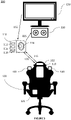
- the chair system 100 includes a main unit 110 and an untethered chair 120.
- a wireless transmitter 112, a subwoofer 114, an audio stream receiver 116 and a processor 118 can be integrated in the main unit.
- the untethered chair 120 can include a power source 121, a wireless receiver 122 for receiving a processed audio stream from the wireless transmitter 112 on the main unit 110 via a wireless connection 125, and a plurality of speakers (130, 140).
- the audio stream receiver 116 can receive an audio stream from an external audio source 150 via a wired or wireless connection 155.
- the received audio stream is processed by the processor 118 to obtain a low frequency portion and a high frequency portion.
- the high frequency portion may be processed to include 3D surround audio, using spatial audio technology such as but not limited to binaural processing using generic head-related transfer functions (HRTFs) and/or binaural room impulse response (BRIR).
- HRTFs generic head-related transfer functions
- BRIR binaural room impulse response
- the high frequency portion is sent via the wireless connection 125 to the wireless receiver 122 on the untethered chair 120 as a processed audio stream.
- the received audio stream can be sent via the wireless connection 125 with the necessary processing done by another processor on the untethered chair 120.
- the high frequency portion is played on the plurality of speakers (130, 140) on the untethered chair, while the low frequency portion of the audio stream is played on the subwoofer 114.
- the subwoofer can be integrally coupled to the main unit 110 (as shown). An appropriate delay can be added to the low frequency portion to ensure audio synchronization between the high frequency portion played at the plurality of speakers (130, 140) at the untethered chair 120, and the low frequency portion played at the main unit 110.
- the subwoofer 114 can be coupled to the main unit 110 via a wired or wireless connection (not shown).
- the high frequency portion can be the portion of the audio stream that has audio frequencies above a threshold frequency (e.g.
- the low frequency portion can be the portion of the audio stream that has audio frequencies at or below the threshold frequency.
- the power requirements for the untethered chair is reduced because the low frequency components (at or below the threshold frequency) of the audio stream do not need to be reproduced by the plurality of speakers (130, 140) on the untethered chair 120.
- the audio frequencies of the full human vocal range for intelligibility can also be considered while selecting a suitable threshold frequency, especially in the embodiments without frontal speakers. For example, the frequency range between 250 Hz and 4kHz is of high importance for intelligibility.
- the untethered chair does not have to be constantly plugged into a wall socket, but can use a power source 121 such as a user-removable battery, a power bank, or the like.
- a power source 121 such as a user-removable battery, a power bank, or the like.
- the untethered chair can be moved or rolled around without the risk of rolling over and damaging any connected wires, or having the risk of a person tripping over any wires connected to the chair.
- the main unit 110 can be placed near to a power socket, and plugged directly through a wired connection to the power socket for power.
- the main unit 110 can be placed near to an external audio source 150.
- the audio stream receiver 116 can receive audio from the external audio source 150 via a wired, or wireless connection 155.
- FIG. 2 a system diagram 200 of an untethered chair 120 in accordance with various embodiments is shown.
- the plurality of speakers (130, 140) is mounted in a position besides or close to the position of the user's ears, at least one on each side of the user.
- the plurality of speakers (130, 140), power source (121) and wireless receiver (122) are separate, they can also be designed as a single module, with the power source 121 and wireless receiver 122 integrated into the single module along with the plurality of speakers (130, 140). In this case, the whole module can be removably coupled to the untethered chair while in use, and removed for charging. Interconnection of the plurality of speakers (130, 140), power source (121) and wireless receiver (122) is preferably wired, so that latency is reduced.
- the chair system 300 includes a main unit 110, an untethered chair 120, and a plurality of frontal speaker 320.
- a wireless transmitter 112, a subwoofer 114, an audio stream receiver 116, and a processor 118 can be integrated in the main unit.
- the untethered chair 120 can include a power source 121, a wireless receiver 122 for receiving a processed audio stream from the wireless transmitter 112 on the main unit 110 via a wireless connection 125, a plurality of speakers (130, 140), and a posture sensor module 310.
- the posture sensor module 310 includes at least one posture sensor, and a posture transmitter.
- the audio stream receiver 116 in the main unit 110 can receive an audio stream from an external audio source 150 via a wired or wireless connection 155.
- the posture sensor module 310 on the untethered chair 120 detects and sends a position of a user on the untethered chair 120 to the processor 118 at the main unit 110 with the posture transmitter via a wireless connection 315.
- the received audio stream 155 is processed by the processor 118 to obtain a low frequency portion, a high frequency portion and a frontal portion.
- the high frequency portion and/or the frontal portion may be processed to include 3D surround audio, using spatial audio technology such as but not limited to binaural processing using generic head-related transfer functions (HRTFs) and/or binaural room impulse response (BRIR).
- HRTFs generic head-related transfer functions
- BRIR binaural room impulse response
- the frontal portion is sent via a wired or wireless connection 325 to the plurality of frontal speaker 320 to be played.
- the high frequency portion is processed according to the position of the user, and is sent to the wireless receiver 122 on the untethered chair 120 as a processed audio stream via wireless connection 125.
- the plurality of speakers (130, 140) on the chair can be considered as left speaker and right speaker respectively, and the high frequency portion is processed accordingly.
- the plurality of speakers (130, 140) on the chair can be considered as rear-left speaker and rear-right speaker respectively, and the high frequency portion processed accordingly.
- Another possible position of the user is leaning on the backrest of the chair, but user's head is not leaning on the headrest.
- the plurality of speakers (130, 140) can, for example, be considered as in a position between the left and rear-left, and between the right and the rear-right respectively, and the high frequency portion processed accordingly.
- the position of the user may be detected in real-time, and the high frequency portion processed accordingly in real-time as well.
- the high frequency portion is played on the plurality of speakers (130, 140) on the untethered chair, while the low frequency portion of the audio stream is played on the subwoofer 114.
- the received audio stream can be sent via the wireless connection 125 with the necessary processing done by another processor on the untethered chair 120.
- the subwoofer can be integrally coupled to the main unit 110 (as shown). An appropriate delay can be added to the low frequency portion, the frontal portion and/or the high frequency portion to ensure audio synchronization between the high frequency portion played at the plurality of speakers (130, 140) at the untethered chair 120, the frontal portion played at the plurality of frontal speaker 320, and the low frequency portion played at the main unit 110.
- the subwoofer 114 can be coupled to the main unit 110 via a wired or wireless connection (not shown).
- the high frequency portion can be the portion of the audio stream that has audio frequencies above a threshold frequency (e.g. preferably around 200 to 500 Hz and more preferably around 300 Hz), and the low frequency portion can be the portion of the audio stream that has audio frequencies at or below the threshold frequency.
- the frontal portion can have a broad frequency range (e.g. from 50 Hz to 20 kHz) which overlaps with the high frequency portion, and/or the low frequency portion.
- the power requirements for the untethered chair is reduced because the low frequency components (at or below the threshold frequency) of the audio stream do not need to be reproduced by the plurality of speakers (130, 140) on the untethered chair 120.
- the audio frequencies of the full human vocal range can also be considered while selecting a suitable threshold frequency, especially in the embodiments without frontal speakers.
- the untethered chair does not have to be constantly plugged into a wall socket, but can use a power source 121 such as a user-removable battery, a power bank, or the like.
- the untethered chair can be moved or rolled around without the risk of rolling over and damaging any connected wires, or having the risk of a person tripping over any wires connected to the chair.
- the main unit 110 can be placed near to a power socket, and plugged directly through a wired connection to the power socket for power.
- the main unit 110 can be placed near to an external audio source 150, and/or the plurality of frontal speakers 320.
- most of the audio processing is carried out by the processor 118 on the main unit 110, further reducing the power consumption of the untethered chair 120.
- the audio stream receiver 116 can receive audio from the external audio source 150 via a wired, or wireless connection 155.
- a system diagram 400 of an untethered chair 120 in accordance with various embodiments is shown.
- the plurality of speakers (130, 140) is mounted in a position besides or close to the position of the user's ears, one on each side.
- the plurality of speakers (130, 140), power source (121) and wireless receiver (122) are separate, they can also be designed as a single module, with the power source 121 and wireless receiver 122 integrated into the single module.
- the whole module can be removably coupled to the untethered chair while in use, and removed for charging when needed.
- a posture sensor module 310 can also be integrated in the untethered chair 120.
- the posture sensor module may have at least one posture sensor and a posture transmitter. Although the posture transmitter and the wireless receiver 122 are shown to be separate, the posture transmitter and the wireless receiver 122 may be combined in a single transceiver, instead of being two separate components.
- Sensor module 310 can be powered by power source 121.
- the at least one posture sensor can be located at or near the headrest and/or at or near the backrest of the untethered chair, the at least one posture sensor positioned to detect a position of the user, in particular the position of the head, shoulder and/or back of the user on the chair.
- the main unit 110 may have a receiving means such as but not limited to a card reader, a data entry interface, a transceiver, an Internet connection or USB port for receiving a set of personalization data of the user.
- the set of personalization data may include the user's HRTF, for example, a personalized HRTF or a generalized representation of the user's HRTF determined through best-match basis to a general grouping of HRTFs, and/or the user's anthropometric measurements or approximation of his ear(s) and upper torso.
- the received audio stream is processed by processor 118 in the main unit 110 to generate the high frequency portion and/or frontal portion with 3D surround audio based on the personalization data of the user.
- the receiving means can be located on the untethered chair, and the received audio stream processed by a processor that is located on the untethered chair.
- the spatial effect of the high frequency portion and/or frontal portion is made even more realistic, further enhancing the user's experience when using the chair system.
- the chair system can process audio and generate personalized HRTF using any suitable technique.
- the techniques as disclosed in US Application No. 16/853676 , US Patent No. 10225682 , and US Patent No. 10390171 which are hereby incorporated by reference, can be used.
- the personalization data may also include audio characteristics of the plurality of speakers (130, 140) on the untethered chair and/or the plurality of frontal speaker 320, and the processing of high frequency portion and/or frontal portion with 3D surround audio further improved, for example, by processing based on applying a suitable equalizer setting based on the audio characteristics of the plurality of speakers (130, 140) and/or the plurality of frontal speaker 320.
- the audio effect of the high frequency portion and/or frontal portion is further improved, further enhancing the user's experience when using the chair.
- a flow diagram 500 depicting a method of processing audio for a chair system in accordance with various embodiments is shown.
- a chair system including a main unit and an untethered chair is provided.
- An audio stream is received in step 510, and the audio stream is processed to obtain a low frequency portion and a high frequency portion in step 520.
- the processor can be located in the main unit, or in the untethered chair.
- the processor is preferably located in the main unit to reduce the power consumption of the untethered chair, especially if complex audio processing is to be carried out.
- the low frequency portion can, for example, be the portion of the audio stream that has audio frequencies at and below a threshold frequency (e.g.
- a processor checks if personalization data has been received via a receiving means such as but not limited to a card reader, a data entry interface, a transceiver, an Internet connection or USB port for receiving a set of personalization data of the user. When the check indicates that no personalization data has been received, the processor will load a set of generic data. On the other hand, when personalization data has been received, the processor will load the personalized data.
- a receiving means such as but not limited to a card reader, a data entry interface, a transceiver, an Internet connection or USB port for receiving a set of personalization data of the user.
- the processor will load a set of generic data.
- the processor will load the personalized data.
- the personalization data may include the user's HRTF, for example, a personalized HRTF or a generalized representation of the user's HRTF determined through best-match basis to a general grouping of HRTFs, and/or the user's anthropometric measurements or approximation of his ear(s) and upper torso.
- the personalization data may alternatively or in combination also include characteristics of the plurality of speakers on the untethered chair, and the processing of high frequency portion with 3D surround audio further improved, for example, by processing based on applying a suitable equalizer setting based on the characteristics of the plurality of speakers.
- the audio effect of the high frequency portion is further improved, further enhancing the user's experience when using the chair.
- the received audio stream is processed by the processor to obtain the high frequency portion.
- the user's experience when playing the game is enhanced by heightening his listening experience through realistic 3D surround audio.
- the spatial effect of the high frequency portion is made even more realistic, further enhancing the user's experience when playing the game.
- the chair system can process audio and generate personalized HRTF using any suitable technique. For example, the techniques as disclosed in US Application No. 16/853676 , US Patent No. 10225682 , and US Patent No. 10390171 , which are hereby incorporated by reference, can be used.
- the high frequency portion is sent to a wireless receiver located at the untethered chair if the processor is located on the main unit.
- the untethered chair plays the high frequency portion with a plurality of speakers coupled with the untethered chair in step 540.
- the plurality of speakers can be removably coupled.
- the low frequency portion is played with a subwoofer.
- the subwoofer can be integrally coupled to the main unit. An appropriate delay can be added to the low frequency portion to ensure audio synchronization between the high frequency portion played at the plurality of speakers at the untethered chair, and the low frequency portion played at the subwoofer.
- the subwoofer can be coupled to the main unit via a wired or wireless connection.
- a flow diagram 600 depicting a method of processing audio for a chair system in accordance with various embodiments is shown.
- a chair system including a main unit, an untethered chair, and a plurality of frontal speaker is provided.
- An audio stream is received in step 610, and a position of a user on the untethered chair is detected by a posture sensor module on the untethered chair in step 620.
- a processor can be located in the main unit, or in the untethered chair.
- the processor is preferably located in the main unit to reduce the power consumption of the untethered chair, especially if complex audio processing is to be carried out.
- step 630 the position of the user on the untethered chair is sent by a posture transmitter to the processor.
- step 640 the audio stream is processed to obtain a low frequency portion, a high frequency portion, and a frontal portion.
- the high frequency portion is processed according to the position of the user. For example, when the position of the user is detected as leaning fully against the chair with user's head leaning on the headrest, the plurality of speakers on the chair can be considered as left speaker and right speaker respectively, and the high frequency portion processed accordingly. However, if the position of the user is detected as leaning forward from the backrest of the chair, the plurality of speakers on the chair can be considered as rear-left speaker and rear-right speaker respectively, and the high frequency portion processed accordingly.
- the plurality of speakers can, for example, be considered as in a position between the left and rear-left, and between the right and the rear-right respectively, and the high frequency portion processed accordingly.
- the position of the user may be detected in real-time, and the high frequency portion processed accordingly in real-time as well.
- the low frequency portion can, for example, be the portion of the audio stream that has audio frequencies at or below a threshold frequency (e.g. preferably around 200 to 500 Hz and more preferably around 300 Hz) while the high frequency portion can, for example, be the portion of the audio stream that has audio frequencies above the threshold frequency.
- a processor checks if personalization data has been received via a receiving means such as but not limited to a card reader, a data entry interface, a transceiver, an Internet connection or USB port for receiving a set of personalization data of the user. When the check indicates that no personalization data has been received, the processor will load a set of generic data. On the other hand, when personalization data has been received, the processor will load the personalized data.
- the personalization data may include the user's HRTF, for example, a personalized HRTF or a generalized representation of the user's HRTF determined through best-match basis to a general grouping of HRTFs, and/or the user's anthropometric measurements or approximation of his ear(s) and upper torso.
- the personalization data may alternatively or in combination also include characteristics of the plurality of speakers on the untethered chair and/or the plurality of frontal speaker, and the processing of high frequency portion and/or frontal portion with 3D surround audio further improved, for example, by processing based on applying a suitable equalizer setting based on the characteristics of the plurality of speakers and/or the plurality of frontal speaker.
- the audio effect of the high frequency portion is further improved, further enhancing the user's experience when using the chair.
- the received audio stream is processed by the processor to obtain the high frequency portion.
- the user's experience when playing the game is enhanced by heightening his listening experience through realistic 3D surround audio.
- the spatial effect of the high frequency portion and/or frontal portion is made even more realistic, further enhancing the user's experience when playing the game.
- the chair system can process audio and generate personalized HRTF using any suitable technique. For example, the techniques as disclosed in US Application No. 16/853676 , US Patent No. 10225682 , and US Patent No. 10390171 , which are hereby incorporated by reference, can be used.
- the frontal portion is sent to the plurality of frontal speaker.
- the high frequency portion is sent to a wireless receiver located at the untethered chair in optional step 660, when the processor is located on the main unit.
- the frontal portion is played with the plurality of frontal speaker in step 670, the high frequency portion is played with the plurality of speakers on the untethered chair in step 680, and the low frequency portion is played with a subwoofer in step 690.
- the subwoofer is integrally coupled to the main unit, or coupled to the main unit via a wired or wireless connection.
- the subwoofer can be coupled to the main unit via a wired or wireless connection.
- An advantage of the present invention is that it provides a way for the untethered chair to be moved freely, and used safely.
- headphones can be provided to work in conjunction with the system described, and could either replace or supplement the plurality of frontal speakers, and/or replace or supplement the plurality of speakers on the untethered chair.
Landscapes
- Physics & Mathematics (AREA)
- Engineering & Computer Science (AREA)
- Acoustics & Sound (AREA)
- Signal Processing (AREA)
- Chair Legs, Seat Parts, And Backrests (AREA)
- Circuit For Audible Band Transducer (AREA)
- Stereophonic System (AREA)
- Details Of Audible-Bandwidth Transducers (AREA)
Abstract
Description
- The present invention generally relates to a chair system, and more particularly relates to a chair system with an untethered chair with speakers.
- A typical chair with speakers comprises two full-range speakers mounted below the headrest, next to or slightly behind the user's ears, with an optional sub-woofer mounted underneath the seat cushion at the base of the chair. The chair is typically connected to a power source and/or an external audio source through a wired interface. However, due to the desired flexibility in movement of the chair, having the wired connection is not ideal as the castor wheels of the chair may roll over and damage the wires, or a person may trip over the wire connected to the chair.
- Thus, it can be seen that what is needed is a chair system with an untethered chair with speakers which is able to move freely, and be used safely. Furthermore, other desirable features and characteristics will become apparent from the subsequent detailed description and the appended claims, taken in conjunction with the accompanying drawings and this background of the disclosure.
- In one aspect of the invention, a chair system including a main unit and an untethered chair is provided. The main unit includes a wireless transmitter, a subwoofer, an audio stream receiver and a processor. The untethered chair includes a plurality of speakers, a power source and a wireless receiver for receiving a processed audio stream from the main unit.
- In another aspect of the invention, a method of processing audio for a chair system having a main unit and an untethered chair is provided. The method includes receiving an audio stream at the main unit, processing the audio stream with a processor at the main unit to obtain a low frequency portion and a high frequency portion, sending the high frequency portion to a wireless receiver located at the untethered chair, playing the high frequency portion with a plurality of speakers located at the untethered chair, and playing the low frequency portion with a subwoofer.
-
-
FIG. 1 is a system diagram of a chair system in accordance with various embodiments. -
FIG. 2 is a system diagram of an untethered chair in accordance with various embodiments. -
FIG. 3 is a system diagram of a chair system in accordance with various embodiments. -
FIG. 4 is a system diagram of an untethered chair in accordance with various embodiments. -
FIG. 5 is a flow diagram depicting a method of processing audio for a chair system in accordance with various embodiments. -
FIG. 6 is a flow diagram depicting a method of processing audio for a chair system in accordance with various embodiments. - The following detailed description is merely exemplary in nature and is not intended to limit the invention or the application and uses of the invention. Furthermore, there is no intention to be bound by any theory presented in the preceding background of the invention or the following detailed description. It is an intent of the various embodiments to present a chair system with an untethered chair with speakers that can be moved freely, and used safely.
- Referring to
FIG. 1 , a system diagram of achair system 100 in accordance with various embodiments is shown. Thechair system 100 includes amain unit 110 and anuntethered chair 120. Awireless transmitter 112, asubwoofer 114, anaudio stream receiver 116 and aprocessor 118 can be integrated in the main unit. Theuntethered chair 120 can include apower source 121, awireless receiver 122 for receiving a processed audio stream from thewireless transmitter 112 on themain unit 110 via awireless connection 125, and a plurality of speakers (130, 140). Theaudio stream receiver 116 can receive an audio stream from anexternal audio source 150 via a wired orwireless connection 155. In one embodiment, the received audio stream is processed by theprocessor 118 to obtain a low frequency portion and a high frequency portion. The high frequency portion may be processed to include 3D surround audio, using spatial audio technology such as but not limited to binaural processing using generic head-related transfer functions (HRTFs) and/or binaural room impulse response (BRIR). The high frequency portion is sent via thewireless connection 125 to thewireless receiver 122 on theuntethered chair 120 as a processed audio stream. Alternatively, the received audio stream can be sent via thewireless connection 125 with the necessary processing done by another processor on theuntethered chair 120. The high frequency portion is played on the plurality of speakers (130, 140) on the untethered chair, while the low frequency portion of the audio stream is played on thesubwoofer 114. In one embodiment, the subwoofer can be integrally coupled to the main unit 110 (as shown). An appropriate delay can be added to the low frequency portion to ensure audio synchronization between the high frequency portion played at the plurality of speakers (130, 140) at theuntethered chair 120, and the low frequency portion played at themain unit 110. In another embodiment, thesubwoofer 114 can be coupled to themain unit 110 via a wired or wireless connection (not shown). In one embodiment, the high frequency portion can be the portion of the audio stream that has audio frequencies above a threshold frequency (e.g. preferably around 200 to 500 Hz and more preferably around 300 Hz), and the low frequency portion can be the portion of the audio stream that has audio frequencies at or below the threshold frequency. Advantageously, the power requirements for the untethered chair is reduced because the low frequency components (at or below the threshold frequency) of the audio stream do not need to be reproduced by the plurality of speakers (130, 140) on theuntethered chair 120. The audio frequencies of the full human vocal range for intelligibility can also be considered while selecting a suitable threshold frequency, especially in the embodiments without frontal speakers. For example, the frequency range between 250 Hz and 4kHz is of high importance for intelligibility. With the reduced power consumption, the untethered chair does not have to be constantly plugged into a wall socket, but can use apower source 121 such as a user-removable battery, a power bank, or the like. Advantageously, the untethered chair can be moved or rolled around without the risk of rolling over and damaging any connected wires, or having the risk of a person tripping over any wires connected to the chair. Themain unit 110 can be placed near to a power socket, and plugged directly through a wired connection to the power socket for power. Themain unit 110 can be placed near to anexternal audio source 150. In a preferred embodiment, most of the audio processing is carried out by theprocessor 118 on themain unit 110, further reducing the power consumption of theuntethered chair 120. Theaudio stream receiver 116 can receive audio from theexternal audio source 150 via a wired, orwireless connection 155. - Referring to
Fig. 2 , a system diagram 200 of anuntethered chair 120 in accordance with various embodiments is shown. The plurality of speakers (130, 140) is mounted in a position besides or close to the position of the user's ears, at least one on each side of the user. Even though the figure shows that the plurality of speakers (130, 140), power source (121) and wireless receiver (122) are separate, they can also be designed as a single module, with thepower source 121 andwireless receiver 122 integrated into the single module along with the plurality of speakers (130, 140). In this case, the whole module can be removably coupled to the untethered chair while in use, and removed for charging. Interconnection of the plurality of speakers (130, 140), power source (121) and wireless receiver (122) is preferably wired, so that latency is reduced. - Referring to
FIG. 3 , a system diagram of achair system 300 in accordance with various embodiments is shown. Thechair system 300 includes amain unit 110, anuntethered chair 120, and a plurality offrontal speaker 320. Awireless transmitter 112, asubwoofer 114, anaudio stream receiver 116, and aprocessor 118 can be integrated in the main unit. Theuntethered chair 120 can include apower source 121, awireless receiver 122 for receiving a processed audio stream from thewireless transmitter 112 on themain unit 110 via awireless connection 125, a plurality of speakers (130, 140), and aposture sensor module 310. Theposture sensor module 310 includes at least one posture sensor, and a posture transmitter. Theaudio stream receiver 116 in themain unit 110 can receive an audio stream from anexternal audio source 150 via a wired orwireless connection 155. Theposture sensor module 310 on theuntethered chair 120 detects and sends a position of a user on theuntethered chair 120 to theprocessor 118 at themain unit 110 with the posture transmitter via awireless connection 315. In one embodiment, the receivedaudio stream 155 is processed by theprocessor 118 to obtain a low frequency portion, a high frequency portion and a frontal portion. The high frequency portion and/or the frontal portion may be processed to include 3D surround audio, using spatial audio technology such as but not limited to binaural processing using generic head-related transfer functions (HRTFs) and/or binaural room impulse response (BRIR). The frontal portion is sent via a wired orwireless connection 325 to the plurality offrontal speaker 320 to be played. The high frequency portion is processed according to the position of the user, and is sent to thewireless receiver 122 on theuntethered chair 120 as a processed audio stream viawireless connection 125. For example, when the position of the user is detected as leaning fully against the backrest of the chair with user's head leaning on the headrest, the plurality of speakers (130, 140) on the chair can be considered as left speaker and right speaker respectively, and the high frequency portion is processed accordingly. However, if the position of the user is detected as leaning forward from the backrest of the chair, the plurality of speakers (130, 140) on the chair can be considered as rear-left speaker and rear-right speaker respectively, and the high frequency portion processed accordingly. Another possible position of the user is leaning on the backrest of the chair, but user's head is not leaning on the headrest. In this case, the plurality of speakers (130, 140) can, for example, be considered as in a position between the left and rear-left, and between the right and the rear-right respectively, and the high frequency portion processed accordingly. The position of the user may be detected in real-time, and the high frequency portion processed accordingly in real-time as well. The high frequency portion is played on the plurality of speakers (130, 140) on the untethered chair, while the low frequency portion of the audio stream is played on thesubwoofer 114. Alternatively, the received audio stream can be sent via thewireless connection 125 with the necessary processing done by another processor on theuntethered chair 120. In one embodiment, the subwoofer can be integrally coupled to the main unit 110 (as shown). An appropriate delay can be added to the low frequency portion, the frontal portion and/or the high frequency portion to ensure audio synchronization between the high frequency portion played at the plurality of speakers (130, 140) at theuntethered chair 120, the frontal portion played at the plurality offrontal speaker 320, and the low frequency portion played at themain unit 110. In another embodiment, thesubwoofer 114 can be coupled to themain unit 110 via a wired or wireless connection (not shown). In one embodiment, the high frequency portion can be the portion of the audio stream that has audio frequencies above a threshold frequency (e.g. preferably around 200 to 500 Hz and more preferably around 300 Hz), and the low frequency portion can be the portion of the audio stream that has audio frequencies at or below the threshold frequency. The frontal portion can have a broad frequency range (e.g. from 50 Hz to 20 kHz) which overlaps with the high frequency portion, and/or the low frequency portion. Advantageously, the power requirements for the untethered chair is reduced because the low frequency components (at or below the threshold frequency) of the audio stream do not need to be reproduced by the plurality of speakers (130, 140) on theuntethered chair 120. The audio frequencies of the full human vocal range can also be considered while selecting a suitable threshold frequency, especially in the embodiments without frontal speakers. With the reduced power consumption, the untethered chair does not have to be constantly plugged into a wall socket, but can use apower source 121 such as a user-removable battery, a power bank, or the like. Advantageously, the untethered chair can be moved or rolled around without the risk of rolling over and damaging any connected wires, or having the risk of a person tripping over any wires connected to the chair. Themain unit 110 can be placed near to a power socket, and plugged directly through a wired connection to the power socket for power. Themain unit 110 can be placed near to anexternal audio source 150, and/or the plurality offrontal speakers 320. In a preferred embodiment, most of the audio processing is carried out by theprocessor 118 on themain unit 110, further reducing the power consumption of theuntethered chair 120. Theaudio stream receiver 116 can receive audio from theexternal audio source 150 via a wired, orwireless connection 155. - Referring to
Fig. 4 , a system diagram 400 of anuntethered chair 120 in accordance with various embodiments is shown. The plurality of speakers (130, 140) is mounted in a position besides or close to the position of the user's ears, one on each side. Even though the figure shows that the plurality of speakers (130, 140), power source (121) and wireless receiver (122) are separate, they can also be designed as a single module, with thepower source 121 andwireless receiver 122 integrated into the single module. In this case, the whole module can be removably coupled to the untethered chair while in use, and removed for charging when needed. In one embodiment, aposture sensor module 310 can also be integrated in theuntethered chair 120. The posture sensor module may have at least one posture sensor and a posture transmitter. Although the posture transmitter and thewireless receiver 122 are shown to be separate, the posture transmitter and thewireless receiver 122 may be combined in a single transceiver, instead of being two separate components.Sensor module 310 can be powered bypower source 121. The at least one posture sensor can be located at or near the headrest and/or at or near the backrest of the untethered chair, the at least one posture sensor positioned to detect a position of the user, in particular the position of the head, shoulder and/or back of the user on the chair. - In one embodiment, the
main unit 110 may have a receiving means such as but not limited to a card reader, a data entry interface, a transceiver, an Internet connection or USB port for receiving a set of personalization data of the user. The set of personalization data may include the user's HRTF, for example, a personalized HRTF or a generalized representation of the user's HRTF determined through best-match basis to a general grouping of HRTFs, and/or the user's anthropometric measurements or approximation of his ear(s) and upper torso. The received audio stream is processed byprocessor 118 in themain unit 110 to generate the high frequency portion and/or frontal portion with 3D surround audio based on the personalization data of the user. Alternatively, the receiving means can be located on the untethered chair, and the received audio stream processed by a processor that is located on the untethered chair. Advantageously, by processing the audio stream based on the personalization data of the user, the spatial effect of the high frequency portion and/or frontal portion is made even more realistic, further enhancing the user's experience when using the chair system. The chair system can process audio and generate personalized HRTF using any suitable technique. For example, the techniques as disclosed inUS Application No. 16/853676 US Patent No. 10225682 US Patent No. 10390171 frontal speaker 320, and the processing of high frequency portion and/or frontal portion with 3D surround audio further improved, for example, by processing based on applying a suitable equalizer setting based on the audio characteristics of the plurality of speakers (130, 140) and/or the plurality offrontal speaker 320. Advantageously, by processing the audio stream based on the audio characteristics of the plurality of speakers (130, 140) and/or the plurality offrontal speaker 320, the audio effect of the high frequency portion and/or frontal portion is further improved, further enhancing the user's experience when using the chair. - Referring to
FIG. 5 , a flow diagram 500 depicting a method of processing audio for a chair system in accordance with various embodiments is shown. A chair system including a main unit and an untethered chair is provided. An audio stream is received instep 510, and the audio stream is processed to obtain a low frequency portion and a high frequency portion instep 520. The processor can be located in the main unit, or in the untethered chair. The processor is preferably located in the main unit to reduce the power consumption of the untethered chair, especially if complex audio processing is to be carried out. In one embodiment, the low frequency portion can, for example, be the portion of the audio stream that has audio frequencies at and below a threshold frequency (e.g. preferably around 200 to 500 Hz and more preferably around 300 Hz) while the high frequency portion can, for example, be the portion of the audio stream that has audio frequencies above the threshold frequency. In one embodiment, a processor checks if personalization data has been received via a receiving means such as but not limited to a card reader, a data entry interface, a transceiver, an Internet connection or USB port for receiving a set of personalization data of the user. When the check indicates that no personalization data has been received, the processor will load a set of generic data. On the other hand, when personalization data has been received, the processor will load the personalized data. The personalization data may include the user's HRTF, for example, a personalized HRTF or a generalized representation of the user's HRTF determined through best-match basis to a general grouping of HRTFs, and/or the user's anthropometric measurements or approximation of his ear(s) and upper torso. The personalization data may alternatively or in combination also include characteristics of the plurality of speakers on the untethered chair, and the processing of high frequency portion with 3D surround audio further improved, for example, by processing based on applying a suitable equalizer setting based on the characteristics of the plurality of speakers. Advantageously, by processing the audio stream based on the characteristics of the plurality of speakers, the audio effect of the high frequency portion is further improved, further enhancing the user's experience when using the chair. The received audio stream is processed by the processor to obtain the high frequency portion. Advantageously, by processing the audio using spatial audio technology, the user's experience when playing the game is enhanced by heightening his listening experience through realistic 3D surround audio. More advantageously, by processing the audio based on the personalization data of the user, the spatial effect of the high frequency portion is made even more realistic, further enhancing the user's experience when playing the game. The chair system can process audio and generate personalized HRTF using any suitable technique. For example, the techniques as disclosed inUS Application No. 16/853676 US Patent No. 10225682 US Patent No. 10390171 - In
optional step 530, the high frequency portion is sent to a wireless receiver located at the untethered chair if the processor is located on the main unit. The untethered chair plays the high frequency portion with a plurality of speakers coupled with the untethered chair instep 540. In one embodiment, the plurality of speakers can be removably coupled. Instep 550, the low frequency portion is played with a subwoofer. In one embodiment, the subwoofer can be integrally coupled to the main unit. An appropriate delay can be added to the low frequency portion to ensure audio synchronization between the high frequency portion played at the plurality of speakers at the untethered chair, and the low frequency portion played at the subwoofer. In another embodiment, the subwoofer can be coupled to the main unit via a wired or wireless connection. - Referring to
FIG. 6 , a flow diagram 600 depicting a method of processing audio for a chair system in accordance with various embodiments is shown. A chair system including a main unit, an untethered chair, and a plurality of frontal speaker is provided. An audio stream is received instep 610, and a position of a user on the untethered chair is detected by a posture sensor module on the untethered chair instep 620. A processor can be located in the main unit, or in the untethered chair. The processor is preferably located in the main unit to reduce the power consumption of the untethered chair, especially if complex audio processing is to be carried out. Instep 630, the position of the user on the untethered chair is sent by a posture transmitter to the processor. Instep 640, the audio stream is processed to obtain a low frequency portion, a high frequency portion, and a frontal portion. The high frequency portion is processed according to the position of the user. For example, when the position of the user is detected as leaning fully against the chair with user's head leaning on the headrest, the plurality of speakers on the chair can be considered as left speaker and right speaker respectively, and the high frequency portion processed accordingly. However, if the position of the user is detected as leaning forward from the backrest of the chair, the plurality of speakers on the chair can be considered as rear-left speaker and rear-right speaker respectively, and the high frequency portion processed accordingly. Another possible position of the user is the user leaning on the backrest of the chair, but the user's head is not leaning on the headrest. In this case, the plurality of speakers can, for example, be considered as in a position between the left and rear-left, and between the right and the rear-right respectively, and the high frequency portion processed accordingly. The position of the user may be detected in real-time, and the high frequency portion processed accordingly in real-time as well. In one embodiment, the low frequency portion can, for example, be the portion of the audio stream that has audio frequencies at or below a threshold frequency (e.g. preferably around 200 to 500 Hz and more preferably around 300 Hz) while the high frequency portion can, for example, be the portion of the audio stream that has audio frequencies above the threshold frequency. - In one embodiment, a processor checks if personalization data has been received via a receiving means such as but not limited to a card reader, a data entry interface, a transceiver, an Internet connection or USB port for receiving a set of personalization data of the user. When the check indicates that no personalization data has been received, the processor will load a set of generic data. On the other hand, when personalization data has been received, the processor will load the personalized data. The personalization data may include the user's HRTF, for example, a personalized HRTF or a generalized representation of the user's HRTF determined through best-match basis to a general grouping of HRTFs, and/or the user's anthropometric measurements or approximation of his ear(s) and upper torso. The personalization data may alternatively or in combination also include characteristics of the plurality of speakers on the untethered chair and/or the plurality of frontal speaker, and the processing of high frequency portion and/or frontal portion with 3D surround audio further improved, for example, by processing based on applying a suitable equalizer setting based on the characteristics of the plurality of speakers and/or the plurality of frontal speaker. Advantageously, by processing the audio stream based on the characteristics of the plurality of speakers and/or the plurality of frontal speaker, the audio effect of the high frequency portion is further improved, further enhancing the user's experience when using the chair. The received audio stream is processed by the processor to obtain the high frequency portion. Advantageously, by processing the audio using spatial audio technology, the user's experience when playing the game is enhanced by heightening his listening experience through realistic 3D surround audio. More advantageously, by processing the audio based on the personalization data of the user, the spatial effect of the high frequency portion and/or frontal portion is made even more realistic, further enhancing the user's experience when playing the game. The chair system can process audio and generate personalized HRTF using any suitable technique. For example, the techniques as disclosed in
US Application No. 16/853676 US Patent No. 10225682 US Patent No. 10390171 - In
step 650, the frontal portion is sent to the plurality of frontal speaker. The high frequency portion is sent to a wireless receiver located at the untethered chair inoptional step 660, when the processor is located on the main unit. The frontal portion is played with the plurality of frontal speaker instep 670, the high frequency portion is played with the plurality of speakers on the untethered chair instep 680, and the low frequency portion is played with a subwoofer instep 690. The subwoofer is integrally coupled to the main unit, or coupled to the main unit via a wired or wireless connection. An appropriate delay can be added to the high frequency portion, the frontal portion and/or the low frequency portion to ensure audio synchronization between the high frequency portion played at the plurality of speakers at the untethered chair, the frontal portion played at the plurality of frontal speaker, and the low frequency portion. In another embodiment, the subwoofer can be coupled to the main unit via a wired or wireless connection. - Although the steps in the flow diagrams are given sequentially, it should be appreciated that some of the steps can be performed concurrently, or in a different sequence. The steps described may be implemented in hardware, software, firmware, or any combination thereof.
- Thus, it can be seen that a chair system with an untethered chair with speakers has been provided. An advantage of the present invention is that it provides a way for the untethered chair to be moved freely, and used safely.
- While exemplary embodiments have been presented in the foregoing detailed description of the present embodiments, it should be appreciated that a vast number of variations exists. It should further be appreciated that the exemplary embodiments are only examples, and are not intended to limit the scope, applicability, operation, or configuration of the invention in any way. Rather, the foregoing detailed description will provide those skilled in the art with a convenient road map for implementing exemplary embodiments of the invention, it being understood that various changes may be made in the function and arrangement of steps and method of operation described in the exemplary embodiments without departing from the scope of the invention as set forth in the appended claims. For example, headphones can be provided to work in conjunction with the system described, and could either replace or supplement the plurality of frontal speakers, and/or replace or supplement the plurality of speakers on the untethered chair.
Claims (15)
- A chair system comprising:a main unit comprisinga wireless transmitter,a subwoofer,an audio stream receiver, anda processor; andan untethered chair comprisinga plurality of speakers,a power source, anda wireless receiver for receiving a processed audio stream from the main unit.
- The chair system of claim 1, wherein the main unit receives an audio stream with the audio stream receiver, processes the audio stream with the processor at the main unit to obtain a low frequency portion with audio frequencies at or below a threshold frequency and a high frequency portion with audio frequencies above the threshold frequency, sends the high frequency portion to the wireless receiver for playing the high frequency portion with the plurality of speakers, and plays the low frequency portion with the subwoofer.
- The chair system of claim 2, further comprising:
a plurality of frontal speakers,wherein the untethered chair further comprises a posture sensor module with at least one posture sensor and a posture transmitter, andwherein the posture sensor module detects and sends a position of a user on the untethered chair to the processor, andwherein the processor processes the high frequency potion according to the position of the user, andwherein the processor processes the audio stream to obtain a frontal portion, and sends the frontal portion to the untethered chair for playing at the plurality of frontal speakers. - The chair system of claim 3, further comprising:a receiving means to receive a set of personalization data of the user,wherein the audio stream is processed according to the set of personalization data, and wherein optionally the audio stream is processed according to audio characteristics of the plurality of speakers on the untethered chair.
- The chair system of claim 2, 3 or 4, wherein an appropriate delay is added to the low frequency portion and/or the high frequency portion to ensure audio synchronization between the low frequency portion and the high frequency portion.
- The chair system of claim 3 or 4, wherein an appropriate delay is added to the low frequency portion, the high frequency portion and/or the frontal portion to ensure audio synchronization between the low frequency portion, and the high frequency and the frontal portion.
- The chair system of any one preceding claim, wherein the power source is a user-removable battery, and/or wherein the audio stream receiver has a wired or wireless connection to an external audio source.
- The chair system of any one preceding claim, wherein the subwoofer is integrally coupled to the main unit, or wherein the subwoofer is coupled wired or wirelessly to the main unit.
- A method of processing audio for a chair system having a main unit and an untethered chair, the method comprising:receiving an audio stream with an audio stream receiver;processing the audio stream with a processor to obtain a low frequency portion with audio frequencies at or below a threshold frequency and a high frequency portion with audio frequencies above the threshold frequency;playing the high frequency portion with a plurality of speakers on the untethered chair; andplaying the low frequency portion with a subwoofer coupled to the main unit.
- The method of claim 9, wherein the step of playing the low frequency portion and/or the step of playing the high frequency portion further comprise adding an appropriate delay to ensure audio synchronization between the low frequency portion and the high frequency portion.
- The method of claim 9 or 10, further comprising the steps of:providing a plurality of frontal speakers;detecting a position of a user on the untethered chair with a posture sensor module having at least one posture sensor and a posture transmitter, and sending the position of the user to the processor;processing the high frequency portion according to the position of the user;processing the audio stream with the processor to obtain a frontal portion, and sending the frontal portion to the plurality of frontal speakers; andplaying the frontal portion with the plurality of frontal speakers.
- The method of claim 11, further comprising the step of adding an appropriate delay to the low frequency portion, the high frequency portion and/or the frontal portion to ensure audio synchronization between the low frequency portion, the high frequency and the frontal portion.
- The method of claims 12, further comprising the steps of:receiving a set of personalization data of the user with a receiving means;processing the audio stream according to the set of personalization data; andoptionally processing the audio stream according to audio characteristics of the plurality of speakers on the untethered chair.
- The method of any one of claims 9 to 13, wherein the audio stream receiver has a wired or wireless connection to an external audio source.
- The method of any one of claims 9 to 14, wherein the subwoofer is integrally coupled to the main unit, or wherein the subwoofer is coupled wired or wirelessly to the main unit.
Applications Claiming Priority (1)
| Application Number | Priority Date | Filing Date | Title |
|---|---|---|---|
| US17/135,373 US11641945B2 (en) | 2020-12-28 | 2020-12-28 | Chair system with an untethered chair with speakers |
Publications (2)
| Publication Number | Publication Date |
|---|---|
| EP4021007A1 true EP4021007A1 (en) | 2022-06-29 |
| EP4021007B1 EP4021007B1 (en) | 2026-02-25 |
Family
ID=78829673
Family Applications (1)
| Application Number | Title | Priority Date | Filing Date |
|---|---|---|---|
| EP21213540.4A Active EP4021007B1 (en) | 2020-12-28 | 2021-12-09 | Chair system with an untethered chair with speakers |
Country Status (2)
| Country | Link |
|---|---|
| US (2) | US11641945B2 (en) |
| EP (1) | EP4021007B1 (en) |
Families Citing this family (9)
| Publication number | Priority date | Publication date | Assignee | Title |
|---|---|---|---|---|
| KR102359742B1 (en) * | 2020-05-15 | 2022-02-08 | 박재범 | Element for chair comprising multi channel sound system for chair and chair comprising the same |
| US11679337B2 (en) * | 2021-06-04 | 2023-06-20 | Msg Entertainment Group, Llc | Wheelchair accessible seating location within a venue |
| US12242674B2 (en) | 2022-10-28 | 2025-03-04 | Dell Products L.P. | Information handling system keyboard assymetric magnetic charger |
| US12284501B2 (en) * | 2022-10-28 | 2025-04-22 | Dell Products L.P. | Information handling system immersive sound system |
| US12284474B2 (en) | 2022-10-28 | 2025-04-22 | Dell Products L.P. | Information handling system neck speaker and head movement sensor |
| US12332822B2 (en) | 2022-10-28 | 2025-06-17 | Dell Products L.P. | Information handling system high bandwidth GPU hub |
| US12465845B2 (en) | 2022-10-28 | 2025-11-11 | Dell Products L.P. | Information handling system head position detection for commanding an application function |
| US12465850B2 (en) | 2022-10-28 | 2025-11-11 | Dell Products L.P. | Information handling system display grid and head position monitoring to present a boundary tracking highlight |
| US12307057B2 (en) | 2022-10-28 | 2025-05-20 | Dell Products L.P. | Information handling system keyboard with four dimensional control pad |
Citations (5)
| Publication number | Priority date | Publication date | Assignee | Title |
|---|---|---|---|---|
| WO2009076250A1 (en) * | 2007-12-06 | 2009-06-18 | Bodysound Technologies, Inc. | Chair and system for transmitting sound and vibration |
| US20140334637A1 (en) * | 2013-05-07 | 2014-11-13 | Charles Oswald | Signal Processing for a Headrest-Based Audio System |
| EP3419309A1 (en) * | 2017-06-19 | 2018-12-26 | Nokia Technologies Oy | Methods and apparatuses for controlling the audio output of loudspeakers |
| US10225682B1 (en) | 2018-01-05 | 2019-03-05 | Creative Technology Ltd | System and a processing method for customizing audio experience |
| US10390171B2 (en) | 2018-01-07 | 2019-08-20 | Creative Technology Ltd | Method for generating customized spatial audio with head tracking |
Family Cites Families (26)
| Publication number | Priority date | Publication date | Assignee | Title |
|---|---|---|---|---|
| US2838095A (en) * | 1955-12-07 | 1958-06-10 | Charles U Deaton | Posture chairs |
| CA2535082C (en) * | 2000-11-27 | 2013-11-19 | Terry Cassaday | Chair or bed member having data storage |
| CA2399823C (en) * | 2002-08-26 | 2011-01-04 | Terry Cassaday | Chair with onboard electrical power source |
| US8668045B2 (en) * | 2003-03-10 | 2014-03-11 | Daniel E. Cohen | Sound and vibration transmission pad and system |
| US8340313B2 (en) * | 2003-09-24 | 2012-12-25 | Thomson Licensing | Wireless digital transmission of low frequency effects and surround channels for surround sound system |
| US20080111408A1 (en) * | 2004-02-03 | 2008-05-15 | Raymond Jamie Duran | Video Game Chair |
| JP4239026B2 (en) * | 2005-05-13 | 2009-03-18 | ソニー株式会社 | Sound reproduction method and sound reproduction system |
| US20070001494A1 (en) * | 2005-06-29 | 2007-01-04 | Randy Hoover | Method and apparatus for simultaneously simulating an environment while participating in an activity |
| KR20080077083A (en) * | 2005-12-16 | 2008-08-21 | 인프라-콤 엘티디. | Wireless infrared multimedia system |
| CN102577434A (en) * | 2009-04-10 | 2012-07-11 | 伊默兹公司 | Systems and methods for acousto-tactile speakers |
| US8823782B2 (en) * | 2009-12-31 | 2014-09-02 | Broadcom Corporation | Remote control with integrated position, viewer identification and optical and audio test |
| US9277296B2 (en) * | 2010-04-08 | 2016-03-01 | Terry Cassaday | Keyboard video device |
| US20120223555A1 (en) * | 2011-03-04 | 2012-09-06 | Brown Jr Robert | Catbird seat apparatus |
| US9084058B2 (en) * | 2011-12-29 | 2015-07-14 | Sonos, Inc. | Sound field calibration using listener localization |
| US20130270880A1 (en) * | 2012-04-12 | 2013-10-17 | Steve Lee | Vibrating pillow |
| US9022468B2 (en) * | 2012-05-23 | 2015-05-05 | Cherif Atia Algreatly | Interactive sitting system |
| US9020623B2 (en) * | 2012-06-19 | 2015-04-28 | Sonos, Inc | Methods and apparatus to provide an infrared signal |
| US8845016B2 (en) * | 2012-10-25 | 2014-09-30 | Domash Design Source LLC | Visual and/or acoustic privacy features |
| US9510685B2 (en) * | 2014-05-02 | 2016-12-06 | Steelcase Inc. | Office system telepresence arrangement |
| US20160195923A1 (en) * | 2014-12-26 | 2016-07-07 | Krush Technologies, Llc | Gyroscopic chair for virtual reality simulation |
| AU2015374190A1 (en) * | 2014-12-29 | 2017-07-13 | Herman Miller, Inc. | System architecture for office productivity structure communications |
| CN107950036B (en) * | 2015-09-03 | 2020-06-05 | 杜比实验室特许公司 | Audio bar for controlling wireless speakers |
| US11166101B2 (en) * | 2015-09-03 | 2021-11-02 | Dolby Laboratories Licensing Corporation | Audio stick for controlling wireless speakers |
| USD864895S1 (en) * | 2017-09-28 | 2019-10-29 | Lg Electronics Inc. | Speaker |
| USD864894S1 (en) * | 2018-03-19 | 2019-10-29 | Lg Electronics Inc. | Speaker |
| US11582572B2 (en) * | 2020-01-30 | 2023-02-14 | Bose Corporation | Surround sound location virtualization |
-
2020
- 2020-12-28 US US17/135,373 patent/US11641945B2/en active Active
-
2021
- 2021-12-09 EP EP21213540.4A patent/EP4021007B1/en active Active
-
2023
- 2023-03-29 US US18/128,146 patent/US11844441B2/en active Active
Patent Citations (5)
| Publication number | Priority date | Publication date | Assignee | Title |
|---|---|---|---|---|
| WO2009076250A1 (en) * | 2007-12-06 | 2009-06-18 | Bodysound Technologies, Inc. | Chair and system for transmitting sound and vibration |
| US20140334637A1 (en) * | 2013-05-07 | 2014-11-13 | Charles Oswald | Signal Processing for a Headrest-Based Audio System |
| EP3419309A1 (en) * | 2017-06-19 | 2018-12-26 | Nokia Technologies Oy | Methods and apparatuses for controlling the audio output of loudspeakers |
| US10225682B1 (en) | 2018-01-05 | 2019-03-05 | Creative Technology Ltd | System and a processing method for customizing audio experience |
| US10390171B2 (en) | 2018-01-07 | 2019-08-20 | Creative Technology Ltd | Method for generating customized spatial audio with head tracking |
Also Published As
| Publication number | Publication date |
|---|---|
| US11641945B2 (en) | 2023-05-09 |
| US20220202190A1 (en) | 2022-06-30 |
| EP4021007B1 (en) | 2026-02-25 |
| US20230292926A1 (en) | 2023-09-21 |
| US11844441B2 (en) | 2023-12-19 |
Similar Documents
| Publication | Publication Date | Title |
|---|---|---|
| US11844441B2 (en) | Chair system with an untethered chair with speakers | |
| JP5894634B2 (en) | Determination of HRTF for each individual | |
| CN112544089B (en) | Microphone device providing audio with spatial background | |
| CN102694517B (en) | The surround sound of space invariance | |
| EP3258707A1 (en) | Nfmi based synchronization | |
| EP1819192A1 (en) | A headset acoustic device and sound channel reproducing method | |
| JPWO2010084769A1 (en) | Hearing aid | |
| EP2839675A1 (en) | Auto detection of headphone orientation | |
| TW201220861A (en) | Using accelerometers for left right detection of headset earpieces | |
| US11490197B1 (en) | Personal audio entertainment system | |
| EP4097993B1 (en) | Surround sound location virtualization | |
| CN104735599A (en) | Hearing devices with selectable perceptual spatial localization of sound sources | |
| JP2023548324A (en) | Systems and methods for providing enhanced audio | |
| US20210204084A1 (en) | Out-of-head localization system, filter generation device, method, and program | |
| EP3442241A1 (en) | An acoustic device | |
| TWI815290B (en) | Method and host for adjusting audio of speakers, and computer readable medium | |
| HK40069220A (en) | Chair system with an untethered chair with speakers | |
| CN114697816A (en) | Chair system having an unbounded chair with speakers | |
| KR102613035B1 (en) | Earphone with sound correction function and recording method using it | |
| CN114828792B (en) | Coordinated binaural sound compression | |
| CN109068243A (en) | A kind of 3D virtual three-dimensional sound sense of hearing auxiliary system and 3D virtual three-dimensional sound earphone | |
| WO2018000449A1 (en) | Multifunctional chair | |
| JP7188545B2 (en) | Out-of-head localization system and out-of-head localization method | |
| JP3234569U (en) | Personal audio component entertainment system | |
| CN109218876B (en) | Intelligent earphone device personalization system with safety outgoing function and use method |
Legal Events
| Date | Code | Title | Description |
|---|---|---|---|
| PUAI | Public reference made under article 153(3) epc to a published international application that has entered the european phase |
Free format text: ORIGINAL CODE: 0009012 |
|
| STAA | Information on the status of an ep patent application or granted ep patent |
Free format text: STATUS: THE APPLICATION HAS BEEN PUBLISHED |
|
| AK | Designated contracting states |
Kind code of ref document: A1 Designated state(s): AL AT BE BG CH CY CZ DE DK EE ES FI FR GB GR HR HU IE IS IT LI LT LU LV MC MK MT NL NO PL PT RO RS SE SI SK SM TR |
|
| STAA | Information on the status of an ep patent application or granted ep patent |
Free format text: STATUS: REQUEST FOR EXAMINATION WAS MADE |
|
| 17P | Request for examination filed |
Effective date: 20221213 |
|
| RBV | Designated contracting states (corrected) |
Designated state(s): AL AT BE BG CH CY CZ DE DK EE ES FI FR GB GR HR HU IE IS IT LI LT LU LV MC MK MT NL NO PL PT RO RS SE SI SK SM TR |
|
| P01 | Opt-out of the competence of the unified patent court (upc) registered |
Effective date: 20230520 |
|
| STAA | Information on the status of an ep patent application or granted ep patent |
Free format text: STATUS: EXAMINATION IS IN PROGRESS |
|
| 17Q | First examination report despatched |
Effective date: 20240429 |
|
| REG | Reference to a national code |
Ref country code: DE Ref legal event code: R079 Ipc: H04R0005020000 Ref country code: DE Ref legal event code: R079 Ref document number: 602021048594 Country of ref document: DE Free format text: PREVIOUS MAIN CLASS: H04R0001020000 Ipc: H04R0005020000 |
|
| GRAP | Despatch of communication of intention to grant a patent |
Free format text: ORIGINAL CODE: EPIDOSNIGR1 |
|
| STAA | Information on the status of an ep patent application or granted ep patent |
Free format text: STATUS: GRANT OF PATENT IS INTENDED |
|
| RIC1 | Information provided on ipc code assigned before grant |
Ipc: H04R 5/02 20060101AFI20250930BHEP Ipc: H04R 1/02 20060101ALI20250930BHEP Ipc: H04R 5/033 20060101ALI20250930BHEP |
|
| INTG | Intention to grant announced |
Effective date: 20251010 |
|
| GRAS | Grant fee paid |
Free format text: ORIGINAL CODE: EPIDOSNIGR3 |
|
| GRAA | (expected) grant |
Free format text: ORIGINAL CODE: 0009210 |
|
| STAA | Information on the status of an ep patent application or granted ep patent |
Free format text: STATUS: THE PATENT HAS BEEN GRANTED |
|
| AK | Designated contracting states |
Kind code of ref document: B1 Designated state(s): AL AT BE BG CH CY CZ DE DK EE ES FI FR GB GR HR HU IE IS IT LI LT LU LV MC MK MT NL NO PL PT RO RS SE SI SK SM TR |
|
| REG | Reference to a national code |
Ref country code: CH Ref legal event code: F10 Free format text: ST27 STATUS EVENT CODE: U-0-0-F10-F00 (AS PROVIDED BY THE NATIONAL OFFICE) Effective date: 20260225 Ref country code: GB Ref legal event code: FG4D |
|
| REG | Reference to a national code |
Ref country code: DE Ref legal event code: R096 Ref document number: 602021048594 Country of ref document: DE |
|
| REG | Reference to a national code |
Ref country code: IE Ref legal event code: FG4D |
|
| REG | Reference to a national code |
Ref country code: NL Ref legal event code: FP |