EP4019859A1 - Information processing method, information processing device, and program - Google Patents
Information processing method, information processing device, and program Download PDFInfo
- Publication number
- EP4019859A1 EP4019859A1 EP20871377.6A EP20871377A EP4019859A1 EP 4019859 A1 EP4019859 A1 EP 4019859A1 EP 20871377 A EP20871377 A EP 20871377A EP 4019859 A1 EP4019859 A1 EP 4019859A1
- Authority
- EP
- European Patent Office
- Prior art keywords
- information
- power consumption
- air conditioner
- operated
- information processing
- Prior art date
- Legal status (The legal status is an assumption and is not a legal conclusion. Google has not performed a legal analysis and makes no representation as to the accuracy of the status listed.)
- Ceased
Links
Images




Classifications
-
- F—MECHANICAL ENGINEERING; LIGHTING; HEATING; WEAPONS; BLASTING
- F24—HEATING; RANGES; VENTILATING
- F24F—AIR-CONDITIONING; AIR-HUMIDIFICATION; VENTILATION; USE OF AIR CURRENTS FOR SCREENING
- F24F11/00—Control or safety arrangements
- F24F11/62—Control or safety arrangements characterised by the type of control or by internal processing, e.g. using fuzzy logic, adaptive control or estimation of values
-
- F—MECHANICAL ENGINEERING; LIGHTING; HEATING; WEAPONS; BLASTING
- F24—HEATING; RANGES; VENTILATING
- F24F—AIR-CONDITIONING; AIR-HUMIDIFICATION; VENTILATION; USE OF AIR CURRENTS FOR SCREENING
- F24F11/00—Control or safety arrangements
- F24F11/30—Control or safety arrangements for purposes related to the operation of the system, e.g. for safety or monitoring
- F24F11/46—Improving electric energy efficiency or saving
-
- F—MECHANICAL ENGINEERING; LIGHTING; HEATING; WEAPONS; BLASTING
- F24—HEATING; RANGES; VENTILATING
- F24F—AIR-CONDITIONING; AIR-HUMIDIFICATION; VENTILATION; USE OF AIR CURRENTS FOR SCREENING
- F24F11/00—Control or safety arrangements
- F24F11/50—Control or safety arrangements characterised by user interfaces or communication
- F24F11/52—Indication arrangements, e.g. displays
-
- F—MECHANICAL ENGINEERING; LIGHTING; HEATING; WEAPONS; BLASTING
- F24—HEATING; RANGES; VENTILATING
- F24F—AIR-CONDITIONING; AIR-HUMIDIFICATION; VENTILATION; USE OF AIR CURRENTS FOR SCREENING
- F24F11/00—Control or safety arrangements
- F24F11/62—Control or safety arrangements characterised by the type of control or by internal processing, e.g. using fuzzy logic, adaptive control or estimation of values
- F24F11/63—Electronic processing
-
- F—MECHANICAL ENGINEERING; LIGHTING; HEATING; WEAPONS; BLASTING
- F24—HEATING; RANGES; VENTILATING
- F24F—AIR-CONDITIONING; AIR-HUMIDIFICATION; VENTILATION; USE OF AIR CURRENTS FOR SCREENING
- F24F11/00—Control or safety arrangements
- F24F11/62—Control or safety arrangements characterised by the type of control or by internal processing, e.g. using fuzzy logic, adaptive control or estimation of values
- F24F11/63—Electronic processing
- F24F11/64—Electronic processing using pre-stored data
-
- F—MECHANICAL ENGINEERING; LIGHTING; HEATING; WEAPONS; BLASTING
- F25—REFRIGERATION OR COOLING; COMBINED HEATING AND REFRIGERATION SYSTEMS; HEAT PUMP SYSTEMS; MANUFACTURE OR STORAGE OF ICE; LIQUEFACTION SOLIDIFICATION OF GASES
- F25B—REFRIGERATION MACHINES, PLANTS OR SYSTEMS; COMBINED HEATING AND REFRIGERATION SYSTEMS; HEAT PUMP SYSTEMS
- F25B1/00—Compression machines, plants or systems with non-reversible cycle
-
- G—PHYSICS
- G05—CONTROLLING; REGULATING
- G05B—CONTROL OR REGULATING SYSTEMS IN GENERAL; FUNCTIONAL ELEMENTS OF SUCH SYSTEMS; MONITORING OR TESTING ARRANGEMENTS FOR SUCH SYSTEMS OR ELEMENTS
- G05B17/00—Systems involving the use of models or simulators of said systems
- G05B17/02—Systems involving the use of models or simulators of said systems electric
-
- G—PHYSICS
- G06—COMPUTING OR CALCULATING; COUNTING
- G06Q—INFORMATION AND COMMUNICATION TECHNOLOGY [ICT] SPECIALLY ADAPTED FOR ADMINISTRATIVE, COMMERCIAL, FINANCIAL, MANAGERIAL OR SUPERVISORY PURPOSES; SYSTEMS OR METHODS SPECIALLY ADAPTED FOR ADMINISTRATIVE, COMMERCIAL, FINANCIAL, MANAGERIAL OR SUPERVISORY PURPOSES, NOT OTHERWISE PROVIDED FOR
- G06Q10/00—Administration; Management
- G06Q10/06—Resources, workflows, human or project management; Enterprise or organisation planning; Enterprise or organisation modelling
-
- G—PHYSICS
- G06—COMPUTING OR CALCULATING; COUNTING
- G06Q—INFORMATION AND COMMUNICATION TECHNOLOGY [ICT] SPECIALLY ADAPTED FOR ADMINISTRATIVE, COMMERCIAL, FINANCIAL, MANAGERIAL OR SUPERVISORY PURPOSES; SYSTEMS OR METHODS SPECIALLY ADAPTED FOR ADMINISTRATIVE, COMMERCIAL, FINANCIAL, MANAGERIAL OR SUPERVISORY PURPOSES, NOT OTHERWISE PROVIDED FOR
- G06Q30/00—Commerce
- G06Q30/02—Marketing; Price estimation or determination; Fundraising
- G06Q30/0283—Price estimation or determination
-
- G—PHYSICS
- G06—COMPUTING OR CALCULATING; COUNTING
- G06Q—INFORMATION AND COMMUNICATION TECHNOLOGY [ICT] SPECIALLY ADAPTED FOR ADMINISTRATIVE, COMMERCIAL, FINANCIAL, MANAGERIAL OR SUPERVISORY PURPOSES; SYSTEMS OR METHODS SPECIALLY ADAPTED FOR ADMINISTRATIVE, COMMERCIAL, FINANCIAL, MANAGERIAL OR SUPERVISORY PURPOSES, NOT OTHERWISE PROVIDED FOR
- G06Q30/00—Commerce
- G06Q30/04—Billing or invoicing
-
- G—PHYSICS
- G06—COMPUTING OR CALCULATING; COUNTING
- G06Q—INFORMATION AND COMMUNICATION TECHNOLOGY [ICT] SPECIALLY ADAPTED FOR ADMINISTRATIVE, COMMERCIAL, FINANCIAL, MANAGERIAL OR SUPERVISORY PURPOSES; SYSTEMS OR METHODS SPECIALLY ADAPTED FOR ADMINISTRATIVE, COMMERCIAL, FINANCIAL, MANAGERIAL OR SUPERVISORY PURPOSES, NOT OTHERWISE PROVIDED FOR
- G06Q50/00—Information and communication technology [ICT] specially adapted for implementation of business processes of specific business sectors, e.g. utilities or tourism
- G06Q50/06—Energy or water supply
-
- G—PHYSICS
- G06—COMPUTING OR CALCULATING; COUNTING
- G06Q—INFORMATION AND COMMUNICATION TECHNOLOGY [ICT] SPECIALLY ADAPTED FOR ADMINISTRATIVE, COMMERCIAL, FINANCIAL, MANAGERIAL OR SUPERVISORY PURPOSES; SYSTEMS OR METHODS SPECIALLY ADAPTED FOR ADMINISTRATIVE, COMMERCIAL, FINANCIAL, MANAGERIAL OR SUPERVISORY PURPOSES, NOT OTHERWISE PROVIDED FOR
- G06Q50/00—Information and communication technology [ICT] specially adapted for implementation of business processes of specific business sectors, e.g. utilities or tourism
- G06Q50/10—Services
- G06Q50/16—Real estate
- G06Q50/163—Real estate management
-
- F—MECHANICAL ENGINEERING; LIGHTING; HEATING; WEAPONS; BLASTING
- F24—HEATING; RANGES; VENTILATING
- F24F—AIR-CONDITIONING; AIR-HUMIDIFICATION; VENTILATION; USE OF AIR CURRENTS FOR SCREENING
- F24F2110/00—Control inputs relating to air properties
- F24F2110/10—Temperature
-
- F—MECHANICAL ENGINEERING; LIGHTING; HEATING; WEAPONS; BLASTING
- F24—HEATING; RANGES; VENTILATING
- F24F—AIR-CONDITIONING; AIR-HUMIDIFICATION; VENTILATION; USE OF AIR CURRENTS FOR SCREENING
- F24F2110/00—Control inputs relating to air properties
- F24F2110/10—Temperature
- F24F2110/12—Temperature of the outside air
-
- F—MECHANICAL ENGINEERING; LIGHTING; HEATING; WEAPONS; BLASTING
- F24—HEATING; RANGES; VENTILATING
- F24F—AIR-CONDITIONING; AIR-HUMIDIFICATION; VENTILATION; USE OF AIR CURRENTS FOR SCREENING
- F24F2110/00—Control inputs relating to air properties
- F24F2110/20—Humidity
-
- F—MECHANICAL ENGINEERING; LIGHTING; HEATING; WEAPONS; BLASTING
- F24—HEATING; RANGES; VENTILATING
- F24F—AIR-CONDITIONING; AIR-HUMIDIFICATION; VENTILATION; USE OF AIR CURRENTS FOR SCREENING
- F24F2110/00—Control inputs relating to air properties
- F24F2110/20—Humidity
- F24F2110/22—Humidity of the outside air
-
- F—MECHANICAL ENGINEERING; LIGHTING; HEATING; WEAPONS; BLASTING
- F24—HEATING; RANGES; VENTILATING
- F24F—AIR-CONDITIONING; AIR-HUMIDIFICATION; VENTILATION; USE OF AIR CURRENTS FOR SCREENING
- F24F2140/00—Control inputs relating to system states
- F24F2140/10—Pressure
- F24F2140/12—Heat-exchange fluid pressure
-
- F—MECHANICAL ENGINEERING; LIGHTING; HEATING; WEAPONS; BLASTING
- F24—HEATING; RANGES; VENTILATING
- F24F—AIR-CONDITIONING; AIR-HUMIDIFICATION; VENTILATION; USE OF AIR CURRENTS FOR SCREENING
- F24F2140/00—Control inputs relating to system states
- F24F2140/60—Energy consumption
-
- G—PHYSICS
- G05—CONTROLLING; REGULATING
- G05B—CONTROL OR REGULATING SYSTEMS IN GENERAL; FUNCTIONAL ELEMENTS OF SUCH SYSTEMS; MONITORING OR TESTING ARRANGEMENTS FOR SUCH SYSTEMS OR ELEMENTS
- G05B2219/00—Program-control systems
- G05B2219/20—Pc systems
- G05B2219/26—Pc applications
- G05B2219/2614—HVAC, heating, ventillation, climate control
Definitions
- the present disclosure relates to an information processing method, an information processing apparatus, and a program.
- Patent Document 1 Japanese Laid-Open Patent Publication No. 2002-032438
- the purpose is to provide a technique that can appropriately estimate the energy conservation effect due to updating the equipment.
- An information processing method implemented by an information processing apparatus includes performing a first estimation process, based on a data set including a combination of information indicating a situation and information on power consumption when a first air conditioner, installed in a predetermined location, has been operated.
- the first estimation process is a process of estimating information on power consumption when the first air conditioner, installed in the predetermined location, is operated in a predetermined situation.
- the information processing method as described in the first aspect further includes performing a process of notifying of information based on a comparison of information on power consumption when a second air conditioner, being operated instead of the first air conditioner, has been operated in a first situation, with information on power consumption, estimated by the first estimation process, when the first air conditioner is operated in the first situation.
- the information processing method as described in the first or second aspect further includes performing a second estimation process that estimates information on power consumption when a second air conditioner is operated in the predetermined situation, the second estimation process being based on a data set including a combination of information indicating a situation and power consumption when the second air conditioner, being operated instead of the first air conditioner, has been operated, and a process of notifying of information based on a comparison of the information on power consumption, estimated by the first estimation process, when the first air conditioner is operated, with the information on power consumption, estimated by the second estimation process, when the second air conditioner is operated.
- the information processing method as described in any one of the first to third aspects further includes estimating an air conditioning load according to a situation in the predetermined location, based on the data set including the combination of the information indicating a situation and the information on power consumption when the first air conditioner, installed in the predetermined location, has been operated, and performing a process of notifying of information on power consumption of a second air conditioner, being operated instead of the first air conditioner, with respect to the estimated air conditioning load.
- the second air conditioner is an apparatus installed in the predetermined location instead of the first air conditioner, or is the first air conditioner whose control parameter has been changed.
- the information indicating the situation includes at least one of indoor temperature, indoor humidity, outdoor temperature, and outdoor humidity.
- the information on power consumption includes at least one of a power consumption amount integrated value, a power consumption peak value, a current value, a high-pressure pressure, a low-pressure pressure, a compressor rotational speed, and information indicating compressor operating efficiency.
- an information processing apparatus includes a first estimation part configured to estimate information on power consumption, based on a data set including a combination of information indicating a situation and information on power consumption when a first air conditioner, installed in a predetermined location, has been operated.
- the first estimation part estimates the information on power consumption when the first air conditioner, installed in the predetermined location, is operated in a predetermined situation.
- a program causes a computer to execute a first estimation process, based on a data set including a combination of information indicating a situation and information on power consumption when a first air conditioner, installed in a predetermined location, has been operated.
- the first estimation process is a process of estimating information on power consumption when the first air conditioner, installed in the predetermined location, is operated in a predetermined situation.
- FIG. 1 is a diagram illustrating an example of a system configuration of an information processing system according to an embodiment.
- the information processing system 1 includes an information processing apparatus 10, an apparatus 20A, an apparatus 20B (hereinafter, when it is not necessary to distinguish each of them, simply referred to as an "apparatus 20") and a terminal 30.
- the apparatus 20B may be a new apparatus to which the old apparatus 20A is updated.
- the apparatus 20B may be, for example, a new model having the same function as the apparatus 20A.
- the apparatus 20B may be a device for which an operation setting related to energy conservation is updated in the apparatus 20A.
- the number of the information processing apparatuses 10, the apparatuses 20, and the terminals 30 is not limited to the example of FIG. 1 .
- the information processing apparatus 10 and the apparatus 20, as well as the information processing apparatus 10 and the terminal 30 may be connected to be able to perform communications via a network NW, whose examples include the Internet, a wireless local area network (LAN), cellular phone networks of Long Term Evolution (LTE), 5G, etc., a LAN, and a signal line.
- NW a network
- the apparatus 20 may be installed in, for example, a residence, an office, and a public facility.
- the information processing apparatus 10 may be, for example, a server on a cloud.
- the information processing apparatus 10 may be, for example, an edge server installed in a building where multiple apparatuses 20 are installed. Further, the information processing apparatus 10 may, for example, be accommodated in the apparatus 20 (for example, a housing of an indoor unit of an air conditioner).
- the information processing apparatus 10 estimates information on power consumption when the apparatus 20A installed in a predetermined location (a facility, a room, an equipment) is operated in a predetermined situation based on a data set including a combination of information indicating a situation and information on power consumption when the apparatus 20A installed in the predetermined location has been operated.
- a predetermined location a facility, a room, an equipment
- the information processing apparatus 10 notifies the user of the energy conservation effect by transmitting information, to the terminal 30, based on a comparison of the estimated information on power consumption when the apparatus 20A has been operated and information on power consumption when the apparatus 20B, which is operated instead of the apparatus 20A, has been operated in the predetermined situation.
- the apparatus 20 may be, for example, various apparatuses such as an air conditioner, a refrigerator, a water heater, and a light, and may include an Internet of Things (IoT) device that transmits various kinds of measured information to the information processing apparatus 10.
- IoT Internet of Things
- the terminal 30 may be, for example, a terminal such as a smartphone, a cellular phone, a tablet, and a personal computer used by a user of the apparatus 20.
- the terminal 30 notifies the user of information indicating the energy conservation effect due to updating the apparatus based on the information received from the information processing apparatus 10.
- the user of each apparatus 20 registers IDs and communication addresses of the apparatus 20 and the terminal 30 that the user uses with the information processing apparatus 10 in advance, so that the information processing apparatus 10 can notify each terminal 30 of the user of the apparatus 20 of information such as the energy conservation effect due to updating the apparatus 20A to the apparatus 20B.
- FIG. 2 is a diagram illustrating an example of a hardware configuration of the information processing apparatus 10 according to the embodiment.
- the information processing apparatus 10 includes a Central Processing Unit (CPU) 101, a Read Only Memory (ROM) 102, and a Random Access Memory (RAM) 103.
- the CPU 101, the ROM 102, and the RAM 103 constitute a so-called computer.
- the information processing apparatus 10 includes a secondary storage 104, a display unit 105, an operating unit 106, an I/F (Interface) unit 107, and a drive unit 108.
- the hardware items of the information processing apparatus 10 are interconnected via a bus 109.
- the CPU 101 is a processor that executes various programs (for example, a machine learning program, etc.) installed in the secondary storage 104.
- the ROM 102 is a non-volatile memory.
- the ROM 102 operates as a primary storage to store various programs, data, etc., required by the CPU 101 to execute various programs installed in the secondary storage 104.
- the ROM 102 stores boot programs, etc., such as the BIOS (Basic Input/Output System) and the EFI (Extensible Firmware Interface).
- the RAM 103 is a volatile memory such as a Dynamic Random Access Memory (DRAM), a Static Random Access Memory (SRAM), or the like.
- the RAM 103 operates as a primary storage to provide a work area into which various programs installed in the secondary storage 104 are loaded when executed by the CPU 101.
- the secondary storage 104 stores various programs and information that is used when various programs are executed.
- the display unit 105 is a display device that displays various kinds of information.
- the operating unit 106 is an operating device for receiving various operations.
- the I/F unit 107 is a communication device that communicates with external apparatuses.
- the drive unit 108 is a device for loading a recording medium 110.
- the recording medium 110 here includes media that optically, electrically, or magnetically record information, such as a CD-ROM, a flexible disk, and a magneto-optical disk. Further, the recording medium 110 may also include semiconductor memories that electrically record information, such as a ROM and a flash memory.
- the recording medium 110 as distributed is loaded into the drive unit 108, and various programs recorded in the recording medium 110 are read by the drive unit 108 to be installed in the secondary storage 104.
- various programs may be downloaded from a network that is not depicted to be installed in the secondary storage 104.
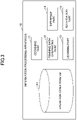
- FIG. 3 is a diagram illustrating an example of functional blocks of the information processing apparatus according to the embodiment.
- the information processing apparatus 10 includes an operating conditions database (DB) 111, an obtaining part 11, a training data generating part 12, a learning part 13, an inference part 14, and a notification part 15. These parts may be implemented by, for example, cooperation of one or more programs installed in the information processing apparatus 10 and of the CPU 101, the ROM 102, the RAM 103, and the like of the information processing apparatus 10.
- DB operating conditions database
- the obtaining part 11 obtains an operating condition of the apparatus 20 and records the operating condition in the operating conditions DB 111.
- the training data generating part 12 generates training data for training (machine learning) information on power consumption according to a surrounding environment and the operation setting of the apparatus 20 when the apparatus 20 is operated based on information obtained by the obtaining part 11.
- the learning part 13 learns the information on power consumption according to the surrounding environment and the operation setting of the apparatus 20 when the apparatus 20 is operated based on the training data generated by the training data generating part 12.
- the inference part 14 infers the energy conservation effect due to updating the apparatus 20A to the apparatus 20B.
- the inference part 14 infers information on power consumption of the apparatus 20A when the apparatus 20A is used instead of the apparatus 20B in a predetermined period based on, for example, the surrounding environment and the operation setting of the apparatus 20B when the apparatus 20B is operated during the predetermined period obtained by the obtaining part 11, and the training result of the learning part 13.
- the inference part 14 generates information based on, for example, a comparison of the information on power consumption of the apparatus 20A when the apparatus 20A is used for the predetermined period with the information on power consumption of the apparatus 20B during the predetermined period.
- the notification part 15 notifies the user of the apparatus 20 of information indicating the energy conservation effect due to updating the apparatus 20 inferred by the inference part 14.
- the apparatus 20 is an air conditioner
- the disclosed technique can be applied to various apparatuses 20 such as a refrigerator, a water heater, and a light.
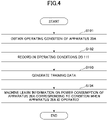
- FIG. 4 is a flowchart illustrating an example of the process of the information processing apparatus 10 during learning according to the embodiment.
- FIG. 5 is a diagram illustrating an example of the history of operating conditions stored in the operating conditions DB 111 according to the embodiment.
- the obtaining part 11 of the information processing apparatus 10 obtains the operating condition of the apparatus 20A installed at a predetermined location.
- the obtaining part 11 of the information processing apparatus 10 may, for example, obtain information on the current operating condition of the apparatus 20A from the apparatus 20A at predetermined time intervals (for example, one hour).
- the obtaining part 11 of the information processing apparatus 10 may obtain a history of information on the operating conditions of the apparatus 20A from the apparatus 20A at predetermined time intervals (for example, once a day).
- the obtaining part 11 of the information processing apparatus 10 may, for example, obtain the history of information on the operating conditions of the apparatus 20A stored in an external server.
- the information on operating conditions may include, for example, an apparatus ID that is the ID of the apparatus 20A, the date and time of the operation of the apparatus 20A, information indicating a surrounding environment when the apparatus 20A has been operated (for example, of the date and time), the information on operation setting when the apparatus has been operated, and information on power consumption when the apparatus has been operated.
- the obtaining part 11 of the information processing apparatus 10 records the obtained operating condition in the operating conditions DB 111 (step S102).
- a set (record) of the information indicating a surrounding environment, the information on operation setting, and the information on power consumption when the apparatus 20 has been operated is stored in the operating conditions DB 111, being correlated with the apparatus ID and the date and time.
- the information indicating a surrounding environment when the apparatus 20 has been operated may include, for example, outside air temperature (outdoor temperature), the number of people inside a room, indoor illuminance, outside air humidity (outdoor humidity), solar irradiance, weather type, indoor temperature, and indoor humidity.
- the outside air temperature is the temperature outside a building in which the apparatus 20 is installed.
- the outside air temperature may be, for example, measured with a temperature sensor provided in the air conditioner outdoor unit of the apparatus 20.
- the number of people inside a room is the number of people inside a room in which the apparatus 20 is installed.
- the number of people inside a room may be, for example, measured by the apparatus 20 based on information detected with a radiation temperature sensor, a camera, or the like provided in the air conditioner indoor unit of the apparatus 20.
- the indoor luminance is luminance inside a room in which the apparatus 20 is installed.
- the indoor luminance may be, for example, measured with an illuminance sensor provided in the air conditioner indoor unit of the apparatus 20.
- the outside air humidity is humidity outside a building in which the apparatus 20 is installed.
- the outside air humidity may be, for example, measured with a humidity sensor provided in the air conditioner outdoor unit of the apparatus 20.
- the solar irradiance is solar irradiance outside a building in which the apparatus 20 is installed.
- the solar irradiance may be, for example, measured with a solar irradiance sensor (pyranometer) provided in the outdoor unit of the apparatus 20.
- the weather type is the type of weather in a region where the apparatus 20 is installed.
- Examples of weather types may include types such as sunny, cloudy, rainy, and snowy.
- the weather type is, for example, preset in the apparatus 20.
- the weather type may also be determined based on information on a region in which the apparatus 20 is installed and information on the weather type of each region at the date and time obtained from the server of a meteorological bureau or the like.
- the indoor temperature and the indoor humidity are temperature and humidity, respectively, inside a room in which the apparatus 20 is installed.
- the indoor temperature and the indoor humidity may be, for example, measured with a temperature sensor and a humidity sensor, respectively, provided in the air conditioner outdoor unit of the apparatus 20.
- the information on operation setting is information on operation setting when the apparatus 20 has been operated.
- the information on operation setting may include, for example, setting information with respect to the operation of the apparatus 20 provided by a user operating the remote controller of the apparatus 20 or the like.
- the operation setting may include, for example, an operation mode, set temperature, and a set airflow volume. Examples of operation modes include automatic operation, cooling operation, heating operation, dehumidifying operation, and fan operation.
- the information on operation setting may include, for example, information on an operation rate (operation time, the number of operating units) of the apparatus 20.
- the information on power consumption is information on power consumption of the apparatus 20 when the apparatus 20 has been operated.
- the information on power consumption may include at least one of, for example, a power consumption amount integrated value, a power consumption peak value, a current value, a high-pressure pressure, a low-pressure pressure, a compressor rotational speed, and information indicating compressor operating efficiency.
- the power consumption amount integrated value is the integrated value of the amount of power consumption of the apparatus 20 within a predetermined period of time (for example, the last ten minutes).
- the power consumption peak value is, for example, the peak value of the power consumption of the apparatus 20 within a predetermined period of time.
- the current value is, for example, the average current value of the apparatus 20 within a predetermined period of time.
- the high-pressure pressure is the average high-pressure pressure value of the apparatus 20 within a predetermined period of time.
- the high-pressure pressure is a high-pressure pressure (hereinafter also simply referred to as "high pressure" as appropriate) in the refrigeration cycle of the apparatus 20, and may be, for example, the pressure of the refrigerant compressed and discharged by a compressor (a discharge pressure of the compressor) or the pressure of the refrigerant in the condenser.
- the low-pressure pressure is the average low-pressure pressure value of the apparatus 20 within a predetermined period of time.
- the low-pressure pressure is a low-pressure pressure (hereinafter also simply referred to as "low pressure" as appropriate) in the refrigeration cycle of the apparatus 20, and may be, for example, the pressure of the refrigerant taken in into the compressor (the pressure of the refrigerant before being compressed by the compressor).
- the operating efficiency of the compressor is, for example, the efficiency of compressing the refrigerant with predetermined power consumption.
- the operating efficiency of the compressor for example, becomes highest when the rotational speed of the compressor is a predetermined value.
- the training data generating part 12 of the information processing apparatus 10 generates training data for learning the power consumption according to a condition when the apparatus 20A is operated, based on a data set recorded in the operating conditions DB 111 (step S103).
- the training data generating part 12 of the information processing apparatus 10 may, for example, employ, as training data for learning the information on power consumption, a data set including a combination of at least one item included in the information indicating a surrounding environment or the information on operation setting when the apparatus 20A has been operated and the information on power consumption.
- the data set is recorded in the operating conditions DB 111.
- the training data generating part 12 of the information processing apparatus 10 may, for example, use information on at least one item included in the information indicating a surrounding environment or the information on operation setting when the apparatus 20A has been operated as an input and use the information on power consumption as ground truth data, and employ a combination (set) of the input and the ground truth data as the training data for learning the information on power consumption.
- the learning part 13 of the information processing apparatus 10 learns, by machine learning, the information on power consumption of the apparatus 20A corresponding to a condition when the apparatus 20A is operated based on the generated training data (step S104) .
- the learning part 13 of the information processing apparatus 10 may, for example, learn, by machine learning, a regression problem to infer information on power consumption based on an input with supervised learning.
- the regression problem is, for example, a problem that predicts a continuous value.
- the learning part 13 of the information processing apparatus 10 may, for example, perform machine learning using linear regression.
- the learning part 13 of the information processing apparatus 10 may, for example, perform machine learning using the method of least squares or the like, using information on power consumption as an objective variable (response variable, dependent variable) and using information on at least one item included in information indicating a situation when the apparatus 20A has been operated as an explanatory variable (input variable, independent variable).
- the learning part 13 of the information processing apparatus 10 may, for example, perform machine learning using nonlinear regression.
- the learning part 13 of the information processing apparatus 10 may perform machine learning using, for example, a regression neural network (Recurrent neural network), a general regression neural network (General Regression Neural Network), a random forest (Random Forest), a support vector machine (support vector machine, SVM), or the like.
- a regression neural network Recurrent neural network
- General Regression Neural Network General Regression Neural Network
- Random Forest random forest
- support vector machine support vector machine, SVM
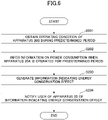
- FIG. 6 is a flowchart illustrating an example of the process of the information processing apparatus 10 during inference of the energy conservation effect according to the embodiment.
- FIG. 7 is a diagram illustrating an example of a notification screen of the energy conservation effect according to the embodiment.
- the apparatus 20A installed in a predetermined location is assumed to be updated to the apparatus 20B and the apparatus 20B is assumed to be in operation for a certain period of time.
- step S201 the obtaining part 11 of the information processing apparatus 10 obtains an operating condition of the apparatus 20B installed at a place where the apparatus 20A was installed during a predetermined period.
- the obtaining part 11 of the information processing apparatus 10 may obtain the operating condition of the apparatus 20 for a period specified by the user.
- the inference part 14 of the information processing apparatus 10 infers information on power consumption of the apparatus 20A when the apparatus 20A is operated for the predetermined period, based on the information indicating the surrounding environment and the information on operation setting when the apparatus 20B has been operated, and the training result of the information on power consumption by the process in step S104 of FIG. 4 , which are included in the obtained operating conditions for the predetermined period (step S202).
- the inference part 14 of the information processing apparatus 10 inputs information on an item used when learning the information on power consumption among the items included in the information indicating the surrounding environment and the information on operation setting when the apparatus 20B has been operated. Then, the inference part 14 of the information processing apparatus 10 uses the training result of the information on power consumption to infer the information on power consumption by the apparatus 20A.
- the inference part 14 of the information processing apparatus 10 may infer information on power consumption by the apparatus 20A based on each training result by each of the above-described methods. In this case, the inference part 14 of the information processing apparatus 10 infers the information on power consumption by the apparatus 20A based on each training result by each of the methods described in the process in step S104 of FIG. 4 . The inference part 14 of the information processing apparatus 10 may infer the average value of the inferred values or the like as information on power consumption by the apparatus 20A.
- the inference part 14 of the information processing apparatus 10 generates information indicating the energy conservation effect based on a comparison of the information on power consumption of the apparatus 20A when the apparatus 20A has been used for the predetermined period with information on power consumption of the apparatus 20B during the predetermined period (step S203).
- the inference part 14 of the information processing apparatus 10 may calculate information on an electricity bill that has been reduced due to updating the apparatus 20 according to the difference between the power consumption of the old apparatus 20A and the power consumption of the new apparatus 20B.
- the inference part 14 of the information processing apparatus 10 may calculate a ratio of the power consumption that has been reduced due to updating the apparatus 20, for example, according to the ratio of the power consumption of the old apparatus 20A to the power consumption of the new apparatus 20B.
- the notification part 15 of the information processing apparatus 10 notifies the user of the apparatus 20 of information indicating the energy conservation effect due to updating the apparatus 20 inferred by the inference part 14 (step S204).
- the information processing apparatus 10 transmits information that causes a display screen 701 illustrated in FIG. 7 to be displayed on the terminal 30.
- the notification part 15 of the information processing apparatus 10 displays a period 702 for comparison of energy conservation effect, power consumption 703 and an electricity bill 704 in the new apparatus 20B during the period 702, and power consumption 705 and an electricity bill 706 in the old apparatus 20A during the period 702.
- the notification part 15 of the information processing apparatus 10 also displays a ratio 707 of the power consumption reduced during the period 702 due to updating the apparatus 20 and an electricity bill 708 reduced due to updating the apparatus 20. Accordingly, even when the power consumption in the summer period is lower than in the last year, for example, due to a cool summer of the last year in which the old apparatus 20A was operated and a hot summer of this year in which the new apparatus 20B has been operated, the energy conservation effect due to updating the apparatus 20 can be appropriately presented to the user.
- the information processing apparatus 10 may, for example, infer the energy conservation effect when the apparatus 20A is updated to the apparatus 20B.
- the energy conservation effect that would have been obtained if the apparatus 20 was updated earlier can be presented to the user.
- the learning part 13 of the information processing apparatus 10 learns information indicating the surrounding environment in which the apparatus 20B is operated and information on power consumption according to the operation setting of the apparatus 20, through the same processing as that in FIG. 4 , based on the operation condition of the apparatus 20B. Then, the inference part 14 infers the information on power consumption of the apparatus 20B when the apparatus 20B is used instead of the apparatus 20A in the predetermined period, based on, for example, the surrounding environment and the operation setting of the apparatus 20B when the apparatus 20A has been operated in the predetermined period obtained by the obtaining part 11, and the training result of the information on power consumption of the apparatus 20B by the learning part 13. Then, the inference part 14 may, for example, generate information based on a comparison of the information on power consumption of the apparatus 20B when the apparatus 20B has been used for the predetermined period with the information on power consumption of the apparatus 20A during the predetermined period.
- the energy conservation effect due to updating may be inferred and notified to the user of the apparatus 20.
- the learning part 13 of the information processing apparatus 10 performs machine learning with respect to, for example, characteristics of various buildings according to information indicating a situation and information on power consumption based on a data set including the information indicating the characteristics of the various buildings (an example of an "air conditioning load"), the information indicating a situation, and the information on power consumption from each apparatus 20, of the same type (the same model) as the apparatus 20A, installed in the various buildings (laboratories) in which the apparatus 20 is supposed to be installed by the user.
- the information indicating the characteristics of the building may include, for example, information on a heat load to be transferred by a temperature difference from the outside air through the heat transfer and radiation, an outside air load due to drafts from the windows or doors and the outside air coming in for ventilation, and solar radiation, which is the heat, of the solar heat, that enters through glass and the heat that enters through a roof or a wall.
- the inference part 14 of the information processing apparatus 10 infers the air conditioning load according to a situation at a predetermined location based on a data set including, for example, information indicating a situation and information on power consumption when the apparatus 20A installed at the predetermined location has been operated.
- the learning part 13 of the information processing apparatus 10 performs machine learning with respect to, for example, information on power consumption according to information indicating a situation and information indicating characteristics of various buildings based on a data set including the information indicating the characteristics of the various buildings, the information indicating a situation, and the information on power consumption from each apparatus 20, of the same type (the same model) as the apparatus 20B, installed in the various buildings.
- the information processing apparatus 10 inferring part 14 infers information on power consumption of the apparatus 20B at the predetermined location based on, for example, the estimated air conditioning load at the predetermined location and the information indicating a situation during the predetermined period.
- the notification part 15 of the information processing apparatus 10 notifies the terminal 30 of information on the estimated power consumption of the apparatus 20B.
- Each of the functional parts of the information processing apparatus 10 may be implemented by cloud computing, for example, composed of one or more computers. Further, at least a part of the process of the functional parts of the information processing apparatus 10 described above may be executed by the apparatus 20.
- the information processing apparatus 10 and the apparatus 20 may be configured as an integrated apparatus.
Landscapes
- Engineering & Computer Science (AREA)
- Business, Economics & Management (AREA)
- Physics & Mathematics (AREA)
- General Engineering & Computer Science (AREA)
- Mechanical Engineering (AREA)
- Combustion & Propulsion (AREA)
- Chemical & Material Sciences (AREA)
- Economics (AREA)
- Signal Processing (AREA)
- Strategic Management (AREA)
- General Physics & Mathematics (AREA)
- Marketing (AREA)
- Theoretical Computer Science (AREA)
- General Business, Economics & Management (AREA)
- Development Economics (AREA)
- Fuzzy Systems (AREA)
- Mathematical Physics (AREA)
- Health & Medical Sciences (AREA)
- Tourism & Hospitality (AREA)
- Human Resources & Organizations (AREA)
- Human Computer Interaction (AREA)
- Entrepreneurship & Innovation (AREA)
- Finance (AREA)
- Primary Health Care (AREA)
- Accounting & Taxation (AREA)
- General Health & Medical Sciences (AREA)
- Game Theory and Decision Science (AREA)
- Public Health (AREA)
- Water Supply & Treatment (AREA)
- Quality & Reliability (AREA)
- Thermal Sciences (AREA)
- Operations Research (AREA)
- Educational Administration (AREA)
- Automation & Control Theory (AREA)
- Air Conditioning Control Device (AREA)
- Management, Administration, Business Operations System, And Electronic Commerce (AREA)
Abstract
Description
- The present disclosure relates to an information processing method, an information processing apparatus, and a program.
- Conventionally, a technique of updating equipment with new equipment having higher energy conservation performance than old equipment and estimating the energy conservation effect due to updating the equipment is known (for example, see Patent Document 1).
- [Patent Document 1]
Japanese Laid-Open Patent Publication No. 2002-032438 - However, in the conventional technique, if the situation when the old equipment was in operation is different from the situation when the new equipment was in operation, it may not be possible to appropriately estimate the energy conservation effect due to updating the equipment. The purpose is to provide a technique that can appropriately estimate the energy conservation effect due to updating the equipment.
- An information processing method implemented by an information processing apparatus, according to a first aspect of the present disclosure, includes performing a first estimation process, based on a data set including a combination of information indicating a situation and information on power consumption when a first air conditioner, installed in a predetermined location, has been operated. The first estimation process is a process of estimating information on power consumption when the first air conditioner, installed in the predetermined location, is operated in a predetermined situation.
- According to a second aspect of the present disclosure, the information processing method as described in the first aspect further includes performing a process of notifying of information based on a comparison of information on power consumption when a second air conditioner, being operated instead of the first air conditioner, has been operated in a first situation, with information on power consumption, estimated by the first estimation process, when the first air conditioner is operated in the first situation.
- According to a third aspect of the present disclosure, the information processing method as described in the first or second aspect further includes performing a second estimation process that estimates information on power consumption when a second air conditioner is operated in the predetermined situation, the second estimation process being based on a data set including a combination of information indicating a situation and power consumption when the second air conditioner, being operated instead of the first air conditioner, has been operated, and a process of notifying of information based on a comparison of the information on power consumption, estimated by the first estimation process, when the first air conditioner is operated, with the information on power consumption, estimated by the second estimation process, when the second air conditioner is operated.
- According to a fourth aspect of the present disclosure, the information processing method as described in any one of the first to third aspects further includes estimating an air conditioning load according to a situation in the predetermined location, based on the data set including the combination of the information indicating a situation and the information on power consumption when the first air conditioner, installed in the predetermined location, has been operated, and performing a process of notifying of information on power consumption of a second air conditioner, being operated instead of the first air conditioner, with respect to the estimated air conditioning load.
- According to a fifth aspect of the present disclosure, in the information processing method as described in any one of the second to fourth aspects, the second air conditioner is an apparatus installed in the predetermined location instead of the first air conditioner, or is the first air conditioner whose control parameter has been changed.
- According to a sixth aspect of the present disclosure, in the information processing method as described in any one of the first to fifth aspects, the information indicating the situation includes at least one of indoor temperature, indoor humidity, outdoor temperature, and outdoor humidity.
- According to a seventh aspect of the present disclosure, in the information processing method as described in any one of the first to sixth aspects, the information on power consumption includes at least one of a power consumption amount integrated value, a power consumption peak value, a current value, a high-pressure pressure, a low-pressure pressure, a compressor rotational speed, and information indicating compressor operating efficiency.
- According to an eighth aspect of the present disclosure, an information processing apparatus includes a first estimation part configured to estimate information on power consumption, based on a data set including a combination of information indicating a situation and information on power consumption when a first air conditioner, installed in a predetermined location, has been operated. The first estimation part estimates the information on power consumption when the first air conditioner, installed in the predetermined location, is operated in a predetermined situation.
- According to a ninth aspect of the present disclosure, a program causes a computer to execute a first estimation process, based on a data set including a combination of information indicating a situation and information on power consumption when a first air conditioner, installed in a predetermined location, has been operated. The first estimation process is a process of estimating information on power consumption when the first air conditioner, installed in the predetermined location, is operated in a predetermined situation.
-
-
FIG. 1 is a diagram illustrating an example of a system configuration of an information processing system according to an embodiment; -
FIG. 2 is a diagram illustrating an example of a hardware configuration of an information processing apparatus according to the embodiment; -
FIG. 3 is a diagram illustrating an example of a functional block diagram of the information processing apparatus according to the embodiment; -
FIG. 4 is a flowchart illustrating an example of the process of the information processing apparatus during learning according to the embodiment; -
FIG. 5 is a diagram illustrating an example of a history of operating conditions stored in operating conditions DB according to the embodiment; -
FIG. 6 is a flowchart illustrating an example of the process of the information processing apparatus during inference of an energy conservation effect according to the embodiment; and -
FIG. 7 is a diagram illustrating an example of a notification screen of an energy conservation effect according to the embodiment. - Hereinafter, each embodiment will be described with reference to the drawings. In the present specification and the drawings, the components having substantially the same functional configuration are designated by the same reference numerals to omit duplicate explanations.
- First, a system configuration of an information processing system 1 will be described.
FIG. 1 is a diagram illustrating an example of a system configuration of an information processing system according to an embodiment. As illustrated inFIG. 1 , the information processing system 1 includes aninformation processing apparatus 10, anapparatus 20A, anapparatus 20B (hereinafter, when it is not necessary to distinguish each of them, simply referred to as an "apparatus 20") and aterminal 30. Theapparatus 20B may be a new apparatus to which theold apparatus 20A is updated. In this case, theapparatus 20B may be, for example, a new model having the same function as theapparatus 20A. Alternatively, theapparatus 20B may be a device for which an operation setting related to energy conservation is updated in theapparatus 20A. The number of theinformation processing apparatuses 10, the apparatuses 20, and theterminals 30 is not limited to the example ofFIG. 1 . - The
information processing apparatus 10 and the apparatus 20, as well as theinformation processing apparatus 10 and theterminal 30 may be connected to be able to perform communications via a network NW, whose examples include the Internet, a wireless local area network (LAN), cellular phone networks of Long Term Evolution (LTE), 5G, etc., a LAN, and a signal line. The apparatus 20 may be installed in, for example, a residence, an office, and a public facility. Theinformation processing apparatus 10 may be, for example, a server on a cloud. Theinformation processing apparatus 10 may be, for example, an edge server installed in a building where multiple apparatuses 20 are installed. Further, theinformation processing apparatus 10 may, for example, be accommodated in the apparatus 20 (for example, a housing of an indoor unit of an air conditioner). - The
information processing apparatus 10 estimates information on power consumption when theapparatus 20A installed in a predetermined location (a facility, a room, an equipment) is operated in a predetermined situation based on a data set including a combination of information indicating a situation and information on power consumption when theapparatus 20A installed in the predetermined location has been operated. - The
information processing apparatus 10 notifies the user of the energy conservation effect by transmitting information, to theterminal 30, based on a comparison of the estimated information on power consumption when theapparatus 20A has been operated and information on power consumption when theapparatus 20B, which is operated instead of theapparatus 20A, has been operated in the predetermined situation. - The apparatus 20 may be, for example, various apparatuses such as an air conditioner, a refrigerator, a water heater, and a light, and may include an Internet of Things (IoT) device that transmits various kinds of measured information to the
information processing apparatus 10. - The
terminal 30 may be, for example, a terminal such as a smartphone, a cellular phone, a tablet, and a personal computer used by a user of the apparatus 20. Theterminal 30 notifies the user of information indicating the energy conservation effect due to updating the apparatus based on the information received from theinformation processing apparatus 10. - The user of each apparatus 20 registers IDs and communication addresses of the apparatus 20 and the
terminal 30 that the user uses with theinformation processing apparatus 10 in advance, so that theinformation processing apparatus 10 can notify eachterminal 30 of the user of the apparatus 20 of information such as the energy conservation effect due to updating theapparatus 20A to theapparatus 20B. - Next, the hardware configuration of the
information processing apparatus 10 of the information processing system 1 according to the embodiment will be described. -
FIG. 2 is a diagram illustrating an example of a hardware configuration of theinformation processing apparatus 10 according to the embodiment. As illustrated inFIG. 2 , theinformation processing apparatus 10 includes a Central Processing Unit (CPU) 101, a Read Only Memory (ROM) 102, and a Random Access Memory (RAM) 103. TheCPU 101, theROM 102, and theRAM 103 constitute a so-called computer. Theinformation processing apparatus 10 includes asecondary storage 104, adisplay unit 105, anoperating unit 106, an I/F (Interface)unit 107, and a drive unit 108. The hardware items of theinformation processing apparatus 10 are interconnected via a bus 109. - The
CPU 101 is a processor that executes various programs (for example, a machine learning program, etc.) installed in thesecondary storage 104. TheROM 102 is a non-volatile memory. TheROM 102 operates as a primary storage to store various programs, data, etc., required by theCPU 101 to execute various programs installed in thesecondary storage 104. Specifically, theROM 102 stores boot programs, etc., such as the BIOS (Basic Input/Output System) and the EFI (Extensible Firmware Interface). - The
RAM 103 is a volatile memory such as a Dynamic Random Access Memory (DRAM), a Static Random Access Memory (SRAM), or the like. TheRAM 103 operates as a primary storage to provide a work area into which various programs installed in thesecondary storage 104 are loaded when executed by theCPU 101. - The
secondary storage 104 stores various programs and information that is used when various programs are executed. - The
display unit 105 is a display device that displays various kinds of information. Theoperating unit 106 is an operating device for receiving various operations. The I/F unit 107 is a communication device that communicates with external apparatuses. - The drive unit 108 is a device for loading a recording medium 110. The recording medium 110 here includes media that optically, electrically, or magnetically record information, such as a CD-ROM, a flexible disk, and a magneto-optical disk. Further, the recording medium 110 may also include semiconductor memories that electrically record information, such as a ROM and a flash memory.
- For example, the recording medium 110 as distributed is loaded into the drive unit 108, and various programs recorded in the recording medium 110 are read by the drive unit 108 to be installed in the
secondary storage 104. Alternatively, various programs may be downloaded from a network that is not depicted to be installed in thesecondary storage 104. - Next, the functional configuration of the information processing system 1 according to the embodiment will be described with reference to
FIG. 3. FIG. 3 is a diagram illustrating an example of functional blocks of the information processing apparatus according to the embodiment. - The
information processing apparatus 10 according to the embodiment includes an operating conditions database (DB) 111, an obtainingpart 11, a trainingdata generating part 12, a learningpart 13, aninference part 14, and anotification part 15. These parts may be implemented by, for example, cooperation of one or more programs installed in theinformation processing apparatus 10 and of theCPU 101, theROM 102, theRAM 103, and the like of theinformation processing apparatus 10. - The obtaining
part 11 obtains an operating condition of the apparatus 20 and records the operating condition in theoperating conditions DB 111. - The training
data generating part 12 generates training data for training (machine learning) information on power consumption according to a surrounding environment and the operation setting of the apparatus 20 when the apparatus 20 is operated based on information obtained by the obtainingpart 11. The learningpart 13 learns the information on power consumption according to the surrounding environment and the operation setting of the apparatus 20 when the apparatus 20 is operated based on the training data generated by the trainingdata generating part 12. - The
inference part 14 infers the energy conservation effect due to updating theapparatus 20A to theapparatus 20B. Theinference part 14 infers information on power consumption of theapparatus 20A when theapparatus 20A is used instead of theapparatus 20B in a predetermined period based on, for example, the surrounding environment and the operation setting of theapparatus 20B when theapparatus 20B is operated during the predetermined period obtained by the obtainingpart 11, and the training result of the learningpart 13. Then, theinference part 14 generates information based on, for example, a comparison of the information on power consumption of theapparatus 20A when theapparatus 20A is used for the predetermined period with the information on power consumption of theapparatus 20B during the predetermined period. - The
notification part 15 notifies the user of the apparatus 20 of information indicating the energy conservation effect due to updating the apparatus 20 inferred by theinference part 14. - In the following, a case where the apparatus 20 is an air conditioner will be described as an example, but the disclosed technique can be applied to various apparatuses 20 such as a refrigerator, a water heater, and a light.
- An example of the process of the information processing system 1 during learning according to the embodiment is described with reference to
FIG. 4 andFIG. 5 .FIG. 4 is a flowchart illustrating an example of the process of theinformation processing apparatus 10 during learning according to the embodiment.FIG. 5 is a diagram illustrating an example of the history of operating conditions stored in theoperating conditions DB 111 according to the embodiment. - In step S101, the obtaining
part 11 of theinformation processing apparatus 10 obtains the operating condition of theapparatus 20A installed at a predetermined location. Here, the obtainingpart 11 of theinformation processing apparatus 10 may, for example, obtain information on the current operating condition of theapparatus 20A from theapparatus 20A at predetermined time intervals (for example, one hour). Alternatively, the obtainingpart 11 of theinformation processing apparatus 10 may obtain a history of information on the operating conditions of theapparatus 20A from theapparatus 20A at predetermined time intervals (for example, once a day). The obtainingpart 11 of theinformation processing apparatus 10 may, for example, obtain the history of information on the operating conditions of theapparatus 20A stored in an external server. - Here, the information on operating conditions may include, for example, an apparatus ID that is the ID of the
apparatus 20A, the date and time of the operation of theapparatus 20A, information indicating a surrounding environment when theapparatus 20A has been operated (for example, of the date and time), the information on operation setting when the apparatus has been operated, and information on power consumption when the apparatus has been operated. - Next, the obtaining
part 11 of theinformation processing apparatus 10 records the obtained operating condition in the operating conditions DB 111 (step S102). - According to the example of
FIG. 5 , a set (record) of the information indicating a surrounding environment, the information on operation setting, and the information on power consumption when the apparatus 20 has been operated is stored in theoperating conditions DB 111, being correlated with the apparatus ID and the date and time. - The information indicating a surrounding environment when the apparatus 20 has been operated may include, for example, outside air temperature (outdoor temperature), the number of people inside a room, indoor illuminance, outside air humidity (outdoor humidity), solar irradiance, weather type, indoor temperature, and indoor humidity.
- The outside air temperature is the temperature outside a building in which the apparatus 20 is installed. The outside air temperature may be, for example, measured with a temperature sensor provided in the air conditioner outdoor unit of the apparatus 20.
- The number of people inside a room is the number of people inside a room in which the apparatus 20 is installed. The number of people inside a room may be, for example, measured by the apparatus 20 based on information detected with a radiation temperature sensor, a camera, or the like provided in the air conditioner indoor unit of the apparatus 20.
- The indoor luminance is luminance inside a room in which the apparatus 20 is installed. The indoor luminance may be, for example, measured with an illuminance sensor provided in the air conditioner indoor unit of the apparatus 20.
- The outside air humidity is humidity outside a building in which the apparatus 20 is installed. The outside air humidity may be, for example, measured with a humidity sensor provided in the air conditioner outdoor unit of the apparatus 20.
- The solar irradiance is solar irradiance outside a building in which the apparatus 20 is installed. The solar irradiance may be, for example, measured with a solar irradiance sensor (pyranometer) provided in the outdoor unit of the apparatus 20.
- The weather type is the type of weather in a region where the apparatus 20 is installed. Examples of weather types may include types such as sunny, cloudy, rainy, and snowy. The weather type is, for example, preset in the apparatus 20. The weather type may also be determined based on information on a region in which the apparatus 20 is installed and information on the weather type of each region at the date and time obtained from the server of a meteorological bureau or the like.
- The indoor temperature and the indoor humidity are temperature and humidity, respectively, inside a room in which the apparatus 20 is installed. The indoor temperature and the indoor humidity may be, for example, measured with a temperature sensor and a humidity sensor, respectively, provided in the air conditioner outdoor unit of the apparatus 20.
- The information on operation setting is information on operation setting when the apparatus 20 has been operated. The information on operation setting may include, for example, setting information with respect to the operation of the apparatus 20 provided by a user operating the remote controller of the apparatus 20 or the like. The operation setting may include, for example, an operation mode, set temperature, and a set airflow volume. Examples of operation modes include automatic operation, cooling operation, heating operation, dehumidifying operation, and fan operation. The information on operation setting may include, for example, information on an operation rate (operation time, the number of operating units) of the apparatus 20.
- The information on power consumption is information on power consumption of the apparatus 20 when the apparatus 20 has been operated. The information on power consumption may include at least one of, for example, a power consumption amount integrated value, a power consumption peak value, a current value, a high-pressure pressure, a low-pressure pressure, a compressor rotational speed, and information indicating compressor operating efficiency.
- The power consumption amount integrated value is the integrated value of the amount of power consumption of the apparatus 20 within a predetermined period of time (for example, the last ten minutes). The power consumption peak value is, for example, the peak value of the power consumption of the apparatus 20 within a predetermined period of time. The current value is, for example, the average current value of the apparatus 20 within a predetermined period of time.
- The high-pressure pressure is the average high-pressure pressure value of the apparatus 20 within a predetermined period of time. The high-pressure pressure is a high-pressure pressure (hereinafter also simply referred to as "high pressure" as appropriate) in the refrigeration cycle of the apparatus 20, and may be, for example, the pressure of the refrigerant compressed and discharged by a compressor (a discharge pressure of the compressor) or the pressure of the refrigerant in the condenser.
- The low-pressure pressure is the average low-pressure pressure value of the apparatus 20 within a predetermined period of time. The low-pressure pressure is a low-pressure pressure (hereinafter also simply referred to as "low pressure" as appropriate) in the refrigeration cycle of the apparatus 20, and may be, for example, the pressure of the refrigerant taken in into the compressor (the pressure of the refrigerant before being compressed by the compressor).
- The operating efficiency of the compressor is, for example, the efficiency of compressing the refrigerant with predetermined power consumption. The operating efficiency of the compressor, for example, becomes highest when the rotational speed of the compressor is a predetermined value.
- Next, the training
data generating part 12 of theinformation processing apparatus 10 generates training data for learning the power consumption according to a condition when theapparatus 20A is operated, based on a data set recorded in the operating conditions DB 111 (step S103). - Here, the training
data generating part 12 of theinformation processing apparatus 10 may, for example, employ, as training data for learning the information on power consumption, a data set including a combination of at least one item included in the information indicating a surrounding environment or the information on operation setting when theapparatus 20A has been operated and the information on power consumption. The data set is recorded in theoperating conditions DB 111. In this case, the trainingdata generating part 12 of theinformation processing apparatus 10 may, for example, use information on at least one item included in the information indicating a surrounding environment or the information on operation setting when theapparatus 20A has been operated as an input and use the information on power consumption as ground truth data, and employ a combination (set) of the input and the ground truth data as the training data for learning the information on power consumption. - Next, the learning
part 13 of theinformation processing apparatus 10 learns, by machine learning, the information on power consumption of theapparatus 20A corresponding to a condition when theapparatus 20A is operated based on the generated training data (step S104) . - Here, the learning
part 13 of theinformation processing apparatus 10 may, for example, learn, by machine learning, a regression problem to infer information on power consumption based on an input with supervised learning. The regression problem is, for example, a problem that predicts a continuous value. - The learning
part 13 of theinformation processing apparatus 10 may, for example, perform machine learning using linear regression. In this case, the learningpart 13 of theinformation processing apparatus 10 may, for example, perform machine learning using the method of least squares or the like, using information on power consumption as an objective variable (response variable, dependent variable) and using information on at least one item included in information indicating a situation when theapparatus 20A has been operated as an explanatory variable (input variable, independent variable). - Further, the learning
part 13 of theinformation processing apparatus 10 may, for example, perform machine learning using nonlinear regression. In this case, the learningpart 13 of theinformation processing apparatus 10 may perform machine learning using, for example, a regression neural network (Recurrent neural network), a general regression neural network (General Regression Neural Network), a random forest (Random Forest), a support vector machine (support vector machine, SVM), or the like. - Next, an example of the process of the
information processing apparatus 10 during inference of the energy conservation effect according to the embodiment is described with reference toFIG. 6 andFIG. 7 .FIG. 6 is a flowchart illustrating an example of the process of theinformation processing apparatus 10 during inference of the energy conservation effect according to the embodiment.FIG. 7 is a diagram illustrating an example of a notification screen of the energy conservation effect according to the embodiment. In the following, theapparatus 20A installed in a predetermined location is assumed to be updated to theapparatus 20B and theapparatus 20B is assumed to be in operation for a certain period of time. - In step S201, the obtaining
part 11 of theinformation processing apparatus 10 obtains an operating condition of theapparatus 20B installed at a place where theapparatus 20A was installed during a predetermined period. Here, the obtainingpart 11 of theinformation processing apparatus 10 may obtain the operating condition of the apparatus 20 for a period specified by the user. - Next, the
inference part 14 of theinformation processing apparatus 10 infers information on power consumption of theapparatus 20A when theapparatus 20A is operated for the predetermined period, based on the information indicating the surrounding environment and the information on operation setting when theapparatus 20B has been operated, and the training result of the information on power consumption by the process in step S104 ofFIG. 4 , which are included in the obtained operating conditions for the predetermined period (step S202). Here, theinference part 14 of theinformation processing apparatus 10 inputs information on an item used when learning the information on power consumption among the items included in the information indicating the surrounding environment and the information on operation setting when theapparatus 20B has been operated. Then, theinference part 14 of theinformation processing apparatus 10 uses the training result of the information on power consumption to infer the information on power consumption by theapparatus 20A. - Further, the
inference part 14 of theinformation processing apparatus 10 may infer information on power consumption by theapparatus 20A based on each training result by each of the above-described methods. In this case, theinference part 14 of theinformation processing apparatus 10 infers the information on power consumption by theapparatus 20A based on each training result by each of the methods described in the process in step S104 ofFIG. 4 . Theinference part 14 of theinformation processing apparatus 10 may infer the average value of the inferred values or the like as information on power consumption by theapparatus 20A. - Next, the
inference part 14 of theinformation processing apparatus 10 generates information indicating the energy conservation effect based on a comparison of the information on power consumption of theapparatus 20A when theapparatus 20A has been used for the predetermined period with information on power consumption of theapparatus 20B during the predetermined period (step S203). Here, for example, theinference part 14 of theinformation processing apparatus 10 may calculate information on an electricity bill that has been reduced due to updating the apparatus 20 according to the difference between the power consumption of theold apparatus 20A and the power consumption of thenew apparatus 20B. Further, theinference part 14 of theinformation processing apparatus 10 may calculate a ratio of the power consumption that has been reduced due to updating the apparatus 20, for example, according to the ratio of the power consumption of theold apparatus 20A to the power consumption of thenew apparatus 20B. - Next, the
notification part 15 of theinformation processing apparatus 10 notifies the user of the apparatus 20 of information indicating the energy conservation effect due to updating the apparatus 20 inferred by the inference part 14 (step S204). Here, for example, theinformation processing apparatus 10 transmits information that causes adisplay screen 701 illustrated inFIG. 7 to be displayed on the terminal 30. In the example ofFIG. 7 , thenotification part 15 of theinformation processing apparatus 10 displays aperiod 702 for comparison of energy conservation effect,power consumption 703 and anelectricity bill 704 in thenew apparatus 20B during theperiod 702, andpower consumption 705 and anelectricity bill 706 in theold apparatus 20A during theperiod 702. - Further, the
notification part 15 of theinformation processing apparatus 10 also displays aratio 707 of the power consumption reduced during theperiod 702 due to updating the apparatus 20 and anelectricity bill 708 reduced due to updating the apparatus 20. Accordingly, even when the power consumption in the summer period is lower than in the last year, for example, due to a cool summer of the last year in which theold apparatus 20A was operated and a hot summer of this year in which thenew apparatus 20B has been operated, the energy conservation effect due to updating the apparatus 20 can be appropriately presented to the user. - The
information processing apparatus 10 may, for example, infer the energy conservation effect when theapparatus 20A is updated to theapparatus 20B. Thus, for example, the energy conservation effect that would have been obtained if the apparatus 20 was updated earlier can be presented to the user. - In this case, the learning
part 13 of theinformation processing apparatus 10 learns information indicating the surrounding environment in which theapparatus 20B is operated and information on power consumption according to the operation setting of the apparatus 20, through the same processing as that inFIG. 4 , based on the operation condition of theapparatus 20B. Then, theinference part 14 infers the information on power consumption of theapparatus 20B when theapparatus 20B is used instead of theapparatus 20A in the predetermined period, based on, for example, the surrounding environment and the operation setting of theapparatus 20B when theapparatus 20A has been operated in the predetermined period obtained by the obtainingpart 11, and the training result of the information on power consumption of theapparatus 20B by the learningpart 13. Then, theinference part 14 may, for example, generate information based on a comparison of the information on power consumption of theapparatus 20B when theapparatus 20B has been used for the predetermined period with the information on power consumption of theapparatus 20A during the predetermined period. - Before updating the
apparatus 20A to theapparatus 20B, the energy conservation effect due to updating may be inferred and notified to the user of the apparatus 20. - In this case, the learning
part 13 of theinformation processing apparatus 10 performs machine learning with respect to, for example, characteristics of various buildings according to information indicating a situation and information on power consumption based on a data set including the information indicating the characteristics of the various buildings (an example of an "air conditioning load"), the information indicating a situation, and the information on power consumption from each apparatus 20, of the same type (the same model) as theapparatus 20A, installed in the various buildings (laboratories) in which the apparatus 20 is supposed to be installed by the user. - The information indicating the characteristics of the building may include, for example, information on a heat load to be transferred by a temperature difference from the outside air through the heat transfer and radiation, an outside air load due to drafts from the windows or doors and the outside air coming in for ventilation, and solar radiation, which is the heat, of the solar heat, that enters through glass and the heat that enters through a roof or a wall.
- The
inference part 14 of theinformation processing apparatus 10 infers the air conditioning load according to a situation at a predetermined location based on a data set including, for example, information indicating a situation and information on power consumption when theapparatus 20A installed at the predetermined location has been operated. - Further, the learning
part 13 of theinformation processing apparatus 10 performs machine learning with respect to, for example, information on power consumption according to information indicating a situation and information indicating characteristics of various buildings based on a data set including the information indicating the characteristics of the various buildings, the information indicating a situation, and the information on power consumption from each apparatus 20, of the same type (the same model) as theapparatus 20B, installed in the various buildings. - Then, the
information processing apparatus 10 inferringpart 14 infers information on power consumption of theapparatus 20B at the predetermined location based on, for example, the estimated air conditioning load at the predetermined location and the information indicating a situation during the predetermined period. - Then, the
notification part 15 of theinformation processing apparatus 10 notifies the terminal 30 of information on the estimated power consumption of theapparatus 20B. - Each of the functional parts of the
information processing apparatus 10 may be implemented by cloud computing, for example, composed of one or more computers. Further, at least a part of the process of the functional parts of theinformation processing apparatus 10 described above may be executed by the apparatus 20. Theinformation processing apparatus 10 and the apparatus 20 may be configured as an integrated apparatus. - Embodiments are described above, while it will be understood that various changes in form and details are possible without departing from the spirit and scope of the claims.
- The present invention is based upon and claims priority to basic application No.
2019-180996, filed with the Japan Patent Office on September 30, 2019 -
- 1
- information processing system
- 10
- information processing apparatus
- 111
- operating conditions DB
- 11
- obtaining part
- 12
- training data generating part
- 13
- learning part
- 14
- inference part
- 15
- notification part
Claims (9)
- An information processing method implemented by an information processing apparatus, comprising
performing a first estimation process, based on a data set including a combination of information indicating a situation and information on power consumption when a first air conditioner, installed in a predetermined location, has been operated, the first estimation process being a process of estimating information on power consumption when the first air conditioner, installed in the predetermined location, is operated in a predetermined situation. - The information processing method as claimed in claim 1, further comprising performing a process of notifying of information based on a comparison of information on power consumption when a second air conditioner, being operated instead of the first air conditioner, has been operated in a first situation, with information on power consumption, estimated by the first estimation process, when the first air conditioner is operated in the first situation.
- The information processing method as claimed in claim 1 or 2, further comprising:performing a second estimation process, based on a data set including a combination of information indicating a situation and power consumption when a second air conditioner, being operated instead of the first air conditioner, has been operated, the second estimation process being a process of estimating information on power consumption when the second air conditioner is operated in the predetermined situation; andperforming a process of notifying of information based on a comparison of the information on power consumption, estimated by the first estimation process, when the first air conditioner is operated, with the information on power consumption, estimated by the second estimation process, when the second air conditioner is operated.
- The information processing method as claimed in any of claims 1 to 3, further comprising:estimating an air conditioning load according to a situation in the predetermined location, based on the data set including the combination of the information indicating the situation and the information on power consumption when the first air conditioner, installed in the predetermined location, has been operated; andperforming a process of notifying of information on power consumption of a second air conditioner, being operated instead of the first air conditioner, with respect to the estimated air conditioning load.
- The information processing method as claimed in any of claims 2 to 4, wherein the second air conditioner is an apparatus installed in the predetermined location instead of the first air conditioner, or is the first air conditioner whose control parameter has been changed.
- The information processing method as claimed in any of claims 1 to 5, wherein the information indicating the situation includes at least one of indoor temperature, indoor humidity, outdoor temperature, and outdoor humidity.
- The information processing method as claimed in any of claims 1 to 6, wherein the information on power consumption includes at least one of a power consumption amount integrated value, a power consumption peak value, a current value, a high-pressure pressure, a low-pressure pressure, a compressor rotational speed, and information indicating compressor operating efficiency.
- An information processing apparatus comprising a first estimation part configured to estimate information on power consumption, based on a data set including a combination of information indicating a situation and information on power consumption when a first air conditioner, installed in a predetermined location, has been operated, the first estimation part estimating the information on power consumption when the first air conditioner, installed in the predetermined location, is operated in a predetermined situation.
- A program causing a computer to,
execute a first estimation process, based on a data set including a combination of information indicating a situation and information on power consumption when a first air conditioner, installed in a predetermined location, has been operated, the first estimation process being a process of estimating information on power consumption when the first air conditioner, installed in the predetermined location, is operated in a predetermined situation.
Applications Claiming Priority (2)
| Application Number | Priority Date | Filing Date | Title |
|---|---|---|---|
| JP2019180996A JP6974757B2 (en) | 2019-09-30 | 2019-09-30 | Information processing methods, information processing devices, and programs |
| PCT/JP2020/023687 WO2021065093A1 (en) | 2019-09-30 | 2020-06-17 | Information processing method, information processing device, and program |
Publications (2)
| Publication Number | Publication Date |
|---|---|
| EP4019859A1 true EP4019859A1 (en) | 2022-06-29 |
| EP4019859A4 EP4019859A4 (en) | 2022-10-12 |
Family
ID=75270588
Family Applications (1)
| Application Number | Title | Priority Date | Filing Date |
|---|---|---|---|
| EP20871377.6A Ceased EP4019859A4 (en) | 2019-09-30 | 2020-06-17 | INFORMATION PROCESSING METHOD AND DEVICE, AND PROGRAM |
Country Status (5)
| Country | Link |
|---|---|
| US (1) | US11971186B2 (en) |
| EP (1) | EP4019859A4 (en) |
| JP (1) | JP6974757B2 (en) |
| CN (1) | CN114450531B (en) |
| WO (1) | WO2021065093A1 (en) |
Families Citing this family (1)
| Publication number | Priority date | Publication date | Assignee | Title |
|---|---|---|---|---|
| JP6974757B2 (en) * | 2019-09-30 | 2021-12-01 | ダイキン工業株式会社 | Information processing methods, information processing devices, and programs |
Family Cites Families (20)
| Publication number | Priority date | Publication date | Assignee | Title |
|---|---|---|---|---|
| JP4523124B2 (en) | 2000-07-14 | 2010-08-11 | 日立アプライアンス株式会社 | Energy service business system |
| JP3783929B2 (en) * | 2001-08-21 | 2006-06-07 | ダイキン工業株式会社 | Energy saving effect estimation method and apparatus |
| JP2005009852A (en) * | 2003-05-28 | 2005-01-13 | Matsushita Electric Ind Co Ltd | Energy consumption prediction apparatus and energy consumption prediction method |
| US20040254686A1 (en) | 2003-05-28 | 2004-12-16 | Masaru Matsui | Energy consumption prediction apparatus and energy consumption prediction method |
| JP4910020B2 (en) * | 2009-08-05 | 2012-04-04 | 株式会社日立製作所 | Consumer energy management system |
| JP2011250027A (en) * | 2010-05-25 | 2011-12-08 | Panasonic Electric Works Co Ltd | Remote control device and information communication system |
| CN102799162A (en) * | 2012-08-13 | 2012-11-28 | 清华大学 | Building energy-saving method based on incentive mechanism |
| US9298197B2 (en) * | 2013-04-19 | 2016-03-29 | Google Inc. | Automated adjustment of an HVAC schedule for resource conservation |
| JP5621888B2 (en) * | 2013-07-16 | 2014-11-12 | 三菱電機株式会社 | Equipment system |
| US10185345B2 (en) | 2015-06-22 | 2019-01-22 | Solarcity Corporation | Systems and methods of home efficiency modeling |
| JP6403906B2 (en) * | 2015-12-07 | 2018-10-10 | 三菱電機株式会社 | Control device, air conditioning system, and control method for air conditioner |
| JP6581490B2 (en) | 2015-12-14 | 2019-09-25 | 株式会社東芝 | Air conditioning parameter generation device, air conditioning operation evaluation device, air conditioning parameter generation method and program |
| JP6529901B2 (en) * | 2015-12-17 | 2019-06-12 | 株式会社東芝 | Power estimation apparatus, power estimation method and power estimation program |
| JP6861373B2 (en) * | 2016-12-05 | 2021-04-21 | パナソニックIpマネジメント株式会社 | Control method and control system |
| JP6377805B2 (en) * | 2017-05-18 | 2018-08-22 | 株式会社東芝 | Profit analysis apparatus and method for power generation equipment, and program |
| JP6793149B2 (en) | 2018-04-16 | 2020-12-02 | 株式会社三共 | Game machine |
| WO2020059473A1 (en) * | 2018-09-20 | 2020-03-26 | シャープ株式会社 | Operation control device, operation control program, and recording medium |
| JP7364923B2 (en) * | 2019-01-29 | 2023-10-19 | ダイキン工業株式会社 | Air conditioning system, server, air conditioning system control method, program, and recording medium |
| CN109890176B (en) * | 2019-03-01 | 2020-10-27 | 北京慧辰资道资讯股份有限公司 | Device for optimizing energy consumption efficiency of machine room based on artificial intelligence |
| JP6974757B2 (en) * | 2019-09-30 | 2021-12-01 | ダイキン工業株式会社 | Information processing methods, information processing devices, and programs |
-
2019
- 2019-09-30 JP JP2019180996A patent/JP6974757B2/en active Active
-
2020
- 2020-06-17 CN CN202080068076.1A patent/CN114450531B/en active Active
- 2020-06-17 EP EP20871377.6A patent/EP4019859A4/en not_active Ceased
- 2020-06-17 US US17/754,274 patent/US11971186B2/en active Active
- 2020-06-17 WO PCT/JP2020/023687 patent/WO2021065093A1/en not_active Ceased
Also Published As
| Publication number | Publication date |
|---|---|
| JP2021055968A (en) | 2021-04-08 |
| EP4019859A4 (en) | 2022-10-12 |
| US11971186B2 (en) | 2024-04-30 |
| WO2021065093A1 (en) | 2021-04-08 |
| CN114450531A (en) | 2022-05-06 |
| CN114450531B (en) | 2023-04-28 |
| JP6974757B2 (en) | 2021-12-01 |
| US20220364754A1 (en) | 2022-11-17 |
Similar Documents
| Publication | Publication Date | Title |
|---|---|---|
| EP3989594B1 (en) | Information processing method, information processing device | |
| US11385664B2 (en) | Methods and apparatus for achieving energy consumption goals through model-based simulations | |
| US8606374B2 (en) | Thermodynamic modeling for enclosures | |
| US10386795B2 (en) | Methods and apparatus for parameter based learning and adjusting temperature preferences | |
| US10248143B2 (en) | Architecture for thermostat control during time-of-use intervals | |
| CN113819596A (en) | Air conditioner control method and air conditioner | |
| CN113932426B (en) | Control method, control system, electronic equipment and storage medium for air-conditioning power limitation | |
| EP4089619A1 (en) | Building equipment energy management control system and control method therefor | |
| CN112747419B (en) | Wind-water linkage control method, device and equipment for central air conditioner and storage medium | |
| CN115017006B (en) | Auxiliary energy-saving control method and system for data center | |
| EP4040063A1 (en) | Remaining value calculation system for air conditioner and assistance system for air conditioner | |
| CN115540245A (en) | Air conditioner refrigeration control method, air conditioner and computer readable storage medium | |
| CN114811840B (en) | A smart air conditioner remote operation and fault warning control method based on the Internet of Things | |
| WO2021223404A1 (en) | Method and apparatus for adjusting air conditioner, and electronic device and computer storage medium | |
| EP3695288B1 (en) | Decoupled modeling methods and systems | |
| US11971186B2 (en) | Information processing method, information processing apparatus, and program | |
| US10503192B2 (en) | Energy consumption modeling | |
| JP7332865B2 (en) | Information processing method, information processing device, and program | |
| CN107300278B (en) | System and method for minimizing compressor usage in an HVAC system | |
| JP7385099B2 (en) | Information processing equipment, air conditioning equipment, information processing method, air conditioning method, and program | |
| CN107894076A (en) | Multi-online air-conditioning system and its energy-saving control method, device and storage medium | |
| CN109556225B (en) | Control method for refrigerating capacity of cooling system and cooling system | |
| US20150330648A1 (en) | Hvac system, an hvac controller and a method of heating an lcd display of an hvac controller | |
| WO2022050370A1 (en) | Generation method, program, information processing device, information processing method, and trained model | |
| WO2020244319A1 (en) | Environment measurement method and apparatus of communication facility, and environment control method and apparatus of communication facility |
Legal Events
| Date | Code | Title | Description |
|---|---|---|---|
| STAA | Information on the status of an ep patent application or granted ep patent |
Free format text: STATUS: THE INTERNATIONAL PUBLICATION HAS BEEN MADE |
|
| PUAI | Public reference made under article 153(3) epc to a published international application that has entered the european phase |
Free format text: ORIGINAL CODE: 0009012 |
|
| STAA | Information on the status of an ep patent application or granted ep patent |
Free format text: STATUS: REQUEST FOR EXAMINATION WAS MADE |
|
| 17P | Request for examination filed |
Effective date: 20220324 |
|
| AK | Designated contracting states |
Kind code of ref document: A1 Designated state(s): AL AT BE BG CH CY CZ DE DK EE ES FI FR GB GR HR HU IE IS IT LI LT LU LV MC MK MT NL NO PL PT RO RS SE SI SK SM TR |
|
| A4 | Supplementary search report drawn up and despatched |
Effective date: 20220912 |
|
| RIC1 | Information provided on ipc code assigned before grant |
Ipc: G05B 17/02 20060101ALI20220906BHEP Ipc: G06Q 50/06 20120101ALI20220906BHEP Ipc: F24F 140/60 20180101ALI20220906BHEP Ipc: F24F 140/12 20180101ALI20220906BHEP Ipc: F24F 110/22 20180101ALI20220906BHEP Ipc: F24F 110/20 20180101ALI20220906BHEP Ipc: F24F 110/12 20180101ALI20220906BHEP Ipc: F24F 110/10 20180101ALI20220906BHEP Ipc: F24F 11/64 20180101ALI20220906BHEP Ipc: F24F 11/62 20180101ALI20220906BHEP Ipc: F24F 11/52 20180101ALI20220906BHEP Ipc: F24F 11/46 20180101ALI20220906BHEP Ipc: F25B 1/00 20060101AFI20220906BHEP |
|
| DAV | Request for validation of the european patent (deleted) | ||
| DAX | Request for extension of the european patent (deleted) | ||
| RAP3 | Party data changed (applicant data changed or rights of an application transferred) |
Owner name: DAIKIN INDUSTRIES, LTD. |
|
| STAA | Information on the status of an ep patent application or granted ep patent |
Free format text: STATUS: EXAMINATION IS IN PROGRESS |
|
| 17Q | First examination report despatched |
Effective date: 20230509 |
|
| P01 | Opt-out of the competence of the unified patent court (upc) registered |
Effective date: 20230526 |
|
| REG | Reference to a national code |
Ref country code: DE Ref legal event code: R003 |
|
| STAA | Information on the status of an ep patent application or granted ep patent |
Free format text: STATUS: THE APPLICATION HAS BEEN REFUSED |
|
| 18R | Application refused |
Effective date: 20240910 |