EP4018963B1 - Orthodontische hilfspange für ein schalenartiges dentalgerät - Google Patents
Orthodontische hilfspange für ein schalenartiges dentalgerät Download PDFInfo
- Publication number
- EP4018963B1 EP4018963B1 EP19946186.4A EP19946186A EP4018963B1 EP 4018963 B1 EP4018963 B1 EP 4018963B1 EP 19946186 A EP19946186 A EP 19946186A EP 4018963 B1 EP4018963 B1 EP 4018963B1
- Authority
- EP
- European Patent Office
- Prior art keywords
- shell
- dental appliance
- component
- functional component
- auxiliary
- Prior art date
- Legal status (The legal status is an assumption and is not a legal conclusion. Google has not performed a legal analysis and makes no representation as to the accuracy of the status listed.)
- Active
Links
Images

Classifications
-
- A—HUMAN NECESSITIES
- A61—MEDICAL OR VETERINARY SCIENCE; HYGIENE
- A61C—DENTISTRY; APPARATUS OR METHODS FOR ORAL OR DENTAL HYGIENE
- A61C7/00—Orthodontics, i.e. obtaining or maintaining the desired position of teeth, e.g. by straightening, evening, regulating, separating, or by correcting malocclusions
- A61C7/08—Mouthpiece-type retainers or positioners, e.g. for both the lower and upper arch
-
- A—HUMAN NECESSITIES
- A61—MEDICAL OR VETERINARY SCIENCE; HYGIENE
- A61C—DENTISTRY; APPARATUS OR METHODS FOR ORAL OR DENTAL HYGIENE
- A61C7/00—Orthodontics, i.e. obtaining or maintaining the desired position of teeth, e.g. by straightening, evening, regulating, separating, or by correcting malocclusions
- A61C7/36—Devices acting between upper and lower teeth
-
- A—HUMAN NECESSITIES
- A61—MEDICAL OR VETERINARY SCIENCE; HYGIENE
- A61C—DENTISTRY; APPARATUS OR METHODS FOR ORAL OR DENTAL HYGIENE
- A61C2204/00—Features not otherwise provided for
Definitions
- Some embodiments of the present disclosure belong to the field of medical devices, and in particular, to an auxiliary orthodontic device for a shell-like dental appliance, an orthodontic appliance and an orthodontic system.
- auxiliary devices such as a traction device
- US 2006/019213A discloses an attachable orthodontic hook system, the hook is designed for the reception of orthodontic elastics used to correct the patient's bite.
- the hook is comprised of a predestal back, a locking longitudinal shaft, and a single button hook or a button hook with accessory hooks.
- the hook system is difficult to cooperate with the traction device such as extra-maxillary device for orthodontic treatment.
- An objective of some embodiments of the present disclosure is to provide an auxiliary orthodontic device for a shell-like dental appliance, which enables a shell-like dental appliance and the auxiliary device to be assembled together easily and stably, and a corresponding auxiliary device can be selected and used based on orthodontic requirements, thereby achieving a corresponding orthodontic function.
- Some embodiments of the present disclosure provide an auxiliary orthodontic device for a shell-like dental appliance, the auxiliary orthodontic device including:
- a corresponding auxiliary function of the auxiliary orthodontic device is achieved through the functional component, and the retaining component is connected to the functional component through the shell-like dental appliance, or the functional component passes through the shell-like dental appliance and is connected to the retaining component.
- the functional component is a traction member with a hooking function, a tongue crib for improving tongue habits, or a component for opening occlusion.
- the functional component can be correspondingly selected according to clinical requirements, to adapt to different orthodontic requirements.
- the traction member when the functional component is the traction member with the hooking function, the traction member includes a traction rod, a limiting member and a base, the traction rod is disposed between the limiting member and the base, the base is disposed adjacent to a labial side of the shell-like dental appliance, an end portion of the traction rod connected to the base is perpendicular to a tooth surface of labial side, one end of the traction rod away from the base is a free end, and the limiting member is disposed at the free end of the traction rod, and forms a limiting slot with the traction rod.
- the traction member cooperates with an extramaxillary traction device or an intramaxillary traction device to achieve traction
- the base is adjacent to the shell-like dental appliance, so that the base can provide support for the traction rod on the base.
- the end portion of the traction rod is disposed perpendicular to the tooth surface of labial side, which is convenient to generate a corresponding traction force during traction, thereby avoiding an unexpected movement caused by a tilt of the traction force.
- the limiting member and the traction rod form a limiting slot, and the limiting slot is connected to an elastic member to generate a hooking force for connecting to the extramaxillary traction device or the intramaxillary traction device.
- the traction rod is of a hook-like structure disposed at a specific angle
- a connection end between the traction rod and the base is perpendicular to the tooth surface of labial side
- the free end of the traction rod is disposed at a specific angle with the tooth surface of labial side.
- the traction rod is of the hook-like structure disposed at a specific angle
- the hook-like structure may generate a hooking force for connecting to an extramaxillary traction device or an intramaxillary traction device to implement traction.
- a surface of the functional component adjacent to the labial side of the shell-like dental appliance is a curved surface consistent with a dental arch curve of the labial side.
- the surface of the functional component adjacent to the labial side of the shell-like dental appliance is closely attached to the dental arch curve of the labial side, so that wearing is more comfortable.
- a first matching member connected to the retaining component is further disposed at a position of the functional component adjacent to the labial side of the shell-like dental appliance.
- the functional component is connected to the retaining component through the first matching member.
- the retaining component includes a fixing member and a connecting member, one end of the connecting member is connected to the fixing member, and another end of the connecting member is provided with a second matching member connected to the first matching member.
- the fixing member retains the retaining component on one side of the shell-like dental appliance, and is connected to the functional component through engagement between the second matching member and the first matching member, so that the functional component is fixed on another side of the shell-like dental appliance.
- the first matching member and the second matching member are connected in a manner of a male-female matching connection.
- the male-female matching connection has advantages of a simple structure and a reliable connection.
- the male-female matching connection is a threaded connection, an insert connection, a tenon-and-mortise connection, a magnetic attraction connection or an adhesion connection.
- the component for opening occlusion is a jaw pad component or a flat guide component.
- the functional component is set as the jaw pad component or the flat guide component, and is configured for occlusal reconstruction of upper and lower jaws or a vertical movement of a lower jaw to open posterior tooth occlusion.
- a cross section of the retaining component passing through the shell-like dental appliance is of a non-circular structure that prevents rotation relative to the shell-like dental appliance, and the cross section of the retaining component passing through the shell-like dental appliance is matched with an opening provided on the shell-like dental appliance.
- a cross section of the functional component passing through the shell-like dental appliance is a non-circular structure that prevents rotation relative to the shell-like dental appliance, and the cross section of the functional component passing through the shell-like dental appliance is matched with an opening provided on the shell-like dental appliance.
- a portion of the retaining component or the functional component passing through the shell-like dental appliance is a non-circular structure, and when the non-circular structure is engaged with the shell-like dental appliance, positions of the two are relatively stable and do not move or rotate.
- some embodiments of the present disclosure further provide a shell-like dental appliance, including: a shell-like dental appliance body and the auxiliary orthodontic device for a shell-like dental appliance described above.
- some embodiments of the present disclosure further provide a tooth orthodontic system, including: a plurality of orthodontic appliances, where at least one of the orthodontic appliances is the shell-like dental appliance described above.
- the present disclosure at least has following advantages.
- the auxiliary orthodontic device for a shell-like dental appliance provided by some embodiments of the present disclosure, which is provided with a functional component and a retaining component, here the functional component is set to have a corresponding auxiliary orthodontic function, and the retaining component is set to have an effect of fixing the auxiliary orthodontic device and the shell-like dental appliance.
- the retaining component passes through the shell-like dental appliance to be connected to the functional component, or the functional component passes through the shell-like dental appliance to be connected to the retaining component.
- the auxiliary orthodontic device When engaged with the shell-like dental appliance in use, the auxiliary orthodontic device can achieve the auxiliary orthodontic function more precisely without affecting an area of corresponding teeth wrapped by the shell-like dental appliance, thereby not affecting an overall orthodontic effect of the shell-like dental appliance.
- the auxiliary orthodontic device When being disposed on the shell-like dental appliance to achieve the corresponding auxiliary orthodontic function, the auxiliary orthodontic device performs orthodontic treatment by using an overall force of the overall shell-like dental appliance and the corresponding teeth, to achieve the orthodontic treatment of overall dentition, and it avoids that the auxiliary orthodontic device is disposed on a single tooth, resulting in an unexpected orthodontic effect on an action of the single tooth.
- the auxiliary orthodontic device may be prepared through pre-forming, and is applicable to large-scale production, and a corresponding auxiliary orthodontic function may be added based on orthodontic requirements, so as to avoid errors caused by a manual operation to affect the orthodontic effect.
- the auxiliary orthodontic device is made of a material that can be applied in a mouth, and is engaged with the shell-like dental appliance by physical connection. This cannot cause uncertainty in use by a change of a material characteristic due to reprocessing.
- a combination manner of an auxiliary device and an invisible appliance is mainly includes: the auxiliary device and the invisible appliance are integrally formed, or the auxiliary device and the invisible appliance are adhered together.
- the foregoing modes have a disadvantage that the connection between the auxiliary device and the invisible appliance is unstable.
- traction on the appliance is mainly performed in the following four manners in the existing technologies.
- a cross section of the retaining component 20 passing through the shell-like dental appliance 3 is of a non-circular structure that prevents rotation relative to the shell-like dental appliance 3, and the cross section of the retaining component 20 passing through the shell-like dental appliance 3 is matched with an opening on the shell-like dental appliance 3.
- both are of a polygonal structure such as a rectangular structure or a triangular structure, or are of another structure for matching.
- a portion of the retaining component 20 passing through the shell-like dental appliance 3 is of a non-circular structure, and when the non-circular structure is engaged with the shell-like dental appliance 3, positions of the two are relatively stable and do not move or rotate.
- a height of the retaining component 20 passing through the shell-like dental appliance 3 is basically the same as a thickness of the shell-like dental appliance 3, which can play a role of auxiliary retaining.
- a cross section of the functional component 10 passing through the shell-like dental appliance 3 is of a non-circular structure that prevents rotation relative to the shell-like dental appliance 3, and a cross section of the functional component 10 passing through the shell-like dental appliance 3 is matched with an opening on the shell-like dental appliance 3.
- both are of a polygonal structure such as a rectangular structure or a triangular structure, or are of another structure for matching.
- a morphology of the functional component 10 is related to clinical requirements, and a corresponding functional auxiliary orthodontic device may be selected according to clinical effects.
- the functional component 10 is a functional portion with a traction function.
- the functional component 10 is disposed on a labial side surface of the shell-like dental appliance 3, and may provide a hooking function for intramaxillary traction and intermaxillary traction.
- a surface of the functional component 10 adjacent to the labial side of the shell-like dental appliance 3 is set as a curved surface consistent with a dental arch curve of the labial side.
- surfaces 2011a and 2011c on a side of the fixing member 201 adjacent to the teeth are set as concave surfaces.
- a surface 2011b of the fixing member 201 on the side adjacent to the teeth is set as a convex surface.
- a surface of the fixing member 201 that is adjacent to a lingual side and is in contact with the teeth is set to be consistent with the curved surface of the tooth surface. Accordingly, the fixing member 201 is in close contact with the tooth surface, so that the shell-like dental appliance 3 wraps the teeth more closely to ensure the orthodontic effect and reduce the discomfort caused by wearing.
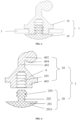
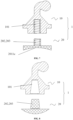
- a first matching member 101 connected to the retaining component 20 is further disposed at a position of the functional component 10 adjacent to the labial side of the shell-like dental appliance 3. As shown in FIG. 4 to FIG. 8 , the functional component 10 is connected to the retaining component 20 through the first matching member 101.
- the retaining component 20 includes a fixing member 201 and a connecting member 202, one end of the connecting member 202 is connected to the fixing member 201, and another end of the connecting member 202 is provided with a second matching member 203 connected to the first matching member 101.
- the second matching member 203 is engaged with the first matching member 101 to implement a connection between the functional component 10 and the retaining component 20, so that the functional component 10 is fixed on a labial side of the shell-like dental appliance 3.
- the first matching member 101 and the second matching member 203 are connected in a manner of a male-female matching connection.
- the male-female matching connection has advantages of a simple structure and a reliable connection.
- the male-female matching connection is a threaded connection, an insert connection, a tenon-and-mortise connection, a magnetic attraction connection or an adhesion connection.
- the fixing member 201 has a coverage area larger than an interface of the shell-like dental appliance through which the fixing member 201 passes, and can play a fixing role when it engaged with the functional component 10.
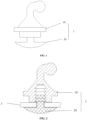
- the functional component 10 is the traction member 4 including: a traction rod 401, a limiting member 402 and a base 403.
- the traction rod 401 is disposed between the limiting member 402 and the base 403, the base 403 is disposed adjacent to a labial side of the shell-like dental appliance 3, an end portion of the traction rod 401 connected to the base 403 is perpendicular to a tooth surface of labial side, the limiting member 402 is disposed at a free end of the traction rod 401, and the limiting member 402 forms a limiting slot 404 with the traction rod 401.
- the traction member 401 is engaged with a traction device to implement traction, the base 403 is adjacent to the shell-like dental appliance 3, so that the base 403 can provide support for the traction rod 401 on the base, and the end portion of the traction rod 401 is disposed perpendicular to the tooth surface of labial side, so that a traction force is perpendicular to the tooth surface of labial side, to avoid an unexpected movement caused by a tilt of the traction force.
- the limiting member 402 and the traction rod 401 form a limiting slot 404, and the limiting slot 404 may generate a hooking force for connecting to the traction device.
- the traction rod 401 is of a hook-like structure disposed at a specific angle with a tooth surface of labial side, the hook-like structure is disposed at a free end of the traction rod 401, and the limiting member 402 and the traction rod 401 form a limiting slot 404.
- a spherical protrusion may be disposed at a free end of the limiting member 402, and a portion for connecting the traction rod 401 to the base 403 is set to be perpendicular to the tooth surface of labial side, and is configured to connect an intramaxillary traction device or an intermaxillary traction device, thereby generating a more stable hooking force.
- the traction rod 401 is of a hook-like structure disposed at a specific angle with the tooth surface of labial side, and when the traction rod is connected and fixed with the shell-like dental appliance 3, a direction of disposing the traction rod 401 of the hook-like structure cannot rotate relative to the shell-like dental appliance, or otherwise there is a deviation from an expected orthodontic effect. Therefore, when at least one of the functional component 10 and the retaining component 20 passes through the shell-like dental appliance 3, a cross section passing through the shell-like dental appliance 3 is of a non-circular structure that prevents rotation relative to the shell-like dental appliance 3, to prevent orthodontic errors caused by the relative rotation.
- the traction rod 401 is a straight rod. That is, the traction rod is perpendicular to the tooth surface of labial side, and the limiting member 402 disposed on the traction rod may be a sphere with a diameter greater than a width of the free end of the traction rod 401, or the limiting member 402 may be of another structure, only if the limiting member may form the limiting slot 404 with the traction rod 401 for hooking.
- the structure of the limiting member 402 is not limited herein.
- the first matching member 101 and the second matching member 203 are connected in a manner of a male-female matching connection.
- the male-female matching connection has advantages of a simple structure and a reliable connection.
- the first matching member 101 and the second matching member 203 are of an insert structure.
- the first matching member 101 is of a concave structure
- the second matching member 203 is of a convex structure. During use, the second matching member 203 is inserted into the first matching member 101 to implement insert engagement.
- the first matching member 101 is of a concave structure
- the second matching member 203 is of a convex structure
- a limiting insert structure engaged with an outer surface of the second matching member 101 is disposed on an inner surface of the first matching member 101.
- one or more vertically stacked trapezoid structures are disposed on the inner surface of the first matching member 101, and a width of an upper base of the trapezoid structure is less than a width of a lower base thereof.
- the second matching member 203 interacts with the first matching member 101, and a relative position does not change. That is, the second matching member 203 cannot slide out from inside of the first matching member 101.
- the first matching member 101 is of a concave structure
- the second matching member 203 is of a convex structure
- the first matching member 101 and the second matching member 203 are of a threaded connection.
- the second matching member 203 is adapted, by using an external thread disposed on an outer surface of the second matching member, to an internal thread disposed inside the first matching member 101 to complete corresponding fixing.
- This connection manner is a detachable connection.
- the first matching member 101 is of a concave structure
- the second matching member 203 is of a convex structure
- the first matching member 101 and the second matching member 203 are of a magnetic attraction. That is, a concave surface of the first matching member 101 and a convex surface of the second matching member 203 are of two magnetic pole structures with opposite magnetism. After the second matching member 203 is inserted into the first matching member 101, the two are attracted and connected to each other. This connection manner is a detachable connection. Referring to FIG.
- the first matching member 101 is provided with a columnar trapezoidal concave structure
- the second matching member 203 is provided with a columnar trapezoidal convex structure matching the columnar trapezoidal concave structure, and a length of an upper base of a trapezoid is less than a length of a lower base thereof.
- a concave surface of the first matching member 101 and a convex surface of the second matching member 203 are of two magnetic pole structures with opposite magnetism. After the second matching member 203 is inserted into the first matching member 101, the two are attracted and connected to each other.
- the first matching member 101 is of a concave structure
- the second matching member 203 is of a convex structure
- the first matching member 101 and the second matching member 203 are of a tenon-and-mortise connection. That is, a concave surface of the first matching member 101 and a convex surface of the second matching member 203 are of two structures that are concave-convex matched, and the two are engaged with each other to complete fixing, which is similar to the engagement manner in FIG. 8 .
- the first matching member 101 is of a concave structure
- the second matching member 203 is of a convex structure, which is not limited herein, and the two may be of other structures as long as such structures can be engaged with each other and thus fixed.
- the first matching member 101 is of a convex structure
- the second matching member 203 is of a concave structure, which is not limited herein, and the two may be of other structures as long as such structures can be engaged with each other and thus fixed.
- Posterior region is defined according to a classification of teeth in the 2nd edition of " Introduction of Stomatology" published by the Peking University Medical Press on pages 36 to 38 , and includes premolars and molars, teeth 4 to 8 are shown by using a foreign direct investment (FDI) marking method, and teeth 1 to 3 are shown by using the FDI marking method in an anterior region.
- FDI foreign direct investment
- the functional component 10 connected on the shell-like dental appliance 3 may be only disposed in a premolar region, or may be only disposed in a molar region, or may be partially disposed in a premolar region and a molar region, or may be disposed in a part region of a premolar region and a molar region, or may be both disposed in a premolar region and a molar region.
- the foregoing auxiliary orthodontic device for a shell-like dental appliance 3 is provided with a functional component 10 and a retaining component 20, here the functional component 10 is set to have a corresponding auxiliary orthodontic function, and the retaining component 20 is set to have an effect of retaining the auxiliary orthodontic device and the shell-like dental appliance 3.
- the retaining component 20 passes through the shell-like dental appliance 3 to be connected to the functional component 10, or the functional component 10 passes through the shell-like dental appliance 3 to be connected to the retaining component 20.
- Such a separated connection manner enables that cooperation between the auxiliary orthodontic device and the shell-like dental appliance 3 is more stable, that is, the shell-like dental appliance 3 is partially inserted into the auxiliary device, so that a connection between the two is stable.
- the auxiliary orthodontic device When engaged with the shell-like dental appliance 3 in use, the auxiliary orthodontic device can achieve the auxiliary orthodontic function more precisely without affecting an area of corresponding tooth wrapped by the shell-like dental appliance 3, and further affecting an overall orthodontic effect of the shell-like dental appliance 3.
- the auxiliary orthodontic device When being disposed on the shell-like dental appliance 3 to achieve the corresponding auxiliary orthodontic function, the auxiliary orthodontic device performs orthodontic treatment by using an overall force of the overall shell-like dental appliance 3 and the corresponding tooth, to implement the orthodontic treatment of overall dentition, and it avoids that the auxiliary orthodontic device is disposed on a single teeth, resulting in an unexpected orthodontic effect on an action of the single teeth.
- the auxiliary orthodontic device may be prepared through pre-forming, and is applicable to large-scale production, and a corresponding auxiliary orthodontic function is added according to orthodontic requirements, to avoid errors caused by a manual operation to affect the orthodontic effect.
- the auxiliary orthodontic device is made of a material that can be applied in a mouth, and is engaged with the shell-like dental appliance 3 by physical connection. This cannot cause uncertainty in use by a change of a material characteristic due to reprocessing.
- the functional component 10 may alternatively be a tongue crib 5 for improving tongue habits.
- the functional component 10 is the tongue crib 5 for improving tongue habits
- the functional component 10 is disposed on a lingual side surface of the shell-like dental appliance 3; and remaining structures may be the same as the structures described in any implementation described above. Details are not described herein again.
- the functional component 10 may alternatively be a component for opening occlusion.
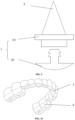
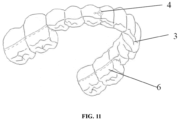
- the functional component may be a jaw pad component 6 for opening occlusion or a flat guide component for opening occlusion, which may be disposed in the posterior region or the anterior region of the shell-like dental appliance 3.
- the jaw pad component 6 is disposed in the posterior region of the shell-like dental appliance 3, and remaining structures may be the same as the structures described in any implementation described above. Details are not described herein again.
- Fig. 10 For a specific manner of cooperating the jaw pad component 6 with the shell-like dental appliance body, refer to Fig. 10 .
- some embodiments of the present disclosure further provide a shell-like dental appliance, including: a shell-like dental appliance body and the auxiliary orthodontic device for a shell-like dental appliance 3 in any of the foregoing embodiments.
- the auxiliary orthodontic device includes a functional component 10 and a retaining component 20 provided separately from the functional component, here the retaining component 20 is connected to the functional component 10, at least one of the functional component 10 and the retaining component 20 passes through a shell-like dental appliance 3, the functional component 10 is retained on the shell-like dental appliance 3, and the functional component 10 is disposed on an outer surface of the shell-like dental appliance 3.
- the auxiliary orthodontic device for a shell-like dental appliance is disposed on a labial surface or a lingual surface of the shell-like dental appliance 3 to achieve a corresponding auxiliary orthodontic function.
- a traction member with a hooking function, a tongue crib for improving tongue habits or a component for opening occlusion completes the corresponding auxiliary orthodontic function.
- the auxiliary orthodontic device may perform intramaxillary traction or intermaxillary traction; when being the tongue crib 5, as shown in FIG.
- the auxiliary orthodontic device may improve patient's tongue habits to prevent a tongue from licking a disposition position; and when being a component for opening occlusion, and being specifically a jaw pad component 6 or a flat guide component, as shown in FIG. 10 , the auxiliary orthodontic device may open relative occlusion of patient's upper and lower jaws to perform occlusal reconstruction of the upper and lower jaws.
- the auxiliary orthodontic device has both the traction member 4 and the jaw pad component 6, and may open occlusion and perform both intramaxillary traction or intermaxillary traction.
- Some embodiments of the present disclosure further provide a tooth orthodontic system, including: a plurality of orthodontic appliances, here at least one of the orthodontic appliances is the shell-like dental appliance 3 described above.
- the auxiliary orthodontic device disposed on the shell-like dental appliance 3 gradually changes from an initial position to an orthodontic target position, and the auxiliary orthodontic device may be transformed in shape, size and position according to actual orthodontic requirements, or may be replaced with different auxiliary orthodontic devices according to actual orthodontic requirements, to achieve the expected orthodontic effect.
Landscapes
- Health & Medical Sciences (AREA)
- Oral & Maxillofacial Surgery (AREA)
- Dentistry (AREA)
- Epidemiology (AREA)
- Life Sciences & Earth Sciences (AREA)
- Animal Behavior & Ethology (AREA)
- General Health & Medical Sciences (AREA)
- Public Health (AREA)
- Veterinary Medicine (AREA)
- Dental Tools And Instruments Or Auxiliary Dental Instruments (AREA)
Claims (12)
- Kieferorthopädische Hilfsvorrichtung für ein schalenartiges Dentalgerät, die Folgendes umfasst:eine Funktionskomponente (10), undeine Haltekomponente (20), die separat von der Funktionskomponente (10) bereitgestellt ist;die Haltekomponente (20) ist mit der Funktionskomponente (10) verbindbar;wobei, wenn die kieferorthopädische Hilfsvorrichtung mit dem schalenartigen Dentalgerät im Eingriff ist, mindestens eine der Funktionskomponente (10) und der Haltekomponente (20) durch das schalenartige Dentalgerät (3) verläuft, die Funktionskomponente (10) am schalenartigen Dentalgerät (3) gehalten wird und die Funktionskomponente (10) an der Außenfläche des schalenartigen Dentalgeräts (3) bereitgestellt ist,wobei die Funktionskomponente (10) ein Traktionselement (4) mit einer Einhakungsfunktion ist,dadurch gekennzeichnet, dass,eine Fläche der Funktionskomponente (10) neben einer labialen Seite des schalenartigen Dentalgeräts (3), wenn montiert, eine gekrümmte Fläche ist, die mit einer Dentalbogenkurve der labialen Seite des schalenartigen Dentalgeräts (3) konsistent ist.
- Kieferorthopädische Hilfsvorrichtung für ein schalenartiges Dentalgerät nach Anspruch 1, wobei das Traktionselement (4) einen Traktionsstab (401), ein Begrenzungselement (402) und eine Basis (403) umfasst;wobei der Traktionsstab (401) zwischen dem Begrenzungselement (402) und der Basis (403) angeordnet ist, die Basis (403) neben einer labialen Seite des schalenartigen Dentalgeräts (3) anzuordnen ist;wobei im Gebrauch ein Endabschnitt des Traktionsstabs (401), der mit der Basis (403) verbunden ist, senkrecht zu einer Fläche eines Zahns auf der labialen Seite verläuft; undein Ende des Traktionsstabs (401), das von der Basis (403) entfernt ist, ist ein freies Ende und das Begrenzungselement (402) ist am freien Ende des Traktionsstabs (401) angeordnet und bildet mit dem Traktionsstab (401) einen Begrenzungsschlitz (404).
- Kieferorthopädische Hilfsvorrichtung für ein schalenartiges Dentalgerät nach Anspruch 2, wobei der Traktionsstab (401) eine hakenartige Struktur aufweist, die in einem spezifischen Winkel angeordnet ist, ein Ende der Basis (403), das mit dem Traktionsstab (401) verbunden ist, ein Verbindungsende ist, das Verbindungsende zwischen dem Traktionsstab (401) und der Basis (403) senkrecht zur Fläche des Zahns auf der labialen Seite verläuft und das freie Ende des Traktionsstaubs (401) in einem spezifischen Winkel zur Fläche des Zahns auf der labialen Seite angeordnet ist.
- Kieferorthopädische Hilfsvorrichtung für ein schalenartiges Dentalgerät nach einem der Ansprüche 1 bis 3, wobei ferner in einer Position der Funktionskomponente (10) ein erstes Anpassungselement (101) angeordnet ist, das mit der Haltekomponente (20) verbindbar ist, um der labialen Seite des schalenartigen Dentalgeräts (3), wenn es montiert ist, benachbart zu sein.
- Kieferorthopädische Hilfsvorrichtung für ein schalenartiges Dentalgerät nach Anspruch 4, wobei die Haltekomponente (20) ein Befestigungselement (201) und ein Verbindungselement (202) umfasst, ein Ende des Verbindungselements (202) mit dem Befestigungselement (201) verbunden ist und ein anderes Ende des Verbindungselements (202) mit einem zweiten Anpassungselement (203) versehen ist, das mit dem ersten Anpassungselement (101) verbunden ist.
- Kieferorthopädische Hilfsvorrichtung für ein schalenartiges Dentalgerät nach Anspruch 5, wobei das Befestigungselement (201) eine gekrümmte Fläche aufweist, die an eine Zahnfläche angepasst und im Gebrauch mit den Zähnen in Berührung ist.
- Kieferorthopädische Hilfsvorrichtung für ein schalenartiges Dentalgerät nach Anspruch 5, wobei das erste Anpassungselement (101) und das zweite Anpassungselement (203) in einer Weise einer Stecker-Buchse-Anpassungsverbindung verbunden sind.
- Kieferorthopädische Hilfsvorrichtung für ein schalenartiges Dentalgerät nach Anspruch 7, wobei die Stecker-Buchse-Anpassungsverbindung eine Gewindeverbindung, eine Einsteckverbindung, eine Zapfenverbindung, eine magnetische Anzugsverbindung oder eine Haftungsverbindung ist.
- Kieferorthopädische Hilfsvorrichtung für ein schalenartiges Dentalgerät nach Anspruch 1, wobei, wenn die Funktionskomponente (10) eine Komponente zum Öffnen eines Verschlusses ist, die Komponente zum Öffnen eines Verschlusses eine Kieferpolsterkomponente oder eine flache Führungskomponente ist.
- Kieferorthopädische Hilfsvorrichtung für ein schalenartiges Dentalgerät nach einem der Ansprüche 1 bis 9, wobei ein Querschnitt der Haltekomponente (20), die durch das schalenartige Dentalgerät (3) verläuft, eine nicht kreisförmige Struktur aufweist, die eine Drehung relativ zum schalenartigen Dentalgerät (3) verhindert, und der Querschnitt der Haltekomponente (20), die durch das schalenartige Dentalgerät (3) verläuft, an eine Öffnung angepasst ist, die am schalenartigen Dentalgerät (3) vorgesehen ist; oder
ein Querschnitt der Funktionskomponente (10), die durch das schalenartige Dentalgerät (3) verläuft, eine nicht kreisförmige Struktur aufweist, die eine Drehung relativ zum schalenartigen Dentalgerät (3) verhindert, und der Querschnitt der Funktionskomponente (10), die durch das schalenartige Dentalgerät (3) verläuft, an eine Öffnung angepasst ist, die am schalenartigen Dentalgerät (3) vorgesehen ist. - Schalenartiges Dentalgerät, das Folgendes umfasst: einen schalenartigen Dentalgerätekörper und die kieferorthopädische Hilfsvorrichtung für ein schalenartiges Dentalgerät nach einem der Ansprüche 1 bis 10.
- Kieferorthopädisches Zahnsystem, das Folgendes umfasst: eine Vielzahl von kieferorthopädischen Geräten, wobei mindestens eines das kieferorthopädische Gerät das schalenartige Dentalgerät nach Anspruch 11 ist.
Applications Claiming Priority (2)
| Application Number | Priority Date | Filing Date | Title |
|---|---|---|---|
| CN201921570502.2U CN211094851U (zh) | 2019-09-20 | 2019-09-20 | 用于壳状牙科矫治器的辅助矫治装置、矫治器 |
| PCT/CN2019/128220 WO2021051700A1 (zh) | 2019-09-20 | 2019-12-25 | 用于壳状牙科矫治器的辅助矫治装置、矫治器及矫治系统 |
Publications (4)
| Publication Number | Publication Date |
|---|---|
| EP4018963A1 EP4018963A1 (de) | 2022-06-29 |
| EP4018963A4 EP4018963A4 (de) | 2022-10-26 |
| EP4018963C0 EP4018963C0 (de) | 2025-05-07 |
| EP4018963B1 true EP4018963B1 (de) | 2025-05-07 |
Family
ID=71720994
Family Applications (1)
| Application Number | Title | Priority Date | Filing Date |
|---|---|---|---|
| EP19946186.4A Active EP4018963B1 (de) | 2019-09-20 | 2019-12-25 | Orthodontische hilfspange für ein schalenartiges dentalgerät |
Country Status (7)
| Country | Link |
|---|---|
| US (1) | US20220202533A1 (de) |
| EP (1) | EP4018963B1 (de) |
| JP (1) | JP3238934U (de) |
| CN (1) | CN211094851U (de) |
| AU (1) | AU2019466858B2 (de) |
| TW (1) | TWM608388U (de) |
| WO (1) | WO2021051700A1 (de) |
Families Citing this family (5)
| Publication number | Priority date | Publication date | Assignee | Title |
|---|---|---|---|---|
| CN114246697B (zh) * | 2020-09-22 | 2023-10-13 | 正雅齿科科技(上海)有限公司 | 牙齿矫治系统的设计方法和制备方法 |
| CN112773524A (zh) * | 2021-01-29 | 2021-05-11 | 上海正雅齿科科技股份有限公司 | 牵引装置及具有牵引装置的壳状牙齿矫正器、系统和套组 |
| CN114948284A (zh) * | 2021-02-26 | 2022-08-30 | 正雅齿科科技(上海)有限公司 | 牙科器械及其设计方法、安装台的设计方法 |
| CN115120365A (zh) * | 2021-03-26 | 2022-09-30 | 正雅齿科科技(上海)有限公司 | 牙科矫治辅助装置、壳状牙科矫治器及牙科器械 |
| US20230293267A1 (en) * | 2022-03-17 | 2023-09-21 | Ormco Corporation | Orthodontic appliances |
Citations (1)
| Publication number | Priority date | Publication date | Assignee | Title |
|---|---|---|---|---|
| WO2007139485A1 (en) * | 2006-05-26 | 2007-12-06 | Nordstroem Jan Christer | An arrangement for securing a teeth support |
Family Cites Families (8)
| Publication number | Priority date | Publication date | Assignee | Title |
|---|---|---|---|---|
| US6572372B1 (en) * | 2000-04-25 | 2003-06-03 | Align Technology, Inc. | Embedded features and methods of a dental appliance |
| US7090490B2 (en) * | 2004-07-26 | 2006-08-15 | Brian Keith Graham | Attachable orthodontic hook system |
| CN106031661A (zh) * | 2015-03-17 | 2016-10-19 | 首都医科大学附属北京口腔医院 | 一种口腔正畸支抗体 |
| CN205683156U (zh) * | 2015-12-29 | 2016-11-16 | 深圳爱美适科技有限公司 | 具有舌刺的无托槽隐形矫治器 |
| EP3804667A1 (de) * | 2016-03-08 | 2021-04-14 | Mitsui Chemicals, Inc. | Mundstück, blatt zur herstellung einer mundstückeinheit und herstellungsverfahren des mundstücks |
| US10485637B2 (en) * | 2016-10-26 | 2019-11-26 | Dental Milling Solutions, LLC | Dental prosthetic assemblies and coupling systems |
| CN118593156A (zh) * | 2018-09-25 | 2024-09-06 | 杭州一牙数字口腔有限公司 | 支抗牵引复合的附件和隐形矫治器 |
| CN110063802B (zh) * | 2019-05-23 | 2024-04-12 | 四川大学 | 下颌前导隐形矫治器 |
-
2019
- 2019-09-20 CN CN201921570502.2U patent/CN211094851U/zh active Active
- 2019-12-25 JP JP2022600038U patent/JP3238934U/ja active Active
- 2019-12-25 AU AU2019466858A patent/AU2019466858B2/en active Active
- 2019-12-25 WO PCT/CN2019/128220 patent/WO2021051700A1/zh not_active Ceased
- 2019-12-25 EP EP19946186.4A patent/EP4018963B1/de active Active
-
2020
- 2020-09-15 TW TW109212082U patent/TWM608388U/zh unknown
-
2022
- 2022-03-18 US US17/655,375 patent/US20220202533A1/en not_active Abandoned
Patent Citations (1)
| Publication number | Priority date | Publication date | Assignee | Title |
|---|---|---|---|---|
| WO2007139485A1 (en) * | 2006-05-26 | 2007-12-06 | Nordstroem Jan Christer | An arrangement for securing a teeth support |
Also Published As
| Publication number | Publication date |
|---|---|
| WO2021051700A1 (zh) | 2021-03-25 |
| TWM608388U (zh) | 2021-03-01 |
| US20220202533A1 (en) | 2022-06-30 |
| JP3238934U (ja) | 2022-08-31 |
| EP4018963C0 (de) | 2025-05-07 |
| EP4018963A1 (de) | 2022-06-29 |
| CN211094851U (zh) | 2020-07-28 |
| EP4018963A4 (de) | 2022-10-26 |
| AU2019466858B2 (en) | 2023-08-03 |
| AU2019466858A1 (en) | 2022-04-07 |
Similar Documents
| Publication | Publication Date | Title |
|---|---|---|
| EP4018963B1 (de) | Orthodontische hilfspange für ein schalenartiges dentalgerät | |
| JP5444219B2 (ja) | 口腔内咬合矯正装置用の歯科矯正アタッチメントモジュール | |
| KR101573186B1 (ko) | 치열교정용 구개 고정구 | |
| CN211156365U (zh) | 一种壳状牙科器械及壳状牙科矫治系统 | |
| EP0389223A2 (de) | Stützklammer für eine zahnorthopädische Anordnung | |
| US11246683B1 (en) | Orthodontic band attachment device | |
| JP6854291B2 (ja) | 舌側歯科矯正装具 | |
| CN104661614A (zh) | 具有结扎特征结构的矫正器具 | |
| CN104970892A (zh) | 一种方便清洁的被动式滑盖自锁托槽 | |
| CN211433401U (zh) | 一种圆弧纽扣剪切钳 | |
| CN212261567U (zh) | 用于牙科器械的辅助矫治装置、牙齿矫治器及矫治系统 | |
| CN208784950U (zh) | 一种水平阻生磨牙竖直装置 | |
| CN205411356U (zh) | 正畸牵引埋伏阻生牙用牵引弹簧 | |
| US11033363B2 (en) | Orthodontic appliance for dentistry | |
| US20220110720A1 (en) | Orthodontic device and tool for handling the device | |
| TWM620389U (zh) | 輔助矯治裝置、殼狀牙齒矯治器及矯治套組 | |
| CN215458818U (zh) | 一种阻生磨牙矫正器 | |
| CN215535175U (zh) | 一种磨牙远中移动的辅助装置 | |
| CN206473407U (zh) | 一种用于牙齿正畸的单根前牙转矩簧 | |
| CN210472302U (zh) | 一种ⅲ类错颌个性化定制隐形正畸矫治器 | |
| CN223041629U (zh) | 正畸挂钩 | |
| CN210903430U (zh) | 一种悬臂式矫治器 | |
| CN216724784U (zh) | 一种用于口腔不良习惯纠正的训练器 | |
| CN222444373U (zh) | 一种透明矫治器牵引扣结构 | |
| CN221712268U (zh) | 一种低摩擦力的弓丝滑动矫治系统 |
Legal Events
| Date | Code | Title | Description |
|---|---|---|---|
| STAA | Information on the status of an ep patent application or granted ep patent |
Free format text: STATUS: THE INTERNATIONAL PUBLICATION HAS BEEN MADE |
|
| PUAI | Public reference made under article 153(3) epc to a published international application that has entered the european phase |
Free format text: ORIGINAL CODE: 0009012 |
|
| STAA | Information on the status of an ep patent application or granted ep patent |
Free format text: STATUS: REQUEST FOR EXAMINATION WAS MADE |
|
| 17P | Request for examination filed |
Effective date: 20220318 |
|
| AK | Designated contracting states |
Kind code of ref document: A1 Designated state(s): AL AT BE BG CH CY CZ DE DK EE ES FI FR GB GR HR HU IE IS IT LI LT LU LV MC MK MT NL NO PL PT RO RS SE SI SK SM TR |
|
| A4 | Supplementary search report drawn up and despatched |
Effective date: 20220927 |
|
| RIC1 | Information provided on ipc code assigned before grant |
Ipc: A61C 7/36 20060101ALI20220921BHEP Ipc: A61C 7/00 20060101AFI20220921BHEP |
|
| DAV | Request for validation of the european patent (deleted) | ||
| DAX | Request for extension of the european patent (deleted) | ||
| STAA | Information on the status of an ep patent application or granted ep patent |
Free format text: STATUS: EXAMINATION IS IN PROGRESS |
|
| 17Q | First examination report despatched |
Effective date: 20230516 |
|
| GRAP | Despatch of communication of intention to grant a patent |
Free format text: ORIGINAL CODE: EPIDOSNIGR1 |
|
| STAA | Information on the status of an ep patent application or granted ep patent |
Free format text: STATUS: GRANT OF PATENT IS INTENDED |
|
| INTG | Intention to grant announced |
Effective date: 20250107 |
|
| GRAS | Grant fee paid |
Free format text: ORIGINAL CODE: EPIDOSNIGR3 |
|
| GRAA | (expected) grant |
Free format text: ORIGINAL CODE: 0009210 |
|
| STAA | Information on the status of an ep patent application or granted ep patent |
Free format text: STATUS: THE PATENT HAS BEEN GRANTED |
|
| AK | Designated contracting states |
Kind code of ref document: B1 Designated state(s): AL AT BE BG CH CY CZ DE DK EE ES FI FR GB GR HR HU IE IS IT LI LT LU LV MC MK MT NL NO PL PT RO RS SE SI SK SM TR |
|
| REG | Reference to a national code |
Ref country code: GB Ref legal event code: FG4D |
|
| REG | Reference to a national code |
Ref country code: CH Ref legal event code: EP |
|
| REG | Reference to a national code |
Ref country code: DE Ref legal event code: R096 Ref document number: 602019069830 Country of ref document: DE |
|
| REG | Reference to a national code |
Ref country code: IE Ref legal event code: FG4D |
|
| U01 | Request for unitary effect filed |
Effective date: 20250528 |
|
| U07 | Unitary effect registered |
Designated state(s): AT BE BG DE DK EE FI FR IT LT LU LV MT NL PT RO SE SI Effective date: 20250606 |
|
| PG25 | Lapsed in a contracting state [announced via postgrant information from national office to epo] |
Ref country code: ES Free format text: LAPSE BECAUSE OF FAILURE TO SUBMIT A TRANSLATION OF THE DESCRIPTION OR TO PAY THE FEE WITHIN THE PRESCRIBED TIME-LIMIT Effective date: 20250507 |
|
| PG25 | Lapsed in a contracting state [announced via postgrant information from national office to epo] |
Ref country code: GR Free format text: LAPSE BECAUSE OF FAILURE TO SUBMIT A TRANSLATION OF THE DESCRIPTION OR TO PAY THE FEE WITHIN THE PRESCRIBED TIME-LIMIT Effective date: 20250808 Ref country code: NO Free format text: LAPSE BECAUSE OF FAILURE TO SUBMIT A TRANSLATION OF THE DESCRIPTION OR TO PAY THE FEE WITHIN THE PRESCRIBED TIME-LIMIT Effective date: 20250807 |
|
| PG25 | Lapsed in a contracting state [announced via postgrant information from national office to epo] |
Ref country code: PL Free format text: LAPSE BECAUSE OF FAILURE TO SUBMIT A TRANSLATION OF THE DESCRIPTION OR TO PAY THE FEE WITHIN THE PRESCRIBED TIME-LIMIT Effective date: 20250507 |
|
| PG25 | Lapsed in a contracting state [announced via postgrant information from national office to epo] |
Ref country code: HR Free format text: LAPSE BECAUSE OF FAILURE TO SUBMIT A TRANSLATION OF THE DESCRIPTION OR TO PAY THE FEE WITHIN THE PRESCRIBED TIME-LIMIT Effective date: 20250507 |
|
| PG25 | Lapsed in a contracting state [announced via postgrant information from national office to epo] |
Ref country code: RS Free format text: LAPSE BECAUSE OF FAILURE TO SUBMIT A TRANSLATION OF THE DESCRIPTION OR TO PAY THE FEE WITHIN THE PRESCRIBED TIME-LIMIT Effective date: 20250807 |
|
| PG25 | Lapsed in a contracting state [announced via postgrant information from national office to epo] |
Ref country code: IS Free format text: LAPSE BECAUSE OF FAILURE TO SUBMIT A TRANSLATION OF THE DESCRIPTION OR TO PAY THE FEE WITHIN THE PRESCRIBED TIME-LIMIT Effective date: 20250907 |