EP4018129B1 - Betreiben eines haushalts-gargeräts mit mindestens einer kamera - Google Patents
Betreiben eines haushalts-gargeräts mit mindestens einer kamera Download PDFInfo
- Publication number
- EP4018129B1 EP4018129B1 EP20753907.3A EP20753907A EP4018129B1 EP 4018129 B1 EP4018129 B1 EP 4018129B1 EP 20753907 A EP20753907 A EP 20753907A EP 4018129 B1 EP4018129 B1 EP 4018129B1
- Authority
- EP
- European Patent Office
- Prior art keywords
- image
- brightness
- cooking
- food
- cooking chamber
- Prior art date
- Legal status (The legal status is an assumption and is not a legal conclusion. Google has not performed a legal analysis and makes no representation as to the accuracy of the status listed.)
- Active
Links
Images


Classifications
-
- G—PHYSICS
- G06—COMPUTING OR CALCULATING; COUNTING
- G06T—IMAGE DATA PROCESSING OR GENERATION, IN GENERAL
- G06T7/00—Image analysis
- G06T7/90—Determination of colour characteristics
-
- A—HUMAN NECESSITIES
- A47—FURNITURE; DOMESTIC ARTICLES OR APPLIANCES; COFFEE MILLS; SPICE MILLS; SUCTION CLEANERS IN GENERAL
- A47J—KITCHEN EQUIPMENT; COFFEE MILLS; SPICE MILLS; APPARATUS FOR MAKING BEVERAGES
- A47J37/00—Baking; Roasting; Grilling; Frying
- A47J37/06—Roasters; Grills; Sandwich grills
- A47J37/0623—Small-size cooking ovens, i.e. defining an at least partially closed cooking cavity
- A47J37/0664—Accessories
-
- A—HUMAN NECESSITIES
- A23—FOODS OR FOODSTUFFS; TREATMENT THEREOF, NOT COVERED BY OTHER CLASSES
- A23L—FOODS, FOODSTUFFS OR NON-ALCOHOLIC BEVERAGES, NOT OTHERWISE PROVIDED FOR; PREPARATION OR TREATMENT THEREOF
- A23L5/00—Preparation or treatment of foods or foodstuffs, in general; Food or foodstuffs obtained thereby; Materials therefor
- A23L5/10—General methods of cooking foods, e.g. by roasting or frying
-
- A—HUMAN NECESSITIES
- A47—FURNITURE; DOMESTIC ARTICLES OR APPLIANCES; COFFEE MILLS; SPICE MILLS; SUCTION CLEANERS IN GENERAL
- A47J—KITCHEN EQUIPMENT; COFFEE MILLS; SPICE MILLS; APPARATUS FOR MAKING BEVERAGES
- A47J27/00—Cooking-vessels
- A47J27/04—Cooking-vessels for cooking food in steam; Devices for extracting fruit juice by means of steam ; Vacuum cooking vessels
-
- A—HUMAN NECESSITIES
- A47—FURNITURE; DOMESTIC ARTICLES OR APPLIANCES; COFFEE MILLS; SPICE MILLS; SUCTION CLEANERS IN GENERAL
- A47J—KITCHEN EQUIPMENT; COFFEE MILLS; SPICE MILLS; APPARATUS FOR MAKING BEVERAGES
- A47J36/00—Parts, details or accessories of cooking-vessels
- A47J36/32—Time-controlled igniting mechanisms or alarm devices
-
- A—HUMAN NECESSITIES
- A47—FURNITURE; DOMESTIC ARTICLES OR APPLIANCES; COFFEE MILLS; SPICE MILLS; SUCTION CLEANERS IN GENERAL
- A47J—KITCHEN EQUIPMENT; COFFEE MILLS; SPICE MILLS; APPARATUS FOR MAKING BEVERAGES
- A47J37/00—Baking; Roasting; Grilling; Frying
- A47J37/06—Roasters; Grills; Sandwich grills
- A47J37/0623—Small-size cooking ovens, i.e. defining an at least partially closed cooking cavity
- A47J37/0658—Small-size cooking ovens, i.e. defining an at least partially closed cooking cavity specially adapted for cooking pizza
-
- F—MECHANICAL ENGINEERING; LIGHTING; HEATING; WEAPONS; BLASTING
- F24—HEATING; RANGES; VENTILATING
- F24C—DOMESTIC STOVES OR RANGES ; DETAILS OF DOMESTIC STOVES OR RANGES, OF GENERAL APPLICATION
- F24C7/00—Stoves or ranges heated by electric energy
- F24C7/02—Stoves or ranges heated by electric energy using microwaves
-
- F—MECHANICAL ENGINEERING; LIGHTING; HEATING; WEAPONS; BLASTING
- F24—HEATING; RANGES; VENTILATING
- F24C—DOMESTIC STOVES OR RANGES ; DETAILS OF DOMESTIC STOVES OR RANGES, OF GENERAL APPLICATION
- F24C7/00—Stoves or ranges heated by electric energy
- F24C7/08—Arrangement or mounting of control or safety devices
- F24C7/082—Arrangement or mounting of control or safety devices on ranges, e.g. control panels, illumination
- F24C7/085—Arrangement or mounting of control or safety devices on ranges, e.g. control panels, illumination on baking ovens
-
- F—MECHANICAL ENGINEERING; LIGHTING; HEATING; WEAPONS; BLASTING
- F27—FURNACES; KILNS; OVENS; RETORTS
- F27D—DETAILS OR ACCESSORIES OF FURNACES, KILNS, OVENS OR RETORTS, IN SO FAR AS THEY ARE OF KINDS OCCURRING IN MORE THAN ONE KIND OF FURNACE
- F27D21/00—Arrangement of monitoring devices; Arrangement of safety devices
- F27D21/02—Observation or illuminating devices
-
- H—ELECTRICITY
- H04—ELECTRIC COMMUNICATION TECHNIQUE
- H04N—PICTORIAL COMMUNICATION, e.g. TELEVISION
- H04N9/00—Details of colour television systems
- H04N9/64—Circuits for processing colour signals
-
- H—ELECTRICITY
- H04—ELECTRIC COMMUNICATION TECHNIQUE
- H04N—PICTORIAL COMMUNICATION, e.g. TELEVISION
- H04N9/00—Details of colour television systems
- H04N9/77—Circuits for processing the brightness signal and the chrominance signal relative to each other, e.g. adjusting the phase of the brightness signal relative to the colour signal, correcting differential gain or differential phase
-
- A—HUMAN NECESSITIES
- A23—FOODS OR FOODSTUFFS; TREATMENT THEREOF, NOT COVERED BY OTHER CLASSES
- A23V—INDEXING SCHEME RELATING TO FOODS, FOODSTUFFS OR NON-ALCOHOLIC BEVERAGES AND LACTIC OR PROPIONIC ACID BACTERIA USED IN FOODSTUFFS OR FOOD PREPARATION
- A23V2002/00—Food compositions, function of food ingredients or processes for food or foodstuffs
-
- A—HUMAN NECESSITIES
- A47—FURNITURE; DOMESTIC ARTICLES OR APPLIANCES; COFFEE MILLS; SPICE MILLS; SUCTION CLEANERS IN GENERAL
- A47J—KITCHEN EQUIPMENT; COFFEE MILLS; SPICE MILLS; APPARATUS FOR MAKING BEVERAGES
- A47J27/00—Cooking-vessels
- A47J27/04—Cooking-vessels for cooking food in steam; Devices for extracting fruit juice by means of steam ; Vacuum cooking vessels
- A47J2027/043—Cooking-vessels for cooking food in steam; Devices for extracting fruit juice by means of steam ; Vacuum cooking vessels for cooking food in steam
-
- F—MECHANICAL ENGINEERING; LIGHTING; HEATING; WEAPONS; BLASTING
- F27—FURNACES; KILNS; OVENS; RETORTS
- F27D—DETAILS OR ACCESSORIES OF FURNACES, KILNS, OVENS OR RETORTS, IN SO FAR AS THEY ARE OF KINDS OCCURRING IN MORE THAN ONE KIND OF FURNACE
- F27D21/00—Arrangement of monitoring devices; Arrangement of safety devices
- F27D21/02—Observation or illuminating devices
- F27D2021/026—Observation or illuminating devices using a video installation
-
- G—PHYSICS
- G06—COMPUTING OR CALCULATING; COUNTING
- G06T—IMAGE DATA PROCESSING OR GENERATION, IN GENERAL
- G06T2207/00—Indexing scheme for image analysis or image enhancement
- G06T2207/10—Image acquisition modality
- G06T2207/10024—Color image
-
- H—ELECTRICITY
- H04—ELECTRIC COMMUNICATION TECHNIQUE
- H04N—PICTORIAL COMMUNICATION, e.g. TELEVISION
- H04N5/00—Details of television systems
- H04N5/76—Television signal recording
- H04N5/765—Interface circuits between an apparatus for recording and another apparatus
- H04N5/77—Interface circuits between an apparatus for recording and another apparatus between a recording apparatus and a television camera
Definitions
- the invention relates to a method for operating a household cooking appliance with a cooking chamber and at least one camera that is set up to record pixel-based images from the cooking chamber, in which at least one image from the cooking chamber is recorded by means of the at least one camera and the image is evaluated.
- the invention also relates to a household cooking appliance, having a cooking chamber and at least one camera for recording pixel-based images, wherein the household cooking appliance is designed to carry out the method.
- the invention is particularly advantageously applicable to ovens, microwaves, steam treatment devices or any combinations thereof.
- DE 10 2016 215 550 A1 discloses a method for determining a degree of browning of food in a cooking chamber of a domestic cooking appliance, which domestic cooking appliance has a camera directed into the cooking chamber and a light source for illuminating the cooking chamber, and wherein a reference image is recorded by means of the camera, a first measurement image is recorded at a first brightness of the light source, a second measurement image is recorded at a second brightness of the light source, a difference image is generated from the first measurement image and the second measurement image, and the difference image is compared with the reference image.
- a domestic cooking appliance has a camera directed into a cooking chamber, a light source for illuminating the cooking chamber and a control device coupled to the camera and the light source, wherein the domestic cooking appliance is set up to carry out the method.
- DE 10 2005 014 713 A1 discloses a sensor device with a data processing unit for determining a degree of browning of a cooking product arranged in a cooking chamber and with at least one sensor for detecting a radiation intensity reflected by the cooking product.
- the data processing unit for determining a relevance parameter for a characteristic the detected radiation intensity is dependent on the temporal course of the detected radiation intensity.
- WO 2014/053002 A2 provides an apparatus for characterizing a chromatic property of food.
- the apparatus comprises a light source arranged to emit light having at least two wavelengths or wavelength ranges.
- the light source is further arranged to direct the light onto a surface of at least the food.
- the apparatus also comprises a detector positioned to detect at least a portion of the reflected light and arranged to produce an output indicative of an intensity of the detected reflected light.
- the apparatus is arranged to produce corresponding indicia for the at least two wavelengths or wavelength ranges. A relationship between the indicia for one of the at least two wavelengths or wavelength ranges and the indicia for the other or another of the at least two wavelengths or wavelength ranges is indicative of the chromatic property of the surface of the food.
- a cooking appliance is set up to carry out the method and has: a cooking chamber, at least one light source for emitting light into the cooking chamber and at least one light sensor for measuring light reflected in the cooking chamber, wherein the cooking appliance further comprises: an evaluation device for spectroscopic evaluation of the measurement results determined by the at least one light sensor and a control device for controlling a cooking process depending on a result of the evaluation.
- EP 0 682 243 A1 discloses a device and a method for measuring the degree of browning of a product, in particular a baked product, with at least one radiation source which generates a measuring radiation and a reference radiation of different wavelength ranges, the reflection and backscattering of which are influenced differently by the degree of browning of the product, both of which are directed to the Food to be cooked is radiated, with a measuring sensor for detecting the radiation emitted by the food to be cooked, with a reference sensor for detecting the intensities of the measuring radiation and the reference radiation, and with a device for determining the degree of browning from the intensity of the measuring radiation detected by the measuring sensor, from the intensity of the reference radiation detected by the measuring sensor, from the intensity of the measuring radiation detected by the reference sensor and from the intensity of the reference radiation detected by the reference sensor.
- JP 61265429 A discloses a method in which a surface of a food to be cooked is irradiated with two kinds of light each having different wavelengths while heating it, and the reflected light is detected by a photometer.
- the food is heated by a heater and irradiated with light sources having different emission wavelengths to detect the rays reflected from the food by the photometer having sensitivities for these two emission wavelengths.
- the emission intensity of the first light source has its maximum at a wavelength of 300 W, 600 nm, while the emission intensity of the second light source has its maximum at a wavelength of 700 W, 1200 nm.
- the surface condition of the food can be determined by the light rays. Accordingly, cooking that shows a good final condition at all times can be effected by presetting the detection level of reflected rays suitable for a cooking menu.
- the object is achieved by a method for operating a household cooking appliance with a cooking chamber and at least one camera which is set up to record pixel-based images from the cooking chamber, in which (a) by means of the at least one camera takes at least one image from the cooking chamber and (b) the image is evaluated excluding the brightness values of its associated pixels.
- This method has the advantage that image data recorded from the cooking chamber can be evaluated largely independently of a brightness distribution in the cooking chamber generated, for example, by cooking chamber lighting and/or ambient light.
- the method solves the problem of the typically inhomogeneous brightness distribution in the cooking chamber for image evaluation.
- the evaluation is advantageously independent of a shelf level and height of the food to be cooked. It also has the advantage of greater robustness against light source-related brightness changes that arise, for example, due to an operating temperature, an age of the light source and/or due to a changing light incidence through a cooking chamber door.
- the method is also advantageously largely independent of structural changes to the lighting arrangement, such as the number and/or arrangement of light sources for illuminating the cooking chamber.
- image evaluation can be carried out more simply and quickly, in particular by reducing the amount of data to be evaluated.
- the household cooking appliance can in particular be an oven, a microwave, a steam treatment appliance or any combination thereof, e.g. an oven with additional microwave and/or steam treatment function.
- the cooking chamber can also be referred to as a muffle or oven.
- the household cooking appliance can have one or more cooking chambers, e.g. in the form of a double-deck oven with two cooking chambers arranged one above the other.
- the cooking chamber has several insertion levels for positioning food supports such as wire racks, baking trays, etc.
- the cooking chamber typically has a loading opening arranged at the front, which can be closed by means of a cooking chamber door.
- the at least one camera records pixel-based images, with each pixel being assigned several color space coordinates or their associated values. This can also be expressed as an image containing several color space channels (hereinafter also simply called “channels”), which indicate the possible color space coordinates.
- the camera is a color camera.
- the pixels of a recorded color image are assigned several colors or color space channels, e.g. red, green and blue in the case of an RGB image.
- the camera is a black and white camera that takes a series of several (1-channel) images at the shortest possible intervals, using different light colors to illuminate the individual images, e.g. red light, green light and blue light.
- the individual (1-channel) images of the series could be concatenated and then viewed as one color image.
- the at least one image recorded typically shows the food (e.g. one or more dishes arranged in a distributed manner) and often also areas of the cooking chamber such as a cooking chamber wall.
- the image area that does not show any food can be disregarded in a further development.
- object recognition can be carried out on the food.
- the identification of image areas that contain food and image areas that do not show any food but, for example, a cooking chamber wall is generally known and will therefore not be discussed in more detail here.
- the at least one cooking chamber camera is arranged in an upper half of the cooking chamber in order to be able to record the food to be cooked over its entire surface.
- the at least one cooking chamber camera can be arranged in the area of a ceiling, a left side wall, a right side wall, a rear wall and/or the cooking chamber door.
- a cooking chamber camera can be arranged in the area of the ceiling of the cooking chamber and another cooking chamber camera can be arranged in the upper third or quarter of the left side wall or the right side wall.
- the household cooking appliance has at least one lighting device, e.g. comprising one or more light sources, in particular light spotlights, for illuminating the cooking chamber.
- the light sources can in principle be arranged in any way in relation to the cooking chamber, e.g. in a ceiling, in an upper half side cooking chamber walls (left side wall, right side wall, rear wall), in the cooking chamber door, etc.
- at least one light source can be arranged near a camera.
- the image analysis e.g. to determine the browning of one or more dishes, can then be carried out by excluding the brightness values of the pixels of at least one recorded image.
- the brightness values are not taken into account for the evaluation and are therefore excluded, but are still present in the image data of the evaluated image. This can be advantageous, for example, if the image is also intended to be displayed to a user on a screen.
- the household cooking appliance can trigger at least one action, e.g. adapt a cooking process (e.g. a cooking chamber temperature) to a detected degree of cooking, determine a remaining running time and display it if necessary, cancel the cooking process, issue a message to a user and/or switch to another cooking phase (e.g. a keep-warm phase), etc.
- a cooking process e.g. a cooking chamber temperature
- step (b) the sub-steps (b1) that an image is generated from the recorded image (hereinafter referred to as a "brightness-normalized" image without loss of generality) in which the brightness values of the associated pixels have been separated, and (b2) that the brightness-normalized image is evaluated, are carried out.
- the brightness-normalized image therefore no longer contains any brightness information. This creates the advantage that the amount of data and thus also the requirements for the computing power required for evaluation can be noticeably reduced.
- step (b1) the brightness-normalized image is generated from an image whose pixels each have several color space coordinates including a brightness coordinate by separating the brightness coordinate.
- This enables a particularly simple separation or exclusion of the brightness values by simply eliminating the brightness coordinate(s).
- the channel representing the brightness coordinate (“brightness channel”) is eliminated.
- the image from which the brightness-normalized image is generated, or its pixels are described by a color space that has the brightness as its own color space coordinate.
- the remaining color space coordinates of the brightness-normalized image are also referred to below as "color coordinates”.
- the color coordinates then span a brightness-normalized color space. Concrete value tuples of the color coordinates can then be mapped to a color location of the brightness-normalized color space.
- the brightness-normalized image is generated by eliminating the brightness channel from an HSX image.
- This has the advantage that an HSX image uses a widely used color space representation, which is also easy to evaluate.
- the amount of image data can be reduced by the amount of data in the brightness channel.
- An HSX image is understood to be an image whose color space coordinates include a color value (hue), a color saturation and a brightness value.
- the brightness-normalized image can alternatively be generated by eliminating the brightness channel, e.g. from an image in YUV format, YIQ format, etc.
- the color value can be represented or specified as a color angle on the color wheel (e.g. with 0° for red, 120° for green, 240° for blue).
- Color value and color saturation form the two color coordinates that create a, e.g. circular, brightness-normalized (H, S) color space.
- the pixels of the image recorded in step (a) do not have an independent brightness coordinate and in step (b1) the recorded image is converted into an image whose pixels each have several color space coordinates including a brightness coordinate.
- the brightness values or the brightness information can advantageously be excluded or eliminated relatively easily even from recorded images that do not have an independent brightness channel.
- step (a) an RGB image or CMYK image is recorded and in step (b1) the RGB image or CMYK image is first converted into an HSX image and then the brightness-normalized (“HS") image is generated from the HSX image by separating the brightness values.
- HS brightness-normalized
- the transformation into an HSX image is generally known, for example for RGB after HSV transformation according to the formula set by Gonzalez and Woods, by Foley and Van Dam or by Travis. Compared to an RGB image, using an HSX image reduces the amount of data by a third, and compared to a CMYK image by as much as half.
- the process is not limited to the use of RGB, CMYK, HSX, etc. images.
- the image is evaluated to determine a degree of doneness of the food shown in the image (i.e., one or more different food items) using at least one remaining color coordinate, e.g. based on an evaluation of the color value, the color saturation or a color location determined from the color value and the color saturation of a brightness-normalized HSX image or HS image.
- the degree of doneness of a food is determined by evaluating the individual or grouped pixels of this food in the brightness-normalized image. This allows a location dependency or spatial distribution of the degree of doneness to be taken into account.
- the degree of doneness of a food is determined by calculating an overall color location for the food. This can be done, for example, by averaging - possibly weighted - the values of at least one color coordinate of the pixels belonging to the food.
- a degree of doneness can generally be understood as a measurement that depicts or represents different cooking states with the end points "not cooked” and "cooked”.
- a change in the degree of doneness is recognized by detecting a color change on the surface of the food being cooked.
- the current color and/or a color change therefore represent a quantifiable indication of the degree of doneness.
- the degree of doneness is a degree of browning.
- other degrees of doneness can also be determined instead of a degree of browning. For example, certain foods lose their color as the degree of doneness increases, or a color change other than brown can occur as the degree of doneness increases. This can be taken into account, for example, if the type of food is known in advance, e.g. due to user input or an automatic determination.
- the degree of doneness or the achievement of a target degree of doneness can be determined over the entire surface of a food item ("globally") or separately for different parts of the food item ("locally”). Specifically, when the degree of doneness is determined locally, the cooking appliance can trigger at least one action if a target degree of doneness has already been achieved in one part, is achieved for several parts or is achieved for all parts.
- One embodiment is that the achievement of a target degree of doneness of the food being considered is determined by reaching a target color point defined by the remaining color coordinates or an area around it (e.g. Htarget ⁇ 2° and Starget ⁇ 5%). This enables a particularly simple determination of a finished cooking state of the food being considered.
- the target degree of doneness can be set in a further development before or at the start of a cooking process. If, for example, a certain dish (e.g. chicken, pizza, casserole, etc.) and a desired degree of browning (e.g. "crispy”) are set as part of a cooking program, the target color point corresponding to the target degree of doneness, in particular the target degree of browning, can be calculated from this or retrieved from a data storage device.
- steps (a) and (b) are carried out several times in succession. This allows the color coordinates of the food or the surface of the food to be cooked to be advantageously evaluated at different times and dynamic effects to be taken into account.
- color coordinates of a food that are determined in succession can be evaluated to determine a target cooking level of the food and/or a remaining cooking time.
- the temporally successive color coordinates are evaluated pixel by pixel, e.g. by comparing images. For example, difference images can be generated and evaluated to determine the target degree of doneness and/or the remaining cooking time. Achieving a target degree of doneness can then be determined, for example, based on the fact that a temporal change in the color coordinates for at least 70% of the pixels is below a certain threshold value and, if applicable, these pixels are within a certain distance from a target degree of doneness.
- a curve of at least one color coordinate is evaluated to determine the target cooking level of the food and/or the remaining cooking time.
- This advantageously allows cooking product states (e.g. a cooking level, especially browning level) to be evaluated particularly flexibly and reliably.
- the known methods for curve evaluation or curve discussion can be used, e.g. determining maximum and/or minimum points, saddle points, points with a high gradient, etc.
- the curve can, for example, represent a temporal change in a - standardized or non-standardized - color angle. of the color value and/or a - normalized or non-normalized - change in the degree of saturation.
- the object is also achieved by a household cooking appliance, having a cooking chamber and at least one camera for recording pixel-based images, wherein the household cooking appliance is designed to carry out the method as described above.
- the household cooking appliance can be designed analogously to the method and has the same advantages.
- the evaluation can take place in the household cooking appliance or outside the household cooking appliance, e.g. in an external data processing device such as a network server or a cloud computer. If the evaluation takes place in the household cooking appliance, this has a corresponding data processing device; if the evaluation takes place externally, it has a communication interface with an external data processing device. In principle, the process can also be carried out in any way distributed between the household cooking appliance and the external data processing device.
- an external data processing device such as a network server or a cloud computer.
- Fig.1 shows a sectional side view of a sketch of a household cooking appliance 1 with a cooking chamber 2, the front loading opening 3 of which can be closed by means of a cooking chamber door 4.
- the cooking chamber 2 has several shelf levels with corresponding shelf heights EH1 to EH4, with the shelf height EH1 being near a floor of the cooking chamber 2 and the shelf height EH4 being near a ceiling of the cooking chamber 2.
- food A which itself has a certain height, is placed on the second shelf height EH2, e.g. on a wire rack or baking tray inserted in the corresponding shelf level (not shown).
- a color camera 5 is mounted in the ceiling of the cooking chamber 2, but other cameras (not shown) may also be present.
- the color camera 5 is set up (i.e., designed and arranged) to record pixel-based color images from above or from an angle above from the cooking chamber 2.
- the household cooking appliance 1 further comprises at least one lighting device for illuminating the cooking chamber 2, e.g. comprising a spotlight (e.g. LED spotlight) 6 in the area of the ceiling and a spotlight (e.g. LED spotlight) 7 in the area of the left and/or right side wall of the cooking chamber 2.
- a spotlight e.g. LED spotlight
- the brightness distribution resulting from the light cone in the cooking chamber 2 when the spotlights 6, 7 are in operation is inhomogeneous in the horizontal plane and also depends on the measured height in the cooking chamber 2. Overall, the light distribution in the cooking chamber is inhomogeneous in all three spatial directions.
- the color camera 5 and the emitters 6, 7 are connected to a control device 8, which can also be configured as a data evaluation device.
- the control device 8 can also be connected to a communication module 9 (e.g. an Ethernet module, a WLAN module, etc.) and via the communication module 9, e.g. via a network N, to a computer C external to the device.
- a communication module 9 e.g. an Ethernet module, a WLAN module, etc.
- Fig.2 shows a plot of an average of the pixel-related values for the different color space coordinates or channels H (color value), S (saturation) and V (brightness) of an HSV image of a white reference depending on the insertion heights EH1 to EH4.
- the color space coordinates H, S and V are standardized to a maximum value "1" as follows:
- the HSV image can be captured directly or indirectly (e.g. via an RGB image).
- Fig.3 shows a standard deviation for the different color coordinates or channels H, S, V of the HSV image from Fig.2 depending on the insertion heights EH1 to EH4.
- the standard deviation in the V channel V is significantly larger than in the H and S channels H, S. This means that the H and S values of the individual pixels are almost constant within the area of the white reference at the respective insertion heights EH1 to EH4.
- a browning assessment of food A taking into account the brightness is therefore very error-prone, especially if the shelf height EH1 to EH4 and the height and shape of the food are not known.
- Fig.4 shows a curve that is analogous to Fig.2 standardized color coordinates H and S of an HSV image of the top side of a food item A in the form of a pizza mozzarella over a duration t of oven cooking in seconds.
- H and S corresponds to a browning of the surface of the pizza, so that the browning can be reliably recognized even without taking the brightness value S into account.
- the curves or curve progressions for H and S can be used to determine whether a target cooking level and/or the remaining cooking time are reached. If, for example, the time until browning begins and/or until it is completed is known, the time until the target cooking level and/or the remaining cooking time are reached can be looked up using tables or characteristic curves determined experimentally, for example.
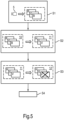
- Fig.5 shows a process flow for preparing an evaluation of an RGB image 10 recorded by the camera 5 in a step S1 for operating the household cooking appliance 1. For example, in order to reduce the error rate in the browning assessment, the highly error-prone brightness information is omitted or excluded from further evaluation.
- a step S2 the recorded RGB image 10 with its channels R (red), G (green) and B (blue) is converted or transformed into an HSV image 11 with its channels H, S and V.
- step S3 the V channel is separated, resulting in a brightness-normalized HS image 12 whose data volume is approximately one third less than that of the HSV image 11.
- the V channel V is therefore not used for further evaluation in step S4, as indicated by its crossing out.
- the steps S3, S3 and/or S4 can be executed entirely or partially on the control device 8 and/or on the computer C.
Landscapes
- Engineering & Computer Science (AREA)
- Food Science & Technology (AREA)
- Mechanical Engineering (AREA)
- General Engineering & Computer Science (AREA)
- Chemical & Material Sciences (AREA)
- Combustion & Propulsion (AREA)
- Multimedia (AREA)
- Signal Processing (AREA)
- Life Sciences & Earth Sciences (AREA)
- Nutrition Science (AREA)
- Polymers & Plastics (AREA)
- Health & Medical Sciences (AREA)
- Computer Vision & Pattern Recognition (AREA)
- Physics & Mathematics (AREA)
- General Physics & Mathematics (AREA)
- Theoretical Computer Science (AREA)
- Electric Ovens (AREA)
- Investigating Or Analysing Materials By Optical Means (AREA)
Description
- Die Erfindung betrifft ein Verfahren zum Betreiben eines Haushalts-Gargeräts mit einem Garraum und mindestens einer Kamera, die zum Aufnehmen von bildpunktbasierten Bildern aus dem Garraum eingerichtet ist, bei dem mittels der mindestens einen Kamera mindestens ein Bild aus dem Garraum aufgenommen wird und das Bild ausgewertet wird. Die Erfindung betrifft auch ein Haushalts-Gargerät, aufweisend einen Garraum und mindestens eine Kamera zum Aufnehmen von bildpunktbasierten Bildern, wobei das Haushalts-Gargerät zur Durchführung des Verfahrens ausgestaltet ist. Die Erfindung ist insbesondere vorteilhaft anwendbar auf Backöfen, Mikrowellengeräte, Dampfbehandlungsgeräte oder beliebige Kombinationen davon.
-
DE 10 2016 215 550 A1 offenbart ein Verfahren zum Feststellen eines Bräunungsgrads von Gargut in einem Garraum eines Haushalts-Gargeräts, welches Haushalts-Gargerät eine in den Garraum gerichtete Kamera und eine Lichtquelle zum Beleuchten des Garraums aufweist, und wobei mittels der Kamera ein Referenzbild aufgenommen wird, ein erstes Messbild bei einer ersten Helligkeit der Lichtquelle aufgenommen wird, ein zweites Messbild bei einer zweiten Helligkeit der Lichtquelle aufgenommen wird, aus dem ersten Messbild und dem zweiten Messbild ein Differenzbild erzeugt wird und das Differenzbild mit dem Referenzbild verglichen wird. Ein Haushalts-Gargerät weist eine in einen Garraum gerichtete Kamera, eine Lichtquelle zum Beleuchten des Garraums und eine mit der Kamera und der Lichtquelle gekoppelte Steuereinrichtung auf, wobei das Haushalts-Gargerät zum Durchführen des Verfahrens eingerichtet ist. -
DE 10 2005 014 713 A1 offenbart s von einer Sensorvorrichtung mit einer Datenverarbeitungseinheit zum Bestimmen eines Bräunungsgrads eines in einem Garraum angeordneten Garguts und mit wenigstens einem Sensor zum Erfassen einer vom Gargut reflektierten Strahlungsintensität. Um eine Sensorvorrichtung für Gargeräte bereitzustellen, mittels der ein Bräunungsgrad eines Garguts sicher, zuverlässig und insbesondere unabhängig von einer Größe und Form des Garguts bestimmt werden kann, wird vorgeschlagen, dass die Datenverarbeitungseinheit zum Bestimmen eines Relevanzparameters für eine Kenngröße der erfassten Strahlungsintensität abhängig von dem zeitlichen Verlauf der erfassten Strahlungsintensität vorgesehen ist. -
WO 2014/053002 A2 stellt eine Vorrichtung zur Charakterisierung einer chromatischen Eigenschaft von Lebensmitteln bereit. Die Vorrichtung umfasst eine Lichtquelle, die angeordnet ist, um Licht mit mindestens zwei Wellenlängen oder Wellenlängenbereichen zu emittieren. Die Lichtquelle ist ferner angeordnet, um das Licht auf eine Oberfläche mindestens des Lebensmittels zu lenken. Die Vorrichtung umfasst auch einen Detektor, der positioniert ist, um mindestens einen Teil des reflektierten Lichts zu erfassen, und angeordnet ist, um eine Ausgabe zu erzeugen, die eine Intensität des erfassten reflektierten Lichts angibt. Die Vorrichtung ist derart angeordnet, dass entsprechende Angaben für die mindestens zwei Wellenlängen oder Wellenlängenbereiche erzeugt werden. Eine Beziehung zwischen der Angabe für eine der mindestens zwei Wellenlängen oder Wellenlängenbereiche und der Angabe für die andere oder eine andere der mindestens zwei Wellenlängen oder Wellenlängenbereiche zeigt die chromatische Eigenschaft der Oberfläche des Lebensmittels an. -
DE 10 2017 206 056 A1 offenbart ein Verfahren zum Betreiben eines Gargeräts, bei dem ein Garraum mit Licht verschiedener Wellenlängenbereiche bestrahlt wird und aus dem Garraum stammendes Licht gemessen wird, wobei Messergebnisse spektroskopisch ausgewertet werden und ein Betrieb des Gargeräts abhängig von einem Ergebnis der spektroskopischen Auswertung geändert wird. Ein Gargerät ist zum Ablauf des Verfahrens eingerichtet und weist auf: einen Garraum, mindestens eine Lichtquelle zum Abstrahlen von Licht in den Garraum und mindestens einen Lichtsensor zum Messen von in dem Garraum reflektierten Lichts, wobei das Gargerät ferner aufweist: eine Auswerteeinrichtung zur spektroskopischen Auswertung der von dem mindestens einen Lichtsensor ermittelten Messergebnisse und eine Steuereinrichtung zum Steuern eines Garablaufs abhängig von einem Ergebnis der Auswertung. -
EP 0 682 243 A1 offenbart eine Vorrichtung und ein Verfahren zur Messung des Bräunungsgrades eines Gargutes, insbesondere eines Backgutes angegeben, mit mindestens einer Strahlungsquelle, die eine Messstrahlung und eine Referenzstrahlung unterschiedlicher Wellenlängenbereiche erzeugt, deren Reflektion und Rückstreuung unterschiedlich vom Bräunungsgrad des Gargutes beeinflusst wird, die beide über eine Optik auf das Gargut abgestrahlt werden, mit einem Messsensor zur Erfassung der vom Gargut emittierten Strahlung, mit einem Referenzsensor zur Erfassung der Intensitäten der Messstrahlung und der Referenzstrahlung, und mit einer Einrichtung zur Ermittlung des Bräunungsgrades aus der vom Messsensor detektierten Intensität der Messstrahlung, aus der vom Messsensor detektierten Intensität der Referenzstrahlung, aus der vom Referenzsensor detektierten Intensität der Messstrahlung und aus der vom Referenzsensor detektierten Intensität der Referenzstrahlung. -
JP 61265429 A - Es ist die Aufgabe der vorliegenden Erfindung, die Nachteile des Standes der Technik zumindest teilweise zu überwinden und insbesondere eine verbesserte Möglichkeit zum Betreiben eines Haushalts-Gargeräts beruhend auf einer Bildauswertung eines Garrauminhalts bereitzustellen.
- Diese Aufgabe wird gemäß den Merkmalen der unabhängigen Ansprüche gelöst. Vorteilhafte Ausführungsformen sind Gegenstand der abhängigen Ansprüche, der Beschreibung und der Zeichnungen.
- Die Aufgabe wird gelöst durch ein Verfahren zum Betreiben eines Haushalts-Gargeräts mit einem Garraum und mindestens einer Kamera, die zum Aufnehmen von bildpunktbasierten Bildern aus dem Garraum eingerichtet ist, bei dem (a) mittels der mindestens einen Kamera mindestens ein Bild aus dem Garraum aufgenommen wird und (b) das Bild unter Ausschluss der Helligkeitswerte seiner zugehörigen Bildpunkte ausgewertet wird.
- Dieses Verfahren ergibt den Vorteil, dass aus dem Garraum aufgenommene Bilddaten weitgehend unabhängig von einer z.B. durch eine Garraumbeleuchtung und/oder einen Einfall von Umgebungslicht erzeugten Helligkeitsverteilung in dem Garraum ausgewertet werden können. In anderen Worten wird mittels des Verfahrens das Problem der typischerweise inhomogenen Helligkeitsverteilung im Garraum zur Bildauswertung gelöst. Insbesondere ist die Auswertung vorteilhafterweise unabhängig von einer Einschubebene und Garguthöhe. Auch wird der Vorteil einer größeren Robustheit gegenüber lichtquellenbedingten Helligkeitsänderungen erreicht, die sich beispielsweise aufgrund einer Betriebstemperatur, eines Alters der Lichtquelle und/oder aufgrund eines sich verändernden Lichteinfalls durch eine Garraumtür ergeben. Das Verfahren ist zudem vorteilhafterweise weitgehend unabhängig gegenüber konstruktiven Änderungen der Beleuchtungsanordnung wie einer Zahl und/oder Anordnung von Lichtquellen zur Garraumausleuchtung. Darüber hinaus ergibt sich der Vorteil, dass die Bildauswertung einfacher und schneller ausführbar ist, insbesondere durch Reduktion der auszuwertenden Datenmenge.
- Das Haushalts-Gargerät kann insbesondere ein Backofen, ein Mikrowellengerät, ein Dampfbehandlungsgerät oder beliebige Kombinationen davon sein, z.B. ein Backofen mit zusätzlicher Mikrowellen- und/oder Dampfbehandlungsfunktion. Der Garraum kann auch als Muffel oder Backrohr bezeichnet werden. Das Haushalts-Gargerät kann einen oder mehrere Garräume aufweisen, z.B. in Form eines Doppelstockofens mit zwei übereinander angeordneten Garräumen.
- Es ist eine Weiterbildung, dass der Garraum mehrere Einschubebenen zur Positionierung von Gargutträgers wie Gitterosten, Backblechen usw. aufweist. Der Garraum weist ein typischerweise eine frontseitig angeordnete Beschickungsöffnung auf, die mittels einer Garraumtür verschließbar ist.
- Die mindestens eine Kamera nimmt bildpunktbasierte Bilder auf, wobei jedem Bildpunkt oder Pixel mehrere Farbraumkoordinaten bzw. deren zugehörige Werte zugeordnet sind. Dies kann auch so ausgedrückt werden, dass ein Bild mehrere Farbraumkanäle (im Folgenden auch einfach als "Kanäle" bezeichnet) aufweist, welche die möglichen Farbraumkoordinaten bezeichnen.
- Es ist eine Weiterbildung, dass die Kamera eine Farbkamera ist. Den Bildpunkten eines aufgenommenen Farbbilds sind dabei mehrere Farben oder Farbraumkanäle zugeordnet, z.B. rot, grün und blau für den Fall eines RGB-Bilds.
- Es ist eine Weiterbildung, dass die Kamera eine Schwarzweiß-Kamera ist, die in möglichst kurzem Abstand eine Serie mit mehreren (1-Kanal-) Bilder aufnimmt, wobei für die Beleuchtung der einzelnen Bilder unterschiedliche Lichtfarben verwendet werden, z.B. Rotlicht, Grünlicht und Blaulicht. Die einzelnen (1-Kanal-) Bilder der Serie könnten konkateniert werden und dann als ein Farbbild angesehen werden.
- Befindet sich in dem Garraum Gargut, zeigt das mindestens eine aufgenommene Bild typischerweise das Gargut (z.B. ein oder mehrere verteilte angeordnete Speisen) sowie häufig auch Bereiche des Garraums wie eine Garraumwandung. Zur Auswertung kann in einer Weiterbildung derjenige Bildbereich, der kein Gargut zeigt, unberücksichtigt bleiben. Dazu kann z.B. eine Objekterkennung auf Gargut durchgeführt werden. Die Identifizierung von Bildbereichen, die Gargut enthalten, und Bildbereichen, die kein Gargut, sondern z.B. eine Garraumwandung zeigen, ist grundsätzlich bekannt und wird deshalb hier nicht weiter vertieft.
- Die mindestens eine Garraumkamera ist in einer Weiterbildung in einer oberen Hälfte des Garraums angeordnet, um das Gargut besonders vollflächig aufnehmen zu können. Insbesondere kann die mindestens eine Garraumkamera im Bereich einer Decke, einer linken Seitenwand, einer rechten Seitenwand, einer Rückwand und/oder der Garraumtür angeordnet sein. Beispielhaft kann eine Garraumkamera im Bereich der Decke des Garraums und eine weitere Garraumkamera im oberen Drittel oder Viertel der linken Seitenwand oder der rechten Seitenwand angeordnet sein.
- Es ist eine Weiterbildung, dass das Haushalts-Gargerät mindestens eine Beleuchtungseinrichtung, z.B. umfassend ein oder mehrere Lichtquellen, insbesondere Lichtstrahler, zur Beleuchtung des Garraums aufweist. Die Lichtquellen können grundsätzlich beliebig in Bezug auf den Garraum angeordnet sein, z.B. in einer Decke, in einer oberen Hälfte seitlicher Garraumwandungen (linke Seitenwand, rechte Seitenwand, Rückwand), in der Garraumtür usw. Insbesondere kann mindestens eine Lichtquelle in der Nähe einer Kamera angeordnet sein.
- Die Bildauswertung, z.B. zur Bräunungsbestimmung eines oder mehrerer Speisen, kann dann unter Ausschluss der Helligkeitswerte der Bildpunkte mindestens eines aufgenommenen Bilds vorgenommen werden.
- Es ist eine Weiterbildung, dass die Helligkeitswerte zur Auswertung nicht berücksichtigt werden und dadurch ausgeschlossen werden, aber in den Bilddaten des ausgewerteten Bilds weiterhin vorhanden sind. Dies kann z.B. vorteilhaft sein, wenn das Bild zusätzlich dazu vorgesehen ist, einem Nutzer auf einem Bildschirm angezeigt zu werden.
- Auf der Basis der Auswertung bzw. beruhend auf dem Ergebnis der Auswertung kann das Haushalts-Gargerät mindestens eine Aktion auslösen, z.B. einen Garvorgang (z.B. eine Garraumtemperatur) an einen erkannten Gargrad anpassen, eine Restlaufdauer bestimmen und ggf. anzeigen, den Garvorgang abbrechen, einen Hinweis an einen Nutzer ausgeben und/oder in eine andere Garphase (z.B. eine Warmhaltephase) übergehen usw.
- Es ist eine Ausgestaltung, dass in Schritt (b) die Teilschritte (b1), dass aus dem aufgenommenen Bild ein Bild (im Folgenden ohne Beschränkung der Allgemeinheit als "helligkeitsnormiertes" Bild bezeichnet) erzeugt wird, bei dem die Helligkeitswerte der zugehörigen Bildpunkte abgetrennt worden sind, und (b2), dass das helligkeitsnormierte Bild ausgewertet wird, durchgeführt werden. Das helligkeitsnormierte Bild weist also keine Helligkeitsinformation mehr auf. Dadurch wird der Vorteil erzeugt, dass sich eine Datenmenge und damit auch eine Anforderungen an eine zur Auswertung benötigte Rechenleistung merklich reduzieren lässt.
- Es ist eine Ausgestaltung, dass in Schritt (b1) das helligkeitsnormierte Bild aus einem Bild erzeugt wird, dessen Bildpunkte jeweils mehrere Farbraumkoordinaten einschließlich einer Helligkeitskoordinate aufweisen, indem die Helligkeitskoordinate abgetrennt wird. Dies ermöglicht einen besonders einfache Abtrennung oder Ausschluss der Helligkeitswerte durch einfaches Eliminieren der Helligkeitskoordinate(n). In anderen Worten ist in dem helligkeitsnormierten Bild der die Helligkeitskoordinate repräsentierende Kanal ("Helligkeitskanal") eliminiert worden. Zur Umsetzung dieser Ausgestaltung wird das Bild, aus dem das helligkeitsnormierte Bild erzeugt wird, bzw. dessen Bildpunkte also durch einen Farbraum beschrieben, der die Helligkeit als eine eigene Farbraumkoordinate aufweist. Die verbleibenden Farbraumkoordinaten des helligkeitsnormierten Bild werden im Folgenden auch als "Farbkoordinaten" bezeichnet. Die Farbkoordinaten spannen dann einen helligkeitsnormierten Farbraum auf. Konkrete Wertetupel der Farbkoordinaten lassen sich dann auf einen Farbort des helligkeitsnormierten Farbraums abbilden.
- Es ist eine Ausgestaltung, dass das helligkeitsnormierte Bild durch Elimination des Helligkeitskanal aus einem HSX-Bild erzeugt wird. Hierbei ergibt sich der Vorteil, dass ein HSX-Bild eine weitverbreitete Farbraumdarstellung nutzt, die sich zudem leicht auswerten lässt. Zudem lässt sich die Bilddatenmenge um die Datenmenge des Helligkeitskanals reduzieren. Unter einem HSX-Bild wird insbesondere ein Bild verstanden, dessen Farbraumkoordinaten einen Farbwert (engl. "hue"), eine Farbsättigung (engl. "saturation") und einen Helligkeitswert umfassen. Das helligkeitsnormierte Bild kann alternativ durch Elimination des Helligkeitskanal z.B. aus einem im YUV-Format, YIQ-Format usw. vorliegenden Bild erzeugt werden.
- Der Farbwert kann als Farbwinkel auf dem Farbkreis (z.B. mit 0° für Rot, 120° für Grün, 240° für Blau) dargestellt oder angegeben werden. Die Farbsättigung kann als Prozentwert (z.B. mit 0% = Neutralgrau, 50% = wenig gesättigte Farbe, 100% = gesättigte, reine Farbe), entsprechend einem Intervall von Null bis Eins, dargestellt werden. Farbwert und Farbsättigung bilden die beiden Farbkoordinaten, die einen, z.B. kreisförmigen, helligkeitsnormierten (H, S)-Farbraum aufziehen.
- Das HSX-Bild kann in mehreren Varianten (mit X = V, L, B oder I) vorliegen, die sich in der Darstellung des Helligkeitswerts unterscheiden, beispielsweise als
- HSV-Bild, bei dem der Helligkeitswert (engl. "value", auch Dunkelstufe genannt) als Prozentwert (0% = keine Helligkeit, 100% = volle Helligkeit), entsprechend einem Intervall von Null bis Eins, dargestellt wird;
- HSL-Bild mit der relativen Helligkeit (engl. "lightness") anstelle des Hellwerts;
- HSB-Bild mit der absoluten Helligkeit (engl. "brightness") anstelle des Hellwerts;
- HSI-Bild mit der Lichtintensität (engl. "intensity") anstelle des Hellwerts.
- Da der Helligkeitskanal X eliminiert wird, sind alle Varianten eines HSX-Bild gleichartig nutzbar.
- Es ist eine Ausgestaltung, dass die Bildpunkte des in Schritt (a) aufgenommenen Bilds keine eigenständige Helligkeitskoordinate aufweisen und in Schritt (b1) das aufgenommenen Bild in ein Bild umgewandelt wird, dessen Bildpunkte jeweils mehrere Farbraumkoordinaten einschließlich einer Helligkeitskoordinate aufweisen. So können die Helligkeitswerte bzw. kann die Helligkeitsinformation vorteilhafterweise vergleichsweise einfach auch aus aufgenommenen Bildern ausgeschlossen oder eliminiert werden, die keinen eigenständigen Helligkeitskanal aufweisen.
- Es ist eine Ausgestaltung, dass in Schritt (a) ein RGB-Bild oder CMYK-Bild aufgenommen wird und in Schritt (b1) zunächst das RGB-Bild oder CMYK-Bild in ein HSX-Bild umgewandelt wird und dann das helligkeitsnormierte ("HS"-)Bild aus dem HSX-Bild durch Abtrennung der Helligkeitswerte erzeugt wird. So wird der Vorteil erreicht, dass die häufig von einer Farbkamera im RGB-Format oder CMYK-Format erzeugten Farbbilder zur Durchführung des Verfahrens nutzbar sind. Die Transformation in ein HSX-Bild ist allgemein bekannt, für die RGB nach HSV-Transformation z.B. gemäß dem Formelsatz von Gonzalez und Woods, von Foley und Van Dam oder von Travis. Gegenüber einem RGB-Bild wird durch die Nutzung eines HSX-Bild eine Reduzierung der Datenmenge um ein Drittel, gegenüber einem CMYK-Bild sogar um die Hälfte erreicht.
- Jedoch ist das Verfahren nicht auf die Verwendung von RGB-, CMYK-, HSX- usw. Bildern beschränkt.
- Es ist eine Ausgestaltung, dass das Bild zur Bestimmung eines Gargrads von in dem Bild abgebildetem Gargut (d.h., ein oder mehreren unterschiedlichen Gargütern) anhand mindestens einer verbliebenen Farbkoordinate ausgewertet wird, z.B. beruhend auf einer Auswertung des Farbwerts, der Farbsättigung oder eines aus dem Farbwert und der Farbsättigung bestimmten Farborts eines helligkeitsnormierten HSX-Bilds bzw. HS-Bilds.
- Es ist eine Weiterbildung, dass der Gargrad eines Garguts durch Auswertung der einzelnen oder gruppenweise Bildpunkte dieses Garguts in dem helligkeitsnormierten Bild bestimmt wird. Dadurch kann eine Ortsabhängigkeit oder räumliche Verteilung des Gargrads mitberücksichtigt werden.
- Es ist eine Weiterbildung, dass der Gargrad eines Garguts durch Berechnung eines Gesamtfarborts für das Garguts bestimmt wird. Dies kann z.B. durch - ggf. gewichtete - Wertemittelung der Werte mindestens einer Farbkoordinate der zu dem Gargut gehörigen Bildpunkte durchgeführt werden.
- Unter einem Gargrad kann allgemein eine Messgröße verstanden werden, welche unterschiedliche Garzustände mit den Endpunkten "nicht gar" und "gar" abbildet oder repräsentiert. Vorliegend wird eine Änderung eines Gargrads durch Feststellung eines Farbwechsels an der Oberfläche des Garguts erkannt. Die aktuelle Farbe und/oder ein Farbwechsel stellen also einen quantifizierbaren Hinweis auf den Gargrad dar.
- Es ist eine Weiterbildung, dass der Gargrad ein Bräunungsgrad ist. Im Gegensatz zu einer bisher verwendeten Bestimmung des Bräunungsgrads anhand einer zunehmenden Verdunklung des Garguts lässt sich der Bräunungsgrad vorliegend beispielsweise aus einem Farbwechsel, z.B. von einer nicht-braunen Farbe wie grün zu braun, feststellen. Dies entspräche bei einem HS-Bild einer Änderung eines Farborts in einer (H, S)-Ebene, z.B. von grün (H = 120°; S = 100%) zu braun (H = 20°; S = 75%). Jedoch können auch andere Gargrade anstelle eines Bräunungsgrads bestimmt werden. So verlieren bestimmte Gargüter mit zunehmendem Gargrad ihre Farbe, oder es kann mit zunehmendem Gargrad zu einem anderen Farbwechsel als zu braun kommen. Dies kann beispielsweise berücksichtigt werden, wenn die Art des Garguts vorher bekannt ist, z.B. aufgrund einer Nutzereingabe oder einer automatisches Bestimmung.
- Der Gargrad bzw. das Erreichen eines Ziel-Gargrads kann über die ganze Oberfläche eines Garguts ("global") bestimmt werden oder für verschiedene Teilbereiche des Garguts getrennt ("lokal") bestimmt werden. Speziell kann bei lokaler Bestimmung des Gargrads durch das Gargerät mindestens eine Aktion ausgelöst werden, wenn ein Ziel-Gargrad bereits in einem Teilbereich erreicht wird, für mehrere Teilbereiche erreicht wird oder für alle Teilbereiche erreicht wird.
- Es ist eine Ausgestaltung, dass ein Erreichen eines Ziel-Gargrads des betrachteten Garguts anhand eines Erreichens eines durch die verbliebenen Farbkoordinaten definierten Ziel-Farbpunkts oder einer Umgebung davon (z.B. von Hziel ± 2° und Sziel ± 5%) bestimmt wird. Dies ermöglicht eine besonders einfache Bestimmung eines fertigen Garzustands des betrachteten Garguts. Der Ziel-Gargrad kann in einer Weiterbildung vor oder mit Beginn eines Garvorgangs festgelegt werden. Wenn beispielsweise im Rahmen eines Garprogramms eine bestimmte Speise (z.B. Hähnchen, Pizza, Auflauf, usw.) und ein gewünschter Bräunungsgrad (z.B. "knusprig") eingestellt werden, kann daraus der dem Ziel-Gargrad, insbesondere Ziel-Bräunungsgrad, entsprechende Ziel-Farbpunkt berechnet oder aus einem Datenspeicher abgerufen werden.
- Es ist eine Ausgestaltung, dass die Schritte (a) und (b) zeitlich aufeinanderfolgend mehrfach durchgeführt werden. Dadurch können die Farbkoordinaten des Garguts bzw. der Gargutoberfläche vorteilhafterweise zu unterschiedlichen Zeiten ausgewertet werden und so auch dynamische Effekte mitberücksichtigt werden. Insbesondere können zeitlich aufeinanderfolgend ermittelte Farbkoordinaten eines Garguts zur Bestimmung eines Ziel-Gargrads des Garguts und/oder einer Restgardauer ausgewertet werden.
- Es ist eine Weiterbildung, dass die zeitlich aufeinanderfolgenden Farbkoordinaten bildpunktweise ausgewertet werden, z.B. durch Bildvergleich. Beispielsweise können zur Bestimmung des Ziel-Gargrads und/oder der Restgardauer Differenzbilder erzeugt und ausgewertet werden. Ein Erreichen eines Ziel-Gargrads kann dann z.B. anhand dessen festgestellt werden, dass eine zeitliche Änderung der Farbkoordinaten für mindestens 70% der Bildpunkte unterhalb eines bestimmten Schwellwerts liegt und ggf. diese Bildpunkte innerhalb eines bestimmten Abstands von einem Ziel-Gargrad liegen.
- Es ist eine Ausgestaltung, dass zur Bestimmung des Ziel-Gargrads des Garguts und/oder der Restgardauer ein Kurvenverlauf mindestens einer Farbkoordinate ausgewertet wird. So lassen sich vorteilhafterweise Gargutzustände (z.B. ein Gargrad, speziell Bräunungsgrad) besonders flexibel und zuverlässig auswerten. Zur Auswertung des zeitlichen Verlaufs lassen sich die bekannten Methoden zur Kurvenauswertung oder Kurvendiskussion verwenden, z.B. eine Bestimmung von Maximal- und/oder Minimalpunkten, Sattelpunkten, Punkten hoher Steigung usw. Der Kurvenverlauf kann im beispielhaften Fall eines HSX-Bilds z.B. eine zeitliche Änderung eines - normierten oder nicht normierten - Farbwinkels des Farbwerts und/oder eine - normierte oder nicht normierte - Änderung eines Sättigungsgrads umfassen.
- Die Aufgabe wird auch gelöst durch ein Haushalts-Gargerät, aufweisend einen Garraum und mindestens eine Kamera zum Aufnehmen von bildpunktbasierten Bildern, wobei das Haushalts-Gargerät zur Durchführung des Verfahrens wie oben beschrieben ausgestaltet ist. Das Haushalts-Gargerät kann analog zu dem Verfahren ausgebildet werden und weist die gleichen Vorteile auf.
- Die Auswertung kann im Haushalts-Gargerät oder außerhalb des Haushalts-Gargeräts, z.B. in einer externen Datenverarbeitungseinrichtung wie einem Netzwerkserver oder einem Cloudrechner, erfolgen. Bei Auswertung im Haushalts-Gargerät weist dieses eine entsprechend Datenverarbeitungseinrichtung auf, bei externer Auswertung eine Kommunikationsschnittstelle mit einer externen Datenverarbeitungseinrichtung. Auch kann das Verfahren grundsätzlich beliebig verteilt auf dem Haushalts-Gargerät und der externen Datenverarbeitungseinrichtung durchgeführt werden.
- Die oben beschriebenen Eigenschaften, Merkmale und Vorteile dieser Erfindung sowie die Art und Weise, wie diese erreicht werden, werden klarer und deutlicher verständlich im Zusammenhang mit der folgenden schematischen Beschreibung eines Ausführungsbeispiels, das im Zusammenhang mit den Zeichnungen näher erläutert wird.
- Fig.1
- zeigt als Schnittdarstellung in Seitenansicht eine Skizze eines Haushalts-Gargeräts mit mindestens einer Kamera;
- Fig.2
- zeigt eine Auftragung eines Mittelwerts der verschiedenen Farbraumkoordinaten eines HSV-Bilds einer Weißreferenz in Abhängigkeit von einer Einschubhöhe;
- Fig.3
- zeigt eine Standardabweichung für die verschiedenen Farbkoordinaten eines HSV-Bilds einer Weißreferenz in Abhängigkeit von einer Einschubhöhe;
- Fig.4
- zeigt einen Kurvenverlauf normierter Farbkoordinaten eines HSV-Bilds eines Garguts über eine Dauer eines Garbetriebs; und
- Fig.5
- zeigt einen Verfahrensablauf zum Vorbereiten einer Auswertung eines aufgenommenen Bilds zum Betreiben des Haushalts-Gargeräts.
-
Fig.1 zeigt als Schnittdarstellung in Seitenansicht eine Skizze eines Haushalts-Gargeräts 1 mit einem Garraum 2, dessen frontseitige Beschickungsöffnung 3 mittels einer Garraumtür 4 verschließbar ist. Der Garraum 2 weist mehrere Einschubebenen mit entsprechenden Einschubhöhen EH1 bis EH4 auf, wobei sich die Einschubhöhe EH1 nahe eines Bodens des Garraums 2 befindet und sich die Einschubhöhe EH4 nahe einer Decke des Garraums 2 befindet. Hier ist Gargut A, das selbst eine gewisse Höhe aufweist, auf der zweiten Einschubhöhe EH2 aufgelegt, z.B. auf einem in der zugehörigen Einschubebene eingesetzten Gitterrost oder Backblech (o. Abb.). - In der Decke des Garraums 2 ist eine Farbkamera 5 angebracht, es können aber auch noch andere Kameras (o. Abb.) vorhanden sein. Die Farbkamera 5 ist dazu eingerichtet (d.h., ausgebildet und angeordnet), bildpunktbasierte Farbbilder von oben oder von schräg oben aus dem Garraum 2 aufzunehmen.
- Das Haushalts-Gargerät 1 weist ferner mindestens eine Beleuchtungseinrichtung zur Beleuchtung des Garraums 2 auf, z.B. aufweisend einen Strahler (z.B. LED-Strahler) 6 im Bereich der Decke und einen Strahler (z.B. LED-Strahler) 7 im Bereich der linken und/oder rechten Seitenwand des Garraums 2. Die sich bei Betrieb der Strahler 6, 7 aufgrund deren Lichtkegel in dem Garraum 2 ergebende Helligkeitsverteilung ist in der horizontalen Ebene inhomogen und auch von der gemessenen Höhe in dem Garraum 2 abhängig. Insgesamt ergibt sich im Garraum eine in allen drei Raumrichtungen inhomogene Lichtverteilung.
- Die Farbkamera 5 und die Strahler 6, 7 sind mit einer Steuereinrichtung 8 verbunden, die auch als Datenauswerteeinrichtung eingerichtet sein kann.
- Die Steuereinrichtung 8 kann ferner mit einem Kommunikationsmodul 9 (z.B. einem Ethernet-Modul, einem WLAN-Modul usw.) verbunden sei, und über das Kommunikationsmodul 9 z.B. über ein Netzwerk N mit einem geräteexternen Rechner C. Dadurch wird es ermöglicht, Datenverarbeitungsabläufe bzw. Rechenkapazität ganz oder teilweise aus dem Haushalts-Gargerät 1 auszulagern, z.B. in der sog. Cloud bereitzuhalten.
-
Fig.2 zeigt eine Auftragung eines Mittelwerts der bildpunktbezogenen Werte für die verschiedenen Farbraumkoordinaten bzw. Kanäle H (Farbwert), S (Sättigung) und V (Helligkeit) eines HSV-Bilds einer Weißreferenz in Abhängigkeit von den Einschubhöhen EH1 bis EH4. Die Farbraumkoordinaten H, S und V sind hier wie folgt auf einen Maximalwert "1" normiert: Der Farbwert H ist auf 360° normiert (ein normierter Farbwert H = 0 entspricht somit einem Farbwinkel von 0° oder 360°, ein Farbwert von 0,5 einem Farbwinkel von 180°, usw.), während die Farbraumkoordinaten S und V auf 100% normiert sind (so entspricht ein normierter Wert von 0,5 einer Sättigung von 50% bzw. einer Helligkeit von 50%, usw.). - Das HSV-Bild kann direkt oder indirekt (z.B. über ein RGB-Bild) aufgenommen worden sein.
- Die Mittelwerte über die Bildpunkte bzw. die Fläche der Weißreferenz der H- und S- Kanäle H, S sind für die Einschubhöhen EH1 bis EH4 nahezu konstant, während sich der V-Kanal V stark ändert.
-
Fig.3 zeigt eine Standardabweichung für die verschiedenen Farbkoordinaten bzw. Kanäle H, S, V des HSV-Bilds ausFig.2 in Abhängigkeit von den Einschubhöhen EH1 bis EH4. Die Standardabweichung im V-Kanal V ist wesentlich Größer als im H- und S-Kanal H, S. Das bedeutet, dass die H- und S-Werte der einzelnen Bildpunkte nahezu konstant innerhalb der Fläche der Weißreferenz auf der jeweiligen Einschubhöhen EH1 bis EH4 sind. - Eine Bräunungsbeurteilung der Garguts A unter Berücksichtigung der Helligkeit wird dadurch sehr fehlerbehaftet, insbesondere wenn die Einschubhöhe EH1 bis EH4 und Garguthöhe und -form nicht bekannt sind.
-
Fig.4 zeigt einen Kurvenverlauf der analog zuFig.2 normierten Farbkoordinaten H und S eines HSV-Bilds einer Oberseite eines Garguts A in Form einer Pizza Mozzarella über eine Dauer t eines Ofengarbetriebs in Sekunden. - Ab ca. t = 800 s beginnen sich die Werte für H (untere Kurve) und V (obere Kurve) merklich zu verändern, und zwar sinkt H ab und steigt S an. Die Kurven oder Kurvenverläufe gehen danach nach t ca. 1200 s in einen jeweiligen Plateauzustand über. Diese Änderung von H und S entspricht einer Bräunung der Oberfläche der Pizza, so dass die Bräunung auch ohne Berücksichtigung des Helligkeitswerts S zuverlässig erkennbar ist.
- Aus den Kurven oder Kurvenverläufen für H und S lässt sich ein Erreichen eines Ziel-Gargrads und/oder der Restgardauer bestimmen. Ist beispielsweise der Zeitpunkt bis zum Einsetzen und/oder bis zum Abschluss der Bräunung bekannt, kann dann durch beispielsweise experimentell ermittelte Tabellen oder Kennlinien der Zeitpunkt bis zum Erreichen des Ziel-Gargrads und/oder der Restgardauer nachgeschlagen werden.
-
Fig.5 zeigt einen Verfahrensablauf zum Vorbereiten einer Auswertung eines in einem Schritt S1 durch die Kamera 5 aufgenommenen RGB-Bilds 10 zum Betreiben des Haushalts-Gargeräts 1. Beispielsweise um die Fehlerbehaftung bei der Bräunungsbeurteilung zu verringern, wird die hochgradig fehlerbehaftete Helligkeitsinformation weggelassen bzw. zur weiteren Auswertung ausgeschlossen. - Dazu wird in einem Schritt S2 das aufgenommene RGB-Bild 10 mit seinen Kanälen R (rot), G (grün) und B (blau) in ein HSV-Bild 11 mit seinen Kanälen H, S und V umgewandelt oder transformiert.
- In einem Schritt S3 wird der V-Kanal separiert, wodurch sich ein helligkeitsnormiertes HS-Bild 12 ergibt, dessen Datenmenge um ca. ein Drittel geringer ist als die des HSV-Bilds 11. Der V-Kanal V wird folglich in Schritt S4 nicht zu weiteren Auswertung verwendet, wie durch seine Durchstreichung angedeutet.
- Die Schritte S3, S3 und/oder S4 können ganz oder teilweise auf der Steuereinrichtung 8 und/oder auf dem Rechner C ablaufen.
- Selbstverständlich ist die vorliegende Erfindung nicht auf das gezeigte Ausführungsbeispiel beschränkt.
- Allgemein kann unter "ein", "eine" usw. eine Einzahl oder eine Mehrzahl verstanden werden, insbesondere im Sinne von "mindestens ein" oder "ein oder mehrere" usw., solange dies nicht explizit ausgeschlossen ist, z.B. durch den Ausdruck "genau ein" usw. Auch kann eine Zahlenangabe genau die angegebene Zahl als auch einen üblichen Toleranzbereich umfassen, solange dies nicht explizit ausgeschlossen ist.
-
- 1
- Haushalts-Gargerät
- 2
- Garraum
- 3
- Beschickungsöffnung
- 4
- Garraumtür
- 5
- Farbkamera
- 6
- Strahler
- 7
- Strahler
- 8
- Steuereinrichtung
- 9
- Kommunikationsmodul
- 10
- RGB-Bild
- 11
- HSV-Bild
- 12
- Helligkeitsnormiertes HS-Bild
- A
- Gargut
- B
- B-Kanal
- C
- Rechner
- EH1-EH4
- Einschubhöhe
- G
- G-Kanal
- H
- H-Kanal
- N
- Netzwerk
- R
- R-Kanal
- S
- S-Kanal
- V
- V-Kanal
Claims (12)
- Verfahren (S1-S4) zum Betreiben eines Haushalts-Gargeräts (1) mit einem Garraum (2) und mindestens einer Kamera (5), die zum Aufnehmen von bildpunktbasierten Bildern (10) aus dem Garraum (2) eingerichtet ist, bei dem(a) mittels der mindestens einen Kamera (5) mindestens ein Bild (10) aus dem Garraum (2) aufgenommen wird (S1), ,(b) das Bild (10) unter Ausschluss der Helligkeitswerte seiner zugehörigen Bildpunkte ausgewertet wird (S2-S4), undberuhend auf einem Ergebnis des Auswertens durch das Haushalts-Gargerät (1) mindestens eine Aktion ausgelöst wird.
- Verfahren (S1-S4) nach Anspruch 1, bei dem Schritt (b) die Teilschritte(b1) aus dem aufgenommenen Bild (10) wird ein helligkeitsnormiertes Bild (12) erzeugt, bei dem die Helligkeitswerte der zugehörigen Bildpunkte abgetrennt worden sind (S2-S3), und(b2) das helligkeitsnormierte Bild (12) wird ausgewertet (S4),umfasst.
- Verfahren (S1-S4) nach Anspruch 2, bei dem in Schritt (b1) das helligkeitsnormierte Bild (12) aus einem Bild (11) erzeugt wird, dessen Bildpunkte jeweils mehrere Farbraumkoordinaten (H, S, V) einschließlich einer Helligkeitskoordinate (V) aufweisen, indem die Helligkeitskoordinate (V) abgetrennt wird (S3).
- Verfahren (S1-S4) nach Anspruch 3, bei dem in Schritt (b1) das helligkeitsnormierte Bild (12) aus einem HSX-Bild (11) erzeugt wird (S3).
- Verfahren (S1-S4) nach einem der Ansprüche 3 bis 4, bei dem- die Bildpunkte des in Schritt (a) aufgenommenen Bilds (12) keine eigenständige Helligkeitskoordinate aufweisen und- in Schritt (b1) das aufgenommenen Bild (12) in ein Bild (11) umgewandelt wird, dessen Bildpunkte jeweils mehrere Farbraumkoordinaten (H, S, V) einschließlich einer Helligkeitskoordinate (V) aufweisen (S2).
- Verfahren (S1-S4) nach Anspruch 5, bei dem in Schritt (a) ein RGB-Bild (10) aufgenommen wird (S1) und in Schritt (b1) zunächst das RGB-Bild (10) in ein HSX-Bild (11) umgewandelt wird (S2) und dann das helligkeitsnormierte Bild (12) aus dem HSX-Bild (11) durch Abtrennung der Helligkeitswerte (V) erzeugt wird.
- Verfahren (S1-S4) nach einem der vorhergehenden Ansprüche, bei dem das helligkeitsnormierte Bild (12) zur Bestimmung eines Gargrads, insbesondere Bräunungsgrads, von in dem Bild (12) abgebildetem Gargut (A) anhand mindestens einer verbliebenen Farbkoordinate (H, S) ausgewertet wird.
- Verfahren (S1-S4) nach Anspruch 7, bei dem ein Erreichen eines Ziel-Gargrads des Garguts (A) anhand eines Erreichens eines durch die verbliebenen Farbkoordinaten (H, S) definierten Ziel-Farbpunkts dieses Garguts (A) oder einer Umgebung davon bestimmt wird.
- Verfahren (S1-S4) nach einem der Ansprüche 3 bis 8, bei dem die Schritte (a) und (b) zeitlich aufeinanderfolgend mehrfach durchgeführt werden und zeitlich aufeinanderfolgende Farbkoordinaten eines Garguts (A) zur Bestimmung eines Ziel-Gargrads des Garguts (A) und/oder einer Restgardauer ausgewertet werden.
- Verfahren (S1-S2) nach Anspruch 9, bei dem zur Bestimmung des Ziel-Gargrads des Garguts (A) und/oder der Restgardauer ein Kurvenverlauf mindestens einer Farbkoordinate (H, S) ausgewertet wird.
- Verfahren (S1-S4) zum Betreiben eines Haushalts-Gargeräts (1) mit einem Garraum (2) und mindestens einer Kamera (5), die zum Aufnehmen von bildpunktbasierten Bildern (10) aus dem Garraum (2) eingerichtet ist, bei dem- mittels der mindestens einen Kamera (5) mindestens ein Bild (10) aus dem Garraum (2) aufgenommen wird (S1), wobei jedem Bildpunkt des aufgenommenen Bilds (10) mehrere Farbraumkoordinaten zugeordnet sind,- das aufgenommene Bild (12) in ein Bild (11) umgewandelt wird, dessen Bildpunkte jeweils mehrere Farbraumkoordinaten (H, S, V) einschließlich einer Helligkeitskoordinate (V) aufweisen (S2),- aus dem umgewandelten Bild (11) ein helligkeitsnormiertes Bild (12) erzeugt wird, bei dem die Helligkeitswerte der zugehörigen Bildpunkte abgetrennt worden sind (S3),- das mindestens eine helligkeitsnormierte Bild (12) ausgewertet wird (S4) und- beruhend auf einem Ergebnis des Auswertens durch das Haushalts-Gargerät (1) mindestens eine Aktion ausgelöst wird.
- Haushalts-Gargerät (1), aufweisend einen Garraum (2) und mindestens eine Kamera (5) zum Aufnehmen von bildpunktbasierten Bildern (12), wobei das Haushalts-Gargerät (1) zur Durchführung des Verfahrens (S1-S4) nach einem der vorhergehenden Ansprüche ausgestaltet ist.
Applications Claiming Priority (2)
| Application Number | Priority Date | Filing Date | Title |
|---|---|---|---|
| DE102019212364.3A DE102019212364A1 (de) | 2019-08-19 | 2019-08-19 | Betreiben eines Haushalts-Gargeräts mit mindestens einer Kamera |
| PCT/EP2020/071961 WO2021032477A1 (de) | 2019-08-19 | 2020-08-05 | Betreiben eines haushalts-gargeräts mit mindestens einer kamera |
Publications (2)
| Publication Number | Publication Date |
|---|---|
| EP4018129A1 EP4018129A1 (de) | 2022-06-29 |
| EP4018129B1 true EP4018129B1 (de) | 2025-02-12 |
Family
ID=72039574
Family Applications (1)
| Application Number | Title | Priority Date | Filing Date |
|---|---|---|---|
| EP20753907.3A Active EP4018129B1 (de) | 2019-08-19 | 2020-08-05 | Betreiben eines haushalts-gargeräts mit mindestens einer kamera |
Country Status (6)
| Country | Link |
|---|---|
| US (1) | US12236644B2 (de) |
| EP (1) | EP4018129B1 (de) |
| CN (1) | CN114222517B (de) |
| DE (1) | DE102019212364A1 (de) |
| PL (1) | PL4018129T3 (de) |
| WO (1) | WO2021032477A1 (de) |
Families Citing this family (4)
| Publication number | Priority date | Publication date | Assignee | Title |
|---|---|---|---|---|
| CN115177158A (zh) * | 2021-04-02 | 2022-10-14 | 博西华电器(江苏)有限公司 | 烹饪器具 |
| US20250176757A1 (en) | 2022-03-04 | 2025-06-05 | BSH Hausgeräte GmbH | Determining a volume size of food |
| DE102022203107A1 (de) * | 2022-03-30 | 2023-10-05 | BSH Hausgeräte GmbH | Lebensmittel, Gargerät zur Zubereitung des Lebensmittels und Verfahren zur Steuerung des Gargeräts |
| CN116868241A (zh) * | 2022-05-07 | 2023-10-10 | 范颂尼控股有限公司 | 烹饪阶段标识 |
Family Cites Families (16)
| Publication number | Priority date | Publication date | Assignee | Title |
|---|---|---|---|---|
| JPS61265429A (ja) * | 1985-05-20 | 1986-11-25 | Matsushita Electric Ind Co Ltd | 加熱調理器 |
| DE4416762A1 (de) * | 1994-05-14 | 1995-11-23 | Krieg Gunther | Verfahren und Vorrichtung zur kontinuierlichen Messung des Bräunungsgrades bei Back- Koch- Röstprozessen in voll- oder halbautomatischen Back- Koch- Röstsystemen |
| US10687391B2 (en) * | 2004-12-03 | 2020-06-16 | Pressco Ip Llc | Method and system for digital narrowband, wavelength specific cooking, curing, food preparation, and processing |
| DE102005014713A1 (de) * | 2005-03-31 | 2006-10-05 | BSH Bosch und Siemens Hausgeräte GmbH | Sensorvorrichtung mit einer Datenverarbeitungseinheit zum Bestimmen eines Bräunungsgrads |
| KR20140051153A (ko) * | 2011-02-11 | 2014-04-30 | 고지 엘티디. | 에너지 인가 장치를 제어하는 인터페이스 |
| EP2618634A1 (de) * | 2012-01-23 | 2013-07-24 | Whirlpool Corporation | Mikrowellenwärmungsvorrichtung |
| CN104602580B (zh) | 2012-07-23 | 2016-10-26 | 感应能力有限公司 | 用于表征食品的色度特性的装置和方法 |
| DE102014210672A1 (de) * | 2014-06-05 | 2015-12-17 | BSH Hausgeräte GmbH | Gargerät mit Lichtmusterprojektor und Kamera |
| US11388788B2 (en) * | 2015-09-10 | 2022-07-12 | Brava Home, Inc. | In-oven camera and computer vision systems and methods |
| JP7221689B2 (ja) * | 2015-09-10 | 2023-02-14 | ブラバ・ホーム・インコーポレイテッド | オーブン内カメラ |
| DE102016215550A1 (de) * | 2016-08-18 | 2018-02-22 | BSH Hausgeräte GmbH | Feststellen eines Bräunungsgrads von Gargut |
| US20180172510A1 (en) * | 2016-12-08 | 2018-06-21 | Verifood, Ltd. | Spectrometry system applications |
| JP6815253B2 (ja) * | 2017-03-30 | 2021-01-20 | 大阪瓦斯株式会社 | 加熱調理器 |
| DE102017206056A1 (de) * | 2017-04-10 | 2018-10-11 | BSH Hausgeräte GmbH | Betreiben eines Gargeräts |
| DE102017117230A1 (de) * | 2017-07-31 | 2019-01-31 | Miele & Cie. Kg | Gargerät und Verfahren |
| CN109587860B (zh) * | 2018-11-29 | 2021-05-25 | 江苏宏威重工机床制造有限公司 | 炉腔环境维护机构 |
-
2019
- 2019-08-19 DE DE102019212364.3A patent/DE102019212364A1/de active Pending
-
2020
- 2020-08-05 PL PL20753907.3T patent/PL4018129T3/pl unknown
- 2020-08-05 US US17/628,237 patent/US12236644B2/en active Active
- 2020-08-05 EP EP20753907.3A patent/EP4018129B1/de active Active
- 2020-08-05 CN CN202080058514.6A patent/CN114222517B/zh active Active
- 2020-08-05 WO PCT/EP2020/071961 patent/WO2021032477A1/de not_active Ceased
Also Published As
| Publication number | Publication date |
|---|---|
| US12236644B2 (en) | 2025-02-25 |
| US20220414937A1 (en) | 2022-12-29 |
| EP4018129A1 (de) | 2022-06-29 |
| CN114222517A (zh) | 2022-03-22 |
| CN114222517B (zh) | 2025-02-25 |
| WO2021032477A1 (de) | 2021-02-25 |
| DE102019212364A1 (de) | 2021-02-25 |
| PL4018129T3 (pl) | 2025-06-02 |
Similar Documents
| Publication | Publication Date | Title |
|---|---|---|
| EP3500798B1 (de) | Feststellen eines bräunungsgrads von gargut | |
| EP3610198B1 (de) | Betreiben eines gargeräts | |
| WO2021032477A1 (de) | Betreiben eines haushalts-gargeräts mit mindestens einer kamera | |
| DE102020126930B4 (de) | Verfahren zur Bestimmung des Zeitpunktes für die Reinigung eines Garraums eines Gargeräts | |
| EP3715721A1 (de) | Verfahren zum betreiben eines gargeräts und gargerät | |
| EP3899498A1 (de) | Gargerät und verfahren zum betreiben eines gargeräts | |
| Arce-Lopera et al. | Luminance distribution as a determinant for visual freshness perception: Evidence from image analysis of a cabbage leaf | |
| EP3770507A1 (de) | Verfahren zum betreiben eines gargeräts und gargerät | |
| DE102019107819A1 (de) | Verfahren zum Betreiben eines Gargeräts und Gargerät | |
| DE102019216682A1 (de) | Bestimmen eines Ziel-Verarbeitungszustands eines zu behandelnden Garguts | |
| EP4274997A1 (de) | Verfahren zum bestimmen eines garzeiteindes von gargut sowie haushaltsgargerät | |
| DE102017118661A1 (de) | Küchengerät mit einer Beleuchtungseinrichtung zur Beleuchtung eines Lebensmittels | |
| EP3722673A1 (de) | Gargerät und verfahren | |
| DE102017011134B4 (de) | Haushaltskältegerät sowie Verfahren zum Steuern einer in diesem angeordneten Lichtquellenanordnung | |
| DE102019107815B4 (de) | Verfahren zum Betreiben eines Gargeräts und Gargerät | |
| DE102019107828A1 (de) | Verfahren zum Betreiben eines Gargeräts und Gargerät | |
| WO2019129446A1 (de) | Haushaltsgerätevorrichtung, insbesondere haushaltskältegerätevorrichtung | |
| EP3938710B1 (de) | Optisches erkennen eines garguts | |
| BE1030426B1 (de) | Verfahren zum Garen eines Garguts in einem Gargerät mit einer Kameraeinrichtung | |
| DE102021110068A1 (de) | Verfahren zum Betreiben eines Gargeräts und Gargerät | |
| BE1030917A1 (de) | Gargerät und Verfahren zum Betreiben eines Gargeräts | |
| EP4599189A1 (de) | Betreiben eines haushaltsgargeräts mit mindestens einer behandlungsraumkamera | |
| EP4237748A1 (de) | Verfahren zum betreiben eines gargerätes und gargerät | |
| EP4595700A1 (de) | Identifizieren von gargut in einem wärmebild |
Legal Events
| Date | Code | Title | Description |
|---|---|---|---|
| STAA | Information on the status of an ep patent application or granted ep patent |
Free format text: STATUS: UNKNOWN |
|
| STAA | Information on the status of an ep patent application or granted ep patent |
Free format text: STATUS: THE INTERNATIONAL PUBLICATION HAS BEEN MADE |
|
| PUAI | Public reference made under article 153(3) epc to a published international application that has entered the european phase |
Free format text: ORIGINAL CODE: 0009012 |
|
| STAA | Information on the status of an ep patent application or granted ep patent |
Free format text: STATUS: REQUEST FOR EXAMINATION WAS MADE |
|
| 17P | Request for examination filed |
Effective date: 20220321 |
|
| AK | Designated contracting states |
Kind code of ref document: A1 Designated state(s): AL AT BE BG CH CY CZ DE DK EE ES FI FR GB GR HR HU IE IS IT LI LT LU LV MC MK MT NL NO PL PT RO RS SE SI SK SM TR |
|
| DAV | Request for validation of the european patent (deleted) | ||
| DAX | Request for extension of the european patent (deleted) | ||
| GRAP | Despatch of communication of intention to grant a patent |
Free format text: ORIGINAL CODE: EPIDOSNIGR1 |
|
| STAA | Information on the status of an ep patent application or granted ep patent |
Free format text: STATUS: GRANT OF PATENT IS INTENDED |
|
| INTG | Intention to grant announced |
Effective date: 20240920 |
|
| GRAS | Grant fee paid |
Free format text: ORIGINAL CODE: EPIDOSNIGR3 |
|
| GRAA | (expected) grant |
Free format text: ORIGINAL CODE: 0009210 |
|
| STAA | Information on the status of an ep patent application or granted ep patent |
Free format text: STATUS: THE PATENT HAS BEEN GRANTED |
|
| AK | Designated contracting states |
Kind code of ref document: B1 Designated state(s): AL AT BE BG CH CY CZ DE DK EE ES FI FR GB GR HR HU IE IS IT LI LT LU LV MC MK MT NL NO PL PT RO RS SE SI SK SM TR |
|
| REG | Reference to a national code |
Ref country code: GB Ref legal event code: FG4D Free format text: NOT ENGLISH |
|
| REG | Reference to a national code |
Ref country code: CH Ref legal event code: EP |
|
| REG | Reference to a national code |
Ref country code: DE Ref legal event code: R096 Ref document number: 502020010388 Country of ref document: DE |
|
| REG | Reference to a national code |
Ref country code: IE Ref legal event code: FG4D Free format text: LANGUAGE OF EP DOCUMENT: GERMAN |
|
| REG | Reference to a national code |
Ref country code: NL Ref legal event code: MP Effective date: 20250212 |
|
| PG25 | Lapsed in a contracting state [announced via postgrant information from national office to epo] |
Ref country code: RS Free format text: LAPSE BECAUSE OF FAILURE TO SUBMIT A TRANSLATION OF THE DESCRIPTION OR TO PAY THE FEE WITHIN THE PRESCRIBED TIME-LIMIT Effective date: 20250512 |
|
| PG25 | Lapsed in a contracting state [announced via postgrant information from national office to epo] |
Ref country code: FI Free format text: LAPSE BECAUSE OF FAILURE TO SUBMIT A TRANSLATION OF THE DESCRIPTION OR TO PAY THE FEE WITHIN THE PRESCRIBED TIME-LIMIT Effective date: 20250212 |
|
| PG25 | Lapsed in a contracting state [announced via postgrant information from national office to epo] |
Ref country code: ES Free format text: LAPSE BECAUSE OF FAILURE TO SUBMIT A TRANSLATION OF THE DESCRIPTION OR TO PAY THE FEE WITHIN THE PRESCRIBED TIME-LIMIT Effective date: 20250212 |
|
| REG | Reference to a national code |
Ref country code: LT Ref legal event code: MG9D |
|
| PG25 | Lapsed in a contracting state [announced via postgrant information from national office to epo] |
Ref country code: NO Free format text: LAPSE BECAUSE OF FAILURE TO SUBMIT A TRANSLATION OF THE DESCRIPTION OR TO PAY THE FEE WITHIN THE PRESCRIBED TIME-LIMIT Effective date: 20250512 Ref country code: IS Free format text: LAPSE BECAUSE OF FAILURE TO SUBMIT A TRANSLATION OF THE DESCRIPTION OR TO PAY THE FEE WITHIN THE PRESCRIBED TIME-LIMIT Effective date: 20250612 |
|
| PG25 | Lapsed in a contracting state [announced via postgrant information from national office to epo] |
Ref country code: NL Free format text: LAPSE BECAUSE OF FAILURE TO SUBMIT A TRANSLATION OF THE DESCRIPTION OR TO PAY THE FEE WITHIN THE PRESCRIBED TIME-LIMIT Effective date: 20250212 |
|
| PG25 | Lapsed in a contracting state [announced via postgrant information from national office to epo] |
Ref country code: HR Free format text: LAPSE BECAUSE OF FAILURE TO SUBMIT A TRANSLATION OF THE DESCRIPTION OR TO PAY THE FEE WITHIN THE PRESCRIBED TIME-LIMIT Effective date: 20250212 |
|
| PG25 | Lapsed in a contracting state [announced via postgrant information from national office to epo] |
Ref country code: PT Free format text: LAPSE BECAUSE OF FAILURE TO SUBMIT A TRANSLATION OF THE DESCRIPTION OR TO PAY THE FEE WITHIN THE PRESCRIBED TIME-LIMIT Effective date: 20250612 Ref country code: LV Free format text: LAPSE BECAUSE OF FAILURE TO SUBMIT A TRANSLATION OF THE DESCRIPTION OR TO PAY THE FEE WITHIN THE PRESCRIBED TIME-LIMIT Effective date: 20250212 |
|
| PG25 | Lapsed in a contracting state [announced via postgrant information from national office to epo] |
Ref country code: GR Free format text: LAPSE BECAUSE OF FAILURE TO SUBMIT A TRANSLATION OF THE DESCRIPTION OR TO PAY THE FEE WITHIN THE PRESCRIBED TIME-LIMIT Effective date: 20250513 Ref country code: BG Free format text: LAPSE BECAUSE OF FAILURE TO SUBMIT A TRANSLATION OF THE DESCRIPTION OR TO PAY THE FEE WITHIN THE PRESCRIBED TIME-LIMIT Effective date: 20250212 |
|
| PG25 | Lapsed in a contracting state [announced via postgrant information from national office to epo] |
Ref country code: SE Free format text: LAPSE BECAUSE OF FAILURE TO SUBMIT A TRANSLATION OF THE DESCRIPTION OR TO PAY THE FEE WITHIN THE PRESCRIBED TIME-LIMIT Effective date: 20250212 |
|
| PG25 | Lapsed in a contracting state [announced via postgrant information from national office to epo] |
Ref country code: SM Free format text: LAPSE BECAUSE OF FAILURE TO SUBMIT A TRANSLATION OF THE DESCRIPTION OR TO PAY THE FEE WITHIN THE PRESCRIBED TIME-LIMIT Effective date: 20250212 |
|
| PG25 | Lapsed in a contracting state [announced via postgrant information from national office to epo] |
Ref country code: DK Free format text: LAPSE BECAUSE OF FAILURE TO SUBMIT A TRANSLATION OF THE DESCRIPTION OR TO PAY THE FEE WITHIN THE PRESCRIBED TIME-LIMIT Effective date: 20250212 |
|
| PGFP | Annual fee paid to national office [announced via postgrant information from national office to epo] |
Ref country code: DE Payment date: 20250831 Year of fee payment: 6 |
|
| PG25 | Lapsed in a contracting state [announced via postgrant information from national office to epo] |
Ref country code: IT Free format text: LAPSE BECAUSE OF FAILURE TO SUBMIT A TRANSLATION OF THE DESCRIPTION OR TO PAY THE FEE WITHIN THE PRESCRIBED TIME-LIMIT Effective date: 20250212 |
|
| PGFP | Annual fee paid to national office [announced via postgrant information from national office to epo] |
Ref country code: TR Payment date: 20250731 Year of fee payment: 6 |
|
| PGFP | Annual fee paid to national office [announced via postgrant information from national office to epo] |
Ref country code: GB Payment date: 20250822 Year of fee payment: 6 |
|
| PG25 | Lapsed in a contracting state [announced via postgrant information from national office to epo] |
Ref country code: EE Free format text: LAPSE BECAUSE OF FAILURE TO SUBMIT A TRANSLATION OF THE DESCRIPTION OR TO PAY THE FEE WITHIN THE PRESCRIBED TIME-LIMIT Effective date: 20250212 Ref country code: CZ Free format text: LAPSE BECAUSE OF FAILURE TO SUBMIT A TRANSLATION OF THE DESCRIPTION OR TO PAY THE FEE WITHIN THE PRESCRIBED TIME-LIMIT Effective date: 20250212 |
|
| PG25 | Lapsed in a contracting state [announced via postgrant information from national office to epo] |
Ref country code: RO Free format text: LAPSE BECAUSE OF FAILURE TO SUBMIT A TRANSLATION OF THE DESCRIPTION OR TO PAY THE FEE WITHIN THE PRESCRIBED TIME-LIMIT Effective date: 20250212 |
|
| PG25 | Lapsed in a contracting state [announced via postgrant information from national office to epo] |
Ref country code: SK Free format text: LAPSE BECAUSE OF FAILURE TO SUBMIT A TRANSLATION OF THE DESCRIPTION OR TO PAY THE FEE WITHIN THE PRESCRIBED TIME-LIMIT Effective date: 20250212 |
|
| REG | Reference to a national code |
Ref country code: DE Ref legal event code: R097 Ref document number: 502020010388 Country of ref document: DE |
|
| PLBE | No opposition filed within time limit |
Free format text: ORIGINAL CODE: 0009261 |
|
| STAA | Information on the status of an ep patent application or granted ep patent |
Free format text: STATUS: NO OPPOSITION FILED WITHIN TIME LIMIT |
|
| REG | Reference to a national code |
Ref country code: CH Ref legal event code: L10 Free format text: ST27 STATUS EVENT CODE: U-0-0-L10-L00 (AS PROVIDED BY THE NATIONAL OFFICE) Effective date: 20251224 |
|
| 26N | No opposition filed |
Effective date: 20251113 |
|
| PGFP | Annual fee paid to national office [announced via postgrant information from national office to epo] |
Ref country code: PL Payment date: 20250730 Year of fee payment: 6 |
|
| REG | Reference to a national code |
Ref country code: CH Ref legal event code: H13 Free format text: ST27 STATUS EVENT CODE: U-0-0-H10-H13 (AS PROVIDED BY THE NATIONAL OFFICE) Effective date: 20260324 |
|
| PG25 | Lapsed in a contracting state [announced via postgrant information from national office to epo] |
Ref country code: MC Free format text: LAPSE BECAUSE OF FAILURE TO SUBMIT A TRANSLATION OF THE DESCRIPTION OR TO PAY THE FEE WITHIN THE PRESCRIBED TIME-LIMIT Effective date: 20250212 |
|
| PG25 | Lapsed in a contracting state [announced via postgrant information from national office to epo] |
Ref country code: LU Free format text: LAPSE BECAUSE OF NON-PAYMENT OF DUE FEES Effective date: 20250805 |
|
| PG25 | Lapsed in a contracting state [announced via postgrant information from national office to epo] |
Ref country code: CH Free format text: LAPSE BECAUSE OF NON-PAYMENT OF DUE FEES Effective date: 20250831 |