EP4016965B1 - Informationsverarbeitungsverfahren, netzwerksteuerung, knoten und computerlesbares speichermedium - Google Patents
Informationsverarbeitungsverfahren, netzwerksteuerung, knoten und computerlesbares speichermedium Download PDFInfo
- Publication number
- EP4016965B1 EP4016965B1 EP21860445.2A EP21860445A EP4016965B1 EP 4016965 B1 EP4016965 B1 EP 4016965B1 EP 21860445 A EP21860445 A EP 21860445A EP 4016965 B1 EP4016965 B1 EP 4016965B1
- Authority
- EP
- European Patent Office
- Prior art keywords
- segment identifier
- identifier information
- information
- node
- message
- Prior art date
- Legal status (The legal status is an assumption and is not a legal conclusion. Google has not performed a legal analysis and makes no representation as to the accuracy of the status listed.)
- Active
Links
Images


Classifications
-
- H—ELECTRICITY
- H04—ELECTRIC COMMUNICATION TECHNIQUE
- H04L—TRANSMISSION OF DIGITAL INFORMATION, e.g. TELEGRAPHIC COMMUNICATION
- H04L45/00—Routing or path finding of packets in data switching networks
- H04L45/02—Topology update or discovery
- H04L45/04—Interdomain routing, e.g. hierarchical routing
-
- H—ELECTRICITY
- H04—ELECTRIC COMMUNICATION TECHNIQUE
- H04L—TRANSMISSION OF DIGITAL INFORMATION, e.g. TELEGRAPHIC COMMUNICATION
- H04L45/00—Routing or path finding of packets in data switching networks
-
- H—ELECTRICITY
- H04—ELECTRIC COMMUNICATION TECHNIQUE
- H04L—TRANSMISSION OF DIGITAL INFORMATION, e.g. TELEGRAPHIC COMMUNICATION
- H04L45/00—Routing or path finding of packets in data switching networks
- H04L45/34—Source routing
-
- H—ELECTRICITY
- H04—ELECTRIC COMMUNICATION TECHNIQUE
- H04L—TRANSMISSION OF DIGITAL INFORMATION, e.g. TELEGRAPHIC COMMUNICATION
- H04L45/00—Routing or path finding of packets in data switching networks
- H04L45/50—Routing or path finding of packets in data switching networks using label swapping, e.g. multi-protocol label switch [MPLS]
-
- H—ELECTRICITY
- H04—ELECTRIC COMMUNICATION TECHNIQUE
- H04L—TRANSMISSION OF DIGITAL INFORMATION, e.g. TELEGRAPHIC COMMUNICATION
- H04L45/00—Routing or path finding of packets in data switching networks
- H04L45/54—Organization of routing tables
Definitions
- Embodiments of the present disclosure relate to, but not limited to, the technical field of communication, and in particular to an information processing method applicable to a network controller, an information processing method applicable to a first edge node, a network controller, a node and a computer-readable storage medium.
- Segment routing is a method for routing based on a source node. This method can compel a flow to pass through any path and service link only by maintaining the state of each flow on the source node, without maintaining the state of flows on intermediate nodes and the last node. Segment routing can be applied to multi-protocol label switching (MPLS) data planes and IPv6 data planes, which are called SR-MPLS and SRv6, respectively.
- MPLS multi-protocol label switching
- SRv6 can be communicated with SR-MPLS or conventional MPLS by advertising public network routing or virtual private network (VPN) private network routing through border gateway protocol (BGP).
- VPN virtual private network
- BGP border gateway protocol
- the backbone network is a conventional MPLS network and the network controller has no permission to acquire the topology information of the conventional MPLS network in the backbone domain, the network controller cannot calculate the end-to-end routing path of cross-metropolitan area-backbone-metropolitan area.
- Patent literature ( US2020127913A1 ) is directed to packet network interworking including segment routing.
- a network includes a first forwarding domain using a first data plane forwarding protocol and a second forwarding domain using a second data plane forwarding protocol different than the first data forwarding plane forwarding protocol.
- the first forwarding domain includes a first path node and a particular border node.
- the second forwarding domain includes a second path node and the particular border node.
- the particular border node performs Segment Routing or other protocol interworking between the different data plane forwarding domains, such as for transporting packets through a different forwarding domain or translating a packet to use a different data forwarding protocol.
- SR Segment Routing
- SR-MPLS SR-Multiprotocol Label Switching
- Paths through the network are determined by a Path Computation Engine and/or based on route advertisements such associated with Binding Segment Identifiers (BSIDs) (e.g., labels, Internet Protocol version 6 addresses).
- BSIDs Binding Segment Identifiers
- Patent literature discloses mechanisms by which link state "path" information can be collected from networks and shared with external components, such as routers or centralized controllers or path computation elements, using an exterior gateway protocol, such as the Border Gateway Protocol. That is, the link state information for multiple interior gateway protocol (IGP) routing domains is shared between external components using the exterior gateway protocol, such as BGP.
- IGP interior gateway protocol
- BGP exterior gateway protocol
- the techniques described herein allow link state information to be shared across different routing domains, such as routing and reachability information shared between different autonomous systems.
- the extensions described herein allow an exterior gateway protocol to be used to signal explicit path segments within IPG routing domains so as to set up an overall path that spans the multiple IPG routing domains.
- Embodiments of the present disclosure provide an information processing method, a network controller, a node and a computer-readable storage medium.
- an information processing method applied to a network controller.
- the method includes: acquiring a first border gateway protocol link state (BGP-LS) message reported by a first edge node of a first network domain, where the first BGP-LS message carries second segment identifier information and first segment identifier information pre-configured according to the second segment identifier information, the first segment identifier information corresponds to the first edge node, and the second segment identifier information corresponds to a second edge node of the first network domain; where, the first segment identifier information pre-configured for the second segment identifier information is by means of a mapping relationship between the first segment identifier information and the second segment identifier information; determining, according to the first segment identifier information and the second segment identifier information, the presence of a reachable path from the first edge node to the second edge node; and, calculating a routing path including the reachable path, and establishing a segment identifier list including the first segment identifier information
- BGP-LS border gateway protocol
- an information processing method applied to a first edge node of a first network domain.
- the method includes: constructing a first BGP-LS message carrying first segment identifier information and second segment identifier information, where the second segment identifier information comes from a second edge node of the first network domain and corresponds to the second edge node, the first segment identifier information is pre-configured according to the second segment identifier information and corresponds to the first edge node; where, the first segment identifier information pre-configured for the second segment identifier information is by means of a mapping relationship between the first segment identifier information and the second segment identifier information; and, reporting the first BGP-LS message to a network controller, so that the network controller determines, according to the first segment identifier information and the second segment identifier information in the first BGP-LS message, the presence of a reachable path from the first edge node to the second edge node and calculates a routing path including the reachable path and the network controller
- the network controller includes: a memory, a processor and computer programs that are stored on the memory and executable by the processor. The programs, when executed by the processor, cause the processor to carry out the information processing method described above.
- an edge node includes: a memory, a processor and computer programs that are stored on the memory and executable by the processor.
- the programs when executed by the processor, cause the processor to carry out the information processing method described above.
- a computer-readable storage having computer-executable instructions stored thereon which, when executed by a processor, cause the processor to carry out the method described above.
- Embodiments of the present disclosure provide an information processing method, a network controller, a node and a computer-readable storage medium.
- the network controller acquires first segment identifier information and second segment identifier information through a first BGP-LS message reported by a first edge node of a first network domain.
- the network controller can determine, according to the first segment identifier information and the second segment identifier information, the presence of a reachable path across the first network domain from the first edge node to the second edge node and thus can calculate a routing path including the reachable path. Therefore, even if the network controller has no permission to acquire topology information in the first network domain, the network controller can still calculate the routing path across the first network domain.
- the network controller will establish a segment identifier list including the first segment identifier information in the process of calculating the routing path. Therefore, after the network controller issues the segment identifier list including the first segment identifier information to a node, the node can forward a message according to the segment identifier list so that the message can be forwarded along the routing path across the first network domain.
- FIG. 1 is a schematic diagram of a network topology configured to execute an information processing method according to an embodiment of the present disclosure.
- the network topology includes a network controller 100, a first node 121, a second node 122, a third node 111, a fourth node 112, a fifth node 113, a sixth node 131 and a seventh node 132.
- the first node 121 and the second node 122 belong to a second network domain 120.
- the third node 111, the fourth node 112 and the fifth node 113 belong to a first network domain 110.
- the sixth node 131 and the seventh node 132 belong to a third network domain 130.
- the first node 121, the second node 122, the third node 111, the fourth node 112, the fifth node 113, the sixth node 131 and the seventh node 132 are connected successively.
- the first node 121, the second node 122, the third node 111, the fourth node 112, the fifth node 113, the sixth node 131 and the seventh node 132 can be network devices such as routers or switches, which can forward messages.
- the network controller 100 is connected to the first node 121, the second node 122, the third node 111, the fifth node 113, the sixth node 131 and the seventh node 132, respectively, and can acquire node information reported by these nodes respectively and calculate an end-to-end routing path according to the node information. In addition, the network controller 100 can also control these nodes, respectively.
- the second network domain 120 and the third network domain 130 belong to a metropolitan area network, and the first network domain 110 belongs to a backbone network.
- the second network domain 120 and the third network domain 130 can be SRv6 domains, and the first network domain 110 is an MPLS domain.
- the second network domain 120 and the third network domain 130 can be MPLS domains, and the first network domain 110 is an SRv6 domain.
- both the third node 111 and the fifth node 113 are edge nodes of the first network domain 110, which have the ability to support SRv6 and can report related node information to the network controller 100.
- the second node 122 and the third node 111 are BGP peers
- the fifth node 113 and the sixth node 131 are BGP peers.
- a link segment identifier used for indicating the adjacency between the second node 122 and the third node 111 is stored in the second node 122
- a link segment identifier used for indicating the adjacency between the fifth node 113 and the sixth node 131 is stored in the sixth node 131.
- the second node 122 and the sixth node 131 can report the stored link segment identifiers to the network controller 100.
- each node in the first network domain 110 can acquire node information of other nodes in the first network domain 110 and can thus establish a reachable path in the first network domain 110.
- the third node 111 can establish a reachable path from the fourth node 112 to the fifth node 113. It is to be noted that, in a case where the network controller has no permission to acquire the topology information in the first network domain 110, the network controller cannot acquire the specific topology information of the reachable path through the third node 111.
- the network topology and application scenario described in the embodiment of the present disclosure are to describe the technical schemes in the embodiment of the present disclosure more clearly, and do not constitute any limitations to the technical schemes in the embodiment of the present disclosure.
- the technical schemes in the embodiment of the present disclosure are also applicable to similar technical problems.
- each node and topology structure shown in FIG. 1 do not constitute any limitations to the embodiments the present invention and more or less components than those shown or combinations of some components or different component arrangements can be included.
- the edge nodes of each network domain can separately call the stored information processing programs to execute the information processing method.
- the network controller can call the stored information processing programs and cooperate with each node to execute the information processing method.
- FIG. 3 is a flowchart of an information processing method according to an embodiment of the present disclosure.
- the information processing method is applied to a network controller.
- the information processing method includes, but not limited to, steps S110 to S130.
- a first BGP-LS message reported by a first edge node of a first network domain is acquired, where the first BGP-LS message carries second segment identifier information and first segment identifier information configured according to the second segment identifier information, the first segment identifier information corresponds to the first edge node, and the second segment identifier information corresponds to a second edge node of the first network domain.
- the presence of a reachable path from the first edge node to the second edge node is determined according to the first segment identifier information and the second segment identifier information.
- a routing path including the reachable path is calculated, and a segment identifier list including the first segment identifier information is established in the process of calculating the routing path.
- the second segment identifier information comes from the second edge node of the first network domain and corresponds to the second edge node. Therefore, after the first edge node of the first network domain acquires the second segment identifier information, the first edge node can pre-configure corresponding first segment identifier information for the second segment identifier information (that is, a mapping relationship exists between the first segment identifier information and the second segment identifier information).
- the network controller After the network controller receives the first segment identifier information and the second segment identifier information carried in the first BGP-LS message, since the first segment identifier information corresponds to the first edge node, the second segment identifier information corresponds to the second edge node and the first segment identifier information is configured according to the second segment identifier information, in a case where the network controller has no permission to acquire the topology information in the first network domain, the network controller can take the first network domain as a black box network that can learn entry node information and exit node information but cannot learn the specific internal topology, that is, the network controller can determine, according to the first segment identifier information and the second segment identifier information, the presence of a reachable path across the first network domain from the first edge node to the second edge node.
- the network controller can calculate a routing path including the reachable path.
- the network controller can still calculate a routing path across the first network domain.
- the network controller will establish a segment identifier list including the first segment identifier information in the process of calculating the routing path. Therefore, after the network controller issues the segment identifier list including the first segment identifier information to a node in a subsequent step, the node can forward a message according to the segment identifier list so that the message can be forwarded along the routing path across the first network domain.
- the first network domain can be an MPLS domain or an SRv6 domain. This will not be specifically limited in the embodiment.
- the first segment identifier information is an SRv6 segment identifier
- the second segment identifier information is an MPLS label.
- the first network domain is an SRv6 domain
- the first segment identifier information is an MPLS label
- the second segment identifier information is an SRv6 segment identifier.
- a sub-TLV can be added in the first BGP-LS message, so that the first BGP-LS message can carry the first segment identifier information and the second segment identifier information.
- an MPLS Cross Connect Incoming SRv6 SID sub-TLV may be added in the Local MPLS Cross Connect TLV of the existing BGP-LS message structure to carry the first segment identifier information (SRv6 segment identifier),.
- the Local MPLS Cross Connect TLV expands the carrying through an NLRI (network layer reachability information) field in the BGP-LS message structure, and the second segment identifier information (MPLS label) is carried in the Local MPLS Cross Connect TLV.
- FIG. 4 shows a structure of MPLS Cross Connect Incoming SRv6 SID sub-TLV carrying the first segment identifier information. In this sub-TLV structure, main fields are explained below:
- the network controller After the network controller acquires the second segment identifier information in the Local MPLS Cross Connect TLV and the content (i.e., the first segment identifier information) of the Incoming SRv6 SID field in the MPLS Cross Connect Incoming SRv6 SID sub-TLV, the network controller can include the first segment identifier information (SRv6 segment identifier) represented by the Incoming SRv6 SID field in an end-to-end SRv6 segment identifier list across the first network domain.
- SRv6 segment identifier first segment identifier information represented by the Incoming SRv6 SID field in an end-to-end SRv6 segment identifier list across the first network domain.
- the edge node can switch the first segment identifier information into the MPLS label (i.e., the second segment identifier information) pre-stored in the edge node, so that the edge node can forward this message in the first network domain according to the MPLS label.
- the MPLS label i.e., the second segment identifier information
- an MPLS Cross Connect Outgoing SRv6 SID sub-TLV may be added in the Local MPLS Cross Connect TLV of the existing BGP-LS message structure.
- the Local MPLS Cross Connect TLV expands the carrying through an NLRI field in the BGP-LS message structure, and the Incoming Label field in the Local MPLS Cross Connect TLV carries the first segment identifier information (MPLS label), and the MPLS Cross Connect Outgoing SRv6 SID sub-TLV carries the second segment identifier information (SRv6 segment identifier).
- MPLS label first segment identifier information
- SRv6 segment identifier second segment identifier information
- the network controller After the network controller acquires the content (i.e., the first segment identifier information) of the Incoming Label field in the Local MPLS Cross Connect TLV and the content (i.e., the second segment identifier information) of the Outgoing SRv6 SID field in the MPLS Cross Connect Incoming SRv6 SID sub-TLV, the network controller can include the first segment identifier information (MPLS label) represented by the Incoming Label field in an end-to-end SR-MPLS segment identifier list across the first network domain.
- MPLS label the first segment identifier information represented by the Incoming Label field in an end-to-end SR-MPLS segment identifier list across the first network domain.
- the edge node can switch the first segment identifier information into the SRv6 segment identifier (i.e., the second segment identifier information) pre-stored in the edge node, so that the edge node can forward this message in the first network domain according to the SRv6 segment identifier.
- the first BGP-LS message further carries forwarding equivalence class (FEC) information.
- the FEC information is used to indicate related information of an exit node of the reachable path from the first edge node to the second edge node in the first network domain.
- the step S120 includes, without limitation, determining, according to the first segment identifier information, the second segment identifier information and the FEC information, the presence of a reachable path from the first edge node to the second edge node.
- the FEC information is the loopback routing information of the exit node of the MPLS label switching path (MPLS LSP) or the global IPv6 routing information of the exit node of the SRv6 domain.
- the network controller can complete a path puzzle during the calculation of the end-to-end cross-domain path by utilizing the FEC information.
- the network controller can learn the presence of a reachable path (e.g., an MPLS LSP or SRv6 forwarding path) from the first edge node to the second edge node in the first network domain through the first segment identifier information, the second segment identifier information and the FEC information.
- a reachable path e.g., an MPLS LSP or SRv6 forwarding path
- the specific information of the second edge node is indicated by the FEC information. Therefore, when an end-to-end routing path across the first network domain needs to be calculated, the network controller can establish a segment identifier list including the first segment identifier information, and it is considered that the first segment identifier information in the segment identifier list corresponds to a one-hop reachable path from the first edge node to the second edge node. Thus, the message can be passed through along the one-hop reachable path in the black box network (i.e., the first network domain) according to the segment identifier list.
- the network controller can still calculate a routing path across the first network domain and can establish a segment identifier list including the first segment identifier information in the process of calculating the routing path, so that the message can be forwarded along the routing path across the first network domain according to the segment identifier list.
- the computing a routing path including the reachable path in step S130 includes, without limitation, steps S131 to S132.
- a second BGP-LS message reported by a network node of a second network domain is acquired, where the second BGP-LS message carries third segment identifier information corresponding to the network node of the second network domain.
- a routing path including the reachable path is calculated according to the first segment identifier information, the second segment identifier information and the third segment identifier information.
- the network controller also acquires a second BGP-LS message reported by a network node of a second network domain. Since the second BGP-LS message carries third segment identifier information corresponding to the network node of the second network domain, the network controller can calculate a routing path across the first network domain from the second network domain including the reachable path according to the first segment identifier information, the second segment identifier information and the third segment identifier information.
- the first network domain and the second network domain are different network domains.
- the second network domain is an MPLS domain.
- the first network domain is an MPLS domain
- the second network domain is an SRv6 domain.
- the third segment identifier information is an MPLS label.
- the third segment identifier information is an SRv6 segment identifier.
- the network node of the second network domain is an intermediate node of the second network domain or an edge node of the second network domain, and there is no limitation thereto.
- the third segment identifier information carried in the second BGP-LS message is a segment identifier corresponding to the intermediate node.
- the third segment identifier information carried in the second BGP-LS message includes a segment identifier corresponding to the edge node and a link segment identifier corresponding to the BGP adjacency.
- the link segment identifier corresponds to an adjacency link between the edge node of the second network domain and the first edge node of the first network domain.
- the information processing method further includes, without limitation, issuing the segment identifier list including the first segment identifier information to the first edge node, so that the first edge node forwards messages according to the segment identifier list including the first segment identifier information.
- the network controller can issue the segment identifier list including the first segment identifier information to the first edge node of the first network domain, so that the first edge node can construct a message including the first segment identifier information according to the segment identifier list. Therefore, when the first edge node forwards a message according to the segment identifier list including the first segment identifier information, the message can be forwarded along the routing path across the first network domain according to the segment identifier list including the first segment identifier information.
- the network controller can still establish a segment identifier list that enables the message to be forwarded across the first network domain, thereby satisfying the cross-domain service forwarding requirements brought by the incremental deployment of the SRv6 network in the network.
- the information processing method further includes, without limitation, issuing the segment identifier list including the first segment identifier information to the network node of the second network domain, so that the network node of the second network domain forwards messages according to the segment identifier list including the first segment identifier information.
- the network controller can issue the segment identifier list including the first segment identifier information to the network node of the second network domain, so that the network node of the second network domain can construct a message including the first segment identifier information according to the segment identifier list. Therefore, when the network node of the second network domain forwards a message according to the segment identifier list including the first segment identifier information, the message can be forwarded along the routing path across the first network domain from the second network domain according to the segment identifier list including the first segment identifier information.
- the network controller can still establish a segment identifier list that enables the message to be forwarded across the first network domain from the second network domain, thereby satisfying the cross-domain service forwarding requirements brought by the incremental deployment of the SRv6 network in the network.
- FIG. 7 is a flowchart of the information processing method according to another embodiment of the present disclosure. As shown in FIG. 7 , the information processing method is applied to a first edge node of a first network domain.
- the information processing method includes, without limitation, steps S210 to S220.
- a first BGP-LS message carrying first segment identifier information and second segment identifier information is constructed, where the second segment identifier information comes from a second edge node of the first network domain and corresponds to the second edge node, and the first segment identifier information is configured according to the second segment identifier information and corresponds to the first edge node.
- the first BGP-LS message is reported to a network controller, so that the network controller determines, according to the first segment identifier information and the second segment identifier information in the first BGP-LS message, the presence of a reachable path from the first edge node to the second edge node and calculates a routing path including the reachable path and the network controller establishes a segment identifier list including the first segment identifier information in the process of calculating the routing path.
- the first edge node after the first edge node acquires the second segment identifier information that comes from the second edge node of the first network domain and corresponds to the second edge node, the first edge node can firstly configure corresponding first segment identifier information for the second segment identifier information (that is, a mapping relationship presents between the first segment identifier information and the second segment identifier information). Then, the first edge node constructs a first BGP-LS message carrying the first segment identifier information and the second segment identifier information, and reports the first BGP-LS message to the network controller.
- the network controller After the network controller acquires the first segment identifier information and the second segment identifier information according to the first BGP-LS message, since a mapping relationship presents between the first segment identifier information and the second segment identifier information, the network controller can take the first network domain as a black box network whose entry node information and exit node information can be learned but the specific internal topology structure cannot be learned, and can determine, according to the first segment identifier information and the second segment identifier information, the presence of a reachable path across the first network domain from the first edge node to the second edge node. Thus, the network control can calculate a routing path including the reachable path.
- the network controller can still calculate a routing path across the first network domain.
- the network controller will establish a segment identifier list including the first segment identifier information in the process of calculating the routing path. Therefore, after the first edge node receives the segment identifier list including the first segment identifier information issued by the network controller in a subsequent step, the first edge node can forward a message according to the segment identifier list so that the message can be forwarded along the routing path across the first network domain.
- the first network domain is an MPLS domain or an SRv6 domain, and there is no limitation thereto.
- the first segment identifier information is an SRv6 segment identifier
- the second segment identifier information is an MPLS label.
- the first network domain is an SRv6 domain
- the first segment identifier information is an MPLS label
- the second segment identifier information is an SRv6 segment identifier.
- the first edge node adds a sub-TLV in the first BGP-LS message to allow the first BGP-LS message to carry the first segment identifier information and the second segment identifier information.
- a sub-TLV in the first BGP-LS message to allow the first BGP-LS message to carry the first segment identifier information and the second segment identifier information.
- an MPLS Cross Connect Incoming SRv6 SID sub-TLV may be added in the Local MPLS Cross Connect TLV of the existing BGP-LS message structure to carry the first segment identifier information (SRv6 segment identifier).
- the Local MPLS Cross Connect TLV expands the carrying through an NLRI (network layer reachability information) field in the BGP-LS message structure, and the second segment identifier information (MPLS label) is carried in the Local MPLS Cross Connect TLV.
- NLRI network layer reachability information
- an MPLS Cross Connect Outgoing SRv6 SID sub-TLV may be added in the Local MPLS Cross Connect TLV of the existing BGP-LS message structure.
- the Local MPLS Cross Connect TLV expands the carrying through an NLRI field in the BGP-LS message structure, and the Incoming Label field in the Local MPLS Cross Connect TLV carries the first segment identifier information (MPLS label), and the MPLS Cross Connect Outgoing SRv6 SID sub-TLV carries the second segment identifier information (SRv6 segment identifier).
- the MPLS Cross Connect Incoming SRv6 SID sub-TLV added in the Local MPLS Cross Connect TLV have the same structure and meaning as the MPLS Cross Connect Incoming SRv6 SID sub-TLV in the embodiment shown in FIG. 4 .
- the structure and meaning of the MPLS Cross Connect Incoming SRv6 SID sub-TLV in this embodiment can refer to the relevant description of the MPLS Cross Connect Incoming SRv6 SID sub-TLV in the embodiment shown in FIG. 4 , and will not be repeated herein.
- the MPLS Cross Connect Outgoing SRv6 SID sub-TLV added in the Local MPLS Cross Connect TLV have the same structure and meaning as the MPLS Cross Connect Outgoing SRv6 SID sub-TLV in the embodiment shown in FIG. 5 .
- the structure and meaning of the MPLS Cross Connect Outgoing SRv6 SID sub-TLV in this embodiment can refer to the relevant description of the MPLS Cross Connect Outgoing SRv6 SID sub-TLV in the embodiment shown in FIG. 5 , and will not be repeated herein.
- the first BGP-LS message further carries FEC information.
- the FEC information is used to indicate related information of an exit node of the reachable path from the first edge node to the second edge node in the first network domain.
- the network controller can determine, according to the first segment identifier information, the second segment identifier information and the FEC information in the first BGP-LS message, the presence of a reachable path from the first edge node to the second edge node and calculates a routing path including the reachable path, and the network controller can establish a segment identifier list including the first segment identifier information in the process of calculating the routing path.
- the FEC information is the loopback routing information of the exit node of the MPLS LSP or the global IPv6 routing information of the exit node of the SRv6 domain.
- the network controller can complete a path puzzle during the calculation of the end-to-end cross-domain path by utilizing the FEC information.
- the network controller when the network controller needs to calculate an end-to-end routing path across the first network domain, since the first BGP-LS reported to the network controller by the first edge node carries the first segment identifier information, the second segment identifier information and the FEC information, the network controller can learn the presence of a reachable path (e.g., an MPLS LSP or SRv6 forwarding path) from the first edge node to the second edge node in the first network domain through the first segment identifier information, the second segment identifier information and the FEC information.
- the specific information of the second edge node is indicated by the FEC information.
- the network controller can establish a segment identifier list including the first segment identifier information, and it is considered that the first segment identifier information in the segment identifier list corresponds to a one-hop reachable path from the first edge node to the second edge node.
- the message can be passed through along the one-hop reachable path in the black box network (i.e., the first network domain) according to the segment identifier list.
- the network controller can still calculate a routing path across the first network domain and can establish a segment identifier list including the first segment identifier information in the process of calculating the routing path, so that the message can be forwarded along the routing path across the first network domain according to the segment identifier list.
- the information processing method further includes, without limitation, steps S230 to S240.
- a message forwarded according to the segment identifier list including the first segment identifier information is acquired.
- the message is forwarded according to the first segment identifier information in the segment identifier list.
- the network controller issues the segment identifier list including the first segment identifier information to a network node of a second network domain, so that the network node of the second network domain can construct a message according to the segment identifier list and forward the message.
- the first edge node of the first network domain acquires the message forwarded by the network node of the second network domain according to the segment identifier list
- the first edge node will forward the message according to the first segment identifier information in the segment identifier list, so that the message can be forwarded along the routing path across the first network domain from the second network domain according to the segment identifier list including the first segment identifier information. Therefore, even if the network controller has no permission to acquire the topology information in the first network domain, the network controller can still establish and issue a segment identifier list that enables the message to be forwarded across the first network domain from the second network domain, thereby satisfying the cross-domain service forwarding requirements brought by the incremental deployment of the SRv6 network in the network.
- the information processing method further includes, without limitation, steps S250 to S270.
- the segment identifier list including the first segment identifier information issued by the network controller is acquired.
- a message is constructed according to the segment identifier list including the first segment identifier information.
- the message is forwarded according to the first segment identifier information in the segment identifier list.
- the network controller issues the segment identifier list including the first segment identifier information to the first edge node of the first network domain, so that the first edge node of the first network domain can construct a message according to the segment identifier list and forward the message, and the message can be forwarded along the routing path across the first network domain according to the segment identifier list including the first segment identifier information.
- the network controller can still establish and issue a segment identifier list that enables the message to be forwarded across the first network domain, thereby satisfying the cross-domain service forwarding requirements brought by the incremental deployment of the SRv6 network in the network.
- the message received by the first edge node is an IPv6 message
- the first segment identifier information is an SRv6 segment identifier
- the message constructed and forwarded by the first edge node is an IPv6 message
- the first segment information is an SRv6 segment identifier
- the first edge node when the first edge node forwards a message according to the first segment identifier information in the segment identifier list, the first edge node can switch the first segment identifier information into the second segment identifier information (MPLS label) and additionally encapsulates, in an outer layer of the message, an intermediate segment identifier list corresponding to the second segment identifier information, so that the message forms an MPLS label message, and the MPLS label message can be passed through along the reachable path in the first network domain.
- MPLS label MPLS label
- the message constructed and forwarded by the first edge node is an MPLS label message
- the first segment identifier information is an MPLS segment identifier
- the first edge node when the first edge node forwards a message according to the first segment identifier information in the segment identifier list, the first edge node can switch the first segment identifier information into the second segment identifier information (SRv6 segment identifier) and additionally encapsulate, in an outer layer of the message, an intermediate segment identifier list corresponding to the second segment identifier information, so that the message forms an IPv6 message, and the IPv6 message can be passed through along the reachable path in the first network domain.
- SRv6 segment identifier second segment identifier information
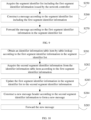
- the step S240 in the embodiment shown in FIG. 8 or the step S270 in the embodiment shown in FIG. 9 includes, without limitation, steps S281 to S285.
- an identifier information table item is obtained by table lookup according to the first segment identifier information in the segment identifier list.
- the second segment identifier information is acquired from the identifier information table item according to the first segment identifier information.
- the first segment identifier information in the segment identifier list is updated to the second segment identifier information.
- a new message header is constructed according to the second segment identifier information to form a new message.
- the new message is forwarded.
- the first edge node when the first edge node forwards a message according to the first segment identifier information in the segment identifier list, the first edge node obtains an identifier information table item pre-created in the first edge node by table lookup according to the first segment identifier information in the segment identifier list.
- the identifier information table item represents the mapping relationship between the first segment identifier information and the second segment identifier information.
- the first edge node can acquire, from the identifier information table item, the second segment identifier information corresponding to the first segment identifier information according to the first segment identifier information. Then, the first edge node replaces the first segment identifier information in the segment identifier list with the second segment identifier information.
- the first edge node constructs a new message header according to the second segment identifier information in the segment identifier list to form a new message. Then, the first edge node will forward the new message according to the new message header, so that the new message can be forwarded along the reachable path in the first network domain.
- the first edge node when the first edge node configures corresponding first segment identifier information for the acquired second segment identifier information, the first edge node will correspondingly create an identifier information table item.
- the identifier information table pre-created in the first edge node may be implemented differently.
- the identifier information table item when the first edge node is a node of the MPLS domain, the identifier information table item is a local segment identifier table item.
- the local segment identifier table item contains the first segment identifier information (SRv6 segment identifier) and the second segment identifier information (MPLS label) corresponding to the first segment identifier information.
- the identifier information table item is an incoming label map (ILM) table item
- the forwarding information contained in the ILM table item prompts to switch the first segment identifier information (MPLS label) into the second segment identifier information (SRv6 segment identifier) corresponding to the first segment identifier information and forward it to the second edge node along the shortest path.
- the ILM table item reflects a reachable path across the first network domain from the first edge node to the second edge node.
- the new message header constructed according to the second segment identifier information by the first edge node may be implemented differently.
- the new message header is an MPLS label stack.
- the first edge node forms an MPLS label stack to the second segment identifier information according to the second segment identifier information (MPLS label) and the MPLS labels advertised by other nodes in the first network domain.
- MPLS label the second segment identifier information
- a new message that can be forwarded in the first network domain can be formed by encapsulating the MPLS label stack in an outer layer of the message.
- the new message header is an SRv6 segment identifier list formed by the IPv6 address list.
- the first edge node will form an SRv6 segment identifier list to the second segment identifier information according to the second segment identifier information (SRv6 segment identifier) and the SRv6 segment identifiers advertised by other nodes in the first network domain.
- a new message that can be forwarded in the first network domain can be formed by encapsulating the SRv6 segment identifier list in the outer layer of the message.
- the second network domain 120 and the third network domain 130 are SRv6 domains
- the first network domain 110 is an MPLS domain.
- the second network domain 120 includes a first node 121 and a second node 122 connected successively.
- the first network domain 110 includes a third node 111, a fourth node 112 and a fifth node 113 connected successively.
- the third network domain 130 includes a sixth node 131 and a seventh node 132 connected successively.
- the second node 122 and the third node 111 are BGP peers.
- the fifth node 113 and the sixth node 131 are BGP peers.
- the network controller 100 is connected to the first node 121, the second node 122, the third node 111, the fifth node 113, the sixth node 131 and the seventh node 132, respectively.
- the network controller 100 needs to calculate an end-to-end segment routing traffic engineering (SR-TE) path from the first node 121 to the seventh node 132.
- SR-TE path successively passes through the second network domain 120, the first network domain 110 and the third network domain 130.
- the third node 111 and the fifth node 113 have the ability to support SRv6.
- a link segment identifier END.X SID (122-111) used for indicating the adjacency between the second node 122 and the third node 111 is stored in the second node 122
- a link segment identifier END.X SID (113-131) used for indicating the adjacency between the fifth node 113 and the sixth node 131 is stored in the sixth node 131.
- the third node 111 creates, in the first network domain 110, a BGP labeled unicast LSP (BGP LU LSP) to the fifth node 113, and configures a piece of first segment identifier information sid-100 for the BGP LU LSP according to the locally configured policy.
- BGP LU LSP BGP labeled unicast LSP
- the third node 111 reports, to the network controller 100, local MPLS cross connect information corresponding to the BGP LU LSP.
- the local MPLS cross connect information is marked with XC (from 111 to 113).
- the local MPLS cross connect information includes the first segment identifier information sid-100, a second segment identifier information label-100 corresponding to the fifth node 113, an outgoing interface, FEC information corresponding to the fifth node 113 and other information.
- the network controller 100 can sense, according to the local MPLS cross connect information, the presence of a one-hop reachable path from the third node 111 to the fifth node 113 in the first network domain 110, so the network controller 100 can calculate an end-to-end SR-TE path as ⁇ 122, 122-111, XC (from 111 to 113), 113-131, 132>, and translate the SR-TE path into an SRv6 segment identifier list, which is ⁇ END SID (122), END.X SID (122-111), sid-100, END.X SID (113-131), END SID (132)>. Then, the network controller 100 issues the SRv6 segment identifier list to the first node 121 to allow the first node 121 to forward an IPv6 message according to the SRv6 segment identifier list.
- the first node 121 when the IPv6 message is forwarded along the SRv6 segment identifier list, the first node 121 encapsulates an IPv6 header and a segment routing header for the IPv6 message, where the segment routing header contains the SRv6 segment identifier list.
- the specific forwarding process of the IPv6 message will be described below.
- the first node 121 forwards the IPv6 message to the second node 122 along the shortest path according to a first segment identifier END SID (122) in the SRv6 segment identifier list.
- the second node 122 explicitly forwards the IPv6 message to the third node 111 along an inter-domain link according to a second segment identifier END.X SID (122-111) in the SRv6 segment identifier list.
- the third node 111 hits the corresponding local segment identifier table item in the third node 111 according to a third segment identifier sid-100 (i.e., the first segment identifier information) in the SRv6 segment identifier list, switches the first segment identifier information sid-100 into the second segment identifier information label-100, obtains a corresponding MPLS label stack to the fifth node 113 according to the second segment identifier information label-100, and encapsulates the MPLS label stack in an outer layer of the IPv6 message to allow the IPv6 message to form an MPLS label message.
- the MPLS label message is passed through all the way to the fifth node 113 in the first network domain 110 in a conventional MPLS forwarding manner.
- the MPLS labels in the outer layer of the MPLS label message will be all popped up to expose the IPv6 header in an inner layer.
- the MPLS label message is restored as the IPv6 message, and the IPv6 message is explicitly forwarded to the sixth node 131 along the inter-domain link according to a fourth segment identifier END.X SID (113-131) in the SRv6 segment identifier list.
- the sixth node 131 forwards the IPv6 message to the seventh node 132 along the shortest path according to a fifth segment identifier END SID (132) in the SRv6 segment identifier list.
- the second network domain 120 and the third network domain 130 are SR-MPLS domains, and the first network domain 110 is an SRv6 domain.
- the second network domain 120 includes a first node 121 and a second node 122 connected successively.
- the first network domain 110 includes a third node 111, a fourth node 112 and a fifth node 113 connected successively.
- the third network domain 130 includes a sixth node 131 and a seventh node 132 connected successively.
- the second node 122 and the third node 111 are BGP peers.
- the fifth node 113 and the sixth node 131 are BGP peers.
- the network controller 100 is connected to the first node 121, the second node 122, the third node 111, the fifth node 113, the sixth node 131 and the seventh node 132, respectively.
- the network controller 100 needs to calculate an end-to-end SR-TE path from the first node 121 to the seventh node 132, and the SR-TE path successively passes through the second network domain 120, the first network domain 110 and the third network domain 130.
- the third node 111 and the fifth node 113 have the ability to support SR-MPLS and SRv6.
- a link segment identifier Adjacency-SID (122-111) used for indicating the adjacency between the second node 122 and the third node 111 is stored in the second node 122.
- a link segment identifier Adjacency-SID (113-131) used for indicating the adjacency between the fifth node 113 and the sixth node 131 is stored in the sixth node 131.
- the third node 111 receives a node segment identifier END SID (113) (i.e., the second segment identifier information) of the fifth node 113 advertised by the fifth node 113 through an interior gateway protocol (IGP).
- IGP interior gateway protocol
- the third node 111 configures a piece of first segment identifier information lable-200 for the node segment identifier END SID (113) of the fifth node 113 according to the locally configured policy and creates a corresponding ILM table item.
- the forwarding information contained in the ILM table item prompts to switch the first segment identifier information label-200 into the second segment identifier information END SID (113) and forward it to the fifth node 113 along the shortest path.
- the third node can also configure a local policy to directly allocate an additional piece of first segment identifier information (MPLS label) for the node segment identifier of the fifth node 113.
- MPLS label additional piece of first segment identifier information
- the third node 111 reports, to the network controller 100, local MPLS cross connect information corresponding to the ILM table item.
- the local MPLS cross connect information is marked with XC (from 111 to 113).
- the local MPLS cross connect information includes the first segment identifier information label-200, the second segment identifier information END SID (113), an outgoing interface, FEC information corresponding to the fifth node 113 and other information.
- the network controller 100 can sense, according to the local MPLS cross connect information, the presence of a one-hop reachable path from the third node 111 to the fifth node 113 in the first network domain 110, so the network controller 100 can calculate an end-to-end SR-TE path as ⁇ 122, 122-111, XC (from 111 to 113), 113-131, 132>, and translate the SR-TE path into an SR-MPLS segment identifier list, which is ⁇ Node-SID (122), Adjacency-SID (122-111), label-200, Adjacency-SID (113-131), Node-SID (132)>. Then, the network controller 100 issues the SR-MPLS segment identifier list to the first node 121 to allow the first node 121 to forward an MPLS label message according to the SR-MPLS segment identifier list.
- the first node 121 when the MPLS label message is forwarded along the SR-MPLS segment identifier list, the first node 121 encapsulates an MPLS label stack in an outer layer of the MPLS label message, where the MPLS label stack contains the SR-MPLS segment identifier list.
- the specific forwarding process of the MPLS label message will be described below.
- the first node 121 forwards the MPLS label message to the second node 122 along the shortest path according to a first segment identifier Node-SID (122) in the SR-MPLS segment identifier list.
- the second node 122 explicitly forwards the MPLS label message to the third node 111 along an inter-domain link according to a second segment identifier Adjacency-SID (122-111) in the SR-MPLS segment identifier list.
- the third node 111 hits a corresponding ILM table item in the third node 111 according to the third segment identifier label-200 (i.e., the first segment identifier information) in the SR-MPLS segment identifier list, switches the first segment identifier information label-200 into the second segment identifier information END SID (113), obtains a corresponding SRv6 segment identifier list to the fifth node 113 according to the second segment identifier information END SID (113), and encapsulates an IPv6 header in an outer layer of the MPLS label message to allow the MPLS label message to form an IPv6 message.
- the IPv6 message is passed through all the way to the fifth node 113 in the first network domain 110 in a conventional IPv6 message forwarding manner.
- the IPv6 header in the outer layer of the IPv6 message will be removed to expose the MPLS label message in an inner layer.
- the IPv6 message is restored as the MPLS label message, and the MPLS label message is explicitly forwarded to the sixth node 131 along the inter-domain link according to a fourth segment identifier Adjacency-SID (113-131) in the SR-MPLS segment identifier list.
- the sixth node 131 forwards the MPLS label message to the seventh node 132 along the shortest path according to a fifth segment identifier Node-SID (132) in the SR-MPLS segment identifier list.
- an embodiment of the present disclosure further provides a network controller.
- the network controller includes: a memory, a processor and computer programs that are stored on the memory and executable by the processor.
- the processor and the memory may be connected via a bus or in other ways.
- the memory can be configured to store non-temporary software programs and non-temporary computer-executable programs.
- the memory may include high-speed random access memories, or may include non-temporary memories, such as at least one disk memory device, flash memory devices or other non-temporary solid-state memory devices.
- the memory may optionally include memories remotely arranged relative to the processor. These remote memories may be connected to the processor via a network. Examples of the network include, but not limited to, Internet, Intranet, local area networks, mobile communication networks and combinations thereof.
- the network controller in this embodiment can be applied to the network controller in the embodiment shown in FIG. 1 or FIG. 2 .
- the network controller in this embodiment can constitute a part of the network topology in the embodiment shown in FIG. 1 or FIG. 2 . All these embodiments belong to the same inventive concept, and therefore have the same implementation principles and technical effects, which will not be described in detail here.
- the non-temporary software programs and instructions required to implement the information processing method in the above embodiments are stored in the memory.
- the programs and instructions when executed by the processor, cause the processor to carry out the information processing method in the above embodiments, for example, executing the steps S110 to S130 in the method of FIG. 3 and the steps S131 to S132 in the method of FIG. 6 .
- an embodiment of the present disclosure further provides a node.
- the node includes: a memory, a processor and computer programs that are stored on the memory and executable by the processor.
- the processor and the memory may be connected via a bus or in other ways.
- the memory can be configured to store non-temporary software programs and non-temporary computer-executable programs.
- the memory may include high-speed random access memories, or may include non-temporary memories, such as at least one disk memory device, flash memory devices or other non-temporary solid-state memory devices.
- the memory may optionally include memories remotely arranged relative to the processor. These remote memories may be connected to the processor via a network. Examples of the network include, but not limited to, Internet, Intranet, local area networks, mobile communication networks and combinations thereof.
- the node in this embodiment can be applied to the first edge node in the embodiment shown in FIG. 1 or FIG. 2 .
- the node in this embodiment can constitute a part of the network topology in the embodiment shown in FIG. 1 or FIG. 2 .
- the non-temporary software programs and instructions required to implement the information processing method in the above embodiments are stored in the memory.
- the programs and instructions when executed by the processor, cause the processor to carry out the information processing method in the above embodiments, for example, executing the steps S210 to S220 in the method of FIG. 7 , the steps S230 to S240 in the method of FIG. 8 , the steps S250 to S270 in the method of FIG. 9 and the steps S281 to S285 in the method of FIG. 10 .
- the apparatus embodiments described above are merely illustrative.
- the units described as separate components may be or may not be physically separated from each other, that is, they may be located in one place or may be distributed on a plurality of network units. Some or all of modules may be selected according to actual needs to achieve the purpose of the schemes of the embodiments.
- an embodiment of the present disclosure further provides a computer-readable storage medium having computer-executable instructions thereon.
- the computer-executable instructions when executed by a processor or controller, for example, the processor in the above network controller embodiment, cause the processor to carry out the information processing method in the above embodiments, for example, executing the steps S110 to S130 in the method of FIG. 3 and the steps S131 to S132 in the method of FIG. 6 .
- the computer-executable instructions when executed by a processor in the above node embodiment, cause the processor to carry out the information processing method in the above embodiments, for example, executing the steps S210 to S220 in the method of FIG. 7 , the steps S230 to S240 in the method of FIG. 8 , the steps S250 to S270 in the method of FIG. 9 and the steps S281 to S285 in the method of FIG. 10 .
- the embodiments of the present disclosure include the following steps: acquiring a first BGP-LS message reported by a first edge node of a first network domain, where the first BGP-LS message carries second segment identifier information and first segment identifier information configured according to the second segment identifier information, the first segment identifier information corresponds to the first edge node, and the second segment identifier information corresponds to a second edge node of the first network domain; determining, according to the first segment identifier information and the second segment identifier information, a reachable path from the first edge node to the second edge node; and, calculating a routing path including the reachable path, and establishing a segment identifier list including the first segment identifier information in the process of calculating the routing path.
- the network controller can determine, according to the first segment identifier information and second segment identifier information, the presence of a reachable path across the first network domain from the first edge node to the second edge node and can thus calculate a routing path including the reachable path. Therefore, even if the network controller has no permission to acquire the topology information in the first network domain, the network controller can still calculate a routing path across the first network domain.
- the term computer storage medium includes volatile or non-volatile and removable or non-removable mediums implemented in any method or technology used to store information (such as computer-readable instructions, data structures, program modules or other data).
- the computer storage medium includes, but not limited to, RAMs, ROMs, EEPROMs, flash memories or other memory technologies, CD-ROMs, digital video disks (DVDs) or other optical disk storages, magnetic cassettes, magnetic tapes, magnetic disk storages or other magnetic storage devices, or any other mediums which can be used to store desired information and can be accessed by computers.
- the communication medium generally contains computer-readable instructions, data structures, program modules or other data in modulation data signals such as carriers or other transmission mechanisms, and may include any information transfer medium.
Landscapes
- Engineering & Computer Science (AREA)
- Computer Networks & Wireless Communication (AREA)
- Signal Processing (AREA)
- Data Exchanges In Wide-Area Networks (AREA)
Claims (10)
- Informationsverarbeitungsverfahren, das auf eine Netzsteuerung anwendbar ist, das Informationsverarbeitungsverfahren umfassend:Erfassen einer ersten Nachricht über Border Gateway Protocol Link State, BGP-LS, die von einem ersten Randknoten einer ersten Netzdomäne gemeldet wird, wobei die erste BGP-LS-Nachricht zweite Segmentkennungsinformationen und erste Segmentkennungsinformationen trägt, die gemäß den zweiten Segmentkennungsinformationen vorkonfiguriert sind, wobei die ersten Segmentkennungsinformationen dem ersten Randknoten entsprechen, und die zweite Segmentkennungsinformationen einem zweiten Randknoten der ersten Netzdomäne (S110) entsprechen; wobei die ersten Segmentkennungsinformationen für die zweiten Segmentkennungsinformationen mittels einer Abbildungsbeziehung zwischen den ersten Segmentkennungsinformationen und den zweiten Segmentkennungsinformationen vorkonfiguriert sind;Bestimmen, gemäß den ersten Segmentkennungsinformationen und den zweiten Segmentkennungsinformationen, des Vorhandenseins eines erreichbaren Pfads von dem ersten Randknoten zu dem zweiten Randknoten (S120); undBerechnen eines Routingpfads einschließlich des erreichbaren Pfads und Erstellen einer Segmentkennungsliste einschließlich der ersten Segmentkennungsinformationen in dem Prozess eines Berechnens des Routingpfads (S130);dadurch gekennzeichnet, dass die erste BGP-LS-Nachricht ferner Informationen über Weiterleitungs-Äquivalenzklasse, FEC, trägt; und das Bestimmen, gemäß den ersten Segmentkennungsinformationen und den zweiten Segmentkennungsinformationen, des Vorhandenseins eines erreichbaren Pfads von dem ersten Randknoten zu dem zweiten Randknoten Folgendes umfasst:Bestimmen, gemäß den ersten Segmentkennungsinformationen, den zweiten Segmentkennungsinformationen und den FEC-Informationen, des Vorhandenseins eines erreichbaren Pfads von dem ersten Randknoten zu dem zweiten Randknoten;wobei die FEC-Informationen Loopback-Routinginformationen eines Ausgangsknotens von MPLS-Label-Switching-Pfad oder globale 1Pv6-Routinginformationen eines anderen Ausgangsknotens der SRv6-Domäne umfassen.
- Informationsverarbeitungsverfahren nach Anspruch 1, wobei das Berechnen eines Routingpfads einschließlich des erreichbaren Pfads Folgendes umfasst:Erfassen einer zweiten BGP-LS-Nachricht, die von einem Netzknoten einer zweiten Netzdomäne gemeldet wird, wobei die zweite BGP-LS-Nachricht dritte Segmentkennungsinformationen trägt, die dem Netzknoten entsprechen (S131); undBerechnen eines Routingpfads einschließlich des erreichbaren Pfads gemäß den ersten Segmentkennungsinformationen, den zweiten Segmentkennungsinformationen und den dritten Segmentkennungsinformationen (S132).
- Informationsverarbeitungsverfahren nach Anspruch 1, ferner umfassend:
Ausgeben der Segmentkennungsliste einschließlich der ersten Segmentkennungsinformationen an den ersten Randknoten, sodass der erste Randknoten Nachrichten gemäß der Segmentkennungsliste einschließlich den ersten Segmentkennungsinformationen weiterleitet. - Informationsverarbeitungsverfahren nach Anspruch 2, ferner umfassend:
Ausgeben der Segmentkennungsliste einschließlich der ersten Segmentkennungsinformationen an den Netzknoten, sodass der Netzknoten Nachrichten gemäß der Segmentkennungsliste einschließlich den ersten Segmentkennungsinformationen weiterleitet. - Informationsverarbeitungsverfahren, das auf einen ersten Randknoten einer ersten Netzdomäne anwendbar ist, das Informationsverarbeitungsverfahren umfassend:Erstellen einer ersten BGP-LS-Nachricht, die erste Segmentkennungsinformationen und zweite Segmentkennungsinformationen trägt, wobei die zweiten Segmentkennungsinformationen von einem zweiten Randknoten der ersten Netzdomäne kommen und dem zweiten Randknoten entsprechen, wobei die ersten Segmentkennungsinformationen gemäß den zweiten Segmentkennungsinformationen vorkonfiguriert sind und dem ersten Randknoten entsprechen (S210); wobei die ersten Segmentkennungsinformationen für die zweiten Segmentkennungsinformationen mittels einer Abbildungsbeziehung zwischen den ersten Segmentkennungsinformationen und den zweiten Segmentkennungsinformationen vorkonfiguriert sind; undMelden der ersten BGP-LS-Nachricht an eine Netzsteuerung, sodass die Netzsteuerung gemäß den ersten Segmentkennungsinformationen und den zweiten Segmentkennungsinformationen in der ersten BGP-LS-Nachricht das Vorhandensein eines erreichbaren Pfads von dem ersten Randknoten zu dem zweiten Randknoten bestimmt und einen Routingpfad einschließlich des erreichbaren Pfads berechnet, und sodass die Netzsteuerung eine Segmentkennungsliste einschließlich der ersten Segmentkennungsinformationen in dem Prozess eines Berechnens des Routingpfads erstellt (S220);dadurch gekennzeichnet, dass die erste BGP-LS-Nachricht ferner FEC-Informationen trägt und die erste BGP-LS-Nachricht es dem Netzsteuerung ermöglicht, gemäß den ersten Segmentkennungsinformationen, den zweiten Segmentkennungsinformationen und den FEC-Informationen in der ersten BGP-LS-Nachricht das Vorhandensein eines erreichbaren Pfads von dem ersten Randknoten zu dem zweiten Randknoten zu bestimmen und einen Routingpfad zu berechnen, der den erreichbaren Pfad beinhaltet, und eine Segmentkennungsliste zu erstellen, die die ersten Segmentkennungsinformationen in dem Prozess eines Berechnens des Routingpfads beinhaltet;wobei die FEC-Informationen Loopback-Routinginformationen eines Ausgangsknotens von MPLS-Label-Switching-Pfad oder globale 1Pv6-Routinginformationen eines anderen Ausgangsknotens der SRv6-Domäne umfassen.
- Informationsverarbeitungsverfahren nach Anspruch 5, ferner umfassend:Erfassen einer Nachricht, die gemäß der Segmentkennungsliste weitergeleitet wird (S230) und Weiterleiten der Nachricht gemäß den ersten Segmentkennungsinformationen in der Segmentkennungsliste (S240);
oderErfassen der Segmentkennungsliste einschließlich der ersten Segmentkennungsinformationen, die von der Netzsteuerung (S250) ausgegeben werden, Aufbauen einer Nachricht gemäß der Segmentkennungsliste, die die ersten Segmentkennungsinformationen (S260) beinhaltet, und Weiterleiten der Nachricht gemäß den ersten Segmentkennungsinformationen in der Segmentkennungsliste (S270). - Informationsverarbeitungsverfahren nach Anspruch 6, wobei das Weiterleiten der Nachricht gemäß den ersten Segmentkennungsinformationen in der Segmentkennungsliste Folgendes umfasst:Erlangen eines Kennungsinformation-Tabellenelements durch Nachschlagen in der Tabelle gemäß den ersten Segmentkennungsinformationen in der Segmentkennungsliste (S281);Erfassen der zweiten Segmentkennungsinformationen anhand des Kennungsinformation-Tabellenelements gemäß den ersten Segmentkennungsinformationen (S282);Aktualisieren der ersten Segmentkennungsinformationen in der Segmentkennungsliste auf die zweiten Segmentkennungsinformationen (S283);Aufbauen eines neuen Nachrichtenkopfs gemäß den zweiten Segmentkennungsinformationen, um eine neue Nachricht zu bilden (S284); undWeiterleiten der neuen Nachricht (S285).
- Netzsteuerung, umfassend: einen Speicher, einen Prozessor und Computerprogramme, die in dem Speicher gespeichert und von dem Prozessor ausführbar sind, wobei die Computerprogramme, wenn sie von dem Prozessor ausgeführt werden, die Netzsteuerung veranlassen, das Informationsverarbeitungsverfahren nach einem der Ansprüche 1 bis 4 durchzuführen.
- Randknoten, umfassend: einen Speicher, einen Prozessor und Computerprogramme, die in dem Speicher gespeichert und von dem Prozessor ausführbar sind, wobei die Computerprogramme, wenn sie von dem Prozessor ausgeführt werden, den Randknoten veranlassen, das Informationsverarbeitungsverfahren nach einem der Ansprüche 5 bis 7 durchzuführen.
- Computerlesbares Speichermedium, auf dem computerausführbare Anweisungen gespeichert sind, die, wenn sie von einem Prozessor ausgeführt werden, den mit einer Netzsteuerung assoziierten Prozessor veranlassen, das Informationsverarbeitungsverfahren nach einem der Ansprüche 1 bis 4 durchzuführen, oder, wenn sie von einem mit einem Randknoten assoziierten Prozessor ausgeführt werden, den Randknoten veranlassen, das Informationsverarbeitungsverfahren nach einem der Ansprüche 5 bis 7 durchzuführen.
Applications Claiming Priority (2)
| Application Number | Priority Date | Filing Date | Title |
|---|---|---|---|
| CN202010862297.8A CN114124776B (zh) | 2020-08-25 | 2020-08-25 | 信息处理方法、网络控制器、节点及计算机可读存储介质 |
| PCT/CN2021/114566 WO2022042610A1 (zh) | 2020-08-25 | 2021-08-25 | 信息处理方法、网络控制器、节点及计算机可读存储介质 |
Publications (3)
| Publication Number | Publication Date |
|---|---|
| EP4016965A1 EP4016965A1 (de) | 2022-06-22 |
| EP4016965A4 EP4016965A4 (de) | 2022-12-14 |
| EP4016965B1 true EP4016965B1 (de) | 2025-05-21 |
Family
ID=80354661
Family Applications (1)
| Application Number | Title | Priority Date | Filing Date |
|---|---|---|---|
| EP21860445.2A Active EP4016965B1 (de) | 2020-08-25 | 2021-08-25 | Informationsverarbeitungsverfahren, netzwerksteuerung, knoten und computerlesbares speichermedium |
Country Status (3)
| Country | Link |
|---|---|
| EP (1) | EP4016965B1 (de) |
| CN (1) | CN114124776B (de) |
| WO (1) | WO2022042610A1 (de) |
Families Citing this family (2)
| Publication number | Priority date | Publication date | Assignee | Title |
|---|---|---|---|---|
| CN116962274A (zh) * | 2022-04-19 | 2023-10-27 | 中国移动通信集团山西有限公司 | 跨域路径生成方法、装置、设备及介质 |
| CN119583422B (zh) * | 2024-11-25 | 2025-12-16 | 中国联合网络通信集团有限公司 | 一种网络路径确定方法、程序产品、装置及存储介质 |
Family Cites Families (13)
| Publication number | Priority date | Publication date | Assignee | Title |
|---|---|---|---|---|
| US7623531B2 (en) * | 2005-04-19 | 2009-11-24 | Alcatel Lucent | Negotiation of datapath treatment for end-to-end interworked network traffic |
| EP3038303B1 (de) * | 2013-09-26 | 2018-09-19 | Huawei Technologies Co., Ltd. | Einrichtungsverfahren und -vorrichtung eines cross-domain-pfads |
| US9660897B1 (en) * | 2013-12-04 | 2017-05-23 | Juniper Networks, Inc. | BGP link-state extensions for segment routing |
| US9680745B2 (en) * | 2014-01-20 | 2017-06-13 | Huawei Technologies Co., Ltd. | Multi-domain source routed forwarding based on collaborating network controllers |
| US9998368B2 (en) * | 2015-06-11 | 2018-06-12 | Futurewei Technologies, Inc. | Zone routing system |
| CN106713137B (zh) * | 2015-11-13 | 2020-02-18 | 中国电信股份有限公司 | 基于分段路由和sdn技术的vpn方法、装置及系统 |
| US10454780B2 (en) * | 2017-12-07 | 2019-10-22 | Cisco Technology, Inc. | Optimizing source routing using machine learning |
| US10516610B2 (en) * | 2018-03-15 | 2019-12-24 | Cisco Technology, Inc. | Segment routing packet policies and functions providing processing signaling and packet forwarding efficiencies in a network |
| CN110830352B (zh) * | 2018-08-07 | 2022-09-23 | 中兴通讯股份有限公司 | 一种vpn跨域的实现方法、装置和边界节点 |
| US11134002B2 (en) * | 2018-10-22 | 2021-09-28 | Cisco Technology, Inc. | Packet network interworking including segment routing |
| CN111490937B (zh) * | 2019-01-28 | 2022-03-29 | 华为技术有限公司 | 一种建立跨域转发路径的方法、装置及系统 |
| WO2020160564A1 (en) * | 2019-03-19 | 2020-08-06 | Futurewei Technologies, Inc. | Preferred path routing in ethernet networks |
| CN111541613B (zh) * | 2020-04-27 | 2022-03-22 | 鹏城实验室 | 一种基于SRv6的数据处理方法及相关设备 |
-
2020
- 2020-08-25 CN CN202010862297.8A patent/CN114124776B/zh active Active
-
2021
- 2021-08-25 WO PCT/CN2021/114566 patent/WO2022042610A1/zh not_active Ceased
- 2021-08-25 EP EP21860445.2A patent/EP4016965B1/de active Active
Also Published As
| Publication number | Publication date |
|---|---|
| EP4016965A1 (de) | 2022-06-22 |
| EP4016965A4 (de) | 2022-12-14 |
| CN114124776B (zh) | 2025-07-15 |
| WO2022042610A1 (zh) | 2022-03-03 |
| CN114124776A (zh) | 2022-03-01 |
Similar Documents
| Publication | Publication Date | Title |
|---|---|---|
| EP3836490B1 (de) | Domänenübergreifendes vpn-implementierungsverfahren, vorrichtung und grenzknoten | |
| EP3832957B1 (de) | Übertragungssteuerungsverfahren, knoten, netzwerksystem und speichermedium | |
| US9369347B2 (en) | Service to node resolution | |
| US10237163B2 (en) | Static route advertisement | |
| CN109075984B (zh) | 计算的spring组播的多点到多点树 | |
| EP3497893B1 (de) | Routen von segmenten auf der grundlage von maximaler segmentidentifikatortiefe | |
| US9019814B1 (en) | Fast failover in multi-homed ethernet virtual private networks | |
| US7957306B2 (en) | Providing reachability information in a routing domain of an external destination address in a data communications network | |
| CN112511444A (zh) | 一种组播流量传输方法、装置、通信节点及存储介质 | |
| CN114650256A (zh) | 报文处理方法、节点及计算机可读存储介质 | |
| CN103098426A (zh) | 使用分层标记栈改进ldp收敛的方法和设备 | |
| US12244495B2 (en) | Method and apparatus for layer 2 route calculation in a route reflector network device | |
| US12143293B2 (en) | Fast reroute for BUM traffic in ethernet virtual private networks | |
| US11362954B2 (en) | Tunneling inter-domain stateless internet protocol multicast packets | |
| US20230081052A1 (en) | Method and apparatus for sending multicast packet | |
| EP4016965B1 (de) | Informationsverarbeitungsverfahren, netzwerksteuerung, knoten und computerlesbares speichermedium | |
| US11909622B1 (en) | Extended protection in segment routing flexible algorithm | |
| CN112039765B (zh) | 路由信息发送的方法、路由选路的方法和装置 | |
| US12500832B2 (en) | Establishing and advertising co-routed bidirectional paths across multiple domains | |
| JP2023531065A (ja) | イーサネット仮想プライベートネットワークエグレス高速リルートにおける過渡ループ防止 | |
| US20200036580A1 (en) | Outside router fault detection | |
| US20240348527A1 (en) | Signaling Service SID Transposition Capability in SRv6 Networks | |
| EP4465609B1 (de) | Erweiterter schutz in einem flexiblen segmentroutingalgorithmus | |
| EP4492749A1 (de) | Berührungsfreie konfiguration für ein mesh von knoten unter verwendung eines flexiblen segmentroutingalgorithmus | |
| US20250023809A1 (en) | Zero touch configuration for a mesh of nodes using Segment Routing Flexible Algorithm |
Legal Events
| Date | Code | Title | Description |
|---|---|---|---|
| STAA | Information on the status of an ep patent application or granted ep patent |
Free format text: STATUS: THE INTERNATIONAL PUBLICATION HAS BEEN MADE |
|
| PUAI | Public reference made under article 153(3) epc to a published international application that has entered the european phase |
Free format text: ORIGINAL CODE: 0009012 |
|
| STAA | Information on the status of an ep patent application or granted ep patent |
Free format text: STATUS: REQUEST FOR EXAMINATION WAS MADE |
|
| 17P | Request for examination filed |
Effective date: 20220317 |
|
| AK | Designated contracting states |
Kind code of ref document: A1 Designated state(s): AL AT BE BG CH CY CZ DE DK EE ES FI FR GB GR HR HU IE IS IT LI LT LU LV MC MK MT NL NO PL PT RO RS SE SI SK SM TR |
|
| A4 | Supplementary search report drawn up and despatched |
Effective date: 20221115 |
|
| RIC1 | Information provided on ipc code assigned before grant |
Ipc: H04L 45/52 20220101ALN20221109BHEP Ipc: H04L 45/50 20220101ALN20221109BHEP Ipc: H04L 45/02 20220101ALI20221109BHEP Ipc: H04L 45/00 20220101AFI20221109BHEP |
|
| DAV | Request for validation of the european patent (deleted) | ||
| DAX | Request for extension of the european patent (deleted) | ||
| GRAP | Despatch of communication of intention to grant a patent |
Free format text: ORIGINAL CODE: EPIDOSNIGR1 |
|
| STAA | Information on the status of an ep patent application or granted ep patent |
Free format text: STATUS: GRANT OF PATENT IS INTENDED |
|
| RIC1 | Information provided on ipc code assigned before grant |
Ipc: H04L 45/52 20220101ALN20241210BHEP Ipc: H04L 45/50 20220101ALN20241210BHEP Ipc: H04L 45/02 20220101ALI20241210BHEP Ipc: H04L 45/00 20220101AFI20241210BHEP |
|
| INTG | Intention to grant announced |
Effective date: 20241218 |
|
| GRAS | Grant fee paid |
Free format text: ORIGINAL CODE: EPIDOSNIGR3 |
|
| GRAA | (expected) grant |
Free format text: ORIGINAL CODE: 0009210 |
|
| STAA | Information on the status of an ep patent application or granted ep patent |
Free format text: STATUS: THE PATENT HAS BEEN GRANTED |
|
| AK | Designated contracting states |
Kind code of ref document: B1 Designated state(s): AL AT BE BG CH CY CZ DE DK EE ES FI FR GB GR HR HU IE IS IT LI LT LU LV MC MK MT NL NO PL PT RO RS SE SI SK SM TR |
|
| REG | Reference to a national code |
Ref country code: GB Ref legal event code: FG4D |
|
| REG | Reference to a national code |
Ref country code: CH Ref legal event code: EP |
|
| REG | Reference to a national code |
Ref country code: DE Ref legal event code: R096 Ref document number: 602021031256 Country of ref document: DE |
|
| REG | Reference to a national code |
Ref country code: IE Ref legal event code: FG4D |
|
| REG | Reference to a national code |
Ref country code: NL Ref legal event code: MP Effective date: 20250521 |
|
| PG25 | Lapsed in a contracting state [announced via postgrant information from national office to epo] |
Ref country code: PT Free format text: LAPSE BECAUSE OF FAILURE TO SUBMIT A TRANSLATION OF THE DESCRIPTION OR TO PAY THE FEE WITHIN THE PRESCRIBED TIME-LIMIT Effective date: 20250922 Ref country code: ES Free format text: LAPSE BECAUSE OF FAILURE TO SUBMIT A TRANSLATION OF THE DESCRIPTION OR TO PAY THE FEE WITHIN THE PRESCRIBED TIME-LIMIT Effective date: 20250521 Ref country code: FI Free format text: LAPSE BECAUSE OF FAILURE TO SUBMIT A TRANSLATION OF THE DESCRIPTION OR TO PAY THE FEE WITHIN THE PRESCRIBED TIME-LIMIT Effective date: 20250521 |
|
| PGFP | Annual fee paid to national office [announced via postgrant information from national office to epo] |
Ref country code: DE Payment date: 20250702 Year of fee payment: 5 |
|
| REG | Reference to a national code |
Ref country code: LT Ref legal event code: MG9D |
|
| PG25 | Lapsed in a contracting state [announced via postgrant information from national office to epo] |
Ref country code: NO Free format text: LAPSE BECAUSE OF FAILURE TO SUBMIT A TRANSLATION OF THE DESCRIPTION OR TO PAY THE FEE WITHIN THE PRESCRIBED TIME-LIMIT Effective date: 20250821 Ref country code: GR Free format text: LAPSE BECAUSE OF FAILURE TO SUBMIT A TRANSLATION OF THE DESCRIPTION OR TO PAY THE FEE WITHIN THE PRESCRIBED TIME-LIMIT Effective date: 20250822 |
|
| PG25 | Lapsed in a contracting state [announced via postgrant information from national office to epo] |
Ref country code: NL Free format text: LAPSE BECAUSE OF FAILURE TO SUBMIT A TRANSLATION OF THE DESCRIPTION OR TO PAY THE FEE WITHIN THE PRESCRIBED TIME-LIMIT Effective date: 20250521 Ref country code: PL Free format text: LAPSE BECAUSE OF FAILURE TO SUBMIT A TRANSLATION OF THE DESCRIPTION OR TO PAY THE FEE WITHIN THE PRESCRIBED TIME-LIMIT Effective date: 20250521 |
|
| PG25 | Lapsed in a contracting state [announced via postgrant information from national office to epo] |
Ref country code: BG Free format text: LAPSE BECAUSE OF FAILURE TO SUBMIT A TRANSLATION OF THE DESCRIPTION OR TO PAY THE FEE WITHIN THE PRESCRIBED TIME-LIMIT Effective date: 20250521 |
|
| PGFP | Annual fee paid to national office [announced via postgrant information from national office to epo] |
Ref country code: GB Payment date: 20250703 Year of fee payment: 5 |
|
| PG25 | Lapsed in a contracting state [announced via postgrant information from national office to epo] |
Ref country code: HR Free format text: LAPSE BECAUSE OF FAILURE TO SUBMIT A TRANSLATION OF THE DESCRIPTION OR TO PAY THE FEE WITHIN THE PRESCRIBED TIME-LIMIT Effective date: 20250521 |
|
| PGFP | Annual fee paid to national office [announced via postgrant information from national office to epo] |
Ref country code: AT Payment date: 20251020 Year of fee payment: 5 Ref country code: FR Payment date: 20250703 Year of fee payment: 5 |
|
| PG25 | Lapsed in a contracting state [announced via postgrant information from national office to epo] |
Ref country code: RS Free format text: LAPSE BECAUSE OF FAILURE TO SUBMIT A TRANSLATION OF THE DESCRIPTION OR TO PAY THE FEE WITHIN THE PRESCRIBED TIME-LIMIT Effective date: 20250821 |
|
| PG25 | Lapsed in a contracting state [announced via postgrant information from national office to epo] |
Ref country code: IS Free format text: LAPSE BECAUSE OF FAILURE TO SUBMIT A TRANSLATION OF THE DESCRIPTION OR TO PAY THE FEE WITHIN THE PRESCRIBED TIME-LIMIT Effective date: 20250921 |
|
| PG25 | Lapsed in a contracting state [announced via postgrant information from national office to epo] |
Ref country code: LV Free format text: LAPSE BECAUSE OF FAILURE TO SUBMIT A TRANSLATION OF THE DESCRIPTION OR TO PAY THE FEE WITHIN THE PRESCRIBED TIME-LIMIT Effective date: 20250521 |
|
| REG | Reference to a national code |
Ref country code: AT Ref legal event code: MK05 Ref document number: 1797815 Country of ref document: AT Kind code of ref document: T Effective date: 20250521 |
|
| PG25 | Lapsed in a contracting state [announced via postgrant information from national office to epo] |
Ref country code: DK Free format text: LAPSE BECAUSE OF FAILURE TO SUBMIT A TRANSLATION OF THE DESCRIPTION OR TO PAY THE FEE WITHIN THE PRESCRIBED TIME-LIMIT Effective date: 20250521 Ref country code: AT Free format text: LAPSE BECAUSE OF FAILURE TO SUBMIT A TRANSLATION OF THE DESCRIPTION OR TO PAY THE FEE WITHIN THE PRESCRIBED TIME-LIMIT Effective date: 20250521 Ref country code: SM Free format text: LAPSE BECAUSE OF FAILURE TO SUBMIT A TRANSLATION OF THE DESCRIPTION OR TO PAY THE FEE WITHIN THE PRESCRIBED TIME-LIMIT Effective date: 20250521 |
|
| PG25 | Lapsed in a contracting state [announced via postgrant information from national office to epo] |
Ref country code: CZ Free format text: LAPSE BECAUSE OF FAILURE TO SUBMIT A TRANSLATION OF THE DESCRIPTION OR TO PAY THE FEE WITHIN THE PRESCRIBED TIME-LIMIT Effective date: 20250521 |
|
| PG25 | Lapsed in a contracting state [announced via postgrant information from national office to epo] |
Ref country code: EE Free format text: LAPSE BECAUSE OF FAILURE TO SUBMIT A TRANSLATION OF THE DESCRIPTION OR TO PAY THE FEE WITHIN THE PRESCRIBED TIME-LIMIT Effective date: 20250521 |
|
| PG25 | Lapsed in a contracting state [announced via postgrant information from national office to epo] |
Ref country code: RO Free format text: LAPSE BECAUSE OF FAILURE TO SUBMIT A TRANSLATION OF THE DESCRIPTION OR TO PAY THE FEE WITHIN THE PRESCRIBED TIME-LIMIT Effective date: 20250521 Ref country code: SK Free format text: LAPSE BECAUSE OF FAILURE TO SUBMIT A TRANSLATION OF THE DESCRIPTION OR TO PAY THE FEE WITHIN THE PRESCRIBED TIME-LIMIT Effective date: 20250521 |
|
| PG25 | Lapsed in a contracting state [announced via postgrant information from national office to epo] |
Ref country code: IT Free format text: LAPSE BECAUSE OF FAILURE TO SUBMIT A TRANSLATION OF THE DESCRIPTION OR TO PAY THE FEE WITHIN THE PRESCRIBED TIME-LIMIT Effective date: 20250521 |
|
| REG | Reference to a national code |
Ref country code: DE Ref legal event code: R097 Ref document number: 602021031256 Country of ref document: DE |
|
| REG | Reference to a national code |
Ref country code: CH Ref legal event code: H13 Free format text: ST27 STATUS EVENT CODE: U-0-0-H10-H13 (AS PROVIDED BY THE NATIONAL OFFICE) Effective date: 20260324 |
|
| PLBE | No opposition filed within time limit |
Free format text: ORIGINAL CODE: 0009261 |
|
| STAA | Information on the status of an ep patent application or granted ep patent |
Free format text: STATUS: NO OPPOSITION FILED WITHIN TIME LIMIT |
|
| PG25 | Lapsed in a contracting state [announced via postgrant information from national office to epo] |
Ref country code: MC Free format text: LAPSE BECAUSE OF FAILURE TO SUBMIT A TRANSLATION OF THE DESCRIPTION OR TO PAY THE FEE WITHIN THE PRESCRIBED TIME-LIMIT Effective date: 20250521 |
|
| REG | Reference to a national code |
Ref country code: CH Ref legal event code: L10 Free format text: ST27 STATUS EVENT CODE: U-0-0-L10-L00 (AS PROVIDED BY THE NATIONAL OFFICE) Effective date: 20260402 |
|
| PG25 | Lapsed in a contracting state [announced via postgrant information from national office to epo] |
Ref country code: LU Free format text: LAPSE BECAUSE OF NON-PAYMENT OF DUE FEES Effective date: 20250825 |
|
| PG25 | Lapsed in a contracting state [announced via postgrant information from national office to epo] |
Ref country code: CH Free format text: LAPSE BECAUSE OF NON-PAYMENT OF DUE FEES Effective date: 20250831 |
|
| 26N | No opposition filed |
Effective date: 20260224 |