EP4016221A1 - Verfahren und system zum erkennen und klassifizieren von durch ein flugzeug ausgeführten manövern auf der basis von während eines fluges des flugzeugs erfassten massnahmen - Google Patents
Verfahren und system zum erkennen und klassifizieren von durch ein flugzeug ausgeführten manövern auf der basis von während eines fluges des flugzeugs erfassten massnahmen Download PDFInfo
- Publication number
- EP4016221A1 EP4016221A1 EP20425059.1A EP20425059A EP4016221A1 EP 4016221 A1 EP4016221 A1 EP 4016221A1 EP 20425059 A EP20425059 A EP 20425059A EP 4016221 A1 EP4016221 A1 EP 4016221A1
- Authority
- EP
- European Patent Office
- Prior art keywords
- time
- training
- manoeuvre
- classifier
- test
- Prior art date
- Legal status (The legal status is an assumption and is not a legal conclusion. Google has not performed a legal analysis and makes no representation as to the accuracy of the status listed.)
- Granted
Links
Images







Classifications
-
- G—PHYSICS
- G05—CONTROLLING; REGULATING
- G05B—CONTROL OR REGULATING SYSTEMS IN GENERAL; FUNCTIONAL ELEMENTS OF SUCH SYSTEMS; MONITORING OR TESTING ARRANGEMENTS FOR SUCH SYSTEMS OR ELEMENTS
- G05B23/00—Testing or monitoring of control systems or parts thereof
- G05B23/02—Electric testing or monitoring
- G05B23/0205—Electric testing or monitoring by means of a monitoring system capable of detecting and responding to faults
- G05B23/0218—Electric testing or monitoring by means of a monitoring system capable of detecting and responding to faults characterised by the fault detection method dealing with either existing or incipient faults
- G05B23/0221—Preprocessing measurements, e.g. data collection rate adjustment; Standardization of measurements; Time series or signal analysis, e.g. frequency analysis or wavelets; Trustworthiness of measurements; Indexes therefor; Measurements using easily measured parameters to estimate parameters difficult to measure; Virtual sensor creation; De-noising; Sensor fusion; Unconventional preprocessing inherently present in specific fault detection methods like PCA-based methods
-
- G—PHYSICS
- G08—SIGNALLING
- G08G—TRAFFIC CONTROL SYSTEMS
- G08G5/00—Traffic control systems for aircraft
- G08G5/50—Navigation or guidance aids
-
- B—PERFORMING OPERATIONS; TRANSPORTING
- B64—AIRCRAFT; AVIATION; COSMONAUTICS
- B64D—EQUIPMENT FOR FITTING IN OR TO AIRCRAFT; FLIGHT SUITS; PARACHUTES; ARRANGEMENT OR MOUNTING OF POWER PLANTS OR PROPULSION TRANSMISSIONS IN AIRCRAFT
- B64D45/00—Aircraft indicators or protectors not otherwise provided for
-
- G—PHYSICS
- G05—CONTROLLING; REGULATING
- G05B—CONTROL OR REGULATING SYSTEMS IN GENERAL; FUNCTIONAL ELEMENTS OF SUCH SYSTEMS; MONITORING OR TESTING ARRANGEMENTS FOR SUCH SYSTEMS OR ELEMENTS
- G05B23/00—Testing or monitoring of control systems or parts thereof
- G05B23/02—Electric testing or monitoring
- G05B23/0205—Electric testing or monitoring by means of a monitoring system capable of detecting and responding to faults
- G05B23/0218—Electric testing or monitoring by means of a monitoring system capable of detecting and responding to faults characterised by the fault detection method dealing with either existing or incipient faults
- G05B23/0224—Process history based detection method, e.g. whereby history implies the availability of large amounts of data
- G05B23/024—Quantitative history assessment, e.g. mathematical relationships between available data; Functions therefor; Principal component analysis [PCA]; Partial least square [PLS]; Statistical classifiers, e.g. Bayesian networks, linear regression or correlation analysis; Neural networks
-
- G—PHYSICS
- G05—CONTROLLING; REGULATING
- G05B—CONTROL OR REGULATING SYSTEMS IN GENERAL; FUNCTIONAL ELEMENTS OF SUCH SYSTEMS; MONITORING OR TESTING ARRANGEMENTS FOR SUCH SYSTEMS OR ELEMENTS
- G05B23/00—Testing or monitoring of control systems or parts thereof
- G05B23/02—Electric testing or monitoring
- G05B23/0205—Electric testing or monitoring by means of a monitoring system capable of detecting and responding to faults
- G05B23/0259—Electric testing or monitoring by means of a monitoring system capable of detecting and responding to faults characterized by the response to fault detection
- G05B23/0283—Predictive maintenance, e.g. involving the monitoring of a system and, based on the monitoring results, taking decisions on the maintenance schedule of the monitored system; Estimating remaining useful life [RUL]
-
- G—PHYSICS
- G07—CHECKING-DEVICES
- G07C—TIME OR ATTENDANCE REGISTERS; REGISTERING OR INDICATING THE WORKING OF MACHINES; GENERATING RANDOM NUMBERS; VOTING OR LOTTERY APPARATUS; ARRANGEMENTS, SYSTEMS OR APPARATUS FOR CHECKING NOT PROVIDED FOR ELSEWHERE
- G07C5/00—Registering or indicating the working of vehicles
- G07C5/08—Registering or indicating performance data other than driving, working, idle, or waiting time, with or without registering driving, working, idle or waiting time
- G07C5/0841—Registering performance data
-
- G—PHYSICS
- G08—SIGNALLING
- G08G—TRAFFIC CONTROL SYSTEMS
- G08G5/00—Traffic control systems for aircraft
- G08G5/30—Flight plan management
-
- G—PHYSICS
- G08—SIGNALLING
- G08G—TRAFFIC CONTROL SYSTEMS
- G08G5/00—Traffic control systems for aircraft
- G08G5/50—Navigation or guidance aids
- G08G5/55—Navigation or guidance aids for a single aircraft
-
- B—PERFORMING OPERATIONS; TRANSPORTING
- B64—AIRCRAFT; AVIATION; COSMONAUTICS
- B64D—EQUIPMENT FOR FITTING IN OR TO AIRCRAFT; FLIGHT SUITS; PARACHUTES; ARRANGEMENT OR MOUNTING OF POWER PLANTS OR PROPULSION TRANSMISSIONS IN AIRCRAFT
- B64D45/00—Aircraft indicators or protectors not otherwise provided for
- B64D2045/0085—Devices for aircraft health monitoring, e.g. monitoring flutter or vibration
Definitions
- Aim of the present invention to provide a method for detecting the type of manoeuvres executed during the flight of an aircraft, which at least partially satisfies the aforementioned requirement.
- FIG. 1A shows a helicopter 1, which is equipped with a monitoring system 2, which includes, for example, a sensor for measuring the bank angle of the helicopter 1 and thus provides, in use, the values (i.e., the samples) of the bank angle, with a given sampling frequency, for example of the order of ten Hertz.
- the primary quantities may include: aircraft kinematics variables (such as pitch angle, roll angle, yaw angle, heading angle, vertical acceleration, vertical velocity, longitudinal acceleration, lateral acceleration, roll rate, pitch rate, yaw rate, Northward velocity, Eastward velocity, main rotor velocity); aircraft control variables (such as for example collective control position, lateral cyclic control position, longitudinal cyclic control position, pedal position); environmental variables (such as for example air speed, radar altitude, barometric altitude, wind speed, wind direction, total air temperature, take-off weight); variables related to energy systems (such as motor torque, motor turbine rotation speed, motor generator rotation speed).
- aircraft kinematics variables such as pitch angle, roll angle, yaw angle, heading angle, vertical acceleration, vertical velocity, longitudinal acceleration, lateral acceleration, roll rate, pitch rate, yaw rate, Northward velocity, Eastward velocity, main rotor velocity
- aircraft control variables such as for example collective control position, lateral cyclic control position, longitudinal cyclic control position, pedal position
- environmental variables
- N the number of primary quantities
- the sensors operate synchronously, with the same sampling frequency f c (for example, equal to 12.5 Hz); in fact, even if the sensors operated natively with different sampling frequencies, it would be in any case possible to return to the same sampling frequency, for example through oversampling, subsampling and interpolation operations.
- Figure 1B shows a first and a second time interval T1, T2, in which a first and a second test manoeuvre M1, M2, respectively, of a first test flight of the helicopter 1, as signalled by the pilot, take place.
- NMP1, NMP2, NMP3 respectively indicate three periods of time spaced with respect to the first and second time interval T1, T2, in which no manoeuvres are signalled by the pilot, as described in greater detail below.
- the periods of time NMP1, NMP2, NMP3 are referred to as non-labelled periods.
- the set (indicated with 5) of the manoeuvres that can be carried out by an aircraft can be subdivided into a plurality of subsets, to which in the continuation reference is made as to macrocategories (indicated with MC).
- Each macrocategory MC groups subclasses of manoeuvres (indicated with SC in Figure 2 ) with similar features.
- Figure 2 shows macrocategories MC related, respectively, to the level flight, to the bank turn, to the vertical take-off, to the climbing, etc.
- the macrocategory relative to the level flight may include a plurality of manoeuvres (only four shown in Figure 2 , indicated by "forty-node level flight", “sixty-node level flight”, “ninety-node level flight” and "one hundred and fifty-node level flight”).
- each macrocategory MC represents a corresponding class (or type) of manoeuvres.
- the manoeuvres belonging to such macrocategory MC can be distinguished from each other in a deterministic manner, for example on the basis of the corresponding trends of one or more primary quantities (for example, on the basis of on average speeds or average roll angle values, etc.)
- the present method provides, as shown in Figure 3 , for acquiring (block 100) a training data structure 10, an example of which is shown qualitatively in Figure 4 .
- the training data structure 10 can be stored in a computer 12.
- the training data structure 10 stores the time series (intended as successions of samples connected to corresponding time instants) formed by the values of the primary quantities detected by the monitoring system 2 of the helicopter 1 during test flights, as well as by monitoring systems (not shown) of other aircraft (not shown) during respective test flights. Moreover, as mentioned above with reference to the first and second test manoeuvres M1, M2 shown in Figure 1B , the training data structure 10 stores the initial instant and the end instant of each test manoeuvre, signalled by the aircraft pilot. In addition, the training data structure 10 stores, for each test manoeuvre, the macrocategory MC to which the test manoeuvre belongs.
- the training data structure 10 shown in Figure 4 stores the values of the primary quantities 1-5 during the first and second time interval T1, T2, in both cases, connecting them to the macrocategory MC1.
- the training data structure 10 stores a first cluster of data (indicated as DG1 in Figures 1B and 4 ), formed by the values assumed by the quantities 1-5 during the first time interval T1, and a second cluster of data (indicated with DG2 in Figures 1B and 4 ), formed by the values assumed by the quantities 1-5 during the second time interval T2; moreover, either for the first or for the second cluster of data DG1, DG2, the detection data structure 10 stores the connection to the macrocategory MC1.
- the storage of the macrocategories connected to the test manoeuvres is qualitatively represented, by connecting each cluster of data to the corresponding pair (test manoeuvre, macrocategory).
- the training data structure 10 also stores the values assumed by the primary quantities 1-5 during the aforementioned non-labelled periods NMP1, NMP2, NMP3, which, as previously mentioned, represent periods in which the pilot has not specified the manoeuvre executed.
- the training data structure 10 shown in Figure 4 it also stores the time series formed by the values of the primary quantities detected by the corresponding sensors during a second test flight, executed for example with an aircraft other than the helicopter 1 with which the first test flight was executed, and in which two other test manoeuvres were signalled, which took place respectively in a third and a fourth time interval T3, T4.
- the values acquired during each test flight have a respective time axis, with origin coinciding with the start of the flight; the alignment of the time axes of different flights can be managed in a per se known manner and is irrelevant for the purposes of this method.
- the first and fourth time interval T3, T4 are alternated with other three non-labelled periods NMP4, NMP5, NMP6.
- a third and fourth test manoeuvre have taken place respectively, which belong for example to the macrocategory MC2 and to the macrocategory MC3, respectively.
- the training data structure 10 comprises a number of sub-blocks SB, which are referred to hereinafter as training sub-structures SB.
- Each training sub-structure SB stores the time series formed by the values assumed of the quantities during a corresponding test flight.
- Each cluster of data DG therefore belongs to a single corresponding training sub-structure SB.
- the computer 12 selects (block 220), for each intermediate time instant t clkj , the subset of the values of the m-th training sub-structure Sbm m falling into the time window between t clkj - (TW' p/ 2) and t clkj + (TW p /2).
- each time duration TW' p identifies a corresponding time window of equal duration, which is translated and centred (i.e.
- the time window with extension equal to the first time duration TW' 1 is centred at the intermediate time instant t clk3 or at the intermediate time instant t clk4 , it occurs that the corresponding subset of selected values of the training sub-structure SB m also includes values assumed by the primary quantities during part of the subsequent test manoeuvre M m+1 .
- the computer 12 extracts (block 230) a corresponding feature vector of extended manoeuvre training FV' mpj . Consequently, for each test manoeuvre, NUM_TW*NUM_J feature vectors of extended manoeuvre training FV' mpj are calculated, all of which are connected to the macrocategory MC m of the corresponding test manoeuvre M m .
- the feature vectors of extended manoeuvre training FV' mpj have the same dimensions as the feature vectors of entire manoeuvre training FV m and are calculated in the same way, i.e. they refer to the same statistical quantities, however, these statistical quantities are calculated on the basis of subsets of the values assumed by the primary quantities during each test manoeuvre, instead of on the basis of the values assumed by the primary quantities during the entire test manoeuvre.
- each element of each feature vector of extended manoeuvre training FV' mpj is equal to the value of a corresponding statistical quantity calculated on the basis of the values assumed by a corresponding primary quantity during the time window t clkj -(TW' p/ 2) and t clkj + (TW' p /2).
- Figure 5C again relates to the m-th test manoeuvre M m and shows the selection of the subsets of the training sub-structure SB m , relating to the second time duration TW' 2 , which for example has a duration twice the first time duration TW' 1 .
- This selection allows to calculate the five feature vectors of extended manoeuvre training FV' m20 -FV' m24 , which, like the feature vectors of extended manoeuvre training FV' m10 -FV' m14 shown in Figure 5B , are connected to the macrocategory MC m of the m-th test manoeuvre M m .
- the computer 12 applies (block 150), for each of the corresponding intermediate time instants t clkj , the first first-level classifier 131 to each of the feature vectors of extended manoeuvre training FV' mpj , so as to obtain a number equal to NUM_TW of first strategy training prediction vectors PV' mpj , which can be indexed in the same way as the feature vectors of extended manoeuvre training FV' mpj .
- Each first strategy training prediction vector PV' mpj has a number of elements equal to the number NUM_MC of macrocategories MC, each element being indicative of the probability that the corresponding feature vector of extended manoeuvre training FV' mpj is connected to the macrocategory MC that corresponds to the element.
- the computer 12 aggregates (block 160), for each of the intermediate time instants t clkj , the first strategy training prediction vectors PV' mpj (in a number equal to NUM_TW), so as to form a corresponding macrovector, which is still connected to the macrocategory MC of the test manoeuvre, and to which reference is made hereinafter as to the corresponding first training prediction macrovector MPV' mj .
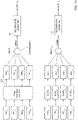
- Figure 7 refers to the m-th test manoeuvre M m and shows a graphical example of the operations of blocks 150 and 160, with reference to a single intermediate time instant t clkj (in the example shown, the intermediate time instant t clk0 ).
- Figure 7 shows how the application of the first first-level classifier 131 to the four feature vectors of extended manoeuvre training FV' m10 - FV' m40 leads to the generation, respectively, of the corresponding four first strategy training prediction vectors PV' m10 - PV' m40 , which are aggregated into the first training prediction macrovector MPV' m0 , which is connected to the macrocategory MC m of the test manoeuvre M m .
- Figure 8 refers to the m-th test manoeuvre M m and shows how, for each of the four time durations TW' 1 -TW' 4 , each of the five intermediate time instants t clk0 -t clk4 is connected to a corresponding first strategy training prediction vector PV', each of which, as said, includes a number of elements equal to the number NUM_MC of macrocategories. Moreover, Figure 8 shows that each of the five intermediate time instants t clk0 -t clk4 is connected to a corresponding first training prediction macrovector MPV' m0 -MPV' m4 , which is also connected to the macrocategory MC m .
- the computer 12 trains (block 170) a first second-level classifier 151 (shown in Figure 7 ), on the basis of the first training prediction macrovectors MPV' mj calculated for the test manoeuvres, as well as on the basis of the macrocategories MC connected to said macrovectors.
- the first second-level classifier 151 is trained in a supervised manner.
- the first second-level classifier 151 may be a classifier of the logistic regression type.
- first first-level classifier 131 and the first second-level classifier 151 have been trained, it is possible to determine the macrocategory to which an unknown manoeuvre (therefore, with unknown duration) belongs, executed, for example, by an unknown helicopter 3 (an example of which is shown in Figure 1A ), equipped with a respective monitoring system 4 including sensors (not shown) suitable for monitoring the aforementioned primary quantities. More precisely, during an unknown flight of the unknown helicopter 3, that is, during a flight in which the executed manoeuvres are not known, it is possible to identify the occurrence of a manoeuvre belonging to one of the aforementioned macrocategories MC, used during the training of the first first-level classifier 131 and of the first second-level classifier 151. For this purpose, the operations shown in Figure 9 are executed.
- a new data structure (shown in Figure 10 , where it is indicated by 205) is acquired (block 300), to which reference is made hereinafter as to the non-labelled data structure 205, since it is formed by the time series of the values assumed by the primary quantities, as measured by the monitoring system 4 equipping the unknown helicopter 3 during the unknown flight.
- the non-labelled data structure 205 is formed by a single training sub-structure SB.
- the non-labelled data structure 205 does not store any connection to the macrocategories MC.
- each primary quantity is connected to the corresponding sampling instants, i.e. they are distributed along the aforementioned flight_time, which has a discretization still equal to the sampling period ⁇ c .
- each time series connected to a corresponding primary quantity includes a number of values equal to W tot *f c .
- the computer 12 selects the subset of the values of the non-labelled data structure 205 that fall into the time window ranging between t clkk - (TW' p /2) and t clkk + (TW' p /2).
- time window ranging between t clkk -(TW NUM_TW /2) and t clkk + (TW' NUM_TW /2) (that is, the broadest time window) extends beyond the boundaries of the non-labelled data structure 205, it is possible to adopt a different centring of the NUM_TW time windows with respect to the time instant t clkk , so that the time windows fall entirely into the non-labelled data structure 205, or the time instant t clkk can be discarded, or also the corresponding subsets of the non-labelled data structure 205 may include only the values actually available; these details are irrelevant for the purposes of executing this method.
- the computer 12 extracts (block 320) a corresponding vector of features, which is referred to hereinafter as to the input feature vector FVX kp . Consequently, for the generic k-th time instant t clkk provided by the time base time_clk, a number equal to NUM_TW of input feature vectors FVX kp , without any connections to any macrocategory MC, are calculated.
- the computer 12 applies (block 330) the first first-level classifier 131 to the corresponding input feature vectors FVX kp , so as to obtain a number equal to NUM_TW of first strategy input prediction vectors PVX' kp , as qualitatively exemplified in Figure 11 , in which the four first strategy input prediction vectors PVX' k1 - PVX' k4 are shown, which derive from the application of the first first-level classifier 131 to, respectively, the four input feature vectors FVX k1 -FVX k4 .
- Each first strategy input prediction vector PVX' kp has a number of elements equal to the number NUM_MC of macrocategories MC, each element being indicative of the probability that the corresponding input feature vector FVX kp is connected to the macrocategory MC that corresponds to the element, and therefore of the probability that at the corresponding k-th time instant t clkk the unknown helicopter 3 was executing a manoeuvre belonging to such macrocategory MC.
- the computer 12 aggregates (block 335) the first strategy input prediction vectors PVX' kp (in a number equal to NUM_TW), so as to form a corresponding macrovector, to which reference is made hereinafter as to the first strategy input macrovector MPVX' k .
- the computer 12 may implement a different strategy, which is now described with reference to Figure 12 and provides for training, starting from the training data structure 10, a plurality of second first-level classifiers CLASS and a second one 251, as qualitatively shown in Figure 7 . What has been said above as regards to blocks 100 and 110 of Figure 3 also applies to this strategy.
- the computer 12 makes use of a synchronized time base, to which reference is made hereinafter as to time_clk_sync, since it has a period equal to the period ⁇ clk and is synchronized with respect to the instant t start , so as to have origin coinciding with the instant t start .
- the computer 12 determines (block 400, Figure 13 ) a succession of time instants t clk sync (shown in Figure 14 ).
- the computer 12 detects (block 410, Figure 13 ) the time instants t clk_sync_u falling within the time interval T m , and therefore falling during the test manoeuvre M m .
- the time instant t clk_sync_0 is not detected, since it coincides with the instant t start .
- the computer 12 selects, for each test manoeuvre, a number of subsets (possibly also an entire subset, as explained hereinafter) of the cluster of data DG corresponding to the test manoeuvre, as described hereinafter, again with reference to the generic p-th time duration TW' p and to the m-th test manoeuvre M m , and as shown in Figure 14 with reference to the first time duration TW' 1 .
- the computer 12 selects (block 450) each synchronized intermediate time instant t clk_sync_u such that the time window t clk_sync_u -(TW p '/2) and t clk_sync_u + (TW p '/2) falls entirely within the time interval T m .
- the computer 12 only selects the synchronized intermediate time instants t clk_sync_2 and t clk_sync_3 .
- the computer 12 selects (block 460) the subset of the values of the cluster of data DG m falling into the time window falling between t clk_sync_u -(TW' p /2) and t clk_sync_u +(TW p /2).
- a time window of duration equal to the time duration TW' p is centred thereon, this window being used to select the values of the cluster of data DG m .
- the computer 12 trains (block 350) a corresponding second first-level classifier CLASS, on the basis of the corresponding set SET of feature vectors of partial manoeuvre training FV" mpu and of the macrocategories MC connected to these vectors.
- the computer 12 executes trainings of the supervised and multiclass type, so as to obtain a number of second first-level classifiers equal to NUM_TW, as shown qualitatively in Figure 7 , in which four second first-level classifiers CLASS 1 -CLASS 4 are shown, which correspond respectively to the time durations TW 1 ' - TW 4 '.
- the second first-level classifiers CLASS are of a type known per se, such as for example random forest classifiers. Moreover, as stated above, referring for example to the p-th second first-level classifier CLASS p , it has been trained on the basis of feature vectors calculated on portions of clusters of data DG relating to test manoeuvres, said portions having time extensions not higher than the p-th time duration TW' p .
- the computer 12 applies (block 360) the second first-level classifiers CLASS to the aforementioned feature vectors of extended manoeuvre training FV' mpj , in the following manner.
- the computer 12 has, for each of the corresponding intermediate time instants t clkj of each test manoeuvre, a number equal to NUM_TW of second strategy training prediction vector PV" mpj .
- Figure 7 shows the four second strategy training prediction vectors PV" m10 - PV" m40 relating to the intermediate time instant t clk0 of the m-th test manoeuvre M m , generated respectively by the four second first-level classifiers CLASS 1 - CLASS 4 connected respectively to the time durations TW 1 '-TW 4 ', respectively starting from the four feature vectors of extended manoeuvre training FV' m10 -FV' m40 .
- the computer 12 aggregates (block 370, Figure 12 ), for each of the intermediate time instants t clkj , the second strategy training prediction vectors of PV" mpj (in a number equal to NUM_TW), so as to form a corresponding macrovector, which is again connected to the macrocategory MC of the test manoeuvre, and to which reference is made hereinafter as to the corresponding second training prediction macrovector MPV" mj .
- the four second strategy training prediction vectors PV" m10 - PV" m40 are aggregated into a second training prediction macrovector MPV" m0 , which is connected to the macrocategory MC m of the test manoeuvre M m .
- the computer 12 trains (block 380) a second second-level classifier 251 (shown in Figure 7 ), on the basis of the second training prediction macrovectors MPV" mj calculated for the intermediate time instants t clkj of each test manoeuvre.
- the second second-level classifier 251 is trained in a supervised manner, on the basis of the second training prediction macrovectors MPV" mj and of the macrocategories connected thereto. Furthermore, purely by way of example, the second second-level classifier 251 can be a classifier of the logistic regression type.
- the computer 12 aggregates (block 510) the second strategy input prediction vectors PVX" kp (in a number equal to NUM_TW), so as to form a corresponding macrovector, to which reference is made hereinafter as to the second strategy input macrovector MPVX" k .
- the computer 12 applies (block 520) the second second-level classifier 151 to the second strategy input macrovector MPVX" k , so as to obtain a second output vector OUT_B k , in which each element is indicative of the probability that the corresponding input feature vector FVX kp is connected to the macrocategory MC that corresponds to the element, and therefore that, at the k-th time instant t clkk , the unknown helicopter 3 was executing a manoeuvre belonging to said macrocategory MC.
- the second output vector OUT_B k represents an improvement of the probabilities contained in the second strategy input prediction vectors PVX" kp .
- training based on portions of manoeuvres tends to be more effective in the case of manoeuvres in which there occurs, for example, a gradual variation of a quantity (for example, a speed) between an initial value and a final value; in fact, in this case, a classifier trained on the basis of entire manoeuvres tends to recognize only manoeuvres in which this quantity exactly assumes such initial and final values, while a classifier based on portions of manoeuvres has the possibility of suitably weighing the trend (variation) of the quantity in each portion of the manoeuvre.
- a quantity for example, a speed
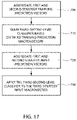
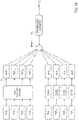
- the first and second strategy may be combined by using a third second-level classifier 651, which is trained as described in Figure 17 and exemplified in Figure 18 .
- the computer 12 aggregates (block 700, Figure 17 ), for each of the corresponding intermediate time instants t clkj , the corresponding first strategy training prediction vectors PV' mpj (in a number equal to NUM_TW), generated by the first first-level classifier 131, and the second strategy training prediction vectors PV" mpj each generated by a corresponding second first-level classifier CLASS, so as to obtain a third training prediction macrovector MPV''' mj , which is still connected to the macrocategory MC of the test manoeuvre that is taking place in the intermediate time instant t clkj .
- Figures 20A and 20B refer to a simplified case, in which NUM MC is equal to two (only a first and a second macrocategory MC1, MC2 are available) and furthermore NUM_TW is equal to two (only a first and a second time duration TW' 1 , TW' 2 are available).
- the first first-level classifier 131 generates the two first strategy training prediction vectors PV' m11 and PV' m21 , starting respectively from the feature vectors of extended manoeuvre training, FV' m11 and FV' m21 .
- the element of the first strategy training prediction vector PV' m11 relating to the macrocategory MC1 has, correctly, a high value (0.9), while the element relative to the macrocategory MC2 has, correctly, a low value (0.1).
- both feature vectors of extended manoeuvre training FV' m11 and FV' m21 are connected to the macrocategory MC1
- the training of the first second-level classifier 151 causes it to assign, for the macrocategory MC1, a greater weight to the corresponding element of the first strategy training prediction vector PV' m11 , instead of to the corresponding element of the first strategy training prediction vector PV' m21 .
- the computer 12 trains a fourth second-level classifier 751, as described below, so as to implement a fourth strategy.
- the computer aggregates (block 820) the input feature vectors FVX kp , so as to obtain a corresponding input feature macrovector MFVX k , to which the computer 12 applies (block 830) the fourth second-level classifier 751, so as to obtain a fourth output vector OUT_D k .
- Figure 22 shows, for example, the aggregation of the input feature vectors FVX k1 - FVX k4 .
- the computer trains (block 900) a plurality of classifiers 910, which are referred to hereinafter as single-class classifiers SCC (shown in Figure 24 ) .
- the computer 12 trains a corresponding single-class classifier SCC, on the basis of the vectors of entire manoeuvre features FV m .
- it is trained on the basis of the feature vectors of entire manoeuvre FV m connected to test manoeuvres, which, if they are related to manoeuvres belonging to the i-th macrocategory MC i , are connected for example to a first label (for example, unitary), otherwise they are connected to a second label (for example, invalid); in other words, the label is indicative of the match/mismatch between the macrocategory MC of the test manoeuvre and the macrocategory MC i which corresponds to the i-th single-class classifier SCCi.
- Figure 24 shows the application to the four input feature vectors FVX k1 -FVX k4 of four single-class classifiers SCC 1 -SCC 4 and the consequent generation of the single-class probability vectors SCV k1 - SCV k4 ; examples of the latter vectors are shown in Figure 25 .
- the computer 12 generates (block 920) an update vector OUT_UPDATE k , so that it has a number of elements equal to the number NUM_MC, the generic i-th element being equal to the maximum among the values of the i-th elements of the single-class probability vectors SCV kp , that is, to the maximum among the values provided by the i-th single-class classifier SCCi when it is applied to the input feature vectors FVX kp of the k-th time instant t clkk (in a number equal to NUM_TW).
- the computer 12 sets (block 950) the final vector OUT_FIN k equal to the update vector OUT_UPDATE k , since, in this particular circumstance (simultaneous execution of manoeuvres belonging to different macrocategories), the probabilities contained in the latter tend to be more accurate than those of the multiclass strategy output vector OUT_Y k .
- the computer 12 trains (block 960), for each time duration TW', a corresponding number of single-class classifiers SCC' (shown in Figure 27 ) equal to the number of macrocategories NUM_MC, to which reference is made hereinafter as to single-class single-window classifiers SCC'.
- the calculator 12 thus trains a number equal to NUM_TW*NUM_MC of single-class single-window classifiers SCC', which are then indexed by means of the index 'p' and the index 'i'.
- Figure 27 shows the four input feature vectors FVX k1 -FVX k4 which are classified by, respectively, the following single-class single-window classifiers SCC' 11 -SCC' 14 ; SCC' 21 - SCC' 24 ; SCC' 31 - SCC' 34 ; and SCC' 41 - SCC' 44 ; in this way, the single-class single-window probability vectors SCV' k1 - SCV' k4 are generated. Only for the simplicity's sake, the same values used in Figure 25 have been adopted in Figure 27 , although in reality there may be differences.
- the computer 12 detects (block 985), on the basis of the single-window update vector OUT_UPDATE' k , whether in the k-th time instant t clkk two or more manoeuvres belonging to different macrocategories MC are executed (that is, it detects a condition of multiple macrocategories), for example, by detecting whether two or more elements of the single-window update vector OUT_UPDATE' k exceed a predetermined threshold.
- the detection of multiple macrocategories may provide for further threshold controls/variation mechanisms, as described with reference to block 930.
- the computer 12 executes the operations of block 940. Otherwise, that is if manoeuvres belonging to different macrocategories MC are detected (output YES of block 985), the computer 12 sets (block 990) the final vector OUT_FIN k equal to the single-window update vector OUT_UPDATE' k and then performs the operations of block 951.
- blocks 960-990 are characterized by a greater computational burden and by the creation of a high number of classifiers compared to the operations of blocks 900-950, however, they can guarantee good performance, in particular in the case of manoeuvres with quantities having relatively constant trends.
- the computer 12 may use the macrocategory detected through the operations indicated in block 951 to carry out also a detection (identification) of the corresponding manoeuvre carried out.
- This identification can take place in a deterministic way on the basis of the values of one or more primary quantities and is represented by block 991 shown either in Figure 23 or in Figure 26 .
- the computer 12 can identify said manoeuvre on the basis of the detected macrocategory and of at least a value of at least one primary quantity of the non-labelled data structure 205, such as, for example, a value relating to a speed in the k-th time instant t clkk or in other time instants t clk .
- the information on the detected macrocategories, as well as, if necessary, on the detected manoeuvres, can be used to determine the state of usage of the unknown helicopter 3, for example in order to plan efficiently the maintenance of the unknown helicopter 3.
- the computer 12 may store (block 992) information correlating the loads to which one or more components of the helicopter 1 have been subjected, when the latter has executed corresponding manoeuvres, which belong to corresponding macrocategories MC; to this end, the helicopter 1 was equipped, during the execution of the manoeuvres, with a load detection system 17, which is configured to detect the loads to which the components are subjected.
- the first- and second-level classifiers may be of a different type with respect to what has been described.
Landscapes
- Engineering & Computer Science (AREA)
- Physics & Mathematics (AREA)
- General Physics & Mathematics (AREA)
- Automation & Control Theory (AREA)
- Aviation & Aerospace Engineering (AREA)
- Mathematical Physics (AREA)
- Evolutionary Computation (AREA)
- Artificial Intelligence (AREA)
- Traffic Control Systems (AREA)
- Feedback Control In General (AREA)
- Radar, Positioning & Navigation (AREA)
- Remote Sensing (AREA)
- Management, Administration, Business Operations System, And Electronic Commerce (AREA)
Priority Applications (5)
| Application Number | Priority Date | Filing Date | Title |
|---|---|---|---|
| EP20425059.1A EP4016221B1 (de) | 2020-12-18 | 2020-12-18 | Verfahren und system zum erkennen und klassifizieren von durch ein flugzeug ausgeführten manövern auf der basis von während eines fluges des flugzeugs erfassten massnahmen |
| US18/267,576 US12400551B2 (en) | 2020-12-18 | 2021-12-17 | Method and system for detecting and classifying manoeuvres executed by an aircraft on the basis of measures acquired during a flight of the aircraft |
| PCT/IB2021/061957 WO2022130334A1 (en) | 2020-12-18 | 2021-12-17 | "method and system for detecting and classifying manoeuvres executed by an aircraft on the basis of measures acquired during a flight of the aircraft |
| CN202180093901.8A CN117413232A (zh) | 2020-12-18 | 2021-12-17 | 用于基于在飞机的飞行期间获取的测量对由飞机执行的操纵进行检测和分类的方法和系统 |
| KR1020237024432A KR20230135580A (ko) | 2020-12-18 | 2021-12-17 | 항공기의 비행 중에 획득된 측정값에 기초하여 항공기에의해 실행되는 기동을 검출 및 분류하기 위한 방법 및 시스템 |
Applications Claiming Priority (1)
| Application Number | Priority Date | Filing Date | Title |
|---|---|---|---|
| EP20425059.1A EP4016221B1 (de) | 2020-12-18 | 2020-12-18 | Verfahren und system zum erkennen und klassifizieren von durch ein flugzeug ausgeführten manövern auf der basis von während eines fluges des flugzeugs erfassten massnahmen |
Publications (2)
| Publication Number | Publication Date |
|---|---|
| EP4016221A1 true EP4016221A1 (de) | 2022-06-22 |
| EP4016221B1 EP4016221B1 (de) | 2023-06-14 |
Family
ID=74661219
Family Applications (1)
| Application Number | Title | Priority Date | Filing Date |
|---|---|---|---|
| EP20425059.1A Active EP4016221B1 (de) | 2020-12-18 | 2020-12-18 | Verfahren und system zum erkennen und klassifizieren von durch ein flugzeug ausgeführten manövern auf der basis von während eines fluges des flugzeugs erfassten massnahmen |
Country Status (5)
| Country | Link |
|---|---|
| US (1) | US12400551B2 (de) |
| EP (1) | EP4016221B1 (de) |
| KR (1) | KR20230135580A (de) |
| CN (1) | CN117413232A (de) |
| WO (1) | WO2022130334A1 (de) |
Families Citing this family (1)
| Publication number | Priority date | Publication date | Assignee | Title |
|---|---|---|---|---|
| GB2599688B (en) * | 2020-10-09 | 2023-08-16 | Rolls Royce Plc | An improved turbofan gas turbine engine |
Citations (3)
| Publication number | Priority date | Publication date | Assignee | Title |
|---|---|---|---|---|
| EP2270618A2 (de) * | 2009-06-26 | 2011-01-05 | Honeywell International Inc. | Verfahren und System zur Fehlerbestimmung für ein Flugzeug |
| EP2384971A1 (de) * | 2010-04-21 | 2011-11-09 | Sikorsky Aircraft Corporation | Verfahren zur Bestimmung eines von einem Flugzeug durchgeführten Manövers |
| EP3462266A1 (de) * | 2017-09-29 | 2019-04-03 | The Boeing Company | Flugzeugwartungsnachrichtvorhersage |
Family Cites Families (5)
| Publication number | Priority date | Publication date | Assignee | Title |
|---|---|---|---|---|
| WO2004097766A1 (en) * | 2003-04-28 | 2004-11-11 | ST Electronics (Training & Simulation Systems) Pte Ltd. | Method for aircraft position prediction based on aircraft characteristics |
| US9898934B2 (en) * | 2016-07-25 | 2018-02-20 | Honeywell International Inc. | Prediction of vehicle maneuvers |
| US10996683B2 (en) * | 2018-02-09 | 2021-05-04 | Skydio, Inc. | Aerial vehicle touchdown detection |
| US11912431B2 (en) * | 2021-09-20 | 2024-02-27 | Rockwell Collins, Inc. | Time based overlay for positional map displays |
| US12260765B2 (en) * | 2021-09-30 | 2025-03-25 | Honeywell International Inc. | Systems and methods for alerting when an intruder trend vector is predicted to intercept with an aircraft taxi path |
-
2020
- 2020-12-18 EP EP20425059.1A patent/EP4016221B1/de active Active
-
2021
- 2021-12-17 US US18/267,576 patent/US12400551B2/en active Active
- 2021-12-17 WO PCT/IB2021/061957 patent/WO2022130334A1/en not_active Ceased
- 2021-12-17 CN CN202180093901.8A patent/CN117413232A/zh active Pending
- 2021-12-17 KR KR1020237024432A patent/KR20230135580A/ko active Pending
Patent Citations (3)
| Publication number | Priority date | Publication date | Assignee | Title |
|---|---|---|---|---|
| EP2270618A2 (de) * | 2009-06-26 | 2011-01-05 | Honeywell International Inc. | Verfahren und System zur Fehlerbestimmung für ein Flugzeug |
| EP2384971A1 (de) * | 2010-04-21 | 2011-11-09 | Sikorsky Aircraft Corporation | Verfahren zur Bestimmung eines von einem Flugzeug durchgeführten Manövers |
| EP3462266A1 (de) * | 2017-09-29 | 2019-04-03 | The Boeing Company | Flugzeugwartungsnachrichtvorhersage |
Also Published As
| Publication number | Publication date |
|---|---|
| WO2022130334A1 (en) | 2022-06-23 |
| US12400551B2 (en) | 2025-08-26 |
| KR20230135580A (ko) | 2023-09-25 |
| CN117413232A (zh) | 2024-01-16 |
| US20240105065A1 (en) | 2024-03-28 |
| EP4016221B1 (de) | 2023-06-14 |
Similar Documents
| Publication | Publication Date | Title |
|---|---|---|
| Das et al. | Multiple kernel learning for heterogeneous anomaly detection: algorithm and aviation safety case study | |
| Khan et al. | Unsupervised anomaly detection in unmanned aerial vehicles | |
| EP3460611B1 (de) | System und verfahren zur flugzeugfehlererkennung | |
| CN113486938B (zh) | 基于多分支时间卷积网络的重着陆的分析方法和装置 | |
| CN107703920B (zh) | 基于多元时间序列的列车制动系统的故障检测方法 | |
| Janakiraman | Explaining aviation safety incidents using deep temporal multiple instance learning | |
| CN108760302A (zh) | 一种风力发电机组轴承的在线监测与故障诊断系统 | |
| CN110070098A (zh) | 用于通过监督式自动学习来探测飞行器的冰冻状况的方法 | |
| CN114004292B (zh) | 基于飞参数据无监督聚类的飞行员平飘顶杆行为分析方法 | |
| CN104614166A (zh) | 一种飞机发动机转子振动信号故障状态识别的方法 | |
| CN111680875A (zh) | 基于概率基线模型的无人机状态风险模糊综合评价方法 | |
| Shi et al. | Health index synthetization and remaining useful life estimation for turbofan engines based on run-to-failure datasets | |
| CN115994302A (zh) | 基于柯西核贝叶斯自适应共振网络的航空发动机故障诊断方法 | |
| US12400551B2 (en) | Method and system for detecting and classifying manoeuvres executed by an aircraft on the basis of measures acquired during a flight of the aircraft | |
| CN117668537A (zh) | 一种用于设备故障排查的检测系统及其检测方法 | |
| Liu et al. | An adjustable feature-weighted Bayesian model for hybrid satellite telemetry variables anomaly detection under multioperating conditions | |
| Anger | Hidden semi-Markov models for predictive maintenance of rotating elements | |
| WO2023062519A1 (en) | Method and system for detecting flight regimes of an aircraft, on the basis of measurements acquired during an aircraft flight | |
| EP4198842B1 (de) | Verfahren zur klassifizierung von flugmanövern mittels eines neuronales netzes | |
| Slimene et al. | Anomaly Detection Method of Aircraft System using Multivariate Time Series Clustering and Classification Techniques | |
| Cui et al. | A method for intermittent fault diagnosis of electronic equipment based on labeled SOM | |
| Zhang et al. | Fault prediction of unmanned aerial vehicles based on entropy weight fusion and temporal graph convolutional network with non-Euclidian structure | |
| KR20230066871A (ko) | 비행 궤적 학습을 통한 비정상 운행 구간 검출 방법 및 장치 | |
| Asher et al. | Automatic regime detection for Rotor Track and Balance using vibration only sensor data | |
| Wang et al. | Incremental support vector machine learning method for aircraft event recognition |
Legal Events
| Date | Code | Title | Description |
|---|---|---|---|
| PUAI | Public reference made under article 153(3) epc to a published international application that has entered the european phase |
Free format text: ORIGINAL CODE: 0009012 |
|
| STAA | Information on the status of an ep patent application or granted ep patent |
Free format text: STATUS: THE APPLICATION HAS BEEN PUBLISHED |
|
| AK | Designated contracting states |
Kind code of ref document: A1 Designated state(s): AL AT BE BG CH CY CZ DE DK EE ES FI FR GB GR HR HU IE IS IT LI LT LU LV MC MK MT NL NO PL PT RO RS SE SI SK SM TR |
|
| STAA | Information on the status of an ep patent application or granted ep patent |
Free format text: STATUS: REQUEST FOR EXAMINATION WAS MADE |
|
| 17P | Request for examination filed |
Effective date: 20220726 |
|
| RBV | Designated contracting states (corrected) |
Designated state(s): AL AT BE BG CH CY CZ DE DK EE ES FI FR GB GR HR HU IE IS IT LI LT LU LV MC MK MT NL NO PL PT RO RS SE SI SK SM TR |
|
| GRAP | Despatch of communication of intention to grant a patent |
Free format text: ORIGINAL CODE: EPIDOSNIGR1 |
|
| STAA | Information on the status of an ep patent application or granted ep patent |
Free format text: STATUS: GRANT OF PATENT IS INTENDED |
|
| RIC1 | Information provided on ipc code assigned before grant |
Ipc: B64D 45/00 20060101ALN20221129BHEP Ipc: G05B 23/02 20060101AFI20221129BHEP |
|
| INTG | Intention to grant announced |
Effective date: 20230103 |
|
| RAP1 | Party data changed (applicant data changed or rights of an application transferred) |
Owner name: LEONARDO S.P.A. |
|
| GRAS | Grant fee paid |
Free format text: ORIGINAL CODE: EPIDOSNIGR3 |
|
| GRAA | (expected) grant |
Free format text: ORIGINAL CODE: 0009210 |
|
| STAA | Information on the status of an ep patent application or granted ep patent |
Free format text: STATUS: THE PATENT HAS BEEN GRANTED |
|
| AK | Designated contracting states |
Kind code of ref document: B1 Designated state(s): AL AT BE BG CH CY CZ DE DK EE ES FI FR GB GR HR HU IE IS IT LI LT LU LV MC MK MT NL NO PL PT RO RS SE SI SK SM TR |
|
| REG | Reference to a national code |
Ref country code: CH Ref legal event code: EP |
|
| REG | Reference to a national code |
Ref country code: DE Ref legal event code: R096 Ref document number: 602020012498 Country of ref document: DE |
|
| REG | Reference to a national code |
Ref country code: AT Ref legal event code: REF Ref document number: 1579682 Country of ref document: AT Kind code of ref document: T Effective date: 20230715 |
|
| REG | Reference to a national code |
Ref country code: LT Ref legal event code: MG9D |
|
| REG | Reference to a national code |
Ref country code: NL Ref legal event code: MP Effective date: 20230614 |
|
| PG25 | Lapsed in a contracting state [announced via postgrant information from national office to epo] |
Ref country code: SE Free format text: LAPSE BECAUSE OF FAILURE TO SUBMIT A TRANSLATION OF THE DESCRIPTION OR TO PAY THE FEE WITHIN THE PRESCRIBED TIME-LIMIT Effective date: 20230614 Ref country code: NO Free format text: LAPSE BECAUSE OF FAILURE TO SUBMIT A TRANSLATION OF THE DESCRIPTION OR TO PAY THE FEE WITHIN THE PRESCRIBED TIME-LIMIT Effective date: 20230914 Ref country code: ES Free format text: LAPSE BECAUSE OF FAILURE TO SUBMIT A TRANSLATION OF THE DESCRIPTION OR TO PAY THE FEE WITHIN THE PRESCRIBED TIME-LIMIT Effective date: 20230614 |
|
| P01 | Opt-out of the competence of the unified patent court (upc) registered |
Effective date: 20231005 |
|
| REG | Reference to a national code |
Ref country code: AT Ref legal event code: MK05 Ref document number: 1579682 Country of ref document: AT Kind code of ref document: T Effective date: 20230614 |
|
| PG25 | Lapsed in a contracting state [announced via postgrant information from national office to epo] |
Ref country code: RS Free format text: LAPSE BECAUSE OF FAILURE TO SUBMIT A TRANSLATION OF THE DESCRIPTION OR TO PAY THE FEE WITHIN THE PRESCRIBED TIME-LIMIT Effective date: 20230614 Ref country code: NL Free format text: LAPSE BECAUSE OF FAILURE TO SUBMIT A TRANSLATION OF THE DESCRIPTION OR TO PAY THE FEE WITHIN THE PRESCRIBED TIME-LIMIT Effective date: 20230614 Ref country code: LV Free format text: LAPSE BECAUSE OF FAILURE TO SUBMIT A TRANSLATION OF THE DESCRIPTION OR TO PAY THE FEE WITHIN THE PRESCRIBED TIME-LIMIT Effective date: 20230614 Ref country code: LT Free format text: LAPSE BECAUSE OF FAILURE TO SUBMIT A TRANSLATION OF THE DESCRIPTION OR TO PAY THE FEE WITHIN THE PRESCRIBED TIME-LIMIT Effective date: 20230614 Ref country code: HR Free format text: LAPSE BECAUSE OF FAILURE TO SUBMIT A TRANSLATION OF THE DESCRIPTION OR TO PAY THE FEE WITHIN THE PRESCRIBED TIME-LIMIT Effective date: 20230614 Ref country code: GR Free format text: LAPSE BECAUSE OF FAILURE TO SUBMIT A TRANSLATION OF THE DESCRIPTION OR TO PAY THE FEE WITHIN THE PRESCRIBED TIME-LIMIT Effective date: 20230915 |
|
| PG25 | Lapsed in a contracting state [announced via postgrant information from national office to epo] |
Ref country code: FI Free format text: LAPSE BECAUSE OF FAILURE TO SUBMIT A TRANSLATION OF THE DESCRIPTION OR TO PAY THE FEE WITHIN THE PRESCRIBED TIME-LIMIT Effective date: 20230614 |
|
| PG25 | Lapsed in a contracting state [announced via postgrant information from national office to epo] |
Ref country code: SK Free format text: LAPSE BECAUSE OF FAILURE TO SUBMIT A TRANSLATION OF THE DESCRIPTION OR TO PAY THE FEE WITHIN THE PRESCRIBED TIME-LIMIT Effective date: 20230614 |
|
| PG25 | Lapsed in a contracting state [announced via postgrant information from national office to epo] |
Ref country code: IS Free format text: LAPSE BECAUSE OF FAILURE TO SUBMIT A TRANSLATION OF THE DESCRIPTION OR TO PAY THE FEE WITHIN THE PRESCRIBED TIME-LIMIT Effective date: 20231014 |
|
| PG25 | Lapsed in a contracting state [announced via postgrant information from national office to epo] |
Ref country code: SM Free format text: LAPSE BECAUSE OF FAILURE TO SUBMIT A TRANSLATION OF THE DESCRIPTION OR TO PAY THE FEE WITHIN THE PRESCRIBED TIME-LIMIT Effective date: 20230614 Ref country code: SK Free format text: LAPSE BECAUSE OF FAILURE TO SUBMIT A TRANSLATION OF THE DESCRIPTION OR TO PAY THE FEE WITHIN THE PRESCRIBED TIME-LIMIT Effective date: 20230614 Ref country code: RO Free format text: LAPSE BECAUSE OF FAILURE TO SUBMIT A TRANSLATION OF THE DESCRIPTION OR TO PAY THE FEE WITHIN THE PRESCRIBED TIME-LIMIT Effective date: 20230614 Ref country code: PT Free format text: LAPSE BECAUSE OF FAILURE TO SUBMIT A TRANSLATION OF THE DESCRIPTION OR TO PAY THE FEE WITHIN THE PRESCRIBED TIME-LIMIT Effective date: 20231016 Ref country code: IS Free format text: LAPSE BECAUSE OF FAILURE TO SUBMIT A TRANSLATION OF THE DESCRIPTION OR TO PAY THE FEE WITHIN THE PRESCRIBED TIME-LIMIT Effective date: 20231014 Ref country code: EE Free format text: LAPSE BECAUSE OF FAILURE TO SUBMIT A TRANSLATION OF THE DESCRIPTION OR TO PAY THE FEE WITHIN THE PRESCRIBED TIME-LIMIT Effective date: 20230614 Ref country code: CZ Free format text: LAPSE BECAUSE OF FAILURE TO SUBMIT A TRANSLATION OF THE DESCRIPTION OR TO PAY THE FEE WITHIN THE PRESCRIBED TIME-LIMIT Effective date: 20230614 Ref country code: AT Free format text: LAPSE BECAUSE OF FAILURE TO SUBMIT A TRANSLATION OF THE DESCRIPTION OR TO PAY THE FEE WITHIN THE PRESCRIBED TIME-LIMIT Effective date: 20230614 |
|
| PG25 | Lapsed in a contracting state [announced via postgrant information from national office to epo] |
Ref country code: PL Free format text: LAPSE BECAUSE OF FAILURE TO SUBMIT A TRANSLATION OF THE DESCRIPTION OR TO PAY THE FEE WITHIN THE PRESCRIBED TIME-LIMIT Effective date: 20230614 |
|
| REG | Reference to a national code |
Ref country code: DE Ref legal event code: R097 Ref document number: 602020012498 Country of ref document: DE |
|
| PLBE | No opposition filed within time limit |
Free format text: ORIGINAL CODE: 0009261 |
|
| STAA | Information on the status of an ep patent application or granted ep patent |
Free format text: STATUS: NO OPPOSITION FILED WITHIN TIME LIMIT |
|
| PG25 | Lapsed in a contracting state [announced via postgrant information from national office to epo] |
Ref country code: DK Free format text: LAPSE BECAUSE OF FAILURE TO SUBMIT A TRANSLATION OF THE DESCRIPTION OR TO PAY THE FEE WITHIN THE PRESCRIBED TIME-LIMIT Effective date: 20230614 |
|
| PG25 | Lapsed in a contracting state [announced via postgrant information from national office to epo] |
Ref country code: SI Free format text: LAPSE BECAUSE OF FAILURE TO SUBMIT A TRANSLATION OF THE DESCRIPTION OR TO PAY THE FEE WITHIN THE PRESCRIBED TIME-LIMIT Effective date: 20230614 |
|
| 26N | No opposition filed |
Effective date: 20240315 |
|
| PG25 | Lapsed in a contracting state [announced via postgrant information from national office to epo] |
Ref country code: SI Free format text: LAPSE BECAUSE OF FAILURE TO SUBMIT A TRANSLATION OF THE DESCRIPTION OR TO PAY THE FEE WITHIN THE PRESCRIBED TIME-LIMIT Effective date: 20230614 |
|
| REG | Reference to a national code |
Ref country code: CH Ref legal event code: PL |
|
| PG25 | Lapsed in a contracting state [announced via postgrant information from national office to epo] |
Ref country code: LU Free format text: LAPSE BECAUSE OF NON-PAYMENT OF DUE FEES Effective date: 20231218 |
|
| PG25 | Lapsed in a contracting state [announced via postgrant information from national office to epo] |
Ref country code: MC Free format text: LAPSE BECAUSE OF FAILURE TO SUBMIT A TRANSLATION OF THE DESCRIPTION OR TO PAY THE FEE WITHIN THE PRESCRIBED TIME-LIMIT Effective date: 20230614 |
|
| REG | Reference to a national code |
Ref country code: BE Ref legal event code: MM Effective date: 20231231 |
|
| PG25 | Lapsed in a contracting state [announced via postgrant information from national office to epo] |
Ref country code: MC Free format text: LAPSE BECAUSE OF FAILURE TO SUBMIT A TRANSLATION OF THE DESCRIPTION OR TO PAY THE FEE WITHIN THE PRESCRIBED TIME-LIMIT Effective date: 20230614 Ref country code: LU Free format text: LAPSE BECAUSE OF NON-PAYMENT OF DUE FEES Effective date: 20231218 |
|
| REG | Reference to a national code |
Ref country code: IE Ref legal event code: MM4A |
|
| PG25 | Lapsed in a contracting state [announced via postgrant information from national office to epo] |
Ref country code: IE Free format text: LAPSE BECAUSE OF NON-PAYMENT OF DUE FEES Effective date: 20231218 |
|
| PG25 | Lapsed in a contracting state [announced via postgrant information from national office to epo] |
Ref country code: BE Free format text: LAPSE BECAUSE OF NON-PAYMENT OF DUE FEES Effective date: 20231231 |
|
| PG25 | Lapsed in a contracting state [announced via postgrant information from national office to epo] |
Ref country code: CH Free format text: LAPSE BECAUSE OF NON-PAYMENT OF DUE FEES Effective date: 20231231 |
|
| PG25 | Lapsed in a contracting state [announced via postgrant information from national office to epo] |
Ref country code: IE Free format text: LAPSE BECAUSE OF NON-PAYMENT OF DUE FEES Effective date: 20231218 Ref country code: CH Free format text: LAPSE BECAUSE OF NON-PAYMENT OF DUE FEES Effective date: 20231231 Ref country code: BE Free format text: LAPSE BECAUSE OF NON-PAYMENT OF DUE FEES Effective date: 20231231 |
|
| PG25 | Lapsed in a contracting state [announced via postgrant information from national office to epo] |
Ref country code: BG Free format text: LAPSE BECAUSE OF FAILURE TO SUBMIT A TRANSLATION OF THE DESCRIPTION OR TO PAY THE FEE WITHIN THE PRESCRIBED TIME-LIMIT Effective date: 20230614 |
|
| PG25 | Lapsed in a contracting state [announced via postgrant information from national office to epo] |
Ref country code: BG Free format text: LAPSE BECAUSE OF FAILURE TO SUBMIT A TRANSLATION OF THE DESCRIPTION OR TO PAY THE FEE WITHIN THE PRESCRIBED TIME-LIMIT Effective date: 20230614 |
|
| PGFP | Annual fee paid to national office [announced via postgrant information from national office to epo] |
Ref country code: DE Payment date: 20241227 Year of fee payment: 5 |
|
| PG25 | Lapsed in a contracting state [announced via postgrant information from national office to epo] |
Ref country code: CY Free format text: LAPSE BECAUSE OF FAILURE TO SUBMIT A TRANSLATION OF THE DESCRIPTION OR TO PAY THE FEE WITHIN THE PRESCRIBED TIME-LIMIT; INVALID AB INITIO Effective date: 20201218 |
|
| PG25 | Lapsed in a contracting state [announced via postgrant information from national office to epo] |
Ref country code: HU Free format text: LAPSE BECAUSE OF FAILURE TO SUBMIT A TRANSLATION OF THE DESCRIPTION OR TO PAY THE FEE WITHIN THE PRESCRIBED TIME-LIMIT; INVALID AB INITIO Effective date: 20201218 |
|
| PG25 | Lapsed in a contracting state [announced via postgrant information from national office to epo] |
Ref country code: TR Free format text: LAPSE BECAUSE OF FAILURE TO SUBMIT A TRANSLATION OF THE DESCRIPTION OR TO PAY THE FEE WITHIN THE PRESCRIBED TIME-LIMIT Effective date: 20230614 |
|
| PGFP | Annual fee paid to national office [announced via postgrant information from national office to epo] |
Ref country code: GB Payment date: 20251223 Year of fee payment: 6 |
|
| PGFP | Annual fee paid to national office [announced via postgrant information from national office to epo] |
Ref country code: IT Payment date: 20251104 Year of fee payment: 6 |
|
| PGFP | Annual fee paid to national office [announced via postgrant information from national office to epo] |
Ref country code: FR Payment date: 20251223 Year of fee payment: 6 |