EP4013416B1 - Procédé de préparation de 1,4-dihydro-4-oxoquinoline-2-carboxylates et de composés de 4-aminoquinoline à partir de ceux-ci - Google Patents
Procédé de préparation de 1,4-dihydro-4-oxoquinoline-2-carboxylates et de composés de 4-aminoquinoline à partir de ceux-ci Download PDFInfo
- Publication number
- EP4013416B1 EP4013416B1 EP20852059.3A EP20852059A EP4013416B1 EP 4013416 B1 EP4013416 B1 EP 4013416B1 EP 20852059 A EP20852059 A EP 20852059A EP 4013416 B1 EP4013416 B1 EP 4013416B1
- Authority
- EP
- European Patent Office
- Prior art keywords
- formula
- ester
- compound
- solvent
- acid
- Prior art date
- Legal status (The legal status is an assumption and is not a legal conclusion. Google has not performed a legal analysis and makes no representation as to the accuracy of the status listed.)
- Active
Links
Images

Classifications
-
- C—CHEMISTRY; METALLURGY
- C07—ORGANIC CHEMISTRY
- C07D—HETEROCYCLIC COMPOUNDS
- C07D215/00—Heterocyclic compounds containing quinoline or hydrogenated quinoline ring systems
- C07D215/02—Heterocyclic compounds containing quinoline or hydrogenated quinoline ring systems having no bond between the ring nitrogen atom and a non-ring member or having only hydrogen atoms or carbon atoms directly attached to the ring nitrogen atom
- C07D215/16—Heterocyclic compounds containing quinoline or hydrogenated quinoline ring systems having no bond between the ring nitrogen atom and a non-ring member or having only hydrogen atoms or carbon atoms directly attached to the ring nitrogen atom with hetero atoms or with carbon atoms having three bonds to hetero atoms with at the most one bond to halogen, e.g. ester or nitrile radicals, directly attached to ring carbon atoms
- C07D215/48—Carbon atoms having three bonds to hetero atoms with at the most one bond to halogen
Definitions
- the present invention relates to process for preparing certain 1,4-dihydro-4-oxoquinoline-2-carboxylate esters.
- this invention relates to an improved preparation of 5,7-dihalo-1,4-dihydro-4-oxoquinoline-2-carboxylate esters, and subsequent conversion of the oxoquinoline esters to 4-aminoquinoline compounds, including acids and esters thereof.
- 4-Ureido-5,7-dihalo-quinoline-2-carboxylate compounds particularly diphenylureido-dichlorokynurenic acid (DCUKA) compounds and esters thereof, reportedly have analgesic activity and are useful in treating chronic pain and alcohol dependence, as well as preventing relapse in alcohol addicted subjects.
- DCUKA diphenylureido-dichlorokynurenic acid
- One difficulty in the commercial development of the 4-ureido-5,7-dihalo-quinoline-2-carboxylate compounds has been the harsh conditions needed for preparing 5,7-dihalo-1,4-dihydro-4-oxoquinoline-2-carboxylates, which are intermediates in the synthesis of the 4-ureido-5,7-dihalo-quinoline-2-carboxylate compounds.
- Reaction A in Scheme 1 comprises heating a mixture of 3,5-dichloroaniline 1 and diethyl acetylenedicarboxylate (e.g., 2 in tetrahydrofuran (THF) at about 70 °C to afford Michael adduct 3.
- Reaction B involves heating Michael adduct 3 at about 250 °C in diphenyl ether solvent to afford ethyl 5,7-dichloro-1,4-dihydro-4-oxoquinoline-2-carboxylate ester 4.
- Ester 4 is then reacted with chlorosulfonyl isocyanate in acetonitrile, followed by quenching with hydrochloric acid (collectively Reaction C) to afford ethyl 4-amino-5,7-dichloro-quinoline-2-carboxylate ester 5, which is then reacted with diphenylcarbamoyl chloride in dimethylformamide (DMF) in the presence of a NaH to afford the DCUKA ethyl ester (Reaction D) or if desired, the DCUKA acid can be isolated by in situ hydrolysis of the ester group.
- DMF dimethylformamide
- the DCUKA acid can be isolated by in situ hydrolysis of the ester group.
- Reaction B in Scheme 1 is a potential impediment to commercial scale production of DCUKA compounds due to the high temperature of the reaction, as well as the expense of the solvent, and the difficulties of purifying the product and recovering the solvent.
- the processes described herein address this problem.
- Park et al. (Bull. Korean Chem. Soc. 28 (2007), 1203-1205 ) describes a synthesis of 4-hydroxycoumarin and 4-hydroxy-2-quinolone derivatives.
- WO 2015/195943 discloses aminoquinoline compounds useful for treating chronic pain, addiction, and other conditions.
- a method for preparing an alkyl 5,7-dihalo-1,4-dihydro-4-oxoquinoline-2-carboxylate ester of Formula IV, below, is described herein.
- the method comprises cyclizing a dialkyl 1-(3,5-dihalophenylamino)ethylene-1,2-dicarboxylate compound of Formula III with P 2 O 5 in methane sulfonic acid (often referred to as Eaton's reagent) in a heated continuous flow reactor to form the alkyl l,4-dihydro-4-oxoquinoline-2-carboxylate ester of Formula IV.
- a cosolvent such as dichloromethane can be included with the Eaton's reagent.
- each X independently is a halogen, e.g., F, Cl, Br or I
- each R is a C 1 to C 4 alkyl group, e.g., methyl (Me), ethyl (Et), propyl (Pr), isopropyl (iPr) , butyl (Bu), and the like.
- each X is Cl.
- each R is ethyl.
- each X is Cl, and each R is ethyl.
- Reaction (b) of Scheme 2 is performed at much lower temperature utilizing P 2 O 5 in methanesulfonic acid (e.g., about 7 to about 10 % by weight (wt%) P 2 O 5 in methanesulfonic acid; also known as Eaton's reagent) than the prior known thermal cycloacylation.
- Reaction (b) is performed in a flow reactor in neat Eaton's reagent as the sole solvent, or with Eaton's reagent and a hydrocarbon or halogenated hydrocarbon cosolvent.
- the method of the third embodiment can include purifying the diphenylureido-dihalokynurenic acid ester of Formula VI, as well.
- the purification is performed by:
- the purified ester of Formula VI can be converted to the corresponding carboxylic acid (e.g., to DCUKA) or to a salt thereof by hydrolysis.
- the carboxylic acid or the carboxylate salt can be converted to an addition salt with a strong acid, such as p-toluenesulfonic acid, such that the heterocyclic nitrogen of the diphenylureido-dihalokynurenic acid is protonated.
- diethyl acetylenedicarboxylate is not thermally stable and decomposes with a significant energy release, so it is preferable to limit the diethyl acetylenedicarboxylate charge to less than one equivalent (e.g., about 0.9 eq) for safety purposes.
- THF was removed by distillation and the crude Michael adduct mixture can be directly used in the subsequent cycloacylation reaction to produce Compound 4, as described below. This procedure was found to be suitable for the production of the Michael adduct material in a multi-kilo scale.
- the water can include a base to neutralize or partially neutralize the methane sulfonic acid and any phosphoric acid that may form upon adding the effluent to the water.
- the trituration procedure can be used even when a cosolvent such as dichloromethane is present in the effluent.
- the crude precipitate which may still contain some unreacted Compound 3, significant amounts of unreacted 3,5-disubstituted aniline 1, as well as some side products, can be further purified by slurring crude Compound 4 in an aqueous solution of a basic salt such as sodium acetate (e.g., about 5 to 20 mL of aqueous salt solution per gram of crude Compound 4).
- a basic salt such as sodium acetate
- the crude Compound 4 can be purified by slurrying the solid in an organic solvent in which the product has moderate to low solubility, such as a C 1 -C 3 alcohol (e.g., methanol or isopropanol) or acetonitrile. With isopropanol and acetonitrile, purities of up to 95 % can be achieved, with recoveries of up to 90 % of the theoretical amount of desired product in the crude solid product.
- a C 1 -C 3 alcohol e.g., methanol or
- chlorosulfonyl isocyanate preferably is added to a solution of Compound 5 at about 70 °C instead of 23 °C, which results in controlled evolution of CO 2 during the entire addition. Following this procedure, crude Compound 5 is isolated in up to 93% yield at a purity of up to 90%.
- Crude Compound 5 was readily purified by slurrying in a variety of solvents, including ethanol, isopropanol and ethyl acetate.
- solvents including ethanol, isopropanol and ethyl acetate.
- slurrying in 3 to 5 volumes of isopropanol resulted in a recovery of about 85 % of Compound 5 at purities of 94 to 97 % as determined by HPLC.
- Similar results were obtained with 3 to 5 volumes of ethanol, albeit with slightly lower recovery (64-72 %) and slightly higher purity (98 to 99 %).
- Slurry purification with about 3 to 10 volumes ethyl acetate afforded the highest recoveries (88 to 90 %) at HPLC purities of 93 to 97 %.
- Weaker bases such as pyridine, diisopropylethylamine in toluene, and cesium carbonate in DMF also failed to afford the desired product, as did neat pyridine.
- Crystallization initiated by a solvent swap from DCM to EtOH also provided high purity Compound 6, since this material is relatively insoluble in EtOH.
- a mixture of EtOAc and MEK can be used to dissolve the crude DCUKA acid, and this solvent combination can be removed by solvent swapping with EtOH as in the case of DCM.
- the organic phase was subjected to distillation at 45 °C to reduce the DCM volume level about 4- to 5-fold from initial volume, and then EtOH was added dropwise continuously to remove DCM further during the distillation. After about 6 volumes of EtOH was added, the mixture was maintained at about 70 °C for about 45 min to afford a DCM to EtOH ratio of about 1:22 as determined by 1 H-NMR analysis.
Landscapes
- Chemical & Material Sciences (AREA)
- Organic Chemistry (AREA)
- Organic Low-Molecular-Weight Compounds And Preparation Thereof (AREA)
- Pharmaceuticals Containing Other Organic And Inorganic Compounds (AREA)
- Plural Heterocyclic Compounds (AREA)
Claims (15)
- Procédé pour la préparation d'un ester de 5,7-dihalogéno-l,4-dihydro-4-oxoquinoléine-2-carboxylate d'alkyle de Formule IV, comprenant les étapes séquentielles de :(i) chauffage d'une première solution comprenant un composé de Formule III dissous dans un réactif comprenant 7 à 10 % en poids de P2O5 dans de l'acide méthanesulfonique, à une concentration de 0,15 à 0,25 gramme du composé de Formule III par ml du réactif :

 (ii) ajout de l'effluent collecté à l'étape (i) à au moins 5 volumes d'eau par volume de l'effluent, sous agitation, tout en maintenant une température de l'eau de 15 °C ou moins, pour former un premier précipité comprenant l'ester de Formule IV ; et(iii) récupération du premier précipité ;dans lesdites Formule III et Formule IV, chaque X étant indépendamment un atome d'halogène ; et chaque R étant indépendamment un alkyle en C1 à C4.
 - Procédé de la revendication 1, comprenant en outre les étapes de :(iv) agitation d'une première suspension comprenant le premier précipité obtenu à l'étape (iii) dans un premier solvant à une température située dans la plage de 40 à 50 °C pendant au moins 1 heure ; et(v) récupération de particules solides non dissoutes comprenant un ester purifié de Formule IV à partir de la première suspension ;dans lequel le premier solvant est sélectionné dans le groupe constitué par l'acétonitrile, le méthanol, l'isopropanol et une combinaison de deux de ceux-ci ou plus ;dans lequel la première suspension comprend de préférence 3 à 10 ml du premier solvant par gramme du premier précipité.
- Procédé pour la préparation d'un 5,7-dihalogéno-l,4-dihydro-4-oxoquinoléine-2-carboxylate d'alkyle de Formule IV comprenant les étapes séquentielles de :(i) mise en contact d'une première solution comprenant 15 à 60 % en poids de dihalogénoaniline de Formule I dans un premier solvant avec au moins 0,9 équivalent d'un acétylènedicarboxylate de dialkyle de Formule II à une température sélectionnée de 70 à 100 °C pendant une période de 6 à 24 heures pour former un composé de Formule III :
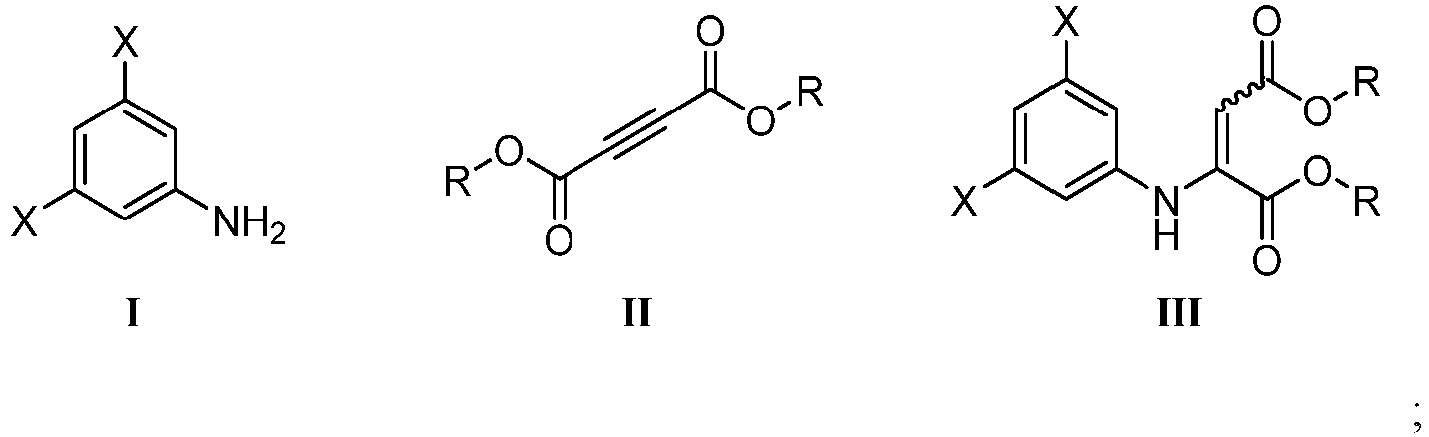 (ii) élimination du premier solvant pour former un premier résidu comprenant le composé de Formule III ;(iii) chauffage d'une deuxième solution comprenant le premier résidu de l'étape (ii) dissous dans un réactif comprenant 7 à 10 % en poids de P2O5 dans de l'acide méthanesulfonique, à une concentration de 0,15 à 0,25 gramme du premier résidu par ml du réactif, et à une température sélectionnée de 65 à 75 °C en pompant la deuxième solution à travers un serpentin de réacteur à flux continu chauffé à un débit de pompage suffisant pour assurer un temps de séjour de 15 à 40 minutes dans le serpentin chauffé ; et collecte d'un effluent s'écoulant hors du serpentin chauffé comprenant un ester de 5,7-dihalogéno-l,4-dihydro-4-oxoquinoléine-2-carboxylate d'alkyle de Formule IV :
 (iv) ajout de l'effluent collecté à l'étape (iii) à au moins 5 volumes d'eau par volume de l'effluent, sous agitation, tout en maintenant une température de l'eau de 15 °C ou moins, pour former un premier précipité comprenant l'ester de Formule IV ; et(v) récupération du premier précipité ;dans lesdites Formule I, Formule II, Formule III et Formule IV, chaque X étant indépendamment un atome d'halogène ; chaque R étant indépendamment un alkyle en C1 à C4, et le premier solvant étant un solvant aprotique.
 - Procédé de l'une des revendications 1 ou 3, dans lequel (a) chaque X est un atome de chlore ; (b) chaque R est un éthyle ; ou (c) chaque X est un atome de chlore, et chaque R est un éthyle.
- Procédé de l'une des revendications 1 ou 3, dans lequel la première solution comprend en outre un cosolvant hydrocarboné ou hydrocarboné halogéné, dans lequel le cosolvant comprend de préférence du dichlorométhane.
- Procédé pour la préparation d'un ester alkylique de l'acide diphényluréido-dihalogénokynurénique de Formule VI comprenant la réalisation des étapes (i), (ii), (iii), (iv) et (v) de la revendication 2 ; puis :(vi) la mise en contact d'une troisième solution comprenant l'ester purifié de Formule IV dans un premier solvant aprotique polaire avec de l'isocyanate de chlorosulfonyle à une température de 40 à 80 °C jusqu'à ce qu'il n'y ait plus de dégagement de gaz de dioxyde de carbone ;(vii) l'ajout d'un acide dissous dans un alcool en C1 à C4 à la troisième solution, et le chauffage du mélange acide résultant à une température de 65 à 75 °C pour former un ester de 5,7-dihalogéno-4-aminoquinoléine-2-carboxylate de Formule V :
 (viii) l'isolation de l'ester de Formule V ;(ix) la mise en contact d'une quatrième solution comprenant l'ester de Formule V isolé à l'étape (viii) dans un deuxième solvant aprotique polaire avec du chlorure de diphénylcarbamoyle en présence d'une base pour former un ester alkylique de l'acide diphényluréido-dihalogénokynurénique de Formule VI :
 (x) l'isolation de l'ester alkylique de l'acide diphényluréido-dihalogénokynurénique de Formule VI ; dans lesdites Formule I, Formule II, Formule III, Formule IV, Formule V et Formule VI, chaque X étant indépendamment un atome d'halogène ; et chaque R étant indépendamment un alkyle en C1 à C4.
 - Procédé de la revendication 6, dans lequel chaque X est un atome de chlore et chaque R est un éthyle.
- Procédé de la revendication 6, dans lequel la première solution de l'étape (iii) comprend en outre un cosolvant hydrocarboné ou hydrocarboné halogéné, dans lequel le cosolvant comprend de préférence du dichlorométhane.
- Procédé de la revendication 6, comprenant en outre la purification de l'ester de Formule V avant l'étape (ix) par :(a) l'agitation d'une seconde suspension comprenant l'ester de Formule V isolé à l'étape (viii) dans un troisième solvant à une température comprise dans la plage de 40 à 50 °C pendant au moins 1 heure ; et(b) le refroidissement de la seconde suspension à une température de 20 à 25 °C, puis la récupération de particules solides non dissoutes comprenant un ester purifié de Formule V à partir de la seconde suspension ;dans lequel le troisième solvant est sélectionné dans le groupe constitué par un alcool en C2 à C3, un acétate d'alkyle en C2 à C3 et une combinaison de ceux-ci.
- Procédé de la revendication 6, dans lequel l'ester alkylique de l'acide diphényluréido-dihalogénokynurénique de Formule VI est isolé à l'étape (x) en ajoutant la troisième solution de l'étape (ix) à 26 à 30 volumes d'un acide aqueux, sous agitation, pour former un troisième précipité comprenant l'ester de Formule VI, puis en récupérant l'ester de Formule VI par filtration ou centrifugation.
- Procédé de la revendication 10, comprenant en outre la dissolution du troisième précipité dans un mélange d'acétate d'éthyle et de méthyléthylcétone, puis la réduction du volume de l'acétate d'éthyle et de la méthyléthylcétone par distillation pour cristalliser le composé de Formule VI.
- Procédé de la revendication 6, dans lequel le composé de Formule III à l'étape (i) est formé en mettant en contact une première solution comprenant 15 à 60 % en poids de dihalogénoaniline de Formule I avec au moins 0,9 équivalent d'un acétylènedicarboxylate de dialkyle de Formule II à une température sélectionnée de 70 à 100 °C pendant une période de 6 à 24 heures pour former un composé de Formule III :

- Procédé de formation d'un sel d'acide diphényluréido-dihalogénokynurénique de Formule VII, comprenant le procédé de la revendication 6, dans lequel le composé VI est hydrolysé avec une base aqueuse :

- Procédé de formation d'un acide diphényluréido-dihalogénokynurénique de Formule VIII, comprenant le procédé de la revendication 13, dans lequel le composé VII est neutralisé avec un acide fort :

- Procédé de formation d'un sel d'addition d'acide p-toluènesulfonique diphényluréido-dihalogénokynurénique de Formule IX, comprenant le procédé de la revendication 13, dans lequel le composé VII est mis en contact avec au moins deux équivalents d' acide p-toluènesulfonique :

Applications Claiming Priority (2)
| Application Number | Priority Date | Filing Date | Title |
|---|---|---|---|
| US16/537,936 US10875831B1 (en) | 2019-08-12 | 2019-08-12 | Process for preparing 1,4-dihydro-4-oxoquinoline-2-carboxylates and 4-aminoquinoline compounds therefrom |
| PCT/US2020/046038 WO2021030511A1 (fr) | 2019-08-12 | 2020-08-12 | Procédé de préparation de 1,4-dihydro-4-oxoquinoline-2-carboxylates et de composés de 4-aminoquinoline à partir de ceux-ci |
Publications (4)
| Publication Number | Publication Date |
|---|---|
| EP4013416A1 EP4013416A1 (fr) | 2022-06-22 |
| EP4013416A4 EP4013416A4 (fr) | 2023-09-13 |
| EP4013416B1 true EP4013416B1 (fr) | 2025-07-02 |
| EP4013416B8 EP4013416B8 (fr) | 2025-08-13 |
Family
ID=74039712
Family Applications (1)
| Application Number | Title | Priority Date | Filing Date |
|---|---|---|---|
| EP20852059.3A Active EP4013416B8 (fr) | 2019-08-12 | 2020-08-12 | Procédé de préparation de 1,4-dihydro-4-oxoquinoline-2-carboxylates et de composés de 4-aminoquinoline à partir de ceux-ci |
Country Status (5)
| Country | Link |
|---|---|
| US (2) | US10875831B1 (fr) |
| EP (1) | EP4013416B8 (fr) |
| JP (1) | JP7689742B2 (fr) |
| CA (1) | CA3147667A1 (fr) |
| WO (1) | WO2021030511A1 (fr) |
Families Citing this family (1)
| Publication number | Priority date | Publication date | Assignee | Title |
|---|---|---|---|---|
| EP4227297A1 (fr) * | 2022-02-11 | 2023-08-16 | Lohocla Research Corporation | Procédé de préparation d'acides diphényluréido-dihalokynuréniques et de leurs sels d'addition tosylate |
Family Cites Families (7)
| Publication number | Priority date | Publication date | Assignee | Title |
|---|---|---|---|---|
| DE3028520A1 (de) * | 1980-07-28 | 1982-02-25 | Dynamit Nobel Ag, 5210 Troisdorf | Verfahren zur herstellung von chinolinen, naphtyridinen und anderen stickstoff-bi-heterocyclen |
| US6962930B1 (en) * | 1997-06-06 | 2005-11-08 | Lohocla Research Corporation | Compounds, compositions and method suitable for amelioration of withdrawal syndromes and withdrawal-induced brain damage |
| US20110184018A1 (en) * | 2005-10-07 | 2011-07-28 | Lohocla Research Corporation | Method for treating peripheral neuropathic pain |
| WO2007044682A2 (fr) * | 2005-10-07 | 2007-04-19 | Lohocla Research Corporation | Procede pour le traitement de la douleur chronique |
| WO2015162538A1 (fr) * | 2014-04-21 | 2015-10-29 | Lupin Limited | Composés hétérocycliques en tant que modulateurs des récepteurs de détection du calcium pour le traitement de l'hyperparathyroïdie, de l'insuffisance rénale chronique et de la néphropathie chronique |
| CA2952451C (fr) | 2014-06-20 | 2022-08-23 | Lohocla Research Corporation | Agents therapeutiques multifonctionnels a base d'aminoquinoline |
| WO2019070742A1 (fr) * | 2017-10-03 | 2019-04-11 | Sidecar Therapeutics, Inc. | Composés inhibiteurs de kinase 1 (ask 1) de régulation du signal de l'apoptose |
-
2019
- 2019-08-12 US US16/537,936 patent/US10875831B1/en active Active
-
2020
- 2020-08-12 WO PCT/US2020/046038 patent/WO2021030511A1/fr not_active Ceased
- 2020-08-12 CA CA3147667A patent/CA3147667A1/fr active Pending
- 2020-08-12 EP EP20852059.3A patent/EP4013416B8/fr active Active
- 2020-08-12 JP JP2022508808A patent/JP7689742B2/ja active Active
-
2022
- 2022-02-11 US US17/669,767 patent/US12503441B2/en active Active
Also Published As
| Publication number | Publication date |
|---|---|
| EP4013416B8 (fr) | 2025-08-13 |
| WO2021030511A1 (fr) | 2021-02-18 |
| US20220162168A1 (en) | 2022-05-26 |
| EP4013416A1 (fr) | 2022-06-22 |
| EP4013416A4 (fr) | 2023-09-13 |
| US10875831B1 (en) | 2020-12-29 |
| US12503441B2 (en) | 2025-12-23 |
| CA3147667A1 (fr) | 2021-02-18 |
| JP2022544284A (ja) | 2022-10-17 |
| JP7689742B2 (ja) | 2025-06-09 |
Similar Documents
| Publication | Publication Date | Title |
|---|---|---|
| EP3882237B1 (fr) | Procédé de préparation de 6-(cyclopropaneamido)-4-((2-méthoxy-3-(1-méthyl-1h-1,2,4-triazol-3-yl) phényl)amino)-n-(méthyl-d3)pyridazine-3-carboxamide | |
| EP4281448B1 (fr) | Procédé de préparation d'une forme énantiomériquement enrichie de 2-[2- (2-chlorothiazol-5-yl)-2-hydroxy-éthyl]sulfanyl-6-hydroxy-3-méthyl-5-phenyl-pyrimidin-4-one | |
| US20200190056A1 (en) | Processes for the preparation of niraparib and intermediates thereof | |
| US20210139462A1 (en) | Process for the preparation of a sulfonamide structured kinase inhibitor | |
| EP4013416B1 (fr) | Procédé de préparation de 1,4-dihydro-4-oxoquinoline-2-carboxylates et de composés de 4-aminoquinoline à partir de ceux-ci | |
| EP4153599B1 (fr) | Procédé de fabrication de 7-amino-5-méthyl- [1,2,5] oxadiazolo [3,4-b] pyridine-carboxylate d'alkyle | |
| EP4227297A1 (fr) | Procédé de préparation d'acides diphényluréido-dihalokynuréniques et de leurs sels d'addition tosylate | |
| KR20040072665A (ko) | [1,4,5]-옥사디아제핀 유도체의 제조방법 | |
| HK40097692A (en) | Process for preparing diphenylureido-dihalokynurenic acids and tosylate addition salts thereof | |
| CN110204488A (zh) | 一种月桂酰阿立哌唑的制备方法 | |
| RU2846415C2 (ru) | Способ получения ингибитора нуклеокапсида вируса гепатита в | |
| CA2722818A1 (fr) | Procede de fabrication de 1,7'-dimethyl-2'-propyl-2,5'-bis-1h-benzimidazole | |
| EP4153600B1 (fr) | Procédé continu de fabrication de 7-amino-5-méthyl-[1,2,5] oxadiazolo [3,4-b] pyridine-carboxylate d'alkyle | |
| JPH02289563A (ja) | o―カルボキシピリジル―およびo―カルボキシキノリルイミダゾリノンの改良製造法 | |
| JPH11116576A (ja) | 2−クロロ−ベンズイミダゾール誘導体の製造方法 | |
| JP7751914B2 (ja) | B型肝炎ウイルスヌクレオカプシド阻害剤の製造方法 | |
| US11932614B2 (en) | Method for preparing diazoxide | |
| WO2023100110A1 (fr) | Procédé de préparation de brivaracétam | |
| WO2025257773A1 (fr) | Procédés de préparation de ritlecitinib et d'intermédiaires de celui-ci | |
| WO2026008424A1 (fr) | Procédé de préparation d'une forme énantiomériquement enrichie de 2-[2-(2-chlorothiazol-5-yl)-2-hydroxy-éthyl]sulfanyl-6-hydroxy-3-méthyl-5-phényl-pyrimidin-4-one | |
| JPH04270272A (ja) | アミノアルキルモルホリン誘導体の製造法 | |
| JPH1029981A (ja) | ヘキサヒドロピリダジン類の製造方法 | |
| JP2003113181A (ja) | 6−ハロプリンの製造方法 | |
| CN110577520A (zh) | 一种6-硝基-4-取代氨基喹唑啉衍生物的制备方法 | |
| JPH04316579A (ja) | ピリド[1,2−a]ピリミジン誘導体の新規製造法 |
Legal Events
| Date | Code | Title | Description |
|---|---|---|---|
| STAA | Information on the status of an ep patent application or granted ep patent |
Free format text: STATUS: THE INTERNATIONAL PUBLICATION HAS BEEN MADE |
|
| PUAI | Public reference made under article 153(3) epc to a published international application that has entered the european phase |
Free format text: ORIGINAL CODE: 0009012 |
|
| STAA | Information on the status of an ep patent application or granted ep patent |
Free format text: STATUS: REQUEST FOR EXAMINATION WAS MADE |
|
| 17P | Request for examination filed |
Effective date: 20220307 |
|
| AK | Designated contracting states |
Kind code of ref document: A1 Designated state(s): AL AT BE BG CH CY CZ DE DK EE ES FI FR GB GR HR HU IE IS IT LI LT LU LV MC MK MT NL NO PL PT RO RS SE SI SK SM TR |
|
| DAV | Request for validation of the european patent (deleted) | ||
| DAX | Request for extension of the european patent (deleted) | ||
| REG | Reference to a national code |
Ref country code: HK Ref legal event code: DE Ref document number: 40078770 Country of ref document: HK |
|
| REG | Reference to a national code |
Ref country code: DE Free format text: PREVIOUS MAIN CLASS: A61K0031470000 Ipc: C07D0215233000 Ref country code: DE Ref legal event code: R079 Ref document number: 602020053963 Country of ref document: DE Free format text: PREVIOUS MAIN CLASS: A61K0031470000 Ipc: C07D0215233000 |
|
| A4 | Supplementary search report drawn up and despatched |
Effective date: 20230811 |
|
| RIC1 | Information provided on ipc code assigned before grant |
Ipc: C07D 215/48 20060101ALI20230807BHEP Ipc: C07D 215/233 20060101AFI20230807BHEP |
|
| STAA | Information on the status of an ep patent application or granted ep patent |
Free format text: STATUS: EXAMINATION IS IN PROGRESS |
|
| 17Q | First examination report despatched |
Effective date: 20240605 |
|
| GRAP | Despatch of communication of intention to grant a patent |
Free format text: ORIGINAL CODE: EPIDOSNIGR1 |
|
| STAA | Information on the status of an ep patent application or granted ep patent |
Free format text: STATUS: GRANT OF PATENT IS INTENDED |
|
| INTG | Intention to grant announced |
Effective date: 20250210 |
|
| GRAS | Grant fee paid |
Free format text: ORIGINAL CODE: EPIDOSNIGR3 |
|
| GRAA | (expected) grant |
Free format text: ORIGINAL CODE: 0009210 |
|
| STAA | Information on the status of an ep patent application or granted ep patent |
Free format text: STATUS: THE PATENT HAS BEEN GRANTED |
|
| P01 | Opt-out of the competence of the unified patent court (upc) registered |
Free format text: CASE NUMBER: APP_23742/2025 Effective date: 20250519 |
|
| AK | Designated contracting states |
Kind code of ref document: B1 Designated state(s): AL AT BE BG CH CY CZ DE DK EE ES FI FR GB GR HR HU IE IS IT LI LT LU LV MC MK MT NL NO PL PT RO RS SE SI SK SM TR |
|
| REG | Reference to a national code |
Ref country code: GB Ref legal event code: FG4D |
|
| REG | Reference to a national code |
Ref country code: CH Ref legal event code: EP |
|
| RAP4 | Party data changed (patent owner data changed or rights of a patent transferred) |
Owner name: LOHOCLA RESEARCH CORPORATION |
|
| REG | Reference to a national code |
Ref country code: DE Ref legal event code: R096 Ref document number: 602020053963 Country of ref document: DE |
|
| REG | Reference to a national code |
Ref country code: IE Ref legal event code: FG4D |
|
| REG | Reference to a national code |
Ref country code: CH Ref legal event code: PK Free format text: BERICHTIGUNG B8 |
|
| REG | Reference to a national code |
Ref country code: SE Ref legal event code: TRGR |
|
| PGFP | Annual fee paid to national office [announced via postgrant information from national office to epo] |
Ref country code: DE Payment date: 20250812 Year of fee payment: 6 |
|
| PGFP | Annual fee paid to national office [announced via postgrant information from national office to epo] |
Ref country code: GB Payment date: 20250828 Year of fee payment: 6 Ref country code: BE Payment date: 20250828 Year of fee payment: 6 |
|
| PGFP | Annual fee paid to national office [announced via postgrant information from national office to epo] |
Ref country code: FR Payment date: 20250828 Year of fee payment: 6 |
|
| PGFP | Annual fee paid to national office [announced via postgrant information from national office to epo] |
Ref country code: SE Payment date: 20250828 Year of fee payment: 6 Ref country code: CH Payment date: 20250929 Year of fee payment: 6 |
|
| REG | Reference to a national code |
Ref country code: NL Ref legal event code: MP Effective date: 20250702 |
|
| PG25 | Lapsed in a contracting state [announced via postgrant information from national office to epo] |
Ref country code: PT Free format text: LAPSE BECAUSE OF FAILURE TO SUBMIT A TRANSLATION OF THE DESCRIPTION OR TO PAY THE FEE WITHIN THE PRESCRIBED TIME-LIMIT Effective date: 20251103 |
|
| PG25 | Lapsed in a contracting state [announced via postgrant information from national office to epo] |
Ref country code: NL Free format text: LAPSE BECAUSE OF FAILURE TO SUBMIT A TRANSLATION OF THE DESCRIPTION OR TO PAY THE FEE WITHIN THE PRESCRIBED TIME-LIMIT Effective date: 20250702 |
|
| REG | Reference to a national code |
Ref country code: AT Ref legal event code: MK05 Ref document number: 1809141 Country of ref document: AT Kind code of ref document: T Effective date: 20250702 |
|
| PG25 | Lapsed in a contracting state [announced via postgrant information from national office to epo] |
Ref country code: IS Free format text: LAPSE BECAUSE OF FAILURE TO SUBMIT A TRANSLATION OF THE DESCRIPTION OR TO PAY THE FEE WITHIN THE PRESCRIBED TIME-LIMIT Effective date: 20251102 |
|
| PG25 | Lapsed in a contracting state [announced via postgrant information from national office to epo] |
Ref country code: NO Free format text: LAPSE BECAUSE OF FAILURE TO SUBMIT A TRANSLATION OF THE DESCRIPTION OR TO PAY THE FEE WITHIN THE PRESCRIBED TIME-LIMIT Effective date: 20251002 |
|
| REG | Reference to a national code |
Ref country code: LT Ref legal event code: MG9D |
|
| PG25 | Lapsed in a contracting state [announced via postgrant information from national office to epo] |
Ref country code: AT Free format text: LAPSE BECAUSE OF FAILURE TO SUBMIT A TRANSLATION OF THE DESCRIPTION OR TO PAY THE FEE WITHIN THE PRESCRIBED TIME-LIMIT Effective date: 20250702 |
|
| PG25 | Lapsed in a contracting state [announced via postgrant information from national office to epo] |
Ref country code: FI Free format text: LAPSE BECAUSE OF FAILURE TO SUBMIT A TRANSLATION OF THE DESCRIPTION OR TO PAY THE FEE WITHIN THE PRESCRIBED TIME-LIMIT Effective date: 20250702 |
|
| PG25 | Lapsed in a contracting state [announced via postgrant information from national office to epo] |
Ref country code: HR Free format text: LAPSE BECAUSE OF FAILURE TO SUBMIT A TRANSLATION OF THE DESCRIPTION OR TO PAY THE FEE WITHIN THE PRESCRIBED TIME-LIMIT Effective date: 20250702 |
|
| PG25 | Lapsed in a contracting state [announced via postgrant information from national office to epo] |
Ref country code: GR Free format text: LAPSE BECAUSE OF FAILURE TO SUBMIT A TRANSLATION OF THE DESCRIPTION OR TO PAY THE FEE WITHIN THE PRESCRIBED TIME-LIMIT Effective date: 20251003 |
|
| PG25 | Lapsed in a contracting state [announced via postgrant information from national office to epo] |
Ref country code: CZ Free format text: LAPSE BECAUSE OF FAILURE TO SUBMIT A TRANSLATION OF THE DESCRIPTION OR TO PAY THE FEE WITHIN THE PRESCRIBED TIME-LIMIT Effective date: 20250702 |
|
| PG25 | Lapsed in a contracting state [announced via postgrant information from national office to epo] |
Ref country code: LV Free format text: LAPSE BECAUSE OF FAILURE TO SUBMIT A TRANSLATION OF THE DESCRIPTION OR TO PAY THE FEE WITHIN THE PRESCRIBED TIME-LIMIT Effective date: 20250702 |
|
| PG25 | Lapsed in a contracting state [announced via postgrant information from national office to epo] |
Ref country code: BG Free format text: LAPSE BECAUSE OF FAILURE TO SUBMIT A TRANSLATION OF THE DESCRIPTION OR TO PAY THE FEE WITHIN THE PRESCRIBED TIME-LIMIT Effective date: 20250702 Ref country code: PL Free format text: LAPSE BECAUSE OF FAILURE TO SUBMIT A TRANSLATION OF THE DESCRIPTION OR TO PAY THE FEE WITHIN THE PRESCRIBED TIME-LIMIT Effective date: 20250702 |
|
| PG25 | Lapsed in a contracting state [announced via postgrant information from national office to epo] |
Ref country code: RS Free format text: LAPSE BECAUSE OF FAILURE TO SUBMIT A TRANSLATION OF THE DESCRIPTION OR TO PAY THE FEE WITHIN THE PRESCRIBED TIME-LIMIT Effective date: 20251002 |
|
| PG25 | Lapsed in a contracting state [announced via postgrant information from national office to epo] |
Ref country code: ES Free format text: LAPSE BECAUSE OF FAILURE TO SUBMIT A TRANSLATION OF THE DESCRIPTION OR TO PAY THE FEE WITHIN THE PRESCRIBED TIME-LIMIT Effective date: 20250702 |