EP4013216B1 - Verfahren und system in einer waldmaschine - Google Patents
Verfahren und system in einer waldmaschine Download PDFInfo
- Publication number
- EP4013216B1 EP4013216B1 EP20853032.9A EP20853032A EP4013216B1 EP 4013216 B1 EP4013216 B1 EP 4013216B1 EP 20853032 A EP20853032 A EP 20853032A EP 4013216 B1 EP4013216 B1 EP 4013216B1
- Authority
- EP
- European Patent Office
- Prior art keywords
- forest machine
- database
- view
- track
- surroundings
- Prior art date
- Legal status (The legal status is an assumption and is not a legal conclusion. Google has not performed a legal analysis and makes no representation as to the accuracy of the status listed.)
- Active
Links
Images
Classifications
-
- G—PHYSICS
- G06—COMPUTING OR CALCULATING; COUNTING
- G06V—IMAGE OR VIDEO RECOGNITION OR UNDERSTANDING
- G06V10/00—Arrangements for image or video recognition or understanding
- G06V10/70—Arrangements for image or video recognition or understanding using pattern recognition or machine learning
-
- A—HUMAN NECESSITIES
- A01—AGRICULTURE; FORESTRY; ANIMAL HUSBANDRY; HUNTING; TRAPPING; FISHING
- A01G—HORTICULTURE; CULTIVATION OF VEGETABLES, FLOWERS, RICE, FRUIT, VINES, HOPS OR SEAWEED; FORESTRY; WATERING
- A01G23/00—Forestry
- A01G23/003—Collecting felled trees
-
- A—HUMAN NECESSITIES
- A01—AGRICULTURE; FORESTRY; ANIMAL HUSBANDRY; HUNTING; TRAPPING; FISHING
- A01G—HORTICULTURE; CULTIVATION OF VEGETABLES, FLOWERS, RICE, FRUIT, VINES, HOPS OR SEAWEED; FORESTRY; WATERING
- A01G23/00—Forestry
-
- B—PERFORMING OPERATIONS; TRANSPORTING
- B62—LAND VEHICLES FOR TRAVELLING OTHERWISE THAN ON RAILS
- B62D—MOTOR VEHICLES; TRAILERS
- B62D15/00—Steering not otherwise provided for
- B62D15/02—Steering position indicators ; Steering position determination; Steering aids
- B62D15/025—Active steering aids, e.g. helping the driver by actively influencing the steering system after environment evaluation
- B62D15/0265—Automatic obstacle avoidance by steering
-
- G—PHYSICS
- G05—CONTROLLING; REGULATING
- G05D—SYSTEMS FOR CONTROLLING OR REGULATING NON-ELECTRIC VARIABLES
- G05D1/00—Control of position, course, altitude or attitude of land, water, air or space vehicles, e.g. using automatic pilots
- G05D1/02—Control of position or course in two dimensions
- G05D1/021—Control of position or course in two dimensions specially adapted to land vehicles
- G05D1/0212—Control of position or course in two dimensions specially adapted to land vehicles with means for defining a desired trajectory
- G05D1/0221—Control of position or course in two dimensions specially adapted to land vehicles with means for defining a desired trajectory involving a learning process
-
- G—PHYSICS
- G05—CONTROLLING; REGULATING
- G05D—SYSTEMS FOR CONTROLLING OR REGULATING NON-ELECTRIC VARIABLES
- G05D1/00—Control of position, course, altitude or attitude of land, water, air or space vehicles, e.g. using automatic pilots
- G05D1/02—Control of position or course in two dimensions
- G05D1/021—Control of position or course in two dimensions specially adapted to land vehicles
- G05D1/0231—Control of position or course in two dimensions specially adapted to land vehicles using optical position detecting means
- G05D1/0246—Control of position or course in two dimensions specially adapted to land vehicles using optical position detecting means using a video camera in combination with image processing means
- G05D1/0248—Control of position or course in two dimensions specially adapted to land vehicles using optical position detecting means using a video camera in combination with image processing means in combination with a laser
-
- G—PHYSICS
- G05—CONTROLLING; REGULATING
- G05D—SYSTEMS FOR CONTROLLING OR REGULATING NON-ELECTRIC VARIABLES
- G05D1/00—Control of position, course, altitude or attitude of land, water, air or space vehicles, e.g. using automatic pilots
- G05D1/02—Control of position or course in two dimensions
- G05D1/021—Control of position or course in two dimensions specially adapted to land vehicles
- G05D1/0268—Control of position or course in two dimensions specially adapted to land vehicles using internal positioning means
- G05D1/0274—Control of position or course in two dimensions specially adapted to land vehicles using internal positioning means using mapping information stored in a memory device
-
- G—PHYSICS
- G06—COMPUTING OR CALCULATING; COUNTING
- G06V—IMAGE OR VIDEO RECOGNITION OR UNDERSTANDING
- G06V20/00—Scenes; Scene-specific elements
- G06V20/50—Context or environment of the image
- G06V20/56—Context or environment of the image exterior to a vehicle by using sensors mounted on the vehicle
-
- G—PHYSICS
- G06—COMPUTING OR CALCULATING; COUNTING
- G06V—IMAGE OR VIDEO RECOGNITION OR UNDERSTANDING
- G06V20/00—Scenes; Scene-specific elements
- G06V20/50—Context or environment of the image
- G06V20/56—Context or environment of the image exterior to a vehicle by using sensors mounted on the vehicle
- G06V20/58—Recognition of moving objects or obstacles, e.g. vehicles or pedestrians; Recognition of traffic objects, e.g. traffic signs, traffic lights or roads
-
- G—PHYSICS
- G06—COMPUTING OR CALCULATING; COUNTING
- G06V—IMAGE OR VIDEO RECOGNITION OR UNDERSTANDING
- G06V20/00—Scenes; Scene-specific elements
- G06V20/50—Context or environment of the image
- G06V20/56—Context or environment of the image exterior to a vehicle by using sensors mounted on the vehicle
- G06V20/588—Recognition of the road, e.g. of lane markings; Recognition of the vehicle driving pattern in relation to the road
-
- G—PHYSICS
- G08—SIGNALLING
- G08G—TRAFFIC CONTROL SYSTEMS
- G08G1/00—Traffic control systems for road vehicles
- G08G1/16—Anti-collision systems
- G08G1/165—Anti-collision systems for passive traffic, e.g. including static obstacles, trees
-
- B—PERFORMING OPERATIONS; TRANSPORTING
- B60—VEHICLES IN GENERAL
- B60W—CONJOINT CONTROL OF VEHICLE SUB-UNITS OF DIFFERENT TYPE OR DIFFERENT FUNCTION; CONTROL SYSTEMS SPECIALLY ADAPTED FOR HYBRID VEHICLES; ROAD VEHICLE DRIVE CONTROL SYSTEMS FOR PURPOSES NOT RELATED TO THE CONTROL OF A PARTICULAR SUB-UNIT
- B60W2300/00—Indexing codes relating to the type of vehicle
- B60W2300/15—Agricultural vehicles
- B60W2300/158—Harvesters
-
- B—PERFORMING OPERATIONS; TRANSPORTING
- B60—VEHICLES IN GENERAL
- B60W—CONJOINT CONTROL OF VEHICLE SUB-UNITS OF DIFFERENT TYPE OR DIFFERENT FUNCTION; CONTROL SYSTEMS SPECIALLY ADAPTED FOR HYBRID VEHICLES; ROAD VEHICLE DRIVE CONTROL SYSTEMS FOR PURPOSES NOT RELATED TO THE CONTROL OF A PARTICULAR SUB-UNIT
- B60W2420/00—Indexing codes relating to the type of sensors based on the principle of their operation
- B60W2420/40—Photo, light or radio wave sensitive means, e.g. infrared sensors
- B60W2420/403—Image sensing, e.g. optical camera
Definitions
- the invention relates to a method in a forest machine, in which method the surroundings of the forest machine are observed using one or more sensors, and the observations are assembled to form a database of the surroundings, and the database is utilized in the operation of the forest machine.
- the invention also relates to a system in a forest machine.
- a database formed of the surroundings is used, for example, in measuring the quality characteristics of a stand of trees, particularly from the viewpoint of the sawmill industry.
- a detailed 3D point cloud of the forest can be produced to form a database, from which even the trunks and branches of individual trees can be measured.
- the analysed data can then be used to plan felling. For example, a harvester can be taken to a stand marked for felling in which there is a tree it is wished to fell.
- the creation of the database is a separate operation, which requires its own equipment and own operator.
- the creation of the database demands a great deal of computation and storage capacity.
- From the database a view that can be examined by eye can be formed, which is transmitted to the harvester for final utilization.
- Another problem then is the alignment of the view with the ground, so that the driver can select the correct trees to fell.
- the driver of the forwarder following the harvester has only vague location and quality data on the felled timber.
- the invention is intended to create a new type of method for a forest machine, by which a database of the surroundings can be formed more simply than before and further that the database can be utilized more concretely than before.
- the invention is intended to create a new type of a system for a forest machine, which is simple and can be utilized directly to operate the forest machine.
- the characteristic features of the method according to the present invention are stated in the accompanying Claim 1.
- the characteristic features of the system according to the present invention are stated in the accompanying Claim 13.
- a database formed of observations is utilized in a new and surprising manner.
- the database is formed in the forest machine.
- the database is preferably used in real time to operate the forest machine.
- felled trees is then facilitated and at the same time problem situations can be avoided.
- data on a stand for felling remains in the system and can be utilized later, for example, to verify the felling result or the felling trace, or, for example, to verify the thinning density or ground damage.
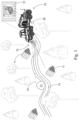
- Figure 1 shows a forest machine 10, which is used to collect the trees previously felled and cut by a harvester. Generally, the trees are cut into stacks 11 by timber grade, or at least into separate grab piles. It is then as easy as possible for the forest machine's driver to find the trees on the ground. At the same time, the mixing of different timber grades with each other is avoided.
- the forest machine can be driven in both directions, as the driver's seat can also be rotated. To aid the driver, there is nowadays usually also a camera in addition to mirrors. Accessories warning of obstacles are also used. In some cases, in thinning the driver has his back facing the driving direction when making a load. The forest machine is then driven on the basis of the camera, which is difficult and slow.
- Figure 1 shows thinning felling, in which some trees are left to grow. The forest machine's route then winds about, taking into account the ground and the remaining trees. In this situation, the forest machine's driver usually has his back to the driving direction and is looking at the load space, to load as efficiently as possible.
- the invention relates to a method in a forest machine.
- the forest machine's 10 surroundings are observed.
- the observations are collected to form a database 12 of the surroundings ( Figure 4 ) and the database is utilized in the operation of the forest machine 10.
- observations of a limited area are used.
- the number of observations is then limited, and thus little processing capacity is required.
- the database 12 is formed in real time in the forest machine 10. Firstly, the existing equipment in the forest machine can be used for processing and secondly there is no delay in forming the database.
- the method can then be applied without investing in equipment and external apparatuses. Further, a view 19 is formed from the database 12 of selected observations, from which a track 13 in the surroundings is recognized.
- a view can be formed simply from the observation data, from which the track can be recognized by software means. Though the apparatus observes the entire surroundings, the number of observations remains limited by selecting only observations from a limited area.
- the forest machine 10 is oriented in the direction of the track 13, once the direction of travel 14 of the forest machine 10 relative to the recognized track 13 has been detected.
- the direction of travel refers to the straight line along which the forest machine would move, if the steering wheel was not moved.
- the forest machine can move forward or back along this line, but information on the direction of travel can be defined from the system in the forest machine.
- the forest machine's 10 direction of travel 14 differs from the track's 13 direction (broken line), which is detected by the method the forest machine 10 then being steered in the direction of the track 13.
- the system controls the forest machine on the basis of the database.
- the level of control can be selected in the system.
- the forest machine 10 when steering, the forest machine 10 is controlled automatically, semi-automatically, or with assistance, based on the database.
- automatic control the driver trusts the system, which controls the forest machine entirely on the basis of the database. The driver can then concentrate on operating the loader.
- semi-automatic control the system starts steering, but the real steering movement is made by the driver. From even a small steering movement the driver feels the direction in which the system would have steered.
- assisted control the system proposes a suitable steering direction, for example by an arrow in the display of the data system belonging to the system, or by nudging the controls, or some other haptic feedback through the controls.
- the driver decides on the progress of the forest machine. In other words, the driver decides when and at what speed the forest machine will move.
- the forest machine 10 can be driven automatically, semi-automatically, or with assistance.
- automatic driving the system determines the speed of the forest machine according to the situation.
- semi-automatic driving the system either slightly accelerates or slows the forest machine to control driving.
- assisted driving for example if the system detects the next stack being far away or the stack's position being already in the system, the system proposes acceleration. The driver can then accelerate the forest machine to the next stack.
- the system can guide the driver to accelerate or slow by showing a suitable signal in the display.
- the driver can preferably choose how the system controls steering and driving.
- the driver can then select the level of automation according to the situation.
- collisions with trees left to grow and other obstacles are avoided.
- too possible problematic situations can be forecast.
- the driver only has to open the grab enough for the trees to be taken into the load in the load space. This avoids the hoist and grab swaying when the forest machine is driven to the next stack. Excess movements and swaying stress the forest machine.
- the surroundings are observed using one or more sensors 15, from whose measurement data a 3D point cloud of the surroundings is formed.
- the system can utilize the 3D point cloud directly, but the 3D point cloud can also be shown as a visual view, which assists the forest machine's driver in his work.
- One or more of the following devices are used as sensors: a camera 16, radar 17, or lidar 18. Information will then be sufficient to form a precise and reliable database.
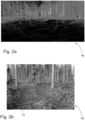
- Figure 2a shows the raw data collected by lidar.
- the raw data is an innumerable number of measurements and measurement points, from which a point cloud is formed.
- the point cloud obtained is processed according to the intended purpose, such as, for example, to be visualized to form a view ( Figure 2b ), or then to be processed to form a set of tree maps.
- a view 19 is obtained, from which the track 13 can be reliably recognized ( Figure 2b ).
- the area being observed can be limited, keeping the amount of information to be processed small.
- the observations of the limited area are used in recognition. For example, only a specific sector in front of the forest machine is observed. The forest machine's data-processing capacity will then be sufficient and there will be as little delay as possible in forming a database.
- a suitable lidar is the laser observation device marketed by the manufacture Velodyne under the product name VLP-16, which can measure up to 600 000 points a second.
- the view 19 is preferably recorded and attached to a map program in the forest machine 10. The view can then be utilized the next time when the previous track can be exploited.
- the entire surroundings can be observed using other equipment in the forest machine, so that the trees and ground can also be observed, as stated above.
- the observation of the track, which is essential for steering, can be made from a limited, i.e. smaller amount of data, so that processing will be local and in real time.
- a view is formed from the database, from which primarily the track is recognized, as are various other things.
- processing can be done in the forest machine and preferably also in real time. This avoids delays in processing and data transmission when the steering of the forest machine will be correctly timed and sufficiently precise for the forest machine to be sure to stay on the track.
- Non-positionality also prevents the accumulation of errors, as the track is followed in real time on real ground.
- the view formed is also simple, but the track can be recognized sufficiently reliably and rapidly using present technology.
- Position is also important in recording. In other words, it is necessary to know the real position of the recorded database or the view formed from it. In the area of the stand a mobile or GPS connection may not be available when positioning will fail.
- a known starting point 20 is thus sought before observation, to position the forest machine 10 ( Figure 1 ).
- a network connection can generally be still found on the forest track, but farther into the forest connections are not available.
- the starting point can be defined from a known point included in the recorded map, the precise co-ordinates of which are known.
- the known position is then defined in the map program or the position is defined from some known position, which is attached to the map program.
- the positioning of, and/or at least a definition of the position of the starting point of the map is always sought to be made primarily using GPS or some other known satellite positioning, such as Glonass, Galileo, Beidou, IRNSS, or QZSS.
- the view 19 is attached to the map program stored in the forest machine 10, so as to position the forest machine 10 without a network connection.
- the position of the forest machine will then be known even without a positioning connection.
- the view 19 is updated by recording part of the view 19 as known to position the forest machine 10 without a network connection.
- Figure 1 shows the map program, to which the starting point 20 is connected, instead of the view.
- the position remains known, when the real view is attached as part of the map program.
- the obstacles 21 on, or near the track 13 are also defined in the observation. Problems can then be avoided beforehand. Large stones may have rolled onto the track after the harvester, or a large tree may have fallen across the track.
- the system can also be used to detect obstacles. Further the system can be developed by connecting to observation machine learning, which is arranged to decide whether to go around the detected obstacle 21, or what should be done after detecting an obstacle. Previous going around or over an obstacle remains in the memory and the stored data can be utilized in future operations. For example, there is reason to indicate to take care at a previous very deep part of the track, or even to bypass the point in question.
- the productivity of a forest machine can be significantly raised, and better quality can be achieved in thinning, when the trees left standing are not damaged.
- track data can be formed in the forest machine, based on which the automation can be arranged to steer and even drive the forest machine.
- Driving can be done by the driver or the automation, after which the driver can concentrate on only collecting trees while the automation takes care of steering and driving.
- the system can also be utilized in group felling and thinning.
- the driving and steering automation can be programmed so that large stones and stumps are not driven over, instead the system seeks the best route from the track, for example, in terms of speed, length of trip, or fuel consumption.
- the forest machine is steered along an observed track. Observation and steering are preferably done automatically, making steering movements by the driver unnecessary. It is enough for the driver to define speed according to the situation. For example, the forest machine can be driven between small stacks without stopping and stopped only at larger stacks. When starting again, acceleration is enough while the system steers the forest machine along the track. A known camera view can still support the driver to ensure staying on the track, but the system, however, actively steers the forest machine.
- the system can also be arranged to drive the forest machine automatically.
- the system determines when the forest machine will move and at what speed. For example, when the hoist is moving the system slows down and when lifting a heavy load, it stops the forest machine. At the same time, the system observes the track and guides the forest machine to stay on the track. At a large stack, where trees must be lifted more than once, the system can be instructed to await starting.
- the control can be the single press of a button in the hoist's controls, or a specific function when operating the hoist, from which the system recognizes the next lifting coming from the same stack. If point control is being used, the system recognizes the situation when the grab is being taken to the same stack by point control. The system then keeps the forest machine stationary.
- the driver can press a specific button or carry out a pre-defined operation, from which the system knows to move the forest machine forward.
- the operation activating starting can be, for example, an extended opening of the grab or the rotation of the opened grab over a pre-set rotation-angle limit.
- the system includes one or more sensors 15 arranged to observe the forest machine's 10 surroundings.
- the system includes a database 12 for collecting observations of the surroundings.
- the system includes means 34 for detecting a previous track 13 in the surroundings and the forest machine's 10 direction of travel 14 on the basis of a view formed from the database 12, as well as for steering the forest machine 10 in the direction of the track 13, once the forest machine's 10 direction of travel 14 relative to the detected track 13 has been recognized.
- the observation means such as the sensor 15, are connected to the data system and are set to control the necessary operating devices, such as the control means 23 and/or driving means 24.
- the driver's commands are transmitted as electrical pre-control to the hydraulic operating devices.
- the hydraulic operating devices For example, even one hydraulic cylinder, by which the mutual angle of the forest machine's chassis is altered, is enough to steer the forest machine.
- the adding of driving to steering already demands more signals, but these too are of a limited number.
- economical acceleration ramps can be defined in the system, by which the forest machine's starting is as rapid as possible, but nevertheless economical. Observation of the ground and surroundings can affect the acceleration ramp.
- the observation means can include various devices by which the ground can be observed with sufficient precision. For example, by combining the image material of a 360-camera a 3D model can be formed, from which the track can be observed. Correspondingly, it is possible to obtain a 3D point cloud, from which the shapes of the ground such as tracks can be observed, directly from radar and lidar imaging. Observation is preferably combined with the map program of the forest machine's data system, when the real position of the forest machine can be defined on the basis of the map program and real-time observation, even though a GPS signal is unavailable. Miniature flying devices, such as drones, can also be utilized to observe the surroundings.
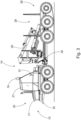
- FIG 3 shows a forest machine 10, which includes a front chassis 25 and a rear chassis 26.
- the front chassis 25 has an engine and a cab 27.
- the rear chassis 26 has a load space 28 and a hoist 29.
- the front chassis 25 and the rear chassis 26 are pivoted to each other and the chassis' mutual angle of rotation is altered by means of one or more hydraulic cylinders 30, which are part of the steering means 23.
- One part of the system is a display device 31, which is located in the cab 27.
- the display 31 is connected to the data system 22, which controls and monitors the forest machine and its operating devices.
- the necessary sensors, database, and accessories are connected to the data system.
- a camera 16, radar 17, and lidar 18 are connected to the system.
- the sensors are located in the front chassis, but they can equally well also be located in the rear chassis.
- the angle between the forest machine's front and rear chassis is detected by sensors, such as an inertia measurement unit, based on which the control system detects the angle and permits chassis-steering of the forest machine.
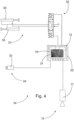
- FIG. 4 shows a schematic example of the system.
- the data system 22, including the display 31, contains all the means needed for collecting and processing data and further for operating the operating devices and thus for steering and driving the forest machine, according to the method.
- the radar 17 is connected directly to the data system 22, but it is also possible to utilize observation means connected to the machine-control system, such as a 360-camera.
- the system controls a valve 32, which is linked to two cross-connected hydraulic cylinders 30.
- the hydraulic cylinders are fitted on both sides of the chassis pivot.
- the working movements of both hydraulic cylinders are equal in magnitude but opposite in direction.
- the forest machine can be steered using a single valve.
- a servo motor 33 for driving a servo motor 33 is connected here to the system.
- the servo motor can be arranged to operate the accelerator pedal, or directly the feed-pump's regulator.
- the control data is transmitted directly electrically to the machine-control system.
- the functionality of the method can be obtained by means of software. The method then becomes available through a software update.
Landscapes
- Engineering & Computer Science (AREA)
- Physics & Mathematics (AREA)
- General Physics & Mathematics (AREA)
- Multimedia (AREA)
- Theoretical Computer Science (AREA)
- Radar, Positioning & Navigation (AREA)
- Automation & Control Theory (AREA)
- Aviation & Aerospace Engineering (AREA)
- Remote Sensing (AREA)
- Life Sciences & Earth Sciences (AREA)
- Forests & Forestry (AREA)
- Ecology (AREA)
- Environmental Sciences (AREA)
- Computer Vision & Pattern Recognition (AREA)
- Biodiversity & Conservation Biology (AREA)
- Mechanical Engineering (AREA)
- Transportation (AREA)
- Databases & Information Systems (AREA)
- General Health & Medical Sciences (AREA)
- Chemical & Material Sciences (AREA)
- Electromagnetism (AREA)
- Health & Medical Sciences (AREA)
- Artificial Intelligence (AREA)
- Computing Systems (AREA)
- Combustion & Propulsion (AREA)
- Optics & Photonics (AREA)
- Medical Informatics (AREA)
- Evolutionary Computation (AREA)
- Software Systems (AREA)
- Traffic Control Systems (AREA)
- Control Of Position, Course, Altitude, Or Attitude Of Moving Bodies (AREA)
- Operation Control Of Excavators (AREA)
- Navigation (AREA)
- Human Computer Interaction (AREA)
Claims (13)
- Verfahren zum Betrieb einer Waldmaschine, bei dem die Umgebung der Waldmaschine (10) unter Verwendung eines oder mehrerer Sensoren (15) beobachtet wird, und die Beobachtungen zur Bildung einer Datenbank (12) der Umgebung montiert werden, und die Datenbank (12) beim Betrieb der Waldmaschine (10) verwendet wird, dadurch gekennzeichnet, dass die Beobachtungen eines begrenzten Bereichs verwendet werden und die Datenbank (12) in Echtzeit in der Waldmaschine (10) gebildet wird, wobei bei der Durchforstung aus der Datenbank (12) ausgewählter Beobachtungen eine Sicht (19) in Richtung der Fahrtrichtung (14) gebildet wird, aus der eine Bahn (13) in der Umgebung erkannt wird, und die Waldmaschine (10) mit den zur Waldmaschine (10) gehörenden Steuermitteln (23) in Richtung der Bahn (13) ausgerichtet wird, nachdem die Fahrtrichtung (14) der Waldmaschine (10) relativ zur erkannten Bahn (13) erfasst worden ist, und bei der Ausrichtung die Waldmaschine (10) basierend auf der Sicht (19) automatisch, halbautomatisch oder mit Unterstützung gelenkt wird.
- Verfahren nach Anspruch 1, dadurch gekennzeichnet, dass die Waldmaschine (10) zusätzlich zur Lenkung automatisch, halbautomatisch oder mit Unterstützung gefahren wird.
- Verfahren nach Anspruch 1 oder 2, dadurch gekennzeichnet, dass die Umgebung mit einem oder mehreren Sensoren (15) beobachtet wird, aus deren Messdaten eine 3D-Punktwolke der Umgebung gebildet wird.
- Verfahren nach Anspruch 3, dadurch gekennzeichnet, dass eine oder mehrere der folgenden Vorrichtungen: Kamera (16), Radar (17) oder Lidar (18), als Sensor (15) verwendet wird.
- Verfahren nach einem der Ansprüche 1 bis 4, dadurch gekennzeichnet, dass auch der Boden und die Bäume in der Sicht (19) erkannt werden.
- Verfahren nach einem der Ansprüche 1 bis 5, dadurch gekennzeichnet, dass die Sicht (19) aufgezeichnet wird und die Sicht (19) dem Kartenprogramm in der Waldmaschine (10) zugeordnet wird.
- Verfahren nach einem der Ansprüche 1 bis 6, dadurch gekennzeichnet, dass vor der Beobachtung ein bekannter Startpunkt (20) gesucht wird, um die Waldmaschine (10) zu positionieren.
- Verfahren nach Anspruch 7, dadurch gekennzeichnet, dass nach dem Aufsuchen des Startpunktes (20) die Sicht (19) mit dem in der Waldmaschine (10) aufgezeichneten Kartenprogramm verbunden wird, um die Waldmaschine (10) ohne Netzwerkverbindung zu positionieren.
- Verfahren nach Anspruch 8, dadurch gekennzeichnet, dass nach der Suche des Startpunktes (20) die Sicht (19) aktualisiert wird, indem ein Teil der Sicht (19) als bekannt gespeichert wird, um die Waldmaschine (10) ohne Netzwerkverbindung zu positionieren.
- Verfahren nach einem der Ansprüche 1 bis 9, dadurch gekennzeichnet, dass Hindernisse (21) auf der Bahn (13) oder in deren Nähe auch aus der Sicht (19) definiert werden.
- Verfahren nach Anspruch 10, dadurch gekennzeichnet, dass der Beobachtung ein maschinelles Lernen hinzugefügt wird, das so beschaffen ist, dass es entscheidet, ob um ein erfasstes Hindernis (21) herumgesteuert werden soll.
- Waldmaschine mit einem System, wobei das System einen oder mehrere Sensoren (15) einschließt, die angeordnet sind, um die Umgebung der Waldmaschine (10) zu beobachten, sowie eine Datenbank (12), um Beobachtungen der Umgebung zu montieren, wobei die Datenbank (12) angeordnet ist, um beim Betrieb der Waldmaschine (10) verwendet zu werden, dadurch gekennzeichnet, dass das System Mittel (34) einschließt, die so beschaffen sind, dass sie in der Waldmaschine (10) in Echtzeit eine Datenbank (12) der Beobachtungen eines begrenzten Bereichs (10) bilden und eine Bahn (13) in der Umgebung basierend auf der bei der Durchforstung aus der Datenbank (12) gebildeten Sicht (19) in Richtung der Fahrtrichtung (14) erkennen, und dass die Mittel (34) ein Datensystem (22) einschließen, das die Datenbank (12) enthält, das an der Waldmaschine (10) angebracht ist und dazu eingerichtet ist, die zur Waldmaschine (10) gehörenden Steuermittel (23) zu betätigen, um die Waldmaschine (10) basierend auf der Sicht (19) in Richtung der Bahn (13) automatisch, halbautomatisch oder mit Unterstützung auszurichten, sobald die Fahrtrichtung (14) der Waldmaschine (10) relativ zur erkannten Bahn (13) erfasst worden ist.
- Waldmaschine mit einem System nach Anspruch 12, dadurch gekennzeichnet, dass das Datensystem (22) eingerichtet ist, die zur Waldmaschine (10) gehörenden Antriebsmittel (24) zu bedienen.
Applications Claiming Priority (2)
| Application Number | Priority Date | Filing Date | Title |
|---|---|---|---|
| FI20195678A FI20195678A1 (fi) | 2019-08-14 | 2019-08-14 | Menetelmä ja järjestelmä metsäkoneessa |
| PCT/FI2020/050529 WO2021028622A1 (en) | 2019-08-14 | 2020-08-14 | Method and system in a forest machine |
Publications (3)
| Publication Number | Publication Date |
|---|---|
| EP4013216A1 EP4013216A1 (de) | 2022-06-22 |
| EP4013216A4 EP4013216A4 (de) | 2023-09-13 |
| EP4013216B1 true EP4013216B1 (de) | 2025-04-23 |
Family
ID=74570359
Family Applications (1)
| Application Number | Title | Priority Date | Filing Date |
|---|---|---|---|
| EP20853032.9A Active EP4013216B1 (de) | 2019-08-14 | 2020-08-14 | Verfahren und system in einer waldmaschine |
Country Status (7)
| Country | Link |
|---|---|
| US (1) | US20220266868A1 (de) |
| EP (1) | EP4013216B1 (de) |
| CN (1) | CN114258265A (de) |
| BR (1) | BR112022002663A2 (de) |
| CA (1) | CA3147842A1 (de) |
| FI (2) | FI20195678A1 (de) |
| WO (1) | WO2021028622A1 (de) |
Families Citing this family (3)
| Publication number | Priority date | Publication date | Assignee | Title |
|---|---|---|---|---|
| CN114916396A (zh) * | 2022-06-16 | 2022-08-19 | 吉林大学 | 一种全自动植树机器人 |
| CN117237824B (zh) * | 2023-11-14 | 2024-02-02 | 吉林省林业科学研究院(吉林省林业生物防治中心站) | 一种基于遥感图像技术的林区采伐检测设备 |
| EP4616703A1 (de) * | 2024-03-12 | 2025-09-17 | Deere & Company | Verfahren zur vermessung und analyse eines forstbereichs für ein forstfahrzeug |
Family Cites Families (18)
| Publication number | Priority date | Publication date | Assignee | Title |
|---|---|---|---|---|
| AU7110698A (en) * | 1997-04-16 | 1998-11-11 | Carnegie Wave Energy Limited | Agricultural harvester with robotic control |
| US9002566B2 (en) * | 2008-02-10 | 2015-04-07 | AgJunction, LLC | Visual, GNSS and gyro autosteering control |
| JP2010012928A (ja) * | 2008-07-03 | 2010-01-21 | Yanmar Co Ltd | 不整地用走行車両 |
| US8195342B2 (en) * | 2008-09-11 | 2012-06-05 | Deere & Company | Distributed knowledge base for vehicular localization and work-site management |
| WO2010032495A1 (ja) * | 2008-09-16 | 2010-03-25 | 株式会社アドイン研究所 | 樹木情報計測方法、樹木情報計測装置、プログラム |
| US8275547B2 (en) * | 2009-09-30 | 2012-09-25 | Utility Risk Management Corporation, Llc | Method and system for locating a stem of a target tree |
| US9043129B2 (en) * | 2010-10-05 | 2015-05-26 | Deere & Company | Method for governing a speed of an autonomous vehicle |
| CN102135766B (zh) * | 2011-01-04 | 2013-05-08 | 北京林业大学 | 自主作业林业机器人平台 |
| FI124889B (fi) * | 2012-05-31 | 2015-03-13 | Ponsse Oyj | Sovitelma metsäkoneessa ja vastaavalla sovitelmalla varustettu metsäkone |
| JP6143223B2 (ja) * | 2013-03-26 | 2017-06-07 | 学校法人早稲田大学 | 樹木の伐倒システム、樹木情報検出装置及びそのプログラム |
| US9305219B2 (en) * | 2014-01-23 | 2016-04-05 | Mitsubishi Electric Research Laboratories, Inc. | Method for estimating free space using a camera system |
| FI20165731L (fi) * | 2015-09-30 | 2017-03-31 | Deere & Co | Puunhakkuutietojärjestelmä |
| US11102940B2 (en) * | 2016-03-31 | 2021-08-31 | Husqvarna Ab | Forestry management device |
| US10579068B2 (en) * | 2016-10-03 | 2020-03-03 | Agjunction Llc | Using optical sensors to resolve vehicle heading issues |
| US11269346B2 (en) * | 2017-06-22 | 2022-03-08 | Agjunction Llc | 3-d image system for vehicle control |
| CN108633533B (zh) * | 2018-04-11 | 2024-06-04 | 北京木业邦科技有限公司 | 树木自动抚育方法、装置、电子设备及存储介质 |
| US11277956B2 (en) * | 2018-07-26 | 2022-03-22 | Bear Flag Robotics, Inc. | Vehicle controllers for agricultural and industrial applications |
| FI20185724A1 (fi) * | 2018-08-30 | 2020-03-01 | Ponsse Oyj | Menetelmä ja järjestelmä koneellisessa puunkorjuussa |
-
2019
- 2019-08-14 FI FI20195678A patent/FI20195678A1/fi unknown
-
2020
- 2020-08-14 EP EP20853032.9A patent/EP4013216B1/de active Active
- 2020-08-14 US US17/632,433 patent/US20220266868A1/en not_active Abandoned
- 2020-08-14 CA CA3147842A patent/CA3147842A1/en active Pending
- 2020-08-14 FI FIEP20853032.9T patent/FI4013216T3/fi active
- 2020-08-14 CN CN202080057235.8A patent/CN114258265A/zh active Pending
- 2020-08-14 BR BR112022002663A patent/BR112022002663A2/pt not_active Application Discontinuation
- 2020-08-14 WO PCT/FI2020/050529 patent/WO2021028622A1/en not_active Ceased
Also Published As
| Publication number | Publication date |
|---|---|
| FI4013216T3 (fi) | 2025-06-20 |
| EP4013216A4 (de) | 2023-09-13 |
| US20220266868A1 (en) | 2022-08-25 |
| EP4013216A1 (de) | 2022-06-22 |
| FI20195678A1 (fi) | 2021-02-15 |
| CN114258265A (zh) | 2022-03-29 |
| BR112022002663A2 (pt) | 2022-05-03 |
| CA3147842A1 (en) | 2021-02-18 |
| WO2021028622A1 (en) | 2021-02-18 |
Similar Documents
| Publication | Publication Date | Title |
|---|---|---|
| EP4013216B1 (de) | Verfahren und system in einer waldmaschine | |
| US12025986B2 (en) | Working vehicle | |
| WO2022065091A1 (ja) | 自動走行システム、自動走行方法、及び自動走行プログラム | |
| EP3568001A1 (de) | Verfahren und anordnung zur steuerung des betriebs einer holzhandhabungsvorrichtung in einer arbeitsmaschine und forstmaschine | |
| EP3843533B1 (de) | Verfahren zur steuerung eines kraftübertragungsvorrichtung, system und forstmaschine | |
| JP7120878B2 (ja) | 作業機昇降制御装置 | |
| CN108508889B (zh) | 小型智能除草及松土装置和控制方法 | |
| EP4165977A1 (de) | Mähdrescher system und verfahren zum automatischen und halbautomatischen befüllen von gruppen von aufnahmefahrzeugen | |
| CN114746317B (zh) | 作业车辆 | |
| EP4239429A1 (de) | Automatisches fahrverfahren, automatisches fahrsystem und automatisches fahrprogramm | |
| WO2024134033A1 (en) | Method in a forest machine and a system | |
| CN108496533A (zh) | 一种无人驾驶联合收割机激光导航系统 | |
| EP4547009A1 (de) | Verfahren und steuerungssystem zur steuerung eines auslegers einer erntemaschine | |
| EP4458123A1 (de) | Landwirtschaftliches arbeitsassistenzsystem, landwirtschaftliche maschine, landwirtschaftliche arbeitsassistenzvorrichtung | |
| DE102019006720A1 (de) | Autonomer Betrieb eines Fahrzeugs | |
| JP2022095324A (ja) | 作業車両 | |
| JP2022010873A (ja) | 作業車両の制御システム | |
| JP2022010872A (ja) | 作業車両の制御システム | |
| EP4534470A1 (de) | Betriebssystem | |
| EP4581916A1 (de) | Arbeitsunterstützungsvorrichtung, arbeitsmaschine und arbeitsunterstützungsverfahren | |
| US20250221347A1 (en) | Controlling tree felling direction | |
| EP4471689B1 (de) | Überwachung von geernteten stämmen und stämmestapeln an einem arbeitsort | |
| JP7511410B2 (ja) | 農作業支援システム | |
| FI20246549A1 (fi) | Menetelmä metsätyökoneen käytössä ja metsätyökone | |
| CN120716773A (zh) | 自动行驶方法、自动行驶程序以及自动行驶系统 |
Legal Events
| Date | Code | Title | Description |
|---|---|---|---|
| STAA | Information on the status of an ep patent application or granted ep patent |
Free format text: STATUS: THE INTERNATIONAL PUBLICATION HAS BEEN MADE |
|
| PUAI | Public reference made under article 153(3) epc to a published international application that has entered the european phase |
Free format text: ORIGINAL CODE: 0009012 |
|
| STAA | Information on the status of an ep patent application or granted ep patent |
Free format text: STATUS: REQUEST FOR EXAMINATION WAS MADE |
|
| 17P | Request for examination filed |
Effective date: 20220310 |
|
| AK | Designated contracting states |
Kind code of ref document: A1 Designated state(s): AL AT BE BG CH CY CZ DE DK EE ES FI FR GB GR HR HU IE IS IT LI LT LU LV MC MK MT NL NO PL PT RO RS SE SI SK SM TR |
|
| DAV | Request for validation of the european patent (deleted) | ||
| DAX | Request for extension of the european patent (deleted) | ||
| REG | Reference to a national code |
Ref country code: DE Ref legal event code: R079 Free format text: PREVIOUS MAIN CLASS: A01G0023000000 Ref country code: DE Ref legal event code: R079 Ref document number: 602020050120 Country of ref document: DE Free format text: PREVIOUS MAIN CLASS: A01G0023000000 Ipc: G05D0001020000 |
|
| A4 | Supplementary search report drawn up and despatched |
Effective date: 20230811 |
|
| RIC1 | Information provided on ipc code assigned before grant |
Ipc: G08G 1/16 20060101ALI20230807BHEP Ipc: B62D 15/02 20060101ALI20230807BHEP Ipc: A01G 23/00 20060101ALI20230807BHEP Ipc: G05D 1/02 20200101AFI20230807BHEP |
|
| REG | Reference to a national code |
Ref country code: DE Ref legal event code: R079 Free format text: PREVIOUS MAIN CLASS: G05D0001020000 Ref country code: DE Ref legal event code: R079 Ref document number: 602020050120 Country of ref document: DE Free format text: PREVIOUS MAIN CLASS: G05D0001020000 Ipc: G05D0001000000 |
|
| RIC1 | Information provided on ipc code assigned before grant |
Ipc: B62D 15/02 20060101ALI20240827BHEP Ipc: A01G 23/00 20060101ALI20240827BHEP Ipc: G05D 1/00 20060101AFI20240827BHEP |
|
| GRAP | Despatch of communication of intention to grant a patent |
Free format text: ORIGINAL CODE: EPIDOSNIGR1 |
|
| STAA | Information on the status of an ep patent application or granted ep patent |
Free format text: STATUS: GRANT OF PATENT IS INTENDED |
|
| INTG | Intention to grant announced |
Effective date: 20241115 |
|
| GRAS | Grant fee paid |
Free format text: ORIGINAL CODE: EPIDOSNIGR3 |
|
| GRAA | (expected) grant |
Free format text: ORIGINAL CODE: 0009210 |
|
| STAA | Information on the status of an ep patent application or granted ep patent |
Free format text: STATUS: THE PATENT HAS BEEN GRANTED |
|
| AK | Designated contracting states |
Kind code of ref document: B1 Designated state(s): AL AT BE BG CH CY CZ DE DK EE ES FI FR GB GR HR HU IE IS IT LI LT LU LV MC MK MT NL NO PL PT RO RS SE SI SK SM TR |
|
| REG | Reference to a national code |
Ref country code: GB Ref legal event code: FG4D |
|
| REG | Reference to a national code |
Ref country code: CH Ref legal event code: EP |
|
| REG | Reference to a national code |
Ref country code: DE Ref legal event code: R096 Ref document number: 602020050120 Country of ref document: DE |
|
| REG | Reference to a national code |
Ref country code: IE Ref legal event code: FG4D |
|
| REG | Reference to a national code |
Ref country code: FI Ref legal event code: FGE |
|
| REG | Reference to a national code |
Ref country code: SE Ref legal event code: TRGR |
|
| REG | Reference to a national code |
Ref country code: NL Ref legal event code: MP Effective date: 20250423 |
|
| PG25 | Lapsed in a contracting state [announced via postgrant information from national office to epo] |
Ref country code: NL Free format text: LAPSE BECAUSE OF FAILURE TO SUBMIT A TRANSLATION OF THE DESCRIPTION OR TO PAY THE FEE WITHIN THE PRESCRIBED TIME-LIMIT Effective date: 20250423 |
|
| REG | Reference to a national code |
Ref country code: AT Ref legal event code: MK05 Ref document number: 1788356 Country of ref document: AT Kind code of ref document: T Effective date: 20250423 |
|
| PG25 | Lapsed in a contracting state [announced via postgrant information from national office to epo] |
Ref country code: PT Free format text: LAPSE BECAUSE OF FAILURE TO SUBMIT A TRANSLATION OF THE DESCRIPTION OR TO PAY THE FEE WITHIN THE PRESCRIBED TIME-LIMIT Effective date: 20250825 Ref country code: ES Free format text: LAPSE BECAUSE OF FAILURE TO SUBMIT A TRANSLATION OF THE DESCRIPTION OR TO PAY THE FEE WITHIN THE PRESCRIBED TIME-LIMIT Effective date: 20250423 |
|
| PGFP | Annual fee paid to national office [announced via postgrant information from national office to epo] |
Ref country code: FI Payment date: 20250820 Year of fee payment: 6 |
|
| REG | Reference to a national code |
Ref country code: LT Ref legal event code: MG9D |
|
| PG25 | Lapsed in a contracting state [announced via postgrant information from national office to epo] |
Ref country code: NO Free format text: LAPSE BECAUSE OF FAILURE TO SUBMIT A TRANSLATION OF THE DESCRIPTION OR TO PAY THE FEE WITHIN THE PRESCRIBED TIME-LIMIT Effective date: 20250723 Ref country code: GR Free format text: LAPSE BECAUSE OF FAILURE TO SUBMIT A TRANSLATION OF THE DESCRIPTION OR TO PAY THE FEE WITHIN THE PRESCRIBED TIME-LIMIT Effective date: 20250724 |
|
| PG25 | Lapsed in a contracting state [announced via postgrant information from national office to epo] |
Ref country code: PL Free format text: LAPSE BECAUSE OF FAILURE TO SUBMIT A TRANSLATION OF THE DESCRIPTION OR TO PAY THE FEE WITHIN THE PRESCRIBED TIME-LIMIT Effective date: 20250423 |
|
| PG25 | Lapsed in a contracting state [announced via postgrant information from national office to epo] |
Ref country code: BG Free format text: LAPSE BECAUSE OF FAILURE TO SUBMIT A TRANSLATION OF THE DESCRIPTION OR TO PAY THE FEE WITHIN THE PRESCRIBED TIME-LIMIT Effective date: 20250423 |
|
| PG25 | Lapsed in a contracting state [announced via postgrant information from national office to epo] |
Ref country code: HR Free format text: LAPSE BECAUSE OF FAILURE TO SUBMIT A TRANSLATION OF THE DESCRIPTION OR TO PAY THE FEE WITHIN THE PRESCRIBED TIME-LIMIT Effective date: 20250423 |
|
| PG25 | Lapsed in a contracting state [announced via postgrant information from national office to epo] |
Ref country code: AT Free format text: LAPSE BECAUSE OF FAILURE TO SUBMIT A TRANSLATION OF THE DESCRIPTION OR TO PAY THE FEE WITHIN THE PRESCRIBED TIME-LIMIT Effective date: 20250423 |
|
| PGFP | Annual fee paid to national office [announced via postgrant information from national office to epo] |
Ref country code: SE Payment date: 20250825 Year of fee payment: 6 |
|
| PG25 | Lapsed in a contracting state [announced via postgrant information from national office to epo] |
Ref country code: RS Free format text: LAPSE BECAUSE OF FAILURE TO SUBMIT A TRANSLATION OF THE DESCRIPTION OR TO PAY THE FEE WITHIN THE PRESCRIBED TIME-LIMIT Effective date: 20250723 |
|
| PG25 | Lapsed in a contracting state [announced via postgrant information from national office to epo] |
Ref country code: IS Free format text: LAPSE BECAUSE OF FAILURE TO SUBMIT A TRANSLATION OF THE DESCRIPTION OR TO PAY THE FEE WITHIN THE PRESCRIBED TIME-LIMIT Effective date: 20250823 |
|
| PG25 | Lapsed in a contracting state [announced via postgrant information from national office to epo] |
Ref country code: LV Free format text: LAPSE BECAUSE OF FAILURE TO SUBMIT A TRANSLATION OF THE DESCRIPTION OR TO PAY THE FEE WITHIN THE PRESCRIBED TIME-LIMIT Effective date: 20250423 |
|
| PG25 | Lapsed in a contracting state [announced via postgrant information from national office to epo] |
Ref country code: DK Free format text: LAPSE BECAUSE OF FAILURE TO SUBMIT A TRANSLATION OF THE DESCRIPTION OR TO PAY THE FEE WITHIN THE PRESCRIBED TIME-LIMIT Effective date: 20250423 Ref country code: SM Free format text: LAPSE BECAUSE OF FAILURE TO SUBMIT A TRANSLATION OF THE DESCRIPTION OR TO PAY THE FEE WITHIN THE PRESCRIBED TIME-LIMIT Effective date: 20250423 |
|
| PG25 | Lapsed in a contracting state [announced via postgrant information from national office to epo] |
Ref country code: CZ Free format text: LAPSE BECAUSE OF FAILURE TO SUBMIT A TRANSLATION OF THE DESCRIPTION OR TO PAY THE FEE WITHIN THE PRESCRIBED TIME-LIMIT Effective date: 20250423 |
|
| PG25 | Lapsed in a contracting state [announced via postgrant information from national office to epo] |
Ref country code: EE Free format text: LAPSE BECAUSE OF FAILURE TO SUBMIT A TRANSLATION OF THE DESCRIPTION OR TO PAY THE FEE WITHIN THE PRESCRIBED TIME-LIMIT Effective date: 20250423 |
|
| REG | Reference to a national code |
Ref country code: DE Ref legal event code: R097 Ref document number: 602020050120 Country of ref document: DE |
|
| PG25 | Lapsed in a contracting state [announced via postgrant information from national office to epo] |
Ref country code: SK Free format text: LAPSE BECAUSE OF FAILURE TO SUBMIT A TRANSLATION OF THE DESCRIPTION OR TO PAY THE FEE WITHIN THE PRESCRIBED TIME-LIMIT Effective date: 20250423 Ref country code: RO Free format text: LAPSE BECAUSE OF FAILURE TO SUBMIT A TRANSLATION OF THE DESCRIPTION OR TO PAY THE FEE WITHIN THE PRESCRIBED TIME-LIMIT Effective date: 20250423 |
|
| PG25 | Lapsed in a contracting state [announced via postgrant information from national office to epo] |
Ref country code: IT Free format text: LAPSE BECAUSE OF FAILURE TO SUBMIT A TRANSLATION OF THE DESCRIPTION OR TO PAY THE FEE WITHIN THE PRESCRIBED TIME-LIMIT Effective date: 20250423 |
|
| PLBE | No opposition filed within time limit |
Free format text: ORIGINAL CODE: 0009261 |
|
| STAA | Information on the status of an ep patent application or granted ep patent |
Free format text: STATUS: NO OPPOSITION FILED WITHIN TIME LIMIT |
|
| REG | Reference to a national code |
Ref country code: CH Ref legal event code: L10 Free format text: ST27 STATUS EVENT CODE: U-0-0-L10-L00 (AS PROVIDED BY THE NATIONAL OFFICE) Effective date: 20260304 |
|
| REG | Reference to a national code |
Ref country code: CH Ref legal event code: H13 Free format text: ST27 STATUS EVENT CODE: U-0-0-H10-H13 (AS PROVIDED BY THE NATIONAL OFFICE) Effective date: 20260324 |