EP4012880B1 - Charging and discharging monitoring circuit and tumor therapy instrument - Google Patents
Charging and discharging monitoring circuit and tumor therapy instrument Download PDFInfo
- Publication number
- EP4012880B1 EP4012880B1 EP20849615.8A EP20849615A EP4012880B1 EP 4012880 B1 EP4012880 B1 EP 4012880B1 EP 20849615 A EP20849615 A EP 20849615A EP 4012880 B1 EP4012880 B1 EP 4012880B1
- Authority
- EP
- European Patent Office
- Prior art keywords
- discharge
- switch group
- charge
- switch
- voltage
- Prior art date
- Legal status (The legal status is an assumption and is not a legal conclusion. Google has not performed a legal analysis and makes no representation as to the accuracy of the status listed.)
- Active
Links
Images



Classifications
-
- A—HUMAN NECESSITIES
- A61—MEDICAL OR VETERINARY SCIENCE; HYGIENE
- A61B—DIAGNOSIS; SURGERY; IDENTIFICATION
- A61B18/00—Surgical instruments, devices or methods for transferring non-mechanical forms of energy to or from the body
- A61B18/04—Surgical instruments, devices or methods for transferring non-mechanical forms of energy to or from the body by heating
- A61B18/12—Surgical instruments, devices or methods for transferring non-mechanical forms of energy to or from the body by heating by passing a current through the tissue to be heated, e.g. high-frequency current
- A61B18/1206—Generators therefor
- A61B18/1233—Generators therefor with circuits for assuring patient safety
-
- A—HUMAN NECESSITIES
- A61—MEDICAL OR VETERINARY SCIENCE; HYGIENE
- A61B—DIAGNOSIS; SURGERY; IDENTIFICATION
- A61B18/00—Surgical instruments, devices or methods for transferring non-mechanical forms of energy to or from the body
-
- H—ELECTRICITY
- H02—GENERATION; CONVERSION OR DISTRIBUTION OF ELECTRIC POWER
- H02J—ELECTRIC POWER NETWORKS; CIRCUIT ARRANGEMENTS OR SYSTEMS FOR SUPPLYING OR DISTRIBUTING ELECTRIC POWER; SYSTEMS FOR STORING ELECTRIC ENERGY
- H02J7/00—Circuit arrangements for charging or discharging batteries or for supplying loads from batteries
- H02J7/80—Circuit arrangements for charging or discharging batteries or for supplying loads from batteries including monitoring or indicating arrangements
-
- A—HUMAN NECESSITIES
- A61—MEDICAL OR VETERINARY SCIENCE; HYGIENE
- A61B—DIAGNOSIS; SURGERY; IDENTIFICATION
- A61B18/00—Surgical instruments, devices or methods for transferring non-mechanical forms of energy to or from the body
- A61B2018/00571—Surgical instruments, devices or methods for transferring non-mechanical forms of energy to or from the body for achieving a particular surgical effect
- A61B2018/00577—Ablation
-
- A—HUMAN NECESSITIES
- A61—MEDICAL OR VETERINARY SCIENCE; HYGIENE
- A61B—DIAGNOSIS; SURGERY; IDENTIFICATION
- A61B18/00—Surgical instruments, devices or methods for transferring non-mechanical forms of energy to or from the body
- A61B2018/00571—Surgical instruments, devices or methods for transferring non-mechanical forms of energy to or from the body for achieving a particular surgical effect
- A61B2018/00613—Irreversible electroporation
-
- A—HUMAN NECESSITIES
- A61—MEDICAL OR VETERINARY SCIENCE; HYGIENE
- A61B—DIAGNOSIS; SURGERY; IDENTIFICATION
- A61B18/00—Surgical instruments, devices or methods for transferring non-mechanical forms of energy to or from the body
- A61B2018/00636—Sensing and controlling the application of energy
- A61B2018/00642—Sensing and controlling the application of energy with feedback, i.e. closed loop control
-
- A—HUMAN NECESSITIES
- A61—MEDICAL OR VETERINARY SCIENCE; HYGIENE
- A61B—DIAGNOSIS; SURGERY; IDENTIFICATION
- A61B18/00—Surgical instruments, devices or methods for transferring non-mechanical forms of energy to or from the body
- A61B2018/00636—Sensing and controlling the application of energy
- A61B2018/00696—Controlled or regulated parameters
- A61B2018/00702—Power or energy
- A61B2018/00708—Power or energy switching the power on or off
-
- A—HUMAN NECESSITIES
- A61—MEDICAL OR VETERINARY SCIENCE; HYGIENE
- A61B—DIAGNOSIS; SURGERY; IDENTIFICATION
- A61B18/00—Surgical instruments, devices or methods for transferring non-mechanical forms of energy to or from the body
- A61B2018/00636—Sensing and controlling the application of energy
- A61B2018/00773—Sensed parameters
- A61B2018/00892—Voltage
-
- H—ELECTRICITY
- H02—GENERATION; CONVERSION OR DISTRIBUTION OF ELECTRIC POWER
- H02J—ELECTRIC POWER NETWORKS; CIRCUIT ARRANGEMENTS OR SYSTEMS FOR SUPPLYING OR DISTRIBUTING ELECTRIC POWER; SYSTEMS FOR STORING ELECTRIC ENERGY
- H02J2207/00—Details of circuit arrangements for charging or discharging batteries or supplying loads from batteries
- H02J2207/50—Charging of capacitors, supercapacitors, ultra-capacitors or double layer capacitors
-
- H—ELECTRICITY
- H02—GENERATION; CONVERSION OR DISTRIBUTION OF ELECTRIC POWER
- H02J—ELECTRIC POWER NETWORKS; CIRCUIT ARRANGEMENTS OR SYSTEMS FOR SUPPLYING OR DISTRIBUTING ELECTRIC POWER; SYSTEMS FOR STORING ELECTRIC ENERGY
- H02J7/00—Circuit arrangements for charging or discharging batteries or for supplying loads from batteries
- H02J7/855—Circuit arrangements for charging or discharging batteries or for supplying loads from batteries with circuits adapted for supplying loads from the battery
Definitions
- the present application relates to the field of medical device technique, and particularly to a charge and discharge monitoring circuit and a tumor therapy instrument.
- the working process of the tumor therapy instrument based on an electric pulse technology is generally as follows: the instantaneous electric field intensity of the pulsed electric field applied to the cell is greater than 1kV/cm (kilovolts per centimeter), accordingly the molecular permeability of the cell is greatly increased, and then the electroporation is produced. As the pulsed electric field intensity continues to increase, irreversible electrical breakdown occurs, which leads to mechanical breakage of the cell membrane until the cell death.
- the tumor therapy instrument has strict requirements for output pulses, and the stability of the charge and discharge performance of the tumor therapy instrument directly affects the reliability of the pulse output. Therefore, the monitoring of the charge and discharge of the tumor therapy instrument has great significance.
- a charge and discharge monitoring circuit including a capacitor bank and a power supply configured to power the capacitor bank; further including:
- the discharge module includes a first switch device and a discharge load; a first end of the first switch device is connected to a first end of the discharge load, a second end of the first switch device is connected to one end of the capacitor bank, and a third end of the first switch device is connected to the controller, a second end of the discharge load is connected to the other end of the capacitor bank.
- the first switch group includes at least two second switch devices connected in series.
- the second switch group includes at least two third switch devices connected in series.
- the charge and discharge monitoring circuit further includes a first isolation module; a first input terminal of the first isolation module is connected to the first switch group, a second input terminal of the first isolation module is connected to the second switch group, and an output terminal of the first isolation module is connected to the voltage detection circuit.
- the charge and discharge monitoring circuit further includes a second isolation module; the second isolation module is connected between the voltage detection circuit and the controller.
- the voltage detection circuit includes a voltage divider circuit; a first detection terminal of the voltage divider circuit is connected to the third switch interface of the first switch group, and a second detection terminal of the voltage divider circuit is connected to the third switch interface of the second switch group, and an output terminal of the voltage divider circuit is connected to the controller.
- the controller includes a processing chip and an AD acquisition circuit connected to the processing chip.
- a tumor therapy instrument which includes an upper computer and the charge and discharge monitoring circuit according to any one of the above embodiments; the upper computer is connected to the controller.
- the tumor therapy instrument further includes an alarm device connected to the controller.
- the first switch group is connected between the positive electrode of the power supply and the positive electrode of the capacitor bank; the second switch group is connected between the negative electrode of the power supply and the negative electrode of the capacitor bank.
- the discharge module is connected between the positive electrode of the capacitor bank and the negative electrode of the capacitor bank.
- the first detection terminal of the voltage detection circuit is connected to the third switch interface of the first switch group, and the second detection terminal is connected to the third switch interface of the second switch group; the controller, when receiving the charge monitoring instruction, controls the discharge module to turn off, and controls the first switch group and the second switch group to turn on, and acquires the charge voltage signal to obtain the charge voltage; the controller, when receiving the discharge monitoring instruction, controls the discharge module to turn on, and controls the first switch group and the second switch group to turn off, and acquires the discharge voltage signal to obtain the discharge voltage, thereby implementing the real-time charge and discharge monitoring of the tumor therapy instrument.
- the circuit structure is simple, and the real-time monitoring of the charge and discharge is improved.
- a charge and discharge monitoring circuit which includes a capacitor bank 110 and a power supply 120 configured to power the capacitor bank 110; and further includes:
- the capacitor bank 110 can be configured to store electrical energy, and transmit the stored electrical energy to a pulse generator, so that the pulse generator generates an electrical pulse signal.
- the capacitor bank 110 can consist of a plurality of capacitors in parallel, or the capacitor bank 110 can also consist of a plurality of capacitors in series.
- the power supply 120 can be a DC high-voltage power supply, for example, the power supply 120 can be a kilovolt-level high-voltage power supply.
- the first switch group 130 can be configured to control on-off between the positive electrode of the power supply 120 and the positive electrode of the capacitor bank 110.
- the second switch group 140 can be configured to control the on-off between the negative electrode of the power supply 120 and the negative electrode of the capacitor bank 110.
- the discharge module 150 can be configured to discharge the electric energy stored in the capacitor bank 110 and can also be configured to control the on-off of a discharge path of the capacitor bank 110.
- the voltage detection circuit 160 can be configured to detect voltages of power supply signals inputted into both ends of the capacitor bank 110. For example, the voltage detection circuit 160 can acquire the power supply signal, and perform conversion processing (for example, filtering and/or voltage division) on the acquired power supply signal, and then can obtain the charge voltage signal corresponding to the power supply signal.
- the voltage detection circuit 160 can also be configured to detect voltages of the discharge signals at both ends of the discharge module 150.
- the voltage detection circuit 160 can acquire the discharge signal, and perform conversion processing (for example, filtering and/or voltage division) on the acquired discharge signal, and then can obtain the discharge voltage signal corresponding to the discharge signal.
- the controller 170 refers to a processing device with functions such as signal transmission, and signal acquisition and processing.
- the charge voltage signal refers to an analog charge voltage signal; and the charge voltage refers to a digital charge voltage.
- the discharge voltage signal refers to an analog discharge voltage signal; and the discharge voltage refers to a digital discharge voltage.
- the charge monitoring instruction can be generated based on a user request, or can be automatically generated when the system determines that a charge monitoring condition is satisfied.
- the discharge detection instruction can be generated based on a user request, or automatically generated when the system determines that a discharge monitoring condition is satisfied.
- the first switch group 130 is connected between the positive electrode of the power supply 120 and the positive electrode of the capacitor bank 110; the second switch group 130 is connected between the negative electrode of the power supply 120 and the negative electrode of the capacitor bank 110; and the discharge module 150 is connected between the positive electrode of the capacitor bank 110 and the negative electrode of the capacitor bank 110; the controller 170 is connected to the first switch group 130, the second switch group 140, and the discharge module 150 respectively, and the controller 170 can respectively control the on-off of the first switch group 130, the second switch group 140 and the discharge module 150 according to the received monitoring instruction (such as the charge monitoring instruction and the discharge monitoring instruction), thereby implementing the switching between the charge monitoring path and the discharge monitoring path of the tumor therapy instrument, and simplifying the charge and discharge monitoring circuit.
- the received monitoring instruction such as the charge monitoring instruction and the discharge monitoring instruction
- the first detection terminal of the voltage detection circuit 160 is connected to the third switch interface of the first switch group 130, and the second detection terminal is connected to the third switch interface of the second switch group 140;
- the controller 170 is connected to the voltage detection circuit 160 to control, when receiving the charge monitoring instruction, the discharge module 150 to turn off and control the first switch group 130 and the second switch group 140 to turn on, and acquire the charge voltage signal to obtain the charge voltage;
- the controller 170 when receiving the discharge monitoring instruction, controls the discharge module 150 to turn on, and controls the first switch group 130 and the second switch group 140 to turn off, and the acquires the discharge voltage signal to obtain the discharge voltage, thereby implementing the real-time charge and discharge monitoring of the tumor therapy instrument.
- the on-off of the first switch group, the second switch group and the discharge module are respectively controlled by the controller, to implement the switching between the charge monitoring path and the discharge monitoring path of the tumor therapy instrument, and simplify the charge and discharge monitoring circuit.
- the charge voltage signal and the discharge voltage signal are acquired by the controller, and the acquired charge voltage signal and discharge voltage signal are processed by the controller, thereby implementing the real-time monitoring of the charge voltage and charge current of the tumor therapy instrument, and improving the real-time monitoring of the charge and discharge.
- a charge and discharge monitoring circuit which includes a controller 270, a capacitor bank 210, a power supply 220 configured to power the capacitor bank, a first switch group 230 connected between a positive electrode of the power supply 220 and a positive electrode of the capacitor bank 210, a second switch group 240 connected between a negative electrode of the power supply 220 and a negative electrode of the capacitor bank 210, a discharge module 250 connected between the positive electrode of the capacitor bank 210 and the negative electrode of the capacitor bank 210, and a voltage detection circuit 260 connected between the first switch group 230 and the second switch group 240.
- the controller 270 is respectively connected to the voltage detection circuit 260, the first switch group 230, the second switch group 240, and the discharge module 250.
- the discharge module 250 includes a first switch device 252 and a discharge load 254.
- a first end of the first switch device 252 is connected to a first end of the discharge load 254, a second end of the first switch device 252 is connected to one end of the capacitor bank 210, and a third end of the first switch device 252 is connected to the controller 270; a second end of the discharge load 254 is connected to the other end of the capacitor bank 210.
- the first switch device 252 refers to an electronic element that can turn off a circuit, interrupt a current, or make the current flow to other circuits.
- the first switch device 252 may be, but is not limited to, a MOSFET switch device and an IGBT switch.
- the discharge load 254 can be configured to consume the electric energy of the capacitor bank.
- the first end of the first switch device 252 is connected to the first end of the discharge load 254, the second end of the first switch device 252 is connected to one end of the capacitor bank 210, and the third end of the first switch device 252 is connected to the controller 270, and the second end of the discharge load 254 is connected to the other end of the capacitor bank 210.
- the controller 270 can control the on-off of the discharge channel of the capacitor bank through the on-off of the first switch device 252; and then the controller 270, when receiving the charge monitoring instruction, controls the first switch device 252 to turn off and controls the first switch group 230 and the second switch group 240 to turn on, and acquires the charge voltage signal to obtain the charge voltage, thereby implementing the real-time monitoring of the charge voltage.
- the controller 270 when receiving the discharge monitoring instruction, controls the first switch device 252 to turn on, and controls the first switch group 230 and the second switch group 240 to turn off, and acquires the discharge voltage signal to obtain the discharge voltage, thereby implementing the real-time monitoring of the discharge voltage.
- a charge and discharge monitoring circuit which includes a controller 370, a capacitor bank 310, a power supply 320 configured to power the capacitor bank 310, a first switch group 330 connected between a positive electrode of the power supply 320 and a positive electrode of the capacitor bank 310, a second switch group 340 connected between a negative electrode of the power supply 320 and a negative electrode of the capacitor bank 310, a discharge module 350 connected between the positive electrode of the capacitor bank 310 and the negative electrode of the capacitor bank 310, a voltage detection circuit 360 connected between the first switch group 330 and the second switch group 340; the controller 370 is respectively connected to the voltage detection circuit 360, the first switch group 330, the second switch group 340 and the discharge module 350.
- the first switch group 330 includes at least two second switch devices 332 connected in series.
- the second switching device 332 refers to an electronic element that can turn off a circuit, interrupt a current, or make the current flow to other circuits.
- the second switch device 332 may be, but is not limited to, a MOSFET switch device and an IGBT switch.
- the first switch group 330 includes two second switch devices 332 connected in series; and a first detection terminal of the voltage detection circuit 360 is connected between the two second switch devices 332 connected in series.
- the controller 370 when receiving the charge monitoring instruction, controls the discharge module 350 to turn off, and controls the second switch group 340 to turn on, and controls the two second switch devices 332 connected in series to turn on, and acquires the charge voltage signal to obtain the charge voltage, thereby implementing the real-time monitoring of the charge voltage.
- the controller 370 when receiving the discharge monitoring instruction, controls the discharge module 350 to turn on, and controls the second switch group 340 to turn off, and controls the two second switch devices 332 connected in series to turn off, and acquires the discharge voltage signal to obtain the discharge voltage, thereby implementing the real-time monitoring of the discharge voltage.
- the first detection terminal of the voltage detection circuit can also be connected to a connection line between the second switch device and the power supply.
- the second switch group 340 includes at least two third switch devices 342 connected in series.
- the third switch device 342 refers to an electronic element that can turn off a circuit, interrupt a current, or make the current flow to other circuits.
- the third switch device 342 may be, but is not limited to, a MOSFET switch device and an IGBT switch.
- the second switch group 340 includes two third switch devices 342 connected in series; the second detection terminal of the voltage detection circuit 360 is connected between the two third switch devices 342 connected in series.
- the controller 370 when receiving the charge monitoring instruction, controls the discharge module 350 to turn off, and controls the first switch group 330 to turn on, and controls the two third switch devices 342 connected in series to turn on, and acquires the charge voltage signal to obtain the charge voltage, thereby implementing the real-time monitoring of the charge voltage.
- the controller 370 when receiving the discharge monitoring instruction, controls the discharge module 350 to turn on, and controls the first switch group 330 to turn off, and controls the two third switch devices 342 connected in series to turn off, and acquires the discharge voltage signal to obtain the discharge voltage, thereby implementing the real-time monitoring of the discharge voltage.
- the second detection terminal of the voltage detection circuit can also be connected to the connection line between the third switch device and the power supply.
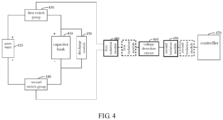
- a charge and discharge monitoring circuit which includes a controller 470, a capacitor bank 410, a power supply 420 configured to power the capacitor bank 410, a first switch group 410 connected between a positive electrode of the power supply 420 and a positive electrode of the capacitor bank 410, a second switch group 440 connected between a negative electrode of the power supply 420 and a negative electrode of the capacitor bank 410, a discharge module 450 connected between the positive electrode of the capacitor bank 410 and the negative electrode of the capacitor bank 410, a voltage detection circuit 460 connected between the first switch group 430 and the second switch group 440; the controller 470 is respectively connected to the voltage detection circuit 460, the first switch group 430, the second switch group 440 and the discharge module 450.
- the charge and discharge monitoring circuit 460 further includes a first isolation module 480.
- a first input terminal of the first isolation module 480 is connected to the first switch group 430, a second input terminal of the first isolation module 480 is connected to the second switch group 440, and an output terminal of the first isolation module 480 is connected to the voltage detection circuit 460.
- the first isolation module 480 can be, but is not limited to, an outer optical path photocoupler and an inner optical path photocoupler.
- the first isolation module 480 is connected between the voltage detection circuit 460 and the switch group (the first switch group 430 and the second switch group 440); the power supply 420 can transmit the outputted power supply signal to the first isolation module 480 during the charging; the power supply signal is isolated and converted through the first isolation module 480, and the processed power supply signal is transmitted to the voltage detection circuit 460, such that the voltage detection circuit 460 obtains the charge voltage signal according to the power supply signal, thereby implementing the isolation of the power supply signal from the charge voltage signal.
- the outputted discharge signal can be transmitted to the first isolation module 480 to isolate and convert the discharge signal through the first isolation module 480, and the processed discharge signal is transmitted to the voltage detection circuit 460, such that the voltage detection circuit 460 obtains the discharge voltage signal according to the discharge signal, thereby implementing the isolation of the discharge signal from the discharge voltage signal, and improving the anti-interference capability of the signal transmission on the switch group side.
- the number of the first isolation modules is at least one.
- each second isolation module 480 is connected in series between the voltage detection circuit 460 and the switch group (the first switch group 430 and the second switch group 440).
- the charge and discharge monitoring circuit further includes a second isolation module 490; the second isolation module 490 is connected between the voltage detection circuit 460 and the controller 470.
- the second isolation module 490 may be, but is not limited to, an outer optical path photocoupler and an inner optical path photocoupler.
- the second isolation module 490 is connected between the voltage detection circuit 460 and the controller 470; in the signal acquisition process of the controller 470, the voltage signal (the charge voltage signal or discharge voltage signal) outputted from the voltage detection circuit 460 can be transmitted to the second isolation module 490 to isolate and convert the voltage signal (the charge voltage signal or discharge voltage signal) through the second isolation module 490, and the processed voltage signal (the charge voltage signal or discharge voltage signal) is transmitted to the controller 470, accordingly the corresponding charge voltage or discharge voltage can be obtained according to the acquired voltage signal (the charge voltage signal or discharge voltage signal), thereby implementing the isolation of the charge voltage signal from the charge voltage (or the isolation of the discharge voltage signal from the discharge voltage), and improving the anti-interference capability of the signal transmission on the controller side.
- the number of the second isolation modules 490 is at least one.
- each second isolation module 490 is connected in series between the voltage detection circuit 460 and the controller 470.
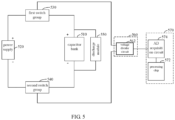
- a charge and discharge monitoring circuit which includes a controller 570, a capacitor bank 510, a power supply 520 configured to power the capacitor bank 510, a first switch group 530 connected between a positive electrode of the power supply 520 and a positive electrode of the capacitor bank 510, a second switch group 540 connected between a negative electrode of the power supply 520 and a negative electrode of the capacitor bank 510, a discharge module 550 connected between the positive electrode of the capacitor bank 510 and the negative electrode of the capacitor bank 510, a voltage detection circuit 560 connected between the first switch group 530 and the second switch group 540; the controller 570 is respectively connected to the voltage detection circuit 560, the first switch group 530, the second switch group 540 and the discharge module 550.
- the voltage detection circuit 560 includes a voltage divider circuit 562.
- a first detection terminal of the voltage divider circuit 562 is connected to the third switch interface of the first switch group 530; and a second detection terminal of the voltage divider circuit 562 is connected to the third switch interface of the second switch group 540, and an output terminal of the voltage divider circuit 562 is connected to the controller 570.
- the voltage divider circuit 562 can consist of one voltage divider resistor, or consist of a plurality of voltage divider resistors in series. It should be noted that the resistance value of the voltage divider resistor can be calculated according to the requirements of acquisition parameters of a control device.
- the voltage divider circuit 562 is connected between the controller and the switch group (the first switch group and the second switch group), the voltage divider circuit 562 can perform voltage dividing on the received power supply signal to obtain the corresponding charge voltage signal, and then the controller 570 can acquire the charge voltage signal to obtain the charge voltage, thereby implementing the real-time monitoring of the charge voltage of the tumor therapy instrument.
- the voltage divider circuit 562 can perform the voltage dividing on the received discharge signal to obtain the corresponding discharge voltage signal, and then the controller 570 can acquire the discharge voltage signal to obtain the discharge voltage, thereby implementing the real-time monitoring of the discharge voltage of the tumor therapy instrument.
- the voltage detection circuit may further include a filter circuit connected to the voltage divider circuit.
- the filter circuit may filter the charge voltage signal, and then obtain the filtered charge voltage signal, such that the charge voltage signal acquired by the controller is more accurate.
- the filter circuit can filter the discharge voltage signal, and then can obtain the filtered discharge voltage signal, such that the discharge voltage signal acquired by the controller is more accurate.
- the voltage divider circuit performs the voltage dividing on the voltage signals (the charge voltage signal and discharge voltage signal), so that the voltage signals (the charge voltage signal and discharge voltage signal) obtained after the voltage dividing can satisfy the requirements of the parameter acquisition of the controller and meanwhile the accuracy of the monitoring of the charge voltage is improved.
- the controller 570 includes a processing chip 572 and an AD acquisition circuit 574 connected to the processing chip 572.
- the processing chip 572 can be, but not limited to, a single-chip microcomputer (SCM) system chip, an ARM processing chip, and an FPGA processing chip.
- the AD acquisition circuit 574 refers to an acquisition circuit that can perform analog-to-digital conversion on a signal.
- the processing chip 572 is connected to the AD acquisition circuit 574, and the AD acquisition circuit 574 is connected to the voltage detection circuit 560.
- the processing chip 572 can drive the AD acquisition circuit 574 to operate, and the AD acquisition circuit 574 can acquire the charge voltage signal outputted from the voltage detection circuit 560, and convert the analog charge voltage signal into a digital charge voltage through the analog-to-digital conversion processing, and transmit the digital charge voltage to the processing chip 572, thereby implementing the real-time monitoring of the charge voltage.
- the AD acquisition circuit 574 can also acquire the discharge voltage signal outputted from the voltage detection circuit 560, and convert the analog discharge voltage signal into the digital discharge voltage through the analog-to-digital conversion processing, and transmit the digital discharge voltage to the processing chip 572, thereby implementing the real-time monitoring of the discharge voltage.
- the processing chip can transmit the charge voltage and the discharge voltage to an upper computer, and the charge voltage and the discharge voltage can be monitored in real time by the upper computer.
- a tumor therapy instrument is further provided, which includes an upper computer 640 and the charge and discharge monitoring circuit 620 in any one of the above-mentioned embodiments; and the upper computer 610 is connected to a controller.
- the upper computer 610 may be, but is not limited to, a tablet computer and a personal computer (PC).
- PC personal computer
- the voltage detection circuit can detect the power supply signal outputted from the power supply to the capacitor bank, and obtain the charge voltage signal; the controller acquires the charge voltage signal, and then transmits the acquired charge voltage to the upper computer to implement the real-time monitoring of the charge voltage of the tumor therapy instrument.
- the voltage detection circuit can also detect the power supply signal outputted from the capacitor bank to the discharge module, and then obtain the discharge voltage signal.
- the controller acquires the discharge voltage signal, and then transmits the acquired discharge voltage to the upper computer to implement the real-time monitoring of the tumor therapy instrument.
- the circuit structure of the tumor therapy instrument is simple, which improves the real-time monitoring of the pulses.
- the upper computer 610 can also display a waveform diagram corresponding to the charge voltage and the charge current, so that the user can observe the corresponding waveform diagram, and control the tumor therapy instrument accordingly according to the waveform diagram.
- an alarm device 630 connected to the controller is further included.
- the alarm device 630 may be a flashing light or a buzzer, or a combination of the flashing light and the buzzer.
- the controller can process the charge voltage and the discharge voltage.
- the charge voltage is abnormal (for example, the charge voltage exceeds a safety threshold)
- the alarm device 630 is triggered, such that the alarm device 630 generates an alarm
- the discharge voltage is abnormal (such as the discharge voltage exceeds a safety threshold)
- the alarm device 630 is triggered, such that the alarm device 630 generates an alarm, thereby implementing a timely response to the monitoring situation of the tumor therapy instrument and enhancing the safety performance of the tumor therapy instrument.
Landscapes
- Health & Medical Sciences (AREA)
- Life Sciences & Earth Sciences (AREA)
- Surgery (AREA)
- Engineering & Computer Science (AREA)
- Medical Informatics (AREA)
- General Health & Medical Sciences (AREA)
- Otolaryngology (AREA)
- Veterinary Medicine (AREA)
- Public Health (AREA)
- Nuclear Medicine, Radiotherapy & Molecular Imaging (AREA)
- Biomedical Technology (AREA)
- Heart & Thoracic Surgery (AREA)
- Molecular Biology (AREA)
- Animal Behavior & Ethology (AREA)
- Physics & Mathematics (AREA)
- Plasma & Fusion (AREA)
- Power Engineering (AREA)
- Measurement Of Current Or Voltage (AREA)
- Charge And Discharge Circuits For Batteries Or The Like (AREA)
Description
- The present application relates to the field of medical device technique, and particularly to a charge and discharge monitoring circuit and a tumor therapy instrument.
- With the development of science and technology, the application of tumor therapy instruments has received wide attention. There are many types of tumor therapy instruments. The working process of the tumor therapy instrument based on an electric pulse technology is generally as follows: the instantaneous electric field intensity of the pulsed electric field applied to the cell is greater than 1kV/cm (kilovolts per centimeter), accordingly the molecular permeability of the cell is greatly increased, and then the electroporation is produced. As the pulsed electric field intensity continues to increase, irreversible electrical breakdown occurs, which leads to mechanical breakage of the cell membrane until the cell death. The tumor therapy instrument has strict requirements for output pulses, and the stability of the charge and discharge performance of the tumor therapy instrument directly affects the reliability of the pulse output. Therefore, the monitoring of the charge and discharge of the tumor therapy instrument has great significance.
- In the implementation process, the inventors found that the conventional technology at least has the following problems: the design of the conventional circuit based on the charge and discharge monitoring of the tumor therapy instrument is complicated, and the charge and discharge monitoring delay is large.
- In view of this, as for the problems of complicated design of the conventional circuit based on the charge and discharge monitoring of the tumor therapy instrument and the large delay in the charge and discharge monitoring, it is necessary to provide a charge and discharge monitoring circuit and a tumor therapy instrument.
- In order to achieve the above purpose, according to an embodiment of the present invention, a charge and discharge monitoring circuit is provided, including a capacitor bank and a power supply configured to power the capacitor bank; further including:
- a first switch group, a first switch interface of the first switch group being connected to a positive electrode of the power supply, and a second switch interface of the first switch group being connected to a positive electrode of the capacitor bank;
- a second switch group, a first switch interface of the second switch group being connected to a negative electrode of the power supply, and a second switch interface of the second switch group being connected to a negative electrode of the capacitor bank;
- a discharge module, an input terminal of the discharge module being connected to the positive electrode of the capacitor bank, and an output terminal of the discharge module being connected to the negative electrode of the capacitor bank;
- a voltage detection circuit, a first detection terminal of the voltage detection circuit being connected to a third switch interface of the first switch group, and a second detection terminal of the voltage detection circuit being connected to a third switch interface of the second switch group, the voltage detection circuit being configured to monitor a charge voltage signal of the capacitor bank and monitor a discharge voltage signal of the discharge module;
- a controller, the controller being respectively connected to an output terminal of the voltage detection circuit, a control interface of the first switch group, a control interface of the second switch group and a control terminal of the discharge module; the controller being configured to, when receiving a charge monitoring instruction, control the discharge module to turn off, and control the first switch group and the second switch group to turn on, and acquire a charge voltage signal to obtain a charge voltage; the controller being configured to, when receiving a discharge monitoring instruction, control the discharge module to turn on, and control the first switch group and the second switch group to turn off, and acquire a discharge voltage signal to obtain a discharge voltage.
- In an embodiment, the discharge module includes a first switch device and a discharge load;
a first end of the first switch device is connected to a first end of the discharge load, a second end of the first switch device is connected to one end of the capacitor bank, and a third end of the first switch device is connected to the controller, a second end of the discharge load is connected to the other end of the capacitor bank. - In an embodiment, the first switch group includes at least two second switch devices connected in series.
- In an embodiment, the second switch group includes at least two third switch devices connected in series.
- In an embodiment, the charge and discharge monitoring circuit further includes a first isolation module;
a first input terminal of the first isolation module is connected to the first switch group, a second input terminal of the first isolation module is connected to the second switch group, and an output terminal of the first isolation module is connected to the voltage detection circuit. - In an embodiment, the charge and discharge monitoring circuit further includes a second isolation module;
the second isolation module is connected between the voltage detection circuit and the controller. - In an embodiment, the voltage detection circuit includes a voltage divider circuit;
a first detection terminal of the voltage divider circuit is connected to the third switch interface of the first switch group, and a second detection terminal of the voltage divider circuit is connected to the third switch interface of the second switch group, and an output terminal of the voltage divider circuit is connected to the controller. - In an embodiment, the controller includes a processing chip and an AD acquisition circuit connected to the processing chip.
- In another aspect, according to an embodiment of the present invention, a tumor therapy instrument is provided, which includes an upper computer and the charge and discharge monitoring circuit according to any one of the above embodiments;
the upper computer is connected to the controller. - In an embodiment, the tumor therapy instrument further includes an alarm device connected to the controller.
- One of the above technical solutions has the following advantages and beneficial effects.
- The first switch group is connected between the positive electrode of the power supply and the positive electrode of the capacitor bank; the second switch group is connected between the negative electrode of the power supply and the negative electrode of the capacitor bank. The discharge module is connected between the positive electrode of the capacitor bank and the negative electrode of the capacitor bank. The first detection terminal of the voltage detection circuit is connected to the third switch interface of the first switch group, and the second detection terminal is connected to the third switch interface of the second switch group; the controller, when receiving the charge monitoring instruction, controls the discharge module to turn off, and controls the first switch group and the second switch group to turn on, and acquires the charge voltage signal to obtain the charge voltage; the controller, when receiving the discharge monitoring instruction, controls the discharge module to turn on, and controls the first switch group and the second switch group to turn off, and acquires the discharge voltage signal to obtain the discharge voltage, thereby implementing the real-time charge and discharge monitoring of the tumor therapy instrument. As for the real-time charge and discharge monitoring circuit in each embodiment of the present invention, the circuit structure is simple, and the real-time monitoring of the charge and discharge is improved.
-
-
FIG 1 is a schematic structure diagram I of a charge and discharge monitoring circuit according to an embodiment of the present invention. -
FIG 2 is a schematic structure diagram II of a charge and discharge monitoring circuit according to an embodiment of the present invention. -
FIG 3 is a schematic structure diagram III of a charge and discharge monitoring circuit according to an embodiment of the present invention. -
FIG 4 is a schematic structure diagram IV of a charge and discharge monitoring circuit according to an embodiment of the present invention. -
FIG 5 is a schematic structure diagram V of a charge and discharge monitoring circuit according to an embodiment of the present invention. -
FIG 6 is a schematic block diagram illustrating a tumor therapy instrument according to an embodiment of the present invention. - In order to facilitate the understanding of the present application, the application will be described in a more comprehensive manner with reference to the relevant accompanying drawings. Preferred embodiments of the present invention are shown in the accompanying drawings. However, the present application can be implemented in many different forms and is not limited to the embodiments described herein. Rather, the purpose of providing these embodiments is to make the disclosure of the present application more thorough and comprehensive.
- Unless otherwise defined, all technical and scientific terms used herein have the same meaning as commonly understood by those skilled in the technical field of the present application. The terms used in the description of the present application herein are merely for the purpose of describing the specific embodiments, and are not intended to limit the present application. The term "and/or" as used herein includes any and all combinations of one or more related listed items.
- In order to solve the problem of the complicated design of the conventional circuit based on the charge and discharge monitoring of the tumor therapy instrument and the large delay in the charge and discharge monitoring, according to an embodiment, as shown in
FIG 1 , a charge and discharge monitoring circuit is provided, which includes acapacitor bank 110 and apower supply 120 configured to power thecapacitor bank 110; and further includes: - a
first switch group 130; a first switch interface of thefirst switch group 130 is connected to a positive electrode of thepower supply 120, and a second switch interface of thefirst switch group 130 is connected to a positive electrode of thecapacitor bank 110; - a
second switch group 140; a first switch interface of thesecond switch group 140 is connected to a negative electrode of thepower supply 120, and a second switch interface of thesecond switch group 140 is connected to a negative electrode of thecapacitor bank 110; - a
discharge module 150; an input terminal of thedischarge module 150 is connected to the positive electrode of thecapacitor bank 110, and an output terminal of thedischarge module 150 is connected to the negative electrode of thecapacitor bank 110; - a
voltage detection circuit 160; a first detection terminal of thevoltage detection circuit 160 is connected to a third switch interface of thefirst switch group 130, and a second detection terminal of thevoltage detection circuit 160 is connected to a third switch interface of thesecond switch group 140; thevoltage detection circuit 160 is configured to monitor a charge voltage signal of thecapacitor bank 110, and monitor a discharge voltage signal of thedischarge module 150; - a
controller 170; thecontroller 170 is respectively connected to an output terminal of thevoltage detection circuit 160, a control interface of thefirst switch group 130, a control interface of thesecond switch group 140, and a control terminal of thedischarge module 150; thecontroller 170, when receiving a charge monitoring instruction, controls thedischarge module 150 to turn off, and controls thefirst switch group 130 and thesecond switch group 140 to turn on, and acquires a charge voltage signal to obtain a charge voltage; thecontroller 170, when receiving a discharge monitoring instruction, controls thedischarge module 150 to turn on, and controls thefirst switch group 130 and thesecond switch group 140 to turn off, and acquires a discharge voltage signal to obtain a discharge voltage. - The
capacitor bank 110 can be configured to store electrical energy, and transmit the stored electrical energy to a pulse generator, so that the pulse generator generates an electrical pulse signal. Thecapacitor bank 110 can consist of a plurality of capacitors in parallel, or thecapacitor bank 110 can also consist of a plurality of capacitors in series. Thepower supply 120 can be a DC high-voltage power supply, for example, thepower supply 120 can be a kilovolt-level high-voltage power supply. Thefirst switch group 130 can be configured to control on-off between the positive electrode of thepower supply 120 and the positive electrode of thecapacitor bank 110. Thesecond switch group 140 can be configured to control the on-off between the negative electrode of thepower supply 120 and the negative electrode of thecapacitor bank 110. Thedischarge module 150 can be configured to discharge the electric energy stored in thecapacitor bank 110 and can also be configured to control the on-off of a discharge path of thecapacitor bank 110. Thevoltage detection circuit 160 can be configured to detect voltages of power supply signals inputted into both ends of thecapacitor bank 110. For example, thevoltage detection circuit 160 can acquire the power supply signal, and perform conversion processing (for example, filtering and/or voltage division) on the acquired power supply signal, and then can obtain the charge voltage signal corresponding to the power supply signal. Thevoltage detection circuit 160 can also be configured to detect voltages of the discharge signals at both ends of thedischarge module 150. For example, thevoltage detection circuit 160 can acquire the discharge signal, and perform conversion processing (for example, filtering and/or voltage division) on the acquired discharge signal, and then can obtain the discharge voltage signal corresponding to the discharge signal. Thecontroller 170 refers to a processing device with functions such as signal transmission, and signal acquisition and processing. - The charge voltage signal refers to an analog charge voltage signal; and the charge voltage refers to a digital charge voltage. The discharge voltage signal refers to an analog discharge voltage signal; and the discharge voltage refers to a digital discharge voltage.
- It should be noted that the charge monitoring instruction can be generated based on a user request, or can be automatically generated when the system determines that a charge monitoring condition is satisfied. The discharge detection instruction can be generated based on a user request, or automatically generated when the system determines that a discharge monitoring condition is satisfied.
- Specifically, the
first switch group 130 is connected between the positive electrode of thepower supply 120 and the positive electrode of thecapacitor bank 110; thesecond switch group 130 is connected between the negative electrode of thepower supply 120 and the negative electrode of thecapacitor bank 110; and thedischarge module 150 is connected between the positive electrode of thecapacitor bank 110 and the negative electrode of thecapacitor bank 110; thecontroller 170 is connected to thefirst switch group 130, thesecond switch group 140, and thedischarge module 150 respectively, and thecontroller 170 can respectively control the on-off of thefirst switch group 130, thesecond switch group 140 and thedischarge module 150 according to the received monitoring instruction (such as the charge monitoring instruction and the discharge monitoring instruction), thereby implementing the switching between the charge monitoring path and the discharge monitoring path of the tumor therapy instrument, and simplifying the charge and discharge monitoring circuit. - The first detection terminal of the
voltage detection circuit 160 is connected to the third switch interface of thefirst switch group 130, and the second detection terminal is connected to the third switch interface of thesecond switch group 140; thecontroller 170 is connected to thevoltage detection circuit 160 to control, when receiving the charge monitoring instruction, thedischarge module 150 to turn off and control thefirst switch group 130 and thesecond switch group 140 to turn on, and acquire the charge voltage signal to obtain the charge voltage; thecontroller 170, when receiving the discharge monitoring instruction, controls thedischarge module 150 to turn on, and controls thefirst switch group 130 and thesecond switch group 140 to turn off, and the acquires the discharge voltage signal to obtain the discharge voltage, thereby implementing the real-time charge and discharge monitoring of the tumor therapy instrument. - In the above-mentioned rea-time charge and discharge monitoring circuit, the on-off of the first switch group, the second switch group and the discharge module are respectively controlled by the controller, to implement the switching between the charge monitoring path and the discharge monitoring path of the tumor therapy instrument, and simplify the charge and discharge monitoring circuit. The charge voltage signal and the discharge voltage signal are acquired by the controller, and the acquired charge voltage signal and discharge voltage signal are processed by the controller, thereby implementing the real-time monitoring of the charge voltage and charge current of the tumor therapy instrument, and improving the real-time monitoring of the charge and discharge.
- In an embodiment, as shown in
FIG 2 , a charge and discharge monitoring circuit is provided, which includes acontroller 270, acapacitor bank 210, apower supply 220 configured to power the capacitor bank, afirst switch group 230 connected between a positive electrode of thepower supply 220 and a positive electrode of thecapacitor bank 210, asecond switch group 240 connected between a negative electrode of thepower supply 220 and a negative electrode of thecapacitor bank 210, adischarge module 250 connected between the positive electrode of thecapacitor bank 210 and the negative electrode of thecapacitor bank 210, and avoltage detection circuit 260 connected between thefirst switch group 230 and thesecond switch group 240. Thecontroller 270 is respectively connected to thevoltage detection circuit 260, thefirst switch group 230, thesecond switch group 240, and thedischarge module 250. - The
discharge module 250 includes afirst switch device 252 and a discharge load 254. A first end of thefirst switch device 252 is connected to a first end of the discharge load 254, a second end of thefirst switch device 252 is connected to one end of thecapacitor bank 210, and a third end of thefirst switch device 252 is connected to thecontroller 270; a second end of the discharge load 254 is connected to the other end of thecapacitor bank 210. - Specifically, the
first switch device 252 refers to an electronic element that can turn off a circuit, interrupt a current, or make the current flow to other circuits. Thefirst switch device 252 may be, but is not limited to, a MOSFET switch device and an IGBT switch. The discharge load 254 can be configured to consume the electric energy of the capacitor bank. - The first end of the
first switch device 252 is connected to the first end of the discharge load 254, the second end of thefirst switch device 252 is connected to one end of thecapacitor bank 210, and the third end of thefirst switch device 252 is connected to thecontroller 270, and the second end of the discharge load 254 is connected to the other end of thecapacitor bank 210. Thecontroller 270 can control the on-off of the discharge channel of the capacitor bank through the on-off of thefirst switch device 252; and then thecontroller 270, when receiving the charge monitoring instruction, controls thefirst switch device 252 to turn off and controls thefirst switch group 230 and thesecond switch group 240 to turn on, and acquires the charge voltage signal to obtain the charge voltage, thereby implementing the real-time monitoring of the charge voltage. Thecontroller 270, when receiving the discharge monitoring instruction, controls thefirst switch device 252 to turn on, and controls thefirst switch group 230 and thesecond switch group 240 to turn off, and acquires the discharge voltage signal to obtain the discharge voltage, thereby implementing the real-time monitoring of the discharge voltage. - In an embodiment, as shown in
FIG 3 , a charge and discharge monitoring circuit is provided, which includes acontroller 370, acapacitor bank 310, apower supply 320 configured to power thecapacitor bank 310, afirst switch group 330 connected between a positive electrode of thepower supply 320 and a positive electrode of thecapacitor bank 310, asecond switch group 340 connected between a negative electrode of thepower supply 320 and a negative electrode of thecapacitor bank 310, adischarge module 350 connected between the positive electrode of thecapacitor bank 310 and the negative electrode of thecapacitor bank 310, avoltage detection circuit 360 connected between thefirst switch group 330 and thesecond switch group 340; thecontroller 370 is respectively connected to thevoltage detection circuit 360, thefirst switch group 330, thesecond switch group 340 and thedischarge module 350. Thefirst switch group 330 includes at least twosecond switch devices 332 connected in series. - Specifically, the
second switching device 332 refers to an electronic element that can turn off a circuit, interrupt a current, or make the current flow to other circuits. Thesecond switch device 332 may be, but is not limited to, a MOSFET switch device and an IGBT switch. - For example, the
first switch group 330 includes twosecond switch devices 332 connected in series; and a first detection terminal of thevoltage detection circuit 360 is connected between the twosecond switch devices 332 connected in series. Furthermore, thecontroller 370, when receiving the charge monitoring instruction, controls thedischarge module 350 to turn off, and controls thesecond switch group 340 to turn on, and controls the twosecond switch devices 332 connected in series to turn on, and acquires the charge voltage signal to obtain the charge voltage, thereby implementing the real-time monitoring of the charge voltage. Thecontroller 370, when receiving the discharge monitoring instruction, controls thedischarge module 350 to turn on, and controls thesecond switch group 340 to turn off, and controls the twosecond switch devices 332 connected in series to turn off, and acquires the discharge voltage signal to obtain the discharge voltage, thereby implementing the real-time monitoring of the discharge voltage. - It should be noted that the first detection terminal of the voltage detection circuit can also be connected to a connection line between the second switch device and the power supply.
- In a specific embodiment, as shown in
FIG 3 , thesecond switch group 340 includes at least twothird switch devices 342 connected in series. - Specifically, the
third switch device 342 refers to an electronic element that can turn off a circuit, interrupt a current, or make the current flow to other circuits. Thethird switch device 342 may be, but is not limited to, a MOSFET switch device and an IGBT switch. - For example, the
second switch group 340 includes twothird switch devices 342 connected in series; the second detection terminal of thevoltage detection circuit 360 is connected between the twothird switch devices 342 connected in series. Furthermore, thecontroller 370, when receiving the charge monitoring instruction, controls thedischarge module 350 to turn off, and controls thefirst switch group 330 to turn on, and controls the twothird switch devices 342 connected in series to turn on, and acquires the charge voltage signal to obtain the charge voltage, thereby implementing the real-time monitoring of the charge voltage. Thecontroller 370, when receiving the discharge monitoring instruction, controls thedischarge module 350 to turn on, and controls thefirst switch group 330 to turn off, and controls the twothird switch devices 342 connected in series to turn off, and acquires the discharge voltage signal to obtain the discharge voltage, thereby implementing the real-time monitoring of the discharge voltage. - It should be noted that the second detection terminal of the voltage detection circuit can also be connected to the connection line between the third switch device and the power supply.
- In an embodiment, as shown in
FIG 4 , a charge and discharge monitoring circuit is provided, which includes acontroller 470, acapacitor bank 410, apower supply 420 configured to power thecapacitor bank 410, afirst switch group 410 connected between a positive electrode of thepower supply 420 and a positive electrode of thecapacitor bank 410, a second switch group 440 connected between a negative electrode of thepower supply 420 and a negative electrode of thecapacitor bank 410, adischarge module 450 connected between the positive electrode of thecapacitor bank 410 and the negative electrode of thecapacitor bank 410, avoltage detection circuit 460 connected between thefirst switch group 430 and the second switch group 440; thecontroller 470 is respectively connected to thevoltage detection circuit 460, thefirst switch group 430, the second switch group 440 and thedischarge module 450. The charge and dischargemonitoring circuit 460 further includes a first isolation module 480. A first input terminal of the first isolation module 480 is connected to thefirst switch group 430, a second input terminal of the first isolation module 480 is connected to the second switch group 440, and an output terminal of the first isolation module 480 is connected to thevoltage detection circuit 460. - The first isolation module 480 can be, but is not limited to, an outer optical path photocoupler and an inner optical path photocoupler.
- Specifically, the first isolation module 480 is connected between the
voltage detection circuit 460 and the switch group (thefirst switch group 430 and the second switch group 440); thepower supply 420 can transmit the outputted power supply signal to the first isolation module 480 during the charging; the power supply signal is isolated and converted through the first isolation module 480, and the processed power supply signal is transmitted to thevoltage detection circuit 460, such that thevoltage detection circuit 460 obtains the charge voltage signal according to the power supply signal, thereby implementing the isolation of the power supply signal from the charge voltage signal. In the process of discharging thecapacitor bank 410 to thedischarge module 450, the outputted discharge signal can be transmitted to the first isolation module 480 to isolate and convert the discharge signal through the first isolation module 480, and the processed discharge signal is transmitted to thevoltage detection circuit 460, such that thevoltage detection circuit 460 obtains the discharge voltage signal according to the discharge signal, thereby implementing the isolation of the discharge signal from the discharge voltage signal, and improving the anti-interference capability of the signal transmission on the switch group side. - It should be noted that, as shown in
FIG 4 , the number of the first isolation modules is at least one. For example, when the charge and discharge monitoring circuit includes two or more second isolation modules 480, each second isolation module 480 is connected in series between thevoltage detection circuit 460 and the switch group (thefirst switch group 430 and the second switch group 440). - In an embodiment, as shown in
FIG 4 , the charge and discharge monitoring circuit further includes asecond isolation module 490; thesecond isolation module 490 is connected between thevoltage detection circuit 460 and thecontroller 470. - The
second isolation module 490 may be, but is not limited to, an outer optical path photocoupler and an inner optical path photocoupler. - Specifically, the
second isolation module 490 is connected between thevoltage detection circuit 460 and thecontroller 470; in the signal acquisition process of thecontroller 470, the voltage signal (the charge voltage signal or discharge voltage signal) outputted from thevoltage detection circuit 460 can be transmitted to thesecond isolation module 490 to isolate and convert the voltage signal (the charge voltage signal or discharge voltage signal) through thesecond isolation module 490, and the processed voltage signal (the charge voltage signal or discharge voltage signal) is transmitted to thecontroller 470, accordingly the corresponding charge voltage or discharge voltage can be obtained according to the acquired voltage signal (the charge voltage signal or discharge voltage signal), thereby implementing the isolation of the charge voltage signal from the charge voltage (or the isolation of the discharge voltage signal from the discharge voltage), and improving the anti-interference capability of the signal transmission on the controller side. - It should be noted that, as shown in
FIG 4 , the number of thesecond isolation modules 490 is at least one. For example, when the charge and discharge monitoring circuit includes two or moresecond isolation modules 490, eachsecond isolation module 490 is connected in series between thevoltage detection circuit 460 and thecontroller 470. - In an embodiment, as shown in
FIG 5 , a charge and discharge monitoring circuit is provided, which includes acontroller 570, acapacitor bank 510, apower supply 520 configured to power thecapacitor bank 510, afirst switch group 530 connected between a positive electrode of thepower supply 520 and a positive electrode of thecapacitor bank 510, asecond switch group 540 connected between a negative electrode of thepower supply 520 and a negative electrode of thecapacitor bank 510, adischarge module 550 connected between the positive electrode of thecapacitor bank 510 and the negative electrode of thecapacitor bank 510, avoltage detection circuit 560 connected between thefirst switch group 530 and thesecond switch group 540; thecontroller 570 is respectively connected to thevoltage detection circuit 560, thefirst switch group 530, thesecond switch group 540 and thedischarge module 550. Thevoltage detection circuit 560 includes avoltage divider circuit 562. A first detection terminal of thevoltage divider circuit 562 is connected to the third switch interface of thefirst switch group 530; and a second detection terminal of thevoltage divider circuit 562 is connected to the third switch interface of thesecond switch group 540, and an output terminal of thevoltage divider circuit 562 is connected to thecontroller 570. - The
voltage divider circuit 562 can consist of one voltage divider resistor, or consist of a plurality of voltage divider resistors in series. It should be noted that the resistance value of the voltage divider resistor can be calculated according to the requirements of acquisition parameters of a control device. - Specifically, the
voltage divider circuit 562 is connected between the controller and the switch group (the first switch group and the second switch group), thevoltage divider circuit 562 can perform voltage dividing on the received power supply signal to obtain the corresponding charge voltage signal, and then thecontroller 570 can acquire the charge voltage signal to obtain the charge voltage, thereby implementing the real-time monitoring of the charge voltage of the tumor therapy instrument. Thevoltage divider circuit 562 can perform the voltage dividing on the received discharge signal to obtain the corresponding discharge voltage signal, and then thecontroller 570 can acquire the discharge voltage signal to obtain the discharge voltage, thereby implementing the real-time monitoring of the discharge voltage of the tumor therapy instrument. - In an example, the voltage detection circuit may further include a filter circuit connected to the voltage divider circuit. The filter circuit may filter the charge voltage signal, and then obtain the filtered charge voltage signal, such that the charge voltage signal acquired by the controller is more accurate. The filter circuit can filter the discharge voltage signal, and then can obtain the filtered discharge voltage signal, such that the discharge voltage signal acquired by the controller is more accurate.
- In the above-mentioned real-time charge and discharge monitoring circuit, the voltage divider circuit performs the voltage dividing on the voltage signals (the charge voltage signal and discharge voltage signal), so that the voltage signals (the charge voltage signal and discharge voltage signal) obtained after the voltage dividing can satisfy the requirements of the parameter acquisition of the controller and meanwhile the accuracy of the monitoring of the charge voltage is improved.
- In a specific embodiment, as shown in
FIG 5 , thecontroller 570 includes aprocessing chip 572 and anAD acquisition circuit 574 connected to theprocessing chip 572. - The
processing chip 572 can be, but not limited to, a single-chip microcomputer (SCM) system chip, an ARM processing chip, and an FPGA processing chip. TheAD acquisition circuit 574 refers to an acquisition circuit that can perform analog-to-digital conversion on a signal. - Specifically, the
processing chip 572 is connected to theAD acquisition circuit 574, and theAD acquisition circuit 574 is connected to thevoltage detection circuit 560. Theprocessing chip 572 can drive theAD acquisition circuit 574 to operate, and theAD acquisition circuit 574 can acquire the charge voltage signal outputted from thevoltage detection circuit 560, and convert the analog charge voltage signal into a digital charge voltage through the analog-to-digital conversion processing, and transmit the digital charge voltage to theprocessing chip 572, thereby implementing the real-time monitoring of the charge voltage. TheAD acquisition circuit 574 can also acquire the discharge voltage signal outputted from thevoltage detection circuit 560, and convert the analog discharge voltage signal into the digital discharge voltage through the analog-to-digital conversion processing, and transmit the digital discharge voltage to theprocessing chip 572, thereby implementing the real-time monitoring of the discharge voltage. - In an example, the processing chip can transmit the charge voltage and the discharge voltage to an upper computer, and the charge voltage and the discharge voltage can be monitored in real time by the upper computer.
- In an embodiment, as shown in
FIG 6 , a tumor therapy instrument is further provided, which includes an upper computer 640 and the charge and discharge monitoring circuit 620 in any one of the above-mentioned embodiments; and theupper computer 610 is connected to a controller. - The
upper computer 610 may be, but is not limited to, a tablet computer and a personal computer (PC). - Specifically, the voltage detection circuit can detect the power supply signal outputted from the power supply to the capacitor bank, and obtain the charge voltage signal; the controller acquires the charge voltage signal, and then transmits the acquired charge voltage to the upper computer to implement the real-time monitoring of the charge voltage of the tumor therapy instrument. The voltage detection circuit can also detect the power supply signal outputted from the capacitor bank to the discharge module, and then obtain the discharge voltage signal. The controller acquires the discharge voltage signal, and then transmits the acquired discharge voltage to the upper computer to implement the real-time monitoring of the tumor therapy instrument. The circuit structure of the tumor therapy instrument is simple, which improves the real-time monitoring of the pulses.
- Further, the
upper computer 610 can also display a waveform diagram corresponding to the charge voltage and the charge current, so that the user can observe the corresponding waveform diagram, and control the tumor therapy instrument accordingly according to the waveform diagram. - In a specific embodiment, as shown in
FIG 6 , analarm device 630 connected to the controller is further included. - The
alarm device 630 may be a flashing light or a buzzer, or a combination of the flashing light and the buzzer. - Specifically, the controller can process the charge voltage and the discharge voltage. When the charge voltage is abnormal (for example, the charge voltage exceeds a safety threshold), the
alarm device 630 is triggered, such that thealarm device 630 generates an alarm; when the discharge voltage is abnormal (such as the discharge voltage exceeds a safety threshold), thealarm device 630 is triggered, such that thealarm device 630 generates an alarm, thereby implementing a timely response to the monitoring situation of the tumor therapy instrument and enhancing the safety performance of the tumor therapy instrument. - The technical features of the above-mentioned embodiments can be combined arbitrarily. In order to make the description concise, all possible combinations of the various technical features in the above-mentioned embodiments are not described. However, as long as there is no contradiction in the combination of these technical features, all should be considered as the scope of the present invention if they fall within such a scope as defined by the appended claims.
- The above-mentioned embodiments are merely some embodiments of the present invention, and their descriptions are more specific and detailed, but they should not be understood as limiting the scope of the present invention
- The present invention is defined only by the appended claims.
Claims (10)
- A charge and discharge monitoring circuit comprising a capacitor bank (110, 210, 310, 410, 510) and a power supply (120, 220, 320, 420, 520) configured to power the capacitor bank; further comprising:a first switch group (130, 230, 330, 430, 530), wherein a first switch interface of the first switch group is connected to a positive electrode of the power supply, and a second switch interface of the first switch group is connected to a positive electrode of the capacitor bank;a second switch group (140, 240, 340, 440, 540), wherein a first switch interface of the second switch group is connected to a negative electrode of the power supply, and a second switch interface of the second switch group is connected to a negative electrode of the capacitor bank;a discharge module (150, 250, 350, 450, 550), wherein an input terminal of the discharge module is connected to the positive electrode of the capacitor bank, and an output terminal of the discharge module is connected to the negative electrode of the capacitor bank;a voltage detection circuit (160, 260, 360, 460, 560), wherein a first detection terminal of the voltage detection circuit is connected to a third switch interface of the first switch group, and a second detection terminal of the voltage detection circuit is connected to a third switch interface of the second switch group, the voltage detection circuit is configured to monitor a charge voltage signal of the capacitor bank and monitor a discharge voltage signal of the discharge module;a controller (170, 270, 370, 470, 570), wherein the controller is respectively connected to an output terminal of the voltage detection circuit, a control interface of the first switch group, a control interface of the second switch group and a control terminal of the discharge module; wherein the controller is configured to, when receiving a charge monitoring instruction, control the discharge module to turn off, and control the first switch group and the second switch group to turn on, and acquire a charge voltage signal to obtain a charge voltage; wherein the controller is configured to, when receiving a discharge monitoring instruction, control the discharge module to turn on, and control the first switch group and the second switch group to turn off, and acquire a discharge voltage signal to obtain a discharge voltage.
- The charge and discharge monitoring circuit according to claim 1, wherein the discharge module (250) comprises a first switch device (252) and a discharge load (254);a first end of the first switch device is connected to a first end of the discharge load, a second end of the first switch device is connected to one end of the capacitor bank (210), anda third end of the first switch device is connected to the controller (270), a second end of the discharge load is connected to the other end of the capacitor bank.
- The charge and discharge monitoring circuit according to claim 1, wherein the first switch group (330) comprises at least two second switch devices (332) connected in series.
- The charge and discharge monitoring circuit according to claim 1, wherein the second switch group (340) comprises at least two third switch devices (342) connected in series.
- The charge and discharge monitoring circuit according to claim 1, further comprising a first isolation module (480);
wherein a first input terminal of the first isolation module is connected to the first switch group, a second input terminal of the first isolation module is connected to the second switch group, and an output terminal of the first isolation module is connected to the voltage detection circuit. - The charge and discharge monitoring circuit according to claim 5, further comprising a second isolation module (490);
wherein the second isolation module is connected between the voltage detection circuit and the controller. - The charge and discharge monitoring circuit according to claim 1, wherein the voltage detection circuit (560) comprises a voltage divider circuit (562);
a first detection terminal of the voltage divider circuit is connected to the third switch interface of the first switch group, and a second detection terminal of the voltage divider circuit is connected to the third switch interface of the second switch group, and an output terminal of the voltage divider circuit is connected to the controller. - The charge and discharge monitoring circuit according to any one of claims 1 to 7, wherein the controller (570) comprises a processing chip (572) and an AD acquisition circuit (574) connected to the processing chip.
- A tumor therapy instrument, characterized by comprising an upper computer (610), and the charge and discharge monitoring circuit according to any one of claims 1 to 8; wherein the upper computer is connected to the controller.
- The tumor therapy instrument according to claim 9, further comprising an alarm device (630) connected to the controller.
Applications Claiming Priority (2)
| Application Number | Priority Date | Filing Date | Title |
|---|---|---|---|
| CN201910720954.2A CN112336444A (en) | 2019-08-06 | 2019-08-06 | Charge-discharge monitoring circuit and tumor therapeutic instrument |
| PCT/CN2020/106410 WO2021023128A1 (en) | 2019-08-06 | 2020-07-31 | Charging and discharging monitoring circuit and tumor therapy instrument |
Publications (3)
| Publication Number | Publication Date |
|---|---|
| EP4012880A1 EP4012880A1 (en) | 2022-06-15 |
| EP4012880A4 EP4012880A4 (en) | 2022-12-14 |
| EP4012880B1 true EP4012880B1 (en) | 2023-12-27 |
Family
ID=74366401
Family Applications (1)
| Application Number | Title | Priority Date | Filing Date |
|---|---|---|---|
| EP20849615.8A Active EP4012880B1 (en) | 2019-08-06 | 2020-07-31 | Charging and discharging monitoring circuit and tumor therapy instrument |
Country Status (3)
| Country | Link |
|---|---|
| EP (1) | EP4012880B1 (en) |
| CN (1) | CN112336444A (en) |
| WO (1) | WO2021023128A1 (en) |
Families Citing this family (1)
| Publication number | Priority date | Publication date | Assignee | Title |
|---|---|---|---|---|
| CN114594411B (en) * | 2022-03-07 | 2024-09-24 | 国网四川省电力公司营销服务中心 | A pre-arcing time-current characteristic detection system for fuse fuse |
Family Cites Families (18)
| Publication number | Priority date | Publication date | Assignee | Title |
|---|---|---|---|---|
| JP2003215172A (en) * | 2002-01-23 | 2003-07-30 | Seiko Epson Corp | Charge / discharge current detection circuit and variable resistor |
| CN201215570Y (en) * | 2008-04-09 | 2009-04-01 | 深圳和而泰智能控制股份有限公司 | Voltage detecting circuit for battery |
| CN101618253A (en) * | 2008-07-01 | 2010-01-06 | 深圳迈瑞生物医疗电子股份有限公司 | Charge-discharge protection device and defibrillation charge-discharge protection method in defibrillation system |
| CN201319516Y (en) * | 2008-11-26 | 2009-09-30 | 广州西格美信电子科技有限公司 | Self-adapting external battery for mobile devices |
| GB2489498A (en) * | 2011-03-31 | 2012-10-03 | Nexus Alpha Low Power Systems Ltd | A battery charger and method using an irregular power source such as a solar panel and which comprises super-capacitors. |
| CN202682564U (en) * | 2012-05-30 | 2013-01-23 | 张涛 | Full-time high-voltage steep pulse cancer therapeutic apparatus |
| JP6397720B2 (en) * | 2014-10-22 | 2018-09-26 | 日鉄住金テックスエンジ株式会社 | Voltage calibration method for charge / discharge power supply and apparatus for voltage calibration |
| JP2016088178A (en) * | 2014-10-31 | 2016-05-23 | 日立化成株式会社 | Power supply system and automobile |
| US9735601B2 (en) * | 2015-09-09 | 2017-08-15 | The Florida International University Board Of Trustees | Systems and techniques for energy storage regulation |
| US9917464B2 (en) * | 2015-10-01 | 2018-03-13 | Getac Technology Corporation | Electronic apparatus and charging/discharging management method thereof |
| TWI551000B (en) * | 2015-12-15 | 2016-09-21 | 國立勤益科技大學 | Dc backup power-supply system |
| CN105429226B (en) * | 2015-12-16 | 2018-10-23 | 重庆西南集成电路设计有限责任公司 | Large capacity charge-discharge battery manages system |
| US11128158B2 (en) * | 2016-03-09 | 2021-09-21 | Servato Corp. | Battery management system and related techniques for adaptive, dynamic control of battery charging |
| CN207926262U (en) * | 2018-02-05 | 2018-09-28 | 湖北工业大学 | Based on monolithic processor controlled uninterrupted direct current (DC) power supply power supply |
| CN108303656B (en) * | 2018-02-28 | 2024-04-09 | 长沙优力电驱动系统有限公司 | Battery pack charge-discharge testing device |
| CN208369238U (en) * | 2018-04-16 | 2019-01-11 | 北京国电光宇新技术开发有限公司 | A kind of charge and discharge and charge voltage regulating mechanism |
| CN208547706U (en) * | 2018-07-26 | 2019-02-26 | 深圳拓邦股份有限公司 | A kind of rechargeable battery charging and discharging currents detection circuit and the electric appliance using rechargeable battery |
| CN109787322A (en) * | 2019-03-08 | 2019-05-21 | 东莞亿动智能科技有限公司 | A kind of batteries in parallel connection group and its voltage balancing method |
-
2019
- 2019-08-06 CN CN201910720954.2A patent/CN112336444A/en active Pending
-
2020
- 2020-07-31 EP EP20849615.8A patent/EP4012880B1/en active Active
- 2020-07-31 WO PCT/CN2020/106410 patent/WO2021023128A1/en not_active Ceased
Also Published As
| Publication number | Publication date |
|---|---|
| WO2021023128A1 (en) | 2021-02-11 |
| EP4012880A4 (en) | 2022-12-14 |
| CN112336444A (en) | 2021-02-09 |
| EP4012880A1 (en) | 2022-06-15 |
Similar Documents
| Publication | Publication Date | Title |
|---|---|---|
| US11448683B2 (en) | Insulation detection circuit, detection method and battery management system | |
| US11799285B2 (en) | Method for starting photovoltaic rapid shutdown system, application apparatus and system | |
| EP4011307B1 (en) | Real-time pulse monitoring circuit and tumor treatment apparatus | |
| CN107070236B (en) | Switching Power Supply | |
| EP3514914A1 (en) | Charging method, charging device and charging system | |
| WO2016019667A1 (en) | Charging circuit and system for rechargeable battery | |
| EP4012880B1 (en) | Charging and discharging monitoring circuit and tumor therapy instrument | |
| CN209913692U (en) | Low-voltage side power supply primary side voltage sampling circuit of vehicle-mounted DCDC converter | |
| CN108336800B (en) | Charge-discharge control circuit and battery management system | |
| CN112677821A (en) | Battery system and electric vehicle | |
| KR20180106939A (en) | Battery pack and method of connecting the same to external battery systems in parallel | |
| CN103063888B (en) | Trigger time sequence system of Microsoft management console (MMC) valve overflow shutoff test and test method thereof | |
| CN214798951U (en) | Reverse connection protection circuit, charging device and electronic equipment | |
| WO2022217721A1 (en) | Smart battery | |
| CN111884638A (en) | Thyristor interlocking control circuit | |
| CN215415698U (en) | Thin film capacitive energy testing device | |
| CN203895981U (en) | Marine sensor power supply apparatus | |
| RU86330U1 (en) | INTELLIGENT POWER SUPPLY | |
| CN209805458U (en) | battery cell charging and discharging control module and battery cell protection device | |
| CN112104192A (en) | Low-voltage side power supply primary side voltage sampling circuit of vehicle-mounted DCDC converter | |
| CN223378891U (en) | Charge and discharge control circuit of energy storage equipment | |
| CN223652146U (en) | A high-power frequency converter with overvoltage protection | |
| CN223613308U (en) | Disconnecting switches, disconnecting switch circuits, and battery management systems | |
| RU31886U1 (en) | High Voltage Gate Module | |
| CN218350471U (en) | Load open circuit detection circuit |
Legal Events
| Date | Code | Title | Description |
|---|---|---|---|
| STAA | Information on the status of an ep patent application or granted ep patent |
Free format text: STATUS: THE INTERNATIONAL PUBLICATION HAS BEEN MADE |
|
| PUAI | Public reference made under article 153(3) epc to a published international application that has entered the european phase |
Free format text: ORIGINAL CODE: 0009012 |
|
| STAA | Information on the status of an ep patent application or granted ep patent |
Free format text: STATUS: REQUEST FOR EXAMINATION WAS MADE |
|
| 17P | Request for examination filed |
Effective date: 20220302 |
|
| AK | Designated contracting states |
Kind code of ref document: A1 Designated state(s): AL AT BE BG CH CY CZ DE DK EE ES FI FR GB GR HR HU IE IS IT LI LT LU LV MC MK MT NL NO PL PT RO RS SE SI SK SM TR |
|
| DAV | Request for validation of the european patent (deleted) | ||
| DAX | Request for extension of the european patent (deleted) | ||
| A4 | Supplementary search report drawn up and despatched |
Effective date: 20221111 |
|
| RIC1 | Information provided on ipc code assigned before grant |
Ipc: A61B 18/12 20060101ALI20221107BHEP Ipc: G01R 31/3835 20190101ALI20221107BHEP Ipc: H02J 7/00 20060101AFI20221107BHEP |
|
| GRAP | Despatch of communication of intention to grant a patent |
Free format text: ORIGINAL CODE: EPIDOSNIGR1 |
|
| P01 | Opt-out of the competence of the unified patent court (upc) registered |
Effective date: 20230530 |
|
| STAA | Information on the status of an ep patent application or granted ep patent |
Free format text: STATUS: GRANT OF PATENT IS INTENDED |
|
| INTG | Intention to grant announced |
Effective date: 20230713 |
|
| GRAS | Grant fee paid |
Free format text: ORIGINAL CODE: EPIDOSNIGR3 |
|
| GRAA | (expected) grant |
Free format text: ORIGINAL CODE: 0009210 |
|
| STAA | Information on the status of an ep patent application or granted ep patent |
Free format text: STATUS: THE PATENT HAS BEEN GRANTED |
|
| AK | Designated contracting states |
Kind code of ref document: B1 Designated state(s): AL AT BE BG CH CY CZ DE DK EE ES FI FR GB GR HR HU IE IS IT LI LT LU LV MC MK MT NL NO PL PT RO RS SE SI SK SM TR |
|
| REG | Reference to a national code |
Ref country code: GB Ref legal event code: FG4D |
|
| REG | Reference to a national code |
Ref country code: CH Ref legal event code: EP |
|
| REG | Reference to a national code |
Ref country code: DE Ref legal event code: R096 Ref document number: 602020023582 Country of ref document: DE |
|
| REG | Reference to a national code |
Ref country code: IE Ref legal event code: FG4D |
|
| REG | Reference to a national code |
Ref country code: NL Ref legal event code: FP |
|
| PG25 | Lapsed in a contracting state [announced via postgrant information from national office to epo] |
Ref country code: GR Free format text: LAPSE BECAUSE OF FAILURE TO SUBMIT A TRANSLATION OF THE DESCRIPTION OR TO PAY THE FEE WITHIN THE PRESCRIBED TIME-LIMIT Effective date: 20240328 |
|
| REG | Reference to a national code |
Ref country code: LT Ref legal event code: MG9D |
|
| PG25 | Lapsed in a contracting state [announced via postgrant information from national office to epo] |
Ref country code: LT Free format text: LAPSE BECAUSE OF FAILURE TO SUBMIT A TRANSLATION OF THE DESCRIPTION OR TO PAY THE FEE WITHIN THE PRESCRIBED TIME-LIMIT Effective date: 20231227 |
|
| PG25 | Lapsed in a contracting state [announced via postgrant information from national office to epo] |
Ref country code: ES Free format text: LAPSE BECAUSE OF FAILURE TO SUBMIT A TRANSLATION OF THE DESCRIPTION OR TO PAY THE FEE WITHIN THE PRESCRIBED TIME-LIMIT Effective date: 20231227 |
|
| PG25 | Lapsed in a contracting state [announced via postgrant information from national office to epo] |
Ref country code: LT Free format text: LAPSE BECAUSE OF FAILURE TO SUBMIT A TRANSLATION OF THE DESCRIPTION OR TO PAY THE FEE WITHIN THE PRESCRIBED TIME-LIMIT Effective date: 20231227 Ref country code: GR Free format text: LAPSE BECAUSE OF FAILURE TO SUBMIT A TRANSLATION OF THE DESCRIPTION OR TO PAY THE FEE WITHIN THE PRESCRIBED TIME-LIMIT Effective date: 20240328 Ref country code: FI Free format text: LAPSE BECAUSE OF FAILURE TO SUBMIT A TRANSLATION OF THE DESCRIPTION OR TO PAY THE FEE WITHIN THE PRESCRIBED TIME-LIMIT Effective date: 20231227 Ref country code: ES Free format text: LAPSE BECAUSE OF FAILURE TO SUBMIT A TRANSLATION OF THE DESCRIPTION OR TO PAY THE FEE WITHIN THE PRESCRIBED TIME-LIMIT Effective date: 20231227 Ref country code: BG Free format text: LAPSE BECAUSE OF FAILURE TO SUBMIT A TRANSLATION OF THE DESCRIPTION OR TO PAY THE FEE WITHIN THE PRESCRIBED TIME-LIMIT Effective date: 20240327 |
|
| REG | Reference to a national code |
Ref country code: AT Ref legal event code: MK05 Ref document number: 1645445 Country of ref document: AT Kind code of ref document: T Effective date: 20231227 |
|
| PG25 | Lapsed in a contracting state [announced via postgrant information from national office to epo] |
Ref country code: SE Free format text: LAPSE BECAUSE OF FAILURE TO SUBMIT A TRANSLATION OF THE DESCRIPTION OR TO PAY THE FEE WITHIN THE PRESCRIBED TIME-LIMIT Effective date: 20231227 Ref country code: RS Free format text: LAPSE BECAUSE OF FAILURE TO SUBMIT A TRANSLATION OF THE DESCRIPTION OR TO PAY THE FEE WITHIN THE PRESCRIBED TIME-LIMIT Effective date: 20231227 Ref country code: NO Free format text: LAPSE BECAUSE OF FAILURE TO SUBMIT A TRANSLATION OF THE DESCRIPTION OR TO PAY THE FEE WITHIN THE PRESCRIBED TIME-LIMIT Effective date: 20240327 Ref country code: LV Free format text: LAPSE BECAUSE OF FAILURE TO SUBMIT A TRANSLATION OF THE DESCRIPTION OR TO PAY THE FEE WITHIN THE PRESCRIBED TIME-LIMIT Effective date: 20231227 Ref country code: HR Free format text: LAPSE BECAUSE OF FAILURE TO SUBMIT A TRANSLATION OF THE DESCRIPTION OR TO PAY THE FEE WITHIN THE PRESCRIBED TIME-LIMIT Effective date: 20231227 |
|
| PG25 | Lapsed in a contracting state [announced via postgrant information from national office to epo] |
Ref country code: IS Free format text: LAPSE BECAUSE OF FAILURE TO SUBMIT A TRANSLATION OF THE DESCRIPTION OR TO PAY THE FEE WITHIN THE PRESCRIBED TIME-LIMIT Effective date: 20240427 |
|
| PG25 | Lapsed in a contracting state [announced via postgrant information from national office to epo] |
Ref country code: CZ Free format text: LAPSE BECAUSE OF FAILURE TO SUBMIT A TRANSLATION OF THE DESCRIPTION OR TO PAY THE FEE WITHIN THE PRESCRIBED TIME-LIMIT Effective date: 20231227 Ref country code: AT Free format text: LAPSE BECAUSE OF FAILURE TO SUBMIT A TRANSLATION OF THE DESCRIPTION OR TO PAY THE FEE WITHIN THE PRESCRIBED TIME-LIMIT Effective date: 20231227 |
|
| PG25 | Lapsed in a contracting state [announced via postgrant information from national office to epo] |
Ref country code: SK Free format text: LAPSE BECAUSE OF FAILURE TO SUBMIT A TRANSLATION OF THE DESCRIPTION OR TO PAY THE FEE WITHIN THE PRESCRIBED TIME-LIMIT Effective date: 20231227 |
|
| PG25 | Lapsed in a contracting state [announced via postgrant information from national office to epo] |
Ref country code: SM Free format text: LAPSE BECAUSE OF FAILURE TO SUBMIT A TRANSLATION OF THE DESCRIPTION OR TO PAY THE FEE WITHIN THE PRESCRIBED TIME-LIMIT Effective date: 20231227 Ref country code: SK Free format text: LAPSE BECAUSE OF FAILURE TO SUBMIT A TRANSLATION OF THE DESCRIPTION OR TO PAY THE FEE WITHIN THE PRESCRIBED TIME-LIMIT Effective date: 20231227 Ref country code: RO Free format text: LAPSE BECAUSE OF FAILURE TO SUBMIT A TRANSLATION OF THE DESCRIPTION OR TO PAY THE FEE WITHIN THE PRESCRIBED TIME-LIMIT Effective date: 20231227 Ref country code: IS Free format text: LAPSE BECAUSE OF FAILURE TO SUBMIT A TRANSLATION OF THE DESCRIPTION OR TO PAY THE FEE WITHIN THE PRESCRIBED TIME-LIMIT Effective date: 20240427 Ref country code: EE Free format text: LAPSE BECAUSE OF FAILURE TO SUBMIT A TRANSLATION OF THE DESCRIPTION OR TO PAY THE FEE WITHIN THE PRESCRIBED TIME-LIMIT Effective date: 20231227 Ref country code: CZ Free format text: LAPSE BECAUSE OF FAILURE TO SUBMIT A TRANSLATION OF THE DESCRIPTION OR TO PAY THE FEE WITHIN THE PRESCRIBED TIME-LIMIT Effective date: 20231227 Ref country code: AT Free format text: LAPSE BECAUSE OF FAILURE TO SUBMIT A TRANSLATION OF THE DESCRIPTION OR TO PAY THE FEE WITHIN THE PRESCRIBED TIME-LIMIT Effective date: 20231227 |
|
| PG25 | Lapsed in a contracting state [announced via postgrant information from national office to epo] |
Ref country code: PL Free format text: LAPSE BECAUSE OF FAILURE TO SUBMIT A TRANSLATION OF THE DESCRIPTION OR TO PAY THE FEE WITHIN THE PRESCRIBED TIME-LIMIT Effective date: 20231227 Ref country code: PT Free format text: LAPSE BECAUSE OF FAILURE TO SUBMIT A TRANSLATION OF THE DESCRIPTION OR TO PAY THE FEE WITHIN THE PRESCRIBED TIME-LIMIT Effective date: 20240429 |
|
| PG25 | Lapsed in a contracting state [announced via postgrant information from national office to epo] |
Ref country code: PT Free format text: LAPSE BECAUSE OF FAILURE TO SUBMIT A TRANSLATION OF THE DESCRIPTION OR TO PAY THE FEE WITHIN THE PRESCRIBED TIME-LIMIT Effective date: 20240429 Ref country code: PL Free format text: LAPSE BECAUSE OF FAILURE TO SUBMIT A TRANSLATION OF THE DESCRIPTION OR TO PAY THE FEE WITHIN THE PRESCRIBED TIME-LIMIT Effective date: 20231227 |
|
| REG | Reference to a national code |
Ref country code: DE Ref legal event code: R097 Ref document number: 602020023582 Country of ref document: DE |
|
| PG25 | Lapsed in a contracting state [announced via postgrant information from national office to epo] |
Ref country code: DK Free format text: LAPSE BECAUSE OF FAILURE TO SUBMIT A TRANSLATION OF THE DESCRIPTION OR TO PAY THE FEE WITHIN THE PRESCRIBED TIME-LIMIT Effective date: 20231227 |
|
| PG25 | Lapsed in a contracting state [announced via postgrant information from national office to epo] |
Ref country code: DK Free format text: LAPSE BECAUSE OF FAILURE TO SUBMIT A TRANSLATION OF THE DESCRIPTION OR TO PAY THE FEE WITHIN THE PRESCRIBED TIME-LIMIT Effective date: 20231227 |
|
| PLBE | No opposition filed within time limit |
Free format text: ORIGINAL CODE: 0009261 |
|
| STAA | Information on the status of an ep patent application or granted ep patent |
Free format text: STATUS: NO OPPOSITION FILED WITHIN TIME LIMIT |
|
| 26N | No opposition filed |
Effective date: 20240930 |
|
| PG25 | Lapsed in a contracting state [announced via postgrant information from national office to epo] |
Ref country code: MC Free format text: LAPSE BECAUSE OF FAILURE TO SUBMIT A TRANSLATION OF THE DESCRIPTION OR TO PAY THE FEE WITHIN THE PRESCRIBED TIME-LIMIT Effective date: 20231227 |
|
| REG | Reference to a national code |
Ref country code: CH Ref legal event code: PL |
|
| PG25 | Lapsed in a contracting state [announced via postgrant information from national office to epo] |
Ref country code: LU Free format text: LAPSE BECAUSE OF NON-PAYMENT OF DUE FEES Effective date: 20240731 |
|
| PG25 | Lapsed in a contracting state [announced via postgrant information from national office to epo] |
Ref country code: LU Free format text: LAPSE BECAUSE OF NON-PAYMENT OF DUE FEES Effective date: 20240731 |
|
| PG25 | Lapsed in a contracting state [announced via postgrant information from national office to epo] |
Ref country code: SI Free format text: LAPSE BECAUSE OF FAILURE TO SUBMIT A TRANSLATION OF THE DESCRIPTION OR TO PAY THE FEE WITHIN THE PRESCRIBED TIME-LIMIT Effective date: 20231227 Ref country code: CH Free format text: LAPSE BECAUSE OF NON-PAYMENT OF DUE FEES Effective date: 20240731 Ref country code: BE Free format text: LAPSE BECAUSE OF NON-PAYMENT OF DUE FEES Effective date: 20240731 |
|
| REG | Reference to a national code |
Ref country code: BE Ref legal event code: MM Effective date: 20240731 |
|
| PG25 | Lapsed in a contracting state [announced via postgrant information from national office to epo] |
Ref country code: IE Free format text: LAPSE BECAUSE OF NON-PAYMENT OF DUE FEES Effective date: 20240731 |
|
| PG25 | Lapsed in a contracting state [announced via postgrant information from national office to epo] |
Ref country code: CY Free format text: LAPSE BECAUSE OF FAILURE TO SUBMIT A TRANSLATION OF THE DESCRIPTION OR TO PAY THE FEE WITHIN THE PRESCRIBED TIME-LIMIT; INVALID AB INITIO Effective date: 20200731 |
|
| PGFP | Annual fee paid to national office [announced via postgrant information from national office to epo] |
Ref country code: NL Payment date: 20260130 Year of fee payment: 6 |
|
| PG25 | Lapsed in a contracting state [announced via postgrant information from national office to epo] |
Ref country code: HU Free format text: LAPSE BECAUSE OF FAILURE TO SUBMIT A TRANSLATION OF THE DESCRIPTION OR TO PAY THE FEE WITHIN THE PRESCRIBED TIME-LIMIT; INVALID AB INITIO Effective date: 20200731 |
|
| PGFP | Annual fee paid to national office [announced via postgrant information from national office to epo] |
Ref country code: GB Payment date: 20260130 Year of fee payment: 6 |
|
| PGFP | Annual fee paid to national office [announced via postgrant information from national office to epo] |
Ref country code: DE Payment date: 20260130 Year of fee payment: 6 |
|
| PGFP | Annual fee paid to national office [announced via postgrant information from national office to epo] |
Ref country code: IT Payment date: 20260130 Year of fee payment: 6 |
|
| PGFP | Annual fee paid to national office [announced via postgrant information from national office to epo] |
Ref country code: FR Payment date: 20260130 Year of fee payment: 6 |