EP4011889A1 - Primary aminosiloxane compound and method for producing same - Google Patents
Primary aminosiloxane compound and method for producing same Download PDFInfo
- Publication number
- EP4011889A1 EP4011889A1 EP20851685.6A EP20851685A EP4011889A1 EP 4011889 A1 EP4011889 A1 EP 4011889A1 EP 20851685 A EP20851685 A EP 20851685A EP 4011889 A1 EP4011889 A1 EP 4011889A1
- Authority
- EP
- European Patent Office
- Prior art keywords
- compound
- primary
- formula
- preparing
- aminosiloxane
- Prior art date
- Legal status (The legal status is an assumption and is not a legal conclusion. Google has not performed a legal analysis and makes no representation as to the accuracy of the status listed.)
- Granted
Links
Images
Classifications
-
- C—CHEMISTRY; METALLURGY
- C07—ORGANIC CHEMISTRY
- C07F—ACYCLIC, CARBOCYCLIC OR HETEROCYCLIC COMPOUNDS CONTAINING ELEMENTS OTHER THAN CARBON, HYDROGEN, HALOGEN, OXYGEN, NITROGEN, SULFUR, SELENIUM OR TELLURIUM
- C07F7/00—Compounds containing elements of Groups 4 or 14 of the Periodic Table
- C07F7/02—Silicon compounds
- C07F7/08—Compounds having one or more C—Si linkages
- C07F7/0834—Compounds having one or more O-Si linkage
- C07F7/0838—Compounds with one or more Si-O-Si sequences
-
- C—CHEMISTRY; METALLURGY
- C07—ORGANIC CHEMISTRY
- C07F—ACYCLIC, CARBOCYCLIC OR HETEROCYCLIC COMPOUNDS CONTAINING ELEMENTS OTHER THAN CARBON, HYDROGEN, HALOGEN, OXYGEN, NITROGEN, SULFUR, SELENIUM OR TELLURIUM
- C07F7/00—Compounds containing elements of Groups 4 or 14 of the Periodic Table
- C07F7/02—Silicon compounds
- C07F7/08—Compounds having one or more C—Si linkages
- C07F7/10—Compounds having one or more C—Si linkages containing nitrogen having a Si-N linkage
-
- C—CHEMISTRY; METALLURGY
- C07—ORGANIC CHEMISTRY
- C07F—ACYCLIC, CARBOCYCLIC OR HETEROCYCLIC COMPOUNDS CONTAINING ELEMENTS OTHER THAN CARBON, HYDROGEN, HALOGEN, OXYGEN, NITROGEN, SULFUR, SELENIUM OR TELLURIUM
- C07F7/00—Compounds containing elements of Groups 4 or 14 of the Periodic Table
- C07F7/02—Silicon compounds
- C07F7/08—Compounds having one or more C—Si linkages
- C07F7/0834—Compounds having one or more O-Si linkage
- C07F7/0838—Compounds with one or more Si-O-Si sequences
- C07F7/0872—Preparation and treatment thereof
- C07F7/0889—Reactions not involving the Si atom of the Si-O-Si sequence
-
- Y—GENERAL TAGGING OF NEW TECHNOLOGICAL DEVELOPMENTS; GENERAL TAGGING OF CROSS-SECTIONAL TECHNOLOGIES SPANNING OVER SEVERAL SECTIONS OF THE IPC; TECHNICAL SUBJECTS COVERED BY FORMER USPC CROSS-REFERENCE ART COLLECTIONS [XRACs] AND DIGESTS
- Y02—TECHNOLOGIES OR APPLICATIONS FOR MITIGATION OR ADAPTATION AGAINST CLIMATE CHANGE
- Y02P—CLIMATE CHANGE MITIGATION TECHNOLOGIES IN THE PRODUCTION OR PROCESSING OF GOODS
- Y02P20/00—Technologies relating to chemical industry
- Y02P20/50—Improvements relating to the production of bulk chemicals
- Y02P20/55—Design of synthesis routes, e.g. reducing the use of auxiliary or protecting groups
Definitions
- This invention relates to a novel primary aminosiloxane compound and a method for preparing the same, and more particularly, to a novel primary aminomethylsiloxane compound and a method for preparing the same.
- Silane compounds and modified siloxane compounds having a primary amino group find a wide variety of use wherein the adsorption and reactivity of the amino group are utilized, including filler surface modifying agents, resin modifying agents, textile treating agents, paint additives, and cosmetic raw materials, as well as synthesis reactants for high-functionality products.
- silane compounds and modified siloxane compounds having a primary amino group those compounds in which the linker between a silicon atom and the primary amino group has a carbon chain length of at least 3 carbon atoms are generally well known, whereas few reports refer to modified siloxane compounds having a carbon chain of one carbon atom, i.e., a primary aminomethyl group.
- Patent Document 1 JP-A 2005-517749 ) describes a primary aminomethyl-functionality polysiloxane and a method for preparing the same. It is reported that a both end primary aminomethyl-modified polysiloxane is synthesized by reacting a polysiloxane having a hydroxy group at a molecular chain end with an alkoxysilane having a primary aminomethyl group.
- Patent Document 2 JP-A 2007-503455 ) describes a siloxane compound having a primary aminomethyl group as an organofunctionality siloxane mixture and a method for preparing the same. Since examples relating to such compounds are described nowhere, it is unknown whether the compound can be prepared by the proposed method.
- Patent Document 3 ( US 20060122413A1 ) describes examples relating to pendant primary aminomethyl-modified polysiloxane compounds and branched primary aminomethyl-modified polysiloxane compounds in which among siloxane structural units, D units (R 2 SiO 2/2 ) and T units (RSiO 3/2 ) are modified.
- the desired compound is obtained by using an alkoxysilane having a primary aminomethyl group as the reactant and reacting it with a polysiloxane compound having a hydroxy group at a molecular chain end.
- Patent Documents 1 to 3 for the synthesis of siloxane compounds having a primary aminomethyl group, alkoxysilanes having a primary aminomethyl group are used as the reactant.
- Patent Document 4 JP-A 2018-528156 ) describes disiloxane compounds having a primary aminomethyl group and their synthesis. Synthesis is carried out herein by reacting a disiloxane having a chloromethyl group with sodium azide to form an azide product, followed by hydrogenation.
- Non-Patent Document 1 Journal of the American Chemical Society, 1955, 77, 3493 ) describes disiloxane compounds and cyclic siloxane compounds having a primary aminomethyl group and their synthesis.
- alkoxysilanes having a substituent at ⁇ -position are characterized by accelerated hydrolysis reaction. Since alkoxysilanes having a primary aminomethyl group instantly undergo hydrolysis reaction with by-produced H 2 O, it is difficult to obtain primary aminomethylsiloxane compounds having branched chain, for example, M 3 T: (R 3 SiO 1/2 ) 3 (RSiO 3/2 ) from trialkoxysilanes having a primary aminomethyl group and low molecular siloxane compounds having a hydroxy group at a molecular chain end. No exemplary compounds have been reported.
- Non-Patent Document 1 Journal of the American Chemical Society, 1955, 77, 3493
- An object of the invention which has been made under the above-mentioned circumstances, is to provide a novel primary aminosiloxane compound and a method for preparing the same and more particularly, a novel primary aminomethylsiloxane compound and a method for preparing the same.
- the invention provides a novel primary aminosiloxane compound and a method for preparing the same, as defined below.
- novel primary aminosiloxane compounds and a method for preparing the same and more particularly, novel primary aminomethylsiloxane compounds and a method for preparing the same.
- novel primary aminosiloxane compounds are highly useful in that they find a wide variety of use wherein the adsorption and reactivity of the amino group are utilized, including filler surface modifying agents, resin modifying agents, textile treating agents, paint additives, and cosmetic raw materials, as well as synthesis reactants for high-functionality products, for example, reactants for ligands in hydrosilylation reaction.
- the invention provides a primary aminosiloxane compound having the formula (1).
- R 1 , R 2 , R 3 , R 4 and R 5 are each independently hydrogen or a C 1 -C 30 monovalent hydrocarbon group in which some or all carbon-bonded hydrogen atoms may be substituted by halogen atoms or hydroxy groups and which may be separated by oxygen or nitrogen.
- Suitable halogen atoms include fluorine, chlorine, bromine and iodine.
- the C 1 -C 30 monovalent hydrocarbon groups include straight, branched or cyclic alkyl, alkenyl, alkynyl, aryl and aralkyl groups.
- the alkyl groups are preferably of 1 to 20 carbon atoms, more preferably of 1 to 10 carbon atoms, and examples thereof include straight or branched alkyl groups such as methyl, ethyl, n-propyl, isopropyl, n-butyl, isobutyl, s-butyl, t-butyl, n-pentyl, n-hexyl, n-heptyl, n-octyl, n-nonyl, n-decyl, n-undecyl, n-dodecyl, n-tridecyl, n-tetradecyl, n-pentadecyl, n-hexadecyl, n-heptadecyl, n-octadecyl, n-nonadecyl, and n-eicosanyl; and cyclic alkyl groups
- the alkenyl groups are preferably of 2 to 20 carbon atoms, and examples thereof include ethenyl (or vinyl), n-1-propenyl, n-2-propenyl, 1-methylethenyl, n-1-butenyl, n-2-butenyl, n-3-butenyl, 2-methyl-1-propenyl, 2-methyl-2-propenyl, 1-ethylethenyl, 1-methyl-1-propenyl, 1-methyl-2-propenyl, n-1-pentenyl, n-1-decenyl, and n-1-eicosenyl.
- the alkynyl groups are preferably of 2 to 20 carbon atoms, and examples thereof include ethynyl, n-1-propynyl, n-2-propynyl, n-1-butynyl, n-2-butynyl, n-3-butynyl, 1-methyl-2-propynyl, n-1-pentynyl, n-2-pentynyl, n-3-pentynyl, n-4-pentynyl, 1-methyl-n-butynyl, 2-methyl-n-butynyl, 3-methyl-n-butynyl, 1,1-dimethyl-n-propynyl, n-1-hexynyl, n-1-decynyl, n-1-pentadecynyl, and n-1-eicosynyl.
- the aryl groups are preferably of 6 to 30 carbon atoms, more preferably of 6 to 20 carbon atoms, and examples thereof include phenyl, 1-naphthyl, 2-naphthyl, anthryl, phenanthryl, o-biphenylyl, m-biphenylyl, and p-biphenylyl.
- the aralkyl groups are preferably of 7 to 30 carbon atoms, more preferably of 7 to 20 carbon atoms, and examples thereof include benzyl, phenylethyl, phenylpropyl, naphthylmethyl, naphthylethyl, and naphthylpropyl.
- the hydrocarbon group may have a substituent(s) and may have a plurality of identical or different substituents at an arbitrary position or positions.
- substituents include halogen atoms such as fluorine and chlorine as mentioned above, and hydroxy.
- one or more atoms selected from oxygen and nitrogen may intervene in each group R 1 , R 2 , R 3 , R 4 and R 5 as long as synthesis is possible.
- R 1 and R 2 are more preferably hydrogen.
- the compound having formula (1) is a primary aminomethylsiloxane compound.
- R 3 , R 4 and R 5 are more preferably selected from hydrogen, methyl, ethyl, n-propyl, isopropyl, butyl, n-octyl, n-decyl, n-dodecyl, phenyl, 2-isopropylphenyl, vinyl, hydroxyethyloxypropyl, and trifluoromethylethyl. Methyl is most preferred.
- the method for preparing the primary aminosiloxane compound having the formula (1) involves the step of reacting a siloxane compound having the following formula (2) as a precursor with a deprotecting agent.
- a siloxane compound having the following formula (2) as a precursor with a deprotecting agent.
- R 1 , R 2 , R 3 , R 4 and R 5 are as defined above.
- R 1 and R 2 are hydrogen
- R 3 , R 4 and R 5 are selected from hydrogen, methyl, ethyl, n-propyl, isopropyl, butyl, n-octyl, n-decyl, n-dodecyl, phenyl, 2-isopropylphenyl, vinyl, hydroxyethyloxypropyl, and trifluoromethylethyl.
- examples of the C 1 -C 30 monovalent hydrocarbon groups R 6 and R 8 are as exemplified above for R 1 to R 5 .
- X is selected from C 1 -C 30 divalent hydrocarbon groups, for example, unsubstituted or substituted alkylene, alkenylene, arylene, and aralkylene groups.
- the alkylene groups may be straight, branched or cyclic and are preferably of 1 to 20 carbon atoms, more preferably of 2 to 10 carbon atoms. Examples thereof include straight or branched alkylene groups such as methylene, ethylene, propylene, trimethylene, n-butylene, isobutylene, s-butylene, n-octylene, 2-ethylhexylene, n-decylene, n-undecylene, n-dodecylene, n-tridecylene, n-tetradecylene, n-pentadecylene, n-hexadecylene, n-heptadecylene, n-octadecylene, n-nonadecylene, and n-eicosanylene; and cyclic alkylene groups such as 1,4-cyclohexylene.
- the alkenylene groups may be straight, branched or cyclic and are preferably of 2 to 20 carbon atoms, more preferably of 2 to 10 carbon atoms. Examples thereof include straight or branched alkenylene groups such as ethenylene, propenylene, and butenylene.
- the arylene groups are preferably of 6 to 30 carbon atoms, more preferably of 6 to 20 carbon atoms. Examples thereof include o-phenylene, m-phenylene, p-phenylene, 1,2-naphthylene, 1,8-naphthylene, 2,3-naphthylene, and 4,4'-biphenylene.
- the aralkylene groups are preferably of 7 to 30 carbon atoms, more preferably of 7 to 20 carbon atoms. Examples thereof include -(CH 2 ) k -Ar- wherein Ar is a C 6 -C 20 arylene group and k is an integer of 1 to 10, -Ar-(CH 2 ) k - wherein Ar and k are as defined above, and -(CH 2 ) k -Ar-(CH 2 ) k - wherein Ar is as defined above and k is each independently as defined above.
- ethylene, ethenylene, and o-phenylene are preferred.
- any carbon-bonded hydrogen may be substituted, and exemplary substituents include halogen atoms such as fluorine, chlorine, bromine and iodine, and alkoxy groups such as methoxy, ethoxy and propoxy.
- halogen atoms such as fluorine, chlorine, bromine and iodine
- alkoxy groups such as methoxy, ethoxy and propoxy.
- X is unsubstituted.
- siloxane compound having the formula (2) preferably the formula (3) are shown below.
- the method for preparing the siloxane compound having the formula (2), preferably the formula (3) as precursor is, for example, by reacting a siloxane compound having a chloromethyl group with an alkali metal salt of an amide compound or imide compound.
- the siloxane compound having a chloromethyl group can be prepared by reacting a chloromethyltrialkoxysilane, chloromethyldialkoxymethylsilane or chloromethylalkoxydimethylsilane with a disiloxane compound such as 1,1,1,3,3,3-hexamethyldisiloxane or 1,1,3,3-tetramethyldisiloxane in the presence of an acid catalyst.
- a substituent may be introduced by hydrosilylation reaction with the aid of a platinum catalyst (e.g., Karstedt catalyst or Speier catalyst) or Rh catalyst.
- a platinum catalyst e.g., Karstedt catalyst or Speier catalyst
- Rh catalyst e.g., Rh catalyst
- the alkali metal salt of an amide compound or imide compound is obtained by reacting an amide compound such as acetamide or an imide compound such as succinimide, maleimide or phthalimide with an alkali metal alkoxide such as sodium methoxide, sodium t-butoxide or potassium t-butoxide.
- an amide compound such as acetamide or an imide compound such as succinimide, maleimide or phthalimide
- an alkali metal alkoxide such as sodium methoxide, sodium t-butoxide or potassium t-butoxide.
- potassium phthalimide is commercially available.
- the alkali metal salt of an amide compound or imide compound is used in an amount of 0.1 to 50 moles, preferably 1 to 20 moles per mole of chloromethyl group on the siloxane compound having a chloromethyl group.
- a catalytic amount of alkali metal iodide such as sodium iodide may be added.
- an organic solvent may be used.
- ether compounds such as ethylene glycol dimethyl ether, diethylene glycol dimethyl ether and tetrahydrofuran
- amide compounds such as N,N-dimethylformamide, N,N-dimethylacetamide and N-methylpyrrolidone are used.
- the reaction conditions under which the siloxane compound having the formula (2) is prepared are not particularly limited and typically include a reaction temperature of room temperature (20 ⁇ 5°C) to 200°C, preferably 50 to 150°C and a reaction time of 0.5 to 48 hours.
- reaction product is subjected to filtration or separatory washing with distilled water or neutral aqueous solution of a salt such as NaCl or Na 2 SO 4 , and the organic layer is dried over Na 2 SO 4 .
- a salt such as NaCl or Na 2 SO 4
- vacuum drying yielding the siloxane compound having the formula (2).
- the reaction product may be diluted with a solvent such as hexane prior to the filtration or separatory washing.
- a deprotecting agent is added to the siloxane compound having the formula (2), preferably the formula (3) as precursor to induce deprotection to produce the primary aminosiloxane compound having the formula (1).
- the primary amine compounds are not particularly limited as long as the reaction takes place. Compounds having an amino group and containing a C 1 -C 30 straight, branched or cyclic hydrocarbon group are preferred, with primary alkylamine compounds being more preferred.
- the primary alkylamine compounds are not particularly limited as long as the reaction takes place. Examples include alkylamines such as methylamine, n-butylamine, hexylamine, and octylamine, as well as ethylenediamine, propylenediamine, diethylenetriamine, triethylenetetramine, and tetraethylenehexamine.
- the amount of the deprotecting agent used may be about 1 to about 100 moles, preferably 1 to 50 moles, more preferably 2 to 20 moles per mole of the compound having formula (2).
- an organic solvent may be added. Any organic solvent may be used as long as it does not interfere with the reaction. Use may be made of aliphatic hydrocarbons such as pentane, hexane, heptane, octane, and cyclohexane; ethers such as diethyl ether, diisopropyl ether, dibutyl ether, cyclopentyl methyl ether, tetrahydrofuran, and 1,4-dioxane; and aromatic hydrocarbons such as benzene, toluene, xylene, and mesitylene.
- aliphatic hydrocarbons such as pentane, hexane, heptane, octane, and cyclohexane
- ethers such as diethyl ether, diisopropyl ether, dibutyl ether, cyclopentyl methyl ether, tetrahydrofuran, and 1,
- the reaction conditions under which the primary aminosiloxane compound having the formula (1) is prepared are not particularly limited and typically include a reaction temperature of 10 to 200°C, preferably 30 to 120°C and a reaction time of 1 to 48 hours.
- the primary aminosiloxane compounds thus obtained are highly useful in that they find a wide variety of use where the adsorption and reactivity of the amino group are utilized, including filler surface modifying agents, resin modifying agents, textile treating agents, paint additives, and cosmetic raw materials, as well as synthesis reactants for high-functionality products, for example, reactants for ligands in hydrosilylation reaction.
- FIG. 1 shows the data of 1 H-NMR analysis of the resulting compound. The compound is shown below.
- FIG. 2 shows the data of 1 H-NMR analysis of the resulting compound. The compound is shown below.
- 1 H-NMR (CDCl 3 , 400 MHz) ⁇ : 2.02 (s, 2H), 1.00-0.60 (br, 2H), 0.12 (s, 27H)
Landscapes
- Chemical & Material Sciences (AREA)
- Organic Chemistry (AREA)
- Chemical Kinetics & Catalysis (AREA)
Abstract
Formula (1) : H2N-CR1R2-Si(OSiR3R4R5)3 .
[In formula (1), R1, R2, R3, R4 and R5 each independently denote a hydrogen atom or a CI-30 monovalent hydrocarbon group which may be bonded via an oxygen atom or a nitrogen atom and in which some or all carbon atom-bonded hydrogen atoms may be substituted with halogen atoms or hydroxyl groups.]
Description
- This invention relates to a novel primary aminosiloxane compound and a method for preparing the same, and more particularly, to a novel primary aminomethylsiloxane compound and a method for preparing the same.
- Silane compounds and modified siloxane compounds having a primary amino group find a wide variety of use wherein the adsorption and reactivity of the amino group are utilized, including filler surface modifying agents, resin modifying agents, textile treating agents, paint additives, and cosmetic raw materials, as well as synthesis reactants for high-functionality products.
- Of the silane compounds and modified siloxane compounds having a primary amino group, those compounds in which the linker between a silicon atom and the primary amino group has a carbon chain length of at least 3 carbon atoms are generally well known, whereas few reports refer to modified siloxane compounds having a carbon chain of one carbon atom, i.e., a primary aminomethyl group.
- Patent Document 1 (
JP-A 2005-517749 - Patent Document 2 (
JP-A 2007-503455 - Patent Document 3 (
US 20060122413A1 ) describes examples relating to pendant primary aminomethyl-modified polysiloxane compounds and branched primary aminomethyl-modified polysiloxane compounds in which among siloxane structural units, D units (R2SiO2/2) and T units (RSiO3/2) are modified. Herein, the desired compound is obtained by using an alkoxysilane having a primary aminomethyl group as the reactant and reacting it with a polysiloxane compound having a hydroxy group at a molecular chain end. - In Patent Documents 1 to 3, for the synthesis of siloxane compounds having a primary aminomethyl group, alkoxysilanes having a primary aminomethyl group are used as the reactant.
- Patent Document 4 (
JP-A 2018-528156 - Non-Patent Document 1 (Journal of the American Chemical Society, 1955, 77, 3493) describes disiloxane compounds and cyclic siloxane compounds having a primary aminomethyl group and their synthesis.
- With regard to the synthesis of siloxane compounds having a primary aminomethyl group, it is possible to obtain the desired compounds by reacting alkoxysilanes having a primary aminomethyl group with polysiloxane compounds having a hydroxy group at a molecular chain end, as in Patent Documents 1 to 3.
- On the other hand, when low molecular siloxane compounds having a hydroxy group at a molecular chain end are used, it is readily presumed that condensation reaction between hydroxy end groups is accelerated, and H2O is by-produced at the same time as hydroxy groups disappear.
- Further, alkoxysilanes having a substituent at α-position are characterized by accelerated hydrolysis reaction. Since alkoxysilanes having a primary aminomethyl group instantly undergo hydrolysis reaction with by-produced H2O, it is difficult to obtain primary aminomethylsiloxane compounds having branched chain, for example, M3T: (R3SiO1/2)3(RSiO3/2) from trialkoxysilanes having a primary aminomethyl group and low molecular siloxane compounds having a hydroxy group at a molecular chain end. No exemplary compounds have been reported.
-
- Patent Document 1:
JP-A 2005-517749 - Patent Document 2:
JP-A 2007-503455 - Patent Document 3:
US 2006-0122413A1 - Patent Document 4:
JP-A 2018-528156 - Non-Patent Document 1: Journal of the American Chemical Society, 1955, 77, 3493
- An object of the invention, which has been made under the above-mentioned circumstances, is to provide a novel primary aminosiloxane compound and a method for preparing the same and more particularly, a novel primary aminomethylsiloxane compound and a method for preparing the same.
- Making extensive investigations to attain the above object, the inventor has found that a novel primary aminosiloxane compound is obtained by subjecting a siloxane compound having an imide skeleton to deprotection reaction known as Gabriel synthesis. The invention is predicated on this finding.
- Accordingly, the invention provides a novel primary aminosiloxane compound and a method for preparing the same, as defined below.
- [1] A primary aminosiloxane compound having the formula (1):
H2N-CR1R2-Si(OSiR3R4R5)3 (1)
wherein R1, R2, R3, R4 and R5 are each independently hydrogen or a C1-C30 monovalent hydrocarbon group in which some or all carbon-bonded hydrogen atoms may be substituted by halogen atoms or hydroxy groups and which may be separated by oxygen or nitrogen. - [2] The primary aminosiloxane compound of [1] wherein the C1-C30 monovalent hydrocarbon groups represented by R1, R2, R3, R4 and R5 in the formula (1) are straight, branched or cyclic and selected from alkyl, alkenyl, alkynyl, aryl, and aralkyl groups.
- [3] A method for preparing the primary aminosiloxane compound of [1] or [2], comprising the step of reacting a siloxane compound with a deprotecting agent to produce the primary aminosiloxane compound having the formula (1), said siloxane compound having the formula (2):
R6-C(=O)-NR7-CR1R2-Si(OSiR3R4R5)3 (2)
wherein R1, R2, R3, R4 and R5 are each independently hydrogen or a C1-C30 monovalent hydrocarbon group in which some or all carbon-bonded hydrogen atoms may be substituted by halogen atoms or hydroxy groups and which may be separated by oxygen or nitrogen, R7 is hydrogen or -C(=O)-R8, R6 and R8 each are a C1-C30 monovalent hydrocarbon group, with the proviso that when R7 is -C(=O)-R8, R6 may bond with R8 to form a divalent hydrocarbon group to construct a cyclic structure. - [4] The method for preparing the primary aminosiloxane compound according to [3] wherein in formula (2), when R7 is -C(=O)-R8, R6 bonds with R8 to form a divalent hydrocarbon group to construct a cyclic structure.
- [5] The method for preparing the primary aminosiloxane compound according to [3] or [4] wherein the deprotecting agent to be reacted with the siloxane compound having the formula (2) is a hydrazine monohydrate or primary amine compound.
- [6] The method for preparing the primary aminosiloxane compound according to [5] wherein the primary amine compound is a primary alkylamine compound.
- [7] The method for preparing the primary aminosiloxane compound according to [6] wherein the primary alkylamine compound is selected from the group consisting of methylamine, n-butylamine, hexylamine, octylamine, ethylenediamine, propylenediamine, diethylenetriamine, triethylenetetramine, and tetraethylenehexamine.
- [8] The method for preparing the primary aminosiloxane compound according to any one of [3] to [7] wherein the C1-C30 monovalent hydrocarbon groups represented by R1, R2, R3, R4, R5, R6, and R8 in the formula (2) are straight, branched or cyclic and selected from alkyl, alkenyl, alkynyl, aryl, and aralkyl groups.
- According to the invention, there are provided novel primary aminosiloxane compounds and a method for preparing the same and more particularly, novel primary aminomethylsiloxane compounds and a method for preparing the same. These novel primary aminosiloxane compounds are highly useful in that they find a wide variety of use wherein the adsorption and reactivity of the amino group are utilized, including filler surface modifying agents, resin modifying agents, textile treating agents, paint additives, and cosmetic raw materials, as well as synthesis reactants for high-functionality products, for example, reactants for ligands in hydrosilylation reaction.
-
- [
FIG. 1] FIG. 1 is a diagram showing the data of 1H-NMR analysis on the compound obtained in Synthesis Example 2. - [
FIG. 2] FIG. 2 is a diagram showing the data of 1H-NMR analysis on the aminomethylsiloxane compound obtained in Example 1. - Now the invention is described in detail.
- The invention provides a primary aminosiloxane compound having the formula (1).
H2N-CR1R2-Si(OSiR3R4R5)3 (1)
- In the formula (1), R1, R2, R3, R4 and R5 are each independently hydrogen or a C1-C30 monovalent hydrocarbon group in which some or all carbon-bonded hydrogen atoms may be substituted by halogen atoms or hydroxy groups and which may be separated by oxygen or nitrogen.
- Suitable halogen atoms include fluorine, chlorine, bromine and iodine.
- The C1-C30 monovalent hydrocarbon groups include straight, branched or cyclic alkyl, alkenyl, alkynyl, aryl and aralkyl groups.
- The alkyl groups are preferably of 1 to 20 carbon atoms, more preferably of 1 to 10 carbon atoms, and examples thereof include straight or branched alkyl groups such as methyl, ethyl, n-propyl, isopropyl, n-butyl, isobutyl, s-butyl, t-butyl, n-pentyl, n-hexyl, n-heptyl, n-octyl, n-nonyl, n-decyl, n-undecyl, n-dodecyl, n-tridecyl, n-tetradecyl, n-pentadecyl, n-hexadecyl, n-heptadecyl, n-octadecyl, n-nonadecyl, and n-eicosanyl; and cyclic alkyl groups such as cyclopropyl, cyclobutyl, cyclopentyl, cyclohexyl, cycloheptyl, cyclooctyl, cyclononyl, norbornyl, and adamantyl.
- The alkenyl groups are preferably of 2 to 20 carbon atoms, and examples thereof include ethenyl (or vinyl), n-1-propenyl, n-2-propenyl, 1-methylethenyl, n-1-butenyl, n-2-butenyl, n-3-butenyl, 2-methyl-1-propenyl, 2-methyl-2-propenyl, 1-ethylethenyl, 1-methyl-1-propenyl, 1-methyl-2-propenyl, n-1-pentenyl, n-1-decenyl, and n-1-eicosenyl.
- The alkynyl groups are preferably of 2 to 20 carbon atoms, and examples thereof include ethynyl, n-1-propynyl, n-2-propynyl, n-1-butynyl, n-2-butynyl, n-3-butynyl, 1-methyl-2-propynyl, n-1-pentynyl, n-2-pentynyl, n-3-pentynyl, n-4-pentynyl, 1-methyl-n-butynyl, 2-methyl-n-butynyl, 3-methyl-n-butynyl, 1,1-dimethyl-n-propynyl, n-1-hexynyl, n-1-decynyl, n-1-pentadecynyl, and n-1-eicosynyl.
- The aryl groups are preferably of 6 to 30 carbon atoms, more preferably of 6 to 20 carbon atoms, and examples thereof include phenyl, 1-naphthyl, 2-naphthyl, anthryl, phenanthryl, o-biphenylyl, m-biphenylyl, and p-biphenylyl.
- The aralkyl groups are preferably of 7 to 30 carbon atoms, more preferably of 7 to 20 carbon atoms, and examples thereof include benzyl, phenylethyl, phenylpropyl, naphthylmethyl, naphthylethyl, and naphthylpropyl.
- The hydrocarbon group may have a substituent(s) and may have a plurality of identical or different substituents at an arbitrary position or positions.
- Exemplary substituents include halogen atoms such as fluorine and chlorine as mentioned above, and hydroxy.
- Also, one or more atoms selected from oxygen and nitrogen may intervene in each group R1, R2, R3, R4 and R5 as long as synthesis is possible.
- In the formula (1), R1 and R2 are more preferably hydrogen. When both R1 and R2 are hydrogen, the compound having formula (1) is a primary aminomethylsiloxane compound.
- In the formula (1), R3, R4 and R5 are more preferably selected from hydrogen, methyl, ethyl, n-propyl, isopropyl, butyl, n-octyl, n-decyl, n-dodecyl, phenyl, 2-isopropylphenyl, vinyl, hydroxyethyloxypropyl, and trifluoromethylethyl. Methyl is most preferred.
- Examples of the primary aminosiloxane compound having the formula (1) are shown below.

- The method for preparing the primary aminosiloxane compound having the formula (1) involves the step of reacting a siloxane compound having the following formula (2) as a precursor with a deprotecting agent.
R6-C(=O)-NR7-CR1R2-Si(OSiR3R4R5)3 (2)
- In the formula (2), R1, R2, R3, R4 and R5 are as defined above.
- Of the groups R1, R2, R3, R4 and R5, more preferably R1 and R2 are hydrogen, and R3, R4 and R5 are selected from hydrogen, methyl, ethyl, n-propyl, isopropyl, butyl, n-octyl, n-decyl, n-dodecyl, phenyl, 2-isopropylphenyl, vinyl, hydroxyethyloxypropyl, and trifluoromethylethyl.
- R7 is hydrogen or -C(=O)-R8, and R6 and R8 each are a C1-C30 monovalent hydrocarbon group, with the proviso that when R7 is -C(=O)-R8, R6 may bond with R8 to form a divalent hydrocarbon group to construct a cyclic structure.
- In the formula (2), examples of the C1-C30 monovalent hydrocarbon groups R6 and R8 are as exemplified above for R1 to R5.
- In the formula (2), R7 is preferably -C(=O)-R8. Preference is given to a compound having the formula (2) wherein R7 is -C(=O)-R8, and R6 bonds with R8 to form a divalent hydrocarbon group to construct a cyclic structure, that is, a cyclic imidosiloxane compound having the following formula (3):
R9N-CR1R2-Si(OSiR3R4R5)3 (3)
wherein R1, R2, R3, R4 and R5 are as defined above, R9 is a divalent group: -C(=O)-X-C(=O)-, and X is a C1-C30 divalent hydrocarbon group. - In the formula (3), X is selected from C1-C30 divalent hydrocarbon groups, for example, unsubstituted or substituted alkylene, alkenylene, arylene, and aralkylene groups.
- The alkylene groups may be straight, branched or cyclic and are preferably of 1 to 20 carbon atoms, more preferably of 2 to 10 carbon atoms. Examples thereof include straight or branched alkylene groups such as methylene, ethylene, propylene, trimethylene, n-butylene, isobutylene, s-butylene, n-octylene, 2-ethylhexylene, n-decylene, n-undecylene, n-dodecylene, n-tridecylene, n-tetradecylene, n-pentadecylene, n-hexadecylene, n-heptadecylene, n-octadecylene, n-nonadecylene, and n-eicosanylene; and cyclic alkylene groups such as 1,4-cyclohexylene.
- The alkenylene groups may be straight, branched or cyclic and are preferably of 2 to 20 carbon atoms, more preferably of 2 to 10 carbon atoms. Examples thereof include straight or branched alkenylene groups such as ethenylene, propenylene, and butenylene.
- The arylene groups are preferably of 6 to 30 carbon atoms, more preferably of 6 to 20 carbon atoms. Examples thereof include o-phenylene, m-phenylene, p-phenylene, 1,2-naphthylene, 1,8-naphthylene, 2,3-naphthylene, and 4,4'-biphenylene.
- The aralkylene groups are preferably of 7 to 30 carbon atoms, more preferably of 7 to 20 carbon atoms. Examples thereof include -(CH2)k-Ar- wherein Ar is a C6-C20 arylene group and k is an integer of 1 to 10, -Ar-(CH2)k- wherein Ar and k are as defined above, and -(CH2)k-Ar-(CH2)k- wherein Ar is as defined above and k is each independently as defined above.
- Of these groups, ethylene, ethenylene, and o-phenylene are preferred.
- In the hydrocarbon group X, any carbon-bonded hydrogen may be substituted, and exemplary substituents include halogen atoms such as fluorine, chlorine, bromine and iodine, and alkoxy groups such as methoxy, ethoxy and propoxy. Preferably X is unsubstituted.
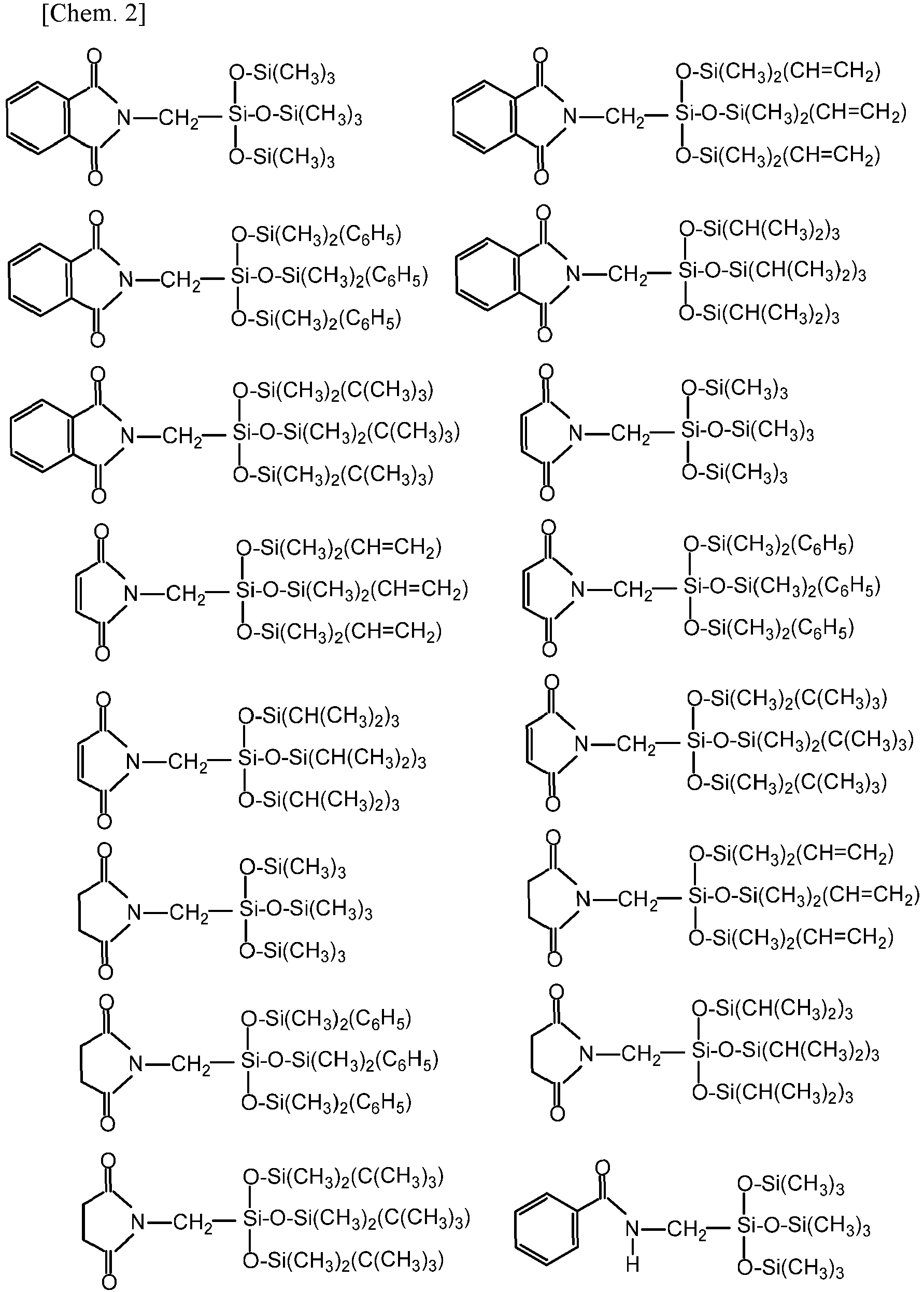
- Examples of the siloxane compound having the formula (2), preferably the formula (3) are shown below.
- While the primary aminosiloxane compound having the formula (1) is obtained by deprotecting the siloxane compound having the formula (2), preferably the formula (3) as precursor, the method for preparing the siloxane compound having the formula (2), preferably the formula (3) as precursor is, for example, by reacting a siloxane compound having a chloromethyl group with an alkali metal salt of an amide compound or imide compound.
- The siloxane compound having a chloromethyl group can be prepared by reacting a chloromethyltrialkoxysilane, chloromethyldialkoxymethylsilane or chloromethylalkoxydimethylsilane with a disiloxane compound such as 1,1,1,3,3,3-hexamethyldisiloxane or 1,1,3,3-tetramethyldisiloxane in the presence of an acid catalyst.
- When the siloxane compound having a chloromethyl group has a Si-H group, a substituent may be introduced by hydrosilylation reaction with the aid of a platinum catalyst (e.g., Karstedt catalyst or Speier catalyst) or Rh catalyst.
- The alkali metal salt of an amide compound or imide compound is obtained by reacting an amide compound such as acetamide or an imide compound such as succinimide, maleimide or phthalimide with an alkali metal alkoxide such as sodium methoxide, sodium t-butoxide or potassium t-butoxide. Besides, potassium phthalimide is commercially available.
- In preparing the siloxane compound having the formula (2), the alkali metal salt of an amide compound or imide compound is used in an amount of 0.1 to 50 moles, preferably 1 to 20 moles per mole of chloromethyl group on the siloxane compound having a chloromethyl group. In order to accelerate the reaction, for example, a catalytic amount of alkali metal iodide such as sodium iodide may be added.
- In preparing the siloxane compound having the formula (2), an organic solvent may be used. For example, ether compounds such as ethylene glycol dimethyl ether, diethylene glycol dimethyl ether and tetrahydrofuran, and amide compounds such as N,N-dimethylformamide, N,N-dimethylacetamide and N-methylpyrrolidone are used.
- The reaction conditions under which the siloxane compound having the formula (2) is prepared are not particularly limited and typically include a reaction temperature of room temperature (20±5°C) to 200°C, preferably 50 to 150°C and a reaction time of 0.5 to 48 hours.
- At the end of reaction, the reaction product is subjected to filtration or separatory washing with distilled water or neutral aqueous solution of a salt such as NaCl or Na2SO4, and the organic layer is dried over Na2SO4. These treatments are followed by vacuum drying, yielding the siloxane compound having the formula (2). It is noted that the reaction product may be diluted with a solvent such as hexane prior to the filtration or separatory washing.
- Further, a deprotecting agent is added to the siloxane compound having the formula (2), preferably the formula (3) as precursor to induce deprotection to produce the primary aminosiloxane compound having the formula (1).
- The deprotecting agent used for deprotection of the siloxane compound having the formula (2) may be one capable of converting the amide skeleton (e.g., R6-C(=O)-N) or imide skeleton (e.g., R6-C(=O)-N-C(=O)-R8) to an amino group. It is selected from, for example, the compounds described in Greene's Protective Groups in Organic Synthesis, 5th Ed., 1012-1014, 2014, John Wiley & Sons, Inc., preferably hydrazine monohydrates and primary amine compounds, more preferably primary amine compounds.
- The primary amine compounds are not particularly limited as long as the reaction takes place. Compounds having an amino group and containing a C1-C30 straight, branched or cyclic hydrocarbon group are preferred, with primary alkylamine compounds being more preferred.
- The primary alkylamine compounds are not particularly limited as long as the reaction takes place. Examples include alkylamines such as methylamine, n-butylamine, hexylamine, and octylamine, as well as ethylenediamine, propylenediamine, diethylenetriamine, triethylenetetramine, and tetraethylenehexamine.
- The amount of the deprotecting agent used may be about 1 to about 100 moles, preferably 1 to 50 moles, more preferably 2 to 20 moles per mole of the compound having formula (2).
- In preparing the primary aminosiloxane compound having the formula (1), an organic solvent may be added. Any organic solvent may be used as long as it does not interfere with the reaction. Use may be made of aliphatic hydrocarbons such as pentane, hexane, heptane, octane, and cyclohexane; ethers such as diethyl ether, diisopropyl ether, dibutyl ether, cyclopentyl methyl ether, tetrahydrofuran, and 1,4-dioxane; and aromatic hydrocarbons such as benzene, toluene, xylene, and mesitylene.
- The reaction conditions under which the primary aminosiloxane compound having the formula (1) is prepared are not particularly limited and typically include a reaction temperature of 10 to 200°C, preferably 30 to 120°C and a reaction time of 1 to 48 hours.
- The primary aminosiloxane compounds thus obtained, especially primary aminomethylsiloxane compounds are highly useful in that they find a wide variety of use where the adsorption and reactivity of the amino group are utilized, including filler surface modifying agents, resin modifying agents, textile treating agents, paint additives, and cosmetic raw materials, as well as synthesis reactants for high-functionality products, for example, reactants for ligands in hydrosilylation reaction.
- Synthesis Examples and Examples are given below for illustrating the invention, but the invention is not limited thereto. In Synthesis Examples and Examples, reactions and storage of products are conducted in nitrogen atmosphere unless otherwise stated.
- For 1H-NMR analysis, Advance III 400 (Bruker Analytik) was used. GC yield was measured by system 7890B (column HP-5, Agilent Technologies) at a rate of 10°C/min from 80°C.
- A 500-mL separable flask was charged with 216.1 g (1.27 mol) of chloromethyltrimethoxysilane, 80.1 g of methanol, 405.2 g (2.50 mol) of 1,1,1,3,3,3-hexamethyldisiloxane, and 12.7 g of sulfuric acid, and ice cooled. With the flask kept below 15°C, 88.7 g of distilled water was added dropwise over 30 minutes. At the end of addition, stirring was continued at room temperature for 7 hours. The organic layer was recovered by separatory operation and washed with sodium chloride aqueous solution until the water layer became neutral. Thereafter, the organic layer was purified by distillation, yielding 1135.32 g of colorless clear solution (yield 31%, GC purity > 99%). The resulting compound is shown below.

- A 500-mL separable flask was charged with 79.46 g (0.43 mol) of potassium phthalimide (Tokyo Chemical Industry Co., Ltd.), 7.24 g (0.05 mol) of sodium iodide (Fujifilm Wako Pure Chemical Corp.), and 130.54 g (0.38 mol) of 3-(chloromethyl)-1,1,1,5,5,5-hexamethyl-3-[(trimethylsilyl)oxy]trisiloxane obtained in Synthesis Example 1. The flask was equipped with a stirring impeller and condenser, and 89.3 g of dry N,N-dimethylformamide (Fujifilm Wako Pure Chemical Corp.) was added thereto, after which reaction was carried out in an oil bath at 150°C for 10 hours. Thereafter, 99.8 g of hexane was added to the reaction solution. The subsequent filtration and vacuum drying yielded 158.81 g of a pale yellow solution (yield 89%, GC purity 99%).
FIG. 1 shows the data of 1H-NMR analysis of the resulting compound. The compound is shown below.
1H-NMR (CDCl3, 400 MHz) δ: 7.88-7.74 (m, 2H), 7.70-7.62 (m, 2H), 3.21 (s, 0.43H), 3.11 (s, 1.57H), 0.07 (s, 27H)
- Preparation of 3-(aminomethyl)-1,1,1,5,5,5-hexamethyl-3-[(trimethylsilyl)oxy]trisiloxane A 500-mL separable flask was charged with 100.03 g (0.22 mol) of the compound obtained in Synthesis Example 2 and 50.74 g (0.84 mol) of dry ethylenediamine (Fujifilm Wako Pure Chemical Corp.). The flask was equipped with a stirring impeller and condenser, after which reaction was carried out in an oil bath at 70°C for 3 hours. The reaction solution separated into two layers, after which the upper layer was recovered and extracted 3 times with hexane. On vacuum distillation (2 mmHg, 77°C), 46.47 g of a colorless solution was obtained (yield 65%, GC purity > 99%).
FIG. 2 shows the data of 1H-NMR analysis of the resulting compound. The compound is shown below.
1H-NMR (CDCl3, 400 MHz) δ: 2.02 (s, 2H), 1.00-0.60 (br, 2H), 0.12 (s, 27H)
Claims (8)
- A primary aminosiloxane compound having the formula (1):
H2N-CR1R2-Si(OSiR3R4R5)3 (1)
wherein R1, R2, R3, R4 and R5 are each independently hydrogen or a C1-C30 monovalent hydrocarbon group in which some or all carbon-bonded hydrogen atoms may be substituted by halogen atoms or hydroxy groups and which may be separated by oxygen or nitrogen. - The primary aminosiloxane compound of claim 1 wherein the C1-C30 monovalent hydrocarbon groups represented by R1, R2, R3, R4 and R5 in the formula (1) are straight, branched or cyclic and selected from alkyl, alkenyl, alkynyl, aryl, and aralkyl groups.
- A method for preparing the primary aminosiloxane compound of claim 1 or 2, comprising the step of reacting a siloxane compound with a deprotecting agent to produce the primary aminosiloxane compound having the formula (1), said siloxane compound having the formula (2):
R6-C(=O)-NR7-CR1R2-Si(OSiR3R4R5)3 (2)
wherein R1, R2, R3, R4 and R5 are each independently hydrogen or a C1-C30 monovalent hydrocarbon group in which some or all carbon-bonded hydrogen atoms may be substituted by halogen atoms or hydroxy groups and which may be separated by oxygen or nitrogen, R7 is hydrogen or -C(=O)-R8, R6 and R8 each are a C1-C30 monovalent hydrocarbon group, with the proviso that when R7 is -C(=O)-R8, R6 may bond with R8 to form a divalent hydrocarbon group to construct a cyclic structure. - The method for preparing the primary aminosiloxane compound according to claim 3 wherein in the formula (2), when R7 is -C(=O)-R8, R6 bonds with R8 to form a divalent hydrocarbon group to construct a cyclic structure.
- The method for preparing the primary aminosiloxane compound according to claim 3 or 4 wherein the deprotecting agent to be reacted with the siloxane compound having the formula (2) is a hydrazine monohydrate or primary amine compound.
- The method for preparing the primary aminosiloxane compound according to claim 5 wherein the primary amine compound is a primary alkylamine compound.
- The method for preparing the primary aminosiloxane compound according to claim 6 wherein the primary alkylamine compound is selected from the group consisting of methylamine, n-butylamine, hexylamine, octylamine, ethylenediamine, propylenediamine, diethylenetriamine, triethylenetetramine, and tetraethylenehexamine.
- The method for preparing the primary aminosiloxane compound according to any one of claims 3 to 7 wherein each of the C1-C30 monovalent hydrocarbon groups represented by R1, R2, R3, R4, R5, R6, and R8 in the formula (2) is straight, branched or cyclic and selected from alkyl, alkenyl, alkynyl, aryl, and aralkyl groups.
Applications Claiming Priority (2)
| Application Number | Priority Date | Filing Date | Title |
|---|---|---|---|
| JP2019147267 | 2019-08-09 | ||
| PCT/JP2020/028695 WO2021029210A1 (en) | 2019-08-09 | 2020-07-27 | Primary aminosiloxane compound and method for producing same |
Publications (3)
| Publication Number | Publication Date |
|---|---|
| EP4011889A1 true EP4011889A1 (en) | 2022-06-15 |
| EP4011889A4 EP4011889A4 (en) | 2023-07-26 |
| EP4011889B1 EP4011889B1 (en) | 2025-09-03 |
Family
ID=74571023
Family Applications (1)
| Application Number | Title | Priority Date | Filing Date |
|---|---|---|---|
| EP20851685.6A Active EP4011889B1 (en) | 2019-08-09 | 2020-07-27 | Primary aminosiloxane compound and method for producing same |
Country Status (5)
| Country | Link |
|---|---|
| US (1) | US20220372051A1 (en) |
| EP (1) | EP4011889B1 (en) |
| JP (1) | JP7310894B2 (en) |
| CN (1) | CN114206887A (en) |
| WO (1) | WO2021029210A1 (en) |
Family Cites Families (12)
| Publication number | Priority date | Publication date | Assignee | Title |
|---|---|---|---|---|
| US3981859A (en) * | 1972-07-26 | 1976-09-21 | Minnesota Mining And Manufacturing Company | Silicone-compatible azo dyestuffs |
| US4711943A (en) * | 1985-04-26 | 1987-12-08 | Sola U.S.A. Inc. | Hydrophilic siloxane monomers and dimers for contact lens materials, and contact lenses fabricated therefrom |
| JP2625624B2 (en) * | 1993-01-29 | 1997-07-02 | 信越化学工業株式会社 | Method for producing amino-containing organopolysiloxane |
| JPH06228161A (en) * | 1993-01-29 | 1994-08-16 | Shin Etsu Chem Co Ltd | Method for producing isocyanate group-containing organopolysiloxane |
| JP2000061973A (en) | 1998-08-20 | 2000-02-29 | Bando Chem Ind Ltd | Anti-vibration material |
| DE10206124A1 (en) | 2002-02-14 | 2003-09-04 | Consortium Elektrochem Ind | Aminomethylene functional siloxanes |
| DE10303693A1 (en) | 2003-01-30 | 2004-08-12 | Consortium für elektrochemische Industrie GmbH | Aminomethylene functional siloxanes |
| DE10321320A1 (en) | 2003-05-13 | 2004-12-02 | Degussa Ag | Organofunctional siloxane mixtures |
| JP2007023246A (en) | 2005-07-12 | 2007-02-01 | E Brain:Kk | Novel silicon-containing compound and method for producing the same |
| TW201231512A (en) | 2010-10-15 | 2012-08-01 | Dow Corning | Silicon-containing materials with controllable microstructure |
| CA2985823A1 (en) | 2015-05-12 | 2016-11-17 | Blinkbio, Inc. | Silicon based drug conjugates and methods of using same |
| CN110922600B (en) * | 2019-10-22 | 2021-05-25 | 武汉大学 | A kind of hydroxyhydrocarbyl organosilicon compound and its preparation method and application |
-
2020
- 2020-07-27 JP JP2021539193A patent/JP7310894B2/en active Active
- 2020-07-27 EP EP20851685.6A patent/EP4011889B1/en active Active
- 2020-07-27 WO PCT/JP2020/028695 patent/WO2021029210A1/en not_active Ceased
- 2020-07-27 US US17/633,629 patent/US20220372051A1/en not_active Abandoned
- 2020-07-27 CN CN202080056386.1A patent/CN114206887A/en active Pending
Also Published As
| Publication number | Publication date |
|---|---|
| US20220372051A1 (en) | 2022-11-24 |
| WO2021029210A1 (en) | 2021-02-18 |
| JPWO2021029210A1 (en) | 2021-02-18 |
| CN114206887A (en) | 2022-03-18 |
| EP4011889A4 (en) | 2023-07-26 |
| JP7310894B2 (en) | 2023-07-19 |
| EP4011889B1 (en) | 2025-09-03 |
Similar Documents
| Publication | Publication Date | Title |
|---|---|---|
| US20220033587A1 (en) | Reactive siloxanes | |
| JPH0718077A (en) | Production of carbinol-functional siloxane | |
| US11965127B2 (en) | Cationic silicone surfactants and method of preparing same | |
| EP1622964B1 (en) | Organofunctional siloxane mixtures | |
| US20080234441A1 (en) | Process for producing bis-(aminoalkyl)-polysiloxanes | |
| US5504235A (en) | Method for decomposing polysiloxane | |
| EP0639576B1 (en) | Organopolysiloxanes having a silanol group and process of making them | |
| JPH1017579A (en) | N, N-bis (trimethylsilyl) aminopropylsilane compound and method for producing the same | |
| CN107001638A (en) | Method for producing the organo-silicon compound with amino | |
| EP4011889B1 (en) | Primary aminosiloxane compound and method for producing same | |
| CN104470935B (en) | Oxa-cyclosilane and preparation method thereof | |
| JP2024510117A (en) | Method for producing siloxane-(meth)acrylate macromonomer | |
| JPH04235190A (en) | Sterically hindered aminohydrocarbylsilanes and process for producing same | |
| JP2015510902A (en) | Process for producing aminoalkylalkoxysilanes | |
| CN117510532A (en) | Oligoaminopropylsiloxane and synthesis method thereof | |
| KR20190124315A (en) | Process for preparing urea-functional siloxane | |
| US11440926B2 (en) | Method for preparing aminopropylsilanes | |
| JP2021042177A (en) | Novel isocyanide compound, formamide compound, and method for producing organic silicon compound using isocyanide compound | |
| JP2023546328A (en) | Method for synthesizing alkoxy group-containing aminosiloxane | |
| EP0570208A2 (en) | Phenol-modified silicones | |
| JP2021028321A (en) | Method for Producing Amino Group-Containing Organosilicon Compound | |
| JP2022038140A (en) | Method for producing organosilicon compound | |
| JP4279066B2 (en) | Cyclic siloxane compound and method for producing the same | |
| WO2004005302A1 (en) | Process for the preparation of acyloxysilanes | |
| JPH0673073A (en) | Production of organotrialalkoxysilane |
Legal Events
| Date | Code | Title | Description |
|---|---|---|---|
| STAA | Information on the status of an ep patent application or granted ep patent |
Free format text: STATUS: THE INTERNATIONAL PUBLICATION HAS BEEN MADE |
|
| PUAI | Public reference made under article 153(3) epc to a published international application that has entered the european phase |
Free format text: ORIGINAL CODE: 0009012 |
|
| STAA | Information on the status of an ep patent application or granted ep patent |
Free format text: STATUS: REQUEST FOR EXAMINATION WAS MADE |
|
| 17P | Request for examination filed |
Effective date: 20220209 |
|
| AK | Designated contracting states |
Kind code of ref document: A1 Designated state(s): AL AT BE BG CH CY CZ DE DK EE ES FI FR GB GR HR HU IE IS IT LI LT LU LV MC MK MT NL NO PL PT RO RS SE SI SK SM TR |
|
| DAV | Request for validation of the european patent (deleted) | ||
| DAX | Request for extension of the european patent (deleted) | ||
| REG | Reference to a national code |
Ref country code: DE Ref legal event code: R079 Free format text: PREVIOUS MAIN CLASS: C07F0007100000 Ipc: C07F0007080000 Ref document number: 602020058211 Country of ref document: DE |
|
| A4 | Supplementary search report drawn up and despatched |
Effective date: 20230626 |
|
| RIC1 | Information provided on ipc code assigned before grant |
Ipc: C07F 7/08 20060101AFI20230620BHEP |
|
| GRAP | Despatch of communication of intention to grant a patent |
Free format text: ORIGINAL CODE: EPIDOSNIGR1 |
|
| STAA | Information on the status of an ep patent application or granted ep patent |
Free format text: STATUS: GRANT OF PATENT IS INTENDED |
|
| INTG | Intention to grant announced |
Effective date: 20250320 |
|
| GRAS | Grant fee paid |
Free format text: ORIGINAL CODE: EPIDOSNIGR3 |
|
| GRAA | (expected) grant |
Free format text: ORIGINAL CODE: 0009210 |
|
| STAA | Information on the status of an ep patent application or granted ep patent |
Free format text: STATUS: THE PATENT HAS BEEN GRANTED |
|
| RBV | Designated contracting states (corrected) |
Designated state(s): DE FR GB |
|
| AK | Designated contracting states |
Kind code of ref document: B1 Designated state(s): DE FR GB |
|
| REG | Reference to a national code |
Ref country code: DE Ref legal event code: R096 Ref document number: 602020058211 Country of ref document: DE |