EP4011610A1 - Aluminum pouch film for secondary battery, and method for producing same - Google Patents
Aluminum pouch film for secondary battery, and method for producing same Download PDFInfo
- Publication number
- EP4011610A1 EP4011610A1 EP20849192.8A EP20849192A EP4011610A1 EP 4011610 A1 EP4011610 A1 EP 4011610A1 EP 20849192 A EP20849192 A EP 20849192A EP 4011610 A1 EP4011610 A1 EP 4011610A1
- Authority
- EP
- European Patent Office
- Prior art keywords
- aluminum
- resin layer
- layer
- outer resin
- secondary battery
- Prior art date
- Legal status (The legal status is an assumption and is not a legal conclusion. Google has not performed a legal analysis and makes no representation as to the accuracy of the status listed.)
- Pending
Links
- 229910052782 aluminium Inorganic materials 0.000 title claims abstract description 127
- XAGFODPZIPBFFR-UHFFFAOYSA-N aluminium Chemical compound [Al] XAGFODPZIPBFFR-UHFFFAOYSA-N 0.000 title claims abstract description 123
- 238000004519 manufacturing process Methods 0.000 title claims abstract description 16
- 239000010410 layer Substances 0.000 claims abstract description 186
- 229920005989 resin Polymers 0.000 claims abstract description 132
- 239000011347 resin Substances 0.000 claims abstract description 132
- 239000012790 adhesive layer Substances 0.000 claims abstract description 39
- 229920001721 polyimide Polymers 0.000 claims abstract description 38
- 239000004642 Polyimide Substances 0.000 claims abstract description 17
- 238000000034 method Methods 0.000 claims description 49
- VEXZGXHMUGYJMC-UHFFFAOYSA-N Hydrochloric acid Chemical compound Cl VEXZGXHMUGYJMC-UHFFFAOYSA-N 0.000 claims description 24
- XLYOFNOQVPJJNP-UHFFFAOYSA-N water Substances O XLYOFNOQVPJJNP-UHFFFAOYSA-N 0.000 claims description 24
- 238000005530 etching Methods 0.000 claims description 22
- QAOWNCQODCNURD-UHFFFAOYSA-N Sulfuric acid Chemical compound OS(O)(=O)=O QAOWNCQODCNURD-UHFFFAOYSA-N 0.000 claims description 21
- 239000002253 acid Substances 0.000 claims description 13
- GRYLNZFGIOXLOG-UHFFFAOYSA-N Nitric acid Chemical compound O[N+]([O-])=O GRYLNZFGIOXLOG-UHFFFAOYSA-N 0.000 claims description 10
- 229910017604 nitric acid Inorganic materials 0.000 claims description 10
- 239000007921 spray Substances 0.000 claims description 10
- 238000004833 X-ray photoelectron spectroscopy Methods 0.000 claims description 9
- 238000002156 mixing Methods 0.000 claims description 5
- 238000005507 spraying Methods 0.000 claims description 5
- -1 polyethylene terephthalate Polymers 0.000 description 95
- 238000002360 preparation method Methods 0.000 description 50
- 239000010408 film Substances 0.000 description 42
- 229920005862 polyol Polymers 0.000 description 31
- 239000000853 adhesive Substances 0.000 description 27
- 230000001070 adhesive effect Effects 0.000 description 26
- 239000011888 foil Substances 0.000 description 24
- 239000012948 isocyanate Substances 0.000 description 23
- XEEYBQQBJWHFJM-UHFFFAOYSA-N Iron Chemical compound [Fe] XEEYBQQBJWHFJM-UHFFFAOYSA-N 0.000 description 22
- 229920000098 polyolefin Polymers 0.000 description 21
- 239000007788 liquid Substances 0.000 description 19
- 239000000243 solution Substances 0.000 description 19
- 239000004743 Polypropylene Substances 0.000 description 18
- 229920000728 polyester Polymers 0.000 description 18
- 229920001155 polypropylene Polymers 0.000 description 18
- 239000003792 electrolyte Substances 0.000 description 17
- 230000000052 comparative effect Effects 0.000 description 16
- 229920001577 copolymer Polymers 0.000 description 15
- 150000003077 polyols Chemical class 0.000 description 15
- 238000011282 treatment Methods 0.000 description 15
- 238000003475 lamination Methods 0.000 description 14
- 229920002647 polyamide Polymers 0.000 description 14
- 229920000139 polyethylene terephthalate Polymers 0.000 description 14
- UPMLOUAZCHDJJD-UHFFFAOYSA-N 4,4'-Diphenylmethane Diisocyanate Chemical compound C1=CC(N=C=O)=CC=C1CC1=CC=C(N=C=O)C=C1 UPMLOUAZCHDJJD-UHFFFAOYSA-N 0.000 description 12
- 239000004952 Polyamide Substances 0.000 description 12
- 239000004840 adhesive resin Substances 0.000 description 11
- 229920006223 adhesive resin Polymers 0.000 description 11
- 150000001875 compounds Chemical class 0.000 description 11
- 230000007423 decrease Effects 0.000 description 11
- 229910052742 iron Inorganic materials 0.000 description 11
- 150000002513 isocyanates Chemical class 0.000 description 11
- 230000008569 process Effects 0.000 description 11
- LYCAIKOWRPUZTN-UHFFFAOYSA-N Ethylene glycol Chemical compound OCCO LYCAIKOWRPUZTN-UHFFFAOYSA-N 0.000 description 10
- 239000004698 Polyethylene Substances 0.000 description 10
- 238000007654 immersion Methods 0.000 description 10
- 229920000573 polyethylene Polymers 0.000 description 10
- 150000003839 salts Chemical class 0.000 description 10
- KRHYYFGTRYWZRS-UHFFFAOYSA-N Fluorane Chemical compound F KRHYYFGTRYWZRS-UHFFFAOYSA-N 0.000 description 9
- 239000003795 chemical substances by application Substances 0.000 description 9
- ZFSLODLOARCGLH-UHFFFAOYSA-N isocyanuric acid Chemical compound OC1=NC(O)=NC(O)=N1 ZFSLODLOARCGLH-UHFFFAOYSA-N 0.000 description 9
- 238000010030 laminating Methods 0.000 description 9
- 239000000463 material Substances 0.000 description 9
- 229920001707 polybutylene terephthalate Polymers 0.000 description 9
- 239000009719 polyimide resin Substances 0.000 description 9
- RTZKZFJDLAIYFH-UHFFFAOYSA-N Diethyl ether Chemical compound CCOCC RTZKZFJDLAIYFH-UHFFFAOYSA-N 0.000 description 8
- QQVIHTHCMHWDBS-UHFFFAOYSA-N isophthalic acid Chemical compound OC(=O)C1=CC=CC(C(O)=O)=C1 QQVIHTHCMHWDBS-UHFFFAOYSA-N 0.000 description 8
- 229910052757 nitrogen Inorganic materials 0.000 description 8
- 229920005906 polyester polyol Polymers 0.000 description 8
- 239000005020 polyethylene terephthalate Substances 0.000 description 8
- 239000004814 polyurethane Substances 0.000 description 8
- 229920002635 polyurethane Polymers 0.000 description 8
- KKEYFWRCBNTPAC-UHFFFAOYSA-N terephthalic acid group Chemical group C(C1=CC=C(C(=O)O)C=C1)(=O)O KKEYFWRCBNTPAC-UHFFFAOYSA-N 0.000 description 8
- HRPVXLWXLXDGHG-UHFFFAOYSA-N Acrylamide Chemical compound NC(=O)C=C HRPVXLWXLXDGHG-UHFFFAOYSA-N 0.000 description 7
- 238000005238 degreasing Methods 0.000 description 7
- 150000002009 diols Chemical class 0.000 description 7
- 239000000203 mixture Substances 0.000 description 7
- 239000000178 monomer Substances 0.000 description 7
- 239000004593 Epoxy Substances 0.000 description 6
- DNIAPMSPPWPWGF-UHFFFAOYSA-N Propylene glycol Chemical compound CC(O)CO DNIAPMSPPWPWGF-UHFFFAOYSA-N 0.000 description 6
- 239000007789 gas Substances 0.000 description 6
- 125000002887 hydroxy group Chemical group [H]O* 0.000 description 6
- 229910052751 metal Inorganic materials 0.000 description 6
- 239000002184 metal Substances 0.000 description 6
- 229920006284 nylon film Polymers 0.000 description 6
- 229920000515 polycarbonate Polymers 0.000 description 6
- 239000004417 polycarbonate Substances 0.000 description 6
- QQONPFPTGQHPMA-UHFFFAOYSA-N propylene Natural products CC=C QQONPFPTGQHPMA-UHFFFAOYSA-N 0.000 description 6
- 239000000126 substance Substances 0.000 description 6
- DVKJHBMWWAPEIU-UHFFFAOYSA-N toluene 2,4-diisocyanate Chemical compound CC1=CC=C(N=C=O)C=C1N=C=O DVKJHBMWWAPEIU-UHFFFAOYSA-N 0.000 description 6
- 229920002292 Nylon 6 Polymers 0.000 description 5
- 229920002302 Nylon 6,6 Polymers 0.000 description 5
- 239000004721 Polyphenylene oxide Substances 0.000 description 5
- QVGXLLKOCUKJST-UHFFFAOYSA-N atomic oxygen Chemical compound [O] QVGXLLKOCUKJST-UHFFFAOYSA-N 0.000 description 5
- 239000000805 composite resin Substances 0.000 description 5
- 230000003247 decreasing effect Effects 0.000 description 5
- RRAMGCGOFNQTLD-UHFFFAOYSA-N hexamethylene diisocyanate Chemical compound O=C=NCCCCCCN=C=O RRAMGCGOFNQTLD-UHFFFAOYSA-N 0.000 description 5
- NIMLQBUJDJZYEJ-UHFFFAOYSA-N isophorone diisocyanate Chemical compound CC1(C)CC(N=C=O)CC(C)(CN=C=O)C1 NIMLQBUJDJZYEJ-UHFFFAOYSA-N 0.000 description 5
- 238000005259 measurement Methods 0.000 description 5
- 238000012986 modification Methods 0.000 description 5
- 230000004048 modification Effects 0.000 description 5
- 239000001301 oxygen Substances 0.000 description 5
- 229910052760 oxygen Inorganic materials 0.000 description 5
- 239000012785 packaging film Substances 0.000 description 5
- 229920006280 packaging film Polymers 0.000 description 5
- 229920000570 polyether Polymers 0.000 description 5
- 239000011112 polyethylene naphthalate Substances 0.000 description 5
- 229920000642 polymer Polymers 0.000 description 5
- 125000004805 propylene group Chemical group [H]C([H])([H])C([H])([*:1])C([H])([H])[*:2] 0.000 description 5
- 229920005604 random copolymer Polymers 0.000 description 5
- 239000010409 thin film Substances 0.000 description 5
- NIXOWILDQLNWCW-UHFFFAOYSA-M Acrylate Chemical compound [O-]C(=O)C=C NIXOWILDQLNWCW-UHFFFAOYSA-M 0.000 description 4
- 239000005058 Isophorone diisocyanate Substances 0.000 description 4
- XMUZQOKACOLCSS-UHFFFAOYSA-N [2-(hydroxymethyl)phenyl]methanol Chemical compound OCC1=CC=CC=C1CO XMUZQOKACOLCSS-UHFFFAOYSA-N 0.000 description 4
- WNLRTRBMVRJNCN-UHFFFAOYSA-N adipic acid Chemical compound OC(=O)CCCCC(O)=O WNLRTRBMVRJNCN-UHFFFAOYSA-N 0.000 description 4
- 125000001931 aliphatic group Chemical group 0.000 description 4
- 239000003513 alkali Substances 0.000 description 4
- 125000003118 aryl group Chemical group 0.000 description 4
- 230000004888 barrier function Effects 0.000 description 4
- 239000002585 base Substances 0.000 description 4
- 229920001400 block copolymer Polymers 0.000 description 4
- 238000006243 chemical reaction Methods 0.000 description 4
- DIOQZVSQGTUSAI-UHFFFAOYSA-N decane Chemical compound CCCCCCCCCC DIOQZVSQGTUSAI-UHFFFAOYSA-N 0.000 description 4
- 238000009820 dry lamination Methods 0.000 description 4
- 229920001038 ethylene copolymer Polymers 0.000 description 4
- 238000001125 extrusion Methods 0.000 description 4
- FPYJFEHAWHCUMM-UHFFFAOYSA-N maleic anhydride Chemical compound O=C1OC(=O)C=C1 FPYJFEHAWHCUMM-UHFFFAOYSA-N 0.000 description 4
- 229920003207 poly(ethylene-2,6-naphthalate) Polymers 0.000 description 4
- 229920006122 polyamide resin Polymers 0.000 description 4
- 229920001225 polyester resin Polymers 0.000 description 4
- 239000005056 polyisocyanate Substances 0.000 description 4
- 229920001228 polyisocyanate Polymers 0.000 description 4
- 229920005672 polyolefin resin Polymers 0.000 description 4
- CXMXRPHRNRROMY-UHFFFAOYSA-N sebacic acid Chemical compound OC(=O)CCCCCCCCC(O)=O CXMXRPHRNRROMY-UHFFFAOYSA-N 0.000 description 4
- WSQZNZLOZXSBHA-UHFFFAOYSA-N 3,8-dioxabicyclo[8.2.2]tetradeca-1(12),10,13-triene-2,9-dione Chemical compound O=C1OCCCCOC(=O)C2=CC=C1C=C2 WSQZNZLOZXSBHA-UHFFFAOYSA-N 0.000 description 3
- LLLVZDVNHNWSDS-UHFFFAOYSA-N 4-methylidene-3,5-dioxabicyclo[5.2.2]undeca-1(9),7,10-triene-2,6-dione Chemical compound C1(C2=CC=C(C(=O)OC(=C)O1)C=C2)=O LLLVZDVNHNWSDS-UHFFFAOYSA-N 0.000 description 3
- QTBSBXVTEAMEQO-UHFFFAOYSA-N Acetic acid Chemical compound CC(O)=O QTBSBXVTEAMEQO-UHFFFAOYSA-N 0.000 description 3
- GVNWZKBFMFUVNX-UHFFFAOYSA-N Adipamide Chemical compound NC(=O)CCCCC(N)=O GVNWZKBFMFUVNX-UHFFFAOYSA-N 0.000 description 3
- 229910000838 Al alloy Inorganic materials 0.000 description 3
- PEDCQBHIVMGVHV-UHFFFAOYSA-N Glycerine Chemical compound OCC(O)CO PEDCQBHIVMGVHV-UHFFFAOYSA-N 0.000 description 3
- 239000005057 Hexamethylene diisocyanate Substances 0.000 description 3
- WHXSMMKQMYFTQS-UHFFFAOYSA-N Lithium Chemical compound [Li] WHXSMMKQMYFTQS-UHFFFAOYSA-N 0.000 description 3
- 239000004677 Nylon Substances 0.000 description 3
- 239000006087 Silane Coupling Agent Substances 0.000 description 3
- HEMHJVSKTPXQMS-UHFFFAOYSA-M Sodium hydroxide Chemical compound [OH-].[Na+] HEMHJVSKTPXQMS-UHFFFAOYSA-M 0.000 description 3
- 150000007513 acids Chemical class 0.000 description 3
- 125000000217 alkyl group Chemical group 0.000 description 3
- 229910045601 alloy Inorganic materials 0.000 description 3
- 239000000956 alloy Substances 0.000 description 3
- OHJMTUPIZMNBFR-UHFFFAOYSA-N biuret Chemical compound NC(=O)NC(N)=O OHJMTUPIZMNBFR-UHFFFAOYSA-N 0.000 description 3
- 150000001718 carbodiimides Chemical class 0.000 description 3
- IQPQWNKOIGAROB-UHFFFAOYSA-N isocyanate group Chemical group [N-]=C=O IQPQWNKOIGAROB-UHFFFAOYSA-N 0.000 description 3
- 229910052744 lithium Inorganic materials 0.000 description 3
- SLCVBVWXLSEKPL-UHFFFAOYSA-N neopentyl glycol Chemical compound OCC(C)(C)CO SLCVBVWXLSEKPL-UHFFFAOYSA-N 0.000 description 3
- 229920001778 nylon Polymers 0.000 description 3
- 239000005022 packaging material Substances 0.000 description 3
- OJMIONKXNSYLSR-UHFFFAOYSA-N phosphorous acid Chemical compound OP(O)O OJMIONKXNSYLSR-UHFFFAOYSA-N 0.000 description 3
- 239000004645 polyester resin Substances 0.000 description 3
- 238000007789 sealing Methods 0.000 description 3
- 229920006027 ternary co-polymer Polymers 0.000 description 3
- SBJCUZQNHOLYMD-UHFFFAOYSA-N 1,5-Naphthalene diisocyanate Chemical compound C1=CC=C2C(N=C=O)=CC=CC2=C1N=C=O SBJCUZQNHOLYMD-UHFFFAOYSA-N 0.000 description 2
- QGLRLXLDMZCFBP-UHFFFAOYSA-N 1,6-diisocyanato-2,4,4-trimethylhexane Chemical compound O=C=NCC(C)CC(C)(C)CCN=C=O QGLRLXLDMZCFBP-UHFFFAOYSA-N 0.000 description 2
- 229940008841 1,6-hexamethylene diisocyanate Drugs 0.000 description 2
- ICLCCFKUSALICQ-UHFFFAOYSA-N 1-isocyanato-4-(4-isocyanato-3-methylphenyl)-2-methylbenzene Chemical compound C1=C(N=C=O)C(C)=CC(C=2C=C(C)C(N=C=O)=CC=2)=C1 ICLCCFKUSALICQ-UHFFFAOYSA-N 0.000 description 2
- IMSODMZESSGVBE-UHFFFAOYSA-N 2-Oxazoline Chemical class C1CN=CO1 IMSODMZESSGVBE-UHFFFAOYSA-N 0.000 description 2
- 229920002943 EPDM rubber Polymers 0.000 description 2
- VGGSQFUCUMXWEO-UHFFFAOYSA-N Ethene Chemical compound C=C VGGSQFUCUMXWEO-UHFFFAOYSA-N 0.000 description 2
- 239000005977 Ethylene Substances 0.000 description 2
- 101000576320 Homo sapiens Max-binding protein MNT Proteins 0.000 description 2
- JHWNWJKBPDFINM-UHFFFAOYSA-N Laurolactam Chemical compound O=C1CCCCCCCCCCCN1 JHWNWJKBPDFINM-UHFFFAOYSA-N 0.000 description 2
- HDONYZHVZVCMLR-UHFFFAOYSA-N N=C=O.N=C=O.CC1CCCCC1 Chemical compound N=C=O.N=C=O.CC1CCCCC1 HDONYZHVZVCMLR-UHFFFAOYSA-N 0.000 description 2
- PXHVJJICTQNCMI-UHFFFAOYSA-N Nickel Chemical compound [Ni] PXHVJJICTQNCMI-UHFFFAOYSA-N 0.000 description 2
- 229920000299 Nylon 12 Polymers 0.000 description 2
- 229920000305 Nylon 6,10 Polymers 0.000 description 2
- NBIIXXVUZAFLBC-UHFFFAOYSA-N Phosphoric acid Chemical compound OP(O)(O)=O NBIIXXVUZAFLBC-UHFFFAOYSA-N 0.000 description 2
- 229920006121 Polyxylylene adipamide Polymers 0.000 description 2
- OFOBLEOULBTSOW-UHFFFAOYSA-N Propanedioic acid Natural products OC(=O)CC(O)=O OFOBLEOULBTSOW-UHFFFAOYSA-N 0.000 description 2
- ZJCCRDAZUWHFQH-UHFFFAOYSA-N Trimethylolpropane Chemical compound CCC(CO)(CO)CO ZJCCRDAZUWHFQH-UHFFFAOYSA-N 0.000 description 2
- 239000007983 Tris buffer Substances 0.000 description 2
- WNLRTRBMVRJNCN-UHFFFAOYSA-L adipate(2-) Chemical compound [O-]C(=O)CCCCC([O-])=O WNLRTRBMVRJNCN-UHFFFAOYSA-L 0.000 description 2
- 239000001361 adipic acid Substances 0.000 description 2
- 235000011037 adipic acid Nutrition 0.000 description 2
- 125000002723 alicyclic group Chemical group 0.000 description 2
- 150000001336 alkenes Chemical class 0.000 description 2
- PXKLMJQFEQBVLD-UHFFFAOYSA-N bisphenol F Chemical compound C1=CC(O)=CC=C1CC1=CC=C(O)C=C1 PXKLMJQFEQBVLD-UHFFFAOYSA-N 0.000 description 2
- CDQSJQSWAWPGKG-UHFFFAOYSA-N butane-1,1-diol Chemical compound CCCC(O)O CDQSJQSWAWPGKG-UHFFFAOYSA-N 0.000 description 2
- 150000001732 carboxylic acid derivatives Chemical class 0.000 description 2
- PDXRQENMIVHKPI-UHFFFAOYSA-N cyclohexane-1,1-diol Chemical compound OC1(O)CCCCC1 PDXRQENMIVHKPI-UHFFFAOYSA-N 0.000 description 2
- 125000000113 cyclohexyl group Chemical group [H]C1([H])C([H])([H])C([H])([H])C([H])(*)C([H])([H])C1([H])[H] 0.000 description 2
- INSRQEMEVAMETL-UHFFFAOYSA-N decane-1,1-diol Chemical compound CCCCCCCCCC(O)O INSRQEMEVAMETL-UHFFFAOYSA-N 0.000 description 2
- GYZLOYUZLJXAJU-UHFFFAOYSA-N diglycidyl ether Chemical compound C1OC1COCC1CO1 GYZLOYUZLJXAJU-UHFFFAOYSA-N 0.000 description 2
- KIQKWYUGPPFMBV-UHFFFAOYSA-N diisocyanatomethane Chemical compound O=C=NCN=C=O KIQKWYUGPPFMBV-UHFFFAOYSA-N 0.000 description 2
- 239000012153 distilled water Substances 0.000 description 2
- GTZOYNFRVVHLDZ-UHFFFAOYSA-N dodecane-1,1-diol Chemical compound CCCCCCCCCCCC(O)O GTZOYNFRVVHLDZ-UHFFFAOYSA-N 0.000 description 2
- 238000001035 drying Methods 0.000 description 2
- 230000000694 effects Effects 0.000 description 2
- 238000000921 elemental analysis Methods 0.000 description 2
- 229920006351 engineering plastic Polymers 0.000 description 2
- 150000002148 esters Chemical class 0.000 description 2
- 125000001495 ethyl group Chemical group [H]C([H])([H])C([H])([H])* 0.000 description 2
- 238000011156 evaluation Methods 0.000 description 2
- 230000002349 favourable effect Effects 0.000 description 2
- 239000000446 fuel Substances 0.000 description 2
- 125000003055 glycidyl group Chemical group C(C1CO1)* 0.000 description 2
- MHIBEGOZTWERHF-UHFFFAOYSA-N heptane-1,1-diol Chemical compound CCCCCCC(O)O MHIBEGOZTWERHF-UHFFFAOYSA-N 0.000 description 2
- ACCCMOQWYVYDOT-UHFFFAOYSA-N hexane-1,1-diol Chemical compound CCCCCC(O)O ACCCMOQWYVYDOT-UHFFFAOYSA-N 0.000 description 2
- SAMYCKUDTNLASP-UHFFFAOYSA-N hexane-2,2-diol Chemical compound CCCCC(C)(O)O SAMYCKUDTNLASP-UHFFFAOYSA-N 0.000 description 2
- 229920001903 high density polyethylene Polymers 0.000 description 2
- 239000004700 high-density polyethylene Substances 0.000 description 2
- 230000007062 hydrolysis Effects 0.000 description 2
- 238000006460 hydrolysis reaction Methods 0.000 description 2
- WGCNASOHLSPBMP-UHFFFAOYSA-N hydroxyacetaldehyde Natural products OCC=O WGCNASOHLSPBMP-UHFFFAOYSA-N 0.000 description 2
- 125000000959 isobutyl group Chemical group [H]C([H])([H])C([H])(C([H])([H])[H])C([H])([H])* 0.000 description 2
- 125000001449 isopropyl group Chemical group [H]C([H])([H])C([H])(*)C([H])([H])[H] 0.000 description 2
- 125000000654 isopropylidene group Chemical group C(C)(C)=* 0.000 description 2
- 229920000092 linear low density polyethylene Polymers 0.000 description 2
- 239000004707 linear low-density polyethylene Substances 0.000 description 2
- 229920001684 low density polyethylene Polymers 0.000 description 2
- 239000004702 low-density polyethylene Substances 0.000 description 2
- VZCYOOQTPOCHFL-UPHRSURJSA-N maleic acid Chemical compound OC(=O)\C=C/C(O)=O VZCYOOQTPOCHFL-UPHRSURJSA-N 0.000 description 2
- 239000011976 maleic acid Substances 0.000 description 2
- 229920001179 medium density polyethylene Polymers 0.000 description 2
- 239000004701 medium-density polyethylene Substances 0.000 description 2
- VNWKTOKETHGBQD-UHFFFAOYSA-N methane Chemical compound C VNWKTOKETHGBQD-UHFFFAOYSA-N 0.000 description 2
- AYLRODJJLADBOB-QMMMGPOBSA-N methyl (2s)-2,6-diisocyanatohexanoate Chemical compound COC(=O)[C@@H](N=C=O)CCCCN=C=O AYLRODJJLADBOB-QMMMGPOBSA-N 0.000 description 2
- 125000002496 methyl group Chemical group [H]C([H])([H])* 0.000 description 2
- 125000004108 n-butyl group Chemical group [H]C([H])([H])C([H])([H])C([H])([H])C([H])([H])* 0.000 description 2
- 125000004123 n-propyl group Chemical group [H]C([H])([H])C([H])([H])C([H])([H])* 0.000 description 2
- KYTZHLUVELPASH-UHFFFAOYSA-N naphthalene-1,2-dicarboxylic acid Chemical compound C1=CC=CC2=C(C(O)=O)C(C(=O)O)=CC=C21 KYTZHLUVELPASH-UHFFFAOYSA-N 0.000 description 2
- FVXBCDWMKCEPCL-UHFFFAOYSA-N nonane-1,1-diol Chemical compound CCCCCCCCC(O)O FVXBCDWMKCEPCL-UHFFFAOYSA-N 0.000 description 2
- BDJRBEYXGGNYIS-UHFFFAOYSA-N nonanedioic acid Chemical compound OC(=O)CCCCCCCC(O)=O BDJRBEYXGGNYIS-UHFFFAOYSA-N 0.000 description 2
- OEIJHBUUFURJLI-UHFFFAOYSA-N octane-1,8-diol Chemical compound OCCCCCCCCO OEIJHBUUFURJLI-UHFFFAOYSA-N 0.000 description 2
- JRZJOMJEPLMPRA-UHFFFAOYSA-N olefin Natural products CCCCCCCC=C JRZJOMJEPLMPRA-UHFFFAOYSA-N 0.000 description 2
- 230000035515 penetration Effects 0.000 description 2
- 230000000704 physical effect Effects 0.000 description 2
- WLJVNTCWHIRURA-UHFFFAOYSA-N pimelic acid Chemical compound OC(=O)CCCCCC(O)=O WLJVNTCWHIRURA-UHFFFAOYSA-N 0.000 description 2
- 229920005629 polypropylene homopolymer Polymers 0.000 description 2
- 150000007519 polyprotic acids Polymers 0.000 description 2
- 229920001296 polysiloxane Polymers 0.000 description 2
- GHMLBKRAJCXXBS-UHFFFAOYSA-N resorcinol Chemical compound OC1=CC=CC(O)=C1 GHMLBKRAJCXXBS-UHFFFAOYSA-N 0.000 description 2
- TYFQFVWCELRYAO-UHFFFAOYSA-N suberic acid Chemical compound OC(=O)CCCCCCC(O)=O TYFQFVWCELRYAO-UHFFFAOYSA-N 0.000 description 2
- 238000004381 surface treatment Methods 0.000 description 2
- 125000000999 tert-butyl group Chemical group [H]C([H])([H])C(*)(C([H])([H])[H])C([H])([H])[H] 0.000 description 2
- RUELTTOHQODFPA-UHFFFAOYSA-N toluene 2,6-diisocyanate Chemical compound CC1=C(N=C=O)C=CC=C1N=C=O RUELTTOHQODFPA-UHFFFAOYSA-N 0.000 description 2
- VZCYOOQTPOCHFL-UHFFFAOYSA-N trans-butenedioic acid Natural products OC(=O)C=CC(O)=O VZCYOOQTPOCHFL-UHFFFAOYSA-N 0.000 description 2
- ARCGXLSVLAOJQL-UHFFFAOYSA-N trimellitic acid Chemical compound OC(=O)C1=CC=C(C(O)=O)C(C(O)=O)=C1 ARCGXLSVLAOJQL-UHFFFAOYSA-N 0.000 description 2
- 239000008096 xylene Substances 0.000 description 2
- PUPZLCDOIYMWBV-UHFFFAOYSA-N (+/-)-1,3-Butanediol Chemical compound CC(O)CCO PUPZLCDOIYMWBV-UHFFFAOYSA-N 0.000 description 1
- PZWQOGNTADJZGH-SNAWJCMRSA-N (2e)-2-methylpenta-2,4-dienoic acid Chemical compound OC(=O)C(/C)=C/C=C PZWQOGNTADJZGH-SNAWJCMRSA-N 0.000 description 1
- JNYAEWCLZODPBN-JGWLITMVSA-N (2r,3r,4s)-2-[(1r)-1,2-dihydroxyethyl]oxolane-3,4-diol Chemical compound OC[C@@H](O)[C@H]1OC[C@H](O)[C@H]1O JNYAEWCLZODPBN-JGWLITMVSA-N 0.000 description 1
- WYTZZXDRDKSJID-UHFFFAOYSA-N (3-aminopropyl)triethoxysilane Chemical compound CCO[Si](OCC)(OCC)CCCN WYTZZXDRDKSJID-UHFFFAOYSA-N 0.000 description 1
- 229920003067 (meth)acrylic acid ester copolymer Polymers 0.000 description 1
- OUPZKGBUJRBPGC-UHFFFAOYSA-N 1,3,5-tris(oxiran-2-ylmethyl)-1,3,5-triazinane-2,4,6-trione Chemical compound O=C1N(CC2OC2)C(=O)N(CC2OC2)C(=O)N1CC1CO1 OUPZKGBUJRBPGC-UHFFFAOYSA-N 0.000 description 1
- BOSWPVRACYJBSJ-UHFFFAOYSA-N 1,3-di(p-tolyl)carbodiimide Chemical compound C1=CC(C)=CC=C1N=C=NC1=CC=C(C)C=C1 BOSWPVRACYJBSJ-UHFFFAOYSA-N 0.000 description 1
- IKYNWXNXXHWHLL-UHFFFAOYSA-N 1,3-diisocyanatopropane Chemical compound O=C=NCCCN=C=O IKYNWXNXXHWHLL-UHFFFAOYSA-N 0.000 description 1
- VZXPHDGHQXLXJC-UHFFFAOYSA-N 1,6-diisocyanato-5,6-dimethylheptane Chemical compound O=C=NC(C)(C)C(C)CCCCN=C=O VZXPHDGHQXLXJC-UHFFFAOYSA-N 0.000 description 1
- RTBFRGCFXZNCOE-UHFFFAOYSA-N 1-methylsulfonylpiperidin-4-one Chemical compound CS(=O)(=O)N1CCC(=O)CC1 RTBFRGCFXZNCOE-UHFFFAOYSA-N 0.000 description 1
- DTQJMAHDNUWGFH-UHFFFAOYSA-N 2,4-diphenyl-4,5-dihydro-1,3-oxazole Chemical compound C1OC(C=2C=CC=CC=2)=NC1C1=CC=CC=C1 DTQJMAHDNUWGFH-UHFFFAOYSA-N 0.000 description 1
- DXPIUHXKXUKZDK-UHFFFAOYSA-N 2,5-dimethyl-4,5-dihydro-1,3-oxazole Chemical compound CC1CN=C(C)O1 DXPIUHXKXUKZDK-UHFFFAOYSA-N 0.000 description 1
- STMDPCBYJCIZOD-UHFFFAOYSA-N 2-(2,4-dinitroanilino)-4-methylpentanoic acid Chemical compound CC(C)CC(C(O)=O)NC1=CC=C([N+]([O-])=O)C=C1[N+]([O-])=O STMDPCBYJCIZOD-UHFFFAOYSA-N 0.000 description 1
- SMZOUWXMTYCWNB-UHFFFAOYSA-N 2-(2-methoxy-5-methylphenyl)ethanamine Chemical compound COC1=CC=C(C)C=C1CCN SMZOUWXMTYCWNB-UHFFFAOYSA-N 0.000 description 1
- JAHNSTQSQJOJLO-UHFFFAOYSA-N 2-(3-fluorophenyl)-1h-imidazole Chemical compound FC1=CC=CC(C=2NC=CN=2)=C1 JAHNSTQSQJOJLO-UHFFFAOYSA-N 0.000 description 1
- NIXOWILDQLNWCW-UHFFFAOYSA-N 2-Propenoic acid Natural products OC(=O)C=C NIXOWILDQLNWCW-UHFFFAOYSA-N 0.000 description 1
- KFNAHVKJFHDCSK-UHFFFAOYSA-N 2-[2-(4,5-dihydro-1,3-oxazol-2-yl)ethyl]-4,5-dihydro-1,3-oxazole Chemical compound N=1CCOC=1CCC1=NCCO1 KFNAHVKJFHDCSK-UHFFFAOYSA-N 0.000 description 1
- HMOZDINWBHMBSQ-UHFFFAOYSA-N 2-[3-(4,5-dihydro-1,3-oxazol-2-yl)phenyl]-4,5-dihydro-1,3-oxazole Chemical compound O1CCN=C1C1=CC=CC(C=2OCCN=2)=C1 HMOZDINWBHMBSQ-UHFFFAOYSA-N 0.000 description 1
- GZQKJQLFIGBEIE-UHFFFAOYSA-N 2-[4-(4,5-dihydro-1,3-oxazol-2-yl)butyl]-4,5-dihydro-1,3-oxazole Chemical compound N=1CCOC=1CCCCC1=NCCO1 GZQKJQLFIGBEIE-UHFFFAOYSA-N 0.000 description 1
- ZDNUPMSZKVCETJ-UHFFFAOYSA-N 2-[4-(4,5-dihydro-1,3-oxazol-2-yl)phenyl]-4,5-dihydro-1,3-oxazole Chemical compound O1CCN=C1C1=CC=C(C=2OCCN=2)C=C1 ZDNUPMSZKVCETJ-UHFFFAOYSA-N 0.000 description 1
- VXZBYIWNGKSFOJ-UHFFFAOYSA-N 2-[4-[5-(2,3-dihydro-1H-inden-2-ylamino)pyrazin-2-yl]pyrazol-1-yl]-1-(2,4,6,7-tetrahydrotriazolo[4,5-c]pyridin-5-yl)ethanone Chemical compound C1C(CC2=CC=CC=C12)NC=1N=CC(=NC=1)C=1C=NN(C=1)CC(=O)N1CC2=C(CC1)NN=N2 VXZBYIWNGKSFOJ-UHFFFAOYSA-N 0.000 description 1
- 125000000022 2-aminoethyl group Chemical group [H]C([*])([H])C([H])([H])N([H])[H] 0.000 description 1
- CDAWCLOXVUBKRW-UHFFFAOYSA-N 2-aminophenol Chemical class NC1=CC=CC=C1O CDAWCLOXVUBKRW-UHFFFAOYSA-N 0.000 description 1
- 125000000954 2-hydroxyethyl group Chemical group [H]C([*])([H])C([H])([H])O[H] 0.000 description 1
- GUXJXWKCUUWCLX-UHFFFAOYSA-N 2-methyl-2-oxazoline Chemical compound CC1=NCCO1 GUXJXWKCUUWCLX-UHFFFAOYSA-N 0.000 description 1
- ZXTHWIZHGLNEPG-UHFFFAOYSA-N 2-phenyl-4,5-dihydro-1,3-oxazole Chemical compound O1CCN=C1C1=CC=CC=C1 ZXTHWIZHGLNEPG-UHFFFAOYSA-N 0.000 description 1
- LZFNKJKBRGFWDU-UHFFFAOYSA-N 3,6-dioxabicyclo[6.3.1]dodeca-1(12),8,10-triene-2,7-dione Chemical compound O=C1OCCOC(=O)C2=CC=CC1=C2 LZFNKJKBRGFWDU-UHFFFAOYSA-N 0.000 description 1
- ZVSXNPBSZYQDKJ-UHFFFAOYSA-N 3,8-dioxabicyclo[8.3.1]tetradeca-1(14),10,12-triene-2,9-dione Chemical compound O=C1OCCCCOC(=O)C2=CC=CC1=C2 ZVSXNPBSZYQDKJ-UHFFFAOYSA-N 0.000 description 1
- ZLAOXGYWRBSWOY-UHFFFAOYSA-N 3-chloropropyl(methoxy)silane Chemical compound CO[SiH2]CCCCl ZLAOXGYWRBSWOY-UHFFFAOYSA-N 0.000 description 1
- OFNISBHGPNMTMS-UHFFFAOYSA-N 3-methylideneoxolane-2,5-dione Chemical compound C=C1CC(=O)OC1=O OFNISBHGPNMTMS-UHFFFAOYSA-N 0.000 description 1
- UUEWCQRISZBELL-UHFFFAOYSA-N 3-trimethoxysilylpropane-1-thiol Chemical compound CO[Si](OC)(OC)CCCS UUEWCQRISZBELL-UHFFFAOYSA-N 0.000 description 1
- XDLMVUHYZWKMMD-UHFFFAOYSA-N 3-trimethoxysilylpropyl 2-methylprop-2-enoate Chemical compound CO[Si](OC)(OC)CCCOC(=O)C(C)=C XDLMVUHYZWKMMD-UHFFFAOYSA-N 0.000 description 1
- HDPBBNNDDQOWPJ-UHFFFAOYSA-N 4-[1,2,2-tris(4-hydroxyphenyl)ethyl]phenol Chemical compound C1=CC(O)=CC=C1C(C=1C=CC(O)=CC=1)C(C=1C=CC(O)=CC=1)C1=CC=C(O)C=C1 HDPBBNNDDQOWPJ-UHFFFAOYSA-N 0.000 description 1
- FAUAZXVRLVIARB-UHFFFAOYSA-N 4-[[4-[bis(oxiran-2-ylmethyl)amino]phenyl]methyl]-n,n-bis(oxiran-2-ylmethyl)aniline Chemical compound C1OC1CN(C=1C=CC(CC=2C=CC(=CC=2)N(CC2OC2)CC2OC2)=CC=1)CC1CO1 FAUAZXVRLVIARB-UHFFFAOYSA-N 0.000 description 1
- WFCQTAXSWSWIHS-UHFFFAOYSA-N 4-[bis(4-hydroxyphenyl)methyl]phenol Chemical compound C1=CC(O)=CC=C1C(C=1C=CC(O)=CC=1)C1=CC=C(O)C=C1 WFCQTAXSWSWIHS-UHFFFAOYSA-N 0.000 description 1
- BQKCABNKOFEHEG-UHFFFAOYSA-N 5H-dioxazole Chemical class O1ON=CC1 BQKCABNKOFEHEG-UHFFFAOYSA-N 0.000 description 1
- DEXFNLNNUZKHNO-UHFFFAOYSA-N 6-[3-[4-[2-(2,3-dihydro-1H-inden-2-ylamino)pyrimidin-5-yl]piperidin-1-yl]-3-oxopropyl]-3H-1,3-benzoxazol-2-one Chemical compound C1C(CC2=CC=CC=C12)NC1=NC=C(C=N1)C1CCN(CC1)C(CCC1=CC2=C(NC(O2)=O)C=C1)=O DEXFNLNNUZKHNO-UHFFFAOYSA-N 0.000 description 1
- ZOXJGFHDIHLPTG-UHFFFAOYSA-N Boron Chemical compound [B] ZOXJGFHDIHLPTG-UHFFFAOYSA-N 0.000 description 1
- DPUOLQHDNGRHBS-UHFFFAOYSA-N Brassidinsaeure Natural products CCCCCCCCC=CCCCCCCCCCCCC(O)=O DPUOLQHDNGRHBS-UHFFFAOYSA-N 0.000 description 1
- 239000004970 Chain extender Substances 0.000 description 1
- VYZAMTAEIAYCRO-UHFFFAOYSA-N Chromium Chemical compound [Cr] VYZAMTAEIAYCRO-UHFFFAOYSA-N 0.000 description 1
- RYGMFSIKBFXOCR-UHFFFAOYSA-N Copper Chemical compound [Cu] RYGMFSIKBFXOCR-UHFFFAOYSA-N 0.000 description 1
- 229920000089 Cyclic olefin copolymer Polymers 0.000 description 1
- FBPFZTCFMRRESA-FSIIMWSLSA-N D-Glucitol Natural products OC[C@H](O)[C@H](O)[C@@H](O)[C@H](O)CO FBPFZTCFMRRESA-FSIIMWSLSA-N 0.000 description 1
- FBPFZTCFMRRESA-JGWLITMVSA-N D-glucitol Chemical compound OC[C@H](O)[C@@H](O)[C@H](O)[C@H](O)CO FBPFZTCFMRRESA-JGWLITMVSA-N 0.000 description 1
- QOSSAOTZNIDXMA-UHFFFAOYSA-N Dicylcohexylcarbodiimide Chemical compound C1CCCCC1N=C=NC1CCCCC1 QOSSAOTZNIDXMA-UHFFFAOYSA-N 0.000 description 1
- KMTRUDSVKNLOMY-UHFFFAOYSA-N Ethylene carbonate Chemical compound O=C1OCCO1 KMTRUDSVKNLOMY-UHFFFAOYSA-N 0.000 description 1
- 239000004812 Fluorinated ethylene propylene Substances 0.000 description 1
- YCKRFDGAMUMZLT-UHFFFAOYSA-N Fluorine atom Chemical compound [F] YCKRFDGAMUMZLT-UHFFFAOYSA-N 0.000 description 1
- 229910001290 LiPF6 Inorganic materials 0.000 description 1
- HBBGRARXTFLTSG-UHFFFAOYSA-N Lithium ion Chemical compound [Li+] HBBGRARXTFLTSG-UHFFFAOYSA-N 0.000 description 1
- 241000985630 Lota lota Species 0.000 description 1
- FYYHWMGAXLPEAU-UHFFFAOYSA-N Magnesium Chemical compound [Mg] FYYHWMGAXLPEAU-UHFFFAOYSA-N 0.000 description 1
- 229920000877 Melamine resin Polymers 0.000 description 1
- 239000004640 Melamine resin Substances 0.000 description 1
- 229920000459 Nitrile rubber Polymers 0.000 description 1
- 229920003189 Nylon 4,6 Polymers 0.000 description 1
- FRCLQKLLFQYUJJ-UHFFFAOYSA-N P(O)(O)O.P(O)(O)O.C(C)(C)(C)C1=C(C(=CC(=C1)C)C(C)(C)C)C(O)(C(CO)(CO)CO)C1=C(C=C(C=C1C(C)(C)C)C)C(C)(C)C Chemical compound P(O)(O)O.P(O)(O)O.C(C)(C)(C)C1=C(C(=CC(=C1)C)C(C)(C)C)C(O)(C(CO)(CO)CO)C1=C(C=C(C=C1C(C)(C)C)C)C(C)(C)C FRCLQKLLFQYUJJ-UHFFFAOYSA-N 0.000 description 1
- GIATZHZBSIMOEE-UHFFFAOYSA-N P(O)(O)O.P(O)(O)O.C(C)(C)(C)C1=C(C=CC(=C1)C(C)(C)C)C(O)(C(CO)(CO)CO)C1=C(C=C(C=C1)C(C)(C)C)C(C)(C)C Chemical compound P(O)(O)O.P(O)(O)O.C(C)(C)(C)C1=C(C=CC(=C1)C(C)(C)C)C(O)(C(CO)(CO)CO)C1=C(C=C(C=C1)C(C)(C)C)C(C)(C)C GIATZHZBSIMOEE-UHFFFAOYSA-N 0.000 description 1
- ISWSIDIOOBJBQZ-UHFFFAOYSA-N Phenol Chemical compound OC1=CC=CC=C1 ISWSIDIOOBJBQZ-UHFFFAOYSA-N 0.000 description 1
- JKIJEFPNVSHHEI-UHFFFAOYSA-N Phenol, 2,4-bis(1,1-dimethylethyl)-, phosphite (3:1) Chemical compound CC(C)(C)C1=CC(C(C)(C)C)=CC=C1OP(OC=1C(=CC(=CC=1)C(C)(C)C)C(C)(C)C)OC1=CC=C(C(C)(C)C)C=C1C(C)(C)C JKIJEFPNVSHHEI-UHFFFAOYSA-N 0.000 description 1
- 229920002845 Poly(methacrylic acid) Polymers 0.000 description 1
- 239000005062 Polybutadiene Substances 0.000 description 1
- ZLMJMSJWJFRBEC-UHFFFAOYSA-N Potassium Chemical compound [K] ZLMJMSJWJFRBEC-UHFFFAOYSA-N 0.000 description 1
- BLRPTPMANUNPDV-UHFFFAOYSA-N Silane Chemical compound [SiH4] BLRPTPMANUNPDV-UHFFFAOYSA-N 0.000 description 1
- XUIMIQQOPSSXEZ-UHFFFAOYSA-N Silicon Chemical compound [Si] XUIMIQQOPSSXEZ-UHFFFAOYSA-N 0.000 description 1
- KDYFGRWQOYBRFD-UHFFFAOYSA-N Succinic acid Natural products OC(=O)CCC(O)=O KDYFGRWQOYBRFD-UHFFFAOYSA-N 0.000 description 1
- ATJFFYVFTNAWJD-UHFFFAOYSA-N Tin Chemical compound [Sn] ATJFFYVFTNAWJD-UHFFFAOYSA-N 0.000 description 1
- RTAQQCXQSZGOHL-UHFFFAOYSA-N Titanium Chemical compound [Ti] RTAQQCXQSZGOHL-UHFFFAOYSA-N 0.000 description 1
- 229920001807 Urea-formaldehyde Polymers 0.000 description 1
- HCHKCACWOHOZIP-UHFFFAOYSA-N Zinc Chemical compound [Zn] HCHKCACWOHOZIP-UHFFFAOYSA-N 0.000 description 1
- QCWXUUIWCKQGHC-UHFFFAOYSA-N Zirconium Chemical compound [Zr] QCWXUUIWCKQGHC-UHFFFAOYSA-N 0.000 description 1
- NOZAQBYNLKNDRT-UHFFFAOYSA-N [diacetyloxy(ethenyl)silyl] acetate Chemical compound CC(=O)O[Si](OC(C)=O)(OC(C)=O)C=C NOZAQBYNLKNDRT-UHFFFAOYSA-N 0.000 description 1
- RMKZLFMHXZAGTM-UHFFFAOYSA-N [dimethoxy(propyl)silyl]oxymethyl prop-2-enoate Chemical compound CCC[Si](OC)(OC)OCOC(=O)C=C RMKZLFMHXZAGTM-UHFFFAOYSA-N 0.000 description 1
- 230000010062 adhesion mechanism Effects 0.000 description 1
- 239000002313 adhesive film Substances 0.000 description 1
- 230000032683 aging Effects 0.000 description 1
- 125000003545 alkoxy group Chemical group 0.000 description 1
- 229910000147 aluminium phosphate Inorganic materials 0.000 description 1
- 125000003368 amide group Chemical group 0.000 description 1
- 150000001412 amines Chemical class 0.000 description 1
- 229920003180 amino resin Polymers 0.000 description 1
- JFCQEDHGNNZCLN-UHFFFAOYSA-N anhydrous glutaric acid Natural products OC(=O)CCCC(O)=O JFCQEDHGNNZCLN-UHFFFAOYSA-N 0.000 description 1
- 238000000137 annealing Methods 0.000 description 1
- 229910052787 antimony Inorganic materials 0.000 description 1
- WATWJIUSRGPENY-UHFFFAOYSA-N antimony atom Chemical compound [Sb] WATWJIUSRGPENY-UHFFFAOYSA-N 0.000 description 1
- 229910052785 arsenic Inorganic materials 0.000 description 1
- RQNWIZPPADIBDY-UHFFFAOYSA-N arsenic atom Chemical compound [As] RQNWIZPPADIBDY-UHFFFAOYSA-N 0.000 description 1
- 239000012298 atmosphere Substances 0.000 description 1
- 229910052797 bismuth Inorganic materials 0.000 description 1
- JCXGWMGPZLAOME-UHFFFAOYSA-N bismuth atom Chemical compound [Bi] JCXGWMGPZLAOME-UHFFFAOYSA-N 0.000 description 1
- IISBACLAFKSPIT-UHFFFAOYSA-N bisphenol A Chemical compound C=1C=C(O)C=CC=1C(C)(C)C1=CC=C(O)C=C1 IISBACLAFKSPIT-UHFFFAOYSA-N 0.000 description 1
- 229910052796 boron Inorganic materials 0.000 description 1
- 239000001273 butane Substances 0.000 description 1
- KDYFGRWQOYBRFD-NUQCWPJISA-N butanedioic acid Chemical compound O[14C](=O)CC[14C](O)=O KDYFGRWQOYBRFD-NUQCWPJISA-N 0.000 description 1
- 125000004106 butoxy group Chemical group [*]OC([H])([H])C([H])([H])C(C([H])([H])[H])([H])[H] 0.000 description 1
- 150000001735 carboxylic acids Chemical class 0.000 description 1
- 239000005025 cast polypropylene Substances 0.000 description 1
- 239000001913 cellulose Substances 0.000 description 1
- 229920002678 cellulose Polymers 0.000 description 1
- 238000006757 chemical reactions by type Methods 0.000 description 1
- 229910052804 chromium Inorganic materials 0.000 description 1
- 239000011651 chromium Substances 0.000 description 1
- 239000011248 coating agent Substances 0.000 description 1
- 238000000576 coating method Methods 0.000 description 1
- 229910017052 cobalt Inorganic materials 0.000 description 1
- 239000010941 cobalt Substances 0.000 description 1
- GUTLYIVDDKVIGB-UHFFFAOYSA-N cobalt atom Chemical compound [Co] GUTLYIVDDKVIGB-UHFFFAOYSA-N 0.000 description 1
- 230000006835 compression Effects 0.000 description 1
- 238000007906 compression Methods 0.000 description 1
- 229910052802 copper Inorganic materials 0.000 description 1
- 239000010949 copper Substances 0.000 description 1
- LDHQCZJRKDOVOX-NSCUHMNNSA-N crotonic acid Chemical compound C\C=C\C(O)=O LDHQCZJRKDOVOX-NSCUHMNNSA-N 0.000 description 1
- VEIOBOXBGYWJIT-UHFFFAOYSA-N cyclohexane;methanol Chemical compound OC.OC.C1CCCCC1 VEIOBOXBGYWJIT-UHFFFAOYSA-N 0.000 description 1
- 230000032798 delamination Effects 0.000 description 1
- KORSJDCBLAPZEQ-UHFFFAOYSA-N dicyclohexylmethane-4,4'-diisocyanate Chemical compound C1CC(N=C=O)CCC1CC1CCC(N=C=O)CC1 KORSJDCBLAPZEQ-UHFFFAOYSA-N 0.000 description 1
- GPLRAVKSCUXZTP-UHFFFAOYSA-N diglycerol Chemical compound OCC(O)COCC(O)CO GPLRAVKSCUXZTP-UHFFFAOYSA-N 0.000 description 1
- IEJIGPNLZYLLBP-UHFFFAOYSA-N dimethyl carbonate Chemical compound COC(=O)OC IEJIGPNLZYLLBP-UHFFFAOYSA-N 0.000 description 1
- ROORDVPLFPIABK-UHFFFAOYSA-N diphenyl carbonate Chemical compound C=1C=CC=CC=1OC(=O)OC1=CC=CC=C1 ROORDVPLFPIABK-UHFFFAOYSA-N 0.000 description 1
- VVTXSHLLIKXMPY-UHFFFAOYSA-L disodium;2-sulfobenzene-1,3-dicarboxylate Chemical compound [Na+].[Na+].OS(=O)(=O)C1=C(C([O-])=O)C=CC=C1C([O-])=O VVTXSHLLIKXMPY-UHFFFAOYSA-L 0.000 description 1
- GZCKIUIIYCBICZ-UHFFFAOYSA-L disodium;benzene-1,3-dicarboxylate Chemical compound [Na+].[Na+].[O-]C(=O)C1=CC=CC(C([O-])=O)=C1 GZCKIUIIYCBICZ-UHFFFAOYSA-L 0.000 description 1
- 229920001971 elastomer Polymers 0.000 description 1
- 238000005868 electrolysis reaction Methods 0.000 description 1
- 239000003822 epoxy resin Substances 0.000 description 1
- HQQADJVZYDDRJT-UHFFFAOYSA-N ethene;prop-1-ene Chemical group C=C.CC=C HQQADJVZYDDRJT-UHFFFAOYSA-N 0.000 description 1
- FWDBOZPQNFPOLF-UHFFFAOYSA-N ethenyl(triethoxy)silane Chemical compound CCO[Si](OCC)(OCC)C=C FWDBOZPQNFPOLF-UHFFFAOYSA-N 0.000 description 1
- WOXXJEVNDJOOLV-UHFFFAOYSA-N ethenyl-tris(2-methoxyethoxy)silane Chemical compound COCCO[Si](OCCOC)(OCCOC)C=C WOXXJEVNDJOOLV-UHFFFAOYSA-N 0.000 description 1
- 125000001301 ethoxy group Chemical group [H]C([H])([H])C([H])([H])O* 0.000 description 1
- 229920006242 ethylene acrylic acid copolymer Polymers 0.000 description 1
- 229920005648 ethylene methacrylic acid copolymer Polymers 0.000 description 1
- 239000005038 ethylene vinyl acetate Substances 0.000 description 1
- 229920006226 ethylene-acrylic acid Polymers 0.000 description 1
- 238000004880 explosion Methods 0.000 description 1
- 239000011737 fluorine Substances 0.000 description 1
- 229910052731 fluorine Inorganic materials 0.000 description 1
- 229910052732 germanium Inorganic materials 0.000 description 1
- GNPVGFCGXDBREM-UHFFFAOYSA-N germanium atom Chemical compound [Ge] GNPVGFCGXDBREM-UHFFFAOYSA-N 0.000 description 1
- 238000010438 heat treatment Methods 0.000 description 1
- XXMIOPMDWAUFGU-UHFFFAOYSA-N hexane-1,6-diol Chemical compound OCCCCCCO XXMIOPMDWAUFGU-UHFFFAOYSA-N 0.000 description 1
- BHEPBYXIRTUNPN-UHFFFAOYSA-N hydridophosphorus(.) (triplet) Chemical compound [PH] BHEPBYXIRTUNPN-UHFFFAOYSA-N 0.000 description 1
- 229920000554 ionomer Polymers 0.000 description 1
- 125000002510 isobutoxy group Chemical group [H]C([H])([H])C([H])(C([H])([H])[H])C([H])([H])O* 0.000 description 1
- QQVIHTHCMHWDBS-UHFFFAOYSA-L isophthalate(2-) Chemical compound [O-]C(=O)C1=CC=CC(C([O-])=O)=C1 QQVIHTHCMHWDBS-UHFFFAOYSA-L 0.000 description 1
- 150000003951 lactams Chemical class 0.000 description 1
- 229910001416 lithium ion Inorganic materials 0.000 description 1
- 229910052749 magnesium Inorganic materials 0.000 description 1
- 239000011777 magnesium Substances 0.000 description 1
- WPBNNNQJVZRUHP-UHFFFAOYSA-L manganese(2+);methyl n-[[2-(methoxycarbonylcarbamothioylamino)phenyl]carbamothioyl]carbamate;n-[2-(sulfidocarbothioylamino)ethyl]carbamodithioate Chemical compound [Mn+2].[S-]C(=S)NCCNC([S-])=S.COC(=O)NC(=S)NC1=CC=CC=C1NC(=S)NC(=O)OC WPBNNNQJVZRUHP-UHFFFAOYSA-L 0.000 description 1
- 238000002844 melting Methods 0.000 description 1
- 230000008018 melting Effects 0.000 description 1
- 150000002739 metals Chemical class 0.000 description 1
- 125000000956 methoxy group Chemical group [H]C([H])([H])O* 0.000 description 1
- LVHBHZANLOWSRM-UHFFFAOYSA-N methylenebutanedioic acid Natural products OC(=O)CC(=C)C(O)=O LVHBHZANLOWSRM-UHFFFAOYSA-N 0.000 description 1
- 238000013508 migration Methods 0.000 description 1
- 230000005012 migration Effects 0.000 description 1
- 150000007522 mineralic acids Chemical class 0.000 description 1
- JCNCSCMYYGONLU-UHFFFAOYSA-N n,n'-bis(2-methylphenyl)methanediimine Chemical compound CC1=CC=CC=C1N=C=NC1=CC=CC=C1C JCNCSCMYYGONLU-UHFFFAOYSA-N 0.000 description 1
- XLDBGFGREOMWSL-UHFFFAOYSA-N n,n'-bis[2,6-di(propan-2-yl)phenyl]methanediimine Chemical compound CC(C)C1=CC=CC(C(C)C)=C1N=C=NC1=C(C(C)C)C=CC=C1C(C)C XLDBGFGREOMWSL-UHFFFAOYSA-N 0.000 description 1
- CMESPBFFDMPSIY-UHFFFAOYSA-N n,n'-diphenylmethanediimine Chemical compound C1=CC=CC=C1N=C=NC1=CC=CC=C1 CMESPBFFDMPSIY-UHFFFAOYSA-N 0.000 description 1
- QPJSUIGXIBEQAC-UHFFFAOYSA-N n-(2,4-dichloro-5-propan-2-yloxyphenyl)acetamide Chemical compound CC(C)OC1=CC(NC(C)=O)=C(Cl)C=C1Cl QPJSUIGXIBEQAC-UHFFFAOYSA-N 0.000 description 1
- IJDNQMDRQITEOD-UHFFFAOYSA-N n-butane Chemical compound CCCC IJDNQMDRQITEOD-UHFFFAOYSA-N 0.000 description 1
- OFBQJSOFQDEBGM-UHFFFAOYSA-N n-pentane Natural products CCCCC OFBQJSOFQDEBGM-UHFFFAOYSA-N 0.000 description 1
- 229910052759 nickel Inorganic materials 0.000 description 1
- 229910052755 nonmetal Inorganic materials 0.000 description 1
- 150000002843 nonmetals Chemical class 0.000 description 1
- 238000004806 packaging method and process Methods 0.000 description 1
- NFHFRUOZVGFOOS-UHFFFAOYSA-N palladium;triphenylphosphane Chemical compound [Pd].C1=CC=CC=C1P(C=1C=CC=CC=1)C1=CC=CC=C1.C1=CC=CC=C1P(C=1C=CC=CC=1)C1=CC=CC=C1.C1=CC=CC=C1P(C=1C=CC=CC=1)C1=CC=CC=C1.C1=CC=CC=C1P(C=1C=CC=CC=1)C1=CC=CC=C1 NFHFRUOZVGFOOS-UHFFFAOYSA-N 0.000 description 1
- WXZMFSXDPGVJKK-UHFFFAOYSA-N pentaerythritol Chemical compound OCC(CO)(CO)CO WXZMFSXDPGVJKK-UHFFFAOYSA-N 0.000 description 1
- 229920009441 perflouroethylene propylene Polymers 0.000 description 1
- 230000002093 peripheral effect Effects 0.000 description 1
- 239000005011 phenolic resin Substances 0.000 description 1
- 150000003018 phosphorus compounds Chemical class 0.000 description 1
- 229920001084 poly(chloroprene) Polymers 0.000 description 1
- 229920001200 poly(ethylene-vinyl acetate) Polymers 0.000 description 1
- 229920006111 poly(hexamethylene terephthalamide) Polymers 0.000 description 1
- 229920001281 polyalkylene Polymers 0.000 description 1
- 229920001515 polyalkylene glycol Polymers 0.000 description 1
- 229920002857 polybutadiene Polymers 0.000 description 1
- 229920001692 polycarbonate urethane Polymers 0.000 description 1
- 229920000647 polyepoxide Polymers 0.000 description 1
- 229920006149 polyester-amide block copolymer Polymers 0.000 description 1
- 229920006146 polyetheresteramide block copolymer Polymers 0.000 description 1
- 229920000921 polyethylene adipate Polymers 0.000 description 1
- 229920000223 polyglycerol Polymers 0.000 description 1
- 239000005518 polymer electrolyte Substances 0.000 description 1
- 230000000379 polymerizing effect Effects 0.000 description 1
- 150000008442 polyphenolic compounds Chemical class 0.000 description 1
- 235000013824 polyphenols Nutrition 0.000 description 1
- 239000011118 polyvinyl acetate Substances 0.000 description 1
- 229920002689 polyvinyl acetate Polymers 0.000 description 1
- 229910052700 potassium Inorganic materials 0.000 description 1
- 239000011591 potassium Substances 0.000 description 1
- 238000012545 processing Methods 0.000 description 1
- 238000012827 research and development Methods 0.000 description 1
- 238000005096 rolling process Methods 0.000 description 1
- 239000005060 rubber Substances 0.000 description 1
- 229940116351 sebacate Drugs 0.000 description 1
- CXMXRPHRNRROMY-UHFFFAOYSA-L sebacate(2-) Chemical compound [O-]C(=O)CCCCCCCCC([O-])=O CXMXRPHRNRROMY-UHFFFAOYSA-L 0.000 description 1
- 238000010517 secondary reaction Methods 0.000 description 1
- 229910000077 silane Inorganic materials 0.000 description 1
- 229910052710 silicon Inorganic materials 0.000 description 1
- 239000010703 silicon Substances 0.000 description 1
- 239000002904 solvent Substances 0.000 description 1
- 239000000600 sorbitol Substances 0.000 description 1
- 229920003048 styrene butadiene rubber Polymers 0.000 description 1
- 235000011149 sulphuric acid Nutrition 0.000 description 1
- 239000004094 surface-active agent Substances 0.000 description 1
- 230000008961 swelling Effects 0.000 description 1
- 229920002397 thermoplastic olefin Polymers 0.000 description 1
- 229910052718 tin Inorganic materials 0.000 description 1
- 229910052719 titanium Inorganic materials 0.000 description 1
- 239000010936 titanium Substances 0.000 description 1
- 150000004992 toluidines Chemical class 0.000 description 1
- LDHQCZJRKDOVOX-UHFFFAOYSA-N trans-crotonic acid Natural products CC=CC(O)=O LDHQCZJRKDOVOX-UHFFFAOYSA-N 0.000 description 1
- GQIUQDDJKHLHTB-UHFFFAOYSA-N trichloro(ethenyl)silane Chemical compound Cl[Si](Cl)(Cl)C=C GQIUQDDJKHLHTB-UHFFFAOYSA-N 0.000 description 1
- DXNCZXXFRKPEPY-UHFFFAOYSA-N tridecanedioic acid Chemical compound OC(=O)CCCCCCCCCCCC(O)=O DXNCZXXFRKPEPY-UHFFFAOYSA-N 0.000 description 1
- JXUKBNICSRJFAP-UHFFFAOYSA-N triethoxy-[3-(oxiran-2-ylmethoxy)propyl]silane Chemical compound CCO[Si](OCC)(OCC)CCCOCC1CO1 JXUKBNICSRJFAP-UHFFFAOYSA-N 0.000 description 1
- QQQSFSZALRVCSZ-UHFFFAOYSA-N triethoxysilane Chemical compound CCO[SiH](OCC)OCC QQQSFSZALRVCSZ-UHFFFAOYSA-N 0.000 description 1
- DQZNLOXENNXVAD-UHFFFAOYSA-N trimethoxy-[2-(7-oxabicyclo[4.1.0]heptan-4-yl)ethyl]silane Chemical compound C1C(CC[Si](OC)(OC)OC)CCC2OC21 DQZNLOXENNXVAD-UHFFFAOYSA-N 0.000 description 1
- BPSIOYPQMFLKFR-UHFFFAOYSA-N trimethoxy-[3-(oxiran-2-ylmethoxy)propyl]silane Chemical compound CO[Si](OC)(OC)CCCOCC1CO1 BPSIOYPQMFLKFR-UHFFFAOYSA-N 0.000 description 1
- WGKLOLBTFWFKOD-UHFFFAOYSA-N tris(2-nonylphenyl) phosphite Chemical compound CCCCCCCCCC1=CC=CC=C1OP(OC=1C(=CC=CC=1)CCCCCCCCC)OC1=CC=CC=C1CCCCCCCCC WGKLOLBTFWFKOD-UHFFFAOYSA-N 0.000 description 1
- AVWRKZWQTYIKIY-UHFFFAOYSA-N urea-1-carboxylic acid Chemical compound NC(=O)NC(O)=O AVWRKZWQTYIKIY-UHFFFAOYSA-N 0.000 description 1
- 229910052720 vanadium Inorganic materials 0.000 description 1
- GPPXJZIENCGNKB-UHFFFAOYSA-N vanadium Chemical compound [V]#[V] GPPXJZIENCGNKB-UHFFFAOYSA-N 0.000 description 1
- 239000005050 vinyl trichlorosilane Substances 0.000 description 1
- 229910052725 zinc Inorganic materials 0.000 description 1
- 239000011701 zinc Substances 0.000 description 1
- 229910052726 zirconium Inorganic materials 0.000 description 1
- 239000004711 α-olefin Substances 0.000 description 1
Images
Classifications
-
- B—PERFORMING OPERATIONS; TRANSPORTING
- B32—LAYERED PRODUCTS
- B32B—LAYERED PRODUCTS, i.e. PRODUCTS BUILT-UP OF STRATA OF FLAT OR NON-FLAT, e.g. CELLULAR OR HONEYCOMB, FORM
- B32B15/00—Layered products comprising a layer of metal
- B32B15/20—Layered products comprising a layer of metal comprising aluminium or copper
-
- B—PERFORMING OPERATIONS; TRANSPORTING
- B32—LAYERED PRODUCTS
- B32B—LAYERED PRODUCTS, i.e. PRODUCTS BUILT-UP OF STRATA OF FLAT OR NON-FLAT, e.g. CELLULAR OR HONEYCOMB, FORM
- B32B15/00—Layered products comprising a layer of metal
- B32B15/04—Layered products comprising a layer of metal comprising metal as the main or only constituent of a layer, which is next to another layer of the same or of a different material
- B32B15/08—Layered products comprising a layer of metal comprising metal as the main or only constituent of a layer, which is next to another layer of the same or of a different material of synthetic resin
-
- B—PERFORMING OPERATIONS; TRANSPORTING
- B32—LAYERED PRODUCTS
- B32B—LAYERED PRODUCTS, i.e. PRODUCTS BUILT-UP OF STRATA OF FLAT OR NON-FLAT, e.g. CELLULAR OR HONEYCOMB, FORM
- B32B15/00—Layered products comprising a layer of metal
- B32B15/04—Layered products comprising a layer of metal comprising metal as the main or only constituent of a layer, which is next to another layer of the same or of a different material
- B32B15/08—Layered products comprising a layer of metal comprising metal as the main or only constituent of a layer, which is next to another layer of the same or of a different material of synthetic resin
- B32B15/085—Layered products comprising a layer of metal comprising metal as the main or only constituent of a layer, which is next to another layer of the same or of a different material of synthetic resin comprising polyolefins
-
- B—PERFORMING OPERATIONS; TRANSPORTING
- B32—LAYERED PRODUCTS
- B32B—LAYERED PRODUCTS, i.e. PRODUCTS BUILT-UP OF STRATA OF FLAT OR NON-FLAT, e.g. CELLULAR OR HONEYCOMB, FORM
- B32B15/00—Layered products comprising a layer of metal
- B32B15/04—Layered products comprising a layer of metal comprising metal as the main or only constituent of a layer, which is next to another layer of the same or of a different material
- B32B15/08—Layered products comprising a layer of metal comprising metal as the main or only constituent of a layer, which is next to another layer of the same or of a different material of synthetic resin
- B32B15/088—Layered products comprising a layer of metal comprising metal as the main or only constituent of a layer, which is next to another layer of the same or of a different material of synthetic resin comprising polyamides
-
- B—PERFORMING OPERATIONS; TRANSPORTING
- B32—LAYERED PRODUCTS
- B32B—LAYERED PRODUCTS, i.e. PRODUCTS BUILT-UP OF STRATA OF FLAT OR NON-FLAT, e.g. CELLULAR OR HONEYCOMB, FORM
- B32B15/00—Layered products comprising a layer of metal
- B32B15/04—Layered products comprising a layer of metal comprising metal as the main or only constituent of a layer, which is next to another layer of the same or of a different material
- B32B15/08—Layered products comprising a layer of metal comprising metal as the main or only constituent of a layer, which is next to another layer of the same or of a different material of synthetic resin
- B32B15/09—Layered products comprising a layer of metal comprising metal as the main or only constituent of a layer, which is next to another layer of the same or of a different material of synthetic resin comprising polyesters
-
- B—PERFORMING OPERATIONS; TRANSPORTING
- B32—LAYERED PRODUCTS
- B32B—LAYERED PRODUCTS, i.e. PRODUCTS BUILT-UP OF STRATA OF FLAT OR NON-FLAT, e.g. CELLULAR OR HONEYCOMB, FORM
- B32B27/00—Layered products comprising a layer of synthetic resin
- B32B27/28—Layered products comprising a layer of synthetic resin comprising synthetic resins not wholly covered by any one of the sub-groups B32B27/30 - B32B27/42
- B32B27/281—Layered products comprising a layer of synthetic resin comprising synthetic resins not wholly covered by any one of the sub-groups B32B27/30 - B32B27/42 comprising polyimides
-
- B—PERFORMING OPERATIONS; TRANSPORTING
- B32—LAYERED PRODUCTS
- B32B—LAYERED PRODUCTS, i.e. PRODUCTS BUILT-UP OF STRATA OF FLAT OR NON-FLAT, e.g. CELLULAR OR HONEYCOMB, FORM
- B32B27/00—Layered products comprising a layer of synthetic resin
- B32B27/32—Layered products comprising a layer of synthetic resin comprising polyolefins
-
- B—PERFORMING OPERATIONS; TRANSPORTING
- B32—LAYERED PRODUCTS
- B32B—LAYERED PRODUCTS, i.e. PRODUCTS BUILT-UP OF STRATA OF FLAT OR NON-FLAT, e.g. CELLULAR OR HONEYCOMB, FORM
- B32B27/00—Layered products comprising a layer of synthetic resin
- B32B27/34—Layered products comprising a layer of synthetic resin comprising polyamides
-
- B—PERFORMING OPERATIONS; TRANSPORTING
- B32—LAYERED PRODUCTS
- B32B—LAYERED PRODUCTS, i.e. PRODUCTS BUILT-UP OF STRATA OF FLAT OR NON-FLAT, e.g. CELLULAR OR HONEYCOMB, FORM
- B32B27/00—Layered products comprising a layer of synthetic resin
- B32B27/36—Layered products comprising a layer of synthetic resin comprising polyesters
-
- B—PERFORMING OPERATIONS; TRANSPORTING
- B32—LAYERED PRODUCTS
- B32B—LAYERED PRODUCTS, i.e. PRODUCTS BUILT-UP OF STRATA OF FLAT OR NON-FLAT, e.g. CELLULAR OR HONEYCOMB, FORM
- B32B27/00—Layered products comprising a layer of synthetic resin
- B32B27/36—Layered products comprising a layer of synthetic resin comprising polyesters
- B32B27/365—Layered products comprising a layer of synthetic resin comprising polyesters comprising polycarbonates
-
- B—PERFORMING OPERATIONS; TRANSPORTING
- B32—LAYERED PRODUCTS
- B32B—LAYERED PRODUCTS, i.e. PRODUCTS BUILT-UP OF STRATA OF FLAT OR NON-FLAT, e.g. CELLULAR OR HONEYCOMB, FORM
- B32B37/00—Methods or apparatus for laminating, e.g. by curing or by ultrasonic bonding
- B32B37/10—Methods or apparatus for laminating, e.g. by curing or by ultrasonic bonding characterised by the pressing technique, e.g. using action of vacuum or fluid pressure
-
- B—PERFORMING OPERATIONS; TRANSPORTING
- B32—LAYERED PRODUCTS
- B32B—LAYERED PRODUCTS, i.e. PRODUCTS BUILT-UP OF STRATA OF FLAT OR NON-FLAT, e.g. CELLULAR OR HONEYCOMB, FORM
- B32B37/00—Methods or apparatus for laminating, e.g. by curing or by ultrasonic bonding
- B32B37/12—Methods or apparatus for laminating, e.g. by curing or by ultrasonic bonding characterised by using adhesives
-
- B—PERFORMING OPERATIONS; TRANSPORTING
- B32—LAYERED PRODUCTS
- B32B—LAYERED PRODUCTS, i.e. PRODUCTS BUILT-UP OF STRATA OF FLAT OR NON-FLAT, e.g. CELLULAR OR HONEYCOMB, FORM
- B32B37/00—Methods or apparatus for laminating, e.g. by curing or by ultrasonic bonding
- B32B37/12—Methods or apparatus for laminating, e.g. by curing or by ultrasonic bonding characterised by using adhesives
- B32B37/1284—Application of adhesive
-
- B—PERFORMING OPERATIONS; TRANSPORTING
- B32—LAYERED PRODUCTS
- B32B—LAYERED PRODUCTS, i.e. PRODUCTS BUILT-UP OF STRATA OF FLAT OR NON-FLAT, e.g. CELLULAR OR HONEYCOMB, FORM
- B32B38/00—Ancillary operations in connection with laminating processes
-
- B—PERFORMING OPERATIONS; TRANSPORTING
- B32—LAYERED PRODUCTS
- B32B—LAYERED PRODUCTS, i.e. PRODUCTS BUILT-UP OF STRATA OF FLAT OR NON-FLAT, e.g. CELLULAR OR HONEYCOMB, FORM
- B32B38/00—Ancillary operations in connection with laminating processes
- B32B38/10—Removing layers, or parts of layers, mechanically or chemically
-
- B—PERFORMING OPERATIONS; TRANSPORTING
- B32—LAYERED PRODUCTS
- B32B—LAYERED PRODUCTS, i.e. PRODUCTS BUILT-UP OF STRATA OF FLAT OR NON-FLAT, e.g. CELLULAR OR HONEYCOMB, FORM
- B32B7/00—Layered products characterised by the relation between layers; Layered products characterised by the relative orientation of features between layers, or by the relative values of a measurable parameter between layers, i.e. products comprising layers having different physical, chemical or physicochemical properties; Layered products characterised by the interconnection of layers
- B32B7/02—Physical, chemical or physicochemical properties
-
- B—PERFORMING OPERATIONS; TRANSPORTING
- B32—LAYERED PRODUCTS
- B32B—LAYERED PRODUCTS, i.e. PRODUCTS BUILT-UP OF STRATA OF FLAT OR NON-FLAT, e.g. CELLULAR OR HONEYCOMB, FORM
- B32B7/00—Layered products characterised by the relation between layers; Layered products characterised by the relative orientation of features between layers, or by the relative values of a measurable parameter between layers, i.e. products comprising layers having different physical, chemical or physicochemical properties; Layered products characterised by the interconnection of layers
- B32B7/04—Interconnection of layers
- B32B7/12—Interconnection of layers using interposed adhesives or interposed materials with bonding properties
-
- H—ELECTRICITY
- H01—ELECTRIC ELEMENTS
- H01M—PROCESSES OR MEANS, e.g. BATTERIES, FOR THE DIRECT CONVERSION OF CHEMICAL ENERGY INTO ELECTRICAL ENERGY
- H01M50/00—Constructional details or processes of manufacture of the non-active parts of electrochemical cells other than fuel cells, e.g. hybrid cells
- H01M50/10—Primary casings; Jackets or wrappings
- H01M50/102—Primary casings; Jackets or wrappings characterised by their shape or physical structure
- H01M50/105—Pouches or flexible bags
-
- H—ELECTRICITY
- H01—ELECTRIC ELEMENTS
- H01M—PROCESSES OR MEANS, e.g. BATTERIES, FOR THE DIRECT CONVERSION OF CHEMICAL ENERGY INTO ELECTRICAL ENERGY
- H01M50/00—Constructional details or processes of manufacture of the non-active parts of electrochemical cells other than fuel cells, e.g. hybrid cells
- H01M50/10—Primary casings; Jackets or wrappings
- H01M50/116—Primary casings; Jackets or wrappings characterised by the material
- H01M50/124—Primary casings; Jackets or wrappings characterised by the material having a layered structure
- H01M50/1243—Primary casings; Jackets or wrappings characterised by the material having a layered structure characterised by the internal coating on the casing
-
- H—ELECTRICITY
- H01—ELECTRIC ELEMENTS
- H01M—PROCESSES OR MEANS, e.g. BATTERIES, FOR THE DIRECT CONVERSION OF CHEMICAL ENERGY INTO ELECTRICAL ENERGY
- H01M50/00—Constructional details or processes of manufacture of the non-active parts of electrochemical cells other than fuel cells, e.g. hybrid cells
- H01M50/10—Primary casings; Jackets or wrappings
- H01M50/116—Primary casings; Jackets or wrappings characterised by the material
- H01M50/124—Primary casings; Jackets or wrappings characterised by the material having a layered structure
- H01M50/1245—Primary casings; Jackets or wrappings characterised by the material having a layered structure characterised by the external coating on the casing
-
- H—ELECTRICITY
- H01—ELECTRIC ELEMENTS
- H01M—PROCESSES OR MEANS, e.g. BATTERIES, FOR THE DIRECT CONVERSION OF CHEMICAL ENERGY INTO ELECTRICAL ENERGY
- H01M50/00—Constructional details or processes of manufacture of the non-active parts of electrochemical cells other than fuel cells, e.g. hybrid cells
- H01M50/10—Primary casings; Jackets or wrappings
- H01M50/116—Primary casings; Jackets or wrappings characterised by the material
- H01M50/124—Primary casings; Jackets or wrappings characterised by the material having a layered structure
- H01M50/126—Primary casings; Jackets or wrappings characterised by the material having a layered structure comprising three or more layers
- H01M50/129—Primary casings; Jackets or wrappings characterised by the material having a layered structure comprising three or more layers with two or more layers of only organic material
-
- H—ELECTRICITY
- H01—ELECTRIC ELEMENTS
- H01M—PROCESSES OR MEANS, e.g. BATTERIES, FOR THE DIRECT CONVERSION OF CHEMICAL ENERGY INTO ELECTRICAL ENERGY
- H01M50/00—Constructional details or processes of manufacture of the non-active parts of electrochemical cells other than fuel cells, e.g. hybrid cells
- H01M50/10—Primary casings; Jackets or wrappings
- H01M50/131—Primary casings; Jackets or wrappings characterised by physical properties, e.g. gas permeability, size or heat resistance
-
- H—ELECTRICITY
- H01—ELECTRIC ELEMENTS
- H01M—PROCESSES OR MEANS, e.g. BATTERIES, FOR THE DIRECT CONVERSION OF CHEMICAL ENERGY INTO ELECTRICAL ENERGY
- H01M50/00—Constructional details or processes of manufacture of the non-active parts of electrochemical cells other than fuel cells, e.g. hybrid cells
- H01M50/10—Primary casings; Jackets or wrappings
- H01M50/14—Primary casings; Jackets or wrappings for protecting against damage caused by external factors
-
- B—PERFORMING OPERATIONS; TRANSPORTING
- B32—LAYERED PRODUCTS
- B32B—LAYERED PRODUCTS, i.e. PRODUCTS BUILT-UP OF STRATA OF FLAT OR NON-FLAT, e.g. CELLULAR OR HONEYCOMB, FORM
- B32B2250/00—Layers arrangement
- B32B2250/03—3 layers
-
- B—PERFORMING OPERATIONS; TRANSPORTING
- B32—LAYERED PRODUCTS
- B32B—LAYERED PRODUCTS, i.e. PRODUCTS BUILT-UP OF STRATA OF FLAT OR NON-FLAT, e.g. CELLULAR OR HONEYCOMB, FORM
- B32B2255/00—Coating on the layer surface
- B32B2255/06—Coating on the layer surface on metal layer
-
- B—PERFORMING OPERATIONS; TRANSPORTING
- B32—LAYERED PRODUCTS
- B32B—LAYERED PRODUCTS, i.e. PRODUCTS BUILT-UP OF STRATA OF FLAT OR NON-FLAT, e.g. CELLULAR OR HONEYCOMB, FORM
- B32B2255/00—Coating on the layer surface
- B32B2255/26—Polymeric coating
-
- B—PERFORMING OPERATIONS; TRANSPORTING
- B32—LAYERED PRODUCTS
- B32B—LAYERED PRODUCTS, i.e. PRODUCTS BUILT-UP OF STRATA OF FLAT OR NON-FLAT, e.g. CELLULAR OR HONEYCOMB, FORM
- B32B2307/00—Properties of the layers or laminate
- B32B2307/30—Properties of the layers or laminate having particular thermal properties
- B32B2307/306—Resistant to heat
-
- B—PERFORMING OPERATIONS; TRANSPORTING
- B32—LAYERED PRODUCTS
- B32B—LAYERED PRODUCTS, i.e. PRODUCTS BUILT-UP OF STRATA OF FLAT OR NON-FLAT, e.g. CELLULAR OR HONEYCOMB, FORM
- B32B2307/00—Properties of the layers or laminate
- B32B2307/70—Other properties
- B32B2307/714—Inert, i.e. inert to chemical degradation, corrosion
-
- B—PERFORMING OPERATIONS; TRANSPORTING
- B32—LAYERED PRODUCTS
- B32B—LAYERED PRODUCTS, i.e. PRODUCTS BUILT-UP OF STRATA OF FLAT OR NON-FLAT, e.g. CELLULAR OR HONEYCOMB, FORM
- B32B2439/00—Containers; Receptacles
- B32B2439/40—Closed containers
- B32B2439/46—Bags
-
- B—PERFORMING OPERATIONS; TRANSPORTING
- B32—LAYERED PRODUCTS
- B32B—LAYERED PRODUCTS, i.e. PRODUCTS BUILT-UP OF STRATA OF FLAT OR NON-FLAT, e.g. CELLULAR OR HONEYCOMB, FORM
- B32B2457/00—Electrical equipment
- B32B2457/10—Batteries
-
- B—PERFORMING OPERATIONS; TRANSPORTING
- B32—LAYERED PRODUCTS
- B32B—LAYERED PRODUCTS, i.e. PRODUCTS BUILT-UP OF STRATA OF FLAT OR NON-FLAT, e.g. CELLULAR OR HONEYCOMB, FORM
- B32B2553/00—Packaging equipment or accessories not otherwise provided for
-
- H—ELECTRICITY
- H01—ELECTRIC ELEMENTS
- H01M—PROCESSES OR MEANS, e.g. BATTERIES, FOR THE DIRECT CONVERSION OF CHEMICAL ENERGY INTO ELECTRICAL ENERGY
- H01M2220/00—Batteries for particular applications
- H01M2220/20—Batteries in motive systems, e.g. vehicle, ship, plane
-
- Y—GENERAL TAGGING OF NEW TECHNOLOGICAL DEVELOPMENTS; GENERAL TAGGING OF CROSS-SECTIONAL TECHNOLOGIES SPANNING OVER SEVERAL SECTIONS OF THE IPC; TECHNICAL SUBJECTS COVERED BY FORMER USPC CROSS-REFERENCE ART COLLECTIONS [XRACs] AND DIGESTS
- Y02—TECHNOLOGIES OR APPLICATIONS FOR MITIGATION OR ADAPTATION AGAINST CLIMATE CHANGE
- Y02E—REDUCTION OF GREENHOUSE GAS [GHG] EMISSIONS, RELATED TO ENERGY GENERATION, TRANSMISSION OR DISTRIBUTION
- Y02E60/00—Enabling technologies; Technologies with a potential or indirect contribution to GHG emissions mitigation
- Y02E60/10—Energy storage using batteries
Definitions
- the present invention relates to an aluminum pouch film for a secondary battery, and a method for producing the same, and more particularly, to an aluminum pouch film for a secondary battery having significantly improved chemical resistance, heat resistance and electrolyte liquid resistance compared to packaging films used in the art, and a method for producing the same.
- a secondary battery an electrochemical device recently used for supplying power to various electronic and electrical products, normally refers to a lithium secondary battery, and means a battery having a polymer electrolyte and generating a current through lithium ion migration.
- a packaging exterior material used for protecting such a secondary battery a pouch film in which polymer and metal are laminated is used.
- Such a pouch film for a secondary battery has a form having an aluminum thin film provided in between in order to protect a battery cell formed with an electrode assembly and an electrolyte liquid filled therein by a subsequent process, and to stably maintain electrochemical properties and the like of the cell, and in order to protect the battery cell from external impact, a polyethylene terephthalate (PET) resin, a nylon film or the like is formed on the aluminum thin film as an outer resin layer.
- PET polyethylene terephthalate
- an upper pouch film and a lower pouch film are bonded on the outer peripheral surface by thermal bonding or the like, and between a lower surface of the upper pouch film and an upper surface of the lower pouch film, an adhesive layer made of a thermoplastic polyolefin such as polyethylene (PE) or polypropylene (PP) or a copolymer thereof is formed.
- a thermoplastic polyolefin such as polyethylene (PE) or polypropylene (PP) or a copolymer thereof is formed.
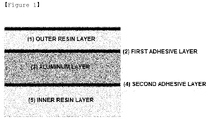
- a pouch film is generally formed in a predetermined layered structure having an order of an inner resin layer in direct contact with an electrolyte liquid, a second adhesive layer, an aluminum layer, a first adhesive layer and an outer resin layer in direct contact with the outside.
- a pouch-type secondary battery formed in the above-described structure may be damaged for various reasons under various circumstances.
- a protruding portion such as an electrode tap or an electrode lead causes damage such as cracks on the pouch inner layer, and the aluminum layer may be exposed due to such damage.
- the adhesive layer formed in a thin film form may be damaged by dropping, impact, pressure, compression or the like, and through the damaged part, the aluminum layer is exposed to an electrolyte liquid or the like.
- the aluminum layer exposed to an electrolyte liquid as above may be corroded as the electrolyte liquid penetrated or diffused into the battery causes a chemical reaction with oxygen or moisture, which leads to a problem of generating a corrosive gas and thereby causing swelling that expands inside the battery.
- LiPF 6 may react with water and oxygen to generate hydrofluoric acid (HF), a corrosive gas.
- HF hydrofluoric acid
- Such hydrofluoric acid may react with aluminum to cause a rapid exothermic reaction, and, as a secondary reaction, is adsorbed on the aluminum surface and penetrates into the system. This increases brittleness of the system resulting in cracks in the pouch film even with micro impact, and herein, lithium and the atmosphere may react due to electrolyte liquid leakage causing ignition.
- Patent Document 1 Korean Laid-open Patent Publication No. 10-2001-7010231 (November 15, 2001 ) "Packaging Material for Polymer Cell and Method for Producing the Same"
- the present invention has been made in view of the above, and is directed to providing an aluminum pouch film for a secondary battery maintaining excellent chemical resistance, heat resistance, salt resistance and electrolyte liquid resistance that the pouch film even when the secondary battery is used under environments of high temperature, high salt, high humidity and ultraviolet rays, and a method for producing the same.
- an aluminum pouch film for a secondary battery including an aluminum layer, an outer resin layer formed on a first surface of the aluminum layer, a first adhesive layer bonding the aluminum layer and the outer resin layer, an inner resin layer formed on a second surface of the aluminum layer, and a second adhesive layer bonding the aluminum layer and the inner resin layer, wherein the outer resin layer includes a polyimide.
- an inner direction surface of the outer resin layer has a contact angle of 60 degrees or less.
- the outer resin layer has O 1S /C 1S , which is determined by X-ray photoelectron spectroscopy, of 1.0 to 3.5.
- a method for producing an aluminum pouch film for a secondary battery including a) preparing an aluminum layer, b) preparing an outer resin layer, c) bonding the outer resin layer to a first surface of the aluminum layer, and d) bonding the inner resin layer on a second surface of the aluminum layer.
- the step b) is an etching step of spraying an etching solution on an inner direction surface of the outer resin layer using a spray method.
- immersing the outer resin layer into water is further included after the step b) .
- the etching solution is a solution obtained by mixing any one strong acid of hydrochloric acid (HCl), sulfuric acid (H 2 SO 4 ) and nitric acid (HNO 3 ) with water.
- HCl hydrochloric acid
- SO 4 sulfuric acid
- HNO 3 nitric acid
- an aluminum pouch film for a secondary battery is capable of preventing a chemical reaction occurring when an aluminum layer is brought into contact with water including an electrolyte liquid or salt, and deformation of the pouch film occurring when exposed to stressful environments such as high temperature and ultraviolet rays, and accordingly, risks of expansion inside a battery due to generating a gas inside the battery or explosion by a high temperature can be reduced.
- micro-crack occurrences are prevented, which is preferred for increasing battery sizes for mass production of large capacity batteries used in electric vehicles, marine electric ships and the like, and safety for battery environments can be enhanced.
- FIG. 1 illustrates a structure of an aluminum pouch film for a secondary battery according to a preferred embodiment of the present invention.
- Embodiments provided according to the present invention may all be accomplished by the following descriptions.
- the following descriptions need to be understood as describing preferred embodiments of the present invention, and it is to be understood that the present invention is not necessarily limited thereto.
- the present invention provides an aluminum pouch film for a secondary battery, the film including an aluminum layer, an outer resin layer formed on a first surface of the aluminum layer, a first adhesive layer bonding the aluminum layer and the outer resin layer, an inner resin layer formed on a second surface of the aluminum layer, and a second adhesive layer bonding the aluminum layer and the inner resin layer, wherein the outer resin layer includes a polyimide.
- aluminum or an aluminum alloy is suitable as a material of a metal thin film used as a barrier layer for preventing penetration of oxygen, moisture or the like from the outside.
- the aluminum alloy an alloy obtained by adding various metals and non-metals to pure aluminum or a stainless alloy may be used.
- soft aluminum foil may be preferably used, and more preferably, iron-containing aluminum foil is used to provide formability to aluminum foil.
- the aluminum foil series with high purity has excellent processability, and therefore, aluminum alloy foil in No. 1000 series or No. 8000 series is preferred.
- the aluminum base may optionally be an alloy including an atom selected from the group consisting of silicon, boron, germanium, arsenic, antimony, copper, magnesium, manganese, zinc, lithium, iron, chromium, vanadium, titanium, bismuth, potassium, tin, lead, zirconium, nickel, cobalt and combinations thereof.
- the iron may be included preferably in 0.1% by mass to 9.0% by mass and more preferably in 0.5% by mass to 2.0% by mass with respect to 100 of the total aluminum foil mass. When the iron content is less than 0.1% by mass in the aluminum foil, softness of the aluminum layer decreases, and the iron content exceeding 9.0% by mass causes a problem of declining formability.
- the aluminum foil used in the aluminum layer may have the surface etched or degreased in order to enhance adhesiveness with the inner resin layer, however, the treatment may be skipped to reduce the process speed.
- the aluminum layer is for preventing penetration of gas and water vapor into a battery from the outside, and the aluminum thin film is required to have no pin holes and processing suitability (pouching, emboss forming).
- the thickness is preferably from 10 pm to 100 ⁇ m, and is more preferably from 30 ⁇ m to 50 ⁇ m considering processability, oxygen and moisture barrier properties, and the like. Failing to satisfy the above-mentioned range has problems in that the aluminum layer is readily torn and has reduced electrolytic resistance and insulating properties when the thickness is less than 10 ⁇ m, and formability is reduced when the thickness exceeds 50 ⁇ m.
- the outer resin layer corresponds to a portion in direct contact with hardware, and therefore, is preferably a resin having insulating properties.
- a resin used as the outer resin layer polyester resins such as polyethylene terephthalate, polybutylene terephthalate, polyethylene naphthalate, polybutylene naphthalate, copolymerized polyester and polycarbonate may be used, or polyamide resins or polyimide resins may be used.
- polyimide resins may be used.
- polyester resin may include polyethylene terephthalate (PET), polybutylene terephthalate (PBT), polyethylene naphthalate (PEN), polybutylene naphthalate (PBN), copolymerized polyester, polycarbonate (PC) and the like.
- PET polyethylene terephthalate
- PBT polybutylene terephthalate
- PEN polyethylene naphthalate
- PBN polybutylene naphthalate
- copolymerized polyester polycarbonate
- PC polycarbonate
- polyester may include polyethylene terephthalate, polybutylene terephthalate, polyethylene naphthalate, polybutylene naphthalate, polyethylene isophthalate, polycarbonate, copolymerized polyester employing ethylene terephthalate as a repeating unit subject, copolymerized polyester employing butylene terephthalate as a repeating unit subject and the like.
- copolymerized polyester employing ethylene terephthalate as a repeating unit subject may include copolymer polyester polymerized with ethylene isophthalate employing ethylene terephthalate as a repeating unit subject, polyethylene (terephthalate/isophthalate), polyethylene (terephthalate/adipate), polyethylene (terephthalate/sodium sulfoisophthalate), polyethylene (terephthalate/sodium isophthalate), polyethylene (terephthalate/phenyl-dicarboxylate), polyethylene (terephthalate/decane dicarboxylate) and the like.
- examples of the copolymerized polyester employing butylene terephthalate as a repeating unit subject may include copolymer polyester polymerized with butylene isophthalate employing butylene terephthalate as a repeating unit subject, polybutylene (terephthalate/adipate), polybutylene (terephthalate/sebacate), polybutylene (terephthalate/decane dicarboxylate), polybutylene naphthalate and the like. These polymers may be used either alone as one type, or as a combination of two or more types.
- polyamide resin may include aliphatic-based polyamides such as nylon 6, nylon 66, nylon 610, nylon 12, nylon 46, and a copolymer of nylon 6 and nylon 66; aromatic group-including polyamides such as hexamethylenediamine-isophthalic acid-terephthalic acid copolymerized polyamide such as nylon 61, nylon 6T, nylon 6IT and nylon 6I6T (I represents isophthalic acid, and T represents terephthalic acid) including structural units derived from terephthalic acid and/or isophthalic acid, and polymeta-xylene adipamide (MXD6); alicyclic-based polyamides such as polyaminomethylcyclohexyl adipamide (PACM6); or polyamides copolymerizing a lactam component and an isocyanate component such as 4,4'-diphenylmethane-diisocyanate, polyesteramide copolymers or polyetheresteramide copolymers, which
- the nylon film is mainly used as a packaging film by having excellent heat resistance, cold resistance and mechanical strength as well as having excellent disruptive strength, pin-hole resistance, gas barrier properties and the like.
- Specific examples of the nylon film may include polyamide resins, that is, nylon 6, nylon 66, a copolymer of nylon 6 and nylon 66, nylon 610, polymeta-xylene adipamide (MXD6) and the like.
- the laminated outer resin layer preferably has a thickness of 10 ⁇ m to 30 ⁇ m or greater, and particularly preferably has a thickness of 12 ⁇ m to 25 ⁇ m. Failing to satisfy the above-mentioned range has problems in that the outer resin layer is readily torn due to declined physical properties when the thickness is less than 10 ⁇ m, and formability is reduced when the thickness exceeds 30 ⁇ m.
- a polyimide film may be preferably used as a packaging film of a secondary battery.
- Polyimide is classified as a general-purpose engineering plastic, and has excellent heat resistance, insulating properties, flexibility and non-flammability with no changes in the properties in a wide range of temperatures from 273 degrees below zero to 400 degrees above zero. Due to such properties, polyimide is used as a material in various fields such as space suits, mobile phone ⁇ fuel cell cases, display and military devices, and the like.
- the polyimide film used as the outer resin layer may be prepared after going through surface treatment through etching before lamination.
- a solution obtained by mixing any one strong acid of hydrochloric acid (HCl), sulfuric acid (H2SO4) and nitric acid (HNO3) with water may be used, and as the etching method, a method of immersing the polyimide film into the mixture solution for a certain period of time or spraying the mixture solution using a spray method is preferred, however, the method is not limited thereto.
- the spray method the mixture solution is sprayed on an inner direction surface of the polyimide resin, and then aged for a certain period of time at room temperature. After that, the polyimide film is rinse treated to remove residues, and then used as the outer resin layer.
- the inner direction surface of the outer resin layer may have a contact angle of 60 degrees of less, preferably 40 degrees of less, more preferably 20 degrees of less, and even more preferably 10 degrees of less.
- a contact angle of exceeding 60 degrees adhesive strength decreases under environments of moisture, salt, high heat, ultraviolet rays and the like causing a problem of making lamination on the aluminum layer difficult.
- the outer resin layer may have O 1S /C 1S , which is determined by X-ray photoelectron spectroscopy (XPS), of 1.0 to 3.5, preferably 2.3 to 3.5 and more preferably 2.8 to 3.5.
- O 1S /C 1S is determined by X-ray photoelectron spectroscopy (XPS)
- XPS X-ray photoelectron spectroscopy
- the imide bond in the polyimide is decomposed through hydrolysis, which may increase active sites capable of reacting and bonding with the first adhesive layer to describe later. Accordingly, adhesive strength between the outer resin layer of the present invention and the first adhesive layer may be enhanced.
- the first adhesive layer is a layer increasing adhesion between the outer resin layer-aluminum foil layer.
- the adhesive layer is formed by an adhesive resin capable of adhering a base layer and a metal layer.
- the adhesive resin used for forming the adhesive layer may be a two-component curable adhesive resin or a one-component curable adhesive resin.
- an adhesion mechanism of the adhesive resin used for forming the adhesive layer is not particularly limited as well, and any one of chemical reaction type, solvent volatilization type, heat melting type, heat pressure type and the like may be used.
- the resin component of the adhesive resin used for forming the adhesive layer may include polyester-based resins such as polyethylene terephthalate, polybutylene terephthalate, polyethylene naphthalate, polybutylene naphthalate, polyethylene isophthalate, polycarbonate and copolymerized polyester; polyether-based adhesives; polyurethane-based adhesives; epoxy-based resins; phenol resin-based resins; polyamide-based resins such as nylon 6, nylon 66, nylon 12 and copolymerized polyamide; polyolefin-based resins such as polyolefin, acid-modified polyolefin and metal-modified polyolefin; polyvinyl acetate-based resins; cellulose-based adhesives; (meth)acryl-based resins; polyimide-based resins; amino resins such as a urea resin and a melamine resin; rubber such as chloroprene rubber, nitrile rubber and styrene-butadiene
- the combination type of two or more types of the adhesive resin components is not particularly limited, and examples of the adhesive resin component may include a composite resin of polyamide and acid-modified polyolefin, a composite resin of polyamide and metal-modified polyolefin, polyamide and polyester, a composite resin of polyester and acid-modified polyolefin, a composite resin of polyester and metal-modified polyolefin, and the like.
- polyurethane-based two-component curable adhesive resins may be included in terms of having excellent malleability, durability or anti-restraint function under high humidity condition, or anti-deteriorating function during heat sealing, and effectively suppressing occurrences of delamination through suppressing a decrease in the lamination strength between the base layer and the metal layer.
- the first adhesive layer is a layer increasing adhesion between the base layer-aluminum foil layer.
- the first adhesive layer may be formed using known materials as an adhesive used for laminating a resin film and aluminum foil.
- the corresponding adhesive may include a main agent including a polyol such as polyester polyol, polyether polyol, acrylic polyol or carbonate polyol, and a polyurethane-based adhesive containing a curing agent including a difunctional or higher isocyanate compound.
- a polyurethane-based resin is formed by acting the curing agent on the main agent.
- a polyol may be included as the component of the adhesive.
- polyol compound used for the urethane-type adhesive may include polyester polyol, polyesterpolyurethane polyol, polyether polyol, polyetherpolyurethane polyol and the like. Hydroxyl group equivalents and weight average molecular weights of these polyol compounds are not particularly limited as long as the above-mentioned properties are satisfied finally in relation to the isocyanate-based compound to combine, and for example, the hydroxyl group equivalent (number/mol) may be from 0.5 to 2.5 and preferably from 0.7 to 1.9, and the weight average molecular weight may be from 500 to 120000 and preferably from 1000 to 80000.
- polyester polyol, polyesterpolyurethane polyol and polyetherpolyurethane polyol are preferably included. These polyol compounds may be used either alone as one type, or as a combination of two or more types.
- polyester polyol materials obtained by reacting at least one type of polybasic acid and at least one type of diol may be used.
- the polybasic acid may include dibasic acids such as aliphatic-based dibasic acids such as succinic acid, glutaric acid, adipic acid, pimelic acid, suberic acid, azelaic acid, sebacic acid, and brassylic acid, and aromatic-based dibasic acids such as isophthalic acid, terephthalic acid and naphthalene dicarboxylic acid, and the like.
- diol may include aliphatic-based diols such as ethylene glycol, propylene glycol, butanediol, neopentyl glycol, methyl pentanediol, hexanediol, heptanediol, octanediol, nonanediol, decanediol and dodecanediol, alicyclic-based diols such as cyclohexanediol and hydrogen-added xylylene glycol, and aromatic-based diols such as xylylene glycol, and the like.
- aliphatic-based diols such as ethylene glycol, propylene glycol, butanediol, neopentyl glycol, methyl pentanediol, hexanediol, heptanediol, octanedio
- polyester urethane polyols obtained by chain-extending hydroxyl groups at both ends of the polyester polyol using a single product of isocyanate compound, or an adduct product, a biuret product or an isocyanurate product including at least one type of isocyanate compound, and the like may be included.
- Examples of the isocyanate compound may include 2,4- or 2,6-tolylene diisocyanate, xylylene isocyanate, 4,4'-diphenylmethane diisocyanate, methylene diisocyanate, isopropylene diisocyanate, lysine diisocyanate, 2,2,4- or 2,4,4-trimethylhexamethylene diisocyanate, 1,6-hexamethylene diisocyanate, methylcyclohexane diisocyanate, isophorone diisocyanate, 4,4'-dicyclohexylmethane diisocyanate, isopropylidene dicyclohexyl-4,4'-diisocyanate and the like.
- copolymers having poly(meth)acrylic acid as a main component may be included.
- the corresponding copolymer may include materials obtained by copolymerizing, starting with hydroxyl group-containing monomers such as 2-hydroxyethyl (meth)acrylate and 2-hydroxypropyl (meth)acrylate, alkyl (meth)acrylate-based monomers in which the alkyl group is a methyl group, an ethyl group, an n-propyl group, an i-propyl group, an n-butyl group, an i-butyl group, a t-butyl group, a 2-ethylhexyl group or a cyclohexyl group; amide group-containing monomers such as (meth)acrylamide, N-alkyl (meth)acrylamide, N,N-dialkyl (meth)acrylamide (the alkyl group is a methyl group, an ethyl group, an
- carbonate polyol materials obtained by reacting a carbonate compound and diol may be used.
- carbonate compound dimethyl carbonate, diphenyl carbonate, ethylene carbonate and the like may be used.
- diol aliphatic diols such as ethylene glycol, propylene glycol, butanediol, neopentyl glycol, methylpentanediol, hexanediol, heptanediol, octanediol, nonanediol, decanediol and dodecanediol, alicyclic diols such as cyclohexanediol and hydrogen-added xylylene glycol, aromatic diols such as xylylene glycol, and the like may be used.
- polycarbonate urethane polyols obtained by chain-extending a hydroxyl group at the end of the carbonate polyol using the above-described isocyanate compound may be used.
- an isocyanate may be included as the component of the adhesive.
- Examples of the isocyanate-based compound used for the urethane-type adhesive may include polyisocyanate, adduct products thereof, isocyanurate modified products thereof, carbodiimide modified products thereof, allophanate modified products thereof, biuret modified products thereof and the like.
- polyisocyanate may include aromatic diisocyanates such as diphenylmethane diisocyanate (MDI), polyphenylmethanediisocyanate (polymeric MDI), toluenediisocyanate (TDI), hexamethylenediisocyanate (HDI), bis(4-isocyanatecyclohexyl)methane (H12MDI), isophoronediisocyanate (IPDI), 1,5-naphthalenediisocyanate (1,5-NDI), 3,3'-dimethyl-4,4'-diphenylenediisocyanate (TODI) and xylenediisocyanate (XDI); aliphatic diisocyanates such as trimethylene diisocyanate, hexamethylene diisocyanate, trimethylhexamethylene diisocyanate and isophorone diisocyanate; alicyclic diisocyanates such as 4,4'-methylenebis(cyclocyanate
- the adduct product may include those obtained by adding trimethylolpropane, glycol or the like to the polyisocyanate.
- isocyanate-based compounds preferably polyisocyanate and adduct products thereof; more preferably aromatic diisocyanate, adduct products thereof and isocyanurate modified products thereof; even more preferably MDI, polymeric MDI, TDI, adduct products thereof and isocyanurate modified products thereof; and particularly preferably adduct products of MDI, adduct products of TDI, polymeric MDI, and isocyanurate modified products of TDI may be included.
- isocyanate-based compounds may be used either alone as one type, or as a combination of two or more types.
- types of the isocyanate compounds used as a chain extender may be used, and, although repeating, single products of isocyanate compounds selected from among 2,4- or 2,6-tolylene diisocyanate, xylylene isocyanate, 4,4'-diphenylmethane diisocyanate, methylene diisocyanate, isopropylene diisocyanate, lysine diisocyanate, 2,2,4- or 2,4,4-trimethylhexamethylene diisocyanate, 1,6-hexamethylene diisocyanate, methylcyclohexane diisocyanate, isophorone diisocyanate, 4,4'-dicyclohexylmethane diisocyanate and isopropylidene dicyclohexyl-4,4'-diisocyanate, or adduct products, biuret products, isocyanurate products including at least one type of
- the mixed amount of the curing agent 1 part by mass to 100 parts by mass is preferred with respect to 100 parts by mass of the main agent, and 5 parts by mass to 50 parts by mass is more preferred.
- the content being less than 1 parts by mass may lead to concern of not achieving performance in terms of adhesion or electrolyte liquid resistance.
- an excess isocyanate group is present, which may affect adhesive film quality by the remaining of unreacted materials, or hardness.
- a carbodiimide compound, an oxazoline compound, an epoxy compound, a phosphorous compound, a silane coupling agent and the like may be mixed to the polyurethane-based adhesive.
- carbodiimide compound may include N,N'-di-o-toluyl carbodiimide, N,N'-diphenyl carbodiimide, N,N'-di-2,6-dimethylphenyl carbodiimide, N,N'-bis(2,6-diisopropylphenyl)carbodiimide, N,N'-dioctyldecyl carbodiimide, N-triyl-N'-cyclohexyl carbodiimide, N,N'-di-2,2-di-t-butylphenyl carbodiimide, N-triyl-N'-phenyl carbodiimide, N,N'-di-p-nitrophenyl carbodiimide, N,N'-di-p-aminophenyl carbodiimide, N,N'-di-p-hydroxyphenyl carbodiimide, N,N'-di-di
- oxazoline compound may include monooxazoline compounds such as 2-oxazoline, 2-methyl-2-oxazoline, 2-phenyl-2-oxazoline, 2,5-dimethyl-2-oxazoline and 2,4-diphenyl-2-oxazoline, and dioxazoline compounds such as 2,2'-(1,3-phenylene)-bis(2-oxazoline), 2,2'-(1,2-ethylene)-bis(2-oxazoline), 2,2'-(1,4-butylene)-bis(2-oxazoline) and 2,2'-(1,4-phenylene)-bis(2-oxazoline) .
- monooxazoline compounds such as 2-oxazoline, 2-methyl-2-oxazoline, 2-phenyl-2-oxazoline, 2,5-dimethyl-2-oxazoline and 2,4-diphenyl-2-oxazoline
- dioxazoline compounds such as 2,2'-(1,3-phenylene)-bis(2-oxazoline
- the epoxy compound may include diglycidyl ether of aliphatic diol such as 1,6-hexanediol, neopentyl glycol and polyalkylene glycol; polyglycidyl ether of aliphatic polyol such as sorbitol, sorbitan, polyglycerol, pentaerythritol, diglycerol, glycerol and trimethylolpropane; polyglycidyl ether of alicyclic polyol such as cyclohexane dimethanol; diglycidyl ester or polyglycidyl ester of aliphatic or aromatic polycarboxylic acid such as terephthalic acid, isophthalic acid, naphthalene dicarboxylic acid, trimellitic acid, adipic acid and sebacic acid; diglycidyl ether or polyglycidyl ether of polyphenol such as resorcinol, bis-(p-hydroxyphenyl,
- Examples of the phosphorous-based compound may include tris(2,4-di-t-butylphenyl)phosphite, tetrakis(2,4-di-t-butylphenyl)-4,4'-biphenylene phosphonite, bis(2,4-di-t-butylphenyl)pentaerythritol-di-phosphite, bis(2,6-di-t-butyl-4-methylphenyl)pentaerythritol-di-phosphite, 2,2-methylenebis(4,6-di-t-butylphenyl)octyl phosphite, 4,4'-butylidene-bis(3-methyl-6-t-butylphenyl-ditridecyl)phosphite, 1,1,3-tris(2-methyl-4-ditridecyl phosphite-5-t-butyl-phenyl
- silane coupling agent may include various silane coupling agents such as vinyltriethoxysilane, vinyltris( ⁇ -methoxyethoxy)silane, ⁇ -methacryloxypropyltrimethoxysilane, vinyltriacetoxysilane, ⁇ -glycidoxypropyltrimethoxysilane, ⁇ -glycidoxypropyltriethoxysilane, ⁇ -(3,4-epoxycyclohexyl)ethyltrimethoxysilane, ⁇ -chloropropylmethoxysilane, vinyltrichlorosilane, ⁇ -mercaptopropyl trimethoxysilane, ⁇ -aminopropyltriethoxysilane and N- ⁇ (aminoethyl)- ⁇ -aminopropyltrimethoxysilane.
- silane coupling agents such as vinyltriethoxysilane, vinyltris( ⁇ -methoxyethoxy)si
- the adhesive used for forming the adhesive layer satisfying properties of a packaging film for a secondary battery of the present invention may preferably include urethane-type adhesives including at least one type of polyol compound selected from the group consisting of polyester polyol, polyesterpolyurethane polyol, polyether polyol and polyetherpolyurethane polyol, and at least one type of isocyanate-based compound selected from the group consisting of aromatic diisocyanate, adduct products thereof and isocyanurate modified products thereof; more preferably include urethane-type adhesives including at least one type of polyol compound selected from the group consisting of polyester polyol, polyesterpolyurethane polyol, polyether polyol and polyetherpolyurethane polyol, and at least one type of isocyanate-based compound selected from the group consisting of MDI, polymeric MDI, TDI, adduct products thereof and isocyanurate modified products thereof.
- urethane-type adhesives including at least one type of
- a ratio thereof is properly set depending on the properties to be provided in the adhesive layer, and for example, the ratio of the isocyanate group of the isocyanate-based compound per 1 mole of the hydroxyl group of the polyol compound may be from 1 mole to 30 moles, and preferably from 3 moles to 20 moles.
- the first adhesive layer preferably has a thickness of 2 ⁇ m to 10 ⁇ m and more preferably 3 ⁇ m to 5 ⁇ m considering adhesiveness with the outer resin layer and thickness after forming. Failing to satisfy the above-mentioned range may cause problems in that adhesiveness decreases when the thickness is less than 2 ⁇ m, and cracks may occur when the thickness exceeds 10 ⁇ m.
- polyolefins such as polyethylene (PE) or polypropylene (PP), or copolymers thereof may be used as the inner resin layer.
- the inner resin layer is not particularly limited thereto, and is formed with a resin layer selected from the group consisting of, in addition to the polyolefin-based such as polyethylene, polypropylene and polybutylene, ethylene copolymers, propylene copolymers, polyester-based, polyamide-based, polycarbonate-based, fluorine-based, silicone-based, acryl-based, ethylene-propylene-diene-monomer rubber (EPDM) and mixtures thereof.
- a polyolefin-based resin layer or a composite resin layer of polybutadiene and polyolefin may be used.
- polystyrene resin examples include polyethylene such as low-density polyethylene, medium-density polyethylene, high-density polyethylene or linear low-density polyethylene; polypropylene such as homopolypropylene, block copolymers of polypropylene (for example, block copolymer of propylene and ethylene) and random copolymers of polypropylene (for example, random copolymer of propylene and ethylene); a ternary copolymer of ethylene-butene-propylene; and the like.
- polyethylene and polypropylene are preferably included.
- a polyolefin such as polyethylene or polypropylene or a copolymer thereof in the inner resin layer is preferred since processability such as lamination is favorable as well as having properties required as a packaging material for a secondary battery such as favorable heat sealing properties, moisture-proof properties and heat resistance.
- the thickness of the polymer layer of the inner resin layer is preferably from 20 ⁇ m to 100 ⁇ m and more preferably from 30 ⁇ m to 80 ⁇ m considering formability, insulating properties, electrolyte liquid resistance and the like. Failing to satisfy the above-mentioned range may cause problems of reducing formability, insulating properties and electrolyte liquid resistance.
- the second adhesive layer is a layer increasing adhesion between the inner resin layer-aluminum foil layer.
- polyurethane, acid-modified polyolefin resin, epoxy or the like may be used as the second adhesive layer.
- Specific examples of the second adhesive may include maleic anhydride polypropylene (MAHPP) and the like.
- heat-adhesive olefin-based resin may include polyethylene, an ethylene- ⁇ -olefin copolymer, an ethylene-acrylic acid copolymer, an ethylene-methacrylic acid copolymer, an ethylene-acrylic acid ester copolymer, an ethylene-methacrylic acid ester copolymer, an ethylene- vinyl acetate copolymer, ionomers, polypropylene, maleic anhydride-modified polypropylene, an ethylene-propylene copolymer, a propylene-1-butene-ethylene copolymer and the like, and may preferably include one or more types of olefin-based resins selected from the group consisting of polypropylene, an ethylene-propylene copolymer and a propylene-1-butene-ethylene copolymer.
- the acid-modified polyolefin used for forming the second adhesive layer is a polymer modified by graft polymerizing polyolefin with unsaturated carboxylic acid.
- Specific examples of the acid-modified polyolefin may include polyethylene such as low-density polyethylene, medium-density polyethylene, high-density polyethylene or linear low-density polyethylene; crystalline or amorphous polypropylene such as homopolypropylene, block copolymers of polypropylene (for example, block copolymer of propylene and ethylene) and random copolymers of polypropylene (for example, random copolymer of propylene and ethylene); a ternary copolymer of ethylene-butene-propylene, and the like.
- polyolefins having at least propylene as a forming monomer are preferably included, and a ternary copolymer of ethylene-butene-propylene and a random copolymer of propylene-ethylene may be more preferably included in terms of heat resistance.
- the unsaturated carboxylic acid used for modification may include maleic acid, acrylic acid, itaconic acid, crotonic acid, maleic anhydride, itaconic anhydride and the like.
- maleic acid and maleic anhydride are preferably included.
- the acid-modified polyolefin may be used either alone as one type, or as a combination of two or more types.
- the second adhesive layer preferably has a thickness of 2 ⁇ m to 10 ⁇ m and more preferably 3 ⁇ m to 5 ⁇ m considering adhesiveness with the inner resin layer and thickness after forming. Failing to satisfy the above-mentioned range may cause problems in that adhesiveness decreases when the thickness is less than 2 ⁇ m, and cracks may occur when the thickness exceeds 5 ⁇ m.
- the method is not particularly limited, however, a dry lamination method, a heat lamination method or an extrusion lamination method may be preferably used for the lamination.
- the present invention provides a method for producing an aluminum pouch film for a secondary battery, the method including a) preparing an aluminum layer, b) preparing an outer resin layer, c) bonding the outer resin layer to a first surface of the aluminum layer and d) bonding the inner resin layer to a second surface of the aluminum layer.
- soft aluminum foil may be preferably used, and aluminum foil including iron may be more preferably used in order to further provide pin-hole resistance and softness during cold forming.
- the iron may be preferably included in 0.1% by mass to 9.0% by mass and more preferably included in 0.5% by mass to 2.0% by mass with respect to 100% by mass of the whole aluminum foil.
- the iron content is less than 0.1% by mass with respect to 100% by mass of the whole aluminum foil, softness of the aluminum layer decreases, and including the iron exceeding 9.0% by mass has a problem of reducing formability.
- the thickness of the aluminum layer is preferably from 10 ⁇ m to 100 ⁇ m and more preferably from 30 ⁇ m to 50 ⁇ m considering pin-hole resistance, processability, oxygen and moisture barrier properties, and the like. Failing to satisfy the above-mentioned range may cause problems in that the aluminum layer is readily torn and electrolyte liquid resistance and insulating properties decline when the thickness is less than 10 ⁇ m, and formability becomes poor when the thickness exceeds 100 ⁇ m.
- untreated aluminum foil may be used, however, using degreased aluminum foil is more preferred in terms of providing electrolysis liquid resistance, electrolyte liquid resistance and the like.
- degreasing treatment method a wet-type or dry-type treatment method may be included.
- Examples of the wet-type degreasing treatment may include acid degreasing or alkali degreasing.
- Examples of the acid used in the acid decreasing may include inorganic acids such as sulfuric acid, acetic acid, phosphoric acid and hydrofluoric acid, and the acid may be used either alone as one type, or as a combination of two or more types.
- various metal salts may be mixed thereto in order to enhance an etching effect of the aluminum foil.
- Examples of the alkali used in the alkali degreasing may include strong alkalis such as sodium hydroxide, and a weak alkali type or a surfactant may also be mixed thereto.
- Examples of the dry-type degreasing treatment may include a method of degreasing using a process of annealing aluminum at a high temperature.
- the outer resin layer corresponds to a portion in direct contact with hardware, and therefore, is preferably a resin having insulating properties. Accordingly, as a resin used as the outer resin layer, polyester resins such as polyethylene terephthalate, polybutylene terephthalate, polyethylene naphthalate, polybutylene naphthalate, copolymerized polyester and polycarbonate may be used, or polyamide resins or polyimide resins may be used. Preferably, polyimide resins may be used.
- a polyimide film may be preferably used as a packaging film of a secondary battery.
- Polyimide is classified as a general-purpose engineering plastic, and has excellent heat resistance, insulating properties, flexibility and non-flammability with no changes in the properties in a wide range of temperatures from 273 degrees below zero to 400 degrees above zero. Due to such properties, polyimide is used as a material in various fields such as space suits, mobile phone ⁇ fuel cell cases, display and military devices, and the like.
- the b) preparing of an outer resin layer may be an etching step of spraying an etching solution on an inner direction surface of the outer resin layer using a spray method.
- the etching solution may be a solution obtained by mixing any one strong acid of hydrochloric acid (HCl), sulfuric acid (H 2 SO 4 ) and nitric acid (HNO 3 ) with water.
- the polyimide film used as the outer resin layer may be prepared after going through surface treatment through etching before lamination.
- a solution obtained by mixing any one strong acid of hydrochloric acid (HCl), sulfuric acid (H 2 SO 4 ) and nitric acid (HNO 3 ) with water may be used, and as the etching method, a method of immersing the polyimide film into the mixture solution for a certain period of time or spraying the mixture solution using a spray method is preferred, however, the method is not limited thereto.
- the spray method the mixture solution is sprayed on an inner direction surface of the polyimide resin, and then aged for a certain period of time at room temperature. After that, the polyimide film is rinse treated to remove residues, and then used as the outer resin layer.
- the inner direction surface of the outer resin layer may have a contact angle of 60 degrees of less, preferably 40 degrees of less, more preferably 20 degrees of less, and even more preferably 10 degrees of less.
- a contact angle of exceeding 60 degrees adhesive strength decreases under environments of moisture, salt, high heat, ultraviolet rays and the like causing a problem of making lamination on the aluminum layer difficult.
- immersing the outer resin layer into water may be further included.
- the imide bond in the polyimide included in the outer resin layer is hydrolyzed, and active sites may be formed.
- active sites capable of reacting and bonding with the first adhesive layer increase, and this may be identified through an increase in the O 1S /C 1S measurement value obtained by X-ray photoelectron spectroscopy (XPS).
- a first adhesive layer is coated on the aluminum layer prepared in the step a).
- the thickness of the coated first adhesive layer is preferably from 2 ⁇ m to 10 ⁇ m and more preferably from 3 ⁇ m to 5 ⁇ m considering adhesiveness with the outer resin layer and thickness after forming. Failing to satisfy the above-mentioned range may cause problems in that adhesiveness decreases when the thickness is less than 2 ⁇ m, and cracks may occur when the thickness exceeds 10 ⁇ m.
- the outer resin layer prepared in the step b) is laminated using a dry lamination method or an extrusion lamination method to form the outer resin layer.
- the laminated outer resin layer preferably has a thickness of 10 ⁇ m to 30 ⁇ m or greater, and particularly preferably has a thickness of 12 ⁇ m to 25 ⁇ m. Failing to satisfy the above-mentioned range has problems in that the outer resin layer is readily torn due to declined physical properties when the thickness is less than 10 ⁇ m, and formability is reduced when the thickness exceeds 30 ⁇ m.
- a drying lamination method or an extrusion lamination method may be, although not particularly limited thereto, preferably used to laminate the outer resin layer.
- polyurethane, acid-modified polyolefin resin, epoxy or the like may be used as a second adhesive layer bonding the aluminum layer and the inner resin layer, and as specific examples thereof, maleic anhydride polypropylene (MAHPP) or the like may be used.
- MAHPP maleic anhydride polypropylene
- the thickness of the second adhesive layer is preferably from 2 ⁇ m to 30 ⁇ m and more preferably from 3 ⁇ m to 15 ⁇ m considering adhesiveness with the inner resin layer and thickness after forming. Failing to satisfy the above-mentioned range may cause problems in that adhesiveness decreases when the thickness is less than 2 ⁇ m, and cracks may occur when the thickness exceeds 30 ⁇ m.
- a drying lamination method or an extrusion lamination method may be, although not particularly limited thereto, preferably used to laminate the inner resin layer.
- a hydrochloric acid solution having a molar concentration of the following Table 1 was sprayed on an inner direction surface of a polyimide film (product of SKC Kolon PI, Inc.) having a thickness of 25 ⁇ m using a spray method in order to conduct an etching process on Preparation Examples 1 to 9.
- the polyimide resin was aged for 1 hour at room temperature to prepare outer resin layers of Preparation Examples 6 to 9.
- Preparation Examples 1 to 5 completed with the aging were each immersed into water (distilled water). The time of immersion into water varied as in the following Table 1 to prepare outer resin layers of Preparation Examples 1 to 5 to be finally used as an outer resin layer.
- Table 1 Molar Concentration of Hydrochloric Acid Solution (M) Water Immersion Treatment Time of Water Immersion Treatment (min) Preparation Example 1 5 0 2 Preparation Example 2 5 0 4 Preparation Example 3 5 0 6 Preparation Example 4 5 0 8 Preparation Example 5 5 0 10 Preparation Example 6 1.5 X - Preparation Example 7 2.5 X - Preparation Example 8 4 X - Preparation Example 9 5 X - Preparation Example 10 - X -
- a maleic anhydride-modified polyolefin adhesive product of HICHEM Co., Ltd.
- cast polypropylene product of Lotte Chemical (former Homan Petrochemical) having a thickness of 40 ⁇ m was laminated on the aluminum using a dry lamination method to prepare pouch films of Examples 1 to 5.
- Pouch films of Comparative Examples 1 to 4 were prepared by conducing all processes in the same manner under the same condition as in Examples 1 to 5 except that Preparation Examples 6 to 9 that did not go through the water immersion treatment were used as the outer resin layer instead of Preparation Examples 1 to 5.
- a pouch film of Comparative Example 5 was prepared by conducing all processes in the same manner under the same condition as in Examples 1 to 5 except that Preparation Example 10 that did not use the spray-type etching was used as the outer resin layer instead of Preparation Examples 1 to 5.
- a contact angle was measured using a contact angle measurement device (drop shape analyzer (DSA 100)).
- a polyimide outer resin layer specimen of each of Preparation Examples 1 to 10 having a size of 100 mmx100 mm was placed on a flat plate so that the inner direction surface is visible, and a small amount of distilled water was dropped thereon using a syringe cylinder to be placed in a drop form.
- a camera lens was placed perpendicular to the surface of the polyimide resin, and a contact angle formed between the inner direction surface of the polyimide resin and the liquid drop was measured three times repeatedly, and the average value is shown as in Table 3.
- O 1s /C 1s was measured by X-ray photoelectron spectroscopy (XPS, Quantum 2000 (Physical Electronics)), and the results are shown as in the following Table 5.
- XPS X-ray photoelectron spectroscopy
- Table 5 O 1S /C 1S Preparation Example 1 1.45 Preparation Example 2 2.1 Preparation Example 3 2.45 Preparation Example 4 2.7 Preparation Example 5 2.9
Landscapes
- Chemical & Material Sciences (AREA)
- Chemical Kinetics & Catalysis (AREA)
- Electrochemistry (AREA)
- General Chemical & Material Sciences (AREA)
- Engineering & Computer Science (AREA)
- Mechanical Engineering (AREA)
- Physics & Mathematics (AREA)
- Fluid Mechanics (AREA)
- Sealing Battery Cases Or Jackets (AREA)
Abstract
Description
- This application claims the benefits of priority based on
Korean Patent Application No. 10-2019-0095785 filed on August 6, 2019 - The present invention relates to an aluminum pouch film for a secondary battery, and a method for producing the same, and more particularly, to an aluminum pouch film for a secondary battery having significantly improved chemical resistance, heat resistance and electrolyte liquid resistance compared to packaging films used in the art, and a method for producing the same.
- A secondary battery, an electrochemical device recently used for supplying power to various electronic and electrical products, normally refers to a lithium secondary battery, and means a battery having a polymer electrolyte and generating a current through lithium ion migration. As a packaging exterior material used for protecting such a secondary battery, a pouch film in which polymer and metal are laminated is used. Such a pouch film for a secondary battery has a form having an aluminum thin film provided in between in order to protect a battery cell formed with an electrode assembly and an electrolyte liquid filled therein by a subsequent process, and to stably maintain electrochemical properties and the like of the cell, and in order to protect the battery cell from external impact, a polyethylene terephthalate (PET) resin, a nylon film or the like is formed on the aluminum thin film as an outer resin layer.
- In the pouch film, an upper pouch film and a lower pouch film are bonded on the outer peripheral surface by thermal bonding or the like, and between a lower surface of the upper pouch film and an upper surface of the lower pouch film, an adhesive layer made of a thermoplastic polyolefin such as polyethylene (PE) or polypropylene (PP) or a copolymer thereof is formed.
- A pouch film is generally formed in a predetermined layered structure having an order of an inner resin layer in direct contact with an electrolyte liquid, a second adhesive layer, an aluminum layer, a first adhesive layer and an outer resin layer in direct contact with the outside.
- A pouch-type secondary battery formed in the above-described structure may be damaged for various reasons under various circumstances. For example, in the process of storing the electrode assembly inside the pouch, a protruding portion such as an electrode tap or an electrode lead causes damage such as cracks on the pouch inner layer, and the aluminum layer may be exposed due to such damage.
- In addition, heat is applied from the outside when heat sealing the pouch film, and by this heat, pin-holes are generated or damage is caused resulting in cracks on the inner adhesive layer, and the aluminum layer may be exposed to an electrolyte liquid or the like.
- In addition to the above-described reasons, the adhesive layer formed in a thin film form may be damaged by dropping, impact, pressure, compression or the like, and through the damaged part, the aluminum layer is exposed to an electrolyte liquid or the like.
- The aluminum layer exposed to an electrolyte liquid as above may be corroded as the electrolyte liquid penetrated or diffused into the battery causes a chemical reaction with oxygen or moisture, which leads to a problem of generating a corrosive gas and thereby causing swelling that expands inside the battery.
- More specifically, LiPF6 may react with water and oxygen to generate hydrofluoric acid (HF), a corrosive gas. Such hydrofluoric acid may react with aluminum to cause a rapid exothermic reaction, and, as a secondary reaction, is adsorbed on the aluminum surface and penetrates into the system. This increases brittleness of the system resulting in cracks in the pouch film even with micro impact, and herein, lithium and the atmosphere may react due to electrolyte liquid leakage causing ignition.
- Accordingly, various aluminum surface modification techniques have been studied to prevent contact with aluminum in the center part even when corrosive hydrofluoric acid is generated as above. As the aluminum surface modification technique, heat treatment, or other conversion treatments, sol-gel coating, primer treatment, treatments with corona, plasma or the like may be included.
- However, with the recent trend of gradual increases in the capacity of secondary batteries, aluminum surface modification alone has limits in resolving such problems, and needs for an aluminum pouch film for a secondary battery having excellent chemical resistance, durability, electrolyte liquid resistance and formability have been consistently emerging.
- In addition, as the scope of applications for secondary batteries expands to shipbuilding industry, aviation industry and the like as well as electric vehicle industry, on which studies have been conducted for some time, research and development for using high-capacity secondary batteries has been actively conducted.
- However, weak chemical resistance and electrolyte liquid resistance have been raised as problems to use a nylon film vulnerable to harsh environments such as high temperature, high salt, high humidity and ultraviolet rays in a pouch film of a high-capacity secondary battery as an outer resin layer. For example, when exposed to moisture including high salt due to cracks in a pouch film, there have been problems such as decline in properties of the nylon film, generation of corrosive gases, or possibility of aluminum in the inner center part, and salt and moisture being brought into contact with each other and reacting.
- Accordingly, a method of laminating a polyimide film having excellent chemical resistance and heat resistance as an outer resin layer instead of an existing nylon film has been proposed, however, there has been a problem of decreased adhesive strength when laminating a polyimide film as an outer resin layer. In order to overcome such a problem, studies on a method of laminating a polyimide film on an aluminum layer without decreasing adhesive strength under conditions of high temperature, high salt, high humidity and ultraviolet rays have been required.
- (Patent Document 1)
Korean Laid-open Patent Publication No. 10-2001-7010231 (November 15, 2001 - The present invention has been made in view of the above, and is directed to providing an aluminum pouch film for a secondary battery maintaining excellent chemical resistance, heat resistance, salt resistance and electrolyte liquid resistance that the pouch film even when the secondary battery is used under environments of high temperature, high salt, high humidity and ultraviolet rays, and a method for producing the same.
- According to a first aspect of the present invention, there is provided an aluminum pouch film for a secondary battery, the aluminum pouch film including an aluminum layer, an outer resin layer formed on a first surface of the aluminum layer, a first adhesive layer bonding the aluminum layer and the outer resin layer, an inner resin layer formed on a second surface of the aluminum layer, and a second adhesive layer bonding the aluminum layer and the inner resin layer, wherein the outer resin layer includes a polyimide.
- In one embodiment of the present invention, an inner direction surface of the outer resin layer has a contact angle of 60 degrees or less.
- In one embodiment of the present invention, the outer resin layer has O1S/C1S, which is determined by X-ray photoelectron spectroscopy, of 1.0 to 3.5.
- According to a second aspect of the present invention, there is provided a method for producing an aluminum pouch film for a secondary battery, the method including a) preparing an aluminum layer, b) preparing an outer resin layer, c) bonding the outer resin layer to a first surface of the aluminum layer, and d) bonding the inner resin layer on a second surface of the aluminum layer.
- In one embodiment of the present invention, the step b) is an etching step of spraying an etching solution on an inner direction surface of the outer resin layer using a spray method.
- In one embodiment of the present invention, immersing the outer resin layer into water is further included after the step b) .
- In one embodiment of the present invention, the etching solution is a solution obtained by mixing any one strong acid of hydrochloric acid (HCl), sulfuric acid (H2SO4) and nitric acid (HNO3) with water.
- Using an aluminum pouch film for a secondary battery according to the present invention is capable of preventing a chemical reaction occurring when an aluminum layer is brought into contact with water including an electrolyte liquid or salt, and deformation of the pouch film occurring when exposed to stressful environments such as high temperature and ultraviolet rays, and accordingly, risks of expansion inside a battery due to generating a gas inside the battery or explosion by a high temperature can be reduced. In addition, micro-crack occurrences are prevented, which is preferred for increasing battery sizes for mass production of large capacity batteries used in electric vehicles, marine electric ships and the like, and safety for battery environments can be enhanced.
-
FIG. 1 illustrates a structure of an aluminum pouch film for a secondary battery according to a preferred embodiment of the present invention. - Embodiments provided according to the present invention may all be accomplished by the following descriptions. The following descriptions need to be understood as describing preferred embodiments of the present invention, and it is to be understood that the present invention is not necessarily limited thereto.
- The present invention provides an aluminum pouch film for a secondary battery, the film including an aluminum layer, an outer resin layer formed on a first surface of the aluminum layer, a first adhesive layer bonding the aluminum layer and the outer resin layer, an inner resin layer formed on a second surface of the aluminum layer, and a second adhesive layer bonding the aluminum layer and the inner resin layer, wherein the outer resin layer includes a polyimide.
- Hereinafter, each constitution of the aluminum pouch film for a secondary battery of the present invention will be described in detail.
- In the film for a secondary battery packaging material of the present invention, aluminum or an aluminum alloy is suitable as a material of a metal thin film used as a barrier layer for preventing penetration of oxygen, moisture or the like from the outside. As the aluminum alloy, an alloy obtained by adding various metals and non-metals to pure aluminum or a stainless alloy may be used. As the aluminum layer, soft aluminum foil may be preferably used, and more preferably, iron-containing aluminum foil is used to provide formability to aluminum foil. As for the aluminum foil, series with high purity has excellent processability, and therefore, aluminum alloy foil in No. 1000 series or No. 8000 series is preferred. in addition, the aluminum base may optionally be an alloy including an atom selected from the group consisting of silicon, boron, germanium, arsenic, antimony, copper, magnesium, manganese, zinc, lithium, iron, chromium, vanadium, titanium, bismuth, potassium, tin, lead, zirconium, nickel, cobalt and combinations thereof. In the iron-containing aluminum foil, the iron may be included preferably in 0.1% by mass to 9.0% by mass and more preferably in 0.5% by mass to 2.0% by mass with respect to 100 of the total aluminum foil mass. When the iron content is less than 0.1% by mass in the aluminum foil, softness of the aluminum layer decreases, and the iron content exceeding 9.0% by mass causes a problem of declining formability. The aluminum foil used in the aluminum layer may have the surface etched or degreased in order to enhance adhesiveness with the inner resin layer, however, the treatment may be skipped to reduce the process speed. The aluminum layer is for preventing penetration of gas and water vapor into a battery from the outside, and the aluminum thin film is required to have no pin holes and processing suitability (pouching, emboss forming). The thickness is preferably from 10 pm to 100 µm, and is more preferably from 30 µm to 50 µm considering processability, oxygen and moisture barrier properties, and the like. Failing to satisfy the above-mentioned range has problems in that the aluminum layer is readily torn and has reduced electrolytic resistance and insulating properties when the thickness is less than 10 µm, and formability is reduced when the thickness exceeds 50 µm.
- In the aluminum pouch film for a secondary battery of the present invention, the outer resin layer corresponds to a portion in direct contact with hardware, and therefore, is preferably a resin having insulating properties. Accordingly, as a resin used as the outer resin layer, polyester resins such as polyethylene terephthalate, polybutylene terephthalate, polyethylene naphthalate, polybutylene naphthalate, copolymerized polyester and polycarbonate may be used, or polyamide resins or polyimide resins may be used. Preferably, polyimide resins may be used.
- Specific examples of the polyester resin may include polyethylene terephthalate (PET), polybutylene terephthalate (PBT), polyethylene naphthalate (PEN), polybutylene naphthalate (PBN), copolymerized polyester, polycarbonate (PC) and the like. Specific examples of the polyester may include polyethylene terephthalate, polybutylene terephthalate, polyethylene naphthalate, polybutylene naphthalate, polyethylene isophthalate, polycarbonate, copolymerized polyester employing ethylene terephthalate as a repeating unit subject, copolymerized polyester employing butylene terephthalate as a repeating unit subject and the like. In addition, specific examples of the copolymerized polyester employing ethylene terephthalate as a repeating unit subject may include copolymer polyester polymerized with ethylene isophthalate employing ethylene terephthalate as a repeating unit subject, polyethylene (terephthalate/isophthalate), polyethylene (terephthalate/adipate), polyethylene (terephthalate/sodium sulfoisophthalate), polyethylene (terephthalate/sodium isophthalate), polyethylene (terephthalate/phenyl-dicarboxylate), polyethylene (terephthalate/decane dicarboxylate) and the like. In addition, examples of the copolymerized polyester employing butylene terephthalate as a repeating unit subject may include copolymer polyester polymerized with butylene isophthalate employing butylene terephthalate as a repeating unit subject, polybutylene (terephthalate/adipate), polybutylene (terephthalate/sebacate), polybutylene (terephthalate/decane dicarboxylate), polybutylene naphthalate and the like. These polymers may be used either alone as one type, or as a combination of two or more types.
- Specific examples of the polyamide resin may include aliphatic-based polyamides such as nylon 6, nylon 66, nylon 610, nylon 12, nylon 46, and a copolymer of nylon 6 and nylon 66; aromatic group-including polyamides such as hexamethylenediamine-isophthalic acid-terephthalic acid copolymerized polyamide such as nylon 61, nylon 6T, nylon 6IT and nylon 6I6T (I represents isophthalic acid, and T represents terephthalic acid) including structural units derived from terephthalic acid and/or isophthalic acid, and polymeta-xylene adipamide (MXD6); alicyclic-based polyamides such as polyaminomethylcyclohexyl adipamide (PACM6); or polyamides copolymerizing a lactam component and an isocyanate component such as 4,4'-diphenylmethane-diisocyanate, polyesteramide copolymers or polyetheresteramide copolymers, which are copolymers of copolymerized polyamide and polyester or polyalkylene ether glycol; copolymers thereof, and the like. These polyamides may be used either alone as one type, or as a combination of two or more types.
- The nylon film is mainly used as a packaging film by having excellent heat resistance, cold resistance and mechanical strength as well as having excellent disruptive strength, pin-hole resistance, gas barrier properties and the like. Specific examples of the nylon film may include polyamide resins, that is, nylon 6, nylon 66, a copolymer of nylon 6 and nylon 66, nylon 610, polymeta-xylene adipamide (MXD6) and the like. When laminating the outer resin layer, the laminated outer resin layer preferably has a thickness of 10 µm to 30 µm or greater, and particularly preferably has a thickness of 12 µm to 25 µm. Failing to satisfy the above-mentioned range has problems in that the outer resin layer is readily torn due to declined physical properties when the thickness is less than 10 µm, and formability is reduced when the thickness exceeds 30 µm.
- In the outer resin layer as above, a polyimide film may be preferably used as a packaging film of a secondary battery. Polyimide is classified as a general-purpose engineering plastic, and has excellent heat resistance, insulating properties, flexibility and non-flammability with no changes in the properties in a wide range of temperatures from 273 degrees below zero to 400 degrees above zero. Due to such properties, polyimide is used as a material in various fields such as space suits, mobile phone·fuel cell cases, display and military devices, and the like.
- The polyimide film used as the outer resin layer may be prepared after going through surface treatment through etching before lamination. In the etching process, a solution obtained by mixing any one strong acid of hydrochloric acid (HCl), sulfuric acid (H2SO4) and nitric acid (HNO3) with water may be used, and as the etching method, a method of immersing the polyimide film into the mixture solution for a certain period of time or spraying the mixture solution using a spray method is preferred, however, the method is not limited thereto. Particularly, in the spray method, the mixture solution is sprayed on an inner direction surface of the polyimide resin, and then aged for a certain period of time at room temperature. After that, the polyimide film is rinse treated to remove residues, and then used as the outer resin layer.
- The inner direction surface of the outer resin layer may have a contact angle of 60 degrees of less, preferably 40 degrees of less, more preferably 20 degrees of less, and even more preferably 10 degrees of less. When the inner direction surface of the outer resin layer has a contact angle of exceeding 60 degrees, adhesive strength decreases under environments of moisture, salt, high heat, ultraviolet rays and the like causing a problem of making lamination on the aluminum layer difficult.
- The outer resin layer may have O1S/C1S, which is determined by X-ray photoelectron spectroscopy (XPS), of 1.0 to 3.5, preferably 2.3 to 3.5 and more preferably 2.8 to 3.5. As the O1s/C1s value determined by X-ray photoelectron spectroscopy increases, the imide bond in the polyimide is decomposed through hydrolysis, which may increase active sites capable of reacting and bonding with the first adhesive layer to describe later. Accordingly, adhesive strength between the outer resin layer of the present invention and the first adhesive layer may be enhanced.
- The first adhesive layer is a layer increasing adhesion between the outer resin layer-aluminum foil layer. The adhesive layer is formed by an adhesive resin capable of adhering a base layer and a metal layer. The adhesive resin used for forming the adhesive layer may be a two-component curable adhesive resin or a one-component curable adhesive resin. In addition, an adhesion mechanism of the adhesive resin used for forming the adhesive layer is not particularly limited as well, and any one of chemical reaction type, solvent volatilization type, heat melting type, heat pressure type and the like may be used.
- Specific examples of the resin component of the adhesive resin used for forming the adhesive layer may include polyester-based resins such as polyethylene terephthalate, polybutylene terephthalate, polyethylene naphthalate, polybutylene naphthalate, polyethylene isophthalate, polycarbonate and copolymerized polyester; polyether-based adhesives; polyurethane-based adhesives; epoxy-based resins; phenol resin-based resins; polyamide-based resins such as nylon 6, nylon 66, nylon 12 and copolymerized polyamide; polyolefin-based resins such as polyolefin, acid-modified polyolefin and metal-modified polyolefin; polyvinyl acetate-based resins; cellulose-based adhesives; (meth)acryl-based resins; polyimide-based resins; amino resins such as a urea resin and a melamine resin; rubber such as chloroprene rubber, nitrile rubber and styrene-butadiene rubber; silicone-based resins; fluorinated ethylene propylene copolymers and the like. These adhesive resin components may be used either alone as one type, or as a combination of two or more types.
- The combination type of two or more types of the adhesive resin components is not particularly limited, and examples of the adhesive resin component may include a composite resin of polyamide and acid-modified polyolefin, a composite resin of polyamide and metal-modified polyolefin, polyamide and polyester, a composite resin of polyester and acid-modified polyolefin, a composite resin of polyester and metal-modified polyolefin, and the like. Among these, polyurethane-based two-component curable adhesive resins; polyamide, polyester, or blended resins of these and modified polyolefin may be included in terms of having excellent malleability, durability or anti-restraint function under high humidity condition, or anti-deteriorating function during heat sealing, and effectively suppressing occurrences of delamination through suppressing a decrease in the lamination strength between the base layer and the metal layer.
- The first adhesive layer is a layer increasing adhesion between the base layer-aluminum foil layer.
- The first adhesive layer may be formed using known materials as an adhesive used for laminating a resin film and aluminum foil. Examples of the corresponding adhesive may include a main agent including a polyol such as polyester polyol, polyether polyol, acrylic polyol or carbonate polyol, and a polyurethane-based adhesive containing a curing agent including a difunctional or higher isocyanate compound. A polyurethane-based resin is formed by acting the curing agent on the main agent.
- First, a polyol may be included as the component of the adhesive.
- Examples of the polyol compound used for the urethane-type adhesive may include polyester polyol, polyesterpolyurethane polyol, polyether polyol, polyetherpolyurethane polyol and the like. Hydroxyl group equivalents and weight average molecular weights of these polyol compounds are not particularly limited as long as the above-mentioned properties are satisfied finally in relation to the isocyanate-based compound to combine, and for example, the hydroxyl group equivalent (number/mol) may be from 0.5 to 2.5 and preferably from 0.7 to 1.9, and the weight average molecular weight may be from 500 to 120000 and preferably from 1000 to 80000. Among these polyol compounds, polyester polyol, polyesterpolyurethane polyol and polyetherpolyurethane polyol are preferably included. These polyol compounds may be used either alone as one type, or as a combination of two or more types.
- As the polyester polyol, materials obtained by reacting at least one type of polybasic acid and at least one type of diol may be used. Examples of the polybasic acid may include dibasic acids such as aliphatic-based dibasic acids such as succinic acid, glutaric acid, adipic acid, pimelic acid, suberic acid, azelaic acid, sebacic acid, and brassylic acid, and aromatic-based dibasic acids such as isophthalic acid, terephthalic acid and naphthalene dicarboxylic acid, and the like. Examples of the diol may include aliphatic-based diols such as ethylene glycol, propylene glycol, butanediol, neopentyl glycol, methyl pentanediol, hexanediol, heptanediol, octanediol, nonanediol, decanediol and dodecanediol, alicyclic-based diols such as cyclohexanediol and hydrogen-added xylylene glycol, and aromatic-based diols such as xylylene glycol, and the like.
- In addition, as the polyester polyol, polyester urethane polyols obtained by chain-extending hydroxyl groups at both ends of the polyester polyol using a single product of isocyanate compound, or an adduct product, a biuret product or an isocyanurate product including at least one type of isocyanate compound, and the like may be included. Examples of the isocyanate compound may include 2,4- or 2,6-tolylene diisocyanate, xylylene isocyanate, 4,4'-diphenylmethane diisocyanate, methylene diisocyanate, isopropylene diisocyanate, lysine diisocyanate, 2,2,4- or 2,4,4-trimethylhexamethylene diisocyanate, 1,6-hexamethylene diisocyanate, methylcyclohexane diisocyanate, isophorone diisocyanate, 4,4'-dicyclohexylmethane diisocyanate, isopropylidene dicyclohexyl-4,4'-diisocyanate and the like.
- As the acrylic polyol, copolymers having poly(meth)acrylic acid as a main component may be included. Examples of the corresponding copolymer may include materials obtained by copolymerizing, starting with hydroxyl group-containing monomers such as 2-hydroxyethyl (meth)acrylate and 2-hydroxypropyl (meth)acrylate, alkyl (meth)acrylate-based monomers in which the alkyl group is a methyl group, an ethyl group, an n-propyl group, an i-propyl group, an n-butyl group, an i-butyl group, a t-butyl group, a 2-ethylhexyl group or a cyclohexyl group; amide group-containing monomers such as (meth)acrylamide, N-alkyl (meth)acrylamide, N,N-dialkyl (meth)acrylamide (the alkyl group is a methyl group, an ethyl group, an n-propyl group, an i-propyl group, an n-butyl group, an i-butyl group, a t-butyl group, a 2-ethylhexyl group, a cyclohexyl group or the like), N-alkoxy (meth)acrylamide, N,N-dialkoxy (meth)acrylamide (the alkoxy group is a methoxy group, an ethoxy group, a butoxy group, an isobutoxy group or the like), N-methylol (meth)acrylamide and N-phenyl (meth)acrylamide; glycidyl group-containing monomers such as glycidyl (meth)acrylate and allyl glycidyl ether; silane-containing monomers such as (meth)acryloxypropyl trimethoxysilane and (meth)acryloxypropyl triethoxysilane; and isocyanate group-containing monomers such as (meth)acryloxypropyl isocyanate.
- As the carbonate polyol, materials obtained by reacting a carbonate compound and diol may be used. As the carbonate compound, dimethyl carbonate, diphenyl carbonate, ethylene carbonate and the like may be used. As the diol, aliphatic diols such as ethylene glycol, propylene glycol, butanediol, neopentyl glycol, methylpentanediol, hexanediol, heptanediol, octanediol, nonanediol, decanediol and dodecanediol, alicyclic diols such as cyclohexanediol and hydrogen-added xylylene glycol, aromatic diols such as xylylene glycol, and the like may be used.
- In addition, polycarbonate urethane polyols obtained by chain-extending a hydroxyl group at the end of the carbonate polyol using the above-described isocyanate compound may be used.
- Next, an isocyanate may be included as the component of the adhesive.
- Examples of the isocyanate-based compound used for the urethane-type adhesive may include polyisocyanate, adduct products thereof, isocyanurate modified products thereof, carbodiimide modified products thereof, allophanate modified products thereof, biuret modified products thereof and the like. Specific examples of the polyisocyanate may include aromatic diisocyanates such as diphenylmethane diisocyanate (MDI), polyphenylmethanediisocyanate (polymeric MDI), toluenediisocyanate (TDI), hexamethylenediisocyanate (HDI), bis(4-isocyanatecyclohexyl)methane (H12MDI), isophoronediisocyanate (IPDI), 1,5-naphthalenediisocyanate (1,5-NDI), 3,3'-dimethyl-4,4'-diphenylenediisocyanate (TODI) and xylenediisocyanate (XDI); aliphatic diisocyanates such as trimethylene diisocyanate, hexamethylene diisocyanate, trimethylhexamethylene diisocyanate and isophorone diisocyanate; alicyclic diisocyanates such as 4,4'-methylenebis(cyclohexylisocyanate) and isophorone diisocyanate, and the like. Specific examples of the adduct product may include those obtained by adding trimethylolpropane, glycol or the like to the polyisocyanate. Among these isocyanate-based compounds, preferably polyisocyanate and adduct products thereof; more preferably aromatic diisocyanate, adduct products thereof and isocyanurate modified products thereof; even more preferably MDI, polymeric MDI, TDI, adduct products thereof and isocyanurate modified products thereof; and particularly preferably adduct products of MDI, adduct products of TDI, polymeric MDI, and isocyanurate modified products of TDI may be included. These isocyanate-based compounds may be used either alone as one type, or as a combination of two or more types.
- As the difunctional or higher isocyanate compound used as the curing agent, types of the isocyanate compounds used as a chain extender may be used, and, although repeating, single products of isocyanate compounds selected from among 2,4- or 2,6-tolylene diisocyanate, xylylene isocyanate, 4,4'-diphenylmethane diisocyanate, methylene diisocyanate, isopropylene diisocyanate, lysine diisocyanate, 2,2,4- or 2,4,4-trimethylhexamethylene diisocyanate, 1,6-hexamethylene diisocyanate, methylcyclohexane diisocyanate, isophorone diisocyanate, 4,4'-dicyclohexylmethane diisocyanate and isopropylidene dicyclohexyl-4,4'-diisocyanate, or adduct products, biuret products, isocyanurate products including at least one type of the isocyanate compound selected from among the isocyanate compounds.
- As the mixed amount of the curing agent, 1 part by mass to 100 parts by mass is preferred with respect to 100 parts by mass of the main agent, and 5 parts by mass to 50 parts by mass is more preferred. The content being less than 1 parts by mass may lead to concern of not achieving performance in terms of adhesion or electrolyte liquid resistance. When the content exceeds 100 parts by mass, an excess isocyanate group is present, which may affect adhesive film quality by the remaining of unreacted materials, or hardness.
- For facilitating adhesion, a carbodiimide compound, an oxazoline compound, an epoxy compound, a phosphorous compound, a silane coupling agent and the like may be mixed to the polyurethane-based adhesive.
- Examples of the carbodiimide compound may include N,N'-di-o-toluyl carbodiimide, N,N'-diphenyl carbodiimide, N,N'-di-2,6-dimethylphenyl carbodiimide, N,N'-bis(2,6-diisopropylphenyl)carbodiimide, N,N'-dioctyldecyl carbodiimide, N-triyl-N'-cyclohexyl carbodiimide, N,N'-di-2,2-di-t-butylphenyl carbodiimide, N-triyl-N'-phenyl carbodiimide, N,N'-di-p-nitrophenyl carbodiimide, N,N'-di-p-aminophenyl carbodiimide, N,N'-di-p-hydroxyphenyl carbodiimide, N,N'-di-cyclohexyl carbodiimide, N,N'-di-p-toluyl carbodiimide and the like.
- Examples of the oxazoline compound may include monooxazoline compounds such as 2-oxazoline, 2-methyl-2-oxazoline, 2-phenyl-2-oxazoline, 2,5-dimethyl-2-oxazoline and 2,4-diphenyl-2-oxazoline, and dioxazoline compounds such as 2,2'-(1,3-phenylene)-bis(2-oxazoline), 2,2'-(1,2-ethylene)-bis(2-oxazoline), 2,2'-(1,4-butylene)-bis(2-oxazoline) and 2,2'-(1,4-phenylene)-bis(2-oxazoline) .
- Examples of the epoxy compound may include diglycidyl ether of aliphatic diol such as 1,6-hexanediol, neopentyl glycol and polyalkylene glycol; polyglycidyl ether of aliphatic polyol such as sorbitol, sorbitan, polyglycerol, pentaerythritol, diglycerol, glycerol and trimethylolpropane; polyglycidyl ether of alicyclic polyol such as cyclohexane dimethanol; diglycidyl ester or polyglycidyl ester of aliphatic or aromatic polycarboxylic acid such as terephthalic acid, isophthalic acid, naphthalene dicarboxylic acid, trimellitic acid, adipic acid and sebacic acid; diglycidyl ether or polyglycidyl ether of polyphenol such as resorcinol, bis-(p-hydroxyphenyl)methane, 2,2-bis-(p-hydroxyphenyl)propane, tris-(p-hydroxyphenyl)methane and 1,1,2,2-tetrakis(p-hydroxyphenyl)ethane; N-glycidyl derivatives of amine such as N,N'-diglycidyl aniline, N,N,N-diglycidyl toluidine and N,N,N',N'-tetraglycidyl-bis-(p-aminophenyl)methane, triglycidyl derivatives of aminophenol; triglycidyltris(2-hydroxyethyl)isocyanurate, triglycidyl isocyanurate, ortho-cresol-type epoxy, phenol novolac-type epoxy resin and the like.
- Examples of the phosphorous-based compound may include tris(2,4-di-t-butylphenyl)phosphite, tetrakis(2,4-di-t-butylphenyl)-4,4'-biphenylene phosphonite, bis(2,4-di-t-butylphenyl)pentaerythritol-di-phosphite, bis(2,6-di-t-butyl-4-methylphenyl)pentaerythritol-di-phosphite, 2,2-methylenebis(4,6-di-t-butylphenyl)octyl phosphite, 4,4'-butylidene-bis(3-methyl-6-t-butylphenyl-ditridecyl)phosphite, 1,1,3-tris(2-methyl-4-ditridecyl phosphite-5-t-butyl-phenyl)butane, tris(mixed mono- and dinonylphenyl)phosphite, tris(nonylphenyl)phosphite, 4,4'-isopropylidenebis(phenyl-dialkyl phosphite) and the like.
- Examples of the silane coupling agent may include various silane coupling agents such as vinyltriethoxysilane, vinyltris(β-methoxyethoxy)silane, γ-methacryloxypropyltrimethoxysilane, vinyltriacetoxysilane, γ-glycidoxypropyltrimethoxysilane, γ-glycidoxypropyltriethoxysilane, β-(3,4-epoxycyclohexyl)ethyltrimethoxysilane, γ-chloropropylmethoxysilane, vinyltrichlorosilane, γ-mercaptopropyl trimethoxysilane, γ-aminopropyltriethoxysilane and N-β(aminoethyl)-γ-aminopropyltrimethoxysilane.
- The adhesive used for forming the adhesive layer satisfying properties of a packaging film for a secondary battery of the present invention may preferably include urethane-type adhesives including at least one type of polyol compound selected from the group consisting of polyester polyol, polyesterpolyurethane polyol, polyether polyol and polyetherpolyurethane polyol, and at least one type of isocyanate-based compound selected from the group consisting of aromatic diisocyanate, adduct products thereof and isocyanurate modified products thereof; more preferably include urethane-type adhesives including at least one type of polyol compound selected from the group consisting of polyester polyol, polyesterpolyurethane polyol, polyether polyol and polyetherpolyurethane polyol, and at least one type of isocyanate-based compound selected from the group consisting of MDI, polymeric MDI, TDI, adduct products thereof and isocyanurate modified products thereof.
- In addition, in the adhesive including the polyol compound (main agent) and the isocyanate-based compound (curing agent), a ratio thereof is properly set depending on the properties to be provided in the adhesive layer, and for example, the ratio of the isocyanate group of the isocyanate-based compound per 1 mole of the hydroxyl group of the polyol compound may be from 1 mole to 30 moles, and preferably from 3 moles to 20 moles.
- The first adhesive layer preferably has a thickness of 2 µm to 10 µm and more preferably 3 µm to 5 µm considering adhesiveness with the outer resin layer and thickness after forming. Failing to satisfy the above-mentioned range may cause problems in that adhesiveness decreases when the thickness is less than 2 µm, and cracks may occur when the thickness exceeds 10 µm.
- In the aluminum pouch film for a secondary battery of the present invention, polyolefins such as polyethylene (PE) or polypropylene (PP), or copolymers thereof may be used as the inner resin layer. The inner resin layer is not particularly limited thereto, and is formed with a resin layer selected from the group consisting of, in addition to the polyolefin-based such as polyethylene, polypropylene and polybutylene, ethylene copolymers, propylene copolymers, polyester-based, polyamide-based, polycarbonate-based, fluorine-based, silicone-based, acryl-based, ethylene-propylene-diene-monomer rubber (EPDM) and mixtures thereof. Preferably, a polyolefin-based resin layer or a composite resin layer of polybutadiene and polyolefin may be used.
- Specific examples of the polyolefin used above may include polyethylene such as low-density polyethylene, medium-density polyethylene, high-density polyethylene or linear low-density polyethylene; polypropylene such as homopolypropylene, block copolymers of polypropylene (for example, block copolymer of propylene and ethylene) and random copolymers of polypropylene (for example, random copolymer of propylene and ethylene); a ternary copolymer of ethylene-butene-propylene; and the like. Among these polyolefins, polyethylene and polypropylene are preferably included.
- Using a polyolefin such as polyethylene or polypropylene or a copolymer thereof in the inner resin layer is preferred since processability such as lamination is favorable as well as having properties required as a packaging material for a secondary battery such as favorable heat sealing properties, moisture-proof properties and heat resistance. The thickness of the polymer layer of the inner resin layer is preferably from 20 µm to 100 µm and more preferably from 30 µm to 80 µm considering formability, insulating properties, electrolyte liquid resistance and the like. Failing to satisfy the above-mentioned range may cause problems of reducing formability, insulating properties and electrolyte liquid resistance.
- The second adhesive layer is a layer increasing adhesion between the inner resin layer-aluminum foil layer.
- In the aluminum pouch film for a secondary battery of the present invention, polyurethane, acid-modified polyolefin resin, epoxy or the like may be used as the second adhesive layer. Specific examples of the second adhesive may include maleic anhydride polypropylene (MAHPP) and the like.
- Examples of the heat-adhesive olefin-based resin may include polyethylene, an ethylene-α-olefin copolymer, an ethylene-acrylic acid copolymer, an ethylene-methacrylic acid copolymer, an ethylene-acrylic acid ester copolymer, an ethylene-methacrylic acid ester copolymer, an ethylene- vinyl acetate copolymer, ionomers, polypropylene, maleic anhydride-modified polypropylene, an ethylene-propylene copolymer, a propylene-1-butene-ethylene copolymer and the like, and may preferably include one or more types of olefin-based resins selected from the group consisting of polypropylene, an ethylene-propylene copolymer and a propylene-1-butene-ethylene copolymer.
- The acid-modified polyolefin used for forming the second adhesive layer is a polymer modified by graft polymerizing polyolefin with unsaturated carboxylic acid. Specific examples of the acid-modified polyolefin may include polyethylene such as low-density polyethylene, medium-density polyethylene, high-density polyethylene or linear low-density polyethylene; crystalline or amorphous polypropylene such as homopolypropylene, block copolymers of polypropylene (for example, block copolymer of propylene and ethylene) and random copolymers of polypropylene (for example, random copolymer of propylene and ethylene); a ternary copolymer of ethylene-butene-propylene, and the like. Among these polyolefins, polyolefins having at least propylene as a forming monomer are preferably included, and a ternary copolymer of ethylene-butene-propylene and a random copolymer of propylene-ethylene may be more preferably included in terms of heat resistance. Examples of the unsaturated carboxylic acid used for modification may include maleic acid, acrylic acid, itaconic acid, crotonic acid, maleic anhydride, itaconic anhydride and the like. Among these unsaturated carboxylic acids, maleic acid and maleic anhydride are preferably included. The acid-modified polyolefin may be used either alone as one type, or as a combination of two or more types.
- The second adhesive layer preferably has a thickness of 2 µm to 10 µm and more preferably 3 µm to 5 µm considering adhesiveness with the inner resin layer and thickness after forming. Failing to satisfy the above-mentioned range may cause problems in that adhesiveness decreases when the thickness is less than 2 µm, and cracks may occur when the thickness exceeds 5 µm.
- When laminating the inner resin layer and the aluminum layer on the second adhesive layer, the method is not particularly limited, however, a dry lamination method, a heat lamination method or an extrusion lamination method may be preferably used for the lamination.
- The present invention provides a method for producing an aluminum pouch film for a secondary battery, the method including a) preparing an aluminum layer, b) preparing an outer resin layer, c) bonding the outer resin layer to a first surface of the aluminum layer and d) bonding the inner resin layer to a second surface of the aluminum layer.
- As the aluminum layer of the aluminum pouch film for a secondary battery of the present invention, soft aluminum foil may be preferably used, and aluminum foil including iron may be more preferably used in order to further provide pin-hole resistance and softness during cold forming. In the aluminum foil including iron, the iron may be preferably included in 0.1% by mass to 9.0% by mass and more preferably included in 0.5% by mass to 2.0% by mass with respect to 100% by mass of the whole aluminum foil. When the iron content is less than 0.1% by mass with respect to 100% by mass of the whole aluminum foil, softness of the aluminum layer decreases, and including the iron exceeding 9.0% by mass has a problem of reducing formability.
- The thickness of the aluminum layer is preferably from 10 µm to 100 µm and more preferably from 30 µm to 50 µm considering pin-hole resistance, processability, oxygen and moisture barrier properties, and the like. Failing to satisfy the above-mentioned range may cause problems in that the aluminum layer is readily torn and electrolyte liquid resistance and insulating properties decline when the thickness is less than 10 µm, and formability becomes poor when the thickness exceeds 100 µm.
- As the aluminum foil used in the aluminum layer, untreated aluminum foil may be used, however, using degreased aluminum foil is more preferred in terms of providing electrolysis liquid resistance, electrolyte liquid resistance and the like. As the degreasing treatment method, a wet-type or dry-type treatment method may be included.
- Examples of the wet-type degreasing treatment may include acid degreasing or alkali degreasing. Examples of the acid used in the acid decreasing may include inorganic acids such as sulfuric acid, acetic acid, phosphoric acid and hydrofluoric acid, and the acid may be used either alone as one type, or as a combination of two or more types. In addition, when necessary, various metal salts may be mixed thereto in order to enhance an etching effect of the aluminum foil. Examples of the alkali used in the alkali degreasing may include strong alkalis such as sodium hydroxide, and a weak alkali type or a surfactant may also be mixed thereto.
- Examples of the dry-type degreasing treatment may include a method of degreasing using a process of annealing aluminum at a high temperature.
- The outer resin layer corresponds to a portion in direct contact with hardware, and therefore, is preferably a resin having insulating properties. Accordingly, as a resin used as the outer resin layer, polyester resins such as polyethylene terephthalate, polybutylene terephthalate, polyethylene naphthalate, polybutylene naphthalate, copolymerized polyester and polycarbonate may be used, or polyamide resins or polyimide resins may be used. Preferably, polyimide resins may be used.
- In the outer resin layer as above, a polyimide film may be preferably used as a packaging film of a secondary battery. Polyimide is classified as a general-purpose engineering plastic, and has excellent heat resistance, insulating properties, flexibility and non-flammability with no changes in the properties in a wide range of temperatures from 273 degrees below zero to 400 degrees above zero. Due to such properties, polyimide is used as a material in various fields such as space suits, mobile phone·fuel cell cases, display and military devices, and the like.
- The b) preparing of an outer resin layer may be an etching step of spraying an etching solution on an inner direction surface of the outer resin layer using a spray method. In addition, the etching solution may be a solution obtained by mixing any one strong acid of hydrochloric acid (HCl), sulfuric acid (H2SO4) and nitric acid (HNO3) with water.
- Specifically, the polyimide film used as the outer resin layer may be prepared after going through surface treatment through etching before lamination. In the etching process, a solution obtained by mixing any one strong acid of hydrochloric acid (HCl), sulfuric acid (H2SO4) and nitric acid (HNO3) with water may be used, and as the etching method, a method of immersing the polyimide film into the mixture solution for a certain period of time or spraying the mixture solution using a spray method is preferred, however, the method is not limited thereto. Particularly, in the spray method, the mixture solution is sprayed on an inner direction surface of the polyimide resin, and then aged for a certain period of time at room temperature. After that, the polyimide film is rinse treated to remove residues, and then used as the outer resin layer.
- The inner direction surface of the outer resin layer may have a contact angle of 60 degrees of less, preferably 40 degrees of less, more preferably 20 degrees of less, and even more preferably 10 degrees of less. When the inner direction surface of the outer resin layer has a contact angle of exceeding 60 degrees, adhesive strength decreases under environments of moisture, salt, high heat, ultraviolet rays and the like causing a problem of making lamination on the aluminum layer difficult.
- After the b) preparing of an outer resin layer, immersing the outer resin layer into water may be further included. By the immersion into water, the imide bond in the polyimide included in the outer resin layer is hydrolyzed, and active sites may be formed. In addition, as the time of immersion into water increases, active sites capable of reacting and bonding with the first adhesive layer increase, and this may be identified through an increase in the O1S/C1S measurement value obtained by X-ray photoelectron spectroscopy (XPS).
- In forming the outer resin layer on a first surface of the aluminum layer of the aluminum pouch film for a secondary battery of the present invention, a first adhesive layer is coated on the aluminum layer prepared in the step a). Herein, the thickness of the coated first adhesive layer is preferably from 2 µm to 10 µm and more preferably from 3 µm to 5 µm considering adhesiveness with the outer resin layer and thickness after forming. Failing to satisfy the above-mentioned range may cause problems in that adhesiveness decreases when the thickness is less than 2 µm, and cracks may occur when the thickness exceeds 10 µm.
- On the first adhesive layer coated as above, the outer resin layer prepared in the step b) is laminated using a dry lamination method or an extrusion lamination method to form the outer resin layer. When laminating the outer resin layer, the laminated outer resin layer preferably has a thickness of 10 µm to 30 µm or greater, and particularly preferably has a thickness of 12 µm to 25 µm. Failing to satisfy the above-mentioned range has problems in that the outer resin layer is readily torn due to declined physical properties when the thickness is less than 10 µm, and formability is reduced when the thickness exceeds 30 µm.
- When laminating the outer resin layer, a drying lamination method or an extrusion lamination method may be, although not particularly limited thereto, preferably used to laminate the outer resin layer.
- In bonding an inner resin layer to a second surface of the aluminum layer of the aluminum pouch film for a secondary battery of the present invention, polyurethane, acid-modified polyolefin resin, epoxy or the like may be used as a second adhesive layer bonding the aluminum layer and the inner resin layer, and as specific examples thereof, maleic anhydride polypropylene (MAHPP) or the like may be used.
- The thickness of the second adhesive layer is preferably from 2 µm to 30 µm and more preferably from 3 µm to 15 µm considering adhesiveness with the inner resin layer and thickness after forming. Failing to satisfy the above-mentioned range may cause problems in that adhesiveness decreases when the thickness is less than 2 µm, and cracks may occur when the thickness exceeds 30 µm.
- When laminating the inner resin layer on the aluminum layer, a drying lamination method or an extrusion lamination method may be, although not particularly limited thereto, preferably used to laminate the inner resin layer.
- Hereinafter, preferred examples are provided in order to illuminate the present invention, however, the following examples are provided only to more readily understand the present invention, and the present invention is not limited thereto.
- In preparing an outer resin layer, a hydrochloric acid solution having a molar concentration of the following Table 1 was sprayed on an inner direction surface of a polyimide film (product of SKC Kolon PI, Inc.) having a thickness of 25 µm using a spray method in order to conduct an etching process on Preparation Examples 1 to 9. After the spray-type etching, the polyimide resin was aged for 1 hour at room temperature to prepare outer resin layers of Preparation Examples 6 to 9.
- In addition, Preparation Examples 1 to 5 completed with the aging were each immersed into water (distilled water). The time of immersion into water varied as in the following Table 1 to prepare outer resin layers of Preparation Examples 1 to 5 to be finally used as an outer resin layer.
[Table 1] Molar Concentration of Hydrochloric Acid Solution (M) Water Immersion Treatment Time of Water Immersion Treatment (min) Preparation Example 1 5 0 2 Preparation Example 2 5 0 4 Preparation Example 3 5 0 6 Preparation Example 4 5 0 8 Preparation Example 5 5 0 10 Preparation Example 6 1.5 X - Preparation Example 7 2.5 X - Preparation Example 8 4 X - Preparation Example 9 5 X - Preparation Example 10 - X - - In order to laminate the outer resin layer on a first surface of aluminum foil (product of Dong-il Aluminum Co., Ltd.) having a thickness of 40 µm, a polyurethane adhesive resin (product of HICHEM Co., Ltd.) having a thickness of 4 µm was coated using a gravure roll method, and the polyimide outer resin layer of each of Preparation Examples 1 to 5 was laminated on the aluminum layer using a dry lamination method.
- After that, in order to laminate an inner resin layer on a second surface of the aluminum foil, a maleic anhydride-modified polyolefin adhesive (product of HICHEM Co., Ltd.) was coated to a thickness of 4 µm, and cast polypropylene (product of Lotte Chemical (former Homan Petrochemical)) having a thickness of 40 µm was laminated on the aluminum using a dry lamination method to prepare pouch films of Examples 1 to 5.
- Pouch films of Comparative Examples 1 to 4 were prepared by conducing all processes in the same manner under the same condition as in Examples 1 to 5 except that Preparation Examples 6 to 9 that did not go through the water immersion treatment were used as the outer resin layer instead of Preparation Examples 1 to 5.
- A pouch film of Comparative Example 5 was prepared by conducing all processes in the same manner under the same condition as in Examples 1 to 5 except that Preparation Example 10 that did not use the spray-type etching was used as the outer resin layer instead of Preparation Examples 1 to 5.
[Table 2] Used Outer Resin Layer Example 1 Preparation Example 1 Example 2 Preparation Example 2 Example 3 Preparation Example 3 Example 4 Preparation Example 4 Example 5 Preparation Example 5 Comparative Example 1 Preparation Example 6 Comparative Example 2 Preparation Example 7 Comparative Example 3 Preparation Example 8 Comparative Example 4 Preparation Example 9 Comparative Example 5 Preparation Example 10 - For the inner direction surface of the polyimide outer resin layer of each of Preparation Examples 1 to 10, a contact angle was measured using a contact angle measurement device (drop shape analyzer (DSA 100)).
- Specifically, a polyimide outer resin layer specimen of each of Preparation Examples 1 to 10 having a size of 100 mmx100 mm was placed on a flat plate so that the inner direction surface is visible, and a small amount of distilled water was dropped thereon using a syringe cylinder to be placed in a drop form. After that, a camera lens was placed perpendicular to the surface of the polyimide resin, and a contact angle formed between the inner direction surface of the polyimide resin and the liquid drop was measured three times repeatedly, and the average value is shown as in Table 3.
[Table 3] Contact Angle (°) Preparation Example 1 41 Preparation Example 2 30 Preparation Example 3 21 Preparation Example 4 14 Preparation Example 5 10 Preparation Example 6 85 Preparation Example 7 73 Preparation Example 8 64 Preparation Example 9 59 Preparation Example 10 96 - As seen from Table 3, it was identified that the contact angle decreased as the molar concentration of the sulfuric acid solution dispersed using a spray method in the etching process increased. In addition, it was identified that the contact angle decreased as the time of water immersion treatment conducted after the etching increased.
- For the pouch film produced in each of Examples 1 to 5 and Comparative Examples 1 to 5, adhesiveness was evaluated by measuring adhesive strength (N/15 mm) between the polyimide outer resin layer and the first adhesive layer using a UTM apparatus (TESTONE Co., Ltd.) in accordance with the ASTM D882, and the results are shown in the following Table 4.
[Table 4] Adhesive Strength (N/15mm) Example 1 2.1 Example 2 3.2 Example 3 4.5 Example 4 5.2 Example 5 6.5 Comparative Example 1 1.2 Comparative Example 2 1.4 Comparative Example 3 1.6 Comparative Example 4 1.7 Comparative Example 5 0.8 - As seen from Table 4, it was identified that adhesive strength increased as the molar concentration of the sulfuric acid solution dispersed using a spray method in the etching process increased. In addition, adhesive strength increased as the time of water immersion treatment conducted after the etching as in Example 5 increased.
- In order to analyze elements included in the polyimide outer resin layer of each of Preparation Examples 1 to 5, O1s/C1s was measured by X-ray photoelectron spectroscopy (XPS, Quantum 2000 (Physical Electronics)), and the results are shown as in the following Table 5.
[Table 5] O1S/C1S Preparation Example 1 1.45 Preparation Example 2 2.1 Preparation Example 3 2.45 Preparation Example 4 2.7 Preparation Example 5 2.9 - In Preparation Examples 1 to 5 that are the outer resin layers prepared after going through the water immersion treatment, it was identified through an increase in the O1S/C1S measurement value that, as the time of the water immersion treatment increased, active sites increased by the imide bond in the polyimide being decomposed through hydrolysis.
- Simple modifications and variations of the present invention all fall within the category of the present invention, and the specific protection scope of the present invention will become obvious from the appended claims.
Claims (7)
- An aluminum pouch film for a secondary battery, the film comprising:an aluminum layer;an outer resin layer formed on a first surface of the aluminum layer;a first adhesive layer bonding the aluminum layer and the outer resin layer;an inner resin layer formed on a second surface of the aluminum layer; anda second adhesive layer bonding the aluminum layer and the inner resin layer,wherein the outer resin layer includes a polyimide.
- The aluminum pouch film for a secondary battery of claim 1, wherein an inner direction surface of the outer resin layer has a contact angle of 60 degrees or less.
- The aluminum pouch film for a secondary battery of claim 1, wherein the outer resin layer has O1S/C1S, which is determined by X-ray photoelectron spectroscopy, of 1.0 to 3.5.
- A method for producing the aluminum pouch film for a secondary battery of claim 1, the method comprising:a) preparing an aluminum layer;b) preparing an outer resin layer;c) bonding the outer resin layer to a first surface of the aluminum layer; andd) bonding the inner resin layer to a second surface of the aluminum layer.
- The method for producing the aluminum pouch film for a secondary battery of claim 4, wherein b) is spraying an etching solution on an inner direction surface of the outer resin layer using a spray method.
- The method for producing the aluminum pouch film for a secondary battery of claim 4, further comprising, after b), immersing the outer resin layer into water.
- The method for producing the aluminum pouch film for a secondary battery of claim 5, wherein the etching solution is a solution obtained by mixing any one strong acid of hydrochloric acid (HCl), sulfuric acid (H2SO4) and nitric acid (HNO3) with water.
Applications Claiming Priority (2)
| Application Number | Priority Date | Filing Date | Title |
|---|---|---|---|
| KR1020190095785A KR102387069B1 (en) | 2019-08-06 | 2019-08-06 | Aluminium pouch film for the secondary battery and the manufacturing method thereof |
| PCT/KR2020/010450 WO2021025512A1 (en) | 2019-08-06 | 2020-08-06 | Aluminum pouch film for secondary battery, and method for producing same |
Publications (2)
| Publication Number | Publication Date |
|---|---|
| EP4011610A1 true EP4011610A1 (en) | 2022-06-15 |
| EP4011610A4 EP4011610A4 (en) | 2023-08-16 |
Family
ID=74502812
Family Applications (1)
| Application Number | Title | Priority Date | Filing Date |
|---|---|---|---|
| EP20849192.8A Pending EP4011610A4 (en) | 2019-08-06 | 2020-08-06 | Aluminum pouch film for secondary battery, and method for producing same |
Country Status (5)
| Country | Link |
|---|---|
| US (1) | US20220285763A1 (en) |
| EP (1) | EP4011610A4 (en) |
| KR (2) | KR102387069B1 (en) |
| CN (1) | CN114786942B (en) |
| WO (1) | WO2021025512A1 (en) |
Families Citing this family (1)
| Publication number | Priority date | Publication date | Assignee | Title |
|---|---|---|---|---|
| CN111653694B (en) * | 2020-05-21 | 2021-08-06 | 上海恩捷新材料科技有限公司 | External packing material for battery device and battery |
Family Cites Families (20)
| Publication number | Priority date | Publication date | Assignee | Title |
|---|---|---|---|---|
| JP2816560B2 (en) * | 1989-04-28 | 1998-10-27 | 日本カーバイド工業株式会社 | Metallic film for exterior |
| US4959121A (en) * | 1990-01-05 | 1990-09-25 | General Electric Company | Method for treating a polyimide surface for subsequent plating thereon |
| EP1102336B1 (en) * | 1999-04-08 | 2007-09-12 | Dai Nippon Printing Co., Ltd. | Lithium battery packaging laminated multilayer structure |
| JP2004017571A (en) * | 2002-06-19 | 2004-01-22 | Mitsui Chemicals Inc | Polymide copper clad laminate and manufacturing method therefor |
| JP4360139B2 (en) * | 2003-08-11 | 2009-11-11 | 東亞合成株式会社 | Battery case packaging material and battery case molded using the same |
| CN101484513B (en) * | 2006-07-04 | 2013-05-29 | 新日铁化学株式会社 | Surface modification method for polyimide resin layer and method for producing metal-clad laminate |
| JP5196344B2 (en) * | 2008-03-26 | 2013-05-15 | 東レ・デュポン株式会社 | Method for improving adhesion of polyimide film |
| CN101746103A (en) * | 2008-12-12 | 2010-06-23 | 比亚迪股份有限公司 | Method for preparing laminated polyimide metal foil |
| CN104040752A (en) * | 2012-01-09 | 2014-09-10 | 株式会社喜星化学 | Aluminum pouch film for secondary battery, packaging material including same, secondary battery including same, and method for manufacturing aluminum pouch film for secondary battery |
| JP2016522968A (en) * | 2013-05-13 | 2016-08-04 | ヒソン ケミカル リミテッド | Aluminum pouch film for secondary battery, packaging material including the same, secondary battery including the same, and manufacturing method thereof |
| KR101485523B1 (en) * | 2013-05-13 | 2015-01-22 | 주식회사희성화학 | Aluminium pouch film for the Secondary Battery, the Pack containing the same, the Secondary Battery containing the same and the manufacturing method of the same |
| KR20230117762A (en) * | 2013-09-03 | 2023-08-09 | 코진 필름 앤드 케미칼즈 가부시키가이샤 | Biaxially oriented nylon film for cold molding |
| CN103647029B (en) * | 2013-11-28 | 2017-01-04 | 明冠新材料股份有限公司 | A kind of lithium battery aluminum-plastic film and preparation method |
| CN107078256A (en) * | 2014-09-22 | 2017-08-18 | 东京应化工业株式会社 | Separator for metal secondary batteries |
| KR20160129595A (en) * | 2015-04-30 | 2016-11-09 | 주식회사 엘지화학 | Battery case for pouch-type secondary battery and Pouch-type secondary battery comprising the same |
| KR20170142623A (en) * | 2016-06-20 | 2017-12-28 | 주식회사 비티엘첨단소재 | Aluminium pouch film for secondary battery and the manufacturing method of the same |
| JP6458099B2 (en) * | 2016-09-16 | 2019-01-23 | 旭化成株式会社 | Polyimide precursor, resin composition, resin film and method for producing the same |
| US11389869B2 (en) * | 2017-08-31 | 2022-07-19 | Hitachi Metals, Ltd. | Cylinder for molding machine, and its production method |
| KR102135142B1 (en) | 2018-02-07 | 2020-07-17 | 한성크린텍주식회사 | A system for deodorizing using activated carbon |
| CN108486888B (en) * | 2018-04-08 | 2021-01-12 | 北京化工大学 | Surface bionic modification method and application of high-performance polyimide fiber |
-
2019
- 2019-08-06 KR KR1020190095785A patent/KR102387069B1/en active Active
-
2020
- 2020-08-06 EP EP20849192.8A patent/EP4011610A4/en active Pending
- 2020-08-06 US US17/632,670 patent/US20220285763A1/en active Pending
- 2020-08-06 CN CN202080069376.1A patent/CN114786942B/en active Active
- 2020-08-06 WO PCT/KR2020/010450 patent/WO2021025512A1/en not_active Ceased
-
2022
- 2022-04-07 KR KR1020220043535A patent/KR102722621B1/en active Active
Also Published As
| Publication number | Publication date |
|---|---|
| KR102722621B1 (en) | 2024-10-29 |
| EP4011610A4 (en) | 2023-08-16 |
| KR20220047745A (en) | 2022-04-19 |
| US20220285763A1 (en) | 2022-09-08 |
| KR20210018616A (en) | 2021-02-18 |
| CN114786942A (en) | 2022-07-22 |
| WO2021025512A1 (en) | 2021-02-11 |
| CN114786942B (en) | 2024-07-30 |
| KR102387069B1 (en) | 2022-04-18 |
Similar Documents
| Publication | Publication Date | Title |
|---|---|---|
| KR102383894B1 (en) | Aluminium pouch film for the secondary battery and the manufacturing method thereof | |
| EP4287364A1 (en) | Aluminum pouch film for secondary battery and method for manufacturing same | |
| KR102019359B1 (en) | Aluminium pouch film for the secondary battery and the manufacturing method thereof | |
| KR102019360B1 (en) | Aluminium pouch film for the secondary battery and the manufacturing method thereof | |
| KR20240133655A (en) | Stainless steel pouch film for the secondary battery | |
| EP4287365A1 (en) | Aluminum pouch film for secondary battery, and manufacturing method therefor | |
| KR102722621B1 (en) | Aluminium pouch film for the secondary battery and the manufacturing method thereof | |
| KR102388336B1 (en) | Aluminium pouch film for the secondary battery | |
| KR20240133657A (en) | Stainless steel pouch film for the secondary battery | |
| KR102857572B1 (en) | Black pouch film for the secondary battery | |
| KR102875918B1 (en) | Titanium pouch film for the secondary battery | |
| KR102922749B1 (en) | Aluminium pouch film for the secondary battery and the manufacturing method thereof | |
| KR102857568B1 (en) | Composite sheet for preventing thermal runaway for secondary batteries combined with silica aerogel and pouch film | |
| KR102462497B1 (en) | Aluminium pouch film for the secondary battery | |
| KR102875914B1 (en) | Copper pouch film for the secondary battery | |
| KR20230161037A (en) | Pouch film for the secondary battery and the manufacturing method thereof | |
| KR20240133656A (en) | Stainless steel pouch film for the secondary battery | |
| KR20230154662A (en) | Aluminium pouch film for the secondary battery and the manufacturing method thereof | |
| EP4675778A1 (en) | Stainless steel pouch film for secondary battery | |
| KR20240133654A (en) | Stainless steel pouch film for the secondary battery | |
| KR20240139579A (en) | Aluminuim pouch film for the secondary battery |
Legal Events
| Date | Code | Title | Description |
|---|---|---|---|
| STAA | Information on the status of an ep patent application or granted ep patent |
Free format text: STATUS: THE INTERNATIONAL PUBLICATION HAS BEEN MADE |
|
| PUAI | Public reference made under article 153(3) epc to a published international application that has entered the european phase |
Free format text: ORIGINAL CODE: 0009012 |
|
| STAA | Information on the status of an ep patent application or granted ep patent |
Free format text: STATUS: REQUEST FOR EXAMINATION WAS MADE |
|
| 17P | Request for examination filed |
Effective date: 20220215 |
|
| AK | Designated contracting states |
Kind code of ref document: A1 Designated state(s): AL AT BE BG CH CY CZ DE DK EE ES FI FR GB GR HR HU IE IS IT LI LT LU LV MC MK MT NL NO PL PT RO RS SE SI SK SM TR |
|
| DAV | Request for validation of the european patent (deleted) | ||
| DAX | Request for extension of the european patent (deleted) | ||
| A4 | Supplementary search report drawn up and despatched |
Effective date: 20230714 |
|
| RIC1 | Information provided on ipc code assigned before grant |
Ipc: B32B 15/20 20060101AFI20230710BHEP |