EP4011109B1 - Schätzung eines timing für eine nachbarzelle eines benutzergeräts - Google Patents
Schätzung eines timing für eine nachbarzelle eines benutzergeräts Download PDFInfo
- Publication number
- EP4011109B1 EP4011109B1 EP20750918.3A EP20750918A EP4011109B1 EP 4011109 B1 EP4011109 B1 EP 4011109B1 EP 20750918 A EP20750918 A EP 20750918A EP 4011109 B1 EP4011109 B1 EP 4011109B1
- Authority
- EP
- European Patent Office
- Prior art keywords
- serving cell
- timing
- location
- lte
- csi
- Prior art date
- Legal status (The legal status is an assumption and is not a legal conclusion. Google has not performed a legal analysis and makes no representation as to the accuracy of the status listed.)
- Active
Links
Images



Classifications
-
- H—ELECTRICITY
- H04—ELECTRIC COMMUNICATION TECHNIQUE
- H04W—WIRELESS COMMUNICATION NETWORKS
- H04W56/00—Synchronisation arrangements
- H04W56/001—Synchronization between nodes
-
- H—ELECTRICITY
- H04—ELECTRIC COMMUNICATION TECHNIQUE
- H04W—WIRELESS COMMUNICATION NETWORKS
- H04W16/00—Network planning, e.g. coverage or traffic planning tools; Network deployment, e.g. resource partitioning or cells structures
- H04W16/24—Cell structures
- H04W16/28—Cell structures using beam steering
-
- H—ELECTRICITY
- H04—ELECTRIC COMMUNICATION TECHNIQUE
- H04B—TRANSMISSION
- H04B7/00—Radio transmission systems, i.e. using radiation field
- H04B7/02—Diversity systems; Multi-antenna system, i.e. transmission or reception using multiple antennas
- H04B7/04—Diversity systems; Multi-antenna system, i.e. transmission or reception using multiple antennas using two or more spaced independent antennas
- H04B7/06—Diversity systems; Multi-antenna system, i.e. transmission or reception using multiple antennas using two or more spaced independent antennas at the transmitting station
- H04B7/0613—Diversity systems; Multi-antenna system, i.e. transmission or reception using multiple antennas using two or more spaced independent antennas at the transmitting station using simultaneous transmission
- H04B7/0615—Diversity systems; Multi-antenna system, i.e. transmission or reception using multiple antennas using two or more spaced independent antennas at the transmitting station using simultaneous transmission of weighted versions of same signal
- H04B7/0617—Diversity systems; Multi-antenna system, i.e. transmission or reception using multiple antennas using two or more spaced independent antennas at the transmitting station using simultaneous transmission of weighted versions of same signal for beam forming
-
- H—ELECTRICITY
- H04—ELECTRIC COMMUNICATION TECHNIQUE
- H04B—TRANSMISSION
- H04B7/00—Radio transmission systems, i.e. using radiation field
- H04B7/02—Diversity systems; Multi-antenna system, i.e. transmission or reception using multiple antennas
- H04B7/04—Diversity systems; Multi-antenna system, i.e. transmission or reception using multiple antennas using two or more spaced independent antennas
- H04B7/06—Diversity systems; Multi-antenna system, i.e. transmission or reception using multiple antennas using two or more spaced independent antennas at the transmitting station
- H04B7/0613—Diversity systems; Multi-antenna system, i.e. transmission or reception using multiple antennas using two or more spaced independent antennas at the transmitting station using simultaneous transmission
- H04B7/0615—Diversity systems; Multi-antenna system, i.e. transmission or reception using multiple antennas using two or more spaced independent antennas at the transmitting station using simultaneous transmission of weighted versions of same signal
- H04B7/0619—Diversity systems; Multi-antenna system, i.e. transmission or reception using multiple antennas using two or more spaced independent antennas at the transmitting station using simultaneous transmission of weighted versions of same signal using feedback from receiving side
- H04B7/0621—Feedback content
- H04B7/0626—Channel coefficients, e.g. channel state information [CSI]
-
- H—ELECTRICITY
- H04—ELECTRIC COMMUNICATION TECHNIQUE
- H04L—TRANSMISSION OF DIGITAL INFORMATION, e.g. TELEGRAPHIC COMMUNICATION
- H04L5/00—Arrangements affording multiple use of the transmission path
- H04L5/003—Arrangements for allocating sub-channels of the transmission path
- H04L5/0048—Allocation of pilot signals, i.e. of signals known to the receiver
-
- H—ELECTRICITY
- H04—ELECTRIC COMMUNICATION TECHNIQUE
- H04W—WIRELESS COMMUNICATION NETWORKS
- H04W24/00—Supervisory, monitoring or testing arrangements
- H04W24/08—Testing, supervising or monitoring using real traffic
-
- H—ELECTRICITY
- H04—ELECTRIC COMMUNICATION TECHNIQUE
- H04W—WIRELESS COMMUNICATION NETWORKS
- H04W48/00—Access restriction; Network selection; Access point selection
- H04W48/16—Discovering, processing access restriction or access information
-
- H—ELECTRICITY
- H04—ELECTRIC COMMUNICATION TECHNIQUE
- H04W—WIRELESS COMMUNICATION NETWORKS
- H04W56/00—Synchronisation arrangements
-
- H—ELECTRICITY
- H04—ELECTRIC COMMUNICATION TECHNIQUE
- H04W—WIRELESS COMMUNICATION NETWORKS
- H04W56/00—Synchronisation arrangements
- H04W56/004—Synchronisation arrangements compensating for timing error of reception due to propagation delay
- H04W56/0045—Synchronisation arrangements compensating for timing error of reception due to propagation delay compensating for timing error by altering transmission time
-
- H—ELECTRICITY
- H04—ELECTRIC COMMUNICATION TECHNIQUE
- H04W—WIRELESS COMMUNICATION NETWORKS
- H04W64/00—Locating users or terminals or network equipment for network management purposes, e.g. mobility management
-
- H—ELECTRICITY
- H04—ELECTRIC COMMUNICATION TECHNIQUE
- H04W—WIRELESS COMMUNICATION NETWORKS
- H04W64/00—Locating users or terminals or network equipment for network management purposes, e.g. mobility management
- H04W64/003—Locating users or terminals or network equipment for network management purposes, e.g. mobility management locating network equipment
-
- H—ELECTRICITY
- H04—ELECTRIC COMMUNICATION TECHNIQUE
- H04W—WIRELESS COMMUNICATION NETWORKS
- H04W76/00—Connection management
- H04W76/20—Manipulation of established connections
- H04W76/27—Transitions between radio resource control [RRC] states
Definitions
- Various aspects described herein generally relate to estimating a timing of a non-serving cell of a user equipment (UE).
- UE user equipment
- Wireless communication systems have developed through various generations, including a first-generation analog wireless phone service (1G), a second-generation (2G) digital wireless phone service (including interim 2.5G and 2.75G networks), a third-generation (3G) high speed data, Internet-capable wireless service and a fourth-generation (4G) service (e.g., Long Term Evolution (LTE) or WiMax).
- 1G first-generation analog wireless phone service
- 2G second-generation digital wireless phone service
- 3G high speed data
- 4G fourth-generation
- 4G fourth-generation
- LTE Long Term Evolution
- PCS Personal Communications Service
- Examples of known cellular systems include the cellular Analog Advanced Mobile Phone System (AMPS), and digital cellular systems based on Code Division Multiple Access (CDMA), Frequency Division Multiple Access (FDMA), Time Division Multiple Access (TDMA), the Global System for Mobile access (GSM) variation of TDMA, etc.
- CDMA Code Division Multiple Access
- FDMA Frequency Division Multiple Access
- TDMA Time Division Multiple Access
- a fifth generation (5G) mobile standard calls for higher data transfer speeds, greater numbers of connections, and better coverage, among other improvements.
- the 5G standard according to the Next Generation Mobile Networks Alliance, is designed to provide data rates of several tens of megabits per second to each of tens of thousands of users, with 1 gigabit per second to tens of workers on an office floor. Several hundreds of thousands of simultaneous connections should be supported in order to support large sensor deployments. Consequently, the spectral efficiency of 5G mobile communications should be significantly enhanced compared to the current 4G standard. Furthermore, signaling efficiencies should be enhanced and latency should be substantially reduced compared to current standards.
- Some wireless communication networks support operation at very high and even extremely-high frequency (EHF) bands, such as millimeter wave (mmW) frequency bands (generally, wavelengths of 1mm to 10mm, or 30 to 300GHz). These extremely high frequencies may support very high throughput such as up to six gigabits per second (Gbps).
- EHF extremely-high frequency
- mmW millimeter wave
- Gbps gigabits per second
- One of the challenges for wireless communication at very high or extremely high frequencies is that a significant propagation loss may occur due to the high frequency. As the frequency increases, the wavelength may decrease, and the propagation loss may increase as well. At mmW frequency bands, the propagation loss may be severe. For example, the propagation loss may be on the order of 22 to 27 dB, relative to that observed in either the 2.4 GHz, or 5 GHz bands.
- MIMO Multiple Input-Multiple Output
- massive MIMO systems in any band.
- MIMO is a method for multiplying the capacity of a radio link by using multiple transmit and receive antennas to exploit multipath propagation.
- Multipath propagation occurs because radio frequency (RF) signals not only travel by the shortest path between the transmitter and receiver, which may be a line of sight (LOS) path, but also over a number of other paths as they spread out from the transmitter and reflect off other objects such as hills, buildings, water, and the like on their way to the receiver.
- RF radio frequency
- a transmitter in a MIMO system includes multiple antennas and takes advantage of multipath propagation by directing these antennas to each transmit the same RF signals on the same radio channel to a receiver.
- the receiver is also equipped with multiple antennas tuned to the radio channel that can detect the RF signals sent by the transmitter. As the RF signals arrive at the receiver (some RF signals may be delayed due to the multipath propagation), the receiver can combine them into a single RF signal. Because the transmitter sends each RF signal at a lower power level than it would send a single RF signal, propagation loss is also an issue in a MIMO system.
- transmitters may use beamforming to extend RF signal coverage.
- transmit beamforming is a technique for emitting an RF signal in a specific direction
- receive beamforming is a technique used to increase receive sensitivity of RF signals that arrive at a receiver along a specific direction.
- Transmit beamforming and receive beamforming may be used in conjunction with each other or separately, and references to "beamforming" may hereinafter refer to transmit beamforming, receive beamforming, or both.
- the transmitter determines where a given receiver is located relative to the transmitter and projects a stronger downlink RF signal in that specific direction, thereby providing a faster (in terms of data rate) and stronger RF signal for the receiver.
- a transmitter can control the phase and relative amplitude of the RF signal broadcasted by each antenna.
- a transmitter may use an array of antennas (also referred to as a "phased array” or an “antenna array”) that creates a beam of RF waves that can be "steered” to point in different directions, without actually moving the antennas.
- the RF current is fed to the individual antennas with the correct phase relationship so that the radio waves from the separate antennas add together to increase the radiation in a desired direction, while cancelling the radio waves from the separate antennas to suppress radiation in undesired directions.
- a mobile device can be configured to measure and report the observed time difference of arrival (OTDOA) or reference signal timing difference (RSTD) between reference RF signals received from two or more network nodes (e.g., different base stations or different transmission points (e.g., antennas) belonging to the same base station).
- OTD observed time difference of arrival
- RSTD reference signal timing difference
- the mobile device may also transmit its own ranging signal(s) that are measured by the two or more network nodes, either as part of a separate positioning procedure or to facilitate calculation of round trip propagation time (RTT) between the mobile device and the two or more network nodes.
- RTT round trip propagation time
- WO 2010/104451 A1 discloses methods in a network node such as a positioning server and a user equipment, of enabling downlink-based positioning of the user equipment which is served by a serving cell.
- the network node estimates a timing difference between a timing of a neighboring cell and a timing of the serving cell. This is done based on synchronization information associated with the neighboring and serving cells. It then transmits an instruction to perform a positioning measurement to the user equipment.
- the instruction comprises an identity of the neighboring cell and the estimated timing difference. In this way the UE finds the reference signal when performing the positioning measurements, even when the SFNs of the neighbor cell is not aligned with the SFN of the serving cell.
- US 2010/108270 A1 discloses determining a positioning reference signal pattern, based on a cell identity and a pre-defined mapping between the cell identity and the positioning reference signal pattern, and performing positioning measurements based on the determined positioning reference signal pattern.
- Various aspects described herein generally relate to estimating a timing of a non-serving cell of a user equipment (UE).
- UE user equipment
- various aspects may be described in terms of sequences of actions to be performed by, for example, elements of a computing device.
- Those skilled in the art will recognize that various actions described herein can be performed by specific circuits (e.g., an application specific integrated circuit (ASIC)), by program instructions being executed by one or more processors, or by a combination of both.
- these sequences of actions described herein can be considered to be embodied entirely within any form of non-transitory computer-readable medium having stored thereon a corresponding set of computer instructions that upon execution would cause an associated processor to perform the functionality described herein.
- the various aspects described herein may be embodied in a number of different forms, all of which have been contemplated to be within the scope of the claimed subject matter.
- the corresponding form of any such aspects may be described herein as, for example, "logic configured to" and/or other structural components configured to perform the described action.
- the terms “user equipment” (or “UE"), “user device,” “user terminal,” “client device,” “communication device,” “wireless device,” “wireless communications device,” “handheld device,” “mobile device,” “mobile terminal,” “mobile station,” “handset,” “access terminal,” “subscriber device,” “subscriber terminal,” “subscriber station,” “terminal,” and variants thereof may interchangeably refer to any suitable mobile or stationary device that can receive wireless communication and/or navigation signals. These terms are also intended to include devices which communicate with another device that can receive wireless communication and/or navigation signals such as by short-range wireless, infrared, wireline connection, or other connection, regardless of whether satellite signal reception, assistance data reception, and/or position-related processing occurs at the device or at the other device.
- these terms are intended to include all devices, including wireless and wireline communication devices, that can communicate with a core network via a radio access network (RAN), and through the core network the UEs can be connected with external networks such as the Internet and with other UEs.
- RAN radio access network
- the UEs can be connected with external networks such as the Internet and with other UEs.
- other mechanisms of connecting to the core network and/or the Internet are also possible for the UEs, such as over a wired access network, a wireless local area network (WLAN) (e.g., based on IEEE 802.11, etc.) and so on.
- WLAN wireless local area network
- UEs can be embodied by any of a number of types of devices including but not limited to printed circuit (PC) cards, compact flash devices, external or internal modems, wireless or wireline phones, smartphones, tablets, tracking devices, asset tags, and so on.
- PC printed circuit
- a communication link through which UEs can send signals to a RAN is called an uplink channel (e.g., a reverse traffic channel, a reverse control channel, an access channel, etc.).
- a communication link through which the RAN can send signals to UEs is called a downlink or forward link channel (e.g., a paging channel, a control channel, a broadcast channel, a forward traffic channel, etc.).
- traffic channel can refer to either an uplink / reverse or downlink / forward traffic channel.
- FIG. 1 illustrates an exemplary wireless communications system 100.
- the wireless communications system 100 (which may also be referred to as a wireless wide area network (WWAN)) may include various base stations 102 and various UEs 104.
- the base stations 102 may include macro cells (high power cellular base stations) and/or small cells (low power cellular base stations), wherein the macro cells may include Evolved NodeBs (eNBs), where the wireless communications system 100 corresponds to an LTE network, or gNodeBs (gNBs), where the wireless communications system 100 corresponds to a 5G network or a combination of both, and the small cells may include femtocells, picocells, microcells, etc.
- eNBs Evolved NodeBs
- gNBs gNodeBs
- the base stations 102 may collectively form a Radio Access Network (RAN) and interface with an Evolved Packet Core (EPC) or Next Generation Core (NGC) through backhaul links.
- EPC Evolved Packet Core
- NGC Next Generation Core
- the base stations 102 may perform functions that relate to one or more of transferring user data, radio channel ciphering and deciphering, integrity protection, header compression, mobility control functions (e.g., handover, dual connectivity), inter-cell interference coordination, connection setup and release, load balancing, distribution for non-access stratum (NAS) messages, NAS node selection, synchronization, RAN sharing, multimedia broadcast multicast service (MBMS), subscriber and equipment trace, RAN information management (RIM), paging, positioning, and delivery of warning messages.
- the base stations 102 may communicate with each other directly or indirectly (e.g., through the EPC / NGC) over backhaul links 134, which may be wired or wireless.
- the base stations 102 may wirelessly communicate with the UEs 104. Each of the base stations 102 may provide communication coverage for a respective geographic coverage area 110.
- geographic coverage areas 110 may be subdivided into a plurality of cells (e.g., three), or sectors, each cell corresponding to a single antenna or array of antennas of a base station 102.
- the term "cell” or “sector” may correspond to one of a plurality of cells of a base station 102, or to the base station 102 itself, depending on the context.
- While neighboring macro cell geographic coverage areas 110 may partially overlap (e.g., in a handover region), some of the geographic coverage areas 110 may be substantially overlapped by a larger geographic coverage area 110.
- a small cell base station 102' may have a geographic coverage area 110' that substantially overlaps with the geographic coverage area 110 of one or more macro cell base stations 102.
- a network that includes both small cell and macro cells may be known as a heterogeneous network.
- a heterogeneous network may also include Home eNBs (HeNBs), which may provide service to a restricted group known as a closed subscriber group (CSG).
- HeNBs Home eNBs
- CSG closed subscriber group
- the communication links 120 between the base stations 102 and the UEs 104 may include uplink (UL) (also referred to as reverse link) transmissions from a UE 104 to a base station 102 and/or downlink (DL) (also referred to as forward link) transmissions from a base station 102 to a UE 104.
- the communication links 120 may use MIMO antenna technology, including spatial multiplexing, beamforming, and/or transmit diversity.
- the communication links may be through one or more carriers. Allocation of carriers may be asymmetric with respect to DL and UL (e.g., more or less carriers may be allocated for DL than for LTL).
- the wireless communications system 100 may further include a wireless local area network (WLAN) access point (AP) 150 in communication with WLAN stations (STAs) 152 via communication links 154 in an unlicensed frequency spectrum (e.g., 5 GHz).
- WLAN wireless local area network
- AP access point
- the WLAN STAs 152 and/or the WLAN AP 150 may perform a clear channel assessment (CCA) prior to communicating in order to determine whether the channel is available.
- CCA clear channel assessment
- the small cell base station 102' may operate in a licensed and/or an unlicensed frequency spectrum. When operating in an unlicensed frequency spectrum, the small cell base station 102' may employ LTE or 5G technology and use the same 5 GHz unlicensed frequency spectrum as used by the WLAN AP 150. The small cell base station 102', employing LTE / 5G in an unlicensed frequency spectrum, may boost coverage to and/or increase capacity of the access network. LTE in an unlicensed spectrum may be referred to as LTE-unlicensed (LTE-U), licensed assisted access (LAA), or MulteFire.
- LTE-U LTE-unlicensed
- LAA licensed assisted access
- MulteFire MulteFire
- the wireless communications system 100 may further include a mmW base station 180 that may operate in mmW frequencies and/or near mmW frequencies in communication with a UE 182.
- Extremely high frequency (EHF) is part of the RF in the electromagnetic spectrum. EHF has a range of 30 GHz to 300 GHz and a wavelength between 1 millimeter and 10 millimeters. Radio waves in this band may be referred to as a millimeter wave.
- Near mmW may extend down to a frequency of 3 GHz with a wavelength of 100 millimeters.
- the super high frequency (SHF) band extends between 3 GHz and 30 GHz, also referred to as centimeter wave. Communications using the mmW/near mmW radio frequency band have high path loss and a relatively short range.
- the mmW base station 180 may utilize beamforming 184 with the UE 182 to compensate for the extremely high path loss and short range. Further, it will be appreciated that in alternative configurations, one or more base stations 102 may also transmit using mmW or near mmW and beamforming. Accordingly, it will be appreciated that the foregoing illustrations are merely examples and should not be construed to limit the various aspects disclosed herein.
- the wireless communications system 100 may further include one or more UEs, such as UE 190, that connects indirectly to one or more communication networks via one or more device-to-device (D2D) peer-to-peer (P2P) links.
- LTE 190 has a D2D P2P link 192 with one of the UEs 104 connected to one of the base stations 102 (e.g., through which UE 190 may indirectly obtain cellular connectivity) and a D2D P2P link 194 with WLAN STA 152 connected to the WLAN AP 150 (through which UE 190 may indirectly obtain WLAN-based Internet connectivity).
- the D2D P2P links 192-194 may be supported with any well-known D2D radio access technology (RAT), such as LTE Direct (LTE-D), WiFi Direct (WiFi-D), Bluetooth, and so on.
- RAT D2D radio access technology
- FIG. 2A illustrates an example wireless network structure 200.
- an NGC 210 can be viewed functionally as control plane functions 214 (e.g., UE registration, authentication, network access, gateway selection, etc.), and user plane functions 212 (e.g., UE gateway function, access to data networks, Internet protocol (IP) routing, etc.), which operate cooperatively to form the core network.
- control plane functions 214 e.g., UE registration, authentication, network access, gateway selection, etc.
- user plane functions 212 e.g., UE gateway function, access to data networks, Internet protocol (IP) routing, etc.
- IP Internet protocol
- an eNB 224 may also be connected to the NGC 210 via NG-C 215 to the control plane functions 214 and NG-U 213 to user plane functions 212. Further, eNB 224 may directly communicate with gNB 222 via a backhaul connection 223. Accordingly, in some configurations, the New RAN 220 may only have one or more gNBs 222, while other configurations include one or more of both eNBs 224 and gNBs 222. Either gNB 222 or eNB 224 may communicate with UEs 240 (e.g., any of the UEs depicted in FIG. 1 , such as UEs 104, UE 152, UE 182, UE 190, etc.).
- UEs 240 e.g., any of the UEs depicted in FIG. 1 , such as UEs 104, UE 152, UE 182, UE 190, etc.
- a location server 230 may be in communication with the NGC 210 to provide location assistance for UEs 240.
- the location server 230 can be implemented as a plurality of structurally separate servers, or alternately may each correspond to a single server.
- the location server 230 can be configured to support one or more location services for UEs 240 that can connect to the location server 230 via the core network, NGC 210, and/or via the Internet (not illustrated). Further, the location server 230 may be integrated into a component of the core network, or alternatively may be external to the core network.
- FIG. 2B illustrates another example wireless network structure 250.
- an NGC 260 can be viewed functionally as control plane functions, an access and mobility management function (AMF) 264 and user plane functions, and a session management function (SMF) 262, which operate cooperatively to form the core network.
- User plane interface 263 and control plane interface 265 connect the eNB 224 to the NGC 260 and specifically to AMF 264 and SMF 262.
- a gNB 222 may also be connected to the NGC 260 via control plane interface 265 to AMF 264 and user plane interface 263 to SMF 262.
- eNB 224 may directly communicate with gNB 222 via the backhaul connection 223, with or without gNB direct connectivity to the NGC 260. Accordingly, in some configurations, the New RAN 220 may only have one or more gNBs 222, while other configurations include one or more of both eNBs 224 and gNBs 222. Either gNB 222 or eNB 224 may communicate with UEs 240 (e.g., any of the UEs depicted in FIG. 1 , such as UEs 104, UE 182, UE 190, etc.). Another optional aspect may include a location management function (LMF) 270, which may be in communication with the NGC 260 to provide location assistance for UEs 240.
- LMF location management function
- the LMF 270 can be implemented as a plurality of separate servers (e.g., physically separate servers, different software modules on a single server, different software modules spread across multiple physical servers, etc.), or alternately may each correspond to a single server.
- the LMF 270 can be configured to support one or more location services for UEs 240 that can connect to the LMF 270 via the core network, NGC 260, and/or via the Internet (not illustrated).
- FIG. 3A illustrates an exemplary base station (BS) 310 (e.g., an eNB, a gNB, a small cell AP, a WLAN AP, etc.) in communication with an exemplary UE 350 (e.g., any of the UEs depicted in FIG. 1 , such as UEs 104, UE 152, UE 182, UE 190, etc.) in a wireless network.
- BS base station
- 310 e.g., an eNB, a gNB, a small cell AP, a WLAN AP, etc.
- exemplary UE 350 e.g., any of the UEs depicted in FIG. 1 , such as UEs 104, UE 152, UE 182, UE 190, etc.
- NGC 210 / EPC 260 may be provided to a controller/processor 375.
- the controller/processor 375 implements functionality for a radio resource control (RRC) layer, a packet data convergence protocol (PDCP) layer, a radio link control (RLC) layer, and a medium access control (MAC) layer.
- RRC layer functionality associated with broadcasting of system information (e.g., master information block (MIB), system information blocks (SIBs)), RRC connection control (e.g., RRC connection paging, RRC connection establishment, RRC connection modification, and RRC connection release), inter-RAT mobility, and measurement configuration for UE measurement reporting;
- PDCP layer functionality associated with header compression/decompression, security (ciphering, deciphering, integrity protection, integrity verification), and handover support functions;
- RLC layer functionality associated with the transfer of upper layer packet data units (PDUs), error correction through automatic repeat request (ARQ), concatenation, segmentation, and reassembly of RLC service data units (SDUs), re-segmentation of RLC data PDUs, and
- the transmit (TX) processor 316 and the receive (RX) processor 370 implement Layer-1 functionality associated with various signal processing functions.
- Layer-1 which includes a physical (PHY) layer, may include error detection on the transport channels, forward error correction (FEC) coding/decoding of the transport channels, interleaving, rate matching, mapping onto physical channels, modulation/demodulation of physical channels, and MIMO antenna processing.
- the TX processor 316 handles mapping to signal constellations based on various modulation schemes (e.g., binary phase-shift keying (BPSK), quadrature phase-shift keying (QPSK), M-phase-shift keying (M-PSK), M-quadrature amplitude modulation (M-QAM)).
- BPSK binary phase-shift keying
- QPSK quadrature phase-shift keying
- M-PSK M-phase-shift keying
- M-QAM M-quadrature amplitude modulation
- Each stream may then be mapped to an orthogonal frequency-division multiplexing (OFDM) subcarrier, multiplexed with a reference signal (e.g., pilot) in the time and/or frequency domain, and then combined together using an inverse fast Fourier transform (IFFT) to produce a physical channel carrying a time domain OFDM symbol stream.
- OFDM orthogonal frequency-division multiplexing
- IFFT inverse fast Fourier transform
- the OFDM stream is spatially precoded to produce multiple spatial streams.
- Channel estimates from a channel estimator 374 may be used to determine the coding and modulation scheme, as well as for spatial processing.
- the channel estimate may be derived from a reference signal and/or channel condition feedback transmitted by the UE 350.
- Each spatial stream may then be provided to one or more different antennas 320 via a separate transmitter 318a.
- Each transmitter 318a may modulate an RF carrier with a respective spatial stream for transmission.
- each receiver 354a receives a signal through its respective antenna 352. Each receiver 354a recovers information modulated onto an RF carrier and provides the information to the RX processor 356.
- the TX processor 368 and the RX processor 356 implement Layer-1 functionality associated with various signal processing functions.
- the RX processor 356 may perform spatial processing on the information to recover any spatial streams destined for the UE 350. If multiple spatial streams are destined for the LTE 350, they may be combined by the RX processor 356 into a single OFDM symbol stream.
- the RX processor 356 then converts the OFDM symbol stream from the time-domain to the frequency domain using a fast Fourier transform (FFT).
- FFT fast Fourier transform
- the symbols on each subcarrier, and the reference signal are recovered and demodulated by determining the most likely signal constellation points transmitted by the base station 310. These soft decisions may be based on channel estimates computed by the channel estimator 358. The soft decisions are then decoded and de-interleaved to recover the data and control signals that were originally transmitted by the base station 310 on the physical channel. The data and control signals are then provided to the processing system 359, which implements Layer-3 and Layer-2 functionality.
- the processing system 359 can be associated with a memory 360 that stores program codes and data.
- the memory 360 may be referred to as a non-transitory computer-readable medium.
- the processing system 359 provides demultiplexing between transport and logical channels, packet reassembly, deciphering, header decompression, and control signal processing to recover IP packets from the core network.
- the processing system 359 is also responsible for error detection.
- the processing system 359 provides RRC layer functionality associated with system information (e.g., MIB, SIBs) acquisition, RRC connections, and measurement reporting; PDCP layer functionality associated with header compression/decompression, and security (ciphering, deciphering, integrity protection, integrity verification); RLC layer functionality associated with the transfer of upper layer PDUs, error correction through ARQ, concatenation, segmentation, and reassembly of RLC SDUs, re-segmentation of RLC data PDUs, and reordering of RLC data PDUs; and MAC layer functionality associated with mapping between logical channels and transport channels, multiplexing of MAC SDUs onto transport blocks (TBs), demultiplexing of MAC SDUs from TBs, scheduling information reporting, error correction through hybrid automatic repeat request (HARQ), priority handling, and logical channel prioritization.
- RRC layer functionality associated with system information (e.g., MIB, SIBs) acquisition, RRC connections, and measurement reporting
- PDCP layer functionality associated
- Channel estimates derived by the channel estimator 358 from a reference signal or feedback transmitted by the base station 310 may be used by the TX processor 368 to select the appropriate coding and modulation schemes, and to facilitate spatial processing.
- the spatial streams generated by the TX processor 368 may be provided to different antenna 352 via separate transmitters 354b. Each transmitter 354b may modulate an RF carrier with a respective spatial stream for transmission.
- the transmitters 354b and the receivers 354a may be one or more transceivers, one or more discrete transmitters, one or more discrete receivers, or any combination thereof.
- the UL transmission is processed at the base station 310 in a manner similar to that described in connection with the receiver function at the UE 350.
- Each receiver 318b receives a signal through its respective antenna 320.
- Each receiver 318b recovers information modulated onto an RF carrier and provides the information to a RX processor 370.
- the transmitters 318a and the receivers 318b may be one or more transceivers, one or more discrete transmitters, one or more discrete receivers, or any combination thereof.
- the processing system 375 can be associated with a memory 376 that stores program codes and data.
- the memory 376 may be referred to as a non-transitory computer-readable medium.
- the processing system 375 provides demultiplexing between transport and logical channels, packet reassembly, deciphering, header decompression, control signal processing to recover IP packets from the UE 350. IP packets from the processing system 375 may be provided to the core network.
- the processing system 375 is also responsible for error detection.
- the various components of the BS 310 and UE 350 of FIG. 3A are communicatively coupled to each other.
- some or all of the inter-component communicative coupling may be implemented may be wired coupling (e.g., via an electrical or optical bus), while in other designs some or all of the inter-component communicative coupling may be implemented wirelessly.
- FIG. 3B illustrates an exemplary server 300B.
- the server 300B may correspond to one example configuration of the location server 230 described above.
- the server 300B includes a processor 301B coupled to volatile memory 302B and a large capacity nonvolatile memory, such as a disk drive 303B.
- the server 300B may also include a floppy disc drive, compact disc (CD) or DVD disc drive 306B coupled to the processor 301B.
- the server 300B may also include network access ports 304B coupled to the processor 301B for establishing data connections with a network 307B, such as a local area network coupled to other broadcast system computers and servers or to the Internet.
- a network 307B such as a local area network coupled to other broadcast system computers and servers or to the Internet.
- FIG. 4 illustrates an exemplary wireless communications system 400 according to various aspects of the disclosure.
- a UE 404 which may correspond to any of the UEs described above with respect to FIG. 1 (e.g., UEs 104, UE 182, UE 190, etc.), is attempting to calculate an estimate of its position, or assist another entity (e.g., a base station or core network component, another UE, a location server, a third party application, etc.) to calculate an estimate of its position.
- the UE 404 may communicate wirelessly with a plurality of base stations 402a-d (collectively, base stations 402), which may correspond to any combination of base stations 102 or 180 and/or WLAN AP 150 in FIG.
- the UE 404 may determine its position, or assist in the determination of its position, in a predefined reference coordinate system.
- the UE 404 may specify its position using a two-dimensional coordinate system; however, the aspects disclosed herein are not so limited, and may also be applicable to determining positions using a three-dimensional coordinate system, if the extra dimension is desired.
- FIG. 4 illustrates one UE 404 and four base stations 402, as will be appreciated, there may be more UEs 404 and more or fewer base stations 402.
- the base stations 402 may be configured to broadcast reference RF signals (e.g., Positioning Reference Signals (PRS), Cell-specific Reference Signals (CRS), Channel State Information Reference Signals (CSI-RS), synchronization signals, etc.) to UEs 404 in their coverage area to enable a UE 404 to measure reference RF signal timing differences (e.g., OTDOA or RSTD) between pairs of network nodes and/or to identify the beam that best excite the LOS or shortest radio path between the UE 404 and the transmitting base stations 402.
- reference RF signals e.g., Positioning Reference Signals (PRS), Cell-specific Reference Signals (CRS), Channel State Information Reference Signals (CSI-RS), synchronization signals, etc.
- PRS Positioning Reference Signals
- CRS Cell-specific Reference Signals
- CSI-RS Channel State Information Reference Signals
- Identifying the LOS/shortest path beam(s) is of interest not only because these beams can subsequently be used for OTDOA measurements between a pair of base stations 402, but also because identifying these beams can directly provide some positioning information based on the beam direction. Moreover, these beams can subsequently be used for other position estimation methods that require precise ToA, such as round-trip time estimation based methods.
- a “network node” may be a base station 402, a cell of a base station 402, a remote radio head, an antenna of a base station 402, where the locations of the antennas of a base station 402 are distinct from the location of the base station 402 itself, or any other network entity capable of transmitting reference signals.
- a “node” may refer to either a network node or a UE.
- a location server may send assistance data to the UE 404 that includes an identification of one or more neighbor cells of base stations 402 and configuration information for reference RF signals transmitted by each neighbor cell.
- the assistance data can originate directly from the base stations 402 themselves (e.g., in periodically broadcasted overhead messages, etc.).
- the UE 404 can detect neighbor cells of base stations 402 itself without the use of assistance data.
- the UE 404 (e.g., based in part on the assistance data, if provided) can measure and (optionally) report the OTDOA from individual network nodes and/or RSTDs between reference RF signals received from pairs of network nodes.
- the UE 404 or the location server can determine the distance between the UE 404 and the measured network nodes and thereby calculate the location of the UE 404.
- position estimate is used herein to refer to an estimate of a position for a UE 404, which may be geographic (e.g., may comprise a latitude, longitude, and possibly altitude) or civic (e.g., may comprise a street address, building designation, or precise point or area within or nearby to a building or street address, such as a particular entrance to a building, a particular room or suite in a building, or a landmark such as a town square).
- a position estimate may also be referred to as a "location,” a "position,” a “fix,” a "position fix,” a “location fix,” a "location estimate,” a "fix estimate,” or by some other term.
- the means of obtaining a location estimate may be referred to generically as "positioning,” "locating,” or “position fixing.”
- a particular solution for obtaining a position estimate may be referred to as a “position solution.”
- a particular method for obtaining a position estimate as part of a position solution may be referred to as a "position method” or as a “positioning method.”
- base station may refer to a single physical transmission point or to multiple physical transmission points that may or may not be co-located.
- the physical transmission point may be an antenna of the base station (e.g., base station 402) corresponding to a cell of the base station.
- the physical transmission points may be an array of antennas (e.g., as in a MIMO system or where the base station employs beamforming) of the base station.
- the physical transmission points may be a Distributed Antenna System (DAS) (a network of spatially separated antennas connected to a common source via a transport medium) or a Remote Radio Head (RRH) (a remote base station connected to a serving base station).
- DAS Distributed Antenna System
- RRH Remote Radio Head
- the non-co-located physical transmission points may be the serving base station receiving the measurement report from the UE (e.g., UE 404) and a neighbor base station whose reference RF signals the UE is measuring.
- FIG. 4 illustrates an aspect in which base stations 402a and 402b form a DAS / RRH 420.
- the base station 402a may be the serving base station of the UE 404 and the base station 402b may be a neighbor base station of the UE 404.
- the base station 402b may be the RRH of the base station 402a.
- the base stations 402a and 402b may communicate with each other over a wired or wireless link 422.
- the UE 404 To accurately determine the position of the UE 404 using the OTDOAs and/or RSTDs between RF signals received from pairs of network nodes, the UE 404 needs to measure the reference RF signals received over the LOS path (or the shortest NLOS path where an LOS path is not available), between the UE 404 and a network node (e.g., base station 402, antenna).
- RF signals travel not only by the LOS / shortest path between the transmitter and receiver, but also over a number of other paths as the RF signals spread out from the transmitter and reflect off other objects such as hills, buildings, water, and the like on their way to the receiver.
- FIG. 4 illustrates a number of LOS paths 410 and a number of NLOS paths 412 between the base stations 402 and the UE 404.
- FIG. 4 illustrates base station 402a transmitting over an LOS path 410a and an NLOS path 412a
- base station 402b transmitting over an LOS path 410b and two NLOS paths 412b
- base station 402c transmitting over an LOS path 410c and an NLOS path 412c
- base station 402d transmitting over two NLOS paths 412d.
- each NLOS path 412 reflects off some object 430 (e.g., a building).
- each LOS path 410 and NLOS path 412 transmitted by a base station 402 may be transmitted by different antennas of the base station 402 (e.g., as in a MIMO system), or may be transmitted by the same antenna of a base station 402 (thereby illustrating the propagation of an RF signal).
- the term "LOS path" refers to the shortest path between a transmitter and receiver, and may not be an actual LOS path, but rather, the shortest NLOS path.
- one or more of base stations 402 may be configured to use beamforming to transmit RF signals.
- some of the available beams may focus the transmitted RF signal along the LOS paths 410 (e.g., the beams produce highest antenna gain along the LOS paths) while other available beams may focus the transmitted RF signal along the NLOS paths 412.
- a beam that has high gain along a certain path and thus focuses the RF signal along that path may still have some RF signal propagating along other paths; the strength of that RF signal naturally depends on the beam gain along those other paths.
- An "RF signal” comprises an electromagnetic wave that transports information through the space between the transmitter and the receiver.
- a transmitter may transmit a single "RF signal” or multiple "RF signals” to a receiver.
- the receiver may receive multiple "RF signals” corresponding to each transmitted RF signal due to the propagation characteristics of RF signals through multipath channels.
- the beams of interest for data communication between the base station 402 and the UE 404 will be the beams carrying RF signals that arrive at UE 404 with the highest signal strength (as indicated by, e.g., the Received Signal Received Power (RSRP) or SINR in the presence of a directional interfering signal), whereas the beams of interest for position estimation will be the beams carrying RF signals that excite the shortest path or LOS path (e.g., an LOS path 410).
- RSRP Received Signal Received Power
- SINR Received Signal Received Power
- FIG. 4 is described in terms of transmissions from a base station to a UE, it will be appreciated that the downlink RF signal paths described with respect to FIG. 4 are equally applicable to transmissions from a UE to a base station where the UE is capable of MIMO operation and/or beamforming. Also, while beamforming is generally described above in context with transmit beamforming, receive beamforming may also be used in conjunction with the above-noted transmit beamforming in certain embodiments.
- OTDOA is a downlink positioning methodology introduced in LTE Rel. 9.
- OTDOA is a multilateration methodology in which a UE measures the time of arrival (TOA) of signals received from multiple base stations (or eNodeBs). The TOAs of Cell-specific Reference Signals (CRSs) from several neighboring base stations or cells (e.g., eNodeBs) are subtracted from a TOA of a Positioning Reference Signal (PRS) of a reference base station or cell (e.g., eNodeB) to form OTDOAs.
- CRSs Cell-specific Reference Signals
- PRS Positioning Reference Signal
- PRSs may be periodically transmitted by base stations or cells (e.g., during positioning occasions that occur aperiodically or at a certain periodicity or interval) and may be implemented as pseudo-random Quadrature Phase Shift Keying (QPSK) sequences that are mapped in diagonal patterns with shifts in frequency and time to avoid collision with cell-specific reference signals.
- QPSK Quadrature Phase Shift Keying
- each time (or range) difference determines a hyperbola, and the point at which these hyperbolas intersect is the estimated UE location.
- the measurement made by the UE for OTDOA positioning is the Reference Signal Time Difference (RSTD) measurement.
- the RSTD is the relative timing difference between two cells; namely, the reference cell and a measured neighboring cell.
- the RSTD measurement is possible on an intra-frequency cell and on an inter-frequency cell.
- the OTDOA-based may also be implemented in the uplink direction, which is referred to as uplink TDOA (U-TDOA).
- the CSI-RS can be used for different purposes.
- a first CSI-RS type can be used for L3 (i.e., protocol stack layer 3) mobility
- a second CSI-RS type can be used for beam management (e.g., beam-specific radio resource management (RRM)).
- RRM radio resource management
- Different CSI-RS types may different in various ways, including which cells transmit the CSI-RS types and/or information that is indexed to particular CSI-RS types (e.g., whether a particular CSI-RS is associated with a cell ID from which a location can be derived).
- the CSI-RS for L3 mobility can have the same, partially the same, or different CSI-RS configuration relative to the CSI-RS configuration used for the CSI-RS for beam management.
- the CSI-RS configuration can be established via dedicated RRC signaling, and can be used to support CSI-RS measurements for a large number of beams.
- a timing synchronization reference refers to the frame, slot, and/or symbol timing of a cell (referred to herein as the "timing" of the associated cell).
- the timing of a cell can be obtained from a Synchronization Signal Block (SSB) obtained for that cell.
- SSB Synchronization Signal Block
- a cell ID for a time reference of CSI-RS(s) is conveyed to the UE.
- the UE is not required to measure CSI-RS configured for L3 mobility outside of "active time", whereby the active time refers to the time when the UE is monitoring PDCCH in onDuration or due to any timer triggered by gNB activity, e.g., when any of 'onDurationTimer', 'drx-InactitivityTimer' or ' drx-RetransmissionTimer' is running.
- the CSI-RS for L3 mobility uses the same sequence design as the CSI-RS for beam management.
- a CSI-RS sequence seed to generate a CSI-RS sequence is configured on a UE-specific basis UE.
- 1-port CSI-RS resources for beam management are re-used for CSI-RS for L3 mobility.
- values of D for CSI-RS for beam management are re-used for CSI-RS for L3 mobility.
- all CSI-RS resources for L3 mobility may be confined to designated slots.
- Table 1 depicts various parameters for a particular CSI-RS configuration: Table 1: CSI-RS Configuration Parameter Name Description
- Table 1: CSI-RS Configuration Parameter Name Description Candidate values Commonality of configured value(s) across multiple resources Cell_ID Physical Cell ID for CSI-RS 0, 1, ..., 1007 Common value is assigned across all the resources configured for a cell slotConfig Contains periodicity and slot offset for periodic/semi-persistent CSI-RS Periodicity: ⁇ 5, 10, 20, 40 ⁇ msec Offset: 0, 1, ..., P-1 slots, where periodicity P is in terms of slots in the CSI-RS numerology Configured per resource FFS slot offset details (no additional RRC impact) Sequence-Generation Sequence generation parameter for CSI-RS, i.e., scrambling ID 0-1023 Configured per resource Common-PRB-Grid-offset Information to define common PRB grid for CSI-RS sequence generation [0,1,2, ...
- the associatedSSB parameter operates as follows:
- the refServCellIndex parameter operates as follows:
- timing to a non-serving cell may not be optimized in scenarios (i) where the UE is not configured with associatedSSB, or (ii) where the UE is configured with associatedSSB but cannot detect associatedSSB.
- a timing to a neighboring or non-serving cell e.g., gNB
- the true timing e.g., such that CSI-RS processing is not optimized.
- the UE may not process a timing to a neighboring or non-serving cell (e.g., gNB) at all.
- Embodiments of the present disclosure are related to estimating a timing of a non-serving cell.
- the timing of the non-serving cell can be estimated in the above-noted scenarios where a UE is either not configured with associatedSSB or cannot detect associatedSSB, but the embodiments described herein are not limited to such scenarios.
- FIG. 5 illustrates an exemplary process 500 of estimating a timing of a non-serving cell according to an aspect of the disclosure.
- the process 500 of FIG. 5 is performed by a UE 505, which may correspond to any of the above-noted UEs (e.g., UE 240, 350, etc.).
- the UE 505 determines a timing for a serving cell (e.g., a Pcell, such as a gNB, that is serving the U3 505).
- a serving cell e.g., a Pcell, such as a gNB, that is serving the U3 505
- the UE 505 e.g., controller/processor 359, etc.
- the UE 505 can leverage the knowledge of these non-serving cell(s) to obtain the location at 504 in association with timing estimation to one or more of those non-serving cell(s).
- the location of the non-serving cell is obtained at 504 based at least in part on information received at the UE (e.g., positioning assistance information received in association with a UE-based positioning procedure).
- the UE-based positioning procedure may be performed based on various parameters, including but not limited to Observed Time Difference Of Arrival (OTDOA) measurements, multi-cell Round Trip Time (RTT) measurements, Angle of Arrival (AoA) or Angle of Departure (AoD) measurements, enhanced Cell ID with beamforming, to name a few.
- OTDOA Observed Time Difference Of Arrival
- RTT Round Trip Time
- AoA Angle of Arrival
- AoD Angle of Departure
- the positioning assistance information can be conveyed to the UE 505 outside of a UE-based positioning procedure (e.g., in response to a UE-initiated request for the positioning assistance information, or every time the UE is in a new area, the UE may obtain or be provided with assistance data in that area to assist in a future a positioning procedure, etc.).
- a UE-based positioning procedure e.g., in response to a UE-initiated request for the positioning assistance information, or every time the UE is in a new area, the UE may obtain or be provided with assistance data in that area to assist in a future a positioning procedure, etc.
- a group of cells participating in a UE-specific RRM (beam management) procedures is different than a group of cells participating in a UE-specific positioning procedure.
- the positions (or physical locations) of the cells participating in the UE-specific positioning procedure is known to the UE, whereas the positions (or physical locations) of the cells participating in the UE-specific RRM procedures are not necessarily known to the UE.
- signaling can be implemented such that the UE can correlate (or map) the cells participating in the UE-specific RRM procedures with their respective locations.
- the UE can be configured with an actual physical location of one or more non-serving cells via an RRC configuration of the CSI-RS for RRM (or beam management).
- the RRC configuration "csi-RS-CellList-Mobility" has a list of cells, and this list can be further enhanced with a list of corresponding physical locations.
- a Location Management Function (LMF) is aware of the gNB locations, and the serving cell is aware of the cell-IDs of the non-serving cells participating in the RRM procedure.
- LMF Location Management Function
- the LMF forwards the locations to the serving cell, and then the serving cell forwards those that are participating in the RRM (e.g., a subset of gNBs) to the UE through RRC configuration (e.g., via an Information Element of a RRC configuration message).
- NRPPa NR Positioning Protocol A
- the cell ID used in the RRM procedure for a particular cell can be different than the cell ID used in the position estimation procedure for that same cell (e.g., because the number of cells in the respective procedures is different and the RRM/positioning procedures operate independently such that syncing of cell IDs between the procedures is difficult).
- UE can be configured in a Location Positioning Protocol (LPP) configuration (e.g., via an Information Element of an LPP configuration message). with a mapping between the cell IDs used in the RRM procedure to the cell IDs used in the position estimation procedure.
- LPP Location Positioning Protocol
- the UE is configured with a higher layer message (e.g., together with the PRS configurations), of a mapping between the gNBs participating in the positioning procedure and the RRM procedure.
- an IE may comprise a list containing tuples of cell-IDs with corresponding physical locations may.
- the cell-IDs may be 10 bits long.
- Examples of how the physical locations can be indicated in the IE are as follows: Table 2 Physical Location Characterization Alternative #1 EllipsoidPointWithAltitudeAndUncertaintyEllipsoid (same as in NRPPa) : Latitude resolution 90/223 ⁇ 1.1 ⁇ 10-5 degrees; e.g., corresponds to about 1.2 m; Longitude resolution 360/224 ⁇ 2 ⁇ 10-5 degrees; e.g., corresponds to about ⁇ 2.4 m; Altitude resolution is 1 m
- HighAccuracyEllipsoidPointWithAltitudeAndUncertaintyEllipsoid Allows resolution of ⁇ 5 millimeters for latitude, and less than ⁇ 10 millimeters for longitude; 2-7 m resolution for altitude
- an explicit association between a PRS resource configured in the LPP and a RRM resource configured in RRC is conveyed to the UE.
- the explicit association can be conveyed to the UE via RRC.
- the explicit association can be conveyed to the UE via LPP (e.g., via an Information Element of an LPP configuration message).
- the IE indicating the explicit association may comprise a list of tuples where each tuple contains a ⁇ PRS resource ID> of the LPP and a ⁇ PRS resource ID> of the CSIRS for RRM (exists in 331 CSI-RS-ResourceConfigMobility).
- an implicit association between a PRS resource configured in the LPP and a RRM resource configured in RRC is conveyed to the UE (e.g., via an Information Element of a RRC configuration message).
- a PRS resource and RRM resource are configured with a scrambling code.
- Each PRS resource is associated with a location known to the UE.
- the RRM resource associated with the same cell as a PRS can be configured with the same respective scrambling code.
- the UE then knows to associate a RRM resource using the same scrambling code as a PRS resource with the physical location associated with that PRS resource.
- the UE 505 determines a location of the UE.
- the determination of the UE location at 506 can be obtained based on an angle and delay estimate from a serving cell, as shown in FIG. 6A .
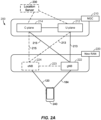
- FIG. 6A assuming that the locations of gNB1 and gNB2 are known to the UE, an angle and delay estimate of a CSI-RS from gNB2 (serving cell) can be used at the UE to derive the UE location.
- the determination of the UE location at 506 can be obtained based signals from multiple cells, as shown in FIG. 6B .
- PRSs from gNB1 through gNB4 can be used at the UE to derive the UE location.
- the UE 505 (e.g., controller/processor 359, etc.) estimates a timing for the non-serving cell based at least in part on the timing for the serving cell, the location of the non-serving cell and the location of the UE.
- the estimation of the non-serving cell timing at 508 is calculated as an offset from the timing of the serving cell which is determined earlier at 502.
- the UE 505 calculates a difference between (i) a propagation delay between the UE and the serving cell, and (ii) a propagation delay between the UE and the non-serving cell. This calculated difference is used as a timing offset to the timing of the serving cell so as to estimate the timing of the non-serving cell.
- the resultant estimated timing of the non-serving cell may be more accurate than other available timing methodologies, which results in improved measurements of signals from the non-serving cell, such as measurements of CSI-RS for RRC or beam management (e.g., resulting in more accurate position location determinations, beam management or RRM, etc.) and/or other benefits.
- FIG. 7 illustrates an example implementation of the process of 500 of FIG. 5 in accordance with an embodiment of the disclosure.
- a UE monitors a downlink channel for a CSI-RS from a non-serving cell.
- the monitoring of 702 may occur with respect to CSI-RS for L3 mobility and may occur during active time (e.g., when UE is monitoring PDCCH in onDuration or due to any timer triggered by gNB activity, i.e., when any of 'onDurationTimer', 'drx-InactitivityTimer' or ' drx-RetransmissionTimer' is running).
- the monitoring of 702 may occur while the UE is configured with (and can detect) associatedSSB.
- the non-serving cell transmits a CSI-RS, which is received (or decoded) by the UE at 706.
- the UE updates a timing for the non-serving cell based on the CSI-RS received at 706.
- a UE stops monitoring the downlink channel for the CSI-RS from the non-serving cell.
- the monitoring cessation of 710 occurs based on the UE being outside of active time. In another example, the monitoring cessation of 710 can occur based on UE either not being configured with associatedSSB or not being able the embodiments described herein are not limited to such scenarios.
- the non-serving cell transmits a CSI-RS, which is not received (or decoded) by the UE at 714.
- the CSI-RS which is not received (or decoded) by the UE at 714.
- the UE instead of permitting the timing to the non-serving cell to drift, the UE instead updates (or estimates) the timing to the non-serving cell based on a timing for a serving cell (not shown), a location of the non-serving cell and a location of the UE.
- 714 may include a number of executions of the process 500 of FIG. 5 that continue so long as the UE is not monitoring the downlink channel for CSI-RSs from the non-serving cell.
- the UE resumes monitoring of the downlink channel for CSI-RSs from the non-serving cell.
- the monitoring resumption at 716 may be triggered by the UE resuming active time (e.g., when the UE resumes monitoring PDCCH in onDuration or due to any timer triggered by gNB activity, i.e., when any of 'onDurationTimer', 'drx-InactitivityTimer' or ' drx-RetransmissionTimer' is running).
- the monitoring resumption of 716 may occur while the UE is configured with (and can detect) associatedSSB.
- the non-serving cell transmits a CSI-RS, which is received (or decoded) by the UE at 720.
- the UE updates a timing for the non-serving cell based on the CSI-RS received at 720.
- FIGS. 5 may be implemented via various "means", such as particular hardware components of the associated UEs 505.
- means for performing the determining, obtaining, and estimating aspects of 502, 504, 506 and 508 may correspond to any combination of processor-related circuitry on the respective UEs, including controller/processor 359, transceivers 352 ... 354, memory 360, etc., of UE 350 of FIG. 3A .
- DSP digital signal processor
- ASIC application specific integrated circuit
- FPGA field programmable gate array
- a general purpose processor may be a microprocessor, but in the alternative, the processor may be any conventional processor, controller, microcontroller, or state machine.
- a processor may also be implemented as a combination of computing devices (e.g., a combination of a DSP and a microprocessor, a plurality of microprocessors, one or more microprocessors in conjunction with a DSP core, or other such configurations).
- a software module may reside in RAM, flash memory, ROM, EPROM, EEPROM, registers, hard disk, a removable disk, a CD-ROM, or any other form of non-transitory computer-readable medium known in the art.
- An exemplary non-transitory computer-readable medium may be coupled to the processor such that the processor can read information from, and write information to, the non-transitory computer-readable medium.
- the non-transitory computer-readable medium may be integral to the processor.
- the processor and the non-transitory computer-readable medium may reside in an ASIC.
- the ASIC may reside in a user device (e.g., a UE) or a base station.
- the processor and the non-transitory computer-readable medium may be discrete components in a user device or base station.
- the functions described herein may be implemented in hardware, software, firmware, or any combination thereof. If implemented in software, the functions may be stored on or transmitted over as one or more instructions or code on a non-transitory computer-readable medium.
- Computer-readable media may include storage media and/or communication media including any non-transitory medium that may facilitate transferring a computer program from one place to another.
- a storage media may be any available media that can be accessed by a computer.
- such computer-readable media can comprise RAM, ROM, EEPROM, CD-ROM or other optical disk storage, magnetic disk storage or other magnetic storage devices, or any other medium that can be used to carry or store desired program code in the form of instructions or data structures and that can be accessed by a computer.
- any connection is properly termed a computer-readable medium.
- the software is transmitted from a website, server, or other remote source using a coaxial cable, fiber optic cable, twisted pair, DSL, or wireless technologies such as infrared, radio, and microwave, then the coaxial cable, fiber optic cable, twisted pair, DSL, or wireless technologies such as infrared, radio, and microwave are included in the definition of a medium.
- disk and disc which may be used interchangeably herein, includes CD, laser disc, optical disc, DVD, floppy disk, and Blu-ray discs, which usually reproduce data magnetically and/or optically with lasers. Combinations of the above should also be included within the scope of computer-readable media.
Landscapes
- Engineering & Computer Science (AREA)
- Signal Processing (AREA)
- Computer Networks & Wireless Communication (AREA)
- Computer Security & Cryptography (AREA)
- Mobile Radio Communication Systems (AREA)
Claims (15)
- Verfahren zum Betreiben eines Benutzergeräts UE (505), das Folgendes beinhaltet:Bestimmen (502) eines Timings für eine bedienende Zelle;Erhalten (504) eines Orts einer nicht bedienenden Zelle;Bestimmen (506) eines Orts des UE; undSchätzen (508) eines Timings für die nicht bedienende Zelle zumindest teilweise auf der Basis des Timings für die bedienende Zelle, des Orts der nicht bedienenden Zelle und des Orts des UE, wobei das Schätzen des Timings für die nicht bedienende Zelle Folgendes beinhaltet:Bestimmen einer ersten Ausbreitungsverzögerung zwischen dem UE und der bedienenden Zelle;Bestimmen einer zweiten Ausbreitungsverzögerung zwischen dem UE und der nicht bedienenden Zelle; undSchätzen des Timings für die nicht bedienende Zelle durch Addieren der Differenz zwischen der ersten und zweiten Ausbreitungsverzögerung zu dem Timing für die bedienende Zelle.
- Verfahren nach Anspruch 1, das ferner Folgendes beinhaltet:Durchführen einer UE-basierten Ortungsprozedur, wobei erhaltene Ortungsunterstützungsinformation am UE in Assoziation mit der UE-basierten Ortungsprozedur empfangen werden; oderdas ferner Folgendes beinhaltet:
Durchführen einer oder mehreren Messungen von einem oder mehreren Signalen von der nicht bedienenden Zelle auf der Basis des geschätzten Timings. - Verfahren nach Anspruch 1, das ferner Folgendes beinhaltet:Überwachen eines Downlink-Kanals auf CSI-RSs von einer nicht bedienenden Zelle;Bestimmen eines Timings der nicht bedienenden Zelle auf der Basis der durch die Überwachung erkannten CSI-RSs;Beenden der Überwachung des Downlink-Kanals auf CSI-RSs von der nicht bedienenden Zelle,wobei das Schätzen durchgeführt wird, während das UE den Downlink-Kanal nicht auf CSI-RSs von der nicht bedienenden Zelle überwacht, wobei das Beenden vorzugsweise auf der Basis ausgelöst wird, dass das UE nicht mit einem assoziatedSSB konfiguriert ist oder den assoziatedSSB nicht erkennt.
- Benutzergerät, UE (505), das Folgendes umfasst:einen Speicher;mindestens einen Transceiver; undmindestens einen Prozessor, der kommunikativ mit dem Speicher und dem mindestens einen Transceiver gekoppelt und konfiguriert ist zum:Bestimmen (502) eines Timings für eine bedienende Zelle;Erhalten (504) eines Orts einer nicht bedienenden Zelle;Bestimmen (506) eines Orts des UE; undSchätzen (508) eines Timings für die nicht bedienende Zelle zumindest teilweise auf der Basis des Timings für die bedienende Zelle, dem Ort der nicht bedienenden Zelle und dem Ort des UE, wobei das Schätzen des Timings für die nicht bedienende Zelle Folgendes beinhaltet: Bestimmen einer ersten Ausbreitungsverzögerung zwischen dem UE und der bedienenden Zelle; Bestimmen einer zweiten Ausbreitungsverzögerung zwischen dem UE und der nicht bedienenden Zelle; und Schätzen des Timings für die nicht bedienende Zelle durch Addieren der Differenz zwischen der ersten und zweiten Ausbreitungsverzögerung zu dem Timing für die bedienende Zelle.
- UE nach Anspruch 4,wobei der mindestens eine Prozessor ferner zum Durchführen einer UE-basierten Ortungsprozedur konfiguriert ist,wobei Ortungsunterstützungsinformationen, die den Ort der nicht dienenden Zelle anzeigen, am UE in Assoziation mit der UE-basierten Ortungsprozedur empfangen werden.
- UE nach Anspruch 4, wobei der mindestens eine Prozessor ferner zum Durchführen einer oder mehrerer Messungen eines oder mehrerer Signale von der nicht bedienenden Zelle auf der Basis des geschätzten Timings konfiguriert ist.
- Verfahren nach Anspruch 1 oder UE nach Anspruch 4, wobei die ein oder mehreren Signale ein oder mehrere CSI-RS für RRM (Radio Resource Management) oder Strahlmanagement umfassen.
- UE nach Anspruch 4, wobei der mindestens eine Prozessor ferner konfiguriert ist zum:Überwachen eines Downlink-Kanals auf CSI-RSs von einer nicht bedienenden Zelle;Bestimmen eines Timings der nicht bedienenden Zelle auf der Basis der durch die Überwachung erkannten CSI-RSs;Beenden der Überwachung des Downlink-Kanals auf CSI-RSs von der nicht bedienenden Zelle,wobei der mindestens eine Prozessor ferner zum Schätzen des Timings konfiguriert ist, während das UE den Downlink-Kanal nicht auf CSI-RSs von der nicht bedienenden Zelle überwacht.
- UE nach Anspruch 8, wobei das Beenden auf der Basis ausgelöst wird, dass das UE nicht mit associatedSSB konfiguriert ist oder das associatedSSB nicht erkennt.
- Verfahren nach Anspruch 1 oder UE nach Anspruch 4,wobei der Ort des UE auf der Basis von einer oder mehreren Messungen am UE eines oder mehrerer Signale von der bedienenden Zelle bestimmt wird, oderwobei der Ort des UE auf der Basis von mehreren Messungen bestimmt wird, die am UE an mehreren Signalen von mehreren Zellen durchgeführt werden.
- Verfahren nach Anspruch 1 oder UE nach Anspruch 4, wobei der Ort der nicht bedienenden Zelle über eine von der bedienenden Zelle empfangene RRC-(Radio Resource Control)-Konfigurationsnachricht erhalten wird, die ein Mapping zwischen einem Satz von Zellkennungen und einem entsprechenden Satz von physischen Orten angibt; oder
wobei der Ort der nicht bedienenden Zelle über eine LPP-(LTE Positioning Protocol)-Konfiguration erhalten wird, die ein Mapping zwischen einem Satz von Zellkennungen und einem entsprechenden Satz von physischen Orten angibt. - Verfahren nach Anspruch 1 oder UE nach Anspruch 4, wobei der Ort der nicht bedienenden Zelle auf der Basis einer von der bedienenden Zelle empfangenen Nachricht erhalten wird, die eine explizite Assoziation zwischen einer gemäß dem LPP (LTE Positioning Protocol) konfigurierten PRS-(Positioning Reference Signal)-Ressource und einer gemäß RRC (Radio Resource Control) konfigurierten RRM-(Radio Resource Management)-Ressource angibt.
- Verfahren oder UE nach Anspruch 12, wobei die Nachricht über LLP oder RRC signalisiert wird; oder
wobei der Ort der nicht bedienenden Zelle auf der Basis einer impliziten Assoziation zwischen einer gemäß dem LPP (LTE Positioning Protocol) konfigurierten PRS-(Positioning Reference Signal)-Ressource und einer gemäß RRC (Radio Resource Control) konfigurierten RRM-(Radio Recource Management)-Ressource erhalten wird. - Verfahren oder UE nach Anspruch 12,wobei der Ort der nicht bedienenden Zelle auf der Basis einer impliziten Assoziation zwischen einer gemäß dem LPP (LTE Positioning Protocol) konfigurierten PRS-(Positioning Reference Signal)-Ressource und einer gemäß RRC (Radio Resource Control) konfigurierten RRM-(Radio Resource Management)-Ressource erhalten wird,wobei die PRS-Ressource mit einem physischen Ort assoziiert ist,wobei die PRS-Ressource implizit mit der RRM-Ressource auf der Basis davon assoziiert ist, dass jede jeweilige Ressource mit demselben Scrambling-Code konfiguriert ist,wobei die implizit mit der PRS-Ressource assoziierte RRM-Ressource mit dem gleichen physischen Ort wie die PRS-Ressource assoziiert ist.
- Nichtflüchtiges computerlesbares Medium, auf dem Befehle gespeichert sind, die bei Ausführung durch ein Benutzergerät, UE, bewirken, dass das UE das Verfahren nach einem der Ansprüche 1-3 durchführt.
Applications Claiming Priority (3)
| Application Number | Priority Date | Filing Date | Title |
|---|---|---|---|
| GR20190100345 | 2019-08-09 | ||
| US16/922,795 US11963113B2 (en) | 2019-08-09 | 2020-07-07 | Estimating a timing for a non-serving cell of a user equipment |
| PCT/US2020/041227 WO2021029990A1 (en) | 2019-08-09 | 2020-07-08 | Estimating a timing for a non-serving cell of a user equipment |
Publications (3)
| Publication Number | Publication Date |
|---|---|
| EP4011109A1 EP4011109A1 (de) | 2022-06-15 |
| EP4011109C0 EP4011109C0 (de) | 2023-12-13 |
| EP4011109B1 true EP4011109B1 (de) | 2023-12-13 |
Family
ID=74498238
Family Applications (1)
| Application Number | Title | Priority Date | Filing Date |
|---|---|---|---|
| EP20750918.3A Active EP4011109B1 (de) | 2019-08-09 | 2020-07-08 | Schätzung eines timing für eine nachbarzelle eines benutzergeräts |
Country Status (5)
| Country | Link |
|---|---|
| US (2) | US11963113B2 (de) |
| EP (1) | EP4011109B1 (de) |
| CN (2) | CN114208056B (de) |
| TW (1) | TW202112150A (de) |
| WO (1) | WO2021029990A1 (de) |
Families Citing this family (10)
| Publication number | Priority date | Publication date | Assignee | Title |
|---|---|---|---|---|
| CN110635876B (zh) * | 2018-06-22 | 2020-11-06 | 维沃移动通信有限公司 | Nr系统的定位参考信号配置、接收方法和设备 |
| US11963113B2 (en) | 2019-08-09 | 2024-04-16 | Qualcomm Incorporated | Estimating a timing for a non-serving cell of a user equipment |
| US10986559B1 (en) * | 2020-01-28 | 2021-04-20 | AVI-On Labs, LLC | Network message transmissions reduction systems and methods |
| JP7522871B2 (ja) * | 2020-07-20 | 2024-07-25 | 北京小米移動軟件有限公司 | 通信方法、ユーザデバイス、基地局デバイスおよびコンピュータ記憶媒体 |
| CN115885546A (zh) * | 2020-08-17 | 2023-03-31 | 瑞典爱立信有限公司 | 在非陆地网络中使用要服务的预期时间作为小区选择和重选标准 |
| US11832116B2 (en) * | 2021-11-01 | 2023-11-28 | Verizon Patent And Licensing Inc. | Systems and methods for machine learning model augmentation using target distributions of key performance indicators in a wireless network |
| WO2023106982A1 (en) * | 2021-12-09 | 2023-06-15 | Telefonaktiebolaget Lm Ericsson (Publ) | Configuring cell groups in which reference signals are not transmitted by all cells |
| KR20230113880A (ko) * | 2022-01-24 | 2023-08-01 | 삼성전자주식회사 | 통신 시스템에서 송신 및 수신을 위한 스위칭 타이밍을 제어하기 위한 전자 장치 및 그의 동작 방법 |
| US12375242B2 (en) * | 2022-03-29 | 2025-07-29 | Qualcomm Incorporated | Channel scrambling techniques in wireless communications |
| US12445990B2 (en) * | 2022-10-21 | 2025-10-14 | Qualcomm Incorporated | Machine learning based timing advance updates |
Family Cites Families (58)
| Publication number | Priority date | Publication date | Assignee | Title |
|---|---|---|---|---|
| US6167275A (en) * | 1997-12-17 | 2000-12-26 | Motorola, Inc. | Method and apparatus for determining a location of a communication unit in a wireless communication system |
| US6353744B1 (en) * | 1999-08-16 | 2002-03-05 | Nortel Networks Limited | Method for positioning with low geometrical dilution of position (GDOP) |
| US7254401B2 (en) * | 2000-12-19 | 2007-08-07 | Nokia Corporation | Network-based method and system for determining a location of user equipment in CDMA networks |
| US7149201B2 (en) * | 2000-12-20 | 2006-12-12 | Denso Corporation | Enhanced bearer overhead monitoring for improved position location performance for wireless mobiles |
| JP4479307B2 (ja) * | 2004-03-30 | 2010-06-09 | 日本電気株式会社 | 無線通信端末及びその無線通信早期確立方法 |
| US7286801B2 (en) * | 2004-05-19 | 2007-10-23 | Qualcomm Incorporated | Maintaining and searching sets of cells in a wireless communication system |
| EP1811800A1 (de) * | 2006-01-23 | 2007-07-25 | Alcatel Lucent | Verfahren, Basisstation und Kommunikationsnetz zur Unterstützung des Schnelluplink Paketzuganges (HSUPA) mit soft-Handover |
| US7570962B2 (en) * | 2006-07-12 | 2009-08-04 | Intel Corporation | Wireless access network base station and method for determining location information for a mobile station using uplink time-difference of arrival |
| WO2008126284A1 (ja) * | 2007-03-30 | 2008-10-23 | Fujitsu Limited | イコライザの制御装置及び制御方法並びに前記制御装置をそなえた無線端末 |
| CN103645459B (zh) * | 2007-05-01 | 2016-03-30 | 高通股份有限公司 | 无线通信系统的定位 |
| US8144662B2 (en) * | 2007-09-17 | 2012-03-27 | Qualcomm Incorporated | Method and apparatus for neighbor list updates |
| US8094067B2 (en) * | 2008-08-12 | 2012-01-10 | Broadcom Corporation | Method and system for determining a position of a mobile communication device |
| WO2010104451A1 (en) | 2009-03-09 | 2010-09-16 | Telefonaktiebolaget L M Ericsson (Publ) | Methods and arrangements in a wireless communication system |
| BRPI0925339A2 (pt) * | 2009-04-27 | 2016-04-26 | Huawei Tech Co Ltd | método, sistema e equipamento para processamento de informação |
| US8965395B2 (en) * | 2009-06-05 | 2015-02-24 | Qualcomm Incorporated | Positioning of user equipment in a wireless communication network |
| EP2264960B1 (de) * | 2009-06-19 | 2014-10-01 | Alcatel Lucent | Verfahren und Verarbeitungsanordnung zur gemeinsamen Verarbeitung von Uplink-Daten |
| JP5571783B2 (ja) | 2009-06-24 | 2014-08-13 | テレフオンアクチーボラゲット エル エム エリクソン(パブル) | セルラネットワークにおける測位支援方法及び装置 |
| US8463292B2 (en) * | 2009-06-29 | 2013-06-11 | Telefonaktiebolaget Lm Ericsson (Publ) | TDOA—based reconstruction of base station location data |
| US8923216B2 (en) * | 2009-07-30 | 2014-12-30 | Qualcomm Incorporated | Robust decoding of CoMP transmissions |
| US10111111B2 (en) * | 2009-11-19 | 2018-10-23 | Qualcomm Incorporated | Per-cell timing and/or frequency acquisition and their use on channel estimation in wireless networks |
| US9179395B2 (en) * | 2010-01-18 | 2015-11-03 | Qualcomm Incorporated | Method and apparatus for mitigating data loss during autonomous system information reading |
| US20110317624A1 (en) * | 2010-06-23 | 2011-12-29 | Qualcomm Incorporated | Methods of control/data partition scheme in heterogeneous networks for lte-a |
| KR20120099568A (ko) * | 2011-01-18 | 2012-09-11 | 삼성전자주식회사 | 무선 통신 시스템에서 단말기 내에 복수 개의 이종 통신 모듈이 있을 경우 간섭을 측정하는 방법 및 장치 |
| US9084191B2 (en) * | 2011-01-20 | 2015-07-14 | Qualcomm Incorporated | Method and apparatus for determining timing information for cells |
| US9363782B2 (en) | 2011-06-22 | 2016-06-07 | Qualcomm Incorporated | Methods and apparatus for wireless device positioning in multicarrier configurations |
| CN102857277B (zh) * | 2011-06-29 | 2017-05-10 | 夏普株式会社 | 信道状态信息反馈方法和用户设备 |
| US11125850B2 (en) * | 2011-08-03 | 2021-09-21 | Polte Corporation | Systems and methods for determining a timing offset of emitter antennas in a wireless network |
| US8897813B2 (en) * | 2012-02-03 | 2014-11-25 | Andrew Llc | LTE user equipment positioning system and method |
| US10863313B2 (en) * | 2014-08-01 | 2020-12-08 | Polte Corporation | Network architecture and methods for location services |
| US9173183B1 (en) | 2013-05-16 | 2015-10-27 | Sprint Spectrum L.P. | Method and system for determining time synchronization errors in time difference of arrival (TDOA) measurements |
| CN103313381B (zh) | 2013-06-06 | 2016-10-26 | 安徽华东光电技术研究所 | 一种无线通信发射基站同步方法 |
| US9432809B2 (en) * | 2013-07-12 | 2016-08-30 | Qualcomm Incorporated | Providing OTDOA PRS assistance data |
| RU2619054C1 (ru) * | 2013-07-30 | 2017-05-11 | Хуавэй Текнолоджиз Ко., Лтд. | Способ, устройство и система для обработки внутриканальных помех в соте |
| US10219237B2 (en) * | 2013-11-22 | 2019-02-26 | Telefonaktiebolaget Lm Ericsson (Publ) | User equipment and method for estimating and updating a timing of a cell in a wireless communications network |
| US10003915B2 (en) * | 2014-02-25 | 2018-06-19 | Bridgewest Finance Llc | Frame time synchronization in a wireless local area network |
| US9220081B2 (en) * | 2014-03-05 | 2015-12-22 | Intel Corporation | Access point location discovery in unmanaged networks |
| US10135586B2 (en) * | 2014-03-20 | 2018-11-20 | Intel IP Corporation | Reference signal enhancement for shared cell |
| EP2930981B1 (de) * | 2014-04-08 | 2018-02-21 | Nokia Solutions and Networks Oy | Sendeleistungsregelung eines benutzergeräts zur kommunikation mit einer niederleistungsbasisstation und einer hochleistungsbasisstation |
| US10462839B2 (en) * | 2015-04-08 | 2019-10-29 | Lg Electronics Inc. | Method for transmitting sidelink terminal information of terminal in wireless communication system and terminal utilizing the method |
| WO2016163971A1 (en) * | 2015-04-08 | 2016-10-13 | Intel Corporation | Inter-frequency inter-public land mobile network (plmn) discovery |
| CN106658584B (zh) * | 2015-10-30 | 2022-02-15 | 北京三星通信技术研究有限公司 | 信号发送与接收和干扰测量的方法及设备 |
| CN108702642B (zh) * | 2015-11-02 | 2021-08-13 | 瑞典爱立信有限公司 | 在非服务载波频率上调适d2d操作 |
| US10757722B2 (en) * | 2016-03-25 | 2020-08-25 | Lg Electronics Inc. | Method for allowing wireless resource to be allocated in wireless communication system, and device therefor |
| KR101988574B1 (ko) * | 2016-06-12 | 2019-06-12 | 엘지전자 주식회사 | 신호를 수신하는 방법 및 그 무선 기기 |
| EP3306337A1 (de) | 2016-10-10 | 2018-04-11 | Fraunhofer Gesellschaft zur Förderung der Angewand | Benutzergerätelokalisierung in einem mobilkommunikationsnetzwerk |
| US10736063B2 (en) * | 2017-06-27 | 2020-08-04 | Qualcomm Incorporated | Neighbor cell synchronization signal block index determination |
| CN109474938B (zh) | 2017-09-08 | 2023-03-17 | 展讯通信(上海)有限公司 | 获取邻小区定时的方法、装置及用户设备 |
| US10547979B2 (en) * | 2018-01-21 | 2020-01-28 | Qualcomm Incorporated | Systems and methods for locating a user equipment using generic position methods for a 5G network |
| EP3775964A1 (de) * | 2018-04-05 | 2021-02-17 | Telefonaktiebolaget LM Ericsson (publ) | Verfahren zur unterstützung von lte otdoa für nr-geräte |
| WO2019212224A1 (ko) | 2018-04-30 | 2019-11-07 | 엘지전자 주식회사 | 무선 통신 시스템에서 단말과 기지국 간 채널 상태 정보를 송수신하는 방법 및 이를 지원하는 장치 |
| US12501377B2 (en) * | 2019-01-04 | 2025-12-16 | Huawei Technologies Co., Ltd. | Sounding reference signal for uplink-based multi-cell measurement |
| EP3751920B1 (de) * | 2019-01-11 | 2024-03-27 | LG Electronics Inc. | Verfahren zum erhalt von systeminformationen in einem drahtloskommunikationssystem und vorrichtung dafür |
| US20200359375A1 (en) * | 2019-01-22 | 2020-11-12 | Lg Electronics Inc. | Method for determining slot in which psfch is transmitted in wireless communication system |
| CN113424611B (zh) * | 2019-02-15 | 2023-10-24 | 上海诺基亚贝尔股份有限公司 | 多小区定位 |
| GB2582788B (en) * | 2019-04-02 | 2021-10-13 | Samsung Electronics Co Ltd | Methods and apparatus for configuring 5G new radio uplink positioning reference signals |
| JP7293395B2 (ja) * | 2019-04-07 | 2023-06-19 | エルジー エレクトロニクス インコーポレイティド | 無線通信システムにおいてサイドリンク通信及びフィードバックに関連するueの動作方法 |
| US10856236B1 (en) * | 2019-05-20 | 2020-12-01 | Qualcomm Incorporated | Fallback procedures when the path loss or spatial transmit quasi-collocation (QCL) reference from neighboring cells is failing for sounding reference signals (SRS) for positioning |
| US11963113B2 (en) | 2019-08-09 | 2024-04-16 | Qualcomm Incorporated | Estimating a timing for a non-serving cell of a user equipment |
-
2020
- 2020-07-07 US US16/922,795 patent/US11963113B2/en active Active
- 2020-07-08 CN CN202080055327.2A patent/CN114208056B/zh active Active
- 2020-07-08 TW TW109123048A patent/TW202112150A/zh unknown
- 2020-07-08 EP EP20750918.3A patent/EP4011109B1/de active Active
- 2020-07-08 CN CN202410480728.2A patent/CN118353509A/zh active Pending
- 2020-07-08 WO PCT/US2020/041227 patent/WO2021029990A1/en not_active Ceased
-
2024
- 2024-04-10 US US18/632,108 patent/US12363659B2/en active Active
Also Published As
| Publication number | Publication date |
|---|---|
| US12363659B2 (en) | 2025-07-15 |
| US20240259969A1 (en) | 2024-08-01 |
| US20210045075A1 (en) | 2021-02-11 |
| CN114208056B (zh) | 2024-05-07 |
| CN118353509A (zh) | 2024-07-16 |
| EP4011109A1 (de) | 2022-06-15 |
| US11963113B2 (en) | 2024-04-16 |
| EP4011109C0 (de) | 2023-12-13 |
| CN114208056A (zh) | 2022-03-18 |
| WO2021029990A1 (en) | 2021-02-18 |
| TW202112150A (zh) | 2021-03-16 |
Similar Documents
| Publication | Publication Date | Title |
|---|---|---|
| EP3811530B1 (de) | Strahlumschaltfähigkeitsanzeige in drahtlosen, strahlformung nutzenden netzwerken | |
| EP3804425B1 (de) | Berechnung und meldung einer relevanzmetrik für einen positionierungsbakenstrahl | |
| EP4011109B1 (de) | Schätzung eines timing für eine nachbarzelle eines benutzergeräts | |
| US11310816B2 (en) | Associating a downlink reference signal for positioning of a user equipment with an uplink reference signal for transmission by the user equipment | |
| US11601911B2 (en) | Determining timing resolution and range of reported timing measurements used for position estimation | |
| EP3881616B1 (de) | Gestaffelte ressourcensätze der verfolgungsreferenzsignale für die kanalstatusinformation zur verwendung der positionierung | |
| US10880896B2 (en) | Identifying beams of interest for position estimation | |
| US11031992B2 (en) | Receive beam selection for measuring a reference signal | |
| KR20210015968A (ko) | 복수의 상이한 송신 지점 위치들과 연관된 기지국의 위치 정보 교환 | |
| US11122574B2 (en) | Indication of antenna coherence for phase difference of arrival and angle of departure estimation | |
| US11672027B2 (en) | Managing an overlap between downlink reference signals |
Legal Events
| Date | Code | Title | Description |
|---|---|---|---|
| STAA | Information on the status of an ep patent application or granted ep patent |
Free format text: STATUS: UNKNOWN |
|
| STAA | Information on the status of an ep patent application or granted ep patent |
Free format text: STATUS: THE INTERNATIONAL PUBLICATION HAS BEEN MADE |
|
| PUAI | Public reference made under article 153(3) epc to a published international application that has entered the european phase |
Free format text: ORIGINAL CODE: 0009012 |
|
| STAA | Information on the status of an ep patent application or granted ep patent |
Free format text: STATUS: REQUEST FOR EXAMINATION WAS MADE |
|
| 17P | Request for examination filed |
Effective date: 20220120 |
|
| AK | Designated contracting states |
Kind code of ref document: A1 Designated state(s): AL AT BE BG CH CY CZ DE DK EE ES FI FR GB GR HR HU IE IS IT LI LT LU LV MC MK MT NL NO PL PT RO RS SE SI SK SM TR |
|
| DAV | Request for validation of the european patent (deleted) | ||
| DAX | Request for extension of the european patent (deleted) | ||
| GRAP | Despatch of communication of intention to grant a patent |
Free format text: ORIGINAL CODE: EPIDOSNIGR1 |
|
| STAA | Information on the status of an ep patent application or granted ep patent |
Free format text: STATUS: GRANT OF PATENT IS INTENDED |
|
| INTG | Intention to grant announced |
Effective date: 20230719 |
|
| RAP3 | Party data changed (applicant data changed or rights of an application transferred) |
Owner name: QUALCOMM INCORPORATED |
|
| GRAS | Grant fee paid |
Free format text: ORIGINAL CODE: EPIDOSNIGR3 |
|
| GRAA | (expected) grant |
Free format text: ORIGINAL CODE: 0009210 |
|
| STAA | Information on the status of an ep patent application or granted ep patent |
Free format text: STATUS: THE PATENT HAS BEEN GRANTED |
|
| AK | Designated contracting states |
Kind code of ref document: B1 Designated state(s): AL AT BE BG CH CY CZ DE DK EE ES FI FR GB GR HR HU IE IS IT LI LT LU LV MC MK MT NL NO PL PT RO RS SE SI SK SM TR |
|
| REG | Reference to a national code |
Ref country code: GB Ref legal event code: FG4D |
|
| REG | Reference to a national code |
Ref country code: CH Ref legal event code: EP |
|
| REG | Reference to a national code |
Ref country code: DE Ref legal event code: R096 Ref document number: 602020022738 Country of ref document: DE |
|
| REG | Reference to a national code |
Ref country code: IE Ref legal event code: FG4D |
|
| U01 | Request for unitary effect filed |
Effective date: 20240104 |
|
| U07 | Unitary effect registered |
Designated state(s): AT BE BG DE DK EE FI FR IT LT LU LV MT NL PT SE SI Effective date: 20240115 |
|
| PG25 | Lapsed in a contracting state [announced via postgrant information from national office to epo] |
Ref country code: GR Free format text: LAPSE BECAUSE OF FAILURE TO SUBMIT A TRANSLATION OF THE DESCRIPTION OR TO PAY THE FEE WITHIN THE PRESCRIBED TIME-LIMIT Effective date: 20240314 |
|
| PG25 | Lapsed in a contracting state [announced via postgrant information from national office to epo] |
Ref country code: ES Free format text: LAPSE BECAUSE OF FAILURE TO SUBMIT A TRANSLATION OF THE DESCRIPTION OR TO PAY THE FEE WITHIN THE PRESCRIBED TIME-LIMIT Effective date: 20231213 |
|
| PG25 | Lapsed in a contracting state [announced via postgrant information from national office to epo] |
Ref country code: GR Free format text: LAPSE BECAUSE OF FAILURE TO SUBMIT A TRANSLATION OF THE DESCRIPTION OR TO PAY THE FEE WITHIN THE PRESCRIBED TIME-LIMIT Effective date: 20240314 Ref country code: ES Free format text: LAPSE BECAUSE OF FAILURE TO SUBMIT A TRANSLATION OF THE DESCRIPTION OR TO PAY THE FEE WITHIN THE PRESCRIBED TIME-LIMIT Effective date: 20231213 |
|
| PG25 | Lapsed in a contracting state [announced via postgrant information from national office to epo] |
Ref country code: RS Free format text: LAPSE BECAUSE OF FAILURE TO SUBMIT A TRANSLATION OF THE DESCRIPTION OR TO PAY THE FEE WITHIN THE PRESCRIBED TIME-LIMIT Effective date: 20231213 Ref country code: NO Free format text: LAPSE BECAUSE OF FAILURE TO SUBMIT A TRANSLATION OF THE DESCRIPTION OR TO PAY THE FEE WITHIN THE PRESCRIBED TIME-LIMIT Effective date: 20240313 Ref country code: HR Free format text: LAPSE BECAUSE OF FAILURE TO SUBMIT A TRANSLATION OF THE DESCRIPTION OR TO PAY THE FEE WITHIN THE PRESCRIBED TIME-LIMIT Effective date: 20231213 |
|
| PG25 | Lapsed in a contracting state [announced via postgrant information from national office to epo] |
Ref country code: IS Free format text: LAPSE BECAUSE OF FAILURE TO SUBMIT A TRANSLATION OF THE DESCRIPTION OR TO PAY THE FEE WITHIN THE PRESCRIBED TIME-LIMIT Effective date: 20240413 |
|
| PG25 | Lapsed in a contracting state [announced via postgrant information from national office to epo] |
Ref country code: CZ Free format text: LAPSE BECAUSE OF FAILURE TO SUBMIT A TRANSLATION OF THE DESCRIPTION OR TO PAY THE FEE WITHIN THE PRESCRIBED TIME-LIMIT Effective date: 20231213 |
|
| U20 | Renewal fee for the european patent with unitary effect paid |
Year of fee payment: 5 Effective date: 20240614 |
|
| PG25 | Lapsed in a contracting state [announced via postgrant information from national office to epo] |
Ref country code: SK Free format text: LAPSE BECAUSE OF FAILURE TO SUBMIT A TRANSLATION OF THE DESCRIPTION OR TO PAY THE FEE WITHIN THE PRESCRIBED TIME-LIMIT Effective date: 20231213 |
|
| PG25 | Lapsed in a contracting state [announced via postgrant information from national office to epo] |
Ref country code: SM Free format text: LAPSE BECAUSE OF FAILURE TO SUBMIT A TRANSLATION OF THE DESCRIPTION OR TO PAY THE FEE WITHIN THE PRESCRIBED TIME-LIMIT Effective date: 20231213 Ref country code: SK Free format text: LAPSE BECAUSE OF FAILURE TO SUBMIT A TRANSLATION OF THE DESCRIPTION OR TO PAY THE FEE WITHIN THE PRESCRIBED TIME-LIMIT Effective date: 20231213 Ref country code: RO Free format text: LAPSE BECAUSE OF FAILURE TO SUBMIT A TRANSLATION OF THE DESCRIPTION OR TO PAY THE FEE WITHIN THE PRESCRIBED TIME-LIMIT Effective date: 20231213 Ref country code: IS Free format text: LAPSE BECAUSE OF FAILURE TO SUBMIT A TRANSLATION OF THE DESCRIPTION OR TO PAY THE FEE WITHIN THE PRESCRIBED TIME-LIMIT Effective date: 20240413 Ref country code: CZ Free format text: LAPSE BECAUSE OF FAILURE TO SUBMIT A TRANSLATION OF THE DESCRIPTION OR TO PAY THE FEE WITHIN THE PRESCRIBED TIME-LIMIT Effective date: 20231213 |
|
| PG25 | Lapsed in a contracting state [announced via postgrant information from national office to epo] |
Ref country code: PL Free format text: LAPSE BECAUSE OF FAILURE TO SUBMIT A TRANSLATION OF THE DESCRIPTION OR TO PAY THE FEE WITHIN THE PRESCRIBED TIME-LIMIT Effective date: 20231213 |
|
| PG25 | Lapsed in a contracting state [announced via postgrant information from national office to epo] |
Ref country code: PL Free format text: LAPSE BECAUSE OF FAILURE TO SUBMIT A TRANSLATION OF THE DESCRIPTION OR TO PAY THE FEE WITHIN THE PRESCRIBED TIME-LIMIT Effective date: 20231213 |
|
| REG | Reference to a national code |
Ref country code: DE Ref legal event code: R097 Ref document number: 602020022738 Country of ref document: DE |
|
| PLBE | No opposition filed within time limit |
Free format text: ORIGINAL CODE: 0009261 |
|
| STAA | Information on the status of an ep patent application or granted ep patent |
Free format text: STATUS: NO OPPOSITION FILED WITHIN TIME LIMIT |
|
| 26N | No opposition filed |
Effective date: 20240916 |
|
| PG25 | Lapsed in a contracting state [announced via postgrant information from national office to epo] |
Ref country code: MC Free format text: LAPSE BECAUSE OF FAILURE TO SUBMIT A TRANSLATION OF THE DESCRIPTION OR TO PAY THE FEE WITHIN THE PRESCRIBED TIME-LIMIT Effective date: 20231213 |
|
| REG | Reference to a national code |
Ref country code: CH Ref legal event code: PL |
|
| PG25 | Lapsed in a contracting state [announced via postgrant information from national office to epo] |
Ref country code: CH Free format text: LAPSE BECAUSE OF NON-PAYMENT OF DUE FEES Effective date: 20240731 |
|
| PGFP | Annual fee paid to national office [announced via postgrant information from national office to epo] |
Ref country code: GB Payment date: 20250612 Year of fee payment: 6 |
|
| U20 | Renewal fee for the european patent with unitary effect paid |
Year of fee payment: 6 Effective date: 20250617 |
|
| PGFP | Annual fee paid to national office [announced via postgrant information from national office to epo] |
Ref country code: IE Payment date: 20250612 Year of fee payment: 6 |
|
| PG25 | Lapsed in a contracting state [announced via postgrant information from national office to epo] |
Ref country code: CY Free format text: LAPSE BECAUSE OF FAILURE TO SUBMIT A TRANSLATION OF THE DESCRIPTION OR TO PAY THE FEE WITHIN THE PRESCRIBED TIME-LIMIT; INVALID AB INITIO Effective date: 20200708 |
|
| PG25 | Lapsed in a contracting state [announced via postgrant information from national office to epo] |
Ref country code: HU Free format text: LAPSE BECAUSE OF FAILURE TO SUBMIT A TRANSLATION OF THE DESCRIPTION OR TO PAY THE FEE WITHIN THE PRESCRIBED TIME-LIMIT; INVALID AB INITIO Effective date: 20200708 |