EP4010896B1 - Erstellung und wiedergabe digitaler audiowellenformen - Google Patents
Erstellung und wiedergabe digitaler audiowellenformen Download PDFInfo
- Publication number
- EP4010896B1 EP4010896B1 EP20761665.7A EP20761665A EP4010896B1 EP 4010896 B1 EP4010896 B1 EP 4010896B1 EP 20761665 A EP20761665 A EP 20761665A EP 4010896 B1 EP4010896 B1 EP 4010896B1
- Authority
- EP
- European Patent Office
- Prior art keywords
- waveform
- partials
- audio
- frequency
- note
- Prior art date
- Legal status (The legal status is an assumption and is not a legal conclusion. Google has not performed a legal analysis and makes no representation as to the accuracy of the status listed.)
- Active
Links
Images
Classifications
-
- G—PHYSICS
- G10—MUSICAL INSTRUMENTS; ACOUSTICS
- G10H—ELECTROPHONIC MUSICAL INSTRUMENTS; INSTRUMENTS IN WHICH THE TONES ARE GENERATED BY ELECTROMECHANICAL MEANS OR ELECTRONIC GENERATORS, OR IN WHICH THE TONES ARE SYNTHESISED FROM A DATA STORE
- G10H1/00—Details of electrophonic musical instruments
-
- G—PHYSICS
- G10—MUSICAL INSTRUMENTS; ACOUSTICS
- G10H—ELECTROPHONIC MUSICAL INSTRUMENTS; INSTRUMENTS IN WHICH THE TONES ARE GENERATED BY ELECTROMECHANICAL MEANS OR ELECTRONIC GENERATORS, OR IN WHICH THE TONES ARE SYNTHESISED FROM A DATA STORE
- G10H1/00—Details of electrophonic musical instruments
- G10H1/0008—Associated control or indicating means
-
- G—PHYSICS
- G10—MUSICAL INSTRUMENTS; ACOUSTICS
- G10H—ELECTROPHONIC MUSICAL INSTRUMENTS; INSTRUMENTS IN WHICH THE TONES ARE GENERATED BY ELECTROMECHANICAL MEANS OR ELECTRONIC GENERATORS, OR IN WHICH THE TONES ARE SYNTHESISED FROM A DATA STORE
- G10H1/00—Details of electrophonic musical instruments
- G10H1/02—Means for controlling the tone frequencies, e.g. attack or decay; Means for producing special musical effects, e.g. vibratos or glissandos
- G10H1/06—Circuits for establishing the harmonic content of tones, or other arrangements for changing the tone colour
-
- G—PHYSICS
- G10—MUSICAL INSTRUMENTS; ACOUSTICS
- G10H—ELECTROPHONIC MUSICAL INSTRUMENTS; INSTRUMENTS IN WHICH THE TONES ARE GENERATED BY ELECTROMECHANICAL MEANS OR ELECTRONIC GENERATORS, OR IN WHICH THE TONES ARE SYNTHESISED FROM A DATA STORE
- G10H7/00—Instruments in which the tones are synthesised from a data store, e.g. computer organs
- G10H7/02—Instruments in which the tones are synthesised from a data store, e.g. computer organs in which amplitudes at successive sample points of a tone waveform are stored in one or more memories
-
- G—PHYSICS
- G10—MUSICAL INSTRUMENTS; ACOUSTICS
- G10H—ELECTROPHONIC MUSICAL INSTRUMENTS; INSTRUMENTS IN WHICH THE TONES ARE GENERATED BY ELECTROMECHANICAL MEANS OR ELECTRONIC GENERATORS, OR IN WHICH THE TONES ARE SYNTHESISED FROM A DATA STORE
- G10H7/00—Instruments in which the tones are synthesised from a data store, e.g. computer organs
- G10H7/08—Instruments in which the tones are synthesised from a data store, e.g. computer organs by calculating functions or polynomial approximations to evaluate amplitudes at successive sample points of a tone waveform
- G10H7/10—Instruments in which the tones are synthesised from a data store, e.g. computer organs by calculating functions or polynomial approximations to evaluate amplitudes at successive sample points of a tone waveform using coefficients or parameters stored in a memory, e.g. Fourier coefficients
- G10H7/105—Instruments in which the tones are synthesised from a data store, e.g. computer organs by calculating functions or polynomial approximations to evaluate amplitudes at successive sample points of a tone waveform using coefficients or parameters stored in a memory, e.g. Fourier coefficients using Fourier coefficients
-
- G—PHYSICS
- G10—MUSICAL INSTRUMENTS; ACOUSTICS
- G10H—ELECTROPHONIC MUSICAL INSTRUMENTS; INSTRUMENTS IN WHICH THE TONES ARE GENERATED BY ELECTROMECHANICAL MEANS OR ELECTRONIC GENERATORS, OR IN WHICH THE TONES ARE SYNTHESISED FROM A DATA STORE
- G10H2250/00—Aspects of algorithms or signal processing methods without intrinsic musical character, yet specifically adapted for or used in electrophonic musical processing
- G10H2250/131—Mathematical functions for musical analysis, processing, synthesis or composition
- G10H2250/215—Transforms, i.e. mathematical transforms into domains appropriate for musical signal processing, coding or compression
-
- G—PHYSICS
- G10—MUSICAL INSTRUMENTS; ACOUSTICS
- G10H—ELECTROPHONIC MUSICAL INSTRUMENTS; INSTRUMENTS IN WHICH THE TONES ARE GENERATED BY ELECTROMECHANICAL MEANS OR ELECTRONIC GENERATORS, OR IN WHICH THE TONES ARE SYNTHESISED FROM A DATA STORE
- G10H2250/00—Aspects of algorithms or signal processing methods without intrinsic musical character, yet specifically adapted for or used in electrophonic musical processing
- G10H2250/541—Details of musical waveform synthesis, i.e. audio waveshape processing from individual wavetable samples, independently of their origin or of the sound they represent
- G10H2250/631—Waveform resampling, i.e. sample rate conversion or sample depth conversion
Definitions
- Analog and/or digital synthesizers can be used to generate audio sounds.
- Analog synthesizers typically use analog circuitry (e.g., sound-generating circuitry and modulators) to generate sounds.
- a user can, for example, configure oscillators to generate various audio waveforms at different musical pitches.
- Digital synthesizers in contrast, use digital processors. In the digital domain, a number of steps are often applied in order to store and reproduce an audio signal.
- the techniques can include filtering (e.g., low pass filtering), performing an analog-to-digital conversion (e.g., including sampling the audio signal) to generate a digital waveform, and storing the waveform in an audio file.
- HORNER A ET AL "METHODS FOR MULTIPLE WAVETABLE SYNTHESIS OF MUSICAL INSTRUMENT TONES", JOURNAL OF THE AUDIO ENGINEERING SOCIETY, AUDIO ENGINEERING SOCIETY, NEW YORK, NY, US, vol. 41, no. 5, 1 May 1993 (1993-05-01), pages 336-355 , describes methods for determining near-optimal parameters for the synthesis of harmonic musical instrument or voice sounds using the addition of several fixed wavetables with time-varying weights.
- LEE K ET HORNER A "MODELING PIANO TONES WITH GROUP SYNTHESIS", JOURNAL OF THE AUDIO ENGINEERING SOCIETY, NEW YORK, NY, US, vol. 47, no. 3, 1 March 1999 (1999-03-01), pages 101-111 , describes adapting group synthesis to model piano tones.
- the main features of the adaptation are 1) nearly contiguous groups selected by a genetic algorithm with hillclimbing refinement, and 2) frequency stretch factors to simulate partial stretching.
- the inventors have recognized and appreciated that it can be desirable to emulate aspects of analog synthesizers, such as the ability to generate various audio waveforms at different musical pitches, in software.
- the inventors have further recognized and appreciated that it can be desirable to go beyond basic emulation of a few traditional oscillator waveforms to allow a user to create custom (e.g., arbitrary) wave shapes.
- audio waveforms are often thought of as continuous signals of arbitrary length, with no upper bound on frequency content, that is not the case in the digital domain.
- digital systems have certain limitations, and the intricacies of waveform processing in the digital domain can complicate the synthesis of arbitrary audio waveforms at different frequencies.
- the system may reduce the fidelity of the ultimate waveform and/or create aliasing distortion.
- the inventors developed techniques for authoring arbitrarily shaped waveforms.
- the techniques can include determining the partial series of the authored waveform.
- the inventors have further developed techniques for generating a wave table for a waveform (e.g., for an authored waveform).
- the wave table can include various versions of the waveform, each with a different number of partial waveforms. Since each waveform version can be associated with a pitch range (e.g., a pitch range that can be resampled without reducing the fidelity of the waveform and/or creating aliasing distortion), the techniques can include selecting an appropriate waveform version from the wave table for processing (e.g., for resampling to obtain a desired frequency).
- the techniques can include linearly interpolating between multiple waveforms in the wave table so that each portion of the rendered audio leverages the best possible waveform.
- the techniques can be used to render these audio waveforms in various contexts, such as for a video game or for a multimedia experience that occurs in substantially real time on devices with limited processing power. For example, even on powerful devices, the audio rendering system performing the techniques described herein is just one of a number of software systems that need compute power to create the entire end-user experience. Therefore, the techniques can include providing additional processing efficiencies, as discussed herein.
- audio samples can be stored in memory as discretized waveforms, which can include a sampling rate and a corresponding Nyquist frequency, where the Nyquist frequency is half of the sampling rate of the waveform.
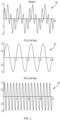
- FIG. 1 shows an example of a waveform 100 and its partial waveforms 120 and 140, according to some examples.
- the waveform 100 includes a fundamental partial frequency 120 of 100 Hz and an overtone partial frequency 140 of 400 Hz.
- the waveform 100 includes the fundamental frequency 120 and one multiple of the fundamental frequency, the overtone frequency 140.
- a waveform can be stored in a manner such that the waveform has been band limited at or below its Nyquist frequency before sampling (e.g., to avoid aliasing during playback of the discretized waveform).
- systems can apply an antialiasing filter prior to sampling that attenuates frequencies above the highest frequency to be recreated during playback. For example, if the system has a waveform in memory that is already band limited such that there is minimal and/or no aliasing when the waveform is played at its original rate, then no additional aliasing (e.g., beyond any already in the waveform when it was created) should occur if the waveform is played back at its original pitch.
- the partial series can include, for example, the amplitudes and phases of the sinewaves that, when combined, result in a pitched complex waveform.
- pitched complex waveforms include square waves, triangle waves, guitar string plucks, trumpet sounds, etc.
- the system can process an authored waveform to generate a wave table that can be used to generate different pitches of the authored waveform, as discussed further in conjunction with FIGS. 4A-4B .
- the techniques can use models of analog synthesizer waveforms to mathematically determine the partial series.
- common waveforms include a triangle waveform, a sawtooth waveform, and/or a square waveform.
- a triangle waveform can contain partials at the odd frequencies, with amplitudes at the inverse of the square of the harmonic number (e.g., 1/3 2 , 1/5 2 , etc.).
- a sawtooth waveform can include all harmonic partials with amplitudes as the inverse of the harmonic number.
- a square waveform can contain odd partials with amplitudes at the inverse of the partial number.
- the number of partials can be limited, e.g., since otherwise any number of partials could be determined when using mathematical techniques.
- the Nyquist frequency can be used to limit the number of partials. For example, as described herein the system can be configured such that it does not reproduce a partial above the Nyquist frequency of the sample rate that the system is using for rendering.
- the system can limit the number of partials based on the volume of the fundamental.
- the system can be configured to not render any more partials once their volume drops below a certain configured metric below the volume of the fundamental.
- a metric of -96 dB can be used since digital audio is typically stored at a resolution of 16 bits per sample, which limits the dynamic range to 96 dB between silence and the loudest representable number.
- the fundamental sinewave is at a gain of 1, and given the formula for a given waveform (e.g., including the fact that the partials diminish in volume as the partial number goes up), the number of partials before their volume reaches 0.000016 can be determined.
- a square wave which has odd partials with amplitudes that are the inverse of the partial number, a square wave has 62,501 partials (i.e., 1/0.000016).
- the system can be configured to (further) limit the number of partials based on the sample rate at which the system will be rendering the waveforms. For example, if using the MIDI specification, a waveform need not be rendered for a pitch below ⁇ 8.662 Hz, which is the frequency of the lowest MIDI note. Given that as the fundamental frequency, the render sample rate's Nyquist frequency can be divided by 8.662 Hz to determine how many partials could potentially be needed (but which may not be needed). For example, if the render sample rate is 48 kHz and therefore Nyquist is 24 kHz, then 24,000 Hz / 8.662 Hz is ⁇ 2770 partials. As shown, this number does not depend on the waveform shape, rather it is a constant given the lowest pitch desired to be rendered and the rendering sample rate.
- the tools can, in addition or alternatively, allow a user to author custom, arbitrary waveforms by specifying the partial series.
- additive synthesis authoring tools can be used to create a partial series representation of a waveform.
- a tool can include one or more techniques that allow a user to specify the volume and phase of each partial.
- some tools can specify the partials using a text editor.
- a graphical user interface can present a series of sliders, including a slider for each partial such that the user can set the volume/amplitude and phase of each partial.
- a user can author any number of partials up to a predetermined limit, if any (e.g., given the lowest pitch desired to be rendered and the sample rate, as discussed above).
- the tools can allow a user to sample a pitched analog waveform (e.g., using a microphone).
- the system can convert the sampled analog waveform to a partial series in the digital domain.
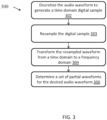
- FIG. 3 shows an exemplary method 300 of determining the partial series for a sampled analog waveform, according to some embodiments.
- the system is configured to discretize the analog waveform.
- the system is configured to resample the waveform from step 302.
- the system is configured to transform the resampled waveform from the time domain to the frequency domain.
- the system is configured to determine a set of partial waveforms for the desired audio waveform.
- the analog waveform can be discretized through techniques of audio sampling, including band limiting the analog waveform to remove content above the Nyquist frequency, and measuring the analog voltage at fixed intervals (e.g., the sampling rate) to create a time domain digital sample.
- the system can choose a resample rate based on the fundamental pitch of the sampled waveform and its original sample rate, and the waveform can be resampled to the new rate.
- the new rate is chosen such that the fundamental pitch of the waveform falls on one specific bin of the frequency domain representation, and/or such that aliasing is not added during this resampling. For example, assume an analog waveform has a fundamental pitch of 440Hz, sampled at an original sample rate of 48 kHz, and therefore with a Nyquist frequency at 24 kHz. For harmonic partial series, the partials will be some multiple of the fundamental pitch, and the system can be configured to only include the partials that are below the Nyquist frequency.
- the number of partials that fall completely below Nyquist can be determined by dividing the original sampling rate by the fundamental pitch. Using this example, 24,000 / 440 is --54.5, and therefore 54 partials fall below Nyquist.
- a constraint can include a lower limit on the new sample rate.
- the sample rate can be set to be at least as often as the original sample rate (e.g., since resampling lower than the original rate can introduce aliasing).
- the system is configured to transform the resampled waveform from the time domain to the frequency domain.
- the system is configured to perform a fast Fourier transform (FFT) to get the frequency domain representation of the sampled waveform.
- FFT size can be determined based on the number of partials below Nyquist. For example, the FFT size can be at least 55 bins in size, given the 54 partials plus a zero'th bin that represents DC.
- the frequency of each bin in an FFT can be calculated with the formula B*Fs/N, where B is the bin index, Fs is the sample rate, and N is the size of the FFT.
- the bin count can be altered to achieve optimizations in the Fourier transform. For example, 128 bins may be chosen, which would result in a resample rate of 56320 samples per second.
- the system is configured to determine a set of partial waveforms for the desired audio waveform.
- the FFT result can be used to determine the partial series.
- the bin spacing can be determined by dividing the sample rate by the FFT size.
- the techniques can be configured to perform an FFT with an FFT size that is equal to the number of samples. Therefore, for such an FFT, the first bin is the DC component.
- the second bin is the fundamental or first partial
- the third bin is the second partial (e.g., 2 times the fundamental frequency)
- the fourth bin is the third partial (e.g., 3 times the fundamental), and so on.
- the system can be configured to calculate partial amplitudes and/or phases based on the FFT result.
- the time domain, resampled, digital sample can be converted to the frequency domain using the bin count (e.g., as calculated above).
- the frequency domain representation e.g., complex numbers on the z-plane
- the resulting partial series includes just the partials that fall between the original pitch of the digital sample and the Nyquist frequency, given its original sampling rate (e.g., since higher partials can be removed as described above).
- the tools can be configured to allow the user to hand-draw the shape of a waveform.
- a user can specify an arbitrary shape of the waveform.
- a user can be presented with various drawing tools, ranging from a text editor that allows the user to specify how the waveform should be shaped at various points, or a GUI that allows the user to draw the shape.
- the techniques can resample the authored waveform using techniques similar to those described herein (e.g., those described for sampling an analog waveform). For example, the hand-drawn waveform can be resampled as discussed in conjunction with sampling an analog waveform.
- a hand-drawn waveform can contain discontinuities that result in frequencies well above the resample rate's Nyquist frequency. Such discontinuities can be mitigated by over-sampling, filtering the waveform, and then down sampling, which can reduce the potential effects of aliasing that could be created from sampling a hand specified waveform.
- the number of partials of a hand-drawn waveform can be determined by choosing a sampling rate that works best given the range of pitches (fundamental frequencies) desired to reproduce and the rendering sample rate.
- the system can be configured to process the partial series for later use, such as during a video game or multimedia experience.
- a technique that can be used to render a waveform at different pitches can include interpolating between the audio samples of the waveform that are saved in memory.
- a discretized waveform can be sampled at different rates (e.g., using linear interpolation) to generate different pitches. For example, if a band limited waveform is sampled at a lower rate to generate a lower pitch, no additional aliasing should occur. However, issues can occur depending on the sampling.
- the reproduced audio waveform may not include the highest possible number of partial waveforms (e.g., multiples of the fundamental frequency of the waveform) that would naturally occur at that pitch.
- those partial waveforms, or partials may have been band-limited out when the original waveform was created.
- aliasing can occur because the waveform in memory has high partials that are being transposed up above the Nyquist frequency.
- waveforms can include associated audio processing limitations when trying to modify the pitch of the stored waveform.
- Some exemplary audio processing limitations of the waveform processing can include partials becoming inaudible at certain pitches. For example, for the next partial of a waveform that is above Nyquist, as the waveform is played at a lower and lower pitch, that partial moves downward toward the Nyquist cutoff. At some point, as the pitch is lowered that partial finally moves below Nyquist and is therefore not rendered as part of the audible waveform, which can reduce the fidelity of the audio waveform. However, the inventors have appreciated that it is desirable to be able to hear such partials.
- Other exemplary audio processing limitations include aliasing.
- the inventors have developed techniques to overcome these and other limitations when processing waveforms.
- the techniques can include, for a particular waveform, storing a plurality of versions of the waveform (e.g., in a wave table) such that each version includes a different number of partials.
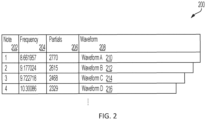
- FIG. 2 shows an exemplary wave table 200, according to some embodiments.
- the wave table 200 shows a note number 202 (e.g., 1, 2, 3, and so on), a frequency of each note (e.g., 8.6619557 Hz for note 1), the number of partials 206, and a waveform 208 for each wave table entry, including waveforms A 210, B 212, C 214, D 216, and so on.
- Waveform A 210 includes 2,770 partials
- waveform B 212 includes 2615 partials, and so on.
- the number of partials 206 is the number of partials that would be possible at a sample rate of 48 kHz (Nyquist at 24 kHz), according to some embodiments. Therefore, various waveforms can be stored in a wave table. Each waveform 208 in the table is the same waveform, rendered with a different number of partials. It should be understood that various structures can be used to store the wave table, such as a database, two- or three-dimensional arrays, linked lists, and/or the like.
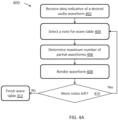
- FIG. 4A shows an exemplary computerized method 400 for generating a wave table, according to some embodiments.
- the system receives data indicative of an audio waveform, such as a partial series of the waveform.
- the system selects a note or frequency for a wave table entry.
- the system determines the maximum number of partial waveforms for the selected note.
- the system renders the waveform for the entry for the note in the wave table with the number of partial waveforms determined at step 406.
- the system determines whether there are any additional notes left to create entries for in the wave table. If yes, the method proceeds back to step 404 for a new note. If no, the system proceeds to step 412 and completes creating the wave table.
- the system receives data indicative of an audio waveform and/or its partial series.
- the system receives the partial series.
- the system receives an authored waveform and determines the partial series of the waveform.
- the audio waveform can be an authored waveform, a sampled analog waveform, and/or the like.
- the system can determine the partial series of the authored waveform for rendering the wave table, as described herein.
- the system selects a note or frequency for a particular entry of the wave table 404.
- the system can start by selecting MIDI note #1. While this example uses MIDI notes, any type of note can be used to build the wave table.
- instruments may have a set of notes that can be used to create the wave table.
- a piano has a set of discrete notes that can be used to build the wavetable, such as by creating an entry for each note of the piano.
- the system determines the maximum number of partial waveforms for the wave table entry.
- the number of partials stored in the wave table for each entry can be dependent on certain factors, such as the playback sample rate of the system.
- the sample rate can be determined when beginning the process to generate the wave table (e.g., at boot time or load time), and therefore the wave table can be dynamically generated based on the particular system environment. For example, some devices may include an audio synthesizer with a sampling rate of 48 kHz, while others may have a lower sampling rate, such as 24 kHz or 36 kHz.
- the system can determine the supported sampling rate of the system and use the sampling rate to dynamically build the wave table.
- the waveforms can be created using, for example, additive synthesis (e.g., summing sinewaves at the appropriate frequency and amplitude), inverse FFT (e.g., by first taking the partial series and converting the amplitudes and phases into complex z-plane representations.), and/or the like.
- the wave table can be created in advance, such as by using a tool and saving the wave table into a file, and/or can be generated at runtime (e.g., in which case the partial series is stored persistently).
- the system can be configured to render additional versions of the waveform, such as each possible version of this waveform (e.g., every possible partial count).
- the ultimate size can depend on the number of bits used to store the samples. For example, if using 32-bit floating-point numbers, the buffer size would need to be about 30 MB (e.g., 7,675,670 ⁇ 32 bits ; 8 bits per byte).
- the techniques can include reducing the overall number of partials, e.g., to save space and/or processing requirements. For example, techniques can be used to reduce the number of partials to a set that provides an acceptable reproduction fidelity. For example, since the maximum number of partials depends on the system sample rate as shown in Equation 1 (e.g., since the sample rate affects Nyquist), the sample rate can be lowered. As another example, the system can be configured to limit the maximum number of partials that are rendered. Such a limit may not significantly affect rendering.
- limiting the number of partials may not allow each and every partial being played back that would otherwise be allowed based on the system sample rate, however it may be rare for this to occur regardless (e.g., it may be rare that any sample is actually rendered at 8.662 Hz).
- the system can be configured not to render a waveform for every sequential number of partials (e.g., from 1 to 2770 in the example discussed herein).
- the wave table 200 shown in FIG. 2 there are gaps in the partial counts for the MIDI note numbers.
- MIDI note #1 can have up to 2,770 partials
- the next MIDI note #2 can only have 2,615, which is a difference of 155 partials compared to MIDI note #1.
- the system can be configured to only render waveforms to support the note frequencies of the system (e.g., for just the MIDI note frequencies). While such an approach may not address every possible rendering situation, it can be a viable tradeoff in terms of space saving.
- a musician could use a pitch bend wheel or modulation to generate frequencies between the MIDI notes, and therefore may not have a perfect match to the waveform versions in the wave table. But for purposes of memory optimization, it can be desirable to forego "perfect" rendering at such frequencies since the wave table could still be used to render the waveform.
- the system could be configured to just resample the waveform that has fewer partials than would otherwise be renderable (e.g., by resampling the waveform that was rendered for the nearest higher MIDI note).
- adding up the partials for the various MIDI notes applying such techniques could require needing 98,330 total samples for all "MIDI note” waveforms. Storing 98,330 total samples could only require about 384 KB of memory (e.g., compared to 30 MB otherwise).
- the wave table (e.g., stored in memory) includes the same waveform, defined by its partial series, rendered with varying numbers of its partials for each version.
- the different versions of the waveform in the wave table can facilitate generating different pitches of the authored waveform (e.g., in a manner that preserves fidelity and avoids aliasing).
- the system can determine one or more attributes, such as the number of partials that need to be rendered, the magnitude (volume) of each partial, the phase of each partial, and/or the like. The system can use this and/or other information to select a particular version of the waveform in the wave table for processing to render the waveform with the desired pitch.
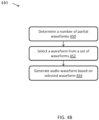
- FIG. 4B shows an exemplary computerized method 440 for generating a waveform with a desired pitch using a wave table, according to some embodiments.
- the system determines a number of partial waveforms for the ultimate waveform (e.g., at the desired pitch).
- the system selects a waveform version from the wave table (e.g., which includes a set of different versions of the authored waveform, where each version has an associated different number of partial waveforms generated based on the authored waveform) based on the number of partial waveforms associated with the desired audio waveform at the particular pitch.
- the system generates the audio waveform at the desired pitch using the selected version of the waveform from the wave table. Steps 450-454 therefore leverage the wave table (e.g., generated as described in conjunction with FIG. 4A ) to produce the ultimate waveform at a desired pitch.
- the system can receive an incoming note (e.g., MIDI note) that is to be rendered using the wave table.
- the system can convert the desired note to a fundamental frequency.
- the system can receive the desired fundamental frequency.
- the system can add or subtract from that frequency, as necessary, such as based on other controllers (e.g., other MIDI controllers, such as a pitch bend wheel, or requests from other code logic).
- the system determines a number of partial waveforms for the final desired frequency.
- the system can determine the number of partial waveforms based on various parameters, such as based on the sample rate, the playback frequency of the desired audio waveform, or both.
- the system can calculate the maximum number of partials possible at that frequency. For example, for a 48 kHz rendering sample rate and a desired frequency of the waveform of 440 Hz, the maximum number of partials below Nyquist are 54.5 as discussed herein. Rounding down to the nearest whole integer is 54 partials (which includes the fundamental frequency as well as 53 additional partials).
- the system selects a waveform version from the wave table based on the number of determined partial waveforms at step 450. For example, the system can select the waveform version from the table that has the number of partials determined at step 450. If techniques are used to reduce the number of waveform versions as discussed herein, there may not be a waveform version in the wave table with the same number of partials determined at step 450. The system can therefore be configured to select a next-closest version, such as the version with the next-fewer number of partials.
- the system generates the audio waveform at the desired pitch using the selected version of the waveform from the wave table.
- the system can resample the selected waveform to generate the audio waveform at the requested playback pitch.
- Each version of a waveform can be sampled at different pitches.
- a given (e.g., band limited) waveform version in memory e.g., waveform A 210
- there can be a certain range of playback pitch where that waveform contains all possible partials below Nyquist, and only those partials.
- the system can be configured to resample this waveform over that range of pitch (e.g., without risk of losing partials and/or aliasing). If the system needs to resample the waveform beyond that range, the system can be configured to switch to another version of the waveform with a different number of partials (e.g., waveform B 212, waveform C 214, and/or the like).
- the other waveforms each, in-turn, have a different associated range of playback pitch, e.g., without risk of losing partials or aliasing. For example, for a particular waveform, if the pitch is increased beyond the range for that waveform, the techniques can select a new waveform with fewer partials as the pitch is increased to avoid aliasing. If the pitch is lowered beyond the range supported by a waveform, the techniques can select a new waveform with more partials to use the best quality waveform available.
- the system can use the various versions of the waveform in the wave table to choose the best version for the particular desired tone of the waveform, such that the selected waveform can provide the desired tone with the most number of partials for the best audio quality while avoiding aliasing.
- the techniques can use multiple waveforms.
- the system can start rendering audio based on a first waveform, and as the pitch is increased or decreased, the system can switch to using a different waveform.
- the size of each waveform A 210, B 212, and so on is smaller or larger depending on the playback time of the waveform (as well as the amount of storage required to store the waveform with the associated partials, as discussed herein).
- the system can keep track of its location in a particular waveform and use the location to jump to the proper location of the next waveform.
- the system can use a floating point number to represent the start (e.g., at 0) and end (e.g., at 1) of each waveform, and keep track of the position of the waveform accordingly. For example, if the system has rendered up to 0.5 way through a particular waveform, the system can jump to 0.5 of the way through the next waveform.
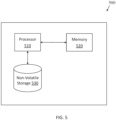
- the computer system 500 may include one or more processors 510 and one or more non-transitory computer-readable storage media (e.g., memory 520 and one or more non-volatile storage media 530).
- the processor 510 may control writing data to and reading data from the memory 520 and the non-volatile storage device 530 in any suitable manner, as the aspects of the invention described herein are not limited in this respect.
- the processor 510 may execute one or more instructions stored in one or more computer-readable storage media (e.g., the memory 520, storage media, etc.), which may serve as non-transitory computer-readable storage media storing instructions for execution by the processor 510.
- computer-readable storage media e.g., the memory 520, storage media, etc.
- code used to, for example, provide tools for authoring a waveform, generating a wave table, and/or resampling a waveform to create a desired pitch, etc. may be stored on one or more computer-readable storage media of computer system 500.
- Processor 510 may execute any such code to provide any techniques for authoring waveforms as described herein. Any other software, programs or instructions described herein may also be stored and executed by computer system 500.
- computer code may be applied to any aspects of methods and techniques described herein. For example, computer code may be applied to interact with an operating system to author and/or process waveforms through conventional operating system processes.
- the various methods or processes outlined herein may be coded as software that is executable on one or more processors that employ any one of a variety of operating systems or platforms. Additionally, such software may be written using any of numerous suitable programming languages and/or programming or scripting tools, and also may be compiled as executable machine language code or intermediate code that is executed on a virtual machine or a suitable framework.
- inventive concepts may be embodied as at least one non-transitory computer readable storage medium (e.g., a computer memory, one or more floppy discs, compact discs, optical discs, magnetic tapes, flash memories, circuit configurations in Field Programmable Gate Arrays or other semiconductor devices, etc.) encoded with one or more programs that, when executed on one or more computers or other processors, implement the various embodiments of the present invention.
- the non-transitory computer-readable medium or media may be transportable, such that the program or programs stored thereon may be loaded onto any computer resource to implement various aspects of the present invention as discussed above.
- program means any type of computer code or set of computer-executable instructions that can be employed to program a computer or other processor to implement various aspects of embodiments as discussed above. Additionally, it should be appreciated that according to one aspect, one or more computer programs that when executed perform methods of the present invention need not reside on a single computer or processor, but may be distributed in a modular fashion among different computers or processors to implement various aspects of the present invention.
- Computer-executable instructions may be in many forms, such as program modules, executed by one or more computers or other devices.
- program modules include routines, programs, objects, components, data structures, etc. that perform particular tasks or implement particular abstract data types.
- functionality of the program modules may be combined or distributed as desired in various embodiments.
- data structures may be stored in non-transitory computer-readable storage media in any suitable form.
- Data structures may have fields that are related through location in the data structure. Such relationships may likewise be achieved by assigning storage for the fields with locations in a non-transitory computer-readable medium that convey relationship between the fields.
- any suitable mechanism may be used to establish relationships among information in fields of a data structure, including through the use of pointers, tags or other mechanisms that establish relationships among data elements.
- inventive concepts may be embodied as one or more methods, of which examples have been provided.
- the acts performed as part of a method may be ordered in any suitable way. Accordingly, embodiments may be constructed in which acts are performed in an order different than illustrated, which may include performing some acts simultaneously, even though shown as sequential acts in illustrative embodiments.
- a reference to "A and/or B", when used in conjunction with open-ended language such as “comprising” can refer, in one embodiment, to A only (optionally including elements other than B); in another embodiment, to B only (optionally including elements other than A); in yet another embodiment, to both A and B (optionally including other elements); etc.
Landscapes
- Engineering & Computer Science (AREA)
- Physics & Mathematics (AREA)
- Acoustics & Sound (AREA)
- Multimedia (AREA)
- General Engineering & Computer Science (AREA)
- Mathematical Physics (AREA)
- Algebra (AREA)
- General Physics & Mathematics (AREA)
- Mathematical Analysis (AREA)
- Mathematical Optimization (AREA)
- Pure & Applied Mathematics (AREA)
- Electrophonic Musical Instruments (AREA)
Claims (9)
- Computerimplementiertes Verfahren zum Erzeugen einer Audiowellenform (208) bei einer Wiedergabefrequenz, wobei das Verfahren umfasst:Erhalten von ersten Daten, die auf einen Satz von Partialton-Wellenformen (206) der Audiowellenform hinweisen; undErzeugen einer Wellentabelle (200) für die Audiowellenform basierend auf dem Satz von Partialton-Wellenformen, wobei das Erzeugen umfasst:Festlegen eines Satzes von Noten (202), wobei jede Note einen entsprechenden Eintrag in der Wellenformtabelle hat;für jede Note im Satz der Noten:Festlegen einer zugeordneten Anzahl von Partialtönen (206) für die Note;Rendern einer zugeordneten Wellenformversion der Audiowellenform, die die festgelegte Anzahl der Partialtöne für die Note aus dem Satz der Partialton-Wellenformen umfasst; undSpeichern der zugeordneten Wellenformversion (210, 212, 214, 216) im entsprechenden Eintrag der Note in der Wellentabelle.
- Verfahren nach Anspruch 1, das ferner umfasst:
Festlegen einer Anzahl von Partialton-Wellenformen basierend auf einer Abtastrate, einer Wiedergabefrequenz (204) der Audiowellenform (208) oder beiden; und Auswählen, basierend auf den ersten Daten und der Anzahl der Partialton-Wellenformen, mindestens einer Wellenformversion aus dem Satz der Wellenformversionen, die der Audiowellenform zugeordnet sind, um die Audiowellenform bei der Wiedergabefrequenz zu erzeugen, wobei jede Wellenformversion im Satz der Wellenformversionen eine zugeordnete unterschiedliche Anzahl von Partialton-Wellenformen (206) für die Audiowellenform umfasst. - Verfahren nach Anspruch 2, wobei das Auswählen der mindestens einen Wellenformversion umfasst:Auswählen einer ersten Wellenformversion zum Erzeugen eines ersten Teils der Audiowellenform (208); undAuswählen einer zweiten Wellenformversion zum Erzeugen eines zweiten Teils der Audiowellenform, wobei das Auswählen das Festlegen einer Startposition der zweiten Wellenform basierend auf einer Endposition der ersten Wellenform umfasst.
- Verfahren nach Anspruch 2 oder 3, das ferner ein erneutes Abtasten der ausgewählten mindestens einen Wellenformversion umfasst, um die Audiowellenform (208) bei der Wiedergabefrequenz zu erzeugen.
- Verfahren nach einem der Ansprüche 2 bis 4, wobei das Festlegen der zugeordneten Anzahl von Partialton-Wellenformen das Festlegen einer maximalen Anzahl von Partialton-Wellenformen für die Wiedergabefrequenz der Audiowellenform (208) umfasst.
- Verfahren nach einem der vorhergehenden Ansprüche, wobei das Erhalten der ersten Daten, die auf den Satz von Partialton-Wellenformen hinweisen, umfasst:Abtasten der Audiowellenform (208), um eine abgetastete Wellenform zu erzeugen;Umwandeln der abgetasteten Wellenform von einer Zeitdomäne in eine Frequenzdomäne, um eine abgetastete Frequenzdomänen-Wellenform zu erzeugen; undFestlegen des Satzes der Partialton-Wellenformen für die Audiowellenform (208) basierend auf der abgetasteten Frequenzdomänen-Wellenform.
- Verfahren nach einem der vorhergehenden Ansprüche, wobei das Festlegen der zugeordneten Anzahl von Partialtönen für jede Note umfasst:Festlegen einer unterstützten Abtastrate; undFestlegen der zugeordneten Anzahl von Partialtönen für jede Note, indem die unterstützte Abtastrate durch die Frequenz der zugeordneten Note geteilt wird.
- System zum Erzeugen einer Audiowellenform (208) bei einer Wiedergabefrequenz, wobei das System umfasst:
einen Prozessor in Kommunikation mit einem Speicher, wobei der Speicher dazu konfiguriert ist, maschinenlesbare Anweisungen zu speichern, die, wenn sie vom Prozessor ausgeführt werden, den Prozessor veranlassen, das Verfahren nach einem vorhergehenden Anspruch durchzuführen. - Mindestens ein computerlesbares Speichermedium, das prozessorausführbare Anweisungen speichert, die, wenn sie von mindestens einem Prozessor ausgeführt werden, den mindestens einen Prozessor veranlassen, das Verfahren nach einem der Ansprüche 1 bis 7 durchzuführen.
Applications Claiming Priority (2)
| Application Number | Priority Date | Filing Date | Title |
|---|---|---|---|
| US201962884424P | 2019-08-08 | 2019-08-08 | |
| PCT/US2020/045260 WO2021026384A1 (en) | 2019-08-08 | 2020-08-06 | Authoring and rendering digital audio waveforms |
Publications (2)
| Publication Number | Publication Date |
|---|---|
| EP4010896A1 EP4010896A1 (de) | 2022-06-15 |
| EP4010896B1 true EP4010896B1 (de) | 2024-11-13 |
Family
ID=72240480
Family Applications (1)
| Application Number | Title | Priority Date | Filing Date |
|---|---|---|---|
| EP20761665.7A Active EP4010896B1 (de) | 2019-08-08 | 2020-08-06 | Erstellung und wiedergabe digitaler audiowellenformen |
Country Status (3)
| Country | Link |
|---|---|
| US (1) | US11594207B2 (de) |
| EP (1) | EP4010896B1 (de) |
| WO (1) | WO2021026384A1 (de) |
Families Citing this family (2)
| Publication number | Priority date | Publication date | Assignee | Title |
|---|---|---|---|---|
| US11594207B2 (en) * | 2019-08-08 | 2023-02-28 | Harmonix Music Systems, Inc. | Techniques for digitally rendering audio waveforms and related systems and methods |
| US11837212B1 (en) * | 2023-03-31 | 2023-12-05 | The Adt Security Corporation | Digital tone synthesizers |
Family Cites Families (18)
| Publication number | Priority date | Publication date | Assignee | Title |
|---|---|---|---|---|
| JPS5632188A (en) * | 1979-08-24 | 1981-04-01 | Sony Corp | Waveform synthesizer |
| JPH0792978A (ja) * | 1993-06-30 | 1995-04-07 | Kawai Musical Instr Mfg Co Ltd | 楽音発生装置 |
| CN1174370C (zh) * | 1995-06-19 | 2004-11-03 | 雅马哈株式会社 | 形成音色波形的方法和装置 |
| JP3644263B2 (ja) * | 1998-07-31 | 2005-04-27 | ヤマハ株式会社 | 波形形成装置及び方法 |
| US7003120B1 (en) * | 1998-10-29 | 2006-02-21 | Paul Reed Smith Guitars, Inc. | Method of modifying harmonic content of a complex waveform |
| JP4226164B2 (ja) * | 1999-09-14 | 2009-02-18 | ローランド株式会社 | 波形信号の時間軸圧縮伸長装置 |
| JP3654084B2 (ja) * | 1999-09-27 | 2005-06-02 | ヤマハ株式会社 | 波形生成方法及び装置 |
| JP2001100760A (ja) * | 1999-09-27 | 2001-04-13 | Yamaha Corp | 波形生成方法及び装置 |
| JP3714397B2 (ja) * | 2000-03-14 | 2005-11-09 | ヤマハ株式会社 | 波形データ処理装置及び波形データ処理方法 |
| JP3975772B2 (ja) * | 2002-02-19 | 2007-09-12 | ヤマハ株式会社 | 波形生成装置及び方法 |
| JP4218624B2 (ja) * | 2004-10-18 | 2009-02-04 | ヤマハ株式会社 | 楽音データ生成方法及び装置 |
| JP4396646B2 (ja) * | 2006-02-07 | 2010-01-13 | ヤマハ株式会社 | 応答波形合成方法、応答波形合成装置、音響設計支援装置および音響設計支援プログラム |
| JP5533892B2 (ja) * | 2012-01-06 | 2014-06-25 | ヤマハ株式会社 | 演奏装置 |
| JP6090204B2 (ja) * | 2014-02-21 | 2017-03-08 | ヤマハ株式会社 | 音響信号発生装置 |
| EP3630546B1 (de) * | 2017-05-24 | 2022-08-10 | Gogoro Inc. | Systeme zur erzeugung von audiosignalen und zugehörige verfahren |
| IT201800008080A1 (it) * | 2018-08-13 | 2020-02-13 | Viscount Int Spa | Sistema per la generazione di suono sintetizzato in strumenti musicali. |
| JP6806120B2 (ja) * | 2018-10-04 | 2021-01-06 | カシオ計算機株式会社 | 電子楽器、楽音発生方法及びプログラム |
| US11594207B2 (en) * | 2019-08-08 | 2023-02-28 | Harmonix Music Systems, Inc. | Techniques for digitally rendering audio waveforms and related systems and methods |
-
2020
- 2020-08-06 US US16/987,302 patent/US11594207B2/en active Active
- 2020-08-06 EP EP20761665.7A patent/EP4010896B1/de active Active
- 2020-08-06 WO PCT/US2020/045260 patent/WO2021026384A1/en not_active Ceased
Also Published As
| Publication number | Publication date |
|---|---|
| US20210043180A1 (en) | 2021-02-11 |
| WO2021026384A1 (en) | 2021-02-11 |
| US11594207B2 (en) | 2023-02-28 |
| EP4010896A1 (de) | 2022-06-15 |
Similar Documents
| Publication | Publication Date | Title |
|---|---|---|
| Miranda | Computer sound design: synthesis techniques and programming | |
| Tae | Introduction to digital signal processing: Computer musically speaking | |
| US6900381B2 (en) | Method for removing aliasing in wave table based synthesizers | |
| CN111418005B (zh) | 声音合成方法、声音合成装置及存储介质 | |
| US6137045A (en) | Method and apparatus for compressed chaotic music synthesis | |
| CN103310780B (zh) | 乐音产生装置及乐音产生方法 | |
| US11594207B2 (en) | Techniques for digitally rendering audio waveforms and related systems and methods | |
| Creasey | Audio processes: Musical analysis, modification, synthesis, and control | |
| CN101641730A (zh) | 乐器数字接口硬件指令 | |
| KR101120968B1 (ko) | 악기 디지털 인터페이스 하드웨어 명령 세트 | |
| JP3795201B2 (ja) | 音響信号の符号化方法およびコンピュータ読み取り可能な記録媒体 | |
| Klassen | Spline Modeling of Audio Signals with Cycle Interpolation | |
| RU2314502C2 (ru) | Устройство и способ для обработки звука звонка | |
| Bianchini et al. | Virtual sound | |
| JP4152502B2 (ja) | 音響信号の符号化装置および符号データの編集装置 | |
| Wells | Real-time spectral modelling of audio for creative sound transformation | |
| Lazzarini | Soundfiles | |
| Mitchell | Basicsynth | |
| JP3237226B2 (ja) | ループ波形生成装置及びループ波形生成方法 | |
| Gupta et al. | Comparative Analysis of Sound Synthesis Methods and Development of a Compact Analog Synthesizer | |
| Natsheh et al. | Platform dependent delay and pitch shifting using Android environment | |
| Goeddel et al. | High quality synthesis of musical voices in discrete time | |
| Kreković et al. | Controlling dynamic stochastic synthesis with an audio signal | |
| KR20210050647A (ko) | 악기 디지털 인터페이스 재생 장치 및 방법 | |
| Murdoch et al. | On the Edge: Statistics & Computing: Listen to Your Data—Sonification with Standard Statistics Software |
Legal Events
| Date | Code | Title | Description |
|---|---|---|---|
| STAA | Information on the status of an ep patent application or granted ep patent |
Free format text: STATUS: UNKNOWN |
|
| STAA | Information on the status of an ep patent application or granted ep patent |
Free format text: STATUS: THE INTERNATIONAL PUBLICATION HAS BEEN MADE |
|
| PUAI | Public reference made under article 153(3) epc to a published international application that has entered the european phase |
Free format text: ORIGINAL CODE: 0009012 |
|
| STAA | Information on the status of an ep patent application or granted ep patent |
Free format text: STATUS: REQUEST FOR EXAMINATION WAS MADE |
|
| 17P | Request for examination filed |
Effective date: 20220307 |
|
| AK | Designated contracting states |
Kind code of ref document: A1 Designated state(s): AL AT BE BG CH CY CZ DE DK EE ES FI FR GB GR HR HU IE IS IT LI LT LU LV MC MK MT NL NO PL PT RO RS SE SI SK SM TR |
|
| DAV | Request for validation of the european patent (deleted) | ||
| DAX | Request for extension of the european patent (deleted) | ||
| GRAP | Despatch of communication of intention to grant a patent |
Free format text: ORIGINAL CODE: EPIDOSNIGR1 |
|
| STAA | Information on the status of an ep patent application or granted ep patent |
Free format text: STATUS: GRANT OF PATENT IS INTENDED |
|
| INTG | Intention to grant announced |
Effective date: 20240123 |
|
| GRAJ | Information related to disapproval of communication of intention to grant by the applicant or resumption of examination proceedings by the epo deleted |
Free format text: ORIGINAL CODE: EPIDOSDIGR1 |
|
| STAA | Information on the status of an ep patent application or granted ep patent |
Free format text: STATUS: REQUEST FOR EXAMINATION WAS MADE |
|
| GRAP | Despatch of communication of intention to grant a patent |
Free format text: ORIGINAL CODE: EPIDOSNIGR1 |
|
| STAA | Information on the status of an ep patent application or granted ep patent |
Free format text: STATUS: GRANT OF PATENT IS INTENDED |
|
| INTC | Intention to grant announced (deleted) | ||
| INTG | Intention to grant announced |
Effective date: 20240607 |
|
| P01 | Opt-out of the competence of the unified patent court (upc) registered |
Free format text: CASE NUMBER: APP_39760/2024 Effective date: 20240703 |
|
| GRAS | Grant fee paid |
Free format text: ORIGINAL CODE: EPIDOSNIGR3 |
|
| GRAA | (expected) grant |
Free format text: ORIGINAL CODE: 0009210 |
|
| STAA | Information on the status of an ep patent application or granted ep patent |
Free format text: STATUS: THE PATENT HAS BEEN GRANTED |
|
| AK | Designated contracting states |
Kind code of ref document: B1 Designated state(s): AL AT BE BG CH CY CZ DE DK EE ES FI FR GB GR HR HU IE IS IT LI LT LU LV MC MK MT NL NO PL PT RO RS SE SI SK SM TR |
|
| REG | Reference to a national code |
Ref country code: GB Ref legal event code: FG4D |
|
| REG | Reference to a national code |
Ref country code: CH Ref legal event code: EP |
|
| REG | Reference to a national code |
Ref country code: DE Ref legal event code: R096 Ref document number: 602020041335 Country of ref document: DE |
|
| REG | Reference to a national code |
Ref country code: IE Ref legal event code: FG4D |
|
| REG | Reference to a national code |
Ref country code: LT Ref legal event code: MG9D |
|
| REG | Reference to a national code |
Ref country code: NL Ref legal event code: MP Effective date: 20241113 |
|
| PG25 | Lapsed in a contracting state [announced via postgrant information from national office to epo] |
Ref country code: PT Free format text: LAPSE BECAUSE OF FAILURE TO SUBMIT A TRANSLATION OF THE DESCRIPTION OR TO PAY THE FEE WITHIN THE PRESCRIBED TIME-LIMIT Effective date: 20250313 Ref country code: IS Free format text: LAPSE BECAUSE OF FAILURE TO SUBMIT A TRANSLATION OF THE DESCRIPTION OR TO PAY THE FEE WITHIN THE PRESCRIBED TIME-LIMIT Effective date: 20250313 Ref country code: HR Free format text: LAPSE BECAUSE OF FAILURE TO SUBMIT A TRANSLATION OF THE DESCRIPTION OR TO PAY THE FEE WITHIN THE PRESCRIBED TIME-LIMIT Effective date: 20241113 |
|
| PG25 | Lapsed in a contracting state [announced via postgrant information from national office to epo] |
Ref country code: FI Free format text: LAPSE BECAUSE OF FAILURE TO SUBMIT A TRANSLATION OF THE DESCRIPTION OR TO PAY THE FEE WITHIN THE PRESCRIBED TIME-LIMIT Effective date: 20241113 Ref country code: NL Free format text: LAPSE BECAUSE OF FAILURE TO SUBMIT A TRANSLATION OF THE DESCRIPTION OR TO PAY THE FEE WITHIN THE PRESCRIBED TIME-LIMIT Effective date: 20241113 |
|
| REG | Reference to a national code |
Ref country code: AT Ref legal event code: MK05 Ref document number: 1742314 Country of ref document: AT Kind code of ref document: T Effective date: 20241113 |
|
| PG25 | Lapsed in a contracting state [announced via postgrant information from national office to epo] |
Ref country code: BG Free format text: LAPSE BECAUSE OF FAILURE TO SUBMIT A TRANSLATION OF THE DESCRIPTION OR TO PAY THE FEE WITHIN THE PRESCRIBED TIME-LIMIT Effective date: 20241113 |
|
| PG25 | Lapsed in a contracting state [announced via postgrant information from national office to epo] |
Ref country code: ES Free format text: LAPSE BECAUSE OF FAILURE TO SUBMIT A TRANSLATION OF THE DESCRIPTION OR TO PAY THE FEE WITHIN THE PRESCRIBED TIME-LIMIT Effective date: 20241113 |
|
| PG25 | Lapsed in a contracting state [announced via postgrant information from national office to epo] |
Ref country code: NO Free format text: LAPSE BECAUSE OF FAILURE TO SUBMIT A TRANSLATION OF THE DESCRIPTION OR TO PAY THE FEE WITHIN THE PRESCRIBED TIME-LIMIT Effective date: 20250213 |
|
| PG25 | Lapsed in a contracting state [announced via postgrant information from national office to epo] |
Ref country code: GR Free format text: LAPSE BECAUSE OF FAILURE TO SUBMIT A TRANSLATION OF THE DESCRIPTION OR TO PAY THE FEE WITHIN THE PRESCRIBED TIME-LIMIT Effective date: 20250214 Ref country code: AT Free format text: LAPSE BECAUSE OF FAILURE TO SUBMIT A TRANSLATION OF THE DESCRIPTION OR TO PAY THE FEE WITHIN THE PRESCRIBED TIME-LIMIT Effective date: 20241113 Ref country code: LV Free format text: LAPSE BECAUSE OF FAILURE TO SUBMIT A TRANSLATION OF THE DESCRIPTION OR TO PAY THE FEE WITHIN THE PRESCRIBED TIME-LIMIT Effective date: 20241113 |
|
| PG25 | Lapsed in a contracting state [announced via postgrant information from national office to epo] |
Ref country code: PL Free format text: LAPSE BECAUSE OF FAILURE TO SUBMIT A TRANSLATION OF THE DESCRIPTION OR TO PAY THE FEE WITHIN THE PRESCRIBED TIME-LIMIT Effective date: 20241113 |
|
| PG25 | Lapsed in a contracting state [announced via postgrant information from national office to epo] |
Ref country code: RS Free format text: LAPSE BECAUSE OF FAILURE TO SUBMIT A TRANSLATION OF THE DESCRIPTION OR TO PAY THE FEE WITHIN THE PRESCRIBED TIME-LIMIT Effective date: 20250213 |
|
| PG25 | Lapsed in a contracting state [announced via postgrant information from national office to epo] |
Ref country code: SM Free format text: LAPSE BECAUSE OF FAILURE TO SUBMIT A TRANSLATION OF THE DESCRIPTION OR TO PAY THE FEE WITHIN THE PRESCRIBED TIME-LIMIT Effective date: 20241113 |
|
| PG25 | Lapsed in a contracting state [announced via postgrant information from national office to epo] |
Ref country code: DK Free format text: LAPSE BECAUSE OF FAILURE TO SUBMIT A TRANSLATION OF THE DESCRIPTION OR TO PAY THE FEE WITHIN THE PRESCRIBED TIME-LIMIT Effective date: 20241113 |
|
| PG25 | Lapsed in a contracting state [announced via postgrant information from national office to epo] |
Ref country code: EE Free format text: LAPSE BECAUSE OF FAILURE TO SUBMIT A TRANSLATION OF THE DESCRIPTION OR TO PAY THE FEE WITHIN THE PRESCRIBED TIME-LIMIT Effective date: 20241113 |
|
| PG25 | Lapsed in a contracting state [announced via postgrant information from national office to epo] |
Ref country code: RO Free format text: LAPSE BECAUSE OF FAILURE TO SUBMIT A TRANSLATION OF THE DESCRIPTION OR TO PAY THE FEE WITHIN THE PRESCRIBED TIME-LIMIT Effective date: 20241113 |
|
| PG25 | Lapsed in a contracting state [announced via postgrant information from national office to epo] |
Ref country code: SK Free format text: LAPSE BECAUSE OF FAILURE TO SUBMIT A TRANSLATION OF THE DESCRIPTION OR TO PAY THE FEE WITHIN THE PRESCRIBED TIME-LIMIT Effective date: 20241113 |
|
| PG25 | Lapsed in a contracting state [announced via postgrant information from national office to epo] |
Ref country code: CZ Free format text: LAPSE BECAUSE OF FAILURE TO SUBMIT A TRANSLATION OF THE DESCRIPTION OR TO PAY THE FEE WITHIN THE PRESCRIBED TIME-LIMIT Effective date: 20241113 |
|
| PG25 | Lapsed in a contracting state [announced via postgrant information from national office to epo] |
Ref country code: IT Free format text: LAPSE BECAUSE OF FAILURE TO SUBMIT A TRANSLATION OF THE DESCRIPTION OR TO PAY THE FEE WITHIN THE PRESCRIBED TIME-LIMIT Effective date: 20241113 |
|
| REG | Reference to a national code |
Ref country code: DE Ref legal event code: R097 Ref document number: 602020041335 Country of ref document: DE |
|
| PG25 | Lapsed in a contracting state [announced via postgrant information from national office to epo] |
Ref country code: SE Free format text: LAPSE BECAUSE OF FAILURE TO SUBMIT A TRANSLATION OF THE DESCRIPTION OR TO PAY THE FEE WITHIN THE PRESCRIBED TIME-LIMIT Effective date: 20241113 |
|
| PLBE | No opposition filed within time limit |
Free format text: ORIGINAL CODE: 0009261 |
|
| STAA | Information on the status of an ep patent application or granted ep patent |
Free format text: STATUS: NO OPPOSITION FILED WITHIN TIME LIMIT |
|
| PGFP | Annual fee paid to national office [announced via postgrant information from national office to epo] |
Ref country code: DE Payment date: 20250827 Year of fee payment: 6 |
|
| PGFP | Annual fee paid to national office [announced via postgrant information from national office to epo] |
Ref country code: GB Payment date: 20250827 Year of fee payment: 6 |
|
| PGFP | Annual fee paid to national office [announced via postgrant information from national office to epo] |
Ref country code: FR Payment date: 20250825 Year of fee payment: 6 |
|
| 26N | No opposition filed |
Effective date: 20250814 |
|
| REG | Reference to a national code |
Ref country code: CH Ref legal event code: H13 Free format text: ST27 STATUS EVENT CODE: U-0-0-H10-H13 (AS PROVIDED BY THE NATIONAL OFFICE) Effective date: 20260324 |
|
| PG25 | Lapsed in a contracting state [announced via postgrant information from national office to epo] |
Ref country code: MC Free format text: LAPSE BECAUSE OF FAILURE TO SUBMIT A TRANSLATION OF THE DESCRIPTION OR TO PAY THE FEE WITHIN THE PRESCRIBED TIME-LIMIT Effective date: 20241113 |
|
| PG25 | Lapsed in a contracting state [announced via postgrant information from national office to epo] |
Ref country code: LU Free format text: LAPSE BECAUSE OF NON-PAYMENT OF DUE FEES Effective date: 20250806 |
|
| PG25 | Lapsed in a contracting state [announced via postgrant information from national office to epo] |
Ref country code: CH Free format text: LAPSE BECAUSE OF NON-PAYMENT OF DUE FEES Effective date: 20250831 |