EP4010007B1 - Production of mhc ii/cii complexes - Google Patents
Production of mhc ii/cii complexes Download PDFInfo
- Publication number
- EP4010007B1 EP4010007B1 EP20750299.8A EP20750299A EP4010007B1 EP 4010007 B1 EP4010007 B1 EP 4010007B1 EP 20750299 A EP20750299 A EP 20750299A EP 4010007 B1 EP4010007 B1 EP 4010007B1
- Authority
- EP
- European Patent Office
- Prior art keywords
- peptide
- drb1
- cii
- mhc
- domain
- Prior art date
- Legal status (The legal status is an assumption and is not a legal conclusion. Google has not performed a legal analysis and makes no representation as to the accuracy of the status listed.)
- Active
Links
Images









Classifications
-
- C—CHEMISTRY; METALLURGY
- C07—ORGANIC CHEMISTRY
- C07K—PEPTIDES
- C07K14/00—Peptides having more than 20 amino acids; Gastrins; Somatostatins; Melanotropins; Derivatives thereof
- C07K14/435—Peptides having more than 20 amino acids; Gastrins; Somatostatins; Melanotropins; Derivatives thereof from animals; from humans
- C07K14/705—Receptors; Cell surface antigens; Cell surface determinants
- C07K14/70503—Immunoglobulin superfamily
- C07K14/70539—MHC-molecules, e.g. HLA-molecules
-
- A—HUMAN NECESSITIES
- A61—MEDICAL OR VETERINARY SCIENCE; HYGIENE
- A61K—PREPARATIONS FOR MEDICAL, DENTAL OR TOILETRY PURPOSES
- A61K39/00—Medicinal preparations containing antigens or antibodies
- A61K39/0005—Vertebrate antigens
- A61K39/0008—Antigens related to auto-immune diseases; Preparations to induce self-tolerance
-
- A—HUMAN NECESSITIES
- A61—MEDICAL OR VETERINARY SCIENCE; HYGIENE
- A61K—PREPARATIONS FOR MEDICAL, DENTAL OR TOILETRY PURPOSES
- A61K38/00—Medicinal preparations containing peptides
- A61K38/16—Peptides having more than 20 amino acids; Gastrins; Somatostatins; Melanotropins; Derivatives thereof
- A61K38/17—Peptides having more than 20 amino acids; Gastrins; Somatostatins; Melanotropins; Derivatives thereof from animals; from humans
-
- A—HUMAN NECESSITIES
- A61—MEDICAL OR VETERINARY SCIENCE; HYGIENE
- A61K—PREPARATIONS FOR MEDICAL, DENTAL OR TOILETRY PURPOSES
- A61K38/00—Medicinal preparations containing peptides
- A61K38/16—Peptides having more than 20 amino acids; Gastrins; Somatostatins; Melanotropins; Derivatives thereof
- A61K38/17—Peptides having more than 20 amino acids; Gastrins; Somatostatins; Melanotropins; Derivatives thereof from animals; from humans
- A61K38/177—Receptors; Cell surface antigens; Cell surface determinants
- A61K38/1774—Immunoglobulin superfamily (e.g. CD2, CD4, CD8, ICAM molecules, B7 molecules, Fc-receptors, MHC-molecules)
-
- A—HUMAN NECESSITIES
- A61—MEDICAL OR VETERINARY SCIENCE; HYGIENE
- A61K—PREPARATIONS FOR MEDICAL, DENTAL OR TOILETRY PURPOSES
- A61K38/00—Medicinal preparations containing peptides
- A61K38/16—Peptides having more than 20 amino acids; Gastrins; Somatostatins; Melanotropins; Derivatives thereof
- A61K38/17—Peptides having more than 20 amino acids; Gastrins; Somatostatins; Melanotropins; Derivatives thereof from animals; from humans
- A61K38/39—Connective tissue peptides, e.g. collagen, elastin, laminin, fibronectin, vitronectin, cold insoluble globulin [CIG]
-
- A—HUMAN NECESSITIES
- A61—MEDICAL OR VETERINARY SCIENCE; HYGIENE
- A61K—PREPARATIONS FOR MEDICAL, DENTAL OR TOILETRY PURPOSES
- A61K39/00—Medicinal preparations containing antigens or antibodies
- A61K39/385—Haptens or antigens, bound to carriers
-
- A—HUMAN NECESSITIES
- A61—MEDICAL OR VETERINARY SCIENCE; HYGIENE
- A61K—PREPARATIONS FOR MEDICAL, DENTAL OR TOILETRY PURPOSES
- A61K47/00—Medicinal preparations characterised by the non-active ingredients used, e.g. carriers or inert additives; Targeting or modifying agents chemically bound to the active ingredient
- A61K47/50—Medicinal preparations characterised by the non-active ingredients used, e.g. carriers or inert additives; Targeting or modifying agents chemically bound to the active ingredient the non-active ingredient being chemically bound to the active ingredient, e.g. polymer-drug conjugates
- A61K47/51—Medicinal preparations characterised by the non-active ingredients used, e.g. carriers or inert additives; Targeting or modifying agents chemically bound to the active ingredient the non-active ingredient being chemically bound to the active ingredient, e.g. polymer-drug conjugates the non-active ingredient being a modifying agent
- A61K47/54—Medicinal preparations characterised by the non-active ingredients used, e.g. carriers or inert additives; Targeting or modifying agents chemically bound to the active ingredient the non-active ingredient being chemically bound to the active ingredient, e.g. polymer-drug conjugates the non-active ingredient being a modifying agent the modifying agent being an organic compound
- A61K47/55—Medicinal preparations characterised by the non-active ingredients used, e.g. carriers or inert additives; Targeting or modifying agents chemically bound to the active ingredient the non-active ingredient being chemically bound to the active ingredient, e.g. polymer-drug conjugates the non-active ingredient being a modifying agent the modifying agent being an organic compound the modifying agent being also a pharmacologically or therapeutically active agent, i.e. the entire conjugate being a codrug
-
- A—HUMAN NECESSITIES
- A61—MEDICAL OR VETERINARY SCIENCE; HYGIENE
- A61K—PREPARATIONS FOR MEDICAL, DENTAL OR TOILETRY PURPOSES
- A61K47/00—Medicinal preparations characterised by the non-active ingredients used, e.g. carriers or inert additives; Targeting or modifying agents chemically bound to the active ingredient
- A61K47/50—Medicinal preparations characterised by the non-active ingredients used, e.g. carriers or inert additives; Targeting or modifying agents chemically bound to the active ingredient the non-active ingredient being chemically bound to the active ingredient, e.g. polymer-drug conjugates
- A61K47/51—Medicinal preparations characterised by the non-active ingredients used, e.g. carriers or inert additives; Targeting or modifying agents chemically bound to the active ingredient the non-active ingredient being chemically bound to the active ingredient, e.g. polymer-drug conjugates the non-active ingredient being a modifying agent
- A61K47/62—Medicinal preparations characterised by the non-active ingredients used, e.g. carriers or inert additives; Targeting or modifying agents chemically bound to the active ingredient the non-active ingredient being chemically bound to the active ingredient, e.g. polymer-drug conjugates the non-active ingredient being a modifying agent the modifying agent being a protein, peptide or polyamino acid
- A61K47/65—Peptidic linkers, binders or spacers, e.g. peptidic enzyme-labile linkers
-
- A—HUMAN NECESSITIES
- A61—MEDICAL OR VETERINARY SCIENCE; HYGIENE
- A61P—SPECIFIC THERAPEUTIC ACTIVITY OF CHEMICAL COMPOUNDS OR MEDICINAL PREPARATIONS
- A61P19/00—Drugs for skeletal disorders
-
- A—HUMAN NECESSITIES
- A61—MEDICAL OR VETERINARY SCIENCE; HYGIENE
- A61P—SPECIFIC THERAPEUTIC ACTIVITY OF CHEMICAL COMPOUNDS OR MEDICINAL PREPARATIONS
- A61P19/00—Drugs for skeletal disorders
- A61P19/02—Drugs for skeletal disorders for joint disorders, e.g. arthritis, arthrosis
-
- A—HUMAN NECESSITIES
- A61—MEDICAL OR VETERINARY SCIENCE; HYGIENE
- A61P—SPECIFIC THERAPEUTIC ACTIVITY OF CHEMICAL COMPOUNDS OR MEDICINAL PREPARATIONS
- A61P29/00—Non-central analgesic, antipyretic or antiinflammatory agents, e.g. antirheumatic agents; Non-steroidal antiinflammatory drugs [NSAID]
-
- A—HUMAN NECESSITIES
- A61—MEDICAL OR VETERINARY SCIENCE; HYGIENE
- A61P—SPECIFIC THERAPEUTIC ACTIVITY OF CHEMICAL COMPOUNDS OR MEDICINAL PREPARATIONS
- A61P37/00—Drugs for immunological or allergic disorders
-
- A—HUMAN NECESSITIES
- A61—MEDICAL OR VETERINARY SCIENCE; HYGIENE
- A61P—SPECIFIC THERAPEUTIC ACTIVITY OF CHEMICAL COMPOUNDS OR MEDICINAL PREPARATIONS
- A61P37/00—Drugs for immunological or allergic disorders
- A61P37/02—Immunomodulators
-
- C—CHEMISTRY; METALLURGY
- C07—ORGANIC CHEMISTRY
- C07K—PEPTIDES
- C07K14/00—Peptides having more than 20 amino acids; Gastrins; Somatostatins; Melanotropins; Derivatives thereof
- C07K14/435—Peptides having more than 20 amino acids; Gastrins; Somatostatins; Melanotropins; Derivatives thereof from animals; from humans
- C07K14/78—Connective tissue peptides, e.g. collagen, elastin, laminin, fibronectin, vitronectin or cold insoluble globulin [CIG]
-
- C—CHEMISTRY; METALLURGY
- C12—BIOCHEMISTRY; BEER; SPIRITS; WINE; VINEGAR; MICROBIOLOGY; ENZYMOLOGY; MUTATION OR GENETIC ENGINEERING
- C12N—MICROORGANISMS OR ENZYMES; COMPOSITIONS THEREOF; PROPAGATING, PRESERVING, OR MAINTAINING MICROORGANISMS; MUTATION OR GENETIC ENGINEERING; CULTURE MEDIA
- C12N15/00—Mutation or genetic engineering; DNA or RNA concerning genetic engineering, vectors, e.g. plasmids, or their isolation, preparation or purification; Use of hosts therefor
- C12N15/09—Recombinant DNA-technology
- C12N15/63—Introduction of foreign genetic material using vectors; Vectors; Use of hosts therefor; Regulation of expression
- C12N15/79—Vectors or expression systems specially adapted for eukaryotic hosts
- C12N15/85—Vectors or expression systems specially adapted for eukaryotic hosts for animal cells
-
- C—CHEMISTRY; METALLURGY
- C12—BIOCHEMISTRY; BEER; SPIRITS; WINE; VINEGAR; MICROBIOLOGY; ENZYMOLOGY; MUTATION OR GENETIC ENGINEERING
- C12N—MICROORGANISMS OR ENZYMES; COMPOSITIONS THEREOF; PROPAGATING, PRESERVING, OR MAINTAINING MICROORGANISMS; MUTATION OR GENETIC ENGINEERING; CULTURE MEDIA
- C12N5/00—Undifferentiated human, animal or plant cells, e.g. cell lines; Tissues; Cultivation or maintenance thereof; Culture media therefor
- C12N5/06—Animal cells or tissues; Human cells or tissues
- C12N5/0602—Vertebrate cells
- C12N5/0684—Cells of the urinary tract or kidneys
- C12N5/0687—Renal stem cells; Renal progenitors
-
- C—CHEMISTRY; METALLURGY
- C12—BIOCHEMISTRY; BEER; SPIRITS; WINE; VINEGAR; MICROBIOLOGY; ENZYMOLOGY; MUTATION OR GENETIC ENGINEERING
- C12N—MICROORGANISMS OR ENZYMES; COMPOSITIONS THEREOF; PROPAGATING, PRESERVING, OR MAINTAINING MICROORGANISMS; MUTATION OR GENETIC ENGINEERING; CULTURE MEDIA
- C12N9/00—Enzymes; Proenzymes; Compositions thereof; Processes for preparing, activating, inhibiting, separating or purifying enzymes
- C12N9/10—Transferases (2.)
- C12N9/1048—Glycosyltransferases (2.4)
- C12N9/1051—Hexosyltransferases (2.4.1)
-
- A—HUMAN NECESSITIES
- A61—MEDICAL OR VETERINARY SCIENCE; HYGIENE
- A61K—PREPARATIONS FOR MEDICAL, DENTAL OR TOILETRY PURPOSES
- A61K39/00—Medicinal preparations containing antigens or antibodies
- A61K2039/57—Medicinal preparations containing antigens or antibodies characterised by the type of response, e.g. Th1, Th2
- A61K2039/577—Medicinal preparations containing antigens or antibodies characterised by the type of response, e.g. Th1, Th2 tolerising response
-
- A—HUMAN NECESSITIES
- A61—MEDICAL OR VETERINARY SCIENCE; HYGIENE
- A61K—PREPARATIONS FOR MEDICAL, DENTAL OR TOILETRY PURPOSES
- A61K39/00—Medicinal preparations containing antigens or antibodies
- A61K2039/60—Medicinal preparations containing antigens or antibodies characteristics by the carrier linked to the antigen
- A61K2039/6031—Proteins
- A61K2039/605—MHC molecules or ligands thereof
-
- A—HUMAN NECESSITIES
- A61—MEDICAL OR VETERINARY SCIENCE; HYGIENE
- A61K—PREPARATIONS FOR MEDICAL, DENTAL OR TOILETRY PURPOSES
- A61K39/00—Medicinal preparations containing antigens or antibodies
- A61K2039/62—Medicinal preparations containing antigens or antibodies characterised by the link between antigen and carrier
- A61K2039/622—Medicinal preparations containing antigens or antibodies characterised by the link between antigen and carrier non-covalent binding
-
- C—CHEMISTRY; METALLURGY
- C07—ORGANIC CHEMISTRY
- C07K—PEPTIDES
- C07K2319/00—Fusion polypeptide
-
- C—CHEMISTRY; METALLURGY
- C07—ORGANIC CHEMISTRY
- C07K—PEPTIDES
- C07K2319/00—Fusion polypeptide
- C07K2319/90—Fusion polypeptide containing a motif for post-translational modification
- C07K2319/91—Fusion polypeptide containing a motif for post-translational modification containing a motif for glycosylation
-
- C—CHEMISTRY; METALLURGY
- C12—BIOCHEMISTRY; BEER; SPIRITS; WINE; VINEGAR; MICROBIOLOGY; ENZYMOLOGY; MUTATION OR GENETIC ENGINEERING
- C12N—MICROORGANISMS OR ENZYMES; COMPOSITIONS THEREOF; PROPAGATING, PRESERVING, OR MAINTAINING MICROORGANISMS; MUTATION OR GENETIC ENGINEERING; CULTURE MEDIA
- C12N2510/00—Genetically modified cells
- C12N2510/02—Cells for production
-
- C—CHEMISTRY; METALLURGY
- C12—BIOCHEMISTRY; BEER; SPIRITS; WINE; VINEGAR; MICROBIOLOGY; ENZYMOLOGY; MUTATION OR GENETIC ENGINEERING
- C12N—MICROORGANISMS OR ENZYMES; COMPOSITIONS THEREOF; PROPAGATING, PRESERVING, OR MAINTAINING MICROORGANISMS; MUTATION OR GENETIC ENGINEERING; CULTURE MEDIA
- C12N2740/00—Reverse transcribing RNA viruses
- C12N2740/00011—Details
- C12N2740/00041—Use of virus, viral particle or viral elements as a vector
- C12N2740/00043—Use of virus, viral particle or viral elements as a vector viral genome or elements thereof as genetic vector
-
- C—CHEMISTRY; METALLURGY
- C12—BIOCHEMISTRY; BEER; SPIRITS; WINE; VINEGAR; MICROBIOLOGY; ENZYMOLOGY; MUTATION OR GENETIC ENGINEERING
- C12N—MICROORGANISMS OR ENZYMES; COMPOSITIONS THEREOF; PROPAGATING, PRESERVING, OR MAINTAINING MICROORGANISMS; MUTATION OR GENETIC ENGINEERING; CULTURE MEDIA
- C12N2740/00—Reverse transcribing RNA viruses
- C12N2740/00011—Details
- C12N2740/10011—Retroviridae
- C12N2740/16011—Human Immunodeficiency Virus, HIV
- C12N2740/16041—Use of virus, viral particle or viral elements as a vector
- C12N2740/16043—Use of virus, viral particle or viral elements as a vector viral genome or elements thereof as genetic vector
-
- C—CHEMISTRY; METALLURGY
- C12—BIOCHEMISTRY; BEER; SPIRITS; WINE; VINEGAR; MICROBIOLOGY; ENZYMOLOGY; MUTATION OR GENETIC ENGINEERING
- C12N—MICROORGANISMS OR ENZYMES; COMPOSITIONS THEREOF; PROPAGATING, PRESERVING, OR MAINTAINING MICROORGANISMS; MUTATION OR GENETIC ENGINEERING; CULTURE MEDIA
- C12N2800/00—Nucleic acids vectors
- C12N2800/10—Plasmid DNA
- C12N2800/106—Plasmid DNA for vertebrates
- C12N2800/107—Plasmid DNA for vertebrates for mammalian
-
- Y—GENERAL TAGGING OF NEW TECHNOLOGICAL DEVELOPMENTS; GENERAL TAGGING OF CROSS-SECTIONAL TECHNOLOGIES SPANNING OVER SEVERAL SECTIONS OF THE IPC; TECHNICAL SUBJECTS COVERED BY FORMER USPC CROSS-REFERENCE ART COLLECTIONS [XRACs] AND DIGESTS
- Y02—TECHNOLOGIES OR APPLICATIONS FOR MITIGATION OR ADAPTATION AGAINST CLIMATE CHANGE
- Y02A—TECHNOLOGIES FOR ADAPTATION TO CLIMATE CHANGE
- Y02A50/00—TECHNOLOGIES FOR ADAPTATION TO CLIMATE CHANGE in human health protection, e.g. against extreme weather
- Y02A50/30—Against vector-borne diseases, e.g. mosquito-borne, fly-borne, tick-borne or waterborne diseases whose impact is exacerbated by climate change
Definitions
- the present invention relates to in situ glycosylated MHC II/CII peptide complexes, i.e., complexes comprising CII peptides naturally glycosylated during recombinant protein expression in the host cell.
- the invention further relates to methods of producing glycosylated MHC II/CII peptide complexes in mammalian cells.
- the invention relates to such post-translationally modified, glycosylated MHC II/CII peptide complexes for use in treating arthritis.
- RA Rheumatoid arthritis
- Today's pharmaceutical treatment is initiated immediately upon establishment of the clinical diagnosis and is effective in 60-70% of the cases, but does not achieve cure from the disease.
- Drug treatment predominantly targets common effector pathways of inflammation thereby causing broad immunosuppressive effects associated with an increased risk for infection.
- RA immunogenetics of RA suggests a key role for aberrant pathways of T-cell activation in the initiation and/or perpetuation of disease.
- CD4+ T-cells are engaged by antigenic peptide fragments complexed with human leukocyte antigen (HLA) class II molecules (human major histocompatibility complex (MHC) class II), leading to their activation in the context of co-stimulatory signals provided by professional antigen presenting cells.
- HLA human leukocyte antigen
- MHC major histocompatibility complex
- the strongest evidence supporting a role for CD4+ T cells in disease pathogenesis is the genetic association between RA and certain alleles of the HLA-DRB1 locus coding for an amino acid consensus motif Q/R R/K R A A on the beta-chain of the peptide binding pocket of the MHC class II molecule HLA-DR (amino acid position 70-74, the so called "shared epitope") ( Gregersen PK et al., Arthritis Rheum. 1987;30:1205-1213 ).
- Compelling evidence for a pathogenic role of T cells in RA is further provided by their frequent detectability in inflammatory synovial infiltrates of moderate to severe disease indicating their collaboration with B cells in local immune reactions to promote the maturation of specific autoantibody responses.
- an impaired CD4+CD25(hi) regulatory T cell (Treg) function has been suggested to be involved in the pathogenesis of RA. Accordingly, the dysregulated chronically activated T cell compartment in RA represents a key target for therapeutic immunomodulatory intervention.
- RA is today believed to start many years before clinical onset.
- RA as polygenetic disease with the above mentioned shared-epitope encoding alleles at the HLA-DRB1 locus as the strongest risk factor, develops in respectively predisposed individuals.
- yet ill-defined environmental and/or life style factors are also involved in triggering an autoimmune response associated with the generation of antibodies to IgG (rheumatoid factors) and to citrullinated proteins (ACPA) that can persist in arthritis prone but still healthy individuals for a preclinical period of up to two decades.
- IgG rheumatoid factors
- ACPA citrullinated proteins
- CII type II collagen
- citrullinated CII is detectable ( Burkhardt H et al., Eur J Immunol. 2005; 35:1643-52 ).
- CII is the major protein component in joint cartilage.
- RA patients that carry the DRB1*0401 allele (50% of Caucasian RA-patients) have been demonstrated to harbor T cells in their repertoire that specifically respond to a major CII epitope corresponding to the amino acid sequence 259-273 of the triple helical CII region.
- T cell determinant critical for activation of the T cell receptor (TCR) is dependent on the physiologically galactosylated hydroxylysine residue at position 264 ( Baecklund J. et al., Proc Natl Acad Sci USA. 2002; 99:9960-5 ).
- CIA collagen-induced arthritis
- a disturbance of the physiologic peripheral self-tolerance especially to structural components of the diarthrodial joints as being a major driving force in RA pathogenesis has therefore been suggested and its reestablishment is the rationale for the development of a tolerogenic treatment strategy.
- This approach consists of the parenteral administration of DR4/galCII complexes to biomarker selected human RA-patients identified as carriers of the DRB1*0401 allele by preceding genotyping to induce immune regulatory T cells that downregulate arthritogenic T cell responses by bystander suppression.
- the mechanism of action consists of a selective immunomodulation of arthritogenic adaptive immune responses while leaving protective immunity unaffected.
- WO 2007/058587 A1 relates to a "compound comprising an autoantigenic peptide and a carrier with a MHC binding motif' and discloses a compound comprising (a) a peptide and (b) a carrier, wherein said peptide has at least the motif X-X-X-X-X-X and wherein at least one amino acid residue X is glycosylated. Furthermore, the peptide is being linked to the peptide binding protein and said carrier comprises at least a MHC binding motif, wherein the linking may be covalently. However, the peptide is not expressed together with the MHC II protein by the same host cell or is linked to the MHC II protein via a linker peptide.
- MHC II proteins were initially expressed in SL2 cells with a replacement peptide in the binding groove and then loaded with the peptide in vitro. Expression of MHC II proteins in insect cells is further disclosed in US 2010/168390 A1 , others used bacterial expression systems US 2013/309229 A1 . Both bacterial and insect cells have a limited capacity to produce posttranslational modifications.
- the present invention relates to a composition
- a composition comprising recombinant MHC II/CII peptide complexes comprising (a) an extracellular region of an MHC class II alpha chain comprising at least an alpha 1 domain; (b) an extracellular region of an MHC class II beta chain comprising at least a beta 1 domain; and (c) a collagen II peptide (CII peptide) fused to the N-terminus of the MHC class II alpha chain or the MHC class II beta chain by a linker peptide, preferably to the MHC class II beta chain; wherein the CII peptide comprises the amino acid sequence selected from the group consisting of AGFKGEQGPKG, AGFKGEQGPXG, AGFKGEXGPKG, AGFKGXQGPKG, AGFKXEQGPKG, AGFKGEXGPXG, AGFKGXQGPXG and AGFKXEQGPXG, and wherein the MHC II/CII peptide complexes comprise
- the CII peptide comprises the amino acid sequence of AGFKGEQGPKG, AGFKGEQGPX 1 G, AGFKGEX 2 GPKG, AGFKGX 3 QGPKG, AGFKX 4 EQGPKG, AGFKGEX 2 GPX 1 G, AGFKGX 3 QGPX 1 G and AGFKX 4 EQGPX 1 G, wherein X 1 is any of the proteinogenic amino acids except K, preferably R, A, G or Q, more preferably R; X 2 is any of the proteinogenic amino acids except Q; preferably A, R, H or G; X 3 is any of the proteinogenic amino acids except E, preferably A, D, Q or G; and X 4 is any of the proteinogenic amino acids except G, more preferably A, S, V or L.
- X 2 , X 3 or X 4 are not K, more preferably X 1 ,X 2 , X 3 or X 4 are not K.
- the CII peptide comprises the amino acid sequence of AGFKGEQGPKG or AGFKGEQGPX 1 G, preferably of AGFKGEQGPKGEP or AGFKGEQGPX 1 GEP, more preferably of GIAGFKGEQGPKGEP or GIAGFKGEQGPX 1 GEP.
- the MHC class II is HLA-DR and at least the alpha 1 domain is DRA*0101 and at least the beta 1 domain is selected from DRB1*0401, DRB1*0404, DRB1*0405, DRB1*0408, DRB1*0409, DRB1*0101, DRB1*0102, DRB1*1001, DRB1*1402 and DRB1*1303, preferably DRB1*0401.
- the CII peptide comprises only the first lysine residue and any further K is mutated, preferably mutated to R, A, G or Q, more preferably to R.
- a MHC II/CII peptide complex comprising a post-translationally modified O-glycosylated Cll peptide comprising (a) transfecting a mammalian cell with (i) a polynucleotide encoding an extracellular region of the MHC II alpha chain comprising at least an alpha 1 domain; (ii) a polynucleotide encoding an extracellular region of the MHC II beta chain comprising at least a beta 1 domain; and (iii) a polynucleotide encoding a collagen II peptide (Cll peptide) fused to the N-terminus of the MHC class II alpha chain or the MHC class II beta chain by a linker peptide, preferably to the MHC class II beta chain, wherein the CII peptide comprises the amino acid sequence selected from the group consisting of AGFKGEQGPKG, AGFKGEQGPXG, AGFKGEX
- the CII peptide comprises the amino acid sequence of AGFKGEQGPKG, AGFKGEQGPX 1 G, AGFKGEX 2 GPKG, AGFKGX 3 QGPKG, AGFKX 4 EQGPKG, AGFKGEX 2 GPX 1 G, AGFKGX 3 QGPX 1 G and AGFKX 4 EQGPX 1 G, wherein X 1 is any of the proteinogenic amino acids except K, preferably R, A, G or Q, more preferably R; X 2 is any of the proteinogenic amino acids except Q; preferably A, R, H or G; X 3 is any of the proteinogenic amino acids except E, preferably A, D, Q or G; and X 4 is any of the proteinogenic amino acids except G, more preferably A, S, V or L.
- X 2 , X 3 or X 4 are not K, more preferably X 1 ,X 2 , X 3 or X 4 are not K.
- the CII peptide comprises the amino acid sequence of AGFKGEQGPKG or AGFKGEQGPX 1 G, preferably of AGFKGEQGPKGEP or AGFKGEQGPX 1 GEP, more preferably of GIAGFKGEQGPKGEP or GIAGFKGEQGPX 1 GEP.
- the CII peptide comprises only the first lysine residue and any further K is mutated, preferably mutated to R, A, G or Q, more preferably to R.
- Suitable mammalian cell comprises enzymes to post-translationally modify lysine residues in collagen, comprising hydroxylating lysine to hydroxylysine (Hyl) and galactosylating Hyl to galactosylhydroxylysine (Gal-Hyl), such as a lysylhydroxylase (e.g., lysylhydroxylase 1 (LH1) and/or lysylhydroxylase 2 (LH2)) and a collagen galactosyltransferase (e.g., collagen galactosyltransferase GLT25D1 and/or GLT25D2.
- a lysylhydroxylase e.g., lysylhydroxylase 1 (LH1) and/or lysylhydroxylase 2
- the mammalian cell is a kidney cell, a fibroblast cell or an osteoblast cell, preferably a kidney cell, more preferably a HEK 293 cell line.
- the mammalian cell is a genetically engineered cell recombinantly expressing a lysylhydroxylase and a collagen galactosyltransferase, preferably lysylhydroxylase 1 (LH1) and/or lysylhydroxylase 2 (LH2) and collagen galactosyltransferase GLT25D1 and/or GLT25D2.
- the mammalian cell lacks galactosylhydroxylysyl glucosyltransferase activity.
- a recombinant MHC II/CII peptide complex comprising a post-translationally modified Cll peptide, obtained by the in vitro method according to the invention, wherein the first lysine residue of the CII peptide is O-glycosylated Hyl.
- the invention relates to a composition comprising a recombinant MHC II/CII peptide complex comprising a post-translationally modified Cll peptide, obtained by the in vitro method according to the invention, wherein the first lysine residue of the CII peptide is O-glycosylated Hyl.
- composition according to the invention or the recombinant MHC II/CII peptide complex according to the invention for use in treating chronic inflammatory disease wherein the chronic inflammatory joint disease is preferably selected from the group consisting of rheumatoid arthritis, osteoarthritis, psoriatic arthritis, non-radiographic axial spondyloarthritis, ankylosing spondylitis, juvenile idiopathic arthritis, relapsing polychondritis, systemic lupus erythematosus, Lyme disease, Meniere diseases, autoimmune inner ear disease (AIED), or Still's disease.
- the chronic inflammatory joint disease is preferably selected from the group consisting of rheumatoid arthritis, osteoarthritis, psoriatic arthritis, non-radiographic axial spondyloarthritis, ankylosing spondylitis, juvenile idiopathic arthritis, relapsing polychondritis, systemic lupus erythematos
- the invention relates to a MHC II/CII peptide complex tetramer comprising the recombinant MHC II/CII peptide complex(es) of the composition according to the invention or the recombinant MHC II/CII peptide complex comprising a post-translationally modified CII peptide according to the invention.
- the tetramer comprises a multimerisation molecule, such as streptavidin.
- Also described herein is a method for preparing a MHC II/CII peptide complex tetramer comprising the steps of (a) providing the composition according to the invention or the recombinant MHC II/CII peptide complex comprising the post-translationally modified CII peptide according to the invention, wherein the MHC II/CII peptide complex comprises at least one N-terminal biotinylation; (b) contacting the composition with a multimerisation molecule, preferably streptavidin, and optionally isolating tetramers comprising four MHC II/CII peptide complexes bound to a streptavidin.
- a multimerisation molecule preferably streptavidin
- Also described herein is an in vitro method for detecting and/or quantifying T cells specific for a given antigen, wherein the method comprises the steps of providing the MHC II/CII peptide complex tetramer according to the invention; contacting the MHC II/CII peptide complex tetramer with a sample of a subject, preferably a sample containing peripheral blood cells of said subject; and detecting the label of the MHC II/CII peptide complex tetramer bound to T cells.
- protein is used interchangeably with "amino acid sequence” or “polypeptide” and refers to polymers of amino acids of any length. These terms also include proteins that are post-translationally modified through reactions that include, but are not limited to, glycosylation, acetylation, phosphorylation, glycation or protein processing. Modifications and changes, for example fusions to other proteins, amino acid sequence substitutions, deletions or insertions, can be made in the structure of a polypeptide while the molecule maintains its biological functional activity. For example certain amino acid sequence substitutions can be made in a polypeptide or its underlying nucleic acid coding sequence and a protein can be obtained with the same properties.
- polypeptide typically refers to a sequence of more than 20 amino acids and the term “peptide” means sequences with up to 20 amino acids in length. However, the terms may be used interchangeably.
- a protein may form multimers such as dimers, wherein the dimer may be a heterodimer or a homodimer.
- the MHC II/CII peptide complex according to the invention comprise an extracellular region of an MHC class II alpha chain and an extracellular region of an MHC class II beta chain, which typically form a heterodimer which forms the binding groove to harbor the collagen II peptide fused to the N-terminus of one of the chains.
- two proteins forming a heterodimer can also be generated as a fusion protein forming a single polypeptide chain with the domains linked to each other, optionally via a flexible linker, i.e. a single chain heterodimer.
- a "fusion protein” is defined as a protein which contains the complete sequences or any parts of the sequences of two or more originally separate natural or modified proteins. Fusion proteins can be constructed by genetic engineering approaches using recombinant DNA techniques by fusing the two or more genes or cDNAs, or parts thereof, that originally encode the two or more originally separate natural or heterologous proteins, or parts thereof. This results in a fusion protein with functional properties derived from each of the original proteins. Thus, a peptide or protein is linked to another protein by a peptide bond or preferably a linker peptide.
- genomic DNA refers to the heritable genetic information of a host organism.
- the genomic DNA comprises the DNA of the nucleus (also referred to as chromosomal DNA) but also of other cellular organelles (e.g., mitochondria).
- Gene refers to a DNA locus of heritable genomic sequence which affects an organism's traits by being expressed as a functional product or by regulation of gene expression.
- Genes and polynucleotides may include introns and exons as in a genomic sequence, or just the coding sequences as comprised in a cDNA, such as an open reading frame (ORF), comprising a start codon (methionine codon) and a translation stop codon.
- ORF open reading frame
- Genes and polynucleotides can also include regions that regulate their expression, such as transcription initiation, translation and transcription termination. Thus, also included are regulatory elements such as a promoter.
- nucleic acid refers to a single or double- stranded polymer of deoxyribonucleotide bases or ribonucleotide bases read from the 5' to the 3' end and include double stranded DNA (dsDNA), single stranded DNA (ssDNA), single stranded RNA (ssRNA), double stranded RNA (dsRNA), genomic DNA, cDNA, cRNA, recombinant DNA or recombinant RNA and derivatives thereof, such as those containing modified backbones.
- dsDNA double stranded DNA
- ssDNA single stranded DNA
- ssRNA single stranded RNA
- dsRNA double stranded RNA
- genomic DNA cDNA
- cRNA recombinant DNA or recombinant RNA and derivatives thereof, such as those containing modified backbones.
- a polynucleotide particularly to be stably integrated into the mammalian genome, is a DNA or cDNA.
- Polynucleotides can be prepared in different ways (e.g. by chemical synthesis, by gene cloning etc.) and can take various forms (e.g. linear or branched, single or double stranded, or a hybrid thereof, primers, probes etc.).
- the term "nucleotide sequence" or “nucleic acid sequence” refers to both the sense and antisense strands of a nucleic acid as either individual single strands or in the duplex.
- recombinant polynucleotide refers to a polynucleotide derived from a different cell, organism or a different species from the recipient, e.g., a CHO cell or a HEK 293 cell, and introduced into the recipient using recombinant techniques. In the context of the present invention the skilled person would understand that it refers to a DNA or cDNA.
- a recombinant polynucleotide may also be referred to as transgene or a heterologous polynucleotide. Thus, it may be a gene or an open reading frame (ORF) coding for a recombinant protein.
- ORF open reading frame
- recombinant polynucleotide refers to a polynucleotide derived from a different cell or artificially synthesized.
- the term “recombinant” refers to molecules such as polypeptides or polynucleic acid molecules formed by laboratory method of genetic recombination, such as molecular cloning. Such methods bring together genetic material from multiple sources or create sequences that do not naturally exist.
- “recombinant” also includes a polynucleotide comprising two or more sequences that are not found in the same relationship to each other in nature or a polypeptide encoded by said polynucleotide.
- Recombinant may therefore also refer to a polynucleotide sequence, such as a gene or transgene, or a portion thereof, derived from the same cell line, but being inserted into the genome in a location in which it is not typically found, or a gene introduced into a cell of an organism in which it is not typically found.
- a "recombinant polynucleotide”, “recombinant gene” or “recombinant sequences” can be introduced into a target cell or host cell directly or preferably by using an "expression vector", preferably a mammalian expression vector.
- an "expression vector” preferably a mammalian expression vector.
- Methods used to construct vectors are well known to the person skilled in the art.
- Vectors may include, but are not limited to, plasmid vectors, cosmids, artificial/mini-chromosomes (e.g. ACE), or viral vectors such as retrovirus, adenovirus, adeno-associated virus and herpes simplex virus.
- the eukaryotic expression vectors will typically contain also prokaryotic sequences that facilitate the propagation of the vector in bacteria such as an origin of replication and antibiotic resistance genes for selection in bacteria.
- prokaryotic expression vectors containing a cloning site into which a polynucleotide can be operably linked, are well known in the art.
- expression vectors also comprise an expression cassette encoding a selectable marker, allowing selection of host cells carrying said expression marker.
- cytokine refers to small proteins, which are released by cells and act as intercellular mediators, for example influencing the behavior of the cells surrounding the secreting cell.
- Cytokines may be secreted by immune or other cells, such as T-cells, B-cells, NK cells and macrophages. Cytokines may be involved in intercellular signaling events, such as autocrine signaling, paracrine signaling and endocrine signaling. They may mediate a range of biological processes including, but not limited to immunity, inflammation, and hematopoiesis. Cytokines may be chemokines, interferons, interleukins, lymphokines or tumor necrosis factors.
- RNA transcribed from a selected sequence can be quantified by Northern blot hybridization, ribonuclease RNA protection, in situ hybridization to cellular RNA or by PCR, such as qPCR. Proteins encoded by a selected sequence can be quantitated by various methods, e.g.
- RNA such as a miRNA or shRNA
- PCR such as qPCR
- gene product refers to both the RNA polynucleotide and polypeptide that is encoded by a gene or DNA polynucleotide.
- proteinogenic amino acid refers to all amino acids that are incorporated biosynthetically into proteins during translation.
- proteinogenic means protein creating. In eukaryotes there are 21 genetically encoding amino acids, i.e., proteinogenic amino acids, the 20 of the standard genetic code and selenocysteine.
- the 20 amino acids of the standard genetic code are alanine, arginine, asparagine, aspartic acid, cysteine, glutamic acid, glutamine, glycine, histidine, isoleucine, leucine, lysine, methionine, phenylalanine, proline, serine, threonine, tryptophane, tyrosine and valine.
- post-translational modification refers to a naturally occurring modification of a lysine residue in the CII peptide that may occur when produced in cells.
- the post-translational modification of a lysine residue may result in hydroxylysine (Hyl) or is O-glycosylated Hyl, such as galactosyl-hydroxylysine or glucosylgalactosyl-hydroxylysine, preferably galactosyl-hydroxylysine.
- domain refers to a folded protein structure which has tertiary structure independent of the rest of the protein. Generally, domains are responsible for discrete functional properties of proteins and in many cases may be added, removed or transferred to other proteins without loss of function of the remainder of the protein and/or of the domain.
- the alpha 1 domain of the MHC II alpha chain and the beta 1 domain of the MHC II beta chain each are folded polypeptide domains together forming the peptide binding groove of the MHC II molecule.
- the present invention provides an in vitro method for producing a MHC II/CII peptide complex comprising a post-translationally O-glycosylated modified CII peptide comprising transfecting a mammalian cell with (i) a polynucleotide encoding an extracellular region of the MHC II alpha chain comprising at least an alpha 1 domain; (ii) a polynucleotide encoding an extracellular region of the MHC II beta chain comprising at least a beta 1 domain; and (iii) a polynucleotide encoding a collagen II peptide (Cll peptide) fused to the N-terminus of the MHC class II alpha chain or the MHC class II beta chain by a linker peptide, wherein the CII peptide comprises the amino acid sequence selected from the group consisting of AGFKGEQGPKG, AGFKGEQGPXG, AGFKGEXGPKG, AGFKGXQGPKG, A
- the first lysine residue of the CII peptide is O-glycosylated hydroxylysine (Hyl).
- the first lysine residue is galactosyl-hydroxylysine.
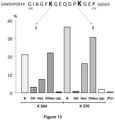
- the term "the first lysine residue” as used herein refers to K264 of the CII peptide 261-273 (AGFK(264)GEQGPK(270)GEP; SEQ ID NO: 10) or 259-273 (GIAGFK(264)GEQGPK(270)GEP; SEQ ID NO: 13) (corresponding to amino acid position 4 in SEQ ID NOs: 1 to 12 and amino acid position 6 in SEQ ID NOs: 13-15).
- the method may further comprise a step of analysing the post-translational modification, such as the glycosylation profile, of the CII peptide of the MHC II/CII peptide complex.
- Methods for analyzing the glycosylation profile are well known in the art and include methods such as mass spectrometry.
- the method according to the invention is an in vitro method. Further the method comprises the use of mammalian cell lines, rather than primary cells.
- the CII peptide comprises the amino acid sequence of AGFKGEQGPKG, AGFKGEQGPX 1 G, AGFKGEX 2 GPKG, AGFKGX 3 QGPKG, AGFKX 4 EQGPKG, AGFKGEX 2 GPX 1 G, AGFKGX 3 QGPX 1 G and AGFKX 4 EQGPX 1 G, wherein X 1 is any of the proteinogenic amino acids except K, preferably R, A, G or Q, more preferably R; X 2 is any of the proteinogenic amino acids except Q; preferably A, R, H or G; X 3 is any of the proteinogenic amino acids except E, preferably A, D, Q or G; and X 4 is any of the proteinogenic amino acids except G, more preferably A, S, V or L.
- X 2 , X 3 or X 4 are not K, more preferably X 1 ,X 2 , X 3 or X 4 are not K.
- the CII peptide comprises the amino acid sequence of AGFKGEQGPKG or AGFKGEQGPX 1 G, preferably of AGFKGEQGPKGEP or AGFKGEQGPX 1 GEP, more preferably of GIAGFKGEQGPKGEP or GIAGFKGEQGPX 1 GEP.
- MHC II/CII peptide complex refers to a soluble complex comprising the extracellular domains of an MHC II protein or part thereof forming the peptide binding groove and a collagen II peptide (Cll peptide), wherein the peptide is fused (i.e., linked via a linker peptide) to the N-terminus of either the alpha or the beta chain.
- the CII peptide is fused to the N-terminus of the MHC class II beta chain.
- a MHC II protein comprises an alpha 1 domain and an alpha 2 domain, which form the extracellular domain of the alpha chain and a beta 1 domain and a beta 2 domain, which form the extracellular domain of the beta chain.
- the term "extracellular domain” and "extracellular region” are used synonymously herein.
- the alpha 1 domain and the beta 1 domain form the peptide binding groove, i.e., the site that interacts and binds the peptide, such as the CII peptide.
- the MHC II/CII peptide complex comprises at least the alpha 1 domain and the beta 1 domain of the MHC II protein.
- the MHC II/CII peptide complex comprises the alpha 1 domain, the alpha 2 domain, the beta 1 domain and the beta 2 domain of the MHC II protein.
- MHC class II molecules are a class of major histocompatibility complex (MHC) molecules normally found only on professional antigen-presenting cells (APCs) such as dendritic cells, mononuclear phagocytes, such as monocytes and macrophages, and B cells.
- APCs professional antigen-presenting cells
- the antigens presented by MHC class II molecules are derived from extracellular proteins, while MHC class I molecules present cytosolic or intracellular peptides. Extracellular proteins are endocytosed, digested and loaded onto MHC II proteins forming an MHC II/peptide complex. The loaded complex is then transferred to the cell surface, where it is presented to effector cells.
- HLA human leukocyte antigen
- MHC II protein encompasses human HLA proteins.
- HLAs corresponding to MHC class II proteins are HLA-DP, HLA-DM, HLA-DOA, HLA-COB, HLA-DQ and HLA-DR.
- RA there is a genetic association with certain alleles of the HLA-DRB1 locus coding for an amino acid consensus motif (Q/R R/K R A A) on the beta-chain of the peptide binding pocket of the MHC class II molecule HLA-DR (amino acid position 70-74, the so called "shared epitope").
- RA associates HLA DRB1 alleles are QKRAA-coding alleles HLA_DRB1* 0401 and 0409, QRRAA-coding alleles: HLA_DRB1* 0404, 0405, 0408, 0101, 0102 and 1402, RRRAA-coding allele: HLA_DRB1* 1001 and DKRAA-coding allele: HLA_DRB1* 1303.
- the extracellular region of the MHC class II alpha chain and the extracellular region of the MHC class II beta chain are therefore derived from HLA-DR, preferably at least the alpha 1 domain is from DRA*0101 and at least the beta 1 domain is from a HLA-DR allele selected from the group consisting of DRB1*0401, DRB1*0404 and DRB1*0405, DRB1*0408, DRB1*0409, DRB1*0101, DRB1*0102, DRB1*1001, DRB1*1402 and DRB1*1303, preferably DRB1*0401, DRB1*0404, DRB1*0405, DRB1*0408, DRB1*0409, DRBV0101, DRB1*0102, DRB1*1001 and DRB1*1402, more preferably DRB1*0401, DRB1*0404, DRB1*0101 and DRB1*0405, even more preferably DRB1*0401.
- the alpha 1 domain and the alpha 2 domain is from DRA*0101 (alpha 1 and 2 domain: amino acids 19-200 of SEQ ID NO: 16) and the beta 1 domain and the beta 2 domain is from a HLA-DR allele selected from the group consisting of DRB1 *0401, DRB1*0404 and DRB1*0405, DRB1*0408, DRB1*0409, DRBV0101, DRB1*0102, DRB1*1001, DRB1*1402 and DRB1*1303, preferably DRB1*0401, DRB1*0404, DRB1*0405, DRB1*0408, DRB1*0409, DRB1*0101, DRB1*0102, DRB1*1001 and DRB1*1402, more preferably DRB1*0401, DRB1*0404, DRB1*0101 and DRB1*040, even more preferably DRB1*0401 (beta 1 and 2 domain: amino acids 60-250
- the specific MHC II/CII peptide complexes used in the examples are abbreviated as follows: Aq/rCII (naturally glycosylated, rat CII), Aq/nCII (naked or non-modified, rat CII), Aq/galCII (galactosylated (Gal-Hyl at K264)), wherein the rat CII peptide used has the amino acid sequence GIAGFKGEQGPKGET (SEQ ID NO: 29) and DR4/hCII (naturally glycosylated, human), DR4/nCII (naked or non-modified, human), DR4/galCII (galactosylated (Gal-Hyl at K264), human), wherein the CII peptide used has the human amino acid sequence GIAGFKGEQGPKGEP (SEQ ID NO: 13).
- the MHC II/CII peptide complex produced according to the in vitro method of the invention comprises a post-translationally modified peptide, wherein the first lysine residue of the CII peptide is O-glycosylsted Hyl.
- the CII peptide comprises the amino acid sequence selected from the group consisting of AGFKGEQGPKG, AGFKGEQGPXG, AGFKGEXGPKG, AGFKGXQGPKG, AGFKXEQGPKG, AGFKGEXGPXG AGFKGXQGPXG and AGFKXEQGPXG.
- the CII peptide comprises the amino acid sequence of AGFKGEQGPKG, AGFKGEQGPX 1 G, AGFKGEX 2 GPKG, AGFKGX 3 QGPKG, AGFKX 4 EQGPKG, AGFKGEX 2 GPX 1 G and AGFKGX 3 QGPX 1 G, AGFKX 4 EQGPX 1 G, wherein X 1 is any of the proteinogenic amino acids except K, preferably R, A, G or Q, more preferably R; X 2 is any of the proteinogenic amino acids except Q; preferably A, R, H or G; X 3 is any of the proteinogenic amino acids except E, preferably A, D, Q or G; and X 4 is any of the proteinogenic amino acids except G, more preferably A, S, V or L.
- X 2 , X 3 or X 4 is not K, more preferably X 1 , X 2 , X 3 or X 4 is not K.
- the CII peptide comprises the amino acid sequence of AGFKGEQGPKG or AGFKGEQGPX 1 G, preferably of AGFKGEQGPKGEP or AGFKGEQGPX 1 GEP, more preferably of GIAGFKGEQGPKGEP or GIAGFKGEQGPX 1 GEP.
- the CII peptide comprises the amino acid sequence of AGFKGEQGPKG (SEQ ID NO: 1) or AGFKGEQGPXG (SEQ ID NO: 2), preferably of AGFKGEQGPKGEP (SEQ ID NO: 10) or AGFKGEQGPXGEP (SEQ ID NO: 11), more preferably of GIAGFKGEQGPKGEP (SEQ ID NO: 13) or GIAGFKGEQGPXGEP (SEQ ID NO: 14).
- the CII peptide GIAGFKGEQGPKGEP corresponds to amino acids 259-273 of the triple helical type II collagen (CII) region.
- CII peptides suitable for binding into the binding pocket are from 11 to 20 amino acids in length, preferably the CII peptide is 11 to 15 amino acids in length, more preferably the CII peptide is 13 to 15 amino acids in length.
- the CII peptide comprises the amino acid sequence AGFKGEQGPKG (SEQ ID NO: 1), more preferably AGFKGEQGPKGEP (SEQ ID NO: 10) and even more preferably of GIAGFKGEQGPKGEP (SEQ ID NO: 13).
- the second K (K270) may be mutated, preferably to R, A, G or Q, more preferably to R.
- the CII peptide comprises the amino acid sequence AGFKGEQGPXG (SEQ ID NO: 2), AGFKGEQGPXGEP (SEQ ID NO: 11) and GIAGFKGEQGPXGEP (SEQ ID NO: 14), wherein X may be any proteinogenic amino acid other than K, preferably X is R, A, G or Q, more preferably X is R.
- the CII peptide comprises the amino acid sequence AGFKGEQGPRG (SEQ ID NO: 9), AGFKGEQGPRGEP (SEQ ID NO: 12) and GIAGFKGEQGPRGEP (SEQ ID NO: 15).
- Table 1 Sequence SEQ ID NO: AGFKGEQGPKG SEQ ID NO: 1 AGFKGEQGP X 1 G* SEQ ID NO: 2 AGFKGE X 2 GPKG* SEQ ID NO: 3 AGFKG X 3 QGPKG* SEQ ID NO: 4 AGFK X 4 EQGPKG* SEQ ID NO: 5 AGFKGE X 2 GP X 1 G* SEQ ID NO: 6 AGFKG X 3 QGP X 1 G* SEQ ID NO: 7 AGFK X 4 EQGP X 1 G* SEQ ID NO: 8 AGFKGEQGPRG SEQ ID NO: 9 AGFKGEQGPKGEP SEQ ID NO: 10 AGFKGEQGP X 1 GEP* SEQ ID NO: 11 AGFKGEQGPRGEP SEQ ID NO: 12 GIAGFKGEQGPKGEP SEQ ID NO: 13 GIAGFKGEQGP X 1 GEP* SEQ ID NO:
- the MHC II/CII peptide complexes produced according to the invention comprise MHC II/CII peptide complexes with a post-translationally modified CII peptide, wherein the first lysine residue of the CII peptide is O-glycosylated hydroxylysine.
- the first lysine (K) residue in GIAGFKGEQGPKGEP is at position 264 of the amino acid sequence of the triple helical CII region (corresponding to amino acid position 4 in SEQ ID NOs: 1 to 12 and amino acid position 6 in SEQ ID NOs: 13-15).
- the "first lysine residue" as used herein may also be referred to as K264 or lysine at position 264.
- the second lysine residue in CII peptide: GIAGFKGEQGPKGEP is at position 270 of the amino acid sequence of the triple helical Cll region (corresponding to amino acid position 10 in SEQ ID NOs: 1, 3-5 or 10, and amino acid position 12.in SEQ ID NO: 13).
- the "second lysine residue” or “further lysine residue” as used herein may also be referred to as K270 or lysine at position 270.
- the MHC II/CII peptide complexes produced according to the invention comprise MHC II/CII peptide complexes wherein at least the first lysine residue is galactosyl-hydroxylysine.
- the collagen specific post-translational galactosylation of the first lysine residues in the CII peptide sequence according to the invention i.e., the lysine residue at position 264, is involved in T cell recognition via the TCR and the resulting pharmacological effects.
- the lysine residue in position 270 is located at the edge of the binding groove of the DR4 molecule and its galactosyl-hydroxylysine modification is considered to be less important for TCR recognition.
- the second or further lysine residue (corresponding to K 270) may be unmodified, hydroxylysine or galactosyl-hydroxylysine.
- the TCR of a T cell hybridoma recognizing the gal264 epitope is not affected by a K270R mutation.
- the CII peptide comprises only the first lysine residue and any further K is mutated, preferably mutated to R, A, G or Q, more preferably mutated to R. Therefore CII peptides AGFKGEQGPRG (SEQ ID NO: 9), preferably AGFKGEQGPRGEP (SEQ ID NO: 12) and more preferably GIAGFKGEQGPRGEP (SEQ ID NO: 15) are also encompassed by the present invention. Mutation of the second lysine has the advantage to reduce heterogeneity of the product.
- galactosyl-hydroxylysine may be glucosylated to form glucosyl-galactosyl-hydroxylysine (Glc-Gal-Hyl), which is likely to have a negative effect on TCR recognition due to the bulkiness of the disaccharide (Glc-Gal), particularly at position K270.
- a K270 mutation, particularly K270R further avoids interference with binding as no disaccharide modification can be attached at this position.
- the collagen II peptide (Cll peptide) is fused to the N-terminus of the MHC class II alpha chain or the MHC class II beta chain by a linker peptide, preferably to the N-terminus of the MHC class II beta chain.
- linker peptide refers to a polypeptide consisting of multiple amino acid residues.
- the linker peptide may be any peptide as long as it is long and flexible enough to allow the peptide to bind to the peptide binding pocket formed by the MHC II complex.
- An example of a suitable linker is a Gly-Ser linker.
- the CII peptide, the peptide linker and at least one of the extracellular regions of the MHC II alpha chain and the MHC II beta chain are expressed as one polypeptide and encoded by one polynucleotide.
- the term "fused to” as used herein means "linked to” wherein the linking is via peptide bonds using a linker peptide and therefore a fusion protein is generated. This feature structurally distinguishes the MHC II/CII peptide complex produced by the in vitro method according to the present invention from prior art complexes.
- the MHC II protein is produced with a CLIP peptide as a surrogate peptide, which is linked to one of the MHC II chains via a linker peptide comprising a peptidase cleavage site, such as a thrombin cleavage site.
- a linker peptide comprising a peptidase cleavage site, such as a thrombin cleavage site.
- a synthetically prepared galactosylated peptide i.e., a Cll peptide carrying gal-Hyl at position K264
- this synthetic galactosylated peptide may be covalently linked to the MHC II proteins, this linkage is not via a linker peptide.
- the MHC II/CII peptide complex used in the examples (SEQ ID NO: 16 and SEQ ID NO: 17) and as depicted in Figure 1 without the signal peptide still contains an enzymatic cleavage site (thrombin cleavage site, Figure 1 ) between the linker and the CII peptide, this is not necessary and is preferably removed from a therapeutic product.
- the linker peptide may improve stability of the product and prevent peptide loss.
- the MHC II/CII peptide complex according to the invention does not contain an enzymatic cleavage site in the amino acid sequence between the CII peptide and extracellular region of the MHC II beta chain (or the MHC II alpha chain).
- the MHC II/CII peptide complex does not comprise a (1) streptavidin-tag (SAWSHPQFEK, SEQ ID NO: 30) for purification, (2) a cleavage site (e.g., a TEV cleavage site) between the MHC II a/ MHC II ⁇ chain and the heterodimerisation domain and/or (3) a recognition site for the E. coli biotin ligase (BirA) (e.g., an AviTag) as present in the exemplified complex shown in Figure 1 and used in the Examples.
- a streptavidin-tag SAWSHPQFEK, SEQ ID NO: 30
- a cleavage site e.g., a TEV cleavage site
- a recognition site for the E. coli biotin ligase e.g., an AviTag
- the MHC II/CII complex comprises the His-tag (polyhistidine-tag) or a functionally equivalent tag at the C-terminal end of the polypeptide comprising the HLA-DR alpha chain and/or the HLA-DR beta chain.
- His-tag polyhistidine-tag
- An exemplary minimal HLA-DR/CII peptide complex according to the present invention may be encoded by the amino acid sequence according to SEQ ID NO:18 and SEQ ID NO:19. The person skilled in the art would understand that the peptide sequence may vary as encompassed by the claims.
- the MHC II/CII peptide complex obtained according to the in vitro method of the invention contains at least one His-tag or functionally equivalent tag at the C-terminal end of the polypeptide comprising the HLA-DR alpha chain and/or the HLA-DR beta chain.
- the His-tag is preferably at least a hexahistidine-tag, more preferably at least a heptahistidine-tag.
- Functionally equivalent tags are e.g., chondroitin-binding peptides.
- the composition may comprise MHC II/CII peptide complexes comprising chondroitin-binding peptide, preferably a chondroitin- and hyaluronic acid (also referred to as hyaluronan) binding peptide.
- the MHC II/CII peptide complex comprises at least one C-terminal chondroitin-binding peptide.
- Chondroitin-binding peptides are known in the art and include without being limited thereto peptides having the amino acid sequences EKRIWFPYRRF (SEQ ID NO: 31), YKTNFRRYYRF (SEQ ID NO: 32) or VLIRHFRKRYY (SEQ ID NO: 33) ( Butterfield KC et al., Biochemistry. 2010 Feb 23;49(7):1549-55 ).
- the chondroitin-binding peptide comprises 5-20 amino acids, preferably 6 to 20 amino acids, more preferably 6 to 20 amino acids.
- a respective sequence containing the binding consensus motif is defined as follows: B(X7)B, in which B is either R or K and X7 contains no acidic residues and at least one basic amino acid ( Yang B et al., EMBO J. 1994 Jan 15;13(2):286-96 ).
- the MHC II/CII peptide complex can also bind to chrondoitin sulfate via an his-tag.
- the chondroitin binding peptide may be a polyhistidine-tag, preferably a hexahistidine-tag, or any other amino acid sequences that increase binding affinity to chondroitin sulfate, such as.
- EKRIWFPYRRF (SEQ ID NO: 31), YKTNFRRYYRF (SEQ ID NO: 32) or VLIRHFRKRYY (SEQ ID NO: 33). Chondroitin and hyaluronic acid are both important components of cartilage.
- the in vitro method according to the invention comprises transfecting a mammalian cell with (i) a polynucleotide encoding an extracellular region of the MHC II alpha chain comprising at least an alpha 1 domain, (ii) a polynucleotide encoding an extracellular region of the MHC II beta chain comprising at least a beta 1 domain, wherein the C II peptide is further fused to the N-terminus of either the MHC II alpha chain or the MHC II beta chain, preferably the MHC II beta chain and as further specified in the appended set of claims.
- Transfecting as used herein means introducing the DNA into the mammalian cell using transfection methods known in the art.
- transfection or “transfecting” includes “transduction” and “transducing”, which is often used to describe virus-mediated gene transfer into eukaryotic cells.
- the polynucleotide may be DNA or RNA, preferably DNA. Transfection may be transient transfection or stable transfection.
- the polynucleotide is present in a vector, preferably an expression vector.
- stable integration is commonly achieved by transiently introducing the at least one recombinant polynucleotide or a vector containing the at least one recombinant polynucleotide into the mammalian host cell, which facilitates the stable integration of said recombinant polynucleotide(s) into the mammalian cell genome.
- the recombinant polynucleotide is flanked by homology arms, i.e., sequences homologous to the region upstream and downstream of the integration site.
- a vector to introduce the recombinant polynucleotide into the mammalian cell may be chosen from a great variety of suitable vector systems, such as plasmids, retroviruses, cosmids, EBV-derived episomes, and the like.
- Various shuttle vectors may be used, e.g., vectors which may autonomously replicate in a plurality of host microorganisms such as E. coli and Pseudomonas sp. Before their introduction into the mammalian host cell, circular vectors may be linearized to facilitate integration into the mammalian cell genome.
- Methods for the introduction of vectors into mammalian cells include transfection with biological methods, such as viral delivery, with chemical methods, such as using cationic polymers, calcium phosphate, cationic lipids or cationic amino acids; with physical methods, such as electroporation or microinjection.
- the recombinant polynucleotide stably integrated into the genome of the mammalian cell is part of an expression cassette.
- An expression cassette comprises at least one heterologous polynucleotide coding for a gene product, such as a RNA and/or a protein, operably linked to a promoter and optionally further means controlling the expression of the gene product(s).
- a gene product such as a RNA and/or a protein
- Such means include, but are not limited to enhancers, termination signals, polyadenylation signals and a 3' untranslated region, typically containing a polyadenylation site.
- the promoter may be a weak promoter, or a strong promoter supporting high level expression of the gene product of interest.
- Said promoters include, but are not limited to CMV (cytomegalovirus) promoters, SV40 (Simian vacuolating virus 40) promoters, the RSV (Rous Sarcoma Virus) promoters, adenovirus promoters (e.g., the adenovirus major late promoter (AdMLP), CHEF-1 (CHO-derived elongation factor-1) promotors, polyoma and strong mammalian promoters such as native immunoglobulin and actin promoters or the natural promoter of the at least one heterologous polynucleotide.
- the promoter is a CMV promoter or an SV40 promoter, most preferably a CMV promoter.
- polyadenylation signals examples are BGH polyA, SV40 late or early polyA; alternatively, 3'UTRs of immunoglobulin genes etc. can be used.
- the 3' untranslated region may be engineered to support high level expression, e.g., by removing instability elements, such as AREs (adenylate-uridylate rich elements).
- the gene product may be placed under the control of an amplifiable genetic selection marker, such as dihydrofolate reductase (DHFR), glutamine synthetase (GS).
- DHFR dihydrofolate reductase
- GS glutamine synthetase
- the amplifiable selection marker gene can be on the same expression vector as the secreted therapeutic protein expression cassette.
- the amplifiable selection marker gene and the secreted therapeutic protein expression cassette can be on different expression vectors, but integrate in close proximity into the host cell's genome. Two or more vectors that are co-transfected simultaneously, for example, often integrate in close proximity into the host cell's genome.
- Amplification of the genetic region containing the secreted therapeutic protein expression cassette is then mediated by adding the amplification agent (e.g., MTX for DHFR or MSX for GS) into the cultivation medium.
- the amplification agent e.g., MTX for DHFR or MSX for GS
- Sufficiently high stable levels of the gene product in the host cell or the producer cell may be achieved, e.g., by cloning multiple copies of a heterologous polynucleotide into an expression vector. Cloning multiple copies of the recombinant polynucleotide into an expression vector and amplifying the secreted therapeutic protein expression cassette (encoding for the MHC II/CII peptide complex) as described above may further be combined.
- the polynucleotide encoding an extracellular region of the MHC II alpha chain comprising at least an alpha 1 domain is present in one vector (first polynucleotide) and the polynucleotide encoding an extracellular region of the MHC II beta chain comprising at least a beta 1 domain (second polynucleotide) is present in another vector, wherein the CII peptide is further encoded by either the first or the second polynucleotide to provide a CII peptide fused to the N-terminus of either the MHC II alpha chain or the MHC II beta chain.
- first and the second polynucleotide may be part of separate expression cassettes on the same vector.
- first and the second polynucleotide form a single polynucleotide encoding a single fusion polypeptide comprising the extracellular region of the MHC class II alpha chain comprising at least an alpha 1 domain; the extracellular region of the MHC class II beta chain comprising at least a beta 1 domain; and the collagen II peptide (Cll peptide) fused to the N-terminus of the MHC class II alpha chain or the MHC class II beta chain by a linker peptide, preferably to the MHC class II beta chain.
- the extracellular region of the MHC class II alpha chain comprising at least an alpha 1 domain and the extracellular region of the MHC class II beta chain comprising at least a beta 1 domain; and the collagen II peptide (Cll peptide) fused to the N-terminus of the MHC class II alpha chain or the MHC class II beta chain by a linker peptide, preferably to the MHC class II beta chain; are encoded by a single polynucleotide to express a single fusion polypeptide (single chain heterodimer.
- the method comprises a first polynucleotide encoding the extracellular region of the MHC class II alpha chain comprising at least an alpha 1 domain; a second polynucleotide encoding the extracellular region of the MHC class II beta chain comprising at least a beta 1 domain; and a polynucleotide encoding the collagen II peptide (CII peptide) fused to the N-terminus of the MHC class II alpha chain or the MHC class II beta chain by a linker peptide, preferably to the MHC class II beta chain.
- CII peptide collagen II peptide
- the MHC class II alpha chain is fused at its C-terminal end (C-terminally) to a first functional domain of a leucine zipper heterodimerization motif and the MHC class II beta chain is fused at its C-terminal end to a second complementary functional domain of a leucine zipper heterodimerization motif.
- the first functional domain and the second complementary functional domain may be an acidic and a basic leucine zipper heterodimerization domain, preferably a jun-fos leucine zipper motif.
- the first and/or the second polynucleotide encodes a polyhistidine tag at the C-terminal end of the functional domain of a leucine zipper heterodimerization motif.
- the mammalian cell is cultivated under conditions suitable to produce the MHC II/CII peptide complex, and the cell supernatant and/or the cells are harvested, wherein the cell supernatant and/or the cells comprise(s) the MHC II/CII peptide complex comprising a post-translationally O-glycosylated modified CII peptide, wherein the first lysine residue of the CII peptide is O-glycosylated hydroxylysine, more preferably galactosyl-hydroxylysine.
- the method may further comprise a step of analysing the post-translational modification, such as the glycosylation profile, of the CII peptide of the MHC II/CII peptide complex.
- the post-translational modification such as the glycosylation profile
- Methods for analyzing the post-translational modifications and glycosylation profile are well known in the art and include methods such as mass spectrometry.
- any mammalian cell suitable for high yield protein production may be used according to the present invention, as long as it comprises enzymes to post-translationally modify lysine residues in collagen, comprising hydroxylating lysine to hydroxylysine (Hyl) and galactosylating Hyl to galactosylhydroxylysine (Gal-Hyl).
- the term "galactosylated” as used herein in the context of lysine includes that the lysine has been hydroxylated to hydroxylysine prior to galactosylation.
- the enzymes may be endogenously present in the cell or may be recombinantly expressed in the cell.
- the mammalian cell comprises a lysylhydroxylase (EC 1.14.11.4) and a collagen galactosyltransferase (EC 2.4.1.50), preferably lysylhydroxylase 1 (LH1) and/or lysylhydroxylase 2 (LH2) and collagen galactosyltransferase GLT25D1 and/or GLT25D2, preferably GLT25D1.
- LH1 lysylhydroxylase 1
- LH2 lysylhydroxylase 2
- GLT25D1 and/or GLT25D2 preferably GLT25D1.
- These enzymes post-translationally modify collagen.
- these enzymes are likely to be present in cell lines producing collagen, such as kidney cells, fibroblast cells or osteoclast cells, particularly kidney cells, such as HEK 293 cells or derivatives thereof.
- the HEK 293 cells may be grown as adherent cells or in suspension.
- HEK 293 cell suitable for the in vitro method according to the invention is the HEK 293 cell or the HEK 293F cell, such as the Expi293F cell (Gibco, Cat. No. A14527, also available as cGMP banked Cat. No. 100044202).
- Other suitable HEK 293 cells include HEK 293T cells and/or suspension cells thereof. It was surprising that also small peptides presented by MHC II proteins can be post-translationally modified in these cells. Although the peptides are derived from collagen they are present in an entirely different (unnatural) environment within the MHC II complex.
- the mammalian cell is a kidney cell, a fibroblast cell or an osteoblast cell, preferably a HEK 293 cell or cell line.
- HEK 293 cells have been described previously to express lysylhydroxylases PLOD1 and PLOD2 (encoding for LH1 and LH2, respectively), galactosyltransferases GLT25D1 and GLT25D2 and further PLOD3 (encoding for LH3).
- the mammalian cell is a genetically engineered cell recombinantly expressing a lysylhydroxylase and a collagen galactosyltransferase.
- the mammalian cell is genetically engineered to recombinantly express lysylhydroxylase 1 (LH1) and/or lysylhydroxylase 2 (LH2) and collagen galactosyltransferase GLT25D1 and/or GLT25D2, preferably GLT25D1.
- GLT25D2 is expressed in only a few cell types and is therefore less likely to be responsible for normal collagen modification.
- Any mammalian cell may be genetically engineered to recombinantly express a lysylhydroxylase and a collagen galactosyltransferase, preferably lysylhydroxylase 1 (LH1) and/or lysylhydroxylase 2 (LH2) and collagen galactosyltransferase GLT25D1 and/or GLT25D2.
- the genetically engineered mammalian cell as described is a CHO cell, more preferably a CHO-DG44 cell, a CHO-K1 cell, a CHO-DXB11 cell, a CHO-S cell, a CHO glutamine synthetase (GS)-deficient cell or a derivative of any of these cells.
- the MHC II/CII peptide complexes produced by the in vitro method according to the present invention is a heterogeneous mixture of MHC II/CII peptide complexes comprising different post-translational modifications of the CII peptide, particularly at the first and optional second lysine residue of the CII peptide.
- the harvested cell supernatant and optionally harvested cells further comprises MHC II/CII peptide complexes comprising the CII peptide, wherein the first lysine residue of the CII peptide is unmodified or glucosylgalactosyl-hydroxylysine (GG-Hyl), preferably unmodified and the optional second lysine residue of the CII peptide is independently unmodified, hydroxylysine (Hyl), galactosyl-hydroxylysine (G-Hyl) or glucosylgalactosyl-hydroxylysine (GG-Hyl), preferably unmodified, hydroxylysine (Hyl), galactosyl-hydroxylysine (G-Hyl).
- MHC II/CII peptide complexes comprising the CII peptide, wherein the first lysine residue of the CII peptide is unmodified or glucosylgalactosyl-hydroxylysine
- the harvested cell supernatant and optionally harvested cells do not comprise MHC II/CII peptide complexes, wherein the second lysine residue is glucosylgalactosyl-hydroxylysine.
- the harvested cell supernatant and optionally harvested cells do not comprise glucosylgalactosyl-hydroxylysine (GG-Hyl) modified MHC II/CII peptide complexes, e.g., MHC II/CII peptide complexes comprising an O-glycosylated CII peptide wherein the first and/or the optional second lysine residue are glucosylgalactosyl-hydroxylysine.
- GG-Hyl glucosylgalactosyl-hydroxylysine
- the heterogeneous mixture of MHC II/CII peptide complexes comprises at least 5%, at least 10%, at least 20% or at least 30% of G-Hyl at the first lysine (K264) of the CII peptide of total MHC II/CII peptide complexes in the mixture or the composition.
- the heterogeneous mixture of MHC II/CII peptide complexes comprises preferably less than 50%, less than 40% or less than 30% unmodified Cll peptides of total MHC II/CII peptide complexes in the mixture or the composition.
- the heterogeneous mixture of MHC II/CII peptides complexes comprises less than 20%, less than 10%, less than 5% and more preferably less than 1% GG-Hyl in the CII peptide of total MHC II/CII peptide complexes in the mixture or the composition.
- the percentage refers to percent of CII peptide in the MHC II/CII peptide complexes of total Cll peptides in the MHC II/CII peptide complexes.
- said second lysine residue (K270) is mutated, for example mutated to Arginine (K270R).
- the (optional) second lysine is not post-translationally modified to glucosylgalactosyl-hydroxylysine (GG-Hyl) and is present as unmodified lysine, hydroxylysine or galactosyl hydroxylysine.
- the mammalian cell In order to reduce heterogeneity of the mixture of MHC II/CII peptides complexes and bulky glucosylgalactosylhydroxylysine formation it is further advantageous if the mammalian cell lacks galactosylhydroxylysyl glucosyltransferase (EC 2.4.1.66) activity. In one embodiment the mammalian cell therefore lacks galactosylhydroxylysyl glucosyltransferase activity. Preferably the mammalian cell lacks lysylhydroxylase 3 (LH3).
- LH3 lysylhydroxylase 3
- LH3 is a multifunctional enzyme comprising lysylhydroxylase (LH), galactosyltransferase (GT) and galactosylhydroxylysyl glucosyltransferase (GGT) activity, wherein the major function of the enzyme seems to be the GGT activity.
- LH3 activity may be deleted or reduced using knock-down or knock-out approaches. Enzyme expression can, e.g., be reduced using RNA interference, such as siRNA or shRNA.
- RNA interference refers to sequence-specific or gene-specific suppression of gene expression (protein synthesis), without generalized suppression of protein synthesis. RNAi may involve degradation of messenger RNA (mRNA) by an RNA-induced silencing complex (RISC), preventing translation of the transcribed mRNA. The suppression of gene expression caused by RNAi may be transient or it may be more stable, even permanent. RNAi may be mediated by miRNA, siRNA or shRNA. Preferably the RNAi is gene-specific (only one gene is targeted). Gene-specific RNAi may be mediated by siRNA or shRNA.
- small interfering or “short interfering RNA” or “siRNA” refer to an RNA duplex of nucleotides that is targeted to a desired gene and is capable of inhibiting the expression of a gene with which it shares homology. It is formed from long double stranded RNA (dsRNA) or shRNA.
- dsRNA long double stranded RNA
- the RNA duplex typically comprises two complementary single-stranded RNAs of 19, 20, 21, 22, 23, 24, 25, 26, 27, 28 or 29 nucleotides that form 17, 18, 19, 20, 21, 22, 23, 24, 25, 26 or 27 base pairs and possess 3' overhangs of two nucleotides, preferably the RNA duplex comprises two complementary single stranded RNAs of 19-27 nucleotides that form 17-25 base pairs and possess 3' overhangs of two nucleotides.
- siRNA is "targeted" to a gene, wherein the nucleotide sequence of the duplex portion of the siRNA is complementary to a nucleotide sequence of the mRNA of the targeted gene.
- the siRNA or a precursor thereof is always exogenously introduced into the cell, e.g., directly or by transfection of a vector having a sequence encoding said siRNA, and the endogenous miRNA pathway is harnessed for correct processing of siRNA and cleavage or degradation of the target mRNA.
- the duplex RNA can be expressed in a cell from a single construct.
- shRNA small hairpin RNA
- shRNA refers to an RNA duplex wherein a portion of the siRNA is part of a hairpin structure (shRNA).
- shRNA can be processed intracellularly into a functional siRNA.
- the hairpin structure may contain a loop portion positioned between the two sequences that form the duplex.
- the loop can vary in length. In some embodiments the loop is 4, 5, 6, 7, 8, 9, 10, 11, 12, 13 or 14 nucleotides in length.
- the hairpin structure can also contain 3' or 5' overhang portions. In some aspects, the overhang is a 3' or a 5' overhang of 0, 1, 2, 3, 4 or 5 nucleotides in length.
- a nucleotide sequence comprised in the vector serves as a template for the expression of a small hairpin RNA, comprising a sense region, a loop region and an antisense region. Following expression the sense and antisense regions form a duplex.
- shRNA is always exogenously introduced, e.g., by transfection of a vector having a sequence encoding said shRNA, and the endogenous miRNA pathway is harnessed for correct processing of the siRNA and cleavage or degradation of the target mRNA.
- Use of a vector having a sequence encoding a shRNA has the advantage over use of chemically synthesized siRNA in that the suppression of the target gene is typically long-term and stable.
- siRNA and shRNA mediate mRNA repression by complete sequence complementarity (i.e., perfect base paring between the antisense strand of the RNA duplex of the small interfering RNA and the target mRNA) and are therefore specific for their target.
- the antisense strand of the RNA duplex may also be referred to as active strand of the RNA duplex.
- Complete sequence complementarity of perfect base paring means that the antisense strand of the RNA duplex of the small interfering RNA has at least 89% sequence identity with the target mRNA for at least 15 continuous nucleotides, at least 16 continuous nucleotides, at least 17 continuous nucleotides, at least 18 continuous nucleotides and preferably at least 19 continuous nucleotides, or preferably at least 93% sequence identity with the target mRNA for at least 15 continuous nucleotides, at least 16 continuous nucleotides, at least 17 continuous nucleotides, at least 18 continuous nucleotides and preferably at least 19 continuous nucleotides.
- the antisense strand of the RNA duplex of the small interfering RNA has 100% sequence identity with the target mRNA for at least 15 continuous nucleotides, at least 16 continuous nucleotides, at least 17 continuous nucleotides, at least 18 continuous nucleotides and preferably at least 19 continuous nucleotides.
- the enzyme is not expressed or the gene may be mutated or deleted.
- the mammalian cell lacks galactosylhydroxylysyl glucosyltransferase activity.
- the mammalian cell lacks the multifunctional enzyme LH3.
- the gene may be silenced or not sufficiently expressed.
- the mammalian cell comprises a mutant LH3 enzyme lacking galactosylhydroxylysyl glucosyltransferase activity.
- the mammalian cell is genetically engineered to have reduced or no galactosylhydroxylysyl glucosyltransferase activity.
- the PLOD3 gene encoding for LH3 may be mutated or deleted; and/or the LH3 enzyme may be a mutated LH3 enzyme lacking galactosylhydrosylysyl glucosyltransferase activity. Methods for deleting or mutating genes are well known in the art and may include the use of sequence specific DNA editing enzymes.
- a “sequence specific DNA editing enzyme” or a “site specific nuclease” as used herein is a protein that enables the cleavage of DNA at defined nucleotide sequences (recognition sites). Said cleavage may occur on one or both of two complementary DNA strands and thus allow, for example targeted mutagenesis, targeted deletion of specific genomic DNA sequences or result in the site-directed recombination of the cleaved target DNA with a heterologous polynucleotide.
- the sequence specificity of said editing enzymes may result from one or more sequence specific DNA binding protein domains within the editing enzyme, or from the enzyme binding a guide polynucleotide (e.g.
- RNA that directs it to a DNA sequence with at least partial complementarity to said guide polynucleotide.
- the recognition site of said editing enzymes may therefore be altered by engineering the DNA binding protein domains, or using alternative guide polynucleotides.
- Multiple sequence specific DNA editing enzymes are known in the art, non-limiting examples of which are zinc finger nucleases (ZFNs), meganucleases, transcription activator-like effector nucleases (TALENs) and CRISPR associated nucleases.
- the genetically engineered mammalian cell lacking galactosylhydroxylysyl glucosyltransferase activity is a HEK 293 cell or cell line.
- a cell line that would benefit from reducing galactosylhydroxylysyl glucosyltransferase for the production of the MHC II/CII complexes according to the invention is the Expi293F cell (Gibco, Cat. No. A14527, also available as cGMP banked Cat. No. 100044202).
- Galactosylhydroxylysyl glucosyltransferase activity may also be inhibited using carminic acid.
- the in vitro method according to the invention may comprise cultivating the mammalian cells according to step (b) in carminic acid.
- the mammalian cells are preferably being established, adapted, and completely cultivated under serum free conditions, and optionally in media, which are free of any protein/peptide of animal origin.
- Commercially available media such as PreproGow TM HEK293 Media (PREPROTECH, USA) Expi293 TM Expression Medium (Thermo Fisher, USA), HAM's F12 (Sigma, Deisenhofen, Germany,) RPPMI (Sigma), Ham's F12 (Sigma, Deisenhofen, Germany), RPMI-1640 (Sigma), Dulbecco's Modified Eagle's Medium (DMEM; Sigma), Minimal Essential Medium (MEM; Sigma), Iscove's Modified Dulbecco's Medium (IMDM; Sigma), CD-CHO (Invitrogen, Carlsbad, CA), serum-free CHO Medium (Sigma), and protein-free CHO Medium (Sigma) are exemplary appropriate nutrient solutions.
- any of the media may be supplemented as necessary with a variety of compounds, non-limiting examples of which are recombinant hormones and/or other recombinant growth factors (such as insulin, transferrin, epidermal growth factor, insulin like growth factor), salts (such as sodium chloride, calcium, magnesium, phosphate), buffers (such as HEPES), nucleosides (such as adenosine, thymidine), glutamine, glucose or other equivalent energy sources, antibiotics and trace elements. Any other necessary supplements may also be included at appropriate concentrations that would be known to those skilled in the art.
- recombinant hormones and/or other recombinant growth factors such as insulin, transferrin, epidermal growth factor, insulin like growth factor
- salts such as sodium chloride, calcium, magnesium, phosphate
- buffers such as HEPES
- nucleosides such as adenosine, thymidine
- glutamine glucose or other equivalent energy sources
- antibiotics and trace elements Any other necessary
- composition comprising a recombinant MHC II/CII peptide complex
- the invention provides a composition comprising recombinant MHC II/CII peptide complexes comprising (a) an extracellular region of an MHC class II alpha chain comprising at least an alpha 1 domain; (b) an extracellular region of an MHC class II beta chain comprising at least a beta 1 domain; and (c) a collagen II peptide (Cll peptide) fused to the N-terminus of the MHC class II alpha chain or the MHC class II beta chain by a linker peptide, preferably to the MHC class II beta chain; wherein the CII peptide comprises the amino acid sequence selected from the group consisting of AGFKGEQGPKG, AGFKGEQGPXG, AGFKGEXGPKG, AGFKGXQGPKG, AGFKXEQGPKG, AGFKGEXGPXG, AGFKGXQGPXG and AGFKXEQGPXG, wherein the MHC II/CII peptide complexes comprise a post-translationally modified
- MHC II/CII peptide complex refers to a soluble complex comprising the extracellular domains of an MHC II protein or part thereof forming the peptide binding groove and a collagen II peptide (Cll peptide), wherein the peptide is fused (i.e., linked) to the N-terminus of either the alpha or the beta chain.
- the CII peptide is fused to the N-terminus of the MHC class II beta chain.
- a MHC II protein comprises an alpha 1 domain and an alpha 2 domain, which form the extracellular domain of the alpha chain and a beta 1 domain and a beta 2 domain, which form the extracellular domain of the beta chain.
- the alpha 1 domain and the beta 1 domain form the peptide binding groove, i.e., the site that interacts and binds the peptide, such as a CII peptide.
- the MHC II/CII peptide complex comprises at least the alpha 1 domain and the beta 1 domain of the MHC II protein.
- the MHC II/CII peptide complex comprises the alpha 1 domain, the alpha 2 domain, the beta 1 domain and the beta 2 domain of the MHC II protein.
- RA associates HLA DRB1 alleles are QKRAA-coding alleles HLA_DRB1* 0401 and 0409, QRRAA-coding alleles: HLA_DRB1* 0404, 0405, 0408, 0101, 0102 and 1402, RRRAA-coding allele: HLA_DRB1* 1001 and DKRAA-coding allele: HLA_DRB1* 1303.
- the extracellular region of the MHC class II alpha chain and the extracellular region of the MHC class II beta chain are therefore derived from HLA-DR, preferably at least the alpha 1 domain is from DRA*0101 and at least the beta 1 domain is from a HLA-DR allele selected from the group consisting of DRB1 *0401, DRB1*0404, DRB1*0405, DRB1*0408, DRB1*0409, DRBV0101, DRB1*0102, DRB1*1001, DRB1*1402 and DRB1*1303, preferably DRB1*0401, DRB1*0404, DRB1*0405, DRB1*0408, DRB1*0409, DRB1*0101, DRB1*0102, DRB1*1001 and DRB1*1402, more preferably DRB1*0401, DRB1*0404 and DRB1*0405.
- the alpha 1 domain and the alpha 2 domain is from DRA*0101 and the beta 1 domain and the beta 2 domain is from a HLA-DR allele selected from the group consisting of DRB1*0401, DRB1*0404, DRB1*0405, DRB1*0408, DRB1*0409, DRB1*0101, DRB1*0102, DRB1*1001, DRB1*1402 and DRB1*1303, preferably DRB1*0401, DRB1*0404, DRB1*0405, DRB1*0408, DRBV0409, DRB1*0101, DRB1*0102, DRB1*1001 and DRB1*1402, more preferably DRB1*0401, DRB1*0404, DRB1*0101 and DRB1*0405.
- CIA collagen-induced arthritis
- composition comprising the MHC II/CII peptide complexes according to the invention comprises a post-translationally modified peptide, wherein the first lysine residue of the CII peptide is O-glycosylated Hyl.
- the CII peptide comprises the amino acid sequence selected from the group consisting of AGFKGEQGPKG, AGFKGEQGPXG, AGFKGEXGPKG, AGFKGXQGPKG, AGFKXEQGPKG, AGFKGEXGPXG and AGFKGXQGPXG, AGFKXEQGPXG.
- the CII peptide comprises the amino acid sequence of AGFKGEQGPKG, AGFKGEQGPX 1 G, AGFKGEX 2 GPKG, AGFKGX 3 QGPKG, AGFKX 4 EQGPKG, AGFKGEX 2 GPX 1 G and AGFKGX 3 QGPX 1 G, AGFKX 4 EQGPX 1 G, wherein X 1 is any of the proteinogenic amino acids except K, preferably R, A, G or Q, more preferably R; X 2 is any of the proteinogenic amino acids except Q; preferably A, R, H or G; X 3 is any of the proteinogenic amino acids except E, preferably A, D, Q or G; and X 4 is any of the proteinogenic amino acids except G, more preferably A, S, V or L.
- X 2 , X 3 or X 4 is not K, more preferably X 1 , X 2 , X 3 or X 4 is not K.
- the CII peptide comprises the amino acid sequence of AGFKGEQGPKG or AGFKGEQGPX 1 G, preferably of AGFKGEQGPKGEP or AGFKGEQGPX 1 GEP, more preferably of GIAGFKGEQGPKGEP or GIAGFKGEQGPX 1 GEP.
- the CII peptide comprises the amino acid sequence of AGFKGEQGPKG (SEQ ID NO: 1) or AGFKGEQGPXG (SEQ ID NO: 2), preferably of AGFKGEQGPKGEP (SEQ ID NO: 10) or AGFKGEQGPXGEP (SEQ ID NO: 11), more preferably of GIAGFKGEQGPKGEP (SEQ ID NO: 13) or GIAGFKGEQGPXGEP (SEQ ID NO: 14).
- the Oil peptide GIAGFKGEQGPKGEP corresponds to amino acids 259-273 of the triple helical Oil region.
- CII peptides suitable for binding into the binding pocket of MHC II are from 10 to 20 amino acids in length, preferably the Oil peptide is from 11 to 15 amino acids in length, more preferably the Oil peptide is from 13 to 15 amino acids in length.
- the CII peptide comprises the amino acid sequence AGFKGEQGPKG (SEQ ID NO: 1), more preferably AGFKGEQGPKGEP (SEQ ID NO: 10) and even more preferably of GIAGFKGEQGPKGEP (SEQ ID NO: 13).
- the second K (K270) may be mutated, preferably to R.
- the CII peptide comprises the amino acid sequence AGFKGEQGPXG (SEQ ID NO: 2), AGFKGEQGPXGEP (SEQ ID NO: 11) and GIAGFKGEQGPXGEP (SEQ ID NO: 14), wherein X may be any proteinogenic amino acid other than K, preferably X is R, A, G or Q, more preferably R).
- the CII peptide comprises the amino acid sequence AGFKGEQGPRG (SEQ ID NO: 9), AGFKGEQGPRGEP (SEQ ID NO: 12) and GIAGFKGEQGPRGEP (SEQ ID NO: 15).
- composition comprising the MHC II/CII peptide complexes according to the invention comprise MHC II/CII peptide complexes with a CII peptide, wherein at least the first lysine residue of the CII peptide is O-glycosylated hydroxylysine.
- the first lysine (K) residue of the CII peptide corresponds to the first K in GIAGFKGEQGPKGEP (SEQ ID NO: 13) at position 264 of the amino acid sequence of the triple helical CII region.
- the optional second lysine (K) residue in the CII peptide corresponds to the second K in GIAGFKGEQGPKGEP at position 270 of the amino acid sequence of the triple helical CII region.
- the MHC II/CII peptide complexes according to the invention comprise a post-translationally modified CII peptide, wherein at least the first lysine residue is galactosyl-hydroxylysine.
- galactosyl-hydroxylysine may also be referred to as G-Hyl or Gal-Hyl and excludes a modification to glucosylgalactosyl-hydroxylysine.
- the collagen specific post-translational galactosylation of the first lysine residues in the CII peptide sequence according to the invention i.e., lysine residue at position 264, is involved in T cell recognition via the TCR and the resulting pharmacological effects.
- the lysine residue in position 270 is located at the edge of the binding groove of the DR4 molecule and its galactosyl-hydroxylysine modification is considered to be less important for TCR recognition.
- the second or further lysine residue (corresponding to K 270) may be any of unmodified, hydroxylysine or galactosyl-hydroxylysine, preferably unmodified.
- the TCR of a T cell hybridoma recognizing the gal264 epitope is not affected by a K270R mutation.
- the CII peptide comprises only the first lysine residue and any further optional K (such as the optional second K) is mutated, preferably mutated to R. Therefore CII peptides comprising the amino acid sequence AGFKGEQGPRG (SEQ ID NO: 9), preferably AGFKGEQGPRGEP (SEQ ID NO: 12) and more preferably GIAGFKGEQGPRGEP (SEQ ID NO: 15) are also encompassed by the present invention.
- the collagen II peptide (Cll peptide) is fused to the N-terminus of the MHC class II alpha chain or the MHC class II beta chain by a linker peptide, preferably to the N-terminus of the MHC class II beta chain.
- linker peptide refers to a polypeptide consisting of multiple amino acid residues.
- the linker peptide may be any peptide as long as it is long and flexible enough to allow the peptide to bind to the peptide binding pocket formed by the MHC II complex.
- An example of a suitable linker is a Gly-Ser linker.
- the CII peptide, the linker peptide and at least one of the extracellular regions of the MHC II alpha chain and the MHC II beta chain are expressed as one polypeptide and encoded by one polynucleotide.
- the term "fused to” as used herein means "linked to” wherein the linking is via peptide bonds, optionally using a linker peptide, and therefore a fusion protein is generated. This feature structurally distinguishes the MHC II/CII peptide complex according to the present invention from prior art complexes.
- the MHC II protein is produced with a CLIP peptide as a surrogate peptide, which is linked to one of the MHC II chains via a linker peptide comprising a peptidase cleavage site, such as a thrombin cleavage site.
- a linker peptide comprising a peptidase cleavage site, such as a thrombin cleavage site.
- the synthetically prepared galactosylated peptide i.e., a Cll peptide carrying gal-Hyl at position K264
- this synthetic galactosylated peptide may be covalently linked to the MHC II molecule, this linkage is not via a linker peptide.
- the MHC II/CII peptide complex used in the examples still contains an enzymatic cleavage site (thrombin cleavage site, Figure 1 ) between the linker and the CII peptide, this is not necessary and is preferably removed from a therapeutic product.
- the linker peptide may improve stability of the product and prevent peptide loss.
- the MHC II/CII peptide complex according to the invention does not contain an enzymatic cleavage site in the amino acid sequence between the CII peptide and extracellular region of the MHC II beta chain (or the MHC II alpha chain).
- the MHC II/CII peptide complexes comprised in the composition do not comprise a (1) streptavidin-tag (such as SAWSHPQFEK; SEQ ID NO: 30) for purification, (2) a cleavage site (e.g., a TEV cleavage site) between the MHC II ⁇ / MHC II ⁇ chain and the heterodimerisation domain and/or (3) a recognition site for the E. coli biotin ligase (BirA) (e.g., an AviTag) as present in the exemplified complex shown in Figure 1 and used in the Examples.
- a streptavidin-tag such as SAWSHPQFEK; SEQ ID NO: 30
- a cleavage site e.g., a TEV cleavage site
- a recognition site for the E. coli biotin ligase (BirA) e.g., an AviTag
- the MHC II/CII complex comprises the His-tag (polyhistidine-tag) or a functionally equivalent tag at the C-terminal end of the polypeptide comprising the HLA-DR alpha chain and/or the HLA-DR beta chain.
- His-tag polyhistidine-tag
- a functionally equivalent tag at the C-terminal end of the polypeptide comprising the HLA-DR alpha chain and/or the HLA-DR beta chain.
- An exemplary minimal HLA-DR/CII peptide complex according to the present invention may be encoded by the amino acid sequence according to SEQ ID NO:18 and SEQ ID NO:19. The person skilled in the art would understand that the peptide sequence may vary as encompassed by the claims.
- compositions according to the invention comprise MHC II/CII peptide complexes containing a His-tag or a functionally equivalent tag at the C-terminal end of the polypeptide comprising the HLA-DR alpha chain and/or the HLA-DR beta chain.
- Functionally equivalent tags are e.g., chondroitin-binding peptides.
- the composition may comprise MHC II/CII peptide complexes comprising at least one chondroitin-binding peptide, preferably a chondroitin- and hyaluronic acid- (also referred to as hyaluronan) binding peptide.
- the MHC II/CII peptide complex comprises at least one C-terminal chondroitin-binding peptide.
- Chondroitin-binding peptides are known in the art and include without being limited thereto peptides having the amino acid sequences EKRIWFPYRRF (SEQ ID NO: 31), YKTNFRRYYRF (SEQ ID NO: 32) or VLIRHFRKRYY (SEQ ID NO: 33) ( Butterfield KC et al., Biochemistry. 2010 Feb 23;49(7):1549-55 ).
- the chondroitin binding peptide comprises 5 to 20 amino acids, preferably 6 to 20 amino acids, more preferably 6 to 12 amino acids.
- a respective sequence containing the binding consensus motif is defined as follows: B(X7)B, in which B is either R or K and X7 contains no acidic residues and at least one basic amino acid ( Yang B et al., EMBO J. 1994 Jan 15;13(2):286-96 ).
- the MHC II/CII peptide complex can also bind to chrondoitin sulfate via the his-tag.
- the condroitin binding peptide may be a polyhistidine-tag, preferably a hexa histidine-tag, or any other amino acid sequences that increase binding affinity to chondroitin sulfate, such as.
- EKRIWFPYRRF (SEQ ID NO: 31), YKTNFRRYYRF (SEQ ID NO: 32) or VLIRHFRKRYY (SEQ ID NO: 33). Chondroitin and hyaluronic acid are both important components of cartilage.
- the extracellular region of the MHC class II alpha chain comprising at least an alpha 1 domain and the extracellular region of the MHC class II beta chain comprising at least a beta 1 domain; and the collagen II peptide (CII peptide) fused to the N-terminus of the MHC class II alpha chain or the MHC class II beta chain by a linker peptide, preferably to the MHC class II beta chain; are expressed as a single fusion polypeptide (single chain heterodimer).
- the MHC II/CII peptide complex comprises a first polypeptide comprising the extracellular region of the MHC class II alpha chain comprising at least an alpha 1 domain; a second polypeptide comprising the extracellular region of the MHC class II beta chain comprising at least a beta 1 domain; and the collagen II peptide (Cll peptide) fused to the N-terminus of the MHC class II alpha chain or the MHC class II beta chain by a linker peptide, preferably to the MHC class II beta chain.
- the MHC class II alpha chain is fused at its C-terminal end to a first functional domain of a leucine zipper heterodimerization motif and the MHC class II beta chain is fused at its C-terminal end to a second complementary functional domain of a leucine zipper heterodimerization motif.
- the first functional domain and the second complementary functional domain may be an acidic and a basic leucine zipper heterodimerization domain, preferably a jun-fos leucine zipper motif.
- the first and/or the second polypeptide comprises a chondroitin sulfate binding peptide, such as a polyhistidine tag, at the C-terminus of the functional domain of a leucine zipper heterodimerization motif.
- composition according to the invention comprises MHC II/CII peptide complexes, comprising a post-translationally modified CII peptide, wherein the first lysine residue of the CII peptide is O glycosylated Hyl, in a heterogeneous mixture of MHC II/CII peptide complexes comprising different post-translational modifications of the CII peptide, particularly the first and optional second lysine residue of the CII peptide.
- the composition further comprises MHC II/CII peptide complexes comprising the CII peptide, wherein the first lysine residue of the CII peptide is unmodified, hydroxylysine (Hyl) or glucosylgalactosyl-hydroxylysine (GG-Hyl), preferably unmodified or hydroxylysine (Hyl) and the optional second lysine residue of the CII peptide is independently unmodified, hydroxylysine (Hyl), galactosyl-hydroxylysine (G-Hyl) or glucosylgalactosyl-hydroxylysine (GG-Hyl), preferably unmodified, hydroxylysine (Hyl), galactosyl-hydroxylysine (G-Hyl).
- the composition does not comprise glucosylgalactosyl-hydroxylysine (GG-Hyl) modified MHC II/CII peptide complexes, e.g., MHC II/CII peptide complexes comprising an O-glycosylated Cll peptide wherein the first and the optional second lysine residue are glucosylgalactosyl-hydroxylysine.
- GG-Hyl glucosylgalactosyl-hydroxylysine
- the composition comprises MHC II/CII peptide complexes comprising at least 5%, at least 10%, at least 20% or at least 30% of G-Hyl at the first lysine (K264) of the CII peptide of total MHC II/CI I peptide complexes in the mixture or the composition.
- the composition comprises MHC II/CII peptide complexes comprising preferably less than 50%, less than 40% or less than 30% unmodified Cll peptides of total MHC II/CII peptide complexes in the mixture or the composition.
- the composition comprises MHC II/CII peptides complexes comprising preferably less than 20%, less than 10%, less than 5% and more preferably less than 1% GG-Hyl in the CII peptide of total MHC II/CII peptide complexes in the mixture or the composition.
- the percentage refers to percent of CII peptide in the MHC II/CII peptide complexes of total Cll peptides in the MHC II/CII peptide complexes.
- said second lysine residue (K270) is mutated, for example mutated to arginine (K270R).
- the (optional) second lysine is not post-translationally modified to glucosylgalactosyl-hydroxylysine (GG-Hyl) and is present as unmodified lysine, hydroxylysine or galactosyl hydroxylysine.
- the present invention provides a recombinant MHC II/CII peptide complex, obtained or obtainable by the in vitro method of the present invention, wherein the first lysine residue of the CII peptide is O-glycosylated Hyl.
- the recombinant MHC II/CII peptide complex comprising an O-glycosylated Cll peptide is obtained by the in vitro method of the invention, wherein the first lysine residue of the CII peptide is O-glycosylated Hyl.
- the present invention provides a composition comprising the recombinant MHC II/CII peptide complex comprising a post-translationally modified CII peptide obtained by the in vitro method of the present invention, wherein the first lysine residue of the CII peptide is O-glycosylated Hyl.
- composition according to the invention or the MHC II/CII peptide complex tetramer of the invention for detecting antigen-specific T cells, preferably in vitro.
- the composition of the invention may be a pharmaceutical composition.
- the present invention also discloses pharmaceutical compositions comprising the composition comprising recombinant MHC II/CII peptide complexes as described herein and pharmaceutically acceptable excipients.
- the composition or pharmaceutical composition may be administered by any route of administration, preferably subcutaneously (s.c.) or intravenously (i.v.). In one embodiment the composition or pharmaceutical composition is administered using an osmotic pump implanted subcutaneously.
- the composition or pharmaceutical composition comprising the recombinant MHC II/CII peptide complexes according to the invention may be lyophilized or in an aqueous solution.
- Pharmaceutically acceptable excipients may include carriers as well as stabilizers.
- the invention relates to a composition comprising the recombinant MHC II/CII peptide complex according to the invention or to the recombinant MHC II CII peptide complex produced by the in vitro method according to the invention for use in treating chronic inflammatory disease.
- the composition is a pharmaceutical composition further comprising pharmaceutically acceptable excipients.
- the composition comprising the recombinant MHC II/CII peptide complex according to the invention or the recombinant MHC II CII peptide complex produced by the in vitro method according to the invention is for use in treating chronic inflammatory disease in a human subject, particularly arthritis or other chronic inflammatory joint disease.
- the composition is for use in treating chronic inflammatory disease selected from the group consisting of rheumatoid arthritis, osteoarthritis, psoriatic arthritis, non-radiographic axial spondyloarthritis, ankylosing spondylitis, juvenile idiopathic arthritis, relapsing polychondritis, systemic lupus erythematosus, Lyme disease, Meniere diseases, autoimmune inner ear disease (AIED), or Still's disease.
- chronic inflammatory disease selected from the group consisting of rheumatoid arthritis, osteoarthritis, psoriatic arthritis, non-radiographic axial spondyloarthritis, ankylosing spondylitis, juvenile idiopathic arthritis, relapsing polychondritis, systemic lupus erythematosus, Lyme disease, Meniere diseases, autoimmune inner ear disease (AIED), or Still's disease.
- the chronic inflammatory disease may be arthritis, preferably selected from the group consisting of rheumatoid arthritis, osteoarthritis, psoriatic arthritis, ankyloses spondylitis, juvenile idiopathic arthritis or Still's disease, more preferably rheumatoid arthritis, osteoarthritis, psoriatic arthritis, more preferably rheumatoid arthritis.
- the composition according to the invention is for first line treatment of rheumatoid arthritis, for treatment in subjects inadequately responding to methotrexate and/or conventional synthetic (small molecule) disease modifying antirheumatic drugs (DMARDs), for treatment in subjects inadequately responding to biologic DMARDs (e.g., anti-TNF, anti-CTLA4 (abatacept) anti-IL-6, anti-CD20 (rituximab) antibodies), for treatment in subjects inadequately responding to targeted synthetic DMARDs (e.g., JAK-inhibitors).
- DMARDs small molecule disease modifying antirheumatic drugs
- biologic DMARDs e.g., anti-TNF, anti-CTLA4 (abatacept) anti-IL-6, anti-CD20 (rituximab) antibodies
- targeted synthetic DMARDs e.g., JAK-inhibitors
- the composition according to the invention is for prophylactic treatment in patients at high risk to develop rheumatoid
- the composition is to be administered subcutaneously or intravenously, more preferably subcutaneously.
- the composition may be administered at single doses of about 10 ⁇ g to about 250 ⁇ g, preferably 20 to 200 ⁇ g, more preferably 50 ⁇ g to 100 ⁇ g.
- treatment comprises a loading and a maintenance phase.
- the loading phase may comprise 3 to 10, preferably 6 sequential applications on consecutive days.
- Maintenance doses may be administered weekly or every 3 to 14 days, preferably weekly, biweekly, monthly, every two months or at even higher intervals.
- Tetramers comprising recombinant MHC II/CII peptide complex
- the invention provides a MHC II/CII peptide complex tetramer comprising the recombinant MHC II/CII peptide complex(es) or the composition according to the invention or the recombinant MHC II/CII peptide complex comprising a post-translationally modified CII peptide obtained by the in vitro method according to the invention, wherein the first lysine residue of the CII peptide is O-glycosylated Hyl.
- the tetramer comprises a multimerization molecule, preferably streptavidin or avidin, binding the recombinant MHC II/CII peptide complexes.
- the mulitimerisation molecule is streptavidin.
- Each of the recombinant MHC II/CII peptide complexes may contain at least one covalently bound, N-terminal biotin. Biotinylation, the process of covalently attaching biotin to a protein, is preferably site specific and may be via chemical linkage or via enzymatic linkage.
- the recombinant MHC II/CII peptide complexes contain a recognition site for a biotin ligase, such as the E. coli biotin ligase (BirA).
- the recognition site for BirA is a 15 amino acid peptide termed AviTag or Acceptor Peptide (e.g., an AviTag).
- Enzymatic biotinylation can be carried out in vitro or in vivo.
- the multimerization molecule such as streptavidin
- a label preferably a fluorochrome
- Labels may be any label known in the art, such as horse radish peroxidase to be detected by enzymatic chemiluminescence (ECL) or luciferase.
- ECL enzymatic chemiluminescence
- luciferase enzymatic chemiluminescence
- fluorochromes such as PE, APC, rhodamine (TRITC), FITC etc.
- the tetramers are produced by a method for preparing a MHC II/CII peptide complex tetramer comprising (a) providing the composition according to the invention or the recombinant MHC II/CII peptide complex comprising an O-glycosylated Cll peptide according to the invention, wherein the MHC II/CII peptide complex comprises at least one N-terminal biotinylation, (b) contacting the composition with a multimerization molecule, preferably streptavidin, and optionally isolating tetramers comprising four MHC II/CII peptide complexes bound to a streptavidin.
- the tetramers according to the invention may be used for detecting antigen-specific T cells and hence for detecting arthritis, particularly rheumatoid arthritis.
- a method for detecting and/or quantifying T cells specific for a given antigen comprising (a) providing the MHC II/CII peptide complex tetramer according to the invention, wherein the multimerization molecule is conjugated to a label (b) contacting the MHC II/CII peptide complex tetramer with a sample of a subject, preferably a sample containing peripheral blood cells of said subject, and (c) detecting the label of the MHC II/CII peptide complex tetramer bound T cells.
- the method is an in vitro detection method.
- the label is a fluorochrome.
- the labelled MHC II/CII peptide complex tetramer bound to T cells may be detected by any suitable methods known to the art, such as flow cytometry.
- the method is an in vitro method.
- the method is a method for diagnosing a patient with arthritis or rheumatoid arthritis comprising (a) providing the MHC II/CII peptide complex tetramer according to the invention, wherein the multimerization molecule is conjugated to a label (b) contacting the MHC II/CII peptide complex tetramer with a sample of a subject, preferably a sample containing peripheral blood cells of said subject, and (c) detecting the label of the MHC II/CII peptide complex tetramer bound to T cells. If labelled MHC II/CII peptide complex tetramer bound to T cells are detected the patient is likely to have or to be at risk of developing arthritis, particularly rheumatoid arthritis.
- Aq/galCII or DR4/galCII loaded with synthetic Gal-peptide: GIAGFK(Gal-Hyl)GEQGPKGEP
- Aq/nCII or DR4/nCII loaded with non-modified peptide: GIAGFKGEQGPKGEP; SEQ ID NO: 13
- Aq-mCLIPmt protein was expressed in HEK293 cell line (Expi293F cells, Gibco, Cat. No. A14527) or CHO cells ( Figure 4 ) by transient transfection, purified using a combination of immobilized metal ion affinity chromatography (IMAC) using the His-tag and size exclusion chromatography (SEC).
- IMAC immobilized metal ion affinity chromatography
- Gal-peptide GIAGFK(Gal-Hyl)GEQGPKGEP
- GIAGFK(Gal-Hyl)GEQGPKGEP were synthesized, purified, and characterized, as described in Diogo, D. et al., Curr Opin Rheumatol. 2014; 26: 85-92 ; Gregersen PK et al., Arthritis Rheum. 1987;30:1205-1213 ; Duke O et al., Clin Exp Immunol. 1982;49:22-30 .
- Naturally glycosylated mouse Aq/rCII and human DR4/hCll Naturally glycosylated mouse Aq/rCII and human DR4/hCll protein was expressed in HEK293 cell line (Expi293F cells, Gibco, Cat. No. A14527) by transient transfection and purified using a combination of immobilized metal ion affinity chromatography (IMAC) using the His-tag and size exclusion chromatography (SEC).
- IMAC immobilized metal ion affinity chromatography
- SEC size exclusion chromatography
- MHC II-peptide complexes were diluted to desired concentrations in sterile PBS (Gibco), filtered using a DynaGard 0.2 ⁇ m syringe tip filter and 100 ⁇ l protein solution was filled into ALZET micro-osmotic pumps (DURECT corporation, model 1007D, 0.5 ⁇ l/h, 7 days) using sterile techniques. The pumps were handled with surgical gloves. To ensure immediate pumping of the substance the prefilled pumps were placed in PBS overnight at 4°C before implantation.
- ALZET micro-osmotic pumps DURECT corporation, model 1007D, 0.5 ⁇ l/h, 7 days
- cDNAs encoding the two chains of the complex as depicted in Figure 1 were synthesized at Eurofins with Kpnl and Xhol restriction sites at the 5' and 3' ends.
- the synthesized cDNAs were digested using restriction enzymes Kpnl and Xhol (FastDigest TM , ThermoFisher Scientific).
- the digested DNA fragments were cloned separately into mammalian expression vector pCEP4 (Life technologies) following digestion with the same restriction enzymes.
- the two recombinant plasmids encoding the two chains of the complex were co-transfected into Expi393F TM cells with FectoPRO TM DNA transfection reagent (Polyplus transfection). The supernatants were harvested 6 days post-transfection. The recombinant protein was first captured using a 5 ml HisTrap Excel (GE Healthcare Life Sciences) affinity column followed by size-exclusion chromatography on Superdex 200 pg (GE Healthcare life Sciences).
- the recombinant protein was purified as a single peak and was concentrated, diafiltrated into biotinylation buffer (20mM Tris-HCl, 50mM NaCl, pH 8.0) using an Amicon centrifuge device with MWCO of 10 kDa. Biotinylation using biotin-protein ligase was performed according to the manufacturer's instructions (Avidity), and the reaction was carried out at 30°C for 2 h. Free biotin were removed by size-exclusion chromatography on a Superdex 200 pg column.
- the founders of the B10.Q mice were originally provided by J. Klein (Tübingen, Germany), and BALB/c mice were purchased from The Jackson Laboratory. All mice were bred and housed at the animal facility of Medical Inflammation Research (Karolinska Institutet). All animals used were fed a standard rodent chow and given water ad libitum. Different experimental groups were housed together in order to minimize experimental bias.
- the local ethics committee approved all animal experiments (Stockholms Norra Djurförsöksetiska Nämnd, Sweden). All in vivo arthritis experiments were covered by the ethical numbers N213/14 and N35/16. Anesthesia of animals was accomplished by isoflurane inhalation, whereas sacrifice was performed with CO 2 .
- Rat type II collagen was prepared from Swarm chondrosarcoma (Swarm rat chondosarcoma, SRC), by limited pepsin digestion, and further purification, as described in Chavele KM and Ehrenstein MR, FEBS Lett. 2011; 585:3603-10 . Prepared rCII was stored at 4°C until used. To induce collagen-induced arthritis (CIA), each mouse was injected with 100 ⁇ g of rCII emulsified 1:1 in CFA (Difco) at the base of the tail in a total volume of 100 ⁇ l.
- CFA collagen-induced arthritis
- mice Thirty-five days later, the mice were given a booster injection of 50 ⁇ g of rat CII emulsified 1:1 in IFA (Difco) in a total volume of 50 ⁇ l. Development of clinical arthritis was followed through visual scoring of the animals based on the number of inflamed joints in each paw, starting 2 weeks post-immunization and continuing until the end of the experiment. An extended scoring protocol as described in Klareskog L et al., Annu Rev Immunol. 2008;26: 651-75 ranging from 1 to 15 for each paw with a maximum score of 60 per mouse was used. The mice were examined two to four times per week for 90 days following immunization.
- mice A single s.c. injection of 100 ⁇ g in mice was nearly equally effective on the treatment of clinical arthritis as the s.c. pump infusion of 15 ⁇ g/day for 7 consecutive days. However, the prolonged treatment seemed to be more effective on the induction of regulatory TR1 cells as evidence by FACS analysis of lymph node T cells in the treated mice.
- QB mice pre-immunized with rat CII/CFA were intradermally injected with 10 ⁇ g of rCII dissolved in phosphate buffered saline (PBS) into the left ear at day 8 post-immunization.
- PBS phosphate buffered saline
- the right ears were injected with solvent and the ear swellings measured 24 h later by an investigator blinded for the treatment of the animals using a caliper.
- Treatment was performed via a 24 h application of 100 ⁇ g of Aq/peptide complexes using osmotic pumps implanted at day 4 post immunization with rCII.
- MHC II/peptide complexes were diluted in sterile PBS and coated onto plates by incubation at 4°C for overnight or added directly in soluble form to T cell hybridomas.
- the MHC II/peptide complex-coated plates were then washed twice with sterile PBS to remove unbound complexes, and 5 ⁇ 10 4 T-hybridoma cells in 200 ⁇ l DMEM supplemented with 5% FCS, 100 IU/ml penicillin, and 100 ⁇ g/ml streptomycin were added per well.
- IL-2 or IL-10 was measured in the culture supernatants by sandwich ELISA (BioLegend).
- Mouse rIL-2 or rl-10 respectively served as a positive control and standard.
- Stimulation experiments using T-hydridoma cells were performed under different conditions in microtiter wells: 1) pre-coated with recombinant DR4/CII-peptide complexes, 2) coated with hyaluronan (Sigma Aldrich (#H7630)) or chondroitin sulfate (Sigma Aldrich (#C9819)) to which the DR4/CII-peptide complexes were subsequently added in fluid phase.
- This design was chosen to study the impact of the potential interaction of both components on T cell activation by the DR4/CII-peptide complex and mimics the interplay of the DR4/CII-peptide complexes with connective tissue components physiologically expressed in the extracellular matrix (ECM) in the tissues and the draining lymphatic system, or 3) with a blocked surface to which the solute ECM components hyaluronan, chondroitin sulfate or heparin sulfate as well as the DR4/CII-peptide complexes were added in order to study their impact on the T-hydridoma cells as a model for the modulation of T cell function in body fluids of diseased tissues compartments e.g. joint effusions or the lymph fluid.
- ECM extracellular matrix
- the MHC II/peptide tetramer complexes were freshly prepared by adding PE-labeled streptavidin and APC-labeled streptavidin (Biolegend) to the recombinant protein at a molar ratio of 1:4, and incubating at +4°C for 1 h.
- PE-labeled streptavidin and APC-labeled streptavidin Biolegend
- To identify peptide-specific T lymphocytes cells were incubated with the DR4/peptide tetramer complexes (20 ⁇ g/ml) at +37°C for 1 h in the presence of 50 nM Dasatinib, a small-molecule protein tyrosine kinase inhibitor, following staining for cell surface markers.
- Viability staining solution (Zombie NIR; Biolegend) was added just before acquisition to exclude dead cells from the analysis.
- the samples were acquired by using an LSR Fortessa flow cytometer using FacsDiVa software (BD Biosciences), and the data were analyzed with FlowJo Software (v10, FlowJo LLC).
- PBMCs were thawed and rested overnight in TexMACS (Biolegend) at 1.5 ⁇ 10 6 cell/well.
- Cells were stimulated with the respective peptide variants GIAGFKGEQGPKGEP (SEQ ID NO: 13) and GIAGFK(Gal-Hyl)GEQGPKGEP) at a concentration of 50 ⁇ g/ml for 7 hours together with anti-CD28 at 1 ⁇ g/ml (BioLegend).
- SEB staphylococcal enterotoxin B
- In vitro assays were performed to analyze the induction/differentiation of regulatory T cell functions e.g. the upregulation of the Tr1 phenotype associated cytokine IL-10 upon stimulation with DR4/CII-monomers for a prolonged incubation period of several days.
- PBMCs were isolated by dense gradient centrifugation and 1.2 ⁇ 10 6 cells/mL cells in TexMACS (Miltenyi Biotec, Cat# 130-097-196) were stimulated with 1 ⁇ g/mL anti-CD3 (Biolegend, Cat# 317304) and 100 ng/mL IL-27 (Peprotech, Cat#200-38B) (positive control, Tr1), 3.6 ⁇ g/mL DR4/nCll, 3.6 ⁇ g/mL DR4/galCII, 3.6 ⁇ g/mL DR4/hCll or left without stimulation (negative control, w/o) for 8 days. Stimulation was done in duplicates. At day 8 the culture supernatants were collected and analyzed for released cytokines using a custom made panel for detection of human cytokines in a multiplex bead-based LEGENDplex TM assay following the manufacture's protocol.
- Example 1 Production of functionally active Aq/rCII in HEK 293 cells
- Aq/rCll(259-273) complexes can be expressed in HEK293 cells and that the purified complexes comprise covalently linked CII peptides (CII259-273) wherein the lysine at position 264 is posttranslationally modified.
- CII259-273 covalently linked CII peptides
- Osmotic pumps that have been implanted subcutaneously one week after immunization. Osmotic pumps are advantageous over intravenous injections, because Aq/rCll(259-273) complexes remains in the circulation at constant level and are available for tolerance induction in vivo over a longer period of time.
- Osmotic pumps are advantageous over intravenous injections, because Aq/rCll(259-273) complexes remains in the circulation at constant level and are available for tolerance induction in vivo over a longer period of time.
- Control MHC II/CII complexes were produced in S2 insect cells, which have a strongly impaired capacity to produce posttranslational modifications in terms of O-linked glycosylation of lysine side chains.
- S2 insect cells which have a strongly impaired capacity to produce posttranslational modifications in terms of O-linked glycosylation of lysine side chains.
- HCQ.4 clone which recognizes the CII259-273 peptide with a non-modified or hydroxylated lysine at position 264, responded to the Aq/rCll(259-273) complex produced in S2 insect cells.
- all CII-specific clones responded to the Aq/rCII(259-273) complex produced in HEK293 cells.
- T cell hybridoma clones used are as follows: HCQ3 (CII, Gal-HK264), HCQ.4 (CII, not modified and HK264), HCQ.11 (Glc-Gal-HK264), HM1R.2 (CII, Gal-HK264 and Gal-HK264+270), HP3 (Aq-restricted, pepsin-peptide).
- HCQ3 CII, Gal-HK264
- HCQ.4 CII, not modified and HK264
- HCQ.11 Glc-Gal-HK264
- HM1R.2 CII, Gal-HK264 and Gal-HK264+270
- HP3 Aq-restricted, pepsin-peptide
- Example 2 In situ glycosylated Aq/rCII in a mouse CIA model
- mice immunized with CII in adjuvants were implanted 7 day later (following boost immunization 35 days after the initial immunization) with osmotic pumps loaded with three different amounts of HEK293-produced Aq-rCII(259-273) complex and followed for development of arthritis. Mice were implanted with pumps loaded with PBS only as negative control.
- Aq-rCII(259-273) complex conferred protection in a dose dependent manner and mice treated with the highest amount of Aq-rCll(259-273) complex (100 ⁇ g) completely protected from developing arthritis.
- Mice treated with the intermediate amount (50 ⁇ g) of the Aq-rCII(259-273) complex showed some protection, whereas treatment with the lowest amount (10 ⁇ g) resulted in a frequency of arthritis that was comparable to PBS-treated controls.
- mice MHC II/CII complexes can be prepared in HEK293 cells using the in situ glycosylation machinery of the host cell.
- human MHC II/CII complexes can be prepared in HEK293 cells using the in situ glycosylation machinery of the cell.
- the complexes were prepared as described above in HEK293 cells. Control complexes were expressed in CHO cells and loaded with not modified peptide (DR4/nCII) or galactosylated peptide (DR4/gaICII).
- Two activation restricted human T cell hybridomas (3H8: unmodified CII-epitope, mDR1.1: galactosylated CII-epitope) were used to check the galactosylation status of the naturally glycosylated DR4/peptide complex (DR4/hCll) compared a DR4/peptide complex loaded either with not modified peptide or galactosylated peptide.
- DR4/hCll naturally glycosylated DR4/peptide complex
- Figure 4A the T cell hybridoma mDR1.1 gets activated upon stimulation with the DR4/galCII complex, whereas stimulation with the DR4/nCII remains almost negative.
- the DR4/covalently linked CII (DR4/hCll) is a heterogeneous product with regard to the galactosylation status. That means the composition comprising the DR4/hCll complex contains peptides with galactosylated and unmodified lysine residues in position 264. Activation level of cells stimulated with the DR4/hCll is slightly lower compared to the DR4/galCII complex and very similar to the DR4/nCII complex ( Fig. 4B , using 3H8 cells).
- the aim was to establish a tetramer based method to directly detect antigen specific T cells in the peripheral blood (PBMCs) of RA patients and healthy donors. Therefore, biotinylated DR4/CII peptide complexes were incubated with either Streptavidin-PE or Streptavidin-APC. To reduce unspecific binding of the tetramers, a double tetramer staining by using two flurochromes was performed. Antigen specific T cells (CII259-273, K264gal) using DR4/gaICII tetramers can be detected in RA-patients as well as in healthy donors ( Figure 5A ).
- T cells with specificity for the unmodified CII peptide can be detected using DR4/nCII tetramers ( Figure 5B ).
- the mean frequency of antigen specific T cells is higher using the naturally glycosylated DR4/hCll tetramers compared to DR4/gaICII tetramers or DR4/nCII tetramers ( Figure 5B ). Since the frequency of antigen-specific T cells in the peripheral blood is quite low (0.01-0,1%), the observed numbers are as expected.
- Activated CD4+ T cells were also detected in PBMCs of HLA-DRB1*0401 RA patients following galCII peptide stimulation by flow cytometry using CD154 (CD40L) surface staining as a marker for T cell activation ( Fig. 6 ).
- CD154 CD40L
- cells incubated only with an antibody against costimulatory CD28 were mainly negative (data not shown). Since the expected frequency of the antigen-specific T cell population is quite low in the peripheral blood, the detection of 0.01-0,1% CD154+ T cells (parent population: CD3/CD4 living T cells) is satisfying.
- T cells get less activated using the unmodified (naked) CII peptide. Since numbers of antigen specific T cells using DR4/galCII or DR4/nCII tetramer staining were similar in PBMCs of HLA-DRB1*0401 RA patients ( Fig. 5 ), the difference observed following peptide activation seems to be due to a difference in activity or functional status of the respective T cells.
- Example 5 In vitro stimulation/differentiation of T cells from the peripheral blood of HLA-DRB1*0401 positive RA patients
- PBMCs from genotyped HLA-DRB1*0401 positive RA patients were either stimulated under Tr1 cell inducing conditions with anti-CD3 and IL-27 (positive control, Tr1), with DR4/nCII (3.6 ⁇ g/mL), DR4/galCII, (3.6 ⁇ g/mL), or without stimulation (negative control, K1) for 8 days. Stimulation was done in duplicates.
- cytokine release was collected and analyzed for cytokine release using a custom-made panel for human cytokines in a multiplex bead-based LEGENDplex TM assay format according the manufacture's protocol.
- the results shown in Fig. 7 clearly demonstrate the capacity of DR4/nCII and DR4/gaICII to induce the release of the anti-inflammatory cytokine IL-10 in PBMCs from RA patients and at levels even slightly higher compared to positive controls incubated under conventional TR1 inducing conditions for 8 days.
- pro-inflammatory cytokines e.g. TNF- ⁇ , IL-2, IL-17a, IL-17f, or IFN-y.
- sequences not directly essential for the MHC II/CII complex can be omitted from the construct, including the contribution of the polyhistidine-tag (His-tag), the biotinylation site, the TEV cleavage site, the thrombin cleavage site and the strep-tag to the T cell activating properties of the recombinant complex.
- the DR4/CII peptide complexes as well as the anti-CD3 antibody (positive control) are coated to the plastic surface of the microtiter wells in a standard hybridoma activation assay.
- DR4/hCII ⁇ His complex was produced that only lacks the His-tag (6His) at the carboxy-terminal end of the MHC class II beta chain, but is otherwise identical to the DR4/hCll complex, i.e., contains the JUN/FOS heterodimerization domains (compare Fig.1 ).
- DR4/hCll complex As an additional control for the involvement of electrostatic interactions by the positively charged functional imidazole group of histidine, a further mutated recombinant variant of the DR4/hCll complex was prepared, in which the His-tag was replaced with a triplet of negatively charged amino acid residues Asp-Glu-Asp (DED) (DR4/hCII_DED).
- DED Asp-Glu-Asp
- DR4/hCII_DED negatively charged amino acid residues Asp-Glu-Asp
- ECM extracellular matrix
- the observed effect of the His-tagged complexes cannot simply be explained by electrostatic interactions of polysulfated anionic glycosaminoglycans via the positively charged imidazole groups of the polyhistidine tag, since heparan sulfate likewise contains a high degree of negatively charged sulfate groups, but does not seem to significantly facilitate the IL-2 response of the 3H8 hybridoma cells stimulated by the solute His-tagged DR4/hCll complex. Accordingly, the results suggest a specific interaction of the polyhistidine tag with the chondroitin sulfate matrix to increase the IL-2 response by 3H8 hybridoma cells stimulated with the dissolved DR4/hCll complex.
- mice were triggered at day 8 post immunization by an intradermal CII injection into one ear to develop a T cell dependent inflammatory swelling controlled by a vehicle trigger applied to the contralateral ear. Prior the induction of the DTH reaction the mice received treatment on day 4 postimmunization by a 24 h sc.
- Example 7 Obstacles of the recombinant production of the DR4/qal CII complex in HEK cells
- the posttranslational modification of the CII sequence of the peptide in the binding groove of the recombinant DR4-complex involves several sequential steps by different enzymes. These collagen-specific posttranslational modifications preferentially affect the lysine residues at positions 264 and 270.
- the initial step is a lysyl hydroxylation mediated by a lysyl hydroxylase followed by a galactosyl transfer to the hydroxylated lysine mediated by a galactosyl transferase. Further, a single glucose residue may be added to the galactosylated hydroxylysine.
- the lysine residue in position 270 is located at the edge of the binding groove of the DR4 molecule its carbohydrate modification is generally considered not to be involved in TCR recognition.
- K270 may be mutated into an arginine residue (R). This mutation has previously been shown not to affect binding to the TCR of antigen-specific T cell hybridoma.
- the reaction catalyzing the transfer of the glucose residue to the galactosylated hydroxylysine is the galactosylhydroxylysyl glucosyltransferase (synonymous name: procollagen lysylhydroylase 3 (LH3)).
- LH3 is a multifunctional enzyme also capable of catalyzing the before mentioned initial steps of lysine modification, i.e., hydroxylation resulting in hydroxylysine (Hyl) and galactosyl transfer resulting in galactosyl-hydroxylysine (Gal-Hyl) ( Figure 14A ).
- lysine modification i.e., hydroxylation resulting in hydroxylysine (Hyl) and galactosyl transfer resulting in galactosyl-hydroxylysine (Gal-Hyl) ( Figure 14A ).
- its non-redundant activity is the final glucose transfer to the galactosyl hydroxylysine
- a HEK cell line for the production of the DR4/hCll complex that is selectively made deficient for the final glucosyltransfer to the galactosyl hydroxylysine in the CII peptide is expected to be advantageous in order to improve efficacy of recombinantly produced DR4/hCll complex.
- This can be achieved by generating HEK293 LH3 knock-out cells, e.g., by introducing a gene disrupting mutation into the Plod3 gene encoding the lysylhydroxylase 3 gene using a CRISPR/CAS gene editing approach.
- Expi293F cells In a first step we generated Expi293F cells) with a Plod3 knock-down by lentiviral transfection of specific shRNA to investigate the potential of this strategy to obtain a less heterogenous product with an increased specific T cell activating activity by improvement of the recombinant expression system.
- Expi293 cells were plated using 200,000 cells/well in 12-well plates followed by shaking the plates at 37°C, 8% CO 2 and 120 rpm for 3 hours.
- lentiviral particles customized lentiviral particles from Sigma
- PElpro transfection reagent Polyplus
- glycan analysis by mass spectrometry was performed to investigate the reduction of glucosylation of galactosylhydroxylysyl residues in plod3 knock-down Expi293F cells and Expi293F control cells. Both lysines (K264 and K270) within the collagen type II epitope were analysed. A clear reduction of gluco-galactosylhydroxylysyl residues (DiHex) is visible in Expi293 KO cells ( Figure 14C ).
- stably transduced cells were diluted and seeded on 96-well plates for mini pool generation.
- the cells were grown under selection pressure and 40 mini pools were isolated.
- the cells were expanded and PLOD3 expression was determined in cell lysates by Western Blot to verify efficient knock-down of Plod3.
- Lysates from 1 ⁇ 10 6 lentiviral transduced Expi293F mini pools were loaded onto a SDS-PAGE.
- Western Blot analysis of successful knock-down was performed using an anti-PLOD3 antibody (Thermo Fisher PAS-48435) and a secondary anti-rabbit HRP antibody.
- PLOD3 has a theoretical molecular weight of 84 kDa.
- Clone #4, #18 and #20 showed efficient Plod3 knock-down and were therefore used for further expansion and experiments.
- Clone 18 was lost due to drop in viability, Clones 4 and 20 have been selected for further production and glycan analysis is underway.
Landscapes
- Health & Medical Sciences (AREA)
- Life Sciences & Earth Sciences (AREA)
- Chemical & Material Sciences (AREA)
- Organic Chemistry (AREA)
- General Health & Medical Sciences (AREA)
- Engineering & Computer Science (AREA)
- Medicinal Chemistry (AREA)
- Bioinformatics & Cheminformatics (AREA)
- Immunology (AREA)
- Public Health (AREA)
- Veterinary Medicine (AREA)
- Animal Behavior & Ethology (AREA)
- Pharmacology & Pharmacy (AREA)
- Genetics & Genomics (AREA)
- Zoology (AREA)
- Nuclear Medicine, Radiotherapy & Molecular Imaging (AREA)
- Chemical Kinetics & Catalysis (AREA)
- General Chemical & Material Sciences (AREA)
- Proteomics, Peptides & Aminoacids (AREA)
- Biochemistry (AREA)
- Gastroenterology & Hepatology (AREA)
- Biomedical Technology (AREA)
- Molecular Biology (AREA)
- Wood Science & Technology (AREA)
- Biophysics (AREA)
- Epidemiology (AREA)
- Biotechnology (AREA)
- Rheumatology (AREA)
- General Engineering & Computer Science (AREA)
- Microbiology (AREA)
- Toxicology (AREA)
- Cell Biology (AREA)
- Physical Education & Sports Medicine (AREA)
- Orthopedic Medicine & Surgery (AREA)
- Pain & Pain Management (AREA)
- Urology & Nephrology (AREA)
- Mycology (AREA)
- Physics & Mathematics (AREA)
- Plant Pathology (AREA)
- Peptides Or Proteins (AREA)
Applications Claiming Priority (2)
| Application Number | Priority Date | Filing Date | Title |
|---|---|---|---|
| EP19191094 | 2019-08-09 | ||
| PCT/EP2020/072287 WO2021028350A1 (en) | 2019-08-09 | 2020-08-07 | Production of mhc ii/cii complexes |
Publications (3)
| Publication Number | Publication Date |
|---|---|
| EP4010007A1 EP4010007A1 (en) | 2022-06-15 |
| EP4010007B1 true EP4010007B1 (en) | 2023-11-15 |
| EP4010007C0 EP4010007C0 (en) | 2023-11-15 |
Family
ID=67587675
Family Applications (1)
| Application Number | Title | Priority Date | Filing Date |
|---|---|---|---|
| EP20750299.8A Active EP4010007B1 (en) | 2019-08-09 | 2020-08-07 | Production of mhc ii/cii complexes |
Country Status (9)
| Country | Link |
|---|---|
| US (1) | US20220288177A1 (https=) |
| EP (1) | EP4010007B1 (https=) |
| JP (1) | JP7492538B2 (https=) |
| KR (1) | KR102831696B1 (https=) |
| CN (1) | CN114206945B (https=) |
| CA (1) | CA3137810A1 (https=) |
| ES (1) | ES2971719T3 (https=) |
| PL (1) | PL4010007T3 (https=) |
| WO (1) | WO2021028350A1 (https=) |
Families Citing this family (4)
| Publication number | Priority date | Publication date | Assignee | Title |
|---|---|---|---|---|
| JP2024537611A (ja) * | 2021-08-30 | 2024-10-16 | ジェネンテック, インコーポレイテッド | Mhciiペプチド結合の性質決定のためのアッセイおよび試薬 |
| CN119630690A (zh) | 2022-06-03 | 2025-03-14 | 豪夫迈·罗氏有限公司 | 改进的生产细胞 |
| EP4378533A1 (en) | 2022-11-29 | 2024-06-05 | Fraunhofer-Gesellschaft zur Förderung der angewandten Forschung e.V. | Patient selection and therapy monitoring for autoimmune disorders |
| WO2024117967A1 (en) * | 2022-12-01 | 2024-06-06 | Dubnovitsky Anatoly | Peptide mimics and their use |
Citations (2)
| Publication number | Priority date | Publication date | Assignee | Title |
|---|---|---|---|---|
| EP2593551A1 (en) * | 2010-07-15 | 2013-05-22 | Technion Research & Development Foundation Ltd. | Isolated high affinity entities with t-cell receptor like specificity towards native complexes of mhc class ii and glutamic acid decarboxylase (gad) autoantigenic peptides |
| US20180355043A1 (en) * | 2015-12-17 | 2018-12-13 | Janssen Biotech, Inc. | Antibodies Specifically Binding HLA-DR and Their Uses |
Family Cites Families (4)
| Publication number | Priority date | Publication date | Assignee | Title |
|---|---|---|---|---|
| CA2629881C (en) | 2005-11-17 | 2017-09-12 | Rikard Holmdahl | A compound comprising an autoantigenic peptide and a carrier with a mhc binding motif |
| WO2008116468A2 (en) * | 2007-03-26 | 2008-10-02 | Dako Denmark A/S | Mhc peptide complexes and uses thereof in infectious diseases |
| EP3620465B1 (en) | 2007-07-03 | 2025-02-19 | Dako Denmark A/S | Improved methods for generation, labeling and use of mhc multimers |
| US20130309229A1 (en) | 2011-01-28 | 2013-11-21 | The United States Government As Represented By The Department Of Veterans Affairs | Recombinant t cell ligands and antibodies that bind b cells for the treatment of autoimmune diseases |
-
2020
- 2020-08-07 CN CN202080056542.4A patent/CN114206945B/zh active Active
- 2020-08-07 ES ES20750299T patent/ES2971719T3/es active Active
- 2020-08-07 CA CA3137810A patent/CA3137810A1/en active Pending
- 2020-08-07 PL PL20750299.8T patent/PL4010007T3/pl unknown
- 2020-08-07 WO PCT/EP2020/072287 patent/WO2021028350A1/en not_active Ceased
- 2020-08-07 US US17/633,916 patent/US20220288177A1/en active Pending
- 2020-08-07 JP JP2021572488A patent/JP7492538B2/ja active Active
- 2020-08-07 KR KR1020217043364A patent/KR102831696B1/ko active Active
- 2020-08-07 EP EP20750299.8A patent/EP4010007B1/en active Active
Patent Citations (2)
| Publication number | Priority date | Publication date | Assignee | Title |
|---|---|---|---|---|
| EP2593551A1 (en) * | 2010-07-15 | 2013-05-22 | Technion Research & Development Foundation Ltd. | Isolated high affinity entities with t-cell receptor like specificity towards native complexes of mhc class ii and glutamic acid decarboxylase (gad) autoantigenic peptides |
| US20180355043A1 (en) * | 2015-12-17 | 2018-12-13 | Janssen Biotech, Inc. | Antibodies Specifically Binding HLA-DR and Their Uses |
Also Published As
| Publication number | Publication date |
|---|---|
| JP7492538B2 (ja) | 2024-05-29 |
| KR102831696B1 (ko) | 2025-07-07 |
| PL4010007T3 (pl) | 2024-04-08 |
| ES2971719T3 (es) | 2024-06-06 |
| CN114206945A (zh) | 2022-03-18 |
| KR20220044687A (ko) | 2022-04-11 |
| EP4010007A1 (en) | 2022-06-15 |
| EP4010007C0 (en) | 2023-11-15 |
| CN114206945B (zh) | 2025-11-04 |
| US20220288177A1 (en) | 2022-09-15 |
| JP2022543960A (ja) | 2022-10-17 |
| WO2021028350A1 (en) | 2021-02-18 |
| CA3137810A1 (en) | 2021-02-18 |
Similar Documents
| Publication | Publication Date | Title |
|---|---|---|
| EP4010007B1 (en) | Production of mhc ii/cii complexes | |
| US11760787B2 (en) | B7-H5, a costimulatory polypeptide | |
| EP1973573A2 (en) | Methods and compositions for expanding t regulatory cells | |
| EP4010006B1 (en) | Hla-dr/cii peptide complexes for treating arthritis | |
| RS57480B1 (sr) | Fuzioni protein koji sadrži interleukin 4 i interleukin 10 | |
| US20230348560A1 (en) | Chimeric ilt receptor compositions and methods | |
| HK40063235A (en) | Hla-dr/cii peptide complexes for treating arthritis | |
| HK40064159A (en) | Production of mhc ii/cii complexes | |
| HK40064159B (zh) | Mhc ii/cii肽复合体的产生 | |
| HK40063235B (zh) | 用於治疗关节炎的hla-dr/cii肽复合体 | |
| HK40050291A (en) | Suicide module compositions and methods | |
| HK40050291B (en) | Suicide module compositions and methods |
Legal Events
| Date | Code | Title | Description |
|---|---|---|---|
| STAA | Information on the status of an ep patent application or granted ep patent |
Free format text: STATUS: UNKNOWN |
|
| STAA | Information on the status of an ep patent application or granted ep patent |
Free format text: STATUS: THE INTERNATIONAL PUBLICATION HAS BEEN MADE |
|
| PUAI | Public reference made under article 153(3) epc to a published international application that has entered the european phase |
Free format text: ORIGINAL CODE: 0009012 |
|
| STAA | Information on the status of an ep patent application or granted ep patent |
Free format text: STATUS: REQUEST FOR EXAMINATION WAS MADE |
|
| 17P | Request for examination filed |
Effective date: 20211208 |
|
| AK | Designated contracting states |
Kind code of ref document: A1 Designated state(s): AL AT BE BG CH CY CZ DE DK EE ES FI FR GB GR HR HU IE IS IT LI LT LU LV MC MK MT NL NO PL PT RO RS SE SI SK SM TR |
|
| STAA | Information on the status of an ep patent application or granted ep patent |
Free format text: STATUS: EXAMINATION IS IN PROGRESS |
|
| 17Q | First examination report despatched |
Effective date: 20220708 |
|
| DAV | Request for validation of the european patent (deleted) | ||
| DAX | Request for extension of the european patent (deleted) | ||
| RIC1 | Information provided on ipc code assigned before grant |
Ipc: A61P 37/00 20060101ALI20230427BHEP Ipc: A61P 29/00 20060101ALI20230427BHEP Ipc: C12N 15/09 20060101ALI20230427BHEP Ipc: C12N 5/00 20060101ALI20230427BHEP Ipc: C07K 14/00 20060101ALI20230427BHEP Ipc: A61K 38/17 20060101AFI20230427BHEP Ipc: C07K 14/78 20060101ALI20230427BHEP Ipc: C07K 14/74 20060101ALI20230427BHEP |
|
| GRAP | Despatch of communication of intention to grant a patent |
Free format text: ORIGINAL CODE: EPIDOSNIGR1 |
|
| STAA | Information on the status of an ep patent application or granted ep patent |
Free format text: STATUS: GRANT OF PATENT IS INTENDED |
|
| INTG | Intention to grant announced |
Effective date: 20230613 |
|
| GRAS | Grant fee paid |
Free format text: ORIGINAL CODE: EPIDOSNIGR3 |
|
| GRAA | (expected) grant |
Free format text: ORIGINAL CODE: 0009210 |
|
| STAA | Information on the status of an ep patent application or granted ep patent |
Free format text: STATUS: THE PATENT HAS BEEN GRANTED |
|
| AK | Designated contracting states |
Kind code of ref document: B1 Designated state(s): AL AT BE BG CH CY CZ DE DK EE ES FI FR GB GR HR HU IE IS IT LI LT LU LV MC MK MT NL NO PL PT RO RS SE SI SK SM TR |
|
| REG | Reference to a national code |
Ref country code: CH Ref legal event code: EP Ref country code: GB Ref legal event code: FG4D |
|
| REG | Reference to a national code |
Ref country code: IE Ref legal event code: FG4D |
|
| REG | Reference to a national code |
Ref country code: DE Ref legal event code: R096 Ref document number: 602020021145 Country of ref document: DE |
|
| U01 | Request for unitary effect filed |
Effective date: 20231215 |
|
| U07 | Unitary effect registered |
Designated state(s): AT BE BG DE DK EE FI FR IT LT LU LV MT NL PT SE SI Effective date: 20231221 |
|
| REG | Reference to a national code |
Ref country code: NO Ref legal event code: T2 Effective date: 20231115 |
|
| REG | Reference to a national code |
Ref country code: GR Ref legal event code: EP Ref document number: 20240400369 Country of ref document: GR Effective date: 20240312 |
|
| PG25 | Lapsed in a contracting state [announced via postgrant information from national office to epo] |
Ref country code: IS Free format text: LAPSE BECAUSE OF FAILURE TO SUBMIT A TRANSLATION OF THE DESCRIPTION OR TO PAY THE FEE WITHIN THE PRESCRIBED TIME-LIMIT Effective date: 20240315 |
|
| PG25 | Lapsed in a contracting state [announced via postgrant information from national office to epo] |
Ref country code: IS Free format text: LAPSE BECAUSE OF FAILURE TO SUBMIT A TRANSLATION OF THE DESCRIPTION OR TO PAY THE FEE WITHIN THE PRESCRIBED TIME-LIMIT Effective date: 20240315 |
|
| PG25 | Lapsed in a contracting state [announced via postgrant information from national office to epo] |
Ref country code: RS Free format text: LAPSE BECAUSE OF FAILURE TO SUBMIT A TRANSLATION OF THE DESCRIPTION OR TO PAY THE FEE WITHIN THE PRESCRIBED TIME-LIMIT Effective date: 20231115 Ref country code: HR Free format text: LAPSE BECAUSE OF FAILURE TO SUBMIT A TRANSLATION OF THE DESCRIPTION OR TO PAY THE FEE WITHIN THE PRESCRIBED TIME-LIMIT Effective date: 20231115 |
|
| REG | Reference to a national code |
Ref country code: ES Ref legal event code: FG2A Ref document number: 2971719 Country of ref document: ES Kind code of ref document: T3 Effective date: 20240606 |
|
| PG25 | Lapsed in a contracting state [announced via postgrant information from national office to epo] |
Ref country code: CZ Free format text: LAPSE BECAUSE OF FAILURE TO SUBMIT A TRANSLATION OF THE DESCRIPTION OR TO PAY THE FEE WITHIN THE PRESCRIBED TIME-LIMIT Effective date: 20231115 |
|
| PG25 | Lapsed in a contracting state [announced via postgrant information from national office to epo] |
Ref country code: SK Free format text: LAPSE BECAUSE OF FAILURE TO SUBMIT A TRANSLATION OF THE DESCRIPTION OR TO PAY THE FEE WITHIN THE PRESCRIBED TIME-LIMIT Effective date: 20231115 |
|
| PG25 | Lapsed in a contracting state [announced via postgrant information from national office to epo] |
Ref country code: SM Free format text: LAPSE BECAUSE OF FAILURE TO SUBMIT A TRANSLATION OF THE DESCRIPTION OR TO PAY THE FEE WITHIN THE PRESCRIBED TIME-LIMIT Effective date: 20231115 Ref country code: SK Free format text: LAPSE BECAUSE OF FAILURE TO SUBMIT A TRANSLATION OF THE DESCRIPTION OR TO PAY THE FEE WITHIN THE PRESCRIBED TIME-LIMIT Effective date: 20231115 Ref country code: RO Free format text: LAPSE BECAUSE OF FAILURE TO SUBMIT A TRANSLATION OF THE DESCRIPTION OR TO PAY THE FEE WITHIN THE PRESCRIBED TIME-LIMIT Effective date: 20231115 Ref country code: CZ Free format text: LAPSE BECAUSE OF FAILURE TO SUBMIT A TRANSLATION OF THE DESCRIPTION OR TO PAY THE FEE WITHIN THE PRESCRIBED TIME-LIMIT Effective date: 20231115 |
|
| REG | Reference to a national code |
Ref country code: DE Ref legal event code: R097 Ref document number: 602020021145 Country of ref document: DE |
|
| U20 | Renewal fee for the european patent with unitary effect paid |
Year of fee payment: 5 Effective date: 20240814 |
|
| PLBE | No opposition filed within time limit |
Free format text: ORIGINAL CODE: 0009261 |
|
| STAA | Information on the status of an ep patent application or granted ep patent |
Free format text: STATUS: NO OPPOSITION FILED WITHIN TIME LIMIT |
|
| 26N | No opposition filed |
Effective date: 20240819 |
|
| PG25 | Lapsed in a contracting state [announced via postgrant information from national office to epo] |
Ref country code: MC Free format text: LAPSE BECAUSE OF FAILURE TO SUBMIT A TRANSLATION OF THE DESCRIPTION OR TO PAY THE FEE WITHIN THE PRESCRIBED TIME-LIMIT Effective date: 20231115 |
|
| U20 | Renewal fee for the european patent with unitary effect paid |
Year of fee payment: 6 Effective date: 20250826 |
|
| PGFP | Annual fee paid to national office [announced via postgrant information from national office to epo] |
Ref country code: ES Payment date: 20250917 Year of fee payment: 6 |
|
| PGFP | Annual fee paid to national office [announced via postgrant information from national office to epo] |
Ref country code: GR Payment date: 20250819 Year of fee payment: 6 Ref country code: NO Payment date: 20250820 Year of fee payment: 6 |
|
| PGFP | Annual fee paid to national office [announced via postgrant information from national office to epo] |
Ref country code: TR Payment date: 20250804 Year of fee payment: 6 Ref country code: PL Payment date: 20250725 Year of fee payment: 6 |
|
| PGFP | Annual fee paid to national office [announced via postgrant information from national office to epo] |
Ref country code: GB Payment date: 20250822 Year of fee payment: 6 |
|
| PGFP | Annual fee paid to national office [announced via postgrant information from national office to epo] |
Ref country code: CH Payment date: 20250901 Year of fee payment: 6 |
|
| PGFP | Annual fee paid to national office [announced via postgrant information from national office to epo] |
Ref country code: IE Payment date: 20250821 Year of fee payment: 6 |
|
| PG25 | Lapsed in a contracting state [announced via postgrant information from national office to epo] |
Ref country code: CY Free format text: LAPSE BECAUSE OF FAILURE TO SUBMIT A TRANSLATION OF THE DESCRIPTION OR TO PAY THE FEE WITHIN THE PRESCRIBED TIME-LIMIT; INVALID AB INITIO Effective date: 20200807 |
|
| PG25 | Lapsed in a contracting state [announced via postgrant information from national office to epo] |
Ref country code: HU Free format text: LAPSE BECAUSE OF FAILURE TO SUBMIT A TRANSLATION OF THE DESCRIPTION OR TO PAY THE FEE WITHIN THE PRESCRIBED TIME-LIMIT; INVALID AB INITIO Effective date: 20200807 |