EP4009957B1 - Solid composition comprising a pyy compound and a salt of n-(8-(2-hydroxybenzoyl)amino)caprylic acid - Google Patents
Solid composition comprising a pyy compound and a salt of n-(8-(2-hydroxybenzoyl)amino)caprylic acid Download PDFInfo
- Publication number
- EP4009957B1 EP4009957B1 EP20754702.7A EP20754702A EP4009957B1 EP 4009957 B1 EP4009957 B1 EP 4009957B1 EP 20754702 A EP20754702 A EP 20754702A EP 4009957 B1 EP4009957 B1 EP 4009957B1
- Authority
- EP
- European Patent Office
- Prior art keywords
- amino
- compound
- pyy
- percent
- salt
- Prior art date
- Legal status (The legal status is an assumption and is not a legal conclusion. Google has not performed a legal analysis and makes no representation as to the accuracy of the status listed.)
- Active
Links
Images
Classifications
-
- A—HUMAN NECESSITIES
- A61—MEDICAL OR VETERINARY SCIENCE; HYGIENE
- A61K—PREPARATIONS FOR MEDICAL, DENTAL OR TOILETRY PURPOSES
- A61K38/00—Medicinal preparations containing peptides
- A61K38/16—Peptides having more than 20 amino acids; Gastrins; Somatostatins; Melanotropins; Derivatives thereof
- A61K38/17—Peptides having more than 20 amino acids; Gastrins; Somatostatins; Melanotropins; Derivatives thereof from animals; from humans
- A61K38/22—Hormones
- A61K38/26—Glucagons
-
- A—HUMAN NECESSITIES
- A61—MEDICAL OR VETERINARY SCIENCE; HYGIENE
- A61K—PREPARATIONS FOR MEDICAL, DENTAL OR TOILETRY PURPOSES
- A61K9/00—Medicinal preparations characterised by special physical form
- A61K9/14—Particulate form, e.g. powders, Processes for size reducing of pure drugs or the resulting products, Pure drug nanoparticles
- A61K9/16—Agglomerates; Granulates; Microbeadlets ; Microspheres; Pellets; Solid products obtained by spray drying, spray freeze drying, spray congealing,(multiple) emulsion solvent evaporation or extraction
- A61K9/1605—Excipients; Inactive ingredients
- A61K9/1617—Organic compounds, e.g. phospholipids, fats
-
- A—HUMAN NECESSITIES
- A61—MEDICAL OR VETERINARY SCIENCE; HYGIENE
- A61K—PREPARATIONS FOR MEDICAL, DENTAL OR TOILETRY PURPOSES
- A61K38/00—Medicinal preparations containing peptides
- A61K38/16—Peptides having more than 20 amino acids; Gastrins; Somatostatins; Melanotropins; Derivatives thereof
- A61K38/17—Peptides having more than 20 amino acids; Gastrins; Somatostatins; Melanotropins; Derivatives thereof from animals; from humans
- A61K38/22—Hormones
-
- A—HUMAN NECESSITIES
- A61—MEDICAL OR VETERINARY SCIENCE; HYGIENE
- A61K—PREPARATIONS FOR MEDICAL, DENTAL OR TOILETRY PURPOSES
- A61K9/00—Medicinal preparations characterised by special physical form
- A61K9/14—Particulate form, e.g. powders, Processes for size reducing of pure drugs or the resulting products, Pure drug nanoparticles
- A61K9/16—Agglomerates; Granulates; Microbeadlets ; Microspheres; Pellets; Solid products obtained by spray drying, spray freeze drying, spray congealing,(multiple) emulsion solvent evaporation or extraction
- A61K9/1605—Excipients; Inactive ingredients
- A61K9/1629—Organic macromolecular compounds
- A61K9/1652—Polysaccharides, e.g. alginate, cellulose derivatives; Cyclodextrin
-
- A—HUMAN NECESSITIES
- A61—MEDICAL OR VETERINARY SCIENCE; HYGIENE
- A61K—PREPARATIONS FOR MEDICAL, DENTAL OR TOILETRY PURPOSES
- A61K9/00—Medicinal preparations characterised by special physical form
- A61K9/20—Pills, tablets, discs, rods
- A61K9/2004—Excipients; Inactive ingredients
- A61K9/2022—Organic macromolecular compounds
- A61K9/205—Polysaccharides, e.g. alginate, gums; Cyclodextrin
- A61K9/2054—Cellulose; Cellulose derivatives, e.g. hydroxypropyl methylcellulose
-
- A—HUMAN NECESSITIES
- A61—MEDICAL OR VETERINARY SCIENCE; HYGIENE
- A61K—PREPARATIONS FOR MEDICAL, DENTAL OR TOILETRY PURPOSES
- A61K9/00—Medicinal preparations characterised by special physical form
- A61K9/20—Pills, tablets, discs, rods
- A61K9/2095—Tabletting processes
-
- A—HUMAN NECESSITIES
- A61—MEDICAL OR VETERINARY SCIENCE; HYGIENE
- A61P—SPECIFIC THERAPEUTIC ACTIVITY OF CHEMICAL COMPOUNDS OR MEDICINAL PREPARATIONS
- A61P3/00—Drugs for disorders of the metabolism
- A61P3/04—Anorexiants; Antiobesity agents
-
- A—HUMAN NECESSITIES
- A61—MEDICAL OR VETERINARY SCIENCE; HYGIENE
- A61P—SPECIFIC THERAPEUTIC ACTIVITY OF CHEMICAL COMPOUNDS OR MEDICINAL PREPARATIONS
- A61P3/00—Drugs for disorders of the metabolism
- A61P3/08—Drugs for disorders of the metabolism for glucose homeostasis
- A61P3/10—Drugs for disorders of the metabolism for glucose homeostasis for hyperglycaemia, e.g. antidiabetics
Definitions
- the present invention relates to solid compositions comprising a Peptide tyrosine tyrosine (PYY) compound and a salt of N-(8-(2-hydroxybenzoyl)amino)caprylic acid and their use in medicine.
- PYY Peptide tyrosine tyrosine
- PYY is released during a meal from L-cells in the distal small intestine and the colon.
- PYY is known to have peripheral effects in the gastrointestinal (GI) tract and also act centrally as a satiety signal.
- PYY is naturally secreted as a 36 amino acid peptide (PYY(1-36)) with a C-terminal amide but is cleaved to PYY(3-36) which constitutes approximately 50% of the circulating PYY.
- the enzyme responsible for the degradation is dipeptidyl peptidase IV (DPPIV).
- DPPIV dipeptidyl peptidase IV
- PYY(3-36) is rapidly eliminated by proteases and other clearance mechanisms.
- the half-life of PYY(3-36) has been reported to be ⁇ 30 minutes in pigs.
- PYYY displays suboptimal pharmacokinetic properties, meaning that the peptide has to be administered at least twice daily.
- PYY(1-36) activates Y1, Y2 and Y5 receptors with very little selectivity and the Y4 receptor slightly less
- the DPPIV processed PYY(3-36) displays increased selectivity for the Y2 receptor over Y1, Y4 and Y5 receptors, albeit some Y1 and Y5 affinity is retained.
- Y2 receptor activation is known to decrease appetite and food intake whereas Y1 and Y5 receptor activation leads to an increase in appetite and food intake.
- Y1 and Y5 receptor activation may lead to an increase in blood pressure.
- PYY(3-36) has been suggested for use in the treatment of obesity and associated diseases based on the demonstrated effects of certain of these peptides in animal models and in man, and on the fact that obese people have low basal levels of PYY as well as lower meal responses of this peptide. Furthermore, Y2 receptor agonists have been demonstrated to have anti-secretory and pro-absorptive effects in the gastro-intestinal (GI) tract. The potential use of Y2 receptor agonists in the treatment of a number of GI disorders has been suggested.
- GI gastro-intestinal
- Y2 selective PYY(3-36) analogues have a positive effect on glucose metabolism and are thus suggested to be used for the treatment of diabetes.
- WO2011/058165 , WO2015/071355 and WO2016/198682 disclose examples of Y2 selective receptor agonists with protracted pharmacokinetic properties.
- PYY(3-36) has been administered in combination with other peptides e.g. in combination with GLP-1(7-36) and shown promising results for treatment of obesity and diabetes ( Schmidt et al., Am J Physiol Endocrinol Metab, 306: E1248-E1256, 2014 ).
- Human PYY and analogues thereof have a low oral bioavailability. Human PYY and analogues thereof can only be detected in plasma after oral administration if formulated with certain absorption enhancers in a specific amount.
- Steinert et al. discloses oral administration of a tablet comprising PYY(3-36) and 150 mg sodium N-(8-(2-hydroxybenzoyl)amino)caprylate (SNAC), and also a tablet comprising a combination of GLP-1(7-36) and PYY(3-36) with 150 mg SNAC.
- SNAC sodium N-(8-(2-hydroxybenzoyl)amino)caprylate
- WO2004/104018 and WO2006/017251 describe oral administration of PYY(3-36) using SNAC as delivery agent in the form of a tablet or for buccal administration, respectively.
- GLP-1 receptor agonist semaglutide has been formulated with SNAC to obtain tablets with oral bioavailability ( WO2012/080471 and WO2013/139694 ).
- composition comprising a PYY compound optionally in combination with a GLP-1 receptor agonist.
- the present invention relates to a composition
- a composition comprising a PYY compound and an absorption enhancer or delivery agent.
- the excipients of the composition according to the invention includes a very high content of the delivery agent and a minimal content of further excipients as described herein.
- the provided compositions display an accelerated dissolution enabling a faster uptake of the active pharmaceutical ingredient.
- Oral administration of therapeutic peptides is challenging due to the rapid degradation of such peptides in the GI system.
- compositions providing accelerated dissolution and absorption of the PYY compound by oral administration. Based on previous data obtained for semaglutide, an improved exposure of the PYY compound by oral administration is therefore foreseen.
- the inventors have surprisingly found that the dissolution of the PYY compound increases when the excipients of the composition comprises a very high content of the absorption enhancer and a minimal content of any further excipients.
- the invention relates to a composition wherein the weight ratio of the delivery agent relative to the total composition, or in particular, relative to the other excipients of the composition, is very high.
- the invention relates to a pharmaceutical composition
- a pharmaceutical composition comprising a PYY compound, a delivery agent and/or absorption enhancer such as SNAC, wherein the delivery agent/absorption enhancer constitutes at least 90 percent (w/w) of the excipients of the composition.
- the invention relates to a pharmaceutical composition
- a pharmaceutical composition comprising a PYY compound, a delivery agent and/or absorption enhancer such as SNAC, wherein the delivery agent/absorption enhancer constitutes at least 60 percent (w/w) of the composition.
- the composition further includes a lubricant.
- the invention relates to the composition of the invention for use in medicine, e.g. for the treatment of diabetes and/or obesity, wherein said composition is administered orally.
- the invention relates to a method of treating diabetes or obesity comprising administering the composition as defined herein to a patient in need thereof, wherein said composition is a tablet and is administered orally.
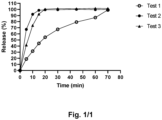
- Fig. 1 shows fast dissolution (release) of PYY compound 4 of test composition 2 and test composition 3 as compared to test composition 1.
- the invention relates to a composition
- a composition comprising a PYY compound and an absorption enhancer or delivery agent.
- the composition may be in the form suitable for oral administration, such as a tablet, sachet or capsule.
- the composition is an oral composition, or a pharmaceutical composition, such as an oral pharmaceutical composition.
- the composition according to the invention includes a high content of the delivery agent and a minimal content of further excipients as described herein below.
- the provided compositions display an accelerated dissolution and thereby enables fast and efficient uptake of the active pharmaceutical ingredient.
- hPYY(1-36) refers to the human Peptide YY, the sequence of which is included in the sequence listing as SEQ ID NO:1.
- the peptide having the sequence of SEQ ID NO:1 may also be designated native hPYY.
- PYY compound refers to a peptide, or a compound, which is a variant of hPYY(1-36).
- PYY compound as used herein may also refer to a peptide, or a compound, which is a variant of hPYY(3-36) (SEQ ID NO:2).
- PYY compound as used herein may also refer to a peptide, or a compound, which is a variant of hPYY(4-36) (SEQ ID NO: 29).
- the term “variant” refers to a compound which comprises one or more amino acid substitutions, deletions, additions and/or insertions.
- the C-terminal of the PYY compounds comprised in the present composition is an amide, as is the C-terminal of native hPYY(1-36) (SEQ ID NO:1), hPYY(3-36) (SEQ ID NO:2) and hPYY(4-36) (SEQ ID NO: 29), respectively.
- the PYY compounds comprised in the present composition can be PYY analogues and/or derivatives thereof.
- PYY analogue is used for PYY compounds, where at least one amino acid modification in the backbone is present as compared to hPYY(1-36).
- PYY derivative is used for PYY compounds comprising at least one non-amino acid substituent covalently attached.
- a PYY derivative is a derivative of a PYY analogue and thus, a PYY compound comprising at least one amino acid modification in the backbone and at least one non-amino acid substituent covalently attached.
- the PYY compounds comprised in the present composition may comprise up to 10 amino acid modifications as compared to hPYY(3-36) (SEQ ID NO:2).
- amino acid modification used throughout this application is used in the meaning of a modification to an amino acid as compared to hPYY(3-36). This modification can be the result of a deletion of an amino acid, addition of an amino acid, or substitution of one amino acid with another.
- the PYY compound comprised in the present composition is described in example 1 of WO2016/198682 (compounds 1-63, 65-71) and their biological data as described therein potency (example 2), binding affinity (example 3), half-life (example 4), and their pharmacodynamic data (effect on blood glucose and food intake, example 5).
- the PYY compound comprised in the present composition may comprise i) lysine at the position corresponding to position 7 or 10 of hPYY(1-36) (SEQ ID NO:1); ii) tryptophan at the position corresponding to position 30 of hPYY(1-36) (SEQ ID NO:1); iii) leucine at the position corresponding to position 31 of hPYY(1-36) (SEQ ID NO:1); and iv) tyrosine at the position corresponding to position 28 of hPYY(1-36) (SEQ ID NO:1), meaning that the PYY compounds of this aspect may comprise up to 6 amino acid modifications as compared to hPYY(3-36) in addition to these modification in the positions corresponding to positions 7, 30, 28, and 31 of hPYY(1-36) (SEQ ID NO:1).
- the PYY compounds comprised in the present composition may comprise i) lysine at the position corresponding to position 7 or 10 of hPYY(1-36) (SEQ ID NO:1); ii) tryptophan at the position corresponding to position 30 of hPYY(1-36) (SEQ ID NO:1); iii) leucine at the position corresponding to position 31 of hPYY(1-36) (SEQ ID NO:1); iv) tyrosine at the position corresponding to position 28 of hPYY(1-36) (SEQ ID NO:1); and v) isoleucine at the position corresponding to position 22 of hPYY(1-36) (SEQ ID NO:1), meaning that the PYY compounds of this aspect may comprise up to 5 amino acid modifications as compared to hPYY(3-36) in addition to these modification in the positions corresponding to positions 7, 30, 22, 28, and 31 of hPYY(1-36) (SEQ ID NO:1).
- [Arg4,Lys7,Gln18,Tyr28,Trp30,Leu31]hPYY(3-36) comprises 6 amino acid substitutions as compared to hPYY(3-36).
- [Arg4,Lys7,Gln18,Tyr28,Trp30,Leu31]hPYY(4-36) comprises 6 amino acid substitutions and 1 deletion as compared to hPYY(3-36), meaning that this compound has 7 amino acid modifications as compared to hPYY(3-36).
- PYY compounds comprised in the present composition may be described by reference to i) the number of the amino acid residue in hPYY(1-36) (SEQ ID NO:1) which corresponds to the amino acid residue which is changed (i.e., the corresponding position in hPYY(1-36), and to ii) the actual change.
- the position referred to is the position of the PYY analogue corresponding to that particular position of hPYY(1-36).
- the first amino acid residue of a given sequence is assigned no. 1.
- the first amino acid residue of hPYY(3-36) which is isoleucine, is assigned no. 1 in the sequence listings.
- this position is referred to as the position corresponding to position 3 of hPYY(1-36).
- a PYY compound comprises a particular amino acid at a position corresponding to a certain position of hPYY(1-36), means that the native amino acid in that position has been replaced with that particular amino acid.
- [Lys7,Tyr28,Trp30,Leu31]hPYY(3-36) designates an analogue of the human PYY(1-36), wherein the naturally occurring alanine in position 7 has been substituted with lysine, the naturally occurring leucine in position 28 has been substituted with tyrosine, the naturally occurring leucine in position 30 has been substituted with tryptophan, the naturally occurring valine in position 31 has been substituted with leucine, and tyrosine and proline in position 1 and 2, respectively, have been deleted.
- [Lys7,Tyr28,Trp30,Leu31]hPYY(3-36) can also be said to designate an analogue of the human PYY(3-36), wherein the naturally occurring alanine in position 7 has been substituted with lysine, the naturally occurring leucine in position 28 has been substituted with tyrosine, the naturally occurring leucine in position 30 has been substituted with tryptophan, and the naturally occurring valine in position 31 has been substituted with leucine.
- Amino acid residues may be identified by their full name, their one-letter code, and/or their three-letter code. These three ways are fully equivalent.
- Analogues "comprising" certain specified changes may comprise further changes, when compared to hPYY(1-36).
- the analogue "has" the specified changes.
- a PYY analogue is a PYY compound in which a number of amino acid residues have been modified when compared to hPYY(1-36) or hPYY(3-36). These modifications include substitutions, insertions, and/or deletions, alone or in combination.
- the PYY analogues comprised in the composition of the invention include one or more modifications of a "non-essential" amino acid residue.
- a "non-essential" amino acid residue is a residue that can be altered, i.e., deleted or substituted in the human PYY amino acid sequence without abolishing or substantially reducing the activity of the PYY analogue towards the Y2 receptor.
- amino acids may be substituted by conservative substitution.
- conservative substitution denotes that one or more amino acids are replaced by another, biologically similar residue. Examples include substitution of amino acid residues with similar characteristics, e.g. small amino acids, acidic amino acids, polar amino acids, basic amino acids, hydrophobic amino acids and aromatic amino acids.
- the PYY analogues comprised in the composition of the invention may comprise substitutions of one or more unnatural and/or non-amino acids, e.g., amino acid mimetics, into the sequence of PYY.
- the PYY analogues comprised in the composition of the invention may have one or more amino acid residues deleted from the amino acid sequence of human PYY, alone or in combination with one or more insertions or substitutions.
- the PYY analogues comprised in the composition of the invention may have one or more amino acid residues inserted into the amino acid sequence of human PYY, alone or in combination with one or more deletions and/or substitutions.
- the PYY analogues of the invention may include insertions of one or more unnatural amino acids and/or non-amino acids into the sequence of PYY.
- amino acid includes proteinogenic (or coded or natural) amino acids (amongst the 20 standard amino acids), as well as non-proteinogenic (or non-coded or non-natural) amino acids.
- Proteinogenic amino acids are those which are naturally incorporated into proteins.
- the standard amino acids are those encoded by the genetic code.
- Non-proteinogenic amino acids are either not found in proteins, or not produced by standard cellular machinery (e.g., they may have been subject to post-translational modification).
- Non-limiting examples of non-proteinogenic amino acids are the D-isomers of the proteinogenic amino acids.
- D-isomer of a proteinogenic amino acid is the D-isomer of aspartic acid, which can also be written as D-Asp.
- derivative as used herein in the context of a PYY compound or analogue means a chemically modified PYY peptide, in which one or more substituents have been covalently attached to the peptide.
- the substituent may be an N-terminal substituent.
- the substituent may be a modifying group or alternatively, referred to as a protracting moiety.
- the PYY compound comprises a substituent covalently attached to the alpha-amino group in the amino acid residue in the N-terminus of the PYY compound.
- the amino acid residues in the positions corresponding to positions 1-3 of hPYY(1-36) are absent, and the N-terminal substituent is covalently attached to the amino acid residue in the position corresponding to position 4 of hPYY(1-36).
- the N-terminal substituent is an alkanoyl group. In one aspect, the N-terminal substituent is an alkanoyl group comprising up to 12 carbon atoms. In another aspect, the N-terminal substituent is an alkanoyl group comprising up to 6 carbon atoms. In another aspect, the N-terminal substituent is selected form 3-methylbutanoyl or acetyl.
- the PYY compound comprises a modifying group covalently attached to the amino acid residue in the position corresponding to position 7 or 10 of hPYY(1-36).
- the substituent or modifying group is capable of forming non-covalent conjugates with proteins, thereby promoting the circulation of the derivative with the blood stream, and also having the effect of protracting the time of action of the derivative, due to the fact that the conjugate of the PYY derivative and albumin is only slowly removed by renal clearance.
- the substituent, or modifying group, as a whole may also be referred to as a protracting moiety.
- the modifying group may be covalently attached to a lysine residue of the PYY peptide by acylation, i.e., via an amide bond formed between a carboxylic acid group of the modifying group and the epsilon amino group of the lysine residue.
- the amino group of lysine could also be coupled to an aldehyde of the modifying group by reductive amination.
- the thiol group of cysteine could by coupled to a maleiimido group of the modifying group by Michael addition or coupled to the chloro- or iodoacetyl group of the modifying group by nucleophilic substitution.
- the modifying group is covalently attached to a lysine residue in a position corresponding to position 7 or 10 of hPYY(1-36) by acylation, i.e. via an amide bond formed between a carboxylic acid group of the modifying group and the epsilon amino group of the lysine residue.
- the PYY compound comprised in the composition of the invention is a PYY derivative selected from compounds 1-63, 65-71 in WO2016/198682 (Example 1) or as enclosed under embodiments herein as compounds 1-63, 65-71 and the peptide backbones as SEQ ID NO: 3-28.
- the delivery agent used in the composition of the present invention is a salt of N-(8-(2-hydroxybenzoyl)amino)caprylic acid (NAC) and is included as an excipient.
- NAC N-(8-(2-hydroxybenzoyl)amino)caprylic acid
- the structural formula of N-(8-(2-hydroxybenzoyl)amino)caprylate is shown in formula (I).
- the salt of N-(8-(2-hydroxybenzoyl)amino)caprylic acid comprises one monovalent cation, two monovalent cations or one divalent cation.
- the salt of N-(8-(2-hydroxybenzoyl)amino)caprylic acid is selected from the group consisting of the sodium salt, potassium salt and/or calcium salt of N-(8-(2-hydroxybenzoyl)amino)caprylic acid.
- the salt of N-(8-(2-hydroxybenzoyl)amino)caprylic acid is selected from the group consisting of the sodium salt, potassium salt and/or the ammonium salt.
- the salt of N-(8-(2-hydroxybenzoyl)amino)caprylic acid is the sodium salt or the potassium salt. In one embodiment, the salt of N-(8-(2-hydroxybenzoyl)amino)caprylic acid is the sodium salt or the ammonium salt. Salts of N-(8-(2-hydroxybenzoyl)amino)caprylate may be prepared using the method described in e.g. WO96/030036 , WO00/046182 , WO01/092206 or WO2008/028859 .
- the salt of N-(8-(2-hydroxybenzoyl)amino)caprylic acid may be crystalline and/or amorphous.
- the delivery agent comprises the anhydrate, monohydrate, dihydrate, trihydrate, a solvate or one third of a hydrate of the salt of N-(8-(2-hydroxybenzoyl)amino)caprylic acid as well as combinations thereof.
- the delivery agent is a salt of N-(8-(2-hydroxybenzoyl)amino)caprylic acid as described in WO2007/121318 .
- the delivery agent is sodium N-(8-(2-hydroxybenzoyl)amino)caprylate (referred to as "SNAC" herein), also known as sodium 8-(salicyloylamino)octanoate.
- SNAC sodium N-(8-(2-hydroxybenzoyl)amino)caprylate
- the composition of the invention further comprises a GLP-1 receptor agonist in combination with the PYY compound.
- GLP-1 receptor agonist refers to a compound, which fully or partially activates the human GLP-1 receptor.
- GLP-1 receptor agonist as well as the specific GLP-1 receptor agonists described herein are meant to encompass also salt forms hereof.
- the GLP-1 receptor agonist should display "GLP-1 activity" which refers to the ability of the compound, i.e. a GLP-1 analogue or a compound comprising a GLP-1 analogue, to bind to the GLP-1 receptor and initiate a signal transduction pathway resulting in insulinotropic action or other physiological effects as is known in the art.
- GLP-1 activity refers to the ability of the compound, i.e. a GLP-1 analogue or a compound comprising a GLP-1 analogue, to bind to the GLP-1 receptor and initiate a signal transduction pathway resulting in insulinotropic action or other physiological effects as is known in the art.
- the "GLP-1 receptor agonist” binds to a GLP-1 receptor, e.g. with an affinity constant (K D ) or activate the receptor with a potency (EC 50 ) of below 1 ⁇ M, e.g. below 100 nM as measured by methods known in the art (see e.g.
- the GLP-1 receptor agonist may be administered to an animal with increased blood glucose (e.g. obtained using an Intravenous Glucose Tolerance Test (IVGTT).
- IVGTT Intravenous Glucose Tolerance Test
- a person skilled in the art will be able to determine a suitable glucose dosage and a suitable blood sampling regime, e.g. depending on the species of the animal, for the IVGTT) and measure the plasma insulin concentration over time.
- Suitable assays have been described in such as WO2015/155151 .
- the GLP-1 receptor agonist is a GLP-1 analogue, optionally comprising one substituent.
- GLP-1 analogue as used herein referring to a peptide, or a compound, which is a variant of the human Glucagon-like Peptide-1 (GLP-1(7-37)).
- GLP-1(7-37) has the sequence HAEGTFTSDV SSYLEGQAAKEFIAWLVKGRG (SEQ ID NO: 31).
- GLP-1(7-36) has the sequence HAEGTFTSDV SSYLEGQAAKEFIAWLVKGR (SEQ ID NO: 30).
- the term "variant" refers to a compound which comprises one or more amino acid substitutions, deletions, additions and/or insertions.
- the C-terminal of the GLP-1 receptor agonist is an amide.
- the GLP-1 receptor agonist is GLP-1(7-37)amide or GLP-1(7-36)amide.
- the GLP-1 receptor agonist comprises a substituent, wherein the substituent is [2-(2- ⁇ 2-[2-(2- ⁇ 2-[(S)-4-carboxy-4-(17-carboxyheptadecanoylamino) butyrylamino]ethoxy ⁇ ethoxy)acetylamino] ethoxy ⁇ ethoxy)acetyl].
- the substituent is [2-(2- ⁇ 2-[2-(2- ⁇ 2-[(S)-4-carboxy-4-( ⁇ trans-4-[(19-carboxynonadecanoylamino)methyl]cyclohexanecarbonyl ⁇ amino)butyrylamino]ethoxy ⁇ ethoxy)acetylamino]ethoxy ⁇ ethoxy)acetyl].
- the GLP-1 receptor agonist is semaglutide, also known as N- epsilon26-[2-(2- ⁇ 2-[2-(2- ⁇ 2-[(S)-4-carboxy-4-(17-carboxyheptadecanoylamino) butyrylamino]ethoxy ⁇ ethoxy)acetylamino]ethoxy ⁇ ethoxy)acetyl][Aib8,Arg34]GLP-1 (7-37) (SEQ ID NO: 32), which may be prepared as described in WO2006/097537 , Example 4 and has the following structure:
- the GLP-1 receptor agonist is "GLP-1 agonist A” which is Diacylated [Aib8,Glu22,Arg26, Lys27, Glu30,Arg34, Lys36]-GLP-1-(7 -37)-peptidyl-Glu-Gly (SEQ ID NO.
- Semaglutide and GLP-1 agonist A have been shown to be orally available when formulated in a SNAC formulation as described in PCT application no. PCT/EP2019/052487 .
- the term "GLP-1 receptor agonist” is meant to encompass the GLP-1 receptor agonist and any pharmaceutically acceptable salt, amide, or ester thereof.
- the composition comprises the GLP-1 receptor agonist or a pharmaceutically acceptable salt, amide, or ester thereof.
- the composition comprises the GLP-1 receptor agonist and one or more pharmaceutically acceptable counter ions.
- the GLP-1 receptor agonist is selected from one or more of the GLP-1 receptor agonists mentioned in WO93/19175 , WO96/29342 , WO98/08871 , WO99/43707 , WO99/43706 , WO99/43341 , WO99/43708 , WO2005/027978 , WO2005/058954 , WO2005/058958 , WO2006/005667 , WO2006/037810 , WO2006/037811 , WO2006/097537 , WO2006/097538 , WO2008/023050 , WO2009/030738 , WO2009/030771 and WO2009/030774 .
- composition or pharmaceutical composition of the present invention is a solid or dry composition suited for administration by the oral route as described further herein below.
- the composition comprises at least one pharmaceutically acceptable excipient.
- excipient as used herein broadly refers to any component other than the active therapeutic ingredient(s) or active pharmaceutical ingredient(s) (API(s)).
- An excipient may be a pharmaceutically inert substance, an inactive substance, and/or a therapeutically or medicinally none active substance.
- the excipients may serve various purposes, e.g. as a carrier, vehicle, filler, binder, lubricant, glidant, disintegrant, flow control agent, crystallization inhibitors, solubilizer, stabilizer, colouring agent, flavouring agent, surfactant, emulsifier or combinations of thereof and/or to improve administration, and/or absorption of the therapeutically active substance(s) or active pharmaceutical ingredient(s).
- the salt of N-(8-(2-hydroxybenzoyl)amino)caprylic acid is an excipient acting as a delivery agent.
- the amount of each excipient used may vary within ranges conventional in the art.
- the excipients may be selected from binders, such as polyvinyl pyrrolidone (povidone), etc.; fillers such as cellulose powder, microcrystalline cellulose, cellulose derivatives like hydroxymethylcellulose, hydroxyethylcellulose, hydroxypropylcellulose and hydroxy-propylmethylcellulose, dibasic calcium phosphate, corn starch, pregelatinized starch, etc.; lubricants and/or glidants such as stearic acid, magnesium stearate, sodium stearylfumarate, glycerol tribehenate, etc.; flow control agents such as colloidal silica, talc, etc.; crystallization inhibitors such as povidone, etc.; solubilizers such as pluronic, povidone, etc.; colouring agents, including dyes and pigments such as iron oxide red or yellow, titanium dioxide, talc, etc.; pH control agents such as citric acid, tartaric acid, fumaric acid, sodium citrate
- the composition may comprise a binder, such as povidone; starches; celluloses and derivatives thereof, such as microcrystalline cellulose, e.g., Avicel PH from FMC (Philadelphia, PA), hydroxypropyl cellulose hydroxylethyl cellulose and hydroxylpropylmethyl cellulose METHOCEL from Dow Chemical Corp. (Midland, MI); sucrose; dextrose; corn syrup; polysaccharides; and gelatine.
- the binder may be selected from the group consisting of dry binders and/or wet granulation binders. Suitable dry binders are, e.g., cellulose powder and microcrystalline cellulose, such as Avicel PH 102 and Avicel PH 200.
- the composition comprises Avicel, such as Avicel PH 102.
- Suitable binders for wet granulation or dry granulation are corn starch, polyvinyl pyrrolidone (povidone), vinylpyrrolidone-vinylacetate copolymer (copovidone) and cellulose derivatives like hydroxymethylcellulose, hydroxyethylcellulose, hydroxypropylcellulose and hydroxyl-propylmethylcellulose.
- the composition comprises povidone.
- the composition comprises a filler, which may be selected from lactose, mannitol, erythritol, sucrose, sorbitol, calcium phosphate, such as calciumhydrogen phosphate, microcrystalline cellulose, powdered cellulose, confectioner's sugar, compressible sugar, dextrates, dextrin and dextrose.
- a filler which may be selected from lactose, mannitol, erythritol, sucrose, sorbitol, calcium phosphate, such as calciumhydrogen phosphate, microcrystalline cellulose, powdered cellulose, confectioner's sugar, compressible sugar, dextrates, dextrin and dextrose.
- the composition comprises microcrystalline cellulose, such as Avicel PH 101, Avicel PH 102 or Avicel PH 200.
- the composition comprises a lubricant and/or a glidant.
- the composition comprises a lubricant and/or a glidant, such as talc, magnesium stearate, calcium stearate, zinc stearate, glyceryl behenate, glyceryl dibehenate, behenoyl polyoxyl-8 glycerides, polyethylene oxide polymers, sodium lauryl sulfate, magnesium lauryl sulfate, sodium oleate, sodium stearyl fumarate, stearic acid, hydrogenated vegetable oils, silicon dioxide and/or polyethylene glycol etc.
- the composition comprises magnesium stearate or glyceryl dibehenate (such as the product Compritol ® 888 ATO which consists of mono-, di- and triesters of behenic acid (C22) with the diester fraction being predominant).
- magnesium stearate or glyceryl dibehenate such as the product Compritol ® 888 ATO which consists of mono-, di- and triesters of behenic acid (C22) with the diester fraction being predominant.
- the composition comprises a disintegrant, such as sodium starch glycolate, polacrilin potassium, sodium starch glycolate, crospovidon, croscarmellose, sodium carboxymethylcellulose or dried corn starch.
- a disintegrant such as sodium starch glycolate, polacrilin potassium, sodium starch glycolate, crospovidon, croscarmellose, sodium carboxymethylcellulose or dried corn starch.
- the composition may comprise one or more surfactants, for example a surfactant, at least one surfactant, or two different surfactants.
- surfactant refers to any molecules or ions that are comprised of a water-soluble (hydrophilic) part, and a fat-soluble (lipophilic) part.
- the surfactant may e.g. be selected from the group consisting of anionic surfactants, cationic surfactants, nonionic surfactants, and/or zwitterionic surfactants.
- compositions of the invention have a very high content of the delivery agent.
- This very high content can be defined relative to the full content of the tablets including also the active pharmaceutical ingredient (i.e. the PYY compound optionally in combination with a GLP-1 receptor agonist) or alternatively relative to the total content of excipients excluding the active pharmaceutical ingredient(s).
- the description here below also refers to compositions consisting of specific ingredients, the PYY compound, excipients, and optionally a GLP-1 receptor agonist, the term consisting is to be understood to never the less encompass trace amounts of any substance with no effect on the function of the composition, which may also be referred to as consisting essential of.
- Such substances can be impurities remaining in preparation of the PYY compound optionally from the GLP-1 receptor agonist or from the production of the salt of NAC or minimal amounts (below 1 %) of any pharmaceutical acceptable excipient that do not affect the quality or absorption of the formulation.
- the pharmaceutical composition comprises
- the salt of NAC constitutes above 70 percent (w/w), such as above 75 percent (w/w), such as above 80 percent (w/w), such as above 85 percent (w/w), such as above 90 percent (w/w) of said composition.
- the salt of NAC constitutes at least 70 percent (w/w), such as at least 75 percent (w/w), such as at least 80 percent (w/w), such as at least 85 percent (w/w), such as at least 90 percent (w/w) of said composition.
- the pharmaceutical composition comprises
- the salt of NAC constitutes at least at least 91 percent (w/w), such as at least 92 percent (w/w), such as at least 93 percent (w/w), such as at least 94 percent (w/w), such as at least 95 percent (w/w) of the excipients of the composition.
- the pharmaceutical composition consists of
- the salt of NAC constitutes at least at least 91 percent (w/w), such as at least 92 percent (w/w), such as at least 93 percent (w/w), such as at least 94 percent (w/w), such as at least 95 percent (w/w) of the excipients of the composition.
- the pharmaceutical composition consists of
- the salt of NAC constitutes at least at least 91 percent (w/w), such as at least 92 percent (w/w), such as at least 93 percent (w/w), such as at least 94 percent (w/w), such as at least 95 percent (w/w) of the excipients of the composition.
- the pharmaceutical composition consists of
- the salt of NAC constitutes at least 91 percent (w/w), such as at least 92 percent (w/w), such as at least 93 percent (w/w), such as at least 94 percent (w/w), such as at least 95 percent (w/w) of the excipients of the composition.
- the pharmaceutical composition comprises
- the pharmaceutical composition consists of
- the pharmaceutical composition consists of
- the salt of NAC constitutes above 60 percent (w/w), such as above 70 percent (w/w), such as above 75 percent (w/w), such as 80 percent (w/w) or such as above 90 percent (w/w) of the composition.
- the salt of NAC constitutes at least 95 percent (w/w), such as at least 96 percent (w/w), such as at least 97 percent (w/w) or such as at least 98 percent (w/w) of the excipients of the composition.
- the pharmaceutical composition consists of
- the salt of NAC constitutes above 60 percent (w/w), such as above 70 percent (w/w), such as above 75 percent (w/w), such as above 80 percent (w/w) or such as above 90 percent (w/w) of the composition.
- the salt of NAC constitutes at least 95 percent (w/w), such as at least 96 percent (w/w), such as at least 97 percent (w/w) or such as at least 98 percent (w/w) of the excipients of the composition.
- the content of excipients, besides the delivery agent is according to the invention preferably minimal.
- the pharmaceutical composition comprises at least one lubricant.
- the pharmaceutical composition comprises or consists of:
- the lubricant may be magnesium stearate or glyceryl dibehenate. In one embodiment, the lubricant is magnesium stearate. In one embodiment, the lubricant is glyceryl dibehenate.
- a composition as described above wherein said salt of N-(8-(2-hydroxybenzoyl)amino)caprylic acid (NAC) constitutes at least 90 percent (w/w), such as at least 95 percent (w/w) of the excipients of the composition may further be a composition wherein said salt constitutes at least or above 60 percent (w/w) of the composition.
- NAC N-(8-(2-hydroxybenzoyl)amino)caprylic acid
- compositions described above wherein said salt constitutes at least or above 60 percent (w/w) of the composition may further be a composition wherein said salt of N-(8-(2-hydroxybenzoyl)amino)caprylic acid (NAC) constitutes at least 90 percent (w/w), such as at least 95 percent (w/w) of the excipients of the composition.
- NAC N-(8-(2-hydroxybenzoyl)amino)caprylic acid
- the pharmaceutical composition comprises or consists of:
- the lubricant may be magnesium stearate or glyceryl dibehenate. In one embodiment, the lubricant is magnesium stearate. In one embodiment, the lubricant is glyceryl dibehenate.
- a composition as described above wherein said salt of N-(8-(2-hydroxybenzoyl)amino)caprylic acid (NAC) constitutes at least 90 percent (w/w), such as at least 95 percent (w/w) of the excipients of the composition may further be a composition wherein said salt constitutes at least or above 60 percent (w/w) of the composition.
- NAC N-(8-(2-hydroxybenzoyl)amino)caprylic acid
- compositions described above wherein said salt constitutes at least or above 60 percent (w/w) of the composition may further be a composition wherein said salt of N-(8-(2-hydroxybenzoyl)amino)caprylic acid (NAC) constitutes at least 90 percent (w/w), such as at least 95 percent (w/w) of the excipients of the composition.
- NAC N-(8-(2-hydroxybenzoyl)amino)caprylic acid
- the pharmaceutical composition may further be a composition wherein the salt of N-(8-(2-hydroxybenzoyl)amino)caprylic acid (NAC) is selected from the group consisting of the sodium salt, potassium salt and/or calcium salt of N-(8-(2-hydroxybenzoyl)amino)caprylic acid (NAC) or alternatively from the group consisting of just the sodium salt and the potassium salt.
- the salt of N-(8-(2-hydroxybenzoyl)amino)caprylic acid (NAC) is sodium N-(8-(2-hydroxybenzoyl)amino)caprylate.
- any further excipients constitutes at most 10 percent (w/w) of the excipients, i.e. any such binder, filler, and/or lubricant/glidant constitutes at the most 10 percent (w/w) of the weight of excipients of the composition.
- the excipients of the composition comprise at least or above 90 percent (w/w) delivery agent, and less than 5 percent (w/w) of any further excipients, such as binder, filler, and/or lubricant/glidant.
- the excipients of the composition comprise at least 90 percent (w/w) delivery agent and less than 5 percent (w/w) lubricant. In one embodiment, the excipients of the composition comprise at least 90 percent (w/w) delivery agent and less than 3 percent (w/w) lubricant.
- the excipients of the composition comprise at least or above 90 percent (w/w) delivery agent and 0.1-5 percent (w/w), such as 0.5-4 percent (w/w) or 1-3 percent (w/w), of lubricant.
- the excipients of the composition comprise 2-2.5 percent (w/w) of lubricant.
- the excipients of the composition comprise 1-5 percent (w/w) of lubricant.
- the excipients of the composition comprise 1-4 percent (w/w) of lubricant.
- the excipients of the composition comprise 1-3 percent (w/w) of lubricant.
- the excipients of the composition comprise 1-2.5 percent (w/w) of lubricant. In further such embodiments, the excipients of the composition comprise 2-3 percent (w/w) of lubricant. In further such embodiments, the excipients of the composition comprise 2-4 percent (w/w) of lubricant. In further such embodiments, the excipients of the composition comprise 2-5 percent (w/w) of lubricant. In further such embodiments, the excipients of the composition comprise 2.5 percent (w/w) of lubricant.
- any further excipients of the composition constitute at most 5 percent (w/w) of the excipients, i.e. any such binder, filler, and/or lubricant/glidant constitutes at the most 5 percent (w/w) of the weight of the excipients of the composition.
- the excipients of the composition comprise at least 95 percent (w/w) delivery agent and less than 5 percent (w/w) lubricant. In one embodiment, the excipients of the composition comprise at least 95 percent (w/w) delivery agent and less than 3 percent (w/w) lubricant.
- the excipients of the composition comprise at least 95 percent (w/w) delivery agent and 0.1-5 percent (w/w), such as 0.5-4 percent (w/w) or 1-3 percent (w/w), of lubricant. In further such embodiments, the excipients of the composition comprise 2-2.5 percent (w/w) of lubricant.
- the pharmaceutical composition according to the invention is preferably produced in a dosage form suitable for oral administration as described herein below.
- the absolute amounts of the ingredients of the composition of the invention are provided with reference to the content in a dosage unit i.e. per tablet, capsule or sachet.
- compositions of the invention may in a further embodiment comprise at most 1000 mg of said salt of N-(8-(2-hydroxybenzoyl)amino)caprylic acid per dose unit.
- the invention relates to a composition wherein a dose unit comprises at most 500 mg of said salt.
- the amount of the salt of N-(8-(2-hydroxybenzoyl) amino)caprylic acid per dose unit is at least 0.05 mmol, such as at least 0.075 mmol, such as at least 0.1 mmol, such as at least 0.125 mmol, such as at least 0.15 mmol, such as at least 0.20 mmol, at least 0.25 mmol, at least 0.30 mmol, at least 0.35 mmol, at least 0.40 mmol, at least 0.45 mmol, at least 0.50 mmol, at least 0.55 mmol or at least 0.60 mmol.
- the amount of the salt of N-(8-(2-hydroxybenzoyl)amino)caprylic acid per dosage unit of the composition is up to 3 mmol, such as up to 2.75 mmol, such as up to 2.5 mmol, such as up to 2.25 mmol, such as 2 mmol, such as up to 1.5 mmol, up to 1 mmol, up to 0.75 mmol, up to 0.6 mmol, up to 0.5 mmol, up to 0.4 mmol, up to 0.3 mmol and up to 0.2 mmol.
- the amount of the salt of N-(8-(2-hydroxybenzoyl) amino)caprylic acid per dose unit of the composition is in the range of 0.05-3 mmol, 0.10- 2.5 mmol, 0.15- 2.0 mmol, 0.20 - 1.5 mmol, 0.25-1.0 mmol, 0.30-0.75 mmol or such as 0.45-0.65 mmol.
- the amount of SNAC in the composition is at least 15 mg, such as at least 20 mg, such as at least 25 mg, such as at least 50 mg, such as at least 75 mg, at least 100 mg, at least 125 mg, at least 150 mg, at least 175 mg, at least 200 mg, at least 225 mg, at least 250 mg, at least 275 mg and at least 300 mg per dose unit.
- the amount of SNAC in the composition is up to 1000 mg, such as up to 800 mg, such as up to 600 mg, such as up to 575 mg, such as up to 550 mg, up to 525 mg, up to 500 mg, up to 475 mg, up to 450 mg, up to 425 mg, up to 400 mg, up to 375 mg, up to 350 mg, up to 325 mg per dose unit, or up to 300 mg per dose unit.
- the amount of SNAC in the composition is in the range of 15-1000 mg, such as 20-800 mg, such as 25-600 mg, such as 50-500 mg, such as 50-400 mg, such as 75-400 mg, such as 80-350 mg or such as from around 100 to around 300 mg per dose unit.
- the amount of SNAC is in the range of 20-200 mg, such as 25-175 mg, such as 75-150 mg, such as 80-120 mg such as around 100 mg per dose unit.
- the amount of SNAC is in the range of 200-800 mg, such as 250-400 mg, such as 250-350 mg, such as 275-325 mg, such as around 300 mg per dose unit.
- a dose unit of the pharmaceutical compositions of the invention comprises 0.1-100 mg, 0.2 to 100 mg or 0.5-50 mg of the PYY compound.
- a dose unit of the composition comprises an amount of PYY compound is in the range of 0.2 to 50 mg or 1 to 40 mg.
- a dose unit comprises 0.5-5 mg of the PYY compound, such as 0.75- 4.5 mg, such as 1, 1.5, 2, 2.5 or 3 mg or 3.5, 4, 4.5 mg, such as 1-3 or 3-5 mg of the PYY compound per dose unit.
- a dose unit comprises 2 to 20 mg of the PYY compound, such as 2-15 mg, such as 2, 3, 4, 5, 6 or 7 mg, such as 2, 3, 4 or 5 mg, or such as 8, 10, 12 or 14 mg, such as 15 mg or such as 20 mg of the PYY compound per dose unit.
- a dose unit comprises 5 to 50 mg of the PYY compound, such as 10-45 mg, such as 20, 30 or 40 mg, or such as 25, 35, or 45 mg, or such as 30-50 mg or such as 20-40 mg of the PYY compound per dose unit.
- the amount of PYY compound may be varied depending on identity of the PYY compound, the effect desired and indication.
- the pharmaceutical composition comprises a GLP-1 receptor agonist in addition to the PYY compound.
- a dose unit of the pharmaceutical compositions of the invention comprises 0.1-100 mg or 0.2 to 100 mg of the GLP-1 receptor agonist.
- a dose unit of the composition comprises an amount of the GLP-1 receptor agonist in the range of 0.2 to 50 mg or 1 to 40 mg.
- a dose unit comprises 0.5-5 mg of the GLP-1 receptor agonist, such as 0.75-4.5 mg, such as 1, 1.5, 2, 2.5 or 3 mg or 3.5, 4, 4.5 mg, such as 1-3 or 3-5 mg of the GLP-1 receptor agonist per dose unit.
- a dose unit comprises 2 to 20 mg of the GLP-1 receptor agonist, such as 2-15 mg, such as 2, 3, 4, 5, 6 or 7 mg, such as 2, 3, 4 or 5 mg, or such as 8, 10, 12 or 14 mg, such as 15 mg or such as 20 mg of the GLP-1 receptor agonist per dose unit.
- a dose unit comprises 5 to 50 mg of the GLP-1 receptor agonist, such as 10-45 mg, such as 20, 30 or 40 mg, or such as 25, 35, or 45 mg, or such as 30-50 mg or such as 20-40 mg of the GLP-1 receptor agonist per dose unit.
- the amount of the GLP-1 receptor agonist may be varied depending on identity of the GLP-1 receptor agonist, the effect desired and the indication, e.g. a higher content may be relevant for treating obesity compared to diabetes.
- a unit dose of the composition comprises 0.5-25 mg magnesium stearate, such as 1-10 mg, such as 2-8 mg or such as 2-5 mg magnesium stearate.
- the amount of magnesium stearate is determined relative to the amount of the salt of NAC, such as SNAC, such that a unit dose of the composition comprises 1-8 mg magnesium stearate or such as 2-5 mg magnesium stearate or 2-3 mg magnesium stearate per 100 mg salt of N-(8-(2-hydroxybenzoyl)amino)caprylic acid, such as SNAC.
- a unit dose of the composition comprises 80-120 mg SNAC, 0.5-5 mg PYY compound and 2-3 mg lubricant.
- a unit dose of the composition comprises 80-120 mg SNAC, 1.5-10 mg PYY compound and 2-3 mg lubricant.
- a unit dose of the composition comprises 80-120 mg SNAC, 5-50 mg PYY compound and 2-3 mg lubricant.
- a unit dose of the composition comprises 250-350 mg SNAC, 0.5-5 mg compound and 3-10 mg lubricant.
- a unit dose of the composition comprises 250-350 mg SNAC, 1.5-10 mg PYY compound and 3-10 mg lubricant.
- a unit dose of the composition comprises 250-350 mg SNAC, 5-50 mg PYY compound and 3-10 mg lubricant.
- a unit dose of the composition comprises 80-120 mg SNAC, 0.5-5 mg PYY compound, 0.5-5 mg GLP- receptor agonist and 2-3 mg lubricant.
- a unit dose of the composition comprises 80-120 mg SNAC, 1.5-10 mg PYY compound, 1.5-10 mg GLP- receptor agonist and 2-3 mg lubricant.
- a unit dose of the composition comprises 80-120 mg SNAC, 5-50 mg PYY compound, 5-50 mg GLP- receptor agonist and 2-3 mg lubricant.
- a unit dose of the composition comprises 250-350 mg SNAC, 0.5-5 mg compound, 0.5-5 mg GLP- receptor agonist and 3-10 mg lubricant.
- a unit dose of the composition comprises 250-350 mg SNAC, 1.5-10 mg PYY compound, 1.5-10 mg GLP- receptor agonist and 3-10 mg lubricant.
- a unit dose of the composition comprises 250-350 mg SNAC, 5-50 mg PYY compound, 5-50 mg GLP- receptor agonist and 3-10 mg lubricant.
- the pharmaceutical composition of the invention has a fast disintegration or dissolution in vitro. Disintegration or dissolution may be tested as known in the art and as described herein in Assay I or Assay II.
- Dissolution or release may be expressed as the amount of the PYY compound measured in solution after a given period relative to the total content of the PYY compound of the composition. The relative amount may be given in percentage.
- the release of the PYY compound from the pharmaceutical composition of the invention is at least 85 % within 15 minutes or at least 95 % within 30 minutes. In one such embodiment, the release is measured at pH 6.8.
- the pharmaceutical composition comprises
- composition of the invention comprising PYY compound/SNAC behave like semaglutide/SNAC compositions with regards to disintegration and dissolution (Examples 2 and 3 herein).
- the composition of the invention is bioavailable in vivo from oral administration (Example 4 herein).
- the improved plasma exposure of a PYY compound using a composition according to the invention compared to a PYY compound/SNAC composition prepared according to WO 2012/080471 and WO 2013/139694 can be demonstrated using Assay IV herein, similar to what has previously been observed for semaglutide and other GLP-1 receptor agonists ( PCT/EP2019/052487 ).
- the pharmaceutical composition of the invention provides an early exposure in vivo. In one embodiment, the pharmaceutical composition of the invention provides increased exposure of the PYY compound in vivo. In one embodiment, the pharmaceutical composition of the invention provides an increased early exposure in vivo.
- the reference may be test composition 1 as described herein.
- the pharmaceutical composition comprises
- the pharmaceutical composition comprises
- the pharmaceutical composition comprises
- the pharmaceutical composition comprises
- compositions may be administered in several dosage forms, for example as a tablet; a coated tablet; a sachet or a capsule such as hard- or softshell gelatine capsules and all such compositions are considered solid oral dosage forms.
- the composition may further be compounded in a drug carrier or drug delivery system, e.g. in order to improve stability and/or solubility or further improve bioavailability.
- the composition may be a freeze-dried or spray-dried composition.
- the composition may be in the form of a dose unit, such as a tablet.
- the weight of the unit dose is in the range of 50 mg to 1000 mg, such as in the range of 50-750 mg, or such as in the range of 100-500 mg.
- the weight of the dose unit is in the range of 75 mg to 350 mg, such as in the range of 100-300 mg or such as in the range of 200-350 mg.
- the weight of the dose unit is in the range of 100 mg to 400 mg, such as in the range of 50-300 mg or such as in the range of 200-400 mg.
- the composition may be granulated prior to being compacted and e.g. compressed into tablets.
- the composition may comprise an intragranular part and/or an extragranular part, wherein the intragranular part has been granulated and the extragranular part has been added after granulation.
- the composition may comprise one or more intragranular parts and/or an extragranular part, wherein the one or more intragranular parts have been granulated and the extragranular part has been added after granulation.
- the intragranular part may comprise the PYY compound, the delivery agent and/or an excipient, such as a lubricant and/or glidant.
- the intragranular part comprises the delivery agent and a lubricant and/or a glidant and optionally the GLP-1 receptor agonist.
- the composition may comprise both a PYY compound and a GLP-1 receptor agonist.
- said composition may be made from one intragranular part comprising the PYY compound, the GLP-1 receptor agonist, the delivery agent and a lubricant and/or a glidant.
- said composition may be made by mixing two intragranular parts: i) one intragranular part comprising the PYY compound, the delivery agent and a lubricant and/or glidant and ii) another intragranular part comprising the GLP-1 receptor agonist, the delivery agent and a lubricant and/or glidant.
- the extragranular part comprises the PYY compound, and/or a lubricant and/or a glidant, such as magnesium stearate and optionally the GLP-1 receptor agonist. In some embodiments, the extragranular part comprises the PYY compound and optionally the GLP-1 receptor agonist. In some embodiments, the extragranular part comprises an excipient, such as a lubricant and/or glidant, such as magnesium stearate.
- the intragranular part comprises the PYY compound, the delivery agent and the lubricant and/or a glidant.
- the granulate may be directly compressed into tablets and the tablets have no extragranular part.
- composition according to the invention may be performed according to methods known in the art.
- the various components are optionally delumped or sieved, weighed and then combined.
- the mixing of the components may be carried out until a homogeneous blend is obtained.
- granulate and “granules” are used interchangeably herein to refer to particles of composition material which may be prepared as described above.
- the term refers broadly to pharmaceutical ingredients in the form of particles, granules, and aggregates which are used in the preparation of solid dose formulations.
- granules are obtained by processing a powder or a blend to obtain a solid which is subsequently broken down to obtain granules of the desired size.
- granules are to be used in the tabletting material, granules may be produced in a manner known to a person skilled in the art, for example using wet granulation methods known for the production of "built-up" granules or "broken-down" granules.
- Methods for the formation of built-up granules may operate continuously and comprise, for example simultaneously spraying the granulation mass with granulation solution and drying, for example in a drum granulator, in pan granulators, on disc granulators, in a fluidized bed, by spray-drying, spray-granulation or spray-solidifying, or operate discontinuously, for example in a fluidized bed, in a rotary fluid bed, in a batch mixer, such as a high shear mixer or a low shear mixer, or in a spray-drying drum.
- Methods for the production of broken-down granules which may be carried out discontinuously and in which the granulation mass first forms a wet aggregate with the granulation solution, which is subsequently comminuted or by other means formed into granules of the desired size and the granules may then be dried.
- Suitable equipment for the wet granulation step are planetary mixers, low shear mixers, high shear mixers, extruders and spheronizers, such as an apparatus from the companies Loedige, Glatt, Diosna, Fielder, Collette, Aeschbach, Alexanderwerk, Ytron, Wyss & Probst, Werner & Pfleiderer, HKD, Loser, Fuji, Nica, Caleva and Gabler.
- Granules may also be formed by dry granulation techniques in which one or more of the excipient(s) and/or the active pharmaceutical ingredient is compressed to form relatively large moldings, for example slugs or ribbons, which are comminuted by grinding, and the ground material serves as the tabletting material to be later compacted.
- Suitable equipment for dry granulation is, but not limited to, roller compaction equipment from Gerteis such as Gerteis MICRO-PACTOR, MINI-PACTOR and MACRO-PACTOR.
- a tablet press may be used to compact the tabletting material into a solid oral dosage form, for example a tablet.
- the tabletting material is filled (e.g. force fed or gravity fed) into a die cavity.
- the tabletting material is then compacted by a set of punches applying pressure. Subsequently, the resulting compact, or tablet is ejected from the tablet press.
- the above mentioned tabletting process is subsequently referred to herein as the "compaction process".
- Suitable tablet presses include, but are not limited to, rotary tablet presses and eccentric tablet presses.
- Examples of tablet presses include, but are not limited to, the Fette 102i (Fette GmbH), the Korsch XL100, the Korsch PH 106 rotary tablet press (Korsch AG, Germany), the Korsch EK-O eccentric tabletting press (Korsch AG, Germany), the Romaco Kilian STYL'ONE Evo tablet press and the Manesty F-Press (Manesty Machines Ltd., United Kingdom).
- granulates may be prepared by wet, melt or dry granulation, preferably dry granulation.
- Granules of i, ii and/or iii and/or optionally iv. may thus be obtained by dry granulation of a blend hereof, such as by roller compaction.
- wet granulation may be used to obtain the granules. This material can then be used directly or further refined to obtain the final granules.
- the composition comprises at least one granulate. In one embodiment, the composition comprises one type of granulate. The composition may alternatively comprise two types of granulates.
- the invention relates to a composition
- a composition comprising
- the invention relates to a composition
- a composition comprising
- the invention relates to a composition
- a composition comprising
- the granulation may be obtained by various methods as described above, wherein i, ii and/or iii and/or optionally iv. are initially mixed either as powders or by the preparation of a solution comprising both ingredients.
- the method of preparation of the tablet comprises; a) granulating a mixture comprising the delivery agent and optionally a lubricant; b) blending the granulate of a) with a PYY compound and optionally additional lubricant, and then c) compressing the blend of b) into tablets.
- the method of preparation of the tablet comprises; a) granulating a mixture comprising the delivery agent and optionally a lubricant; b) blending the granulate of a) with a PYY compound and a GLP-1 receptor agonist and optionally additional lubricant, and then c) compressing the blend of b) into tablets.
- the method of preparation of the tablet comprises; a) granulating a mixture comprising the delivery agent, the PYY compound and optionally a lubricant and b) compressing the granulate of a) into tablets and optionally including additional lubricant.
- the method of preparation of the tablet comprises; a) granulating a mixture comprising the delivery agent, the PYY compound, the GLP-1 receptor agonist and optionally a lubricant and b) compressing the granulate of a) into tablets and optionally including additional lubricant.
- the method of preparation of the tablet comprises; a) granulating a first a mixture comprising the delivery agent, the PYY compound, and optionally a lubricant, b) granulating a second mixture comprising the delivery agent, the GLP-1 receptor agonist, and optionally a lubricant and c) mixing the granules of a) and b) and compressing the mixture of granulates of a) and b) into tablets and optionally including additional lubricant.
- one or more sieving step(s) can be included prior to the final dry granulation step/roller compaction or tablet compression step.
- excipient(s) such as a lubricant may be added prior to tablet compression forming an extragranular part.
- the present invention also relates to a composition of the invention for use as a medicament.
- the composition of the invention may be used for the following medical treatments, all preferably relating one way or another to diabetes and/or obesity:
- Type 2 diabetes and/or obesity.
- the invention further relates to a method of treating a subject in need thereof, comprising administering a therapeutically effective amount of a composition according to the present invention to said subject.
- the method of treatment is for treatment of diabetes or obesity and/or the further indications specified above.
- a method for treating obesity comprising administering to a subject in need thereof a therapeutically effective amount of a pharmaceutical composition comprising a PYY compound, a salt of N-(8-(2-hydroxybenzoyl)amino)caprylic acid (NAC), and optionally, a lubricant.
- a method for treating obesity comprising administering to a subject in need thereof a therapeutically effective amount of a pharmaceutical composition comprising a PYY compound, a salt of N-(8-(2-hydroxybenzoyl)amino)caprylic acid (NAC), optionally a lubricant and optionally, a GLP-1 receptor agonist.
- a method for treating obesity comprising administering to a subject in need thereof a therapeutically effective amount of a pharmaceutical composition comprising
- a method for treating obesity comprising administering to a subject in need thereof a therapeutically effective amount of a pharmaceutical composition comprising
- the salt of N-(8-(2-hydroxybenzoyl)amino)caprylic acid constitutes at least 90 percent (w/w) of the excipients of the composition. In a preferred embodiment, the salt of N-(8-(2-hydroxybenzoyl)amino)caprylic acid constitutes at least 95 percent (w/w) of the excipients of the composition.
- a method for treating obesity comprising administering to a subject in need thereof a therapeutically effective amount of a pharmaceutical composition comprising about 1-30 mg of a PYY compound, about 100-300 mg of salt of N-(8-(2-hydroxybenzoyl)amino)caprylic acid (NAC), about 2-8 mg of magnesium stearate, and optionally about 1-20 mg of a GLP-1 receptor agonist.
- a pharmaceutical composition comprising about 1-30 mg of a PYY compound, about 100-300 mg of salt of N-(8-(2-hydroxybenzoyl)amino)caprylic acid (NAC), about 2-8 mg of magnesium stearate, and optionally about 1-20 mg of a GLP-1 receptor agonist.
- the PYY compound is selected from compounds 1-63, 65-71 as disclosed herein and in WO2016/198682 (compounds 1-63, 65-71, example 1).
- the PYY compound is selected from compound 4 (N ⁇ alpha-4 ⁇ -(3-Methylbutanoyl)-N ⁇ Epsilon-7 ⁇ -6-[[(4S)-4-carboxy-4-(17-carboxy-heptadecanoylamino)butanoyl]amino]hexanoyl-[Arg4, Lys7,Pro9,Gln18,Tyr28,Trp30, Leu31]hPYY(4-36)), compound 20 (N ⁇ alpha-4 ⁇ -(3-Methylbutanoyl)-N ⁇ Epsilon-7 ⁇ -6-[[(4S)-4-carboxy-4-(17-carboxy-heptadecanoylamino)butanoyl]amin
- the GLP-1 receptor agonist is semaglutide having a formula of N-epsilon26-[2-(2- ⁇ 2-[2-(2- ⁇ 2-[(S)-4-carboxy-4-(17-carboxy-heptadecanoylamino)butyrylamino]ethoxy ⁇ ethoxy)acetylamino]ethoxy ⁇ ethoxy)acetyl] [Aib8,Arg34]GLP-1(7-37) and the salt of N-(8-(2-hydroxybenzoyl)amino)caprylic acid (NAC) is sodium N-(8-(2-hydroxybenzoyl)amino)caprylic acid (SNAC).
- a lubricant including magnesium stearate.
- the composition is administered orally and is in a form of a table, capsule or a sachet.
- one or more dose units may be administered to said subject in need.
- a disintegration test is performed in an appropriate disintegration apparatus e.g. USP disintegration apparatus to measure the disintegration time of the test compositions in vitro.
- an appropriate disintegration apparatus e.g. USP disintegration apparatus to measure the disintegration time of the test compositions in vitro.
- a standard dissolution test according to the European Pharmacopeia (Ph Eur 2.9.3) may be performed to measure the release of the PYY compound and SNAC in vitro.
- a dissolution test is performed in an appropriate dissolution apparatus e.g. USP dissolution apparatus 2. More specifically, an apparatus 2 is used in accordance with United States Pharmacopoeia 35 using a paddle rotation speed of 50 rpm. For testing at pH 6.8, the 500 mL dissolution medium of 0.05 M phosphate buffer is used at a temperature of 37 ⁇ 0.5 °C. Dissolution media has a content of 0.1 % Brij ® 35. Samples are removed at appropriate intervals and sample content determined using a RP-UHPLC method for dual detection of SNAC and PYY compound.
- the sample content is calculated based on the peak area of the PYY compound and SNAC peaks in the chromatogram relative to the peak areas of the PYY compound and SNAC references, respectively.
- the released amount of PYY compound and SNAC is calculated as percentage of the total content in the test compositions.
- the total content in the tablets is determined using Assay III.
- Assay III Analysis of amount of PYY compound and SNAC
- the tablets are weighed before extraction of the PYY compound and SNAC. Tablets are dissolved in a relevant amount of 0.05 M phosphate buffer, pH 7.4, with 20% acetonitrile. Extraction time of two hours is used. Samples are centrifuged, and a suitable volume is transferred to HPLC vial. Standards of relevant PYY compound and SNAC are prepared by using the same diluent as for the samples. UHPLC with an UV-detector is used for dual determination of the PYY compound and SNAC content. The tablet content is calculated based on the peak area of the PYY compound and SNAC peaks in the chromatogram relative to the peak areas of the PYY compound and SNAC references, respectively.
- PK studies in Beagle dogs are conducted to determine the exposure of the PYY compound after peroral administration of different dosage forms.
- the dogs are fasted overnight and from 0 to 4 h after dosing. Besides, the dogs are restricted to water 1 hour before dosing until 4 hours after dosing, but otherwise have ad libitum access to water during the whole period.
- the tablets comprising the PYY compound are administered in the following manner: 10 min prior to tablet administration the dogs are dosed subcutaneously with approximately 3 nmol/kg of SEQ ID NO: 34).
- the PYY tablets are placed in the back of the mouth of the dog to prevent chewing. The mouth is then closed and tap water is given by a syringe or gavage to facilitate swallowing of the tablet.
- Blood is sampled at predefined time points for up till 10 hr post dosing to adequately cover the full plasma concentration-time absorption profile of the PYY compound.
- 0.8 mL of whole blood is collected in a 1.5 mL EDTA coated tube, and the tube is gently turned to allowing mixing of the sample with the EDTA.
- Blood samples (for example 0.8 mL) are collected in EDTA buffer (8mM) and then centrifuged at 4°C and 2000G for 10 minutes. Plasma is pipetted into Micronic tubes on dry ice and kept at -20°C until analysis.
- Blood samples are taken as appropriate, for example from a venflon in the cephalic vein in the front leg for the first 2 hours and then with syringe from the jugular vein for the rest of the time points (the first few drops are allowed to drain from the venflon to avoid heparin saline from the venflon in the sample).
- PYY compound was assayed in dog plasma by plasma protein precipitation and turboflow liquid chromatography tandem mass spectrometry (TF-LC-MS/MS).
- Calibrators were prepared by spiking blank dog plasma with PYY compound in the range from 0.5 to 200 nM.
- One volume of calibrators, blank plasma and study samples were precipitated with three volumes of ethanol (with internal standard) and centrifuged.
- One volume of supernatant was mixed with two volumes of Milli-Q water (with 1% formic acid).
- the mixture was analysed by TF-LC-MS/MS using a Cyclone turboflow column (0.5 x 50 mm, ThermoFisher Scientific) and an Aeris Peptide 3.6 um XB-C18 analytical column (50 ⁇ 2.1 mm, Phenomenex) or a Poroshell SB-C18 2.7 um analytical column (50 ⁇ 2.1 mm, Agilent).
- a gradient elution was conducted using mobile phase A (consisting of milli-Q water with 1% formic acid and 5% methanol/acetonitrile (50/50)) and mobile phase B (consisting of methanol/acetonitrile (50/50) with 1% formic acid and 5% milli-Q water).
- a TSQ Altis or a QE Plus mass spectrometer (ThermoFisher Scientific) was used as detector in single or parallel reaction monitoring mode (m/z 968.5 to m/z 883.4 or m/z 806.7576, NCE 17).
- Linear calibration curves (weighed 1/x 2 ) were used for calculating the concentration in the plasma samples. Quality control samples were included. The deviation between nominal and calculated concentration in the calibrators and quality control samples was below 20%.
- Dry granulation is carried out by roller compaction on a Gerteis MINI-PACTOR.
- the roller speed is set at 3 rpm and roller compaction force at 6 kN/cm, gap of 1 mm.
- SNAC and magnesium stearate and optionally MCC Prior to dry granulation SNAC and magnesium stearate and optionally MCC are blended in a suitable blender such as a V-shell blender, Pharmatech MB100.
- Tablets are produced on a Kilian STYL'ONE simulating a Fette 102i or on a Fette 102i mounted with a single set of punches, resulting in 7 mm round, 7.2 ⁇ 12 mm or 7.5 ⁇ 13 mm oval tablets having no score.
- Punch size is chosen according to the total tablet weight.
- the press speed is set to 20rpm.
- the fill volume is adjusted to obtain tablets having target weights from 107 mg to 403 mg. Compression forces around 7 to 8.5 kN are applied to obtain tablets with a crushing strength of around 56-134 N respective to the tablet size.
- Test compositions were prepared according to table 1 below, comprising a peptide based PYY compound prepared as described in WO2016/198682 (Example 1, compounds 4 and 32).
- the compounds tested have the following name and structure: N ⁇ alpha-4 ⁇ -(3-Methylbutanoyl)-N ⁇ Epsilon-7 ⁇ -6-[[(4S)-4-carboxy-4-(17-carboxy-heptadecanoylamino)butanoyl]amino]hexanoyl-[Arg4, Lys7,Pro9,Gln18,Tyr28,Trp30, Leu31]hPYY(4-36) (compound 4): and N ⁇ alpha-4 ⁇ -(3-Methylbutanoyl)-N ⁇ Epsilon-7 ⁇ -6-[[(4S)-4-carboxy-4-(17-carboxy-heptadecanoylamino)butanoyl]amino]
- Test composition 1 was produced by granulating a blending of SNAC, magnesium stearate and MCC as described in WO 2013/139694 . The granulates were subsequently blended with povidone, the PYY compound and further MCC and magnesium stearate prior to tablet compression (method 2).
- Test compositions 2, 3 and 4 were prepared by blending of SNAC with magnesium stearate prior to dry granulation (method 1). The obtained granulates where subsequently blended with PYY compound prior to tablet compression (method 2). The compositions are described in table 1.
- the objective of the present study was to evaluate the disintegration of the series of the tablet compositions described in Example 1.
- Disintegration was measured according to Assay I using a Pharmatech PTZ auto disintegration tester in accordance with European Pharmacopoeia employing automatic detection. Test compositions 1 - 4 were tested in water R and considered disintegrated when the automatic detection was deployed. The results are reported as average of 3 tablets.
- Table 2 shows the results for tablets prepared according to Example 1 above. Table 2. Disintegration times Composition Test 1 Test 2 Test 3 Test 4 Disintegration time 12 min 2 s 3 min 57 s 7 min 36 s 5 min 49 s
- test compositions 2, 3 and 4 display a significantly faster disintegration than observed for test composition 1.
- the objective of the present study was to evaluate the dissolution of the series of the tablet compositions described in Example 1.
- Dissolution was measured according to Assay II and the amount of SNAC and the PYY compound measured according to Assay III.
- the released amount of SNAC and PYY compound was calculated as percentages of the actual content in the tablets i.e. 100/300 mg/tablet SNAC and 3 mg/tablet PYY compound.
- the content (released amount) of PYY compound is reported as average of 3 tablets.
- Table 3 shows the results for tablets prepared according to Example 1 above, wherein the release is presented as "PYY compound in solution (%)" describing the amount of PYY compound in solution after 15, 30 and 60 min relative to the total amount of PYY compound in the tablet at the start of the experiment.
- the total amount of PYY compound in the tablets were determined according to Assay III.
- test composition 2 and 3 display a faster release of the PYY compound compared to what was observed for test composition 1.
- a significantly faster release of the PYY compound is observed for the early time points, i.e. at 15 and 30 minutes. The difference in release is less significant after 60 minutes.
- the amount of SNAC in the tablets did not influence the release of the PYY compound substantially i.e. that tablets comprising 100 mg SNAC dissolve as fast as tablets comprising 300 mg SNAC when measured after 15 minutes or later.
- test compositions 1-3 Further data obtained after 5, 10, 15, 20, 30, 45 and 60 minutes for test compositions 1-3 are shown in Figure 1 , demonstrating that test 2 and test 3 are superior to test 1 at every time point.
Landscapes
- Health & Medical Sciences (AREA)
- Life Sciences & Earth Sciences (AREA)
- Engineering & Computer Science (AREA)
- Bioinformatics & Cheminformatics (AREA)
- Animal Behavior & Ethology (AREA)
- Pharmacology & Pharmacy (AREA)
- General Health & Medical Sciences (AREA)
- Public Health (AREA)
- Veterinary Medicine (AREA)
- Medicinal Chemistry (AREA)
- Chemical & Material Sciences (AREA)
- Epidemiology (AREA)
- Diabetes (AREA)
- Endocrinology (AREA)
- Organic Chemistry (AREA)
- Nuclear Medicine, Radiotherapy & Molecular Imaging (AREA)
- General Chemical & Material Sciences (AREA)
- Chemical Kinetics & Catalysis (AREA)
- Obesity (AREA)
- Hematology (AREA)
- Zoology (AREA)
- Gastroenterology & Hepatology (AREA)
- Proteomics, Peptides & Aminoacids (AREA)
- Immunology (AREA)
- Biophysics (AREA)
- Child & Adolescent Psychology (AREA)
- Emergency Medicine (AREA)
- Molecular Biology (AREA)
- Medicines That Contain Protein Lipid Enzymes And Other Medicines (AREA)
- Peptides Or Proteins (AREA)
- Medicinal Preparation (AREA)
- Organic Low-Molecular-Weight Compounds And Preparation Thereof (AREA)
- Acyclic And Carbocyclic Compounds In Medicinal Compositions (AREA)
Applications Claiming Priority (2)
| Application Number | Priority Date | Filing Date | Title |
|---|---|---|---|
| EP19190571 | 2019-08-07 | ||
| PCT/EP2020/072137 WO2021023817A1 (en) | 2019-08-07 | 2020-08-06 | Solid composition comprising a pyy compound and a salt of n-(8-(2-hydroxybenzoyl)amino)caprylic acid |
Publications (3)
| Publication Number | Publication Date |
|---|---|
| EP4009957A1 EP4009957A1 (en) | 2022-06-15 |
| EP4009957C0 EP4009957C0 (en) | 2023-10-11 |
| EP4009957B1 true EP4009957B1 (en) | 2023-10-11 |
Family
ID=67587403
Family Applications (1)
| Application Number | Title | Priority Date | Filing Date |
|---|---|---|---|
| EP20754702.7A Active EP4009957B1 (en) | 2019-08-07 | 2020-08-06 | Solid composition comprising a pyy compound and a salt of n-(8-(2-hydroxybenzoyl)amino)caprylic acid |
Country Status (6)
| Country | Link |
|---|---|
| US (1) | US20220280611A1 (https=) |
| EP (1) | EP4009957B1 (https=) |
| JP (1) | JP2022543826A (https=) |
| CN (1) | CN114206375A (https=) |
| ES (1) | ES2969534T3 (https=) |
| WO (1) | WO2021023817A1 (https=) |
Families Citing this family (6)
| Publication number | Priority date | Publication date | Assignee | Title |
|---|---|---|---|---|
| WO2023084118A1 (en) | 2021-11-15 | 2023-05-19 | Adocia | Solid compositions comprising a peptide or a protein and an acylated amino acid |
| EP4299057A1 (en) | 2022-06-30 | 2024-01-03 | Adocia | Solid compositions comprising a peptide or a protein and an acylated amino acid |
| EP4180060A1 (en) | 2021-11-15 | 2023-05-17 | Adocia | Solid compositions comprising a peptide or a protein and an acylated amino acid |
| EP4299052A1 (en) | 2022-06-30 | 2024-01-03 | Adocia | Solid compositions comprising a peptide or a protein and a permeation enhancer |
| EP4299071A1 (en) | 2022-07-01 | 2024-01-03 | Adocia | Compositions comprising a peptide or a protein and an acylated amino acid |
| JP2025526148A (ja) * | 2022-08-18 | 2025-08-07 | ベーリンガー インゲルハイム インターナショナル ゲゼルシャフト ミット ベシュレンクテル ハフツング | 長時間作用型glp-1/グルカゴン受容体アゴニスト及びnpy2受容体アゴニストを含む組合せ治療 |
Family Cites Families (8)
| Publication number | Priority date | Publication date | Assignee | Title |
|---|---|---|---|---|
| BRPI0411165A (pt) * | 2003-05-14 | 2006-07-11 | Emisphere Tech Inc | composição farmacêutica, forma de unidade de dosagem e métodos para preparar seu uso |
| GB0504857D0 (en) * | 2005-03-09 | 2005-04-13 | Imp College Innovations Ltd | Novel compounds and their effects on feeding behaviour |
| SI2651398T1 (en) * | 2010-12-16 | 2018-04-30 | Novo Nordisk A/S | SOLID COMPOSITIONS CONTAINING GLP-1 AGONIST AND SOL N- (8- (2-HYDROXYBENZOIL) AMINO) CAPRICULATE ACIDS |
| HRP20181447T1 (hr) * | 2012-03-22 | 2018-11-02 | Novo Nordisk A/S | Pripravci glp-1 peptida i njihova priprava |
| EP3068795B1 (en) * | 2013-11-15 | 2019-03-06 | Novo Nordisk A/S | Hpyy(1-36) having a beta-homoarginine substitution at position 35 |
| CN105722526B (zh) * | 2013-11-15 | 2020-12-08 | 诺和诺德股份有限公司 | 选择性pyy化合物及其用途 |
| WO2016124687A1 (en) * | 2015-02-04 | 2016-08-11 | Novo Nordisk A/S | Selective pyy compounds and uses thereof |
| TWI694082B (zh) * | 2015-06-12 | 2020-05-21 | 丹麥商諾佛 儂迪克股份有限公司 | 選擇性pyy化合物及其用途 |
-
2020
- 2020-08-06 WO PCT/EP2020/072137 patent/WO2021023817A1/en not_active Ceased
- 2020-08-06 US US17/633,047 patent/US20220280611A1/en not_active Abandoned
- 2020-08-06 JP JP2022507487A patent/JP2022543826A/ja not_active Withdrawn
- 2020-08-06 CN CN202080055637.4A patent/CN114206375A/zh not_active Withdrawn
- 2020-08-06 EP EP20754702.7A patent/EP4009957B1/en active Active
- 2020-08-06 ES ES20754702T patent/ES2969534T3/es active Active
Also Published As
| Publication number | Publication date |
|---|---|
| WO2021023817A1 (en) | 2021-02-11 |
| JP2022543826A (ja) | 2022-10-14 |
| EP4009957A1 (en) | 2022-06-15 |
| CN114206375A (zh) | 2022-03-18 |
| EP4009957C0 (en) | 2023-10-11 |
| US20220280611A1 (en) | 2022-09-08 |
| ES2969534T3 (es) | 2024-05-21 |
Similar Documents
| Publication | Publication Date | Title |
|---|---|---|
| US12396953B2 (en) | Solid compositions comprising a GLP-1 agonist and a salt of N-(8-(2-hydroxybenzoyl)amino)caprylic acid | |
| EP4009957B1 (en) | Solid composition comprising a pyy compound and a salt of n-(8-(2-hydroxybenzoyl)amino)caprylic acid | |
| EP3790575B1 (en) | Solid compositions comprising a glp-1 agonist and a salt of n-(8-(2-hydroxybenzoyl)amino)caprylic acid | |
| US20220265777A1 (en) | Solid compositions comprising a glp-1 agonist, an sglt2 inhibitor and a salt of n-(8-(2-hydroxybenzoyl)amino)caprylic acid | |
| CN115461044A (zh) | 包含glp-1激动剂和组氨酸的固体组合物 | |
| US20220395559A1 (en) | Solid compositions comprising a glp-1 agonist, an sglt2 inhibitor and a salt of n-(8-(2-hydroxybenzoyl)amino)caprylic acid | |
| US20220323544A1 (en) | Solid compositions comprising an egf(a) derivative and a salt of n-(8-(2-hydroxybenzoyl)amino)caprylic acid | |
| HK40034270B (en) | Solid compositions comprising a glp-1 agonist, a salt of n-(8-(2-hydroxybenzoyl)amino)caprylic acid and a lubricant | |
| HK40034270A (en) | Solid compositions comprising a glp-1 agonist, a salt of n-(8-(2-hydroxybenzoyl)amino)caprylic acid and a lubricant |
Legal Events
| Date | Code | Title | Description |
|---|---|---|---|
| STAA | Information on the status of an ep patent application or granted ep patent |
Free format text: STATUS: UNKNOWN |
|
| STAA | Information on the status of an ep patent application or granted ep patent |
Free format text: STATUS: THE INTERNATIONAL PUBLICATION HAS BEEN MADE |
|
| PUAI | Public reference made under article 153(3) epc to a published international application that has entered the european phase |
Free format text: ORIGINAL CODE: 0009012 |
|
| STAA | Information on the status of an ep patent application or granted ep patent |
Free format text: STATUS: REQUEST FOR EXAMINATION WAS MADE |
|
| 17P | Request for examination filed |
Effective date: 20220307 |
|
| AK | Designated contracting states |
Kind code of ref document: A1 Designated state(s): AL AT BE BG CH CY CZ DE DK EE ES FI FR GB GR HR HU IE IS IT LI LT LU LV MC MK MT NL NO PL PT RO RS SE SI SK SM TR |
|
| DAX | Request for extension of the european patent (deleted) | ||
| RAV | Requested validation state of the european patent: fee paid |
Extension state: TN Effective date: 20220307 Extension state: MA Effective date: 20220307 |
|
| GRAP | Despatch of communication of intention to grant a patent |
Free format text: ORIGINAL CODE: EPIDOSNIGR1 |
|
| STAA | Information on the status of an ep patent application or granted ep patent |
Free format text: STATUS: GRANT OF PATENT IS INTENDED |
|
| INTG | Intention to grant announced |
Effective date: 20230413 |
|
| GRAS | Grant fee paid |
Free format text: ORIGINAL CODE: EPIDOSNIGR3 |
|
| GRAA | (expected) grant |
Free format text: ORIGINAL CODE: 0009210 |
|
| STAA | Information on the status of an ep patent application or granted ep patent |
Free format text: STATUS: THE PATENT HAS BEEN GRANTED |
|
| AK | Designated contracting states |
Kind code of ref document: B1 Designated state(s): AL AT BE BG CH CY CZ DE DK EE ES FI FR GB GR HR HU IE IS IT LI LT LU LV MC MK MT NL NO PL PT RO RS SE SI SK SM TR |
|
| REG | Reference to a national code |
Ref country code: GB Ref legal event code: FG4D |
|
| REG | Reference to a national code |
Ref country code: CH Ref legal event code: EP |
|
| REG | Reference to a national code |
Ref country code: DE Ref legal event code: R096 Ref document number: 602020019118 Country of ref document: DE |
|
| REG | Reference to a national code |
Ref country code: IE Ref legal event code: FG4D |
|
| U01 | Request for unitary effect filed |
Effective date: 20231012 |
|
| U07 | Unitary effect registered |
Designated state(s): AT BE BG DE DK EE FI FR IT LT LU LV MT NL PT SE SI Effective date: 20231106 |
|
| PG25 | Lapsed in a contracting state [announced via postgrant information from national office to epo] |
Ref country code: GR Free format text: LAPSE BECAUSE OF FAILURE TO SUBMIT A TRANSLATION OF THE DESCRIPTION OR TO PAY THE FEE WITHIN THE PRESCRIBED TIME-LIMIT Effective date: 20240112 |
|
| PG25 | Lapsed in a contracting state [announced via postgrant information from national office to epo] |
Ref country code: IS Free format text: LAPSE BECAUSE OF FAILURE TO SUBMIT A TRANSLATION OF THE DESCRIPTION OR TO PAY THE FEE WITHIN THE PRESCRIBED TIME-LIMIT Effective date: 20240211 |
|
| PG25 | Lapsed in a contracting state [announced via postgrant information from national office to epo] |
Ref country code: IS Free format text: LAPSE BECAUSE OF FAILURE TO SUBMIT A TRANSLATION OF THE DESCRIPTION OR TO PAY THE FEE WITHIN THE PRESCRIBED TIME-LIMIT Effective date: 20240211 Ref country code: GR Free format text: LAPSE BECAUSE OF FAILURE TO SUBMIT A TRANSLATION OF THE DESCRIPTION OR TO PAY THE FEE WITHIN THE PRESCRIBED TIME-LIMIT Effective date: 20240112 |
|
| REG | Reference to a national code |
Ref country code: ES Ref legal event code: FG2A Ref document number: 2969534 Country of ref document: ES Kind code of ref document: T3 Effective date: 20240521 |
|
| PG25 | Lapsed in a contracting state [announced via postgrant information from national office to epo] |
Ref country code: RS Free format text: LAPSE BECAUSE OF FAILURE TO SUBMIT A TRANSLATION OF THE DESCRIPTION OR TO PAY THE FEE WITHIN THE PRESCRIBED TIME-LIMIT Effective date: 20231011 Ref country code: PL Free format text: LAPSE BECAUSE OF FAILURE TO SUBMIT A TRANSLATION OF THE DESCRIPTION OR TO PAY THE FEE WITHIN THE PRESCRIBED TIME-LIMIT Effective date: 20231011 Ref country code: NO Free format text: LAPSE BECAUSE OF FAILURE TO SUBMIT A TRANSLATION OF THE DESCRIPTION OR TO PAY THE FEE WITHIN THE PRESCRIBED TIME-LIMIT Effective date: 20240111 Ref country code: HR Free format text: LAPSE BECAUSE OF FAILURE TO SUBMIT A TRANSLATION OF THE DESCRIPTION OR TO PAY THE FEE WITHIN THE PRESCRIBED TIME-LIMIT Effective date: 20231011 |
|
| REG | Reference to a national code |
Ref country code: DE Ref legal event code: R097 Ref document number: 602020019118 Country of ref document: DE |
|
| PG25 | Lapsed in a contracting state [announced via postgrant information from national office to epo] |
Ref country code: CZ Free format text: LAPSE BECAUSE OF FAILURE TO SUBMIT A TRANSLATION OF THE DESCRIPTION OR TO PAY THE FEE WITHIN THE PRESCRIBED TIME-LIMIT Effective date: 20231011 |
|
| PG25 | Lapsed in a contracting state [announced via postgrant information from national office to epo] |
Ref country code: SK Free format text: LAPSE BECAUSE OF FAILURE TO SUBMIT A TRANSLATION OF THE DESCRIPTION OR TO PAY THE FEE WITHIN THE PRESCRIBED TIME-LIMIT Effective date: 20231011 |
|
| PG25 | Lapsed in a contracting state [announced via postgrant information from national office to epo] |
Ref country code: SM Free format text: LAPSE BECAUSE OF FAILURE TO SUBMIT A TRANSLATION OF THE DESCRIPTION OR TO PAY THE FEE WITHIN THE PRESCRIBED TIME-LIMIT Effective date: 20231011 Ref country code: SK Free format text: LAPSE BECAUSE OF FAILURE TO SUBMIT A TRANSLATION OF THE DESCRIPTION OR TO PAY THE FEE WITHIN THE PRESCRIBED TIME-LIMIT Effective date: 20231011 Ref country code: RO Free format text: LAPSE BECAUSE OF FAILURE TO SUBMIT A TRANSLATION OF THE DESCRIPTION OR TO PAY THE FEE WITHIN THE PRESCRIBED TIME-LIMIT Effective date: 20231011 Ref country code: CZ Free format text: LAPSE BECAUSE OF FAILURE TO SUBMIT A TRANSLATION OF THE DESCRIPTION OR TO PAY THE FEE WITHIN THE PRESCRIBED TIME-LIMIT Effective date: 20231011 |
|
| PLBE | No opposition filed within time limit |
Free format text: ORIGINAL CODE: 0009261 |
|
| STAA | Information on the status of an ep patent application or granted ep patent |
Free format text: STATUS: NO OPPOSITION FILED WITHIN TIME LIMIT |
|
| 26N | No opposition filed |
Effective date: 20240712 |
|
| U20 | Renewal fee for the european patent with unitary effect paid |
Year of fee payment: 5 Effective date: 20240902 |
|
| REG | Reference to a national code |
Ref country code: CH Ref legal event code: PL |
|
| GBPC | Gb: european patent ceased through non-payment of renewal fee |
Effective date: 20240806 |
|
| PG25 | Lapsed in a contracting state [announced via postgrant information from national office to epo] |
Ref country code: MC Free format text: LAPSE BECAUSE OF FAILURE TO SUBMIT A TRANSLATION OF THE DESCRIPTION OR TO PAY THE FEE WITHIN THE PRESCRIBED TIME-LIMIT Effective date: 20231011 Ref country code: CH Free format text: LAPSE BECAUSE OF NON-PAYMENT OF DUE FEES Effective date: 20240831 |
|
| PG25 | Lapsed in a contracting state [announced via postgrant information from national office to epo] |
Ref country code: GB Free format text: LAPSE BECAUSE OF NON-PAYMENT OF DUE FEES Effective date: 20240806 |
|
| PG25 | Lapsed in a contracting state [announced via postgrant information from national office to epo] |
Ref country code: IE Free format text: LAPSE BECAUSE OF NON-PAYMENT OF DUE FEES Effective date: 20240806 |
|
| REG | Reference to a national code |
Ref country code: ES Ref legal event code: FD2A Effective date: 20250926 |
|
| U20 | Renewal fee for the european patent with unitary effect paid |
Year of fee payment: 6 Effective date: 20250901 |
|
| PG25 | Lapsed in a contracting state [announced via postgrant information from national office to epo] |
Ref country code: ES Free format text: LAPSE BECAUSE OF NON-PAYMENT OF DUE FEES Effective date: 20240807 |
|
| PG25 | Lapsed in a contracting state [announced via postgrant information from national office to epo] |
Ref country code: CY Free format text: LAPSE BECAUSE OF FAILURE TO SUBMIT A TRANSLATION OF THE DESCRIPTION OR TO PAY THE FEE WITHIN THE PRESCRIBED TIME-LIMIT; INVALID AB INITIO Effective date: 20200806 |
|
| VS25 | Lapsed in a validation state [announced via postgrant information from nat. office to epo] |
Ref country code: MA Free format text: FAILURE TO ELECT DOMICILE IN THE NATIONAL COUNTRY Effective date: 20240112 |
|
| PG25 | Lapsed in a contracting state [announced via postgrant information from national office to epo] |
Ref country code: HU Free format text: LAPSE BECAUSE OF FAILURE TO SUBMIT A TRANSLATION OF THE DESCRIPTION OR TO PAY THE FEE WITHIN THE PRESCRIBED TIME-LIMIT; INVALID AB INITIO Effective date: 20200806 |
|
| VS25 | Lapsed in a validation state [announced via postgrant information from nat. office to epo] |
Ref country code: MA Free format text: LAPSE BECAUSE OF FAILURE TO SUBMIT A TRANSLATION OF THE DESCRIPTION OR TO PAY THE FEE WITHIN THE PRESCRIBED TIME-LIMIT Effective date: 20231011 |