EP4008347B1 - Gd2 bindende moleküle - Google Patents
Gd2 bindende moleküle Download PDFInfo
- Publication number
- EP4008347B1 EP4008347B1 EP20845660.8A EP20845660A EP4008347B1 EP 4008347 B1 EP4008347 B1 EP 4008347B1 EP 20845660 A EP20845660 A EP 20845660A EP 4008347 B1 EP4008347 B1 EP 4008347B1
- Authority
- EP
- European Patent Office
- Prior art keywords
- cells
- chimeric antigen
- antigen receptor
- amino acid
- cell
- Prior art date
- Legal status (The legal status is an assumption and is not a legal conclusion. Google has not performed a legal analysis and makes no representation as to the accuracy of the status listed.)
- Active
Links
Images










Classifications
-
- A—HUMAN NECESSITIES
- A61—MEDICAL OR VETERINARY SCIENCE; HYGIENE
- A61P—SPECIFIC THERAPEUTIC ACTIVITY OF CHEMICAL COMPOUNDS OR MEDICINAL PREPARATIONS
- A61P35/00—Antineoplastic agents
-
- A—HUMAN NECESSITIES
- A61—MEDICAL OR VETERINARY SCIENCE; HYGIENE
- A61K—PREPARATIONS FOR MEDICAL, DENTAL OR TOILETRY PURPOSES
- A61K40/00—Cellular immunotherapy
- A61K40/10—Cellular immunotherapy characterised by the cell type used
- A61K40/11—T-cells, e.g. tumour infiltrating lymphocytes [TIL] or regulatory T [Treg] cells; Lymphokine-activated killer [LAK] cells
-
- A—HUMAN NECESSITIES
- A61—MEDICAL OR VETERINARY SCIENCE; HYGIENE
- A61K—PREPARATIONS FOR MEDICAL, DENTAL OR TOILETRY PURPOSES
- A61K40/00—Cellular immunotherapy
- A61K40/30—Cellular immunotherapy characterised by the recombinant expression of specific molecules in the cells of the immune system
- A61K40/31—Chimeric antigen receptors [CAR]
-
- A—HUMAN NECESSITIES
- A61—MEDICAL OR VETERINARY SCIENCE; HYGIENE
- A61K—PREPARATIONS FOR MEDICAL, DENTAL OR TOILETRY PURPOSES
- A61K40/00—Cellular immunotherapy
- A61K40/40—Cellular immunotherapy characterised by antigens that are targeted or presented by cells of the immune system
- A61K40/41—Vertebrate antigens
- A61K40/42—Cancer antigens
- A61K40/4256—Tumor associated carbohydrates
- A61K40/4258—Gangliosides, e.g. GM2, GD2 or GD3
-
- A—HUMAN NECESSITIES
- A61—MEDICAL OR VETERINARY SCIENCE; HYGIENE
- A61P—SPECIFIC THERAPEUTIC ACTIVITY OF CHEMICAL COMPOUNDS OR MEDICINAL PREPARATIONS
- A61P37/00—Drugs for immunological or allergic disorders
- A61P37/02—Immunomodulators
- A61P37/04—Immunostimulants
-
- A—HUMAN NECESSITIES
- A61—MEDICAL OR VETERINARY SCIENCE; HYGIENE
- A61P—SPECIFIC THERAPEUTIC ACTIVITY OF CHEMICAL COMPOUNDS OR MEDICINAL PREPARATIONS
- A61P43/00—Drugs for specific purposes, not provided for in groups A61P1/00-A61P41/00
-
- C—CHEMISTRY; METALLURGY
- C07—ORGANIC CHEMISTRY
- C07K—PEPTIDES
- C07K14/00—Peptides having more than 20 amino acids; Gastrins; Somatostatins; Melanotropins; Derivatives thereof
- C07K14/435—Peptides having more than 20 amino acids; Gastrins; Somatostatins; Melanotropins; Derivatives thereof from animals; from humans
- C07K14/705—Receptors; Cell surface antigens; Cell surface determinants
- C07K14/70503—Immunoglobulin superfamily
- C07K14/7051—T-cell receptor (TcR)-CD3 complex
-
- C—CHEMISTRY; METALLURGY
- C07—ORGANIC CHEMISTRY
- C07K—PEPTIDES
- C07K16/00—Immunoglobulins [IGs], e.g. monoclonal or polyclonal antibodies
- C07K16/18—Immunoglobulins [IGs], e.g. monoclonal or polyclonal antibodies against material from animals or humans
- C07K16/28—Immunoglobulins [IGs], e.g. monoclonal or polyclonal antibodies against material from animals or humans against receptors, cell surface antigens or cell surface determinants
- C07K16/30—Immunoglobulins [IGs], e.g. monoclonal or polyclonal antibodies against material from animals or humans against receptors, cell surface antigens or cell surface determinants from tumour cells
- C07K16/3076—Immunoglobulins [IGs], e.g. monoclonal or polyclonal antibodies against material from animals or humans against receptors, cell surface antigens or cell surface determinants from tumour cells against structure-related tumour-associated moieties
- C07K16/3084—Immunoglobulins [IGs], e.g. monoclonal or polyclonal antibodies against material from animals or humans against receptors, cell surface antigens or cell surface determinants from tumour cells against structure-related tumour-associated moieties against tumour-associated gangliosides
-
- C—CHEMISTRY; METALLURGY
- C12—BIOCHEMISTRY; BEER; SPIRITS; WINE; VINEGAR; MICROBIOLOGY; ENZYMOLOGY; MUTATION OR GENETIC ENGINEERING
- C12N—MICROORGANISMS OR ENZYMES; COMPOSITIONS THEREOF; PROPAGATING, PRESERVING, OR MAINTAINING MICROORGANISMS; MUTATION OR GENETIC ENGINEERING; CULTURE MEDIA
- C12N5/00—Undifferentiated human, animal or plant cells, e.g. cell lines; Tissues; Cultivation or maintenance thereof; Culture media therefor
- C12N5/06—Animal cells or tissues; Human cells or tissues
- C12N5/0602—Vertebrate cells
- C12N5/0634—Cells from the blood or the immune system
- C12N5/0636—T lymphocytes
-
- C—CHEMISTRY; METALLURGY
- C12—BIOCHEMISTRY; BEER; SPIRITS; WINE; VINEGAR; MICROBIOLOGY; ENZYMOLOGY; MUTATION OR GENETIC ENGINEERING
- C12N—MICROORGANISMS OR ENZYMES; COMPOSITIONS THEREOF; PROPAGATING, PRESERVING, OR MAINTAINING MICROORGANISMS; MUTATION OR GENETIC ENGINEERING; CULTURE MEDIA
- C12N5/00—Undifferentiated human, animal or plant cells, e.g. cell lines; Tissues; Cultivation or maintenance thereof; Culture media therefor
- C12N5/06—Animal cells or tissues; Human cells or tissues
- C12N5/0602—Vertebrate cells
- C12N5/0634—Cells from the blood or the immune system
- C12N5/0636—T lymphocytes
- C12N5/0638—Cytotoxic T lymphocytes [CTL] or lymphokine activated killer cells [LAK]
-
- C—CHEMISTRY; METALLURGY
- C12—BIOCHEMISTRY; BEER; SPIRITS; WINE; VINEGAR; MICROBIOLOGY; ENZYMOLOGY; MUTATION OR GENETIC ENGINEERING
- C12N—MICROORGANISMS OR ENZYMES; COMPOSITIONS THEREOF; PROPAGATING, PRESERVING, OR MAINTAINING MICROORGANISMS; MUTATION OR GENETIC ENGINEERING; CULTURE MEDIA
- C12N5/00—Undifferentiated human, animal or plant cells, e.g. cell lines; Tissues; Cultivation or maintenance thereof; Culture media therefor
- C12N5/06—Animal cells or tissues; Human cells or tissues
- C12N5/0602—Vertebrate cells
- C12N5/067—Hepatocytes
-
- A—HUMAN NECESSITIES
- A61—MEDICAL OR VETERINARY SCIENCE; HYGIENE
- A61K—PREPARATIONS FOR MEDICAL, DENTAL OR TOILETRY PURPOSES
- A61K39/00—Medicinal preparations containing antigens or antibodies
- A61K2039/505—Medicinal preparations containing antigens or antibodies comprising antibodies
-
- A—HUMAN NECESSITIES
- A61—MEDICAL OR VETERINARY SCIENCE; HYGIENE
- A61K—PREPARATIONS FOR MEDICAL, DENTAL OR TOILETRY PURPOSES
- A61K2239/00—Indexing codes associated with cellular immunotherapy of group A61K40/00
- A61K2239/46—Indexing codes associated with cellular immunotherapy of group A61K40/00 characterised by the cancer treated
-
- A—HUMAN NECESSITIES
- A61—MEDICAL OR VETERINARY SCIENCE; HYGIENE
- A61K—PREPARATIONS FOR MEDICAL, DENTAL OR TOILETRY PURPOSES
- A61K38/00—Medicinal preparations containing peptides
-
- A—HUMAN NECESSITIES
- A61—MEDICAL OR VETERINARY SCIENCE; HYGIENE
- A61K—PREPARATIONS FOR MEDICAL, DENTAL OR TOILETRY PURPOSES
- A61K48/00—Medicinal preparations containing genetic material which is inserted into cells of the living body to treat genetic diseases; Gene therapy
-
- C—CHEMISTRY; METALLURGY
- C07—ORGANIC CHEMISTRY
- C07K—PEPTIDES
- C07K2317/00—Immunoglobulins specific features
- C07K2317/50—Immunoglobulins specific features characterized by immunoglobulin fragments
- C07K2317/56—Immunoglobulins specific features characterized by immunoglobulin fragments variable (Fv) region, i.e. VH and/or VL
- C07K2317/565—Complementarity determining region [CDR]
-
- C—CHEMISTRY; METALLURGY
- C07—ORGANIC CHEMISTRY
- C07K—PEPTIDES
- C07K2317/00—Immunoglobulins specific features
- C07K2317/60—Immunoglobulins specific features characterized by non-natural combinations of immunoglobulin fragments
- C07K2317/62—Immunoglobulins specific features characterized by non-natural combinations of immunoglobulin fragments comprising only variable region components
- C07K2317/622—Single chain antibody (scFv)
-
- C—CHEMISTRY; METALLURGY
- C07—ORGANIC CHEMISTRY
- C07K—PEPTIDES
- C07K2319/00—Fusion polypeptide
-
- C—CHEMISTRY; METALLURGY
- C07—ORGANIC CHEMISTRY
- C07K—PEPTIDES
- C07K2319/00—Fusion polypeptide
- C07K2319/01—Fusion polypeptide containing a localisation/targetting motif
- C07K2319/03—Fusion polypeptide containing a localisation/targetting motif containing a transmembrane segment
-
- C—CHEMISTRY; METALLURGY
- C07—ORGANIC CHEMISTRY
- C07K—PEPTIDES
- C07K2319/00—Fusion polypeptide
- C07K2319/30—Non-immunoglobulin-derived peptide or protein having an immunoglobulin constant or Fc region, or a fragment thereof, attached thereto
-
- C—CHEMISTRY; METALLURGY
- C12—BIOCHEMISTRY; BEER; SPIRITS; WINE; VINEGAR; MICROBIOLOGY; ENZYMOLOGY; MUTATION OR GENETIC ENGINEERING
- C12N—MICROORGANISMS OR ENZYMES; COMPOSITIONS THEREOF; PROPAGATING, PRESERVING, OR MAINTAINING MICROORGANISMS; MUTATION OR GENETIC ENGINEERING; CULTURE MEDIA
- C12N2510/00—Genetically modified cells
-
- C—CHEMISTRY; METALLURGY
- C12—BIOCHEMISTRY; BEER; SPIRITS; WINE; VINEGAR; MICROBIOLOGY; ENZYMOLOGY; MUTATION OR GENETIC ENGINEERING
- C12N—MICROORGANISMS OR ENZYMES; COMPOSITIONS THEREOF; PROPAGATING, PRESERVING, OR MAINTAINING MICROORGANISMS; MUTATION OR GENETIC ENGINEERING; CULTURE MEDIA
- C12N2740/00—Reverse transcribing RNA viruses
- C12N2740/00011—Details
- C12N2740/10011—Retroviridae
- C12N2740/10041—Use of virus, viral particle or viral elements as a vector
- C12N2740/10043—Use of virus, viral particle or viral elements as a vector viral genome or elements thereof as genetic vector
Definitions
- the present invention relates to a chimeric antigen receptor comprising a GD2-binding domain and the like.
- Gangliosides are a family of glycolipids and are composed of a sugar chain portion and a lipid (ceramide: fatty acid + long-chain base). Gangliosides are synthesized by a series of enzymatic reactions and metabolized to end products.
- GD2 is synthesized from GD3 by GM2/GD2 synthase, and further synthesized to GD1b by GM1/GD1b/GA1 synthase.
- GD2 synthase In cancer cells, the expression of GD2 synthase is high, and the expression of GD1b synthase is low, resulting in high GD2 expression on the cell surface. It is known that GD2 expressed on cells is involved in cell adhesion and signal transduction by coexisting with adhesion molecules such as integrins and is involved in cancer growth and metastasis.
- GD2 is known to be highly expressed in melanoma, neuroblastoma, glioblastoma, lung cancer, osteosarcoma, and leukemia. GD2 is expressed in nerve cells and glial cells in normal tissues, but its expression in these normal tissues is low.
- GD2 is considered to be a good molecule target
- antibodies that recognize GD2 have been isolated and used in antibody treatment or CAR treatment (PTL 1).
- the treatments have limited effects so far, showing insufficient therapeutic efficacy.
- cytotoxic action in vitro is weak, and the treatment on P1143 shows about 20% lysis (effector-to-target ratio: 5:1), which was the most potent effect, while showing only about a few percent for others.
- PTL 1 also discloses that melanoma was injected through IV to develop lung cancer, followed by effector infusion (1 ⁇ 10 7 ) ( Fig. 6 ), and 20 % of mice were dead on day 100, showing that the therapeutic experiment did not achieve a complete cure.
- An object of the present invention is to provide a cancer treatment or prevention technique that molecularly targets GD2.
- the present invention provides a technique of treating or preventing cancer that molecularly targets GD2. Specifically, the present invention treats or prevents cancer by using a chimeric antigen receptor that molecularly targets GD2.
- the "identity" of amino acid sequences refers to the degree to which two or more contrastable amino acid sequences match each other. Thus, the higher the degree of match between two amino acid sequences, the higher the identity or similarity of those sequences.
- the level of amino acid sequence identity is determined, for example, by using FASTA (a tool for sequence analysis) with default parameters. Alternatively, the level of amino acid sequence identity can be determined by using the BLAST algorithm by Karlin and Altschul ( Karlin S, Altschul SF. Methods for assessing the statistical significance of molecular sequence features by using general scorings schemes, Proc Natl Acad Sci USA. 87: 2264-2268(1990 ), Karlin S, Altschul SF.
- conservative substitution means the substitution of an amino acid residue with an amino acid residue having a similar side chain.
- substitution between amino acid residues having a basic side chain such as lysine, arginine, or histidine is considered to be a conservative substitution.
- substitutions between other amino acid residues are also considered to be a conservative substitution: the substitution between amino acid residues having an acidic side chain such as aspartic acid or glutamic acid; the substitution between amino acid residues having an uncharged polar side chain such as glycine, asparagine, glutamine, serine, threonine, tyrosine, or cysteine; the substitution between amino acid residues having a nonpolar side chain such as alanine, valine, leucine, isoleucine, proline, phenylalanine, methionine, or tryptophan; the substitution between amino acid residues having a beta-branched side chain such as threonine, valine, or isoleucine; and the substitution between amino acid residues having an aromatic side chain such as tyrosine, phenylalanine, tryptophan, or histidine.
- an acidic side chain such as aspartic acid or glutamic acid
- amino acid residues having an uncharged polar side chain
- CDR is an abbreviation for c omplementarity d etermining r egion.
- CDR is a region in the variable regions of immunoglobulins and is deeply involved in the specific binding of an antibody to its antigen.
- the phrase “light-chain CDR” refers to a CDR present in the light-chain variable regions of immunoglobulins, and the phrase “heavy-chain CDR” refers to a CDR present in the heavy-chain variable regions of immunoglobulins.
- variable region refers to a region containing CDR1 to CDR3 (simply “CDRs 1-3" below).
- the order in which these CDRs 1-3 are arranged is not limited; however, the variable region preferably refers to a region in which CDR1, CDR2, and CDR3 are arranged in this order in the direction from the N-terminus toward the C-terminus or in the reverse order either consecutively or via other amino acid sequences referred to as “framework regions” (FRs), which are described later.
- FRs framework regions
- the phrase “heavy-chain variable region” refers to a region in which heavy-chain CDRs 1-3 are arranged, and the phrase “light-chain variable region” refers to a region in which light-chain CDRs 1-3 are arranged.
- FRs framework regions
- the region between the N-terminus and CDR1 of a variable region is defined as FR1, the region between CDR1 and CDR2 as FR2, the region between CDR2 and CDR3 as FR3, and the region between CDR3 and the C-terminus of a variable region as FR4.
- the present invention relates to a chimeric antigen receptor comprising a GD2-binding domain comprising a heavy-chain variable region containing a heavy-chain CDR1 containing the amino acid sequence represented by SEQ ID NO: 1, a heavy-chain CDR2 containing the amino acid sequence represented by SEQ ID NO: 2, and a heavy-chain CDR3 containing the amino acid sequence represented by SEQ ID NO: 3; and a light-chain variable region containing a light-chain CDR1 containing the amino acid sequence represented by SEQ ID NO: 9, a light-chain CDR2 containing the amino acid sequence represented by SEQ ID NO: 10, and a light-chain CDR3 containing the amino acid sequence represented by SEQ ID NO: 11 (in the present specification, "the GD2-binding molecule of the present invention").
- the chimeric antigen receptor comprising a GD2-binding domain of the present invention is described below.
- the chimeric antigen receptor comprising a GD2-binding domain of the present invention can be any chimeric antigen receptor comprising a GD2-binding domain as long as the chimeric antigen receptor comprising a GD2-binding domain contains a heavy-chain variable region containing a heavy-chain CDR1 containing the amino acid sequence represented by SEQ ID NO: 1, a heavy-chain CDR2 containing the amino acid sequence represented by SEQ ID NO: 2, and a heavy-chain CDR3 containing the amino acid sequence represented by SEQ ID NO: 3, and a light-chain variable region containing a light-chain CDR1 containing the amino acid sequence represented by SEQ ID NO: 9, a light-chain CDR2 containing the amino acid sequence represented by SEQ ID NO: 10, and a light-chain CDR3 containing the amino acid sequence represented by SEQ ID NO: 11, and as long as the GD2-binding molecule is capable of binding to GD2.
- the chimeric antigen receptor comprising a GD2-binding domain of the present invention may be a molecule formed of a single type of polypeptide or a molecule formed of a complex of two or more types of polypeptides.
- the chimeric antigen receptor comprising a GD2-binding domain of the present invention may also be a molecule formed of a polypeptide or of a complex of polypeptides, or a molecule formed of a polypeptide or complex of polypeptides to which another substance (e.g., a fluorescent substance, a radioactive substance, or an inorganic particle) is linked.
- the binding capability to GD2 can be measured in accordance with a known method, for example, by ELISA (specifically, for example, by the method of Test Example 2).
- the binding capability of the GD2-binding molecule of the present invention to GD2 is, for example, at least 20%, at least 50%, at least 70%, at least 80%, at least 90%, at least 95%, or at least 99% of the binding capability of 220-51 antibody to GD2 in the Examples described later, which are taken as 100%.
- the GD2-binding molecule of the present invention preferably contains both the heavy-chain variable region and the light-chain variable region.
- the heavy-chain variable region is preferably a heavy-chain variable region containing the amino acid sequence represented by SEQ ID NO: 4, or an amino acid sequence having at least 90% (preferably at least 95%, preferably at least 98%, preferably at least 99%) identity with the amino acid sequence represented by SEQ ID NO: 4.
- the light-chain variable region is preferably a light-chain variable region containing the amino acid sequence represented by SEQ ID NO: 12, or an amino acid sequence having at least 90% (preferably at least 95%, preferably at least 98%, preferably at least 99%) identity with the amino acid sequence represented by SEQ ID NO: 12. If the amino acid sequence of SEQ ID NO: 4 or 12 is mutated, the mutation is preferably a substitution of an amino acid, and more preferably a conservative substitution of an amino acid.
- the chimeric antigen receptor comprising a GD2-binding domain of the present invention can specifically recognize ganglioside GD2.
- the binding capability of the GD2-binding molecule of the present invention to other antigens which are at least one member selected from the group consisting of ganglioside GD1a, ganglioside GD1b, ganglioside GD3, ganglioside GM1, ganglioside GM3, ganglioside GT1b, and lactosylceramide (preferably, two members or more, three members or more, four members or more, five members or more, six members or more, or seven members (all)), is preferably 1/2 or less (preferably, 1/5 or less, 1/10 or less, 1/20 or less, 1/100 or less, 1/500 or less, 1/2000 or less, or 1/10000 or less) of the binding capability of the GD2-binding molecule of the present invention to ganglioside GD2.
- the chimeric antigen receptor comprising a GD2-binding domain of the present invention may be chemically modified.
- the polypeptide that constitutes the GD2-binding molecule of the present invention may have a carboxyl group (-COOH), carboxylate (-COO-), amide (-CONH 2 ), or ester (-COOR) at the C-terminus.
- R in the ester is, for example, a C 1-6 alkyl group such as methyl, ethyl, n-propyl, isopropyl, or n-butyl; a C 3-8 cycloalkyl group such as cyclopentyl or cyclohexyl; a C 6-12 aryl group such as phenyl or ⁇ -naphthyl; a phenyl-C 1-2 alkyl group such as benzyl or phenethyl; a C 7-14 aralkyl group such as an ⁇ -naphthyl-C 1-2 alkyl group such as ⁇ -naphthyl methyl; or a pivaloyloxymethyl group.
- a C 1-6 alkyl group such as methyl, ethyl, n-propyl, isopropyl, or n-butyl
- a C 3-8 cycloalkyl group such as cycl
- the polypeptide that constitutes the GD2-binding molecule of the present invention may have an amidated or esterified carboxyl group (or carboxylate), which is not the carboxyl group at the C-terminus.
- the ester in this case may be, for example, the esters of the C-terminus described above.
- the polypeptide that constitutes the GD2-binding molecule of the present invention further includes polypeptides having the amino group of the N-terminal amino acid residue protected by a protective group (e.g., a C 1-6 acyl group including a C 1-6 alkanoyl such as a formyl group and an acetyl group), polypeptides having the N-terminal glutamine residue pyroglutamated that can be formed due to cleavage in vivo; and polypeptides having a substituent (e.g., -OH, -SH, an amino group, an imidazole group, an indole group, and a guanidino group) on a side change of an amino acid in the molecule protected by an appropriate protective group (e.g., a C 1-6 acyl group including a C 1-6 alkanoyl group such as a formyl group and an acetyl group).
- a protective group e.g., a C 1-6
- the chimeric antigen receptor comprising a GD2-binding domain of the present invention may have a protein or peptide (e.g., a known protein tag or signal sequence) added.
- protein tags include biotin, a His tag, a FLAG tag, a Halo tag, a MBP tag, a HA tag, a Myc tag, a V5 tag, a PA tag, and a fluorescent protein tag.
- the chimeric antigen receptor comprising a GD2-binding domain of the present invention may be a pharmaceutically acceptable salt formed with an acid or base.
- the salt can be any pharmaceutically acceptable salt, and can be either an acid salt or a basic salt.
- acid salts include inorganic acid salts, such as hydrochloride, hydrobromide, sulfate, nitrate, and phosphate; organic acid salts, such as acetate, propionate, tartarate, fumarate, maleate, malate, citrate, methanesulfonate, and para-toluenesulfonate; and amino acid salts, such as aspartate, and glutamate.
- Examples of basic salts include alkali metal salts such as sodium salts and potassium salts; and alkaline-earth metal salts, such as calcium salts and magnesium salts.
- the chimeric antigen receptor comprising a GD2-binding domain of the present invention may be in the form of a solvate.
- the solvent can be any pharmaceutically acceptable solvent, and may be, for example, water, ethanol, glycerol, or acetic acid.
- the GD2-binding molecule is an antibody (in the present specification, the GD2-binding molecule being an antibody may be referred to as "the antibody").
- the antibody is a monoclonal antibody.
- scFv-Fc refers to the structure in which two antibody fragments each containing scFv, CH2, and CH3 are aggregated between CH3 and CH3 by non-covalent intermolecular interaction, as with the minibody, and the fragments are linked through a disulfide bond between thiol groups of the cysteine residues contained in each CH3.
- Fv is considered to be the smallest structural unit of an antibody with the heavy-chain variable region and the light-chain variable region being aggregated by non-covalent intermolecular interaction.
- the thiol group of the cysteine residue present in the heavy-chain variable region may be linked to the thiol group of the cysteine residue present in the light-chain variable region through a disulfide bond.
- diabody trimer, and tetrabody respectively refer to a dimer, a trimer, and a tetramer formed by scFv described above and are each aggregated and structurally stabilized, for example, by non-covalent intermolecular interaction of the variable regions, as with Fv.
- the origin of the antibody is not particularly limited.
- the antibody may be, for example, a human-derived antibody, a mouse-derived antibody, a rat-derived antibody, a rabbit-derived antibody, a monkey-derived antibody, or a chimpanzee-derived antibody.
- the antibody may be a chimeric antibody (e.g., an antibody formed by replacing the amino acid sequence of the constant region of an antibody derived from a non-human organism (e.g., a mouse) with the amino acid sequence of the constant region of a human-derived antibody), a humanized antibody, or a fully humanized antibody.
- the antibody can be produced, for example, by a method including culturing a host transformed with a polynucleotide encoding the antibody, and collecting the fraction containing the antibody.
- the polynucleotide encoding the antibody can be any polynucleotide that expressibly contains the sequence of the antibody, and may contain other sequences in addition to the coding sequence of the antibody. Other sequences include a secretory-signal-peptide-coding sequence, a promoter sequence, an enhancer sequence, a repressor sequence, an insulator sequence, an origin of replication, and a drug-resistant-gene-coding sequence that are located adjacent to the coding sequence of the antibody.
- the polynucleotide encoding the antibody may also be a linear polynucleotide or a cyclic polynucleotide (e.g., a vector).
- polynucleotides include (I) polynucleotides containing a base sequence encoding at least one member selected from the group consisting of the heavy chain, the heavy-chain variable region, the heavy-chain CDR1, the heavy-chain CDR2, and the heavy-chain CDR3 of the antibody, (II) polynucleotides containing a base sequence encoding at least one member selected from the group consisting of the light chain, the light-chain variable region, the light-chain CDR1, the light-chain CDR2, and the light-chain CDR3 of the antibody, (III) polynucleotides containing a base sequence encoding at least one member selected from the group consisting of the heavy chain, the heavy-chain variable region, the heavy-chain CDR1, the heavy-chain CDR2, and the heavy-chain CDR3 of the antibody, and polynucleotides containing a base sequence encoding at least one member selected from the group consisting of the light chain, the light-chain variable region, the light-chain C
- the host can be any organism, and is, for example, insect cells, eukaryotic cells, or mammal cells. Of these, mammal cells such as HEK cells, CHO cells, NS0 cells, SP2/O cells, or P3U1 cells are preferable from the standpoint of more efficiently expressing the antibody.
- mammal cells such as HEK cells, CHO cells, NS0 cells, SP2/O cells, or P3U1 cells are preferable from the standpoint of more efficiently expressing the antibody.
- the methods for transformation, culture, and collection are not particularly limited, and any method known in the field of antibody production can be used. After being collected, the antibody may optionally be purified. Purification can be performed by a method known in the field of antibody production, such as chromatography or dialysis.
- the chimeric antigen receptor comprising a GD2-binding domain the present invention is a chimeric antigen receptor.
- the chimeric antigen receptor comprising a GD2-binding domain of the present invention may be referred to as "the chimeric antigen receptor of the present invention."
- the chimeric antigen receptor is typically a chimeric protein that has its single-chain antibody (scFv) composed of a light chain (VL) bound in tandem to a heavy chain (VH) of the variable region of a monoclonal antibody at a position closer to the N-terminus as a domain responsible for its binding capability to an antigen and its T-cell receptor (TCR) ⁇ chain at a position closer to the C-terminus.
- scFv single-chain antibody
- VL light chain
- VH heavy chain
- TCR T-cell receptor
- the domain responsible for the binding capability to an antigen (GD2) (GD2-binding domain) in the chimeric antigen receptor of the present invention is not particularly limited as long as the domain contains a heavy-chain variable region containing a heavy-chain CDR1 containing the amino acid sequence represented by SEQ ID NO: 1, a heavy-chain CDR2 containing the amino acid sequence represented by SEQ ID NO: 2, and a heavy-chain CDR3 containing the amino acid sequence represented by SEQ ID NO: 3, and a light-chain variable region containing a light-chain CDR1 containing the amino acid sequence represented by SEQ ID NO: 9, a light-chain CDR2 containing the amino acid sequence represented by SEQ ID NO: 10, and a light-chain CDR3 containing the amino acid sequence represented by SEQ ID NO: 11.
- the GD2-binding domain preferably has the structure of scFv.
- the linker that links the heavy-chain variable region with the light-chain variable region can be any linker that maintains functionality of the chimeric antigen receptor.
- the linker is preferably a GS linker (typically, a linker having a repeated sequence containing GGGGS (SEQ ID NO: 41) as a structural unit).
- the number of amino acid residues of the linker is, for example, 5 to 30, preferably 10 to 20, and more preferably 15.
- the chimeric antigen receptor of the present invention typically contains a core domain containing a scFv domain having a heavy-chain variable region and a light-chain variable region, a transmembrane domain, and the intracellular domain of TCR.
- a core domain containing a scFv domain having a heavy-chain variable region and a light-chain variable region, a transmembrane domain, and the intracellular domain of TCR.
- the scFv domain, the transmembrane domain, and the intracellular domain of TCR are arranged in this order from the N-terminus directly or via other domains.
- the transmembrane domain can be of any type that does not interfere with the functionality of the chimeric antigen receptor.
- CD28, CD3zeta, CD4, or CD8alpha which are expressed in cells such as T cells, can be used.
- These transmembrane domains may be mutated as long as the functionality of the chimeric antigen receptor is not interfered with.
- the intracellular domain of TCR can be, for example, an intracellular domain derived from CD3, which is also called a "TCR ⁇ chain.”
- CD3 may be mutated as long as the functionality of the chimeric antigen receptor is not interfered with. Mutation of CD3 is preferably made such that CD3 contains ITAM (immunoreceptor tyrosine-based activation motif).
- the chimeric antigen receptor of the present invention preferably has a spacer sequence between the scFv domain and the transmembrane domain.
- the spacer sequence can be of any length and can be formed of any amino acid residues as long as the functionality of the chimeric antigen receptor is not interfered with.
- the spacer sequence can be designed so as to have about 10 to 200 amino acid residues.
- the spacer sequence for use is preferably the sequence of the constant region of the light chain.
- the core domain in the chimeric antigen receptor of the present invention preferably further contains the intracellular domain of a co-stimulator.
- the intracellular domain of a co-stimulator can be of any intracellular domain derived from a co-stimulator of cells such as T cells. For example, at least one member selected from the group consisting of OX40, 4-1BB, GITR, CD27, CD278, CD28 and the like can be suitably selected and used.
- the intracellular domain of these co-stimulators may be mutated as long as the functionality of the chimeric antigen receptor is not interfered with.
- the position of the intracellular domain of a co-stimulator is not particularly limited as long as the intracellular domain is at a position closer to the C-terminus of the transmembrane domain; the intracellular domain may be at a position closer to the N-terminus or the C-terminus of the intracellular domain of TCR.
- the chimeric antigen receptor of the present invention preferably contains a ligand domain such as a GITRL domain, a 4-1BBL domain, or an ICOSL domain at a position closer to the C-terminus of the core domain via a self-cleaving peptide domain. This can increase the expression efficiency of the chimeric antigen receptor or the cytotoxic activity of CAR-T cells containing the chimeric antigen receptor.
- a ligand domain such as a GITRL domain, a 4-1BBL domain, or an ICOSL domain
- self-cleaving peptide refers to a peptide sequence with cleavage activity occurring between two amino acid residues in the peptide sequence.
- self-cleaving peptides include 2A peptides and 2A-like peptides.
- cleavage occurs between the glycine residue and the proline residue of these peptides. This occurs because of the "ribosomal skipping mechanism," in which a normal peptide linkage between the glycine residue and the proline residue does not form during translation, and this does not affect the translation downstream.
- the ribosomal skipping mechanism is known in the art and is used in the expression of multiple proteins encoded by a single molecular messenger RNA (mRNA).
- mRNA molecular messenger RNA
- the self-cleaving peptide for use in the present invention can be obtained from 2A peptides of viruses or 2A-like peptides that have equivalent functionality.
- the self-cleaving peptide can be selected from the group consisting of 2A peptides derived from foot-and-mouth disease virus (FMDV) (F2A), 2A peptides derived from equine rhinitis A virus (ERAV) (E2A), 2A peptides derived from porcine teschovirus (PTV-1) (P2A), and 2A peptides derived from Thosea asigna virus (TaV) (T2A).
- the self-cleaving peptide domain may be mutated as long as the activity of the self-cleaving peptide domain is not greatly impaired.
- the GITRL domain is not particularly limited.
- the GITRL domain is, for example, preferably a domain having the amino acid sequence represented by SEQ ID NO: 40, or an amino acid sequence having at least 90% identity (preferably at least 95%, preferably at least 98%, and preferably at least 99%) with the amino acid sequence represented by SEQ ID NO: 40. If the GITRL domain is an amino acid sequence having a mutation in the amino acid sequence represented by SEQ ID NO: 40, the mutation is preferably a substitution of an amino acid, and more preferably a conservative substitution of an amino acid.
- Chimeric antigen receptors and CAR-T cells can be produced in accordance with a known method or an equivalent method.
- the present invention relates to a polynucleotide encoding the chimeric antigen receptor comprising a GD2-binding domain of the present invention (which may be referred to as "the polynucleotide of the present invention” in the present specification).
- the polynucleotide of the present invention is described below.
- the polynucleotide of the present invention may contain other sequences in addition to the coding sequence of the chimeric antigen receptor comprising a GD2-binding domain of the present invention.
- the polynucleotide of the present invention expressibly contains the sequence of the chimeric antigen receptor comprising a GD2-binding domain of the present invention.
- Other sequences include promoter sequences, enhancer sequences, repressor sequences, insulator sequences, origins of replication, reporter protein (e.g., fluorescent proteins) coding sequences, and drug-resistant-gene-coding sequences.
- the polynucleotide of the present invention includes not only DNA and RNA but also known chemically modified DNA or RNA as described below.
- the phosphate residue (phosphate) of each nucleotide can be substituted with, for example, a chemically modified phosphate residue such as phosphorothioate (PS), methylphosphonate, or phosphorodithionate.
- PS phosphorothioate
- methylphosphonate methylphosphonate
- phosphorodithionate phosphorodithionate
- the hydroxyl group at position 2 of the ribose of each ribonucleotide may also be substituted with -OR (R represents, for example, CH3(2'-O-Me), CH 2 CH 2 OCH 3 (2'-O-MOE), CH 2 CH 2 NHC(NH)NH 2 , CH 2 CONHCH 3 , or CH 2 CH 2 CN).
- R represents, for example, CH3(2'-O-Me), CH 2 CH 2 OCH 3 (2'-O-MOE), CH 2 CH 2 NHC(NH)NH 2 , CH 2 CONHCH 3 , or CH 2 CH 2 CN).
- the base moiety pyrimidine, purine
- polynucleotide of the present invention also includes, but is not limited to, those formed by modifying the phosphate moiety or the hydroxyl portion, for example, by biotin, an amino group, a lower alkyl amine group, or an acetyl group.
- polynucleotide includes not only natural nucleic acids but also BNA (bridged nucleic acid), LNA (locked nucleic acid), and PNA (peptide nucleic acid).
- the present invention relates to a cell comprising the polynucleotide of the present invention (which may be referred to as "the cell of the present invention” in the present specification).
- the cell of the present invention is described below.
- the cells from which the cell of the present invention is derived are not particularly limited.
- the cell of the present invention comprises a polynucleotide encoding the chimeric antigen receptor of the present invention
- the cell is preferably a T cell.
- the T cell is preferably a cell expressing the chimeric antigen receptor of the present invention.
- the chimeric antigen receptor of the present invention is expressed on the cell membrane, and preferably expressed in such a state that the chimeric antigen receptor comprising a GD2-binding domain is exposed outside the cell membrane.
- a T cell or the like expressing the chimeric antigen receptor recognizes GD2 in the GD2-binding domain, and then intracellularly transfers a recognition signal to activate a signal that induces cytotoxic activity.
- the cell mounts attacks against other cells or tissues expressing GD2, or exerts cytotoxic activity.
- CAR-T cell When a cell exhibiting such a function is a CTL, this cell is called a “chimeric antigen receptor T-cell" ("CAR-T cell”).
- CAR-T cell Cells that have potential to exhibit cytotoxic activity, such as NK cells, can also exert cytotoxic activity when the GD2-binding domain binds to GD2, as with the chimeric antigen receptor T-cell.
- a host cell comprising the polynucleotide encoding the chimeric antigen receptor (in particular, a host cell having cytotoxic activity) is useful as an active ingredient of pharmaceutical compositions.
- Such CAR-T cells or the like are useful for treatment or prevention of cancer or the like because they specifically recognize cancer tissue (tumor tissue).
- the type of cancer is not particularly limited, and includes solid cancer and blood cancer.
- solid cancer include lung cancer, colorectal cancer, ovarian cancer, breast cancer, brain tumor, stomach cancer, liver cancer, tongue cancer, thyroid cancer, kidney cancer, prostate cancer, uterine cancer, osteosarcoma, chondrosarcoma, rhabdomyosarcoma, melanoma, neuroblastoma, bladder cancer, and the like.
- the cell of the present invention can be obtained by introducing the polynucleotide of the present invention into cells. If necessary, the cell containing the polynucleotide of the present invention may be concentrated, or may be concentrated using a specific marker (CD antigen, such as CD8) as an indicator.
- a specific marker CD antigen, such as CD8
- the present invention relates to a pharmaceutical composition
- a pharmaceutical composition comprising the chimeric antigen receptor T-cell or chimeric antigen receptor NK-cell containing the polynucleotide encoding the chimeric antigen receptor of the present invention, (which may be referred to as "the pharmaceutical composition of the present invention” in the present specification).
- the pharmaceutical composition of the present invention is described below.
- the content of the cell in the pharmaceutical composition can be appropriately set in consideration of the type of target disease (e.g., solid cancer), desired therapeutic effects, administration method, treatment period, patient's age, patient's body weight, etc.
- the content of the cell in the pharmaceutical composition may be, for example, about 1 cell/mL to 10 4 cells/mL.
- the administration form of the pharmaceutical composition is not particularly limited as long as the desired effects are obtained.
- the pharmaceutical composition can be administered to mammals, including humans, by any of the following administration routes: oral administration and parenteral administration (e.g., intravenous injection, intramuscular injection, subcutaneous administration, rectal administration, dermal administration, and local administration). Since the active ingredient is a cell, the administration form is preferably parenteral administration, and more preferably intravenous injection.
- the dosage forms for oral administration and parenteral administration, and their production methods are well known to a person skilled in the art.
- the pharmaceutical composition can be produced according to a usual method by, for example, mixing the cell of the present invention with a pharmaceutically acceptable carrier etc.
- dosage forms for parenteral administration include injection preparations (e.g., intravenous drip infusion, intravenous injection, intramuscular injection, subcutaneous injection, and endodermic injection), external preparations (e.g., ointments, cataplasms, and lotions), suppositories, inhalants, eye drops, ophthalmic ointments, nasal drops, ear drops, liposome agents, and the like.
- an injection preparation can be prepared by dissolving or suspending cells in distilled water for injection, and optionally adding a solubilizer, a buffer, a pH adjuster, an isotonizing agent, a soothing agent, a preservative, a stabilizer, etc.
- the pharmaceutical composition can also be used as a freeze-dried preparation prepared before use.
- the pharmaceutical composition may further comprise other drugs effective for the treatment or prevention of diseases.
- the pharmaceutical composition can also contain components such as sterilants, antiphlogistics, cell activators, vitamins, and amino acids, if necessary.
- excipients As the carrier used for formulating the pharmaceutical composition, excipients, binders, disintegrators, lubricants, coloring agents, and flavoring agents that are generally used in this technical field can be used; and stabilizers, emulsifiers, absorption enhancers, surfactants, pH adjusters, antiseptics, antioxidants, extenders, moisturizers, surface activators, dispersants, buffers, preservatives, solubilizers, soothing agents, and the like can also optionally be used.
- stabilizers, emulsifiers, absorption enhancers, surfactants, pH adjusters, antiseptics, antioxidants, extenders, moisturizers, surface activators, dispersants, buffers, preservatives, solubilizers, soothing agents, and the like can also optionally be used.
- the type of disease treated or prevented using the pharmaceutical composition is not particularly limited as long as the treatment or prevention can be achieved.
- Examples of specific target diseases include tumors.
- Preferable examples of tumors include GD2-positive tumors.
- the type of tumor is not particularly limited, and includes solid cancer and blood cancer.
- Examples of solid cancer include lung cancer (in particular, small-cell lung cancer), colorectal cancer, ovarian cancer, breast cancer, brain tumor, stomach cancer, liver cancer, tongue cancer, thyroid cancer, kidney cancer, prostate cancer, uterine cancer, osteosarcoma, chondrosarcoma, rhabdomyosarcoma, melanoma, neuroblastoma, bladder cancer, and the like.
- the administration target (test subject) of the pharmaceutical composition is, for example, an animal having a disease described above or an animal with a potential to develop such a disease.
- a "potential to develop such a disease” can be determined by a known diagnostic method.
- the animal is, for example, a mammal, and preferably a human.
- the dose of the pharmaceutical composition can be determined by a clinical physician, taking into consideration various factors, such as administration route, the type of disease, the degree of symptoms, patient's age, sex, and body weight, severity of disease, pharmacological findings such as pharmacokinetics and toxicological characteristics, use or non-use of drug delivery system, and whether the composition is administered as part of a combinational drug with other medicinal agents.
- the dose can be about 10 4 cells/kg (body weight) to 10 9 cells/kg (body weight).
- the administration schedule of the pharmaceutical composition can also be determined taking into consideration the same factors as those for the dose. For example, the composition can be administered once a day to once a month in the daily dose described above.
- Carney and AS were obtained from Dr. Old. IMR32, CEM, Kokl-3, and MOLT4 were obtained from Dr. Old/Ueda.
- YTN17 was provided by Dr. Yodoi
- subline N1 of SK-MEL-28 cells was provided by Dr. Lloyd.
- NCI-417, ACC-LC-171, ACC-LC-96, and ACC-LC-17 were provided by Dr. Takashi Takahashi.
- C-2 cells D-18 were prepared by introducing GD3 synthase into ACC-LC-17.
- GD2-expressing cells S1 and S6 were prepared by introducing, into subline N1 (GD3, not expressing GD3) of SK-MEL-28 cells, pCDNA3.1neo into which GD3 synthase and GM2/GD2 synthase cDNAs were incorporated.
- V4 and V9 are those into which empty vector pCDNA3.1neo was introduced.
- a rabbit anti-human kappa antibody (159) was purchased from MBL.
- An Alexa 488-labeled anti-rabbit IgG antibody (A11034) was purchased from Invitrogen.
- a PE-labeled anti-GITRL antibody (FAB6941P) was purchased from BioLegend.
- a PE-labeled anti-human 4-1BB antibody (311504) was purchased from BioLegend.
- a PE-labeled anti-human ICOSL antibody (309404) was purchased from BioLegend.
- An APC-labeled anti-human CD4 antibody (clone RPA-T4) was purchased from Invitrogen.
- a PE-labeled anti-human CD4 antibody (555347) was purchased from BD.
- An APC/Cy7-labeled anti-human CD8 antibody (clone HT8a) was purchased from BioLegend.
- a FITC-labeled anti-human Vd2 antibody (clone B6, 331418) was purchased from BioLegend.
- a V450-labeled anti-human IFNg antibody (clone 45.83, 48-7319-42) was purchased from BD Pharmingen.
- a PE/Cy7-labeled anti-human TNFa antibody (clone Mab11, 12-7349-82) was purchased from eBioscience.
- An APC-labeled anti-human CD107a antibody (560664) was purchased from BD Pharmingen.
- CD1928 and CD1928z GITRL prepared by Eurofins were subjected to enzymatic treatment with restriction enzymes NotI and XhoI, and recombined to pMS3 to prepare plasmid vectors.
- Luciferase NGFR expression vectors were prepared by treating these two prepared by Eurofins' custom synthesis with NotI and ClaI, and ClaI and XhoI, respectively, and recombining them into pMS3. These were introduced into Plat-A using FuGENE to prepare retroviruses. The method was performed according to the manufacturer's instructions.
- peripheral blood mononuclear cells adjusted with Ficoll were cultured in GT-T551 supplemented with 0.6% human plasma and IL-2 at a final concentration of 600 u/ml, collected on day 4, infected with retroviruses immobilized at 42°C for 2 hours at 2000 ⁇ g, and cultured.
- Gamma/delta cells were made according to the method of Tanaka et al.
- Gamma/delta cells obtained by culturing peripheral blood mononuclear cells in YM-AB containing a novel bisphosphonate preparation (PTA), adding 25 ng/ml of IL-7 and 25 ng/ml of IL-15, and collecting them on day 4) were infected and cultured in the same medium.
- PTA novel bisphosphonate preparation
- CAR expression an anti-kappa antibody was reacted at 10 micrograms/ml, followed by washing; Alexa 488-labeled anti-rabbit IgG (Invitrogen) was reacted at 5 micrograms/ml, followed by washing; staining with an APC/Cy7-labeled anti-human CD8 antibody (BD) and an APC-labeled anti-human CD4 antibody (BioLegend) was performed; and measurement was performed with a FACSCanto.
- PE-labeled anti-human GITRL BioLegend
- was diluted 100-fold and reacted was diluted 100-fold and reacted, and measurement was performed with a FACSCanto.
- Intracellular staining of GITRL with BD Cytofix/Cytoperm and BD Perm/Wash was performed using a PE-labeled anti-human GITRL antibody (BioLegend). The method was performed according to the manufacturer's instructions.
- 1.5 ⁇ 10 4 target cells AS suspended in 100 microliters of RPMI 1640 10% FCS were placed and allowed to stand in a CO 2 incubator for 24 hours. Thereafter, 1.5 ⁇ 10 4 effector cells suspended in 100 microliters of RPMI 1640 10% FCS were placed, and the subsequent changes in current were recorded.
- the experiment was performed according to the manufacturer's instructions. Specifically, first, 4 ⁇ 10 5 target AS cells were suspended in 400 microliters of 10% FCS/PRMI 1640, and 1 microliter of a BM-HT solution was added thereto, followed by culturing in a CO 2 incubator for 15 minutes. After washing, 5 ⁇ 10 3 cells were prepared, and 50 ⁇ 10 3 , 15 ⁇ 10 3 , and 5 ⁇ 10 3 CAR-T cells were added thereto, and the cells were co-cultured for 2 hours and then centrifuged to collect 25 microliters of a supernatant. 250 microliters of an EU solution was added thereto, followed by mixing. Thereafter, luminescence was measured with a TriStar2 SLB942 Multimode Reader (Berthold Technologies).
- a Balb/c x C57BL/6 F1 mouse was immunized with three subcutaneous inoculations of IMR32 cells, and the collected spleen cells were fused with NS-1 cells, followed by culturing in RPMI 1640 medium containing 10% FCS and HAT, thereby obtaining monoclonal antibodies.
- the obtained antibodies were screened by flow cytometry recognition for IMR32 cells. Subclones of the obtained clone 220 were further obtained, and 220-51 was obtained.
- the antigen specificity of the 220-51 antibody was analyzed by ELISA. Gangliosides GD1a, GD1b, GD2, GD3, GM1, GM3, and GT1b, and lactosylceramide (50 ng each) were immobilized with methanol. Each serially diluted ascites antibody was reacted, and an HRP-labeled anti-mouse IgG antibody (Southern Biotech) was reacted. Color was developed using OPD, and the absorbance was measured.
- Fig. 1 shows the results.
- the 220-51 antibody recognized only GD2 and did not recognize any of the other gangliosides.
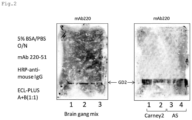
- the antigen specificity of the 220-51 antibody was analyzed by thin-layer chromatography.
- a mixture of a bovine-derived ganglioside and GM3, and gangliosides derived from cancer cells SK-MEL-23 (Carney2) and AS were subjected to thin-layer chromatography and transferred onto a PVDF membrane with a heat blotter (ATTO TLC Thermal Blotter AC5970, Atto, Tokyo), and the 220-51 antibody was then reacted.
- HRP-conjugated anti-mouse IgG whole (Cell Signaling), which is an HRP-labeled anti-mouse secondary antibody, was reacted, followed by light emission with a Western Lightning TM Plus ECL (PerkinElmer Inc., Waltham, MA).
- Fig. 2 shows the results.
- the 220-51 antibody recognized only GD2 and did not recognize any of the other gangliosides.
- 1 ⁇ 10 5 cells were treated with the 100-fold diluted antibody in 0.5% BSA/PBS at room temperature for 30 minutes, washed, treated with a FITC-labeled anti-mouse IgG antibody (Cappel), washed with PBS, and measured with a FACS Caliver or Accuri C6.
- Fig. 3 shows the results.
- the 220-51 antibody recognized GD2+ AS, IMR32, Kohl-3 (SK-MEL-31), and YTN17, but did not recognize GD2- CEM or MOLT4.
- GD2+ melanoma S1 and S6 cells, and GD2- V4 and V9 cells (number of cells: 1 ⁇ 10 4 ) were seeded on a plate on which collagen was immobilized, and adhesion was observed with an RT-CES when the 220-51 antibody was diluted 50-fold and reacted at 0.5 hours and 3 hours (S1-T: addition of antibody to S1).
- Fig. 4 shows the results.
- the 220-51 antibody inhibited the adhesion of GD2+ S1 and S6 cells, but did not inhibit the adhesion of GD2- V4 or V9 cells.
- the amino acid sequence of the 220-51 antibody and the base sequence encoding the antibody were analyzed. The analysis results are shown below. The sequences of the CDRs were deduced by IMGIT.
- P2A-GITRL The amino acid sequence of P2A-GITRL is as follows: GSGATNFSLLKQAGDVEENPGP (P2A amino acid sequence: SEQ ID NO: 39)-MTLHPSPITCEFLFSTALISPKMCLSHLENMPLSHSRTQGAQRSSWKLWLFCSIVMLLFLCSFSW LIFIFLQLETAKEPCMAKFGPLPSKWQMASSEPPCVNKVSDWKLEILQNGLYLIYGQVAPNANYN DVAPFEVRLYKNKDMIQTLTNKSKIQNVGGTYELHVGDTIDLIFNSEHQVLKNNTYWGIILLANP QFIS (GITRL amino acid sequence: SEQ ID NO: 40).
- an expression plasmid in which the P2A-GITRL base sequence was incorporated adjacent to the 3' side of the base sequence of SEQ ID NO: 35 of the zG CAR expression plasmid was prepared using the artificial gene and PCR.
- Each plasmid DNA constructed as mentioned above was introduced into Plat-A cells to prepare retroviruses.
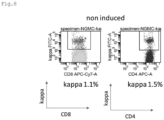
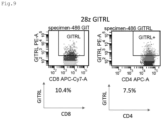
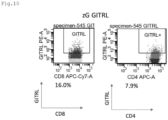
- Cultured human PBMCs were infected with the retroviruses to obtain CAR-transduced T cells, and CAR expression was examined by flow cytometry.
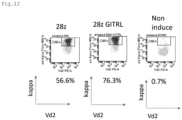
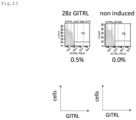
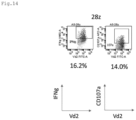
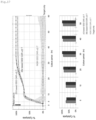
- CAR and ligand expression was confirmed in alpha/beta T cells as shown in Figs. 6 to 11 , and in gamma/delta T cells as shown in Figs. 12 and 13 . These are effector cells. It was confirmed that the expression efficiency and expression intensity (indicated by mean fluorescent intensity; MFI) of the CARs were enhanced by co-expression with GITRL ( Figs. 6 to 8 ).
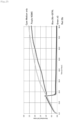
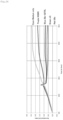
- cytotoxic action of the effector cells on AS cells was examined according to changes over time by using xCELLigence.
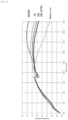
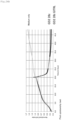
- the results showed that GD2 CAR had sufficient cytotoxic activity in alpha/beta T cells and gamma/delta T cells ( Figs. 17 and 18 ). This was also observed in a non-radioactive cytotoxicity test ( Fig. 19 ).
- GD2-positive Kelly cells (20000 cells) were cultured on an E-plate for 20 hours, each kind of the effector cells (alpha/beta) (40000 cells) was added and cultured, and the cell index was tracked over time.
- the cell index reflects the number of Kelly cells on the E-plate.
- the normalized cell index is a cell index normalized on the assumption that the number of Kelly cells immediately before co-culture with the effector cells was 1.
- the cell index reflects the number of SK-N-SH cells on the E-plate.
- the normalized cell index is a cell index normalized on the assumption that the number of SK-N-SH cells immediately before co-culture with the effector cells was 1.
- the cell index reflects the number of Hs578T-Luc cells on the E-plate.
- the normalized cell index is a cell index normalized on the assumption that the number of Hs578T-Luc cells immediately before co-culture with the effector cells was 1.
- GD2-negative BT549-Luc cells (20000 cells) were cultured on an E-plate for 18 hours, each kind of the effector cells (alpha/beta) (40000 cells) was allowed to act thereon, and the cell index was tracked over time.
- the cell index reflects the number of BT549-Luc cells on the E-plate.
- the normalized cell index is a cell index normalized on the assumption that the number of BT549-Luc cells immediately before co-culture with the effector cells was 1.
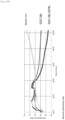
- GD2-positive Kelly cells (20000 cells) were cultured on an E-plate for 20 hours, each kind of the effector cells (alpha/beta) (30000 cells) was allowed to act thereon, and the cell index was tracked over time.
- the effector cells were collected and successively co-cultured with Kelly cells cultured on an E-plate for 24 hours, and changes in the cell index were recorded over time.
- the cell index reflects the number of Kelly cells on the E-plate.
- the normalized cell index is a cell index normalized on the assumption that the number of Kelly cells immediately before co-culture with the effector cells was 1.
- the GITRL-co-expressing 28z CAR-T cells retained stronger cytotoxic activity than 28z CAR ( Fig. 24 ).
- D8 cells are a GD2-positive cell line established by introduction of GD3 synthase and GD2 synthase genes into GD2-negative small-cell lung cancer SK-LC-17, and G418 selection. After GD2-positive D8 cells (10000 cells) were cultured on an E-plate for 18 hours, each kind of the effector cells (alpha/beta) (30000 cells) was allowed to act thereon, and the cell index was tracked over time. The cell index reflects the number of D8 cells on the E-plate.
- C2 cells are a GD2-negative cell line established by introduction of a pCDNA3.1neo plasmid into GD2-negative small-cell lung cancer SK-LC-17, and G418 selection. After GD2-negative C2 cells (10000 cells) were cultured on an E-plate for 18 hours, each kind of the effector cells (alpha/beta) (30000 cells) was allowed to act thereon, and the cell index was tracked over time. The cell index reflects the number of C2 cells on the E-plate.
- the normalized cell index is a cell index normalized on the assumption that the number of C2 cells immediately before co-culture with the effector cells was 1.
- the cell index reflects the number of NCI-N417 cells on the E-plate.
- the normalized cell index is a cell index normalized on the assumption that the number of NCI-N417 cells immediately before co-culture with the effector cells was 1.
Landscapes
- Health & Medical Sciences (AREA)
- Life Sciences & Earth Sciences (AREA)
- Chemical & Material Sciences (AREA)
- Engineering & Computer Science (AREA)
- Immunology (AREA)
- Organic Chemistry (AREA)
- General Health & Medical Sciences (AREA)
- Biomedical Technology (AREA)
- Genetics & Genomics (AREA)
- Bioinformatics & Cheminformatics (AREA)
- Zoology (AREA)
- Biotechnology (AREA)
- Wood Science & Technology (AREA)
- Veterinary Medicine (AREA)
- Public Health (AREA)
- Animal Behavior & Ethology (AREA)
- Cell Biology (AREA)
- Biochemistry (AREA)
- Medicinal Chemistry (AREA)
- Epidemiology (AREA)
- General Engineering & Computer Science (AREA)
- Microbiology (AREA)
- Hematology (AREA)
- Molecular Biology (AREA)
- Proteomics, Peptides & Aminoacids (AREA)
- Biophysics (AREA)
- Pharmacology & Pharmacy (AREA)
- Chemical Kinetics & Catalysis (AREA)
- General Chemical & Material Sciences (AREA)
- Nuclear Medicine, Radiotherapy & Molecular Imaging (AREA)
- Gastroenterology & Hepatology (AREA)
- Toxicology (AREA)
- Peptides Or Proteins (AREA)
- Medicines That Contain Protein Lipid Enzymes And Other Medicines (AREA)
- Medicines Containing Antibodies Or Antigens For Use As Internal Diagnostic Agents (AREA)
- Medicines Containing Material From Animals Or Micro-Organisms (AREA)
- Preparation Of Compounds By Using Micro-Organisms (AREA)
- Micro-Organisms Or Cultivation Processes Thereof (AREA)
- Developmental Biology & Embryology (AREA)
- Virology (AREA)
Claims (10)
- Chimärer Antigenrezeptor, umfassend eine GD2-Bindungsdomäne, umfassendeine variable Region der schweren Kette, enthaltendeine CDR1 der schweren Kette, welche die Aminosäuresequenz enthält, die durch SEQ ID NO: 1 dargestellt ist,eine CDR2 der schweren Kette, welche die Aminosäuresequenz enthält, die durch SEQ ID NO: 2 dargestellt ist, undeine CDR3 der schweren Kette, welche die Aminosäuresequenz enthält, die durch SEQ ID NO: 3 dargestellt ist, undeine variable Region der leichten Kette, enthaltendeine CDR1 der leichten Kette, welche die Aminosäuresequenz enthält, die durch SEQ ID NO: 9 dargestellt ist,eine CDR2 der leichten Kette, welche die Aminosäuresequenz enthält, die durch SEQ ID NO: 10 dargestellt ist, undeine CDR3 der leichten Kette, welche die Aminosäuresequenz enthält, die durch SEQ ID NO: 11 dargestellt ist.
- Chimärer Antigenrezeptor nach Anspruch 1, wobei die Bindungsfähigkeit des chimären Antigenrezeptors an Gangliosid GD1a, Gangliosid GD1b, Gangliosid GD3, Gangliosid GM1, Gangliosid GM3, Gangliosid GT1b oder Lactosylceramid gleich oder kleiner ist als 1/2 der Bindungsfähigkeit des chimären Antigenrezeptors an Gangliosid GD2.
- Chimärer Antigenrezeptor nach Anspruch 1 oder 2, die eine Kerndomäne umfasst, enthaltendeine scFv-Domäne, welche die variable Region der schweren Kette und die variable Region der leichten Kette enthält,eine Transmembrandomäne, undeine intrazelluläre Domäne von TCR.
- Chimärer Antigenrezeptor nach Anspruch 3, wobei die Kerndomäne weiter eine intrazelluläre Domäne eines Co-Stimulators enthält.
- Chimärer Antigenrezeptor nach Anspruch 3 oder 4, der mittels einer selbstspaltenden Peptiddomäne eine GITRL-Domäne an der C-Terminus-Seite der Kerndomäne umfasst.
- Polynukleotid, das den chimären Antigenrezeptor nach einem der Ansprüche 1 bis 5 kodiert.
- Zelle, die das Polynukleotid nach Anspruch 6 umfasst.
- Chimäre Antigenrezeptor-T-Zelle oder chimäre Antigenrezeptor-NK-Zelle, die das Polynukleotid nach Anspruch 6 umfasst.
- Pharmazeutische Zusammensetzung, die die chimäre Antigenrezeptor-T-Zelle oder die chimäre Antigenrezeptor-NK-Zelle nach Anspruch 8 umfasst.
- Pharmazeutische Zusammensetzung nach Anspruch 9, die zur Verwendung bei der Behandlung oder Vorbeugung von Krebs dient.
Applications Claiming Priority (2)
| Application Number | Priority Date | Filing Date | Title |
|---|---|---|---|
| JP2019142358 | 2019-08-01 | ||
| PCT/JP2020/029446 WO2021020564A1 (ja) | 2019-08-01 | 2020-07-31 | Gd2結合性分子 |
Publications (3)
| Publication Number | Publication Date |
|---|---|
| EP4008347A1 EP4008347A1 (de) | 2022-06-08 |
| EP4008347A4 EP4008347A4 (de) | 2023-03-08 |
| EP4008347B1 true EP4008347B1 (de) | 2025-04-30 |
Family
ID=74228907
Family Applications (1)
| Application Number | Title | Priority Date | Filing Date |
|---|---|---|---|
| EP20845660.8A Active EP4008347B1 (de) | 2019-08-01 | 2020-07-31 | Gd2 bindende moleküle |
Country Status (6)
| Country | Link |
|---|---|
| US (1) | US20220275104A1 (de) |
| EP (1) | EP4008347B1 (de) |
| JP (1) | JP7505784B2 (de) |
| BR (1) | BR112022001649A2 (de) |
| ES (1) | ES3031393T3 (de) |
| WO (1) | WO2021020564A1 (de) |
Families Citing this family (2)
| Publication number | Priority date | Publication date | Assignee | Title |
|---|---|---|---|---|
| EP4008404A4 (de) * | 2019-08-01 | 2023-03-01 | Mie University | Antigenrezeptor |
| WO2023081485A1 (en) | 2021-11-08 | 2023-05-11 | Pacific Biosciences Of California, Inc. | Stepwise sequencing of a polynucleotide with a homogenous reaction mixture |
Family Cites Families (11)
| Publication number | Priority date | Publication date | Assignee | Title |
|---|---|---|---|---|
| JP5654986B2 (ja) * | 2008-06-30 | 2015-01-14 | モーフオテク・インコーポレーテツド | 抗gd2抗体並びにそれに関連する方法及び使用 |
| US9315585B2 (en) * | 2010-06-19 | 2016-04-19 | Memorial Sloan Kettering Cancer Center | Anti-GD2 antibodies |
| WO2012033885A1 (en) * | 2010-09-08 | 2012-03-15 | Baylor College Of Medicine | Immunotherapy of cancer using genetically engineered gd2-specific t cells |
| WO2013189516A1 (en) * | 2012-06-18 | 2013-12-27 | Apeiron Biologics Ag | Method for treating a gd2 positive cancer |
| GB201403972D0 (en) * | 2014-03-06 | 2014-04-23 | Ucl Business Plc | Chimeric antigen receptor |
| US11248058B2 (en) * | 2015-02-19 | 2022-02-15 | University Of Florida Research Foundation, Inc. | Chimeric antigen receptors and uses thereof |
| TW202508628A (zh) * | 2016-07-28 | 2025-03-01 | 瑞士商諾華公司 | 嵌合抗原受體及pd-1抑制劑之組合療法 |
| US11938153B2 (en) * | 2017-03-31 | 2024-03-26 | The Board Of Trustees Of The Leland Stanford Junior University | Methods of treating T cell exhaustion by inhibiting or modulating T cell receptor signaling |
| CN111247242B (zh) * | 2017-06-21 | 2024-07-19 | 美商生物细胞基因治疗有限公司 | 嵌合抗原受体(CARs)、组合物及其使用方法 |
| IT201800007601A1 (it) * | 2018-07-30 | 2020-01-30 | Rigenerand Srl | Metodo per la produzione di cellule bi-funzionali per il trattamento di tumori |
| BR112021025029A2 (pt) * | 2019-06-13 | 2022-01-25 | Allogene Therapeutics Inc | Anticorpos anti-talen e seus usos |
-
2020
- 2020-07-31 WO PCT/JP2020/029446 patent/WO2021020564A1/ja not_active Ceased
- 2020-07-31 ES ES20845660T patent/ES3031393T3/es active Active
- 2020-07-31 BR BR112022001649A patent/BR112022001649A2/pt unknown
- 2020-07-31 EP EP20845660.8A patent/EP4008347B1/de active Active
- 2020-07-31 JP JP2021535464A patent/JP7505784B2/ja active Active
- 2020-07-31 US US17/631,745 patent/US20220275104A1/en active Pending
Also Published As
| Publication number | Publication date |
|---|---|
| ES3031393T3 (en) | 2025-07-08 |
| JPWO2021020564A1 (de) | 2021-02-04 |
| BR112022001649A2 (pt) | 2022-03-22 |
| US20220275104A1 (en) | 2022-09-01 |
| JP7505784B2 (ja) | 2024-06-25 |
| EP4008347A1 (de) | 2022-06-08 |
| EP4008347A4 (de) | 2023-03-08 |
| WO2021020564A1 (ja) | 2021-02-04 |
Similar Documents
| Publication | Publication Date | Title |
|---|---|---|
| JP7578938B2 (ja) | B7-h3に対するモノクローナル抗体および細胞治療におけるその使用 | |
| TW202018083A (zh) | 用於細胞療法之多樣化抗原結合域、新穎平台及其他增強子 | |
| US12492252B2 (en) | Anti-GPC3 antibody, anti-GPC3 chimeric antigen receptor and GPC3/CD3 bispecific antibody | |
| CN113195542A (zh) | Cd30-结合部分、嵌合抗原受体及其用途 | |
| CN117285641A (zh) | 制导和导航控制蛋白及其制备和使用方法 | |
| AU2022263573B2 (en) | Bispecific polypeptides for engagement of CAR expressing immune cells with antigen presenting cells and uses thereof | |
| US20220185882A1 (en) | Artificial immunosurveillance chimeric antigen receptor (ai-car) and cells expressing the same | |
| US20240024480A1 (en) | Prame binding molecule | |
| US20220323495A1 (en) | Antigen-binding agents that specifically bind epidermal growth factor receptor variant iii | |
| US20230348556A1 (en) | Artificial immunosurveillance chimeric antigen receptor and cells expressing the same | |
| EP4008347B1 (de) | Gd2 bindende moleküle | |
| EP4242309A1 (de) | Chimärer antigenrezeptor | |
| EP4008404A1 (de) | Antigenrezeptor | |
| US12371492B2 (en) | Humanized antibody specific for CD22 and chimeric antigen receptor using the same | |
| CN110291107B (zh) | 靶向cd43的独特唾液酸糖基化的癌症相关表位的单克隆抗体 | |
| RU2824670C2 (ru) | Gd2-связывающая молекула | |
| JP2026014549A (ja) | Prame結合性分子 | |
| HK40100269A (en) | Chimeric antigen receptor | |
| AU2023387045A1 (en) | Antibody against hematological cancer | |
| WO2025005938A1 (en) | Antibodies and antigen binding fragments thereof binding to chimeric receptors and uses thereof | |
| WO2023274355A1 (zh) | 改造的间充质干细胞和免疫效应细胞联合治疗肿瘤 | |
| WO2024199468A1 (zh) | 双特异性抗体、药物组合物及用途 |
Legal Events
| Date | Code | Title | Description |
|---|---|---|---|
| STAA | Information on the status of an ep patent application or granted ep patent |
Free format text: STATUS: THE INTERNATIONAL PUBLICATION HAS BEEN MADE |
|
| PUAI | Public reference made under article 153(3) epc to a published international application that has entered the european phase |
Free format text: ORIGINAL CODE: 0009012 |
|
| STAA | Information on the status of an ep patent application or granted ep patent |
Free format text: STATUS: REQUEST FOR EXAMINATION WAS MADE |
|
| 17P | Request for examination filed |
Effective date: 20220210 |
|
| AK | Designated contracting states |
Kind code of ref document: A1 Designated state(s): AL AT BE BG CH CY CZ DE DK EE ES FI FR GB GR HR HU IE IS IT LI LT LU LV MC MK MT NL NO PL PT RO RS SE SI SK SM TR |
|
| DAV | Request for validation of the european patent (deleted) | ||
| DAX | Request for extension of the european patent (deleted) | ||
| A4 | Supplementary search report drawn up and despatched |
Effective date: 20230207 |
|
| RIC1 | Information provided on ipc code assigned before grant |
Ipc: A61K 39/00 20060101ALI20230201BHEP Ipc: C12P 21/08 20060101ALI20230201BHEP Ipc: A61K 35/17 20150101ALI20230201BHEP Ipc: A61K 38/17 20060101ALI20230201BHEP Ipc: C12N 15/62 20060101ALI20230201BHEP Ipc: C12N 15/13 20060101ALI20230201BHEP Ipc: C12N 15/12 20060101ALI20230201BHEP Ipc: C12N 5/10 20060101ALI20230201BHEP Ipc: C07K 19/00 20060101ALI20230201BHEP Ipc: C07K 16/30 20060101ALI20230201BHEP Ipc: C07K 14/725 20060101ALI20230201BHEP Ipc: A61P 43/00 20060101ALI20230201BHEP Ipc: A61P 37/04 20060101ALI20230201BHEP Ipc: A61P 35/00 20060101ALI20230201BHEP Ipc: A61K 48/00 20060101ALI20230201BHEP Ipc: A61K 39/395 20060101AFI20230201BHEP |
|
| STAA | Information on the status of an ep patent application or granted ep patent |
Free format text: STATUS: EXAMINATION IS IN PROGRESS |
|
| 17Q | First examination report despatched |
Effective date: 20240605 |
|
| GRAP | Despatch of communication of intention to grant a patent |
Free format text: ORIGINAL CODE: EPIDOSNIGR1 |
|
| STAA | Information on the status of an ep patent application or granted ep patent |
Free format text: STATUS: GRANT OF PATENT IS INTENDED |
|
| INTG | Intention to grant announced |
Effective date: 20250117 |
|
| GRAS | Grant fee paid |
Free format text: ORIGINAL CODE: EPIDOSNIGR3 |
|
| GRAA | (expected) grant |
Free format text: ORIGINAL CODE: 0009210 |
|
| STAA | Information on the status of an ep patent application or granted ep patent |
Free format text: STATUS: THE PATENT HAS BEEN GRANTED |
|
| AK | Designated contracting states |
Kind code of ref document: B1 Designated state(s): AL AT BE BG CH CY CZ DE DK EE ES FI FR GB GR HR HU IE IS IT LI LT LU LV MC MK MT NL NO PL PT RO RS SE SI SK SM TR |
|
| REG | Reference to a national code |
Ref country code: CH Ref legal event code: EP Ref country code: GB Ref legal event code: FG4D |
|
| REG | Reference to a national code |
Ref country code: DE Ref legal event code: R096 Ref document number: 602020050564 Country of ref document: DE |
|
| REG | Reference to a national code |
Ref country code: IE Ref legal event code: FG4D |
|
| P01 | Opt-out of the competence of the unified patent court (upc) registered |
Free format text: CASE NUMBER: APP_22833/2025 Effective date: 20250514 |
|
| REG | Reference to a national code |
Ref country code: ES Ref legal event code: FG2A Ref document number: 3031393 Country of ref document: ES Kind code of ref document: T3 Effective date: 20250708 |
|
| PGFP | Annual fee paid to national office [announced via postgrant information from national office to epo] |
Ref country code: GB Payment date: 20250612 Year of fee payment: 6 |
|
| PGFP | Annual fee paid to national office [announced via postgrant information from national office to epo] |
Ref country code: FR Payment date: 20250610 Year of fee payment: 6 |
|
| REG | Reference to a national code |
Ref country code: NL Ref legal event code: MP Effective date: 20250430 |
|
| REG | Reference to a national code |
Ref country code: AT Ref legal event code: MK05 Ref document number: 1789430 Country of ref document: AT Kind code of ref document: T Effective date: 20250430 |
|
| PG25 | Lapsed in a contracting state [announced via postgrant information from national office to epo] |
Ref country code: FI Free format text: LAPSE BECAUSE OF FAILURE TO SUBMIT A TRANSLATION OF THE DESCRIPTION OR TO PAY THE FEE WITHIN THE PRESCRIBED TIME-LIMIT Effective date: 20250430 Ref country code: PT Free format text: LAPSE BECAUSE OF FAILURE TO SUBMIT A TRANSLATION OF THE DESCRIPTION OR TO PAY THE FEE WITHIN THE PRESCRIBED TIME-LIMIT Effective date: 20250901 |
|
| PGFP | Annual fee paid to national office [announced via postgrant information from national office to epo] |
Ref country code: ES Payment date: 20250801 Year of fee payment: 6 |
|
| PGFP | Annual fee paid to national office [announced via postgrant information from national office to epo] |
Ref country code: DE Payment date: 20250604 Year of fee payment: 6 |
|
| REG | Reference to a national code |
Ref country code: LT Ref legal event code: MG9D |
|
| PG25 | Lapsed in a contracting state [announced via postgrant information from national office to epo] |
Ref country code: GR Free format text: LAPSE BECAUSE OF FAILURE TO SUBMIT A TRANSLATION OF THE DESCRIPTION OR TO PAY THE FEE WITHIN THE PRESCRIBED TIME-LIMIT Effective date: 20250731 Ref country code: NO Free format text: LAPSE BECAUSE OF FAILURE TO SUBMIT A TRANSLATION OF THE DESCRIPTION OR TO PAY THE FEE WITHIN THE PRESCRIBED TIME-LIMIT Effective date: 20250730 |
|
| PG25 | Lapsed in a contracting state [announced via postgrant information from national office to epo] |
Ref country code: NL Free format text: LAPSE BECAUSE OF FAILURE TO SUBMIT A TRANSLATION OF THE DESCRIPTION OR TO PAY THE FEE WITHIN THE PRESCRIBED TIME-LIMIT Effective date: 20250430 Ref country code: PL Free format text: LAPSE BECAUSE OF FAILURE TO SUBMIT A TRANSLATION OF THE DESCRIPTION OR TO PAY THE FEE WITHIN THE PRESCRIBED TIME-LIMIT Effective date: 20250430 |
|
| PGFP | Annual fee paid to national office [announced via postgrant information from national office to epo] |
Ref country code: IT Payment date: 20250722 Year of fee payment: 6 |
|
| PG25 | Lapsed in a contracting state [announced via postgrant information from national office to epo] |
Ref country code: BG Free format text: LAPSE BECAUSE OF FAILURE TO SUBMIT A TRANSLATION OF THE DESCRIPTION OR TO PAY THE FEE WITHIN THE PRESCRIBED TIME-LIMIT Effective date: 20250430 |
|
| PG25 | Lapsed in a contracting state [announced via postgrant information from national office to epo] |
Ref country code: HR Free format text: LAPSE BECAUSE OF FAILURE TO SUBMIT A TRANSLATION OF THE DESCRIPTION OR TO PAY THE FEE WITHIN THE PRESCRIBED TIME-LIMIT Effective date: 20250430 |
|
| PG25 | Lapsed in a contracting state [announced via postgrant information from national office to epo] |
Ref country code: AT Free format text: LAPSE BECAUSE OF FAILURE TO SUBMIT A TRANSLATION OF THE DESCRIPTION OR TO PAY THE FEE WITHIN THE PRESCRIBED TIME-LIMIT Effective date: 20250430 |
|
| PG25 | Lapsed in a contracting state [announced via postgrant information from national office to epo] |
Ref country code: RS Free format text: LAPSE BECAUSE OF FAILURE TO SUBMIT A TRANSLATION OF THE DESCRIPTION OR TO PAY THE FEE WITHIN THE PRESCRIBED TIME-LIMIT Effective date: 20250731 |
|
| PG25 | Lapsed in a contracting state [announced via postgrant information from national office to epo] |
Ref country code: IS Free format text: LAPSE BECAUSE OF FAILURE TO SUBMIT A TRANSLATION OF THE DESCRIPTION OR TO PAY THE FEE WITHIN THE PRESCRIBED TIME-LIMIT Effective date: 20250830 |
|
| PG25 | Lapsed in a contracting state [announced via postgrant information from national office to epo] |
Ref country code: LV Free format text: LAPSE BECAUSE OF FAILURE TO SUBMIT A TRANSLATION OF THE DESCRIPTION OR TO PAY THE FEE WITHIN THE PRESCRIBED TIME-LIMIT Effective date: 20250430 |
|
| PG25 | Lapsed in a contracting state [announced via postgrant information from national office to epo] |
Ref country code: DK Free format text: LAPSE BECAUSE OF FAILURE TO SUBMIT A TRANSLATION OF THE DESCRIPTION OR TO PAY THE FEE WITHIN THE PRESCRIBED TIME-LIMIT Effective date: 20250430 Ref country code: SM Free format text: LAPSE BECAUSE OF FAILURE TO SUBMIT A TRANSLATION OF THE DESCRIPTION OR TO PAY THE FEE WITHIN THE PRESCRIBED TIME-LIMIT Effective date: 20250430 |
|
| PG25 | Lapsed in a contracting state [announced via postgrant information from national office to epo] |
Ref country code: CZ Free format text: LAPSE BECAUSE OF FAILURE TO SUBMIT A TRANSLATION OF THE DESCRIPTION OR TO PAY THE FEE WITHIN THE PRESCRIBED TIME-LIMIT Effective date: 20250430 |
|
| PG25 | Lapsed in a contracting state [announced via postgrant information from national office to epo] |
Ref country code: EE Free format text: LAPSE BECAUSE OF FAILURE TO SUBMIT A TRANSLATION OF THE DESCRIPTION OR TO PAY THE FEE WITHIN THE PRESCRIBED TIME-LIMIT Effective date: 20250430 |
|
| PG25 | Lapsed in a contracting state [announced via postgrant information from national office to epo] |
Ref country code: SK Free format text: LAPSE BECAUSE OF FAILURE TO SUBMIT A TRANSLATION OF THE DESCRIPTION OR TO PAY THE FEE WITHIN THE PRESCRIBED TIME-LIMIT Effective date: 20250430 Ref country code: RO Free format text: LAPSE BECAUSE OF FAILURE TO SUBMIT A TRANSLATION OF THE DESCRIPTION OR TO PAY THE FEE WITHIN THE PRESCRIBED TIME-LIMIT Effective date: 20250430 |