EP4007174B1 - Method for constructing regular qc-ldpc code and electronic device - Google Patents
Method for constructing regular qc-ldpc code and electronic device Download PDFInfo
- Publication number
- EP4007174B1 EP4007174B1 EP20851745.8A EP20851745A EP4007174B1 EP 4007174 B1 EP4007174 B1 EP 4007174B1 EP 20851745 A EP20851745 A EP 20851745A EP 4007174 B1 EP4007174 B1 EP 4007174B1
- Authority
- EP
- European Patent Office
- Prior art keywords
- value
- assigned
- matrix
- girth
- regular
- Prior art date
- Legal status (The legal status is an assumption and is not a legal conclusion. Google has not performed a legal analysis and makes no representation as to the accuracy of the status listed.)
- Active
Links
Images



Classifications
-
- H—ELECTRICITY
- H03—ELECTRONIC CIRCUITRY
- H03M—CODING; DECODING; CODE CONVERSION IN GENERAL
- H03M13/00—Coding, decoding or code conversion, for error detection or error correction; Coding theory basic assumptions; Coding bounds; Error probability evaluation methods; Channel models; Simulation or testing of codes
- H03M13/03—Error detection or forward error correction by redundancy in data representation, i.e. code words containing more digits than the source words
- H03M13/033—Theoretical methods to calculate these checking codes
- H03M13/036—Heuristic code construction methods, i.e. code construction or code search based on using trial-and-error
-
- H—ELECTRICITY
- H03—ELECTRONIC CIRCUITRY
- H03M—CODING; DECODING; CODE CONVERSION IN GENERAL
- H03M13/00—Coding, decoding or code conversion, for error detection or error correction; Coding theory basic assumptions; Coding bounds; Error probability evaluation methods; Channel models; Simulation or testing of codes
- H03M13/03—Error detection or forward error correction by redundancy in data representation, i.e. code words containing more digits than the source words
- H03M13/05—Error detection or forward error correction by redundancy in data representation, i.e. code words containing more digits than the source words using block codes, i.e. a predetermined number of check bits joined to a predetermined number of information bits
- H03M13/11—Error detection or forward error correction by redundancy in data representation, i.e. code words containing more digits than the source words using block codes, i.e. a predetermined number of check bits joined to a predetermined number of information bits using multiple parity bits
- H03M13/1102—Codes on graphs and decoding on graphs, e.g. low-density parity check [LDPC] codes
- H03M13/1148—Structural properties of the code parity-check or generator matrix
- H03M13/116—Quasi-cyclic LDPC [QC-LDPC] codes, i.e. the parity-check matrix being composed of permutation or circulant sub-matrices
-
- H—ELECTRICITY
- H03—ELECTRONIC CIRCUITRY
- H03M—CODING; DECODING; CODE CONVERSION IN GENERAL
- H03M13/00—Coding, decoding or code conversion, for error detection or error correction; Coding theory basic assumptions; Coding bounds; Error probability evaluation methods; Channel models; Simulation or testing of codes
- H03M13/03—Error detection or forward error correction by redundancy in data representation, i.e. code words containing more digits than the source words
- H03M13/05—Error detection or forward error correction by redundancy in data representation, i.e. code words containing more digits than the source words using block codes, i.e. a predetermined number of check bits joined to a predetermined number of information bits
- H03M13/11—Error detection or forward error correction by redundancy in data representation, i.e. code words containing more digits than the source words using block codes, i.e. a predetermined number of check bits joined to a predetermined number of information bits using multiple parity bits
- H03M13/1102—Codes on graphs and decoding on graphs, e.g. low-density parity check [LDPC] codes
- H03M13/1148—Structural properties of the code parity-check or generator matrix
-
- H—ELECTRICITY
- H03—ELECTRONIC CIRCUITRY
- H03M—CODING; DECODING; CODE CONVERSION IN GENERAL
- H03M13/00—Coding, decoding or code conversion, for error detection or error correction; Coding theory basic assumptions; Coding bounds; Error probability evaluation methods; Channel models; Simulation or testing of codes
- H03M13/03—Error detection or forward error correction by redundancy in data representation, i.e. code words containing more digits than the source words
- H03M13/05—Error detection or forward error correction by redundancy in data representation, i.e. code words containing more digits than the source words using block codes, i.e. a predetermined number of check bits joined to a predetermined number of information bits
- H03M13/11—Error detection or forward error correction by redundancy in data representation, i.e. code words containing more digits than the source words using block codes, i.e. a predetermined number of check bits joined to a predetermined number of information bits using multiple parity bits
- H03M13/1102—Codes on graphs and decoding on graphs, e.g. low-density parity check [LDPC] codes
- H03M13/1148—Structural properties of the code parity-check or generator matrix
- H03M13/1151—Algebraically constructed LDPC codes, e.g. LDPC codes derived from Euclidean geometries [EG-LDPC codes]
-
- H—ELECTRICITY
- H03—ELECTRONIC CIRCUITRY
- H03M—CODING; DECODING; CODE CONVERSION IN GENERAL
- H03M13/00—Coding, decoding or code conversion, for error detection or error correction; Coding theory basic assumptions; Coding bounds; Error probability evaluation methods; Channel models; Simulation or testing of codes
- H03M13/03—Error detection or forward error correction by redundancy in data representation, i.e. code words containing more digits than the source words
- H03M13/05—Error detection or forward error correction by redundancy in data representation, i.e. code words containing more digits than the source words using block codes, i.e. a predetermined number of check bits joined to a predetermined number of information bits
- H03M13/11—Error detection or forward error correction by redundancy in data representation, i.e. code words containing more digits than the source words using block codes, i.e. a predetermined number of check bits joined to a predetermined number of information bits using multiple parity bits
- H03M13/1102—Codes on graphs and decoding on graphs, e.g. low-density parity check [LDPC] codes
- H03M13/1148—Structural properties of the code parity-check or generator matrix
- H03M13/1177—Regular LDPC codes with parity-check matrices wherein all rows and columns have the same row weight and column weight, respectively
-
- H—ELECTRICITY
- H03—ELECTRONIC CIRCUITRY
- H03M—CODING; DECODING; CODE CONVERSION IN GENERAL
- H03M13/00—Coding, decoding or code conversion, for error detection or error correction; Coding theory basic assumptions; Coding bounds; Error probability evaluation methods; Channel models; Simulation or testing of codes
- H03M13/03—Error detection or forward error correction by redundancy in data representation, i.e. code words containing more digits than the source words
- H03M13/05—Error detection or forward error correction by redundancy in data representation, i.e. code words containing more digits than the source words using block codes, i.e. a predetermined number of check bits joined to a predetermined number of information bits
- H03M13/11—Error detection or forward error correction by redundancy in data representation, i.e. code words containing more digits than the source words using block codes, i.e. a predetermined number of check bits joined to a predetermined number of information bits using multiple parity bits
- H03M13/1102—Codes on graphs and decoding on graphs, e.g. low-density parity check [LDPC] codes
- H03M13/1148—Structural properties of the code parity-check or generator matrix
- H03M13/118—Parity check matrix structured for simplifying encoding, e.g. by having a triangular or an approximate triangular structure
Definitions
- Embodiments of the present disclosure relate to the communications field, and in particular, relate to a method for constructing a regular QC-LDPC code and an electronic device, and a computer-readable storage medium.
- Quasi-Cyclic Low-Density Parity-Check (QC-LDPC) code is widely studied and applied as a representative to LDPC codes.
- the QC-LDPC code is a combination of a QC code and an LDPC code, and is characterized in remarkable error correction performance of the LDPC code and structural properties of the QC code.
- QC-LDPC code based on a form of "Circulant Permutation Matrix (CPM)".
- CPM Chip Permutation Matrix
- a length of the shortest cycle in a Tanner graph corresponding to the check matrix of the QC-LDPC code is defined as a girth.
- a maximal girth of the check matrix is important in order to obtain good decoding performance.
- TASDIGHI ALIREZA ET AL. "Symmetrical Constructions for Regular Girth-8 QC-LDPC Codes", IEEE TRANSACTIONS ON COMMUNICATIONS, PISCATAWAY, NJ. USA., vol. 65, (20161013 ), proposes new constructions for regular girth-8 quasi-cyclic low-density parity-check (QC-LDPC) codes based on circulant permutation matrices (CPM).
- CPM circulant permutation matrices
- the constructions assume symmetries in the structure of the parity-check matrix and employ a greedy exhaustive search algorithm to find the permutation shifts of the CPMs. As a result of symmetries, the new codes have a more compact representation compared with their counterparts.
- the embodiments of the present disclosure provide a method for constructing a regular QC-LDPC code and an electronic device, and a computer-readable storage medium.
- An embodiment of the present disclosure provides a method for constructing a regular QC-LDPC code, including: initializing each element of a first row and a first column in a cyclic shift value matrix of a regular QC-LDPC code to 0; obtaining K values satisfying a preset condition, where a value of K is equal to a number of columns of the cyclic shift value matrix, and the preset condition includes that one of the K values is 0, and no duplicate number exists in a set consisting of differences each between any two of the K values; assigning the K values to K elements of a second row in the cyclic shift value matrix, respectively, where a first element of the second row is assigned a value of 0; searching, based on dimension quantity information of a circulant permutation matrix of the regular QC-LDPC code, for a value satisfying a preset girth condition for each element to be assigned a value, to obtain the cyclic shift value matrix, where each element to be assigned a value refers to an element other than elements of the first
- An embodiment of the present disclosure further provides an electronic device, including: at least one processor; and a memory communicatively connected to the at least one processor, where the memory stores instructions executable by the at least one processor to enable the at least one processor to perform the method for constructing a regular QC-LDPC code.
- An embodiment of the present disclosure further provides a computer-readable storage medium storing a computer program which, when executed by a processor, causes the processor to perform the method for constructing a regular QC-LDPC code.
- a common type is a QC-LDPC code based on a form of "Circulant Permutation Matrix (CPM)", and a check matrix form H of this type of QC-LDPC code is shown in Fig. 1 .
- Each element I ( s i,j ) represents a unit matrix or a cyclic shift matrix of a unit matrix, or an all-zero matrix.
- a cyclic shift value s i,j in the element I(s i,j ) is extracted to construct a cyclic shift value matrix H s , thus transforming a design of a large-size check matrix H into a smaller-size cyclic shift value matrix H s .
- a form of the matrix H s is shown in Fig. 2 .
- a QC-LDPC code in a form of all-zero sub-matrix does not exist in the check matrix, and is also referred to as a (J,K) regular QC-LDPC code, where J and K respectively refer to a column width and a row height of the check matrix H , that is, the number of rows and the number of columns of the cyclic shift value matrix H s .
- a length of the shortest cycle in a Tanner graph corresponding to the check matrix of the QC-LDPC code is defined as a girth.
- a maximal girth of the check matrix is important in order to obtain good decoding performance.
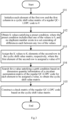
- Embodiment one of the present disclosure relates to a method for constructing a regular QC-LDPC code. An illustrative process is shown in Fig. 3 .
- each element of the first row and the first column in a cyclic shift value matrix of the regular QC-LDPC code is initialized to 0.
- K values satisfying a preset condition is obtained, where a value of K is equal to the number of columns of the cyclic shift value matrix, and the preset condition includes that one of the values is 0, and no duplicate number exists in a set consisting of differences each between any two of the values.
- K values are assigned to K elements of the second row in the cyclic shift value matrix, respectively, where the first element of the second row is assigned a value of 0.
- a value satisfying the girth condition is searched for based on dimension quantity information of a circulant permutation matrix of the regular QC-LDPC code for each element to be assigned a value, to obtain the cyclic shift value matrix, where each element to be assigned a value refers to an element other than elements of the first row, the second row, and the first column in the cyclic shift value matrix.
- a check matrix of the regular QC-LDPC code is constructed based on the cyclic shift value matrix.
- Construction of the regular QC-LDPC code is to construct the check matrix of the regular QC-LDPC code.
- values of the elements in the cyclic shift value matrix are determined based on the given number of rows, the number of columns, and a girth, to construct the check matrix according to the cyclic shift value matrix.
- the letters J, K, and G denote the number of rows, the number of columns, and the girth, respectively.
- this embodiment provides a method for constructing a (J,K) regular QC-LDPC code with a girth g.
- specific values of the preset number of rows J, the number of columns K, and the girth G are not limited.
- the specified girth may be 8, 10 or 12.
- this embodiment can be used to search for a (J,K) regular QC-LDPC code with a large girth.
- a cyclic shift value matrix H s with J rows and K columns is created, and each element in the cyclic shift value matrix H s is initialized.
- all elements in the first row and first column of the cyclic shift value matrix H s are assigned a value of 0, and the rest of the elements can be assigned a default value that is of a to-be-assigned meaning in the system. For example, if a default value of -1 in the system means a value used for assignment, the remaining elements can be assigned the value of -1.
- K values satisfying a preset condition are obtained, and these K values respectively correspond to K elements in the second row of the cyclic shift value matrix H s .
- the K values need to satisfy the preset condition, that is: one of the values is 0, and no duplicate number exists in a set consisting of differences each between any two of the values.
- K 4, and the K values are a1, a2, a3 and a4, respectively. If a difference between a1 and a2 is recorded as b12, a difference between a1 and a3 as b13, a difference between a1 and a4 as b14, a difference between a2 and a3 as b23, a difference between a2 and a4 as b24, and a difference between a3 and a4 as b34, no duplicate number exists in the set ⁇ b12, b13, b14, b23, b24, b34 ⁇ , that is, b12, b13, b14, b23, b24, b34 are different from each other. In addition, one of a1, a2, a3 and a4 is 0. During assigning values to the elements of the second row, the first element of the second row is assigned a value of 0, and the remaining three elements of the second row are assigned the other three values.
- the K values can be assigned to the elements of the second row in the order of the K values.
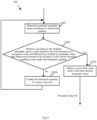
- step 104 includes the following sub-steps.
- multiple candidate values are determined according to a dimension quantity.
- girth detection is performed according to the multiple candidate values for each element to be assigned a value, and whether a candidate value that makes each element to be assigned a value satisfy the girth condition exists under the dimension quantity is determined. If such candidate value exists, the process proceeds to sub-step 1043. If such candidate value does not exist, the process proceeds to sub-step 1044.
- the dimension quantity is updated by using a step size. Then step 104 is repeated.
- the dimension quantity information includes an initial value and the step size of the dimension quantity, where the initial value of the dimension quantity is an integer greater than 1.
- the letters P and Step denote the dimension quantity and the step size, respectively.
- the multiple candidate values determined according to the dimension quantity P are arranged in sequence as follows: 1, 2, ...P-1.
- an optional value set PM can be determined according to the dimension quantity P.
- girth detection may be performed sequentially for each element to be assigned a value according to the multiple candidate values from left to right and from top to bottom.
- the detection order is the second element of the third row, the third element of the third row, ..., and the K th element of the third row; the second element of the fourth row, the third element of the fourth row, ..., the K th element of the fourth row; ...; the second element of the J th row, the third element of the J th row, ..., and the K th element of the J th row.
- Sub-step 1042 can be implemented as follows.
- the candidate values are selected from the candidate value set PM sequentially. For each candidate value, only when it is determined that the candidate value does not exist in the cyclic shift value matrix, the candidate value can be assigned to the element to be assigned a value and girth detection is performed. In other words, for each candidate value, it is determined whether the candidate value exists in the cyclic shift value matrix. If the candidate value does not exist in the cyclic shift value matrix, the candidate value is assigned to the element to be assigned a value and girth detection is performed. If the candidate value already exists in the cyclic shift value matrix, the candidate value will not be assigned to the element to be assigned a value for girth detection.
- Whether the candidate value exists in the cyclic shift value matrix means whether the candidate value is the same as a value of any element in the cyclic shift value matrix. If the candidate value is the same as a value of an element in the cyclic shift value matrix, it indicates that the candidate value already exists in the cyclic shift value matrix. If the candidate value is different from the value of any element, it indicates that the candidate value does not exist in the cyclic shift value matrix.
- the girth condition cannot be satisfied when girth detection is performed for the element to be assigned a value by using the candidate value. Therefore, in this example, by determining whether the candidate value already exists in the cyclic shift value matrix, a candidate value that will inevitably lead to detection failure can be removed first, thus reducing search times and further improving a search speed. It should be noted that in another example, at sub-step 1042, the multiple candidate values may alternatively be assigned in sequence to the element to be assigned a value and then girth detection is performed.
- Girth detection in this embodiment means determining whether a girth of the check matrix at a time when the element to be assigned a value is assigned the candidate value is greater than or equal to the preset girth G. If the girth is greater than or equal to the present girth G, it indicates that the candidate value can make the element to be assigned a value satisfy the girth condition, that is, the candidate value is an optional value of the element to be assigned a value. If the girth is less than the present girth G (that is, there is a ring of a length less than the girth G in the check matrix at this time), it indicates that the candidate value is not the optional value of the element to be assigned a value.
- rings of various lengths less than G may be searched for.
- rings with lengths of 4, 6 and 8 may be searched for to determine whether a ring of a length less than G exists. In this way, it can be ensured that no ring of a length less than G exists. In other words, it is ensured that the girth is greater than or equal to G.
- an optional value set Cand_S i,j is created for the element to be assigned a value in advance, where S i,j represents the element to be assigned a value, 2 ⁇ i ⁇ J-1, 1 ⁇ j ⁇ K-1, and both i and j are integers.
- the candidate value satisfying the girth condition is added into the optional value set Cand_S i, j corresponding to the element to be assigned a value until girth detection for the element to be assigned a value by using each candidate value is completed.
- a value assignment step which includes the following sub-steps b and c.
- step b whether Cand_S i, j is an empty set is determined. If Cand_S i, j is a non-empty set, an optional value from Cand_S i, j is selected and assigned to the element S i,j to be assigned a value, and girth detection is performed for a next element to be assigned a value after the element S i,j to be assigned a value according to the above multiple candidate values, until detection for all the elements to be assigned a value is completed. If all the elements to be assigned a value are assigned values, it is determined that a candidate value that makes each element to be assigned a value satisfy the girth condition exists under the dimension quantity, and the process proceeds to sub-step 1043.
- step c if Cand_S i, j is an empty set, it indicates that a current assigned value of a previous element of S i,j affects selection of an optional value of S i,j , and in this case, the following operations are performed for the previous element of S i,j :
- the current value of the previous element of S i,j needs to be removed from an optional value set of the previous element of S i,j , the previous element of S i,j is reused as an element to be assigned a value, and the value assignment step is repeated, that is, step b is returned. If S i,j is the second element in the third row, then S i,j does not have a previous element.
- step 104 is returned.
- step 104 is repeated after updating the dimension quantity, to search under an updated dimension quantity.
- step 104 is repeatedly executed until a value satisfying the girth condition for each element to be assigned a value is found.
- the cyclic shift value matrix of the regular QC-LDPC code with each element to be assigned a value having been assigned a value is obtained.
- a dimension quantity of the circulant permutation matrix can be obtained, that is, the cyclic shift value matrix found under the dimension quantity.
- a check matrix of a (J,K) regular QC-LDPC code of the girth G is constructed, that is, a (J,K) regular QC-LDPC code of the girth G is constructed.
- the first row and the second row will not generate loops of lengths of 4 and 8;
- a ring of the length of 6 may not appear until the third row, and therefore the ring of the length of 6 may not be considered during assigning values to the elements of the second row.
- a value of a loop of a length less than girth G in the check matrix may not be considered for use (that is, if the girth G is greater than 6, a loop of a length of 6 may not be considered for use).
- the elements of the first row and the first column of the cyclic shift value matrix of the regular QC-LDPC code are initialized to 0. Then, multiple values satisfying the preset condition are obtained and assigned to the elements of the second row in the cyclic shift value matrix, respectively.
- the preset condition includes that one of the values is 0, and no duplicate number exists in a set consisting of differences each between any two of the values. In this case, it is possible to ensure that the first two rows of the matrix do not have rings of specific lengths, to first determine values of the elements of the second row. Then, a value of each element to be assigned a value is searched for based on the dimension quantity information of the circulant permutation matrix.
- Each element to be assigned a value refers to an element other than elements of the first row, the second row, and the first column in the cyclic shift value matrix.
- the elements to be assigned a value that need to be assigned a value through searching start from the second element of the third row rather than the second row.
- the number of elements to be assigned a value that need to be assigned a value through searching is reduced, thus reducing a search time of the cyclic shift value matrix and improving a construction speed of the regular QC-LDPC code.
- the search time can be greatly reduced, thereby greatly improving the construction speed of the regular QC-LDPC code.
- the present disclosure can greatly reduce the search time in the case of a high bit rate and a large girth.
- Example 1 Construct a (3,6) regular QC-LDPC code with a girth of 8.
- H s 0 0 0 0 0 0 0 ⁇ 1 ⁇ 1 ⁇ 1 0 ⁇ 1 ⁇ 1 ⁇ 1 ⁇ 1 ⁇ 1 ⁇ 1 ⁇ 1 ⁇ 1 ⁇ 1 ⁇ 1 ⁇ 1 ⁇ 1 ⁇ 1
- an initial value of the dimension quantity P of the circulant permutation matrix is 27, and the step size Step is 1.
- Elements of the third row of the cyclic shift value matrix H s are traversed and searched for as follows: At step 3.1, according to the second row of elements in the cyclic shift value matrix H s , used flags Choose_0, Choose_4, Choose_10, Choose_23, Choose_24, and Choose_26 of the used values 0, 4, 10, 23, 24, and 26 are set to true, and unused flags are set to false.
- An initial value of a search position i is set to 1 and a search return flag Return i is set to false.
- the step is stopped until i equals to 6.
- the initial value of the dimension quantity P is 27, and a set ⁇ 1,2,3, ..., 26 ⁇ is determined according to the dimension quantity. Values in a set ⁇ 1,2,3, ..., 26 ⁇ are assigned to j one by one. If j has already existed in the matrix H s , that is, Choose_j is true, the value is skipped and detection is directly performed on a next value. If Choose_j is false, j is assigned to S 2,i and girth detection is performed. If a girth existing in the cyclic shift value matrix is not less than the specified girth of 8, that is, Judge_cycle is true, it indicates that j is an optional value, and the value is put into the optional value set Cand_S 2,i .
- step 3.2.3 If a ring of a length less than 8 exists in the matrix, it indicates that the value j is not optional, and detection is directly performed on a next value. After all the elements in the set ⁇ 1, 2, 3, ..., 26 ⁇ are traversed, the process proceeds to step 3.2.3.
- step 3.2.3 whether the current optional value set Cand_S 2,i .is an empty set is determined. If Cand_S 2,i . is a non-empty set, that is, a size(Cand_S 2,i ) is not equal to 0, a random number is selected from the set Cand_S 2,i and assigned to S 2,i , the used value flag Choose_S 2,i is set to true, i is automatically increased by 1, and then step 3.2.1 is performed for optional value search for the next element S 2,i+1 .
- i If i is equal to 1, it indicates that the cyclic shift value matrix that satisfies the conditions cannot be found under the current value of P.
- the current value of P is added to Step and a sum of P and Step is assigned to P again, and step 3.1 is performed to restart the search.
- i If i is not equal to 1, it indicates that the value of the previous element S 2,i-2 affects values of S 2,i-1 and S 2,i .
- the search return flag Return_i is set to false, Return_(i-1) is set to true, i is decreased by 1, and step 3.2.1 is performed.
- step 3.3 when values of all elements of the third row of the cyclic shift value matrix H s are determined, it indicates that an appropriate cyclic shift value matrix has been found, and then traversal and search is directly jumped out.
- the cyclic shift value matrix H s obtained by traversal search and the current value pf P are output.
- the check matrix is obtained according to the cyclic shift value matrix H s and the value of P.
- Example 2 Construct a (3,8) regular QC-LDPC code with a girth of 10.
- H s 0 0 0 0 0 0 0 0 0 0 0 ⁇ 1 ⁇ 1 ⁇ 1 ⁇ 1 0 ⁇ 1 ⁇ 1 ⁇ 1 ⁇ 1 ⁇ 1 ⁇ 1 ⁇ 1 ⁇ 1 ⁇ 1 ⁇ 1 ⁇ 1 ⁇ 1 ⁇ 1 ⁇ 1 ⁇ 1 ⁇ 1 ⁇ 1 ⁇ 1 ⁇ 1 ⁇ 1 ⁇ 1 ⁇ 1 ⁇ 1 ⁇ 1 ⁇ 1 ⁇ 1 ⁇ 1 ⁇ 1 ⁇ 1 ⁇ 1 ⁇ 1 ⁇ 1 ⁇ 1 ⁇ 1 ⁇ 1 ⁇ 1 ⁇ 1 ⁇ 1 ⁇ 1 ⁇ 1 ⁇ 1 ⁇ 1 ⁇ 1 ⁇ 1 ⁇ 1 ⁇ 1 ⁇ 1 ⁇ 1 ⁇ 1 ⁇ 1 ⁇ 1 ⁇ 1 ⁇ 1 ⁇ 1 ⁇ 1 ⁇ 1 ⁇ 1 ⁇ 1 ⁇ 1 ⁇ 1 ⁇ 1 ⁇ 1 ⁇ 1 ⁇ 1 ⁇ 1 ⁇ 1 ⁇ 1 ⁇ 1 ⁇ 1 ⁇ 1 ⁇ 1
- the eight values selected from the difference set (57,8,1) are not fixed but random. The above is merely an example.
- an initial value of the dimension quantity P of the circulant permutation matrix is 49, and the step size Step is 1.
- Elements of the third row of the cyclic shift value matrix H s are traversed and searched for as follows: At step 3.1, according to the second row of elements in the cyclic shift value matrix H s , used flags Choose_0, Choose_5, Choose_6, Choose_8, Choose_18, Choose_37, Choose_41, Choose_48 of the used values 0, 5, 6, 8, 18, 37, 41, and 48 are set to true, and unused flags are set to false.
- An initial value of a search position i is set to 1 and a search return flag Return_i is set to false.
- the step is stopped until i equals to 8.
- the initial value of the dimension quantity P is 49, and a set ⁇ 1,2,3, ..., 48 ⁇ is determined according to the dimension quantity. Values in a set ⁇ 1,2,3, ..., 48 ⁇ are assigned to j one by one. If j has already existed in the matrix H s , that is, Choose_j is true, the value is skipped and detection is directly performed on a next value. If Choose_j is false, j is assigned to S 2,i and girth detection is performed. If a girth existing in the cyclic shift value matrix is not less than the specified girth of 10, that is, Judge_cycle is true, it indicates that j is an optional value, and the value is put into the optional value set Cand_S 2,i .
- step 3.2.3 If a ring of a length less than 10 exists in the matrix, it indicates that the value j is not optional, and detection is directly performed on a next value. After all the elements in the set ⁇ 1, 2, 3, ..., 48 ⁇ are traversed, the process proceeds to step 3.2.3.
- step 3.2.3 whether the current optional value set Cand_S 2,i .is an empty set is determined. If Cand_S 2,i . is a non-empty set, that is, a size(Cand_S 2,i ) is not equal to 0, a random number is selected from the set Cand_S 2,i and assigned to S 2,i , the used value flag Choose_S 2,i is set to true, i is automatically increased by 1, and then step 3.2.1 is performed for optional value search for the next element S 2,i+1 .
- i If i is equal to 1, it indicates that the cyclic shift value matrix that satisfies the conditions cannot be found under the current value of P.
- the current value of P is added to Step and a sum of P and Step is assigned to P again, and step 3.1 is performed to restart the search.
- i If i is not equal to 1, it indicates that the value of the previous element S 2,i-2 affects values of S 2,i-1 and S 2,i .
- the search return flag Return_i is set to false, Return_(i-1) is set to true, i is decreased by 1, and step 3.2.1 is performed.
- step 3.3 when values of all elements of the third row of the cyclic shift value matrix H s are determined, it indicates that an appropriate cyclic shift value matrix has been found, and then traversal and search is directly jumped out.
- the cyclic shift value matrix H s obtained by traversal search and the current value pf P are output.
- the check matrix is obtained according to the cyclic shift value matrix H s and the value of P.
- Example 3 Construct a (3,12) regular QC-LDPC code with a girth of 12.
- H s 0 0 0 0 0 0 0 0 0 0 0 0 0 0 0 0 ⁇ 1 ⁇ 1 ⁇ 1 ⁇ 1 ⁇ 1 ⁇ 1 ⁇ 1 ⁇ 1 ⁇ 1 0 0 ⁇ 1 ⁇ 1 ⁇ 1 ⁇ 1 ⁇ 1 ⁇ 1 0 ⁇ 1 ⁇ 1 ⁇ 1 ⁇ 1 ⁇ 1 ⁇ 1 0 ⁇ 1 ⁇ 1 ⁇ 1 ⁇ 1 0 ⁇ 1 ⁇ 1 ⁇ 1 ⁇ 1 ⁇ 1 ⁇ 1 ⁇ 1 ⁇ 1 ⁇ 1 ⁇ 1 ⁇ 1 ⁇ 1 ⁇ 1 ⁇ 1 ⁇ 1 ⁇ 1 ⁇ 1 ⁇ 1 ⁇ 1 ⁇ 1 ⁇ 1 ⁇ 1 ⁇ 1 ⁇ 1 ⁇ 1 ⁇ 1 ⁇ 1 ⁇ 1 ⁇ 1 ⁇ 1 ⁇ 1 ⁇ 1 ⁇ 1 ⁇ 1 ⁇ 1 ⁇ 1 ⁇ 1 ⁇ 1 ⁇ 1 ⁇ 1 ⁇ 1 ⁇ 1 ⁇ 1 ⁇ 1
- step 2 according to the number of columns K of 12, multiple values ⁇ 1,11,16,40,41,43,52,60,74,78,121,128 ⁇ are selected from a difference set (133,12,1). The smallest value "1" is subtracted from the twelve values, and values ⁇ 0,10,15,39,40,42,51,59,73,77,120,127 ⁇ are obtained and used as elements of the second row of the cyclic shift value matrix.
- an initial value of the dimension quantity P of the circulant permutation matrix is 128, and the step size Step is 1.
- Elements of the third row of the cyclic shift value matrix H s are traversed and searched for as follows: At step 3.1, according to the second row of elements in the cyclic shift value matrix H s , used flags Choose_0, Choose_10, Choose_15, Choose_39, Choose_40, Choose_42, Choose_51, Choose_59, Choose_73, Choose_77, Choose_120, and Choose_127 of the used values 0, 10, 15, 39, 40, 42, 51, 59, 73, 77, 120 and 127 are set to true, and unused flags are set to false.
- An initial value of a search position i is set to 1 and a search return flag Return_i is set to false.
- the step is stopped until i equals to 12.
- the initial value of the dimension quantity Pis 128, and a set ⁇ 1,2,3, ..., 127 ⁇ is determined according to the dimension quantity. Values in a set ⁇ 1,2,3, ..., 127 ⁇ are assigned to j one by one. If j has already existed in the matrix H s , that is, Choose_j is true, the value is skipped and detection is directly performed on a next value. If Choose_j is false, j is assigned to S 2,i and girth detection is performed. If a girth existing in the cyclic shift value matrix is not less than the specified girth of 12, that is, Judge_cycle is true, it indicates that j is an optional value, and the value is put into the optional value set Cand_S 2,i .
- i If i is equal to 1, it indicates that the cyclic shift value matrix that satisfies the conditions cannot be found under the current value of P.
- the current value of P is added to Step and a sum of P and Step is assigned to P again, and step 3.1 is performed to restart the search.
- i If i is not equal to 1, it indicates that the value of the previous element S 2,i-2 affects values of S 2,i-1 and S 2,i .
- the search return flag Return_i is set to false, Return_(i-1) is set to true, i is decreased by 1, and step 3.2.1 is performed.
- step 3.3 when values of all elements of the third row of the matrix H s are determined, it indicates that an appropriate cyclic shift value matrix has been found, and then traversal and search is directly jumped out.
- the cyclic shift value matrix H s obtained by traversal search and the current value pf P are output.
- the value of P is 5220.
- the check matrix is obtained according to the cyclic shift value matrix H s and the value of P.
- Embodiment two of the present disclosure relates to a method for constructing a regular QC-LDPC code.
- Embodiment two is roughly the same as embodiment one, with the main differences as follows:
- a method for quickly finding a value satisfying the condition is provided.
- Fig. 5 is a flowchart of a method for constructing a regular QC-LDPC code according to embodiment two.
- Step 201 each element of the first row and the first column in a cyclic shift value matrix of the regular QC-LDPC code is initialized to 0. Step 201 is roughly the same as step 101, and details are not described here again.
- K values satisfying a preset condition is obtained, where a value of K is equal to the number of columns of the cyclic shift value matrix, and the preset condition includes that one of the values is 0, and no duplicate number exists in a set consisting of differences each between any two of the values.
- Step 202 includes the following sub-steps.
- a difference set is determined according to the number of columns, and K difference set elements are selected from the difference set.
- the number of columns is K, and a difference set (v, k, ⁇ ) is obtained, where the difference set obtained according to the number of columns K includes multiple elements, and v is the largest element in this difference set.
- a smallest value of the K difference set elements is determined, and the smallest value is subtracted from the K difference set elements to obtain K values.
- the smallest value of the K difference set elements needs to be subtracted from each of the K difference set elements, to obtain the K values, where one of the K values is 0.
- the K values are obtained by subtracting a same value from the K difference set elements. Therefore, the following condition is met: no duplicate number exists in a set consisting of differences each between any two numbers.
- K sequential difference set elements may be taken from the difference set.
- the taken K difference set elements are arranged in ascending order. Therefore, the K values are arranged in ascending order, and the first value is 0.
- the K values when assigning values to the elements of the second row, the K values can be assigned to the elements of the second row in the order of the K values.
- Step 203 the K values are assigned to K elements of the second row in the cyclic shift value matrix, respectively, where the first element of the second row is assigned a value of 0.
- Step 203 is roughly the same as step 103, and details are not described here again.
- a value satisfying the girth condition is searched for based on dimension quantity information of a circulant permutation matrix of the regular QC-LDPC code for each element to be assigned a value, to obtain the cyclic shift value matrix.
- Each element to be assigned a value refers to an element other than elements of the first row, the second row, and the first column in the cyclic shift value matrix.
- Step 205 a check matrix of the regular QC-LDPC code is constructed based on the cyclic shift value matrix. Step 205 is roughly the same as step 105, and details are not described here again.
- Embodiment three of the present disclosure relates to a method for constructing a regular QC-LDPC code.
- the difference between embodiment three and embodiment two is that in embodiment three of the present disclosure, another method for quickly finding a value satisfying the condition is provided.
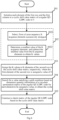
- Fig. 6 is a flowchart of a method for constructing a regular QC-LDPC code according to embodiment three.
- Step 301 each element of the first row and the first column in a cyclic shift value matrix of the regular QC-LDPC code is initialized to 0. Step 301 is roughly the same as step 101, and details are not described here again.
- K values satisfying a preset condition is obtained, where a value of K is equal to the number of columns of the cyclic shift value matrix, and the preset condition includes that one of the values is 0, and no duplicate number exists in a set consisting of differences each between any two of the values.
- Step 302 includes the following sub-steps.
- K sequence elements successively arranged are selected from a Lucas sequence.
- the Lucas sequence is a known sequence, and K sequence elements successively arranged are selected from the Lucas sequence. Due to characteristics of the Lucas sequence, the K sequence elements successively arranged satisfy the following condition: no duplicate number exists in a set consisting of differences each between any two sequences.
- a smallest value of the K sequence elements is determined, and the smallest value is subtracted from the K sequence elements to obtain K values.
- the smallest value of the K sequence elements needs to be subtracted from each of the K sequence elements, to obtain the K values, where one of the K values is 0.
- the K values are obtained by subtracting a same value from the K sequence elements. Therefore, the following condition is met: no duplicate number exists in a set consisting of differences each between any two numbers.
- the K sequence elements successively arranged taken from the Lucas sequence are arranged in ascending order. Therefore, the K values are arranged in ascending order, and the first value is 0. In this case, when assigning values to the elements of the second row, the K values can be assigned to the elements of the second row in the order of the K values.
- Step 303 the K values are assigned to K elements of the second row in the cyclic shift value matrix, respectively, where the first element of the second row is assigned a value of 0.
- Step 303 is roughly the same as step 103, and details are not described here again.
- a value satisfying the girth condition is searched for based on dimension quantity information of a circulant permutation matrix of the regular QC-LDPC code for each element to be assigned a value, to obtain the cyclic shift value matrix.
- Each element to be assigned a value refers to an element other than elements of the first row, the second row, and the first column in the cyclic shift value matrix.
- Step 305 a check matrix of the regular QC-LDPC code is constructed based on the cyclic shift value matrix. Step 305 is roughly the same as step 105, and details are not described here again.
- the K values satisfying the preset condition are obtained based on the Lucas sequence, which is efficient.
- Embodiment four of the present disclosure relates to an electronic device, as shown in fig. 7 , including: at least one processor 701; and a memory 702 communicatively connected with the at least one processor 701.
- the memory 702 stores instructions executable by the at least one processor 701 to enable the at least one processor 701 to perform the method for constructing a regular QC-LDPC code described in any of the foregoing embodiments.
- the memory 702 and the processor 701 are connected through a bus.
- the bus may include any number of interconnected buses and bridges.
- the bus connects the at least one processor 701 and various circuits of the memory 702.
- the bus may also connect various other circuits such as a peripheral device, a voltage regulator and a power management circuit, which are well known in the art and therefore will not be further described here.
- a bus interface provides an interface between the bus and a transceiver.
- the transceiver may be one element or multiple elements, such as multiple receivers and transmitters, and provide a unit for communicating with various other apparatuses on a transmission medium.
- Data that has been processed by the processor 701 is transmitted on a wireless medium by means of an antenna. Further, the antenna also receives data and transmits the data to the processor 701.
- the processor 701 is responsible for bus management and general processing, and may also provide various functions, including timing, peripheral interface, voltage regulation, power management and other control functions.
- the memory 702 may be configured to store data used by the processor 701 when performing operations.
- the fifth embodiment of the present disclosure relates to a computer-readable storage medium storing a computer program. The computer program, when executed by the processor, causes the processor to perform the methods according to the embodiments above.
- the aforementioned storage medium includes: various media that can store program codes, such as a USB flash drive, a mobile hard disk, a read-only memory (ROM), a random-access memory (RAM), a magnetic disk or an optical disk.
Landscapes
- Physics & Mathematics (AREA)
- Mathematical Physics (AREA)
- Probability & Statistics with Applications (AREA)
- Engineering & Computer Science (AREA)
- Theoretical Computer Science (AREA)
- Discrete Mathematics (AREA)
- General Physics & Mathematics (AREA)
- Mobile Radio Communication Systems (AREA)
- Error Detection And Correction (AREA)
Description
- Embodiments of the present disclosure relate to the communications field, and in particular, relate to a method for constructing a regular QC-LDPC code and an electronic device, and a computer-readable storage medium.
- Quasi-Cyclic Low-Density Parity-Check (QC-LDPC) code is widely studied and applied as a representative to LDPC codes. The QC-LDPC code is a combination of a QC code and an LDPC code, and is characterized in remarkable error correction performance of the LDPC code and structural properties of the QC code.
- Among various QC-LDPC code types, a common type is a QC-LDPC code based on a form of "Circulant Permutation Matrix (CPM)". A length of the shortest cycle in a Tanner graph corresponding to the check matrix of the QC-LDPC code is defined as a girth. A maximal girth of the check matrix is important in order to obtain good decoding performance.
- MOHAMMAD H TADAYON ET AL.: "Efficient Search of Compact QC-LDPC and SC-LDPC Convolutional Codes with Large Girth", ARXIV.ORG, CORNELL UNIVERSITY LIBRARY, 201 OLIN LIBRARY CORNELL UNIVERSITY ITHACA, NY 14853, (20180417), proposes a low-complexity method to find quasi-cyclic low-density parity-check block codes with
girth 10 or 12 and shorter length than those designed through classical approaches. The method is extended to time-invariant spatially coupled low-density parity-check convolutional codes, permitting to achieve small syndrome former constraint lengths. - ZHANG LIJUN ET AL.: "Constructions of QC LDPC codes based on integer sequences", SCIENCE CHINA INFORMATION SCIENCES, SCIENCE CHINA PRESS, BEIJING, vol. 57, no. 6, (20140513), proposes that three types of (2, F) and (3, F) quasi cyclic (QC) low-density parity-check (LDPC) codes are constructed based on difference sequence and Hoey sequence. All 4-cycles and even 6-cycles are removed in the Tanner graph, and the girth is not less than six. The decoding complexity as well as extension to irregular case is analyzed. Simulation results show that in AWGN and Rayleigh fading channels, the codes can achieve the same error performance as their counterpart PEG codes, and outperform the corresponding MacKay codes and array codes.
- IVAN B DJORDJEVIC ET AL.: "Next Generation FEC for High-Capacity Communication in Optical Transport Networks", JOURNAL OF LIGHTWAVE TECHNOLOGY, IEEE, USA, vol. PP, no. 16, pages 3518 - 3530, (20090815), describes codes on graphs of interest for next generation forward error correction (FEC) in high-speed optical networks, namely turbo codes and low-density parity-check (LDPC) codes. This paper describes both binary and nonbinary LDPC codes, their design, and decoding. This paper also discusses an FPGA implementation of decoders for binary LDPC codes. This paper then explains how to combine multilevel modulation and channel coding optimally by using coded modulation. Also, this paper describes an LDPC-coded turbo-equalizer as a candidate for dealing simultaneously with fiber nonlinearities, PMD, and residual chromatic dispersion.
- BATTAGLIONI MASSIMO ET AL.: "Compact QC-LDPC Block and SC-LDPC Convolutional Codes for Low-Latency Communications", PROC., IEEE 29TH ANNUAL INTERNATIONAL SYMPOSIUM ON PERSONAL, INDOOR AND MOBILE RADIO COMMUNICATIONS (PIMRC), (20180909), shows how certain requirements can be fulfilled by using some special quasi-cyclic low-density parity-check block codes and spatially coupled low-density parity-check convolutional codes that are denoted as compact. They are defined by parity-check matrices designed according to a recent approach based on sequentially multiplied columns. This method allows obtaining codes with girth up to 12.
- TASDIGHI ALIREZA ET AL.: "Symmetrical Constructions for Regular Girth-8 QC-LDPC Codes", IEEE TRANSACTIONS ON COMMUNICATIONS, PISCATAWAY, NJ. USA., vol. 65, (20161013), proposes new constructions for regular girth-8 quasi-cyclic low-density parity-check (QC-LDPC) codes based on circulant permutation matrices (CPM). The constructions assume symmetries in the structure of the parity-check matrix and employ a greedy exhaustive search algorithm to find the permutation shifts of the CPMs. As a result of symmetries, the new codes have a more compact representation compared with their counterparts. In majority of cases, also, they achieve the girth 8 at a shorter block length for the same degree distribution (code rate). Deterministic (explicit) constructions are also presented to expand the proposed parity-check matrices to larger block lengths and higher rates. The proposed long high-rate codes are often substantially shorter than regular girth-8 QC-LDPC codes of similar rate in the literature. Simulation results demonstrate that the proposed symmetric codes have competitive performance in comparison with similar existing QC-LDPC codes that lack symmetry.
- The embodiments of the present disclosure provide a method for constructing a regular QC-LDPC code and an electronic device, and a computer-readable storage medium.
- An embodiment of the present disclosure provides a method for constructing a regular QC-LDPC code, including: initializing each element of a first row and a first column in a cyclic shift value matrix of a regular QC-LDPC code to 0; obtaining K values satisfying a preset condition, where a value of K is equal to a number of columns of the cyclic shift value matrix, and the preset condition includes that one of the K values is 0, and no duplicate number exists in a set consisting of differences each between any two of the K values; assigning the K values to K elements of a second row in the cyclic shift value matrix, respectively, where a first element of the second row is assigned a value of 0; searching, based on dimension quantity information of a circulant permutation matrix of the regular QC-LDPC code, for a value satisfying a preset girth condition for each element to be assigned a value, to obtain the cyclic shift value matrix, where each element to be assigned a value refers to an element other than elements of the first row, the second row, and the first column in the cyclic shift value matrix; constructing a check matrix of the regular QC-LDPC code based on the cyclic shift value matrix; and using the constructed regular QC-LDPC code for error correction by processing data to be transmitted or processing received data.
- An embodiment of the present disclosure further provides an electronic device, including: at least one processor; and a memory communicatively connected to the at least one processor, where the memory stores instructions executable by the at least one processor to enable the at least one processor to perform the method for constructing a regular QC-LDPC code.
- An embodiment of the present disclosure further provides a computer-readable storage medium storing a computer program which, when executed by a processor, causes the processor to perform the method for constructing a regular QC-LDPC code.
- One or more embodiments are illustrated with reference to corresponding figures in the accompanying drawings, and these illustrations do not constitute a limitation to the embodiments. Elements having same reference signs in the accompanying drawings represent similar elements. The figures in the accompanying drawings are not necessarily drawn to scale unless otherwise specified.
-
Fig. 1 is an expression of a check matrix of a QC-LDPC code based on a "circulant permutation matrix"; -
Fig. 2 is an expression of a cyclic shift value matrix of a QC-LDPC code based on a "circulant permutation matrix"; -
Fig. 3 is a flowchart of a method for constructing a regular QC-LDPC code according to embodiment one of the present disclosure; -
Fig. 4 is a detailed flowchart ofstep 104 according to embodiment one of the present disclosure; -
Fig. 5 is a flowchart of a method for constructing a regular QC-LDPC code according to embodiment two of the present disclosure; -
Fig. 6 . is a flowchart of a method for constructing a regular QC-LDPC code according to embodiment three of the present disclosure; and -
Fig. 7 is a block diagram of an electronic device according to embodiment four of the present disclosure. - In order to make the purposes, technical schemes and advantages of the embodiments of the present disclosure clear, the embodiments of the present disclosure will be described in detail with reference to the accompanying drawings. Those having ordinary skills in the art can understand that, in various embodiments of the present disclosure, many technical details have been set forth in order to enable readers to better understand the present disclosure. However, even without these technical details and various changes and modifications based on the following embodiments, the technical schemes of the present disclosure can be implemented. The following embodiments are respectively provided for convenience of description, and should not constitute any limitation on various implementations of the present disclosure. The embodiments can be combined with and referenced by each other without conflict.
- Among various QC-LDPC code types, a common type is a QC-LDPC code based on a form of "Circulant Permutation Matrix (CPM)", and a check matrix form H of this type of QC-LDPC code is shown in
Fig. 1 . Each element I(si,j ) represents a unit matrix or a cyclic shift matrix of a unit matrix, or an all-zero matrix. A cyclic shift value si,j in the element I(si,j) is extracted to construct a cyclic shift value matrix Hs, thus transforming a design of a large-size check matrix H into a smaller-size cyclic shift value matrix Hs. A form of the matrix Hs is shown inFig. 2 . A QC-LDPC code in a form of all-zero sub-matrix does not exist in the check matrix, and is also referred to as a (J,K) regular QC-LDPC code, where J and K respectively refer to a column width and a row height of the check matrix H , that is, the number of rows and the number of columns of the cyclic shift value matrix Hs. A length of the shortest cycle in a Tanner graph corresponding to the check matrix of the QC-LDPC code is defined as a girth. A maximal girth of the check matrix is important in order to obtain good decoding performance. - Embodiment one of the present disclosure relates to a method for constructing a regular QC-LDPC code. An illustrative process is shown in
Fig. 3 . - At
step 101, each element of the first row and the first column in a cyclic shift value matrix of the regular QC-LDPC code is initialized to 0. - At
step 102, K values satisfying a preset condition is obtained, where a value of K is equal to the number of columns of the cyclic shift value matrix, and the preset condition includes that one of the values is 0, and no duplicate number exists in a set consisting of differences each between any two of the values. - At
step 103, K values are assigned to K elements of the second row in the cyclic shift value matrix, respectively, where the first element of the second row is assigned a value of 0. - At
step 104, a value satisfying the girth condition is searched for based on dimension quantity information of a circulant permutation matrix of the regular QC-LDPC code for each element to be assigned a value, to obtain the cyclic shift value matrix, where each element to be assigned a value refers to an element other than elements of the first row, the second row, and the first column in the cyclic shift value matrix. - At
step 105, a check matrix of the regular QC-LDPC code is constructed based on the cyclic shift value matrix. - The implementation details of the method for constructing a regular QC-LDPC code in this embodiment are described in detail below. The following contents are only provided for convenience of understanding, and should not be considered as necessities for the implementation of this scheme.
- Construction of the regular QC-LDPC code is to construct the check matrix of the regular QC-LDPC code. Generally, values of the elements in the cyclic shift value matrix are determined based on the given number of rows, the number of columns, and a girth, to construct the check matrix according to the cyclic shift value matrix. In this embodiment and the following embodiments, the letters J, K, and G denote the number of rows, the number of columns, and the girth, respectively. To be specific, this embodiment provides a method for constructing a (J,K) regular QC-LDPC code with a girth g.
- In this embodiment, specific values of the preset number of rows J, the number of columns K, and the girth G are not limited. In an example, the specified girth may be 8, 10 or 12. In other words, this embodiment can be used to search for a (J,K) regular QC-LDPC code with a large girth.
- At
step 101, according to the given number of rows J and the number of columns K, a cyclic shift value matrix Hs with J rows and K columns is created, and each element in the cyclic shift value matrix Hs is initialized. During initialization, all elements in the first row and first column of the cyclic shift value matrix Hs are assigned a value of 0, and the rest of the elements can be assigned a default value that is of a to-be-assigned meaning in the system. For example, if a default value of -1 in the system means a value used for assignment, the remaining elements can be assigned the value of -1. - At
step 102 and step 103, K values satisfying a preset condition are obtained, and these K values respectively correspond to K elements in the second row of the cyclic shift value matrix Hs. The K values need to satisfy the preset condition, that is: one of the values is 0, and no duplicate number exists in a set consisting of differences each between any two of the values. - For example, K=4, and the K values are a1, a2, a3 and a4, respectively. If a difference between a1 and a2 is recorded as b12, a difference between a1 and a3 as b13, a difference between a1 and a4 as b14, a difference between a2 and a3 as b23, a difference between a2 and a4 as b24, and a difference between a3 and a4 as b34, no duplicate number exists in the set {b12, b13, b14, b23, b24, b34}, that is, b12, b13, b14, b23, b24, b34 are different from each other. In addition, one of a1, a2, a3 and a4 is 0. During assigning values to the elements of the second row, the first element of the second row is assigned a value of 0, and the remaining three elements of the second row are assigned the other three values.
- 0 can be ranked in the first place of the K values, or the K values are ranked in ascending order. In this case, when assigning values to the elements of the second row, the K values can be assigned to the elements of the second row in the order of the K values.
- In an example, as shown in
fig. 4 ,step 104 includes the following sub-steps. - At sub-step 1041, multiple candidate values are determined according to a dimension quantity.
- At sub-step 1042, girth detection is performed according to the multiple candidate values for each element to be assigned a value, and whether a candidate value that makes each element to be assigned a value satisfy the girth condition exists under the dimension quantity is determined. If such candidate value exists, the process proceeds to sub-step 1043. If such candidate value does not exist, the process proceeds to sub-step 1044.
- At sub-step 1043: The cyclic shift value matrix with each element assigned a value is obtained.
- At sub-step 1044, the dimension quantity is updated by using a step size. Then step 104 is repeated.
- In this embodiment, the dimension quantity information includes an initial value and the step size of the dimension quantity, where the initial value of the dimension quantity is an integer greater than 1. In this embodiment, the letters P and Step denote the dimension quantity and the step size, respectively. When
step 104 is performed for the first time, the multiple candidate values are determined by using the initial value of the dimension quantity. - At sub-step 1041, the multiple candidate values determined according to the dimension quantity P are arranged in sequence as follows: 1, 2, ...P-1. In other words, an optional value set PM can be determined according to the dimension quantity P. The candidate value set includes several candidate values arranged in ascending order, and can be expressed as PM={1,2,3, ..., p-1}.
- At sub-step 1042, girth detection may be performed sequentially for each element to be assigned a value according to the multiple candidate values from left to right and from top to bottom. In other words, the detection order is the second element of the third row, the third element of the third row, ..., and the Kth element of the third row; the second element of the fourth row, the third element of the fourth row, ..., the Kth element of the fourth row; ...; the second element of the Jth row, the third element of the Jth row, ..., and the Kth element of the Jth row.
- Sub-step 1042 can be implemented as follows.
- At step a, during girth detection for each element to be assigned a value, the candidate values are selected from the candidate value set PM sequentially. For each candidate value, only when it is determined that the candidate value does not exist in the cyclic shift value matrix, the candidate value can be assigned to the element to be assigned a value and girth detection is performed. In other words, for each candidate value, it is determined whether the candidate value exists in the cyclic shift value matrix. If the candidate value does not exist in the cyclic shift value matrix, the candidate value is assigned to the element to be assigned a value and girth detection is performed. If the candidate value already exists in the cyclic shift value matrix, the candidate value will not be assigned to the element to be assigned a value for girth detection.
- Whether the candidate value exists in the cyclic shift value matrix means whether the candidate value is the same as a value of any element in the cyclic shift value matrix. If the candidate value is the same as a value of an element in the cyclic shift value matrix, it indicates that the candidate value already exists in the cyclic shift value matrix. If the candidate value is different from the value of any element, it indicates that the candidate value does not exist in the cyclic shift value matrix.
- If the candidate value already exists in the cyclic shift value matrix, the girth condition cannot be satisfied when girth detection is performed for the element to be assigned a value by using the candidate value. Therefore, in this example, by determining whether the candidate value already exists in the cyclic shift value matrix, a candidate value that will inevitably lead to detection failure can be removed first, thus reducing search times and further improving a search speed. It should be noted that in another example, at sub-step 1042, the multiple candidate values may alternatively be assigned in sequence to the element to be assigned a value and then girth detection is performed.
- Girth detection in this embodiment means determining whether a girth of the check matrix at a time when the element to be assigned a value is assigned the candidate value is greater than or equal to the preset girth G. If the girth is greater than or equal to the present girth G, it indicates that the candidate value can make the element to be assigned a value satisfy the girth condition, that is, the candidate value is an optional value of the element to be assigned a value. If the girth is less than the present girth G (that is, there is a ring of a length less than the girth G in the check matrix at this time), it indicates that the candidate value is not the optional value of the element to be assigned a value. Here, rings of various lengths less than G may be searched for. For example, if G is 10, rings with lengths of 4, 6 and 8 may be searched for to determine whether a ring of a length less than G exists. In this way, it can be ensured that no ring of a length less than G exists. In other words, it is ensured that the girth is greater than or equal to G.
- There may be several candidate values in the multiple candidate values that can make the element to be assigned a value satisfy the girth condition, and any one of the several candidate values that can make the element to be assigned a value satisfy the girth condition can be assigned to the element to be assigned a value. In this embodiment, an optional value set Cand_Si,j is created for the element to be assigned a value in advance, where Si,j represents the element to be assigned a value, 2 ≦ i ≦ J-1, 1 ≦ j ≦ K-1, and both i and j are integers. The candidate value satisfying the girth condition is added into the optional value set Cand_Si, j corresponding to the element to be assigned a value until girth detection for the element to be assigned a value by using each candidate value is completed.
- Then, the process proceeds to a value assignment step, which includes the following sub-steps b and c.
- At step b, whether Cand_Si, j is an empty set is determined. If Cand_Si, j is a non-empty set, an optional value from Cand_Si, j is selected and assigned to the element Si,j to be assigned a value, and girth detection is performed for a next element to be assigned a value after the element Si,j to be assigned a value according to the above multiple candidate values, until detection for all the elements to be assigned a value is completed. If all the elements to be assigned a value are assigned values, it is determined that a candidate value that makes each element to be assigned a value satisfy the girth condition exists under the dimension quantity, and the process proceeds to sub-step 1043.
- At step c, if Cand_Si, j is an empty set, it indicates that a current assigned value of a previous element of Si,j affects selection of an optional value of Si,j, and in this case, the following operations are performed for the previous element of Si,j: The current value of the previous element of Si,j needs to be removed from an optional value set of the previous element of Si,j, the previous element of Si,j is reused as an element to be assigned a value, and the value assignment step is repeated, that is, step b is returned. If Si,j is the second element in the third row, then Si,j does not have a previous element. In this case, it is determined that no candidate value that makes each element to be assigned a value satisfy the girth condition exists under the dimension quantity. Then, the process proceeds to sub-step 1044, that is, using a sum of the dimension quantity and the step size as a new dimension quantity to update the dimension quantity. After the dimension quantity is updated,
step 104 is returned. - To be specific, if no candidate value that makes each element to be assigned a value satisfy the girth condition exists under the current dimension quantity, then step 104 is repeated after updating the dimension quantity, to search under an updated dimension quantity. Provided that the candidate value that makes each element to be assigned a value satisfy the girth condition has not been found,
step 104 is repeatedly executed until a value satisfying the girth condition for each element to be assigned a value is found. In this way, the cyclic shift value matrix of the regular QC-LDPC code with each element to be assigned a value having been assigned a value is obtained. At the same time, a dimension quantity of the circulant permutation matrix can be obtained, that is, the cyclic shift value matrix found under the dimension quantity. - At
step 105, according to the found circulant shift value matrix and the dimension quantity of the circulant permutation matrix, that is, the found dimension quantity of the circulant permutation matrix on which the cyclic shift value matrix is based, a check matrix of a (J,K) regular QC-LDPC code of the girth G is constructed, that is, a (J,K) regular QC-LDPC code of the girth G is constructed. - In this embodiment, when the obtained K values satisfy the preset condition, and the K values are used to assign values to the elements of the second row, it can be ensured that the first row and the second row will not generate loops of lengths of 4 and 8; A ring of the length of 6 may not appear until the third row, and therefore the ring of the length of 6 may not be considered during assigning values to the elements of the second row. In the search of the elements to be assigned a value, a value of a loop of a length less than girth G in the check matrix may not be considered for use (that is, if the girth G is greater than 6, a loop of a length of 6 may not be considered for use).
- Compared with the conventional technology, in this embodiment, the elements of the first row and the first column of the cyclic shift value matrix of the regular QC-LDPC code are initialized to 0. Then, multiple values satisfying the preset condition are obtained and assigned to the elements of the second row in the cyclic shift value matrix, respectively. The preset condition includes that one of the values is 0, and no duplicate number exists in a set consisting of differences each between any two of the values. In this case, it is possible to ensure that the first two rows of the matrix do not have rings of specific lengths, to first determine values of the elements of the second row. Then, a value of each element to be assigned a value is searched for based on the dimension quantity information of the circulant permutation matrix. Each element to be assigned a value refers to an element other than elements of the first row, the second row, and the first column in the cyclic shift value matrix. In other words, the elements to be assigned a value that need to be assigned a value through searching start from the second element of the third row rather than the second row. Compared with the conventional technology, the number of elements to be assigned a value that need to be assigned a value through searching is reduced, thus reducing a search time of the cyclic shift value matrix and improving a construction speed of the regular QC-LDPC code. Especially in a case of a high bit rate and a large girth, the search time can be greatly reduced, thereby greatly improving the construction speed of the regular QC-LDPC code.
- Especially in the case of a high bit rate and a large girth, when a column width is fixed, as the bit rate increases, a size of the check matrix increases accordingly. Therefore, more cyclic shift values that satisfy the girth condition need to be searched for. When the bit rate is fixed, as the girth increases, the girth condition that needs to be met imposes higher requirements, and the search for each cyclic shift value becomes more complicated. Therefore, the present disclosure can greatly reduce the search time in the case of a high bit rate and a large girth.
- The following is a practical example of constructing the (J,K) regular QC-LDPC code of the girth G according to the method of this embodiment. It should be noted that division of steps in the following practical example is merely another way for clear description. During implementation, the following steps can be combined into one step, or some steps can be divided into multiple steps, which include a same logical relationship as the steps in
Fig. 3 andFig. 4 . - Example 1: Construct a (3,6) regular QC-LDPC code with a girth of 8.
- At
step 1, it is known according to input parameters that J is 3, K is 6, and the girth is 8. A 3∗6 cyclic shift value matrix Hs is created and initialized. The initialized Hs is as follows:
- At step 2, according to the number of columns K of 6, multiple values {1,5,11,24,25,27} are selected from a difference set (31,6,1). The smallest value "1" is subtracted from the six values, and values {0,4,10,23,24,26} are obtained and used as elements of the second row of the cyclic shift value matrix. At this time, Hs is as follows:

- It should be noted that the six values selected from the difference set (31,6,1) are not fixed but random. The above is merely an example.
- At step 3, an initial value of the dimension quantity P of the circulant permutation matrix is 27, and the step size Step is 1. Elements of the third row of the cyclic shift value matrix Hs are traversed and searched for as follows:
At step 3.1, according to the second row of elements in the cyclic shift value matrix Hs, used flags Choose_0, Choose_4, Choose_10, Choose_23, Choose_24, and Choose_26 of the usedvalues - At step 3.2, optional values that are of elements and that satisfy the girth condition are determined one by one from left to right starting from the second element S2,i=1 of the third row, and these values are input into an optional value set Cand_S2,i. The step is stopped until i equals to 6. A detailed work process includes the following steps:
At step 3.2.1, starting from i=1, whether the search return flag Return_i is true is first determined. If Return_i is false, it indicates that an optional value can be searched for the element S2,i and step 3.2.2 is performed. If Return_i is true, it indicates that no optional value satisfying the girth condition can be found for this element. In this case, a previous element S2,i-1 needs to be returned for value re-assignment and searching, and step 3.2.4 is performed. - At step 3.2.2, the initial value of the dimension quantity P is 27, and a set {1,2,3, ..., 26} is determined according to the dimension quantity. Values in a set {1,2,3, ..., 26} are assigned to j one by one. If j has already existed in the matrix Hs , that is, Choose_j is true, the value is skipped and detection is directly performed on a next value. If Choose_j is false, j is assigned to S2,i and girth detection is performed. If a girth existing in the cyclic shift value matrix is not less than the specified girth of 8, that is, Judge_cycle is true, it indicates that j is an optional value, and the value is put into the optional value set Cand_S2,i. Then detection is performed on a next value. If a ring of a length less than 8 exists in the matrix, it indicates that the value j is not optional, and detection is directly performed on a next value. After all the elements in the set {1, 2, 3, ..., 26} are traversed, the process proceeds to step 3.2.3.
- At step 3.2.3, whether the current optional value set Cand_S2,i.is an empty set is determined. If Cand_S2,i. is a non-empty set, that is, a size(Cand_S2,i) is not equal to 0, a random number is selected from the set Cand_S2,i and assigned to S2,i, the used value flag Choose_S2,i is set to true, i is automatically increased by 1, and then step 3.2.1 is performed for optional value search for the next element S2,i+1. If Cand_S2,i is an empty set, that is, size(Cand_S2,i)=0, it indicates that a current assigned value of the previous element S2,i-1 affects selection of an optional value of S2,i, it is stipulated that the search return flag Return i is true, i is decreased by 1, and step 3.2.1 is performed.
- At step 3.2.4, the used value flag Choose_S2,i of S2,i is set to false, and then whether the optional value set Cand_S2,i is an empty set is determined. If Cand_S2,i is a non-empty set, that is, the size(Cand_S2,i) is not equal to 0, a random number is selected from the set Cand_S2,i and assigned to the used value flag Choose_S2,i, the used value flag Choose_S2,i is set to true, i is automatically increased by 1, and then step 3.2.1 is performed for optional value search for S2,i+1. If Cand_S2,i is an empty set, that is, size(Cand_S2,i)=0, whether the value of i is 1 at this time is determined. If i is equal to 1, it indicates that the cyclic shift value matrix that satisfies the conditions cannot be found under the current value of P. The current value of P is added to Step and a sum of P and Step is assigned to P again, and step 3.1 is performed to restart the search. If i is not equal to 1, it indicates that the value of the previous element S2,i-2 affects values of S2,i-1 and S2,i. The search return flag Return_i is set to false, Return_(i-1) is set to true, i is decreased by 1, and step 3.2.1 is performed.
- At step 3.3, when values of all elements of the third row of the cyclic shift value matrix Hs are determined, it indicates that an appropriate cyclic shift value matrix has been found, and then traversal and search is directly jumped out.
- At step 4, the cyclic shift value matrix Hs obtained by traversal search and the current value pf P are output. The cyclic shift value matrix Hs is as follows:

- The value of P is 27.
- At step 5, the check matrix is obtained according to the cyclic shift value matrix Hs and the value of P.
- Example 2: Construct a (3,8) regular QC-LDPC code with a girth of 10.
- At
step 1, it is known according to input parameters that J is 3, K is 8, and the girth is 10. A 3*8 cyclic shift value matrix Hs is created and initialized. The initialized Hs is as follows:
- At step 2, according to the number of columns K of 8, multiple values {1,6,7,9,19,38,42,49} are selected from a difference set (57,8,1). The smallest value "1" is subtracted from the eight values, and values {0,5,6,8,18,37,41,48} are obtained and used as elements of the second row of the cyclic shift value matrix. At this time, Hs is as follows:

- It should be noted that the eight values selected from the difference set (57,8,1) are not fixed but random. The above is merely an example.
- At step 3, an initial value of the dimension quantity P of the circulant permutation matrix is 49, and the step size Step is 1. Elements of the third row of the cyclic shift value matrix Hs are traversed and searched for as follows:
At step 3.1, according to the second row of elements in the cyclic shift value matrix Hs, used flags Choose_0, Choose_5, Choose_6, Choose_8, Choose_18, Choose_37, Choose_41, Choose_48 of the usedvalues 0, 5, 6, 8, 18, 37, 41, and 48 are set to true, and unused flags are set to false. An initial value of a search position i is set to 1 and a search return flag Return_i is set to false. - At step 3.2, optional values that are of elements and that satisfy the girth condition are determined one by one from left to right starting from the second element S2,i=1 of the third row, and these values are input into an optional value set Cand_S2,i. The step is stopped until i equals to 8. A detailed work process includes the following steps:
At step 3.2.1, starting from i=1, whether the search return flag Return_i is true is first determined. If Return_i is false, it indicates that an optional value can be searched for the element S2,i and step 3.2.2 is performed. If Return_i is true, it indicates that no optional value satisfying the girth condition can be found for this element. In this case, a previous element S2,i-1 needs to be returned for value re-assignment and searching, and step 3.2.4 is performed. - At step 3.2.2, the initial value of the dimension quantity P is 49, and a set {1,2,3, ..., 48} is determined according to the dimension quantity. Values in a set {1,2,3, ..., 48} are assigned to j one by one. If j has already existed in the matrix Hs , that is, Choose_j is true, the value is skipped and detection is directly performed on a next value. If Choose_j is false, j is assigned to S2,i and girth detection is performed. If a girth existing in the cyclic shift value matrix is not less than the specified girth of 10, that is, Judge_cycle is true, it indicates that j is an optional value, and the value is put into the optional value set Cand_S2,i. Then detection is performed on a next value. If a ring of a length less than 10 exists in the matrix, it indicates that the value j is not optional, and detection is directly performed on a next value. After all the elements in the set {1, 2, 3, ..., 48} are traversed, the process proceeds to step 3.2.3.
- At step 3.2.3, whether the current optional value set Cand_S2,i.is an empty set is determined. If Cand_S2,i. is a non-empty set, that is, a size(Cand_S2,i) is not equal to 0, a random number is selected from the set Cand_S2,i and assigned to S2,i, the used value flag Choose_S2,i is set to true, i is automatically increased by 1, and then step 3.2.1 is performed for optional value search for the next element S2,i+1. If Cand_S2,i is an empty set, that is, size(Cand_S2,i)=0, it indicates that a current assigned value of the previous element S2,i-1 affects selection of an optional value of S2,i, it is stipulated that the search return flag Return i is true, i is decreased by 1, and step 3.2.1 is performed.
- At step 3.2.4, the used value flag Choose_S2,i of S2,i is set to false, and then whether the optional value set Cand_S2,i is an empty set is determined. If Cand_S2,i is a non-empty set, that is, the size(Cand_S2,i) is not equal to 0, a random number is selected from the set Cand_S2,i and assigned to the used value flag Choose_S2,i, the used value flag Choose_S2,i is set to true, i is automatically increased by 1, and then step 3.2.1 is performed for optional value search for S2,i+1. If Cand_S2,i is an empty set, that is, size(Cand_S2,i)=0, whether the value of i is 1 at this time is determined. If i is equal to 1, it indicates that the cyclic shift value matrix that satisfies the conditions cannot be found under the current value of P. The current value of P is added to Step and a sum of P and Step is assigned to P again, and step 3.1 is performed to restart the search. If i is not equal to 1, it indicates that the value of the previous element S2,i-2 affects values of S2,i-1 and S2,i. The search return flag Return_i is set to false, Return_(i-1) is set to true, i is decreased by 1, and step 3.2.1 is performed.
- At step 3.3, when values of all elements of the third row of the cyclic shift value matrix Hs are determined, it indicates that an appropriate cyclic shift value matrix has been found, and then traversal and search is directly jumped out.
- At step 4, the cyclic shift value matrix Hs obtained by traversal search and the current value pf P are output. The cyclic shift value matrix Hs is as follows:

- The value of P is 299.
- At step 5, the check matrix is obtained according to the cyclic shift value matrix Hs and the value of P.
- Example 3: Construct a (3,12) regular QC-LDPC code with a girth of 12.
- At
step 1, it is known according to input parameters that J is 3, K is 12, and the girth is 12. A 3*12 cyclic shift value matrix Hs is created and initialized. The initialized Hs is as follows:
- At step 2, according to the number of columns K of 12, multiple values {1,11,16,40,41,43,52,60,74,78,121,128} are selected from a difference set (133,12,1). The smallest value "1" is subtracted from the twelve values, and values {0,10,15,39,40,42,51,59,73,77,120,127} are obtained and used as elements of the second row of the cyclic shift value matrix. At this time, Hs is as follows:

- It should be noted that the twelve values selected from the difference set (133,12,1) are not fixed but random. The above is merely an example.
- At step 3, an initial value of the dimension quantity P of the circulant permutation matrix is 128, and the step size Step is 1. Elements of the third row of the cyclic shift value matrix Hs are traversed and searched for as follows:
At step 3.1, according to the second row of elements in the cyclic shift value matrix Hs, used flags Choose_0, Choose_10, Choose_15, Choose_39, Choose_40, Choose_42, Choose_51, Choose_59, Choose_73, Choose_77, Choose_120, and Choose_127 of the usedvalues - At step 3.2, optional values that are of elements and that satisfy the girth condition are determined one by one from left to right starting from the second element S2,i=1 of the third row, and these values are input into an optional value set Cand_S2,i. The step is stopped until i equals to 12. A detailed work process includes the following steps:
At step 3.2.1, starting from i=1, whether the search return flag Return_i is true is first determined. If Return_i is false, it indicates that an optional value can be searched for the element S2,i and step 3.2.2 is performed. If Return_i is true, it indicates that no optional value satisfying the girth condition can be found for this element. In this case, a previous element S2,i-1 needs to be returned for value re-assignment and searching, and step 3.2.4 is performed. - At step 3.2.2, the initial value of the dimension quantity Pis 128, and a set {1,2,3, ..., 127} is determined according to the dimension quantity. Values in a set {1,2,3, ..., 127} are assigned to j one by one. If j has already existed in the matrix Hs , that is, Choose_j is true, the value is skipped and detection is directly performed on a next value. If Choose_j is false, j is assigned to S2,i and girth detection is performed. If a girth existing in the cyclic shift value matrix is not less than the specified girth of 12, that is, Judge_cycle is true, it indicates that j is an optional value, and the value is put into the optional value set Cand_S2,i. Then detection is performed on a next value. If a ring of a length less than 12 exists in the matrix, it indicates that the value j is not optional, and detection is directly performed on a next value. After all the elements in the set {1, 2, 3, ..., 127} are traversed, the process proceeds to step 3.2.3.
- At step 3.2.3, whether the current optional value set Cand_S2,i.is an empty set is determined. If Cand_S2,i. is a non-empty set, that is, a size(Cand_S2,i) is not equal to 0, a random number is selected from the set Cand_S2,i and assigned to S2,i, the used value flag Choose_S2,i is set to true, i is automatically increased by 1, and then step 3.2.1 is performed for optional value search for the next element S2,i+1. If Cand_S2,i is an empty set, that is, size(Cand_S2,i)=0, it indicates that a current assigned value of the previous element S2,i-1 affects selection of an optional value of S2,i, it is stipulated that the search return flag Return i is true, i is decreased by 1, and step 3.2.1 is performed.
- At step 3.2.4, the used value flag Choose_S2,i of S2,i is set to false, and then whether the optional value set Cand_S2,i is an empty set is determined. If Cand_S2,i is a non-empty set, that is, the size(Cand_S2,i) is not equal to 0, a random number is selected from the set Cand_S2,i and assigned to the used value flag Choose_S2,i, the used value flag Choose_S2,i is set to true, i is automatically increased by 1, and then step 3.2.1 is performed for optional value search for S2,i+1. If Cand_S2,i is an empty set, that is, size(Cand_S2,i)=0, whether the value of i is 1 at this time is determined. If i is equal to 1, it indicates that the cyclic shift value matrix that satisfies the conditions cannot be found under the current value of P. The current value of P is added to Step and a sum of P and Step is assigned to P again, and step 3.1 is performed to restart the search. If i is not equal to 1, it indicates that the value of the previous element S2,i-2 affects values of S2,i-1 and S2,i. The search return flag Return_i is set to false, Return_(i-1) is set to true, i is decreased by 1, and step 3.2.1 is performed.
- At step 3.3, when values of all elements of the third row of the matrix Hs are determined, it indicates that an appropriate cyclic shift value matrix has been found, and then traversal and search is directly jumped out.
- At step 4, the cyclic shift value matrix Hs obtained by traversal search and the current value pf P are output. The matrix Hs is as follows:

- The value of P is 5220.
- At step 5, the check matrix is obtained according to the cyclic shift value matrix Hs and the value of P.
- Embodiment two of the present disclosure relates to a method for constructing a regular QC-LDPC code. Embodiment two is roughly the same as embodiment one, with the main differences as follows: In embodiment two of the present disclosure, a method for quickly finding a value satisfying the condition is provided.
-
Fig. 5 is a flowchart of a method for constructing a regular QC-LDPC code according to embodiment two. - At
step 201, each element of the first row and the first column in a cyclic shift value matrix of the regular QC-LDPC code is initialized to 0. Step 201 is roughly the same asstep 101, and details are not described here again. - At
step 202, K values satisfying a preset condition is obtained, where a value of K is equal to the number of columns of the cyclic shift value matrix, and the preset condition includes that one of the values is 0, and no duplicate number exists in a set consisting of differences each between any two of the values. - Step 202 includes the following sub-steps.
- At sub-step 2021, a difference set is determined according to the number of columns, and K difference set elements are selected from the difference set.
- The number of columns is K, and a difference set (v, k, λ) is obtained, where the difference set obtained according to the number of columns K includes multiple elements, and v is the largest element in this difference set. In this embodiment, it is set that k=K, and λ=1.Here, k=K indicates that K difference set elements are randomly taken from the difference set obtained according to the number of columns K. λ=1 indicates that a difference between any two difference set elements in the K taken difference set elements only occurs once. In other words, the K difference set elements satisfy the following condition: no duplicate number exists in a set consisting of differences each between any two difference set elements. For example, if the number of columns K is 8, elements {1,6,7,9,19,38,42,49} are selected from a difference set (57,8,1), where v=57.
- At sub-step 2022, a smallest value of the K difference set elements is determined, and the smallest value is subtracted from the K difference set elements to obtain K values.
- In order to ensure that the first element of the second row is 0, the smallest value of the K difference set elements needs to be subtracted from each of the K difference set elements, to obtain the K values, where one of the K values is 0. The K values are obtained by subtracting a same value from the K difference set elements. Therefore, the following condition is met: no duplicate number exists in a set consisting of differences each between any two numbers.
- Generally, K sequential difference set elements may be taken from the difference set. In this case, the taken K difference set elements are arranged in ascending order. Therefore, the K values are arranged in ascending order, and the first value is 0. In this case, when assigning values to the elements of the second row, the K values can be assigned to the elements of the second row in the order of the K values.
- At
step 203, the K values are assigned to K elements of the second row in the cyclic shift value matrix, respectively, where the first element of the second row is assigned a value of 0. Step 203 is roughly the same asstep 103, and details are not described here again. - At
step 204, a value satisfying the girth condition is searched for based on dimension quantity information of a circulant permutation matrix of the regular QC-LDPC code for each element to be assigned a value, to obtain the cyclic shift value matrix. Each element to be assigned a value refers to an element other than elements of the first row, the second row, and the first column in the cyclic shift value matrix. Step 204 is roughly the same asstep 104, and details are not described here again. - At
step 205, a check matrix of the regular QC-LDPC code is constructed based on the cyclic shift value matrix. Step 205 is roughly the same asstep 105, and details are not described here again. - In this embodiment, the K values satisfying the preset condition are obtained based on differences, which is efficient. Embodiment three of the present disclosure relates to a method for constructing a regular QC-LDPC code. The difference between embodiment three and embodiment two is that in embodiment three of the present disclosure, another method for quickly finding a value satisfying the condition is provided.
-
Fig. 6 is a flowchart of a method for constructing a regular QC-LDPC code according to embodiment three. - At
step 301, each element of the first row and the first column in a cyclic shift value matrix of the regular QC-LDPC code is initialized to 0. Step 301 is roughly the same asstep 101, and details are not described here again. - At
step 302, K values satisfying a preset condition is obtained, where a value of K is equal to the number of columns of the cyclic shift value matrix, and the preset condition includes that one of the values is 0, and no duplicate number exists in a set consisting of differences each between any two of the values. - Step 302 includes the following sub-steps.
- At sub-step 3021, K sequence elements successively arranged are selected from a Lucas sequence.
- The Lucas sequence is a known sequence, and K sequence elements successively arranged are selected from the Lucas sequence. Due to characteristics of the Lucas sequence, the K sequence elements successively arranged satisfy the following condition: no duplicate number exists in a set consisting of differences each between any two sequences.
- At sub-step 3022, a smallest value of the K sequence elements is determined, and the smallest value is subtracted from the K sequence elements to obtain K values.
- In order to ensure that the first element of the second row is 0, the smallest value of the K sequence elements needs to be subtracted from each of the K sequence elements, to obtain the K values, where one of the K values is 0. Here, the K values are obtained by subtracting a same value from the K sequence elements. Therefore, the following condition is met: no duplicate number exists in a set consisting of differences each between any two numbers.
- The K sequence elements successively arranged taken from the Lucas sequence are arranged in ascending order. Therefore, the K values are arranged in ascending order, and the first value is 0. In this case, when assigning values to the elements of the second row, the K values can be assigned to the elements of the second row in the order of the K values.
- At
step 303, the K values are assigned to K elements of the second row in the cyclic shift value matrix, respectively, where the first element of the second row is assigned a value of 0. Step 303 is roughly the same asstep 103, and details are not described here again. - At
step 304, a value satisfying the girth condition is searched for based on dimension quantity information of a circulant permutation matrix of the regular QC-LDPC code for each element to be assigned a value, to obtain the cyclic shift value matrix. Each element to be assigned a value refers to an element other than elements of the first row, the second row, and the first column in the cyclic shift value matrix. Step 304 is roughly the same asstep 104, and details are not described here again. - At
step 305, a check matrix of the regular QC-LDPC code is constructed based on the cyclic shift value matrix. Step 305 is roughly the same asstep 105, and details are not described here again. - In this embodiment, the K values satisfying the preset condition are obtained based on the Lucas sequence, which is efficient.
- The steps of the above methods are divided only for the sake of clear description, and during implementation, the steps may be combined into one step or one step may be split into multiple steps. All shall fall within the scope of protection of the present disclosure provided that the same logical relationship is included. Insignificant modifications added to or insignificant designs introduced into an algorithm or a procedure without changing the core of the algorithm or the procedure shall fall within the scope of protection of the present disclosure.
- Embodiment four of the present disclosure relates to an electronic device, as shown in
fig. 7 , including: at least oneprocessor 701; and amemory 702 communicatively connected with the at least oneprocessor 701. - The
memory 702 stores instructions executable by the at least oneprocessor 701 to enable the at least oneprocessor 701 to perform the method for constructing a regular QC-LDPC code described in any of the foregoing embodiments. - The
memory 702 and theprocessor 701 are connected through a bus. The bus may include any number of interconnected buses and bridges. The bus connects the at least oneprocessor 701 and various circuits of thememory 702. The bus may also connect various other circuits such as a peripheral device, a voltage regulator and a power management circuit, which are well known in the art and therefore will not be further described here. A bus interface provides an interface between the bus and a transceiver. The transceiver may be one element or multiple elements, such as multiple receivers and transmitters, and provide a unit for communicating with various other apparatuses on a transmission medium. Data that has been processed by theprocessor 701 is transmitted on a wireless medium by means of an antenna. Further, the antenna also receives data and transmits the data to theprocessor 701. - The
processor 701 is responsible for bus management and general processing, and may also provide various functions, including timing, peripheral interface, voltage regulation, power management and other control functions. Thememory 702 may be configured to store data used by theprocessor 701 when performing operations. The fifth embodiment of the present disclosure relates to a computer-readable storage medium storing a computer program. The computer program, when executed by the processor, causes the processor to perform the methods according to the embodiments above. - That is, those having ordinary skills in the art can understand that all or some of the steps in the methods for implementing the above embodiments can be completed by instructing related hardware through a program, which is stored in a storage medium and includes several instructions configured to enable a device (which may be a single-chip microcomputer, a chip, etc.) or a processor to execute all or some of the steps of the methods according to the embodiments of the present disclosure. The aforementioned storage medium includes: various media that can store program codes, such as a USB flash drive, a mobile hard disk, a read-only memory (ROM), a random-access memory (RAM), a magnetic disk or an optical disk.
- Those having ordinary skills in the art can understand that the above embodiments are provided for explaining the implementations of the present disclosure, but in practical applications, various changes in form and detail can be made therein without departing from the scope of the claimed invention.
Claims (10)
- A method for constructing a regular Quasi-Cyclic Low-Density Parity-Check, QC-LDPC, code, comprising:initializing each element of a first row and a first column in a cyclic shift value matrix of the regular QC-LDPC code to 0 (101);obtaining K values satisfying a preset condition, wherein a value of K is equal to the number of columns of the cyclic shift value matrix, and the preset condition comprises that one of the K values is 0 and no duplicate number exists in a set consisting of differences each between any two of the K values (102);assigning the K values to K elements of a second row in the cyclic shift value matrix, respectively, wherein a first element of the second row is assigned a value of 0 (103);searching, based on dimension quantity information of a circulant permutation matrix of the regular QC-LDPC code, for a value satisfying a preset girth condition for each element to be assigned a value, to obtain the cyclic shift value matrix, wherein each element to be assigned a value refers to an element other than elements of the first row, the second row, and the first column in the cyclic shift value matrix (104);constructing a check matrix of the regular QC-LDPC code based on the cyclic shift value matrix (105); andusing the constructed regular QC-LDPC code for error correction by processing data to be transmitted or processing received data.
- The method for constructing a regular QC-LDPC code of claim 1, wherein obtaining K values satisfying a preset condition comprises:determining a difference set according to the number of columns, and selecting K difference set elements from the difference set (2021); anddetermining a smallest value of the K difference set elements, and subtracting the smallest value from each of the K difference set elements to obtain the K values (2022).
- The method for constructing a regular QC-LDPC code of claim 1, wherein obtaining K values satisfying a preset condition comprises:selecting, from a Lucas sequence, K sequence elements successively arranged (3021); anddetermining a smallest value of the K sequence elements, and subtracting the smallest value from each of the K sequence elements to obtain the K values (3022).
- The method for constructing a regular QC-LDPC code of claim 1, wherein the girth condition comprises: a girth of the check matrix being 8, 10 or 12.
- The method for constructing a regular QC-LDPC code of claim 1, wherein the dimension quantity information comprises an initial value and a step size of a dimension quantity; and searching, based on dimension quantity information of a circulant permutation matrix of the regular QC-LDPC code, for a value satisfying a preset girth condition for each element to be assigned a value comprises:determining multiple candidate values according to the dimension quantity;performing, according to the multiple candidate values, a girth detection for each element to be assigned a value, and determining whether a candidate value which makes each element to be assigned a value satisfy the girth condition exists under the dimension quantity; andin response to existence of a candidate value that makes each element to be assigned a value satisfy the girth condition, obtaining the cyclic shift value matrix with each element assigned a value; andin response to non-existence of a candidate value that makes each element to be assigned a value satisfy the girth condition, updating the dimension quantity according to the step size, and repeating the process of searching, based on dimension quantity information of a circulant permutation matrix of the regular QC-LDPC code, for a value satisfying a preset girth condition for each element to be assigned a value.
- The method for constructing a regular QC-LDPC code of claim 5, wherein performing a girth detection for each element to be assigned a value according to the multiple candidate values comprises:
in response to determining, for each of the candidate values, that a respective one of the candidate values does not exist in the cyclic shift value matrix, assigning the respective one of the candidate values to the element to be assigned a value, and perform a girth detection. - The method for constructing a regular QC-LDPC code of claim 5, wherein performing, according to the multiple candidate values, a girth detection for each element to be assigned a value, and determining whether a candidate value that makes each element to be assigned a value satisfy the girth condition exists under the dimension quantity comprises:
for each element to be assigned a value, adding the candidate value satisfying the girth condition to an optional value set for the element to be assigned a value; and proceeding to a value assignment process, comprising:in response to the optional value set for the element to be assigned a value being a non-empty set, selecting from the optional value set an optional value and assigning to the element to be assigned a value; and in response to each element to be assigned a value being assigned a value, determining that a candidate value that makes each element to be assigned a value satisfy the girth condition exists under the dimension quantity;in response to the optional value set for the element to be assigned a value being an empty set and the element to be assigned a value being an element other than the first element to be assigned a value, removing a current value of a previous element to be assigned a value of the element to be assigned a value from an optional value set for the previous element to be assigned a value, and performing the value assignment process on the previous element to be assigned a value; andin response to the optional value set for the element to be assigned a value being an empty set and the element to be assigned a value being the first element to be assigned a value, determining that no candidate value that makes each element to be assigned a value satisfy the girth condition exists under the dimension quantity,wherein the process of searching for a value satisfying the girth condition for each element to be assigned a value is performed in order from left to right and from top to bottom in the cyclic shift value matrix. - The method for constructing a regular QC-LDPC code of claim 5, wherein constructing a check matrix of the regular QC-LDPC code based on the cyclic shift value matrix comprises:constructing thecheck matrix of the regular QC-LDPC code according to the cyclic shift value matrix and the dimension quantity, wherein a value satisfying the girth condition for each element to be assigned a value is searched for based on the dimension quantity.
- An electronic device, comprising:at least one processor (701); anda memory (702) communicatively connected to the at least one processor (701);wherein the memory (702) stores instructions executable by the at least one processor (701) to enable the at least one processor (701) to perform the method for constructing a regular QC-LDPC code of any one of claims 1 to 8.
- A computer-readable storage medium storing a computer program which, when executed by a processor, causes the processor to perform the method for constructing a regular QC-LDPC code of any one of claims 1 to 8.
Applications Claiming Priority (2)
| Application Number | Priority Date | Filing Date | Title |
|---|---|---|---|
| CN201910744688.7A CN112398482B (en) | 2019-08-13 | 2019-08-13 | Construction method and electronic device of regular QC-LDPC code |
| PCT/CN2020/103929 WO2021027525A1 (en) | 2019-08-13 | 2020-07-24 | Method for constructing regular qc-ldpc code and electronic device |
Publications (3)
| Publication Number | Publication Date |
|---|---|
| EP4007174A1 EP4007174A1 (en) | 2022-06-01 |
| EP4007174A4 EP4007174A4 (en) | 2022-09-07 |
| EP4007174B1 true EP4007174B1 (en) | 2023-11-15 |
Family
ID=74569532
Family Applications (1)
| Application Number | Title | Priority Date | Filing Date |
|---|---|---|---|
| EP20851745.8A Active EP4007174B1 (en) | 2019-08-13 | 2020-07-24 | Method for constructing regular qc-ldpc code and electronic device |
Country Status (5)
| Country | Link |
|---|---|
| EP (1) | EP4007174B1 (en) |
| JP (1) | JP2022543905A (en) |
| KR (1) | KR102663257B1 (en) |
| CN (1) | CN112398482B (en) |
| WO (1) | WO2021027525A1 (en) |
Families Citing this family (2)
| Publication number | Priority date | Publication date | Assignee | Title |
|---|---|---|---|---|
| CN113055023B (en) * | 2021-03-02 | 2022-02-18 | 北京科技大学 | High-energy-efficiency high-speed parallel LDPC coding method and coder |
| CN114268326B (en) * | 2021-12-06 | 2024-06-25 | 西安空间无线电技术研究所 | Deterministic construction method of self-adaptive QC-LDPC code |
Family Cites Families (6)
| Publication number | Priority date | Publication date | Assignee | Title |
|---|---|---|---|---|
| EP2169835B1 (en) * | 2007-06-29 | 2016-02-10 | Mitsubishi Electric Corporation | Check matrix generating device, check matrix generating method, encoder, transmitter, decoder, and receiver |
| US8103931B2 (en) * | 2008-08-27 | 2012-01-24 | Mitsubishi Electric Research Laboratories, Inc. | Method for constructing large-girth quasi-cyclic low-density parity-check codes |
| CN102315899A (en) * | 2010-06-30 | 2012-01-11 | 中国科学院微电子研究所 | Quasi-cyclic decoding method for low-density parity check code |
| KR102019893B1 (en) * | 2013-07-22 | 2019-09-09 | 삼성전자주식회사 | Apparatus and method for receiving signal in communication system supporting low density parity check code |
| WO2017105270A1 (en) * | 2015-12-15 | 2017-06-22 | Huawei Technologies Co., Ltd. | Determination of a quasi-cyclic low-density parity-check, qc-ldpc, code for channel coding in digital communication systems |
| CN109756232A (en) * | 2019-01-09 | 2019-05-14 | 重庆邮电大学 | A Method for Constructing Large Girth Regular QC-LDPC Codes Based on Fibonacci-Lucas Sequence |
-
2019
- 2019-08-13 CN CN201910744688.7A patent/CN112398482B/en active Active
-
2020
- 2020-07-24 KR KR1020227006610A patent/KR102663257B1/en active Active
- 2020-07-24 EP EP20851745.8A patent/EP4007174B1/en active Active
- 2020-07-24 WO PCT/CN2020/103929 patent/WO2021027525A1/en not_active Ceased
- 2020-07-24 JP JP2022509171A patent/JP2022543905A/en active Pending
Also Published As
| Publication number | Publication date |
|---|---|
| EP4007174A4 (en) | 2022-09-07 |
| CN112398482A (en) | 2021-02-23 |
| WO2021027525A1 (en) | 2021-02-18 |
| CN112398482B (en) | 2024-12-06 |
| JP2022543905A (en) | 2022-10-14 |
| KR102663257B1 (en) | 2024-05-03 |
| KR20220042181A (en) | 2022-04-04 |
| EP4007174A1 (en) | 2022-06-01 |
Similar Documents
| Publication | Publication Date | Title |
|---|---|---|
| US20130086445A1 (en) | Quasi-Cyclic Low-Density Parity-Check Codes | |
| US10193570B2 (en) | Method of and apparatus for generating spatially-coupled low-density parity-check code | |
| CN113612486B (en) | A basis matrix method, system, device and storage medium for constructing PBRL LDPC codes | |
| US7343548B2 (en) | Method and apparatus for encoding and decoding data | |
| US20160173132A1 (en) | Construction of Structured LDPC Convolutional Codes | |
| EP3110009A1 (en) | Encoding method, decoding method, encoding device and decoding device for structured ldpc | |
| US20150295593A1 (en) | Apparatus and method for encoding and decoding data in twisted polar code | |
| RU2450442C2 (en) | Method and apparatus for channel encoding and decoding in communication system using low-density parity-check codes | |
| EP3364578B1 (en) | Parallel decoding for qc-ldpc codes | |
| US9037945B2 (en) | Generating partially sparse generator matrix for a quasi-cyclic low-density parity-check encoder | |
| US11171673B2 (en) | Decoding method and apparatus | |
| EP4007174A1 (en) | Method for constructing regular qc-ldpc code and electronic device | |
| JP5488472B2 (en) | Decoding device, data communication device and data storage device having the decoding device | |
| JP4832447B2 (en) | Decoding apparatus and method using channel code | |
| CN110892644B (en) | Construction of a polar code, in particular a multi-core polar code, based on a distance criterion and a reliability criterion | |
| CN111384978B (en) | Polarization code decoding method and device and communication equipment | |
| Khatami et al. | An efficient exhaustive low-weight codeword search for structured LDPC codes | |
| CN114337683A (en) | Encoding and decoding method, device, system, and medium for polar codes | |
| JP2011160491A (en) | Decoder | |
| JP2006523399A (en) | Method and apparatus for construction of variable length error correcting code | |
| JP2006523989A (en) | Method and apparatus for construction of variable length error correcting code | |
| TW201740687A (en) | Decoding method and decoder for low density parity check code | |
| CN116318181A (en) | A polar code decoding method and device | |
| JP2010130342A (en) | Decoder | |
| CN117081609A (en) | A CV-QKD fast decoding method and device under limited resource conditions |
Legal Events
| Date | Code | Title | Description |
|---|---|---|---|
| STAA | Information on the status of an ep patent application or granted ep patent |
Free format text: STATUS: THE INTERNATIONAL PUBLICATION HAS BEEN MADE |
|
| PUAI | Public reference made under article 153(3) epc to a published international application that has entered the european phase |
Free format text: ORIGINAL CODE: 0009012 |
|
| STAA | Information on the status of an ep patent application or granted ep patent |
Free format text: STATUS: REQUEST FOR EXAMINATION WAS MADE |
|
| 17P | Request for examination filed |
Effective date: 20220224 |
|
| AK | Designated contracting states |
Kind code of ref document: A1 Designated state(s): AL AT BE BG CH CY CZ DE DK EE ES FI FR GB GR HR HU IE IS IT LI LT LU LV MC MK MT NL NO PL PT RO RS SE SI SK SM TR |
|
| A4 | Supplementary search report drawn up and despatched |
Effective date: 20220810 |
|
| RIC1 | Information provided on ipc code assigned before grant |
Ipc: H03M 13/11 20060101AFI20220804BHEP |
|
| DAV | Request for validation of the european patent (deleted) | ||
| DAX | Request for extension of the european patent (deleted) | ||
| GRAP | Despatch of communication of intention to grant a patent |
Free format text: ORIGINAL CODE: EPIDOSNIGR1 |
|
| STAA | Information on the status of an ep patent application or granted ep patent |
Free format text: STATUS: GRANT OF PATENT IS INTENDED |
|
| RIC1 | Information provided on ipc code assigned before grant |
Ipc: H03M 13/03 20060101ALI20230523BHEP Ipc: H03M 13/11 20060101AFI20230523BHEP |
|
| INTG | Intention to grant announced |
Effective date: 20230609 |
|
| GRAS | Grant fee paid |
Free format text: ORIGINAL CODE: EPIDOSNIGR3 |
|
| GRAA | (expected) grant |
Free format text: ORIGINAL CODE: 0009210 |
|
| STAA | Information on the status of an ep patent application or granted ep patent |
Free format text: STATUS: THE PATENT HAS BEEN GRANTED |
|
| AK | Designated contracting states |
Kind code of ref document: B1 Designated state(s): AL AT BE BG CH CY CZ DE DK EE ES FI FR GB GR HR HU IE IS IT LI LT LU LV MC MK MT NL NO PL PT RO RS SE SI SK SM TR |
|
| REG | Reference to a national code |
Ref country code: CH Ref legal event code: EP Ref country code: GB Ref legal event code: FG4D |
|
| REG | Reference to a national code |
Ref country code: DE Ref legal event code: R096 Ref document number: 602020021266 Country of ref document: DE |
|
| REG | Reference to a national code |
Ref country code: IE Ref legal event code: FG4D |
|
| REG | Reference to a national code |
Ref country code: LT Ref legal event code: MG9D |
|
| REG | Reference to a national code |
Ref country code: NL Ref legal event code: MP Effective date: 20231115 |
|
| PG25 | Lapsed in a contracting state [announced via postgrant information from national office to epo] |
Ref country code: GR Free format text: LAPSE BECAUSE OF FAILURE TO SUBMIT A TRANSLATION OF THE DESCRIPTION OR TO PAY THE FEE WITHIN THE PRESCRIBED TIME-LIMIT Effective date: 20240216 |
|
| PG25 | Lapsed in a contracting state [announced via postgrant information from national office to epo] |
Ref country code: IS Free format text: LAPSE BECAUSE OF FAILURE TO SUBMIT A TRANSLATION OF THE DESCRIPTION OR TO PAY THE FEE WITHIN THE PRESCRIBED TIME-LIMIT Effective date: 20240315 |
|
| PG25 | Lapsed in a contracting state [announced via postgrant information from national office to epo] |
Ref country code: LT Free format text: LAPSE BECAUSE OF FAILURE TO SUBMIT A TRANSLATION OF THE DESCRIPTION OR TO PAY THE FEE WITHIN THE PRESCRIBED TIME-LIMIT Effective date: 20231115 |
|
| REG | Reference to a national code |
Ref country code: AT Ref legal event code: MK05 Ref document number: 1632694 Country of ref document: AT Kind code of ref document: T Effective date: 20231115 |
|
| PG25 | Lapsed in a contracting state [announced via postgrant information from national office to epo] |
Ref country code: NL Free format text: LAPSE BECAUSE OF FAILURE TO SUBMIT A TRANSLATION OF THE DESCRIPTION OR TO PAY THE FEE WITHIN THE PRESCRIBED TIME-LIMIT Effective date: 20231115 |
|
| PG25 | Lapsed in a contracting state [announced via postgrant information from national office to epo] |
Ref country code: AT Free format text: LAPSE BECAUSE OF FAILURE TO SUBMIT A TRANSLATION OF THE DESCRIPTION OR TO PAY THE FEE WITHIN THE PRESCRIBED TIME-LIMIT Effective date: 20231115 |
|
| PG25 | Lapsed in a contracting state [announced via postgrant information from national office to epo] |
Ref country code: ES Free format text: LAPSE BECAUSE OF FAILURE TO SUBMIT A TRANSLATION OF THE DESCRIPTION OR TO PAY THE FEE WITHIN THE PRESCRIBED TIME-LIMIT Effective date: 20231115 |
|
| PG25 | Lapsed in a contracting state [announced via postgrant information from national office to epo] |
Ref country code: NL Free format text: LAPSE BECAUSE OF FAILURE TO SUBMIT A TRANSLATION OF THE DESCRIPTION OR TO PAY THE FEE WITHIN THE PRESCRIBED TIME-LIMIT Effective date: 20231115 Ref country code: LT Free format text: LAPSE BECAUSE OF FAILURE TO SUBMIT A TRANSLATION OF THE DESCRIPTION OR TO PAY THE FEE WITHIN THE PRESCRIBED TIME-LIMIT Effective date: 20231115 Ref country code: IS Free format text: LAPSE BECAUSE OF FAILURE TO SUBMIT A TRANSLATION OF THE DESCRIPTION OR TO PAY THE FEE WITHIN THE PRESCRIBED TIME-LIMIT Effective date: 20240315 Ref country code: GR Free format text: LAPSE BECAUSE OF FAILURE TO SUBMIT A TRANSLATION OF THE DESCRIPTION OR TO PAY THE FEE WITHIN THE PRESCRIBED TIME-LIMIT Effective date: 20240216 Ref country code: ES Free format text: LAPSE BECAUSE OF FAILURE TO SUBMIT A TRANSLATION OF THE DESCRIPTION OR TO PAY THE FEE WITHIN THE PRESCRIBED TIME-LIMIT Effective date: 20231115 Ref country code: BG Free format text: LAPSE BECAUSE OF FAILURE TO SUBMIT A TRANSLATION OF THE DESCRIPTION OR TO PAY THE FEE WITHIN THE PRESCRIBED TIME-LIMIT Effective date: 20240215 Ref country code: AT Free format text: LAPSE BECAUSE OF FAILURE TO SUBMIT A TRANSLATION OF THE DESCRIPTION OR TO PAY THE FEE WITHIN THE PRESCRIBED TIME-LIMIT Effective date: 20231115 Ref country code: PT Free format text: LAPSE BECAUSE OF FAILURE TO SUBMIT A TRANSLATION OF THE DESCRIPTION OR TO PAY THE FEE WITHIN THE PRESCRIBED TIME-LIMIT Effective date: 20240315 |
|
| PG25 | Lapsed in a contracting state [announced via postgrant information from national office to epo] |
Ref country code: SE Free format text: LAPSE BECAUSE OF FAILURE TO SUBMIT A TRANSLATION OF THE DESCRIPTION OR TO PAY THE FEE WITHIN THE PRESCRIBED TIME-LIMIT Effective date: 20231115 Ref country code: RS Free format text: LAPSE BECAUSE OF FAILURE TO SUBMIT A TRANSLATION OF THE DESCRIPTION OR TO PAY THE FEE WITHIN THE PRESCRIBED TIME-LIMIT Effective date: 20231115 Ref country code: PL Free format text: LAPSE BECAUSE OF FAILURE TO SUBMIT A TRANSLATION OF THE DESCRIPTION OR TO PAY THE FEE WITHIN THE PRESCRIBED TIME-LIMIT Effective date: 20231115 Ref country code: NO Free format text: LAPSE BECAUSE OF FAILURE TO SUBMIT A TRANSLATION OF THE DESCRIPTION OR TO PAY THE FEE WITHIN THE PRESCRIBED TIME-LIMIT Effective date: 20240215 Ref country code: LV Free format text: LAPSE BECAUSE OF FAILURE TO SUBMIT A TRANSLATION OF THE DESCRIPTION OR TO PAY THE FEE WITHIN THE PRESCRIBED TIME-LIMIT Effective date: 20231115 Ref country code: HR Free format text: LAPSE BECAUSE OF FAILURE TO SUBMIT A TRANSLATION OF THE DESCRIPTION OR TO PAY THE FEE WITHIN THE PRESCRIBED TIME-LIMIT Effective date: 20231115 |
|
| PG25 | Lapsed in a contracting state [announced via postgrant information from national office to epo] |
Ref country code: DK Free format text: LAPSE BECAUSE OF FAILURE TO SUBMIT A TRANSLATION OF THE DESCRIPTION OR TO PAY THE FEE WITHIN THE PRESCRIBED TIME-LIMIT Effective date: 20231115 |
|
| PG25 | Lapsed in a contracting state [announced via postgrant information from national office to epo] |
Ref country code: CZ Free format text: LAPSE BECAUSE OF FAILURE TO SUBMIT A TRANSLATION OF THE DESCRIPTION OR TO PAY THE FEE WITHIN THE PRESCRIBED TIME-LIMIT Effective date: 20231115 |
|
| PG25 | Lapsed in a contracting state [announced via postgrant information from national office to epo] |
Ref country code: SK Free format text: LAPSE BECAUSE OF FAILURE TO SUBMIT A TRANSLATION OF THE DESCRIPTION OR TO PAY THE FEE WITHIN THE PRESCRIBED TIME-LIMIT Effective date: 20231115 |
|
| PG25 | Lapsed in a contracting state [announced via postgrant information from national office to epo] |
Ref country code: SM Free format text: LAPSE BECAUSE OF FAILURE TO SUBMIT A TRANSLATION OF THE DESCRIPTION OR TO PAY THE FEE WITHIN THE PRESCRIBED TIME-LIMIT Effective date: 20231115 Ref country code: SK Free format text: LAPSE BECAUSE OF FAILURE TO SUBMIT A TRANSLATION OF THE DESCRIPTION OR TO PAY THE FEE WITHIN THE PRESCRIBED TIME-LIMIT Effective date: 20231115 Ref country code: RO Free format text: LAPSE BECAUSE OF FAILURE TO SUBMIT A TRANSLATION OF THE DESCRIPTION OR TO PAY THE FEE WITHIN THE PRESCRIBED TIME-LIMIT Effective date: 20231115 Ref country code: IT Free format text: LAPSE BECAUSE OF FAILURE TO SUBMIT A TRANSLATION OF THE DESCRIPTION OR TO PAY THE FEE WITHIN THE PRESCRIBED TIME-LIMIT Effective date: 20231115 Ref country code: EE Free format text: LAPSE BECAUSE OF FAILURE TO SUBMIT A TRANSLATION OF THE DESCRIPTION OR TO PAY THE FEE WITHIN THE PRESCRIBED TIME-LIMIT Effective date: 20231115 Ref country code: DK Free format text: LAPSE BECAUSE OF FAILURE TO SUBMIT A TRANSLATION OF THE DESCRIPTION OR TO PAY THE FEE WITHIN THE PRESCRIBED TIME-LIMIT Effective date: 20231115 Ref country code: CZ Free format text: LAPSE BECAUSE OF FAILURE TO SUBMIT A TRANSLATION OF THE DESCRIPTION OR TO PAY THE FEE WITHIN THE PRESCRIBED TIME-LIMIT Effective date: 20231115 |
|
| REG | Reference to a national code |
Ref country code: DE Ref legal event code: R097 Ref document number: 602020021266 Country of ref document: DE |
|
| PLBE | No opposition filed within time limit |
Free format text: ORIGINAL CODE: 0009261 |
|
| STAA | Information on the status of an ep patent application or granted ep patent |
Free format text: STATUS: NO OPPOSITION FILED WITHIN TIME LIMIT |
|
| 26N | No opposition filed |
Effective date: 20240819 |
|
| PG25 | Lapsed in a contracting state [announced via postgrant information from national office to epo] |
Ref country code: SI Free format text: LAPSE BECAUSE OF FAILURE TO SUBMIT A TRANSLATION OF THE DESCRIPTION OR TO PAY THE FEE WITHIN THE PRESCRIBED TIME-LIMIT Effective date: 20231115 |
|
| PG25 | Lapsed in a contracting state [announced via postgrant information from national office to epo] |
Ref country code: SI Free format text: LAPSE BECAUSE OF FAILURE TO SUBMIT A TRANSLATION OF THE DESCRIPTION OR TO PAY THE FEE WITHIN THE PRESCRIBED TIME-LIMIT Effective date: 20231115 |
|
| PG25 | Lapsed in a contracting state [announced via postgrant information from national office to epo] |
Ref country code: MC Free format text: LAPSE BECAUSE OF FAILURE TO SUBMIT A TRANSLATION OF THE DESCRIPTION OR TO PAY THE FEE WITHIN THE PRESCRIBED TIME-LIMIT Effective date: 20231115 |
|
| REG | Reference to a national code |
Ref country code: CH Ref legal event code: PL |
|
| PG25 | Lapsed in a contracting state [announced via postgrant information from national office to epo] |
Ref country code: LU Free format text: LAPSE BECAUSE OF NON-PAYMENT OF DUE FEES Effective date: 20240724 |
|
| PG25 | Lapsed in a contracting state [announced via postgrant information from national office to epo] |
Ref country code: LU Free format text: LAPSE BECAUSE OF NON-PAYMENT OF DUE FEES Effective date: 20240724 |
|
| PG25 | Lapsed in a contracting state [announced via postgrant information from national office to epo] |
Ref country code: BE Free format text: LAPSE BECAUSE OF NON-PAYMENT OF DUE FEES Effective date: 20240731 Ref country code: CH Free format text: LAPSE BECAUSE OF NON-PAYMENT OF DUE FEES Effective date: 20240731 |
|
| REG | Reference to a national code |
Ref country code: BE Ref legal event code: MM Effective date: 20240731 |
|
| PG25 | Lapsed in a contracting state [announced via postgrant information from national office to epo] |
Ref country code: IE Free format text: LAPSE BECAUSE OF NON-PAYMENT OF DUE FEES Effective date: 20240724 |
|
| PG25 | Lapsed in a contracting state [announced via postgrant information from national office to epo] |
Ref country code: FI Free format text: LAPSE BECAUSE OF FAILURE TO SUBMIT A TRANSLATION OF THE DESCRIPTION OR TO PAY THE FEE WITHIN THE PRESCRIBED TIME-LIMIT Effective date: 20231115 |
|
| PGFP | Annual fee paid to national office [announced via postgrant information from national office to epo] |
Ref country code: DE Payment date: 20250722 Year of fee payment: 6 |
|
| PGFP | Annual fee paid to national office [announced via postgrant information from national office to epo] |
Ref country code: GB Payment date: 20250722 Year of fee payment: 6 |
|
| PGFP | Annual fee paid to national office [announced via postgrant information from national office to epo] |
Ref country code: FR Payment date: 20250725 Year of fee payment: 6 |
|
| PG25 | Lapsed in a contracting state [announced via postgrant information from national office to epo] |
Ref country code: CY Free format text: LAPSE BECAUSE OF FAILURE TO SUBMIT A TRANSLATION OF THE DESCRIPTION OR TO PAY THE FEE WITHIN THE PRESCRIBED TIME-LIMIT; INVALID AB INITIO Effective date: 20200724 |
|
| PG25 | Lapsed in a contracting state [announced via postgrant information from national office to epo] |
Ref country code: HU Free format text: LAPSE BECAUSE OF FAILURE TO SUBMIT A TRANSLATION OF THE DESCRIPTION OR TO PAY THE FEE WITHIN THE PRESCRIBED TIME-LIMIT; INVALID AB INITIO Effective date: 20200724 |