EP4006447B1 - Absorptionsmaschine - Google Patents
Absorptionsmaschine Download PDFInfo
- Publication number
- EP4006447B1 EP4006447B1 EP21209991.5A EP21209991A EP4006447B1 EP 4006447 B1 EP4006447 B1 EP 4006447B1 EP 21209991 A EP21209991 A EP 21209991A EP 4006447 B1 EP4006447 B1 EP 4006447B1
- Authority
- EP
- European Patent Office
- Prior art keywords
- solution
- outlet
- inlet
- exchange device
- heat exchange
- Prior art date
- Legal status (The legal status is an assumption and is not a legal conclusion. Google has not performed a legal analysis and makes no representation as to the accuracy of the status listed.)
- Active
Links
Images


Classifications
-
- F—MECHANICAL ENGINEERING; LIGHTING; HEATING; WEAPONS; BLASTING
- F25—REFRIGERATION OR COOLING; COMBINED HEATING AND REFRIGERATION SYSTEMS; HEAT PUMP SYSTEMS; MANUFACTURE OR STORAGE OF ICE; LIQUEFACTION SOLIDIFICATION OF GASES
- F25B—REFRIGERATION MACHINES, PLANTS OR SYSTEMS; COMBINED HEATING AND REFRIGERATION SYSTEMS; HEAT PUMP SYSTEMS
- F25B40/00—Subcoolers, desuperheaters or superheaters
-
- F—MECHANICAL ENGINEERING; LIGHTING; HEATING; WEAPONS; BLASTING
- F25—REFRIGERATION OR COOLING; COMBINED HEATING AND REFRIGERATION SYSTEMS; HEAT PUMP SYSTEMS; MANUFACTURE OR STORAGE OF ICE; LIQUEFACTION SOLIDIFICATION OF GASES
- F25B—REFRIGERATION MACHINES, PLANTS OR SYSTEMS; COMBINED HEATING AND REFRIGERATION SYSTEMS; HEAT PUMP SYSTEMS
- F25B15/00—Sorption machines, plants or systems, operating continuously, e.g. absorption type
- F25B15/02—Sorption machines, plants or systems, operating continuously, e.g. absorption type without inert gas
- F25B15/04—Sorption machines, plants or systems, operating continuously, e.g. absorption type without inert gas the refrigerant being ammonia evaporated from aqueous solution
-
- F—MECHANICAL ENGINEERING; LIGHTING; HEATING; WEAPONS; BLASTING
- F25—REFRIGERATION OR COOLING; COMBINED HEATING AND REFRIGERATION SYSTEMS; HEAT PUMP SYSTEMS; MANUFACTURE OR STORAGE OF ICE; LIQUEFACTION SOLIDIFICATION OF GASES
- F25B—REFRIGERATION MACHINES, PLANTS OR SYSTEMS; COMBINED HEATING AND REFRIGERATION SYSTEMS; HEAT PUMP SYSTEMS
- F25B2400/00—General features or devices for refrigeration machines, plants or systems, combined heating and refrigeration systems or heat-pump systems, i.e. not limited to a particular subgroup of F25B
- F25B2400/23—Separators
-
- F—MECHANICAL ENGINEERING; LIGHTING; HEATING; WEAPONS; BLASTING
- F25—REFRIGERATION OR COOLING; COMBINED HEATING AND REFRIGERATION SYSTEMS; HEAT PUMP SYSTEMS; MANUFACTURE OR STORAGE OF ICE; LIQUEFACTION SOLIDIFICATION OF GASES
- F25B—REFRIGERATION MACHINES, PLANTS OR SYSTEMS; COMBINED HEATING AND REFRIGERATION SYSTEMS; HEAT PUMP SYSTEMS
- F25B25/00—Machines, plants or systems, using a combination of modes of operation covered by two or more of the groups F25B1/00 - F25B23/00
- F25B25/02—Compression-sorption machines, plants, or systems
-
- F—MECHANICAL ENGINEERING; LIGHTING; HEATING; WEAPONS; BLASTING
- F25—REFRIGERATION OR COOLING; COMBINED HEATING AND REFRIGERATION SYSTEMS; HEAT PUMP SYSTEMS; MANUFACTURE OR STORAGE OF ICE; LIQUEFACTION SOLIDIFICATION OF GASES
- F25B—REFRIGERATION MACHINES, PLANTS OR SYSTEMS; COMBINED HEATING AND REFRIGERATION SYSTEMS; HEAT PUMP SYSTEMS
- F25B37/00—Absorbers; Adsorbers
-
- Y—GENERAL TAGGING OF NEW TECHNOLOGICAL DEVELOPMENTS; GENERAL TAGGING OF CROSS-SECTIONAL TECHNOLOGIES SPANNING OVER SEVERAL SECTIONS OF THE IPC; TECHNICAL SUBJECTS COVERED BY FORMER USPC CROSS-REFERENCE ART COLLECTIONS [XRACs] AND DIGESTS
- Y02—TECHNOLOGIES OR APPLICATIONS FOR MITIGATION OR ADAPTATION AGAINST CLIMATE CHANGE
- Y02A—TECHNOLOGIES FOR ADAPTATION TO CLIMATE CHANGE
- Y02A30/00—Adapting or protecting infrastructure or their operation
- Y02A30/27—Relating to heating, ventilation or air conditioning [HVAC] technologies
-
- Y—GENERAL TAGGING OF NEW TECHNOLOGICAL DEVELOPMENTS; GENERAL TAGGING OF CROSS-SECTIONAL TECHNOLOGIES SPANNING OVER SEVERAL SECTIONS OF THE IPC; TECHNICAL SUBJECTS COVERED BY FORMER USPC CROSS-REFERENCE ART COLLECTIONS [XRACs] AND DIGESTS
- Y02—TECHNOLOGIES OR APPLICATIONS FOR MITIGATION OR ADAPTATION AGAINST CLIMATE CHANGE
- Y02B—CLIMATE CHANGE MITIGATION TECHNOLOGIES RELATED TO BUILDINGS, e.g. HOUSING, HOUSE APPLIANCES OR RELATED END-USER APPLICATIONS
- Y02B30/00—Energy efficient heating, ventilation or air conditioning [HVAC]
- Y02B30/62—Absorption based systems
Definitions
- the present invention relates to the field of absorption machines. Its application is particularly advantageous in the field of ammonia-water absorption machines for the production of cold and/or heat.
- thermodynamics There are various technological solutions, many of which are based on the principles of thermodynamics.
- the water-ammonia absorption machine is an interesting technology, particularly thanks to its operating principle, which makes it possible to create a refrigeration or heat pump circuit using medium-high temperature heat as a source instead of electrical energy.
- the latter source is precious and expensive, while heat can be free (solar) or resulting as a waste from an industrial process.
- an absorption machine can easily be coupled to solar thermal systems, heating networks, industrial factories that require negative cold and even high-power turbo-gas electric generators.
- An object of the present invention is therefore to propose a simple and efficient absorption machine capable of reconciling technical and economic needs.
- the first fluid comprises water and/or a solvent such as lithium nitrate or sodium thiocyanate
- the second fluid comprises ammonia or alcohol
- the poor solution has a first mass concentration rate of the second fluid
- the condensed solution has a second mass concentration rate of the second fluid
- the rich solution has a third mass concentration rate of the second fluid
- the refrigerating solution has a fourth mass concentration rate of the second fluid, the first concentration rate, the second concentration rate, the third concentration rate and the fourth concentration rate each being different from each other.
- the first mass concentration rate of the second fluid is lower than the second mass concentration rate of the second fluid, and the first mass concentration rate of the second fluid and the third mass concentration rate of the second fluid are lower than the fourth rate mass concentration of the second fluid.
- the machine in the first configuration, is configured to cool the fourth external heat transfer fluid.
- the first external heat transfer fluid and the third external heat transfer fluid form one and the same common external heat transfer fluid so that respectively the outlet of the first external heat transfer fluid from the absorber or the inlet of the first external heat transfer fluid of the absorber is fluidly connected, preferably directly, respectively to the inlet of the third external heat transfer fluid of the condenser or the outlet of the third external heat transfer fluid of the condenser, the machine then being configured to increase the temperature of said common external heat transfer fluid.
- At least one of the absorber, the first heat exchange device, the heat generator, the condenser, the evaporator comprises at least one plate heat exchanger.
- the absorber, the first heat exchange device, the heat generator, the condenser and the evaporator each comprise at least one plate heat exchanger.
- the plate heat exchanger is configured so that the fluids passing through it circulate counter-currently relative to each other.
- the second heat exchange device comprises at least one plate heat exchanger. This makes it possible to reduce the bulk of the absorption machines of the prior art. This makes it possible to reduce the manufacturing costs of absorption machines of the prior art. This allows for simpler maintenance.
- the lean solution and the rich solution circulate countercurrently in the plate heat exchanger of the second heat exchange device. This improves heat exchange.
- the third heat exchange device comprises at least one plate heat exchanger. This makes it possible to reduce the bulk of the absorption machines of the prior art. This makes it possible to reduce the manufacturing costs of absorption machines of the prior art. This allows for simpler maintenance.
- the refrigerant solution and the rich solution circulate countercurrently in the plate heat exchanger of the third heat exchange device. This improves heat exchange.
- the secondary outlet of the rich solution of the third heat exchange device is fluidly connected, preferably directly, to the inlet of the rich solution of the second heat exchange device. This helps warm the rich solution.
- the fourth heat exchange device comprises at least one plate heat exchanger. This makes it possible to reduce the bulk of the absorption machines of the prior art. This makes it possible to reduce the manufacturing costs of absorption machines of the prior art. This allows for simpler maintenance.
- the lean solution leaving the condenser and the lean solution leaving the evaporator circulate countercurrently in the plate heat exchanger of the fourth heat exchange device. This improves heat exchange.
- the machine comprises at least one device for increasing the pressure of the refrigerant solution fluidly connected between the outlet of the refrigerant solution of the evaporator and the inlet of the lean solution of the first heat exchange device, so as to increase the pressure of the mixture of the lean solution with the refrigerant solution in the first heat exchange device, preferably in the absorber. This improves the COP.
- the lean solution inlet of the first expansion valve is fluidly connected, preferably directly, the lean solution outlet of the second heat exchange device.
- the refrigerant solution inlet of the second expansion valve is fluidly connected, preferably directly, to the main refrigerant solution outlet of the fourth heat exchange device.
- a fluidically connected to B or even “A fluidically connected to B” is synonymous with "A is in fluidic connection with B” and does not necessarily mean that there is no organ between A and B.
- these expressions mean a fluid connection between two elements, this connection which may or may not be direct, this means that it is possible that between a first device and a second device which are fluidly connected, a path of a fluid exists, this path may or may not include other devices.
- fluidically connected directly means a direct fluidic connection between two elements. This means that between a first device and a second device which are fluidically directly connected no other member is present, other than a conduit or several conduits.
- fluidically arranged means positioning a device on the path of a fluid.
- the present solution thus concerns an absorption machine capable of delivering heat and cold depending on its configuration.
- the present invention makes it possible to carry out at least one thermodynamic absorption cycle of the GAX type while presenting advantages both in terms of performance but also in terms of cost and size.
- the present solution uses a much more modular technology and frees itself from the constraints known solutions.
- the present solution proposes to deconstruct the traditional columns of the generator and the absorber.
- the new structure makes it possible to achieve the same thermodynamic objectives, namely producing the vapor of a concentrated solution called refrigerant necessary in the so-called refrigeration part of the machine.
- the heat exchangers involved are cleverly designed and are arranged in relation to each other in an optimized manner.
- an advantage of the present solution is that the absorption machine is capable of presenting two configurations, one as a heat pump and the other as a refrigeration with interesting COPs. Each of these two configurations presents an interesting coefficient of performance (COP).
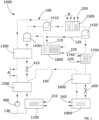
- the figure 1 represents the present machine 1000 in a configuration capable of generating cold, while the figure 2 , it represents a configuration capable of generating heat.
- the external heat transfer fluid of the absorber 1100 and the condenser 1700 are different in the case of the refrigeration configuration, while they form advantageously one and the same external heat transfer fluid in the case of the heat pump configuration.
- the absorption machine comprises a circulating mixture 100 in a circuit.
- This circulating mixture 100 advantageously comprises at least a first fluid and a second fluid.
- This first fluid can advantageously be taken from at least: water, or a solvent such as lithium nitrate or sodium thiocyanate, or even a mixture of water and lithium nitrate.
- This second fluid can preferably be taken from at least: ammonia, or alcohol.
- the mass proportion of the first fluid is between 30% and 70%, preferably between 40% and 60%, and advantageously between 45% and 55%.
- the mass proportion of the second fluid is between 30% and 70%, preferably between 40% and 60%, and advantageously between 45% and 55%.
- the concentration of the second fluid in the circulating mixture 100 is variable during the circulation of said mixture 100 in the machine 1000.
- the mixture 100 in circulation advantageously presents different concentration rates of the second fluid in the first fluid depending on its circulation in said machine 1000.
- the mixture 100 in circulation can have a first concentration rate of the second fluid in the form of a lean solution 110.
- the lean solution 110 thus contains very little of the second fluid.
- the condensed solution 110 is a two-phase solution.
- the lean solution 110 comprises a liquid part and a gaseous part.
- the liquid part largely comprises the first fluid.
- the gaseous part largely comprises the second fluid.
- the lean solution 110 comprises a mass concentration of second fluid less than 70%, preferably 60% and advantageously 50%.
- the mixture 100 in circulation can also have a second concentration rate of the second fluid in the form of a condensed solution 120.
- This condensed solution 120 is preferably monophasic.
- This condensed solution 120 is advantageously liquid.
- the condensed solution 120 has a mass concentration of second fluid greater than the mass concentration of second fluid of the lean solution 110.
- the condensed solution 120 comprises a mass concentration of second fluid between 50% and 90%, preferably between 50% and 80%, and advantageously between 60% and 75%.
- the circulating mixture 100 may also have a third concentration rate of the second fluid in the form of a rich solution 130.
- the rich solution 130 is mainly liquid and largely comprises the first fluid and the second fluid.
- the rich solution 130 may present a gaseous part at one or more points of the circulation circuit of the machine 1000, preferably during its passage or at the outlet of the first heat exchange device 1200.
- the rich solution 130 comprises a mass concentration rate of second fluid different from the mass concentration rate of second fluid of the lean solution 110.
- the rich solution 130 comprises a mass concentration of second fluid of between 30% and 80%, preferably between 40% and 70%, and advantageously between 45% and 65%.
- the circulating mixture 100 may also have a fourth concentration rate of the second fluid in the form of a refrigerating solution 140.
- the refrigerating solution 140 mainly comprises the second fluid.
- the refrigerating solution 140 can be in a gaseous and/or liquid state.
- the refrigerating solution 140 has a mass concentration of second fluid greater than the mass concentration of second fluid of the rich solution 130.
- the refrigerating solution 140 comprises a mass concentration of second fluid greater than 90%, preferably 96% and advantageously 98%.
- a high temperature is considered to be the maximum temperature that the mixture 100 can reach during a thermodynamic cycle implemented by the machine 1000.
- this high temperature is greater than 130 ° C, advantageously at 160°C.
- high pressure is considered to be the maximum pressure that the mixture 100 can reach during a thermodynamic cycle implemented by the machine 1000.
- this high pressure is greater than 20 bar, advantageously 25 bar.
- a low temperature is considered to be the minimum temperature that the mixture 100 can reach during a thermodynamic cycle implemented by the machine 1000.
- this low temperature is less than -15°C, advantageously at -35°C.
- low pressure is considered to be the minimum pressure that the mixture 100 can reach during a thermodynamic cycle implemented by the machine 1000.
- the low pressure is less than 5 bar, advantageously less than 1 bar.
- the machine 1000 has a first configuration and a second configuration.
- the machine 1000 is configured to produce cold. This cold production is preferably carried out by reducing the temperature of an external heat transfer fluid.
- the machine 1000 is configured to produce heat. This heat production is preferably carried out by increasing the temperature of an external heat transfer fluid.
- the present invention makes it possible to reduce the bulk of the classic absorption machines of the prior art. It also reduces manufacturing and installation costs. And finally, it allows increased ease of maintenance and replacement of parts.
- the inlet 1110 of the lean solution 110 of the absorber 1100 is fluidly connected, preferably directly, to an outlet 1220 of the lean solution 110 of the first heat exchange device 1200.
- the outlet 1120 of the rich solution 130 of the absorber 1100 is fluidly connected, preferably directly, to an inlet 1230 of the rich solution 130 of the first heat exchange device 120.
- a solution pump 300 can be placed between the outlet 1120 of the rich solution 130 of the absorber 1100 and the inlet 1230 of the rich solution 130 of the first device heat exchange 1200.
- the absorber 1100 is configured to cause the lean solution 110 and the first external heat transfer fluid 210 to interact thermally. This makes it possible to transform the lean solution 110 into a rich solution 130. In fact, this makes it possible to reduce the temperature of the poor solution 110. This reduction in temperature then makes it possible to increase the mass concentration rate of the second fluid. The poor solution 110 then transforms into a rich solution 130.
- the absorber 1100 makes it possible to generate an exothermic reaction by allowing the poor solution 110 to absorb the second fluid, thus transforming itself into a rich solution 130.
- the exchange thermal between the lean solution 110 and the first external heat transfer fluid 210 is of the two-phase-liquid type.
- the poor solution 110 is in a two-phase state when it enters the absorber 1100.
- the quantity of the second fluid absorbed is directly linked to the absorption efficiency occurring in the absorber 1100.
- the rich solution 130 at the outlet of the absorber 1100 has a mass concentration of second fluid 1.5 times greater, preferably 3 times greater than the mass concentration of second fluid of the lean solution 110 at the inlet of the absorber 1100.
- the rich solution 130 is therefore colder than the lean solution 110 at the inlet, part of this heat having been transferred to the first external heat transfer fluid 210.
- the first external heat transfer fluid 210 enters the absorber 1100 at a temperature lower than that with which it emerges from the absorber 1100.
- the absorber 1100 comprises a plate heat exchanger.
- the machine 1000 comprises a pressure increasing device capable of modifying the pressure of the mixture in circulation 100 in the absorber 1100 so as to increase the mass concentration of second fluid of the rich solution 130 during the transformation of the lean solution 110 into a rich solution 130.
- This pressure increase device can for example be placed at the inlet of the absorber 1100, or even at the inlet of the first heat exchange device 1200, or even at the outlet of the fourth heat exchange device 1800, depending on the direction of circulation of the lean solution and/or the refrigerant solution 140.
- This device The pressure increase could for example be a compressor or even an ejector, by way of non-limiting example.
- this pressure increase device is arranged between the secondary outlet 1840 of the refrigerant solution of the fourth heat exchange device 1800 and the inlet 1210 of the lean solution of the first heat exchange device 1200.
- This makes it possible to having a hotter solution at the inlet of the first heat exchange device 1200.
- This also makes it possible to have a greater pressure in the absorber 1100. This also makes it possible not to disturb the poor solution before its isenthalpic expansion phase produced by the first expansion valve 410. This then makes it possible to improve the COP.
- the plurality of separation bottles comprises a first separation bottle, a second separation bottle and a third separation bottle.
- the inlet 1230 of the rich solution 130 of the first heat exchange device is fluidly connected, preferably directly, to the outlet 1120 of the rich solution 130 of the absorber 1100.
- the outlet 1220 of the lean solution 110 is fluidically connected, preferably directly, to the inlet 1110 of the lean solution 110 of the absorber 1100.
- the inlet 1210 of the lean solution 110 is fluidly connected to an outlet 1432 of the lean solution 110 of a separation bottle 1430 of the plurality of separation bottles.
- a second heat exchange device 1300 is arranged between the inlet 1210 of the lean solution 110 of the first heat exchange device 1200 and the outlet 1432 of the lean solution 110 of said separation bottle 1430 of the plurality of separation bottles.
- a first expansion valve 410 of the plurality of expansion valves can be fluidly arranged between the inlet 1210 of the lean solution 110 of the first heat exchange device 1200 and the outlet 1432 of said bottle separation 1430 of the plurality of separation bottles relative to the circulation of the lean solution 110.
- said first expansion valve 410 of the plurality of expansion valves can be arranged between the outlet 1320 of the lean solution 110 of the second heat exchange device 1300 and the inlet 1210 of the lean solution 110 of the first heat exchange device 1200 relative to the circulation of the lean solution 110.
- the inlet 1210 of the lean solution 110 of the first heat exchange device 1200 allows mixing between the lean solution 110 and the refrigerant solution 140.
- the first heat exchange device 1200 is configured to cause the rich solution 130 to thermally interact with the lean solution 110. This thermal interaction is intended to modify the temperature of the rich solution 130, and advantageously of the lean solution 110.
- the first heat exchange device 1200 is configured to increase the temperature of the rich solution 130.
- the first heat exchange device 1200 is configured to reduce the temperature of the lean solution 110. .
- the first heat exchange device 1200 is configured to receive the rich solution 130, preferably at a first temperature and at a first pressure.
- This first temperature is preferably called cold, and advantageously is lower than the temperature of the lean solution 110 at the inlet of the first heat exchange device 1200.
- This first pressure is a high pressure, and advantageously is greater than the pressure of the solution lean 110 at the inlet of the first heat exchange device 1200.
- the first heat exchange device 1200 is advantageously configured to receive the lean solution 110 and preferably a mixture of the lean solution 110 and the refrigerant solution 140.
- the mixture of the lean solution 110 and the refrigerant solution 140 is a two-phase mixture comprising a liquid phase and a gas phase.
- This mixture is at a pressure lower than the pressure of the rich solution 130 entering the first heat exchange device.
- the rich solution 130 and the lean solution 110, and preferably said mixture move in the first counter-current heat exchange device.
- the lean solution 110 and the refrigerant solution 140 are in co-current while the rich solution 130 is in counter-current with respect to the lean solution 110 and the refrigerant solution 140.
- heat transfer from the lean solution 110 and the refrigerant solution 140 mixed to the rich solution 130 is possible via the use of plate heat exchangers.
- the absorption generated by the encounter of the lean solution 110 with the refrigerated solution 140 is an exothermic reaction. This makes it possible to improve the heat transfer from the mixture of the lean solution 110 and the refrigerant solution 140 to the rich solution 130.
- the rich solution 130 leaves the first heat exchange device 1200 at a temperature higher than that at which it entered the first heat exchange device 1200.
- the lean solution 110 mixed with the refrigerant solution 140 leaves the first heat exchange device 1200 at a temperature lower than the temperature at which it entered the first heat exchange device 1200.
- the first heat exchange device 1200 comprises a plate heat exchanger.
- FIG. 3 schematically illustrates a plate heat exchanger of the first heat exchange device 1200.
- This plate exchanger comprises plates 160 separating two fluid circulation circuits, preferably in counter-current, in order to improve the heat exchanges 150.
- the rich solution 130 and its direction of circulation 131 in this plate exchanger.
- the lean solution 110 and its direction of circulation 111 in this plate exchanger.
- the lean solution 111 can be mixed with the refrigerant solution 140 before entering the first heat exchange device 1200.
- a lean solution 110 presenting a two-phase state.
- the lean solution 110 then comprises a liquid phase 113 and a gas phase 112, said gas phase 112 being formed by the refrigerant solution 140 in the vapor state.
- heat exchanges 150 occur via the plates 160 of the plate exchanger. These thermal exchanges 150 allow an increase in the rich solution making it partially two-phase and thus allowing the appearance of a gas phase 132 in the rich solution 130.
- the absorber 1100 and the first heat exchange device 1200 can form a single element of the machine.
- the first heat exchange device 1200 can be configured so that the lean solution 110 is in counter-current with the refrigerant solution 140 or semi-counter-current with the refrigerant solution 140. This makes it possible to improve absorption. This also makes it possible to improve the heat transfer between said mixture and the rich solution 130.
- the use of one or more plate heat exchangers configured so that the gas phase 112 and the liquid phase 113 circulate in counter-current relative to each other allows an improvement in heat transfer and absorption. Indeed, if the gas phase 112, that is to say the refrigerant solution 140, is injected in counter-current with respect to the liquid phase 113, that is to say with the lean solution 110, then the the absorption of the second fluid is improved as is the heat transfer between the refrigerant solution 140 and the lean solution 110 and the rich solution 130.
- the plate exchanger can include one or more injectors at the bottom of each channel circulation of the poor solution 110, that is to say in the low pressure channels.
- the inlet 1411 of the rich solution 130 is fluidly connected, preferably directly, to the outlet 1240 of the rich solution 130 of the first heat exchange device 1200.
- the second heat exchange device 1300 is fluidly disposed between the first heat exchange device 1200 and the first separation bottle 1410 relative to the circulation of rich solution 130.
- the outlet 1340 of the rich solution 130 of the second device The heat exchange 1300 is fluidly connected, preferably directly, to the inlet 1411 of the rich solution 130 of the first separation bottle 1410.
- the inlet 1413 of the refrigerant solution 140 of the first separation bottle 1410 is fluidly connected, preferably directly, to a third separation bottle 1430 of the plurality of separation bottles, preferably to the outlet 1433 of the refrigerant solution 140 of the third separation bottle 1430.
- the outlet 1412 of the lean solution 110 is fluidly connected, preferably directly, to the heat generator 1600, in particular to an inlet 1610 of the lean solution 110 of the heat generator 1600.
- the outlet 1414 of the refrigerant solution 140 is fluidly connected, preferably directly, to a second separation bottle 1420, in particular to an inlet 1421 of the refrigerant solution 140 of the second separation bottle 1420.
- the first separation bottle 1410 is configured so that when the rich solution 130 enters the first separation bottle 1410, the first separation bottle 1410 then separates the liquid part and the gaseous part of the rich solution 130. Indeed at this stage, the rich solution 130 is in a two-phase state. Preferably, the gaseous part of the rich solution 130 is separated to supply the refrigerant solution 140, the remaining liquid part then forming the lean solution 110. In addition, the first separation bottle 1410 allows the recovery of heat from the refrigerant solution 140 incoming towards the poor solution 110 outgoing.
- the lean solution 110 at the outlet of the first separation bottle 1410 has a mass concentration of second fluid 10% lower, preferably 30% lower than the mass concentration of second fluid of the rich solution 130 at the inlet of the the first separation bottle 1410.
- the third heat exchange device 1500 is fluidly arranged between the first separation bottle 1410 and the second separation bottle 1420 relative to the refrigerant solution 140. More particularly, the outlet 1414 of the refrigerant solution 140 of the first bottle 1414 is fluidly connected, preferably directly, to an inlet 1510 of the refrigerant solution 140 of the third heat exchange device 1500. And the inlet 1421 of the refrigerant solution 140 of the second separation bottle 1420 is preferably fluidly connected, preferably directly, to an outlet 1520 of the refrigerant solution 140 of the third heat exchange device 1500.
- the first separation bottle 1410 is configured to thermally interact the rich solution 130 with the refrigerant solution 140 of so as to transform the rich solution 130 into a lean solution 110, preferably so as to reduce the mass concentration rate of the second fluid in the rich solution 130 so as to obtain the lean solution 110.
- the use of one or more separation bottles makes it possible to free our from the conventional use of the column of the generator called GAX used in the prior art and presenting a complexity of assembly and a consequent bulk.
- the rich solution 130 is in a two-phase state when it enters the first separation bottle 1410, that is to say it comprises a liquid portion and a gaseous portion.
- the rich solution 130 enters the first separation bottle 1410, it is mixed with a saturated vapor present with the refrigerant solution 140 at the outlet of the third separation bottle 1430.
- the refrigerant solution 140 is preferably at high temperature at the outlet of the the third separation bottle 1430.
- saturated part of the heat of this steam, called saturated, is transferred to the rich solution 130.
- This mixture causes evaporation.
- This mixture then causes the separation of the rich solution 130 into two phases resulting in the poor solution 110 which is preferably two-phase.
- the first separation bottle 1410 allows the removal of the generator column present in the solutions of the prior art.
- the first separation bottle comprises a pressurized tank which allows good phase separation and/or effective heat exchange between the different solutions.
- the inlet 1421 of the refrigerant solution 140 is fluidly connected, preferably directly, to the outlet 1414 of the refrigerant solution 140 of the first separation bottle 1410.
- the third heat exchange device 1500 can be arranged fluidly between the outlet 14141 of the refrigerant solution 140 of the first separation bottle 1410 and the inlet 1421 of the refrigerant solution 140 of the second separation bottle 1420.
- the outlet 1422 of the refrigerant solution 140 is fluidly connected, preferably directly, to the condenser 1700, in particular to an inlet 1710 of the refrigerant solution 140 of the condenser 1700.
- the outlet 1423 of the condensed solution 120 is fluidly connected, preferably directly, to the outlet 1412 of the lean solution 110 of the first separation bottle 1410 or to the inlet 1610 of the lean solution 110 of the generator. heat 1600 so as to be mixed with the lean solution 110, preferably before entering the heat generator 1600.
- the second separation bottle 1420 is configured to extract at least part of the condensed solution 120 from the refrigerant solution 140.
- this second separation bottle 1420 is configured to divide the vapor very rich in second fluid from the liquid part, this liquid part then forming the refrigerant solution 140.
- the second separation bottle 1420 is preferably configured to separate the vapor rich in the first fluid from the refrigerant solution 140. This vapor then forms the condensed solution 120.
- the condensed solution 120 is more concentrated than the lean solution 110.
- the outlet 1423 of the refrigerant solution 140 of the second separation bottle is fluidly connected, preferably directly, to the first separation bottle 1410, preferably to an inlet of the refrigerant solution 140 of the first bottle separation 1410. This allows the recovery of at least part of the first fluid. This allows for improved performance.
- the inlet 1431 of the lean solution 110 of the third separation bottle 1430 is fluidly connected, preferably directly, to the outlet 1620 of the lean solution 110 of the heat generator 1600.
- the outlet 1432 of the lean solution 110 of the third separation bottle 1430 is fluidly connected, preferably directly, to the inlet 1210 of the lean solution 110 of the first heat exchange device 1200.
- the second heat exchange device 1300 is fluidly arranged between the outlet 1432 of the lean solution 110 of the third bottle of separation 1430 and the first heat exchange device 1200.
- the second heat exchange device 1300 is fluidly disposed between the outlet 1432 of the lean solution 110 of the third separation bottle 1430 and the first expansion valve 410 .
- the outlet 1433 of the refrigerant solution 140 of the third separation bottle 1430 is fluidly connected, preferably directly, to the inlet 1413 of the refrigerant solution 140 of the first separation bottle 1410.
- the third separation bottle 1430 is configured to extract at least part of the refrigerant solution 140 from the lean solution 110, preferably once it has left the heat generator 1600.
- the third separation bottle 1430 allows the separation of the vapor phase and the liquid phase of the lean solution 110 leaving the heat generator 1600. Indeed, at the outlet of the heat generator 1600, the lean solution 110 is found at high pressure and high temperature, that is to say at a temperature and pressure higher than that of the lean solution 110 entering the heat generator 1600.
- this second separation bottle 1420 makes it possible to separate the vapor and liquid phases at the outlet of the heat generator 1600.
- this third separation bottle 1430 at the outlet of the heat generator Heat 1600 makes it possible to eliminate the traditional and bulky column of heat generators of the prior art.
- this third separation bottle 1430 comprises a pressurized tank.
- the third separation bottle 1430 is configured to operate at high pressure and high temperature.
- the first separation bottle 1410 and the third separation bottle 1430 form a single separation bottle ensuring by itself the functions of the first separation bottle 1410 and the third separation bottle 1430. This makes it possible to simplify the implementation of the present invention. And this also reduces manufacturing and/or installation costs.
- the inlet 1610 of the lean solution 110 of the heat generator 1600 is fluidly connected, preferably directly, to the outlet 1412 of the lean solution 110 of the first separation bottle 1410.
- the inlet 1610 of the lean solution 110 of the first separation bottle 1410. is also fluidly connected, preferably directly, to the outlet 1423 of the condensed solution 120 of the second separation bottle 1420.
- the outlet 1620 of the lean solution 110 of the heat generator is fluidly connected, preferably directly, to the inlet 1431 of the lean solution 110 of the third separation bottle 1430.
- the lean solution 110 and the condensed solution 120 are mixed at the inlet 1610 of the lean solution 110 of the heat generator 1600.
- the heat generator 1600 is configured to cause the lean solution 110 and the second external heat transfer fluid 220 to interact thermally, preferably so as to increase the temperature of the lean solution 110.
- This increase in the temperature of the lean solution 110 is intended to make the poor solution 110 reach a high temperature.
- the heat generator 1600 comprises a plate heat exchanger.
- This plate exchanger is configured to operate in counter-current. That is to say that the lean solution 110 circulates in one direction in the plate exchanger and that the second external heat transfer fluid 220 circulates in the opposite direction.
- This counter-current circulation increases the efficiency of heat transfer.
- the heat generator 1600 is configured to operate at high pressure, that is to say at a pressure greater than 30 bar.
- the heat generator 1600 is advantageously configured to heat the lean solution 110 to high temperature, that is to say at a temperature of up to 200°C.
- the main inlet 1710 of the refrigerant solution 140 of the condenser 1700 is fluidly connected, preferably directly, to the outlet 1422 of the refrigerant solution 140 of the second separation bottle 1420.
- the main outlet 1720 of the refrigerant solution 140 of the condenser 1700 is fluidly connected, preferably directly, to the main inlet 1910 of the evaporator 1900.
- a fourth heat exchange device 1800 is fluidly arranged between the main outlet 1720 of the refrigerant solution 140 of the condenser 1700 and the main inlet 1910 of the evaporator 1900.
- the condenser 1700 is configured to cause the refrigerating solution 140 and the third external heat transfer fluid 230 to interact thermally so as to modify the temperature of the refrigerating solution 140, preferably so as to reduce the temperature of the refrigerating solution 140.
- the condenser 1700 comprises a plate heat exchanger.
- the condenser 1700 is configured to use the third external heat transfer fluid 230 so as to cool the refrigerant solution 140 passing through it. This then makes it possible to partially liquefy at least part of the refrigerant solution 140.
- the condenser 1700 makes it possible to set the value of the high pressure. In fact, the high pressure is advantageously dependent on the minimum temperature to which the refrigerant solution 140 is cooled.
- the main inlet 1910 of the refrigerant solution 140 of the evaporator 1900 is fluidly connected, preferably directly, to the main outlet 1720 of the refrigerant solution 140 of the condenser 1700.
- the fourth device The heat exchange 1800 is fluidly arranged between the main outlet 1720 of the refrigerant solution 140 of the condenser 1700 and the main inlet 1910 of the refrigerant solution 140 of the evaporator 1900.
- the main outlet 1920 of the refrigerant solution 140 of the evaporator 1900 is fluidly connected, preferably directly, to the inlet 1210 of the lean solution 110 of the first heat exchange device 1200.
- the fourth heat exchange device 1800 is fluidly arranged between the main outlet 1920 of the refrigerant solution 140 of the evaporator 1900 and the inlet 1210 of the lean solution 110 of the first heat exchange device 1200.
- the evaporator 1900 is configured to cause the refrigerant solution 140 and the fourth external heat transfer fluid 240 to interact thermally, so as to modify the temperature of the fourth external heat transfer fluid 240.
- This temperature modification is possible via the evaporation of part of less of the refrigerant solution 140.
- This then makes it possible to reduce the temperature of the fourth external heat transfer fluid 240 via the evaporation of at least part of the refrigerant solution 140.
- the lean solution 110 coming from the third separation bottle 1430 and the refrigerating solution 140 coming from the evaporator 1900 are mixed upstream or at the inlet 1210 of the lean solution 110 of the first device. heat exchange 1200.
- the second heat exchange device 1300 is arranged fluidly between the third separation bottle 1430 and the first heat exchange device 1200 relative to the circulation of the lean solution 110.
- the second device the heat exchange 1300 is fluidly arranged between the outlet 1432 of the lean solution 110 of the third separation bottle 1430 and the inlet 1210 of the lean solution 110 of the first heat exchange device 1200 relative to the circulation of the lean solution 110 .
- the second heat exchange device 1300 is arranged fluidly between the first heat exchange device 1200 and the first separation bottle 1410 relative to the circulation of the rich solution 130.
- the second device the heat exchange 1300 is fluidly arranged between the outlet 1240 of the rich solution 130 of the first heat exchange device 1200 and the inlet 1411 of the rich solution 130 of the first separation bottle 1410 relative to the circulation of the rich solution 130 .
- the inlet 1330 of the rich solution 130 of the second heat exchange device 1300 is fluidly connected, preferably directly, with the outlet 1240 of the rich solution 130 of the first heat exchange device 1200, advantageously with the outlet secondary 1540 of the rich solution 130 of the third heat exchange device 1500 as described below.
- the outlet 1340 of the rich solution 130 of the second heat exchange device 1300 is fluidly connected, preferably directly, to the inlet 1411 of the rich solution 130 of the first separation bottle 1410.
- the inlet 1310 of the lean solution 110 of the second heat exchange device 1300 is fluidly connected, preferably directly, with the outlet 1432 of the lean solution 110 of the third separation bottle 1430.
- the outlet 1320 of the lean solution 110 of the second heat exchange device 1300 is fluidly connected, preferably directly, with the inlet 1210 of the lean solution 110 of the first heat exchange device 1200.
- the first expansion valve 410 is fluidly arranged between the outlet 1320 of the lean solution 110 of the second heat exchange device 1300 and the inlet 1210 of the lean solution 110 of the first heat exchange device 1200.
- the second heat exchange device 1300 is configured to cause the rich solution 130 to interact thermally with the lean solution 110.
- the second heat exchange device 1300 is configured to increase the temperature of the rich solution 130 and to reduce the temperature of the lean solution 110.
- the second heat exchange device 1300 allows heat transfer between the lean solution 110 which is at high temperature and the rich solution 130 which is at a temperature lower than the high temperature.
- the rich solution 130 then becomes at least partly two-phase throughout its passage in the second heat exchange device 1300.
- the fluids circulating in the second heat exchange device 1300 are in counter-current. Note that in the second heat exchange device 1300, the rich solution 130 and the lean solution 110 are preferably at the same pressure.
- the second heat exchange device 1300 comprises at least one plate heat exchanger. According to one embodiment, the second heat exchange device 1300 comprises at least one plate heat exchanger.
- the lean solution 110 before entering the heat generator 1600, can be preheated by the lean solution 110 leaving the third separation bottle 1430, before passing into the second heat exchange device 1300
- this heat exchange then occurs at a high temperature and has advantages in terms of irreversibility.
- the temperatures involved in this heat exchange are both high, and relatively close to each other. This makes it possible to use the temperatures at the outlet of this heat exchange to carry out other exchanges. thermal.
- the coldest temperature remains warm enough to be cooled at least once again during a future heat exchange.
- the third heat exchange device 1500 is arranged fluidly between the first heat exchange device 1200 and the first separation bottle 1410 relative to the circulation of the rich solution 130.
- the third device the heat exchange 1500 is fluidly arranged between the outlet 1240 of the rich solution 130 of the first heat exchange device 1200 and the inlet 1411 of the rich solution 130 of the first separation bottle 1410 relative to the circulation of the rich solution 130
- the third heat exchange device 1500 is arranged fluidly between the first heat exchange device 1200 and the second heat exchange device 1300 relative to the circulation of the rich solution 130.
- the third heat exchange device 1500 is fluidly disposed between the outlet 1240 of the rich solution 130 of the first heat exchange device 1200 and the inlet 1330 of the rich solution 130 of the second heat exchange device 1300 relative to the circulation of the rich solution 130.
- the third heat exchange device 1300 is arranged fluidly between the first separation bottle 1410 and the second separation bottle 1420 relative to the circulation of the refrigerant solution 140.
- the third exchange device thermal 1500 is arranged between the outlet 1414 of the refrigerant solution 140 of the first separation bottle 1410 and the inlet 1421 of the refrigerant solution 140 of the second separation bottle 1420 relative to the circulation of the refrigerant solution 140.
- the main inlet 1510 of the refrigerant solution 140 of the third heat exchange device 1500 is fluidly connected, preferably directly, to the outlet 1414 of the refrigerant solution 140 of the first separation bottle 1410.
- the main outlet 1520 of the refrigerant solution 140 of the third heat exchange device 1500 is fluidly connected, preferably directly, to the inlet 1421 of the refrigerant solution 140 of the second separation bottle 1420.
- the secondary inlet 1530 of the rich solution 130 of the third heat exchange device 1500 is fluidly connected, preferably directly, to the outlet 1240 of the rich solution 130 of the first heat exchange device 1200.
- the secondary outlet 1540 of the rich solution 130 of the third heat exchange device 1500 is fluidly connected, preferably directly, to the inlet 1411 of the rich solution 130 of the first separation bottle 1410.
- the secondary outlet 1540 of the rich solution 130 of the third heat exchange device 1500 is fluidly connected, preferably directly, to the inlet 1330 of the rich solution 130 of the second heat exchange device 1300.
- the third heat exchange device 1500 is configured to cause the refrigerant solution 140 to interact thermally with the rich solution 130. This then makes it possible to increase the temperature of the rich solution 130 while cooling the refrigerant solution 140.
- the third heat exchange device 1500 is configured to cause the refrigerant solution 140 to interact thermally with the fifth external heat transfer fluid 250. This then makes it possible to cool the refrigerant solution 140.
- the third heat exchange device 1500 is configured to enrich the liquid part of the refrigerant solution 140 by mainly cooling the gaseous part of the refrigerant solution 140.
- the third heat exchange device 1500 comprises a first part and a second part.
- the first part comprises at least a first heat exchanger configured to cool the refrigerant solution 140 from the rich solution 130.
- This first heat exchanger is preferably a plate heat exchanger.
- the second part comprises at least a second heat exchanger configured to cool the refrigerating solution 140 from the fifth external heat transfer fluid 250, preferably being at room temperature.
- This second heat exchanger 1500 is preferably a plate heat exchanger. This makes it possible to recover heat from the refrigerant solution 140 between the first separation bottle 1410 and the second separation bottle 1420. This makes it possible to heat the rich solution 130 between the first device heat exchange device 1200 and the first separation bottle 1410, preferably between the first heat exchange device 1200 and the second heat exchange device 1300.
- the third heat exchange device 1500 comprises at least one plate heat exchanger, preferably two plate heat exchangers.
- the second part of the third heat exchange device 1500 can be removed, in particular, if the machine 1000 is configured so that the temperature at the outlet of the third heat exchange device is higher. This makes it possible to reduce the manufacturing costs of the Machine 1000 according to the present invention.
- the fourth heat exchange device 1800 is arranged fluidly between the condenser 1700 and the evaporator 1900 relative to the circulation of the refrigerant solution 140.
- the fourth heat exchange device 1800 is arranged fluidly between the outlet 1720 of the refrigerant solution 140 of the condenser 1700 and the inlet 1910 of the refrigerant solution 140 of the evaporator 1900.
- a second expansion valve 420 is fluidly disposed between the fourth heat exchange device 1800 and the evaporator 1900.
- the second expansion valve is fluidly disposed between the outlet 1720 of the solution refrigerant 140 of the condenser 1700 and the inlet 1910 of the refrigerant solution 140 of the evaporator 1900.
- the fourth heat exchange device 1800 is arranged fluidly between the evaporator 1900 and the first heat exchange device 1200 relative to the circulation of the refrigerant solution 140.
- the fourth heat exchange device thermal 1800 is fluidly arranged between the outlet 1920 of the refrigerant solution 140 of the evaporator 1900 and the inlet 1210 of the refrigerant solution 140 of the first heat exchange device 1200.
- the main inlet 1810 of the refrigerant solution 140 of the fourth heat exchange device 1800 is fluidly connected, preferably directly, to the main outlet 1720 of the refrigerant solution 140 of the condenser 1700.
- the main outlet 1820 of the refrigerant solution 140 of the fourth heat exchange device 1800 is fluidly connected, preferably directly, to the inlet 1910 of the refrigerant solution 140 of the evaporator 1900.
- the main outlet 1820 of the refrigerant solution 140 of the fourth heat exchange device 1800 is fluidly connected, preferably directly, to the inlet 421 of the refrigerant solution 140 of the second expansion valve 420.
- the outlet 422 of the second expansion valve 420 is fluidly connected, preferably directly, to the inlet 1910 of the refrigerant solution 140 of the evaporator 1900.
- the secondary inlet 1830 of the refrigerant solution 140 of the fourth heat exchange device 1800 is fluidly connected, preferably directly, with the outlet 1920 of the refrigerant solution 140 of the evaporator 1900.
- the secondary outlet 1840 of the refrigerant solution 140 of the fourth heat exchange device 1800 is fluidly connected, preferably directly, to the inlet 1210 of the lean solution 110 of the first heat exchange device 1200.
- the fourth heat exchange device 1800 is configured to cause the refrigerant solution 140 to thermally interact before it enters the evaporator 1900 with the refrigerant solution 140 after its exit from the evaporator 1900.
- the fourth heat exchange device 1800 is configured to cool the refrigerant solution 140 before it enters the evaporator 1900, preferably before it undergoes expansion, preferably isenthalpic, via the second expansion valve 420. This makes it possible to optimize, preferably maximize, the thermal drop of the refrigerant solution 140 before it enters the evaporator 1900.
- the fourth heat exchange device 1800 makes it possible to improve the evaporation of the refrigerant solution 140 before it enters the absorber 1100, preferably in the first thermal device 1200.
- the fourth heat exchange device 1800 comprises at least one plate heat exchanger, preferably only plate heat exchangers.
- the plurality of expansion valves comprises at least a first expansion valve 410 and a second expansion valve 420 as previously described.
- the first expansion valve 410 is fluidly arranged between the third separation bottle 1430 and the first heat exchange device 1200 relative to the circulation of the lean solution 110.
- the first expansion valve expansion 410 is fluidly arranged between the second thermal device 1300 and the first heat exchange device 1200 relative to the circulation of the lean solution 110.
- the inlet 412 of the lean solution 110 of the first expansion valve 410 is fluidly connected, preferably directly, to the outlet 1320 of the lean solution 110 of the second heat exchange device 1300.
- the outlet 411 of the lean solution 110 of the first expansion valve 410 is fluidly connected, preferably directly, to the inlet 1210 of the lean solution 110 of the first heat exchange device 1200.
- the first expansion valve 410 is configured to modify the temperature of the lean solution 110, preferably to modify the temperature of the poor solution 110 by isenthalpic relaxation. This allows the lean solution 110 to be at low pressure when it arrives at the first heat exchange device 1200 and preferably at the absorber 1100.
- the second expansion valve 420 is fluidly disposed between the condenser 1700 and the evaporator 1900 relative to the circulation of the lean solution 110.
- the second expansion valve 420 is fluidly disposed between the fourth heat exchange device 1800 and the evaporator 1900 relative to the circulation of the lean solution 110.
- the inlet 421 of the lean solution 110 of the second expansion valve 420 is fluidically connected, preferably directly, to the outlet 1820 of the lean solution 110 of the fourth heat exchange device 1800.
- the outlet 422 of the lean solution 110 of the second expansion valve 420 is fluidically connected, preferably directly, to the inlet 1910 of the lean solution 110 of the evaporator 1900.
- the second expansion valve 420 is configured to allow the temperature of the lean solution 110 to be modified, preferably to allow the lean solution 110 to reach a temperature of predetermined evaporation before the lean solution 110 enters the evaporator 1900.
- the second expansion valve 420 causes the lean solution 110 to undergo isenthalpic expansion.
- the first expansion valve 410 is configured to produce isenthalpic expansion.
- the first expansion valve 410 is configured to generate isothermal expansion. This makes it possible to improve the thermodynamic effect or effects of the first heat exchange device 1200 on the mixture 100 in circulation.
- the solution pump 300 is fluidly arranged between the absorber 1100 and the first heat exchange device 1200 relative to the circulation of the rich solution 130.
- the inlet 310 of the rich solution 130 of the solution pump 300 is fluidly connected, preferably directly, to the outlet 1120 of the rich solution 130 of the absorber 1100.
- the outlet 320 of the rich solution 130 of the solution pump 300 is fluidly connected, preferably directly, at the inlet 1230 of the rich solution 130 of the first heat exchange device 1200.
- the solution pump 300 is configured to modify the pressure of the rich solution 130, preferably to increase the pressure of the rich solution 130.
- the solution pump 300 ensures the circulation of the mixture in the machine 1000.
- the solution pump 300 brings the rich solution 130 preferably at high pressure.
- the present invention makes it possible to carry out a thermodynamic cycle of the GAX type with preferably only plate exchangers, while maintaining or even improving the performance of this type of machine but at the same time reducing the costs, the size and the maintenance difficulties.
- the present invention makes it possible to generate cold or heat depending on its operational configuration. This then makes it possible to increase the possible applications and consequently its economic interest.
- the destructuring of the old and bulky columns of the absorber and the heat generator allows the clever use of new thermodynamic devices arranged and configured in an ingenious way. This makes it possible to reduce the vertical development of the components and allows better distribution of the components in space.
- the present invention allows better compactness of the machine, for example via the use of separation bottles and/or via the use of one or more plate heat exchangers.
- the present invention makes assembly and maintenance of the machine simpler.
Landscapes
- Engineering & Computer Science (AREA)
- Physics & Mathematics (AREA)
- Mechanical Engineering (AREA)
- Thermal Sciences (AREA)
- General Engineering & Computer Science (AREA)
- Sorption Type Refrigeration Machines (AREA)
Claims (15)
- Absorptionsmaschine (1000), die eine zirkulierende Mischung (100) in einem Kreislauf umfasst, wobei die Maschine hauptsächlich ein erstes und ein zweites Fluid umfasst, wobei die Maschine (1000) dabei eine erste Konfiguration aufweist, in der die Maschine (1000) Kälte erzeugt, und eine zweite Konfiguration, in der die Maschine (1000) Wärme erzeugt, wobei die zirkulierende Mischung (100) eine Massenkonzentration an zweitem Fluid aufweist, die in Abhängigkeit von ihrer Position in dem Kreislauf derart variiert, dass für die zirkulierenden Mischung in Abhängigkeit von der Position eine sogenannte magere Lösung (110), eine sogenannte kondensierte Lösung (120), eine sogenannte reichhaltige Lösung (130) und eine sogenannte Kältelösung (140) definiert sind, wobei die Maschine (1000) mindestens Folgendes umfasst:• einen Absorber (1100), der dazu konfiguriert ist, eine Massenkonzentrationsrate des zweitens Fluids der mageren Lösung (110) derart zu erhöhen, dass die magere Lösung (110) in eine reichhaltige Lösung (130) umgewandelt wird;• eine erste Wärmeaustauschvorrichtung (1200), die dazu konfiguriert ist, die Temperatur der reichhaltigen Lösung (130) ausgehend von der mageren Lösung (110) zu erhöhen,• einen Wärmegenerator (1600), der dazu konfiguriert ist, die Temperatur der mageren Lösung (110) zu erhöhen,• einen Kondensator (1700), der dazu konfiguriert ist, die Kältelösung (140) zu kondensieren,• einen Verdampfer (1900), der dazu konfiguriert ist, mindestens einen Teil der Kältelösung (140) zu verdampfen,und wobei:• die Maschine 1000) in der ersten Konfiguration dazu konfiguriert ist, einen externen Wärmeträger, der in dem Verdampfer (1700) zirkuliert, zu kühlen;• in der zweiten Konfiguration ein externer Wärmeträger (210), der in dem Absorber (1100) zirkuliert, und ein externer Wärmeträger (230), der in dem Kondensator zirkuliert, den einzigen und selben externen Wärmeträger bilden, der gemeinsamer externer Wärmeträger genannt wird, wobei die Maschine (1000) dazu konfiguriert ist, die Temperatur des gemeinsamen externen Wärmeträgers zu erhöhen, dadurch gekennzeichnet, dass die Maschine Folgendes umfasst:• eine erste Trennflasche (1410), die dazu konfiguriert ist, die reichhaltige Lösung (130) in einen flüssigen Teil und einen gasförmigen Teil zu trennen, wobei der gasförmige Teil dazu bestimmt ist, die Kältelösung (140) zuzubringen, und der flüssige Teil die magere Lösung (110) bildet, wobei die erste Trennflasche (1410) mit einem Ausgang (1240) der reichhaltigen Lösung (130) der erste Wärmeaustauschvorrichtung (1200) und einem Eingang (1910) der mageren Lösung (110) des Wärmegenerators (1600) fluidisch verbunden ist,• eine zweite Trennflasche (1420), die dazu konfiguriert ist, zum Teil mindestens die kondensierte Lösung (120) aus der Kältelösung (140) zu extrahieren, wobei die zweite Trennflasche (1420) mit einem Ausgang (1414) der Kältelösung (140) der ersten Trennflasche (1410) und mit einem Eingang (1710) der Kältelösung (140) des Kondensators (1700) fluidisch verbunden ist,• eine dritte Trennflasche (1430), die dazu konfiguriert ist, die magere Lösung (110) in einen flüssigen Teil und einen gasförmigen Teil zu trennen, wobei der gasförmige Teil die Kältelösung (140) bildet, und der flüssige Teil die magere Lösung (110) bildet, wobei die dritte Trennflasche (1430) mit einem Ausgang (1620) der mageren Lösung (110) des Wärmegenerators (1600), einem Eingang (1210) der mageren Lösung (110) der ersten Wärmeaustauschvorrichtung (1200) und einem Eingang (1413) der Kältelösung (140) der ersten Trennflasche (1410) fluidisch verbunden ist.
- Maschine (100) nach dem vorstehenden Anspruch, wobei das erste Fluid Wasser und/oder ein Lösemittel, wie Lithiumnitrat oder Natriumthiocyanat, umfasst, und wobei das zweite Fluid Ammoniak oder Alkohol umfasst.
- Maschine (1000) nach einem der vorstehenden Ansprüche, wobei die magere Lösung eine erste Massenkonzentrationsrate des zweiten Fluids aufweist, und wobei die kondensierte Lösung eine zweite Massenkonzentrationsrate des zweiten Fluids aufweist, und wobei die reichhaltige Lösung eine dritte Massenkonzentrationsrate des zweiten Fluids aufweist, und wobei die Kältelösung eine vierte Massenkonzentrationsrate des zweiten Fluids aufweist, wobei die erste Konzentrationsrate, die zweite Konzentrationsrate, die dritte Konzentrationsrate und die vierte Konzentrationsrate jeweils voneinander unterschiedlich sind, wobei bevorzugt die erste Massenkonzentrationsrate des zweiten Fluids kleiner ist als die zweite Massenkonzentrationsrate des zweiten Fluids, und wobei die erste Massenkonzentrationsrate des zweiten Fluids und die dritte Massenkonzentrationsrate des zweiten Fluids geringer sind als die vierte Massenkonzentrationsrate des zweiten Fluids.
- Maschine (1000) nach einem der vorstehenden Ansprüche, wobei:• der Absorber (1100) Folgendes umfasst:- einen Eingang (1110) der mageren Lösung (110), wobei die magere Lösung (110) eine erste Temperatur aufweist,- einen Ausgang (1120) der reichhaltigen Lösung (130), wobei die reichhaltige Lösung (130) eine zweite Temperatur, die niedriger ist als die erste Temperatur, aufweist,- einen Eingang (1130) eines ersten externen Wärmeträgers (210) und- einen Ausgang (1140) des ersten externen Wärmeträgers (210), wobei der Absorber (1100) dazu konfiguriert ist, die magere Lösung (110) und den ersten externen Wärmeträger (210) derart thermisch interagieren zu lassen, dass die magere Lösung (110) in reichhaltige Lösung (130) umgewandelt wird, bevorzugt derart, dass die Temperatur der mageren Lösung (110 verringert wird, vorteilhafterweise derart, dass die Massenkonzentrationsrate des zweiten Fluids sie daher in reichhaltige Lösung (130) umwandelt;• die erste Wärmeaustauschvorrichtung (1200) Folgendes umfasst:- einen Eingang (1230) der reichhaltigen Lösung (130),- einen Eingang (1210) der mageren Lösung (110),- einen Ausgang (1240) der reichhaltigen Lösung (130) und- einen Ausgang (1220) der mageren Lösung (110),wobei die erste Wärmeaustauschvorrichtung (1200) dazu konfiguriert ist, die reichhaltige Lösung (130) mit der mageren Lösung (110) derart thermisch interagieren zu lassen, dass die Temperatur der reichhaltigen Lösung (130) geändert, bevorzugt erhöht wird,wobei der Eingang (1230) der reichhaltigen Lösung (130) der ersten Wärmeaustauschvorrichtung (1200) mit dem Ausgang (1120) der reichhaltigen Lösung (130) des Absorbers (1100) fluidisch verbunden ist, undder Ausgang (1220) der mageren Lösung (110) der ersten Wärmeaustauschvorrichtung (1200) mit dem Eingang (1110) der mageren Lösung (110) des Absorbers (1100) fluidisch verbunden ist;• die erste Trennflasche (1410) Folgendes umfasst:- einen Eingang (1411) der reichhaltigen Lösung (130),- einen Eingang (1413) der Kältelösung (140),- einen Ausgang (1412) der mageren Lösung (110) und- einen Ausgang (1414) der Kältelösung (140),wobei die erste Trennflasche (1410) dazu konfiguriert ist, die reichhaltige Lösung (130) in einen flüssigen Teil und einen gasförmigen Teil zu trennen, wobei der gasförmige Teil dazu bestimmt ist, die Kältelösung (140) zuzubringen, und der flüssige Teil die magere Lösung (110) bildet,wobei der Eingang (1411) der reichhaltigen Lösung (130) der ersten Trennflasche (1410) mit dem Ausgang (1240) der reichhaltigen Lösung (130) der ersten Wärmeaustauschvorrichtung (1200) fluidisch verbunden ist;• die zweite Trennflasche (1420) Folgendes umfasst:- einen Eingang (1421) der Kältelösung (140),- einen Ausgang (1422) der Kältelösung (140) und- einen Ausgang (1423) der Kältelösung (140),wobei der Eingang (1421) der Kältelösung (140) der zweiten Trennflasche (1410) mit dem Ausgang (1414) der Kältelösung (140) der ersten Trennflasche (1410) fluidisch verbunden ist;• der Wärmegenerator (1600) Folgendes umfasst:- einen Eingang (1610) der mageren Lösung (110),- einen Ausgang (1620) der mageren Lösung (110),wobei der Wärmegenerator (1600) dazu konfiguriert ist, die magere Lösung (110) und einen zweiten externen Wärmeträger (220) bevorzugt derart thermisch interagieren zu lassen, dass die Temperatur der mageren Lösung (110) erhöht wird,wobei der Eingang (1610) der mageren Lösung (110) des Wärmegenerators (1600) mit dem Ausgang (1412) der mageren Lösung (110) der ersten Trennflasche (1410) und mit dem Ausgang (1423) der kondensierten Lösung (120) der zweiten Trennflasche (1420) fluidisch verbunden ist,die magere Lösung (110) und die kondensierte Lösung (140) im Bereich des Eingangs (1610) der mageren Lösung (110) des Wärmegenerators (1600) gemischt werden;• die dritte Trennflasche (1430) Folgendes umfasst:- einen Eingang (1431) der mageren Lösung (110),- einen Ausgang (1432) der mageren Lösung (110) und- einen Ausgang (1433) der Kältelösung (140),wobei der Eingang (1431) der mageren Lösung (110) der dritten Trennflasche (1430) mit dem Ausgang (1620) der mageren Lösung (110) der ersten Wärmeaustauschvorrichtung (1600) fluidisch verbunden ist,wobei der Ausgang (1432) der mageren Lösung (110) der dritten Trennflasche (1430) mit dem Eingang (1210) der mageren Lösung (110) der ersten Wärmeaustauschvorrichtung (1200) verbunden ist, der Ausgang (1433) der Kältelösung (140) der dritten Trennflasche (1430) fluidisch mit dem Eingang (1413) der Kältelösung (140) der ersten Trennflasche (1410) fluidisch verbunden ist;• der Kondensator (1700) Folgendes umfasst:- einen Eingang (1710) der Kältelösung (140),- einen Eingang (1730) eines dritten externen Wärmeträgers (230),- einen Ausgang (1720) der Kältelösung (140) und- einen Ausgang (1740) des dritten externen Wärmeträgers (230),wobei der Kondensator (1700) dazu konfiguriert ist, die Kältelösung (140) und den dritten externen Wärmeträger (230) derart thermisch interagieren zu lassen, dass die Kältelösung (140) kondensiert wird,wobei der Eingang (1710) der Kältelösung (140) des Kondensators (1700) mit dem Ausgang (1422) der Kältelösung (140) der zweiten Trennflasche (1420) fluidisch verbunden ist;• der Verdampfer (1900) Folgendes umfasst:und wobei:- einen Eingang (1910) der Kältelösung (140),- einen Ausgang (1920) der Kältelösung (140),wobei der Verdampfer (1900) dazu konfiguriert ist, die Kältelösung (140) und einen vierten externen Wärmeträger (240) derart thermisch interagieren zu lassen, dass die Temperatur des vierten externen Wärmeträgers (240) über die Verdampfung mindestens eines Teils der Kältelösung (140) geändert wird, bevorzugt die Temperatur des vierten externen Wärmeträgers (240) über die Verdampfung mindestens eines Teils der Kältelösung (140) verringert wird,wobei der Eingang (1910) der Kältelösung (140) des Verdampfers (1900) mit dem Ausgang der Kältelösung (1720) des Kondensators (1700) fluidisch verbunden ist,wobei der Ausgang (1920) der Kältelösung (140) des Verdampfers (1900) mit dem Eingang (1210) der mageren Lösung (110) der ersten Wärmeaustauschvorrichtung (1200) fluidisch verbunden ist,die magere Lösung (110) und die Kältelösung (140) im Bereich des Eingangs (1210) der mageren Lösung (110) der ersten Wärmeaustauschvorrichtung (1210) gemischt werden;• in der ersten Konfiguration die Maschine (1000) dazu konfiguriert ist, den vierten externen Wärmeträger (240) zu kühlen;• in der zweiten Konfiguration der erste externe Wärmeträger (210) und der dritte externe Wärmeträger (230) einen einzigen und selben gemeinsamen Wärmeträger derart bilden, dass jeweils der Ausgang (1140) des ersten externen Wärmeträgers (210) des Absorbers (1100) oder der Eingang (1130) des ersten externen Wärmeträgers (210) des Absorbers (1100) jeweils mit dem Eingang (1730) des dritten externen Wärmeträgers (230) des Kondensators (1700) oder dem Ausgang (1740) des dritten externen Wärmeträgers (230) des Kondensators (1700) fluidisch verbunden sind, wobei die Maschine (1000) dabei dazu konfiguriert ist, die Temperatur des gemeinsamen externen Wärmeträgers zu erhöhen.
- Maschine (1000) nach dem vorstehenden Anspruch, wobei mindestens einer des Absorbers (1100), der ersten Wärmeaustauschvorrichtung (1200), des Wärmegenerators (1600), des Kondensators (1700), des Verdampfers (1900) mindestens einen Plattenwärmetauscher umfasst, wobei der Plattenwärmetauscher bevorzugt konfiguriert ist, damit die Fluide, die ihn durchqueren, im Gegenstrom zueinander zirkulieren.
- Maschine (1000) nach einem der Ansprüche 4 und 5, die eine zweite Wärmeaustauschvorrichtung (1300) umfasst, die Folgendes umfasst:• einen Eingang (1330) der reichhaltigen Lösung (130),• einen Eingang (1310) der mageren Lösung (110),• einen Ausgang (1340) der reichhaltigen Lösung (130),• einen Ausgang (1320) der mageren Lösung (110),wobei die zweite Wärmeaustauschvorrichtung (1300) dazu konfiguriert ist, die reichhaltige Lösung (130) mit der mageren Lösung (110) thermisch interagieren zu lassen, um bevorzugt die Temperatur der reichhaltigen Lösung (130) zu erhöhen und die Temperatur der mageren Lösung (110) zu verringern,wobei der Eingang (1330) der reichhaltigen Lösung (130) der zweiten Wärmeaustauschvorrichtung (1300) mit dem Ausgang (1240) der reichhaltigen Lösung (130) der ersten Wärmeaustauschvorrichtung (1200) fluidisch verbunden ist,wobei der Ausgang (1340) der reichhaltigen Lösung (130) der zweiten Wärmeaustauschvorrichtung (1300) mit dem Eingang (1411) der reichhaltigen Lösung (130) der ersten Trennflasche (1410) fluidisch verbunden ist,wobei der Eingang (1310) der mageren Lösung (110) der zweiten Wärmeaustauschvorrichtung (1300) mit dem Ausgang (1432) der mageren Lösung (110) der dritten Trennflasche (1430) fluidisch verbunden ist, undder Ausgang (1320) der mageren Lösung (110) der zweiten Wärmeaustauschvorrichtung (1300) mit dem Eingang (1210) der mageren Lösung (110) der ersten Wärmeaustauschvorrichtung (1200) fluidisch verbunden ist, wobei die zweite Wärmeaustauschvorrichtung (1300) bevorzugt mindestens einen Plattenwärmetauscher umfasst, wobei die magere Lösung (110) und bevorzugt die reichhaltige Lösung (130) im Gegenstrom in dem Plattenwärmetauscher der zweiten Wärmeaustauschvorrichtung (1300) zirkulieren.
- Maschine (1000) nach einem der Ansprüche 4 bis 6, die eine dritte Wärmeaustauschvorrichtung (1500) umfasst, die Folgendes umfasst:• einen Haupteingang (1510) der Kältelösung (140),• einen Hauptausgang (1520) der Kältelösung (140),• einen Sekundäreingang (1530) der reichhaltigen Lösung (130),• einen Sekundärausgang (1540) der reichhaltigen Lösung (130),• einen zusätzlichen Eingang (1550) eines fünften externen Wärmeträgers (250),• einen zusätzlichen Ausgang (1560) des fünften externen Wärmeträgers (250),wobei die dritte Wärmeaustauschvorrichtung (1500) dazu konfiguriert ist, die Kältelösung (140) mit der reichhaltigen Lösung (130) derart thermisch interagieren zu lassen, dass die Temperatur der reichhaltigen Lösung (130) erhöht wird, und die Kältelösung (140) mit einem fünften externen Wärmeträger (250) derart, dass die Temperatur der Kältelösung (140) verringert wird,wobei der Haupteingang (1510) der Kältelösung (140) der dritten Wärmeaustauschvorrichtung (1500) mit dem Ausgang (1414) der Kältelösung (140) der ersten Trennflasche (1410) fluidisch verbunden ist, der Hauptausgang (1520) der Kältelösung (140) der dritten Wärmeaustauschvorrichtung (1500) mit dem Eingang (1421) der Kältelösung (140) der zweiten Trennflasche (1420) fluidisch verbunden ist,wobei der Sekundäreingang (1530) der reichhaltigen Lösung (130) der dritten Wärmeaustauschvorrichtung (1500) mit dem Ausgang (1240) der reichhaltigen Lösung (130) der ersten Wärmeaustauschvorrichtung (1200) fluidisch verbunden ist,wobei der Sekundärausgang (1540) der reichhaltigen Lösung (130) der dritten Wärmeaustauschvorrichtung 1500) mit dem Eingang (1411) der reichhaltigen Lösung (130) der ersten Trennflasche (1410) fluidisch verbunden ist, wobei die dritte Wärmeaustauschvorrichtung (1500) bevorzugt mindestens einen Plattenwärmetauscher umfasst, bevorzugt dem vorstehenden Anspruch, in dem die Kältelösung (140) und die reichhaltige Lösung (130) im Gegenstrom in dem Plattenwärmetauscher der dritten Wärmeaustauscheinheit (1500) zirkulieren.
- Maschine (1000) nach dem vorstehenden Anspruch, kombiniert mit Anspruch 6, wobei der Sekundärausgang (1540) der reichhaltigen Lösung (130) der dritten Wärmeaustauschvorrichtung (1500) mit dem Eingang (1330) der reichhaltigen Lösung (130) der zweiten Wärmeaustauschvorrichtung (1300) fluidisch verbunden ist.
- Maschine (1000) nach einem der Ansprüche 4 bis 8, die eine vierte Wärmeaustauschvorrichtung (1800) umfasst, die Folgendes umfasst:• einen Haupteingang (1810) der Kältelösung (140),• einen Hauptausgang (1820) der Kältelösung (140),• einen Sekundäreingang (1830) der Kältelösung (140), und• einen Sekundärausgang (1840) der Kältelösung (140),wobei die vierte Wärmeaustauschvorrichtung (1800) dazu konfiguriert ist, die Kältelösung (140) mit sich selbst vor ihrem Eintritt in den Verdampfer (1900) und nach ihrem Austritt aus dem Verdampfer (1900) thermisch interagieren zu lassen,wobei der Haupteingang (1810) der Kältelösung (140) der vierten Wärmetauschvorrichtung (1800) mit dem Ausgang (1720) der Kältelösung (140) des Kondensators (1700) fluidisch verbunden ist,wobei der Hauptausgang (1820) der Kältelösung (140) der vierten Wärmeaustauschvorrichtung (1800) mit dem Haupteingang (1910) der Kältelösung (140) des Verdampfers (1900) fluidisch verbunden ist,wobei der Sekundäreingang (1830) der Kältelösung (140) der vierten Wärmeaustauschvorrichtung (1800) mit dem Hauptausgang (1920) der Kältelösung (140) des Verdampfers (1900) fluidisch verbunden ist,wobei der Sekundärausgang (1840) der Kältelösung (140) der vierten Wärmeaustauschvorrichtung (1800) mit dem Eingang (1210) der mageren Lösung (110) der ersten Wärmeaustauschvorrichtung (1200) fluidisch verbunden ist, wobei bevorzugt Wärmeaustauschvorrichtung (1800) mindestens einen Plattenwärmetauscher umfasst, wobei die magere Lösung (110), die aus dem Kondensator (1700) austritt, und die magere Lösung (110), die aus dem Verdampfer (1900) austritt, im Gegenstrom in dem Plattenwärmetauscher der vierten Wärmeaustauschvorrichtung (1800) zirkulieren.
- Maschine (1000) nach einem der Ansprüche 4 bis 9, die mindestens eine Druckerhöhungsvorrichtung der Kältelösung, die mit dem Ausgang (1920) der Kältelösung (140) des Verdampfers (1900) und dem Eingang (1210) der mageren Lösung (110) der ersten Wärmeaustauschvorrichtung (1200) fluidisch verbunden ist, derart umfasst, dass der Druck der Mischung der mageren Lösung (110) mit der Kältelösung (140) in der ersten Wärmeaustauschvorrichtung (1200), bevorzugt in dem Absorber (1100), erhöht wird.
- Maschine (1000) nach einem der Ansprüche 4 bis 10, die mindestens ein erstes Expansionsventil (410) umfasst, das Folgendes umfasst:• einen Eingang (411) der mageren Lösung (110) und• einen Ausgang (412) der mageren Lösung (110),wobei das erste Expansionsventil (410) dazu konfiguriert ist, die Temperatur der mageren Lösung (110) zu ändern, um bevorzugt die Temperatur der mageren Lösung (110) durch eine isenthalpische Expansion zu ändern,wobei der Eingang (411) der mageren Lösung (110) des Expansionsventils (410) mit dem Ausgang (1432) der mageren Lösung (110) der dritten Trennflasche (1430) fluidisch verbunden ist.
- Maschine (1000) nach dem vorstehenden Anspruch, kombiniert mit Anspruch 6,
wobei der Eingang (411) der mageren Lösung (110) des ersten Expansionsventils (410) mit dem Ausgang (1320) der mageren Lösung (110) der zweiten Wärmeaustauschvorrichtung (1300) fluidisch verbunden ist. - Maschine (1000) nach einem der Ansprüche 4 bis 12, die mindestens ein zweites Expansionsventil (420) umfasst, das Folgendes umfasst:• einen Eingang (421) der Kältelösung (140) und• einen Ausgang (422) der Kältelösung (140),wobei das zweite Expansionsventil (420) dazu konfiguriert ist, die Temperatur der Kältelösung (140) zu ändern, um bevorzugt die Temperatur der Kältelösung (140) durch eine isenthalpische Expansion zu ändern,wobei der Eingang (421) der Kältelösung (140) der zweiten Trennflasche (420) mit dem Ausgang (1720) der Kältelösung (140) des Kondensators (1700) fluidisch verbunden ist, bevorzugt mit dem Ausgang der Kältelösung (140) der vierten Wärmeaustauschvorrichtung,wobei der Ausgang der Kältelösung (140) mit dem Haupteingang der Kältelösung (140) des Verdampfers (1900) fluidisch verbunden ist.
- Maschine (1000) nach dem vorstehenden Anspruch, kombiniert mit Anspruch 9, wobei der Eingang (421) der Kältelösung (140) des zweiten Expansionsventils (420) mit dem Hauptausgang (1820) der Kältelösung (140) der vierten Wärmeaustauschvorrichtung (1800) fluidisch verbunden ist.
- Maschine (1000) nach einem der Ansprüche 4 bis 14, die mindestens eine Lösungspumpe (300) umfasst, die Folgendes umfasst:• einen Eingang (310) der reichhaltigen Lösung (130), und• einen Ausgang (320) der reichhaltigen Lösung (130),wobei die Lösungspumpe (300) dazu konfiguriert ist, den Druck der reichhaltigen Lösung (130) zu ändern, bevorzugt um den Druck der reichhaltigen Lösung (130) zu erhöhen, wobei der Eingang (310) der reichhaltigen Lösung (130) der Lösungspumpe (300) mit dem Ausgang (1120) der reichhaltigen Lösung (130) des Absorbers (1100) fluidisch verbunden ist, undwobei der Ausgang (320) der reichhaltigen Lösung (130) der Lösungspumpe (300) mit dem Eingang (1230) der reichhaltigen Lösung (130) der ersten Wärmeaustauschvorrichtung (1200) fluidisch verbunden ist.
Applications Claiming Priority (1)
| Application Number | Priority Date | Filing Date | Title |
|---|---|---|---|
| FR2012308A FR3116890B1 (fr) | 2020-11-27 | 2020-11-27 | Machine à absorption |
Publications (2)
| Publication Number | Publication Date |
|---|---|
| EP4006447A1 EP4006447A1 (de) | 2022-06-01 |
| EP4006447B1 true EP4006447B1 (de) | 2023-10-25 |
Family
ID=74045968
Family Applications (1)
| Application Number | Title | Priority Date | Filing Date |
|---|---|---|---|
| EP21209991.5A Active EP4006447B1 (de) | 2020-11-27 | 2021-11-23 | Absorptionsmaschine |
Country Status (2)
| Country | Link |
|---|---|
| EP (1) | EP4006447B1 (de) |
| FR (1) | FR3116890B1 (de) |
Family Cites Families (3)
| Publication number | Priority date | Publication date | Assignee | Title |
|---|---|---|---|---|
| EP3236178B1 (de) * | 2016-04-22 | 2020-08-12 | AGO AG Energie + Anlagen | Sorptionswärmepumpe und sorptionskreisprozess |
| CN106091474B (zh) * | 2016-06-17 | 2018-09-18 | 珠海格力电器股份有限公司 | 氨水吸收-压缩式制冷/热泵系统及换热方法 |
| EP3540334B1 (de) * | 2018-03-15 | 2021-10-20 | AGO GmbH Energie + Anlagen | Wärmetransformator und wärmetransformationsprozess |
-
2020
- 2020-11-27 FR FR2012308A patent/FR3116890B1/fr active Active
-
2021
- 2021-11-23 EP EP21209991.5A patent/EP4006447B1/de active Active
Also Published As
| Publication number | Publication date |
|---|---|
| EP4006447A1 (de) | 2022-06-01 |
| FR3116890A1 (fr) | 2022-06-03 |
| FR3116890B1 (fr) | 2022-11-18 |
Similar Documents
| Publication | Publication Date | Title |
|---|---|---|
| EP1927816B1 (de) | Dampfkompressionsvorrichtung und Verfahren zur Umsetzung eines entsprechenden transkritischen Zyklusses | |
| EP3732743B1 (de) | Energieerzeugungsanlage mit kopplung einer brennstoffzelle und eines reversiblen thermodynamischen systems | |
| FR2476240A1 (fr) | Appareil de recuperation d'energie pour installation de compresseur de gaz | |
| EP3830511B1 (de) | Verfahren zum austausch von wärme | |
| FR2575787A1 (fr) | Procede de production d'energie mecanique | |
| EP3510257A1 (de) | Mechanisches system zur erzeugung mechanischer energie aus flüssigem stickstoff und entsprechendes verfahren | |
| EP4006447B1 (de) | Absorptionsmaschine | |
| FR3112198A1 (fr) | Installation et procédé de réfrigération d’hydrogène | |
| EP4092356B1 (de) | Absorptionsmaschine mit spiralförmigen plattenwärmetauschern | |
| EP4256185A1 (de) | System und verfahren zur speicherung und rückgewinnung von energie unter verwendung von druckgas mit rückgewinnung von flüssigkeit | |
| EP4350129B1 (de) | System zur energieerzeugung mit einem organischen rankine-zyklus und integriertem absorptionszyklus | |
| FR2807826A1 (fr) | Echangeur vaporisateur-condenseur du type a bain | |
| BE903196A (fr) | Procede de production d'energie | |
| EP4332463A1 (de) | Wärmeerzeugungsvorrichtung | |
| FR3068442A1 (fr) | Dispositif de refroidissement combine a une production de vapeur | |
| EP4116640B1 (de) | System zur erzeugung von kälte und strom aus einer thermischen quelle mit niedriger temperatur, das eine regelung des verhältnisses zwischen kälte- und stromerzeugung ermöglicht | |
| FR2943125A1 (fr) | Procede de liquefaction de gaz naturel a cycle combine | |
| WO2022268830A1 (fr) | Procede de stockage et de recuperation d'energie avec stockage de chaleur indirect a la compression | |
| FR2858830A1 (fr) | Procede pour augmenter la capacite et l'efficacite d'installations gazieres du type comprenant une turbine a gaz | |
| FR3029612A1 (fr) | Systeme de liquefaction de gaz a machine a absorption et pompe a chaleur stirling | |
| FR3117163A1 (fr) | procédé de stockage et de récupération d’énergie comprenant une turbine à gaz pour réchauffer le gaz comprimé à la détente | |
| EP4355985A1 (de) | System zur rückgewinnung von kompressionsenergie eines gases, verflüssiger mit solch einem system und verfahren zur rückgewinnung von kompressionsenergie eines gases | |
| Xia et al. | Coordinated optimization of mixture working fluid composition and operating parameters of an improved composition tunable organic Rankine cycle-vapor compression refrigeration system under the full conditions | |
| WO2022117407A1 (fr) | Système et procédé de stockage et de récupération d'énergie par gaz comprimé avec cycle de rankine | |
| FR3152176A1 (fr) | Transformateur de chaleur à absorption optimisé par éjecteur |
Legal Events
| Date | Code | Title | Description |
|---|---|---|---|
| PUAI | Public reference made under article 153(3) epc to a published international application that has entered the european phase |
Free format text: ORIGINAL CODE: 0009012 |
|
| STAA | Information on the status of an ep patent application or granted ep patent |
Free format text: STATUS: REQUEST FOR EXAMINATION WAS MADE |
|
| 17P | Request for examination filed |
Effective date: 20211123 |
|
| AK | Designated contracting states |
Kind code of ref document: A1 Designated state(s): AL AT BE BG CH CY CZ DE DK EE ES FI FR GB GR HR HU IE IS IT LI LT LU LV MC MK MT NL NO PL PT RO RS SE SI SK SM TR |
|
| GRAP | Despatch of communication of intention to grant a patent |
Free format text: ORIGINAL CODE: EPIDOSNIGR1 |
|
| STAA | Information on the status of an ep patent application or granted ep patent |
Free format text: STATUS: GRANT OF PATENT IS INTENDED |
|
| RIC1 | Information provided on ipc code assigned before grant |
Ipc: F25B 37/00 20060101ALI20230428BHEP Ipc: F25B 25/02 20060101ALI20230428BHEP Ipc: F25B 40/00 20060101ALI20230428BHEP Ipc: F25B 15/04 20060101AFI20230428BHEP |
|
| INTG | Intention to grant announced |
Effective date: 20230523 |
|
| GRAS | Grant fee paid |
Free format text: ORIGINAL CODE: EPIDOSNIGR3 |
|
| GRAA | (expected) grant |
Free format text: ORIGINAL CODE: 0009210 |
|
| STAA | Information on the status of an ep patent application or granted ep patent |
Free format text: STATUS: THE PATENT HAS BEEN GRANTED |
|
| AK | Designated contracting states |
Kind code of ref document: B1 Designated state(s): AL AT BE BG CH CY CZ DE DK EE ES FI FR GB GR HR HU IE IS IT LI LT LU LV MC MK MT NL NO PL PT RO RS SE SI SK SM TR |
|
| REG | Reference to a national code |
Ref country code: GB Ref legal event code: FG4D Free format text: NOT ENGLISH |
|
| REG | Reference to a national code |
Ref country code: CH Ref legal event code: EP |
|
| REG | Reference to a national code |
Ref country code: DE Ref legal event code: R096 Ref document number: 602021006195 Country of ref document: DE |
|
| REG | Reference to a national code |
Ref country code: IE Ref legal event code: FG4D Free format text: LANGUAGE OF EP DOCUMENT: FRENCH |
|
| REG | Reference to a national code |
Ref country code: SE Ref legal event code: TRGR |
|
| REG | Reference to a national code |
Ref country code: LT Ref legal event code: MG9D |
|
| REG | Reference to a national code |
Ref country code: NL Ref legal event code: MP Effective date: 20231025 |
|
| REG | Reference to a national code |
Ref country code: AT Ref legal event code: MK05 Ref document number: 1625037 Country of ref document: AT Kind code of ref document: T Effective date: 20231025 |
|
| PG25 | Lapsed in a contracting state [announced via postgrant information from national office to epo] |
Ref country code: NL Free format text: LAPSE BECAUSE OF FAILURE TO SUBMIT A TRANSLATION OF THE DESCRIPTION OR TO PAY THE FEE WITHIN THE PRESCRIBED TIME-LIMIT Effective date: 20231025 |
|
| PG25 | Lapsed in a contracting state [announced via postgrant information from national office to epo] |
Ref country code: GR Free format text: LAPSE BECAUSE OF FAILURE TO SUBMIT A TRANSLATION OF THE DESCRIPTION OR TO PAY THE FEE WITHIN THE PRESCRIBED TIME-LIMIT Effective date: 20240126 |
|
| PG25 | Lapsed in a contracting state [announced via postgrant information from national office to epo] |
Ref country code: IS Free format text: LAPSE BECAUSE OF FAILURE TO SUBMIT A TRANSLATION OF THE DESCRIPTION OR TO PAY THE FEE WITHIN THE PRESCRIBED TIME-LIMIT Effective date: 20240225 |
|
| PG25 | Lapsed in a contracting state [announced via postgrant information from national office to epo] |
Ref country code: LT Free format text: LAPSE BECAUSE OF FAILURE TO SUBMIT A TRANSLATION OF THE DESCRIPTION OR TO PAY THE FEE WITHIN THE PRESCRIBED TIME-LIMIT Effective date: 20231025 |
|
| PG25 | Lapsed in a contracting state [announced via postgrant information from national office to epo] |
Ref country code: AT Free format text: LAPSE BECAUSE OF FAILURE TO SUBMIT A TRANSLATION OF THE DESCRIPTION OR TO PAY THE FEE WITHIN THE PRESCRIBED TIME-LIMIT Effective date: 20231025 |
|
| PG25 | Lapsed in a contracting state [announced via postgrant information from national office to epo] |
Ref country code: ES Free format text: LAPSE BECAUSE OF FAILURE TO SUBMIT A TRANSLATION OF THE DESCRIPTION OR TO PAY THE FEE WITHIN THE PRESCRIBED TIME-LIMIT Effective date: 20231025 |
|
| PG25 | Lapsed in a contracting state [announced via postgrant information from national office to epo] |
Ref country code: LT Free format text: LAPSE BECAUSE OF FAILURE TO SUBMIT A TRANSLATION OF THE DESCRIPTION OR TO PAY THE FEE WITHIN THE PRESCRIBED TIME-LIMIT Effective date: 20231025 Ref country code: IS Free format text: LAPSE BECAUSE OF FAILURE TO SUBMIT A TRANSLATION OF THE DESCRIPTION OR TO PAY THE FEE WITHIN THE PRESCRIBED TIME-LIMIT Effective date: 20240225 Ref country code: GR Free format text: LAPSE BECAUSE OF FAILURE TO SUBMIT A TRANSLATION OF THE DESCRIPTION OR TO PAY THE FEE WITHIN THE PRESCRIBED TIME-LIMIT Effective date: 20240126 Ref country code: ES Free format text: LAPSE BECAUSE OF FAILURE TO SUBMIT A TRANSLATION OF THE DESCRIPTION OR TO PAY THE FEE WITHIN THE PRESCRIBED TIME-LIMIT Effective date: 20231025 Ref country code: BG Free format text: LAPSE BECAUSE OF FAILURE TO SUBMIT A TRANSLATION OF THE DESCRIPTION OR TO PAY THE FEE WITHIN THE PRESCRIBED TIME-LIMIT Effective date: 20240125 Ref country code: AT Free format text: LAPSE BECAUSE OF FAILURE TO SUBMIT A TRANSLATION OF THE DESCRIPTION OR TO PAY THE FEE WITHIN THE PRESCRIBED TIME-LIMIT Effective date: 20231025 Ref country code: PT Free format text: LAPSE BECAUSE OF FAILURE TO SUBMIT A TRANSLATION OF THE DESCRIPTION OR TO PAY THE FEE WITHIN THE PRESCRIBED TIME-LIMIT Effective date: 20240226 |
|
| PG25 | Lapsed in a contracting state [announced via postgrant information from national office to epo] |
Ref country code: RS Free format text: LAPSE BECAUSE OF FAILURE TO SUBMIT A TRANSLATION OF THE DESCRIPTION OR TO PAY THE FEE WITHIN THE PRESCRIBED TIME-LIMIT Effective date: 20231025 Ref country code: PL Free format text: LAPSE BECAUSE OF FAILURE TO SUBMIT A TRANSLATION OF THE DESCRIPTION OR TO PAY THE FEE WITHIN THE PRESCRIBED TIME-LIMIT Effective date: 20231025 Ref country code: NO Free format text: LAPSE BECAUSE OF FAILURE TO SUBMIT A TRANSLATION OF THE DESCRIPTION OR TO PAY THE FEE WITHIN THE PRESCRIBED TIME-LIMIT Effective date: 20240125 Ref country code: LV Free format text: LAPSE BECAUSE OF FAILURE TO SUBMIT A TRANSLATION OF THE DESCRIPTION OR TO PAY THE FEE WITHIN THE PRESCRIBED TIME-LIMIT Effective date: 20231025 Ref country code: HR Free format text: LAPSE BECAUSE OF FAILURE TO SUBMIT A TRANSLATION OF THE DESCRIPTION OR TO PAY THE FEE WITHIN THE PRESCRIBED TIME-LIMIT Effective date: 20231025 |
|
| PG25 | Lapsed in a contracting state [announced via postgrant information from national office to epo] |
Ref country code: DK Free format text: LAPSE BECAUSE OF FAILURE TO SUBMIT A TRANSLATION OF THE DESCRIPTION OR TO PAY THE FEE WITHIN THE PRESCRIBED TIME-LIMIT Effective date: 20231025 |
|
| PG25 | Lapsed in a contracting state [announced via postgrant information from national office to epo] |
Ref country code: LU Free format text: LAPSE BECAUSE OF NON-PAYMENT OF DUE FEES Effective date: 20231123 |
|
| PG25 | Lapsed in a contracting state [announced via postgrant information from national office to epo] |
Ref country code: CZ Free format text: LAPSE BECAUSE OF FAILURE TO SUBMIT A TRANSLATION OF THE DESCRIPTION OR TO PAY THE FEE WITHIN THE PRESCRIBED TIME-LIMIT Effective date: 20231025 |
|
| REG | Reference to a national code |
Ref country code: DE Ref legal event code: R097 Ref document number: 602021006195 Country of ref document: DE |
|
| PG25 | Lapsed in a contracting state [announced via postgrant information from national office to epo] |
Ref country code: SK Free format text: LAPSE BECAUSE OF FAILURE TO SUBMIT A TRANSLATION OF THE DESCRIPTION OR TO PAY THE FEE WITHIN THE PRESCRIBED TIME-LIMIT Effective date: 20231025 |
|
| PG25 | Lapsed in a contracting state [announced via postgrant information from national office to epo] |
Ref country code: SM Free format text: LAPSE BECAUSE OF FAILURE TO SUBMIT A TRANSLATION OF THE DESCRIPTION OR TO PAY THE FEE WITHIN THE PRESCRIBED TIME-LIMIT Effective date: 20231025 Ref country code: SK Free format text: LAPSE BECAUSE OF FAILURE TO SUBMIT A TRANSLATION OF THE DESCRIPTION OR TO PAY THE FEE WITHIN THE PRESCRIBED TIME-LIMIT Effective date: 20231025 Ref country code: RO Free format text: LAPSE BECAUSE OF FAILURE TO SUBMIT A TRANSLATION OF THE DESCRIPTION OR TO PAY THE FEE WITHIN THE PRESCRIBED TIME-LIMIT Effective date: 20231025 Ref country code: LU Free format text: LAPSE BECAUSE OF NON-PAYMENT OF DUE FEES Effective date: 20231123 Ref country code: IT Free format text: LAPSE BECAUSE OF FAILURE TO SUBMIT A TRANSLATION OF THE DESCRIPTION OR TO PAY THE FEE WITHIN THE PRESCRIBED TIME-LIMIT Effective date: 20231025 Ref country code: EE Free format text: LAPSE BECAUSE OF FAILURE TO SUBMIT A TRANSLATION OF THE DESCRIPTION OR TO PAY THE FEE WITHIN THE PRESCRIBED TIME-LIMIT Effective date: 20231025 Ref country code: DK Free format text: LAPSE BECAUSE OF FAILURE TO SUBMIT A TRANSLATION OF THE DESCRIPTION OR TO PAY THE FEE WITHIN THE PRESCRIBED TIME-LIMIT Effective date: 20231025 Ref country code: CZ Free format text: LAPSE BECAUSE OF FAILURE TO SUBMIT A TRANSLATION OF THE DESCRIPTION OR TO PAY THE FEE WITHIN THE PRESCRIBED TIME-LIMIT Effective date: 20231025 |
|
| REG | Reference to a national code |
Ref country code: BE Ref legal event code: MM Effective date: 20231130 |
|
| PG25 | Lapsed in a contracting state [announced via postgrant information from national office to epo] |
Ref country code: MC Free format text: LAPSE BECAUSE OF FAILURE TO SUBMIT A TRANSLATION OF THE DESCRIPTION OR TO PAY THE FEE WITHIN THE PRESCRIBED TIME-LIMIT Effective date: 20231025 |
|
| PG25 | Lapsed in a contracting state [announced via postgrant information from national office to epo] |
Ref country code: MC Free format text: LAPSE BECAUSE OF FAILURE TO SUBMIT A TRANSLATION OF THE DESCRIPTION OR TO PAY THE FEE WITHIN THE PRESCRIBED TIME-LIMIT Effective date: 20231025 |
|
| PLBE | No opposition filed within time limit |
Free format text: ORIGINAL CODE: 0009261 |
|
| STAA | Information on the status of an ep patent application or granted ep patent |
Free format text: STATUS: NO OPPOSITION FILED WITHIN TIME LIMIT |
|
| REG | Reference to a national code |
Ref country code: IE Ref legal event code: MM4A |
|
| 26N | No opposition filed |
Effective date: 20240726 |
|
| PG25 | Lapsed in a contracting state [announced via postgrant information from national office to epo] |
Ref country code: IE Free format text: LAPSE BECAUSE OF NON-PAYMENT OF DUE FEES Effective date: 20231123 |
|
| PG25 | Lapsed in a contracting state [announced via postgrant information from national office to epo] |
Ref country code: BE Free format text: LAPSE BECAUSE OF NON-PAYMENT OF DUE FEES Effective date: 20231130 |
|
| PG25 | Lapsed in a contracting state [announced via postgrant information from national office to epo] |
Ref country code: SI Free format text: LAPSE BECAUSE OF FAILURE TO SUBMIT A TRANSLATION OF THE DESCRIPTION OR TO PAY THE FEE WITHIN THE PRESCRIBED TIME-LIMIT Effective date: 20231025 |
|
| PG25 | Lapsed in a contracting state [announced via postgrant information from national office to epo] |
Ref country code: SI Free format text: LAPSE BECAUSE OF FAILURE TO SUBMIT A TRANSLATION OF THE DESCRIPTION OR TO PAY THE FEE WITHIN THE PRESCRIBED TIME-LIMIT Effective date: 20231025 Ref country code: IE Free format text: LAPSE BECAUSE OF NON-PAYMENT OF DUE FEES Effective date: 20231123 Ref country code: BE Free format text: LAPSE BECAUSE OF NON-PAYMENT OF DUE FEES Effective date: 20231130 |
|
| REG | Reference to a national code |
Ref country code: CH Ref legal event code: PL |
|
| PG25 | Lapsed in a contracting state [announced via postgrant information from national office to epo] |
Ref country code: FI Free format text: LAPSE BECAUSE OF FAILURE TO SUBMIT A TRANSLATION OF THE DESCRIPTION OR TO PAY THE FEE WITHIN THE PRESCRIBED TIME-LIMIT Effective date: 20231025 |
|
| REG | Reference to a national code |
Ref country code: CH Ref legal event code: PL |
|
| PG25 | Lapsed in a contracting state [announced via postgrant information from national office to epo] |
Ref country code: CH Free format text: LAPSE BECAUSE OF NON-PAYMENT OF DUE FEES Effective date: 20241130 |
|
| PG25 | Lapsed in a contracting state [announced via postgrant information from national office to epo] |
Ref country code: CY Free format text: LAPSE BECAUSE OF FAILURE TO SUBMIT A TRANSLATION OF THE DESCRIPTION OR TO PAY THE FEE WITHIN THE PRESCRIBED TIME-LIMIT; INVALID AB INITIO Effective date: 20211123 |
|
| PG25 | Lapsed in a contracting state [announced via postgrant information from national office to epo] |
Ref country code: TR Free format text: LAPSE BECAUSE OF FAILURE TO SUBMIT A TRANSLATION OF THE DESCRIPTION OR TO PAY THE FEE WITHIN THE PRESCRIBED TIME-LIMIT Effective date: 20231025 |
|
| PGFP | Annual fee paid to national office [announced via postgrant information from national office to epo] |
Ref country code: DE Payment date: 20251118 Year of fee payment: 5 |
|
| PGFP | Annual fee paid to national office [announced via postgrant information from national office to epo] |
Ref country code: GB Payment date: 20251125 Year of fee payment: 5 |
|
| PGFP | Annual fee paid to national office [announced via postgrant information from national office to epo] |
Ref country code: FR Payment date: 20251125 Year of fee payment: 5 |
|
| PGFP | Annual fee paid to national office [announced via postgrant information from national office to epo] |
Ref country code: SE Payment date: 20251119 Year of fee payment: 5 |
|
| PG25 | Lapsed in a contracting state [announced via postgrant information from national office to epo] |
Ref country code: HU Free format text: LAPSE BECAUSE OF FAILURE TO SUBMIT A TRANSLATION OF THE DESCRIPTION OR TO PAY THE FEE WITHIN THE PRESCRIBED TIME-LIMIT; INVALID AB INITIO Effective date: 20211123 |