EP4002170A1 - Ausführungsschutz mittels datenfärbung - Google Patents
Ausführungsschutz mittels datenfärbung Download PDFInfo
- Publication number
- EP4002170A1 EP4002170A1 EP20306400.1A EP20306400A EP4002170A1 EP 4002170 A1 EP4002170 A1 EP 4002170A1 EP 20306400 A EP20306400 A EP 20306400A EP 4002170 A1 EP4002170 A1 EP 4002170A1
- Authority
- EP
- European Patent Office
- Prior art keywords
- colour
- memory
- tag
- address
- data
- Prior art date
- Legal status (The legal status is an assumption and is not a legal conclusion. Google has not performed a legal analysis and makes no representation as to the accuracy of the status listed.)
- Withdrawn
Links
Images


Classifications
-
- G—PHYSICS
- G06—COMPUTING OR CALCULATING; COUNTING
- G06F—ELECTRIC DIGITAL DATA PROCESSING
- G06F21/00—Security arrangements for protecting computers, components thereof, programs or data against unauthorised activity
- G06F21/50—Monitoring users, programs or devices to maintain the integrity of platforms, e.g. of processors, firmware or operating systems
- G06F21/52—Monitoring users, programs or devices to maintain the integrity of platforms, e.g. of processors, firmware or operating systems during program execution, e.g. stack integrity ; Preventing unwanted data erasure; Buffer overflow
- G06F21/54—Monitoring users, programs or devices to maintain the integrity of platforms, e.g. of processors, firmware or operating systems during program execution, e.g. stack integrity ; Preventing unwanted data erasure; Buffer overflow by adding security routines or objects to programs
-
- G—PHYSICS
- G06—COMPUTING OR CALCULATING; COUNTING
- G06F—ELECTRIC DIGITAL DATA PROCESSING
- G06F21/00—Security arrangements for protecting computers, components thereof, programs or data against unauthorised activity
- G06F21/50—Monitoring users, programs or devices to maintain the integrity of platforms, e.g. of processors, firmware or operating systems
- G06F21/52—Monitoring users, programs or devices to maintain the integrity of platforms, e.g. of processors, firmware or operating systems during program execution, e.g. stack integrity ; Preventing unwanted data erasure; Buffer overflow
-
- G—PHYSICS
- G06—COMPUTING OR CALCULATING; COUNTING
- G06F—ELECTRIC DIGITAL DATA PROCESSING
- G06F21/00—Security arrangements for protecting computers, components thereof, programs or data against unauthorised activity
- G06F21/50—Monitoring users, programs or devices to maintain the integrity of platforms, e.g. of processors, firmware or operating systems
- G06F21/55—Detecting local intrusion or implementing counter-measures
- G06F21/554—Detecting local intrusion or implementing counter-measures involving event detection and direct action
Definitions
- the present invention relates to an execution system having at least a central processing unit, a system memory storing a genuine program having instructions and associated variables at determined addresses and a secure agent component dedicated to the protection of the execution of the genuine program and fetching instructions occurring between the central processing unit and memories.
- the invention also pertains to a method to protect the execution of a genuine program having instructions stored in a system memory at determined addresses, said genuine program being to be executed by a central processing unit using said system memory, said method being implemented, independently of the execution of the genuine program, thanks to a secure agent component inserted between the system memory and the central processing unit.
- the invention concerns products with security needs. It is well known that any CPU-based products including security ones as smartcard are facing attacks such as buffer overflow (/underflow) including stack overflow (/underflow), Java Program Counter (JPC) and Java Stack Pointer (JSP) attacks.
- buffer overflow /underflow
- JPC Java Program Counter
- JSP Java Stack Pointer
- State-of-the-art counter measures as software bound checking, canary or double stack targets only a part of the Address range protection with penalty in performance or code development.
- the present invention aims at detecting the above-mentioned malicious attacks while not harming the performance of a genuine program.
- the present invention is defined, in its broadest sense, as an execution system, according to claim 1, having at least a central processing unit, a system memory storing a genuine program having instructions and associated variables at determined addresses and a secure agent component dedicated to the protection of the execution of the genuine program and fetching instructions occurring between the central processing unit and memories, said secure agent component comprising a colour memory created at the compilation time of the genuine program from the genuine program source and data to be protected, said colour memory listing the determined memory addresses of the genuine program with, at least, an associated colour tag for each store and load instruction relative to data to be protected, said secure agent component being such that, for store instruction of a data to be protected at a destination address of the system memory, it associates the colour tag stored at the store instruction address in the colour memory to the destination address in the colour memory while storing data at the destination address in the system memory, said secure agent component being further such that, for load instruction at a loading address, it compares the colour tag associated to the loading address in the colour memory and the colour tag associated to the load instruction address in the colour memory
- a secure agent component of the invention loads a corresponding colour tag from a colour memory.
- This tag is used in the following way:
- the creation of the colour memory is indeed based on the list of addresses in the genuine program, the list of data to be protected and the colour tags associated to these data. Indeed the colour memory reproduces the list of addresses of the genuine program with colours tags stored at the addresses of data to be protected and at the address of the instructions manipulating it.
- the invention thus proposes a data colouring with address checker, which is a global security solution with no performance impact.
- the genuine program is executed without consideration of the processing by the secure agent component which performs tasks in parallel of the execution of the genuine program.
- the invention can replace the Memory Protection Unit (MPU) functionality with better granularity. It is a global counter measure solution which targets several attacks: stack, buffer and variable attacks...
- the invention is new and original in comparison with state-of-the-art counter measures based on MPU, redundancy introduced by the software or canary inserted in stack.
- MPU Memory Protection Unit
- the genuine program can thus be any program having a certification or a specific compliance, necessitating no modification. It can also be an open source program.
- the invention indeed permits to protect the execution of the genuine program without introducing any modification in the genuine program which remains devoid of any modification for the need of the invention.
- system memory can be a cache as it will be discussed in the description of the drawings.
- the secure agent component being such that, for store instruction of a data to be protected at a destination address of the system memory, it associates the colour tag stored at the store instruction address in the colour memory to the destination address in the colour memory while storing data at the destination in the system memory by copying the colour tag stored at the store instruction address in the colour memory to the destination address in the colour memory while storing data at the destination address in the system memory, and wherein, for load instruction of a data to be protected at a loading address of the system memory, it compares the colour tag associated to the loading address in the colour memory and the colour tag associated to the load instruction address in the colour memory by a comparison of the colour tags stored at the loading address in the colour memory and stored at the load instruction address in the colour memory.
- the secure agent component being such that, for store instruction of a data to be protected at a destination address of the system memory, it associates the colour tag stored at the store instruction address in the colour memory to the destination address in the colour memory while storing data at the destination in the system memory by:
- the colours associated to data to be protected have been defined by user inputs relative to the data to be protected used at the time of compilation during the creation of the colour memory.
- said colour memory created at the compilation time listing the determined memory addresses of the genuine program with, in addition, an associated colour tag for each determined addresses where the data to be protected are stored, said execution system being such that, for any load instruction of such data to be protected at the determined address of the system memory, the execution system compares the colour tag stored at the loading address in the colour memory and the colour tag at the load instruction address in the colour memory.
- the invention also relates to a method to protect the execution of a genuine program having instructions stored in a system memory at determined addresses, said genuine program being to be executed by a central processing unit using said system memory, said method being implemented, independently of the execution of the genuine program, thanks to a secure agent component inserted between the system memory and the central processing unit, said secure agent component comprising a colour memory created at the compilation time of the genuine program from the genuine program source and from data to be protected, said colour memory listing the determined memory addresses of the genuine program with, at least, an associated colour tag for each store and load instruction relative to data to be protected, the method to protect the execution of the program comprising the steps of:
- Such a method is implemented in a system as defined according to the invention. While having, in the colour memory, a kind of duplicate of the addresses as stored in the system memory, said duplicate giving colours associated to addresses, the method of the invention enables a double check of the address and of the colouring of the data. In case of fault attack or other attacks modifying memory in a way that does not correspond to the genuine program, the invention enables to find discrepancies.
- the step of, for store instruction of a data to be protected at a destination address of the system memory, associating the colour tag stored at the store instruction address in the colour memory to the destination address in the colour memory while storing data at the destination in the system memory consists in copying the colour tag stored at the store instruction address in the colour memory to the destination address in the colour memory while storing data at the destination address in the system memory, and the step of, for load instruction of a data to be protected at a loading address of the system memory, comparing the colour tag associated to the loading address in the colour memory and the colour tag associated to the load instruction address in the colour memory is a comparison of the colour tags stored at the loading address in the colour memory and stored at the load instruction address in the colour memory.
- This implementation enables to check that the right loading address has been designated by the program and that no fault has been introduced for the memory access instruction to point to another address than the right one. This is a simple implementation where the comparison is direct from the colour tags as directly previously stored.
- the step of, for store instruction of a data to be protected at a destination address of the system memory, associating the colour tag stored at the store instruction address in the colour memory to the destination address in the colour memory while storing data at the destination in the system memory consists in the following steps:
- This second implementation is an indirect comparison of a colour tag associated to the loading address in the colour memory and a colour tag associated to the load instruction address in the colour memory.
- This uses a data integrity functionality to verify the address range.
- the coloured integrity tag of this implementation combines a colour tag as previously defined with a signature of the data.
- the colours associated to data to be protected are defined by user inputs relative to the data to be protected used at the time of compilation during the creation of the colour memory.
- This feature enables, at the time of the genuine program compilation, the user to associate particular colour to particular data.
- a set of data can thus be chosen by the user to be protected and the user has the choice of the colour(s), that can be of any value.
- said colour memory created at the compilation time listing the determined memory addresses of the genuine program with, in addition, an associated colour tag for each determined addresses where the data to be protected are stored, said method comprising the step of, for any load instruction of such data to be protected at the determined address of the system memory, comparing the colour tag stored at the loading address in the colour memory and the colour tag at the load instruction address in the colour memory.
- This specific feature is particularly interesting in genuine programs where at least a data to be protected is constant or pre-defined in the genuine program but can be extended to any data to be protected. In this case there is no need, for a store instruction, to associate a colour tag to the stored data at a destination address as the colour tag is already associated.
- the associated colour tag is the same for data of a same context
- the triggering of the alarm can also be made diversely dependent of the detection of discrepancy in the colours.
- one or more embodiments comprise the features hereinafter fully described and particularly pointed out in the claims.
- Figure 1 schematically shows a first implementation of the invention where an exemplary set of instructions is executed in a system of the invention.
- the system is an execution environment composed of a central processing unit CPU and system memory SM to store a genuine program. It is here noted that the program has not been modified according to the invention. It can be any kind of genuine program like an open source program for example, or any certified program, or any program having specific compliance to any rule and that must remain unchanged while needing to improve the security of its execution.
- System memory SM can be a system memory or a cache where the program is stored with its variables to be executed in the execution environment as shown on figure 1 . Indeed the address of the data in the system memory or in the cache are the same.
- the secure agent component can thus indifferently be connected to the system memory or to a cache.
- the cache is a memory smaller than the original one. A given location in the cache indeed corresponds to many locations in memory. While a data is stored at a memory address, the cache indeed stores an information to strictly identify the corresponding memory address.
- the system memory SM can also be a plurality of memories, spread on diverse devices.
- the CPU executes code by fetching instructions and reads and writes data from/into memories SM.
- the security protection of the invention is inserted in the system by introducing a Secure agent component SAC located between CPU and memories and by storing additional information in memories.
- This information can be added in memory classically accessible by the CPU, e.g. RAM, NVM or in a dedicated secure agent memory SAM.
- the colour tag is stored in the system memory itself with the data and the set of instructions.
- the system memory will store words of, for example, 32+n bits, 32 bits being the ones read by the CPU to execute the program, and n being the number of bits by which the colour tag is identified, those n bits being thus read by the secure agent component SAC. This does not modify the program itself as the CPU only read the first 32 bits (or the 64 bits if the CPU works on such other size of data).
- the solution can be applied on all types of CPU Instruction Set Architecture because the register transfer level RTL code impact on the CPU and on the secure agent component SAC is limited.
- the secure agent component SAC monitors the accesses occurring between the CPU and memories SM. It can access to the dedicated secure agent memory SAM or to a memory accessible by the CPU that contains the additional data needed for the implementation of the invention. For this purpose, the secure agent component SAC may modify the bus data access.
- FIG 1 is shown an exemplary part of memory PAL listing addresses where data and instructions of the program to be protected are stored.
- This part of memory PAL stores some memory access instructions, here store and load instructions, relative to data, FOO and BAR, to be protected using colour tags according to the invention.
- colour memory CM is here shown in a dedicated secure agent memory SAM. It is noted here that it could also be a memory accessible by the secure agent component SAC that contains the additional data needed for the implementation of the invention.
- the colour memory CM can thus physically be implemented in the system memory SM as discussed above.
- the colour memory CM is generated from the program itself and from user inputs tagging the data to be protected. At the time of compilation, each memory access instruction to access data to be protected is associated to a colour tag.
- Such a colour tag can be individual for each data to be protected or can be associated to all data of a context to be protected.
- Such context can be a function, a process or a buffer composed of several data elements to be protected.
- the colour tag is a value coded in bits without correlation with the data itself.
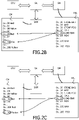
- Figures 2A , 2B and 2C illustrate what occurs during the execution of the exemplary set of instructions in the program as stored in the part of memory PAL.
- STORE BAR at address 0x... 00 is thus executed, the secure agent component SAC monitors bus to collect the variable BAR address 0x... 100 and write the colour Red in the colour memory CM.
- the colour tag, here Red is the one associated to the currently executed instruction STORE BAR instructions. This colour tag is thus previously read by the secure agent component in the colour memory CM at the address of the instruction STORE BAR, i.e. 0x... 00.
- the instruction STORE FOO is executed. This is not illustrated in figures. While writing the variable FOO at address 0x... 200, the secure agent component who fetched this instructions, stores, in the colour memory, the colour tag corresponding to the STORE FOO instruction at address 0x... 08, i.e. the Yellow colour tag, at the address of the variable FOO, i.e. 0x... 200.
- the colour tag Yellow is stored at the address 0x... 200 of the variable FOO in the colour memory CM.
- the secure agent component fetches the instruction, determine the associated colour tag, here Red at address 0x... 10, in the colour memory CM and determine also the colour tag associated to the read variable, here Red at address 0x... 100.
- the colour tags are identical and the execution of the program can be continued without alarm.
- the secure agent component SAC determines the colour tag Red for the instruction LOAD BAR and the colour tag Yellow at the address 0x... 200 when the data is to be loaded. This discrepancy of colour tag lead to an alarm and/or to an execution abortion.
- Figure 3 schematically shows a second implementation of the invention where the integrity of the data to be protected is further checked while implementing the invention.
- Coloured integrity tag associated to data/variable to be protected
- Colour tag associated to instructions relative to the data/variable to be protected.
- the coloured integrity tag is calculated using a function f of the colour and of the variable, typically a signature of the colour and the variable.
- the secure agent component SAC loads a coloured integrity tag corresponding to the data and a Colour tag corresponding to the instruction.
- the secure agent component SAC takes the variable and the colour tag of the instruction as stored in the colour memory CM and calculates a coloured integrity tag, typically by calculating the signature f(Colour tag; Variable). This coloured integrity tag is stored as associated to the data/variable in the colour memory CM as shown on figure 3 .
- the secure agent component SAC retrieve the variable in the system memory at the right address and the colour tag of the instruction and calculates a coloured integrity tag for the variable, i.e. the signature f(Colour tag; Variable) with the retrieved variable and colour tag.
- the secure agent component SAC compares this calculated coloured integrity tag with the one stored in the colour memory CM at the address corresponding to the variable. Integrity is thus checked by comparing both data signatures. The combination of the colour with the value of the variable enables to get a data integrity signature and to check the colour together.
- the secure agent component SAC fetches a STORE BAR, it then fill the colour memory CM at corresponding address of data BAR 0x100 with a coloured integrity tag f(Red, BAR).
- the secure agent memory SAC fetches a LOAD BAR instruction
- the instruction that will be sent to the central processing unit CPU is to read the system memory at address 0x100 where the data BAR is stored.
- the colour memory CM is read at address 0x10 to get the colour associated to the instruction, here Red.
- the secure agent component SAC calculates the integrity function f(Red, BAR) with the retrieved data BAR and colour of LOAD BAR instruction, here Red. It then reads the colour memory CM at address 0x100 which stores f(Red,BAR) for comparison and triggering of an alarm and/or abortion of the execution.
- the secure agent component SAC loads the data FOO and the colour Red, which is the colour of the instruction LOAD BAR, from the colour memory CM.
- the secure agent component SAC compares integritySignature(Yellow, FOO) as stored for address 0x...200 with the computed signature which is equal to integritySignature(Red, FOO). As the signatures are different, the attack is detected.
- the Colour can be shared with several variables or with a whole buffer. Typically contexts can be defined having a same colour. It explains why a LOAD (or STORE) instruction tagged with a Colour cannot access to other Colour data. Typically, to protect stack, to avoid that code working in a stack frame modifies another stack frame, different Colours are selected for each frame.
- the secure agent component SAC adds Data Integrity Signature to the bus, integrity can be propagated up to the CPU and used within. In that case data length is no more, for instance, 32 bits but 32+n bits. Data integrity can be checked inside CPU. Integrity is then checked end-to-end.
- the secure agent component SAC has the possibility to associate the colour tag or the coloured integrity tag to the data on the bus. In that case the bus is composed of n extra bits dedicated to code the information. This information can be used by the CPU to check again the integrity for instance.
- the invention enables to propose the functionality of colouring data while willing to protect a program.
- code needs to be processed and colour tags produced, corresponding tools are proposed to create the colour memory according to the invention at compilation time.
- the user lists, before compilation, the colours of the data of the program.
- program source code is compiled and linked.
- the information resulting from the compilation contains the genuine program and also related compilation and link information. This previous information will be post-processed with the list of colours of data of the program to generate the colours associated to each STORE and LOAD instructions.
- the post-process step produces the secure agent memory content.
- the invention protects the data by supporting the following functionalities:
Landscapes
- Engineering & Computer Science (AREA)
- Computer Security & Cryptography (AREA)
- Software Systems (AREA)
- Theoretical Computer Science (AREA)
- Physics & Mathematics (AREA)
- General Engineering & Computer Science (AREA)
- General Physics & Mathematics (AREA)
- Computer Hardware Design (AREA)
- Storage Device Security (AREA)
- Debugging And Monitoring (AREA)
Priority Applications (6)
| Application Number | Priority Date | Filing Date | Title |
|---|---|---|---|
| EP20306400.1A EP4002170A1 (de) | 2020-11-18 | 2020-11-18 | Ausführungsschutz mittels datenfärbung |
| PL21807073.8T PL4248344T3 (pl) | 2020-11-18 | 2021-11-08 | Ochrona wykonania przy użyciu kolorowania danych |
| DK21807073.8T DK4248344T3 (da) | 2020-11-18 | 2021-11-08 | Afviklingsbeskyttelse under anvendelse af datafarvning |
| US18/037,390 US12572646B2 (en) | 2020-11-18 | 2021-11-08 | Execution protection using data colouring |
| EP21807073.8A EP4248344B1 (de) | 2020-11-18 | 2021-11-08 | Ausführungsschutz mittels datenfärbung |
| PCT/EP2021/080882 WO2022106228A1 (en) | 2020-11-18 | 2021-11-08 | Execution protection using data colouring |
Applications Claiming Priority (1)
| Application Number | Priority Date | Filing Date | Title |
|---|---|---|---|
| EP20306400.1A EP4002170A1 (de) | 2020-11-18 | 2020-11-18 | Ausführungsschutz mittels datenfärbung |
Publications (1)
| Publication Number | Publication Date |
|---|---|
| EP4002170A1 true EP4002170A1 (de) | 2022-05-25 |
Family
ID=74105792
Family Applications (2)
| Application Number | Title | Priority Date | Filing Date |
|---|---|---|---|
| EP20306400.1A Withdrawn EP4002170A1 (de) | 2020-11-18 | 2020-11-18 | Ausführungsschutz mittels datenfärbung |
| EP21807073.8A Active EP4248344B1 (de) | 2020-11-18 | 2021-11-08 | Ausführungsschutz mittels datenfärbung |
Family Applications After (1)
| Application Number | Title | Priority Date | Filing Date |
|---|---|---|---|
| EP21807073.8A Active EP4248344B1 (de) | 2020-11-18 | 2021-11-08 | Ausführungsschutz mittels datenfärbung |
Country Status (5)
| Country | Link |
|---|---|
| US (1) | US12572646B2 (de) |
| EP (2) | EP4002170A1 (de) |
| DK (1) | DK4248344T3 (de) |
| PL (1) | PL4248344T3 (de) |
| WO (1) | WO2022106228A1 (de) |
Families Citing this family (1)
| Publication number | Priority date | Publication date | Assignee | Title |
|---|---|---|---|---|
| US20250156396A1 (en) * | 2023-11-14 | 2025-05-15 | Qualcomm Incorporated | Data integrity detection |
Citations (2)
| Publication number | Priority date | Publication date | Assignee | Title |
|---|---|---|---|---|
| WO2019152805A1 (en) * | 2018-02-02 | 2019-08-08 | Dover Microsystems, Inc. | System and method for translating mapping policy into code |
| US20190243655A1 (en) * | 2018-02-02 | 2019-08-08 | The Charles Stark Draper Laboratory, Inc. | Systems and Methods for Policy Execution Processing |
Family Cites Families (3)
| Publication number | Priority date | Publication date | Assignee | Title |
|---|---|---|---|---|
| US10372625B2 (en) * | 2016-12-27 | 2019-08-06 | Intel Corporation | Secure memory |
| US11630920B2 (en) * | 2018-06-29 | 2023-04-18 | Intel Corporation | Memory tagging for side-channel defense, memory safety, and sandboxing |
| GB2579849B (en) * | 2018-12-18 | 2021-08-25 | Advanced Risc Mach Ltd | Integrity tree for memory integrity checking |
-
2020
- 2020-11-18 EP EP20306400.1A patent/EP4002170A1/de not_active Withdrawn
-
2021
- 2021-11-08 US US18/037,390 patent/US12572646B2/en active Active
- 2021-11-08 EP EP21807073.8A patent/EP4248344B1/de active Active
- 2021-11-08 WO PCT/EP2021/080882 patent/WO2022106228A1/en not_active Ceased
- 2021-11-08 PL PL21807073.8T patent/PL4248344T3/pl unknown
- 2021-11-08 DK DK21807073.8T patent/DK4248344T3/da active
Patent Citations (2)
| Publication number | Priority date | Publication date | Assignee | Title |
|---|---|---|---|---|
| WO2019152805A1 (en) * | 2018-02-02 | 2019-08-08 | Dover Microsystems, Inc. | System and method for translating mapping policy into code |
| US20190243655A1 (en) * | 2018-02-02 | 2019-08-08 | The Charles Stark Draper Laboratory, Inc. | Systems and Methods for Policy Execution Processing |
Non-Patent Citations (1)
| Title |
|---|
| DONGKYUN AHN ET AL: "Prospect of Fine Grain Dynamic Memory Access Control with Profiling", EMERGING SECURITY INFORMATION SYSTEMS AND TECHNOLOGIES (SECURWARE), 2010 FOURTH INTERNATIONAL CONFERENCE ON, IEEE, PISCATAWAY, NJ, USA, 18 July 2010 (2010-07-18), pages 69 - 74, XP031799911, ISBN: 978-1-4244-7517-9 * |
Also Published As
| Publication number | Publication date |
|---|---|
| WO2022106228A1 (en) | 2022-05-27 |
| EP4248344A1 (de) | 2023-09-27 |
| EP4248344B1 (de) | 2025-01-01 |
| US12572646B2 (en) | 2026-03-10 |
| PL4248344T3 (pl) | 2025-02-24 |
| DK4248344T3 (da) | 2025-01-20 |
| US20240004991A1 (en) | 2024-01-04 |
| EP4248344C0 (de) | 2025-01-01 |
Similar Documents
| Publication | Publication Date | Title |
|---|---|---|
| US7594111B2 (en) | Secure execution of a computer program | |
| US7603704B2 (en) | Secure execution of a computer program using a code cache | |
| CN108090346B (zh) | 一种基于数据流监控的代码复用攻击防御方法及系统 | |
| EP2842041B1 (de) | Datenverarbeitungssystem und verfahren zum betreiben eines datenverarbeitungssystems | |
| CN112464221B (zh) | 内存访问行为的监控方法及系统 | |
| US4866599A (en) | Call instruction, return instruction and trap procedure for ring crossing architecture | |
| CN112463286B (zh) | 用于虚拟机操作系统的异常事件监控方法及系统 | |
| CN112463288B (zh) | 基于插桩的行为监控方法及系统 | |
| CN112464231A (zh) | 基于虚拟机的威胁检测方法及系统 | |
| US12210408B2 (en) | Remapping at least one of a guard tag and an address tag associated with a target address to generate a remapped tag for use in tag checking | |
| US12475214B2 (en) | Code flow protection with error propagation | |
| US12572646B2 (en) | Execution protection using data colouring | |
| KR20200123799A (ko) | 디바이스를 디버깅할 때 메타데이터에 액세스하기 위한 장치 및 방법 | |
| JP2021512405A (ja) | メモリ・アクセスにおける保護タグ・チェックの制御 | |
| CN112463287B (zh) | 基于插桩的访问请求处理方法及系统 | |
| US20250147895A1 (en) | Program processing device and program processing method | |
| US12229245B2 (en) | Control flow integrity system and method | |
| US11055202B1 (en) | Compilation scheme for tagged global variables | |
| CN112948818A (zh) | 一种防止堆栈溢出攻击的保护方法及系统 | |
| US7774587B2 (en) | Dynamic redundancy checker against fault injection | |
| Arora et al. | Enhancing security through hardware-assisted run-time validation of program data properties | |
| CN119830364B (zh) | 标签计算机系统和内存保护方法、装置及电子设备 | |
| EP4524788A1 (de) | Verfahren zum sicheren schutz der ausführung eines softwarecodes gegen fehlerinjektionsangriffe | |
| TW202540891A (zh) | 認證碼設定指令及認證碼檢查指令 | |
| CN115525890A (zh) | 程序的保护方法、检测器、电子设备及存储介质 |
Legal Events
| Date | Code | Title | Description |
|---|---|---|---|
| PUAI | Public reference made under article 153(3) epc to a published international application that has entered the european phase |
Free format text: ORIGINAL CODE: 0009012 |
|
| STAA | Information on the status of an ep patent application or granted ep patent |
Free format text: STATUS: THE APPLICATION HAS BEEN PUBLISHED |
|
| AK | Designated contracting states |
Kind code of ref document: A1 Designated state(s): AL AT BE BG CH CY CZ DE DK EE ES FI FR GB GR HR HU IE IS IT LI LT LU LV MC MK MT NL NO PL PT RO RS SE SI SK SM TR |
|
| STAA | Information on the status of an ep patent application or granted ep patent |
Free format text: STATUS: THE APPLICATION IS DEEMED TO BE WITHDRAWN |
|
| 18D | Application deemed to be withdrawn |
Effective date: 20221126 |