EP3998700B1 - Electric power conversion device - Google Patents
Electric power conversion device Download PDFInfo
- Publication number
- EP3998700B1 EP3998700B1 EP19936920.8A EP19936920A EP3998700B1 EP 3998700 B1 EP3998700 B1 EP 3998700B1 EP 19936920 A EP19936920 A EP 19936920A EP 3998700 B1 EP3998700 B1 EP 3998700B1
- Authority
- EP
- European Patent Office
- Prior art keywords
- power conversion
- current
- short circuit
- unit
- conversion device
- Prior art date
- Legal status (The legal status is an assumption and is not a legal conclusion. Google has not performed a legal analysis and makes no representation as to the accuracy of the status listed.)
- Active
Links
Images




Classifications
-
- H—ELECTRICITY
- H02—GENERATION; CONVERSION OR DISTRIBUTION OF ELECTRIC POWER
- H02H—EMERGENCY PROTECTIVE CIRCUIT ARRANGEMENTS
- H02H7/00—Emergency protective circuit arrangements specially adapted for specific types of electric machines or apparatus or for sectionalised protection of cable or line systems, and effecting automatic switching in the event of an undesired change from normal working conditions
- H02H7/10—Emergency protective circuit arrangements specially adapted for specific types of electric machines or apparatus or for sectionalised protection of cable or line systems, and effecting automatic switching in the event of an undesired change from normal working conditions for converters; for rectifiers
- H02H7/12—Emergency protective circuit arrangements specially adapted for specific types of electric machines or apparatus or for sectionalised protection of cable or line systems, and effecting automatic switching in the event of an undesired change from normal working conditions for converters; for rectifiers for static converters or rectifiers
- H02H7/1213—Emergency protective circuit arrangements specially adapted for specific types of electric machines or apparatus or for sectionalised protection of cable or line systems, and effecting automatic switching in the event of an undesired change from normal working conditions for converters; for rectifiers for static converters or rectifiers for DC-DC converters
-
- H—ELECTRICITY
- H02—GENERATION; CONVERSION OR DISTRIBUTION OF ELECTRIC POWER
- H02H—EMERGENCY PROTECTIVE CIRCUIT ARRANGEMENTS
- H02H7/00—Emergency protective circuit arrangements specially adapted for specific types of electric machines or apparatus or for sectionalised protection of cable or line systems, and effecting automatic switching in the event of an undesired change from normal working conditions
- H02H7/10—Emergency protective circuit arrangements specially adapted for specific types of electric machines or apparatus or for sectionalised protection of cable or line systems, and effecting automatic switching in the event of an undesired change from normal working conditions for converters; for rectifiers
- H02H7/12—Emergency protective circuit arrangements specially adapted for specific types of electric machines or apparatus or for sectionalised protection of cable or line systems, and effecting automatic switching in the event of an undesired change from normal working conditions for converters; for rectifiers for static converters or rectifiers
- H02H7/125—Emergency protective circuit arrangements specially adapted for specific types of electric machines or apparatus or for sectionalised protection of cable or line systems, and effecting automatic switching in the event of an undesired change from normal working conditions for converters; for rectifiers for static converters or rectifiers for rectifiers
- H02H7/1257—Emergency protective circuit arrangements specially adapted for specific types of electric machines or apparatus or for sectionalised protection of cable or line systems, and effecting automatic switching in the event of an undesired change from normal working conditions for converters; for rectifiers for static converters or rectifiers for rectifiers responsive to short circuit or wrong polarity in output circuit
-
- H—ELECTRICITY
- H02—GENERATION; CONVERSION OR DISTRIBUTION OF ELECTRIC POWER
- H02J—ELECTRIC POWER NETWORKS; CIRCUIT ARRANGEMENTS OR SYSTEMS FOR SUPPLYING OR DISTRIBUTING ELECTRIC POWER; SYSTEMS FOR STORING ELECTRIC ENERGY
- H02J1/00—Circuit arrangements for DC mains or DC distribution networks
- H02J1/10—Parallel operation of DC sources
- H02J1/102—Parallel operation of DC sources being switching converters
-
- H—ELECTRICITY
- H02—GENERATION; CONVERSION OR DISTRIBUTION OF ELECTRIC POWER
- H02M—APPARATUS FOR CONVERSION BETWEEN AC AND AC, BETWEEN AC AND DC, OR BETWEEN DC AND DC, AND FOR USE WITH MAINS OR SIMILAR POWER SUPPLY SYSTEMS; CONVERSION OF DC OR AC INPUT POWER INTO SURGE OUTPUT POWER; CONTROL OR REGULATION THEREOF
- H02M1/00—Details of apparatus for conversion
- H02M1/0003—Details of control, feedback or regulation circuits
- H02M1/0009—Devices or circuits for detecting current in a converter
-
- H—ELECTRICITY
- H02—GENERATION; CONVERSION OR DISTRIBUTION OF ELECTRIC POWER
- H02M—APPARATUS FOR CONVERSION BETWEEN AC AND AC, BETWEEN AC AND DC, OR BETWEEN DC AND DC, AND FOR USE WITH MAINS OR SIMILAR POWER SUPPLY SYSTEMS; CONVERSION OF DC OR AC INPUT POWER INTO SURGE OUTPUT POWER; CONTROL OR REGULATION THEREOF
- H02M1/00—Details of apparatus for conversion
- H02M1/0067—Converter structures employing plural converter units, other than for parallel operation of the units on a single load
- H02M1/007—Plural converter units in cascade
-
- H—ELECTRICITY
- H02—GENERATION; CONVERSION OR DISTRIBUTION OF ELECTRIC POWER
- H02M—APPARATUS FOR CONVERSION BETWEEN AC AND AC, BETWEEN AC AND DC, OR BETWEEN DC AND DC, AND FOR USE WITH MAINS OR SIMILAR POWER SUPPLY SYSTEMS; CONVERSION OF DC OR AC INPUT POWER INTO SURGE OUTPUT POWER; CONTROL OR REGULATION THEREOF
- H02M1/00—Details of apparatus for conversion
- H02M1/32—Means for protecting converters other than automatic disconnection
-
- H—ELECTRICITY
- H02—GENERATION; CONVERSION OR DISTRIBUTION OF ELECTRIC POWER
- H02M—APPARATUS FOR CONVERSION BETWEEN AC AND AC, BETWEEN AC AND DC, OR BETWEEN DC AND DC, AND FOR USE WITH MAINS OR SIMILAR POWER SUPPLY SYSTEMS; CONVERSION OF DC OR AC INPUT POWER INTO SURGE OUTPUT POWER; CONTROL OR REGULATION THEREOF
- H02M3/00—Conversion of DC power input into DC power output
- H02M3/02—Conversion of DC power input into DC power output without intermediate conversion into AC
- H02M3/04—Conversion of DC power input into DC power output without intermediate conversion into AC by static converters
- H02M3/10—Conversion of DC power input into DC power output without intermediate conversion into AC by static converters using discharge tubes with control electrode or semiconductor devices with control electrode
- H02M3/145—Conversion of DC power input into DC power output without intermediate conversion into AC by static converters using discharge tubes with control electrode or semiconductor devices with control electrode using devices of a triode or transistor type requiring continuous application of a control signal
- H02M3/155—Conversion of DC power input into DC power output without intermediate conversion into AC by static converters using discharge tubes with control electrode or semiconductor devices with control electrode using devices of a triode or transistor type requiring continuous application of a control signal using semiconductor devices only
- H02M3/156—Conversion of DC power input into DC power output without intermediate conversion into AC by static converters using discharge tubes with control electrode or semiconductor devices with control electrode using devices of a triode or transistor type requiring continuous application of a control signal using semiconductor devices only with automatic control of output voltage or current, e.g. switching regulators
-
- H—ELECTRICITY
- H02—GENERATION; CONVERSION OR DISTRIBUTION OF ELECTRIC POWER
- H02M—APPARATUS FOR CONVERSION BETWEEN AC AND AC, BETWEEN AC AND DC, OR BETWEEN DC AND DC, AND FOR USE WITH MAINS OR SIMILAR POWER SUPPLY SYSTEMS; CONVERSION OF DC OR AC INPUT POWER INTO SURGE OUTPUT POWER; CONTROL OR REGULATION THEREOF
- H02M3/00—Conversion of DC power input into DC power output
- H02M3/22—Conversion of DC power input into DC power output with intermediate conversion into AC
- H02M3/24—Conversion of DC power input into DC power output with intermediate conversion into AC by static converters
- H02M3/28—Conversion of DC power input into DC power output with intermediate conversion into AC by static converters using discharge tubes with control electrode or semiconductor devices with control electrode to produce the intermediate AC
- H02M3/325—Conversion of DC power input into DC power output with intermediate conversion into AC by static converters using discharge tubes with control electrode or semiconductor devices with control electrode to produce the intermediate AC using devices of a triode or a transistor type requiring continuous application of a control signal
- H02M3/335—Conversion of DC power input into DC power output with intermediate conversion into AC by static converters using discharge tubes with control electrode or semiconductor devices with control electrode to produce the intermediate AC using devices of a triode or a transistor type requiring continuous application of a control signal using semiconductor devices only
- H02M3/33569—Conversion of DC power input into DC power output with intermediate conversion into AC by static converters using discharge tubes with control electrode or semiconductor devices with control electrode to produce the intermediate AC using devices of a triode or a transistor type requiring continuous application of a control signal using semiconductor devices only having several active switching elements
- H02M3/33573—Full-bridge at primary side of an isolation transformer
-
- H—ELECTRICITY
- H02—GENERATION; CONVERSION OR DISTRIBUTION OF ELECTRIC POWER
- H02M—APPARATUS FOR CONVERSION BETWEEN AC AND AC, BETWEEN AC AND DC, OR BETWEEN DC AND DC, AND FOR USE WITH MAINS OR SIMILAR POWER SUPPLY SYSTEMS; CONVERSION OF DC OR AC INPUT POWER INTO SURGE OUTPUT POWER; CONTROL OR REGULATION THEREOF
- H02M7/00—Conversion of AC power input into DC power output; Conversion of DC power input into AC power output
- H02M7/02—Conversion of AC power input into DC power output without possibility of reversal
- H02M7/04—Conversion of AC power input into DC power output without possibility of reversal by static converters
- H02M7/12—Conversion of AC power input into DC power output without possibility of reversal by static converters using discharge tubes with control electrode or semiconductor devices with control electrode
- H02M7/21—Conversion of AC power input into DC power output without possibility of reversal by static converters using discharge tubes with control electrode or semiconductor devices with control electrode using devices of a triode or transistor type requiring continuous application of a control signal
- H02M7/217—Conversion of AC power input into DC power output without possibility of reversal by static converters using discharge tubes with control electrode or semiconductor devices with control electrode using devices of a triode or transistor type requiring continuous application of a control signal using semiconductor devices only
- H02M7/219—Conversion of AC power input into DC power output without possibility of reversal by static converters using discharge tubes with control electrode or semiconductor devices with control electrode using devices of a triode or transistor type requiring continuous application of a control signal using semiconductor devices only in a bridge configuration
-
- H—ELECTRICITY
- H02—GENERATION; CONVERSION OR DISTRIBUTION OF ELECTRIC POWER
- H02H—EMERGENCY PROTECTIVE CIRCUIT ARRANGEMENTS
- H02H3/00—Emergency protective circuit arrangements for automatic disconnection directly responsive to an undesired change from normal electric working condition with or without subsequent reconnection ; integrated protection
- H02H3/02—Details
- H02H3/06—Details with automatic reconnection
- H02H3/063—Details concerning the co-operation of many similar arrangements, e.g. in a network
-
- H—ELECTRICITY
- H02—GENERATION; CONVERSION OR DISTRIBUTION OF ELECTRIC POWER
- H02H—EMERGENCY PROTECTIVE CIRCUIT ARRANGEMENTS
- H02H3/00—Emergency protective circuit arrangements for automatic disconnection directly responsive to an undesired change from normal electric working condition with or without subsequent reconnection ; integrated protection
- H02H3/08—Emergency protective circuit arrangements for automatic disconnection directly responsive to an undesired change from normal electric working condition with or without subsequent reconnection ; integrated protection responsive to excess current
- H02H3/087—Emergency protective circuit arrangements for automatic disconnection directly responsive to an undesired change from normal electric working condition with or without subsequent reconnection ; integrated protection responsive to excess current for DC applications
-
- H—ELECTRICITY
- H02—GENERATION; CONVERSION OR DISTRIBUTION OF ELECTRIC POWER
- H02M—APPARATUS FOR CONVERSION BETWEEN AC AND AC, BETWEEN AC AND DC, OR BETWEEN DC AND DC, AND FOR USE WITH MAINS OR SIMILAR POWER SUPPLY SYSTEMS; CONVERSION OF DC OR AC INPUT POWER INTO SURGE OUTPUT POWER; CONTROL OR REGULATION THEREOF
- H02M1/00—Details of apparatus for conversion
- H02M1/0067—Converter structures employing plural converter units, other than for parallel operation of the units on a single load
- H02M1/0077—Plural converter units whose outputs are connected in series
-
- H—ELECTRICITY
- H02—GENERATION; CONVERSION OR DISTRIBUTION OF ELECTRIC POWER
- H02M—APPARATUS FOR CONVERSION BETWEEN AC AND AC, BETWEEN AC AND DC, OR BETWEEN DC AND DC, AND FOR USE WITH MAINS OR SIMILAR POWER SUPPLY SYSTEMS; CONVERSION OF DC OR AC INPUT POWER INTO SURGE OUTPUT POWER; CONTROL OR REGULATION THEREOF
- H02M3/00—Conversion of DC power input into DC power output
- H02M3/22—Conversion of DC power input into DC power output with intermediate conversion into AC
- H02M3/24—Conversion of DC power input into DC power output with intermediate conversion into AC by static converters
- H02M3/28—Conversion of DC power input into DC power output with intermediate conversion into AC by static converters using discharge tubes with control electrode or semiconductor devices with control electrode to produce the intermediate AC
- H02M3/325—Conversion of DC power input into DC power output with intermediate conversion into AC by static converters using discharge tubes with control electrode or semiconductor devices with control electrode to produce the intermediate AC using devices of a triode or a transistor type requiring continuous application of a control signal
- H02M3/335—Conversion of DC power input into DC power output with intermediate conversion into AC by static converters using discharge tubes with control electrode or semiconductor devices with control electrode to produce the intermediate AC using devices of a triode or a transistor type requiring continuous application of a control signal using semiconductor devices only
- H02M3/337—Conversion of DC power input into DC power output with intermediate conversion into AC by static converters using discharge tubes with control electrode or semiconductor devices with control electrode to produce the intermediate AC using devices of a triode or a transistor type requiring continuous application of a control signal using semiconductor devices only in push-pull configuration
- H02M3/3372—Conversion of DC power input into DC power output with intermediate conversion into AC by static converters using discharge tubes with control electrode or semiconductor devices with control electrode to produce the intermediate AC using devices of a triode or a transistor type requiring continuous application of a control signal using semiconductor devices only in push-pull configuration of the parallel type
-
- H—ELECTRICITY
- H02—GENERATION; CONVERSION OR DISTRIBUTION OF ELECTRIC POWER
- H02M—APPARATUS FOR CONVERSION BETWEEN AC AND AC, BETWEEN AC AND DC, OR BETWEEN DC AND DC, AND FOR USE WITH MAINS OR SIMILAR POWER SUPPLY SYSTEMS; CONVERSION OF DC OR AC INPUT POWER INTO SURGE OUTPUT POWER; CONTROL OR REGULATION THEREOF
- H02M3/00—Conversion of DC power input into DC power output
- H02M3/22—Conversion of DC power input into DC power output with intermediate conversion into AC
- H02M3/24—Conversion of DC power input into DC power output with intermediate conversion into AC by static converters
- H02M3/28—Conversion of DC power input into DC power output with intermediate conversion into AC by static converters using discharge tubes with control electrode or semiconductor devices with control electrode to produce the intermediate AC
- H02M3/325—Conversion of DC power input into DC power output with intermediate conversion into AC by static converters using discharge tubes with control electrode or semiconductor devices with control electrode to produce the intermediate AC using devices of a triode or a transistor type requiring continuous application of a control signal
- H02M3/335—Conversion of DC power input into DC power output with intermediate conversion into AC by static converters using discharge tubes with control electrode or semiconductor devices with control electrode to produce the intermediate AC using devices of a triode or a transistor type requiring continuous application of a control signal using semiconductor devices only
- H02M3/337—Conversion of DC power input into DC power output with intermediate conversion into AC by static converters using discharge tubes with control electrode or semiconductor devices with control electrode to produce the intermediate AC using devices of a triode or a transistor type requiring continuous application of a control signal using semiconductor devices only in push-pull configuration
- H02M3/3376—Conversion of DC power input into DC power output with intermediate conversion into AC by static converters using discharge tubes with control electrode or semiconductor devices with control electrode to produce the intermediate AC using devices of a triode or a transistor type requiring continuous application of a control signal using semiconductor devices only in push-pull configuration with automatic control of output voltage or current
Definitions
- the present invention relates to a power conversion device.
- a power conversion device capable of preventing short-circuit current from flowing
- a power conversion device including a short-circuit current interruption unit that is composed of a semiconductor switching element and a diode.
- the semiconductor switching element of the short-circuit current interruption unit is turned off so that short-circuit current is interrupted (see, for example, Patent Document 1).
- US 2003 141 856 A1 relates to a switching power supply circuit, and more particularly, to a switching power supply circuit having an overcurrent detecting function and an output short circuit detecting function.
- US 2013 207 633 A1 relates to a switching regulator for outputting a constant voltage, and more particularly, to a switching regulator including a short-circuit detection circuit.
- WO 2018 225 410 A1 relates to a power conversion device and a three-phase power conversion device.
- US 2017 063 283 A1 relates to a motor driving apparatus for driving a feed axis and a main axis of a machine tool or arms and the like of an industrial machine and an industrial robot.
- US 2017 126 010 A1 relates to a converter system, a superior converter system, a renewable energy power station, as well as to a method and a controller for operating the converter system and superior converter system.
- Patent Document 1 Japanese Laid-open Patent Publication (translation of PCT application) JP 2016-537960 A
- Wind power generation systems, photovoltaic power generation systems, or the like have a plurality of windmills or a plurality of solar cell modules connected in parallel.
- DC power is transmitted, and sub DC lines are in parallel to one another and connected to a main DC line serving as a main route for power transmission.
- the windmills or the solar cell modules are disposed on the sub DC lines.
- a power conversion device for converting power generated by each windmill or each solar cell module into DC power suitable for power transmission, is connected to the corresponding sub DC line.
- the short-circuit current interruption units thereof are operated in response to excessive sneak currents so that current routes are disconnected.
- the other power conversion devices having experienced no short circuit are also stopped, and thus a problem arises in that the entire system is stopped for a long time.
- the present invention which is defined by independent claim 1, has been made to solve the above problem.
- the present invention even when one power conversion device among a plurality of power conversion devices connected in parallel experiences a short circuit, the other power conversion devices having experienced no short circuit can be promptly restarted.
- the power conversion device includes the short circuit elimination determination unit configured to determine whether or not the short circuit at the output terminal has been eliminated.
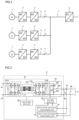
- FIG. 1 is a configuration diagram of a wind power generation system as an example of a system to which a power conversion device according to Embodiment 1 is applied.
- This example is a wind power generation system having three windmills connected in parallel. It is noted that the wind power generation system may have four or more windmills connected in parallel.
- AC power generated by a generator 1 in each windmill is converted into DC power by a corresponding AC-DC conversion device 2, and then the DC power is inputted to a corresponding power conversion device 3 of the present embodiment.
- the power conversion device 3 is a DC-DC conversion device. It is noted that the AC-DC conversion device 2 has a function of converting AC input power into DC power and outputting the DC power. Meanwhile, the DC-DC conversion device has a function of converting a DC input power into a DC power at a different voltage and outputting the DC power.
- a plurality of the power conversion devices 3 are in parallel to one another and connected to a main DC line 7 via respective sub DC lines 6. As shown in FIG. 1 , each sub DC line 6 is provided with a circuit breaker 4. The main DC line 7 is connected to a separate power grid via a large-capacity power conversion device 5. It is noted that, as the system to which the power conversion device of the present embodiment is applied, there are a photovoltaic power generation system, a DC power distribution system that distributes DC power, and the like in addition to the wind power generation system.
- FIG. 2 is a configuration diagram of each power conversion device 3 according to the present embodiment.
- the power conversion device 3 of the present embodiment includes: a DC-DC conversion unit 31; an output terminal 3a from which the DC power obtained through conversion by the DC-DC conversion unit 31 is outputted to the corresponding sub DC line 6; a current interruption unit 32 provided between the DC-DC conversion unit 31 and the output terminal 3a and having a function of interrupting current that flows from the DC-DC conversion unit 31 to the output terminal 3a; a short circuit occurrence determination unit 33 which determines, on the basis of a current value at the sub DC line 6, whether or not a short circuit has occurred at the output terminal 3a; a short circuit elimination determination unit 34 which determines, on the basis of a current value and a voltage value at the sub DC line 6, whether or not the short circuit at the output terminal 3a has been eliminated; and a first gate drive unit 35 which drives a semiconductor switching element of the current interruption unit 32.
- an output terminal 3b is a terminal at a reference potential for DC power to
- the DC-DC conversion unit 31 includes: a first three-phase bridge circuit 311 which converts DC power inputted to a pair of input terminals 3c and 3d into AC power; and a second three-phase bridge circuit 312 which converts, into DC power, the AC power obtained through conversion by the first three-phase bridge circuit 311.
- the first three-phase bridge circuit 311 and the second three-phase bridge circuit 312 are connected to each other via a transformation circuit 313.
- a capacitor 314 and a capacitor 315 are respectively connected to the input side of the first three-phase bridge circuit 311 and the output side of the second three-phase bridge circuit 312.
- the power conversion device 3 further includes a second gate drive unit 36 which drives switching elements in the first three-phase bridge circuit 311 and the second three-phase bridge circuit 312 of the DC-DC conversion unit 31.
- the current interruption unit 32 includes: a semiconductor switching element 321; a diode 322 connected in antiparallel to the semiconductor switching element 321; and a flyback diode 323 connected in series to the semiconductor switching element 321. Further, an inductance element 324 is connected to a connection point between the semiconductor switching element 321 and the flyback diode 323.
- the semiconductor switching element 32 for example, an insulated-gate bipolar transistor (IGBT), a gate commutated turn-off thyristor (GCT), a metal-oxide-semiconductor field-effect transistor (MOSFET), or the like can be used.
- the semiconductor switching element 321 of the current interruption unit 32 is constantly kept in an ON state during a normal operation (during power conversion) of the power conversion device 3. Thus, current constantly flows in the semiconductor switching element 321 during a normal operation. Therefore, a unipolar element such as MOSFET in which voltage drop is small, is suitable as the semiconductor switching element 321. It is noted that, since the current interruption unit 32 is configured with the semiconductor switching element, a switching operation is performed at high speed as compared to the case where the current interruption unit 32 is configured with a mechanical switch.
- the current interruption unit 32 includes the flyback diode 323, current that flows to the inductance element 324 side can be caused to flow back to the flyback diode 323 side when the semiconductor switching element 321 is turned off. As a result, surge voltage to be applied to both ends of the semiconductor switching element 321 is suppressed, and reliability can be improved. Further, since the current interruption unit 32 includes the inductance element 324, increase in short-circuit current that flows until the semiconductor switching element 321 is set to be turned off, can be made moderate. Thus, the short-circuit current can be assuredly interrupted.
- the sub DC line 6 on the output side of the power conversion device 3 is provided with: a current sensor 61 which detects a current at the sub DC line 6; and a voltage sensor 62 which detects a voltage at the sub DC line 6.
- the current value detected by the current sensor 61 is a current value at the output terminal 3a
- the voltage value detected by the voltage sensor 62 is a voltage value at the output terminal 3a.
- the current sensor 61 outputs the detected current value to the short circuit occurrence determination unit 33 and the short circuit elimination determination unit 34.
- the voltage sensor 62 outputs the detected voltage value to the short circuit elimination determination unit 34.
- the short circuit occurrence determination unit 33 determines, on the basis of the information from the current sensor 61, whether or not a short circuit has occurred at the output terminal 3a. Then, if the short circuit occurrence determination unit 33 determines that a short circuit has occurred, the short circuit occurrence determination unit 33 turns off the semiconductor switching element 321 of the current interruption unit 32 via the first gate drive unit 35. By turning off the semiconductor switching element 321 of the current interruption unit 32, current that flows from the DC-DC conversion unit 31 to the output terminal 3a is interrupted. In other words, the power conversion device 3 is stopped.
- the short circuit occurrence determination unit 33 determines that a short circuit has occurred, if the current value detected by the current sensor 61 exceeds a preset overcurrent setting value.
- the overcurrent setting value is set to a value that is larger than a rated current value of the DC-DC conversion unit 31 and smaller than a maximum current value of a reverse bias safe operating area (RBSOA) of the semiconductor switching element 321.
- RSOA reverse bias safe operating area
- the short circuit elimination determination unit 34 determines, on the basis of the information from the current sensor 61 and the information from the voltage sensor 62, whether or not the short circuit at the output terminal 3a has been eliminated. Then, if the short circuit elimination determination unit 34 determines that the short circuit at the output terminal 3a has been eliminated, the short circuit elimination determination unit 34 turns on the semiconductor switching element 321 of the current interruption unit 32 via the first gate drive unit 35.
- the interruption of current that flows from the DC-DC conversion unit 31 to the output terminal 3a is canceled.
- the phrase "the interruption of current is canceled” means that routes for current are connected to each other.
- the short circuit elimination determination unit 34 determines that the short-circuited state has been canceled, if the current value detected by the current sensor 61 is smaller than a preset first current value and the voltage value detected by the voltage sensor 62 is larger than a preset first voltage value.
- the first current value that is set in the short circuit elimination determination unit 34 is set to be, for example, 10 % of a rated current value of the sub DC line 6. Meanwhile, the first voltage value that is set in the short circuit elimination determination unit 34 is set to be, for example, 80 % of a rated voltage value of the sub DC line 6.
- FIG. 3 is a diagram for explaining sneak currents in a wind power generation system according to the present embodiment.
- This example is a wind power generation system having three windmills connected in parallel in the same manner as in FIG. 1 .
- AC-DC conversion devices 2A, 2B, and 2C are respectively connected in series to generators 1A, 1B, and 1C in the windmills, and power conversion devices 3A, 3B, and 3C of the present embodiment are also respectively connected in series to the generators 1A, 1B, and 1C.
- Outputs of the power conversion devices 3A, 3B, and 3C are respectively connected to sub DC lines 6A, 6B, and 6C.
- the sub DC lines 6A, 6B, and 6C are respectively provided with circuit breakers 4A, 4B, and 4C.
- the sub DC lines 6A, 6B, and 6C are in parallel to one another and connected to the main DC line 7.
- the main DC line 7 is connected to a separate power grid via the large-capacity power conversion device 5.
- opening of the circuit breaker 4A makes it possible to electrically separate the power conversion device 3A having experienced the short circuit from the main DC line 7.
- sneak currents flow from the power conversion devices 3B and 3C into the power conversion device 3A during a time from a time point immediately after the power conversion device 3A has experienced the short circuit to a time point at which the circuit breaker 4A is opened.
- the short circuit occurrence determination units 33 of the power conversion devices 3B and 3C determine that the sneak currents flowing through the sub DC lines 6B and 6C are short-circuit currents, and turn off the semiconductor switching elements 321 of the current interruption units 32. Consequently, the sneak currents flowing through the sub DC lines 6B and 6C are interrupted at the current interruption units 32, and thus the circuit breakers 4B and 4C provided to the sub DC lines 6B and 6C are not opened. However, the interruption causes each of the power conversion devices 3B and 3C to be in a stopped state.
- the short circuit elimination determination units 34 of the power conversion devices 3B and 3C determine that the short-circuited states of the sub DC lines 6B and 6C have been canceled, and turn on the semiconductor switching elements 321 of the current interruption units 32 via the first gate drive units 35.
- the power conversion devices 3B and 3C are promptly restarted, and power generated by each of the generators 1B and 1C can be transmitted to the main DC line 7.
- the power conversion devices 3B and 3C do not include any short circuit elimination determination units, is as follows.
- the power conversion devices 3B and 3C can interrupt sneak currents by means of the short circuit occurrence determination units. As a result, unnecessary opening of the circuit breakers 4B and 4C provided to the sub DC lines 6B and 6C can be prevented.
- the power conversion devices including the short circuit elimination determination units as described above, even when one power conversion device among the plurality of power conversion devices connected in parallel experiences a short circuit, the other power conversion devices having experienced no short circuit can be promptly restarted.
- FIG. 4 is a configuration diagram of the first gate drive unit 35.
- the first gate drive unit 35 receives signals from the short circuit occurrence determination unit 33 and the short circuit elimination determination unit 34. If the short circuit occurrence determination unit 33 determines that a short circuit has occurred, the first gate drive unit 35 receives an OFF signal. Meanwhile, if the short circuit elimination determination unit 34 determines that the short circuit has been eliminated, the first gate drive unit 35 receives an ON signal.
- the semiconductor switching element 321 of the current interruption unit 32 is driven by the first gate drive unit 35.
- the semiconductor switching element 321 is constantly kept in an ON state during a normal operation (during power conversion).
- a gate resistance value 351 intrinsic to the first gate drive unit 35 is set to be large, increase in switching loss is not caused. Therefore, if the gate resistance value 351 intrinsic to the first gate drive unit 35 is set to be larger than a gate resistance value intrinsic to the second gate drive unit 36, surge voltage at the time of turning off can be suppressed, and reliability can be improved.
- the short circuit occurrence determination unit 33 determines, on the basis of a current value at the sub DC line 6 detected by the current sensor 61, whether or not a short circuit has occurred, and turns off the semiconductor switching element 321 of the current interruption unit 32 via the first gate drive unit 35. At this time, a delay occurs among the current sensor 61, the short circuit occurrence determination unit 33, the first gate drive unit 35, and the current interruption unit 32.
- the semiconductor switching element 321 cannot be promptly turned off upon occurrence of a short circuit.
- the time from a time point at which the short circuit has occurred to a time point at which the semiconductor switching element 321 is turned off, is referred to as a delay time.
- Sneak current increases during the delay time.
- V the voltage at the sub DC line 6
- L the inductance value of the inductance element 324 of the current interruption unit 32
- T the delay time
- the semiconductor switching element 321 can be prevented from being damaged. L ⁇ V / Imax ⁇ Ioc ⁇ T
- the voltage V at the sub DC line 6 is assumed to be 200 V
- the maximum current value Imax of the reverse bias safe operating area (RBSOA) of the semiconductor switching element 321 is assumed to be 800 A
- the overcurrent setting value Ioc is assumed to be 600 A
- the delay time T is assumed to be 50 ⁇ s
- the inductance value L of the inductance element 324 only has to be equal to or larger than 50 ⁇ H.
- the semiconductor switching element can be prevented from being damaged even when short-circuit current flows in the power conversion device.
- each power conversion device of the present embodiment includes the three-phase bridge circuits for the power conversion unit, another power conversion unit may be used as long as the power conversion unit outputs DC power.
- the overcurrent setting value that is set in the short circuit occurrence determination unit is set to a value that is smaller than a breaking current setting value of the circuit breaker provided to the sub DC line to which the power conversion device is connected. If the overcurrent setting value is set to a value that is smaller than the breaking current setting value of the circuit breaker, when sneak current flows, the current interruption unit is operated before the circuit breaker is operated. Thus, the sub DC line can be assuredly prevented from being disconnected by the circuit breaker.
- FIG. 5 is a configuration diagram of a wind power generation system as an example of a system to which a power conversion device according to Embodiment 2 is applied.
- This example is a wind power generation system having the three windmills connected in parallel.
- AC power generated by each of the generators 1 in the windmills is inputted to a corresponding power conversion device 13 of the present embodiment.
- Each power conversion device 13 of the present embodiment is an AC-DC conversion device.
- the power conversion device 13 converts the AC power into DC power.
- the three power conversion devices 13 are in parallel to one another and connected to the main DC line 7 via the sub DC lines 6. As shown in FIG. 5 , each sub DC line 6 may be provided with the corresponding circuit breaker 4.
- the main DC line 7 is connected to a separate power grid via the large-capacity power conversion device 5.
- FIG. 6 is a configuration diagram of each power conversion device 13 according to the present embodiment.
- the power conversion device 13 of the present embodiment includes: an AC-DC conversion unit 37; the output terminal 3a from which the DC power obtained through conversion by the AC-DC conversion unit 37 is outputted to the corresponding sub DC line 6; the current interruption unit 32 provided between the AC-DC conversion unit 37 and the output terminal 3a and having a function of interrupting current that flows from the AC-DC conversion unit 37 to the output terminal 3a; the short circuit occurrence determination unit 33 which determines, on the basis of a current value at the sub DC line 6, whether or not a short circuit has occurred at the output terminal 3a; the short circuit elimination determination unit 34 which determines, on the basis of a current value and a voltage value at the sub DC line 6, whether or not the short circuit at the output terminal 3a has been eliminated; and the first gate drive unit 35 which drives the semiconductor switching element of the current interruption unit 32.
- the output terminal 3b is a terminal at a reference potential for DC power to be outputted to the output
- the AC-DC conversion unit 37 includes a two-level three-phase bridge circuit 372 which converts, into DC power, three-phase AC power inputted to three input terminals 3c, 3d, and 3e.
- a capacitor 375 is connected to the output side of the three-phase bridge circuit 372.
- the power conversion device 13 further includes the second gate drive unit 36 which drives switching elements of the three-phase bridge circuit 372 of the AC-DC conversion unit 37.
- the sub DC line 6 on the output side of the power conversion device 13 is provided with: the current sensor 61 which detects a current at the sub DC line 6; and the voltage sensor 62 which detects a voltage at the sub DC line 6.
- the current sensor 61 outputs the detected current value to the short circuit occurrence determination unit 33 and the short circuit elimination determination unit 34.
- the voltage sensor 62 outputs the detected voltage value to the short circuit elimination determination unit 34.
- the short circuit occurrence determination unit 33 determines, on the basis of the information from the current sensor 61, whether or not a short circuit has occurred at the output terminal 3a. Then, if the short circuit occurrence determination unit 33 determines that a short circuit has occurred, the short circuit occurrence determination unit 33 turns off the semiconductor switching element 321 of the current interruption unit 32 via the first gate drive unit 35. By turning off the semiconductor switching element 321 of the current interruption unit 32, current that flows from the AC-DC conversion unit 37 to the output terminal 3a is interrupted. In other words, the power conversion device 13 is stopped.
- the short circuit occurrence determination unit 33 determines that a short circuit has occurred, if the current value detected by the current sensor 61 exceeds a preset overcurrent setting value.
- the overcurrent setting value is set to a value that is larger than a rated current value of the AC-DC conversion unit 37 and smaller than the maximum current value of the reverse bias safe operating area (RBSOA) of the semiconductor switching element 321.
- the short circuit elimination determination unit 34 determines, on the basis of the information from the current sensor 61 and the information from the voltage sensor 62, whether or not the short circuit at the output terminal 3a has been eliminated.
- the short circuit elimination determination unit 34 determines that the short circuit at the output terminal 3a has been eliminated, the short circuit elimination determination unit 34 turns on the semiconductor switching element 321 of the current interruption unit 32 via the first gate drive unit 35. By turning on the semiconductor switching element 321 of the current interruption unit 32, the interruption of current that flows from the AC-DC conversion unit 37 to the output terminal 3a is canceled.
- the short circuit elimination determination unit 34 determines that the short-circuited state has been canceled, if the current value detected by the current sensor 61 is smaller than a preset first current value and the voltage value detected by the voltage sensor 62 is larger than a preset first voltage value.
- the first current value that is set in the short circuit elimination determination unit 34 is set to be, for example, 10 % of the rated current value of the sub DC line 6. Meanwhile, the first voltage value that is set in the short circuit elimination determination unit 34 is set to be, for example, 80 % of the rated voltage value of the sub DC line 6.
- the power conversion device 13 having experienced the short circuit includes the current interruption unit 32 and the short circuit occurrence determination unit 33, and thus can interrupt the short-circuit current.
- the circuit breaker 4 connected to the said power conversion device 13 is opened. The opening of the circuit breaker 4 leads to electrical separation of the power conversion device 13 having experienced the short circuit from the main DC line 7.
- sneak currents flow from the other two power conversion devices into the one power conversion device during a time from a time point immediately after the one power conversion device has experienced the short circuit to a time point at which the circuit breaker 4 is opened.
- the short circuit occurrence determination units 33 of the other two power conversion devices determine that the sneak currents flowing through the sub DC lines 6 are short-circuit currents, and turn off the semiconductor switching elements 321 of the current interruption units 32. Therefore, the other two power conversion devices having experienced no short circuit are each in a stopped state.
- the short circuit elimination determination units 34 of the other two power conversion devices determine that the short circuits at the output terminals 3a have been eliminated, and turn on the semiconductor switching elements 321 of the current interruption units 32 via the first gate drive units 35.
- the other two power conversion devices are promptly restarted, and power generated by each of the generators can be transmitted to the main DC line 7.
- the power conversion devices of the present embodiment in this manner, the loss of the opportunity of power generation due to short-circuit failure or the like can be reduced to minimum in the wind power generation system.
- the gate resistance value intrinsic to the first gate drive unit 35 is set to be larger than the gate resistance value intrinsic to the second gate drive unit 36, surge voltage at the time of turning off can be suppressed and reliability can be improved, in the same manner as in Embodiment 1.
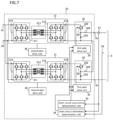
- FIG. 7 is a configuration diagram of a power conversion device 23 according to Embodiment 3.
- the power conversion device 23 of the present embodiment is a power conversion device used for a wind power generation system or the like, as the power conversion device shown in FIG. 1 for Embodiment 1 is.
- the power conversion device 23 of the present embodiment is a DC-DC conversion device, as the power conversion device of Embodiment 1 is.
- two DC-DC conversion units 31 and two current interruption units 32 are connected in series for the purpose of increasing output voltage.
- First gate drive units 35 are respectively connected to the two current interruption units 32.
- second gate drive units 36 are respectively connected to the two DC-DC conversion units 31.
- the power conversion device 23 of the present embodiment further includes: the short circuit occurrence determination unit 33 which determines, on the basis of a current value at the sub DC line 6, whether or not a short circuit has occurred at the output terminal 3a; and the short circuit elimination determination unit 34 which determines, on the basis of a current value and a voltage value at the sub DC line 6, whether or not the short circuit at the output terminal 3a has been eliminated.
- each DC-DC conversion unit 31 the configurations of each DC-DC conversion unit 31, each current interruption unit 32, the short circuit occurrence determination unit 33, the short circuit elimination determination unit 34, each first gate drive unit 35, and each second gate drive unit 36 are the same as those in Embodiment 1. It is noted that, although the two DC-DC conversion units 31 and the two current interruption units 32 are connected in series in the power conversion device shown in FIG. 7 , three or more DC-DC conversion units and three or more current interruption units may be connected in series.
- the sub DC line 6 on the output side of the power conversion device 23 is provided with: the current sensor 61 which detects a current at the sub DC line 6; and the voltage sensor 62 which detects a voltage at the sub DC line 6.
- the current sensor 61 outputs the detected current value to the short circuit occurrence determination unit 33 and the short circuit elimination determination unit 34.
- the voltage sensor 62 outputs the detected voltage value to the short circuit elimination determination unit 34.
- the short circuit occurrence determination unit 33 determines, on the basis of the information from the current sensor 61, whether or not a short circuit has occurred at the output terminal 3a. Then, if the short circuit occurrence determination unit 33 determines that a short circuit has occurred, the short circuit occurrence determination unit 33 turns off semiconductor switching elements 321 of the two current interruption units 32 via the first gate drive units 35. By turning off the semiconductor switching elements 321 of the current interruption units 32, currents that flow from the two DC-DC conversion units 31 to the output terminal 3a are interrupted. In other words, the power conversion device 23 is stopped.
- the short circuit occurrence determination unit 33 determines that a short circuit has occurred, if the current value detected by the current sensor 61 exceeds a preset overcurrent setting value.
- the overcurrent setting value is set to a value that is larger than rated current values of the DC-DC conversion units 31 and smaller than maximum current values of reverse bias safe operating areas (RBSOAs) of the semiconductor switching elements 321.
- the short circuit elimination determination unit 34 determines, on the basis of the information from the current sensor 61 and the information from the voltage sensor 62, whether or not the short circuit at the output terminal 3a has been eliminated. Then, if the short circuit elimination determination unit 34 determines that the short circuit at the output terminal 3a has been eliminated, the short circuit elimination determination unit 34 turns on the semiconductor switching elements 321 of the two current interruption units 32 via the first gate drive units 35.
- the short circuit elimination determination unit 34 determines that the short-circuited state has been canceled, if the current value detected by the current sensor 61 is smaller than a preset first current value and the voltage value detected by the voltage sensor 62 is larger than a preset first voltage value.
- the first current value that is set in the short circuit elimination determination unit 34 is set to be, for example, 10 % of the rated current value of the sub DC line 6. Meanwhile, the first voltage value that is set in the short circuit elimination determination unit 34 is set to be, for example, 80 % of the rated voltage value of the sub DC line 6.
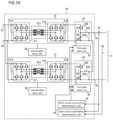
- FIG. 8 is a configuration diagram of another power conversion device 23 according to the present embodiment.
- the two current interruption units 32 include respective inductance elements 324.
- the two inductance elements 324 are connected in series.
- one inductance element 325 may be provided, instead of the two inductance elements, between the output terminal 3a and the current interruption unit 32 that is located closer to the output terminal 3a. If the number of inductance elements is reduced in this manner, the size of the power conversion device is reduced. It is noted that the position of the one inductance element 325 may be any position on a current route connected to the output terminal 3a.
- FIG. 9 is a configuration diagram of a power conversion device 43 according to Embodiment 4.
- the power conversion device 43 of the present embodiment is a power conversion device used for a wind power generation system or the like, as the power conversion device shown in FIG. 1 for Embodiment 1 is.
- the power conversion device 43 of the present embodiment is obtained by providing, in the power conversion device of Embodiment 3, bypass switches 326 in parallel to the flyback diodes 323 of the current interruption units 32.
- the bypass switches 326 are constantly kept in opened states during a normal operation (during power conversion) of the power conversion device 43. Each bypass switch 326 is closed upon detection of: a failure of the current interruption unit 32 including the said bypass switch 326; or a failure of the DC-DC conversion unit 31 connected to the input side of the said current interruption unit 32. By closing the bypass switch 326, a current route bypassing the failed DC-DC conversion unit 31 or the failed current interruption unit 32 is formed. Consequently, the operation of the power conversion device 43 can be continued with the other DC-DC conversion unit 31 and the other current interruption unit 32 capable of normal operations.
- the sub DC line 6 on the output side of the power conversion device 43 is provided with: the current sensor 61 which detects a current at the sub DC line 6; and the voltage sensor 62 which detects a voltage at the sub DC line 6.
- the current sensor 61 outputs the detected current value to the short circuit occurrence determination unit 33 and the short circuit elimination determination unit 34.
- the voltage sensor 62 outputs the detected voltage value to the short circuit elimination determination unit 34.
- the short circuit occurrence determination unit 33 determines, on the basis of the information from the current sensor 61, whether or not a short circuit has occurred at the output terminal 3a. Then, if the short circuit occurrence determination unit 33 determines that a short circuit has occurred, the short circuit occurrence determination unit 33 turns off the semiconductor switching elements 321 of the two current interruption units 32 via the first gate drive units 35. By turning off the semiconductor switching elements 321 of the current interruption units 32, currents that flow from the two DC-DC conversion units 31 to the output terminal 3a are interrupted. In other words, the power conversion device 43 is stopped.
- the short circuit occurrence determination unit 33 determines that a short circuit has occurred, if the current value detected by the current sensor 61 exceeds a preset overcurrent setting value.
- the overcurrent setting value is set to a value that is larger than the rated current values of the DC-DC conversion units 31 and smaller than the maximum current values of the reverse bias safe operating areas (RBSOAs) of the semiconductor switching elements 321.
- the short circuit elimination determination unit 34 determines, on the basis of the information from the current sensor 61 and the information from the voltage sensor 62, whether or not the short circuit at the output terminal 3a has been eliminated. Then, if the short circuit elimination determination unit 34 determines that the short circuit at the output terminal 3a has been eliminated, the short circuit elimination determination unit 34 turns on the semiconductor switching elements 321 of the two current interruption units 32 via the first gate drive units 35.
- the short circuit elimination determination unit 34 determines that the short-circuited state has been canceled, if the current value detected by the current sensor 61 is smaller than a preset first current value and the voltage value detected by the voltage sensor 62 is larger than a preset first voltage value.
- the first current value that is set in the short circuit elimination determination unit 34 is set to be, for example, 10 % of the rated current value of the sub DC line 6. Meanwhile, the first voltage value that is set in the short circuit elimination determination unit 34 is set to be, for example, 80 % of the rated voltage value of the sub DC line 6.
- each power conversion device of the present embodiment includes the bypass switches in parallel to the flyback diodes of the current interruption units, even if one of the DC-DC conversion units or one of the current interruption units fails, the operation can be continued with the other DC-DC conversion unit and the other current interruption unit capable of normal operations.
- the power conversion device of the present embodiment may be a power conversion device including the one inductance element 325 shown in FIG. 8 for Embodiment 3.
- FIG. 10 is a configuration diagram of another power conversion device 43 according to the present embodiment.
- the bypass switches 326 may be connected in parallel to the flyback diodes 323 with the inductance elements 324 interposed therebetween.
- the power conversion device 43 having such a configuration even if either of the bypass switches 326 is closed when the semiconductor switching element 321 of the corresponding current interruption unit 32 has failed in a short-circuited state, discharge current from the capacitor 315 of the corresponding DC-DC conversion unit 31 flows through the bypass switch 326 via the inductance element 324. Therefore, abrupt increase in the discharge current from the capacitor 315 can be inhibited.
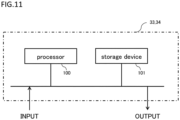
- each of the short circuit occurrence determination units 33 and the short circuit elimination determination units 34 in the power conversion devices according to embodiments 1 to 4 may be composed of a processor 100 and a storage device 101 as shown in FIG. 11 which shows an example of hardware.
- the storage device 101 includes a volatile storage device such as a random access memory and a nonvolatile auxiliary storage device such as a flash memory.
- the storage device 101 may include, as the auxiliary storage device, a hard disk instead of a flash memory.
- the processor 100 executes a program inputted from the storage device 101.
- the program is inputted from the auxiliary storage device via the volatile storage device to the processor 100.
- the processor 100 may output data such as a calculation result to the volatile storage device of the storage device 101 or save the data to the auxiliary storage device via the volatile storage device.
Landscapes
- Engineering & Computer Science (AREA)
- Power Engineering (AREA)
- Protection Of Static Devices (AREA)
- Inverter Devices (AREA)
- Emergency Protection Circuit Devices (AREA)
- Direct Current Feeding And Distribution (AREA)
- Dc-Dc Converters (AREA)
Description
- The present invention relates to a power conversion device.
- There have been known power conversion devices such as: AC-DC conversion devices for converting AC input power into DC power and outputting the DC power; and DC-DC conversion devices for converting a DC input power into a DC power at a different voltage and outputting the DC power. In such power conversion devices, if an output terminal is short-circuited for some reason, excessive short-circuit current flows. The excessive short-circuit current causes failure of the power conversion device.
- As a power conversion device capable of preventing short-circuit current from flowing, there is a power conversion device including a short-circuit current interruption unit that is composed of a semiconductor switching element and a diode. In this power conversion device, if the value of output current exceeds a preset threshold value, the semiconductor switching element of the short-circuit current interruption unit is turned off so that short-circuit current is interrupted (see, for example, Patent Document 1).
-
US 2003 141 856 A1 relates to a switching power supply circuit, and more particularly, to a switching power supply circuit having an overcurrent detecting function and an output short circuit detecting function. -
US 2013 207 633 A1 relates to a switching regulator for outputting a constant voltage, and more particularly, to a switching regulator including a short-circuit detection circuit. -
WO 2018 225 410 A1 relates to a power conversion device and a three-phase power conversion device. -
US 2017 063 283 A1 relates to a motor driving apparatus for driving a feed axis and a main axis of a machine tool or arms and the like of an industrial machine and an industrial robot. -
US 2017 126 010 A1 relates to a converter system, a superior converter system, a renewable energy power station, as well as to a method and a controller for operating the converter system and superior converter system. - Patent Document 1:
Japanese Laid-open Patent Publication (translation of PCT application)JP 2016-537960 A - Wind power generation systems, photovoltaic power generation systems, or the like have a plurality of windmills or a plurality of solar cell modules connected in parallel. In such a system, DC power is transmitted, and sub DC lines are in parallel to one another and connected to a main DC line serving as a main route for power transmission. The windmills or the solar cell modules are disposed on the sub DC lines. A power conversion device for converting power generated by each windmill or each solar cell module into DC power suitable for power transmission, is connected to the corresponding sub DC line.
- If one power conversion device among a plurality of the power conversion devices connected in parallel experiences a short circuit, excessive current flows from the other power conversion devices having experienced no short circuit into the power conversion device having experienced the short circuit. This current is called sneak current. In the case of using conventional power conversion devices including short-circuit current interruption units, in a power conversion device thereamong having experienced a short circuit, the short-circuit current interruption unit thereof is operated so that short-circuit current can be interrupted.
- However, also in the other power conversion devices having experienced no short circuit, the short-circuit current interruption units thereof are operated in response to excessive sneak currents so that current routes are disconnected. As a result, the other power conversion devices having experienced no short circuit are also stopped, and thus a problem arises in that the entire system is stopped for a long time.
- The present invention, which is defined by
independent claim 1, has been made to solve the above problem. In the present invention, even when one power conversion device among a plurality of power conversion devices connected in parallel experiences a short circuit, the other power conversion devices having experienced no short circuit can be promptly restarted. - According to the invention, the problem is solved by the subject matter outlined in
independent claim 1. Advantageous further developments of the invention are set forth in the dependent claims. - The power conversion device according to the present invention includes the short circuit elimination determination unit configured to determine whether or not the short circuit at the output terminal has been eliminated. Thus, even when one power conversion device among a plurality of the power conversion devices connected in parallel experiences a short circuit, the other power conversion devices having experienced no short circuit can be promptly restarted.
-
- FIG. 1
- is a configuration diagram of a wind power generation system according to
Embodiment 1. - FIG. 2
- is a configuration diagram of a power conversion device according to
Embodiment 1. - FIG. 3
- is a diagram for explaining sneak currents in the wind power generation system according to
Embodiment 1. - FIG. 4
- is a configuration diagram of a first gate drive unit in
Embodiment 1. - FIG. 5
- is a configuration diagram of a wind power generation system according to
Embodiment 2. - FIG. 6
- is a configuration diagram of a power conversion device according to
Embodiment 2. - FIG. 7
- is a configuration diagram of a power conversion device according to
Embodiment 3. - FIG. 8
- is a configuration diagram of a power conversion device according to
Embodiment 3. - FIG. 9
- is a configuration diagram of a power conversion device according to
Embodiment 4. - FIG. 10
- is a configuration diagram of a power conversion device according to
Embodiment 4. - FIG. 11
- is a schematic diagram showing an example of hardware of each of short circuit occurrence determination units and short circuit elimination determination units in
embodiments 1 to 4. - Hereinafter, power conversion devices according to embodiments for carrying out the present invention will be described in detail with reference to the drawings. The same or corresponding portions in the drawings are denoted by the same reference characters.
-
FIG. 1 is a configuration diagram of a wind power generation system as an example of a system to which a power conversion device according toEmbodiment 1 is applied. This example is a wind power generation system having three windmills connected in parallel. It is noted that the wind power generation system may have four or more windmills connected in parallel. In the wind power generation system, AC power generated by agenerator 1 in each windmill is converted into DC power by a corresponding AC-DC conversion device 2, and then the DC power is inputted to a correspondingpower conversion device 3 of the present embodiment. - The
power conversion device 3 is a DC-DC conversion device. It is noted that the AC-DC conversion device 2 has a function of converting AC input power into DC power and outputting the DC power. Meanwhile, the DC-DC conversion device has a function of converting a DC input power into a DC power at a different voltage and outputting the DC power. - A plurality of the
power conversion devices 3 are in parallel to one another and connected to amain DC line 7 via respective sub DC lines 6. As shown inFIG. 1 , eachsub DC line 6 is provided with acircuit breaker 4. Themain DC line 7 is connected to a separate power grid via a large-capacitypower conversion device 5. It is noted that, as the system to which the power conversion device of the present embodiment is applied, there are a photovoltaic power generation system, a DC power distribution system that distributes DC power, and the like in addition to the wind power generation system. -
FIG. 2 is a configuration diagram of eachpower conversion device 3 according to the present embodiment. Thepower conversion device 3 of the present embodiment includes: a DC-DC conversion unit 31; anoutput terminal 3a from which the DC power obtained through conversion by the DC-DC conversion unit 31 is outputted to the correspondingsub DC line 6; acurrent interruption unit 32 provided between the DC-DC conversion unit 31 and theoutput terminal 3a and having a function of interrupting current that flows from the DC-DC conversion unit 31 to theoutput terminal 3a; a short circuitoccurrence determination unit 33 which determines, on the basis of a current value at thesub DC line 6, whether or not a short circuit has occurred at theoutput terminal 3a; a short circuitelimination determination unit 34 which determines, on the basis of a current value and a voltage value at thesub DC line 6, whether or not the short circuit at theoutput terminal 3a has been eliminated; and a firstgate drive unit 35 which drives a semiconductor switching element of thecurrent interruption unit 32. It is noted that anoutput terminal 3b is a terminal at a reference potential for DC power to be outputted to theoutput terminal 3a. - The DC-
DC conversion unit 31 includes: a first three-phase bridge circuit 311 which converts DC power inputted to a pair ofinput terminals phase bridge circuit 312 which converts, into DC power, the AC power obtained through conversion by the first three-phase bridge circuit 311. - The first three-
phase bridge circuit 311 and the second three-phase bridge circuit 312 are connected to each other via atransformation circuit 313. Acapacitor 314 and acapacitor 315 are respectively connected to the input side of the first three-phase bridge circuit 311 and the output side of the second three-phase bridge circuit 312. Thepower conversion device 3 further includes a secondgate drive unit 36 which drives switching elements in the first three-phase bridge circuit 311 and the second three-phase bridge circuit 312 of the DC-DC conversion unit 31. - The
current interruption unit 32 includes: asemiconductor switching element 321; adiode 322 connected in antiparallel to thesemiconductor switching element 321; and aflyback diode 323 connected in series to thesemiconductor switching element 321. Further, aninductance element 324 is connected to a connection point between thesemiconductor switching element 321 and theflyback diode 323. As thesemiconductor switching element 321, for example, an insulated-gate bipolar transistor (IGBT), a gate commutated turn-off thyristor (GCT), a metal-oxide-semiconductor field-effect transistor (MOSFET), or the like can be used. - The
semiconductor switching element 321 of thecurrent interruption unit 32 is constantly kept in an ON state during a normal operation (during power conversion) of thepower conversion device 3. Thus, current constantly flows in thesemiconductor switching element 321 during a normal operation. Therefore, a unipolar element such as MOSFET in which voltage drop is small, is suitable as thesemiconductor switching element 321. It is noted that, since thecurrent interruption unit 32 is configured with the semiconductor switching element, a switching operation is performed at high speed as compared to the case where thecurrent interruption unit 32 is configured with a mechanical switch. - In addition, since the
current interruption unit 32 includes theflyback diode 323, current that flows to theinductance element 324 side can be caused to flow back to theflyback diode 323 side when thesemiconductor switching element 321 is turned off. As a result, surge voltage to be applied to both ends of thesemiconductor switching element 321 is suppressed, and reliability can be improved. Further, since thecurrent interruption unit 32 includes theinductance element 324, increase in short-circuit current that flows until thesemiconductor switching element 321 is set to be turned off, can be made moderate. Thus, the short-circuit current can be assuredly interrupted. - The
sub DC line 6 on the output side of thepower conversion device 3 is provided with: acurrent sensor 61 which detects a current at thesub DC line 6; and avoltage sensor 62 which detects a voltage at thesub DC line 6. Specifically, the current value detected by thecurrent sensor 61 is a current value at theoutput terminal 3a, and the voltage value detected by thevoltage sensor 62 is a voltage value at theoutput terminal 3a. Thecurrent sensor 61 outputs the detected current value to the short circuitoccurrence determination unit 33 and the short circuitelimination determination unit 34. Thevoltage sensor 62 outputs the detected voltage value to the short circuitelimination determination unit 34. - The short circuit
occurrence determination unit 33 determines, on the basis of the information from thecurrent sensor 61, whether or not a short circuit has occurred at theoutput terminal 3a. Then, if the short circuitoccurrence determination unit 33 determines that a short circuit has occurred, the short circuitoccurrence determination unit 33 turns off thesemiconductor switching element 321 of thecurrent interruption unit 32 via the firstgate drive unit 35. By turning off thesemiconductor switching element 321 of thecurrent interruption unit 32, current that flows from the DC-DC conversion unit 31 to theoutput terminal 3a is interrupted. In other words, thepower conversion device 3 is stopped. - The short circuit
occurrence determination unit 33 determines that a short circuit has occurred, if the current value detected by thecurrent sensor 61 exceeds a preset overcurrent setting value. The overcurrent setting value is set to a value that is larger than a rated current value of the DC-DC conversion unit 31 and smaller than a maximum current value of a reverse bias safe operating area (RBSOA) of thesemiconductor switching element 321. By setting the overcurrent setting value to a value that is smaller than the maximum current value of the reverse bias safe operating area, failure of thesemiconductor switching element 321 can be prevented. - The short circuit
elimination determination unit 34 determines, on the basis of the information from thecurrent sensor 61 and the information from thevoltage sensor 62, whether or not the short circuit at theoutput terminal 3a has been eliminated. Then, if the short circuitelimination determination unit 34 determines that the short circuit at theoutput terminal 3a has been eliminated, the short circuitelimination determination unit 34 turns on thesemiconductor switching element 321 of thecurrent interruption unit 32 via the firstgate drive unit 35. - By turning on the
semiconductor switching element 321 of thecurrent interruption unit 32, the interruption of current that flows from the DC-DC conversion unit 31 to theoutput terminal 3a is canceled. It is noted that the phrase "the interruption of current is canceled" means that routes for current are connected to each other. By canceling the interruption of current at thecurrent interruption unit 32, the DC power obtained through conversion by the DC-DC conversion unit 31 is outputted to thesub DC line 6. In other words, thepower conversion device 3 is restarted. - The short circuit
elimination determination unit 34 determines that the short-circuited state has been canceled, if the current value detected by thecurrent sensor 61 is smaller than a preset first current value and the voltage value detected by thevoltage sensor 62 is larger than a preset first voltage value. - The first current value that is set in the short circuit
elimination determination unit 34 is set to be, for example, 10 % of a rated current value of thesub DC line 6. Meanwhile, the first voltage value that is set in the short circuitelimination determination unit 34 is set to be, for example, 80 % of a rated voltage value of thesub DC line 6. By setting to the above values, determination as to whether or not the short-circuited state has been canceled can be promptly made. - Next, operations of the
power conversion device 3 of the present embodiment will be described. -
FIG. 3 is a diagram for explaining sneak currents in a wind power generation system according to the present embodiment. This example is a wind power generation system having three windmills connected in parallel in the same manner as inFIG. 1 . AC-DC conversion devices generators power conversion devices 3A, 3B, and 3C of the present embodiment are also respectively connected in series to thegenerators - Outputs of the
power conversion devices 3A, 3B, and 3C are respectively connected to subDC lines sub DC lines circuit breakers sub DC lines main DC line 7. Themain DC line 7 is connected to a separate power grid via the large-capacitypower conversion device 5. - It is assumed that, as shown in
FIG. 3 , the power conversion device 3A has failed and experienced a short circuit. When the power conversion device 3A experiences a short circuit, excessive short-circuit currents (sneak currents) flow from the large-capacitypower conversion device 5 and the otherpower conversion devices 3B and 3C toward the power conversion device 3A. InFIG. 3 , the broken arrows indicate the sneak currents. In addition, the flows of the excessive sneak currents lead also to reduction in voltages of themain DC line 7 and thesub DC lines - Since the only device that has failed is the power conversion device 3A, opening of the
circuit breaker 4A makes it possible to electrically separate the power conversion device 3A having experienced the short circuit from themain DC line 7. However, sneak currents flow from thepower conversion devices 3B and 3C into the power conversion device 3A during a time from a time point immediately after the power conversion device 3A has experienced the short circuit to a time point at which thecircuit breaker 4A is opened. - At this time, the short circuit
occurrence determination units 33 of thepower conversion devices 3B and 3C determine that the sneak currents flowing through thesub DC lines semiconductor switching elements 321 of thecurrent interruption units 32. Consequently, the sneak currents flowing through thesub DC lines current interruption units 32, and thus thecircuit breakers sub DC lines power conversion devices 3B and 3C to be in a stopped state. - After the power conversion device 3A is electrically separated from the
main DC line 7 by opening thecircuit breaker 4A, currents and voltages at themain DC line 7 and thesub DC lines main DC line 7 and the current values at thesub DC lines main DC line 7 and the voltage values at thesub DC lines - At this time, the short circuit
elimination determination units 34 of thepower conversion devices 3B and 3C determine that the short-circuited states of thesub DC lines semiconductor switching elements 321 of thecurrent interruption units 32 via the firstgate drive units 35. As a result, thepower conversion devices 3B and 3C are promptly restarted, and power generated by each of thegenerators 1B and 1C can be transmitted to themain DC line 7. By using the power conversion devices of the present embodiment in this manner, the period during which power cannot be generated owing to short-circuit failure or the like (hereinafter, written as loss of the opportunity of power generation) can be reduced to minimum in the wind power generation system. - Meanwhile, a case where the
power conversion devices 3B and 3C do not include any short circuit elimination determination units, is as follows. Thepower conversion devices 3B and 3C can interrupt sneak currents by means of the short circuit occurrence determination units. As a result, unnecessary opening of thecircuit breakers sub DC lines - However, in each of the
power conversion devices 3B and 3C in which short-circuit currents have been interrupted, the semiconductor switching element of the current interruption unit is kept in an OFF state even though a normal operation can be performed. As a result, thepower conversion devices 3B and 3C are not restarted, and thus power generated by each of thegenerators 1B and 1C cannot be transmitted to themain DC line 7. Therefore, the loss of the opportunity of power generation becomes large. - By using the power conversion devices including the short circuit elimination determination units as described above, even when one power conversion device among the plurality of power conversion devices connected in parallel experiences a short circuit, the other power conversion devices having experienced no short circuit can be promptly restarted.
-
FIG. 4 is a configuration diagram of the firstgate drive unit 35. The firstgate drive unit 35 receives signals from the short circuitoccurrence determination unit 33 and the short circuitelimination determination unit 34. If the short circuitoccurrence determination unit 33 determines that a short circuit has occurred, the firstgate drive unit 35 receives an OFF signal. Meanwhile, if the short circuitelimination determination unit 34 determines that the short circuit has been eliminated, the firstgate drive unit 35 receives an ON signal. - As shown in
FIG. 4 , thesemiconductor switching element 321 of thecurrent interruption unit 32 is driven by the firstgate drive unit 35. Thesemiconductor switching element 321 is constantly kept in an ON state during a normal operation (during power conversion). Thus, even if agate resistance value 351 intrinsic to the firstgate drive unit 35 is set to be large, increase in switching loss is not caused. Therefore, if thegate resistance value 351 intrinsic to the firstgate drive unit 35 is set to be larger than a gate resistance value intrinsic to the secondgate drive unit 36, surge voltage at the time of turning off can be suppressed, and reliability can be improved. - In the power conversion device of the present embodiment, the short circuit
occurrence determination unit 33 determines, on the basis of a current value at thesub DC line 6 detected by thecurrent sensor 61, whether or not a short circuit has occurred, and turns off thesemiconductor switching element 321 of thecurrent interruption unit 32 via the firstgate drive unit 35. At this time, a delay occurs among thecurrent sensor 61, the short circuitoccurrence determination unit 33, the firstgate drive unit 35, and thecurrent interruption unit 32. - Therefore, the
semiconductor switching element 321 cannot be promptly turned off upon occurrence of a short circuit. The time from a time point at which the short circuit has occurred to a time point at which thesemiconductor switching element 321 is turned off, is referred to as a delay time. Sneak current increases during the delay time. If the voltage at thesub DC line 6 is defined as V, the inductance value of theinductance element 324 of thecurrent interruption unit 32 is defined as L, and the delay time is defined as T, the amount ΔI of increase in sneak current can be expressed with the following expression (1).
- If the overcurrent setting value that is set in the short circuit
occurrence determination unit 33 is defined as Ioc and the maximum current value of the reverse bias safe operating area (RBSOA) of thesemiconductor switching element 321 is defined as Imax, when the inductance value L of theinductance element 324 is set so as to satisfy the following expression (2), thesemiconductor switching element 321 can be prevented from being damaged.
- For example, if the voltage V at the
sub DC line 6 is assumed to be 200 V, the maximum current value Imax of the reverse bias safe operating area (RBSOA) of thesemiconductor switching element 321 is assumed to be 800 A, the overcurrent setting value Ioc is assumed to be 600 A, and the delay time T is assumed to be 50 µs, the inductance value L of theinductance element 324 only has to be equal to or larger than 50 µH. - By using a power conversion device in which setting has been made as described above, the semiconductor switching element can be prevented from being damaged even when short-circuit current flows in the power conversion device.
- It is noted that, although an example has been described in which each power conversion device of the present embodiment includes the three-phase bridge circuits for the power conversion unit, another power conversion unit may be used as long as the power conversion unit outputs DC power.
- It is desirable that the overcurrent setting value that is set in the short circuit occurrence determination unit is set to a value that is smaller than a breaking current setting value of the circuit breaker provided to the sub DC line to which the power conversion device is connected. If the overcurrent setting value is set to a value that is smaller than the breaking current setting value of the circuit breaker, when sneak current flows, the current interruption unit is operated before the circuit breaker is operated. Thus, the sub DC line can be assuredly prevented from being disconnected by the circuit breaker.
-
FIG. 5 is a configuration diagram of a wind power generation system as an example of a system to which a power conversion device according toEmbodiment 2 is applied. This example is a wind power generation system having the three windmills connected in parallel. In the wind power generation system, AC power generated by each of thegenerators 1 in the windmills is inputted to a correspondingpower conversion device 13 of the present embodiment. - Each
power conversion device 13 of the present embodiment is an AC-DC conversion device. Thepower conversion device 13 converts the AC power into DC power. The threepower conversion devices 13 are in parallel to one another and connected to themain DC line 7 via the sub DC lines 6. As shown inFIG. 5 , eachsub DC line 6 may be provided with thecorresponding circuit breaker 4. Themain DC line 7 is connected to a separate power grid via the large-capacitypower conversion device 5. -
FIG. 6 is a configuration diagram of eachpower conversion device 13 according to the present embodiment. Thepower conversion device 13 of the present embodiment includes: an AC-DC conversion unit 37; theoutput terminal 3a from which the DC power obtained through conversion by the AC-DC conversion unit 37 is outputted to the correspondingsub DC line 6; thecurrent interruption unit 32 provided between the AC-DC conversion unit 37 and theoutput terminal 3a and having a function of interrupting current that flows from the AC-DC conversion unit 37 to theoutput terminal 3a; the short circuitoccurrence determination unit 33 which determines, on the basis of a current value at thesub DC line 6, whether or not a short circuit has occurred at theoutput terminal 3a; the short circuitelimination determination unit 34 which determines, on the basis of a current value and a voltage value at thesub DC line 6, whether or not the short circuit at theoutput terminal 3a has been eliminated; and the firstgate drive unit 35 which drives the semiconductor switching element of thecurrent interruption unit 32. It is noted that theoutput terminal 3b is a terminal at a reference potential for DC power to be outputted to theoutput terminal 3a. - The AC-
DC conversion unit 37 includes a two-level three-phase bridge circuit 372 which converts, into DC power, three-phase AC power inputted to threeinput terminals capacitor 375 is connected to the output side of the three-phase bridge circuit 372. Thepower conversion device 13 further includes the secondgate drive unit 36 which drives switching elements of the three-phase bridge circuit 372 of the AC-DC conversion unit 37. - The
sub DC line 6 on the output side of thepower conversion device 13 is provided with: thecurrent sensor 61 which detects a current at thesub DC line 6; and thevoltage sensor 62 which detects a voltage at thesub DC line 6. Thecurrent sensor 61 outputs the detected current value to the short circuitoccurrence determination unit 33 and the short circuitelimination determination unit 34. Thevoltage sensor 62 outputs the detected voltage value to the short circuitelimination determination unit 34. - The short circuit
occurrence determination unit 33 determines, on the basis of the information from thecurrent sensor 61, whether or not a short circuit has occurred at theoutput terminal 3a. Then, if the short circuitoccurrence determination unit 33 determines that a short circuit has occurred, the short circuitoccurrence determination unit 33 turns off thesemiconductor switching element 321 of thecurrent interruption unit 32 via the firstgate drive unit 35. By turning off thesemiconductor switching element 321 of thecurrent interruption unit 32, current that flows from the AC-DC conversion unit 37 to theoutput terminal 3a is interrupted. In other words, thepower conversion device 13 is stopped. - The short circuit
occurrence determination unit 33 determines that a short circuit has occurred, if the current value detected by thecurrent sensor 61 exceeds a preset overcurrent setting value. The overcurrent setting value is set to a value that is larger than a rated current value of the AC-DC conversion unit 37 and smaller than the maximum current value of the reverse bias safe operating area (RBSOA) of thesemiconductor switching element 321. - The short circuit
elimination determination unit 34 determines, on the basis of the information from thecurrent sensor 61 and the information from thevoltage sensor 62, whether or not the short circuit at theoutput terminal 3a has been eliminated. - Then, if the short circuit
elimination determination unit 34 determines that the short circuit at theoutput terminal 3a has been eliminated, the short circuitelimination determination unit 34 turns on thesemiconductor switching element 321 of thecurrent interruption unit 32 via the firstgate drive unit 35. By turning on thesemiconductor switching element 321 of thecurrent interruption unit 32, the interruption of current that flows from the AC-DC conversion unit 37 to theoutput terminal 3a is canceled. - By canceling the interruption of current at the
current interruption unit 32, the DC power obtained through conversion by the AC-DC conversion unit 37 is outputted to thesub DC line 6. In other words, thepower conversion device 13 is restarted. - The short circuit
elimination determination unit 34 determines that the short-circuited state has been canceled, if the current value detected by thecurrent sensor 61 is smaller than a preset first current value and the voltage value detected by thevoltage sensor 62 is larger than a preset first voltage value. - The first current value that is set in the short circuit
elimination determination unit 34 is set to be, for example, 10 % of the rated current value of thesub DC line 6. Meanwhile, the first voltage value that is set in the short circuitelimination determination unit 34 is set to be, for example, 80 % of the rated voltage value of thesub DC line 6. By setting to the above values, determination as to whether or not the short-circuited state has been canceled can be promptly made. - Next, operations of the
power conversion device 13 of the present embodiment will be described. - It is assumed that, as shown in
FIG. 5 , onepower conversion device 13 among the threepower conversion devices 13 connected in parallel has failed and experienced a short circuit. When the onepower conversion device 13 experiences a short circuit, short-circuit currents (sneak currents) flow from the large-capacitypower conversion device 5 and the other twopower conversion devices 13 toward thepower conversion device 13 having experienced the short circuit. - The
power conversion device 13 having experienced the short circuit includes thecurrent interruption unit 32 and the short circuitoccurrence determination unit 33, and thus can interrupt the short-circuit current. In addition, since short-circuit current flows from the large-capacitypower conversion device 5 into thepower conversion device 13 having experienced the short circuit, thecircuit breaker 4 connected to the saidpower conversion device 13 is opened. The opening of thecircuit breaker 4 leads to electrical separation of thepower conversion device 13 having experienced the short circuit from themain DC line 7. - However, sneak currents flow from the other two power conversion devices into the one power conversion device during a time from a time point immediately after the one power conversion device has experienced the short circuit to a time point at which the
circuit breaker 4 is opened. At this time, the short circuitoccurrence determination units 33 of the other two power conversion devices determine that the sneak currents flowing through thesub DC lines 6 are short-circuit currents, and turn off thesemiconductor switching elements 321 of thecurrent interruption units 32. Therefore, the other two power conversion devices having experienced no short circuit are each in a stopped state. - After the
power conversion device 13 having experienced the short circuit is electrically separated from themain DC line 7 by opening thecircuit breaker 4, currents and voltages at themain DC line 7 and thesub DC lines 6 are restored. The short circuitelimination determination units 34 of the other two power conversion devices determine that the short circuits at theoutput terminals 3a have been eliminated, and turn on thesemiconductor switching elements 321 of thecurrent interruption units 32 via the firstgate drive units 35. - As a result, the other two power conversion devices are promptly restarted, and power generated by each of the generators can be transmitted to the
main DC line 7. By using the power conversion devices of the present embodiment in this manner, the loss of the opportunity of power generation due to short-circuit failure or the like can be reduced to minimum in the wind power generation system. - By using such power conversion devices, even when one power conversion device among a plurality of the power conversion devices connected in parallel experiences a short circuit, the other power conversion devices having experienced no short circuit can be promptly restarted.
- It is noted that, if the inductance value L of the
inductance element 324 of thecurrent interruption unit 32 is set so as to satisfy expression (2), thesemiconductor switching element 321 can be prevented from being damaged, in the same manner as inEmbodiment 1. - In addition, if the gate resistance value intrinsic to the first
gate drive unit 35 is set to be larger than the gate resistance value intrinsic to the secondgate drive unit 36, surge voltage at the time of turning off can be suppressed and reliability can be improved, in the same manner as inEmbodiment 1. -
FIG. 7 is a configuration diagram of apower conversion device 23 according toEmbodiment 3. Thepower conversion device 23 of the present embodiment is a power conversion device used for a wind power generation system or the like, as the power conversion device shown inFIG. 1 forEmbodiment 1 is. Thepower conversion device 23 of the present embodiment is a DC-DC conversion device, as the power conversion device ofEmbodiment 1 is. In thepower conversion device 23 of the present embodiment, two DC-DC conversion units 31 and twocurrent interruption units 32 are connected in series for the purpose of increasing output voltage. - First
gate drive units 35 are respectively connected to the twocurrent interruption units 32. In addition, secondgate drive units 36 are respectively connected to the two DC-DC conversion units 31. Thepower conversion device 23 of the present embodiment further includes: the short circuitoccurrence determination unit 33 which determines, on the basis of a current value at thesub DC line 6, whether or not a short circuit has occurred at theoutput terminal 3a; and the short circuitelimination determination unit 34 which determines, on the basis of a current value and a voltage value at thesub DC line 6, whether or not the short circuit at theoutput terminal 3a has been eliminated. - In the
power conversion device 23 of the present embodiment, the configurations of each DC-DC conversion unit 31, eachcurrent interruption unit 32, the short circuitoccurrence determination unit 33, the short circuitelimination determination unit 34, each firstgate drive unit 35, and each secondgate drive unit 36 are the same as those inEmbodiment 1. It is noted that, although the two DC-DC conversion units 31 and the twocurrent interruption units 32 are connected in series in the power conversion device shown inFIG. 7 , three or more DC-DC conversion units and three or more current interruption units may be connected in series. - The
sub DC line 6 on the output side of thepower conversion device 23 is provided with: thecurrent sensor 61 which detects a current at thesub DC line 6; and thevoltage sensor 62 which detects a voltage at thesub DC line 6. Thecurrent sensor 61 outputs the detected current value to the short circuitoccurrence determination unit 33 and the short circuitelimination determination unit 34. Thevoltage sensor 62 outputs the detected voltage value to the short circuitelimination determination unit 34. - The short circuit
occurrence determination unit 33 determines, on the basis of the information from thecurrent sensor 61, whether or not a short circuit has occurred at theoutput terminal 3a. Then, if the short circuitoccurrence determination unit 33 determines that a short circuit has occurred, the short circuitoccurrence determination unit 33 turns offsemiconductor switching elements 321 of the twocurrent interruption units 32 via the firstgate drive units 35. By turning off thesemiconductor switching elements 321 of thecurrent interruption units 32, currents that flow from the two DC-DC conversion units 31 to theoutput terminal 3a are interrupted. In other words, thepower conversion device 23 is stopped. - The short circuit
occurrence determination unit 33 determines that a short circuit has occurred, if the current value detected by thecurrent sensor 61 exceeds a preset overcurrent setting value. The overcurrent setting value is set to a value that is larger than rated current values of the DC-DC conversion units 31 and smaller than maximum current values of reverse bias safe operating areas (RBSOAs) of thesemiconductor switching elements 321. - The short circuit
elimination determination unit 34 determines, on the basis of the information from thecurrent sensor 61 and the information from thevoltage sensor 62, whether or not the short circuit at theoutput terminal 3a has been eliminated. Then, if the short circuitelimination determination unit 34 determines that the short circuit at theoutput terminal 3a has been eliminated, the short circuitelimination determination unit 34 turns on thesemiconductor switching elements 321 of the twocurrent interruption units 32 via the firstgate drive units 35. - By turning on the
semiconductor switching elements 321 of thecurrent interruption units 32, the interruption of currents that flow from the two DC-DC conversion units 31 to theoutput terminal 3a is canceled. By canceling the interruption of currents at the twocurrent interruption units 32, DC power obtained through conversion by each of the two DC-DC conversion units 31 is outputted to thesub DC line 6. In other words, thepower conversion device 23 is restarted. - The short circuit
elimination determination unit 34 determines that the short-circuited state has been canceled, if the current value detected by thecurrent sensor 61 is smaller than a preset first current value and the voltage value detected by thevoltage sensor 62 is larger than a preset first voltage value. - The first current value that is set in the short circuit
elimination determination unit 34 is set to be, for example, 10 % of the rated current value of thesub DC line 6. Meanwhile, the first voltage value that is set in the short circuitelimination determination unit 34 is set to be, for example, 80 % of the rated voltage value of thesub DC line 6. By setting to the above values, determination as to whether or not the short-circuited state has been canceled can be promptly made. - By using such power conversion devices, even when one power conversion device among a plurality of the power conversion devices connected in parallel experiences a short circuit, the other power conversion devices having experienced no short circuit can be promptly restarted in the same manner as in
Embodiment 1. -
FIG. 8 is a configuration diagram of anotherpower conversion device 23 according to the present embodiment. In thepower conversion device 23 shown inFIG. 7 , the twocurrent interruption units 32 includerespective inductance elements 324. The twoinductance elements 324 are connected in series. Meanwhile, as shown inFIG. 8 , oneinductance element 325 may be provided, instead of the two inductance elements, between theoutput terminal 3a and thecurrent interruption unit 32 that is located closer to theoutput terminal 3a. If the number of inductance elements is reduced in this manner, the size of the power conversion device is reduced. It is noted that the position of the oneinductance element 325 may be any position on a current route connected to theoutput terminal 3a. - It is noted that, if the inductance value L of each of the two
inductance elements 324 of thecurrent interruption units 32 shown inFIG. 7 or the oneinductance element 325 shown inFIG. 8 is set so as to satisfy expression (2), thesemiconductor switching elements 321 can be prevented from being damaged, in the same manner as inEmbodiment 1. -
FIG. 9 is a configuration diagram of apower conversion device 43 according toEmbodiment 4. Thepower conversion device 43 of the present embodiment is a power conversion device used for a wind power generation system or the like, as the power conversion device shown inFIG. 1 forEmbodiment 1 is. Thepower conversion device 43 of the present embodiment is obtained by providing, in the power conversion device ofEmbodiment 3, bypass switches 326 in parallel to theflyback diodes 323 of thecurrent interruption units 32. - The bypass switches 326 are constantly kept in opened states during a normal operation (during power conversion) of the
power conversion device 43. Eachbypass switch 326 is closed upon detection of: a failure of thecurrent interruption unit 32 including the saidbypass switch 326; or a failure of the DC-DC conversion unit 31 connected to the input side of the saidcurrent interruption unit 32. By closing thebypass switch 326, a current route bypassing the failed DC-DC conversion unit 31 or the failedcurrent interruption unit 32 is formed. Consequently, the operation of thepower conversion device 43 can be continued with the other DC-DC conversion unit 31 and the othercurrent interruption unit 32 capable of normal operations. - The
sub DC line 6 on the output side of thepower conversion device 43 is provided with: thecurrent sensor 61 which detects a current at thesub DC line 6; and thevoltage sensor 62 which detects a voltage at thesub DC line 6. Thecurrent sensor 61 outputs the detected current value to the short circuitoccurrence determination unit 33 and the short circuitelimination determination unit 34. Thevoltage sensor 62 outputs the detected voltage value to the short circuitelimination determination unit 34. - The short circuit
occurrence determination unit 33 determines, on the basis of the information from thecurrent sensor 61, whether or not a short circuit has occurred at theoutput terminal 3a. Then, if the short circuitoccurrence determination unit 33 determines that a short circuit has occurred, the short circuitoccurrence determination unit 33 turns off thesemiconductor switching elements 321 of the twocurrent interruption units 32 via the firstgate drive units 35. By turning off thesemiconductor switching elements 321 of thecurrent interruption units 32, currents that flow from the two DC-DC conversion units 31 to theoutput terminal 3a are interrupted. In other words, thepower conversion device 43 is stopped. - The short circuit
occurrence determination unit 33 determines that a short circuit has occurred, if the current value detected by thecurrent sensor 61 exceeds a preset overcurrent setting value. The overcurrent setting value is set to a value that is larger than the rated current values of the DC-DC conversion units 31 and smaller than the maximum current values of the reverse bias safe operating areas (RBSOAs) of thesemiconductor switching elements 321. - The short circuit
elimination determination unit 34 determines, on the basis of the information from thecurrent sensor 61 and the information from thevoltage sensor 62, whether or not the short circuit at theoutput terminal 3a has been eliminated. Then, if the short circuitelimination determination unit 34 determines that the short circuit at theoutput terminal 3a has been eliminated, the short circuitelimination determination unit 34 turns on thesemiconductor switching elements 321 of the twocurrent interruption units 32 via the firstgate drive units 35. - By turning on the
semiconductor switching elements 321 of thecurrent interruption units 32, the interruption of currents that flow from the two DC-DC conversion units 31 to theoutput terminal 3a is canceled. By canceling the interruption of currents at the twocurrent interruption units 32, DC power obtained through conversion by each of the two DC-DC conversion units 31 is outputted to thesub DC line 6. In other words, thepower conversion device 43 is restarted. - The short circuit
elimination determination unit 34 determines that the short-circuited state has been canceled, if the current value detected by thecurrent sensor 61 is smaller than a preset first current value and the voltage value detected by thevoltage sensor 62 is larger than a preset first voltage value. - The first current value that is set in the short circuit
elimination determination unit 34 is set to be, for example, 10 % of the rated current value of thesub DC line 6. Meanwhile, the first voltage value that is set in the short circuitelimination determination unit 34 is set to be, for example, 80 % of the rated voltage value of thesub DC line 6. By setting to the above values, determination as to whether or not the short-circuited state has been canceled can be promptly made. - By using such power conversion devices, even when one power conversion device among a plurality of the power conversion devices connected in parallel experiences a short circuit, the other power conversion devices having experienced no short circuit can be promptly restarted in the same manner as in
Embodiment 3. - In addition, since each power conversion device of the present embodiment includes the bypass switches in parallel to the flyback diodes of the current interruption units, even if one of the DC-DC conversion units or one of the current interruption units fails, the operation can be continued with the other DC-DC conversion unit and the other current interruption unit capable of normal operations.
- It is noted that, when either of the DC-
DC conversion units 31 or either of thecurrent interruption units 32 has failed, thecorresponding bypass switch 326 is closed, and thus a mechanical switch that does not need any power in order to keep the closed state is desirable as thebypass switch 326. Further, the power conversion device of the present embodiment may be a power conversion device including the oneinductance element 325 shown inFIG. 8 forEmbodiment 3. -
FIG. 10 is a configuration diagram of anotherpower conversion device 43 according to the present embodiment. As shown inFIG. 10 , the bypass switches 326 may be connected in parallel to theflyback diodes 323 with theinductance elements 324 interposed therebetween. In thepower conversion device 43 having such a configuration, even if either of the bypass switches 326 is closed when thesemiconductor switching element 321 of the correspondingcurrent interruption unit 32 has failed in a short-circuited state, discharge current from thecapacitor 315 of the corresponding DC-DC conversion unit 31 flows through thebypass switch 326 via theinductance element 324. Therefore, abrupt increase in the discharge current from thecapacitor 315 can be inhibited. - It is noted that each of the short circuit
occurrence determination units 33 and the short circuitelimination determination units 34 in the power conversion devices according toembodiments 1 to 4 may be composed of aprocessor 100 and astorage device 101 as shown inFIG. 11 which shows an example of hardware. Although not shown, thestorage device 101 includes a volatile storage device such as a random access memory and a nonvolatile auxiliary storage device such as a flash memory. - Alternatively, the
storage device 101 may include, as the auxiliary storage device, a hard disk instead of a flash memory. Theprocessor 100 executes a program inputted from thestorage device 101. In this case, the program is inputted from the auxiliary storage device via the volatile storage device to theprocessor 100. In addition, theprocessor 100 may output data such as a calculation result to the volatile storage device of thestorage device 101 or save the data to the auxiliary storage device via the volatile storage device. - Although the invention is described above in terms of various exemplary embodiments, it should be understood that the various features, aspects, and functionality described in one or more of the individual embodiments are not limited in their applicability to the particular embodiment with which they are described, but instead can be applied, alone or in various combinations to one or more of the embodiments of the invention.
- It is therefore understood that the scope of the invention is defined by the appended claims.
-
- 1
- generator
- 1A, 1B, 1C
- generator
- 2
- AC-DC conversion device
- 2A, 2B, 2C
- AC-DC conversion device
- 3
- power conversion device
- 3A, 3B, 3C3
- power conversion device
- 3a, 3b
- output terminal
- 3c, 3d, 3e
- input terminal
- 4
- circuit breaker
- 4A, 4B, 4C
- circuit breaker
- 5
- power conversion device
- 6
- sub DC line
- 6A, 6B, 6C
- sub DC line
- 7
- main DC line
- 13
- power conversion device
- 23
- power conversion device
- 31
- DC-DC conversion unit
- 32
- current interruption unit
- 33
- short circuit occurrence determination unit
- 34
- short circuit elimination determination unit
- 35
- first gate drive unit
- 36
- second gate drive unit
- 37
- AC-DC conversion unit
- 43
- power conversion device
- 61
- current sensor
- 62
- voltage sensor
- 100
- processor
- 101
- storage device
- 311
- first three-phase bridge circuit
- 312
- second three-phase bridge circuit
- 313
- transformation circuit
- 314
- capacitor
- 315
- capacitor
- 321
- semiconductor switching element
- 322
- diode
- 323
- flyback diode
- 324
- inductance element
- 325
- inductance element
- 326
- bypass switch
- 351
- gate resistance value
- 372
- three-phase bridge circuit
- 375
- capacitor
Claims (8)
- A system comprising a plurality of power conversion devices (2, 3) coupled in parallelat the output side, each power conversion device (2, 3) couplable to a respective AC power generator (1) at the input side, andeach power conversion device (2, 3) comprising:- a power conversion unit (31) configured to convert input power into DC power;- an output terminal (3a) from which the DC power obtained through conversion by the power conversion unit (31) is output;- a DC-line (6A, 6B, 6C) provided with a circuit breaker (4A, 4B, 4C);- a current sensor (61) for detecting a current at the DC-line (6A, 6B, 6C);- a voltage sensor (62) for detecting a voltage at the DC line (6A, 6B, 6C);- a short circuit occurrence determination unit (33) configured to determine, on the basis of a current value detected by the current sensor (61), whether or not a sneak current exists, the sneak current being an excessive current that indicates that one of the other power conversion devices (2, 3) is experiencing a short circuit;- a short circuit elimination determination unit (34) configured to determine, on the basis of a current value detected by the current sensor (61) and a voltage value detected by the voltage sensor (62), whether or not a short circuit has been eliminated; and- a current interruption unit (32) provided between the power conversion unit (31) and the output terminal (3a), the current interruption unit (32) being configured to- interrupt current that flows from the power conversion unit (31) to the output terminal (3a) by turning OFF a semiconductor switching element (321) of the current interruption unit (32), if the short circuit occurrence determination unit (33) determines that a sneak currents exists, and- cancel the current interrupt, by turning ON the semiconductor switching element (321), if the short circuit elimination determination unit (34) determines that the short circuit has been eliminated;wherein the semiconductor switching element (321) is constantly kept in an ON state during a normal operation of the system, and the system is configured to control the circuit breakers (4A, 4B, 4C) such as to open the circuit breaker (4A, 4B, 4C) of a power conversion device (2, 3) only if that device is experiencing a short circuit.
- The system according to claim 1, wherein the short circuit elimination determination unit (34) is configured to determine-s that the short circuit at the output terminal (3a) has been eliminated, if the current value at the output terminal (3a) is smaller than a preset value and the voltage value at the output terminal (3a) is larger than a preset value.
- The system according to claim 1 or 2,wherein the current interruption unit (32) includes:- a semiconductor switching element (321);- a flyback diode (323) connected in series to the semiconductor switching element (321); and- an inductance element (324) connected to a connection point between the semiconductor switching element (321) and the flyback diode (323), andby turning off the semiconductor switching element (321), current that flows from the power conversion unit to the output terminal (3a) is interrupted.
- The system according to claim 3,wherein the short circuit occurrence determination unit (33) is configured to determine that a short circuit has occurred at the output terminal (3a), if a current value of the DC power exceeds an overcurrent setting value, andwherein the overcurrent setting value is set to a value that is larger than a rated current value of the power conversion unit and smaller than a maximum current value of a reverse bias safe operating area of the semiconductor switching element (321).
- The system according to claim 3 or 4,wherein the power conversion unit includes a three-phase bridge circuit,wherein the power conversion device (2, 3) further comprises- a first gate drive unit (35) configured to drive the semiconductor switching element of the current interruption unit (32), and- a second gate drive unit (36) configured to drive the three-phase bridge circuit of the power conversion unit, and- a gate resistance value of the first gate drive unit (35) is larger than a gate resistance value of the second gate drive unit (36).
- The system according to any one of claims 3 to 5,comprising a plurality of the power conversion units and a plurality of the current interruption units (32),wherein the plurality of the power conversion units and the plurality of the current interruption units (32) are connected in series.
- The system according to claim 6,
wherein each current interruption unit (32) includes a bypass switch (326) connected in parallel to the flyback diode (323) of the current interruption unit (32). - The system according to any one of claims 3 to 7, wherein the semiconductor switching element (321) is a unipolar element.
Applications Claiming Priority (1)
| Application Number | Priority Date | Filing Date | Title |
|---|---|---|---|
| PCT/JP2019/027560 WO2021005792A1 (en) | 2019-07-11 | 2019-07-11 | Electric power conversion device |
Publications (3)
| Publication Number | Publication Date |
|---|---|
| EP3998700A1 EP3998700A1 (en) | 2022-05-18 |
| EP3998700A4 EP3998700A4 (en) | 2022-07-13 |
| EP3998700B1 true EP3998700B1 (en) | 2025-05-28 |
Family
ID=74114497
Family Applications (1)
| Application Number | Title | Priority Date | Filing Date |
|---|---|---|---|
| EP19936920.8A Active EP3998700B1 (en) | 2019-07-11 | 2019-07-11 | Electric power conversion device |
Country Status (4)
| Country | Link |
|---|---|
| US (1) | US11855445B2 (en) |
| EP (1) | EP3998700B1 (en) |
| JP (1) | JP7086298B2 (en) |
| WO (1) | WO2021005792A1 (en) |
Families Citing this family (2)
| Publication number | Priority date | Publication date | Assignee | Title |
|---|---|---|---|---|
| US12362679B2 (en) * | 2020-08-05 | 2025-07-15 | Mitsubishi Electric Corporation | Power conversion device |
| JP7764422B2 (en) * | 2023-04-28 | 2025-11-05 | 矢崎総業株式会社 | Short circuit detection circuit |
Citations (1)
| Publication number | Priority date | Publication date | Assignee | Title |
|---|---|---|---|---|
| US20170126010A1 (en) * | 2014-07-17 | 2017-05-04 | Abb Schweiz Ag | Power converter system for renewable energy sources |
Family Cites Families (19)
| Publication number | Priority date | Publication date | Assignee | Title |
|---|---|---|---|---|
| US5027264A (en) | 1989-09-29 | 1991-06-25 | Wisconsin Alumni Research Foundation | Power conversion apparatus for DC/DC conversion using dual active bridges |
| JPH06311739A (en) * | 1993-04-19 | 1994-11-04 | Fujitsu Ltd | Input overcurrent suppression circuit |
| US6671191B2 (en) * | 2001-03-22 | 2003-12-30 | Sanyo Denki Co., Ltd. | Electric power conversion apparatus |
| JP4052948B2 (en) * | 2002-01-15 | 2008-02-27 | ローム株式会社 | Multi-phase DC / DC converter |
| JP3572292B2 (en) | 2002-01-29 | 2004-09-29 | 松下電器産業株式会社 | Switching power supply circuit |
| JP4207117B2 (en) | 2003-01-23 | 2009-01-14 | 富士フイルム株式会社 | Power circuit |
| JP2006271069A (en) | 2005-03-23 | 2006-10-05 | Toshiba Mitsubishi-Electric Industrial System Corp | Parallel multiplex chopper device |
| JP4952711B2 (en) * | 2006-02-27 | 2012-06-13 | 富士通株式会社 | Power supply device and control method thereof |
| JP4591571B2 (en) * | 2008-08-04 | 2010-12-01 | 株式会社デンソー | Power supply |
| JP6030836B2 (en) * | 2012-02-13 | 2016-11-24 | エスアイアイ・セミコンダクタ株式会社 | Switching regulator |
| WO2014039191A1 (en) * | 2012-09-06 | 2014-03-13 | Murata Manufacturing Co., Ltd. | Method and apparatus for continuous short-circuit protection |
| FR3012693B1 (en) | 2013-10-27 | 2016-02-05 | Commissariat Energie Atomique | PROTECTION OF A POWER SUPPLY INCLUDING SEVERAL BATTERIES IN PARALLEL AGAINST A SHORT EXTERNAL CIRCUIT |
| WO2016121402A1 (en) * | 2015-01-28 | 2016-08-04 | 京セラ株式会社 | Electric power control device, electric power control system, and electric power control method |
| JP6117878B2 (en) * | 2015-09-02 | 2017-04-19 | ファナック株式会社 | Motor drive device having overcurrent detection unit |
| DE112016003991T8 (en) | 2015-09-02 | 2018-09-13 | Autonetworks Technologies, Ltd. | DC-DC converter |
| WO2017094379A1 (en) * | 2015-11-30 | 2017-06-08 | 株式会社日立製作所 | Power conversion device |
| EP3514941B1 (en) * | 2016-09-13 | 2020-12-09 | Mitsubishi Electric Corporation | Power conversion apparatus and power system |
| US10998830B2 (en) * | 2017-06-06 | 2021-05-04 | Hitachi, Ltd. | Power conversion device and three-phase power conversion device |
| EP3780311A1 (en) * | 2018-04-12 | 2021-02-17 | Mitsubishi Electric Corporation | Power conversion system |
-
2019
- 2019-07-11 US US17/599,586 patent/US11855445B2/en active Active
- 2019-07-11 JP JP2021530460A patent/JP7086298B2/en active Active
- 2019-07-11 EP EP19936920.8A patent/EP3998700B1/en active Active
- 2019-07-11 WO PCT/JP2019/027560 patent/WO2021005792A1/en not_active Ceased
Patent Citations (1)
| Publication number | Priority date | Publication date | Assignee | Title |
|---|---|---|---|---|
| US20170126010A1 (en) * | 2014-07-17 | 2017-05-04 | Abb Schweiz Ag | Power converter system for renewable energy sources |
Also Published As
| Publication number | Publication date |
|---|---|
| EP3998700A4 (en) | 2022-07-13 |
| EP3998700A1 (en) | 2022-05-18 |
| US20220181869A1 (en) | 2022-06-09 |
| JPWO2021005792A1 (en) | 2021-10-21 |
| JP7086298B2 (en) | 2022-06-17 |
| US11855445B2 (en) | 2023-12-26 |
| WO2021005792A1 (en) | 2021-01-14 |
Similar Documents
| Publication | Publication Date | Title |
|---|---|---|
| EP3745581B1 (en) | Power conversion device | |
| KR101453631B1 (en) | Converter for high voltages | |
| US10734804B2 (en) | Power conversion device and DC power transmission system | |
| JP5860720B2 (en) | Power converter, DC substation, DC power transmission system, and method for controlling power converter | |
| CN103311903B (en) | A switch device and its power generation system | |
| CN110571847A (en) | Fault isolation device, DC boost device and inverter device | |
| JP7809497B2 (en) | Hybrid switching device for power grids | |
| WO2017020269A1 (en) | Bidirectional power valve and control method therefor and hybrid multi-terminal hvdc system using the same | |
| EP3998700B1 (en) | Electric power conversion device | |
| CN114128067B (en) | DC switchboard | |
| US12237125B2 (en) | Method for coordinating protective devices in a distribution grid | |
| US12567748B2 (en) | Power converter and protection method for short circuit to ground on direct current side thereof | |
| JP7435817B2 (en) | power converter | |
| JP7395417B2 (en) | Shutoff device | |
| WO2022257215A1 (en) | Shutdown device control method and apparatus, and shutdown device | |
| JP7805439B2 (en) | Drive circuit | |
| US20250253648A1 (en) | Fault current limiting solid-state switching device | |
| JP2025067140A (en) | Electric power conversion device | |
| CN120150203A (en) | Energy storage valve operation control method, device, energy storage valve submodule and energy storage system | |
| JP2025147807A (en) | Power Conversion Device | |
| CN121586977A (en) | Semiconductor circuit breaker having semiconductor switch for electric power and power supply apparatus including the same | |
| HK40067162A (en) | Dc distribution panel | |
| HK1179769A1 (en) | Switching module for use in a device to limit and/or break the current of a power transmission or distribution line |
Legal Events
| Date | Code | Title | Description |
|---|---|---|---|
| STAA | Information on the status of an ep patent application or granted ep patent |
Free format text: STATUS: THE INTERNATIONAL PUBLICATION HAS BEEN MADE |
|
| PUAI | Public reference made under article 153(3) epc to a published international application that has entered the european phase |
Free format text: ORIGINAL CODE: 0009012 |
|
| STAA | Information on the status of an ep patent application or granted ep patent |
Free format text: STATUS: REQUEST FOR EXAMINATION WAS MADE |
|
| 17P | Request for examination filed |
Effective date: 20220104 |
|
| AK | Designated contracting states |
Kind code of ref document: A1 Designated state(s): AL AT BE BG CH CY CZ DE DK EE ES FI FR GB GR HR HU IE IS IT LI LT LU LV MC MK MT NL NO PL PT RO RS SE SI SK SM TR |
|
| REG | Reference to a national code |
Ref country code: DE Ref legal event code: R079 Free format text: PREVIOUS MAIN CLASS: H02M0003335000 Ipc: H02J0001100000 Ref country code: DE Ref legal event code: R079 Ref document number: 602019070648 Country of ref document: DE Free format text: PREVIOUS MAIN CLASS: H02M0003335000 Ipc: H02J0001100000 |
|
| A4 | Supplementary search report drawn up and despatched |
Effective date: 20220610 |
|
| RIC1 | Information provided on ipc code assigned before grant |
Ipc: H02M 3/337 20060101ALN20220603BHEP Ipc: H02M 3/156 20060101ALI20220603BHEP Ipc: H02M 1/32 20070101ALI20220603BHEP Ipc: H02M 1/00 20060101ALI20220603BHEP Ipc: H02J 1/10 20060101AFI20220603BHEP |
|
| DAV | Request for validation of the european patent (deleted) | ||
| DAX | Request for extension of the european patent (deleted) | ||
| STAA | Information on the status of an ep patent application or granted ep patent |
Free format text: STATUS: EXAMINATION IS IN PROGRESS |
|
| 17Q | First examination report despatched |
Effective date: 20230721 |
|
| REG | Reference to a national code |
Ref country code: DE Ref legal event code: R079 Free format text: PREVIOUS MAIN CLASS: H02J0001100000 Ipc: H02M0001000000 Ref country code: DE Ref legal event code: R079 Ref document number: 602019070648 Country of ref document: DE Free format text: PREVIOUS MAIN CLASS: H02J0001100000 Ipc: H02M0001000000 |
|
| GRAP | Despatch of communication of intention to grant a patent |
Free format text: ORIGINAL CODE: EPIDOSNIGR1 |
|
| STAA | Information on the status of an ep patent application or granted ep patent |
Free format text: STATUS: GRANT OF PATENT IS INTENDED |
|
| RIC1 | Information provided on ipc code assigned before grant |
Ipc: H02M 3/337 20060101ALN20250123BHEP Ipc: H02M 7/219 20060101ALI20250123BHEP Ipc: H02H 7/125 20060101ALI20250123BHEP Ipc: H02H 7/12 20060101ALI20250123BHEP Ipc: H02J 1/10 20060101ALI20250123BHEP Ipc: H02M 3/335 20060101ALI20250123BHEP Ipc: H02M 3/156 20060101ALI20250123BHEP Ipc: H02M 1/32 20070101ALI20250123BHEP Ipc: H02M 1/00 20060101AFI20250123BHEP |
|
| RIC1 | Information provided on ipc code assigned before grant |
Ipc: H02M 3/337 20060101ALN20250128BHEP Ipc: H02M 7/219 20060101ALI20250128BHEP Ipc: H02H 7/125 20060101ALI20250128BHEP Ipc: H02H 7/12 20060101ALI20250128BHEP Ipc: H02J 1/10 20060101ALI20250128BHEP Ipc: H02M 3/335 20060101ALI20250128BHEP Ipc: H02M 3/156 20060101ALI20250128BHEP Ipc: H02M 1/32 20070101ALI20250128BHEP Ipc: H02M 1/00 20060101AFI20250128BHEP |
|
| INTG | Intention to grant announced |
Effective date: 20250205 |
|
| RIN1 | Information on inventor provided before grant (corrected) |
Inventor name: ISHIBASHI, TAKAHARU Inventor name: JIMICHI, TAKUSHI |
|
| GRAS | Grant fee paid |
Free format text: ORIGINAL CODE: EPIDOSNIGR3 |
|
| GRAA | (expected) grant |
Free format text: ORIGINAL CODE: 0009210 |
|
| STAA | Information on the status of an ep patent application or granted ep patent |
Free format text: STATUS: THE PATENT HAS BEEN GRANTED |
|
| AK | Designated contracting states |
Kind code of ref document: B1 Designated state(s): AL AT BE BG CH CY CZ DE DK EE ES FI FR GB GR HR HU IE IS IT LI LT LU LV MC MK MT NL NO PL PT RO RS SE SI SK SM TR |
|
| REG | Reference to a national code |
Ref country code: GB Ref legal event code: FG4D |
|
| REG | Reference to a national code |
Ref country code: CH Ref legal event code: EP |
|
| REG | Reference to a national code |
Ref country code: IE Ref legal event code: FG4D Ref country code: DE Ref legal event code: R096 Ref document number: 602019070648 Country of ref document: DE |
|
| REG | Reference to a national code |
Ref country code: SE Ref legal event code: TRGR |
|
| PGFP | Annual fee paid to national office [announced via postgrant information from national office to epo] |
Ref country code: GB Payment date: 20250626 Year of fee payment: 7 |
|
| PGFP | Annual fee paid to national office [announced via postgrant information from national office to epo] |
Ref country code: SE Payment date: 20250626 Year of fee payment: 7 |
|
| REG | Reference to a national code |
Ref country code: NL Ref legal event code: MP Effective date: 20250528 |
|
| PG25 | Lapsed in a contracting state [announced via postgrant information from national office to epo] |
Ref country code: FI Free format text: LAPSE BECAUSE OF FAILURE TO SUBMIT A TRANSLATION OF THE DESCRIPTION OR TO PAY THE FEE WITHIN THE PRESCRIBED TIME-LIMIT Effective date: 20250528 Ref country code: ES Free format text: LAPSE BECAUSE OF FAILURE TO SUBMIT A TRANSLATION OF THE DESCRIPTION OR TO PAY THE FEE WITHIN THE PRESCRIBED TIME-LIMIT Effective date: 20250528 |
|
| PGFP | Annual fee paid to national office [announced via postgrant information from national office to epo] |
Ref country code: DE Payment date: 20250624 Year of fee payment: 7 |
|
| REG | Reference to a national code |
Ref country code: LT Ref legal event code: MG9D |
|
| PG25 | Lapsed in a contracting state [announced via postgrant information from national office to epo] |
Ref country code: GR Free format text: LAPSE BECAUSE OF FAILURE TO SUBMIT A TRANSLATION OF THE DESCRIPTION OR TO PAY THE FEE WITHIN THE PRESCRIBED TIME-LIMIT Effective date: 20250829 Ref country code: NO Free format text: LAPSE BECAUSE OF FAILURE TO SUBMIT A TRANSLATION OF THE DESCRIPTION OR TO PAY THE FEE WITHIN THE PRESCRIBED TIME-LIMIT Effective date: 20250828 |
|
| PG25 | Lapsed in a contracting state [announced via postgrant information from national office to epo] |
Ref country code: NL Free format text: LAPSE BECAUSE OF FAILURE TO SUBMIT A TRANSLATION OF THE DESCRIPTION OR TO PAY THE FEE WITHIN THE PRESCRIBED TIME-LIMIT Effective date: 20250528 Ref country code: PL Free format text: LAPSE BECAUSE OF FAILURE TO SUBMIT A TRANSLATION OF THE DESCRIPTION OR TO PAY THE FEE WITHIN THE PRESCRIBED TIME-LIMIT Effective date: 20250528 |
|
| PG25 | Lapsed in a contracting state [announced via postgrant information from national office to epo] |
Ref country code: BG Free format text: LAPSE BECAUSE OF FAILURE TO SUBMIT A TRANSLATION OF THE DESCRIPTION OR TO PAY THE FEE WITHIN THE PRESCRIBED TIME-LIMIT Effective date: 20250528 |
|
| PG25 | Lapsed in a contracting state [announced via postgrant information from national office to epo] |
Ref country code: HR Free format text: LAPSE BECAUSE OF FAILURE TO SUBMIT A TRANSLATION OF THE DESCRIPTION OR TO PAY THE FEE WITHIN THE PRESCRIBED TIME-LIMIT Effective date: 20250528 |
|
| PG25 | Lapsed in a contracting state [announced via postgrant information from national office to epo] |
Ref country code: RS Free format text: LAPSE BECAUSE OF FAILURE TO SUBMIT A TRANSLATION OF THE DESCRIPTION OR TO PAY THE FEE WITHIN THE PRESCRIBED TIME-LIMIT Effective date: 20250828 |
|
| PG25 | Lapsed in a contracting state [announced via postgrant information from national office to epo] |
Ref country code: IS Free format text: LAPSE BECAUSE OF FAILURE TO SUBMIT A TRANSLATION OF THE DESCRIPTION OR TO PAY THE FEE WITHIN THE PRESCRIBED TIME-LIMIT Effective date: 20250928 |
|
| PG25 | Lapsed in a contracting state [announced via postgrant information from national office to epo] |
Ref country code: LV Free format text: LAPSE BECAUSE OF FAILURE TO SUBMIT A TRANSLATION OF THE DESCRIPTION OR TO PAY THE FEE WITHIN THE PRESCRIBED TIME-LIMIT Effective date: 20250528 |
|
| REG | Reference to a national code |
Ref country code: AT Ref legal event code: MK05 Ref document number: 1799232 Country of ref document: AT Kind code of ref document: T Effective date: 20250528 |
|
| PG25 | Lapsed in a contracting state [announced via postgrant information from national office to epo] |
Ref country code: DK Free format text: LAPSE BECAUSE OF FAILURE TO SUBMIT A TRANSLATION OF THE DESCRIPTION OR TO PAY THE FEE WITHIN THE PRESCRIBED TIME-LIMIT Effective date: 20250528 Ref country code: AT Free format text: LAPSE BECAUSE OF FAILURE TO SUBMIT A TRANSLATION OF THE DESCRIPTION OR TO PAY THE FEE WITHIN THE PRESCRIBED TIME-LIMIT Effective date: 20250528 Ref country code: SM Free format text: LAPSE BECAUSE OF FAILURE TO SUBMIT A TRANSLATION OF THE DESCRIPTION OR TO PAY THE FEE WITHIN THE PRESCRIBED TIME-LIMIT Effective date: 20250528 |
|
| PG25 | Lapsed in a contracting state [announced via postgrant information from national office to epo] |
Ref country code: CZ Free format text: LAPSE BECAUSE OF FAILURE TO SUBMIT A TRANSLATION OF THE DESCRIPTION OR TO PAY THE FEE WITHIN THE PRESCRIBED TIME-LIMIT Effective date: 20250528 |
|
| PG25 | Lapsed in a contracting state [announced via postgrant information from national office to epo] |
Ref country code: EE Free format text: LAPSE BECAUSE OF FAILURE TO SUBMIT A TRANSLATION OF THE DESCRIPTION OR TO PAY THE FEE WITHIN THE PRESCRIBED TIME-LIMIT Effective date: 20250528 |
|
| PG25 | Lapsed in a contracting state [announced via postgrant information from national office to epo] |
Ref country code: SK Free format text: LAPSE BECAUSE OF FAILURE TO SUBMIT A TRANSLATION OF THE DESCRIPTION OR TO PAY THE FEE WITHIN THE PRESCRIBED TIME-LIMIT Effective date: 20250528 Ref country code: RO Free format text: LAPSE BECAUSE OF FAILURE TO SUBMIT A TRANSLATION OF THE DESCRIPTION OR TO PAY THE FEE WITHIN THE PRESCRIBED TIME-LIMIT Effective date: 20250528 |
|
| PG25 | Lapsed in a contracting state [announced via postgrant information from national office to epo] |
Ref country code: IT Free format text: LAPSE BECAUSE OF FAILURE TO SUBMIT A TRANSLATION OF THE DESCRIPTION OR TO PAY THE FEE WITHIN THE PRESCRIBED TIME-LIMIT Effective date: 20250528 |
|
| REG | Reference to a national code |
Ref country code: CH Ref legal event code: H13 Free format text: ST27 STATUS EVENT CODE: U-0-0-H10-H13 (AS PROVIDED BY THE NATIONAL OFFICE) Effective date: 20260224 |
|
| REG | Reference to a national code |
Ref country code: DE Ref legal event code: R097 Ref document number: 602019070648 Country of ref document: DE |
|
| PG25 | Lapsed in a contracting state [announced via postgrant information from national office to epo] |
Ref country code: LU Free format text: LAPSE BECAUSE OF NON-PAYMENT OF DUE FEES Effective date: 20250711 |
|
| REG | Reference to a national code |
Ref country code: BE Ref legal event code: MM Effective date: 20250731 |
|
| PLBE | No opposition filed within time limit |
Free format text: ORIGINAL CODE: 0009261 |
|
| STAA | Information on the status of an ep patent application or granted ep patent |
Free format text: STATUS: NO OPPOSITION FILED WITHIN TIME LIMIT |
|
| REG | Reference to a national code |
Ref country code: CH Ref legal event code: L10 Free format text: ST27 STATUS EVENT CODE: U-0-0-L10-L00 (AS PROVIDED BY THE NATIONAL OFFICE) Effective date: 20260409 |
|
| PG25 | Lapsed in a contracting state [announced via postgrant information from national office to epo] |
Ref country code: BE Free format text: LAPSE BECAUSE OF NON-PAYMENT OF DUE FEES Effective date: 20250731 |
|
| PG25 | Lapsed in a contracting state [announced via postgrant information from national office to epo] |
Ref country code: FR Free format text: LAPSE BECAUSE OF NON-PAYMENT OF DUE FEES Effective date: 20250728 |
|
| PG25 | Lapsed in a contracting state [announced via postgrant information from national office to epo] |
Ref country code: CH Free format text: LAPSE BECAUSE OF NON-PAYMENT OF DUE FEES Effective date: 20250731 |