EP3995917A1 - Optimization support device, method, and program - Google Patents
Optimization support device, method, and program Download PDFInfo
- Publication number
- EP3995917A1 EP3995917A1 EP20834542.1A EP20834542A EP3995917A1 EP 3995917 A1 EP3995917 A1 EP 3995917A1 EP 20834542 A EP20834542 A EP 20834542A EP 3995917 A1 EP3995917 A1 EP 3995917A1
- Authority
- EP
- European Patent Office
- Prior art keywords
- parameter
- operating condition
- quality
- state
- conversion unit
- Prior art date
- Legal status (The legal status is an assumption and is not a legal conclusion. Google has not performed a legal analysis and makes no representation as to the accuracy of the status listed.)
- Granted
Links
Images



Classifications
-
- G—PHYSICS
- G05—CONTROLLING; REGULATING
- G05B—CONTROL OR REGULATING SYSTEMS IN GENERAL; FUNCTIONAL ELEMENTS OF SUCH SYSTEMS; MONITORING OR TESTING ARRANGEMENTS FOR SUCH SYSTEMS OR ELEMENTS
- G05B13/00—Adaptive control systems, i.e. systems automatically adjusting themselves to have a performance which is optimum according to some preassigned criterion
- G05B13/02—Adaptive control systems, i.e. systems automatically adjusting themselves to have a performance which is optimum according to some preassigned criterion electric
- G05B13/0205—Adaptive control systems, i.e. systems automatically adjusting themselves to have a performance which is optimum according to some preassigned criterion electric not using a model or a simulator of the controlled system
- G05B13/024—Adaptive control systems, i.e. systems automatically adjusting themselves to have a performance which is optimum according to some preassigned criterion electric not using a model or a simulator of the controlled system in which a parameter or coefficient is automatically adjusted to optimise the performance
-
- G—PHYSICS
- G05—CONTROLLING; REGULATING
- G05B—CONTROL OR REGULATING SYSTEMS IN GENERAL; FUNCTIONAL ELEMENTS OF SUCH SYSTEMS; MONITORING OR TESTING ARRANGEMENTS FOR SUCH SYSTEMS OR ELEMENTS
- G05B19/00—Program-control systems
- G05B19/02—Program-control systems electric
- G05B19/418—Total factory control, i.e. centrally controlling a plurality of machines, e.g. direct or distributed numerical control [DNC], flexible manufacturing systems [FMS], integrated manufacturing systems [IMS] or computer integrated manufacturing [CIM]
- G05B19/41875—Total factory control, i.e. centrally controlling a plurality of machines, e.g. direct or distributed numerical control [DNC], flexible manufacturing systems [FMS], integrated manufacturing systems [IMS] or computer integrated manufacturing [CIM] characterised by quality surveillance of production
-
- G—PHYSICS
- G05—CONTROLLING; REGULATING
- G05B—CONTROL OR REGULATING SYSTEMS IN GENERAL; FUNCTIONAL ELEMENTS OF SUCH SYSTEMS; MONITORING OR TESTING ARRANGEMENTS FOR SUCH SYSTEMS OR ELEMENTS
- G05B19/00—Program-control systems
- G05B19/02—Program-control systems electric
- G05B19/418—Total factory control, i.e. centrally controlling a plurality of machines, e.g. direct or distributed numerical control [DNC], flexible manufacturing systems [FMS], integrated manufacturing systems [IMS] or computer integrated manufacturing [CIM]
- G05B19/41865—Total factory control, i.e. centrally controlling a plurality of machines, e.g. direct or distributed numerical control [DNC], flexible manufacturing systems [FMS], integrated manufacturing systems [IMS] or computer integrated manufacturing [CIM] characterised by job scheduling, process planning, material flow
-
- B—PERFORMING OPERATIONS; TRANSPORTING
- B01—PHYSICAL OR CHEMICAL PROCESSES OR APPARATUS IN GENERAL
- B01J—CHEMICAL OR PHYSICAL PROCESSES, e.g. CATALYSIS OR COLLOID CHEMISTRY; THEIR RELEVANT APPARATUS
- B01J19/00—Chemical, physical or physico-chemical processes in general; Their relevant apparatus
- B01J19/0006—Controlling or regulating processes
-
- B—PERFORMING OPERATIONS; TRANSPORTING
- B01—PHYSICAL OR CHEMICAL PROCESSES OR APPARATUS IN GENERAL
- B01J—CHEMICAL OR PHYSICAL PROCESSES, e.g. CATALYSIS OR COLLOID CHEMISTRY; THEIR RELEVANT APPARATUS
- B01J19/00—Chemical, physical or physico-chemical processes in general; Their relevant apparatus
- B01J19/0006—Controlling or regulating processes
- B01J19/0033—Optimalisation processes, i.e. processes with adaptive control systems
-
- B—PERFORMING OPERATIONS; TRANSPORTING
- B01—PHYSICAL OR CHEMICAL PROCESSES OR APPARATUS IN GENERAL
- B01J—CHEMICAL OR PHYSICAL PROCESSES, e.g. CATALYSIS OR COLLOID CHEMISTRY; THEIR RELEVANT APPARATUS
- B01J19/00—Chemical, physical or physico-chemical processes in general; Their relevant apparatus
- B01J19/0006—Controlling or regulating processes
- B01J19/004—Multifunctional apparatus for automatic manufacturing of various chemical products
-
- G—PHYSICS
- G05—CONTROLLING; REGULATING
- G05B—CONTROL OR REGULATING SYSTEMS IN GENERAL; FUNCTIONAL ELEMENTS OF SUCH SYSTEMS; MONITORING OR TESTING ARRANGEMENTS FOR SUCH SYSTEMS OR ELEMENTS
- G05B13/00—Adaptive control systems, i.e. systems automatically adjusting themselves to have a performance which is optimum according to some preassigned criterion
- G05B13/02—Adaptive control systems, i.e. systems automatically adjusting themselves to have a performance which is optimum according to some preassigned criterion electric
- G05B13/0265—Adaptive control systems, i.e. systems automatically adjusting themselves to have a performance which is optimum according to some preassigned criterion electric the criterion being a learning criterion
-
- G—PHYSICS
- G05—CONTROLLING; REGULATING
- G05B—CONTROL OR REGULATING SYSTEMS IN GENERAL; FUNCTIONAL ELEMENTS OF SUCH SYSTEMS; MONITORING OR TESTING ARRANGEMENTS FOR SUCH SYSTEMS OR ELEMENTS
- G05B13/00—Adaptive control systems, i.e. systems automatically adjusting themselves to have a performance which is optimum according to some preassigned criterion
- G05B13/02—Adaptive control systems, i.e. systems automatically adjusting themselves to have a performance which is optimum according to some preassigned criterion electric
- G05B13/04—Adaptive control systems, i.e. systems automatically adjusting themselves to have a performance which is optimum according to some preassigned criterion electric involving the use of models or simulators
- G05B13/042—Adaptive control systems, i.e. systems automatically adjusting themselves to have a performance which is optimum according to some preassigned criterion electric involving the use of models or simulators in which a parameter or coefficient is automatically adjusted to optimise the performance
-
- G—PHYSICS
- G06—COMPUTING OR CALCULATING; COUNTING
- G06N—COMPUTING ARRANGEMENTS BASED ON SPECIFIC COMPUTATIONAL MODELS
- G06N20/00—Machine learning
- G06N20/20—Ensemble learning
-
- G—PHYSICS
- G06—COMPUTING OR CALCULATING; COUNTING
- G06N—COMPUTING ARRANGEMENTS BASED ON SPECIFIC COMPUTATIONAL MODELS
- G06N3/00—Computing arrangements based on biological models
- G06N3/02—Neural networks
- G06N3/04—Architecture, e.g. interconnection topology
- G06N3/0499—Feedforward networks
-
- G—PHYSICS
- G06—COMPUTING OR CALCULATING; COUNTING
- G06N—COMPUTING ARRANGEMENTS BASED ON SPECIFIC COMPUTATIONAL MODELS
- G06N3/00—Computing arrangements based on biological models
- G06N3/02—Neural networks
- G06N3/08—Learning methods
-
- G—PHYSICS
- G06—COMPUTING OR CALCULATING; COUNTING
- G06N—COMPUTING ARRANGEMENTS BASED ON SPECIFIC COMPUTATIONAL MODELS
- G06N3/00—Computing arrangements based on biological models
- G06N3/02—Neural networks
- G06N3/08—Learning methods
- G06N3/09—Supervised learning
-
- B—PERFORMING OPERATIONS; TRANSPORTING
- B01—PHYSICAL OR CHEMICAL PROCESSES OR APPARATUS IN GENERAL
- B01J—CHEMICAL OR PHYSICAL PROCESSES, e.g. CATALYSIS OR COLLOID CHEMISTRY; THEIR RELEVANT APPARATUS
- B01J2219/00—Chemical, physical or physico-chemical processes in general; Their relevant apparatus
- B01J2219/00002—Chemical plants
- B01J2219/00027—Process aspects
- B01J2219/00033—Continuous processes
-
- B—PERFORMING OPERATIONS; TRANSPORTING
- B01—PHYSICAL OR CHEMICAL PROCESSES OR APPARATUS IN GENERAL
- B01J—CHEMICAL OR PHYSICAL PROCESSES, e.g. CATALYSIS OR COLLOID CHEMISTRY; THEIR RELEVANT APPARATUS
- B01J2219/00—Chemical, physical or physico-chemical processes in general; Their relevant apparatus
- B01J2219/00049—Controlling or regulating processes
- B01J2219/00191—Control algorithm
- B01J2219/00193—Sensing a parameter
-
- B—PERFORMING OPERATIONS; TRANSPORTING
- B01—PHYSICAL OR CHEMICAL PROCESSES OR APPARATUS IN GENERAL
- B01J—CHEMICAL OR PHYSICAL PROCESSES, e.g. CATALYSIS OR COLLOID CHEMISTRY; THEIR RELEVANT APPARATUS
- B01J2219/00—Chemical, physical or physico-chemical processes in general; Their relevant apparatus
- B01J2219/00049—Controlling or regulating processes
- B01J2219/00191—Control algorithm
- B01J2219/00222—Control algorithm taking actions
- B01J2219/00227—Control algorithm taking actions modifying the operating conditions
-
- G—PHYSICS
- G05—CONTROLLING; REGULATING
- G05B—CONTROL OR REGULATING SYSTEMS IN GENERAL; FUNCTIONAL ELEMENTS OF SUCH SYSTEMS; MONITORING OR TESTING ARRANGEMENTS FOR SUCH SYSTEMS OR ELEMENTS
- G05B2219/00—Program-control systems
- G05B2219/30—Nc systems
- G05B2219/32—Operator till task planning
- G05B2219/32187—Correlation between controlling parameters for influence on quality parameters
-
- G—PHYSICS
- G05—CONTROLLING; REGULATING
- G05B—CONTROL OR REGULATING SYSTEMS IN GENERAL; FUNCTIONAL ELEMENTS OF SUCH SYSTEMS; MONITORING OR TESTING ARRANGEMENTS FOR SUCH SYSTEMS OR ELEMENTS
- G05B2219/00—Program-control systems
- G05B2219/30—Nc systems
- G05B2219/32—Operator till task planning
- G05B2219/32188—Teaching relation between controlling parameters and quality parameters
-
- G—PHYSICS
- G05—CONTROLLING; REGULATING
- G05B—CONTROL OR REGULATING SYSTEMS IN GENERAL; FUNCTIONAL ELEMENTS OF SUCH SYSTEMS; MONITORING OR TESTING ARRANGEMENTS FOR SUCH SYSTEMS OR ELEMENTS
- G05B2219/00—Program-control systems
- G05B2219/30—Nc systems
- G05B2219/32—Operator till task planning
- G05B2219/32193—Ann, neural base quality management
-
- G—PHYSICS
- G05—CONTROLLING; REGULATING
- G05B—CONTROL OR REGULATING SYSTEMS IN GENERAL; FUNCTIONAL ELEMENTS OF SUCH SYSTEMS; MONITORING OR TESTING ARRANGEMENTS FOR SUCH SYSTEMS OR ELEMENTS
- G05B2219/00—Program-control systems
- G05B2219/30—Nc systems
- G05B2219/32—Operator till task planning
- G05B2219/32194—Quality prediction
-
- G—PHYSICS
- G05—CONTROLLING; REGULATING
- G05B—CONTROL OR REGULATING SYSTEMS IN GENERAL; FUNCTIONAL ELEMENTS OF SUCH SYSTEMS; MONITORING OR TESTING ARRANGEMENTS FOR SUCH SYSTEMS OR ELEMENTS
- G05B2219/00—Program-control systems
- G05B2219/30—Nc systems
- G05B2219/32—Operator till task planning
- G05B2219/32252—Scheduling production, machining, job shop
-
- G—PHYSICS
- G06—COMPUTING OR CALCULATING; COUNTING
- G06N—COMPUTING ARRANGEMENTS BASED ON SPECIFIC COMPUTATIONAL MODELS
- G06N7/00—Computing arrangements based on specific mathematical models
- G06N7/01—Probabilistic graphical models, e.g. probabilistic networks
-
- G—PHYSICS
- G16—INFORMATION AND COMMUNICATION TECHNOLOGY [ICT] SPECIALLY ADAPTED FOR SPECIFIC APPLICATION FIELDS
- G16C—COMPUTATIONAL CHEMISTRY; CHEMOINFORMATICS; COMPUTATIONAL MATERIALS SCIENCE
- G16C20/00—Chemoinformatics, i.e. ICT specially adapted for the handling of physicochemical or structural data of chemical particles, elements, compounds or mixtures
- G16C20/10—Analysis or design of chemical reactions, syntheses or processes
-
- G—PHYSICS
- G16—INFORMATION AND COMMUNICATION TECHNOLOGY [ICT] SPECIALLY ADAPTED FOR SPECIFIC APPLICATION FIELDS
- G16C—COMPUTATIONAL CHEMISTRY; CHEMOINFORMATICS; COMPUTATIONAL MATERIALS SCIENCE
- G16C20/00—Chemoinformatics, i.e. ICT specially adapted for the handling of physicochemical or structural data of chemical particles, elements, compounds or mixtures
- G16C20/70—Machine learning, data mining or chemometrics
-
- Y—GENERAL TAGGING OF NEW TECHNOLOGICAL DEVELOPMENTS; GENERAL TAGGING OF CROSS-SECTIONAL TECHNOLOGIES SPANNING OVER SEVERAL SECTIONS OF THE IPC; TECHNICAL SUBJECTS COVERED BY FORMER USPC CROSS-REFERENCE ART COLLECTIONS [XRACs] AND DIGESTS
- Y02—TECHNOLOGIES OR APPLICATIONS FOR MITIGATION OR ADAPTATION AGAINST CLIMATE CHANGE
- Y02P—CLIMATE CHANGE MITIGATION TECHNOLOGIES IN THE PRODUCTION OR PROCESSING OF GOODS
- Y02P90/00—Enabling technologies with a potential contribution to greenhouse gas [GHG] emissions mitigation
- Y02P90/02—Total factory control, e.g. smart factories, flexible manufacturing systems [FMS] or integrated manufacturing systems [IMS]
Definitions
- the present disclosure relates to an optimization support device, a method, and a program that support an optimization of various parameters in a product production process.
- a method of associating a process condition parameter that specifies operating conditions and the like of the process with a quality parameter of the product and predicting the quality parameter as a forward problem from the process condition parameter or predicting an optimum solution of the process condition parameter by an inverse problem from the quality parameter has been proposed by using various operations using a neural network.
- JP2003-345416A proposes a method of deriving an optimum solution of a production plan in the reverse order of the flow of producing a product from a raw material in order to divide a product production process, define a plurality of prediction models, and optimize a product production plan.
- the method described in JP2003-345416A corresponds to a method of predicting a process condition parameter by an inverse problem from a quality parameter of a product by learning the correlation between the process condition parameter and the quality parameter.
- JP2006-323523A proposes a method of modeling a production process by operating variables, state variables, and quality variables, and deriving optimum operating variables in order to improve the quality of the product.
- the method described in JP2006-323523A corresponds to a method of predicting a quality parameter as a forward problem from a process condition parameter.
- the present invention has been made in view of the above circumstances, and an object of the present invention is to enable accurate prediction of various conditions in a product production process.
- a first optimization support device comprises a first conversion unit that converts an operating condition parameter indicating an operating condition of a process for producing a product into a state parameter indicating a state of the process, and a second conversion unit that converts the state parameter into a quality parameter indicating a quality of the product.
- the first conversion unit may have a first learning model that has been trained to output the state parameter by inputting the operating condition parameter
- the second conversion unit may have a second learning model that has been trained to output the quality parameter by inputting the state parameter.
- the first optimization support device may further comprise a third conversion unit that converts the quality parameter into the state parameter, and a fourth conversion unit that converts the state parameter into the operating condition parameter.
- the third conversion unit may convert the quality parameter into the state parameter based on a control parameter of the second learning model
- the fourth conversion unit may convert the state parameter into the operating condition parameter based on a control parameter of the first learning model.
- a second optimization support device comprises a third conversion unit that converts a quality parameter indicating a quality of a product produced in a process for producing the product into a state parameter indicating a state of the process, and a fourth conversion unit that converts the state parameter into an operating condition parameter indicating an operating condition of the process.
- the third conversion unit may convert the quality parameter into the state parameter based on a control parameter of a learning model that has been trained to output the quality parameter by inputting the state parameter.
- the second optimization support device may further comprise a second conversion unit that has the learning model that has been trained to output the quality parameter by inputting the state parameter, and converts the state parameter into the quality parameter indicating the quality of the product.
- the fourth conversion unit may convert the state parameter into the operating condition parameter based on a control parameter of a learning model that has been trained to output the state parameter by inputting the operating condition parameter.
- the second optimization support device may further comprise a first conversion unit that has the learning model that has been trained to output the state parameter by inputting the operating condition parameter, and converts the operating condition parameter into the state parameter.
- the process may be a flow synthesis process, a cell culture process, a vacuum film forming process, and a coating process.
- a first optimization support method comprises converting an operating condition parameter indicating an operating condition of a process for producing a product into a state parameter indicating a state of the process, and converting the state parameter into a quality parameter indicating a quality of the product.
- a second optimization support method comprises converting a quality parameter indicating a quality of a product produced in a process for producing the product into a state parameter indicating a state of the process, and converting the state parameter into an operating condition parameter indicating an operating condition of the process.
- the first and second optimization support methods according to the aspects of the present disclosure may be provided as a program for causing a computer to execute the method.
- a third optimization support device comprises a memory that stores instructions to be executed by a computer, and a processor configured to execute the stored instructions, and the processor executes a process of converting an operating condition parameter indicating an operating condition of a process for producing a product into a state parameter indicating a state of the process, and converting the state parameter into a quality parameter indicating a quality of the product.
- a fourth optimization support device comprises a memory that stores instructions to be executed by a computer, and a processor configured to execute the stored instructions, and the processor executes a process of converting a quality parameter indicating a quality of a product produced in a process for producing the product into a state parameter indicating a state of the process, and converting the state parameter into an operating condition parameter indicating an operating condition of the process.
- Fig. 1 is a schematic block diagram showing a configuration of a production facility to which an optimization support device according to an embodiment of the present disclosure is applied.
- a production facility 1 according to the present embodiment comprises a production device 2 and an optimization support device 3 according to the present embodiment.
- a flow reactor is included as the production device 2.
- the flow reactor is a device for obtaining a product by performing a flow reaction process in which a raw material is continuously reacted while flowing.
- Fig. 2 is a schematic block diagram showing a configuration of the production facility 1 including a flow reactor.
- the production device 2 comprises a flow reactor 11 and a controller 12.
- the flow reactor 11 comprises a first supply unit 21, a second supply unit 22, a reaction section 23, and a collecting section 26. The operation of each part of the flow reactor 11 is controlled by the controller 12.
- the controller 12 is connected to the optimization support device 3.
- the first supply unit 21 and the second supply unit 22 are respectively connected to upstream end parts of the reaction section 23 by piping, and the collecting section 26 is connected to a downstream end part of the reaction section 23 by piping.
- the flow reaction performed in the flow reactor 11 may be, for example, a synthesis reaction for synthesizing a compound that is a monomer, or a polymerization reaction for producing a polymer by reacting monomers, or may be elementary reactions such as an initiation reaction and a termination reaction in an anionic polymerization reaction, for example.
- a reactant that is a target of the flow reaction may be, for example, a vegetation (growth) stage compound that is a target of the termination reaction.
- the termination reaction of stopping the vegetation (growth) of polystyryllithium with methanol is performed by the flow reaction.
- the first supply unit 21 is a member for supplying a first raw material of the flow reaction to the reaction section 23.
- the first raw material in the present embodiment is, for example, a first liquid obtained by dissolving polystyryllithium in a solvent, and polystyryllithium is an example of a reactant of the flow reaction process.
- the first supply unit 21 comprises a pump (not shown), and a flow rate of the first raw material to the reaction section 23 is controlled by controlling a rotation speed of the pump.
- the second supply unit 22 is a member for supplying a second raw material of the flow reaction to the reaction section 23.
- the second raw material in the present embodiment is a mixture of methanol and water, that is, an aqueous methanol solution, and methanol is used as a terminating agent for the termination reaction.
- the second supply unit 22 also comprises a pump (not shown) like the first supply unit 21, and a flow rate of the second raw material to the reaction section 23 is controlled by controlling a rotation speed of the pump.
- the reaction section 23 is a member for performing a termination reaction as a flow reaction, and comprises a merging portion 31, a reaction portion 32, a temperature control unit 33, an irradiation unit 34, and a first detection unit 35.
- the merging portion 31 is a T-shaped branched tube, that is, a T-shaped tube.
- a cross tube may be used instead of the T-shaped tube.
- a first tube part 31a of the merging portion 31 is connected to the first supply unit 21, a second tube part 31b thereof is connected to the second supply unit 22, and a third tube part 31c thereof is connected to the reaction portion 32, respectively.
- the reaction portion 32 has a predetermined reaction path length and reaction path diameter. The reaction path length and reaction path diameter can be changed by changing the tubular member constituting the reaction portion 32.
- the inside of the reaction portion 32 is a flow path for a mixture (hereinafter referred to as a mixed raw material) of the first raw material and the second raw material, and a hollow portion in the tube is defined as a reaction site.
- the mixed raw material undergoes an anionic polymerization termination reaction while passing through the reaction portion 32, so that polystyrene is produced.
- the temperature control unit 33 consists of, for example, a heater or the like, and is a member for controlling a temperature of the flow reaction (hereinafter referred to as a reaction temperature).
- the temperature control unit 33 controls the temperature (reaction temperature) of the mixed raw material flowing in and through the merging portion 31 and the reaction portion 32.
- the irradiation unit 34 has, for example, a light source that emits light such as ultraviolet rays, and is a member for irradiating the reaction portion 32 with light such as ultraviolet rays in a case of performing a photoreaction as a flow reaction.
- the first detection unit 35 detects the state of the mixed raw material in the reaction section 23 and outputs the result to the optimization support device 3.
- a parameter indicating the state of the mixed raw material (hereinafter referred to as a state parameter) is a parameter indicating the physical properties of the mixed raw material obtained in a case where the mixed raw material is reacted according to the input operating condition parameter and the environment in the reaction section.
- the state parameter includes, for example, at least one of the reaction temperature, color, pH, and dissolved oxygen content of the mixed raw material, pressure of reaction section 23, or the shape of a spectrum (infrared absorption spectrum, Raman spectroscopic waveform, and nuclear magnetic resonance waveform) representing the physical characteristics of the product.
- the first detection unit 35 comprises a temperature sensor, an imaging unit, a pH sensor, a dissolved oxygen content sensor, a spectrometer, and the like (all not shown).
- the collecting section 26 is a member for collecting polystyrene that is a product of the flow reaction.
- the collecting section 26 precipitates polystyrene from the polystyrene solution guided from the reaction section, collects the precipitated polystyrene from the mixed solution, and dries the collected polystyrene to obtain polystyrene.
- the collecting section 26 comprises a second detection unit 36.
- the second detection unit 36 detects the quality of the product, which is the processing result of the flow reaction, and outputs the detected result to the optimization support device 3.
- a parameter indicating the quality of the product (hereinafter referred to as a quality parameter) is a parameter that serves as a measure for determining whether or not the product obtained as a result of the reaction has appropriate quality.
- the quality parameter includes at least one of the product concentration, the impurity concentration, or the like, but in addition to these, at least one of the product purity, molecular weight, molecular weight dispersion, yield, or the like may be used.
- the concentration of the product in the solution may be detected as a quality parameter.
- reaction section and the collecting section are not limited to the above examples, and may be appropriately changed depending on at least one of the type of the flow reaction or the type of the product.
- a container may be provided in place of the collecting section 26, and the polystyrene solution guided from the reaction section 23 may be temporarily stored in this container.
- the stored polystyrene solution is guided to the collecting section 26, and the product may be obtained by precipitating, collecting, and drying the polystyrene.
- the controller 12 generally controls the flow reactor 11.
- the controller 12 is connected to each of the pumps of the first supply unit 21 and the second supply unit 22, the temperature control unit 33, the irradiation unit 34, the first detection unit 35, and the second detection unit 36.
- the controller 12 controls the respective flow rates of the first raw material and the second raw material by respectively controlling the rotation speeds of the pumps of the first supply unit 21 and the second supply unit 22.
- the controller 12 controls the temperature of the mixed raw material by controlling the temperature control unit 33.
- the controller 12 controls the irradiation of the reaction section 23 with light such as ultraviolet rays by giving an instruction to the irradiation unit 34.
- the controller 12 detects the state parameter and the quality parameter by giving an instruction to the first detection unit 35 and the second detection unit 36.
- the controller 12 also sets the operating conditions of the flow reactor 11.
- the parameter indicating the operating condition (hereinafter referred to as the operating condition parameter) is a parameter for setting the reaction condition which is the processing condition of the flow reaction process, and for driving each part of the flow reactor 11 in order to produce a product of an appropriate quality.
- the operating condition parameter includes, for example, at least one of the flow rate of the first raw material, the flow rate of the second raw material, the reaction time, the reaction temperature, the mixing ratio, the UV illuminance, the flow path depth, or the reagent equivalent in a case where the reagent.
- the controller 12 has an operating unit (not shown), and sets an operating condition parameter by inputting an operating signal from the operating unit, thereby controlling the flow reactor 11 to the set operating condition.
- the operating condition parameter is set by click or selection using a mouse in the operating unit and/or input of characters using a keyboard.
- controller 12 is connected to the optimization support device 3, and in addition to or instead of the operating signal from the above-mentioned operating unit, the controller 12 sets the operating condition to a target operating condition output by the optimization support device 3, thereby controlling the flow reactor 11 to the predetermined operating condition.
- the optimization support device 3 provides support for accurately determining a target operating condition parameter for the flow reaction process performed by the flow reactor 11.
- the optimization support device 3 includes, for example, one computer in which an optimization support program according to the present embodiment is installed.
- the optimization support program is stored in a storage device of a server computer connected to a network or in a network storage in a state in which it can be accessed from the outside, and is downloaded and installed on the computer in response to a request of an operator.
- the optimization support program is recorded on a recording medium, such as a digital versatile disc (DVD) or a compact disc read only memory (CD-ROM), and distributed, and installed on the computer from the recording medium.
- DVD digital versatile disc
- CD-ROM compact disc read only memory
- Fig. 3 is a schematic block diagram showing a configuration of the optimization support device realized by installing an optimization support program on a computer.
- the optimization support device 3 comprises a central processing unit (CPU) 41, a memory 42, and a storage 43 as the configuration of a standard computer. Further, the optimization support device 3 is connected to a display unit 44 such as a liquid crystal display and an input unit 45 such as a keyboard and a mouse.
- a display unit 44 such as a liquid crystal display
- an input unit 45 such as a keyboard and a mouse.
- the storage 43 consists of a hard disk drive or the like, and stores various information including information necessary for processing of optimization support.
- the memory 42 stores an optimization support program.
- the optimization support program defines, as processes to be executed by the CPU 41, a first conversion process for converting an operating condition parameter indicating a process operating condition for producing a product into a state parameter indicating a state of the process, a second conversion process for converting the state parameter into a quality parameter indicating a quality of the product, a third conversion process for converting the quality parameter into the state parameter, a fourth conversion process for converting the state parameter into the operating condition parameter, and a learning process for learning a neural network, which will be described later.
- the computer functions as a first conversion unit 51, a second conversion unit 52, a third conversion unit 53, a fourth conversion unit 54, and a learning unit 55.
- the first conversion unit 51 converts an operating condition parameter indicating an operating condition of a process for producing a product (flow reaction in the present embodiment) into a state parameter indicating a state of the process, thereby deriving the state parameter.
- the first conversion unit 51 has a first learning model M1 that has been trained to output a state parameter by inputting an operating condition parameter.
- the first learning model M1 is constructed by the learning unit 55 learning a neural network or the like as described later.
- the second conversion unit 52 converts the state parameter into a quality parameter indicating the quality of the product (polystyrene in the present embodiment), thereby deriving the quality parameter.
- the second conversion unit 52 has a second learning model M2 that has been trained to output a quality parameter by inputting a state parameter.
- the second learning model M2 is constructed by the learning unit 55 learning a neural network or the like as described later.
- the third conversion unit 53 converts the quality parameter indicating the quality of the product into the state parameter indicating the state of the process, thereby deriving the state parameter.
- the third conversion unit 53 converts the quality parameter into the state parameter based on the control parameter of the second learning model M2 in the second conversion unit 52.
- the fourth conversion unit 54 converts the state parameter indicating the process state into an operating condition parameter indicating the operating condition of the process, thereby deriving the operating condition parameter.
- the fourth conversion unit 54 converts the state parameter into the operating condition parameter based on the control parameter of the first learning model M1 in the first conversion unit 51.
- the model used for the first learning model M1 is a prediction model that predicts a state parameter by inputting an operating condition parameter.
- the model used for the second learning model M2 is also a prediction model that predicts a quality parameter by inputting a state parameter.
- a machine learning model can be used as the prediction model. Examples of the machine learning model include linear regression, Gaussian process regression, support vector regression, a decision tree, an ensemble method, a bagging method, a boosting method, a gradient boosting method, and the like. Further, as an example of the machine learning model, a neural network model can be mentioned.
- Examples of the neural network model include a simple perceptron, a multilayer perceptron, a deep neural network, a convolutional neural network, a deep belief network, a recurrent neural network, a stochastic neural network, and the like.
- Random forest can be mentioned as an ensemble method for machine learning models. Random forest is a learning model that improves prediction accuracy by using randomly sampled training data and randomly selected explanatory variables to create a plurality of decision trees with low correlation, and integrating and averaging the prediction results.
- the control parameters of the random forest model include the number of explanatory variables and the number of branches of the decision tree.
- a deep neural network can be mentioned.
- the deep neural network has a large number of control parameters of the model and can be flexibly combined, so that the deep neural network can exhibit high performance for various data configurations.
- Control parameters of the deep neural network include the number of layers of the network, the number of nodes, the type of activation function, the dropout ratio, the mini-batch size, the number of epochs, the learning rate, and the like.
- execution frameworks for these models, and the model can be selected from the execution frameworks as appropriate.
- the execution framework can be selected from Tensorflow, CNTK, Theano, Caffe, mxnet, Keras, PyTorch, Chainer, Scikit-learn, Caret, Matlab (registered trade mark), and the like.
- a neural network is used as a prediction model.
- the learning unit 55 learns the neural network as a prediction model and constructs the first learning model M1 and the second learning model M2. First, the first learning model M1 of the first conversion unit 51 will be described.
- the learning unit 55 learns the neural network using the operating condition parameter as an explanatory variable and the state parameter as an objective variable, and constructs the first learning model M1 by deriving a function representing the relationship between the operating condition parameter and the state parameter.
- the learning unit 55 generates the following functions (1A), (1B), and (1C) that represent the relationship between the operating condition parameter and the state parameter.
- xi (i is a natural number) is a value of an operating condition parameter, and a maximum value of i is the number of operating condition parameters.
- i 5 parameters of, for example, the flow rate of the first raw material, the flow rate of the second raw material, the reaction time, the reaction temperature, and the mixing ratio are used as the operating condition parameters
- i 5.
- ym (m is a natural number) is a value of a state parameter
- a maximum value of m is the number of state parameters.
- m 3.
- w xiul and w ulym are weighting coefficients representing the connection weight of the neural network. Specifically, w xiul is a weighting coefficient between xi and ul, and w ulym is a weighting coefficient between ul and ym.
- Fig. 4 is a diagram for describing the layer structure of the neural network for constructing the first learning model M1 in the present embodiment.
- a neural network 60 has a three-layer structure of an input layer L1, a hidden layer L2, and an output layer L3.
- the input layer L1 includes values x1 to x5 of operating condition parameters which are explanatory variables.
- the hidden layer L2 includes three nodes u1 to u3, and is one layer in the present embodiment.
- Each of the nodes u1 to u3 is the sum of the values obtained by weighting x1 to x5 with a weighting coefficient w xiul corresponding to each of x1 to x5.
- the output layer L3 includes values y1 to y3 of state parameters which are objective variables.
- Each of the values y1 to y3 of the state parameters is a value obtained by weighting nodes u1 to u3 with a weighting coefficient w ulym corresponding to each of the nodes u1 to u3.
- the black circles " ⁇ " in Fig. 4 indicate the weighting coefficients w xiul and w ulym .
- the weighting coefficients w xiul and w ulym are derived by learning the neural network 60 using the teacher data.
- the layer structure of the neural network 60 is not limited to that shown in Fig. 4 .
- the learning unit 55 learns the neural network using the state parameter as an explanatory variable and the quality parameter as an objective variable, and constructs the second learning model M2 by deriving a function representing the relationship between the state parameter and the quality parameter.
- the learning unit 55 generates the following functions (2A) and (2B) that represent the relationship between the operating condition parameter and the state parameter.
- ym (m is a natural number) is a value of a state parameter.
- m 3.
- zk (k is a natural number) is a value of a quality parameter, and a maximum value of k is the number of quality parameters.
- k 2.
- u1l (1 is a natural number) is a node of a hidden layer L12 in a neural network, which will be described later, and a maximum value of 11 is the number of nodes.
- w ymu1l and w u1lzk are weighting coefficients representing the connection weight of the neural network. Specifically, w ymu1l is a weighting coefficient between ym and u1l, and w u1lzk is a weighting coefficient between u1l and zk.
- Fig. 5 is a diagram for describing the layer structure of the neural network for constructing the second learning model M2 in the present embodiment.
- a neural network 70 has a three-layer structure of an input layer L11, a hidden layer L12, and an output layer L13.
- the input layer L11 includes values y1 to y3 of state parameters which are explanatory variables.
- the hidden layer L12 includes three nodes u11 to u13, and is one layer in the present embodiment. Each of the nodes u11 to u13 is the sum of the values obtained by weighting y1 to y3 with a weighting coefficient w ymu1l corresponding to each of y1 to y3.
- the output layer L13 includes values z1 and z2 of quality parameters which are objective variables.
- Each of the values z1 and z2 of the quality parameters is a value obtained by weighting nodes u1 to u3 with a weighting coefficient w u1lzk corresponding to each of the nodes u1 to u3.
- the black circles " ⁇ " in Fig. 5 indicate the weighting coefficients w ymu1l and w u1lzk .
- the weighting coefficients w ymu1l and w u1lzkym are derived by learning the neural network 70 using the teacher data.
- the layer structure of the neural network 70 is not limited to that shown in Fig. 5 .
- the learning unit 55 learns the neural networks 60 and 70 using a plurality of pieces of teacher data generated in advance to construct the first learning model M1 and the second learning model M2.
- the teacher data includes operating condition parameters, state parameters, and quality parameters in a case where a product of preferable quality is obtained.
- a plurality of pieces of teacher data are prepared and stored in the storage 43.
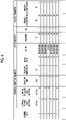
- Fig. 6 is a diagram showing an example of teacher data.
- the teacher data includes operating condition parameters, state parameters, and quality parameters.
- the operating condition parameters include five parameters of the flow rate of the first raw material, the flow rate of the second raw material, the reaction time, the reaction temperature, and the mixing ratio.
- the state parameters include three parameters of color, pressure, and pH of the mixed raw material.
- the quality parameters also include two parameters of product concentration and impurity concentration.
- the learning unit 55 trains the neural networks 60 and 70 using the teacher data stored in the storage 43, for example, according to the error back propagation method. Specifically, for the neural network 60, the learning unit 55 inputs the operating condition parameter included in one of the teacher data sets to the neural network 60, and causes the neural network 60 to output the state parameter. Then, the learning unit 55 trains the neural network 60 by deriving the weighting coefficients w xiul and w ulym so that the difference between the state parameter output from the neural network 60 and the state parameter included in the teacher data is minimized.
- the learning unit 55 inputs the state parameter included in one of the teacher data sets to the neural network 70, and causes the neural network 70 to output the quality parameter. Then, the learning unit 55 trains the neural network 70 by deriving the weighting coefficients w ymu1l and w u1lzk so that the difference between the quality parameter output from the neural network 70 and the quality parameter included in the teacher data is minimized.
- the learning unit 55 stores the functions represented by the first learning model M1 and the second learning model M2 in the storage 43.
- the third conversion unit 53 and the fourth conversion unit 54 derive operating condition parameters for obtaining target quality parameters from target unknown quality parameters (hereinafter referred to as target quality parameters).
- target quality parameters target unknown quality parameters
- the third conversion unit 53 converts the target quality parameter into a state parameter based on the control parameter of the second learning model M2 of the second conversion unit 52.
- the state parameter obtained by converting the target quality parameter is referred to as a target state parameter.
- the control parameters are the weighting coefficients w ymu1l and w u1lzk in the function obtained based on the second learning model M2.
- the third conversion unit 53 derives the following functions G21 and G22 for generating the target state parameter.
- G 21 zt 1 ⁇ w u 1 z 1 / 1 + exp ⁇ w y 1 u11 ⁇ y 1 + w y 2 u11 ⁇ y 2 + w y3u11 ⁇ y3 + w u 2 z 1 / 1 + exp ⁇ w y 1 u12 ⁇ y 1 + w y 2 u12 ⁇ y 2 + w y3u12 ⁇ y3 + w u 3 z 1 / 1 + exp ⁇ w y 1 u13 ⁇ y 1 + w y 2 u13 ⁇ y 2 + w y3u13 ⁇ y3
- G 22 zt2 ⁇ w u 1 z2 / 1 + exp ⁇ w y 1 u11 ⁇ y 1 + w y 2 u11 ⁇ y 2 + w y3u11 ⁇ y3 + exp w u 2 / 1 + exp ⁇
- zt1 and zt2 are target quality parameters, respectively.
- the third conversion unit 53 derives the state parameter ym for minimizing the absolute value of the functions G21 and G22 as a target state parameter ytm.
- the target state parameter ytm is derived by performing multivariate analysis such as multiple regression analysis and principal component analysis, or multi-objective optimization such as genetic algorithm, multi-objective particle swarm optimization, and Bayesian optimization using the target quality parameters zt1 and zt2 as explanatory variables and the target state parameter ytm as the objective variable.
- the fourth conversion unit 54 converts the target state parameter into an operating condition parameter based on the control parameter of the first learning model M1 of the first conversion unit 51.
- the operating condition parameter obtained by converting the target state parameter is used as a target operating condition parameter.
- the control parameters are the weighting coefficients w xiul and w ulym in the function represented by the first learning model M1.
- the fourth conversion unit 54 generates the following functions G11, G12, and G13 for generating the target operating condition parameter.
- yt1, yt2, and yt3 are target state parameters, respectively.
- the fourth conversion unit 54 derives the operating condition parameter xi for minimizing the absolute value of the functions G11 to G13 as a target operating condition parameter xti.
- the target operating condition parameter xti is derived by performing multivariate analysis such as multiple regression analysis and principal component analysis, or multi-objective optimization such as genetic algorithm, multi-objective particle swarm optimization, and Bayesian optimization using the target state parameters yt1, yt2, and yt3 as explanatory variables and the target operating condition parameter xti as the objective variable.
- the processing performed by the first conversion unit 51, the second conversion unit 52, the third conversion unit 53, and the fourth conversion unit 54 described above will be conceptually described with reference to Fig. 7 .
- the first conversion unit 51 predicts the state parameter as a forward problem from the operating condition parameter.
- the second conversion unit 52 predicts the quality parameter as a forward problem from the state parameter.
- the third conversion unit 53 predicts the state parameter as an inverse problem from the quality parameter.
- the fourth conversion unit 54 predicts the operating condition parameter as an inverse problem from the state parameter.
- the white arrow represents the forward problem
- the black arrow represents the inverse problem.
- the quality parameter is derived from the operating condition parameter by the two-step process through the state parameter. Further, the operating condition parameter is derived by the two-step process from the quality parameter to the state parameter.
- the optimization support device 3 outputs the target operating condition parameter xti to the controller 12.
- the controller 12 controls the operation of the flow reactor 11 according to the target operating condition parameter xti. Accordingly, a product having the target quality is produced.
- Fig. 8 is a flowchart showing a process performed at the time of constructing the first learning model M1 of the first conversion unit 51 and the second learning model M2 of the second conversion unit 52 in the present embodiment.
- the learning unit 55 reads out one piece of teacher data from a plurality of pieces of teacher data stored in the storage 43 (Step ST1), and causes the neural network of the first conversion unit 51 to learn the relationship between the operating condition parameter and the state parameter (first learning; Step ST2).
- the learning unit 55 causes the neural network of the second conversion unit 52 to learn the relationship between the state parameter and the quality parameter (second learning; Step ST3).
- the learning unit returns to Step ST1, reads out the next teacher data, and repeats the processes of Step ST2 and Step ST3.
- the first learning model M1 and the second learning model M2 are constructed.
- the learning unit 55 repeats learning until a difference between the state parameter generated by the first conversion unit 51 and the state parameter of the teacher data and a difference between the quality parameter generated by the second conversion unit 52 and the quality parameter of the teacher data are equal to or less than a predetermined threshold value.
- the number of repetitions may be a predetermined number of times.
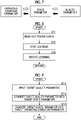
- Fig. 9 is a flowchart showing a process for deriving the operating condition parameter from the target quality parameter.
- the third conversion unit 53 converts the target quality parameter into the target state parameter based on the control parameter of the second learning model M2 (Step ST12).
- the fourth conversion unit 54 converts the target state parameter into the target operating condition parameter (Step ST13), and ends the process.
- a quality parameter was derived from a process condition parameter in the related art, but in the present embodiment, a process condition parameter is divided into an operating condition parameter and a state parameter, and a quality parameter is derived by a two-step process of converting an operating condition parameter into a state parameter by the first conversion unit 51 and converting the state parameter into the quality parameter by the second conversion unit 52. Therefore, compared with the process of obtaining quality parameters by using operating condition parameters and state parameters as process condition parameters without distinguishing between the operating condition parameters and the state parameters in the related art, the number of input parameters can be reduced in the processes performed by the first conversion unit 51 and the second conversion unit 52, respectively. Thereby, overtraining can be prevented, especially in a case where a learning model constructed by learning a neural network or the like is used for conversion. Therefore, according to the present embodiment, various conditions in the product production process can be accurately predicted.
- the process of deriving the target operating condition parameter from the target quality parameter is performed in each of the third conversion unit 53 and the fourth conversion unit 54, so that the process is divided into two processes. Therefore, compared with the process of obtaining process condition parameters from quality parameters without distinguishing between the operating condition parameters and the state parameters in the related art, the number of input parameters can be reduced in the processes performed by the third conversion unit 53 and the fourth conversion unit 54, respectively. Thereby, according to the present embodiment, the target operating condition parameter can be accurately predicted from the target quality parameter.
- the conversion of the target quality parameter to the target state parameter is performed using the control parameter of the second learning model M2 and the conversion from the target state parameter to the target operating condition parameter is performed using the control parameter of the first learning model M1.
- the control parameters of the first learning model M1 and the second learning model M2 can accurately predict various conditions in the product production process. Therefore, according to the present embodiment, the target operating condition parameter can be accurately derived from the target quality parameter. Therefore, by producing the product using the target operating condition parameter, the product having the target quality can be obtained.
- the process condition parameter is predicted from the quality parameter by learning the correlation between the process condition parameter and the quality parameter as in the method described in JP2003-345416A
- the correlation between the operating condition parameter and the state parameter is not learned at all as in the present embodiment. Therefore, even though the production process is performed according to the predicted process condition parameters, the product having the target quality may not be produced. That is, in a case where the process condition parameter is predicted from the quality parameter by learning the correlation between the process condition parameter and the quality parameter, it is assumed that the state parameter can be realized by the operating condition parameter. However, that assumption is not established in most cases. Therefore, it is not possible to accurately predict the process condition parameter that can achieve the target quality parameter by the method of predicting the process condition parameter from the quality parameter as in the related art.
- a process condition parameter is divided into an operating condition parameter and a state parameter, and a state parameter is predicted from a quality parameter and an operating condition parameter is predicted from the state parameter, or a state parameter is predicted from an operating condition parameter and a quality parameter is predicted from the state parameter. Therefore, the operating condition parameter, the state parameter, and the quality parameter can be predicted in the situation where the assumption that the state parameter can be realized by the operating condition parameter included in the process condition parameter is established. Therefore, according to the present embodiment, various conditions in the product production process can be accurately predicted.
- the first conversion unit 51 converts the operating condition parameter into the state parameter by using the first learning model M1 constructed by learning the neural network 60, but the present disclosure is not limited thereto.
- the operating condition parameter may be converted into the state parameter by a mathematical formula for converting the operating condition parameter into the state parameter, a table in which the operating condition parameter and the state parameter are associated with each other, or the like.
- the fourth conversion unit 54 may convert the state parameter into the operating condition parameter by a mathematical formula for converting the state parameter into the operating condition parameter, a table in which the state parameter and the operating condition parameter are associated with each other, or the like.
- the second conversion unit 52 converts the state parameter into the quality parameter by using the second learning model M2 constructed by learning the neural network 70, but the present disclosure is not limited thereto.
- the state parameter may be converted into the quality parameter by a mathematical formula for converting the state parameter into the quality parameter, a table in which the state parameter and the quality parameter are associated with each other, or the like.
- the third conversion unit 53 may convert the quality parameter into the state parameter by a mathematical formula for converting the quality parameter into the state parameter, a table in which the quality parameter and the state parameter are associated with each other, or the like.
- the optimization support device 3 comprises the first conversion unit 51, the second conversion unit 52, the third conversion unit 53, and the fourth conversion unit 54, but the present disclosure is not limited thereto.
- the optimization support device 3 may have only the first conversion unit 51 and the second conversion unit 52.
- the first conversion unit 51 may convert the operating condition parameter into the state parameter by the first learning model M1, or may convert the operating condition parameter into the state parameter by a mathematical formula, a table, or the like.
- the second conversion unit 52 may convert the state parameter into the quality parameter by the second learning model M2, or may convert the state parameter into the quality parameter by a mathematical formula, a table, or the like.
- the optimization support device 3 may have only the third conversion unit 53 and the fourth conversion unit 54.
- the third conversion unit 53 may convert the quality parameter into the state parameter by using the control parameter of the second learning model M2 constructed by a device separate from the optimization support device 3, or may convert the quality parameter into the state parameter by a mathematical formula, a table, or the like.
- the fourth conversion unit 54 may convert the state parameter into the operating condition parameter by using the control parameter of the first learning model M1 constructed by a device separate from the optimization support device 3, or may convert the state parameter into the operating condition parameter by a mathematical formula, a table, or the like.
- the flow synthesis process is used as the process for producing the product, but the present disclosure is not limited thereto.
- a cell culture process may be used as the process for producing the product.
- the product is a cell and an antibody produced by the cell
- the cell culture condition is used as an operating condition parameter
- the quality of the cell and the antibody produced by the cell is used as a quality parameter.
- the production device 2 shown in Fig. 1 is a cell culture device.
- the operating condition parameter for example, a perfusion ratio, the number of cells in a stationary phase, a stirring speed of a liquid in a culture tank, the amount of bottom air, the amount of bottom oxygen, the amount of bottom nitrogen, the amount of carbon dioxide on the upper surface, the amount of air on the upper surface, the amount of antifoaming agent, the amount of surfactant, and the like can be used.
- the state parameter for example, pH, p02 (oxygen partial pressure), pCO 2 (carbon dioxide partial pressure), Gln (glutamine concentration), Glu (glutamic acid concentration), Gluc (glucose concentration), Lac (lactic acid concentration), NH 4 + (ammonia ion concentration), Na + (sodium ion concentration), K + (potassium ion concentration), Osmol (osmotic pressure), Kla (oxygen transfer coefficient), and the like can be used.
- the quality parameter antibody concentration, by-product concentration, the number of living cells, and the like can be used.
- a vacuum film forming process may be used as the process for producing the product.
- the product is a film formed on the surface of a substrate such as glass, resin, and metal.
- the production device 2 shown in Fig. 1 is a vacuum film forming device.
- the condition of vacuum film formation is used as an operating condition parameter, and the quality of film formation is used as a quality parameter.
- the operating condition parameter for example, vacuum pressure, applied voltage, bias voltage, substrate temperature, film formation time, gas flow rate, gas concentration, line speed, and the like can be used.
- the state parameter is the state of plasma, and plasma stability, plasma color development, ICP-OES/ICP-AES (plasma emission spectrometry) waveform spectrum, plasma density, adhesive plate depot thickness, device potential difference, and the like can be used.
- ICP-OES/ICP-AES plasma emission spectrometry waveform spectrum, plasma density, adhesive plate depot thickness, device potential difference, and the like
- quality parameter film quality, barrier performance, and the like can be used.
- a roll-to-roll coating process may also be used as the process for producing the product.
- the product is a liquid crystal retardation film, an antiglare film, or the like in which a coating film is formed on the surface of a resin serving as a substrate, such as triacetyl cellulose (TAC), polyethylene terephthalate (PET), and cycloolefin polymer (COP).
- TAC triacetyl cellulose
- PET polyethylene terephthalate
- COP cycloolefin polymer
- the production device 2 shown in Fig. 1 is a coating device.
- the coating condition is used as an operating condition parameter
- the quality of the coating film is used as a quality parameter.
- the operating condition parameter for example, the coating flow rate, the liquid temperature, the drying temperature, the line speed, the transport roll temperature, and the like can be used.
- the state parameter the pulsation of the liquid, the fluctuation of the drying air velocity, the amount of volatilization during drying, the amount of liquid permeation into the substrate, and the like can be used.
- the quality parameter the film quality, the film thickness distribution of the coating film, the adhesion between the coating film and the substrate, and the like can be used.
- the various processors include a programmable logic device (PLD) as a processor of which the circuit configuration can be changed after manufacture, such as a field programmable gate array (FPGA), a dedicated electrical circuit as a processor having a dedicated circuit configuration for executing specific processing such as an application specific integrated circuit (ASIC), and the like, in addition to the CPU as a general-purpose processor that functions as various processing units by executing software (program).
- PLD programmable logic device
- FPGA field programmable gate array
- ASIC application specific integrated circuit
- One processing unit may be configured by one of the various processors, or configured by a combination of the same or different kinds of two or more processors (for example, a combination of a plurality of FPGAs or a combination of the CPU and the FPGA).
- a plurality of processing units may be configured by one processor.
- a plurality of processing units are configured by one processor
- one processor is configured by a combination of one or more CPUs and software as typified by a computer, such as a client or a server, and this processor functions as a plurality of processing units.
- IC integrated circuit
- SoC system on chip
- circuitry in which circuit elements such as semiconductor elements are combined can be used.
Landscapes
- Engineering & Computer Science (AREA)
- Physics & Mathematics (AREA)
- Software Systems (AREA)
- General Physics & Mathematics (AREA)
- Theoretical Computer Science (AREA)
- Artificial Intelligence (AREA)
- Evolutionary Computation (AREA)
- General Engineering & Computer Science (AREA)
- Health & Medical Sciences (AREA)
- Automation & Control Theory (AREA)
- Chemical & Material Sciences (AREA)
- Computer Vision & Pattern Recognition (AREA)
- Medical Informatics (AREA)
- Mathematical Physics (AREA)
- Computing Systems (AREA)
- Data Mining & Analysis (AREA)
- Biomedical Technology (AREA)
- Biophysics (AREA)
- General Health & Medical Sciences (AREA)
- Computational Linguistics (AREA)
- Molecular Biology (AREA)
- Life Sciences & Earth Sciences (AREA)
- Organic Chemistry (AREA)
- Chemical Kinetics & Catalysis (AREA)
- Manufacturing & Machinery (AREA)
- Quality & Reliability (AREA)
- Feedback Control In General (AREA)
- General Factory Administration (AREA)
Abstract
Description
- The present disclosure relates to an optimization support device, a method, and a program that support an optimization of various parameters in a product production process.
- In the process of producing a product, for example, a method of associating a process condition parameter that specifies operating conditions and the like of the process with a quality parameter of the product and predicting the quality parameter as a forward problem from the process condition parameter or predicting an optimum solution of the process condition parameter by an inverse problem from the quality parameter has been proposed by using various operations using a neural network.
- For example,
JP2003-345416A JP2003-345416A JP2006-323523A JP2006-323523A - Incidentally, in the process of producing a product, there are a considerable number of process condition parameters that specify the operating conditions and the like of the process. In a case where many such condition parameters are input to the prediction model to predict the quality parameters of the product, accurate prediction may not be possible. In particular, in a case where the prediction model is a neural network, a large number of process condition parameters results in overtraining of the neural network. In a case where the neural network is over-trained in this way, accurate quality parameters cannot be predicted in a case where process condition parameters other than teacher data are input. It is also conceivable to use a function or table instead of the prediction model to obtain quality parameters from process condition parameters. However, even in such cases, a large number of process condition parameters complicates the configuration of the function or table, making it difficult to create an appropriate function or table, and as a result, accurate prediction may not be possible.
- The present invention has been made in view of the above circumstances, and an object of the present invention is to enable accurate prediction of various conditions in a product production process.
- A first optimization support device according to an aspect of the present disclosure comprises a first conversion unit that converts an operating condition parameter indicating an operating condition of a process for producing a product into a state parameter indicating a state of the process, and a second conversion unit that converts the state parameter into a quality parameter indicating a quality of the product.
- In the first optimization support device according to the aspect of the present disclosure, the first conversion unit may have a first learning model that has been trained to output the state parameter by inputting the operating condition parameter, and the second conversion unit may have a second learning model that has been trained to output the quality parameter by inputting the state parameter.
- The first optimization support device according to the aspect of the present disclosure may further comprise a third conversion unit that converts the quality parameter into the state parameter, and a fourth conversion unit that converts the state parameter into the operating condition parameter.
- In the first optimization support device according to the aspect of the present disclosure, the third conversion unit may convert the quality parameter into the state parameter based on a control parameter of the second learning model, and the fourth conversion unit may convert the state parameter into the operating condition parameter based on a control parameter of the first learning model.
- A second optimization support device according to another aspect of the present disclosure comprises a third conversion unit that converts a quality parameter indicating a quality of a product produced in a process for producing the product into a state parameter indicating a state of the process, and a fourth conversion unit that converts the state parameter into an operating condition parameter indicating an operating condition of the process.
- In the second optimization support device according to the aspect of the present disclosure, the third conversion unit may convert the quality parameter into the state parameter based on a control parameter of a learning model that has been trained to output the quality parameter by inputting the state parameter.
- In this case, the second optimization support device according to the aspect of the present disclosure may further comprise a second conversion unit that has the learning model that has been trained to output the quality parameter by inputting the state parameter, and converts the state parameter into the quality parameter indicating the quality of the product.
- In the second optimization support device according to the aspect of the present disclosure, the fourth conversion unit may convert the state parameter into the operating condition parameter based on a control parameter of a learning model that has been trained to output the state parameter by inputting the operating condition parameter.
- In this case, the second optimization support device according to the aspect of the present disclosure may further comprise a first conversion unit that has the learning model that has been trained to output the state parameter by inputting the operating condition parameter, and converts the operating condition parameter into the state parameter.
- In the first and second optimization support devices according to the aspects of the present disclosure, the process may be a flow synthesis process, a cell culture process, a vacuum film forming process, and a coating process.
- A first optimization support method according to another aspect of the present disclosure comprises converting an operating condition parameter indicating an operating condition of a process for producing a product into a state parameter indicating a state of the process, and converting the state parameter into a quality parameter indicating a quality of the product.
- A second optimization support method according to another aspect of the present disclosure comprises converting a quality parameter indicating a quality of a product produced in a process for producing the product into a state parameter indicating a state of the process, and converting the state parameter into an operating condition parameter indicating an operating condition of the process.
- The first and second optimization support methods according to the aspects of the present disclosure may be provided as a program for causing a computer to execute the method.
- A third optimization support device according to another aspect of the present disclosure comprises a memory that stores instructions to be executed by a computer, and a processor configured to execute the stored instructions, and the processor executes a process of converting an operating condition parameter indicating an operating condition of a process for producing a product into a state parameter indicating a state of the process, and converting the state parameter into a quality parameter indicating a quality of the product.
- A fourth optimization support device according to another aspect of the present disclosure comprises a memory that stores instructions to be executed by a computer, and a processor configured to execute the stored instructions, and the processor executes a process of converting a quality parameter indicating a quality of a product produced in a process for producing the product into a state parameter indicating a state of the process, and converting the state parameter into an operating condition parameter indicating an operating condition of the process.
- According to the aspects of the present disclosure, various conditions in the product production process can be accurately predicted.
-
-
Fig. 1 is a schematic block diagram showing a configuration of a production facility to which an optimization support device according to an embodiment is applied. -
Fig. 2 is a schematic block diagram showing a configuration of a production facility including a flow reactor. -
Fig. 3 is a schematic block diagram showing a configuration of the optimization support device according to the present embodiment. -
Fig. 4 is a conceptual diagram of a layer structure of a neural network. -
Fig. 5 is a conceptual diagram of a layer structure of a neural network. -
Fig. 6 is an explanatory diagram of a data set of teacher data. -
Fig. 7 is a conceptual diagram of processing performed in the present embodiment. -
Fig. 8 is a flowchart showing a process performed at the time of generating a first learning model of a first conversion unit and a second learning model of a second conversion unit in the present embodiment. -
Fig. 9 is a flowchart showing a process for deriving an operating condition parameter from a target quality parameter. -
Fig. 10 is a schematic block diagram showing a configuration of an optimization support device according to another embodiment. -
Fig. 11 is a schematic block diagram showing a configuration of an optimization support device according to still another embodiment. - Hereinafter, an embodiment of the present disclosure will be described with reference to the drawings.
Fig. 1 is a schematic block diagram showing a configuration of a production facility to which an optimization support device according to an embodiment of the present disclosure is applied. As shown inFig. 1 , aproduction facility 1 according to the present embodiment comprises aproduction device 2 and anoptimization support device 3 according to the present embodiment. - In the present embodiment, a flow reactor is included as the
production device 2. The flow reactor is a device for obtaining a product by performing a flow reaction process in which a raw material is continuously reacted while flowing.Fig. 2 is a schematic block diagram showing a configuration of theproduction facility 1 including a flow reactor. As shown inFig. 2 , theproduction device 2 comprises aflow reactor 11 and acontroller 12. Theflow reactor 11 comprises afirst supply unit 21, asecond supply unit 22, areaction section 23, and acollecting section 26. The operation of each part of theflow reactor 11 is controlled by thecontroller 12. Thecontroller 12 is connected to theoptimization support device 3. - In the
flow reactor 11, thefirst supply unit 21 and thesecond supply unit 22 are respectively connected to upstream end parts of thereaction section 23 by piping, and thecollecting section 26 is connected to a downstream end part of thereaction section 23 by piping. - The flow reaction performed in the
flow reactor 11 may be, for example, a synthesis reaction for synthesizing a compound that is a monomer, or a polymerization reaction for producing a polymer by reacting monomers, or may be elementary reactions such as an initiation reaction and a termination reaction in an anionic polymerization reaction, for example. Accordingly, a reactant that is a target of the flow reaction may be, for example, a vegetation (growth) stage compound that is a target of the termination reaction. In the present embodiment, the termination reaction of stopping the vegetation (growth) of polystyryllithium with methanol is performed by the flow reaction. - The
first supply unit 21 is a member for supplying a first raw material of the flow reaction to thereaction section 23. The first raw material in the present embodiment is, for example, a first liquid obtained by dissolving polystyryllithium in a solvent, and polystyryllithium is an example of a reactant of the flow reaction process. Thefirst supply unit 21 comprises a pump (not shown), and a flow rate of the first raw material to thereaction section 23 is controlled by controlling a rotation speed of the pump. - The
second supply unit 22 is a member for supplying a second raw material of the flow reaction to thereaction section 23. The second raw material in the present embodiment is a mixture of methanol and water, that is, an aqueous methanol solution, and methanol is used as a terminating agent for the termination reaction. Thesecond supply unit 22 also comprises a pump (not shown) like thefirst supply unit 21, and a flow rate of the second raw material to thereaction section 23 is controlled by controlling a rotation speed of the pump. - The
reaction section 23 is a member for performing a termination reaction as a flow reaction, and comprises a mergingportion 31, areaction portion 32, atemperature control unit 33, anirradiation unit 34, and afirst detection unit 35. The mergingportion 31 is a T-shaped branched tube, that is, a T-shaped tube. A cross tube may be used instead of the T-shaped tube. Afirst tube part 31a of the mergingportion 31 is connected to thefirst supply unit 21, asecond tube part 31b thereof is connected to thesecond supply unit 22, and athird tube part 31c thereof is connected to thereaction portion 32, respectively. Thus, the first raw material and second raw material guided to thereaction section 23 are combined with each other and are sent to thereaction portion 32 in a mixed state. Thereaction portion 32 has a predetermined reaction path length and reaction path diameter. The reaction path length and reaction path diameter can be changed by changing the tubular member constituting thereaction portion 32. - The inside of the
reaction portion 32 is a flow path for a mixture (hereinafter referred to as a mixed raw material) of the first raw material and the second raw material, and a hollow portion in the tube is defined as a reaction site. The mixed raw material undergoes an anionic polymerization termination reaction while passing through thereaction portion 32, so that polystyrene is produced. - The
temperature control unit 33 consists of, for example, a heater or the like, and is a member for controlling a temperature of the flow reaction (hereinafter referred to as a reaction temperature). Thetemperature control unit 33 controls the temperature (reaction temperature) of the mixed raw material flowing in and through the mergingportion 31 and thereaction portion 32. - The
irradiation unit 34 has, for example, a light source that emits light such as ultraviolet rays, and is a member for irradiating thereaction portion 32 with light such as ultraviolet rays in a case of performing a photoreaction as a flow reaction. - The
first detection unit 35 detects the state of the mixed raw material in thereaction section 23 and outputs the result to theoptimization support device 3. A parameter indicating the state of the mixed raw material (hereinafter referred to as a state parameter) is a parameter indicating the physical properties of the mixed raw material obtained in a case where the mixed raw material is reacted according to the input operating condition parameter and the environment in the reaction section. The state parameter includes, for example, at least one of the reaction temperature, color, pH, and dissolved oxygen content of the mixed raw material, pressure ofreaction section 23, or the shape of a spectrum (infrared absorption spectrum, Raman spectroscopic waveform, and nuclear magnetic resonance waveform) representing the physical characteristics of the product. For this purpose, thefirst detection unit 35 comprises a temperature sensor, an imaging unit, a pH sensor, a dissolved oxygen content sensor, a spectrometer, and the like (all not shown). - The collecting
section 26 is a member for collecting polystyrene that is a product of the flow reaction. The collectingsection 26 precipitates polystyrene from the polystyrene solution guided from the reaction section, collects the precipitated polystyrene from the mixed solution, and dries the collected polystyrene to obtain polystyrene. - In addition, the collecting
section 26 comprises asecond detection unit 36. Thesecond detection unit 36 detects the quality of the product, which is the processing result of the flow reaction, and outputs the detected result to theoptimization support device 3. A parameter indicating the quality of the product (hereinafter referred to as a quality parameter) is a parameter that serves as a measure for determining whether or not the product obtained as a result of the reaction has appropriate quality. Specifically, the quality parameter includes at least one of the product concentration, the impurity concentration, or the like, but in addition to these, at least one of the product purity, molecular weight, molecular weight dispersion, yield, or the like may be used. In addition, in a case where the product is obtained in the collectingsection 26 in a solution state in which the product is dissolved in a solvent, for example, the concentration of the product in the solution (molar concentration or the like) may be detected as a quality parameter. - Meanwhile, the reaction section and the collecting section are not limited to the above examples, and may be appropriately changed depending on at least one of the type of the flow reaction or the type of the product. For example, a container may be provided in place of the collecting
section 26, and the polystyrene solution guided from thereaction section 23 may be temporarily stored in this container. In this case, for example, the stored polystyrene solution is guided to the collectingsection 26, and the product may be obtained by precipitating, collecting, and drying the polystyrene. - The
controller 12 generally controls theflow reactor 11. Thecontroller 12 is connected to each of the pumps of thefirst supply unit 21 and thesecond supply unit 22, thetemperature control unit 33, theirradiation unit 34, thefirst detection unit 35, and thesecond detection unit 36. Thecontroller 12 controls the respective flow rates of the first raw material and the second raw material by respectively controlling the rotation speeds of the pumps of thefirst supply unit 21 and thesecond supply unit 22. Further, thecontroller 12 controls the temperature of the mixed raw material by controlling thetemperature control unit 33. Further, thecontroller 12 controls the irradiation of thereaction section 23 with light such as ultraviolet rays by giving an instruction to theirradiation unit 34. Further, thecontroller 12 detects the state parameter and the quality parameter by giving an instruction to thefirst detection unit 35 and thesecond detection unit 36. - The
controller 12 also sets the operating conditions of theflow reactor 11. The parameter indicating the operating condition (hereinafter referred to as the operating condition parameter) is a parameter for setting the reaction condition which is the processing condition of the flow reaction process, and for driving each part of theflow reactor 11 in order to produce a product of an appropriate quality. The operating condition parameter includes, for example, at least one of the flow rate of the first raw material, the flow rate of the second raw material, the reaction time, the reaction temperature, the mixing ratio, the UV illuminance, the flow path depth, or the reagent equivalent in a case where the reagent. Thecontroller 12 has an operating unit (not shown), and sets an operating condition parameter by inputting an operating signal from the operating unit, thereby controlling theflow reactor 11 to the set operating condition. For example, the operating condition parameter is set by click or selection using a mouse in the operating unit and/or input of characters using a keyboard. - Further, the
controller 12 is connected to theoptimization support device 3, and in addition to or instead of the operating signal from the above-mentioned operating unit, thecontroller 12 sets the operating condition to a target operating condition output by theoptimization support device 3, thereby controlling theflow reactor 11 to the predetermined operating condition. - The
optimization support device 3 provides support for accurately determining a target operating condition parameter for the flow reaction process performed by theflow reactor 11. Theoptimization support device 3 includes, for example, one computer in which an optimization support program according to the present embodiment is installed. The optimization support program is stored in a storage device of a server computer connected to a network or in a network storage in a state in which it can be accessed from the outside, and is downloaded and installed on the computer in response to a request of an operator. Alternatively, the optimization support program is recorded on a recording medium, such as a digital versatile disc (DVD) or a compact disc read only memory (CD-ROM), and distributed, and installed on the computer from the recording medium. -
Fig. 3 is a schematic block diagram showing a configuration of the optimization support device realized by installing an optimization support program on a computer. As shown inFig. 3 , theoptimization support device 3 comprises a central processing unit (CPU) 41, amemory 42, and astorage 43 as the configuration of a standard computer. Further, theoptimization support device 3 is connected to adisplay unit 44 such as a liquid crystal display and aninput unit 45 such as a keyboard and a mouse. - The
storage 43 consists of a hard disk drive or the like, and stores various information including information necessary for processing of optimization support. - Further, the
memory 42 stores an optimization support program. The optimization support program defines, as processes to be executed by theCPU 41, a first conversion process for converting an operating condition parameter indicating a process operating condition for producing a product into a state parameter indicating a state of the process, a second conversion process for converting the state parameter into a quality parameter indicating a quality of the product, a third conversion process for converting the quality parameter into the state parameter, a fourth conversion process for converting the state parameter into the operating condition parameter, and a learning process for learning a neural network, which will be described later. - Then, in a case where the
CPU 41 executes these processes according to the program, the computer functions as afirst conversion unit 51, asecond conversion unit 52, athird conversion unit 53, afourth conversion unit 54, and alearning unit 55. - The
first conversion unit 51 converts an operating condition parameter indicating an operating condition of a process for producing a product (flow reaction in the present embodiment) into a state parameter indicating a state of the process, thereby deriving the state parameter. For this purpose, thefirst conversion unit 51 has a first learning model M1 that has been trained to output a state parameter by inputting an operating condition parameter. The first learning model M1 is constructed by thelearning unit 55 learning a neural network or the like as described later. - The
second conversion unit 52 converts the state parameter into a quality parameter indicating the quality of the product (polystyrene in the present embodiment), thereby deriving the quality parameter. For this purpose, thesecond conversion unit 52 has a second learning model M2 that has been trained to output a quality parameter by inputting a state parameter. The second learning model M2 is constructed by thelearning unit 55 learning a neural network or the like as described later. - The
third conversion unit 53 converts the quality parameter indicating the quality of the product into the state parameter indicating the state of the process, thereby deriving the state parameter. In the present embodiment, thethird conversion unit 53 converts the quality parameter into the state parameter based on the control parameter of the second learning model M2 in thesecond conversion unit 52. - The
fourth conversion unit 54 converts the state parameter indicating the process state into an operating condition parameter indicating the operating condition of the process, thereby deriving the operating condition parameter. In the present embodiment, thefourth conversion unit 54 converts the state parameter into the operating condition parameter based on the control parameter of the first learning model M1 in thefirst conversion unit 51. - Here, the model used for the first learning model M1 is a prediction model that predicts a state parameter by inputting an operating condition parameter. The model used for the second learning model M2 is also a prediction model that predicts a quality parameter by inputting a state parameter. A machine learning model can be used as the prediction model. Examples of the machine learning model include linear regression, Gaussian process regression, support vector regression, a decision tree, an ensemble method, a bagging method, a boosting method, a gradient boosting method, and the like. Further, as an example of the machine learning model, a neural network model can be mentioned. Examples of the neural network model include a simple perceptron, a multilayer perceptron, a deep neural network, a convolutional neural network, a deep belief network, a recurrent neural network, a stochastic neural network, and the like.
- Random forest can be mentioned as an ensemble method for machine learning models. Random forest is a learning model that improves prediction accuracy by using randomly sampled training data and randomly selected explanatory variables to create a plurality of decision trees with low correlation, and integrating and averaging the prediction results. The control parameters of the random forest model include the number of explanatory variables and the number of branches of the decision tree.
- Further, as a neural network model, a deep neural network can be mentioned. Compared to machine learning models other than the neural network, the deep neural network has a large number of control parameters of the model and can be flexibly combined, so that the deep neural network can exhibit high performance for various data configurations. Control parameters of the deep neural network include the number of layers of the network, the number of nodes, the type of activation function, the dropout ratio, the mini-batch size, the number of epochs, the learning rate, and the like. There are a plurality of execution frameworks for these models, and the model can be selected from the execution frameworks as appropriate. For example, the execution framework can be selected from Tensorflow, CNTK, Theano, Caffe, mxnet, Keras, PyTorch, Chainer, Scikit-learn, Caret, Matlab (registered trade mark), and the like. In the present embodiment, a neural network is used as a prediction model.
- The
learning unit 55 learns the neural network as a prediction model and constructs the first learning model M1 and the second learning model M2. First, the first learning model M1 of thefirst conversion unit 51 will be described. Thelearning unit 55 learns the neural network using the operating condition parameter as an explanatory variable and the state parameter as an objective variable, and constructs the first learning model M1 by deriving a function representing the relationship between the operating condition parameter and the state parameter. In the present embodiment, thelearning unit 55 generates the following functions (1A), (1B), and (1C) that represent the relationship between the operating condition parameter and the state parameter.


- In the above functions (1A) to (1C), xi (i is a natural number) is a value of an operating condition parameter, and a maximum value of i is the number of operating condition parameters. In the present embodiment, in a case where five parameters of, for example, the flow rate of the first raw material, the flow rate of the second raw material, the reaction time, the reaction temperature, and the mixing ratio are used as the operating condition parameters, i = 5. ym (m is a natural number) is a value of a state parameter, and a maximum value of m is the number of state parameters. In the present embodiment, in a case where, for example, the color, pressure, and pH of the mixed raw material are used as the state parameters, m = 3. ul (1 is a natural number) is a node of a hidden layer L2 in a neural network, which will be described later, and a maximum value of 1 is the number of nodes. In the present embodiment, 1 = 3. wxiul and wulym are weighting coefficients representing the connection weight of the neural network. Specifically, wxiul is a weighting coefficient between xi and ul, and wulym is a weighting coefficient between ul and ym.
-
Fig. 4 is a diagram for describing the layer structure of the neural network for constructing the first learning model M1 in the present embodiment. As shown inFig. 4 , aneural network 60 has a three-layer structure of an input layer L1, a hidden layer L2, and an output layer L3. The input layer L1 includes values x1 to x5 of operating condition parameters which are explanatory variables. The hidden layer L2 includes three nodes u1 to u3, and is one layer in the present embodiment. Each of the nodes u1 to u3 is the sum of the values obtained by weighting x1 to x5 with a weighting coefficient wxiul corresponding to each of x1 to x5. The output layer L3 includes values y1 to y3 of state parameters which are objective variables. Each of the values y1 to y3 of the state parameters is a value obtained by weighting nodes u1 to u3 with a weighting coefficient wulym corresponding to each of the nodes u1 to u3. The black circles "●" inFig. 4 indicate the weighting coefficients wxiul and wulym. The weighting coefficients wxiul and wulym are derived by learning theneural network 60 using the teacher data. The layer structure of theneural network 60 is not limited to that shown inFig. 4 . - Next, the second learning model M2 of the
second conversion unit 52 will be described. Thelearning unit 55 learns the neural network using the state parameter as an explanatory variable and the quality parameter as an objective variable, and constructs the second learning model M2 by deriving a function representing the relationship between the state parameter and the quality parameter. In the present embodiment, thelearning unit 55 generates the following functions (2A) and (2B) that represent the relationship between the operating condition parameter and the state parameter.

- In the above functions (2A) and (2B), ym (m is a natural number) is a value of a state parameter. In the present embodiment, in a case where, for example, the reaction temperature, color, and pH of the mixed raw material are used as the state parameters as described above, m = 3. zk (k is a natural number) is a value of a quality parameter, and a maximum value of k is the number of quality parameters. In the present embodiment, in a case where, for example, the product concentration and the impurity concentration are used as the quality parameter, k = 2. u1l (1 is a natural number) is a node of a hidden layer L12 in a neural network, which will be described later, and a maximum value of 11 is the number of nodes. In the present embodiment, 11 = 3. wymu1l and wu1lzk are weighting coefficients representing the connection weight of the neural network. Specifically, wymu1l is a weighting coefficient between ym and u1l, and wu1lzk is a weighting coefficient between u1l and zk.
-
Fig. 5 is a diagram for describing the layer structure of the neural network for constructing the second learning model M2 in the present embodiment. As shown inFig. 5 , aneural network 70 has a three-layer structure of an input layer L11, a hidden layer L12, and an output layer L13. The input layer L11 includes values y1 to y3 of state parameters which are explanatory variables. The hidden layer L12 includes three nodes u11 to u13, and is one layer in the present embodiment. Each of the nodes u11 to u13 is the sum of the values obtained by weighting y1 to y3 with a weighting coefficient wymu1l corresponding to each of y1 to y3. The output layer L13 includes values z1 and z2 of quality parameters which are objective variables. Each of the values z1 and z2 of the quality parameters is a value obtained by weighting nodes u1 to u3 with a weighting coefficient wu1lzk corresponding to each of the nodes u1 to u3. The black circles "●" inFig. 5 indicate the weighting coefficients wymu1l and wu1lzk. The weighting coefficients wymu1l and wu1lzkym are derived by learning theneural network 70 using the teacher data. The layer structure of theneural network 70 is not limited to that shown inFig. 5 . - The
learning unit 55 learns theneural networks storage 43.Fig. 6 is a diagram showing an example of teacher data. As shown inFig. 6 , the teacher data includes operating condition parameters, state parameters, and quality parameters. Further, the operating condition parameters include five parameters of the flow rate of the first raw material, the flow rate of the second raw material, the reaction time, the reaction temperature, and the mixing ratio. The state parameters include three parameters of color, pressure, and pH of the mixed raw material. The quality parameters also include two parameters of product concentration and impurity concentration. - At the time of learning, the
learning unit 55 trains theneural networks storage 43, for example, according to the error back propagation method. Specifically, for theneural network 60, thelearning unit 55 inputs the operating condition parameter included in one of the teacher data sets to theneural network 60, and causes theneural network 60 to output the state parameter. Then, thelearning unit 55 trains theneural network 60 by deriving the weighting coefficients wxiul and wulym so that the difference between the state parameter output from theneural network 60 and the state parameter included in the teacher data is minimized. - Further, for the
neural network 70, thelearning unit 55 inputs the state parameter included in one of the teacher data sets to theneural network 70, and causes theneural network 70 to output the quality parameter. Then, thelearning unit 55 trains theneural network 70 by deriving the weighting coefficients wymu1l and wu1lzk so that the difference between the quality parameter output from theneural network 70 and the quality parameter included in the teacher data is minimized. - In a case where the learning is completed and the first learning model M1 and the second learning model M2 are constructed, the
learning unit 55 stores the functions represented by the first learning model M1 and the second learning model M2 in thestorage 43. - In the present embodiment, the
third conversion unit 53 and thefourth conversion unit 54 derive operating condition parameters for obtaining target quality parameters from target unknown quality parameters (hereinafter referred to as target quality parameters). For this purpose, thethird conversion unit 53 converts the target quality parameter into a state parameter based on the control parameter of the second learning model M2 of thesecond conversion unit 52. The state parameter obtained by converting the target quality parameter is referred to as a target state parameter. The control parameters are the weighting coefficients wymu1l and wu1lzk in the function obtained based on the second learning model M2. In the present embodiment, thethird conversion unit 53 derives the following functions G21 and G22 for generating the target state parameter.

- In the functions G21 and G22, zt1 and zt2 are target quality parameters, respectively. The
third conversion unit 53 derives the state parameter ym for minimizing the absolute value of the functions G21 and G22 as a target state parameter ytm. Specifically, the target state parameter ytm is derived by performing multivariate analysis such as multiple regression analysis and principal component analysis, or multi-objective optimization such as genetic algorithm, multi-objective particle swarm optimization, and Bayesian optimization using the target quality parameters zt1 and zt2 as explanatory variables and the target state parameter ytm as the objective variable. - The
fourth conversion unit 54 converts the target state parameter into an operating condition parameter based on the control parameter of the first learning model M1 of thefirst conversion unit 51. The operating condition parameter obtained by converting the target state parameter is used as a target operating condition parameter. The control parameters are the weighting coefficients wxiul and wulym in the function represented by the first learning model M1. In the present embodiment, thefourth conversion unit 54 generates the following functions G11, G12, and G13 for generating the target operating condition parameter.


- In the functions G11 to G13, yt1, yt2, and yt3 are target state parameters, respectively. The
fourth conversion unit 54 derives the operating condition parameter xi for minimizing the absolute value of the functions G11 to G13 as a target operating condition parameter xti. Specifically, the target operating condition parameter xti is derived by performing multivariate analysis such as multiple regression analysis and principal component analysis, or multi-objective optimization such as genetic algorithm, multi-objective particle swarm optimization, and Bayesian optimization using the target state parameters yt1, yt2, and yt3 as explanatory variables and the target operating condition parameter xti as the objective variable. - The processing performed by the
first conversion unit 51, thesecond conversion unit 52, thethird conversion unit 53, and thefourth conversion unit 54 described above will be conceptually described with reference toFig. 7 . Thefirst conversion unit 51 predicts the state parameter as a forward problem from the operating condition parameter. Thesecond conversion unit 52 predicts the quality parameter as a forward problem from the state parameter. Thethird conversion unit 53 predicts the state parameter as an inverse problem from the quality parameter. Thefourth conversion unit 54 predicts the operating condition parameter as an inverse problem from the state parameter. InFig. 7 , the white arrow represents the forward problem, and the black arrow represents the inverse problem. - As shown in
Fig. 7 , in the present embodiment, the quality parameter is derived from the operating condition parameter by the two-step process through the state parameter. Further, the operating condition parameter is derived by the two-step process from the quality parameter to the state parameter. - The
optimization support device 3 outputs the target operating condition parameter xti to thecontroller 12. Thecontroller 12 controls the operation of theflow reactor 11 according to the target operating condition parameter xti. Accordingly, a product having the target quality is produced. - Next, a process performed in the present embodiment will be described.
Fig. 8 is a flowchart showing a process performed at the time of constructing the first learning model M1 of thefirst conversion unit 51 and the second learning model M2 of thesecond conversion unit 52 in the present embodiment. Thelearning unit 55 reads out one piece of teacher data from a plurality of pieces of teacher data stored in the storage 43 (Step ST1), and causes the neural network of thefirst conversion unit 51 to learn the relationship between the operating condition parameter and the state parameter (first learning; Step ST2). Next, thelearning unit 55 causes the neural network of thesecond conversion unit 52 to learn the relationship between the state parameter and the quality parameter (second learning; Step ST3). Then, the learning unit returns to Step ST1, reads out the next teacher data, and repeats the processes of Step ST2 and Step ST3. Thereby, the first learning model M1 and the second learning model M2 are constructed. - The
learning unit 55 repeats learning until a difference between the state parameter generated by thefirst conversion unit 51 and the state parameter of the teacher data and a difference between the quality parameter generated by thesecond conversion unit 52 and the quality parameter of the teacher data are equal to or less than a predetermined threshold value. The number of repetitions may be a predetermined number of times. - Next, in the present embodiment, the process for deriving the operating condition parameter from the unknown target quality parameter will be described.
Fig. 9 is a flowchart showing a process for deriving the operating condition parameter from the target quality parameter. In a case where the target quality parameter is input to theoptimization support device 3 from the input unit 15 (Step ST11), thethird conversion unit 53 converts the target quality parameter into the target state parameter based on the control parameter of the second learning model M2 (Step ST12). Next, thefourth conversion unit 54 converts the target state parameter into the target operating condition parameter (Step ST13), and ends the process. - As described above, a quality parameter was derived from a process condition parameter in the related art, but in the present embodiment, a process condition parameter is divided into an operating condition parameter and a state parameter, and a quality parameter is derived by a two-step process of converting an operating condition parameter into a state parameter by the
first conversion unit 51 and converting the state parameter into the quality parameter by thesecond conversion unit 52. Therefore, compared with the process of obtaining quality parameters by using operating condition parameters and state parameters as process condition parameters without distinguishing between the operating condition parameters and the state parameters in the related art, the number of input parameters can be reduced in the processes performed by thefirst conversion unit 51 and thesecond conversion unit 52, respectively. Thereby, overtraining can be prevented, especially in a case where a learning model constructed by learning a neural network or the like is used for conversion. Therefore, according to the present embodiment, various conditions in the product production process can be accurately predicted. - Further, in the present embodiment, the process of deriving the target operating condition parameter from the target quality parameter is performed in each of the
third conversion unit 53 and thefourth conversion unit 54, so that the process is divided into two processes. Therefore, compared with the process of obtaining process condition parameters from quality parameters without distinguishing between the operating condition parameters and the state parameters in the related art, the number of input parameters can be reduced in the processes performed by thethird conversion unit 53 and thefourth conversion unit 54, respectively. Thereby, according to the present embodiment, the target operating condition parameter can be accurately predicted from the target quality parameter. - Further, in the present embodiment, the conversion of the target quality parameter to the target state parameter is performed using the control parameter of the second learning model M2 and the conversion from the target state parameter to the target operating condition parameter is performed using the control parameter of the first learning model M1. Here, the control parameters of the first learning model M1 and the second learning model M2 can accurately predict various conditions in the product production process. Therefore, according to the present embodiment, the target operating condition parameter can be accurately derived from the target quality parameter. Therefore, by producing the product using the target operating condition parameter, the product having the target quality can be obtained.
- Further, in a case where the process condition parameter is predicted from the quality parameter by learning the correlation between the process condition parameter and the quality parameter as in the method described in
JP2003-345416A - In the present embodiment, a process condition parameter is divided into an operating condition parameter and a state parameter, and a state parameter is predicted from a quality parameter and an operating condition parameter is predicted from the state parameter, or a state parameter is predicted from an operating condition parameter and a quality parameter is predicted from the state parameter. Therefore, the operating condition parameter, the state parameter, and the quality parameter can be predicted in the situation where the assumption that the state parameter can be realized by the operating condition parameter included in the process condition parameter is established. Therefore, according to the present embodiment, various conditions in the product production process can be accurately predicted.
- In the above embodiment, the
first conversion unit 51 converts the operating condition parameter into the state parameter by using the first learning model M1 constructed by learning theneural network 60, but the present disclosure is not limited thereto. For example, the operating condition parameter may be converted into the state parameter by a mathematical formula for converting the operating condition parameter into the state parameter, a table in which the operating condition parameter and the state parameter are associated with each other, or the like. - In this case, the
fourth conversion unit 54 may convert the state parameter into the operating condition parameter by a mathematical formula for converting the state parameter into the operating condition parameter, a table in which the state parameter and the operating condition parameter are associated with each other, or the like. - Further, in the above embodiment, the
second conversion unit 52 converts the state parameter into the quality parameter by using the second learning model M2 constructed by learning theneural network 70, but the present disclosure is not limited thereto. For example, the state parameter may be converted into the quality parameter by a mathematical formula for converting the state parameter into the quality parameter, a table in which the state parameter and the quality parameter are associated with each other, or the like. - In this case, the
third conversion unit 53 may convert the quality parameter into the state parameter by a mathematical formula for converting the quality parameter into the state parameter, a table in which the quality parameter and the state parameter are associated with each other, or the like. - Further, in the above embodiment, the
optimization support device 3 comprises thefirst conversion unit 51, thesecond conversion unit 52, thethird conversion unit 53, and thefourth conversion unit 54, but the present disclosure is not limited thereto. As shown inFig. 10 , theoptimization support device 3 may have only thefirst conversion unit 51 and thesecond conversion unit 52. In this case, thefirst conversion unit 51 may convert the operating condition parameter into the state parameter by the first learning model M1, or may convert the operating condition parameter into the state parameter by a mathematical formula, a table, or the like. Further, thesecond conversion unit 52 may convert the state parameter into the quality parameter by the second learning model M2, or may convert the state parameter into the quality parameter by a mathematical formula, a table, or the like. - Further, as shown in
Fig. 11 , theoptimization support device 3 may have only thethird conversion unit 53 and thefourth conversion unit 54. In this case, thethird conversion unit 53 may convert the quality parameter into the state parameter by using the control parameter of the second learning model M2 constructed by a device separate from theoptimization support device 3, or may convert the quality parameter into the state parameter by a mathematical formula, a table, or the like. Further, thefourth conversion unit 54 may convert the state parameter into the operating condition parameter by using the control parameter of the first learning model M1 constructed by a device separate from theoptimization support device 3, or may convert the state parameter into the operating condition parameter by a mathematical formula, a table, or the like. - Further, in the above embodiment, the flow synthesis process is used as the process for producing the product, but the present disclosure is not limited thereto. A cell culture process may be used as the process for producing the product. In the cell culture process, the product is a cell and an antibody produced by the cell, the cell culture condition is used as an operating condition parameter, and the quality of the cell and the antibody produced by the cell is used as a quality parameter. Further, the
production device 2 shown inFig. 1 is a cell culture device. For example, in a case where the cell culture process is an antibody cell culture process, as the operating condition parameter, for example, a perfusion ratio, the number of cells in a stationary phase, a stirring speed of a liquid in a culture tank, the amount of bottom air, the amount of bottom oxygen, the amount of bottom nitrogen, the amount of carbon dioxide on the upper surface, the amount of air on the upper surface, the amount of antifoaming agent, the amount of surfactant, and the like can be used. As the state parameter, for example, pH, p02 (oxygen partial pressure), pCO2 (carbon dioxide partial pressure), Gln (glutamine concentration), Glu (glutamic acid concentration), Gluc (glucose concentration), Lac (lactic acid concentration), NH4 + (ammonia ion concentration), Na+ (sodium ion concentration), K+ (potassium ion concentration), Osmol (osmotic pressure), Kla (oxygen transfer coefficient), and the like can be used. As the quality parameter, antibody concentration, by-product concentration, the number of living cells, and the like can be used. - Further, a vacuum film forming process may be used as the process for producing the product. In the vacuum film forming process, the product is a film formed on the surface of a substrate such as glass, resin, and metal. Further, the
production device 2 shown inFig. 1 is a vacuum film forming device. Further, the condition of vacuum film formation is used as an operating condition parameter, and the quality of film formation is used as a quality parameter. As the operating condition parameter, for example, vacuum pressure, applied voltage, bias voltage, substrate temperature, film formation time, gas flow rate, gas concentration, line speed, and the like can be used. The state parameter is the state of plasma, and plasma stability, plasma color development, ICP-OES/ICP-AES (plasma emission spectrometry) waveform spectrum, plasma density, adhesive plate depot thickness, device potential difference, and the like can be used. As the quality parameter, film quality, barrier performance, and the like can be used. - A roll-to-roll coating process may also be used as the process for producing the product. In the coating process, the product is a liquid crystal retardation film, an antiglare film, or the like in which a coating film is formed on the surface of a resin serving as a substrate, such as triacetyl cellulose (TAC), polyethylene terephthalate (PET), and cycloolefin polymer (COP). Further, the
production device 2 shown inFig. 1 is a coating device. Further, the coating condition is used as an operating condition parameter, and the quality of the coating film is used as a quality parameter. As the operating condition parameter, for example, the coating flow rate, the liquid temperature, the drying temperature, the line speed, the transport roll temperature, and the like can be used. As the state parameter, the pulsation of the liquid, the fluctuation of the drying air velocity, the amount of volatilization during drying, the amount of liquid permeation into the substrate, and the like can be used. As the quality parameter, the film quality, the film thickness distribution of the coating film, the adhesion between the coating film and the substrate, and the like can be used. - In the above embodiments, for example, as hardware structures of processing units that execute various kinds of processing, such as the
first conversion unit 51, thesecond conversion unit 52, thethird conversion unit 53, thefourth conversion unit 54, and thelearning unit 55, various processors shown below can be used. As described above, the various processors include a programmable logic device (PLD) as a processor of which the circuit configuration can be changed after manufacture, such as a field programmable gate array (FPGA), a dedicated electrical circuit as a processor having a dedicated circuit configuration for executing specific processing such as an application specific integrated circuit (ASIC), and the like, in addition to the CPU as a general-purpose processor that functions as various processing units by executing software (program). - One processing unit may be configured by one of the various processors, or configured by a combination of the same or different kinds of two or more processors (for example, a combination of a plurality of FPGAs or a combination of the CPU and the FPGA). In addition, a plurality of processing units may be configured by one processor.
- As an example where a plurality of processing units are configured by one processor, first, there is a form in which one processor is configured by a combination of one or more CPUs and software as typified by a computer, such as a client or a server, and this processor functions as a plurality of processing units. Second, there is a form in which a processor for realizing the function of the entire system including a plurality of processing units by one integrated circuit (IC) chip as typified by a system on chip (SoC) or the like is used. In this way, various processing units are configured by one or more of the above-described various processors as hardware structures.
- Furthermore, as the hardware structure of the various processors, more specifically, an electrical circuit (circuitry) in which circuit elements such as semiconductor elements are combined can be used.
-
- 1: production facility
- 2: production device
- 3: optimization support device
- 11: flow reactor
- 12: controller
- 21: first supply unit
- 22: second supply unit
- 23: reaction section
- 26: collecting section
- 31: merging portion
- 31a to 31c: first tube part to third tube part
- 32: reaction portion
- 33: temperature control unit
- 34: irradiation unit
- 35: first detection unit
- 36: second detection unit
- 41: CPU
- 42: memory
- 43: storage
- 44: display unit
- 45: input unit
- 51: first conversion unit
- 52: second conversion unit
- 53: third conversion unit
- 54: fourth conversion unit
- 55: learning unit
- 60, 70: neural network
- L1, L11: input layer
- L2, L12: hidden layer
- L3, L13: output layer
- xi: value of operating condition parameter
- ul, u1l: node value
- ym: value of state parameter
- zk: value of quality parameter
Claims (18)
- An optimization support device comprising:a first conversion unit that converts an operating condition parameter indicating an operating condition of a process for producing a product into a state parameter indicating a state of the process; anda second conversion unit that converts the state parameter into a quality parameter indicating a quality of the product.
- The optimization support device according to claim 1, whereinthe first conversion unit has a first learning model that has been trained to output the state parameter by inputting the operating condition parameter, andthe second conversion unit has a second learning model that has been trained to output the quality parameter by inputting the state parameter.
- The optimization support device according to claim 1, further comprising:a third conversion unit that converts the quality parameter into the state parameter; anda fourth conversion unit that converts the state parameter into the operating condition parameter.
- The optimization support device according to claim 2, further comprising:a third conversion unit that converts the quality parameter into the state parameter; anda fourth conversion unit that converts the state parameter into the operating condition parameter.
- The optimization support device according to claim 4, whereinthe third conversion unit converts the quality parameter into the state parameter based on a control parameter of the second learning model, andthe fourth conversion unit converts the state parameter into the operating condition parameter based on a control parameter of the first learning model.
- An optimization support device comprising:a third conversion unit that converts a quality parameter indicating a quality of a product produced in a process for producing the product into a state parameter indicating a state of the process; anda fourth conversion unit that converts the state parameter into an operating condition parameter indicating an operating condition of the process.
- The optimization support device according to claim 6, wherein the third conversion unit converts the quality parameter into the state parameter based on a control parameter of a learning model that has been trained to output the quality parameter by inputting the state parameter.
- The optimization support device according to claim 7, further comprising:
a second conversion unit that has the learning model that has been trained to output the quality parameter by inputting the state parameter, and converts the state parameter into the quality parameter indicating the quality of the product. - The optimization support device according to any one of claims 6 to 8, wherein the fourth conversion unit converts the state parameter into the operating condition parameter based on a control parameter of a learning model that has been trained to output the state parameter by inputting the operating condition parameter.
- The optimization support device according to claim 9, further comprising:
a first conversion unit that has the learning model that has been trained to output the state parameter by inputting the operating condition parameter, and converts the operating condition parameter into the state parameter. - The optimization support device according to any one of claims 1 to 10, wherein the process is a flow synthesis process.
- The optimization support device according to any one of claims 1 to 10, wherein the process is a cell culture process.
- The optimization support device according to any one of claims 1 to 10, wherein the process is a vacuum film forming process.
- The optimization support device according to any one of claims 1 to 10, wherein the process is a coating process.
- An optimization support method comprising:converting an operating condition parameter indicating an operating condition of a process for producing a product into a state parameter indicating a state of the process; andconverting the state parameter into a quality parameter indicating a quality of the product.
- An optimization support method comprising:converting a quality parameter indicating a quality of a product produced in a process for producing the product into a state parameter indicating a state of the process; andconverting the state parameter into an operating condition parameter indicating an operating condition of the process.
- An optimization support program causing a computer to execute a procedure comprising:converting an operating condition parameter indicating an operating condition of a process for producing a product into a state parameter indicating a state of the process; andconverting the state parameter into a quality parameter indicating a quality of the product.
- An optimization support program causing a computer to execute a procedure comprising:converting a quality parameter indicating a quality of a product produced in a process for producing the product into a state parameter indicating a state of the process; andconverting the state parameter into an operating condition parameter indicating an operating condition of the process.
Applications Claiming Priority (2)
| Application Number | Priority Date | Filing Date | Title |
|---|---|---|---|
| JP2019124421 | 2019-07-03 | ||
| PCT/JP2020/019773 WO2021002108A1 (en) | 2019-07-03 | 2020-05-19 | Optimization support device, method, and program |
Publications (3)
| Publication Number | Publication Date |
|---|---|
| EP3995917A1 true EP3995917A1 (en) | 2022-05-11 |
| EP3995917A4 EP3995917A4 (en) | 2022-08-03 |
| EP3995917B1 EP3995917B1 (en) | 2025-07-09 |
Family
ID=74100993
Family Applications (1)
| Application Number | Title | Priority Date | Filing Date |
|---|---|---|---|
| EP20834542.1A Active EP3995917B1 (en) | 2019-07-03 | 2020-05-19 | Optimization support device, method, and program |
Country Status (5)
| Country | Link |
|---|---|
| US (1) | US20220066399A1 (en) |
| EP (1) | EP3995917B1 (en) |
| JP (1) | JP7577657B2 (en) |
| CN (1) | CN113994281A (en) |
| WO (1) | WO2021002108A1 (en) |
Families Citing this family (8)
| Publication number | Priority date | Publication date | Assignee | Title |
|---|---|---|---|---|
| US20240077854A1 (en) * | 2021-01-19 | 2024-03-07 | Konica Minolta, Inc. | Manufacturing condition optimization apparatus, computer program product, and manufacturing condition optimization method |
| JP7331885B2 (en) * | 2021-05-27 | 2023-08-23 | 横河電機株式会社 | Prediction device, prediction method, prediction program, and control device |
| JP2023164204A (en) * | 2022-04-29 | 2023-11-10 | 日本特殊陶業株式会社 | generator |
| WO2024029069A1 (en) | 2022-08-05 | 2024-02-08 | 千代田化工建設株式会社 | Production system |
| JP2024141726A (en) * | 2023-03-29 | 2024-10-10 | 株式会社日立プラントサービス | Cell culture device, culture condition determining device, and culture condition determining method |
| TWI896096B (en) * | 2023-07-10 | 2025-09-01 | 三顧股份有限公司 | Method for calculating feasible process parameters |
| CN119849653B (en) * | 2024-02-26 | 2025-10-10 | 江苏时代新能源科技有限公司 | Training method, prediction method, device and equipment for production procedure prediction model |
| JP2026056912A (en) * | 2024-09-20 | 2026-04-02 | 株式会社日立製作所 | Computer systems, information processing methods, and programs |
Family Cites Families (23)
| Publication number | Priority date | Publication date | Assignee | Title |
|---|---|---|---|---|
| US5197114A (en) * | 1990-08-03 | 1993-03-23 | E. I. Du Pont De Nemours & Co., Inc. | Computer neural network regulatory process control system and method |
| JP3373588B2 (en) * | 1993-04-20 | 2003-02-04 | 新日本製鐵株式会社 | Quality control device and control method |
| JPH09304376A (en) * | 1996-05-10 | 1997-11-28 | Nkk Corp | Coke strength predictor |
| US6106785A (en) * | 1997-06-30 | 2000-08-22 | Honeywell Inc. | Polymerization process controller |
| JP4449276B2 (en) | 2002-05-23 | 2010-04-14 | 三菱化学株式会社 | Production plan optimization method and production plan optimization program |
| US7526463B2 (en) * | 2005-05-13 | 2009-04-28 | Rockwell Automation Technologies, Inc. | Neural network using spatially dependent data for controlling a web-based process |
| JP2006323523A (en) | 2005-05-17 | 2006-11-30 | Kyoto Univ | Operating variable selection device, operating variable selection method, operating variable selection program, and computer-readable recording medium recording the same |
| JP4918793B2 (en) * | 2006-03-13 | 2012-04-18 | 凸版印刷株式会社 | Optimal operating condition setting system |
| WO2009122760A1 (en) * | 2008-04-04 | 2009-10-08 | 富士フイルム株式会社 | Image processing device, image processing method, and computer-readable medium |
| JP5335720B2 (en) * | 2010-03-19 | 2013-11-06 | 富士フイルム株式会社 | Method for producing functional film |
| CN102831269B (en) * | 2012-08-16 | 2015-03-25 | 内蒙古科技大学 | Method for determining technological parameters in flow industrial process |
| JP2015172025A (en) * | 2014-03-11 | 2015-10-01 | 東京化成工業株式会社 | Method of preparing pharmaceutical by continuous flow multi-stage reaction |
| JP2015223550A (en) * | 2014-05-27 | 2015-12-14 | 株式会社Sat | Coating apparatus and coating method |
| JP6301199B2 (en) * | 2014-05-30 | 2018-03-28 | 富士フイルム株式会社 | Cell evaluation apparatus, method and program |
| US9481764B1 (en) * | 2015-10-13 | 2016-11-01 | The Boeing Company | Flow reactor synthesis of polymers |
| KR101733658B1 (en) * | 2016-04-11 | 2017-05-10 | 성균관대학교산학협력단 | Conductive carbon film for culturing cell, and method of culturing cell using the same |
| EA037650B1 (en) * | 2016-10-18 | 2021-04-27 | Райфенхойзер Гмбх Унд Ко. Кг Машиненфабрик | METHOD FOR CONTROL OF THE PRODUCTION PROCESS, METHOD FOR INDIRECT DISCLOSURE OF SYSTEMATIC DEPENDENCE, METHOD FOR ADAPTING THE QUALITY, METHOD FOR STARTING THE PRODUCTION PROCESS, METHOD AND INSTALLATION FOR MANUFACTURING EXTRUSIONAL PRODUCTION |
| JP6686151B2 (en) * | 2017-01-27 | 2020-04-22 | 三菱日立パワーシステムズ株式会社 | Model parameter value estimating device and method, program, recording medium storing program, model parameter value estimating system |
| JP6621059B2 (en) * | 2017-11-28 | 2019-12-18 | 株式会社安川電機 | Mechanical equipment control system, mechanical equipment control device, and mechanical equipment control method |
| CN112020529A (en) * | 2017-12-12 | 2020-12-01 | 波音公司 | Continuous flow method for preparing conductive polymers |
| JP7317466B2 (en) * | 2017-12-12 | 2023-07-31 | 株式会社日立製作所 | Screening method for cell lines and culture conditions, and apparatus therefor |
| JP7092879B2 (en) * | 2017-12-29 | 2022-06-28 | エフ.ホフマン-ラ ロシュ アーゲー | Prediction of metabolic status of cell culture |
| US11675334B2 (en) * | 2019-06-18 | 2023-06-13 | International Business Machines Corporation | Controlling a chemical reactor for the production of polymer compounds |
-
2020
- 2020-05-19 JP JP2021529910A patent/JP7577657B2/en active Active
- 2020-05-19 CN CN202080040798.6A patent/CN113994281A/en active Pending
- 2020-05-19 WO PCT/JP2020/019773 patent/WO2021002108A1/en not_active Ceased
- 2020-05-19 EP EP20834542.1A patent/EP3995917B1/en active Active
-
2021
- 2021-11-10 US US17/454,392 patent/US20220066399A1/en active Pending
Also Published As
| Publication number | Publication date |
|---|---|
| JP7577657B2 (en) | 2024-11-05 |
| CN113994281A (en) | 2022-01-28 |
| EP3995917A4 (en) | 2022-08-03 |
| JPWO2021002108A1 (en) | 2021-01-07 |
| US20220066399A1 (en) | 2022-03-03 |
| WO2021002108A1 (en) | 2021-01-07 |
| EP3995917B1 (en) | 2025-07-09 |
Similar Documents
| Publication | Publication Date | Title |
|---|---|---|
| EP3995917B1 (en) | Optimization support device, method, and program | |
| Trigilio et al. | Gillespie-driven kinetic Monte Carlo algorithms to model events for bulk or solution (bio) chemical systems containing elemental and distributed species | |
| Yuan et al. | Soft sensor model development in multiphase/multimode processes based on Gaussian mixture regression | |
| CN114502715B (en) | Method and device for optimizing biotechnological production | |
| Wang et al. | Discovering chemistry with an ab initio nanoreactor | |
| Bayer et al. | Model transferability and reduced experimental burden in cell culture process development facilitated by hybrid modeling and intensified design of experiments | |
| Pinto et al. | Hybrid deep modeling of a CHO-K1 fed-batch process: combining first-principles with deep neural networks | |
| CN115240785B (en) | Chemical reaction prediction method, system, device and storage medium | |
| Duo et al. | Autonomous materials synthesis laboratories: Integrating artificial intelligence with advanced robotics for accelerated discovery | |
| Lu et al. | Recent advances in the application of machine learning to crystal behavior and crystallization process control | |
| Gruich et al. | Clarifying trust of materials property predictions using neural networks with distribution-specific uncertainty quantification | |
| Bae et al. | Construction of a valid domain for a hybrid model and its application to dynamic optimization with controlled exploration | |
| CN119907850A (en) | Concept of training and using at least one machine learning model for modeling dynamical aspects of a biological organism | |
| Gkinis et al. | Building a data-driven reduced order model of a chemical vapor deposition process from low-fidelity CFD simulations | |
| JP7254950B2 (en) | Searching device, searching method, operating program for searching device, and flow reaction equipment | |
| Vaitkus et al. | Soft-sensors based on black-box models for bioreactors monitoring and state estimation | |
| Dadfar et al. | The Alchemist, the Scientist, and the Robot: Exploring the Potential of Human‐AI Symbiosis in Self‐Driving Polymer Laboratories | |
| CN116864019A (en) | Compound synthesis route prediction system based on AI prediction | |
| CN114974450A (en) | Method for generating operation steps based on machine learning and automatic testing device | |
| Xing et al. | Optimization-based simultaneous modelling of stoichiometries and kinetics in complex organic reaction system | |
| Glasby et al. | Machine learning and digital manufacturing approaches for solid‐state materials development | |
| Feng et al. | Internagent-1.5: A unified agentic framework for long-horizon autonomous scientific discovery | |
| Pandey et al. | Machine Learning Applications in Polymer Informatics—An Overview | |
| Galvanin | Development of autonomous platforms for kinetic model identification | |
| JP7704464B2 (en) | Method for operating cell culture condition determination device and cell culture condition determination device |
Legal Events
| Date | Code | Title | Description |
|---|---|---|---|
| STAA | Information on the status of an ep patent application or granted ep patent |
Free format text: STATUS: THE INTERNATIONAL PUBLICATION HAS BEEN MADE |
|
| PUAI | Public reference made under article 153(3) epc to a published international application that has entered the european phase |
Free format text: ORIGINAL CODE: 0009012 |
|
| STAA | Information on the status of an ep patent application or granted ep patent |
Free format text: STATUS: REQUEST FOR EXAMINATION WAS MADE |
|
| 17P | Request for examination filed |
Effective date: 20211112 |
|
| AK | Designated contracting states |
Kind code of ref document: A1 Designated state(s): AL AT BE BG CH CY CZ DE DK EE ES FI FR GB GR HR HU IE IS IT LI LT LU LV MC MK MT NL NO PL PT RO RS SE SI SK SM TR |
|
| A4 | Supplementary search report drawn up and despatched |
Effective date: 20220701 |
|
| RIC1 | Information provided on ipc code assigned before grant |
Ipc: G06N 3/08 20060101ALI20220627BHEP Ipc: G06N 3/04 20060101ALI20220627BHEP Ipc: G16C 20/70 20190101ALI20220627BHEP Ipc: G16C 20/10 20190101ALI20220627BHEP Ipc: B01J 19/00 20060101ALI20220627BHEP Ipc: G05B 13/02 20060101ALI20220627BHEP Ipc: G05B 11/36 20060101ALI20220627BHEP Ipc: G05B 19/418 20060101AFI20220627BHEP |
|
| DAV | Request for validation of the european patent (deleted) | ||
| DAX | Request for extension of the european patent (deleted) | ||
| STAA | Information on the status of an ep patent application or granted ep patent |
Free format text: STATUS: EXAMINATION IS IN PROGRESS |
|
| 17Q | First examination report despatched |
Effective date: 20230906 |
|
| GRAP | Despatch of communication of intention to grant a patent |
Free format text: ORIGINAL CODE: EPIDOSNIGR1 |
|
| STAA | Information on the status of an ep patent application or granted ep patent |
Free format text: STATUS: GRANT OF PATENT IS INTENDED |
|
| INTG | Intention to grant announced |
Effective date: 20250411 |
|
| GRAS | Grant fee paid |
Free format text: ORIGINAL CODE: EPIDOSNIGR3 |
|
| GRAA | (expected) grant |
Free format text: ORIGINAL CODE: 0009210 |
|
| STAA | Information on the status of an ep patent application or granted ep patent |
Free format text: STATUS: THE PATENT HAS BEEN GRANTED |
|
| AK | Designated contracting states |
Kind code of ref document: B1 Designated state(s): AL AT BE BG CH CY CZ DE DK EE ES FI FR GB GR HR HU IE IS IT LI LT LU LV MC MK MT NL NO PL PT RO RS SE SI SK SM TR |
|
| REG | Reference to a national code |
Ref country code: GB Ref legal event code: FG4D |
|
| REG | Reference to a national code |
Ref country code: CH Ref legal event code: EP |
|
| REG | Reference to a national code |
Ref country code: IE Ref legal event code: FG4D |
|
| REG | Reference to a national code |
Ref country code: DE Ref legal event code: R096 Ref document number: 602020054316 Country of ref document: DE |
|
| REG | Reference to a national code |
Ref country code: NL Ref legal event code: MP Effective date: 20250709 |
|
| PG25 | Lapsed in a contracting state [announced via postgrant information from national office to epo] |
Ref country code: PT Free format text: LAPSE BECAUSE OF FAILURE TO SUBMIT A TRANSLATION OF THE DESCRIPTION OR TO PAY THE FEE WITHIN THE PRESCRIBED TIME-LIMIT Effective date: 20251110 |
|
| PG25 | Lapsed in a contracting state [announced via postgrant information from national office to epo] |
Ref country code: NL Free format text: LAPSE BECAUSE OF FAILURE TO SUBMIT A TRANSLATION OF THE DESCRIPTION OR TO PAY THE FEE WITHIN THE PRESCRIBED TIME-LIMIT Effective date: 20250709 |
|
| REG | Reference to a national code |
Ref country code: AT Ref legal event code: MK05 Ref document number: 1812390 Country of ref document: AT Kind code of ref document: T Effective date: 20250709 |
|
| PG25 | Lapsed in a contracting state [announced via postgrant information from national office to epo] |
Ref country code: IS Free format text: LAPSE BECAUSE OF FAILURE TO SUBMIT A TRANSLATION OF THE DESCRIPTION OR TO PAY THE FEE WITHIN THE PRESCRIBED TIME-LIMIT Effective date: 20251109 |
|
| PG25 | Lapsed in a contracting state [announced via postgrant information from national office to epo] |
Ref country code: NO Free format text: LAPSE BECAUSE OF FAILURE TO SUBMIT A TRANSLATION OF THE DESCRIPTION OR TO PAY THE FEE WITHIN THE PRESCRIBED TIME-LIMIT Effective date: 20251009 |
|
| REG | Reference to a national code |
Ref country code: LT Ref legal event code: MG9D |
|
| PG25 | Lapsed in a contracting state [announced via postgrant information from national office to epo] |
Ref country code: AT Free format text: LAPSE BECAUSE OF FAILURE TO SUBMIT A TRANSLATION OF THE DESCRIPTION OR TO PAY THE FEE WITHIN THE PRESCRIBED TIME-LIMIT Effective date: 20250709 |
|
| PG25 | Lapsed in a contracting state [announced via postgrant information from national office to epo] |
Ref country code: FI Free format text: LAPSE BECAUSE OF FAILURE TO SUBMIT A TRANSLATION OF THE DESCRIPTION OR TO PAY THE FEE WITHIN THE PRESCRIBED TIME-LIMIT Effective date: 20250709 |
|
| PG25 | Lapsed in a contracting state [announced via postgrant information from national office to epo] |
Ref country code: HR Free format text: LAPSE BECAUSE OF FAILURE TO SUBMIT A TRANSLATION OF THE DESCRIPTION OR TO PAY THE FEE WITHIN THE PRESCRIBED TIME-LIMIT Effective date: 20250709 |
|
| PG25 | Lapsed in a contracting state [announced via postgrant information from national office to epo] |
Ref country code: GR Free format text: LAPSE BECAUSE OF FAILURE TO SUBMIT A TRANSLATION OF THE DESCRIPTION OR TO PAY THE FEE WITHIN THE PRESCRIBED TIME-LIMIT Effective date: 20251010 |
|
| PG25 | Lapsed in a contracting state [announced via postgrant information from national office to epo] |
Ref country code: SE Free format text: LAPSE BECAUSE OF FAILURE TO SUBMIT A TRANSLATION OF THE DESCRIPTION OR TO PAY THE FEE WITHIN THE PRESCRIBED TIME-LIMIT Effective date: 20250709 |
|
| PG25 | Lapsed in a contracting state [announced via postgrant information from national office to epo] |
Ref country code: LV Free format text: LAPSE BECAUSE OF FAILURE TO SUBMIT A TRANSLATION OF THE DESCRIPTION OR TO PAY THE FEE WITHIN THE PRESCRIBED TIME-LIMIT Effective date: 20250709 |
|
| PG25 | Lapsed in a contracting state [announced via postgrant information from national office to epo] |
Ref country code: BG Free format text: LAPSE BECAUSE OF FAILURE TO SUBMIT A TRANSLATION OF THE DESCRIPTION OR TO PAY THE FEE WITHIN THE PRESCRIBED TIME-LIMIT Effective date: 20250709 Ref country code: PL Free format text: LAPSE BECAUSE OF FAILURE TO SUBMIT A TRANSLATION OF THE DESCRIPTION OR TO PAY THE FEE WITHIN THE PRESCRIBED TIME-LIMIT Effective date: 20250709 |
|
| PG25 | Lapsed in a contracting state [announced via postgrant information from national office to epo] |
Ref country code: RS Free format text: LAPSE BECAUSE OF FAILURE TO SUBMIT A TRANSLATION OF THE DESCRIPTION OR TO PAY THE FEE WITHIN THE PRESCRIBED TIME-LIMIT Effective date: 20251009 |
|
| PG25 | Lapsed in a contracting state [announced via postgrant information from national office to epo] |
Ref country code: ES Free format text: LAPSE BECAUSE OF FAILURE TO SUBMIT A TRANSLATION OF THE DESCRIPTION OR TO PAY THE FEE WITHIN THE PRESCRIBED TIME-LIMIT Effective date: 20250709 |
|
| PG25 | Lapsed in a contracting state [announced via postgrant information from national office to epo] |
Ref country code: SM Free format text: LAPSE BECAUSE OF FAILURE TO SUBMIT A TRANSLATION OF THE DESCRIPTION OR TO PAY THE FEE WITHIN THE PRESCRIBED TIME-LIMIT Effective date: 20250709 |
|
| PGFP | Annual fee paid to national office [announced via postgrant information from national office to epo] |
Ref country code: GB Payment date: 20260323 Year of fee payment: 7 |
|
| PG25 | Lapsed in a contracting state [announced via postgrant information from national office to epo] |
Ref country code: DK Free format text: LAPSE BECAUSE OF FAILURE TO SUBMIT A TRANSLATION OF THE DESCRIPTION OR TO PAY THE FEE WITHIN THE PRESCRIBED TIME-LIMIT Effective date: 20250709 |
|
| PG25 | Lapsed in a contracting state [announced via postgrant information from national office to epo] |
Ref country code: IT Free format text: LAPSE BECAUSE OF FAILURE TO SUBMIT A TRANSLATION OF THE DESCRIPTION OR TO PAY THE FEE WITHIN THE PRESCRIBED TIME-LIMIT Effective date: 20250709 |
|
| PG25 | Lapsed in a contracting state [announced via postgrant information from national office to epo] |
Ref country code: CZ Free format text: LAPSE BECAUSE OF FAILURE TO SUBMIT A TRANSLATION OF THE DESCRIPTION OR TO PAY THE FEE WITHIN THE PRESCRIBED TIME-LIMIT Effective date: 20250709 |
|
| PG25 | Lapsed in a contracting state [announced via postgrant information from national office to epo] |
Ref country code: EE Free format text: LAPSE BECAUSE OF FAILURE TO SUBMIT A TRANSLATION OF THE DESCRIPTION OR TO PAY THE FEE WITHIN THE PRESCRIBED TIME-LIMIT Effective date: 20250709 Ref country code: SK Free format text: LAPSE BECAUSE OF FAILURE TO SUBMIT A TRANSLATION OF THE DESCRIPTION OR TO PAY THE FEE WITHIN THE PRESCRIBED TIME-LIMIT Effective date: 20250709 |