EP3992770B1 - Message processing method and apparatus, and computer storage medium - Google Patents
Message processing method and apparatus, and computer storage medium Download PDFInfo
- Publication number
- EP3992770B1 EP3992770B1 EP20858807.9A EP20858807A EP3992770B1 EP 3992770 B1 EP3992770 B1 EP 3992770B1 EP 20858807 A EP20858807 A EP 20858807A EP 3992770 B1 EP3992770 B1 EP 3992770B1
- Authority
- EP
- European Patent Office
- Prior art keywords
- message
- rudp
- user
- module
- dpdk
- Prior art date
- Legal status (The legal status is an assumption and is not a legal conclusion. Google has not performed a legal analysis and makes no representation as to the accuracy of the status listed.)
- Active
Links
Images


Classifications
-
- H—ELECTRICITY
- H04—ELECTRIC COMMUNICATION TECHNIQUE
- H04L—TRANSMISSION OF DIGITAL INFORMATION, e.g. TELEGRAPHIC COMMUNICATION
- H04L69/00—Network arrangements, protocols or services independent of the application payload and not provided for in the other groups of this subclass
- H04L69/16—Implementation or adaptation of Internet protocol [IP], of transmission control protocol [TCP] or of user datagram protocol [UDP]
- H04L69/164—Adaptation or special uses of UDP protocol
-
- H—ELECTRICITY
- H04—ELECTRIC COMMUNICATION TECHNIQUE
- H04L—TRANSMISSION OF DIGITAL INFORMATION, e.g. TELEGRAPHIC COMMUNICATION
- H04L45/00—Routing or path finding of packets in data switching networks
- H04L45/74—Address processing for routing
- H04L45/745—Address table lookup; Address filtering
- H04L45/7453—Address table lookup; Address filtering using hashing
-
- H—ELECTRICITY
- H04—ELECTRIC COMMUNICATION TECHNIQUE
- H04L—TRANSMISSION OF DIGITAL INFORMATION, e.g. TELEGRAPHIC COMMUNICATION
- H04L49/00—Packet switching elements
- H04L49/30—Peripheral units, e.g. input or output ports
- H04L49/3009—Header conversion, routing tables or routing tags
-
- H—ELECTRICITY
- H04—ELECTRIC COMMUNICATION TECHNIQUE
- H04L—TRANSMISSION OF DIGITAL INFORMATION, e.g. TELEGRAPHIC COMMUNICATION
- H04L63/00—Network architectures or network communication protocols for network security
- H04L63/10—Network architectures or network communication protocols for network security for controlling access to devices or network resources
- H04L63/101—Access control lists [ACL]
-
- H—ELECTRICITY
- H04—ELECTRIC COMMUNICATION TECHNIQUE
- H04L—TRANSMISSION OF DIGITAL INFORMATION, e.g. TELEGRAPHIC COMMUNICATION
- H04L69/00—Network arrangements, protocols or services independent of the application payload and not provided for in the other groups of this subclass
- H04L69/22—Parsing or analysis of headers
-
- H—ELECTRICITY
- H04—ELECTRIC COMMUNICATION TECHNIQUE
- H04W—WIRELESS COMMUNICATION NETWORKS
- H04W12/00—Security arrangements; Authentication; Protecting privacy or anonymity
- H04W12/08—Access security
-
- Y—GENERAL TAGGING OF NEW TECHNOLOGICAL DEVELOPMENTS; GENERAL TAGGING OF CROSS-SECTIONAL TECHNOLOGIES SPANNING OVER SEVERAL SECTIONS OF THE IPC; TECHNICAL SUBJECTS COVERED BY FORMER USPC CROSS-REFERENCE ART COLLECTIONS [XRACs] AND DIGESTS
- Y02—TECHNOLOGIES OR APPLICATIONS FOR MITIGATION OR ADAPTATION AGAINST CLIMATE CHANGE
- Y02D—CLIMATE CHANGE MITIGATION TECHNOLOGIES IN INFORMATION AND COMMUNICATION TECHNOLOGIES [ICT], I.E. INFORMATION AND COMMUNICATION TECHNOLOGIES AIMING AT THE REDUCTION OF THEIR OWN ENERGY USE
- Y02D30/00—Reducing energy consumption in communication networks
- Y02D30/70—Reducing energy consumption in communication networks in wireless communication networks
Definitions
- the present disclosure relates to the field of information processing and, in particular, to a message processing method and device, and a computer-readable storage medium.
- the base station When user equipment (UE) accesses or disconnects from a cell, the base station receives a Reliable User Datagram Protocol (RUDP) message using the kernel protocol stack and forwards the message to the processing module via a socket.
- RUDP Reliable User Datagram Protocol
- US 2008/268881 A1 relates to a method and mobile device for silently fetching data.
- the method can include the steps of receiving a silent fetch request from an originating device over a wireless communication channel in which the silent fetch request requests information and checking the authorization of the originating device. If the originating device is an authorized device, the requested information can be fetched and transmitted to the originating device. As an example, the requested information can be fetched from a receiving device or from a network server with which the receiving device is associated. As another example, the wireless communication channel can be a traffic channel that supports at least push-to-talk communications.
- US 2018/329743 A1 relates to a data processing system having a poll mode driver and a library supporting protocol processing.
- the poll mode driver and the library are non-operating system functionalities.
- An application is provided.
- An operation system is configured while executing in kernel mode and in response to the application being determined to be unresponsive, use a helper process being an operating system functionality executing at user-mode to cause a receive or transmit mode of the application to continue.
- the present disclosure provides a message processing method applicable to a base station, according to claim 1.
- the present disclosure also provides a message processing device according to claim 6.
- the present disclosure also provides a computer-readable storage medium storing one or more programs according to claim 7.
- Fig. 1 is a flowchart of a message processing method provided in the present disclosure.
- the method shown in Fig. 1 that is applicable to a base station includes the following steps.
- a RUDP message is acquired, where the RUDP message includes access request information of UE; a baseband processing unit sends the RUDP message to a control module when the UE is accessing or disconnecting from the base station; and in practical applications, since the control module is not limited to receiving messages of the RUDP message type, but the control module also receives other types of messages, which requires the control module to identify the received messages.
- acquiring a RUDP message includes: acquiring a message sent by a baseband processing module; and performing RUDP message identification on the acquired message by utilizing an Access Control List (ACL) module within a switch chip to obtain a RUDP message.
- ACL Access Control List
- the identification of the message is implemented by utilizing the built-in ACL function of the switch chip, and a new method for message matching identification is provided compared to the utilization of Media Access Control Address (MAC) address matching in the existing technology, which has a lower hardware cost due to the utilization of the built-in function in the switch chip.
- MAC Media Access Control Address
- the RUDP message is stored in a user-mode memory.
- the reason why adopting the kernel-mode protocol stack to receive a RUDP message significantly increases the workload of the CPU is the occurrence of memory copies of the RUDP message from the kernel mode to the user mode, especially in the case of frequent access of large volume of UE, which further increases the burden on the CPU due to too many interruptions in sending and receiving packets at the network port.
- the inventors propose that, in the solution provided in the embodiments of the present disclosure, a RUDP message be stored directly into the user-mode memory, then there is no need to perform a memory copy, thus achieving the purpose of zero memory copies and achieving the effect of reducing the burden on the CPU.
- the stored RUDP message is processed.
- resource allocation and tunnel establishment for UE access is performed based on the content of the RUDP message.
- an RUDP message is acquired, the RUDP message is stored in a user-mode memory, and the stored RUDP message is processed.
- the RUDP message is stored directly into the user-mode memory, there is no need to perform a memory copy, thus achieving the purpose of zero memory copies and achieving the effect of reducing the burden on the processor.
- performing identification on the acquired message by utilizing an ACL module within a switch chip to obtain a RUDP message includes: performing hash calculation on the acquired message to obtain a hash value of the message; performing a matching operation on the hash value of the received message by utilizing hash value information pre-stored in a Ternary Content Addressable Memory (TCAM) in the ACL module; and determining that the received message is a RUDP message in response to a result of matching being that the hash value of the message is consistent with the hash value stored in the TCAM.
- TCAM Ternary Content Addressable Memory
- the ACL adopts the hash value of the underlying TCAM to perform rules hitting and matching operations without the involvement of other external software, which are fast and accurate. If at least two rules are set in the TCAM table, it is possible to match one message with at least two rules in parallel, thus improving the processing efficiency.
- storing the RUDP message in a user-mode memory includes: sending the RUDP message to a Data Plane Development Kit (DPDK) module; and storing the RUDP message in the user-mode memory by utilizing the DPDK module.
- DPDK Data Plane Development Kit
- the storage of the RUDP message in the user-mode memory is achieved by utilizing the DPDK module.
- the DPDK module By utilizing the open source characteristics of the DPDK module, software configuration of the DPDK is performed, thus accomplishing the purpose of storing the RUDP message into the user-mode memory without increasing the hardware development cost.
- sending the RUDP message to a DPDK module includes: redirecting a destination port for the RUDP message to a pre-acquired DPDK port; and sending out the RUDP message for which the destination port has been redirected.
- the RUDP message may be sent to the DPDK port for processing by the DPDK module.
- the redirection of the destination port it is possible to achieve the purpose of routing, within the control module, the RUDP message to the DPDK module without changing the destination port for the message sent by the baseband processing module, thus accomplishing the purpose of storing the RUDP message into the user-mode memory without destroying the transmission mechanism of the original communication protocol.
- storing the RUDP message in the user-mode memory by utilizing the DPDK module includes: polling and matching messages received at the DPDK port to acquire a RUDP message; and saving the RUDP message in a pre-set queue in the user-mode memory space.
- the message format characteristics information for RUDP messages may be adopted to poll and match messages received by the DPDK port to obtain a RUDP message, and then the RUDP message may be stored by utilizing a queue of the port. Since DPDK adopts techniques of Userspace I/O (UIO) and huge page, a message may be stored directly into the user-mode memory, thus achieving the purpose of storing data directly into the user-mode memory and achieving the purpose of zero copy.
- UEO Userspace I/O
- saving the RUDP message in a pre-set queue in the user-mode memory space includes: storing the RUDP message into the pre-set queue according to a pre-stored storage sequence; and after saving the RUDP message in the pre-set queue in the user-mode memory space, the method further includes: controlling, in accordance with a correspondence between pre-set queues and processing modules, each processing module to respond respectively to a RUDP message in a corresponding queue.
- the RUDP message may be stored by utilizing at least two queues, where the specific queue in which the received RUDP message is stored may be determined according to a pre-set policy, for example, a queue may be randomly selected, or a corresponding queue may be determined according to a pre-set calculation expression based on the receiving serial number of the RUDP message.
- a pre-set policy for example, a queue may be randomly selected, or a corresponding queue may be determined according to a pre-set calculation expression based on the receiving serial number of the RUDP message.
- each processing module processes a RUDP message in a corresponding queue, where the RUDP messages in the queues may be processed in a first-in-first-out manner.
- processing the stored RUDP message includes: acquiring, after obtaining response information corresponding to the RUDP message, a user-mode memory required by the response information from the DPDK module; obtaining a response message corresponding to the RUDP message by utilizing the acquired user-mode memory and the response information; and sending the response message by utilizing the switch chip.
- the user-mode memory is requested via the DPDK module and filled in with the message, which is then sent out directly, so there is no interruption and memory copy, thus significantly simplifying the processing flow and improving the response efficiency.
- the method before storing the RUDP message in the user-mode memory, the method further includes: acquiring information on the number of times the UE has accessed and/or disconnected from a cell within a pre-set length of time; and storing a RUDP message corresponding to the UE in the user-mode memory in response to the information on the number of times the UE has accessed and/or disconnected from the cell meeting a pre-set determination condition of frequent access.
- a RUDP message may be identified through ACL, and the message may be sent, received and processed by utilizing DPDK, so as to avoid interruptions and achieve zero-copy to improve the transmission performance, thus enhancing user experience and winning customer reputation.
- Fig. 2 is an interactive schematic diagram of the message processing method provided in an embodiment of the present disclosure.
- a RUDP message may be output by the baseband processing unit after being processed by the radio frequency processing unit.
- the control module of the present disclosure processes the RUDP message by utilizing the built-in switch chip and the CPU and sends it to the core network after processing.
- Fig. 3 is an interactive schematic diagram between modules shown in Fig. 2 .
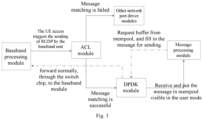
- the processing approach of the module shown in Fig. 3 includes the following steps: in the direction of data transmission for receiving the RUDP message, the baseband processing module triggers the sending of the RUDP to the ACL module after UE access; the ACL module performs matching by adopting a pre-stored RUDP message and sends the message to other network driver modules in response to the message matching being failed, and sends the message to the DPDK module in response to the message matching being successful; and after receiving the message, the DPDK module places the message in a memory visible in the user mode and processes the message in the user-mode memory by utilizing the message processing module.
- the message processing module requests memory from the user-mode memory, completes the filling of the message, and utilizes the DPDK module to send to the switch chip the RUDP message, which is then sent by the switch chip to the baseband processing module.
- the RUDP message in the direction of receiving, after the RUDP message is identified in the switch chip, the RUDP message is stored directly via the DPDK port into the user-mode memory and then sent to the message processing module; and in the direction of sending, the Operation Support Systems (OSS) requests network port memory, fills in the message, and then sends it out directly.
- OSS Operation Support Systems
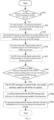
- Fig. 4 is a flowchart of a processing method for a RUDP message provided by an embodiment of the present disclosure. The method shown in Fig. 4 includes the following steps.
- a radio frequency unit detects whether a user terminal has accessed the cell.
- the radio frequency unit informs the baseband processing module to send a RUDP message to the control module.
- a switch chip in the control module performs ACL rule matching on the received RUDP message.
- bit fields such as message type and port number are adopted in the existing technology to perform identification and screening one by one.
- adopting the method in the existing technology will significantly increase the load of CPU.
- the embodiments of the present disclosure propose to use the ACL function at the switch chip level to identify and mark messages for forwarding at high speed by utilizing a TCAM table, which significantly improves the identification efficiency without increasing additional consumptions of CPU.
- step 404 is executed; otherwise, the message is forwarded normally.
- the switch chip in the control module redirects a destination port for the RUDP message to a DPDK network port.
- the DPDK After the ACL identifies the RUDP message and forwards it to the DPDK network port, the DPDK puts, through polling, the message in a Memory Pool (mempool) which is visible in the user mode, and may directly deliver the message to the processing module for processing.
- a Memory Pool (mempool) which is visible in the user mode, and may directly deliver the message to the processing module for processing.
- the CPU in the control module sends out the RUDP message for which the destination port has been redirected.
- a packet sending and receiving thread of the DPDK module performs polling and receiving operations and performs message matching; and in response to the received message being a RUDP message, step 407 is executed; otherwise, a discard operation is performed for all messages.
- the RUDP message is stored in the user-mode memory space (mempool) in the form of a queue, where there is a binding relationship between DPDK packet sending and receiving threads and the processing modules in the CPU, each processing module being allocated with a corresponding packet sending and receiving queue.
- a polling thread polls the RUDP message and delivers the RUDP message to the processing module for processing.
- the processing module performs resource allocation and tunnel establishment for UE access according to the content of the message.
- steps 405 to 409 after a message is received at the DPDK network port, the message is polled and received in the user mode and then delivered to the processing module, during which no interruptions need to be generated, no message identification needs to be performed in the user mode, and no copy of the message from the kernel mode to the user mode needs to occur, thus significantly saving system resources and performance.
- the method provided in the embodiments of the present disclosure does not need to modify the hardware design, but can optimize the message processing by utilizing the open source DPDK and the ACL function that comes with the switch chip, thus improving the processing efficiency.
- storing RUDP messages with the help of DPDK by utilizing a huge page table achieves the zero-copy purpose and binds the queues to the processing modules, thus improving the processing efficiency of the messages.
- the polling thread the problems of task scheduling and frequent interruptions are avoided, thus significantly saving CPU resources and improving processing performance, making it possible to better ensure the use and experience of user terminal equipment.
- Fig. 5 is a structural diagram of a message processing device provided in the present disclosure.
- the device shown in Fig. 5 includes a processor 501 and a memory 502, where the memory 502 stores a computer program, and the processor 501 invokes the computer program in the memory 502 to implement the following operations, which include: acquiring a RUDP message, where the RUDP message includes access request information of UE; storing the RUDP message in a user-mode memory; and processing the stored RUDP message.
- the processor 501 invokes the computer program in the memory 502 to implement the operation of acquiring the RUDP message, which includes: acquiring a message sent by a baseband processing module; and performing RUDP message identification on the acquired message by utilizing an ACL module within a switch chip in the control module to obtain a RUDP message.
- the processor 501 invokes the computer program in the memory 502 to implement the operation of performing identification on the acquired message by utilizing the ACL module within the switch chip in the control module to obtain the RUDP message, which includes: performing hash calculation on the acquired message to obtain a hash value of the message; performing a matching operation on the hash value of the received message by utilizing hash value information pre-stored in a Ternary Content Addressable Memory 502 (TCAM) in the ACL module; and determining that the received message is a RUDP message in response to a result of matching being that the hash value of the message is consistent with the hash value stored in the TCAM.
- TCAM Ternary Content Addressable Memory 502
- the processor 501 invokes the computer program in the memory 502 to implement the operation of storing the RUDP message in the user-mode memory, which includes: sending the RUDP message to a DPDK module; and storing the RUDP message in the user-mode memory by utilizing the DPDK module.
- the processor 501 invokes the computer program in the memory 502 to implement the operation of sending the RUDP message to the DPDK module, which includes: redirecting a destination port for the RUDP message to a pre-acquired DPDK port; and sending out the RUDP message for which the destination port has been redirected.
- the processor 501 invokes the computer program in the memory 502 to implement the operation of storing the RUDP message in the user-mode memory by utilizing the DPDK module, which includes: polling and matching messages received at the DPDK port to acquire a RUDP message; and saving the RUDP message in a pre-set queue in the user-mode memory space.
- the processor 501 invokes the computer program in the memory 502 to implement the operation of saving the RUDP message in the pre-set queue in the user-mode memory space, which includes: storing the RUDP message into the pre-set queue according to a pre-stored storage sequence.
- the processor 501 invokes the computer program in the memory 502 to further implement the following operation, which includes: controlling, in accordance with a correspondence between pre-set queues and processing modules, each processing module to respond to a RUDP message in a corresponding queue.
- the processor 501 invokes the computer program in the memory 502 to implement the operation of processing the stored RUDP message, which includes: acquiring, after obtaining response information corresponding to the RUDP message, a user-mode memory required by the response information from the DPDK module; obtaining a response message corresponding to the RUDP message by utilizing the acquired user-mode memory and the response information; and sending the response message by utilizing the switch chip.
- the processor 501 invokes the computer program in the memory 502 to implement the operation of storing the RUDP message in the pre-set queue in the user-mode memory space
- the processor 501 invokes the computer program in the memory 502 to implement the following operations, which include: acquiring information on the number of times the UE has accessed and/or disconnected from a cell within a pre-set length of time; and storing a RUDP message corresponding to the UE in the user-mode memory in response to the information on the number of times the UE has accessed and/or disconnected from the cell meeting a pre-set determination condition of frequent access.
- an RUDP message is acquired, the RUDP message is stored in a user-mode memory, and the stored RUDP message is processed.
- the RUDP message is stored directly into the user-mode memory, there is no need to perform a memory copy, thus achieving the purpose of zero memory copies and achieving the effect of reducing the burden on the processor.
- the present disclosure further provides a computer-readable storage medium storing one or more programs which are executable by one or more processors to implement any method described above.
- an RUDP message is acquired, the RUDP message is stored in a user-mode memory, and the stored RUDP message is processed.
- the RUDP message is stored directly into the user-mode memory, there is no need to perform a memory copy, thus achieving the purpose of zero memory copies and achieving the effect of reducing the burden on the processor.
- Such software can be distributed on computer-readable media, which can include computer-readable storage media (or non-transitory media) and communication media (or transitory media).
- computer-readable storage medium includes volatile and nonvolatile, removable and non-removable media implemented in any method or technique for storing information, such as computer-readable instructions, data structures, program modules or other data.
- a computer-readable storage medium includes, but is not limited to, RAM, ROM, EEPROM, flash memory or other memory technologies, CD-ROM, digital versatile disk (DVD) or other optical disk storage, cassettes, magnetic tapes, magnetic disk storage or other magnetic storage devices, or any other medium that can be configured to store desired information and can be accessed by a computer.
- communication media typically contain computer-readable instructions, data structures, program modules or other data in a modulated data signal such as a carrier wave or other transmission mechanism, and can include any information transmission media.
- a modulated data signal such as a carrier wave or other transmission mechanism
Landscapes
- Engineering & Computer Science (AREA)
- Computer Networks & Wireless Communication (AREA)
- Signal Processing (AREA)
- Computer Security & Cryptography (AREA)
- Computer Hardware Design (AREA)
- Computing Systems (AREA)
- General Engineering & Computer Science (AREA)
- Mobile Radio Communication Systems (AREA)
- Data Exchanges In Wide-Area Networks (AREA)
Description
- The present disclosure relates to the field of information processing and, in particular, to a message processing method and device, and a computer-readable storage medium.
- When user equipment (UE) accesses or disconnects from a cell, the base station receives a Reliable User Datagram Protocol (RUDP) message using the kernel protocol stack and forwards the message to the processing module via a socket. However, in the case of frequent access of large volume of UE, there are too many interruptions in receiving and sending packets at the network port, which significantly increases the workload of CPU.
-
US 2008/268881 A1 relates to a method and mobile device for silently fetching data. In one arrangement, the method can include the steps of receiving a silent fetch request from an originating device over a wireless communication channel in which the silent fetch request requests information and checking the authorization of the originating device. If the originating device is an authorized device, the requested information can be fetched and transmitted to the originating device. As an example, the requested information can be fetched from a receiving device or from a network server with which the receiving device is associated. As another example, the wireless communication channel can be a traffic channel that supports at least push-to-talk communications. -
US 2018/329743 A1 relates to a data processing system having a poll mode driver and a library supporting protocol processing. The poll mode driver and the library are non-operating system functionalities. An application is provided. An operation system is configured while executing in kernel mode and in response to the application being determined to be unresponsive, use a helper process being an operating system functionality executing at user-mode to cause a receive or transmit mode of the application to continue. - The present disclosure provides a message processing method applicable to a base station, according to claim 1.
- The present disclosure also provides a message processing device according to claim 6.
- The present disclosure also provides a computer-readable storage medium storing one or more programs according to claim 7.
- Additional features and advantages of the present disclosure will be set forth in the subsequent description, and in part will become apparent from the description, or may be learned by practice of the present disclosure. The purposes and other advantages of the present disclosure can be realized and obtained by structures particularly noted in the description, the claims and the accompanying drawings.
- The accompanying drawings are used to provide further understanding of the technical schemes of the present disclosure and constitute a part of the description. The accompanying drawings are used to explain the technical schemes of the present disclosure together with the embodiments of the present disclosure, and do not constitute a restriction on the technical schemes of the present disclosure.
-
Fig. 1 is a flowchart of a message processing method provided in the present disclosure; -
Fig. 2 is an interactive schematic diagram of the message processing method provided in an embodiment of the present disclosure; -
Fig. 3 is an interactive schematic diagram between modules shown inFig. 2 ; -
Fig. 4 is a flowchart of a processing method for a RUDP message provided by an embodiment of the present disclosure; and -
Fig. 5 is a structural diagram of a message processing device provided in the present disclosure. - In order to make the purposes, technical schemes and advantages of the present disclosure clear, the embodiments of the present disclosure will be described hereinafter in detail with reference to the accompanying drawings. It should be noted that any combinations of embodiments and features of the embodiments of the present disclosure without conflict are possible.
- The steps shown in the flowcharts of the drawings may be performed in a computer system, such as with a set of computer-executable instructions. Furthermore, although example logical order is shown in the flowchart, in some cases, the steps shown or described may be performed in different order.
-
Fig. 1 is a flowchart of a message processing method provided in the present disclosure. The method shown inFig. 1 that is applicable to a base station includes the following steps. - At
step 101, a RUDP message is acquired, where the RUDP message includes access request information of UE; a baseband processing unit sends the RUDP message to a control module when the UE is accessing or disconnecting from the base station; and in practical applications, since the control module is not limited to receiving messages of the RUDP message type, but the control module also receives other types of messages, which requires the control module to identify the received messages. - In an embodiment, acquiring a RUDP message includes: acquiring a message sent by a baseband processing module; and performing RUDP message identification on the acquired message by utilizing an Access Control List (ACL) module within a switch chip to obtain a RUDP message.
- In this embodiment, the identification of the message is implemented by utilizing the built-in ACL function of the switch chip, and a new method for message matching identification is provided compared to the utilization of Media Access Control Address (MAC) address matching in the existing technology, which has a lower hardware cost due to the utilization of the built-in function in the switch chip.
- At
step 102, the RUDP message is stored in a user-mode memory. In the process of analyzing the problem of overburdened CPU in the existing technology, the inventors found that the reason why adopting the kernel-mode protocol stack to receive a RUDP message significantly increases the workload of the CPU is the occurrence of memory copies of the RUDP message from the kernel mode to the user mode, especially in the case of frequent access of large volume of UE, which further increases the burden on the CPU due to too many interruptions in sending and receiving packets at the network port. - Based on the inventors' analysis, the inventors propose that, in the solution provided in the embodiments of the present disclosure, a RUDP message be stored directly into the user-mode memory, then there is no need to perform a memory copy, thus achieving the purpose of zero memory copies and achieving the effect of reducing the burden on the CPU.
- At
step 103, the stored RUDP message is processed. - In an embodiment, resource allocation and tunnel establishment for UE access is performed based on the content of the RUDP message.
- According to the method embodiment provided in the present disclosure, an RUDP message is acquired, the RUDP message is stored in a user-mode memory, and the stored RUDP message is processed. By storing the RUDP message directly into the user-mode memory, there is no need to perform a memory copy, thus achieving the purpose of zero memory copies and achieving the effect of reducing the burden on the processor.
- The method provided in the present disclosure is further illustrated as follows.
- In an embodiment, performing identification on the acquired message by utilizing an ACL module within a switch chip to obtain a RUDP message includes: performing hash calculation on the acquired message to obtain a hash value of the message; performing a matching operation on the hash value of the received message by utilizing hash value information pre-stored in a Ternary Content Addressable Memory (TCAM) in the ACL module; and determining that the received message is a RUDP message in response to a result of matching being that the hash value of the message is consistent with the hash value stored in the TCAM.
- In this embodiment, the ACL adopts the hash value of the underlying TCAM to perform rules hitting and matching operations without the involvement of other external software, which are fast and accurate. If at least two rules are set in the TCAM table, it is possible to match one message with at least two rules in parallel, thus improving the processing efficiency.
- In an embodiment, storing the RUDP message in a user-mode memory includes: sending the RUDP message to a Data Plane Development Kit (DPDK) module; and storing the RUDP message in the user-mode memory by utilizing the DPDK module.
- In this embodiment, the storage of the RUDP message in the user-mode memory is achieved by utilizing the DPDK module. By utilizing the open source characteristics of the DPDK module, software configuration of the DPDK is performed, thus accomplishing the purpose of storing the RUDP message into the user-mode memory without increasing the hardware development cost.
- In an embodiment, sending the RUDP message to a DPDK module includes: redirecting a destination port for the RUDP message to a pre-acquired DPDK port; and sending out the RUDP message for which the destination port has been redirected.
- In this embodiment, after the ACL module determines the RUDP message, by redirecting the destination port for the message, the RUDP message may be sent to the DPDK port for processing by the DPDK module. By means of the redirection of the destination port, it is possible to achieve the purpose of routing, within the control module, the RUDP message to the DPDK module without changing the destination port for the message sent by the baseband processing module, thus accomplishing the purpose of storing the RUDP message into the user-mode memory without destroying the transmission mechanism of the original communication protocol.
- In an embodiment, storing the RUDP message in the user-mode memory by utilizing the DPDK module includes: polling and matching messages received at the DPDK port to acquire a RUDP message; and saving the RUDP message in a pre-set queue in the user-mode memory space.
- In this embodiment, the message format characteristics information for RUDP messages may be adopted to poll and match messages received by the DPDK port to obtain a RUDP message, and then the RUDP message may be stored by utilizing a queue of the port. Since DPDK adopts techniques of Userspace I/O (UIO) and huge page, a message may be stored directly into the user-mode memory, thus achieving the purpose of storing data directly into the user-mode memory and achieving the purpose of zero copy.
- In an embodiment, saving the RUDP message in a pre-set queue in the user-mode memory space includes: storing the RUDP message into the pre-set queue according to a pre-stored storage sequence; and after saving the RUDP message in the pre-set queue in the user-mode memory space, the method further includes: controlling, in accordance with a correspondence between pre-set queues and processing modules, each processing module to respond respectively to a RUDP message in a corresponding queue.
- In this embodiment, the RUDP message may be stored by utilizing at least two queues, where the specific queue in which the received RUDP message is stored may be determined according to a pre-set policy, for example, a queue may be randomly selected, or a corresponding queue may be determined according to a pre-set calculation expression based on the receiving serial number of the RUDP message.
- Since each queue has a corresponding processing module, each processing module processes a RUDP message in a corresponding queue, where the RUDP messages in the queues may be processed in a first-in-first-out manner. By processing RUDP messages in parallel by utilizing multiple processing modules, the processing efficiency of the messages can be effectively improved.
- In an embodiment, processing the stored RUDP message includes: acquiring, after obtaining response information corresponding to the RUDP message, a user-mode memory required by the response information from the DPDK module; obtaining a response message corresponding to the RUDP message by utilizing the acquired user-mode memory and the response information; and sending the response message by utilizing the switch chip.
- In this embodiment, after obtaining the response information corresponding to the RUDP message, the user-mode memory is requested via the DPDK module and filled in with the message, which is then sent out directly, so there is no interruption and memory copy, thus significantly simplifying the processing flow and improving the response efficiency.
- In an embodiment, before storing the RUDP message in the user-mode memory, the method further includes: acquiring information on the number of times the UE has accessed and/or disconnected from a cell within a pre-set length of time; and storing a RUDP message corresponding to the UE in the user-mode memory in response to the information on the number of times the UE has accessed and/or disconnected from the cell meeting a pre-set determination condition of frequent access.
- In this embodiment, by determining whether the UE has accessed the base station frequently, it is possible to effectively switch between the original message processing method and the message processing method of the present disclosure, thereby increasing the flexibility of the method application.
- The method provided in the embodiments of the present disclosure is further illustrated as follows: in the case of frequent access to the base station by large volume of UE, a RUDP message may be identified through ACL, and the message may be sent, received and processed by utilizing DPDK, so as to avoid interruptions and achieve zero-copy to improve the transmission performance, thus enhancing user experience and winning customer reputation.
-
Fig. 2 is an interactive schematic diagram of the message processing method provided in an embodiment of the present disclosure. As shown inFig. 2 , after the user equipment has accessed the base station, a RUDP message may be output by the baseband processing unit after being processed by the radio frequency processing unit. The control module of the present disclosure processes the RUDP message by utilizing the built-in switch chip and the CPU and sends it to the core network after processing. -
Fig. 3 is an interactive schematic diagram between modules shown inFig. 2 . The processing approach of the module shown inFig. 3 includes the following steps: in the direction of data transmission for receiving the RUDP message, the baseband processing module triggers the sending of the RUDP to the ACL module after UE access; the ACL module performs matching by adopting a pre-stored RUDP message and sends the message to other network driver modules in response to the message matching being failed, and sends the message to the DPDK module in response to the message matching being successful; and after receiving the message, the DPDK module places the message in a memory visible in the user mode and processes the message in the user-mode memory by utilizing the message processing module. - In the direction of data transmission for sending the RUDP message, the message processing module requests memory from the user-mode memory, completes the filling of the message, and utilizes the DPDK module to send to the switch chip the RUDP message, which is then sent by the switch chip to the baseband processing module.
- In the interaction diagram shown in
Fig. 3 , in the direction of receiving, after the RUDP message is identified in the switch chip, the RUDP message is stored directly via the DPDK port into the user-mode memory and then sent to the message processing module; and in the direction of sending, the Operation Support Systems (OSS) requests network port memory, fills in the message, and then sends it out directly. In the above-mentioned transmission process, there is no interruption or memory copy operations, which significantly simplifies the processing flow, improves the response efficiency, and qualitatively improves many indexes of the base station. -
Fig. 4 is a flowchart of a processing method for a RUDP message provided by an embodiment of the present disclosure. The method shown inFig. 4 includes the following steps. - At
step 401, a radio frequency unit detects whether a user terminal has accessed the cell. - At
step 402, after detecting that the user terminal has accessed the cell, the radio frequency unit informs the baseband processing module to send a RUDP message to the control module. - At
step 403, after the RUDP message is transmitted to the control module via the physical link, a switch chip in the control module performs ACL rule matching on the received RUDP message. - During RUDP message identification, bit fields such as message type and port number are adopted in the existing technology to perform identification and screening one by one. However, when the amount of messages is large, adopting the method in the existing technology will significantly increase the load of CPU. In order to overcome the above problem, the embodiments of the present disclosure propose to use the ACL function at the switch chip level to identify and mark messages for forwarding at high speed by utilizing a TCAM table, which significantly improves the identification efficiency without increasing additional consumptions of CPU.
- In response to the matching being successful,
step 404 is executed; otherwise, the message is forwarded normally. - At
step 404, the switch chip in the control module redirects a destination port for the RUDP message to a DPDK network port. - After the ACL identifies the RUDP message and forwards it to the DPDK network port, the DPDK puts, through polling, the message in a Memory Pool (mempool) which is visible in the user mode, and may directly deliver the message to the processing module for processing.
- At
step 405, the CPU in the control module sends out the RUDP message for which the destination port has been redirected. - At
step 406, a packet sending and receiving thread of the DPDK module performs polling and receiving operations and performs message matching; and in response to the received message being a RUDP message,step 407 is executed; otherwise, a discard operation is performed for all messages. - At
step 407, the RUDP message is stored in the user-mode memory space (mempool) in the form of a queue, where there is a binding relationship between DPDK packet sending and receiving threads and the processing modules in the CPU, each processing module being allocated with a corresponding packet sending and receiving queue. - At
step 408, a polling thread polls the RUDP message and delivers the RUDP message to the processing module for processing. - At
step 409, the processing module performs resource allocation and tunnel establishment for UE access according to the content of the message. - As can be seen from
steps 405 to 409, after a message is received at the DPDK network port, the message is polled and received in the user mode and then delivered to the processing module, during which no interruptions need to be generated, no message identification needs to be performed in the user mode, and no copy of the message from the kernel mode to the user mode needs to occur, thus significantly saving system resources and performance. - The method provided in the embodiments of the present disclosure does not need to modify the hardware design, but can optimize the message processing by utilizing the open source DPDK and the ACL function that comes with the switch chip, thus improving the processing efficiency. In addition, compared with the original forwarding processing method, storing RUDP messages with the help of DPDK by utilizing a huge page table achieves the zero-copy purpose and binds the queues to the processing modules, thus improving the processing efficiency of the messages. Further, by the polling thread, the problems of task scheduling and frequent interruptions are avoided, thus significantly saving CPU resources and improving processing performance, making it possible to better ensure the use and experience of user terminal equipment.
-
Fig. 5 is a structural diagram of a message processing device provided in the present disclosure. The device shown inFig. 5 includes aprocessor 501 and amemory 502, where thememory 502 stores a computer program, and theprocessor 501 invokes the computer program in thememory 502 to implement the following operations, which include: acquiring a RUDP message, where the RUDP message includes access request information of UE; storing the RUDP message in a user-mode memory; and processing the stored RUDP message. - In an embodiment, the
processor 501 invokes the computer program in thememory 502 to implement the operation of acquiring the RUDP message, which includes: acquiring a message sent by a baseband processing module; and performing RUDP message identification on the acquired message by utilizing an ACL module within a switch chip in the control module to obtain a RUDP message. - In an embodiment, the
processor 501 invokes the computer program in thememory 502 to implement the operation of performing identification on the acquired message by utilizing the ACL module within the switch chip in the control module to obtain the RUDP message, which includes: performing hash calculation on the acquired message to obtain a hash value of the message; performing a matching operation on the hash value of the received message by utilizing hash value information pre-stored in a Ternary Content Addressable Memory 502 (TCAM) in the ACL module; and determining that the received message is a RUDP message in response to a result of matching being that the hash value of the message is consistent with the hash value stored in the TCAM. - In an embodiment, the
processor 501 invokes the computer program in thememory 502 to implement the operation of storing the RUDP message in the user-mode memory, which includes: sending the RUDP message to a DPDK module; and storing the RUDP message in the user-mode memory by utilizing the DPDK module. - In an embodiment, the
processor 501 invokes the computer program in thememory 502 to implement the operation of sending the RUDP message to the DPDK module, which includes: redirecting a destination port for the RUDP message to a pre-acquired DPDK port; and sending out the RUDP message for which the destination port has been redirected. - In an embodiment, the
processor 501 invokes the computer program in thememory 502 to implement the operation of storing the RUDP message in the user-mode memory by utilizing the DPDK module, which includes: polling and matching messages received at the DPDK port to acquire a RUDP message; and saving the RUDP message in a pre-set queue in the user-mode memory space. - In an embodiment, the
processor 501 invokes the computer program in thememory 502 to implement the operation of saving the RUDP message in the pre-set queue in the user-mode memory space, which includes: storing the RUDP message into the pre-set queue according to a pre-stored storage sequence. In an embodiment, after theprocessor 501 invokes the computer program in thememory 502 to implement the operation of saving the RUDP message in the pre-set queue in the user-mode memory space, theprocessor 501 invokes the computer program in thememory 502 to further implement the following operation, which includes: controlling, in accordance with a correspondence between pre-set queues and processing modules, each processing module to respond to a RUDP message in a corresponding queue. - In an embodiment, the
processor 501 invokes the computer program in thememory 502 to implement the operation of processing the stored RUDP message, which includes: acquiring, after obtaining response information corresponding to the RUDP message, a user-mode memory required by the response information from the DPDK module; obtaining a response message corresponding to the RUDP message by utilizing the acquired user-mode memory and the response information; and sending the response message by utilizing the switch chip. - In an embodiment, before the
processor 501 invokes the computer program in thememory 502 to implement the operation of storing the RUDP message in the pre-set queue in the user-mode memory space, theprocessor 501 invokes the computer program in thememory 502 to implement the following operations, which include: acquiring information on the number of times the UE has accessed and/or disconnected from a cell within a pre-set length of time; and storing a RUDP message corresponding to the UE in the user-mode memory in response to the information on the number of times the UE has accessed and/or disconnected from the cell meeting a pre-set determination condition of frequent access. - According to the device embodiment provided in the present disclosure, an RUDP message is acquired, the RUDP message is stored in a user-mode memory, and the stored RUDP message is processed. By storing the RUDP message directly into the user-mode memory, there is no need to perform a memory copy, thus achieving the purpose of zero memory copies and achieving the effect of reducing the burden on the processor.
- The present disclosure further provides a computer-readable storage medium storing one or more programs which are executable by one or more processors to implement any method described above.
- According to the computer-readable storage medium embodiment provided in the present disclosure, an RUDP message is acquired, the RUDP message is stored in a user-mode memory, and the stored RUDP message is processed. By storing the RUDP message directly into the user-mode memory, there is no need to perform a memory copy, thus achieving the purpose of zero memory copies and achieving the effect of reducing the burden on the processor.
- It can be understood by those having ordinary skills in the art that all or some of the steps of the methods, systems and functional modules/units in the devices disclosed above can be implemented as software, firmware, hardware and appropriate combinations thereof. In a hardware embodiment, the division between functional modules/units mentioned in the above description does not necessarily correspond to the division of physical components. For example, a physical component may have multiple functions, or a function or step may be performed cooperatively by several physical components. Some or all of the components may be implemented as software executed by a processor, such as a digital signal processor or a microprocessor, or as hardware, or as an integrated circuit, such as an application-specific integrated circuit. Such software can be distributed on computer-readable media, which can include computer-readable storage media (or non-transitory media) and communication media (or transitory media). As well known to those having ordinary skills in the art, the term computer-readable storage medium includes volatile and nonvolatile, removable and non-removable media implemented in any method or technique for storing information, such as computer-readable instructions, data structures, program modules or other data. A computer-readable storage medium includes, but is not limited to, RAM, ROM, EEPROM, flash memory or other memory technologies, CD-ROM, digital versatile disk (DVD) or other optical disk storage, cassettes, magnetic tapes, magnetic disk storage or other magnetic storage devices, or any other medium that can be configured to store desired information and can be accessed by a computer. Furthermore, it is well known to those having ordinary skills in the art that communication media typically contain computer-readable instructions, data structures, program modules or other data in a modulated data signal such as a carrier wave or other transmission mechanism, and can include any information transmission media. The invention is defined by the appended independent claims. Preferred embodiments are defined by the dependent claims. Further "embodiments" described in this description which do not fall within the scope of the appended claims shall serve as examples for a better understanding of the invention.
Claims (7)
- A message processing method applicable to a base station, comprising:acquiring a Reliable User Datagram Protocol, RUDP, message, wherein the RUDP message comprises access request information of user equipment, UE (101);storing the RUDP message in a user-mode memory (102); andprocessing the stored RUDP message (103);characterized in that,storing the RUDP message in a user-mode memory comprises:sending the RUDP message to a Data Plane Development Kit, DPDK, module; andstoring the RUDP message in the user-mode memory by utilizing the DPDK module;wherein sending the RUDP message to a DPDK module comprises:redirecting a destination port for the RUDP message to a pre-acquired DPDK port of the DPDK module used to place the RUDP message in a memory space visible in user mode; andsending out the RUDP message for which the destination port has been redirected;wherein storing the RUDP message in the user-mode memory by utilizing the DPDK module comprises:polling and matching messages received at the DPDK port to acquire a RUDP message; andsaving the RUDP message in a pre-set queue in the user-mode memory space;wherein:saving the RUDP message in a pre-set queue in the user-mode memory space comprises:
storing the RUDP message into the pre-set queue according to a pre-stored storage sequence;
andafter saving the RUDP message in the pre-set queue in the user-mode memory space, the method further comprises:
controlling, in accordance with a correspondence between pre-set queues and processing modules, each processing module to respond respectively to a RUDP message in a corresponding queue. - The method of claim 1, wherein acquiring a RUDP message comprises:acquiring a message sent by a baseband processing module; andperforming RUDP message identification on the acquired message by utilizing an Access Control List, ACL, module within a switch chip to obtain a RUDP message.
- The method of claim 2, wherein performing identification on the acquired message by utilizing an ACL module within a switch chip to obtain a RUDP message comprises:performing hash calculation on the acquired message to obtain a hash value of the message;performing a matching operation on the hash value of the received message by utilizing hash value information pre-stored in a Ternary Content Addressable Memory, TCAM, in the ACL module; anddetermining that the received message is a RUDP message in response to a result of matching being that the hash value of the message is consistent with the hash value stored in the TCAM.
- The method of claim 1, wherein processing the stored RUDP message comprises:acquiring, after obtaining response information corresponding to the RUDP message, a user-mode memory required by the response information from the DPDK module;obtaining a response message corresponding to the RUDP message by utilizing the acquired user-mode memory and the response information; andsending the response message by utilizing the switch chip.
- The method of claim 1, wherein before storing the RUDP message in the user-mode memory, the method further comprises:acquiring information on a number of times that the UE has accessed and/or disconnected from a cell within a pre-set length of time; andstoring a RUDP message corresponding to the UE in the user-mode memory in response to the information on the number of times that the UE has accessed and/or disconnected from the cell meeting a pre-set determination condition of frequent access.
- A message processing device comprising a processor (501) and a memory (502), wherein the memory (502) stores a computer program, which the processor (501) invokes to implement the method of any one of claims 1 to 5.
- A computer-readable storage medium storing one or more programs which are executable by one or more processors to implement the method of any one of claims 1 to 5.
Applications Claiming Priority (2)
| Application Number | Priority Date | Filing Date | Title |
|---|---|---|---|
| CN201910785349.3A CN112422457B (en) | 2019-08-23 | 2019-08-23 | Message processing method and device and computer storage medium |
| PCT/CN2020/109085 WO2021036812A1 (en) | 2019-08-23 | 2020-08-14 | Message processing method and apparatus, and computer storage medium |
Publications (3)
| Publication Number | Publication Date |
|---|---|
| EP3992770A1 EP3992770A1 (en) | 2022-05-04 |
| EP3992770A4 EP3992770A4 (en) | 2022-07-27 |
| EP3992770B1 true EP3992770B1 (en) | 2025-01-15 |
Family
ID=74685065
Family Applications (1)
| Application Number | Title | Priority Date | Filing Date |
|---|---|---|---|
| EP20858807.9A Active EP3992770B1 (en) | 2019-08-23 | 2020-08-14 | Message processing method and apparatus, and computer storage medium |
Country Status (4)
| Country | Link |
|---|---|
| EP (1) | EP3992770B1 (en) |
| JP (1) | JP7366240B2 (en) |
| CN (1) | CN112422457B (en) |
| WO (1) | WO2021036812A1 (en) |
Families Citing this family (1)
| Publication number | Priority date | Publication date | Assignee | Title |
|---|---|---|---|---|
| CN113434287A (en) * | 2021-06-03 | 2021-09-24 | 中国联合网络通信集团有限公司 | Task data transmission method, system, electronic device and storage medium |
Family Cites Families (16)
| Publication number | Priority date | Publication date | Assignee | Title |
|---|---|---|---|---|
| CN101035060A (en) * | 2006-03-08 | 2007-09-12 | 中兴通讯股份有限公司 | Integrated processing method for three-folded content addressable memory message classification |
| CA2663317A1 (en) * | 2006-09-13 | 2008-03-20 | Asankya Networks, Inc. | Systems and methods of improving performance of transport protocols in a multi-path environment |
| US20080268881A1 (en) * | 2007-04-30 | 2008-10-30 | Motorola, Inc. | Method and apparatus for silently fetching information |
| US8259659B2 (en) * | 2008-07-03 | 2012-09-04 | Apple Inc. | Apparatus and methods for managing access and update requests in a wireless network |
| US9331963B2 (en) * | 2010-09-24 | 2016-05-03 | Oracle International Corporation | Wireless host I/O using virtualized I/O controllers |
| CN102546398B (en) * | 2011-12-16 | 2015-02-25 | 华为技术有限公司 | Message matching method and device |
| CN104104705B (en) * | 2013-04-11 | 2018-02-02 | 阿里巴巴集团控股有限公司 | The cut-in method and equipment of distributed memory system |
| US9264357B2 (en) * | 2013-04-30 | 2016-02-16 | Xpliant, Inc. | Apparatus and method for table search with centralized memory pool in a network switch |
| CN104601468B (en) * | 2015-01-13 | 2018-10-09 | 新华三技术有限公司 | Message forwarding method and equipment |
| CN106657126B (en) * | 2017-01-05 | 2019-11-08 | 盛科网络(苏州)有限公司 | The device and method of detection and defending DDoS (Distributed Denial of Service) attacks |
| KR102319838B1 (en) * | 2017-03-08 | 2021-11-01 | 삼성전자 주식회사 | Apparatus and method for random access for massive connectivity |
| CN108628684B (en) * | 2017-03-20 | 2021-01-05 | 华为技术有限公司 | DPDK-based message processing method and computer equipment |
| US11093284B2 (en) * | 2017-05-12 | 2021-08-17 | Xilinx, Inc. | Data processing system |
| CN108037898A (en) * | 2017-12-15 | 2018-05-15 | 郑州云海信息技术有限公司 | A kind of method, system and device of the dpdk communications based on Ceph |
| CN109309626B (en) * | 2018-09-10 | 2022-03-25 | 南京知常容信息技术有限公司 | DPDK-based high-speed network data packet capturing, distributing and caching method |
| CN109688058B (en) * | 2018-12-19 | 2021-03-02 | 迈普通信技术股份有限公司 | Message processing method and device and network equipment |
-
2019
- 2019-08-23 CN CN201910785349.3A patent/CN112422457B/en active Active
-
2020
- 2020-08-14 JP JP2022511037A patent/JP7366240B2/en active Active
- 2020-08-14 WO PCT/CN2020/109085 patent/WO2021036812A1/en not_active Ceased
- 2020-08-14 EP EP20858807.9A patent/EP3992770B1/en active Active
Also Published As
| Publication number | Publication date |
|---|---|
| EP3992770A4 (en) | 2022-07-27 |
| CN112422457B (en) | 2023-04-07 |
| WO2021036812A1 (en) | 2021-03-04 |
| EP3992770A1 (en) | 2022-05-04 |
| JP7366240B2 (en) | 2023-10-20 |
| CN112422457A (en) | 2021-02-26 |
| JP2022545453A (en) | 2022-10-27 |
Similar Documents
| Publication | Publication Date | Title |
|---|---|---|
| US11159454B2 (en) | Technologies for accelerating edge device workloads | |
| EP4009593B1 (en) | Data transmission method and apparatus, network card and storage medium | |
| CN112152940B (en) | Message processing method, device and system | |
| US20240236178A1 (en) | Network traffic management at radio-based application pipeline processing servers | |
| EP3913893A1 (en) | Method and apparatus for processing data message | |
| US10574477B2 (en) | Priority tagging based solutions in fc sans independent of target priority tagging capability | |
| US9621633B2 (en) | Flow director-based low latency networking | |
| EP3438868A1 (en) | Tee access control method and mobile terminal implementing same | |
| WO2023005773A1 (en) | Message forwarding method and apparatus based on remote direct data storage, and network card and device | |
| CN108023829B (en) | Message processing method and device, storage medium and electronic equipment | |
| CN113891396B (en) | Data packet processing method and device, computer equipment and storage medium | |
| US9479438B2 (en) | Link aggregation based on virtual interfaces of VLANs | |
| WO2025001091A1 (en) | Packet distribution method, network device and storage medium | |
| US11271897B2 (en) | Electronic apparatus for providing fast packet forwarding with reference to additional network address translation table | |
| CN117580128A (en) | Node access method, device and storage medium | |
| EP3992770A1 (en) | Message processing method and apparatus, and computer storage medium | |
| US10284501B2 (en) | Technologies for multi-core wireless network data transmission | |
| EP4161207A1 (en) | Base station device and method for operating base station device | |
| US20180091447A1 (en) | Technologies for dynamically transitioning network traffic host buffer queues | |
| WO2021073473A1 (en) | Data packet processing method and apparatus, communication device, and storage medium | |
| CN104811391B (en) | Data packet processing method, device and server | |
| WO2023226730A1 (en) | Data transmission method and apparatus, and storage medium and program product | |
| CN113783778B (en) | DDoS device-based policy routing method, system, computer and storage medium | |
| CN116016687A (en) | Message distribution method and system based on DPDK | |
| US20200210244A1 (en) | Virtual resource placement |
Legal Events
| Date | Code | Title | Description |
|---|---|---|---|
| STAA | Information on the status of an ep patent application or granted ep patent |
Free format text: STATUS: THE INTERNATIONAL PUBLICATION HAS BEEN MADE |
|
| PUAI | Public reference made under article 153(3) epc to a published international application that has entered the european phase |
Free format text: ORIGINAL CODE: 0009012 |
|
| STAA | Information on the status of an ep patent application or granted ep patent |
Free format text: STATUS: REQUEST FOR EXAMINATION WAS MADE |
|
| 17P | Request for examination filed |
Effective date: 20220127 |
|
| AK | Designated contracting states |
Kind code of ref document: A1 Designated state(s): AL AT BE BG CH CY CZ DE DK EE ES FI FR GB GR HR HU IE IS IT LI LT LU LV MC MK MT NL NO PL PT RO RS SE SI SK SM TR |
|
| A4 | Supplementary search report drawn up and despatched |
Effective date: 20220627 |
|
| RIC1 | Information provided on ipc code assigned before grant |
Ipc: H04L 9/40 20220101ALI20220621BHEP Ipc: H04L 67/01 20220101ALI20220621BHEP Ipc: H04L 49/90 20220101ALI20220621BHEP Ipc: G06F 3/06 20060101AFI20220621BHEP |
|
| DAV | Request for validation of the european patent (deleted) | ||
| DAX | Request for extension of the european patent (deleted) | ||
| REG | Reference to a national code |
Ref country code: DE Free format text: PREVIOUS MAIN CLASS: G06F0003060000 Ipc: H04L0045745300 Ref country code: DE Ref legal event code: R079 Ref document number: 602020044960 Country of ref document: DE Free format text: PREVIOUS MAIN CLASS: G06F0003060000 Ipc: H04L0045745300 |
|
| GRAP | Despatch of communication of intention to grant a patent |
Free format text: ORIGINAL CODE: EPIDOSNIGR1 |
|
| STAA | Information on the status of an ep patent application or granted ep patent |
Free format text: STATUS: GRANT OF PATENT IS INTENDED |
|
| RIC1 | Information provided on ipc code assigned before grant |
Ipc: H04L 9/40 20220101ALI20241007BHEP Ipc: H04W 12/08 20210101ALI20241007BHEP Ipc: H04L 69/22 20220101ALI20241007BHEP Ipc: H04L 69/164 20220101ALI20241007BHEP Ipc: H04L 45/7453 20220101AFI20241007BHEP |
|
| INTG | Intention to grant announced |
Effective date: 20241022 |
|
| GRAS | Grant fee paid |
Free format text: ORIGINAL CODE: EPIDOSNIGR3 |
|
| GRAA | (expected) grant |
Free format text: ORIGINAL CODE: 0009210 |
|
| STAA | Information on the status of an ep patent application or granted ep patent |
Free format text: STATUS: THE PATENT HAS BEEN GRANTED |
|
| AK | Designated contracting states |
Kind code of ref document: B1 Designated state(s): AL AT BE BG CH CY CZ DE DK EE ES FI FR GB GR HR HU IE IS IT LI LT LU LV MC MK MT NL NO PL PT RO RS SE SI SK SM TR |
|
| REG | Reference to a national code |
Ref country code: CH Ref legal event code: EP Ref country code: GB Ref legal event code: FG4D |
|
| REG | Reference to a national code |
Ref country code: DE Ref legal event code: R096 Ref document number: 602020044960 Country of ref document: DE |
|
| REG | Reference to a national code |
Ref country code: IE Ref legal event code: FG4D |
|
| REG | Reference to a national code |
Ref country code: NL Ref legal event code: MP Effective date: 20250115 |
|
| PG25 | Lapsed in a contracting state [announced via postgrant information from national office to epo] |
Ref country code: NL Free format text: LAPSE BECAUSE OF FAILURE TO SUBMIT A TRANSLATION OF THE DESCRIPTION OR TO PAY THE FEE WITHIN THE PRESCRIBED TIME-LIMIT Effective date: 20250115 |
|
| PG25 | Lapsed in a contracting state [announced via postgrant information from national office to epo] |
Ref country code: RS Free format text: LAPSE BECAUSE OF FAILURE TO SUBMIT A TRANSLATION OF THE DESCRIPTION OR TO PAY THE FEE WITHIN THE PRESCRIBED TIME-LIMIT Effective date: 20250415 |
|
| PG25 | Lapsed in a contracting state [announced via postgrant information from national office to epo] |
Ref country code: FI Free format text: LAPSE BECAUSE OF FAILURE TO SUBMIT A TRANSLATION OF THE DESCRIPTION OR TO PAY THE FEE WITHIN THE PRESCRIBED TIME-LIMIT Effective date: 20250115 |
|
| PG25 | Lapsed in a contracting state [announced via postgrant information from national office to epo] |
Ref country code: PL Free format text: LAPSE BECAUSE OF FAILURE TO SUBMIT A TRANSLATION OF THE DESCRIPTION OR TO PAY THE FEE WITHIN THE PRESCRIBED TIME-LIMIT Effective date: 20250115 |
|
| PG25 | Lapsed in a contracting state [announced via postgrant information from national office to epo] |
Ref country code: ES Free format text: LAPSE BECAUSE OF FAILURE TO SUBMIT A TRANSLATION OF THE DESCRIPTION OR TO PAY THE FEE WITHIN THE PRESCRIBED TIME-LIMIT Effective date: 20250115 |
|
| REG | Reference to a national code |
Ref country code: LT Ref legal event code: MG9D |
|
| PG25 | Lapsed in a contracting state [announced via postgrant information from national office to epo] |
Ref country code: NO Free format text: LAPSE BECAUSE OF FAILURE TO SUBMIT A TRANSLATION OF THE DESCRIPTION OR TO PAY THE FEE WITHIN THE PRESCRIBED TIME-LIMIT Effective date: 20250415 Ref country code: IS Free format text: LAPSE BECAUSE OF FAILURE TO SUBMIT A TRANSLATION OF THE DESCRIPTION OR TO PAY THE FEE WITHIN THE PRESCRIBED TIME-LIMIT Effective date: 20250515 |
|
| REG | Reference to a national code |
Ref country code: AT Ref legal event code: MK05 Ref document number: 1760553 Country of ref document: AT Kind code of ref document: T Effective date: 20250115 |
|
| PG25 | Lapsed in a contracting state [announced via postgrant information from national office to epo] |
Ref country code: HR Free format text: LAPSE BECAUSE OF FAILURE TO SUBMIT A TRANSLATION OF THE DESCRIPTION OR TO PAY THE FEE WITHIN THE PRESCRIBED TIME-LIMIT Effective date: 20250115 |
|
| PG25 | Lapsed in a contracting state [announced via postgrant information from national office to epo] |
Ref country code: LV Free format text: LAPSE BECAUSE OF FAILURE TO SUBMIT A TRANSLATION OF THE DESCRIPTION OR TO PAY THE FEE WITHIN THE PRESCRIBED TIME-LIMIT Effective date: 20250115 Ref country code: PT Free format text: LAPSE BECAUSE OF FAILURE TO SUBMIT A TRANSLATION OF THE DESCRIPTION OR TO PAY THE FEE WITHIN THE PRESCRIBED TIME-LIMIT Effective date: 20250515 |
|
| PG25 | Lapsed in a contracting state [announced via postgrant information from national office to epo] |
Ref country code: BG Free format text: LAPSE BECAUSE OF FAILURE TO SUBMIT A TRANSLATION OF THE DESCRIPTION OR TO PAY THE FEE WITHIN THE PRESCRIBED TIME-LIMIT Effective date: 20250115 Ref country code: GR Free format text: LAPSE BECAUSE OF FAILURE TO SUBMIT A TRANSLATION OF THE DESCRIPTION OR TO PAY THE FEE WITHIN THE PRESCRIBED TIME-LIMIT Effective date: 20250416 |
|
| PG25 | Lapsed in a contracting state [announced via postgrant information from national office to epo] |
Ref country code: AT Free format text: LAPSE BECAUSE OF FAILURE TO SUBMIT A TRANSLATION OF THE DESCRIPTION OR TO PAY THE FEE WITHIN THE PRESCRIBED TIME-LIMIT Effective date: 20250115 |
|
| PG25 | Lapsed in a contracting state [announced via postgrant information from national office to epo] |
Ref country code: SE Free format text: LAPSE BECAUSE OF FAILURE TO SUBMIT A TRANSLATION OF THE DESCRIPTION OR TO PAY THE FEE WITHIN THE PRESCRIBED TIME-LIMIT Effective date: 20250115 |
|
| PG25 | Lapsed in a contracting state [announced via postgrant information from national office to epo] |
Ref country code: SM Free format text: LAPSE BECAUSE OF FAILURE TO SUBMIT A TRANSLATION OF THE DESCRIPTION OR TO PAY THE FEE WITHIN THE PRESCRIBED TIME-LIMIT Effective date: 20250115 |
|
| PG25 | Lapsed in a contracting state [announced via postgrant information from national office to epo] |
Ref country code: DK Free format text: LAPSE BECAUSE OF FAILURE TO SUBMIT A TRANSLATION OF THE DESCRIPTION OR TO PAY THE FEE WITHIN THE PRESCRIBED TIME-LIMIT Effective date: 20250115 |
|
| PG25 | Lapsed in a contracting state [announced via postgrant information from national office to epo] |
Ref country code: IT Free format text: LAPSE BECAUSE OF FAILURE TO SUBMIT A TRANSLATION OF THE DESCRIPTION OR TO PAY THE FEE WITHIN THE PRESCRIBED TIME-LIMIT Effective date: 20250115 |
|
| REG | Reference to a national code |
Ref country code: DE Ref legal event code: R097 Ref document number: 602020044960 Country of ref document: DE |
|
| PG25 | Lapsed in a contracting state [announced via postgrant information from national office to epo] |
Ref country code: CZ Free format text: LAPSE BECAUSE OF FAILURE TO SUBMIT A TRANSLATION OF THE DESCRIPTION OR TO PAY THE FEE WITHIN THE PRESCRIBED TIME-LIMIT Effective date: 20250115 Ref country code: EE Free format text: LAPSE BECAUSE OF FAILURE TO SUBMIT A TRANSLATION OF THE DESCRIPTION OR TO PAY THE FEE WITHIN THE PRESCRIBED TIME-LIMIT Effective date: 20250115 |
|
| PG25 | Lapsed in a contracting state [announced via postgrant information from national office to epo] |
Ref country code: RO Free format text: LAPSE BECAUSE OF FAILURE TO SUBMIT A TRANSLATION OF THE DESCRIPTION OR TO PAY THE FEE WITHIN THE PRESCRIBED TIME-LIMIT Effective date: 20250115 |
|
| PG25 | Lapsed in a contracting state [announced via postgrant information from national office to epo] |
Ref country code: SK Free format text: LAPSE BECAUSE OF FAILURE TO SUBMIT A TRANSLATION OF THE DESCRIPTION OR TO PAY THE FEE WITHIN THE PRESCRIBED TIME-LIMIT Effective date: 20250115 |
|
| PLBE | No opposition filed within time limit |
Free format text: ORIGINAL CODE: 0009261 |
|
| STAA | Information on the status of an ep patent application or granted ep patent |
Free format text: STATUS: NO OPPOSITION FILED WITHIN TIME LIMIT |
|
| REG | Reference to a national code |
Ref country code: CH Ref legal event code: L10 Free format text: ST27 STATUS EVENT CODE: U-0-0-L10-L00 (AS PROVIDED BY THE NATIONAL OFFICE) Effective date: 20251126 |
|
| 26N | No opposition filed |
Effective date: 20251016 |
|
| REG | Reference to a national code |
Ref country code: DE Ref legal event code: R119 Ref document number: 602020044960 Country of ref document: DE |
|
| REG | Reference to a national code |
Ref country code: CH Ref legal event code: H13 Free format text: ST27 STATUS EVENT CODE: U-0-0-H10-H13 (AS PROVIDED BY THE NATIONAL OFFICE) Effective date: 20260324 |
|
| PG25 | Lapsed in a contracting state [announced via postgrant information from national office to epo] |
Ref country code: MC Free format text: LAPSE BECAUSE OF FAILURE TO SUBMIT A TRANSLATION OF THE DESCRIPTION OR TO PAY THE FEE WITHIN THE PRESCRIBED TIME-LIMIT Effective date: 20250115 |
|
| PG25 | Lapsed in a contracting state [announced via postgrant information from national office to epo] |
Ref country code: LU Free format text: LAPSE BECAUSE OF NON-PAYMENT OF DUE FEES Effective date: 20250814 |
|
| PG25 | Lapsed in a contracting state [announced via postgrant information from national office to epo] |
Ref country code: CH Free format text: LAPSE BECAUSE OF NON-PAYMENT OF DUE FEES Effective date: 20250831 |
|
| GBPC | Gb: european patent ceased through non-payment of renewal fee |
Effective date: 20250814 |