EP3989015B1 - Method, apparatus and device for constructing simulated vehicle lane change trajectory, and storage medium - Google Patents
Method, apparatus and device for constructing simulated vehicle lane change trajectory, and storage medium Download PDFInfo
- Publication number
- EP3989015B1 EP3989015B1 EP20862295.1A EP20862295A EP3989015B1 EP 3989015 B1 EP3989015 B1 EP 3989015B1 EP 20862295 A EP20862295 A EP 20862295A EP 3989015 B1 EP3989015 B1 EP 3989015B1
- Authority
- EP
- European Patent Office
- Prior art keywords
- target
- vehicle
- lane
- lane change
- traveling data
- Prior art date
- Legal status (The legal status is an assumption and is not a legal conclusion. Google has not performed a legal analysis and makes no representation as to the accuracy of the status listed.)
- Active
Links
Images





Classifications
-
- G—PHYSICS
- G05—CONTROLLING; REGULATING
- G05B—CONTROL OR REGULATING SYSTEMS IN GENERAL; FUNCTIONAL ELEMENTS OF SUCH SYSTEMS; MONITORING OR TESTING ARRANGEMENTS FOR SUCH SYSTEMS OR ELEMENTS
- G05B17/00—Systems involving the use of models or simulators of said systems
- G05B17/02—Systems involving the use of models or simulators of said systems electric
-
- B—PERFORMING OPERATIONS; TRANSPORTING
- B60—VEHICLES IN GENERAL
- B60W—CONJOINT CONTROL OF VEHICLE SUB-UNITS OF DIFFERENT TYPE OR DIFFERENT FUNCTION; CONTROL SYSTEMS SPECIALLY ADAPTED FOR HYBRID VEHICLES; ROAD VEHICLE DRIVE CONTROL SYSTEMS FOR PURPOSES NOT RELATED TO THE CONTROL OF A PARTICULAR SUB-UNIT
- B60W30/00—Purposes of road vehicle drive control systems not related to the control of a particular sub-unit, e.g. of systems using conjoint control of vehicle sub-units
- B60W30/18—Propelling the vehicle
- B60W30/18009—Propelling the vehicle related to particular drive situations
- B60W30/18163—Lane change; Overtaking manoeuvres
-
- B—PERFORMING OPERATIONS; TRANSPORTING
- B60—VEHICLES IN GENERAL
- B60W—CONJOINT CONTROL OF VEHICLE SUB-UNITS OF DIFFERENT TYPE OR DIFFERENT FUNCTION; CONTROL SYSTEMS SPECIALLY ADAPTED FOR HYBRID VEHICLES; ROAD VEHICLE DRIVE CONTROL SYSTEMS FOR PURPOSES NOT RELATED TO THE CONTROL OF A PARTICULAR SUB-UNIT
- B60W30/00—Purposes of road vehicle drive control systems not related to the control of a particular sub-unit, e.g. of systems using conjoint control of vehicle sub-units
- B60W30/08—Active safety systems predicting or avoiding probable or impending collision or attempting to minimise its consequences
- B60W30/09—Taking automatic action to avoid collision, e.g. braking and steering
-
- B—PERFORMING OPERATIONS; TRANSPORTING
- B60—VEHICLES IN GENERAL
- B60W—CONJOINT CONTROL OF VEHICLE SUB-UNITS OF DIFFERENT TYPE OR DIFFERENT FUNCTION; CONTROL SYSTEMS SPECIALLY ADAPTED FOR HYBRID VEHICLES; ROAD VEHICLE DRIVE CONTROL SYSTEMS FOR PURPOSES NOT RELATED TO THE CONTROL OF A PARTICULAR SUB-UNIT
- B60W30/00—Purposes of road vehicle drive control systems not related to the control of a particular sub-unit, e.g. of systems using conjoint control of vehicle sub-units
- B60W30/08—Active safety systems predicting or avoiding probable or impending collision or attempting to minimise its consequences
- B60W30/095—Predicting travel path or likelihood of collision
- B60W30/0956—Predicting travel path or likelihood of collision the prediction being responsive to traffic or environmental parameters
-
- B—PERFORMING OPERATIONS; TRANSPORTING
- B60—VEHICLES IN GENERAL
- B60W—CONJOINT CONTROL OF VEHICLE SUB-UNITS OF DIFFERENT TYPE OR DIFFERENT FUNCTION; CONTROL SYSTEMS SPECIALLY ADAPTED FOR HYBRID VEHICLES; ROAD VEHICLE DRIVE CONTROL SYSTEMS FOR PURPOSES NOT RELATED TO THE CONTROL OF A PARTICULAR SUB-UNIT
- B60W30/00—Purposes of road vehicle drive control systems not related to the control of a particular sub-unit, e.g. of systems using conjoint control of vehicle sub-units
- B60W30/14—Adaptive cruise control
- B60W30/143—Speed control
-
- B—PERFORMING OPERATIONS; TRANSPORTING
- B60—VEHICLES IN GENERAL
- B60W—CONJOINT CONTROL OF VEHICLE SUB-UNITS OF DIFFERENT TYPE OR DIFFERENT FUNCTION; CONTROL SYSTEMS SPECIALLY ADAPTED FOR HYBRID VEHICLES; ROAD VEHICLE DRIVE CONTROL SYSTEMS FOR PURPOSES NOT RELATED TO THE CONTROL OF A PARTICULAR SUB-UNIT
- B60W30/00—Purposes of road vehicle drive control systems not related to the control of a particular sub-unit, e.g. of systems using conjoint control of vehicle sub-units
- B60W30/14—Adaptive cruise control
- B60W30/16—Control of distance between vehicles, e.g. keeping a distance to preceding vehicle
-
- B—PERFORMING OPERATIONS; TRANSPORTING
- B60—VEHICLES IN GENERAL
- B60W—CONJOINT CONTROL OF VEHICLE SUB-UNITS OF DIFFERENT TYPE OR DIFFERENT FUNCTION; CONTROL SYSTEMS SPECIALLY ADAPTED FOR HYBRID VEHICLES; ROAD VEHICLE DRIVE CONTROL SYSTEMS FOR PURPOSES NOT RELATED TO THE CONTROL OF A PARTICULAR SUB-UNIT
- B60W40/00—Estimation or calculation of non-directly measurable driving parameters for road vehicle drive control systems not related to the control of a particular sub unit, e.g. by using mathematical models
- B60W40/02—Estimation or calculation of non-directly measurable driving parameters for road vehicle drive control systems not related to the control of a particular sub unit, e.g. by using mathematical models related to ambient conditions
- B60W40/04—Traffic conditions
-
- B—PERFORMING OPERATIONS; TRANSPORTING
- B60—VEHICLES IN GENERAL
- B60W—CONJOINT CONTROL OF VEHICLE SUB-UNITS OF DIFFERENT TYPE OR DIFFERENT FUNCTION; CONTROL SYSTEMS SPECIALLY ADAPTED FOR HYBRID VEHICLES; ROAD VEHICLE DRIVE CONTROL SYSTEMS FOR PURPOSES NOT RELATED TO THE CONTROL OF A PARTICULAR SUB-UNIT
- B60W40/00—Estimation or calculation of non-directly measurable driving parameters for road vehicle drive control systems not related to the control of a particular sub unit, e.g. by using mathematical models
- B60W40/10—Estimation or calculation of non-directly measurable driving parameters for road vehicle drive control systems not related to the control of a particular sub unit, e.g. by using mathematical models related to vehicle motion
- B60W40/105—Speed
-
- B—PERFORMING OPERATIONS; TRANSPORTING
- B62—LAND VEHICLES FOR TRAVELLING OTHERWISE THAN ON RAILS
- B62D—MOTOR VEHICLES; TRAILERS
- B62D15/00—Steering not otherwise provided for
- B62D15/02—Steering position indicators ; Steering position determination; Steering aids
- B62D15/025—Active steering aids, e.g. helping the driver by actively influencing the steering system after environment evaluation
- B62D15/0255—Automatic changing of lane, e.g. for passing another vehicle
-
- B—PERFORMING OPERATIONS; TRANSPORTING
- B60—VEHICLES IN GENERAL
- B60W—CONJOINT CONTROL OF VEHICLE SUB-UNITS OF DIFFERENT TYPE OR DIFFERENT FUNCTION; CONTROL SYSTEMS SPECIALLY ADAPTED FOR HYBRID VEHICLES; ROAD VEHICLE DRIVE CONTROL SYSTEMS FOR PURPOSES NOT RELATED TO THE CONTROL OF A PARTICULAR SUB-UNIT
- B60W30/00—Purposes of road vehicle drive control systems not related to the control of a particular sub-unit, e.g. of systems using conjoint control of vehicle sub-units
- B60W30/08—Active safety systems predicting or avoiding probable or impending collision or attempting to minimise its consequences
- B60W2030/082—Vehicle operation after collision
-
- B—PERFORMING OPERATIONS; TRANSPORTING
- B60—VEHICLES IN GENERAL
- B60W—CONJOINT CONTROL OF VEHICLE SUB-UNITS OF DIFFERENT TYPE OR DIFFERENT FUNCTION; CONTROL SYSTEMS SPECIALLY ADAPTED FOR HYBRID VEHICLES; ROAD VEHICLE DRIVE CONTROL SYSTEMS FOR PURPOSES NOT RELATED TO THE CONTROL OF A PARTICULAR SUB-UNIT
- B60W2554/00—Input parameters relating to objects
- B60W2554/40—Dynamic objects, e.g. animals, windblown objects
- B60W2554/404—Characteristics
- B60W2554/4042—Longitudinal speed
-
- B—PERFORMING OPERATIONS; TRANSPORTING
- B60—VEHICLES IN GENERAL
- B60W—CONJOINT CONTROL OF VEHICLE SUB-UNITS OF DIFFERENT TYPE OR DIFFERENT FUNCTION; CONTROL SYSTEMS SPECIALLY ADAPTED FOR HYBRID VEHICLES; ROAD VEHICLE DRIVE CONTROL SYSTEMS FOR PURPOSES NOT RELATED TO THE CONTROL OF A PARTICULAR SUB-UNIT
- B60W2554/00—Input parameters relating to objects
- B60W2554/80—Spatial relation or speed relative to objects
- B60W2554/802—Longitudinal distance
Definitions
- the present invention relates to the technical field of Internet communication, and in particular to a method, an apparatus and a device for constructing a simulated vehicle lane change trajectory.
- a vehicle lane change scenario of an automated driving simulation system only trajectory planning of a vehicle traveling from a point in its own lane to another point in a neighboring lane within a specified time is considered; in other words, a behavior of a vehicle changing from an original lane to a target lane is simulated.
- a vehicle lane change process cannot be completed at one time due to interference of some factors. For example, a vehicle that is in a neighboring target lane and is behind the present vehicle may accelerate, resulting in that the present vehicle in the current lane cannot complete a lane change safely.
- the determination as to whether or not another vehicle is in the target lane may be made based on the own lane width, the own vehicle's deviation from the lateral center of the own lane (own lane deviation), and the lateral position of the another vehicle.
- own lane switching in which the own lane deviation changes by the lane width occurs and makes it impossible to properly perform the above determination.
- CN 104282033 A discloses an integrated lane changing behavior simulation method oriented towards vehicle animation simulation.
- the method includes the coordinate system building step, wherein a lane changing track of a vehicle to change a lane is built on the basis of a moving coordinate system, the current position of the vehicle to change the lane serves as the origin of the moving coordinate system, the transverse axis of the moving coordinate system is in the lane line direction of the vehicle to change the lane, and the longitudinal axis of the moving coordinate system is in the direction perpendicular to the transverse axis; the lane changing track describing step, wherein the offsets of the lane changing track in the transverse axis and the longitudinal axis are described respectively on the basis of the moving coordinate system; the track restraint step, wherein a restraint condition is formed on the basis of influence on the lane changing track from multiple influence factors; the track obtaining step, wherein the lane changing track is restrained on the basis of the constraint condition, and the final lane changing track of the vehicle is obtained.
- a method for constructing a simulated vehicle lane change trajectory is provided.
- the method is executed by a target lane change vehicle.
- the method includes:
- an apparatus for constructing a simulated vehicle lane change trajectory includes:
- the target preceding vehicle determining module is further configured to determine the target preceding vehicle from the preceding vehicle in the target lane and a preceding vehicle in the current lane depending on whether a centroid of the target lane change vehicle crosses a lane line of the current lane.
- the first original lane return trajectory construction module is further configured to: determine transverse traveling data at a starting time instant of returning to an original lane when the preset lane change condition is not met; determine transverse traveling data at an ending time instant of the returning to an original lane; determine the transverse traveling data in the original lane return process according to the transverse traveling data at the starting time instant, the transverse traveling data at the ending time instant, and first preset return time; update, from the preceding vehicle in the target lane and the preceding vehicle in the current lane, a target preceding vehicle in a time period from the starting time instant to the ending time instant in real time, depending on whether the centroid of the target lane change vehicle crosses the lane line of the current lane in the time period from the starting time instant to the ending time instant; and determine the longitudinal traveling data in the original lane return process according to a longitudinal speed of the target lane change vehicle, a longitudinal speed of the target preceding vehicle, and a distance between the target preceding vehicle and the target lane change vehicle in the
- the apparatus further includes: a first starting time instant determining module, configured to use the time instant when the preset lane change condition is not met as a starting time instant of straightening a vehicle head; a first transverse traveling data determining module, configured to determine transverse traveling data at the starting time instant; a second transverse traveling data determining module, configured to determine transverse traveling data at an ending time instant of the straightening a vehicle head; a first transverse traveling data update module, configured to determine transverse traveling data in a process of the straightening the vehicle head, according to the transverse traveling data at the starting time instant, the transverse traveling data at the ending time instant, and preset straightening time; a second target preceding vehicle update module, configured to update, from the preceding vehicle in the target lane and the preceding vehicle in the current lane, a target preceding vehicle in a time period from the starting time instant to the ending time instant in real time, depending on whether the centroid of the target lane change vehicle crosses the lane line of the current lane in
- a device for constructing a simulated vehicle lane change trajectory includes a processor and a memory.
- the memory stores at least one instruction, at least one program, a code set, or an instruction set.
- the at least one instruction, the at least one program, the code set, or the instruction set is loaded and executed by the processor to perform the method for constructing a simulated vehicle lane change trajectory according to the embodiments of the present application.
- a computer-readable storage medium stores at least one instruction, at least one program, a code set, or an instruction set.
- the at least one instruction, the at least one program, the code set, or the instruction set is loaded and executed by a processor to perform the foregoing method for constructing a simulated vehicle lane change trajectory.
- a method for constructing a simulated vehicle lane change trajectory is provided, so that a simulated trajectory can reflect the reality better, thereby providing effective decision-making support for practical application of automatic driving.
- FIG. 1A is a schematic diagram of an application scenario to which a method for constructing a simulated vehicle lane change trajectory is applicable according to an embodiment of the present invention.
- the application scenario includes at least a simulated vehicle 01, a simulated vehicle 02, a simulated vehicle 03, and a simulated vehicle 04.
- the simulated vehicle 01 may be a target lane change vehicle needing to change lanes in a vehicle driving simulation system.
- the simulated vehicle 02 may be a preceding vehicle that is located in a current lane of the target lane change vehicle and that is in front of the target lane change vehicle in the vehicle driving simulation system.
- the simulated vehicle 03 may be a preceding vehicle that is located in a target lane of the target lane change vehicle and that is in front of the target lane change vehicle in the vehicle driving simulation system.
- the simulated vehicle 04 may be a following vehicle that is located in the target lane of the target lane change vehicle and that is behind the target lane change vehicle in the vehicle driving simulation system.
- the embodiments of the present invention provide the method for constructing a simulated vehicle lane change trajectory, executed by the target lane change vehicle, for example, the simulated vehicle 01.
- a lane change trajectory coordinate system is constructed by using a position of the target lane change vehicle as an origin, using a center line of a current lane of the target lane change vehicle as an ordinate axis, and using a normal of the center line as an abscissa axis.
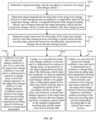
- FIG. 1B is a schematic flowchart of a method for constructing a simulated vehicle lane change trajectory according to an embodiment of the present invention. As shown in FIG. 1B , the method for constructing a simulated vehicle lane change trajectory includes the following steps S101 to S106.
- step S101 a target preceding vehicle is determined according to a position of a target lane change vehicle.
- the position of the target lane change vehicle is reflected by a positional relationship between a centroid of the target lane change vehicle and a lane line of a current lane.
- the target preceding vehicle is determined from the preceding vehicle in the target lane and a preceding vehicle in the current lane, depending on whether the centroid of the target lane change vehicle crosses the lane line of the current lane.
- step S102 target longitudinal traveling data of the target lane change vehicle in a lane change process is determined according to a longitudinal speed of the target lane change vehicle, a longitudinal speed of the target preceding vehicle, and a distance between the target preceding vehicle and the target lane change vehicle at each time instant in the lane change process.
- step S103 target transverse traveling data of the target lane change vehicle in the lane change process is determined according to preset initial transverse traveling data, preset end transverse traveling data, and preset lane change time in the lane change process.
- step S104 in a case that a preset lane change condition is met, or in a case that the preset lane change condition is not met and it is determined to continue to change lanes, a first lane change trajectory of the target lane change vehicle in the lane change trajectory coordinate system is constructed based on the target transverse traveling data and the target longitudinal traveling data if a following vehicle in a target lane decelerates.
- step S105 in a case that the preset lane change condition is not met and it is determined to continue to change lanes, an acceleration in the target longitudinal traveling data is updated if the following vehicle does not decelerate, so that an updated longitudinal speed of the target lane change vehicle is greater than a longitudinal speed of the following vehicle and less than a longitudinal speed of the preceding vehicle in the target lane; and a second lane change trajectory of the target lane change vehicle is constructed in the lane change trajectory coordinate system based on the updated longitudinal traveling data and the target transverse traveling data.
- step S106 in a case that the preset lane change condition is not met and it is determined not to continue to change lanes, transverse traveling data and longitudinal traveling data in an original lane return process are updated; and a first original lane return trajectory of the target lane change vehicle is constructed in the lane change trajectory coordinate system according to the transverse traveling data and the longitudinal traveling data in the original lane return process.
- the process of determining a target preceding vehicle according to a position of a target lane change vehicle includes: determining the target preceding vehicle from the preceding vehicle in the target lane and the preceding vehicle in the current lane, depending on whether the centroid of the target lane change vehicle crosses the lane line of the current lane.
- a lane change trajectory coordinate system is constructed; then, a traveling status in a lane change process is represented by transverse traveling data and longitudinal traveling data; for different statuses in the lane change process, different lane change trajectories are constructed with reference to the transverse traveling data and the longitudinal traveling data; and an original lane return trajectory is constructed when a lane change cannot be completed at one time because a following vehicle located behind the present vehicle in the target lane accelerates.
- a simulated trajectory can reflect the reality better, thereby providing effective decision-making support for practical application of automatic driving.
- FIG. 2 is a schematic flowchart of a method for constructing a simulated vehicle lane change trajectory according to an embodiment of the present invention.
- operational steps of the method described in the embodiments or flowcharts are provided in the Specification, more or fewer operational steps may be included based on conventional efforts or non-creative efforts.
- the order of the steps listed in the embodiments is merely one of multiple step execution orders, and does not indicate the only execution order.
- the method may be performed according to method orders shown in the embodiments or the accompanying drawings or performed in parallel (for example, in a parallel processor or multi-thread processing environment).
- the method may include steps S201 to S215.
- a lane change trajectory coordinate system is constructed by using a position of a target lane change vehicle as an origin, using a center line of a current lane of the target lane change vehicle as an ordinate axis, and using a normal of the center line as an abscissa axis.
- the lane change trajectory coordinate system is constructed by using the position of the target lane change vehicle as the origin, using the center line of the lane as the ordinate axis (a direction s indicating the traveling direction), and using the normal of the center line as the abscissa axis (a direction d indicating a positive direction of the abscissa axis).
- a trajectory is subsequently determined in the lane change trajectory coordinate system, descriptions are made by using a longitudinal distance (that is, a distance along the center line in the traveling direction) and a transverse distance (that is, an offset distance from the center line) with reference to the center line of the lane.
- Traveling data in a lane change process of the target lane change vehicle may include transverse traveling data and longitudinal traveling data.
- the transverse traveling data may include a transverse speed, a transverse acceleration, and a transverse position (that is, a transverse offset distance relative to the center line); and the longitudinal traveling data may include a longitudinal speed, a longitudinal acceleration, and a longitudinal position.
- a target preceding vehicle is determined from a preceding vehicle in a target lane and a preceding vehicle in the current lane depending on whether a centroid of the target lane change vehicle crosses a lane line of the current lane.
- the target preceding vehicle may be a vehicle that affects the longitudinal traveling data of the target lane change vehicle in the lane change process of the target lane change vehicle.
- the target lane change vehicle when the centroid of the target lane change vehicle crosses the lane line of the current lane, it is considered that the target lane change vehicle has entered the target lane. In this case, impact of a preceding vehicle in an original lane on the present vehicle is not considered, and only impact of a speed, a distance, and the like of the preceding vehicle in the target lane on the target lane change vehicle is considered.
- the preceding vehicle in the target lane may serve as the target preceding vehicle.
- the target lane change vehicle when the centroid of the target lane change vehicle fails to cross the lane line of the current lane, it is considered that the target lane change vehicle is in an initial stage of a lane change, and the speed and the distance of the preceding vehicle in the target lane and a speed and a distance of the preceding vehicle in the current lane are considered together when a longitudinal speed of the target lane change vehicle is to be controlled.
- a preceding vehicle having a shorter distance from the target lane change vehicle, among the preceding vehicle in the target lane and the preceding vehicle in the current lane, may serve as the target preceding vehicle.
- step S205 target longitudinal traveling data of the target lane change vehicle in a lane change process is determined according to a longitudinal speed of the target lane change vehicle, a longitudinal speed of the target preceding vehicle, and a distance between the target preceding vehicle and the target lane change vehicle at each time instant in the lane change process.
- the distance between the target preceding vehicle and the target lane change vehicle may be a longitudinal distance between the target preceding vehicle and the target lane change vehicle.
- each time instant corresponds to a simulation step size, for example, the simulation step size is 1s.
- each time instant is one second.
- a time period of the lane change process may be preset.
- the target longitudinal traveling data of the target lane change vehicle in the lane change process is determined based on the longitudinal speed of the target lane change vehicle, the longitudinal speed of the target preceding vehicle, and the distance between the target preceding vehicle and the target lane change vehicle at each time instant in the lane change process.
- the target longitudinal traveling data of the target lane change vehicle in the lane change process is determined with reference to a follow-up algorithm.
- a current target preceding vehicle is determined depending on whether the centroid of the target lane change vehicle crosses the lane line of the current lane, so as to update the longitudinal traveling data of the target lane change vehicle based on a longitudinal speed of the current target preceding vehicle, and a distance between the current target preceding vehicle and the target lane change vehicle.
- step S207 preset initial transverse traveling data, preset end transverse traveling data, and preset lane change time in the lane change process are determined.
- the preset initial transverse traveling data corresponding to the lane change starting time instant, the preset end transverse traveling data corresponding to the lane change ending time instant, and the preset lane change time are first determined.
- step S209 target transverse traveling data of the target lane change vehicle in the lane change process is determined according to the preset initial transverse traveling data, the preset end transverse traveling data, and the preset lane change time.
- a transverse position of the target lane change vehicle at each time instant may be determined.
- the lane width is 4 m
- the lane change time period is 4s.
- FIG. 4 is a schematic curve diagram of a transverse position (a transverse offset distance) that varies with time in a lane change process according to an embodiment of the present invention.
- FIG. 5 is a schematic curve diagram of a transverse speed that varies with time in a lane change process according to an embodiment of the present invention.
- FIG. 6 is a schematic curve diagram of a transverse speed that varies with time in a lane change process according to an embodiment of the present invention.
- a first lane change trajectory of the target lane change vehicle in the lane change trajectory coordinate system is constructed based on the target transverse traveling data and the target longitudinal traveling data if a following vehicle in a target lane decelerates.
- the lane change condition may include that a distance between the target lane change vehicle and the preceding vehicle and/or the following vehicle in the target lane is greater than a specific preset safe distance.
- the first lane change trajectory of the target lane change vehicle in the lane change trajectory coordinate system is constructed based on the target transverse traveling data and the target longitudinal traveling data if the following vehicle in the target lane decelerates.
- first target lane change traveling data including a speed, an acceleration, and a position
- the first lane change trajectory of the target lane change vehicle is constructed in the lane change trajectory coordinate system based on the first target lane change traveling data.
- step S213 in a case that the preset lane change condition is not met and it is determined to continue to change lanes, an acceleration in the target longitudinal traveling data is updated if the following vehicle does not decelerate, so that an updated longitudinal speed of the target lane change vehicle is greater than a longitudinal speed of the following vehicle and less than a longitudinal speed of a preceding vehicle in the target lane; and a second lane change trajectory of the target lane change vehicle is constructed in the lane change trajectory coordinate system based on the updated longitudinal traveling data and the target transverse traveling data.
- acceleration needs to be performed longitudinally to avoid a collision accident if the following vehicle does not decelerate, so that a longitudinal acceleration of the target lane change vehicle is higher than that of the following vehicle in the target lane, and is less than a maximum acceleration (the maximum acceleration is determined based on the longitudinal traveling data of the target lane change vehicle and longitudinal traveling data of the preceding vehicle in the target lane, to ensure that the target lane change vehicle does not collide with the preceding vehicle in the target lane while accelerating) and the longitudinal traveling data of the preceding vehicle in the target lane.
- the acceleration in the target longitudinal traveling data is updated if the following vehicle does not decelerate, so that the updated longitudinal speed of the target lane change vehicle is greater than the longitudinal speed of the following vehicle and less than the longitudinal speed of the preceding vehicle in the target lane.
- the second lane change trajectory of the target lane change vehicle is constructed in the lane change trajectory coordinate system based on the updated longitudinal traveling data and the target transverse traveling data.
- second target lane change traveling data is determined according to the updated longitudinal traveling data and the target transverse traveling data, and the second lane change trajectory of the target lane change vehicle is constructed in the lane change trajectory coordinate system based on the second target lane change traveling data.
- step S215 in a case that the preset lane change condition is not met and it is determined not to continue to change lanes, transverse traveling data and longitudinal traveling data in an original lane return process are updated; and a first original lane return trajectory of the target lane change vehicle is constructed in the lane change trajectory coordinate system according to the transverse traveling data and the longitudinal traveling data in the original lane return process.
- the original lane is immediately returned to, and then, a surrounding condition is observed to determine whether to restart a new lane change process.
- the transverse traveling data and the longitudinal traveling data in the original lane return process are updated, and the first original lane return trajectory of the target lane change vehicle is constructed in the lane change trajectory coordinate system based on the transverse traveling data and the longitudinal traveling data in the original lane return process.
- the process of updating transverse traveling data and longitudinal traveling data in an original lane return process may include steps S2151 to S2189 as follows.
- step S2151 transverse traveling data at a starting time instant of returning to an original lane is determined.
- the preset lane change condition is not met, and it is determined not to continue to change lanes.
- the target lane change vehicle travels based on the target transverse traveling data and the target longitudinal traveling data.
- the preset lane change condition is not met at a time instant
- transverse traveling data at the time instant is determined from the target transverse traveling data.
- the original lane return process refers to returning to a center line of the original lane.
- a transverse position, a transverse acceleration, and a speed in the transverse traveling data at the ending time instant are all 0.
- step S2155 the transverse traveling data in the original lane return process is determined according to the transverse traveling data at the starting time instant, the transverse traveling data at the ending time instant, and first preset return time.
- the transverse traveling data in the original lane return process is determined with reference to the polynomial. Specifically, for determining of the transverse traveling data in the original lane return process by means of the polynomial, one may refer to the foregoing related steps, and details are not described herein again.
- step S2157 from the preceding vehicle in the target lane and the preceding vehicle in the current lane, a target preceding vehicle in a time period from the starting time instant to the ending time instant is updated in real time, depending on whether the centroid of the target lane change vehicle crosses the lane line of the current lane in the time period from the starting time instant to the ending time instant.
- the centroid of the target lane change vehicle in the original lane return process, is changed from a state that the centroid crosses the lane line of the current lane to a state that the centroid does not cross the lane line of the current lane.
- a preceding vehicle with a smaller current distance from the target lane change vehicle is selected as the target preceding vehicle, from the preceding vehicle in the target lane and the preceding vehicle in the current lane.
- step S2159 according to a longitudinal speed of the target lane change vehicle, a longitudinal speed of the target preceding vehicle, and a distance between the target preceding vehicle and the target lane change vehicle in the time period from the starting time instant to the ending time instant, the longitudinal traveling data in the original lane return process is determined.
- the process of constructing a first original lane return trajectory of the target lane change vehicle in the lane change trajectory coordinate system according to the transverse traveling data and the longitudinal traveling data in the original lane return process may include: determining first target lane change traveling data of the target lane change vehicle in the original lane return process according to the transverse traveling data and the target longitudinal traveling data in the original lane return process; and constructing the first original lane return trajectory of the target lane change vehicle in the lane change trajectory coordinate system based on the first target lane change traveling data.
- a lane change trajectory coordinate system is constructed; a traveling status in a lane change process is represented by transverse traveling data and longitudinal traveling data; for different statuses in the lane change process, different lane change trajectories are constructed with reference to the transverse traveling data and the longitudinal traveling data; and an original lane return trajectory is constructed when a lane change cannot be completed at one time because a following vehicle located behind the present vehicle in the target lane accelerates.
- the simulated trajectory can reflect the reality better, thereby providing effective decision-making support for practical application of automatic driving.
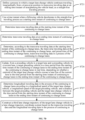
- FIG. 7B is a schematic flowchart of a method for constructing a simulated vehicle lane change trajectory in a case that a preset lane change condition is not met according to an embodiment of the present invention. As shown in FIG. 7B , in a case that the preset lane change condition is not met, the method further includes steps S701 to S706 as follows.
- step S701 transverse traveling data at a starting time instant of straightening a vehicle head is determined. At the starting time instant, the preset lane change condition is not met, and it is determined not to continue to change lanes.
- step S702 transverse traveling data at an ending time instant of the straightening the vehicle head is determined.
- step S703 according to the transverse traveling data at the starting time instant, the transverse traveling data at the ending time instant, and preset straightening time, transverse traveling data in a process of the straightening the vehicle head is determined.
- transverse traveling data at a starting time instant t c of straightening a vehicle head is (Qd c , Vd c , Ad c ), transverse traveling data at an ending time instant is (Qd c , 0, 0).
- the vehicle is kept at the same transverse position, and a transverse acceleration and a transverse speed are both 0.
- a preset vehicle head straightening time is T 2
- the transverse traveling data of the target lane change vehicle is updated with reference to the polynomial. For specific steps, one may refer to the foregoing related steps, and details are not described herein again.
- step S704 from a preceding vehicle in a target lane and a preceding vehicle in a current lane, a target preceding vehicle in a time period from the starting time instant to the ending instant is updated in real time, depending on whether a centroid of the target lane change vehicle crosses a lane line of the current lane in the time period from the starting time instant to the ending time instant.
- step S705 according to a longitudinal speed of the target lane change vehicle, a longitudinal speed of the target preceding vehicle, and a distance between the target preceding vehicle and the target lane change vehicle in the time period from the starting time instant to the ending time instant, longitudinal traveling data in the process of the straightening a vehicle head is determined.
- the target preceding vehicle is timely updated depending on whether the centroid of the target lane change vehicle crosses the lane line of the current lane in the process of the straightening the vehicle head. Then, the longitudinal traveling data in the process of the straightening the vehicle head is updated with reference to the longitudinal speed of the target preceding vehicle and the distance between the target preceding vehicle and the target lane change vehicle.
- Step S706 a vehicle head straightening trajectory of the target lane change vehicle is constructed in a lane change trajectory coordinate system based on the transverse traveling data and the longitudinal traveling data in the process of the straightening a vehicle head.
- Target straightening traveling data in the process of the straightening the vehicle head is determined according to the transverse traveling data in the process of the straightening the vehicle head and the target longitudinal traveling data; and a vehicle head straightening trajectory of the target lane change vehicle is constructed in the lane change trajectory coordinate system based on the target straightening traveling data.
- FIG. 7C is a schematic flowchart of a method for constructing a simulated vehicle lane change trajectory after a vehicle head is straightened according to an embodiment of the present invention. As shown in FIG. 7C , the method further includes the following steps S711 and S712.
- step S711 traveling time of continuing traveling longitudinally from a transverse position in the transverse traveling data at the ending time instant of the straightening a vehicle head is determined.
- a traveling trajectory of the target lane change vehicle is constructed in the lane change trajectory coordinate system based on the traveling time and the transverse traveling data and the longitudinal traveling data at the ending time instant of the straightening the vehicle head.
- FIG. 7D is a schematic flowchart of a method for constructing a simulated vehicle lane change trajectory when continuing to change lanes after it is determined that a following vehicle decelerates according to an embodiment of the present invention. As shown in FIG. 7D , the method further includes the following steps S721 to S728.
- step S721 a process in which the target lane change vehicle continues traveling longitudinally from a transverse position in the transverse traveling data at the ending time instant of the straightening a vehicle head, is defined as a straight-line traveling process.
- step S722 a time instant when the following vehicle decelerates in the straight-line traveling process serves as a starting time instant of continuing to change lanes.
- step S723 transverse traveling data at the starting time instant of the continuing to change lanes is determined.
- step S724 transverse traveling data at an ending time instant of the continuing to change lanes is determined.
- step S725 according to the transverse traveling data at the starting time instant of the continuing to change lanes, the transverse traveling data at the ending time instant of the continuing to change lanes, and preset time of the continuing to change lanes, transverse traveling data in a process of the continuing to change lanes is determined.
- the transverse traveling data at the starting time instant of the continuing to change lanes is (Qd c , 0, 0)
- the transverse traveling data at the ending time instant of the continuing to change lanes is (h, 0, 0)
- h is the lane width.
- the target lane change vehicle moves by a distance of one lane relative to the center line of the original lane at the ending time instant of continuing to change lanes.
- Time required for continuing to change lanes is T 4 .
- the transverse traveling data of the target lane change vehicle is updated with reference to the polynomial. For specific steps, one may refer to the foregoing related steps, and details are not described herein again.
- step S726 from the preceding vehicle in the target lane and the preceding vehicle in the current lane, a target preceding vehicle in a time period from the starting time instant of the continuing to change lanes to the ending time instant of the continuing to change lanes is updated in real time, depending on whether the centroid of the target lane change vehicle crosses the lane line of the current lane in the time period from the starting time instant of the continuing to change lanes to the ending time instant of the continuing to change lanes.
- step S727 longitudinal traveling data in the process of the continuing to change lanes is determined according to a longitudinal speed of the target lane change vehicle, a longitudinal speed of the target preceding vehicle, and a distance between the target preceding vehicle and the target lane change vehicle in the time period from the starting time instant of the continuing to change lanes to the ending time instant of the continuing to change lanes.
- the target preceding vehicle is timely updated depending on whether the centroid of the target lane change vehicle crosses the lane line of the current lane in the process of the continuing to change lanes. Then, the longitudinal traveling data in the process of the continuing to change lanes is updated with reference to the longitudinal speed of the target preceding vehicle and the distance between the target preceding vehicle and the target lane change vehicle.
- a third lane change trajectory of the target lane change vehicle is constructed in the lane change trajectory coordinate system based on the transverse traveling data and the longitudinal traveling data in the process of the continuing to change lanes.
- Third target lane change traveling data in the process of the continuing to change lanes is determined according to the transverse traveling data and the target longitudinal traveling data in the process of the continuing to change lanes, and a third lane change trajectory of the target lane change vehicle is constructed in the lane change trajectory coordinate system based on the third target lane change traveling data.
- FIG. 7E is a schematic flowchart of a method for constructing a simulated vehicle lane change trajectory during returning to an original lane according to an embodiment of the present invention. As shown in FIG. 7E , the method further includes the following steps S731 and S737.
- step S731 in a case that a duration of the straight-line traveling process is greater than or equal to preset traveling time and a following vehicle does not decelerate, a time instant when the preset traveling time expires serves as a starting time instant of returning to an original lane.
- step S732 transverse traveling data at the starting time instant of the returning to an original lane is determined.
- step S733 transverse traveling data at an ending time instant of the returning to an original lane is determined.
- transverse traveling data in an original lane return process is determined according to the transverse traveling data at the starting time instant of the returning to an original lane, the transverse traveling data at the ending time instant of the returning to an original lane, and second preset return time.
- the transverse traveling data at the starting time instant of the returning to an original lane is (Qd c , 0, 0)
- the transverse traveling data at the ending time instant of the returning to an original lane is (0, 0, 0)
- a time required for returning to the original lane is T 5 .
- the transverse traveling data of the target lane change vehicle is updated with reference to the polynomial. For specific steps, one may refer to the foregoing related steps, and details are not described herein again.
- step S735 from the preceding vehicle in the target lane and the preceding vehicle in the current lane, a target preceding vehicle in a time period from the starting time instant to the ending time instant of the returning to an original lane is updated in real time, depending on whether the centroid of the target lane change vehicle crosses the lane line of the current lane in the time period from the starting time instant to the ending time instant of the returning to an original lane.
- longitudinal traveling data in the original lane return process is determined according to a longitudinal speed of the target lane change vehicle, a longitudinal speed of the target preceding vehicle, and a distance between the target preceding vehicle and the target lane change vehicle in the time period from the starting time instant to the ending time instant of the returning to an original lane.
- the target preceding vehicle is timely updated depending on whether the centroid of the target lane change vehicle crosses the lane line of the current lane in the original lane return process. Then, the longitudinal traveling data in the original lane return process is updated with reference to the longitudinal speed of the target preceding vehicle and the distance between the target preceding vehicle and the target lane change vehicle.
- step S737 a second original lane return trajectory of the target lane change vehicle is constructed in the lane change trajectory coordinate system based on the transverse traveling data and the longitudinal traveling data in the original lane return process.
- Second target returning traveling data in the original lane return process is determined according to the transverse traveling data in the original lane return process and the target longitudinal traveling data, and a second original lane return trajectory of the target lane change vehicle is constructed in the lane change trajectory coordinate system based on the second target returning traveling data.
- the target lane change vehicle in a case that the preset lane change condition is not met and it is determined to continue to change lanes, the target lane change vehicle still change lanes based on the target transverse traveling data and the longitudinal traveling data, resulting in a collision accident. In this case, the collision accident is recorded.
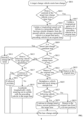
- FIG. 8 is a schematic flowchart of simulated lane change driving according to an embodiment of the present invention. Specifically, the method may include steps S801 to steps S833 as follows.
- step S801 a target lane change vehicle starts a lane change.
- step S803 it is determined whether a centroid of the target lane change vehicle crosses a lane line.
- step S805 in a case that it is determined that the centroid does not cross the lane line in step S803, a longitudinal speed is updated with reference to a preceding vehicle having a shorter distance from the present vehicle, among a preceding vehicle in a target lane and a preceding vehicle in an original lane.
- step S807 in a case that it is determined that the centroid crosses the lane line in step S803, a longitudinal speed is updated with reference to a preceding vehicle in an original lane.
- step S809 it is determined whether a preset lane change condition is met.
- step S811 lanes are changed directly in a case that the preset lane change condition is met.
- step S813 it is determined whether to continue to change lanes in a case that the preset lane change condition is not met.
- step S815 it is determined whether a following vehicle in the target lane decelerates, when it is determined to continue to change lanes.
- step S811 that is, lanes are changed directly, in a case that the following vehicle decelerates.
- step S817 it is determined whether to continue to change lanes in a case that the following vehicle does not decelerate.
- step S819 when it is determined not to continue to change lanes, the target lane change vehicle accelerates longitudinally but should not collide with the preceding vehicle in the target lane.
- step S821 a collision accident is recorded if the target lane change vehicle continues to change lanes.
- step S823 it is determined whether to return to the original lane in a case that a determination result in step S813 is negative.
- step S825 a vehicle head is straightened and the target lane change vehicle travels along a straight line, if the vehicle does not return to the original lane.
- step S827 it is determined whether the following vehicle decelerates.
- step S829 the target lane change vehicle continues to change lanes from a current position, in a case that the following vehicle decelerates.
- step S831 the target lane change vehicle returns to the original lane from the current position in a case that the following vehicle does not decelerate.
- step S833 the target lane change vehicle returns to the original lane in a case that a determination result in step S823 is positive.
- an actual lane change scenario can be better simulated in simulated driving.
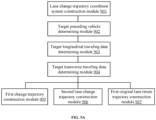
- an apparatus for constructing a simulated vehicle lane change trajectory is further provided. As shown in FIG. 9A , the apparatus includes:
- the target preceding vehicle determining module 902 is further configured to determine the target preceding vehicle from the preceding vehicle in the target lane and a preceding vehicle in the current lane, depending on whether a centroid of the target lane change vehicle crosses a lane line of the current lane.
- the target transverse traveling data determining module 904 includes a data determining sub-module and a target transverse traveling data determining sub-module.
- the data determining sub-module is configured to determine the preset initial transverse traveling data, the preset end transverse traveling data, and the preset lane change time in the lane change process.
- the target transverse traveling data determining sub-module is configured to determine target transverse traveling data of the target lane change vehicle in the lane change process according to the preset initial transverse traveling data, the preset end transverse traveling data, and the preset lane change time.
- an apparatus for constructing a simulated vehicle lane change trajectory is further provided. As shown in FIG. 9B , the apparatus includes:
- the first original lane return trajectory construction module 980 is further configured to:
- the apparatus further includes: a first starting time instant determining module 981, configured to determine the time instant when the preset lane change condition is not met as a starting time instant of straightening a vehicle head; a first transverse traveling data determining module 982, configured to determine transverse traveling data at the starting time instant; a second transverse traveling data determining module 983, configured to determine transverse traveling data at an ending time instant of the straightening a vehicle head; a first transverse traveling data update module 984, configured to determine transverse traveling data in a process of the straightening the vehicle head, according to the transverse traveling data at the starting time instant, the transverse traveling data at the ending time instant, and preset straightening time; a second target preceding vehicle update module 985, configured to update, from the preceding vehicle in the target lane and the preceding vehicle in the current lane, a target preceding vehicle in a time period from the starting time instant to the ending time instant in real
- the apparatus further includes: a straight-line traveling process determining module 988, configured to define a process in which the target lane change vehicle continues traveling longitudinally from a transverse position in the transverse traveling data at the ending time instant of the straightening a vehicle head as a straight-line traveling process; a second starting time instant determining module 989, configured to determine a time instant when the following vehicle decelerates in the straight-line traveling process as a starting time instant of continuing changing a lane; a third transverse traveling data determining module 990, configured to determine transverse traveling data at the stating time instant of the continuing to change lanes; a fourth transverse traveling data determining module 991, configured to determine transverse traveling data at an ending time instant of the continuing to change lanes; a second transverse traveling data update module 992, configured to determine transverse traveling data in a process of the continuing to change lanes, according to the transverse traveling data at the starting time instant, the transverse traveling data at the ending time instant, and preset time of the continuing to change lanes
- the apparatus further includes:
- the apparatus further includes:
- the apparatus further includes: a recording module, configured to record, in a case that the preset lane change condition is not met and it is determined to continue to change lanes, a collision accident if the following vehicle does not decelerate.
- a recording module configured to record, in a case that the preset lane change condition is not met and it is determined to continue to change lanes, a collision accident if the following vehicle does not decelerate.
- the apparatus in the apparatus embodiment is based on the same concept as the method embodiments.
- a device for constructing a simulated vehicle lane change trajectory includes a processor and a memory.
- the memory stores at least one instruction, at least one program, a code set, or an instruction set.
- the at least one instruction, the at least one program, the code set, or the instruction set is loaded and executed by the processor to perform the method for constructing a simulated vehicle lane change trajectory provided by the foregoing method embodiments.
- the memory is configured to store a software program and module.
- the processor runs the software program and module stored in the memory, to implement various functional applications and data processing.
- the memory mainly includes a program storage area and a data storage area.
- the program storage area stores an operating system, an application required by a function, and the like.
- the data storage area stores data created according to use of the device, and the like.
- the memory includes a high-speed random access memory, and further includes a non-volatile memory, such as at least one magnetic disk storage device, a flash memory, or another volatile solid-state storage device.
- the memory further includes a memory controller, so as to provide access of the processor to the memory.
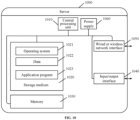
- FIG. 10 is a structural block diagram of a hardware of a server for performing a method for constructing a simulated vehicle lane change trajectory according to an embodiment of the present invention.
- a server 1000 varies greatly due to different configurations or performance, and includes one or more central processing units (CPUs) 1010 (the CPUs 1010 include but are not limited to processing apparatuses such as microprocessors MCU or programmable logical devices FPGA), and a memory 1030 configured to store data, and one or more storage media 1020 (for example, one or more mass storage devices) storing an application 1023 or data 1022.
- CPUs central processing units
- the CPUs 1010 include but are not limited to processing apparatuses such as microprocessors MCU or programmable logical devices FPGA
- a memory 1030 configured to store data
- storage media 1020 for example, one or more mass storage devices
- the memory 1030 and the storage media 1020 may be transient storage or persistent storage.
- Programs stored in the storage media 1020 may include one or more modules, and each module may include series of instructions for the server.
- the CPUs 1010 is configured to be in communication with the storage media 1020 and to execute the series of instructions stored in the storage media 1020 on the server 1000.
- the server 1000 further includes one or more power supplies 1060, one or more wired or wireless network interfaces 1050, one or more input/output interfaces 1040, and/or one or more operating systems 1021, such as Windows Server TM , Mac OS X TM , Unix TM , Uinux TM , and FreeBSD TM .
- An input/output interface 1040 receives or transmits data through a network.
- a specific example of the foregoing network may include a wireless network provided by a communications provider of the server 1000.
- the input/output interface 1040 includes a network interface controller (NIC), which may be connected to another network device through a base station so as to communicate with the Internet.
- the input/output interface 1040 may be a radio frequency (RF) module, which is configured to communicate with the Internet in a wireless manner.
- RF radio frequency
- the server 1000 may include more or fewer components than those shown in FIG. 10 , or have a configuration different from that shown in FIG. 10 .
- a storage medium is further provided according to an embodiment of the present invention.
- the storage medium may be configured to store at least one instruction, at least one program, a code set, or an instruction set which is related to the method for constructing a simulated vehicle lane change trajectory.
- the at least one instruction, the at least one program, the code set, or the instruction set are loaded and executed by a processor to perform the method for constructing a simulated vehicle lane change trajectory provided by the foregoing method embodiments.
- the foregoing storage medium may be located in at least one of multiple network servers in a computer network.
- the storage medium may include, but is not limited to, a medium such as a USB flash drive, a read-only memory (ROM), a random access memory (RAM), a removable hard disk, a magnetic disk, or an optical disc.
- a lane change trajectory coordinate system is constructed; a traveling status in a lane change process is represented by transverse traveling data and longitudinal traveling data; for different statuses in the lane change process, different lane change trajectories are constructed with reference to the transverse traveling data and the longitudinal traveling data; and an original lane return trajectory is constructed when a lane change cannot be completed at one time because a following vehicle located behind the present vehicle in the target lane accelerates.
- the simulated trajectory can reflect the reality better, thereby providing effective decision-making support for practical application of automatic driving.
- the program may be stored in a computer-readable storage medium.
- the storage medium mentioned above may be: a read only memory, a magnetic disk, or an optical disc.
Landscapes
- Engineering & Computer Science (AREA)
- Transportation (AREA)
- Mechanical Engineering (AREA)
- Automation & Control Theory (AREA)
- Physics & Mathematics (AREA)
- Mathematical Physics (AREA)
- Chemical & Material Sciences (AREA)
- Combustion & Propulsion (AREA)
- General Physics & Mathematics (AREA)
- Control Of Driving Devices And Active Controlling Of Vehicle (AREA)
- Traffic Control Systems (AREA)
Description
- This application claims priority to
Chinese Patent Application No. 201910857583.2, titled "METHOD, APPARATUS AND DEVICE FOR CONSTRUCTING SIMULATED VEHICLE LANE CHANGE TRAJECTORY" filed on September 9, 2019 - The present invention relates to the technical field of Internet communication, and in particular to a method, an apparatus and a device for constructing a simulated vehicle lane change trajectory.
- In development of automated driving systems, a process from simulation to real vehicle testing is always required, and a simulation experiment based on an automated driving simulation system, as a zero-risk, fast iteration, and reproducible test method, lays a solid foundation for automated driving.
- At present, in a vehicle lane change scenario of an automated driving simulation system, only trajectory planning of a vehicle traveling from a point in its own lane to another point in a neighboring lane within a specified time is considered; in other words, a behavior of a vehicle changing from an original lane to a target lane is simulated. However, in the real world, when traffic is relatively heavy or drivers are fractious, a vehicle lane change process cannot be completed at one time due to interference of some factors. For example, a vehicle that is in a neighboring target lane and is behind the present vehicle may accelerate, resulting in that the present vehicle in the current lane cannot complete a lane change safely.
According toUS 2018/354519 A1 , when lane change assist control for assisting a lane change from an own lane (original lane) to an adjacent target lane is performed, the determination as to whether or not another vehicle is in the target lane may be made based on the own lane width, the own vehicle's deviation from the lateral center of the own lane (own lane deviation), and the lateral position of the another vehicle. When the vehicle enters the target lane, own lane switching in which the own lane deviation changes by the lane width occurs and makes it impossible to properly perform the above determination. In view of this, after occurrence of own lane switching, the above determination is made based on a value obtained by adding the own lane width to the another vehicle lateral position or a value obtained by subtracting the own lane width from the another vehicle lateral position.
CN 104282033 A discloses an integrated lane changing behavior simulation method oriented towards vehicle animation simulation. The method includes the coordinate system building step, wherein a lane changing track of a vehicle to change a lane is built on the basis of a moving coordinate system, the current position of the vehicle to change the lane serves as the origin of the moving coordinate system, the transverse axis of the moving coordinate system is in the lane line direction of the vehicle to change the lane, and the longitudinal axis of the moving coordinate system is in the direction perpendicular to the transverse axis; the lane changing track describing step, wherein the offsets of the lane changing track in the transverse axis and the longitudinal axis are described respectively on the basis of the moving coordinate system; the track restraint step, wherein a restraint condition is formed on the basis of influence on the lane changing track from multiple influence factors; the track obtaining step, wherein the lane changing track is restrained on the basis of the constraint condition, and the final lane changing track of the vehicle is obtained. - According to embodiments of the present invention, a method for constructing a simulated vehicle lane change trajectory is provided. The method is executed by a target lane change vehicle. The method includes:
- constructing a lane change trajectory coordinate system by using a position of the target lane change vehicle as an origin, using a center line of a current lane of the target lane change vehicle as an ordinate axis, and using a normal of the center line as an abscissa axis;
- determining a target preceding vehicle according to the position of the target lane change vehicle;
- determining target longitudinal traveling data of the target lane change vehicle in a lane change process according to a longitudinal speed of the target lane change vehicle, a longitudinal speed of the target preceding vehicle, and a distance between the target preceding vehicle and the target lane change vehicle at each time instant in the lane change process;
- determining target transverse traveling data of the target lane change vehicle in the lane change process according to preset initial transverse traveling data, preset end transverse traveling data, and preset lane change time in the lane change process;
- constructing, in a case that a preset lane change condition is met, or in a case that the preset lane change condition is not met and it is determined to continue to change lanes, a first lane change trajectory of the target lane change vehicle in the lane change trajectory coordinate system based on the target transverse traveling data and the target longitudinal traveling data if a following vehicle in a target lane decelerates;
- updating, in a case that the preset lane change condition is not met and it is determined to continue to change lanes, an acceleration in the target longitudinal traveling data if the following vehicle does not decelerate, to cause an updated longitudinal speed of the target lane change vehicle to be greater than a longitudinal speed of the following vehicle and less than a longitudinal speed of a preceding vehicle in the target lane; and constructing a second lane change trajectory of the target lane change vehicle in the lane change trajectory coordinate system based on the updated longitudinal traveling data and the target transverse traveling data; and
- updating, in a case that the preset lane change condition is not met and it is determined not to continue to change lanes, transverse traveling data and longitudinal traveling data in an original lane return process, and constructing a first original lane return trajectory of the target lane change vehicle in the lane change trajectory coordinate system according to the transverse traveling data and the longitudinal traveling data in the original lane return process.
- According to embodiments of the present invention, an apparatus for constructing a simulated vehicle lane change trajectory is further provided. The apparatus includes:
- a lane change trajectory coordinate system construction module, configured to construct a lane change trajectory coordinate system by using a position of a target lane change vehicle as an origin, using a center line of a current lane of the target lane change vehicle as an ordinate axis, and using a normal of the center line as an abscissa axis;
- a target preceding vehicle determining module, configured to determine a target preceding vehicle according to the position of the target lane change vehicle;
- a target longitudinal traveling data determining module, configured to determine target longitudinal traveling data of the target lane change vehicle in a lane change process according to a longitudinal speed of the target lane change vehicle, a longitudinal speed of the target preceding vehicle, and a distance between the target preceding vehicle and the target lane change vehicle at each time instant in the lane change process;
- a target transverse traveling data determining module, configured to determine target transverse traveling data of the target lane change vehicle in the lane change process according to preset initial transverse traveling data, preset end transverse traveling data, and preset lane change time in the lane change process;
- a first lane change trajectory construction module, configured to construct, in a case that a preset lane change condition is met, or in a case that the preset lane change condition is not met and it is determined to continue to change lanes, a first lane change trajectory of the target lane change vehicle in the lane change trajectory coordinate system based on the target transverse traveling data and the target longitudinal traveling data if a following vehicle in a target lane decelerates;
- a second lane change trajectory construction module, configured to update, in a case that the preset lane change condition is not met and it is determined to continue to change lanes, an acceleration in the target longitudinal traveling data if the following vehicle does not decelerate, to cause an updated longitudinal speed of the target lane change vehicle to be greater than a longitudinal speed of the following vehicle and less than a longitudinal speed of a preceding vehicle in the target lane; and construct a second lane change trajectory of the target lane change vehicle in the lane change trajectory coordinate system based on the updated longitudinal traveling data and the target transverse traveling data; and
- a first original lane return trajectory construction module, configured to update, in a case that the preset lane change condition is not met and it is determined not to continue to change lanes, transverse traveling data and longitudinal traveling data in an original lane return process; and construct a first original lane return trajectory of the target lane change vehicle in the lane change trajectory coordinate system according to the transverse traveling data and the longitudinal traveling data in the original lane return process.
- In some embodiments, the target preceding vehicle determining module is further configured to determine the target preceding vehicle from the preceding vehicle in the target lane and a preceding vehicle in the current lane depending on whether a centroid of the target lane change vehicle crosses a lane line of the current lane.
- In some embodiments, the first original lane return trajectory construction module is further configured to: determine transverse traveling data at a starting time instant of returning to an original lane when the preset lane change condition is not met; determine transverse traveling data at an ending time instant of the returning to an original lane; determine the transverse traveling data in the original lane return process according to the transverse traveling data at the starting time instant, the transverse traveling data at the ending time instant, and first preset return time; update, from the preceding vehicle in the target lane and the preceding vehicle in the current lane, a target preceding vehicle in a time period from the starting time instant to the ending time instant in real time, depending on whether the centroid of the target lane change vehicle crosses the lane line of the current lane in the time period from the starting time instant to the ending time instant; and determine the longitudinal traveling data in the original lane return process according to a longitudinal speed of the target lane change vehicle, a longitudinal speed of the target preceding vehicle, and a distance between the target preceding vehicle and the target lane change vehicle in the time period from the starting time instant to the ending time instant.
- In some embodiments, the apparatus further includes: a first starting time instant determining module, configured to use the time instant when the preset lane change condition is not met as a starting time instant of straightening a vehicle head; a first transverse traveling data determining module, configured to determine transverse traveling data at the starting time instant; a second transverse traveling data determining module, configured to determine transverse traveling data at an ending time instant of the straightening a vehicle head; a first transverse traveling data update module, configured to determine transverse traveling data in a process of the straightening the vehicle head, according to the transverse traveling data at the starting time instant, the transverse traveling data at the ending time instant, and preset straightening time; a second target preceding vehicle update module, configured to update, from the preceding vehicle in the target lane and the preceding vehicle in the current lane, a target preceding vehicle in a time period from the starting time instant to the ending time instant in real time, depending on whether the centroid of the target lane change vehicle crosses the lane line of the current lane in the time period from the starting time instant to the ending time instant; a first longitudinal traveling data update module, configured to determine longitudinal traveling data in the process of the straightening the vehicle head, according to a longitudinal speed of the target lane change vehicle, a longitudinal speed of the target preceding vehicle, and a distance between the target preceding vehicle and the target lane change vehicle in the time period from the starting time instant to the ending time instant; and a vehicle head straightening trajectory construction module, configured to construct a vehicle head straightening trajectory of the target lane change vehicle in the lane change trajectory coordinate system based on the transverse traveling data and the longitudinal traveling data in the process of the straightening the vehicle head.
- According to embodiments of the present invention, a device for constructing a simulated vehicle lane change trajectory is further provided. The device includes a processor and a memory. The memory stores at least one instruction, at least one program, a code set, or an instruction set. The at least one instruction, the at least one program, the code set, or the instruction set is loaded and executed by the processor to perform the method for constructing a simulated vehicle lane change trajectory according to the embodiments of the present application.
- According to embodiments of the present invention, a computer-readable storage medium is further provided. The computer-readable storage medium stores at least one instruction, at least one program, a code set, or an instruction set. The at least one instruction, the at least one program, the code set, or the instruction set is loaded and executed by a processor to perform the foregoing method for constructing a simulated vehicle lane change trajectory.
- To describe the technical solutions and advantages in the embodiments of the present application more clearly, the accompanying drawings required for describing the embodiments are described briefly hereinafter. Apparently, the accompanying drawings in the following description show merely some embodiments of the present invention, and a person of ordinary skill in the art may still derive other accompanying drawings from these accompanying drawings without creative efforts.
-
FIG. 1A is a schematic diagram of an application scenario according to an embodiment of the present invention. -
FIG. 1B is a schematic flowchart of a method for constructing a simulated vehicle lane change trajectory according to an embodiment of the present invention. -
FIG. 2 is a schematic flowchart of a method for constructing a simulated vehicle lane change trajectory according to an embodiment of the present invention. -
FIG. 3 is a schematic diagram of a lane change trajectory coordinate system according to an embodiment of the present invention. -
FIG. 4 is a schematic curve diagram of a transverse position (a transverse offset distance) that varies with time in a lane change process according to an embodiment of the present invention. -
FIG. 5 is a schematic curve diagram of a transverse speed that varies with time in a lane change process according to an embodiment of the present invention. -
FIG. 6 is a schematic curve diagram of a transverse speed that varies with time in a lane change process according to an embodiment of the present invention. -
FIG. 7A is a schematic flowchart of updating transverse traveling data and longitudinal traveling data in an original lane return process according to an embodiment of the present invention. -
FIG. 7B is a schematic flowchart of a method for constructing a simulated vehicle lane change trajectory in a case that a preset lane change condition is not met according to an embodiment of the present invention. -
FIG. 7C is a schematic flowchart of a method for constructing a simulated vehicle lane change trajectory after a vehicle head is straightened according to an embodiment of the present invention. -
FIG. 7D is a schematic flowchart of a method for constructing a simulated vehicle lane change trajectory when continuing to change lanes after it is determined that a following vehicle decelerates according to an embodiment of the present invention. -
FIG. 7E is a schematic flowchart of a method for constructing a simulated vehicle lane change trajectory during returning to an original lane according to an embodiment of the present invention. -
FIG. 8 is a schematic flowchart of simulated lane change driving according to an embodiment of the present invention. -
FIG. 9A is a schematic structural diagram of an apparatus for constructing a simulated vehicle lane change trajectory according to an embodiment of the present invention. -
FIG. 9B is a schematic structural diagram of an apparatus for constructing a simulated vehicle lane change trajectory according to an embodiment of the present invention. -
FIG. 10 is a block diagram showing a hardware structure of a server for performing a method for constructing a simulated vehicle lane change trajectory according to an embodiment of the present invention. - In the specification, claims, and the foregoing accompanying drawings of the present invention, the terms "first", "second", and so on are intended to distinguish similar objects but do not necessarily indicate a specific order or sequence. The data termed in such a way are interchangeable in proper circumstances, so that the embodiments of the present invention described herein can be implemented in orders other than the order illustrated or described herein. Moreover, the terms "include", "contain" and any other variants mean to cover the non-exclusive inclusion. For example, a process, method, system, product, or server that includes a series of steps or units is not necessarily limited to those steps or units, but may include other steps or units not expressly listed or inherent to such a process, method, product, or device.
- In the related art, it is not taken into consideration that in the real world, when traffic is relatively heavy or drivers are fractious, it is likely that a vehicle lane change process may not be completed at one time due to interferences of some factors. Therefore, vehicle lane change scenarios in the related art may result in that simulation results are difficult to reflect the reality, and thus cannot provide effective decision-making support for practical application of automatic driving.
- Based on this, according to embodiments of the present invention, a method for constructing a simulated vehicle lane change trajectory is provided, so that a simulated trajectory can reflect the reality better, thereby providing effective decision-making support for practical application of automatic driving.
-
FIG. 1A is a schematic diagram of an application scenario to which a method for constructing a simulated vehicle lane change trajectory is applicable according to an embodiment of the present invention. As shown inFIG. 1A , the application scenario includes at least asimulated vehicle 01, asimulated vehicle 02, asimulated vehicle 03, and asimulated vehicle 04. - The
simulated vehicle 01 may be a target lane change vehicle needing to change lanes in a vehicle driving simulation system. Thesimulated vehicle 02 may be a preceding vehicle that is located in a current lane of the target lane change vehicle and that is in front of the target lane change vehicle in the vehicle driving simulation system. Thesimulated vehicle 03 may be a preceding vehicle that is located in a target lane of the target lane change vehicle and that is in front of the target lane change vehicle in the vehicle driving simulation system. Thesimulated vehicle 04 may be a following vehicle that is located in the target lane of the target lane change vehicle and that is behind the target lane change vehicle in the vehicle driving simulation system. - Based on the foregoing application scenario, the embodiments of the present invention provide the method for constructing a simulated vehicle lane change trajectory, executed by the target lane change vehicle, for example, the
simulated vehicle 01. Before the simulated vehicle lane change trajectory is constructed, a lane change trajectory coordinate system is constructed by using a position of the target lane change vehicle as an origin, using a center line of a current lane of the target lane change vehicle as an ordinate axis, and using a normal of the center line as an abscissa axis. -
FIG. 1B is a schematic flowchart of a method for constructing a simulated vehicle lane change trajectory according to an embodiment of the present invention. As shown inFIG. 1B , the method for constructing a simulated vehicle lane change trajectory includes the following steps S101 to S106. - In step S101, a target preceding vehicle is determined according to a position of a target lane change vehicle.
- In some embodiments, the position of the target lane change vehicle is reflected by a positional relationship between a centroid of the target lane change vehicle and a lane line of a current lane. The target preceding vehicle is determined from the preceding vehicle in the target lane and a preceding vehicle in the current lane, depending on whether the centroid of the target lane change vehicle crosses the lane line of the current lane.
- In step S102, target longitudinal traveling data of the target lane change vehicle in a lane change process is determined according to a longitudinal speed of the target lane change vehicle, a longitudinal speed of the target preceding vehicle, and a distance between the target preceding vehicle and the target lane change vehicle at each time instant in the lane change process.
- In step S103, target transverse traveling data of the target lane change vehicle in the lane change process is determined according to preset initial transverse traveling data, preset end transverse traveling data, and preset lane change time in the lane change process.
- In step S104, in a case that a preset lane change condition is met, or in a case that the preset lane change condition is not met and it is determined to continue to change lanes, a first lane change trajectory of the target lane change vehicle in the lane change trajectory coordinate system is constructed based on the target transverse traveling data and the target longitudinal traveling data if a following vehicle in a target lane decelerates.
- In step S105, in a case that the preset lane change condition is not met and it is determined to continue to change lanes, an acceleration in the target longitudinal traveling data is updated if the following vehicle does not decelerate, so that an updated longitudinal speed of the target lane change vehicle is greater than a longitudinal speed of the following vehicle and less than a longitudinal speed of the preceding vehicle in the target lane; and a second lane change trajectory of the target lane change vehicle is constructed in the lane change trajectory coordinate system based on the updated longitudinal traveling data and the target transverse traveling data.
- In step S106, in a case that the preset lane change condition is not met and it is determined not to continue to change lanes, transverse traveling data and longitudinal traveling data in an original lane return process are updated; and a first original lane return trajectory of the target lane change vehicle is constructed in the lane change trajectory coordinate system according to the transverse traveling data and the longitudinal traveling data in the original lane return process.
- In some embodiments, the process of determining a target preceding vehicle according to a position of a target lane change vehicle includes: determining the target preceding vehicle from the preceding vehicle in the target lane and the preceding vehicle in the current lane, depending on whether the centroid of the target lane change vehicle crosses the lane line of the current lane.
- In the method for constructing a simulated vehicle lane change trajectory provided in the present disclosure, a lane change trajectory coordinate system is constructed; then, a traveling status in a lane change process is represented by transverse traveling data and longitudinal traveling data; for different statuses in the lane change process, different lane change trajectories are constructed with reference to the transverse traveling data and the longitudinal traveling data; and an original lane return trajectory is constructed when a lane change cannot be completed at one time because a following vehicle located behind the present vehicle in the target lane accelerates. In this way, a simulated trajectory can reflect the reality better, thereby providing effective decision-making support for practical application of automatic driving.
- According to embodiments of the present disclosure, invention, a method for constructing a simulated vehicle lane change trajectory is further provided.
FIG. 2 is a schematic flowchart of a method for constructing a simulated vehicle lane change trajectory according to an embodiment of the present invention. Although operational steps of the method described in the embodiments or flowcharts are provided in the Specification, more or fewer operational steps may be included based on conventional efforts or non-creative efforts. The order of the steps listed in the embodiments is merely one of multiple step execution orders, and does not indicate the only execution order. When the method is performed in an actual system or server product, the method may be performed according to method orders shown in the embodiments or the accompanying drawings or performed in parallel (for example, in a parallel processor or multi-thread processing environment). As shown inFIG. 2 , the method may include steps S201 to S215. - In step S201, a lane change trajectory coordinate system is constructed by using a position of a target lane change vehicle as an origin, using a center line of a current lane of the target lane change vehicle as an ordinate axis, and using a normal of the center line as an abscissa axis.
- In the embodiment of the present invention, as shown in
FIG. 3 , the lane change trajectory coordinate system is constructed by using the position of the target lane change vehicle as the origin, using the center line of the lane as the ordinate axis (a direction s indicating the traveling direction), and using the normal of the center line as the abscissa axis (a direction d indicating a positive direction of the abscissa axis). Correspondingly, when a trajectory is subsequently determined in the lane change trajectory coordinate system, descriptions are made by using a longitudinal distance (that is, a distance along the center line in the traveling direction) and a transverse distance (that is, an offset distance from the center line) with reference to the center line of the lane. Traveling data in a lane change process of the target lane change vehicle may include transverse traveling data and longitudinal traveling data. Specifically, the transverse traveling data may include a transverse speed, a transverse acceleration, and a transverse position (that is, a transverse offset distance relative to the center line); and the longitudinal traveling data may include a longitudinal speed, a longitudinal acceleration, and a longitudinal position. - In step S203, a target preceding vehicle is determined from a preceding vehicle in a target lane and a preceding vehicle in the current lane depending on whether a centroid of the target lane change vehicle crosses a lane line of the current lane.
- In the embodiment of this specification, the target preceding vehicle may be a vehicle that affects the longitudinal traveling data of the target lane change vehicle in the lane change process of the target lane change vehicle.
- In actual applications, when the centroid of the target lane change vehicle crosses the lane line of the current lane, it is considered that the target lane change vehicle has entered the target lane. In this case, impact of a preceding vehicle in an original lane on the present vehicle is not considered, and only impact of a speed, a distance, and the like of the preceding vehicle in the target lane on the target lane change vehicle is considered. The preceding vehicle in the target lane may serve as the target preceding vehicle.
- In actual applications, when the centroid of the target lane change vehicle fails to cross the lane line of the current lane, it is considered that the target lane change vehicle is in an initial stage of a lane change, and the speed and the distance of the preceding vehicle in the target lane and a speed and a distance of the preceding vehicle in the current lane are considered together when a longitudinal speed of the target lane change vehicle is to be controlled. In this case, a preceding vehicle having a shorter distance from the target lane change vehicle, among the preceding vehicle in the target lane and the preceding vehicle in the current lane, may serve as the target preceding vehicle.
- In step S205, target longitudinal traveling data of the target lane change vehicle in a lane change process is determined according to a longitudinal speed of the target lane change vehicle, a longitudinal speed of the target preceding vehicle, and a distance between the target preceding vehicle and the target lane change vehicle at each time instant in the lane change process.
- In the embodiment of this specification, the distance between the target preceding vehicle and the target lane change vehicle may be a longitudinal distance between the target preceding vehicle and the target lane change vehicle.
- In actual applications, in a simulation system, each time instant corresponds to a simulation step size, for example, the simulation step size is 1s. Correspondingly, each time instant is one second. In the embodiment of this specification, a time period of the lane change process may be preset. In this case, the target longitudinal traveling data of the target lane change vehicle in the lane change process is determined based on the longitudinal speed of the target lane change vehicle, the longitudinal speed of the target preceding vehicle, and the distance between the target preceding vehicle and the target lane change vehicle at each time instant in the lane change process. Specifically, in the embodiment of this specification, the target longitudinal traveling data of the target lane change vehicle in the lane change process is determined with reference to a follow-up algorithm.
- In a specific embodiment, a formula of the follow-up algorithm is as follows:


- In addition, it is to be understood that, if the lane change process is interrupted due to the safe distance and the target lane change vehicle needs to travel along a straight line or return to the original lane, a current target preceding vehicle is determined depending on whether the centroid of the target lane change vehicle crosses the lane line of the current lane, so as to update the longitudinal traveling data of the target lane change vehicle based on a longitudinal speed of the current target preceding vehicle, and a distance between the current target preceding vehicle and the target lane change vehicle.
- In step S207, preset initial transverse traveling data, preset end transverse traveling data, and preset lane change time in the lane change process are determined.
- In the embodiment of this specification, a transverse driving behavior is described by using a high-order polynomial. In the lane change process, traveling data of a vehicle in a transverse direction may be regarded as a change in a time period from t = t0 (a lane change starting time instant) to t = T (a lane change ending time instant).
- In the embodiment of this specification, the preset initial transverse traveling data corresponding to the lane change starting time instant, the preset end transverse traveling data corresponding to the lane change ending time instant, and the preset lane change time are first determined.
- In step S209, target transverse traveling data of the target lane change vehicle in the lane change process is determined according to the preset initial transverse traveling data, the preset end transverse traveling data, and the preset lane change time.
- In the embodiment of this specification, the target transverse traveling data of the target lane change vehicle in the lane change process is determined with reference to the high-order polynomial. Specifically, assuming that a lane change starting time instant t0 = 0, (Qd0, Vd0, Ad0) is used for describing a position, a speed, and an acceleration in the transverse direction respectively at a time instant t = 0, (QdT, VdT, AdT) is used for describing a position, a speed, and an acceleration in the transverse direction respectively at a time instant t = T, and h (which is usually a lane width) represents a distance from a center line of the original lane to a center line of the target lane. Correspondingly, Vd0 = VdT = 0, Ad0 = AdT = 0, Qd0 = 0, and QdT = h.
- In this way, there are six boundary conditions. Correspondingly, a fifth-order polynomial is used for describing a position of the vehicle in the transverse direction at any time instant, that is, Qd = a0 + a1t + a2t2 + a3t3 + a4t4 + a5t5; and polynomial coefficients a0, a1, a2, a3, a4 and a5 can be solved based on Vd0 = VdT = 0, Ad0 = AdT = 0, Qd0 = 0, and QdT = h.


- After the polynomial coefficients a0, a1, a2, a3, a4, and a5 are obtained, a transverse position of the target lane change vehicle at each time instant may be determined. In a specific embodiment, as shown in
FIG. 4 , it is assumed that the lane width is 4 m, and the lane change time period is 4s.FIG. 4 is a schematic curve diagram of a transverse position (a transverse offset distance) that varies with time in a lane change process according to an embodiment of the present invention. - Further, based on the transverse position and transverse speeds in the preset initial transverse traveling data and the preset end transverse traveling data in the lane change process, a transverse speed at each time instant in the lane change process is determined. In a specific embodiment, as shown in
FIG. 5 , it is assumed that the lane width is 4 m, and the lane change time period is 4s.FIG. 5 is a schematic curve diagram of a transverse speed that varies with time in a lane change process according to an embodiment of the present invention. - Further, a transverse acceleration in the lane change process is determined based on the transverse speed in the lane change process.
FIG. 6 is a schematic curve diagram of a transverse speed that varies with time in a lane change process according to an embodiment of the present invention. - In step S211, in a case that a preset lane change condition is met, or in a case that the preset lane change condition is not met and it is determined to continue to change lanes, a first lane change trajectory of the target lane change vehicle in the lane change trajectory coordinate system is constructed based on the target transverse traveling data and the target longitudinal traveling data if a following vehicle in a target lane decelerates.
- In actual applications, in the lane change process of the vehicle, when an intention of changing lanes is determined, it is necessary to determine whether a lane change condition is met based on the consideration of safety. In the embodiment of this specification, the lane change condition may include that a distance between the target lane change vehicle and the preceding vehicle and/or the following vehicle in the target lane is greater than a specific preset safe distance.
- In the embodiment of this specification, in a case that the preset lane change condition is met, or in a case that the preset lane change condition is not met and it is determined to continue to change lanes, the first lane change trajectory of the target lane change vehicle in the lane change trajectory coordinate system is constructed based on the target transverse traveling data and the target longitudinal traveling data if the following vehicle in the target lane decelerates. Specifically, first target lane change traveling data (including a speed, an acceleration, and a position) of the target lane change vehicle is determined according to the target transverse traveling data and the target longitudinal traveling data, and the first lane change trajectory of the target lane change vehicle is constructed in the lane change trajectory coordinate system based on the first target lane change traveling data.
- In step S213, in a case that the preset lane change condition is not met and it is determined to continue to change lanes, an acceleration in the target longitudinal traveling data is updated if the following vehicle does not decelerate, so that an updated longitudinal speed of the target lane change vehicle is greater than a longitudinal speed of the following vehicle and less than a longitudinal speed of a preceding vehicle in the target lane; and a second lane change trajectory of the target lane change vehicle is constructed in the lane change trajectory coordinate system based on the updated longitudinal traveling data and the target transverse traveling data.
- In actual applications, in a case that the preset lane change condition is not met and it is determined to continue to change lanes, acceleration needs to be performed longitudinally to avoid a collision accident if the following vehicle does not decelerate, so that a longitudinal acceleration of the target lane change vehicle is higher than that of the following vehicle in the target lane, and is less than a maximum acceleration (the maximum acceleration is determined based on the longitudinal traveling data of the target lane change vehicle and longitudinal traveling data of the preceding vehicle in the target lane, to ensure that the target lane change vehicle does not collide with the preceding vehicle in the target lane while accelerating) and the longitudinal traveling data of the preceding vehicle in the target lane. In the embodiment of this specification, in a case that the preset lane change condition is not met and it is determined to continue to change lanes, the acceleration in the target longitudinal traveling data is updated if the following vehicle does not decelerate, so that the updated longitudinal speed of the target lane change vehicle is greater than the longitudinal speed of the following vehicle and less than the longitudinal speed of the preceding vehicle in the target lane. Subsequently, the second lane change trajectory of the target lane change vehicle is constructed in the lane change trajectory coordinate system based on the updated longitudinal traveling data and the target transverse traveling data. Specifically, second target lane change traveling data is determined according to the updated longitudinal traveling data and the target transverse traveling data, and the second lane change trajectory of the target lane change vehicle is constructed in the lane change trajectory coordinate system based on the second target lane change traveling data.
- In step S215, in a case that the preset lane change condition is not met and it is determined not to continue to change lanes, transverse traveling data and longitudinal traveling data in an original lane return process are updated; and a first original lane return trajectory of the target lane change vehicle is constructed in the lane change trajectory coordinate system according to the transverse traveling data and the longitudinal traveling data in the original lane return process.
- In the embodiment of this specification, it a case that the preset lane change condition is not met and it is determined not to continue to change lanes, the original lane is immediately returned to, and then, a surrounding condition is observed to determine whether to restart a new lane change process. Specifically, the transverse traveling data and the longitudinal traveling data in the original lane return process are updated, and the first original lane return trajectory of the target lane change vehicle is constructed in the lane change trajectory coordinate system based on the transverse traveling data and the longitudinal traveling data in the original lane return process.
- In an embodiment of this specification, as shown in
FIG. 7A , the process of updating transverse traveling data and longitudinal traveling data in an original lane return process may include steps S2151 to S2189 as follows. - In step S2151, transverse traveling data at a starting time instant of returning to an original lane is determined. At the starting time instant, the preset lane change condition is not met, and it is determined not to continue to change lanes.
- In the embodiment of this specification, in a case that the preset lane change condition is not met, the target lane change vehicle travels based on the target transverse traveling data and the target longitudinal traveling data. Correspondingly, in a case the preset lane change condition is not met at a time instant, transverse traveling data at the time instant (the starting time instant of returning to an original lane) is determined from the target transverse traveling data.
- S2153: transverse traveling data at an ending time instant of the returning to an original lane is determined.
- In the embodiment of this specification, the original lane return process refers to returning to a center line of the original lane. A transverse position, a transverse acceleration, and a speed in the transverse traveling data at the ending time instant are all 0.
- In step S2155, the transverse traveling data in the original lane return process is determined according to the transverse traveling data at the starting time instant, the transverse traveling data at the ending time instant, and first preset return time.
- In the embodiment of this specification, if the transverse traveling data at the starting time instant of the returning to an original lane is (Qdc, Vdc, Adc), the transverse traveling data at the ending time instant is (0, 0, 0), and a time required for returning to an original lane is a first preset return time T1, the transverse traveling data in the original lane return process is determined with reference to the polynomial. Specifically, for determining of the transverse traveling data in the original lane return process by means of the polynomial, one may refer to the foregoing related steps, and details are not described herein again.
- In step S2157, from the preceding vehicle in the target lane and the preceding vehicle in the current lane, a target preceding vehicle in a time period from the starting time instant to the ending time instant is updated in real time, depending on whether the centroid of the target lane change vehicle crosses the lane line of the current lane in the time period from the starting time instant to the ending time instant.
- In the embodiment of this specification, in the original lane return process, the centroid of the target lane change vehicle is changed from a state that the centroid crosses the lane line of the current lane to a state that the centroid does not cross the lane line of the current lane. In a case that the centroid of the target lane change vehicle does not cross the lane line of the current lane, a preceding vehicle with a smaller current distance from the target lane change vehicle is selected as the target preceding vehicle, from the preceding vehicle in the target lane and the preceding vehicle in the current lane.
- In step S2159, according to a longitudinal speed of the target lane change vehicle, a longitudinal speed of the target preceding vehicle, and a distance between the target preceding vehicle and the target lane change vehicle in the time period from the starting time instant to the ending time instant, the longitudinal traveling data in the original lane return process is determined.
- In the embodiment of this specification, for the process of determining longitudinal traveling data in the original lane return process, one may refer to the foregoing related steps of determining the target longitudinal traveling data, and details are not described herein again.
- In the embodiment of this specification, the process of constructing a first original lane return trajectory of the target lane change vehicle in the lane change trajectory coordinate system according to the transverse traveling data and the longitudinal traveling data in the original lane return process may include: determining first target lane change traveling data of the target lane change vehicle in the original lane return process according to the transverse traveling data and the target longitudinal traveling data in the original lane return process; and constructing the first original lane return trajectory of the target lane change vehicle in the lane change trajectory coordinate system based on the first target lane change traveling data.
- It may be learned from the technical solutions in the embodiments of this specification that, a lane change trajectory coordinate system is constructed; a traveling status in a lane change process is represented by transverse traveling data and longitudinal traveling data; for different statuses in the lane change process, different lane change trajectories are constructed with reference to the transverse traveling data and the longitudinal traveling data; and an original lane return trajectory is constructed when a lane change cannot be completed at one time because a following vehicle located behind the present vehicle in the target lane accelerates. In this way, the simulated trajectory can reflect the reality better, thereby providing effective decision-making support for practical application of automatic driving.
- In some embodiments, in a case that the preset lane change condition is not met and it is determined not to continue to change lanes, a vehicle head is straightened to be parallel to the lane line, and the target lane change vehicle keeps traveling along a straight line, so that a status of a following vehicle is further observed, and a next action is determined depending on whether the following vehicle decelerates.
FIG. 7B is a schematic flowchart of a method for constructing a simulated vehicle lane change trajectory in a case that a preset lane change condition is not met according to an embodiment of the present invention. As shown inFIG. 7B , in a case that the preset lane change condition is not met, the method further includes steps S701 to S706 as follows. - In step S701, transverse traveling data at a starting time instant of straightening a vehicle head is determined. At the starting time instant, the preset lane change condition is not met, and it is determined not to continue to change lanes.
- In step S702, transverse traveling data at an ending time instant of the straightening the vehicle head is determined.
- In step S703, according to the transverse traveling data at the starting time instant, the transverse traveling data at the ending time instant, and preset straightening time, transverse traveling data in a process of the straightening the vehicle head is determined.
- In the embodiment of this specification, it is assumed that transverse traveling data at a starting time instant tc of straightening a vehicle head is (Qdc, Vdc, Adc), transverse traveling data at an ending time instant is (Qdc, 0, 0). In other words, during the process that the vehicle head is straightened, the vehicle is kept at the same transverse position, and a transverse acceleration and a transverse speed are both 0. Assuming that a preset vehicle head straightening time is T2, the transverse traveling data of the target lane change vehicle is updated with reference to the polynomial. For specific steps, one may refer to the foregoing related steps, and details are not described herein again.
- In step S704, from a preceding vehicle in a target lane and a preceding vehicle in a current lane, a target preceding vehicle in a time period from the starting time instant to the ending instant is updated in real time, depending on whether a centroid of the target lane change vehicle crosses a lane line of the current lane in the time period from the starting time instant to the ending time instant.
- In step S705, according to a longitudinal speed of the target lane change vehicle, a longitudinal speed of the target preceding vehicle, and a distance between the target preceding vehicle and the target lane change vehicle in the time period from the starting time instant to the ending time instant, longitudinal traveling data in the process of the straightening a vehicle head is determined.
- In the embodiment of this specification, the target preceding vehicle is timely updated depending on whether the centroid of the target lane change vehicle crosses the lane line of the current lane in the process of the straightening the vehicle head. Then, the longitudinal traveling data in the process of the straightening the vehicle head is updated with reference to the longitudinal speed of the target preceding vehicle and the distance between the target preceding vehicle and the target lane change vehicle.
- In Step S706, a vehicle head straightening trajectory of the target lane change vehicle is constructed in a lane change trajectory coordinate system based on the transverse traveling data and the longitudinal traveling data in the process of the straightening a vehicle head.
- Target straightening traveling data in the process of the straightening the vehicle head is determined according to the transverse traveling data in the process of the straightening the vehicle head and the target longitudinal traveling data; and a vehicle head straightening trajectory of the target lane change vehicle is constructed in the lane change trajectory coordinate system based on the target straightening traveling data.
- In the embodiment of this specification, after the vehicle head is straightened, the vehicle travels along a straight line for a period of time.
FIG. 7C is a schematic flowchart of a method for constructing a simulated vehicle lane change trajectory after a vehicle head is straightened according to an embodiment of the present invention. As shown inFIG. 7C , the method further includes the following steps S711 and S712. - In step S711, traveling time of continuing traveling longitudinally from a transverse position in the transverse traveling data at the ending time instant of the straightening a vehicle head is determined.
- In step S712, a traveling trajectory of the target lane change vehicle is constructed in the lane change trajectory coordinate system based on the traveling time and the transverse traveling data and the longitudinal traveling data at the ending time instant of the straightening the vehicle head.
- In the embodiment of this specification, after the vehicle head is straightened, in the straight-line traveling process, whether the following vehicle decelerates is observed. After the following vehicle decelerates, the target lane change vehicle continues to change lanes.
FIG. 7D is a schematic flowchart of a method for constructing a simulated vehicle lane change trajectory when continuing to change lanes after it is determined that a following vehicle decelerates according to an embodiment of the present invention. As shown inFIG. 7D , the method further includes the following steps S721 to S728. - In step S721, a process in which the target lane change vehicle continues traveling longitudinally from a transverse position in the transverse traveling data at the ending time instant of the straightening a vehicle head, is defined as a straight-line traveling process.
- In step S722, a time instant when the following vehicle decelerates in the straight-line traveling process serves as a starting time instant of continuing to change lanes.
- In step S723, transverse traveling data at the starting time instant of the continuing to change lanes is determined.
- In step S724, transverse traveling data at an ending time instant of the continuing to change lanes is determined.
- In step S725, according to the transverse traveling data at the starting time instant of the continuing to change lanes, the transverse traveling data at the ending time instant of the continuing to change lanes, and preset time of the continuing to change lanes, transverse traveling data in a process of the continuing to change lanes is determined.
- In the embodiment of this specification, it is assumed that the transverse traveling data at the starting time instant of the continuing to change lanes is (Qdc, 0, 0), the transverse traveling data at the ending time instant of the continuing to change lanes is (h, 0, 0), and h is the lane width. In other words, the target lane change vehicle moves by a distance of one lane relative to the center line of the original lane at the ending time instant of continuing to change lanes. Time required for continuing to change lanes is T4. Similarly, the transverse traveling data of the target lane change vehicle is updated with reference to the polynomial. For specific steps, one may refer to the foregoing related steps, and details are not described herein again.
- In step S726, from the preceding vehicle in the target lane and the preceding vehicle in the current lane, a target preceding vehicle in a time period from the starting time instant of the continuing to change lanes to the ending time instant of the continuing to change lanes is updated in real time, depending on whether the centroid of the target lane change vehicle crosses the lane line of the current lane in the time period from the starting time instant of the continuing to change lanes to the ending time instant of the continuing to change lanes.
- In step S727, longitudinal traveling data in the process of the continuing to change lanes is determined according to a longitudinal speed of the target lane change vehicle, a longitudinal speed of the target preceding vehicle, and a distance between the target preceding vehicle and the target lane change vehicle in the time period from the starting time instant of the continuing to change lanes to the ending time instant of the continuing to change lanes.
- In the embodiments of this specification, the target preceding vehicle is timely updated depending on whether the centroid of the target lane change vehicle crosses the lane line of the current lane in the process of the continuing to change lanes. Then, the longitudinal traveling data in the process of the continuing to change lanes is updated with reference to the longitudinal speed of the target preceding vehicle and the distance between the target preceding vehicle and the target lane change vehicle.
- In step S728, a third lane change trajectory of the target lane change vehicle is constructed in the lane change trajectory coordinate system based on the transverse traveling data and the longitudinal traveling data in the process of the continuing to change lanes.
- Third target lane change traveling data in the process of the continuing to change lanes is determined according to the transverse traveling data and the target longitudinal traveling data in the process of the continuing to change lanes, and a third lane change trajectory of the target lane change vehicle is constructed in the lane change trajectory coordinate system based on the third target lane change traveling data.
- In the embodiment of this specification, after the vehicle head is straightened, in the straight-line traveling process, whether the following vehicle decelerates is observed. If the following vehicle still does not decelerate after the target lane change vehicle travels along a straight line for a period of time, the original lane is returned to.
FIG. 7E is a schematic flowchart of a method for constructing a simulated vehicle lane change trajectory during returning to an original lane according to an embodiment of the present invention. As shown inFIG. 7E , the method further includes the following steps S731 and S737. - In step S731, in a case that a duration of the straight-line traveling process is greater than or equal to preset traveling time and a following vehicle does not decelerate, a time instant when the preset traveling time expires serves as a starting time instant of returning to an original lane.
- In step S732, transverse traveling data at the starting time instant of the returning to an original lane is determined.
- In step S733, transverse traveling data at an ending time instant of the returning to an original lane is determined.
- In step S734, transverse traveling data in an original lane return process is determined according to the transverse traveling data at the starting time instant of the returning to an original lane, the transverse traveling data at the ending time instant of the returning to an original lane, and second preset return time.
- In the embodiments of this specification, it is assumed that the transverse traveling data at the starting time instant of the returning to an original lane is (Qdc, 0, 0), the transverse traveling data at the ending time instant of the returning to an original lane is (0, 0, 0), and a time required for returning to the original lane is T5. Similarly, the transverse traveling data of the target lane change vehicle is updated with reference to the polynomial. For specific steps, one may refer to the foregoing related steps, and details are not described herein again.
- In step S735, from the preceding vehicle in the target lane and the preceding vehicle in the current lane, a target preceding vehicle in a time period from the starting time instant to the ending time instant of the returning to an original lane is updated in real time, depending on whether the centroid of the target lane change vehicle crosses the lane line of the current lane in the time period from the starting time instant to the ending time instant of the returning to an original lane.
- In step S736, longitudinal traveling data in the original lane return process is determined according to a longitudinal speed of the target lane change vehicle, a longitudinal speed of the target preceding vehicle, and a distance between the target preceding vehicle and the target lane change vehicle in the time period from the starting time instant to the ending time instant of the returning to an original lane.
- In the embodiments of this specification, the target preceding vehicle is timely updated depending on whether the centroid of the target lane change vehicle crosses the lane line of the current lane in the original lane return process. Then, the longitudinal traveling data in the original lane return process is updated with reference to the longitudinal speed of the target preceding vehicle and the distance between the target preceding vehicle and the target lane change vehicle.
- In step S737, a second original lane return trajectory of the target lane change vehicle is constructed in the lane change trajectory coordinate system based on the transverse traveling data and the longitudinal traveling data in the original lane return process.
- Second target returning traveling data in the original lane return process is determined according to the transverse traveling data in the original lane return process and the target longitudinal traveling data, and a second original lane return trajectory of the target lane change vehicle is constructed in the lane change trajectory coordinate system based on the second target returning traveling data.
- In some other embodiments, in a case that the preset lane change condition is not met and it is determined to continue to change lanes, the target lane change vehicle still change lanes based on the target transverse traveling data and the longitudinal traveling data, resulting in a collision accident. In this case, the collision accident is recorded.
- In a specific embodiment,
FIG. 8 is a schematic flowchart of simulated lane change driving according to an embodiment of the present invention. Specifically, the method may include steps S801 to steps S833 as follows. - In step S801, a target lane change vehicle starts a lane change.
- In step S803, it is determined whether a centroid of the target lane change vehicle crosses a lane line.
- In step S805, in a case that it is determined that the centroid does not cross the lane line in step S803, a longitudinal speed is updated with reference to a preceding vehicle having a shorter distance from the present vehicle, among a preceding vehicle in a target lane and a preceding vehicle in an original lane.
- In step S807, in a case that it is determined that the centroid crosses the lane line in step S803, a longitudinal speed is updated with reference to a preceding vehicle in an original lane.
- In step S809, it is determined whether a preset lane change condition is met.
- In step S811, lanes are changed directly in a case that the preset lane change condition is met.
- In step S813, it is determined whether to continue to change lanes in a case that the preset lane change condition is not met.
- In step S815, it is determined whether a following vehicle in the target lane decelerates, when it is determined to continue to change lanes.
- The method returns to step S811, that is, lanes are changed directly, in a case that the following vehicle decelerates.
- In step S817, it is determined whether to continue to change lanes in a case that the following vehicle does not decelerate.
- In step S819, when it is determined not to continue to change lanes, the target lane change vehicle accelerates longitudinally but should not collide with the preceding vehicle in the target lane.
- In step S821, a collision accident is recorded if the target lane change vehicle continues to change lanes.
- In step S823, it is determined whether to return to the original lane in a case that a determination result in step S813 is negative.
- In step S825, a vehicle head is straightened and the target lane change vehicle travels along a straight line, if the vehicle does not return to the original lane.
- In step S827, it is determined whether the following vehicle decelerates.
- In step S829, the target lane change vehicle continues to change lanes from a current position, in a case that the following vehicle decelerates.
- In step S831, the target lane change vehicle returns to the original lane from the current position in a case that the following vehicle does not decelerate.
- In step S833, the target lane change vehicle returns to the original lane in a case that a determination result in step S823 is positive.
- In the lane change scenarios formed by the trajectories constructed based on the method for constructing a simulated vehicle lane change trajectory provided in this specification, an actual lane change scenario can be better simulated in simulated driving.
- According to embodiments of the present invention, an apparatus for constructing a simulated vehicle lane change trajectory is further provided. As shown in
FIG. 9A , the apparatus includes: - a lane change trajectory coordinate
system construction module 901, configured to construct a lane change trajectory coordinate system by using a position of a target lane change vehicle as an origin, using a center line of a current lane of the target lane change vehicle as an ordinate axis, and using a normal of the center line as an abscissa axis; - a target preceding
vehicle determining module 902, configured to determine a target preceding vehicle according to the position of the target lane change vehicle. - a target longitudinal traveling
data determining module 903, configured to determine target longitudinal traveling data of the target lane change vehicle in a lane change process according to a longitudinal speed of the target lane change vehicle, a longitudinal speed of the target preceding vehicle, and a distance between the target preceding vehicle and the target lane change vehicle at each time instant in the lane change process; - a target transverse traveling
data determining module 904, configured to determine target transverse traveling data of the target lane change vehicle in the lane change process according to preset initial transverse traveling data, preset end transverse traveling data, and preset lane change time in the lane change process; - a first lane change
trajectory construction module 905, configured to construct, in a case that a preset lane change condition is met, or in a case that the preset lane change condition is not met and it is determined to continue to change lanes, a first lane change trajectory of the target lane change vehicle in the lane change trajectory coordinate system based on the target transverse traveling data and the target longitudinal traveling data if a following vehicle in a target lane decelerates; - a second lane change
trajectory construction module 906, configured to update, in a case that the preset lane change condition is not met and it is determined to continue to change lanes, an acceleration in the target longitudinal traveling data if the following vehicle does not decelerate, so that an updated longitudinal speed of the target lane change vehicle is greater than a longitudinal speed of the following vehicle and less than a longitudinal speed of a preceding vehicle in the target lane; and construct a second lane change trajectory of the target lane change vehicle in the lane change trajectory coordinate system based on the updated longitudinal traveling data and the target transverse traveling data; and - a first original lane return
trajectory construction module 907, configured to update, in a case that the preset lane change condition is not met and it is determined not to continue to change lanes, transverse traveling data and longitudinal traveling data in an original lane return process; and construct a first original lane return trajectory of the target lane change vehicle in the lane change trajectory coordinate system according to the transverse traveling data and the longitudinal traveling data in the original lane return process. - In some embodiments, the target preceding
vehicle determining module 902 is further configured to determine the target preceding vehicle from the preceding vehicle in the target lane and a preceding vehicle in the current lane, depending on whether a centroid of the target lane change vehicle crosses a lane line of the current lane. - In some embodiments, the target transverse traveling
data determining module 904 includes a data determining sub-module and a target transverse traveling data determining sub-module. - The data determining sub-module is configured to determine the preset initial transverse traveling data, the preset end transverse traveling data, and the preset lane change time in the lane change process.
- The target transverse traveling data determining sub-module is configured to determine target transverse traveling data of the target lane change vehicle in the lane change process according to the preset initial transverse traveling data, the preset end transverse traveling data, and the preset lane change time.
- According to embodiments of the present invention, an apparatus for constructing a simulated vehicle lane change trajectory is further provided. As shown in
FIG. 9B , the apparatus includes: - a lane change trajectory coordinate system construction module 910, configured to construct a lane change trajectory coordinate system by using a position of a target lane change vehicle as an origin, using a center line of a current lane of the target lane change vehicle as an ordinate axis, and using a normal of the center line as an abscissa axis;
- a target preceding
vehicle determining module 920, configured to determine a target preceding vehicle from the preceding vehicle in a target lane and a preceding vehicle in a current lane, depending on whether a centroid of the target lane change vehicle crosses a lane line of the current lane. - a target longitudinal traveling
data determining module 930, configured to determine target longitudinal traveling data of the target lane change vehicle in a lane change process according to a longitudinal speed of the target lane change vehicle, a longitudinal speed of the target preceding vehicle, and a distance between the target preceding vehicle and the target lane change vehicle at each time instant in the lane change process; - a
data determining module 940, configured to determine preset initial transverse traveling data, preset end transverse traveling data, and preset lane change time in the lane change process; - a target transverse traveling
data determining module 950, configured to determine target transverse traveling data of the target lane change vehicle in the lane change process according to the preset initial transverse traveling data, the preset end transverse traveling data, and the preset lane change time; - a first lane change trajectory construction module 960, configured to construct, in a case that a preset lane change condition is met, or in a case that the preset lane change condition is not met and it is determined to continue to change lanes, a first lane change trajectory of the target lane change vehicle in the lane change trajectory coordinate system based on the target transverse traveling data and the target longitudinal traveling data if a following vehicle in a target lane decelerates;
- a second lane change
trajectory construction module 970, configured to update, in a case that the preset lane change condition is not met and it is determined to continue to change lanes, an acceleration in the target longitudinal traveling data if the following vehicle does not decelerate, so that an updated longitudinal speed of the target lane change vehicle is greater than a longitudinal speed of the following vehicle and less than a longitudinal speed of a preceding vehicle in the target lane; and construct a second lane change trajectory of the target lane change vehicle in the lane change trajectory coordinate system based on the updated longitudinal traveling data and the target transverse traveling data; and - a first original lane return
trajectory construction module 980, configured to update, in a case that the preset lane change condition is not met and it is determined not to continue to change lanes, transverse traveling data and longitudinal traveling data in an original lane return process; and construct a first original lane return trajectory of the target lane change vehicle in the lane change trajectory coordinate system according to the transverse traveling data and the longitudinal traveling data in the original lane return process. - In some embodiments, the first original lane return
trajectory construction module 980 is further configured to: - determine traverse traveling data at a starting time instant of returning to an original lane when the preset lane change condition is not met;
- determine transverse traveling data at an ending time instant of the returning to an original lane;
- determine the transverse traveling data in the original lane return process according to the transverse traveling data at the starting time instant, the transverse traveling data at the ending time instant, and first preset return time;
- update, from the preceding vehicle in the target lane and the preceding vehicle in the current lane, a target preceding vehicle in a time period from the starting time instant to the ending time instant in real time, depending on whether the centroid of the target lane change vehicle crosses the lane line of the current lane in the time period from the starting time instant to the ending time instant; and
- determine the longitudinal traveling data in the original lane return process according to a longitudinal speed of the target lane change vehicle, a longitudinal speed of the target preceding vehicle, and a distance between the target preceding vehicle and the target lane change vehicle in the time period from the starting time instant to the ending time instant.
- In some embodiments, in a case that the preset lane change condition is not met, the apparatus further includes: a first starting time instant determining module 981, configured to determine the time instant when the preset lane change condition is not met as a starting time instant of straightening a vehicle head; a first transverse traveling data determining module 982, configured to determine transverse traveling data at the starting time instant; a second transverse traveling data determining module 983, configured to determine transverse traveling data at an ending time instant of the straightening a vehicle head; a first transverse traveling data update module 984, configured to determine transverse traveling data in a process of the straightening the vehicle head, according to the transverse traveling data at the starting time instant, the transverse traveling data at the ending time instant, and preset straightening time; a second target preceding vehicle update module 985, configured to update, from the preceding vehicle in the target lane and the preceding vehicle in the current lane, a target preceding vehicle in a time period from the starting time instant to the ending time instant in real time, depending on whether the centroid of the target lane change vehicle crosses the lane line of the current lane in the time period from the starting time instant to the ending time instant; a first longitudinal traveling data update module 986, configured to determine longitudinal traveling data in the process of the straightening the vehicle head, according to a longitudinal speed of the target lane change vehicle, a longitudinal speed of the target preceding vehicle, and a distance between the target preceding vehicle and the target lane change vehicle in the time period from the starting time instant to the ending time instant; and a vehicle head straightening trajectory construction module 987, configured to construct a vehicle head straightening trajectory of the target lane change vehicle in the lane change trajectory coordinate system based on the transverse traveling data and the longitudinal traveling data in the process of the straightening the vehicle head.
- In some embodiments, the apparatus further includes: a straight-line traveling process determining module 988, configured to define a process in which the target lane change vehicle continues traveling longitudinally from a transverse position in the transverse traveling data at the ending time instant of the straightening a vehicle head as a straight-line traveling process; a second starting time instant determining module 989, configured to determine a time instant when the following vehicle decelerates in the straight-line traveling process as a starting time instant of continuing changing a lane; a third transverse traveling data determining module 990, configured to determine transverse traveling data at the stating time instant of the continuing to change lanes; a fourth transverse traveling data determining module 991, configured to determine transverse traveling data at an ending time instant of the continuing to change lanes; a second transverse traveling data update module 992, configured to determine transverse traveling data in a process of the continuing to change lanes, according to the transverse traveling data at the starting time instant, the transverse traveling data at the ending time instant, and preset time of the continuing to change lanes; a second target preceding vehicle update module 993, configured to update, from the preceding vehicle in the target lane and the preceding vehicle in the current lane, the target preceding vehicle in a time period from the starting time instant of the continuing to change lanes to the ending time instant of the continuing to change lanes in real time, depending on whether the centroid of the target lane change vehicle crosses the lane line of the current lane in a time period from the starting time instant of the continuing to change lanes to the ending time instant of the continuing to change lanes; a second longitudinal traveling data update module 994, configured to determine longitudinal traveling data in the process of the continuing to change lanes according to a longitudinal speed of the target lane change vehicle, a longitudinal speed of the target preceding vehicle, and a distance between the target preceding vehicle and the target lane change vehicle in the time period from the starting time instant of the continuing to change lanes to the ending time instant of the continuing to change lanes; and a third lane change trajectory construction module 995, configured to construct a third lane change trajectory of the target lane change vehicle in the lane change trajectory coordinate system based on the transverse traveling data and the longitudinal traveling data in the process of the continuing to change lanes.
- In some embodiments, the apparatus further includes:
- a third starting time
instant determining module 9871, configured to determine, if a duration of the straight-line traveling process is greater than or equal to preset traveling time and the following vehicle does not decelerate, a time instant when the preset traveling time expires, as a starting time instant of returning to an original lane; - a fifth transverse traveling
data determining module 9872, configured to determine transverse traveling data at the starting time instant of the returning to an original lane; - a sixth transverse traveling
data determining module 9873, configured to determine transverse traveling data at an ending time instant of the returning to an original lane; - a third transverse traveling
data update module 9874, configured to determine transverse traveling data in an original lane return process according to the transverse traveling data at the starting time instant of the returning to an original lane, the transverse traveling data at the ending time instant of the returning to an original lane, and second preset returning time; - a third target preceding
vehicle update module 9875, configured to update, from the preceding vehicle in the target lane and the preceding vehicle in the current lane, the target preceding vehicle in a time period from the starting time instant to the ending time instant of the returning to an original lane in real time, depending on whether the centroid of the target lane change vehicle crosses the lane line of the current lane in the time period from the starting time instant to the ending time instant of the returning to an original lane; - a third longitudinal traveling
data update module 9876, configured to determine the longitudinal traveling data in the original lane return process according to a longitudinal speed of the target lane change vehicle, a longitudinal speed of the target preceding vehicle, and a distance between the target preceding vehicle and the target lane change vehicle in the time period from the starting time instant to the ending time instant of the returning to an original lane; and - a second original lane return
trajectory construction module 9878, configured to construct a second original lane return trajectory of the target lane change vehicle in the lane change trajectory coordinate system based on the transverse traveling data and the longitudinal traveling data in the original lane return process. - In some embodiments, the apparatus further includes:
- a traveling time determining module 9879, configured to determine traveling time of continuing traveling longitudinally from a transverse position in the transverse traveling data at the ending time instant of the straightening a vehicle head; and
- a traveling trajectory construction module 9880, configured to construct a traveling trajectory of the target lane change vehicle in the lane change trajectory coordinate system based on the traveling time and the transverse traveling data and the longitudinal traveling data at the ending time instant of the straightening a vehicle head.
- In some embodiments, the apparatus further includes: a recording module, configured to record, in a case that the preset lane change condition is not met and it is determined to continue to change lanes, a collision accident if the following vehicle does not decelerate.
- The apparatus in the apparatus embodiment is based on the same concept as the method embodiments.
- According to embodiments of the present invention, a device for constructing a simulated vehicle lane change trajectory is provided. The device includes a processor and a memory. The memory stores at least one instruction, at least one program, a code set, or an instruction set. The at least one instruction, the at least one program, the code set, or the instruction set is loaded and executed by the processor to perform the method for constructing a simulated vehicle lane change trajectory provided by the foregoing method embodiments.
- The memory is configured to store a software program and module. The processor runs the software program and module stored in the memory, to implement various functional applications and data processing. The memory mainly includes a program storage area and a data storage area. The program storage area stores an operating system, an application required by a function, and the like. The data storage area stores data created according to use of the device, and the like. In addition, the memory includes a high-speed random access memory, and further includes a non-volatile memory, such as at least one magnetic disk storage device, a flash memory, or another volatile solid-state storage device. Correspondingly, the memory further includes a memory controller, so as to provide access of the processor to the memory.
- The method embodiment provided in the present invention may be executed in a mobile terminal, a computer terminal, a server, or a similar computing apparatus.
FIG. 10 is a structural block diagram of a hardware of a server for performing a method for constructing a simulated vehicle lane change trajectory according to an embodiment of the present invention. As shown inFIG. 10 , aserver 1000 varies greatly due to different configurations or performance, and includes one or more central processing units (CPUs) 1010 (theCPUs 1010 include but are not limited to processing apparatuses such as microprocessors MCU or programmable logical devices FPGA), and amemory 1030 configured to store data, and one or more storage media 1020 (for example, one or more mass storage devices) storing anapplication 1023 ordata 1022. Thememory 1030 and thestorage media 1020 may be transient storage or persistent storage. Programs stored in thestorage media 1020 may include one or more modules, and each module may include series of instructions for the server. Furthermore, theCPUs 1010 is configured to be in communication with thestorage media 1020 and to execute the series of instructions stored in thestorage media 1020 on theserver 1000. Theserver 1000 further includes one ormore power supplies 1060, one or more wired orwireless network interfaces 1050, one or more input/output interfaces 1040, and/or one ormore operating systems 1021, such as Windows Server™, Mac OS X™, Unix™, Uinux™, and FreeBSD™. - An input/
output interface 1040 receives or transmits data through a network. A specific example of the foregoing network may include a wireless network provided by a communications provider of theserver 1000. In an example, the input/output interface 1040 includes a network interface controller (NIC), which may be connected to another network device through a base station so as to communicate with the Internet. In an example, the input/output interface 1040 may be a radio frequency (RF) module, which is configured to communicate with the Internet in a wireless manner. - A person of ordinary skill in the art may understand that the structure shown in
FIG. 10 is only for the purpose of illustration, and is not intended to limit the structure of the foregoing electronic device. For example, theserver 1000 may include more or fewer components than those shown inFIG. 10 , or have a configuration different from that shown inFIG. 10 . - A storage medium is further provided according to an embodiment of the present invention. The storage medium may be configured to store at least one instruction, at least one program, a code set, or an instruction set which is related to the method for constructing a simulated vehicle lane change trajectory. The at least one instruction, the at least one program, the code set, or the instruction set are loaded and executed by a processor to perform the method for constructing a simulated vehicle lane change trajectory provided by the foregoing method embodiments.
- In this embodiment, the foregoing storage medium may be located in at least one of multiple network servers in a computer network. In this embodiment, the storage medium may include, but is not limited to, a medium such as a USB flash drive, a read-only memory (ROM), a random access memory (RAM), a removable hard disk, a magnetic disk, or an optical disc.
- It may be seen from the method and apparatus for constructing a simulated vehicle lane change trajectory, and the server or the storage medium provided in the present invention that, a lane change trajectory coordinate system is constructed; a traveling status in a lane change process is represented by transverse traveling data and longitudinal traveling data; for different statuses in the lane change process, different lane change trajectories are constructed with reference to the transverse traveling data and the longitudinal traveling data; and an original lane return trajectory is constructed when a lane change cannot be completed at one time because a following vehicle located behind the present vehicle in the target lane accelerates. In this way, the simulated trajectory can reflect the reality better, thereby providing effective decision-making support for practical application of automatic driving.
- The sequence of the foregoing embodiments of the present invention is merely for description purpose and does not represent the preference among the embodiments. Specific embodiments of this specification are described above. Other embodiments fall within the scope of the appended claims. In some cases, the actions or steps recited in the claims may be performed in sequences different from those in the embodiments and an expected result can still be achieved. In addition, the processes depicted in the accompanying drawings are not necessarily performed in the specific order or successively to achieve an expected result. In some implementations, multitasking and parallel processing may be feasible or beneficial.
- The embodiments of this specification are described in a progressive manner, for same or similar parts in the embodiments, one may refer to other embodiments, and descriptions of each embodiment focus on a difference from other embodiments. Especially, apparatus and server embodiments are basically similar to a method embodiment, and therefore are described briefly; and, for related parts, one may refer to related descriptions in the method embodiment.
- A person of ordinary skill in the art may understand that all or some of the steps of the foregoing embodiments may be implemented by hardware, or may be implemented by a program instructing related hardware. The program may be stored in a computer-readable storage medium. The storage medium mentioned above may be: a read only memory, a magnetic disk, or an optical disc.
Claims (13)
- A method for constructing a simulated vehicle lane change trajectory, executed by a target lane change vehicle, the method comprising:constructing (S201) a lane change trajectory coordinate system by using a position of the target lane change vehicle as an origin, using a center line of a current lane of the target lane change vehicle as an ordinate axis, and using a normal of the center line as an abscissa axis;determining (S203) a target preceding vehicle according to the position of the target lane change vehicle;determining (S205) target longitudinal traveling data of the target lane change vehicle in a lane change process according to a longitudinal speed of the target lane change vehicle, a longitudinal speed of the target preceding vehicle, and a distance between the target preceding vehicle and the target lane change vehicle at each time instant in the lane change process;determining (S209) target transverse traveling data of the target lane change vehicle in the lane change process according to preset initial transverse traveling data, preset end transverse traveling data, and preset lane change time in the lane change process;constructing (S211), in a case that a preset lane change condition is met, or in a case that the preset lane change condition is not met and it is determined to continue to change lanes, a first lane change trajectory of the target lane change vehicle in the lane change trajectory coordinate system based on the target transverse traveling data and the target longitudinal traveling data if a following vehicle in a target lane decelerates;updating (S213), in a case that the preset lane change condition is not met and it is determined to continue to change lanes, an acceleration in the target longitudinal traveling data if the following vehicle does not decelerate, to cause an updated longitudinal speed of the target lane change vehicle to be greater than a longitudinal speed of the following vehicle and less than a longitudinal speed of a preceding vehicle in the target lane; and constructing a second lane change trajectory of the target lane change vehicle in the lane change trajectory coordinate system based on the updated longitudinal traveling data and the target transverse traveling data; andupdating (S215), in a case that the preset lane change condition is not met and it is determined not to continue to change lanes, transverse traveling data and longitudinal traveling data in an original lane return process, and constructing a first original lane return trajectory of the target lane change vehicle in the lane change trajectory coordinate system according to the transverse traveling data and the longitudinal traveling data in the original lane return process.
- The method according to claim 1, wherein the determining a target preceding vehicle according to the position of the target lane change vehicle comprises:
determining the target preceding vehicle from the preceding vehicle in the target lane and a preceding vehicle in the current lane depending on whether a centroid of the target lane change vehicle crosses a lane line of the current lane. - The method according to claim 1, wherein the updating transverse traveling data and longitudinal traveling data in an original lane return process comprises:determining transverse traveling data at a starting time instant of returning to an original lane when the preset lane change condition is not met;determining transverse traveling data at an ending time instant of the returning to an original lane;determining the transverse traveling data in the original lane return process according to the transverse traveling data at the starting time instant, the transverse traveling data at the ending time instant, and first preset return time;updating, from the preceding vehicle in the target lane and the preceding vehicle in the current lane, a target preceding vehicle in a time period from the starting time instant to the ending time instant in real time, depending on whether the centroid of the target lane change vehicle crosses the lane line of the current lane in the time period from the starting time instant to the ending time instant; anddetermining the longitudinal traveling data in the original lane return process according to a longitudinal speed of the target lane change vehicle, a longitudinal speed of the target preceding vehicle, and a distance between the target preceding vehicle and the target lane change vehicle in the time period from the starting time instant to the ending time instant.
- The method according to claim 1, wherein in a case that the preset lane change condition is not met, the method further comprises:determining transverse traveling data at a starting time instant of straightening a vehicle head when the preset lane change condition is not met;determining transverse traveling data at an ending time instant of the straightening the vehicle head;determining transverse traveling data in a process of the straightening the vehicle head, according to the transverse traveling data at the starting time instant, the transverse traveling data at the ending time instant, and preset straightening time;updating, from the preceding vehicle in the target lane and the preceding vehicle in the current lane, a target preceding vehicle at a time period from the starting time instant to the ending time instant in real time, depending on whether the centroid of the target lane change vehicle crosses the lane line of the current lane at the time period from the starting time instant to the ending time instant; anddetermining longitudinal traveling data in the process of the straightening the vehicle head, according to a longitudinal speed of the target lane change vehicle, a longitudinal speed of the target preceding vehicle, and a distance between the target preceding vehicle and the target lane change vehicle at the time period from the starting time instant to the ending time instant; andconstructing a vehicle head straightening trajectory of the target lane change vehicle in the lane change trajectory coordinate system based on the transverse traveling data and the longitudinal traveling data in the process of the straightening the vehicle head.
- The method according to claim 4, further comprising:defining a process in which the target lane change vehicle continues traveling longitudinally from a transverse position in the transverse traveling data at the ending time instant of the straightening the vehicle head, as a straight-line traveling process;using a time instant when the following vehicle decelerates in the straight-line traveling process as a starting time instant of continuing to change lanes;determining transverse traveling data at the starting time instant of the continuing to change lanes;determining transverse traveling data at an ending time instant of the continuing to change lanes;determining transverse traveling data in a process of the continuing to change lanes, according to the transverse traveling data at the starting time instant of the continuing to change lanes, the transverse traveling data at the ending time instant of the continuing to change lanes, and preset time of the continuing to change lanes;updating, from the preceding vehicle in the target lane and the preceding vehicle in the current lane, a target preceding vehicle in a time period from the starting time instant of the continuing to change lanes to the ending time instant of the continuing to change lanes in real time, depending on whether the centroid of the target lane change vehicle crosses the lane line of the current lane at the time period from the starting time instant of the continuing to change lanes to the ending time instant of the continuing to change lanes;determining longitudinal traveling data in the process of the continuing to change lanes according to a longitudinal speed of the target lane change vehicle, a longitudinal speed of the target preceding vehicle, and a distance between the target preceding vehicle and the target lane change vehicle in the time period from the starting time instant of the continuing to change lanes to the ending time instant of the continuing to change lanes; andconstructing a third lane change trajectory of the target lane change vehicle in the lane change trajectory coordinate system based on the transverse traveling data and the longitudinal traveling data in the process of the continuing to change lanes.
- The method according to claim 5, further comprising:using, in a case that a duration of the straight-line traveling process is greater than or equal to a preset traveling time and the following vehicle does not decelerate, a time instant when the preset traveling time expires as a starting time instant of returning to an original lane;determining transverse traveling data at the starting time instant of the returning to an original lane;determining transverse traveling data at an ending time instant of the returning to an original lane;determining the transverse traveling data in the original lane return process according to the transverse traveling data at the starting time instant of the returning to an original lane, the transverse traveling data at the ending time instant of the returning to an original lane, and second preset return time;updating, from the preceding vehicle in the target lane and the preceding vehicle in the current lane, a target preceding vehicle at a time period from the starting time instant to the ending time instant of the returning to an original lane in real time, depending on whether the centroid of the target lane change vehicle crosses the lane line of the current lane at the time period from the starting time instant to the ending time instant of the returning to an original lane;determining the longitudinal traveling data in the original lane return process according to a longitudinal speed of the target lane change vehicle, a longitudinal speed of the target preceding vehicle, and a distance between the target preceding vehicle and the target lane change vehicle in the time period from the starting time instant to the ending time instant of the returning to an original lane; andconstructing a second original lane return trajectory of the target lane change vehicle in the lane change trajectory coordinate system based on the transverse traveling data and the longitudinal traveling data in the original lane return process.
- The method according to claim 4, further comprising:determining traveling time of continuing traveling longitudinally from a transverse position in the transverse traveling data at the ending time instant of the straightening the vehicle head; andconstructing a traveling trajectory of the target lane change vehicle in the lane change trajectory coordinate system based on the traveling time and the transverse traveling data and the longitudinal traveling data at the ending time instant of the straightening the vehicle head.
- The method according to claim 1, wherein in a case that the preset lane change condition is not met, it is determined to continue to change lanes, and if the following vehicle does not decelerate, the method further comprises:
recording a collision accident. - An apparatus for constructing a simulated vehicle lane change trajectory, comprising:a lane change trajectory coordinate system construction module (901), configured to construct a lane change trajectory coordinate system by using a position of a target lane change vehicle as an origin, using a center line of a current lane of the target lane change vehicle as an ordinate axis, and using a normal of the center line as an abscissa axis;a target preceding vehicle determining module (902), configured to determine a target preceding vehicle according to the position of the target lane change vehicle;a target longitudinal traveling data determining module (903), configured to determine target longitudinal traveling data of the target lane change vehicle in a lane change process according to a longitudinal speed of the target lane change vehicle, a longitudinal speed of the target preceding vehicle, and a distance between the target preceding vehicle and the target lane change vehicle at each time instant in the lane change process;a target transverse traveling data determining module (904), configured to determine target transverse traveling data of the target lane change vehicle in the lane change process according to preset initial transverse traveling data, preset end transverse traveling data, and preset lane change time in the lane change process;a first lane change trajectory construction module (905), configured to construct, in a case that a preset lane change condition is met, or in a case that the preset lane change condition is not met and it is determined to continue to change lanes, a first lane change trajectory of the target lane change vehicle in the lane change trajectory coordinate system based on the target transverse traveling data and the target longitudinal traveling data if a following vehicle in a target lane decelerates;a second lane change trajectory construction module (906), configured to update, in a case that the preset lane change condition is not met and it is determined to continue to change lanes, an acceleration in the target longitudinal traveling data if the following vehicle does not decelerate, to cause an updated longitudinal speed of the target lane change vehicle to be greater than a longitudinal speed of the following vehicle and less than a longitudinal speed of a preceding vehicle in the target lane; and construct a second lane change trajectory of the target lane change vehicle in the lane change trajectory coordinate system based on the updated longitudinal traveling data and the target transverse traveling data; anda first original lane return trajectory construction module (907), configured to update, in a case that the preset lane change condition is not met and it is determined not to continue to change lanes, transverse traveling data and longitudinal traveling data in an original lane return process, and construct a first original lane return trajectory of the target lane change vehicle in the lane change trajectory coordinate system according to the transverse traveling data and the longitudinal traveling data in the original lane return process.
- The apparatus according to claim 9, wherein the target preceding vehicle determining module (902) is further configured to determine the target preceding vehicle from the preceding vehicle in the target lane and a preceding vehicle in the current lane depending on whether a centroid of the target lane change vehicle crosses a lane line of the current lane.
- The apparatus according to claim 9, wherein the first original lane return trajectory construction module (907) is further configured to determine transverse traveling data at a starting time instant of returning to an original lane when the preset lane change condition is not met; determine transverse traveling data at an ending time instant of the returning to an original lane; determine the transverse traveling data in the original lane return process according to the transverse traveling data at the starting time instant, the transverse traveling data at the ending time instant, and first preset return time; update, from the preceding vehicle in the target lane and the preceding vehicle in the current lane, a target preceding vehicle in a time period from the starting time instant to the ending time instant in real time, depending on whether the centroid of the target lane change vehicle crosses the lane line of the current lane in the time period from the starting time instant to the ending time instant; and determine the longitudinal traveling data in the original lane return process according to a longitudinal speed of the target lane change vehicle, a longitudinal speed of the target preceding vehicle, and a distance between the target preceding vehicle and the target lane change vehicle in the time period from the starting time instant to the ending time instant.
- The apparatus according to claim 9, wherein the apparatus further comprises: a first starting time instant determining module, configured to use a time instant when the preset lane change condition is not met as a starting time instant of straightening a vehicle head; a first transverse traveling data determining module, configured to determine transverse traveling data at the starting time instant; a second transverse traveling data determining module, configured to determine transverse traveling data at an ending time instant of the straightening the vehicle head; a first transverse traveling data update module, configured to determine traverse traveling data in a process of the straightening the vehicle head, according to the transverse traveling data at the starting time instant, the transverse traveling data at the ending time instant, and preset straightening time; a second target preceding vehicle update module, configured to update, from the preceding vehicle in the target lane and the preceding vehicle in the current lane, a target preceding vehicle at a time period from the starting time instant to the ending time instant in real time, depending on whether the centroid of the target lane change vehicle crosses the lane line of the current lane at the time period from the starting time instant to the ending time instant; a first longitudinal traveling data update module, configured to determine longitudinal traveling data in the process of straightening the vehicle head, according to a longitudinal speed of the target lane change vehicle, a longitudinal speed of the target preceding vehicle, and a distance between the target preceding vehicle and the target lane change vehicle at the time period from the starting time instant to the ending time instant; and a vehicle head straightening trajectory construction module, configured to construct a vehicle head straightening trajectory of the target lane change vehicle in the lane change trajectory coordinate system based on the transverse traveling data and the longitudinal traveling data in the process of the straightening the vehicle head.
- A computer-readable storage medium, storing a computer program executable on a computer device, wherein the program, when run on the computer device, causes the computer device to perform the method for constructing a simulated vehicle lane change trajectory according to any one of claims 1 to 8.
Applications Claiming Priority (2)
| Application Number | Priority Date | Filing Date | Title |
|---|---|---|---|
| CN201910857583.2A CN110780602B (en) | 2019-09-09 | 2019-09-09 | Method, device and equipment for constructing simulated vehicle lane change track |
| PCT/CN2020/113135 WO2021047438A1 (en) | 2019-09-09 | 2020-09-03 | Method, apparatus and device for constructing simulated vehicle lane change trajectory, and storage medium |
Publications (3)
| Publication Number | Publication Date |
|---|---|
| EP3989015A1 EP3989015A1 (en) | 2022-04-27 |
| EP3989015A4 EP3989015A4 (en) | 2022-10-26 |
| EP3989015B1 true EP3989015B1 (en) | 2024-10-30 |
Family
ID=69384179
Family Applications (1)
| Application Number | Title | Priority Date | Filing Date |
|---|---|---|---|
| EP20862295.1A Active EP3989015B1 (en) | 2019-09-09 | 2020-09-03 | Method, apparatus and device for constructing simulated vehicle lane change trajectory, and storage medium |
Country Status (4)
| Country | Link |
|---|---|
| US (1) | US12202486B2 (en) |
| EP (1) | EP3989015B1 (en) |
| CN (1) | CN110780602B (en) |
| WO (1) | WO2021047438A1 (en) |
Families Citing this family (34)
| Publication number | Priority date | Publication date | Assignee | Title |
|---|---|---|---|---|
| CN110444018B (en) * | 2019-07-30 | 2020-11-03 | 腾讯科技(深圳)有限公司 | Control method and device for simulated city system, storage medium and electronic device |
| CN110780602B (en) * | 2019-09-09 | 2022-02-18 | 腾讯科技(深圳)有限公司 | Method, device and equipment for constructing simulated vehicle lane change track |
| US11884294B2 (en) * | 2019-12-30 | 2024-01-30 | Nvidia Corporation | Lane change planning and control in autonomous machine applications |
| CN111539371B (en) * | 2020-05-06 | 2022-02-01 | 腾讯科技(深圳)有限公司 | Vehicle control method, device, equipment and storage medium |
| CN113954834A (en) * | 2020-07-15 | 2022-01-21 | 荷兰移动驱动器公司 | Lane changing planning method and vehicle-mounted device |
| CN111856968B (en) * | 2020-07-31 | 2023-07-21 | 成都信息工程大学 | A large-scale traffic simulation system and method based on parallel computing |
| CN114084136B (en) * | 2020-08-05 | 2024-01-30 | 上海汽车集团股份有限公司 | Method and device for selecting longitudinal control following target in lane changing process of vehicle |
| CN112286188B (en) * | 2020-10-20 | 2022-09-30 | 腾讯科技(深圳)有限公司 | Vehicle driving control method, device, equipment and computer readable storage medium |
| CN112230565B (en) * | 2020-10-28 | 2022-07-19 | 腾讯科技(深圳)有限公司 | Method and device for simulating driving of vehicle, electronic equipment and computer-readable storage medium |
| DE102020214865A1 (en) * | 2020-11-26 | 2022-06-02 | Robert Bosch Gesellschaft mit beschränkter Haftung | Method and device for supporting a driver of a motor vehicle when changing lanes |
| CN113050452B (en) * | 2021-03-25 | 2025-07-01 | 腾讯科技(深圳)有限公司 | Vehicle lane change control method, device, computer equipment and storage medium |
| CN113138084B (en) * | 2021-04-22 | 2024-03-08 | 华路易云科技有限公司 | Methods, devices and equipment for adjusting virtual traffic flow |
| CN113158349B (en) * | 2021-05-24 | 2025-06-13 | 腾讯科技(深圳)有限公司 | Vehicle lane-changing simulation method, device, electronic device and storage medium |
| CN115691194B (en) * | 2021-07-27 | 2025-08-08 | 阿里巴巴创新公司 | Vehicle trajectory restoration method, device and storage medium |
| CN114004009A (en) * | 2021-08-02 | 2022-02-01 | 华为技术有限公司 | Control method and device for lane changing of vehicle |
| CN114103956B (en) * | 2021-12-02 | 2023-11-24 | 腾讯科技(深圳)有限公司 | Vehicle control method, apparatus and computer program product |
| CN114516331B (en) * | 2022-02-10 | 2024-04-09 | 苏州挚途科技有限公司 | Vehicle lane-changing control method, device and electronic equipment |
| CN114647936A (en) * | 2022-03-16 | 2022-06-21 | 重庆长安汽车股份有限公司 | Scene-based vehicle driving trajectory generation method and readable storage medium |
| CN114572218B (en) * | 2022-03-30 | 2024-07-09 | 武汉理工大学 | Lane changing control method, device, equipment and medium based on vehicle driving mode |
| CN114721384B (en) * | 2022-04-06 | 2025-04-04 | 岚图汽车科技有限公司 | A trajectory planning method for lane keeping |
| US12252127B2 (en) * | 2022-04-19 | 2025-03-18 | Aptiv Technologies AG | Dynamically calculating lane change trajectories |
| CN114898324B (en) * | 2022-06-15 | 2025-07-25 | 智道网联科技(北京)有限公司 | Lane line data grouping method, apparatus and computer readable storage medium |
| US20240001926A1 (en) * | 2022-06-29 | 2024-01-04 | Ford Global Technologies, Llc | Controlling a vehicle lane-change |
| CN115116231B (en) * | 2022-08-26 | 2023-02-03 | 深圳市城市交通规划设计研究中心股份有限公司 | Vehicle-road cooperative microscopic simulation system and method, electronic device and storage medium |
| CN115871670B (en) * | 2022-12-16 | 2026-04-14 | 知行汽车科技(苏州)股份有限公司 | Vehicle lane change track planning method, device, equipment and medium |
| CN116129652B (en) * | 2023-04-10 | 2023-08-01 | 深圳市城市交通规划设计研究中心股份有限公司 | Speed guidance method, electronic equipment, and storage medium for networked vehicles at single intersections |
| DE102023113984B3 (en) | 2023-05-26 | 2024-09-12 | Cariad Se | Performing an automated lane change maneuver for a motor vehicle |
| CN116631260B (en) * | 2023-05-29 | 2025-07-25 | 多伦互联网技术有限公司 | Method for changing AI vehicle in virtual scene |
| DE102023117165A1 (en) * | 2023-06-29 | 2025-01-02 | Valeo Schalter Und Sensoren Gmbh | METHOD FOR INTERRUPTING A LANE CHANGE TRAJECTORY |
| US12570278B1 (en) * | 2023-07-17 | 2026-03-10 | Zoox, Inc. | System for evaluating a lane change operation of an autonomous vehicle |
| CN117390966B (en) * | 2023-11-21 | 2024-08-06 | 长安大学 | Intelligent vehicle lane change track automatic generation method and system based on deep learning |
| DE102023133147A1 (en) * | 2023-11-28 | 2025-05-28 | Valeo Schalter Und Sensoren Gmbh | ACCELERATION ADJUSTMENT FOR AN AUTOMATIC OVERTAKING MANIFOLD |
| CN117842073B (en) * | 2024-03-07 | 2024-06-21 | 中国第一汽车股份有限公司 | Target vehicle lane change intention recognition method and device and vehicle |
| CN118494482B (en) * | 2024-04-29 | 2025-02-18 | 重庆赛力斯凤凰智创科技有限公司 | Vehicle lane changing method, device and computer equipment |
Family Cites Families (50)
| Publication number | Priority date | Publication date | Assignee | Title |
|---|---|---|---|---|
| JP3841853B2 (en) * | 1995-01-12 | 2006-11-08 | 本田技研工業株式会社 | Vehicle operating status monitoring device |
| EP1898232B1 (en) * | 2006-09-08 | 2010-09-01 | Ford Global Technologies, LLC | Method and system for collision avoidance |
| EP2756992A1 (en) * | 2013-01-21 | 2014-07-23 | Volvo Car Corporation | Motor vehicle safety arrangement and method |
| DE102013021813B4 (en) * | 2013-12-20 | 2018-05-24 | Audi Ag | Driver assistance system with adaptive reaction threshold |
| US9555801B2 (en) * | 2014-03-05 | 2017-01-31 | Denso International America, Inc. | Active steering safety system |
| JP6103716B2 (en) * | 2014-06-17 | 2017-03-29 | 富士重工業株式会社 | Vehicle travel control device |
| CN104282033A (en) * | 2014-08-12 | 2015-01-14 | 中国科学院计算技术研究所 | Integrated lane changing behavior simulation method oriented towards vehicle animation simulation |
| JP5970513B2 (en) * | 2014-09-29 | 2016-08-17 | 富士重工業株式会社 | Driving support control device |
| JP6462494B2 (en) * | 2015-05-29 | 2019-01-30 | 株式会社デンソー | Driving support device and driving support method |
| CN107848531B (en) * | 2015-07-15 | 2020-12-25 | 本田技研工业株式会社 | Vehicle control device, vehicle control method, and medium storing vehicle control program |
| CN104960524B (en) * | 2015-07-16 | 2017-06-06 | 北京航空航天大学 | Many cars collaboration lane change control system and its method based on truck traffic |
| CN106611504B (en) * | 2015-10-23 | 2019-09-17 | 中国移动通信集团公司 | A kind of speed bootstrap technique and device |
| US20190016339A1 (en) * | 2016-02-16 | 2019-01-17 | Honda Motor Co., Ltd. | Vehicle control device, vehicle control method, and vehicle control program |
| JP6380766B2 (en) * | 2016-03-14 | 2018-08-29 | 本田技研工業株式会社 | Vehicle control device, vehicle control method, and vehicle control program |
| US9701307B1 (en) * | 2016-04-11 | 2017-07-11 | David E. Newman | Systems and methods for hazard mitigation |
| JP6485399B2 (en) * | 2016-04-15 | 2019-03-20 | 株式会社デンソー | Support device |
| CN107672584B (en) * | 2016-07-29 | 2022-05-03 | 福特环球技术公司 | System and method for overtaking lane control |
| DE102016009762A1 (en) * | 2016-08-11 | 2018-02-15 | Trw Automotive Gmbh | Control system and control method for determining a likelihood of a lane change of a preceding motor vehicle |
| JP6809890B2 (en) * | 2016-12-15 | 2021-01-06 | 日立オートモティブシステムズ株式会社 | Vehicle control device |
| JP6494121B2 (en) * | 2017-03-01 | 2019-04-03 | 本田技研工業株式会社 | Lane change estimation device, lane change estimation method, and program |
| CN106926844B (en) * | 2017-03-27 | 2018-10-19 | 西南交通大学 | A kind of dynamic auto driving lane-change method for planning track based on real time environment information |
| CN106981202A (en) * | 2017-05-22 | 2017-07-25 | 中原智慧城市设计研究院有限公司 | A kind of vehicle based on track model lane change detection method back and forth |
| JP2019003234A (en) * | 2017-06-09 | 2019-01-10 | トヨタ自動車株式会社 | Driving assistance device |
| CN107315411B (en) * | 2017-07-04 | 2020-04-21 | 合肥工业大学 | A lane-changing trajectory planning method for unmanned vehicles based on vehicle-vehicle cooperation |
| JP7069726B2 (en) * | 2018-01-10 | 2022-05-18 | 株式会社デンソー | Notification device and in-vehicle device |
| FR3078045B1 (en) * | 2018-02-22 | 2021-03-05 | Renault Sas | DEVICE AND METHOD FOR AID DRIVING A MOTOR VEHICLE |
| US11084490B2 (en) * | 2018-04-11 | 2021-08-10 | Hyundai Motor Company | Apparatus and method for controlling drive of vehicle |
| CN108682184A (en) * | 2018-04-25 | 2018-10-19 | 江苏大学 | A vehicle overtaking auxiliary control method and system applied to two-way two-way lanes |
| CN109017792B (en) * | 2018-07-16 | 2020-08-14 | 东南大学 | Ecological driving method for vehicle lane changing behavior based on vehicle-road coordination technology |
| CN109035862B (en) * | 2018-08-06 | 2020-04-14 | 清华大学 | A multi-vehicle cooperative lane changing control method based on vehicle-vehicle communication |
| US10875531B2 (en) * | 2018-08-08 | 2020-12-29 | Ford Global Technologies, Llc | Vehicle lateral motion control |
| CN109035863B (en) * | 2018-08-09 | 2021-11-23 | 北京智行者科技有限公司 | Forced lane-changing driving method for vehicle |
| US10981564B2 (en) * | 2018-08-17 | 2021-04-20 | Ford Global Technologies, Llc | Vehicle path planning |
| CN109177974B (en) * | 2018-08-28 | 2020-01-03 | 清华大学 | Man-machine co-driving type lane keeping auxiliary method for intelligent automobile |
| US11186282B2 (en) * | 2018-12-11 | 2021-11-30 | Alpine Electronics, Inc. | Automated lane change system and methods |
| JP6966489B2 (en) * | 2019-01-17 | 2021-11-17 | 本田技研工業株式会社 | Vehicle control systems, vehicle control methods, and programs |
| CN109799821A (en) * | 2019-01-25 | 2019-05-24 | 汉腾汽车有限公司 | A kind of automatic Pilot control method based on state machine |
| CN109948801A (en) * | 2019-02-15 | 2019-06-28 | 浙江工业大学 | Based on the psychoanalytic vehicle lane-changing probability output method for establishing model of driver's lane-change |
| JP7156988B2 (en) * | 2019-03-25 | 2022-10-19 | 本田技研工業株式会社 | Travel control device, travel control method, and program |
| US20200307589A1 (en) * | 2019-03-29 | 2020-10-01 | Chongqing Jinkang New Energy Vehicle, Ltd. | Automatic lane merge with tunable merge behaviors |
| CN109976355B (en) * | 2019-04-26 | 2021-12-10 | 腾讯科技(深圳)有限公司 | Trajectory planning method, system, device and storage medium |
| CN110069887B (en) * | 2019-05-05 | 2022-04-15 | 腾讯科技(深圳)有限公司 | Driving simulation method, device, equipment and storage medium |
| CN110103969B (en) * | 2019-05-16 | 2020-11-13 | 广州小鹏汽车科技有限公司 | Vehicle control method, device and system and vehicle |
| WO2020249989A1 (en) * | 2019-06-13 | 2020-12-17 | 日産自動車株式会社 | Vehicle travel control method and vehicle travel control device |
| US11242060B2 (en) * | 2019-08-26 | 2022-02-08 | GM Global Technology Operations LLC | Maneuver planning for urgent lane changes |
| US12528466B2 (en) * | 2019-08-27 | 2026-01-20 | Lg Electronics Inc. | Method for transmitting and receiving signal by vehicle in wireless communication system, and vehicle therefor |
| US12412473B2 (en) * | 2019-08-27 | 2025-09-09 | Lg Electronics Inc. | Method for vehicle transmitting signal in wireless communication system and vehicle therefor |
| US20210074162A1 (en) * | 2019-09-09 | 2021-03-11 | GM Global Technology Operations LLC | Methods and systems for performing lane changes by an autonomous vehicle |
| CN110780602B (en) * | 2019-09-09 | 2022-02-18 | 腾讯科技(深圳)有限公司 | Method, device and equipment for constructing simulated vehicle lane change track |
| US20230009173A1 (en) * | 2021-07-12 | 2023-01-12 | GM Global Technology Operations LLC | Lane change negotiation methods and systems |
-
2019
- 2019-09-09 CN CN201910857583.2A patent/CN110780602B/en active Active
-
2020
- 2020-09-03 EP EP20862295.1A patent/EP3989015B1/en active Active
- 2020-09-03 WO PCT/CN2020/113135 patent/WO2021047438A1/en not_active Ceased
-
2021
- 2021-11-16 US US17/527,700 patent/US12202486B2/en active Active
Also Published As
| Publication number | Publication date |
|---|---|
| CN110780602A (en) | 2020-02-11 |
| WO2021047438A1 (en) | 2021-03-18 |
| EP3989015A1 (en) | 2022-04-27 |
| EP3989015A4 (en) | 2022-10-26 |
| US20220073076A1 (en) | 2022-03-10 |
| US12202486B2 (en) | 2025-01-21 |
| CN110780602B (en) | 2022-02-18 |
Similar Documents
| Publication | Publication Date | Title |
|---|---|---|
| EP3989015B1 (en) | Method, apparatus and device for constructing simulated vehicle lane change trajectory, and storage medium | |
| EP3819183B1 (en) | Method and apparatus for planning in an autonomous vehicle, electronic device and storage medium | |
| EP3805073B1 (en) | Automated vehicular lane changing method and apparatus | |
| JP7231372B2 (en) | Autonomous vehicle policy generation | |
| EP4119412B1 (en) | Vehicle-based data processing method, computer device, and storage medium | |
| CN110320910B (en) | Vehicle avoidance control method, device, electronic equipment and storage medium | |
| US20240166196A1 (en) | Obstacle avoidance method, apparatus, electronic device and storage medium for vehicle | |
| US10845204B2 (en) | Vehicle, route calculation device, and route calculation method | |
| EP3540553B1 (en) | Operating method and device of plant-protection unmanned aerial vehicle | |
| CN113165670A (en) | Intelligent driving method, device, storage medium and computer program | |
| CN104457649A (en) | Shaft detection method and device for magnetic suspension system | |
| US12128885B2 (en) | Method and system for determining a usable distance in front of a vehicle | |
| CN113501007B (en) | Path trajectory planning method, device and terminal based on automatic driving | |
| CN112947495B (en) | Model training method, unmanned equipment control method and device | |
| CN114030486A (en) | Trajectory prediction method and apparatus for dynamic obstacle, electronic device, and storage medium | |
| JP2021133689A (en) | Travel assisting device, travel assisting method, and travel assisting program | |
| CN117719500B (en) | Vehicle collision detection method, device, electronic equipment and storage medium | |
| CN115032949A (en) | Curve planning method and system supporting target position change in motion | |
| JP2023072153A (en) | Route prediction device, route prediction method, and vehicle control system | |
| CN115497323B (en) | V2X-based vehicle collaborative lane changing method and device | |
| JP2008234593A (en) | Vehicle behavior prediction device | |
| CN115507871A (en) | Route planning method, device, vehicle and medium for automatic driving vehicle | |
| CN115497336A (en) | Vehicle collision early warning method and device and storage medium | |
| Mehr et al. | Estimating the likelihood of reaching a road target using multiple lane changes for driver assistance | |
| CN114454883A (en) | Longitudinal planning method for creating safe lane changing condition based on week vehicle prediction |
Legal Events
| Date | Code | Title | Description |
|---|---|---|---|
| STAA | Information on the status of an ep patent application or granted ep patent |
Free format text: STATUS: THE INTERNATIONAL PUBLICATION HAS BEEN MADE |
|
| PUAI | Public reference made under article 153(3) epc to a published international application that has entered the european phase |
Free format text: ORIGINAL CODE: 0009012 |
|
| STAA | Information on the status of an ep patent application or granted ep patent |
Free format text: STATUS: REQUEST FOR EXAMINATION WAS MADE |
|
| 17P | Request for examination filed |
Effective date: 20210907 |
|
| AK | Designated contracting states |
Kind code of ref document: A1 Designated state(s): AL AT BE BG CH CY CZ DE DK EE ES FI FR GB GR HR HU IE IS IT LI LT LU LV MC MK MT NL NO PL PT RO RS SE SI SK SM TR |
|
| RAP3 | Party data changed (applicant data changed or rights of an application transferred) |
Owner name: TENCENT TECHNOLOGY (SHENZHEN) COMPANY LIMITED |
|
| A4 | Supplementary search report drawn up and despatched |
Effective date: 20220928 |
|
| RIC1 | Information provided on ipc code assigned before grant |
Ipc: B60W 30/09 20120101ALI20220922BHEP Ipc: B62D 15/02 20060101ALI20220922BHEP Ipc: G05B 17/02 20060101AFI20220922BHEP |
|
| DAV | Request for validation of the european patent (deleted) | ||
| DAX | Request for extension of the european patent (deleted) | ||
| GRAP | Despatch of communication of intention to grant a patent |
Free format text: ORIGINAL CODE: EPIDOSNIGR1 |
|
| STAA | Information on the status of an ep patent application or granted ep patent |
Free format text: STATUS: GRANT OF PATENT IS INTENDED |
|
| INTG | Intention to grant announced |
Effective date: 20240502 |
|
| GRAS | Grant fee paid |
Free format text: ORIGINAL CODE: EPIDOSNIGR3 |
|
| GRAA | (expected) grant |
Free format text: ORIGINAL CODE: 0009210 |
|
| STAA | Information on the status of an ep patent application or granted ep patent |
Free format text: STATUS: THE PATENT HAS BEEN GRANTED |
|
| AK | Designated contracting states |
Kind code of ref document: B1 Designated state(s): AL AT BE BG CH CY CZ DE DK EE ES FI FR GB GR HR HU IE IS IT LI LT LU LV MC MK MT NL NO PL PT RO RS SE SI SK SM TR |
|
| REG | Reference to a national code |
Ref country code: GB Ref legal event code: FG4D |
|
| REG | Reference to a national code |
Ref country code: CH Ref legal event code: EP |
|
| REG | Reference to a national code |
Ref country code: IE Ref legal event code: FG4D |
|
| REG | Reference to a national code |
Ref country code: DE Ref legal event code: R096 Ref document number: 602020040511 Country of ref document: DE |
|
| REG | Reference to a national code |
Ref country code: LT Ref legal event code: MG9D |
|
| REG | Reference to a national code |
Ref country code: NL Ref legal event code: MP Effective date: 20241030 |
|
| PG25 | Lapsed in a contracting state [announced via postgrant information from national office to epo] |
Ref country code: PT Free format text: LAPSE BECAUSE OF FAILURE TO SUBMIT A TRANSLATION OF THE DESCRIPTION OR TO PAY THE FEE WITHIN THE PRESCRIBED TIME-LIMIT Effective date: 20250228 Ref country code: IS Free format text: LAPSE BECAUSE OF FAILURE TO SUBMIT A TRANSLATION OF THE DESCRIPTION OR TO PAY THE FEE WITHIN THE PRESCRIBED TIME-LIMIT Effective date: 20250228 Ref country code: HR Free format text: LAPSE BECAUSE OF FAILURE TO SUBMIT A TRANSLATION OF THE DESCRIPTION OR TO PAY THE FEE WITHIN THE PRESCRIBED TIME-LIMIT Effective date: 20241030 |
|
| PG25 | Lapsed in a contracting state [announced via postgrant information from national office to epo] |
Ref country code: FI Free format text: LAPSE BECAUSE OF FAILURE TO SUBMIT A TRANSLATION OF THE DESCRIPTION OR TO PAY THE FEE WITHIN THE PRESCRIBED TIME-LIMIT Effective date: 20241030 Ref country code: NL Free format text: LAPSE BECAUSE OF FAILURE TO SUBMIT A TRANSLATION OF THE DESCRIPTION OR TO PAY THE FEE WITHIN THE PRESCRIBED TIME-LIMIT Effective date: 20241030 |
|
| REG | Reference to a national code |
Ref country code: AT Ref legal event code: MK05 Ref document number: 1737495 Country of ref document: AT Kind code of ref document: T Effective date: 20241030 |
|
| PG25 | Lapsed in a contracting state [announced via postgrant information from national office to epo] |
Ref country code: BG Free format text: LAPSE BECAUSE OF FAILURE TO SUBMIT A TRANSLATION OF THE DESCRIPTION OR TO PAY THE FEE WITHIN THE PRESCRIBED TIME-LIMIT Effective date: 20241030 |
|
| PG25 | Lapsed in a contracting state [announced via postgrant information from national office to epo] |
Ref country code: ES Free format text: LAPSE BECAUSE OF FAILURE TO SUBMIT A TRANSLATION OF THE DESCRIPTION OR TO PAY THE FEE WITHIN THE PRESCRIBED TIME-LIMIT Effective date: 20241030 |
|
| PG25 | Lapsed in a contracting state [announced via postgrant information from national office to epo] |
Ref country code: NO Free format text: LAPSE BECAUSE OF FAILURE TO SUBMIT A TRANSLATION OF THE DESCRIPTION OR TO PAY THE FEE WITHIN THE PRESCRIBED TIME-LIMIT Effective date: 20250130 |
|
| PG25 | Lapsed in a contracting state [announced via postgrant information from national office to epo] |
Ref country code: LV Free format text: LAPSE BECAUSE OF FAILURE TO SUBMIT A TRANSLATION OF THE DESCRIPTION OR TO PAY THE FEE WITHIN THE PRESCRIBED TIME-LIMIT Effective date: 20241030 Ref country code: AT Free format text: LAPSE BECAUSE OF FAILURE TO SUBMIT A TRANSLATION OF THE DESCRIPTION OR TO PAY THE FEE WITHIN THE PRESCRIBED TIME-LIMIT Effective date: 20241030 Ref country code: GR Free format text: LAPSE BECAUSE OF FAILURE TO SUBMIT A TRANSLATION OF THE DESCRIPTION OR TO PAY THE FEE WITHIN THE PRESCRIBED TIME-LIMIT Effective date: 20250131 |
|
| PG25 | Lapsed in a contracting state [announced via postgrant information from national office to epo] |
Ref country code: PL Free format text: LAPSE BECAUSE OF FAILURE TO SUBMIT A TRANSLATION OF THE DESCRIPTION OR TO PAY THE FEE WITHIN THE PRESCRIBED TIME-LIMIT Effective date: 20241030 |
|
| PG25 | Lapsed in a contracting state [announced via postgrant information from national office to epo] |
Ref country code: RS Free format text: LAPSE BECAUSE OF FAILURE TO SUBMIT A TRANSLATION OF THE DESCRIPTION OR TO PAY THE FEE WITHIN THE PRESCRIBED TIME-LIMIT Effective date: 20250130 |
|
| PG25 | Lapsed in a contracting state [announced via postgrant information from national office to epo] |
Ref country code: SM Free format text: LAPSE BECAUSE OF FAILURE TO SUBMIT A TRANSLATION OF THE DESCRIPTION OR TO PAY THE FEE WITHIN THE PRESCRIBED TIME-LIMIT Effective date: 20241030 |
|
| PG25 | Lapsed in a contracting state [announced via postgrant information from national office to epo] |
Ref country code: DK Free format text: LAPSE BECAUSE OF FAILURE TO SUBMIT A TRANSLATION OF THE DESCRIPTION OR TO PAY THE FEE WITHIN THE PRESCRIBED TIME-LIMIT Effective date: 20241030 |
|
| PG25 | Lapsed in a contracting state [announced via postgrant information from national office to epo] |
Ref country code: EE Free format text: LAPSE BECAUSE OF FAILURE TO SUBMIT A TRANSLATION OF THE DESCRIPTION OR TO PAY THE FEE WITHIN THE PRESCRIBED TIME-LIMIT Effective date: 20241030 |
|
| PG25 | Lapsed in a contracting state [announced via postgrant information from national office to epo] |
Ref country code: RO Free format text: LAPSE BECAUSE OF FAILURE TO SUBMIT A TRANSLATION OF THE DESCRIPTION OR TO PAY THE FEE WITHIN THE PRESCRIBED TIME-LIMIT Effective date: 20241030 |
|
| PG25 | Lapsed in a contracting state [announced via postgrant information from national office to epo] |
Ref country code: SK Free format text: LAPSE BECAUSE OF FAILURE TO SUBMIT A TRANSLATION OF THE DESCRIPTION OR TO PAY THE FEE WITHIN THE PRESCRIBED TIME-LIMIT Effective date: 20241030 |
|
| PG25 | Lapsed in a contracting state [announced via postgrant information from national office to epo] |
Ref country code: CZ Free format text: LAPSE BECAUSE OF FAILURE TO SUBMIT A TRANSLATION OF THE DESCRIPTION OR TO PAY THE FEE WITHIN THE PRESCRIBED TIME-LIMIT Effective date: 20241030 |
|
| PG25 | Lapsed in a contracting state [announced via postgrant information from national office to epo] |
Ref country code: IT Free format text: LAPSE BECAUSE OF FAILURE TO SUBMIT A TRANSLATION OF THE DESCRIPTION OR TO PAY THE FEE WITHIN THE PRESCRIBED TIME-LIMIT Effective date: 20241030 |
|
| REG | Reference to a national code |
Ref country code: DE Ref legal event code: R097 Ref document number: 602020040511 Country of ref document: DE |
|
| PLBE | No opposition filed within time limit |
Free format text: ORIGINAL CODE: 0009261 |
|
| STAA | Information on the status of an ep patent application or granted ep patent |
Free format text: STATUS: NO OPPOSITION FILED WITHIN TIME LIMIT |
|
| PG25 | Lapsed in a contracting state [announced via postgrant information from national office to epo] |
Ref country code: SE Free format text: LAPSE BECAUSE OF FAILURE TO SUBMIT A TRANSLATION OF THE DESCRIPTION OR TO PAY THE FEE WITHIN THE PRESCRIBED TIME-LIMIT Effective date: 20241030 |
|
| 26N | No opposition filed |
Effective date: 20250731 |
|
| PGFP | Annual fee paid to national office [announced via postgrant information from national office to epo] |
Ref country code: DE Payment date: 20250919 Year of fee payment: 6 |
|
| PGFP | Annual fee paid to national office [announced via postgrant information from national office to epo] |
Ref country code: GB Payment date: 20250923 Year of fee payment: 6 |
|
| PGFP | Annual fee paid to national office [announced via postgrant information from national office to epo] |
Ref country code: FR Payment date: 20250924 Year of fee payment: 6 |
|
| REG | Reference to a national code |
Ref country code: CH Ref legal event code: H13 Free format text: ST27 STATUS EVENT CODE: U-0-0-H10-H13 (AS PROVIDED BY THE NATIONAL OFFICE) Effective date: 20260425 |