EP3988676A1 - Multiplex pcr for detection of carbapenemase genes - Google Patents
Multiplex pcr for detection of carbapenemase genes Download PDFInfo
- Publication number
- EP3988676A1 EP3988676A1 EP20203612.5A EP20203612A EP3988676A1 EP 3988676 A1 EP3988676 A1 EP 3988676A1 EP 20203612 A EP20203612 A EP 20203612A EP 3988676 A1 EP3988676 A1 EP 3988676A1
- Authority
- EP
- European Patent Office
- Prior art keywords
- seq
- sequence
- consecutive nucleotides
- carbapenemase
- oxa
- Prior art date
- Legal status (The legal status is an assumption and is not a legal conclusion. Google has not performed a legal analysis and makes no representation as to the accuracy of the status listed.)
- Withdrawn
Links
- 108010068385 carbapenemase Proteins 0.000 title claims abstract description 309
- 238000001514 detection method Methods 0.000 title claims description 50
- 238000007403 mPCR Methods 0.000 title description 16
- 238000000034 method Methods 0.000 claims abstract description 99
- 241000894006 Bacteria Species 0.000 claims abstract description 69
- 108091034117 Oligonucleotide Proteins 0.000 claims abstract description 59
- 229940124586 β-lactam antibiotics Drugs 0.000 claims abstract description 27
- 229940079593 drug Drugs 0.000 claims abstract description 25
- 239000003814 drug Substances 0.000 claims abstract description 25
- YZBQHRLRFGPBSL-RXMQYKEDSA-N carbapenem Chemical compound C1C=CN2C(=O)C[C@H]21 YZBQHRLRFGPBSL-RXMQYKEDSA-N 0.000 claims abstract description 23
- 208000015181 infectious disease Diseases 0.000 claims abstract description 12
- 208000035143 Bacterial infection Diseases 0.000 claims abstract description 10
- 208000022362 bacterial infectious disease Diseases 0.000 claims abstract description 10
- 238000003745 diagnosis Methods 0.000 claims abstract description 10
- 239000002773 nucleotide Substances 0.000 claims description 189
- 125000003729 nucleotide group Chemical group 0.000 claims description 188
- 239000000523 sample Substances 0.000 claims description 187
- 230000002441 reversible effect Effects 0.000 claims description 62
- 230000000295 complement effect Effects 0.000 claims description 56
- 238000009396 hybridization Methods 0.000 claims description 51
- 108091093088 Amplicon Proteins 0.000 claims description 18
- 230000003321 amplification Effects 0.000 claims description 18
- 238000003199 nucleic acid amplification method Methods 0.000 claims description 18
- 238000000338 in vitro Methods 0.000 claims description 6
- 239000000872 buffer Substances 0.000 claims description 5
- 102000016928 DNA-directed DNA polymerase Human genes 0.000 claims description 3
- 108010014303 DNA-directed DNA polymerase Proteins 0.000 claims description 3
- 108020000946 Bacterial DNA Proteins 0.000 claims description 2
- 238000003752 polymerase chain reaction Methods 0.000 description 44
- 101710144867 Inositol monophosphatase Proteins 0.000 description 40
- 108020004414 DNA Proteins 0.000 description 27
- 238000003556 assay Methods 0.000 description 23
- 235000013902 inosinic acid Nutrition 0.000 description 21
- 230000001580 bacterial effect Effects 0.000 description 20
- 150000007523 nucleic acids Chemical class 0.000 description 20
- 108090000623 proteins and genes Proteins 0.000 description 20
- 102000006635 beta-lactamase Human genes 0.000 description 18
- 108020004707 nucleic acids Proteins 0.000 description 16
- 102000039446 nucleic acids Human genes 0.000 description 16
- 101710150697 Inositol monophosphatase 1 Proteins 0.000 description 12
- JLCPHMBAVCMARE-UHFFFAOYSA-N [3-[[3-[[3-[[3-[[3-[[3-[[3-[[3-[[3-[[3-[[3-[[5-(2-amino-6-oxo-1H-purin-9-yl)-3-[[3-[[3-[[3-[[3-[[3-[[5-(2-amino-6-oxo-1H-purin-9-yl)-3-[[5-(2-amino-6-oxo-1H-purin-9-yl)-3-hydroxyoxolan-2-yl]methoxy-hydroxyphosphoryl]oxyoxolan-2-yl]methoxy-hydroxyphosphoryl]oxy-5-(5-methyl-2,4-dioxopyrimidin-1-yl)oxolan-2-yl]methoxy-hydroxyphosphoryl]oxy-5-(6-aminopurin-9-yl)oxolan-2-yl]methoxy-hydroxyphosphoryl]oxy-5-(6-aminopurin-9-yl)oxolan-2-yl]methoxy-hydroxyphosphoryl]oxy-5-(6-aminopurin-9-yl)oxolan-2-yl]methoxy-hydroxyphosphoryl]oxy-5-(6-aminopurin-9-yl)oxolan-2-yl]methoxy-hydroxyphosphoryl]oxyoxolan-2-yl]methoxy-hydroxyphosphoryl]oxy-5-(5-methyl-2,4-dioxopyrimidin-1-yl)oxolan-2-yl]methoxy-hydroxyphosphoryl]oxy-5-(4-amino-2-oxopyrimidin-1-yl)oxolan-2-yl]methoxy-hydroxyphosphoryl]oxy-5-(5-methyl-2,4-dioxopyrimidin-1-yl)oxolan-2-yl]methoxy-hydroxyphosphoryl]oxy-5-(5-methyl-2,4-dioxopyrimidin-1-yl)oxolan-2-yl]methoxy-hydroxyphosphoryl]oxy-5-(6-aminopurin-9-yl)oxolan-2-yl]methoxy-hydroxyphosphoryl]oxy-5-(6-aminopurin-9-yl)oxolan-2-yl]methoxy-hydroxyphosphoryl]oxy-5-(4-amino-2-oxopyrimidin-1-yl)oxolan-2-yl]methoxy-hydroxyphosphoryl]oxy-5-(4-amino-2-oxopyrimidin-1-yl)oxolan-2-yl]methoxy-hydroxyphosphoryl]oxy-5-(4-amino-2-oxopyrimidin-1-yl)oxolan-2-yl]methoxy-hydroxyphosphoryl]oxy-5-(6-aminopurin-9-yl)oxolan-2-yl]methoxy-hydroxyphosphoryl]oxy-5-(4-amino-2-oxopyrimidin-1-yl)oxolan-2-yl]methyl [5-(6-aminopurin-9-yl)-2-(hydroxymethyl)oxolan-3-yl] hydrogen phosphate Polymers Cc1cn(C2CC(OP(O)(=O)OCC3OC(CC3OP(O)(=O)OCC3OC(CC3O)n3cnc4c3nc(N)[nH]c4=O)n3cnc4c3nc(N)[nH]c4=O)C(COP(O)(=O)OC3CC(OC3COP(O)(=O)OC3CC(OC3COP(O)(=O)OC3CC(OC3COP(O)(=O)OC3CC(OC3COP(O)(=O)OC3CC(OC3COP(O)(=O)OC3CC(OC3COP(O)(=O)OC3CC(OC3COP(O)(=O)OC3CC(OC3COP(O)(=O)OC3CC(OC3COP(O)(=O)OC3CC(OC3COP(O)(=O)OC3CC(OC3COP(O)(=O)OC3CC(OC3COP(O)(=O)OC3CC(OC3COP(O)(=O)OC3CC(OC3COP(O)(=O)OC3CC(OC3COP(O)(=O)OC3CC(OC3COP(O)(=O)OC3CC(OC3CO)n3cnc4c(N)ncnc34)n3ccc(N)nc3=O)n3cnc4c(N)ncnc34)n3ccc(N)nc3=O)n3ccc(N)nc3=O)n3ccc(N)nc3=O)n3cnc4c(N)ncnc34)n3cnc4c(N)ncnc34)n3cc(C)c(=O)[nH]c3=O)n3cc(C)c(=O)[nH]c3=O)n3ccc(N)nc3=O)n3cc(C)c(=O)[nH]c3=O)n3cnc4c3nc(N)[nH]c4=O)n3cnc4c(N)ncnc34)n3cnc4c(N)ncnc34)n3cnc4c(N)ncnc34)n3cnc4c(N)ncnc34)O2)c(=O)[nH]c1=O JLCPHMBAVCMARE-UHFFFAOYSA-N 0.000 description 11
- 150000001413 amino acids Chemical group 0.000 description 10
- 108700026220 vif Genes Proteins 0.000 description 10
- 108020004256 Beta-lactamase Proteins 0.000 description 9
- 108090000204 Dipeptidase 1 Proteins 0.000 description 9
- 229940041011 carbapenems Drugs 0.000 description 9
- 238000003753 real-time PCR Methods 0.000 description 9
- 102100035679 Inositol monophosphatase 1 Human genes 0.000 description 8
- 230000015572 biosynthetic process Effects 0.000 description 8
- 238000000605 extraction Methods 0.000 description 8
- 241000588626 Acinetobacter baumannii Species 0.000 description 7
- 102000004190 Enzymes Human genes 0.000 description 7
- 108090000790 Enzymes Proteins 0.000 description 7
- 101000740455 Klebsiella pneumoniae Metallo-beta-lactamase type 2 Proteins 0.000 description 7
- 229940088598 enzyme Drugs 0.000 description 7
- 238000012360 testing method Methods 0.000 description 7
- 238000006243 chemical reaction Methods 0.000 description 6
- 230000000694 effects Effects 0.000 description 6
- 102000054767 gene variant Human genes 0.000 description 6
- 238000002844 melting Methods 0.000 description 6
- 230000008018 melting Effects 0.000 description 6
- 238000001228 spectrum Methods 0.000 description 6
- XLYOFNOQVPJJNP-UHFFFAOYSA-N water Substances O XLYOFNOQVPJJNP-UHFFFAOYSA-N 0.000 description 6
- 108010056874 AmpC beta-lactamases Proteins 0.000 description 5
- 101100120171 Caenorhabditis elegans kpc-1 gene Proteins 0.000 description 5
- 102000053602 DNA Human genes 0.000 description 5
- 241000588921 Enterobacteriaceae Species 0.000 description 5
- 241000589517 Pseudomonas aeruginosa Species 0.000 description 5
- 229940124350 antibacterial drug Drugs 0.000 description 5
- 238000013461 design Methods 0.000 description 5
- 239000007850 fluorescent dye Substances 0.000 description 5
- 238000010200 validation analysis Methods 0.000 description 5
- UDGUGZTYGWUUSG-UHFFFAOYSA-N 4-[4-[[2,5-dimethoxy-4-[(4-nitrophenyl)diazenyl]phenyl]diazenyl]-n-methylanilino]butanoic acid Chemical group COC=1C=C(N=NC=2C=CC(=CC=2)N(C)CCCC(O)=O)C(OC)=CC=1N=NC1=CC=C([N+]([O-])=O)C=C1 UDGUGZTYGWUUSG-UHFFFAOYSA-N 0.000 description 4
- 101100026178 Caenorhabditis elegans egl-3 gene Proteins 0.000 description 4
- LFQSCWFLJHTTHZ-UHFFFAOYSA-N Ethanol Chemical compound CCO LFQSCWFLJHTTHZ-UHFFFAOYSA-N 0.000 description 4
- 101710126181 Insulin-like growth factor 2 mRNA-binding protein 1 Proteins 0.000 description 4
- 102100029083 Minor histocompatibility antigen H13 Human genes 0.000 description 4
- -1 a-galactosidase Proteins 0.000 description 4
- 230000007062 hydrolysis Effects 0.000 description 4
- 238000006460 hydrolysis reaction Methods 0.000 description 4
- 239000013641 positive control Substances 0.000 description 4
- 239000000047 product Substances 0.000 description 4
- 238000012216 screening Methods 0.000 description 4
- 230000035945 sensitivity Effects 0.000 description 4
- 241000894007 species Species 0.000 description 4
- 238000005406 washing Methods 0.000 description 4
- 108020004465 16S ribosomal RNA Proteins 0.000 description 3
- 101100108294 Caenorhabditis elegans aex-5 gene Proteins 0.000 description 3
- 238000007400 DNA extraction Methods 0.000 description 3
- 241000501667 Etroplus Species 0.000 description 3
- 101000702393 Homo sapiens Signal peptide peptidase-like 2B Proteins 0.000 description 3
- 108010009816 IMP-8 enzyme Proteins 0.000 description 3
- 101710150707 Inositol monophosphatase 2 Proteins 0.000 description 3
- 101710126176 Insulin-like growth factor 2 mRNA-binding protein 2 Proteins 0.000 description 3
- 241000588747 Klebsiella pneumoniae Species 0.000 description 3
- 108091028043 Nucleic acid sequence Proteins 0.000 description 3
- 102100030404 Signal peptide peptidase-like 2B Human genes 0.000 description 3
- 102100023501 Signal peptide peptidase-like 3 Human genes 0.000 description 3
- 101710111748 Signal peptide peptidase-like 3 Proteins 0.000 description 3
- 108020004682 Single-Stranded DNA Proteins 0.000 description 3
- 229910052799 carbon Inorganic materials 0.000 description 3
- 150000001875 compounds Chemical class 0.000 description 3
- 230000003247 decreasing effect Effects 0.000 description 3
- 108060004734 metallo-beta-lactamase Proteins 0.000 description 3
- 102000020235 metallo-beta-lactamase Human genes 0.000 description 3
- 239000013612 plasmid Substances 0.000 description 3
- 230000008569 process Effects 0.000 description 3
- YBJHBAHKTGYVGT-ZKWXMUAHSA-N (+)-Biotin Chemical compound N1C(=O)N[C@@H]2[C@H](CCCCC(=O)O)SC[C@@H]21 YBJHBAHKTGYVGT-ZKWXMUAHSA-N 0.000 description 2
- KDCGOANMDULRCW-UHFFFAOYSA-N 7H-purine Chemical compound N1=CNC2=NC=NC2=C1 KDCGOANMDULRCW-UHFFFAOYSA-N 0.000 description 2
- 241000589291 Acinetobacter Species 0.000 description 2
- 101100058532 Caenorhabditis elegans bli-4 gene Proteins 0.000 description 2
- 108010078777 Colistin Proteins 0.000 description 2
- 241000588697 Enterobacter cloacae Species 0.000 description 2
- 108700039887 Essential Genes Proteins 0.000 description 2
- CEAZRRDELHUEMR-URQXQFDESA-N Gentamicin Chemical compound O1[C@H](C(C)NC)CC[C@@H](N)[C@H]1O[C@H]1[C@H](O)[C@@H](O[C@@H]2[C@@H]([C@@H](NC)[C@@](C)(O)CO2)O)[C@H](N)C[C@@H]1N CEAZRRDELHUEMR-URQXQFDESA-N 0.000 description 2
- 229930182566 Gentamicin Natural products 0.000 description 2
- 241000124008 Mammalia Species 0.000 description 2
- 241001465754 Metazoa Species 0.000 description 2
- 241001494479 Pecora Species 0.000 description 2
- 229930182555 Penicillin Natural products 0.000 description 2
- MTCFGRXMJLQNBG-UHFFFAOYSA-N Serine Natural products OCC(N)C(O)=O MTCFGRXMJLQNBG-UHFFFAOYSA-N 0.000 description 2
- WKDDRNSBRWANNC-UHFFFAOYSA-N Thienamycin Natural products C1C(SCCN)=C(C(O)=O)N2C(=O)C(C(O)C)C21 WKDDRNSBRWANNC-UHFFFAOYSA-N 0.000 description 2
- ISAKRJDGNUQOIC-UHFFFAOYSA-N Uracil Chemical compound O=C1C=CNC(=O)N1 ISAKRJDGNUQOIC-UHFFFAOYSA-N 0.000 description 2
- 108010071398 VIM-7 metallo-beta-lactamase Proteins 0.000 description 2
- 239000003570 air Substances 0.000 description 2
- 238000000137 annealing Methods 0.000 description 2
- 229960002379 avibactam Drugs 0.000 description 2
- 239000003782 beta lactam antibiotic agent Substances 0.000 description 2
- 230000003115 biocidal effect Effects 0.000 description 2
- 239000008280 blood Substances 0.000 description 2
- 210000004369 blood Anatomy 0.000 description 2
- NPGNOVNWUSPMDP-UTEPHESZSA-N chembl1650818 Chemical compound N(/[C@H]1[C@@H]2N(C1=O)[C@H](C(S2)(C)C)C(=O)OCOC(=O)C(C)(C)C)=C\N1CCCCCC1 NPGNOVNWUSPMDP-UTEPHESZSA-N 0.000 description 2
- 229960003346 colistin Drugs 0.000 description 2
- OPTASPLRGRRNAP-UHFFFAOYSA-N cytosine Chemical compound NC=1C=CNC(=O)N=1 OPTASPLRGRRNAP-UHFFFAOYSA-N 0.000 description 2
- 230000004069 differentiation Effects 0.000 description 2
- 239000000539 dimer Substances 0.000 description 2
- 238000005516 engineering process Methods 0.000 description 2
- 229960000308 fosfomycin Drugs 0.000 description 2
- YMDXZJFXQJVXBF-STHAYSLISA-N fosfomycin Chemical compound C[C@@H]1O[C@@H]1P(O)(O)=O YMDXZJFXQJVXBF-STHAYSLISA-N 0.000 description 2
- 239000012634 fragment Substances 0.000 description 2
- 230000014509 gene expression Effects 0.000 description 2
- 229960002518 gentamicin Drugs 0.000 description 2
- UYTPUPDQBNUYGX-UHFFFAOYSA-N guanine Chemical compound O=C1NC(N)=NC2=C1N=CN2 UYTPUPDQBNUYGX-UHFFFAOYSA-N 0.000 description 2
- 230000003301 hydrolyzing effect Effects 0.000 description 2
- 229960002182 imipenem Drugs 0.000 description 2
- ZSKVGTPCRGIANV-ZXFLCMHBSA-N imipenem Chemical compound C1C(SCC\N=C\N)=C(C(O)=O)N2C(=O)[C@H]([C@H](O)C)[C@H]21 ZSKVGTPCRGIANV-ZXFLCMHBSA-N 0.000 description 2
- 230000003993 interaction Effects 0.000 description 2
- 238000002955 isolation Methods 0.000 description 2
- 229960002260 meropenem Drugs 0.000 description 2
- DMJNNHOOLUXYBV-PQTSNVLCSA-N meropenem Chemical compound C=1([C@H](C)[C@@H]2[C@H](C(N2C=1C(O)=O)=O)[C@H](O)C)S[C@@H]1CN[C@H](C(=O)N(C)C)C1 DMJNNHOOLUXYBV-PQTSNVLCSA-N 0.000 description 2
- 238000012986 modification Methods 0.000 description 2
- 230000004048 modification Effects 0.000 description 2
- JORAUNFTUVJTNG-BSTBCYLQSA-N n-[(2s)-4-amino-1-[[(2s,3r)-1-[[(2s)-4-amino-1-oxo-1-[[(3s,6s,9s,12s,15r,18s,21s)-6,9,18-tris(2-aminoethyl)-3-[(1r)-1-hydroxyethyl]-12,15-bis(2-methylpropyl)-2,5,8,11,14,17,20-heptaoxo-1,4,7,10,13,16,19-heptazacyclotricos-21-yl]amino]butan-2-yl]amino]-3-h Chemical compound CC(C)CCCCC(=O)N[C@@H](CCN)C(=O)N[C@H]([C@@H](C)O)CN[C@@H](CCN)C(=O)N[C@H]1CCNC(=O)[C@H]([C@@H](C)O)NC(=O)[C@H](CCN)NC(=O)[C@H](CCN)NC(=O)[C@H](CC(C)C)NC(=O)[C@@H](CC(C)C)NC(=O)[C@H](CCN)NC1=O.CCC(C)CCCCC(=O)N[C@@H](CCN)C(=O)N[C@H]([C@@H](C)O)CN[C@@H](CCN)C(=O)N[C@H]1CCNC(=O)[C@H]([C@@H](C)O)NC(=O)[C@H](CCN)NC(=O)[C@H](CCN)NC(=O)[C@H](CC(C)C)NC(=O)[C@@H](CC(C)C)NC(=O)[C@H](CCN)NC1=O JORAUNFTUVJTNG-BSTBCYLQSA-N 0.000 description 2
- NXFQHRVNIOXGAQ-YCRREMRBSA-N nitrofurantoin Chemical compound O1C([N+](=O)[O-])=CC=C1\C=N\N1C(=O)NC(=O)C1 NXFQHRVNIOXGAQ-YCRREMRBSA-N 0.000 description 2
- 229960000564 nitrofurantoin Drugs 0.000 description 2
- 150000002960 penicillins Chemical class 0.000 description 2
- 229960004212 pivmecillinam Drugs 0.000 description 2
- XDJYMJULXQKGMM-UHFFFAOYSA-N polymyxin E1 Natural products CCC(C)CCCCC(=O)NC(CCN)C(=O)NC(C(C)O)C(=O)NC(CCN)C(=O)NC1CCNC(=O)C(C(C)O)NC(=O)C(CCN)NC(=O)C(CCN)NC(=O)C(CC(C)C)NC(=O)C(CC(C)C)NC(=O)C(CCN)NC1=O XDJYMJULXQKGMM-UHFFFAOYSA-N 0.000 description 2
- KNIWPHSUTGNZST-UHFFFAOYSA-N polymyxin E2 Natural products CC(C)CCCCC(=O)NC(CCN)C(=O)NC(C(C)O)C(=O)NC(CCN)C(=O)NC1CCNC(=O)C(C(C)O)NC(=O)C(CCN)NC(=O)C(CCN)NC(=O)C(CC(C)C)NC(=O)C(CC(C)C)NC(=O)C(CCN)NC1=O KNIWPHSUTGNZST-UHFFFAOYSA-N 0.000 description 2
- 238000011002 quantification Methods 0.000 description 2
- 238000004445 quantitative analysis Methods 0.000 description 2
- 230000002285 radioactive effect Effects 0.000 description 2
- 239000012723 sample buffer Substances 0.000 description 2
- 238000013207 serial dilution Methods 0.000 description 2
- 239000002689 soil Substances 0.000 description 2
- 238000003786 synthesis reaction Methods 0.000 description 2
- 229960003865 tazobactam Drugs 0.000 description 2
- BVCKFLJARNKCSS-DWPRYXJFSA-N temocillin Chemical compound N([C@]1(OC)C(N2[C@H](C(C)(C)S[C@@H]21)C(O)=O)=O)C(=O)C(C(O)=O)C=1C=CSC=1 BVCKFLJARNKCSS-DWPRYXJFSA-N 0.000 description 2
- 229960001114 temocillin Drugs 0.000 description 2
- MPLHNVLQVRSVEE-UHFFFAOYSA-N texas red Chemical group [O-]S(=O)(=O)C1=CC(S(Cl)(=O)=O)=CC=C1C(C1=CC=2CCCN3CCCC(C=23)=C1O1)=C2C1=C(CCC1)C3=[N+]1CCCC3=C2 MPLHNVLQVRSVEE-UHFFFAOYSA-N 0.000 description 2
- RWQNBRDOKXIBIV-UHFFFAOYSA-N thymine Chemical compound CC1=CNC(=O)NC1=O RWQNBRDOKXIBIV-UHFFFAOYSA-N 0.000 description 2
- 239000002132 β-lactam antibiotic Substances 0.000 description 2
- BZTDTCNHAFUJOG-UHFFFAOYSA-N 6-carboxyfluorescein Chemical compound C12=CC=C(O)C=C2OC2=CC(O)=CC=C2C11OC(=O)C2=CC=C(C(=O)O)C=C21 BZTDTCNHAFUJOG-UHFFFAOYSA-N 0.000 description 1
- 102000012440 Acetylcholinesterase Human genes 0.000 description 1
- 108010022752 Acetylcholinesterase Proteins 0.000 description 1
- 241000122230 Acinetobacter junii Species 0.000 description 1
- 241000229113 Acinetobacter pittii Species 0.000 description 1
- 241000251468 Actinopterygii Species 0.000 description 1
- 229930024421 Adenine Natural products 0.000 description 1
- GFFGJBXGBJISGV-UHFFFAOYSA-N Adenine Chemical compound NC1=NC=NC2=C1N=CN2 GFFGJBXGBJISGV-UHFFFAOYSA-N 0.000 description 1
- 229920001817 Agar Polymers 0.000 description 1
- 102000002260 Alkaline Phosphatase Human genes 0.000 description 1
- 108020004774 Alkaline Phosphatase Proteins 0.000 description 1
- USFZMSVCRYTOJT-UHFFFAOYSA-N Ammonium acetate Chemical compound N.CC(O)=O USFZMSVCRYTOJT-UHFFFAOYSA-N 0.000 description 1
- 239000005695 Ammonium acetate Substances 0.000 description 1
- 241000271566 Aves Species 0.000 description 1
- 241000283690 Bos taurus Species 0.000 description 1
- 241000282472 Canis lupus familiaris Species 0.000 description 1
- 241000283707 Capra Species 0.000 description 1
- 241000700198 Cavia Species 0.000 description 1
- 229930186147 Cephalosporin Natural products 0.000 description 1
- 241000282693 Cercopithecidae Species 0.000 description 1
- 241000588919 Citrobacter freundii Species 0.000 description 1
- 108091035707 Consensus sequence Proteins 0.000 description 1
- 239000003298 DNA probe Substances 0.000 description 1
- XPDXVDYUQZHFPV-UHFFFAOYSA-N Dansyl Chloride Chemical compound C1=CC=C2C(N(C)C)=CC=CC2=C1S(Cl)(=O)=O XPDXVDYUQZHFPV-UHFFFAOYSA-N 0.000 description 1
- 241000283086 Equidae Species 0.000 description 1
- 241000588724 Escherichia coli Species 0.000 description 1
- 241000282326 Felis catus Species 0.000 description 1
- 241001272567 Hominoidea Species 0.000 description 1
- 108010001336 Horseradish Peroxidase Proteins 0.000 description 1
- JUZNIMUFDBIJCM-ANEDZVCMSA-N Invanz Chemical compound O=C([C@H]1NC[C@H](C1)SC=1[C@H](C)[C@@H]2[C@H](C(N2C=1C(O)=O)=O)[C@H](O)C)NC1=CC=CC(C(O)=O)=C1 JUZNIMUFDBIJCM-ANEDZVCMSA-N 0.000 description 1
- 229930194542 Keto Natural products 0.000 description 1
- 241000588915 Klebsiella aerogenes Species 0.000 description 1
- 241000588749 Klebsiella oxytoca Species 0.000 description 1
- 241000582786 Monoplex Species 0.000 description 1
- 241000588772 Morganella morganii Species 0.000 description 1
- 241000699670 Mus sp. Species 0.000 description 1
- 241000282579 Pan Species 0.000 description 1
- TYMABNNERDVXID-DLYFRVTGSA-N Panipenem Chemical compound C([C@@H]1[C@H](C(N1C=1C(O)=O)=O)[C@H](O)C)C=1S[C@H]1CCN(C(C)=N)C1 TYMABNNERDVXID-DLYFRVTGSA-N 0.000 description 1
- 206010034133 Pathogen resistance Diseases 0.000 description 1
- 108010013381 Porins Proteins 0.000 description 1
- 206010036790 Productive cough Diseases 0.000 description 1
- 241000588770 Proteus mirabilis Species 0.000 description 1
- 241000589774 Pseudomonas sp. Species 0.000 description 1
- CZPWVGJYEJSRLH-UHFFFAOYSA-N Pyrimidine Chemical compound C1=CN=CN=C1 CZPWVGJYEJSRLH-UHFFFAOYSA-N 0.000 description 1
- 238000011529 RT qPCR Methods 0.000 description 1
- 241000700159 Rattus Species 0.000 description 1
- 108091028664 Ribonucleotide Proteins 0.000 description 1
- 241000283984 Rodentia Species 0.000 description 1
- 238000000692 Student's t-test Methods 0.000 description 1
- 241000282887 Suidae Species 0.000 description 1
- NINIDFKCEFEMDL-UHFFFAOYSA-N Sulfur Chemical group [S] NINIDFKCEFEMDL-UHFFFAOYSA-N 0.000 description 1
- 241000589634 Xanthomonas Species 0.000 description 1
- HCHKCACWOHOZIP-UHFFFAOYSA-N Zinc Chemical compound [Zn] HCHKCACWOHOZIP-UHFFFAOYSA-N 0.000 description 1
- 229940022698 acetylcholinesterase Drugs 0.000 description 1
- 239000002253 acid Substances 0.000 description 1
- 229960000643 adenine Drugs 0.000 description 1
- 239000008272 agar Substances 0.000 description 1
- 229940043376 ammonium acetate Drugs 0.000 description 1
- 235000019257 ammonium acetate Nutrition 0.000 description 1
- 238000004458 analytical method Methods 0.000 description 1
- 238000010171 animal model Methods 0.000 description 1
- 230000000845 anti-microbial effect Effects 0.000 description 1
- 239000000427 antigen Substances 0.000 description 1
- 108091007433 antigens Proteins 0.000 description 1
- 102000036639 antigens Human genes 0.000 description 1
- 239000004599 antimicrobial Substances 0.000 description 1
- 238000013459 approach Methods 0.000 description 1
- 238000003149 assay kit Methods 0.000 description 1
- 244000052616 bacterial pathogen Species 0.000 description 1
- 239000011324 bead Substances 0.000 description 1
- 230000008901 benefit Effects 0.000 description 1
- 125000003460 beta-lactamyl group Chemical group 0.000 description 1
- 229960002685 biotin Drugs 0.000 description 1
- 235000020958 biotin Nutrition 0.000 description 1
- 239000011616 biotin Substances 0.000 description 1
- 210000001124 body fluid Anatomy 0.000 description 1
- 238000005251 capillar electrophoresis Methods 0.000 description 1
- 125000004432 carbon atom Chemical group C* 0.000 description 1
- 230000003915 cell function Effects 0.000 description 1
- ZAIPMKNFIOOWCQ-UEKVPHQBSA-N cephalexin Chemical compound C1([C@@H](N)C(=O)N[C@H]2[C@@H]3N(C2=O)C(=C(CS3)C)C(O)=O)=CC=CC=C1 ZAIPMKNFIOOWCQ-UEKVPHQBSA-N 0.000 description 1
- 229940124587 cephalosporin Drugs 0.000 description 1
- 150000001780 cephalosporins Chemical class 0.000 description 1
- 230000008859 change Effects 0.000 description 1
- 239000003153 chemical reaction reagent Substances 0.000 description 1
- 238000002512 chemotherapy Methods 0.000 description 1
- 239000013611 chromosomal DNA Substances 0.000 description 1
- 239000007382 columbia agar Substances 0.000 description 1
- 239000013068 control sample Substances 0.000 description 1
- 238000013211 curve analysis Methods 0.000 description 1
- 230000001351 cycling effect Effects 0.000 description 1
- 229940104302 cytosine Drugs 0.000 description 1
- 238000012217 deletion Methods 0.000 description 1
- 230000037430 deletion Effects 0.000 description 1
- 238000004925 denaturation Methods 0.000 description 1
- 230000036425 denaturation Effects 0.000 description 1
- 239000005547 deoxyribonucleotide Substances 0.000 description 1
- 125000002637 deoxyribonucleotide group Chemical group 0.000 description 1
- 230000014670 detection of bacterium Effects 0.000 description 1
- 238000006471 dimerization reaction Methods 0.000 description 1
- 229960000895 doripenem Drugs 0.000 description 1
- AVAACINZEOAHHE-VFZPANTDSA-N doripenem Chemical compound C=1([C@H](C)[C@@H]2[C@H](C(N2C=1C(O)=O)=O)[C@H](O)C)S[C@@H]1CN[C@H](CNS(N)(=O)=O)C1 AVAACINZEOAHHE-VFZPANTDSA-N 0.000 description 1
- 238000001035 drying Methods 0.000 description 1
- 230000002500 effect on skin Effects 0.000 description 1
- 238000000835 electrochemical detection Methods 0.000 description 1
- 239000012149 elution buffer Substances 0.000 description 1
- 229940092559 enterobacter aerogenes Drugs 0.000 description 1
- 230000007613 environmental effect Effects 0.000 description 1
- 230000002255 enzymatic effect Effects 0.000 description 1
- 229960002770 ertapenem Drugs 0.000 description 1
- 238000012869 ethanol precipitation Methods 0.000 description 1
- 230000007717 exclusion Effects 0.000 description 1
- 210000003608 fece Anatomy 0.000 description 1
- 238000007429 general method Methods 0.000 description 1
- 238000012120 genotypic test Methods 0.000 description 1
- 101150086731 ges-1 gene Proteins 0.000 description 1
- 238000004128 high performance liquid chromatography Methods 0.000 description 1
- 229910052739 hydrogen Inorganic materials 0.000 description 1
- RAXXELZNTBOGNW-UHFFFAOYSA-N imidazole Substances C1=CNC=N1 RAXXELZNTBOGNW-UHFFFAOYSA-N 0.000 description 1
- 238000011534 incubation Methods 0.000 description 1
- 230000005764 inhibitory process Effects 0.000 description 1
- 230000000977 initiatory effect Effects 0.000 description 1
- 238000011081 inoculation Methods 0.000 description 1
- 238000003780 insertion Methods 0.000 description 1
- 230000037431 insertion Effects 0.000 description 1
- 125000000468 ketone group Chemical group 0.000 description 1
- 239000007788 liquid Substances 0.000 description 1
- HWYHZTIRURJOHG-UHFFFAOYSA-N luminol Chemical compound O=C1NNC(=O)C2=C1C(N)=CC=C2 HWYHZTIRURJOHG-UHFFFAOYSA-N 0.000 description 1
- 238000012423 maintenance Methods 0.000 description 1
- 238000004519 manufacturing process Methods 0.000 description 1
- 239000000463 material Substances 0.000 description 1
- 230000007246 mechanism Effects 0.000 description 1
- 239000002609 medium Substances 0.000 description 1
- 238000002156 mixing Methods 0.000 description 1
- 238000010369 molecular cloning Methods 0.000 description 1
- 229940041009 monobactams Drugs 0.000 description 1
- 229940076266 morganella morganii Drugs 0.000 description 1
- 210000003205 muscle Anatomy 0.000 description 1
- 230000035772 mutation Effects 0.000 description 1
- 230000003472 neutralizing effect Effects 0.000 description 1
- 238000002515 oligonucleotide synthesis Methods 0.000 description 1
- 230000002018 overexpression Effects 0.000 description 1
- 108010071437 oxacillinase Proteins 0.000 description 1
- 229950011346 panipenem Drugs 0.000 description 1
- 239000008188 pellet Substances 0.000 description 1
- 210000003800 pharynx Anatomy 0.000 description 1
- 108091033319 polynucleotide Proteins 0.000 description 1
- 102000040430 polynucleotide Human genes 0.000 description 1
- 239000002157 polynucleotide Substances 0.000 description 1
- 102000007739 porin activity proteins Human genes 0.000 description 1
- 125000002924 primary amino group Chemical group [H]N([H])* 0.000 description 1
- 102000004169 proteins and genes Human genes 0.000 description 1
- 230000009467 reduction Effects 0.000 description 1
- 238000011160 research Methods 0.000 description 1
- 239000002336 ribonucleotide Substances 0.000 description 1
- 125000002652 ribonucleotide group Chemical group 0.000 description 1
- 150000003839 salts Chemical class 0.000 description 1
- 239000000243 solution Substances 0.000 description 1
- 238000011895 specific detection Methods 0.000 description 1
- 230000007480 spreading Effects 0.000 description 1
- 210000003802 sputum Anatomy 0.000 description 1
- 208000024794 sputum Diseases 0.000 description 1
- 238000010972 statistical evaluation Methods 0.000 description 1
- 238000006467 substitution reaction Methods 0.000 description 1
- 239000006228 supernatant Substances 0.000 description 1
- 230000001360 synchronised effect Effects 0.000 description 1
- 230000002194 synthesizing effect Effects 0.000 description 1
- SNUDIPVBUUXCDG-QHSBEEBCSA-N tebipenem pivoxil Chemical compound C=1([C@H](C)[C@@H]2[C@H](C(N2C=1C(=O)OCOC(=O)C(C)(C)C)=O)[C@H](O)C)SC(C1)CN1C1=NCCS1 SNUDIPVBUUXCDG-QHSBEEBCSA-N 0.000 description 1
- ABZLKHKQJHEPAX-UHFFFAOYSA-N tetramethylrhodamine Chemical compound C=12C=CC(N(C)C)=CC2=[O+]C2=CC(N(C)C)=CC=C2C=1C1=CC=CC=C1C([O-])=O ABZLKHKQJHEPAX-UHFFFAOYSA-N 0.000 description 1
- 230000001225 therapeutic effect Effects 0.000 description 1
- 238000002560 therapeutic procedure Methods 0.000 description 1
- 229940113082 thymine Drugs 0.000 description 1
- 239000001226 triphosphate Substances 0.000 description 1
- 235000011178 triphosphate Nutrition 0.000 description 1
- 229940035893 uracil Drugs 0.000 description 1
- 210000002700 urine Anatomy 0.000 description 1
- 239000011701 zinc Substances 0.000 description 1
- 229910052725 zinc Inorganic materials 0.000 description 1
Images



Classifications
-
- C—CHEMISTRY; METALLURGY
- C12—BIOCHEMISTRY; BEER; SPIRITS; WINE; VINEGAR; MICROBIOLOGY; ENZYMOLOGY; MUTATION OR GENETIC ENGINEERING
- C12Q—MEASURING OR TESTING PROCESSES INVOLVING ENZYMES, NUCLEIC ACIDS OR MICROORGANISMS; COMPOSITIONS OR TEST PAPERS THEREFOR; PROCESSES OF PREPARING SUCH COMPOSITIONS; CONDITION-RESPONSIVE CONTROL IN MICROBIOLOGICAL OR ENZYMOLOGICAL PROCESSES
- C12Q1/00—Measuring or testing processes involving enzymes, nucleic acids or microorganisms; Compositions therefor; Processes of preparing such compositions
- C12Q1/68—Measuring or testing processes involving enzymes, nucleic acids or microorganisms; Compositions therefor; Processes of preparing such compositions involving nucleic acids
- C12Q1/6876—Nucleic acid products used in the analysis of nucleic acids, e.g. primers or probes
- C12Q1/6888—Nucleic acid products used in the analysis of nucleic acids, e.g. primers or probes for detection or identification of organisms
- C12Q1/689—Nucleic acid products used in the analysis of nucleic acids, e.g. primers or probes for detection or identification of organisms for bacteria
-
- C—CHEMISTRY; METALLURGY
- C12—BIOCHEMISTRY; BEER; SPIRITS; WINE; VINEGAR; MICROBIOLOGY; ENZYMOLOGY; MUTATION OR GENETIC ENGINEERING
- C12Q—MEASURING OR TESTING PROCESSES INVOLVING ENZYMES, NUCLEIC ACIDS OR MICROORGANISMS; COMPOSITIONS OR TEST PAPERS THEREFOR; PROCESSES OF PREPARING SUCH COMPOSITIONS; CONDITION-RESPONSIVE CONTROL IN MICROBIOLOGICAL OR ENZYMOLOGICAL PROCESSES
- C12Q2600/00—Oligonucleotides characterized by their use
- C12Q2600/16—Primer sets for multiplex assays
Definitions
- the present invention relates to the field of bacterial resistance, in particular to resistance against beta lactam antibacterial drugs, more particularly to detection of bacteria producing carbapenemase genes by multiplex PCR.
- Carbapenem resistance occurs mostly via carbapenemases, acquired enzymes that are able to hydrolyze different beta-lactam antibiotics, but also through a combination of porin loss or overexpression of efflux pumps with expression of extended-spectrum beta lactamases (ESBLs) or AmpCs, depending on the bacteria. Carbapenemases are usually located on plasmids that allow facilitated spreading. The first carbapenemase (NmcA) was discovered in an Enterobacteriaceae in 1993 (Naas and Nordmann 1994).
- KPC a serine beta-lactamase
- NDM NDM
- VIM and IMP also known as metallo-beta-lactamases
- OXA-48, OXA-40/24, OXA-23 and OXA-58 classify in class D.
- Eazyplex ® SuperBug CRE assay Amplex Biosystems GmbH, G funnelen, Germany
- Check-Direct CPE assay Check-Points, Wageningen, The Netherlands
- Cepheid Xpert Carba-R assay Cepheid, Sunnyvale, CA, USA
- Some assays include certain IMP variants, different extended spectrum beta-lactamases (ESBLs) and AmpC beta-lactamases (AmpCs).
- ESBLs extended spectrum beta-lactamases
- AmpC beta-lactamases AmpC beta-lactamases
- most of the commercially available assays are limited to the "big 4" carbapenemases commonly found in Enterobacteriaceae (KPC, NDM, VIM and OXA-48).
- the inventors performed a careful analysis of recently occurring carbapenemase genes to define new primers and probes for the detection of carbapenemases in Enterobacteriaceae and in the non-fermenters P. aeruginosa and A. baumannii.
- the primers and probes are suitable to be used in a multiplex PCR approach.
- the carbapenemase detection assay of the present invention provides inter alia one or more of the following advantages: (i) detection 97.1% of the carbapenemases reported by the German National Reference Laboratory (NRL); (ii) detection of recently occurring carbapenemase gene variants; (iii) detection of multiple IMP carbapenemase genes, including IMP-7, -13, -14, -15 and -28; (iv) detection of OXA-40/24-like and OXA-58-like carbapenemase genes; (v) simultaneous detection of NDM, KPC, VIM, IMP, OXA-23-like, OXA-48-like, OXA-58-like and OXA-40/24-like carbapenemase genes including most known variants; (vi) increased sensitivity; (vii) increased specificity; (viii) decreased time needed for carbapenemase gene detection; (ix) decreased limit of detection (LOD) for single carbapenemase genes; (
- the present invention relates to a method for determining in a sample the presence or absence of carbapenemase producing bacteria, the method comprising determining in said sample the presence or absence of one or more carbapenemase genes selected from the group consisting of
- the present invention relates to an oligonucleotide set comprising
- the present invention relates to a kit comprising an oligonucleotide set according to the second aspect of the invention and a component selected from the group consisting of a buffer, nucleotides and a DNA polymerase.
- the present invention relates to a use of the oligonucleotide set according to second aspect or the kit according the third aspect for determining in a sample the presence or absence of carbapenemase producing bacteria.
- the present invention relates to a method of diagnosis of an infection with carbapenemase producing bacteria, the method comprising
- the present invention relates to a method of treatment of a bacterial infection, the method comprising
- the present invention relates to an in vitro method for selecting a patient for treatment with a beta lactam antibacterial drug, preferably a carbapenem, the method comprising
- the present invention relates to a beta lactam antibacterial drug, preferably a carbapenem for use in a method of treatment of a bacterial infection in a patient that is not infected with carbapenemase producing bacteria, the method comprising
- the terms used herein are defined as described in " A multilingual glossary of biotechnological terms: (IUPAC Recommendations)", Leuenberger, H.G.W, Nagel, B. and Kölbl, H. eds. (1995), Helvetica Chimica Acta, CH-4010 Basel, Switzerl and).
- the present invention relates to a method for determining in a sample the presence or absence of carbapenemase producing bacteria, the method comprising determining in said sample the presence or absence of one or more carbapenemase genes selected from the group consisting of
- determining refers to at least qualitatively analysing for the presence or absence of a carbapenemase gene.
- At least qualitatively means that also a quantitative analysis of the amount of a carbapenemase gene, if present, can be performed. Such a “determining the amount” can be performed as described herein.
- the reference gene is preferably a housekeeping gene.
- a housekeeping gene is a constitutively expressed gene involved in or required for the maintenance of basic cellular function and is expected to always be available in constant amounts.
- An example for a bacterial reference gene is the 16S rDNA gene.
- Bactemase producing bacteria having a clinically significant carbapenemase-producing activity.
- bacteria having a clinically significant carbapenemase producing activity refers to bacteria showing positive carbapenemase activity in a clinically recommended phenotypic carbapenemase production test including, but not limited to, the VITEK 2 system (bioMérieux GmbH, Nürtingen, Germany).
- the method according to the first aspect of the invention involves amplification and/or detection of carbapenemase genes present in bacterial genomic DNA.
- bacterial genomic DNA encompasses the different types of DNA that may be present in a bacterial cell, including plasmid DNA and chromosomal DNA.
- the methods according to the invention allow the detection of a low number of copies of bacterial genomic DNA. In certain embodiments, the methods described herein are sufficiently sensitive to allow the detection of a reduced number of copies of bacterial genomic DNA.
- the detection methods described herein provide for detection of as low as less than 100 copies, or as low as less than 50 copies, or as low as less than 25 copies, or as low as less than 10 copies, or as low as less than 5 copies, or as low as only one copy of bacterial genomic DNA.
- the method according to the invention results in a decreased limit of detection (LOD) compared to other methods know in the art.
- LOD limit of detection
- the LOD was as low as 3 copies per PCR (e.g. for NDM, VIM and OXA-like carbapenemase genes).
- sample includes a direct clinical sample (e.g. a biological specimen obtained from bodily fluids such as blood or urine, or throat swabs, nasal swabs, rectal swabs, dermal swabs, sputum, feces, bronchial aspirates, etc.) as well as a processed specimen (e.g. a clinical isolate obtained following bacterial culture or purified nucleic acids).
- a processed specimen e.g. a clinical isolate obtained following bacterial culture or purified nucleic acids.
- the term also encompasses bacterial cultures from various environments as well as various environmental samples that may originate from, but not limited to, hospitals (e.g. swabs of laboratory working surfaces, swabs of medical instruments, swabs of a patient room, etc.), public spaces (e.g. swabs of an object from school, shopping malls, etc.), nature (e.g. water, air, soil, etc.), and the like.
- carbapenem refers to an antibacterial drug of the class of beta-lactam antibacterial drugs. Carbapenems are very similar to penicillins, wherein the sulphur atom at position 1 of the beta-lactam ring is replaced with an unsubstituted carbon atom. Carbapenems are often used for the treatment of severe or high-risk bacterial infections and are usually reserved for known or suspected multidrug-resistant (MDR) bacterial infections. Examples of carbapenems are imipenem, meropenem, ertapenem, doripenem, panipenem, biopenem and tebipenem.
- carbapenemase refers to an enzyme carbapenem-hydrolyzing activity.
- carbapenemases are capable of hydrolyzing penicillins, cephalosporins, monobactams.
- Carbapenemases are members of the Ambler classes A, B, and D of ⁇ -lactamases. Class A and D enzymes have a serine-based hydrolytic mechanism, while class B enzymes are metallo- ⁇ -lactamases that contain zinc in the active site.
- class A the KPC carbapenemases are the most prevalent group, found mostly on plasmids in Klebsiella pneumoniae.
- the class D carbapenemases consist of OXA-type ⁇ -lactamases frequently detected in Acinetobacter baumannii.
- the metallo- ⁇ -lactamases of class B belong to the IMP, VIM, SPM, GIM, and SIM families and have been detected primarily in Pseudomonas aeruginosa.
- carbapenemase producing bacteria are able to hydrolyze carbapenems and several other beta-lactam anti-bacterial drugs, carbapenemase producing bacteria resistant or at least less susceptible to treatment with carbapenems and other beta-lactam anti-bacterial drugs.
- NDM carbapenemase includes any carbapenemase having at least 85%, at least 90%, at least 95%, at least 96%, at least 97%, at least 98%, at least 99% or more sequence identity (at the amino acid or nucleic acid level) with an NDM carbapenemase of accession number FN396876, JF703135, JQ734687, JQ348841, JN104597, JN967644, JX262694, AB744718, KC999080, KF361506, AB926431, LC012596, NG_049328.1, NG_049332.1, NG_049333.1, KX812714.1, Y503030.1, MF370080.1 or MG183694.1.
- KPC carbapenemase includes any carbapenemase having at least 85%, at least 90%, at least 95%, at least 96%, at least 97%, at least 98%, at least 99% or more sequence identity (at the amino acid or nucleic acid level) with a KPC carbapenemase of accession number AF297554, AY034847, HM769262, FJ473382, EU400222, EU555534, EU729727, FJ234412, FJ624872, GQ140348, HM066995, HQ342889, HQ342890, JX524191, KC433553, KC465199, NG_049249.1, NG_049250.1, NG_049251.1, NG_049252.1, MF772496.1, NG_049254.1, NG_049255.1, NG_051167.1, NG_051469.1, NG_052862.1, KY282958.1, KY56
- VIM carbapenemase includes any carbapenemase having at least 85%, at least 90%, at least 95%, at least 96%, at least 97%, at least 98%, at least 99% or more sequence identity (at the amino acid ornucleic acid level) with a VIM carbapenemase of accession number Y18050, AF302086, AF300454, EU581706, DQ023222, AY165025, AJ536835, AY524987, AY524988, AY524989, AY605049, DQ143913, DQ365886, FJ445404, EU419745, EU419746, EU118148, AM778091, FJ499397, GQ414736, GQ242167, HM855205, HM750249, FR748153, HQ858608, JF900599, JX311308, JN129451, JN982330, JN676230, JX
- IMP carbapenemase includes any carbapenemase having at least 85%, at least 90%, at least 95%, at least 96%, at least 97%, at least 98%, at least 99% or more sequence identity (at the amino acid or nucleic acid level) with an IMP carbapenemase of accession number DQ522237, AJ243491, AB010417, AF244145, DQ307573, JF810083, AB188812, AF318077, EU042136, AY033653, AB195637, AB074436, AJ420864, AJ512502, AY553332, EF184216, AJ584652, EF184215, EF118171, AB196988, DQ361087, EF192154, HM175876, GU045307, JF894248, JQ407409, HQ438058, KF148593, JQ002629, JN848782, AB
- OXA-23-like carbapenemase includes any carbapenemase having at least 85%, at least 90%, at least 95%, at least 96%, at least 97%, at least 98%, at least 99% or more sequence identity (at the amino acid or nucleic acid level) with an OXA-23-like carbapenemase of accession number EU571228, FJ194460, HM488986, HM488987, HM488988, HM488989, HM488990, HM488991, HM488992, JN638887, HQ700358, JQ837239, AF201828, AY288523, KY883665.1 or AY762325.
- OXA-48-like carbapenemase includes any carbapenemase having at least 85%, at least 90%, at least 95%, at least 96%, at least 97%, at least 98%, at least 99% or more sequence identity (at the amino acid or nucleic acid level) with an OXA-48-like carbapenemase of accession number GU197550, HQ700343, HM992946, JQ809466, JX423831, JX438000, JX438001, JX893517, KF900153.1, AY236073, NG_055475.1, NG_054666.1, NG_055490.1, NG_052051.1 or NG_054693.1.
- OXA-58-like carbapenemase includes any carbapenemase having at least 85%, at least 90%, at least 95%, at least 96%, at least 97%, at least 98%, at least 99% or more sequence identity (at the amino acid or nucleic acid level) with an OXA-58-like carbapenemase of accession number GU831575, KU726870.1, AY665723, DQ519090 or EF102240.
- OXA-40/24-like carbapenemase includes any carbapenemase having at least 85%, at least 90%, at least 95%, at least 96%, at least 97%, at least 98%, at least 99% or more sequence identity (at the amino acid or nucleic acid level) with an OXA-40/24-like carbapenemase of accession number AM991978, GU199038, JQ838185, AJ239129, AF201826, AF201827, GU199039, GQ861437, HM640278, JQ326200, KC479324 or KC479325.
- Each of the eight carbapenemase families listed above comprises many variants.
- the IMP family e.g. comprises IMP-42, IMP-60, IMP-6, IMP-30, IMP-66, IMP-10 and many more.
- the OXA-48-like family e.g. comprises OXA-514, OXA, 547, OXA-519 and many more.
- variable refers to an enzyme which differs by one or more amino acids from the first protein sequence described and characterized for each carbapenemase family, wherein the difference may be a substitution, a deletion, or an insertion ( Widmann M et al., 2012, Antimicrobial Agents & Chemotherapy 56:3481-3491 ).
- hybridization when used with respect to an oligonucleotide, is meant to refer to specific hybridization and is to be understood as a bond of an oligonucleotide to an at least substantially complementary sequence along the lines of the Watson-Crick base pairings in the sample DNA, forming a duplex structure, under moderate or stringent hybridization conditions.
- a single nucleotide or base it refers to the binding according to Watson-Crick base pairings, e.g. C-G, A-T and A-U.
- “Substantially complementary” means that an oligonucleotide does not need to reflect the exact sequence of the template (i.e.
- the primers and the probes capable of hybridization to a target sequence comprise a nucleotide sequence having at least 85%, at least 90%, at least 93% or at least 95% identity with said target sequence.
- Stringent hybridization conditions involve hybridizing at 68°C in 5x SSC/5x Denhardt's solution/1.0% SDS, and washing in 0.2x SSC/0.1% SDS at room temperature, or involve the art-recognized equivalent thereof (e.g., conditions in which a hybridization is carried out at 60°C in 2.5 x SSC buffer, followed by several washing steps at 37°C in a low buffer concentration, and remains stable).
- Moderate conditions involve washing in 3x SSC at 42°C, or the art-recognized equivalent thereof.
- the parameters of salt concentration and temperature can be varied to achieve the optimal level of hybridization strengh between the probe and the target nucleic acid.
- mismatch refers to base-pair mismatch in DNA, more specifically a base-pair that is unable to form normal base-pairing interactions (i.e., other than "A” with “T” or “U”, or "G” with “C”).
- A refers to a denine
- C refers to c ytosine
- G refers to g uanine
- T refers to t hymine
- U refers to u racil
- W w eak
- S s trong
- K k eto
- M a m ino
- Y p y rimidine
- R pr r ine
- B refers to C
- D refers to A
- H refers to A
- N refers to A, C, G or T.
- oligonucleotide refers to a linear oligomer of 5 to 50 ribonucleotides or preferably deoxyribonucleotides. Preferably, it has the structure of a single-stranded DNA fragment.
- primer oligonucleotide or “primer” as used herein refers to a single-stranded oligonucleotide substantially complementary to a nucleic acid sequence sought to be amplified (the template) and serves as a starting point for synthesis of a primer extension product.
- the primers are characterized by a GC content of 35-65%; a length of 17-30 bp; and/or a melting temperature of 57-62 °C, preferably 58-61 °C.
- a melting temperature of 57-62 °C preferably 58-61 °C.
- the primers are characterized by a GC content of 35-65%; a length of 17-30 bp; and a melting temperature of 58-61 °C.
- the presence or absence of a carbapenemase gene according to the method of the first aspect of the invention is determined using a forward primer, a reverse primer and a probe.
- probe oligonucleotide or “probe” as used herein refers to a single-stranded oligonucleotide substantially complementary to a nucleic acid sequence sought to be amplified (the template) and serves to detect an amplicon by annealing to one strand of the amplicon, usually not where any of the primer oligonucleotides bind (i.e. not to a sequence segment of the one strand which overlaps with a sequence segment a primer oligonucleotide anneals to).
- the probe may be linked, preferably covalently linked, to at least one detectable label which allows detection of the amplicon.
- detectable label does not exhibit any particular limitation.
- the detectable label may be selected from the group consisting of radioactive labels, luminescent labels, fluorescent dyes, compounds having an enzymatic activity, magnetic labels, antigens, and compounds having a high binding affinity for a detectable label.
- fluorescent dyes linked to a probe may serve as a detection label, e.g. in a real-time PCR.
- Suitable radioactive markers are P-32, S-35, 1-125, and H-3
- suitable luminescent markers are chemiluminescent compounds, preferably luminol
- suitable fluorescent markers are preferably dansyl chloride, fluorcein-5-isothiocyanate, and 4-fluor-7-nitrobenz-2-aza-1,3 diazole, in particular 6-carboxyfluorescein (FAM), 6-hexachlorofluorescein (HEX), 5(6)-carboxytetramethylrhodamine (TAMRA), 5(6)-carboxy-X-Rhodamine (ROX), cyanin-5-fluorophor (Cy5) and derivates thereof;
- suitable enzyme markers are horseradish peroxidase, alkaline phosphatase, a-galactosidase, acetylcholinesterase, or biotin.
- the probe is linked to a fluorescent dye and a corresponding quencher, wherein one is located at the 3'-end and the other at the 5'-end.
- a fluorescent signal emitted from the fluorescent dye is emitted upon hydrolysis of the probe during the primer elongation steps of a PCR.
- probes may comprise detection moieties that enable their electrochemical detection in a microelectrode array (e.g. for use in the CYCLE ® Technology developed by FRIZ Biochem).
- the probes are characterized by a GC content of 40-60%; a length of 20-40 bp, preferably 20-30 bp; and/or a melting temperature of 68-72 °C.
- the probes are characterized by a GC content of 40-60%; a length of 20-40 bp, preferably 20-30 bp; and a melting temperature of 68-72 °C.
- the primers and probes show a high specificity towards their respective carbapenemase genes, which was confirmed by Primer BLAST against the non-redundant database and the collected beta-lactamase resistance genes.
- the primers and probes do not show hairpin formation or formation of self-/heterodimers.
- the primers and probes were selected such that no multimers, in particular dimers, of primers and/or probes will form.
- the primers and probes show a change in free energy ( ⁇ G) of less than -9.0 kcal/mol for hairpin and multimer formation.
- the primers and probes do not comprise single nucleotide repetitions of more than 5 nucleotides, preferably not more than 4 nucleotides, more preferably not more than 3 nucleotides.
- the primers and probes may comprise a mismatch with respect to the target sequence.
- the number of mismatches is 3 or less, more preferably 2 or less and most preferably 1 or less.
- all mismatches are in the middle third or 5' third of a primer oligonucleotide.
- the expression "method for determining in a sample the presence or absence of carbapenemase producing bacteria” as used herein refers to diagnosis of an infection with carbapenemase producing bacteria in a patient of which the sample is obtained. As will be understood by persons skilled in the art, such assessment normally may not be correct for 100% of the patients, although it preferably is correct. The term, however, requires that a correct indication can be made for a statistically significant part of the subjects. Whether a part is statistically significant can be determined easily by the person skilled in the art using several well-known statistical evaluation tools, for example, determination of confidence intervals, determination of p values, Student's t-test, Mann-Whitney test, etc.
- the preferred confidence intervals are at least 50%, at least 60%, at least 70%, at least 80%, at least 90%, at least 95%.
- the p values are preferably 0.05, 0.01, or 0.005.
- sensitivity relates to the percentage of samples containing carbapenemase producing bacteria that were correctly identified.
- the term "specificity” relates to the percentage of samples that were correctly identified as not containing carbapenemase producing bacteria.
- subject refers to an individual, such as a human, a non-human primate (e.g. chimpanzees and other apes and monkey species); farm animals, such as birds, fish, cattle, sheep, pigs, goats and horses; domestic mammals, such as dogs and cats; laboratory animals including rodents, such as mice, rats and guinea pigs.
- a non-human primate e.g. chimpanzees and other apes and monkey species
- farm animals such as birds, fish, cattle, sheep, pigs, goats and horses
- domestic mammals such as dogs and cats
- laboratory animals including rodents, such as mice, rats and guinea pigs.
- the method according to the first aspect of the invention comprises the steps of (a) amplification of a region of bacterial DNA comprised in the sample using at least one primer pair consisting of a forward and a corresponding reverse primer recited for use in the method according to the first aspect of the invention; and (b) detection of the presence or absence of an amplicon, wherein the presence of an amplicon is indicative for the presence of carbapenemase producing bacteria in the sample and the absence of an amplicon is indicative for the absence of carbapenemase producing bacteria in the sample.
- the term "is indicative for” or “indicates” as used herein refers to an act of identifying or specifying the thing (i.e. the presence or absence of carbapenemase producing bacteria) to be indicated. As will be understood by persons skilled in the art, such assessment normally may not be correct for 100% of the patients, although it preferably is correct. The term, however, requires that a correct indication can be made for a statistically significant part of the subjects.
- the term "amplification" as used herein refers to an increase in the number of copies of the target nucleic acid and its complementary sequence, or particularly a region thereof.
- the amplification may be performed by using any method known in the art.
- the amplification of nucleic acid includes methods that require multiple cycles during the amplification process or method that are performed at a single temperature. Cycling techniques are exemplified by methods requiring thermo-cycling.
- the methods requiring thermo-cycling include polymerase chain reaction (PCR), which is well known in the art.
- the PCR includes denaturing a double-stranded DNA into single stranded DNAs by thermal denaturation, annealing a primer to the single stranded DNAs; and synthesizing a complementary strand from the primer.
- an "amplicon” is a double-stranded fragment of DNA generated by amplification, preferably by PCR.
- the amplicon has a size of 70-500 bp, preferably 100-400 bp, more preferably 100-300 bp, even more preferably 100-220 bp.
- the distance between primers and probes is less than 100 bp, preferably less than 75 bp, preferably less than 50 bp, even more preferably less than 25 bp.
- the amplification is by PCR, more preferably by multiplex PCR.
- multiplex PCR refers to the use of PCR to amplify several different DNA sequences simultaneously. This process amplifies DNA in samples using multiple primer pairs specific for different target nucleic acid sequences.
- the amplification is by quantitative PCR (qPCR), more preferably by quantitative multiplex PCR.
- qPCR quantitative PCR
- the method according to the first aspect of the invention enables the simultaneous detection of multiple relevant carbapenemase genes.
- the term "simultaneous" when referring to amplification and/or detection generally refers to events (e.g. amplification and/or detection) that are contemporaneous and/or synchronized in order to occur in a single tube or in the course of a single process (e.g. a PCR reaction).
- “simultaneous” is not limited to events that occur exactly at the same time. It can be envisioned that a simultaneous detection of multiple carbapenemase genes occurs in one multiplex PCR reaction or several separate multiplex PCR reactions. In preferred embodiments, simultaneous detection of the presence or absence of at least six, preferably at least seven, more preferably at least eight carbapenemase genes is determined in one or two multiplex PCR reactions.
- a multiplex PCR in the method according to the first aspect of the invention, in particular a multiplex PCT with not more than two separate multiplex reactions, provides for a significant reduction in time needed for determining the presence or absence of carbapenem producing bacteria.
- the inventors have shown that the method according to the first aspect of the invention allows for detection of the presence or absence of eighth carbapenemase genes (including their variants) in less than 3 hours (starting from bacterial colonies).
- the method according to the first aspect of the invention detects the presence or absence of additional carbapenemase genes besides a KPC carbapenemase gene, an NDM carbapenemase gene, a VIM carbapenemase gene and an OXA-48-like carbapenemase gene.
- the presence or absence of at least one or at least two carbapenemase genes selected from the group consisting of an IMP carbapenemase gene, an OXA-23-like carbapenemase gene, an OXA-40/24-like carbapenemase gene and an OXA-58-like carbapenemase gene is determined.
- the presence or absence of at least one carbapenemase gene selected from the group consisting of an OXA-40/24-like carbapenemase gene and an OXA-58-like carbapenemase gene is determined.
- the presence or absence of an NDM carbapenemase gene, a KPC carbapenemase gene, a VIM carbapenemase gene, an IMP carbapenemase gene, an OXA-23-like carbapenemase gene, an OXA-48-like carbapenemase gene, an OXA-58-like carbapenemase gene and an OXA-40/42-like carbapenemase gene is determined.
- a forward primer and the corresponding reverse primer form a primer pair.
- the corresponding probe (if present) is capable of hybridization with one strand of an amplicon generatable with the primer pair.
- the forward primer, the corresponding reverse primer and (if present) the corresponding probe have, with respect to a double-stranded nucleic acid molecule, sequences that are (at least substantially) identical to one strand each such that they each anneal to the complementary strand of the strand they are (at least substantially) identical to.
- the term "forward primer” refers to the primer which is (at least substantially) identical to the forward strand (as defined by the direction of the genomic reference sequence) of the double-stranded nucleic acid molecule
- reverse primer refers to the primer which is (at least substantially) identical to the reverse complementary strand of the forward strand in the double-stranded nucleic acid molecule.
- probe refers to an oligonucleotide which is (at least substantially) identical to either the forward or the reverse strand of the double-stranded nucleic acid molecule.
- the distance between the sites where forward and reverse primer anneal to their template depends on the length of the amplicon the primers are supposed to allow generating. Typically, with respect to the present invention it is between 100 and 220 bp.
- a forward primer, the corresponding reverse primer and optionally the corresponding probe form an oligonucleotide set. It is preferred that the oligonucleotide set comprises a probe.
- F1 and R1 form a primer pair
- P1 (if present) is capable of hybridization with one strand of an amplicon generatable with F1 and R1.
- F1, R1 and optionally P1 form oligonucleotide set 1.
- the oligonucleotide sets 1 to 8 are suitable for determining the presence or absence of a carbapenemase gene, wherein each oligonucleotide set allows for the detection of a certain carbapenemase gene (including its variants as described herein).
- oligonucleotide set 1 allows for the detection of an NDM carbapenemase gene.
- For each oligonucleotide set several alternatives exist.
- the following embodiments relate to possible sequences for each oligonucleotide set.
- the primers comprise or consist of 16 to 30 consecutive nucleotides of the indicated sequences.
- the probes (if present) comprise or consist of 20 to 30 consecutive nucleotides of the indicated sequences.
- the indicated sequences were determined such that the selection of 16 to 30 (or 20 to 30, respectively) consecutive nucleotides results in primers/probes showing a selective amplification of their respective carbapenemase gene and having a low probability of hairpin formation or dimer formation ( ⁇ G of less than -9.0 kcal/mol).
- the sequence of F1 comprises or consists of 16 to 30 consecutive nucleotides of SEQ ID NO:3, the sequence of R1 comprises or consists of 16 to 30 consecutive nucleotides of SEQ ID NO:4 and the sequence of P1 comprises or consists of 20 to 30 consecutive nucleotides of SEQ ID NO:5.
- the sequence of F1 comprises or consists of 16 to 30 consecutive nucleotides of SEQ ID NO:6
- the sequence of R1 comprises or consists of 16 to 30 consecutive nucleotides of SEQ ID NO:7
- the sequence of P1 comprises or consists of 20 to 30 consecutive nucleotides of SEQ ID NO:8.
- sequence of F1 comprises or consists of 16 to 30 consecutive nucleotides of SEQ ID NO:9
- sequence of R1 comprises or consists of 16 to 30 consecutive nucleotides of SEQ ID NO:10
- sequence of P1 comprises or consists of 20 to 30 consecutive nucleotides of SEQ ID NO:11.
- sequence of F1 comprises or consists of 16 to 30 consecutive nucleotides of SEQ ID NO:12
- sequence of R1 comprises or consists of 16 to 30 consecutive nucleotides of SEQ ID NO:13
- sequence of P1 comprises or consists of 20 to 30 consecutive nucleotides of SEQ ID NO:14.
- the sequence of F2 comprises or consists of 16 to 30 consecutive nucleotides of SEQ ID NO:29
- the sequence of R2 comprises or consists of 16 to 30 consecutive nucleotides of SEQ ID NO:30
- the sequence of P2 comprises or consists of 20 to 30 consecutive nucleotides of SEQ ID NO:31.
- the sequence of F2 comprises or consists of 16 to 30 consecutive nucleotides of SEQ ID NO:32
- the sequence of R2 comprises or consists of 16 to 30 consecutive nucleotides of SEQ ID NO:33
- the sequence of P2 comprises or consists of 20 to 30 consecutive nucleotides of SEQ ID NO:34.
- sequence of F2 comprises or consists of 16 to 30 consecutive nucleotides of SEQ ID NO:35
- sequence of R2 comprises or consists of 16 to 30 consecutive nucleotides of SEQ ID NO:36
- sequence of P2 comprises or consists of 20 to 30 consecutive nucleotides of SEQ ID NO:37.
- the sequence of F3 comprises or consists of 16 to 30 consecutive nucleotides of SEQ ID NO:49
- the sequence of R3 comprises or consists of 16 to 30 consecutive nucleotides of SEQ ID NO:50
- the sequence of P3 comprises or consists of 20 to 30 consecutive nucleotides of SEQ ID NO:51.
- the sequence of F3 comprises or consists of 16 to 30 consecutive nucleotides of SEQ ID NO:52
- the sequence of R3 comprises or consists of 16 to 30 consecutive nucleotides of SEQ ID NO:53
- the sequence of P3 comprises or consists of 20 to 30 consecutive nucleotides of SEQ ID NO:54.
- sequence of F3 comprises or consists of 16 to 30 consecutive nucleotides of SEQ ID NO:55
- sequence of R3 comprises or consists of 16 to 30 consecutive nucleotides of SEQ ID NO:56 or SEQ ID NO:57
- sequence of P3 comprises or consists of 20 to 30 consecutive nucleotides of SEQ ID NO:58.
- the sequence of F4 comprises or consists of 16 to 30 consecutive nucleotides of SEQ ID NO:70
- the sequence of R4 comprises or consists of 16 to 30 consecutive nucleotides of SEQ ID NO:71
- the sequence of P4 comprises or consists of 20 to 30 consecutive nucleotides of SEQ ID NO:72.
- the sequence of F4 comprises or consists of 16 to 30 consecutive nucleotides of SEQ ID NO:80
- the sequence of R4 comprises or consists of 16 to 30 consecutive nucleotides of SEQ ID NO:81
- the sequence of P4 comprises or consists of 20 to 30 consecutive nucleotides of SEQ ID NO:82.
- sequence of F4 comprises or consists of 16 to 30 consecutive nucleotides of SEQ ID NO:87
- sequence of R4 comprises or consists of 16 to 30 consecutive nucleotides of SEQ ID NO:88
- sequence of P4 comprises or consists of 20 to 30 consecutive nucleotides of SEQ ID NO:89.
- the sequence of F5 comprises or consists of 16 to 30 consecutive nucleotides of SEQ ID NO:95
- the sequence of R5 comprises or consists of 16 to 30 consecutive nucleotides of SEQ ID NO:96
- the sequence of P5 comprises or consists of 20 to 30 consecutive nucleotides of SEQ ID NO:97.
- the sequence of F5 comprises or consists of 16 to 30 consecutive nucleotides of SEQ ID NO:98
- the sequence of R5 comprises or consists of 16 to 30 consecutive nucleotides of SEQ ID NO:99
- the sequence of P5 comprises or consists of 20 to 30 consecutive nucleotides of SEQ ID NO:100.
- sequence of F5 comprises or consists of 16 to 30 consecutive nucleotides of SEQ ID NO:101
- sequence of R5 comprises or consists of 16 to 30 consecutive nucleotides of SEQ ID NO:102
- sequence of P5 comprises or consists of 20 to 30 consecutive nucleotides of SEQ ID NO:103.
- the sequence of F6 comprises or consists of 16 to 30 consecutive nucleotides of SEQ ID NO:115
- the sequence of R6 comprises or consists of 16 to 30 consecutive nucleotides of SEQ ID NO:116
- the sequence of P6 comprises or consists of 20 to 30 consecutive nucleotides of SEQ ID NO:117.
- the sequence of F6 comprises or consists of 16 to 30 consecutive nucleotides of SEQ ID NO:118
- the sequence of R6 comprises or consists of 16 to 30 consecutive nucleotides of SEQ ID NO:119
- the sequence of P6 comprises or consists of 20 to 30 consecutive nucleotides of SEQ ID NO:120.
- sequence of F7 comprises or consists of 16 to 30 consecutive nucleotides of SEQ ID NO:128 or SEQ ID NO:131
- sequence of R7 comprises or consists of 16 to 30 consecutive nucleotides of SEQ ID NO:129
- sequence of P7 comprises or consists of 20 to 30 consecutive nucleotides of SEQ ID NO:130 or SEQ ID NO:132.
- sequence of F8 comprises or consists of 16 to 30 consecutive nucleotides of SEQ ID NO:139
- sequence of R8 comprises or consists of 16 to 30 consecutive nucleotides of SEQ ID NO:140
- sequence of P8 comprises or consists of 20 to 30 consecutive nucleotides of SEQ ID NO:141 or SEQ ID NO:142.
- the sequence of F1 comprises or consists of SEQ ID NO:15
- the sequence of R1 comprises or consists of SEQ ID NO:16 and the sequence of P1 comprises or consists of SEQ ID NO:17
- the sequence of F1 comprises or consists of SEQ ID NO:18
- the sequence of R1 comprises or consists of SEQ ID NO:19 and the sequence of P1 comprises or consists of SEQ ID NO:20
- the sequence of F1 comprises or consists of SEQ ID NO:21
- the sequence of R1 comprises or consists of SEQ ID NO:22 and the sequence of P1 comprises or consists of SEQ ID NO:23
- the sequence of F1 comprises or consists of SEQ ID NO:24
- the sequence of R1 comprises or consists of SEQ ID NO:25 and the sequence of P1 comprises or consists of SEQ ID NO:26.
- the sequence of F2 comprises or consists of SEQ ID NO:38
- the sequence of R2 comprises or consists of SEQ ID NO:39 and the sequence of P2 comprises or consists of SEQ ID NO:40
- the sequence of F2 comprises or consists of SEQ ID NO:41
- the sequence of R2 comprises or consists of SEQ ID NO:42
- the sequence of P2 comprises or consists of SEQ ID NO:43
- the sequence of F2 comprises or consists of SEQ ID NO:44
- the sequence of R2 comprises or consists of SEQ ID NO:45 and the sequence of P2 comprises or consists of SEQ ID NO:46.
- the sequence of F3 comprises or consists of SEQ ID NO:59
- the sequence of R3 comprises or consists of SEQ ID NO:60 and the sequence of P3 comprises or consists of SEQ ID NO:61
- the sequence of F3 comprises or consists of SEQ ID NO:62
- the sequence of R3 comprises or consists of SEQ ID NO:63 and the sequence of P3 comprises or consists of SEQ ID NO:64
- the sequence of F3 comprises or consists of SEQ ID NO:65
- the sequence of R3 comprises or consists of SEQ ID NO:66 or SEQ ID NO:67
- the sequence of P3 comprises or consists of SEQ ID NO:68.
- the sequence of F4 comprises or consists of SEQ ID NO:73
- the sequence of R4 comprises or consists of SEQ ID NO:74 and the sequence of P4 comprises or consists of SEQ ID NO:75
- the sequence of F4 comprises or consists of SEQ ID NO:76
- the sequence of R4 comprises or consists of SEQ ID NO:77 and the sequence of P4 comprises or consists of SEQ ID NO:78
- the sequence of F4 comprises or consists of SEQ ID NO:83
- the sequence of R4 comprises or consists of SEQ ID NO:84 and the sequence of P4 comprises or consists of SEQ ID NO:85
- the sequence of F4 comprises or consists of SEQ ID NO:90
- the sequence of R4 comprises or consists of SEQ ID NO:91 and the sequence of P4 comprises or consists of SEQ ID NO:92.
- the sequence of F5 comprises or consists of SEQ ID NO:104
- the sequence of R5 comprises or consists of SEQ ID NO:105 and the sequence of P5 comprises or consists of SEQ ID NO:106
- the sequence of F5 comprises or consists of SEQ ID NO:107
- the sequence of R5 comprises or consists of SEQ ID NO:108
- the sequence of P5 comprises or consists of SEQ ID NO:109
- the sequence of F5 comprises or consists of SEQ ID NO:110
- the sequence of R5 comprises or consists of SEQ ID NO:111 and the sequence of P5 comprises or consists of SEQ ID NO:112.
- the sequence of F6 comprises or consists of SEQ ID NO:121
- the sequence of R6 comprises or consists of SEQ ID NO:122
- the sequence of P6 comprises or consists of SEQ ID NO:123
- the sequence of F6 comprises or consists of SEQ ID NO:124
- the sequence of R6 comprises or consists of SEQ ID NO:125
- the sequence of P6 comprises or consists of SEQ ID NO:126.
- the sequence of F7 comprises or consists of SEQ ID NO:133 or SEQ ID NO:136
- the sequence of R7 comprises or consists of SEQ ID NO:134
- the sequence of P7 comprises or consists of SEQ ID NO:135 or SEQ ID NO:137.
- the sequence of F8 comprises or consists of SEQ ID NO:143
- the sequence of R8 comprises or consists of SEQ ID NO:144
- the sequence of P8 comprises or consists of SEQ ID NO:145 or SEQ ID NO:146.
- each oligonucleotide set While several alternatives exist for each oligonucleotide set, the inventors have determined a preferred set for each oligonucleotide set. The following embodiments relate to the preferred oligonucleotide sets.
- the primers comprise or consist of 16 to 30 consecutive nucleotides of SEQ ID NO: 3, 4, 29, 30, 49, 50, 70, 71, 95, 96, 115, 116, 128, 129, 139 or 140 and the probes (if present) comprise or consist of 20 to 30 consecutive nucleotides of SEQ ID NO:5, 31, 51, 72, 97, 117, 130 or 141.
- the probes comprise or consist of 20 to 30 consecutive nucleotides of SEQ ID NO:5, 31, 51, 72, 97, 117, 130 or 141.
- the presence of the IMP carbapenemase gene is determined using a forward primer F4 and a forward primer F4.2, a reverse primer R4 and a reverse primer R4.2 and optionally a probe P4 and a probe P4.2, wherein F4, F4.2, R4, R4.2, P4 and P4.2 are each capable of hybridization to SEQ ID NO:69 or its complement.
- F4, F4.2, R4, R4.2, P4 and P4.2 are each capable of hybridization to SEQ ID NO:69 or its complement.
- the presence of the IMP carbapenemase gene is determined using two oligonucleotide sets (set 4 and set 4.2), wherein these sets are different from each other and allow for the detection of additional IMP carbapenemase genes.
- the oligonucleotides of set 4.2 are elongated with respect to the oligonucleotides of set 4. The elongation serves to stabilize mismatches between the oligonucleotides and some IMP carbapenemase genes.
- the sequence of F4.2 comprises or consists of 20 to 30, preferably approximately 25 consecutive nucleotides of SEQ ID NO:80
- the sequence of R4.2 comprises or consists of 20 to 30, preferably approximately 24 consecutive nucleotides of SEQ ID NO:81
- the sequence of P4.2 comprises or consists of 25 to 40, preferably approximately 35 consecutive nucleotides of SEQ ID NO:82.
- the sequence of F4.2 comprises or consists of SEQ ID NO:76
- the sequence of R4.2 comprises or consists of SEQ ID NO:77
- the sequence of P4.2 comprises or consists of SEQ ID NO:78.
- the method according to the first aspect of the invention can easily be automatized, thereby allowing an easy performance of DNA extraction and real-time PCR without the need of increased experience of the person performing the assay.
- the present invention relates to an oligonucleotide set comprising
- each of the oligonucleotide sets a to h comprises a forward primer, a reverse primer and a probe. It is preferred that in addition, the oligonucleotide set comprises a forward primer F4.2 comprising or consisting of SEQ ID NO:76, a reverse primer R4.2 comprising or consisting of SEQ ID NO:77 and a probe P4.2 comprising or consisting of SEQ ID NO:78.
- the present invention relates to a kit comprising an oligonucleotide set according to the second aspect of the invention and a component selected from the group consisting of a buffer, nucleotides and a thermostable DNA polymerase.
- Oligonucleotides of the invention may be prepared using general methods well known in the art, such as synthesis from appropriate nucleotide triphosphates, isolation from biological sources, etc. Synthetic oligonucleotides may be obtained using nucleic acid synthesizers or similar devices. The resultant construct may be purified according to methods known in the art, such as high-performance liquid chromatography (HPLC). Long, double-stranded polynucleotides may be synthesized in stages, due to any size limitations inherent in the oligonucleotide synthesis methods.
- HPLC high-performance liquid chromatography
- the present invention relates to a use of the oligonucleotide set according to second aspect or the kit according the third aspect for determining in a sample the presence or absence of carbapenemase producing bacteria.
- the present invention relates to a method of diagnosis of an infection with carbapenemase producing bacteria, the method comprising
- the method of diagnosis is an in vitro method.
- the method of diagnosis according to the fifth aspect includes the detection of the onset of an infection with carbapenemase producing bacteria, i.e. before an overtly observable clinical manifestation.
- the method of diagnosis according to the fifth aspect may be used as an initial screening to identify patients colonized with carbapenemase harboring bacteria. The reduced time until results are obtained can avoid isolation of patients and will help to prevent spread of antimicrobial resistances and possible outbreaks by timely initiation of infection control measures.
- the present invention relates to a method of treatment of a bacterial infection, the method comprising
- treatment refers to a therapeutic treatment, wherein the goal is to cure a bacterial infection.
- the present invention relates to an in vitro method for selecting a patient for treatment with a beta lactam antibacterial drug, preferably a carbapenem, the method comprising
- the present invention relates to a beta lactam antibacterial drug, preferably a carbapenem for use in a method of treatment of a bacterial infection in a patient that is not infected with carbapenemase producing bacteria, the method comprising
- the present invention relates to the oligonucleotide set according to the second aspect or the kit according to the third aspect for use in a method of treatment of a bacterial infection in a patient that is not infected with carbapenemase producing bacteria, the method comprising
- step b) comprises determining the presence or absence of carbapenemase producing bacteria according to the method of the first aspect of the invention.
- the probes, primers, kits and methods described herein may also be useful in implementing adequate hygiene procedures, for instance by providing detection of presence or absences of bacteria in various environments including, but not limited to, hospitals (e.g. laboratory working surfaces, medical instruments, patient rooms, etc.), public spaces (e.g. schools, shopping malls, etc.), nature (e.g. water, air, soil, etc.) and the like.
- hospitals e.g. laboratory working surfaces, medical instruments, patient rooms, etc.
- public spaces e.g. schools, shopping malls, etc.
- nature e.g. water, air, soil, etc.
- the invention may also find applications in epidemiologic studies.
- SEQ ID NOs 1-149 The present application refers to SEQ ID NOs 1-149. An overview and explanation of these SEQ ID NOs is given in Table 1 below: Table 1: Sequences Gene SEQ ID NO NDM Consensus 1 Consensus short 2 Primer & Probe Regions Set 1.1 F 3 R 4 P 5 Set 1.2 F 6 R 7 P 8 Set 1.3 F 9 R 10 P 11 Set 1.4 F 12 R 13 P 14 Primer & Probe Set 1.1 F 15 R 16 P 17 Set 1.2 F 18 R 19 P 20 Set 1.3 F 21 R 22 P 23 Set 1.4 F 24 R 25 P 26 KPC Consensus 27 Consensus short 28 Primer & Probe Regions Set 2.1 F 29 R 30 P 31 Set 2.2 F 32 R 33 P 43 Set 2.3 F 35 R 36 P 37 Primer & Probe Set 2.1 F 38 R 39 P 40 Set 2.2 F 41 R 42 P 43 Set 2.3 F 44 R 45 P 46 VIM Consensus 47 Consensus short 48 Primer & Probe Regions Set 3.1 F 49 R 50 P
- the primers are specific for the respective carbapenemase even without a probe, they can also be used for a classic PCR with subsequent capillary electrophoresis.
- the carbapenemases can be differentiated on the basis of different amplicon sizes. For KPC, VIM and OXA-48-like, an adjustment can be made to increase the size difference (see Table 3).
- a sequence collection of beta lactamases from the center for genomic epidemiology (https://cge.cbs.dtu.dk/services/data.php, December 2017) was used to design primers and hydrolysis probes. It was complemented with all currently available carbapenemase gene variants from the NCBI database (December 2017, Table 2).
- the assay was designed to detect eight common carbapenemase groups: blaNDM, blaKPC, blaVIM, blaIMP, blaOXA-23-like, blaOXA-40/24-like, blaOXA-58-like and blaOXA-48-like.
- Table 2 Sequences from NCBI added to the sequence collection from the center for genomic epidemiology Carbapenemase Accession number NDM NG_049332.1, NG_049333.1, KX812714.1, KY503030.1, MF370080.1, MG183694.1 KPC NG_049249.1, NG_049250.1, NG_049251.1, NG_049252.1, MF772496.1, NG_049254.1, NG_049255.1, NG_051167.1, NG_051469.1, NG_052862.1, KY282958.1, KY563764.1, KY646302.1, NG_055494.1, NG_055495.1 VIM NG_050366.1, HG934765.1, KP771862.1, NG_050370.1, NG_050371.1, NG_050372.1, NG_050373.1, NG_050374.1, KT954134.1, KT964061.1,
- the alignment of the carbapenemase sequences was done with MUSCLE in MEGA 7.0.26. The aim was to cover as many gene variants as possible with one set of primers and probe.
- phylogenetic trees were created with the UPGMA method in MEGA 7.0.26. Either all sequences or a selection of sequences was used to create a consensus sequence.
- the primer and probe design was done with the IDT primer tool (Integrated DNA Technologies, Inc.), with following settings: Mg 2+ : 4 mM, Tm primer: 58 °C - 61 °C, Tm probe: 68 °C - 72 °C, amplicon size: 100 bp - 220 bp.
- the given primers and probes were analyzed with the IDT oligo analyzer for hairpin formation and self-/heterodimers, regarding the IDT guidelines. If there was an issue with dimerization, the oligonucleotides were adjusted manually. Primer BLAST was performed for verifying the specificity of the oligonucleotides against the non-redundant database and the collected beta-lactamase resistance genes. To define two multiplex PCRs, possible interactions between all oligonucleotides were analyzed with the multiple primer analyzer (Thermos Fisher Scientific). As a positive control detection of 16S rDNA was included (Nadkarni et al. 2002).
- the first multiplex PCR detects NDM, KPC, VIM and IMP genes and 16S rDNA
- the second multiplex PCR detects OXA-23-like, OXA-40/-24-like, OXA-58-like and OXA-48-like genes.
- the chelex based DNA extraction was performed as described by Martin-Platero et al. 2010. To purify the DNA, ethanol precipitation was done. Therefore, 0.3 M ammonium acetate and 80 % (v/v) of ethanol absolute was added. Samples were inverted and incubated at -80 °C for one hour. After incubation, the samples were centrifuged for 20 min at 13.300 rpm and 4 °C. The supernatant was discarded and two washing steps followed by adding 300 ⁇ l of 70 % ethanol, mixing and centrifuging for 20 min at 13.300 rpm and 4 °C. After drying the pellet, it was resuspended with 56 °C nucleic acid-free water. DNA quality was determined with the NanoDrop 1000 Spectrophotometer (Thermo Fisher Scientific); quantification was done with the Quant-iT TM PicoGreen TM dsDNA Assay Kit (Thermo Fisher Scientific).
- DNA extracted with the chelex based method, was only used to analyze the PCR performance, since a known amount of DNA is needed for determining the limit of detection.
- the whole validation of the assay was done with the automated extraction of the BD MAX TM System, by using the BD MAX TM ExK TM DNA-2 Kit.
- MM1 Quantitative real-time PCRs were performed on the BD MAX TM System. For the detection of all eight carbapenemases two master mixes (MM1 and MM2) were prepared. For each reaction 12.5 ⁇ l of MM1 (2.5 ⁇ l primaQUANT 5x qPCR-Probe-MasterMix (Steinbrenner GmbH, Wiesenbach, Germany), IMP-F/R, 16S-F/R: 0.3 ⁇ M; KPC-F/R, NDM-F/R, VIM-F/R: 0.4 ⁇ M; IMP-P: 0.2 ⁇ M, 16S-P: 0.25 ⁇ M, KPC-P, NDM-P, VIM-P: 0.15 ⁇ M, 4 ⁇ l DNA, PCR-grade water) and MM2 (2.5 ⁇ l primaQUANT 5x qPCR-Probe-MasterMix, Primer: 0.4 ⁇ M, OXA-23-P, OXA-40/24-P: 0.25 ⁇
- the DNA was extracted with the BD MAX TM ExK TM DNA-2 Kit (4 snap configuration) from a bacterial colony of an overnight culture. MM1 and MM2 were prepared two-fold concentrated. The magnetic beads for the extraction were placed at position 1 of the extraction stripes. Position 2 and 4 were for MM1 and MM2 and at position 3 50 ⁇ l of PCR-grade water for neutralizing the elution buffer were added. One colony of an overnight culture was transferred into the sample buffer tube and vortexed before the extraction was started. The BD MAX TM ExK TM DNA-2 protocol (type 3: liquid MM with primers and probes) was used for extraction. PCR was performed with the protocol of the PCR-only mode.
- Rectal swabs (ESwab TM , Copan) in which multidrug-resistant Gram-negative bacteria had been detected by selective culture screening were collected from the University Hospital Heidelberg and stored at - 20 °C. Swabs were selected if there was bacterial growth on a chromID ® ESBL plate (bioMérieux GmbH) and if the bacteria showed resistance to meropenem and imipenem, which was tested by VITEK 2 system (bioMérieux GmbH, Nürtingen, Germany). The routine isolates were further differentiated by multiplex SYBR green real-time PCR (Hofko et al. 2014), resulting in a known carbapenemase type. 100 ⁇ l of the rectal swab medium were transferred to the sample buffer tube of the ExK DNA-2 Kit and PCR was performed as described.
- IMP and OXA type carbapenemases show a high degree of sequence diversity that is why not all variants are detectable ( FIG. 1 ).
- two sets were designed to detect frequent IMP variants in Germany (Koch-Institut 2016; Pfennigwerth 2017; Koch-Institut 2015; Pfennigwerth 2018). Both sets are binding in the same gene region but the oligonucleotides differ in length, to compensate mismatches for some IMPs.
- Most IMPs are amplified best with either both sets or a combination of the two sets ( Fig. 1 , circled, *: experimentally tested variants).
- Table 3 Sequences of designed primers and probes (5'-3') for the carbapenemase detection, amplicon size and melting temperature.
- KPC-P comprises a 5' JOE moiety and a 3' BHQ1 moiety.
- VIM-P comprises a 5' TexasRed moiety and a 3' BHQ2 moiety.
- IMP-P1 and IMP-P2 comprise a 5' Cy5 moiety and a 3' BHQ2 moiety.
- OXA-23-like-P comprises a 5' FAM moiety and a 3' BHQ1 moiety.
- OXA-72-like-P comprises a 5' JOE moiety and a 3' BHQ1 moiety.
- OXA-58-like-P comprises a 5' TexasRed moiety and a 3' BHQ2 moiety.
- OXA-48-like-P comprises a 5' Cy5 moiety and a 3' BHQ2 moiety.
- 16S-P comprises a 5' Cy5.5 moiety and a 3' BBQ moiety (Nadkarni et al. 2002).
- OXA beta-lactamases have a different spectrum of activity. OXA-23-like, OXA-58-like, OXA-40/24-like, OXA-48-like and OXA-51-like are able to hydrolyze carbapenems. The other OXA-groups are extended-spectrum, broad-spectrum or narrow-spectrum beta-lactamases (Antunes and Fisher 2014). Primers and hydrolysis probes were designed for OXA-23-like, OXA-58-like, OXA-40/24-like and OXA-48-like ( Fig. 1B , colored tip labels).
- OXA-51-like carbapenemases that commonly occur chromosomally in Acinetobacter species were not included in the assay.
- OXA-51-like genes have a high degree of sequence diversity, thus more than one set of primers and probes would have been needed to cover all or most variants of this carbapenemase ( Fig. 1B ; (Evans et al. 2008)).
- the assay performance was determined with isolated DNA in the PCR-only mode on the BD MAX TM System. All eight carbapenemases and tested variants are detectable with this assay.
- the oligonucleotides were specific, as there was neither amplification of ESBLs (CTX-M, GES, SHV, TEM) and AmpC beta-lactamases (DHA, CMY, ACT) nor of beta-lactamase negative bacteria. Additionally, different variants of a carbapenemase were tested with the PCR and were all identified correctly (Table 4). The PCR showed 100 % sensitivity and 100 % specificity with the tested isolates.
- LOD limit of detection
- PCR efficiency was calculated.
- the desired range for PCR efficiencies is between 90 % and 110 %, which is the case for NDM, OXA-58, OXA-72 and OXA-48.
- KPC and OXA-23 are with 88 % and 89 % almost in this range.
- Only VIM-1 and IMP-8/24 showed poorer efficiencies with 80 % and 77 % ( Fig. 2 ).
- the assay was validated as a fully automated PCR with consecutive isolates collected at the NRL from January, 21 st to February, 6 th 2013. A total of 152 isolates were tested with the BD MAX TM ExK TM DNA-2 extraction kit.
- Beta-lactamase NRL result Bacterial species a Number of isolates BD MAX TM result concordant discordant VIM-1 klox, encl, klpn, esco 13 VIM 13 0 VIM-2 psae, 10 VIM 10 0 KPC-2 klpn, 4 KPC 4 0 KPC-3 klpn 4 KPC 4 0 NDM-1/6 esco, klpn, acba 5 NDM 5 0 NDM-1/6, OXA-23 acba 1 NDM, OXA-23-like 1 0 OXA-23 acba, 12 OXA-23-like 12 0 OXA-23 acba, 12 OXA-23-like 12 0 OXA-48 klpn, esco, 9 OXA-48-like 9 0 GES-1 psae, 5 negative 5 0 CMY-2 esco, prmi 3
- Beta-lactamase NRL/UKHD result Bacterial species a Number of isolates BD MAX TM result concordant discordant OXA-58 acba 1 OXA-58-like 1 0 OXA-72 acba 1 OXA-40/24-like 1 0 OXA-204 klpn 1 OXA-48-like 1 0 IMP-13 acba 1 IMP 1 0 IMP-1 psae 1 IMP 1 0 IMP-16 psae 1 IMP 1 0 IMP-7 psae 1 IMP 1 0 IMP-14 encl 1 IMP 1 0 IMP-15 psae 1 IMP 1 0 IMP-4/-28 encl 1 IMP 1 0 IMP-2/19 psae 1 IMP 1 0 KPC-2, VIM-26 klpn 1 KPC, VIM 1 0 NDM-1/-6, OXA-48 klpn 1 N
- rectal swabs were collected from routine diagnostics at the University Hospital Heidelberg if there was growth on chromID ® ESBL plates and if the isolate showed resistance to carbapenems. Due to differentiation with the multiplex SYBR green real-time PCR (Hofko et al. 2014) the carbapenemase type was known.
- Table 7 Comparison of direct PCR-samples to differentiated isolates Number of rectal swab Cultured isolate Result of direct PCR in rectal swab concordant detection of new carbapenemase in direct PCR discordant 1 OXA-23-like OXA-23-like 1 0 0 2 OXA-48-like OXA-48-like 1 0 0 3 OXA-48-like OXA-48-like 1 0 0 4 OXA-23-like OXA-23-like 1 0 0 5 KPC KPC 1 0 0 6 OXA-48-like OXA-48-like 1 0 0 7 OXA-48-like OXA-48-like 1 0 0 8 OXA-48-like OXA-48-like 1 0 0 9 NDM, OXA-48-like NDM, OXA-48-like, OXA-23-like 2 1 0 10 NDM NDM, OXA
Landscapes
- Chemical & Material Sciences (AREA)
- Life Sciences & Earth Sciences (AREA)
- Analytical Chemistry (AREA)
- Proteomics, Peptides & Aminoacids (AREA)
- Organic Chemistry (AREA)
- Zoology (AREA)
- Wood Science & Technology (AREA)
- Health & Medical Sciences (AREA)
- Engineering & Computer Science (AREA)
- Microbiology (AREA)
- Immunology (AREA)
- Molecular Biology (AREA)
- Biotechnology (AREA)
- Biophysics (AREA)
- Physics & Mathematics (AREA)
- Biochemistry (AREA)
- Bioinformatics & Cheminformatics (AREA)
- General Engineering & Computer Science (AREA)
- General Health & Medical Sciences (AREA)
- Genetics & Genomics (AREA)
- Measuring Or Testing Involving Enzymes Or Micro-Organisms (AREA)
Abstract
The present invention relates to a method for determining in a sample the presence or absence of carbapenemase producing bacteria, comprising determining the presence or absence of one or more carbapenemase genes selected from the group consisting of an NDM carbapenemase gene, a KPC carbapenemase gene, a VIM carbapenemase gene, an IMP carbapenemase gene, an OXA-23-like carbapenemase gene, an OXA-48-like carbapenemase gene, an OXA-58-like carbapenemase gene and an OXA-40/24-like carbapenemase gene. In addition, the invention relates to an oligonucleotide set and a kit suitable for use in the claimed method. The invention further relates to a method of diagnosis of an infection with carbapenemase producing bacteria, a method for selecting a patient for treatment with a beta lactam antibacterial drug and a beta lactam antibacterial drug, preferably a carbapenem, for use in a method of treatment of a bacterial infection in a patient that is not infected with carbapenemase producing bacteria.
Description
- The present invention relates to the field of bacterial resistance, in particular to resistance against beta lactam antibacterial drugs, more particularly to detection of bacteria producing carbapenemase genes by multiplex PCR.
- Resistance to beta-lactam antibiotics in gram-negative bacilli is an increasing problem worldwide. In case of resistance to carbapenems, the remaining treatment options for severe infections are limited (Kaase 2012). Carbapenem resistance occurs mostly via carbapenemases, acquired enzymes that are able to hydrolyze different beta-lactam antibiotics, but also through a combination of porin loss or overexpression of efflux pumps with expression of extended-spectrum beta lactamases (ESBLs) or AmpCs, depending on the bacteria. Carbapenemases are usually located on plasmids that allow facilitated spreading. The first carbapenemase (NmcA) was discovered in an Enterobacteriaceae in 1993 (Naas and Nordmann 1994). Over the last years, a large variety of carbapenemases have been described but the most important remain KPC, NDM, VIM and OXA-48. These four enzymes are also the most prevalent carbapenemases found in Enterobacteriaceae over the last years in Germany (Koch-Institut 2016; Pfennigwerth 2017; Koch-Institut 2015; Pfennigwerth 2018). In the non-fermenters Pseudomonas aeruginosa and Acinetobacter baumannii VIM, IMP and OXA-23, OXA-72 and OXA-58, respectively, were detected more frequently (ibd.).
- Carbapenemases are classified based on their amino acid sequence into different Ambler classes. KPC, a serine beta-lactamase, belongs to Ambler class A, NDM, VIM and IMP, also known as metallo-beta-lactamases, belong to class B, and the oxacillinases OXA-48, OXA-40/24, OXA-23 and OXA-58 classify in class D. Numerous variants exist within each class due to mutations of the genes. The number of carbapenemase variants is steadily increasing.
- For infection control, detection methods that cover different carbapenemases and their variants are needed. A rapid identification and differentiation of carbapenemases in the clinical setting is important to define suitable antibiotic therapies, take hygienic measures and be able to counteract further spread. Besides phenotypic detection methods of carbapenem resistance, a number of different genotypic assays, based on monoplex or multiplex quantitative real-time PCR and using hydrolysis probes or melt-curve analysis have been developed (e.g. Hofko et al. 2014). Examples are Eazyplex® SuperBug CRE assay (Amplex Biosystems GmbH, Gießen, Germany), the Check-Direct CPE assay (Check-Points, Wageningen, The Netherlands) or the Cepheid Xpert Carba-R assay (Cepheid, Sunnyvale, CA, USA). Some assays include certain IMP variants, different extended spectrum beta-lactamases (ESBLs) and AmpC beta-lactamases (AmpCs). However, most of the commercially available assays are limited to the "big 4" carbapenemases commonly found in Enterobacteriaceae (KPC, NDM, VIM and OXA-48). Even of KPC, NDM, VIM and OXA-48, not all recently occurring gene variants are included. The carbapenemases IMP and OXA occurring in the nonfermenters Pseudomonas aeruginosa and Acinetobacter baumannii, which constitute a significant proportion of detected carbapenemases in Germany, are only partially covered or not covered at all.
- Here, the inventors performed a careful analysis of recently occurring carbapenemase genes to define new primers and probes for the detection of carbapenemases in Enterobacteriaceae and in the non-fermenters P. aeruginosa and A. baumannii. The primers and probes are suitable to be used in a multiplex PCR approach. Thus, the present inventors have overcome one or more of the above stated problems of the prior art. The carbapenemase detection assay of the present invention provides inter alia one or more of the following advantages: (i) detection 97.1% of the carbapenemases reported by the German National Reference Laboratory (NRL); (ii) detection of recently occurring carbapenemase gene variants; (iii) detection of multiple IMP carbapenemase genes, including IMP-7, -13, -14, -15 and -28; (iv) detection of OXA-40/24-like and OXA-58-like carbapenemase genes; (v) simultaneous detection of NDM, KPC, VIM, IMP, OXA-23-like, OXA-48-like, OXA-58-like and OXA-40/24-like carbapenemase genes including most known variants; (vi) increased sensitivity; (vii) increased specificity; (viii) decreased time needed for carbapenemase gene detection; (ix) decreased limit of detection (LOD) for single carbapenemase genes; (x) easy realization and implementation of the assay; (xi) suitability of the assay for automatization.
- In a first aspect, the present invention relates to a method for determining in a sample the presence or absence of carbapenemase producing bacteria, the method comprising determining in said sample the presence or absence of one or more carbapenemase genes selected from the group consisting of
- a) an NDM carbapenemase gene, the presence of which is determined using a forward primer F1, a reverse primer R1 and optionally a probe P1, wherein F1, R1 and P1 are each capable of hybridization to SEQ ID NO: 1 or its complement;
- b) a KPC carbapenemase gene, the presence of which is determined using a forward primer F2, a reverse primer R2 and optionally a probe P2, wherein F2, R2 and P2 are each capable of hybridization to SEQ ID NO:27 or its complement;
- c) a VIM carbapenemase gene, the presence of which is determined using a forward primer F3, a reverse primer R3 and optionally a probe P3, wherein F3, R3 and P3 are each capable of hybridization to SEQ ID NO:47 or its complement;
- d) an IMP carbapenemase gene, the presence of which is determined using a forward primer F4, a reverse primer R4 and optionally a probe P4, wherein F4, R4 and P4 are each capable of hybridization to SEQ ID NO:69 or its complement, SEQ ID NO:79 or its complement, or SEQ ID NO:86 or its complement;
- e) an OXA-23-like carbapenemase gene, the presence of which is determined using a forward primer F5, a reverse primer R5 and optionally a probe P5, wherein F5, R5 and P5 are each capable of hybridization to SEQ ID NO:93 or its complement;
- f) an OXA-48-like carbapenemase gene, the presence of which is determined using a forward primer F6, a reverse primer R6 and optionally a probe P6, wherein F6, R6 and P6 are each capable of hybridization to SEQ ID NO:113 or its complement;
- g) an OXA-58-like carbapenemase gene, the presence of which is determined using a forward primer F7, a reverse primer R7 and optionally a probe P7, wherein F7, R7 and P7 are each capable of hybridization to SEQ ID NO:127 or its complement; and
- h) an OXA-40/24-like carbapenemase gene, the presence of which is determined using a forward primer F8, a reverse primer R8 and optionally a probe P8, wherein F8, R8 and P8 are each capable of hybridization to SEQ ID NO:138 or its complement.
- In a second aspect, the present invention relates to an oligonucleotide set comprising
- a) a forward primer F1 comprising or consisting of SEQ ID NO:15, a reverse primer R1 comprising or consisting of SEQ ID NO:16 and optionally a probe P1 comprising or consisting of SEQ ID NO:17;
- b) a forward primer F2 comprising or consisting of SEQ ID NO:38, a reverse primer R2 comprising or consisting of SEQ ID NO:39 and optionally a probe P2 comprising or consisting of SEQ ID NO:40;
- c) a forward primer F3 comprising or consisting of SEQ ID NO:59, a reverse primer R3 comprising or consisting of SEQ ID NO:60 and optionally a probe P3 comprising or consisting of SEQ ID NO:61;
- d) a forward primer F4 comprising or consisting of SEQ ID NO:73, a reverse primer R4 comprising or consisting of SEQ ID NO:74 and optionally a probe P4 comprising or consisting of SEQ ID NO:75;
- e) a forward primer F5 comprising or consisting of SEQ ID NO:104, a reverse primer R5 comprising or consisting of SEQ ID NO:105 and optionally a probe P5 comprising or consisting of SEQ ID NO:106;
- f) a forward primer F6 comprising or consisting of SEQ ID NO:121, a reverse primer R6 comprising or consisting of SEQ ID NO:122 and optionally a probe P6 comprising or consisting of SEQ ID NO:123;
- g) a forward primer F7 comprising or consisting of SEQ ID NO:133, a reverse primer R7 comprising or consisting of SEQ ID NO:134 and optionally a probe P7 comprising or consisting of SEQ ID NO:135; and/or
- h) a forward primer F8 comprising or consisting of SEQ ID NO:143, a reverse primer R8 comprising or consisting of SEQ ID NO:144 and optionally a probe P8 comprising or consisting of SEQ ID NO:145.
- In a third aspect, the present invention relates to a kit comprising an oligonucleotide set according to the second aspect of the invention and a component selected from the group consisting of a buffer, nucleotides and a DNA polymerase.
- In a fourth aspect, the present invention relates to a use of the oligonucleotide set according to second aspect or the kit according the third aspect for determining in a sample the presence or absence of carbapenemase producing bacteria.
- In a fifth aspect, the present invention relates to a method of diagnosis of an infection with carbapenemase producing bacteria, the method comprising
- a) obtaining a sample of a patient;
- b) determining in the sample the presence or absence of carbapenemase producing bacteria, comprising determining in said sample the presence or absence of one or more carbapenemase genes selected from the group consisting of an NDM carbapenemase gene, a KPC carbapenemase gene, a VIM carbapenemase gene, an IMP carbapenemase gene, an OXA-23-like carbapenemase gene, an OXA-48-like carbapenemase gene, an OXA-58-like carbapenemase gene and an OXA-40/24-like carbapenemase gene; wherein the presence of a carbapenemase gene in the sample is indicative of an infection with carbapenemase producing bacteria.
- In a sixth aspect, the present invention relates to a method of treatment of a bacterial infection, the method comprising
- a) obtaining a sample of a patient;
- b) determining in the sample the presence or absence of carbapenemase producing bacteria, comprising determining in said sample the presence or absence of one or more carbapenemase genes selected from the group consisting of an NDM carbapenemase gene, a KPC carbapenemase gene, a VIM carbapenemase gene, an IMP carbapenemase gene, an OXA-23-like carbapenemase gene, an OXA-48-like carbapenemase gene, an OXA-58-like carbapenemase gene and an OXA-40/24-like carbapenemase gene;
- c) if the sample comprises carbapenemase producing bacteria, administering to the patient an antibacterial drug different from a beta lactam antibacterial drug, preferably different from a carbapenem, preferably an antibacterial drug selected from the group consisting of colistin, gentamicin, ceftazidime-avibactam, ceftolozane-tazobactam, fosfomycin, nitrofurantoin, pivmecillinam and temocillin; if the sample does not comprise carbapenemase producing bacteria, administering to the patient a beta lactam antibacterial drug, preferably a carbapenem.
- In a seventh aspect, the present invention relates to an in vitro method for selecting a patient for treatment with a beta lactam antibacterial drug, preferably a carbapenem, the method comprising
- a) obtaining a sample of a patient;
- b) determining in the sample the presence or absence of carbapenemase producing bacteria, comprising determining in said sample the presence or absence of one or more carbapenemase genes selected from the group consisting of an NDM carbapenemase gene, a KPC carbapenemase gene, a VIM carbapenemase gene, an IMP carbapenemase gene, an OXA-23-like carbapenemase gene, an OXA-48-like carbapenemase gene, an OXA-58-like carbapenemase gene and an OXA-40/24-like carbapenemase gene;
- c) if the sample does not comprise carbapenemase producing bacteria, selecting the patient for treatment with a beta lactam antibacterial drug, preferably a carbapenem.
- In an eighth aspect, the present invention relates to a beta lactam antibacterial drug, preferably a carbapenem for use in a method of treatment of a bacterial infection in a patient that is not infected with carbapenemase producing bacteria, the method comprising
- a) obtaining a sample of a patient;
- b) determining in the sample the presence or absence of carbapenemase producing bacteria, comprising determining in said sample the presence or absence of one or more carbapenemase genes selected from the group consisting of an NDM carbapenemase gene, a KPC carbapenemase gene, a VIM carbapenemase gene, an IMP carbapenemase gene, an OXA-23-like carbapenemase gene, an OXA-48-like carbapenemase gene, an OXA-58-like carbapenemase gene and an OXA-40/24-like carbapenemase gene;
- c) if the sample does not comprise carbapenemase producing bacteria, administering to the patient a beta lactam antibacterial drug, preferably a carbapenem.
- Before the present invention is described in detail below, it is to be understood that this invention is not limited to the particular methodology, protocols and reagents described herein as these may vary. It is also to be understood that the terminology used herein is for the purpose of describing particular embodiments only, and is not intended to limit the scope of the present invention, which will be limited only by the appended claims. Unless defined otherwise, all technical and scientific terms used herein have the same meanings as commonly understood by one of ordinary skill in the art.
- Preferably, the terms used herein are defined as described in "A multilingual glossary of biotechnological terms: (IUPAC Recommendations)", Leuenberger, H.G.W, Nagel, B. and Kölbl, H. eds. (1995), Helvetica Chimica Acta, CH-4010 Basel, Switzerland).
- Several documents are cited throughout the text of this specification. Each of the documents cited herein (including all patents, patent applications, scientific publications, manufacturers' specifications, instructions etc.), whether supra or infra, is hereby incorporated by reference in its entirety.
- In the following, the elements of the present invention will be described. These elements are listed with specific embodiments; however, it should be understood that they may be combined in any manner and in any number to create additional embodiments. The variously described examples and preferred embodiments should not be construed to limit the present invention to only the explicitly described embodiments. This description should be understood to support and encompass embodiments, which combine the explicitly described embodiments with any number of the disclosed and/or preferred elements. Furthermore, any permutations and combinations of all described elements in this application should be considered disclosed by the description of the present application unless the context indicates otherwise.
- Throughout this specification and the claims which follow, unless the context requires otherwise, the word "comprise", and variations such as "comprises" and "comprising", are to be understood to imply the inclusion of a stated integer or step or group of integers or steps but not the exclusion of any other integer or step or group of integer or step. In preferred embodiments, "comprise" can mean "consist of". As used in this specification and the appended claims, the singular forms "a", "an", and "the" include plural referents, unless the content clearly dictates otherwise.
- The specification uses a variety of terms and phrases, which have certain meanings as defined below. Preferred meanings are to be construed as preferred embodiments of the aspects of the invention described herein. As such, they and also further embodiments described in the following can be combined with any embodiment of the aspects of the invention and in particular any preferred embodiment of the aspects of the invention described above.
- In a first aspect, the present invention relates to a method for determining in a sample the presence or absence of carbapenemase producing bacteria, the method comprising determining in said sample the presence or absence of one or more carbapenemase genes selected from the group consisting of
- a) an NDM carbapenemase gene, the presence of which is determined using a forward primer F1, a reverse primer R1 and optionally a probe P1, wherein F1, R1 and P1 are each capable of hybridization to SEQ ID NO:1 or its complement;
- b) a KPC carbapenemase gene, the presence of which is determined using a forward primer F2, a reverse primer R2 and optionally a probe P2, wherein F2, R2 and P2 are each capable of hybridization to SEQ ID NO:27 or its complement;
- c) a VIM carbapenemase gene, the presence of which is determined using a forward primer F3, a reverse primer R3 and optionally a probe P3, wherein F3, R3 and P3 are each capable of hybridization to SEQ ID NO:47 or its complement;
- d) an IMP carbapenemase gene, the presence of which is determined using a forward primer F4, a reverse primer R4 and optionally a probe P4, wherein F4, R4 and P4 are each capable of hybridization to SEQ ID NO:69 or its complement, SEQ ID NO:79 or its complement, or SEQ ID NO:86 or its complement;
- e) an OXA-23-like carbapenemase gene, the presence of which is determined using a forward primer F5, a reverse primer R5 and optionally a probe P5, wherein F5, R5 and P5 are each capable of hybridization to SEQ ID NO:93 or its complement;
- f) an OXA-48-like carbapenemase gene, the presence of which is determined using a forward primer F6, a reverse primer R6 and optionally a probe P6, wherein F6, R6 and P6 are each capable of hybridization to SEQ ID NO:113 or its complement;
- g) an OXA-58-like carbapenemase gene, the presence of which is determined using a forward primer F7, a reverse primer R7 and optionally a probe P7, wherein F7, R7 and P7 are each capable of hybridization to SEQ ID NO:127 or its complement; and
- h) an OXA-40/24-like carbapenemase gene, the presence of which is determined using a forward primer F8, a reverse primer R8 and optionally a probe P8, wherein F8, R8 and P8 are each capable of hybridization to SEQ ID NO:138 or its complement.
- The term "determining" as used herein refers to at least qualitatively analysing for the presence or absence of a carbapenemase gene. "At least qualitatively" means that also a quantitative analysis of the amount of a carbapenemase gene, if present, can be performed. Such a "determining the amount" can be performed as described herein. Generally, the quantification may be absolute, e.g. in copies per µl sample, or it may be relative, e.g. 10-fold higher than in a control sample or as percentage of the amount of a reference gene. Determining the absolute amount of a carbapenemase gene in the sample may comprise normalizing for the amount of total DNA in the sample and the average genome size of the bacterial species. In case of determining a relative amount as percentage of the amount of a reference gene a reference gene, the reference gene is preferably a housekeeping gene.
- A housekeeping gene is a constitutively expressed gene involved in or required for the maintenance of basic cellular function and is expected to always be available in constant amounts. An example for a bacterial reference gene is the 16S rDNA gene.
- Quantitative analysis enables to identify samples comprising carbapenemase producing bacteria having a clinically significant carbapenemase-producing activity. The term "bacteria having a clinically significant carbapenemase producing activity" refers to bacteria showing positive carbapenemase activity in a clinically recommended phenotypic carbapenemase production test including, but not limited to, the
VITEK 2 system (bioMérieux Deutschland GmbH, Nürtingen, Germany). - Whenever it is mentioned in the present specification that the presence of a carbapenemase gene or the presence of carbapenemase producing bacteria is determined, this is meant to include determination of the absence of the carbapenemase gene or the carbapenemase producing bacteria.
- The method according to the first aspect of the invention involves amplification and/or detection of carbapenemase genes present in bacterial genomic DNA. As used herein, the term "bacterial genomic DNA" encompasses the different types of DNA that may be present in a bacterial cell, including plasmid DNA and chromosomal DNA. The methods according to the invention allow the detection of a low number of copies of bacterial genomic DNA. In certain embodiments, the methods described herein are sufficiently sensitive to allow the detection of a reduced number of copies of bacterial genomic DNA. In embodiments, the detection methods described herein provide for detection of as low as less than 100 copies, or as low as less than 50 copies, or as low as less than 25 copies, or as low as less than 10 copies, or as low as less than 5 copies, or as low as only one copy of bacterial genomic DNA.
- The inventors have shown that the method according to the invention results in a decreased limit of detection (LOD) compared to other methods know in the art. Using the method according to the invention, the LOD was as low as 3 copies per PCR (e.g. for NDM, VIM and OXA-like carbapenemase genes).
- In the context of the present specification, the term "sample" includes a direct clinical sample (e.g. a biological specimen obtained from bodily fluids such as blood or urine, or throat swabs, nasal swabs, rectal swabs, dermal swabs, sputum, feces, bronchial aspirates, etc.) as well as a processed specimen (e.g. a clinical isolate obtained following bacterial culture or purified nucleic acids). The term also encompasses bacterial cultures from various environments as well as various environmental samples that may originate from, but not limited to, hospitals (e.g. swabs of laboratory working surfaces, swabs of medical instruments, swabs of a patient room, etc.), public spaces (e.g. swabs of an object from school, shopping malls, etc.), nature (e.g. water, air, soil, etc.), and the like. Methods for deriving samples from a subject or the environment are well known to those skilled in the art.
- In the context of the present specification, the term "carbapenem" refers to an antibacterial drug of the class of beta-lactam antibacterial drugs. Carbapenems are very similar to penicillins, wherein the sulphur atom at
position 1 of the beta-lactam ring is replaced with an unsubstituted carbon atom. Carbapenems are often used for the treatment of severe or high-risk bacterial infections and are usually reserved for known or suspected multidrug-resistant (MDR) bacterial infections. Examples of carbapenems are imipenem, meropenem, ertapenem, doripenem, panipenem, biopenem and tebipenem. - In the context of the present specification, the term "carbapenemase" refers to an enzyme carbapenem-hydrolyzing activity. In addition, carbapenemases are capable of hydrolyzing penicillins, cephalosporins, monobactams. Carbapenemases are members of the Ambler classes A, B, and D of β-lactamases. Class A and D enzymes have a serine-based hydrolytic mechanism, while class B enzymes are metallo-β-lactamases that contain zinc in the active site. In class A, the KPC carbapenemases are the most prevalent group, found mostly on plasmids in Klebsiella pneumoniae. The class D carbapenemases consist of OXA-type β-lactamases frequently detected in Acinetobacter baumannii. The metallo-β-lactamases of class B belong to the IMP, VIM, SPM, GIM, and SIM families and have been detected primarily in Pseudomonas aeruginosa.
- Since carbapenemase producing bacteria are able to hydrolyze carbapenems and several other beta-lactam anti-bacterial drugs, carbapenemase producing bacteria resistant or at least less susceptible to treatment with carbapenems and other beta-lactam anti-bacterial drugs.
- The term "NDM carbapenemase" includes any carbapenemase having at least 85%, at least 90%, at least 95%, at least 96%, at least 97%, at least 98%, at least 99% or more sequence identity (at the amino acid or nucleic acid level) with an NDM carbapenemase of accession number FN396876, JF703135, JQ734687, JQ348841, JN104597, JN967644, JX262694, AB744718, KC999080, KF361506, AB926431, LC012596, NG_049328.1, NG_049332.1, NG_049333.1, KX812714.1, Y503030.1, MF370080.1 or MG183694.1.
- The term "KPC carbapenemase" includes any carbapenemase having at least 85%, at least 90%, at least 95%, at least 96%, at least 97%, at least 98%, at least 99% or more sequence identity (at the amino acid or nucleic acid level) with a KPC carbapenemase of accession number AF297554, AY034847, HM769262, FJ473382, EU400222, EU555534, EU729727, FJ234412, FJ624872, GQ140348, HM066995, HQ342889, HQ342890, JX524191, KC433553, KC465199, NG_049249.1, NG_049250.1, NG_049251.1, NG_049252.1, MF772496.1, NG_049254.1, NG_049255.1, NG_051167.1, NG_051469.1, NG_052862.1, KY282958.1, KY563764.1, KY646302.1, NG_055494.1 or NG_055495.1.
- The term "VIM carbapenemase" includes any carbapenemase having at least 85%, at least 90%, at least 95%, at least 96%, at least 97%, at least 98%, at least 99% or more sequence identity (at the amino acid ornucleic acid level) with a VIM carbapenemase of accession number Y18050, AF302086, AF300454, EU581706, DQ023222, AY165025, AJ536835, AY524987, AY524988, AY524989, AY605049, DQ143913, DQ365886, FJ445404, EU419745, EU419746, EU118148, AM778091, FJ499397, GQ414736, GQ242167, HM855205, HM750249, FR748153, HQ858608, JF900599, JX311308, JN129451, JN982330, JN676230, JX258134, JX013656, JX982634, JX982635, JX982636, KC469971, NG_050379.1, NG_050374.1, KY508061.1, HG934765.1, KT964061.1, KX349731.1, NG_050370.1, NG_050366.1, KP771862.1, KU663375.1, KU663374.1, KT954134.1, NG_050371.1, NG_050372.1 or NG_050373.1.
- The term "IMP carbapenemase" includes any carbapenemase having at least 85%, at least 90%, at least 95%, at least 96%, at least 97%, at least 98%, at least 99% or more sequence identity (at the amino acid or nucleic acid level) with an IMP carbapenemase of accession number DQ522237, AJ243491, AB010417, AF244145, DQ307573, JF810083, AB188812, AF318077, EU042136, AY033653, AB195637, AB074436, AJ420864, AJ512502, AY553332, EF184216, AJ584652, EF184215, EF118171, AB196988, DQ361087, EF192154, HM175876, GU045307, JF894248, JQ407409, HQ438058, KF148593, JQ002629, JN848782, AB715422, JF816544, JX131372, HQ875573, AB753457, AB753458, AB753456, AB777500, AB777501, NG_049180.1, NG_049185.1, NG_049187.1, NG_049195.1, NG_049209.1, NG_049210.1, NG_049211.1, NG_049213.1, NG_049214.1, NG_049215.1, KU052795.1, KU299753.1, KU315553.1, KU647281.1, KX196782.1, NG_050945.1, KX462700.1, KX753224.1, KX821663.1, NG_052050.1, LC190726.1, MF281100.1, MF669572.1 or MF678349.1.
- The term "OXA-23-like carbapenemase" includes any carbapenemase having at least 85%, at least 90%, at least 95%, at least 96%, at least 97%, at least 98%, at least 99% or more sequence identity (at the amino acid or nucleic acid level) with an OXA-23-like carbapenemase of accession number EU571228, FJ194460, HM488986, HM488987, HM488988, HM488989, HM488990, HM488991, HM488992, JN638887, HQ700358, JQ837239, AF201828, AY288523, KY883665.1 or AY762325.
- The term "OXA-48-like carbapenemase" includes any carbapenemase having at least 85%, at least 90%, at least 95%, at least 96%, at least 97%, at least 98%, at least 99% or more sequence identity (at the amino acid or nucleic acid level) with an OXA-48-like carbapenemase of accession number GU197550, HQ700343, HM992946, JQ809466, JX423831, JX438000, JX438001, JX893517, KF900153.1, AY236073, NG_055475.1, NG_054666.1, NG_055490.1, NG_052051.1 or NG_054693.1.
- The term "OXA-58-like carbapenemase" includes any carbapenemase having at least 85%, at least 90%, at least 95%, at least 96%, at least 97%, at least 98%, at least 99% or more sequence identity (at the amino acid or nucleic acid level) with an OXA-58-like carbapenemase of accession number GU831575, KU726870.1, AY665723, DQ519090 or EF102240.
- The term "OXA-40/24-like carbapenemase" includes any carbapenemase having at least 85%, at least 90%, at least 95%, at least 96%, at least 97%, at least 98%, at least 99% or more sequence identity (at the amino acid or nucleic acid level) with an OXA-40/24-like carbapenemase of accession number AM991978, GU199038, JQ838185, AJ239129, AF201826, AF201827, GU199039, GQ861437, HM640278, JQ326200, KC479324 or KC479325.
- Each of the eight carbapenemase families listed above (NDM, KPC, VIM, IMP, OXA-23-like, OXA-48-like, OXA-58-like and OXA-40/24-like) comprises many variants. The IMP family e.g. comprises IMP-42, IMP-60, IMP-6, IMP-30, IMP-66, IMP-10 and many more. The OXA-48-like family e.g. comprises OXA-514, OXA, 547, OXA-519 and many more. As used herein, the term "variant" refers to an enzyme which differs by one or more amino acids from the first protein sequence described and characterized for each carbapenemase family, wherein the difference may be a substitution, a deletion, or an insertion (Widmann M et al., 2012, Antimicrobial Agents & Chemotherapy 56:3481-3491).
- In the context of the present specification, the term "hybridization", when used with respect to an oligonucleotide, is meant to refer to specific hybridization and is to be understood as a bond of an oligonucleotide to an at least substantially complementary sequence along the lines of the Watson-Crick base pairings in the sample DNA, forming a duplex structure, under moderate or stringent hybridization conditions. When it is used with respect to a single nucleotide or base, it refers to the binding according to Watson-Crick base pairings, e.g. C-G, A-T and A-U. "Substantially complementary" means that an oligonucleotide does not need to reflect the exact sequence of the template (i.e. the target sequence) and can comprise mismatches as defined below. In preferred embodiments, the primers and the probes capable of hybridization to a target sequence comprise a nucleotide sequence having at least 85%, at least 90%, at least 93% or at least 95% identity with said target sequence.
- Stringent hybridization conditions involve hybridizing at 68°C in 5x SSC/5x Denhardt's solution/1.0% SDS, and washing in 0.2x SSC/0.1% SDS at room temperature, or involve the art-recognized equivalent thereof (e.g., conditions in which a hybridization is carried out at 60°C in 2.5 x SSC buffer, followed by several washing steps at 37°C in a low buffer concentration, and remains stable). Moderate conditions involve washing in 3x SSC at 42°C, or the art-recognized equivalent thereof. The parameters of salt concentration and temperature can be varied to achieve the optimal level of hybridization strengh between the probe and the target nucleic acid. Guidance regarding such conditions is available in the art, for example, by Sambrook et al., 1989, Molecular Cloning, A Laboratory Manual, Cold Spring Harbor Press, N.Y.; and Ausubel et al. (eds.), 1995, Current Protocols in Molecular Biology, (John Wiley & Sons, N.Y.) at Unit 2.10.
- The term "mismatch" as used herein refers to base-pair mismatch in DNA, more specifically a base-pair that is unable to form normal base-pairing interactions (i.e., other than "A" with "T" or "U", or "G" with "C").
- In the context of the present specification, the IUPAC for nucleotides is used. According to this nomenclature, A refers to adenine, C refers to cytosine, G refers to guanine, T refers to thymine, U refers to uracil, W (weak) refers to A and T, S (strong) refers to C or G, K (keto) refers to G or T, M (amino) refers to A or C, Y (pyrimidine) refers to C or T, R (purine) refers to A or G, B refers to C, G or T, D refers to A, G or T, H refers to A, C or T, V refers to A, C or G and N refers to A, C, G or T.
- The term "oligonucleotide" as used herein refers to a linear oligomer of 5 to 50 ribonucleotides or preferably deoxyribonucleotides. Preferably, it has the structure of a single-stranded DNA fragment.
- The term "primer oligonucleotide" or "primer" as used herein refers to a single-stranded oligonucleotide substantially complementary to a nucleic acid sequence sought to be amplified (the template) and serves as a starting point for synthesis of a primer extension product.
- In preferred embodiments of the first aspect of the invention, the primers are characterized by a GC content of 35-65%; a length of 17-30 bp; and/or a melting temperature of 57-62 °C, preferably 58-61 °C. The skilled person is well capable of determining the melting temperature of a primer oligonucleotide. An exemplary method is described in the methods section below. Preferably, the primers are characterized by a GC content of 35-65%; a length of 17-30 bp; and a melting temperature of 58-61 °C.
- It is preferred that the presence or absence of a carbapenemase gene according to the method of the first aspect of the invention is determined using a forward primer, a reverse primer and a probe.
- The term "probe oligonucleotide" or "probe" as used herein refers to a single-stranded oligonucleotide substantially complementary to a nucleic acid sequence sought to be amplified (the template) and serves to detect an amplicon by annealing to one strand of the amplicon, usually not where any of the primer oligonucleotides bind (i.e. not to a sequence segment of the one strand which overlaps with a sequence segment a primer oligonucleotide anneals to). The probe may be linked, preferably covalently linked, to at least one detectable label which allows detection of the amplicon. The term "detectable label" as used herein does not exhibit any particular limitation. The detectable label may be selected from the group consisting of radioactive labels, luminescent labels, fluorescent dyes, compounds having an enzymatic activity, magnetic labels, antigens, and compounds having a high binding affinity for a detectable label. For example, fluorescent dyes linked to a probe may serve as a detection label, e.g. in a real-time PCR. Suitable radioactive markers are P-32, S-35, 1-125, and H-3, suitable luminescent markers are chemiluminescent compounds, preferably luminol, and suitable fluorescent markers are preferably dansyl chloride, fluorcein-5-isothiocyanate, and 4-fluor-7-nitrobenz-2-aza-1,3 diazole, in particular 6-carboxyfluorescein (FAM), 6-hexachlorofluorescein (HEX), 5(6)-carboxytetramethylrhodamine (TAMRA), 5(6)-carboxy-X-Rhodamine (ROX), cyanin-5-fluorophor (Cy5) and derivates thereof; suitable enzyme markers are horseradish peroxidase, alkaline phosphatase, a-galactosidase, acetylcholinesterase, or biotin. In some embodiments, the probe is linked to a fluorescent dye and a corresponding quencher, wherein one is located at the 3'-end and the other at the 5'-end. In such embodiments, a fluorescent signal emitted from the fluorescent dye is emitted upon hydrolysis of the probe during the primer elongation steps of a PCR. Alternatively, probes may comprise detection moieties that enable their electrochemical detection in a microelectrode array (e.g. for use in the CYCLE® Technology developed by FRIZ Biochem).
- In preferred embodiments of the first aspect of the invention, the probes are characterized by a GC content of 40-60%; a length of 20-40 bp, preferably 20-30 bp; and/or a melting temperature of 68-72 °C. Preferably, the probes are characterized by a GC content of 40-60%; a length of 20-40 bp, preferably 20-30 bp; and a melting temperature of 68-72 °C.
- The primers and probes show a high specificity towards their respective carbapenemase genes, which was confirmed by Primer BLAST against the non-redundant database and the collected beta-lactamase resistance genes. The primers and probes do not show hairpin formation or formation of self-/heterodimers. For use in multiplex PCR, the primers and probes were selected such that no multimers, in particular dimers, of primers and/or probes will form. Preferably, the primers and probes show a change in free energy (ΔG) of less than -9.0 kcal/mol for hairpin and multimer formation. The primers and probes do not comprise single nucleotide repetitions of more than 5 nucleotides, preferably not more than 4 nucleotides, more preferably not more than 3 nucleotides.
- The primers and probes may comprise a mismatch with respect to the target sequence. In a preferred embodiment, the number of mismatches is 3 or less, more preferably 2 or less and most preferably 1 or less.
- In a preferred embodiment, all mismatches are in the middle third or 5' third of a primer oligonucleotide.
- In some embodiments, the expression "method for determining in a sample the presence or absence of carbapenemase producing bacteria" as used herein refers to diagnosis of an infection with carbapenemase producing bacteria in a patient of which the sample is obtained. As will be understood by persons skilled in the art, such assessment normally may not be correct for 100% of the patients, although it preferably is correct. The term, however, requires that a correct indication can be made for a statistically significant part of the subjects. Whether a part is statistically significant can be determined easily by the person skilled in the art using several well-known statistical evaluation tools, for example, determination of confidence intervals, determination of p values, Student's t-test, Mann-Whitney test, etc. Details are provided in Dowdy and Wearden, Statistics for Research, John Wiley & Sons, New York 1983. The preferred confidence intervals are at least 50%, at least 60%, at least 70%, at least 80%, at least 90%, at least 95%. The p values are preferably 0.05, 0.01, or 0.005.
- In the context of the present specification, the term "sensitivity" relates to the percentage of samples containing carbapenemase producing bacteria that were correctly identified.
- In the context of the present specification, the term "specificity" relates to the percentage of samples that were correctly identified as not containing carbapenemase producing bacteria.
- The term "subject" as used herein refers to an individual, such as a human, a non-human primate (e.g. chimpanzees and other apes and monkey species); farm animals, such as birds, fish, cattle, sheep, pigs, goats and horses; domestic mammals, such as dogs and cats; laboratory animals including rodents, such as mice, rats and guinea pigs. The term does not denote a particular age or sex. In a particular meaning, the subject is a mammal. In a preferred meaning, the subject is a human.
- It can be envisioned that the method according to the first aspect of the invention comprises the steps of (a) amplification of a region of bacterial DNA comprised in the sample using at least one primer pair consisting of a forward and a corresponding reverse primer recited for use in the method according to the first aspect of the invention; and (b) detection of the presence or absence of an amplicon, wherein the presence of an amplicon is indicative for the presence of carbapenemase producing bacteria in the sample and the absence of an amplicon is indicative for the absence of carbapenemase producing bacteria in the sample.
- The term "is indicative for" or "indicates" as used herein refers to an act of identifying or specifying the thing (i.e. the presence or absence of carbapenemase producing bacteria) to be indicated. As will be understood by persons skilled in the art, such assessment normally may not be correct for 100% of the patients, although it preferably is correct. The term, however, requires that a correct indication can be made for a statistically significant part of the subjects.
- The term "amplification" as used herein refers to an increase in the number of copies of the target nucleic acid and its complementary sequence, or particularly a region thereof. The amplification may be performed by using any method known in the art. The amplification of nucleic acid includes methods that require multiple cycles during the amplification process or method that are performed at a single temperature. Cycling techniques are exemplified by methods requiring thermo-cycling. The methods requiring thermo-cycling include polymerase chain reaction (PCR), which is well known in the art. The PCR includes denaturing a double-stranded DNA into single stranded DNAs by thermal denaturation, annealing a primer to the single stranded DNAs; and synthesizing a complementary strand from the primer. An "amplicon" is a double-stranded fragment of DNA generated by amplification, preferably by PCR. In preferred embodiments of the method according to the first aspect of the invention, the amplicon has a size of 70-500 bp, preferably 100-400 bp, more preferably 100-300 bp, even more preferably 100-220 bp. In preferred embodiments, the distance between primers and probes is less than 100 bp, preferably less than 75 bp, preferably less than 50 bp, even more preferably less than 25 bp.
- It is preferred that the amplification is by PCR, more preferably by multiplex PCR.
- In the context of the present specification, the term "multiplex PCR" refers to the use of PCR to amplify several different DNA sequences simultaneously. This process amplifies DNA in samples using multiple primer pairs specific for different target nucleic acid sequences.
- It is further preferred that the amplification is by quantitative PCR (qPCR), more preferably by quantitative multiplex PCR.
- In the context of the present specification, the term "quantitative PCR (qPCR)" refers to a PCR in which the amplification of a target nucleic acid sequences is monitored during the PCR (i.e., in "real time"), not at its end, as in conventional PCR. Common methods for the quantitative detection of PCR products in qPCR are non-specific fluorescent dyes that intercalate with any double-stranded amplification product and sequence-specific DNA probes which permit sequence-specific detection of an amplification product after hybridization of the probe with its complementary sequence. In preferred embodiments of the method according to the first aspect of the invention, quantitative multiplex PCR with sequence specific probes is used.
- The method according to the first aspect of the invention enables the simultaneous detection of multiple relevant carbapenemase genes. As used herein, the term "simultaneous" when referring to amplification and/or detection generally refers to events (e.g. amplification and/or detection) that are contemporaneous and/or synchronized in order to occur in a single tube or in the course of a single process (e.g. a PCR reaction). As such, "simultaneous" is not limited to events that occur exactly at the same time. It can be envisioned that a simultaneous detection of multiple carbapenemase genes occurs in one multiplex PCR reaction or several separate multiplex PCR reactions. In preferred embodiments, simultaneous detection of the presence or absence of at least six, preferably at least seven, more preferably at least eight carbapenemase genes is determined in one or two multiplex PCR reactions.
- The use of a multiplex PCR in the method according to the first aspect of the invention, in particular a multiplex PCT with not more than two separate multiplex reactions, provides for a significant reduction in time needed for determining the presence or absence of carbapenem producing bacteria. The inventors have shown that the method according to the first aspect of the invention allows for detection of the presence or absence of eighth carbapenemase genes (including their variants) in less than 3 hours (starting from bacterial colonies).
- The method according to the first aspect of the invention detects the presence or absence of additional carbapenemase genes besides a KPC carbapenemase gene, an NDM carbapenemase gene, a VIM carbapenemase gene and an OXA-48-like carbapenemase gene. Thus, in certain embodiments, the presence or absence of at least one or at least two carbapenemase genes selected from the group consisting of an IMP carbapenemase gene, an OXA-23-like carbapenemase gene, an OXA-40/24-like carbapenemase gene and an OXA-58-like carbapenemase gene is determined. Preferably, the presence or absence of at least one carbapenemase gene selected from the group consisting of an OXA-40/24-like carbapenemase gene and an OXA-58-like carbapenemase gene is determined.
- In most preferred embodiments, the presence or absence of an NDM carbapenemase gene, a KPC carbapenemase gene, a VIM carbapenemase gene, an IMP carbapenemase gene, an OXA-23-like carbapenemase gene, an OXA-48-like carbapenemase gene, an OXA-58-like carbapenemase gene and an OXA-40/42-like carbapenemase gene is determined.
- In the method according to the first aspect of the invention, a forward primer and the corresponding reverse primer form a primer pair. The corresponding probe (if present) is capable of hybridization with one strand of an amplicon generatable with the primer pair.
- The forward primer, the corresponding reverse primer and (if present) the corresponding probe have, with respect to a double-stranded nucleic acid molecule, sequences that are (at least substantially) identical to one strand each such that they each anneal to the complementary strand of the strand they are (at least substantially) identical to. The term "forward primer" refers to the primer which is (at least substantially) identical to the forward strand (as defined by the direction of the genomic reference sequence) of the double-stranded nucleic acid molecule, and the term "reverse primer" refers to the primer which is (at least substantially) identical to the reverse complementary strand of the forward strand in the double-stranded nucleic acid molecule. The term "probe" refers to an oligonucleotide which is (at least substantially) identical to either the forward or the reverse strand of the double-stranded nucleic acid molecule. The distance between the sites where forward and reverse primer anneal to their template depends on the length of the amplicon the primers are supposed to allow generating. Typically, with respect to the present invention it is between 100 and 220 bp.
- Together, a forward primer, the corresponding reverse primer and optionally the corresponding probe form an oligonucleotide set. It is preferred that the oligonucleotide set comprises a probe. As an example, F1 and R1 form a primer pair, and P1 (if present) is capable of hybridization with one strand of an amplicon generatable with F1 and R1. Together, F1, R1 and optionally P1
form oligonucleotide set 1. The oligonucleotide sets 1 to 8 are suitable for determining the presence or absence of a carbapenemase gene, wherein each oligonucleotide set allows for the detection of a certain carbapenemase gene (including its variants as described herein). For example, oligonucleotide set 1 allows for the detection of an NDM carbapenemase gene. For each oligonucleotide set, several alternatives exist. - The following embodiments relate to possible sequences for each oligonucleotide set. The primers comprise or consist of 16 to 30 consecutive nucleotides of the indicated sequences. The probes (if present) comprise or consist of 20 to 30 consecutive nucleotides of the indicated sequences. The indicated sequences were determined such that the selection of 16 to 30 (or 20 to 30, respectively) consecutive nucleotides results in primers/probes showing a selective amplification of their respective carbapenemase gene and having a low probability of hairpin formation or dimer formation (ΔG of less than -9.0 kcal/mol).
- In some embodiments, the sequence of F1 comprises or consists of 16 to 30 consecutive nucleotides of SEQ ID NO:3, the sequence of R1 comprises or consists of 16 to 30 consecutive nucleotides of SEQ ID NO:4 and the sequence of P1 comprises or consists of 20 to 30 consecutive nucleotides of SEQ ID NO:5. Alternatively, the sequence of F1 comprises or consists of 16 to 30 consecutive nucleotides of SEQ ID NO:6, the sequence of R1 comprises or consists of 16 to 30 consecutive nucleotides of SEQ ID NO:7 and the sequence of P1 comprises or consists of 20 to 30 consecutive nucleotides of SEQ ID NO:8. Alternatively, the sequence of F1 comprises or consists of 16 to 30 consecutive nucleotides of SEQ ID NO:9, the sequence of R1 comprises or consists of 16 to 30 consecutive nucleotides of SEQ ID NO:10 and the sequence of P1 comprises or consists of 20 to 30 consecutive nucleotides of SEQ ID NO:11. Alternatively, the sequence of F1 comprises or consists of 16 to 30 consecutive nucleotides of SEQ ID NO:12, the sequence of R1 comprises or consists of 16 to 30 consecutive nucleotides of SEQ ID NO:13 and the sequence of P1 comprises or consists of 20 to 30 consecutive nucleotides of SEQ ID NO:14.
- In some embodiments, the sequence of F2 comprises or consists of 16 to 30 consecutive nucleotides of SEQ ID NO:29, the sequence of R2 comprises or consists of 16 to 30 consecutive nucleotides of SEQ ID NO:30 and the sequence of P2 comprises or consists of 20 to 30 consecutive nucleotides of SEQ ID NO:31. Alternatively, the sequence of F2 comprises or consists of 16 to 30 consecutive nucleotides of SEQ ID NO:32, the sequence of R2 comprises or consists of 16 to 30 consecutive nucleotides of SEQ ID NO:33 and the sequence of P2 comprises or consists of 20 to 30 consecutive nucleotides of SEQ ID NO:34. Alternatively, the sequence of F2 comprises or consists of 16 to 30 consecutive nucleotides of SEQ ID NO:35, the sequence of R2 comprises or consists of 16 to 30 consecutive nucleotides of SEQ ID NO:36 and the sequence of P2 comprises or consists of 20 to 30 consecutive nucleotides of SEQ ID NO:37.
- In some embodiments, the sequence of F3 comprises or consists of 16 to 30 consecutive nucleotides of SEQ ID NO:49, the sequence of R3 comprises or consists of 16 to 30 consecutive nucleotides of SEQ ID NO:50 and the sequence of P3 comprises or consists of 20 to 30 consecutive nucleotides of SEQ ID NO:51. Alternatively, the sequence of F3 comprises or consists of 16 to 30 consecutive nucleotides of SEQ ID NO:52, the sequence of R3 comprises or consists of 16 to 30 consecutive nucleotides of SEQ ID NO:53 and the sequence of P3 comprises or consists of 20 to 30 consecutive nucleotides of SEQ ID NO:54. Alternatively, the sequence of F3 comprises or consists of 16 to 30 consecutive nucleotides of SEQ ID NO:55, the sequence of R3 comprises or consists of 16 to 30 consecutive nucleotides of SEQ ID NO:56 or SEQ ID NO:57 and the sequence of P3 comprises or consists of 20 to 30 consecutive nucleotides of SEQ ID NO:58.
- In some embodiments, the sequence of F4 comprises or consists of 16 to 30 consecutive nucleotides of SEQ ID NO:70, the sequence of R4 comprises or consists of 16 to 30 consecutive nucleotides of SEQ ID NO:71 and the sequence of P4 comprises or consists of 20 to 30 consecutive nucleotides of SEQ ID NO:72. Alternatively, the sequence of F4 comprises or consists of 16 to 30 consecutive nucleotides of SEQ ID NO:80, the sequence of R4 comprises or consists of 16 to 30 consecutive nucleotides of SEQ ID NO:81 and the sequence of P4 comprises or consists of 20 to 30 consecutive nucleotides of SEQ ID NO:82. Alternatively, the sequence of F4 comprises or consists of 16 to 30 consecutive nucleotides of SEQ ID NO:87, the sequence of R4 comprises or consists of 16 to 30 consecutive nucleotides of SEQ ID NO:88 and the sequence of P4 comprises or consists of 20 to 30 consecutive nucleotides of SEQ ID NO:89.
- In some embodiments, the sequence of F5 comprises or consists of 16 to 30 consecutive nucleotides of SEQ ID NO:95, the sequence of R5 comprises or consists of 16 to 30 consecutive nucleotides of SEQ ID NO:96 and the sequence of P5 comprises or consists of 20 to 30 consecutive nucleotides of SEQ ID NO:97. Alternatively, the sequence of F5 comprises or consists of 16 to 30 consecutive nucleotides of SEQ ID NO:98, the sequence of R5 comprises or consists of 16 to 30 consecutive nucleotides of SEQ ID NO:99 and the sequence of P5 comprises or consists of 20 to 30 consecutive nucleotides of SEQ ID NO:100. Alternatively, the sequence of F5 comprises or consists of 16 to 30 consecutive nucleotides of SEQ ID NO:101, the sequence of R5 comprises or consists of 16 to 30 consecutive nucleotides of SEQ ID NO:102 and the sequence of P5 comprises or consists of 20 to 30 consecutive nucleotides of SEQ ID NO:103.
- In some embodiments, the sequence of F6 comprises or consists of 16 to 30 consecutive nucleotides of SEQ ID NO:115, the sequence of R6 comprises or consists of 16 to 30 consecutive nucleotides of SEQ ID NO:116 and the sequence of P6 comprises or consists of 20 to 30 consecutive nucleotides of SEQ ID NO:117. Alternatively, the sequence of F6 comprises or consists of 16 to 30 consecutive nucleotides of SEQ ID NO:118, the sequence of R6 comprises or consists of 16 to 30 consecutive nucleotides of SEQ ID NO:119 and the sequence of P6 comprises or consists of 20 to 30 consecutive nucleotides of SEQ ID NO:120.
- In some embodiments, the sequence of F7 comprises or consists of 16 to 30 consecutive nucleotides of SEQ ID NO:128 or SEQ ID NO:131, the sequence of R7 comprises or consists of 16 to 30 consecutive nucleotides of SEQ ID NO:129 and the sequence of P7 comprises or consists of 20 to 30 consecutive nucleotides of SEQ ID NO:130 or SEQ ID NO:132.
- In some embodiments, the sequence of F8 comprises or consists of 16 to 30 consecutive nucleotides of SEQ ID NO:139, the sequence of R8 comprises or consists of 16 to 30 consecutive nucleotides of SEQ ID NO:140 and the sequence of P8 comprises or consists of 20 to 30 consecutive nucleotides of SEQ ID NO:141 or SEQ ID NO:142.
- In preferred embodiments of oligonucleotide set 1, the sequence of F1 comprises or consists of SEQ ID NO:15, the sequence of R1 comprises or consists of SEQ ID NO:16 and the sequence of P1 comprises or consists of SEQ ID NO:17; or the sequence of F1 comprises or consists of SEQ ID NO:18, the sequence of R1 comprises or consists of SEQ ID NO:19 and the sequence of P1 comprises or consists of SEQ ID NO:20; or the sequence of F1 comprises or consists of SEQ ID NO:21, the sequence of R1 comprises or consists of SEQ ID NO:22 and the sequence of P1 comprises or consists of SEQ ID NO:23; or the sequence of F1 comprises or consists of SEQ ID NO:24, the sequence of R1 comprises or consists of SEQ ID NO:25 and the sequence of P1 comprises or consists of SEQ ID NO:26.
- In preferred embodiments of oligonucleotide set 2, the sequence of F2 comprises or consists of SEQ ID NO:38, the sequence of R2 comprises or consists of SEQ ID NO:39 and the sequence of P2 comprises or consists of SEQ ID NO:40; or the sequence of F2 comprises or consists of SEQ ID NO:41, the sequence of R2 comprises or consists of SEQ ID NO:42 and the sequence of P2 comprises or consists of SEQ ID NO:43; or the sequence of F2 comprises or consists of SEQ ID NO:44, the sequence of R2 comprises or consists of SEQ ID NO:45 and the sequence of P2 comprises or consists of SEQ ID NO:46.
- In preferred embodiments of oligonucleotide set 3, the sequence of F3 comprises or consists of SEQ ID NO:59, the sequence of R3 comprises or consists of SEQ ID NO:60 and the sequence of P3 comprises or consists of SEQ ID NO:61; or the sequence of F3 comprises or consists of SEQ ID NO:62, the sequence of R3 comprises or consists of SEQ ID NO:63 and the sequence of P3 comprises or consists of SEQ ID NO:64; or the sequence of F3 comprises or consists of SEQ ID NO:65, the sequence of R3 comprises or consists of SEQ ID NO:66 or SEQ ID NO:67 and the sequence of P3 comprises or consists of SEQ ID NO:68.
- In preferred embodiments of oligonucleotide set 4, the sequence of F4 comprises or consists of SEQ ID NO:73, the sequence of R4 comprises or consists of SEQ ID NO:74 and the sequence of P4 comprises or consists of SEQ ID NO:75; or the sequence of F4 comprises or consists of SEQ ID NO:76, the sequence of R4 comprises or consists of SEQ ID NO:77 and the sequence of P4 comprises or consists of SEQ ID NO:78; or the sequence of F4 comprises or consists of SEQ ID NO:83, the sequence of R4 comprises or consists of SEQ ID NO:84 and the sequence of P4 comprises or consists of SEQ ID NO:85; or the sequence of F4 comprises or consists of SEQ ID NO:90, the sequence of R4 comprises or consists of SEQ ID NO:91 and the sequence of P4 comprises or consists of SEQ ID NO:92.
- In preferred embodiments of oligonucleotide set 5, the sequence of F5 comprises or consists of SEQ ID NO:104, the sequence of R5 comprises or consists of SEQ ID NO:105 and the sequence of P5 comprises or consists of SEQ ID NO:106; or the sequence of F5 comprises or consists of SEQ ID NO:107, the sequence of R5 comprises or consists of SEQ ID NO:108 and the sequence of P5 comprises or consists of SEQ ID NO:109; or the sequence of F5 comprises or consists of SEQ ID NO:110, the sequence of R5 comprises or consists of SEQ ID NO:111 and the sequence of P5 comprises or consists of SEQ ID NO:112.
- In preferred embodiments of oligonucleotide set 6, the sequence of F6 comprises or consists of SEQ ID NO:121, the sequence of R6 comprises or consists of SEQ ID NO:122 and the sequence of P6 comprises or consists of SEQ ID NO:123; or the sequence of F6 comprises or consists of SEQ ID NO:124, the sequence of R6 comprises or consists of SEQ ID NO:125 and the sequence of P6 comprises or consists of SEQ ID NO:126.
- In preferred embodiments of oligonucleotide set 7, the sequence of F7 comprises or consists of SEQ ID NO:133 or SEQ ID NO:136, the sequence of R7 comprises or consists of SEQ ID NO:134 and the sequence of P7 comprises or consists of SEQ ID NO:135 or SEQ ID NO:137.
- In preferred embodiments of oligonucleotide set 8, the sequence of F8 comprises or consists of SEQ ID NO:143, the sequence of R8 comprises or consists of SEQ ID NO:144 and the sequence of P8 comprises or consists of SEQ ID NO:145 or SEQ ID NO:146.
- While several alternatives exist for each oligonucleotide set, the inventors have determined a preferred set for each oligonucleotide set. The following embodiments relate to the preferred oligonucleotide sets.
- In preferred embodiments of the method according to the first aspect of the invention,
- a) F1, R1 and P1 are each capable of hybridization to SEQ ID NO:2 or its complement;
- b) F2, R2 and P2 are each capable of hybridization to SEQ ID NO:28 or its complement;
- c) F3, R3 and P3 are each capable of hybridization to SEQ ID NO:48 or its complement;
- d) F4, R4 and P4 are each capable of hybridization to SEQ ID NO:69 or its complement;
- e) F5, R5 and P5 are each capable of hybridization to SEQ ID NO:94 or its complement;
- f) F6, R6 and P6 are each capable of hybridization to SEQ ID NO:114 or its complement;
- g) F7, R7 and P7 are each capable of hybridization to SEQ ID NO:127 or its complement; and/or
- h) F8, R8 and P8 are each capable of hybridization to SEQ ID NO:138 or its complement.
- In more preferred embodiments of the method according to the first aspect of the invention, the primers comprise or consist of 16 to 30 consecutive nucleotides of SEQ ID NO: 3, 4, 29, 30, 49, 50, 70, 71, 95, 96, 115, 116, 128, 129, 139 or 140 and the probes (if present) comprise or consist of 20 to 30 consecutive nucleotides of SEQ ID NO:5, 31, 51, 72, 97, 117, 130 or 141. In these embodiments,
- a) the sequence of F1 comprises or consists of 16 to 30, preferably approximately 20 consecutive nucleotides of SEQ ID NO:3, the sequence of R1 comprises or consists of 16 to 30, preferably approximately 17 consecutive nucleotides of SEQ ID NO:4 and the sequence of P1 comprises or consists of 20 to 30, preferably approximately 24 consecutive nucleotides of SEQ ID NO:5;
- b) the sequence of F2 comprises or consists of 16 to 30, preferably approximately 18 consecutive nucleotides of SEQ ID NO:29, the sequence of R2 comprises or consists of 16 to 30, preferably approximately 18 consecutive nucleotides of SEQ ID NO:30 and the sequence of P2 comprises or consists of 20 to 30, preferably approximately 21 consecutive nucleotides of SEQ ID NO:31;
- c) the sequence of F3 comprises or consists of 16 to 30, preferably approximately 19 consecutive nucleotides of SEQ ID NO:49, the sequence of R3 comprises or consists of 16 to 30, preferably approximately 18 consecutive nucleotides of SEQ ID NO:50 and the sequence of P3 comprises or consists of 20 to 30, preferably approximately 29 consecutive nucleotides of SEQ ID NO:51;
- d) the sequence of F4 comprises or consists of 16 to 30, preferably approximately 22 consecutive nucleotides of SEQ ID NO:70, the sequence of R4 comprises or consists of 16 to 30, preferably approximately 21 consecutive nucleotides of SEQ ID NO:71 and the sequence of P4 comprises or consists of 20 to 30, preferably approximately 28 consecutive nucleotides of SEQ ID NO:72;
- e) the sequence of F5 comprises or consists of 16 to 30, preferably approximately 18 consecutive nucleotides of SEQ ID NO:95, the sequence of R5 comprises or consists of 16 to 30, preferably approximately 19 consecutive nucleotides of SEQ ID NO:96 and the sequence of P5 comprises or consists of 20 to 30, preferably approximately 26 consecutive nucleotides of SEQ ID NO:97;
- f) the sequence of F6 comprises or consists of 16 to 30, preferably approximately 17 consecutive nucleotides of SEQ ID NO:115, the sequence of R6 comprises or consists of 16 to 30, preferably approximately 20 consecutive nucleotides of SEQ ID NO:116 and the sequence of P6 comprises or consists of 20 to 30, preferably approximately 23 consecutive nucleotides of SEQ ID NO:117;
- g) the sequence of F7 comprises or consists of 16 to 30, preferably approximately 18 consecutive nucleotides of SEQ ID NO:128, the sequence of R7 comprises or consists of 16 to 30, preferably approximately 19 consecutive nucleotides of SEQ ID NO:129 and the sequence of P7 comprises or consists of 20 to 30, preferably approximately 28 consecutive nucleotides of SEQ ID NO:130; and/or
- h) the sequence of F8 comprises or consists of 16 to 30, preferably approximately 19 consecutive nucleotides of SEQ ID NO:139, the sequence of R8 comprises or consists of 16 to 30, preferably approximately 20 consecutive nucleotides of SEQ ID NO:140 and the sequence of P8 comprises or consists of 20 to 30, preferably approximately 27 consecutive nucleotides of SEQ ID NO:141.
- In even more preferred embodiments of the method according to the first aspect of the invention,
- a) the sequence of F1 comprises or consists of SEQ ID NO:15, the sequence of R1 comprises or consists of SEQ ID NO:16 and the sequence of P1 comprises or consists of SEQ ID NO:17;
- b) the sequence of F2 comprises or consists of SEQ ID NO:38, the sequence of R2 comprises or consists of SEQ ID NO:39 and the sequence of P2 comprises or consists of SEQ ID NO:40;
- c) the sequence of F3 comprises or consists of SEQ ID NO:59, the sequence of R3 comprises or consists of SEQ ID NO:60 and the sequence of P3 comprises or consists of SEQ ID NO:61;
- d) the sequence of F4 comprises or consists of SEQ ID NO:73, the sequence of R4 comprises or consists of SEQ ID NO:74 and the sequence of P4 comprises or consists of SEQ ID NO:75;
- e) the sequence of F5 comprises or consists of SEQ ID NO:104, the sequence of R5 comprises or consists of SEQ ID NO:105 and the sequence of P5 comprises or consists of SEQ ID NO:106;
- f) the sequence of F6 comprises or consists of SEQ ID NO:121, the sequence of R6 comprises or consists of SEQ ID NO:122 and the sequence of P6 comprises or consists of SEQ ID NO:123;
- g) the sequence of F7 comprises or consists of SEQ ID NO:133, the sequence of R7 comprises or consists of SEQ ID NO:134 and the sequence of P7 comprises or consists of SEQ ID NO:135; and/or
- h) the sequence of F8 comprises or consists of SEQ ID NO:143, the sequence of R8 comprises or consists of SEQ ID NO:144 and the sequence of P8 comprises or consists of SEQ ID NO:145.
- In preferred embodiments, the presence of the IMP carbapenemase gene is determined using a forward primer F4 and a forward primer F4.2, a reverse primer R4 and a reverse primer R4.2 and optionally a probe P4 and a probe P4.2, wherein F4, F4.2, R4, R4.2, P4 and P4.2 are each capable of hybridization to SEQ ID NO:69 or its complement. In other words, in preferred embodiments, the presence of the IMP carbapenemase gene is determined using two oligonucleotide sets (set 4 and set 4.2), wherein these sets are different from each other and allow for the detection of additional IMP carbapenemase genes. The oligonucleotides of set 4.2 are elongated with respect to the oligonucleotides of
set 4. The elongation serves to stabilize mismatches between the oligonucleotides and some IMP carbapenemase genes. In some embodiments of oligonucleotide set 4.2, the sequence of F4.2 comprises or consists of 20 to 30, preferably approximately 25 consecutive nucleotides of SEQ ID NO:80, the sequence of R4.2 comprises or consists of 20 to 30, preferably approximately 24 consecutive nucleotides of SEQ ID NO:81 and the sequence of P4.2 comprises or consists of 25 to 40, preferably approximately 35 consecutive nucleotides of SEQ ID NO:82. In preferred embodiments of oligonucleotide set 4.2, the sequence of F4.2 comprises or consists of SEQ ID NO:76, the sequence of R4.2 comprises or consists of SEQ ID NO:77 and the sequence of P4.2 comprises or consists of SEQ ID NO:78. - In most preferred embodiments of the method according to the first aspect of the invention,
- a) the sequence of F1 comprises or consists of SEQ ID NO: 15, the sequence of R1 comprises or consists of SEQ ID NO:16 and the sequence of P1 comprises or consists of SEQ ID NO: 17;
- b) the sequence of F2 comprises or consists of SEQ ID NO:38, the sequence of R2 comprises or consists of SEQ ID NO:39 and the sequence of P2 comprises or consists of SEQ ID NO:40;
- c) the sequence of F3 comprises or consists of SEQ ID NO:59, the sequence of R3 comprises or consists of SEQ ID NO:60 and the sequence of P3 comprises or consists of SEQ ID NO:61;
- d) the sequence of F4 comprises or consists of SEQ ID NO:73, the sequence of R4 comprises or consists of SEQ ID NO:74 and the sequence of P4 comprises or consists of SEQ ID NO:75 and the sequence of F4.2 comprises or consists of SEQ ID NO:76, the sequence of R4.2 comprises or consists of SEQ ID NO:77 and the sequence of P4.2 comprises or consists of SEQ ID NO:78;
- e) the sequence of F5 comprises or consists of SEQ ID NO: 104, the sequence of R5 comprises or consists of SEQ ID NO: 105 and the sequence of P5 comprises or consists of SEQ ID NO: 106;
- f) the sequence of F6 comprises or consists of SEQ ID NO: 121, the sequence of R6 comprises or consists of SEQ ID NO: 122 and the sequence of P6 comprises or consists of SEQ ID NO: 123;
- g) the sequence of F7 comprises or consists of SEQ ID NO: 133, the sequence of R7 comprises or consists of SEQ ID NO: 134 and the sequence of P7 comprises or consists of SEQ ID NO: 135; and/or
- h) the sequence of F8 comprises or consists of SEQ ID NO: 143, the sequence of R8 comprises or consists of SEQ ID NO: 144 and the sequence of P8 comprises or consists of SEQ ID NO: 145.
- The method according to the first aspect of the invention can easily be automatized, thereby allowing an easy performance of DNA extraction and real-time PCR without the need of increased experience of the person performing the assay.
- In a second aspect, the present invention relates to an oligonucleotide set comprising
- a) a forward primer F1 comprising or consisting of SEQ ID NO: 15, a reverse primer R1 comprising or consisting of SEQ ID NO:16 and a probe P1 comprising or consisting of SEQ ID NO: 17;
- b) a forward primer F2 comprising or consisting of SEQ ID NO:38, a reverse primer R2 comprising or consisting of SEQ ID NO:39 and a probe P2 comprising or consisting of SEQ ID NO:40;
- c) a forward primer F3 comprising or consisting of SEQ ID NO:59, a reverse primer R3 comprising or consisting of SEQ ID NO:60 and a probe P3 comprising or consisting of SEQ ID NO:61;
- d) a forward primer F4 comprising or consisting of SEQ ID NO:73, a reverse primer R4 comprising or consisting of SEQ ID NO:74 and a probe P4 comprising or consisting of SEQ ID NO:75;
- e) a forward primer F5 comprising or consisting of SEQ ID NO: 104, a reverse primer R5 comprising or consisting of SEQ ID NO: 105 and a probe P5 comprising or consisting of SEQ ID NO: 106;
- f) a forward primer F6 comprising or consisting of SEQ ID NO: 121, a reverse primer R6 comprising or consisting of SEQ ID NO: 122 and a probe P6 comprising or consisting of SEQ ID NO: 123;
- g) a forward primer F7 comprising or consisting of SEQ ID NO: 133, a reverse primer R7 comprising or consisting of SEQ ID NO: 134 and a probe P7 comprising or consisting of SEQ ID NO: 135; and/or
- h) a forward primer F8 comprising or consisting of SEQ ID NO: 143, a reverse primer R8 comprising or consisting of SEQ ID NO: 144 and a probe P8 comprising or consisting of SEQ ID NO: 145.
- In preferred embodiments of the second aspect of the invention, each of the oligonucleotide sets a to h comprises a forward primer, a reverse primer and a probe. It is preferred that in addition, the oligonucleotide set comprises a forward primer F4.2 comprising or consisting of SEQ ID NO:76, a reverse primer R4.2 comprising or consisting of SEQ ID NO:77 and a probe P4.2 comprising or consisting of SEQ ID NO:78.
- In a third aspect, the present invention relates to a kit comprising an oligonucleotide set according to the second aspect of the invention and a component selected from the group consisting of a buffer, nucleotides and a thermostable DNA polymerase.
- Oligonucleotides of the invention (e.g. primers and probes) may be prepared using general methods well known in the art, such as synthesis from appropriate nucleotide triphosphates, isolation from biological sources, etc. Synthetic oligonucleotides may be obtained using nucleic acid synthesizers or similar devices. The resultant construct may be purified according to methods known in the art, such as high-performance liquid chromatography (HPLC). Long, double-stranded polynucleotides may be synthesized in stages, due to any size limitations inherent in the oligonucleotide synthesis methods.
- In a fourth aspect, the present invention relates to a use of the oligonucleotide set according to second aspect or the kit according the third aspect for determining in a sample the presence or absence of carbapenemase producing bacteria.
- In a fifth aspect, the present invention relates to a method of diagnosis of an infection with carbapenemase producing bacteria, the method comprising
- a) obtaining a sample of a patient;
- b) determining in the sample the presence or absence of carbapenemase producing bacteria, comprising determining in said sample the presence or absence of one or more carbapenemase genes selected from the group consisting of an NDM carbapenemase gene, a KPC carbapenemase gene, a VIM carbapenemase gene, an IMP carbapenemase gene, an OXA-23-like carbapenemase gene, an OXA-48-like carbapenemase gene, an OXA-58-like carbapenemase gene and an OXA-40/24-like carbapenemase gene; wherein the presence of a carbapenemase gene in the sample is indicative of an infection with carbapenemase producing bacteria.
- In preferred embodiments, the method of diagnosis is an in vitro method.
- The method of diagnosis according to the fifth aspect includes the detection of the onset of an infection with carbapenemase producing bacteria, i.e. before an overtly observable clinical manifestation. The method of diagnosis according to the fifth aspect may be used as an initial screening to identify patients colonized with carbapenemase harboring bacteria. The reduced time until results are obtained can avoid isolation of patients and will help to prevent spread of antimicrobial resistances and possible outbreaks by timely initiation of infection control measures.
- In a sixth aspect, the present invention relates to a method of treatment of a bacterial infection, the method comprising
- a) obtaining a sample of a patient;
- b) determining in the sample the presence or absence of carbapenemase producing bacteria, comprising determining in said sample the presence or absence of one or more carbapenemase genes selected from the group consisting of an NDM carbapenemase gene, a KPC carbapenemase gene, a VIM carbapenemase gene, an IMP carbapenemase gene, an OXA-23-like carbapenemase gene, an OXA-48-like carbapenemase gene, an OXA-58-like carbapenemase gene and an OXA-40/24-like carbapenemase gene;
- c) if the sample comprises carbapenemase producing bacteria, administering to the patient an antibacterial drug different from a beta lactam antibacterial drug, in particular different from a carbapenem, preferably an antibacterial drug selected from the group consisting of colistin, gentamicin, ceftazidime-avibactam, ceftolozane-tazobactam, fosfomycin, nitrofurantoin, pivmecillinam and temocillin; if the sample does not comprise carbapenemase producing bacteria, administering to the patient beta lactam antibacterial drug, preferably a carbapenem.
- The terms "treatment" or "treating" as used herein refer to a therapeutic treatment, wherein the goal is to cure a bacterial infection.
- In a seventh aspect, the present invention relates to an in vitro method for selecting a patient for treatment with a beta lactam antibacterial drug, preferably a carbapenem, the method comprising
- a) obtaining a sample of a patient;
- b) determining in the sample the presence or absence of carbapenemase producing bacteria, comprising determining in said sample the presence or absence of one or more carbapenemase genes selected from the group consisting of an NDM carbapenemase gene, a KPC carbapenemase gene, a VIM carbapenemase gene, an IMP carbapenemase gene, an OXA-23-like carbapenemase gene, an OXA-48-like carbapenemase gene, an OXA-58-like carbapenemase gene and an OXA-40/24-like carbapenemase gene;
- c) if the sample does not comprise carbapenemase producing bacteria, selecting the patient for treatment with a beta lactam antibacterial drug, preferably a carbapenem.
- In an eighth aspect, the present invention relates to a beta lactam antibacterial drug, preferably a carbapenem for use in a method of treatment of a bacterial infection in a patient that is not infected with carbapenemase producing bacteria, the method comprising
- a) obtaining a sample of a patient;
- b) determining in the sample the presence or absence of carbapenemase producing bacteria, comprising determining in said sample the presence or absence of one or more carbapenemase genes selected from the group consisting of an NDM carbapenemase gene, a KPC carbapenemase gene, a VIM carbapenemase gene, an IMP carbapenemase gene, an OXA-23-like carbapenemase gene, an OXA-48-like carbapenemase gene, an OXA-58-like carbapenemase gene and an OXA-40/24-like carbapenemase gene;
- c) if the sample does not comprise carbapenemase producing bacteria, administering to the patient a beta lactam antibacterial drug, preferably a carbapenem.
- In a further aspect, the present invention relates to the oligonucleotide set according to the second aspect or the kit according to the third aspect for use in a method of treatment of a bacterial infection in a patient that is not infected with carbapenemase producing bacteria, the method comprising
- a) obtaining a sample of a patient;
- b) determining in the sample the presence or absence of carbapenemase producing bacteria, comprising determining in said sample the presence or absence of one or more carbapenemase genes selected from the group consisting of an NDM carbapenemase gene, a KPC carbapenemase gene, a VIM carbapenemase gene, an IMP carbapenemase gene, an OXA-23-like carbapenemase gene, an OXA-48-like carbapenemase gene, an OXA-58-like carbapenemase gene and an OXA-40/24-like carbapenemase gene;
- c) if the sample does not comprise carbapenemase producing bacteria, administering to the patient a beta lactam antibacterial drug, preferably a carbapenem.
- In preferred embodiments of the method of diagnosis according to the fifth aspect, the method of treatment according to the sixth aspect, the in vitro method according to the seventh aspect or the beta lactam antibacterial drug, preferably a carbapenem, for use according to the eighth aspect or the oligonucleotide set or the kit for use according to the further aspect, step b) comprises determining the presence or absence of carbapenemase producing bacteria according to the method of the first aspect of the invention.
- The probes, primers, kits and methods described herein may also be useful in implementing adequate hygiene procedures, for instance by providing detection of presence or absences of bacteria in various environments including, but not limited to, hospitals (e.g. laboratory working surfaces, medical instruments, patient rooms, etc.), public spaces (e.g. schools, shopping malls, etc.), nature (e.g. water, air, soil, etc.) and the like. The invention may also find applications in epidemiologic studies.
- Various modifications and variations of the invention will be apparent to those skilled in the art without departing from the scope of the invention. Although the invention has been described in connection with specific preferred embodiments, it should be understood that the invention as claimed should not be unduly limited to such specific embodiments. Indeed, various modifications of the described modes for carrying out the invention which are obvious to those skilled in the relevant fields are intended to be covered by the present invention.
- The present application refers to SEQ ID NOs 1-149. An overview and explanation of these SEQ ID NOs is given in Table 1 below:
Table 1: Sequences Gene SEQ ID NO NDM Consensus 1 Consensus short 2 Primer & Probe Regions Set 1.1 F 3 R 4 P 5 Set 1.2 F 6 R 7 P 8 Set 1.3 F 9 R 10 P 11 Set 1.4 F 12 R 13 P 14 Primer & Probe Set 1.1 F 15 R 16 P 17 Set 1.2 F 18 R 19 P 20 Set 1.3 F 21 R 22 P 23 Set 1.4 F 24 R 25 P 26 KPC Consensus 27 Consensus short 28 Primer & Probe Regions Set 2.1 F 29 R 30 P 31 Set 2.2 F 32 R 33 P 43 Set 2.3 F 35 R 36 P 37 Primer & Probe Set 2.1 F 38 R 39 P 40 Set 2.2 F 41 R 42 P 43 Set 2.3 F 44 R 45 P 46 VIM Consensus 47 Consensus short 48 Primer & Probe Regions Set 3.1 F 49 R 50 P 51 Set 3.2 F 52 R 53 P 54 Set 3.3 F 55 R 56 R2 57 P 58 Primer & Probe Set 3.1 F 59 R 60 P 61 Set 3.2 F 62 R 63 P 64 Set 3.3 F 65 R 66 R2 67 P 68 IMP Consensus 1 69 Primer & Probe Regions Set 4.1&2 F 70 R 71 P 72 Primer & Probe Set 4.1 F 73 R 74 P 75 Set 4.2 F 76 R 77 P 78 Consensus 2 79 Primer & Probe Regions Set 4.3 F 80 R 81 P 82 Primer & Probe Set 4.3 F 83 R 84 P 85 Consensus 3 86 Primer & Probe Regions Set 4.3 F 87 R 88 P 89 Primer & Probe Set 4.3 F 90 R 91 P 92 OXA-23-like Consensus 93 Consensus short 94 Primer & Probe Regions Set 5.1 F 95 R 96 P 97 Set 5.2 F 98 R 99 P 100 Set 5.3 F 101 R 102 P 103 Primer & Probe Set 5.1 F 104 R 105 P 106 Set 5.2 F 107 R 108 P 109 Set 5.3 F 110 R 111 P 112 OXA-48-like Consensus 113 Consensus short 114 Primer & Probe Regions Set 6.1 F 115 R 116 P 117 Set 6.2 F 118 R 119 P 120 Primer & Probe Set 6.1 F 121 R 122 P 123 Set 6.2 F 124 R 125 P 126 OXA-58-like Consensus 127 Primer & Probe Regions Set 7.1 F 128 R 129 P 130 Set 7.2 F 131 P 132 Primer & Probe Set 7.1 F 133 R 134 P 135 Set 7.2 F 136 P 137 OXA-40/24-like Consensus 138 Primer & Probe Regions Set 8.1 F 139 R 140 P 141 Set 8.2 P 142 Primer & Probe Set 8.1 F 143 R 144 P 145 Set 8.2 P 146 S16 Primer & Probe F 147 R 148 P 149 - The invention is described by way of the following figures and examples which are to be construed as merely illustrative and not limitative of the scope of the invention.
-
-
Figure 1 : UPGMA nucleotide sequence trees of all currently known blaIMP (A) and blaOXA (B) beta-lactamases. A: grey and circled: detected variants with primer set 2, black: variants that are detectable with either both sets or a combination ofset 1 and set 2, *: experimentally tested variants; branches without label: blaIMP variants that cannot be detected with the two primer sets. B: colored tip labels are detectable with the multiplex PCR. Black tip labels represent other known blaOXA-groups with different spectrum of activity. Unlabeled branches: unclassified blaOXA variants. -
Figure 2 : Determination of limit of detection and PCR efficiencies. A: standard curve for MM1; the detection limit for NDM and VIM is 3.2 copies, for KPC andIMP 32 copies. PCR efficiency in MM1 is 98 % for NDM, 88 % for KPC, 80 % for VIM and 77 % for IMP. B: standard curve for MM2; the detection limit for the different OXA variants is 3.2 copies. PCR efficiencies are between 89 % and 99 % in MM2. -
Figure 3 : Carbapenemase detection directly from rectal swabs compared to differentiated isolates. 60 of 79 carbapenemase genes found in the rectal swabs were also present in the differentiated isolates. 11 of 79 additional carbapenemase genes were detected by testing directly from rectal swabs. 8 of 79 carbapenemases could not be identified in the direct PCR-sample but were detected in isolates from selective agar. -
Figure 4 : UPGMA nucleotide sequence trees of all currently known blaVIM variants. blaVIM-7 was excluded from primer design due to high sequence variations. - Since the primers are specific for the respective carbapenemase even without a probe, they can also be used for a classic PCR with subsequent capillary electrophoresis. The carbapenemases can be differentiated on the basis of different amplicon sizes. For KPC, VIM and OXA-48-like, an adjustment can be made to increase the size difference (see Table 3).
- A sequence collection of beta lactamases from the center for genomic epidemiology (https://cge.cbs.dtu.dk/services/data.php, December 2017) was used to design primers and hydrolysis probes. It was complemented with all currently available carbapenemase gene variants from the NCBI database (December 2017, Table 2). The assay was designed to detect eight common carbapenemase groups: blaNDM, blaKPC, blaVIM, blaIMP, blaOXA-23-like, blaOXA-40/24-like, blaOXA-58-like and blaOXA-48-like.
Table 2: Sequences from NCBI added to the sequence collection from the center for genomic epidemiology Carbapenemase Accession number NDM NG_049332.1, NG_049333.1, KX812714.1, KY503030.1, MF370080.1, MG183694.1 KPC NG_049249.1, NG_049250.1, NG_049251.1, NG_049252.1, MF772496.1, NG_049254.1, NG_049255.1, NG_051167.1, NG_051469.1, NG_052862.1, KY282958.1, KY563764.1, KY646302.1, NG_055494.1, NG_055495.1 VIM NG_050366.1, HG934765.1, KP771862.1, NG_050370.1, NG_050371.1, NG_050372.1, NG_050373.1, NG_050374.1, KT954134.1, KT964061.1, KU663374.1, KU663375.1, NG_050379.1, KX349731.1, KY508061.1 IMP NG_049209.1, NG_049210.1, NG_049211.1, NG_049213.1, NG_049214.1, NG_049215.1, KU052795.1, KU299753.1, KU315553.1, KU647281.1, KX196782.1, NG_050945.1, KX462700.1, KX753224.1, KX821663.1, NG_052050.1, LC190726.1, MF281100.1, MF669572.1, MF678349.1 OXA KF900153.1, KU726870.1, KU878974.1, KX349732.1, KX827284.1, KX828713.1, KY094077.1, KY126221.1, KY126224.1, KY126231.1, KY126232.1, KY126233.1, KY126234.1, KY126237.1, KY126238.1, KY126240.1, KY126241.1, KY674541.1, KY682750.1, KY682751.1, KY682752.1, KY682753.1, KY682754.1, KY682755.1, KY682756.1, KY684124.1, KY767021.1, KY767022.1, KY883665.1, MF099636.1, NG_049787.1, NG_049791.1, NG_051168.1, NG_051751.1, NG_051752.1, NG_052051.1, NG_052064.1, NG_052174.1, NG_052519.1, NG_054666.1, NG_054692.1, NG_054693.1, NG_054698.1, NG_054699.1, NG_054700.1, NG_054701.1, NG_054702.1, NG_054703.1, NG_054704.1, NG_054705.1, NG_054706.1, NG_054707.1, NG_054708.1, NG_054712.1, NG_054953.1, NG_054954.1, NG_054955.1, NG_054956.1, NG_054957.1, NG_054958.1, NG_054959.1, NG_055475.1, NG_055476.1, NG_055490.1, NG_055499.1 - The alignment of the carbapenemase sequences was done with MUSCLE in MEGA 7.0.26. The aim was to cover as many gene variants as possible with one set of primers and probe. To analyze variants clustering together, phylogenetic trees were created with the UPGMA method in MEGA 7.0.26. Either all sequences or a selection of sequences was used to create a consensus sequence. The primer and probe design was done with the IDT primer tool (Integrated DNA Technologies, Inc.), with following settings: Mg2+: 4 mM, Tm primer: 58 °C - 61 °C, Tm probe: 68 °C - 72 °C, amplicon size: 100 bp - 220 bp.
- The given primers and probes were analyzed with the IDT oligo analyzer for hairpin formation and self-/heterodimers, regarding the IDT guidelines. If there was an issue with dimerization, the oligonucleotides were adjusted manually. Primer BLAST was performed for verifying the specificity of the oligonucleotides against the non-redundant database and the collected beta-lactamase resistance genes. To define two multiplex PCRs, possible interactions between all oligonucleotides were analyzed with the multiple primer analyzer (Thermos Fisher Scientific). As a positive control detection of 16S rDNA was included (Nadkarni et al. 2002). The first multiplex PCR detects NDM, KPC, VIM and IMP genes and 16S rDNA, the second multiplex PCR detects OXA-23-like, OXA-40/-24-like, OXA-58-like and OXA-48-like genes.
- To test and validate the assay, two collections from the German National Reference Laboratory (NRL) were used: one collection with all isolates from a half-month period (n=152; Jan, 21st to Feb, 6th 2013). The second set was a random collection with less common carbapenemase variants. The isolates were well characterized by phenotypic and genotypic testing at the NRL (Hofko et al. 2014).
- In addition, bacterial isolates and the corresponding rectal swabs with a known carbapenemase were collected from the University Hospital Heidelberg during a procedure of routine patient screening at hospital admission. The isolates were regrown on BD™ Columbia Agar with 5 % Sheep Blood (Becton Dickinson GmbH, Heidelberg, Germany) at 37 °C.
- The chelex based DNA extraction was performed as described by Martin-Platero et al. 2010. To purify the DNA, ethanol precipitation was done. Therefore, 0.3 M ammonium acetate and 80 % (v/v) of ethanol absolute was added. Samples were inverted and incubated at -80 °C for one hour. After incubation, the samples were centrifuged for 20 min at 13.300 rpm and 4 °C. The supernatant was discarded and two washing steps followed by adding 300 µl of 70 % ethanol, mixing and centrifuging for 20 min at 13.300 rpm and 4 °C. After drying the pellet, it was resuspended with 56 °C nucleic acid-free water. DNA quality was determined with the NanoDrop 1000 Spectrophotometer (Thermo Fisher Scientific); quantification was done with the Quant-iT™ PicoGreen™ dsDNA Assay Kit (Thermo Fisher Scientific).
- DNA, extracted with the chelex based method, was only used to analyze the PCR performance, since a known amount of DNA is needed for determining the limit of detection. The whole validation of the assay was done with the automated extraction of the BD MAX™ System, by using the BD MAX™ ExK™ DNA-2 Kit.
- Quantitative real-time PCRs were performed on the BD MAX™ System. For the detection of all eight carbapenemases two master mixes (MM1 and MM2) were prepared. For each reaction 12.5 µl of MM1 (2.5 µl primaQUANT 5x qPCR-Probe-MasterMix (Steinbrenner GmbH, Wiesenbach, Germany), IMP-F/R, 16S-F/R: 0.3 µM; KPC-F/R, NDM-F/R, VIM-F/R: 0.4 µM; IMP-P: 0.2 µM, 16S-P: 0.25 µM, KPC-P, NDM-P, VIM-P: 0.15 µM, 4 µl DNA, PCR-grade water) and MM2 (2.5 µl primaQUANT 5x qPCR-Probe-MasterMix, Primer: 0.4 µM, OXA-23-P, OXA-40/24-P: 0.25 µM; OXA-58-P, OXA-48-P: 0.15 µM, 4 µl DNA, PCR-grade water) were prepared. 10 µl of MM1 and MM2 were transferred to the BD MAX™ PCR cartridge. PCR was run in the PCR-only mode (98°C, 3 min; 98 °C, 5 s; 57 °C, 47.8 s for 3 cycles; 98 °C, 5 s; 61 °C, 43 s for 37 cycles). DNA samples were diluted to 105 copies/µl and serial dilutions to one copy/µl were prepared. Copy numbers were calculated based on the measured concentration and the average genome size of each bacterial species.
- The DNA was extracted with the BD MAX™ ExK™ DNA-2 Kit (4 snap configuration) from a bacterial colony of an overnight culture. MM1 and MM2 were prepared two-fold concentrated. The magnetic beads for the extraction were placed at
position 1 of the extraction stripes.Position position 3 50 µl of PCR-grade water for neutralizing the elution buffer were added. One colony of an overnight culture was transferred into the sample buffer tube and vortexed before the extraction was started. The BD MAX™ ExK™ DNA-2 protocol (type 3: liquid MM with primers and probes) was used for extraction. PCR was performed with the protocol of the PCR-only mode. - Rectal swabs (ESwab™, Copan) in which multidrug-resistant Gram-negative bacteria had been detected by selective culture screening were collected from the University Hospital Heidelberg and stored at - 20 °C. Swabs were selected if there was bacterial growth on a chromID® ESBL plate (bioMérieux Deutschland GmbH) and if the bacteria showed resistance to meropenem and imipenem, which was tested by
VITEK 2 system (bioMérieux Deutschland GmbH, Nürtingen, Germany). The routine isolates were further differentiated by multiplex SYBR green real-time PCR (Hofko et al. 2014), resulting in a known carbapenemase type. 100 µl of the rectal swab medium were transferred to the sample buffer tube of the ExK DNA-2 Kit and PCR was performed as described. - In total, 9 sets of primers and probes were designed to detect eight common carbapenemases and most of their gene variants (Table 3). Since the last update of the used sequence collection of beta-lactamases from the center for genomic epidemiology was in November 2016, it was complemented with sequences from NCBI to ensure all available variants are included. The aim was to cover at least 95 % of the carbapenemases detected during the last years in Germany by the NRL. All currently known blaKPC and blaNDM variants are detectable. The primers and probe for blaVIM cover all variants except blaVIM-7, due to high sequence variations (
Fig. 4 ). IMP and OXA type carbapenemases show a high degree of sequence diversity that is why not all variants are detectable (Fig. 1 ). Hence two sets were designed to detect frequent IMP variants in Germany (Koch-Institut 2016; Pfennigwerth 2017; Koch-Institut 2015; Pfennigwerth 2018). Both sets are binding in the same gene region but the oligonucleotides differ in length, to compensate mismatches for some IMPs. Most IMPs are amplified best with either both sets or a combination of the two sets (Fig. 1 , circled, *: experimentally tested variants).Table 3: Sequences of designed primers and probes (5'-3') for the carbapenemase detection, amplicon size and melting temperature. Name of primer/probe sequence 5'-3' SEQ ID NO Amplicon size Tm [°C] NDM-F GCCACACCAGTGACAATATC 15 124 bp 62.3 NDM-R GTGCTCAGTGTCGGCAT 16 62.5 NDM-P ACTTGGCCTTGCTGTCCTTGATCA 17 68.8 KPC-F CAGCTCATTCAAGGGCTT 38 148 bp 60.5 KPC-R CGTCATGCCTGTTGTCAG 39 61.0 KPC-P CACACCCATCCGTTACGGCAA 40 67.4 VIM-F TCCAATGGTCTCATTGTCC 59 145 bp 60.0 VIM-R CATGAAAGTGCGTGGAGA 60 60.3 VIM-P ATGAGTTGCTTTTGATTGATACAGCKTGG 61 67.2-68.4 IMP-F1 GGAATAGAGTGGCTTAATTCTC 73 190 bp 59.0 IMP-R1 GCCAAACCACTACGTTATCTK 74 61.6-61.9 IMP-P1 ATGCRTCTGAATTAACAAATGARCTTCT 75 64.0-66.7 IMP-F2 GGTGGAATAGAGTGGCTTAATTCTC 76 193 bp 63.4 IMP-R2 GCCAAACCACTACGTTATCTKGAG 77 64.2-65.5 IMP-P2 
78 69.5-71.4 OXA-23-like-F TAAATGGAAGGGCGAGAA 104 180 bp 59.0 OXA-23-like-R ACCTGCTGTCCAATTTCAG 105 60.8 OXA-23-like-P CCATGAAGCTTTCTGCAGTCCCAGTC 106 69.0 OXA-48-like-F AGGGCGTAGTTGTGCTC 121 149 bp 61.9 OXA-48-like-R GTGTTCATCCTTAACCACGC 122 61.7 OXA-48-like-P TCTTAAACGGGCGAACCAAGCAT 123 67.5 OXA-58-like-F ATTGGCACGTCGTATTGG 133 164 bp 60.7 OXA-58-like-R CCCCTCTGCGCTCTACATA 134 63.2 OXA-58-like-P AGTGAATTGCAACGTATTGGTTATGGCA 135 68.1 OXA-40/24-like-F TGACTTTAGGTGAGGCAATG 143 212 bp 60.6 OXA-40/24-like-R GTTATGTGCAAGGTCATCGG 144 61.5 OXA-40/24-like-P TGCAAGACGGACTGGCCTAGAGCTAAT 145 70.6 16S-F TCCTACGGGAGGCAGCAGT 147 466 bp 59.4 16S-R GGACTACCAGGGTATCTAATCCTGTT 148 58.1 16S-P CGTATTACCGCGGCTGCTGGCAC 149 69.9 NDM-P comprises a 5' FAM moiety and a 3' BHQ1 moiety. KPC-P comprises a 5' JOE moiety and a 3' BHQ1 moiety. VIM-P comprises a 5' TexasRed moiety and a 3' BHQ2 moiety. IMP-P1 and IMP-P2 comprise a 5' Cy5 moiety and a 3' BHQ2 moiety. OXA-23-like-P comprises a 5' FAM moiety and a 3' BHQ1 moiety. OXA-72-like-P comprises a 5' JOE moiety and a 3' BHQ1 moiety. OXA-58-like-P comprises a 5' TexasRed moiety and a 3' BHQ2 moiety. OXA-48-like-P comprises a 5' Cy5 moiety and a 3' BHQ2 moiety. 16S-P comprises a 5' Cy5.5 moiety and a 3' BBQ moiety (Nadkarni et al. 2002). - OXA beta-lactamases have a different spectrum of activity. OXA-23-like, OXA-58-like, OXA-40/24-like, OXA-48-like and OXA-51-like are able to hydrolyze carbapenems. The other OXA-groups are extended-spectrum, broad-spectrum or narrow-spectrum beta-lactamases (Antunes and Fisher 2014). Primers and hydrolysis probes were designed for OXA-23-like, OXA-58-like, OXA-40/24-like and OXA-48-like (
Fig. 1B , colored tip labels). OXA-51-like carbapenemases that commonly occur chromosomally in Acinetobacter species were not included in the assay. OXA-51-like genes have a high degree of sequence diversity, thus more than one set of primers and probes would have been needed to cover all or most variants of this carbapenemase (Fig. 1B ; (Evans et al. 2008)). Furthermore not all Acinetobacter harboring only an OXA-51-like carbapenemase are resistant to carbapenems. (Turton et al. 2006). - Based on the data of the NRL in Germany in the years 2014 - 2017, 98.2 % of the carbapenemases in Enterobacteriaceae, 94.0 % in P. aeruginosa and 96.1 % in A. baumannii are theoretically detectable with this assay, which leads to an overall theoretical sensitivity of 97.1 %.
- The assay performance was determined with isolated DNA in the PCR-only mode on the BD MAX™ System. All eight carbapenemases and tested variants are detectable with this assay. The oligonucleotides were specific, as there was neither amplification of ESBLs (CTX-M, GES, SHV, TEM) and AmpC beta-lactamases (DHA, CMY, ACT) nor of beta-lactamase negative bacteria. Additionally, different variants of a carbapenemase were tested with the PCR and were all identified correctly (Table 4). The PCR showed 100 % sensitivity and 100 % specificity with the tested isolates.
Table 4: Tested carbapenemase variants with the PCR-only mode Carbapenemase gene variants NDM NDM-1, NDM-1/-6, NDM-2 KPC KPC-2, KPC-3 VIM VIM-1, VIM-2, VIM-4, VIM-5, VIM-26, VIM-28 IMP IMP-1, IMP-2/-19, IMP-4/-28, IMP-7, IMP-8/-24, IMP-13, IMP-14, IMP-15, IMP-16 OXA-23-like OXA-23 OXA-40/24-like OXA-72 OXA-58-like OXA-58 OXA-48-like OXA-48, OXA-162, OXA-181, OXA-204 - To define the limit of detection (LOD), one representative target of each carbapenemase was chosen (NDM-1/6, KPC-3, VIM-1, IMP-8/24, OXA-23, OXA-72, OXA-58, OXA-48). PCR was done with serial dilutions in four replicates. For NDM, VIM, OXA-23, OXA-72, OXA-58 and OXA-48 the detection of 3.2 copies/PCR was possible. The LOD for KPC and IMP was 32 copies.
- Based on the standard, PCR efficiency was calculated. The desired range for PCR efficiencies is between 90 % and 110 %, which is the case for NDM, OXA-58, OXA-72 and OXA-48. KPC and OXA-23 are with 88 % and 89 % almost in this range. Only VIM-1 and IMP-8/24 showed poorer efficiencies with 80 % and 77 % (
Fig. 2 ). - The assay was validated as a fully automated PCR with consecutive isolates collected at the NRL from January, 21st to February, 6th 2013. A total of 152 isolates were tested with the BD MAX™ ExK™ DNA-2 extraction kit. The collection contains 59 carbapenemase positive strains (NDM: n=5, KPC: n=8, VIM: n=23, OXA-23: n=12, OXA-48: n=10, NDM and OXA-48: n=1), 12 isolates with ESBLs and AmpC resistance genes (GES: n=5, CMY: n=5, SHV: n=1, DHA: n=1) and 81 beta-lactamase negative isolates. Testing was done by inoculation of sample material from grown isolates into the BD MAX™ extraction tube.
- All 59 carbapenemases were identified correctly. The PCR was considered as successful if either a signal for the positive control or for one of the carbapenemases was detectable. The isolates harboring ESBLs and AmpC beta-lactamases were detected as negatives. For six isolates, the PCR was repeated once, since there was neither a signal for one of the carbapenemases nor for 16S positive control. 80 of the 81 beta-lactamase negative isolates were negative. For one beta-lactamase negative isolate the detection of the positive control failed, even after repetition (Table 5). Only few isolates showed some unspecific OXA-23-like amplification in
mastermix 2 with a Ct value higher 31.0 and a low fluorescence signal, which was considered as background noise, as testing from bacterial colonies leads to clear signals (Ct < 25) for carbapenemase positive isolates.Table 5: Validation of the assay with a consecutive collection of 152 isolates from the NRL, collected from January, 21st to February, 6th 2013. GES, CMY, DHA and SHV were considered as "negative". Beta-lactamase NRL result Bacterial species a Number of isolates BD MAX™ result concordant discordant VIM-1 klox, encl, klpn, esco 13 VIM 13 0 VIM-2 psae, 10 VIM 10 0 KPC-2 klpn, 4 KPC 4 0 KPC-3 klpn 4 KPC 4 0 NDM-1/6 esco, klpn, acba 5 NDM 5 0 NDM-1/6, OXA-23 acba 1 NDM, OXA-23-like 1 0 OXA-23 acba, 12 OXA-23-like 12 0 OXA-23 acba, 12 OXA-23-like 12 0 OXA-48 klpn, esco, 9 OXA-48-like 9 0 GES-1 psae, 5 negative 5 0 CMY-2 esco, prmi 3 negative 3 0 CMY-2/22 prmi 2 negative 2 0 SHV-12 encl, 1 negative 1 0 DHA esco 1 negative 1 0 Negative psae, encl, klpn, enae, esco, acba, prmi, momo, acpi, acju, xama, cifr, pssp 81 negative 80 1 a acba: Acinetobacter baumannii, acpi: Acinetobacter pittii, acju: Acinetobacter junii, cifr: Citrobacter freundii, esco: Escherichia coli, enae: Enterobacter aerogenes, encl: Enterobacter cloacae, klpn: Klebsiella pneumoniae, klox: Klebsiella oxytoca, momo: Morganella morganii, psae: Pseudomonas aeruginosa, pssp: Pseudomonas sp., prmi: Proteus mirabilis, xama: Xanthomonas maltophila - For further validation, isolates with less common carbapenemase variants, which were not present in the consecutive collection, were tested. Different OXA (OXA-58, OXA-72, OXA-204) and IMP (IMP-1, IMP-13, IMP-16, IMP-7, IMP-14, IMP-15, IMP-4/28, IMP-2/19) variants were identified correctly as well as isolates that harbor two carbapenemases (KPC-2+VIM-26, NDM-1/6+OXA-48, OXA-23+OXA-58, Table 6).
Table 6: Further validation of the assay with less common carbapenemase variants. Beta-lactamase NRL/UKHD result Bacterial speciesa Number of isolates BD MAX™ result concordant discordant OXA-58 acba 1 OXA-58-like 1 0 OXA-72 acba 1 OXA-40/24-like 1 0 OXA-204 klpn 1 OXA-48-like 1 0 IMP-13 acba 1 IMP 1 0 IMP-1 psae 1 IMP 1 0 IMP-16 psae 1 IMP 1 0 IMP-7 psae 1 IMP 1 0 IMP-14 encl 1 IMP 1 0 IMP-15 psae 1 IMP 1 0 IMP-4/-28 encl 1 IMP 1 0 IMP-2/19 psae 1 IMP 1 0 KPC-2, VIM-26 klpn 1 KPC, VIM 1 0 NDM-1/-6, OXA-48 klpn 1 NDM, OXA-48-like 1 0 OXA-23, OXA-58 acba 1 OXA-23-like, OXA-58-like 1 0 a acba: Acinetobacter baumannii, encl: Enterobacter cloacae, klpn: Klebsiella pneumoniae, psae: Pseudomonas aeruginosa - Next to the use of the automated PCR for bacterial isolates, direct detection from rectal swabs, e.g. during screening procedures, might be envisioned. Thus, rectal swabs were collected from routine diagnostics at the University Hospital Heidelberg if there was growth on chromID® ESBL plates and if the isolate showed resistance to carbapenems. Due to differentiation with the multiplex SYBR green real-time PCR (Hofko et al. 2014) the carbapenemase type was known.
- A total of 79 genes were detected either in the differentiated isolate or in the direct PCR samples. 60 of 79 genes were concordant. 11 of 79 genes could be detected in the direct PCR-sample but were not identified in routine diagnostics. Thus, in individual cases direct testing was more sensitive than culture-based methods. There was no growth on chromID® ESBL plates but a clear fluorescence signal for OXA-48, indicating that the bacteria perhaps were not viable/ cultivable anymore due to antibiotic treatment or unculturability of the carrier. 8 of 79 genes led to discordant results, since carbapenemases were detected in the differentiated isolate but not in the direct PCR sample (
Fig. 3 , Table 7).Table 7: Comparison of direct PCR-samples to differentiated isolates Number of rectal swab Cultured isolate Result of direct PCR in rectal swab concordant detection of new carbapenemase in direct PCR discordant 1 OXA-23-like OXA-23-like 1 0 0 2 OXA-48-like OXA-48-like 1 0 0 3 OXA-48-like OXA-48-like 1 0 0 4 OXA-23-like OXA-23-like 1 0 0 5 KPC KPC 1 0 0 6 OXA-48-like OXA-48-like 1 0 0 7 OXA-48-like OXA-48-like 1 0 0 8 OXA-48-like OXA-48-like 1 0 0 9 NDM, OXA-48-like NDM, OXA-48-like, OXA-23-like 2 1 0 10 NDM NDM, OXA-23-like, OXA-48-like 1 2 0 11 OXA-48-like OXA-48-like 1 0 0 12 OXA-48-like OXA-48-like 1 0 0 13 OXA-48-like OXA-48-like 1 0 0 14 OXA-48-like OXA-48-like 1 0 0 15 OXA-48-like OXA-48-like 1 0 0 16 VIM-1 VIM 1 0 0 17 VIM-1 VIM 1 0 0 18 NDM, OXA-48-like NDM, OXA-48-like 2 0 0 19 KPC KPC 1 0 0 20 OXA-48-like OXA-48-like 1 0 0 21 OXA-48-like OXA-48-like 1 0 0 22 OXA-48-like OXA-48-like 1 0 0 23 OXA-48-like OXA-48-like 1 0 0 24 OXA-48-like OXA-48-like 1 0 0 25 KPC KPC, OXA-23-like, NDM 1 2 0 26 OXA-48-like OXA-48-like 1 0 0 27 OXA-48-like OXA-48-like 1 0 0 28 OXA-48-like OXA-48-like 1 0 0 29 OXA-48-like OXA-48-like 1 0 0 30 VIM-2 VIM 1 0 0 31 KPC KPC 1 0 0 32 NDM NDM 1 0 0 33 OXA-48-like OXA-48-like 1 0 0 34 NDM NDM 1 0 0 35 NDM NDM 1 0 0 36 NDM NDM 1 0 0 37 OXA-48-like OXA-48 1 0 0 38 NDM NDM 1 0 0 39 NDM NDM 1 0 0 40 OXA-48-like OXA-48-like 1 0 0 41 KPC KPC 1 0 0 42 OXA-48-like OXA-48-like 1 0 0 43 VIM-1 VIM 1 0 0 44 VIM-2 VIM 1 0 0 45 VIM-2 VIM 1 0 0 46 OXA-48-like OXA-48-like 1 0 0 47 OXA-23-like OXA-23-like 1 0 0 48 OXA-48-like OXA-48-like 1 0 0 49 KPC KPC 1 0 0 50 NDM NDM 1 0 0 51 OXA-48-like OXA-48-like 1 0 0 52 OXA-48-like OXA-48-like 1 0 0 53 OXA-48-like OXA-48-like 1 0 0 54 OXA-48-like OXA-48-like 1 0 0 55 NDM NDM, OXA-48-like 1 1 0 56 NDM NDM, OXA-48-like 1 1 0 57 KPC KPC, VIM, OXA-23-like 1 2 0 58 OXA-23-like OXA-48-like 0 1 1 59 OXA-48-like OXA-48-like, OXA-23-like 1 1 0 60 VIM-1 negative 0 0 1 61 VIM-1 negative 0 0 1 62 KPC negative 0 0 1 63 KPC negative 0 0 1 64 IMP-1 negative 0 0 1 65 VIM-1 negative 0 0 1 66 NDM inhibition 0 0 1 -
- Antonelli, A., F. Arena, T. Giani, O. L. Colavecchio, S. V. Valeva, S. Paule, P. Boleij, and G. M. Rossolini. 2016. 'Performance of the BD MAX instrument with Check-Direct CPE real-time PCR for the detection of carbapenemase genes from rectal swabs, in a setting with endemic dissemination of carbapenemase-producing Enterobacteriaceae', Diagn Microbiol Infect Dis, 86: 30-4.
- Antunes, N. T., and J. F. Fisher. 2014. 'Acquired Class D beta-Lactamases', Antibiotics (Basel), 3: 398-434.
- Chavda, K. D., L. Chen, M. R. Jacobs, A. D. Rojtman, R. A. Bonomo, and B. N. Kreiswirth. 2015. 'Complete sequence of a bla(KPC)-harboring cointegrate plasmid isolated from Escherichia coli', Antimicrob Agents Chemother, 59: 2956-9.
- Cuzon, G., T. Naas, P. Bogaerts, Y. Glupczynski, and P. Nordmann. 2012. 'Evaluation of a DNA microarray for the rapid detection of extended-spectrum beta-lactamases (TEM, SHV and CTX-M), plasmid-mediated cephalosporinases (CMY-2-like, DHA, FOX, ACC-1, ACT/MIR and CMY-1-like/MOX) and carbapenemases (KPC, OXA-48, VIM, IMP an accession number d NDM)', J Antimicrob Chemother, 67: 1865-9.
- Dallenne, C., A. Da Costa, D. Decre, C. Favier, and G. Arlet. 2010. 'Development of a set of multiplex PCR assays for the detection of genes encoding important beta-lactamases in Enterobacteriaceae', J Antimicrob Chemother, 65: 490-5.
- Doumith, M., M. J. Ellington, D. M. Livermore, and N. Woodford. 2009. 'Molecular mechanisms disrupting porin expression in ertapenem-resistant Klebsiella and Enterobacter spp. clinical isolates from the UK', J Antimicrob Chemother, 63: 659-67.
- El Amin, N., C. G. Giske, S. Jalal, B. Keijser, G. Kronvall, and B. Wretlind. 2005. 'Carbapenem resistance mechanisms in Pseudomonas aeruginosa: alterations of porin OprD and efflux proteins do not fully explain resistance patterns observed in clinical isolates', APMIS, 113: 187-96.
- Evans, B. A., A. Hamouda, K. J. Towner, and S. G. Amyes. 2008. 'OXA-51-like beta-lactamases and their association with particular epidemic lineages of Acinetobacter baumannii', Clin Microbiol Infect, 14: 268-75.
- Hofko, M., A. Mischnik, M. Kaase, S. Zimmermann, and A. H. Dalpke. 2014. 'Detection of carbapenemases by real-time PCR and melt curve analysis on the BD Max system', J Clin Microbiol, 52: 1701-4.
- Kaase, M. 2012. '[Carbapenemases in gram-negative bacteria. Current data and trends of resistance resulting from the work of national reference centres]', Bundesgesundheitsblatt Gesundheitsforschung Gesundheitsschutz, 55: 1401-4.
- Koch-Institut, Robert. 2015. "Bericht des Nationalen Referenzzentrums (NRZ) für gramnegative Krankenhauserreger." In.: Robert Koch-Institut, Epidemiologie und Gesundheitsberichterstattung.
- Koch-Institut, Robert. 2016. "Bericht des Nationalen Referenzzentrums (NRZ) für gramnegative Krankenhauserreger." In.: Robert Koch-Institut, Epidemiologie und Gesundheitsberichterstattung.
- Lund, M., M. B. Petersen, A. L. Jorgensen, D. Paulmann, and M. Wang. 2018. 'Rapid real-time PCR for the detection of IMP, NDM, VIM, KPC and OXA-48 carbapenemase genes in isolates and spiked stool samples', Diagn Microbiol Infect Dis, 92: 8-12.
- Mentasti, M., K. Prime, K. Sands, S. Khan, and M. Wootton. 2019. 'Rapid detection of IMP, NDM, VIM, KPC and OXA-48-like carbapenemases from Enterobacteriales and Gram-negative non-fermenter bacteria by real-time PCR and melt-curve analysis', Eur J Clin Microbiol Infect Dis.
- Naas, T., G. Cuzon, P. Bogaerts, Y. Glupczynski, and P. Nordmann. 2011. 'Evaluation of a DNA microarray (Check-MDR CT102) for rapid detection of TEM, SHV, and CTX-M extended-spectrum beta-lactamases and of KPC, OXA-48, VIM, IMP, and NDM-1 carbapenemases', J Clin Microbiol, 49: 1608-13.
- Naas, T., and P. Nordmann. 1994. 'Analysis of a carbapenem-hydrolyzing class A beta-lactamase from Enterobacter cloacae and of its LysR-type regulatory protein', Proc Natl Acad Sci U S A, 91: 7693-7.
- Nadkarni, M. A., F. E. Martin, N. A. Jacques, and N. Hunter. 2002. 'Determination of bacterial load by real-time PCR using a broad-range (universal) probe and primers set', Microbiology, 148: 257-66.
- Pfennigwerth, Niels. 2017. "Bericht des Nationalen Referenzzentrums (NRZ) für gramnegative Krankenhauserreger." In.: Robert Koch-Institut, Epidemiologie und Gesundheitsberichterstattung.
- Koch-Institut Robert. 2018. "Bericht des Nationalen Referenzzentrums (NRZ) für gramnegative Krankenhauserreger." In.: Robert Koch-Institut, Epidemiologie und Gesundheitsberichterstattung.
- Queenan, A. M., and K. Bush. 2007. 'Carbapenemases: the versatile beta-lactamases', Clin Microbiol Rev, 20: 440-58, table of contents.
- Saliba, R., C. Neulier, D. Seytre, A. Fiacre, F. Faibis, P. Leduc, M. Amara, F. Jaureguy, E. Carbonnelle, J. R. Zahar, and L. Marty. 2019. 'Can real-time polymerase chain reaction allow a faster recovery of hospital activity in cases of an incidental discovery of carbapenemase-producing Enterobacteriaceae and vancomycin-resistant Enterococci carriers?', J Hosp Infect.
- Stoesser, N., A. E. Sheppard, G. Peirano, L. W. Anson, L. Pankhurst, R. Sebra, H. T. T. Phan, A. Kasarskis, A. J. Mathers, T. E. A. Peto, P. Bradford, M. R. Motyl, A. S. Walker, D. W. Crook, and J. D. Pitout. 2017. 'Genomic epidemiology of global Klebsiella pneumoniae carbapenemase (KPC)-producing Escherichia coli', Sci Rep, 7: 5917.
- Teo, J. W., M. V. La, and R. T. Lin. 2016. 'Development and evaluation of a multiplex real-time PCR for the detection of IMP, VIM, and OXA-23 carbapenemase gene families on the BD MAX open system', Diagn Microbiol Infect Dis, 86: 358-61.
- Teo, J. W., S. Octavia, J. W. Cheng, and R. T. Lin. 2018. 'Evaluation of an in-house developed multiplex real-time PCR for the detection of IMP, OXA-23, GES carbapenemases and the transmissible colistin-resistant mcr gene on the BD MAX open system', Diagn Microbiol Infect Dis, 90: 67-69.
- Turton, J. F., M. E. Ward, N. Woodford, M. E. Kaufmann, R. Pike, D. M. Livermore, and T. L. Pitt. 2006. 'The role of ISAba1 in expression of OXA carbapenemase genes in Acinetobacter baumannii', FEMS Microbiol Lett, 258: 72-7.


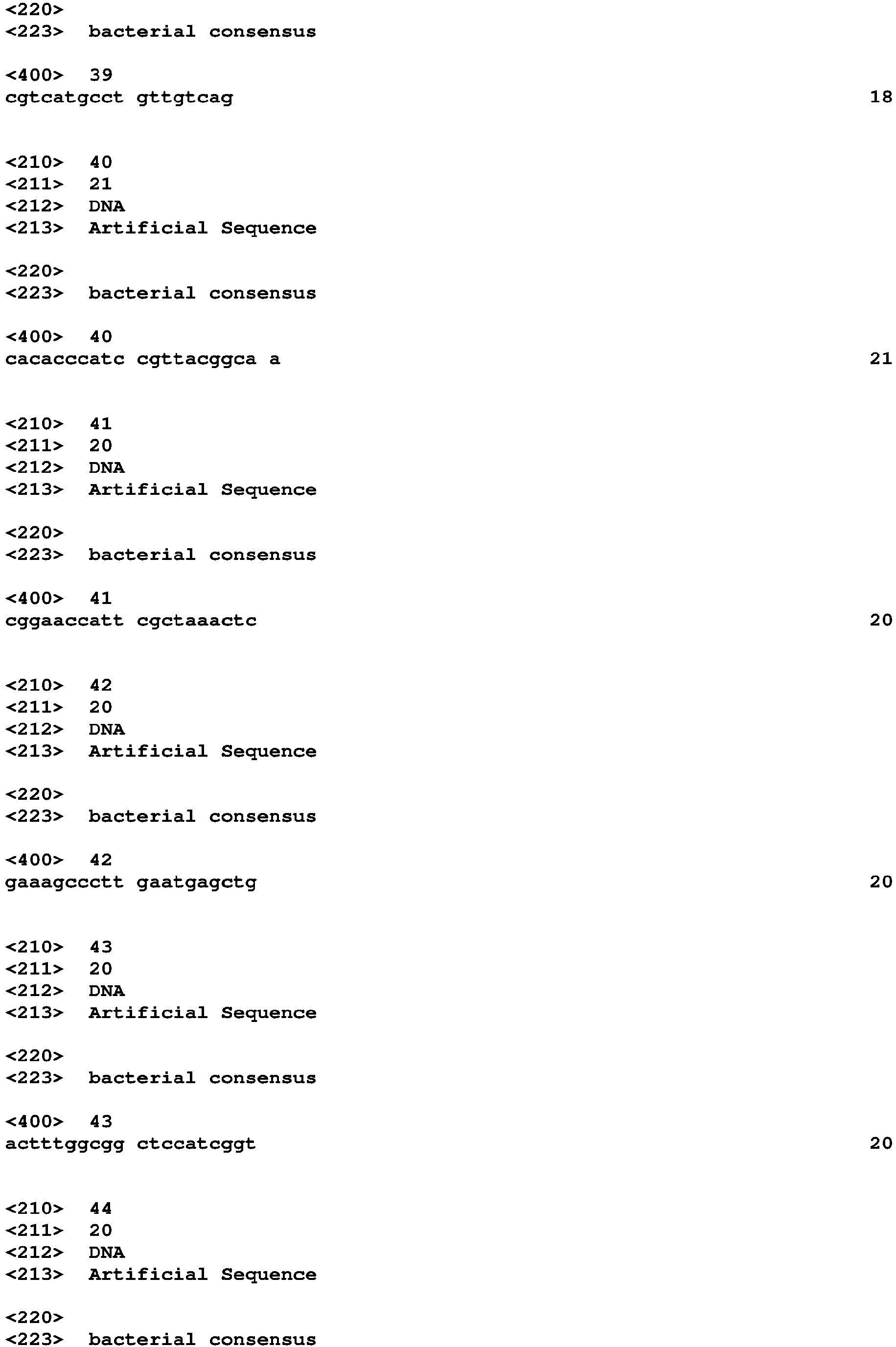

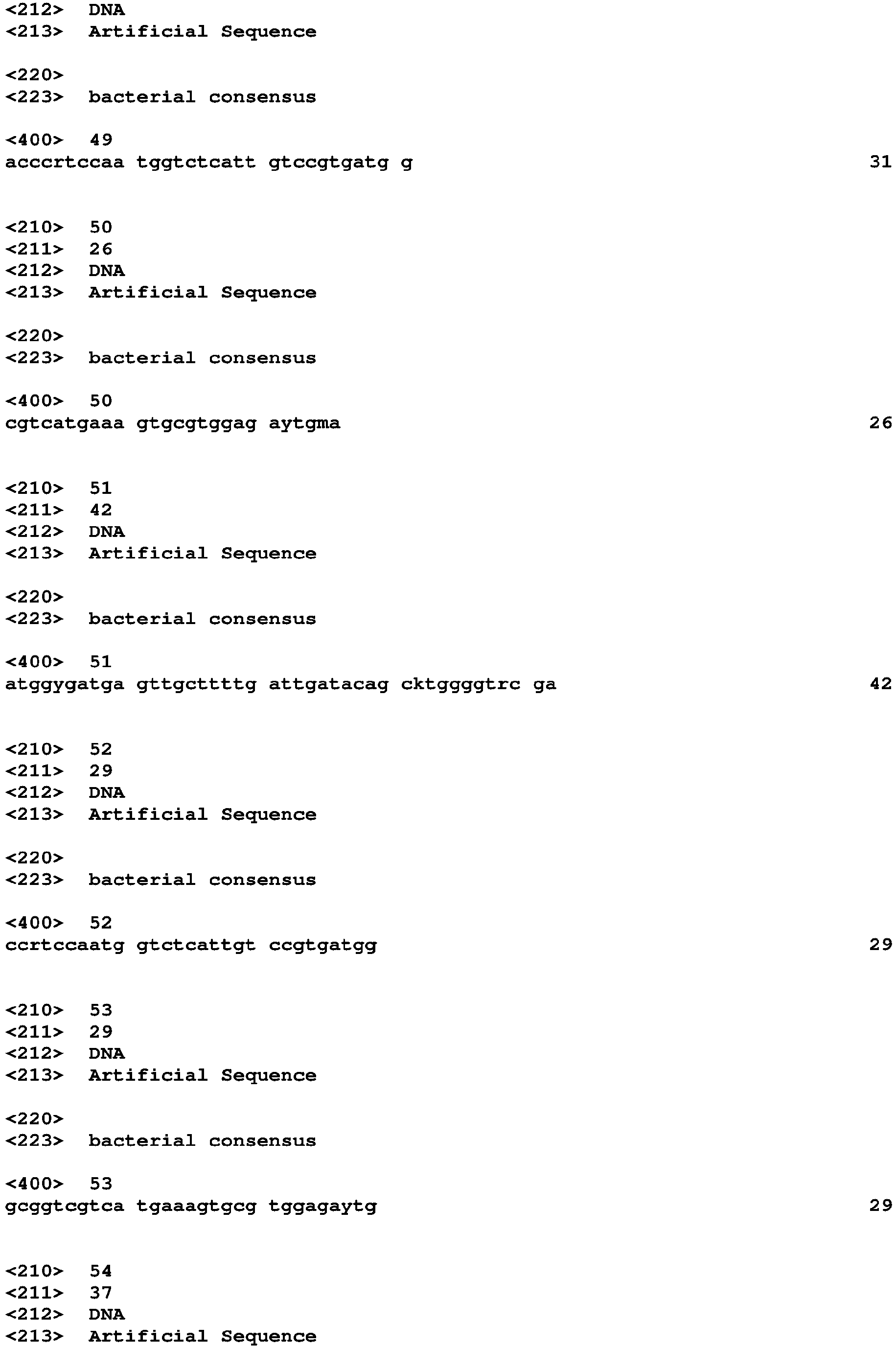


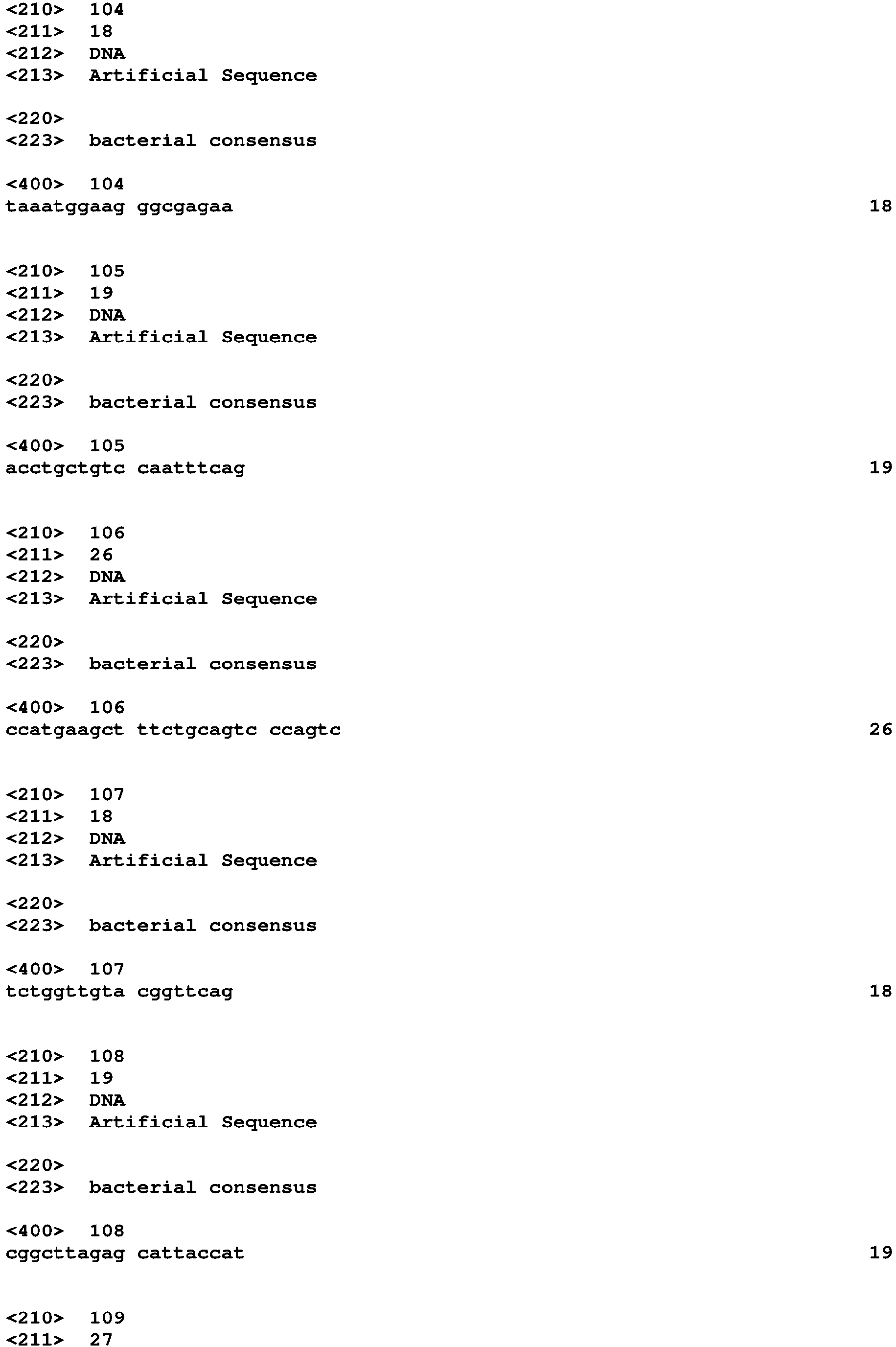

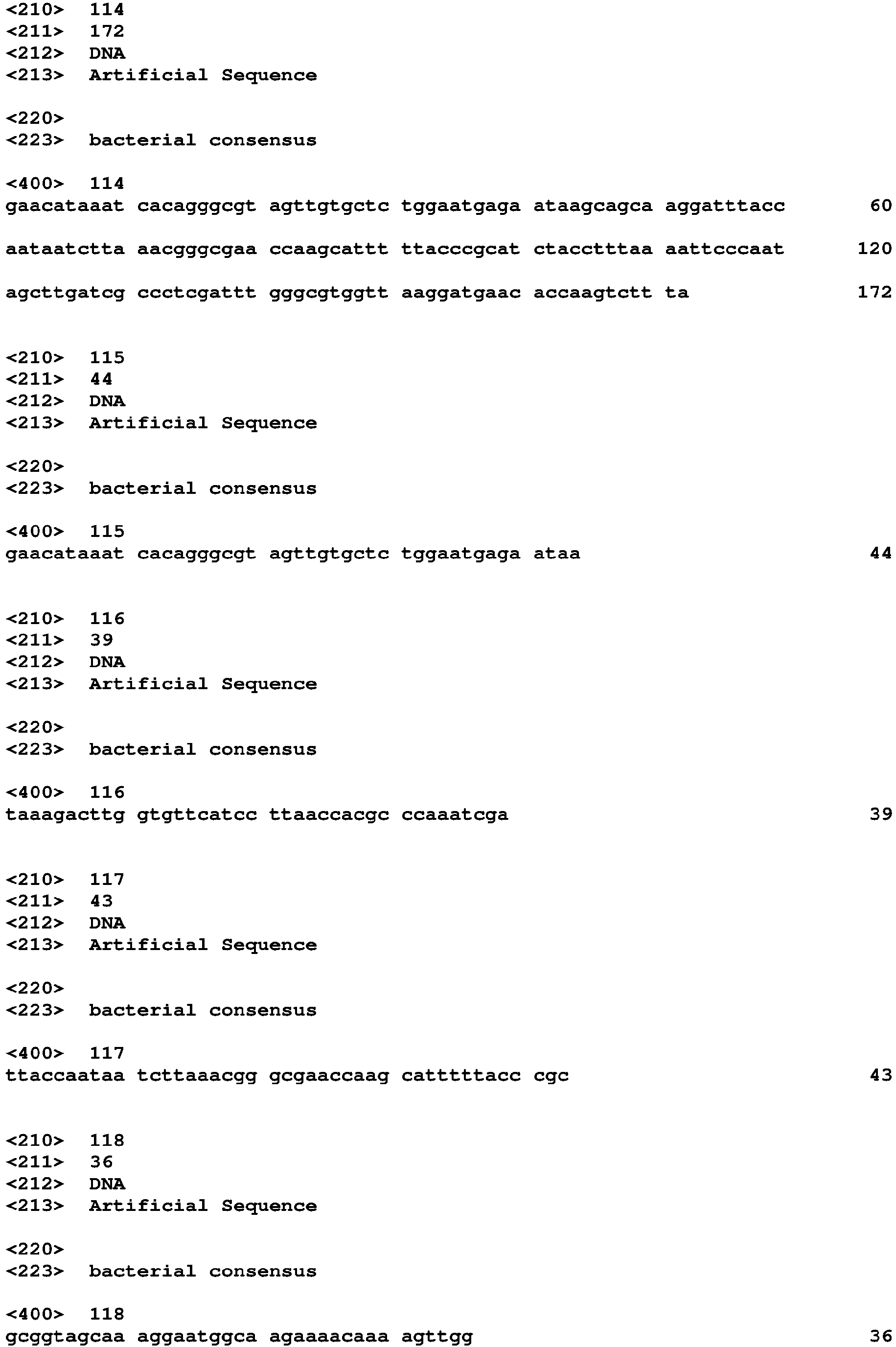


Claims (15)
- A method for determining in a sample the presence or absence of carbapenemase producing bacteria, the method comprising determining in said sample the presence or absence of one or more carbapenemase genes selected from the group consisting ofa) an NDM carbapenemase gene, the presence of which is determined using a forward primer F1, a reverse primer R1 and optionally a probe P1, wherein F1, R1 and P1 are each capable of hybridization to SEQ ID NO:1 or its complement;b) a KPC carbapenemase gene, the presence of which is determined using a forward primer F2, a reverse primer R2 and optionally a probe P2, wherein F2, R2 and P2 are each capable of hybridization to SEQ ID NO:27 or its complement;c) a VIM carbapenemase gene, the presence of which is determined using a forward primer F3, a reverse primer R3 and optionally a probe P3, wherein F3, R3 and P3 are each capable of hybridization to SEQ ID NO:47 or its complement;d) an IMP carbapenemase gene, the presence of which is determined using a forward primer F4, a reverse primer R4 and optionally a probe P4, wherein F4, R4 and P4 are each capable of hybridization to SEQ ID NO:69 or its complement, SEQ ID NO:79 or its complement, or SEQ ID NO:86 or its complement;e) an OXA-23-like carbapenemase gene, the presence of which is determined using a forward primer F5, a reverse primer R5 and optionally a probe P5, wherein F5, R5 and P5 are each capable of hybridization to SEQ ID NO:93 or its complement;f) an OXA-48-like carbapenemase gene, the presence of which is determined using a forward primer F6, a reverse primer R6 and optionally a probe P6, wherein F6, R6 and P6 are each capable of hybridization to SEQ ID NO:113 or its complement;g) an OXA-58-like carbapenemase gene, the presence of which is determined using a forward primer F7, a reverse primer R7 and optionally a probe P7, wherein F7, R7 and P7 are each capable of hybridization to SEQ ID NO:127 or its complement; andh) an OXA-40/24-like carbapenemase gene, the presence of which is determined using a forward primer F8, a reverse primer R8 and optionally a probe P8, wherein F8, R8 and P8 are each capable of hybridization to SEQ ID NO:138 or its complement.
- The method according to claim 1, comprising the steps ofa. amplification of a region of bacterial DNA comprised in the sample using at least one primer pair consisting of a forward and a corresponding reverse primer of claim 1; andb. detection of the presence or absence of an amplicon,wherein the presence of an amplicon is indicative for the presence of carbapenemase producing bacteria in the sample and the absence of an amplicon is indicative for the absence of carbapenemase producing bacteria in the sample.
- The method according to claim 1 or 2, wherein the presence or absence of at least one or at least two carbapenemase genes selected from the group consisting of an IMP carbapenemase gene, an OXA-23-like carbapenemase gene, an OXA-40/24-like carbapenemase gene and an OXA-58-like carbapenemase gene is determined, preferably wherein the presence or absence of at least one carbapenemase gene selected from the group consisting of an OXA-40/24-like carbapenemase gene and an OXA-58-like carbapenemase gene is determined.
- The method according to any one of claims 1 to 3, whereina) F1, R1 and P1 are each capable of hybridization to SEQ ID NO:2 or its complement;b) F2, R2 and P2 are each capable of hybridization to SEQ ID NO:28 or its complement;c) F3, R3 and P3 are each capable of hybridization to SEQ ID NO:48 or its complement;d) F4, R4 and P4 are each capable of hybridization to SEQ ID NO:69 or its complement;e) F5, R5 and P5 are each capable of hybridization to SEQ ID NO:94 or its complement;f) F6, R6 and P6 are each capable of hybridization to SEQ ID NO:114 or its complement;g) F7, R7 and P7 are each capable of hybridization to SEQ ID NO:127 or its complement; and/orh) F8, R8 and P8 are each capable of hybridization to SEQ ID NO:138 or its complement.
- The method according to any one of claims 1 to 4, whereina) the sequence of F1 comprises or consists of 16 to 30 consecutive nucleotides of SEQ ID NO:3, the sequence of R1 comprises or consists of 16 to 30 consecutive nucleotides of SEQ ID NO:4 and the sequence of P1 comprises or consists of 20 to 30 consecutive nucleotides of SEQ ID NO:5; or the sequence of F1 comprises or consists of 16 to 30 consecutive nucleotides of SEQ ID NO:6, the sequence of R1 comprises or consists of 16 to 30 consecutive nucleotides of SEQ ID NO:7 and the sequence of P1 comprises or consists of 20 to 30 consecutive nucleotides of SEQ ID NO:8; or the sequence of F1 comprises or consists of 16 to 30 consecutive nucleotides of SEQ ID NO:9, the sequence of R1 comprises or consists of 16 to 30 consecutive nucleotides of SEQ ID NO:10 and the sequence of P1 comprises or consists of 20 to 30 consecutive nucleotides of SEQ ID NO:11; or the sequence of F1 comprises or consists of 16 to 30 consecutive nucleotides of SEQ ID NO:12, the sequence of R1 comprises or consists of 16 to 30 consecutive nucleotides of SEQ ID NO:13 and the sequence of P1 comprises or consists of 20 to 30 consecutive nucleotides of SEQ ID NO:14;b) the sequence of F2 comprises or consists of 16 to 30 consecutive nucleotides of SEQ ID NO:29, the sequence of R2 comprises or consists of 16 to 30 consecutive nucleotides of SEQ ID NO:30 and the sequence of P2 comprises or consists of 20 to 30 consecutive nucleotides of SEQ ID NO:31; or the sequence of F2 comprises or consists of 16 to 30 consecutive nucleotides of SEQ ID NO:32, the sequence of R2 comprises or consists of 16 to 30 consecutive nucleotides of SEQ ID NO:33 and the sequence of P2 comprises or consists of 20 to 30 consecutive nucleotides of SEQ ID NO:34; or the sequence of F2 comprises or consists of 16 to 30 consecutive nucleotides of SEQ ID NO:35, the sequence of R2 comprises or consists of 16 to 30 consecutive nucleotides of SEQ ID NO:36 and the sequence of P2 comprises or consists of 20 to 30 consecutive nucleotides of SEQ ID NO:37;c) the sequence of F3 comprises or consists of 16 to 30 consecutive nucleotides of SEQ ID NO:49, the sequence of R3 comprises or consists of 16 to 30 consecutive nucleotides of SEQ ID NO:50 and the sequence of P3 comprises or consists of 20 to 30 consecutive nucleotides of SEQ ID NO:51; or the sequence of F3 comprises or consists of 16 to 30 consecutive nucleotides of SEQ ID NO:52, the sequence of R3 comprises or consists of 16 to 30 consecutive nucleotides of SEQ ID NO:53 and the sequence of P3 comprises or consists of 20 to 30 consecutive nucleotides of SEQ ID NO:54; or the sequence of F3 comprises or consists of 16 to 30 consecutive nucleotides of SEQ ID NO:55, the sequence of R3 comprises or consists of 16 to 30 consecutive nucleotides of SEQ ID NO:56 or SEQ ID NO:57 and the sequence of P3 comprises or consists of 20 to 30 consecutive nucleotides of SEQ ID NO:58;d) the sequence of F4 comprises or consists of 16 to 30 consecutive nucleotides of SEQ ID NO:70, the sequence of R4 comprises or consists of 16 to 30 consecutive nucleotides of SEQ ID NO:71 and the sequence of P4 comprises or consists of 20 to 30 consecutive nucleotides of SEQ ID NO:72; or the sequence of F4 comprises or consists of 16 to 30 consecutive nucleotides of SEQ ID NO:80, the sequence of R4 comprises or consists of 16 to 30 consecutive nucleotides of SEQ ID NO:81 and the sequence of P4 comprises or consists of 20 to 30 consecutive nucleotides of SEQ ID NO:82; or the sequence of F4 comprises or consists of 16 to 30 consecutive nucleotides of SEQ ID NO:87, the sequence of R4 comprises or consists of 16 to 30 consecutive nucleotides of SEQ ID NO:88 and the sequence of P4 comprises or consists of 20 to 30 consecutive nucleotides of SEQ ID NO:89;e) the sequence of F5 comprises or consists of 16 to 30 consecutive nucleotides of SEQ ID NO:95, the sequence of R5 comprises or consists of 16 to 30 consecutive nucleotides of SEQ ID NO:96 and the sequence of P5 comprises or consists of 20 to 30 consecutive nucleotides of SEQ ID NO:97; or the sequence of F5 comprises or consists of 16 to 30 consecutive nucleotides of SEQ ID NO:98, the sequence of R5 comprises or consists of 16 to 30 consecutive nucleotides of SEQ ID NO:99 and the sequence of P5 comprises or consists of 20 to 30 consecutive nucleotides of SEQ ID NO:100; or the sequence of F5 comprises or consists of 16 to 30 consecutive nucleotides of SEQ ID NO:101, the sequence of R5 comprises or consists of 16 to 30 consecutive nucleotides of SEQ ID NO:102 and the sequence of P5 comprises or consists of 20 to 30 consecutive nucleotides of SEQ ID NO:103;f) the sequence of F6 comprises or consists of 16 to 30 consecutive nucleotides of SEQ ID NO:115, the sequence of R6 comprises or consists of 16 to 30 consecutive nucleotides of SEQ ID NO:116 and the sequence of P6 comprises or consists of 20 to 30 consecutive nucleotides of SEQ ID NO:117; or the sequence of F6 comprises or consists of 16 to 30 consecutive nucleotides of SEQ ID NO:118, the sequence of R6 comprises or consists of 16 to 30 consecutive nucleotides of SEQ ID NO:119 and the sequence of P6 comprises or consists of 20 to 30 consecutive nucleotides of SEQ ID NO:120;g) the sequence of F7 comprises or consists of 16 to 30 consecutive nucleotides of SEQ ID NO:128 or SEQ ID NO:131, the sequence of R7 comprises or consists of 16 to 30 consecutive nucleotides of SEQ ID NO:129 and the sequence of P7 comprises or consists of 20 to 30 consecutive nucleotides of SEQ ID NO:130 or SEQ ID NO:132; and/orh) the sequence of F8 comprises or consists of 16 to 30 consecutive nucleotides of SEQ ID NO:139, the sequence of R8 comprises or consists of 16 to 30 consecutive nucleotides of SEQ ID NO:140 and the sequence of P8 comprises or consists of 20 to 30 consecutive nucleotides of SEQ ID NO:141 or SEQ ID NO:142.
- The method according to any one of claims 1 to 5, whereina) the sequence of F1 comprises or consists of 16 to 30 consecutive nucleotides of SEQ ID NO:3, the sequence of R1 comprises or consists of 16 to 30 consecutive nucleotides of SEQ ID NO:4 and the sequence of P1 comprises or consists of 20 to 30 consecutive nucleotides of SEQ ID NO:5;b) the sequence of F2 comprises or consists of 16 to 30 consecutive nucleotides of SEQ ID NO:29, the sequence of R2 comprises or consists of 16 to 30 consecutive nucleotides of SEQ ID NO:30 and the sequence of P2 comprises or consists of 20 to 30 consecutive nucleotides of SEQ ID NO:31;c) the sequence of F3 comprises or consists of 16 to 30 consecutive nucleotides of SEQ ID NO:49, the sequence of R3 comprises or consists of 16 to 30 consecutive nucleotides of SEQ ID NO:50 and the sequence of P3 comprises or consists of 20 to 30 consecutive nucleotides of SEQ ID NO:51;d) the sequence of F4 comprises or consists of 16 to 30 consecutive nucleotides of SEQ ID NO:70, the sequence of R4 comprises or consists of 16 to 30 consecutive nucleotides of SEQ ID NO:71 and the sequence of P4 comprises or consists of 20 to 30 consecutive nucleotides of SEQ ID NO:72;e) the sequence of F5 comprises or consists of 16 to 30 consecutive nucleotides of SEQ ID NO:95, the sequence of R5 comprises or consists of 16 to 30 consecutive nucleotides of SEQ ID NO:96 and the sequence of P5 comprises or consists of 20 to 30 consecutive nucleotides of SEQ ID NO:97;f) the sequence of F6 comprises or consists of 16 to 30 consecutive nucleotides of SEQ ID NO:115, the sequence of R6 comprises or consists of 16 to 30 consecutive nucleotides of SEQ ID NO:116 and the sequence of P6 comprises or consists of 20 to 30 consecutive nucleotides of SEQ ID NO:117;g) the sequence of F7 comprises or consists of 16 to 30 consecutive nucleotides of SEQ ID NO: 128, the sequence of R7 comprises or consists of 16 to 30 consecutive nucleotides of SEQ ID NO: 129 and the sequence of P7 comprises or consists of 20 to 30 consecutive nucleotides of SEQ ID NO:130; and/orh) the sequence of F8 comprises or consists of 16 to 30 consecutive nucleotides of SEQ ID NO: 139, the sequence of R8 comprises or consists of 16 to 30 consecutive nucleotides of SEQ ID NO: 140 and the sequence of P8 comprises or consists of 20 to 30 consecutive nucleotides of SEQ ID NO:141.
- The method according to any one of claims 1 to 5, whereina) the sequence of F1 comprises or consists of SEQ ID NO: 15, the sequence of R1 comprises or consists of SEQ ID NO: 16 and the sequence of P1 comprises or consists of SEQ ID NO: 17; or the sequence of F1 comprises or consists of SEQ ID NO: 18, the sequence of R1 comprises or consists of SEQ ID NO: 19 and the sequence of P1 comprises or consists of SEQ ID NO:20; or the sequence of F1 comprises or consists of SEQ ID NO:21, the sequence of R1 comprises or consists of SEQ ID NO:22 and the sequence of P1 comprises or consists of SEQ ID NO:23; or the sequence of F1 comprises or consists of SEQ ID NO:24, the sequence of R1 comprises or consists of SEQ ID NO:25 and the sequence of P1 comprises or consists of SEQ ID NO:26;b) the sequence of F2 comprises or consists of SEQ ID NO:38, the sequence of R2 comprises or consists of SEQ ID NO:39 and the sequence of P2 comprises or consists of SEQ ID NO:40; or the sequence of F2 comprises or consists of SEQ ID NO:41, the sequence of R2 comprises or consists of SEQ ID NO:42 and the sequence of P2 comprises or consists of SEQ ID NO:43; or the sequence of F2 comprises or consists of SEQ ID NO:44, the sequence of R2 comprises or consists of SEQ ID NO:45 and the sequence of P2 comprises or consists of SEQ ID NO:46;c) the sequence of F3 comprises or consists of SEQ ID NO:59, the sequence of R3 comprises or consists of SEQ ID NO:60 and the sequence of P3 comprises or consists of SEQ ID NO:61; or the sequence of F3 comprises or consists of SEQ ID NO:62, the sequence of R3 comprises or consists of SEQ ID NO:63 and the sequence of P3 comprises or consists of SEQ ID NO:64; or the sequence of F3 comprises or consists of SEQ ID NO:65, the sequence of R3 comprises or consists of SEQ ID NO:66 or SEQ ID NO:67 and the sequence of P3 comprises or consists of SEQ ID NO:68;d) the sequence of F4 comprises or consists of SEQ ID NO:73, the sequence of R4 comprises or consists of SEQ ID NO:74 and the sequence of P4 comprises or consists of SEQ ID NO:75; or the sequence of F4 comprises or consists of SEQ ID NO:76, the sequence of R4 comprises or consists of SEQ ID NO:77 and the sequence of P4 comprises or consists of SEQ ID NO:78; or the sequence of F4 comprises or consists of SEQ ID NO:83, the sequence of R4 comprises or consists of SEQ ID NO:84 and the sequence of P4 comprises or consists of SEQ ID NO:85; or the sequence of F4 comprises or consists of SEQ ID NO:90, the sequence of R4 comprises or consists of SEQ ID NO:91 and the sequence of P4 comprises or consists of SEQ ID NO:92;e) the sequence of F5 comprises or consists of SEQ ID NO: 104, the sequence of R5 comprises or consists of SEQ ID NO: 105 and the sequence of P5 comprises or consists of SEQ ID NO: 106; or the sequence of F5 comprises or consists of SEQ ID NO: 107, the sequence of R5 comprises or consists of SEQ ID NO: 108 and the sequence of P5 comprises or consists of SEQ ID NO: 109; or the sequence of F5 comprises or consists of SEQ ID NO:110, the sequence of R5 comprises or consists of SEQ ID NO: 111 and the sequence of P5 comprises or consists of SEQ ID NO: 112;f) the sequence of F6 comprises or consists of SEQ ID NO: 121, the sequence of R6 comprises or consists of SEQ ID NO: 122 and the sequence of P6 comprises or consists of SEQ ID NO: 123; or the sequence of F6 comprises or consists of SEQ ID NO: 124, the sequence of R6 comprises or consists of SEQ ID NO: 125 and the sequence of P6 comprises or consists of SEQ ID NO: 126;g) the sequence of F7 comprises or consists of SEQ ID NO: 133 or SEQ ID NO: 136, the sequence of R7 comprises or consists of SEQ ID NO:134 and the sequence of P7 comprises or consists of SEQ ID NO: 135 or SEQ ID NO:137; and/orh) the sequence of F8 comprises or consists of SEQ ID NO: 143, the sequence of R8 comprises or consists of SEQ ID NO: 144 and the sequence of P8 comprises or consists of SEQ ID NO:145 or SEQ ID NO: 146.
- The method according to any one of claims 1 to 5, whereina) the sequence of F1 comprises or consists of SEQ ID NO: 15, the sequence of R1 comprises or consists of SEQ ID NO: 16 and the sequence of P1 comprises or consists of SEQ ID NO:17;b) the sequence of F2 comprises or consists of SEQ ID NO:38, the sequence of R2 comprises or consists of SEQ ID NO:39 and the sequence of P2 comprises or consists of SEQ ID NO:40;c) the sequence of F3 comprises or consists of SEQ ID NO:59, the sequence of R3 comprises or consists of SEQ ID NO:60 and the sequence of P3 comprises or consists of SEQ ID NO:61;d) the sequence of F4 comprises or consists of SEQ ID NO:73, the sequence of R4 comprises or consists of SEQ ID NO:74 and the sequence of P4 comprises or consists of SEQ ID NO:75;e) the sequence of F5 comprises or consists of SEQ ID NO: 104, the sequence of R5 comprises or consists of SEQ ID NO:105 and the sequence of P5 comprises or consists of SEQ ID NO:106;f) the sequence of F6 comprises or consists of SEQ ID NO: 121, the sequence of R6 comprises or consists of SEQ ID NO:122 and the sequence of P6 comprises or consists of SEQ ID NO:123;g) the sequence of F7 comprises or consists of SEQ ID NO: 133, the sequence of R7 comprises or consists of SEQ ID NO: 134 and the sequence of P7 comprises or consists of SEQ ID NO: 135; and/orh) the sequence of F8 comprises or consists of SEQ ID NO: 143, the sequence of R8 comprises or consists of SEQ ID NO:144 and the sequence of P8 comprises or consists of SEQ ID NO:145.
- An oligonucleotide set comprisinga) a forward primer F1 comprising or consisting of SEQ ID NO:15, a reverse primer R1 comprising or consisting of SEQ ID NO:16 and optionally a probe P1 comprising or consisting of SEQ ID NO:17;b) a forward primer F2 comprising or consisting of SEQ ID NO:38, a reverse primer R2 comprising or consisting of SEQ ID NO:39 and optionally a probe P2 comprising or consisting of SEQ ID NO:40;c) a forward primer F3 comprising or consisting of SEQ ID NO:59, a reverse primer R3 comprising or consisting of SEQ ID NO:60 and optionally a probe P3 comprising or consisting of SEQ ID NO:61;d) a forward primer F4 comprising or consisting of SEQ ID NO:73, a reverse primer R4 comprising or consisting of SEQ ID NO:74 and optionally a probe P4 comprising or consisting of SEQ ID NO:75;e) a forward primer F5 comprising or consisting of SEQ ID NO:104, a reverse primer R5 comprising or consisting of SEQ ID NO:105 and optionally a probe P5 comprising or consisting of SEQ ID NO:106;f) a forward primer F6 comprising or consisting of SEQ ID NO:121, a reverse primer R6 comprising or consisting of SEQ ID NO:122 and optionally a probe P6 comprising or consisting of SEQ ID NO:123;g) a forward primer F7 comprising or consisting of SEQ ID NO:133, a reverse primer R7 comprising or consisting of SEQ ID NO:134 and optionally a probe P7 comprising or consisting of SEQ ID NO:135; and/orh) a forward primer F8 comprising or consisting of SEQ ID NO:143, a reverse primer R8 comprising or consisting of SEQ ID NO:144 and optionally a probe P8 comprising or consisting of SEQ ID NO:145.
- A kit comprising an oligonucleotide set according to claim 9 and a component selected from the group consisting of a buffer, nucleotides and a DNA polymerase.
- A use of the oligonucleotide set according to claim 9 or the kit according to claim 10 for determining in a sample the presence or absence of carbapenemase producing bacteria.
- A method of diagnosis of an infection with carbapenemase producing bacteria, the method comprisinga) obtaining a sample of a patient;b) determining in the sample the presence or absence of carbapenemase producing bacteria, comprising determining in said sample the presence or absence of one or more carbapenemase genes selected from the group consisting of an NDM carbapenemase gene, a KPC carbapenemase gene, a VIM carbapenemase gene, an IMP carbapenemase gene, an OXA-23-like carbapenemase gene, an OXA-48-like carbapenemase gene, an OXA-58-like carbapenemase gene and an OXA-40/24-like carbapenemase gene; wherein the presence of a carbapenemase gene in the sample is indicative of an infection with carbapenemase producing bacteria.
- An in vitro method for selecting a patient for treatment with a beta lactam antibacterial drug, preferably a carbapenem, the method comprisinga) obtaining a sample of a patient;b) determining in the sample the presence or absence of carbapenemase producing bacteria, comprising determining in said sample the presence or absence of one or more carbapenemase genes selected from the group consisting of an NDM carbapenemase gene, a KPC carbapenemase gene, a VIM carbapenemase gene, an IMP carbapenemase gene, an OXA-23-like carbapenemase gene, an OXA-48-like carbapenemase gene, an OXA-58-like carbapenemase gene and an OXA-40/24-like carbapenemase gene;c) if the sample does not comprise carbapenemase producing bacteria, selecting the patient for treatment with a beta lactam antibacterial drug, preferably a carbapenem.
- A beta lactam antibacterial drug, preferably a carbapenem for use in a method of treatment of a bacterial infection in a patient that is not infected with carbapenemase producing bacteria, the method comprisinga) obtaining a sample of a patient;b) determining in the sample the presence or absence of carbapenemase producing bacteria, comprising determining in said sample the presence or absence of one or more carbapenemase genes selected from the group consisting of an NDM carbapenemase gene, a KPC carbapenemase gene, a VIM carbapenemase gene, an IMP carbapenemase gene, an OXA-23-like carbapenemase gene, an OXA-48-like carbapenemase gene, an OXA-58-like carbapenemase gene and an OXA-40/24-like carbapenemase gene;c) if the sample does not comprise carbapenemase producing bacteria, administering to the patient a beta lactam antibacterial drug, preferably a carbapenem.
- The method of diagnosis according to claim 12, the in vitro method according to claim 13 or the beta lactam antibacterial drug for use according to claim 14, wherein step b) comprises determining the presence or absence of carbapenemase producing bacteria according to the method of any one of claims 1 to 9.
Priority Applications (1)
| Application Number | Priority Date | Filing Date | Title |
|---|---|---|---|
| EP20203612.5A EP3988676A1 (en) | 2020-10-23 | 2020-10-23 | Multiplex pcr for detection of carbapenemase genes |
Applications Claiming Priority (1)
| Application Number | Priority Date | Filing Date | Title |
|---|---|---|---|
| EP20203612.5A EP3988676A1 (en) | 2020-10-23 | 2020-10-23 | Multiplex pcr for detection of carbapenemase genes |
Publications (1)
| Publication Number | Publication Date |
|---|---|
| EP3988676A1 true EP3988676A1 (en) | 2022-04-27 |
Family
ID=73014322
Family Applications (1)
| Application Number | Title | Priority Date | Filing Date |
|---|---|---|---|
| EP20203612.5A Withdrawn EP3988676A1 (en) | 2020-10-23 | 2020-10-23 | Multiplex pcr for detection of carbapenemase genes |
Country Status (1)
| Country | Link |
|---|---|
| EP (1) | EP3988676A1 (en) |
Cited By (4)
| Publication number | Priority date | Publication date | Assignee | Title |
|---|---|---|---|---|
| CN114921574A (en) * | 2022-06-24 | 2022-08-19 | 丹娜(天津)生物科技股份有限公司 | A primer-probe combination for detecting carbapenemase-encoding gene and its application |
| CN118006813A (en) * | 2023-09-14 | 2024-05-10 | 北京金匙医学检验实验室有限公司 | Characteristic genes for predicting carbapenem susceptibility phenotypes of Pseudomonas aeruginosa |
| WO2024141442A1 (en) * | 2022-12-25 | 2024-07-04 | F. Hoffmann-La Roche Ag | Compositions and methods for detecting carbapenem resistant acinetobacter calcoaceticus-baumannii (crab) |
| CN119775426A (en) * | 2024-12-31 | 2025-04-08 | 江苏美克医学技术有限公司 | Development, preparation and application of a carbapenemase immunochromatographic kit |
Citations (3)
| Publication number | Priority date | Publication date | Assignee | Title |
|---|---|---|---|---|
| CN102181543A (en) * | 2011-04-08 | 2011-09-14 | 北京爱普益生物科技有限公司 | Primer, probe, kit for detecting bla<NDM-1 (New Delhi metallo-Beta-lactamase-1)> gene and detection method thereof |
| CN103614465B (en) * | 2013-11-06 | 2015-08-26 | 南方医科大学 | For detecting the LAMP primer of the common carbapenem of gram negative bacilli, test kit and detection method thereof |
| WO2015138991A2 (en) * | 2014-03-13 | 2015-09-17 | Opgen, Inc. | Methods of detecting multi-drug resistant organisms |
-
2020
- 2020-10-23 EP EP20203612.5A patent/EP3988676A1/en not_active Withdrawn
Patent Citations (3)
| Publication number | Priority date | Publication date | Assignee | Title |
|---|---|---|---|---|
| CN102181543A (en) * | 2011-04-08 | 2011-09-14 | 北京爱普益生物科技有限公司 | Primer, probe, kit for detecting bla<NDM-1 (New Delhi metallo-Beta-lactamase-1)> gene and detection method thereof |
| CN103614465B (en) * | 2013-11-06 | 2015-08-26 | 南方医科大学 | For detecting the LAMP primer of the common carbapenem of gram negative bacilli, test kit and detection method thereof |
| WO2015138991A2 (en) * | 2014-03-13 | 2015-09-17 | Opgen, Inc. | Methods of detecting multi-drug resistant organisms |
Non-Patent Citations (30)
| Title |
|---|
| "Current Protocols in Molecular Biology", 1995, JOHN WILEY & SONS |
| ANTONELLI, A.F. ARENAT. GIANIO. L. COLAVECCHIOS. V. VALEVAS. PAULEP. BOLEIJG. M. ROSSOLINI: "Performance of the BD MAX instrument with Check-Direct CPE real-time PCR for the detection of carbapenemase genes from rectal swabs, in a setting with endemic dissemination of carbapenemase-producing Enterobacteriaceae", DIAGN MICROBIOL INFECT DIS, vol. 86, 2016, pages 30 - 4 |
| ANTUNES, N. T.J. F. FISHER: "Acquired Class D beta-Lactamases", ANTIBIOTICS (BASEL, vol. 3, 2014, pages 398 - 434 |
| CHAVDA, K. D.L. CHENM. R. JACOBSA. D. ROJTMANR. A. BONOMOB. N. KREISWIRTH: "Complete sequence of a bla(KPC)-harboring cointegrate plasmid isolated from Escherichia coli", ANTIMICROB AGENTS CHEMOTHER, vol. 59, 2015, pages 2956 - 9 |
| CUZON, G.T. NAASP. BOGAERTSY. GLUPCZYNSKIP. NORDMANN: "Evaluation of a DNA microarray for the rapid detection of extended-spectrum beta-lactamases (TEM, SHV and CTX-M), plasmid-mediated cephalosporinases (CMY-2-like, DHA, FOX, ACC-1, ACT/MIR and CMY-1-like/MOX) and carbapenemases (KPC, OXA-48, VIM, IMP an accession number d NDM", J ANTIMICROB CHEMOTHER, vol. 67, 2012, pages 1865 - 9 |
| DALLENNE, C.A. DA COSTAD. DECREC. FAVIERG. ARLET: "Development of a set of multiplex PCR assays for the detection of genes encoding important beta-lactamases in Enterobacteriaceae", J ANTIMICROB CHEMOTHER, vol. 65, 2010, pages 490 - 5, XP055272584, DOI: 10.1093/jac/dkp498 |
| DOUMITH, M.M. J. ELLINGTOND. M. LIVERMOREN. WOODFORD: "Molecular mechanisms disrupting porin expression in ertapenem-resistant Klebsiella and Enterobacter spp. clinical isolates from the UK", J ANTIMICROB CHEMOTHER, vol. 63, 2009, pages 659 - 67 |
| DOWDYWEARDEN: "Statistics for Research", 1983, JOHN WILEY & SONS |
| EL AMIN, N.C. G. GISKES. JALALB. KEIJSERG. KRONVALLB. WRETLIND: "Carbapenem resistance mechanisms in Pseudomonas aeruginosa: alterations of porin OprD and efflux proteins do not fully explain resistance patterns observed in clinical isolates", APMIS, vol. 113, 2005, pages 187 - 96 |
| EVANS, B. A.A. HAMOUDAK. J. TOWNERS. G. AMYES: "OXA-51-like beta-lactamases and their association with particular epidemic lineages of Acinetobacter baumannii", CLIN MICROBIOL INFECT, vol. 14, 2008, pages 268 - 75 |
| HOFKO, M.A. MISCHNIKM. KAASES. ZIMMERMANNA. H. DALPKE: "Detection of carbapenemases by real-time PCR and melt curve analysis on the BD Max system", J CLIN MICROBIOL, vol. 52, 2014, pages 1701 - 4 |
| J. MONTEIRO ET AL: "Rapid detection of carbapenemase genes by multiplex real-time PCR", JOURNAL OF ANTIMICROBIAL CHEMOTHERAPY, vol. 67, no. 4, 9 January 2012 (2012-01-09), pages 906 - 909, XP055074291, ISSN: 0305-7453, DOI: 10.1093/jac/dkr563 * |
| KAASE, M.: "Carbapenemases in gram-negative bacteria. Current data and trends of resistance resulting from the work of national reference centres", BUNDESGESUNDHEITSBLATT GESUNDHEITSFORSCHUNG GESUNDHEITSSCHUTZ, vol. 55, 2012, pages 1401 - 4, XP035132515, DOI: 10.1007/s00103-012-1552-x |
| KOCH-INSTITUT ROBERT.: "Bericht des Nationalen Referenzzentrums (NRZ) fiir gramnegative Krankenhauserreger", ROBERT KOCH-INSTITUT, EPIDEMIOLOGIE UND GESUNDHEITSBERICHTERSTATTUNG, 2018 |
| KOCH-INSTITUT, ROBERT.: "Bericht des Nationalen Referenzzentrums (NRZ) fiir gramnegative Krankenhauserreger", ROBERT KOCH-INSTITUT, EPIDEMIOLOGIE UND GESUNDHEITSBERICHTERSTATTUNG, 2016 |
| KOCH-INSTITUT, ROBERT.: "Bericht des Nationalen Referenzzentrums (NRZ) fur gramnegative Krankenhauserreger", ROBERT KOCH-INSTITUT, EPIDEMIOLOGIE UND GESUNDHEITSBERICHTERSTATTUNG, 2015 |
| LUND, M.M. B. PETERSENA. L. JORGENSEND. PAULMANNM. WANG: "Rapid real-time PCR for the detection of IMP, NDM, VIM, KPC and OXA-48 carbapenemase genes in isolates and spiked stool samples", DIAGN MICROBIOL INFECT DIS, vol. 92, 2018, pages 8 - 12, XP085441481, DOI: 10.1016/j.diagmicrobio.2018.04.002 |
| MENTASTI, M.K. PRIMEK. SANDSS. KHANM. WOOTTON: "Rapid detection of IMP, NDM, VIM, KPC and OXA-48-like carbapenemases from Enterobacteriales and Gram-negative non-fermenter bacteria by real-time PCR and melt-curve analysis", EUR J CLIN MICROBIOL INFECT DIS, 2019 |
| NAAS, T.G. CUZONP. BOGAERTSY. GLUPCZYNSKIP. NORDMANN: "Evaluation of a DNA microarray (Check-MDR CT102) for rapid detection of TEM, SHV, and CTX-M extended-spectrum beta-lactamases and of KPC, OXA-48, VIM, IMP, and NDM-1 carbapenemases", J CLIN MICROBIOL, vol. 49, 2011, pages 1608 - 13 |
| NAAS, T.P. NORDMANN: "Analysis of a carbapenem-hydrolyzing class A beta-lactamase from Enterobacter cloacae and of its LysR-type regulatory protein", PROC NATL ACAD SCI U S A, vol. 91, 1994, pages 7693 - 7 |
| NADKARNI, M. A.F. E. MARTINN. A. JACQUESN. HUNTER: "Determination of bacterial load by real-time PCR using a broad-range (universal) probe and primers set", MICROBIOLOGY, vol. 148, 2002, pages 257 - 66, XP055568103, DOI: 10.1099/00221287-148-1-257 |
| PFENNIGWERTH, NIELS: "Bericht des Nationalen Referenzzentrums (NRZ) fur gramnegative Krankenhauserreger", ROBERT KOCH-INSTITUT, EPIDEMIOLOGIE UND GESUNDHEITSBERICHTERSTATTUNG, 2017 |
| QUEENAN, A. M.K. BUSH.: "Carbapenemases: the versatile beta-lactamases", CLIN MICROBIOL REV, vol. 20, 2007, pages 440 - 58, XP002506388, DOI: 10.1128/CMR.00001-07 |
| SALIBA, R.C. NEULIERD. SEYTREA. FIACREF. FAIBISP. LEDUCM. AMARAF. JAUREGUYE. CARBONNELLEJ. R. ZAHAR: "Can real-time polymerase chain reaction allow a faster recovery of hospital activity in cases of an incidental discovery of carbapenemase-producing Enterobacteriaceae and vancomycin-resistant Enterococci carriers?", J HOSP INFECT, 2019 |
| SAMBROOK ET AL.: "Molecular Cloning, A Laboratory Manual", 1989, COLD SPRING HARBOR PRESS |
| STOESSER, N.A. E. SHEPPARDG. PEIRANOL. W. ANSONL. PANKHURSTR. SEBRAH. T. T. PHANA. KASARSKISA. J. MATHERST. E. A. PETO: "Genomic epidemiology of global Klebsiella pneumoniae carbapenemase (KPC)-producing Escherichia coli", SCI REP, vol. 7, 2017, pages 5917 |
| TEO, J. W.M. V. LAR. T. LIN: "Development and evaluation of a multiplex real-time PCR for the detection of IMP, VIM, and OXA-23 carbapenemase gene families on the BD MAX open system", DIAGN MICROBIOL INFECT DIS, vol. 86, 2016, pages 358 - 61, XP029793965, DOI: 10.1016/j.diagmicrobio.2016.08.019 |
| TEO, J. W.S. OCTAVIAJ. W. CHENGR. T. LIN: "Evaluation of an in-house developed multiplex real-time PCR for the detection of IMP, OXA-23, GES carbapenemases and the transmissible colistin-resistant mcr gene on the BD MAX open system", DIAGN MICROBIOL INFECT DIS, vol. 90, 2018, pages 67 - 69 |
| TURTON, J. F.M. E. WARDN. WOODFORDM. E. KAUFMANNR. PIKED. M. LIVERMORET. L. PITT: "The role of ISAbal in expression of OXA carbapenemase genes in Acinetobacter baumannii", FEMS MICROBIOL LETT, vol. 258, 2006, pages 72 - 7 |
| WIDMANN M ET AL., ANTIMICROBIAL AGENTS & CHEMOTHERAPY, vol. 56, 2012, pages 3481 - 3491 |
Cited By (4)
| Publication number | Priority date | Publication date | Assignee | Title |
|---|---|---|---|---|
| CN114921574A (en) * | 2022-06-24 | 2022-08-19 | 丹娜(天津)生物科技股份有限公司 | A primer-probe combination for detecting carbapenemase-encoding gene and its application |
| WO2024141442A1 (en) * | 2022-12-25 | 2024-07-04 | F. Hoffmann-La Roche Ag | Compositions and methods for detecting carbapenem resistant acinetobacter calcoaceticus-baumannii (crab) |
| CN118006813A (en) * | 2023-09-14 | 2024-05-10 | 北京金匙医学检验实验室有限公司 | Characteristic genes for predicting carbapenem susceptibility phenotypes of Pseudomonas aeruginosa |
| CN119775426A (en) * | 2024-12-31 | 2025-04-08 | 江苏美克医学技术有限公司 | Development, preparation and application of a carbapenemase immunochromatographic kit |
Similar Documents
| Publication | Publication Date | Title |
|---|---|---|
| JP6258360B2 (en) | Methods and kits for detecting antibiotic-resistant bacteria | |
| Jemima et al. | Multiplex PCR for blaCTX-M & blaSHV in the extended spectrum beta lactamase (ESBL) producing gram-negative isolates | |
| EP3194614B1 (en) | Novel test for microbial blood infections | |
| Liu et al. | Molecular mechanisms and epidemiology of carbapenem-resistant Enterobacter cloacae complex isolated from Chinese patients during 2004–2018 | |
| AU2010276352B2 (en) | Sequences and their use for detection and characterization of E. coli O157:H7 | |
| Hong et al. | Relative abundance of Bacteroides spp. in stools and wastewaters as determined by hierarchical oligonucleotide primer extension | |
| WO2008129428A2 (en) | Methods, compositions and kits for detection and analysis of antibiotic-resistant bacteria | |
| US20140315209A1 (en) | Molecular assay for the amplification and detection of kpc genes responsible for high-level resistance to carbapenem in gram negative bacteria | |
| JP2015536653A (en) | PCR reaction mixture and method of using the same | |
| Probst et al. | Fast and automated detection of common carbapenemase genes using multiplex real-time PCR on the BD MAX™ system | |
| WO2020016814A1 (en) | Nucleic acid-based detection of carbapenemase-producing bacteria | |
| US20130183679A1 (en) | Method for detecting the presence of bacterial strains resistant to antibiotics in a biological sample | |
| KR101960016B1 (en) | Composition for detecting pathogens of respiratory disease, and using the same | |
| Hasan et al. | Phenotypic and molecular study of extended-spectrum β-lactamases producing Enterobacteriaceae from urinary tract infection in Zakho city, Kurdistan Region/Iraq. | |
| CN110628926A (en) | A loop-mediated isothermal amplification primer set and detection method for detecting carbapenem antibiotic KPC resistance gene | |
| KR101425149B1 (en) | Improved method for diagnosing Mycobacterium tuberculosis using one-tube nested real-time PCR | |
| Bristy et al. | Misdiagnosis of Bacterial Pathogens by the Diagnostic Centers: A Prospective Route for Antibiotic Resistance | |
| KR101960017B1 (en) | Composition for detecting pathogens of respiratory disease, and using the same | |
| Kumar et al. | To Study The Antimicrobial Susceptibility Pattern Of Pseudomonas Aeruginosa And Detection Of Metallo Beta Lactamase Producing Strain With Special Reference To Blandm-1 AND Blavim | |
| WO2020016816A1 (en) | Nucleic acid-based detection of carbapenemase-producing bacteria | |
| Rajeswari et al. | Molecular Characterization of Carbapenem-Resistant Klebsiella Pneumoniae: Detection of Blandm and Other Resistance Genes by PCR | |
| Niu et al. | Molecular Detection and Characterization of Carbapenem-Resistant Enterobacteriaceae | |
| Rashmi et al. | MOLECULAR DETECTION OF ESBL-ENCODING GENES AMONG CLINICAL ISOLATES OF ESCHERICHIA COLI: A MULTIPLEX PCR–BASED STUDY | |
| Rubala Nancy et al. | Multiplex PCR: A Molecular Modality for Rapid Detection of CTX-M-15, AAD A1 and QNR S1 Genes among Drug Resistant Clinical Isolates of Enterobacteriaceae in Kanchipuram, South India | |
| Niu et al. | of Carbapenem-Resistant |
Legal Events
| Date | Code | Title | Description |
|---|---|---|---|
| PUAI | Public reference made under article 153(3) epc to a published international application that has entered the european phase |
Free format text: ORIGINAL CODE: 0009012 |
|
| STAA | Information on the status of an ep patent application or granted ep patent |
Free format text: STATUS: THE APPLICATION HAS BEEN PUBLISHED |
|
| AK | Designated contracting states |
Kind code of ref document: A1 Designated state(s): AL AT BE BG CH CY CZ DE DK EE ES FI FR GB GR HR HU IE IS IT LI LT LU LV MC MK MT NL NO PL PT RO RS SE SI SK SM TR |
|
| STAA | Information on the status of an ep patent application or granted ep patent |
Free format text: STATUS: THE APPLICATION IS DEEMED TO BE WITHDRAWN |
|
| 18D | Application deemed to be withdrawn |
Effective date: 20221028 |