EP3988202B1 - Method of manufacturing a water purifying material - Google Patents
Method of manufacturing a water purifying material Download PDFInfo
- Publication number
- EP3988202B1 EP3988202B1 EP20827346.6A EP20827346A EP3988202B1 EP 3988202 B1 EP3988202 B1 EP 3988202B1 EP 20827346 A EP20827346 A EP 20827346A EP 3988202 B1 EP3988202 B1 EP 3988202B1
- Authority
- EP
- European Patent Office
- Prior art keywords
- article
- present
- manufacturing
- waste liquid
- water
- Prior art date
- Legal status (The legal status is an assumption and is not a legal conclusion. Google has not performed a legal analysis and makes no representation as to the accuracy of the status listed.)
- Active
Links
Images

Classifications
-
- B—PERFORMING OPERATIONS; TRANSPORTING
- B01—PHYSICAL OR CHEMICAL PROCESSES OR APPARATUS IN GENERAL
- B01J—CHEMICAL OR PHYSICAL PROCESSES, e.g. CATALYSIS OR COLLOID CHEMISTRY; THEIR RELEVANT APPARATUS
- B01J20/00—Solid sorbent compositions or filter aid compositions; Sorbents for chromatography; Processes for preparing, regenerating or reactivating thereof
- B01J20/02—Solid sorbent compositions or filter aid compositions; Sorbents for chromatography; Processes for preparing, regenerating or reactivating thereof comprising inorganic material
- B01J20/0203—Solid sorbent compositions or filter aid compositions; Sorbents for chromatography; Processes for preparing, regenerating or reactivating thereof comprising inorganic material comprising compounds of metals not provided for in B01J20/04
- B01J20/0225—Compounds of Fe, Ru, Os, Co, Rh, Ir, Ni, Pd, Pt
- B01J20/0229—Compounds of Fe
-
- C—CHEMISTRY; METALLURGY
- C02—TREATMENT OF WATER, WASTE WATER, SEWAGE, OR SLUDGE
- C02F—TREATMENT OF WATER, WASTE WATER, SEWAGE, OR SLUDGE
- C02F1/00—Treatment of water, waste water, or sewage
- C02F1/52—Treatment of water, waste water, or sewage by flocculation or precipitation of suspended impurities
- C02F1/5236—Treatment of water, waste water, or sewage by flocculation or precipitation of suspended impurities using inorganic agents
- C02F1/5245—Treatment of water, waste water, or sewage by flocculation or precipitation of suspended impurities using inorganic agents using basic salts, e.g. of aluminium and iron
-
- B—PERFORMING OPERATIONS; TRANSPORTING
- B01—PHYSICAL OR CHEMICAL PROCESSES OR APPARATUS IN GENERAL
- B01J—CHEMICAL OR PHYSICAL PROCESSES, e.g. CATALYSIS OR COLLOID CHEMISTRY; THEIR RELEVANT APPARATUS
- B01J20/00—Solid sorbent compositions or filter aid compositions; Sorbents for chromatography; Processes for preparing, regenerating or reactivating thereof
- B01J20/02—Solid sorbent compositions or filter aid compositions; Sorbents for chromatography; Processes for preparing, regenerating or reactivating thereof comprising inorganic material
-
- B—PERFORMING OPERATIONS; TRANSPORTING
- B01—PHYSICAL OR CHEMICAL PROCESSES OR APPARATUS IN GENERAL
- B01J—CHEMICAL OR PHYSICAL PROCESSES, e.g. CATALYSIS OR COLLOID CHEMISTRY; THEIR RELEVANT APPARATUS
- B01J20/00—Solid sorbent compositions or filter aid compositions; Sorbents for chromatography; Processes for preparing, regenerating or reactivating thereof
- B01J20/02—Solid sorbent compositions or filter aid compositions; Sorbents for chromatography; Processes for preparing, regenerating or reactivating thereof comprising inorganic material
- B01J20/0203—Solid sorbent compositions or filter aid compositions; Sorbents for chromatography; Processes for preparing, regenerating or reactivating thereof comprising inorganic material comprising compounds of metals not provided for in B01J20/04
- B01J20/0248—Compounds of B, Al, Ga, In, Tl
-
- B—PERFORMING OPERATIONS; TRANSPORTING
- B01—PHYSICAL OR CHEMICAL PROCESSES OR APPARATUS IN GENERAL
- B01J—CHEMICAL OR PHYSICAL PROCESSES, e.g. CATALYSIS OR COLLOID CHEMISTRY; THEIR RELEVANT APPARATUS
- B01J20/00—Solid sorbent compositions or filter aid compositions; Sorbents for chromatography; Processes for preparing, regenerating or reactivating thereof
- B01J20/02—Solid sorbent compositions or filter aid compositions; Sorbents for chromatography; Processes for preparing, regenerating or reactivating thereof comprising inorganic material
- B01J20/04—Solid sorbent compositions or filter aid compositions; Sorbents for chromatography; Processes for preparing, regenerating or reactivating thereof comprising inorganic material comprising compounds of alkali metals, alkaline earth metals or magnesium
-
- B—PERFORMING OPERATIONS; TRANSPORTING
- B01—PHYSICAL OR CHEMICAL PROCESSES OR APPARATUS IN GENERAL
- B01J—CHEMICAL OR PHYSICAL PROCESSES, e.g. CATALYSIS OR COLLOID CHEMISTRY; THEIR RELEVANT APPARATUS
- B01J20/00—Solid sorbent compositions or filter aid compositions; Sorbents for chromatography; Processes for preparing, regenerating or reactivating thereof
- B01J20/02—Solid sorbent compositions or filter aid compositions; Sorbents for chromatography; Processes for preparing, regenerating or reactivating thereof comprising inorganic material
- B01J20/10—Solid sorbent compositions or filter aid compositions; Sorbents for chromatography; Processes for preparing, regenerating or reactivating thereof comprising inorganic material comprising silica or silicate
- B01J20/103—Solid sorbent compositions or filter aid compositions; Sorbents for chromatography; Processes for preparing, regenerating or reactivating thereof comprising inorganic material comprising silica or silicate comprising silica
-
- B—PERFORMING OPERATIONS; TRANSPORTING
- B01—PHYSICAL OR CHEMICAL PROCESSES OR APPARATUS IN GENERAL
- B01J—CHEMICAL OR PHYSICAL PROCESSES, e.g. CATALYSIS OR COLLOID CHEMISTRY; THEIR RELEVANT APPARATUS
- B01J20/00—Solid sorbent compositions or filter aid compositions; Sorbents for chromatography; Processes for preparing, regenerating or reactivating thereof
- B01J20/30—Processes for preparing, regenerating, or reactivating
- B01J20/3035—Compressing
-
- B—PERFORMING OPERATIONS; TRANSPORTING
- B01—PHYSICAL OR CHEMICAL PROCESSES OR APPARATUS IN GENERAL
- B01J—CHEMICAL OR PHYSICAL PROCESSES, e.g. CATALYSIS OR COLLOID CHEMISTRY; THEIR RELEVANT APPARATUS
- B01J20/00—Solid sorbent compositions or filter aid compositions; Sorbents for chromatography; Processes for preparing, regenerating or reactivating thereof
- B01J20/30—Processes for preparing, regenerating, or reactivating
- B01J20/3078—Thermal treatment, e.g. calcining or pyrolizing
-
- C—CHEMISTRY; METALLURGY
- C02—TREATMENT OF WATER, WASTE WATER, SEWAGE, OR SLUDGE
- C02F—TREATMENT OF WATER, WASTE WATER, SEWAGE, OR SLUDGE
- C02F1/00—Treatment of water, waste water, or sewage
- C02F1/28—Treatment of water, waste water, or sewage by sorption
- C02F1/281—Treatment of water, waste water, or sewage by sorption using inorganic sorbents
-
- B—PERFORMING OPERATIONS; TRANSPORTING
- B01—PHYSICAL OR CHEMICAL PROCESSES OR APPARATUS IN GENERAL
- B01J—CHEMICAL OR PHYSICAL PROCESSES, e.g. CATALYSIS OR COLLOID CHEMISTRY; THEIR RELEVANT APPARATUS
- B01J2220/00—Aspects relating to sorbent materials
- B01J2220/40—Aspects relating to the composition of sorbent or filter aid materials
- B01J2220/48—Sorbents characterised by the starting material used for their preparation
- B01J2220/4875—Sorbents characterised by the starting material used for their preparation the starting material being a waste, residue or of undefined composition
-
- C—CHEMISTRY; METALLURGY
- C02—TREATMENT OF WATER, WASTE WATER, SEWAGE, OR SLUDGE
- C02F—TREATMENT OF WATER, WASTE WATER, SEWAGE, OR SLUDGE
- C02F1/00—Treatment of water, waste water, or sewage
- C02F1/001—Processes for the treatment of water whereby the filtration technique is of importance
- C02F1/004—Processes for the treatment of water whereby the filtration technique is of importance using large scale industrial sized filters
-
- C—CHEMISTRY; METALLURGY
- C02—TREATMENT OF WATER, WASTE WATER, SEWAGE, OR SLUDGE
- C02F—TREATMENT OF WATER, WASTE WATER, SEWAGE, OR SLUDGE
- C02F1/00—Treatment of water, waste water, or sewage
- C02F1/38—Treatment of water, waste water, or sewage by centrifugal separation
-
- C—CHEMISTRY; METALLURGY
- C02—TREATMENT OF WATER, WASTE WATER, SEWAGE, OR SLUDGE
- C02F—TREATMENT OF WATER, WASTE WATER, SEWAGE, OR SLUDGE
- C02F1/00—Treatment of water, waste water, or sewage
- C02F1/66—Treatment of water, waste water, or sewage by neutralisation; pH adjustment
-
- C—CHEMISTRY; METALLURGY
- C02—TREATMENT OF WATER, WASTE WATER, SEWAGE, OR SLUDGE
- C02F—TREATMENT OF WATER, WASTE WATER, SEWAGE, OR SLUDGE
- C02F2101/00—Nature of the contaminant
- C02F2101/10—Inorganic compounds
- C02F2101/105—Phosphorus compounds
-
- C—CHEMISTRY; METALLURGY
- C02—TREATMENT OF WATER, WASTE WATER, SEWAGE, OR SLUDGE
- C02F—TREATMENT OF WATER, WASTE WATER, SEWAGE, OR SLUDGE
- C02F2101/00—Nature of the contaminant
- C02F2101/10—Inorganic compounds
- C02F2101/16—Nitrogen compounds, e.g. ammonia
-
- C—CHEMISTRY; METALLURGY
- C02—TREATMENT OF WATER, WASTE WATER, SEWAGE, OR SLUDGE
- C02F—TREATMENT OF WATER, WASTE WATER, SEWAGE, OR SLUDGE
- C02F2103/00—Nature of the water, waste water, sewage or sludge to be treated
- C02F2103/007—Contaminated open waterways, rivers, lakes or ponds
-
- C—CHEMISTRY; METALLURGY
- C02—TREATMENT OF WATER, WASTE WATER, SEWAGE, OR SLUDGE
- C02F—TREATMENT OF WATER, WASTE WATER, SEWAGE, OR SLUDGE
- C02F2103/00—Nature of the water, waste water, sewage or sludge to be treated
- C02F2103/08—Seawater, e.g. for desalination
-
- C—CHEMISTRY; METALLURGY
- C02—TREATMENT OF WATER, WASTE WATER, SEWAGE, OR SLUDGE
- C02F—TREATMENT OF WATER, WASTE WATER, SEWAGE, OR SLUDGE
- C02F2103/00—Nature of the water, waste water, sewage or sludge to be treated
- C02F2103/20—Nature of the water, waste water, sewage or sludge to be treated from animal husbandry
-
- C—CHEMISTRY; METALLURGY
- C02—TREATMENT OF WATER, WASTE WATER, SEWAGE, OR SLUDGE
- C02F—TREATMENT OF WATER, WASTE WATER, SEWAGE, OR SLUDGE
- C02F2305/00—Use of specific compounds during water treatment
- C02F2305/10—Photocatalysts
-
- Y—GENERAL TAGGING OF NEW TECHNOLOGICAL DEVELOPMENTS; GENERAL TAGGING OF CROSS-SECTIONAL TECHNOLOGIES SPANNING OVER SEVERAL SECTIONS OF THE IPC; TECHNICAL SUBJECTS COVERED BY FORMER USPC CROSS-REFERENCE ART COLLECTIONS [XRACs] AND DIGESTS
- Y02—TECHNOLOGIES OR APPLICATIONS FOR MITIGATION OR ADAPTATION AGAINST CLIMATE CHANGE
- Y02W—CLIMATE CHANGE MITIGATION TECHNOLOGIES RELATED TO WASTEWATER TREATMENT OR WASTE MANAGEMENT
- Y02W10/00—Technologies for wastewater treatment
- Y02W10/30—Wastewater or sewage treatment systems using renewable energies
- Y02W10/37—Wastewater or sewage treatment systems using renewable energies using solar energy
Definitions
- the present invention relates to a method of manufacturing a water purifying material.
- the material obtained by the method of the present invention is particularly suitably used for purifying rearing water used for cultivating fish and rearing aquarium fish.
- Fish rearing water include river water, seawater, and lake and marsh water.
- Addition of a very small amount of a germicide into water is effective as means for preventing blooms of algae such as blue-green algae but is not suitable for rearing water for cultivation of edible fish.
- Proposed examples of a purifying agent that adsorbs and removes phosphorus components in water include a material having a large specific surface area obtained by neutralizing iron oxyhydroxide (Patent Literature 1), a material obtained by neutralizing a liquid mixture of ferrous sulfate and ferric sulfate such that the material has a composition of Fe(OH)m(SO4)n ⁇ 1H2O (where 2 ⁇ m ⁇ 3, 0 ⁇ n ⁇ 0.5, and 0 ⁇ 1 ⁇ 0.5) (Patent Literature 2), a material obtained by impregnating a porous ceramic granule obtained by mixing and sintering titanium oxide, zirconia, zeolite, ferric oxide, and manganese oxide, with microorganisms (Patent Literature 3), an amorphous anion adsorbent containing ferric hydroxide obtained by adding to an aqueous solution of ferrous iron an oxidizing material in an amount less than the equivalent amount of the
- An object of the present invention is to provide a method for manufacturing a purifying agent that can remove phosphorus, ammonia, nitrous acid, nitric acid, and the like in contaminated water at the same time, is safe for bred fish when applied to purification of fish rearing water, and can prevent blooms of algae in rearing water completely or for a longer period.
- the present inventors have carried out various examinations of manufacture of polyferric sulfate as described above to also find that the above conditions of an iron-containing solution are satisfied by mixing a waste liquid generated in manufacture of the polyferric sulfate with a waste liquid discharged in a pickling process relating to the steel industry and adjusting the mixture.
- Use of these waste liquids as raw materials can reduce the cost of manufacture of the purifying agent of the present invention, leading to the cost of treatment of the waste liquid discharged in the manufacturing process of polyferric sulfate and a pickling process relating to the steel industry.
- the formulation proportion of components of the purifying material is represented in terms of weight ratio based on each element. For example, 30% total iron is calculated by dividing the analyzed (weight) value of iron contained in the sample by the total weight of the sample, that is, the weight of Fe/the total weight ⁇ 100.
- the present invention is described in further detail.
- the pH is adjusted to 6.8 to 7.2 at the time of neutralization because the product contains the largest content of the amorphous product and shows the best adsorption capacity in this range. Crystals of magnetite tend to be formed at pH 7.2 or more, and the product mostly becomes magnetite at pH 9 or more.
- a portion of bivalent iron is dissolved as ions to reduce the amount of a precipitate to be formed, and Fe +2 remains in the solution.
- the temperature at the time of neutralization is set to 30°C or more because the reactivity is poor at 30°C or less, leading to poor formation of anatase TiO4, compounds of Fe, Mg, and Si, and amorphous hydroxides of Fe by reactions of Fe, Mg, Si, and Ti, and because heating is required to reach 50°C or more, which requires high costs and is impractical.
- the purifying agent can be manufactured at a low cost.
- titanium and magnesium are contained in the waste liquid from the manufacturing process of polyferric sulfate, and silica is contained in the waste liquid from a filtering process and a pickling process.
- titanium functions as a photocatalyst, but a titanium content of 5% or more has adverse effects on adsorption of phosphorus (P), which is not preferable.
- P phosphorus
- the composition proportion of the purifying agent greatly deviates from the above range, the adsorption capacity of the contaminant components is reduced.
- the reason is not clear but is considered to be formation of Fe, Mg, and Si compounds such as compounds similar to magnesium aluminate and zeolite, more specifically, insufficiently crystallized compounds such as a compound similar to zeolite in which Mg and Fe 3+ are substituted respectively for M and Al in a common rational formula Mn+x/nAlxSiyO2x+2yx- ⁇ zH 2 O of zeolite, a zeolite type compound containing Al and Fe 3+ if Al exists, MgO ⁇ SiO2 ⁇ nH2O, and Mg3SiO4O10(OH)2, and the contaminant components in the wastewater is supposed to be highly efficiently removed with the superior adsorption capacity.
- the amount of caustic soda is sufficient to allow the entire dissolved metal compounds to be insolubilized, and caustic soda may be added to the solution such that the pH falls within the range of 6.8 to 7.2 while observing the state of precipitation of a solid. Addition of caustic soda is preferably controlled by linking with a pH meter.
- aqueous solution of caustic soda can be added and mixed to a solution in small quantities.
- a reaction vessel provided with stirring means may be used.
- the method for separating the solid formed after the neutralization reaction from the solution can be of any type as long as heating is not involved, and examples include a filter press for pressure filtration and a centrifuge used in sludge treatment for centrifugation.
- Means for drying the collected solid can be of any type as long as the method does not involve heating to 100°C or more, and examples include solar drying, natural drying, and a vacuum dryer utilizing waste heat. If the solid is heated to 100°C or more, the physical properties of the solid change, and the adsorption performance is impaired.
- the purifying agent prepared by the present invention With the purifying agent prepared by the present invention, very small amounts of phosphorus, ammonia, nitrous acid, nitric acid, and the like contained in water can be removed more efficiently than conventional articles, and in particular, if applied to fish rearing water, phosphorus content in the water can be highly efficiently removed, so that blooms of blue-green algae and adhesion of blue-green algae to glass surfaces can be prevented for a long period.
- waste liquid discharged in the manufacturing process of polyferric sulfate and a waste liquid discharged in a pickling process relating to the steel industry as raw materials reduces the cost of manufacture and the cost of treatment of the waste liquids.
- the purifying material of the present invention was prepared as follows.
- the solid obtained in this manner was powdery and had a composition of 30 to 40% total iron, 1 to 5% titanium, 0.1 to 1% magnesium, and 0.1 to 0.8% silica (silicon) in terms of weight ratio.
- conventional article iron hydroxide (hereinafter referred to as a "conventional article"), which is the main component of a commercially available purifying material, was used.
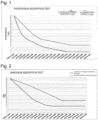
- the phosphorus adsorption was 4.80 mg/g for the article of the present invention and 3.8 mg/g for the conventional article. It was found that the article of the present invention was superior in adsorption capacity. The phosphorus concentration in the wastewater more quickly decreased in the case of the article of the present invention until the 4th day, but the speed of decrease was slowed down to reach a constant concentration after the 14th day. On the other hand, the speed of decrease of the conventional article was slower than the article of the present invention, and changes were not observed after the 15th day.
- Example 2 An experiment was conducted in substantially the same manner as in Example 1 except that an ammonia solution having a concentration of 50 mg/g was used as the waste liquid, and the ammonia adsorption capacity of the article of the present invention was compared with that of the conventional article.
- Figure 2 shows the result.
- the ammonia adsorption was 4.00 mg/g for the article of the present invention and 3.20 mg/g for the conventional article. It was found that the article of the present invention was superior in adsorption capacity. The ammonia concentration in the wastewater more quickly decreased in the case of the article of the present invention.
- Example 2 An experiment was conducted in substantially the same manner as in Example 1 except that a nitrous acid solution having a concentration of 50 mg/g was used as the waste liquid, and the adsorption capacity of nitrous acid ions of the article of the present invention was compared with that of the conventional article.
- Figure 3 shows the result.
- the nitrous acid ion adsorption was 4.00 mg/g for the article of the present invention and 3.00 mg/g for the conventional article. It was found that the article of the present invention was superior in adsorption capacity.
- nitrous acid concentration Until the nitrous acid concentration was reduced to half, 7 days elapsed in the case of the article of the present invention, and 10 days elapsed in the case of the conventional article.
- the nitrous acid concentration gradually decreased after that to 10 mg/g 10 days later in the case of the article of the present invention and 20 mg/g 11 days later in the case of the conventional article and remained on the same level after this.
- Example 2 An experiment was conducted in substantially the same manner as in Example 1 except that a nitric acid solution having a concentration of 50 mg/g was used as the waste liquid, and the adsorption capacity of nitric acid ions of the article of the present invention was compared with that of the conventional article.
- Figure 4 shows the result.
- the nitric acid ion adsorption was 3.50 mg/g for the article of the present invention and 2.50 mg/g for the conventional article. It was found that the article of the present invention was superior in adsorption capacity.
- nitric acid concentration Until the nitric acid concentration was reduced to half, 9 days elapsed in the case of the article of the present invention, and 14 days elapsed in the case of the conventional article.
- the nitric acid concentration gradually decreased after that to 15 mg/g 14 days later in the case of the article of the present invention and 25 mg/g 14 days later in the case of the conventional article and remained on the same level after this.
- the experimental method Into circulating pump filters, 20 g of the article of the present invention prepared in Example 1 and 20 g of the conventional article were respectively charged, aquarium fish were reared in 10-L water tanks, and changes in appearance were observed.
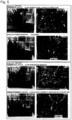
- Figure 5 shows photographs of blooms of blue-green algae on glass surfaces of the water tanks when the rearing water in the tropical fish rearing tanks was purified using the article of the present invention and the conventional article used in Example 1.
Landscapes
- Chemical & Material Sciences (AREA)
- Organic Chemistry (AREA)
- Analytical Chemistry (AREA)
- Chemical Kinetics & Catalysis (AREA)
- Inorganic Chemistry (AREA)
- Physics & Mathematics (AREA)
- Thermal Sciences (AREA)
- Hydrology & Water Resources (AREA)
- Life Sciences & Earth Sciences (AREA)
- Engineering & Computer Science (AREA)
- Environmental & Geological Engineering (AREA)
- Water Supply & Treatment (AREA)
- Water Treatment By Sorption (AREA)
- Solid-Sorbent Or Filter-Aiding Compositions (AREA)
- Farming Of Fish And Shellfish (AREA)
- Removal Of Specific Substances (AREA)
Description
- The present invention relates to a method of manufacturing a water purifying material. The material obtained by the method of the present invention is particularly suitably used for purifying rearing water used for cultivating fish and rearing aquarium fish. Fish rearing water include river water, seawater, and lake and marsh water.
- Since fish rearing water is contaminated with fish excrement and food residues, contaminants in the rearing water are commonly removed with a filter or a purifying material in which the filter is combined with an adsorbent such as activated carbon while the rearing water is circulated.
- However, since conventional adsorbents cannot completely remove phosphorus, ammonia, nitrous acid, nitric acid, and the like, blooms of blue-green algae and the like are unavoidable. Wall surfaces of rearing tanks are therefore required to be periodically cleaned.
- Addition of a very small amount of a germicide into water is effective as means for preventing blooms of algae such as blue-green algae but is not suitable for rearing water for cultivation of edible fish.
- Proposed examples of a purifying agent that adsorbs and removes phosphorus components in water include a material having a large specific surface area obtained by neutralizing iron oxyhydroxide (Patent Literature 1), a material obtained by neutralizing a liquid mixture of ferrous sulfate and ferric sulfate such that the material has a composition of Fe(OH)m(SO4)n·1H2O (where 2 ≤ m < 3, 0 < n ≤ 0.5, and 0 ≤ 1 < 0.5) (Patent Literature 2), a material obtained by impregnating a porous ceramic granule obtained by mixing and sintering titanium oxide, zirconia, zeolite, ferric oxide, and manganese oxide, with microorganisms (Patent Literature 3), an amorphous anion adsorbent containing ferric hydroxide obtained by adding to an aqueous solution of ferrous iron an oxidizing material in an amount less than the equivalent amount of the ferrous iron and then adding an alkali such that the pH is adjusted to 1.5-5.5 (Patent Literature 4), and a material obtained by forming and allowing a photocatalyst film to be supported on a surface of at least one porous carrier selected from activated carbon, zeolite, silica gel, pearlite, porous glass, and the like by evaporation or vacuum deposition or by impregnating the porous carrier with a solution or dispersion of an organometallic compound serving as a photocatalyst and performing decomposition by heating (Patent Literature 5) .
- These purifying agents show improved removal ratios of phosphorus compared with conventional adsorbents, but algae such as blue-green algae grow with a very small amount of nutrients, so that blooms of algae cannot be completely prevented. Further, relevant documents are
WO 2010/140968 A1 ,WO 2019/070574 A1 ,CN 103 086 498 A ,US 2002/077249 A1 . - As described above, development of a purifying agent that is safe for bred fish and can prevent blooms of algae for a longer period has been desired.
-
-
Patent Literature 1
Japanese Patent Laid-Open No. 2006-124239 -
Patent Literature 2
Japanese Patent Laid-Open No. 2007-001835 -
Patent Literature 3
Japanese Patent Laid-Open No. 2005-144304 -
Patent Literature 4
Japanese Patent No. 3961558 -
Patent Literature 5
Japanese Patent Laid-Open No. 2006-110470 - An object of the present invention is to provide a method for manufacturing a purifying agent that can remove phosphorus, ammonia, nitrous acid, nitric acid, and the like in contaminated water at the same time, is safe for bred fish when applied to purification of fish rearing water, and can prevent blooms of algae in rearing water completely or for a longer period.
- Since a flocculant for water treatment having polyferric sulfate as a main component was developed, the present inventors have investigated the shape (such as α, β, γ, and amorphous) of ferric hydroxide revealed at the time of manufacture and use and a removal property on harmful substances and carried out various examinations to find that a material obtained by filtering and drying a neutralized product obtained by neutralizing a solution containing bivalent iron ions, sulfuric acid radicals, chlorine ions, titanium ions, magnesium ions, and silica (silicon ions) at a specific formulation with caustic soda under specific conditions shows a high performance as a water treatment material. The present invention has thus been completed.
- The present inventors have carried out various examinations of manufacture of polyferric sulfate as described above to also find that the above conditions of an iron-containing solution are satisfied by mixing a waste liquid generated in manufacture of the polyferric sulfate with a waste liquid discharged in a pickling process relating to the steel industry and adjusting the mixture. Use of these waste liquids as raw materials can reduce the cost of manufacture of the purifying agent of the present invention, leading to the cost of treatment of the waste liquid discharged in the manufacturing process of polyferric sulfate and a pickling process relating to the steel industry.
- The essential features of the invention are set out in
independent method claim 1. A further, preferred embodiment is described independent claim 2. - The formulation proportion of components of the purifying material is represented in terms of weight ratio based on each element. For example, 30% total iron is calculated by dividing the analyzed (weight) value of iron contained in the sample by the total weight of the sample, that is, the weight of Fe/the total weight × 100.
- The present invention is described in further detail. The pH is adjusted to 6.8 to 7.2 at the time of neutralization because the product contains the largest content of the amorphous product and shows the best adsorption capacity in this range. Crystals of magnetite tend to be formed at pH 7.2 or more, and the product mostly becomes magnetite at
pH 9 or more. At pH 6.8 or less, a portion of bivalent iron is dissolved as ions to reduce the amount of a precipitate to be formed, and Fe+2 remains in the solution. - The temperature at the time of neutralization is set to 30°C or more because the reactivity is poor at 30°C or less, leading to poor formation of anatase TiO4, compounds of Fe, Mg, and Si, and amorphous hydroxides of Fe by reactions of Fe, Mg, Si, and Ti, and because heating is required to reach 50°C or more, which requires high costs and is impractical. By setting the temperature at the time of neutralization to 30 to 50°C as described above, the purifying agent can be manufactured at a low cost.
- Among metal components other than iron contained in the purifying agent, titanium and magnesium are contained in the waste liquid from the manufacturing process of polyferric sulfate, and silica is contained in the waste liquid from a filtering process and a pickling process. Among these components, titanium functions as a photocatalyst, but a titanium content of 5% or more has adverse effects on adsorption of phosphorus (P), which is not preferable. The function as a photocatalyst is not sufficiently fulfilled when the content is 1% or less.
- If the composition proportion of the purifying agent greatly deviates from the above range, the adsorption capacity of the contaminant components is reduced. The reason is not clear but is considered to be formation of Fe, Mg, and Si compounds such as compounds similar to magnesium aluminate and zeolite, more specifically, insufficiently crystallized compounds such as a compound similar to zeolite in which Mg and Fe3+ are substituted respectively for M and Al in a common rational formula Mn+x/nAlxSiyO2x+2yx-·zH2O of zeolite, a zeolite type compound containing Al and Fe3+ if Al exists, MgO·SiO2·nH2O, and Mg3SiO4O10(OH)2, and the contaminant components in the wastewater is supposed to be highly efficiently removed with the superior adsorption capacity.
- In the present invention, the amount of caustic soda is sufficient to allow the entire dissolved metal compounds to be insolubilized, and caustic soda may be added to the solution such that the pH falls within the range of 6.8 to 7.2 while observing the state of precipitation of a solid. Addition of caustic soda is preferably controlled by linking with a pH meter.
- Known means can be used for the addition as long as an aqueous solution of caustic soda can be added and mixed to a solution in small quantities. For example, a reaction vessel provided with stirring means may be used.
- The method for separating the solid formed after the neutralization reaction from the solution can be of any type as long as heating is not involved, and examples include a filter press for pressure filtration and a centrifuge used in sludge treatment for centrifugation.
- Means for drying the collected solid can be of any type as long as the method does not involve heating to 100°C or more, and examples include solar drying, natural drying, and a vacuum dryer utilizing waste heat. If the solid is heated to 100°C or more, the physical properties of the solid change, and the adsorption performance is impaired.
- With the purifying agent prepared by the present invention, very small amounts of phosphorus, ammonia, nitrous acid, nitric acid, and the like contained in water can be removed more efficiently than conventional articles, and in particular, if applied to fish rearing water, phosphorus content in the water can be highly efficiently removed, so that blooms of blue-green algae and adhesion of blue-green algae to glass surfaces can be prevented for a long period.
- Further, use of a waste liquid discharged in the manufacturing process of polyferric sulfate and a waste liquid discharged in a pickling process relating to the steel industry as raw materials reduces the cost of manufacture and the cost of treatment of the waste liquids.
-
- [
Figure 1] Figure 1 is a graph showing the result of a comparative test of the phosphorus adsorption capacity between the article prepared by the method of the present invention and the conventional article in Example 1. - [
Figure 2] Figure 2 is a graph showing the result of a comparative test of the ammonia adsorption capacity between the article prepared by the method of the present invention and the conventional article in Example 2. - [
Figure 3] Figure 3 is a graph showing the result of a comparative test of the nitrous acid (NO2) adsorption capacity between the article prepared by the method of the present invention and the conventional article in Example 3. - [
Figure 4] Figure 4 is a graph showing the result of a comparative test of the nitric acid (NO3) adsorption capacity between the article prepared by the method of the present invention and the conventional article in Example 4. - [
Figure 5] Figure 5 shows photographs of the states of adhesion of blue-green algae to glass surfaces of fish rearing tanks. - A comparative experiment of the phosphorus adsorption capacity between a purifying material prepared by the method of the present invention (hereinafter referred to as "article or purifying material of the present invention ") and a conventional article was conducted.
- The purifying material of the present invention was prepared as follows.
- (1) 0.01 m3 of a waste liquid discharged in the manufacturing process of polyferric sulfate and 1 m3 of a waste liquid discharged in the pickling process relating to the steel industry were mixed.
The liquid mixture had pH 2.5 and a temperature of 40°C. - (2) The liquid mixture was neutralized with caustic soda to pH 6.8.
- (3) The solid obtained was collected with a pressure filter.
- (4) The solid separated was dried with a hot air device.
- The solid obtained in this manner was powdery and had a composition of 30 to 40% total iron, 1 to 5% titanium, 0.1 to 1% magnesium, and 0.1 to 0.8% silica (silicon) in terms of weight ratio.
- As the conventional article, iron hydroxide (hereinafter referred to as a "conventional article"), which is the main component of a commercially available purifying material, was used.
- As the phosphorus-containing waste liquid used for the experiment, a solution that contained potassium dihydrogen phosphate dissolved and had a phosphoric acid concentration adjusted to 50 mg/L was used as a sample.
- In the experiment, 300 ml of a phosphoric acid solution having a concentration of 50 mg/L in which potassium dihydrogen phosphate had been dissolved was poured into two beakers, 3 g each of the purifying agent of the present invention and iron hydroxide was added to these beakers, the mixtures were stirred for 1 minute once a day, and the phosphorus concentrations were measured every 24 hours after the start.
- The phosphorus adsorption was 4.80 mg/g for the article of the present invention and 3.8 mg/g for the conventional article. It was found that the article of the present invention was superior in adsorption capacity. The phosphorus concentration in the wastewater more quickly decreased in the case of the article of the present invention until the 4th day, but the speed of decrease was slowed down to reach a constant concentration after the 14th day. On the other hand, the speed of decrease of the conventional article was slower than the article of the present invention, and changes were not observed after the 15th day.
- An experiment was conducted in substantially the same manner as in Example 1 except that an ammonia solution having a concentration of 50 mg/g was used as the waste liquid, and the ammonia adsorption capacity of the article of the present invention was compared with that of the conventional article.
-
Figure 2 shows the result. The ammonia adsorption was 4.00 mg/g for the article of the present invention and 3.20 mg/g for the conventional article. It was found that the article of the present invention was superior in adsorption capacity. The ammonia concentration in the wastewater more quickly decreased in the case of the article of the present invention. - An experiment was conducted in substantially the same manner as in Example 1 except that a nitrous acid solution having a concentration of 50 mg/g was used as the waste liquid, and the adsorption capacity of nitrous acid ions of the article of the present invention was compared with that of the conventional article.
-
Figure 3 shows the result. The nitrous acid ion adsorption was 4.00 mg/g for the article of the present invention and 3.00 mg/g for the conventional article. It was found that the article of the present invention was superior in adsorption capacity. - Until the nitrous acid concentration was reduced to half, 7 days elapsed in the case of the article of the present invention, and 10 days elapsed in the case of the conventional article. The nitrous acid concentration gradually decreased after that to 10 mg/
g 10 days later in the case of the article of the present invention and 20 mg/g 11 days later in the case of the conventional article and remained on the same level after this. - An experiment was conducted in substantially the same manner as in Example 1 except that a nitric acid solution having a concentration of 50 mg/g was used as the waste liquid, and the adsorption capacity of nitric acid ions of the article of the present invention was compared with that of the conventional article.
-
Figure 4 shows the result. The nitric acid ion adsorption was 3.50 mg/g for the article of the present invention and 2.50 mg/g for the conventional article. It was found that the article of the present invention was superior in adsorption capacity. - Until the nitric acid concentration was reduced to half, 9 days elapsed in the case of the article of the present invention, and 14 days elapsed in the case of the conventional article. The nitric acid concentration gradually decreased after that to 15 mg/
g 14 days later in the case of the article of the present invention and 25 mg/g 14 days later in the case of the conventional article and remained on the same level after this. - The experimental method: Into circulating pump filters, 20 g of the article of the present invention prepared in Example 1 and 20 g of the conventional article were respectively charged, aquarium fish were reared in 10-L water tanks, and changes in appearance were observed.
- In each water tank, 10 neon tetras were reared with 1.5 L of gravel for floor sand "Soil" (trade name) used as the floor sand and water plants.
-
Figure 5 shows photographs of blooms of blue-green algae on glass surfaces of the water tanks when the rearing water in the tropical fish rearing tanks was purified using the article of the present invention and the conventional article used in Example 1. - Adhesion of blue-green algae was observed on the 20th day in the case of the conventional article, but slight adhesion of blue-green algae was observed on the 30th day in the case of the article of the present invention.
Claims (2)
- A method for manufacturing a water purifying material, comprising:adding caustic soda to a solution, which is prepared by combining a waste liquid discharged from a manufacturing process of polyferric sulfate and a waste liquid discharged from a pickling process relating to the steel industry,containing 100 to 200 mg/L of bivalent iron, 20 to 100 mg/L of titanium ions, 5 to 50 mg/L of magnesium, and 3 to 30 mg/L of silica under conditions of 30 to 50°C and pH 6.8 to 7.2 to carry out neutralization and reaction;
separating and collecting an obtained solid at 100°C or less; and drying the collected solid. - The method for manufacturing a water purifying material according to claim 1, wherein iron in the solution includes ferric sulfate (Fe+2) or a mixture of ferric sulfate (Fe+2) and ferrous sulfate (Fe+3).
Applications Claiming Priority (2)
| Application Number | Priority Date | Filing Date | Title |
|---|---|---|---|
| JP2019114385A JP7236143B2 (en) | 2019-06-20 | 2019-06-20 | Water purification material containing iron as main component and method for producing the same |
| PCT/JP2020/023586 WO2020255956A1 (en) | 2019-06-20 | 2020-06-16 | Water purifying material having iron as main component, and method for manufacturing same |
Publications (4)
| Publication Number | Publication Date |
|---|---|
| EP3988202A1 EP3988202A1 (en) | 2022-04-27 |
| EP3988202A4 EP3988202A4 (en) | 2023-05-03 |
| EP3988202B1 true EP3988202B1 (en) | 2024-09-11 |
| EP3988202C0 EP3988202C0 (en) | 2024-09-11 |
Family
ID=73994625
Family Applications (1)
| Application Number | Title | Priority Date | Filing Date |
|---|---|---|---|
| EP20827346.6A Active EP3988202B1 (en) | 2019-06-20 | 2020-06-16 | Method of manufacturing a water purifying material |
Country Status (8)
| Country | Link |
|---|---|
| US (1) | US12121874B2 (en) |
| EP (1) | EP3988202B1 (en) |
| JP (1) | JP7236143B2 (en) |
| CN (1) | CN114364639A (en) |
| AU (1) | AU2020297138A1 (en) |
| CA (1) | CA3142066A1 (en) |
| TW (1) | TWI769468B (en) |
| WO (1) | WO2020255956A1 (en) |
Families Citing this family (1)
| Publication number | Priority date | Publication date | Assignee | Title |
|---|---|---|---|---|
| CN114247419B (en) * | 2021-12-31 | 2023-09-19 | 中国矿业大学(北京) | Adsorption material and preparation method and application thereof |
Family Cites Families (19)
| Publication number | Priority date | Publication date | Assignee | Title |
|---|---|---|---|---|
| JPH07214081A (en) * | 1994-01-28 | 1995-08-15 | Nippon Shokubai Co Ltd | Method for purifying water for breeding marine living things |
| JP2000342960A (en) | 1999-06-08 | 2000-12-12 | Nikko Co | Dephosphorizing agent and method for producing the same |
| AU2002218177A1 (en) * | 2000-09-26 | 2002-04-08 | Bayer Aktiengesellschaft | Contacting and adsorbent granules |
| JP2005087833A (en) | 2003-09-16 | 2005-04-07 | Nippon Steel Chem Co Ltd | Water purification material and method for producing the same |
| JP2005087834A (en) | 2003-09-16 | 2005-04-07 | Nippon Steel Chem Co Ltd | Water purification material and method for producing the same |
| JP2005118614A (en) | 2003-10-14 | 2005-05-12 | Akita Prefecture | Phosphate ion recovery material and its manufacturing method, and phosphate ion recovery method |
| JP4348433B2 (en) | 2003-11-13 | 2009-10-21 | 有限会社ユニレック | Water purifier |
| JP3852844B2 (en) | 2003-11-14 | 2006-12-06 | 株式会社セイスイ | Sludge decomposition / water purification agent and purification method |
| JP2006110470A (en) | 2004-10-14 | 2006-04-27 | Ueda Shikimono Kojo:Kk | Water cleaning agent |
| JP4012975B2 (en) | 2004-10-29 | 2007-11-28 | 独立行政法人科学技術振興機構 | Iron oxyhydroxide production method and iron oxyhydroxide adsorbent |
| CN1698948A (en) | 2005-04-25 | 2005-11-23 | 浙江大学 | Water purificant using paligorskite and sepiolite as supporter, its preparation and application method |
| JP4576560B2 (en) | 2005-06-27 | 2010-11-10 | 独立行政法人産業技術総合研究所 | Phosphorous adsorbent |
| JP3961558B1 (en) | 2006-06-29 | 2007-08-22 | 友隆 柳田 | Anion adsorbent, water quality or soil purification agent and method for producing them |
| JP4995612B2 (en) | 2007-03-29 | 2012-08-08 | タテホ化学工業株式会社 | Water purification agent |
| CN101450856B (en) * | 2007-12-03 | 2011-09-07 | 北京有色金属研究总院 | Oxide ceramic filtering material and preparation method thereof |
| WO2010140968A1 (en) | 2009-06-05 | 2010-12-09 | Kenrex Envirotech | Use of a composition for conditioning wastewater, and system, material and method for recycling wastewater components |
| US8759252B1 (en) * | 2010-10-06 | 2014-06-24 | Michael D. and Anita Kaye | Material and method for the sorption of hydrogen sulfide |
| CN103086498B (en) | 2013-01-30 | 2014-08-06 | 广州市大禹环保科技有限公司 | Ecological brick for purifying water |
| US11267733B2 (en) | 2017-10-02 | 2022-03-08 | Phosphorus Free Water Solutions, Llc | Removal of phosphorus from water |
-
2019
- 2019-06-20 JP JP2019114385A patent/JP7236143B2/en active Active
-
2020
- 2020-06-16 US US17/619,848 patent/US12121874B2/en active Active
- 2020-06-16 AU AU2020297138A patent/AU2020297138A1/en not_active Abandoned
- 2020-06-16 WO PCT/JP2020/023586 patent/WO2020255956A1/en not_active Ceased
- 2020-06-16 CA CA3142066A patent/CA3142066A1/en active Pending
- 2020-06-16 EP EP20827346.6A patent/EP3988202B1/en active Active
- 2020-06-16 CN CN202080044829.5A patent/CN114364639A/en active Pending
- 2020-06-19 TW TW109120814A patent/TWI769468B/en active
Also Published As
| Publication number | Publication date |
|---|---|
| CN114364639A (en) | 2022-04-15 |
| TW202108237A (en) | 2021-03-01 |
| EP3988202A1 (en) | 2022-04-27 |
| EP3988202A4 (en) | 2023-05-03 |
| JP2021000584A (en) | 2021-01-07 |
| AU2020297138A1 (en) | 2022-02-03 |
| CA3142066A1 (en) | 2020-12-24 |
| TWI769468B (en) | 2022-07-01 |
| US20220347649A1 (en) | 2022-11-03 |
| WO2020255956A1 (en) | 2020-12-24 |
| JP7236143B2 (en) | 2023-03-09 |
| US12121874B2 (en) | 2024-10-22 |
| EP3988202C0 (en) | 2024-09-11 |
Similar Documents
| Publication | Publication Date | Title |
|---|---|---|
| Ulu et al. | Ammonia removal from wastewater by air stripping and recovery struvite and calcium sulphate precipitations from anesthetic gases manufacturing wastewater | |
| EP1124761B1 (en) | Lanthanide halide water treatment compositions and methods | |
| US11713262B2 (en) | Rare earth clarifying agent and method for use in primary treatment of wastewater | |
| HU207498B (en) | Process for removing heavy metals from waste waters and process for producing precipitating agent for them | |
| AU2020351421B2 (en) | Phosphorus adsorbent | |
| JP2002514505A (en) | Method for treating water, soil, sediment and / or silt | |
| US6267896B1 (en) | Ferrate-based water disinfectant and method | |
| US12121874B2 (en) | Water purifying material having iron as main component, and method for manufacturing same | |
| Yigit et al. | Phosphate recovery potential from wastewater by chemical precipitation at batch conditions | |
| JP3499151B2 (en) | Sludge treatment method and organic wastewater treatment method including the treatment method | |
| TWI758753B (en) | Water purification material and water purification method using the same | |
| JPH11309448A (en) | Arsenic (III, V), fluorine-adsorbing filter medium and method for producing the same | |
| WO2010140968A1 (en) | Use of a composition for conditioning wastewater, and system, material and method for recycling wastewater components | |
| CN109205829A (en) | The method of film assisting crystallisation technique MAC selective removal and the copper in recycle-water | |
| JP7730489B2 (en) | Foam Glass Composite | |
| KR100272451B1 (en) | Filter medium for removing phosphorous and method for preparing | |
| CN118908236B (en) | A method for manufacturing activated zeolite free of harmful heavy metals | |
| JPH0557289A (en) | Method for purifying aqueous solution contaminated by nitrate ions | |
| JP6901807B1 (en) | Treatment method of water containing selenate ion | |
| WO1999062826A1 (en) | Method for absorbing heavy metals | |
| DE3004825A1 (en) | FELLOW AGENTS, METHOD FOR THE PRODUCTION THEREOF, AND THE USE THEREOF FOR THE DEPHOSPHATIZATION OF WASTE WATER | |
| Bobirica et al. | New materials for removing nitrate, manganese and iron from groundwater. | |
| DE1767869C (en) | Process for the purification of fresh and used water by flocculation in the amphoteric phase | |
| UA50335C2 (en) | Corrosion and scales inhibitor and a method for the preparation thereof | |
| KR20170042015A (en) | Method for removing zinc oxide in water using phosphate and iron salt |
Legal Events
| Date | Code | Title | Description |
|---|---|---|---|
| STAA | Information on the status of an ep patent application or granted ep patent |
Free format text: STATUS: THE INTERNATIONAL PUBLICATION HAS BEEN MADE |
|
| PUAI | Public reference made under article 153(3) epc to a published international application that has entered the european phase |
Free format text: ORIGINAL CODE: 0009012 |
|
| STAA | Information on the status of an ep patent application or granted ep patent |
Free format text: STATUS: REQUEST FOR EXAMINATION WAS MADE |
|
| 17P | Request for examination filed |
Effective date: 20220117 |
|
| AK | Designated contracting states |
Kind code of ref document: A1 Designated state(s): AL AT BE BG CH CY CZ DE DK EE ES FI FR GB GR HR HU IE IS IT LI LT LU LV MC MK MT NL NO PL PT RO RS SE SI SK SM TR |
|
| DAV | Request for validation of the european patent (deleted) | ||
| DAX | Request for extension of the european patent (deleted) | ||
| A4 | Supplementary search report drawn up and despatched |
Effective date: 20230404 |
|
| RIC1 | Information provided on ipc code assigned before grant |
Ipc: C02F 103/00 20060101ALN20230329BHEP Ipc: C02F 1/52 20060101ALN20230329BHEP Ipc: C02F 103/08 20060101ALN20230329BHEP Ipc: C02F 1/00 20060101ALN20230329BHEP Ipc: C02F 1/38 20060101ALN20230329BHEP Ipc: C02F 1/66 20060101ALN20230329BHEP Ipc: C02F 103/20 20060101ALN20230329BHEP Ipc: C02F 101/16 20060101ALN20230329BHEP Ipc: C02F 101/10 20060101ALN20230329BHEP Ipc: A01K 63/04 20060101ALI20230329BHEP Ipc: C02F 1/28 20060101ALI20230329BHEP Ipc: B01J 20/30 20060101ALI20230329BHEP Ipc: B01J 20/02 20060101AFI20230329BHEP |
|
| GRAP | Despatch of communication of intention to grant a patent |
Free format text: ORIGINAL CODE: EPIDOSNIGR1 |
|
| STAA | Information on the status of an ep patent application or granted ep patent |
Free format text: STATUS: GRANT OF PATENT IS INTENDED |
|
| RIC1 | Information provided on ipc code assigned before grant |
Ipc: C02F 103/00 20060101ALN20240311BHEP Ipc: C02F 1/52 20060101ALN20240311BHEP Ipc: C02F 103/08 20060101ALN20240311BHEP Ipc: C02F 1/00 20060101ALN20240311BHEP Ipc: C02F 1/38 20060101ALN20240311BHEP Ipc: C02F 1/66 20060101ALN20240311BHEP Ipc: C02F 103/20 20060101ALN20240311BHEP Ipc: C02F 101/16 20060101ALN20240311BHEP Ipc: C02F 101/10 20060101ALN20240311BHEP Ipc: A01K 63/04 20060101ALI20240311BHEP Ipc: C02F 1/28 20060101ALI20240311BHEP Ipc: B01J 20/30 20060101ALI20240311BHEP Ipc: B01J 20/02 20060101AFI20240311BHEP |
|
| RIC1 | Information provided on ipc code assigned before grant |
Ipc: C02F 103/00 20060101ALN20240318BHEP Ipc: C02F 1/52 20060101ALN20240318BHEP Ipc: C02F 103/08 20060101ALN20240318BHEP Ipc: C02F 1/00 20060101ALN20240318BHEP Ipc: C02F 1/38 20060101ALN20240318BHEP Ipc: C02F 1/66 20060101ALN20240318BHEP Ipc: C02F 103/20 20060101ALN20240318BHEP Ipc: C02F 101/16 20060101ALN20240318BHEP Ipc: C02F 101/10 20060101ALN20240318BHEP Ipc: A01K 63/04 20060101ALI20240318BHEP Ipc: C02F 1/28 20060101ALI20240318BHEP Ipc: B01J 20/30 20060101ALI20240318BHEP Ipc: B01J 20/02 20060101AFI20240318BHEP |
|
| INTG | Intention to grant announced |
Effective date: 20240405 |
|
| GRAS | Grant fee paid |
Free format text: ORIGINAL CODE: EPIDOSNIGR3 |
|
| GRAA | (expected) grant |
Free format text: ORIGINAL CODE: 0009210 |
|
| STAA | Information on the status of an ep patent application or granted ep patent |
Free format text: STATUS: THE PATENT HAS BEEN GRANTED |
|
| AK | Designated contracting states |
Kind code of ref document: B1 Designated state(s): AL AT BE BG CH CY CZ DE DK EE ES FI FR GB GR HR HU IE IS IT LI LT LU LV MC MK MT NL NO PL PT RO RS SE SI SK SM TR |
|
| REG | Reference to a national code |
Ref country code: GB Ref legal event code: FG4D |
|
| REG | Reference to a national code |
Ref country code: CH Ref legal event code: EP |
|
| REG | Reference to a national code |
Ref country code: DE Ref legal event code: R096 Ref document number: 602020037665 Country of ref document: DE |
|
| REG | Reference to a national code |
Ref country code: IE Ref legal event code: FG4D |
|
| U01 | Request for unitary effect filed |
Effective date: 20241008 |
|
| U07 | Unitary effect registered |
Designated state(s): AT BE BG DE DK EE FI FR IT LT LU LV MT NL PT RO SE SI Effective date: 20241029 |
|
| PG25 | Lapsed in a contracting state [announced via postgrant information from national office to epo] |
Ref country code: NO Free format text: LAPSE BECAUSE OF FAILURE TO SUBMIT A TRANSLATION OF THE DESCRIPTION OR TO PAY THE FEE WITHIN THE PRESCRIBED TIME-LIMIT Effective date: 20241211 |
|
| PG25 | Lapsed in a contracting state [announced via postgrant information from national office to epo] |
Ref country code: GR Free format text: LAPSE BECAUSE OF FAILURE TO SUBMIT A TRANSLATION OF THE DESCRIPTION OR TO PAY THE FEE WITHIN THE PRESCRIBED TIME-LIMIT Effective date: 20241212 |
|
| PG25 | Lapsed in a contracting state [announced via postgrant information from national office to epo] |
Ref country code: HR Free format text: LAPSE BECAUSE OF FAILURE TO SUBMIT A TRANSLATION OF THE DESCRIPTION OR TO PAY THE FEE WITHIN THE PRESCRIBED TIME-LIMIT Effective date: 20240911 |
|
| PG25 | Lapsed in a contracting state [announced via postgrant information from national office to epo] |
Ref country code: RS Free format text: LAPSE BECAUSE OF FAILURE TO SUBMIT A TRANSLATION OF THE DESCRIPTION OR TO PAY THE FEE WITHIN THE PRESCRIBED TIME-LIMIT Effective date: 20241211 Ref country code: ES Free format text: LAPSE BECAUSE OF FAILURE TO SUBMIT A TRANSLATION OF THE DESCRIPTION OR TO PAY THE FEE WITHIN THE PRESCRIBED TIME-LIMIT Effective date: 20240911 |
|
| PG25 | Lapsed in a contracting state [announced via postgrant information from national office to epo] |
Ref country code: RS Free format text: LAPSE BECAUSE OF FAILURE TO SUBMIT A TRANSLATION OF THE DESCRIPTION OR TO PAY THE FEE WITHIN THE PRESCRIBED TIME-LIMIT Effective date: 20241211 Ref country code: NO Free format text: LAPSE BECAUSE OF FAILURE TO SUBMIT A TRANSLATION OF THE DESCRIPTION OR TO PAY THE FEE WITHIN THE PRESCRIBED TIME-LIMIT Effective date: 20241211 Ref country code: HR Free format text: LAPSE BECAUSE OF FAILURE TO SUBMIT A TRANSLATION OF THE DESCRIPTION OR TO PAY THE FEE WITHIN THE PRESCRIBED TIME-LIMIT Effective date: 20240911 Ref country code: GR Free format text: LAPSE BECAUSE OF FAILURE TO SUBMIT A TRANSLATION OF THE DESCRIPTION OR TO PAY THE FEE WITHIN THE PRESCRIBED TIME-LIMIT Effective date: 20241212 Ref country code: ES Free format text: LAPSE BECAUSE OF FAILURE TO SUBMIT A TRANSLATION OF THE DESCRIPTION OR TO PAY THE FEE WITHIN THE PRESCRIBED TIME-LIMIT Effective date: 20240911 |
|
| PG25 | Lapsed in a contracting state [announced via postgrant information from national office to epo] |
Ref country code: IS Free format text: LAPSE BECAUSE OF FAILURE TO SUBMIT A TRANSLATION OF THE DESCRIPTION OR TO PAY THE FEE WITHIN THE PRESCRIBED TIME-LIMIT Effective date: 20250111 |
|
| PG25 | Lapsed in a contracting state [announced via postgrant information from national office to epo] |
Ref country code: SM Free format text: LAPSE BECAUSE OF FAILURE TO SUBMIT A TRANSLATION OF THE DESCRIPTION OR TO PAY THE FEE WITHIN THE PRESCRIBED TIME-LIMIT Effective date: 20240911 |
|
| PG25 | Lapsed in a contracting state [announced via postgrant information from national office to epo] |
Ref country code: PL Free format text: LAPSE BECAUSE OF FAILURE TO SUBMIT A TRANSLATION OF THE DESCRIPTION OR TO PAY THE FEE WITHIN THE PRESCRIBED TIME-LIMIT Effective date: 20240911 Ref country code: CZ Free format text: LAPSE BECAUSE OF FAILURE TO SUBMIT A TRANSLATION OF THE DESCRIPTION OR TO PAY THE FEE WITHIN THE PRESCRIBED TIME-LIMIT Effective date: 20240911 |
|
| PG25 | Lapsed in a contracting state [announced via postgrant information from national office to epo] |
Ref country code: SK Free format text: LAPSE BECAUSE OF FAILURE TO SUBMIT A TRANSLATION OF THE DESCRIPTION OR TO PAY THE FEE WITHIN THE PRESCRIBED TIME-LIMIT Effective date: 20240911 |
|
| PGFP | Annual fee paid to national office [announced via postgrant information from national office to epo] |
Ref country code: GB Payment date: 20250618 Year of fee payment: 6 |
|
| PLBE | No opposition filed within time limit |
Free format text: ORIGINAL CODE: 0009261 |
|
| STAA | Information on the status of an ep patent application or granted ep patent |
Free format text: STATUS: NO OPPOSITION FILED WITHIN TIME LIMIT |
|
| U20 | Renewal fee for the european patent with unitary effect paid |
Year of fee payment: 6 Effective date: 20250630 |
|
| 26N | No opposition filed |
Effective date: 20250612 |
|
| REG | Reference to a national code |
Ref country code: CH Ref legal event code: H13 Free format text: ST27 STATUS EVENT CODE: U-0-0-H10-H13 (AS PROVIDED BY THE NATIONAL OFFICE) Effective date: 20260127 |
|
| PG25 | Lapsed in a contracting state [announced via postgrant information from national office to epo] |
Ref country code: MC Free format text: LAPSE BECAUSE OF FAILURE TO SUBMIT A TRANSLATION OF THE DESCRIPTION OR TO PAY THE FEE WITHIN THE PRESCRIBED TIME-LIMIT Effective date: 20240911 |
|
| PG25 | Lapsed in a contracting state [announced via postgrant information from national office to epo] |
Ref country code: IE Free format text: LAPSE BECAUSE OF NON-PAYMENT OF DUE FEES Effective date: 20250616 |
|
| PG25 | Lapsed in a contracting state [announced via postgrant information from national office to epo] |
Ref country code: CH Free format text: LAPSE BECAUSE OF NON-PAYMENT OF DUE FEES Effective date: 20250630 |
|
| U20 | Renewal fee for the european patent with unitary effect paid |
Year of fee payment: 7 Effective date: 20260331 |