EP3984835B1 - Comfortable restraint system - Google Patents
Comfortable restraint system Download PDFInfo
- Publication number
- EP3984835B1 EP3984835B1 EP20822319.8A EP20822319A EP3984835B1 EP 3984835 B1 EP3984835 B1 EP 3984835B1 EP 20822319 A EP20822319 A EP 20822319A EP 3984835 B1 EP3984835 B1 EP 3984835B1
- Authority
- EP
- European Patent Office
- Prior art keywords
- belt
- chambers
- restraint system
- user
- comfortable
- Prior art date
- Legal status (The legal status is an assumption and is not a legal conclusion. Google has not performed a legal analysis and makes no representation as to the accuracy of the status listed.)
- Active
Links
Images



Classifications
-
- B—PERFORMING OPERATIONS; TRANSPORTING
- B60—VEHICLES IN GENERAL
- B60R—VEHICLES, VEHICLE FITTINGS, OR VEHICLE PARTS, NOT OTHERWISE PROVIDED FOR
- B60R22/00—Safety belts or body harnesses in vehicles
-
- B—PERFORMING OPERATIONS; TRANSPORTING
- B60—VEHICLES IN GENERAL
- B60R—VEHICLES, VEHICLE FITTINGS, OR VEHICLE PARTS, NOT OTHERWISE PROVIDED FOR
- B60R22/00—Safety belts or body harnesses in vehicles
- B60R22/18—Anchoring devices
- B60R22/19—Anchoring devices with means for reducing belt tension during use under normal conditions
-
- B—PERFORMING OPERATIONS; TRANSPORTING
- B60—VEHICLES IN GENERAL
- B60R—VEHICLES, VEHICLE FITTINGS, OR VEHICLE PARTS, NOT OTHERWISE PROVIDED FOR
- B60R21/00—Arrangements or fittings on vehicles for protecting or preventing injuries to occupants or pedestrians in case of accidents or other traffic risks
- B60R21/02—Occupant safety arrangements or fittings, e.g. crash pads
- B60R21/16—Inflatable occupant restraints or confinements designed to inflate upon impact or impending impact, e.g. air bags
- B60R21/18—Inflatable occupant restraints or confinements designed to inflate upon impact or impending impact, e.g. air bags the inflatable member formed as a belt or harness or combined with a belt or harness arrangement
Definitions
- the system can incorporate an electromechanical depressurisation mechanism (12) as shown in figure 2 .
- This depressurisation mechanism (12) is in charge of slightly separating the belt (1) from the user's body, such that it reduces the pressure when it is not necessary for the belt (1) to be fitted very tightly.
- the depressurisation mechanism (12) can be located in proximity to the retractor (4), in an area of the seat near the retractor (4) or in a location in which the belt (1) can be perpendicularly separated with respect to the user's body.
Landscapes
- Engineering & Computer Science (AREA)
- Mechanical Engineering (AREA)
- Air Bags (AREA)
Description
- The present invention relates to a restraint system comprising a safety belt that incorporates air chambers making it so the adjustment of the belt on the user's body does not have to be so tight, providing a high degree of comfort.
- The present invention is particularly applicable in the field of safety elements in transport vehicles.
- In the current state of the art, restraint systems using belts have evolved from a basic concept of simply providing a stop for the movement of the user's body to applying different degrees of tension, including stops that are activated when a certain level of advancement is reached or if a sudden movement is produced.
- In any of these cases, however, the initial tension of the belt, once adjusted on the user's body, is continuous and has a greater tendency to be tighter than looser, due to the fact that if an accident happens, the belt must be in contact with the body to be able to stop the movement of the same as soon as possible.
- However, this tightness of the safety belt on the user's body can cause discomfort given that the user has limited movement due to the pressure of the belt, generating heat due to the pressure of the belt and wrinkles in the user's clothing, among other drawbacks.
- Document
JP2000211461A - The present invention is aimed at preventing these drawbacks from occurring by incorporating a comfortable restraint system formed by a safety belt which, remaining in contact with the user's body, maintains a certain gap between the belt and the body which alleviates the pressure caused by the belt throughout the entire width thereof over the body, thereby preventing the aforementioned discomfort.
- Furthermore, the fixed anchoring system of the belt and the retractor device to adapt the new safety belt are modified.
- With the aim of achieving the objectives and avoiding the aforementioned drawbacks, the present invention discloses a comfortable restraint system located in a vehicle incorporating an electronic braking system governed by a control unit, and comprising a safety belt configured by a textile strap, a permanent anchoring device which comprises means for coupling an anchor tongue joined to one end of the textile strap, a removable anchoring device and a retractor for the safety belt, wherein:
- the safety belt comprises a chamber attached longitudinally on each side of the textile strap, and
- the permanent anchoring device comprises connector outlets for the supply of pressurised air through a compression system, and
- each one of the chambers comprises an adapter intended to be joined to a connector outlet, such that the chambers are pneumatically connected to the compression system with a proportional valve, in charge of supplying and extracting air to and from the chambers, which is governed by the vehicle control unit, wherein the restraint system is synchronised with the electronic braking system, such that the air extraction flow of the chambers is proportional to the braking intensity.
- This comfortable restraint system preferably incorporates a depressurisation mechanism which reduces the pressure of the belt on the user's body when expanded, thereby separating it from the user's body. The depressurisation mechanism can be synchronised with the electronic braking system, such that the collapse is proportional to the braking intensity and the depressurisation mechanism does not have to return to its collapsed position to completely adjust the belt to the user's body, rather only partially.
- The chambers are preferably configured in the form of tubes with a high degree of flexibility and made of polyurethane, for example, so that they quickly adapt to the different forms, being either inflated or deflated, and they are attached to the textile strap by means of a lining that covers them, which is preferably sewn to the same.
- To complete the description of the invention, and for the purpose of helping to make the features thereof more readily understandable, according to a preferred exemplary embodiment thereof, a set of drawings is included wherein, by way of illustration and not limitation, the following figures have been represented:
-
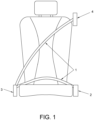
Figure 1 shows a front view of the comfortable restraint system of the invention placed in a vehicle seat. -
Figure 2 shows a side view of the restraint system of the invention incorporating a depressurisation mechanism. -
Figure 3 shows a view of the permanent anchoring device of the belt and the end of the belt before being coupled, showing the fixed anchor tongue of the belt and the pneumatic connectors for supplying air to the chambers. -
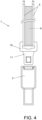
Figure 4 shows a view of the safety belt passing through the fastener of the flap and the anchoring device where the flap of the belt is inserted. -
Figure 5 shows a cross section of the safety belt, showing the textile strap and the air chambers located on the two sides thereof. - A list of the references used in the figures is provided below:
- 1. Safety belt.
- 2. Permanent anchoring device.
- 3. Removable anchoring device.
- 4. Belt retractor.
- 5. Air chambers.
- 6. Textile strap of the belt.
- 7. Connector outlets.
- 8. Anchor tongue.
- 9. Adapters.
- 10. Fastener of the flap.
- 11. Flap of the belt.
- 12. Depressurisation mechanism.
- The present invention relates to comfortable restraint system comprising a safety belt (1) by means of which a contactless area is created between the user's body and the safety belt (1), which allows for the continuous pressure of the safety belt (1) to be reduced.
- As shown in
figure 1 , the comfortable restraint system of the invention is configured by means of a safety belt (1), a permanent anchoring device (2), a removable anchoring device (3) and a retractor (4) to reel the belt (1). Each one of the components is described in detail below. -
Figure 3 represents the permanent anchoring device (2) of the restraint system and one of the ends of the safety belt (1), which is intended to be fastened to the permanent anchoring device (2). The other end of the belt (1) is fastened to the retractor (4). - As can be seen, the belt (1) is made up of a textile strap (6) and a chamber (5) attached longitudinally on each side of the textile strap (6). Each one of the chambers (5) ends at an adapter (9) and is joined to the textile strap (6) by a sewn lining to cover it, for example, both chambers (5) being completely integrated to the textile strap (6) and making up a safety belt (1) without practical differences of flexibility or width with respect to known safety belts. Furthermore, the textile strap (6) ends at an anchor tongue (8).
- The permanent anchoring device (2) is solidly joined to the vehicle chassis. It incorporates an opening for inserting the anchor tongue (8) of the belt (1) and connector outlets (7) for coupling the adapters (9) to thereby supply the chambers (5) of the belt (1) with air.
- The inside of the permanent anchoring device (2) is not shown, given that it incorporates elements known in the state of the art. As essential elements, it incorporates a system for mechanically fastening the anchor tongue (8) of the belt (1) and a compression system with a proportional valve, in charge of supplying and extracting air to and from the chambers (5).
- It must be taken into account that both the fastening of the anchor tongue (8) to the permanent anchoring device (2) and the connection of the adapters (9) to the connector outlets (7) are pre-established in the vehicle and are not elements that are accessible to the user. As for the anchor tongue (8), it is solidly fixed to the inside of the permanent anchoring device (2) and, therefore, is also not accessible to the user of a vehicle. As for the adapters (9), they are solidly joined both to the chambers (5) and to the connector outlets (7), preferably by means of soldering, such that they are not joined in a removable way and therefore cannot be manipulated by the user.
- Thus, by fastening the adapters (9) to the connector outlets (7) the safety belt (1) is pneumatically connected to the permanent anchoring device (2) such that, by means of the compression system, air can be supplied to or extracted from the chambers (5) at will, as needed.
-
Figure 5 shows a cross section of the safety belt (1) where it can be seen that the chambers (5) are preferably formed by means of hollow tubes made of a highly flexible material, such that they can quickly assimilate the dimensional changes caused by the entry or exit of air. This material could be polyurethane, for example. - On the other hand,
figure 4 shows the removable anchoring device (3) intended to receive the flap of the belt (11) when the user puts on the belt (1). The flap (11) is joined to a fastener (10) through which the belt (1) passes so that it can be adjusted to the user being restrained. The fastener (10) has dimensions that are greater than those in the state of the art, since it must be able to slide over the chambers (5) of the belt (1) once they are inflated. - The retractor of the belt (4) is not shown in detail in the figures since it is known in the state of the art. One end of the belt (1) is housed in the retractor, as was previously mentioned, being fixed to a shaft capable of rotating, on which the belt is rolled as it is accommodated inside the retractor (4), in order to house the part that is not in use. However, the retractor (4) of the invention is different from known retractors in that it needs a system that prevents the chambers (5) from being introduced in the retractor (4) when they are inflated. Thus, one device that can be used to prevent this effect consists of rollers locked to the belt (1) on either side thereof, such that the belt (1) is compressed between the rollers but can slide between them, preventing air from entering the chambers (5) beyond the location of the rollers.
- Furthermore, the system can incorporate an electromechanical depressurisation mechanism (12) as shown in
figure 2 . This depressurisation mechanism (12) is in charge of slightly separating the belt (1) from the user's body, such that it reduces the pressure when it is not necessary for the belt (1) to be fitted very tightly. The depressurisation mechanism (12) can be located in proximity to the retractor (4), in an area of the seat near the retractor (4) or in a location in which the belt (1) can be perpendicularly separated with respect to the user's body. - The depressurisation mechanism (12) can be made up of a plate with the ability to rotate around an articulation, such that the mechanism can collapse or expand in order to move the belt closer to or away from the user's body. The plate incorporates a hole through which the belt (1) passes, such that when it expands, it also separates from the body of the belt (1) user, loosening the pressure of the belt (1) on the user.
- Having described the components of the comfortable restraint system of the invention, it is possible to understand that if the compression system insufflates air, the chambers (5) are filled and make it so the contact of the belt (1) on the user's body only takes place at the outer areas of the belt (1), those of the chambers (5), the inner area, consisting of the textile strap (6), remaining free and providing a space that is not in contact with the user's body, thereby reducing the pressure on the same, as well as the heat generated by contact, which leads to greater comfort for the user.
- With regard to the operation of the restraint system, it must be mentioned that it is governed by the vehicle's control unit which, using sensors, is in charge of gathering the necessary information on the state and behaviour of the vehicle.
- By means of the information gathered by the control unit, the braking activity is driven by an electronic braking system incorporated by the vehicle, always based on the needs at the time, and such that the braking percentage that each of the vehicle's wheels receives every day is controlled. This way, by actuating the vehicle's brake pedal, the braking intensity is controlled, making it more or less intense and based on the requirements.
- This way, the electronic braking system is synchronised with the restraint system of the invention, mainly by means of the compression system, which is in charge of supplying and extracting air to and from the chambers (5) of the belt (1). This means that the air extraction flow of the chambers (5) is proportional to the braking intensity.
- With regard to the operation of the restraint system, both the belt (1) itself and the depressurisation mechanism (12) are activated once the vehicle user puts on the belt (1), buckling the flap (11) in the removable anchoring device (3), and turns on the vehicle's engine, without the brake being activated. In this situation, the compression system is activated and, by means of the proportional valve, supplies the chambers (5) with air, which inflate to allow the belt (1) to be slightly separated from the user's body, and, if the depressurisation mechanism (12) is incorporated, it is activated to provide a slight gap between the belt and the user's body.
- On the other hand, by actuating the brake pedal, the instructions sent to the compression system are to extract air from the chambers (5) such that the belt (1) immediately tightens to the driver's body, the system understanding that it is possible that a restraint will be necessary. In this case, the amount of air extracted may vary, depending on the braking intensity and in a way that is proportional to the same, as was previously indicated.
- In the same way, the depressurisation mechanism (12) is also synchronised with the electronic braking system such that, when in the expanded position, with a minimum pressure on the user's body, if the brake pedal is actuated, the depressurisation mechanism (12) collapses to tighten the belt to the user's body. This collapse is preferably proportional to the braking intensity.
- Furthermore, the restraint system can also be synchronised with the adaptive cruise control, a method by means of which the speed at which the user wants to travel is automatically controlled and which, with the help of a radar system, also automatically controls the distance of the vehicle with respect to the vehicle ahead of it, slowing down the vehicle if necessary to maintain said safety distance.
- Lastly, it must be taken into account that the present invention must not be limited by the embodiment described herein. Other configurations may be carried out by those skilled in the art based on the present description. Accordingly, the scope of the invention is defined by the following claims.
Claims (7)
- A comfortable restraint system located in a vehicle incorporating an electronic braking system governed by a control unit, and comprising a safety belt (1) configured by a textile strap (6), a permanent anchoring device (2) which comprises means for coupling an anchor tongue (8) joined to one end of the textile strap (6), a removable anchoring device (3) and a retractor (4) for the safety belt (1), wherein:- the safety belt (1) comprises a chamber (5) attached longitudinally on each side of the textile strap (6), and- the permanent anchoring device (2) comprises connector outlets (7) for the supply of pressurised air through a compression system, and- each one of the chambers (5) comprises an adapter (9) intended to be joined to a connector outlet (7), such that the chambers (5) are pneumatically connected to the compression system with a proportional valve, in charge of supplying and extracting air to and from the chambers (5), which is governed by the vehicle control unit,the restraint system being characterised in that it is synchronised with the electronic braking system, such that the air extraction flow of the chambers (5) is proportional to the braking intensity.
- The comfortable restraint system according to claim 1, characterised in that it comprises a depressurisation mechanism (12) which, when expanded, reduces the pressure of the belt (1) on the user's body.
- The comfortable restraint system according to claim 2, characterised in that the depressurisation mechanism (12) is synchronised with the electronic braking system, such that it collapses proportionally to the braking intensity, partially adjusting the pressure of the belt (1) to the user's body.
- The comfortable restraint system according to claim 1, characterised in that the chambers (5) are configured in the form of tubes with a high degree of flexibility, such that they quickly adapt to the different forms depending on whether they are inflated or deflated.
- The comfortable restraint system according to claim 4, characterised in that chambers (5) are made of polyurethane.
- The comfortable restraint system according to claim 4, characterised in that each chamber (5) is joined to the textile strap (6) by a lining that covers it.
- The comfortable restraint system according to claim 6, characterised in that the lining is sewn to the textile strap (6).
Applications Claiming Priority (2)
| Application Number | Priority Date | Filing Date | Title |
|---|---|---|---|
| ES201930536A ES2799475B2 (en) | 2019-06-12 | 2019-06-12 | COMFORTABLE RETENTION SYSTEM |
| PCT/ES2020/070275 WO2020249835A1 (en) | 2019-06-12 | 2020-04-28 | Comfortable restraint system |
Publications (4)
| Publication Number | Publication Date |
|---|---|
| EP3984835A1 EP3984835A1 (en) | 2022-04-20 |
| EP3984835A4 EP3984835A4 (en) | 2022-08-17 |
| EP3984835C0 EP3984835C0 (en) | 2024-07-03 |
| EP3984835B1 true EP3984835B1 (en) | 2024-07-03 |
Family
ID=73780623
Family Applications (1)
| Application Number | Title | Priority Date | Filing Date |
|---|---|---|---|
| EP20822319.8A Active EP3984835B1 (en) | 2019-06-12 | 2020-04-28 | Comfortable restraint system |
Country Status (5)
| Country | Link |
|---|---|
| US (1) | US11945389B2 (en) |
| EP (1) | EP3984835B1 (en) |
| CN (1) | CN113939434B (en) |
| ES (2) | ES2799475B2 (en) |
| WO (1) | WO2020249835A1 (en) |
Family Cites Families (25)
| Publication number | Priority date | Publication date | Assignee | Title |
|---|---|---|---|---|
| DE3012350A1 (en) * | 1980-03-29 | 1981-10-08 | Werner Dr. med. 4330 Mülheim Schubert | Impact absorbing safety belt - has hollow ribbed structure linked to inflation control |
| IT1236846B (en) * | 1989-10-04 | 1993-04-22 | Ettore Salvaterra | DEVICE TO RELEASE THE TENSION OF THE SAFETY BELT ON THE BODY OF THE DRIVER OR PASSENGERS OF MOTOR VEHICLES. |
| US5765869A (en) * | 1996-09-06 | 1998-06-16 | Huber; John F. | Automatically tightened seatbelt |
| US6276721B1 (en) * | 2000-03-14 | 2001-08-21 | Simula, Inc. | Pivoting seat belt upper anchor point attachment |
| JP3465547B2 (en) * | 1997-09-02 | 2003-11-10 | タカタ株式会社 | Air belt device |
| DE19804365C2 (en) * | 1998-02-04 | 2000-06-08 | Hs Tech & Design | Three-point seat belt |
| JP3876559B2 (en) * | 1999-01-26 | 2007-01-31 | タカタ株式会社 | Air belt device |
| US6676162B2 (en) * | 2002-04-24 | 2004-01-13 | Ford Global Technologies, Llc | Occupant restraint belt presenter |
| JP4290573B2 (en) * | 2003-01-24 | 2009-07-08 | 本田技研工業株式会社 | Vehicle travel safety device |
| DE102004029456A1 (en) * | 2004-05-29 | 2005-12-22 | Schwant, Wilfried, Dipl.-Ing. | Vehicle with at least one seat for at least one vehicle occupant and with a belt system |
| US7434833B2 (en) * | 2004-07-14 | 2008-10-14 | Mazda Motor Corporation | Seat belt device for vehicle |
| US7472925B2 (en) * | 2004-10-12 | 2009-01-06 | Van Freeman Industries Llc | Ergonomic seatbelt for improved belt safety and comfort |
| DE102004056496B4 (en) * | 2004-11-23 | 2007-02-15 | Autoliv Development Ab | Safety belt with an inflatable belt |
| GB0511317D0 (en) * | 2005-06-03 | 2005-07-13 | Macliver Kevin S | Restraining |
| DE102006006807B4 (en) * | 2006-02-14 | 2009-04-09 | Continental Automotive Gmbh | Method for the controlled dispensing of a strap of a safety belt system and corresponding restraint system |
| CN201559612U (en) * | 2009-07-23 | 2010-08-25 | 杨先华 | Comfortable automobile safety belt |
| DE102010026546B4 (en) * | 2010-07-08 | 2021-10-21 | Daimler Ag | Seat belt for a vehicle |
| DE102011109616A1 (en) * | 2011-08-05 | 2013-02-07 | GM Global Technology Operations LLC (n. d. Gesetzen des Staates Delaware) | Inflatable belt i.e. three-point seat belt, for occupant of e.g. passenger car, has expansion body arranged between upper and lower straps in non-activated state and laterally extended outside straps in activated state |
| DE102012004603B4 (en) * | 2012-03-07 | 2014-05-28 | Key Safety Systems, Inc. | Belt retractor for a vehicle seat belt |
| CN103507743A (en) * | 2012-06-27 | 2014-01-15 | 深圳市比亚迪汽车有限公司 | Car safety belt |
| DE102014204186B4 (en) * | 2014-03-07 | 2024-10-17 | Autoliv Development Ab | safety belt device for a motor vehicle |
| US9346430B2 (en) * | 2014-09-11 | 2016-05-24 | Autoliv Asp, Inc. | Inflatable seatbelt |
| CN205905942U (en) * | 2016-08-29 | 2017-01-25 | 温州芳植生物科技有限公司 | Car blet pressure relief device |
| JP6859905B2 (en) * | 2017-09-05 | 2021-04-14 | トヨタ自動車株式会社 | Vehicle seat belt device |
| CN207809312U (en) * | 2018-01-17 | 2018-09-04 | 珠海阳光儿童用品有限公司 | Restraining safety devices by bus |
-
2019
- 2019-06-12 ES ES201930536A patent/ES2799475B2/en active Active
-
2020
- 2020-04-28 ES ES20822319T patent/ES2983550T3/en active Active
- 2020-04-28 CN CN202080042700.0A patent/CN113939434B/en active Active
- 2020-04-28 US US17/618,023 patent/US11945389B2/en active Active
- 2020-04-28 WO PCT/ES2020/070275 patent/WO2020249835A1/en not_active Ceased
- 2020-04-28 EP EP20822319.8A patent/EP3984835B1/en active Active
Also Published As
| Publication number | Publication date |
|---|---|
| WO2020249835A1 (en) | 2020-12-17 |
| EP3984835C0 (en) | 2024-07-03 |
| US20220258687A1 (en) | 2022-08-18 |
| ES2799475B2 (en) | 2021-06-18 |
| ES2799475A1 (en) | 2020-12-17 |
| EP3984835A4 (en) | 2022-08-17 |
| ES2983550T3 (en) | 2024-10-23 |
| CN113939434A (en) | 2022-01-14 |
| CN113939434B (en) | 2025-02-11 |
| US11945389B2 (en) | 2024-04-02 |
| EP3984835A1 (en) | 2022-04-20 |
Similar Documents
| Publication | Publication Date | Title |
|---|---|---|
| US5871230A (en) | Lap mounted inflatable bag and method of use | |
| US7322603B2 (en) | Seat belt system including an airbag | |
| CN107284393B (en) | Occupant protection device | |
| US6951350B2 (en) | Seatbelt airbag | |
| EP0922616B1 (en) | Air bag system for motor vehicle, and method of controlling the same | |
| JP4380778B1 (en) | Vehicle occupant restraint system | |
| US10173629B2 (en) | Collar shaped airbag | |
| US20200254953A1 (en) | Modular restraint seat for vehicle with one or more integrated safety features | |
| EP4043297B1 (en) | Airbag device and vehicle seat | |
| US7604253B2 (en) | Air belt apparatus | |
| CN102806888A (en) | Air belt apparatus for vehicle | |
| WO1997047498A1 (en) | Lap mounted inflatable bag and method of use | |
| EP1990243A1 (en) | Occupant restraint system | |
| JP2005231504A (en) | Occupant crash protection device | |
| EP3696028B1 (en) | Occupant restraint system | |
| JP2014196014A (en) | Side crash passenger protector | |
| US7922195B2 (en) | Vehicle occupant restraint system | |
| EP3984835B1 (en) | Comfortable restraint system | |
| JP2006290258A (en) | Crew restraint system | |
| JP7831357B2 (en) | Vehicle occupant restraint device | |
| US6550805B1 (en) | Occupant restraint belt with inflatable presenter | |
| GB2519449A (en) | Pre-tensioning device for a seat belt of a vehicle, in particular a motor vehicle | |
| JP4687300B2 (en) | Crew restraint system | |
| JP2008100649A (en) | Occupant restraint system | |
| JP2000168493A (en) | Vehicle occupant restraint system with belt gas bag |
Legal Events
| Date | Code | Title | Description |
|---|---|---|---|
| STAA | Information on the status of an ep patent application or granted ep patent |
Free format text: STATUS: THE INTERNATIONAL PUBLICATION HAS BEEN MADE |
|
| PUAI | Public reference made under article 153(3) epc to a published international application that has entered the european phase |
Free format text: ORIGINAL CODE: 0009012 |
|
| STAA | Information on the status of an ep patent application or granted ep patent |
Free format text: STATUS: REQUEST FOR EXAMINATION WAS MADE |
|
| 17P | Request for examination filed |
Effective date: 20211214 |
|
| AK | Designated contracting states |
Kind code of ref document: A1 Designated state(s): AL AT BE BG CH CY CZ DE DK EE ES FI FR GB GR HR HU IE IS IT LI LT LU LV MC MK MT NL NO PL PT RO RS SE SI SK SM TR |
|
| A4 | Supplementary search report drawn up and despatched |
Effective date: 20220715 |
|
| RIC1 | Information provided on ipc code assigned before grant |
Ipc: B60R 21/18 20060101ALI20220711BHEP Ipc: B60R 22/19 20060101ALI20220711BHEP Ipc: B60R 22/00 20060101AFI20220711BHEP |
|
| DAV | Request for validation of the european patent (deleted) | ||
| DAX | Request for extension of the european patent (deleted) | ||
| GRAP | Despatch of communication of intention to grant a patent |
Free format text: ORIGINAL CODE: EPIDOSNIGR1 |
|
| STAA | Information on the status of an ep patent application or granted ep patent |
Free format text: STATUS: GRANT OF PATENT IS INTENDED |
|
| INTG | Intention to grant announced |
Effective date: 20240226 |
|
| GRAS | Grant fee paid |
Free format text: ORIGINAL CODE: EPIDOSNIGR3 |
|
| GRAA | (expected) grant |
Free format text: ORIGINAL CODE: 0009210 |
|
| STAA | Information on the status of an ep patent application or granted ep patent |
Free format text: STATUS: THE PATENT HAS BEEN GRANTED |
|
| AK | Designated contracting states |
Kind code of ref document: B1 Designated state(s): AL AT BE BG CH CY CZ DE DK EE ES FI FR GB GR HR HU IE IS IT LI LT LU LV MC MK MT NL NO PL PT RO RS SE SI SK SM TR |
|
| REG | Reference to a national code |
Ref country code: CH Ref legal event code: EP |
|
| REG | Reference to a national code |
Ref country code: DE Ref legal event code: R096 Ref document number: 602020033488 Country of ref document: DE |
|
| U01 | Request for unitary effect filed |
Effective date: 20240729 |
|
| U07 | Unitary effect registered |
Designated state(s): AT BE BG DE DK EE FI FR IT LT LU LV MT NL PT RO SE SI Effective date: 20240902 |
|
| REG | Reference to a national code |
Ref country code: ES Ref legal event code: FG2A Ref document number: 2983550 Country of ref document: ES Kind code of ref document: T3 Effective date: 20241023 |
|
| PG25 | Lapsed in a contracting state [announced via postgrant information from national office to epo] |
Ref country code: NO Free format text: LAPSE BECAUSE OF FAILURE TO SUBMIT A TRANSLATION OF THE DESCRIPTION OR TO PAY THE FEE WITHIN THE PRESCRIBED TIME-LIMIT Effective date: 20241003 |
|
| PG25 | Lapsed in a contracting state [announced via postgrant information from national office to epo] |
Ref country code: GR Free format text: LAPSE BECAUSE OF FAILURE TO SUBMIT A TRANSLATION OF THE DESCRIPTION OR TO PAY THE FEE WITHIN THE PRESCRIBED TIME-LIMIT Effective date: 20241004 Ref country code: PL Free format text: LAPSE BECAUSE OF FAILURE TO SUBMIT A TRANSLATION OF THE DESCRIPTION OR TO PAY THE FEE WITHIN THE PRESCRIBED TIME-LIMIT Effective date: 20240703 |
|
| PG25 | Lapsed in a contracting state [announced via postgrant information from national office to epo] |
Ref country code: IS Free format text: LAPSE BECAUSE OF FAILURE TO SUBMIT A TRANSLATION OF THE DESCRIPTION OR TO PAY THE FEE WITHIN THE PRESCRIBED TIME-LIMIT Effective date: 20241103 |
|
| PG25 | Lapsed in a contracting state [announced via postgrant information from national office to epo] |
Ref country code: CZ Free format text: LAPSE BECAUSE OF FAILURE TO SUBMIT A TRANSLATION OF THE DESCRIPTION OR TO PAY THE FEE WITHIN THE PRESCRIBED TIME-LIMIT Effective date: 20240703 Ref country code: HR Free format text: LAPSE BECAUSE OF FAILURE TO SUBMIT A TRANSLATION OF THE DESCRIPTION OR TO PAY THE FEE WITHIN THE PRESCRIBED TIME-LIMIT Effective date: 20240703 |
|
| PG25 | Lapsed in a contracting state [announced via postgrant information from national office to epo] |
Ref country code: RS Free format text: LAPSE BECAUSE OF FAILURE TO SUBMIT A TRANSLATION OF THE DESCRIPTION OR TO PAY THE FEE WITHIN THE PRESCRIBED TIME-LIMIT Effective date: 20241003 |
|
| PG25 | Lapsed in a contracting state [announced via postgrant information from national office to epo] |
Ref country code: RS Free format text: LAPSE BECAUSE OF FAILURE TO SUBMIT A TRANSLATION OF THE DESCRIPTION OR TO PAY THE FEE WITHIN THE PRESCRIBED TIME-LIMIT Effective date: 20241003 Ref country code: PL Free format text: LAPSE BECAUSE OF FAILURE TO SUBMIT A TRANSLATION OF THE DESCRIPTION OR TO PAY THE FEE WITHIN THE PRESCRIBED TIME-LIMIT Effective date: 20240703 Ref country code: NO Free format text: LAPSE BECAUSE OF FAILURE TO SUBMIT A TRANSLATION OF THE DESCRIPTION OR TO PAY THE FEE WITHIN THE PRESCRIBED TIME-LIMIT Effective date: 20241003 Ref country code: IS Free format text: LAPSE BECAUSE OF FAILURE TO SUBMIT A TRANSLATION OF THE DESCRIPTION OR TO PAY THE FEE WITHIN THE PRESCRIBED TIME-LIMIT Effective date: 20241103 Ref country code: HR Free format text: LAPSE BECAUSE OF FAILURE TO SUBMIT A TRANSLATION OF THE DESCRIPTION OR TO PAY THE FEE WITHIN THE PRESCRIBED TIME-LIMIT Effective date: 20240703 Ref country code: GR Free format text: LAPSE BECAUSE OF FAILURE TO SUBMIT A TRANSLATION OF THE DESCRIPTION OR TO PAY THE FEE WITHIN THE PRESCRIBED TIME-LIMIT Effective date: 20241004 Ref country code: CZ Free format text: LAPSE BECAUSE OF FAILURE TO SUBMIT A TRANSLATION OF THE DESCRIPTION OR TO PAY THE FEE WITHIN THE PRESCRIBED TIME-LIMIT Effective date: 20240703 |
|
| PG25 | Lapsed in a contracting state [announced via postgrant information from national office to epo] |
Ref country code: SM Free format text: LAPSE BECAUSE OF FAILURE TO SUBMIT A TRANSLATION OF THE DESCRIPTION OR TO PAY THE FEE WITHIN THE PRESCRIBED TIME-LIMIT Effective date: 20240703 |
|
| PG25 | Lapsed in a contracting state [announced via postgrant information from national office to epo] |
Ref country code: SK Free format text: LAPSE BECAUSE OF FAILURE TO SUBMIT A TRANSLATION OF THE DESCRIPTION OR TO PAY THE FEE WITHIN THE PRESCRIBED TIME-LIMIT Effective date: 20240703 |
|
| PLBE | No opposition filed within time limit |
Free format text: ORIGINAL CODE: 0009261 |
|
| STAA | Information on the status of an ep patent application or granted ep patent |
Free format text: STATUS: NO OPPOSITION FILED WITHIN TIME LIMIT |
|
| U20 | Renewal fee for the european patent with unitary effect paid |
Year of fee payment: 6 Effective date: 20250425 |
|
| 26N | No opposition filed |
Effective date: 20250404 |
|
| PGFP | Annual fee paid to national office [announced via postgrant information from national office to epo] |
Ref country code: ES Payment date: 20250626 Year of fee payment: 6 |
|
| REG | Reference to a national code |
Ref country code: CH Ref legal event code: H13 Free format text: ST27 STATUS EVENT CODE: U-0-0-H10-H13 (AS PROVIDED BY THE NATIONAL OFFICE) Effective date: 20251125 |
|
| PG25 | Lapsed in a contracting state [announced via postgrant information from national office to epo] |
Ref country code: MC Free format text: LAPSE BECAUSE OF FAILURE TO SUBMIT A TRANSLATION OF THE DESCRIPTION OR TO PAY THE FEE WITHIN THE PRESCRIBED TIME-LIMIT Effective date: 20240703 |
|
| GBPC | Gb: european patent ceased through non-payment of renewal fee |
Effective date: 20250428 |
|
| PG25 | Lapsed in a contracting state [announced via postgrant information from national office to epo] |
Ref country code: GB Free format text: LAPSE BECAUSE OF NON-PAYMENT OF DUE FEES Effective date: 20250428 |
|
| PG25 | Lapsed in a contracting state [announced via postgrant information from national office to epo] |
Ref country code: CH Free format text: LAPSE BECAUSE OF NON-PAYMENT OF DUE FEES Effective date: 20250430 |
|
| PG25 | Lapsed in a contracting state [announced via postgrant information from national office to epo] |
Ref country code: IE Free format text: LAPSE BECAUSE OF NON-PAYMENT OF DUE FEES Effective date: 20250428 |