EP3984552A1 - Cell capable of activating immune system, and pharmaceutical composition containing said cell - Google Patents
Cell capable of activating immune system, and pharmaceutical composition containing said cell Download PDFInfo
- Publication number
- EP3984552A1 EP3984552A1 EP20822017.8A EP20822017A EP3984552A1 EP 3984552 A1 EP3984552 A1 EP 3984552A1 EP 20822017 A EP20822017 A EP 20822017A EP 3984552 A1 EP3984552 A1 EP 3984552A1
- Authority
- EP
- European Patent Office
- Prior art keywords
- protein
- cell
- seq
- cancer
- fusion protein
- Prior art date
- Legal status (The legal status is an assumption and is not a legal conclusion. Google has not performed a legal analysis and makes no representation as to the accuracy of the status listed.)
- Pending
Links
Images


Classifications
-
- C—CHEMISTRY; METALLURGY
- C07—ORGANIC CHEMISTRY
- C07K—PEPTIDES
- C07K14/00—Peptides having more than 20 amino acids; Gastrins; Somatostatins; Melanotropins; Derivatives thereof
- C07K14/005—Peptides having more than 20 amino acids; Gastrins; Somatostatins; Melanotropins; Derivatives thereof from viruses
- C07K14/01—DNA viruses
- C07K14/025—Papovaviridae, e.g. papillomavirus, polyomavirus, SV40, BK virus, JC virus
-
- C—CHEMISTRY; METALLURGY
- C12—BIOCHEMISTRY; BEER; SPIRITS; WINE; VINEGAR; MICROBIOLOGY; ENZYMOLOGY; MUTATION OR GENETIC ENGINEERING
- C12N—MICROORGANISMS OR ENZYMES; COMPOSITIONS THEREOF; PROPAGATING, PRESERVING, OR MAINTAINING MICROORGANISMS; MUTATION OR GENETIC ENGINEERING; CULTURE MEDIA
- C12N15/00—Mutation or genetic engineering; DNA or RNA concerning genetic engineering, vectors, e.g. plasmids, or their isolation, preparation or purification; Use of hosts therefor
- C12N15/09—Recombinant DNA-technology
- C12N15/11—DNA or RNA fragments; Modified forms thereof; Non-coding nucleic acids having a biological activity
- C12N15/62—DNA sequences coding for fusion proteins
-
- A—HUMAN NECESSITIES
- A61—MEDICAL OR VETERINARY SCIENCE; HYGIENE
- A61K—PREPARATIONS FOR MEDICAL, DENTAL OR TOILETRY PURPOSES
- A61K31/00—Medicinal preparations containing organic active ingredients
- A61K31/70—Carbohydrates; Sugars; Derivatives thereof
- A61K31/7088—Compounds having three or more nucleosides or nucleotides
-
- A—HUMAN NECESSITIES
- A61—MEDICAL OR VETERINARY SCIENCE; HYGIENE
- A61K—PREPARATIONS FOR MEDICAL, DENTAL OR TOILETRY PURPOSES
- A61K35/00—Medicinal preparations containing materials or reaction products thereof with undetermined constitution
- A61K35/12—Materials from mammals; Compositions comprising non-specified tissues or cells; Compositions comprising non-embryonic stem cells; Genetically modified cells
-
- A—HUMAN NECESSITIES
- A61—MEDICAL OR VETERINARY SCIENCE; HYGIENE
- A61K—PREPARATIONS FOR MEDICAL, DENTAL OR TOILETRY PURPOSES
- A61K38/00—Medicinal preparations containing peptides
- A61K38/16—Peptides having more than 20 amino acids; Gastrins; Somatostatins; Melanotropins; Derivatives thereof
-
- A—HUMAN NECESSITIES
- A61—MEDICAL OR VETERINARY SCIENCE; HYGIENE
- A61K—PREPARATIONS FOR MEDICAL, DENTAL OR TOILETRY PURPOSES
- A61K39/00—Medicinal preparations containing antigens or antibodies
- A61K39/12—Viral antigens
-
- A—HUMAN NECESSITIES
- A61—MEDICAL OR VETERINARY SCIENCE; HYGIENE
- A61K—PREPARATIONS FOR MEDICAL, DENTAL OR TOILETRY PURPOSES
- A61K40/00—Cellular immunotherapy
- A61K40/10—Cellular immunotherapy characterised by the cell type used
-
- A—HUMAN NECESSITIES
- A61—MEDICAL OR VETERINARY SCIENCE; HYGIENE
- A61K—PREPARATIONS FOR MEDICAL, DENTAL OR TOILETRY PURPOSES
- A61K40/00—Cellular immunotherapy
- A61K40/40—Cellular immunotherapy characterised by antigens that are targeted or presented by cells of the immune system
- A61K40/41—Vertebrate antigens
- A61K40/42—Cancer antigens
- A61K40/4202—Receptors, cell surface antigens or cell surface determinants
-
- A—HUMAN NECESSITIES
- A61—MEDICAL OR VETERINARY SCIENCE; HYGIENE
- A61K—PREPARATIONS FOR MEDICAL, DENTAL OR TOILETRY PURPOSES
- A61K40/00—Cellular immunotherapy
- A61K40/40—Cellular immunotherapy characterised by antigens that are targeted or presented by cells of the immune system
- A61K40/41—Vertebrate antigens
- A61K40/42—Cancer antigens
- A61K40/4271—Melanoma antigens
-
- A—HUMAN NECESSITIES
- A61—MEDICAL OR VETERINARY SCIENCE; HYGIENE
- A61K—PREPARATIONS FOR MEDICAL, DENTAL OR TOILETRY PURPOSES
- A61K40/00—Cellular immunotherapy
- A61K40/40—Cellular immunotherapy characterised by antigens that are targeted or presented by cells of the immune system
- A61K40/46—Viral antigens
-
- A—HUMAN NECESSITIES
- A61—MEDICAL OR VETERINARY SCIENCE; HYGIENE
- A61K—PREPARATIONS FOR MEDICAL, DENTAL OR TOILETRY PURPOSES
- A61K48/00—Medicinal preparations containing genetic material which is inserted into cells of the living body to treat genetic diseases; Gene therapy
- A61K48/0008—Medicinal preparations containing genetic material which is inserted into cells of the living body to treat genetic diseases; Gene therapy characterised by an aspect of the 'non-active' part of the composition delivered, e.g. wherein such 'non-active' part is not delivered simultaneously with the 'active' part of the composition
-
- A—HUMAN NECESSITIES
- A61—MEDICAL OR VETERINARY SCIENCE; HYGIENE
- A61K—PREPARATIONS FOR MEDICAL, DENTAL OR TOILETRY PURPOSES
- A61K48/00—Medicinal preparations containing genetic material which is inserted into cells of the living body to treat genetic diseases; Gene therapy
- A61K48/005—Medicinal preparations containing genetic material which is inserted into cells of the living body to treat genetic diseases; Gene therapy characterised by an aspect of the 'active' part of the composition delivered, i.e. the nucleic acid delivered
-
- A—HUMAN NECESSITIES
- A61—MEDICAL OR VETERINARY SCIENCE; HYGIENE
- A61P—SPECIFIC THERAPEUTIC ACTIVITY OF CHEMICAL COMPOUNDS OR MEDICINAL PREPARATIONS
- A61P1/00—Drugs for disorders of the alimentary tract or the digestive system
-
- A—HUMAN NECESSITIES
- A61—MEDICAL OR VETERINARY SCIENCE; HYGIENE
- A61P—SPECIFIC THERAPEUTIC ACTIVITY OF CHEMICAL COMPOUNDS OR MEDICINAL PREPARATIONS
- A61P15/00—Drugs for genital or sexual disorders; Contraceptives
-
- A—HUMAN NECESSITIES
- A61—MEDICAL OR VETERINARY SCIENCE; HYGIENE
- A61P—SPECIFIC THERAPEUTIC ACTIVITY OF CHEMICAL COMPOUNDS OR MEDICINAL PREPARATIONS
- A61P31/00—Antiinfectives, i.e. antibiotics, antiseptics, chemotherapeutics
- A61P31/12—Antivirals
-
- A—HUMAN NECESSITIES
- A61—MEDICAL OR VETERINARY SCIENCE; HYGIENE
- A61P—SPECIFIC THERAPEUTIC ACTIVITY OF CHEMICAL COMPOUNDS OR MEDICINAL PREPARATIONS
- A61P31/00—Antiinfectives, i.e. antibiotics, antiseptics, chemotherapeutics
- A61P31/12—Antivirals
- A61P31/20—Antivirals for DNA viruses
-
- A—HUMAN NECESSITIES
- A61—MEDICAL OR VETERINARY SCIENCE; HYGIENE
- A61P—SPECIFIC THERAPEUTIC ACTIVITY OF CHEMICAL COMPOUNDS OR MEDICINAL PREPARATIONS
- A61P35/00—Antineoplastic agents
-
- A—HUMAN NECESSITIES
- A61—MEDICAL OR VETERINARY SCIENCE; HYGIENE
- A61P—SPECIFIC THERAPEUTIC ACTIVITY OF CHEMICAL COMPOUNDS OR MEDICINAL PREPARATIONS
- A61P35/00—Antineoplastic agents
- A61P35/04—Antineoplastic agents specific for metastasis
-
- A—HUMAN NECESSITIES
- A61—MEDICAL OR VETERINARY SCIENCE; HYGIENE
- A61P—SPECIFIC THERAPEUTIC ACTIVITY OF CHEMICAL COMPOUNDS OR MEDICINAL PREPARATIONS
- A61P37/00—Drugs for immunological or allergic disorders
- A61P37/02—Immunomodulators
- A61P37/04—Immunostimulants
-
- A—HUMAN NECESSITIES
- A61—MEDICAL OR VETERINARY SCIENCE; HYGIENE
- A61P—SPECIFIC THERAPEUTIC ACTIVITY OF CHEMICAL COMPOUNDS OR MEDICINAL PREPARATIONS
- A61P43/00—Drugs for specific purposes, not provided for in groups A61P1/00-A61P41/00
-
- C—CHEMISTRY; METALLURGY
- C07—ORGANIC CHEMISTRY
- C07K—PEPTIDES
- C07K14/00—Peptides having more than 20 amino acids; Gastrins; Somatostatins; Melanotropins; Derivatives thereof
- C07K14/005—Peptides having more than 20 amino acids; Gastrins; Somatostatins; Melanotropins; Derivatives thereof from viruses
-
- C—CHEMISTRY; METALLURGY
- C07—ORGANIC CHEMISTRY
- C07K—PEPTIDES
- C07K14/00—Peptides having more than 20 amino acids; Gastrins; Somatostatins; Melanotropins; Derivatives thereof
- C07K14/435—Peptides having more than 20 amino acids; Gastrins; Somatostatins; Melanotropins; Derivatives thereof from animals; from humans
- C07K14/705—Receptors; Cell surface antigens; Cell surface determinants
- C07K14/70503—Immunoglobulin superfamily
- C07K14/70539—MHC-molecules, e.g. HLA-molecules
-
- C—CHEMISTRY; METALLURGY
- C12—BIOCHEMISTRY; BEER; SPIRITS; WINE; VINEGAR; MICROBIOLOGY; ENZYMOLOGY; MUTATION OR GENETIC ENGINEERING
- C12N—MICROORGANISMS OR ENZYMES; COMPOSITIONS THEREOF; PROPAGATING, PRESERVING, OR MAINTAINING MICROORGANISMS; MUTATION OR GENETIC ENGINEERING; CULTURE MEDIA
- C12N5/00—Undifferentiated human, animal or plant cells, e.g. cell lines; Tissues; Cultivation or maintenance thereof; Culture media therefor
- C12N5/10—Cells modified by introduction of foreign genetic material
-
- C—CHEMISTRY; METALLURGY
- C12—BIOCHEMISTRY; BEER; SPIRITS; WINE; VINEGAR; MICROBIOLOGY; ENZYMOLOGY; MUTATION OR GENETIC ENGINEERING
- C12N—MICROORGANISMS OR ENZYMES; COMPOSITIONS THEREOF; PROPAGATING, PRESERVING, OR MAINTAINING MICROORGANISMS; MUTATION OR GENETIC ENGINEERING; CULTURE MEDIA
- C12N7/00—Viruses; Bacteriophages; Compositions thereof; Preparation or purification thereof
-
- A—HUMAN NECESSITIES
- A61—MEDICAL OR VETERINARY SCIENCE; HYGIENE
- A61K—PREPARATIONS FOR MEDICAL, DENTAL OR TOILETRY PURPOSES
- A61K39/00—Medicinal preparations containing antigens or antibodies
- A61K2039/57—Medicinal preparations containing antigens or antibodies characterised by the type of response, e.g. Th1, Th2
-
- A—HUMAN NECESSITIES
- A61—MEDICAL OR VETERINARY SCIENCE; HYGIENE
- A61K—PREPARATIONS FOR MEDICAL, DENTAL OR TOILETRY PURPOSES
- A61K39/00—Medicinal preparations containing antigens or antibodies
- A61K2039/58—Medicinal preparations containing antigens or antibodies raising an immune response against a target which is not the antigen used for immunisation
- A61K2039/585—Medicinal preparations containing antigens or antibodies raising an immune response against a target which is not the antigen used for immunisation wherein the target is cancer
-
- A—HUMAN NECESSITIES
- A61—MEDICAL OR VETERINARY SCIENCE; HYGIENE
- A61K—PREPARATIONS FOR MEDICAL, DENTAL OR TOILETRY PURPOSES
- A61K2239/00—Indexing codes associated with cellular immunotherapy of group A61K40/00
- A61K2239/31—Indexing codes associated with cellular immunotherapy of group A61K40/00 characterized by the route of administration
-
- A—HUMAN NECESSITIES
- A61—MEDICAL OR VETERINARY SCIENCE; HYGIENE
- A61K—PREPARATIONS FOR MEDICAL, DENTAL OR TOILETRY PURPOSES
- A61K2239/00—Indexing codes associated with cellular immunotherapy of group A61K40/00
- A61K2239/38—Indexing codes associated with cellular immunotherapy of group A61K40/00 characterised by the dose, timing or administration schedule
-
- A—HUMAN NECESSITIES
- A61—MEDICAL OR VETERINARY SCIENCE; HYGIENE
- A61K—PREPARATIONS FOR MEDICAL, DENTAL OR TOILETRY PURPOSES
- A61K2239/00—Indexing codes associated with cellular immunotherapy of group A61K40/00
- A61K2239/46—Indexing codes associated with cellular immunotherapy of group A61K40/00 characterised by the cancer treated
- A61K2239/55—Lung
-
- A—HUMAN NECESSITIES
- A61—MEDICAL OR VETERINARY SCIENCE; HYGIENE
- A61K—PREPARATIONS FOR MEDICAL, DENTAL OR TOILETRY PURPOSES
- A61K2239/00—Indexing codes associated with cellular immunotherapy of group A61K40/00
- A61K2239/46—Indexing codes associated with cellular immunotherapy of group A61K40/00 characterised by the cancer treated
- A61K2239/57—Skin; melanoma
-
- A—HUMAN NECESSITIES
- A61—MEDICAL OR VETERINARY SCIENCE; HYGIENE
- A61K—PREPARATIONS FOR MEDICAL, DENTAL OR TOILETRY PURPOSES
- A61K35/00—Medicinal preparations containing materials or reaction products thereof with undetermined constitution
-
- A—HUMAN NECESSITIES
- A61—MEDICAL OR VETERINARY SCIENCE; HYGIENE
- A61K—PREPARATIONS FOR MEDICAL, DENTAL OR TOILETRY PURPOSES
- A61K38/00—Medicinal preparations containing peptides
-
- C—CHEMISTRY; METALLURGY
- C07—ORGANIC CHEMISTRY
- C07K—PEPTIDES
- C07K2319/00—Fusion polypeptide
-
- C—CHEMISTRY; METALLURGY
- C07—ORGANIC CHEMISTRY
- C07K—PEPTIDES
- C07K2319/00—Fusion polypeptide
- C07K2319/40—Fusion polypeptide containing a tag for immunodetection, or an epitope for immunisation
-
- C—CHEMISTRY; METALLURGY
- C12—BIOCHEMISTRY; BEER; SPIRITS; WINE; VINEGAR; MICROBIOLOGY; ENZYMOLOGY; MUTATION OR GENETIC ENGINEERING
- C12N—MICROORGANISMS OR ENZYMES; COMPOSITIONS THEREOF; PROPAGATING, PRESERVING, OR MAINTAINING MICROORGANISMS; MUTATION OR GENETIC ENGINEERING; CULTURE MEDIA
- C12N2510/00—Genetically modified cells
-
- C—CHEMISTRY; METALLURGY
- C12—BIOCHEMISTRY; BEER; SPIRITS; WINE; VINEGAR; MICROBIOLOGY; ENZYMOLOGY; MUTATION OR GENETIC ENGINEERING
- C12N—MICROORGANISMS OR ENZYMES; COMPOSITIONS THEREOF; PROPAGATING, PRESERVING, OR MAINTAINING MICROORGANISMS; MUTATION OR GENETIC ENGINEERING; CULTURE MEDIA
- C12N2710/00—MICROORGANISMS OR ENZYMES; COMPOSITIONS THEREOF; PROPAGATING, PRESERVING, OR MAINTAINING MICROORGANISMS; MUTATION OR GENETIC ENGINEERING; CULTURE MEDIA dsDNA viruses
- C12N2710/00011—Details
- C12N2710/20011—Papillomaviridae
- C12N2710/20022—New viral proteins or individual genes, new structural or functional aspects of known viral proteins or genes
-
- C—CHEMISTRY; METALLURGY
- C12—BIOCHEMISTRY; BEER; SPIRITS; WINE; VINEGAR; MICROBIOLOGY; ENZYMOLOGY; MUTATION OR GENETIC ENGINEERING
- C12N—MICROORGANISMS OR ENZYMES; COMPOSITIONS THEREOF; PROPAGATING, PRESERVING, OR MAINTAINING MICROORGANISMS; MUTATION OR GENETIC ENGINEERING; CULTURE MEDIA
- C12N2710/00—MICROORGANISMS OR ENZYMES; COMPOSITIONS THEREOF; PROPAGATING, PRESERVING, OR MAINTAINING MICROORGANISMS; MUTATION OR GENETIC ENGINEERING; CULTURE MEDIA dsDNA viruses
- C12N2710/00011—Details
- C12N2710/20011—Papillomaviridae
- C12N2710/20033—Use of viral protein as therapeutic agent other than vaccine, e.g. apoptosis inducing or anti-inflammatory
-
- C—CHEMISTRY; METALLURGY
- C12—BIOCHEMISTRY; BEER; SPIRITS; WINE; VINEGAR; MICROBIOLOGY; ENZYMOLOGY; MUTATION OR GENETIC ENGINEERING
- C12N—MICROORGANISMS OR ENZYMES; COMPOSITIONS THEREOF; PROPAGATING, PRESERVING, OR MAINTAINING MICROORGANISMS; MUTATION OR GENETIC ENGINEERING; CULTURE MEDIA
- C12N2710/00—MICROORGANISMS OR ENZYMES; COMPOSITIONS THEREOF; PROPAGATING, PRESERVING, OR MAINTAINING MICROORGANISMS; MUTATION OR GENETIC ENGINEERING; CULTURE MEDIA dsDNA viruses
- C12N2710/00011—Details
- C12N2710/20011—Papillomaviridae
- C12N2710/20034—Use of virus or viral component as vaccine, e.g. live-attenuated or inactivated virus, VLP, viral protein
-
- C—CHEMISTRY; METALLURGY
- C12—BIOCHEMISTRY; BEER; SPIRITS; WINE; VINEGAR; MICROBIOLOGY; ENZYMOLOGY; MUTATION OR GENETIC ENGINEERING
- C12N—MICROORGANISMS OR ENZYMES; COMPOSITIONS THEREOF; PROPAGATING, PRESERVING, OR MAINTAINING MICROORGANISMS; MUTATION OR GENETIC ENGINEERING; CULTURE MEDIA
- C12N2710/00—MICROORGANISMS OR ENZYMES; COMPOSITIONS THEREOF; PROPAGATING, PRESERVING, OR MAINTAINING MICROORGANISMS; MUTATION OR GENETIC ENGINEERING; CULTURE MEDIA dsDNA viruses
- C12N2710/00011—Details
- C12N2710/20011—Papillomaviridae
- C12N2710/20071—Demonstrated in vivo effect
Definitions
- the present invention relates to a cell activating the immune system and a pharmaceutical composition containing the cell.
- HPV Human papillomavirus
- cervical cancer Other than cervical cancer, HPV causes exogenous intraepithelial tumor and vaginal intraepithelial neoplasia, which develop into vulvar cancer and vaginal cancer, respectively.
- HPV is also known to have a risk of developing mesopharyngeal carcinoma.
- Typical HPVs causing cervical cancer are 16 HPV and 18 HPV, which are responsible for 65% of the causes of cervical cancer. Cervical cancer caused by 16 HPV and 18 HPV develops faster than other high-risk cervical cancers. About 80% to 90% of the cervical cancer of women in their 20's to 30's are caused by 16 HPV and 18 HPV.
- a cell obtained by pulsing a cell co-expressing CD1d and a target protein with a CD1d ligand is called an artificial adjuvant vector cell (aAVC), which induces an innate immune response and an acquired immune response to the target protein in subjects administered with aAVC (Patent Literatures 1 to 3 and non-patent literature 1).
- aAVC artificial adjuvant vector cell
- Non Patent Literature 1 Shimizu K. et al., 2007, J. Immunol., Vol. 178, pp2853-2861
- the present invention provides a cell activating the immune system and a pharmaceutical composition containing the cell.
- the artificial adjuvant vector cell (aAVC) expressing E6 protein or E7 protein activates NKT cells to induce E6 and E7 antigen specific T cell, thereby exerting an anti-tumor effect.
- fusion proteins of E6 protein and E7 protein in particular, a fusion protein of E7 protein, E6 protein and E7 protein linked in this order, is highly expressed within a cell. The present invention is based on such a finding.
- the present invention provides, e.g., the following aspects (e.g., industrially available inventions).
- the "subject” may be a mammal including, for example, a human and a non-human mammal.
- the "subject” include a human subject (particularly woman) infected with HPV (for example, HPV-16 and/or HPV-18); a human subject (particularly woman) having a carcinogenic risk increased by infection with HPV and a human subject (particularly woman) who developed cancer by the infection.
- the "treatment” is meant to include a therapeutic treatment and a preventive treatment.
- the “therapy” is meant to include delaying or stopping the progression of a disease or condition and improving and curing a disease or condition.
- the "prevention” is meant to include suppressing onset of a disease or condition and reducing a rate of incidence.
- HPV human papillomavirus
- HPV-16 and HPV-18 increase a risk of developing cancer.
- About 50% of cervical cancers in the world have HPV-16.
- HPV-16 has E1 to E7 early genes and L1 and L2 late genes. E6 and E7 can be involved in carcinogenesis.
- E6 protein examples include E6 protein of HPV-16 such as E6 protein having an amino acid sequence corresponding to the amino acid sequence registered under GenBank registration number: NP_041325.1 (or the amino acid sequence represented by SEQ ID NO: 1); and E6 protein of HPV-18 such as E6 protein having an amino acid sequence corresponding to the amino acid sequence registered under GenBank registration number: NP_040310.1 or (or the amino acid sequence represented by SEQ ID NO: 2).
- E7 protein examples include E7 protein of HPV-16 such as E7 protein having an amino acid sequence corresponding to the amino acid sequence registered under GenBank registration number: NP_041326.1 (or the amino acid sequence represented by SEQ ID NO: 3); and E7 protein of HPV-18 such as E7 protein having an amino acid sequence corresponding to the amino acid sequence registered under GenBank registration number: NP_040311.1 (or the amino acid sequence represented by SEQ ID NO: 4).
- the "corresponding to an amino acid sequence” refers to an ortholog of the amino acid sequence, in other words, a protein having the same functionality as that of a protein having the amino acid sequence.
- E6 protein and E7 protein include, for example, E6 proteins and E7 proteins having a sequence identity of 80% or more, 85% or more, 90% or more, 95% or more, 96% or more, 97% or more, 98% or more, and 99% or more, with the respective amino acid sequences mentioned above.
- the "artificial adjuvant vector cell” refers to the cell expressing CD1d and an antigen (for example, E6 protein and E7 protein), wherein the cell was pulsed with CD1d.
- the cell pulsed with CD1d can be obtained by co-culturing a cell expressing CD1d together with CD1d ligand.
- the CD1d ligand that fails to attach to cells can be removed by washing.
- CD1d is a protein of the CD1 family, more specifically, an MHC class I-like glycoprotein. CD1d presents a glycolipid and activates, for example, NKT cells.
- CD1d include, for example, human CD1d, for example, a protein having the amino acid sequence registered under GenBank registration number: AAH27926.1.
- the CD1d ligand means a glycolipid binding to CD1d.
- examples of the CD1d ligand include, ⁇ -GalCer ( ⁇ -galactosylceramide), ⁇ -C-GalCer ( ⁇ -C-galactosylceramide), iGB3 (isoglobotrihexosylceramide), GD3 (ganglioside 3), GSL-1 ( ⁇ -bound glucuronic acid) and GSL-1'SA (galacturonic acid), any of which can be used as the CD1d ligand.
- ⁇ -GalCer and ⁇ -C-GalCer can be preferably used.
- aAVC When aAVC is administered to a mammal, the aAVC activates NKT cells and matures dendritic cells to induce an innate immune response as well as an acquired immune response. If aAVC expresses a protein, acquired immune response to the protein is also induced. An innate immune response and an acquired immune response are induced by aAVC even if any of dendritic cells, cancer cells and other cells (for example, somatic cell) are used. An innate immune response and acquired immune response are induced by aAVC in a subject even if it is isogenic or allogenic aAVC to the subject to be administered.
- the aAVC itself can be eliminated by the immune system of a subject as a foreign substance after an innate immune response and acquired immune response are induced in the subject.
- a target protein is expressed in aAVC
- an acquired immune response specific to the target protein can be induced in a subject administered with aAVC.
- the target protein can be decomposed into partial peptides in aAVC, which can induce an acquired immune response.
- the aAVC expresses CD1d and pulsed by CD1d ligand.
- the aAVC may have a foreign gene encoding CD1d operably linked to a regulatory sequence.
- the aAVC may have a foreign gene encoding a target protein operably linked to a regulatory sequence.
- the "cell” is a mammalian cell such as a human cell.
- the cell include a dendritic cell and a non-dendritic cell.
- the cell include a tumor cell and a non-tumor cell.
- the cell include a cancer cell and a non-cancer cell.
- the cell include an immortalized cell and a primary cell.
- Examples of the cell include a somatic cell and cells other than the somatic cell.
- the cell may be isogenic or allogenic to a subject to be administered.
- Examples of the cell include a human cell and a human cell line, such as a human fetal kidney cell line, for example, HEK293 cell.
- the "fusion protein” refers to a protein containing two or more proteins or a partial peptide thereof.
- two or more proteins may be linked with or without a spacer interposed between them.
- the spacer may be a peptide having a length of, for example, 1 to 20 amino acids, 1 to 10 amino acids or 1 to 5 amino acids.
- a fusion protein obtained by linking protein A and protein B in this order from the N terminal is expressed herein as "protein A-protein B”.
- a fusion protein obtained by linking protein B and protein A in this order from the N terminal is expressed herein as "protein B-protein A”.
- a fusion protein can be designed by linking genes encoding the proteins or partial peptides thereof constituting the protein in frame.
- nucleic acid refers to deoxyribonucleic acid (DNA) and ribonucleic acid (RNA).
- DNA deoxyribonucleic acid
- RNA ribonucleic acid
- Examples of the nucleic acid encoding a protein include DNA and mRNA.
- DNA may be cDNA having a sequence obtained from mRNA by reverse transcription.
- the nucleic acid may be modified for ensuring stabilization.
- the "expression vector” refers to a vector having a regulatory sequence and a nucleic acid encoding a protein and operably linked to the regulatory sequence, and capable of transcribing mRNA encoding the protein in the cell or in vitro.
- the expression vector may contain, for example, an origin of replication for replicating in a cell, a regulatory sequence, and a nucleic acid encoding a protein and operably linked to the regulatory sequence.
- the expression vector may have a selective marker (for example, drug resistance gene) for identifying a cell having the vector introduced herein.
- Examples of the regulatory sequence for expression in mammalian cells include, but are not particularly limited to, a promoter of RNA polymerase II such as CMV immediately early promoter, HSV thymidine kinase promoter, early and late SV40, retrovirus LTR promoter and metallothionein I promoter.
- Examples of the promoter for expression in Escherichia coli include promoters such as lac, trp, lacI, lacZ, T3, T7, gpt, lambda PR, lambda PL and 3-phosphoglycerate kinase.
- Examples of the promoter for expression in vitro include, but are not particularly limited to, SP6, T7 and T3 promoters.
- Examples of the expression vector include a plasmid, a phage, a phagemid, a cosmid, a fosmid, an artificial chromosome, a retrovirus, a lentivirus, measles virus, vaccinia virus, adenovirus, adeno-associated virus and Sendai virus.
- the "cancer” refers to a benign and malignant neoplasm including cancers of stage 0, stage 1, stage 2, stage 3 and stage 4.
- the cancer include solid cancers and hematopoietic tumors such as blood cancers (for example, leukemia).
- the solid cancer include epithelial cancer and sarcoma.
- cancers examples include, leukemia, lymphoma (for example, Hodgkin's disease and non-Hodgkin's lymphoma), multiple myeloma, brain tumor, breast cancer, endometrial cancer, cervical cancer, ovarian cancer, vaginal cancer, esophageal cancer, gastric cancer, appendix cancer, colorectal cancer, liver cancer (for example, hepatocellular carcinoma), gallbladder cancer, bile duct cancer, pancreatic cancer, adrenal cancer, gastrointestinal stromal tumor, mesothelioma (for example, pleura, peritoneum and pericardium), head and neck cancer (for example, pharyngeal cancer, oral cancer, gingival cancer, tongue cancer, buccal mucosal cancer), salivary gland cancer, sinus cancer (for example, maxillary sinus cancer, frontal sinus cancer, ethmoid sinus cancer, butterfly bone sinus cancer), thyroid cancer, kidney cancer, lung cancer, osteosarcoma, prostate cancer, testicular cancer,
- the target protein refers to a protein to which an antigen specificity of an acquired immunity is directed, wherein the acquired immunity is induced in a living body.
- the target protein may be an endogenous protein or an exogenous protein.
- the target protein may be at least one HPV protein selected from the group consisting of E6 protein, E7 protein and a fusion protein of E6 protein and E7 protein.
- E6 protein and E7 protein may be an HPV protein selected from the group consisting of HPV-16 and HPV-18 proteins.
- An E6-protein part and an E7-protein part contained in a fusion protein of the present invention may be also an HPV protein selected from the group consisting of HPV-16 and HPV-18 proteins.
- express refers to producing a protein from a nucleic acid encoding the protein in the cell such that the cell has the protein.
- aAVC expressing E6 protein and/or E7 protein serving as an antigen induces NKT cells and exerts an anti-tumor effect. Accordingly, the present invention provides aAVC expressing E6 protein and/or E7 protein, a pharmaceutical composition containing said aAVC and a pharmaceutical composition containing said aAVC for treating a cancer.
- a fusion protein of E6 protein and E7 protein examples include a fusion protein selected from the group consisting of E6-E7, E7-E6, E6-E7-E6 and E7-E6-E7 and a protein containing any one of these fusion proteins.
- a nucleic acid for example, DNA or mRNA
- a fusion protein of E6 protein and E7 protein selected from the group consisting of E6-E7, E7-E6, E6-E7-E6 and E7-E6-E7 and proteins containing these fusion proteins.
- an expression vector for use in said fusion protein in mammalian cells there is provided an expression vector for use in expressing said fusion protein in Escherichia coli.
- the cell to be used as aAVC may be a mammalian cell such as a human cell.
- the cell to be used as aAVC may be a dendritic cell or a non-dendritic cell.
- the cell may be a tumor cell or a non-tumor cell.
- the cell to be used as aAVC may be a cancer cell or a non-cancer cell.
- the cell to be used as aAVC may be immortalized cells or primary cells.
- the cell to be used as aAVC may be a somatic cell or a cell other than the somatic cell.
- the cell to be used as aAVC may be isogenic or allogenic to an administration target.
- the cell to be used as aAVC may be, for example, a human cell line such as a human fetal kidney cell line, for example, HEK293 cell.
- the amino acid sequence of an E6-E7 fusion protein is represented by any one of SEQ ID NOs: 5 to 8.
- the amino acid sequence of an E7-E6 fusion protein is represented by any one of, SEQ ID NOs: 9 to 12.
- the amino acid sequence of an E6-E7-E6 fusion protein is represented by any one of, SEQ ID NOs: 13 to 20.
- the amino acid sequence of an E7-E6-E7 fusion protein is represented by any one of, SEQ ID NOs: 21 to 28.
- aAVC expressing a E6-E7 fusion protein serving as an antigen incudes NKT cells to produce an anti-tumor effect. Accordingly, the present invention provides aAVC expressing a E6-E7 fusion protein, a pharmaceutical composition containing said aAVC and a pharmaceutical composition containing said aAVC and to be used for treating a cancer.
- Table 1 Amino acid sequence from which fusion protein is derived Fusion protein of proteins A and B or fusion protein of proteins A, B and C SEQ ID NO: of fusion protein SEQ ID NO: of amino acids of protein A SEQ ID NO: of amino acids of protein B SEQ ID NO: of amino acids of protein C E6-E7 fusion protein SEQ ID NO: 5 SEQ ID NO: 1 SEQ ID NO: 2 - SEQ ID NO: 6 SEQ ID NO: 3 SEQ ID NO: 4 - SEQ ID NO: 7 SEQ ID NO: 1 SEQ ID NO: 4 - SEQ ID NO: 8 SEQ ID NO: 3 SEQ ID NO: 2 - E7-E6 fusion protein SEQ ID NO: 9 SEQ ID NO: 2 SEQ ID NO: 1 - SEQ ID NO: 10 SEQ ID NO: 4 SEQ ID NO: 3 - SEQ ID NO: 11 SEQ ID NO: 4 SEQ ID NO: 1 - SEQ ID NO: 12 SEQ ID NO: 2 SEQ ID NO: 3 - E6-
- A-B fusion protein refers to a protein in which A protein and B protein are linked in this order from the N terminal.
- An example of the amino acid sequence number of the protein is listed in the table.
- the amino acid sequences in Table 1 may be linked with or without a spacer interposed between them.
- a fusion protein of the present invention such as an E7-E6-E7 fusion protein or a fusion protein containing E7-E6-E7; a nucleic acid encoding the fusion protein; a gene expression vector containing the nucleic acid; a human cell or human cell line (for example, human fetal kidney cell line, for example, HEK293 cell) expressing the fusion protein; and a human cell or human cell line (for example, human fetal kidney cell line, for example, HEK293 cell) having the nucleic acid (herein, the cells or cell line may further express CD1d).
- a human cell or human cell line for example, human fetal kidney cell line, for example, HEK293 cell
- the cells or cell line may further express CD1d.
- a pharmaceutical composition containing a human cell or human cell line expressing a fusion protein of the present invention and a pharmaceutical composition containing a human cell or a human cell line having a nucleic acid encoding a fusion protein of the present invention there are provided a fusion protein of the present invention, for example, an E7-E6-E7 fusion protein or a fusion protein containing E7-E6-E7, a nucleic acid encoding the fusion protein, human aAVC expressing the fusion protein and human aAVC having a nucleic acid encoding the fusion protein.
- a pharmaceutical composition containing the human aAVC there is further provided.
- E6 protein or E7 protein, or a fusion protein of E6 protein and E7 protein can be expressed in a cell by introducing an expression vector into the cell.
- E6 protein or E7 protein, or a fusion protein of E6 protein and E7 protein can be expressed in a cell by introduction of mRNA encoding at least one of the proteins into the cell.
- the expression vector and mRNA can be introduced into a cell by a method known to those skilled in the art. Examples of a method for introducing them include lipofection, electroporation and a calcium phosphate method.
- a method for producing aAVC expressing E6 protein or E7 protein, or a fusion protein of E6 protein and E7 protein, or producing a pharmaceutical composition containing the aAVC including introducing mRNA encoding the protein or a fusion protein into a cell.
- a method for producing aAVC expressing an E7-E6-E7 fusion protein or a fusion protein containing E7-E6-E7 includes introducing mRNA encoding the fusion protein into a cell.
- the method for producing aAVC of the present invention may include expressing CD1d by a cell and culturing the cell expressing CD1d in the presence of CD1d ligand.
- the method for producing aAVC of the present invention if a cell expresses CD1d, may not include artificially expressing CD1d.
- the method for producing aAVC of the present invention may include culturing a cell expressing CD1d in the presence of CD1d ligand.
- a method including administering aAVC expressing either one or both of E6 protein and E7 protein of human papillomavirus, to a subject in need.
- a method for treating a cancer in a subject in need including administering aAVC expressing either one or both of E6 protein and E7 protein of human papillomavirus to the subject in a therapeutically effective amount.
- cancer may be a cancer associated with infection with human papillomavirus.
- a method including administering aAVC expressing an E7-E6-E7 fusion protein or a fusion protein containing E7-E6-E7 to a subject in need.
- a method for treating a cancer in a subject in need including administering aAVC expressing an E7-E6-E7 fusion protein or a fusion protein containing E7-E6-E7 to the subject in a therapeutically effective amount.
- aAVC expressing either one or both of E6 protein and E7 protein of human papillomavirus in producing a medicament for use in treating a cancer.
- aAVC expressing either one or both of E6 protein and E7 protein of human papillomavirus for use in a method for treating a cancer.
- aAVC expressing a fusion protein of the present invention such as an E7-E6-E7 fusion protein or a fusion protein containing E7-E6-E7 in producing a medicament for use in treating a cancer.
- aAVC expressing a fusion protein of the present invention such as an E7-E6-E7 fusion protein or a fusion protein containing E7-E6-E7 for use in a method for treating a cancer.
- the pharmaceutical composition according to the present invention may contain aAVC of the present invention and a pharmaceutical acceptable excipient.
- the pharmaceutical composition according to the present invention can be parenterally (for example, intravenously, intratumorally, intramuscularly, intraperitoneally, intracerebroventricularly and intrathecally) administered.
- the pharmaceutically acceptable excipient include a buffer, a tonicity agent, a dispersant, a thickener, a gelling agent, an antioxidant, a preservative and a soothing agent.
- the aAVC of the present invention is expected to produce an antiviral effect in a human subject infected with human papillomavirus.
- the medical drug or pharmaceutical composition of the present invention can be used for treating a human subject (particularly woman) infected with human papillomavirus, a human subject (particularly woman) having a carcinogenic risk increased by the infection and a human subject (particularly woman) who developed cancer by the infection.
- the method of the present invention can be a method for treating a human subject (particularly woman) infected with human papillomavirus, a human subject (particularly woman) having a carcinogenic risk increased by the infection and a human subject (particularly woman) who developed cancer by the infection.
- the medical drug or a pharmaceutical composition of the present invention can be used for treating infection with human papillomavirus in a subject infected with human papillomavirus.
- Example 1 Preparation of cells expressing viral proteins of human papillomavirus (HPV)
- HEK293 strains expressing viral proteins of human papillomavirus were prepared and pulsed with ⁇ -GalCer.
- the fusion proteins designed and put in use include a fusion protein (E6-E7; having the amino acid sequence represented by SEQ ID NO: 5), in which E6 and E7 are linked in this order, a fusion protein (E7-E6; having the amino acid sequence represented by SEQ ID NO: 6), in which E7 and E6 are linked in this order, a fusion protein (E6-E7-E6; having the amino acid sequence represented by SEQ ID NO: 7) in which E6, E7 and E6 are linked in this order, and a fusion protein (E7-E6-E7; having the amino acid sequence represented by SEQ ID NO: 8), in which E7, E6 and E7 are linked in this order.
- E6, E7 and designed fusion proteins were separately cloned into a HindIII-EcoRI cleavage site of pGEM4Z-hPV vector (Cat#P2161, company: Promega).
- Kozak sequence CCACC
- HindIII proliferative protein
- EcoRI proliferative enzyme
- HEK293 cell or NIH3T3 cell expressing CD1d was used (see, for example, J Immunol. 2007;178: 2853-2861 ).
- Culture was carried out in a culture medium such as AIM-V or 10% FCS containing RPMI1640 at 37°C under 5% CO 2 conditions.
- Cells were pulsed with CD1d ligand, ⁇ -GalCer, by adding ⁇ -GalCer (500 ng/mL) to the culture medium followed by culturing.
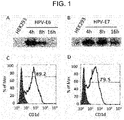
- the culture medium was exchanged and mRNA obtained by the in vitro transcription system was introduced into HEK293 cells or NIH3T3 cells by electroporation. Four hours, Eight hours and Sixteen hours after introduction, the cells were collected and expression levels of E6 and E7 proteins were checked by western blotting. The results were as shown in Figure 1 , panels A and B.
- Example 2 Immune response of cells expressing CD1d pulsed with CD1d ligand, E6 or E7
- Example 1 As shown in Figure 2 , panel A, the cells obtained in Example 1 were intravenously administered to mice and in-vivo immune response was checked 3 days later.
- mRNA encoding E6 or E7 was introduced to the CD1d-expression cells pulsed with ⁇ -GalCer in the same manner as in Example 1, mRNA encoding E6 or E7 was introduced.
- the cells were collected 4 to 12 hours after introduction.
- the cells (5 ⁇ 10 5 cells) obtained were intravenously administered to mice (C57BLZ6, 6 to 8 weeks old, female) through the caudal vein.
- the spleen was isolated and filtered by a cell strainer. Further, red blood cells were lysed with ACK lysing buffer to prepare spleen cells in 5% FCS containing RPMI.
- the spleen cells were stained with an anti-CD19 antibody and CD1d-dimer/Gal and analyzed by flow cytometry (results were as shown in Figure 2 , panel B).
- Example 2 the cells prepared in Example 2 were transplanted into a lung metastasis model animal and evaluated for anti-tumor effect thereof.
- B16 melanoma cells were suspended in PBS so as to have a concentration of 3 ⁇ 10 5 /200 ⁇ l, and intravenously administered to mice (C57BL/6, 6 to 8 weeks old, female) through the caudal vein.
- mice C57BL/6, 6 to 8 weeks old, female
- the cells prepared in Example 2 were administered 3 to 6 hours after administration of melanoma cells.
- PBS was administered to mice of a control group.
- E6-expressing cells prepared using NIH3T3 cells in accordance with Example 2 were administered.
- E7-expressing cells prepared in Example 2 were administered. Two weeks later, the lung was excised out from the mice, lung metastasis of B16 melanoma cells was observed. The results were as shown in Figure 3 .
- a E6-E7 fusion protein was prepared and allowed to express in HEK293 cells.
- the fusion protein was introduced into cells in the form of mRNA as described in Example 1. Four hours after introduction, the cells were collected. A cell lysate was obtained and analyzed by western blotting to check the expression level of the protein.
- an anti-E6 antibody was used in the case shown in Figure 4 and anti-E7 antibody was used in the case shown in Figure 5 .
- individual proteins were detected by western blotting. The images thereof were imported by a computer and analyzed by image analysis software, Image Reader LAS-1000 pro.
- #1 to #6 represent the following cell lysates.
- the E6 expression efficiency of the E6-E7 fusion protein was about half of that of E6 protein, and the E6 expression efficiency of E7-E6-E7 fusion protein was the same as that of the E6 protein.
- the expression efficiencies of the E6-E7 fusion protein and E6-E7-E6 fusion protein were 1/5 to 1/4 times that of E7 protein, whereas the expression efficiency of the E7-E6-E7 fusion protein was more than twice those of the E6-E7 fusion protein and E6-E7-E6 fusion protein.
- Example 6 Activation of killer T cell by aAVC
- E7-E6-E7 expressing HEK293 cells (5 ⁇ 10 5 cells; aAVC-E7-6-7) prepared in Example 4 were administered to mice. Seven days later, CD8 single positive T cells (5 ⁇ 10 5 cells) were taken out from the spleen and stimulated with dendritic cells (1 ⁇ 10 5 cells) to which E6 or E7 peptide was added, for 24 hours. At this time, the number of IFN- ⁇ producing CD8T cells (number of spots) were examined by ELISPOT assay. Since the production of IFN- ⁇ is reported to have a correlation with cytotoxic effect (action) of killer T cells, measurement of the cytokine is widely used. The results were as shown in Figure 7 .
- E7-E6-E7 fusion protein is suitable for expressing a fusion protein of E6 and E7. It is also found that an E7-E6-E7-expressing cell activates the innate immune system to produce an anti-tumor effect, and, in addition, responses specifically to E6 and E7 to induce a CD8T cell producing IFN- ⁇ . From this, it is believed that the E7-E6-E7-expressing cell activates the innate immune system and simultaneously responses specifically to E6 and E7 to induce a CD8T cell producing IFN- ⁇ , thereby producing an anti-tumor effect.
- an E7-E6-E7 fusion protein is expressed in aAVC, it is decomposed into E6 and E7 in a cell to produce small peptides derived from E6 and E7. From this, it is understood that aAVC expressing an E7-E6-E7 fusion protein produces an anti-tumor effect similarly to aAVC expressing E6 and aAVC expressing E7.
Landscapes
- Health & Medical Sciences (AREA)
- Life Sciences & Earth Sciences (AREA)
- Chemical & Material Sciences (AREA)
- General Health & Medical Sciences (AREA)
- Animal Behavior & Ethology (AREA)
- Public Health (AREA)
- Veterinary Medicine (AREA)
- Organic Chemistry (AREA)
- Medicinal Chemistry (AREA)
- Engineering & Computer Science (AREA)
- Epidemiology (AREA)
- Genetics & Genomics (AREA)
- Pharmacology & Pharmacy (AREA)
- Virology (AREA)
- Bioinformatics & Cheminformatics (AREA)
- Molecular Biology (AREA)
- Biotechnology (AREA)
- General Chemical & Material Sciences (AREA)
- Nuclear Medicine, Radiotherapy & Molecular Imaging (AREA)
- Chemical Kinetics & Catalysis (AREA)
- Immunology (AREA)
- Zoology (AREA)
- Biomedical Technology (AREA)
- Biochemistry (AREA)
- Wood Science & Technology (AREA)
- Biophysics (AREA)
- Proteomics, Peptides & Aminoacids (AREA)
- Gastroenterology & Hepatology (AREA)
- General Engineering & Computer Science (AREA)
- Microbiology (AREA)
- Oncology (AREA)
- Cell Biology (AREA)
- Communicable Diseases (AREA)
- Plant Pathology (AREA)
- Toxicology (AREA)
- Physics & Mathematics (AREA)
- Mycology (AREA)
- Endocrinology (AREA)
- Reproductive Health (AREA)
- Developmental Biology & Embryology (AREA)
Abstract
Description
- The present invention relates to a cell activating the immune system and a pharmaceutical composition containing the cell.
- Human papillomavirus (HPV) is a virus known to cause cervical cancer. Other than cervical cancer, HPV causes exogenous intraepithelial tumor and vaginal intraepithelial neoplasia, which develop into vulvar cancer and vaginal cancer, respectively. Recently HPV is also known to have a risk of developing mesopharyngeal carcinoma. Typical HPVs causing cervical cancer are 16 HPV and 18 HPV, which are responsible for 65% of the causes of cervical cancer. Cervical cancer caused by 16 HPV and 18 HPV develops faster than other high-risk cervical cancers. About 80% to 90% of the cervical cancer of women in their 20's to 30's are caused by 16 HPV and 18 HPV.
- A cell obtained by pulsing a cell co-expressing CD1d and a target protein with a CD1d ligand is called an artificial adjuvant vector cell (aAVC), which induces an innate immune response and an acquired immune response to the target protein in subjects administered with aAVC (
Patent Literatures 1 to 3 and non-patent literature 1). -
- Patent Literature 1:
WO2007/097370 - Patent Literature 2:
WO2010/061930 - Patent Literature 3:
WO2013/018778 - Non Patent Literature 1: Shimizu K. et al., 2007, J. Immunol., Vol. 178, pp2853-2861
- The present invention provides a cell activating the immune system and a pharmaceutical composition containing the cell.
- According to the present invention, the artificial adjuvant vector cell (aAVC) expressing E6 protein or E7 protein activates NKT cells to induce E6 and E7 antigen specific T cell, thereby exerting an anti-tumor effect. According to the present invention, fusion proteins of E6 protein and E7 protein, in particular, a fusion protein of E7 protein, E6 protein and E7 protein linked in this order, is highly expressed within a cell. The present invention is based on such a finding.
- Accordingly, the present invention provides, e.g., the following aspects (e.g., industrially available inventions).
- (1) A mammalian cell expressing at least one protein selected from the group consisting of E6 protein and E7 protein for early genes of human papillomavirus and a fusion protein of E6 protein and E7 protein, and expressing CD1d protein, wherein the mammalian cell is pulsed with a CD1d ligand.
- (2) The cell according to (1), wherein the E6 protein and E7 protein for early genes of human papillomavirus are independently expressed.
- (3) The cell according to (2), wherein the E6 protein and E7 protein for early genes of human papillomavirus are expressed in the form of a fusion protein.
- (4) The cell according to (3), wherein the fusion protein comprises E7 protein, E6 protein and E7 protein in this order.
- (5) A fusion protein comprising E7 protein, E6 protein and E7 protein in this order.
- (6) A nucleic acid encoding a fusion protein comprising E7 protein, E6 protein and E7 protein in this order.
- (7) An expression vector for a fusion protein comprising E7 protein, E6 protein and E7 protein in this order, the vector containing a nucleic acid encoding the fusion protein.
- (8) A pharmaceutical composition comprising the cell according to any one of (1) to (4), the fusion protein according to (5), the nucleic acid according to (6) or the vector according to (7).
- (9) The pharmaceutical composition according to (8), for administration to a human subject infected with human papillomavirus.
- (10) The pharmaceutical composition according to (9), wherein the human subject has a cancer caused by human papillomavirus.
- (11) The pharmaceutical composition according to (10), wherein the cancer caused by human papillomavirus is a cancer selected from the group consisting of cervical cancer, anal cancer and vaginal cancer.
-
- [
Figure 1] Figure 1 , panels A and B, show expressions of E6 and E7 proteins in cells, which were obtained by pulsing HEK293 cells expressing CD1d with CD1d ligand, and thereafter, transfected with mRNAs encoding E6 and E7 proteins of HPV-16, respectively, and cultured for a predetermined time; and panels C and D show the flow cytometric analysis results of expression of CD1d on the cell surfaces. - [
Figure 2] Figure 2 shows the results of amplification of NKT cell analyzed by the cell, which expresses E6 or E7 protein and is obtained by pulsing HEK293 cell expressing CD1d with CD1d ligand. Panel A shows the experimental scheme. Panel B shows activation of NKT cells. - [
Figure 3] Figure 3 shows the anti-tumor effect of a cell, which expresses E6 or E7 protein and is obtained by pulsing NIH3T3 cell expressing CD1d with CD1d ligand, on melanoma transplanted models. - [
Figure 4] Figure 4 shows the expression levels of E6 protein in HEK293 cells which were forced to express E6 protein, E7 protein or a fusion protein of these.Figure 4 shows the quantification results of E6 protein expression levels measured by western blotting using an anti-E6 antibody. In the figure, #1: E6 expressing HEK293 cells, #2: E7 expressing HEK293 cell, #3: E6-E7 expressing HEK293 cell, #4: E6-E7-E6 expressing HEK293 cell, #5: E7-E6-E7 expressing HEK293 cell and #6: E7-E6 expressing HEK293 cell. The expression levels are each indicated by the ratio (ratio to E6 protein expression) to the expression level of #1 (regarded as 1). - [
Figure 5] Figure 5 shows the expression levels of E7 protein in HEK293 cells which were forced to express E6 protein, E7 protein or a fusion protein of these.Figure 5 shows the quantification results of E7 protein expression levels measured by western blotting using an anti-E7 antibody. In the figure, #1: E6 expressing HEK293 cell, #2: E7 expressing HEK293 cell, #3: E6-E7 expressing HEK293 cell, #4: E6-E7-E6 expressing HEK293 cell, #5: E7-E6-E7 expressing HEK293 cell and #6: E7-E6 expressing HEK293 cell. The expression levels are each indicated by the ratio (ratio to E7 protein expression) to the expression level of #2 (regarded as 1). - [
Figure 6] Figure 6 shows the anti-tumor effect of HEK293 cells expressing CD1d and E7-E6-E7 protein and pulsed with CD1d ligand in melanoma cell transplanted models. - [
Figure 7] Figure 7 shows the number of IFN-γ producing cells (number of spots) when HEK293 cells expressing CD1d and E7-E6-E7 protein and pulsed with CD1d ligand were administered and E6 and E7 specific CD8T cells were induced by reimmunization of dendritic cells to which E6 or E7 peptides were added. - As used herein, the "subject" may be a mammal including, for example, a human and a non-human mammal. As used herein, the "subject" include a human subject (particularly woman) infected with HPV (for example, HPV-16 and/or HPV-18); a human subject (particularly woman) having a carcinogenic risk increased by infection with HPV and a human subject (particularly woman) who developed cancer by the infection.
- As used herein, the "treatment" is meant to include a therapeutic treatment and a preventive treatment. As used herein, the "therapy" is meant to include delaying or stopping the progression of a disease or condition and improving and curing a disease or condition. As used herein, the "prevention" is meant to include suppressing onset of a disease or condition and reducing a rate of incidence.
- As used herein, "human papillomavirus" (HPV) refers to a virus belonging to the papillomavirus family and forming warts called as papilloma (or papillary tumor). There are at least 180 genotypes in HPV. Of them, HPV-16 and HPV-18 increase a risk of developing cancer. About 50% of cervical cancers in the world have HPV-16. HPV-16 has E1 to E7 early genes and L1 and L2 late genes. E6 and E7 can be involved in carcinogenesis. Examples of E6 protein include E6 protein of HPV-16 such as E6 protein having an amino acid sequence corresponding to the amino acid sequence registered under GenBank registration number: NP_041325.1 (or the amino acid sequence represented by SEQ ID NO: 1); and E6 protein of HPV-18 such as E6 protein having an amino acid sequence corresponding to the amino acid sequence registered under GenBank registration number: NP_040310.1 or (or the amino acid sequence represented by SEQ ID NO: 2). Examples of E7 protein include E7 protein of HPV-16 such as E7 protein having an amino acid sequence corresponding to the amino acid sequence registered under GenBank registration number: NP_041326.1 (or the amino acid sequence represented by SEQ ID NO: 3); and E7 protein of HPV-18 such as E7 protein having an amino acid sequence corresponding to the amino acid sequence registered under GenBank registration number: NP_040311.1 (or the amino acid sequence represented by SEQ ID NO: 4). As used herein, the "corresponding to an amino acid sequence" refers to an ortholog of the amino acid sequence, in other words, a protein having the same functionality as that of a protein having the amino acid sequence. E6 protein and E7 protein include, for example, E6 proteins and E7 proteins having a sequence identity of 80% or more, 85% or more, 90% or more, 95% or more, 96% or more, 97% or more, 98% or more, and 99% or more, with the respective amino acid sequences mentioned above. The sequence identity refers to a value "Identity" obtained by search based on NEEDLE program (Journal of Molecular Biology, 1970, Vol.48, p.443-453) using default parameters, such as Gap penalty = 10, Extend penalty = 0.5 and Matrix = EBLOSUM62.
- As used herein, the "artificial adjuvant vector cell" (aAVC) refers to the cell expressing CD1d and an antigen (for example, E6 protein and E7 protein), wherein the cell was pulsed with CD1d. The cell pulsed with CD1d can be obtained by co-culturing a cell expressing CD1d together with CD1d ligand. The CD1d ligand that fails to attach to cells can be removed by washing. CD1d is a protein of the CD1 family, more specifically, an MHC class I-like glycoprotein. CD1d presents a glycolipid and activates, for example, NKT cells. CD1d include, for example, human CD1d, for example, a protein having the amino acid sequence registered under GenBank registration number: AAH27926.1. The CD1d ligand means a glycolipid binding to CD1d. Examples of the CD1d ligand include, α-GalCer (α-galactosylceramide), α-C-GalCer (α-C-galactosylceramide), iGB3 (isoglobotrihexosylceramide), GD3 (ganglioside 3), GSL-1 (α-bound glucuronic acid) and GSL-1'SA (galacturonic acid), any of which can be used as the CD1d ligand. As the CD1d ligand, for example, α-GalCer and α-C-GalCer can be preferably used.
- When aAVC is administered to a mammal, the aAVC activates NKT cells and matures dendritic cells to induce an innate immune response as well as an acquired immune response. If aAVC expresses a protein, acquired immune response to the protein is also induced. An innate immune response and an acquired immune response are induced by aAVC even if any of dendritic cells, cancer cells and other cells (for example, somatic cell) are used. An innate immune response and acquired immune response are induced by aAVC in a subject even if it is isogenic or allogenic aAVC to the subject to be administered. In the case where allogenic aAVC is used, the aAVC itself can be eliminated by the immune system of a subject as a foreign substance after an innate immune response and acquired immune response are induced in the subject. If a target protein is expressed in aAVC, an acquired immune response specific to the target protein can be induced in a subject administered with aAVC. The target protein can be decomposed into partial peptides in aAVC, which can induce an acquired immune response. The aAVC expresses CD1d and pulsed by CD1d ligand. The aAVC may have a foreign gene encoding CD1d operably linked to a regulatory sequence. The aAVC may have a foreign gene encoding a target protein operably linked to a regulatory sequence.
- As used herein, the "cell" is a mammalian cell such as a human cell. Examples of the cell include a dendritic cell and a non-dendritic cell. Examples of the cell include a tumor cell and a non-tumor cell. Examples of the cell include a cancer cell and a non-cancer cell. Examples of the cell include an immortalized cell and a primary cell. Examples of the cell include a somatic cell and cells other than the somatic cell. The cell may be isogenic or allogenic to a subject to be administered. Examples of the cell include a human cell and a human cell line, such as a human fetal kidney cell line, for example, HEK293 cell.
- As used herein, the "fusion protein" refers to a protein containing two or more proteins or a partial peptide thereof. In the fusion protein, two or more proteins may be linked with or without a spacer interposed between them. The spacer may be a peptide having a length of, for example, 1 to 20 amino acids, 1 to 10 amino acids or 1 to 5 amino acids. A fusion protein obtained by linking protein A and protein B in this order from the N terminal is expressed herein as "protein A-protein B". A fusion protein obtained by linking protein B and protein A in this order from the N terminal is expressed herein as "protein B-protein A". A fusion protein can be designed by linking genes encoding the proteins or partial peptides thereof constituting the protein in frame.
- As used herein, the "nucleic acid" refers to deoxyribonucleic acid (DNA) and ribonucleic acid (RNA). Examples of the nucleic acid encoding a protein include DNA and mRNA. DNA may be cDNA having a sequence obtained from mRNA by reverse transcription. In mRNA, the nucleic acid may be modified for ensuring stabilization.
- As used herein, the "expression vector" refers to a vector having a regulatory sequence and a nucleic acid encoding a protein and operably linked to the regulatory sequence, and capable of transcribing mRNA encoding the protein in the cell or in vitro. The expression vector may contain, for example, an origin of replication for replicating in a cell, a regulatory sequence, and a nucleic acid encoding a protein and operably linked to the regulatory sequence. The expression vector may have a selective marker (for example, drug resistance gene) for identifying a cell having the vector introduced herein. Examples of the regulatory sequence for expression in mammalian cells include, but are not particularly limited to, a promoter of RNA polymerase II such as CMV immediately early promoter, HSV thymidine kinase promoter, early and late SV40, retrovirus LTR promoter and metallothionein I promoter. Examples of the promoter for expression in Escherichia coli include promoters such as lac, trp, lacI, lacZ, T3, T7, gpt, lambda PR, lambda PL and 3-phosphoglycerate kinase. Examples of the promoter for expression in vitro include, but are not particularly limited to, SP6, T7 and T3 promoters. Examples of the expression vector include a plasmid, a phage, a phagemid, a cosmid, a fosmid, an artificial chromosome, a retrovirus, a lentivirus, measles virus, vaccinia virus, adenovirus, adeno-associated virus and Sendai virus.
- As used herein, the "cancer" refers to a benign and malignant neoplasm including cancers of
stage 0,stage 1,stage 2,stage 3 andstage 4. Examples of the cancer include solid cancers and hematopoietic tumors such as blood cancers (for example, leukemia). Examples of the solid cancer include epithelial cancer and sarcoma. Examples of the cancer include, leukemia, lymphoma (for example, Hodgkin's disease and non-Hodgkin's lymphoma), multiple myeloma, brain tumor, breast cancer, endometrial cancer, cervical cancer, ovarian cancer, vaginal cancer, esophageal cancer, gastric cancer, appendix cancer, colorectal cancer, liver cancer (for example, hepatocellular carcinoma), gallbladder cancer, bile duct cancer, pancreatic cancer, adrenal cancer, gastrointestinal stromal tumor, mesothelioma (for example, pleura, peritoneum and pericardium), head and neck cancer (for example, pharyngeal cancer, oral cancer, gingival cancer, tongue cancer, buccal mucosal cancer), salivary gland cancer, sinus cancer (for example, maxillary sinus cancer, frontal sinus cancer, ethmoid sinus cancer, butterfly bone sinus cancer), thyroid cancer, kidney cancer, lung cancer, osteosarcoma, prostate cancer, testicular cancer, renal cell carcinoma, bladder cancer, rhabdomyosarcoma, skin cancer, anal cancer, neuroblastoma, central nervous system cancer, Wilms tumor, germ cell cancer, soft tissue sarcoma, glioma and glioblastoma. Examples of the cancer caused by human papillomavirus include cervical cancer, anal cancer and vaginal cancer. - According to the present invention, the "target protein" refers to a protein to which an antigen specificity of an acquired immunity is directed, wherein the acquired immunity is induced in a living body. The target protein may be an endogenous protein or an exogenous protein. As used herein, the target protein may be at least one HPV protein selected from the group consisting of E6 protein, E7 protein and a fusion protein of E6 protein and E7 protein. E6 protein and E7 protein may be an HPV protein selected from the group consisting of HPV-16 and HPV-18 proteins. An E6-protein part and an E7-protein part contained in a fusion protein of the present invention may be also an HPV protein selected from the group consisting of HPV-16 and HPV-18 proteins.
- As used herein, "express" refers to producing a protein from a nucleic acid encoding the protein in the cell such that the cell has the protein.
- According to the present invention, aAVC expressing E6 protein and/or E7 protein serving as an antigen, induces NKT cells and exerts an anti-tumor effect. Accordingly, the present invention provides aAVC expressing E6 protein and/or E7 protein, a pharmaceutical composition containing said aAVC and a pharmaceutical composition containing said aAVC for treating a cancer.
- According to the present invention, there is provided a fusion protein of E6 protein and E7 protein. Examples of the fusion protein of E6 protein and E7 protein include a fusion protein selected from the group consisting of E6-E7, E7-E6, E6-E7-E6 and E7-E6-E7 and a protein containing any one of these fusion proteins. According to the present invention, there is provided a nucleic acid (for example, DNA or mRNA) encoding a fusion protein of E6 protein and E7 protein selected from the group consisting of E6-E7, E7-E6, E6-E7-E6 and E7-E6-E7 and proteins containing these fusion proteins. According to the present invention, there is provided an expression vector containing a nucleic acid encoding a fusion protein selected from the group consisting of E6-E7, E7-E6, E6-E7-E6 and E7-E6-E7 and proteins containing these fusion proteins. According to the present invention, there is provided an expression vector for use in said fusion protein in mammalian cells. According to the present invention, there is provided an expression vector for use in expressing said fusion protein in Escherichia coli. According to the present invention, there is provided an expression vector for use in transcribing (and preferably translating) a gene encoding said fusion protein in vitro. According to the present invention, there is provided a cell having at least one of the fusion proteins. The cell to be used as aAVC may be a mammalian cell such as a human cell. The cell to be used as aAVC may be a dendritic cell or a non-dendritic cell. The cell may be a tumor cell or a non-tumor cell. The cell to be used as aAVC may be a cancer cell or a non-cancer cell. The cell to be used as aAVC may be immortalized cells or primary cells. The cell to be used as aAVC may be a somatic cell or a cell other than the somatic cell. The cell to be used as aAVC may be isogenic or allogenic to an administration target. The cell to be used as aAVC may be, for example, a human cell line such as a human fetal kidney cell line, for example, HEK293 cell.
- The amino acid sequence of an E6-E7 fusion protein is represented by any one of SEQ ID NOs: 5 to 8. The amino acid sequence of an E7-E6 fusion protein is represented by any one of, SEQ ID NOs: 9 to 12. The amino acid sequence of an E6-E7-E6 fusion protein is represented by any one of, SEQ ID NOs: 13 to 20. The amino acid sequence of an E7-E6-E7 fusion protein is represented by any one of, SEQ ID NOs: 21 to 28. These fusion proteins are satisfactory as long as they are expressed within a cell. Even if a fusion protein phagocytosed by a dendritic cell, it is decomposed into small peptides in the dendritic cell. From the small peptides, the immune system to HPV is conceivably induced. Accordingly, a linker may be appropriately introduced into a joining section between proteins in a fusion protein.
- According to the present invention, aAVC expressing a E6-E7 fusion protein serving as an antigen incudes NKT cells to produce an anti-tumor effect. Accordingly, the present invention provides aAVC expressing a E6-E7 fusion protein, a pharmaceutical composition containing said aAVC and a pharmaceutical composition containing said aAVC and to be used for treating a cancer.
-
Table 1: Amino acid sequence from which fusion protein is derived Fusion protein of proteins A and B or fusion protein of proteins A, B and C SEQ ID NO: of fusion protein SEQ ID NO: of amino acids of protein A SEQ ID NO: of amino acids of protein B SEQ ID NO: of amino acids of protein C E6-E7 fusion protein SEQ ID NO: 5 SEQ ID NO: 1 SEQ ID NO: 2 - SEQ ID NO: 6 SEQ ID NO: 3 SEQ ID NO: 4 - SEQ ID NO: 7 SEQ ID NO: 1 SEQ ID NO: 4 - SEQ ID NO: 8 SEQ ID NO: 3 SEQ ID NO: 2 - E7-E6 fusion protein SEQ ID NO: 9 SEQ ID NO: 2 SEQ ID NO: 1 - SEQ ID NO: 10 SEQ ID NO: 4 SEQ ID NO: 3 - SEQ ID NO: 11 SEQ ID NO: 4 SEQ ID NO: 1 - SEQ ID NO: 12 SEQ ID NO: 2 SEQ ID NO: 3 - E6-E7-E6 fusion protein SEQ ID NO: 13 SEQ ID NO: 1 SEQ ID NO: 2 SEQ ID NO: 1 SEQ ID NO: 14 SEQ ID NO: 1 SEQ ID NO: 2 SEQ ID NO: 3 SEQ ID NO: 15 SEQ ID NO: 1 SEQ ID NO: 4 SEQ ID NO: 1 SEQ ID NO: 16 SEQ ID NO: 1 SEQ ID NO: 4 SEQ ID NO: 3 SEQ ID NO: 17 SEQ ID NO: 3 SEQ ID NO: 2 SEQ ID NO: 1 SEQ ID NO: 18 SEQ ID NO: 3 SEQ ID NO: 2 SEQ ID NO: 3 SEQ ID NO: 19 SEQ ID NO: 3 SEQ ID NO: 4 SEQ ID NO: 1 SEQ ID NO: 20 SEQ ID NO: 3 SEQ ID NO: 4 SEQ ID NO: 3 E7-E6-E7 fusion protein SEQ ID NO: 21 SEQ ID NO: 2 SEQ ID NO: 1 SEQ ID NO: 2 SEQ ID NO: 22 SEQ ID NO: 2 SEQ ID NO: 1 SEQ ID NO: 4 SEQ ID NO: 23 SEQ ID NO: 2 SEQ ID NO: 3 SEQ ID NO: 2 SEQ ID NO: 24 SEQ ID NO: 2 SEQ ID NO: 3 SEQ ID NO: 4 SEQ ID NO: 25 SEQ ID NO: 4 SEQ ID NO: 1 SEQ ID NO: 2 SEQ ID NO: 26 SEQ ID NO: 4 SEQ ID NO: 1 SEQ ID NO: 4 SEQ ID NO: 27 SEQ ID NO: 4 SEQ ID NO: 3 SEQ ID NO: 2 SEQ ID NO: 28 SEQ ID NO: 4 SEQ ID NO: 3 SEQ ID NO: 4 - In Table 1, A-B fusion protein refers to a protein in which A protein and B protein are linked in this order from the N terminal. An example of the amino acid sequence number of the protein is listed in the table. The amino acid sequences in Table 1 may be linked with or without a spacer interposed between them.
- According to the present invention, there are provided a fusion protein of the present invention such as an E7-E6-E7 fusion protein or a fusion protein containing E7-E6-E7; a nucleic acid encoding the fusion protein; a gene expression vector containing the nucleic acid; a human cell or human cell line (for example, human fetal kidney cell line, for example, HEK293 cell) expressing the fusion protein; and a human cell or human cell line (for example, human fetal kidney cell line, for example, HEK293 cell) having the nucleic acid (herein, the cells or cell line may further express CD1d). According to the present invention, there are provided a pharmaceutical composition containing a human cell or human cell line expressing a fusion protein of the present invention and a pharmaceutical composition containing a human cell or a human cell line having a nucleic acid encoding a fusion protein of the present invention. According to the present invention further, there are provided a fusion protein of the present invention, for example, an E7-E6-E7 fusion protein or a fusion protein containing E7-E6-E7, a nucleic acid encoding the fusion protein, human aAVC expressing the fusion protein and human aAVC having a nucleic acid encoding the fusion protein. According to the present invention, there is further provided a pharmaceutical composition containing the human aAVC.
- E6 protein or E7 protein, or a fusion protein of E6 protein and E7 protein can be expressed in a cell by introducing an expression vector into the cell. E6 protein or E7 protein, or a fusion protein of E6 protein and E7 protein can be expressed in a cell by introduction of mRNA encoding at least one of the proteins into the cell. The expression vector and mRNA can be introduced into a cell by a method known to those skilled in the art. Examples of a method for introducing them include lipofection, electroporation and a calcium phosphate method.
- According to the present invention, there is provided a method for producing aAVC expressing E6 protein or E7 protein, or a fusion protein of E6 protein and E7 protein, or producing a pharmaceutical composition containing the aAVC, including introducing mRNA encoding the protein or a fusion protein into a cell. According to the present invention, there is provided a method for producing aAVC expressing an E7-E6-E7 fusion protein or a fusion protein containing E7-E6-E7. According to the present invention, the method for producing aAVC expressing an E7-E6-E7 fusion protein or a fusion protein containing E7-E6-E7, includes introducing mRNA encoding the fusion protein into a cell. The method for producing aAVC of the present invention may include expressing CD1d by a cell and culturing the cell expressing CD1d in the presence of CD1d ligand. The method for producing aAVC of the present invention, if a cell expresses CD1d, may not include artificially expressing CD1d. The method for producing aAVC of the present invention may include culturing a cell expressing CD1d in the presence of CD1d ligand.
- According to the present invention, there is provided a method including administering aAVC expressing either one or both of E6 protein and E7 protein of human papillomavirus, to a subject in need. According to the present invention, there is provided a method for treating a cancer in a subject in need, including administering aAVC expressing either one or both of E6 protein and E7 protein of human papillomavirus to the subject in a therapeutically effective amount. According to the present invention, cancer may be a cancer associated with infection with human papillomavirus.
- According to the present invention, there is provided a method including administering aAVC expressing an E7-E6-E7 fusion protein or a fusion protein containing E7-E6-E7 to a subject in need. According to the present invention, there is provided a method for treating a cancer in a subject in need, including administering aAVC expressing an E7-E6-E7 fusion protein or a fusion protein containing E7-E6-E7 to the subject in a therapeutically effective amount.
- According to the present invention, there is provided use of aAVC expressing either one or both of E6 protein and E7 protein of human papillomavirus in producing a medicament for use in treating a cancer. According to the present invention, there is provided use of aAVC expressing either one or both of E6 protein and E7 protein of human papillomavirus for use in a method for treating a cancer.
- According to the present invention, there is provided use of aAVC expressing a fusion protein of the present invention such as an E7-E6-E7 fusion protein or a fusion protein containing E7-E6-E7 in producing a medicament for use in treating a cancer. According to the present invention, aAVC expressing a fusion protein of the present invention such as an E7-E6-E7 fusion protein or a fusion protein containing E7-E6-E7 for use in a method for treating a cancer.
- The pharmaceutical composition according to the present invention, may contain aAVC of the present invention and a pharmaceutical acceptable excipient. The pharmaceutical composition according to the present invention can be parenterally (for example, intravenously, intratumorally, intramuscularly, intraperitoneally, intracerebroventricularly and intrathecally) administered. Examples of the pharmaceutically acceptable excipient include a buffer, a tonicity agent, a dispersant, a thickener, a gelling agent, an antioxidant, a preservative and a soothing agent.
- According to the present invention, the aAVC of the present invention is expected to produce an antiviral effect in a human subject infected with human papillomavirus. Accordingly, the medical drug or pharmaceutical composition of the present invention can be used for treating a human subject (particularly woman) infected with human papillomavirus, a human subject (particularly woman) having a carcinogenic risk increased by the infection and a human subject (particularly woman) who developed cancer by the infection. The method of the present invention can be a method for treating a human subject (particularly woman) infected with human papillomavirus, a human subject (particularly woman) having a carcinogenic risk increased by the infection and a human subject (particularly woman) who developed cancer by the infection. The medical drug or a pharmaceutical composition of the present invention can be used for treating infection with human papillomavirus in a subject infected with human papillomavirus.
- HEK293 strains expressing viral proteins of human papillomavirus (HPV) were prepared and pulsed with α-GalCer.
- As the viral proteins of HPV, E6 and E7 proteins encoded respectively by early genes E6 and E7 of HPV16, and fusion proteins of them were designed and put in use. Examples of the fusion proteins designed and put in use include a fusion protein (E6-E7; having the amino acid sequence represented by SEQ ID NO: 5), in which E6 and E7 are linked in this order, a fusion protein (E7-E6; having the amino acid sequence represented by SEQ ID NO: 6), in which E7 and E6 are linked in this order, a fusion protein (E6-E7-E6; having the amino acid sequence represented by SEQ ID NO: 7) in which E6, E7 and E6 are linked in this order, and a fusion protein (E7-E6-E7; having the amino acid sequence represented by SEQ ID NO: 8), in which E7, E6 and E7 are linked in this order.
- E6, E7 and designed fusion proteins were separately cloned into a HindIII-EcoRI cleavage site of pGEM4Z-hPV vector (Cat#P2161, company: Promega). In cloning, Kozak sequence (CCACC) was introduced upstream of the initial codon of a gene encoding each of the proteins; a HindIII (restriction enzyme) recognition site was introduced upstream of the Kozak sequence; and an EcoRI (restriction enzyme) recognition site was introduced downstream of a stop codon. In this manner, fusion proteins were integrated into a vector in such a direction that transcription can be made by T7 promoter. The mRNA encoding E6, E7 and the various fusion proteins were prepared by in-vitro transcription system using T7 promoter.
- As protein-expressing cell, HEK293 cell or NIH3T3 cell expressing CD1d was used (see, for example, J Immunol. 2007;178: 2853-2861). Culture was carried out in a culture medium such as AIM-V or 10% FCS containing RPMI1640 at 37°C under 5% CO2 conditions. Cells were pulsed with CD1d ligand, α-GalCer, by adding α-GalCer (500 ng/mL) to the culture medium followed by culturing. The culture medium was exchanged and mRNA obtained by the in vitro transcription system was introduced into HEK293 cells or NIH3T3 cells by electroporation. Four hours, Eight hours and Sixteen hours after introduction, the cells were collected and expression levels of E6 and E7 proteins were checked by western blotting. The results were as shown in
Figure 1 , panels A and B. - As shown in
Figure 1 (panels A and B), qualitative analysis of E6 protein and E7 protein of HPV in HEK293 cells were made. The expression of CD1d in HEK293 cells was checked by flow cytometry using a PE-conjugated anti-CD1d antibody and FACS Caribur. The results were as shown inFigure 1 , panels C and D. In any one of HEK293 cells, expression of CD1d was confirmed. - As shown in
Figure 2 , panel A, the cells obtained in Example 1 were intravenously administered to mice and in-vivo immune response was checked 3 days later. - To the CD1d-expression cells pulsed with α-GalCer in the same manner as in Example 1, mRNA encoding E6 or E7 was introduced. The cells were collected 4 to 12 hours after introduction. The cells (5 × 10⁵ cells) obtained were intravenously administered to mice (C57BLZ6, 6 to 8 weeks old, female) through the caudal vein. Three days after administration, the spleen was isolated and filtered by a cell strainer. Further, red blood cells were lysed with ACK lysing buffer to prepare spleen cells in 5% FCS containing RPMI. The spleen cells were stained with an anti-CD19 antibody and CD1d-dimer/Gal and analyzed by flow cytometry (results were as shown in
Figure 2 , panel B). - As shown in
Figure 2 (panel B), it was found that the number of CD19 negative CD1d-dimer/Gal positive NKT cells increased in the cell administration group. From the results, it was found that the cells administered have an ability to accelerate NKT cells. - In the Example, the cells prepared in Example 2 were transplanted into a lung metastasis model animal and evaluated for anti-tumor effect thereof.
- B16 melanoma cells were suspended in PBS so as to have a concentration of 3 × 10⁵/200 µl, and intravenously administered to mice (C57BL/6, 6 to 8 weeks old, female) through the caudal vein. To the mice, the cells prepared in Example 2 were administered 3 to 6 hours after administration of melanoma cells. PBS was administered to mice of a control group. To the mice of
administration group 1, E6-expressing cells prepared using NIH3T3 cells in accordance with Example 2 were administered. To the mice ofadministration group 2, E7-expressing cells prepared in Example 2 were administered. Two weeks later, the lung was excised out from the mice, lung metastasis of B16 melanoma cells was observed. The results were as shown inFigure 3 . - As shown in
Figure 3 , in the control group, lung metastasis of the melanoma cells was significantly observed. While the entire lung looked black by the presence of melanoma cells in the control group, black color derived from the melanoma cells was virtually not observed in administration group 1 (E6-expressing cell administration group) and administration group 2 (E7-expressing cell administration group). From the results, it was found that E6-expressing cells and E7-expressing cells prepared in Examples both have an anti-tumor effect. From the results of Examples 2 and 3, it was found that CD1d-expressing cells expressing E6 and pulsed with α-GalCer, accelerate NKT cells, in vivo, to activate innate immunity and exert an anti-tumor effect. - In the present invention, a E6-E7 fusion protein was prepared and allowed to express in HEK293 cells. The fusion protein was introduced into cells in the form of mRNA as described in Example 1. Four hours after introduction, the cells were collected. A cell lysate was obtained and analyzed by western blotting to check the expression level of the protein. As the antibody, an anti-E6 antibody was used in the case shown in
Figure 4 and anti-E7 antibody was used in the case shown inFigure 5 . In the same manner as the case shown inFigure 1 , individual proteins were detected by western blotting. The images thereof were imported by a computer and analyzed by image analysis software, Image Reader LAS-1000 pro. With reference of calibration curves prepared based on the densities of bands given by predetermined amounts of E6 protein and E7 protein standard samples, expression levels were obtained based evaluation of the densities of the bands of the samples. The results were as shown inFigures 4 and 5 , each of which shows the expression ratio relative to the expression level of single-protein-expressing cells (regarded as 1). - In
Figures 4 and 5 , #1 to #6 represent the following cell lysates. - #1: E6 expressing HEK293 cells
- #2: E7 expressing HEK293 cells
- #3: E6-E7 expressing HEK293 cells
- #4: E6-E7-E6 expressing HEK293 cells
- #5: E7-E6-E7 expressing HEK293 cells
- #6: E7-E6 expressing HEK293 cells
- As shown in
Figure 4 , the E6 expression efficiency of the E6-E7 fusion protein was about half of that of E6 protein, and the E6 expression efficiency of E7-E6-E7 fusion protein was the same as that of the E6 protein. - As shown in
Figure 5 , the expression efficiencies of the E6-E7 fusion protein and E6-E7-E6 fusion protein were 1/5 to 1/4 times that of E7 protein, whereas the expression efficiency of the E7-E6-E7 fusion protein was more than twice those of the E6-E7 fusion protein and E6-E7-E6 fusion protein. - To lung metastasis model animals (n = 5), which were prepared by transplanting B16 melanoma cells (3 × 10⁵ cells) in the same manner as in Example 3, E7-E6-E7 expressing HEK293 cells (5 × 10⁵ cells) prepared in Example 4 were transplanted and the anti-tumor effect thereof was examined. The results were as shown in
Figure 6 . As shown inFigure 6 , the lung metastasis of melanoma cells was obviously observed, the entire lung looked black by the presence of melanoma cells in the control group, black color derived from the melanoma cells was virtually not observed in the E7-E6-E7 administration group. From the results, it was found that E7-E6-E7 expressing cells prepared in Example can activate the innate immune system to produce an anti-tumor effect. - E7-E6-E7 expressing HEK293 cells (5 × 10⁵ cells; aAVC-E7-6-7) prepared in Example 4 were administered to mice. Seven days later, CD8 single positive T cells (5 × 10⁵ cells) were taken out from the spleen and stimulated with dendritic cells (1 × 10⁵ cells) to which E6 or E7 peptide was added, for 24 hours. At this time, the number of IFN-γ producing CD8T cells (number of spots) were examined by ELISPOT assay. Since the production of IFN-γ is reported to have a correlation with cytotoxic effect (action) of killer T cells, measurement of the cytokine is widely used. The results were as shown in
Figure 7 . As shown inFigure 7 , in the E7-E6-E7 administration group, CD8T cells reacted specifically to E6 and E7 to produce IFN-γ were detected. From the results, it was found that aAVC expressing E7-E6-E7 induces E6 and E7 specific killer T cells. - From the above, it is found that E7-E6-E7 fusion protein is suitable for expressing a fusion protein of E6 and E7. It is also found that an E7-E6-E7-expressing cell activates the innate immune system to produce an anti-tumor effect, and, in addition, responses specifically to E6 and E7 to induce a CD8T cell producing IFN-γ. From this, it is believed that the E7-E6-E7-expressing cell activates the innate immune system and simultaneously responses specifically to E6 and E7 to induce a CD8T cell producing IFN-γ, thereby producing an anti-tumor effect. Note that if an E7-E6-E7 fusion protein is expressed in aAVC, it is decomposed into E6 and E7 in a cell to produce small peptides derived from E6 and E7. From this, it is understood that aAVC expressing an E7-E6-E7 fusion protein produces an anti-tumor effect similarly to aAVC expressing E6 and aAVC expressing E7.
-

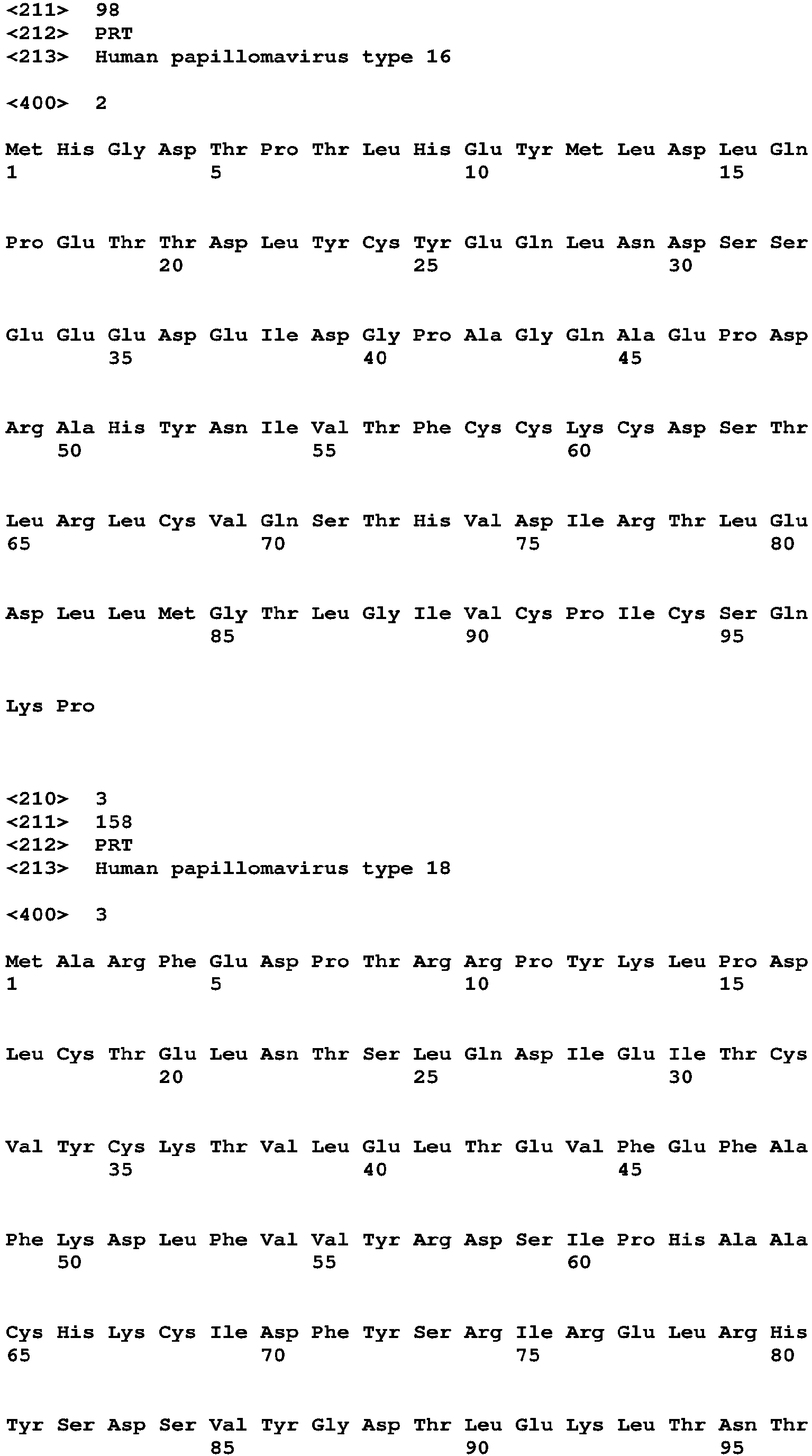


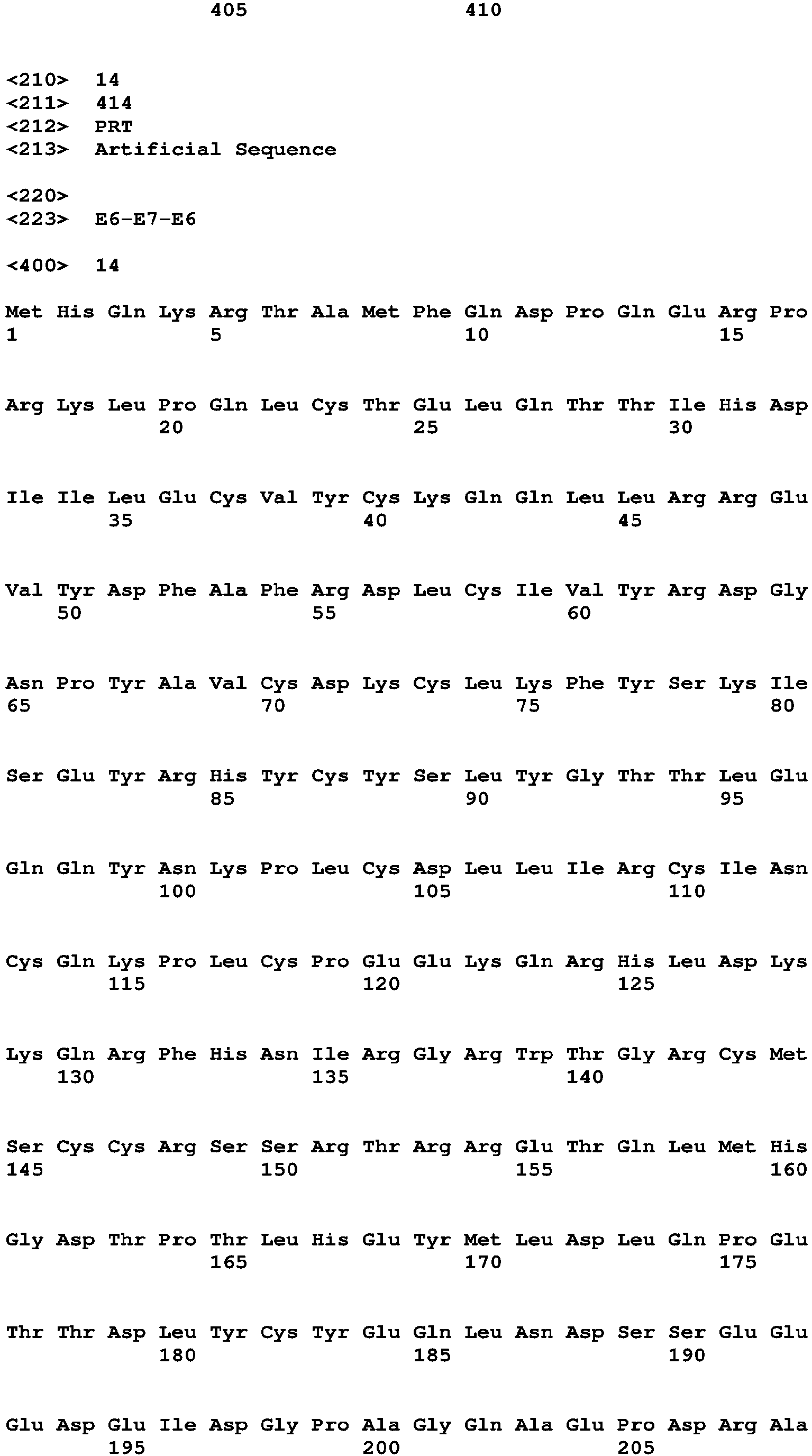


Claims (11)
- A mammalian cell expressing at least one protein selected from the group consisting of E6 protein and E7 protein for early genes of human papillomavirus and a fusion protein of E6 protein and E7 protein, and expressing CD1d protein, wherein the mammalian cell is pulsed with a CD1d ligand.
- The cell according to claim 1, wherein the E6 protein and E7 protein for early genes of human papillomavirus are independently expressed.
- The cell according to claim 2, wherein the E6 protein and E7 protein are expressed in the form of a fusion protein.
- The cell according to claim 3, wherein the fusion protein comprises E7 protein, E6 protein and E7 protein in this order.
- A fusion protein comprising E7 protein, E6 protein and E7 protein in this order.
- A nucleic acid encoding a fusion protein comprising E7 protein, E6 protein and E7 protein in this order.
- An expression vector for a fusion protein comprising E7 protein, E6 protein and E7 protein in this order, the vector comprising a nucleic acid encoding the fusion protein.
- A pharmaceutical composition comprising the cell according to any one of claims 1 to 4, the fusion protein according to claim 5, the nucleic acid according to claim 6 or the vector according to claim 7.
- The pharmaceutical composition according to claim 8, for administration to a human subject infected with human papillomavirus.
- The pharmaceutical composition according to claim 9, wherein the human subject has a cancer caused by human papillomavirus.
- The pharmaceutical composition according to claim 10, wherein the cancer caused by human papillomavirus is a cancer selected from the group consisting of cervical cancer, anal cancer and vaginal cancer.
Applications Claiming Priority (2)
| Application Number | Priority Date | Filing Date | Title |
|---|---|---|---|
| JP2019110834A JP7125760B2 (en) | 2019-06-14 | 2019-06-14 | Cells that stimulate the immune system and pharmaceutical compositions containing the cells |
| PCT/JP2020/023197 WO2020251014A1 (en) | 2019-06-14 | 2020-06-12 | Cell capable of activating immune system, and pharmaceutical composition containing said cell |
Publications (2)
| Publication Number | Publication Date |
|---|---|
| EP3984552A1 true EP3984552A1 (en) | 2022-04-20 |
| EP3984552A4 EP3984552A4 (en) | 2023-07-12 |
Family
ID=73781276
Family Applications (1)
| Application Number | Title | Priority Date | Filing Date |
|---|---|---|---|
| EP20822017.8A Pending EP3984552A4 (en) | 2019-06-14 | 2020-06-12 | IMMUNE SYSTEM ACTIVATING CELL AND PHARMACEUTICAL COMPOSITION CONTAINING SUCH CELL |
Country Status (6)
| Country | Link |
|---|---|
| US (1) | US20220251574A1 (en) |
| EP (1) | EP3984552A4 (en) |
| JP (1) | JP7125760B2 (en) |
| CN (1) | CN114096670B (en) |
| CA (1) | CA3143317A1 (en) |
| WO (1) | WO2020251014A1 (en) |
Family Cites Families (13)
| Publication number | Priority date | Publication date | Assignee | Title |
|---|---|---|---|---|
| US20130189302A1 (en) * | 2006-02-22 | 2013-07-25 | Riken | Immunotherapeutic method using artificial adjuvant vector cells that co-express cd1d and target antigen |
| ES2774707T3 (en) | 2006-02-22 | 2020-07-22 | Riken | Immunotherapy using cells capable of co-expressing a target antigen and CD1d and pulsed with a CD1d ligand |
| US8137674B2 (en) | 2006-04-19 | 2012-03-20 | Postech Foundation | Compositions comprising HPV polypeptides and immunoenhancement peptides for the treatment and prevention of cervical cancer |
| EP1938836A1 (en) * | 2006-12-28 | 2008-07-02 | Universite Rene Descartes (Paris V) | Compositions comprising a B subunit of shiga toxin and a means stimulating NKT cells |
| JPWO2010061930A1 (en) | 2008-11-28 | 2012-04-26 | 独立行政法人理化学研究所 | Immunotherapy using CD1d and target antigen co-expressing allocells |
| US10316332B2 (en) * | 2011-07-29 | 2019-06-11 | Riken | Cell for immunotherapy, including modified nucleic acid construct encoding Wilms tumor gene product |
| US9783821B2 (en) | 2011-07-29 | 2017-10-10 | Riken | Cell for use in immunotherapy which contains modified nucleic acid construct encoding wilms tumor gene product or fragment thereof, method for producing said cell, and said nucleic acid construct |
| CN103772508B (en) * | 2014-01-15 | 2017-05-10 | 深圳泰来生物医药有限公司 | Therapeutic vaccine for immune-enhanced human papilloma virus infection and related diseases |
| CN115197965A (en) | 2015-06-10 | 2022-10-18 | 霍欧奇帕生物科技有限公司 | HPV vaccine |
| CN106554386A (en) * | 2015-09-25 | 2017-04-05 | 广州恒上医药技术有限公司 | The epitope peptide of human papillomavirus and its application |
| SG11201802913VA (en) * | 2015-10-14 | 2018-05-30 | Advaxis Inc | Recombinant listeria vaccine strains and methods of using the same in cancer immunotherapy |
| JP2019514988A (en) | 2016-05-09 | 2019-06-06 | ターンストーン リミテッド パートナーシップ | Combination prime: boost therapy |
| CN108794623B (en) * | 2018-07-04 | 2021-08-13 | 北京索莱宝科技有限公司 | A kind of monoclonal antibody against HPV16 E6 protein and its application |
-
2019
- 2019-06-14 JP JP2019110834A patent/JP7125760B2/en active Active
-
2020
- 2020-06-12 CN CN202080042579.1A patent/CN114096670B/en active Active
- 2020-06-12 US US17/618,699 patent/US20220251574A1/en active Pending
- 2020-06-12 CA CA3143317A patent/CA3143317A1/en active Pending
- 2020-06-12 EP EP20822017.8A patent/EP3984552A4/en active Pending
- 2020-06-12 WO PCT/JP2020/023197 patent/WO2020251014A1/en not_active Ceased
Also Published As
| Publication number | Publication date |
|---|---|
| EP3984552A4 (en) | 2023-07-12 |
| JP7125760B2 (en) | 2022-08-25 |
| CN114096670B (en) | 2024-10-18 |
| CN114096670A (en) | 2022-02-25 |
| US20220251574A1 (en) | 2022-08-11 |
| CA3143317A1 (en) | 2020-12-17 |
| WO2020251014A1 (en) | 2020-12-17 |
| JP2020202750A (en) | 2020-12-24 |
Similar Documents
| Publication | Publication Date | Title |
|---|---|---|
| Molodtsov et al. | Tissue resident CD8 memory T cell responses in cancer and autoimmunity | |
| Barros Jr et al. | Activities of stromal and immune cells in HPV-related cancers | |
| TW202003032A (en) | Extracellular vesicle comprising STING-agonist | |
| EP3277313B1 (en) | Agents and compositions for eliciting an immune response | |
| TW202428301A (en) | Therapeutic rna | |
| Gordy et al. | Treatment with an immature dendritic cell-targeting vaccine supplemented with IFN-α and an inhibitor of DNA methylation markedly enhances survival in a murine melanoma model | |
| KR20220029560A (en) | Novel cancer antigens and methods | |
| JP7834016B2 (en) | Novel cancer antigens and methods | |
| Nguyen et al. | Neoantigen-based mRNA vaccine exhibits superior anti-tumor activity compared to synthetic long peptides in an in vivo lung carcinoma model | |
| CN117295820A (en) | Chimeric antigen receptor using CCR8 as antigen recognition | |
| JP2022514116A (en) | New cancer antigens and methods | |
| Tian et al. | Agonists for cytosolic bacterial receptor ALPK1 induce antitumour immunity | |
| Wang et al. | HBsAg-tagged tumour vaccine system eliminates solid tumours through virus-specific memory T cells | |
| US20180008704A1 (en) | Cd200 inhibitors and methods of use thereof | |
| US20220251574A1 (en) | Cell capable of activating immune system, and pharmaceutical composition containing said cell | |
| Kato et al. | RIG-I helicase-independent pathway in sendai virus-activated dendritic cells is critical for preventing lung metastasis of AT6. 3 prostate cancer | |
| WO2023036169A1 (en) | Antigen binding proteins and uses thereof | |
| JP7655566B2 (en) | Tumor immunotherapy using sindbis virus vectors and agonistic monoclonal antibodies | |
| US20230257713A1 (en) | Immunotherapy method of targeted chemokine and cytokine delivery by mesenchymal stem cell | |
| Zhang et al. | mRNA-encoded mutant HPV16/18 vaccines promote specific T-cell responses and synergize with anti-PD-1 checkpoint blockade in mediating therapeutic tumor regression in mice | |
| LU600082B1 (en) | An Engineered Near-Infrared Light Responsive Exosome, and a Preparation Method and Application Thereof | |
| US20260021184A1 (en) | Cancer Antigens and Methods | |
| US20260124295A1 (en) | Use of lipid nanoparticles and immune checkpoint inhibitors in the treatment of cancer | |
| Nexus | Nanobody-based CAR NK-92 cells for possible immunotherapy of MICA+ tumors | |
| WO2025224446A1 (en) | Novel cancer antigens and methods |
Legal Events
| Date | Code | Title | Description |
|---|---|---|---|
| STAA | Information on the status of an ep patent application or granted ep patent |
Free format text: STATUS: THE INTERNATIONAL PUBLICATION HAS BEEN MADE |
|
| PUAI | Public reference made under article 153(3) epc to a published international application that has entered the european phase |
Free format text: ORIGINAL CODE: 0009012 |
|
| STAA | Information on the status of an ep patent application or granted ep patent |
Free format text: STATUS: REQUEST FOR EXAMINATION WAS MADE |
|
| 17P | Request for examination filed |
Effective date: 20211214 |
|
| AK | Designated contracting states |
Kind code of ref document: A1 Designated state(s): AL AT BE BG CH CY CZ DE DK EE ES FI FR GB GR HR HU IE IS IT LI LT LU LV MC MK MT NL NO PL PT RO RS SE SI SK SM TR |
|
| DAV | Request for validation of the european patent (deleted) | ||
| DAX | Request for extension of the european patent (deleted) | ||
| A4 | Supplementary search report drawn up and despatched |
Effective date: 20230612 |
|
| RIC1 | Information provided on ipc code assigned before grant |
Ipc: A61K 35/12 20150101ALI20230605BHEP Ipc: A61K 31/7088 20060101ALI20230605BHEP Ipc: A61K 38/16 20060101ALI20230605BHEP Ipc: C12N 15/63 20060101ALI20230605BHEP Ipc: C12N 15/62 20060101ALI20230605BHEP Ipc: C12N 15/37 20060101ALI20230605BHEP Ipc: C12N 5/10 20060101ALI20230605BHEP Ipc: C07K 19/00 20060101ALI20230605BHEP Ipc: C07K 14/025 20060101ALI20230605BHEP Ipc: A61P 35/00 20060101ALI20230605BHEP Ipc: A61P 31/20 20060101ALI20230605BHEP Ipc: A61K 39/12 20060101AFI20230605BHEP |