EP3982289B1 - Verfahren zur validierung der echtheit eines in einem objekt vorhandenen bildes, objekt mit erhöhter sicherheitsstufe und verfahren zur herstellung davon, computerausrüstung, computerprogramm und entsprechendes lesemittel - Google Patents
Verfahren zur validierung der echtheit eines in einem objekt vorhandenen bildes, objekt mit erhöhter sicherheitsstufe und verfahren zur herstellung davon, computerausrüstung, computerprogramm und entsprechendes lesemittel Download PDFInfo
- Publication number
- EP3982289B1 EP3982289B1 EP20756999.7A EP20756999A EP3982289B1 EP 3982289 B1 EP3982289 B1 EP 3982289B1 EP 20756999 A EP20756999 A EP 20756999A EP 3982289 B1 EP3982289 B1 EP 3982289B1
- Authority
- EP
- European Patent Office
- Prior art keywords
- validated
- image
- descriptors
- original image
- authenticity
- Prior art date
- Legal status (The legal status is an assumption and is not a legal conclusion. Google has not performed a legal analysis and makes no representation as to the accuracy of the status listed.)
- Active
Links
Images



Classifications
-
- G—PHYSICS
- G06—COMPUTING OR CALCULATING; COUNTING
- G06F—ELECTRIC DIGITAL DATA PROCESSING
- G06F21/00—Security arrangements for protecting computers, components thereof, programs or data against unauthorised activity
- G06F21/10—Protecting distributed programs or content, e.g. vending or licensing of copyrighted material ; Digital rights management [DRM]
- G06F21/16—Program or content traceability, e.g. by watermarking
-
- G—PHYSICS
- G06—COMPUTING OR CALCULATING; COUNTING
- G06T—IMAGE DATA PROCESSING OR GENERATION, IN GENERAL
- G06T1/00—General purpose image data processing
-
- G—PHYSICS
- G06—COMPUTING OR CALCULATING; COUNTING
- G06F—ELECTRIC DIGITAL DATA PROCESSING
- G06F21/00—Security arrangements for protecting computers, components thereof, programs or data against unauthorised activity
- G06F21/30—Authentication, i.e. establishing the identity or authorisation of security principals
- G06F21/31—User authentication
- G06F21/32—User authentication using biometric data, e.g. fingerprints, iris scans or voiceprints
-
- G—PHYSICS
- G06—COMPUTING OR CALCULATING; COUNTING
- G06V—IMAGE OR VIDEO RECOGNITION OR UNDERSTANDING
- G06V20/00—Scenes; Scene-specific elements
- G06V20/80—Recognising image objects characterised by unique random patterns
-
- G—PHYSICS
- G06—COMPUTING OR CALCULATING; COUNTING
- G06V—IMAGE OR VIDEO RECOGNITION OR UNDERSTANDING
- G06V30/00—Character recognition; Recognising digital ink; Document-oriented image-based pattern recognition
- G06V30/40—Document-oriented image-based pattern recognition
- G06V30/41—Analysis of document content
-
- G—PHYSICS
- G06—COMPUTING OR CALCULATING; COUNTING
- G06V—IMAGE OR VIDEO RECOGNITION OR UNDERSTANDING
- G06V40/00—Recognition of biometric, human-related or animal-related patterns in image or video data
- G06V40/10—Human or animal bodies, e.g. vehicle occupants or pedestrians; Body parts, e.g. hands
- G06V40/16—Human faces, e.g. facial parts, sketches or expressions
- G06V40/168—Feature extraction; Face representation
- G06V40/169—Holistic features and representations, i.e. based on the facial image taken as a whole
-
- G—PHYSICS
- G06—COMPUTING OR CALCULATING; COUNTING
- G06V—IMAGE OR VIDEO RECOGNITION OR UNDERSTANDING
- G06V20/00—Scenes; Scene-specific elements
- G06V20/95—Pattern authentication; Markers therefor; Forgery detection
Definitions
- the present invention refers to a computer implemented method for intensification of the security level against alteration and counterfeiting of an object to be validated and to provide the validation of the authenticity of an image present in an object, where the object is part of the technical field of graph security.
- the present invention further comprises an original object with intensified security level against alteration and counterfeiting and the respective method of preparation.
- the present invention further comprises computer devices for reading encoded information in an image comprising means adapted to execute the steps of the method, to computer programs with instructions for executing the methods of the invention and to reading means for a computer equipment with the respective computer programs installed.
- Graph security represents a relevant function in the guarantee of trust in society relations, between the State, the citizens and the organizations, that require authentic and reliable documents and values, such as validation and authentication seals, tags and labels for products, personal and corporate identification documents and diplomas and certificates.
- Halftone Visual Cryptography Another steganography technique is the Halftone Visual Cryptography. This method follows an approach that is distinct from the LSB one.
- an image is encoded in several images with black and white pixels (halftone), which do not present characteristics of the original image visually perceived by a human being.
- black and white pixels halftone
- One of the characteristics of the final image of the Halftone Visual Cryptography process is the total loss of the aesthetic value of the original image, which comes to resemble a white noise, that is, without any detectable or identifiable form by a human being, losing, for example, the aesthetic value of the image.
- the present invention in a first aspect, refers to a computer implemented method for intensifying the security level against alteration and counterfeiting of an object and to provide validation of the authenticity of an image present in an object characterized by comprising the following steps:
- the present invention refers to a computer equipment (10) comprising means adapted to execute the steps of the method implemented by computer for validation of an object to be validated;
- the present invention refers to a computer equipment (10) comprising means adapted to execute the steps of the method implemented by computer for the preparation of the original object.
- the descriptors of the original image (7) are associated to distinct and unique characteristics of the original image (3) and can also be associated to a significant level of distinction as regards the similar images.
- the original image (3) is the photograph of the face of a person or a random pattern, printed, of glitter particles mixed with ink.
- the descriptors of the original image (7) may be related to characteristics of the geometric positions of the particles in connection with a reference point in the image, such as, the geometric coordinates in relation to the mass center, the geometric coordinates in relation to a specific reference point, or the density of the particles in numbered parts of the distribution of points, or other topological characteristics of the particle distribution.
- the descriptors of the image to be validated (8) are calculated, corresponding to those selected as descriptors of the original image (7) as well as the particle density in numbered parts of the image of the distribution of points, or other topological characteristics of the particle distribution image.
- the original image (3) is a hologram pattern which reflector image has one or several graphic motives that reflect with variable intensities, colors and energy depending on the orientation of the pattern, in relation to the capture camera and depending on one or more points of origin of light.
- the reflected color patterns and the information on luminance, chrominance, and spectral light components, as well as the geometric coordinates of the graphic patterns of the hologram matrix are analyzed.
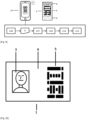
- Figure 9 illustrates an embodiment of an original object according to the present invention, related to an identity document, comprising the photograph of a person and a digital marker.
- Figure 10 illustrates an embodiment of an original object according to the present invention, related to an authenticity guarantee seal for a product, comprising at least one original image and one digital marker, where the original image presents a random pattern, printed, of glitter particles mixed with ink.
- the original object according to the present invention can comprise more than one original image, for example a hologram.
- OpenCV is an example of application open to the public which has a significant set of tools for detecting faces and special characteristics in images.
- the step of validation of authenticity comprises a step of rectification of the image to be validated (4) as regards the original image (3) and optionally a step of rectification of the digital marker to be validated (6) in relation to the digital marker with encoded information of the original image (5).
- the image rectification techniques used in the present invention are the usual ones of the state of the art and consist in applying a series of transformations to two or more images, so that the corresponding points are in the same y-coordinate in all of them. This technique is frequently used in computer vision particularly for optimizing the process of finding corresponding points between different images.
- the coordinates of the descriptors of the original image (7) and the coordinates of the descriptors of the image to be validated (8) may correspond to anchor points in the rectification step, which will allow the adequate comparison between the original rectified image (3) and the rectified image to be validated (4).
- the alignment of the respective vectors related to the coordinates of the descriptors of the original image (7) and the coordinates of the descriptors of the image to be validated (8) is made.
- Another applicable measure comprises the due framing of the images being compared in a same scale. In this manner, it is possible to obtain a vector corresponding to the absolute and normalized difference between the vectors of the descriptors of the original image (7) and the vectors of the descriptors of the image to be validated (8).
- the decision making step as to the authenticity takes into account whether the absolute and normalized difference between the vectors of the descriptors of the original image (7) and the vectors of the descriptors of the image to be validated (8) fit into a pre-determined acceptable range.
- the validation of authenticity of at least one image to be validated (4) and of at least one digital marker to be validated (6) materialized in an object to be validated (2) is a main objective of the present invention as regards the encoded information extracted from at least one original image (3) and the encoded information present in at least one digital marker with encoded information of the original image (5).
- a receiver operating characteristic curve In a ROC curve, the rate of positive correspondence between the original image (3) and the image to be validated (4), referring to the sensitivity, is plotted depending on the rate of false-positive correspondences between the original image (3) and the image to be validated (4), where this last rate is related to the specificity of threshold contour points.
- Each point of the ROC curve is related to a pair of specificity/sensitivity corresponding to a specific decision.
- the sensitivity is the ratio between the number of positive correspondences and the sum of positive and false-negative correspondences.
- the specificity is the ratio between the number of negative correspondences and the sum of false-positive correspondences and of negative correspondences.
- the area under the curve represents a measure of how one parameter can adequately distinguish two diagnosis groups.
- an analysis by means of the comparison between the coordinates of the descriptors of the image to be validated (8) and the coordinates of the descriptors of the original image (7) is used, optionally comprising weighing factors associated to one or more of the respective descriptors.
- calculated functions may be used, for example, from the coordinates, from the texture characteristics or from the elements of the descriptors.
- an analysis by means of the comparison between the coordinates of the descriptors of the image to be validated (8) and the coordinates of the descriptors of the original image (7) may be carried out with the use of a ROC curve.
- the step of validation of the authenticity of at least one image to be validated (4) and of at least one digital marker to be validated (6), materialized in an object to be validated (2) an analysis is made by means of one or more distance relations between the descriptors of the image to be validated (8) and the descriptors of the original image (7), optionally comprising weighing factors associated to one or more of the referred distance relations.
- This alternative embodiment is particularly advantageous since, in the authentication of an image to be validated (4) as regards the original image (3), it was observed that the differences between the distance vectors between the descriptors of the original image (7) and the descriptors of the image to be validated (8) are similar for different regions of the image from which the different descriptors were selected.
- the selection of the distance relations between the contour points of the image must take into account the instability of the relation within a determined sample set, where the instability contemplates the specific level of differentiating capacity of a given relation of distances between contour lines.
- the step of validation of authenticity of at least one image to be validated (5) and of at least one digital marker to be validated (6) printed on an object to be validated can be carried out by an analysis by means of neural networks, which can be configured by means of the following steps:
- the neural networks can be developed with the incorporation of some layers for receival and processing of data.
- one layer may be related to the processing of the normalized differences between the coordinates of the descriptors of the original image (7) and of the descriptors of the image to be validated (8).
- another layer may be related to the execution of a binary test for verifying the true and false results in terms of compatibility between the coordinates.
- the learning tests for the neural network can be carried out with real training data or generated data, where the generated data can comprise the intentional addition of defects, manipulations or distortions in the images.
- the computer implemented method for intensifying the security level against alteration and counterfeiting of an object and to provide the validation of authenticity of at least one image to be validated (4) and of at least one digital marker to be validated (6), materialized in an object to be validated (2) comprises the analysis of the texture characteristics in the original image (3) by means of one or more of the techniques of the local binary pattern histogram (LBP), the histogram of oriented gradients (HoG) and the gray level co-occurrence matrix (GLCM).
- LBP local binary pattern histogram
- HoG histogram of oriented gradients
- GLCM gray level co-occurrence matrix
- these techniques use descriptors corresponding to the differences between the referred techniques applied to one or more descriptors of the original image (7) and to one or more descriptors of the image to be validated (8).
- the local binary pattern histogram (LBP) technique is known from " Face Description with Local Binary Patterns: Application to Face Recognition” (Timo Ahonen; Abdenour Hadid; Matti Pietikäinen), IEEE, Pattern Analysis and Machine Intelligence, December 2006, vol. 28 (12), 2037-2041 , for use in processing of images including detection or identification of objects in an image.
- This technique is based on the attribution of decimal numbers for each pixel of an image and establishes a binary pattern for each pixel, considering its decimal number and the decimal numbers of eight neighbor pixels. Therefore, as illustrated in Figure 3 , the LBP technique establishes a correspondence between decimal numbers based on texture characteristics and binary values for a set of pixels.
- this correspondence between the decimal values and the respective binary values of a set of pixels can be recovered from an original image and compared with the corresponding values for an image to be validated.
- the model requires normalization of the data to obtain a coherent texture descriptor.
- the method comprises the selection of parts of an image and the processing thereof and eventual re-dimensioning so as to obtain the descriptors or that part of the image that has useful information, eliminating useless information, such as the color contained in the background of an image.
- To calculate a HoG descriptor it is necessary to calculate the horizontal and vertical gradients and subsequently calculate the histogram of gradients, where this task is carried out by means of the application of filters to the image with the kernels represented in Figure 4 .
- filters it is possible to attain the same results with a Sobel operator, for example in an OpenCV application, using a size 1 kernel.
- a division of the image is made in a determined number of cells, so that the noise is reduced, and the relevant characteristics of the image are not lost.
- the use of descriptors based on texture characteristics is based on a micro analysis mode of the image, for example attributing descriptors to specific portions of the image.
- the descriptors are attributed to regions of the face, preserving the intrinsic information of the sub-regions, such as the contour of the face, the mouth, the nose, the eyes, the eyebrows, the cheek and the chin.
- a macro analysis of the image may also be used, where the descriptors are applied to the image as a whole, dividing the image in sub-regions by means of adequate contour points.
- the sub-regions of the face can be delimited by the eyes, nose, left cheek and right cheek and moustache region.
- LBP local binary pattern histogram
- HoC histogram of oriented gradients
- the difference between the histograms of the two images can be preferably calculated by means of the neural networks.
- the difference can also be calculated by means of the distance between histograms by the chi-square technique (equation 1), when the LBP and HoG are applied, where 1 refers to one of the images and 2 refers to the other image in comparison and "I" refers to the respective image.
- the difference between the histograms of the two images being compared can also be calculated by means of the distance between histograms by the Bhattacharyya technique (equation 2), when the HoG technique is applied, where N is the total number of intervals of the histogram.
- Equation 2 1 ⁇ 1 H 1 H 2 N ⁇ I H 1 I ⁇ H 2 I
- the analysis of the characteristics of the texture in the original image (3) is executed by means of the gray level co-occurrence matrix (GLCM), which is a model of texture based on the information of the gray scale of pixels.
- GLCM gray level co-occurrence matrix
- the conventional GLCM technique is known from " Textural features for image classification" (R.M. Haralick, K. Shanmugam, I. Dinstein), IEEE Trans. Syst. Man Cybern. 3 (6) (1973) 610-621 .
- This technique aims to identify the spatial dependence in terms of tones of gray, by means of the extraction of the texture information referring to the transition of the levels of gray between two pixels.
- the technique computes the separate pairs of pixels in a determined zone having transition of levels of gray, resulting in the distribution of the gray tones.
- GLCM gray level co-occurrence matrix
- the re-dimensioning maintaining the original proportions of a determined image in gray levels is carried out by means of the re-dimensioning in a pre-determined scale, leading to a pyramidal decomposition of the image.
- this technique can also be used in the preferred embodiments of the step of validation of an image to be validated, by means of the evaluation of the differences between the histograms related to descriptors of texture referring the each pair of images being compared as the successive re-dimensioning are carried out in the direction of reducing the size of the images.
- the model of gray levels can also comprise an analysis of histograms of textures for the pairs involving the original image (3) and the image to be validated (4) when these are re-dimensioned to a determined reduced size and are subsequently gradually re-dimensioned to their original size.
- this process there is a loss of the resolution of the images that are re-dimensioned to a larger size and it is also expected to obtain a similarity to the histograms of the descriptors for each one of the images as the re-dimensioning in the direction of increase in size to the original size is executed.
- This similar variation between the histograms for each pair of images can also be used in the step of validation of the image to be validated (4).
- the model of the gray scale and the gray level co-occurrence matrix consist in preferred embodiments of the present invention in the step of validation of the authenticity of at least one image to be validated (4) and of at least one digital marker to be validated (6) in relation to an original image (3) and to a digital marker with encoded information of the original image (5).
- the image to be validated (4) and the original image (3) are carried, being respectively detected the descriptors of the image to be validated (8) and the descriptors of the original image (7).
- the image to be validated (4) is re-dimensioned and rectified, the descriptors of the image to be validated (8) being recalculated.
- the minimum values and the maximum values of the descriptors of the image to be validated (8) are selected, so as to create a rectangular region that includes the image to be validated (4), which is selected and cut out.
- the next step comprises the equalization of the original image (3) and of the image to be validated (4) and the successive re-dimensioning to the original image (3) and of the image to be validated (4), with the use, for example, of the GLCM, HoG or BLP techniques for each one of the re-dimensioned images, obtaining the vectors of the characteristics for each one of the images in each one of the different stages. Finally, the differences between the histograms of the two images are calculated for each one of the re-dimensioning steps so as to execute the validation.
- the data of the original images are stored in a database (13) and/or in tuples.
- the machine-readable visual element for data representation is a digital marker of bidimensional matrix.
- the digital marker is a digital marker of bidimensional matrix, selected from the group consisting of an Augmented Reality (AR) code, an Aztec code, a 16K code, a CRONTO code, a Dotcode, a Data Matrix, a JAB-Code, a MaxiCode, a PDF417, a PEQRC and a QR Code.
- AR Augmented Reality
- the digital marker is a UniQode.
- the UniQode is based on a digital marker created by means of the appropriate organization of cells, which are comprised of a specific format of pixel arrangement, typically in a 3x3 format. Some cell patterns are related to graphic symbols used for encoding, where the association between a model and a symbol is called a library. In one cell, the pixels are simultaneously used to attribute aesthetic characteristics and encoding ones.
- the generation of a UniQode is based on a quantic system, that is, a regular division of the gray scale in 10 classes.
- each set of cells is typically arranged in a 3x3 pixel format, being encoded in a pattern in which the quantum relates to the colors of the respective pixel in the base image.
- the quanta Q3, Q4, Q5 and Q6 are used to adequately associate the graphic symbols to models by means of the library.
- each pixel in a scale of grays is transformed into a set of pixels k x k in a black and white pattern.
- the UniQode digital markers can be differentiated in " Graphic Code: a New Machine Readable Approach” (Cruz L., Patr ⁇ o B. and Gongalves, N.), published in IEEE International Conference on Artificial Intelligence and Virtual Reality (AIVR), December 10 to 12, 2018 .
- the UniQode digital markers can also be referenced in " Halftone Pattern: A New Steganographic Approach” (Cruz L., Patr ⁇ o B. and Gongalves, N.), published in Eurographics 2018, EG 2018 - Short Papers .
- the encoding process begins by the identification of the cells arranged in a format of pixels and/or icons, typically 3x3, generating candidate cells. Next, one cell is selected per character of a message to be encoded and the referred character is replaced by the related pattern in a library. The remaining cells, both the non-selected candidate cells, as the non-candidate cells, are replaced by graphic elements, which are not listed in a library.
- an inverse process is carried out, where the search for patterns present in the library is carried out and whenever a pattern is located, the respective character is linked in the message to be encoded.
- UniQode has a storage capacity for numerical and/or alphanumerical characters, varying according to its dimension.
- UniQode can also comprise one or more encoded information referring to the traceability of the preparation of the original object (1), one or more encoded information used in the authenticity validation of at least one image to be validated (4) and one or more encoded information on the characteristics of the original object (1).
- At least one optical reader (11) is used, preferably a photographic camera.
- the step of validation of authenticity of at least one image to be validated (4) and of at least one digital marker to be validated (6), materialized in an object to be validated (2) comprises the following steps:
- the server consists in an application, one part of a computer system or a complete computer, that provides services to a network comprising one or more computer equipment, including the computer equipment (10).
- This network of computer equipment is capable of exchanging information and sharing resources, is interlinked by a communications system where the connections can be established by means of cable media or wireless media.
- a computer equipment (10) which may be a smartphone, comprising optical reader (11), that may be a camera of the smartphone, captures the image of an object to be validated (106) and the computer equipment (10) calculates the descriptors of at least one image to be validated (107).
- the optical reader (11) captures the image of a digital marker to be validated and executes the reading of a link that promotes the orientation to a server (109).
- the values calculated referring to the descriptors of the image to be validated (8) are sent to the encoded link in the digital marker to be validated (6).
- the steps of decoding the descriptors of the digital marker to be validated (108) are executed; of search in at least one database for the descriptors of the original image (111); and of validation of an image to be validated in an object to be validated (112), where the descriptors calculated for the image to be validated (4) are compared with the descriptors of the original image (3), which are stored in at least one database (13) comprising encoded information of the original image (3) and of the digital marker with encoded information of the original image (5).
- the step of validation of the authenticity of at least one image to be validated (4) and of at least one digital marker to be validated (6), materialized in an object to be validated (2) comprises the following steps:
- a computer equipment (10) which may be a smartphone, comprising optical reader (11), which may be a camera of the smartphone, captures the image of an object to be validated (106) and also captures the image of a digital marker to be validated.
- the computer equipment (10) sends the image to be validated (4) and the digital marker to be validated (6) to the server (12).
- the server (12) calculates the descriptors of at least one image to be validated (107).
- the server (12) additionally executes the decoding of the descriptors of the digital marker to be validated (108).
- the step of validation of an image to be validated is additionally executed in an object to be validated (112), where the descriptors calculated for the image to be validated (4) are compared with the descriptors of the original image (3), which are stored in at least one database (13) comprising encoded information of the original image (3) and of the digital marker with encoded information of the original image (3) and the digital marker with encoded information of the original image (5).
- the server also carries out the search in at least one database for the descriptors of the original image (111).
- the information search system to be searched in a database requires at least one metric of comparison between the information to be searched in the database and the tuples of the database.
- One of the methods most used to search is the KNN which at a first level of search covers all the elements of the database calculating the difference (or distance) between the information to be validated and the tuples.
- the k tuples are selected next with less difference (or distance).
- the method lists the elements using a second metric of comparison, measuring other characteristics of the elements to be compared.
- the result of the search will be the tuple of the database with less distance (selected from the tuples resulting from the first level of search) in case this minimum distance is equal to or smaller than an identification threshold. Otherwise, that is, in case the smaller distance is higher than the identification threshold, it is considered that the information to be searched in the database does not exist in the database.
- there exist in the state of the art other methodologies that improve or refine this KNN method, namely starting from searching in smaller searches or using some characteristics to reduce the dimension of the search.
- indexing techniques for databases that allow making indexed search to a direct information to be searched, for example, using part of the information to be searched as a search index in a database, that is, as a manner of listing the tuples.
- the step of validation of authenticity of at least one image to be validated (4) and of at least one digital marker to be validated (6), materialized in an object to be validated (2) comprises the following steps:
- This embodiment waives the use of a server and a computer network of equipment interlinked by a communications system.
- the method of verification of the authenticity of an object to be validated (2) can be carried out in an offline mode, using essentially the computer program installed in the computer equipment (10).
- a computer equipment (10) that can be a smartphone, comprising optical reader (11), that can be a smartphone camera, captures the image of an object to be validated (106) and the computer equipment (10) calculates the descriptors of at least one image to be validated (107).
- the step of validation of an image to be validated (112) and of the decision on the authenticity of an object to be validated (113) is executed in the computer equipment itself (10), where the descriptors calculated for the image to be validated (4) are compared with the descriptors of the original image (3), which are encoded in the digital marker to be and are read by means of optical reader (11).
- the decision step if the difference between the values calculated for the descriptors of the image to be validated (8) and the reference values of the descriptors in the original image (7) is higher than a pre-established limit, the decision on the authenticity of the object to be validated (113), taken in the server (12) will be considered negative, that is, the object to be validated (2) will not be considered authentic.
- the decision on the authenticity of the object to be validated (113), taken in the server (12) will be considered positive, that is, the object to be validated (2) will be considered authentic.
- the decision as to the authenticity is, in any of the two cases, sent to the computer equipment (10), which allows the exhibition of the result of the method of verification of the authenticity to the user.
- the step of decision on an object to be validated existing two vectors of coordinates corresponding to the characteristics or descriptors duly aligned, it is possible to obtain a normalized vector of absolute differences, for example, of the perimeter of the contour of the image of the face of a person.
- This normalized vector of the absolute differences can be used in the decision step on the authenticity. In fact, it is possible to add the elements of this vector and decide on the authenticity based on the comparison with a limiting value.
- the artificial neural networks can contribute to a more robust decision, when processing the differences of the vectors of the coordinates.
- the neural networks can be trained with a balanced set of examples and can comprise typically three layers in their architecture, apart from being configured to execute a binary test in the decision step.
- the neural network can be configured to return a value close to zero in case of a positive authenticity and one in case of a negative authenticity. Tests carried out with 4500 examples in the training of the neural network, led to true positive result rates of 0,06 and false positive result rates of 0,95 with a limit of 0,50.
- a distance between the two vectors corresponding to the descriptors of the original image (7) and the descriptors of the image to be validated (8) is calculated where the distance can be an Euclidian distance or other metric of distance of the state of the art.
- the sum of the absolute values of the differences of the two vectors of characteristic information referring to the descriptors in the original image (7) and the descriptors in the image to be validated (8) is calculated.
- an artificial neural network is used.
- the creation and materialization of a digital marker with encoded information of the original image (5) is used, where the referred digital marker is one of the elements of the object according to the present invention capable of being submitted to the step of validation of the object.
- the digital marker consists in a machine-readable visual element for data representation.
- the digital marker is a bidimensional matrix digital marker, selected from the group consisting of an AR augmented reality, an Aztec code, a 16K Code, a CRONTO code, a Dotcode, a Data Matrix, a JAB-Code, a MaxiCode, a PDF417 and a QR Code.
- the digital marker is a UniQode.
- the step of materialization comprises one or more of the techniques of printing, stamping, burn out, deposition, and engraving.
- the printing techniques are comprised techniques of flexography, offset, digital printing, gravure, and serigraphy.
- the burn out technique may be implemented by lasers.
- the object with intensified security level against alteration and counterfeiting contemplates the materialization of an original image (3) and of the digital marker with encoded information of the original image (5) in a physical support (9), which can be selected from one or more of the group consisting in a cellulose base, a metallic base or a polymeric material base.
- An original image (3) present in the original object can consist of at least one element selected from a photograph of the face of a person, an image associated to the quality control of a product, an image associated to the identification or traceability of a product, an image associated to biometric aspects and an image associated to the origin of a product.
- the object with intensified security level against alteration and counterfeiting of the invention can be selected, for example, from among a stamp, a label, a tag, an official seal, a document, a banknote, an identity card, an identity document, a travel document, a diploma and a certificate.
- the object can comprise different visual elements, such as: printed images, security holograms, texts, barcodes (unidimensional or bidimensional), logos, watermarks, random patterns, guilloché, microtexts, among other graphic elements.
- inks enriched with insoluble metallic markers can be used and with random positioning, in several levels of intensity. Additionally, special inks can be used that absorb or reflect infrared light, ultraviolet light, or polarized light.
- the materialization of the objects according to the present invention can also be carried out by means of iridescent pains, thermochromic inks, photochromic inks, optically variable inks, or magnetic inks.
- the expression “substantially” means that the real value is within around 10% of the desired value, variable or related limit, particularly within around 5% of the desired value, variable or related limit or particularly within around 1 % of the desired value, variable or related limit.
Landscapes
- Engineering & Computer Science (AREA)
- Theoretical Computer Science (AREA)
- Physics & Mathematics (AREA)
- General Physics & Mathematics (AREA)
- Multimedia (AREA)
- Software Systems (AREA)
- Computer Vision & Pattern Recognition (AREA)
- Computer Security & Cryptography (AREA)
- Oral & Maxillofacial Surgery (AREA)
- Health & Medical Sciences (AREA)
- Computer Hardware Design (AREA)
- General Engineering & Computer Science (AREA)
- General Health & Medical Sciences (AREA)
- Human Computer Interaction (AREA)
- Artificial Intelligence (AREA)
- Technology Law (AREA)
- Editing Of Facsimile Originals (AREA)
- Image Processing (AREA)
Claims (28)
- Computerimplementiertes Verfahren zur Erhöhung des Sicherheitsniveaus eines Objekts gegen Veränderung und Fälschung und zur Validierung der Echtheit eines in einem Objekt vorhandenen Bildes, dadurch gekennzeichnet, dass es die folgenden Schritte umfasst:a) Verarbeitung mindestens eines Originalbildes (3), worin mindestens ein Originalbild (3) eine Fotografie des Gesichts einer Person ist;b) Zuordnung von mindestens einer im Originalbild (3) vorhandenen zu kodierenden Information (3) zu einem oder mehreren grafischen Elementmustern zur Darstellung von Daten in einem maschinenlesbaren visuellen Element;c) Erzeugung von mindestens einem digitalen Marker mit kodierten Informationen des Originalbildes (5), wobei der digitale Marker (5) mindestens ein Muster von grafischen Elementen zur Darstellung von Daten umfasst, die aus Schritt b) erhalten wurden, worin das besagte maschinenlesbare visuelle Element zur Datendarstellung der besagte digitale Marker mit codierten Informationen des Originalbildes (5) ist, bei dem es sich um einen zweidimensionalen digitalen Matrixmarker handelt, worin die kodierte Information des Originalbildes Deskriptoren des Originalbildes (7) umfasst;d) Validierung der Echtheit mindestens eines zu validierenden Bildes (4) und von mindestens einem zu validierenden digitalen Marker (6), materialisiert in einem zu validierenden Objekt (2), durch den Vergleich von kodierten Informationen, die aus mindestens einem zu validierenden Bild (4) berechnet wurden, mit der codierten Information, die mindestens einem Originalbild (3) entspricht, und durch die Verarbeitung der kodierten Informationen, die in mindestens einem zu validierenden digitalen Marker (6) sowie die Verarbeitung der codierten Informationen, die in mindestens einem digitalen Marker mit den kodierten Informationen des Originalbildes (5) vorhanden sind, wobei das besagte zu validierende Bild (4) aus einer Fotografie eines Bildes besteht;e) Entscheidung über die Echtheit von mindestens einem zu validierenden Bild (4) und von mindestens einem zu validierenden digitalen Marker (6), der in einem zu validierenden Objekt (2) materialisiert ist;worin der Schritt d) der Validierung der Echtheit von mindestens einem zu validierenden Bild (4) und von mindestens einem zu validierenden digitalen Marker (6), materialisiert in einem zu validierenden Objekt (2), den Vergleich einer oder mehrerer geometrischer Eigenschaften und/oder einer oder mehrerer Textureigenschaften und/oder einer oder mehrerer dreidimensionaler Tiefeneigenschaften und/oder einer oder mehrerer zufälliger Dispersionsmerkmale der Partikeldichte in dem zu validierenden Bild (4) mit den jeweiligen Merkmalen des Originalbildes (3) umfasst, wobei die genannten Merkmale des zu validierenden Bildes (4) und des Originalbildes (3) jeweils anhand eines oder mehrerer Deskriptoren des zu validierenden Bildes (8) und anhand eines oder mehrerer Deskriptoren des Originalbildes (7) definiert werden;worin der Schritt d) der Validierung der Echtheit mindestens eines zu validierenden Bildes (4) und mindestens eines zu validierenden digitalen Markers (6), der in einem zu validierenden Objekt (2) materialisiert ist, die Verwendung einer Analyse mittels des Verhältnisses der Abstände zwischen den Deskriptoren des zu validierenden Bildes (8) und den Deskriptoren des Originalbildes (7) umfasst, einschließlich der Gewichtungsfaktoren, die mit einem oder mehreren der genannten Abstandsbeziehungen verbunden sind;worin der Schritt e) der Entscheidung über die Echtheit mindestens eines zu validierenden Bildes (4) und mindestens eines zu validierenden digitalen Markers (6), der in einem zu validierenden Objekt (2) materialisiert ist, die Berücksichtigung umfasst, ob eine absolute und eine normierte Differenz zwischen den Vektoren der Deskriptoren des Originalbildes (7) und den Vektoren der Deskriptoren des zu validierenden Bildes (8) in einen vorher festgelegten akzeptablen Bereich passt;worin die im Originalbild (3) vorhandenen zu kodierenden Informationen einen oder mehrere Deskriptoren des Originalbildes (7) umfassen, die den geometrischen Eigenschaften eines oder mehrerer Elemente des Gesichts zugeordnet sind, die aus der Gruppe ausgewählt werden, die aus der Kontur des Gesichts, dem Mund, der Nase, den Augen, den Augenbrauen, den Wangen und dem Kinn besteht.
- Computerimplementiertes Verfahren zur Erhöhung des Sicherheitsniveaus eines Objekts gegen Veränderung und Fälschung und zur Validierung der Echtheit eines in einem Objekt vorhandenen Bildes gemäß Anspruch 1, dadurch gekennzeichnet, dass der Schritt der Validierung der Echtheit einen Schritt der Berichtigung des zu validierenden Bildes (4) in Bezug auf das Originalbild (3) und optional einen Schritt der Berichtigung des zu validierenden digitalen Markers (6) in Bezug auf den digitalen Marker mit kodierten Informationen des Originalbildes (5) umfasst.
- Computerimplementiertes Verfahren zur Erhöhung des Sicherheitsniveaus eines Objekts gegen Veränderung und Fälschung und zur Validierung der Echtheit eines in einem Objekt vorhandenen Bildes gemäß einem der vorhergehenden Ansprüche, dadurch gekennzeichnet, dass im Schritt der Validierung der Echtheit mindestens eines zu validierenden Bildes (4) und mindestens eines zu validierenden digitalen Markers (6), der in einem zu validierenden Objekt materialisiert ist (2), die Analyse einer Empfänger-Betriebskennlinie (ROC-Kurve) verwendet wird.
- Computerimplementiertes Verfahren zur Erhöhung des Sicherheitsniveaus eines Objekts gegen Veränderung und Fälschung und zur Validierung der Echtheit eines in einem Objekt vorhandenen Bildes gemäß einem der vorhergehenden Ansprüche, dadurch gekennzeichnet, dass im Schritt der Validierung der Echtheit mindestens eines zu validierenden Bildes (4) und mindestens eines zu validierenden digitalen Markers (6), der in einem zu validierenden Objekt materialisiert ist (2), eine Analyse mittels des Vergleichs zwischen den Koordinaten der Deskriptoren des zu validierenden Bildes (8) und den Koordinaten der Deskriptoren des Originalbildes (7) verwendet wird, die optional Gewichtungsfaktoren umfasst, die einem oder mehreren der jeweiligen Deskriptoren zugeordnet sind.
- Computerimplementiertes Verfahren zur Erhöhung des Sicherheitsniveaus eines Objekts gegen Veränderung und Fälschung und zur Validierung der Echtheit eines in einem Objekt vorhandenen Bildes gemäß einem der vorhergehenden Ansprüche, dadurch gekennzeichnet, dass im Schritt der Validierung der Echtheit mindestens eines zu validierenden Bildes (4) und mindestens eines zu validierenden digitalen Markers (6), der in einem zu validierenden Objekt (2) materialisiert ist, eine Analyse mittels eines neuronalen Netzes verwendet wird, das mittels der folgenden Schritte konfiguriert wird:i. Auswahl eines ersten Probensatzes mit einer Anzahl von Koordinaten der Deskriptoren im Originalbild (7) zum Training des neuronalen Netzes;ii Auswahl eines zweiten Probensatzes mit einer Anzahl von Koordinaten der Deskriptoren des zu validierenden Bildes (8) zum Training des neuronalen Netzes;iii Ermittlung der normierten Differenzen zwischen den Koordinaten der Deskriptoren des Originalbildes (7) und den Koordinaten der Deskriptoren des zu validierenden Bildes (8);iv. Festlegung der Akzeptanzwerteintervalle für positive Verifikationsergebnisse zwischen dem Originalbild (3) und dem zu validierenden Bild (4).
- Computerimplementiertes Verfahren zur Erhöhung des Sicherheitsniveaus eines Objekts gegen Veränderung und Fälschung und zur Validierung der Echtheit eines in einem Objekt vorhandenen Bildes gemäß einem der vorhergehenden Ansprüche, dadurch gekennzeichnet, dass im Schritt der Validierung der Echtheit mindestens eines zu validierenden Bildes (4) und mindestens eines zu validierenden digitalen Markers (6), der in einem zu validierenden Objekt (2) materialisiert ist, die Analyse der Eigenschaften der Textur im Originalbild (3) mittels einer der Techniken der lokalen binären Musterhistogramme (LBP), des Histogramms der orientierten Gradienten (HOG) und der Grauwertematrix (GLCM) durchgeführt wird.
- Computerimplementiertes Verfahren zur Erhöhung des Sicherheitsniveaus eines Objekts gegen Veränderung und Fälschung und zur Validierung der Echtheit eines in einem Objekt vorhandenen Bildes gemäß Anspruch 6, dadurch gekennzeichnet, dass die Deskriptoren des Originalbildes (7) und Deskriptoren des zu validierenden Bildes (8) verwendet werden, die durch die Anwendung einer oder mehrerer der Techniken der lokalen binären Musterhistogramme (LBP) des Histogramm der orientierten Gradienten (HOG) und und der Grauwertematrix (GLCM) erhalten werden, wobei die Unterschiede zwischen den genannten Techniken auf einen oder mehrere Deskriptoren des Originalbildes (7) und einen oder mehrere der Deskriptoren des zu validierenden Bildes (8) angewendet werden.
- Computerimplementiertes Verfahren zur Erhöhung des Sicherheitsniveaus eines Objekts gegen Veränderung und Fälschung und zur Validierung der Echtheit eines in einem Objekt vorhandenen Bildes gemäß dem vorhergehenden Anspruch, dadurch gekennzeichnet, dass mindestens ein digitaler Marker ein UniQode ist.
- Computerimplementiertes Verfahren zur Erhöhung des Sicherheitsniveaus eines Objekts gegen Veränderung und Fälschung und zur Validierung der Echtheit eines in einem Objekt vorhandenen Bildes gemäß einem der vorhergehenden Ansprüche, dadurch gekennzeichnet, dass im Schritt der Validierung der Echtheit mindestens eines zu validierenden Bildes (4) und mindestens eines zu validierenden digitalen Markers (6), der in einem zu validierenden Objekt (2) materialisiert ist, mindestens ein optisches Lesegerät (10), vorzugsweise eine Fotokamera verwendet wird.
- Computerimplementiertes Verfahren zur Erhöhung des Sicherheitsniveaus eines Objekts gegen Veränderung und Fälschung und zur Validierung der Echtheit eines in einem Objekt vorhandenen Bildes gemäß einem der Ansprüche 1 bis 9, gekennzeichnet durch den Schritt der Validierung der Echtheit mindestens eines zu validierenden Bildes (4) und mindestens eines zu validierenden digitalen Markers (6), der in einem zu validierenden Objekt (2) materialisiert ist, der aus folgenden Schritten besteht:i. Erfassung von mindestens einem zu validierenden Bild (106) mit einem in einer Computerausrüstung (10) vorhandenen optischen Lesegerät (11);ii Berechnung der Deskriptoren von mindestens einem zu validierenden Bild (107), ausgeführt durch die Computerausrüstung (10);iii Durchführung einer Auslesung mindestens einer kodierten Information in mindestens einem zu validierenden digitalen Marker (6) mit dem optischen Lesegerät (11), wobei die referenzierte Auslesung die Orientierung des zu validierenden digitalen Markers durch die Deskriptoren zur Validierung an einen Server fördert (109) sowie die Übermittlung der Deskriptoren des zu validierenden Bildes (8) fördert, die im vorherigen Schritt für den Server (12) berechnet wurden;iv. Suche nach den Deskriptoren des Originalbildes (111) in mindestens einer Datenbank, wobei die Datenbank mit den codierten Informationen des Originalbildes (13) mittels des Servers (12) abgerufen wird;v. Validierung eines zu validierenden Bildes in einem zu validierenden Objekt (112) durch den Vergleich der Deskriptoren des zu validierenden Bildes (8) mit den Deskriptoren des Originalbildes (7) auf dem Server (12);vi. Entscheidung über die Echtheit eines zu validierenden Objekts (113) auf dem Server (112);vii. Übermittlung der Entscheidung über die Echtheit durch den Server (12) an die Computerausrüstung (10).
- Computerimplementiertes Verfahren zur Erhöhung des Sicherheitsniveaus eines Objekts gegen Veränderung und Fälschung und zur Validierung der Echtheit eines in einem Objekt vorhandenen Bildes gemäß einem der Ansprüche 1 bis 9, gekennzeichnet durch den Schritt der Validierung der Echtheit mindestens eines zu validierenden Bildes (4) und mindestens eines zu validierenden digitalen Markers (6), der in einem zu validierenden Objekt materialisiert ist (2), bestehend aus folgenden Schritten:i. Erfassung von mindestens einem zu validierenden Bild (106) und eines Bildes eines zu validierenden Markers mit einem optischen Lesegerät (11), das in einer Computerausrüstung (10) vorhanden ist;ii Übermittlung von mindestens einem zu validierenden Bild und mindestens einem zu validierenden digitalen Marker an einen Server (110);iii Empfang mindestens eines zu validierenden Bildes (4) und von mindestens einem zu validierenden digitalen Marker (6) durch einen Server (12);iv. Berechnung der Deskriptoren von mindestens einem zu validierenden Bild (107), ausgeführt durch den Server (12);v. Decodierung der Deskriptoren des zu validierenden digitalen Markers (108), ausgeführt durch den Server (12);vi. Suche nach den Deskriptoren des Originalbildes (111) in mindestens einer Datenbank, wobei die Datenbank mit codierten Informationen des Originalbildes (13) mittels des Servers (12) abgerufen wird;vii. Validierung eines zu validierenden Bildes in einem zu validierenden Objekt (112) durch den Vergleich der Deskriptoren des zu validierenden Bildes (8) mit den Deskriptoren des Originalbildes (7) auf dem Server (12);viii. Entscheidung über die Echtheit eines zu validierenden Objekts (113) auf dem Server (12);ix. Übermittlung der Entscheidung über die Echtheit durch den Server (12) an die Computerausrüstung (10).
- Computerimplementiertes Verfahren zur Erhöhung des Sicherheitsniveaus eines Objekts gegen Veränderung und Fälschung und zur Validierung der Echtheit eines in einem Objekt vorhandenen Bildes gemäß einem der Ansprüche 1 bis 9, dadurch gekennzeichnet, dass der Schritt der Validierung der Echtheit mindestens eines zu validierenden Bildes (4) und mindestens eines zu validierenden digitalen Markers (6), der in einem zu validierenden Objekt (2) materialisiert ist (2), die folgenden Schritte umfasst:i. Erfassung von mindestens einem zu validierenden Bild (106) mit einem in einer Computerausrüstung (10) vorhandenen optischen Lesegerät (11);ii Berechnung der Deskriptoren von mindestens einem zu validierenden Bild (107), ausgeführt durch die Computerausrüstung (10);iii Durchführung einer Auslesung mindestens einer kodierten Information in mindestens einem zu validierenden digitalen Marker (6) mit dem optischen Lesegerät (11), wobei die referenzierte kodierte Information die Deskriptoren des Originalbildes umfasst (7);iv. Validierung eines zu validierenden Bildes in einem zu validierenden Objekt (112) durch den in der Computerausrüstung (10) durchgeführten Vergleich der Deskriptoren des zu validierenden Bildes (8) mit den Deskriptoren des Originalbildes (7);v. Entscheidung über die Echtheit eines zu validierenden Objekts (113) in der Computerausrüstung (10).
- Verfahren zur Herstellung eines Originalobjekts (1) mit einem erhöhten Sicherheitsniveau gegen Veränderung und Fälschung, dadurch gekennzeichnet, dass es folgende Schritte umfasst:a) Verarbeitung mindestens eines Originalbildes (3), worin mindestens ein Originalbild (3) eine Fotografie des Gesichts einer Person ist;b) Zuordnung von mindestens einer im Originalbild vorhandenen zu kodierenden Information (3) zu einem oder mehreren grafischen Elementmustern zur Datendarstellung in einem maschinenlesbaren visuellen Element;c) Erzeugung von mindestens einem digitalen Marker mit kodierten Informationen des Originalbildes (5), wobei der digitale Marker (5) mindestens ein grafisches Elementmuster zur Darstellung von Daten umfasst, die aus Schritt b) erhalten wurden, worin das besagte maschinenlesbare visuelle Element zur Datendarstellung der besagte digitale Marker mit codierten Informationen des Originalbildes (5) ist, bei dem es sich um einen zweidimensionalen digitalen Matrixmarker handelt, und worin die kodierte Information des Originalbildes Deskriptoren des Originalbildes (7) umfasst, worin die im Originalbild (3) vorhandenen zu kodierenden Informationen einen oder mehrere Deskriptoren des Originalbildes (7) umfassen, die den geometrischen Eigenschaften eines oder mehrerer Elemente des Gesichts zugeordnet sind, ausgewählt aus der Gruppe, die aus der Kontur des Gesichts, dem Mund, der Nase, den Augen, den Augenbrauen, den Wangen und dem Kinn besteht, worin die Abstände zwischen den Deskriptoren des Originalbildes (7) zur Validierung der Echtheit des Originalobjekts (1) verwendet werden, wobei die besagten Abstände zwischen den Deskriptoren des Originalbildes (7) Gewichtungsfaktoren umfassen, die mit einer oder mehreren der genannten Abstandsbeziehungen verbunden sind;d) Materialisierung mindestens eines Originalbildes (3) und mindestens eines digitalen Markers mit kodierten Informationen des Originalbildes (5) auf einem physischen Träger (9), wodurch ein Originalobjekt (1) erzeugt wird.
- Verfahren zur Herstellung eines Originalobjekts (1) mit einem erhöhten Sicherheitsniveau gegen Veränderung und Fälschung gemäß dem vorhergehenden Anspruch, dadurch gekennzeichnet, dass der physische Träger (9) aus einer oder mehreren Gruppen ausgewählt wird, die aus einer Zellulosebasis, einer Metallbasis oder einer polymeren Materialbasis bestehen.
- Verfahren zur Herstellung eines Originalobjekts (1) mit einem erhöhten Sicherheitsniveau gegen Veränderung und Fälschung gemäß dem vorangehenden Anspruch, dadurch gekennzeichnet, dass mindestens ein digitaler Marker ein UniQode ist.
- Verfahren zur Herstellung eines Originalobjekts (1) mit einem erhöhten Sicherheitsniveau gegen Veränderung und Fälschung gemäß einem der Ansprüche 13 bis 15, dadurch gekennzeichnet, dass der Materialisierungsschritt eine oder mehrere Techniken des Druckens, Stanzens, Ausbrennens, Abscheidens und Gravierens umfasst.
- Originalobjekt (1) mit einem erhöhten Sicherheitsniveau gegen Veränderung und Fälschung, dadurch gekennzeichnet, dass das Objekt mindestens ein Originalbild (3) und mindestens einen digitalen Marker mit codierten Informationen des Originalbildes (5) umfasst, das auf einem physischen Träger (9) materialisiert wird, der mittels des in einem der Ansprüche 13 bis 16 definierten Verfahrens herzustellen ist; worin der besagte digitale Marker mit kodierten Informationen des Originalbildes (5) ein zweidimensionaler digitaler Matrixmarker ist und die codierte Information des Originalbildes Deskriptoren des Originalbildes (7) umfasst; worin mindestens ein Originalbild (3) eine Fotografie des Gesichts einer Person ist; worin die im Originalbild (3) vorhandenen zu kodierenden Informationen einen oder mehrere Deskriptoren des Originalbildes (7) umfassen, die den geometrischen Eigenschaften eines oder mehrerer Elemente des Gesichts zugeordnet sind, ausgewählt aus der Gruppe, die aus der Kontur des Gesichts, dem Mund, der Nase, den Augen, den Augenbrauen, den Wangen und dem Kinn besteht.
- Originalobjekt (1) mit erhöhtem Sicherheitsniveau gegen Veränderung und Fälschung gemäß dem vorhergehenden Anspruch, dadurch gekennzeichnet, dass das Objekt aus einem Stempel, einem Etikett, einem Anhänger, einem Amtsstempel, einem Dokument, einer Banknote, einem Personalausweis, einem Ausweisdokument, einem Reisedokument, einem Diplom und einem Zertifikat ausgewählt wird.
- Originalobjekt (1) mit erhöhtem Sicherheitsniveau gegen Veränderung und Fälschung gemäß dem vorhergehenden Anspruch, dadurch gekennzeichnet, dass mindestens ein digitaler Marker mit kodierten Informationen des Originalbildes (5) ein UniQode ist.
- Originalobjekt (1) mit erhöhtem Sicherheitsniveau gegen Veränderung und Fälschung gemäß dem vorhergehenden Anspruch, dadurch gekennzeichnet, dass der UniQode eine oder mehrere codierte Informationen über die Rückverfolgbarkeit bei der Herstellung des Originalobjekts (1), eine oder mehrere codierte Informationen, die zur Validierung der Echtheit mindestens eines zu validierenden Bildes verwendet werden (4), und eine oder mehrere codierte Informationen über Eigenschaften des Originalobjekts (1) umfasst
- Originalobjekt (1) mit erhöhtem Sicherheitsniveau gegen Veränderung und Fälschung gemäß einem der Ansprüche 17 bis 20, dadurch gekennzeichnet, dass der physische Träger (9) aus einer oder mehreren Gruppen ausgewählt wird, die aus einer Zellulosebasis, einer Metallbasis oder einer polymeren Materialbasis bestehen.
- Originalobjekt (1) mit erhöhtem Sicherheitsniveau gegen Veränderung und Fälschung gemäß einem der Ansprüche 17 bis 21, dadurch gekennzeichnet, dass der Materialisierungsschritt eine oder mehrere der Techniken des Druckens, Stanzens, Ausbrennens, Abscheidens und Gravierens umfasst.
- Computerausrüstung (10), dadurch gekennzeichnet, dass sie Mittel umfasst, die geeignet sind, die Schritte des in einem der Ansprüche 1 bis 12 genannten Verfahrens durchzuführen.
- Computerausrüstung (10), dadurch gekennzeichnet, dass sie Mittel umfasst, die geeignet sind, die Schritte des in einem der Ansprüche 13 bis 16 genannten Verfahrens durchzuführen.
- Computerprogramm, dadurch gekennzeichnet, dass es Anweisungen enthält, die es ermöglichen, dass die Computerausrüstung (10) die in einem der Ansprüche 1 bis 12 definierten Schritte des Verfahrens gemäß Anspruch 23 ausführt.
- Computerprogramm, dadurch gekennzeichnet, dass es Anweisungen enthält, die es ermöglichen, dass die Computerausrüstung (10) die in einem der Ansprüche 13 bis 16 definierten Schritte des Verfahrens gemäß Anspruch 24 ausführt
- Computerlesbarer Datenträger, dadurch gekennzeichnet, dass darauf das Computerprogramm gemäß Anspruch 25 gespeichert ist.
- Computerlesbarer Datenträger, dadurch gekennzeichnet, dass darauf das Computerprogramm gemäß Anspruch 26 gespeichert ist.
Applications Claiming Priority (2)
| Application Number | Priority Date | Filing Date | Title |
|---|---|---|---|
| PT115571A PT115571B (pt) | 2019-06-08 | 2019-06-08 | Método para a validação da autenticidade de uma imagem presente num objeto, objeto com nível de segurança intensificado e o seu método de preparo, aparelho computacional, programas de computador e meio de leitura adaptados |
| PCT/PT2020/050023 WO2020251380A1 (pt) | 2019-06-08 | 2020-06-05 | Método para a validação da autenticidade de uma imagem presente em um objeto, objeto com nível de segurança intensificado e o seu método de preparo, aparelho computacional, programas de computador e meio de leitura adaptados |
Publications (3)
| Publication Number | Publication Date |
|---|---|
| EP3982289A1 EP3982289A1 (de) | 2022-04-13 |
| EP3982289C0 EP3982289C0 (de) | 2024-11-20 |
| EP3982289B1 true EP3982289B1 (de) | 2024-11-20 |
Family
ID=72087129
Family Applications (1)
| Application Number | Title | Priority Date | Filing Date |
|---|---|---|---|
| EP20756999.7A Active EP3982289B1 (de) | 2019-06-08 | 2020-06-05 | Verfahren zur validierung der echtheit eines in einem objekt vorhandenen bildes, objekt mit erhöhter sicherheitsstufe und verfahren zur herstellung davon, computerausrüstung, computerprogramm und entsprechendes lesemittel |
Country Status (3)
| Country | Link |
|---|---|
| EP (1) | EP3982289B1 (de) |
| PT (1) | PT115571B (de) |
| WO (1) | WO2020251380A1 (de) |
Families Citing this family (2)
| Publication number | Priority date | Publication date | Assignee | Title |
|---|---|---|---|---|
| DE102019123691A1 (de) * | 2019-09-04 | 2021-03-04 | Bundesdruckerei Gmbh | Verfahren zur prüfung der echtheit eines sicherheitsdokuments |
| CN113505360A (zh) * | 2021-07-16 | 2021-10-15 | 湖南快乐阳光互动娱乐传媒有限公司 | 一种验证码请求处理方法及相关设备 |
Citations (1)
| Publication number | Priority date | Publication date | Assignee | Title |
|---|---|---|---|---|
| US20040117627A1 (en) * | 2002-12-16 | 2004-06-17 | Xerox Corporation | Systems and methods for providing hardcopy secure documents and for validation of such documents |
Family Cites Families (2)
| Publication number | Priority date | Publication date | Assignee | Title |
|---|---|---|---|---|
| US6104812A (en) | 1998-01-12 | 2000-08-15 | Juratrade, Limited | Anti-counterfeiting method and apparatus using digital screening |
| ES2356598T3 (es) | 2000-09-20 | 2011-04-11 | Alpvision Sa | Proceso destinado a prevenir la falsificación o la alteración de una superficie impresa o grabada. |
-
2019
- 2019-06-08 PT PT115571A patent/PT115571B/pt active IP Right Grant
-
2020
- 2020-06-05 WO PCT/PT2020/050023 patent/WO2020251380A1/pt not_active Ceased
- 2020-06-05 EP EP20756999.7A patent/EP3982289B1/de active Active
Patent Citations (1)
| Publication number | Priority date | Publication date | Assignee | Title |
|---|---|---|---|---|
| US20040117627A1 (en) * | 2002-12-16 | 2004-06-17 | Xerox Corporation | Systems and methods for providing hardcopy secure documents and for validation of such documents |
Non-Patent Citations (2)
| Title |
|---|
| SCHROFF FLORIAN ET AL: "FaceNet: A unified embedding for face recognition and clustering", 2015 IEEE CONFERENCE ON COMPUTER VISION AND PATTERN RECOGNITION (CVPR), IEEE, 7 June 2015 (2015-06-07), pages 815 - 823, XP032793492, DOI: 10.1109/CVPR.2015.7298682 * |
| YUPING FENG ET AL: "The application of scale invariant feature transform fused with shape model in the human face recognition", 2016 IEEE ADVANCED INFORMATION MANAGEMENT, COMMUNICATES, ELECTRONIC AND AUTOMATION CONTROL CONFERENCE (IMCEC), IEEE, 3 October 2016 (2016-10-03), pages 1716 - 1720, XP033070981, DOI: 10.1109/IMCEC.2016.7867511 * |
Also Published As
| Publication number | Publication date |
|---|---|
| EP3982289C0 (de) | 2024-11-20 |
| EP3982289A1 (de) | 2022-04-13 |
| WO2020251380A1 (pt) | 2020-12-17 |
| PT115571B (pt) | 2021-06-07 |
| PT115571A (pt) | 2020-12-09 |
Similar Documents
| Publication | Publication Date | Title |
|---|---|---|
| KR102406432B1 (ko) | 신원 인증 방법 및 장치, 전자 기기 및 저장 매체 | |
| Yan et al. | An IoT-based anti-counterfeiting system using visual features on QR code | |
| CN105706107B (zh) | 二维条形码以及这种条形码的认证的方法 | |
| CN118552973B (zh) | 票据识别方法、装置、设备及存储介质 | |
| EP3588364A1 (de) | Überprüfung eines gesichts in einem dokument | |
| US20090152357A1 (en) | Document verification using dynamic document identification framework | |
| CN110427972B (zh) | 证件视频特征提取方法、装置、计算机设备和存储介质 | |
| WO2021179157A1 (zh) | 用于验证产品真伪的方法和装置 | |
| CN116664961B (zh) | 基于信码的防伪标签智能识别方法及系统 | |
| JP2012124957A (ja) | 微小セキュリティマークを利用した偽造防止装置及び方法 | |
| Uddin et al. | Image-based approach for the detection of counterfeit banknotes of Bangladesh | |
| CN110533704B (zh) | 油墨标签的识别验伪方法、装置、设备及介质 | |
| EP3982289A1 (de) | Verfahren zur validierung der echtheit eines in einem objekt vorhandenen bildes, objekt mit erhöhter sicherheitsstufe und verfahren zur herstellung davon, computerausrüstung, computerprogramm und entsprechendes lesemittel | |
| EP3992356B1 (de) | Verfahren zur verifizierung der authentizität und zur erstellung von autorisierten produktdaten mit gewebemerkmalen | |
| Lamsal | COUNTERFIET PAPER BANKNOTE IDENTIFICATION BASED ON COLOR AND TEXTURE | |
| CN113518997A (zh) | 基于微结构检测的防伪纸质品及其制作方法和鉴别方法 | |
| CN109493091A (zh) | 一种基于二维码的物理防伪的方法及系统 | |
| CN117611923B (zh) | 一种身份证件真伪识别方法及系统 | |
| CN117392684B (zh) | 奢侈品鉴定模型训练方法、奢侈品鉴定方法及其装置 | |
| CN107844820B (zh) | 一种用于金属件的二维码防伪方法 | |
| Kaur et al. | 2-Phase Multi-trait Biometric Authentication Model Against Spoofing Attack Using Deep Hash Model | |
| Patil et al. | Altered handwritten text detection in document images using deep learning | |
| Chopde et al. | Comparative analysis of AI facial recognition algorithms | |
| Rouis et al. | Deep Discriminative Feature Learning for Document Image Manipulation Detection | |
| Akshara et al. | Localized Forgery Detection: Integrating DeepLabV3 With Error Level Analysis |
Legal Events
| Date | Code | Title | Description |
|---|---|---|---|
| STAA | Information on the status of an ep patent application or granted ep patent |
Free format text: STATUS: UNKNOWN |
|
| STAA | Information on the status of an ep patent application or granted ep patent |
Free format text: STATUS: THE INTERNATIONAL PUBLICATION HAS BEEN MADE |
|
| PUAI | Public reference made under article 153(3) epc to a published international application that has entered the european phase |
Free format text: ORIGINAL CODE: 0009012 |
|
| STAA | Information on the status of an ep patent application or granted ep patent |
Free format text: STATUS: REQUEST FOR EXAMINATION WAS MADE |
|
| 17P | Request for examination filed |
Effective date: 20211229 |
|
| AK | Designated contracting states |
Kind code of ref document: A1 Designated state(s): AL AT BE BG CH CY CZ DE DK EE ES FI FR GB GR HR HU IE IS IT LI LT LU LV MC MK MT NL NO PL PT RO RS SE SI SK SM TR |
|
| DAV | Request for validation of the european patent (deleted) | ||
| DAX | Request for extension of the european patent (deleted) | ||
| STAA | Information on the status of an ep patent application or granted ep patent |
Free format text: STATUS: EXAMINATION IS IN PROGRESS |
|
| 17Q | First examination report despatched |
Effective date: 20230206 |
|
| REG | Reference to a national code |
Ref country code: DE Ref legal event code: R079 Free format text: PREVIOUS MAIN CLASS: G06K0009000000 Ipc: G06V0020800000 Ref country code: DE Ref legal event code: R079 Ref document number: 602020041694 Country of ref document: DE Free format text: PREVIOUS MAIN CLASS: G06K0009000000 Ipc: G06V0020800000 |
|
| GRAP | Despatch of communication of intention to grant a patent |
Free format text: ORIGINAL CODE: EPIDOSNIGR1 |
|
| STAA | Information on the status of an ep patent application or granted ep patent |
Free format text: STATUS: GRANT OF PATENT IS INTENDED |
|
| RIC1 | Information provided on ipc code assigned before grant |
Ipc: G06V 40/16 20220101ALI20240523BHEP Ipc: G06F 21/16 20130101ALI20240523BHEP Ipc: G06F 21/32 20130101ALI20240523BHEP Ipc: G06V 30/41 20220101ALI20240523BHEP Ipc: G06V 20/80 20220101AFI20240523BHEP |
|
| INTG | Intention to grant announced |
Effective date: 20240617 |
|
| GRAS | Grant fee paid |
Free format text: ORIGINAL CODE: EPIDOSNIGR3 |
|
| GRAA | (expected) grant |
Free format text: ORIGINAL CODE: 0009210 |
|
| STAA | Information on the status of an ep patent application or granted ep patent |
Free format text: STATUS: THE PATENT HAS BEEN GRANTED |
|
| AK | Designated contracting states |
Kind code of ref document: B1 Designated state(s): AL AT BE BG CH CY CZ DE DK EE ES FI FR GB GR HR HU IE IS IT LI LT LU LV MC MK MT NL NO PL PT RO RS SE SI SK SM TR |
|
| REG | Reference to a national code |
Ref country code: GB Ref legal event code: FG4D |
|
| REG | Reference to a national code |
Ref country code: CH Ref legal event code: EP |
|
| REG | Reference to a national code |
Ref country code: DE Ref legal event code: R096 Ref document number: 602020041694 Country of ref document: DE |
|
| REG | Reference to a national code |
Ref country code: IE Ref legal event code: FG4D |
|
| U01 | Request for unitary effect filed |
Effective date: 20241220 |
|
| U07 | Unitary effect registered |
Designated state(s): AT BE BG DE DK EE FI FR IT LT LU LV MT NL PT RO SE SI Effective date: 20250122 |
|
| PG25 | Lapsed in a contracting state [announced via postgrant information from national office to epo] |
Ref country code: HR Free format text: LAPSE BECAUSE OF FAILURE TO SUBMIT A TRANSLATION OF THE DESCRIPTION OR TO PAY THE FEE WITHIN THE PRESCRIBED TIME-LIMIT Effective date: 20241120 Ref country code: IS Free format text: LAPSE BECAUSE OF FAILURE TO SUBMIT A TRANSLATION OF THE DESCRIPTION OR TO PAY THE FEE WITHIN THE PRESCRIBED TIME-LIMIT Effective date: 20250320 |
|
| PG25 | Lapsed in a contracting state [announced via postgrant information from national office to epo] |
Ref country code: ES Free format text: LAPSE BECAUSE OF FAILURE TO SUBMIT A TRANSLATION OF THE DESCRIPTION OR TO PAY THE FEE WITHIN THE PRESCRIBED TIME-LIMIT Effective date: 20241120 |
|
| PG25 | Lapsed in a contracting state [announced via postgrant information from national office to epo] |
Ref country code: NO Free format text: LAPSE BECAUSE OF FAILURE TO SUBMIT A TRANSLATION OF THE DESCRIPTION OR TO PAY THE FEE WITHIN THE PRESCRIBED TIME-LIMIT Effective date: 20250220 |
|
| PG25 | Lapsed in a contracting state [announced via postgrant information from national office to epo] |
Ref country code: GR Free format text: LAPSE BECAUSE OF FAILURE TO SUBMIT A TRANSLATION OF THE DESCRIPTION OR TO PAY THE FEE WITHIN THE PRESCRIBED TIME-LIMIT Effective date: 20250221 |
|
| PG25 | Lapsed in a contracting state [announced via postgrant information from national office to epo] |
Ref country code: PL Free format text: LAPSE BECAUSE OF FAILURE TO SUBMIT A TRANSLATION OF THE DESCRIPTION OR TO PAY THE FEE WITHIN THE PRESCRIBED TIME-LIMIT Effective date: 20241120 |
|
| PG25 | Lapsed in a contracting state [announced via postgrant information from national office to epo] |
Ref country code: RS Free format text: LAPSE BECAUSE OF FAILURE TO SUBMIT A TRANSLATION OF THE DESCRIPTION OR TO PAY THE FEE WITHIN THE PRESCRIBED TIME-LIMIT Effective date: 20250220 |
|
| U20 | Renewal fee for the european patent with unitary effect paid |
Year of fee payment: 6 Effective date: 20250509 |
|
| PG25 | Lapsed in a contracting state [announced via postgrant information from national office to epo] |
Ref country code: SM Free format text: LAPSE BECAUSE OF FAILURE TO SUBMIT A TRANSLATION OF THE DESCRIPTION OR TO PAY THE FEE WITHIN THE PRESCRIBED TIME-LIMIT Effective date: 20241120 |
|
| PG25 | Lapsed in a contracting state [announced via postgrant information from national office to epo] |
Ref country code: SK Free format text: LAPSE BECAUSE OF FAILURE TO SUBMIT A TRANSLATION OF THE DESCRIPTION OR TO PAY THE FEE WITHIN THE PRESCRIBED TIME-LIMIT Effective date: 20241120 |
|
| PG25 | Lapsed in a contracting state [announced via postgrant information from national office to epo] |
Ref country code: CZ Free format text: LAPSE BECAUSE OF FAILURE TO SUBMIT A TRANSLATION OF THE DESCRIPTION OR TO PAY THE FEE WITHIN THE PRESCRIBED TIME-LIMIT Effective date: 20241120 |
|
| PLBE | No opposition filed within time limit |
Free format text: ORIGINAL CODE: 0009261 |
|
| STAA | Information on the status of an ep patent application or granted ep patent |
Free format text: STATUS: NO OPPOSITION FILED WITHIN TIME LIMIT |
|
| 26N | No opposition filed |
Effective date: 20250821 |
|
| REG | Reference to a national code |
Ref country code: CH Ref legal event code: H13 Free format text: ST27 STATUS EVENT CODE: U-0-0-H10-H13 (AS PROVIDED BY THE NATIONAL OFFICE) Effective date: 20260127 |
|
| PG25 | Lapsed in a contracting state [announced via postgrant information from national office to epo] |
Ref country code: MC Free format text: LAPSE BECAUSE OF FAILURE TO SUBMIT A TRANSLATION OF THE DESCRIPTION OR TO PAY THE FEE WITHIN THE PRESCRIBED TIME-LIMIT Effective date: 20241120 |
|
| GBPC | Gb: european patent ceased through non-payment of renewal fee |
Effective date: 20250605 |
|
| PG25 | Lapsed in a contracting state [announced via postgrant information from national office to epo] |
Ref country code: GB Free format text: LAPSE BECAUSE OF NON-PAYMENT OF DUE FEES Effective date: 20250605 |
|
| PG25 | Lapsed in a contracting state [announced via postgrant information from national office to epo] |
Ref country code: IE Free format text: LAPSE BECAUSE OF NON-PAYMENT OF DUE FEES Effective date: 20250605 |
|
| PG25 | Lapsed in a contracting state [announced via postgrant information from national office to epo] |
Ref country code: CH Free format text: LAPSE BECAUSE OF NON-PAYMENT OF DUE FEES Effective date: 20250630 |