EP3981998B1 - Gestängesteller mit hohem versatz mit zusätzlichem niedrig versetzten arm zur reduzierung von seitlichen lasten - Google Patents
Gestängesteller mit hohem versatz mit zusätzlichem niedrig versetzten arm zur reduzierung von seitlichen lasten Download PDFInfo
- Publication number
- EP3981998B1 EP3981998B1 EP20200510.4A EP20200510A EP3981998B1 EP 3981998 B1 EP3981998 B1 EP 3981998B1 EP 20200510 A EP20200510 A EP 20200510A EP 3981998 B1 EP3981998 B1 EP 3981998B1
- Authority
- EP
- European Patent Office
- Prior art keywords
- brake
- brake lever
- previous
- shaft
- drum
- Prior art date
- Legal status (The legal status is an assumption and is not a legal conclusion. Google has not performed a legal analysis and makes no representation as to the accuracy of the status listed.)
- Active
Links
Images


Classifications
-
- F—MECHANICAL ENGINEERING; LIGHTING; HEATING; WEAPONS; BLASTING
- F16—ENGINEERING ELEMENTS AND UNITS; GENERAL MEASURES FOR PRODUCING AND MAINTAINING EFFECTIVE FUNCTIONING OF MACHINES OR INSTALLATIONS; THERMAL INSULATION IN GENERAL
- F16D—COUPLINGS FOR TRANSMITTING ROTATION; CLUTCHES; BRAKES
- F16D51/00—Brakes with outwardly-movable braking members co-operating with the inner surface of a drum or the like
- F16D51/16—Brakes with outwardly-movable braking members co-operating with the inner surface of a drum or the like shaped as brake-shoes pivoted on a fixed or nearly-fixed axis
- F16D51/18—Brakes with outwardly-movable braking members co-operating with the inner surface of a drum or the like shaped as brake-shoes pivoted on a fixed or nearly-fixed axis with two brake-shoes
- F16D51/20—Brakes with outwardly-movable braking members co-operating with the inner surface of a drum or the like shaped as brake-shoes pivoted on a fixed or nearly-fixed axis with two brake-shoes extending in opposite directions from their pivots
- F16D51/22—Brakes with outwardly-movable braking members co-operating with the inner surface of a drum or the like shaped as brake-shoes pivoted on a fixed or nearly-fixed axis with two brake-shoes extending in opposite directions from their pivots mechanically actuated
-
- F—MECHANICAL ENGINEERING; LIGHTING; HEATING; WEAPONS; BLASTING
- F16—ENGINEERING ELEMENTS AND UNITS; GENERAL MEASURES FOR PRODUCING AND MAINTAINING EFFECTIVE FUNCTIONING OF MACHINES OR INSTALLATIONS; THERMAL INSULATION IN GENERAL
- F16D—COUPLINGS FOR TRANSMITTING ROTATION; CLUTCHES; BRAKES
- F16D65/00—Parts or details
- F16D65/38—Slack adjusters
- F16D65/40—Slack adjusters mechanical
- F16D65/42—Slack adjusters mechanical non-automatic
- F16D65/50—Slack adjusters mechanical non-automatic for angular adjustment of two concentric parts of the brake control system
-
- F—MECHANICAL ENGINEERING; LIGHTING; HEATING; WEAPONS; BLASTING
- F16—ENGINEERING ELEMENTS AND UNITS; GENERAL MEASURES FOR PRODUCING AND MAINTAINING EFFECTIVE FUNCTIONING OF MACHINES OR INSTALLATIONS; THERMAL INSULATION IN GENERAL
- F16D—COUPLINGS FOR TRANSMITTING ROTATION; CLUTCHES; BRAKES
- F16D65/00—Parts or details
- F16D65/38—Slack adjusters
- F16D65/40—Slack adjusters mechanical
- F16D65/52—Slack adjusters mechanical self-acting in one direction for adjusting excessive play
- F16D65/60—Slack adjusters mechanical self-acting in one direction for adjusting excessive play for angular adjustment of two concentric parts of the brake control systems
-
- B—PERFORMING OPERATIONS; TRANSPORTING
- B60—VEHICLES IN GENERAL
- B60T—VEHICLE BRAKE CONTROL SYSTEMS OR PARTS THEREOF; BRAKE CONTROL SYSTEMS OR PARTS THEREOF, IN GENERAL; ARRANGEMENT OF BRAKING ELEMENTS ON VEHICLES IN GENERAL; PORTABLE DEVICES FOR PREVENTING UNWANTED MOVEMENT OF VEHICLES; VEHICLE MODIFICATIONS TO FACILITATE COOLING OF BRAKES
- B60T17/00—Component parts, details, or accessories of power brake systems not covered by groups B60T8/00, B60T13/00 or B60T15/00, or presenting other characteristic features
- B60T17/18—Safety devices; Monitoring
- B60T17/22—Devices for monitoring or checking brake systems; Signal devices
-
- F—MECHANICAL ENGINEERING; LIGHTING; HEATING; WEAPONS; BLASTING
- F16—ENGINEERING ELEMENTS AND UNITS; GENERAL MEASURES FOR PRODUCING AND MAINTAINING EFFECTIVE FUNCTIONING OF MACHINES OR INSTALLATIONS; THERMAL INSULATION IN GENERAL
- F16D—COUPLINGS FOR TRANSMITTING ROTATION; CLUTCHES; BRAKES
- F16D2125/00—Components of actuators
- F16D2125/18—Mechanical mechanisms
- F16D2125/20—Mechanical mechanisms converting rotation to linear movement or vice versa
- F16D2125/22—Mechanical mechanisms converting rotation to linear movement or vice versa acting transversely to the axis of rotation
- F16D2125/28—Cams; Levers with cams
- F16D2125/30—Cams; Levers with cams acting on two or more cam followers, e.g. S-cams
Definitions
- the invention relates to a brake lever for a drum brake arrangement, said brake lever being designed for transmitting the movement of a cylinder rod to a brake shaft.
- the invention can be applied in heavy-duty vehicles, such as trucks, buses and construction equipment. This means that although the invention will be described with respect to a truck, the invention is not restricted to this particular vehicle, but may also be used in other vehicles such as buses, construction equipment, military vehicles and so on.
- Air brakes or, more formally, compressed air brake systems are a type of friction brake for vehicles in which compressed air pressing on a piston is used to apply the pressure to the brake pad needed to stop the vehicle.
- Air brakes are typically used on heavy trucks and buses.
- the brake system consists of a service brake, a parking brake, a control pedal and an air storage tank.
- a service brake there is a disc or drum brake arrangement, which is designed to be held in the "applied” position by spring pressure. Air pressure must be produced to release these "spring brake” parking brakes.
- the brake pedal is pushed, routing the air under pressure to the brake chamber, causing the brake to be engaged.
- Most types of truck air brakes are drum brakes, though there is an increasing trend towards the use of disc brakes.
- a drum brake is a wheel brake that is applied by brake shoes being pressed against a brake drum.
- drum brakes include cam brakes and wedge brakes.
- the brake cylinder converts the energy of compressed air to mechanical operation. It consists of two chambers separated by a rubber diaphragm.
- air flows into the cylinder and pushes the diaphragm against a push rod.
- This causes the push rod to move out from the cylinder and to push on a rotating lever (also known as “brake lever” or “brake arm”).
- the rotating lever transforms the force of the push rod into a torque that is applied to a brake shaft.
- a cam e.g. a S-shaped cam, is arranged at the end of the brake shaft. As the cam rotates, it forces two symmetrical brake pads against the brake drum until the pressure is released and the brake pads return to their resting position.
- the brake shoe carries the brake lining, which is riveted or glued to the shoe.
- the brake When the brake is applied, the shoe moves and presses the lining against the inside of the drum.
- the friction between lining and drum provides the braking effort. Energy is dissipated as heat.
- US 4, 596, 319 discloses an example of an automatic slack adjuster for vehicle brakes.
- US 2, 385, 621 discloses an example of an operating arm for a brake adjusting device.
- the brake lever is not straight, but includes angled parts. This means that there is an angle between the line extending between the two connection points of the brake lever and the plane perpendicular to the axis of rotation of the brake shaft. The greater the offset, the greater the angle.
- the offset usually ranges from 0 to 70 mm. However, when the offset is high, e.g. about 70 mm, significant lateral loads are induced on the brake shaft during actuation of the brake, causing wear and tear on the brake shaft splines and accelerating the damage on the slack adjuster itself.
- An object of the invention is to provide a new brake lever design that allows better withstanding to lateral stress.
- the advantage is that the stiffening member absorbs at least a part of the lateral efforts to which the brake shaft is exposed in the connection area with the brake shaft.
- the invention also concerns a drum brake according to claim 12 and a heavy-duty vehicle according to claim 13.
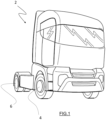
- Figure 1 represents a heavy-duty vehicle 2, which, in the example, is a truck.
- the truck 2 includes a front axle 4 and a rear axle 6.
- the truck is a 4 by 2 truck, i.e. a truck with four wheels in which torque is delivered to only two wheels.
- the invention is applicable to other truck configurations, such as 6 by 4 trucks and 6 by 2 trucks.
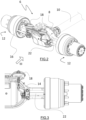
- the rear axle 6 is better represented on Fig. 2 .
- the wheels are not represented.
- rear axle 6 includes an axle housing 8 inside which a differential (not visible) is arranged.
- the differential includes an orifice for receiving one end of a propeller shaft 10.
- the axle 6 further includes two wheel brakes 12 provided each at one longitudinal end of the axle 6.
- Each wheel brake 12 is an air brake or, more formally, a compressed air brake system, which is a type of friction brake in which compressed air pressing on a piston is used to apply the pressure to the brake pad (not shown) needed to stop the vehicle 2.
- the vehicle 2 includes an air tank and a compressor (not represented).
- each wheel brake 12 is a drum brake that is applied by brake shoes (not shown) being pressed against a brake drum 16.
- drum brakes include cam brakes and wedge brakes.
- each wheel brake 12 includes a cam actuation mechanism, in which a brake cylinder 18, also known as an "air cylinder", converts the energy of compressed air to mechanical operation.
- a brake cylinder 18 also known as an "air cylinder”
- each wheel brake 12 has its own brake cylinder 18, which means that there are two brake cylinders 18 fitted on the axle.
- Each brake cylinder 18 consists of two chambers (not shown) separated by a rubber diaphragm (not shown either).
- a push rod 14 also known as “piston”
- This causes the push rod 14 to move out from the cylinder 18 and to push on a rotating lever 20 also known as “brake lever” or “brake arm”
- the rotating lever 20 transforms the force of the push rod 14 into a torque that is applied to a brake shaft 22. Therefore, brake lever 20 is designed for transmitting the movement of cylinder rod 14 to brake shaft 22.
- brake lever 20 is made of metal or an alloy.
- figures 2 and 3 show a traditional drum brake.
- the claimed invention specifically concerns the brake lever 20 as represented on the figures 7-9 .
- the brake lever that is represented on figures 2 and 3 is a brake lever of prior art.
- the brake lever 20 according to the claimed invention is represented on figures 7-9 .
- a cam (not shown), e.g. a S-shaped cam, is arranged at the end of the brake shaft 22. As the cam rotates, it forces two symmetrical brake pads (not shown) against the brake drum 16 until the pressure is released and the brake pads return to their resting position.
- the brake shoe carries the brake lining, which is riveted or glued to the shoe. When the brake is applied, the shoe moves and presses the lining against the inside of the drum 16. The friction between lining and drum provides the braking effort. Energy is dissipated as heat.
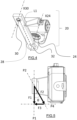
- brake lever 20 comprises a first portion 20a delimiting a hole 24 for fitting the brake shaft 22. Accordingly, hole 24 comprises a central axis X24 that is confounded with the axis of rotation of the brake shaft 22.
- the brake shaft 22 extends longitudinally parallel to the rotation axis of the wheels (in neutral configuration obviously, i.e. when steering angle is of 0°).
- brake lever 20 further comprises a second portion 20b, which is configured to be pivotally connected to the cylinder rod 14.
- the second portion 20b includes a circular bore 30 for receiving a pin (not shown) attached to one end of the push rod 14.
- Bore 30 defines a central axis X30 that represents the axis of rotation of the brake lever 20 relative to the push rod 14.
- Axes X24 and X30 are parallel one with the other.
- bore 30 is a through hole.
- brake lever 20 includes a mechanism (not shown) that enables to adjust the rest position of the shoes when the distance between the drum and shoes reaches a certain point. Precisely, the brake shoes are moved radially outwards so as to be closer to the drum.
- Such mechanism which is known as "slack adjuster"
- slack adjuster can be manual or automatic (self-adjusting) and is built into the brake lever 20 connecting the push rod 14 to the brake shaft 22.
- the slack adjuster is housed inside the first portion 20a of the brake lever 20.
- brake lever 20 and brake shaft 22 are coupled using a dog gear mechanism:
- the hole 24 is part of a crown wheel (that is partially visible on figure 4 ), which is itself part of the slack adjuster and the crown wheel comprises, on the inside, a succession of teeth that engage into complementary splines provided on the brake shaft 22. This enables to rigidly secure the crown wheel of the brake lever 20 in rotation with the brake shaft 22.
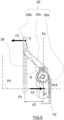
- a plane P1 is defined as the plane, perpendicular to the central axis X24, passing by a connection point A between the rotating lever 20 and the push rod 14 and.
- a plane P2 is defined as the plane, perpendicular to that of Figure 5 , extending between point A and a connection point B between brake lever 20 and brake shaft 22.
- a plane P3 is defined as the plane passing by point B and perpendicular to the central axis X24 of the hole 24.
- first and second portions 20a, 20b are end portions of the brake lever 20.
- Portion 20b is flat, which means that it extends parallel to plane P1.
- first portion 20a and the second portion 20b are offset from each other with respect to the central axis X24 of the hole 24.
- planes P1 and P3 are spaced one from the other by a distance (or "offset") d1.
- brake lever 20 is not straight, but includes angled parts.
- brake lever 20 further includes a central portion 20c extending between the first and second portions 20a, 20b.
- the central portion 20c extends obliquely with respect to the second portion 20b. This means that there is an angle ⁇ between the planes P1 and P2.
- the offset d1 ranges from 0 to 70 mm. In the example of the figures, the offset d1 is high, e.g. about 70 mm. Accordingly, significant lateral loads are induced on the brake shaft 22 during actuation of the brake, causing wear and tear on the brake shaft splines and accelerating the damage on the slack adjuster mechanism.
- the force F1 applied by the push rod 14 can be decomposed into a first force F2 corresponding to the projection of the force F1 into plane P2 and a second force F3 corresponding to the projection of the force F1 into a plane P4 corresponding to the plane of figure 5 , perpendicular to planes P1 and P3.
- Plane P4 includes axes X30 and X24.
- the stiffening member 28 extends from the second portion 20b, which means that it forms an extension of the second portion 20b.
- orifice 32 is a through hole of circular shape.
- the stiffening member 28 is not designed for transmitting any torque to the brake shaft 22:
- the diameter of the orifice 32 is large enough to fit the end of the brake shaft 22, with a radial clearance that allows the brake shaft 22 to rotate inside the orifice 32.
- the orifice 32 acts as a bearing that supports the rotation of the brake shaft 22. Accordingly, the stiffening member 28 acts as a support leg.
- the stiffening member 28 extends perpendicular to the central axis X24 of hole 24, which means that direction L1 is a straight line.
- the stiffening member 28 extends in a curved manner. More precisely, the stiffening member 28 is in the form of a curl (or comma-shaped). The advantage of having this curved stiffening member 28 is that it can match with the shape of the axle housing 8.
- the direction L1 along which extends the stiffening member 28 is a curved line contained inside the plane P1.
- the orifice 32 delimited at the end of the stiffening member 28, which is of circular shape, has a diameter similar to that of the brake shaft 22, which means that there is no need to modify the brake shaft 22.
- the orifice 32 is delimited inside a casing 40 extending parallel to axis X24 between the stiffening member 28 and portion 20a.
- casing 40 makes the junction between stiffening member 28 and portion 20a of brake lever 20.
- the casing 40 of cylindrical shape, is arranged around the end of the brake shaft 22. This enables to increase the robustness of the brake lever 20, to offer a better protection against dust and to provide a better axial support of the brake shaft 22.
Landscapes
- Engineering & Computer Science (AREA)
- General Engineering & Computer Science (AREA)
- Mechanical Engineering (AREA)
- Braking Arrangements (AREA)
Claims (13)
- Bremshebel (20) für eine Trommelbremsanordnung (12), wobei der Bremshebel so ausgebildet ist, dass er die Bewegung einer Zylinderstange (14) auf eine Bremswelle (22) überträgt, wobei der Bremshebel (20) einen ersten Abschnitt (20a) umfasst, der ein Loch (24) zum Anbringen der Bremswelle (22) begrenzt, und einen zweiten Abschnitt (20b), der so eingerichtet ist, dass er schwenkbar mit der Zylinderstange (14) verbunden ist, und wobei der erste Abschnitt und der zweite Abschnitt in Bezug auf eine Mittelachse (X24) des Lochs (24) voneinander versetzt sind,
dadurch gekennzeichnet, dass:- der Bremshebel ferner ein Versteifungselement (28) enthält, das sich gekrümmt entlang einer Richtung (L1) erstreckt, die innerhalb einer Ebene (P1) senkrecht zur Mittelachse (X24) des Lochs liegt, und das eine Öffnung (32) zum Anbringen der Bremswelle (22) enthält. - Bremshebel nach einem der vorhergehenden Ansprüche, dadurch gekennzeichnet, dass der erste und der zweite Abschnitt (20a, 20b) Endabschnitte des Bremshebels (20) sind.
- Bremshebel nach einem der vorhergehenden Ansprüche, dadurch gekennzeichnet, dass der zweite Abschnitt (20b) eine kreisförmige Bohrung (30) zum Aufnehmen eines Stifts enthält.
- Bremshebel nach einem der vorhergehenden Ansprüche, dadurch gekennzeichnet, dass er ferner einen Mittelabschnitt (20c) enthält, der sich zwischen dem ersten und dem zweiten Abschnitt (20a, 20b) erstreckt.
- Bremshebel nach dem vorhergehenden Anspruch, dadurch gekennzeichnet, dass sich der Mittelabschnitt (20c) gegenüber dem zweiten Abschnitt (20b) schräg erstreckt.
- Bremshebel nach Anspruch 4 oder 5, dadurch gekennzeichnet, dass sich das Versteifungselement (28) aus dem zweiten Abschnitt (20b) oder aus dem Mittelabschnitt (20c) erstreckt.
- Bremshebel nach einem der vorhergehenden Ansprüche, dadurch gekennzeichnet, dass er einen automatischen oder manuellen Gestängenachsteller enthält.
- Bremshebel nach einem der vorhergehenden Ansprüche, dadurch gekennzeichnet, dass der Versatz (d1) zwischen dem ersten Abschnitt (20a) und dem zweiten Abschnitt (20b) kleiner oder gleich 70 mm ist.
- Bremshebel nach einem der vorhergehenden Ansprüche, dadurch gekennzeichnet, dass die Öffnung (32) und das Loch (24) denselben Durchmesser aufweisen.
- Bremshebel nach einem der vorhergehenden Ansprüche, dadurch gekennzeichnet, dass die Öffnung (32) ein kreisförmiges Durchgangsloch ist.
- Bremshebel nach einem der vorhergehenden Ansprüche, dadurch gekennzeichnet, dass die Öffnung (32) durch ein Gehäuse (40) begrenzt ist, das sich axial zwischen dem Versteifungselement (28) und dem ersten Abschnitt (20a) erstreckt.
- Trommelbremsanordnung (12), umfassend einen mit einer Druckstange (14) versehenen Bremszylinder (18), eine Bremswelle (22) und einen Bremshebel (20) zum Übertragen der Bewegung der Druckstange (14) auf die Bremswelle, dadurch gekennzeichnet, dass der Bremshebel (20) nach einem der vorhergehenden Ansprüche ist.
- Schwerlastfahrzeug (2), wie ein Lkw oder ein Bus, umfassend mindestens eine Trommelbremsanordnung (12) nach dem vorhergehenden Anspruch.
Priority Applications (5)
| Application Number | Priority Date | Filing Date | Title |
|---|---|---|---|
| EP20200510.4A EP3981998B1 (de) | 2020-10-07 | 2020-10-07 | Gestängesteller mit hohem versatz mit zusätzlichem niedrig versetzten arm zur reduzierung von seitlichen lasten |
| EP24220946.8A EP4502414A3 (de) | 2020-10-07 | 2020-10-07 | Gestängesteller mit hohem versatz mit zusätzlichem arm mit niedrigem versatz zur reduzierung von seitlichen lasten |
| CN202111143304.XA CN114294356A (zh) | 2020-10-07 | 2021-09-28 | 鼓式制动器装置的制动杆及鼓式制动器装置和重型车辆 |
| US17/450,111 US11892047B2 (en) | 2020-10-07 | 2021-10-06 | Brake lever for a drum brake arrangement, said brake lever being designed for transmitting the movement of a cylinder rod to a brake shaft |
| US18/392,717 US12129899B2 (en) | 2020-10-07 | 2023-12-21 | Brake lever for a drum brake arrangement, said brake lever being designed for transmitting the movement of a cylinder rod to a brake shaft |
Applications Claiming Priority (1)
| Application Number | Priority Date | Filing Date | Title |
|---|---|---|---|
| EP20200510.4A EP3981998B1 (de) | 2020-10-07 | 2020-10-07 | Gestängesteller mit hohem versatz mit zusätzlichem niedrig versetzten arm zur reduzierung von seitlichen lasten |
Related Child Applications (2)
| Application Number | Title | Priority Date | Filing Date |
|---|---|---|---|
| EP24220946.8A Division-Into EP4502414A3 (de) | 2020-10-07 | 2020-10-07 | Gestängesteller mit hohem versatz mit zusätzlichem arm mit niedrigem versatz zur reduzierung von seitlichen lasten |
| EP24220946.8A Division EP4502414A3 (de) | 2020-10-07 | 2020-10-07 | Gestängesteller mit hohem versatz mit zusätzlichem arm mit niedrigem versatz zur reduzierung von seitlichen lasten |
Publications (3)
| Publication Number | Publication Date |
|---|---|
| EP3981998A1 EP3981998A1 (de) | 2022-04-13 |
| EP3981998B1 true EP3981998B1 (de) | 2025-01-22 |
| EP3981998C0 EP3981998C0 (de) | 2025-01-22 |
Family
ID=72801350
Family Applications (2)
| Application Number | Title | Priority Date | Filing Date |
|---|---|---|---|
| EP20200510.4A Active EP3981998B1 (de) | 2020-10-07 | 2020-10-07 | Gestängesteller mit hohem versatz mit zusätzlichem niedrig versetzten arm zur reduzierung von seitlichen lasten |
| EP24220946.8A Pending EP4502414A3 (de) | 2020-10-07 | 2020-10-07 | Gestängesteller mit hohem versatz mit zusätzlichem arm mit niedrigem versatz zur reduzierung von seitlichen lasten |
Family Applications After (1)
| Application Number | Title | Priority Date | Filing Date |
|---|---|---|---|
| EP24220946.8A Pending EP4502414A3 (de) | 2020-10-07 | 2020-10-07 | Gestängesteller mit hohem versatz mit zusätzlichem arm mit niedrigem versatz zur reduzierung von seitlichen lasten |
Country Status (3)
| Country | Link |
|---|---|
| US (2) | US11892047B2 (de) |
| EP (2) | EP3981998B1 (de) |
| CN (1) | CN114294356A (de) |
Family Cites Families (20)
| Publication number | Priority date | Publication date | Assignee | Title |
|---|---|---|---|---|
| US2385621A (en) * | 1943-07-27 | 1945-09-25 | Shively | Brake operating mechanism |
| FR1330177A (fr) * | 1962-04-25 | 1963-06-21 | Bendix Corp | Perfectionnements aux freins à tambour |
| US4580665A (en) * | 1979-05-18 | 1986-04-08 | Rockwell International Corporation | Quick connect brake coupling |
| US4256208A (en) * | 1979-05-29 | 1981-03-17 | Eaton Corporation | Slack adjuster |
| ZA802147B (en) * | 1979-05-29 | 1981-04-29 | Eaton Corp | Improved slack adjuster |
| US4596319A (en) | 1983-11-14 | 1986-06-24 | Cumming James C | Automatic slack adjuster for vehicle brakes |
| DE4017949A1 (de) * | 1990-06-05 | 1991-12-12 | Wabco Westinghouse Fahrzeug | Einrichtung zum selbsttaetigen nachstellen einer bremse, insbesondere fahrzeugbremse |
| SE504466C2 (sv) * | 1995-06-08 | 1997-02-17 | Haldex Ab | Slitageindikeringsanordning för bromsbelägg |
| US7198138B2 (en) * | 2004-06-14 | 2007-04-03 | Ang Automotive India Private Limited | Automatic slack adjuster assembly for vehicle braking system |
| US8820490B2 (en) * | 2012-03-16 | 2014-09-02 | Arvinmeritor Technology, Llc | Manual adjuster for automatic slack adjuster |
| US9605724B2 (en) * | 2014-06-26 | 2017-03-28 | Arvinmeritor Technology, Llc | Brake assembly having a camshaft sensor module |
| USD770344S1 (en) * | 2015-06-16 | 2016-11-01 | Haldex Brake Products Ab | Brake adjuster |
| US9574626B1 (en) * | 2015-07-28 | 2017-02-21 | Bendix Spicer Foundation Brake Llc | Rigid bracket assembly for mounting a brake assembly and brake actuator |
| DE102015010348A1 (de) * | 2015-08-06 | 2017-02-09 | Man Truck & Bus Ag | Vorrichtung zur Befestigung eines Verschleißsensors an einem Bremshebel einer Fahrzeugbremse |
| RU178189U1 (ru) * | 2017-03-20 | 2018-03-26 | Общество с ограниченной ответственностью "Ар Си Эр" | Автоматический тормозной рычаг |
| CN206816718U (zh) * | 2017-05-25 | 2017-12-29 | 焦作金箍制动器股份有限公司 | 一种一体式制动器杠杆及使用该杠杆的制动器 |
| CN109563896A (zh) * | 2017-05-31 | 2019-04-02 | 马德拉斯工程工业私人有限公司 | 自动间隙调整器 |
| US11209062B2 (en) * | 2019-05-15 | 2021-12-28 | Bendix Commercial Vehicle Systems Llc | Automatic slack adjuster |
| CN210344113U (zh) * | 2019-07-19 | 2020-04-17 | 绍兴铁安汽配制造有限公司 | 一种轻量型制动间隙自动调整臂及制动系统 |
| US11655869B2 (en) * | 2020-07-10 | 2023-05-23 | Haldex Brake Products Corporation | Brake adjuster with brake stroke indicator |
-
2020
- 2020-10-07 EP EP20200510.4A patent/EP3981998B1/de active Active
- 2020-10-07 EP EP24220946.8A patent/EP4502414A3/de active Pending
-
2021
- 2021-09-28 CN CN202111143304.XA patent/CN114294356A/zh active Pending
- 2021-10-06 US US17/450,111 patent/US11892047B2/en active Active
-
2023
- 2023-12-21 US US18/392,717 patent/US12129899B2/en active Active
Also Published As
| Publication number | Publication date |
|---|---|
| EP3981998A1 (de) | 2022-04-13 |
| US12129899B2 (en) | 2024-10-29 |
| EP3981998C0 (de) | 2025-01-22 |
| US11892047B2 (en) | 2024-02-06 |
| EP4502414A2 (de) | 2025-02-05 |
| US20220106993A1 (en) | 2022-04-07 |
| EP4502414A3 (de) | 2025-03-12 |
| US20240151285A1 (en) | 2024-05-09 |
| CN114294356A (zh) | 2022-04-08 |
Similar Documents
| Publication | Publication Date | Title |
|---|---|---|
| US8011482B2 (en) | Electric actuator unit for a vehicle brake assembly | |
| US8556045B2 (en) | Drum-in-hat disc brake assembly | |
| US8056684B2 (en) | Vehicle drum-in-hat disc brake assembly and method for producing same | |
| US9777782B2 (en) | Shared anchor bracket for a disc brake assembly having separate service and parking brake assemblies | |
| US5253737A (en) | Auxiliary brake force multiplying spring in a multidisc service and auxiliary brake system | |
| US4030576A (en) | Disc brake assembly including a self-contained actuator with wear take-up and anti-drag device | |
| US5630486A (en) | Mechanical actuation device for drum brake | |
| EP0816706B1 (de) | Bimodale Trommelbremse mit einem Feststellbremshebel, der um eine zur Bremsträgerplatte senkrecht stehende Achse dreht | |
| US6851524B2 (en) | Disc brake for motor vehicles | |
| JPS63140131A (ja) | ディスクブレーキ | |
| EP3981998B1 (de) | Gestängesteller mit hohem versatz mit zusätzlichem niedrig versetzten arm zur reduzierung von seitlichen lasten | |
| US3974897A (en) | Brake actuator assembly | |
| US2873005A (en) | Disc brake for vehicles | |
| US3557912A (en) | Duo-servo drum brake and mechanical actuating means therefor | |
| CN113195919B (zh) | 车轮制动装置 | |
| US7490702B1 (en) | Parking and emergency brake actuator for a drum-in-hat disc brake assembly | |
| US3642100A (en) | Pawl parking brake with toggle apply linkage | |
| US20240123962A1 (en) | Apparatus for drum brake assembly | |
| US20250171004A1 (en) | Park Brake Caliper With Inverted Lever Configuration | |
| US3847254A (en) | Parking brake | |
| US12352325B2 (en) | Drum brake assembly | |
| US20250003461A1 (en) | Braking system with balanced actuation | |
| EP1217244B1 (de) | Trommelbremse mit Feststellbremsbetätigung | |
| CN119604691A (zh) | 用于车辆的制动组件和用于施加驻车制动力的方法 | |
| JPH0411418B2 (de) |
Legal Events
| Date | Code | Title | Description |
|---|---|---|---|
| PUAI | Public reference made under article 153(3) epc to a published international application that has entered the european phase |
Free format text: ORIGINAL CODE: 0009012 |
|
| STAA | Information on the status of an ep patent application or granted ep patent |
Free format text: STATUS: THE APPLICATION HAS BEEN PUBLISHED |
|
| AK | Designated contracting states |
Kind code of ref document: A1 Designated state(s): AL AT BE BG CH CY CZ DE DK EE ES FI FR GB GR HR HU IE IS IT LI LT LU LV MC MK MT NL NO PL PT RO RS SE SI SK SM TR |
|
| STAA | Information on the status of an ep patent application or granted ep patent |
Free format text: STATUS: REQUEST FOR EXAMINATION WAS MADE |
|
| 17P | Request for examination filed |
Effective date: 20221003 |
|
| RBV | Designated contracting states (corrected) |
Designated state(s): AL AT BE BG CH CY CZ DE DK EE ES FI FR GB GR HR HU IE IS IT LI LT LU LV MC MK MT NL NO PL PT RO RS SE SI SK SM TR |
|
| STAA | Information on the status of an ep patent application or granted ep patent |
Free format text: STATUS: EXAMINATION IS IN PROGRESS |
|
| 17Q | First examination report despatched |
Effective date: 20230817 |
|
| GRAP | Despatch of communication of intention to grant a patent |
Free format text: ORIGINAL CODE: EPIDOSNIGR1 |
|
| STAA | Information on the status of an ep patent application or granted ep patent |
Free format text: STATUS: GRANT OF PATENT IS INTENDED |
|
| INTG | Intention to grant announced |
Effective date: 20240821 |
|
| GRAS | Grant fee paid |
Free format text: ORIGINAL CODE: EPIDOSNIGR3 |
|
| GRAA | (expected) grant |
Free format text: ORIGINAL CODE: 0009210 |
|
| STAA | Information on the status of an ep patent application or granted ep patent |
Free format text: STATUS: THE PATENT HAS BEEN GRANTED |
|
| AK | Designated contracting states |
Kind code of ref document: B1 Designated state(s): AL AT BE BG CH CY CZ DE DK EE ES FI FR GB GR HR HU IE IS IT LI LT LU LV MC MK MT NL NO PL PT RO RS SE SI SK SM TR |
|
| REG | Reference to a national code |
Ref country code: GB Ref legal event code: FG4D |
|
| REG | Reference to a national code |
Ref country code: CH Ref legal event code: EP |
|
| REG | Reference to a national code |
Ref country code: IE Ref legal event code: FG4D |
|
| REG | Reference to a national code |
Ref country code: DE Ref legal event code: R096 Ref document number: 602020045080 Country of ref document: DE |
|
| U01 | Request for unitary effect filed |
Effective date: 20250205 |
|
| U07 | Unitary effect registered |
Designated state(s): AT BE BG DE DK EE FI FR IT LT LU LV MT NL PT RO SE SI Effective date: 20250211 |
|
| PG25 | Lapsed in a contracting state [announced via postgrant information from national office to epo] |
Ref country code: RS Free format text: LAPSE BECAUSE OF FAILURE TO SUBMIT A TRANSLATION OF THE DESCRIPTION OR TO PAY THE FEE WITHIN THE PRESCRIBED TIME-LIMIT Effective date: 20250422 |
|
| PG25 | Lapsed in a contracting state [announced via postgrant information from national office to epo] |
Ref country code: PL Free format text: LAPSE BECAUSE OF FAILURE TO SUBMIT A TRANSLATION OF THE DESCRIPTION OR TO PAY THE FEE WITHIN THE PRESCRIBED TIME-LIMIT Effective date: 20250122 |
|
| PG25 | Lapsed in a contracting state [announced via postgrant information from national office to epo] |
Ref country code: ES Free format text: LAPSE BECAUSE OF FAILURE TO SUBMIT A TRANSLATION OF THE DESCRIPTION OR TO PAY THE FEE WITHIN THE PRESCRIBED TIME-LIMIT Effective date: 20250122 |
|
| PG25 | Lapsed in a contracting state [announced via postgrant information from national office to epo] |
Ref country code: NO Free format text: LAPSE BECAUSE OF FAILURE TO SUBMIT A TRANSLATION OF THE DESCRIPTION OR TO PAY THE FEE WITHIN THE PRESCRIBED TIME-LIMIT Effective date: 20250422 Ref country code: IS Free format text: LAPSE BECAUSE OF FAILURE TO SUBMIT A TRANSLATION OF THE DESCRIPTION OR TO PAY THE FEE WITHIN THE PRESCRIBED TIME-LIMIT Effective date: 20250522 |
|
| PG25 | Lapsed in a contracting state [announced via postgrant information from national office to epo] |
Ref country code: HR Free format text: LAPSE BECAUSE OF FAILURE TO SUBMIT A TRANSLATION OF THE DESCRIPTION OR TO PAY THE FEE WITHIN THE PRESCRIBED TIME-LIMIT Effective date: 20250122 |
|
| PG25 | Lapsed in a contracting state [announced via postgrant information from national office to epo] |
Ref country code: GR Free format text: LAPSE BECAUSE OF FAILURE TO SUBMIT A TRANSLATION OF THE DESCRIPTION OR TO PAY THE FEE WITHIN THE PRESCRIBED TIME-LIMIT Effective date: 20250423 |
|
| PG25 | Lapsed in a contracting state [announced via postgrant information from national office to epo] |
Ref country code: SM Free format text: LAPSE BECAUSE OF FAILURE TO SUBMIT A TRANSLATION OF THE DESCRIPTION OR TO PAY THE FEE WITHIN THE PRESCRIBED TIME-LIMIT Effective date: 20250122 |
|
| PG25 | Lapsed in a contracting state [announced via postgrant information from national office to epo] |
Ref country code: CZ Free format text: LAPSE BECAUSE OF FAILURE TO SUBMIT A TRANSLATION OF THE DESCRIPTION OR TO PAY THE FEE WITHIN THE PRESCRIBED TIME-LIMIT Effective date: 20250122 |
|
| PG25 | Lapsed in a contracting state [announced via postgrant information from national office to epo] |
Ref country code: SK Free format text: LAPSE BECAUSE OF FAILURE TO SUBMIT A TRANSLATION OF THE DESCRIPTION OR TO PAY THE FEE WITHIN THE PRESCRIBED TIME-LIMIT Effective date: 20250122 |
|
| PLBE | No opposition filed within time limit |
Free format text: ORIGINAL CODE: 0009261 |
|
| STAA | Information on the status of an ep patent application or granted ep patent |
Free format text: STATUS: NO OPPOSITION FILED WITHIN TIME LIMIT |
|
| U20 | Renewal fee for the european patent with unitary effect paid |
Year of fee payment: 6 Effective date: 20251027 |