EP3981895A1 - Ferrite-based steel sheet having excellent corrosion resistance for exhaust system - Google Patents
Ferrite-based steel sheet having excellent corrosion resistance for exhaust system Download PDFInfo
- Publication number
- EP3981895A1 EP3981895A1 EP20847115.1A EP20847115A EP3981895A1 EP 3981895 A1 EP3981895 A1 EP 3981895A1 EP 20847115 A EP20847115 A EP 20847115A EP 3981895 A1 EP3981895 A1 EP 3981895A1
- Authority
- EP
- European Patent Office
- Prior art keywords
- ferrite
- steel sheet
- less
- film formation
- corrosion
- Prior art date
- Legal status (The legal status is an assumption and is not a legal conclusion. Google has not performed a legal analysis and makes no representation as to the accuracy of the status listed.)
- Pending
Links
Images




Classifications
-
- C—CHEMISTRY; METALLURGY
- C22—METALLURGY; FERROUS OR NON-FERROUS ALLOYS; TREATMENT OF ALLOYS OR NON-FERROUS METALS
- C22C—ALLOYS
- C22C38/00—Ferrous alloys, e.g. steel alloys
- C22C38/02—Ferrous alloys, e.g. steel alloys containing silicon
-
- C—CHEMISTRY; METALLURGY
- C21—METALLURGY OF IRON
- C21D—MODIFYING THE PHYSICAL STRUCTURE OF FERROUS METALS; GENERAL DEVICES FOR HEAT TREATMENT OF FERROUS OR NON-FERROUS METALS OR ALLOYS; MAKING METAL MALLEABLE, e.g. BY DECARBURISATION OR TEMPERING
- C21D1/00—General methods or devices for heat treatment, e.g. annealing, hardening, quenching or tempering
- C21D1/26—Methods of annealing
-
- C—CHEMISTRY; METALLURGY
- C21—METALLURGY OF IRON
- C21D—MODIFYING THE PHYSICAL STRUCTURE OF FERROUS METALS; GENERAL DEVICES FOR HEAT TREATMENT OF FERROUS OR NON-FERROUS METALS OR ALLOYS; MAKING METAL MALLEABLE, e.g. BY DECARBURISATION OR TEMPERING
- C21D1/00—General methods or devices for heat treatment, e.g. annealing, hardening, quenching or tempering
- C21D1/68—Temporary coatings or embedding materials applied before or during heat treatment
- C21D1/72—Temporary coatings or embedding materials applied before or during heat treatment during chemical change of surfaces
-
- C—CHEMISTRY; METALLURGY
- C21—METALLURGY OF IRON
- C21D—MODIFYING THE PHYSICAL STRUCTURE OF FERROUS METALS; GENERAL DEVICES FOR HEAT TREATMENT OF FERROUS OR NON-FERROUS METALS OR ALLOYS; MAKING METAL MALLEABLE, e.g. BY DECARBURISATION OR TEMPERING
- C21D1/00—General methods or devices for heat treatment, e.g. annealing, hardening, quenching or tempering
- C21D1/74—Methods of treatment in inert gas, controlled atmosphere, vacuum or pulverulent material
- C21D1/76—Adjusting the composition of the atmosphere
-
- C—CHEMISTRY; METALLURGY
- C21—METALLURGY OF IRON
- C21D—MODIFYING THE PHYSICAL STRUCTURE OF FERROUS METALS; GENERAL DEVICES FOR HEAT TREATMENT OF FERROUS OR NON-FERROUS METALS OR ALLOYS; MAKING METAL MALLEABLE, e.g. BY DECARBURISATION OR TEMPERING
- C21D6/00—Heat treatment of ferrous alloys
- C21D6/002—Heat treatment of ferrous alloys containing Cr
-
- C—CHEMISTRY; METALLURGY
- C21—METALLURGY OF IRON
- C21D—MODIFYING THE PHYSICAL STRUCTURE OF FERROUS METALS; GENERAL DEVICES FOR HEAT TREATMENT OF FERROUS OR NON-FERROUS METALS OR ALLOYS; MAKING METAL MALLEABLE, e.g. BY DECARBURISATION OR TEMPERING
- C21D8/00—Modifying the physical properties of ferrous metals or ferrous alloys by deformation combined with, or followed by, heat treatment
- C21D8/02—Modifying the physical properties of ferrous metals or ferrous alloys by deformation combined with, or followed by, heat treatment during manufacturing of plates or strips
-
- C—CHEMISTRY; METALLURGY
- C21—METALLURGY OF IRON
- C21D—MODIFYING THE PHYSICAL STRUCTURE OF FERROUS METALS; GENERAL DEVICES FOR HEAT TREATMENT OF FERROUS OR NON-FERROUS METALS OR ALLOYS; MAKING METAL MALLEABLE, e.g. BY DECARBURISATION OR TEMPERING
- C21D8/00—Modifying the physical properties of ferrous metals or ferrous alloys by deformation combined with, or followed by, heat treatment
- C21D8/02—Modifying the physical properties of ferrous metals or ferrous alloys by deformation combined with, or followed by, heat treatment during manufacturing of plates or strips
- C21D8/0221—Modifying the physical properties of ferrous metals or ferrous alloys by deformation combined with, or followed by, heat treatment during manufacturing of plates or strips characterised by the working steps
- C21D8/0236—Cold rolling
-
- C—CHEMISTRY; METALLURGY
- C21—METALLURGY OF IRON
- C21D—MODIFYING THE PHYSICAL STRUCTURE OF FERROUS METALS; GENERAL DEVICES FOR HEAT TREATMENT OF FERROUS OR NON-FERROUS METALS OR ALLOYS; MAKING METAL MALLEABLE, e.g. BY DECARBURISATION OR TEMPERING
- C21D8/00—Modifying the physical properties of ferrous metals or ferrous alloys by deformation combined with, or followed by, heat treatment
- C21D8/02—Modifying the physical properties of ferrous metals or ferrous alloys by deformation combined with, or followed by, heat treatment during manufacturing of plates or strips
- C21D8/0247—Modifying the physical properties of ferrous metals or ferrous alloys by deformation combined with, or followed by, heat treatment during manufacturing of plates or strips characterised by the heat treatment
-
- C—CHEMISTRY; METALLURGY
- C21—METALLURGY OF IRON
- C21D—MODIFYING THE PHYSICAL STRUCTURE OF FERROUS METALS; GENERAL DEVICES FOR HEAT TREATMENT OF FERROUS OR NON-FERROUS METALS OR ALLOYS; MAKING METAL MALLEABLE, e.g. BY DECARBURISATION OR TEMPERING
- C21D8/00—Modifying the physical properties of ferrous metals or ferrous alloys by deformation combined with, or followed by, heat treatment
- C21D8/02—Modifying the physical properties of ferrous metals or ferrous alloys by deformation combined with, or followed by, heat treatment during manufacturing of plates or strips
- C21D8/0247—Modifying the physical properties of ferrous metals or ferrous alloys by deformation combined with, or followed by, heat treatment during manufacturing of plates or strips characterised by the heat treatment
- C21D8/0257—Modifying the physical properties of ferrous metals or ferrous alloys by deformation combined with, or followed by, heat treatment during manufacturing of plates or strips characterised by the heat treatment with diffusion of elements, e.g. decarburising, nitriding
-
- C—CHEMISTRY; METALLURGY
- C21—METALLURGY OF IRON
- C21D—MODIFYING THE PHYSICAL STRUCTURE OF FERROUS METALS; GENERAL DEVICES FOR HEAT TREATMENT OF FERROUS OR NON-FERROUS METALS OR ALLOYS; MAKING METAL MALLEABLE, e.g. BY DECARBURISATION OR TEMPERING
- C21D8/00—Modifying the physical properties of ferrous metals or ferrous alloys by deformation combined with, or followed by, heat treatment
- C21D8/02—Modifying the physical properties of ferrous metals or ferrous alloys by deformation combined with, or followed by, heat treatment during manufacturing of plates or strips
- C21D8/0247—Modifying the physical properties of ferrous metals or ferrous alloys by deformation combined with, or followed by, heat treatment during manufacturing of plates or strips characterised by the heat treatment
- C21D8/0273—Final recrystallisation annealing
-
- C—CHEMISTRY; METALLURGY
- C21—METALLURGY OF IRON
- C21D—MODIFYING THE PHYSICAL STRUCTURE OF FERROUS METALS; GENERAL DEVICES FOR HEAT TREATMENT OF FERROUS OR NON-FERROUS METALS OR ALLOYS; MAKING METAL MALLEABLE, e.g. BY DECARBURISATION OR TEMPERING
- C21D8/00—Modifying the physical properties of ferrous metals or ferrous alloys by deformation combined with, or followed by, heat treatment
- C21D8/02—Modifying the physical properties of ferrous metals or ferrous alloys by deformation combined with, or followed by, heat treatment during manufacturing of plates or strips
- C21D8/0278—Modifying the physical properties of ferrous metals or ferrous alloys by deformation combined with, or followed by, heat treatment during manufacturing of plates or strips involving a particular surface treatment
- C21D8/0284—Application of a separating or insulating coating
-
- C—CHEMISTRY; METALLURGY
- C21—METALLURGY OF IRON
- C21D—MODIFYING THE PHYSICAL STRUCTURE OF FERROUS METALS; GENERAL DEVICES FOR HEAT TREATMENT OF FERROUS OR NON-FERROUS METALS OR ALLOYS; MAKING METAL MALLEABLE, e.g. BY DECARBURISATION OR TEMPERING
- C21D9/00—Heat treatment, e.g. annealing, hardening, quenching or tempering, adapted for particular articles; Furnaces therefor
- C21D9/46—Heat treatment, e.g. annealing, hardening, quenching or tempering, adapted for particular articles; Furnaces therefor for sheet metals
-
- C—CHEMISTRY; METALLURGY
- C22—METALLURGY; FERROUS OR NON-FERROUS ALLOYS; TREATMENT OF ALLOYS OR NON-FERROUS METALS
- C22C—ALLOYS
- C22C38/00—Ferrous alloys, e.g. steel alloys
- C22C38/001—Ferrous alloys, e.g. steel alloys containing N
-
- C—CHEMISTRY; METALLURGY
- C22—METALLURGY; FERROUS OR NON-FERROUS ALLOYS; TREATMENT OF ALLOYS OR NON-FERROUS METALS
- C22C—ALLOYS
- C22C38/00—Ferrous alloys, e.g. steel alloys
- C22C38/004—Very low carbon steels, i.e. having a carbon content of less than 0,01%
-
- C—CHEMISTRY; METALLURGY
- C22—METALLURGY; FERROUS OR NON-FERROUS ALLOYS; TREATMENT OF ALLOYS OR NON-FERROUS METALS
- C22C—ALLOYS
- C22C38/00—Ferrous alloys, e.g. steel alloys
- C22C38/04—Ferrous alloys, e.g. steel alloys containing manganese
-
- C—CHEMISTRY; METALLURGY
- C22—METALLURGY; FERROUS OR NON-FERROUS ALLOYS; TREATMENT OF ALLOYS OR NON-FERROUS METALS
- C22C—ALLOYS
- C22C38/00—Ferrous alloys, e.g. steel alloys
- C22C38/06—Ferrous alloys, e.g. steel alloys containing aluminium
-
- C—CHEMISTRY; METALLURGY
- C22—METALLURGY; FERROUS OR NON-FERROUS ALLOYS; TREATMENT OF ALLOYS OR NON-FERROUS METALS
- C22C—ALLOYS
- C22C38/00—Ferrous alloys, e.g. steel alloys
- C22C38/18—Ferrous alloys, e.g. steel alloys containing chromium
- C22C38/28—Ferrous alloys, e.g. steel alloys containing chromium with titanium or zirconium
-
- C—CHEMISTRY; METALLURGY
- C22—METALLURGY; FERROUS OR NON-FERROUS ALLOYS; TREATMENT OF ALLOYS OR NON-FERROUS METALS
- C22C—ALLOYS
- C22C38/00—Ferrous alloys, e.g. steel alloys
- C22C38/18—Ferrous alloys, e.g. steel alloys containing chromium
- C22C38/34—Ferrous alloys, e.g. steel alloys containing chromium with more than 1.5% by weight of silicon
-
- C—CHEMISTRY; METALLURGY
- C21—METALLURGY OF IRON
- C21D—MODIFYING THE PHYSICAL STRUCTURE OF FERROUS METALS; GENERAL DEVICES FOR HEAT TREATMENT OF FERROUS OR NON-FERROUS METALS OR ALLOYS; MAKING METAL MALLEABLE, e.g. BY DECARBURISATION OR TEMPERING
- C21D2211/00—Microstructure comprising significant phases
- C21D2211/005—Ferrite
Definitions
- the present disclosure relates to a ferrite-based steel sheet for an exhaust system, and more particularly, to a ferrite-based steel sheet having excellent corrosion resistance and oxidation resistance suitable for an exhaust system.
- Exhaust systems of automobiles and two-wheeled vehicles are exposed to the outside under an environment where corrosion is easily caused by contamination by snow removal chemicals in winter and also by acidic condensate generated from exhaust gas of fossil fuels.
- a stainless steel having a low thermal capacity instead of cast materials with a high thermal capacity, has been used as a material for exhaust systems to prevent corrosion.
- ferrite-based stainless steel materials which include lower contents of expensive alloying elements than those of austenitic stainless steel materials, have excellent corrosion resistance. Due to such price competitiveness, they have been mainly used for parts of exhaust systems (e.g., muffler, ex-manifold, and collector cone) withstanding a temperature range of exhaust gas (room temperature to 800°C).
- the present disclosure provides a ferrite-based steel sheet for an exhaust system having excellent corrosion resistance with a reduced amount of Cr which is an expensive element.
- One aspect of the present disclosure provides a ferrite-based steel sheet for an exhaust system having excellent corrosion resistance including, in percent by weight (wt%), 0.02% or less of carbon (C), 0.02% or less of nitrogen (N), 2.0% or less of silicon (Si), 0.5% or less of manganese (Mn), 3.0 to 5.5% of chromium (Cr), 0.001 to 0.3% of titanium (Ti), 1.0 to 4.0% of aluminum (Al), and the balance of iron (Fe) and inevitable impurities, wherein the ferrite-based steel sheet has a surface scale layer and satisfies a film formation index of Al of 15.0 or more and a film formation index of Si of 3.0 or less defined below:
- contents of Al, Cr, and Si may satisfy Formula (1) below. 5 * Al ⁇ Cr + Si > 0
- a corrosion depletion rate represented by Formula (2) below is less than 20%.
- corrosion depletion rate % weight before corrosion test ⁇ weight after corrosion test / weight before corrosion test X 100
- the weight after corrosion test is a weight (g) after a generated corrosion product is removed after a corrosion test.
- an L ⁇ value may be 50 or more in L ⁇ a ⁇ b ⁇ color coordinates of the surface.
- an a ⁇ value may be from -10 to +10 and a b ⁇ value may be from -10 to +10 in the L ⁇ a ⁇ b ⁇ color coordinates of the surface.
- the ferrite-based steel sheet according to an embodiment of the present disclosure may have not only significantly reduced raw material costs and manufacturing costs compared to conventional steel sheets used for exhaust systems and but also excellent corrosion resistance.
- a ferrite-based steel sheet for an exhaust system having excellent corrosion resistance includes, in percent by weight (wt%), 0.02% or less of carbon (C), 0.02% or less of nitrogen (N), 2.0% or less of silicon (Si), 0.5% or less of manganese (Mn), 3.0 to 5.5% of chromium (Cr), 0.001 to 0.3% of titanium (Ti), 1.0 to 4.0% of aluminum (Al), and the balance of iron (Fe) and inevitable impurities, wherein the ferrite-based steel sheet has a surface scale layer and satisfies a film formation index of Al of 15.0 or more and a film formation index of Si of 3.0 or less as defined below.
- Nb may be added to stainless steels for exhaust systems, particularly, ferrite-based stainless steels, or Sn may be added to replace Nb.
- the Cr content is increased to enhance oxidation resistance.
- addition of solid solution strengthening elements such as Nb and Sn and the increase in the Cr content are not desirable goals of development because manufacturing costs increase thereby.
- the present disclosure provides a ferrite-based steel sheet including a Cr content lower than 11 wt%, which the minimum Cr content as stainless steels and having excellent corrosion resistance similar or superior to that of conventional stainless steels, and thereby reducing costs for raw materials.
- a ferrite-based steel sheet for an exhaust system having excellent corrosion resistance includes, in percent by weight (wt%), 0.02% or less of carbon (C), 0.02% or less of nitrogen (N), 2.0% or less of silicon (Si), 0.5% or less of manganese (Mn), 3.0 to 5.5% of chromium (Cr), 0.001 to 0.3% of titanium (Ti), 1.0 to 4.0% of aluminum (Al), and the balance of iron (Fe) and inevitable impurities.
- the content of C is greater than 0 and equal to or less than 0.02%.
- C content exceeds 0.02%, toughness of a welded part may deteriorate and Cr 23 C 6 precipitates formed as C binds to Cr cause local depletion of Cr in a matrix resulting in deterioration of corrosion resistance and oxidation resistance.
- C as an inevitable impurity is included in an amount greater than 0, preferably, in an amount of 0.005% or more, because costs of a steelmaking VOD process increase to control the C content at an extremely low level.
- the content of N is greater than 0 and equal to or less than 0.02%.
- N As an inevitable impurity is included in an amount greater than 0, preferably in an amount of 0.005% or more, because costs of a steelmaking VOD process increase to control the N content at an extremely low level.
- the content of Si is 2.0% or less.
- Si as a solid solution strengthening element forms an Si-enriched oxide film on a surface layer, thereby improving oxidation resistance.
- a film formation index of Si needs to be limited to 3.0 or less after annealing heat treatment to realize 'omission of acid pickling', which will be described below, and thus a total content of Si is limited to 2.0% or less to this end.
- the Si content may be 1.5% or less or 1.0% or less to control discoloration prevention more easily.
- the content of Mn is 0.5% or less.
- Mn is an impurity that is inevitably contained in steels and serves to stabilize austenite.
- Mn content exceeds 0.5%, reverse-transformation of austenite occurs during annealing heat treatment after hot rolling or cold rolling, thereby adversely affecting elongation. Therefore, the Mn content is limited within the above-described range.
- the content of Cr is from 3.0 to 5.5%.
- Cr is an element enhancing corrosion resistance
- the Cr content is limited to 5.5% or less according to the purpose of the present disclosure to reduce costs for raw materials.
- Cr is added in an amount of 3.0% or more to obtain minimum corrosion resistance.
- the content of Ti is from 0.001 to 0.3%.
- Ti binds to C and N to form Ti(C,N) precipitates, thereby serving to lower amounts of solute C and N and inhibit formation of a Cr depletion layer.
- Ti needs to be added in an amount of 0.001% or more to improve corrosion resistance and toughness of a welded part. However, because an excess of Ti adversely affects casting, the Ti content is limited to 0.3% or less.
- the content of Al is from 1.0 to 4.0%.
- Al is sufficiently added in an amount of 1.0% or more to form an oxide film during annealing heat treatment.
- an upper limit of the Al content is set to 4.0%.
- the remaining component of the composition of the present disclosure is iron (Fe).
- the composition may include unintended impurities inevitably incorporated from raw materials or surrounding environments.
- addition of other alloy components in addition to the above-described alloy components is not excluded.
- the impurities are not specifically mentioned in the present disclosure, as they are known to any person skilled in the art of manufacturing.
- the ferrite-based steel sheet according to the present disclosure is a cold-rolled, annealed steel sheet having a scale layer on the surface.
- the ferrite-based steel sheet for an exhaust system satisfies a film formation index of Al of 15.0 or more and a film formation index of Si of 3.0 or less within a range in a depth direction from the surface to a depth 0.2 ⁇ m including a scale layer.
- the film formation index of Al and film formation index of Si are defined as follows.
- Si is known to form an Si-enriched oxide film in a surface layer to increase high-temperature oxidation resistance.
- a dark brown scale layer is formed on the surface in the case where the film formation index of Si exceeds 3.0, resulting in deterioration of surface properties. Therefore, the film formation index of Si needs to be limited to 3.0 or less.
- Al also reacts with oxygen of the surface layer to form a non-uniform oxide layer.
- Al is added in an amount of 1.0 to 4.0% according to the present disclosure and annealing heat treatment is performed, migration of Si to the surface layer and reaction thereof are inhibited, an Al-enriched oxide film is formed preferentially.
- the Al oxide film is densely formed satisfying a film formation index of Al of 15.0 or more, a bright metallic color may be obtained.
- a metallic color of a material surface may be expressed by L ⁇ a ⁇ b ⁇ color coordinates established by the International Commission on Illumination.
- the L ⁇ a ⁇ b ⁇ color coordinates are currently the most widely used color coordinates to express a color of an object in all fields.
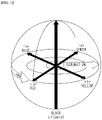
- FIG. 1 shows a color space showing L ⁇ a ⁇ b ⁇ color coordinates.
- L ⁇ strongly represents black when 0 and white when 100
- a ⁇ represents a red direction when a positive number and a green direction when a negative number
- b ⁇ represents a yellow direction when a positive number and a blue direction when a negative number.
- achromatic color is shown.
- the Al-enriched oxide film is formed to obtain a bright metallic surface having a L ⁇ value of 50 or more in the L ⁇ a ⁇ b ⁇ color coordinates.
- a metallic surface with an achromatic color having a L ⁇ value of 50 or more and a ⁇ and b ⁇ values of -10 to +10 may be obtained.
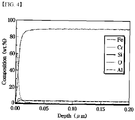
- FIGS. 2 to 4 show distributions of alloy components of examples of the present disclosure analyzed by glow discharge optical emission spectrometry in a depth direction from the surface to a depth of 0.2 ⁇ m.
- FIG. 2 shows distribution of alloy components of a sample of a cold-rolled steel sheet according to an embodiment of the present disclosure prepared without performing acid pickling after annealing heat treatment.
- the film formation index of Al which is a maximum value of the Al content, is 15.0 or more.
- FIG. 3 shows distribution of alloy components of a sample of a cold-rolled steel sheet having the same content ranges of Si and Al as those of ferrite-based stainless steel for common exhaust systems and a reduced Cr content for cost reduction prepared without performing acid pickling after annealing heat treatment in the same manner. That is, this sample corresponds to a cold-rolled, annealed steel sheet in which the Cr content and the Al content are out of the ranges defined in the present disclosure.
- a film formation index of Al is low and a film formation index of Si is about 5.0 in the outermost surface layer. In this case, corrosion resistance and oxidation resistance are insufficient, and surface discoloration occurs due to an Si oxide film.
- FIG. 4 shows distribution of alloy components of a sample of the cold-rolled steel sheet of FIG. 2 prepared by performing annealing heat treatment and then acid pickling according to an embodiment of the present disclosure.
- Cr, Al, and Si are contained, a low film formation index of Al is obtained when the acid pickling is not omitted after the annealing heat treatment unlike the present disclosure.
- the ferrite-based stainless steel may satisfy Formula (1) below to simultaneously satisfy the film formation index of Al and the film formation index of Si. 5 * Al ⁇ Cr + Si > 0
- an Al-enriched oxide film may be sufficiently formed during annealing.
- oxygen used to form the Al-enriched oxide film is insufficient to due to oxidation of Cr and Si or migration of some oxygen required to form the Al-enriched oxide film may be limited due to formation of an oxide film of Cr or Si.
- the thickness of the scale layer may vary according to temperature and time of the annealing heat treatment, but may be defined as a thickness at a point where the film formation index of Al becomes half.
- the thickness of the scale layer may be about 0.1 ⁇ m corresponding to a median value of the film formation index of Al which is the maximum Al content.
- Annealing heat treatment for satisfying the film formation index of Al and the film formation index of Si according to the present disclosure may be performed by a continuous annealing process using an inexpensive gas without using an expensive bright annealing line (BAL) process in which 70% or more of high-purity hydrogen is used in an atmospheric gas.
- BAL bright annealing line
- the object of the present disclosure may be achieved by using a fuel gas as a heat source and limiting excess oxygen of a waste gas is limited to a range of 0.1 to 10%.
- Al within the above-described content range according to the present disclosure reacts with oxygen to form a film providing high corrosion resistance during annealing heat treatment.
- the excess oxygen is insufficient, the Al-enriched oxide film may not be sufficiently formed.
- Fe, Cr, or Si of a material reacts with oxygen to form an oxide film of Fe, Cr, or Si in addition to the Al-enriched oxide film. In this case, discoloration may occur.
- the oxygen content is intended to be limited to 0.1% or less for easy manufacture
- oxidation of Fe, Cr, and Si may be inhibited by mixing with 0.1% to 10% of hydrogen in the atmospheric gas, and thus the Al-enriched oxide film may be formed with a small amount (0.1% or less) of oxygen.
- the oxygen content of 10% or more is unnecessary because costs increase as described above.
- acid pickling is omitted.
- film formation indices of Al and Si may be satisfied and an outermost layer from which a scale layer is not removed may be obtained.
- manufacturing costs may also be reduced.
- a cold-rolled steel sheet may be manufactured by a common manufacturing process in which annealing heat treatment and acid pickling are not omitted.
- a slab including the above-described composition of alloy components may be hot-rolled, and the hot-rolled steel sheet may be subjected to annealing heat treatment and acid pickling, and then cold-rolled to obtain a cold-rolled steel sheet.
- the ferrite-based steel sheet having excellent corrosion resistance may have a corrosion depletion rate of less than 20%, and the corrosion depletion rate may be represented by Formula (2) below.
- Corrosion depletion rate % weight before corrosion test ⁇ weight after corrosion test / weight before corrosion test X 100
- the weight after corrosion test is a weight (g) measured after a generated corrosion product is removed after the corrosion test.
- Corrosion resistance that is, resistance to corrosion
- the degree of corrosion resistance may be evaluated by repeating a process of spraying a solution containing NaCl in a volume ratio of 5% in water onto a material, maintaining for 4 hours, and drying by heating at 60°C for 4 hours, 30 times in total as follows.
- the environment for evaluation may be configured in various ways and is not limited to that provided in the present disclosure.
- '[(weight before corrosion test) - (weight after corrosion test)]/(weight before corrosion test)' is defined as a depletion rate and expressed in % by multiplying by 100.
- the depletion rate may be measured by comparing the weight measured after removing a generated corrosion product after the corrosion test, i.e., 'weight after corrosion test', with the 'weight before corrosion test'.
- thickness may be used instead of weight. In this case, there is no need to remove the corrosion product, and a thickness measured by observing a cross-section using an optical microscope may be compared with a thickness of a metallic portion of a base material excluding the corrosion product.
- Comparative Steels 1 and 2 are ferrite-based stainless steels containing a large amount of Cr that is an expensive element intended to be reduced according to the present disclosure. It was confirmed that corrosion did not occur in the samples of Inventive Steels according to the present disclosure including the same alloy composition by omitting acid pickling after performing annealing heat treatment.
- Table 3 shows film formation indices of Al and film formation indices of Si, corrosion depletion rates of samples prepared by omitting acid pickling, and corrosion acceptability was evaluated based on a criterion of a corrosion depletion rate of 20%. Corrosion acceptable was indicated as ⁇ and corrosion unacceptable was indicated as ⁇ .
- the film formation indies of Al and film formation indices of Si may be analyzed by glow discharge optical emission spectrometry, which is widely known in the art, or any method similar to the glow discharge optical emission spectrometry commonly used in the art may be used for analysis.
- glow discharge optical emission spectrometry which is widely known in the art, or any method similar to the glow discharge optical emission spectrometry commonly used in the art may be used for analysis.
- a resolution of 10 nm or less is required in the analysis of components with respect to a distance from the surface in the depth direction to sufficiently obtain data.
- Comparative Steels 1 to 5 are samples having contents of C, Si, Mn, Al, Ti, and N similar to those of the present disclosure and reduced contents of Cr gradually.
- Comparative Steels 1 and 2 correspond to ferrite-based stainless steels having 11% or more of Cr and exhibited sufficient corrosion resistance, thereby having low corrosion depletion rates and appropriate corrosion acceptability.
- a high film formation index of Si of 10.6 was obtained, and surface discoloration was caused thereby.
- Comparative Steels 3, 4, and 5 exhibited low film formation indices of Al due to low Al contents even when acid pickling was not performed and unacceptable corrosion due to high depletion rates.
- discoloration occurred due to high film formation indices of Si which are maximum Si contents in the oxide films including a scale layer although the Si content was appropriate.
- the Al content for obtaining the film formation index of Al was insufficient in the case of omitting acid pickling referring to Inventive Steels 1 to 3 below. It was confirmed that when the Al content satisfies Formula (1), the film formation index of Si may be lowered and the film formation index of Al may be increased as in Inventive Steels 1 to 3.
- Comparative Steels 6, 7, and 8 correspond to samples in which the Si content was increased.
- the Al content is not sufficient in the case of omitting acid pickling, there by exhibiting unacceptable corrosion evaluation results and surface discoloration.
- Comparative Steel 9 includes 0.9% of Al but does not satisfy the Al content range and Formula (1), and thus the film formation index of Al could not reach a target range, and accordingly insufficient corrosion resistance evaluation results were obtained. It may be determined that Al could not interfere formation of an oxide film of Si due to the insufficient Al content, and accordingly the Si oxide film is dominantly formed, thereby causing discoloration
- Comparative Steel 10 includes a sufficient Al content exhibiting the film formation index of Al greater than 15 and acceptable corrosion resistance evaluation results, Formula (1) could not be satisfied, and thus the film formation index of Si increased. Surface discoloration occurred in Comparative Steel 10, and it was confirmed that surface discoloration could not be inhibited in the case where the film formation index of Si exceeded 3.0 even when the film formation index of Al was satisfied and the corrosion resistance evaluation results are acceptable.
- Inventive Steels 1, 2, and 3 satisfied the alloy composition range of the present disclosure and satisfied both 15.0 or more of the film formation index of Al and 3.0 or less of the film formation index of Si after omitting acid pickling, thereby exhibiting excellent corrosion resistance evaluation results and no discoloration.
- the Cr content of Inventive Steel 4 is slightly low within the composition range of the present disclosure, the film formation index of Al and the film formation index of Si were able to be controlled within target ranges by adjusting the contents of Si and Al to satisfy Formula (1).
- Table 4 shows values of L ⁇ a ⁇ b ⁇ color coordinates of Comparative Steels and Inventive Steels indicating discoloration of Table 3 in more detail.
- Comparative Steels 1 to 5 exhibited scale layers having red color due to oxidation of Cr.
- Comparative Steels 6 to 10 exhibited scale layers having purple or blue color since film formation of Si could not be controlled.
- Inventive Steels 1 to 5 exhibited scale layers having bright metallic color according to the method of the present disclosure.
- FIG. 5 is a photographs showing a surface of a cold-rolled, annealed steel sheet sample of Comparative Steel 10 according to the present disclosure. Referring to FIG. 5 , it was confirmed that a dark brown scale was formed on the surface by annealing heat treatment as in common steel types.
- FIG. 6 is a photographs showing a surface of a cold-rolled, annealed steel sheet sample of Inventive Steel 2 according to the present disclosure. Referring to FIG. 6 , it was confirmed that the sample of Inventive Steel 2 showed a bright metallic gloss even acid picking was not performed, and values of L ⁇ a ⁇ b ⁇ color coordinates were as follows L ⁇ : 79, a ⁇ : 0, and b ⁇ : +1.
- the ferrite-based steel sheet for an exhaust system may be applied to parts of exhaust systems (e.g., muffler, ex-manifold, and collector cone).
Landscapes
- Chemical & Material Sciences (AREA)
- Engineering & Computer Science (AREA)
- Mechanical Engineering (AREA)
- Materials Engineering (AREA)
- Metallurgy (AREA)
- Organic Chemistry (AREA)
- Physics & Mathematics (AREA)
- Thermal Sciences (AREA)
- Crystallography & Structural Chemistry (AREA)
- Heat Treatment Of Sheet Steel (AREA)
Abstract
Description
- The present disclosure relates to a ferrite-based steel sheet for an exhaust system, and more particularly, to a ferrite-based steel sheet having excellent corrosion resistance and oxidation resistance suitable for an exhaust system.
- Exhaust systems of automobiles and two-wheeled vehicles are exposed to the outside under an environment where corrosion is easily caused by contamination by snow removal chemicals in winter and also by acidic condensate generated from exhaust gas of fossil fuels.
- In an environment where the temperature of exhaust gas gradually increases, a stainless steel having a low thermal capacity, instead of cast materials with a high thermal capacity, has been used as a material for exhaust systems to prevent corrosion. Particularly, ferrite-based stainless steel materials, which include lower contents of expensive alloying elements than those of austenitic stainless steel materials, have excellent corrosion resistance. Due to such price competitiveness, they have been mainly used for parts of exhaust systems (e.g., muffler, ex-manifold, and collector cone) withstanding a temperature range of exhaust gas (room temperature to 800°C)..
- Although methods of using stainless steels including an increased amount of Cr have been the most commonly available to obtain corrosion resistance and oxidation resistance, ferrite-based stainless steels including 11 wt% or more of Cr are expensive. In addition, stainless steels having a high Cr content are difficult to be acid-pickled, costs for acid pickling the stainless steels increase, and cold annealing temperature therefor should be increased since a large amount of Nb, or the like is included. Therefore, there is an increasing need to develop a steel sheet for an exhaust system having excellent corrosion resistance while reducing the amount of Cr which increases manufacturing costs.
- The present disclosure provides a ferrite-based steel sheet for an exhaust system having excellent corrosion resistance with a reduced amount of Cr which is an expensive element.
- One aspect of the present disclosure provides a ferrite-based steel sheet for an exhaust system having excellent corrosion resistance including, in percent by weight (wt%), 0.02% or less of carbon (C), 0.02% or less of nitrogen (N), 2.0% or less of silicon (Si), 0.5% or less of manganese (Mn), 3.0 to 5.5% of chromium (Cr), 0.001 to 0.3% of titanium (Ti), 1.0 to 4.0% of aluminum (Al), and the balance of iron (Fe) and inevitable impurities, wherein the ferrite-based steel sheet has a surface scale layer and satisfies a film formation index of Al of 15.0 or more and a film formation index of Si of 3.0 or less defined below:
- [Film formation index of Al]: a maximum value of Al content (wt%) in a range from a surface to a depth of 0.2 µm
- [Film formation index of Si]: a maximum value of Si content (wt%) in a range from a surface to a depth of 0.2 µm.
- In addition, according to an embodiment of the present disclosure, contents of Al, Cr, and Si may satisfy Formula (1) below.

- In addition, according to an embodiment of the present disclosure, a corrosion depletion rate represented by Formula (2) below is less than 20%.

- Here, the weight after corrosion test is a weight (g) after a generated corrosion product is removed after a corrosion test.
- In addition, according to an embodiment of the present disclosure, an L∗ value may be 50 or more in L∗a∗b∗ color coordinates of the surface.
- In addition, according to an embodiment of the present disclosure, an a∗ value may be from -10 to +10 and a b∗ value may be from -10 to +10 in the L∗a∗b∗ color coordinates of the surface.
- The ferrite-based steel sheet according to an embodiment of the present disclosure may have not only significantly reduced raw material costs and manufacturing costs compared to conventional steel sheets used for exhaust systems and but also excellent corrosion resistance.
- In addition, excellent surface properties may be obtained even without performing the final acid pickling process since bright achromatic metallic color in which a L∗ value is 50 or more and a∗ and b∗ values are from-10 to +10, respectively, in the L∗a∗b∗ color coordinates is obtained.
-
-
FIG. 1 shows a color space showing L∗a∗b∗ color coordinates. -
FIG. 2 shows distribution of alloy components of Inventive Steel 2 according to the present disclosure in a depth direction from the surface to a depth of 0.2 µm analyzed by glow discharge optical emission spectrometry. -
FIG. 3 shows distribution of alloy components of Comparative Steel 5 according to the present disclosure in a depth direction from the surface to a depth of 0.2 µm analyzed by glow discharge optical emission spectrometry. -
FIG. 4 shows distribution of alloy components of Inventive Steel 2 according to the present disclosure after acid pickling in a depth direction from the surface to a depth of 0.2 µm analyzed by glow discharge optical emission spectrometry. -
FIG. 5 is a photographs showing a surface of a cold-rolled, annealed steel sheet sample of Comparative Steel 10 according to the present disclosure. -
FIG. 6 is a photographs showing a surface of a cold-rolled, annealed steel sheet sample of Inventive Steel 2 according to the present disclosure. - A ferrite-based steel sheet for an exhaust system having excellent corrosion resistance according to an embodiment of the present disclosure includes, in percent by weight (wt%), 0.02% or less of carbon (C), 0.02% or less of nitrogen (N), 2.0% or less of silicon (Si), 0.5% or less of manganese (Mn), 3.0 to 5.5% of chromium (Cr), 0.001 to 0.3% of titanium (Ti), 1.0 to 4.0% of aluminum (Al), and the balance of iron (Fe) and inevitable impurities, wherein the ferrite-based steel sheet has a surface scale layer and satisfies a film formation index of Al of 15.0 or more and a film formation index of Si of 3.0 or less as defined below.
- [Film formation index of Al]: a maximum Al content (wt%) in a range from a surface to a depth of 0.2 µm
- [Film formation index of Si]: a maximum Si content (wt%) in a range from a surface to a depth of 0.2 µm
- Hereinafter, embodiments of the present disclosure will be described in detail with reference to the accompanying drawings. The following embodiments are provided to fully convey the spirit of the present disclosure to a person having ordinary skill in the art to which the present disclosure belongs. The present disclosure is not limited to the embodiments shown herein but may be embodied in other forms. In the drawings, parts unrelated to the descriptions are omitted for clear description of the disclosure and sizes of elements may be exaggerated for clarity.
- Throughout the specification, the term "include" an element does not preclude other elements but may further include another element, unless otherwise stated.
- As used herein, the singular forms are intended to include the plural forms as well, unless the context clearly indicates otherwise.
- In order to enhance strength at a high temperature, Nb may be added to stainless steels for exhaust systems, particularly, ferrite-based stainless steels, or Sn may be added to replace Nb. In general, the Cr content is increased to enhance oxidation resistance. However, addition of solid solution strengthening elements such as Nb and Sn and the increase in the Cr content are not desirable goals of development because manufacturing costs increase thereby.
- To reduce costs of raw materials for ferrite-based stainless steels for exhaust systems, it is essential to reduce the content of Cr which is an expensive element added in a relatively large amount. However, because Cr is a key element to obtain corrosion resistance in the ferrite-based stainless steels for exhaust systems, there is a need to develop another method of obtaining corrosion resistance to reduce the Cr content. The present disclosure provides a ferrite-based steel sheet including a Cr content lower than 11 wt%, which the minimum Cr content as stainless steels and having excellent corrosion resistance similar or superior to that of conventional stainless steels, and thereby reducing costs for raw materials.
- A ferrite-based steel sheet for an exhaust system having excellent corrosion resistance according to an embodiment of the present disclosure includes, in percent by weight (wt%), 0.02% or less of carbon (C), 0.02% or less of nitrogen (N), 2.0% or less of silicon (Si), 0.5% or less of manganese (Mn), 3.0 to 5.5% of chromium (Cr), 0.001 to 0.3% of titanium (Ti), 1.0 to 4.0% of aluminum (Al), and the balance of iron (Fe) and inevitable impurities.
- Hereinafter, reasons for numerical limitations on the contents of alloying elements in the embodiment of the present disclosure will be described. Hereinafter, the unit is wt% unless otherwise stated.
- The content of C is greater than 0 and equal to or less than 0.02%.
- When the C content exceeds 0.02%, toughness of a welded part may deteriorate and Cr23C6 precipitates formed as C binds to Cr cause local depletion of Cr in a matrix resulting in deterioration of corrosion resistance and oxidation resistance. On the contrary, C as an inevitable impurity is included in an amount greater than 0, preferably, in an amount of 0.005% or more, because costs of a steelmaking VOD process increase to control the C content at an extremely low level.
- The content of N is greater than 0 and equal to or less than 0.02%.
- When the N content exceeds 0.02% in steels, a concentration of solute N reaches a limit and Cr2N precipitates formed as N binds to Cr cause local depletion of Cr in the matrix resulting in deterioration of corrosion resistance and oxidation resistance. On the contrary, N as an inevitable impurity is included in an amount greater than 0, preferably in an amount of 0.005% or more, because costs of a steelmaking VOD process increase to control the N content at an extremely low level.
- The content of Si is 2.0% or less.
- Si as a solid solution strengthening element forms an Si-enriched oxide film on a surface layer, thereby improving oxidation resistance. However, in the present disclosure, a film formation index of Si needs to be limited to 3.0 or less after annealing heat treatment to realize 'omission of acid pickling', which will be described below, and thus a total content of Si is limited to 2.0% or less to this end. However, the Si content may be 1.5% or less or 1.0% or less to control discoloration prevention more easily.
- The content of Mn is 0.5% or less.
- Mn is an impurity that is inevitably contained in steels and serves to stabilize austenite. When the Mn content exceeds 0.5%, reverse-transformation of austenite occurs during annealing heat treatment after hot rolling or cold rolling, thereby adversely affecting elongation. Therefore, the Mn content is limited within the above-described range.
- The content of Cr is from 3.0 to 5.5%.
- Although Cr is an element enhancing corrosion resistance, the Cr content is limited to 5.5% or less according to the purpose of the present disclosure to reduce costs for raw materials. However, Cr is added in an amount of 3.0% or more to obtain minimum corrosion resistance.
- The content of Ti is from 0.001 to 0.3%.
- Ti binds to C and N to form Ti(C,N) precipitates, thereby serving to lower amounts of solute C and N and inhibit formation of a Cr depletion layer. Ti needs to be added in an amount of 0.001% or more to improve corrosion resistance and toughness of a welded part. However, because an excess of Ti adversely affects casting, the Ti content is limited to 0.3% or less.
- The content of Al is from 1.0 to 4.0%.
- In the present disclosure, Al is sufficiently added in an amount of 1.0% or more to form an oxide film during annealing heat treatment. However, when the Al content is excessive, casting and rolling may be difficult to be performed. Thus, an upper limit of the Al content is set to 4.0%.
- The remaining component of the composition of the present disclosure is iron (Fe). However, the composition may include unintended impurities inevitably incorporated from raw materials or surrounding environments. In the present disclosure, addition of other alloy components in addition to the above-described alloy components is not excluded. The impurities are not specifically mentioned in the present disclosure, as they are known to any person skilled in the art of manufacturing.
- However, sufficient corrosion resistance cannot be obtained using the above-described alloy composition alone. According to research conducted by the present inventors, in the case where the Cr content is lowered to reduce costs of raw materials, corrosion may occur when exposed to the outside indicating that there is a problem of significant deterioration in corrosion resistance. Therefore, a special method is introduced to obtain corrosion resistance in the present disclosure.
- In the manufacture of cold-rolled stainless steel sheets for exhaust systems, products are generally released into the market after performing annealing heat treatment for softening the cold-rolled steel sheets and then performing acid pickling to remove surface scales. According to the present disclosure, final products are manufactured without acid pickling treatment after performing annealing heat treatment on the cold-rolled steel sheet having the above-described alloy composition such that a film formation index of Al and a film formation index of Si defined below satisfy ranges defined as follows. That is, the ferrite-based steel sheet according to the present disclosure is a cold-rolled, annealed steel sheet having a scale layer on the surface.
- Conventionally, scale layers have been avoided since a large amount of Fe unfavorable for corrosion resistance is included therein. However, in the present disclosure, an Al-enriched oxide film advantageous to corrosion resistance is formed and intentionally included therein. By controlling the amounts of Al and Si that are enriched and oxidized in the surface layer via annealing heat treatment, corrosion resistance and oxidation resistance similar or superior to those of stainless steels may be obtained even in a ferrite-based steel sheet including 3.0 to 5.5% of Cr.
- The ferrite-based steel sheet for an exhaust system according to an embodiment of the present disclosure satisfies a film formation index of Al of 15.0 or more and a film formation index of Si of 3.0 or less within a range in a depth direction from the surface to a depth 0.2 µm including a scale layer. The film formation index of Al and film formation index of Si are defined as follows.
- [Film formation index of Al]: a maximum Al content (wt%) in a range from a surface to a depth of 0.2 µm
- [Film formation index of Si]: a maximum Si content (wt%) in a range from a surface to a depth of 0.2 µm
- In general, Si is known to form an Si-enriched oxide film in a surface layer to increase high-temperature oxidation resistance. However, in the present invention in which acid pickling is not performed, a dark brown scale layer is formed on the surface in the case where the film formation index of Si exceeds 3.0, resulting in deterioration of surface properties. Therefore, the film formation index of Si needs to be limited to 3.0 or less.
- Al also reacts with oxygen of the surface layer to form a non-uniform oxide layer. In the case where Al is added in an amount of 1.0 to 4.0% according to the present disclosure and annealing heat treatment is performed, migration of Si to the surface layer and reaction thereof are inhibited, an Al-enriched oxide film is formed preferentially. When the Al oxide film is densely formed satisfying a film formation index of Al of 15.0 or more, a bright metallic color may be obtained.
- A metallic color of a material surface may be expressed by L∗a∗b∗ color coordinates established by the International Commission on Illumination. The L∗a∗b∗ color coordinates are currently the most widely used color coordinates to express a color of an object in all fields.
FIG. 1 shows a color space showing L∗a∗b∗ color coordinates. In this regard, L∗ strongly represents black when 0 and white when 100, a∗ represents a red direction when a positive number and a green direction when a negative number, and b∗ represents a yellow direction when a positive number and a blue direction when a negative number. When both a∗ and b∗ are 0, achromatic color is shown. - According to an embodiment of the present disclosure, the Al-enriched oxide film is formed to obtain a bright metallic surface having a L∗ value of 50 or more in the L∗a∗b∗ color coordinates. In addition, a metallic surface with an achromatic color having a L∗ value of 50 or more and a∗ and b∗ values of -10 to +10 may be obtained.
-
FIGS. 2 to 4 show distributions of alloy components of examples of the present disclosure analyzed by glow discharge optical emission spectrometry in a depth direction from the surface to a depth of 0.2 µm. -
FIG. 2 shows distribution of alloy components of a sample of a cold-rolled steel sheet according to an embodiment of the present disclosure prepared without performing acid pickling after annealing heat treatment. Among the measured values in the depth direction, the film formation index of Al, which is a maximum value of the Al content, is 15.0 or more. -
FIG. 3 shows distribution of alloy components of a sample of a cold-rolled steel sheet having the same content ranges of Si and Al as those of ferrite-based stainless steel for common exhaust systems and a reduced Cr content for cost reduction prepared without performing acid pickling after annealing heat treatment in the same manner. That is, this sample corresponds to a cold-rolled, annealed steel sheet in which the Cr content and the Al content are out of the ranges defined in the present disclosure. Referring toFIG. 3 , a film formation index of Al is low and a film formation index of Si is about 5.0 in the outermost surface layer. In this case, corrosion resistance and oxidation resistance are insufficient, and surface discoloration occurs due to an Si oxide film. -
FIG. 4 shows distribution of alloy components of a sample of the cold-rolled steel sheet ofFIG. 2 prepared by performing annealing heat treatment and then acid pickling according to an embodiment of the present disclosure. Although the same contents of Cr, Al, and Si are contained, a low film formation index of Al is obtained when the acid pickling is not omitted after the annealing heat treatment unlike the present disclosure. - Also, according to an embodiment of the present disclosure, the ferrite-based stainless steel may satisfy Formula (1) below to simultaneously satisfy the film formation index of Al and the film formation index of Si.

- When Al is sufficiently contained as shown in Formula (1), an Al-enriched oxide film may be sufficiently formed during annealing. On the contrary, when Al is not sufficiently contained, oxygen used to form the Al-enriched oxide film is insufficient to due to oxidation of Cr and Si or migration of some oxygen required to form the Al-enriched oxide film may be limited due to formation of an oxide film of Cr or Si.
- Meanwhile, the thickness of the scale layer may vary according to temperature and time of the annealing heat treatment, but may be defined as a thickness at a point where the film formation index of Al becomes half. For example, in
FIG. 1 , the thickness of the scale layer may be about 0.1 µm corresponding to a median value of the film formation index of Al which is the maximum Al content. - Annealing heat treatment for satisfying the film formation index of Al and the film formation index of Si according to the present disclosure may be performed by a continuous annealing process using an inexpensive gas without using an expensive bright annealing line (BAL) process in which 70% or more of high-purity hydrogen is used in an atmospheric gas. For example, the object of the present disclosure may be achieved by using a fuel gas as a heat source and limiting excess oxygen of a waste gas is limited to a range of 0.1 to 10%.
- By providing oxygen with an excess oxygen of 0.1% or more, Al within the above-described content range according to the present disclosure reacts with oxygen to form a film providing high corrosion resistance during annealing heat treatment. When the excess oxygen is insufficient, the Al-enriched oxide film may not be sufficiently formed. On the contrary, when the excess oxygen exceeds 10%, Fe, Cr, or Si of a material reacts with oxygen to form an oxide film of Fe, Cr, or Si in addition to the Al-enriched oxide film. In this case, discoloration may occur.
- Meanwhile, in the case where the oxygen content is intended to be limited to 0.1% or less for easy manufacture, oxidation of Fe, Cr, and Si may be inhibited by mixing with 0.1% to 10% of hydrogen in the atmospheric gas, and thus the Al-enriched oxide film may be formed with a small amount (0.1% or less) of oxygen. The oxygen content of 10% or more is unnecessary because costs increase as described above. With less than 0.1% of hydrogen, the ability to inhibit oxidation of Fe, Cr, and Si is insufficient, failing to sufficiently form the Al-enriched oxide film.
- After performing annealing heat treatment, acid pickling is omitted. By omitting the acid pickling, film formation indices of Al and Si may be satisfied and an outermost layer from which a scale layer is not removed may be obtained. By omitting the acid pickling using a mixed acidic solution of nitric acid and/or hydrofluoric acid, manufacturing costs may also be reduced.
- A cold-rolled steel sheet may be manufactured by a common manufacturing process in which annealing heat treatment and acid pickling are not omitted. For example, a slab including the above-described composition of alloy components may be hot-rolled, and the hot-rolled steel sheet may be subjected to annealing heat treatment and acid pickling, and then cold-rolled to obtain a cold-rolled steel sheet.
- The ferrite-based steel sheet having excellent corrosion resistance according to an embodiment of the present disclosure may have a corrosion depletion rate of less than 20%, and the corrosion depletion rate may be represented by Formula (2) below.

- In this regard, the weight after corrosion test is a weight (g) measured after a generated corrosion product is removed after the corrosion test.
- Corrosion resistance, that is, resistance to corrosion, may be confirmed via exposure to a corrosion environment arbitrarily set up. For example, the degree of corrosion resistance may be evaluated by repeating a process of spraying a solution containing NaCl in a volume ratio of 5% in water onto a material, maintaining for 4 hours, and drying by heating at 60°C for 4 hours, 30 times in total as follows. The environment for evaluation may be configured in various ways and is not limited to that provided in the present disclosure.
- In the present disclosure, '[(weight before corrosion test) - (weight after corrosion test)]/(weight before corrosion test)' is defined as a depletion rate and expressed in % by multiplying by 100. The depletion rate may be measured by comparing the weight measured after removing a generated corrosion product after the corrosion test, i.e., 'weight after corrosion test', with the 'weight before corrosion test'. When it is difficult to obtain the depletion rate since the corrosion product needs to be removed, thickness may be used instead of weight. In this case, there is no need to remove the corrosion product, and a thickness measured by observing a cross-section using an optical microscope may be compared with a thickness of a metallic portion of a base material excluding the corrosion product.
- In the case where 1.0% or more of Al is added to a steel containing 11% of Cr, which is to be replaced according to the present disclosure, processibility may deteriorate. In the case of Si, the same phenomenon occurs, and this phenomenon is caused because not only Al and Si but also Cr and Fe inhibit elongation, which is a representative index of processibility, by atomic position substitution. On the contrary, when Formula (1) provided in the present disclosure is satisfied, an elongation of 28% or more may be obtained even by adding 1.0% or more of Al is contained therein. This effect may be additionally obtained according to the present disclosure together with the effect on formation of the Al-enriched oxide film.
- Hereinafter, the present disclosure will be described in more detail with reference to the following examples.
- Steels including alloy compositions listed in Table 1 below were cast and hot-rolled to a thickness of 3 mm. A hot rolling initiation temperature was adjusted around 1,200°C appropriate for preventing excessive tissue growth and obtaining sufficient hot processibilty. After surface acid pickling, the steels were cold-rolled to a thickness of 1 mm and annealed in an atmospheric gas with 5% or more of excess oxygen at a temperature of 900°C or higher for 10 seconds or more. Subsequently, samples of Inventive Steels and Comparative Steels were prepared after performing and not performing acid pickling, respectively. Occurrence of corrosion in the same environment as that exposed to the outside was evaluated and each result is shown in Table 2. Simulation for exposure to the outside was evaluated by formation of spot rusts on the surface after spraying the solution containing NaCl in a volume of 5% in water thereonto and maintaining for 72 hours. Occurrence of corrosion was indicated as ○ and non-occurrence of corrosion was indicated as ×.
Table 1 Item (wt%) C Si Mn Al Cr Ti N Formula (1) Comparative Steel 1 0.008 0.4 0.3 0.004 13.4 0.2 0.006 -13.8 Comparative Steel 2 0.006 0.4 0.3 0.003 11.5 0.2 0.006 -11.9 Comparative Steel 3 0.010 0.4 0.3 0.004 8.9 0.2 0.007 -9.3 Comparative Steel 4 0.008 0.4 0.3 0.002 7.1 0.2 0.007 -7.5 Comparative Steel 5 0.008 0.4 0.3 0.003 5.2 0.2 0.006 -5.6 Comparative Steel 6 0.008 1.6 0.3 0.005 5.3 0.2 0.005 -6.9 Comparative Steel 7 0.009 2.6 0.3 0.007 5.6 0.2 0.006 -8.2 Comparative Steel 8 0.009 3.5 0.3 0.007 4.9 0.2 0.006 -8.4 Comparative Steel 9 0.007 0.4 0.3 0.9 5.3 0.2 0.010 -1.2 Comparative Steel 10 0.007 1.6 0.3 1.3 5.2 0.2 0.007 -0.3 Inventive Steel 1 0.008 0.4 0.3 1.4 5.4 0.2 0.007 +1.2 Inventive Steel 2 0.008 0.5 0.3 1.8 5.2 0.2 0.006 +3.3 Inventive Steel 3 0.007 0.5 0.3 3.5 5.5 0.2 0.006 +11.5 Inventive Steel 4 0.007 0.3 0.3 2.4 3.2 0.1 0.006 +8.5 Inventive Steel 5 0.007 1.6 0.3 1.8 3.2 0.1 0.006 +4.2 Table 2 Item Occurrence of corrosion when exposed to the outside Acid pickling performed Acid pickling omitted Comparative Steel 1 × ○ Comparative Steel 2 × ○ Comparative Steel 3 ○ ○ Comparative Steel 4 ○ ○ Comparative Steel 5 ○ ○ Comparative Steel 6 ○ ○ Comparative Steel 7 ○ ○ Comparative Steel 8 ○ ○ Comparative Steel 9 ○ ○ Comparative Steel 10 ○ ○ Inventive Steel 1 ○ × Inventive Steel 2 ○ × Inventive Steel 3 ○ × Inventive Steel 4 ○ × Inventive Steel 5 ○ × - Table 2 shows that corrosion occurs in the steels treated by acid pickling after the annealing heat treatment in the case of being exposed to the outside even when the alloy composition range according to the present disclosure is satisfied. However, Comparative Steels 1 and 2 are ferrite-based stainless steels containing a large amount of Cr that is an expensive element intended to be reduced according to the present disclosure. It was confirmed that corrosion did not occur in the samples of Inventive Steels according to the present disclosure including the same alloy composition by omitting acid pickling after performing annealing heat treatment.
- Table 3 below shows film formation indices of Al and film formation indices of Si, corrosion depletion rates of samples prepared by omitting acid pickling, and corrosion acceptability was evaluated based on a criterion of a corrosion depletion rate of 20%. Corrosion acceptable was indicated as ○ and corrosion unacceptable was indicated as ×.
- The film formation indies of Al and film formation indices of Si may be analyzed by glow discharge optical emission spectrometry, which is widely known in the art, or any method similar to the glow discharge optical emission spectrometry commonly used in the art may be used for analysis. However, a resolution of 10 nm or less is required in the analysis of components with respect to a distance from the surface in the depth direction to sufficiently obtain data.
Table 3 Item Film formation index of Al Film formation index of Si Discolorati on occurrence Corrosion depletion rate Corrosion acceptabili ty Comparative Steel 1 0 10.6 ○ 4% ○ Comparative Steel 2 0 6.9 ○ 10% ○ Comparative Steel 3 0 6.0 ○ 20% × Comparative Steel 4 0 3.3 ○ 28% × Comparative Steel 5 0 4.6 ○ 41% × Comparative Steel 6 0.1 4.5 ○ 30% × Comparative Steel 7 0.2 6.4 ○ 33% × Comparative Steel 8 0 11.3 ○ 31% × Comparative Steel 9 8.8 3.6 ○ 30% × Comparative Steel 10 23.1 3.3 ○ 12% ○ Inventive Steel 1 16.2 1.1 × 18% ○ Inventive Steel 2 24.2 0.9 × 17% ○ Inventive Steel 3 24.4 0.8 × 12% ○ Inventive Steel 4 22.1 0.2 × 13% ○ Inventive Steel 5 23.0 1.9 × 12% ○ - Comparative Steels 1 to 5 are samples having contents of C, Si, Mn, Al, Ti, and N similar to those of the present disclosure and reduced contents of Cr gradually. Referring to Table 3, Comparative Steels 1 and 2 correspond to ferrite-based stainless steels having 11% or more of Cr and exhibited sufficient corrosion resistance, thereby having low corrosion depletion rates and appropriate corrosion acceptability. However, as a result of omitting the acid pickling process according to the present disclosure, a high film formation index of Si of 10.6 was obtained, and surface discoloration was caused thereby.
- Comparative Steels 3, 4, and 5 exhibited low film formation indices of Al due to low Al contents even when acid pickling was not performed and unacceptable corrosion due to high depletion rates. In addition, it was confirmed that discoloration occurred due to high film formation indices of Si, which are maximum Si contents in the oxide films including a scale layer although the Si content was appropriate. Particularly, it was confirmed that although the contents of the other alloying elements except for the Al content of Comparative Steel 5 satisfied the ranges of the present disclosure, the Al content for obtaining the film formation index of Al was insufficient in the case of omitting acid pickling referring to Inventive Steels 1 to 3 below. It was confirmed that when the Al content satisfies Formula (1), the film formation index of Si may be lowered and the film formation index of Al may be increased as in Inventive Steels 1 to 3.
- Comparative Steels 6, 7, and 8 correspond to samples in which the Si content was increased. In general, even when the content of Si, which is known to be effective on corrosion resistance and oxidation resistance, is increased, the Al content is not sufficient in the case of omitting acid pickling, there by exhibiting unacceptable corrosion evaluation results and surface discoloration.
- Comparative Steel 9 includes 0.9% of Al but does not satisfy the Al content range and Formula (1), and thus the film formation index of Al could not reach a target range, and accordingly insufficient corrosion resistance evaluation results were obtained. It may be determined that Al could not interfere formation of an oxide film of Si due to the insufficient Al content, and accordingly the Si oxide film is dominantly formed, thereby causing discoloration
- Although Comparative Steel 10 includes a sufficient Al content exhibiting the film formation index of Al greater than 15 and acceptable corrosion resistance evaluation results, Formula (1) could not be satisfied, and thus the film formation index of Si increased. Surface discoloration occurred in Comparative Steel 10, and it was confirmed that surface discoloration could not be inhibited in the case where the film formation index of Si exceeded 3.0 even when the film formation index of Al was satisfied and the corrosion resistance evaluation results are acceptable.
- Inventive Steels 1, 2, and 3 satisfied the alloy composition range of the present disclosure and satisfied both 15.0 or more of the film formation index of Al and 3.0 or less of the film formation index of Si after omitting acid pickling, thereby exhibiting excellent corrosion resistance evaluation results and no discoloration.
- Although the Cr content of Inventive Steel 4 is slightly low within the composition range of the present disclosure, the film formation index of Al and the film formation index of Si were able to be controlled within target ranges by adjusting the contents of Si and Al to satisfy Formula (1).
- Meanwhile, although the Si content of Inventive Steel 5 is slightly high within the composition range of the present disclosure, the film formation index of Al and the film formation index of Si were able to be controlled within target ranges by adjusting the contents of Si and Al to satisfy Formula (1).
Table 4 Item Discoloration occurrence L∗ a∗ b∗ Comparative Steel 1 ○ 49 +12 +15 Comparative Steel 2 ○ 49 +13 +13 Comparative Steel 3 ○ 47 +14 +10 Comparative Steel 4 ○ 44 +15 +4 Comparative Steel 5 ○ 40 +15 0 Comparative Steel 6 ○ 39 +14 -3 Comparative Steel 7 ○ 36 +13 -13 Comparative Steel 8 ○ 34 +11 -20 Comparative Steel 9 ○ 35 0 -1 Comparative Steel 10 ○ 36 0 -15 Inventive Steel 1 × 78 +5 +2 Inventive Steel 2 × 79 0 +1 Inventive Steel 3 × 78 0 +1 Inventive Steel 4 × 78 0 +1 Inventive Steel 5 × 78 +5 -8 - Table 4 shows values of L∗a∗b∗ color coordinates of Comparative Steels and Inventive Steels indicating discoloration of Table 3 in more detail. In the case of omitting acid pickling after performing annealing, Comparative Steels 1 to 5 exhibited scale layers having red color due to oxidation of Cr. In addition, Comparative Steels 6 to 10 exhibited scale layers having purple or blue color since film formation of Si could not be controlled. On the contrary, Inventive Steels 1 to 5 exhibited scale layers having bright metallic color according to the method of the present disclosure.
-
FIG. 5 is a photographs showing a surface of a cold-rolled, annealed steel sheet sample of Comparative Steel 10 according to the present disclosure. Referring toFIG. 5 , it was confirmed that a dark brown scale was formed on the surface by annealing heat treatment as in common steel types. -
FIG. 6 is a photographs showing a surface of a cold-rolled, annealed steel sheet sample of Inventive Steel 2 according to the present disclosure. Referring toFIG. 6 , it was confirmed that the sample of Inventive Steel 2 showed a bright metallic gloss even acid picking was not performed, and values of L∗a∗b∗ color coordinates were as follows L∗: 79, a∗: 0, and b∗: +1. - While the present disclosure has been particularly described with reference to exemplary embodiments, it should be understood by those of skilled in the art that various changes in form and details may be made without departing from the spirit and scope of the present disclosure.
- The ferrite-based steel sheet for an exhaust system according to the present disclosure may be applied to parts of exhaust systems (e.g., muffler, ex-manifold, and collector cone).
Claims (5)
- A ferrite-based steel sheet for an exhaust system having excellent corrosion resistance comprising, in percent by weight (wt%), 0.02% or less of carbon (C), 0.02% or less of nitrogen (N), 2.0% or less of silicon (Si), 0.5% or less of manganese (Mn), 3.0 to 5.5% of chromium (Cr), 0.001 to 0.3% of titanium (Ti), 1.0 to 4.0% of aluminum (Al), and the balance of iron (Fe) and inevitable impurities,
wherein the ferrite-based steel sheet has a surface scale layer and satisfies a film formation index of Al of 15.0 or more and a film formation index of Si of 3.0 or less defined below:[Film formation index of Al]: a maximum value of Al content (wt%) in a range from a surface to a depth of 0.2 µm[Film formation index of Si]: a maximum value of Si content (wt%) in a range from a surface to a depth of 0.2 µm. - The ferrite-based steel sheet of claim 1, wherein Formula (1) below is satisfied:

- The ferrite-based steel sheet of claim 1, wherein a corrosion depletion rate represented by Formula (2) below is less than 20%:

- The ferrite-based steel sheet of claim 1, wherein an L∗ value is 50 or more in L∗a∗b∗ color coordinates of the surface.
- The ferrite-based steel sheet of claim 4, wherein an a∗ value is from -10 to +10 and a b∗ value is from -10 to +10 in the L∗a∗b∗ color coordinates of the surface.
Applications Claiming Priority (2)
| Application Number | Priority Date | Filing Date | Title |
|---|---|---|---|
| KR1020190093218A KR102255111B1 (en) | 2019-07-31 | 2019-07-31 | Ferritic steel sheet for exhaust system with excellent corrosion resistance |
| PCT/KR2020/008863 WO2021020757A1 (en) | 2019-07-31 | 2020-07-07 | Ferrite-based steel sheet having excellent corrosion resistance for exhaust system |
Publications (2)
| Publication Number | Publication Date |
|---|---|
| EP3981895A1 true EP3981895A1 (en) | 2022-04-13 |
| EP3981895A4 EP3981895A4 (en) | 2022-09-28 |
Family
ID=74229709
Family Applications (1)
| Application Number | Title | Priority Date | Filing Date |
|---|---|---|---|
| EP20847115.1A Pending EP3981895A4 (en) | 2019-07-31 | 2020-07-07 | FERRITE-BASED STEEL SHEET WITH EXCELLENT CORROSION RESISTANCE FOR EXHAUST SYSTEMS |
Country Status (5)
| Country | Link |
|---|---|
| EP (1) | EP3981895A4 (en) |
| JP (1) | JP7297373B2 (en) |
| KR (1) | KR102255111B1 (en) |
| CN (1) | CN114127321B (en) |
| WO (1) | WO2021020757A1 (en) |
Family Cites Families (20)
| Publication number | Priority date | Publication date | Assignee | Title |
|---|---|---|---|---|
| US3859079A (en) * | 1972-08-09 | 1975-01-07 | Bethlehem Steel Corp | High temperature oxidation resistant alloy |
| JPS5915974B2 (en) * | 1980-04-18 | 1984-04-12 | 住友金属工業株式会社 | Ferrite steel for petroleum and coal chemical plants |
| JPH0699778B2 (en) * | 1989-12-25 | 1994-12-07 | 川崎製鉄株式会社 | Fe-Cr-A (1) Oxidation resistant steel |
| DE69019502T2 (en) * | 1989-12-25 | 1995-10-05 | Kawasaki Steel Co | Steel containing oxidation-resistant chrome and aluminum. |
| US5578265A (en) * | 1992-09-08 | 1996-11-26 | Sandvik Ab | Ferritic stainless steel alloy for use as catalytic converter material |
| EP0658632A4 (en) * | 1993-07-06 | 1995-11-29 | Nippon Steel Corp | STEEL VERY RESISTANT TO CORROSION AND STEEL VERY RESISTANT TO CORROSION AND VERY SUITABLE FOR MENDING. |
| JPH0741905A (en) * | 1993-07-27 | 1995-02-10 | Nippon Steel Corp | Steel for automobile exhaust system |
| JPH0835010A (en) * | 1994-07-22 | 1996-02-06 | Nippon Steel Corp | Method for producing steel and steel pipe having excellent high temperature characteristics |
| JPH11335788A (en) * | 1998-05-25 | 1999-12-07 | Nippon Steel Corp | Lightweight and highly corrosion-resistant steel for automobile exhaust systems |
| JP3549397B2 (en) * | 1998-06-11 | 2004-08-04 | 新日本製鐵株式会社 | Corrosion resistant steel |
| JP2001164317A (en) * | 1999-12-09 | 2001-06-19 | Nippon Steel Corp | Method of manufacturing automotive exhaust system steel pipe with excellent oxidation resistance |
| JP3999141B2 (en) * | 2003-02-21 | 2007-10-31 | 日新製鋼株式会社 | Engine exhaust gas path downstream member |
| JP4868916B2 (en) * | 2006-04-04 | 2012-02-01 | 株式会社神戸製鋼所 | Marine steel with excellent corrosion resistance |
| DE102009031576A1 (en) * | 2008-07-23 | 2010-03-25 | V&M Deutschland Gmbh | Steel alloy for a ferritic steel with excellent creep rupture strength and oxidation resistance at elevated service temperatures |
| US20110217566A1 (en) * | 2009-03-30 | 2011-09-08 | Matoko Nagasawa | Corrosion-resistant steel for chimney/flue use in natural gas-fired or liquefied petroleum gas-fired plants |
| CN102822370B (en) * | 2010-03-31 | 2014-09-03 | 日立金属株式会社 | Ferrite heat-resistant cast steel having excellent normal-temperature toughness and exhaust system component formed from the same |
| JP6006660B2 (en) * | 2013-02-26 | 2016-10-12 | 新日鐵住金ステンレス株式会社 | Alloy-saving ferritic stainless steel with excellent oxidation resistance and corrosion resistance for automotive exhaust system parts |
| JP6405910B2 (en) * | 2014-11-10 | 2018-10-17 | 新日鐵住金株式会社 | Corrosion resistant steel |
| JP6572864B2 (en) * | 2016-10-18 | 2019-09-11 | Jfeスチール株式会社 | Hot-rolled steel sheet for manufacturing electrical steel sheet and method for manufacturing the same |
| KR102031457B1 (en) * | 2017-12-26 | 2019-10-11 | 주식회사 포스코 | Cold-rolled steel sheet for exhaust system having excellent corrosion resistance and formability ad manufacturing method thereof |
-
2019
- 2019-07-31 KR KR1020190093218A patent/KR102255111B1/en active Active
-
2020
- 2020-07-07 WO PCT/KR2020/008863 patent/WO2021020757A1/en not_active Ceased
- 2020-07-07 JP JP2022506185A patent/JP7297373B2/en active Active
- 2020-07-07 CN CN202080051008.4A patent/CN114127321B/en active Active
- 2020-07-07 EP EP20847115.1A patent/EP3981895A4/en active Pending
Also Published As
| Publication number | Publication date |
|---|---|
| CN114127321B (en) | 2022-11-29 |
| JP7297373B2 (en) | 2023-06-26 |
| JP2022543573A (en) | 2022-10-13 |
| KR102255111B1 (en) | 2021-05-24 |
| WO2021020757A1 (en) | 2021-02-04 |
| CN114127321A (en) | 2022-03-01 |
| EP3981895A4 (en) | 2022-09-28 |
| KR20210015012A (en) | 2021-02-10 |
Similar Documents
| Publication | Publication Date | Title |
|---|---|---|
| EP2357259B1 (en) | High-purity ferritic stainless steel having excellent corrosion resistance, and method for producing same | |
| EP2287350B1 (en) | Low-carbon martensitic cr-containing steel | |
| EP3632585B1 (en) | Steel sheet for hot press formed member having excellent resistance to hydrogen delayed fracture, and method for manufacturing same | |
| EP2395121B1 (en) | Ferrite stainless steel with low black spot generation | |
| CN1383457A (en) | Cold rolled steel sheet having excellent corrosion resistance to sulfuric acid | |
| EP3690075A1 (en) | Ferritic stainless steel having excellent high-temperature oxidation resistance, and manufacturing method therefor | |
| KR20140127851A (en) | Ferritic stainless steel sheet | |
| EP1772528B1 (en) | Titanium alloy and method of manufacturing titanium alloy material | |
| CA3085589C (en) | Ferritic stainless steel having excellent salt corrosion resistance | |
| JP7210516B2 (en) | Manufacturing method of austenitic stainless steel sheet | |
| KR20240051169A (en) | Ferritic stainless steel sheet and method for manufacturing ferritic stainless steel sheet | |
| JP3247244B2 (en) | Fe-Cr-Ni alloy with excellent corrosion resistance and workability | |
| JP2774709B2 (en) | Sulfuric acid dew point corrosion resistant stainless steel with excellent hot workability | |
| KR102231345B1 (en) | High-strength cold-rolled steel sheet having excellent surface property and method for manufacturing thereof | |
| EP3875627A1 (en) | Low-cr ferritic stainless steel with excellent formability and high temperature properties, and manufacturing method therefor | |
| KR102255111B1 (en) | Ferritic steel sheet for exhaust system with excellent corrosion resistance | |
| US20130108945A1 (en) | Stainless steel for conductive members with low contact electric resistance and method for producing the same | |
| JP2021055141A (en) | Ferritic stainless steel | |
| US20230144381A1 (en) | Ferritic stainless steel having improved surface characteristics and method for manufacturing same | |
| JP2003129185A (en) | Fe-Ni alloy and shadow mask material with excellent corrosion resistance for shadow mask material | |
| JP3890223B2 (en) | Austenitic stainless steel | |
| JP4306974B2 (en) | Ferritic stainless steel sheet with excellent surface properties | |
| EP4324942B1 (en) | Hot rolled steel sheet for non oriented electrical steel sheet and producing method thereof | |
| JP3597777B2 (en) | Method for producing Fe-Ni alloy material having excellent rust resistance | |
| EP4613906A1 (en) | Ferritic stainless steel with improved impact toughness, and manufacturing method thereof |
Legal Events
| Date | Code | Title | Description |
|---|---|---|---|
| STAA | Information on the status of an ep patent application or granted ep patent |
Free format text: STATUS: THE INTERNATIONAL PUBLICATION HAS BEEN MADE |
|
| PUAI | Public reference made under article 153(3) epc to a published international application that has entered the european phase |
Free format text: ORIGINAL CODE: 0009012 |
|
| STAA | Information on the status of an ep patent application or granted ep patent |
Free format text: STATUS: REQUEST FOR EXAMINATION WAS MADE |
|
| 17P | Request for examination filed |
Effective date: 20220107 |
|
| AK | Designated contracting states |
Kind code of ref document: A1 Designated state(s): AL AT BE BG CH CY CZ DE DK EE ES FI FR GB GR HR HU IE IS IT LI LT LU LV MC MK MT NL NO PL PT RO RS SE SI SK SM TR |
|
| A4 | Supplementary search report drawn up and despatched |
Effective date: 20220826 |
|
| RIC1 | Information provided on ipc code assigned before grant |
Ipc: C21D 6/00 20060101ALI20220822BHEP Ipc: C21D 1/76 20060101ALI20220822BHEP Ipc: C21D 8/02 20060101ALI20220822BHEP Ipc: C21D 9/46 20060101ALI20220822BHEP Ipc: C22C 38/00 20060101ALI20220822BHEP Ipc: C22C 38/34 20060101ALI20220822BHEP Ipc: C22C 38/04 20060101ALI20220822BHEP Ipc: C22C 38/02 20060101ALI20220822BHEP Ipc: C22C 38/06 20060101ALI20220822BHEP Ipc: C22C 38/28 20060101AFI20220822BHEP |
|
| DAV | Request for validation of the european patent (deleted) | ||
| DAX | Request for extension of the european patent (deleted) | ||
| RAP3 | Party data changed (applicant data changed or rights of an application transferred) |
Owner name: POSCO HOLDINGS INC. |
|
| RAP1 | Party data changed (applicant data changed or rights of an application transferred) |
Owner name: POSCO CO., LTD |