EP3981858A1 - Liquid crytal medium - Google Patents
Liquid crytal medium Download PDFInfo
- Publication number
- EP3981858A1 EP3981858A1 EP21200634.0A EP21200634A EP3981858A1 EP 3981858 A1 EP3981858 A1 EP 3981858A1 EP 21200634 A EP21200634 A EP 21200634A EP 3981858 A1 EP3981858 A1 EP 3981858A1
- Authority
- EP
- European Patent Office
- Prior art keywords
- atoms
- compounds
- formula
- denotes
- alkyl
- Prior art date
- Legal status (The legal status is an assumption and is not a legal conclusion. Google has not performed a legal analysis and makes no representation as to the accuracy of the status listed.)
- Granted
Links
Classifications
-
- C—CHEMISTRY; METALLURGY
- C09—DYES; PAINTS; POLISHES; NATURAL RESINS; ADHESIVES; COMPOSITIONS NOT OTHERWISE PROVIDED FOR; APPLICATIONS OF MATERIALS NOT OTHERWISE PROVIDED FOR
- C09K—MATERIALS FOR MISCELLANEOUS APPLICATIONS, NOT PROVIDED FOR ELSEWHERE
- C09K19/00—Liquid crystal materials
- C09K19/04—Liquid crystal materials characterised by the chemical structure of the liquid crystal components, e.g. by a specific unit
- C09K19/42—Mixtures of liquid crystal compounds covered by two or more of the preceding groups C09K19/06 - C09K19/40
- C09K19/44—Mixtures of liquid crystal compounds covered by two or more of the preceding groups C09K19/06 - C09K19/40 containing compounds with benzene rings directly linked
-
- C—CHEMISTRY; METALLURGY
- C09—DYES; PAINTS; POLISHES; NATURAL RESINS; ADHESIVES; COMPOSITIONS NOT OTHERWISE PROVIDED FOR; APPLICATIONS OF MATERIALS NOT OTHERWISE PROVIDED FOR
- C09K—MATERIALS FOR MISCELLANEOUS APPLICATIONS, NOT PROVIDED FOR ELSEWHERE
- C09K19/00—Liquid crystal materials
- C09K19/04—Liquid crystal materials characterised by the chemical structure of the liquid crystal components, e.g. by a specific unit
- C09K19/06—Non-steroidal liquid crystal compounds
- C09K19/34—Non-steroidal liquid crystal compounds containing at least one heterocyclic ring
- C09K19/3491—Non-steroidal liquid crystal compounds containing at least one heterocyclic ring having sulfur as hetero atom
-
- C—CHEMISTRY; METALLURGY
- C09—DYES; PAINTS; POLISHES; NATURAL RESINS; ADHESIVES; COMPOSITIONS NOT OTHERWISE PROVIDED FOR; APPLICATIONS OF MATERIALS NOT OTHERWISE PROVIDED FOR
- C09K—MATERIALS FOR MISCELLANEOUS APPLICATIONS, NOT PROVIDED FOR ELSEWHERE
- C09K19/00—Liquid crystal materials
- C09K19/04—Liquid crystal materials characterised by the chemical structure of the liquid crystal components, e.g. by a specific unit
-
- C—CHEMISTRY; METALLURGY
- C09—DYES; PAINTS; POLISHES; NATURAL RESINS; ADHESIVES; COMPOSITIONS NOT OTHERWISE PROVIDED FOR; APPLICATIONS OF MATERIALS NOT OTHERWISE PROVIDED FOR
- C09K—MATERIALS FOR MISCELLANEOUS APPLICATIONS, NOT PROVIDED FOR ELSEWHERE
- C09K19/00—Liquid crystal materials
- C09K19/52—Liquid crystal materials characterised by components which are not liquid crystals, e.g. additives with special physical aspect: solvents, solid particles
- C09K19/58—Dopants or charge transfer agents
- C09K19/586—Optically active dopants; chiral dopants
-
- C—CHEMISTRY; METALLURGY
- C09—DYES; PAINTS; POLISHES; NATURAL RESINS; ADHESIVES; COMPOSITIONS NOT OTHERWISE PROVIDED FOR; APPLICATIONS OF MATERIALS NOT OTHERWISE PROVIDED FOR
- C09K—MATERIALS FOR MISCELLANEOUS APPLICATIONS, NOT PROVIDED FOR ELSEWHERE
- C09K19/00—Liquid crystal materials
- C09K19/52—Liquid crystal materials characterised by components which are not liquid crystals, e.g. additives with special physical aspect: solvents, solid particles
- C09K19/58—Dopants or charge transfer agents
- C09K19/586—Optically active dopants; chiral dopants
- C09K19/588—Heterocyclic compounds
-
- G—PHYSICS
- G02—OPTICS
- G02F—OPTICAL DEVICES OR ARRANGEMENTS FOR THE CONTROL OF LIGHT BY MODIFICATION OF THE OPTICAL PROPERTIES OF THE MEDIA OF THE ELEMENTS INVOLVED THEREIN; NON-LINEAR OPTICS; FREQUENCY-CHANGING OF LIGHT; OPTICAL LOGIC ELEMENTS; OPTICAL ANALOGUE/DIGITAL CONVERTERS
- G02F1/00—Devices or arrangements for the control of the intensity, colour, phase, polarisation or direction of light arriving from an independent light source, e.g. switching, gating or modulating; Non-linear optics
- G02F1/01—Devices or arrangements for the control of the intensity, colour, phase, polarisation or direction of light arriving from an independent light source, e.g. switching, gating or modulating; Non-linear optics for the control of the intensity, phase, polarisation or colour
- G02F1/13—Devices or arrangements for the control of the intensity, colour, phase, polarisation or direction of light arriving from an independent light source, e.g. switching, gating or modulating; Non-linear optics for the control of the intensity, phase, polarisation or colour based on liquid crystals, e.g. single liquid crystal display cells
- G02F1/133—Constructional arrangements; Operation of liquid crystal cells; Circuit arrangements
- G02F1/1333—Constructional arrangements; Manufacturing methods
-
- G—PHYSICS
- G02—OPTICS
- G02F—OPTICAL DEVICES OR ARRANGEMENTS FOR THE CONTROL OF LIGHT BY MODIFICATION OF THE OPTICAL PROPERTIES OF THE MEDIA OF THE ELEMENTS INVOLVED THEREIN; NON-LINEAR OPTICS; FREQUENCY-CHANGING OF LIGHT; OPTICAL LOGIC ELEMENTS; OPTICAL ANALOGUE/DIGITAL CONVERTERS
- G02F1/00—Devices or arrangements for the control of the intensity, colour, phase, polarisation or direction of light arriving from an independent light source, e.g. switching, gating or modulating; Non-linear optics
- G02F1/01—Devices or arrangements for the control of the intensity, colour, phase, polarisation or direction of light arriving from an independent light source, e.g. switching, gating or modulating; Non-linear optics for the control of the intensity, phase, polarisation or colour
- G02F1/13—Devices or arrangements for the control of the intensity, colour, phase, polarisation or direction of light arriving from an independent light source, e.g. switching, gating or modulating; Non-linear optics for the control of the intensity, phase, polarisation or colour based on liquid crystals, e.g. single liquid crystal display cells
- G02F1/133—Constructional arrangements; Operation of liquid crystal cells; Circuit arrangements
- G02F1/1333—Constructional arrangements; Manufacturing methods
- G02F1/1341—Filling or closing of cells
-
- C—CHEMISTRY; METALLURGY
- C09—DYES; PAINTS; POLISHES; NATURAL RESINS; ADHESIVES; COMPOSITIONS NOT OTHERWISE PROVIDED FOR; APPLICATIONS OF MATERIALS NOT OTHERWISE PROVIDED FOR
- C09K—MATERIALS FOR MISCELLANEOUS APPLICATIONS, NOT PROVIDED FOR ELSEWHERE
- C09K19/00—Liquid crystal materials
- C09K19/04—Liquid crystal materials characterised by the chemical structure of the liquid crystal components, e.g. by a specific unit
- C09K2019/0444—Liquid crystal materials characterised by the chemical structure of the liquid crystal components, e.g. by a specific unit characterized by a linking chain between rings or ring systems, a bridging chain between extensive mesogenic moieties or an end chain group
-
- C—CHEMISTRY; METALLURGY
- C09—DYES; PAINTS; POLISHES; NATURAL RESINS; ADHESIVES; COMPOSITIONS NOT OTHERWISE PROVIDED FOR; APPLICATIONS OF MATERIALS NOT OTHERWISE PROVIDED FOR
- C09K—MATERIALS FOR MISCELLANEOUS APPLICATIONS, NOT PROVIDED FOR ELSEWHERE
- C09K19/00—Liquid crystal materials
- C09K19/04—Liquid crystal materials characterised by the chemical structure of the liquid crystal components, e.g. by a specific unit
- C09K2019/0444—Liquid crystal materials characterised by the chemical structure of the liquid crystal components, e.g. by a specific unit characterized by a linking chain between rings or ring systems, a bridging chain between extensive mesogenic moieties or an end chain group
- C09K2019/0448—Liquid crystal materials characterised by the chemical structure of the liquid crystal components, e.g. by a specific unit characterized by a linking chain between rings or ring systems, a bridging chain between extensive mesogenic moieties or an end chain group the end chain group being a polymerizable end group, e.g. -Sp-P or acrylate
-
- C—CHEMISTRY; METALLURGY
- C09—DYES; PAINTS; POLISHES; NATURAL RESINS; ADHESIVES; COMPOSITIONS NOT OTHERWISE PROVIDED FOR; APPLICATIONS OF MATERIALS NOT OTHERWISE PROVIDED FOR
- C09K—MATERIALS FOR MISCELLANEOUS APPLICATIONS, NOT PROVIDED FOR ELSEWHERE
- C09K19/00—Liquid crystal materials
- C09K19/04—Liquid crystal materials characterised by the chemical structure of the liquid crystal components, e.g. by a specific unit
- C09K19/06—Non-steroidal liquid crystal compounds
- C09K19/08—Non-steroidal liquid crystal compounds containing at least two non-condensed rings
- C09K19/10—Non-steroidal liquid crystal compounds containing at least two non-condensed rings containing at least two benzene rings
- C09K19/12—Non-steroidal liquid crystal compounds containing at least two non-condensed rings containing at least two benzene rings at least two benzene rings directly linked, e.g. biphenyls
- C09K2019/121—Compounds containing phenylene-1,4-diyl (-Ph-)
- C09K2019/122—Ph-Ph
-
- C—CHEMISTRY; METALLURGY
- C09—DYES; PAINTS; POLISHES; NATURAL RESINS; ADHESIVES; COMPOSITIONS NOT OTHERWISE PROVIDED FOR; APPLICATIONS OF MATERIALS NOT OTHERWISE PROVIDED FOR
- C09K—MATERIALS FOR MISCELLANEOUS APPLICATIONS, NOT PROVIDED FOR ELSEWHERE
- C09K19/00—Liquid crystal materials
- C09K19/04—Liquid crystal materials characterised by the chemical structure of the liquid crystal components, e.g. by a specific unit
- C09K19/06—Non-steroidal liquid crystal compounds
- C09K19/08—Non-steroidal liquid crystal compounds containing at least two non-condensed rings
- C09K19/30—Non-steroidal liquid crystal compounds containing at least two non-condensed rings containing saturated or unsaturated non-aromatic rings, e.g. cyclohexane rings
- C09K19/3001—Cyclohexane rings
- C09K19/3003—Compounds containing at least two rings in which the different rings are directly linked (covalent bond)
- C09K2019/3004—Cy-Cy
-
- C—CHEMISTRY; METALLURGY
- C09—DYES; PAINTS; POLISHES; NATURAL RESINS; ADHESIVES; COMPOSITIONS NOT OTHERWISE PROVIDED FOR; APPLICATIONS OF MATERIALS NOT OTHERWISE PROVIDED FOR
- C09K—MATERIALS FOR MISCELLANEOUS APPLICATIONS, NOT PROVIDED FOR ELSEWHERE
- C09K19/00—Liquid crystal materials
- C09K19/04—Liquid crystal materials characterised by the chemical structure of the liquid crystal components, e.g. by a specific unit
- C09K19/06—Non-steroidal liquid crystal compounds
- C09K19/08—Non-steroidal liquid crystal compounds containing at least two non-condensed rings
- C09K19/30—Non-steroidal liquid crystal compounds containing at least two non-condensed rings containing saturated or unsaturated non-aromatic rings, e.g. cyclohexane rings
- C09K19/3001—Cyclohexane rings
- C09K19/3003—Compounds containing at least two rings in which the different rings are directly linked (covalent bond)
- C09K2019/3009—Cy-Ph
-
- C—CHEMISTRY; METALLURGY
- C09—DYES; PAINTS; POLISHES; NATURAL RESINS; ADHESIVES; COMPOSITIONS NOT OTHERWISE PROVIDED FOR; APPLICATIONS OF MATERIALS NOT OTHERWISE PROVIDED FOR
- C09K—MATERIALS FOR MISCELLANEOUS APPLICATIONS, NOT PROVIDED FOR ELSEWHERE
- C09K19/00—Liquid crystal materials
- C09K19/04—Liquid crystal materials characterised by the chemical structure of the liquid crystal components, e.g. by a specific unit
- C09K19/06—Non-steroidal liquid crystal compounds
- C09K19/08—Non-steroidal liquid crystal compounds containing at least two non-condensed rings
- C09K19/30—Non-steroidal liquid crystal compounds containing at least two non-condensed rings containing saturated or unsaturated non-aromatic rings, e.g. cyclohexane rings
- C09K19/3001—Cyclohexane rings
- C09K19/3003—Compounds containing at least two rings in which the different rings are directly linked (covalent bond)
- C09K2019/301—Cy-Cy-Ph
-
- C—CHEMISTRY; METALLURGY
- C09—DYES; PAINTS; POLISHES; NATURAL RESINS; ADHESIVES; COMPOSITIONS NOT OTHERWISE PROVIDED FOR; APPLICATIONS OF MATERIALS NOT OTHERWISE PROVIDED FOR
- C09K—MATERIALS FOR MISCELLANEOUS APPLICATIONS, NOT PROVIDED FOR ELSEWHERE
- C09K19/00—Liquid crystal materials
- C09K19/04—Liquid crystal materials characterised by the chemical structure of the liquid crystal components, e.g. by a specific unit
- C09K19/06—Non-steroidal liquid crystal compounds
- C09K19/08—Non-steroidal liquid crystal compounds containing at least two non-condensed rings
- C09K19/30—Non-steroidal liquid crystal compounds containing at least two non-condensed rings containing saturated or unsaturated non-aromatic rings, e.g. cyclohexane rings
- C09K19/3001—Cyclohexane rings
- C09K19/3003—Compounds containing at least two rings in which the different rings are directly linked (covalent bond)
- C09K2019/3016—Cy-Ph-Ph
-
- C—CHEMISTRY; METALLURGY
- C09—DYES; PAINTS; POLISHES; NATURAL RESINS; ADHESIVES; COMPOSITIONS NOT OTHERWISE PROVIDED FOR; APPLICATIONS OF MATERIALS NOT OTHERWISE PROVIDED FOR
- C09K—MATERIALS FOR MISCELLANEOUS APPLICATIONS, NOT PROVIDED FOR ELSEWHERE
- C09K19/00—Liquid crystal materials
- C09K19/04—Liquid crystal materials characterised by the chemical structure of the liquid crystal components, e.g. by a specific unit
- C09K19/06—Non-steroidal liquid crystal compounds
- C09K19/08—Non-steroidal liquid crystal compounds containing at least two non-condensed rings
- C09K19/30—Non-steroidal liquid crystal compounds containing at least two non-condensed rings containing saturated or unsaturated non-aromatic rings, e.g. cyclohexane rings
- C09K19/3001—Cyclohexane rings
- C09K19/3003—Compounds containing at least two rings in which the different rings are directly linked (covalent bond)
- C09K2019/3027—Compounds comprising 1,4-cyclohexylene and 2,3-difluoro-1,4-phenylene
Definitions
- the present invention relates to a liquid crystal (LC) medium and to the use of the LC medium for optical, electro-optical and electronic purposes, in particular in LC displays, especially in IPS, FFS, VA or PS-VA displays.
- LC liquid crystal
- LCD liquid-crystal display
- TN twisted nematic
- VA vertical aligned
- the LC cell of a VA display contains a layer of an LC medium between two transparent electrodes, where the LC medium usually has a negative dielectric anisotropy.
- the molecules of the LC layer are aligned perpendicular to the electrode surfaces (homeotropically) or have a tilted homeotropic alignment.
- an electrical voltage to the two electrodes, a realignment of the LC molecules parallel to the electrode surfaces takes place.
- OCB optical compensated bend
- LC liquid crystal display
- OCB displays which are based on a birefringence effect and have an LC layer with a so-called "bend" alignment and usually positive dielectric anisotropy. On application of an electrical voltage, a realignment of the LC molecules perpendicular to the electrode surfaces takes place.
- OCB displays normally contain one or more birefringent optical retardation films in order to prevent undesired transparency to light of the bend cell in the dark state.
- OCB displays have a broader viewing angle and shorter response times compared with TN displays.
- IPS in-plane switching
- FFS farnesoid-field switching
- FFS displays have been reported (see, inter alia, S.H. Jung et al., Jpn. J. Appl. Phys., Volume 43, No. 3, 2004, 1028 ), which contain two electrodes on the same substrate, one of which is structured in a comb-shaped manner and the other is unstructured.
- a strong, so-called “fringe field” is thereby generated, i.e. a strong electric field close to the edge of the electrodes, and, throughout the cell, an electric field which has both a strong vertical component and also a strong horizontal component.
- FFS displays have a low viewing-angle dependence of the contrast.
- FFS displays usually contain an LC medium with positive dielectric anisotropy, and an alignment layer, usually of polyimide, which provides planar alignment to the molecules of the LC medium.
- FFS displays can be operated as active-matrix or passive-matrix displays.
- active-matrix displays individual pixels are usually addressed by integrated, non-linear active elements, such as, for example, transistors (for example thin-film transistors (“TFTs”)), while in the case of passive-matrix displays, individual pixels are usually addressed by the multiplex method, as known from the prior art.
- TFTs thin-film transistors
- FFS displays have been disclosed (see S.H. Lee et al., Appl. Phys. Lett. 73(20), 1998, 2882-2883 and S.H. Lee et al., Liquid Crystals 39(9), 2012, 1141-1148 ), which have similar electrode design and layer thickness as FFS displays, but comprise a layer of an LC medium with negative dielectric anisotropy instead of an LC medium with positive dielectric anisotropy.
- the LC medium with negative dielectric anisotropy shows a more favourable director orientation that has less tilt and more twist orientation compared to the LC medium with positive dielectric anisotropy, as a result of which these displays have a higher transmission.
- the displays further comprise an alignment layer, preferably of polyimide provided on at least one of the substrates that is in contact with the LC medium and induces planar alignment of the LC molecules of the LC medium.
- an alignment layer preferably of polyimide provided on at least one of the substrates that is in contact with the LC medium and induces planar alignment of the LC molecules of the LC medium.
- These displays are also known as "Ultra Brightness FFS (UB-FFS)" mode displays. These displays require an LC medium with high reliability.
- the term "reliability” as used hereinafter means the quality of the performance of the display during time and with different stress loads, such as light load, temperature, humidity, voltage, and comprises display effects such as image sticking (area and line image sticking), mura, yogore etc. which are known to the skilled person in the field of LC displays.
- VHR voltage holding ration
- VA displays of the more recent type uniform alignment of the LC molecules is restricted to a plurality of relatively small domains within the LC cell. Disclinations may exist between these domains, also known as tilt domains.
- VA displays having tilt domains have, compared with conventional VA displays, a greater viewing-angle independence of the contrast and the grey shades.
- displays of this type are simpler to produce since additional treatment of the electrode surface for uniform alignment of the molecules in the switched-on state, such as, for example, by rubbing, is no longer necessary. Instead, the preferential direction of the tilt or pretilt angle is controlled by a special design of the electrodes.
- MVA multidomain vertical alignment
- the slit electrodes generate an inhomogeneous electric field in the LC cell on application of a voltage, meaning that controlled switching is still achieved.
- the separations between the slits and protrusions can be increased, but this in turn results in a lengthening of the response times.
- PVA patterned VA
- protrusions are rendered completely superfluous in that both electrodes are structured by means of slits on the opposite sides, which results in increased contrast and improved transparency to light, but is technologically difficult and makes the display more sensitive to mechanical influences (“tapping", etc.).
- a shortening of the response times and an improvement in the contrast and luminance (transmission) of the display are demanded.
- PS polymer sustained
- PSA polymer sustained alignment
- a small amount for example 0.3% by weight, typically ⁇ 1% by weight
- the polymerisation is carried out at a temperature where the LC medium exhibits a liquid crystal phase, usually at room temperature.
- RMs reactive mesogens
- PSA is used hereinafter when referring to displays of the polymer sustained alignment type in general, and the term “PS” is used when referring to specific display modes, like PS-VA, PS-TN and the like.
- RM is used hereinafter when referring to a polymerisable mesogenic or liquid-crystalline compound.
- PS(A) principle is being used in various conventional LC display modes.
- PS-VA, PS-OCB, PS-IPS, PS-FFS, PS-UB-FFS and PS-TN displays are known.
- the polymerisation of the RMs preferably takes place with an applied voltage in the case of PS-VA and PS-OCB displays, and with or without, preferably without, an applied voltage in the case of PS-IPS displays.
- the PS(A) method results in a pretilt in the cell.
- PS-OCB displays for example, it is possible for the bend structure to be stabilised so that an offset voltage is unnecessary or can be reduced.
- the pretilt has a positive effect on response times.
- a standard MVA or PVA pixel and electrode layout can be used.
- PS-VA displays are described, for example, in EP 1 170 626 A2 , US 6,861,107 , US 7,169,449 , US 2004/0191428 A1 , US 2006/0066793 A1 and US 2006/0103804 A1 .
- PS-OCB displays are described, for example, in T.-J- Chen et al., Jpn. J. Appl. Phys. 45, 2006, 2702-2704 and S. H. Kim, L.-C- Chien, Jpn. J. Appl. Phys. 43, 2004, 7643-7647 .
- PS-IPS displays are described, for example, in US 6,177,972 and Appl. Phys. Lett. 1999, 75(21), 3264 .
- PS-TN displays are described, for example, in Optics Express 2004, 12(7), 1221 .
- the PSA display typically contains an alignment layer, for example of polyimide, that provides the initial alignment of the LC molecules before the polymer stabilisation step.
- Rubbed polyimide layers have been used for a long time as alignment layers.
- the rubbing process causes a number of problems, like mura, contamination, problems with static discharge, debris, etc. Therefore instead of rubbed polyimide layers it was proposed to use polyimide layers prepared by photoalignment, utilizing a light-induced orientational ordering of the alignment surface. This can be achieved through photodecomposition, photodimerization or photoisomerization by means of polarised light.
- a self alignment agent or additive to the LC medium that induces the desired alignment, for example homeotropic or planar alignment, in situ by a self assembling mechanism.
- the alignment layer can be omitted on one or both of the substrates.
- SA self-aligned
- SA self-aligning
- a self-aligning additive is added to the LC medium.
- Suitable self-aligning additives are for example compounds having an organic core group and attached thereto one or more polar anchor groups, which are capable of interacting with the substrate surface, causing the additives on the substrate surface to align and induce the desired alignment also in the LC molecules.
- Preferred self-aligning additives comprise for example a mesogenic group and a straight-chain or branched alkyl side chain that is terminated with one or more polar anchor groups, for example selected from hydroxy, carboxy, amino or thiol groups.
- the self-aligning additives may also contain one or more polymerisable groups that can be polymerised under similar conditions as the RMs used in the PSA process.
- Hitherto SA-VA displays and SA-FFS displays haven been disclosed.
- Suitable self-aligning additives to induce homeotropic alignment are disclosed for example in US 2013/0182202 A1 , US 2014/0138581 A1 , US 2015/0166890 A1 and US 2015/0252265 A1 .
- the SA mode can also be used in combination with the PSA mode.
- An LC medium for use in a display of such a combined mode thus contains both one or more RMs and one or more self-aligning additives.
- PSA displays can be operated as active-matrix or passive-matrix displays.
- active-matrix displays individual pixels are usually addressed by integrated, non-linear active elements, such as, for example, transistors (for example thin-film transistors (“TFTs”)), while in the case of passive-matrix displays, individual pixels are usually addressed by the multiplex method, as known from the prior art.
- TFTs thin-film transistors
- the PSA display may also comprise an alignment layer on one or both of the substrates forming the display cell.
- the alignment layer is usually applied on the electrodes (where such electrodes are present) such that it is in contact with the LC medium and induces initial alignment of the LC molecules.
- the alignment layer may comprise or consist of, for example, a polyimide, which may also be rubbed, or may be prepared by a photoalignment method.
- the PSA method can provide significant advantages here.
- a shortening of the response times, which correlate with a measurable pretilt in test cells, can be achieved without significant adverse effects on other parameters.
- An LCD device comprises two substrates with electrodes and a layer of the liquid crystal located in the space enclosed by the substrates.
- the display of an image is achieved by changing the alignment of the liquid crystals with the aid of an electric voltage applied to the electrodes.
- An LCD display is typically produced by adhesively bonding a first substrate having a pixel electrode, a thin-film transistor (TFT) and other components to a second substrate which contains a common electrode, using a sealant.
- the space enclosed by the substrates is filled with the liquid crystal via a fill opening by means of capillary force or vacuum; the fill opening is subsequently sealed using a sealant.
- ODF process a process for the mass production of liquid-crystal displays (see, for example, JPS63-179323 and JPH10-239694 ) in order to shorten the cycle times during production.
- ODF process a process for the production of a liquid-crystal display in which a drop of the liquid crystal is applied to the substrate, which is fitted with electrodes and is provided with a sealant round the edges.
- the second substrate fitted with electrodes is subsequently mounted in vacuo, the sealant is partially cured by UV irradiation and subsequently fully cured by heat treatment.
- the two-step process consisting of UV curing and thermal curing enables the duration of curing to be shortened.
- sealant In the photocuring process, a distinction is made between two types of sealant, those of the cation polymerisation type and those of the free-radical polymerisation type, in each case depending on the type of photopolymerisation initiator.
- sealants of the cationic polymerisation type the problem exists that ions are generated during the photocuring which are able to diffuse into the liquid crystal, which results in a decrease in the specific resistance of the liquid crystal.
- sealants of the free-radical polymerisation type the problem exists that the curing shrinkage is relatively large, which can result in low strength of the adhesion. Both types of sealant, i.e.
- both of the cationic polymerisation type and of the free-radical polymerisation type have the joint problem that shaded parts which are not irradiated with light remain uncured or only incompletely cured, for example behind metal contacts of electronic components of the TFT array substrate of the liquid-crystal display or behind the black matrix of the colour-filter substrate.
- the photocuring and heat-curing process has therefore proven particularly suitable in practice. This is characterised in that the sealant for liquid crystals between the substrates is subjected to primary curing by irradiation with light, followed by a secondary curing step by heating. It is essential in the photocuring and heat-curing process that the liquid crystal is not contaminated either before or after the exposure to light or before or after the heating. What is needed, in particular, are measures for curing the shaded areas mentioned above and measures for preventing diffusion of constituents of the sealant during the heat curing.
- Suitable starting points for a solution are rapid curing at low temperature before commencement of mixing of the sealant with the liquid crystal or the use of components in the sealant which dissolve less in the liquid crystal or not at all. Rapid curing at low temperature means that the life of the sealant is very short owing to the high reactivity, which represents a major problem in practice. Preference is therefore given to the use of sealants which have a long life and comprise components which have low solubility in the liquid crystal.
- Sealants for liquid-crystal displays are disclosed, for example, in US2007/096056 A1 , EP 1780587 A1 , US 2003/0147034 A1 and EP 2381304 A1 .
- the photoinitiators employed in sealants for liquid crystals are particularly problematic since, after activation, they liberate the actual reactive free radicals which initiate or accelerate the polymerisation and which, as small molecules, have high mobility and are usually readily soluble in liquid crystals.
- the LC is exposed to various kinds of stress during production of a display. i.e. heat, UV light and reactive intermediates of a sealant.
- the LC medium is inert towards sealant components in the first place, because in all types of LC panels, the LC will interact with the frame sealant during the production process which can cause edge-mura. This edge-mura becomes more visible the narrower the bezel.
- edge-mura becomes more visible the narrower the bezel.
- the invention is based on the object of providing novel suitable materials, in LC media, optionally comprising reactive mesogens (RM), for use in displays, which do not have the disadvantages indicated above or do so to a reduced extent.
- RM reactive mesogens
- the medium according to the invention is further distinguished by excellent compatibility with an ODF process so that also only negligibly small or no drop mura is observed. Likewise, image sticking in a display according to the invention is at an acceptable level or non-existing.
- the present invention relates to a liquid crystal medium comprising one or more compounds of formula I
- the medium according to the invention is distinguished by favourable properties for applications in displays with narrow bezel, in particular in combination with reactive mesogens for the manufacture of polymer stabilised displays of the PS-VA mode.
- the medium according to the invention enables displays with narrow bezel that show reduced edge mura or no edge mura while showing overall advantageous properties especially for TV or monitor as for example low rotational viscosity, high clearing temperature, a broad nematic phase range and low threshold voltage Unless indicated otherwise, the following definitions apply.
- alkyl is straight-chain or branched or cyclic and has 1 to 15 C atoms, is preferably straight-chain and has, unless indicated otherwise, 1, 2, 3, 4, 5, 6 or 7 C atoms and is accordingly preferably methyl, ethyl, n-propyl, n-butyl, n-pentyl, n-hexyl or n-heptyl.
- branched alkyl is preferably isopropyl, s-butyl, isobutyl, isopentyl, 2-methylhexyl or 2-ethylhexyl.
- cyclic alkyl is taken to mean straight-chain or branched alkyl or alkenyl having up to 12 C atoms, preferably alkyl having 1 to 7 C atoms, in which a group CH 2 is replaced with a carbocyclic ring having 3 to 5 C atoms, very preferably selected from the group consisting of cyclopropyl, cyclobutyl, cyclopentyl and cyclopentenyl, cyclopropylalkyl, cyclobutylalkyl, cyclopentylalkyl and cyclopentenylalkyl, methylcyclopropylalkyl, methylcyclobutylalkyl, methylcyclopentylalkyl and methylcyclopentenylalkyl, in particular cyclopropylmethyl, cyclobutylmethyl, cyclopentylmethyl and cyclopentenylmethyl.
- an alkoxy radical is straight-chain or branched and contains 1 to 15 C atoms. It is preferably straight-chain and has, unless indicated otherwise, 1, 2, 3, 4, 5, 6 or 7 C atoms and is accordingly preferably methoxy, ethoxy, n-propoxy, n-butoxy, n-pentoxy, n-hexoxy or n-heptoxy.
- an alkenyl radical is preferably an alkenyl radical having 2 to 15 C atoms, which is straight-chain or branched and contains at least one C-C double bond. It is preferably straight-chain and has 2 to 7 C atoms. Accordingly, it is preferably vinyl, prop-1- or -2-enyl, but-1-, -2- or -3-enyl, pent-1-, -2-, -3- or -4-enyl, hex-1-, -2-, -3-, -4-or -5-enyl, hept-1-, -2-, -3-, -4-, -5- or -6-enyl.
- the alkenyl radical can be in the form of E and/or Z isomer (trans/cis). In general, the respective E isomers are preferred. Of the alkenyl radicals, prop-2-enyl, but-2- and -3-enyl, and pent-3- and -4-enyl are particularly preferred.
- alkynyl is taken to mean an alkynyl radical having 2 to 15 C atoms, which is straight-chain or branched and contains at least one C-C triple bond.
- 1- and 2-propynyl and 1-, 2- and 3-butynyl are preferred.
- the compounds of the formula I are preferably selected from the group of the compounds of the formulae I-1 to I-4, in which
- the medium according to the invention comprises one or more compounds of formula I selected from the compounds of the formulae I-1 to I-4 in combination with one or more compounds selected from the group of compounds of the formulae IA-1 to IA-18: in which alkyl denotes methyl, ethyl, n-propyl, isopropyl, n-butyl, isobutyl, or n-pentyl.
- the medium comprises one or more compounds of formula 1-1, preferably selected from the compounds of the formulae 1-1-1 to 1-1-6
- the medium according to the invention comprises one or more compounds of the formulae 1-2-1 and/or I-2-2
- the medium according to the invention comprises a compound of formula I-3, in particular selected from the compounds of the formulae 1-3-1 to I-3-5
- the medium according to the invention comprises a compound of formula I-4, in particular selected from the compounds of the formulae 1-4-1 and I-4-2
- Z 2 may have identical or different meanings.
- Z 2 and Z 2B may have identical or different meanings.
- Z 2 and Z 2D may have identical or different meanings.
- R 2A , R 2B , R 2C and R 2D each preferably denote alkyl having 1 to 6 C atoms, in particular CH 3 , C 2 H 5 , n -C 3 H 7 , n -C 4 H 9 , n -C 5 H 11 .
- Z 2 and Z 2B in the formulae IIA and IIB preferably each, independently of one another, denote a single bond, furthermore a -C 2 H 4 - bridge.
- Z 2 -C 2 H 4 - or -CH 2 O-
- Z 2D is preferably a single bond or -CH 2 O-.
- (O)C v H 2v+1 preferably denotes OC v H 2v+1 .
- (O)C v H 2v+1 preferably denotes C v H 2v+1 .
- L 3 and L 4 preferably each denote F.
- alkyl and alkyl * each, independently of one another, denote a straight-chain alkyl radical having 1-6 C atoms
- alkenyl denotes a straight-chain alkenyl radical having 2-6 C atoms
- (O) denotes an oxygen atom or a single bond.
- Particularly preferred mixtures according to the invention comprise one or more compounds of the formulae IIA-2, IIA-8, IIA-10, IIA-16, IIA-18, IIA-40, IIA-41, IIA-42, IIA-43, IIB-2, IIB-10, IIB-16, IIC-1, IID-4 and IID-10.
- the proportion of compounds of the formulae IIA and/or IIB in the mixture as a whole is preferably at least 20 % by weight.
- Preferred media according to the invention comprise at least one compound of the formula IIC-1,
- alkyl and alkyl * have the meanings indicated above, preferably in amounts of ⁇ 5 % by weight, in particular > 3 % by weight.
- the medium comprises one or more compounds of the formula IIA-2 selected from the following sub-formulae:
- the medium comprises one or more compoudns of the formulae IIA-2a-1 to IIA-2a-5:
- the medium comprises one or more compounds of the formula IIA-10 selected from the following sub-formulae:
- the medium comprises one or more compoudns of the formulae IIA-10a-1 to IIA-10a-5:
- the medium comprises one or more compounds of the formula IIB-10 selected from the following sub-formulae:
- the medium comprises one or more compoudns of the formulae IIB-10a-1 to IIB-10a-5:
- the medium according to the invention optionally comprises one or more compounds of formula III in which
- the compounds of formula III are preferably selected from the compounds of the formula III-1 and/or III-2
- the compounds of the formula III-1 selected from the group of compounds of formulae 111-1-1 to 111-1-11, preferably of formula III-1-6, in which alkyl and alkyl * each, independently of one another, denote a straight-chain alkyl radical having 1-6 C atoms, alkenyl and alkenyl * each, independently of one another, denote a straight-chain alkenyl radical having 2-6 C atoms, alkoxy and alkoxy * each, independently of one another, denote a straight-chain alkoxy radical having 1-6 C atoms, and L 11 and L 12 each, independently of one another, denote F or Cl, preferably both F.
- the compounds of the formula III-2 are selected from the group of compounds of formulae III-2-1 to III-2-10, preferably of formula III-2-6, in which alkyl and alkyl * each, independently of one another, denote a straight-chain alkyl radical having 1-6 C atoms, alkenyl and alkenyl * each, independently of one another, denote a straight-chain alkenyl radical having 2-6 C atoms, alkoxy and alkoxy * each, independently of one another, denote a straight-chain alkoxy radical having 1-6 C atoms, and L 1 and L 2 each, independently of one another, denote F or Cl, preferably both F.
- the medium comprises one or more compounds of the formula IIIA-1 and/or IIIA-2 in which L 11 and L 12 have the same meanings as given under formula III, (O) denotes O or a single bond,
- the compounds of formula IIIA-1 and/or IIIA-2 are contained in the medium either alternatively or in addition to the compounds of formula III, preferably additionally.
- Very preferred compounds of the formulae IIIA-1 and IIIA-2 are the following: in which alkoxy denotes a straight-chain alkoxy radical having 1-6 C atoms or alternatively -(CH 2 ) n F in which n is 2,3,4, or 5, preferably C 2 H 4 F.
- the medium comprises one or more compounds of formula III-3 in which
- the compounds of formula III-3 are preferably selected from the group of compounds of the formulae III-3-1 to III-3-10:
- R 12 denotes alkyl having 1 to 7 C-atoms, preferably ethyl, n-propyl or n-butyl, or alternatively cyclopropylmethyl, cyclobutylmethyl or cyclopentylmethyl or alternatively ⁇ (CH 2 ) n F in which n is 2,3,4, or 5, preferably C 2 H 4 F.
- the medium comprises one or more compounds of the formulae III-4 to III-6, preferably of formula III-5, in which the parameters have the meanings given above, R 11 preferably denotes straight-chain alkyl and R 12 preferably denotes alkoxy, each having 1 to 7 C atoms.
- the media comprise one or more compounds of the formula I selected from the group of compounds of formulae III-7 to III-9, preferably of formula III-8, in which the parameters have the meanings given above, R 11 preferably denotes straight-chain alkyl and R 12 preferably denotes alkoxy each having 1 to 7 C atoms.
- Preferred compounds of the formula IVa are selected from the compounds of the formulae IVa-1 to IVa-4: in which
- the medium according to the invention preferably comprises at least one compound of the formula IVa-2.
- Preferred compounds of the formula IVb are selected from the compounds of the formulae IVb-1 to IVb-3: in which
- the compounds of the formula IVb-1 to IVb-3 are particularly preferred.
- Particularly preferred compounds of the formulae IVb are selected from the following compounds:
- the medium according to the invention particularly preferably comprises the compound IVb-1-1.
- the compounds of formula V are preferably selected from the compounds of the formulae V-1 to V-16: in which R 1 and R 2 have the meanings indicated for R 2A above.
- R 1 and R 2 preferably each, independently of one another, denote straight-chain alkyl having 1 to 7 C atoms or alkenyl having 2 to 7 C atoms.
- Preferred media comprise one or more compounds of the formulae V-1, V-3, V-4, V-6, V-7, V-10, V-11, V-12, V-14, V-15, and/or V-16.
- the medium comprises one or more compounds of formula V-16.
- the medium additionally comprises one or more compounds of the formulae VI-1 to VI-9 in which
- mixtures comprising at least one compound of the formula V-9.
- the medium additionally comprises one or more compounds of the formulae VII-1 to VII-21, in which
- R preferably denotes alkyl, furthermore alkoxy, each having 1 to 5 C atoms.
- R preferably denotes alkyl or alkenyl, in particular alkyl.
- R preferably denotes alkyl.
- the total concentration of the compounds of the formula I in the medium is preferably in the range of from 10% to 40%, preferably from 12% to 35%, very preferably from 15% to 30%.
- the total concentration of the compounds of the formula IVa in the medium is preferably in the range of from 4% to 20%, preferably from 6% to 18%, very preferably from 8% to 15%.
- the total concentration of the compounds of the formula IVb in the medium is preferably in the range of from 2% to 15%, preferably from 3% to 12%, very preferably from 4% to 10%.
- the total concentration of the compounds of the formula V in the medium is preferably in the range of from 2% to 15%, preferably from 3% to 12%, very preferably from 4% to 10%.
- the total concentration of the compounds of the formula IIA in the medium is preferably in the range of from 15% to 50%, preferably from 20% to 45%, very preferably from 25% to 40%.
- the total concentration of the compounds of the formula IIB in the medium is preferably in the range of from 5% to 30%, preferably from 8% to 25%, very preferably from 10% to 20%.
- the medium comprises the compound of the formula 1-1-1 in a concentration in the range of from 6 % to 9 %, and the compound of the formula 1-1-5 in a concentration in the range of from 6 % to 9 %, and the compound of the formula 1-1-6 in a concentration in the range of from 5 % to 8 %, and the compound of the formula IVa-2-1 in a concentration in the range of from 10 % to 13 %, and the compound of the formula IVb-1-1 in a concentration in the range of from 5 % to 8 %, and the compound of the formula V-16-1 in a concentration in the range of from 5 % to 8 %, and the compound of the formula IIA-2-2 in a concentration in the range of from 8 to 11 %, and the compound of the formula IIA-2-5 in a concentration in the range of from 6 to 9 %,and the compound of the formula IIA-10-2 in a concentration in the range of from 6 % to 9 %, and the compound of the formula IIA
- the medium according to the invention preferably comprises the compounds of the formulae I-1-1, 1-1-5, 1-1-6, V-16-1, IVa-2-1, IVb-1-1, IIA-2-2, IIA-2-5, IIA-10-2, IIA-10-4, IIB-10-1, IIB-10-4 in a total concentration in the range of from 80 % to 100 %, more preferably from 90% to 99 %, very preferably from 95% to 98%.
- the medium according to the invention preferably consists of 100% of compounds of the formulae 1-1-1, 1-1-5, 1-1-6, V-16-1, IVa-2-1, IVb-1-1, IIA-2-2, IIA-2-5, IIA-10-2, IIA-10-4, IIB-10-1, IIB-10-4.
- the invention further relates to a medium consisting of the medium described above, herein also referred to as host medium, and, in addition, a chiral dopant.
- the invention further relates to a medium consisting of the medium described above, herein also referred to as host medium, and, in addition, a polymerisable compound.
- the invention further relates to a medium consisting of the medium described above, herein also referred to as host medium, and, in addition, a chiral dopant and a polymerisable compound.
- Preferred compounds of the formula IIA-Y are selected from the group consisting of the following sub-formulae in which, Alkyl and Alkyl * each, independently of one another, denote a straight-chain alkyl radical having 1-6 C atoms, Alkoxy denotes a straight-chain alkoxy radical having 1-6 C atoms, Alkenyl and Alkenyl * each, independently of one another, denote a straight-chain alkenyl radical having 2-6 C atoms, and O denotes an oxygen atom or a single bond.
- Particularly preferred compounds of the formula IIA-Y are selected from the group consisting of following sub-formulae: in which Alkoxy and Alkoxy * have the meanings defined above and preferably denote methoxy, ethoxy, n- propyloxy, n-butyloxy or n-pentyloxy.
- the liquid crystal medium according to the invention herein also referred to as liquid crystal host mixture, is suitable for the use in polymer stabilised displays.
- the medium according to the invention optionally comprises one or more polymerisable compounds of formula P P-Sp-A 1 -(Z 1 -A 2 ) z -R P in which the individual radicals, independently of each other and on each occurrence identically or differently, have the following meanings:
- active layer and “switchable layer” mean a layer in an electrooptical display, for example an LC display, that comprises one or more molecules having structural and optical anisotropy, like for example LC molecules, which change their orientation upon an external stimulus like an electric or magnetic field, resulting in a change of the transmission of the layer for polarized or unpolarized light.
- the tilt angle here denotes the average angle ( ⁇ 90°) between the longitudinal molecular axes of the LC molecules (LC director) and the surface of the plane-parallel outer plates which form the LC cell.
- ⁇ 90° the average angle
- a low value for the tilt angle i.e. a large deviation from the 90° angle
- tilt angle values disclosed above and below relate to this measurement method.
- reactive mesogen and "RM” will be understood to mean a compound containing a mesogenic or liquid crystalline skeleton, and one or more functional groups attached thereto which are suitable for polymerisation and are also referred to as “polymerisable group” or "P".
- polymerisable compound as used herein will be understood to mean a polymerisable monomeric compound.
- low-molecular-weight compound will be understood to mean to a compound that is monomeric and/or is not prepared by a polymerisation reaction, as opposed to a "polymeric compound” or a "polymer”.
- unpolymerisable compound will be understood to mean a compound that does not contain a functional group that is suitable for polymerisation under the conditions usually applied for the polymerisation of the RMs.
- mesogenic group as used herein is known to the person skilled in the art and described in the literature, and means a group which, due to the anisotropy of its attracting and repelling interactions, essentially contributes to causing a liquid-crystal (LC) phase in low-molecular-weight or polymeric substances.
- Compounds containing mesogenic groups do not necessarily have to have an LC phase themselves. It is also possible for mesogenic compounds to exhibit LC phase behaviour only after mixing with other compounds and/or after polymerisation. Typical mesogenic groups are, for example, rigid rod- or disc-shaped units.
- optically active and “chiral” are synonyms for materials that are able to induce a helical pitch in a nematic host material, also referred to as “chiral dopants”.
- spacer group hereinafter also referred to as "Sp”, as used herein is known to the person skilled in the art and is described in the literature, see, for example, Pure Appl. Chem. 2001, 73(5), 888 and C. Tschierske, G. Pelzl, S. Diele, Angew. Chem. 2004, 116, 6340-6368 .
- spacer group or “spacer” mean a flexible group, for example an alkylene group, which connects the mesogenic group and the polymerisable group(s) in a polymerisable mesogenic compound.
- trans-1,4-cyclohexylene ring denotes a trans-1,4-cyclohexylene ring.
- the single bond shown between the two ring atoms can be attached to any free position of the benzene ring.
- organic group denotes a carbon or hydrocarbon group.
- Carbon group denotes a mono- or polyvalent organic group containing at least one carbon atom, where this either contains no further atoms (such as, for example, -C ⁇ C-) or optionally contains one or more further atoms, such as, for example, N, O, S, B, P, Si, Se, As, Te or Ge (for example carbonyl, etc.).
- hydrocarbon group denotes a carbon group which additionally contains one or more H atoms and optionally one or more heteroatoms, such as, for example, N, O, S, B, P, Si, Se, As, Te or Ge.
- Halogen denotes F, Cl, Br or I, preferably F or Cl.
- a carbon or hydrocarbon group can be a saturated or unsaturated group. Unsaturated groups are, for example, aryl, alkenyl or alkynyl groups.
- a carbon or hydrocarbon radical having more than 3 C atoms can be straight-chain, branched and/or cyclic and may also contain spiro links or condensed rings.
- alkyl also encompass polyvalent groups, for example alkylene, arylene, heteroarylene, etc.
- aryl denotes an aromatic carbon group or a group derived therefrom.
- heteroaryl denotes “aryl” as defined above, containing one or more heteroatoms, preferably selected from N, O, S, Se, Te, Si and Ge.
- Preferred carbon and hydrocarbon groups are optionally substituted, straight-chain, branched or cyclic, alkyl, alkenyl, alkynyl, alkoxy, alkylcarbonyl, alkoxycarbonyl, alkylcarbonyloxy and alkoxycarbonyloxy having 1 to 40, preferably 1 to 20, very preferably 1 to 12, C atoms, optionally substituted aryl or aryloxy having 5 to 30, preferably 6 to 25, C atoms, or optionally substituted alkylaryl, arylalkyl, alkylaryloxy, arylalkyloxy, arylcarbonyl, aryloxycarbonyl, arylcarbonyloxy and aryloxycarbonyloxy having 5 to 30, preferably 6 to 25, C atoms, wherein one or more C atoms may also be replaced by hetero atoms, preferably selected from N, O, S, Se, Te, Si and Ge.
- hetero atoms preferably selected from N, O, S, Se, Te, Si
- carbon and hydrocarbon groups are C 1 -C 20 alkyl, C 2 -C 20 alkenyl, C2-C 20 alkynyl, C 3 -C 20 allyl, C 4 -C 20 alkyldienyl, C 4 -C 20 polyenyl, C 6 -C 20 cycloalkyl, C 4 -C 15 cycloalkenyl, C 6 -C 30 aryl, C 6 -C 30 alkylaryl, C 6 -C 30 arylalkyl, C 6 -C 30 alkylaryloxy, C 6 -C 30 arylalkyloxy, C 2 -C 30 heteroaryl, C 2 -C 30 heteroaryloxy.
- C 1 -C 12 alkyl Particular preference is given to C 1 -C 12 alkyl, C 2 -C 12 alkenyl, C 2 -C 12 alkynyl, C6-C25 aryl and C2-C25 heteroaryl.
- R x preferably denotes H, F, Cl, CN, a straight-chain, branched or cyclic alkyl chain having 1 to 25 C atoms, in which, in addition, one or more non-adjacent C atoms may be replaced by -O-, -S-, -CO-, -CO-O-, -O-CO-, -O-CO-O- and in which one or more H atoms may be replaced by F or Cl, or denotes an optionally substituted aryl or aryloxy group with 6 to 30 C atoms, or an optionally substituted heteroaryl or heteroaryloxy group with 2 to 30 C atoms.
- Preferred alkyl groups are, for example, methyl, ethyl, n-propyl, isopropyl, n-butyl, isobutyl, s-butyl, t-butyl, 2-methylbutyl, n-pentyl, s-pentyl, cyclopentyl, n-hexyl, cyclohexyl, 2-ethylhexyl, n-heptyl, cycloheptyl, n-octyl, cyclooctyl, n-nonyl, n-decyl, n-undecyl, n-dodecyl, dodecanyl, trifluoromethyl, perfluoro-n-butyl, 2,2,2-trifluoroethyl, perfluorooctyl, perfluorohexyl, etc.
- Preferred alkenyl groups are, for example, ethenyl, propenyl, butenyl, pentenyl, cyclopentenyl, hexenyl, cyclohexenyl, heptenyl, cycloheptenyl, octenyl, cyclooctenyl, etc.
- Preferred alkynyl groups are, for example, ethynyl, propynyl, butynyl, pentynyl, hexynyl, octynyl, etc.
- Preferred alkoxy groups are, for example, methoxy, ethoxy, 2-methoxyethoxy, n-propoxy, i-propoxy, n-butoxy, i-butoxy, s-butoxy, t-butoxy, 2-methylbutoxy, n-pentoxy, n-hexoxy, n-heptoxy, n-octoxy, n-nonoxy, n-decoxy, n-undecoxy, n-dodecoxy, etc.
- Preferred amino groups are, for example, dimethylamino, methylamino, methylphenylamino, phenylamino, etc.
- Aryl and heteroaryl groups can be monocyclic or polycyclic, i.e. they can contain one ring (such as, for example, phenyl) or two or more rings, which may also be fused (such as, for example, naphthyl) or covalently bonded (such as, for example, biphenyl), or contain a combination of fused and linked rings.
- Heteroaryl groups contain one or more heteroatoms, preferably selected from O, N, S and Se.
- aryl groups having 6 to 25 C atoms and mono-, bi- or tricyclic heteroaryl groups having 5 to 25 ring atoms, which optionally contain fused rings and are optionally substituted.
- Preferred aryl groups are, for example, phenyl, biphenyl, terphenyl, [1,1':3',1"]terphenyl-2'-yl, naphthyl, anthracene, binaphthyl, phenanthrene, 9,10-dihydro-phenanthrene, pyrene, dihydropyrene, chrysene, perylene, tetracene, pentacene, benzopyrene, fluorene, indene, indenofluorene, spirobifluorene, etc.
- Preferred heteroaryl groups are, for example, 5-membered rings, such as pyrrole, pyrazole, imidazole, 1,2,3-triazole, 1,2,4-triazole, tetrazole, furan, thiophene, selenophene, oxazole, isoxazole, 1,2-thiazole, 1,3-thiazole, 1,2,3-oxadiazole, 1,2,4-oxadiazole, 1,2,5-oxadiazole, 1,3,4-oxadiazole, 1,2,3-thiadiazole, 1,2,4-thiadiazole, 1,2,5-thiadiazole, 1,3,4-thiadiazole, 6-membered rings, such as pyridine, pyridazine, pyrimidine, pyrazine, 1,3,5-triazine, 1,2,4-triazine, 1,2,3-triazine, 1,2,4,5-tetrazine, 1,2,3,4-tetrazine, 1,
- aryl and heteroaryl groups mentioned above and below may also be substituted by alkyl, alkoxy, thioalkyl, fluorine, fluoroalkyl or further aryl or heteroaryl groups.
- the (non-aromatic) alicyclic and heterocyclic groups encompass both saturated rings, i.e. those containing exclusively single bonds, and also partially unsaturated rings, i.e. those which may also contain multiple bonds.
- Heterocyclic rings contain one or more heteroatoms, preferably selected from Si, O, N, S and Se.
- the (non-aromatic) alicyclic and heterocyclic groups can be monocyclic, i.e. contain only one ring (such as, for example, cyclohexane), or polycyclic, i.e. contain a plurality of rings (such as, for example, decahydronaphthalene or bicyclooctane). Particular preference is given to saturated groups. Preference is furthermore given to mono-, bior tricyclic groups having 5 to 25 ring atoms, which optionally contain fused rings and are optionally substituted.
- Preferred alicyclic and heterocyclic groups are, for example, 5-membered groups, such as cyclopentane, tetrahydrofuran, tetrahydrothiofuran, pyrrolidine, 6-membered groups, such as cyclohexane, silinane, cyclohexene, tetrahydropyran, tetrahydrothiopyran, 1,3-dioxane, 1,3-dithiane, piperidine, 7-membered groups, such as cycloheptane, and fused groups, such as tetrahydronaphthalene, decahydronaphthalene, indane, bicyclo[1.1.1]pentane-1,3-diyl, bicyclo[2.2.2]octane-1,4-diyl, spiro[3.3]heptane-2,6-diyl, octahydro-4,7-methanoindane-2
- Preferred substituents are, for example, solubility-promoting groups, such as alkyl or alkoxy, electron-withdrawing groups, such as fluorine, nitro or nitrile, or substituents for increasing the glass transition temperature (Tg) in the polymer, in particular bulky groups, such as, for example, t-butyl or optionally substituted aryl groups.
- substituents L are, for example, F, Cl, CN, NO 2 , CH 3 , C 2 H 5 , OCH 3 , OC 2 H 5 , COCH 3 , COC 2 H 5 , COOCH 3 , COOC 2 H 5 , CF 3 , OCF 3 , OCHF 2 , OC 2 F 5 , furthermore phenyl.
- a 1 and A 2 very preferably denote in which L has one of the meanings indicated above and r denotes 0, 1, 2, 3 or 4, in particular denotes
- the polymerisable group P is a group which is suitable for a polymerisation reaction, such as, for example, free-radical or ionic chain polymerisation, polyaddition or polycondensation, or for a polymer-analogous reaction, for example addition or condensation onto a main polymer chain.
- a polymerisation reaction such as, for example, free-radical or ionic chain polymerisation, polyaddition or polycondensation, or for a polymer-analogous reaction, for example addition or condensation onto a main polymer chain.
- groups which are suitable for polymerisation with ring opening such as, for example, oxetane or epoxide groups.
- polymerisable groups P are selected from the group consisting of vinyloxy, acrylate, methacrylate, fluoroacrylate, chloroacrylate, oxetane and epoxide, most preferably from acrylate and methacrylate.
- the spacer group Sp is different from a single bond, it is preferably of the formula Sp"-X", so that the respective radical P-Sp- conforms to the formula R-Sp"-X"-, wherein
- Typical spacer groups Sp and -Sp"-X"- are, for example, -(CH 2 ) p1 -, -(CH 2 ) p1 -O-, - (CH 2 ) p1 -O-CO-, -(CH 2 ) p1 -CO-O-, -(CH 2 ) p1 -O-CO-O-, -(CH 2 CH 2 O) q1 -CH 2 CH 2 -, -CH 2 CH 2 -S-CH 2 CH 2 -, -CH 2 CH 2 -NH-CH 2 CH 2 - or -(SiR 0 R 00 -O) p1 -, in which p1 is an integer from 1 to 12, q1 is an integer from 1 to 3, and R 0 and R 00 have the meanings indicated above.
- Particularly preferred groups Sp and -Sp"-X"- are -(CH 2 ) p1 -, -(CH 2 ) p1 -O-, -(CH 2 ) p1 -O-CO-, -(CH 2 ) p1 -CO-O-, -(CH 2 ) p1- O-CO-O-, in which p1 and q1 have the meanings indicated above.
- Particularly preferred groups Sp" are, in each case straight-chain, ethylene, propylene, butylene, pentylene, hexylene, heptylene, octylene, nonylene, decylene, undecylene, dodecylene, octadecylene, ethyleneoxyethylene, methyleneoxybutylene, ethylenethioethylene, ethylene-N-methyliminoethylene, 1-methylalkylene, ethenylene, propenylene and butenylene.
- the compounds of formula P and its subformulae contain a spacer group Sp that is substituted by one or more polymerisable groups P, so that the group Sp-P corresponds to Sp(P) s , with s being ⁇ 2 (branched polymerisable groups).
- Preferred compounds of formula P according to this preferred embodiment are those wherein s is 2, i.e. compounds which contain a group Sp(P) 2 .
- Very preferred compounds of formula P according to this preferred embodiment contain a group selected from the following formulae: -X-alkyl-CHPP S1 -X-alkyl-CH((CH2)aaP)((CH2)bbP) S2 -X-N((CH 2 ) aa P)((CH 2 ) bb P) S3 -X-alkyl-CHP-CH 2 -CH 2 P S4 -X-alkyl-C(CH 2 P)(CH 2 P)-C aa H 2aa+1 S5 -X-alkyl-CHP-CH 2 P S6 -X-alkyl-CPP-C aa H 2aa+1 S7 -X-alkyl-CHPCHP-C aa H 2aa+1 S8
- Preferred spacer groups Sp(P) 2 are selected from formulae S1, S2 and S3.
- Very preferred spacer groups Sp(P) 2 are selected from the following subformulae: -CHPP S1a -O-CHPP S1b -CH 2 -CHPP S1c -OCH 2 -CHPP S1d -CH(CH 2 -P)(CH 2 -P) S2a -OCH(CH 2 -P)(CH 2 -P) S2b -CH 2 -CH(CH 2 -P)(CH 2 -P) S2c -OCH 2 -CH(CH 2 -P)(CH 2 -P) S2d -CO-NH((CH 2 ) 2 P)((CH 2 ) 2 P) S3a
- P is preferably selected from the group consisting of vinyloxy, acrylate, methacrylate, fluoroacrylate, chloroacrylate, oxetane and epoxide, most preferably from acrylate and methacrylate.
- R preferably denotes P-Sp-.
- Sp denotes a single bond or -(CH 2 ) p1 -, -O-(CH 2 ) p1 -, -O-CO-(CH 2 ) p1 , or -CO-O-(CH 2 ) p1 , wherein p1 is 2, 3, 4, 5 or 6, and, if Sp is -O-(CH 2 ) p1 -, -O-CO-(CH 2 ) p1 or -CO-O-(CH 2 ) p1 the O-atom or CO-group, respectively, is linked to the benzene ring.
- At least one group Sp is different from a single bond, and is preferably selected from -(CH 2 ) p1 -, -O-(CH 2 ) p1 -, -O-CO-(CH 2 ) p1 , or -CO-O-(CH 2 ) p1 , wherein p1 is 2, 3, 4, 5 or 6, and, if Sp is -O-(CH 2 ) p1 -, -O-CO-(CH 2 ) p1 or -CO-O-(CH 2 ) p1 the O-atom or CO-group, respectively, is linked to the benzene ring.
- Very preferred groups -A 1 -(Z-A 2 ) z - in formula P are selected from the following formulae wherein at least one benzene ring is substituted by at last one group L and the benzene rings are optionally further substituted by one or more groups L or P-Sp-.
- Preferred compounds of formula P and their subformulae are selected from the following preferred embodiments, including any combination thereof:
- Suitable and preferred compounds of formula P are selected from the following formulae: in which the individual radicals have the following meanings:
- trireactive compounds P15 to P30 in particular P17, P18, P19, P22, P23, P24, P25, P26, P30, P31 and P32.
- the group is preferably wherein L on each occurrence, identically or differently, has one of the meanings given above or below, and is preferably F, Cl, CN, NO 2 , CH 3 , C 2 H 5 , C(CH 3 ) 3 , CH(CH 3 ) 2 , CH 2 CH(CH 3 )C 2 H 5 , OCH 3 , OC 2 H 5 , COCH 3 , COC 2 H 5 , COOCH 3 , COOC 2 H 5 , CF 3 , OCF 3 , OCHF 2 , OC 2 F 5 or P-Sp-, very preferably F, Cl, CN, CH 3 , C 2 H 5 , OCH 3 , COCH 3 , OCF 3 or P-Sp-, more preferably F, Cl, CH 3 , OCH 3 , COCH 3 oder OCF 3 , especially F or CH 3 .
- the media according to the present invention comprise one or more chiral dopants.
- these chiral dopants have an absolute value of the helical twisting power (HTP) in the range of from 1 ⁇ m -1 to 150 ⁇ m -1 , preferably in the range of from 10 ⁇ m -1 to 100 ⁇ m -1 .
- HTP helical twisting power
- the media may comprise two or more chiral dopants, these may have opposite signs of their HTP-values. This condition is preferred for some specific embodiments, as it allows to compensate the chirality of the respective compounds to some degree and, thus, may be used to compensate various temperature dependent properties of the resulting media in the devices.
- the chiral dopants present in the media according to the instant application are mesogenic compounds and most preferably they exhibit a mesophase on their own.
- the medium comprises two or more chiral compounds which all have the same algebraic sign of the HTP.
- the temperature dependence of the HTP of the individual compounds may be high or low.
- the temperature dependence of the pitch of the medium can be compensated by mixing compounds having different temperature dependencies of the HTP in corresponding ratios.
- optically active component a multitude of chiral dopants, some of which are commercially available, is available to the person skilled in the art, such as, for example, cholesteryl nonanoate, R- and S-811, R- and S-1011, R- and S-2011, R- and S-3011, R- and S-4011, or CB15 (all Merck KGaA, Darmstadt).
- Particularly suitable dopants are compounds which contain one or more chiral groups and one or more mesogenic groups, or one or more aromatic or alicyclic groups which form a mesogenic group with the chiral group.
- Suitable chiral groups are, for example, chiral branched hydrocarbon radicals, chiral ethane diols, binaphthols or dioxolanes, furthermore mono- or polyvalent chiral groups selected from the group consisting of sugar derivatives, sugar alcohols, sugar acids, lactic acids, chiral substituted glycols, steroid derivatives, terpene derivatives, amino acids or sequences of a few, preferably 1-5, amino acids.
- Preferred chiral groups are sugar derivatives, such as glucose, mannose, galactose, fructose, arabinose and dextrose; sugar alcohols, such as, for example, sorbitol, mannitol, iditol, galactitol or anhydro derivatives thereof, in particular dianhydrohexitols, such as dianhydrosorbide (1,4:3,6-dianhydro-D-sorbide, isosorbide), dianhydromannitol (isosorbitol) or dianhydroiditol (isoiditol); sugar acids, such as, for example, gluconic acid, gulonic acid and ketogulonic acid; chiral substituted glycol radicals, such as, for example, mono- or oligoethylene or propylene glycols, in which one or more CH 2 groups are substituted by alkyl or alkoxy; amino acids, such as, for example, alanine, valine, phenyl
- the media according to the present invention preferably comprise chiral dopants which are selected from the group of known chiral dopants. Suitable chiral groups and mesogenic chiral compounds are described, for example, in DE 34 25 503 , DE 35 34 777 , DE 35 34 778 , DE 35 34 779 and DE 35 34 780 , DE 43 42 280 , EP 01 038 941 and DE 195 41 820 . Examples are also compounds listed in Table F below.
- Chiral compounds preferably used according to the present invention are selected from the group consisting of the formulae shown below.
- chiral dopants selected from the group consisting of compounds of the following formulae A-I to A-III and A-Ch: in which
- dopants selected from the group consisting of the compounds of the following formulae: in which
- Particularly preferred compounds of formula A are compounds of formula A-III.
- Further preferred dopants are derivatives of the isosorbide, isomannitol or isoiditol of the following formula A-IV: in which the group is preferably dianhydrosorbitol, and chiral ethane diols, such as, for example, diphenylethanediol (hydrobenzoin), in particular mesogenic hydrobenzoin derivatives of the following formula A-V: including the (S,S) enantiomers, which are not shown, in which and are each, independently of one another, 1,4-phenylene, which may also be mono-, di- or trisubstituted by L, or 1,4-cyclohexylene,
- the compounds of the formula A-IV are described in WO 98/00428 .
- the compounds of the formula A-V are described in GB-A-2,328,207 .
- Very particularly preferred dopants are chiral binaphthyl derivatives, as described in WO 02/94805 , chiral binaphthol acetal derivatives, as described in WO 02/34739 , chiral TADDOL derivatives, as described in WO 02/06265 , and chiral dopants having at least one fluorinated bridging group and a terminal or central chiral group, as described in WO 02/06196 and WO 02/06195 .
- chiral binaphthyl derivatives of the formula A-VI-1 in which ring B, R 0 and Z 0 are as defined for the formulae A-IV and A-V, and b is 0, 1, or 2, in particular those selected from the following formulae A-VI-1a to A-VI-1c: in which ring B, R 0 , and Z 0 are as defined for the formula A-VI-1, and
- the concentration of the one or more chiral dopant(s), in the LC medium is preferably in the range from 0.001 % to 20 %, preferably from 0.05 % to 5 %, more preferably from 0.1 % to 2 %, and, most preferably from 0.5 % to 1.5 %.
- concentration ranges apply in particular to the chiral dopant S-4011 or R-4011 (both from Merck KGaA) and for chiral dopants having the same or a similar HTP.
- S-4011 or R-4011 both from Merck KGaA
- these preferred concentrations have to be decreased, respectively increased proportionally according to the ratio of their HTP values relatively to that of S-4011.
- the pitch p of the LC media or host mixtures according to the invention is preferably in the range of from 5 to 50 ⁇ m, more preferably from 8 to 30 ⁇ m and particularly preferably from 10 to 20 ⁇ m.
- the media according to the invention comprise a stabilizer selected from the group of compounds of the formulae ST-1 to ST-19. in which
- n preferably denotes 3.
- n preferably denotes 7.
- Very particularly preferred mixtures according to the invention comprise one or more stabilizers from the group of the compounds of the formulae ST-2a-1, ST-3a-1, ST-3b-1, ST-8-1, ST-9-1 and ST-12:
- the compounds of the formulae ST-1 to ST-19 are preferably each present in the liquid-crystal mixtures according to the invention in amounts of 0.005 - 0.5%, based on the mixture.
- the concentration correspondingly increases to 0.01 - 1% in the case of two compounds, based on the mixtures.
- the total proportion of the compounds of the formulae ST-1 to ST-18, based on the mixture according to the invention, should not exceed 2%.
- the invention furthermore relates to an electro-optical display having active-matrix addressing, characterised in that it contains, as dielectric, a liquid-crystalline medium according to claim 1 and wherein the display is a VA, SA-VA, IPS, U-IPS, FFS, UB-FFS, SA-FFS, PS-VA, PS-OCB, PS-IPS, PS-FFS, PS-UB-FFS, polymer stabilised SA-VA or polymer stabilised SA-FFS display.
- the display is a VA, SA-VA, IPS, U-IPS, FFS, UB-FFS, SA-FFS, PS-VA, PS-OCB, PS-IPS, PS-FFS, PS-UB-FFS, polymer stabilised SA-VA or polymer stabilised SA-FFS display.
- the display according to the invention preferably has a bezel with a thickness of 10 mm or less, more preferably 5 mm or less and very preferably 3 mm or less.
- the present invention further relates to a method for manufacturing a display, constituted by a first and a second substrate, comprising at least the steps of:
- Sealants for liquid-crystal displays are disclosed, for example, in US2007/096056 A1 , EP 1780587 A1 , US 2003/0147034 A1 and EP 2381304 A1 .
- EP 1 559 735 A1 , and EP 2 586 827 A1 are disclosed, for example, in US2007/096056 A1 , EP 1780587 A1 , US 2003/0147034 A1 and EP 2381304 A1 .
- EP 1 559 735 A1 , and EP 2 586 827 A1 are preferably photochemically curable and particularly preferably both photochemically curable and thermally curable.
- the sealants used in the method according to the invention preferably comprise a) one or more curable resins which comprise compounds which are each substituted by one or more epoxide groups (called “epoxides” below), and/or b) one or more compounds which are each substituted by one or more acrylate or methacrylate groups (called “(meth)acrylates” below), and/or c) one or more compounds which are substituted both by epoxide groups and by (meth)acrylate groups (called “epoxide acrylates” below).
- the individual components a), b) and c) here can be in the form of both monomers and oligomers.
- the choice of the components is in principle not restricted to certain compounds.
- the polymerisable compounds are preferably di-, tri- or polyreactive, i.e. they contain two, three or more reactive epoxide and/or (meth)acrylate groups. With a view to the lowest possible contamination of the liquid crystal with the components of the sealant, preference is given to resins which contain hydroxyl groups, sulfonyl groups or ether groups.
- the sealants used in the method according to the invention preferably comprise
- free-radical-curable resins examples include (meth)acrylates and unsaturated polyester resins, which can each be used alone or in a mixture of one or more such substances.
- the monomeric (meth)acrylates preferably contain two or more (meth)acrylate groups per molecule.
- (meth)acrylates are urethane (meth)acrylates containing a urethane bridge and epoxy (meth)acrylates which carry one or more glycidyl groups besides one or more (meth)acrylate groups.
- urethane (meth)acrylates are compounds which are obtained by reaction between diisocyanates (for example isophorone diisocyanate) and compounds which are able to add onto isocyanates, such as, for example, acrylic acid or hydroxyethyl acrylate.
- diisocyanates for example isophorone diisocyanate
- isocyanates such as, for example, acrylic acid or hydroxyethyl acrylate.
- These derivatives may contain chain extensions by caprolactone or polyols and are commercially available, for example, under the trade names U 122P, U 3, 40P, U 4HA and U 1084A (Shin-Nakamura Chemical), and KRM 7595, KRM 7610 and KRM 7619 (Daicel Cytec Co.).
- epoxy (meth)acrylates are derivatives of epoxy resins (for example bisphenol A epoxy resins or propylene glycol diglycidyl ether) and (meth)acrylic acid and are commercially available, for example, under the trade names EA-1020, EA-6320 and EA-5520 (Shin-Nakamura Chemical), and EPOXY ESTER 70PA and EPOXY ESTER 3002A (Kyoiesha Chemi-cal).
- suitable (meth)acrylates are methyl methacrylate, tetrahydrofurfuryl methacrylate, benzyl methacrylate, isobornyl meth-acrylate, 2 hydroxyethyl methacrylate, glycidyl methacrylate, (poly)ethylene glycol dimethacrylate, 1,4-butanediol dimethacrylate, 1,6-hexanediol dimethacrylate, trimethylolpropane triacrylate, pentaerythritol triacrylate and glycerol dimethacrylate.
- the group of free-radical-curable resins likewise includes epoxide acrylates which contain one or more (meth)acrylate groups and one or more epoxide groups per molecule and which are prepared by partially reacting the epoxy resins described above with (meth)acrylic acid in the presence of a base; they furthermore include compounds which are prepared by reacting bi- or polyfunctional isocyanates with half an equivalent of a hydroxyl-containing (meth)acrylate and subsequently with half an equivalent of glycidol; they furthermore include compounds which are prepared by reacting a methacrylate which is substituted by an isocyanate group with glycidol.
- UVAC1561 Disicel Cytec
- 4HBAGE Neippon Kasei
- latent epoxide curing agents examples include dicyandiamides, modified polyamines, hydrazides, 4,4'-diaminodiphenyl sulfone, boron trifluoride/amine complexes, as well as imidazole, guanidine, urea, melamine and derivatives thereof.
- modified polyamines are epoxy adducts of polyamines, amides of polyamines and Mannich-modified polyamines.
- polyamines examples include aliphatic polyamines, such as, for example, ethylenediamine, diethylenetriamine, triethylenetetramine, tetraethylene-pentamine, 1,2-diaminopropane, polyoxypropylenediamine and polyoxy-propylenetriamine; alicyclic polyamines, such as, for example, isophorone-diamine, menthenediamine, bis(4-amino-3-methyldicyclohexyl)methane, diaminodicyclohexylmethane, bis(aminomethyl)cyclohexane, N amino-ethylpiperazine and 3,9-bis(3-aminopropyl)-2,4,8,10-tetraoxaspiro[5.5]undecane; aromatic polyamines, such as, for example, m phenylenediamine, p-phenylenediamine, tolylene-2,4-diamine, tolylene-2,6-d
- the epoxy adducts are prepared by the addition, which is familiar to the person skilled in the art, of epoxides onto polyamines.
- the epoxides are preferably aliphatic compounds, aromatic compounds, etc. These com-pounds can each be employed alone or in a mixture with other epoxides.
- alicyclic epoxides are polyglycidyl ethers of polyols containing at least one alicycle, cyclohexene oxide or cyclopentene oxide and derivatives thereof, in particular saturated derivatives of bisphenol A diglycidyl ether, 3,4-epoxycyclohexylmethyl 3,4-epoxycyclohexanecarboxylate, 3,4-epoxy-1-methylcyclohexyl 3,4-epoxy-1-methylcyclohexanecarboxylate, 6 methyl-3,4-epoxycyclohexylmethyl 6-methyl-3,4-epoxycyclohexanecarboxylate, 3,4-epoxy-3-methylcyclohexylmethyl 3,4-epoxy-3-methylcyclohexanecarboxylate, 3,4-epoxy-5-methylcylcohexylmethyl 3,4-epoxy-5-methylcyclohexanecarboxylate, 2 (3,4-ep
- UVR-6100, UVR-6105, UVR-6110, UVR-6128 and UVR-6200 are, for example, UVR-6100, UVR-6105, UVR-6110, UVR-6128 and UVR-6200 (Union Carbide); Celloxide 2021, Celloxide 2021P, Celloxide 2081, Celloxide 2083, Celloxide 2085, Celloxide 2000, Celloxide 3000, Cyclomer A200, Cyclomer M100, Cyclomer M101, Epolead GT-301, Epolead GT-302, Epolead 401, Epolead 403, ETHB and Epolead HD300 (Daicel Chemical Industries, Ltd.) and KRM-2110 and KRM-2199 (ADEKA Corp.).
- UVR-6100, UVR-6105, UVR-6110, UVR-6128 and UVR-6200 are, for example, UVR-6100, UVR-6105, UVR-6110, UVR-6128 and UVR-6200 (Union Carbide); Celloxide 2021
- aromatic epoxides are polyglycidyl ethers of polyhydric phenols or alkylene oxide adducts thereof which contain at least one aromatic ring, such as, for example, glycidyl ethers of bisphenol A, bisphenol F, or alkylene oxides thereof, as well as epoxy-novolak resins.
- aliphatic epoxides are polyglycidyl ethers of aliphatic polyols or alkylene oxide adducts thereof, polyglycidyl esters of aliphatic long-chain polycarboxylic acids, glycidyl poly(meth) acrylates, in particular 1,4-butanediol diglycidyl ether, 1,6-hexanediol diglycidyl ether, glycerol triglycidyl ether, trimethylolpropane triglycidyl ether, sorbitol tetraglycidyl ether, dipentaerythritol hexaglycidyl ether, polyethylene glycol diglycidyl ether and polypropylene glycol diglycidyl ether; polyglycidyl ethers of polyether-polyols, prepared by addition of one or more alkylene oxides onto aliphatic polyols
- Examples of commercially available aromatic or aliphatic epoxides are Epikote 801 and Epikote 828 (Yuka Shell Epoxy Co., Ltd.); PY-306, 0163 and DY-022 (Ciba Specialty Chemicals); KRM-2720, EP-3300, EP-4000, EP-4901, EP-4010, EP-4080, EP-4900, ED-505 and ED-506 (ADEKA); Epolite M 1230, Epolite EHDG-L, Epolite 40E, Epolite 100E, Epolite 200E, Epolite 400E, Epolite 70P, Epolite 200P, Epolite 400P, Epolite 1500NP, Epolite 1600, Epolite 80MF, Epolite 100MF, Epolite 4000, Epolite 3002 and Epolite FR-1500 (Kyoeisha Chemical); Santoto ST0000, YD-716, YH-300, PG-
- Polyamides are obtained in a manner known to the person skilled in the art by reaction of polyamines with carboxylic acids, such as, for example, adipic acid, sebacic acid, phthalic acid or isophthalic acid.
- carboxylic acids such as, for example, adipic acid, sebacic acid, phthalic acid or isophthalic acid.
- Mannich-modified polyamines are prepared by reacting a polyamine with aldehydes, for example formaldehyde, and phenols, such as, for example, phenol, cresol, xylenol, t butylphenol or resorcinol.
- aldehydes for example formaldehyde
- phenols such as, for example, phenol, cresol, xylenol, t butylphenol or resorcinol.
- hydrazides examples include oxalic dihydrazide, malonic dihydrazide, suc-cinic dihydrazide, glutaric dihydrazide, adipic dihydrazide, suberic dihydra-zide, azelaic dihydrazide, sebacic dihydrazide and phthalic dihydrazide.
- urea derivatives are 3 (3,4-dichlorophenyl)-1,1-dimethylurea, isophorone diisocyanate dimethylurea and tolylene diisocyanate dimethyl-urea.
- epoxy resins (iii) are polyglycidyl ethers of polyhydric phenols, such as, for example, hydroquinone, resorcinol, pyrocatechol and phloroglucinol; polyglycidyl ethers of condensed aromatic hydroxyl compounds, such as naphthol, biphenylol, methylenebisphenol (bisphenol F), methylenebis(orthocresol), ethylidenebisphenol, isopropylidenebisphenol (bisphenol A), 4,4'-dihydroxybenzophenone, isopropylidenebis(orthocresol), tetrabromobisphenol A, 1,3-bis(4-hydroxycumylbenzene), 1,4-bis(4-hydroxycumylbenzene), 1,1,3-tris(4-hydroxyphenyl)butane, 1,1,2,2-tetra(4-hydroxyphenyl)ethane, thiobisphenol, sulfobi
- the sealants used in the process according to the invention com-prise further components, such as, for example, inorganic fillers, or silanes for improving the adhesive strength and the water-repellent properties, organic solvents, pigments, antifoams, conductive additives, levelling agents, etc.
- the sealants used in the method according to the invention are prepared, for example, by mixing and dissolving predetermined amounts of the components employed for photocuring, the components employed for thermal curing, and, if necessary, various additives and subsequently homogenising the mixture using a known mixing device, for example a triple-roll mill, a sand mill or a ball mill.
- the sealant used in the method according to the invention is particularly suitable for sealing liquid-crystal displays produced by the ODF process.
- the liquids or liquid crystals are not restricted in any way.
- the method is particularly suitable for sealing liquid-crystal displays which contain liquid crystals having polymerisable components (reactive meso-gens) and/or individual liquid-crystal substances containing unsaturated groups, such as, for example, alkenyl radicals or cyclohexene-1,4-diyl units.
- the reactive mesogens preferably contain one or more (meth)-acrylate groups.
- the sealant is applied to one of the two glass substrates, followed by the amount of liquid crystal corresponding precisely to the internal volume of the finished liquid-crystal display.
- the display is irradiated with a dose of 1000 mJ to 18,000 mJ of UV light, during which the two substrates are pressed together.
- the sealant is then thermally cured at 110°C to 140°C for 1 to 3 h.
- the liquid crystal medium after having been dispensed onto the substrate comes into contact with the sealant before the curing of the sealant.
- the reactivity of the liquid crystal medium according to the invention is favourably low so that no detectable degradation of the LC takes place before, during or after curing of the sealant so that no visible edge mura is observed in the final display.
- liquid-crystalline medium according to the invention prefferably have a nematic phase from ⁇ -20°C to ⁇ 70°C, particularly preferably from ⁇ -30°C to ⁇ 80°C, very particularly preferably from ⁇ -40°C to ⁇ 90°C.
- the medium according to the invention has a clearing temperature of 65°C or more, preferably of 67°C or more, in particular 70°C or more.
- the expression "have a nematic phase” here means on the one hand that no smectic phase and no crystallisation are observed at low temperatures at the corresponding temperature and on the other hand that clearing still does not occur on heating from the nematic phase.
- the investigation at low temperatures is carried out in a flow viscometer at the corresponding temperature and checked by storage in test cells having a layer thickness corresponding to the electro-optical use for at least 100 hours. If the storage stability at a temperature of -20°C in a corresponding test cell is 1000 h or more, the medium is referred to as stable at this temperature. At temperatures of -30°C and -40°C, the corresponding times are 500 h and 250 h respectively. At high temperatures, the clearing point is measured by conventional methods in capillaries.
- the liquid-crystal mixture preferably has a nematic phase range of at least 60 K and a flow viscosity v 20 of at most 30 mm 2 ⁇ s -1 at 20°C.
- the mixture is nematic at a temperature of -20°C or less, preferably at -30°C or less, very preferably at -40°C or less.
- the values of the birefringence ⁇ n in the liquid-crystal mixture are generally between 0.07 and 0.16, preferably between 0.08 and 0.15, very preferably between 0.09 and 0.14.
- the medium has a birefringence in the range of from 0.090 to 0.110, preferably from 0.095 to 0.109, in particular from 0.098 to 0.108.
- the liquid-crystal mixture according to the invention has a dielectric anisotropy ⁇ of -1.5 to -8.0, preferably of -2.0 to ⁇ 4.0, in particular -2.5 to -3.5,
- the rotational viscosity ⁇ 1 at 20°C is preferably ⁇ 150 mPa ⁇ s, in particular ⁇ 130 mPa ⁇ s.
- the liquid-crystal media according to the invention have relatively low values for the threshold voltage (V 0 ). They are preferably in the range from 1.7 V to 3.0 V, particularly preferably ⁇ 2.7 V and very particularly preferably ⁇ 2.5 V.
- threshold voltage relates to the capacitive threshold (V 0 ), also called the Freedericks threshold, unless explicitly indicated otherwise.
- liquid-crystal media according to the invention have high values for the voltage holding ratio in liquid-crystal cells.
- liquid-crystal media having a low addressing voltage or threshold voltage exhibit a lower voltage holding ratio than those having a higher addressing voltage or threshold voltage and vice versa.
- dielectrically positive compounds denotes compounds having a ⁇ > 1.5
- dielectrically neutral compounds denotes those having -1.5 ⁇ ⁇ ⁇ 1.5
- dielectrically negative compounds denotes those having ⁇ ⁇ -1.5.
- the dielectric anisotropy of the compounds is determined here by dissolving 10 % of the compounds in a liquid-crystalline host and determining the capacitance of the resultant mixture in at least one test cell in each case having a layer thickness of 20 ⁇ m with homeotropic and with homogeneous surface alignment at 1 kHz.
- the measurement voltage is typically 0.5 V to 1.0 V, but is always lower than the capacitive threshold of the respective liquid-crystal mixture investigated.
- the mixtures according to the invention are suitable for all VA-TFT applications, such as, for example, VAN, MVA, (S)-PVA, ASV, PSA (polymer sustained VA) and PS-VA (polymer stabilized VA). They are furthermore suitable for IPS ( i n- p lane s witching) and FFS ( f ringe f ield switching) applications having negative ⁇ .
- VA, IPS or FFS mixture according to the invention may also comprise compounds in which, for example, H, N, O, Cl and F have been replaced by the corresponding isotopes.
- the compounds of formula P are optionally added to the mixtures according to the invention in concentrations of preferably 0.01 to 5 % by weight, particularly preferably 0.2 to 2 % by weight, based on the mixture.
- These mixtures may optionally also comprise an initiator, as described, for example, in U.S. 6,781,665 .
- the initiator for example Irganox-1076 from BASF, is preferably added to the mixture comprising polymerisable compounds in amounts of 0 to 1 %.
- Mixtures of this type can be used for so-called polymer-stabilised VA modes (PS-VA) or PSA (polymer sustained VA), in which polymerisation of the reactive mesogens is intended to take place in the liquid-crystalline mixture after filling of a display panel.
- PS-VA polymer-stabilised VA modes
- PSA polymer sustained VA
- liquid-crystalline compounds of the LC host do not react under the polymerisation conditions of the reactive mesogens, i.e. generally on exposure to UV in the wavelength range from 320 to 360 nm.
- Liquid-crystalline compounds containing an alkenyl side chain such as, for example, CC-3-V, exhibit no reaction under the polymerisation conditions (UV polymerisation) for the RMs, hence, herein, such compounds are not to be considered as RMs.
- the compounds according to the present invention can be synthesized by or in analogy to known methods described in the literature (for example in the standard works such as Houben-Weyl, Methoden der Organischen Chemie [Methods of Organic Chemistry], Georg-Thieme-Verlag, Stuttgart), under reaction conditions which are known and suitable for said reactions. Use may also be made here of variants which are known per se, but are not mentioned here. In particular, they can be prepared as described in or in analogy to the following reaction schemes. Further methods for preparing the inventive compounds can be taken from the examples.
- Table A shows the codes for the ring elements of the nuclei of the compound
- Table B lists the bridging units
- Table C lists the meanings of the symbols for the left- and right-hand end groups of the molecules.
- the acronyms are composed of the codes for the ring elements with optional linking groups, followed by a first hyphen and the codes for the left-hand end group, and a second hyphen and the codes for the right-hand end group.
- Table D shows illustrative structures of compounds together with their respective abbreviations.
- n and m are each integers, and the three dots "" are placeholders for other abbreviations from this table.
- the mixtures according to the invention optionally comprise one or more compounds of the compounds mentioned below.
- n, m, k and I are, independently of one another, each an integer, preferably 1 to 9 preferably 1 to 7, k and I possibly may be also 0 and preferably are 0 to 4, more preferably 0 or 2 and most preferably 2, n preferably is 1, 2, 3, 4 or 5, in the combination "-nO-” it preferably is 1, 2, 3 or 4, preferably 2 or 4, m preferably is 1, 2, 3, 4 or 5, in the combination "-Om” it preferably is 1, 2, 3 or 4, more preferably 2 or 4.
- the combination "-IVm” preferably is "2V1".
- Table E shows chiral dopants which can be added to the LC media according to the invention.
- Table F shows illustrative reactive mesogenic compounds (RM) which can be used in the LC media in accordance with the present invention.
- the mixtures according to the invention comprise one or more polymerisable compounds, preferably selected from the polymerisable compounds of the formulae RM-1 to RM-155.
- compounds RM-1, RM-4, RM-8, RM-17, RM-19, RM-35, RM-37, RM-39, RM-40, RM-41, RM-48, RM-52, RM-54, RM-57, RM-64, RM-74, RM-76, RM-88, RM-102, RM-103, RM-109, RM-117, RM-120, RM-121, RM-122 and RM-145 to RM-153 are particularly preferred.
- the mixtures according to the invention comprise one or more polymerisable compounds selected from the formulae RM-145 to RM-152, very preferably from the formulae RM-147 to RM-152.
- Table G shows self-alignment additives for vertical alignment which can be used in LC media for SA-VA and SA-FFS displays according to the present invention together with the polymerizable compounds of formula P:
- the LC media, SA-VA and SA-FFS displays according to the present invention comprise one or more SA additives selected from formulae SA-1 to SA-48, preferably from formulae SA-14 to SA-48, very preferably from formulae SA-20 to SA-34 and SA-44, in combination with one or more RMs of formula P.
- m.p. denotes the melting point and T( N,I ) denotes the clearing point of a liquid-crystalline substance in degrees Celsius; Furthermore: C denotes crystalline solid state, S denotes smectic phase (the index denotes the phase type), N denotes nematic state, Ch denotes cholesteric phase, I denotes isotropic phase, T g denotes glass-transition temperature. The number between two symbols indicates the conversion temperature in degrees Celsius.
- the host mixture used for determination of the optical anisotropy ⁇ n of single compounds is the commercial mixture ZLI-4792 (Merck KGaA).
- the dielectric anisotropy ⁇ is determined using commercial mixture ZLI-2857.
- the physical data of the compound to be investigated are obtained from the change in the dielectric constants of the host mixture after addition of the compound to be investigated and extrapolation to 100 % of the compound employed. In general, 10 % of the compound to be investigated are dissolved in the host mixture, depending on the solubility.
- parts or per cent data denote parts by weight or per cent by weight.
- temperatures such as, for example, the melting point T(C,N), the transition from the smectic (S) to the nematic (N) phase T(S,N) and the clearing point T(N,I) or cl.p., are indicated in degrees Celsius (°C).
- threshold voltage for the present invention relates to the capacitive threshold (V 0 ), also called the Freedericksz threshold, unless explicitly indicated otherwise.
- the optical threshold can also be indicated for 10 % relative contrast (V 10 ).
- the display used for measurement of the capacitive threshold voltage consists of two plane-parallel glass outer plates at a separation of 20 ⁇ m, which each have on the insides an electrode layer and an unrubbed polyimide alignment layer on top, which cause a homeotropic edge alignment of the liquid-crystal molecules.
- the display or test cell used for measurement of the tilt angle consists of two plane-parallel glass outer plates at a separation of 4 ⁇ m, which each have on the insides an electrode layer and a polyimide alignment layer on top, where the two polyimide layers are rubbed antiparallel to one another and cause a homeotropic edge alignment of the liquid-crystal molecules.
- the polymerisable compounds are polymerised in the display or test cell by irradiation with UV light of defined intensity for a prespecified time, with a voltage simultaneously being applied to the display (usually 10 V to 30 V alternating current, 1 kHz).
- a metal halide lamp and an intensity of 100 mW/cm 2 is used for polymerisation. The intensity is measured using a standard meter (Hoenle UV-meter high end with UV sensor).
- the tilt angle is determined using the Mueller Matrix Polarimeter "AxoScan" from Axometrics.
- a low value i.e. a large deviation from the 90° angle corresponds to a large tilt here.
- tilt angle means the angle between the LC director and the substrate
- LC director means in a layer of LC molecules with uniform orientation the preferred orientation direction of the optical main axis of the LC molecules, which corresponds, in case of calamitic, uniaxially positive birefringent LC molecules, to their molecular long axis.
- VHR 20 is determined at 20°C (VHR 20 ) and after 5 minutes in an oven at 100°C (VHR 100 ) in a commercially available instrument Model LCM-1 (O0004) from TOYO Corporation, Japan.
- the voltage used has a frequency of in a range from 1 Hz to 60 Hz, unless indicated more precisely.
- the stability to UV irradiation is investigated in a "Suntest CPS+", a commercial instrument from Heraeus, Germany, using a Xenon lamp NXE1500B.
- the sealed test cells are irradiated for 2.0 h, unless explicitly indicated, without additional heating.
- the irradiation power in the wavelength range from 300 nm to 800 nm is 765 W / m 2 V.
- a UV "cut-off" filter having an edge wavelength of 310 nm is used in order to simulate the so-called window glass mode.
- at least four test cells are investigated for each condition, and the respective results are indicated as averages of the corresponding individual measurements.
- LTS low-temperature stability
- LC mixture in the bulk against spontaneous crystallisation of individual components at low temperatures or the occurrence of smectic phases, as the case may be
- several sealed bottles each containing about 1 g of the material, are stored at one or more given temperatures, typically of -10°C, -20°C, -30°C and/or -40°C and it is inspected at regular intervals visually, whether a phase transition is observed or not.
- the first one of the samples at a given temperature shows a change time is noted.
- the time until the last inspection, at which no change has been observed is noted as the respective LTS.
- the ion density from which the resistivity is calculated is measured using the commercially available LC Material Characteristics Measurement System Model 6254 from Toyo Corporation, Japan, using VHR test cells with AL16301 Polyimide (JSR Corp., Japan) having a 3.2 ⁇ m cell gap. The measurement is performed after 5 min of storage in an oven at 60 °C or 100 °C.
- HTP denotes the helical twisting power of an optically active or chiral substance in an LC medium (in ⁇ m). Unless indicated otherwise, the HTP is measured in the commercially available nematic LC host mixture MLD-6260 (Merck KGaA) at a temperature of 20°C.
- the Clearing point is measured using the Mettler Thermosystem FP900.
- the optical anisotropy ( ⁇ n) is measured using an Abbe-Refraktometer H005 (Natrium-spectral lamp Na10 at 589nm, 20 °C).
- the dielectric anisotropy ( ⁇ ) is measured using an LCR-Meter E4980A/Agilent (G005) at 20°C ( ⁇ -parallel-cells with JALS 2096-R1).
- the turn on voltage (V 0 ) is measured using an LCR-Meter E4980A/Agilent (G005) at 20°C ( ⁇ -parallel-cells with JALS 2096-R1).
- the rotational viscosity ( ⁇ 1 ) is measured using a TOYO LCM-2 (0002) at 20°C (gamma 1 negative cells with JALS-2096-R 1 ).
- the elastic constant (K 1 , splay) is measured using an LCR-Meter E4980A/Agilent (G005) at 20°C ( ⁇ parallel-cells with JALS 2096-R1).
- K 3 The elastic constant (K 3 , bend) is measured using an LCR-Meter E4980A/Agilent (G005) at 20°C ( ⁇ -parallel-cells with JALS 2096-R1).
- Mixture example P1 consists of 99.595% of Mixture M-1, 0.40% of the compound RM-1 and 0.005% of the compound ST-3a-1
- Mixture example P2 consists of 99.595% of Mixture M-2, 0.40% of the compound RM-1 and 0.005% of the compound ST-3a-1.
- Mixture example P3 consists of 99.595% of Mixture M-3, 0.40% of the compound RM-1 and 0.005% of the compound ST-3a-1.
- Mixture example P4 consists of 99.595% of Mixture M-4, 0.40% of the compound RM-1 and 0.005% of the compound ST-3a-1.
- Mixture example P5 consists of 99.595% of Mixture M-5, 0.40% of the compound RM-1 and 0.005% of the compound ST-3a-1.
- Mixture example P6 consists of 99.595% of Mixture M-1, 0.40% of the compound RM-19 and 0.005% of the compound ST-3a-1.
- Mixture example P7 consists of 99.595% of Mixture M-2, 0.40% of the compound RM-19 and 0.005% of the compound ST-3b-1
- Mixture example P8 consists of 99.595% of Mixture M-3, 0.40% of the compound RM-35 and 0.005% of the compound ST-3a-1
- Mixture example P9 consists of 99.595% of Mixture M-1, 0.40% of the compound RM-156 and 0.005% of the compound ST-3a-1.
- Mixture example P10 consists of 99.595% of Mixture M-2, 0.40% of the compound RM-157 and 0.005% of the compound ST-3b-1
Landscapes
- Chemical & Material Sciences (AREA)
- Physics & Mathematics (AREA)
- Crystallography & Structural Chemistry (AREA)
- Engineering & Computer Science (AREA)
- Materials Engineering (AREA)
- Organic Chemistry (AREA)
- Nonlinear Science (AREA)
- Mathematical Physics (AREA)
- General Physics & Mathematics (AREA)
- Optics & Photonics (AREA)
- Liquid Crystal Substances (AREA)
Abstract
Description
- The present invention relates to a liquid crystal (LC) medium and to the use of the LC medium for optical, electro-optical and electronic purposes, in particular in LC displays, especially in IPS, FFS, VA or PS-VA displays.
- One of the liquid-crystal display (LCD) modes used at present is the TN ("twisted nematic") mode. However, TN LCDs have the disadvantage of a strong viewing-angle dependence of the contrast.
- In addition, so-called VA ("vertically aligned") displays are known which have a broader viewing angle. The LC cell of a VA display contains a layer of an LC medium between two transparent electrodes, where the LC medium usually has a negative dielectric anisotropy. In the switched-off state, the molecules of the LC layer are aligned perpendicular to the electrode surfaces (homeotropically) or have a tilted homeotropic alignment. On application of an electrical voltage to the two electrodes, a realignment of the LC molecules parallel to the electrode surfaces takes place.
- Furthermore, OCB ("optically compensated bend") displays are known which are based on a birefringence effect and have an LC layer with a so-called "bend" alignment and usually positive dielectric anisotropy. On application of an electrical voltage, a realignment of the LC molecules perpendicular to the electrode surfaces takes place. In addition, OCB displays normally contain one or more birefringent optical retardation films in order to prevent undesired transparency to light of the bend cell in the dark state. OCB displays have a broader viewing angle and shorter response times compared with TN displays.
- Also known are so-called IPS ("in-plane switching") displays, which contain an LC layer between two substrates, where the two electrodes are arranged on only one of the two substrates and preferably have intermeshed, comb-shaped structures. On application of a voltage to the electrodes, an electric field which has a significant component parallel to the LC layer is thereby generated between them. This causes realignment of the LC molecules in the layer plane.
- Furthermore, so-called FFS ("fringe-field switching") displays have been reported (see, inter alia, S.H. Jung et al., Jpn. J. Appl. Phys., Volume 43, No. 3, 2004, 1028), which contain two electrodes on the same substrate, one of which is structured in a comb-shaped manner and the other is unstructured. A strong, so-called "fringe field" is thereby generated, i.e. a strong electric field close to the edge of the electrodes, and, throughout the cell, an electric field which has both a strong vertical component and also a strong horizontal component. FFS displays have a low viewing-angle dependence of the contrast. FFS displays usually contain an LC medium with positive dielectric anisotropy, and an alignment layer, usually of polyimide, which provides planar alignment to the molecules of the LC medium.
- FFS displays can be operated as active-matrix or passive-matrix displays. In the case of active-matrix displays, individual pixels are usually addressed by integrated, non-linear active elements, such as, for example, transistors (for example thin-film transistors ("TFTs")), while in the case of passive-matrix displays, individual pixels are usually addressed by the multiplex method, as known from the prior art.
- Furthermore, FFS displays have been disclosed (see S.H. Lee et al., Appl. Phys. Lett. 73(20), 1998, 2882-2883 and S.H. Lee et al., Liquid Crystals 39(9), 2012, 1141-1148), which have similar electrode design and layer thickness as FFS displays, but comprise a layer of an LC medium with negative dielectric anisotropy instead of an LC medium with positive dielectric anisotropy. The LC medium with negative dielectric anisotropy shows a more favourable director orientation that has less tilt and more twist orientation compared to the LC medium with positive dielectric anisotropy, as a result of which these displays have a higher transmission. The displays further comprise an alignment layer, preferably of polyimide provided on at least one of the substrates that is in contact with the LC medium and induces planar alignment of the LC molecules of the LC medium. These displays are also known as "Ultra Brightness FFS (UB-FFS)" mode displays. These displays require an LC medium with high reliability.
- The term "reliability" as used hereinafter means the quality of the performance of the display during time and with different stress loads, such as light load, temperature, humidity, voltage, and comprises display effects such as image sticking (area and line image sticking), mura, yogore etc. which are known to the skilled person in the field of LC displays. As a standard parameter for categorising the reliability usually the voltage holding ration (VHR) value is used, which is a measure for maintaining a constant electrical voltage in a test display. Among other factors, a high VHR is a prerequisite for a high reliability of the LC medium.
- In VA displays of the more recent type, uniform alignment of the LC molecules is restricted to a plurality of relatively small domains within the LC cell. Disclinations may exist between these domains, also known as tilt domains. VA displays having tilt domains have, compared with conventional VA displays, a greater viewing-angle independence of the contrast and the grey shades. In addition, displays of this type are simpler to produce since additional treatment of the electrode surface for uniform alignment of the molecules in the switched-on state, such as, for example, by rubbing, is no longer necessary. Instead, the preferential direction of the tilt or pretilt angle is controlled by a special design of the electrodes.
- In so-called MVA ("multidomain vertical alignment") displays, this is usually achieved by the electrodes having protrusions which cause a local pretilt. As a consequence, the LC molecules are aligned parallel to the electrode surfaces in different directions in different, defined regions of the cell on application of a voltage. "Controlled" switching is thereby achieved, and the formation of interfering disclination lines is prevented. Although this arrangement improves the viewing angle of the display, it results, however, in a reduction in its transparency to light. A further development of MVA uses protrusions on only one electrode side, while the opposite electrode has slits, which improves the transparency to light. The slit electrodes generate an inhomogeneous electric field in the LC cell on application of a voltage, meaning that controlled switching is still achieved. For further improvement of the transparency to light, the separations between the slits and protrusions can be increased, but this in turn results in a lengthening of the response times. In so-called PVA ("patterned VA") displays, protrusions are rendered completely superfluous in that both electrodes are structured by means of slits on the opposite sides, which results in increased contrast and improved transparency to light, but is technologically difficult and makes the display more sensitive to mechanical influences ("tapping", etc.). For many applications, such as, for example, monitors and especially TV screens, however, a shortening of the response times and an improvement in the contrast and luminance (transmission) of the display are demanded.
- A further development are displays of the so-called PS ("polymer sustained") or PSA ("polymer sustained alignment") type, for which the term "polymer stabilised" is also occasionally used. In these, a small amount (for example 0.3% by weight, typically < 1% by weight) of one or more polymerisable, compound(s), preferably polymerisable monomeric compound(s), is added to the LC medium and, after filling the LC medium into the display, is polymerised or crosslinked in situ, usually by UV photopolymerisation, optionally while a voltage is applied to the electrodes of the display. The polymerisation is carried out at a temperature where the LC medium exhibits a liquid crystal phase, usually at room temperature. The addition of polymerisable mesogenic or liquid-crystalline compounds, also known as reactive mesogens or "RMs", to the LC mixture has proven particularly suitable.
- Unless indicated otherwise, the term "PSA" is used hereinafter when referring to displays of the polymer sustained alignment type in general, and the term "PS" is used when referring to specific display modes, like PS-VA, PS-TN and the like.
- Also, unless indicated otherwise, the term "RM" is used hereinafter when referring to a polymerisable mesogenic or liquid-crystalline compound.
- In the meantime, the PS(A) principle is being used in various conventional LC display modes. Thus, for example, PS-VA, PS-OCB, PS-IPS, PS-FFS, PS-UB-FFS and PS-TN displays are known. The polymerisation of the RMs preferably takes place with an applied voltage in the case of PS-VA and PS-OCB displays, and with or without, preferably without, an applied voltage in the case of PS-IPS displays. As can be demonstrated in test cells, the PS(A) method results in a pretilt in the cell. In the case of PS-OCB displays, for example, it is possible for the bend structure to be stabilised so that an offset voltage is unnecessary or can be reduced. In the case of PS-VA displays, the pretilt has a positive effect on response times. For PS-VA displays, a standard MVA or PVA pixel and electrode layout can be used. In addition, however, it is also possible, for example, to manage with only one structured electrode side and no protrusions, which significantly simplifies production and at the same time results in very good contrast and in very good transparency to light.
- PS-VA displays are described, for example, in
EP 1 170 626 A2 ,US 6,861,107 ,US 7,169,449 ,US 2004/0191428 A1 ,US 2006/0066793 A1 andUS 2006/0103804 A1 . PS-OCB displays are described, for example, in T.-J- Chen et al., Jpn. J. Appl. Phys. 45, 2006, 2702-2704 and S. H. Kim, L.-C- Chien, Jpn. J. Appl. Phys. 43, 2004, 7643-7647. PS-IPS displays are described, for example, inUS 6,177,972 and Appl. Phys. Lett. 1999, 75(21), 3264. PS-TN displays are described, for example, in Optics Express 2004, 12(7), 1221. - Below the layer formed by the phase-separated and polymerised RMs which induce the above mentioned pretilt angle, the PSA display typically contains an alignment layer, for example of polyimide, that provides the initial alignment of the LC molecules before the polymer stabilisation step.
- Rubbed polyimide layers have been used for a long time as alignment layers. However, the rubbing process causes a number of problems, like mura, contamination, problems with static discharge, debris, etc. Therefore instead of rubbed polyimide layers it was proposed to use polyimide layers prepared by photoalignment, utilizing a light-induced orientational ordering of the alignment surface. This can be achieved through photodecomposition, photodimerization or photoisomerization by means of polarised light.
- However, still a suitably derivatised polyimide layer is required that comprises the photoreactive group. Generally the effort and costs for production of such a polyimide layer, treatment of the polyimide and improvement with bumps or polymer layers are relatively great.
- In addition, it was observed that unfavourable interaction of the polyimide alignment layer with certain compounds of the LC medium often leads to a reduction of the electrical resistance of the display. The number of suitable and available LC compounds is thus significantly reduced, at the expense of display parameters like viewing-angle dependence, contrast, and response times which are aimed to be improved by the use of such LC compounds. It was therefore desired to omit the polyimide alignment layers.
- For some display modes this was achieved by adding a self alignment agent or additive to the LC medium that induces the desired alignment, for example homeotropic or planar alignment, in situ by a self assembling mechanism. Thereby the alignment layer can be omitted on one or both of the substrates. These display modes are also known as "self-aligned" or "self-aligning" (SA) modes.
- In SA displays a small amount, typically 0.1 to 2.5 %, of a self-aligning additive is added to the LC medium. Suitable self-aligning additives are for example compounds having an organic core group and attached thereto one or more polar anchor groups, which are capable of interacting with the substrate surface, causing the additives on the substrate surface to align and induce the desired alignment also in the LC molecules. Preferred self-aligning additives comprise for example a mesogenic group and a straight-chain or branched alkyl side chain that is terminated with one or more polar anchor groups, for example selected from hydroxy, carboxy, amino or thiol groups. The self-aligning additives may also contain one or more polymerisable groups that can be polymerised under similar conditions as the RMs used in the PSA process.
- Hitherto SA-VA displays and SA-FFS displays haven been disclosed. Suitable self-aligning additives to induce homeotropic alignment, especially for use in SA-VA mode displays, are disclosed for example in
US 2013/0182202 A1 ,US 2014/0138581 A1 ,US 2015/0166890 A1 andUS 2015/0252265 A1 . - The SA mode can also be used in combination with the PSA mode. An LC medium for use in a display of such a combined mode thus contains both one or more RMs and one or more self-aligning additives.
- Like the conventional LC displays described above, PSA displays can be operated as active-matrix or passive-matrix displays. In the case of active-matrix displays, individual pixels are usually addressed by integrated, non-linear active elements, such as, for example, transistors (for example thin-film transistors ("TFTs")), while in the case of passive-matrix displays, individual pixels are usually addressed by the multiplex method, as known from the prior art.
- The PSA display may also comprise an alignment layer on one or both of the substrates forming the display cell. The alignment layer is usually applied on the electrodes (where such electrodes are present) such that it is in contact with the LC medium and induces initial alignment of the LC molecules. The alignment layer may comprise or consist of, for example, a polyimide, which may also be rubbed, or may be prepared by a photoalignment method.
- In particular for monitor and especially TV applications, optimisation of the response times, but also of the contrast and luminance (thus also transmission) of the LC display continues to be demanded. The PSA method can provide significant advantages here. In particular in the case of PS-VA, PS-IPS and PS-FFS, a shortening of the response times, which correlate with a measurable pretilt in test cells, can be achieved without significant adverse effects on other parameters.
- With increasing demand for LCD and with the development of the LCD technology, displays with advantageous characteristics of being lighter and thinner have been designed including the trend towards a slim design of LCD from an aesthetic point of view, such as LCD with a reduced bezel area. The demand for light-weight and slim displays with narrow bezel poses new challenges to product design and manufacturing.
- An LCD device comprises two substrates with electrodes and a layer of the liquid crystal located in the space enclosed by the substrates. The display of an image is achieved by changing the alignment of the liquid crystals with the aid of an electric voltage applied to the electrodes.
- An LCD display is typically produced by adhesively bonding a first substrate having a pixel electrode, a thin-film transistor (TFT) and other components to a second substrate which contains a common electrode, using a sealant. The space enclosed by the substrates is filled with the liquid crystal via a fill opening by means of capillary force or vacuum; the fill opening is subsequently sealed using a sealant.
- With the increase in the size of liquid-crystal displays in recent years, the so-called "one drop filling" process (ODF process) has been proposed as a process for the mass production of liquid-crystal displays (see, for example,
JPS63-179323 JPH10-239694 - However, this process has the disadvantage that the sealant in the uncured state comes into contact with the liquid crystal and the constituents of the sealant are able to diffuse into the liquid crystal.
- In the case of the ODF process, a distinction is made between three processes:
a heat-curing process, a photocuring process and a photocuring and heat-curing process for the curing of a sealant for liquid crystals after the two substrates have been joined together. The disadvantage of the heat-curing process is that the liquid crystal expands and as a consequence of the heating its viscosity drops, which favours mixing with the sealant. - In the photocuring process, a distinction is made between two types of sealant, those of the cation polymerisation type and those of the free-radical polymerisation type, in each case depending on the type of photopolymerisation initiator. In the case of sealants of the cationic polymerisation type, the problem exists that ions are generated during the photocuring which are able to diffuse into the liquid crystal, which results in a decrease in the specific resistance of the liquid crystal. In the case of sealants of the free-radical polymerisation type, the problem exists that the curing shrinkage is relatively large, which can result in low strength of the adhesion. Both types of sealant, i.e. both of the cationic polymerisation type and of the free-radical polymerisation type, have the joint problem that shaded parts which are not irradiated with light remain uncured or only incompletely cured, for example behind metal contacts of electronic components of the TFT array substrate of the liquid-crystal display or behind the black matrix of the colour-filter substrate.
- The photocuring and heat-curing process has therefore proven particularly suitable in practice. This is characterised in that the sealant for liquid crystals between the substrates is subjected to primary curing by irradiation with light, followed by a secondary curing step by heating. It is essential in the photocuring and heat-curing process that the liquid crystal is not contaminated either before or after the exposure to light or before or after the heating. What is needed, in particular, are measures for curing the shaded areas mentioned above and measures for preventing diffusion of constituents of the sealant during the heat curing.
- Suitable starting points for a solution are rapid curing at low temperature before commencement of mixing of the sealant with the liquid crystal or the use of components in the sealant which dissolve less in the liquid crystal or not at all. Rapid curing at low temperature means that the life of the sealant is very short owing to the high reactivity, which represents a major problem in practice. Preference is therefore given to the use of sealants which have a long life and comprise components which have low solubility in the liquid crystal.
- Sealants for liquid-crystal displays are disclosed, for example, in
US2007/096056 A1 ,EP 1780587 A1 ,US 2003/0147034 A1 andEP 2381304 A1 . - The problems described above of damage to the liquid crystal during curing of sealants for liquid-crystal displays are severe, in particular, if the liquid crystal itself comprises polymerisable components as it is the case in the above-mentioned PS ("polymer sustained") or PSA ("polymer sustained alignment") mode in which polymerisable compounds are polymerised and crosslinked in situ.
- The photoinitiators employed in sealants for liquid crystals are particularly problematic since, after activation, they liberate the actual reactive free radicals which initiate or accelerate the polymerisation and which, as small molecules, have high mobility and are usually readily soluble in liquid crystals.
- The problem has been addressed for example in
US 2009/0147206 which proposes polymeric photoinitiators which, owing to their polymer structure based on a polyacrylate, are intended to remain in the sealant during curing. A disadvantage here is that large polymeric photoinitiators have low mobility, and, owing to the fact that they are prepared by polymerisation of a monomer precursor, particularly reactive types of initiator are only accessible with difficulty. - It becomes clear that the LC is exposed to various kinds of stress during production of a display. i.e. heat, UV light and reactive intermediates of a sealant. Ideally, the LC medium is inert towards sealant components in the first place, because in all types of LC panels, the LC will interact with the frame sealant during the production process which can cause edge-mura. This edge-mura becomes more visible the narrower the bezel. Thus for narrow bezel there is still a demand for LC mixtures that show little or no interaction with the frame sealant and thus very little or no edge mura.
- The invention is based on the object of providing novel suitable materials, in LC media, optionally comprising reactive mesogens (RM), for use in displays, which do not have the disadvantages indicated above or do so to a reduced extent. In particular, there is still a need in the art for liquid crystal media with high reliability.
- Further, it is an object of the present invention to provide alternative media in addition to existing media known to the skilled person in order to broaden the range of available materials what allows for a more specific optimisation of a particular display.
- These objects have been achieved in accordance with the present invention by materials and processes as described in the present application.
- It has been found that surprisingly, the use of liquid crystalline hosts as described hereinafter allows to achieve the advantageous effects as mentioned above. In particular, it has been recognized that edge mura can be reduced to an acceptable level or can even be completely avoided by use of a liquid crystal medium as claimed and described herein.
- The medium according to the invention is further distinguished by excellent compatibility with an ODF process so that also only negligibly small or no drop mura is observed. Likewise, image sticking in a display according to the invention is at an acceptable level or non-existing.
- The present invention relates to a liquid crystal medium comprising one or more compounds of formula I

- in which
- R11
- denotes a straight chain or branched or cyclic alkyl radical having 1 to 12 C atoms, or a straight chain or branched or cyclic alkenyl radical having up to 12 C atoms, wherein one or more H atoms are optionally replaced by fluorine, preferably a straight chain or branched or cyclic alkyl radical having 1 to 12 C atoms,
- R12
- denotes a straight chain or branched or cyclic alkyl radical having 1 to 12 C atoms or a straight chain or branched or cyclic alkoxy radical having 1 to 11 C atoms, or a straight chain or branched or cyclic alkenyl radical having up to 12 C atoms, preferably a straight chain or branched or cyclic alkyl radical having 1 to 12 C atoms, and one or more compounds selected from the group of compounds of the formulae IIA, IIB, IIC and IID,

- R2A, R2B, R2C and R2D
- each, independently of one another, denote H, an alkyl or alkenyl radical having up to 15 C atoms which is unsubstituted, monosubstituted by CN or CF3 or at least monosubstituted by halogen, where, in addition, one or more CH2 groups in these radicals may be replaced by -O-, -S-,


- L1 to L4
- each, independently of one another, denote F, Cl, CF3 or CHF2,
- Y
- denotes H, F, Cl, CF3, CHF2 or CH3, preferably H or CH3, very preferably H,
- Z2, Z2B and Z2D
- each, independently of one another, denote a single bond, -CH2CH2-, -CH=CH-, -CF2O-, -OCF2-, -CH2O-, -OCH2-, -COO-, -OCO-, -C2F4-, -CF=CF- or -CH=CHCH2O-,
- p
- denotes 0, 1 or 2,
- q
- denotes 0 or 1, and
- v
- denotes 1, 2, 3, 4, 5, or 6, and one or more compounds of the formula IVa, and one or more compounds of formula IVb

- R41 and R42
- each, independently of one another, denote a straight-chain alkyl, alkoxy, alkenyl, alkoxyalkyl or alkoxy radical having up to 12 C atoms, and


- Z4
- denotes a single bond, -CH2CH2-, -CH=CH-, -CF2O-, -OCF2-, -CH2O-, -OCH2-, -COO-, -OCO-, -C2F4-, -C4H8-, or -CF=CF-, and one or more compounds of formula V

- R51, R52
- denote alkyl having 1 to 7 C atoms, alkoxy having 1 to 7 C atoms, or alkoxyalkyl, alkenyl or alkenyloxy having 2 to 7 C atoms,
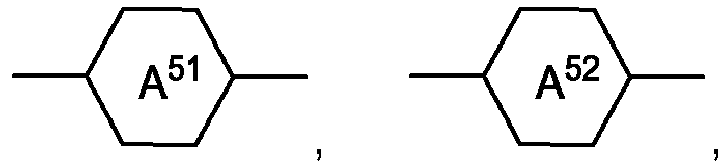


- Z51 , Z52 each,
- independently of one another, denote -CH2-CH2-, -CH2-O-, -CH=CH-, -C≡C-, -COO- or a single bond, and
- n is
- 1 or 2.
- The medium according to the invention is distinguished by favourable properties for applications in displays with narrow bezel, in particular in combination with reactive mesogens for the manufacture of polymer stabilised displays of the PS-VA mode. The medium according to the invention enables displays with narrow bezel that show reduced edge mura or no edge mura while showing overall advantageous properties especially for TV or monitor as for example low rotational viscosity, high clearing temperature, a broad nematic phase range and low threshold voltage Unless indicated otherwise, the following definitions apply.
- As used herein, alkyl is straight-chain or branched or cyclic and has 1 to 15 C atoms, is preferably straight-chain and has, unless indicated otherwise, 1, 2, 3, 4, 5, 6 or 7 C atoms and is accordingly preferably methyl, ethyl, n-propyl, n-butyl, n-pentyl, n-hexyl or n-heptyl.
- Herein, branched alkyl is preferably isopropyl, s-butyl, isobutyl, isopentyl, 2-methylhexyl or 2-ethylhexyl.
- As used herein, cyclic alkyl is taken to mean straight-chain or branched alkyl or alkenyl having up to 12 C atoms, preferably alkyl having 1 to 7 C atoms, in which a group CH2 is replaced with a carbocyclic ring having 3 to 5 C atoms, very preferably selected from the group consisting of cyclopropyl, cyclobutyl, cyclopentyl and cyclopentenyl, cyclopropylalkyl, cyclobutylalkyl, cyclopentylalkyl and cyclopentenylalkyl, methylcyclopropylalkyl, methylcyclobutylalkyl, methylcyclopentylalkyl and methylcyclopentenylalkyl, in particular cyclopropylmethyl, cyclobutylmethyl, cyclopentylmethyl and cyclopentenylmethyl.
- Herein, an alkoxy radical is straight-chain or branched and contains 1 to 15 C atoms. It is preferably straight-chain and has, unless indicated otherwise, 1, 2, 3, 4, 5, 6 or 7 C atoms and is accordingly preferably methoxy, ethoxy, n-propoxy, n-butoxy, n-pentoxy, n-hexoxy or n-heptoxy.
- Herein, an alkenyl radical is preferably an alkenyl radical having 2 to 15 C atoms, which is straight-chain or branched and contains at least one C-C double bond. It is preferably straight-chain and has 2 to 7 C atoms. Accordingly, it is preferably vinyl, prop-1- or -2-enyl, but-1-, -2- or -3-enyl, pent-1-, -2-, -3- or -4-enyl, hex-1-, -2-, -3-, -4-or -5-enyl, hept-1-, -2-, -3-, -4-, -5- or -6-enyl. If the two C atoms of the C-C double bond are substituted, the alkenyl radical can be in the form of E and/or Z isomer (trans/cis). In general, the respective E isomers are preferred. Of the alkenyl radicals, prop-2-enyl, but-2- and -3-enyl, and pent-3- and -4-enyl are particularly preferred.
- Herein, alkynyl is taken to mean an alkynyl radical having 2 to 15 C atoms, which is straight-chain or branched and contains at least one C-C triple bond. 1- and 2-propynyl and 1-, 2- and 3-butynyl are preferred.
- The compounds of the formula I are preferably selected from the group of the compounds of the formulae I-1 to I-4,


- alkyl and alkyl',
- independently of one another, denote alkyl having 1 to 7 C atoms, preferably having 2 to 5 C atoms,
- alkoxy
- denotes alkoxy having 1 to 5 C atoms, preferably having 2 to 4 C atoms,
- alkenyl
- denotes an alkenyl radical having 2 to 5 C atoms, preferably having 2 to 4 C atoms, particularly preferably 2 C atoms, and
- alkenyl'
- denotes an alkenyl radical having 2 to 5 C atoms, preferably having 2 to 4 C atoms, particularly preferably having 2 to 3 C atoms.
- In an embodiment, the medium according to the invention comprises one or more compounds of formula I selected from the compounds of the formulae I-1 to I-4 in combination with one or more compounds selected from the group of compounds of the formulae IA-1 to IA-18:





- Preferably, the medium comprises one or more compounds of formula 1-1, preferably selected from the compounds of the formulae 1-1-1 to 1-1-6





- Preferably, the medium according to the invention comprises one or more compounds of the formulae 1-2-1 and/or I-2-2


- Preferably, the medium according to the invention comprises a compound of formula I-3, in particular selected from the compounds of the formulae 1-3-1 to I-3-5


- Preferably, the medium according to the invention comprises a compound of formula I-4, in particular selected from the compounds of the formulae 1-4-1 and I-4-2


- In the compounds of the formulae IIA, IIB and IID, Z2 may have identical or different meanings. In the compounds of the formula IIB, Z2 and Z2B may have identical or different meanings. In the compounds of the formula IID, Z2 and Z2D may have identical or different meanings.
- In the compounds of the formulae IIA, IIB, IIC and IID, R2A, R2B, R2C and R2D each preferably denote alkyl having 1 to 6 C atoms, in particular CH3, C2H5, n-C3H7, n-C4H9, n-C5H11.
- In the compounds of the formulae IIA, IIB and IID, L1, L2, L3 and L4 preferably denote L1 = L2 = F and L3 = L4 = F, furthermore L1 = F and L2 = Cl, L1 = Cl and L2 = F, L3 = F and L4 = Cl, L3 = CI and L4 = F and Y = H. Z2 and Z2B in the formulae IIA and IIB preferably each, independently of one another, denote a single bond, furthermore a -C2H4- bridge.
- If, in the formula IIB, Z2 = -C2H4- or -CH2O-, Z2B is preferably a single bond or, if Z2B = -C2H4- or -CH2O-, Z2 is preferably a single bond.
- In formula IID, Z2D is preferably a single bond or -CH2O-.
- In the compounds of the formulae IIA, IIB and IID, (O)CvH2v+1 preferably denotes OCvH2v+1. In the compounds of the formula IIC, (O)CvH2v+1 preferably denotes CvH2v+1.
- In the compounds of the formula IIC, L3 and L4 preferably each denote F.
- Preferred compounds of the formulae IIA, IIB, IIC and IID are indicated below:

























- in which the parameter a denotes 1 or 2, alkyl and alkyl* each, independently of one another, denote a straight-chain alkyl radical having 1-6 C atoms, and alkenyl denotes a straight-chain alkenyl radical having 2-6 C atoms, and (O) denotes an oxygen atom or a single bond. Alkenyl preferably denotes CH2=CH-, CH2=CHCH2CH2-, CH3-CH=CH-, CH3-CH2-CH=CH-, CH3-(CH2)2-CH=CH-, CH3-(CH2)3-CH=CH- or CH3-CH=CH-(CH2)2-.
- Particularly preferred mixtures according to the invention comprise one or more compounds of the formulae IIA-2, IIA-8, IIA-10, IIA-16, IIA-18, IIA-40, IIA-41, IIA-42, IIA-43, IIB-2, IIB-10, IIB-16, IIC-1, IID-4 and IID-10.
- The proportion of compounds of the formulae IIA and/or IIB in the mixture as a whole is preferably at least 20 % by weight.
- Preferred media according to the invention comprise at least one compound of the formula IIC-1,
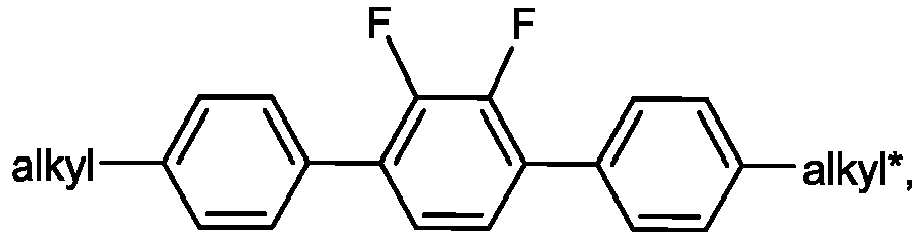
- in which alkyl and alkyl* have the meanings indicated above, preferably in amounts of < 5 % by weight, in particular > 3 % by weight.
- In particular, the medium comprises one or more compounds of the formula IIA-2 selected from the following sub-formulae:




- Alternatively, preferably in addition to the compounds of the formulae IIA-2-1 to IIA-2-5, the medium comprises one or more compoudns of the formulae IIA-2a-1 to IIA-2a-5:


- In particular, the medium comprises one or more compounds of the formula IIA-10 selected from the following sub-formulae:





- Alternatively, preferably in addition to the compounds of the formulae IIA-10-1 to IIA-10-5, the medium comprises one or more compoudns of the formulae IIA-10a-1 to IIA-10a-5:


- In particular, the medium comprises one or more compounds of the formula IIB-10 selected from the following sub-formulae:


- Alternatively, preferably in addition to the compounds of the formulae IIB-10-1 to IIB-10-5, the medium comprises one or more compoudns of the formulae IIB-10a-1 to IIB-10a-5:


- The medium according to the invention optionally comprises one or more compounds of formula III

- R11 and R12
- each, independently of one another, denote H, an alkyl or alkoxy radical having 1 to 15 C atoms, where one or more CH2 groups in these radicals may each be replaced, independently of one another, by

- A1
- on each occurrence, independently of one another, denotes a) 1,4-cyclohexenylene or 1,4-cyclohexylene radical, in which one or two non-adjacent CH2 groups may be replaced by -O- or -S-, b) a 1,4-phenylene radical, in which one or two CH groups may be replaced by N, or c) a radical from the group spiro[3.3]heptane-2,6-diyl, 1,4-bicyclo-[2.2.2]octylene, naphthalene-2,6-diyl, decahydronaphthalene-2,6-diyl, 1,2,3,4-tetrahydronaphthalene-2,6-diyl, phenanthrene-2,7-diyl and fluorene-2,7-diyl, where the radicals a), b) and c) may be mono- or polysubstituted by halogen atoms,
- n
- denotes 0, 1 or 2, preferably 0 or 1,
- Z1 on
- each occurrence independently of one another denotes -CO-O-, -O-CO-, -CF2O- , -OCF2-, -CH2O-, -OCH2-, -CH2-, -CH2CH2-, -(CH2)4-, -CH=CH-CH2O-, -C2F4-, -CH2CF2-, -CF2CH2 -, -CF=CF-, -CH=CF-, -CF=CH-, -CH=CH-, -C≡C- or a single bond, and
- L11 and L12
- each, independently of one another, denote F, Cl, CF3 or CHF2, preferably H or F, most preferably F, and
- W
- denotes O or S.
- The compounds of formula III are preferably selected from the compounds of the formula III-1 and/or III-2


- in which the occurring groups have the same meanings as given under formula III above and preferably
- R11 and R12
- each, independently of one another, an alkyl, alkenyl or alkoxy radical having up to 15 C atoms, more preferably one or both of them denote an alkoxy radical and
- L11 and L12
- each preferably denote F.
- Preferably, the compounds of the formula III-1 selected from the group of compounds of formulae 111-1-1 to 111-1-11, preferably of formula III-1-6,


alkyl and alkyl* each, independently of one another, denote a straight-chain alkyl radical having 1-6 C atoms, alkenyl and alkenyl* each, independently of one another, denote a straight-chain alkenyl radical having 2-6 C atoms, alkoxy and alkoxy* each, independently of one another, denote a straight-chain alkoxy radical having 1-6 C atoms, and L11 and L12 each, independently of one another, denote F or Cl, preferably both F. - Preferably, the compounds of the formula III-2 are selected from the group of compounds of formulae III-2-1 to III-2-10, preferably of formula III-2-6,


alkyl and alkyl* each, independently of one another, denote a straight-chain alkyl radical having 1-6 C atoms, alkenyl and alkenyl* each, independently of one another, denote a straight-chain alkenyl radical having 2-6 C atoms, alkoxy and alkoxy* each, independently of one another, denote a straight-chain alkoxy radical having 1-6 C atoms, and L1 and L2 each, independently of one another, denote F or Cl, preferably both F. - Optionally the medium comprises one or more compounds of the formula IIIA-1 and/or IIIA-2


- RIIIA denotes alkyl or alkenyl having up to 7 C atoms or a group Cy-CmH2m+1-,
- m and n are, identically or differently, 0, 1, 2, 3, 4, 5 or 6, preferably 1, 2 or 3, very preferably 1,
- Cy denotes a cycloaliphatic group having 3, 4 or 5 ring atoms, which is optionally substituted with alkyl or alkenyl each having up to 3 C atoms, or with halogen or CN, and preferably denotes cyclopropyl, cyclobutyl or cyclopentyl.
- The compounds of formula IIIA-1 and/or IIIA-2 are contained in the medium either alternatively or in addition to the compounds of formula III, preferably additionally.
- Very preferred compounds of the formulae IIIA-1 and IIIA-2 are the following:





- In a preferred embodiment of the present invention, the medium comprises one or more compounds of formula III-3

- R11, R12
- identically or differently, denote H, an alkyl or alkoxy radical having 1 to 15 C atoms, in which one or more CH2 groups in these radicals are optionally replaced, independently of one another, by -C≡C-, -CF2O-, -OCF2-, -CH=CH-,


- The compounds of formula III-3 are preferably selected from the group of compounds of the formulae III-3-1 to III-3-10:


- in which R12 denotes alkyl having 1 to 7 C-atoms, preferably ethyl, n-propyl or n-butyl, or alternatively cyclopropylmethyl, cyclobutylmethyl or cyclopentylmethyl or alternatively ―(CH2)nF in which n is 2,3,4, or 5, preferably C2H4F.
- In a preferred embodiment of the present invention, the medium comprises one or more compounds of the formulae III-4 to III-6, preferably of formula III-5,


- In a preferred embodiment the media comprise one or more compounds of the formula I selected from the group of compounds of formulae III-7 to III-9, preferably of formula III-8,



- Preferred compounds of the formula IVa are selected from the compounds of the formulae IVa-1 to IVa-4:




- alkyl and alkyl*
- each, independently of one another, denote a straight-chain alkyl radical having 1 to 6 C atoms.
- The medium according to the invention preferably comprises at least one compound of the formula IVa-2.
- Preferred compounds of the formula IVb are selected from the compounds of the formulae IVb-1 to IVb-3:



- alkyl and alkyl*
- each, independently of one another, denote a straight-chain alkyl radical having 1 to 6 C atoms, and
- alkenyl and alkenyl*
- each, independently of one another, denote a straight-chain alkenyl radical having 2 to 6 C atoms.
- Of the compounds of the formulae IVb-1 to IVb-3, the compounds of the formula IVb-1 are particularly preferred.
- Particularly preferred compounds of the formulae IVb are selected from the following compounds:


- The medium according to the invention particularly preferably comprises the compound IVb-1-1.
- The compounds of formula V are preferably selected from the compounds of the formulae V-1 to V-16:







- R1 and R2 preferably each, independently of one another, denote straight-chain alkyl having 1 to 7 C atoms or alkenyl having 2 to 7 C atoms.
- Preferred media comprise one or more compounds of the formulae V-1, V-3, V-4, V-6, V-7, V-10, V-11, V-12, V-14, V-15, and/or V-16. Very preferably, the medium comprises one or more compounds of formula V-16.
- In a preferred embodiment of the present invention the medium additionally comprises one or more compounds of the formulae VI-1 to VI-9


- R7
- each, independently of one another, have one of the meanings indicated for R2A in Claim 5, and
- w and x
- each, independently of one another, denote 1 to 6.
- Particular preference is given to mixtures comprising at least one compound of the formula V-9.
- In a preferred embodiment of the present invention the medium additionally comprises one or more compounds of the formulae VII-1 to VII-21,


- R denotes a straight-chain alkyl or alkoxy radical having 1 to 6 C atoms, (O) denotes -O- or a single bond, and m is 0, 1, 2, 3, 4, 5 or 6 and n is 0, 1, 2, 3 or 4.
- R preferably denotes methyl, ethyl, propyl, butyl, pentyl, hexyl, methoxy, ethoxy, propoxy, butoxy, pentoxy.
- Particular preference is given to compounds of the formulae VII-1, VII-2, VII-4, VII-20 and VII-21. In these compounds, R preferably denotes alkyl, furthermore alkoxy, each having 1 to 5 C atoms. In the compounds of the formula VII-20, R preferably denotes alkyl or alkenyl, in particular alkyl. In the compound of the formula VII-21, R preferably denotes alkyl.
- The total concentration of the compounds of the formula I in the medium is preferably in the range of from 10% to 40%, preferably from 12% to 35%, very preferably from 15% to 30%.
- The total concentration of the compounds of the formula IVa in the medium is preferably in the range of from 4% to 20%, preferably from 6% to 18%, very preferably from 8% to 15%.
- The total concentration of the compounds of the formula IVb in the medium is preferably in the range of from 2% to 15%, preferably from 3% to 12%, very preferably from 4% to 10%.
- The total concentration of the compounds of the formula V in the medium is preferably in the range of from 2% to 15%, preferably from 3% to 12%, very preferably from 4% to 10%.
- The total concentration of the compounds of the formula IIA in the medium is preferably in the range of from 15% to 50%, preferably from 20% to 45%, very preferably from 25% to 40%.
- The total concentration of the compounds of the formula IIB in the medium is preferably in the range of from 5% to 30%, preferably from 8% to 25%, very preferably from 10% to 20%.
- In a particularly preferred embodiment of the present invention, the medium comprises the compound of the formula 1-1-1





- Above and below, it goes without saying that the percentages of the individual mixture components do not exceed 100 % in total.
- The medium according to the invention preferably comprises the compounds of the formulae I-1-1, 1-1-5, 1-1-6, V-16-1, IVa-2-1, IVb-1-1, IIA-2-2, IIA-2-5, IIA-10-2, IIA-10-4, IIB-10-1, IIB-10-4 in a total concentration in the range of from 80 % to 100 %, more preferably from 90% to 99 %, very preferably from 95% to 98%.
- The medium according to the invention preferably consists of 100% of compounds of the formulae 1-1-1, 1-1-5, 1-1-6, V-16-1, IVa-2-1, IVb-1-1, IIA-2-2, IIA-2-5, IIA-10-2, IIA-10-4, IIB-10-1, IIB-10-4.
- The invention further relates to a medium consisting of the medium described above, herein also referred to as host medium, and, in addition, a chiral dopant.
- The invention further relates to a medium consisting of the medium described above, herein also referred to as host medium, and, in addition, a polymerisable compound.
- The invention further relates to a medium consisting of the medium described above, herein also referred to as host medium, and, in addition, a chiral dopant and a polymerisable compound.
- Further preferred embodiments are listed below:
- a) Liquid-crystalline medium comprising at least one compound of the formulae Z-1 to Z-7,


- b) Preferred liquid-crystalline media according to the invention comprise one or more substances which contain a tetrahydronaphthyl or naphthyl unit, such as, for example, the compounds of the formulae N-1 to N-5,


- Z1 and Z2
- each, independently of one another, denote -C2H4-, -CH=CH-, -(CH2)4-, -(CH2)3O-, -O(CH2)3-, -CH=CHCH 2CH2-, -CH2CH2CH=CH-, -CH2O-, -OCH2-, -COO-, -OCO-, -C2F4-, -C F=CF-, -CF=CH-, -CH=CF-, -CF2O-, -OCF2-, -CH2- or a single bond.
- c) Preferred mixtures comprise one or more compounds selected from the group of the difluorodibenzochroman compounds of the formula BC, chromans of the formula CR, and fluorinated phenanthrenes of the formulae PH-1 and PH-2,


RB1, RB2, RCR1, RCR2, R1, R2 each, independently of one another, have the meaning of R2A. c is 0, 1 or 2. R1 and R2 preferably, independently of one another, denote alkyl or alkoxy having 1 to 6 C atoms.
Particularly preferred compounds of the formulae BC and CR are the compounds BC-1 to BC-7 and CR-1 to CR-5,




- alkyl and alkyl*
- each, independently of one another, denote a straight-chain alkyl radical having 1 to 6 C atoms, and
- alkenyl and alkenyl*
- each, independently of one another, denote a straight-chain alkenyl radical having 2 to 6 C atoms.
- d) Preferred mixtures comprise one or more indane compounds of the formula In,

- R11, R12, R13
- each, independently of one another, denote a straight-chain alkyl, alkoxy, alkoxyalkyl or alkenyl radical having 1 to 6 C atoms,
- R12 and R13
- additionally denote halogen, preferably F,


- i
- denotes 0, 1 or 2.







- e) Preferred mixtures additionally comprise one or more compounds of the formulae L-1 to L-5,


R, R1 and R2 each, independently of one another, have the meanings indicated for R2A in formula IIA above, and alkyl denotes an alkyl radical having 1 to 6 C atoms. The parameter s denotes 1 or 2.
The compounds of the formulae L-1 to L-9 are preferably employed in concentrations of 5 to 15 % by weight, in particular 5 to 12 % by weight and very particularly preferably 8 to 10 % by weight. - f) Preferred mixtures additionally comprise one or more compounds of formula IIA-Y

- Preferred compounds of the formula IIA-Y are selected from the group consisting of the following sub-formulae


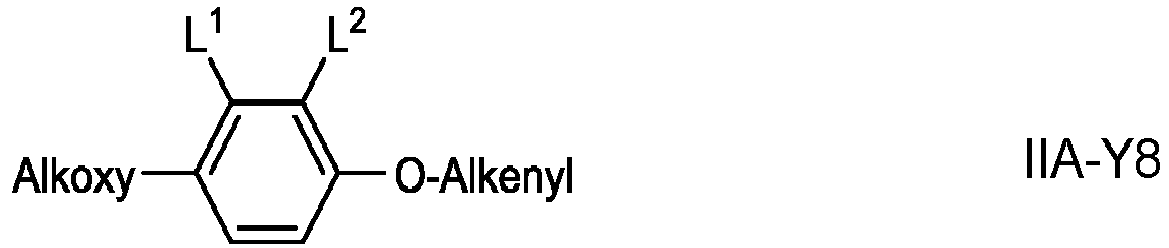


- Particularly preferred compounds of the formula IIA-Y are selected from the group consisting of following sub-formulae:


- The liquid crystal medium according to the invention, herein also referred to as liquid crystal host mixture, is suitable for the use in polymer stabilised displays. To this end, the medium according to the invention optionally comprises one or more polymerisable compounds of formula P
P-Sp-A1-(Z1-A2)z-R P
in which the individual radicals, independently of each other and on each occurrence identically or differently, have the following meanings: - P a polymerisable group,
- Sp a spacer group or a single bond,
- A1, A2 an aromatic, heteroaromatic, alicyclic or heterocyclic group, preferably having 4 to 25 ring atoms, which may also contain fused rings, and which is unsubstituted, or mono- or polysubstituted by L,
- Z1 -O-, -S-, -CO-, -CO-O-, -O-CO-, -O-CO-O-, -OCH2-, -CH2O-, -SCH2-, -CH2S-, -CF2O-, -OCF2-, -CF2S-, -SCF2-, -(CH2)n1-, -CF2CH2-, -CH2CF2-, -(CF2)n1-, -CH=CH-, -CF=CF-, -CH=CF-, -CF=CH-, -C≡C-, -CH=CH-CO-O-, -O-CO-CH=CH-, -CH2-CH2-CO-O-, -O-CO-CH2-CH2-, -CR0R00-, or a single bond,
- R0, R00 H or alkyl having 1 to 12 C atoms,
- R H, L, or P-Sp-,
- L F, Cl, -CN, P-Sp- or straight chain, branched or cyclic alkyl having 1 to 25 C atoms, wherein one or more non-adjacent CH2-groups are optionally replaced by -O-, -S-, -CO-, -CO-O-, -O-CO-, -O-CO-O- in such a manner that O- and/or S-atoms are not directly connected with each other, and wherein one or more H atoms are each optionally replaced by P-Sp-, F or Cl,
- z 0, 1, 2 or 3,
- n1 1,2, 3 or 4.
- As used herein, the terms "active layer" and "switchable layer" mean a layer in an electrooptical display, for example an LC display, that comprises one or more molecules having structural and optical anisotropy, like for example LC molecules, which change their orientation upon an external stimulus like an electric or magnetic field, resulting in a change of the transmission of the layer for polarized or unpolarized light.
- As used herein, the terms "tilt" and "tilt angle" will be understood to mean a tilted alignment of the LC molecules of an LC medium relative to the surfaces of the cell in an LC display (here preferably a PSA display). The tilt angle here denotes the average angle (< 90°) between the longitudinal molecular axes of the LC molecules (LC director) and the surface of the plane-parallel outer plates which form the LC cell. A low value for the tilt angle (i.e. a large deviation from the 90° angle) corresponds to a large tilt here. A suitable method for measurement of the tilt angle is given in the examples. Unless indicated otherwise, tilt angle values disclosed above and below relate to this measurement method.
- As used herein, the terms "reactive mesogen" and "RM" will be understood to mean a compound containing a mesogenic or liquid crystalline skeleton, and one or more functional groups attached thereto which are suitable for polymerisation and are also referred to as "polymerisable group" or "P".
- Unless stated otherwise, the term "polymerisable compound" as used herein will be understood to mean a polymerisable monomeric compound.
- As used herein, the term "low-molecular-weight compound" will be understood to mean to a compound that is monomeric and/or is not prepared by a polymerisation reaction, as opposed to a "polymeric compound" or a "polymer".
- As used herein, the term "unpolymerisable compound" will be understood to mean a compound that does not contain a functional group that is suitable for polymerisation under the conditions usually applied for the polymerisation of the RMs.
- The term "mesogenic group" as used herein is known to the person skilled in the art and described in the literature, and means a group which, due to the anisotropy of its attracting and repelling interactions, essentially contributes to causing a liquid-crystal (LC) phase in low-molecular-weight or polymeric substances. Compounds containing mesogenic groups (mesogenic compounds) do not necessarily have to have an LC phase themselves. It is also possible for mesogenic compounds to exhibit LC phase behaviour only after mixing with other compounds and/or after polymerisation. Typical mesogenic groups are, for example, rigid rod- or disc-shaped units. An overview of the terms and definitions used in connection with mesogenic or LC compounds is given in Pure Appl. Chem. 2001, 73(5), 888 and C. Tschierske, G. Pelzl, S. Diele, Angew. Chem. 2004, 116, 6340-6368.
- As used herein, the terms "optically active" and "chiral" are synonyms for materials that are able to induce a helical pitch in a nematic host material, also referred to as "chiral dopants".
- The term "spacer group", hereinafter also referred to as "Sp", as used herein is known to the person skilled in the art and is described in the literature, see, for example, Pure Appl. Chem. 2001, 73(5), 888 and C. Tschierske, G. Pelzl, S. Diele, Angew. Chem. 2004, 116, 6340-6368. As used herein, the terms "spacer group" or "spacer" mean a flexible group, for example an alkylene group, which connects the mesogenic group and the polymerisable group(s) in a polymerisable mesogenic compound.
- Above and below,


- Above and below "organic group" denotes a carbon or hydrocarbon group.
- "Carbon group" denotes a mono- or polyvalent organic group containing at least one carbon atom, where this either contains no further atoms (such as, for example, -C≡C-) or optionally contains one or more further atoms, such as, for example, N, O, S, B, P, Si, Se, As, Te or Ge (for example carbonyl, etc.). The term "hydrocarbon group" denotes a carbon group which additionally contains one or more H atoms and optionally one or more heteroatoms, such as, for example, N, O, S, B, P, Si, Se, As, Te or Ge.
- "Halogen" denotes F, Cl, Br or I, preferably F or Cl. -CO-, -C(=O)- and -C(O)- denote a carbonyl group, i.e.

- A carbon or hydrocarbon group can be a saturated or unsaturated group. Unsaturated groups are, for example, aryl, alkenyl or alkynyl groups. A carbon or hydrocarbon radical having more than 3 C atoms can be straight-chain, branched and/or cyclic and may also contain spiro links or condensed rings.
- The terms "alkyl", "aryl", "heteroaryl", etc., also encompass polyvalent groups, for example alkylene, arylene, heteroarylene, etc.
- The term "aryl" denotes an aromatic carbon group or a group derived therefrom. The term "heteroaryl" denotes "aryl" as defined above, containing one or more heteroatoms, preferably selected from N, O, S, Se, Te, Si and Ge.
- Preferred carbon and hydrocarbon groups are optionally substituted, straight-chain, branched or cyclic, alkyl, alkenyl, alkynyl, alkoxy, alkylcarbonyl, alkoxycarbonyl, alkylcarbonyloxy and alkoxycarbonyloxy having 1 to 40, preferably 1 to 20, very preferably 1 to 12, C atoms, optionally substituted aryl or aryloxy having 5 to 30, preferably 6 to 25, C atoms, or optionally substituted alkylaryl, arylalkyl, alkylaryloxy, arylalkyloxy, arylcarbonyl, aryloxycarbonyl, arylcarbonyloxy and aryloxycarbonyloxy having 5 to 30, preferably 6 to 25, C atoms, wherein one or more C atoms may also be replaced by hetero atoms, preferably selected from N, O, S, Se, Te, Si and Ge. Further preferred carbon and hydrocarbon groups are C1-C20 alkyl, C2-C20 alkenyl, C2-C20 alkynyl, C3-C20 allyl, C4-C20 alkyldienyl, C4-C20 polyenyl, C6-C20 cycloalkyl, C4-C15 cycloalkenyl, C6-C30 aryl, C6-C30 alkylaryl, C6-C30 arylalkyl, C6-C30 alkylaryloxy, C6-C30 arylalkyloxy, C2-C30 heteroaryl, C2-C30 heteroaryloxy.
- Particular preference is given to C1-C12 alkyl, C2-C12 alkenyl, C2-C12 alkynyl, C6-C25 aryl and C2-C25 heteroaryl.
- Further preferred carbon and hydrocarbon groups are straight-chain, branched or cyclic alkyl having 1 to 20, preferably 1 to 12, C atoms, which are unsubstituted or mono- or polysubstituted by F, Cl, Br, I or CN and in which one or more non-adjacent CH2 groups may each be replaced, independently of one another, by -C(Rx)=C(Rx)-, - C≡-, -N(Rx)-, -O-, -S-, -CO-, -CO-O-, -O-CO-, -O-CO-O- in such a way that O and/or S atoms are not linked directly to one another.
- Rx preferably denotes H, F, Cl, CN, a straight-chain, branched or cyclic alkyl chain having 1 to 25 C atoms, in which, in addition, one or more non-adjacent C atoms may be replaced by -O-, -S-, -CO-, -CO-O-, -O-CO-, -O-CO-O- and in which one or more H atoms may be replaced by F or Cl, or denotes an optionally substituted aryl or aryloxy group with 6 to 30 C atoms, or an optionally substituted heteroaryl or heteroaryloxy group with 2 to 30 C atoms.
- Preferred alkyl groups are, for example, methyl, ethyl, n-propyl, isopropyl, n-butyl, isobutyl, s-butyl, t-butyl, 2-methylbutyl, n-pentyl, s-pentyl, cyclopentyl, n-hexyl, cyclohexyl, 2-ethylhexyl, n-heptyl, cycloheptyl, n-octyl, cyclooctyl, n-nonyl, n-decyl, n-undecyl, n-dodecyl, dodecanyl, trifluoromethyl, perfluoro-n-butyl, 2,2,2-trifluoroethyl, perfluorooctyl, perfluorohexyl, etc.
- Preferred alkenyl groups are, for example, ethenyl, propenyl, butenyl, pentenyl, cyclopentenyl, hexenyl, cyclohexenyl, heptenyl, cycloheptenyl, octenyl, cyclooctenyl, etc.
- Preferred alkynyl groups are, for example, ethynyl, propynyl, butynyl, pentynyl, hexynyl, octynyl, etc.
- Preferred alkoxy groups are, for example, methoxy, ethoxy, 2-methoxyethoxy, n-propoxy, i-propoxy, n-butoxy, i-butoxy, s-butoxy, t-butoxy, 2-methylbutoxy, n-pentoxy, n-hexoxy, n-heptoxy, n-octoxy, n-nonoxy, n-decoxy, n-undecoxy, n-dodecoxy, etc.
- Preferred amino groups are, for example, dimethylamino, methylamino, methylphenylamino, phenylamino, etc.
- Aryl and heteroaryl groups can be monocyclic or polycyclic, i.e. they can contain one ring (such as, for example, phenyl) or two or more rings, which may also be fused (such as, for example, naphthyl) or covalently bonded (such as, for example, biphenyl), or contain a combination of fused and linked rings. Heteroaryl groups contain one or more heteroatoms, preferably selected from O, N, S and Se.
- Particular preference is given to mono-, bi- or tricyclic aryl groups having 6 to 25 C atoms and mono-, bi- or tricyclic heteroaryl groups having 5 to 25 ring atoms, which optionally contain fused rings and are optionally substituted. Preference is furthermore given to 5-, 6- or 7-membered aryl and heteroaryl groups, in which, in addition, one or more CH groups may be replaced by N, S or O in such a way that O atoms and/or S atoms are not linked directly to one another.
- Preferred aryl groups are, for example, phenyl, biphenyl, terphenyl, [1,1':3',1"]terphenyl-2'-yl, naphthyl, anthracene, binaphthyl, phenanthrene, 9,10-dihydro-phenanthrene, pyrene, dihydropyrene, chrysene, perylene, tetracene, pentacene, benzopyrene, fluorene, indene, indenofluorene, spirobifluorene, etc.
- Preferred heteroaryl groups are, for example, 5-membered rings, such as pyrrole, pyrazole, imidazole, 1,2,3-triazole, 1,2,4-triazole, tetrazole, furan, thiophene, selenophene, oxazole, isoxazole, 1,2-thiazole, 1,3-thiazole, 1,2,3-oxadiazole, 1,2,4-oxadiazole, 1,2,5-oxadiazole, 1,3,4-oxadiazole, 1,2,3-thiadiazole, 1,2,4-thiadiazole, 1,2,5-thiadiazole, 1,3,4-thiadiazole, 6-membered rings, such as pyridine, pyridazine, pyrimidine, pyrazine, 1,3,5-triazine, 1,2,4-triazine, 1,2,3-triazine, 1,2,4,5-tetrazine, 1,2,3,4-tetrazine, 1,2,3,5-tetrazine, or condensed groups, such as indole, isoindole, indolizine, indazole, benzimidazole, benzotriazole, purine, naphthimidazole, phenanthrimidazole, pyridimidazole, pyrazinimidazole, quinoxalinimidazole, benzoxazole, naphthoxazole, anthroxazole, phenanthroxazole, isoxazole, benzothiazole, benzofuran, isobenzofuran, dibenzofuran, quinoline, isoquinoline, pteridine, benzo-5,6-quinoline, benzo-6,7-quinoline, benzo-7,8-quinoline, benzoisoquinoline, acridine, phenothiazine, phenoxazine, benzopyridazine, benzopyrimidine, quinoxaline, phenazine, naphthyridine, azacarbazole, benzocarboline, phenanthridine, phenanthroline, thieno[2,3b]thiophene, thieno[3,2b]thiophene, dithienothiophene, isobenzothiophene, dibenzothiophene, benzothiophene, benzothiadiazothiophene, or combinations of these groups.
- The aryl and heteroaryl groups mentioned above and below may also be substituted by alkyl, alkoxy, thioalkyl, fluorine, fluoroalkyl or further aryl or heteroaryl groups.
- The (non-aromatic) alicyclic and heterocyclic groups encompass both saturated rings, i.e. those containing exclusively single bonds, and also partially unsaturated rings, i.e. those which may also contain multiple bonds. Heterocyclic rings contain one or more heteroatoms, preferably selected from Si, O, N, S and Se.
- The (non-aromatic) alicyclic and heterocyclic groups can be monocyclic, i.e. contain only one ring (such as, for example, cyclohexane), or polycyclic, i.e. contain a plurality of rings (such as, for example, decahydronaphthalene or bicyclooctane). Particular preference is given to saturated groups. Preference is furthermore given to mono-, bior tricyclic groups having 5 to 25 ring atoms, which optionally contain fused rings and are optionally substituted. Preference is furthermore given to 5-, 6-, 7- or 8-membered carbocyclic groups, in which, in addition, one or more C atoms may be replaced by Si and/or one or more CH groups may be replaced by N and/or one or more non-adjacent CH2 groups may be replaced by -O- and/or -S-.
- Preferred alicyclic and heterocyclic groups are, for example, 5-membered groups, such as cyclopentane, tetrahydrofuran, tetrahydrothiofuran, pyrrolidine, 6-membered groups, such as cyclohexane, silinane, cyclohexene, tetrahydropyran, tetrahydrothiopyran, 1,3-dioxane, 1,3-dithiane, piperidine, 7-membered groups, such as cycloheptane, and fused groups, such as tetrahydronaphthalene, decahydronaphthalene, indane, bicyclo[1.1.1]pentane-1,3-diyl, bicyclo[2.2.2]octane-1,4-diyl, spiro[3.3]heptane-2,6-diyl, octahydro-4,7-methanoindane-2,5-diyl.
- Preferred substituents are, for example, solubility-promoting groups, such as alkyl or alkoxy, electron-withdrawing groups, such as fluorine, nitro or nitrile, or substituents for increasing the glass transition temperature (Tg) in the polymer, in particular bulky groups, such as, for example, t-butyl or optionally substituted aryl groups.
- Preferred substituents, hereinafter also referred to as "Ls", are, for example, F, Cl, Br, I, -CN, -NO2, -NCO, -NCS, -OCN, -SCN, -C(=O)N(Rx)2, -C(=O)Y1, -C(=O)Rx, -N(Rx)2, straight-chain or branched alkyl, alkoxy, alkylcarbonyl, alkoxycarbonyl, alkylcarbonyloxy or alkoxycarbonyloxy each having 1 to 25 C atoms, in which one or more H atoms may optionally be replaced by F or Cl, optionally substituted silyl having 1 to 20 Si atoms, or optionally substituted aryl having 6 to 25, preferably 6 to 15, C atoms,
- wherein Rx denotes H, F, Cl, CN, or straight chain, branched or cyclic alkyl having 1 to 25 C atoms, wherein one or more non-adjacent CH2-groups are optionally replaced by -O-, -S-, -CO-, -CO-O-, -O-CO-, -O-CO-O- in such a manner that O- and/or S-atoms are not directly connected with each other, and wherein one or more H atoms are each optionally replaced by F, Cl, P- or P-Sp-, and
- Y1 denotes halogen.
- "Substituted silyl or aryl" preferably means substituted by halogen, -CN,
- R0, -OR0, -CO-R0, -CO-O-R0, -O-CO-R0 or -O-CO-O-R0, wherein R0 denotes H or alkyl with 1 to 20 C atoms.
- Particularly preferred substituents L are, for example, F, Cl, CN, NO2, CH3, C2H5, OCH3, OC2H5, COCH3, COC2H5, COOCH3, COOC2H5, CF3, OCF3, OCHF2, OC2F5, furthermore phenyl. A1 and A2 very preferably denote


- The polymerisable group P is a group which is suitable for a polymerisation reaction, such as, for example, free-radical or ionic chain polymerisation, polyaddition or polycondensation, or for a polymer-analogous reaction, for example addition or condensation onto a main polymer chain. Particular preference is given to groups for chain polymerisation, in particular those containing a C=C double bond or -C≡C- triple bond, and groups which are suitable for polymerisation with ring opening, such as, for example, oxetane or epoxide groups.
- Preferred groups P are selected from the group consisting of CH2=CW1-CO-O-, CH2=CW1-CO-,


- Very preferred groups P are selected from the group consisting of CH2=CW1-CO-O-, CH2=CW1-CO-,


- Very particularly preferred groups P are selected from the group consisting of CH2=CW1-CO-O-, in particular CH2=CH-CO-O-, CH2=C(CH3)-CO-O- and CH2=CF-COO-, furthermore CH2=CH-O-, (CH2=CH)2CH-O-CO-, (CH2=CH)2CH-O-,

- Further preferred polymerisable groups P are selected from the group consisting of vinyloxy, acrylate, methacrylate, fluoroacrylate, chloroacrylate, oxetane and epoxide, most preferably from acrylate and methacrylate.
- If the spacer group Sp is different from a single bond, it is preferably of the formula Sp"-X", so that the respective radical P-Sp- conforms to the formula R-Sp"-X"-, wherein
- Sp" denotes linear or branched alkylene having 1 to 20, preferably 1 to 12, C atoms, which is optionally mono- or polysubstituted by F, Cl, Br, I or CN and in which, in addition, one or more non-adjacent CH2 groups may each be replaced, independently of one another, by -O-, -S-, -NH-, -N(R0)-, -Si(R0R00)-, -CO-, -CO-O-, -O-CO-, -O-CO-O-, -S-CO-, -CO-S-, -N(R00)-CO-O-, -O-CO-N(R0)-, -N(R0)-CO-N(R00)-, -CH=CH- or -C≡C- in such a way that O and/or S atoms are not linked directly to one another,
- X" denotes -O-, -S-, -CO-, -CO-O-, -O-CO-, -O-CO-O-, -CO-N(R0)-, -N(R0)-CO-, -N(R0)-CO-N(R00)-, -OCH2-, -CH2O-, -SCH2-, -CH2S-, -CF2O-, -OCF2-, -CF2S-, -SCF2-, -CF2CH2-, -CH2CF2-, -CF2CF2-, -CH=N-, -N=CH-, -N=N-, -CH=CR0-, -CY2=CY3-, -C≡C-, -CH=CH-CO-O-, -O-CO-CH=CH- or a single bond,
- R0 and R00 each, independently of one another, denote H or alkyl having 1 to 20 C atoms, and
- Y2 and Y3 each, independently of one another, denote H, F, Cl or CN.
- X" is preferably -O-, -S-, -CO-, -COO-, -OCO-, -O-COO-, -CO-NR0-, -NR0-CO-, -NR0-CO-NR00- or a single bond.
- Typical spacer groups Sp and -Sp"-X"- are, for example, -(CH2)p1-, -(CH2)p1-O-, - (CH2)p1-O-CO-, -(CH2)p1-CO-O-, -(CH2)p1-O-CO-O-, -(CH2CH2O)q1-CH2CH2-, -CH2CH2-S-CH2CH2-, -CH2CH2-NH-CH2CH2- or -(SiR0R00-O)p1-, in which p1 is an integer from 1 to 12, q1 is an integer from 1 to 3, and R0 and R00 have the meanings indicated above.
- Particularly preferred groups Sp and -Sp"-X"- are -(CH2)p1-, -(CH2)p1-O-, -(CH2)p1-O-CO-, -(CH2)p1-CO-O-, -(CH2)p1-O-CO-O-, in which p1 and q1 have the meanings indicated above.
- Particularly preferred groups Sp" are, in each case straight-chain, ethylene, propylene, butylene, pentylene, hexylene, heptylene, octylene, nonylene, decylene, undecylene, dodecylene, octadecylene, ethyleneoxyethylene, methyleneoxybutylene, ethylenethioethylene, ethylene-N-methyliminoethylene, 1-methylalkylene, ethenylene, propenylene and butenylene.
- In a preferred embodiment of the invention the compounds of formula P and its subformulae contain a spacer group Sp that is substituted by one or more polymerisable groups P, so that the group Sp-P corresponds to Sp(P)s, with s being ≥2 (branched polymerisable groups).
- Preferred compounds of formula P according to this preferred embodiment are those wherein s is 2, i.e. compounds which contain a group Sp(P)2. Very preferred compounds of formula P according to this preferred embodiment contain a group selected from the following formulae:
-X-alkyl-CHPP S1
-X-alkyl-CH((CH2)aaP)((CH2)bbP) S2
-X-N((CH2)aaP)((CH2)bbP) S3
-X-alkyl-CHP-CH2-CH2P S4
-X-alkyl-C(CH2P)(CH2P)-CaaH2aa+1 S5
-X-alkyl-CHP-CH2P S6
-X-alkyl-CPP-CaaH2aa+1 S7
-X-alkyl-CHPCHP-CaaH2aa+1 S8
- in which P is as defined in formula P,
- alkyl denotes a single bond or straight-chain or branched alkylene having 1 to 12 C atoms which is unsubstituted or mono- or polysubstituted by F, Cl or CN and in which one or more non-adjacent CH2 groups may each, independently of one another, be replaced by -C(R0)=C(R0)-, -C≡C-, -N(R0)-, -O-, -S-, -CO-, -CO-O-, -O-CO-, -O-CO-O-in such a way that O and/or S atoms are not linked directly to one another, where R0 has the meaning indicated above,
- aa and bb each, independently of one another, denote 0, 1, 2, 3, 4, 5 or 6,
- X has one of the meanings indicated for X", and is preferably O, CO, SO2, O-CO-, CO-O or a single bond.
- Preferred spacer groups Sp(P)2 are selected from formulae S1, S2 and S3.
- Very preferred spacer groups Sp(P)2 are selected from the following subformulae:
-CHPP S1a
-O-CHPP S1b
-CH2-CHPP S1c
-OCH2-CHPP S1d
-CH(CH2-P)(CH2-P) S2a
-OCH(CH2-P)(CH2-P) S2b
-CH2-CH(CH2-P)(CH2-P) S2c
-OCH2-CH(CH2-P)(CH2-P) S2d
-CO-NH((CH2)2P)((CH2)2P) S3a
- In the compounds of formula P and its subformulae as described above and below, P is preferably selected from the group consisting of vinyloxy, acrylate, methacrylate, fluoroacrylate, chloroacrylate, oxetane and epoxide, most preferably from acrylate and methacrylate.
- Further preferred are compounds of formula P and its subformulae as described above and below, wherein all polymerisable groups P that are present in the compound have the same meaning, and very preferably denote acrylate or methacrylate, most preferably methacrylate.
- In the compounds of formula P and its subformulae as described above and below, R preferably denotes P-Sp-.
- Further preferred are compounds of formula P and its subformulae as described above and below, wherein Sp denotes a single bond or -(CH2)p1-, -O-(CH2)p1-, -O-CO-(CH2)p1, or -CO-O-(CH2)p1, wherein p1 is 2, 3, 4, 5 or 6, and, if Sp is -O-(CH2)p1-, -O-CO-(CH2)p1 or -CO-O-(CH2)p1 the O-atom or CO-group, respectively, is linked to the benzene ring.
- Further preferred are compounds of formula P and its subformulae as described above and below, wherein at least one group Sp is a single bond.
- Further preferred are compounds of formula P and its subformulae as described above and below, wherein at least one group Sp is different from a single bond, and is preferably selected from -(CH2)p1-, -O-(CH2)p1-, -O-CO-(CH2)p1, or -CO-O-(CH2)p1, wherein p1 is 2, 3, 4, 5 or 6, and, if Sp is -O-(CH2)p1-, -O-CO-(CH2)p1 or -CO-O-(CH2)p1 the O-atom or CO-group, respectively, is linked to the benzene ring.
- Very preferred groups -A1-(Z-A2)z- in formula P are selected from the following formulae


- Preferred compounds of formula P and their subformulae are selected from the following preferred embodiments, including any combination thereof:
- All groups P in the compound have the same meaning,
- -A1-(Z-A2)z- is selected from formulae A1, A2 and A5,
- the compounds contain exactly two polymerizable groups (represented by the groups P),
- the compounds contain exactly three polymerizable groups (represented by the groups P),
- P is selected from the group consisting of acrylate, methacrylate and oxetane, very preferably acrylate or methacrylate,
- P is methacrylate,
- all groups Sp are a single bond,
- at least one of the groups Sp is a single bond and at least one of the groups Sp is different from a single bond,
- Sp, when being different from a single bond, is -(CH2)p2-, -(CH2)p2-O-,
-(CH2)p2-CO-O-, -(CH2)p2-O-CO-, wherein p2 is 2, 3, 4, 5 or 6, and the O-atom or the CO-group, respectively, is connected to the benzene ring, - Sp is a single bond or denotes -(CH2)p2-, -(CH2)p2-O-, -(CH2)p2-CO-O-, -(CH2)p2-O-CO-, wherein p2 is 2, 3, 4, 5 or 6, and the O-atom or the CO-group, respectively, is connected to the benzene ring,
- R denotes P-Sp-,
- R does not denote or contain a polymerizable group,
- R does not denote or contain a polymerizable group and denotes straight chain, branched or cyclic alkyl having 1 to 25 C atoms, wherein one or more non-adjacent CH2-groups are optionally replaced by -O-,
-S-, -CO-, -CO-O-, -O-CO-, -O-CO-O- in such a manner that O- and/or S-atoms are not directly connected with each other, and wherein one or more H atoms are each optionally replaced by F, Cl or La, - L or L' denote F, CI or CN,
- L is F.
- Suitable and preferred compounds of formula P are selected from the following formulae:


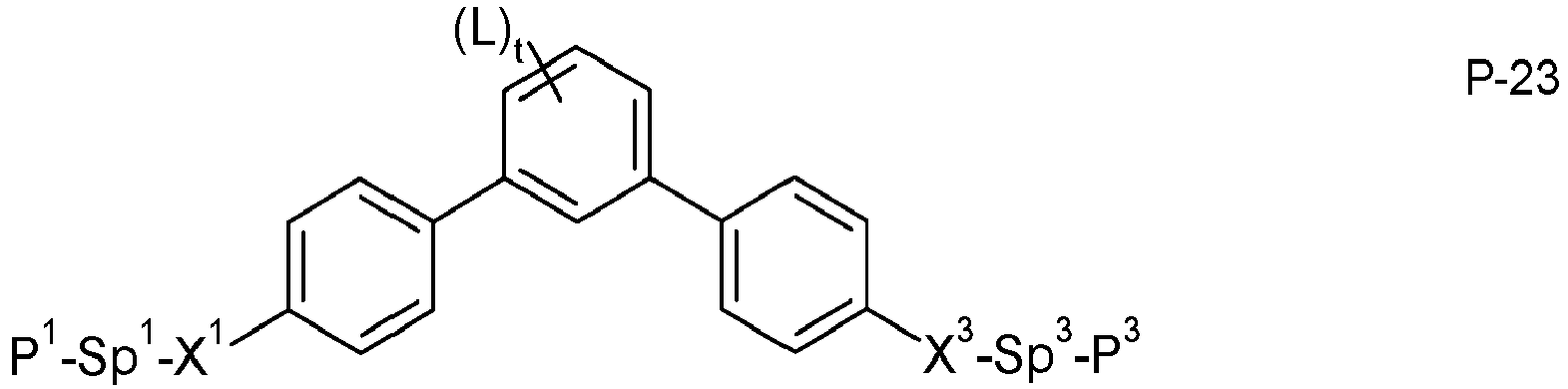


- P1, P2 and P3
- each, independently of one another, denote an acrylate or methacrylate group,
- Sp1, Sp2 and Sp3
- each, independently of one another, denote a single bond or a spacer group having one of the meanings indicated above and below for Sp, and particularly preferably denote -(CH2)p1-, -(CH2)p1-O-, -(CH2)p1-CO-O-, -(CH2)p1-O-CO- or -(CH2)p1-O-CO-O-, in which p1 is an integer from 1 to 12, where, in addition, one or more of the radicals P1-Sp1-, P2-Sp2- and P3-Sp3- may denote Raa, with the proviso that at least one of the radicals P1-Sp1-, P2-Sp2- and P3-Sp3- present is different from Raa,
- Raa
- denotes H, F, Cl, CN or straight-chain or branched alkyl having 1 to 25 C atoms, in which, in addition, one or more non-adjacent CH2 groups may each be replaced, independently of one another, by C(R0)=C(R00)-, -C≡C-, -N(R0)-, -O-, -S-, -CO-, -CO-O-, -O-CO-, -O-CO-O- in such a way that O and/or S atoms are not linked directly to one another, and in which, in addition, one or more H atoms may be replaced by F, Cl, CN or P1-Sp1-, particularly preferably straight-chain or branched, optionally mono- or polyfluorinated alkyl, alkoxy, alkenyl, alkynyl, alkylcarbonyl, alkoxycarbonyl, alkylcarbonyloxy or alkoxycarbonyloxy having 1 to 12 C atoms (where the alkenyl and alkynyl radicals have at least two C atoms and the branched radicals have at least three C atoms),
- R0, R00
- each, independently of one another and identically or differently on each occurrence, denote H or alkyl having 1 to 12 C atoms,
- Ry and Rz
- each, independently of one another, denote H, F, CH3 or CF3,
- X1, X2 and X3
- each, independently of one another, denote -CO-O-, -O-CO- or a single bond,
- Z1
- denotes -O-, -CO-, -C(RyRz)- or -CF2CF2-,
- Z2 and Z3
- each, independently of one another, denote -CO-O-, -O-CO-, -CH2O-, -OCH2-, -CF2O-, -OCF2- or -(CH2)n-, where n is 2, 3 or 4,
- L
- on each occurrence, identically or differently, denotes F, Cl, CN or straight-chain or branched, optionally mono- or polyfluorinated alkyl, alkoxy, alkenyl, alkynyl, alkylcarbonyl, alkoxycarbonyl, alkylcarbonyloxy or alkoxycarbonyloxy having 1 to 12 C atoms, preferably F,
- L' and L"
- each, independently of one another, denote H, F or Cl,
- k
- denotes 0 or 1,
- r
- denotes 0, 1, 2, 3 or 4,
- s
- denotes 0, 1, 2 or 3,
- t
- denotes 0, 1 or 2,
- x
- denotes 0 or 1.
- Especially preferred are compounds of formulae P2, P13, P17, P22, P23, P24, P30, P31 and P32.
- Further preferred are trireactive compounds P15 to P30, in particular P17, P18, P19, P22, P23, P24, P25, P26, P30, P31 and P32.
- In the compounds of formulae P1 to P32 the group


- The media according to the present invention comprise one or more chiral dopants. Preferably these chiral dopants have an absolute value of the helical twisting power (HTP) in the range of from 1 µm-1 to 150 µm-1, preferably in the range of from 10 µm-1 to 100 µm-1. In case the media comprise two or more chiral dopants, these may have opposite signs of their HTP-values. This condition is preferred for some specific embodiments, as it allows to compensate the chirality of the respective compounds to some degree and, thus, may be used to compensate various temperature dependent properties of the resulting media in the devices. Generally, however, it is preferred that most, preferably all of the chiral compounds present in the media according to the present invention have the same sign of their HTP-values.
- Preferably the chiral dopants present in the media according to the instant application are mesogenic compounds and most preferably they exhibit a mesophase on their own.
- In a preferred embodiment of the present invention, the medium comprises two or more chiral compounds which all have the same algebraic sign of the HTP.
- The temperature dependence of the HTP of the individual compounds may be high or low. The temperature dependence of the pitch of the medium can be compensated by mixing compounds having different temperature dependencies of the HTP in corresponding ratios.
- For the optically active component, a multitude of chiral dopants, some of which are commercially available, is available to the person skilled in the art, such as, for example, cholesteryl nonanoate, R- and S-811, R- and S-1011, R- and S-2011, R- and S-3011, R- and S-4011, or CB15 (all Merck KGaA, Darmstadt).
- Particularly suitable dopants are compounds which contain one or more chiral groups and one or more mesogenic groups, or one or more aromatic or alicyclic groups which form a mesogenic group with the chiral group.
- Suitable chiral groups are, for example, chiral branched hydrocarbon radicals, chiral ethane diols, binaphthols or dioxolanes, furthermore mono- or polyvalent chiral groups selected from the group consisting of sugar derivatives, sugar alcohols, sugar acids, lactic acids, chiral substituted glycols, steroid derivatives, terpene derivatives, amino acids or sequences of a few, preferably 1-5, amino acids.
- Preferred chiral groups are sugar derivatives, such as glucose, mannose, galactose, fructose, arabinose and dextrose; sugar alcohols, such as, for example, sorbitol, mannitol, iditol, galactitol or anhydro derivatives thereof, in particular dianhydrohexitols, such as dianhydrosorbide (1,4:3,6-dianhydro-D-sorbide, isosorbide), dianhydromannitol (isosorbitol) or dianhydroiditol (isoiditol); sugar acids, such as, for example, gluconic acid, gulonic acid and ketogulonic acid; chiral substituted glycol radicals, such as, for example, mono- or oligoethylene or propylene glycols, in which one or more CH2 groups are substituted by alkyl or alkoxy; amino acids, such as, for example, alanine, valine, phenylglycine or phenylalanine, or sequences of from 1 to 5 of these amino acids; steroid derivatives, such as, for example, cholesteryl or cholic acid radicals; terpene derivatives, such as, for example, menthyl, neomenthyl, campheyl, pineyl, terpineyl, isolongifolyl, fenchyl, carreyl, myrthenyl, nopyl, geraniyl, linaloyl, neryl, citronellyl or dihydrocitronellyl.
- The media according to the present invention preferably comprise chiral dopants which are selected from the group of known chiral dopants. Suitable chiral groups and mesogenic chiral compounds are described, for example, in
DE 34 25 503 ,DE 35 34 777 ,DE 35 34 778 ,DE 35 34 779 andDE 35 34 780 ,DE 43 42 280 ,EP 01 038 941 DE 195 41 820 . Examples are also compounds listed in Table F below. - Chiral compounds preferably used according to the present invention are selected from the group consisting of the formulae shown below.
- Particular preference is given to chiral dopants selected from the group consisting of compounds of the following formulae A-I to A-III and A-Ch:


- Ra11, Ra12 and Rb12
- , independently of one another, denote alkyl having 1 to 15 C atoms, in which, in addition, one or more non-adjacent CH2 groups may each be replaced, independently of one another, by -C(Rz)=C(Rz)-, -C≡C-, -O-, -S-, -CO-, -CO-O-, -O-CO- or -O-CO-O- in such a way that O and/or S atoms are not linked directly to one another, and in which, in addition, one or more H atoms may each be replaced by F, Cl, Br, I or CN, preferably alkyl, more preferably n-alkyl, with the proviso that Ra12 is different from Rb12
- Ra21 and Ra22,
- independently of one another, denote alkyl having 1 to 15 C atoms, in which, in addition, one or more non-adjacent CH2 groups may each be replaced, independently of one another, by -C(Rz)=C(Rz)-, -C≡C-, -O-,-S-, -CO-, -CO-O-, -O-CO- or -O-CO-O- in such a way that O and/or S atoms are not linked directly to one another, and in which, in addition, one or more H atoms may be replaced by F, Cl, Br, I or CN, preferably both are alkyl, more preferably n-alkyl,
- Ra31, Ra32and Rb32,
- independently of one another, denote straight-chain or branched alkyl having 1 to 15 C atoms, in which, in addition, one or more non-adjacent CH2 groups may each be replaced, independently of one another, by -C(Rz)=C(Rz)-, -C≡C-, -O-, -S-, -CO-, -CO-O-, -O-CO- or -O-CO-O- in such a way that O and/or S atoms are not linked directly to one another, and in which, in addition, one or more H atoms may be replaced by F, Cl, Br, I or CN, preferably alkyl, more preferably n-alkyl, with the proviso that Ra32 is different from Rb32;
- Rz
- denotes H, CH3, F, Cl, or CN, preferably H or F,
- R8
- has one of the meanings of Ra11 given above, preferably alkyl, more preferably n-alkyl having 1 to 15 C atoms,
- Z8
- denotes- C(O)O-, CH2O, CF2O or a single bond, preferably -C(O)O-,
- A11
- is defined as A12 below, or alternatively denotes


- A12
- denotes


- A21
- denotes
- A22
- has the meanings given for A12
- A31
- has the meanings given for A11, or alternatively denotes
- A32
- has the meanings given for A12.
- n2
- on each occurrence, identically or differently, is 0, 1 or 2, and
- n3
- is 1, 2 or 3, and
- r
- is 0, 1, 2, 3 or 4.
- Particular preference is given to dopants selected from the group consisting of the compounds of the following formulae:


- m
- is, on each occurrence, identically or differently, an integer from 1 to 9 and
- n
- is, on each occurrence, identically or differently, an integer from 2 to 9.
- Particularly preferred compounds of formula A are compounds of formula A-III. Further preferred dopants are derivatives of the isosorbide, isomannitol or isoiditol of the following formula A-IV:


and chiral ethane diols, such as, for example, diphenylethanediol (hydrobenzoin), in particular mesogenic hydrobenzoin derivatives of the following formula A-V:
in which

- L
- is H, F, Cl, CN or optionally halogenated alkyl, alkoxy, alkylcarbonyl, alkoxycarbonyl or alkoxycarbonyloxy having 1-7 carbon atoms,
- c
- is 0 or 1,
- X
- is CH2 or -C(O)-,
- Z0
- is -COO-, -OCO-, -CH2CH2- or a single bond, and
- R0
- is alkyl, alkoxy, alkylcarbonyl, alkoxycarbonyl or alkylcarbonyloxy having 1-12 carbon atoms.
- Examples of compounds of formula IV are:



- The compounds of the formula A-IV are described in
WO 98/00428 GB-A-2,328,207 - Very particularly preferred dopants are chiral binaphthyl derivatives, as described in
WO 02/94805 WO 02/34739 WO 02/06265 WO 02/06196 WO 02/06195 - Particular preference is given to chiral compounds of the formula A-VI
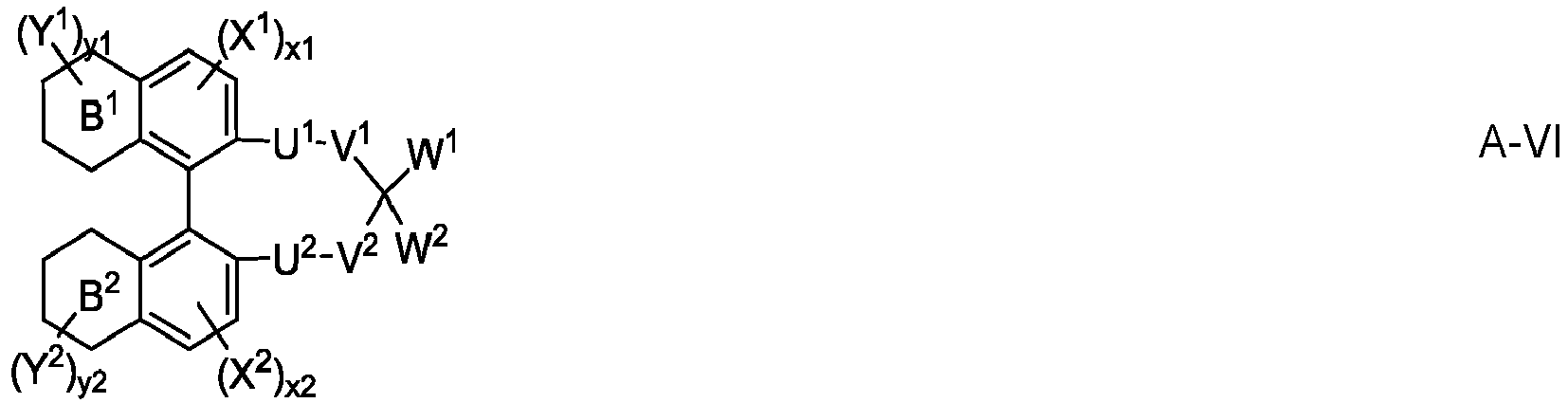
- X1, X2, Y1 and Y2
- are each, independently of one another, F, Cl, Br, I, CN, SCN, SF5, straight-chain or branched alkyl having from 1 to 25 carbon atoms, which is unsubstituted or monosubstituted or polysubstituted by F, Cl, Br, I or CN and in which, in addition, one or more non-adjacent CH2 groups may each, independently of one another, be replaced by -O-, -S-, -NH-, NRx-, -CO-, -COO-, -OCO-, -OCOO-, -S-CO-, -CO-S-, -CH=CH- or -C≡C-in such a way that O and/or S atoms are not bonded directly to one another, a polymerisable group or cycloalkyl or aryl having up to 20 carbon atoms, which may optionally be monosubstituted or polysubstituted by halogen, preferably F, or by a polymerisable group,
- x1 and x2
- are each, independently of one another, 0, 1 or 2,
- y1 and y2
- are each, independently of one another, 0, 1, 2, 3 or 4,
- B1 and B2
- are each, independently of one another, an aromatic or partially or fully saturated aliphatic six-membered ring in which one or more CH groups may each be replaced by N and one or more non-adjacent CH2 groups may each be replaced by O or S,
- W1 and W2
- are each, independently of one another, -Z1-A1-(Z2-A2)m-R, and one of the two is alternatively R1 or A3, but both are not simultaneously H, or


- U1 and U2
- are each, independently of one another, CH2, O, S, CO or CS,
- V1 and V2
- are each, independently of one another, (CH2)n, in which from one to four non-adjacent CH2 groups may each be replaced by O or S, and one of V1 and V2 and, in the case where


n is 1,2 or 3 - Z1 and Z2
- are each, independently of one another, -O-, -S-, -CO-, -COO-, -OCO-, -O-COO-, -CO-NRx-, -NRx-CO-, -O-CH2-, -CH2-O-, -S-CH2-, -CH2-S-, -CF2-O-, -O-CF2-, -CF2-S-, -S-CF2-, -CH2-CH2-, -CF2-CH2-, -CH2-CF2-, -CF2-CF2-, -CH=N-, -N=CH-, -N=N-, -CH=CH-, -CF=CH-, -CH=CF-, -CF=CF-, -C≡C-, a combination of two of these groups, where no two O and/or S and/or N atoms are bonded directly to one another, preferably -CH=CH-COO-, or -COO-CH=CH-, or a single bond,
- Rx
- denotes alkyl having 1 to 6 C atoms,
- A1, A2 and A3
- are each, independently of one another, 1,4-phenylene, in which one or two non-adjacent CH groups may each be replaced by N, 1,4-cyclohexylene, in which one or two non-adjacent CH2 groups may each be replaced by O or S, 1,3-dioxolane-4,5-diyl, 1,4-cyclohexenylene, 1,4-bicyclo[2.2.2]octylene, piperidine-1,4-diyl, naphthalene-2,6-diyl, decahydronaphthalene-2,6-diyl or 1,2,3,4-tetrahydronaphthalene-2,6-diyl, where each of these groups may be monosubstituted or polysubstituted by L, and in addition A1 can be a single bond,
- L
- is a halogen atom, preferably F, CN, NO2, alkyl, alkoxy, alkylcarbonyl, alkoxycarbonyl or alkoxycarbonyloxy having 1-7 carbon atoms, in which one or more H atoms may each be replaced by F or Cl,
- m
- is in each case, independently, 0, 1, 2 or 3, and
- R and R1
- are each, independently of one another, H, F, Cl, Br, I, CN, SCN, SF5, straight-chain or branched alkyl having from 1 or 3 to 25 carbon atoms respectively, which may optionally be monosubstituted or polysubstituted by F, Cl, Br, I or CN, and in which one or more non-adjacent CH2 groups may each be replaced by -O-, -S-, -NH-, -NR0-, -CO-, -COO-, -OCO-, -O-COO-, -S-CO-, -CO-S-, -CH=CH- or -C≡C-, where no two O and/or S atoms are bonded directly to one another, or a polymerisable group.
- Particular preference is given to chiral binaphthyl derivatives of the formula A-VI-1

in particular those selected from the following formulae A-VI-1a to A-VI-1c:


- R0
- as defined for formula A-IV or H or alkyl having from 1 to 4 carbon atoms, and
- b
- is 0, 1 or 2,
- The concentration of the one or more chiral dopant(s), in the LC medium is preferably in the range from 0.001 % to 20 %, preferably from 0.05 % to 5 %, more preferably from 0.1 % to 2 %, and, most preferably from 0.5 % to 1.5 %. These preferred concentration ranges apply in particular to the chiral dopant S-4011 or R-4011 (both from Merck KGaA) and for chiral dopants having the same or a similar HTP. For Chiral dopants having either a higher or a lower absolute value of the HTP compared to S-4011 these preferred concentrations have to be decreased, respectively increased proportionally according to the ratio of their HTP values relatively to that of S-4011.
- The pitch p of the LC media or host mixtures according to the invention is preferably in the range of from 5 to 50 µm, more preferably from 8 to 30 µm and particularly preferably from 10 to 20 µm.
- Preferably, the media according to the invention, comprise a stabilizer selected from the group of compounds of the formulae ST-1 to ST-19.


- RST
- denotes H, an alkyl or alkoxy radical having 1 to 15 C atoms, where, in addition, one or more CH2 groups in these radicals may each be replaced, independently of one another, by -C≡C-, -CF2O-, -OCF2-, -CH=CH-,


- ZST
- each, independently of one another, denote -CO-O-, -O-CO-, -CF2O-, -OCF2-, -CH2O-, -OCH2-, -CH2-, -CH2CH2-, -(CH2)4-, -CH=CH-, -CH2O-, -C2F4-, -CH2CF2-, -CF2CH2-, -CF=CF-, -CH=CF-, -CF=CH-, -CH=CH-, -C≡C- or a single bond,
- L1 and L2
- each, independently of one another, denote F, Cl, CF3 or CHF2,
- p
- denotes 1 or 2,
- q
- denotes 1, 2, 3, 4, 5, 6, 7, 8, 9 or 10.
- Of the compounds of the formula ST, special preference is given to the compounds of the formulae


- In the compounds of the formulae ST-3a and ST-3b, n preferably denotes 3. In the compounds of the formula ST-2a, n preferably denotes 7.
- Very particularly preferred mixtures according to the invention comprise one or more stabilizers from the group of the compounds of the formulae ST-2a-1, ST-3a-1, ST-3b-1, ST-8-1, ST-9-1 and ST-12:


- The compounds of the formulae ST-1 to ST-19 are preferably each present in the liquid-crystal mixtures according to the invention in amounts of 0.005 - 0.5%, based on the mixture.
- If the mixtures according to the invention comprise two or more compounds from the group of the compounds of the formulae ST-1 to ST-18, the concentration correspondingly increases to 0.01 - 1% in the case of two compounds, based on the mixtures.
- However, the total proportion of the compounds of the formulae ST-1 to ST-18, based on the mixture according to the invention, should not exceed 2%.
- The invention furthermore relates to an electro-optical display having active-matrix addressing, characterised in that it contains, as dielectric, a liquid-crystalline medium according to claim 1 and wherein the display is a VA, SA-VA, IPS, U-IPS, FFS, UB-FFS, SA-FFS, PS-VA, PS-OCB, PS-IPS, PS-FFS, PS-UB-FFS, polymer stabilised SA-VA or polymer stabilised SA-FFS display.
- The display according to the invention preferably has a bezel with a thickness of 10 mm or less, more preferably 5 mm or less and very preferably 3 mm or less.
- The present invention further relates to a method for manufacturing a display, constituted by a first and a second substrate, comprising at least the steps of:
- i) dropping the liquid crystal according to one or more of claims 1 to 7 inside a bank of a sealing material for liquid crystals, which is formed on the first substrate;
- ii) bonding the second substrate to the first substrate; and
- iii) curing the sealing material.
- Sealants for liquid-crystal displays are disclosed, for example, in
US2007/096056 A1 ,EP 1780587 A1 ,US 2003/0147034 A1 andEP 2381304 A1 .EP 1 559 735 A1 , andEP 2 586 827 A1 . The sealants used in the method according to the invention are preferably photochemically curable and particularly preferably both photochemically curable and thermally curable. - The sealants used in the method according to the invention preferably comprise a) one or more curable resins which comprise compounds which are each substituted by one or more epoxide groups (called "epoxides" below), and/or b) one or more compounds which are each substituted by one or more acrylate or methacrylate groups (called "(meth)acrylates" below), and/or c) one or more compounds which are substituted both by epoxide groups and by (meth)acrylate groups (called "epoxide acrylates" below).
- The individual components a), b) and c) here can be in the form of both monomers and oligomers. The choice of the components is in principle not restricted to certain compounds. The polymerisable compounds are preferably di-, tri- or polyreactive, i.e. they contain two, three or more reactive epoxide and/or (meth)acrylate groups. With a view to the lowest possible contamination of the liquid crystal with the components of the sealant, preference is given to resins which contain hydroxyl groups, sulfonyl groups or ether groups.
- Besides one or more compounds of the formula I, the sealants used in the method according to the invention preferably comprise
- i) a free-radical-curable resin,
- ii) an epoxy resin,
- iii) an epoxy curing agent.
- Examples of free-radical-curable resins are (meth)acrylates and unsaturated polyester resins, which can each be used alone or in a mixture of one or more such substances. The monomeric (meth)acrylates preferably contain two or more (meth)acrylate groups per molecule.
- Examples of (meth)acrylates are urethane (meth)acrylates containing a urethane bridge and epoxy (meth)acrylates which carry one or more glycidyl groups besides one or more (meth)acrylate groups.
- Examples of urethane (meth)acrylates are compounds which are obtained by reaction between diisocyanates (for example isophorone diisocyanate) and compounds which are able to add onto isocyanates, such as, for example, acrylic acid or hydroxyethyl acrylate.
- These derivatives may contain chain extensions by caprolactone or polyols and are commercially available, for example, under the trade names U 122P, U 3, 40P, U 4HA and U 1084A (Shin-Nakamura Chemical), and KRM 7595, KRM 7610 and KRM 7619 (Daicel Cytec Co.).
- Examples of epoxy (meth)acrylates are derivatives of epoxy resins (for example bisphenol A epoxy resins or propylene glycol diglycidyl ether) and (meth)acrylic acid and are commercially available, for example, under the trade names EA-1020, EA-6320 and EA-5520 (Shin-Nakamura Chemical), and EPOXY ESTER 70PA and EPOXY ESTER 3002A (Kyoiesha Chemi-cal). Further examples of suitable (meth)acrylates are methyl methacrylate, tetrahydrofurfuryl methacrylate, benzyl methacrylate, isobornyl meth-acrylate, 2 hydroxyethyl methacrylate, glycidyl methacrylate, (poly)ethylene glycol dimethacrylate, 1,4-butanediol dimethacrylate, 1,6-hexanediol dimethacrylate, trimethylolpropane triacrylate, pentaerythritol triacrylate and glycerol dimethacrylate.
- The group of free-radical-curable resins likewise includes epoxide acrylates which contain one or more (meth)acrylate groups and one or more epoxide groups per molecule and which are prepared by partially reacting the epoxy resins described above with (meth)acrylic acid in the presence of a base; they furthermore include compounds which are prepared by reacting bi- or polyfunctional isocyanates with half an equivalent of a hydroxyl-containing (meth)acrylate and subsequently with half an equivalent of glycidol; they furthermore include compounds which are prepared by reacting a methacrylate which is substituted by an isocyanate group with glycidol.
- Such materials are available, for example, under the trade names UVAC1561 (Daicel Cytec) and 4HBAGE (Nippon Kasei).
- Examples of latent epoxide curing agents in accordance with the present invention are dicyandiamides, modified polyamines, hydrazides, 4,4'-diaminodiphenyl sulfone, boron trifluoride/amine complexes, as well as imidazole, guanidine, urea, melamine and derivatives thereof.
- Examples of modified polyamines are epoxy adducts of polyamines, amides of polyamines and Mannich-modified polyamines.
- Examples of polyamines are aliphatic polyamines, such as, for example, ethylenediamine, diethylenetriamine, triethylenetetramine, tetraethylene-pentamine, 1,2-diaminopropane, polyoxypropylenediamine and polyoxy-propylenetriamine; alicyclic polyamines, such as, for example, isophorone-diamine, menthenediamine, bis(4-amino-3-methyldicyclohexyl)methane, diaminodicyclohexylmethane, bis(aminomethyl)cyclohexane, N amino-ethylpiperazine and 3,9-bis(3-aminopropyl)-2,4,8,10-tetraoxaspiro[5.5]undecane; aromatic polyamines, such as, for example, m phenylenediamine, p-phenylenediamine, tolylene-2,4-diamine, tolylene-2,6-diamine, mesitylene-2,4-diamine, mesitylene-2,6-diamine, 3,5-diethyltolylene-2,4-diamine and 3,5-diethyltolylene-2,6-diamine, biphenylenediamine, 4,4-diaminodiphenylmethane, 2,5-naphthylenediamine and 2,6-naphthylenediamine; and imidazoles, such as, for example, 2 methylimidazole, 2 ethyl-4-methylimidazole, 2 isopropylimidazole, 2 undecylimidazole, 2 heptadecylimidazole, 2 phenylimidazole, 2 phenyl-4-methylimidazole and 2 amino-propylimidazole.
- The epoxy adducts are prepared by the addition, which is familiar to the person skilled in the art, of epoxides onto polyamines. The epoxides are preferably aliphatic compounds, aromatic compounds, etc. These com-pounds can each be employed alone or in a mixture with other epoxides.
- Examples of alicyclic epoxides are polyglycidyl ethers of polyols containing at least one alicycle, cyclohexene oxide or cyclopentene oxide and derivatives thereof, in particular saturated derivatives of bisphenol A diglycidyl ether, 3,4-epoxycyclohexylmethyl 3,4-epoxycyclohexanecarboxylate, 3,4-epoxy-1-methylcyclohexyl 3,4-epoxy-1-methylcyclohexanecarboxylate, 6 methyl-3,4-epoxycyclohexylmethyl 6-methyl-3,4-epoxycyclohexanecarboxylate, 3,4-epoxy-3-methylcyclohexylmethyl 3,4-epoxy-3-methylcyclohexanecarboxylate, 3,4-epoxy-5-methylcylcohexylmethyl 3,4-epoxy-5-methylcyclohexanecarboxylate, 2 (3,4-epoxycyclohexyl-5,5-spiro-3,4-epoxy)cyclohexanemetadioxane, bis(3,4-epoxycyclohexylmethyl) adipate, 3,4-epoxy-6-methylcyclohexyl carboxylate, methylenebis(3,4-epoxycyclo-hexane), dicyclopentadiene diepoxide, ethylene bis(3,4-epoxycyclohexanecarboxylate), dioctyl epoxyhexahydrophthalate and di-2-ethylhexyl epoxyhexahydrophthalate.
- Commercially available products which contain such compounds are, for example, UVR-6100, UVR-6105, UVR-6110, UVR-6128 and UVR-6200 (Union Carbide); Celloxide 2021, Celloxide 2021P, Celloxide 2081, Celloxide 2083, Celloxide 2085, Celloxide 2000, Celloxide 3000, Cyclomer A200, Cyclomer M100, Cyclomer M101, Epolead GT-301, Epolead GT-302, Epolead 401, Epolead 403, ETHB and Epolead HD300 (Daicel Chemical Industries, Ltd.) and KRM-2110 and KRM-2199 (ADEKA Corp.).
- Examples of aromatic epoxides are polyglycidyl ethers of polyhydric phenols or alkylene oxide adducts thereof which contain at least one aromatic ring, such as, for example, glycidyl ethers of bisphenol A, bisphenol F, or alkylene oxides thereof, as well as epoxy-novolak resins.
- Examples of aliphatic epoxides are polyglycidyl ethers of aliphatic polyols or alkylene oxide adducts thereof, polyglycidyl esters of aliphatic long-chain polycarboxylic acids, glycidyl poly(meth) acrylates, in particular 1,4-butanediol diglycidyl ether, 1,6-hexanediol diglycidyl ether, glycerol triglycidyl ether, trimethylolpropane triglycidyl ether, sorbitol tetraglycidyl ether, dipentaerythritol hexaglycidyl ether, polyethylene glycol diglycidyl ether and polypropylene glycol diglycidyl ether; polyglycidyl ethers of polyether-polyols, prepared by addition of one or more alkylene oxides onto aliphatic polyols, such as, for example, propylene glycol, trimethylolpropane and glycerol; and diglycidyl esters of long-chain aliphatic dicarboxylic acids. Preference is furthermore given to monoglycidyl ethers of higher aliphatic alcohols, monoglycidyl ethers of phenol, cresol, butylphenol or polyether alcohols prepared by addition of alkylene oxides onto these phenols, glycidyl esters of higher fatty acids, epoxidised soyabean oil, octyl epoxystearate, butyl epoxystearate and epoxidised polybutadiene.
- Examples of commercially available aromatic or aliphatic epoxides are Epikote 801 and Epikote 828 (Yuka Shell Epoxy Co., Ltd.); PY-306, 0163 and DY-022 (Ciba Specialty Chemicals); KRM-2720, EP-3300, EP-4000, EP-4901, EP-4010, EP-4080, EP-4900, ED-505 and ED-506 (ADEKA); Epolite M 1230, Epolite EHDG-L, Epolite 40E, Epolite 100E, Epolite 200E, Epolite 400E, Epolite 70P, Epolite 200P, Epolite 400P, Epolite 1500NP, Epolite 1600, Epolite 80MF, Epolite 100MF, Epolite 4000, Epolite 3002 and Epolite FR-1500 (Kyoeisha Chemical); Santoto ST0000, YD-716, YH-300, PG-202, PG-207, YD-172 and YDPN638 (Tohto Kasei Co., Ltd.); TEPIC-S (Nissan Chemical Industries, Ltd.); and Epichlon N 665, Epichlon N 740, Epichlon HP-7200 and Epichlon HP-4032 (DIC Corp.).
- Polyamides are obtained in a manner known to the person skilled in the art by reaction of polyamines with carboxylic acids, such as, for example, adipic acid, sebacic acid, phthalic acid or isophthalic acid.
- Mannich-modified polyamines are prepared by reacting a polyamine with aldehydes, for example formaldehyde, and phenols, such as, for example, phenol, cresol, xylenol, t butylphenol or resorcinol.
- Examples of hydrazides are oxalic dihydrazide, malonic dihydrazide, suc-cinic dihydrazide, glutaric dihydrazide, adipic dihydrazide, suberic dihydra-zide, azelaic dihydrazide, sebacic dihydrazide and phthalic dihydrazide.
- Examples of urea derivatives are 3 (3,4-dichlorophenyl)-1,1-dimethylurea, isophorone diisocyanate dimethylurea and tolylene diisocyanate dimethyl-urea.
- Examples of epoxy resins (iii) are polyglycidyl ethers of polyhydric phenols, such as, for example, hydroquinone, resorcinol, pyrocatechol and phloroglucinol; polyglycidyl ethers of condensed aromatic hydroxyl compounds, such as naphthol, biphenylol, methylenebisphenol (bisphenol F), methylenebis(orthocresol), ethylidenebisphenol, isopropylidenebisphenol (bisphenol A), 4,4'-dihydroxybenzophenone, isopropylidenebis(orthocresol), tetrabromobisphenol A, 1,3-bis(4-hydroxycumylbenzene), 1,4-bis(4-hydroxycumylbenzene), 1,1,3-tris(4-hydroxyphenyl)butane, 1,1,2,2-tetra(4-hydroxyphenyl)ethane, thiobisphenol, sulfobisphenol, oxybisphenol, phenol novolak, orthocresol novolak, ethylphenol novolak, butylphenol novolak, octylphenol novolak, resorcinoil novolak and terpenediphenol; furthermore polyglycidyl ethers of polyhydric alcohols, such as ethylene glycol, propylene glycol, butylene glycol, hexanediol, polyglycol, thiodiglycol, glycerol, trimethylolpropane, pentaerythritol, sorbitol and bisphenol A/ethylene oxide adducts; homo- or copolymers of glycidyl esters of aliphatic, aromatic or alicyclic polybasic carboxylic acids, such as, for example, maleic acid, fumaric acid, itaconic acid, succinic acid, glutaric acid, suberic acid, adipic acid, azelaic acid, sebacic acid, phthalic acid, isophthalic acid, terephthalic acid, trimellitic acid, pyromellitic acid, tetrahydrophthalic acid, hexahydrophthalic acid and endo-methylenetetrahydrophthalic acid, or glycidyl methacrylate; furthermore epoxides containing a glycidylamino group, such as, for exam-ple, N,N-glycidylaniline, bis(4-(N-methyl-N-glycidylamino)phenyl)methane and diglycidyl-o-toluidine; epoxidised cycloalkenes, such as, for example, vinylcyclohexene diepoxide, dicyclopentadiene diepoxide, 3,4-epoxycyclo-hexylmethyl 3,4-epoxycyclohexanecarboxylate, 3,4-epoxy-6-methylcyclohexylmethyl 6-methylcyclohexanecarboxylae and bis(3,4-epoxy-6-methylcyclohexylmethyl) adipate; epoxidised conjugated polyenes, such as, for example, epoxidised polybutadiene, epoxidised acrylonitrile-butadiene copolymer and an epoxidised styrene-butadiene copolymer; furthermore heterocyclic compounds, such as triglycidyl isocyanurate.
- In a preferred embodiment, the sealants used in the process according to the invention com-prise further components, such as, for example, inorganic fillers, or silanes for improving the adhesive strength and the water-repellent properties, organic solvents, pigments, antifoams, conductive additives, levelling agents, etc.
- The sealants used in the method according to the invention are prepared, for example, by mixing and dissolving predetermined amounts of the components employed for photocuring, the components employed for thermal curing, and, if necessary, various additives and subsequently homogenising the mixture using a known mixing device, for example a triple-roll mill, a sand mill or a ball mill.
- The sealant used in the method according to the invention is particularly suitable for sealing liquid-crystal displays produced by the ODF process. The liquids or liquid crystals are not restricted in any way.
- The method is particularly suitable for sealing liquid-crystal displays which contain liquid crystals having polymerisable components (reactive meso-gens) and/or individual liquid-crystal substances containing unsaturated groups, such as, for example, alkenyl radicals or cyclohexene-1,4-diyl units. The reactive mesogens preferably contain one or more (meth)-acrylate groups.
- For the production of the liquid-crystal display, spacers are added to the sealant and the liquid crystal medium in order to produce a precisely defined separation of the substrates and thus a precisely defined cell gap of the display, typically 2 8 µm, depending on the application. Firstly, the sealant is applied to one of the two glass substrates, followed by the amount of liquid crystal corresponding precisely to the internal volume of the finished liquid-crystal display. After the two substrates have been combined, the display is irradiated with a dose of 1000 mJ to 18,000 mJ of UV light, during which the two substrates are pressed together. The sealant is then thermally cured at 110°C to 140°C for 1 to 3 h.
- During the manufacturing of the display according to the invention the liquid crystal medium after having been dispensed onto the substrate comes into contact with the sealant before the curing of the sealant. Surprisingly, the reactivity of the liquid crystal medium according to the invention is favourably low so that no detectable degradation of the LC takes place before, during or after curing of the sealant so that no visible edge mura is observed in the final display.
- It is advantageous for the liquid-crystalline medium according to the invention to preferably have a nematic phase from ≤ -20°C to ≥ 70°C, particularly preferably from ≤ -30°C to ≥ 80°C, very particularly preferably from ≤ -40°C to ≥ 90°C.
- The medium according to the invention has a clearing temperature of 65°C or more, preferably of 67°C or more, in particular 70°C or more.
- The expression "have a nematic phase" here means on the one hand that no smectic phase and no crystallisation are observed at low temperatures at the corresponding temperature and on the other hand that clearing still does not occur on heating from the nematic phase. The investigation at low temperatures is carried out in a flow viscometer at the corresponding temperature and checked by storage in test cells having a layer thickness corresponding to the electro-optical use for at least 100 hours. If the storage stability at a temperature of -20°C in a corresponding test cell is 1000 h or more, the medium is referred to as stable at this temperature. At temperatures of -30°C and -40°C, the corresponding times are 500 h and 250 h respectively. At high temperatures, the clearing point is measured by conventional methods in capillaries.
- The liquid-crystal mixture preferably has a nematic phase range of at least 60 K and a flow viscosity v20 of at most 30 mm2 · s-1 at 20°C.
- The mixture is nematic at a temperature of -20°C or less, preferably at -30°C or less, very preferably at -40°C or less.
- The values of the birefringence Δn in the liquid-crystal mixture are generally between 0.07 and 0.16, preferably between 0.08 and 0.15, very preferably between 0.09 and 0.14.
- In a preferred embodiment of the present invention, the medium has a birefringence in the range of from 0.090 to 0.110, preferably from 0.095 to 0.109, in particular from 0.098 to 0.108.
- The liquid-crystal mixture according to the invention has a dielectric anisotropy Δε of -1.5 to -8.0, preferably of -2.0 to ― 4.0, in particular -2.5 to -3.5,
- The rotational viscosity γ1 at 20°C is preferably ≤ 150 mPa·s, in particular ≤ 130 mPa·s.
- The liquid-crystal media according to the invention have relatively low values for the threshold voltage (V0). They are preferably in the range from 1.7 V to 3.0 V, particularly preferably ≤ 2.7 V and very particularly preferably ≤ 2.5 V.
- For the present invention, the term "threshold voltage" relates to the capacitive threshold (V0), also called the Freedericks threshold, unless explicitly indicated otherwise.
- In addition, the liquid-crystal media according to the invention have high values for the voltage holding ratio in liquid-crystal cells.
- In general, liquid-crystal media having a low addressing voltage or threshold voltage exhibit a lower voltage holding ratio than those having a higher addressing voltage or threshold voltage and vice versa.
- For the present invention, the term "dielectrically positive compounds" denotes compounds having a Δε > 1.5, the term "dielectrically neutral compounds" denotes those having -1.5 ≤ Δε ≤ 1.5 and the term "dielectrically negative compounds" denotes those having Δε < -1.5. The dielectric anisotropy of the compounds is determined here by dissolving 10 % of the compounds in a liquid-crystalline host and determining the capacitance of the resultant mixture in at least one test cell in each case having a layer thickness of 20 µm with homeotropic and with homogeneous surface alignment at 1 kHz. The measurement voltage is typically 0.5 V to 1.0 V, but is always lower than the capacitive threshold of the respective liquid-crystal mixture investigated.
- All temperature values indicated for the present invention are in °C.
- The mixtures according to the invention are suitable for all VA-TFT applications, such as, for example, VAN, MVA, (S)-PVA, ASV, PSA (polymer sustained VA) and PS-VA (polymer stabilized VA). They are furthermore suitable for IPS (in-plane switching) and FFS (fringe field switching) applications having negative Δε.
- It goes without saying for the person skilled in the art that the VA, IPS or FFS mixture according to the invention may also comprise compounds in which, for example, H, N, O, Cl and F have been replaced by the corresponding isotopes.
- The compounds of formula P are optionally added to the mixtures according to the invention in concentrations of preferably 0.01 to 5 % by weight, particularly preferably 0.2 to 2 % by weight, based on the mixture. These mixtures may optionally also comprise an initiator, as described, for example, in
U.S. 6,781,665 . The initiator, for example Irganox-1076 from BASF, is preferably added to the mixture comprising polymerisable compounds in amounts of 0 to 1 %. Mixtures of this type can be used for so-called polymer-stabilised VA modes (PS-VA) or PSA (polymer sustained VA), in which polymerisation of the reactive mesogens is intended to take place in the liquid-crystalline mixture after filling of a display panel. The prerequisite for this is that the liquid-crystalline compounds of the LC host do not react under the polymerisation conditions of the reactive mesogens, i.e. generally on exposure to UV in the wavelength range from 320 to 360 nm. Liquid-crystalline compounds containing an alkenyl side chain, such as, for example, CC-3-V, exhibit no reaction under the polymerisation conditions (UV polymerisation) for the RMs, hence, herein, such compounds are not to be considered as RMs. - The compounds according to the present invention can be synthesized by or in analogy to known methods described in the literature (for example in the standard works such as Houben-Weyl, Methoden der Organischen Chemie [Methods of Organic Chemistry], Georg-Thieme-Verlag, Stuttgart), under reaction conditions which are known and suitable for said reactions. Use may also be made here of variants which are known per se, but are not mentioned here. In particular, they can be prepared as described in or in analogy to the following reaction schemes. Further methods for preparing the inventive compounds can be taken from the examples.
- Other mesogenic compounds which are not explicitly mentioned above can optionally and advantageously also be used in the media in accordance with the present invention. Such compounds are known to the person skilled in the art.
- The following examples explain the present invention without limiting it. However, they show the person skilled in the art preferred mixture concepts with compounds preferably to be employed and the respective concentrations thereof and combinations thereof with one another. In addition, the examples illustrate the properties and property combinations that are accessible.
- For the present invention and in the following examples, the structures of the liquid-crystal compounds are indicated by means of acronyms, with the transformation into chemical formulae taking place in accordance with Tables A to C below. All radicals CmH2m+1, CnH2n+1, and ClH2l+1 or CmH2m-1, CnH2n-1 and ClH2l-1 are straight-chain alkyl radicals or alkylene radicals, in each case having n, m and I C atoms respectively. Preferably n, m and I are independently of each other 1, 2, 3, 4, 5, 6, or 7. Table A shows the codes for the ring elements of the nuclei of the compound, Table B lists the bridging units, and Table C lists the meanings of the symbols for the left- and right-hand end groups of the molecules. The acronyms are composed of the codes for the ring elements with optional linking groups, followed by a first hyphen and the codes for the left-hand end group, and a second hyphen and the codes for the right-hand end group. Table D shows illustrative structures of compounds together with their respective abbreviations.
Table A: Ring elements C 
D 
Dl 
A 
Al 
P 
G 
Gl 
U 
Ul 
Y 
P(F, CI)Y 
P(CI,F)Y 
np 
n3f 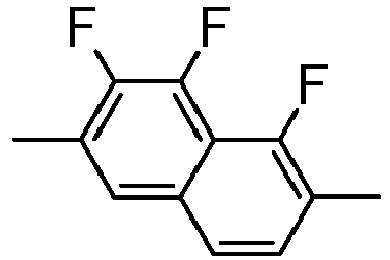
nN3fl 
th 
thl 
tH2f 
tH2fl 
o2f 
o2fl 
dh 
B 
O 
S 
K 
Kl 
L 
LI 
F 
FI 
Bh 
Bh(S) 
Bf 
Bf(S) 
Bfi 
Bfi(S) 
Table B: Bridging units E -CH2-CH2- V -CH=CH- T -C≡C- W -CF2-CF2- B -CF=CF- Z -CO-O- ZI -O-CO- X -CF=CH- XI -CH=CF- O -CH2-O- OI -O-CH2- Q -CF2-O- QI -O-CF2- Table C: End groups On the left individually or in combination On the right individually or in combination -n- CnH2n+1- -n -CnH2n+1 -nO CnH2n+1-O- -On -O- CnH2n+1 -V- CH2=CH- -V -CH=CH2 -nV- CnH2n+1-CH=CH- -nV -CnH2n-CH=CH2 -Vn- CH2=CH- CnH2n- -Vn -CH=CH-CnH2n+1 -nVm- CnH2n+1-CH=CH-CmH2m- -nVm - CnH2n-CH=CH-CmH2m+1 -N- N≡C- -N -C≡N -S- S=C=N- -S -N=C=S -F- F- -F -F -CL- Cl- -CL -Cl -M- CFH2- -M -CFH2 -D- CF2H- -D -CF2H -T- CF3- -T -CF3 -MO- CFH2O - -OM -OCFH2 -DO- CF2HO - -OD -OCF2H -TO- CF3O - -OT -OCF3 -A- H-C≡C- -A -C≡C-H -nA- CnH2n+1-C≡C- -An -C≡C-CnH2n+1 -NA- N≡C-C≡C- -AN -C≡C-C≡N -(cn)- 
-(cn) 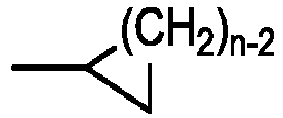
-(cn)m- 
-m(cn) 
On the left only in combination On the right only in combination -...n...- -CnH2n- -...n... -CnH2n- -...M...- -CFH- -...M... -CFH- -...D...- -CF2- -...D... -CF2- -...V...- -CH=CH- -...V... -CH=CH- -...Z...- -CO-O- -...Z... -CO-O- ...ZI...- -O-CO- -...Zi... -O-CO- -...K...- -CO- -...K... -CO- -...W...- -CF=CF- -...W... -CF=CF- - in which n and m are each integers, and the three dots "..." are placeholders for other abbreviations from this table.
- Apart from the compounds of formula I, IIA, IIB, IIC and/or IID, IVa, IVb and V, the mixtures according to the invention optionally comprise one or more compounds of the compounds mentioned below.
- The following abbreviations are used:
(n, m, k and I are, independently of one another, each an integer, preferably 1 to 9 preferably 1 to 7, k and I possibly may be also 0 and preferably are 0 to 4, more preferably 0 or 2 and most preferably 2, n preferably is 1, 2, 3, 4 or 5, in the combination "-nO-" it preferably is 1, 2, 3 or 4, preferably 2 or 4, m preferably is 1, 2, 3, 4 or 5, in the combination "-Om" it preferably is 1, 2, 3 or 4, more preferably 2 or 4. The combination "-IVm" preferably is "2V1".)


Table E Table E shows chiral dopants which can be added to the LC media according to the invention. 





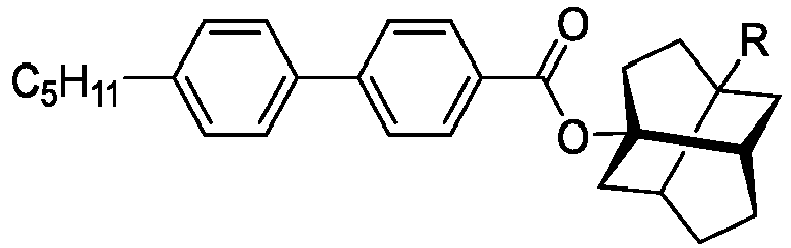


Table F Table F shows illustrative reactive mesogenic compounds (RM) which can be used in the LC media in accordance with the present invention. 





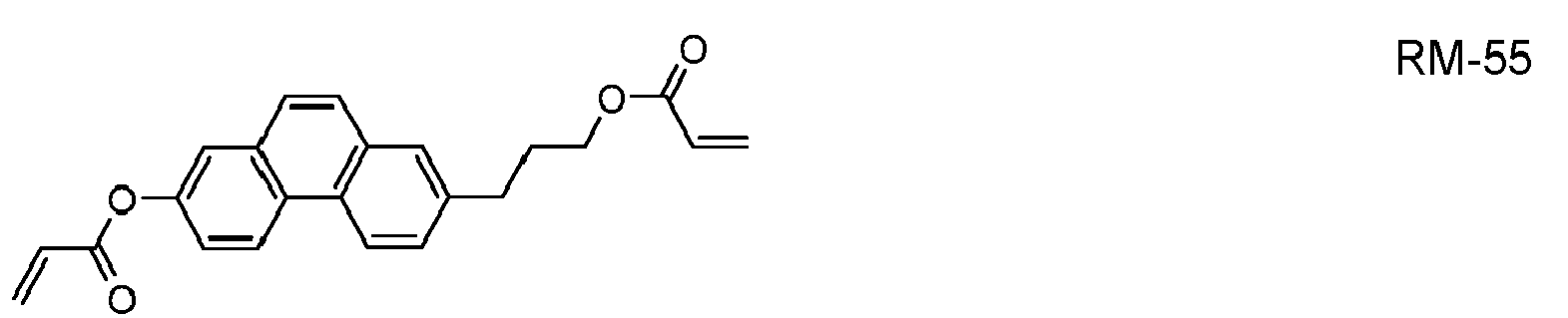
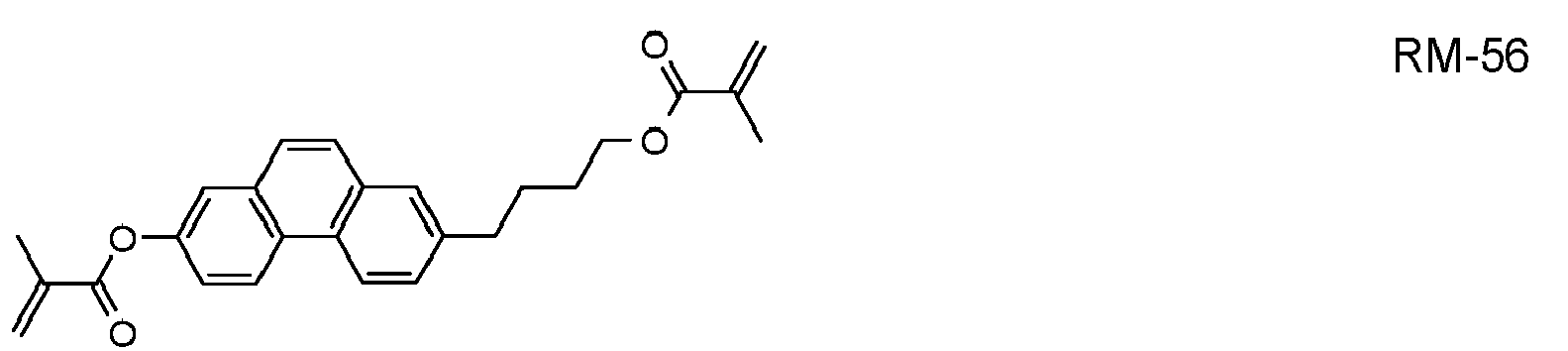





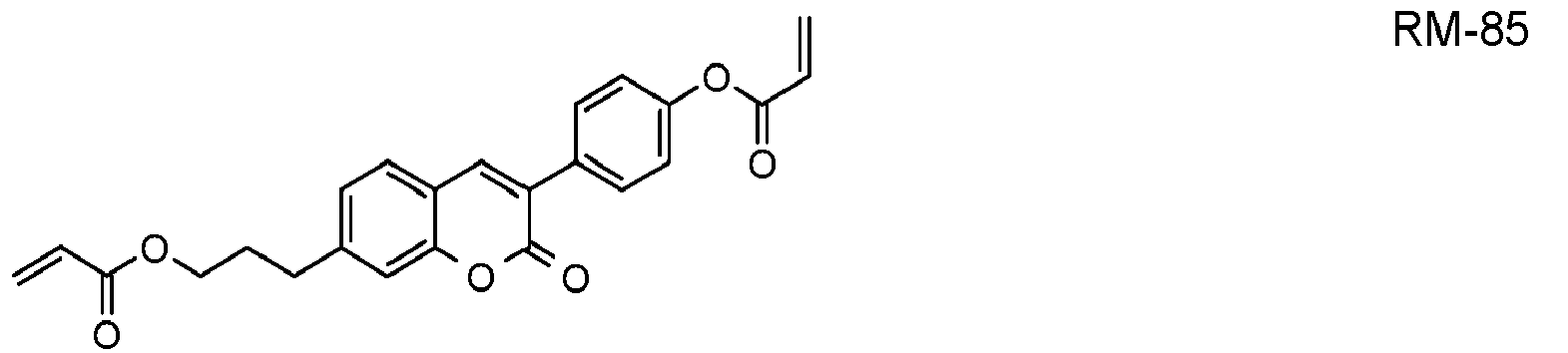


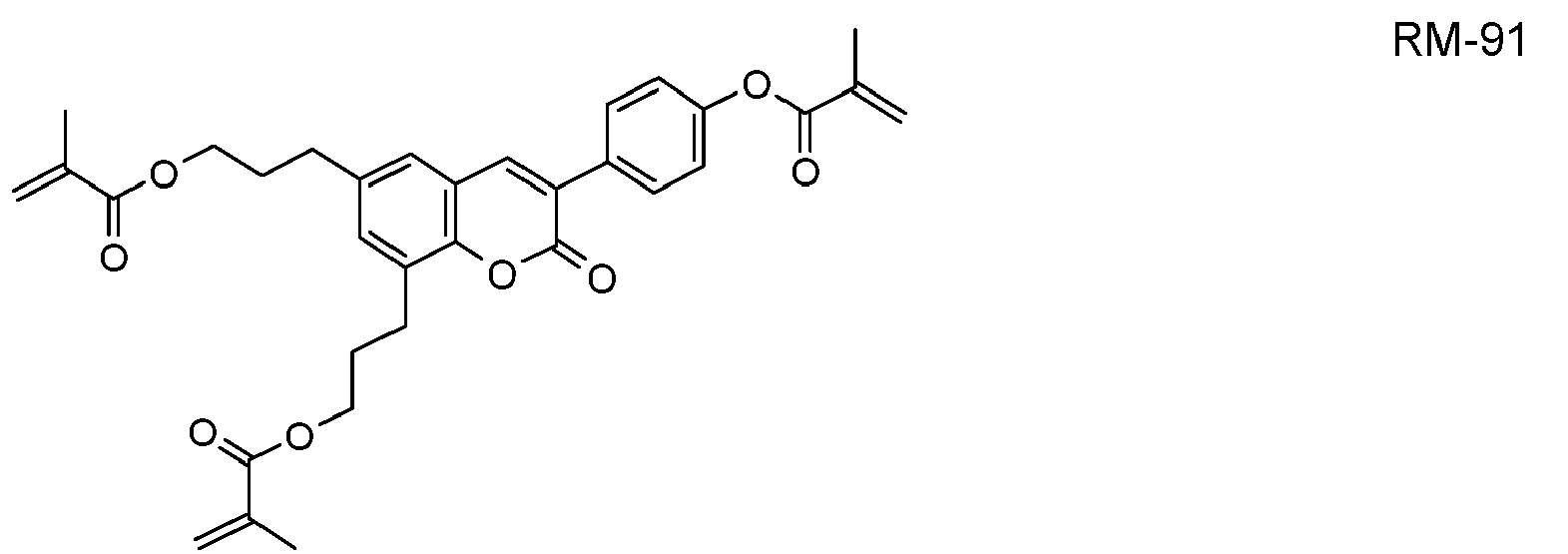
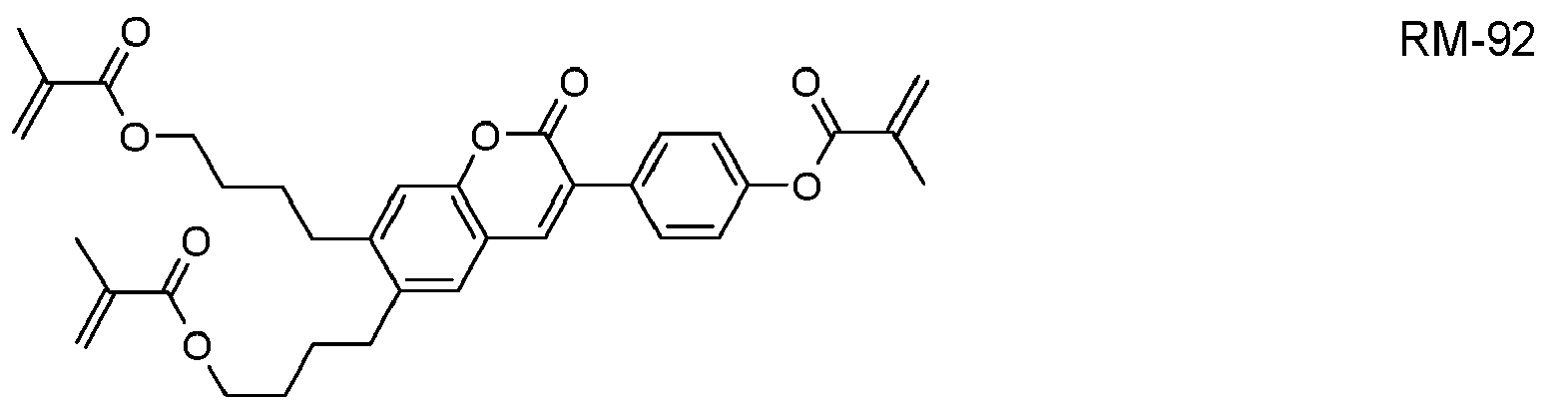


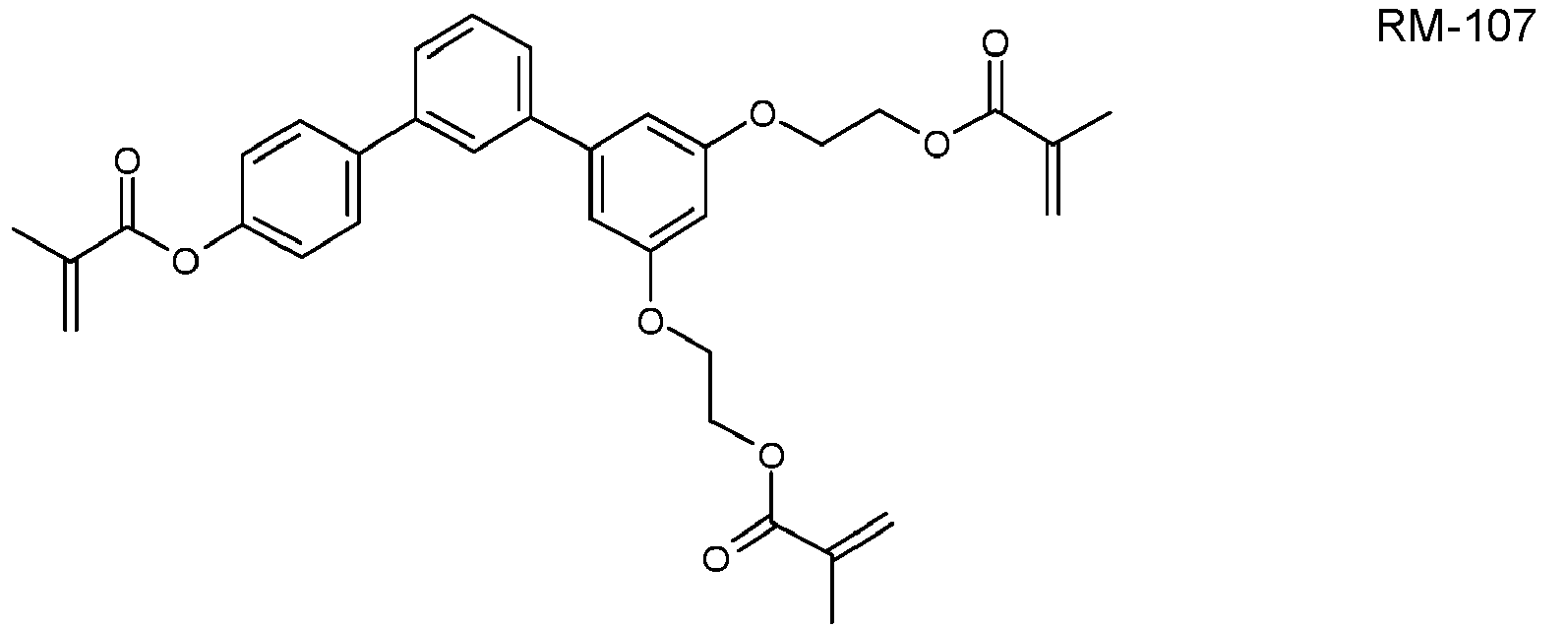


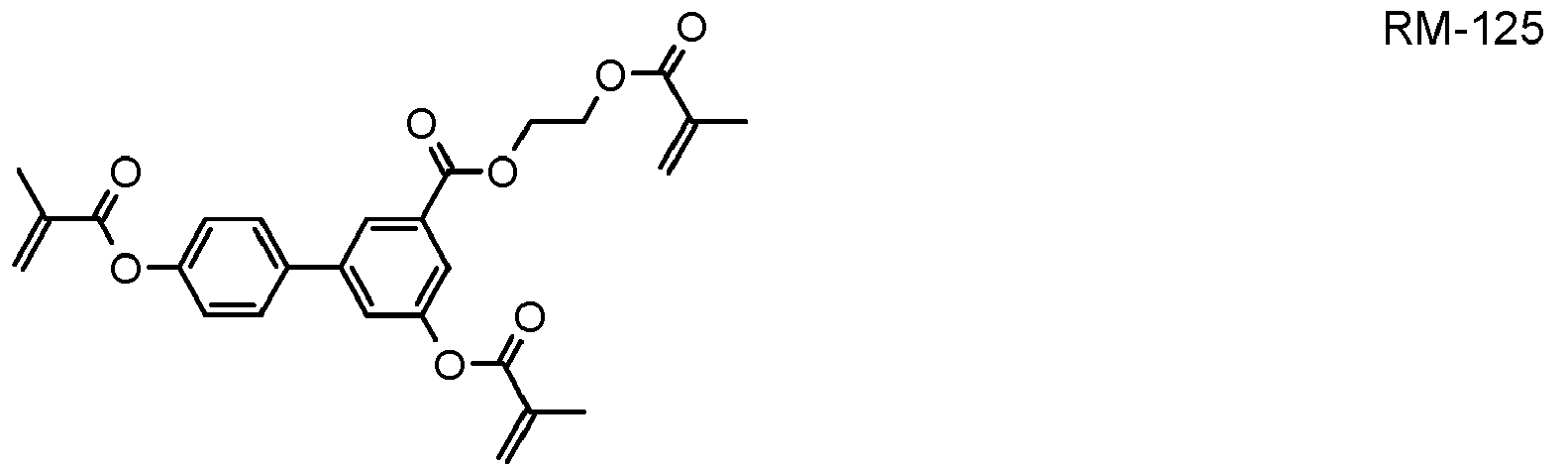


- In a preferred embodiment, the mixtures according to the invention comprise one or more polymerisable compounds, preferably selected from the polymerisable compounds of the formulae RM-1 to RM-155. Of these, compounds RM-1, RM-4, RM-8, RM-17, RM-19, RM-35, RM-37, RM-39, RM-40, RM-41, RM-48, RM-52, RM-54, RM-57, RM-64, RM-74, RM-76, RM-88, RM-102, RM-103, RM-109, RM-117, RM-120, RM-121, RM-122 and RM-145 to RM-153 are particularly preferred.
- In another preferred embodiment, the mixtures according to the invention comprise one or more polymerisable compounds selected from the formulae RM-145 to RM-152, very preferably from the formulae RM-147 to RM-152.
Table G Table G shows self-alignment additives for vertical alignment which can be used in LC media for SA-VA and SA-FFS displays according to the present invention together with the polymerizable compounds of formula P: 


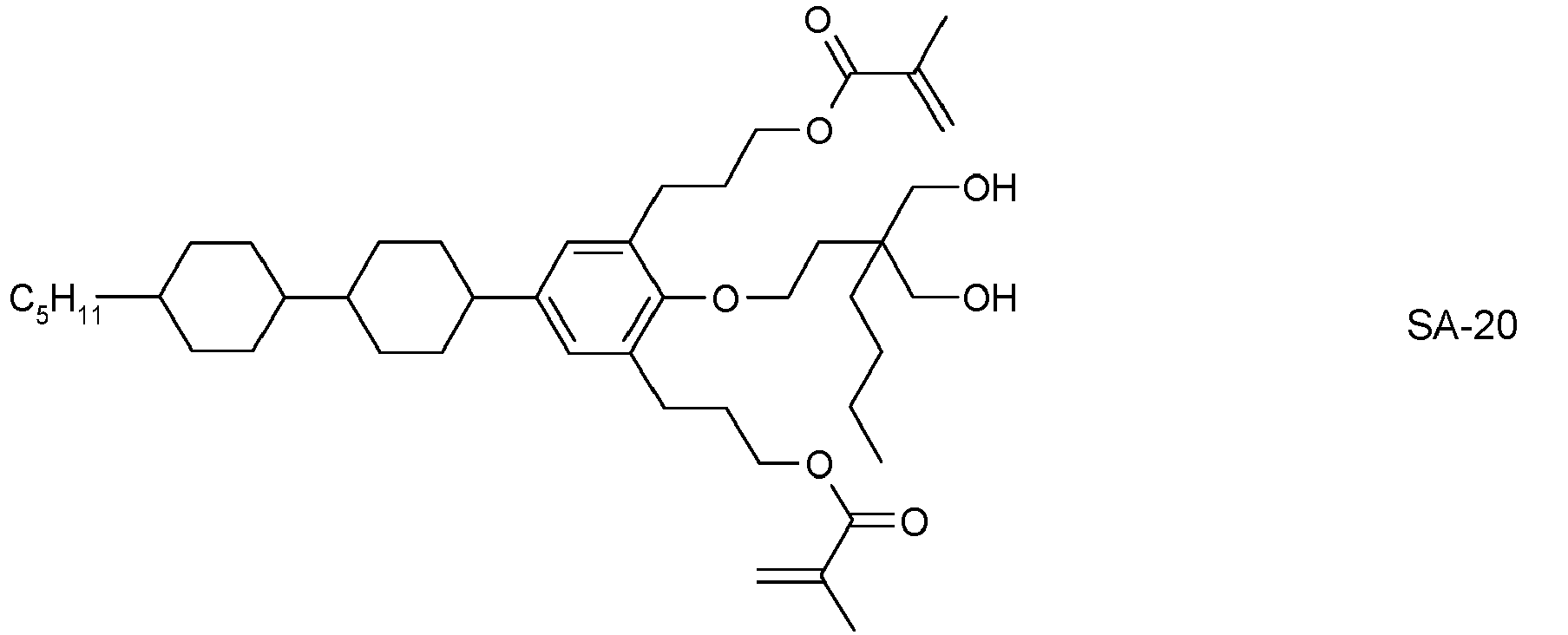


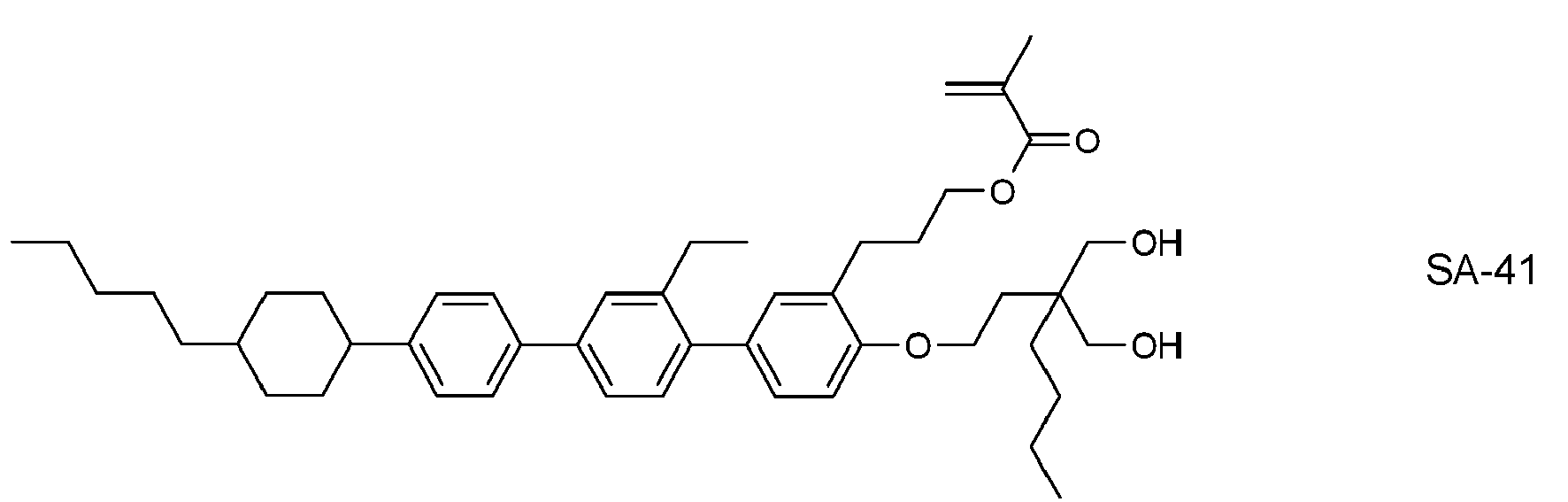


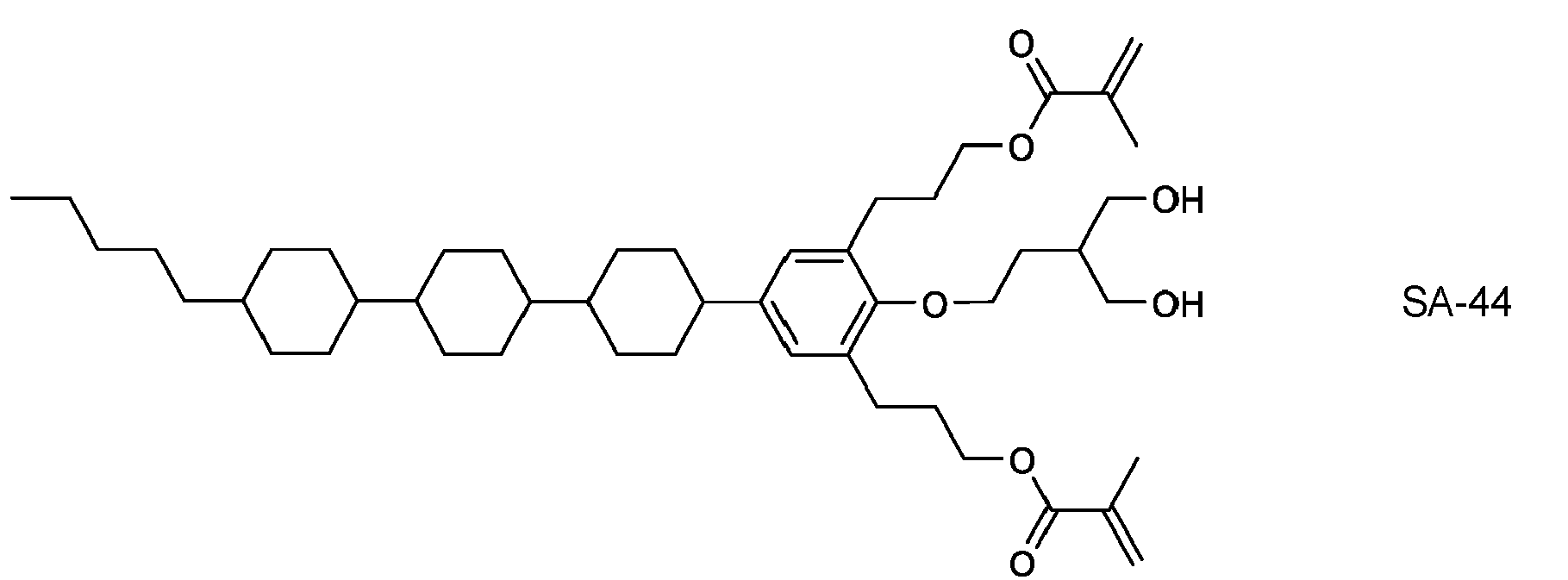

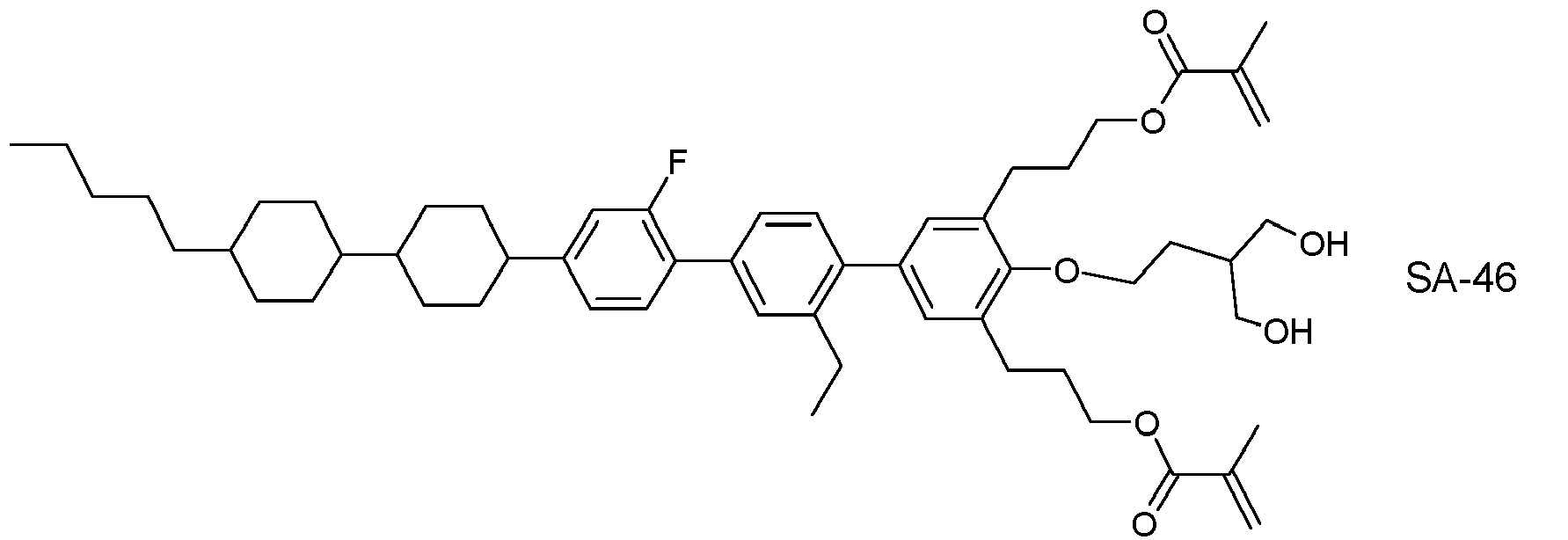


- In a preferred embodiment, the LC media, SA-VA and SA-FFS displays according to the present invention comprise one or more SA additives selected from formulae SA-1 to SA-48, preferably from formulae SA-14 to SA-48, very preferably from formulae SA-20 to SA-34 and SA-44, in combination with one or more RMs of formula P.
- The following examples are intended to explain the invention without limiting it. In the examples, m.p. denotes the melting point and T(N,I) denotes the clearing point of a liquid-crystalline substance in degrees Celsius; Furthermore: C denotes crystalline solid state, S denotes smectic phase (the index denotes the phase type), N denotes nematic state, Ch denotes cholesteric phase, I denotes isotropic phase, Tg denotes glass-transition temperature. The number between two symbols indicates the conversion temperature in degrees Celsius.
- The host mixture used for determination of the optical anisotropy Δn of single compounds is the commercial mixture ZLI-4792 (Merck KGaA). The dielectric anisotropy Δε is determined using commercial mixture ZLI-2857. The physical data of the compound to be investigated are obtained from the change in the dielectric constants of the host mixture after addition of the compound to be investigated and extrapolation to 100 % of the compound employed. In general, 10 % of the compound to be investigated are dissolved in the host mixture, depending on the solubility.
- Unless indicated otherwise, parts or per cent data denote parts by weight or per cent by weight.
- Above and below:
- Vo
- denotes threshold voltage, capacitive [V] at 20°C,
- ne
- denotes extraordinary refractive index at 20°C and 589 nm,
- no
- denotes ordinary refractive index at 20°C and 589 nm,
- Δn
- denotes optical anisotropy at 20°C and 589 nm,
- ε⊥
- denotes dielectric permittivity perpendicular to the director at 20°C and 1 kHz,
- ε∥
- denotes dielectric permittivity parallel to the director at 20°C and 1 kHz,
- Δε
- denotes dielectric anisotropy at 20°C and 1 kHz,
- cl.p., T(N,I)
- denotes clearing point [°C],
- γ1
- denotes rotational viscosity measured at 20°C [mPa·s],
- K1
- denotes elastic constant, "splay" deformation at 20°C [pN],
- K2
- denotes elastic constant, "twist" deformation at 20°C [pN],
- K3
- denotes elastic constant, "bend" deformation at 20°C [pN], and
- LTS
- denotes low-temperature stability (nematic phase), determined in test cells or in the bulk, as specified.
- Unless explicitly noted otherwise, all values indicated in the present application for temperatures, such as, for example, the melting point T(C,N), the transition from the smectic (S) to the nematic (N) phase T(S,N) and the clearing point T(N,I) or cl.p., are indicated in degrees Celsius (°C).
- The term "threshold voltage" for the present invention relates to the capacitive threshold (V0), also called the Freedericksz threshold, unless explicitly indicated otherwise. In the examples, as is generally usual, the optical threshold can also be indicated for 10 % relative contrast (V10).
- The display used for measurement of the capacitive threshold voltage consists of two plane-parallel glass outer plates at a separation of 20 µm, which each have on the insides an electrode layer and an unrubbed polyimide alignment layer on top, which cause a homeotropic edge alignment of the liquid-crystal molecules.
- The display or test cell used for measurement of the tilt angle consists of two plane-parallel glass outer plates at a separation of 4 µm, which each have on the insides an electrode layer and a polyimide alignment layer on top, where the two polyimide layers are rubbed antiparallel to one another and cause a homeotropic edge alignment of the liquid-crystal molecules.
- The polymerisable compounds are polymerised in the display or test cell by irradiation with UV light of defined intensity for a prespecified time, with a voltage simultaneously being applied to the display (usually 10 V to 30 V alternating current, 1 kHz). In the examples, unless indicated otherwise, a metal halide lamp and an intensity of 100 mW/cm2 is used for polymerisation. The intensity is measured using a standard meter (Hoenle UV-meter high end with UV sensor).
- The tilt angle is determined using the Mueller Matrix Polarimeter "AxoScan" from Axometrics. A low value (i.e. a large deviation from the 90° angle) corresponds to a large tilt here.
- Unless stated otherwise, the term "tilt angle" means the angle between the LC director and the substrate, and "LC director" means in a layer of LC molecules with uniform orientation the preferred orientation direction of the optical main axis of the LC molecules, which corresponds, in case of calamitic, uniaxially positive birefringent LC molecules, to their molecular long axis.
- Unless indicated otherwise, the VHR is determined at 20°C (VHR20) and after 5 minutes in an oven at 100°C (VHR100) in a commercially available instrument Model LCM-1 (O0004) from TOYO Corporation, Japan. The voltage used has a frequency of in a range from 1 Hz to 60 Hz, unless indicated more precisely.
- The accuracy of the VHR measurement values depends on the respective value of the VHR. The accuracy decreases with decreasing values. The deviations generally observed in the case of values in the various magnitude ranges are compiled in their order of magnitude in the following table.
VHR range Deviation (relative) VHR values ΔGVHR/VHR /% from to Approx. 99.6 % 100 % +/- 0.1 99.0 % 99.6 % +/- 0.2 98 % 99 % +/- 0.3 95 % 98 % +/- 0.5 90 % 95 % +/- 1 80 % 90 % +/- 2 60 % 80 % +/- 4 40 % 60 % +/- 8 20 % 40 % +/- 10 10 % 20 % +/- 20 - The stability to UV irradiation is investigated in a "Suntest CPS+", a commercial instrument from Heraeus, Germany, using a Xenon lamp NXE1500B. The sealed test cells are irradiated for 2.0 h, unless explicitly indicated, without additional heating. The irradiation power in the wavelength range from 300 nm to 800 nm is 765 W / m2 V. A UV "cut-off" filter having an edge wavelength of 310 nm is used in order to simulate the so-called window glass mode. In each series of experiments, at least four test cells are investigated for each condition, and the respective results are indicated as averages of the corresponding individual measurements.
- The decrease in the voltage holding ratio (ΔVHR) usually caused by the exposure, for example by UV irradiation or by LCD backlighting, is determined in accordance with the following equation (1):

- In order to investigate the low-temperature stability, also known as "LTS", i.e. the stability of the LC mixture in the bulk against spontaneous crystallisation of individual components at low temperatures or the occurrence of smectic phases, as the case may be, several sealed bottles, each containing about 1 g of the material, are stored at one or more given temperatures, typically of -10°C, -20°C, -30°C and/or -40°C and it is inspected at regular intervals visually, whether a phase transition is observed or not. As soon as the first one of the samples at a given temperature shows a change time is noted. The time until the last inspection, at which no change has been observed, is noted as the respective LTS.
- The ion density from which the resistivity is calculated is measured using the commercially available LC Material Characteristics Measurement System Model 6254 from Toyo Corporation, Japan, using VHR test cells with AL16301 Polyimide (JSR Corp., Japan) having a 3.2µm cell gap. The measurement is performed after 5 min of storage in an oven at 60 °C or 100 °C.
- The so-called "HTP" denotes the helical twisting power of an optically active or chiral substance in an LC medium (in µm). Unless indicated otherwise, the HTP is measured in the commercially available nematic LC host mixture MLD-6260 (Merck KGaA) at a temperature of 20°C.
- The Clearing point is measured using the Mettler Thermosystem FP900. The optical anisotropy (Δn) is measured using an Abbe-Refraktometer H005 (Natrium-spectral lamp Na10 at 589nm, 20 °C). The dielectric anisotropy (Δε) is measured using an LCR-Meter E4980A/Agilent (G005) at 20°C (ε-parallel-cells with JALS 2096-R1). The turn on voltage (V0) is measured using an LCR-Meter E4980A/Agilent (G005) at 20°C (ε-parallel-cells with JALS 2096-R1). The rotational viscosity (γ1) is measured using a TOYO LCM-2 (0002) at 20°C (gamma 1 negative cells with JALS-2096-R 1 ). The elastic constant (K1, splay) is measured using an LCR-Meter E4980A/Agilent (G005) at 20°C (ε parallel-cells with JALS 2096-R1). K3: The elastic constant (K3, bend) is measured using an LCR-Meter E4980A/Agilent (G005) at 20°C (ε-parallel-cells with JALS 2096-R1).
- Unless explicitly noted otherwise, all concentrations in the present application are indicated in per cent by weight and relate to the corresponding mixture as a whole, comprising all solid or liquid-crystalline components, without solvents. All physical properties are determined in accordance with "Merck Liquid Crystals, Physical Properties of Liquid Crystals", Status November 1997, Merck KGaA, Germany, and apply for a temperature of 20°C, unless explicitly indicated otherwise.
- The following mixture examples having negative dielectric anisotropy are suitable, in particular, for liquid-crystal displays which have at least one planar alignment layer, such as, for example, IPS and FFS displays, in particular UB-FFS ( = ultra-bright FFS), and for VA displays.
-
Mixture M1 CC-1-3 7.0 % Clearing point /°C: 71.0 CC-3-4 6.0 % Δn (589 nm, 20°C): 0.1079 CC-3-5 5.0 % Δε (1 kHz, 20°C): -3.2 CPP-3-2 7.0 % K1 (pN, 20°C): 12.8 CP-3-O1 11.0 % K3 (pN, 20°C): 14.0 PP-1-4 8.0 % V0 (20°C)/ V: 2.25 CCY-3-O2 9.0 % γ1 (20°C)/ mPa·s: 125 CCY-3-O3 9.0 % CPY-2-O2 10.0 % CPY-3-O3 10.0 % CY-3-O2 10.0 % CY-3-O4 8.0 % Σ 100.0 % Mixture M2 CC-1-3 9.0 % Clearing point /°C: 69.5 CC-3-4 6.0 % Δn (589 nm, 20°C): 0.1041 CC-3-5 6.0 % Δε (1 kHz, 20°C): -3.2 CPP-3-2 5.0 % K1 (pN, 20°C): 12.6 CP-3-O1 10.0 % K3 (pN, 20°C): 13.8 PP-1-4 8.0 % V0 (20°C)/ V: 2.23 CCY-3-O2 9.0 % γ1 (20°C)/ mPa·s: 118 CCY-3-O3 9.0 % CPY-2-O2 10.0 % CPY-3-O3 10.0 % CY-3-O2 10.0 % CY-3-O4 8.0 % Σ 100.0 % Mixture M3 CC-1-3 9.0 % Clearing point /°C: 69.5 CC-3-4 6.0 % Δn (589 nm, 20°C): 0.1018 CC-3-5 6.0 % Δε (1 kHz, 20°C): -3.2 CPP-3-2 5.0 % K1 (pN, 20°C): 12.5 CP-3-O1 13.0 % K3 (pN, 20°C): 14.0 PP-1-4 5.0 % V0 (20°C)/ V: 2.23 CCY-3-O2 9.0 % γ1 (20°C)/ mPa·s: 120 CCY-3-O3 9.0 % CPY-2-O2 10.0 % CPY-3-O3 10.0 % CY-3-O2 10.0 % CY-3-O4 8.0 % Σ 100.0 % Mixture M4 CC-1-3 9.0 % Clearing point /°C: 67.5 CC-3-4 7.0 % Δn (589 nm, 20°C): 0.1042 CC-3-5 5.0 % Δε (1 kHz, 20°C): -2.7 CPP-3-2 8.0 % K1 (pN, 20°C): 12.3 CP-3-O1 13.0 % K3 (pN, 20°C): 13.4 PP-1-4 8.0 % V0 (20°C)/ V: 2.37 CCY-3-O2 8.0 % γ1 (20°C)/ mPa·s: 107 CCY-3-O3 8.0 % CPY-2-O2 9.0 % CPY-3-O3 9.0 % CY-3-O2 9.0 % CY-3-O4 7.0 % Σ 100.0 % Mixture M5 CC-1-3 8.0 % Clearing point /°C: 71.5 CC-3-4 9.0 % Δn (589 nm, 20°C): 0.0995 CC-3-5 8.0 % Δε (1 kHz, 20°C): -3.1 CPP-3-2 5.0 % K1 (pN, 20°C): 13.2 CP-3-O1 10.0 % K3 (pN, 20°C): 14.1 PP-1-4 5.0 % V0 (20°C)/ V: 2.27 CCY-3-O2 9.0 % γ1 (20°C)/ mPa·s: 118 CCY-3-O3 9.0 % CPY-2-O2 10.0 % CPY-3-O3 9.0 % CY-3-O2 11.0 % CY-3-O4 7.0 % Σ 100.0 % Mixture M6 Mixture M6 contains t he compound CCY-3-O2F: 
CC-1-3 7.0 % Clearing point /°C: 68.0 CC-3-4 6.0 % Δn (589 nm, 20°C): 0.1070 CC-3-5 5.0 % Δε (1 kHz, 20°C): -3.0 CPP-3-2 7.0 % V0 (20°C)/ V: 2.29 CP-3-O1 11.0 % γ1 (20°C)/ mPa·s: 135 PP-1-4 8.0 % CCY-3-O2 9.0 % CCY-3-O2F 9.0 % CPY-2-O2 10.0% CPY-3-O3 10.0% CY-3-O2 10.0% CY-3-O4 8.0 % Σ 100.0% Mixture M7 Mixture M7 contains the compound CY-3-O1(c3) 
CC-1-3 9.0 % Clearing point /°C: 66.5 CC-3-4 6.0 % Δn (589 nm, 20°C): 0.1038 CC-3-5 6.0 % Δε (1 kHz, 20°C): -3.1 CPP-3-2 5.0 % γ1 (20°C)/ mPa·s: 129 CP-3-O1 10.0 % PP-1-4 8.0 % CCY-3-O2 9.0 % CCY-3-O3 9.0 % CPY-2-O2 10.0 % CPY-3-O3 10.0 % CY-3-O2 10.0 % CY-3-O1(c3) 8.0 % Σ 100.0 % Mixture M8 Mixture M8 conatins the compounds COY-(c5)-O2 
CC-1-3 9.0 % Clearing point /°C: 66.0 CC-3-4 6.0 % Δn (589 nm, 20°C): 0.1002 CC-3-5 6.0 % Δε (1 kHz, 20°C): -3.3 CPP-3-2 5.0 % γ1 (20°C)/ mPa·s: 138 CP-3-O1 13.0 % PP-1-4 5.0 % CCY-3-O2 9.0 % CCY-3-O3 9.0 % CPY-2-O2 10.0 % CPY-3-O3 10.0 % COY-(c5)-O2 10.0 % CY-3-O4 8.0 % Σ 100.0 % Mixture M9 Mixture M9 contains the compound CCY-(c3)2-O2 
CC-1-3 9.0 % Clearing point /°C: 64.5 CC-3-4 7.0 % Δn (589 nm, 20°C): 0.1022 CC-3-5 5.0 % Δε (1 kHz, 20°C): -2.5 CPP-3-2 8.0 % γ1 (20°C)/ mPa·s: 118 CP-3-O1 13.0 % PP-1-4 8.0 % CCY-3-O2 8.0 % CCY-3-O3 4.0 % CCY-(c3)2-O2 4.0 % CPY-2-O2 9.0 % CPY-3-O3 9.0 % CY-3-O2 9.0 % CY-3-O4 7.0 % Σ 100.0 % Mixture M10 Mixture M10 contains the compound B(S)-2O-O1(c5) CC-1-3 8.0 % Clearing point /°C: 68.5 CC-3-4 9.0 % Δn (589 nm, 20°C): 0.0987 CC-3-5 8.0 % Δε (1 kHz, 20°C): -3.2 CPP-3-2 5.0 % γ1 (20°C)/ mPa·s: 124 CP-3-O1 10.0 % PP-1-4 5.0 % CCY-3-O2 8.0 % CCY-3-O3 8.0 % CPY-2-O2 9.0 % CPY-3-O3 9.0 % CY-3-O2 11.0 % CY-3-O4 7.0 % B(S)-2O-O1(c5) 3.0 % Σ 100.0 % - Mixture example P1 consists of 99.595% of Mixture M-1, 0.40% of the compound RM-1


- Mixture example P2 consists of 99.595% of Mixture M-2, 0.40% of the compound RM-1 and 0.005% of the compound ST-3a-1.
- Mixture example P3 consists of 99.595% of Mixture M-3, 0.40% of the compound RM-1 and 0.005% of the compound ST-3a-1.
- Mixture example P4 consists of 99.595% of Mixture M-4, 0.40% of the compound RM-1 and 0.005% of the compound ST-3a-1.
- Mixture example P5 consists of 99.595% of Mixture M-5, 0.40% of the compound RM-1 and 0.005% of the compound ST-3a-1.
- Mixture example P6 consists of 99.595% of Mixture M-1, 0.40% of the compound RM-19 and 0.005% of the compound ST-3a-1.

- Mixture example P7 consists of 99.595% of Mixture M-2, 0.40% of the compound RM-19 and 0.005% of the compound ST-3b-1

- Mixture example P8 consists of 99.595% of Mixture M-3, 0.40% of the compound RM-35


- Mixture example P9 consists of 99.595% of Mixture M-1, 0.40% of the compound RM-156

- Mixture example P10 consists of 99.595% of Mixture M-2, 0.40% of the compound RM-157


Claims (15)
- A liquid crystal medium comprising a) one or more compounds of the formula I,
 R11 denotes a straight chain or branched or cyclic alkyl radical having 1 to 12 C atoms, or a straight chain or branched or cyclic alkenyl radical having up to 12 C atoms, wherein one or more H atoms are optionally replaced by fluorine,R12 denotes a straight chain or branched or cyclic alkyl radical having 1 to 12 C atoms or a straight chain or branched or cyclic alkoxy radical having 1 to 11 C atoms, or a straight chain or branched or cyclic alkenyl radical having up to 12 C atoms;andb) one or more compounds selected from the group of compounds of the formulae IIA, IIB, IIC and IID,


 R2A, R2B, R2C and R2D each, independently of one another, denote H, an alkyl or alkenyl radical having up to 15 C atoms which is unsubstituted, monosubstituted by CN or CF3 or at least monosubstituted by halogen, where, in addition, one or more CH2 groups in these radicals may be replaced by -O-, -S-,
 L1 to L4 each, independently of one another, denote F, Cl, CF3 or CHF2,Y denotes H, F, Cl, CF3, CHF2 or CH3,Z2, Z2B and Z2D each, independently of one another, denote a single bond, -CH2CH2-, -CH=CH-, -CF2O-, -OCF2-, -CH2O-, -OCH2-, -COO-, -OCO-, -C2F4-, -CF=CF- or -CH=CHCH2O-,p denotes 0, 1 or 2,q denotes 0 or 1, andv denotes 1, 2, 3, 4, 5, or 6,andc) one or more compounds of the formula IVa, and one or more compounds of the formula IVb
 R41 and R42 each, independently of one another, denote a straight-chain alkyl, alkoxy, alkenyl, alkoxyalkyl or alkoxy radical having up to 12 C atoms,

 Z4 denotes a single bond, -CH2CH2-, -CH=CH-, -CF2O-, -OCF2-, -CH2O-, -OCH2-, -COO-, -OCO-, -C2F4-, -C4H8-, or -CF=CF-,andd) one or more compounds of formula V
 R51 and R52 , identically or differently, denote alkyl having 1 to 7 C atoms, alkoxy having 1 to 7 C atoms, or alkoxyalkyl, alkenyl or alkenyloxy having 2 to 7 C atoms,

 Z51 , Z52 each, independently of one another, denote -CH2-CH2-, -CH2-O-, -CH=CH-, -C≡C-, -COO- or a single bond, andn is 1 or 2.
 - The liquid crystal medium according to claim 1, wherein the medium comprises one or more compounds of formula I defined in claim 1, in which the radicals R11 and R12, identically or differently, denote a straight chain or branched or cyclic alkyl radical having 1 to 12 C atoms.
- The liquid crystal medium according to claim 1 wherein the medium comprises one or more compounds of formula IIA and/or IIB as defined in claim 1,andone or more compounds of formula I-1
 andone or more compounds of formula IVa-2
 andone or more compounds of formula IVb-1
 in whichalkyl, alkyl' and alkyl* in the formulae I-1, IVa-2 and IVb-1, identically or differently, denote n-alkyl having 1, 2, 3, 4 or 5 C atoms.
 - The liquid crystal medium according to one or more of claims 1 to 3, wherein the medium comprises the compound of the formula I-1-1


- The liquid crystal medium according to claim 4, wherein the medium comprises 80% to 100% by weight of compounds of the formulae I-1-1, I-1-5, I-1-6, V-16-1, IVa-2-1, IVb-1-1, IIA-2-2, IIA-2-5, IIA-10-2, IIA-10-4, IIB-10-1 and IIB-10-4 as defined in claim 4.
- The liquid crystal medium according to one or more of claims 1 to 5, wherein the medium comprises a chiral dopant.
- The liquid crystal medium according to one or more of claims 1 to 6, wherein the medium comprises one or more polymerisable compounds of formula P
P-Sp-A1-(Z1-A2)z-R P
in whichP denotes a polymerisable group,Sp denotes a spacer group or a single bond,A1, A2 identically or differently, denote an aromatic, heteroaromatic, alicyclic or heterocyclic group, preferably having 4 to 25 ring atoms, which may also contain fused rings, and which is unsubstituted, or mono- or polysubstituted by L,L denotes F, Cl, -CN, P-Sp- or straight chain, branched or cyclic alkyl having 1 to 25 C atoms, wherein one or more non-adjacent CH2-groups are optionally replaced by -O-, -S-, -CO-, -CO-O-, -O-CO- or -O-CO-O-in such a manner that O- and/or S-atoms are not directly connected with each other, and wherein one or more H atoms are each optionally replaced by P-Sp-, F or Cl,Z1 denotes -O-, -S-, -CO-, -CO-O-, -O-CO-, -O-CO-O-, -OCH2-, -CH2O-, -SCH2-, -CH2S-, -CF2O-, -OCF2-, -CF2S-, -SCF2-, -(CH2)n1-, -CF2CH2-, -CH2CF2-, -(CF2)n1-, -CH=CH-, -CF=CF-, -CH=CF-, -CF=CH-, -C≡C-, -CH=CH-CO-O-, -O-CO-CH=CH-, -CH2-CH2-CO-O-, -O-CO-CH2-CH2-, -CR0R00-, or a single bond,R0, R00 identically or differently, denote H or alkyl having 1 to 12 C atoms,R denotes H, L, or P-Sp-,z is 0, 1, 2 or 3,n1 is 1, 2, 3 or 4. - The liquid crystal medium according to claim 7, wherein the polymerisable compounds of formula P are polymerised.
- A liquid crystal display comprising a medium according to one or more of claims 1 to 8.
- The liquid crystal display according to claim 9, wherein the display is a PSA display.
- The liquid crystal display according to claim 10, wherein the display is a PS-VA, PS-IPS, PS-FFS, PS-UB-FFS, polymer stabilised SA-VA or polymer stabilised SA-FFS display.
- The liquid crystal display according to claim 9, wherein the display is a VA, IPS, U-IPS, FFS, UB-FFS, SA-FFS or SA-VA display.
- Use of the liquid crystal medium according to one or more of claims 1 to 8 in electro-optical displays.
- The liquid crystal display according to one or more of claims 9 to 12, wherein the display has a bezel with a thickness of 10 mm or less.
- A method for manufacturing a liquid crystal display having a bezel with a thickness of 10mm or less, constituted by a first and a second substrate, comprising at least the steps of:i) dropping a liquid crystal medium according to one or more of claims 1 to 7 inside a bank of a sealing material for liquid crystals, which is formed on the first substrate;ii) bonding the second substrate to the first substrate; andiii) curing the sealing material.
Applications Claiming Priority (1)
| Application Number | Priority Date | Filing Date | Title |
|---|---|---|---|
| EP20200433 | 2020-10-07 |
Publications (2)
| Publication Number | Publication Date |
|---|---|
| EP3981858A1 true EP3981858A1 (en) | 2022-04-13 |
| EP3981858B1 EP3981858B1 (en) | 2024-04-17 |
Family
ID=72801310
Family Applications (1)
| Application Number | Title | Priority Date | Filing Date |
|---|---|---|---|
| EP21200634.0A Active EP3981858B1 (en) | 2020-10-07 | 2021-10-04 | Liquid crytal medium |
Country Status (3)
| Country | Link |
|---|---|
| EP (1) | EP3981858B1 (en) |
| CN (1) | CN114525139B (en) |
| TW (1) | TWI906383B (en) |
Families Citing this family (1)
| Publication number | Priority date | Publication date | Assignee | Title |
|---|---|---|---|---|
| CN116350841B (en) * | 2023-03-15 | 2025-08-29 | 临沂大学 | Graphene oxide-based liquid crystals, binary liquid crystal systems, 3D sponge-like scaffold materials, liquid crystal gels, biological tissue engineering scaffolds |
Citations (34)
| Publication number | Priority date | Publication date | Assignee | Title |
|---|---|---|---|---|
| DE3534780A1 (en) | 1985-09-30 | 1987-04-02 | Hoechst Ag | Chiral phenol esters of mesogenic carboxylic acids, a process for the preparation thereof and the use thereof as dopes in liquid-crystal phases |
| DE3534778A1 (en) | 1985-09-30 | 1987-04-02 | Hoechst Ag | CHIRAL ESTER OF MESOGENIC CARBONIC ACIDS, A METHOD FOR THE PRODUCTION THEREOF AND THEIR USE AS A DOPER IN LIQUID CRYSTAL PHASES |
| DE3534777A1 (en) | 1985-09-30 | 1987-04-02 | Hoechst Ag | LIQUID CRYSTAL PHASE WITH DOPERATING EFFECT |
| DE4342280A1 (en) | 1993-12-11 | 1995-06-14 | Basf Ag | Polymerizable chiral compounds and their use |
| DE19541820A1 (en) | 1995-11-09 | 1997-05-15 | Consortium Elektrochem Ind | Liquid crystalline organosiloxanes containing chiral dianhydrohexite derivatives |
| WO1998000428A1 (en) | 1996-07-01 | 1998-01-08 | Merck Patent Gmbh | Chiral dopants |
| GB2328207A (en) | 1997-08-13 | 1999-02-17 | Merck Patent Gmbh | Chiral hydrobenzoin derivatives for use as dopants in liquid crystalline mixtures |
| US6177972B1 (en) | 1999-02-04 | 2001-01-23 | International Business Machines Corporation | Polymer stabilized in-plane switched LCD |
| EP1170626A2 (en) | 2000-07-07 | 2002-01-09 | Fujitsu Limited | Liquid crystal display device and production method thereof |
| WO2002006265A1 (en) | 2000-07-13 | 2002-01-24 | Merck Patent Gmbh | Chiral compounds iii |
| WO2002006195A1 (en) | 2000-07-13 | 2002-01-24 | Merck Patent Gmbh | Chiral compounds ii |
| WO2002006196A1 (en) | 2000-07-13 | 2002-01-24 | Merck Patent Gmbh | Chiral compounds i |
| WO2002034739A1 (en) | 2000-10-20 | 2002-05-02 | Merck Patent Gmbh | Chiral binaphthol derivatives |
| WO2002094805A1 (en) | 2001-05-21 | 2002-11-28 | Merck Patent Gmbh | Chiral compounds |
| US20030147034A1 (en) | 1999-11-01 | 2003-08-07 | Kyoritsu Chemical & Co., Ltd | Sealing agent for LC dropping method for LCD panels |
| US6781665B2 (en) | 2002-02-04 | 2004-08-24 | Fujitsu Display Technologies Corporation | Liquid crystal display and method of manufacturing the same |
| US20040191428A1 (en) | 2003-03-26 | 2004-09-30 | Fujitsu Display Technologies Corporation | Liquid crystal panel |
| US6861107B2 (en) | 2002-07-06 | 2005-03-01 | Merck Patent Gmbh | Liquid-crystalline medium |
| EP1559735A1 (en) | 2002-11-06 | 2005-08-03 | Nippon Kayaku Kabushiki Kaisha | Sealing material for liquid crystal and liquid crystal display cell using same |
| US20060066793A1 (en) | 2004-09-24 | 2006-03-30 | Fujitsu Display Technologies Corporation | Liquid crystal display device |
| US20060103804A1 (en) | 2004-11-12 | 2006-05-18 | Sharp Kabushiki Kaisha | Liquid crystal display device and method of manufacture of the same |
| US7169449B2 (en) | 2002-04-16 | 2007-01-30 | Sharp Kabushiki Kaisha | Liquid crystal display device |
| EP1780587A1 (en) | 2004-08-11 | 2007-05-02 | Nippon Kayaku Kabushiki Kaisha | Liquid crystal sealant and liquid crystal display cell utilizing the same |
| US20070096056A1 (en) | 2003-11-26 | 2007-05-03 | Mitsui Chemicals, Inc. | One component resin composition curable with combination of light and heat and use of the same |
| US20090147206A1 (en) | 2007-10-16 | 2009-06-11 | Samsung Electronics Co., Ltd. | End-sealant composition, liquid crystal display panel, and method of manufacturing liquid crystal display panel |
| EP2381304A1 (en) | 2009-01-21 | 2011-10-26 | Adeka Corporation | Sealing agent for liquid crystal dropping method, which contains photocurable resin and thermosetting resin |
| EP2586827A1 (en) | 2010-06-28 | 2013-05-01 | Adeka Corporation | Curable resin composition |
| US20130182202A1 (en) | 2010-09-25 | 2013-07-18 | Merck Patent Gesellschaft Mit Beschrankter Haftung | Liquid crystal displays and liquid crystalline media with homeotropic alignment |
| US20140138581A1 (en) | 2011-07-07 | 2014-05-22 | Merck Patent Gmbh | Liquid-crystalline medium |
| US20140320778A1 (en) * | 2013-04-24 | 2014-10-30 | Shenzhen China Star Optoelectronics Technology Co., Ltd. | Liquid crystal display and the narrow bazel structure thereof |
| EP2837964A1 (en) * | 2013-06-06 | 2015-02-18 | DIC Corporation | Liquid crystal display device |
| US20150166890A1 (en) | 2013-12-16 | 2015-06-18 | Merck Patent Gmbh | Liquid-crystalline medium |
| US20150252265A1 (en) | 2014-03-10 | 2015-09-10 | Merck Patent Gmbh | Liquid-crystalline media having homeotropic alignment |
| CN110922986A (en) * | 2018-09-20 | 2020-03-27 | 北京八亿时空液晶科技股份有限公司 | A kind of liquid crystal composition containing dibenzofuran polymerizable compound and its application |
Family Cites Families (3)
| Publication number | Priority date | Publication date | Assignee | Title |
|---|---|---|---|---|
| CN103197454B (en) * | 2013-04-24 | 2016-03-30 | 深圳市华星光电技术有限公司 | A kind of liquid crystal display and narrow border structure thereof |
| EP3502210B1 (en) * | 2017-12-20 | 2020-09-09 | Merck Patent GmbH | Liquid-crystal medium |
| EP4176021B1 (en) * | 2020-07-03 | 2025-01-01 | Merck Patent GmbH | Liquid crystal medium |
-
2021
- 2021-09-30 CN CN202111155567.2A patent/CN114525139B/en active Active
- 2021-10-04 EP EP21200634.0A patent/EP3981858B1/en active Active
- 2021-10-06 TW TW110137122A patent/TWI906383B/en active
Patent Citations (34)
| Publication number | Priority date | Publication date | Assignee | Title |
|---|---|---|---|---|
| DE3534778A1 (en) | 1985-09-30 | 1987-04-02 | Hoechst Ag | CHIRAL ESTER OF MESOGENIC CARBONIC ACIDS, A METHOD FOR THE PRODUCTION THEREOF AND THEIR USE AS A DOPER IN LIQUID CRYSTAL PHASES |
| DE3534777A1 (en) | 1985-09-30 | 1987-04-02 | Hoechst Ag | LIQUID CRYSTAL PHASE WITH DOPERATING EFFECT |
| DE3534780A1 (en) | 1985-09-30 | 1987-04-02 | Hoechst Ag | Chiral phenol esters of mesogenic carboxylic acids, a process for the preparation thereof and the use thereof as dopes in liquid-crystal phases |
| DE4342280A1 (en) | 1993-12-11 | 1995-06-14 | Basf Ag | Polymerizable chiral compounds and their use |
| DE19541820A1 (en) | 1995-11-09 | 1997-05-15 | Consortium Elektrochem Ind | Liquid crystalline organosiloxanes containing chiral dianhydrohexite derivatives |
| WO1998000428A1 (en) | 1996-07-01 | 1998-01-08 | Merck Patent Gmbh | Chiral dopants |
| GB2328207A (en) | 1997-08-13 | 1999-02-17 | Merck Patent Gmbh | Chiral hydrobenzoin derivatives for use as dopants in liquid crystalline mixtures |
| US6177972B1 (en) | 1999-02-04 | 2001-01-23 | International Business Machines Corporation | Polymer stabilized in-plane switched LCD |
| US20030147034A1 (en) | 1999-11-01 | 2003-08-07 | Kyoritsu Chemical & Co., Ltd | Sealing agent for LC dropping method for LCD panels |
| EP1170626A2 (en) | 2000-07-07 | 2002-01-09 | Fujitsu Limited | Liquid crystal display device and production method thereof |
| WO2002006195A1 (en) | 2000-07-13 | 2002-01-24 | Merck Patent Gmbh | Chiral compounds ii |
| WO2002006196A1 (en) | 2000-07-13 | 2002-01-24 | Merck Patent Gmbh | Chiral compounds i |
| WO2002006265A1 (en) | 2000-07-13 | 2002-01-24 | Merck Patent Gmbh | Chiral compounds iii |
| WO2002034739A1 (en) | 2000-10-20 | 2002-05-02 | Merck Patent Gmbh | Chiral binaphthol derivatives |
| WO2002094805A1 (en) | 2001-05-21 | 2002-11-28 | Merck Patent Gmbh | Chiral compounds |
| US6781665B2 (en) | 2002-02-04 | 2004-08-24 | Fujitsu Display Technologies Corporation | Liquid crystal display and method of manufacturing the same |
| US7169449B2 (en) | 2002-04-16 | 2007-01-30 | Sharp Kabushiki Kaisha | Liquid crystal display device |
| US6861107B2 (en) | 2002-07-06 | 2005-03-01 | Merck Patent Gmbh | Liquid-crystalline medium |
| EP1559735A1 (en) | 2002-11-06 | 2005-08-03 | Nippon Kayaku Kabushiki Kaisha | Sealing material for liquid crystal and liquid crystal display cell using same |
| US20040191428A1 (en) | 2003-03-26 | 2004-09-30 | Fujitsu Display Technologies Corporation | Liquid crystal panel |
| US20070096056A1 (en) | 2003-11-26 | 2007-05-03 | Mitsui Chemicals, Inc. | One component resin composition curable with combination of light and heat and use of the same |
| EP1780587A1 (en) | 2004-08-11 | 2007-05-02 | Nippon Kayaku Kabushiki Kaisha | Liquid crystal sealant and liquid crystal display cell utilizing the same |
| US20060066793A1 (en) | 2004-09-24 | 2006-03-30 | Fujitsu Display Technologies Corporation | Liquid crystal display device |
| US20060103804A1 (en) | 2004-11-12 | 2006-05-18 | Sharp Kabushiki Kaisha | Liquid crystal display device and method of manufacture of the same |
| US20090147206A1 (en) | 2007-10-16 | 2009-06-11 | Samsung Electronics Co., Ltd. | End-sealant composition, liquid crystal display panel, and method of manufacturing liquid crystal display panel |
| EP2381304A1 (en) | 2009-01-21 | 2011-10-26 | Adeka Corporation | Sealing agent for liquid crystal dropping method, which contains photocurable resin and thermosetting resin |
| EP2586827A1 (en) | 2010-06-28 | 2013-05-01 | Adeka Corporation | Curable resin composition |
| US20130182202A1 (en) | 2010-09-25 | 2013-07-18 | Merck Patent Gesellschaft Mit Beschrankter Haftung | Liquid crystal displays and liquid crystalline media with homeotropic alignment |
| US20140138581A1 (en) | 2011-07-07 | 2014-05-22 | Merck Patent Gmbh | Liquid-crystalline medium |
| US20140320778A1 (en) * | 2013-04-24 | 2014-10-30 | Shenzhen China Star Optoelectronics Technology Co., Ltd. | Liquid crystal display and the narrow bazel structure thereof |
| EP2837964A1 (en) * | 2013-06-06 | 2015-02-18 | DIC Corporation | Liquid crystal display device |
| US20150166890A1 (en) | 2013-12-16 | 2015-06-18 | Merck Patent Gmbh | Liquid-crystalline medium |
| US20150252265A1 (en) | 2014-03-10 | 2015-09-10 | Merck Patent Gmbh | Liquid-crystalline media having homeotropic alignment |
| CN110922986A (en) * | 2018-09-20 | 2020-03-27 | 北京八亿时空液晶科技股份有限公司 | A kind of liquid crystal composition containing dibenzofuran polymerizable compound and its application |
Non-Patent Citations (8)
| Title |
|---|
| APPL. PHYS. LETT., vol. 75, no. 21, 1999, pages 3264 |
| C. TSCHIERSKEG. PELZLS. DIELE, ANGEW. CHEM., vol. 116, 2004, pages 6340 - 6368 |
| OPTICS EXPRESS, vol. 12, no. 7, 2004, pages 1221 |
| PURE APPL. CHEM., vol. 73, no. 5, 2001, pages 888 |
| S. H. KIML.-C- CHIEN, JPN. J. APPL. PHYS., vol. 43, no. 3, 2004, pages 7643 - 7647 |
| S.H. LEE ET AL., APPL. PHYS. LETT., vol. 73, no. 20, 1998, pages 2882 - 2883 |
| S.H. LEE ET AL., LIQUID CRYSTALS, vol. 39, no. 9, 2012, pages 1141 - 1148 |
| T.-J- CHEN ET AL., JPN. J. APPL. PHYS., vol. 45, 2006, pages 2702 - 2704 |
Also Published As
| Publication number | Publication date |
|---|---|
| CN114525139B (en) | 2025-07-25 |
| CN114525139A (en) | 2022-05-24 |
| TW202227597A (en) | 2022-07-16 |
| TWI906383B (en) | 2025-12-01 |
| EP3981858B1 (en) | 2024-04-17 |
Similar Documents
| Publication | Publication Date | Title |
|---|---|---|
| KR102934101B1 (en) | Liquid crystal medium | |
| EP4261267B1 (en) | Liquid-crystal medium | |
| EP4050084B1 (en) | Liquid-crystal medium | |
| JP7709472B2 (en) | liquid crystal medium | |
| EP3933009A1 (en) | Liquid crystal medium | |
| EP4399258A1 (en) | Liquid-crystal medium | |
| KR20260033498A (en) | Liquid crystal medium | |
| EP3898892B1 (en) | Liquid-crystal medium | |
| JP7709473B2 (en) | liquid crystal medium | |
| EP3981858B1 (en) | Liquid crytal medium | |
| EP4578929A1 (en) | Liquid-crystal medium | |
| EP4621030A1 (en) | Liquid-crystal medium | |
| WO2024240724A1 (en) | Liquid-crystal medium |
Legal Events
| Date | Code | Title | Description |
|---|---|---|---|
| PUAI | Public reference made under article 153(3) epc to a published international application that has entered the european phase |
Free format text: ORIGINAL CODE: 0009012 |
|
| STAA | Information on the status of an ep patent application or granted ep patent |
Free format text: STATUS: REQUEST FOR EXAMINATION WAS MADE |
|
| 17P | Request for examination filed |
Effective date: 20211004 |
|
| AK | Designated contracting states |
Kind code of ref document: A1 Designated state(s): AL AT BE BG CH CY CZ DE DK EE ES FI FR GB GR HR HU IE IS IT LI LT LU LV MC MK MT NL NO PL PT RO RS SE SI SK SM TR |
|
| P01 | Opt-out of the competence of the unified patent court (upc) registered |
Effective date: 20230519 |
|
| GRAP | Despatch of communication of intention to grant a patent |
Free format text: ORIGINAL CODE: EPIDOSNIGR1 |
|
| STAA | Information on the status of an ep patent application or granted ep patent |
Free format text: STATUS: GRANT OF PATENT IS INTENDED |
|
| INTG | Intention to grant announced |
Effective date: 20231222 |
|
| GRAS | Grant fee paid |
Free format text: ORIGINAL CODE: EPIDOSNIGR3 |
|
| GRAA | (expected) grant |
Free format text: ORIGINAL CODE: 0009210 |
|
| STAA | Information on the status of an ep patent application or granted ep patent |
Free format text: STATUS: THE PATENT HAS BEEN GRANTED |
|
| AK | Designated contracting states |
Kind code of ref document: B1 Designated state(s): AL AT BE BG CH CY CZ DE DK EE ES FI FR GB GR HR HU IE IS IT LI LT LU LV MC MK MT NL NO PL PT RO RS SE SI SK SM TR |
|
| REG | Reference to a national code |
Ref country code: GB Ref legal event code: FG4D |
|
| REG | Reference to a national code |
Ref country code: CH Ref legal event code: EP |
|
| REG | Reference to a national code |
Ref country code: DE Ref legal event code: R096 Ref document number: 602021011871 Country of ref document: DE |
|
| REG | Reference to a national code |
Ref country code: IE Ref legal event code: FG4D |
|
| REG | Reference to a national code |
Ref country code: LT Ref legal event code: MG9D |
|
| REG | Reference to a national code |
Ref country code: NL Ref legal event code: MP Effective date: 20240417 |
|
| REG | Reference to a national code |
Ref country code: AT Ref legal event code: MK05 Ref document number: 1677251 Country of ref document: AT Kind code of ref document: T Effective date: 20240417 |
|
| PG25 | Lapsed in a contracting state [announced via postgrant information from national office to epo] |
Ref country code: NL Free format text: LAPSE BECAUSE OF FAILURE TO SUBMIT A TRANSLATION OF THE DESCRIPTION OR TO PAY THE FEE WITHIN THE PRESCRIBED TIME-LIMIT Effective date: 20240417 |
|
| PG25 | Lapsed in a contracting state [announced via postgrant information from national office to epo] |
Ref country code: NL Free format text: LAPSE BECAUSE OF FAILURE TO SUBMIT A TRANSLATION OF THE DESCRIPTION OR TO PAY THE FEE WITHIN THE PRESCRIBED TIME-LIMIT Effective date: 20240417 |
|
| PG25 | Lapsed in a contracting state [announced via postgrant information from national office to epo] |
Ref country code: IS Free format text: LAPSE BECAUSE OF FAILURE TO SUBMIT A TRANSLATION OF THE DESCRIPTION OR TO PAY THE FEE WITHIN THE PRESCRIBED TIME-LIMIT Effective date: 20240817 |
|
| PG25 | Lapsed in a contracting state [announced via postgrant information from national office to epo] |
Ref country code: BG Free format text: LAPSE BECAUSE OF FAILURE TO SUBMIT A TRANSLATION OF THE DESCRIPTION OR TO PAY THE FEE WITHIN THE PRESCRIBED TIME-LIMIT Effective date: 20240417 |
|
| PG25 | Lapsed in a contracting state [announced via postgrant information from national office to epo] |
Ref country code: HR Free format text: LAPSE BECAUSE OF FAILURE TO SUBMIT A TRANSLATION OF THE DESCRIPTION OR TO PAY THE FEE WITHIN THE PRESCRIBED TIME-LIMIT Effective date: 20240417 Ref country code: FI Free format text: LAPSE BECAUSE OF FAILURE TO SUBMIT A TRANSLATION OF THE DESCRIPTION OR TO PAY THE FEE WITHIN THE PRESCRIBED TIME-LIMIT Effective date: 20240417 |
|
| PG25 | Lapsed in a contracting state [announced via postgrant information from national office to epo] |
Ref country code: GR Free format text: LAPSE BECAUSE OF FAILURE TO SUBMIT A TRANSLATION OF THE DESCRIPTION OR TO PAY THE FEE WITHIN THE PRESCRIBED TIME-LIMIT Effective date: 20240718 |
|
| PG25 | Lapsed in a contracting state [announced via postgrant information from national office to epo] |
Ref country code: PT Free format text: LAPSE BECAUSE OF FAILURE TO SUBMIT A TRANSLATION OF THE DESCRIPTION OR TO PAY THE FEE WITHIN THE PRESCRIBED TIME-LIMIT Effective date: 20240819 |
|
| PG25 | Lapsed in a contracting state [announced via postgrant information from national office to epo] |
Ref country code: ES Free format text: LAPSE BECAUSE OF FAILURE TO SUBMIT A TRANSLATION OF THE DESCRIPTION OR TO PAY THE FEE WITHIN THE PRESCRIBED TIME-LIMIT Effective date: 20240417 |
|
| PG25 | Lapsed in a contracting state [announced via postgrant information from national office to epo] |
Ref country code: AT Free format text: LAPSE BECAUSE OF FAILURE TO SUBMIT A TRANSLATION OF THE DESCRIPTION OR TO PAY THE FEE WITHIN THE PRESCRIBED TIME-LIMIT Effective date: 20240417 |
|
| PG25 | Lapsed in a contracting state [announced via postgrant information from national office to epo] |
Ref country code: PL Free format text: LAPSE BECAUSE OF FAILURE TO SUBMIT A TRANSLATION OF THE DESCRIPTION OR TO PAY THE FEE WITHIN THE PRESCRIBED TIME-LIMIT Effective date: 20240417 |
|
| PG25 | Lapsed in a contracting state [announced via postgrant information from national office to epo] |
Ref country code: LV Free format text: LAPSE BECAUSE OF FAILURE TO SUBMIT A TRANSLATION OF THE DESCRIPTION OR TO PAY THE FEE WITHIN THE PRESCRIBED TIME-LIMIT Effective date: 20240417 |
|
| PG25 | Lapsed in a contracting state [announced via postgrant information from national office to epo] |
Ref country code: PT Free format text: LAPSE BECAUSE OF FAILURE TO SUBMIT A TRANSLATION OF THE DESCRIPTION OR TO PAY THE FEE WITHIN THE PRESCRIBED TIME-LIMIT Effective date: 20240819 Ref country code: PL Free format text: LAPSE BECAUSE OF FAILURE TO SUBMIT A TRANSLATION OF THE DESCRIPTION OR TO PAY THE FEE WITHIN THE PRESCRIBED TIME-LIMIT Effective date: 20240417 Ref country code: NO Free format text: LAPSE BECAUSE OF FAILURE TO SUBMIT A TRANSLATION OF THE DESCRIPTION OR TO PAY THE FEE WITHIN THE PRESCRIBED TIME-LIMIT Effective date: 20240717 Ref country code: LV Free format text: LAPSE BECAUSE OF FAILURE TO SUBMIT A TRANSLATION OF THE DESCRIPTION OR TO PAY THE FEE WITHIN THE PRESCRIBED TIME-LIMIT Effective date: 20240417 Ref country code: IS Free format text: LAPSE BECAUSE OF FAILURE TO SUBMIT A TRANSLATION OF THE DESCRIPTION OR TO PAY THE FEE WITHIN THE PRESCRIBED TIME-LIMIT Effective date: 20240817 Ref country code: HR Free format text: LAPSE BECAUSE OF FAILURE TO SUBMIT A TRANSLATION OF THE DESCRIPTION OR TO PAY THE FEE WITHIN THE PRESCRIBED TIME-LIMIT Effective date: 20240417 Ref country code: GR Free format text: LAPSE BECAUSE OF FAILURE TO SUBMIT A TRANSLATION OF THE DESCRIPTION OR TO PAY THE FEE WITHIN THE PRESCRIBED TIME-LIMIT Effective date: 20240718 Ref country code: FI Free format text: LAPSE BECAUSE OF FAILURE TO SUBMIT A TRANSLATION OF THE DESCRIPTION OR TO PAY THE FEE WITHIN THE PRESCRIBED TIME-LIMIT Effective date: 20240417 Ref country code: ES Free format text: LAPSE BECAUSE OF FAILURE TO SUBMIT A TRANSLATION OF THE DESCRIPTION OR TO PAY THE FEE WITHIN THE PRESCRIBED TIME-LIMIT Effective date: 20240417 Ref country code: BG Free format text: LAPSE BECAUSE OF FAILURE TO SUBMIT A TRANSLATION OF THE DESCRIPTION OR TO PAY THE FEE WITHIN THE PRESCRIBED TIME-LIMIT Effective date: 20240417 Ref country code: AT Free format text: LAPSE BECAUSE OF FAILURE TO SUBMIT A TRANSLATION OF THE DESCRIPTION OR TO PAY THE FEE WITHIN THE PRESCRIBED TIME-LIMIT Effective date: 20240417 Ref country code: RS Free format text: LAPSE BECAUSE OF FAILURE TO SUBMIT A TRANSLATION OF THE DESCRIPTION OR TO PAY THE FEE WITHIN THE PRESCRIBED TIME-LIMIT Effective date: 20240717 |
|
| PG25 | Lapsed in a contracting state [announced via postgrant information from national office to epo] |
Ref country code: DK Free format text: LAPSE BECAUSE OF FAILURE TO SUBMIT A TRANSLATION OF THE DESCRIPTION OR TO PAY THE FEE WITHIN THE PRESCRIBED TIME-LIMIT Effective date: 20240417 |
|
| REG | Reference to a national code |
Ref country code: DE Ref legal event code: R097 Ref document number: 602021011871 Country of ref document: DE |
|
| PG25 | Lapsed in a contracting state [announced via postgrant information from national office to epo] |
Ref country code: EE Free format text: LAPSE BECAUSE OF FAILURE TO SUBMIT A TRANSLATION OF THE DESCRIPTION OR TO PAY THE FEE WITHIN THE PRESCRIBED TIME-LIMIT Effective date: 20240417 |
|
| PG25 | Lapsed in a contracting state [announced via postgrant information from national office to epo] |
Ref country code: CZ Free format text: LAPSE BECAUSE OF FAILURE TO SUBMIT A TRANSLATION OF THE DESCRIPTION OR TO PAY THE FEE WITHIN THE PRESCRIBED TIME-LIMIT Effective date: 20240417 |
|
| PG25 | Lapsed in a contracting state [announced via postgrant information from national office to epo] |
Ref country code: SK Free format text: LAPSE BECAUSE OF FAILURE TO SUBMIT A TRANSLATION OF THE DESCRIPTION OR TO PAY THE FEE WITHIN THE PRESCRIBED TIME-LIMIT Effective date: 20240417 Ref country code: RO Free format text: LAPSE BECAUSE OF FAILURE TO SUBMIT A TRANSLATION OF THE DESCRIPTION OR TO PAY THE FEE WITHIN THE PRESCRIBED TIME-LIMIT Effective date: 20240417 |
|
| PG25 | Lapsed in a contracting state [announced via postgrant information from national office to epo] |
Ref country code: SM Free format text: LAPSE BECAUSE OF FAILURE TO SUBMIT A TRANSLATION OF THE DESCRIPTION OR TO PAY THE FEE WITHIN THE PRESCRIBED TIME-LIMIT Effective date: 20240417 |
|
| PG25 | Lapsed in a contracting state [announced via postgrant information from national office to epo] |
Ref country code: SM Free format text: LAPSE BECAUSE OF FAILURE TO SUBMIT A TRANSLATION OF THE DESCRIPTION OR TO PAY THE FEE WITHIN THE PRESCRIBED TIME-LIMIT Effective date: 20240417 Ref country code: SK Free format text: LAPSE BECAUSE OF FAILURE TO SUBMIT A TRANSLATION OF THE DESCRIPTION OR TO PAY THE FEE WITHIN THE PRESCRIBED TIME-LIMIT Effective date: 20240417 Ref country code: RO Free format text: LAPSE BECAUSE OF FAILURE TO SUBMIT A TRANSLATION OF THE DESCRIPTION OR TO PAY THE FEE WITHIN THE PRESCRIBED TIME-LIMIT Effective date: 20240417 Ref country code: EE Free format text: LAPSE BECAUSE OF FAILURE TO SUBMIT A TRANSLATION OF THE DESCRIPTION OR TO PAY THE FEE WITHIN THE PRESCRIBED TIME-LIMIT Effective date: 20240417 Ref country code: DK Free format text: LAPSE BECAUSE OF FAILURE TO SUBMIT A TRANSLATION OF THE DESCRIPTION OR TO PAY THE FEE WITHIN THE PRESCRIBED TIME-LIMIT Effective date: 20240417 Ref country code: CZ Free format text: LAPSE BECAUSE OF FAILURE TO SUBMIT A TRANSLATION OF THE DESCRIPTION OR TO PAY THE FEE WITHIN THE PRESCRIBED TIME-LIMIT Effective date: 20240417 |
|
| PG25 | Lapsed in a contracting state [announced via postgrant information from national office to epo] |
Ref country code: IT Free format text: LAPSE BECAUSE OF FAILURE TO SUBMIT A TRANSLATION OF THE DESCRIPTION OR TO PAY THE FEE WITHIN THE PRESCRIBED TIME-LIMIT Effective date: 20240417 |
|
| PLBE | No opposition filed within time limit |
Free format text: ORIGINAL CODE: 0009261 |
|
| STAA | Information on the status of an ep patent application or granted ep patent |
Free format text: STATUS: NO OPPOSITION FILED WITHIN TIME LIMIT |
|
| 26N | No opposition filed |
Effective date: 20250120 |
|
| PG25 | Lapsed in a contracting state [announced via postgrant information from national office to epo] |
Ref country code: SI Free format text: LAPSE BECAUSE OF FAILURE TO SUBMIT A TRANSLATION OF THE DESCRIPTION OR TO PAY THE FEE WITHIN THE PRESCRIBED TIME-LIMIT Effective date: 20240417 |
|
| REG | Reference to a national code |
Ref country code: CH Ref legal event code: PL |
|
| PG25 | Lapsed in a contracting state [announced via postgrant information from national office to epo] |
Ref country code: MC Free format text: LAPSE BECAUSE OF FAILURE TO SUBMIT A TRANSLATION OF THE DESCRIPTION OR TO PAY THE FEE WITHIN THE PRESCRIBED TIME-LIMIT Effective date: 20240417 |
|
| PG25 | Lapsed in a contracting state [announced via postgrant information from national office to epo] |
Ref country code: BE Free format text: LAPSE BECAUSE OF NON-PAYMENT OF DUE FEES Effective date: 20241031 Ref country code: LU Free format text: LAPSE BECAUSE OF NON-PAYMENT OF DUE FEES Effective date: 20241004 |
|
| PG25 | Lapsed in a contracting state [announced via postgrant information from national office to epo] |
Ref country code: FR Free format text: LAPSE BECAUSE OF NON-PAYMENT OF DUE FEES Effective date: 20241031 |
|
| PG25 | Lapsed in a contracting state [announced via postgrant information from national office to epo] |
Ref country code: CH Free format text: LAPSE BECAUSE OF NON-PAYMENT OF DUE FEES Effective date: 20241031 |
|
| REG | Reference to a national code |
Ref country code: BE Ref legal event code: MM Effective date: 20241031 |
|
| PG25 | Lapsed in a contracting state [announced via postgrant information from national office to epo] |
Ref country code: SE Free format text: LAPSE BECAUSE OF FAILURE TO SUBMIT A TRANSLATION OF THE DESCRIPTION OR TO PAY THE FEE WITHIN THE PRESCRIBED TIME-LIMIT Effective date: 20240417 |
|
| PG25 | Lapsed in a contracting state [announced via postgrant information from national office to epo] |
Ref country code: IE Free format text: LAPSE BECAUSE OF NON-PAYMENT OF DUE FEES Effective date: 20241004 |
|
| PGFP | Annual fee paid to national office [announced via postgrant information from national office to epo] |
Ref country code: DE Payment date: 20250923 Year of fee payment: 5 |
|
| PG25 | Lapsed in a contracting state [announced via postgrant information from national office to epo] |
Ref country code: CY Free format text: LAPSE BECAUSE OF FAILURE TO SUBMIT A TRANSLATION OF THE DESCRIPTION OR TO PAY THE FEE WITHIN THE PRESCRIBED TIME-LIMIT; INVALID AB INITIO Effective date: 20211004 |
|
| PG25 | Lapsed in a contracting state [announced via postgrant information from national office to epo] |
Ref country code: HU Free format text: LAPSE BECAUSE OF FAILURE TO SUBMIT A TRANSLATION OF THE DESCRIPTION OR TO PAY THE FEE WITHIN THE PRESCRIBED TIME-LIMIT; INVALID AB INITIO Effective date: 20211004 |