EP3980944B1 - Verfahren zur bestimmung eines optimalen arzneimitteldosierschemas - Google Patents
Verfahren zur bestimmung eines optimalen arzneimitteldosierschemas Download PDFInfo
- Publication number
- EP3980944B1 EP3980944B1 EP20733216.4A EP20733216A EP3980944B1 EP 3980944 B1 EP3980944 B1 EP 3980944B1 EP 20733216 A EP20733216 A EP 20733216A EP 3980944 B1 EP3980944 B1 EP 3980944B1
- Authority
- EP
- European Patent Office
- Prior art keywords
- concentration
- drug
- dose
- patient
- efficiency
- Prior art date
- Legal status (The legal status is an assumption and is not a legal conclusion. Google has not performed a legal analysis and makes no representation as to the accuracy of the status listed.)
- Active
Links
Images



Classifications
-
- G—PHYSICS
- G16—INFORMATION AND COMMUNICATION TECHNOLOGY [ICT] SPECIALLY ADAPTED FOR SPECIFIC APPLICATION FIELDS
- G16C—COMPUTATIONAL CHEMISTRY; CHEMOINFORMATICS; COMPUTATIONAL MATERIALS SCIENCE
- G16C20/00—Chemoinformatics, i.e. ICT specially adapted for the handling of physicochemical or structural data of chemical particles, elements, compounds or mixtures
- G16C20/30—Prediction of properties of chemical compounds, compositions or mixtures
-
- G—PHYSICS
- G16—INFORMATION AND COMMUNICATION TECHNOLOGY [ICT] SPECIALLY ADAPTED FOR SPECIFIC APPLICATION FIELDS
- G16H—HEALTHCARE INFORMATICS, i.e. INFORMATION AND COMMUNICATION TECHNOLOGY [ICT] SPECIALLY ADAPTED FOR THE HANDLING OR PROCESSING OF MEDICAL OR HEALTHCARE DATA
- G16H10/00—ICT specially adapted for the handling or processing of patient-related medical or healthcare data
-
- G—PHYSICS
- G16—INFORMATION AND COMMUNICATION TECHNOLOGY [ICT] SPECIALLY ADAPTED FOR SPECIFIC APPLICATION FIELDS
- G16H—HEALTHCARE INFORMATICS, i.e. INFORMATION AND COMMUNICATION TECHNOLOGY [ICT] SPECIALLY ADAPTED FOR THE HANDLING OR PROCESSING OF MEDICAL OR HEALTHCARE DATA
- G16H10/00—ICT specially adapted for the handling or processing of patient-related medical or healthcare data
- G16H10/60—ICT specially adapted for the handling or processing of patient-related medical or healthcare data for patient-specific data, e.g. for electronic patient records
-
- G—PHYSICS
- G16—INFORMATION AND COMMUNICATION TECHNOLOGY [ICT] SPECIALLY ADAPTED FOR SPECIFIC APPLICATION FIELDS
- G16H—HEALTHCARE INFORMATICS, i.e. INFORMATION AND COMMUNICATION TECHNOLOGY [ICT] SPECIALLY ADAPTED FOR THE HANDLING OR PROCESSING OF MEDICAL OR HEALTHCARE DATA
- G16H20/00—ICT specially adapted for therapies or health-improving plans, e.g. for handling prescriptions, for steering therapy or for monitoring patient compliance
- G16H20/10—ICT specially adapted for therapies or health-improving plans, e.g. for handling prescriptions, for steering therapy or for monitoring patient compliance relating to drugs or medications, e.g. for ensuring correct administration to patients
- G16H20/17—ICT specially adapted for therapies or health-improving plans, e.g. for handling prescriptions, for steering therapy or for monitoring patient compliance relating to drugs or medications, e.g. for ensuring correct administration to patients delivered via infusion or injection
-
- G—PHYSICS
- G16—INFORMATION AND COMMUNICATION TECHNOLOGY [ICT] SPECIALLY ADAPTED FOR SPECIFIC APPLICATION FIELDS
- G16H—HEALTHCARE INFORMATICS, i.e. INFORMATION AND COMMUNICATION TECHNOLOGY [ICT] SPECIALLY ADAPTED FOR THE HANDLING OR PROCESSING OF MEDICAL OR HEALTHCARE DATA
- G16H50/00—ICT specially adapted for medical diagnosis, medical simulation or medical data mining; ICT specially adapted for detecting, monitoring or modelling epidemics or pandemics
- G16H50/20—ICT specially adapted for medical diagnosis, medical simulation or medical data mining; ICT specially adapted for detecting, monitoring or modelling epidemics or pandemics for computer-aided diagnosis, e.g. based on medical expert systems
-
- G—PHYSICS
- G06—COMPUTING OR CALCULATING; COUNTING
- G06N—COMPUTING ARRANGEMENTS BASED ON SPECIFIC COMPUTATIONAL MODELS
- G06N7/00—Computing arrangements based on specific mathematical models
- G06N7/01—Probabilistic graphical models, e.g. probabilistic networks
-
- G—PHYSICS
- G16—INFORMATION AND COMMUNICATION TECHNOLOGY [ICT] SPECIALLY ADAPTED FOR SPECIFIC APPLICATION FIELDS
- G16C—COMPUTATIONAL CHEMISTRY; CHEMOINFORMATICS; COMPUTATIONAL MATERIALS SCIENCE
- G16C20/00—Chemoinformatics, i.e. ICT specially adapted for the handling of physicochemical or structural data of chemical particles, elements, compounds or mixtures
- G16C20/70—Machine learning, data mining or chemometrics
-
- Y—GENERAL TAGGING OF NEW TECHNOLOGICAL DEVELOPMENTS; GENERAL TAGGING OF CROSS-SECTIONAL TECHNOLOGIES SPANNING OVER SEVERAL SECTIONS OF THE IPC; TECHNICAL SUBJECTS COVERED BY FORMER USPC CROSS-REFERENCE ART COLLECTIONS [XRACs] AND DIGESTS
- Y02—TECHNOLOGIES OR APPLICATIONS FOR MITIGATION OR ADAPTATION AGAINST CLIMATE CHANGE
- Y02A—TECHNOLOGIES FOR ADAPTATION TO CLIMATE CHANGE
- Y02A90/00—Technologies having an indirect contribution to adaptation to climate change
- Y02A90/10—Information and communication technologies [ICT] supporting adaptation to climate change, e.g. for weather forecasting or climate simulation
Definitions
- the invention is particularly well-suited to provide an optimal drug dosing regimen that can be adapted individually to each patient, taking into account the characteristics of the patient, the characteristics of the drug used, the characteristics of the pathogenic agent (e.g. germ, bacteria or virus) found or suspected in the patient's body and the time at which the drug concentration was measured in the patient's body.
- the pathogenic agent e.g. germ, bacteria or virus
- the method according to the present invention contributes to optimize the treatment of a patient by determining the most appropriate dosing regimen (e.g . dose, dosing intervals and the infusion duration) that is adapted to the patient.
- the most appropriate dosing regimen e.g . dose, dosing intervals and the infusion duration
- the interpretation performed by the physician consists in manually evaluating the current dosage but does not allow determining an optimal dosing regimen for the patient in order to optimize his/her treatment.
- WO 2017/180807 discloses a method and apparatus for providing a dosing regimen for a blood-clotting factor protein based on Bayesian estimations.
- minimal FVIII activity concentrations should be greater than a predetermined target trough concentration (1%) to minimize the risk for internal bleeding.
- the clinician may adjust manually the target. target. Fauchet et al, "Population Pharmacokinetics Study of Recommended Zidovudine Doses in HIV-1-Infected Children", ANTIMICROBIAL AGENTS AND CHEMOTHERAPY, vol. 57, no.
- ECOFFmax and the ECOFFcut values can be obtained from online databases.
- the efficiency pharmacokinetic parameter PPE is further compared to reported concentrations C rap for said drug.
- the efficiency pharmacokinetic parameter PPE is strictly less than the efficiency target CE, a value of a percentage of drug-sensitive pathogenic agents which can be annihilated by the measured drug concentration is computed.
- the method according to the present invention may further comprise a control step subsequently to providing said at least one proposed dose, wherein :
- the optimum dose regimen is obtained as a result of modifying the proposed dose first, then modifying a dose interval and finally modifying a duration of infusion for time-dependent antibiotics.
- concentration dependent i.e. concentration dependent, time-and-concentration dependent
- only the dose and the dose interval may be modified.
- the system further comprises a third-party database from which the client terminal and/or the application server is adapted to retrieve information on pathogenic agents and/or information on drug interactions.
- Another object of the present invention is a computer programme comprising instructions adapted to implement any step of the method as described above when the programme is executed on a computer.
- Another object of the present invention is a medium for storing information, removable or not, readable by a computer or a microprocessor and comprising code instructions of a computer programme adapted for implementing any step of the method as described above, when the programme is executed by a computer.
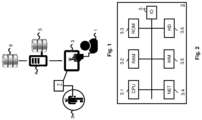
- Figure 1 illustrates schematically a system wherein the present invention may be implemented.
- the invention may be implemented in the context of a hospital where a physician or doctor 1 needs to decide on a dosing regimen of drug or medicine to be administered to a patient 2 infected by a pathogenic agent, such as a germ, bacteria or virus.
- a pathogenic agent such as a germ, bacteria or virus.
- This system comprises a terminal 3 used by the doctor 1, an application server 4, a patient database 5 and third-party databases 6.
- the patient database 5 comprises information relating to patients who are being taken care of at the hospital.
- the third-party databases 6 may comprise reference information relating to drugs (e.g. antibiotics) and pathogenic agents (e.g. bacteria).
- the third-party databases 6 may comprise one or more databases storing information on bacterial susceptibility, such as the one managed by the European Committee on Antimicrobial Susceptibility Testing (EUCAST), and/or databases storing information on drug interactions such as Micromedex.
- EUCAST European Committee on Antimicrobial Susceptibility Testing
- the application server 4 is adapted to retrieve data from both databases 5, 6 via communication networks, such as the Internet (not illustrated).
- the application server 4 is also adapted to communicate with the terminal 3 via communication networks, such as the Internet and/or an intranet (not illustrated).
- the system may further comprise a drug dosing device 7 adapted to measure the drug concentration in the patient's body (e.g. similarly to transdermal devices used to measure glycaemia in real-time).
- the drug dosing device 7 may comprise a wireless communication interface, so as to transmit and/or receive data to/from the terminal 3 via a local area network (not illustrated).
- the drug dosing device 7 may further be adapted to administer a dose of drug to the patient according to an instruction received from the terminal 3 operated by the doctor 1.
- Figure 2 is a schematic block-diagram of the terminal 3 used for implementing one or more embodiments of the present invention.
- the terminal 3 may be a laptop, tablet, smartphone or the like adapted to store and execute a programme, software or application, wherein at least part of the method of the present invention may be implemented.
- the terminal 3 comprises a communication bus connected to:
- the executable code may be stored in the read only memory 3.3, in the storage medium 3.6 or on a removable digital medium, such as a memory card.
- the executable code of the programme, software or application may be received in particular from the application server 4, by means of a communication network, through the network interface 3.4, so as to be stored in one of the storage means of the terminal 3, such as the storage medium 3.6, before being executed.
- the central processing unit 3.1 is adapted to command and manage the execution of instructions or code portions of the software, application or programme according to one of the embodiments of the invention, such instructions being stored in one of the above-mentioned storage means.
- the CPU 3.1 is able to execute instructions stored in the main RAM 3.2, with regard to the software, application or programme, after these instructions have been loaded into the ROM for instance.
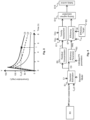
- Such a software, application or programme when it is executed by the processor 3.1, implements at least some of the steps of the diagram shown in figure 4 .
- the terminal 3 is a programmable device that uses a software application configured to implement the method according to the present invention.
- the present invention may be implemented in hardware, for instance, in the form of a specific integrated circuit or Application Specific Integrated Circuit (ASIC).
- ASIC Application Specific Integrated Circuit
- the programme configured to implement the method of the present invention is hosted and run by the terminal 3.
- this programme may be hosted and run by the application server 4 or any remote server that has access to the patient database 5 and/or the third-party databases 6.
- the terminal 3 may be reduced to a lightweight client that is adapted to connect to the application server or the remote server via a communication network such as the Internet.
- the present invention will now be described in the context of treating a patient against a bacteria.
- the invention is not limited to this particular framework but can also apply to any other pathogenic agents such as viruses or fungi.
- antibiotics For treating a patient against a bacteria, the drug or medicine considered to treat the patient is an antibiotic. It is known that antibiotics may be classified in three main categories or classes depending on whether their effect is time-dependent, concentration-dependent or concentration-and-time-dependent.
- Time-dependent antibiotics e.g . beta-lactams
- MIC Minimum Inhibitory Concentration
- Concentration-dependent antibiotics e.g . aminosides
- Concentration-dependent antibiotics are characterized in that the intensity of their activity on the bacteria increases with drug concentration. Thus, a maximum or peak drug concentration must be reached in order to obtain an optimal effect on the bacteria.
- Concentration-and-time-dependent antibiotics e.g. fluoroquinolones
- concentration-and-time-dependent antibiotics are characterized in that the intensity of their activity increases with the area under the drug concentration curve as a function of time.
- the area under the curve (AUC) is known as the exposure.
- concentration designates the total concentration of a drug in a patient's blood, which is the sum of the concentration of drug molecules in free form ( i.e. unbound) and the concentration of drug molecules bound to the plasma proteins. This total concentration is either measured in the patient's body by sensors or estimated by means of mathematical tools.
- Patient-related data may be inputted by the physician by means of the application through a human-machine interface displayed on the terminal 3.
- the patient-related data may be retrieved by the application from the patient database 5 via the application server 4 if this data is already stored in this database.
- the physician When launching the application, the physician is prompted to input, for instance through the human-machine interface by using the input/output interface 3.7, the patient's unique identifier to access his/her profile. Based on the information already available, the application may prompt the physician to complete and/or correct at least part of the patient-related data comprised within said profile.
- Patient-related data may include at least one parameter selected from the group consisting of biological characteristics such as age, gender, weight, creatinin clearance or any covariable having an influence on the drug used to treat the patient.
- Covariable may include any treatment that may be used in combination with the administration of said drug ( i.e. co-treatment) and that may have an impact on the pharmocokinetics of said drug, for instance by interacting with said drug.
- the patient-related data may also include the following parameters selected from:
- the patient-related data may also include parameters from the group consisting of the identification of the pathogenic agent (e.g. bacteria, virus) and the identification of the minimum inhibitory concentration of the identified pathogenic agent.
- the pathogenic agent e.g. bacteria, virus
- Additional information may be added to the patient's profile, such as the infection location(s) in the patient's body.
- the application is adapted to prompt the physician to input only the data which are specific to the patient to be treated, i.e. patient-related data, while general information concerning antibiotics and bacteria or germs have been previously stored in the application.
- the application is adapted to update the general information from third-parties databases 6 by connecting to the application server 4 via its communication interface 3.4.
- the application is executed directly on the application server 4, the application is adapted to send a data update request to the terminal 3, so that the user 1 can input patient-related data to be sent to the application server 4.
- This embodiment is particularly advantageous to strengthen patient's data privacy, in that his/her personal data are not stored directly on user terminal 3 but on a remote server that can be secured.
- These models may be accessible online and retrieved by the terminal 3 upon request or may be initially stored in a memory 3.3 (ROM) of the terminal upon installation of the application.
- ROM memory 3.3
- the application advantageously obtains a measured value of the drug concentration, for instance from the measuring device 7 and adapts automatically the patient's pharmacokinetic model according to this measured value.
- the obtained data may also comprises current dosing regimen data related to the dosing regimen currently applied to the patient, in particular at least one amongst: its dose, its dose interval and its infusion duration.
- the application is configured to define the efficiency pharmacokinetic parameter PPE as the maximum or peak concentration C peak .
- the application is configured to define the efficiency pharmacokinetic parameter PPE as the exposure which corresponds to the area under the curve AUC of the drug concentration.
- the value of the efficiency pharmacokinetic parameter is obtained by calculating the area between the estimated curve C3 and the time axis (X-axis).
- the application is adapted to compute an efficiency target CE as shown in step E5 to which the efficiency pharmacokinetic parameter PPE is then compared in step E7.
- the target ratio RC is defined namely according to the antibiotics category as described below.
- the value of RC may be established from existing relationships linking drug concentration and efficiency as known in the literature which are prone to evolve as knowledge progresses.
- the application may be configured to gather up-to-date data from the literature.
- the susceptibility factor SUS represents the sensitivity of the bacteria to the antibiotics.
- the susceptibility factor SUS is defined in the application according to whether the bacteria has been identified or not, and if identified whether related parameters are known according to the different cases described below.
- the application is configured to set the susceptibility factor SUS as the Minimum Inhibitory Concentration (MIC) associated to the identified bacteria.
- MIC Minimum Inhibitory Concentration
- the application is configured to apply a probabilistic treatment.
- the application is configured to define the susceptibility factor SUS as the maximum Epidemiological Cut-off Value (ECOFF max ) adapted to combat all bacteria that are usually sensitive and for which an ECOFF value can be found in the EUCAST online databases.
- ECOFF max the maximum Epidemiological Cut-off Value
- the application may be further configured to define the susceptibility factor SUS as a reduced Epidemiological Cut-Off Value (ECOFF cut ) that is adapted to combat most bacteria excluding species having the highest ECOFF values according to the MIC distributions as available on the EUCAST online databases.
- ECOFF cut a reduced Epidemiological Cut-Off Value
- the ECOFF cut value is always lower than the ECOFF max value.
- the application is configured to set the susceptibility factor SUS equal to the inhibitory concentration adapted to annihilate 90% of the sensitive bacteria (MIC 90 ).
- the application is configured to select the susceptibility factor from the parameters MIC, MIC 90 , ECOFF, ECOFF max , ECOFF cut as described above.
- This list of parameters proves to be sufficient to account for the vast majority of situations that a physician may encounter when treating patients.
- These parameters may be obtained from EUCAST online databases 6 and stored locally on the terminal 3 or may be retrieved on-the-fly from the application server 4 to which the application is connected.
- the specific efficiency target for the bacteria infecting the patient 2 is only known to the doctor when the MIC of the bacteria is known, e.g. free concentration is greater than four times the MIC value for beta-lactams, or exposure is greater than 100 to 125 times the MIC value for fluoroquinolones.
- the prior art methods as described in the paper Simulations of Valproate Doses Bases on an External 5 Evaluation of Pediatric Population Pharmacokinetic Models or WO 2017/180807 do not provide any information on a target to be reached to efficiently treat a patient.
- the present invention advantageously calculates an efficiency target in various cases, e.g. not only when the MIC is known, but also when the germ (or bacteria) is known but the MIC is unknown for this germ, or event when the germ is not identified.
- the calculation of the efficiency target according to step E5 is comprehensive and thus advantageously adaptive in that it provides a target to be reached so as to efficiently treat a patient in the vast majority of possible cases. It results therefrom that the method of the present invention greatly helps the doctor in determining an effective dose to administer to the patient in every situation.
- PPE is set to the total residual concentration C r that is either measured or estimated as described above in reference to Figures 3 and 4 .
- RCT is an efficiency ratio that designates the total target ratio that the total residual concentration must reach to improve the efficiency of the active molecule of the drug.
- PPE is set to the peak concentration C peak that is either measured or estimated as described above in reference to Figures 3 and 4 .
- RCF is an efficiency ratio that designates a fixed efficiency ratio.
- CE is set between 60 and 80 mg/L, which corresponds to a RCF equal to 8 to 10 times and the SUS is the highest MIC 90 value for the bacteria that are targeted.
- PPE is set to AUC that is calculated from the concentration curve C3 as described above in reference to Figure 3 .
- the application is configured to compute the parameters as shown in Table 1 below and determine in the first comparison step E7 whether the condition PPE ⁇ CE is verified.
- the application may be configured to determine and display on the terminal 3 relevant information that is valuable to the physician for administering a drug to the patient, such as an estimation of the percentage of bacteria that can be combatted by the measured drug concentration Cm(t). Indeed, the physician may react differently in a situation where only 20% of the bacteria can be fought and in a situation where as much as 95% of the bacteria can be fought.
- step E9 the application determines the residual concentration C r which is defined as the total concentration of a drug that remains in the patient's body just before the next administration of the drug.
- Step E9 may be automatically executed in parallel to determining the efficiency parameter in step E3, as soon as Bayesian estimation is performed in step E1.
- this total residual concentration C r is the sum of the concentration of drug molecules in free form ( i.e. unbound) and the concentration of drug molecules bound to the plasma proteins.
- the total residual concentration is either measured in the patient's body by sensors ( e . g. by means of a measuring device 7) or estimated by the application from the estimated concentration evolution computed in step E1 ( i.e. corresponding to curve C3 as depicted on Figure 3 ).
- a second comparison step E11 the application compares the residual drug C r concentration to the toxic concentration C tox defined, as explained previously, as a drug concentration beyond which serious side effects occur. This comparison occurs only when the residual drug C r concentration is higher than the reported concentrations C rap .
- the application may be configured to further compare the residual drug concentration C r to the limit concentration C lim defined, as explained previously, as the drug concentration for which an increased risk of side effects is reported, for instance in online databases to which the application has access. This concentration may be overpassed, if it is considered that the benefits of the treatment are higher than its risks. The application is configured to perform this additional comparison, when the residual concentration is higher than reported concentrations and lower than the toxic concentration.
- the application is configured to determine first whether the residual concentration C r is greater than the toxic concentration C tox ( i.e. C r > C tox ) and then whether the residual concentration C r is greater than the limit concentration C lim ( i.e. C r > C lim ).
- the application is configured to determine whether the residual concentration C r is greater than the toxic concentration C tox . Limit concentrations are actually not determined for this class of antibiotics.
- the application is configured to determine whether the residual concentration C r is greater than the limit concentration C lim .
- the limit concentration may be replaced by the highest concentration reported in the literature without reported adverse events.
- the application is configured to generate and display a message on the terminal to provide appropriate recommendations or warnings to the physician 1.
- the application is configured to determine if the residual concentration C r is greater than the limit concentration C lim and/or if the residual concentration C r is greater than the toxic concentration C tox , i.e. C r > C lim and/or C r > C tox and the application is adapted to display this information.
- the application may indicate whether the residual concentration is satisfactory, insufficient or toxic together with background information relating to the concentration-effect relationships which have been referred to for setting the limit and/or toxic concentrations.
- the application is further configured to compute in step E13 a dosing regimen by calculating at least one of the following parameters: a dose, dose interval, an infusion duration. This calculation is performed by the application by taking into account the antibiotic category (i.e. time-dependent, concentration-dependent, time-and-concentration dependent).
- the application is configured to run simulations by adjusting at least one of these three parameters and provide optimum dosing regimens.
- the application is configured to determine the following parameters:
- the application is adapted to calculate one or more of the following dosing regimens (i.e. dose, dose interval, infusion duration) which are adapted to reach the efficiency target while meeting the toxicity constraints as defined above:
- a first dose and dosing interval modification are proposed by the application. For instance, for time-dependent antibiotics, if this modification is not sufficient, an increase of the duration of infusion is proposed by the application.
- Changing the infusion duration for time-dependent antibiotics in addition to adjusting the first dose and the dosing interval is particularly advantageous to reach the target concentration.
- the application is adapted to propose several doses.
- the application is adapted to propose a first dose equal to DoseECOFFmax to fight against 100% of the sensitive strains and a second dose equal to Doselim to reach the highest concentration, thereby limiting toxicity risks.
- the application allows the clinician to adapt the dose as a function of the patient's clinical context, e.g. either increase the dose to DoseECOFFmax for lack of efficacy or decrease the dose to Doselim in case of adverse events.
- Existing safety rules may be applied after calculating the doses to adjust the proposed dose within safety limits.
- the application is adapted to apply safety rules in a control step E15 after providing the dose at the outcome of step E13.
- safety rules may be predefined in the application and updated or retrieved from existing reference databases.
- the proposed dose may be increased or decreased as a function of the initial dose and the recommended maximal dose.
- the initial dose is defined in the application as the most recent dose that was administered to the patient.
- the history of all administered doses is stored by the application.
- the application is adapted to read the value of the initial dose that was stored in a memory of the application server or in the memory of the terminal from/on which the application is executed.
- the proposed dose is increased by not more than 50% of said initial dose, except if the proposed dose is lower than the maximal recommended dose.
- the proposed dose is decreased by not more than 50% of said initial dose, except if the proposed dose is greater than said maximal recommended dose.
- a DoseMIC for time-and-concentration dependent antibiotics, if the exposure is lower than CE, a DoseMIC, a DoseECOFF, a DoseECOFFmax or a DoseECOFFcut is determined, residual concentration produced is then compared to the limit concentration.
- the possible target for the residual drug concentration Cr is the limit concentration Clim.
- the limit concentration Clim is evidently lower than the toxic concentration C tox . This limit concentration Clim therefore represents an increased risk target for which an increased risk may occurs for the treated patient 2, but may be beneficial to the treated patient 2.
- the possible target(s) for the efficiency pharmacokinetic parameter PPE may be determined from the obtained drug and, in the described example, also from the bacteria data (for example obtained at step E0).
- the target(s) for the efficiency pharmacokinetic parameter PPE include at least one efficiency target CE as explained previously and, in some cases, the reported concentration Crap.
- the reported concentration Crap is the concentration used in the literature independently of the bacteria. Evidently, the reported concentration Crap is always lower than the limit concentration Clim and the toxic concentration C tox .
- the application may, at a first comparison step S1, compare the efficiency pharmacokinetic parameter PPE to at least one of the possible target(s) for the efficiency pharmacokinetic parameter PPE.
- the efficiency pharmacokinetic parameter PPE may be compared to the efficiency target CE.
- the efficiency pharmacokinetic parameter PPE may be compared to the reported concentration Crap.
- the application may, at a second comparison step S2 (for example corresponding to step E11), compare the residual drug concentration C r to the toxic concentration C tox and to the limit concentration Clim.
- the application may, at a third comparison step S3, compare to each other at least some of the possible targets.
- the efficiency target CE may be compared to the reported concentration Crap.
- the application may select at least one (and preferably not all) of the possible targets according to the first and second comparison steps S1, S2, along with the third comparison step S3 in some cases.
- the application may determine, for each selected target, a dosing regimen to reach this target and display this dosing regimen. For example, as explained previously, if the target RC x MIC is selected, the application may determine and display the DoseMIC dosing regimen, if the target RC x ECOFF is selected, the application may determine and display the DoseECOFF dosing regimen, if the target RC x ECOFFmax is selected, the application may determine and display the DoseECOFF max dosing regimen, if the target RC x ECOFFcut is selected, the application may determine the DoseECOFF cut dosing regimen, if the target Crap is selected, the application may determine and display the DoseRap dosing regimen and if the target Clim is selected, the application may determine and display the Doselim dosing regimen.
- the calculation of a dosing regimen to reach a target may comprise several consecutive simulations each with a test dosing regimen, until the last simulation reaches the target.
- the dosing regimen of the first simulation is obtained by modifying the current dosing regimen applied to the patient 2.
- the dosing regimen of the next simulation is obtained by modifying the dosing regimen of the previous simulation.
- the dose is increased for obtaining the dosing regimen of each of one or several first simulations, the dose interval and the infusion duration being left unchanged.
- the dose is for example increased until the target can be reached or until the dose reaches a predefined limit.
- the dose interval is decreased for obtaining the dosing regimen of each of one or several following simulations, the dose and the infusion duration being left unchanged.
- the dose interval is for example decreased until the target can be reached or until the dose interval reaches a predefined limit. In the latter case, the dose can be adjusted with this new dose interval until the target can be reached.
- only the infusion duration is increased for obtaining the dosing regimen of each of one or several following simulations, the dose and the dose interval duration being left unchanged.
- the infusion duration can be increased until obtaining a continuous infusion. If the target can still not be reached, the dose is also modified.
- only the dose and the dose interval can be modified for time and concentration-dependent antibiotics, while only the dose, the dose interval and the infusion duration can be modified for time dependent antibiotics.
- the application may, at a fourth comparison step S4, compare the limit concentration Clim to a residual concentration determined by a simulation using the dosing regimen to reach one of the possible targets.
- this dosing regimen may be calculated in advance (before selection of target(s)).
- the comparison steps S1 and/or S2 and/or S3 and/or S4 provide sets of inequalities between PPE, Cr and possible target(s), respectively forming comparison results. At least some of the comparison results are respectively associated with one or several possible targets. At least some of the comparison results correspond to a satisfactory current dosing regimen and therefore associated with no possible target.
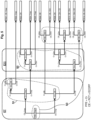
- FIG 5 an example of decision tree for carrying out the comparison steps S1, S2, S3 is illustrated, in the case of a time dependent antibiotic with identified bacteria and unknown MIC.
- the decision tree is a binary decision comprising nodes at each of which one inequality is tested.
- the possible target(s) associated with at least some of the comparison results are indicated in leaves of the decision tree.
- the satisfactory comparison results are indicated, on figure 5 , by "OK" in the corresponding leaf.
- the comparison result R04 corresponds to CE ⁇ Crap, Cr>Crap, Cr ⁇ Ctox and Cr>Clim and is associated with the reported concentration Crap.
- the possible target(s) selected by the application are the one(s) associated with the comparison result provided by the comparison steps with the values for the current treatment (i.e. the values of Cr, RCT, ECOFF Crap, Ctox, Clim).
- the application may determine (for example at step E13) a dosing regimen for each selected target.
- the dosing regimen DoseRap is determined in order to try to make the residual concentration Cr reach the reported concentration Crap.
- the dosing regimen DoseECOFF is determined in order to try to make the residual concentration Cr reach the epidemiological cut off values ECOFF and the dosing regimen DoseLim is determined in order to try to make the residual concentration Cr reach the limit concentration.
- each comparison result is preferably associated with a recommendation message to be displayed by the application (preferably after dose limitation according to step E15), the message comprising each determined dosing regimen as well as, for example, specific comments corresponding to the comparison result (for example, a warning that the residual concentration Cr is higher than the toxic concentration Ctox and/or information indicating the percentage of annihilated strains of bacteria as described previously).
- the physician may then choose one of the recommended displayed dosing regimen(s) to treat the patient 2.
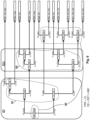
- Figure 6 is a figure similar to figure 5 , in the case of a time dependent antibiotic with identified bacteria and known MIC.
- Figure 7 is a figure similar to figure 5 , in the case of a time dependent antibiotic with unknown bacteria.
- Figure 8 is a figure similar to figure 5 for carrying out the comparison steps S1, S2, S4, in the case of a time and concentration dependent antibiotic with identified bacteria and known MIC.
- comparison step S4 comprises comparing the limit concentration Clim to a simulated residual concentration Cr(DoseMIC) supposing that the DoseMIC dosing regimen is applied to the patient 2.
- Figure 9 is a figure similar to figure 8 , in the case of a time dependent antibiotic with identified bacteria and unknown MIC.
- comparison step S4 comprises comparing the limit concentration Clim to a simulated residual concentration Cr(DoseECOFF) supposing that the DoseECOFF dosing regimen is applied to the patient 2.
- Figure 10 is a figure similar to figure 8 , in the case of a time dependent antibiotic with unknown bacteria.
- comparison step S4 comprises comparing the limit concentration Clim to a simulated residual concentration Cr(DoseECOFFmax) supposing that the DoseECOFFmax dosing regimen is applied to the patient 2, and comparing the limit concentration Clim to a simulated residual concentration Cr(DoseECOFFcut) supposing that the DoseECOFFcut dosing regimen is applied to the patient 2.
Landscapes
- Engineering & Computer Science (AREA)
- Health & Medical Sciences (AREA)
- Public Health (AREA)
- Medical Informatics (AREA)
- Epidemiology (AREA)
- General Health & Medical Sciences (AREA)
- Primary Health Care (AREA)
- Chemical & Material Sciences (AREA)
- Bioinformatics & Cheminformatics (AREA)
- Crystallography & Structural Chemistry (AREA)
- Medicinal Chemistry (AREA)
- Life Sciences & Earth Sciences (AREA)
- Bioinformatics & Computational Biology (AREA)
- Computing Systems (AREA)
- Theoretical Computer Science (AREA)
- Biomedical Technology (AREA)
- Data Mining & Analysis (AREA)
- Databases & Information Systems (AREA)
- Pathology (AREA)
- Pharmaceuticals Containing Other Organic And Inorganic Compounds (AREA)
- Investigating Or Analysing Biological Materials (AREA)
Claims (19)
- Verfahren, das von einem Computer implementiert wird, um ein optimales Arzneimitteldosierungsschema zu bestimmen, um einen Patienten (2) wirksam gegen mindestens einen auf Arzneimittel ansprechenden Krankheitserreger zu behandeln, wobei das Verfahren die folgenden Schritte umfasst:- Erhalten patientenbezogener Daten, die den Patienten (2) betreffen, wobei die patientenbezogenen Daten Parameter beinhalten, die ausgewählt sind aus:- einer Gruppe bestehend aus biologischen Merkmalen, wie Alter, Geschlecht, Gewicht, Kreatinin-Clearance, und/oder- einer Gruppe bestehend aus zuvor verabreichter Dosierung, wie Dosis, Zeitintervall zwischen zwei aufeinanderfolgenden Dosen, Infusionsdauer, Reinjektionszeit, und/oder- einer Gruppe bestehend aus Zeitverzögerung zwischen Arzneimittelverabreichung und Messung, gemessener Arzneimittelkonzentration;- Erhalten einer Konzentration des Arzneimittels, die im Körper des Patienten zu einem beliebigen Zeitpunkt (Cm(t)) gemessen wird,- Berechnen (E1) aus der gemessenen Konzentration (Cm(t)), eines geschätzten Arzneimittelkonzentration-Zeitverlaufs (C3) unter Verwendung eines Bayes'schen Modells, das konfiguriert ist gemäß:- einer dem Patienten zuvor verabreichten Anfangsdosis;- Mittelwerten von Parametern, die aus den patientenbezogenen Daten ausgewählt werden;- interindividueller Variabilität der Parameter innerhalb einer Population von Patienten;- Bestimmen (E3, E9) aus dem geschätzten Arzneimittelkonzentration-Zeitverlauf (C3), eines Werts eines pharmakokinetischen Wirksamkeitsparameters (PPE), der dem Arzneimittel und dem Patienten angepasst ist, und eines Werts einer Arzneimittelrestkonzentration (Cr), wobei der pharmakokinetische Wirksamkeitsparameter (PPE) einer aus einer Spitzenkonzentration (Cpeak) des geschätzten Arzneimittelkonzentration-Zeitverlaufs (C3), einer Restkonzentration (Cr) des geschätzten Arzneimittelkonzentration-Zeitverlaufs (C3) und einer Fläche unter einer Kurve (AUC) des geschätzten Arzneimittelkonzentration-Zeitverlaufs (C3) ist;
wobei das Verfahren dadurch gekennzeichnet ist, dass es weiter Folgendes umfasst:- Bestimmen (E5) möglicher Ziele, die mindestens ein mögliches Ziel (Crap, CE, CEmax, CEcut) für den pharmakokinetischen Wirksamkeitsparameter (PPE) und ein mögliches Ziel für die Arzneimittelrestkonzentration (Cr), definiert als die Arzneimittelsrestkonzentration, bei der ein erhöhtes Risiko für Nebenwirkungen gemeldet wird und die erhöhtes Risikoziel (Clim)) genannt wird, beinhalten;- Verwenden eines binären Entscheidungsbaums, der Knoten umfasst, an denen jeweils eine Ungleichheit getestet wird, um einen Satz von Ungleichheiten zu erhalten, umfassend:- eine Ungleichheit zwischen dem Wert des pharmakokinetischen Wirksamkeitsparameters (PPE) und dem möglichen Ziel, die in einem ersten Vergleichsschritt (E7; S1) erhalten wird, wobei der Wert des pharmakokinetischen Wirksamkeitsparameters (PPE) mit mindestens einem des/der möglichen Ziels/-e (Crap, CE, CEmax, CEcut) für den pharmakokinetischen Wirksamkeitsparameter (PPE) verglichen wird;- eine Ungleichheit zwischen dem Wert der Arzneimittelrestkonzentration (Cr) und einer toxischen Konzentration (Ctox), definiert als eine Arzneimittelkonzentration, ab der schwerwiegende Nebenwirkungen auftreten, und/oder eine Ungleichheit zwischen dem Wert der Arzneimittelrestkonzentration (Cr) und dem erhöhten Risikoziel (Clim), die in einem zweiten Vergleichsschritt (E11; S2) erhalten wird, wobei der Wert der Arzneimittelrestkonzentration (Cr) mit der toxischen Konzentration (Ctox) verglichen wird, und/oder wobei der Wert der Arzneimittelrestkonzentration (Cr) mit dem erhöhten Risikoziel (Clim) verglichen wird;- wobei mindestens einige der möglichen Sätze von Ungleichheiten gemäß dem binären Entscheidungsbaum jeweils mindestens einem der möglichen Ziele zugeordnet sind, und die anderen möglichen Sätze von Ungleichheiten keinem möglichen Ziel zugeordnet sind und einem zufriedenstellenden aktuellen Dosierungsschema entsprechen, Auswählen des/der möglichen Ziels/-e (Crap, CE, CEmax, CEcut, Clim), das/die dem erhaltenen Satz von Ungleichheiten zugeordnet ist/sind; und, für jedes ausgewählte Ziel, Bestimmen (E13) des optimalen Arzneimitteldosierungsschemas, um den Patienten zu behandeln, um das ausgewählte Ziel zu erreichen. - Verfahren nach Anspruch 1, wobei das mindestens eine mögliche Ziel für den pharmakokinetischen Wirksamkeitsparameter (PPE) eine gemeldete Konzentration (Crap) für ein zeitabhängiges Antibiotikum ist.
- Verfahren nach Anspruch 1 oder 2, das einen dritten Vergleichsschritt (S3) umfasst, wobei zwei der möglichen Ziele (CE, Crap, Clim) miteinander verglichen werden, und wobei das Auswählen mindestens eines der möglichen Ziele gemäß dem ersten, zweiten und dritten Vergleichsschritt (S1, S2, S3) durchgeführt wird.
- Verfahren nach einem der Ansprüche 1 bis 3, das das Erhalten von Arzneimitteldaten in Bezug auf das Arzneimittel und das Auswählen des/der möglichen Ziels/-e für den pharmakokinetischen Wirksamkeitsparameter (PPE) aus den Arzneimitteldaten umfasst.
- Verfahren nach Anspruch 4, wobei die Arzneimitteldaten angeben, dass das Arzneimittel ein identifiziertes Antibiotikum für ein Bakterium ist.
- Verfahren nach Anspruch 5, wobei mindestens eines des/der möglichen Ziels/-e (CE) für den pharmakokinetischen Wirksamkeitsparameter (PPE) als das Produkt eines Zielverhältnisses (RC) und eines Anfälligkeitsfaktors (SUS) in Bezug auf die Bakterien definiert ist, wobei das Zielverhältnis (RC) als das Verhältnis definiert ist, das zu erreichen ist, um die Wirksamkeit des Arzneimittels basierend auf bekannten Beziehungen zwischen Konzentration und Wirksamkeit des Arzneimittels zu verbessern.
- Verfahren nach Anspruch 6, das weiter Empfangen von Bakteriendaten, die die Bakterien identifizieren, umfasst, und wobei der Anfälligkeitsfaktor (SUS) eine minimale Hemmkonzentration (MIC) dieser identifizierten Bakterien oder ein epidemiologischer Cut-off-Wert (ECOFF) dieser identifizierten Bakterien ist.
- Verfahren nach Anspruch 7, das weiter Berechnen und Anzeigen eines Wertes eines Prozentsatzes empfindlicher Stämme der identifizierten Bakterien umfasst, die durch die gemessene Arzneimittelkonzentration vernichtet werden können, wenn gemäß dem ersten Vergleichsschritt (S1) der pharmakokinetische Wirksamkeitsparameter (PPE) streng kleiner ist als der mögliche Zielwert (CE), der als Produkt des Zielverhältnisses (RC) für das identifizierte Antibiotikum definiert ist und der Anfälligkeitsfaktor (SUS) der epidemiologische Cut-off-Wert (ECOFF) der identifizierten Bakterien ist.
- Verfahren nach Anspruch 8, das weiter das Empfangen von Bakteriendaten umfasst, die angeben, dass die Bakterien unbekannt sind, und wobei der Anfälligkeitsfaktor (SUS) ein maximaler epidemiologischer Cut-off-Wert (ECOFFmax) ist, der dazu angepasst ist, alle Bakterien zu bekämpfen, die in der Regel empfindlich sind, und für die ein epidemiologischer Cut-off-Wert (ECOFF) bekannt ist, oder ein reduzierter epidemiologischer Cut-off-Wert (ECOFFcut) für eine empirische Behandlung, die dazu angepasst ist, die meisten Krankheitserreger mit Ausnahme der Spezies, die die höchsten epidemiologischen Cut-off-Werte (ECOFF) aufweisen, gemäß bekannten minimalen Hemmkonzentrationsverteilungen, zu bekämpfen.
- Verfahren nach Anspruch 9, das weiter das Berechnen und Anzeigen für jedes einer vordefinierten Anzahl möglicher Bakterien, beispielsweise mindestens zweier vordefinierter Bakterien, eines Wertes eines Prozentsatzes empfindlicher Stämme der möglichen Bakterien umfasst, die durch die gemessene Arzneimittelkonzentration des Arzneimittels vernichtet werden können, wenn gemäß dem ersten Vergleichsschritt (S1) der pharmakokinetische Wirksamkeitsparameter (PPE) streng kleiner ist als das Wirksamkeitsziel (CEmax), das als Produkt des Zielverhältnisses (RC) für das identifizierte Antibiotikum definiert ist, und der Anfälligkeitsfaktors (SUS) der maximale epidemiologische Cut-off-Wert (ECOFFmax) ist.
- Verfahren nach einem der Ansprüche 5 bis 10, wobei das identifizierte Antibiotikum zeitabhängig ist, und wobei der pharmakokinetische Wirksamkeitsparameter (PPE) die Arzneimittelrestkonzentration (Cr) ist.
- Verfahren nach einem der Ansprüche 5 bis 10, wobei das identifizierte Antibiotikum zeit- und konzentrationsabhängig ist, und wobei der pharmakokinetische Wirksamkeitsparameter (PPE) ein Bereich unter der Kurve (AUC) des geschätzten zeitlichen Verlaufs der Arzneimittelkonzentration (C3) ist.
- Verfahren nach einem der vorstehenden Ansprüche, das einen Steuerschritt (E15) umfasst, wobei in dem bestimmten optimalen Arzneimitteldosierungsschema:- die Dosis um nicht mehr als 50 % der Anfangsdosis erhöht wird, es sei denn, die Dosis ist niedriger als die für das Arzneimittel empfohlene maximale Dosis; und/oder- die Dosis um nicht mehr als 50 % der Anfangsdosis verringert wird, es sei denn, die Dosis ist höher als die empfohlene maximale Dosis.
- Verfahren nach einem der vorstehenden Ansprüche, wobei das optimale Dosierungsschema des Arzneimittels als Ergebnis einer Änderung der Dosis und/oder des Dosierungsintervalls bei zeit- und konzentrationsabhängigen Antibiotika oder der Dosis, des Dosierungsintervalls und/oder der Infusionsdauer bei zeitabhängigen Antibiotika erhalten wird.
- System, das einen Anwendungsserver (4) und ein Client-Endgerät (3) umfasst, dadurch gekennzeichnet, dass das Client-Endgerät (3) oder der Anwendungsserver (4) dazu angepasst ist, das Verfahren nach einem der Ansprüche 1 bis 14 zu implementieren.
- System nach Anspruch 15, dadurch gekennzeichnet, dass es weiter eine Patientendatenbank (5) umfasst, aus der das Client-Endgerät (3) und/oder der Anwendungsserver (4) angepasst ist, patientenbezogene Daten abzurufen.
- System nach Anspruch 15 oder 16, dadurch gekennzeichnet, dass es weiter eine Drittpartei-Datenbank (6) umfasst, aus der das Client-Endgerät (3) und/oder der Anwendungsserver (4) angepasst sind, Informationen über Krankheitserreger und/oder Informationen über Wechselwirkungen mit anderen Arzneimitteln abzurufen.
- Computerprogramm, das Anweisungen umfasst, die angepasst sind, um die Schritte des Verfahrens nach einem der Ansprüche 1 bis 14 zu implementieren, wenn das Programm auf einem Computer (3) ausgeführt wird.
- Medium zum Speichern von entfernbaren oder nicht entfernbaren Informationen, die von einem Computer (3) oder einem Mikroprozessor (3.1) lesbar sind, und Codeanweisungen eines Computerprogramms umfassen, das zum Implementieren der Schritte des Verfahrens nach einem der Ansprüche 1 bis 14 angepasst ist, wenn das Programm von einem Computer ausgeführt wird.
Applications Claiming Priority (2)
| Application Number | Priority Date | Filing Date | Title |
|---|---|---|---|
| EP19305734.6A EP3748553A1 (de) | 2019-06-06 | 2019-06-06 | Verfahren zur bestimmung eines optimalen arzneimitteldosierschemas |
| PCT/EP2020/065831 WO2020245458A1 (en) | 2019-06-06 | 2020-06-08 | Method for determining an optimal drug dosing regimen |
Publications (3)
| Publication Number | Publication Date |
|---|---|
| EP3980944A1 EP3980944A1 (de) | 2022-04-13 |
| EP3980944C0 EP3980944C0 (de) | 2025-07-09 |
| EP3980944B1 true EP3980944B1 (de) | 2025-07-09 |
Family
ID=67003391
Family Applications (2)
| Application Number | Title | Priority Date | Filing Date |
|---|---|---|---|
| EP19305734.6A Withdrawn EP3748553A1 (de) | 2019-06-06 | 2019-06-06 | Verfahren zur bestimmung eines optimalen arzneimitteldosierschemas |
| EP20733216.4A Active EP3980944B1 (de) | 2019-06-06 | 2020-06-08 | Verfahren zur bestimmung eines optimalen arzneimitteldosierschemas |
Family Applications Before (1)
| Application Number | Title | Priority Date | Filing Date |
|---|---|---|---|
| EP19305734.6A Withdrawn EP3748553A1 (de) | 2019-06-06 | 2019-06-06 | Verfahren zur bestimmung eines optimalen arzneimitteldosierschemas |
Country Status (4)
| Country | Link |
|---|---|
| US (1) | US20220328137A1 (de) |
| EP (2) | EP3748553A1 (de) |
| CA (1) | CA3142237A1 (de) |
| WO (1) | WO2020245458A1 (de) |
Families Citing this family (5)
| Publication number | Priority date | Publication date | Assignee | Title |
|---|---|---|---|---|
| WO2024148225A1 (en) * | 2023-01-05 | 2024-07-11 | Ks And Associates Llc, Doing Business As Dream Tech, Llc | Method and system for prior toxicity data informed dose-response modeling and benchmark dose (bmd) estimation |
| CN116693012B (zh) * | 2023-05-06 | 2024-10-29 | 同济大学 | 一种含氯消毒剂的排水管道溢流污水消毒协同快速除氨氮方法 |
| CN116779096B (zh) * | 2023-06-28 | 2024-04-16 | 南栖仙策(南京)高新技术有限公司 | 一种用药策略确定方法、装置、设备和存储介质 |
| CN117976125B (zh) * | 2024-04-02 | 2024-06-04 | 山东拓庄医疗科技有限公司 | 一种基于数据分析的医疗设备管理系统及方法 |
| CN118072903B (zh) * | 2024-04-25 | 2024-06-28 | 江南大学附属医院 | 一种基于病种统计分析的抗菌药物用量评估方法及系统 |
Family Cites Families (1)
| Publication number | Priority date | Publication date | Assignee | Title |
|---|---|---|---|---|
| EA201892347A1 (ru) * | 2016-04-15 | 2019-04-30 | Баксалта Инкорпорейтед | Способ и устройство для предоставления фармакокинетической схемы дозирования лекарственных препаратов |
-
2019
- 2019-06-06 EP EP19305734.6A patent/EP3748553A1/de not_active Withdrawn
-
2020
- 2020-06-08 WO PCT/EP2020/065831 patent/WO2020245458A1/en not_active Ceased
- 2020-06-08 EP EP20733216.4A patent/EP3980944B1/de active Active
- 2020-06-08 US US17/615,912 patent/US20220328137A1/en active Pending
- 2020-06-08 CA CA3142237A patent/CA3142237A1/en active Pending
Also Published As
| Publication number | Publication date |
|---|---|
| EP3980944C0 (de) | 2025-07-09 |
| WO2020245458A1 (en) | 2020-12-10 |
| CA3142237A1 (en) | 2020-12-10 |
| EP3748553A1 (de) | 2020-12-09 |
| EP3980944A1 (de) | 2022-04-13 |
| US20220328137A1 (en) | 2022-10-13 |
Similar Documents
| Publication | Publication Date | Title |
|---|---|---|
| EP3980944B1 (de) | Verfahren zur bestimmung eines optimalen arzneimitteldosierschemas | |
| JP7287697B2 (ja) | 薬物動態学的薬物投与計画を提供する方法及び装置 | |
| Eleveld et al. | A general purpose pharmacokinetic model for propofol | |
| Hope et al. | Software for dosage individualization of voriconazole for immunocompromised patients | |
| JP2023179771A (ja) | 適応投与計画を修正するためのシステムおよび方法 | |
| CA2915472C (en) | Pharmacokinetic drug dosing regime apparatus and method | |
| Rinehart et al. | Closed-loop vasopressor control: in-silico study of robustness against pharmacodynamic variability | |
| Han et al. | Covariate‐adjusted borrowing of historical control data in randomized clinical trials | |
| CN109273098B (zh) | 一种基于智能决策的药品疗效预测方法和装置 | |
| Stockmann et al. | An evaluation of vancomycin area under the curve estimation methods for children treated for acute pulmonary exacerbations of cystic fibrosis due to methicillin‐resistant Staphylococcus aureus | |
| US11965206B2 (en) | Method of dosing a patient with multiple drugs using adjusted phenotypes of CYP450 enzymes | |
| Mahzabin et al. | Blockchain associated machine learning and IoT based hypoglycemia detection system with auto-injection feature | |
| Hennessey et al. | A bayesian approach to dose–response assessment and synergy and its application to in vitro dose–response studies | |
| Preijers et al. | In silico evaluation of limited blood sampling strategies for individualized recombinant factor IX prophylaxis in hemophilia B patients | |
| Shih et al. | Titrating and evaluating multi‐drug regimens within subjects | |
| JP7251889B2 (ja) | 生理学的検知及び治療物投与のシステム及び方法 | |
| Martin et al. | Sequential surveillance for drug safety in a regulatory environment | |
| Li et al. | An algorithm and R program for fitting and simulation of pharmacokinetic and pharmacodynamic data | |
| Gao et al. | Adaptive designs for noninferiority trials | |
| CN108766587B (zh) | 一种基于指定药物构建给药数据库的方法及装置 | |
| Wong et al. | Assessment of Markov-dependent stochastic models for drug administration compliance | |
| Polášková et al. | Vancomycin loading dose individualization in a population of obese patients undergoing haemodialysis based on population pharmacokinetic model | |
| CN114067942A (zh) | 基于疾病风险评估的多重用药评价装置、设备及存储介质 | |
| Ortega‐Villa et al. | Regression approaches to assess effect of treatments that arrest progression of symptoms | |
| Vandewalle et al. | Pharmacokinetic model-based assessment of factor IX prophylaxis treatment regimens in severe hemophilia B |
Legal Events
| Date | Code | Title | Description |
|---|---|---|---|
| STAA | Information on the status of an ep patent application or granted ep patent |
Free format text: STATUS: UNKNOWN |
|
| STAA | Information on the status of an ep patent application or granted ep patent |
Free format text: STATUS: THE INTERNATIONAL PUBLICATION HAS BEEN MADE |
|
| PUAI | Public reference made under article 153(3) epc to a published international application that has entered the european phase |
Free format text: ORIGINAL CODE: 0009012 |
|
| STAA | Information on the status of an ep patent application or granted ep patent |
Free format text: STATUS: REQUEST FOR EXAMINATION WAS MADE |
|
| 17P | Request for examination filed |
Effective date: 20211130 |
|
| AK | Designated contracting states |
Kind code of ref document: A1 Designated state(s): AL AT BE BG CH CY CZ DE DK EE ES FI FR GB GR HR HU IE IS IT LI LT LU LV MC MK MT NL NO PL PT RO RS SE SI SK SM TR |
|
| DAV | Request for validation of the european patent (deleted) | ||
| DAX | Request for extension of the european patent (deleted) | ||
| RAP3 | Party data changed (applicant data changed or rights of an application transferred) |
Owner name: UNIVERSITE DE PARIS Owner name: ASSISTANCE PUBLIQUE HOPITAUX DE PARIS |
|
| RAP3 | Party data changed (applicant data changed or rights of an application transferred) |
Owner name: UNIVERSITE DE PARIS CITE Owner name: ASSISTANCE PUBLIQUE HOPITAUX DE PARIS |
|
| REG | Reference to a national code |
Ref country code: DE Ref legal event code: R079 Free format text: PREVIOUS MAIN CLASS: G06N0007000000 Ipc: G16C0020300000 Ref country code: DE Ref legal event code: R079 Ref document number: 602020054198 Country of ref document: DE Free format text: PREVIOUS MAIN CLASS: G06N0007000000 Ipc: G16C0020300000 |
|
| GRAP | Despatch of communication of intention to grant a patent |
Free format text: ORIGINAL CODE: EPIDOSNIGR1 |
|
| STAA | Information on the status of an ep patent application or granted ep patent |
Free format text: STATUS: GRANT OF PATENT IS INTENDED |
|
| RIC1 | Information provided on ipc code assigned before grant |
Ipc: G16C 20/70 20190101ALN20250414BHEP Ipc: G16H 20/10 20180101ALI20250414BHEP Ipc: G16C 20/30 20190101AFI20250414BHEP |
|
| GRAS | Grant fee paid |
Free format text: ORIGINAL CODE: EPIDOSNIGR3 |
|
| GRAA | (expected) grant |
Free format text: ORIGINAL CODE: 0009210 |
|
| STAA | Information on the status of an ep patent application or granted ep patent |
Free format text: STATUS: THE PATENT HAS BEEN GRANTED |
|
| INTG | Intention to grant announced |
Effective date: 20250514 |
|
| AK | Designated contracting states |
Kind code of ref document: B1 Designated state(s): AL AT BE BG CH CY CZ DE DK EE ES FI FR GB GR HR HU IE IS IT LI LT LU LV MC MK MT NL NO PL PT RO RS SE SI SK SM TR |
|
| REG | Reference to a national code |
Ref country code: GB Ref legal event code: FG4D |
|
| REG | Reference to a national code |
Ref country code: CH Ref legal event code: EP |
|
| REG | Reference to a national code |
Ref country code: IE Ref legal event code: FG4D |
|
| REG | Reference to a national code |
Ref country code: DE Ref legal event code: R096 Ref document number: 602020054198 Country of ref document: DE |
|
| U01 | Request for unitary effect filed |
Effective date: 20250806 |
|
| U07 | Unitary effect registered |
Designated state(s): AT BE BG DE DK EE FI FR IT LT LU LV MT NL PT RO SE SI Effective date: 20250818 |