EP3978235A1 - Transparent gas barrier film and method for producing same - Google Patents
Transparent gas barrier film and method for producing same Download PDFInfo
- Publication number
- EP3978235A1 EP3978235A1 EP20813821.4A EP20813821A EP3978235A1 EP 3978235 A1 EP3978235 A1 EP 3978235A1 EP 20813821 A EP20813821 A EP 20813821A EP 3978235 A1 EP3978235 A1 EP 3978235A1
- Authority
- EP
- European Patent Office
- Prior art keywords
- aluminum oxide
- oxide layer
- vapor
- film
- deposition
- Prior art date
- Legal status (The legal status is an assumption and is not a legal conclusion. Google has not performed a legal analysis and makes no representation as to the accuracy of the status listed.)
- Withdrawn
Links
- 230000004888 barrier function Effects 0.000 title claims abstract description 74
- 238000004519 manufacturing process Methods 0.000 title claims abstract description 25
- TWNQGVIAIRXVLR-UHFFFAOYSA-N oxo(oxoalumanyloxy)alumane Chemical compound O=[Al]O[Al]=O TWNQGVIAIRXVLR-UHFFFAOYSA-N 0.000 claims abstract description 102
- 238000007740 vapor deposition Methods 0.000 claims abstract description 76
- 239000002985 plastic film Substances 0.000 claims abstract description 67
- 229920006255 plastic film Polymers 0.000 claims abstract description 67
- 238000010521 absorption reaction Methods 0.000 claims abstract description 37
- QVGXLLKOCUKJST-UHFFFAOYSA-N atomic oxygen Chemical compound [O] QVGXLLKOCUKJST-UHFFFAOYSA-N 0.000 claims description 32
- 239000001301 oxygen Substances 0.000 claims description 32
- 229910052760 oxygen Inorganic materials 0.000 claims description 32
- 239000007789 gas Substances 0.000 claims description 29
- 238000000034 method Methods 0.000 claims description 29
- 239000012298 atmosphere Substances 0.000 claims description 7
- 239000002253 acid Substances 0.000 abstract description 17
- 229910052809 inorganic oxide Inorganic materials 0.000 abstract 2
- 239000010408 film Substances 0.000 description 109
- 239000010410 layer Substances 0.000 description 76
- 238000002834 transmittance Methods 0.000 description 33
- 229910052782 aluminium Inorganic materials 0.000 description 29
- XAGFODPZIPBFFR-UHFFFAOYSA-N aluminium Chemical compound [Al] XAGFODPZIPBFFR-UHFFFAOYSA-N 0.000 description 29
- 238000001704 evaporation Methods 0.000 description 19
- 239000000758 substrate Substances 0.000 description 18
- 230000008020 evaporation Effects 0.000 description 16
- 239000011248 coating agent Substances 0.000 description 14
- 238000000576 coating method Methods 0.000 description 14
- 238000010438 heat treatment Methods 0.000 description 13
- 230000005540 biological transmission Effects 0.000 description 9
- 239000012788 optical film Substances 0.000 description 9
- -1 polyethylene Polymers 0.000 description 8
- 229920000620 organic polymer Polymers 0.000 description 7
- 230000003647 oxidation Effects 0.000 description 7
- 238000007254 oxidation reaction Methods 0.000 description 7
- XLYOFNOQVPJJNP-UHFFFAOYSA-N water Substances O XLYOFNOQVPJJNP-UHFFFAOYSA-N 0.000 description 7
- 230000000052 comparative effect Effects 0.000 description 6
- 239000000463 material Substances 0.000 description 6
- 229910052751 metal Inorganic materials 0.000 description 6
- 239000002184 metal Substances 0.000 description 6
- VYPSYNLAJGMNEJ-UHFFFAOYSA-N Silicium dioxide Chemical compound O=[Si]=O VYPSYNLAJGMNEJ-UHFFFAOYSA-N 0.000 description 5
- 229910052814 silicon oxide Inorganic materials 0.000 description 5
- 239000010409 thin film Substances 0.000 description 5
- 230000002378 acidificating effect Effects 0.000 description 4
- 239000011247 coating layer Substances 0.000 description 4
- 230000007423 decrease Effects 0.000 description 4
- 238000005259 measurement Methods 0.000 description 4
- 239000000126 substance Substances 0.000 description 4
- 239000004743 Polypropylene Substances 0.000 description 3
- 150000007513 acids Chemical class 0.000 description 3
- 238000010030 laminating Methods 0.000 description 3
- 150000004706 metal oxides Chemical class 0.000 description 3
- 239000005022 packaging material Substances 0.000 description 3
- 229920000139 polyethylene terephthalate Polymers 0.000 description 3
- 239000005020 polyethylene terephthalate Substances 0.000 description 3
- 229920001155 polypropylene Polymers 0.000 description 3
- XKRFYHLGVUSROY-UHFFFAOYSA-N Argon Chemical compound [Ar] XKRFYHLGVUSROY-UHFFFAOYSA-N 0.000 description 2
- 239000004698 Polyethylene Substances 0.000 description 2
- 239000000853 adhesive Substances 0.000 description 2
- 230000001070 adhesive effect Effects 0.000 description 2
- 238000011088 calibration curve Methods 0.000 description 2
- 238000004040 coloring Methods 0.000 description 2
- 230000001276 controlling effect Effects 0.000 description 2
- 230000003111 delayed effect Effects 0.000 description 2
- 238000000151 deposition Methods 0.000 description 2
- 230000006866 deterioration Effects 0.000 description 2
- 238000010894 electron beam technology Methods 0.000 description 2
- 230000006698 induction Effects 0.000 description 2
- 230000031700 light absorption Effects 0.000 description 2
- 229920000092 linear low density polyethylene Polymers 0.000 description 2
- 239000004707 linear low-density polyethylene Substances 0.000 description 2
- 229910044991 metal oxide Inorganic materials 0.000 description 2
- 238000002156 mixing Methods 0.000 description 2
- 230000003287 optical effect Effects 0.000 description 2
- 238000004806 packaging method and process Methods 0.000 description 2
- 239000012071 phase Substances 0.000 description 2
- 229920000573 polyethylene Polymers 0.000 description 2
- 235000021419 vinegar Nutrition 0.000 description 2
- 239000000052 vinegar Substances 0.000 description 2
- 238000004804 winding Methods 0.000 description 2
- AWFYPPSBLUWMFQ-UHFFFAOYSA-N 2-[5-[2-(2,3-dihydro-1H-inden-2-ylamino)pyrimidin-5-yl]-1,3,4-oxadiazol-2-yl]-1-(1,4,6,7-tetrahydropyrazolo[4,3-c]pyridin-5-yl)ethanone Chemical compound C1C(CC2=CC=CC=C12)NC1=NC=C(C=N1)C1=NN=C(O1)CC(=O)N1CC2=C(CC1)NN=C2 AWFYPPSBLUWMFQ-UHFFFAOYSA-N 0.000 description 1
- PNEYBMLMFCGWSK-UHFFFAOYSA-N Alumina Chemical compound [O-2].[O-2].[O-2].[Al+3].[Al+3] PNEYBMLMFCGWSK-UHFFFAOYSA-N 0.000 description 1
- 229920002799 BoPET Polymers 0.000 description 1
- MYMOFIZGZYHOMD-UHFFFAOYSA-N Dioxygen Chemical compound O=O MYMOFIZGZYHOMD-UHFFFAOYSA-N 0.000 description 1
- JHWNWJKBPDFINM-UHFFFAOYSA-N Laurolactam Chemical compound O=C1CCCCCCCCCCCN1 JHWNWJKBPDFINM-UHFFFAOYSA-N 0.000 description 1
- 239000004677 Nylon Substances 0.000 description 1
- 229920000299 Nylon 12 Polymers 0.000 description 1
- 229920001007 Nylon 4 Polymers 0.000 description 1
- 229920002292 Nylon 6 Polymers 0.000 description 1
- 229920002302 Nylon 6,6 Polymers 0.000 description 1
- 239000004952 Polyamide Substances 0.000 description 1
- 239000004962 Polyamide-imide Substances 0.000 description 1
- 239000004697 Polyetherimide Substances 0.000 description 1
- 239000004642 Polyimide Substances 0.000 description 1
- 239000004721 Polyphenylene oxide Substances 0.000 description 1
- 239000004734 Polyphenylene sulfide Substances 0.000 description 1
- 239000004372 Polyvinyl alcohol Substances 0.000 description 1
- 229920001328 Polyvinylidene chloride Polymers 0.000 description 1
- 239000000654 additive Substances 0.000 description 1
- AZDRQVAHHNSJOQ-UHFFFAOYSA-N alumane Chemical group [AlH3] AZDRQVAHHNSJOQ-UHFFFAOYSA-N 0.000 description 1
- WNROFYMDJYEPJX-UHFFFAOYSA-K aluminium hydroxide Chemical compound [OH-].[OH-].[OH-].[Al+3] WNROFYMDJYEPJX-UHFFFAOYSA-K 0.000 description 1
- 239000002216 antistatic agent Substances 0.000 description 1
- 239000004760 aramid Substances 0.000 description 1
- 229910052786 argon Inorganic materials 0.000 description 1
- 229920003235 aromatic polyamide Polymers 0.000 description 1
- 230000015572 biosynthetic process Effects 0.000 description 1
- 230000000903 blocking effect Effects 0.000 description 1
- 238000006243 chemical reaction Methods 0.000 description 1
- 238000005229 chemical vapour deposition Methods 0.000 description 1
- 239000003086 colorant Substances 0.000 description 1
- 239000002131 composite material Substances 0.000 description 1
- 238000007796 conventional method Methods 0.000 description 1
- 238000001816 cooling Methods 0.000 description 1
- 230000010485 coping Effects 0.000 description 1
- 238000003851 corona treatment Methods 0.000 description 1
- 230000002596 correlated effect Effects 0.000 description 1
- 230000003247 decreasing effect Effects 0.000 description 1
- 230000002950 deficient Effects 0.000 description 1
- 230000008021 deposition Effects 0.000 description 1
- 238000007865 diluting Methods 0.000 description 1
- 238000010790 dilution Methods 0.000 description 1
- 239000012895 dilution Substances 0.000 description 1
- 229910001882 dioxygen Inorganic materials 0.000 description 1
- 208000028659 discharge Diseases 0.000 description 1
- 239000003814 drug Substances 0.000 description 1
- 238000009820 dry lamination Methods 0.000 description 1
- 230000000694 effects Effects 0.000 description 1
- 238000004993 emission spectroscopy Methods 0.000 description 1
- 150000002148 esters Chemical class 0.000 description 1
- 235000013305 food Nutrition 0.000 description 1
- 230000017525 heat dissipation Effects 0.000 description 1
- 230000001771 impaired effect Effects 0.000 description 1
- 239000012535 impurity Substances 0.000 description 1
- 238000009616 inductively coupled plasma Methods 0.000 description 1
- 239000000314 lubricant Substances 0.000 description 1
- 229920001778 nylon Polymers 0.000 description 1
- 239000012044 organic layer Substances 0.000 description 1
- 230000001590 oxidative effect Effects 0.000 description 1
- 230000000704 physical effect Effects 0.000 description 1
- 239000004014 plasticizer Substances 0.000 description 1
- 229920002492 poly(sulfone) Polymers 0.000 description 1
- 229920002647 polyamide Polymers 0.000 description 1
- 229920002312 polyamide-imide Polymers 0.000 description 1
- 229920000728 polyester Polymers 0.000 description 1
- 229920001601 polyetherimide Polymers 0.000 description 1
- 229920001721 polyimide Polymers 0.000 description 1
- 229920006380 polyphenylene oxide Polymers 0.000 description 1
- 229920000069 polyphenylene sulfide Polymers 0.000 description 1
- 229920002451 polyvinyl alcohol Polymers 0.000 description 1
- 239000004800 polyvinyl chloride Substances 0.000 description 1
- 229920000915 polyvinyl chloride Polymers 0.000 description 1
- 239000005033 polyvinylidene chloride Substances 0.000 description 1
- 230000009257 reactivity Effects 0.000 description 1
- 238000005096 rolling process Methods 0.000 description 1
- 238000007788 roughening Methods 0.000 description 1
- 239000000565 sealant Substances 0.000 description 1
- 238000003980 solgel method Methods 0.000 description 1
- 239000007790 solid phase Substances 0.000 description 1
- 230000003595 spectral effect Effects 0.000 description 1
- 238000003860 storage Methods 0.000 description 1
- 238000004381 surface treatment Methods 0.000 description 1
- KKEYFWRCBNTPAC-UHFFFAOYSA-L terephthalate(2-) Chemical compound [O-]C(=O)C1=CC=C(C([O-])=O)C=C1 KKEYFWRCBNTPAC-UHFFFAOYSA-L 0.000 description 1
- 229920001187 thermosetting polymer Polymers 0.000 description 1
- 239000006097 ultraviolet radiation absorber Substances 0.000 description 1
- 229910052724 xenon Inorganic materials 0.000 description 1
- FHNFHKCVQCLJFQ-UHFFFAOYSA-N xenon atom Chemical compound [Xe] FHNFHKCVQCLJFQ-UHFFFAOYSA-N 0.000 description 1
Images

Classifications
-
- C—CHEMISTRY; METALLURGY
- C23—COATING METALLIC MATERIAL; COATING MATERIAL WITH METALLIC MATERIAL; CHEMICAL SURFACE TREATMENT; DIFFUSION TREATMENT OF METALLIC MATERIAL; COATING BY VACUUM EVAPORATION, BY SPUTTERING, BY ION IMPLANTATION OR BY CHEMICAL VAPOUR DEPOSITION, IN GENERAL; INHIBITING CORROSION OF METALLIC MATERIAL OR INCRUSTATION IN GENERAL
- C23C—COATING METALLIC MATERIAL; COATING MATERIAL WITH METALLIC MATERIAL; SURFACE TREATMENT OF METALLIC MATERIAL BY DIFFUSION INTO THE SURFACE, BY CHEMICAL CONVERSION OR SUBSTITUTION; COATING BY VACUUM EVAPORATION, BY SPUTTERING, BY ION IMPLANTATION OR BY CHEMICAL VAPOUR DEPOSITION, IN GENERAL
- C23C14/00—Coating by vacuum evaporation, by sputtering or by ion implantation of the coating forming material
- C23C14/22—Coating by vacuum evaporation, by sputtering or by ion implantation of the coating forming material characterised by the process of coating
- C23C14/56—Apparatus specially adapted for continuous coating; Arrangements for maintaining the vacuum, e.g. vacuum locks
- C23C14/562—Apparatus specially adapted for continuous coating; Arrangements for maintaining the vacuum, e.g. vacuum locks for coating elongated substrates
-
- C—CHEMISTRY; METALLURGY
- C23—COATING METALLIC MATERIAL; COATING MATERIAL WITH METALLIC MATERIAL; CHEMICAL SURFACE TREATMENT; DIFFUSION TREATMENT OF METALLIC MATERIAL; COATING BY VACUUM EVAPORATION, BY SPUTTERING, BY ION IMPLANTATION OR BY CHEMICAL VAPOUR DEPOSITION, IN GENERAL; INHIBITING CORROSION OF METALLIC MATERIAL OR INCRUSTATION IN GENERAL
- C23C—COATING METALLIC MATERIAL; COATING MATERIAL WITH METALLIC MATERIAL; SURFACE TREATMENT OF METALLIC MATERIAL BY DIFFUSION INTO THE SURFACE, BY CHEMICAL CONVERSION OR SUBSTITUTION; COATING BY VACUUM EVAPORATION, BY SPUTTERING, BY ION IMPLANTATION OR BY CHEMICAL VAPOUR DEPOSITION, IN GENERAL
- C23C14/00—Coating by vacuum evaporation, by sputtering or by ion implantation of the coating forming material
- C23C14/06—Coating by vacuum evaporation, by sputtering or by ion implantation of the coating forming material characterised by the coating material
- C23C14/08—Oxides
- C23C14/081—Oxides of aluminium, magnesium or beryllium
-
- C—CHEMISTRY; METALLURGY
- C23—COATING METALLIC MATERIAL; COATING MATERIAL WITH METALLIC MATERIAL; CHEMICAL SURFACE TREATMENT; DIFFUSION TREATMENT OF METALLIC MATERIAL; COATING BY VACUUM EVAPORATION, BY SPUTTERING, BY ION IMPLANTATION OR BY CHEMICAL VAPOUR DEPOSITION, IN GENERAL; INHIBITING CORROSION OF METALLIC MATERIAL OR INCRUSTATION IN GENERAL
- C23C—COATING METALLIC MATERIAL; COATING MATERIAL WITH METALLIC MATERIAL; SURFACE TREATMENT OF METALLIC MATERIAL BY DIFFUSION INTO THE SURFACE, BY CHEMICAL CONVERSION OR SUBSTITUTION; COATING BY VACUUM EVAPORATION, BY SPUTTERING, BY ION IMPLANTATION OR BY CHEMICAL VAPOUR DEPOSITION, IN GENERAL
- C23C14/00—Coating by vacuum evaporation, by sputtering or by ion implantation of the coating forming material
- C23C14/06—Coating by vacuum evaporation, by sputtering or by ion implantation of the coating forming material characterised by the coating material
- C23C14/08—Oxides
-
- B—PERFORMING OPERATIONS; TRANSPORTING
- B32—LAYERED PRODUCTS
- B32B—LAYERED PRODUCTS, i.e. PRODUCTS BUILT-UP OF STRATA OF FLAT OR NON-FLAT, e.g. CELLULAR OR HONEYCOMB, FORM
- B32B27/00—Layered products comprising a layer of synthetic resin
-
- B—PERFORMING OPERATIONS; TRANSPORTING
- B32—LAYERED PRODUCTS
- B32B—LAYERED PRODUCTS, i.e. PRODUCTS BUILT-UP OF STRATA OF FLAT OR NON-FLAT, e.g. CELLULAR OR HONEYCOMB, FORM
- B32B27/00—Layered products comprising a layer of synthetic resin
- B32B27/06—Layered products comprising a layer of synthetic resin as the main or only constituent of a layer, which is next to another layer of the same or of a different material
-
- B—PERFORMING OPERATIONS; TRANSPORTING
- B32—LAYERED PRODUCTS
- B32B—LAYERED PRODUCTS, i.e. PRODUCTS BUILT-UP OF STRATA OF FLAT OR NON-FLAT, e.g. CELLULAR OR HONEYCOMB, FORM
- B32B9/00—Layered products comprising a layer of a particular substance not covered by groups B32B11/00 - B32B29/00
-
- B—PERFORMING OPERATIONS; TRANSPORTING
- B32—LAYERED PRODUCTS
- B32B—LAYERED PRODUCTS, i.e. PRODUCTS BUILT-UP OF STRATA OF FLAT OR NON-FLAT, e.g. CELLULAR OR HONEYCOMB, FORM
- B32B9/00—Layered products comprising a layer of a particular substance not covered by groups B32B11/00 - B32B29/00
- B32B9/04—Layered products comprising a layer of a particular substance not covered by groups B32B11/00 - B32B29/00 comprising such particular substance as the main or only constituent of a layer, which is next to another layer of the same or of a different material
-
- C—CHEMISTRY; METALLURGY
- C08—ORGANIC MACROMOLECULAR COMPOUNDS; THEIR PREPARATION OR CHEMICAL WORKING-UP; COMPOSITIONS BASED THEREON
- C08J—WORKING-UP; GENERAL PROCESSES OF COMPOUNDING; AFTER-TREATMENT NOT COVERED BY SUBCLASSES C08B, C08C, C08F, C08G or C08H
- C08J7/00—Chemical treatment or coating of shaped articles made of macromolecular substances
- C08J7/04—Coating
- C08J7/048—Forming gas barrier coatings
-
- C—CHEMISTRY; METALLURGY
- C08—ORGANIC MACROMOLECULAR COMPOUNDS; THEIR PREPARATION OR CHEMICAL WORKING-UP; COMPOSITIONS BASED THEREON
- C08J—WORKING-UP; GENERAL PROCESSES OF COMPOUNDING; AFTER-TREATMENT NOT COVERED BY SUBCLASSES C08B, C08C, C08F, C08G or C08H
- C08J7/00—Chemical treatment or coating of shaped articles made of macromolecular substances
- C08J7/04—Coating
- C08J7/06—Coating with compositions not containing macromolecular substances
-
- C—CHEMISTRY; METALLURGY
- C23—COATING METALLIC MATERIAL; COATING MATERIAL WITH METALLIC MATERIAL; CHEMICAL SURFACE TREATMENT; DIFFUSION TREATMENT OF METALLIC MATERIAL; COATING BY VACUUM EVAPORATION, BY SPUTTERING, BY ION IMPLANTATION OR BY CHEMICAL VAPOUR DEPOSITION, IN GENERAL; INHIBITING CORROSION OF METALLIC MATERIAL OR INCRUSTATION IN GENERAL
- C23C—COATING METALLIC MATERIAL; COATING MATERIAL WITH METALLIC MATERIAL; SURFACE TREATMENT OF METALLIC MATERIAL BY DIFFUSION INTO THE SURFACE, BY CHEMICAL CONVERSION OR SUBSTITUTION; COATING BY VACUUM EVAPORATION, BY SPUTTERING, BY ION IMPLANTATION OR BY CHEMICAL VAPOUR DEPOSITION, IN GENERAL
- C23C14/00—Coating by vacuum evaporation, by sputtering or by ion implantation of the coating forming material
- C23C14/0021—Reactive sputtering or evaporation
-
- C—CHEMISTRY; METALLURGY
- C23—COATING METALLIC MATERIAL; COATING MATERIAL WITH METALLIC MATERIAL; CHEMICAL SURFACE TREATMENT; DIFFUSION TREATMENT OF METALLIC MATERIAL; COATING BY VACUUM EVAPORATION, BY SPUTTERING, BY ION IMPLANTATION OR BY CHEMICAL VAPOUR DEPOSITION, IN GENERAL; INHIBITING CORROSION OF METALLIC MATERIAL OR INCRUSTATION IN GENERAL
- C23C—COATING METALLIC MATERIAL; COATING MATERIAL WITH METALLIC MATERIAL; SURFACE TREATMENT OF METALLIC MATERIAL BY DIFFUSION INTO THE SURFACE, BY CHEMICAL CONVERSION OR SUBSTITUTION; COATING BY VACUUM EVAPORATION, BY SPUTTERING, BY ION IMPLANTATION OR BY CHEMICAL VAPOUR DEPOSITION, IN GENERAL
- C23C14/00—Coating by vacuum evaporation, by sputtering or by ion implantation of the coating forming material
- C23C14/02—Pretreatment of the material to be coated
-
- C—CHEMISTRY; METALLURGY
- C23—COATING METALLIC MATERIAL; COATING MATERIAL WITH METALLIC MATERIAL; CHEMICAL SURFACE TREATMENT; DIFFUSION TREATMENT OF METALLIC MATERIAL; COATING BY VACUUM EVAPORATION, BY SPUTTERING, BY ION IMPLANTATION OR BY CHEMICAL VAPOUR DEPOSITION, IN GENERAL; INHIBITING CORROSION OF METALLIC MATERIAL OR INCRUSTATION IN GENERAL
- C23C—COATING METALLIC MATERIAL; COATING MATERIAL WITH METALLIC MATERIAL; SURFACE TREATMENT OF METALLIC MATERIAL BY DIFFUSION INTO THE SURFACE, BY CHEMICAL CONVERSION OR SUBSTITUTION; COATING BY VACUUM EVAPORATION, BY SPUTTERING, BY ION IMPLANTATION OR BY CHEMICAL VAPOUR DEPOSITION, IN GENERAL
- C23C14/00—Coating by vacuum evaporation, by sputtering or by ion implantation of the coating forming material
- C23C14/22—Coating by vacuum evaporation, by sputtering or by ion implantation of the coating forming material characterised by the process of coating
- C23C14/24—Vacuum evaporation
-
- C—CHEMISTRY; METALLURGY
- C23—COATING METALLIC MATERIAL; COATING MATERIAL WITH METALLIC MATERIAL; CHEMICAL SURFACE TREATMENT; DIFFUSION TREATMENT OF METALLIC MATERIAL; COATING BY VACUUM EVAPORATION, BY SPUTTERING, BY ION IMPLANTATION OR BY CHEMICAL VAPOUR DEPOSITION, IN GENERAL; INHIBITING CORROSION OF METALLIC MATERIAL OR INCRUSTATION IN GENERAL
- C23C—COATING METALLIC MATERIAL; COATING MATERIAL WITH METALLIC MATERIAL; SURFACE TREATMENT OF METALLIC MATERIAL BY DIFFUSION INTO THE SURFACE, BY CHEMICAL CONVERSION OR SUBSTITUTION; COATING BY VACUUM EVAPORATION, BY SPUTTERING, BY ION IMPLANTATION OR BY CHEMICAL VAPOUR DEPOSITION, IN GENERAL
- C23C14/00—Coating by vacuum evaporation, by sputtering or by ion implantation of the coating forming material
- C23C14/22—Coating by vacuum evaporation, by sputtering or by ion implantation of the coating forming material characterised by the process of coating
- C23C14/24—Vacuum evaporation
- C23C14/28—Vacuum evaporation by wave energy or particle radiation
- C23C14/30—Vacuum evaporation by wave energy or particle radiation by electron bombardment
-
- C—CHEMISTRY; METALLURGY
- C23—COATING METALLIC MATERIAL; COATING MATERIAL WITH METALLIC MATERIAL; CHEMICAL SURFACE TREATMENT; DIFFUSION TREATMENT OF METALLIC MATERIAL; COATING BY VACUUM EVAPORATION, BY SPUTTERING, BY ION IMPLANTATION OR BY CHEMICAL VAPOUR DEPOSITION, IN GENERAL; INHIBITING CORROSION OF METALLIC MATERIAL OR INCRUSTATION IN GENERAL
- C23C—COATING METALLIC MATERIAL; COATING MATERIAL WITH METALLIC MATERIAL; SURFACE TREATMENT OF METALLIC MATERIAL BY DIFFUSION INTO THE SURFACE, BY CHEMICAL CONVERSION OR SUBSTITUTION; COATING BY VACUUM EVAPORATION, BY SPUTTERING, BY ION IMPLANTATION OR BY CHEMICAL VAPOUR DEPOSITION, IN GENERAL
- C23C14/00—Coating by vacuum evaporation, by sputtering or by ion implantation of the coating forming material
- C23C14/58—After-treatment
-
- C—CHEMISTRY; METALLURGY
- C08—ORGANIC MACROMOLECULAR COMPOUNDS; THEIR PREPARATION OR CHEMICAL WORKING-UP; COMPOSITIONS BASED THEREON
- C08J—WORKING-UP; GENERAL PROCESSES OF COMPOUNDING; AFTER-TREATMENT NOT COVERED BY SUBCLASSES C08B, C08C, C08F, C08G or C08H
- C08J2323/00—Characterised by the use of homopolymers or copolymers of unsaturated aliphatic hydrocarbons having only one carbon-to-carbon double bond; Derivatives of such polymers
- C08J2323/02—Characterised by the use of homopolymers or copolymers of unsaturated aliphatic hydrocarbons having only one carbon-to-carbon double bond; Derivatives of such polymers not modified by chemical after treatment
- C08J2323/10—Homopolymers or copolymers of propene
- C08J2323/12—Polypropene
-
- C—CHEMISTRY; METALLURGY
- C08—ORGANIC MACROMOLECULAR COMPOUNDS; THEIR PREPARATION OR CHEMICAL WORKING-UP; COMPOSITIONS BASED THEREON
- C08J—WORKING-UP; GENERAL PROCESSES OF COMPOUNDING; AFTER-TREATMENT NOT COVERED BY SUBCLASSES C08B, C08C, C08F, C08G or C08H
- C08J2367/00—Characterised by the use of polyesters obtained by reactions forming a carboxylic ester link in the main chain; Derivatives of such polymers
- C08J2367/02—Polyesters derived from dicarboxylic acids and dihydroxy compounds
Definitions
- the present invention relates to a transparent barrier film having excellent properties as a packaging material that has excellent transparency, gas barrier properties, printability, and flexibility and is required to provide the airtightness of foods, pharmaceuticals, and electronic components and the like, or a gas blocking material, and a method for producing the same.
- a film obtained by laminating an inorganic substance on a plastic film is commercially available.
- the inorganic substance metal oxides such as silicon oxide and aluminum oxide are often used from the viewpoint of transparency.
- the metal oxide is mainly laminated on a film by a vapor-deposition method or a CVD method.
- a laminated film that includes, as a barrier layer, an aluminum oxide layer formed by a reactive vapor-deposition method of evaporating aluminum and introducing oxygen is mainly used (see, for example, Patent Document 1).
- the following transparent barrier film is also commercially available.
- an inorganic layer is laminated, and the inorganic layer is coated with an organic layer or the like to improve the barrier properties of the film or protect the inorganic layer (see, for example, Patent Document 2).
- the transparent barrier film is used in a state where the film is subjected to printing when used for a packaging material, or other film is laminated on the film using an adhesive or the like.
- Various films are laminated, but an un-stretched polyethylene film or polypropylene film called a sealant is generally laminated in order to make a bag.
- a vapor-deposition material is inexpensive aluminum, and the evaporation temperature of aluminum is also low, whereby the transparent barrier film can be formed by a relatively inexpensive apparatus having an induction heating type or resistance heating type vapor-deposition source. Therefore, the transparent barrier film having the aluminum oxide layer is provided as a packaging material at a lower cost than that of a transparent barrier film containing silicon oxide or silicon oxide and aluminum oxide as a vapor-deposition material.
- the transparent barrier film having the aluminum oxide layer is provided as a packaging material at a lower cost than that of a transparent barrier film containing silicon oxide or silicon oxide and aluminum oxide as a vapor-deposition material.
- Patent Document 2 introduces coating on an aluminum oxide layer, but the coating makes it impossible to provide improved acid resistance.
- Patent Document 1 discloses a production method in which sufficient barrier properties are less likely to be obtained with a film thickness of 100 nm or less in a reactive vapor-deposition method in which aluminum is evaporated and oxygen is blown, whereby vapor-deposition is performed under a pressure of 1 ⁇ 10 -5 to 1 ⁇ 10 -2 Torr (1.33 ⁇ 10 -3 to 1.33 Pa) in a vacuum pressure vessel, and the film is then stored under conditions of 40°C and 80% RH, or immersed in warm water to temporarily adsorb moisture, followed by performing a heat treatment.
- the barrier properties can be improved, but unreacted aluminum is combined with water to form aluminum hydroxide, whereby the obtained film is apt to react with an acid.
- Patent Document 2 discloses a production method in which a vapor-deposited inorganic layer having an ultraviolet transmittance (366 nm) of 82 to 94% is provided, and a coating layer is provided thereon by a sol-gel method.
- the film thickness is 10 nm or more, whereby the ultraviolet transmittance of 82% or less is considered to cause poor transparency, and the ultraviolet transmittance of 94% or more is considered to provide no reactivity with the coating layer.
- the degree of oxidation during vapor-deposition is increased to provide improved transparency, thereby causing the coating layer to improve the barrier properties.
- the production method increases the number of steps, which makes it difficult to inexpensively produce the film. When an oxide layer obtained by oxidizing aluminum is used, the coating layer cannot prevent a reaction due to an acid.
- a barrier layer composed of silicon oxide as an expensive vapor-deposition material or a layer formed by an expensive vapor-deposition apparatus using an electron beam vapor-deposition source and obtained by mixing silicon oxide with aluminum oxide.
- an object of the present invention is to provide a transparent barrier film that has excellent acid resistance and is inexpensive, and a method for producing the same.
- the present inventors have found that the above problems can be solved by the following means, and have reached the present invention. That is, the present invention has the following configurations.
- the present invention makes it possible to provide a transparent gas barrier film that is inexpensive, has excellent transparency, can retain barrier properties even when packaging acidic contents, and can store the contents for a long period of time, and a method for producing the same.
- a transparent gas barrier film of the present invention includes a plastic film and an aluminum oxide layer provided on at least one surface of the plastic film, the aluminum oxide layer mainly composed of aluminum oxide.
- An absorption coefficient of the aluminum oxide layer immediately after vapor-deposition is less than 0.03 nm -1 , and a film thickness of the aluminum oxide layer is 6 nm or more and 10 nm or less.
- a method for producing a transparent gas barrier film of the present invention is a method for producing a transparent gas barrier film including a plastic film and an aluminum oxide layer provided on at least one surface of the plastic film, the aluminum oxide layer mainly composed of aluminum oxide.
- the method includes an aluminum oxide layer forming step of adjusting an absorption coefficient of the aluminum oxide layer immediately after vapor-deposition to less than 0.03 nm -1 and adjusting a film thickness of the aluminum oxide layer to 6 nm or more and 10 nm or less.
- the aluminum oxide layer mainly composed of aluminum oxide in the present invention substantially contains 99% or more of aluminum oxide and other components as impurities.
- the aluminum oxide contains not only a stoichiometrically complete oxide but also aluminum oxide that is deficient in oxygen.
- the absorption coefficient ⁇ in the present invention can be represented by Formula 1.
- ⁇ ⁇ 1 / tal ⁇ ln Tal / 100
- the film thickness of the aluminum oxide layer of the present invention is a value determined by a fluorescent X-ray apparatus with the density of the aluminum oxide thin film being 0.74 times (2.94 g/cm 3 ) a bulk density (3.97 g/cm 3 ).
- the reason why the density of the aluminum oxide thin film is 0.74 times the bulk density is that the film thickness is well matched with an actual film thickness obtained by TEM or the like.
- an aluminum adhesion amount per unit area is identified by inductively coupled plasma emission spectroscopy, and the aluminum adhesion amount is converted into a film thickness by the density of an aluminum oxide thin film, to measure the film thickness.
- the total light transmittance in the present invention refers to a total light transmittance according to JIS K7375.
- a light source such as a fluorescent lamp, a xenon lamp, or a white LED is used to make light incident on one surface to be measured and measure an amount of light emitted from the other.
- the measured value is correlated to a total light transmittance of a sample measured in advance according to JIS K7375 with the optical film thickness meter, and treated as the total light transmittance.
- Fig. 1 shows a graph obtained by measuring light transmittances of a substrate plastic film and a transparent barrier film by a spectrophotometer.
- the light transmittance 2 of the transparent barrier film causes monotonous light absorption at any wavelength as compared with the light transmittance 1 of the substrate plastic film.
- a value obtained by converting the value of the optical film thickness meter can also be treated as the total light transmittance in consideration of a D65 light source as defined as a light source in JIS K7375 and the wavelength region of the color-matching function of a CIE standard colorimetric observer.
- Fig. 2 shows a wavelength region.
- the transparent gas barrier film of the present invention includes a plastic film and an aluminum oxide layer provided on at least one surface of the plastic film, the aluminum oxide layer mainly composed of aluminum oxide.
- An absorption coefficient of the aluminum oxide layer immediately after vapor-deposition is less than 0.03 nm -1 .
- a method for producing a transparent gas barrier film of the present invention is a method for producing a transparent gas barrier film including a plastic film and an aluminum oxide layer provided on at least one surface of the plastic film, the aluminum oxide layer mainly composed of aluminum oxide.
- the method includes an aluminum oxide layer forming step of adjusting an absorption coefficient of the aluminum oxide layer immediately after vapor-deposition to less than 0.03 nm -1 .
- Immediately after vapor-deposition in the present invention refers to a time point when an optical thickness is measured for film thickness control or the like immediately after an aluminum oxide layer is vapor-deposited on a plastic film in a vacuum chamber.
- the plastic film after vapor-deposition is taken out from the vapor-deposition apparatus, and the total light transmission amount is immediately measured, which coincides with that at the time point when the optical thickness is measured.
- the absorption coefficient immediately after vapor-deposition of 0.03 nm -1 or more causes deteriorated barrier properties of the bag. That is, the barrier film has poor acid resistance.
- the absorption coefficient immediately after vapor-deposition is preferably less than 0.03 nm -1 .
- the acid resistance in the present invention means that an aluminum oxide layer as a barrier layer does not lose its barrier properties due to chemical change in the aluminum oxide layer caused by acids when highly acidic contents are put in a package including a transparent barrier film.
- the absorption coefficient of the transparent gas barrier film of the present invention immediately after vapor-deposition is preferably 0.02 nm -1 or more.
- the absorption coefficient immediately after vapor-deposition is preferably adjusted to 0.02 nm -1 or more.
- the absorption coefficient is 0.02 nm -1 or less, the degree of oxidation of aluminum oxide is high, which provides improved transparency, but a water vapor transmission rate is reduced, which is not preferable as the barrier film.
- the absorption coefficient is finally 0.002 nm -1 or less in the present invention, or "the step of finally adjusting the absorption coefficient to 0.002 nm -1 or less” means that the absorption coefficient is 0.002 nm -1 or less or adjusted to 0.002 nm -1 or less when the absorption coefficient is obtained after the transparent barrier film in which the aluminum oxide layer is laminated on the substrate plastic film by vapor-deposition is taken out from the vacuum chamber, and the transparent barrier film is stored at least at room temperature of 10°C to 40°C for 1 week or more in a state where the aluminum oxide layer is exposed to the atmosphere.
- the thickness of the aluminum oxide vapor-deposited layer is 6 nm or more and 10 nm or less.
- the method for producing a transparent gas barrier film of the present invention includes an aluminum oxide layer forming step of adjusting the thickness of the aluminum oxide layer to 6 nm or more and 10 nm or less.
- the absorption coefficient finally exceeds 0.002 nm -1 , the light absorption of the thin film exceeds 1% even if the film thickness is 10 nm or less, which disadvantageously causes coloring.
- the coloring can also be suppressed by reducing the film thickness, but when the film thickness is 5 nm or less, the barrier properties become problematic.
- a reactive vapor-deposition method is suitable.
- the reactive vapor-deposition method is a method in which oxygen is introduced into a vapor-deposition tank where metal aluminum is evaporated by heating, to oxidize the metal aluminum, thereby depositing aluminum oxide on a substrate plastic film.
- a method for evaporating metal aluminum by heating a resistance heating method, an induction heating method, and an electron beam heating method can be used.
- Examples of a method for controlling the film thickness include a method in which an aluminum oxide layer deposited on a plastic film is measured with a film thickness meter using fluorescent X-rays, and the heating is adjusted to control the film thickness in comparison with the target film thickness.
- a photometer that irradiates light from one side of the plastic film and measures light transmitted from the other side is installed, to control the amount of oxygen introduced according to the amount of the total transmission light.
- metal aluminum is first vapor-deposited on the substrate plastic film.
- the thickness of the deposited metal aluminum is controlled by an optical film thickness meter that irradiates light from one side of the plastic film after vapor-deposition and measures light transmitted from the other side to convert the measured value into a film thickness, thereby making the film thickness constant.
- oxygen is introduced to deposit aluminum oxide.
- an optical film thickness meter is used as a measurement meter of the total light transmittance under a constant evaporation condition to control the amount of oxygen introduced so as to achieve the target total light transmittance.
- the latter production method is preferable because the apparatus is simple.
- a resistance heating method in which an aluminum wire as an evaporation source is supplied to a boat type heating element to evaporate the aluminum wire is suitable. After oxygen is introduced, the film thickness cannot be calculated from the total light transmittance.
- the boat-type evaporation source aluminum as an evaporation material is supplied in a wire form. Accordingly, it is found that if a wire supply speed when an evaporation amount reaches the target is maintained, if the evaporation is delayed, molten aluminum on the boat increases and the evaporation amount decreases. When the evaporation amount increases, the supply of the wire cannot catch up the increase, whereby the evaporation amount does not exceed a certain level. As described above, when the vapor-deposition rate of aluminum is once determined, the evaporation amount is stabilized, which is preferable.
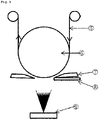
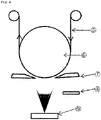
- Figs. 3 and 4 show schematic views of the vapor-deposition apparatus.
- Aluminum evaporating from a vapor-deposition source (9) is deposited on a substrate plastic film (5) on a coating roll (6).
- a coating window (7) is installed near the coating roll (6) in order to limit the angle of incidence of aluminum vapor on the substrate or to prevent the adhesion of aluminum to unnecessary places.
- an oxygen inlet (8) is preferably installed close to the coating roll (6) so as not to hinder the flow of the aluminum vapor.
- a pressure for performing vapor-deposition is preferably 1 ⁇ 10 -2 Pa or less in consideration of the fact that the density of the aluminum oxide increases to provide improved barrier properties.
- the oxygen inlet (8) can be placed in the aluminum vapor to increase the efficiency, but aluminum or aluminum oxide adheres to the oxygen inlet to cause reduced efficiency of the deposition thereof on the substrate plastic film.
- the deposited material adhering to the oxygen inlet (8) peels, drops, and enters the evaporation source, the evaporation amount changes, which is not preferable.
- vapor-deposition is preferably performed by a roll-to-roll method. Because the plastic film after vapor-deposition is taken out in a roll form, the aluminum oxide layer is not exposed to the atmosphere. Therefore, it is necessary to rewind the rolled plastic film once in the atmosphere to entrain air between layers of the plastic film. As a rewinding condition, it is preferable to rewind the plastic film under a condition that an air layer of 0.4 ⁇ m or more is entrained.
- the plastic film after vapor-deposition may be blocked due to dew formation, whereby it is preferable that the temperature is 40°C or less, and the relative humidity is 70 RH% or less.
- the amount of air entrained can be represented by Formula 3.
- the thickness of the rewound plastic film is t ⁇ m; the length thereof is 1 m; the diameter of a paper tube used is 2r mm; and the diameter of the wound rolled plastic film is 2R mm
- the thickness tair ⁇ m of the layer of air entrained between the plastic films can be represented by Formula 3.
- tair ⁇ R 2 ⁇ r 2 / l ⁇ t
- the rewound rolled plastic film is preferably stored until the aluminum oxide layer is stabilized because the oxidation of the aluminum oxide layer gradually proceeds.
- a storage period needs to be at least 1 week at room temperature of 10°C to 40°C.
- An increase in the temperature is presumed to promote the oxidation, but an increase in the temperature to 40°C or higher may affect the physical properties and the like of the film, which is not preferable.
- the temperature of 10°C or lower causes delayed oxidation, which is not preferable.
- the plastic film in the present invention is a film obtained by melt-extruding an organic polymer, stretching the organic polymer in a longitudinal direction and/or a transverse direction as necessary, and cooling and thermosetting the organic polymer.
- the organic polymer include polyethylene, polypropylene, polyethylene terephthalate, polyethylene-2,6-naphthalate, nylon 6, nylon 4, nylon 66, nylon 12, polyvinyl chloride, polyvinylidene chloride, polyvinyl alcohol, wholly aromatic polyamide, polyamide imide, polyimide, polyether imide, polysulfone, polyphenylene sulfide, and polyphenylene oxide. These organic polymers may be copolymerized or blended with a small amount of other organic polymer.
- a plastic film having a total light transmittance of 70% or more is preferable from the viewpoint of the plastic film utilizing the transparency, but the transparency of the plastic film is not particularly limited.
- the total light transmittance is more preferably 80% or more.
- the plastic film used in the present invention may be subjected to a corona discharge treatment, a glow discharge treatment, or other surface roughening treatment before laminating a thin-film layer thereto, or may be subjected to a known anchor coating treatment.
- the thickness of the plastic film used in the present invention is preferably in the range of 5 to 1000 ⁇ m, and more preferably in the range of 10 to 500 ⁇ m.
- the aluminum oxide layer of the present invention is relatively hard because the aluminum oxide layer has an increased density to provide improved barrier properties. Therefore, the plastic film preferably has good dimensional stability.
- An un-stretched plastic film cannot be said to be preferable because the un-stretched plastic film is apt to be deformed by tension.
- a polyamide film made of nylon or the like having a large dimensional change due to humidity or the like cannot be said to be also preferable.
- biaxially stretched polyethylene terephthalate film or a biaxially stretched polypropylene film that has a small dimensional change due to humidity and temperature.
- the substrate plastic film is heated by radiant heat from the vapor-deposition source and heat dissipation accompanying the phase change of aluminum from a gas phase to a solid phase. From this viewpoint, a biaxially stretched film of polyester terephthalate having relatively excellent heat resistance is preferable.
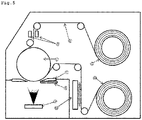
- a transparent barrier film was formed by using a vapor-deposition apparatus, shown in a schematic view described in Fig. 5 , having a vapor-deposition source in which boat-type resistance heating vapor-deposition sources (9) were arranged, and a roll-to-roll-type film traveling system.
- An aluminum wire is fed into a boat made of BN composite.
- An oxygen inlet (8) is installed in a coating window (7) .
- a coating roll (6) was set at -5°C.
- a substrate plastic film (5) used for vapor-deposition is a 12 ⁇ m-thick polyethylene terephthalate plastic film for vapor-deposition of a Toyobo ester (R) film.
- the substrate plastic film (5) is unwound from an unwinding roll (10).
- a vapor-deposition surface of the plastic film (5) is treated by a planar type plasma source (11), and the plastic film (5) is guided to the coating roll (6).
- the plasma source (11) generated plasma in a state where an input power was set to 10 kW, and an argon gas of 400 sccm and an oxygen gas of 100 sccm were caused to flow.
- the substrate plastic film (5) is guided to a coating window position for vapor-deposition by the coating roll (6) after the surface treatment.
- the plastic film after vapor-deposition is caused to move to an optical film thickness meter (12) to measure a total light transmittance. After the measurement, the film is wound around a winding roll (13).
- the total light transmittance during vapor-deposition was obtained by converting the value of the optical film thickness meter by using a sample measured by a turbidimeter (NDH 5000 manufactured by Nippon Denshoku Industries Co., Ltd.) according to JIS K7375.
- the sample taken out after vapor-deposition was measured with the turbidimeter.
- OTR oxygen transmission rate
- a water vapor transmission rate (WVTR) was measured under measurement conditions of a temperature of 40°C and a humidity of 90%RH using a water vapor transmission measuring apparatus (PERMATRAN-W3/31 manufactured by MOCON Inc.,US) according to JIS K7129B.
- a laminated film is formed by dry-laminating a linear low density polyethylene film (LLDPE: L4102 40 ⁇ m, manufactured by Toyobo Co., Ltd.) on the formed transparent barrier film.
- LLDPE linear low density polyethylene film
- an adhesive obtained by mixing TM569 and CAT-10L manufactured by Toyo-Morton, Ltd. was used.
- the laminated film is cut into two A5 size films (148 mm ⁇ 210 mm).
- the two films are sealed at three sides in a state where the films L4012 are overlapped, to form a bag.
- a seal width is 10 mm.
- the bag is filled with 100 ml of a dilution obtained by diluting vinegar (manufactured by Mizkan, grain vinegar) to 50% with water, and sealed.
- the bag is placed in a room at 40°C and stored for 1 week.
- the acid resistance is evaluated by the oxygen transmission rate.
- Example 1 aluminum was vapor-deposited on a substrate plastic film having a total light transmittance of 83% without oxygen being introduced with a target of a total light transmittance of 39%. The total light transmittance was stabilized, and the oxygen was then introduced to control the total light transmittance to 72%. The amount of oxygen introduced was 12278 sccm. A pressure in a vapor-deposition chamber after the introduction of oxygen was 1.5 ⁇ 10 -3 Pa. Table 1 shows the conditions of Example 1.
- This transparent barrier film was rewound at a speed of 230 m/min using a slitter. From the diameter of the rewound rolled plastic film, the amount of air entrained was estimated to be contained at a thickness of about 0.4 ⁇ m between the plastic films.
- the rewound transparent barrier film was stored in a room at 23°C for 3 weeks, and the total light transmittance was then measured with a turbidimeter to calculate an absorption coefficient.
- the results are shown in Table 2.
- the OTR and WVTR obtained by measuring the laminated film obtained by bonding the LLDEP to the transparent barrier film are shown in Table 2.
- the results of the acid resistance test are shown in Table 2.
- Example 1 Total Light Transmittance % Vapor-Deposition Conditions Substrate Plastic Film Aluminum Aluminum Oxide Amount of Oxygen Introduced sccm Pressure mPa Film Traveling Speed m/min Example 1 83 39 72 12278 1.5 600 Example 2 85 28 69 12907 8.8 480 Example 3 85 29 71 12797 9.2 480 Example 4 85 26 72 13650 9.4 432 Example 5 83 18 63 12517 1.4 333 Example 6 83 18 69 13786 1.4 333 Comparative Example 1 83 18 58 11447 1.4 333 Comparative Example 2 83 8 44 10420 1.4 222 Comparative Example 3 83 8 54 12231 1.4 222
- the present invention makes it possible to provide a transparent barrier film that includes, as a barrier layer, an aluminum oxide layer that can be produced at a low cost to have excellent acid resistance and be capable of packaging a wide range of contents, and a method for producing the same.
Landscapes
- Chemical & Material Sciences (AREA)
- Organic Chemistry (AREA)
- Chemical Kinetics & Catalysis (AREA)
- Engineering & Computer Science (AREA)
- Mechanical Engineering (AREA)
- Materials Engineering (AREA)
- Metallurgy (AREA)
- Health & Medical Sciences (AREA)
- Medicinal Chemistry (AREA)
- Polymers & Plastics (AREA)
- Toxicology (AREA)
- Ceramic Engineering (AREA)
- Laminated Bodies (AREA)
- Physical Vapour Deposition (AREA)
Abstract
Description
- The present invention relates to a transparent barrier film having excellent properties as a packaging material that has excellent transparency, gas barrier properties, printability, and flexibility and is required to provide the airtightness of foods, pharmaceuticals, and electronic components and the like, or a gas blocking material, and a method for producing the same.
- As a transparent barrier film, a film obtained by laminating an inorganic substance on a plastic film is commercially available. As the inorganic substance, metal oxides such as silicon oxide and aluminum oxide are often used from the viewpoint of transparency. The metal oxide is mainly laminated on a film by a vapor-deposition method or a CVD method.
- In particular, a laminated film that includes, as a barrier layer, an aluminum oxide layer formed by a reactive vapor-deposition method of evaporating aluminum and introducing oxygen is mainly used (see, for example, Patent Document 1).
- The following transparent barrier film is also commercially available. On the transparent barrier film, an inorganic layer is laminated, and the inorganic layer is coated with an organic layer or the like to improve the barrier properties of the film or protect the inorganic layer (see, for example, Patent Document 2).
- The transparent barrier film is used in a state where the film is subjected to printing when used for a packaging material, or other film is laminated on the film using an adhesive or the like. Various films are laminated, but an un-stretched polyethylene film or polypropylene film called a sealant is generally laminated in order to make a bag.
- In the transparent barrier film having an aluminum oxide layer formed by reactive vapor-deposition used in Patent Documents 1 and 2, a vapor-deposition material is inexpensive aluminum, and the evaporation temperature of aluminum is also low, whereby the transparent barrier film can be formed by a relatively inexpensive apparatus having an induction heating type or resistance heating type vapor-deposition source. Therefore, the transparent barrier film having the aluminum oxide layer is provided as a packaging material at a lower cost than that of a transparent barrier film containing silicon oxide or silicon oxide and aluminum oxide as a vapor-deposition material. However, when acidic contents are put into a bag formed by using the transparent barrier film having the aluminum oxide layer, the barrier properties of the bag are deteriorated, which disadvantageously causes the deterioration in the contents to proceed.
- Patent Document 2 introduces coating on an aluminum oxide layer, but the coating makes it impossible to provide improved acid resistance.
- Patent Document 1 discloses a production method in which sufficient barrier properties are less likely to be obtained with a film thickness of 100 nm or less in a reactive vapor-deposition method in which aluminum is evaporated and oxygen is blown, whereby vapor-deposition is performed under a pressure of 1×10⁻⁵ to 1×10⁻² Torr (1.33×10⁻³ to 1.33 Pa) in a vacuum pressure vessel, and the film is then stored under conditions of 40°C and 80% RH, or immersed in warm water to temporarily adsorb moisture, followed by performing a heat treatment.
- In the production method, it is considered that the barrier properties can be improved, but unreacted aluminum is combined with water to form aluminum hydroxide, whereby the obtained film is apt to react with an acid.
- Patent Document 2 discloses a production method in which a vapor-deposited inorganic layer having an ultraviolet transmittance (366 nm) of 82 to 94% is provided, and a coating layer is provided thereon by a sol-gel method.
- In the production method, the film thickness is 10 nm or more, whereby the ultraviolet transmittance of 82% or less is considered to cause poor transparency, and the ultraviolet transmittance of 94% or more is considered to provide no reactivity with the coating layer. In the production method, the degree of oxidation during vapor-deposition is increased to provide improved transparency, thereby causing the coating layer to improve the barrier properties. The production method increases the number of steps, which makes it difficult to inexpensively produce the film. When an oxide layer obtained by oxidizing aluminum is used, the coating layer cannot prevent a reaction due to an acid.
- Therefore, for coping, there is used a barrier layer composed of silicon oxide as an expensive vapor-deposition material, or a layer formed by an expensive vapor-deposition apparatus using an electron beam vapor-deposition source and obtained by mixing silicon oxide with aluminum oxide.
-
- Patent Document 1:
JP-B-2638797 - Patent Document 2:
JP-A-2007-290292 - The present invention has been made in view of the problems of the conventional technique. That is, an object of the present invention is to provide a transparent barrier film that has excellent acid resistance and is inexpensive, and a method for producing the same.
- As a result of intensive studies, the present inventors have found that the above problems can be solved by the following means, and have reached the present invention. That is, the present invention has the following configurations.
- 1. A transparent gas barrier film comprising a plastic film and an aluminum oxide layer provided on at least one surface of the plastic film, the aluminum oxide layer mainly composed of aluminum oxide, wherein:
- an absorption coefficient of the aluminum oxide layer immediately after vapor-deposition is less than 0.03 nm-1; and
- a film thickness of the aluminum oxide layer is 6 nm or more and 10 nm or less.
- 2. The transparent gas barrier film according to 1., wherein the absorption coefficient immediately after vapor-deposition is 0.02 nm-1 or more.
- 3. The transparent gas barrier film according to 1. or 2., wherein the absorption coefficient is finally 0.02 nm-1 or less.
- 4. A method for producing a transparent gas barrier film comprising a plastic film and an aluminum oxide layer provided on at least one surface of the plastic film, the aluminum oxide layer mainly composed of aluminum oxide,
the method comprising an aluminum oxide layer forming step of adjusting an absorption coefficient of the aluminum oxide layer immediately after vapor-deposition to less than 0.03 nm-1 and adjusting a film thickness of the aluminum oxide layer to 6 nm or more and 10 nm or less. - 5. The method according to 4., wherein in the aluminum oxide layer forming step, the absorption coefficient immediately after vapor-deposition is adjusted to 0.02 nm-1 or more.
- 6. The method according to 4. or 5., wherein the aluminum oxide layer forming step is performed by using a reactive vapor-deposition method.
- 7. The method according to any one of 4. to 6., wherein the absorption coefficient is adjusted by controlling an amount of oxygen introduced into a vapor-deposition tank in the aluminum oxide layer forming step.
- 8. The method according to any one of 4. to 7., further comprising a step of finally adjusting the absorption coefficient to 0.002 nm-1 or less after the aluminum oxide layer forming step.
- 9. The method according to 5., wherein the transparent gas barrier film is stored at normal temperature in an air atmosphere for 1 week or more in the step of adjusting the absorption coefficient to 0.002 nm-1 or less.
- The present invention makes it possible to provide a transparent gas barrier film that is inexpensive, has excellent transparency, can retain barrier properties even when packaging acidic contents, and can store the contents for a long period of time, and a method for producing the same.
-
-
Fig. 1 shows transmittance wavelength characteristics of a substrate plastic film and a transparent gas barrier film measured by a spectrophotometer. -
Fig. 2 shows transmittance wavelength characteristics of a substrate plastic film, a D65 light source, and a color-matching function of a CIE standard colorimetric observer. -
Fig. 3 is a schematic vapor-deposition view. -
Fig. 4 is a schematic vapor-deposition view. -
Fig. 5 is a schematic view of a vapor-deposition apparatus. - Hereinafter, the present invention will be described in detail.
- A transparent gas barrier film of the present invention includes a plastic film and an aluminum oxide layer provided on at least one surface of the plastic film, the aluminum oxide layer mainly composed of aluminum oxide. An absorption coefficient of the aluminum oxide layer immediately after vapor-deposition is less than 0.03 nm-1, and a film thickness of the aluminum oxide layer is 6 nm or more and 10 nm or less.
- A method for producing a transparent gas barrier film of the present invention is a method for producing a transparent gas barrier film including a plastic film and an aluminum oxide layer provided on at least one surface of the plastic film, the aluminum oxide layer mainly composed of aluminum oxide. The method includes an aluminum oxide layer forming step of adjusting an absorption coefficient of the aluminum oxide layer immediately after vapor-deposition to less than 0.03 nm-1 and adjusting a film thickness of the aluminum oxide layer to 6 nm or more and 10 nm or less.
- The aluminum oxide layer mainly composed of aluminum oxide in the present invention substantially contains 99% or more of aluminum oxide and other components as impurities. The aluminum oxide contains not only a stoichiometrically complete oxide but also aluminum oxide that is deficient in oxygen.
- When the total light transmittance of the aluminum oxide layer is Tal % and the film thickness of the aluminum oxide layer is tal nm, the absorption coefficient α in the present invention can be represented by Formula 1.

- When the total light transmittance of the transparent gas barrier film having the aluminum oxide layer is T0 % and the total light transmittance of the substrate plastic film on which the aluminum oxide layer is laminated is Tb %, the total light transmittance Tal % of the aluminum oxide layer can be represented by Formula (2).

- The film thickness of the aluminum oxide layer of the present invention is a value determined by a fluorescent X-ray apparatus with the density of the aluminum oxide thin film being 0.74 times (2.94 g/cm3) a bulk density (3.97 g/cm3). The reason why the density of the aluminum oxide thin film is 0.74 times the bulk density is that the film thickness is well matched with an actual film thickness obtained by TEM or the like.
- In order to obtain the film thickness using the fluorescent X-ray apparatus, it is necessary to measure a sample having a known film thickness in advance using the fluorescent X-ray apparatus, obtain a fluorescent X-ray dose emitted from the sample, and create a calibration curve of the film thickness and fluorescent X-ray intensity.
- In a sample used for creating a calibration curve of fluorescent X-rays, an aluminum adhesion amount per unit area is identified by inductively coupled plasma emission spectroscopy, and the aluminum adhesion amount is converted into a film thickness by the density of an aluminum oxide thin film, to measure the film thickness.
- The total light transmittance in the present invention refers to a total light transmittance according to JIS K7375. In an optical film thickness meter installed to measure a film thickness in a vapor-deposition apparatus, a light source such as a fluorescent lamp, a xenon lamp, or a white LED is used to make light incident on one surface to be measured and measure an amount of light emitted from the other. The measured value is correlated to a total light transmittance of a sample measured in advance according to JIS K7375 with the optical film thickness meter, and treated as the total light transmittance.
-
Fig. 1 shows a graph obtained by measuring light transmittances of a substrate plastic film and a transparent barrier film by a spectrophotometer. The light transmittance 2 of the transparent barrier film causes monotonous light absorption at any wavelength as compared with the light transmittance 1 of the substrate plastic film. A value obtained by converting the value of the optical film thickness meter can also be treated as the total light transmittance in consideration of a D65 light source as defined as a light source in JIS K7375 and the wavelength region of the color-matching function of a CIE standard colorimetric observer.Fig. 2 shows a wavelength region. - The transparent gas barrier film of the present invention includes a plastic film and an aluminum oxide layer provided on at least one surface of the plastic film, the aluminum oxide layer mainly composed of aluminum oxide. An absorption coefficient of the aluminum oxide layer immediately after vapor-deposition is less than 0.03 nm-1.
- A method for producing a transparent gas barrier film of the present invention is a method for producing a transparent gas barrier film including a plastic film and an aluminum oxide layer provided on at least one surface of the plastic film, the aluminum oxide layer mainly composed of aluminum oxide. The method includes an aluminum oxide layer forming step of adjusting an absorption coefficient of the aluminum oxide layer immediately after vapor-deposition to less than 0.03 nm-1.
- "Immediately after vapor-deposition" in the present invention refers to a time point when an optical thickness is measured for film thickness control or the like immediately after an aluminum oxide layer is vapor-deposited on a plastic film in a vacuum chamber.
- When the vapor-deposited aluminum oxide layer comes into contact with oxygen, the oxidation of the aluminum oxide layer further proceeds, which causes change in the total light transmittance.
- After the completion of the vapor-deposition, the plastic film after vapor-deposition is taken out from the vapor-deposition apparatus, and the total light transmission amount is immediately measured, which coincides with that at the time point when the optical thickness is measured.
- Even if the transparent barrier film is exposed to the atmosphere to promote the oxidation of the transparent barrier film, and a bag is formed by using the transparent barrier film to package an acidic substance, the absorption coefficient immediately after vapor-deposition of 0.03 nm-1 or more causes deteriorated barrier properties of the bag. That is, the barrier film has poor acid resistance. The absorption coefficient immediately after vapor-deposition is preferably less than 0.03 nm-1.
- It is unclear whether the acid molecules have a structure of easily approaching to the metal atoms, or the metal oxide atoms are in a state of easily reacting with acids, but deterioration in the barrier film due to the acids occurs.
- The acid resistance in the present invention means that an aluminum oxide layer as a barrier layer does not lose its barrier properties due to chemical change in the aluminum oxide layer caused by acids when highly acidic contents are put in a package including a transparent barrier film.
- The absorption coefficient of the transparent gas barrier film of the present invention immediately after vapor-deposition is preferably 0.02 nm-1 or more. In the method for producing a transparent gas barrier film of the present invention, the absorption coefficient immediately after vapor-deposition is preferably adjusted to 0.02 nm-1 or more. When the absorption coefficient is 0.02 nm-1 or less, the degree of oxidation of aluminum oxide is high, which provides improved transparency, but a water vapor transmission rate is reduced, which is not preferable as the barrier film.
- It is presumed that the aluminum oxide layer largely reacts with oxygen during vapor-deposition, which causes a decreased density of the aluminum oxide layer, but it is not clear.
- "The absorption coefficient is finally 0.002 nm-1 or less" in the present invention, or "the step of finally adjusting the absorption coefficient to 0.002 nm-1 or less" means that the absorption coefficient is 0.002 nm-1 or less or adjusted to 0.002 nm-1 or less when the absorption coefficient is obtained after the transparent barrier film in which the aluminum oxide layer is laminated on the substrate plastic film by vapor-deposition is taken out from the vacuum chamber, and the transparent barrier film is stored at least at room temperature of 10°C to 40°C for 1 week or more in a state where the aluminum oxide layer is exposed to the atmosphere.
- In the transparent gas barrier film of the present invention, the thickness of the aluminum oxide vapor-deposited layer is 6 nm or more and 10 nm or less. The method for producing a transparent gas barrier film of the present invention includes an aluminum oxide layer forming step of adjusting the thickness of the aluminum oxide layer to 6 nm or more and 10 nm or less.
- When the absorption coefficient finally exceeds 0.002 nm-1, the light absorption of the thin film exceeds 1% even if the film thickness is 10 nm or less, which disadvantageously causes coloring. The coloring can also be suppressed by reducing the film thickness, but when the film thickness is 5 nm or less, the barrier properties become problematic.
- As a method for producing a transparent barrier film having an aluminum oxide layer having a film thickness of 10 nm or less and an absorption coefficient immediately after vapor-deposition of 0.03 nm-1 or less, a reactive vapor-deposition method is suitable.
- The reactive vapor-deposition method is a method in which oxygen is introduced into a vapor-deposition tank where metal aluminum is evaporated by heating, to oxidize the metal aluminum, thereby depositing aluminum oxide on a substrate plastic film. As a method for evaporating metal aluminum by heating, a resistance heating method, an induction heating method, and an electron beam heating method can be used.
- Examples of a method for controlling the film thickness include a method in which an aluminum oxide layer deposited on a plastic film is measured with a film thickness meter using fluorescent X-rays, and the heating is adjusted to control the film thickness in comparison with the target film thickness. In this case, in order to set the absorption coefficient to 0.03 nm-1 or less, a photometer that irradiates light from one side of the plastic film and measures light transmitted from the other side is installed, to control the amount of oxygen introduced according to the amount of the total transmission light.
- Alternatively, metal aluminum is first vapor-deposited on the substrate plastic film. The thickness of the deposited metal aluminum is controlled by an optical film thickness meter that irradiates light from one side of the plastic film after vapor-deposition and measures light transmitted from the other side to convert the measured value into a film thickness, thereby making the film thickness constant. Thereafter, oxygen is introduced to deposit aluminum oxide. At that time, there is used a production method in which an optical film thickness meter is used as a measurement meter of the total light transmittance under a constant evaporation condition to control the amount of oxygen introduced so as to achieve the target total light transmittance. The latter production method is preferable because the apparatus is simple.
- In the production method using the optical film thickness meter, a resistance heating method in which an aluminum wire as an evaporation source is supplied to a boat type heating element to evaporate the aluminum wire is suitable. After oxygen is introduced, the film thickness cannot be calculated from the total light transmittance. In the boat-type evaporation source, aluminum as an evaporation material is supplied in a wire form. Accordingly, it is found that if a wire supply speed when an evaporation amount reaches the target is maintained, if the evaporation is delayed, molten aluminum on the boat increases and the evaporation amount decreases. When the evaporation amount increases, the supply of the wire cannot catch up the increase, whereby the evaporation amount does not exceed a certain level. As described above, when the vapor-deposition rate of aluminum is once determined, the evaporation amount is stabilized, which is preferable.
-
Figs. 3 and4 show schematic views of the vapor-deposition apparatus. Aluminum evaporating from a vapor-deposition source (9) is deposited on a substrate plastic film (5) on a coating roll (6). A coating window (7) is installed near the coating roll (6) in order to limit the angle of incidence of aluminum vapor on the substrate or to prevent the adhesion of aluminum to unnecessary places. - As shown in
Fig. 3 , an oxygen inlet (8) is preferably installed close to the coating roll (6) so as not to hinder the flow of the aluminum vapor. - It is considered that when the oxygen inlet (8) is brought close to the evaporation source as shown in
Fig. 4 , aluminum is oxidized at the evaporation source, which causes an unstable evaporation rate. As shown inFig. 4 , when oxygen is introduced at a position away from the flow of the aluminum vapor, the probability that the oxygen encounters aluminum atoms decreases, whereby the oxygen is not effectively used. Unconsumed oxygen increases a pressure in a vacuum vapor-deposition tank. When vapor-deposition is performed in a situation where the pressure is high, the density of the formed film tends to decrease. - A decrease in the density of the aluminum oxide is estimated to cause reduced ability to hinder the permeation of a gas. Therefore, a pressure for performing vapor-deposition is preferably 1×10⁻² Pa or less in consideration of the fact that the density of the aluminum oxide increases to provide improved barrier properties.
- In
Fig. 4 , the oxygen inlet (8) can be placed in the aluminum vapor to increase the efficiency, but aluminum or aluminum oxide adheres to the oxygen inlet to cause reduced efficiency of the deposition thereof on the substrate plastic film. When the deposited material adhering to the oxygen inlet (8) peels, drops, and enters the evaporation source, the evaporation amount changes, which is not preferable. - In the method for producing a transparent barrier film, vapor-deposition is preferably performed by a roll-to-roll method. Because the plastic film after vapor-deposition is taken out in a roll form, the aluminum oxide layer is not exposed to the atmosphere. Therefore, it is necessary to rewind the rolled plastic film once in the atmosphere to entrain air between layers of the plastic film. As a rewinding condition, it is preferable to rewind the plastic film under a condition that an air layer of 0.4 µm or more is entrained. When the plastic film is rewound under a high-temperature high-humidity atmosphere, the plastic film after vapor-deposition may be blocked due to dew formation, whereby it is preferable that the temperature is 40°C or less, and the relative humidity is 70 RH% or less.
- The amount of air entrained can be represented by
Formula 3. When the thickness of the rewound plastic film is t µm; the length thereof is 1 m; the diameter of a paper tube used is 2r mm; and the diameter of the wound rolled plastic film is 2R mm, the thickness tair µm of the layer of air entrained between the plastic films can be represented byFormula 3.
- The rewound rolled plastic film is preferably stored until the aluminum oxide layer is stabilized because the oxidation of the aluminum oxide layer gradually proceeds. A storage period needs to be at least 1 week at room temperature of 10°C to 40°C.
- An increase in the temperature is presumed to promote the oxidation, but an increase in the temperature to 40°C or higher may affect the physical properties and the like of the film, which is not preferable. The temperature of 10°C or lower causes delayed oxidation, which is not preferable.
- The plastic film in the present invention is a film obtained by melt-extruding an organic polymer, stretching the organic polymer in a longitudinal direction and/or a transverse direction as necessary, and cooling and thermosetting the organic polymer. Examples of the organic polymer include polyethylene, polypropylene, polyethylene terephthalate, polyethylene-2,6-naphthalate,
nylon 6, nylon 4, nylon 66,nylon 12, polyvinyl chloride, polyvinylidene chloride, polyvinyl alcohol, wholly aromatic polyamide, polyamide imide, polyimide, polyether imide, polysulfone, polyphenylene sulfide, and polyphenylene oxide. These organic polymers may be copolymerized or blended with a small amount of other organic polymer. - Furthermore, to this organic polymer, known additives such as an ultraviolet absorber, an anti-static agent, a plasticizer, a lubricant, and a coloring agent may be added, and a plastic film having a total light transmittance of 70% or more is preferable from the viewpoint of the plastic film utilizing the transparency, but the transparency of the plastic film is not particularly limited. The total light transmittance is more preferably 80% or more.
- The plastic film used in the present invention may be subjected to a corona discharge treatment, a glow discharge treatment, or other surface roughening treatment before laminating a thin-film layer thereto, or may be subjected to a known anchor coating treatment. The thickness of the plastic film used in the present invention is preferably in the range of 5 to 1000 µm, and more preferably in the range of 10 to 500 µm.
- The aluminum oxide layer of the present invention is relatively hard because the aluminum oxide layer has an increased density to provide improved barrier properties. Therefore, the plastic film preferably has good dimensional stability. An un-stretched plastic film cannot be said to be preferable because the un-stretched plastic film is apt to be deformed by tension. A polyamide film made of nylon or the like having a large dimensional change due to humidity or the like cannot be said to be also preferable.
- It is preferable to use a biaxially stretched polyethylene terephthalate film or a biaxially stretched polypropylene film that has a small dimensional change due to humidity and temperature.
- In the vapor-deposition step, the substrate plastic film is heated by radiant heat from the vapor-deposition source and heat dissipation accompanying the phase change of aluminum from a gas phase to a solid phase. From this viewpoint, a biaxially stretched film of polyester terephthalate having relatively excellent heat resistance is preferable.
- Hereinafter, the present invention will be specifically described with reference to Examples, but the present invention is not limited to Examples.
- A transparent barrier film was formed by using a vapor-deposition apparatus, shown in a schematic view described in
Fig. 5 , having a vapor-deposition source in which boat-type resistance heating vapor-deposition sources (9) were arranged, and a roll-to-roll-type film traveling system. - An aluminum wire is fed into a boat made of BN composite.
- An oxygen inlet (8) is installed in a coating window (7) .
- A coating roll (6) was set at -5°C.
- A substrate plastic film (5) used for vapor-deposition is a 12 µm-thick polyethylene terephthalate plastic film for vapor-deposition of a Toyobo ester (R) film.
- The substrate plastic film (5) is unwound from an unwinding roll (10). A vapor-deposition surface of the plastic film (5) is treated by a planar type plasma source (11), and the plastic film (5) is guided to the coating roll (6).
- The plasma source (11) generated plasma in a state where an input power was set to 10 kW, and an argon gas of 400 sccm and an oxygen gas of 100 sccm were caused to flow.
- The substrate plastic film (5) is guided to a coating window position for vapor-deposition by the coating roll (6) after the surface treatment.
- The plastic film after vapor-deposition is caused to move to an optical film thickness meter (12) to measure a total light transmittance. After the measurement, the film is wound around a winding roll (13).
- The total light transmittance during vapor-deposition was obtained by converting the value of the optical film thickness meter by using a sample measured by a turbidimeter (NDH 5000 manufactured by Nippon Denshoku Industries Co., Ltd.) according to JIS K7375.
- The sample taken out after vapor-deposition was measured with the turbidimeter.
- An oxygen transmission rate (OTR) was measured under measurement conditions of a temperature of 23°C and a humidity of 65%RH using an oxygen transmission measuring apparatus (OXTRAN-2/20 manufactured by MOCON Inc.) according to JIS K7126-2.
- A water vapor transmission rate (WVTR) was measured under measurement conditions of a temperature of 40°C and a humidity of 90%RH using a water vapor transmission measuring apparatus (PERMATRAN-W3/31 manufactured by MOCON Inc.,US) according to JIS K7129B.
- Acid resistance was evaluated as follows.
- First, a laminated film is formed by dry-laminating a linear low density polyethylene film (LLDPE:
L4102 40 µm, manufactured by Toyobo Co., Ltd.) on the formed transparent barrier film. For the dry lamination, an adhesive obtained by mixing TM569 and CAT-10L manufactured by Toyo-Morton, Ltd. was used. - The laminated film is cut into two A5 size films (148 mm × 210 mm). The two films are sealed at three sides in a state where the films L4012 are overlapped, to form a bag. A seal width is 10 mm.
- The bag is filled with 100 ml of a dilution obtained by diluting vinegar (manufactured by Mizkan, grain vinegar) to 50% with water, and sealed. The bag is placed in a room at 40°C and stored for 1 week.
- After 1 week, the contents are taken out, washed with water, and dried, followed by measuring the oxygen transmission rate.
- The acid resistance is evaluated by the oxygen transmission rate.
- First, aluminum was vapor-deposited on a substrate plastic film having a total light transmittance of 83% without oxygen being introduced with a target of a total light transmittance of 39%. The total light transmittance was stabilized, and the oxygen was then introduced to control the total light transmittance to 72%. The amount of oxygen introduced was 12278 sccm. A pressure in a vapor-deposition chamber after the introduction of oxygen was 1.5×10⁻³ Pa. Table 1 shows the conditions of Example 1.
- This transparent barrier film was rewound at a speed of 230 m/min using a slitter. From the diameter of the rewound rolled plastic film, the amount of air entrained was estimated to be contained at a thickness of about 0.4 µm between the plastic films.
- The rewound transparent barrier film was stored in a room at 23°C for 3 weeks, and the total light transmittance was then measured with a turbidimeter to calculate an absorption coefficient. The results are shown in Table 2. The OTR and WVTR obtained by measuring the laminated film obtained by bonding the LLDEP to the transparent barrier film are shown in Table 2. Furthermore, the results of the acid resistance test are shown in Table 2.
[Table 1] Total Light Transmittance % Vapor-Deposition Conditions Substrate Plastic Film Aluminum Aluminum Oxide Amount of Oxygen Introduced sccm Pressure mPa Film Traveling Speed m/min Example 1 83 39 72 12278 1.5 600 Example 2 85 28 69 12907 8.8 480 Example 3 85 29 71 12797 9.2 480 Example 4 85 26 72 13650 9.4 432 Example 5 83 18 63 12517 1.4 333 Example 6 83 18 69 13786 1.4 333 Comparative Example 1 83 18 58 11447 1.4 333 Comparative Example 2 83 8 44 10420 1.4 222 Comparative Example 3 83 8 54 12231 1.4 222 - In the same manner as in Example 1, vapor-deposition was performed under the conditions shown in Table 1. The results are shown in Table 2.
- In the same manner as in Example 1, vapor-deposition was performed under the conditions shown in Table 1.
- The results of evaluating the samples of Comparative Examples 1 to 3 are shown in Table 2.
[Table 2] Film Thickness Absorption Coefficient nm-1 WVTR OTR mL/m2·d·Mpa nm Immediately After Vapor-Deposition After 3 Weeks g/m2 day Untreated After Acid Resistance Test Example 1 6 0.027 0.001 0.8 26 76 Example 2 7 0.026 0.000 0.9 21 32 Example 3 7 0.024 0.000 1.0 18 21 Example 4 7 0.020 0.000 1.0 24 28 Example 5 10 0.029 0.000 0.6 15 40 Example 6 10 0.022 0.000 0.9 31 43 Comparati ve Example 1 11 0.034 0.004 0.6 9 824 Comparati ve Example 2 19 0.036 0.015 2.3 10 871 Comparati ve Example 3 15 0.030 0.007 5.0 12 399 - In Comparative Examples with respect to Examples, the absorption coefficient immediately after vapor-deposition was higher than 0.03 nm-1, whereby the value of the OTR after the acid resistance test was high, which caused impaired barrier properties.
- The present invention makes it possible to provide a transparent barrier film that includes, as a barrier layer, an aluminum oxide layer that can be produced at a low cost to have excellent acid resistance and be capable of packaging a wide range of contents, and a method for producing the same.
-
- 1 Transmittance wavelength characteristics of substrate plastic film (12 µm-thick PET film)
- 2 Transmittance wavelength characteristics of transparent gas barrier film on which aluminum oxide layer is laminated
- 3 Spectral power wavelength characteristics of D65 light source
- 4 y color-matching function
- 5 Plastic film
- 6 Coating roll
- 7 Coating window
- 8 Oxygen inlet
- 9 Vapor-deposition source (resistance heating boat)
- 10 Unwinding roll
- 11 Plasma source
- 12 Optical film thickness meter
- 13 Winding roll
Claims (9)
- A transparent gas barrier film comprising a plastic film and an aluminum oxide layer provided on at least one surface of the plastic film, the aluminum oxide layer mainly composed of aluminum oxide,
wherein:an absorption coefficient of the aluminum oxide layer immediately after vapor-deposition is less than 0.03 nm-1; anda film thickness of the aluminum oxide layer is 6 nm or more and 10 nm or less. - The transparent gas barrier film according to claim 1, wherein the absorption coefficient immediately after vapor-deposition is 0.02 nm-1 or more.
- The transparent gas barrier film according to claim 1 or 2, wherein the absorption coefficient is finally 0.002 nm-1 or less.
- A method for producing a transparent gas barrier film comprising a plastic film and an aluminum oxide layer provided on at least one surface of the plastic film, the aluminum oxide layer mainly composed of aluminum oxide,
the method comprising an aluminum oxide layer forming step of adjusting an absorption coefficient of the aluminum oxide layer immediately after vapor-deposition to less than 0.03 nm-1 and adjusting a film thickness of the aluminum oxide layer to 6 nm or more and 10 nm or less. - The method according to claim 4, wherein in the aluminum oxide layer forming step, the absorption coefficient immediately after vapor-deposition is adjusted to 0.02 nm-1 or more.
- The method according to claim 4 or 5, wherein the aluminum oxide layer forming step is performed by using a reactive vapor-deposition method.
- The method according to any one of claims 4 to 6, wherein the absorption coefficient is adjusted by controlling an amount of oxygen introduced into a vapor-deposition tank in the aluminum oxide layer forming step.
- The method according to any one of claims 4 to 7, further comprising a step of finally adjusting the absorption coefficient to 0.002 nm-1 or less after the aluminum oxide layer forming step.
- The method according to claim 5, wherein the transparent gas barrier film is stored at normal temperature in an air atmosphere for 1 week or more in the step of adjusting the absorption coefficient to 0.002 nm-1 or less.
Applications Claiming Priority (3)
| Application Number | Priority Date | Filing Date | Title |
|---|---|---|---|
| JP2019102711 | 2019-05-31 | ||
| JP2019102710 | 2019-05-31 | ||
| PCT/JP2020/020687 WO2020241621A1 (en) | 2019-05-31 | 2020-05-26 | Transparent gas barrier film and method for producing same |
Publications (2)
| Publication Number | Publication Date |
|---|---|
| EP3978235A1 true EP3978235A1 (en) | 2022-04-06 |
| EP3978235A4 EP3978235A4 (en) | 2023-07-05 |
Family
ID=73552644
Family Applications (1)
| Application Number | Title | Priority Date | Filing Date |
|---|---|---|---|
| EP20813821.4A Withdrawn EP3978235A4 (en) | 2019-05-31 | 2020-05-26 | Transparent gas barrier film and method for producing same |
Country Status (8)
| Country | Link |
|---|---|
| US (1) | US20220220602A1 (en) |
| EP (1) | EP3978235A4 (en) |
| JP (1) | JP7472905B2 (en) |
| KR (1) | KR20220016165A (en) |
| CN (1) | CN113874543A (en) |
| BR (1) | BR112021021780A2 (en) |
| TW (1) | TWI856106B (en) |
| WO (1) | WO2020241621A1 (en) |
Cited By (1)
| Publication number | Priority date | Publication date | Assignee | Title |
|---|---|---|---|---|
| EP4257722A4 (en) * | 2020-12-02 | 2024-07-17 | Toyobo Co., Ltd. | METHOD AND DEVICE FOR MANUFACTURING TRANSPARENT GAS BARRIER FILM |
Families Citing this family (4)
| Publication number | Priority date | Publication date | Assignee | Title |
|---|---|---|---|---|
| CA3201217A1 (en) * | 2020-12-02 | 2022-06-09 | Kiyoshi Iseki | Transparent gas barrier film |
| CN118973811A (en) | 2022-04-05 | 2024-11-15 | 东洋纺株式会社 | Transparent gas barrier film |
| KR102732322B1 (en) * | 2022-07-12 | 2024-11-19 | 주식회사 서일 | Gas-barrier metal oxide deposition film |
| JPWO2025177638A1 (en) * | 2024-02-22 | 2025-08-28 |
Family Cites Families (26)
| Publication number | Priority date | Publication date | Assignee | Title |
|---|---|---|---|---|
| JPS5429887A (en) * | 1977-08-10 | 1979-03-06 | Pilot Pen Co Ltd | Transparent coat forming method |
| JP2638797B2 (en) | 1987-03-13 | 1997-08-06 | 東レ株式会社 | Method for manufacturing transparent gas barrier film |
| JP3448872B2 (en) * | 1991-07-03 | 2003-09-22 | 凸版印刷株式会社 | Method for producing transparent barrier film |
| JPH0687966A (en) * | 1992-04-23 | 1994-03-29 | Tonen Corp | Gas-barrier film and its production |
| JP3331622B2 (en) * | 1992-06-05 | 2002-10-07 | 東レ株式会社 | Method for producing transparent gas barrier film |
| JP3097311B2 (en) * | 1992-06-05 | 2000-10-10 | 東レ株式会社 | Transparent gas barrier film |
| JP4816560B2 (en) * | 1998-11-26 | 2011-11-16 | 東洋紡績株式会社 | Transparent gas barrier film |
| JP2001020059A (en) * | 1999-07-02 | 2001-01-23 | Toyobo Co Ltd | Transparent gas barrier film roll |
| DE10255822B4 (en) * | 2002-11-29 | 2004-10-28 | Fraunhofer-Gesellschaft zur Förderung der angewandten Forschung e.V. | Process for the vapor deposition of ribbon-shaped substrates with a transparent barrier layer made of aluminum oxide |
| DE102004005313A1 (en) * | 2004-02-02 | 2005-09-01 | Fraunhofer-Gesellschaft zur Förderung der angewandten Forschung e.V. | Method for producing an ultra-barrier layer system |
| KR101194125B1 (en) * | 2004-10-19 | 2012-10-25 | 도레이 카부시키가이샤 | Method for producing film, and, film |
| JP2007261134A (en) * | 2006-03-29 | 2007-10-11 | Toppan Printing Co Ltd | Antistatic barrier film |
| JP5228284B2 (en) * | 2006-04-26 | 2013-07-03 | 大日本印刷株式会社 | Transparent barrier laminated film and method for producing the same |
| CN100500925C (en) * | 2006-12-13 | 2009-06-17 | 黄山永新股份有限公司 | A production process of transparent barrier aluminum oxide film |
| TWI501873B (en) * | 2011-12-27 | 2015-10-01 | Nitto Denko Corp | Transparent gas barrier film, transparent gas barrier film manufacturing method, organic EL element, solar cell and thin film battery |
| JP5895684B2 (en) * | 2012-04-24 | 2016-03-30 | コニカミノルタ株式会社 | Method for producing gas barrier film, and method for producing electronic device using gas barrier film |
| JP5892030B2 (en) * | 2012-10-19 | 2016-03-23 | コニカミノルタ株式会社 | Method for producing gas barrier film and gas barrier film |
| JP6365528B2 (en) * | 2013-02-20 | 2018-08-01 | 東洋紡株式会社 | Gas barrier film |
| JP6442839B2 (en) * | 2013-04-25 | 2018-12-26 | 東レフィルム加工株式会社 | Moist heat resistant gas barrier film and method for producing the same |
| CN104354362B (en) * | 2014-10-23 | 2016-05-04 | 海南赛诺实业有限公司 | A kind of superelevation intercepts transparent alumina-plated film and manufacture method thereof |
| JP2017177343A (en) * | 2016-03-28 | 2017-10-05 | 東レフィルム加工株式会社 | Laminate film and method for manufacturing the same |
| CN121137527A (en) * | 2016-08-01 | 2025-12-16 | 应用材料公司 | Evaporation apparatus and method for depositing materials on flexible substrates |
| WO2018147137A1 (en) * | 2017-02-07 | 2018-08-16 | 東レフィルム加工株式会社 | Gas-barrier aluminum vapor deposition film and laminated film using same |
| CN108570644A (en) * | 2017-03-13 | 2018-09-25 | 佛山市正包装材料有限公司 | A kind of high-isolation film and its manufacturing method of plating aluminium oxide |
| WO2018203526A1 (en) * | 2017-05-02 | 2018-11-08 | 東レフィルム加工株式会社 | Aluminum vapor-deposited film and production method therefor |
| JP7320366B2 (en) * | 2018-03-30 | 2023-08-03 | 東レフィルム加工株式会社 | ALUMINUM VAPOR FILM LAMINATE AND PRODUCTION METHOD THEREOF |
-
2020
- 2020-05-26 CN CN202080038535.1A patent/CN113874543A/en active Pending
- 2020-05-26 KR KR1020217042792A patent/KR20220016165A/en not_active Withdrawn
- 2020-05-26 WO PCT/JP2020/020687 patent/WO2020241621A1/en not_active Ceased
- 2020-05-26 BR BR112021021780A patent/BR112021021780A2/en not_active Application Discontinuation
- 2020-05-26 EP EP20813821.4A patent/EP3978235A4/en not_active Withdrawn
- 2020-05-26 US US17/613,478 patent/US20220220602A1/en not_active Abandoned
- 2020-05-26 JP JP2021522776A patent/JP7472905B2/en active Active
- 2020-05-29 TW TW109117999A patent/TWI856106B/en active
Cited By (1)
| Publication number | Priority date | Publication date | Assignee | Title |
|---|---|---|---|---|
| EP4257722A4 (en) * | 2020-12-02 | 2024-07-17 | Toyobo Co., Ltd. | METHOD AND DEVICE FOR MANUFACTURING TRANSPARENT GAS BARRIER FILM |
Also Published As
| Publication number | Publication date |
|---|---|
| EP3978235A4 (en) | 2023-07-05 |
| JPWO2020241621A1 (en) | 2020-12-03 |
| CN113874543A (en) | 2021-12-31 |
| TWI856106B (en) | 2024-09-21 |
| BR112021021780A2 (en) | 2021-12-21 |
| TW202120725A (en) | 2021-06-01 |
| CA3141710A1 (en) | 2020-12-03 |
| WO2020241621A1 (en) | 2020-12-03 |
| JP7472905B2 (en) | 2024-04-23 |
| US20220220602A1 (en) | 2022-07-14 |
| KR20220016165A (en) | 2022-02-08 |
Similar Documents
| Publication | Publication Date | Title |
|---|---|---|
| US20220220602A1 (en) | Transparent gas barrier film and method for producing same | |
| CN102239278A (en) | High rate deposition of thin films with improved barrier layer properties | |
| JP3331622B2 (en) | Method for producing transparent gas barrier film | |
| JPH07300343A (en) | Method for processing thin film of oxide on base material | |
| JP2026063088A (en) | Transparent gas barrier film | |
| US11959162B2 (en) | Gas barrier laminated body | |
| CA3141710C (en) | Transparent gas barrier film and method for producing same | |
| EP1298229A1 (en) | Method for making an Al2O3 film | |
| EP3666922A1 (en) | Gas barrier film production method | |
| EP4506158A1 (en) | Transparent gas barrier film | |
| JP2021186982A (en) | Aluminum vapor deposition film and method for producing the same | |
| JP3097312B2 (en) | Laminated film | |
| JP3591136B2 (en) | Transparent gas barrier film and method for producing the same | |
| JP3956627B2 (en) | High water vapor barrier film and method for producing the same | |
| EP2890918B1 (en) | Novel barrier layer stacks and methods and compositions thereof | |
| JP3097311B2 (en) | Transparent gas barrier film | |
| JPH10128901A (en) | Packaging film | |
| TW202525569A (en) | Laminated body, flexible element, solar cell, optical sensor and method for manufacturing laminated body | |
| JPH11156989A (en) | Highly transparent silicon oxide deposited film | |
| JP2016190439A (en) | Gas barrier film and production method therefor, and gas barrier film inspection method | |
| JPH0780984A (en) | Transparent gas barrier material | |
| JP2003145668A (en) | Gas barrier film roll and method for manufacturing the film roll |
Legal Events
| Date | Code | Title | Description |
|---|---|---|---|
| STAA | Information on the status of an ep patent application or granted ep patent |
Free format text: STATUS: THE INTERNATIONAL PUBLICATION HAS BEEN MADE |
|
| PUAI | Public reference made under article 153(3) epc to a published international application that has entered the european phase |
Free format text: ORIGINAL CODE: 0009012 |
|
| STAA | Information on the status of an ep patent application or granted ep patent |
Free format text: STATUS: REQUEST FOR EXAMINATION WAS MADE |
|
| 17P | Request for examination filed |
Effective date: 20211225 |
|
| AK | Designated contracting states |
Kind code of ref document: A1 Designated state(s): AL AT BE BG CH CY CZ DE DK EE ES FI FR GB GR HR HU IE IS IT LI LT LU LV MC MK MT NL NO PL PT RO RS SE SI SK SM TR |
|
| RAP3 | Party data changed (applicant data changed or rights of an application transferred) |
Owner name: TOYOBO CO., LTD. |
|
| REG | Reference to a national code |
Ref country code: DE Ref legal event code: R079 Free format text: PREVIOUS MAIN CLASS: B32B0009000000 Ipc: C23C0014080000 |
|
| A4 | Supplementary search report drawn up and despatched |
Effective date: 20230602 |
|
| RIC1 | Information provided on ipc code assigned before grant |
Ipc: C08J 7/06 20060101ALI20230526BHEP Ipc: C08J 7/048 20200101ALI20230526BHEP Ipc: C23C 14/00 20060101ALI20230526BHEP Ipc: C23C 14/02 20060101ALI20230526BHEP Ipc: C23C 14/56 20060101ALI20230526BHEP Ipc: C23C 14/24 20060101ALI20230526BHEP Ipc: C23C 14/08 20060101AFI20230526BHEP |
|
| STAA | Information on the status of an ep patent application or granted ep patent |
Free format text: STATUS: THE APPLICATION HAS BEEN WITHDRAWN |
|
| 18W | Application withdrawn |
Effective date: 20250224 |