EP3977049B1 - Verfahren und system zur optimalen kohleauswahl und kraftwerksoptimierung - Google Patents
Verfahren und system zur optimalen kohleauswahl und kraftwerksoptimierung Download PDFInfo
- Publication number
- EP3977049B1 EP3977049B1 EP20815372.6A EP20815372A EP3977049B1 EP 3977049 B1 EP3977049 B1 EP 3977049B1 EP 20815372 A EP20815372 A EP 20815372A EP 3977049 B1 EP3977049 B1 EP 3977049B1
- Authority
- EP
- European Patent Office
- Prior art keywords
- coal
- power plant
- optimum
- model
- zone
- Prior art date
- Legal status (The legal status is an assumption and is not a legal conclusion. Google has not performed a legal analysis and makes no representation as to the accuracy of the status listed.)
- Active
Links
Images



Classifications
-
- F—MECHANICAL ENGINEERING; LIGHTING; HEATING; WEAPONS; BLASTING
- F23—COMBUSTION APPARATUS; COMBUSTION PROCESSES
- F23K—FEEDING FUEL TO COMBUSTION APPARATUS
- F23K1/00—Preparation of lump or pulverulent fuel in readiness for delivery to combustion apparatus
-
- H—ELECTRICITY
- H02—GENERATION; CONVERSION OR DISTRIBUTION OF ELECTRIC POWER
- H02J—CIRCUIT ARRANGEMENTS OR SYSTEMS FOR SUPPLYING OR DISTRIBUTING ELECTRIC POWER; SYSTEMS FOR STORING ELECTRIC ENERGY
- H02J3/00—Circuit arrangements for AC mains or AC distribution networks
- H02J3/004—Generation forecast, e.g. methods or systems for forecasting future energy generation
-
- F—MECHANICAL ENGINEERING; LIGHTING; HEATING; WEAPONS; BLASTING
- F23—COMBUSTION APPARATUS; COMBUSTION PROCESSES
- F23N—REGULATING OR CONTROLLING COMBUSTION
- F23N1/00—Regulating fuel supply
- F23N1/002—Regulating fuel supply using electronic means
-
- G—PHYSICS
- G05—CONTROLLING; REGULATING
- G05B—CONTROL OR REGULATING SYSTEMS IN GENERAL; FUNCTIONAL ELEMENTS OF SUCH SYSTEMS; MONITORING OR TESTING ARRANGEMENTS FOR SUCH SYSTEMS OR ELEMENTS
- G05B13/00—Adaptive control systems, i.e. systems automatically adjusting themselves to have a performance which is optimum according to some preassigned criterion
- G05B13/02—Adaptive control systems, i.e. systems automatically adjusting themselves to have a performance which is optimum according to some preassigned criterion electric
- G05B13/04—Adaptive control systems, i.e. systems automatically adjusting themselves to have a performance which is optimum according to some preassigned criterion electric involving the use of models or simulators
- G05B13/048—Adaptive control systems, i.e. systems automatically adjusting themselves to have a performance which is optimum according to some preassigned criterion electric involving the use of models or simulators using a predictor
-
- H—ELECTRICITY
- H02—GENERATION; CONVERSION OR DISTRIBUTION OF ELECTRIC POWER
- H02J—CIRCUIT ARRANGEMENTS OR SYSTEMS FOR SUPPLYING OR DISTRIBUTING ELECTRIC POWER; SYSTEMS FOR STORING ELECTRIC ENERGY
- H02J3/00—Circuit arrangements for AC mains or AC distribution networks
- H02J3/12—Circuit arrangements for AC mains or AC distribution networks for adjusting voltage in AC networks by changing a characteristic of the network load
- H02J3/14—Circuit arrangements for AC mains or AC distribution networks for adjusting voltage in AC networks by changing a characteristic of the network load by switching loads on to, or off from, network, e.g. progressively balanced loading
- H02J3/144—Demand-response operation of the power transmission or distribution network
-
- F—MECHANICAL ENGINEERING; LIGHTING; HEATING; WEAPONS; BLASTING
- F23—COMBUSTION APPARATUS; COMBUSTION PROCESSES
- F23K—FEEDING FUEL TO COMBUSTION APPARATUS
- F23K2201/00—Pretreatment of solid fuel
- F23K2201/50—Blending
- F23K2201/501—Blending with other fuels or combustible waste
-
- F—MECHANICAL ENGINEERING; LIGHTING; HEATING; WEAPONS; BLASTING
- F23—COMBUSTION APPARATUS; COMBUSTION PROCESSES
- F23K—FEEDING FUEL TO COMBUSTION APPARATUS
- F23K2900/00—Special features of, or arrangements for fuel supplies
- F23K2900/05004—Mixing two or more fluid fuels
-
- F—MECHANICAL ENGINEERING; LIGHTING; HEATING; WEAPONS; BLASTING
- F23—COMBUSTION APPARATUS; COMBUSTION PROCESSES
- F23N—REGULATING OR CONTROLLING COMBUSTION
- F23N2221/00—Pretreatment or prehandling
- F23N2221/10—Analysing fuel properties, e.g. density, calorific
-
- H—ELECTRICITY
- H02—GENERATION; CONVERSION OR DISTRIBUTION OF ELECTRIC POWER
- H02J—CIRCUIT ARRANGEMENTS OR SYSTEMS FOR SUPPLYING OR DISTRIBUTING ELECTRIC POWER; SYSTEMS FOR STORING ELECTRIC ENERGY
- H02J2300/00—Systems for supplying or distributing electric power characterised by decentralized, dispersed, or local generation
- H02J2300/10—The dispersed energy generation being of fossil origin, e.g. diesel generators
Definitions
- the embodiments herein generally relate to the field of optimization of the operation of a power plant. More particularly, but not specifically, the present disclosure provides a system and method for optimum coal selection for a power plant and power plant optimization.
- Coal selection and blending is one of the critical parameters to ensure optimum operation of thermal power plants.
- Coal is typically transported through a series of processes before burning in a boiler.
- the procured coal is received and unloaded from the ships and/ or trains and stored in yards. Based on the requirement, this coal is then crushed, processed and sent to coal bunkers/silos.
- the coal in bunkers is then sent to a pulverizer, which feeds it to the boiler for burning.
- There are various factors related to coal which may affect the overall performance of the thermal power plants. The factors may include, but are not limited to inherent variation in the properties of coals, blending ratio and types of coals blended, changes in properties of coal during transport/storage and so on.
- Coal is often blended together for several reasons such as economic considerations. Often a cheaper coal is added to an expensive coal to offset the coal costs. This blending of coal is typically done based on operator expertise and experience. But blending of coal has several implications on the overall optimization of the plant. There have been several drawbacks associated with blending of coals based on human expertise alone. Different methods of blending need different mixing ratio of coal. For example, coals blended before pulverizer burn more uniformly in boiler compared to when different pulverizer process different coals and mixing happens only in the boiler during burning. This calls for different operating conditions to minimize operating cost while complying with safety and emission norms.
- Coals are mixed together based on heuristics and expertise of the plant operators. Typically power plants store several types of coal in the yard and the decision with respect to which coals should be blended and sent to which boiler is complex, especially in a multiple unit operation. Suggestion of blending and coal usage is needed before it burns in the boiler (as well as for buying decision).
- SCR sulfur-sulphurizer
- FGD flue gas de-sulphurizer
- the effect is not only in terms of cost but revenue as well.
- Different modes of operations need different types of coal for burning. This dynamic decision is hard to make real-time. For example, a blend may work best for minimum operating cost but may not be good for operation where high ash production is beneficial.
- the coal transport which involves storing the coal in the yard, transporting it to correct belt to send it to correct hopper/bunker and then to the boiler through pulverizer; has a lot of constraints in operations.
- the coal buying decision is typically based on current market conditions and an approximate check of overall coal properties provided by the supplier.
- the decision of what to buy and how much to buy is not supported by the knowledge of possible combinations of coals that is beneficial to the plant. Due to this disconnect with plant operation, the operator is restricted to optimize the operation based on available coals in the yard which might not always be the best possible option.
- Document US2007/142975A discloses a method and apparatus for optimizing the operation of a single or multiple power generating units using advanced optimization, modeling, and control techniques.
- a plurality of component optimization systems for optimizing power generating unit components are sequentially coordinated to allow optimized values determined by a first component optimization system to be fed forward for use as an input value to a subsequent component optimization system.
- a unit optimization system may be provided to determine goals and constraints for the plurality of component optimization systems in accordance with economic data.
- a multi-unit optimization system is provided to determine goals and constraints for component optimization systems of different power generating units.
- Document US2006/178762A1 discloses a method and apparatus for optimizing the operation of a power generating plant using artificial intelligence techniques.
- One or more decisions D are determined for at least one consecutive time increment, where at least one of the decisions D is associated with a discrete variable for the operation of a power plant device in the power generating plant.
- the power plant device is a soot cleaning device associated with a boiler.
- Embodiments of the present invention present technological improvements as solutions to one or more of the above-mentioned technical problems recognized by the inventors in conventional systems.
- an embodiment herein provides a system for optimum coal selection for a power plant and power plant optimization.
- the system comprises an input module, at least one memory and one or more hardware processors in communication with the at least one memory.
- the input module obtains information about types of coal present at one or more locations, obtains a set of properties of the types of coal either from a coal database or an operator, obtains a first set of operating parameters of the power plant, obtains a zone of operation, wherein the zone of operation is decided either by the operator or taken from system settings of the power plant, and receives a second set of operating parameters.
- the one or more hardware processors further comprises a coal usage advisory module and a performance optimization module.
- the coal usage advisory module optimizes objective function to identify the optimum set of coals and their coal blending ratio, for the obtained zone of operation based on the obtained set of properties and the first set of operating parameters using a first predictive model, wherein the first predictive model is at least one or more of a physics based fundamental model, a knowledge based model and a data-driven model, and implements the identified coals along with their optimum coal blending ratio in system settings of the power plant.
- the performance optimization module identifies optimum operation settings for the power plant based on the second set of parameters using a second predictive model and the identified optimum set of coals, wherein the second predictive model is at least one or more of a physics based fundamental model, a knowledge based model and a data-driven model, and implements the identified optimum operation settings in the system settings of the power plant to optimize the operation of the power plant.
- the second predictive model is at least one or more of a physics based fundamental model, a knowledge based model and a data-driven model
- the objective function is optimized to identify the optimum set of coals and their coal blending ratio, for the obtained zone of operation based on the obtained set of properties and the first set of operating parameters using a first predictive model, wherein the first predictive model is at least one or more of a physics based fundamental model, a knowledge based model and a data-driven model.
- the identified coals along with their optimum coal blending ratio is implemented in system settings of the power plant.
- a second set of operating parameters are received.
- an optimum operation setting are identified for the power plant based on the second set of parameters using a second predictive model and the identified optimum set of coals, wherein the second predictive model is at least one or more of a physics based fundamental model, a knowledge based model and a data-driven model. And finally, the identified optimum operation settings are implemented in the system settings of the power plant to optimize the operation of the power plant.
- one or more non-transitory machine readable information storage mediums comprising one or more instructions which when executed by one or more hardware processors cause optimum coal selection for a power plant and power plant optimization.
- information about types of coal present at one or more locations are obtained.
- a set of properties of the types of coal is also obtained either from a coal database or an operator
- a first set of operating parameters of the power plant are also obtained.
- a zone of operation is obtained, wherein the zone of operation is decided either by the operator or taken from system settings of the power plant, wherein the obtained zone of operation decides an objective function.
- the objective function is optimized to identify the optimum set of coals and their coal blending ratio, for the obtained zone of operation based on the obtained set of properties and the first set of operating parameters using a first predictive model, wherein the first predictive model is at least one or more of a physics based fundamental model, a knowledge based model and a data-driven model.
- the identified one or more coals along with their optimum coal blending ratio is implemented in system settings of the power plant.
- a second set of operating parameters are received.
- an optimum operation setting are identified for the power plant based on the second set of parameters using a second predictive model and the identified optimum set of coals, wherein the second predictive model is at least one or more of a physics based fundamental model, a knowledge based model and a data-driven model. And finally, the identified optimum operation settings are implemented in the system settings of the power plant to optimize the operation of the power plant.
- FIG. 1 through FIG. 6B where similar reference characters denote corresponding features consistently throughout the figures, there are shown preferred embodiments and these embodiments are described in the context of the following exemplary system and/or method.
- a system 100 for optimum coal selection for a power plant and power plant optimization is shown in the schematic overview of Fig. 1 and a block diagram of Fig. 2 .
- the system 100 ensures optimum running of the power plant, to be specific a thermal power plant.
- the system 100 mainly involves three important components performing different function.
- the three components are a real time and online coal usage advisory, a real time and online operation optimization advisory and a real time and online coal performance simulator.
- the system 100 is configured to utilize two types of predictive models.
- the coal usage and operation advisory system and application is connected to the power plant data recording, retrieval and control systems.
- the plant distributed control system (DCS), Laboratory information management system (LIMS), historian and other systems are connected to the advisory system through a data acquisition module 102 and a communication module 104.
- the system 100 is characterized with one or more databases 106 that stores different kinds of information such as coal property, processed plant DCS data, equipment information, maintenance information, cost related information, revenue related information, optimization results for existing coal combinations, predictive models built for the plant among others.
- the system 100 receives data from the plant or operator in real-time and responds back near real-time/ real-time in terms of actionable control decisions for the plant.
- the system 100 can be implemented wither on the edge or on a cloud platform.
- the edge means the system is implemented in the same place where the power plant is present, it is in the same plant, physically right there. While in the case of cloud, the system 100 can be implemented on the cloud platform and can be accessed via some network.
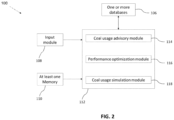
- the system 100 include an input module 108, at least one memory 110 and one or more hardware processor 112 as shown in the block diagram of Fig. 2 .
- the one or more hardware processors 112 works in communication with at least one memory 110.
- the one or more hardware processors 112 are configured to execute a plurality of algorithms stored in at least one memory 110.
- the one or more hardware processors 112 further includes a plurality of modules for performing various functions.
- the one more hardware processors 112 includes a coal usage advisory module 114, a performance optimization module 116 and a coal usage simulation module 118.
- the one or more hardware processors 112 may further comprise other modules for performing certain functions.
- the input module 102 is configured to obtain the input for the system 100.
- the input module 102 is configured to obtain information about types of coal present at one or more locations, a set of properties of the types of coal either from a coal database or an operator, to obtain a zone of operation, wherein the zone of operation is decided either by the operator or taken from system settings of the power plant, and obtain a first set of operating parameters of the power plant.
- the input module 102 and the user interface can be the same component of the system 100.
- the input module 102 and the user interface can include a variety of software and hardware interfaces, for example, a web interface, a graphical user interface, and the like and can facilitate multiple communications within a wide variety of networks N/W and protocol types, including wired networks, for example, LAN, cable, etc., and wireless networks, such as WLAN, cellular, or satellite.
- networks N/W and protocol types including wired networks, for example, LAN, cable, etc., and wireless networks, such as WLAN, cellular, or satellite.
- the system 100 includes the coal usage advisory module 1164.
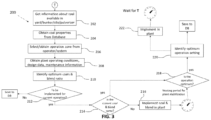
- the working of the coal usage advisory module 114 is shown in the flowchart 200 of Fig. 3 .
- the coal usage and performance optimization advisory loop is triggered by trigger T.
- the trigger T initializes the sequence of operations mentioned in the figure.
- the trigger can be any one of the following:
- the system 100 retrieve the information of coal in the boiler! pulverizer/ bunker or yard, either automatically based on Distributed control system/Laboratory information management system (DCS/LIMS) connectivity or from the operator manually.
- DCS/LIMS Distributed control system/Laboratory information management system
- the various information related to that coal is retrieved from the database of coal.
- Information may include, but not limited to, coal proximate/ ultimate analysis, coal kinetic parameters.
- information such as design information of equipment such as boiler, pulverizer along with heat/ mass transfer parameters of the process can be obtained from the database. Alternatively, a user can input these values as well.
- maintenance information related to specific equipment may also be obtained. For example, replacement date of SCR catalyst can be obtained from database/ plant historian.
- the zone of operation is obtained that decides the objective function.
- the objective can be to optimize overall operating cost.
- Zone of operation can be manually altered or can be obtained from what is already set in the system earlier.
- the operating parameters of the power plant are obtained that include various process parameters, set points and manipulated control parameters.
- various process parameters For example, for FGD unit the set point of SO2 at exit, amount of limestone used etc. can be obtained.
- For a boiler various control parameters such as burner orientations, air distribution, and excess oxygen can be obtained.
- the first predictive models and optimization algorithms are used to identify the optimum set of coals and their blending ratio for the set zone of operation.
- step 212 it is checked if the results (optimum set of coals and their blending ratio) obtained are to be used for real-time operation or saved for future use. In a simulator such results can be just checked by the operator and saved for future use in database. For real-time use, the current coals and blends in use are checked against the ones set in optimization loop at step 214.
- step 216 if the current coal in use and blending ratio is not matching with that in the optimization loop, the identified settings are implemented in the plant. Once implemented there is a waiting period till the coal change completes and plant reaches a steady operation.
- the system 100 automatically checks if the manipulated control parameters of the plant are optimum or not. If the manipulated control parameters of the plant are optimum, the coal set, blending ratio, zone of operation along with the plant operating parameters and control variable settings are identified at step 220 and sent to the power plant at step 222. In addition to that, the coal set and the coal blending ratio are also saved to the one or more database 106 as an optimum record. These settings can be used in future for similar situation again.
- new settings are obtained by another optimization loop that finds the best settings for selected coal blend, zone of operation and load, ambient conditions.
- the system 100 further uses a second set of predictive models and optimization algorithms. The results are saved to the database as a new optimum record and then implemented in the power plant. The system 100 waits for the next trigger and the process repeats.
- the operator can also modify and implement his own settings based on his experience. In such cases the operator may neglect the identified optimum settings and implement his own coal blending ratio.
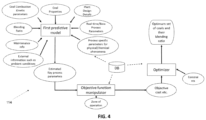
- a schematic diagram of the coal usage advisory module 114 for identification of the best coals and their coal blending ratio is shown in Fig. 4 .
- the first predictive model is at least one or more of a physics based fundamental model, a knowledge based model and a data-driven model.
- the first predictive model is built offline and can be utilized later. It should be appreciated that the system 100 can also use more than one predictive models.
- the unique feature of the first predictive model is they may receive a set of properties of the one or more types of coals as input.
- the set of properties can be obtained from a coal database or by the operator.
- the set of inputs that may be used by first predictive model comprise of:
- the set of properties may include:
- the first predictive model receives at least one of the above as inputs and predicts the identified key process indicators of the power plant.
- the first predictive model may predict SCR outlet NOX, APH outlet gas temperature, power consumption by pulverizer and fans, quantity of gypsum produced in FGD and so on.
- the system 100 is also configured to obtain a zone of operation of the power plant.
- the zone of operation is decided either by the operator or taken from system settings of the power plant.
- an objective function is manipulated based on the selected zone of operation.
- the zone of operation depends upon the current requirement on how the power plant should be operated. For example, the aim can be to operate the power plant at reduced load to extend the life of air preheater, or to produce high quality bottom ash for maximizing ash revenue.
- the objective function is manipulated accordingly.
- weights w can be varied for each of the X's, thereby increasing or decreasing the priority given to each of the indicators. For example, in minimum operation cost mode all the cost parameters X will be provided higher weights compared to remaining parameters. If the objective is to reduce the cost of FGD operation, X which may be SOX processed by FGD may be given a higher weight. When this objective function is used with the above mentioned workflow, the coals and the blend selected will ensure low production of SOX and hence less FGD operation cost. This is just a simple example, more complex scenario can be handled through this mechanism.
- Constraints are typical operation settings that have some limitations. For example, even when the objective is to minimize FGD operation cost and SOX, the temperatures in the boiler should rise above certain limits or RPM of the pulverizer cannot be increased beyond a safe limit.
- the constraints can be set as defaults or can be obtained from the operator manually. Different optimization techniques can be used to realize the optimum, such as GA, Linear programming, Quadratic programing and others.
- agent based learning such as reinforcement learning to identify optimum set of coals or best set of operating conditions for the given objective.
- agent based learning such as reinforcement learning to identify optimum set of coals or best set of operating conditions for the given objective.
- the outcome of the optimization is the selection of coals from the earlier provided set of coals and their best blending ratio, for the provided zone of operation.
- the number of coals selected as best could be single or combination of multiple coals.
- the workflow described above can be used offline as well as online to deliver real-time optimum solution from coal and blending ratio perspective for the selected zone of operation.
- the system 100 further comprises the performance optimization module 116.
- the performance optimization module 116 is configured to identify an optimum operation setting for the power plant based on the second set of parameters using a second predictive model and the identified optimum set of coals. It should be appreciated that the second predictive model may also be a combination of more than one predictive models. The identified optimum operation settings are then implemented in the power plant to optimize the operation of the power plant. It should be appreciated that the identified optimum operation settings for the power plant can also be saved in the one or more database 106 for future use.
- next step is to identify optimum settings for the given zone of operation using the second predictive model as shown in the schematic diagram of Fig. 5 .
- Different type of predictive models are required for identifying optimum settings because some of the information such as coal properties is either unavailable in real-time or is not very accurate.
- the idea of using the second predictive model is to improve on the result obtained by the first predictive model in real-time and online. This allows for adjustment with respect uncertainties in present coal properties and plant conditions.
- the steps involved in the identification of the optimum settings of the power plant is same as the steps involved in identifying optimum coal and their blending ratio by the coal advisory module 114.
- the second predictive model is used for identification of optimum operation settings for selected best coals and blend ratio (burning in plant).
- the second predictive model is at least one or more of a physics based fundamental model, a knowledge based model and a data-driven model.
- the models may receive the following as the second set of operating parameters:
- the system 100 further comprises the coal usage simulation module 118.
- the coal usage simulation module 118 is configured to simulate the usage of coal in the power plant for the selected zone of operation.
- the coal usage simulation module 118 allows the operator to do what if scenario analysis for coals available in yard or bunker for the selected zones of operation.
- the coal usage simulation module 118 can be used while taking coal procurement decisions as well. It provides visibility into operation of the plant to the coal buyer. Instead of just going by market conditions and average requirements from plant, the disclosure can provide the coal usage simulation module 118 to check the benefits of buying specific coals that are available in market. In addition, the disclosure provides the best choice of coals to buy and their quantity given the need from the plant and their properties.
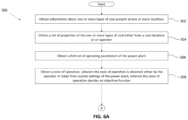
- a flowchart 300 illustrating a method for optimum coal selection for a power plant and power plant optimization is shown in Fig. 6A-6B .
- information about one or more types of coal present at one or more locations is obtained. This information is provided by the seller, it can also be obtained from the other sources.
- the set of properties of the one or more types of coal are obtained either from the one or more database 106 or an operator.
- the first set of operating parameters of the power plant are obtained.
- the zone of operation is obtained, wherein the zone of operation is obtained either by the operator or taken from system settings of the power plant.
- the objective function is a function of key performance indicator value and their corresponding weights.
- the objective function is optimized to identify the optimum set of coals and their coal blending ratio, for the obtained zone of operation based on the obtained set of properties and the first set of operating parameters using the first predictive model.
- the first predictive model is at least one or more of a physics based fundamental model, a knowledge based model and a data-driven model.
- the identified one or more coals along with their optimum coal blending ratio is implemented in system settings of the power plant.
- the optimum coal blending ratio can also be saved in the one or more database 106 for future use.
- the user can also implement his own blending ratio of the power plant based on his experience.
- the method of optimum coal selection can also be used in more than one units in the power plant, with appropriate constraints and priorities.
- the optimum coal is not only for one boiler, if there are more than one boiler, then the system 100 can be used to recommend separate coal blending ratio to each of the boiler present in the power plant.
- Each unit of the power plant will have their own model to identify the optimum settings.
- the system 100 can also be for various other application by a person skilled in the art.
- the above workflow and method can also be used for bio-mass co-fired boilers.
- the method can be adopted to different types of boilers such as critical/ supercritical! sub-critical boilers or tangential/ opposed fired boilers.
- the method can also be extended to variety of grinding equipment and blending methods.
- the method can also cater to premixed blending of coal where coals are mixed before they enter the pulverizers.
- the method can also be extended to systems where different pulverizers handle different coals and no mixing of coals is done before the boiler.
- the system 100 can also be used to look at the long term impact of the coal usage.
- the system 100 can take into account for possible degradation in life of SCR/APH for a given coal usage. It may also take care for non-additive properties while blending coals.
- the embodiments of present invention herein solves the problems related to performance optimization of the power plants.
- the invention provides a method and system for optimum coal selection for a power plant and power plant optimization.
- the hardware device can be any kind of device which can be programmed including e.g. any kind of computer like a server or a personal computer, or the like, or any combination thereof.
- the device may also include means which could be e.g. hardware means like e.g. an application-specific integrated circuit (ASIC), a field-programmable gate array (FPGA), or a combination of hardware and software means, e.g.
- ASIC application-specific integrated circuit
- FPGA field-programmable gate array
- the means can include both hardware means and software means.
- the method embodiments described herein could be implemented in hardware and software.
- the device may also include software means.
- the embodiments may be implemented on different hardware devices, e.g. using a plurality of CPUs.
- the embodiments herein can comprise hardware and software elements.
- the embodiments that are implemented in software include but are not limited to, firmware, resident software, microcode, etc.
- the functions performed by various components described herein may be implemented in other components or combinations of other components.
- a computer-usable or computer readable medium can be any apparatus that can comprise, store, communicate, propagate, or transport the program for use by or in connection with the instruction execution system, apparatus, or device.
- a computer-readable storage medium refers to any type of physical memory on which information or data readable by a processor may be stored.
- a computer-readable storage medium may store instructions for execution by one or more processors, including instructions for causing the processor(s) to perform steps or stages consistent with the embodiments described herein.
- the term "computer-readable medium” should be understood to include tangible items and exclude carrier waves and transient signals, i.e., be non-transitory. Examples include random access memory (RAM), read-only memory (ROM), volatile memory, nonvolatile memory, hard drives, CD ROMs, DVDs, flash drives, disks, and any other known physical storage media.
Landscapes
- Engineering & Computer Science (AREA)
- Power Engineering (AREA)
- Chemical & Material Sciences (AREA)
- Combustion & Propulsion (AREA)
- Mechanical Engineering (AREA)
- General Engineering & Computer Science (AREA)
- Health & Medical Sciences (AREA)
- Artificial Intelligence (AREA)
- Computer Vision & Pattern Recognition (AREA)
- Evolutionary Computation (AREA)
- Medical Informatics (AREA)
- Software Systems (AREA)
- Physics & Mathematics (AREA)
- General Physics & Mathematics (AREA)
- Automation & Control Theory (AREA)
- Regulation And Control Of Combustion (AREA)
- Control Of Steam Boilers And Waste-Gas Boilers (AREA)
- Feedback Control In General (AREA)
Claims (16)
- Prozessorimplementiertes Verfahren (300) zur optimalen Kohleauswahl für eine Kraftwerk- und Kraftwerksoptimierung, wobei das Verfahren Folgendes umfasst:Erhalten, über einen oder mehrere Hardwareprozessoren (112), von Informationen über Kohlearten, die an einem oder mehreren Orten (302) vorhanden sind;Erhalten, über den einen oder die mehreren Hardwareprozessoren (112), eines Satzes von Eigenschaften der Kohlearten von mindestens einem von einer Kohledatenbank oder einem Betreiber (304);Erhalten, über den einen oder die mehreren Hardwareprozessoren (112), eines ersten Satzes von Betriebsparametern des Kraftwerks (306);Erhalten, über den einen oder die mehreren Hardwareprozessoren (112), einer Betriebszone, wobei die Betriebszone von mindestens einem des Betreibers entschieden oder aus Systemeinstellungen des Kraftwerks genommen wird, wobei die Betriebszone eine Zielfunktion (308) entscheidet;Optimieren, über den einen oder die mehreren Hardwareprozessoren (112), der Zielfunktion, um einen optimalen Satz von Kohlen und ihr Kohlenmischungsverhältnis für die erhaltene Betriebszone basierend auf dem erhaltenen Satz von Eigenschaften und dem ersten Satz von Betriebsparametern unter Verwendung eines ersten prädiktiven Modells zu identifizieren, wobei das erste prädiktive Modell mindestens eines oder mehrere von einem physikbasierten Grundmodell, einem wissensbasierten Modell und einem datengetriebenen Modell (310) ist;Implementieren, über den einen oder die mehreren Hardwareprozessoren (112), der identifizierten Kohlen zusammen mit ihrem optimalen Kohlenmischungsverhältnis in den Systemeinstellungen des Kraftwerks (312);Empfangen, über den einen oder die mehreren Hardwareprozessoren (112), eines zweiten Satzes von Betriebsparametern (314);Identifizieren, über den einen oder die mehreren Hardwareprozessoren (112), einer optimalen Betriebseinstellung für das Kraftwerk basierend auf dem zweiten Satz von Parametern unter Verwendung eines zweiten prädiktiven Modells und des identifizierten optimalen Satzes von Kohlen, wobei das zweite prädiktive Modell mindestens eines oder mehrere von einem physikbasierten Grundmodell, einem wissensbasierten Modell und einem datengetriebenen Modell (316) ist; undImplementieren, über den einen oder die mehreren Hardwareprozessoren (112), der identifizierten optimalen Betriebseinstellungen in den Systemeinstellungen des Kraftwerks, um den Betrieb des Kraftwerks (318) zu optimieren.
- Verfahren (300) nach Anspruch 1, ferner umfassend den Schritt des Simulierens des Kohleverbrauchs in dem Kraftwerk für die ausgewählte Betriebszone unter Verwendung eines Kohleverbrauchssimulationsmoduls (118).
- Verfahren (300) nach Anspruch 1, ferner umfassend den Schritt des Bereitstellens eines Auslösers, um die Leistungsoptimierung des Kraftwerks zu starten.
- Verfahren (300) nach Anspruch 1, ferner umfassend den Schritt des Abgleichens der identifizierten Kohlen und eines optimalen Kohlenmischungsverhältnisses mit den bestehenden Systemeinstellungen des Kraftwerks.
- Verfahren (300) nach Anspruch 1, ferner umfassend den Schritt des Speicherns der identifizierten Kohlen und eines optimalen Kohlenmischungsverhältnisses und der identifizierten optimalen Betriebseinstellungen in der Datenbank (106).
- Verfahren (300) nach Anspruch 1, ferner umfassend den Schritt des Bestimmens einer Zielfunktion, wobei die Zielfunktion basierend auf der erhaltenen Betriebszone manipuliert wird.
- Verfahren (300) nach Anspruch 5, wobei die Zielfunktion eine Funktion von Schlüsselleistungsindikatoren und Gewichten ist, die basierend auf der Wichtigkeit der Schlüsselleistungsindikatoren bereitgestellt werden.
- Verfahren (300) nach Anspruch 1, wobei der Satz von Eigenschaften der Kohlearten Folgendes umfasst:Kohle-Nahanalyse und Endanalyse, undKohleverbrennungs-Kinetikparameter.
- Verfahren (300) nach Anspruch 1, wobei der erste Satz von Betriebsparametern von Kraftwerken Folgendes umfasst:Kohleverbrennungs-Kinetikparameter,Prozessparameter, die durch Sensoren gemessen werden,die Kraftwerksentwurfsparameter,Kraftwerkswartungsinformationen,Umgebungsbedingungen undeinen Satz mathematisch definierter Prozessparameter.
- Verfahren (300) nach Anspruch 1, ferner umfassend den Schritt des Manipulierens der Zielfunktion, wenn die Betriebszone erhalten wird.
- Verfahren (300) nach Anspruch 1, wobei das Verfahren der optimalen Kohleauswahl konfiguriert ist, um in mehr als einer Einheit in dem Kraftwerk verwendet zu werden.
- Verfahren (300) nach Anspruch 1, wobei der eine oder die mehreren Orte ein Kessel, ein Pulverisierer, ein Bunker oder ein Ort an einem Kohlehandhabungsort ist.
- Verfahren (300) nach Anspruch 1, wobei der zweite Satz von Betriebsparametern Folgendes umfasst:Kohle-Signaturparameter,Kohleverbrennungs-Kinetikparameter,Prozessparameter, die durch Sensoren gemessen werden,die Kraftwerksentwurfsparameter,Kraftwerkswartungsinformationen,Umgebungsbedingungen undeinen Satz mathematisch definierter Prozessparameter.
- System (100) zur optimalen Kohleauswahl für ein Kraftwerk und eine Kraftwerksoptimierung, wobei das System Folgendes umfasst:ein Eingabemodul (108) zum:Erhalten von Informationen über Kohlearten, die an einem oder mehreren Orten vorhanden sind,Erhalten eines Satzes von Eigenschaften der Kohlearten von mindestens einem von einer Kohledatenbank oder einem Betreiber,Erhalten eines ersten Satzes von Betriebsparametern des Kraftwerks,Erhalten einer Betriebszone, wobei die Betriebszone von mindestens einem des Betreibers entschieden oder aus Systemeinstellungen des Kraftwerks genommen wird, wobei die erhaltene Betriebszone eine Zielfunktion entscheidet, undEmpfangen eines zweiten Satzes von Betriebsparametern;mindestens einen Speicher; undeinen oder mehrere Hardwareprozessoren (112) in Kommunikation mit dem mindestens einen Speicher (110), wobei der eine oder die mehreren Hardwareprozessoren (112) ferner Folgendes umfassen:ein Kohleverbrauchshinweismodul (114) zum:Optimieren der manipulierten Zielfunktion, um den optimalen Satz von Kohlen und ihr Kohlenmischungsverhältnis für die erhaltene Betriebszone basierend auf dem erhaltenen Satz von Eigenschaften und dem ersten Satz von Betriebsparametern unter Verwendung eines ersten prädiktiven Modells zu identifizieren, wobei das erste prädiktive Modell mindestens eines oder mehrere von einem physikbasierten Grundmodell, einem wissensbasierten Modell und einem datengetriebenen Modell ist, undImplementieren der identifizierten Kohlen zusammen mit ihrem optimalen Kohlenmischungsverhältnis in Systemeinstellungen des Kraftwerks; undein Leistungsoptimierungsmodul (116) zum:Identifizieren einer optimalen Betriebseinstellung für das Kraftwerk basierend auf dem zweiten Satz von Parametern unter Verwendung eines zweiten prädiktiven Modells und des identifizierten optimalen Satzes von Kohlen, wobei das zweite prädiktive Modell mindestens eines oder mehrere von einem physikbasierten Grundmodell, einem wissensbasierten Modell und einem datengetriebenen Modell ist, undImplementieren der identifizierten optimalen Betriebseinstellungen in den Systemeinstellungen des Kraftwerks, um den Betrieb des Kraftwerks zu optimieren.
- System (100) nach Anspruch 14, ferner umfassend ein Kohleverbrauchssimulationsmodul (118) zum Simulieren des Kohleverbrauchs in dem Kraftwerk für die erhaltene Betriebszone.
- Computerprogrammprodukt, umfassend ein nichtflüchtiges computerlesbares Medium mit einem darin verkörperten computerlesbaren Programm, wobei das computerlesbare Programm, wenn es auf einer Rechenvorrichtung ausgeführt wird, die Rechenvorrichtung zu Folgendem veranlasst:Erhalten von Informationen über Kohlearten, die an einem oder mehreren Orten (302) vorhanden sind;Erhalten eines Satzes von Eigenschaften der Kohlearten von mindestens einem von einer Kohledatenbank oder einem Betreiber (304);Erhalten eines ersten Satzes von Betriebsparametern eines Kraftwerks (306);Erhalten einer Betriebszone, wobei die Betriebszone von mindestens einem des Betreibers entschieden oder aus Systemeinstellungen des Kraftwerks genommen wird, wobei die Betriebszone eine Zielfunktion (308) entscheidet;Optimieren der Zielfunktion, um einen optimalen Satz von Kohlen und ihr Kohlenmischungsverhältnis für die erhaltene Betriebszone basierend auf dem erhaltenen Satz von Eigenschaften und dem ersten Satz von Betriebsparametern unter Verwendung eines ersten prädiktiven Modells zu identifizieren, wobei das erste prädiktive Modell mindestens eines oder mehrere von einem physikbasierten Grundmodell, einem wissensbasierten Modell und einem datengetriebenen Modell (310) ist;Implementieren der identifizierten Kohlen zusammen mit ihrem optimalen Kohlenmischungsverhältnis in den Systemeinstellungen des Kraftwerks (312);Empfangen eines zweiten Satzes von Betriebsparametern (314);Identifizieren einer optimalen Betriebseinstellung für das Kraftwerk basierend auf dem zweiten Satz von Parametern unter Verwendung eines zweiten prädiktiven Modells und des identifizierten optimalen Satzes von Kohlen, wobei das zweite prädiktive Modell mindestens eines oder mehrere von einem physikbasierten Grundmodell, einem wissensbasierten Modell und einem datengetriebenen Modell (316) ist; undImplementieren der identifizierten optimalen Betriebseinstellungen in den Systemeinstellungen des Kraftwerks, um den Betrieb des Kraftwerks (318) zu optimieren.
Applications Claiming Priority (2)
| Application Number | Priority Date | Filing Date | Title |
|---|---|---|---|
| IN201921021329 | 2019-05-29 | ||
| PCT/IN2020/050477 WO2020240592A2 (en) | 2019-05-29 | 2020-05-27 | Method and system for optimum coal selection and power plant optimization |
Publications (4)
| Publication Number | Publication Date |
|---|---|
| EP3977049A2 EP3977049A2 (de) | 2022-04-06 |
| EP3977049A4 EP3977049A4 (de) | 2023-07-05 |
| EP3977049C0 EP3977049C0 (de) | 2024-09-25 |
| EP3977049B1 true EP3977049B1 (de) | 2024-09-25 |
Family
ID=73553135
Family Applications (1)
| Application Number | Title | Priority Date | Filing Date |
|---|---|---|---|
| EP20815372.6A Active EP3977049B1 (de) | 2019-05-29 | 2020-05-27 | Verfahren und system zur optimalen kohleauswahl und kraftwerksoptimierung |
Country Status (3)
| Country | Link |
|---|---|
| US (1) | US12021384B2 (de) |
| EP (1) | EP3977049B1 (de) |
| WO (1) | WO2020240592A2 (de) |
Families Citing this family (5)
| Publication number | Priority date | Publication date | Assignee | Title |
|---|---|---|---|---|
| EP3991001B1 (de) * | 2019-06-27 | 2024-06-12 | Tata Consultancy Services Limited | Verfahren und system zur leistungsoptimierung einer anlage zur rauchgasentschwefelung (fgd) |
| CN112861379B (zh) * | 2021-03-15 | 2022-08-12 | 南京邮电大学 | 基于稀疏大数据挖掘的火电机组汽轮机优化方法及系统 |
| CN114036855B (zh) * | 2021-11-24 | 2024-09-20 | 西安热工研究院有限公司 | 火电厂动态配煤方法、系统、设备及存储介质 |
| CN114890162B (zh) * | 2022-06-07 | 2024-05-31 | 深圳市出新知识产权管理有限公司 | 配煤方法、配煤设备以及计算机可读存储介质 |
| CN116305769B (zh) * | 2022-12-30 | 2024-03-29 | 数字双碳科技(合肥)有限公司 | 基于碳排放数据的掺烧比例优化方法 |
Family Cites Families (14)
| Publication number | Priority date | Publication date | Assignee | Title |
|---|---|---|---|---|
| JP3385912B2 (ja) | 1997-05-27 | 2003-03-10 | 日本鋼管株式会社 | 石炭配合計画最適化装置 |
| US6725208B1 (en) * | 1998-10-06 | 2004-04-20 | Pavilion Technologies, Inc. | Bayesian neural networks for optimization and control |
| JP2007514044A (ja) * | 2003-12-12 | 2007-05-31 | コールテク コーポレイション | 固形燃料特性を向上させるための前加熱の乾燥プロセスの方法およびシステム |
| US7584024B2 (en) * | 2005-02-08 | 2009-09-01 | Pegasus Technologies, Inc. | Method and apparatus for optimizing operation of a power generating plant using artificial intelligence techniques |
| US7599750B2 (en) * | 2005-12-21 | 2009-10-06 | Pegasus Technologies, Inc. | Model based sequential optimization of a single or multiple power generating units |
| JP4389988B2 (ja) | 2007-09-19 | 2009-12-24 | 株式会社デンソー | 車載装置、車載用ナビゲーション装置及びプログラム |
| US8433450B2 (en) * | 2009-09-11 | 2013-04-30 | Emerson Process Management Power & Water Solutions, Inc. | Optimized control of power plants having air cooled condensers |
| US9002530B2 (en) | 2012-04-23 | 2015-04-07 | General Electric Company | Power plant operation enhancement |
| CN105279700A (zh) | 2014-06-26 | 2016-01-27 | 中煤科工集团北京华宇工程有限公司 | 一种配煤方法及系统 |
| CN104215649B (zh) * | 2014-09-03 | 2017-02-15 | 华安奥特(北京)科技股份有限公司 | 采煤机煤岩自动识别装置 |
| CN105117808B (zh) | 2015-09-22 | 2018-08-10 | 华润电力登封有限公司 | 一种配煤掺烧寻优方法 |
| CN106355280A (zh) | 2016-08-30 | 2017-01-25 | 湖南大唐先科技有限公司 | 一种火电配煤掺烧寻优算法及其系统 |
| CN107274027A (zh) | 2017-06-22 | 2017-10-20 | 湖南华润电力鲤鱼江有限公司 | 一种燃煤机组的多煤种配煤掺烧寻优方法 |
| CN108074020A (zh) | 2018-01-11 | 2018-05-25 | 湖南大唐先科技有限公司 | 一种智能配煤掺烧寻优方法及其系统 |
-
2020
- 2020-05-27 US US17/595,931 patent/US12021384B2/en active Active
- 2020-05-27 EP EP20815372.6A patent/EP3977049B1/de active Active
- 2020-05-27 WO PCT/IN2020/050477 patent/WO2020240592A2/en not_active Ceased
Also Published As
| Publication number | Publication date |
|---|---|
| EP3977049A4 (de) | 2023-07-05 |
| US12021384B2 (en) | 2024-06-25 |
| EP3977049A2 (de) | 2022-04-06 |
| EP3977049C0 (de) | 2024-09-25 |
| US20220320861A1 (en) | 2022-10-06 |
| WO2020240592A2 (en) | 2020-12-03 |
| WO2020240592A3 (en) | 2021-02-18 |
Similar Documents
| Publication | Publication Date | Title |
|---|---|---|
| EP3977049B1 (de) | Verfahren und system zur optimalen kohleauswahl und kraftwerksoptimierung | |
| US11676061B2 (en) | Harnessing machine learning and data analytics for a real time predictive model for a FCC pre-treatment unit | |
| US20220275475A1 (en) | Method and system for optimization of agglomeration of ores | |
| JP6937569B2 (ja) | スケーリングファクタを用いてパワー出力/放出パラメータを調節するガスタービンにおける複合確率的制御、関連した制御システム、コンピュータプログラム製品、および方法 | |
| JP6937571B2 (ja) | スケーリングファクタを用いてパワー出力/放出パラメータを調節するガスタービンにおける複合確率的制御の応用、関連した制御システム、および方法 | |
| JP6900177B2 (ja) | パワー出力放出パラメータについてのガスタービンの調節におけるモデリング確率的制御、関連した制御システム、コンピュータプログラム製品、および方法 | |
| US20090182441A1 (en) | Control loop and method of creating a process model therefor | |
| EP3081787A1 (de) | Anwendung von probabilistischer steuerung in der gasturbinenabstimmung auf kraftstoffflussemissionsparameter, zugehörige steuerungssysteme, computerprogramme und verfahren | |
| JP2017129121A (ja) | スケーリングファクタを用いてパワー出力/放出パラメータを調節するガスタービンにおける複合確率的制御の応用、関連した制御システム、コンピュータプログラム製品、および方法 | |
| JP6906935B2 (ja) | 出力−排出物パラメータに関するガスタービンの調節における装置特有の確率的制御、関連の制御システム、コンピュータプログラム製品、及び方法 | |
| CN105604703B (zh) | 用于调谐燃气涡轮机的计算装置、系统及其方法 | |
| US9797315B2 (en) | Probabilistic control in gas turbine tuning for power output-emissions parameters, related control systems, computer program products and methods | |
| US9599032B2 (en) | Application of probabilistic control in gas turbine tuning for emissions-fuel flow parameters, related control systems, computer program products and methods | |
| US20170159575A1 (en) | Application of probabilistic control in gas turbine tuning for power output-emissions parameters with scaling factor, related control systems, computer program products and methods | |
| US9771875B2 (en) | Application of probabilistic control in gas turbine tuning, related control systems, computer program products and methods | |
| Munoz et al. | A stochastic model to determine the required number of trucks in sugarcane harvest systems | |
| US9599025B2 (en) | Application of probabilistic control in gas turbine tuning for power output-exhaust energy parameters, related control systems, computer program products and methods | |
| Tamas | Simulation investigational method for determining the performance characteristics of logistics systems | |
| US9599031B2 (en) | Application of probabilistic control in gas turbine tuning for power output-emissions parameters, related control systems, computer program products and methods | |
| EP3081786B1 (de) | Anwendung von probabilistischer steuerung in der gasturbinenabstimmung auf abgasenergie- und emissionsparameter, zugehörige steuerungssysteme und computerprogramme | |
| US9771876B2 (en) | Application of probabilistic control in gas turbine tuning with measurement error, related control systems, computer program products and methods | |
| CN118729777B (zh) | 烧结终点的终点信息的获取方法和装置 | |
| CN114890162B (zh) | 配煤方法、配煤设备以及计算机可读存储介质 | |
| KR20250144102A (ko) | 선박의 건조를 위한 대조립 공정의 공정 기간을 산출하는 방법 및 장치 | |
| JP7315528B2 (ja) | プロセス制御を支援するための表示装置および表示方法 |
Legal Events
| Date | Code | Title | Description |
|---|---|---|---|
| STAA | Information on the status of an ep patent application or granted ep patent |
Free format text: STATUS: THE INTERNATIONAL PUBLICATION HAS BEEN MADE |
|
| PUAI | Public reference made under article 153(3) epc to a published international application that has entered the european phase |
Free format text: ORIGINAL CODE: 0009012 |
|
| STAA | Information on the status of an ep patent application or granted ep patent |
Free format text: STATUS: REQUEST FOR EXAMINATION WAS MADE |
|
| 17P | Request for examination filed |
Effective date: 20211129 |
|
| AK | Designated contracting states |
Kind code of ref document: A2 Designated state(s): AL AT BE BG CH CY CZ DE DK EE ES FI FR GB GR HR HU IE IS IT LI LT LU LV MC MK MT NL NO PL PT RO RS SE SI SK SM TR |
|
| DAV | Request for validation of the european patent (deleted) | ||
| DAX | Request for extension of the european patent (deleted) | ||
| A4 | Supplementary search report drawn up and despatched |
Effective date: 20230606 |
|
| RIC1 | Information provided on ipc code assigned before grant |
Ipc: G05B 13/04 20060101ALI20230531BHEP Ipc: F23N 1/00 20060101ALI20230531BHEP Ipc: G06Q 50/06 20120101ALI20230531BHEP Ipc: G05B 13/02 20060101ALI20230531BHEP Ipc: G01N 23/00 20060101ALI20230531BHEP Ipc: G01B 15/02 20060101AFI20230531BHEP |
|
| GRAP | Despatch of communication of intention to grant a patent |
Free format text: ORIGINAL CODE: EPIDOSNIGR1 |
|
| GRAP | Despatch of communication of intention to grant a patent |
Free format text: ORIGINAL CODE: EPIDOSNIGR1 |
|
| STAA | Information on the status of an ep patent application or granted ep patent |
Free format text: STATUS: GRANT OF PATENT IS INTENDED |
|
| INTG | Intention to grant announced |
Effective date: 20240614 |
|
| GRAS | Grant fee paid |
Free format text: ORIGINAL CODE: EPIDOSNIGR3 |
|
| GRAA | (expected) grant |
Free format text: ORIGINAL CODE: 0009210 |
|
| STAA | Information on the status of an ep patent application or granted ep patent |
Free format text: STATUS: THE PATENT HAS BEEN GRANTED |
|
| AK | Designated contracting states |
Kind code of ref document: B1 Designated state(s): AL AT BE BG CH CY CZ DE DK EE ES FI FR GB GR HR HU IE IS IT LI LT LU LV MC MK MT NL NO PL PT RO RS SE SI SK SM TR |
|
| REG | Reference to a national code |
Ref country code: GB Ref legal event code: FG4D |
|
| REG | Reference to a national code |
Ref country code: CH Ref legal event code: EP |
|
| REG | Reference to a national code |
Ref country code: DE Ref legal event code: R096 Ref document number: 602020038408 Country of ref document: DE |
|
| REG | Reference to a national code |
Ref country code: IE Ref legal event code: FG4D |
|
| U01 | Request for unitary effect filed |
Effective date: 20240925 |
|
| U07 | Unitary effect registered |
Designated state(s): AT BE BG DE DK EE FI FR IT LT LU LV MT NL PT RO SE SI Effective date: 20241018 |
|
| PG25 | Lapsed in a contracting state [announced via postgrant information from national office to epo] |
Ref country code: NO Free format text: LAPSE BECAUSE OF FAILURE TO SUBMIT A TRANSLATION OF THE DESCRIPTION OR TO PAY THE FEE WITHIN THE PRESCRIBED TIME-LIMIT Effective date: 20241225 |
|
| PG25 | Lapsed in a contracting state [announced via postgrant information from national office to epo] |
Ref country code: GR Free format text: LAPSE BECAUSE OF FAILURE TO SUBMIT A TRANSLATION OF THE DESCRIPTION OR TO PAY THE FEE WITHIN THE PRESCRIBED TIME-LIMIT Effective date: 20241226 |
|
| PG25 | Lapsed in a contracting state [announced via postgrant information from national office to epo] |
Ref country code: RS Free format text: LAPSE BECAUSE OF FAILURE TO SUBMIT A TRANSLATION OF THE DESCRIPTION OR TO PAY THE FEE WITHIN THE PRESCRIBED TIME-LIMIT Effective date: 20241225 |
|
| PG25 | Lapsed in a contracting state [announced via postgrant information from national office to epo] |
Ref country code: RS Free format text: LAPSE BECAUSE OF FAILURE TO SUBMIT A TRANSLATION OF THE DESCRIPTION OR TO PAY THE FEE WITHIN THE PRESCRIBED TIME-LIMIT Effective date: 20241225 Ref country code: NO Free format text: LAPSE BECAUSE OF FAILURE TO SUBMIT A TRANSLATION OF THE DESCRIPTION OR TO PAY THE FEE WITHIN THE PRESCRIBED TIME-LIMIT Effective date: 20241225 Ref country code: GR Free format text: LAPSE BECAUSE OF FAILURE TO SUBMIT A TRANSLATION OF THE DESCRIPTION OR TO PAY THE FEE WITHIN THE PRESCRIBED TIME-LIMIT Effective date: 20241226 |
|
| PG25 | Lapsed in a contracting state [announced via postgrant information from national office to epo] |
Ref country code: IS Free format text: LAPSE BECAUSE OF FAILURE TO SUBMIT A TRANSLATION OF THE DESCRIPTION OR TO PAY THE FEE WITHIN THE PRESCRIBED TIME-LIMIT Effective date: 20250125 |
|
| PG25 | Lapsed in a contracting state [announced via postgrant information from national office to epo] |
Ref country code: SM Free format text: LAPSE BECAUSE OF FAILURE TO SUBMIT A TRANSLATION OF THE DESCRIPTION OR TO PAY THE FEE WITHIN THE PRESCRIBED TIME-LIMIT Effective date: 20240925 |
|
| PG25 | Lapsed in a contracting state [announced via postgrant information from national office to epo] |
Ref country code: ES Free format text: LAPSE BECAUSE OF FAILURE TO SUBMIT A TRANSLATION OF THE DESCRIPTION OR TO PAY THE FEE WITHIN THE PRESCRIBED TIME-LIMIT Effective date: 20240925 |
|
| PG25 | Lapsed in a contracting state [announced via postgrant information from national office to epo] |
Ref country code: CZ Free format text: LAPSE BECAUSE OF FAILURE TO SUBMIT A TRANSLATION OF THE DESCRIPTION OR TO PAY THE FEE WITHIN THE PRESCRIBED TIME-LIMIT Effective date: 20240925 Ref country code: PL Free format text: LAPSE BECAUSE OF FAILURE TO SUBMIT A TRANSLATION OF THE DESCRIPTION OR TO PAY THE FEE WITHIN THE PRESCRIBED TIME-LIMIT Effective date: 20240925 |
|
| PG25 | Lapsed in a contracting state [announced via postgrant information from national office to epo] |
Ref country code: SK Free format text: LAPSE BECAUSE OF FAILURE TO SUBMIT A TRANSLATION OF THE DESCRIPTION OR TO PAY THE FEE WITHIN THE PRESCRIBED TIME-LIMIT Effective date: 20240925 |
|
| U20 | Renewal fee for the european patent with unitary effect paid |
Year of fee payment: 6 Effective date: 20250526 |
|
| PGFP | Annual fee paid to national office [announced via postgrant information from national office to epo] |
Ref country code: GB Payment date: 20250520 Year of fee payment: 6 |
|
| PGFP | Annual fee paid to national office [announced via postgrant information from national office to epo] |
Ref country code: CH Payment date: 20250601 Year of fee payment: 6 |
|
| PLBE | No opposition filed within time limit |
Free format text: ORIGINAL CODE: 0009261 |
|
| STAA | Information on the status of an ep patent application or granted ep patent |
Free format text: STATUS: NO OPPOSITION FILED WITHIN TIME LIMIT |
|
| 26N | No opposition filed |
Effective date: 20250626 |