EP3974207A1 - Pneumatic tire - Google Patents
Pneumatic tire Download PDFInfo
- Publication number
- EP3974207A1 EP3974207A1 EP20817941.6A EP20817941A EP3974207A1 EP 3974207 A1 EP3974207 A1 EP 3974207A1 EP 20817941 A EP20817941 A EP 20817941A EP 3974207 A1 EP3974207 A1 EP 3974207A1
- Authority
- EP
- European Patent Office
- Prior art keywords
- mass
- parts
- rubber
- silica
- tread
- Prior art date
- Legal status (The legal status is an assumption and is not a legal conclusion. Google has not performed a legal analysis and makes no representation as to the accuracy of the status listed.)
- Withdrawn
Links
- VYPSYNLAJGMNEJ-UHFFFAOYSA-N Silicium dioxide Chemical compound O=[Si]=O VYPSYNLAJGMNEJ-UHFFFAOYSA-N 0.000 claims abstract description 118
- 229920001971 elastomer Polymers 0.000 claims abstract description 101
- 239000005060 rubber Substances 0.000 claims abstract description 100
- 239000000377 silicon dioxide Substances 0.000 claims abstract description 59
- 239000000203 mixture Substances 0.000 claims abstract description 38
- 229920003048 styrene butadiene rubber Polymers 0.000 claims description 43
- 239000005062 Polybutadiene Substances 0.000 claims description 39
- 229920002857 polybutadiene Polymers 0.000 claims description 39
- 239000006087 Silane Coupling Agent Substances 0.000 claims description 23
- 238000005299 abrasion Methods 0.000 abstract description 28
- 239000000446 fuel Substances 0.000 abstract description 19
- 238000004073 vulcanization Methods 0.000 description 26
- 239000002174 Styrene-butadiene Substances 0.000 description 25
- 239000003795 chemical substances by application Substances 0.000 description 19
- 239000011347 resin Substances 0.000 description 18
- 229920005989 resin Polymers 0.000 description 18
- 239000006229 carbon black Substances 0.000 description 17
- PPBRXRYQALVLMV-UHFFFAOYSA-N Styrene Chemical compound C=CC1=CC=CC=C1 PPBRXRYQALVLMV-UHFFFAOYSA-N 0.000 description 14
- 239000003963 antioxidant agent Substances 0.000 description 14
- 238000013329 compounding Methods 0.000 description 14
- XLOMVQKBTHCTTD-UHFFFAOYSA-N Zinc monoxide Chemical compound [Zn]=O XLOMVQKBTHCTTD-UHFFFAOYSA-N 0.000 description 12
- 239000003921 oil Substances 0.000 description 12
- 235000019198 oils Nutrition 0.000 description 12
- 229920002554 vinyl polymer Polymers 0.000 description 12
- NINIDFKCEFEMDL-UHFFFAOYSA-N Sulfur Chemical compound [S] NINIDFKCEFEMDL-UHFFFAOYSA-N 0.000 description 11
- 238000000034 method Methods 0.000 description 11
- 229910052717 sulfur Inorganic materials 0.000 description 11
- 239000011593 sulfur Substances 0.000 description 11
- 230000003078 antioxidant effect Effects 0.000 description 10
- 230000000052 comparative effect Effects 0.000 description 10
- 230000000694 effects Effects 0.000 description 10
- 238000004898 kneading Methods 0.000 description 9
- 239000007788 liquid Substances 0.000 description 9
- ZRALSGWEFCBTJO-UHFFFAOYSA-N Guanidine Chemical compound NC(N)=N ZRALSGWEFCBTJO-UHFFFAOYSA-N 0.000 description 8
- 239000003208 petroleum Substances 0.000 description 8
- 239000012763 reinforcing filler Substances 0.000 description 8
- 238000005096 rolling process Methods 0.000 description 8
- 239000000126 substance Substances 0.000 description 8
- 235000021355 Stearic acid Nutrition 0.000 description 7
- QIQXTHQIDYTFRH-UHFFFAOYSA-N octadecanoic acid Chemical compound CCCCCCCCCCCCCCCCCC(O)=O QIQXTHQIDYTFRH-UHFFFAOYSA-N 0.000 description 7
- OQCDKBAXFALNLD-UHFFFAOYSA-N octadecanoic acid Natural products CCCCCCCC(C)CCCCCCCCC(O)=O OQCDKBAXFALNLD-UHFFFAOYSA-N 0.000 description 7
- 239000008117 stearic acid Substances 0.000 description 7
- 239000004902 Softening Agent Substances 0.000 description 6
- 125000000391 vinyl group Chemical group [H]C([*])=C([H])[H] 0.000 description 6
- 239000001993 wax Substances 0.000 description 6
- 239000011787 zinc oxide Substances 0.000 description 6
- OWRCNXZUPFZXOS-UHFFFAOYSA-N 1,3-diphenylguanidine Chemical compound C=1C=CC=CC=1NC(=N)NC1=CC=CC=C1 OWRCNXZUPFZXOS-UHFFFAOYSA-N 0.000 description 5
- IJGRMHOSHXDMSA-UHFFFAOYSA-N Atomic nitrogen Chemical compound N#N IJGRMHOSHXDMSA-UHFFFAOYSA-N 0.000 description 5
- OKTJSMMVPCPJKN-UHFFFAOYSA-N Carbon Chemical compound [C] OKTJSMMVPCPJKN-UHFFFAOYSA-N 0.000 description 5
- 229920000459 Nitrile rubber Polymers 0.000 description 5
- 150000001993 dienes Chemical class 0.000 description 5
- DEQZTKGFXNUBJL-UHFFFAOYSA-N n-(1,3-benzothiazol-2-ylsulfanyl)cyclohexanamine Chemical compound C1CCCCC1NSC1=NC2=CC=CC=C2S1 DEQZTKGFXNUBJL-UHFFFAOYSA-N 0.000 description 5
- 229910052757 nitrogen Inorganic materials 0.000 description 5
- 230000003014 reinforcing effect Effects 0.000 description 5
- CHJJGSNFBQVOTG-UHFFFAOYSA-N N-methyl-guanidine Natural products CNC(N)=N CHJJGSNFBQVOTG-UHFFFAOYSA-N 0.000 description 4
- 229910052799 carbon Inorganic materials 0.000 description 4
- DOIRQSBPFJWKBE-UHFFFAOYSA-N dibutyl phthalate Chemical compound CCCCOC(=O)C1=CC=CC=C1C(=O)OCCCC DOIRQSBPFJWKBE-UHFFFAOYSA-N 0.000 description 4
- SWSQBOPZIKWTGO-UHFFFAOYSA-N dimethylaminoamidine Natural products CN(C)C(N)=N SWSQBOPZIKWTGO-UHFFFAOYSA-N 0.000 description 4
- 238000011156 evaluation Methods 0.000 description 4
- -1 glycidoxy Chemical group 0.000 description 4
- 229920000642 polymer Polymers 0.000 description 4
- QAZLUNIWYYOJPC-UHFFFAOYSA-M sulfenamide Chemical compound [Cl-].COC1=C(C)C=[N+]2C3=NC4=CC=C(OC)C=C4N3SCC2=C1C QAZLUNIWYYOJPC-UHFFFAOYSA-M 0.000 description 4
- FBBATURSCRIBHN-UHFFFAOYSA-N triethoxy-[3-(3-triethoxysilylpropyldisulfanyl)propyl]silane Chemical compound CCO[Si](OCC)(OCC)CCCSSCCC[Si](OCC)(OCC)OCC FBBATURSCRIBHN-UHFFFAOYSA-N 0.000 description 4
- ZZMVLMVFYMGSMY-UHFFFAOYSA-N 4-n-(4-methylpentan-2-yl)-1-n-phenylbenzene-1,4-diamine Chemical compound C1=CC(NC(C)CC(C)C)=CC=C1NC1=CC=CC=C1 ZZMVLMVFYMGSMY-UHFFFAOYSA-N 0.000 description 3
- 244000043261 Hevea brasiliensis Species 0.000 description 3
- UCKMPCXJQFINFW-UHFFFAOYSA-N Sulphide Chemical compound [S-2] UCKMPCXJQFINFW-UHFFFAOYSA-N 0.000 description 3
- 239000010419 fine particle Substances 0.000 description 3
- RAXXELZNTBOGNW-UHFFFAOYSA-N imidazole Natural products C1=CNC=N1 RAXXELZNTBOGNW-UHFFFAOYSA-N 0.000 description 3
- 230000006872 improvement Effects 0.000 description 3
- 229920003049 isoprene rubber Polymers 0.000 description 3
- 229920003052 natural elastomer Polymers 0.000 description 3
- 229920001194 natural rubber Polymers 0.000 description 3
- 239000004014 plasticizer Substances 0.000 description 3
- 239000011164 primary particle Substances 0.000 description 3
- 229910052761 rare earth metal Inorganic materials 0.000 description 3
- 238000001179 sorption measurement Methods 0.000 description 3
- KUAZQDVKQLNFPE-UHFFFAOYSA-N thiram Chemical compound CN(C)C(=S)SSC(=S)N(C)C KUAZQDVKQLNFPE-UHFFFAOYSA-N 0.000 description 3
- 229960002447 thiram Drugs 0.000 description 3
- MYRTYDVEIRVNKP-UHFFFAOYSA-N 1,2-Divinylbenzene Chemical compound C=CC1=CC=CC=C1C=C MYRTYDVEIRVNKP-UHFFFAOYSA-N 0.000 description 2
- YXIWHUQXZSMYRE-UHFFFAOYSA-N 1,3-benzothiazole-2-thiol Chemical compound C1=CC=C2SC(S)=NC2=C1 YXIWHUQXZSMYRE-UHFFFAOYSA-N 0.000 description 2
- IANQTJSKSUMEQM-UHFFFAOYSA-N 1-benzofuran Chemical compound C1=CC=C2OC=CC2=C1 IANQTJSKSUMEQM-UHFFFAOYSA-N 0.000 description 2
- VTYYLEPIZMXCLO-UHFFFAOYSA-L Calcium carbonate Chemical compound [Ca+2].[O-]C([O-])=O VTYYLEPIZMXCLO-UHFFFAOYSA-L 0.000 description 2
- MQIUGAXCHLFZKX-UHFFFAOYSA-N Di-n-octyl phthalate Natural products CCCCCCCCOC(=O)C1=CC=CC=C1C(=O)OCCCCCCCC MQIUGAXCHLFZKX-UHFFFAOYSA-N 0.000 description 2
- 238000004566 IR spectroscopy Methods 0.000 description 2
- ISWSIDIOOBJBQZ-UHFFFAOYSA-N Phenol Chemical compound OC1=CC=CC=C1 ISWSIDIOOBJBQZ-UHFFFAOYSA-N 0.000 description 2
- FZWLAAWBMGSTSO-UHFFFAOYSA-N Thiazole Chemical compound C1=CSC=N1 FZWLAAWBMGSTSO-UHFFFAOYSA-N 0.000 description 2
- GTVWRXDRKAHEAD-UHFFFAOYSA-N Tris(2-ethylhexyl) phosphate Chemical compound CCCCC(CC)COP(=O)(OCC(CC)CCCC)OCC(CC)CCCC GTVWRXDRKAHEAD-UHFFFAOYSA-N 0.000 description 2
- 150000001412 amines Chemical class 0.000 description 2
- 230000003712 anti-aging effect Effects 0.000 description 2
- 125000003118 aryl group Chemical group 0.000 description 2
- 239000010426 asphalt Substances 0.000 description 2
- BJQHLKABXJIVAM-UHFFFAOYSA-N bis(2-ethylhexyl) phthalate Chemical compound CCCCC(CC)COC(=O)C1=CC=CC=C1C(=O)OCC(CC)CCCC BJQHLKABXJIVAM-UHFFFAOYSA-N 0.000 description 2
- 229920005549 butyl rubber Polymers 0.000 description 2
- 238000006243 chemical reaction Methods 0.000 description 2
- 239000007822 coupling agent Substances 0.000 description 2
- ZSWFCLXCOIISFI-UHFFFAOYSA-N cyclopentadiene Chemical compound C1C=CC=C1 ZSWFCLXCOIISFI-UHFFFAOYSA-N 0.000 description 2
- 230000006866 deterioration Effects 0.000 description 2
- 230000002542 deteriorative effect Effects 0.000 description 2
- WITDFSFZHZYQHB-UHFFFAOYSA-N dibenzylcarbamothioylsulfanyl n,n-dibenzylcarbamodithioate Chemical compound C=1C=CC=CC=1CN(CC=1C=CC=CC=1)C(=S)SSC(=S)N(CC=1C=CC=CC=1)CC1=CC=CC=C1 WITDFSFZHZYQHB-UHFFFAOYSA-N 0.000 description 2
- VJHINFRRDQUWOJ-UHFFFAOYSA-N dioctyl sebacate Chemical compound CCCCC(CC)COC(=O)CCCCCCCCC(=O)OCC(CC)CCCC VJHINFRRDQUWOJ-UHFFFAOYSA-N 0.000 description 2
- POULHZVOKOAJMA-UHFFFAOYSA-N dodecanoic acid Chemical compound CCCCCCCCCCCC(O)=O POULHZVOKOAJMA-UHFFFAOYSA-N 0.000 description 2
- 125000000524 functional group Chemical group 0.000 description 2
- IPCSVZSSVZVIGE-UHFFFAOYSA-N hexadecanoic acid Chemical compound CCCCCCCCCCCCCCCC(O)=O IPCSVZSSVZVIGE-UHFFFAOYSA-N 0.000 description 2
- 238000005259 measurement Methods 0.000 description 2
- 239000000178 monomer Substances 0.000 description 2
- 150000001451 organic peroxides Chemical class 0.000 description 2
- 239000012188 paraffin wax Substances 0.000 description 2
- 229920001084 poly(chloroprene) Polymers 0.000 description 2
- 239000010734 process oil Substances 0.000 description 2
- 238000012545 processing Methods 0.000 description 2
- 150000002910 rare earth metals Chemical class 0.000 description 2
- 230000009467 reduction Effects 0.000 description 2
- 238000005987 sulfurization reaction Methods 0.000 description 2
- 229920003051 synthetic elastomer Polymers 0.000 description 2
- 239000005061 synthetic rubber Substances 0.000 description 2
- 238000012360 testing method Methods 0.000 description 2
- UMGDCJDMYOKAJW-UHFFFAOYSA-N thiourea Chemical compound NC(N)=S UMGDCJDMYOKAJW-UHFFFAOYSA-N 0.000 description 2
- 239000003981 vehicle Substances 0.000 description 2
- WYTZZXDRDKSJID-UHFFFAOYSA-N (3-aminopropyl)triethoxysilane Chemical compound CCO[Si](OCC)(OCC)CCCN WYTZZXDRDKSJID-UHFFFAOYSA-N 0.000 description 1
- RIPYNJLMMFGZSX-UHFFFAOYSA-N (5-benzoylperoxy-2,5-dimethylhexan-2-yl) benzenecarboperoxoate Chemical compound C=1C=CC=CC=1C(=O)OOC(C)(C)CCC(C)(C)OOC(=O)C1=CC=CC=C1 RIPYNJLMMFGZSX-UHFFFAOYSA-N 0.000 description 1
- OYHQOLUKZRVURQ-NTGFUMLPSA-N (9Z,12Z)-9,10,12,13-tetratritiooctadeca-9,12-dienoic acid Chemical compound C(CCCCCCC\C(=C(/C\C(=C(/CCCCC)\[3H])\[3H])\[3H])\[3H])(=O)O OYHQOLUKZRVURQ-NTGFUMLPSA-N 0.000 description 1
- CORMBJOFDGICKF-UHFFFAOYSA-N 1,3,5-trimethoxy 2-vinyl benzene Natural products COC1=CC(OC)=C(C=C)C(OC)=C1 CORMBJOFDGICKF-UHFFFAOYSA-N 0.000 description 1
- XVYUHVUUDRFUNE-UHFFFAOYSA-N 1,3-bis(3-tert-butylperoxypropyl)benzene Chemical compound CC(C)(C)OOCCCC1=CC=CC(CCCOOC(C)(C)C)=C1 XVYUHVUUDRFUNE-UHFFFAOYSA-N 0.000 description 1
- CBCKQZAAMUWICA-UHFFFAOYSA-N 1,4-phenylenediamine Chemical compound NC1=CC=C(N)C=C1 CBCKQZAAMUWICA-UHFFFAOYSA-N 0.000 description 1
- UJPKMTDFFUTLGM-UHFFFAOYSA-N 1-aminoethanol Chemical compound CC(N)O UJPKMTDFFUTLGM-UHFFFAOYSA-N 0.000 description 1
- VDNSZPNSUQRUMS-UHFFFAOYSA-N 1-cyclohexyl-4-ethenylbenzene Chemical compound C1=CC(C=C)=CC=C1C1CCCCC1 VDNSZPNSUQRUMS-UHFFFAOYSA-N 0.000 description 1
- JZHGRUMIRATHIU-UHFFFAOYSA-N 1-ethenyl-3-methylbenzene Chemical compound CC1=CC=CC(C=C)=C1 JZHGRUMIRATHIU-UHFFFAOYSA-N 0.000 description 1
- JUHXTONDLXIGGK-UHFFFAOYSA-N 1-n,4-n-bis(5-methylheptan-3-yl)benzene-1,4-diamine Chemical compound CCC(C)CC(CC)NC1=CC=C(NC(CC)CC(C)CC)C=C1 JUHXTONDLXIGGK-UHFFFAOYSA-N 0.000 description 1
- ZJNLYGOUHDJHMG-UHFFFAOYSA-N 1-n,4-n-bis(5-methylhexan-2-yl)benzene-1,4-diamine Chemical compound CC(C)CCC(C)NC1=CC=C(NC(C)CCC(C)C)C=C1 ZJNLYGOUHDJHMG-UHFFFAOYSA-N 0.000 description 1
- APTGHASZJUAUCP-UHFFFAOYSA-N 1-n,4-n-di(octan-2-yl)benzene-1,4-diamine Chemical compound CCCCCCC(C)NC1=CC=C(NC(C)CCCCCC)C=C1 APTGHASZJUAUCP-UHFFFAOYSA-N 0.000 description 1
- VETPHHXZEJAYOB-UHFFFAOYSA-N 1-n,4-n-dinaphthalen-2-ylbenzene-1,4-diamine Chemical compound C1=CC=CC2=CC(NC=3C=CC(NC=4C=C5C=CC=CC5=CC=4)=CC=3)=CC=C21 VETPHHXZEJAYOB-UHFFFAOYSA-N 0.000 description 1
- ZRMMVODKVLXCBB-UHFFFAOYSA-N 1-n-cyclohexyl-4-n-phenylbenzene-1,4-diamine Chemical compound C1CCCCC1NC(C=C1)=CC=C1NC1=CC=CC=C1 ZRMMVODKVLXCBB-UHFFFAOYSA-N 0.000 description 1
- IGGDKDTUCAWDAN-UHFFFAOYSA-N 1-vinylnaphthalene Chemical compound C1=CC=C2C(C=C)=CC=CC2=C1 IGGDKDTUCAWDAN-UHFFFAOYSA-N 0.000 description 1
- 238000005160 1H NMR spectroscopy Methods 0.000 description 1
- DMWVYCCGCQPJEA-UHFFFAOYSA-N 2,5-bis(tert-butylperoxy)-2,5-dimethylhexane Chemical compound CC(C)(C)OOC(C)(C)CCC(C)(C)OOC(C)(C)C DMWVYCCGCQPJEA-UHFFFAOYSA-N 0.000 description 1
- XMNIXWIUMCBBBL-UHFFFAOYSA-N 2-(2-phenylpropan-2-ylperoxy)propan-2-ylbenzene Chemical compound C=1C=CC=CC=1C(C)(C)OOC(C)(C)C1=CC=CC=C1 XMNIXWIUMCBBBL-UHFFFAOYSA-N 0.000 description 1
- PDELBHCVXBSVPJ-UHFFFAOYSA-N 2-ethenyl-1,3,5-trimethylbenzene Chemical compound CC1=CC(C)=C(C=C)C(C)=C1 PDELBHCVXBSVPJ-UHFFFAOYSA-N 0.000 description 1
- WFUGQJXVXHBTEM-UHFFFAOYSA-N 2-hydroperoxy-2-(2-hydroperoxybutan-2-ylperoxy)butane Chemical compound CCC(C)(OO)OOC(C)(CC)OO WFUGQJXVXHBTEM-UHFFFAOYSA-N 0.000 description 1
- BIISIZOQPWZPPS-UHFFFAOYSA-N 2-tert-butylperoxypropan-2-ylbenzene Chemical compound CC(C)(C)OOC(C)(C)C1=CC=CC=C1 BIISIZOQPWZPPS-UHFFFAOYSA-N 0.000 description 1
- FRIBMENBGGCKPD-UHFFFAOYSA-N 3-(2,3-dimethoxyphenyl)prop-2-enal Chemical compound COC1=CC=CC(C=CC=O)=C1OC FRIBMENBGGCKPD-UHFFFAOYSA-N 0.000 description 1
- BUZICZZQJDLXJN-UHFFFAOYSA-N 3-azaniumyl-4-hydroxybutanoate Chemical compound OCC(N)CC(O)=O BUZICZZQJDLXJN-UHFFFAOYSA-N 0.000 description 1
- OXYZDRAJMHGSMW-UHFFFAOYSA-N 3-chloropropyl(trimethoxy)silane Chemical compound CO[Si](OC)(OC)CCCCl OXYZDRAJMHGSMW-UHFFFAOYSA-N 0.000 description 1
- DCQBZYNUSLHVJC-UHFFFAOYSA-N 3-triethoxysilylpropane-1-thiol Chemical compound CCO[Si](OCC)(OCC)CCCS DCQBZYNUSLHVJC-UHFFFAOYSA-N 0.000 description 1
- UUEWCQRISZBELL-UHFFFAOYSA-N 3-trimethoxysilylpropane-1-thiol Chemical compound CO[Si](OC)(OC)CCCS UUEWCQRISZBELL-UHFFFAOYSA-N 0.000 description 1
- HLBZWYXLQJQBKU-UHFFFAOYSA-N 4-(morpholin-4-yldisulfanyl)morpholine Chemical compound C1COCCN1SSN1CCOCC1 HLBZWYXLQJQBKU-UHFFFAOYSA-N 0.000 description 1
- VXEGSRKPIUDPQT-UHFFFAOYSA-N 4-[4-(4-methoxyphenyl)piperazin-1-yl]aniline Chemical compound C1=CC(OC)=CC=C1N1CCN(C=2C=CC(N)=CC=2)CC1 VXEGSRKPIUDPQT-UHFFFAOYSA-N 0.000 description 1
- RDYXGQJZKXSHTC-UHFFFAOYSA-N 4-n-hexyl-4-n-phenylbenzene-1,4-diamine Chemical compound C=1C=C(N)C=CC=1N(CCCCCC)C1=CC=CC=C1 RDYXGQJZKXSHTC-UHFFFAOYSA-N 0.000 description 1
- ZXPYQXDDKNDCMN-UHFFFAOYSA-N 4-n-octyl-4-n-phenylbenzene-1,4-diamine Chemical compound C=1C=C(N)C=CC=1N(CCCCCCCC)C1=CC=CC=C1 ZXPYQXDDKNDCMN-UHFFFAOYSA-N 0.000 description 1
- RSWGJHLUYNHPMX-UHFFFAOYSA-N Abietic-Saeure Natural products C12CCC(C(C)C)=CC2=CCC2C1(C)CCCC2(C)C(O)=O RSWGJHLUYNHPMX-UHFFFAOYSA-N 0.000 description 1
- 238000004438 BET method Methods 0.000 description 1
- 239000004342 Benzoyl peroxide Substances 0.000 description 1
- OMPJBNCRMGITSC-UHFFFAOYSA-N Benzoylperoxide Chemical compound C=1C=CC=CC=1C(=O)OOC(=O)C1=CC=CC=C1 OMPJBNCRMGITSC-UHFFFAOYSA-N 0.000 description 1
- 240000001548 Camellia japonica Species 0.000 description 1
- 239000006237 Intermediate SAF Substances 0.000 description 1
- 239000004166 Lanolin Substances 0.000 description 1
- 239000005639 Lauric acid Substances 0.000 description 1
- UTGQNNCQYDRXCH-UHFFFAOYSA-N N,N'-diphenyl-1,4-phenylenediamine Chemical compound C=1C=C(NC=2C=CC=CC=2)C=CC=1NC1=CC=CC=C1 UTGQNNCQYDRXCH-UHFFFAOYSA-N 0.000 description 1
- AFCARXCZXQIEQB-UHFFFAOYSA-N N-[3-oxo-3-(2,4,6,7-tetrahydrotriazolo[4,5-c]pyridin-5-yl)propyl]-2-[[3-(trifluoromethoxy)phenyl]methylamino]pyrimidine-5-carboxamide Chemical compound O=C(CCNC(=O)C=1C=NC(=NC=1)NCC1=CC(=CC=C1)OC(F)(F)F)N1CC2=C(CC1)NN=N2 AFCARXCZXQIEQB-UHFFFAOYSA-N 0.000 description 1
- OUBMGJOQLXMSNT-UHFFFAOYSA-N N-isopropyl-N'-phenyl-p-phenylenediamine Chemical compound C1=CC(NC(C)C)=CC=C1NC1=CC=CC=C1 OUBMGJOQLXMSNT-UHFFFAOYSA-N 0.000 description 1
- UFWIBTONFRDIAS-UHFFFAOYSA-N Naphthalene Chemical compound C1=CC=CC2=CC=CC=C21 UFWIBTONFRDIAS-UHFFFAOYSA-N 0.000 description 1
- 235000019482 Palm oil Nutrition 0.000 description 1
- 235000021314 Palmitic acid Nutrition 0.000 description 1
- 241000282320 Panthera leo Species 0.000 description 1
- 235000019484 Rapeseed oil Nutrition 0.000 description 1
- KHPCPRHQVVSZAH-HUOMCSJISA-N Rosin Natural products O(C/C=C/c1ccccc1)[C@H]1[C@H](O)[C@@H](O)[C@@H](O)[C@@H](CO)O1 KHPCPRHQVVSZAH-HUOMCSJISA-N 0.000 description 1
- 229910000831 Steel Inorganic materials 0.000 description 1
- 229910021627 Tin(IV) chloride Inorganic materials 0.000 description 1
- XSQUKJJJFZCRTK-UHFFFAOYSA-N Urea Natural products NC(N)=O XSQUKJJJFZCRTK-UHFFFAOYSA-N 0.000 description 1
- 125000002723 alicyclic group Chemical group 0.000 description 1
- 125000001931 aliphatic group Chemical group 0.000 description 1
- XYLMUPLGERFSHI-UHFFFAOYSA-N alpha-Methylstyrene Chemical compound CC(=C)C1=CC=CC=C1 XYLMUPLGERFSHI-UHFFFAOYSA-N 0.000 description 1
- PNEYBMLMFCGWSK-UHFFFAOYSA-N aluminium oxide Inorganic materials [O-2].[O-2].[O-2].[Al+3].[Al+3] PNEYBMLMFCGWSK-UHFFFAOYSA-N 0.000 description 1
- 239000000427 antigen Substances 0.000 description 1
- 102000036639 antigens Human genes 0.000 description 1
- 108091007433 antigens Proteins 0.000 description 1
- 239000011324 bead Substances 0.000 description 1
- 235000013871 bee wax Nutrition 0.000 description 1
- 239000012166 beeswax Substances 0.000 description 1
- 235000019400 benzoyl peroxide Nutrition 0.000 description 1
- MPMBRWOOISTHJV-UHFFFAOYSA-N but-1-enylbenzene Chemical compound CCC=CC1=CC=CC=C1 MPMBRWOOISTHJV-UHFFFAOYSA-N 0.000 description 1
- KAKZBPTYRLMSJV-UHFFFAOYSA-N butadiene group Chemical group C=CC=C KAKZBPTYRLMSJV-UHFFFAOYSA-N 0.000 description 1
- MTAZNLWOLGHBHU-UHFFFAOYSA-N butadiene-styrene rubber Chemical class C=CC=C.C=CC1=CC=CC=C1 MTAZNLWOLGHBHU-UHFFFAOYSA-N 0.000 description 1
- 229910000019 calcium carbonate Inorganic materials 0.000 description 1
- 238000004364 calculation method Methods 0.000 description 1
- DKVNPHBNOWQYFE-UHFFFAOYSA-N carbamodithioic acid Chemical compound NC(S)=S DKVNPHBNOWQYFE-UHFFFAOYSA-N 0.000 description 1
- KXDHJXZQYSOELW-UHFFFAOYSA-N carbonic acid monoamide Natural products NC(O)=O KXDHJXZQYSOELW-UHFFFAOYSA-N 0.000 description 1
- 235000013869 carnauba wax Nutrition 0.000 description 1
- 239000004203 carnauba wax Substances 0.000 description 1
- 239000004359 castor oil Substances 0.000 description 1
- 235000019438 castor oil Nutrition 0.000 description 1
- 239000003054 catalyst Substances 0.000 description 1
- 125000001309 chloro group Chemical group Cl* 0.000 description 1
- 239000004927 clay Substances 0.000 description 1
- 229910052570 clay Inorganic materials 0.000 description 1
- 239000003240 coconut oil Substances 0.000 description 1
- 235000019864 coconut oil Nutrition 0.000 description 1
- 235000018597 common camellia Nutrition 0.000 description 1
- 150000001875 compounds Chemical class 0.000 description 1
- 238000010276 construction Methods 0.000 description 1
- 230000008094 contradictory effect Effects 0.000 description 1
- 229920001577 copolymer Polymers 0.000 description 1
- 239000013078 crystal Substances 0.000 description 1
- 238000013461 design Methods 0.000 description 1
- LSXWFXONGKSEMY-UHFFFAOYSA-N di-tert-butyl peroxide Chemical compound CC(C)(C)OOC(C)(C)C LSXWFXONGKSEMY-UHFFFAOYSA-N 0.000 description 1
- AFZSMODLJJCVPP-UHFFFAOYSA-N dibenzothiazol-2-yl disulfide Chemical compound C1=CC=C2SC(SSC=3SC4=CC=CC=C4N=3)=NC2=C1 AFZSMODLJJCVPP-UHFFFAOYSA-N 0.000 description 1
- 235000014113 dietary fatty acids Nutrition 0.000 description 1
- 238000002845 discoloration Methods 0.000 description 1
- 238000009826 distribution Methods 0.000 description 1
- 238000007720 emulsion polymerization reaction Methods 0.000 description 1
- 230000002708 enhancing effect Effects 0.000 description 1
- FWDBOZPQNFPOLF-UHFFFAOYSA-N ethenyl(triethoxy)silane Chemical compound CCO[Si](OCC)(OCC)C=C FWDBOZPQNFPOLF-UHFFFAOYSA-N 0.000 description 1
- ZOOODBUHSVUZEM-UHFFFAOYSA-N ethoxymethanedithioic acid Chemical compound CCOC(S)=S ZOOODBUHSVUZEM-UHFFFAOYSA-N 0.000 description 1
- 239000000194 fatty acid Substances 0.000 description 1
- 229930195729 fatty acid Natural products 0.000 description 1
- 150000004665 fatty acids Chemical class 0.000 description 1
- 239000010685 fatty oil Substances 0.000 description 1
- 238000009472 formulation Methods 0.000 description 1
- 238000010528 free radical solution polymerization reaction Methods 0.000 description 1
- 238000007429 general method Methods 0.000 description 1
- ZEMPKEQAKRGZGQ-XOQCFJPHSA-N glycerol triricinoleate Natural products CCCCCC[C@@H](O)CC=CCCCCCCCC(=O)OC[C@@H](COC(=O)CCCCCCCC=CC[C@@H](O)CCCCCC)OC(=O)CCCCCCCC=CC[C@H](O)CCCCCC ZEMPKEQAKRGZGQ-XOQCFJPHSA-N 0.000 description 1
- 230000020169 heat generation Effects 0.000 description 1
- 238000010438 heat treatment Methods 0.000 description 1
- 229920001519 homopolymer Polymers 0.000 description 1
- MTNDZQHUAFNZQY-UHFFFAOYSA-N imidazoline Chemical compound C1CN=CN1 MTNDZQHUAFNZQY-UHFFFAOYSA-N 0.000 description 1
- 235000019388 lanolin Nutrition 0.000 description 1
- 229940039717 lanolin Drugs 0.000 description 1
- 239000000944 linseed oil Substances 0.000 description 1
- 235000021388 linseed oil Nutrition 0.000 description 1
- 229940057995 liquid paraffin Drugs 0.000 description 1
- 239000010687 lubricating oil Substances 0.000 description 1
- 238000004519 manufacturing process Methods 0.000 description 1
- 229910052751 metal Inorganic materials 0.000 description 1
- 239000002184 metal Substances 0.000 description 1
- 238000005065 mining Methods 0.000 description 1
- 238000012986 modification Methods 0.000 description 1
- 230000004048 modification Effects 0.000 description 1
- 238000000465 moulding Methods 0.000 description 1
- WQEPLUUGTLDZJY-UHFFFAOYSA-N n-Pentadecanoic acid Natural products CCCCCCCCCCCCCCC(O)=O WQEPLUUGTLDZJY-UHFFFAOYSA-N 0.000 description 1
- 125000000449 nitro group Chemical group [O-][N+](*)=O 0.000 description 1
- 239000002540 palm oil Substances 0.000 description 1
- 238000001556 precipitation Methods 0.000 description 1
- 125000002924 primary amino group Chemical group [H]N([H])* 0.000 description 1
- 230000008569 process Effects 0.000 description 1
- HRNWETBDIWJQRN-UHFFFAOYSA-N s-(3-triethoxysilylpropyl) hexanethioate Chemical compound CCCCCC(=O)SCCC[Si](OCC)(OCC)OCC HRNWETBDIWJQRN-UHFFFAOYSA-N 0.000 description 1
- JPPLPDOXWBVPCW-UHFFFAOYSA-N s-(3-triethoxysilylpropyl) octanethioate Chemical compound CCCCCCCC(=O)SCCC[Si](OCC)(OCC)OCC JPPLPDOXWBVPCW-UHFFFAOYSA-N 0.000 description 1
- KHYCKXNQNMBFAU-UHFFFAOYSA-N s-(3-trimethoxysilylpropyl) octanethioate Chemical compound CCCCCCCC(=O)SCCC[Si](OC)(OC)OC KHYCKXNQNMBFAU-UHFFFAOYSA-N 0.000 description 1
- 150000003839 salts Chemical class 0.000 description 1
- 125000005372 silanol group Chemical group 0.000 description 1
- 239000005049 silicon tetrachloride Substances 0.000 description 1
- 239000003549 soybean oil Substances 0.000 description 1
- 235000012424 soybean oil Nutrition 0.000 description 1
- 239000010959 steel Substances 0.000 description 1
- PXQLVRUNWNTZOS-UHFFFAOYSA-N sulfanyl Chemical class [SH] PXQLVRUNWNTZOS-UHFFFAOYSA-N 0.000 description 1
- 239000000454 talc Substances 0.000 description 1
- 229910052623 talc Inorganic materials 0.000 description 1
- 239000003784 tall oil Substances 0.000 description 1
- 150000003568 thioethers Chemical class 0.000 description 1
- HPGGPRDJHPYFRM-UHFFFAOYSA-J tin(iv) chloride Chemical compound Cl[Sn](Cl)(Cl)Cl HPGGPRDJHPYFRM-UHFFFAOYSA-J 0.000 description 1
- KJAMZCVTJDTESW-UHFFFAOYSA-N tiracizine Chemical compound C1CC2=CC=CC=C2N(C(=O)CN(C)C)C2=CC(NC(=O)OCC)=CC=C21 KJAMZCVTJDTESW-UHFFFAOYSA-N 0.000 description 1
- KHPCPRHQVVSZAH-UHFFFAOYSA-N trans-cinnamyl beta-D-glucopyranoside Natural products OC1C(O)C(O)C(CO)OC1OCC=CC1=CC=CC=C1 KHPCPRHQVVSZAH-UHFFFAOYSA-N 0.000 description 1
- VTHOKNTVYKTUPI-UHFFFAOYSA-N triethoxy-[3-(3-triethoxysilylpropyltetrasulfanyl)propyl]silane Chemical compound CCO[Si](OCC)(OCC)CCCSSSSCCC[Si](OCC)(OCC)OCC VTHOKNTVYKTUPI-UHFFFAOYSA-N 0.000 description 1
- JXUKBNICSRJFAP-UHFFFAOYSA-N triethoxy-[3-(oxiran-2-ylmethoxy)propyl]silane Chemical compound CCO[Si](OCC)(OCC)CCCOCC1CO1 JXUKBNICSRJFAP-UHFFFAOYSA-N 0.000 description 1
- QPPXVBLDIDEHBA-UHFFFAOYSA-N trimethoxy(3-nitropropyl)silane Chemical compound CO[Si](OC)(OC)CCC[N+]([O-])=O QPPXVBLDIDEHBA-UHFFFAOYSA-N 0.000 description 1
- 229940099259 vaseline Drugs 0.000 description 1
- 239000012991 xanthate Substances 0.000 description 1
Images
Classifications
-
- B—PERFORMING OPERATIONS; TRANSPORTING
- B60—VEHICLES IN GENERAL
- B60C—VEHICLE TYRES; TYRE INFLATION; TYRE CHANGING; CONNECTING VALVES TO INFLATABLE ELASTIC BODIES IN GENERAL; DEVICES OR ARRANGEMENTS RELATED TO TYRES
- B60C1/00—Tyres characterised by the chemical composition or the physical arrangement or mixture of the composition
- B60C1/0016—Compositions of the tread
-
- B—PERFORMING OPERATIONS; TRANSPORTING
- B60—VEHICLES IN GENERAL
- B60C—VEHICLE TYRES; TYRE INFLATION; TYRE CHANGING; CONNECTING VALVES TO INFLATABLE ELASTIC BODIES IN GENERAL; DEVICES OR ARRANGEMENTS RELATED TO TYRES
- B60C11/00—Tyre tread bands; Tread patterns; Anti-skid inserts
- B60C11/03—Tread patterns
- B60C11/0327—Tread patterns characterised by special properties of the tread pattern
- B60C11/033—Tread patterns characterised by special properties of the tread pattern by the void or net-to-gross ratios of the patterns
-
- C—CHEMISTRY; METALLURGY
- C08—ORGANIC MACROMOLECULAR COMPOUNDS; THEIR PREPARATION OR CHEMICAL WORKING-UP; COMPOSITIONS BASED THEREON
- C08L—COMPOSITIONS OF MACROMOLECULAR COMPOUNDS
- C08L9/00—Compositions of homopolymers or copolymers of conjugated diene hydrocarbons
- C08L9/06—Copolymers with styrene
-
- C—CHEMISTRY; METALLURGY
- C08—ORGANIC MACROMOLECULAR COMPOUNDS; THEIR PREPARATION OR CHEMICAL WORKING-UP; COMPOSITIONS BASED THEREON
- C08K—Use of inorganic or non-macromolecular organic substances as compounding ingredients
- C08K2201/00—Specific properties of additives
- C08K2201/002—Physical properties
- C08K2201/006—Additives being defined by their surface area
Definitions
- the present invention relates to a pneumatic tire comprising a tread formed of a rubber composition comprising a predetermined amount of a fine particle silica and a rubber component.
- silica is generally used as a reinforcing filler for a high-performance tire for a passenger car.
- Patent Document 1 discloses that a pneumatic tire using a rubber composition having a predetermined tan ⁇ for a tread is made to have a predetermined tread pattern to achieve both reduction in rolling resistance and improvement in wet braking performance.
- Patent Document 1 JP 2016-33014 A
- a method of increasing toughness is considered by increasing specific surface area of a reinforcing filler in order to increase the number of sites to be bonded with a polymer for improved abrasion resistance, though it is still insufficient.
- Patent Document 1 abrasion resistance is not particularly improved, and there is still room for improvement.
- the present inventors have found that improved abrasion resistance and wet braking performance and good fuel efficiency in a high degree of balance are achieved by setting a negative rate derived from tread pattern within a predetermined range and at the same time micronizing a reinforcing filler (particularly silica) while increasing a specific surface area thereof , and completed the present invention.
- the present disclosure relates to:
- a pneumatic tire which comprises a tread formed of a rubber composition comprising 30 to 120 parts by mass of silica having a BET specific surface area of 180 to 280 m 2 /g based on 100 parts by mass of a rubber component wherein a negative rate within a grounding surface width of the tread is 20-40%, whereby improved abrasion resistance and wet braking performance and good fuel efficiency in a high degree of balance can be achieved.
- the pneumatic tire of the present disclosure comprises a tread formed of a rubber composition comprising 30 to 120 parts by mass of silica having a BET specific surface area of 180 to 280 m 2 /g based on 100 parts by mass of the rubber component, wherein a negative rate within a grounding surface width of the tread is 20-40%.
- a predetermined amount of a fine particle silica having a predetermined specific surface area is used in the rubber composition for tread, and further, a negative rate within a grounding surface width of the tread is set to a predetermined value, whereby it is considered that the fine particle silica enhances reinforcing property of the rubber and that the predetermined negative rate in the tread pattern enables to control an amount of rubber and an amount of area of grounding surface, and further that synergy of these effects achieves improved abrasion resistance and wet braking performance and good fuel efficiency in a high degree of balance.
- a ratio of a total groove area within a grounding surface width to a total area within the grounding surface width of a tread is 20% or more, preferably 25% or more.
- the negative rate in the pneumatic tire of the present disclosure is 40% or less, preferably 35% or less, more preferably 30% or less.
- the negative rate exceeds 40%, since a grounding area becomes small, wet grip performance deteriorates, and also since a grounding ratio is small, abrasion resistance tends to deteriorate.
- the negative rate is preferably 25% or less from the viewpoint that an effect of improving wet grip performance and abrasion resistance can be exhibited more satisfactorily.
- the "grounding surface width" is indicated by outermost grounding parts in a tire width direction when a tire is mounted on a normal rim, filled with an internal pressure of 100% air pressure (maximum air pressure) corresponding to the maximum load capacity (load shown in bold in the internal pressure-load capacity correspondence table) for the applicable JATMA YEAR BOOK size/ply rating, and applied with 80% of the maximum load capacity. If TRA standard and ETRTO standard are applied at a place of use or manufacturing, the present invention follows each standard.
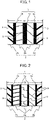
- FIGS. 1 and 2 show a tread pattern within a grounding surface width.
- a plurality of circumferential grooves 1 are provided in a tire circumferential direction (tire rotation direction), and land parts 2 (four columns in FIG. 1 and five columns in FIG. 2 ) partitioned by the circumferential grooves 1 are provided.
- each of the land parts is provided with a width direction groove 3.
- the width direction grooves of the land parts may be provided on all of the land parts, or may be provided on the shoulder land parts only and on the crown land parts only sipes may be provided.
- shapes of the circumferential groove and the width direction groove a wide variety of grooves such as a circumferential groove in a trapezoidal wavy zigzag shape and a width direction groove that draws a curve line are known, which are not particularly limited.
- the "normal rim” is a rim defined for each tire by the standard in a standard system on which standard the tire is based. For example, it is a “standard rim” in JATMA, "Design Rim” in TRA, or “Measuring Rim” in ETRTO.
- the above-mentioned negative rate within the grounding surface width can be obtained by appropriately adjusting means such as mold profile, gauge distribution, and construction, though the means is not particularly limited as long as the negative rate is achieved.
- the negative rate can be adjusted by appropriately adjusting a width of a circumferential groove and a width of a width direction groove.
- a diene-based rubber As a rubber component, a diene-based rubber, a butyl rubber (IIR), or the like can be used.
- a diene-based rubber a natural rubber (NR), a diene-based synthetic rubber, or the like can be used.
- the diene-based synthetic rubber include, for example, an isoprene rubber (IR), a butadiene rubber (BR), a styrene-butadiene rubber (SBR), an acrylonitrile-butadiene rubber (NBR), a chloroprene rubber (CR), and the like. These rubber components may be used alone, or two or more thereof may be used in combination.
- a NR, a BR or a SBR is preferable, and a BR and a SBR are more preferably used in combination, since they exhibit fuel efficiency and wet grip performance with good balance.
- the rubber component comprises a SBR and a BR, and it is further preferable that the rubber component consists of a SBR and a BR only, from the viewpoint that effects of the present disclosure can be exhibited more satisfactorily.
- SBR Styrene-butadiene rubber
- SBR examples include, but not particularly limited to, an emulsion polymerization SBR (E-SBR), a solution polymerization SBR (S-SBR), and the like, and those obtained by modifying these SBRs with a modifying agent (modified SBRs such as a modified E-SBR and a modified S-SBR), hydrogenated ones of these SBRs (hydrogenated SBRs), and the like can also be used.
- E-SBR emulsion polymerization SBR
- S-SBR solution polymerization SBR
- hydrogenated SBRs hydrogenated ones of these SBRs
- a S-SBR is preferable
- a modified S-SBR is more preferable.
- the modified SBRs may be those modified at a main chain and/or a terminal thereof with a modifying agent or those modified with a polyfunctional modification agent such as, for example, a tin tetrachloride and a silicon tetrachloride and partially having a branched structure.
- a modifying agent having a functional group that interacts with silica at a main chain and/or a terminal thereof are particularly preferable.
- a styrene content (styrene content rate) of the SBR is preferably 15.0% by mass to 40.0% by mass.
- the styrene content is more preferably 20.0% by mass or more from the viewpoints of rubber strength and grip performance.
- the styrene content is more preferably 30.0% by mass or less from the viewpoint of fuel efficiency.
- the styrene content of the SBR is a value calculated by 1 H-NMR measurement.
- a vinyl content (1,2-bond butadiene unit amount) of the SBR is preferably 10.0 to 80.0%.
- the vinyl content is preferably 25.0% or more, more preferably 40.0% or more, from the viewpoints of rubber strength and grip performance.
- the vinyl content is preferably 75.0% or less, more preferably 70.0% or less, from the viewpoint of fuel efficiency.
- the vinyl content of the SBR is a value measured by infrared absorption spectrometry.
- a content of the SBR in 100% by mass of the rubber component is preferably 40% by mass or more, more preferably 50% by mass or more, further preferably 60% by mass or more.
- the content of the SBR in 100% by mass of the rubber component is preferably 95% by mass or less, more preferably 90% by mass or less, further preferably 85% by mass or less.
- the content of the SBR is 95% by mass or less, abrasion resistance and rolling resistance tend to be improved.
- a total content of all SBRs shall be a content of SBRs in the rubber component.
- the rubber component of the rubber composition is not 100% by mass of styrene-butadiene rubber.
- the BR is not particularly limited, and those common in the tire industry can be used such as, for example, a BR having a cis 1,4 bond content of less than 50% (a low cis BR), a BR having a cis 1,4 bond content of 90% or more (a high cis BR), a rare-earth-based butadiene rubber synthesized using a rare-earth element-based catalyst (a rare-earth-based BR), a BR containing a syndiotactic polybutadiene crystal (a SPB-containing BR), and a modified BR (a high cis modified BR, a low cis modified BR).
- a high cis BR from the viewpoint of abrasion resistance.
- high cis BR examples include, for example, high cis BRs manufactured and sold by JSR Corporation, Zeon Corporation, Ube Industries, Ltd., etc., and the like.
- high cis BRs those having a cis 1,4 bond content of 95% or more are more preferable, those having a cis 1,4 bond content of 96% or more are more preferable, and those having a cis 1,4 bond content of 97% or more are further preferable. They may be used alone, or two or more thereof may be used in combination.
- a cis 1,4 bond content in a BR is a value calculated by infrared absorption spectrometry.
- a content of the BR in 100% by mass of the rubber component is preferably 5% by mass or more, more preferably 10% by mass or more, further preferably 15% by mass or more.
- a balance of abrasion resistance and rolling resistance tends to become improved.
- the content of the BR in 100% by mass of the rubber component is preferably 60% by mass or less, more preferably 50% by mass or less, further preferably 40% by mass or less.
- wet grip performance tends to become improved.
- a total content of the SBR and the BR in 100% by mass of the rubber component is preferably 80% by mass or more, more preferably 90% by mass or more, further preferably 100% by mass.
- the total content of the SBR and the BR is 80% by mass or more, a good balance of wet grip performance, abrasion resistance, and low heat generation can be maintained.
- silica examples include, but not particularly limited to, for example, a dry silica (anhydrous silica), a wet silica (hydrous silica), and the like. Among them, a wet silica is preferable since it has many silanol groups and many reaction points with a silane coupling agent.
- silica having a BET specific surface area (N 2 SA) of 180 to 280 m 2 /g is used. Silica may be used alone, or two or more thereof may be used in combination.
- Examples of silica include, for example, silica manufactured and sold by Evonik Degussa GmbH, Solvay, Tosoh Silica Corporation, Tokuyama Corporation, etc.
- the BET specific surface area of silica is 180 m 2 /g or more, preferably 190 m 2 /g or more, more preferably 195 m 2 /g or more, further preferably 220 m 2 /g or more, most preferably 230 m 2 /g or more.
- the BET specific surface area of silica is less than 180 m 2 /g, reinforcing property of a rubber required for a tire cannot be secured, and abrasion resistance cannot be secured.
- the BET specific surface area of silica is 280 m 2 /g or less, preferably 270 m 2 /g or less, more preferably 260 m 2 /g or less, further preferably 250 m 2 /g or less, further preferably 240 m 2 /g or less.
- the BET specific surface area of silica in the present specification is a value measured by a BET method according to ASTM D3037-93.
- a content of silica based on 100 parts by mass of the rubber component is 30 parts by mass or more, preferably 40 parts by mass or more, more preferably 50 parts by mass or more, further preferably 60 parts by mass or more, further preferably 70 parts by mass or more, further preferably 80 parts by mass or more, most preferably 90 parts by mass or more.
- the content of silica is less than 30 parts by mass, reinforcing property required for a tire cannot be obtained.
- the content of silica based on 100 parts by mass of the rubber component is 120 parts by mass or less, preferably 110 parts by mass or less, more preferably 100 parts by mass or less. When the content of silica exceeds 120 parts by mass, processability deteriorates, which makes processing difficult.
- silane coupling agent in order to comprise silica.
- silane coupling agent include, for example, sulfide-based silane coupling agents such as bis(3-triethoxysilylpropyl)disulfide and bis(3-triethoxysilylpropyl)tetrasulfide, mercapto-based silane coupling agents such as 3-mercaptopropyltrimethoxysilane and 3-mercaptopropyltriethoxysilane, thioether-based silane coupling agents such as 3-octanoylthio-1-propyltriethoxysilane, 3-hexanoylthio-1-propyltriethoxysilane, and 3-octanoylthio-1-propyltrimethoxysilane, vinyl-based silane coupling agents such as vinyltriethoxysilane, amino-based silane coupling agents such as 3-aminopropyltrie
- sulfide-based coupling agents particularly bis(3-triethoxysilylpropyl)disulfide are preferable from the viewpoints of ease of temperature control of reaction with silica and an effect of improving reinforcing property of a rubber composition.
- a content of the silane coupling agent is preferably 1 part by mass or more, more preferably 2 parts by mass or more, based on 100 parts by mass of silica.
- the content of the silane coupling agent is 1 part by mass or more, viscosity of an unvulcanized rubber composition tends to be suppressed, and deterioration of processability tends to be suppressed.
- the content of the silane coupling agent based on 100 parts by mass of silica is preferably 20 parts by mass or less, more preferably 15 parts by mass or less, further preferably 12 parts by mass or less. When the content of the silane coupling agent is 20 parts by mass or less, there is a tendency that a compounding effect of the silane coupling agent commensurate with cost can be obtained.
- the rubber composition for tread can appropriately comprise rubber components other than diene-based rubbers, and compounding agents commonly used in the conventional rubber industry, for example, reinforcing fillers other than silica, various softening agents, a tackifying resin, various antioxidants, wax, zinc oxide, stearic acid, a vulcanizing agent, a vulcanization accelerator, and the like, as necessary, in addition to the above-described components.
- compounding agents commonly used in the conventional rubber industry, for example, reinforcing fillers other than silica, various softening agents, a tackifying resin, various antioxidants, wax, zinc oxide, stearic acid, a vulcanizing agent, a vulcanization accelerator, and the like, as necessary, in addition to the above-described components.
- reinforcing fillers other than silica those conventionally used in the rubber composition for tire such as, carbon black, calcium carbonate, alumina, clay, and talc can be compounded.
- carbon black is preferable from the viewpoint of rubber strength. That is, it is more preferable to comprise silica and carbon black as reinforcing fillers, and more preferable to comprise silica and carbon black only.
- Carbon black is not particularly limited, and GPF, FEF, HAF, ISAF, SAF, and the like can be used alone, or two or more thereof can be used in combination.
- Examples of carbon black include carbon black manufactured and sold by Asahi Carbon Co., Ltd., Cabot Japan K.K., Tokai Carbon Co., Ltd., Mitsubishi Chemical Corporation, Lion Corporation, Nippon Steel Chemical Carbon Co., Ltd., Columbian Carbon Japan Ltd., etc.
- a nitrogen adsorption specific surface area (N 2 SA) of carbon black is preferably 80 m 2 /g or more, more preferably 100 m 2 /g or more, further preferably 110 m 2 /g or more. Moreover, the N 2 SA is preferably 300 m 2 /g or less, more preferably 250 m 2 /g or less. Besides, the N 2 SA of carbon black can be measured according to JIS K 6217-2: "Carbon black for rubber industry-Fundamental characteristics-Part 2: Determination of specific surface area-Nitrogen adsorption methods-Single-point procedures".
- a content of carbon black when compounded based on 100 parts by mass of the rubber component is preferably 1 part by mass or more, more preferably 5 parts by mass or more, further preferably 8 parts by mass or more, based on 100 parts by mass of the rubber component.
- the content of carbon black based on 100 parts by mass of the rubber component is preferably 50 parts by mass or less, more preferably 30 parts by mass or less, further preferably 15 parts by mass or less, further preferably 10 parts by mass or less.
- the softening agent examples include petroleum-based softening agents such as oil, a lubricating oil, paraffin, a liquid paraffin, a petroleum asphalt, and vaseline, fatty oil-based softening agents such as a soybean oil, a palm oil, a castor oil, a flaxseed oil, a rapeseed oil, and a coconut oil, wax such as a tall oil, factice, beeswax, a carnauba wax, and lanolin, fatty acids such as linoleic acid, palmitic acid, stearic acid, and lauric acid, a liquid polymer, a low-temperature plasticizer, and the like.
- a total compounding amount of softening agents is preferably 100 parts by mass or less based on 100 parts by mass of the rubber component. In this case, there is little risk of deteriorating wet grip performance.
- oil examples include, for example, a process oil such as a paraffin-based, aroma-based, and naphthene-based process oil.
- a content of oil when compounded based on 100 parts by mass of the rubber component is preferably 10 parts by mass or more, more preferably 15 parts by mass or more. Moreover, the content of oil is preferably 60 parts by mass or less, more preferably 55 parts by mass or less, based on 100 parts by mass of the rubber component. When the content of oil is within the above-described ranges, an effect of compounding oil can be sufficiently obtained, and a good abrasion resistance can be obtained. Besides, in the present specification, the content of oil also includes an amount of oil contained in an oil-extended rubber.
- liquid polymer examples include, for example, a liquid SBR, a liquid BR, a liquid IR, a liquid SIR, and the like. Among them, it is particularly preferable to use a liquid SBR because it can improve durability and grip performance with good balance.
- low-temperature plasticizer examples include, for example, liquid components such as dioctyl phthalate (DOP), dibutyl phthalate (DBP), tris(2-ethylhexyl)phosphate (TOP), and bis(2-ethylhexyl)sebacate (DOS).
- DOP dioctyl phthalate
- DBP dibutyl phthalate
- TOP tris(2-ethylhexyl)phosphate
- DOS bis(2-ethylhexyl)sebacate
- tackifying resin examples include a cyclopentadiene-based resin, a coumarone resin, a petroleum-based resin (an aliphatic petroleum resin, an aromatic petroleum resin, an alicyclic petroleum resin, etc.), a phenol-based resin, a rosin derivative, and the like.
- aromatic petroleum resin examples include, for example, the following aromatic vinyl-based resin and C9-based petroleum resin other than the aromatic vinyl-based resin, and the like.
- the aromatic vinyl-based resin may include a homopolymer of an aromatic vinyl monomer (unit) and a copolymer of two or more kinds of the aromatic vinyl monomers which includes, for example, styrene, ⁇ -methylstyrene, 1-vinylnaphthalene, 3-vinyltoluene, ethylvinylbenzene, divinylbenzene, 4-cyclohexylstyrene, 2,4,6-trimethylstyrene, and the like. Moreover, those obtained by modifying them may be used.
- a content of the tackifying resin when compounded based on 100 parts by mass of the rubber component is preferably 1 part by mass or more, more preferably 2 parts by mass or more, further preferably 3 parts by mass or more, particularly preferably 4 parts by mass or more, from the viewpoints of wet grip performance and dry grip performance.
- the content of the tackifying resin, particularly the aromatic vinyl-based resin, based on 100 parts by mass of the rubber component is preferably 50 parts by mass or less, more preferably 40 parts by mass or less, further preferably 35 parts by mass or less, from the viewpoints of abrasion resistance, fuel efficiency, and brittle fracture at a low temperature.
- the antioxidant is not particularly limited, and for example, amine-based, phenol-based, and imidazole-based compounds, and antioxidants such as a carbamic acid metal salt can be appropriately selected and compounded as antioxidants, which may be used alone or two or more of which may be used in combination.
- an amine-based antioxidant is preferable because it has a high antiaging effect
- p-phenylenediamine-based antioxidants are more preferable such as N-(1,3-dimethylbutyl)-N'-phenyl-p-phenylenediamine, N-isopropyl-N'-phenyl-p-phenylenediamine, N,N'-diphenyl-p-phenylenediamine, N,N'-di-2-naphthyl-p-phenylenediamine, N-cyclohexyl-N'-phenyl-p-phenylenediamine, N,N'-bis(1-methylheptyl)-p-phenylenediamine, N,N'-bis(1,4-dimethylpentyl)-p-phenylenediamine, N,N'-bis(1-ethyl-3-methylpentyl)-p-phenylenediamine, N-4-methyl-2
- a content of the antioxidant when compounded based on 100 parts by mass of the rubber component is preferably 0.5 parts by mass or more, more preferably 1 part by mass or more. Moreover, the content of the antioxidant based on 100 parts by mass of the rubber component is preferably 5 parts by mass or less, more preferably 3 parts by mass or less. When the content of the antioxidant is within the above-described ranges, an antiaging effect can be sufficiently obtained, and discoloration due to precipitation of the antioxidant on a tire surface tends to be suppressed.
- stearic acid As stearic acid, zinc oxide, wax, etc., those conventionally used in the rubber industry can be used.
- the rubber composition can comprise a vulcanizing agent.
- a vulcanizing agent an organic peroxide or a sulfur-based vulcanizing agent can be used.
- organic peroxide for example, benzoyl peroxide, dicumyl peroxide, di-t-butyl peroxide, t-butyl cumyl peroxide, methyl ethyl ketone peroxide, cumene hydroperoxide, 2,5-dimethyl-2,5-di(t-butylperoxy)hexane, 2,5-dimethyl-2,5-di(benzoylperoxy)hexane, 2,5-dimethyl-2,5-di(t-butylperoxy)hexin-3, 1,3-bis(t-butylperoxypropyl)benzene, or the like can be used.
- sulfur-based vulcanizing agent for example, sulfur, morpholine disulfide, or the like can be used. Among them
- a content of the vulcanizing agent when compounded based on 100 parts by mass of the rubber component is preferably 0.5 parts by mass or more, more preferably 1 part by mass or more. Moreover, the content of the vulcanizing agent based on 100 parts by mass of the rubber component is preferably 5 parts by mass or less, more preferably 3 parts by mass or less. When the content of the vulcanizing agent is within the above-described ranges, an appropriate fracture characteristics can be obtained, and abrasion resistance tends to become improved.
- vulcanization accelerator examples include, but not particularly limited to, for example, sulfenamide-based, thiazole-based, thiuram-based, thiourea-based, guanidine-based, dithiocarbamic acid-based, aldehyde-amine-based or aldehyde-ammonia-based, imidazoline-based, and xanthate-based vulcanization accelerators, and among them, it is preferable to comprise sulfenamide-based vulcanization accelerators and guanidine-based vulcanization accelerators, and it is more preferable to comprise sulfenamide-based vulcanization accelerators and guanidine-based vulcanization accelerators only, from the viewpoint that the effects of the present disclosure can be obtained more appropriately.
- Examples of the sulfenamide-based vulcanization accelerator include CBS (N-cyclohexyl-2-benzothiazolyl sulfenamide), TBBS (N-t-butyl-2-benzothiazyl sulfenamide), N-oxyethylene-2-benzothiazyl sulfenamide, N,N'-diisopropyl-2-benzothiazyl sulfenamide, N,N-dicyclohexyl-2-benzothiazyl sulfenamide, and the like.
- Examples of the thiazole-based vulcanization accelerator include 2-mercaptobenzothiazole, dibenzothiazolyl disulfide, and the like.
- Examples of the thiuram-based vulcanization accelerator include tetramethylthiuram monosulfide, tetramethylthiuram disulfide, tetrabenzylthiuram disulfide (TBzTD), and the like.
- Examples of the guanidine-based vulcanization accelerator include diphenylguanidine (DPG), diorthotrilguanidine, orthotrilbiguanidine, and the like. They may be used alone, or two or more thereof may be used in combination. Among them, it is preferable to use CBS and DPG in combination from the viewpoint that the effects of the present disclosure can be obtained more appropriately.
- a content of the vulcanization accelerator when compounded based on 100 parts by mass of the rubber component is preferably 0.1 parts by mass or more, more preferably 0.3 parts by mass or more, further preferably 0.5 parts by mass or more.
- the content of the vulcanization accelerator based on 100 parts by mass of the rubber component is preferably 8 parts by mass or less, more preferably 7 parts by mass or less, further preferably 6 parts by mass or less.
- a hardness of a tread obtained by using the above-described rubber composition is preferably 55 degrees or more, more preferably 60 degrees or more, further preferably 65 degrees or more, in terms of JIS-A hardness.
- the hardness is preferably 80 degrees or less, more preferably 75 degrees or less, further preferably 70 degrees or less.
- the hardness is 80 degrees or less, energy input to a tire is mitigated, and there is a tendency that deterioration of abrasion resistance can be prevented.
- the rubber composition for tread can be produced by a general method.
- it can be produced by a method of kneading components other than vulcanizing agents and vulcanization accelerators, of the above-described components, with a known kneading machine used in the general rubber industry such as a Banbury mixer, a kneader, and an open roll (a base kneading step), then adding the vulcanizing agents and the vulcanization accelerators to the mixture to further knead them (a finish kneading step), followed by vulcanizing them, and the like.
- a known kneading machine used in the general rubber industry such as a Banbury mixer, a kneader, and an open roll
- a kneading condition is not particularly limited, and for the base kneading step, kneading at a discharge temperature from 150 to 165°C, preferably 155°C to 160°C for 3 to 10 minutes, preferably 4 to 6 minutes is preferable, and for the finish kneading step, kneading at 70 to 90°C for 1 to 5 minutes, preferably 2 to 4 minutes is preferable.
- a vulcanization condition is not particularly limited, and vulcanizing at 170 to 180°C for 12 to 18 minutes, preferably 13 to 16 minutes is preferable.
- the pneumatic tire can be manufactured by a usual method using the above-mentioned rubber composition for tread. That is, the tire can be produced by extruding the above-described rubber composition, which is obtained by compounding the above-mentioned compounding agents as necessary based on the rubber components, into a shape of a tread, etc., attaching it together with other tire members on a tire forming machine, and molding them by a usual method to form an unvulcanized tire, followed by heating and pressurizing this unvulcanized tire in a vulcanizing machine.
- the tread can also be formed by a method of attaching sheet-shaped unvulcanized rubber compositions together into a predetermined shape or a method of inserting them into two or more extruders to form into two phases at a head outlet of the extruders.
- the pneumatic tire can be used for general tires such as a tire for a passenger car, a high-performance tire for a passenger car, a heavy duty tire for truck and bus, and a racing tire. Among them, a high-performance tire for a passenger car is preferable from the viewpoint of compounding with silica.
- the obtained unvulcanized rubber composition was molded into a tread shape, attached together with other members, and vulcanized at 170°C for 15 minutes, thereby obtaining a pneumatic tire (size 195/65R15) of each Example and Comparative example.
- tread patterns of the tires of Examples 1 to 10 and Comparative examples 1 to 5 are as shown in FIG. 1
- tread patterns of the tires of Examples 11 to 15 are as shown in FIG. 2
- widths of the circumferential groove 1 and/or the width direction groove 3 of each tire were adjusted so that a negative rate of each tire was as shown in Tables 1 and 2.
- the pneumatic tire obtained in each Example and Comparative example was evaluated by the methods shown below in terms of fuel efficiency, abrasion resistance, and wet grip performance. The results are shown in Tables 1 and 2. Moreover, an average of all evaluation indexes is shown as an "Average" in Tables 1 and 2.
- Abrasion resistance index running distance when a groove depth of each compounding is reduced by 1mm / running distance when a groove depth of Comparative example 1 is reduced by 1 mm ⁇ 100
Landscapes
- Engineering & Computer Science (AREA)
- Mechanical Engineering (AREA)
- Chemical & Material Sciences (AREA)
- Health & Medical Sciences (AREA)
- Chemical Kinetics & Catalysis (AREA)
- Medicinal Chemistry (AREA)
- Polymers & Plastics (AREA)
- Organic Chemistry (AREA)
- Tires In General (AREA)
- Compositions Of Macromolecular Compounds (AREA)
Abstract
Description
- The present invention relates to a pneumatic tire comprising a tread formed of a rubber composition comprising a predetermined amount of a fine particle silica and a rubber component.
- In recent years, due to increasing market demands, a tire has been required to have a longer life and a higher durability, and a tread rubber has been required to have an improved abrasion resistance.
- Moreover, at the same time, due to demand for fuel efficiency, reduction in rolling resistance of a tire has been also required, and silica is generally used as a reinforcing filler for a high-performance tire for a passenger car.
- On the other hand, in light of safety, there has been also a demand for further improvement of braking performance on a wet road surface, for which a high degree of achievement of contradictory performances of fuel efficiency and wet grip performance has been required.
- For example,
Patent Document 1 discloses that a pneumatic tire using a rubber composition having a predetermined tan δ for a tread is made to have a predetermined tread pattern to achieve both reduction in rolling resistance and improvement in wet braking performance. - Patent Document 1:
JP 2016-33014 A - As such, a method of increasing toughness is considered by increasing specific surface area of a reinforcing filler in order to increase the number of sites to be bonded with a polymer for improved abrasion resistance, though it is still insufficient.
- Moreover, in
Patent Document 1, abrasion resistance is not particularly improved, and there is still room for improvement. - Therefore, it is an object of the present invention to provide a pneumatic tire having improved abrasion resistance and wet grip performance and good fuel efficiency in a high degree of balance.
- In view of the above-described problems, the present inventors have found that improved abrasion resistance and wet braking performance and good fuel efficiency in a high degree of balance are achieved by setting a negative rate derived from tread pattern within a predetermined range and at the same time micronizing a reinforcing filler (particularly silica) while increasing a specific surface area thereof , and completed the present invention.
- That is, the present disclosure relates to:
- [1] A pneumatic tire comprising a tread,
- wherein the tread is formed of a rubber composition comprising 30 to 120 parts by mass, preferably 40 to 120 parts by mass, more preferably 50 to 120 parts by mass, further preferably 50 to 110 parts by mass of silica having a BET specific surface area of 180 to 280 m2/g, preferably 190 to 270 m2/g, more preferably 195 to 260 m2/g, further preferably 220 to 260 m2/g, further preferably 220 to 250 m2/g, further preferably 220 to 240 m2/g, further preferably 230 to 240 m2/g, based on 100 parts by mass of a rubber component,
- wherein a negative rate within a grounding surface width of the tread is 20-40%, preferably 20-30%, more preferably 20-25%, or preferably 25-35%, more preferably 25-30%,
- [2] The pneumatic tire of [1] above, wherein a content of the silica in the rubber composition is 60 to 120 parts by mass, preferably 60 to 110 parts by mass, more preferably 70 to 110 parts by mass, further preferably 80 to 110 parts by mass, further preferably 90 to 110 parts by mass, or preferably 70 to 100 parts by mass, more preferably 80 to 100 parts by mass, further preferably 90 to 100 parts by mass based on 100 parts by mass of the rubber component,
- [3] The pneumatic tire of [1] or [2] above, wherein the rubber component in the rubber composition comprises a styrene-butadiene rubber (preferably a solution-polymerized styrene-butadiene rubber, more preferably a modified solution-polymerized styrene-butadiene rubber) and a butadiene rubber (preferably a high cis butadiene rubber with a
cis 1,4-bond content of 95% or more), - [4] The pneumatic tire of any one of [1] to [3] above, wherein the rubber composition further comprises a silane coupling agent (preferably a sulfide-based coupling agent, more preferably bis(3-triethoxysilylpropyl)disulfide),
- [5] A pneumatic tire comprising a tread,
- wherein the tread is formed of a rubber composition comprising 30 to 120 parts by mass, preferably 40 to 120 parts by mass, more preferably 50 to 120 parts by mass, further preferably 60 to 120 parts by mass, or preferably 50 to 110 parts by mass, more preferably 60 to 110 parts by mass, further preferably 70 to 110 parts by mass, further preferably 80 to 110 parts by mass, further preferably 90 to 110 parts by mass, or preferably 70 to 100 parts by mass, more preferably 80 to 100 parts by mass, further preferably 90 to 100 parts by mass of silica having a BET specific surface area of 180 to 280 m2/g, preferably 190 to 270 m2/g, more preferably 195 to 260 m2/g, further preferably 220 to 260 m2/g, further preferably 220 to 250 m2/g, further preferably 220 to 240 m2/g, further preferably 230 to 240 m2/g based on 100 parts by mass of a rubber component (excluding a rubber composition comprising a rubber component consisting of 100% by mass of styrene-butadiene rubber),
- wherein a negative rate within a grounding surface width of the tread is 20-40%, preferably 20-30%, more preferably 20-25%, or preferably 25-35%, more preferably 25-30%.
- According to the present invention, a pneumatic tire can be provided which comprises a tread formed of a rubber composition comprising 30 to 120 parts by mass of silica having a BET specific surface area of 180 to 280 m2/g based on 100 parts by mass of a rubber component wherein a negative rate within a grounding surface width of the tread is 20-40%, whereby improved abrasion resistance and wet braking performance and good fuel efficiency in a high degree of balance can be achieved.
-
-
FIG. 1 is a schematic view showing a tread pattern within a grounding surface width in one embodiment of the present disclosure. -
FIG. 2 is a schematic view showing a tread pattern within a grounding surface width in another embodiment of the present disclosure. - The pneumatic tire of the present disclosure comprises a tread formed of a rubber composition comprising 30 to 120 parts by mass of silica having a BET specific surface area of 180 to 280 m2/g based on 100 parts by mass of the rubber component, wherein a negative rate within a grounding surface width of the tread is 20-40%.
- In the pneumatic tire of the present disclosure, a predetermined amount of a fine particle silica having a predetermined specific surface area is used in the rubber composition for tread, and further, a negative rate within a grounding surface width of the tread is set to a predetermined value, whereby it is considered that the fine particle silica enhances reinforcing property of the rubber and that the predetermined negative rate in the tread pattern enables to control an amount of rubber and an amount of area of grounding surface, and further that synergy of these effects achieves improved abrasion resistance and wet braking performance and good fuel efficiency in a high degree of balance.
- Besides, in the present specification, a numerical range identified with "to" means to include the numerical values of both ends.
- In the pneumatic tire of the present disclosure, a ratio of a total groove area within a grounding surface width to a total area within the grounding surface width of a tread (negative rate) is 20% or more, preferably 25% or more. When the negative rate is less than 20%, a grounding ratio increases, so that rolling resistance increases. Moreover, in that case, a tire weight increases, thereby further deteriorating rolling resistance. Furthermore, when a grounding amount is large, drainage performance cannot be secured, so that wet grip performance tends to deteriorate. In addition, the negative rate in the pneumatic tire of the present disclosure is 40% or less, preferably 35% or less, more preferably 30% or less. When the negative rate exceeds 40%, since a grounding area becomes small, wet grip performance deteriorates, and also since a grounding ratio is small, abrasion resistance tends to deteriorate. Here, the negative rate is preferably 25% or less from the viewpoint that an effect of improving wet grip performance and abrasion resistance can be exhibited more satisfactorily.
- Here, the "grounding surface width" is indicated by outermost grounding parts in a tire width direction when a tire is mounted on a normal rim, filled with an internal pressure of 100% air pressure (maximum air pressure) corresponding to the maximum load capacity (load shown in bold in the internal pressure-load capacity correspondence table) for the applicable JATMA YEAR BOOK size/ply rating, and applied with 80% of the maximum load capacity. If TRA standard and ETRTO standard are applied at a place of use or manufacturing, the present invention follows each standard.
-
FIGS. 1 and 2 show a tread pattern within a grounding surface width. In such tread pattern, within the grounding surface width W, a plurality of circumferential grooves 1 (three grooves inFIG. 1 and four grooves inFIG. 2 ) are provided in a tire circumferential direction (tire rotation direction), and land parts 2 (four columns inFIG. 1 and five columns inFIG. 2 ) partitioned by thecircumferential grooves 1 are provided. Moreover, each of the land parts is provided with awidth direction groove 3. For example, among them, when two columns of the land parts on outer sides in a tread width direction are defined asshoulder land parts 2b, the land parts sandwiched between the shoulder land parts are defined ascrown land parts 2a, the circumferential groove sandwiched between the crown land parts is defined as a crownmain groove 1a, and the circumferential grooves sandwiched between one of the shoulder land parts and one of the crown land parts are defined as shouldermain grooves 1b, the width direction grooves of the land parts may be provided on all of the land parts, or may be provided on the shoulder land parts only and on the crown land parts only sipes may be provided. As for shapes of the circumferential groove and the width direction groove, a wide variety of grooves such as a circumferential groove in a trapezoidal wavy zigzag shape and a width direction groove that draws a curve line are known, which are not particularly limited. - The "normal rim" is a rim defined for each tire by the standard in a standard system on which standard the tire is based. For example, it is a "standard rim" in JATMA, "Design Rim" in TRA, or "Measuring Rim" in ETRTO.
- The above-mentioned negative rate within the grounding surface width can be obtained by appropriately adjusting means such as mold profile, gauge distribution, and construction, though the means is not particularly limited as long as the negative rate is achieved. For example, the negative rate can be adjusted by appropriately adjusting a width of a circumferential groove and a width of a width direction groove.
- As a rubber component, a diene-based rubber, a butyl rubber (IIR), or the like can be used. As the diene-based rubber, a natural rubber (NR), a diene-based synthetic rubber, or the like can be used. Examples of the diene-based synthetic rubber include, for example, an isoprene rubber (IR), a butadiene rubber (BR), a styrene-butadiene rubber (SBR), an acrylonitrile-butadiene rubber (NBR), a chloroprene rubber (CR), and the like. These rubber components may be used alone, or two or more thereof may be used in combination. Among them, a NR, a BR or a SBR is preferable, and a BR and a SBR are more preferably used in combination, since they exhibit fuel efficiency and wet grip performance with good balance. Here, it is more preferable that the rubber component comprises a SBR and a BR, and it is further preferable that the rubber component consists of a SBR and a BR only, from the viewpoint that effects of the present disclosure can be exhibited more satisfactorily.
- Examples of the SBR include, but not particularly limited to, an emulsion polymerization SBR (E-SBR), a solution polymerization SBR (S-SBR), and the like, and those obtained by modifying these SBRs with a modifying agent (modified SBRs such as a modified E-SBR and a modified S-SBR), hydrogenated ones of these SBRs (hydrogenated SBRs), and the like can also be used. Among them, a S-SBR is preferable, and a modified S-SBR is more preferable. These SBRs may be used alone, or two or more thereof may be used in combination.
- Moreover, the modified SBRs may be those modified at a main chain and/or a terminal thereof with a modifying agent or those modified with a polyfunctional modification agent such as, for example, a tin tetrachloride and a silicon tetrachloride and partially having a branched structure. Among them, those modified with a modifying agent having a functional group that interacts with silica at a main chain and/or a terminal thereof are particularly preferable. By using such a modified styrene-butadiene rubber modified with a modifying agent and having a functional group that interacts with silica, fuel efficiency and wet grip performance can be further improved with good balance.
- A styrene content (styrene content rate) of the SBR is preferably 15.0% by mass to 40.0% by mass. The styrene content is more preferably 20.0% by mass or more from the viewpoints of rubber strength and grip performance. Moreover, the styrene content is more preferably 30.0% by mass or less from the viewpoint of fuel efficiency. Besides, the styrene content of the SBR is a value calculated by 1H-NMR measurement.
- A vinyl content (1,2-bond butadiene unit amount) of the SBR is preferably 10.0 to 80.0%. The vinyl content is preferably 25.0% or more, more preferably 40.0% or more, from the viewpoints of rubber strength and grip performance. Moreover, the vinyl content is preferably 75.0% or less, more preferably 70.0% or less, from the viewpoint of fuel efficiency. Besides, the vinyl content of the SBR is a value measured by infrared absorption spectrometry.
- When the rubber composition of the tread comprises a SBR, a content of the SBR in 100% by mass of the rubber component is preferably 40% by mass or more, more preferably 50% by mass or more, further preferably 60% by mass or more. When the content of the SBR is 40% by mass or more, wet grip performance required for the tread rubber tends to be easily secured. Moreover, the content of the SBR in 100% by mass of the rubber component is preferably 95% by mass or less, more preferably 90% by mass or less, further preferably 85% by mass or less. When the content of the SBR is 95% by mass or less, abrasion resistance and rolling resistance tend to be improved. Besides, when two or more types of SBR are used in combination, a total content of all SBRs shall be a content of SBRs in the rubber component. Here, from the viewpoint that the effects of the present disclosure can be exhibited more satisfactorily, it is preferable that the rubber component of the rubber composition is not 100% by mass of styrene-butadiene rubber.
- The BR is not particularly limited, and those common in the tire industry can be used such as, for example, a BR having a cis 1,4 bond content of less than 50% (a low cis BR), a BR having a cis 1,4 bond content of 90% or more (a high cis BR), a rare-earth-based butadiene rubber synthesized using a rare-earth element-based catalyst (a rare-earth-based BR), a BR containing a syndiotactic polybutadiene crystal (a SPB-containing BR), and a modified BR (a high cis modified BR, a low cis modified BR). Among them, it is more preferable to use a high cis BR from the viewpoint of abrasion resistance.
- Examples of the high cis BR include, for example, high cis BRs manufactured and sold by JSR Corporation, Zeon Corporation, Ube Industries, Ltd., etc., and the like. Among high cis BRs, those having a cis 1,4 bond content of 95% or more are more preferable, those having a cis 1,4 bond content of 96% or more are more preferable, and those having a cis 1,4 bond content of 97% or more are further preferable. They may be used alone, or two or more thereof may be used in combination. When a high cis BR is compounded, low temperature characteristics and abrasion resistance can be improved. A cis 1,4 bond content in a BR is a value calculated by infrared absorption spectrometry.
- When the rubber composition of the tread comprises a BR, a content of the BR in 100% by mass of the rubber component is preferably 5% by mass or more, more preferably 10% by mass or more, further preferably 15% by mass or more. When the content of the BR is 5% by mass or more, a balance of abrasion resistance and rolling resistance tends to become improved. Moreover, the content of the BR in 100% by mass of the rubber component is preferably 60% by mass or less, more preferably 50% by mass or less, further preferably 40% by mass or less. When the content of the BR is 60% by mass or less, wet grip performance tends to become improved.
- A total content of the SBR and the BR in 100% by mass of the rubber component is preferably 80% by mass or more, more preferably 90% by mass or more, further preferably 100% by mass. When the total content of the SBR and the BR is 80% by mass or more, a good balance of wet grip performance, abrasion resistance, and low heat generation can be maintained.
- Examples of silica include, but not particularly limited to, for example, a dry silica (anhydrous silica), a wet silica (hydrous silica), and the like. Among them, a wet silica is preferable since it has many silanol groups and many reaction points with a silane coupling agent. In the present disclosure, silica having a BET specific surface area (N2SA) of 180 to 280 m2/g is used. Silica may be used alone, or two or more thereof may be used in combination. Examples of silica include, for example, silica manufactured and sold by Evonik Degussa GmbH, Solvay, Tosoh Silica Corporation, Tokuyama Corporation, etc.
- The BET specific surface area of silica is 180 m2/g or more, preferably 190 m2/g or more, more preferably 195 m2/g or more, further preferably 220 m2/g or more, most preferably 230 m2/g or more. When the BET specific surface area of silica is less than 180 m2/g, reinforcing property of a rubber required for a tire cannot be secured, and abrasion resistance cannot be secured. Moreover, the BET specific surface area of silica is 280 m2/g or less, preferably 270 m2/g or less, more preferably 260 m2/g or less, further preferably 250 m2/g or less, further preferably 240 m2/g or less. When the BET specific surface area of silica exceeds 280 m2/g, processability deteriorates, which makes processing difficult. Besides, the BET specific surface area of silica in the present specification is a value measured by a BET method according to ASTM D3037-93.
- A content of silica based on 100 parts by mass of the rubber component is 30 parts by mass or more, preferably 40 parts by mass or more, more preferably 50 parts by mass or more, further preferably 60 parts by mass or more, further preferably 70 parts by mass or more, further preferably 80 parts by mass or more, most preferably 90 parts by mass or more. When the content of silica is less than 30 parts by mass, reinforcing property required for a tire cannot be obtained. Moreover, the content of silica based on 100 parts by mass of the rubber component is 120 parts by mass or less, preferably 110 parts by mass or less, more preferably 100 parts by mass or less. When the content of silica exceeds 120 parts by mass, processability deteriorates, which makes processing difficult.
- It is preferable to use a silane coupling agent in order to comprise silica. Examples of the silane coupling agent include, for example, sulfide-based silane coupling agents such as bis(3-triethoxysilylpropyl)disulfide and bis(3-triethoxysilylpropyl)tetrasulfide, mercapto-based silane coupling agents such as 3-mercaptopropyltrimethoxysilane and 3-mercaptopropyltriethoxysilane, thioether-based silane coupling agents such as 3-octanoylthio-1-propyltriethoxysilane, 3-hexanoylthio-1-propyltriethoxysilane, and 3-octanoylthio-1-propyltrimethoxysilane, vinyl-based silane coupling agents such as vinyltriethoxysilane, amino-based silane coupling agents such as 3-aminopropyltriethoxysilane, glycidoxy-based silane coupling agents such as γ-glycidoxypropyltriethoxysilane, nitro-based silane coupling agents such as 3-nitropropyltrimethoxysilane, and chloro-based silane coupling agents such as 3-chloropropyltrimethoxysilane. They may be used alone, or two or more thereof may be used in combination. Among them, sulfide-based coupling agents, particularly bis(3-triethoxysilylpropyl)disulfide are preferable from the viewpoints of ease of temperature control of reaction with silica and an effect of improving reinforcing property of a rubber composition.
- When the rubber composition comprises a silane coupling agent, a content of the silane coupling agent is preferably 1 part by mass or more, more preferably 2 parts by mass or more, based on 100 parts by mass of silica. When the content of the silane coupling agent is 1 part by mass or more, viscosity of an unvulcanized rubber composition tends to be suppressed, and deterioration of processability tends to be suppressed. Moreover, the content of the silane coupling agent based on 100 parts by mass of silica is preferably 20 parts by mass or less, more preferably 15 parts by mass or less, further preferably 12 parts by mass or less. When the content of the silane coupling agent is 20 parts by mass or less, there is a tendency that a compounding effect of the silane coupling agent commensurate with cost can be obtained.
- The rubber composition for tread can appropriately comprise rubber components other than diene-based rubbers, and compounding agents commonly used in the conventional rubber industry, for example, reinforcing fillers other than silica, various softening agents, a tackifying resin, various antioxidants, wax, zinc oxide, stearic acid, a vulcanizing agent, a vulcanization accelerator, and the like, as necessary, in addition to the above-described components.
- As reinforcing fillers other than silica, those conventionally used in the rubber composition for tire such as, carbon black, calcium carbonate, alumina, clay, and talc can be compounded. When those other than silica are used as reinforcing fillers, carbon black is preferable from the viewpoint of rubber strength. That is, it is more preferable to comprise silica and carbon black as reinforcing fillers, and more preferable to comprise silica and carbon black only.
- Carbon black is not particularly limited, and GPF, FEF, HAF, ISAF, SAF, and the like can be used alone, or two or more thereof can be used in combination. Examples of carbon black include carbon black manufactured and sold by Asahi Carbon Co., Ltd., Cabot Japan K.K., Tokai Carbon Co., Ltd., Mitsubishi Chemical Corporation, Lion Corporation, Nippon Steel Chemical Carbon Co., Ltd., Columbian Carbon Japan Ltd., etc.
- A nitrogen adsorption specific surface area (N2SA) of carbon black is preferably 80 m2/g or more, more preferably 100 m2/g or more, further preferably 110 m2/g or more. Moreover, the N2SA is preferably 300 m2/g or less, more preferably 250 m2/g or less. Besides, the N2SA of carbon black can be measured according to JIS K 6217-2: "Carbon black for rubber industry-Fundamental characteristics-Part 2: Determination of specific surface area-Nitrogen adsorption methods-Single-point procedures".
- A content of carbon black when compounded based on 100 parts by mass of the rubber component is preferably 1 part by mass or more, more preferably 5 parts by mass or more, further preferably 8 parts by mass or more, based on 100 parts by mass of the rubber component. The content of carbon black based on 100 parts by mass of the rubber component is preferably 50 parts by mass or less, more preferably 30 parts by mass or less, further preferably 15 parts by mass or less, further preferably 10 parts by mass or less. When the content of carbon black is within the above-described ranges, good fuel efficiency and weather resistance can be obtained.
- Examples of the softening agent include petroleum-based softening agents such as oil, a lubricating oil, paraffin, a liquid paraffin, a petroleum asphalt, and vaseline, fatty oil-based softening agents such as a soybean oil, a palm oil, a castor oil, a flaxseed oil, a rapeseed oil, and a coconut oil, wax such as a tall oil, factice, beeswax, a carnauba wax, and lanolin, fatty acids such as linoleic acid, palmitic acid, stearic acid, and lauric acid, a liquid polymer, a low-temperature plasticizer, and the like. A total compounding amount of softening agents is preferably 100 parts by mass or less based on 100 parts by mass of the rubber component. In this case, there is little risk of deteriorating wet grip performance.
- Examples of oil include, for example, a process oil such as a paraffin-based, aroma-based, and naphthene-based process oil.
- A content of oil when compounded based on 100 parts by mass of the rubber component is preferably 10 parts by mass or more, more preferably 15 parts by mass or more. Moreover, the content of oil is preferably 60 parts by mass or less, more preferably 55 parts by mass or less, based on 100 parts by mass of the rubber component. When the content of oil is within the above-described ranges, an effect of compounding oil can be sufficiently obtained, and a good abrasion resistance can be obtained. Besides, in the present specification, the content of oil also includes an amount of oil contained in an oil-extended rubber.
- Examples of the liquid polymer include, for example, a liquid SBR, a liquid BR, a liquid IR, a liquid SIR, and the like. Among them, it is particularly preferable to use a liquid SBR because it can improve durability and grip performance with good balance.
- Examples of the low-temperature plasticizer include, for example, liquid components such as dioctyl phthalate (DOP), dibutyl phthalate (DBP), tris(2-ethylhexyl)phosphate (TOP), and bis(2-ethylhexyl)sebacate (DOS).
- Examples of the tackifying resin include a cyclopentadiene-based resin, a coumarone resin, a petroleum-based resin (an aliphatic petroleum resin, an aromatic petroleum resin, an alicyclic petroleum resin, etc.), a phenol-based resin, a rosin derivative, and the like.
- Examples of the aromatic petroleum resin include, for example, the following aromatic vinyl-based resin and C9-based petroleum resin other than the aromatic vinyl-based resin, and the like.
- The aromatic vinyl-based resin may include a homopolymer of an aromatic vinyl monomer (unit) and a copolymer of two or more kinds of the aromatic vinyl monomers which includes, for example, styrene, α-methylstyrene, 1-vinylnaphthalene, 3-vinyltoluene, ethylvinylbenzene, divinylbenzene, 4-cyclohexylstyrene, 2,4,6-trimethylstyrene, and the like. Moreover, those obtained by modifying them may be used.
- A content of the tackifying resin when compounded based on 100 parts by mass of the rubber component is preferably 1 part by mass or more, more preferably 2 parts by mass or more, further preferably 3 parts by mass or more, particularly preferably 4 parts by mass or more, from the viewpoints of wet grip performance and dry grip performance. Moreover, the content of the tackifying resin, particularly the aromatic vinyl-based resin, based on 100 parts by mass of the rubber component is preferably 50 parts by mass or less, more preferably 40 parts by mass or less, further preferably 35 parts by mass or less, from the viewpoints of abrasion resistance, fuel efficiency, and brittle fracture at a low temperature.
- The antioxidant is not particularly limited, and for example, amine-based, phenol-based, and imidazole-based compounds, and antioxidants such as a carbamic acid metal salt can be appropriately selected and compounded as antioxidants, which may be used alone or two or more of which may be used in combination. Among them, an amine-based antioxidant is preferable because it has a high antiaging effect, p-phenylenediamine-based antioxidants are more preferable such as N-(1,3-dimethylbutyl)-N'-phenyl-p-phenylenediamine, N-isopropyl-N'-phenyl-p-phenylenediamine, N,N'-diphenyl-p-phenylenediamine, N,N'-di-2-naphthyl-p-phenylenediamine, N-cyclohexyl-N'-phenyl-p-phenylenediamine, N,N'-bis(1-methylheptyl)-p-phenylenediamine, N,N'-bis(1,4-dimethylpentyl)-p-phenylenediamine, N,N'-bis(1-ethyl-3-methylpentyl)-p-phenylenediamine, N-4-methyl-2-pentyl-N'-phenyl-p-phenylenediamine, N,N'-diaryl-p-phenylenediamine, hindered diaryl-p-phenylenediamine, phenylhexyl-p-phenylenediamine, and phenyloctyl-p-phenylenediamine, and N-(1,3-dimethylbutyl)-N'-phenyl-p-phenylenediamine is particularly preferable.
- A content of the antioxidant when compounded based on 100 parts by mass of the rubber component is preferably 0.5 parts by mass or more, more preferably 1 part by mass or more. Moreover, the content of the antioxidant based on 100 parts by mass of the rubber component is preferably 5 parts by mass or less, more preferably 3 parts by mass or less. When the content of the antioxidant is within the above-described ranges, an antiaging effect can be sufficiently obtained, and discoloration due to precipitation of the antioxidant on a tire surface tends to be suppressed.
- As stearic acid, zinc oxide, wax, etc., those conventionally used in the rubber industry can be used.
- The rubber composition can comprise a vulcanizing agent. As the vulcanizing agent, an organic peroxide or a sulfur-based vulcanizing agent can be used. As the organic peroxide, for example, benzoyl peroxide, dicumyl peroxide, di-t-butyl peroxide, t-butyl cumyl peroxide, methyl ethyl ketone peroxide, cumene hydroperoxide, 2,5-dimethyl-2,5-di(t-butylperoxy)hexane, 2,5-dimethyl-2,5-di(benzoylperoxy)hexane, 2,5-dimethyl-2,5-di(t-butylperoxy)hexin-3, 1,3-bis(t-butylperoxypropyl)benzene, or the like can be used. Moreover, as the sulfur-based vulcanizing agent, for example, sulfur, morpholine disulfide, or the like can be used. Among them, sulfur is preferable.
- A content of the vulcanizing agent when compounded based on 100 parts by mass of the rubber component is preferably 0.5 parts by mass or more, more preferably 1 part by mass or more. Moreover, the content of the vulcanizing agent based on 100 parts by mass of the rubber component is preferably 5 parts by mass or less, more preferably 3 parts by mass or less. When the content of the vulcanizing agent is within the above-described ranges, an appropriate fracture characteristics can be obtained, and abrasion resistance tends to become improved.
- Examples of the vulcanization accelerator include, but not particularly limited to, for example, sulfenamide-based, thiazole-based, thiuram-based, thiourea-based, guanidine-based, dithiocarbamic acid-based, aldehyde-amine-based or aldehyde-ammonia-based, imidazoline-based, and xanthate-based vulcanization accelerators, and among them, it is preferable to comprise sulfenamide-based vulcanization accelerators and guanidine-based vulcanization accelerators, and it is more preferable to comprise sulfenamide-based vulcanization accelerators and guanidine-based vulcanization accelerators only, from the viewpoint that the effects of the present disclosure can be obtained more appropriately.
- Examples of the sulfenamide-based vulcanization accelerator include CBS (N-cyclohexyl-2-benzothiazolyl sulfenamide), TBBS (N-t-butyl-2-benzothiazyl sulfenamide), N-oxyethylene-2-benzothiazyl sulfenamide, N,N'-diisopropyl-2-benzothiazyl sulfenamide, N,N-dicyclohexyl-2-benzothiazyl sulfenamide, and the like. Examples of the thiazole-based vulcanization accelerator include 2-mercaptobenzothiazole, dibenzothiazolyl disulfide, and the like. Examples of the thiuram-based vulcanization accelerator include tetramethylthiuram monosulfide, tetramethylthiuram disulfide, tetrabenzylthiuram disulfide (TBzTD), and the like. Examples of the guanidine-based vulcanization accelerator include diphenylguanidine (DPG), diorthotrilguanidine, orthotrilbiguanidine, and the like. They may be used alone, or two or more thereof may be used in combination. Among them, it is preferable to use CBS and DPG in combination from the viewpoint that the effects of the present disclosure can be obtained more appropriately.
- A content of the vulcanization accelerator when compounded based on 100 parts by mass of the rubber component is preferably 0.1 parts by mass or more, more preferably 0.3 parts by mass or more, further preferably 0.5 parts by mass or more. The content of the vulcanization accelerator based on 100 parts by mass of the rubber component is preferably 8 parts by mass or less, more preferably 7 parts by mass or less, further preferably 6 parts by mass or less. When the content of the vulcanization accelerator is within the above-described ranges, an appropriate fracture characteristics can be obtained, and abrasion resistance tends to become improved.
- A hardness of a tread obtained by using the above-described rubber composition is preferably 55 degrees or more, more preferably 60 degrees or more, further preferably 65 degrees or more, in terms of JIS-A hardness. When the hardness is 55 degrees or more, there is a tendency that rigidity of a rubber required for a tread rubber can be secured. Moreover, the hardness is preferably 80 degrees or less, more preferably 75 degrees or less, further preferably 70 degrees or less. When the hardness is 80 degrees or less, energy input to a tire is mitigated, and there is a tendency that deterioration of abrasion resistance can be prevented.
- The rubber composition for tread can be produced by a general method. For example, it can be produced by a method of kneading components other than vulcanizing agents and vulcanization accelerators, of the above-described components, with a known kneading machine used in the general rubber industry such as a Banbury mixer, a kneader, and an open roll (a base kneading step), then adding the vulcanizing agents and the vulcanization accelerators to the mixture to further knead them (a finish kneading step), followed by vulcanizing them, and the like.
- A kneading condition is not particularly limited, and for the base kneading step, kneading at a discharge temperature from 150 to 165°C, preferably 155°C to 160°C for 3 to 10 minutes, preferably 4 to 6 minutes is preferable, and for the finish kneading step, kneading at 70 to 90°C for 1 to 5 minutes, preferably 2 to 4 minutes is preferable. A vulcanization condition is not particularly limited, and vulcanizing at 170 to 180°C for 12 to 18 minutes, preferably 13 to 16 minutes is preferable.
- The pneumatic tire can be manufactured by a usual method using the above-mentioned rubber composition for tread. That is, the tire can be produced by extruding the above-described rubber composition, which is obtained by compounding the above-mentioned compounding agents as necessary based on the rubber components, into a shape of a tread, etc., attaching it together with other tire members on a tire forming machine, and molding them by a usual method to form an unvulcanized tire, followed by heating and pressurizing this unvulcanized tire in a vulcanizing machine. The tread can also be formed by a method of attaching sheet-shaped unvulcanized rubber compositions together into a predetermined shape or a method of inserting them into two or more extruders to form into two phases at a head outlet of the extruders.
- The pneumatic tire can be used for general tires such as a tire for a passenger car, a high-performance tire for a passenger car, a heavy duty tire for truck and bus, and a racing tire. Among them, a high-performance tire for a passenger car is preferable from the viewpoint of compounding with silica.
- Hereinafter, the present disclosure will be described based on Examples, though the present disclosure is not limited to these Examples.
- Various chemicals used in Examples and Comparative examples are collectively shown below.
- SBR: Nipol NS616 manufactured by ZS Elastomer Co., Ltd. (terminal-modified solution-polymerized SBR, styrene content: 21% by mass, vinyl content: 66%)
- BR: Nipol BR1220 manufactured by Zeon Corporation (cis 1,4 bond content: 97%)
- Carbon black: DIABLACK (Registered Trademark) N220 manufactured by Mitsubishi Chemical Corporation (nitrogen adsorption specific surface area (N2SA): 115 m2/g)
- Silica 1: ULTRASIL (Registered Trademark) 9100GR manufactured by Evonik Degussa GmbH (BET specific surface area: 235 m2/g, average primary particle size: 15 nm)
- Silica 2: Zeosil (Registered Trademark) Premium 200 MP manufactured by Solvay (BET specific surface area: 220 m2/g, average primary particle size: 16 nm)
- Silica 3: ULTRASIL (Registered Trademark) VN3 manufactured by Evonik Degussa GmbH (BET specific surface area: 175 m2/g, average primary particle size: 18 nm)
- Silane coupling agent: Si266 manufactured by Evonik Degussa GmbH (bis(3-triethoxysilylpropyl)disulfide)
- Zinc oxide: Zinc oxide No. 1 manufactured by Mitsui Mining & Smelting Co., Ltd.
- Stearic acid: Bead stearic acid "CAMELLIA" manufactured by NOF CORPORATION
- Oil: Process X-140 manufactured by Japan Energy Corporation
- Antioxidant: Antigen 6C manufactured by Sumitomo Chemical Co., Ltd. (N-(1,3-dimethylbutyl)-N'-phenyl-p-phenylenediamine)
- Wax: SUNNOC N manufactured by Ouchi Shinko Chemical Industry Co., Ltd.
- Sulfur: Powdered sulfur manufactured by Karuizawa Sulfur Co, Ltd.
- Vulcanization accelerator 1: Nocceler CZ manufactured by Ouchi Shinko Chemical Industry Co., Ltd. (N-cyclohexyl-2-benzothiazolylsulfenamide)
- Vulcanization accelerator 2: Nocceler D manufactured by Ouchi Shinko Chemical Industry Co., Ltd. (1,3-diphenylguanidine)
- According to the compounding formulations shown in Tables 1 and 2, using a 1.7 L Banbury mixer manufactured by Kobe Steel, Ltd., chemicals other than sulfur and vulcanization accelerators were charged and kneaded for 5 minutes so that a discharge temperature reached 155°C. Next, sulfur and vulcanization accelerators were added to the obtained kneaded product in the compounding amounts shown in Tables 1 and 2, and then the mixture was kneaded under a condition at about 80°C for 3 minutes using an open roll to obtain an unvulcanized rubber composition. The obtained unvulcanized rubber composition was molded into a tread shape, attached together with other members, and vulcanized at 170°C for 15 minutes, thereby obtaining a pneumatic tire (size 195/65R15) of each Example and Comparative example. Moreover, tread patterns of the tires of Examples 1 to 10 and Comparative examples 1 to 5 are as shown in
FIG. 1 , tread patterns of the tires of Examples 11 to 15 are as shown inFIG. 2 , and widths of thecircumferential groove 1 and/or thewidth direction groove 3 of each tire were adjusted so that a negative rate of each tire was as shown in Tables 1 and 2. - The pneumatic tire obtained in each Example and Comparative example was evaluated by the methods shown below in terms of fuel efficiency, abrasion resistance, and wet grip performance. The results are shown in Tables 1 and 2. Moreover, an average of all evaluation indexes is shown as an "Average" in Tables 1 and 2.
- Using a rolling resistance tester, rolling resistance when each tire was run with a rim of 15 × 6JJ, an internal pressure of 230 kPa, a load of 3.43 kN, and a speed at 80 km/h was measured, and the measurement was indicated as an index as Comparative example 1 being 100. The results show that the larger the index is, the better the fuel efficiency is, and 80 or more shall be a good index.
- Each tire (size 195/65R15) was mounted on a domestic FF vehicle, and a groove depth of the tire tread part after running of 8000 km was measured to calculate a running distance when the groove depth of the tire was reduced by 1 mm, and the result of calculation was indicated as an index by the following equation. The larger the index is, the better the abrasion resistance is.

- Based on a braking performance obtained by an anti-lock braking system (ABS) evaluation test, grip performance was evaluated. That is, a test tire was mounted on a passenger car equipped with a 1800 cc class ABS, an actual vehicle running was performed on an asphalt road surface (in a wet road surface condition, skid number: about 50), and a brake was applied at a speed of 100 km/h to calculate deceleration until the passenger car stopped. Here, deceleration is a distance until a passenger car stops. Then, as wet grip performance index of Comparative example 1 being 100, deceleration was indicated as an index by the following equation. The results show that the larger the index is, the better the braking performance is, and the more excellent the wet grip performance is.

Table 1 Example 1 2 3 4 5 6 7 8 9 10 Compounding amount (part by mass) SBR 70 70 70 70 70 70 70 70 70 70 BR 30 30 30 30 30 30 30 30 30 30 Carbon black 10 10 10 10 10 10 10 10 10 10 Silica 1 70 70 70 50 90 110 - - - - Silica 2 - - - - - - 70 70 70 100 Silica 3 - - - - - - - - - - Silane coupling agent 8.4 8.4 8.4 6.0 10.8 15.4 8.4 8.4 8.4 13.0 Oil 25 25 25 25 25 25 25 25 25 25 Wax 2 2 2 2 2 2 2 2 2 2 Antioxidant 2 2 2 2 2 2 2 2 2 2 Stearic acid 2.5 2.5 2.5 2.5 2.5 2.5 2.5 2.5 2.5 2.5 Zinc oxide 2 2 2 2 2 2 2 2 2 2 Sulfur 1.5 1.5 1.5 1.5 1.5 1.5 1.5 1.5 1.5 1.5 Vulcanization accelerator 1 2 2 2 2 2 2 2 2 2 2 Vulcanization accelerator 2 1.5 1.5 1.5 1.5 1.5 1.5 1.5 1.5 1.5 1.5 Negative rate (%) 25 20 40 25 25 20 25 30 35 25 Evaluation Fuel efficiency index 95 90 120 110 90 80 95 105 110 85 Abrasion resistance index 125 130 108 105 130 130 125 125 120 130 Wet grip performance index 115 120 105 115 140 145 115 110 110 140 Average 112 113 111 110 120 118 112 113 113 118 Table 2 Example Comparative example 11 12 13 14 15 1 2 3 4 5 Compounding amount (part by mass) SBR 70 70 70 70 70 70 70 70 70 70 BR 30 30 30 30 30 30 30 30 30 30 Carbon black 10 10 10 10 10 10 10 10 10 10 Silica 1 70 70 70 50 90 - 70 70 20 140 Silica 2 - - - - - - - - - - Silica 3 - - - - - 70 - - - - Silane coupling agent 8.4 8.4 8.4 6.0 10.8 5.6 8.4 8.4 2.4 19.6 Oil 25 25 25 25 25 25 25 25 25 25 Wax 2 2 2 2 2 2 2 2 2 2 Antioxidant 2 2 2 2 2 2 2 2 2 2 Stearic acid 2.5 2.5 2.5 2.5 2.5 2.5 2.5 2.5 2.5 2.5 Zinc oxide 2 2 2 2 2 2 2 2 2 2 Sulfur 1.5 1.5 1.5 1.5 1.5 1.5 1.5 1.5 1.5 1.5 Vulcanization accelerator 1 2 2 2 2 2 2 2 2 2 2 Vulcanization accelerator 2 1.5 1.5 1.5 1.5 1.5 1.5 1.5 1.5 1.5 1.5 Negative rate (%) 25 20 40 25 25 25 10 50 25 25 Evaluation Fuel efficiency index 98 95 125 115 95 100 45 105 130 55 Abrasion resistance index 120 125 110 105 125 100 105 95 65 105 Wet grip performance index 115 125 105 110 135 100 80 70 60 105 Average 111 115 113 110 118 100 77 90 85 88 - From the results in Tables 1 and 2, by stipulating a BET specific surface area and a content of silica and a negative rate of a tire, it is understood that an amount of rubber and a grounding surface area with a ground can be controlled by a tire pattern (tread pattern) while enhancing reinforcing property of the rubber with silica, thereby achieving improved wet grip performance and abrasion resistance of the rubber as well as a good fuel efficiency.
-
- 1.
- Circumferential groove
- 1a.
- Crown main groove
- 1b.
- Shoulder main groove
- 2.
- Land part
- 2a.
- Crown land part
- 2b.
- Shoulder land part
- 3.
- Width direction groove
- W.
- Grounding surface width
Claims (5)
- A pneumatic tire comprising a tread,wherein the tread is formed of a rubber composition comprising 30 to 120 parts by mass of silica having a BET specific surface area of 180 to 280 m2/g based on 100 parts by mass of a rubber component,wherein a negative rate within a grounding surface width of the tread is 20-40%.
- The pneumatic tire of claim 1, wherein a content of the silica in the rubber composition is 60 to 120 parts by mass based on 100 parts by mass of the rubber component.
- The pneumatic tire of claim 1 or 2, wherein the rubber component in the rubber composition comprises a styrene-butadiene rubber and a butadiene rubber.
- The pneumatic tire of any one of claims 1 to 3, wherein the rubber composition further comprises a silane coupling agent.
- A pneumatic tire comprising a tread,wherein the tread is formed of a rubber composition comprising 30 to 120 parts by mass of silica having a BET specific surface area of 180 to 280 m2/g based on 100 parts by mass of a rubber component (excluding a rubber composition comprising a rubber component consisting of 100% by mass of styrene-butadiene rubber),wherein a negative rate within a grounding surface width of the tread is 20-40%.
Applications Claiming Priority (2)
| Application Number | Priority Date | Filing Date | Title |
|---|---|---|---|
| JP2019105367A JP2020196842A (en) | 2019-06-05 | 2019-06-05 | Pneumatic tire |
| PCT/JP2020/015531 WO2020246128A1 (en) | 2019-06-05 | 2020-04-06 | Pneumatic tire |
Publications (1)
| Publication Number | Publication Date |
|---|---|
| EP3974207A1 true EP3974207A1 (en) | 2022-03-30 |
Family
ID=73647868
Family Applications (1)
| Application Number | Title | Priority Date | Filing Date |
|---|---|---|---|
| EP20817941.6A Withdrawn EP3974207A1 (en) | 2019-06-05 | 2020-04-06 | Pneumatic tire |
Country Status (4)
| Country | Link |
|---|---|
| EP (1) | EP3974207A1 (en) |
| JP (1) | JP2020196842A (en) |
| CN (1) | CN113905897A (en) |
| WO (1) | WO2020246128A1 (en) |
Cited By (1)
| Publication number | Priority date | Publication date | Assignee | Title |
|---|---|---|---|---|
| EP4074520A1 (en) * | 2021-04-15 | 2022-10-19 | Sumitomo Rubber Industries, Ltd. | Tire |
Families Citing this family (8)
| Publication number | Priority date | Publication date | Assignee | Title |
|---|---|---|---|---|
| JP7847743B2 (en) * | 2021-10-20 | 2026-04-20 | 住友ゴム工業株式会社 | pneumatic tires |
| JP7815685B2 (en) * | 2021-10-28 | 2026-02-18 | 住友ゴム工業株式会社 | Heavy-duty tires |
| JP7823381B2 (en) * | 2021-12-14 | 2026-03-04 | 住友ゴム工業株式会社 | Rubber composition for tires and tires |
| JP7823382B2 (en) * | 2021-12-15 | 2026-03-04 | 住友ゴム工業株式会社 | Rubber composition for tires and tires |
| US12351717B2 (en) | 2021-12-20 | 2025-07-08 | The Goodyear Tire & Rubber Company | Tread rubber composition with majority renewable content |
| JP7362957B1 (en) | 2023-02-02 | 2023-10-17 | Toyo Tire株式会社 | pneumatic tires |
| JP7362958B1 (en) | 2023-02-02 | 2023-10-17 | Toyo Tire株式会社 | pneumatic tires |
| JP7362956B1 (en) | 2023-02-02 | 2023-10-17 | Toyo Tire株式会社 | pneumatic tires |
Family Cites Families (15)
| Publication number | Priority date | Publication date | Assignee | Title |
|---|---|---|---|---|
| JPH0781303A (en) * | 1993-09-13 | 1995-03-28 | Yokohama Rubber Co Ltd:The | Pneumatic tire |
| JP4076942B2 (en) * | 2003-11-04 | 2008-04-16 | 住友ゴム工業株式会社 | Rubber composition and competition tire using the same |
| JP2006151244A (en) * | 2004-11-30 | 2006-06-15 | Yokohama Rubber Co Ltd:The | Pneumatic tire |
| JP4769146B2 (en) * | 2006-08-22 | 2011-09-07 | 住友ゴム工業株式会社 | Tread rubber composition and pneumatic tire |
| JP5212589B2 (en) * | 2006-08-22 | 2013-06-19 | 戸田工業株式会社 | Black fine composite particle powder, dispersion containing the black fine composite particle powder, and method for producing black fine composite particle powder |
| FR2928374B1 (en) * | 2008-03-10 | 2011-10-07 | Michelin Soc Tech | DIENE PNEUMATIC RUBBER COMPOSITION COMPRISING SILICA AS A REINFORCING LOAD |
| JP5519310B2 (en) * | 2010-02-08 | 2014-06-11 | 株式会社ブリヂストン | Pneumatic tire |
| US9022084B2 (en) * | 2010-11-10 | 2015-05-05 | The Goodyear Tire & Rubber Company | Passenger tire having low rolling resistance with improved wet traction and treadwear |
| JP6363106B2 (en) * | 2013-02-12 | 2018-07-25 | クーパー タイヤ アンド ラバー カンパニーCooper Tire & Rubber Company | Functionalized silica with elastomeric binder |
| JP6445915B2 (en) * | 2015-04-01 | 2018-12-26 | 株式会社ブリヂストン | tire |
| JP6092984B2 (en) * | 2015-10-30 | 2017-03-08 | 株式会社ブリヂストン | Pneumatic tire |
| FR3045495B1 (en) * | 2015-12-22 | 2018-01-05 | Michelin & Cie | COMPOSITE MATERIALS BASED ON STACKING ORIENTED WITH HARD-MIX MIXTURES FOR MECHANICAL COUPLING |
| JP6784066B2 (en) * | 2016-06-08 | 2020-11-11 | 住友ゴム工業株式会社 | Pneumatic tires |
| JP6376247B1 (en) * | 2017-05-11 | 2018-08-22 | 横浜ゴム株式会社 | Modified butadiene polymer and rubber composition |
| JP6624216B2 (en) * | 2018-02-05 | 2019-12-25 | 横浜ゴム株式会社 | Pneumatic tire |
-
2019
- 2019-06-05 JP JP2019105367A patent/JP2020196842A/en active Pending
-
2020
- 2020-04-06 EP EP20817941.6A patent/EP3974207A1/en not_active Withdrawn
- 2020-04-06 WO PCT/JP2020/015531 patent/WO2020246128A1/en not_active Ceased
- 2020-04-06 CN CN202080039684.XA patent/CN113905897A/en not_active Withdrawn
Cited By (1)
| Publication number | Priority date | Publication date | Assignee | Title |
|---|---|---|---|---|
| EP4074520A1 (en) * | 2021-04-15 | 2022-10-19 | Sumitomo Rubber Industries, Ltd. | Tire |
Also Published As
| Publication number | Publication date |
|---|---|
| CN113905897A (en) | 2022-01-07 |
| JP2020196842A (en) | 2020-12-10 |
| WO2020246128A1 (en) | 2020-12-10 |
Similar Documents
| Publication | Publication Date | Title |
|---|---|---|
| EP3974207A1 (en) | Pneumatic tire | |
| US11261314B2 (en) | Pneumatic tire | |
| EP3950381B1 (en) | Tire | |
| CN113372629B (en) | Rubber composition for tire tread, and tire for passenger car | |
| EP3950386A1 (en) | Tire | |
| EP3950387B1 (en) | Tire | |
| EP4166350B1 (en) | Tire | |
| EP4166351B1 (en) | Tire | |
| JP2020128131A (en) | Rubber composition for tread and tire | |
| EP4177069A1 (en) | Pneumatic tire | |
| EP4008568B1 (en) | Tire | |
| EP4190590B1 (en) | Pneumatic tire | |
| EP3954551B1 (en) | Pneumatic tire | |
| EP4166349B1 (en) | Tire | |
| EP3332988B1 (en) | Pneumatic tire | |
| EP3954550B1 (en) | Pneumatic tire | |
| JP7072532B2 (en) | tire | |
| EP4159483B1 (en) | Tire | |
| EP3995323B9 (en) | Tire | |
| EP4147882B1 (en) | Tire | |
| JP7757714B2 (en) | tire |
Legal Events
| Date | Code | Title | Description |
|---|---|---|---|
| STAA | Information on the status of an ep patent application or granted ep patent |
Free format text: STATUS: THE INTERNATIONAL PUBLICATION HAS BEEN MADE |
|
| PUAI | Public reference made under article 153(3) epc to a published international application that has entered the european phase |
Free format text: ORIGINAL CODE: 0009012 |
|
| STAA | Information on the status of an ep patent application or granted ep patent |
Free format text: STATUS: REQUEST FOR EXAMINATION WAS MADE |
|
| 17P | Request for examination filed |
Effective date: 20211221 |
|
| AK | Designated contracting states |
Kind code of ref document: A1 Designated state(s): AL AT BE BG CH CY CZ DE DK EE ES FI FR GB GR HR HU IE IS IT LI LT LU LV MC MK MT NL NO PL PT RO RS SE SI SK SM TR |
|
| DAV | Request for validation of the european patent (deleted) | ||
| DAX | Request for extension of the european patent (deleted) | ||
| STAA | Information on the status of an ep patent application or granted ep patent |
Free format text: STATUS: THE APPLICATION HAS BEEN WITHDRAWN |
|
| 18W | Application withdrawn |
Effective date: 20221121 |