EP3973508B1 - Abtasten latenter variablen zur erzeugung mehrerer segmentierungen eines bildes - Google Patents
Abtasten latenter variablen zur erzeugung mehrerer segmentierungen eines bildes Download PDFInfo
- Publication number
- EP3973508B1 EP3973508B1 EP20727974.6A EP20727974A EP3973508B1 EP 3973508 B1 EP3973508 B1 EP 3973508B1 EP 20727974 A EP20727974 A EP 20727974A EP 3973508 B1 EP3973508 B1 EP 3973508B1
- Authority
- EP
- European Patent Office
- Prior art keywords
- latent
- space
- sub
- image
- neural network
- Prior art date
- Legal status (The legal status is an assumption and is not a legal conclusion. Google has not performed a legal analysis and makes no representation as to the accuracy of the status listed.)
- Active
Links
Images



Classifications
-
- G—PHYSICS
- G06—COMPUTING OR CALCULATING; COUNTING
- G06T—IMAGE DATA PROCESSING OR GENERATION, IN GENERAL
- G06T7/00—Image analysis
- G06T7/10—Segmentation; Edge detection
-
- G—PHYSICS
- G06—COMPUTING OR CALCULATING; COUNTING
- G06T—IMAGE DATA PROCESSING OR GENERATION, IN GENERAL
- G06T7/00—Image analysis
- G06T7/10—Segmentation; Edge detection
- G06T7/11—Region-based segmentation
-
- A—HUMAN NECESSITIES
- A61—MEDICAL OR VETERINARY SCIENCE; HYGIENE
- A61B—DIAGNOSIS; SURGERY; IDENTIFICATION
- A61B5/00—Measuring for diagnostic purposes; Identification of persons
- A61B5/0033—Features or image-related aspects of imaging apparatus, e.g. for MRI, optical tomography or impedance tomography apparatus; Arrangements of imaging apparatus in a room
-
- A—HUMAN NECESSITIES
- A61—MEDICAL OR VETERINARY SCIENCE; HYGIENE
- A61B—DIAGNOSIS; SURGERY; IDENTIFICATION
- A61B5/00—Measuring for diagnostic purposes; Identification of persons
- A61B5/72—Signal processing specially adapted for physiological signals or for diagnostic purposes
- A61B5/7235—Details of waveform analysis
- A61B5/7264—Classification of physiological signals or data, e.g. using neural networks, statistical classifiers, expert systems or fuzzy systems
-
- G—PHYSICS
- G06—COMPUTING OR CALCULATING; COUNTING
- G06T—IMAGE DATA PROCESSING OR GENERATION, IN GENERAL
- G06T7/00—Image analysis
- G06T7/0002—Inspection of images, e.g. flaw detection
- G06T7/0012—Biomedical image inspection
-
- G—PHYSICS
- G06—COMPUTING OR CALCULATING; COUNTING
- G06T—IMAGE DATA PROCESSING OR GENERATION, IN GENERAL
- G06T2207/00—Indexing scheme for image analysis or image enhancement
- G06T2207/10—Image acquisition modality
- G06T2207/10056—Microscopic image
-
- G—PHYSICS
- G06—COMPUTING OR CALCULATING; COUNTING
- G06T—IMAGE DATA PROCESSING OR GENERATION, IN GENERAL
- G06T2207/00—Indexing scheme for image analysis or image enhancement
- G06T2207/10—Image acquisition modality
- G06T2207/10072—Tomographic images
-
- G—PHYSICS
- G06—COMPUTING OR CALCULATING; COUNTING
- G06T—IMAGE DATA PROCESSING OR GENERATION, IN GENERAL
- G06T2207/00—Indexing scheme for image analysis or image enhancement
- G06T2207/10—Image acquisition modality
- G06T2207/10116—X-ray image
-
- G—PHYSICS
- G06—COMPUTING OR CALCULATING; COUNTING
- G06T—IMAGE DATA PROCESSING OR GENERATION, IN GENERAL
- G06T2207/00—Indexing scheme for image analysis or image enhancement
- G06T2207/10—Image acquisition modality
- G06T2207/10132—Ultrasound image
-
- G—PHYSICS
- G06—COMPUTING OR CALCULATING; COUNTING
- G06T—IMAGE DATA PROCESSING OR GENERATION, IN GENERAL
- G06T2207/00—Indexing scheme for image analysis or image enhancement
- G06T2207/20—Special algorithmic details
- G06T2207/20016—Hierarchical, coarse-to-fine, multiscale or multiresolution image processing; Pyramid transform
-
- G—PHYSICS
- G06—COMPUTING OR CALCULATING; COUNTING
- G06T—IMAGE DATA PROCESSING OR GENERATION, IN GENERAL
- G06T2207/00—Indexing scheme for image analysis or image enhancement
- G06T2207/20—Special algorithmic details
- G06T2207/20084—Artificial neural networks [ANN]
-
- G—PHYSICS
- G06—COMPUTING OR CALCULATING; COUNTING
- G06T—IMAGE DATA PROCESSING OR GENERATION, IN GENERAL
- G06T2207/00—Indexing scheme for image analysis or image enhancement
- G06T2207/20—Special algorithmic details
- G06T2207/20112—Image segmentation details
-
- G—PHYSICS
- G06—COMPUTING OR CALCULATING; COUNTING
- G06T—IMAGE DATA PROCESSING OR GENERATION, IN GENERAL
- G06T2207/00—Indexing scheme for image analysis or image enhancement
- G06T2207/30—Subject of image; Context of image processing
- G06T2207/30004—Biomedical image processing
-
- G—PHYSICS
- G06—COMPUTING OR CALCULATING; COUNTING
- G06T—IMAGE DATA PROCESSING OR GENERATION, IN GENERAL
- G06T2207/00—Indexing scheme for image analysis or image enhancement
- G06T2207/30—Subject of image; Context of image processing
- G06T2207/30004—Biomedical image processing
- G06T2207/30096—Tumor; Lesion
Definitions
- This specification relates to processing data using machine learning models.
- Machine learning models receive an input and generate an output, e.g., a predicted output, based on the received input.
- Some machine learning models are parametric models and generate the output based on the received input and on values of the parameters of the model.
- Some machine learning models are deep models that employ multiple layers of models to generate an output for a received input.
- a deep neural network is a deep machine learning model that includes an output layer and one or more hidden layers that each apply a non-linear transformation to a received input to generate an output.
- Kohl et al. "A Probabilistic U-Net for Segmentation of Ambiguous Images," arXiv: 1806.05034 relates to a generative segmentation model based on a combination of a U-Net with a conditional variational autoencoder that is capable of efficiently producing an unlimited number of plausible hypotheses.
- This specification describes a segmentation system implemented as computer programs on one or more computers in one or more locations that is configured to process an image to generate multiple possible segmentations of the image. Each segmentation may represent a different hypothesis for the ground truth (i.e., actual) segmentation of the image.
- the segmentation system described in this specification can generate a large number of plausible segmentations of an image. By generating multiple possible segmentations of an image, the segmentation system models the inherent ambiguities present in segmenting the image. In one example, in medical imaging applications, a lesion might be visible in an image, but whether or not the lesion is malignant and the precise boundaries of the lesion may be ambiguous. In this example, the segmentation system may generate multiple different segmentations that each define respective boundaries of the lesion and respective predictions for whether the lesion is malignant. Diagnosis and treatment of patients may depend on segmentations of medical images (e.g., CT images). Providing only the most likely segmentation of a medical image may lead to misdiagnosis and sub-optimal treatment. The segmentation system described in this specification can provide multiple possible segmentations of a medical image that can be directly propagated into the next step in a diagnosis pipeline, used to suggest further diagnostic tests to resolve ambiguities, or provided to an expert for analysis, thereby potentially improving patient outcomes.
- the segmentation system described in this specification may enable more efficient use of resources.
- the segmentation system can facilitate more efficient resource usage by obviating the need for multiple people (e.g., physicians) to generate different manual segmentations of an image.
- the system described in this specification can re-use the results of certain previous computations each time it generates a new segmentation of an image.
- the segmentation system samples a latent variable from a latent space, and processes the latent variable and the image using a segmentation neural network.
- the system described in this specification can model the diversity and variations of possible image segmentations at various scales (e.g., spanning from the pixel level to the image level) by sampling latent variables from a "hierarchical" latent space that includes a hierarchy (sequence) of latent sub-spaces.
- the system samples a respective latent sub-variable from each latent sub-space in accordance with a probability distribution over the latent sub-space that is generated based on: (i) the image, and (ii) latent sub-variables sampled from any preceding latent sub-spaces in the hierarchy.
- the system can generate segmentations of an image that more accurately model complex variations in segmentation structures across scales.
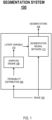
- FIG. 1 shows an example segmentation system 100.
- the segmentation system 100 is an example of a system implemented as computer programs on one or more computers in one or more locations in which the systems, components, and techniques described below are implemented.
- the segmentation system 100 is configured to process an image 102 to generate multiple possible segmentations 104 of the image 102, where each segmentation 104 represents a different hypothesis for the ground truth (i.e., actual) segmentation of the image 102.
- the image 102 may be represented as an ordered collection of numerical values, e.g., as a one-dimensional (1-D), two-dimensional (2-D), three-dimensional (3-D), or N- dimensional (N-D) array of numerical values (where A is a positive integer value).
- pixels or "voxels”.
- the image 102 may be captured using any appropriate imaging modality, e.g., a magnetic resonance imaging (MRI) modality, a computed tomography (CT) imaging modality, a microscope imaging modality (e.g., a light microscope or electron microscope imaging modality), a photographic (camera) imaging modality, an optical coherence tomography (OCT) imaging modality, an ultrasound (US) imaging modality, or an X-ray imaging modality.
- MRI magnetic resonance imaging
- CT computed tomography
- microscope imaging modality e.g., a light microscope or electron microscope imaging modality
- OCT optical coherence tomography
- US ultrasound
- X-ray imaging modality e.g., X-ray imaging modality
- the image 102 may include multiple images that are each captured using a respective imaging modality.
- the image 102 may include a concatenation of an MRI image and a CT image (e.g., of the brain of a patient).
- the image 102 may include multiple images that are each captured at respective time points.
- the image 102 may include a concatenation of MRI images (e.g., of the brain of a patient) that are each captured at a respective time point (e.g., such that the image 102 characterizes the progression of a disease in a patient).
- Each segmentation 104 of the image 102 may be a "soft" segmentation that defines, for each pixel of the image 102, a respective score for each category in a predefined set of categories, where the score for a category characterizes a probability that the pixel is included in the category.
- each segmentation 104 of the image 102 may be a "hard” segmentation that specifies, for each pixel of the image 102, a corresponding category from the predefined set of categories.
- each segmentation 104 may be represented as an ordered collection of numerical values, e.g., an array of numerical values.
- the segmentations 104 may segment the image 102 into any appropriate set of categories.
- the image 102 may be a medical image (e.g., an MRI or CT image of a region of the body of a patient, or a microscope image of a fragment of tissue from a patient) and each category may represent a possible tissue type.
- the tissue types may include: "normal” tissue and "abnormal” (e.g., cancerous) tissue.
- each tissue type may specify a respective region of the body (e.g., bone tissue, heart tissue, liver tissue, lung tissue, etc.).
- the system 100 processes the image 102 to determine a probability distribution 106 over a latent space, and uses a sampling engine 108 to sample a latent variable 110 from the latent space in accordance with the probability distribution 106.
- the system 100 processes: (i) the image 102, and (ii) the sampled latent variable 110, using a segmentation neural network 112 to generate a segmentation 104 of the image 102.
- the "latent space" may represent a collection of possible latent variables, and each latent variable may be represented as an ordered collection of one or more numerical values (e.g., a vector or matrix of numerical values).
- Each latent variable may specify a corresponding segmentation 104 of the image 102, and the system 100 may generate a probability distribution 106 over the latent space that assigns a higher probability to latent variables corresponding to more accurate segmentations of the image.
- the system 100 To generate multiple segmentations 104 of the image 102, the system 100 repeatedly samples latent variables 110 from the latent space, and generates a respective segmentation 104 corresponding to each sampled latent variable 110.
- the system 100 can generate probability distributions 106 over the latent space and sample latent variables 110 in a variety of ways; a few examples are described in more detail next.
- the system 100 may generate the latent variable by sampling from the latent space in accordance with a probability distribution over the latent space that depends on the image 102, but not on any portion of the latent variable itself.
- the latent variable may be referred to as a "global" latent variable obtained using a "global” sampling technique.
- An example implementation of the segmentation system 100 that samples global latent variables and does not form part of the invention claimed herein is described in more detail with reference to FIG. 2A-B .
- the system generates the latent variable by sequentially sampling a respective latent sub-variable from each latent sub-space in a sequence of latent sub-spaces in accordance with a respective probability distribution over each latent sub-space.
- the generated sequence of latent sub-variables collectively define the latent variable 110.
- a "latent sub-space" may represent a collection of possible latent sub-variables, and each latent sub-variable may be represented as an ordered collection of one or more numerical values (e.g., a vector or matrix of numerical values).
- the latent variable may be referred to as a "hierarchical" latent variable obtained using a "hierarchical” sampling technique.
- An example implementation of the segmentation system 100 that samples hierarchical latent variables is described in more detail with reference to FIG. 3A-B .
- the system 100 generates the probability distribution over each latent sub-space based on: (i) the image 102, and (ii) latent sub-variables sampled from preceding latent sub-spaces (i.e., that precede the latent sub-space in the sequence of latent sub-spaces). For example, the system 100 may generate a probability distribution over the first latent sub-space (i.e., in the sequence of latent sub-spaces) as an output of one or more neural network layers that process the image 102 (or feature maps corresponding to the image 102).
- the system 100 may generate a probability distribution over the latent sub-space as an output of one or more neural network layers that process: (i) the image 102 (or feature maps corresponding to the image 102), and (ii) respective latent sub-variables sampled from preceding latent sub-spaces.
- a feature map corresponding to the image 102 may refer to an output generated by processing the image 102 using one or more neural network layers.
- a feature map corresponding to the image 102 may be generated as an intermediate output of the segmentation neural network by processing the image 102.
- An intermediate output of the segmentation neural network 112 may refer to an output generated by one or more intermediate (hidden) layers of the segmentation neural network.
- the sequence of latent sub-spaces may be a sequence of increasing dimensionality, i.e., such that the dimensionality of each latent sub-space is greater than the dimensionality of the preceding latent sub-space.
- Latent variables sampled from latent sub-spaces with lower dimensionalities may implicitly characterize global features relevant to the segmentation as a whole, e.g., the predisposition of a patient for a certain disease.
- Latent variables sampled from latent sub-spaces with higher dimensionalities may implicitly characterize local features relevant to specific parts of the segmentation, e.g., whether a particular nodule is cancerous, or the position of the boundary of a particular nodule.
- the segmentation neural network 112 can have any appropriate neural network architecture that enables it to perform its described functions, in particular, processing an image 102 and a latent variable 110 to generate a corresponding segmentation 104 of the image 102.
- the segmentation neural network 112 may have a convolutional neural network architecture that includes one or more convolutional neural network layers. Example architectures of the segmentation neural network 112 are described in more detail below with reference to FIG. 2A-B and FIG. 3A-B .
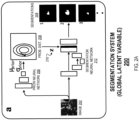
- FIG. 2A shows an example segmentation system 200, which is an example implementation of the segmentation system 100 (described with reference to FIG. 1 ) that uses a global sampling technique for sampling latent variables and does not form part of the invention claimed herein.
- the segmentation system 200 is an example of a system implemented as computer programs on one or more computers in one or more locations in which the systems, components, and techniques described below are implemented.
- the segmentation system 200 is configured to process an image 202 to generate multiple segmentations 204 of the image 202, where each segmentation is specified by a latent variable sampled from a latent space in accordance with a global sampling technique.
- the system 200 may process the image 202 using a prior neural network 206 to generate an output that defines the parameters of a probability distribution 208 over the latent space.
- the latent space may be an N- dimensional Euclidean space (i.e., R N ) and the probability distribution over the latent space may be a Normal probability distribution specified by a mean vector ⁇ prior and a covariance matrix (or covariance vector) ⁇ prior .
- the prior neural network 206 may have any appropriate neural network architecture that enables it to perform its described function.
- the prior neural network 206 may have a convolutional neural network architecture that includes an input layer, one or more intermediate (i.e., hidden) convolutional neural network layers, and a fully-connected output layer.
- the system 200 samples a latent variable 210 from the latent space in accordance with the probability distribution 208 over the latent space, and provides an input including: (i) the image 202, and (ii) the sampled latent variable 210, to the segmentation neural network 212.
- the segmentation neural network 212 is configured to process the input to generate a corresponding segmentation 204 of the image 202.
- the segmentation neural network 212 may have any appropriate neural network architecture that enables it to perform its described function.
- the segmentation neural network may include: (i) a feature extraction sub-network, and (ii) a prediction sub-network.
- a "sub-network" of a neural network refers to a group of one or more layers of the neural network).
- the feature extraction sub-network of the segmentation neural network 212 may be configured to process the image 202 to generate a feature map characterizing the image 202.
- the feature map may be represented, e.g., as an array of numerical values having one or more "spatial" dimensions and a "channel” dimension.
- the feature extraction sub-network may have any appropriate neural network architecture, e.g., a convolutional neural network architecture including one or more convolutional neural network layers.
- the feature extraction sub-network may have the U-Net neural network architecture described with reference to: O. Ronneberger et al., "U-Net: Convolutional Networks for Biomedical Image Segmentation", arXiv: 1505.04597 .
- the prediction sub-network may be configured to combine the feature map (i.e., generated by the feature extraction sub-network) and the latent variable 210, and to process the combination of the feature map and the latent variable 210 to generate the segmentation 204.
- the prediction sub-network may combine the feature map and the latent variable, e.g., by "broadcasting" (i.e., concatenating) the latent variable along the spatial dimensions of the feature map.
- the prediction sub-network may have a neural network architecture that includes one or more 1 ⁇ 1 convolutional neural network layers, i.e., convolutional layers with 1 ⁇ 1-dimensional kernels.
- the system 200 can sample multiple latent variables from the latent space, i.e., in accordance with the probability distribution over the latent space generated by the prior neural network 206.
- the system 200 may avoid regenerating the parameters of the probability distribution over the latent space each time a latent variable is sampled, e.g., by generating the probability distribution parameters only once, and thereafter storing and reusing them.
- the system 200 may avoid regenerating the feature map output by the feature extraction sub-network of the segmentation neural network 212 each time a latent variable is sampled, e.g., by generating the feature map only once, and thereafter storing and reusing it.
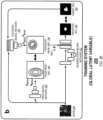
- FIG. 2B shows an example training system 250 for training a segmentation system that uses a global sampling technique for sampling latent variables, e.g., the segmentation system 200 described with reference to FIG. 2A , and does not form part of the invention claimed herein.
- the training system 250 is an example of a system implemented as computer programs on one or more computers in one or more locations in which the systems, components, and techniques described below are implemented.
- the training system 250 is configured to train the segmentation system by jointly training the prior neural network 206 and the segmentation neural network 212 (i.e., described with reference to FIG. 2A ) along with a posterior neural network 252 on a set of training data.
- the posterior neural network 252 (which will be described in more detail below) facilitates training the segmentation system to generate probability distributions over the latent space that assign a higher probability to latent variables corresponding to more accurate segmentations of input images.
- the training data may include multiple training examples, where each training example includes: (i) a training image, and (ii) a target segmentation of the training image.
- Each target segmentation may be manually generated, e.g., by a human expert.
- the training data may include multiple training examples having the same training image but different target segmentations, e.g., that are generated by different human experts.
- the posterior neural network 252 is configured to process: (i) a training image 254, and (ii) a target segmentation 256 of the training image 254, to generate an output that defines the parameters of a "posterior" probability distribution 258 over the latent space.
- the latent space may be an N-dimensional Euclidean space (i.e., R N ) and the posterior probability distribution may be a Normal (i.e., Gaussian) probability distribution specified by a mean vector ⁇ post and a covariance matrix (or covariance vector) ⁇ post .
- the posterior neural network 252 may have any appropriate neural network architecture that enables it to perform its described function.
- the posterior neural network 252 may have a convolutional neural network architecture that includes an input layer, one or more intermediate (i.e., hidden) convolutional neural network layers, and a fully-connected output layer.
- the training system 250 obtains a batch of training examples, e.g., by sampling one or more training examples from the training data. For each training example, the training system 250 processes the training image 254 and target segmentation 256 specified by the training example using the posterior neural network 252 to generate a corresponding posterior probability distribution 258 over the latent space. The training system 250 samples a latent variable 260 from the latent space in accordance with the posterior probability distribution 258 generated for the training example, and processes the training image 254 and the sampled latent variable 260 using the segmentation neural network 212 to generate a predicted segmentation 262. The training system 250 also processes the training image 254 specified by the training example using the prior neural network 206 to generate a "prior" probability distribution 264 over the latent space.
- the training system 250 then jointly optimizes the parameters of the prior neural network 206, the segmentation neural network 212, and the posterior neural network 252 to optimize an objective function, e.g., using gradient descent.
- Optimizing the objective function in equation (1) encourages the prior probability distribution 264 to match the posterior probability distribution 258, and encourages the predicted segmentation 262 corresponding to a latent variable sampled in accordance with the posterior distribution 258 to match the target segmentation 256.
- the objective function given by equation (1) is provided for illustrative purposes only; other objective functions are possible.
- FIG. 3A shows an example segmentation system 300, which is an example implementation of a segmentation system 100 (described with reference to FIG. 1 ) that uses a hierarchical sampling technique for sampling latent variables.
- the segmentation system 300 is an example of a system implemented as computer programs on one or more computers in one or more locations in which the systems, components, and techniques described below are implemented.
- the segmentation system 300 is configured to process an image 302 using a segmentation neural network 304 to generate multiple segmentations 306 of the image 302, where each segmentation is specified by a latent variable sampled from a latent space in accordance with a hierarchical sampling technique.
- the system 300 samples a respective latent sub-variable from each latent sub-space in a sequence of latent sub-spaces in accordance with a probability distribution over each latent sub-space, and the generated sequence of latent sub-variables collectively defines the latent variable.
- the segmentation neural network 304 includes a sequence of one or more "encoder” blocks, e.g., 308-A-C, a sequence of one or more "decoder” blocks, e.g., 3 10-A-E, and one or more "prior” blocks, e.g., 312-A-C.
- a “block” refers to a group of one or more neural network layers.
- the input to a block and the output of a block may be represented as respective arrays of numerical values that are indexed along one or more "spatial" dimensions (e.g., x-y dimensions, or x-y-z dimensions) and a "channel” dimension.
- the "resolution" of a block input/output along a dimension refers to the number of index values along that dimension.
- Each encoder block is configured to process an encoder block input to generate an encoder block output having a lower spatial resolution than the encoder block input, i.e., such that the resolution of the encoder block output is less than the resolution of the encoder block input along at least one spatial dimension.
- the first encoder block may process the image 302, and each subsequent encoder block may process a feature map output by the preceding encoder block.
- Each decoder block is configured to process a decoder block input to generate a decoder block output having a higher spatial resolution than the decoder block input, i.e., such that the resolution of the decoder block output is greater than the resolution of the decoder block input along at least one spatial dimension.
- the first decoder block in the segmentation neural network 304 may process an input including the output of a corresponding encoder block, and each subsequent decoder block may process an input including: (i) the output of a corresponding encoder block, and (ii) the output of the preceding decoder block.
- Each prior block corresponds to a respective decoder block, and is configured to process a feature map generated by the corresponding decoder block to generate an output that defines the parameters of a probability distribution over a corresponding latent sub-space.
- the latent sub-space may be a space of arrays of numerical values having the same spatial resolution as the feature map generated by the corresponding decoder block.
- the prior block 312-B may process a feature map F ⁇ R 2 ⁇ 2 ⁇ C (i.e., having spatial resolution 2 ⁇ 2 and channel resolution C) by one or more 1 ⁇ 1 convolutional neural network layers to generate the parameters of a Normal probability distribution over R 2 ⁇ 2 , where ⁇ ⁇ R 2 ⁇ 2 is an array of mean parameters and ⁇ ⁇ R 2 ⁇ 2 is an array of standard deviation parameters.
- the system 300 may then sample a latent sub-variable z ⁇ R 2 ⁇ 2 in accordance with the probability distribution parameters ( ⁇ , ⁇ ).
- the system 300 may sample a latent sub-variable from the latent sub-space and provide the latent sub-variable as an input to the next decoder block (i.e., in the sequence of decoder blocks). For example, the system 300 may concatenate the latent sub-variable to the other inputs to the next decoder block along their respective spatial dimensions. In some cases, the latent sub-variable may have a lower spatial resolution than the decoder block output, and the system 300 may up-scale the latent sub-variable to have the same spatial resolution as the other inputs to the next decoder block.
- Up-scaling the latent sub-variable may refer to mapping the array of numerical values representing the latent sub-variable to another array of numerical values having a higher spatial resolution, e.g., where some data values in the up-scaled array may be interpolated between data values in the original array.
- the sampled sequence of latent sub-variables may be a sequence of arrays of numerical values of increasing spatial resolution, i.e., such that the spatial resolution of each latent sub-variable is greater than the spatial resolution of the preceding latent sub-variable.
- the final decoder block of the segmentation neural network 304 may generate an output that includes the segmentation 306 of the input image 302.
- a different sequence of latent sub-variables may be sampled from the respective latent sub-spaces and a different segmentation 306 of the image 302 may be generated.
- the system 300 may avoid regenerating the feature maps generated by the encoder blocks each time the same image 302 is processed, e.g., by generating these feature maps only once, and thereafter storing and reusing them each time the same image is processed.
- Generating latent sub-variables represented as arrays of numerical values having the same spatial resolution as the feature maps generated by corresponding decoder blocks (as described above) endows the latent sub-variables with spatial structure.
- the spatial structure of the latent sub-variables can improve the capacity of the system 300 to model independent local variations, e.g., the presence of multiple lesions.
- the segmentation neural network 304 includes a respective prior block corresponding to each decoder block, while in other implementations, the segmentation neural network 304 includes a respective prior block corresponding to only a proper subset of the decoder blocks.
- the segmentation neural network 304 may be implemented as a fully-convolutional neural network, i.e., where each layer is a convolutional layer.
- the segmentation neural network 304 may process images having arbitrary spatial resolutions, and the spatial resolutions of the inputs/outputs of the neural network blocks may vary (e.g., proportionally) based on the spatial resolution of the image being processed.
- the spatial resolutions of the latent sub-variables (which may be directly linked to the spatial resolutions of the feature maps generated by the decoder blocks) may vary based on the spatial resolution of the image being processed.
- the system 300 may sample latent sub-variables with higher spatial resolutions when processing an image with a higher spatial resolution, which can enable the system 300 to more effectively capture the greater range of possible variations in segmentations of images with higher spatial resolutions.
- FIG. 3B shows an example training system 350 for training a segmentation system that uses a hierarchical sampling technique for sampling latent variables, e.g., the segmentation system 300 described with reference to FIG. 3A .
- the training system 350 is an example of a system implemented as computer programs on one or more computers in one or more locations in which the systems, components, and techniques described below are implemented.
- the training system 350 is configured to train the segmentation system by jointly training the segmentation neural network 304 (i.e., described with reference to FIG. 3A ) and a posterior neural network 352 on a set of training data.
- the posterior neural network 352 (which will be described in more detail below) facilitates training the segmentation neural network 304 to generate probability distributions over the latent sub-spaces that assign higher probabilities to sub-latent variables corresponding to more accurate segmentations of input images.
- the training data may include multiple training examples, where each training example includes: (i) a training image, and (ii) a target segmentation of the training image.
- Each target segmentation may be manually generated, e.g., by a human expert.
- the training data may include multiple training examples having the same training image but different target segmentations, e.g., that are generated by different human experts.
- the posterior neural network 352 is configured to process: (i) a training image 354, and (ii) a target segmentation 356 of the training image 354, to generate an output that defines the parameters of a respective "posterior" probability distribution 358 over each latent sub-space in the sequence of latent sub-spaces.
- each latent sub-space may be a space of arrays of numerical values having a respective spatial resolution and the posterior probability distribution may be a Normal probability distribution specified by an array of mean parameters and an array of standard deviation parameters.
- the posterior neural network 352 may have any appropriate neural network architecture that enables it to perform its described function.
- the posterior neural network 352 may have an architecture that substantially matches the architecture of the segmentation neural network 304, e.g., with a sequence of encoder blocks, a sequence of decoder blocks, and one or more "posterior" blocks (i.e., corresponding to the prior blocks of the prior neural network).
- Each posterior block may be configured to process a feature map generated by a corresponding decoder block of the posterior neural network to generate an output that defines the parameters of a posterior probability distribution over a corresponding latent sub-space.
- the posterior neural network 352 may exclude the final decoder block of the segmentation neural network 304, i.e., that generates the predicted segmentation.
- the dimensionalities of the inputs/outputs of the blocks of the posterior neural network 352 may also differ from the segmentation neural network 304, e.g., because the posterior neural network 352 also processes the target segmentation 356 in addition to the training image 354.
- the training system 350 obtains a batch of one or more training examples, and provides the training image 354 and target segmentation 356 specified by each training example as inputs to the posterior neural network 352. For each training example, the training system 350 processes the training image 354 and the target segmentation 356 using the posterior neural network 352 to generate a respective posterior probability distribution 358 over each latent sub-space. The training system 350 also processes the training image 354 using the segmentation neural network 304 to generate a respective prior probability distribution 360 over each latent sub-space and a predicted segmentation 362 of the training image 354.
- the segmentation neural network 304 processes a respective latent variable sampled from each latent sub-space in accordance with the posterior probability distribution 358 over the sub-space (i.e., rather than latent sub-variables sampled in accordance with the prior probability distributions 360).
- the training system 350 then jointly optimizes the parameters of the segmentation neural network 304 and the posterior neural network 352 to optimize an objective function, e.g., using gradient descent.
- Err(Y, ⁇ ) denotes an error (e.g., a cross entropy error) between the target segmentation Y and the predicted segmentation ⁇ (i.e., that is generated by processing latent sub-variables sampled in accordance with the posterior probability distributions)
- ⁇ is a constant factor
- i indexes the latent sub-spaces
- L is the number of latent sub-spaces
- D ( P i , Q i ) represents an error (e.g., a Kullback-Leibler divergence) between the prior probability distribution P i and the posterior
- Optimizing the objective function in equation (2) encourages the prior probability distributions to match the posterior probability distributions, and encourages the predicted segmentation corresponding to latent sub-variables sampled in accordance with the posterior distributions to match the target segmentation.
- the objective function in equation (2) is provided for illustrative purposes only, and other objective functions are possible.
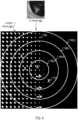
- FIG. 4 shows a CT image 402 of a portion of a lung and an illustration of a (2-D) latent space 404.
- a segmentation e.g., 406
- a segmentation neural network by processing the latent variable at the position in the latent space
- the latent space 404 has been rescaled so that the prior probability distribution over the latent space is a unit Normal distribution
- the circles 408-A-D denote deviations from the mean of the prior probability distribution in integer multiples of the standard deviation ⁇ .
- the white Xs (e.g., 410) overlaid on the latent space 404 denote the positions in the latent space 404 corresponding to target segmentations of the abnormal tissue in the CT image 402 that were manually generated by different human experts.
- FIG. 5 is a flow diagram of an example process 500 for generating multiple possible segmentations of an image.
- the process 500 will be described as being performed by a system of one or more computers located in one or more locations.
- a segmentation system e.g., the segmentation system 100 of FIG. 1 , appropriately programmed in accordance with this specification, can perform the process 500.
- the system receives a request to generate multiple segmentations of an image (502).
- the system samples multiple latent variables from a latent space, where each latent variable is sampled from the latent space in accordance with a respective probability distribution over the latent space that is determined based on (at least) the image (504).
- the system samples each latent variable using a global sampling technique.
- the system samples each latent variable in accordance with a respective probability distribution over the latent space that depends on the image, but not on any portion of the latent variable itself.
- the system samples each latent variable using a hierarchical sampling technique.
- the latent space includes a hierarchy (sequence) of latent subspaces
- sampling a latent variable from the latent space includes sequentially sampling a respective latent sub-variable from each latent sub-space of the latent space.
- the system To sample a latent sub-variable from a given latent sub-space, the system generates a probability distribution over the given latent sub-space based on: (i) the image, and (ii) latent sub-variables sampled from any latent sub-spaces that precede the given latent sub-space in the hierarchy of latent sub-spaces.
- the system samples the latent sub-variable from the given latent sub-space in accordance with the probability distribution over the given latent sub-space.
- the system generates multiple possible segmentations of the image (506).
- the system processes the image and the latent variable using a segmentation neural network having a set of segmentation neural network parameters to generate the possible segmentation of the image.
- the system provides the multiple segmentations of the image in response to the request (508).
- Embodiments of the subject matter and the functional operations described in this specification can be implemented in digital electronic circuitry, in tangibly-embodied computer software or firmware, in computer hardware, including the structures disclosed in this specification and their structural equivalents, or in combinations of one or more of them.
- Embodiments of the subject matter described in this specification can be implemented as one or more computer programs, i.e., one or more modules of computer program instructions encoded on a tangible non-transitory storage medium for execution by, or to control the operation of, data processing apparatus.
- the computer storage medium can be a machine-readable storage device, a machine-readable storage substrate, a random or serial access memory device, or a combination of one or more of them.
- the program instructions can be encoded on an artificially-generated propagated signal, e.g., a machine-generated electrical, optical, or electromagnetic signal, that is generated to encode information for transmission to suitable receiver apparatus for execution by a data processing apparatus.
- data processing apparatus refers to data processing hardware and encompasses all kinds of apparatus, devices, and machines for processing data, including by way of example a programmable processor, a computer, or multiple processors or computers.
- the apparatus can also be, or further include, special purpose logic circuitry, e.g., an FPGA (field programmable gate array) or an ASIC (application-specific integrated circuit).
- the apparatus can optionally include, in addition to hardware, code that creates an execution environment for computer programs, e.g., code that constitutes processor firmware, a protocol stack, a database management system, an operating system, or a combination of one or more of them.
- a computer program which may also be referred to or described as a program, software, a software application, an app, a module, a software module, a script, or code, can be written in any form of programming language, including compiled or interpreted languages, or declarative or procedural languages; and it can be deployed in any form, including as a stand-alone program or as a module, component, subroutine, or other unit suitable for use in a computing environment.
- a program may, but need not, correspond to a file in a file system.
- a program can be stored in a portion of a file that holds other programs or data, e.g., one or more scripts stored in a markup language document, in a single file dedicated to the program in question, or in multiple coordinated files, e.g., files that store one or more modules, sub-programs, or portions of code.
- a computer program can be deployed to be executed on one computer or on multiple computers that are located at one site or distributed across multiple sites and interconnected by a data communication network.
- engine is used broadly to refer to a software-based system, subsystem, or process that is programmed to perform one or more specific functions.
- an engine will be implemented as one or more software modules or components, installed on one or more computers in one or more locations. In some cases, one or more computers will be dedicated to a particular engine; in other cases, multiple engines can be installed and running on the same computer or computers.
- the processes and logic flows described in this specification can be performed by one or more programmable computers executing one or more computer programs to perform functions by operating on input data and generating output.
- the processes and logic flows can also be performed by special purpose logic circuitry, e.g., an FPGA or an ASIC, or by a combination of special purpose logic circuitry and one or more programmed computers.
- Computers suitable for the execution of a computer program can be based on general or special purpose microprocessors or both, or any other kind of central processing unit.
- a central processing unit will receive instructions and data from a read-only memory or a random access memory or both.
- the essential elements of a computer are a central processing unit for performing or executing instructions and one or more memory devices for storing instructions and data.
- the central processing unit and the memory can be supplemented by, or incorporated in, special purpose logic circuitry.
- a computer will also include, or be operatively coupled to receive data from or transfer data to, or both, one or more mass storage devices for storing data, e.g., magnetic, magneto-optical disks, or optical disks.
- a computer need not have such devices.
- a computer can be embedded in another device, e.g., a mobile telephone, a personal digital assistant (PDA), a mobile audio or video player, a game console, a Global Positioning System (GPS) receiver, or a portable storage device, e.g., a universal serial bus (USB) flash drive, to name just a few.
- PDA personal digital assistant
- GPS Global Positioning System
- USB universal serial bus
- Computer-readable media suitable for storing computer program instructions and data include all forms of non-volatile memory, media and memory devices, including by way of example semiconductor memory devices, e.g., EPROM, EEPROM, and flash memory devices; magnetic disks, e.g., internal hard disks or removable disks; magneto-optical disks; and CD-ROM and DVD-ROM disks.
- semiconductor memory devices e.g., EPROM, EEPROM, and flash memory devices
- magnetic disks e.g., internal hard disks or removable disks
- magneto-optical disks e.g., CD-ROM and DVD-ROM disks.
- embodiments of the subject matter described in this specification can be implemented on a computer having a display device, e.g., a CRT (cathode ray tube) or LCD (liquid crystal display) monitor, for displaying information to the user and a keyboard and a pointing device, e.g., a mouse or a trackball, by which the user can provide input to the computer.
- a display device e.g., a CRT (cathode ray tube) or LCD (liquid crystal display) monitor
- keyboard and a pointing device e.g., a mouse or a trackball
- Other kinds of devices can be used to provide for interaction with a user as well; for example, feedback provided to the user can be any form of sensory feedback, e.g., visual feedback, auditory feedback, or tactile feedback; and input from the user can be received in any form, including acoustic, speech, or tactile input.
- a computer can interact with a user by sending documents to and receiving documents from a device that is used by the user; for example, by sending web pages to a web browser on a user's device in response to requests received from the web browser.
- a computer can interact with a user by sending text messages or other forms of message to a personal device, e.g., a smartphone that is running a messaging application, and receiving responsive messages from the user in return.
- Data processing apparatus for implementing machine learning models can also include, for example, special-purpose hardware accelerator units for processing common and compute-intensive parts of machine learning training or production, i.e., inference, workloads.
- Machine learning models can be implemented and deployed using a machine learning framework, e.g., a TensorFlow framework, a Microsoft Cognitive Toolkit framework, an Apache Singa framework, or an Apache MXNet framework.
- a machine learning framework e.g., a TensorFlow framework, a Microsoft Cognitive Toolkit framework, an Apache Singa framework, or an Apache MXNet framework.
- Embodiments of the subject matter described in this specification can be implemented in a computing system that includes a back-end component, e.g., as a data server, or that includes a middleware component, e.g., an application server, or that includes a front-end component, e.g., a client computer having a graphical user interface, a web browser, or an app through which a user can interact with an implementation of the subject matter described in this specification, or any combination of one or more such back-end, middleware, or front-end components.
- the components of the system can be interconnected by any form or medium of digital data communication, e.g., a communication network. Examples of communication networks include a local area network (LAN) and a wide area network (WAN), e.g., the Internet.
- LAN local area network
- WAN wide area network
- the computing system can include clients and servers.
- a client and server are generally remote from each other and typically interact through a communication network. The relationship of client and server arises by virtue of computer programs running on the respective computers and having a client-server relationship to each other.
- a server transmits data, e.g., an HTML page, to a user device, e.g., for purposes of displaying data to and receiving user input from a user interacting with the device, which acts as a client.
- Data generated at the user device e.g., a result of the user interaction, can be received at the server from the device.
Landscapes
- Engineering & Computer Science (AREA)
- Health & Medical Sciences (AREA)
- Life Sciences & Earth Sciences (AREA)
- Physics & Mathematics (AREA)
- Computer Vision & Pattern Recognition (AREA)
- General Health & Medical Sciences (AREA)
- Medical Informatics (AREA)
- General Physics & Mathematics (AREA)
- Theoretical Computer Science (AREA)
- Biomedical Technology (AREA)
- Heart & Thoracic Surgery (AREA)
- Artificial Intelligence (AREA)
- Veterinary Medicine (AREA)
- Public Health (AREA)
- Animal Behavior & Ethology (AREA)
- Surgery (AREA)
- Molecular Biology (AREA)
- Nuclear Medicine, Radiotherapy & Molecular Imaging (AREA)
- Radiology & Medical Imaging (AREA)
- Biophysics (AREA)
- Pathology (AREA)
- Signal Processing (AREA)
- Quality & Reliability (AREA)
- Psychiatry (AREA)
- Physiology (AREA)
- Mathematical Physics (AREA)
- Fuzzy Systems (AREA)
- Evolutionary Computation (AREA)
- Image Analysis (AREA)
Claims (15)
- Verfahren (500), das von einem oder mehreren Datenverarbeitungsgeräten durchgeführt wird, wobei das Verfahren Folgendes umfasst:Empfangen (502) einer Anfrage zum Erzeugen einer Vielzahl von möglichen Segmentierungen (104; 306; 406) eines Bildes (102; 302; 402) ;Abtasten (504) einer Vielzahl von latenten Variablen (110) aus einem latenten Raum (404), wobei jede latente Variable (110) aus dem latenten Raum (404) gemäß einer jeweiligen Wahrscheinlichkeitsverteilung (106) über den latenten Raum (404) abgetastet wird, die zumindest teilweise basierend auf dem Bild (102; 302; 402) bestimmt wird, wobei:
der latente Raum (404) eine Hierarchie von latenten Teilräumen umfasst; und das Abtasten einer latenten Variablen (110) aus dem latenten Raum (404) das Abtasten einer jeweiligen latenten Teilvariable aus jedem latenten Teilraum des latenten Raums (404) umfasst, wobei das Abtasten einer latenten Teilvariable aus einem gegebenen latenten Teilraum Folgendes umfasst:
Erzeugen einer Wahrscheinlichkeitsverteilung (106) über den gegebenen latenten Teilraum basierend auf: (i) dem Bild (102; 302; 402) und (ii) latenten Teilvariablen, die aus einem beliebigen latenten Teilraum abgetastet werden, der dem gegebenen latenten Teilraum in der Hierarchie der latenten Teilräume vorangeht; und Abtasten der latenten Teilvariable aus dem gegebenen latenten Teilraum gemäß der Wahrscheinlichkeitsverteilung (106) über den gegebenen latenten Teilraum, Erzeugen (506) einer Vielzahl von möglichen Segmentierungen (104; 306; 406) des Bildes (102; 302; 402), umfassend Verarbeiten des Bildes (102; 302; 402) und der latenten Variablen (110) unter Verwendung eines neuronalen Netzes (112; 304), das eine Vielzahl von neuronalen Netzparametern für die Segmentierung aufweist, um die mögliche Segmentierung des Bildes (102; 302; 402) zu erzeugen, für jede latente Variable (110); und Bereitstellen (508) der Vielzahl von möglichen Segmentierungen (104; 306; 406) des Bildes (102; 302; 402) als Reaktion auf die Anfrage. - Verfahren (500) nach Anspruch 1, wobei für jeden bestimmten latenten Teilraum in der Hierarchie der latenten Teilräume eine Dimensionalität des bestimmten latenten Teilraums größer ist als eine Dimensionalität eines beliebigen latenten Teilraums, der dem bestimmten latenten Teilraum in der Hierarchie der latenten Teilräume vorangeht.
- Verfahren (500) nach einem der Ansprüche 1-2, wobei für jeden latenten Teilraum:
der latente Teilraum einen Raum von Arrays numerischer Werte umfasst, die eine jeweilige räumliche Auflösung aufweisen, die dem latenten Teilraum entspricht; und wobei die räumliche Auflösung, die dem latenten Teilraum entspricht, größer ist als eine räumliche Auflösung, die einem beliebigen vorhergehenden latenten Teilraum entspricht, und optional wobei die räumliche Auflösung, die jedem latenten Teilraum entspricht, von einer räumlichen Auflösung des Bildes (102; 302; 402) abhängt. - Verfahren (500) nach einem der Ansprüche 1-3, wobei das Erzeugen der Wahrscheinlichkeitsverteilung über den ersten latenten Teilraum in der Hierarchie der latenten Teilräume Folgendes umfasst:
Verarbeiten einer oder mehrerer aus dem Bild (102; 302; 402) abgeleiteter Merkmalsabbildungen unter Verwendung einer oder mehrerer neuronaler Netzschichten, um eine Ausgabe zu erzeugen, die Parameter der Wahrscheinlichkeitsverteilung über den ersten latenten Teilraum definiert, und wobei die eine oder mehreren Merkmalsabbildungen optional Zwischenausgaben des neuronalen Segmentierungsnetzes (112; 304) sind. - Verfahren (500) nach Anspruch 4, wobei die eine oder mehreren neuronalen Netzschichten Zwischenschichten des neuronalen Segmentierungsnetzes (112; 304) sind und/oder wobei die Wahrscheinlichkeitsverteilung über den ersten latenten Teilraum eine normale Wahrscheinlichkeitsverteilung ist und die Parameter der Wahrscheinlichkeitsverteilung über den ersten latenten Teilraum einen Mittelwertvektor und einen Varianzvektor beinhalten.
- Verfahren (500) nach einem der Ansprüche 1-5, wobei das Erzeugen der Wahrscheinlichkeitsverteilung über jeden latenten Teilraum nach dem ersten latenten Teilraum in der Hierarchie der latenten Teilräume Folgendes umfasst:
Verarbeiten einer oder mehrerer aus dem Bild (102; 302; 402) abgeleiteter Merkmalsabbildungen und einer Darstellung der latenten Teilvariable, die aus dem vorhergehenden latenten Teilraum in der Hierarchie der latenten Teilräume unter Verwendung einer oder mehrerer Schichten eines neuronalen Netzes abgetastet wurde, um eine Ausgabe zu erzeugen, die Parameter der Wahrscheinlichkeitsverteilung über den latenten Teilraum definiert, und optional wobei die Darstellung der latenten Teilvariable, die aus dem vorhergehenden latenten Teilraum abgetastet wird, eine hochskalierte Darstellung der latenten Teilvariable ist, die aus dem vorhergehenden latenten Teilraum abgetastet wird. - Verfahren (500) nach Anspruch 6, wobei die eine oder die mehreren Merkmalsabbildungen Zwischenausgaben des neuronalen Segmentierungsnetzes (112; 304) sind und/oder wobei die eine oder die mehreren neuronalen Netzschichten Zwischenschichten des neuronalen Segmentierungsnetzes (112; 304) sind.
- Verfahren (500) nach einem der Ansprüche 6-7, wobei für jeden latenten Teilraum nach dem ersten latenten Teilraum die Wahrscheinlichkeitsverteilung über den latenten Teilraum eine normale Wahrscheinlichkeitsverteilung ist, und die Parameter der Wahrscheinlichkeitsverteilung über den latenten Teilraum einen Mittelwertvektor und einen Varianzvektor beinhalten.
- Verfahren (500) nach einem der Ansprüche 1-8, wobei das Verarbeiten des Bildes (102; 302; 402) und der latenten Variablen (110) unter Verwendung eines neuronalen Segmentierungsnetzes (112; 304) zum Erzeugen der möglichen Segmentierung des Bildes (102; 302; 402) Folgendes umfasst:
Bereitstellen des Bildes (102; 302; 402) als Eingabe an eine Eingabeschicht des neuronalen Segmentierungsnetzes (112; 304); und Bereitstellen jeder latenten Teilvariablen als Eingabe an eine jeweilige Zwischenschicht des neuronalen Segmentierungsnetzes (112; 304). - Verfahren (500) nach einem der Ansprüche 1-9, wobei das neuronale Segmentierungsnetz (112; 304) gemeinsam mit einem posterioren neuronalen Netz (352) trainiert wurde, das dazu konfiguriert ist, während des Trainierens ein Trainingsbild (354) und eine Zielsegmentierung (356) des Trainingsbildes (354) zu verarbeiten, um eine Ausgabe zu erzeugen, die für jeden latenten Teilraum der Hierarchie der latenten Teilräume Parameter einer posterioren Wahrscheinlichkeitsverteilung (358) über den latenten Teilraum definiert.
- Verfahren (500) nach einem der Ansprüche 1-10, wobei jede mögliche Segmentierung (104; 306; 406) des Bildes (102; 302; 402) für jedes Pixel des Bildes (102; 302; 402) eine jeweilige Wahrscheinlichkeit kennzeichnet, dass das Pixel in jeder einer Vielzahl von Kategorien beinhaltet ist.
- Verfahren (500) nach Anspruch 11, wobei das Bild (102; 302; 402) ein medizinisches Bild ist und jede der Vielzahl von Kategorien einer jeweiligen Gewebeart entspricht und wobei das medizinische Bild optional ein Computertomographie-(computed tomography, CT-)Bild (402) ist.
- Verfahren (500) nach einem der Ansprüche 1-12, wobei das neuronale Segmentierungsnetz (112; 304) ein neuronales Faltungsnetz ist und wobei das neuronale Segmentierungsnetz (112; 304) optional eine neuronale U-Net-Netzarchitektur aufweist.
- System (100; 300), umfassend einen oder mehrere Computer und eine oder mehrere Speichervorrichtungen, der/die Anweisungen speichert/speichern, die, wenn sie von dem einen oder den mehreren Computern ausgeführt werden, den einen oder die mehreren Computer dazu veranlassen, die Vorgänge des jeweiligen Verfahrens nach einem der Ansprüche 1-13 durchzuführen.
- Ein oder mehrere Computerspeichermedien, die Anweisungen speichern, die, wenn sie von einem oder mehreren Computern ausgeführt werden, den einen oder die mehreren Computer dazu veranlassen, die Vorgänge des jeweiligen Verfahrens nach einem der Ansprüche 1-13 durchzuführen.
Applications Claiming Priority (2)
| Application Number | Priority Date | Filing Date | Title |
|---|---|---|---|
| US201962852178P | 2019-05-23 | 2019-05-23 | |
| PCT/EP2020/064069 WO2020234349A1 (en) | 2019-05-23 | 2020-05-20 | Sampling latent variables to generate multiple segmentations of an image |
Publications (2)
| Publication Number | Publication Date |
|---|---|
| EP3973508A1 EP3973508A1 (de) | 2022-03-30 |
| EP3973508B1 true EP3973508B1 (de) | 2025-01-01 |
Family
ID=70847361
Family Applications (1)
| Application Number | Title | Priority Date | Filing Date |
|---|---|---|---|
| EP20727974.6A Active EP3973508B1 (de) | 2019-05-23 | 2020-05-20 | Abtasten latenter variablen zur erzeugung mehrerer segmentierungen eines bildes |
Country Status (3)
| Country | Link |
|---|---|
| US (1) | US11430123B2 (de) |
| EP (1) | EP3973508B1 (de) |
| WO (1) | WO2020234349A1 (de) |
Families Citing this family (14)
| Publication number | Priority date | Publication date | Assignee | Title |
|---|---|---|---|---|
| EP3716150A1 (de) * | 2019-03-27 | 2020-09-30 | Nvidia Corporation | Verbesserte bildsegmentierung unter verwendung eines übersetzungsmodells für neuronale netzwerke |
| WO2021059349A1 (ja) * | 2019-09-24 | 2021-04-01 | 富士通株式会社 | 学習方法、学習プログラム、および学習装置 |
| JP7205640B2 (ja) * | 2019-09-24 | 2023-01-17 | 富士通株式会社 | 学習方法、学習プログラム、および学習装置 |
| US12423931B2 (en) * | 2019-11-22 | 2025-09-23 | Uisee (Shanghai) Automotive Technologies Ltd | Simulation scene image generation method, electronic device and storage medium |
| EP3885974B1 (de) * | 2020-03-28 | 2024-01-03 | Tata Consultancy Services Limited | Verfahren und systeme zur erkennung der anwesenheit abnormaler herztöne eines subjekts |
| US12136481B2 (en) * | 2020-06-23 | 2024-11-05 | Virtual Radiologic Corporation | Medical imaging characteristic detection, workflows, and AI model management |
| CN114330471A (zh) * | 2020-09-25 | 2022-04-12 | 辉达公司 | 基于能量的变分自动编码器 |
| US20220101122A1 (en) * | 2020-09-25 | 2022-03-31 | Nvidia Corporation | Energy-based variational autoencoders |
| CN112529150B (zh) * | 2020-12-01 | 2024-06-14 | 华为技术有限公司 | 一种模型结构、模型训练方法、图像增强方法及设备 |
| BE1028516B1 (fr) | 2020-12-23 | 2022-02-16 | Oncoradiomics | Les méthodes et systèmes de segmentation d'images biomédicales comprenant une attention gated skip connection |
| EP4399724A4 (de) * | 2021-09-08 | 2025-06-25 | Janssen Research & Development, LLC | Multimodales system und verfahren zur vorhersage von krebs |
| CN114693830B (zh) * | 2022-05-27 | 2022-11-15 | 阿里巴巴达摩院(杭州)科技有限公司 | 医学影像的多器官分割、模型训练方法、设备及介质 |
| CN118071637B (zh) * | 2024-04-24 | 2024-07-09 | 厦门立马耀网络科技有限公司 | 一种具有多维度潜在空间的图像生成方法及装置 |
| CN119809959A (zh) * | 2025-03-13 | 2025-04-11 | 山东黄海智能装备有限公司 | 一种微生物实验菌落图像处理方法 |
Family Cites Families (10)
| Publication number | Priority date | Publication date | Assignee | Title |
|---|---|---|---|---|
| US10776710B2 (en) * | 2015-03-24 | 2020-09-15 | International Business Machines Corporation | Multimodal data fusion by hierarchical multi-view dictionary learning |
| US11062229B1 (en) * | 2016-02-18 | 2021-07-13 | Deepmind Technologies Limited | Training latent variable machine learning models using multi-sample objectives |
| US11042811B2 (en) * | 2016-10-05 | 2021-06-22 | D-Wave Systems Inc. | Discrete variational auto-encoder systems and methods for machine learning using adiabatic quantum computers |
| CN110622169A (zh) * | 2017-05-15 | 2019-12-27 | 渊慧科技有限公司 | 用于视频中的动作识别的神经网络系统 |
| US10624558B2 (en) * | 2017-08-10 | 2020-04-21 | Siemens Healthcare Gmbh | Protocol independent image processing with adversarial networks |
| WO2019157228A1 (en) * | 2018-02-09 | 2019-08-15 | D-Wave Systems Inc. | Systems and methods for training generative machine learning models |
| GB2581808B (en) * | 2019-02-26 | 2022-08-10 | Imperial College Innovations Ltd | Scene representation using image processing |
| US10872275B2 (en) * | 2019-03-22 | 2020-12-22 | Nokia Technologies Oy | Semantic segmentation based on a hierarchy of neural networks |
| KR102102255B1 (ko) * | 2019-05-14 | 2020-04-20 | 주식회사 뷰노 | 의료 영상에서 병변의 시각화를 보조하는 방법 및 이를 이용한 장치 |
| US10482603B1 (en) * | 2019-06-25 | 2019-11-19 | Artificial Intelligence, Ltd. | Medical image segmentation using an integrated edge guidance module and object segmentation network |
-
2020
- 2020-05-20 WO PCT/EP2020/064069 patent/WO2020234349A1/en not_active Ceased
- 2020-05-20 EP EP20727974.6A patent/EP3973508B1/de active Active
- 2020-05-22 US US16/881,775 patent/US11430123B2/en active Active
Also Published As
| Publication number | Publication date |
|---|---|
| EP3973508A1 (de) | 2022-03-30 |
| US11430123B2 (en) | 2022-08-30 |
| US20200372654A1 (en) | 2020-11-26 |
| WO2020234349A1 (en) | 2020-11-26 |
Similar Documents
| Publication | Publication Date | Title |
|---|---|---|
| US11430123B2 (en) | Sampling latent variables to generate multiple segmentations of an image | |
| US11676281B2 (en) | 3-D convolutional neural networks for organ segmentation in medical images for radiotherapy planning | |
| EP3979198B1 (de) | Bildsegmentierungsmodelltrainingsverfahren und -einrichtung, computervorrichtung und speichermedium | |
| US11704804B2 (en) | Domain adaptation using post-processing model correction | |
| EP3869387B1 (de) | Verfahren, vorrichtung, endgerät und speichermedium zur dreidimensionalen semantischen bildsegmentierung | |
| US20250285265A1 (en) | Systems and methods for detecting structures in 3d images | |
| US11854703B2 (en) | Simulating abnormalities in medical images with generative adversarial networks | |
| US10600185B2 (en) | Automatic liver segmentation using adversarial image-to-image network | |
| US20250316074A1 (en) | Multi-layer perceptron-based computer vision neural networks | |
| JP2024170409A (ja) | 自己注意ベースのニューラルネットワークを使用した画像処理 | |
| US10592820B2 (en) | Sequential learning technique for medical image segmentation | |
| CN110914866A (zh) | 用于在图像分析中进行解剖结构分割的系统和方法 | |
| CN115190999B (zh) | 使用对比损失对分布外的数据进行分类 | |
| Velichko et al. | A comprehensive review of deep learning approaches for magnetic resonance imaging liver tumor analysis | |
| EP3657514A1 (de) | Interaktive iterative bildannotation | |
| He et al. | Deep learning-based image classification for AI-assisted integration of pathology and radiology in medical imaging | |
| US20220414886A1 (en) | Semantic image segmentation using contrastive channels | |
| Zhou et al. | Wrist ultrasound segmentation by deep learning | |
| EP4073755B1 (de) | Kompensation von organverformung zur registrierung medizinischer bilder | |
| CN119560090A (zh) | 一种基于x线胸片的影像报告生成方法及相关设备 | |
| Ndir et al. | Dynamic Prompt Generation for Interactive 3D Medical Image Segmentation Training | |
| CN115526893B (zh) | 一种基于深度学习的海马体分割方法、装置及存储介质 | |
| EP4455993A1 (de) | System und verfahren zum trainieren eines segmentierungsverfahrens mit benutzerkorrekturen | |
| US20250166170A1 (en) | Machine learning based medical imaging analysis using few shot learning with task instructions | |
| Kul et al. | Gray's Anatomy for Segment Anything Model: Optimizing Grayscale Medical Images for Fast and Lightweight |
Legal Events
| Date | Code | Title | Description |
|---|---|---|---|
| STAA | Information on the status of an ep patent application or granted ep patent |
Free format text: STATUS: UNKNOWN |
|
| STAA | Information on the status of an ep patent application or granted ep patent |
Free format text: STATUS: THE INTERNATIONAL PUBLICATION HAS BEEN MADE |
|
| PUAI | Public reference made under article 153(3) epc to a published international application that has entered the european phase |
Free format text: ORIGINAL CODE: 0009012 |
|
| STAA | Information on the status of an ep patent application or granted ep patent |
Free format text: STATUS: REQUEST FOR EXAMINATION WAS MADE |
|
| 17P | Request for examination filed |
Effective date: 20211013 |
|
| AK | Designated contracting states |
Kind code of ref document: A1 Designated state(s): AL AT BE BG CH CY CZ DE DK EE ES FI FR GB GR HR HU IE IS IT LI LT LU LV MC MK MT NL NO PL PT RO RS SE SI SK SM TR |
|
| DAV | Request for validation of the european patent (deleted) | ||
| DAX | Request for extension of the european patent (deleted) | ||
| STAA | Information on the status of an ep patent application or granted ep patent |
Free format text: STATUS: EXAMINATION IS IN PROGRESS |
|
| 17Q | First examination report despatched |
Effective date: 20230116 |
|
| P01 | Opt-out of the competence of the unified patent court (upc) registered |
Effective date: 20230505 |
|
| REG | Reference to a national code |
Ref country code: DE Ipc: A61B0005000000 Ref country code: DE Ref legal event code: R079 Ref document number: 602020044035 Country of ref document: DE Free format text: PREVIOUS MAIN CLASS: G06T0007110000 Ipc: A61B0005000000 |
|
| GRAP | Despatch of communication of intention to grant a patent |
Free format text: ORIGINAL CODE: EPIDOSNIGR1 |
|
| STAA | Information on the status of an ep patent application or granted ep patent |
Free format text: STATUS: GRANT OF PATENT IS INTENDED |
|
| RIC1 | Information provided on ipc code assigned before grant |
Ipc: G06T 7/11 20170101ALI20240708BHEP Ipc: A61B 5/055 20060101ALI20240708BHEP Ipc: A61B 5/00 20060101AFI20240708BHEP |
|
| INTG | Intention to grant announced |
Effective date: 20240725 |
|
| GRAS | Grant fee paid |
Free format text: ORIGINAL CODE: EPIDOSNIGR3 |
|
| GRAA | (expected) grant |
Free format text: ORIGINAL CODE: 0009210 |
|
| STAA | Information on the status of an ep patent application or granted ep patent |
Free format text: STATUS: THE PATENT HAS BEEN GRANTED |
|
| AK | Designated contracting states |
Kind code of ref document: B1 Designated state(s): AL AT BE BG CH CY CZ DE DK EE ES FI FR GB GR HR HU IE IS IT LI LT LU LV MC MK MT NL NO PL PT RO RS SE SI SK SM TR |
|
| REG | Reference to a national code |
Ref country code: GB Ref legal event code: FG4D |
|
| REG | Reference to a national code |
Ref country code: CH Ref legal event code: EP |
|
| REG | Reference to a national code |
Ref country code: DE Ref legal event code: R096 Ref document number: 602020044035 Country of ref document: DE |
|
| REG | Reference to a national code |
Ref country code: IE Ref legal event code: FG4D |
|
| REG | Reference to a national code |
Ref country code: SE Ref legal event code: TRGR |
|
| REG | Reference to a national code |
Ref country code: LT Ref legal event code: MG9D |
|
| REG | Reference to a national code |
Ref country code: NL Ref legal event code: MP Effective date: 20250101 |
|
| REG | Reference to a national code |
Ref country code: AT Ref legal event code: MK05 Ref document number: 1755397 Country of ref document: AT Kind code of ref document: T Effective date: 20250101 |
|
| PG25 | Lapsed in a contracting state [announced via postgrant information from national office to epo] |
Ref country code: NL Free format text: LAPSE BECAUSE OF FAILURE TO SUBMIT A TRANSLATION OF THE DESCRIPTION OR TO PAY THE FEE WITHIN THE PRESCRIBED TIME-LIMIT Effective date: 20250101 |
|
| PG25 | Lapsed in a contracting state [announced via postgrant information from national office to epo] |
Ref country code: FI Free format text: LAPSE BECAUSE OF FAILURE TO SUBMIT A TRANSLATION OF THE DESCRIPTION OR TO PAY THE FEE WITHIN THE PRESCRIBED TIME-LIMIT Effective date: 20250101 |
|
| PG25 | Lapsed in a contracting state [announced via postgrant information from national office to epo] |
Ref country code: PL Free format text: LAPSE BECAUSE OF FAILURE TO SUBMIT A TRANSLATION OF THE DESCRIPTION OR TO PAY THE FEE WITHIN THE PRESCRIBED TIME-LIMIT Effective date: 20250101 |
|
| PGFP | Annual fee paid to national office [announced via postgrant information from national office to epo] |
Ref country code: DE Payment date: 20250529 Year of fee payment: 6 |
|
| PG25 | Lapsed in a contracting state [announced via postgrant information from national office to epo] |
Ref country code: ES Free format text: LAPSE BECAUSE OF FAILURE TO SUBMIT A TRANSLATION OF THE DESCRIPTION OR TO PAY THE FEE WITHIN THE PRESCRIBED TIME-LIMIT Effective date: 20250101 |
|
| PGFP | Annual fee paid to national office [announced via postgrant information from national office to epo] |
Ref country code: GB Payment date: 20250527 Year of fee payment: 6 |
|
| PG25 | Lapsed in a contracting state [announced via postgrant information from national office to epo] |
Ref country code: IS Free format text: LAPSE BECAUSE OF FAILURE TO SUBMIT A TRANSLATION OF THE DESCRIPTION OR TO PAY THE FEE WITHIN THE PRESCRIBED TIME-LIMIT Effective date: 20250501 Ref country code: NO Free format text: LAPSE BECAUSE OF FAILURE TO SUBMIT A TRANSLATION OF THE DESCRIPTION OR TO PAY THE FEE WITHIN THE PRESCRIBED TIME-LIMIT Effective date: 20250401 |
|
| PG25 | Lapsed in a contracting state [announced via postgrant information from national office to epo] |
Ref country code: HR Free format text: LAPSE BECAUSE OF FAILURE TO SUBMIT A TRANSLATION OF THE DESCRIPTION OR TO PAY THE FEE WITHIN THE PRESCRIBED TIME-LIMIT Effective date: 20250101 |
|
| PG25 | Lapsed in a contracting state [announced via postgrant information from national office to epo] |
Ref country code: LV Free format text: LAPSE BECAUSE OF FAILURE TO SUBMIT A TRANSLATION OF THE DESCRIPTION OR TO PAY THE FEE WITHIN THE PRESCRIBED TIME-LIMIT Effective date: 20250101 Ref country code: PT Free format text: LAPSE BECAUSE OF FAILURE TO SUBMIT A TRANSLATION OF THE DESCRIPTION OR TO PAY THE FEE WITHIN THE PRESCRIBED TIME-LIMIT Effective date: 20250502 |
|
| PGFP | Annual fee paid to national office [announced via postgrant information from national office to epo] |
Ref country code: FR Payment date: 20250526 Year of fee payment: 6 |
|
| PG25 | Lapsed in a contracting state [announced via postgrant information from national office to epo] |
Ref country code: GR Free format text: LAPSE BECAUSE OF FAILURE TO SUBMIT A TRANSLATION OF THE DESCRIPTION OR TO PAY THE FEE WITHIN THE PRESCRIBED TIME-LIMIT Effective date: 20250402 Ref country code: BG Free format text: LAPSE BECAUSE OF FAILURE TO SUBMIT A TRANSLATION OF THE DESCRIPTION OR TO PAY THE FEE WITHIN THE PRESCRIBED TIME-LIMIT Effective date: 20250101 |
|
| PG25 | Lapsed in a contracting state [announced via postgrant information from national office to epo] |
Ref country code: AT Free format text: LAPSE BECAUSE OF FAILURE TO SUBMIT A TRANSLATION OF THE DESCRIPTION OR TO PAY THE FEE WITHIN THE PRESCRIBED TIME-LIMIT Effective date: 20250101 |
|
| PG25 | Lapsed in a contracting state [announced via postgrant information from national office to epo] |
Ref country code: CZ Free format text: LAPSE BECAUSE OF FAILURE TO SUBMIT A TRANSLATION OF THE DESCRIPTION OR TO PAY THE FEE WITHIN THE PRESCRIBED TIME-LIMIT Effective date: 20250101 |
|
| PGFP | Annual fee paid to national office [announced via postgrant information from national office to epo] |
Ref country code: IE Payment date: 20250527 Year of fee payment: 6 |
|
| PGFP | Annual fee paid to national office [announced via postgrant information from national office to epo] |
Ref country code: SE Payment date: 20250527 Year of fee payment: 6 |
|
| REG | Reference to a national code |
Ref country code: DE Ref legal event code: R097 Ref document number: 602020044035 Country of ref document: DE |
|
| PG25 | Lapsed in a contracting state [announced via postgrant information from national office to epo] |
Ref country code: SM Free format text: LAPSE BECAUSE OF FAILURE TO SUBMIT A TRANSLATION OF THE DESCRIPTION OR TO PAY THE FEE WITHIN THE PRESCRIBED TIME-LIMIT Effective date: 20250101 |
|
| PG25 | Lapsed in a contracting state [announced via postgrant information from national office to epo] |
Ref country code: DK Free format text: LAPSE BECAUSE OF FAILURE TO SUBMIT A TRANSLATION OF THE DESCRIPTION OR TO PAY THE FEE WITHIN THE PRESCRIBED TIME-LIMIT Effective date: 20250101 |
|
| PG25 | Lapsed in a contracting state [announced via postgrant information from national office to epo] |
Ref country code: IT Free format text: LAPSE BECAUSE OF FAILURE TO SUBMIT A TRANSLATION OF THE DESCRIPTION OR TO PAY THE FEE WITHIN THE PRESCRIBED TIME-LIMIT Effective date: 20250101 |
|
| PG25 | Lapsed in a contracting state [announced via postgrant information from national office to epo] |
Ref country code: EE Free format text: LAPSE BECAUSE OF FAILURE TO SUBMIT A TRANSLATION OF THE DESCRIPTION OR TO PAY THE FEE WITHIN THE PRESCRIBED TIME-LIMIT Effective date: 20250101 |
|
| PG25 | Lapsed in a contracting state [announced via postgrant information from national office to epo] |
Ref country code: RO Free format text: LAPSE BECAUSE OF FAILURE TO SUBMIT A TRANSLATION OF THE DESCRIPTION OR TO PAY THE FEE WITHIN THE PRESCRIBED TIME-LIMIT Effective date: 20250101 |
|
| PG25 | Lapsed in a contracting state [announced via postgrant information from national office to epo] |
Ref country code: SK Free format text: LAPSE BECAUSE OF FAILURE TO SUBMIT A TRANSLATION OF THE DESCRIPTION OR TO PAY THE FEE WITHIN THE PRESCRIBED TIME-LIMIT Effective date: 20250101 |
|
| PLBE | No opposition filed within time limit |
Free format text: ORIGINAL CODE: 0009261 |
|
| STAA | Information on the status of an ep patent application or granted ep patent |
Free format text: STATUS: NO OPPOSITION FILED WITHIN TIME LIMIT |
|
| REG | Reference to a national code |
Ref country code: CH Ref legal event code: L10 Free format text: ST27 STATUS EVENT CODE: U-0-0-L10-L00 (AS PROVIDED BY THE NATIONAL OFFICE) Effective date: 20251112 |
|
| 26N | No opposition filed |
Effective date: 20251002 |
|
| REG | Reference to a national code |
Ref country code: CH Ref legal event code: H13 Free format text: ST27 STATUS EVENT CODE: U-0-0-H10-H13 (AS PROVIDED BY THE NATIONAL OFFICE) Effective date: 20251223 |
|
| PG25 | Lapsed in a contracting state [announced via postgrant information from national office to epo] |
Ref country code: LU Free format text: LAPSE BECAUSE OF NON-PAYMENT OF DUE FEES Effective date: 20250520 |
|
| PG25 | Lapsed in a contracting state [announced via postgrant information from national office to epo] |
Ref country code: CH Free format text: LAPSE BECAUSE OF NON-PAYMENT OF DUE FEES Effective date: 20250531 |
|
| REG | Reference to a national code |
Ref country code: DE Ref legal event code: R081 Ref document number: 602020044035 Country of ref document: DE Owner name: GDM HOLDING LLC (N.D.GES.D.STAATES DELAWARE), , US Free format text: FORMER OWNER: DEEPMIND TECHNOLOGIES LIMITED, LONDON, GB |
|
| REG | Reference to a national code |
Ref country code: BE Ref legal event code: MM Effective date: 20250531 |
|
| PG25 | Lapsed in a contracting state [announced via postgrant information from national office to epo] |
Ref country code: MC Free format text: LAPSE BECAUSE OF FAILURE TO SUBMIT A TRANSLATION OF THE DESCRIPTION OR TO PAY THE FEE WITHIN THE PRESCRIBED TIME-LIMIT Effective date: 20250101 |
|
| PG25 | Lapsed in a contracting state [announced via postgrant information from national office to epo] |
Ref country code: BE Free format text: LAPSE BECAUSE OF NON-PAYMENT OF DUE FEES Effective date: 20250531 |