EP3971521B1 - Target direction determining device, control system, and method and program for aiming surveying device at a target - Google Patents
Target direction determining device, control system, and method and program for aiming surveying device at a target Download PDFInfo
- Publication number
- EP3971521B1 EP3971521B1 EP21195289.0A EP21195289A EP3971521B1 EP 3971521 B1 EP3971521 B1 EP 3971521B1 EP 21195289 A EP21195289 A EP 21195289A EP 3971521 B1 EP3971521 B1 EP 3971521B1
- Authority
- EP
- European Patent Office
- Prior art keywords
- target
- surveying device
- laser scanner
- photographic image
- seen
- Prior art date
- Legal status (The legal status is an assumption and is not a legal conclusion. Google has not performed a legal analysis and makes no representation as to the accuracy of the status listed.)
- Active
Links
Images


Classifications
-
- G—PHYSICS
- G01—MEASURING; TESTING
- G01C—MEASURING DISTANCES, LEVELS OR BEARINGS; SURVEYING; NAVIGATION; GYROSCOPIC INSTRUMENTS; PHOTOGRAMMETRY OR VIDEOGRAMMETRY
- G01C11/00—Photogrammetry or videogrammetry, e.g. stereogrammetry; Photographic surveying
- G01C11/02—Picture taking arrangements specially adapted for photogrammetry or photographic surveying, e.g. controlling overlapping of pictures
- G01C11/025—Picture taking arrangements specially adapted for photogrammetry or photographic surveying, e.g. controlling overlapping of pictures by scanning the object
-
- G—PHYSICS
- G01—MEASURING; TESTING
- G01C—MEASURING DISTANCES, LEVELS OR BEARINGS; SURVEYING; NAVIGATION; GYROSCOPIC INSTRUMENTS; PHOTOGRAMMETRY OR VIDEOGRAMMETRY
- G01C15/00—Surveying instruments or accessories not provided for in groups G01C1/00 - G01C13/00
- G01C15/002—Active optical surveying means
-
- G—PHYSICS
- G01—MEASURING; TESTING
- G01B—MEASURING LENGTH, THICKNESS OR SIMILAR LINEAR DIMENSIONS; MEASURING ANGLES; MEASURING AREAS; MEASURING IRREGULARITIES OF SURFACES OR CONTOURS
- G01B11/00—Measuring arrangements characterised by the use of optical techniques
- G01B11/002—Measuring arrangements characterised by the use of optical techniques for measuring two or more coordinates
-
- G—PHYSICS
- G01—MEASURING; TESTING
- G01C—MEASURING DISTANCES, LEVELS OR BEARINGS; SURVEYING; NAVIGATION; GYROSCOPIC INSTRUMENTS; PHOTOGRAMMETRY OR VIDEOGRAMMETRY
- G01C15/00—Surveying instruments or accessories not provided for in groups G01C1/00 - G01C13/00
- G01C15/02—Means for marking measuring points
- G01C15/06—Surveyors' staffs; Movable markers
-
- G—PHYSICS
- G01—MEASURING; TESTING
- G01S—RADIO DIRECTION-FINDING; RADIO NAVIGATION; DETERMINING DISTANCE OR VELOCITY BY USE OF RADIO WAVES; LOCATING OR PRESENCE-DETECTING BY USE OF THE REFLECTION OR RERADIATION OF RADIO WAVES; ANALOGOUS ARRANGEMENTS USING OTHER WAVES
- G01S17/00—Systems using the reflection or reradiation of electromagnetic waves other than radio waves, e.g. lidar systems
- G01S17/02—Systems using the reflection of electromagnetic waves other than radio waves
- G01S17/06—Systems determining position data of a target
- G01S17/42—Simultaneous measurement of distance and other co-ordinates
-
- G—PHYSICS
- G01—MEASURING; TESTING
- G01S—RADIO DIRECTION-FINDING; RADIO NAVIGATION; DETERMINING DISTANCE OR VELOCITY BY USE OF RADIO WAVES; LOCATING OR PRESENCE-DETECTING BY USE OF THE REFLECTION OR RERADIATION OF RADIO WAVES; ANALOGOUS ARRANGEMENTS USING OTHER WAVES
- G01S17/00—Systems using the reflection or reradiation of electromagnetic waves other than radio waves, e.g. lidar systems
- G01S17/86—Combinations of lidar systems with systems other than lidar, radar or sonar, e.g. with direction finders
Definitions
- the present invention relates to control of a surveying device.
- a target such as a reflective prism
- a surveying device At a surveying site, it may be necessary to determine coordinates of a specific point.
- a target such as a reflective prism
- the location of the target can be measured by automatically operating the surveying device while a worker carries the target by hand to move it.
- Document EP3702728 A1 discloses a target instrument as part of a surveying system in which a terminal device attached to the target pole captures a photo of a surveying instrument to determine the tilt of the target pole.
- an object of the present invention is to provide a technique that enables a surveying device to acquire the direction of a target by using as little extra hardware as possible.
- the present invention provides a target direction determining device that is configured to determine a direction of a target as seen from a surveying device.
- the direction of the target as seen from the surveying device is determined on the basis of a photographic image of the surveying device that is captured from the target side.
- the surveying device may include a directional indicator that enables determination of the direction in which the surveying device is facing.
- the direction of the target as seen from the surveying device may be determined on the basis of the direction the surveying device is facing in the photographic image and the direction of an optical axis of the photographic image.
- the present invention can also be understood as a control system including the target direction determining device and a control device.
- the control device is configured to rotate the surveying device to aim the surveying device at the target on the basis of the direction of the target as seen from the surveying device.
- the present invention can also be understood as a method for aiming a surveying device at a target.
- This method includes acquiring a photographic image of the surveying device that is captured from the target side, determining the direction of the target as seen from the surveying device, on the basis of the photographic image, and rotating the surveying device to aim the surveying device at the target on the basis of the direction of the target as seen from the surveying device.
- the present invention can also be understood as a method for aiming a surveying device at a target.
- This method includes acquiring a photographic image of the surveying device that is captured from the target side by a terminal equipped with a camera, and transmitting the photographic image to a processing server by using a communication function of the terminal equipped with the camera.
- the method also includes determining a direction of the target as seen from the surveying device, on the basis of the photographic image, by the processing server, and rotating the surveying device to aim the surveying device at the target on the basis of the direction of the target.
- the present invention can also be understood as a non-transitory computer recording medium storing computer executable instructions for aiming a surveying device at a target.
- the computer executable instructions when executed by a computer processor, cause the computer processor to acquire a photographic image of the surveying device that is captured from the target side and to determine a direction of the target as seen from the surveying device, on the basis of the photographic image.
- the computer executable instructions when executed by a computer processor, also cause the computer processor to rotate the surveying device to aim the surveying device at the target on the basis of the direction of the target as seen from the surveying device.
- the present invention provides a technique that enables a surveying device to acquire a direction of a target by using as little extra hardware as possible.
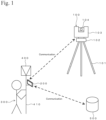
- Fig. 1 shows an overview of an embodiment. This technique is intended to aim a laser scanner 100, as a surveying device, at a reflective prism 400 that is a target.
- the laser scanner 100 is photographed by a smartphone 200 on the reflective prism 400 side, and a photographic image is acquired. On the basis of this photographic image, the direction of the reflective prism 400 as seen from the laser scanner 100 is determined. Then, the laser scanner 100 is rotated to be directed to the reflective prism 400, based on the determined direction.
- Fig. 1 shows the laser scanner 100 as a surveying device.
- a laser scanning point cloud is obtained by using the laser scanner 100.
- the surveying device can employ a total station or a total station equipped with a laser scanner.
- Fig. 1 shows the reflective prism 400 as a surveying target that a worker 300 can carry by hand.
- the reflective prism 400 is a reflective prism for surveying, and it reflects an incident light ray in a direction inverted by 180 degrees.
- the smartphone 200 is attached to a support bar 410 for supporting the reflective prism 400, and relative positional relationships between the reflective prism 400 and the smartphone 200 are fixed.
- the separation distance between the reflective prism 400 and the smartphone 200 is reduced as much as possible.
- a separation distance in a lateral direction or horizontal direction orthogonal to a direction of the laser scanner 100 as seen from the reflective prism 400 is 50 cm or less, and is more preferably 30 cm or less.
- the smartphone 200 is a commercially available ordinary device and includes a camera, a wireless LAN unit, and a data communication function using an internet line.
- This example uses the smartphone 200 as a control terminal or controller of the laser scanner 100. It is also possible to utilize a tablet PC or a dedicated terminal as the control terminal.
- the worker 300 sets up the reflective prism 400 at a desired location to be measured by the laser scanner 100.
- the worker 300 then takes a photograph of the laser scanner 100 by using the camera function of the smartphone 200.
- the image data of this photographic image of the laser scanner 100 is transmitted to a processing server 500.
- the transmission of the image data from the smartphone 200 to the processing server 500 is performed by using an internet line.
- the laser scanner 100 can be photographed in the state in which the worker 300 holds the smartphone 200 in the worker's hand.
- the photographing in this situation is performed in a condition in which a separation distance between the smartphone 200 and the reflective prism 400 in a horizontal direction orthogonal to a line connecting the reflective prism 400 and the laser scanner 100 is 50 cm or less, and is more preferably 30 cm or less.
- the laser scanner 100 is sighted in a state in which an image of the laser scanner 100 shown on the display of the smartphone 200 is maximally enlarged.
- the processing server 500 estimates the direction of the smartphone 200 or the reflective prism 400 relative to the front direction of the laser scanner 100, by using an artificial intelligence (AI) estimation function, on the basis of the photographic image of the laser scanner 100 captured by the smartphone 200.
- AI artificial intelligence
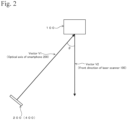
- Fig. 2 is a model diagram as viewed downwardly from the vertical direction. Note that the positions of the smartphone 200 and the reflective prism 400 differ from each other in a strict sense, but herein, these are assumed to be the same.
- Fig. 2 shows a direction of the laser scanner 100 as seen from the smartphone 200 or the reflective prism 400 in the horizontal direction, by a vector V1.
- the vector V1 coincides with the direction of the optical axis of the smartphone 200.
- the front direction of the laser scanner 100 is represented by a vector V2.
- the way the laser scanner 100 is viewed in the photographic image, which is captured by the smartphone 200, is estimated by AI, whereby the direction of the vector V2 relative to the depth direction of the photographic image, that is, the direction of the vector V1, is determined. Specifically, an angle ⁇ between the direction of the laser scanner 100 as seen from the reflective prism 400 (vector V1) and the front direction of the laser scanner 100 (vector V2) is estimated.
- the direction of the reflective prism 400 as seen from the laser scanner 100 relative to the front direction of the laser scanner 100 can be estimated.
- Fig. 3 conceptually shows a photographic image of the laser scanner 100 captured by the smartphone 200.
- Fig. 3 shows the laser scanner 100 as viewed downwardly from a slightly oblique direction, for ease of understanding (more exactly, in a horizontal view, the top surface of the laser scanner 100 cannot be seen).
- an arrow symbol 105 showing the front direction is marked on a side surface of the laser scanner 100
- a triangle symbol 106 showing the front side is marked on the front surface of the laser scanner 100.
- the depth direction of the paper surface is the direction of the optical axis of the camera of the smartphone 200 or the direction of the vector V1.
- the smartphone 200 is seen from the laser scanner 100, in a slightly rightward direction, which is an approximately the 1 o'clock direction.
- This state is quantitatively estimated by an AI estimation model. Specifically, on the basis of the photographic image in Fig. 3 , a quantitative relationship between the vector V1 (refer to Fig. 2 ) and the vector V2 is estimated. This provides information of the direction of the reflective prism 400 as seen from the laser scanner 100, relative to the front direction.
- Fig. 4 conceptually shows another example of the photographic image of the laser scanner 100 captured by the smartphone 200.
- the smartphone 200 is seen from the laser scanner 100, in a right rearward direction, which is an approximately the 5 o'clock direction.
- This state is quantitatively estimated by an AI estimation model.
- the angle ⁇ in Fig. 2 is calculated by an Al estimation model.
- a direction angle such that the smartphone 200 or the reflective prism 400 as seen from the laser scanner 100 is in a clockwise direction by 150 degrees, is estimated.
- a diamond symbol 107 showing the back surface is marked on the back surface of the laser scanner 100.
- a photographic image is recognized as an image of the laser scanner 100 captured from the back surface, by detecting this sign.
- the laser scanner 100 has a remote control function using a wireless LAN.
- the laser scanner 100 is aimed at the reflective prism 400.
- the laser scanner 100 includes a tripod 101, a base 102 supported by the tripod 101, a main body 103 held on the base 102 in a horizontally rotatable manner, and an optical system 104 disposed to the main body 103 and being vertically rotatable.
- Laser scanning in a vertical plane is performed by making the optical system 104 emit distance measuring laser light in a pulsed manner while the optical system 104 is vertically rotated. Simultaneously, the main unit 103 is horizontally rotated. Thus, laser scanning is performed on a surface of the celestial sphere.
- Fig. 5 is a block diagram of the laser scanner 100.
- the laser scanner 100 includes a laser scanner unit 111, a horizontal rotation controlling unit 112, and a communication unit 113.
- the laser scanner unit 111 performs control and processing relating to the laser scanning described above.
- the horizontal rotation controlling unit 112 controls horizontal rotation of the main body 103 relative to the base 102.
- the communication unit 113 communicates with an external device.
- communication is made by using a wireless LAN standard.
- the communication unit 113 is used to communicate with the smartphone 200.
- the laser scanner 100 is able to be controlled remotely by using the communication unit 113.
- the laser scanner or surveying device 100 can be controlled remotely via the communication unit 113 by using a dedicated terminal, a PC, a tablet, or a smartphone as a control terminal or controller.
- starting and stopping laser scanning selecting each type of laser scanning mode, and aiming at the target, which is executed by the processing in Fig. 7 , can be instructed by the remote control.
- Fig. 6 is a block diagram of the processing server 500.
- the processing server 500 includes an image data acquiring unit 501, a target direction estimating unit 502, and a control signal generator 503.
- the processing server 500 is a computer and includes a CPU, a memory, a hard disk drive, and various input-output interfaces.
- An application software program for implementing the functional units shown in Fig. 6 is installed in the computer that constitutes the processing server 500, and the processing server 500 shown in Fig. 6 is implemented by software.
- One, some, or all of the functional units of the processing server 500 can also be composed of a dedicated electronic circuit. In one example, one, some, or all of the functional units of the processing server 500 can be composed by using an FPGA.
- the image data acquiring unit 501 acquires image data of a photographic image captured by the camera of the smartphone 200.
- the target direction estimating unit 502 estimates, on the basis of the photographic image of the laser scanner 100 acquired by the image data acquiring unit 501, the direction of the reflective prism 400 as seen from the laser scanner 100, relative to the front surface of the laser scanner 100, by using an AI estimation model.
- the AI estimation model is obtained by deep learning. Specifically, a direction in which the vector 1 in Fig. 2 is inverted by 180 degrees, is the direction of the reflective prism 400 as seen from the laser scanner 100.
- the control signal generator 503 generates a control signal for making the laser scanner 100 rotate so that the angle ⁇ in Fig. 2 will be 0 and making the front surface of the laser scanner 100 direct to the direction of the reflective prism 400.
- the following describes an Al estimation model that is used in the target direction estimating unit 502.
- the AI estimation model is used by inputting a photographic image of the laser scanner 100 captured by the smartphone 200, and it outputs the angle ⁇ in Fig. 2 .
- the Al estimation model is obtained as follows: A learning network that has an AI estimation function is made to acquire a function of estimating the angle ⁇ in Fig. 2 based on the input image, through deep learning.
- the learning network is an algorithm having a deep layered neural network and performs deep learning.
- the leaning network is not specifically limited.
- Sample photographic images of a laser scanner that are captured from various angles in the horizontal direction are prepared. Among these sample photographic images, photographic images in which the values of the angles ⁇ are already known, is used as teaching data.
- 1000 sample photographic images are prepared.
- the angle ⁇ is prepared for each of the 1000 sample photographic images.
- these 1000 sample photographic images are divided into a group A of 300 sample photographic images as a learning data group and a group B of 700 sample photographic images as a test data group.
- the samples of the group A are used to learn the relationship between an input image and an angle ⁇ , whereby an Al estimation model is obtained.
- the back propagation method is used in learning.
- the back propagation method involves calculating a difference between a determined angle ⁇ , which is an estimated value, and a corresponding correct angle ⁇ , which is a correct value.
- the method also involves adjusting weighting of a neural network, that is, adjusting a learning network, so that the difference will be minimum. Thereafter, the data of the group B is used to evaluate the model.
- the above processes are performed multiple times by changing the pair of the data of the group A and the data of the group B at random.
- the above processing implements deep learning, whereby an AI estimation model to be used for estimating the angle ⁇ in Fig. 2 from the photographic image of the laser scanner 100 is obtained.
- the target direction estimating unit 502 uses this Al estimation model to estimate the angle ⁇ (refer to Fig. 2 ).
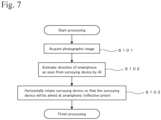
- Fig. 7 shows an example of a flowchart for executing the processing.
- the program for executing the processing in Fig. 7 is stored in a storage device of the computer constituting the processing server 500, such as a semiconductor memory or a hard disk drive, and the program is executed by the CPU of the computer. It is also possible to store this program in an appropriate storage medium.
- the positions of the smartphone 200 and the reflective prism 400 are assumed to be the same.
- application software for making the smartphone 200 implement the function as a controller of the laser scanner 100 is installed in the smartphone 200, whereby the laser scanner 100 can be controlled remotely by using the smartphone 200.
- the laser scanner 100 is desired to face the direction of the worker 300 or the reflective prism 400.
- the worker 300 takes a photograph of the laser scanner 100 by aiming the camera of the smartphone 200 at the laser scanner 100.
- the image of the laser scanner 100 is captured at the center of the screen of the smartphone 200 by enlarging the image shown on the screen as much as possible.
- the worker 300 After photographing is completed, the worker 300 operates the smartphone 200 to instruct start of the processing for aiming the laser scanner 200 at the viewpoint at the time of photographing or the position of the smartphone 200.
- image data that is obtained by photographing the laser scanner 100 is transmitted from the smartphone 200 to the processing server 500, and then, this image data is acquired by the processing server 500 (step S101). This process is performed by the image data acquiring unit 501 in Fig. 6 .
- step S102 On the basis of the photographic image acquired in step S101, a direction in the horizontal direction of the smartphone 200 or the reflective prism 400 as seen from the laser scanner 100 is estimated (step S102). This process is performed by the target direction estimating unit 502 in Fig. 6 . This process estimates the angle ⁇ in Fig. 2 .
- This control signal is transmitted to the smartphone 200.
- the smartphone 200 is connected to the laser scanner 100 by a wireless LAN.
- the smartphone 200 is configured to control remotely the laser scanner 100 by using the wireless LAN.
- the control signal relating to the horizontal rotation is transmitted from the smartphone 200 to the laser scanner 100 via the wireless LAN by using the remote control function.
- the laser scanner 100 horizontally rotates so that the angle ⁇ in Fig. 2 will be 0, so as to face its front surface in the direction of the smartphone 200 or the reflective prism 400.
- laser scanning is performed in a specific range, for example, in a range of plus or minus 5 degrees of horizontal angle, whereby the location of the reflective prism 400 is measured.
- the laser scanner 100 In the state in which the laser scanner 100 is remotely controllable, it is possible for a user to implement a system that aims the laser scanner 100 at the reflective prism 400, which is a target, only by preparing the smartphone 200 having a photographing function.
- the processing server 500 is required, but the system can be established by preparing software, and existing hardware can be used.
- the direction of the laser scanner 100 in the photographic image may be calculated by classic image analysis.
- the front direction of the laser scanner 100 is determined from the photographic image, and the angle ⁇ in Fig. 2 is calculated from an extending direction of an edge or a surface of the main body 103.
- This method and the AI estimation may be used together.
- the function of the processing server 500 can also be implemented by a PC, and the worker 300 can carry this PC.
- a tablet PC with a camera can also be used instead of the smartphone 200. In this case, if the tablet PC has sufficient calculation capacity, the function of the processing server 500 can be conducted by the tablet PC.
- the function of the processing server 500 can be provided to the laser scanner 100.
- the laser scanner 100 includes a computer that has the function of the processing server 500.
- the front and back sides of the laser scanner 100 may be distinguished by the shape of the laser scanner 100.
- the laser scanner 100 needs to have a shape that enables distinguishing between the front and back sides.
- the laser scanner which has no difference in function between the front surface and back sides.
- the laser scanner which has no difference in function between the front and back sides, is rotated so that the front surface or the back surface of the laser scanner will face the smartphone 200 or the reflective prism 400 straight on.
- the laser scanner 100 is controlled by a dedicated wireless controller
- the following processing can be performed.
- the laser scanner 100 is photographed by the smartphone 200.
- the angle ⁇ in Fig. 2 is estimated by the processing server 500, and this estimated angle ⁇ is shown on the smartphone 200.
Landscapes
- Engineering & Computer Science (AREA)
- Physics & Mathematics (AREA)
- General Physics & Mathematics (AREA)
- Radar, Positioning & Navigation (AREA)
- Remote Sensing (AREA)
- Electromagnetism (AREA)
- Computer Networks & Wireless Communication (AREA)
- Multimedia (AREA)
- Optical Radar Systems And Details Thereof (AREA)
- Length Measuring Devices By Optical Means (AREA)
- Studio Devices (AREA)
Description
- The present invention relates to control of a surveying device.
- At a surveying site, it may be necessary to determine coordinates of a specific point. In such a case, a target, such as a reflective prism, is placed at a desired position, and the location of the target is then measured by a surveying device. The location of the target can be measured by automatically operating the surveying device while a worker carries the target by hand to move it.
- In this method, there may be a need to make the surveying device face in the direction of the target or be aimed at the target. To satisfy this need, techniques disclosed in
Japanese Patents Nos. 4648025 4177765 4177784 - Document
EP3702728 A1 discloses a target instrument as part of a surveying system in which a terminal device attached to the target pole captures a photo of a surveying instrument to determine the tilt of the target pole. - The techniques disclosed in
Japanese Patents Nos. 4648025 4177765 4177784 - The present invention provides a target direction determining device that is configured to determine a direction of a target as seen from a surveying device. The direction of the target as seen from the surveying device is determined on the basis of a photographic image of the surveying device that is captured from the target side.
- In the present invention, the surveying device may include a directional indicator that enables determination of the direction in which the surveying device is facing. In the present invention, the direction of the target as seen from the surveying device may be determined on the basis of the direction the surveying device is facing in the photographic image and the direction of an optical axis of the photographic image.
- The present invention can also be understood as a control system including the target direction determining device and a control device. The control device is configured to rotate the surveying device to aim the surveying device at the target on the basis of the direction of the target as seen from the surveying device.
- The present invention can also be understood as a method for aiming a surveying device at a target. This method includes acquiring a photographic image of the surveying device that is captured from the target side, determining the direction of the target as seen from the surveying device, on the basis of the photographic image, and rotating the surveying device to aim the surveying device at the target on the basis of the direction of the target as seen from the surveying device.
- The present invention can also be understood as a method for aiming a surveying device at a target. This method includes acquiring a photographic image of the surveying device that is captured from the target side by a terminal equipped with a camera, and transmitting the photographic image to a processing server by using a communication function of the terminal equipped with the camera. The method also includes determining a direction of the target as seen from the surveying device, on the basis of the photographic image, by the processing server, and rotating the surveying device to aim the surveying device at the target on the basis of the direction of the target.
- The present invention can also be understood as a non-transitory computer recording medium storing computer executable instructions for aiming a surveying device at a target. The computer executable instructions, when executed by a computer processor, cause the computer processor to acquire a photographic image of the surveying device that is captured from the target side and to determine a direction of the target as seen from the surveying device, on the basis of the photographic image. The computer executable instructions, when executed by a computer processor, also cause the computer processor to rotate the surveying device to aim the surveying device at the target on the basis of the direction of the target as seen from the surveying device.
- The present invention provides a technique that enables a surveying device to acquire a direction of a target by using as little extra hardware as possible.
-
-
Fig. 1 is an overview of an embodiment. -
Fig. 2 is a model diagram showing an angular relationship. -
Fig. 3 shows an example of a drawing of a photographic image of a laser scanner. -
Fig. 4 shows an example of a drawing of a photographic image of the laser scanner. -
Fig. 5 is a block diagram of the laser scanner. -
Fig. 6 is a block diagram of a processing server. -
Fig. 7 is a flowchart showing an example of a processing procedure. -
Fig. 1 shows an overview of an embodiment. This technique is intended to aim alaser scanner 100, as a surveying device, at areflective prism 400 that is a target. First, thelaser scanner 100 is photographed by asmartphone 200 on thereflective prism 400 side, and a photographic image is acquired. On the basis of this photographic image, the direction of thereflective prism 400 as seen from thelaser scanner 100 is determined. Then, thelaser scanner 100 is rotated to be directed to thereflective prism 400, based on the determined direction. -
Fig. 1 shows thelaser scanner 100 as a surveying device. In this example, a laser scanning point cloud is obtained by using thelaser scanner 100. The surveying device can employ a total station or a total station equipped with a laser scanner. -
Fig. 1 shows thereflective prism 400 as a surveying target that aworker 300 can carry by hand. Thereflective prism 400 is a reflective prism for surveying, and it reflects an incident light ray in a direction inverted by 180 degrees. - In this example, the
smartphone 200 is attached to asupport bar 410 for supporting thereflective prism 400, and relative positional relationships between thereflective prism 400 and thesmartphone 200 are fixed. The separation distance between thereflective prism 400 and thesmartphone 200 is reduced as much as possible. In particular, a separation distance in a lateral direction or horizontal direction orthogonal to a direction of thelaser scanner 100 as seen from thereflective prism 400 is 50 cm or less, and is more preferably 30 cm or less. Thesmartphone 200 is a commercially available ordinary device and includes a camera, a wireless LAN unit, and a data communication function using an internet line. - This example uses the
smartphone 200 as a control terminal or controller of thelaser scanner 100. It is also possible to utilize a tablet PC or a dedicated terminal as the control terminal. - The
worker 300 sets up thereflective prism 400 at a desired location to be measured by thelaser scanner 100. Theworker 300 then takes a photograph of thelaser scanner 100 by using the camera function of thesmartphone 200. The image data of this photographic image of thelaser scanner 100 is transmitted to aprocessing server 500. The transmission of the image data from thesmartphone 200 to theprocessing server 500 is performed by using an internet line. - Note that the
laser scanner 100 can be photographed in the state in which theworker 300 holds thesmartphone 200 in the worker's hand. The photographing in this situation is performed in a condition in which a separation distance between thesmartphone 200 and thereflective prism 400 in a horizontal direction orthogonal to a line connecting thereflective prism 400 and thelaser scanner 100 is 50 cm or less, and is more preferably 30 cm or less. In addition, prior to photographing, thelaser scanner 100 is sighted in a state in which an image of thelaser scanner 100 shown on the display of thesmartphone 200 is maximally enlarged. - The
processing server 500 estimates the direction of thesmartphone 200 or thereflective prism 400 relative to the front direction of thelaser scanner 100, by using an artificial intelligence (AI) estimation function, on the basis of the photographic image of thelaser scanner 100 captured by thesmartphone 200. -
Fig. 2 is a model diagram as viewed downwardly from the vertical direction. Note that the positions of thesmartphone 200 and thereflective prism 400 differ from each other in a strict sense, but herein, these are assumed to be the same. -
Fig. 2 shows a direction of thelaser scanner 100 as seen from thesmartphone 200 or thereflective prism 400 in the horizontal direction, by a vector V1. The vector V1 coincides with the direction of the optical axis of thesmartphone 200. Moreover, the front direction of thelaser scanner 100 is represented by a vector V2. - The way the
laser scanner 100 is viewed in the photographic image, which is captured by thesmartphone 200, is estimated by AI, whereby the direction of the vector V2 relative to the depth direction of the photographic image, that is, the direction of the vector V1, is determined. Specifically, an angle θ between the direction of thelaser scanner 100 as seen from the reflective prism 400 (vector V1) and the front direction of the laser scanner 100 (vector V2) is estimated. - After the relationship between the vectors V1 and V2 is estimated, the direction of the
reflective prism 400 as seen from thelaser scanner 100 relative to the front direction of the laser scanner 100 (vector V2) can be estimated. -
Fig. 3 conceptually shows a photographic image of thelaser scanner 100 captured by thesmartphone 200.Fig. 3 shows thelaser scanner 100 as viewed downwardly from a slightly oblique direction, for ease of understanding (more exactly, in a horizontal view, the top surface of thelaser scanner 100 cannot be seen). - As shown in
Fig. 3 , anarrow symbol 105 showing the front direction is marked on a side surface of thelaser scanner 100, and atriangle symbol 106 showing the front side is marked on the front surface of thelaser scanner 100. - In the case in
Fig. 3 , the depth direction of the paper surface is the direction of the optical axis of the camera of thesmartphone 200 or the direction of the vector V1. In the case inFig. 3 , thesmartphone 200 is seen from thelaser scanner 100, in a slightly rightward direction, which is an approximately the 1 o'clock direction. This state is quantitatively estimated by an AI estimation model. Specifically, on the basis of the photographic image inFig. 3 , a quantitative relationship between the vector V1 (refer toFig. 2 ) and the vector V2 is estimated. This provides information of the direction of thereflective prism 400 as seen from thelaser scanner 100, relative to the front direction. - In the example of the case in
Fig. 3 , information such that thesmartphone 200 or thereflective prism 400 is seen in a right direction by 30 degrees, from thelaser scanner 100, is estimated. -
Fig. 4 conceptually shows another example of the photographic image of thelaser scanner 100 captured by thesmartphone 200. In this case, thesmartphone 200 is seen from thelaser scanner 100, in a right rearward direction, which is an approximately the 5 o'clock direction. This state is quantitatively estimated by an AI estimation model. - Specifically, on the basis of the photographic image in
Fig. 4 , the angle θ inFig. 2 is calculated by an Al estimation model. In this case, for example, a direction angle such that thesmartphone 200 or thereflective prism 400 as seen from thelaser scanner 100 is in a clockwise direction by 150 degrees, is estimated. - As shown in
Fig. 4 , adiamond symbol 107 showing the back surface is marked on the back surface of thelaser scanner 100. A photographic image is recognized as an image of thelaser scanner 100 captured from the back surface, by detecting this sign. - After the angle θ in
Fig. 2 is determined, thelaser scanner 100 is rotated so that θ = 0, whereby the front surface of thelaser scanner 100 is made to face thesmartphone 200 or thereflective prism 400. - The
laser scanner 100 has a remote control function using a wireless LAN. In this example, a control signal for making thelaser scanner 100 horizontally rotate so that θ = 0, is generated by theprocessing server 500, and the control signal is transmitted to thesmartphone 200. Then, the control signal is transmitted from thesmartphone 200 to thelaser scanner 100, and thelaser scanner 100 horizontally rotates so that θ = 0, accordingly. As a result, thelaser scanner 100 is aimed at thereflective prism 400. - As shown in
Fig. 1 , thelaser scanner 100 includes atripod 101, a base 102 supported by thetripod 101, a main body 103 held on the base 102 in a horizontally rotatable manner, and anoptical system 104 disposed to the main body 103 and being vertically rotatable. - Laser scanning in a vertical plane is performed by making the
optical system 104 emit distance measuring laser light in a pulsed manner while theoptical system 104 is vertically rotated. Simultaneously, the main unit 103 is horizontally rotated. Thus, laser scanning is performed on a surface of the celestial sphere. -
Fig. 5 is a block diagram of thelaser scanner 100. Thelaser scanner 100 includes a laser scanner unit 111, a horizontal rotation controlling unit 112, and a communication unit 113. - The laser scanner unit 111 performs control and processing relating to the laser scanning described above. The horizontal rotation controlling unit 112 controls horizontal rotation of the main body 103 relative to the
base 102. - The communication unit 113 communicates with an external device. Herein, communication is made by using a wireless LAN standard. In this example, the communication unit 113 is used to communicate with the
smartphone 200. Thelaser scanner 100 is able to be controlled remotely by using the communication unit 113. In one example, the laser scanner or surveyingdevice 100 can be controlled remotely via the communication unit 113 by using a dedicated terminal, a PC, a tablet, or a smartphone as a control terminal or controller. - In this example, starting and stopping laser scanning, selecting each type of laser scanning mode, and aiming at the target, which is executed by the processing in
Fig. 7 , can be instructed by the remote control. -
Fig. 6 is a block diagram of theprocessing server 500. Theprocessing server 500 includes an image data acquiring unit 501, a targetdirection estimating unit 502, and acontrol signal generator 503. Theprocessing server 500 is a computer and includes a CPU, a memory, a hard disk drive, and various input-output interfaces. - An application software program for implementing the functional units shown in
Fig. 6 is installed in the computer that constitutes theprocessing server 500, and theprocessing server 500 shown inFig. 6 is implemented by software. One, some, or all of the functional units of theprocessing server 500 can also be composed of a dedicated electronic circuit. In one example, one, some, or all of the functional units of theprocessing server 500 can be composed by using an FPGA. - The image data acquiring unit 501 acquires image data of a photographic image captured by the camera of the
smartphone 200. The targetdirection estimating unit 502 estimates, on the basis of the photographic image of thelaser scanner 100 acquired by the image data acquiring unit 501, the direction of thereflective prism 400 as seen from thelaser scanner 100, relative to the front surface of thelaser scanner 100, by using an AI estimation model. The AI estimation model is obtained by deep learning. Specifically, a direction in which thevector 1 inFig. 2 is inverted by 180 degrees, is the direction of thereflective prism 400 as seen from thelaser scanner 100. - The
control signal generator 503 generates a control signal for making thelaser scanner 100 rotate so that the angle θ inFig. 2 will be 0 and making the front surface of thelaser scanner 100 direct to the direction of thereflective prism 400. - The following describes an Al estimation model that is used in the target
direction estimating unit 502. - The AI estimation model is used by inputting a photographic image of the
laser scanner 100 captured by thesmartphone 200, and it outputs the angle θ inFig. 2 . The Al estimation model is obtained as follows: A learning network that has an AI estimation function is made to acquire a function of estimating the angle θ inFig. 2 based on the input image, through deep learning. - The learning network is an algorithm having a deep layered neural network and performs deep learning. The leaning network is not specifically limited.
- Sample photographic images of a laser scanner that are captured from various angles in the horizontal direction are prepared. Among these sample photographic images, photographic images in which the values of the angles θ are already known, is used as teaching data.
- In one example, 1000 sample photographic images are prepared. The angle θ is prepared for each of the 1000 sample photographic images. Then, these 1000 sample photographic images are divided into a group A of 300 sample photographic images as a learning data group and a group B of 700 sample photographic images as a test data group.
- First, the samples of the group A are used to learn the relationship between an input image and an angle θ, whereby an Al estimation model is obtained. At this time, the back propagation method is used in learning.
- The back propagation method involves calculating a difference between a determined angle θ, which is an estimated value, and a corresponding correct angle θ, which is a correct value. The method also involves adjusting weighting of a neural network, that is, adjusting a learning network, so that the difference will be minimum. Thereafter, the data of the group B is used to evaluate the model.
- The above processes are performed multiple times by changing the pair of the data of the group A and the data of the group B at random. The above processing implements deep learning, whereby an AI estimation model to be used for estimating the angle θ in
Fig. 2 from the photographic image of thelaser scanner 100 is obtained. The targetdirection estimating unit 502 uses this Al estimation model to estimate the angle θ (refer toFig. 2 ). - The following describes an example of a processing procedure performed by the
processing server 500.Fig. 7 shows an example of a flowchart for executing the processing. The program for executing the processing inFig. 7 is stored in a storage device of the computer constituting theprocessing server 500, such as a semiconductor memory or a hard disk drive, and the program is executed by the CPU of the computer. It is also possible to store this program in an appropriate storage medium. - Herein, the positions of the
smartphone 200 and thereflective prism 400 are assumed to be the same. In addition, it is also assumed that application software for making thesmartphone 200 implement the function as a controller of thelaser scanner 100 is installed in thesmartphone 200, whereby thelaser scanner 100 can be controlled remotely by using thesmartphone 200. - First, it is assumed that, in the state in which the
worker 300 stands at a desired point to be positioned while holding thereflective prism 400, thelaser scanner 100 is desired to face the direction of theworker 300 or thereflective prism 400. - In this situation, the
worker 300 takes a photograph of thelaser scanner 100 by aiming the camera of thesmartphone 200 at thelaser scanner 100. At this time, the image of thelaser scanner 100 is captured at the center of the screen of thesmartphone 200 by enlarging the image shown on the screen as much as possible. - After photographing is completed, the
worker 300 operates thesmartphone 200 to instruct start of the processing for aiming thelaser scanner 200 at the viewpoint at the time of photographing or the position of thesmartphone 200. - In response to the above operation, first, image data that is obtained by photographing the
laser scanner 100 is transmitted from thesmartphone 200 to theprocessing server 500, and then, this image data is acquired by the processing server 500 (step S101). This process is performed by the image data acquiring unit 501 inFig. 6 . - Next, on the basis of the photographic image acquired in step S101, a direction in the horizontal direction of the
smartphone 200 or thereflective prism 400 as seen from thelaser scanner 100 is estimated (step S102). This process is performed by the targetdirection estimating unit 502 inFig. 6 . This process estimates the angle θ inFig. 2 . - Then, a control signal is generated for making the main body 103 horizontally rotate so that θ = 0; that is, the front surface of the
laser scanner 100 will be facing the direction of thesmartphone 200 or the reflective prism 400 (step S103). This process is performed by thecontrol signal generator 503 inFig. 6 . - This control signal is transmitted to the
smartphone 200. Thesmartphone 200 is connected to thelaser scanner 100 by a wireless LAN. Thesmartphone 200 is configured to control remotely thelaser scanner 100 by using the wireless LAN. The control signal relating to the horizontal rotation is transmitted from thesmartphone 200 to thelaser scanner 100 via the wireless LAN by using the remote control function. Upon receiving this control signal, thelaser scanner 100 horizontally rotates so that the angle θ inFig. 2 will be 0, so as to face its front surface in the direction of thesmartphone 200 or thereflective prism 400. - Under these conditions, laser scanning is performed in a specific range, for example, in a range of plus or minus 5 degrees of horizontal angle, whereby the location of the
reflective prism 400 is measured. - In the state in which the
laser scanner 100 is remotely controllable, it is possible for a user to implement a system that aims thelaser scanner 100 at thereflective prism 400, which is a target, only by preparing thesmartphone 200 having a photographing function. Theprocessing server 500 is required, but the system can be established by preparing software, and existing hardware can be used. - The direction of the
laser scanner 100 in the photographic image may be calculated by classic image analysis. In this case, the front direction of thelaser scanner 100 is determined from the photographic image, and the angle θ inFig. 2 is calculated from an extending direction of an edge or a surface of the main body 103. This method and the AI estimation may be used together. - The function of the
processing server 500 can also be implemented by a PC, and theworker 300 can carry this PC. Alternatively, instead of thesmartphone 200, a tablet PC with a camera can also be used. In this case, if the tablet PC has sufficient calculation capacity, the function of theprocessing server 500 can be conducted by the tablet PC. - The function of the
processing server 500 can be provided to thelaser scanner 100. In this case, thelaser scanner 100 includes a computer that has the function of theprocessing server 500. Alternatively, it is also possible to prepare a PC that has the function of theprocessing server 500 and to execute the function of theprocessing server 500 by this PC. - The front and back sides of the
laser scanner 100 may be distinguished by the shape of thelaser scanner 100. In this case, thelaser scanner 100 needs to have a shape that enables distinguishing between the front and back sides. - There may be a laser scanner that has no difference in function between the front surface and back sides. In this case, the laser scanner, which has no difference in function between the front and back sides, is rotated so that the front surface or the back surface of the laser scanner will face the
smartphone 200 or thereflective prism 400 straight on. - In the case in which the
laser scanner 100 is controlled by a dedicated wireless controller, the following processing can be performed. First, thelaser scanner 100 is photographed by thesmartphone 200. Then, the angle θ inFig. 2 is estimated by theprocessing server 500, and this estimated angle θ is shown on thesmartphone 200. After seeing the displayed angle, theworker 300 operates the controller to horizontally rotate thelaser scanner 100 so that θ = 0.
Claims (7)
- A target direction determining device configured to determine a direction of a target (400) as seen from a surveying device (100), wherein the direction of the target as seen from the surveying device is determined on a basis of a photographic image of the surveying device that is captured from the target side.
- The target direction determining device according to claim 1, wherein the surveying device includes a directional indicator that enables determining a direction in which the surveying device faces.
- The target direction determining device according to claim 1 or 2, wherein the direction of the target as seen from the surveying device is determined on a basis of the facing direction of the surveying device in the photographic image and a direction of an optical axis of the photographic image.
- A control system comprising:the target direction determining device according to any one of claims 1 to 3; anda control device configured to rotate the surveying device to aim the surveying device at the target on a basis of the direction of the target as seen from the surveying device.
- A method for aiming a surveying device at a target, the method comprising:acquiring (S101) a photographic image of the surveying device Z (100) that is captured from the target side;determining (S102) a direction of the target (400) as seen from the surveying device on a basis of the photographic image; androtating (S103) the surveying device to aim the surveying device at the target on a basis of the direction of the target as seen from the surveying device.
- A method for aiming a surveying device at a target, the method comprising:acquiring (S101) a photographic image of the surveying device (100) that is captured from the target side by a terminal (200) equipped with a camera;transmitting the photographic image to a processing server (500) by using a communication function of the terminal equipped with the camera;determining (S102) a direction of the target as seen from the surveying device on a basis of the photographic image, by the processing server; androtating (S103) the surveying device to aim the surveying device at the target on a basis of the direction of the target.
- A non-transitory computer recording medium storing computer executable instructions for aiming a surveying device at a target, the computer executable instructions, when executed by a computer processor, causing the computer processor to:acquire (S101) a photographic image of the surveying device (100) captured from the target side;determine (S102) a direction of the target (400) as seen from the surveying device on a basis of the photographic image; androtate (S103) the surveying device to aim the surveying device at the target on a basis of the direction of the target as seen from the surveying device.
Applications Claiming Priority (1)
| Application Number | Priority Date | Filing Date | Title |
|---|---|---|---|
| JP2020157146A JP7488737B2 (en) | 2020-09-18 | 2020-09-18 | Control system, method and program for directing surveying instrument toward target |
Publications (2)
| Publication Number | Publication Date |
|---|---|
| EP3971521A1 EP3971521A1 (en) | 2022-03-23 |
| EP3971521B1 true EP3971521B1 (en) | 2023-10-04 |
Family
ID=77666232
Family Applications (1)
| Application Number | Title | Priority Date | Filing Date |
|---|---|---|---|
| EP21195289.0A Active EP3971521B1 (en) | 2020-09-18 | 2021-09-07 | Target direction determining device, control system, and method and program for aiming surveying device at a target |
Country Status (4)
| Country | Link |
|---|---|
| US (1) | US11933611B2 (en) |
| EP (1) | EP3971521B1 (en) |
| JP (1) | JP7488737B2 (en) |
| CN (1) | CN114199122A (en) |
Families Citing this family (2)
| Publication number | Priority date | Publication date | Assignee | Title |
|---|---|---|---|---|
| JP7497553B2 (en) * | 2020-09-29 | 2024-06-11 | 株式会社トプコン | Marking system, marking method |
| JP7695093B2 (en) * | 2021-03-29 | 2025-06-18 | 株式会社トプコン | Surveying system, point cloud data acquisition method, and point cloud data acquisition program |
Family Cites Families (17)
| Publication number | Priority date | Publication date | Assignee | Title |
|---|---|---|---|---|
| US3528747A (en) * | 1968-04-19 | 1970-09-15 | Technidyne Inc | Target devices for visual location of and alignment with laser beams and the like |
| JP4177765B2 (en) | 2004-01-30 | 2008-11-05 | 株式会社 ソキア・トプコン | Surveying system |
| JP4177784B2 (en) | 2004-05-14 | 2008-11-05 | 株式会社 ソキア・トプコン | Surveying system |
| JP4648025B2 (en) | 2005-02-09 | 2011-03-09 | 株式会社 ソキア・トプコン | Surveying system |
| US10168153B2 (en) * | 2010-12-23 | 2019-01-01 | Trimble Inc. | Enhanced position measurement systems and methods |
| US9182229B2 (en) * | 2010-12-23 | 2015-11-10 | Trimble Navigation Limited | Enhanced position measurement systems and methods |
| JP6101037B2 (en) * | 2012-10-15 | 2017-03-22 | 株式会社ミツトヨ | Tracking laser device and measuring device |
| JP6463044B2 (en) * | 2014-09-02 | 2019-01-30 | 株式会社Css技術開発 | Terminal unit, surveying instrument, surveying system, and survey assistance program |
| EP3021078B1 (en) | 2014-11-14 | 2018-09-26 | Leica Geosystems AG | Geodetic surveying system with virtual camera |
| EP3182066B1 (en) * | 2015-12-17 | 2018-07-04 | Leica Geosystems AG | Surveying pole |
| JP6823482B2 (en) * | 2016-07-04 | 2021-02-03 | 株式会社トプコン | 3D position measurement system, 3D position measurement method, and measurement module |
| JP6937126B2 (en) | 2017-01-31 | 2021-09-22 | 株式会社トプコン | Rover and rover measurement system |
| JP6963909B2 (en) * | 2017-05-10 | 2021-11-10 | 株式会社トプコン | Surveying system |
| JP6963936B2 (en) * | 2017-08-25 | 2021-11-10 | 株式会社トプコン | Surveying system |
| JP7163085B2 (en) * | 2018-07-06 | 2022-10-31 | 株式会社トプコン | Surveying method, surveying device and program |
| JP7287793B2 (en) | 2019-02-26 | 2023-06-06 | 株式会社トプコン | Target device and survey system |
| EP3734222B1 (en) * | 2019-05-02 | 2024-12-11 | Leica Geosystems AG | Coordinate measuring and/or stake out device |
-
2020
- 2020-09-18 JP JP2020157146A patent/JP7488737B2/en active Active
-
2021
- 2021-09-03 US US17/446,836 patent/US11933611B2/en active Active
- 2021-09-07 EP EP21195289.0A patent/EP3971521B1/en active Active
- 2021-09-17 CN CN202111092753.6A patent/CN114199122A/en active Pending
Also Published As
| Publication number | Publication date |
|---|---|
| CN114199122A (en) | 2022-03-18 |
| US20220090915A1 (en) | 2022-03-24 |
| EP3971521A1 (en) | 2022-03-23 |
| JP7488737B2 (en) | 2024-05-22 |
| US11933611B2 (en) | 2024-03-19 |
| JP2022050943A (en) | 2022-03-31 |
Similar Documents
| Publication | Publication Date | Title |
|---|---|---|
| CN108881724B (en) | Image acquisition method, device, equipment and storage medium | |
| CN103557859A (en) | Image acquisition and positioning method and image acquisition and positioning system | |
| JP2011239361A (en) | System and method for ar navigation and difference extraction for repeated photographing, and program thereof | |
| WO2019230604A1 (en) | Inspection system | |
| EP3971521B1 (en) | Target direction determining device, control system, and method and program for aiming surveying device at a target | |
| WO2016000194A1 (en) | Photographing control method, device and pan-tilt device | |
| WO2019189381A1 (en) | Moving body, control device, and control program | |
| US20210229810A1 (en) | Information processing device, flight control method, and flight control system | |
| CN107925713A (en) | Camera system and camera shooting control method | |
| US20210247783A1 (en) | Method for controlling handheld gimbal, and handheld gimbal | |
| JP2014063411A (en) | Remote control system, control method, and program | |
| JP2018105974A (en) | Surgical loupe | |
| JP6875196B2 (en) | Mobile platforms, flying objects, support devices, mobile terminals, imaging assist methods, programs, and recording media | |
| JP2020071854A (en) | Image processing device, image processing method, and program | |
| US20260105636A1 (en) | Calibration method of a portable electronic device | |
| WO2021258251A1 (en) | Surveying and mapping method for movable platform, and movable platform and storage medium | |
| WO2021033242A1 (en) | Image recognition device, image recognition method, and image recognition program | |
| JP2024052436A (en) | Reinforcement result display system | |
| CN109891188B (en) | Mobile platform, imaging path generation method, program, and recording medium | |
| CN106289205B (en) | A kind of rhumb self-operated measuring unit | |
| EP4246281B1 (en) | Information display system, information display method, and carrier means | |
| WO2019127303A1 (en) | Method for prompting and determining orientation of unmanned aerial vehicle, and control terminal | |
| KR20180106178A (en) | Unmanned aerial vehicle, electronic device and control method thereof | |
| WO2022109774A1 (en) | Camera control method, device, and system | |
| US12051218B2 (en) | Remote support system, terminal device, and remote device |
Legal Events
| Date | Code | Title | Description |
|---|---|---|---|
| PUAI | Public reference made under article 153(3) epc to a published international application that has entered the european phase |
Free format text: ORIGINAL CODE: 0009012 |
|
| STAA | Information on the status of an ep patent application or granted ep patent |
Free format text: STATUS: THE APPLICATION HAS BEEN PUBLISHED |
|
| AK | Designated contracting states |
Kind code of ref document: A1 Designated state(s): AL AT BE BG CH CY CZ DE DK EE ES FI FR GB GR HR HU IE IS IT LI LT LU LV MC MK MT NL NO PL PT RO RS SE SI SK SM TR |
|
| STAA | Information on the status of an ep patent application or granted ep patent |
Free format text: STATUS: REQUEST FOR EXAMINATION WAS MADE |
|
| 17P | Request for examination filed |
Effective date: 20220923 |
|
| RBV | Designated contracting states (corrected) |
Designated state(s): AL AT BE BG CH CY CZ DE DK EE ES FI FR GB GR HR HU IE IS IT LI LT LU LV MC MK MT NL NO PL PT RO RS SE SI SK SM TR |
|
| RIC1 | Information provided on ipc code assigned before grant |
Ipc: G01S 17/86 20200101ALI20230314BHEP Ipc: G01S 17/42 20060101ALI20230314BHEP Ipc: G01C 15/06 20060101ALI20230314BHEP Ipc: G01C 15/00 20060101AFI20230314BHEP |
|
| GRAP | Despatch of communication of intention to grant a patent |
Free format text: ORIGINAL CODE: EPIDOSNIGR1 |
|
| STAA | Information on the status of an ep patent application or granted ep patent |
Free format text: STATUS: GRANT OF PATENT IS INTENDED |
|
| INTG | Intention to grant announced |
Effective date: 20230504 |
|
| GRAS | Grant fee paid |
Free format text: ORIGINAL CODE: EPIDOSNIGR3 |
|
| GRAA | (expected) grant |
Free format text: ORIGINAL CODE: 0009210 |
|
| STAA | Information on the status of an ep patent application or granted ep patent |
Free format text: STATUS: THE PATENT HAS BEEN GRANTED |
|
| AK | Designated contracting states |
Kind code of ref document: B1 Designated state(s): AL AT BE BG CH CY CZ DE DK EE ES FI FR GB GR HR HU IE IS IT LI LT LU LV MC MK MT NL NO PL PT RO RS SE SI SK SM TR |
|
| REG | Reference to a national code |
Ref country code: GB Ref legal event code: FG4D |
|
| REG | Reference to a national code |
Ref country code: CH Ref legal event code: EP |
|
| REG | Reference to a national code |
Ref country code: DE Ref legal event code: R096 Ref document number: 602021005600 Country of ref document: DE |
|
| REG | Reference to a national code |
Ref country code: IE Ref legal event code: FG4D |
|
| REG | Reference to a national code |
Ref country code: LT Ref legal event code: MG9D |
|
| REG | Reference to a national code |
Ref country code: NL Ref legal event code: MP Effective date: 20231004 |
|
| REG | Reference to a national code |
Ref country code: AT Ref legal event code: MK05 Ref document number: 1618152 Country of ref document: AT Kind code of ref document: T Effective date: 20231004 |
|
| PG25 | Lapsed in a contracting state [announced via postgrant information from national office to epo] |
Ref country code: NL Free format text: LAPSE BECAUSE OF FAILURE TO SUBMIT A TRANSLATION OF THE DESCRIPTION OR TO PAY THE FEE WITHIN THE PRESCRIBED TIME-LIMIT Effective date: 20231004 |
|
| PG25 | Lapsed in a contracting state [announced via postgrant information from national office to epo] |
Ref country code: GR Free format text: LAPSE BECAUSE OF FAILURE TO SUBMIT A TRANSLATION OF THE DESCRIPTION OR TO PAY THE FEE WITHIN THE PRESCRIBED TIME-LIMIT Effective date: 20240105 |
|
| PG25 | Lapsed in a contracting state [announced via postgrant information from national office to epo] |
Ref country code: IS Free format text: LAPSE BECAUSE OF FAILURE TO SUBMIT A TRANSLATION OF THE DESCRIPTION OR TO PAY THE FEE WITHIN THE PRESCRIBED TIME-LIMIT Effective date: 20240204 |
|
| PG25 | Lapsed in a contracting state [announced via postgrant information from national office to epo] |
Ref country code: LT Free format text: LAPSE BECAUSE OF FAILURE TO SUBMIT A TRANSLATION OF THE DESCRIPTION OR TO PAY THE FEE WITHIN THE PRESCRIBED TIME-LIMIT Effective date: 20231004 |
|
| PG25 | Lapsed in a contracting state [announced via postgrant information from national office to epo] |
Ref country code: AT Free format text: LAPSE BECAUSE OF FAILURE TO SUBMIT A TRANSLATION OF THE DESCRIPTION OR TO PAY THE FEE WITHIN THE PRESCRIBED TIME-LIMIT Effective date: 20231004 |
|
| PG25 | Lapsed in a contracting state [announced via postgrant information from national office to epo] |
Ref country code: ES Free format text: LAPSE BECAUSE OF FAILURE TO SUBMIT A TRANSLATION OF THE DESCRIPTION OR TO PAY THE FEE WITHIN THE PRESCRIBED TIME-LIMIT Effective date: 20231004 |
|
| PG25 | Lapsed in a contracting state [announced via postgrant information from national office to epo] |
Ref country code: LT Free format text: LAPSE BECAUSE OF FAILURE TO SUBMIT A TRANSLATION OF THE DESCRIPTION OR TO PAY THE FEE WITHIN THE PRESCRIBED TIME-LIMIT Effective date: 20231004 Ref country code: IS Free format text: LAPSE BECAUSE OF FAILURE TO SUBMIT A TRANSLATION OF THE DESCRIPTION OR TO PAY THE FEE WITHIN THE PRESCRIBED TIME-LIMIT Effective date: 20240204 Ref country code: GR Free format text: LAPSE BECAUSE OF FAILURE TO SUBMIT A TRANSLATION OF THE DESCRIPTION OR TO PAY THE FEE WITHIN THE PRESCRIBED TIME-LIMIT Effective date: 20240105 Ref country code: ES Free format text: LAPSE BECAUSE OF FAILURE TO SUBMIT A TRANSLATION OF THE DESCRIPTION OR TO PAY THE FEE WITHIN THE PRESCRIBED TIME-LIMIT Effective date: 20231004 Ref country code: BG Free format text: LAPSE BECAUSE OF FAILURE TO SUBMIT A TRANSLATION OF THE DESCRIPTION OR TO PAY THE FEE WITHIN THE PRESCRIBED TIME-LIMIT Effective date: 20240104 Ref country code: AT Free format text: LAPSE BECAUSE OF FAILURE TO SUBMIT A TRANSLATION OF THE DESCRIPTION OR TO PAY THE FEE WITHIN THE PRESCRIBED TIME-LIMIT Effective date: 20231004 Ref country code: PT Free format text: LAPSE BECAUSE OF FAILURE TO SUBMIT A TRANSLATION OF THE DESCRIPTION OR TO PAY THE FEE WITHIN THE PRESCRIBED TIME-LIMIT Effective date: 20240205 |
|
| PG25 | Lapsed in a contracting state [announced via postgrant information from national office to epo] |
Ref country code: SE Free format text: LAPSE BECAUSE OF FAILURE TO SUBMIT A TRANSLATION OF THE DESCRIPTION OR TO PAY THE FEE WITHIN THE PRESCRIBED TIME-LIMIT Effective date: 20231004 Ref country code: RS Free format text: LAPSE BECAUSE OF FAILURE TO SUBMIT A TRANSLATION OF THE DESCRIPTION OR TO PAY THE FEE WITHIN THE PRESCRIBED TIME-LIMIT Effective date: 20231004 Ref country code: PL Free format text: LAPSE BECAUSE OF FAILURE TO SUBMIT A TRANSLATION OF THE DESCRIPTION OR TO PAY THE FEE WITHIN THE PRESCRIBED TIME-LIMIT Effective date: 20231004 Ref country code: NO Free format text: LAPSE BECAUSE OF FAILURE TO SUBMIT A TRANSLATION OF THE DESCRIPTION OR TO PAY THE FEE WITHIN THE PRESCRIBED TIME-LIMIT Effective date: 20240104 Ref country code: LV Free format text: LAPSE BECAUSE OF FAILURE TO SUBMIT A TRANSLATION OF THE DESCRIPTION OR TO PAY THE FEE WITHIN THE PRESCRIBED TIME-LIMIT Effective date: 20231004 Ref country code: HR Free format text: LAPSE BECAUSE OF FAILURE TO SUBMIT A TRANSLATION OF THE DESCRIPTION OR TO PAY THE FEE WITHIN THE PRESCRIBED TIME-LIMIT Effective date: 20231004 |
|
| REG | Reference to a national code |
Ref country code: DE Ref legal event code: R097 Ref document number: 602021005600 Country of ref document: DE |
|
| PG25 | Lapsed in a contracting state [announced via postgrant information from national office to epo] |
Ref country code: DK Free format text: LAPSE BECAUSE OF FAILURE TO SUBMIT A TRANSLATION OF THE DESCRIPTION OR TO PAY THE FEE WITHIN THE PRESCRIBED TIME-LIMIT Effective date: 20231004 |
|
| PG25 | Lapsed in a contracting state [announced via postgrant information from national office to epo] |
Ref country code: CZ Free format text: LAPSE BECAUSE OF FAILURE TO SUBMIT A TRANSLATION OF THE DESCRIPTION OR TO PAY THE FEE WITHIN THE PRESCRIBED TIME-LIMIT Effective date: 20231004 |
|
| PG25 | Lapsed in a contracting state [announced via postgrant information from national office to epo] |
Ref country code: SK Free format text: LAPSE BECAUSE OF FAILURE TO SUBMIT A TRANSLATION OF THE DESCRIPTION OR TO PAY THE FEE WITHIN THE PRESCRIBED TIME-LIMIT Effective date: 20231004 |
|
| PG25 | Lapsed in a contracting state [announced via postgrant information from national office to epo] |
Ref country code: SM Free format text: LAPSE BECAUSE OF FAILURE TO SUBMIT A TRANSLATION OF THE DESCRIPTION OR TO PAY THE FEE WITHIN THE PRESCRIBED TIME-LIMIT Effective date: 20231004 Ref country code: SK Free format text: LAPSE BECAUSE OF FAILURE TO SUBMIT A TRANSLATION OF THE DESCRIPTION OR TO PAY THE FEE WITHIN THE PRESCRIBED TIME-LIMIT Effective date: 20231004 Ref country code: RO Free format text: LAPSE BECAUSE OF FAILURE TO SUBMIT A TRANSLATION OF THE DESCRIPTION OR TO PAY THE FEE WITHIN THE PRESCRIBED TIME-LIMIT Effective date: 20231004 Ref country code: IT Free format text: LAPSE BECAUSE OF FAILURE TO SUBMIT A TRANSLATION OF THE DESCRIPTION OR TO PAY THE FEE WITHIN THE PRESCRIBED TIME-LIMIT Effective date: 20231004 Ref country code: EE Free format text: LAPSE BECAUSE OF FAILURE TO SUBMIT A TRANSLATION OF THE DESCRIPTION OR TO PAY THE FEE WITHIN THE PRESCRIBED TIME-LIMIT Effective date: 20231004 Ref country code: DK Free format text: LAPSE BECAUSE OF FAILURE TO SUBMIT A TRANSLATION OF THE DESCRIPTION OR TO PAY THE FEE WITHIN THE PRESCRIBED TIME-LIMIT Effective date: 20231004 Ref country code: CZ Free format text: LAPSE BECAUSE OF FAILURE TO SUBMIT A TRANSLATION OF THE DESCRIPTION OR TO PAY THE FEE WITHIN THE PRESCRIBED TIME-LIMIT Effective date: 20231004 |
|
| PLBE | No opposition filed within time limit |
Free format text: ORIGINAL CODE: 0009261 |
|
| STAA | Information on the status of an ep patent application or granted ep patent |
Free format text: STATUS: NO OPPOSITION FILED WITHIN TIME LIMIT |
|
| 26N | No opposition filed |
Effective date: 20240705 |
|
| PG25 | Lapsed in a contracting state [announced via postgrant information from national office to epo] |
Ref country code: SI Free format text: LAPSE BECAUSE OF FAILURE TO SUBMIT A TRANSLATION OF THE DESCRIPTION OR TO PAY THE FEE WITHIN THE PRESCRIBED TIME-LIMIT Effective date: 20231004 |
|
| PG25 | Lapsed in a contracting state [announced via postgrant information from national office to epo] |
Ref country code: SI Free format text: LAPSE BECAUSE OF FAILURE TO SUBMIT A TRANSLATION OF THE DESCRIPTION OR TO PAY THE FEE WITHIN THE PRESCRIBED TIME-LIMIT Effective date: 20231004 |
|
| PG25 | Lapsed in a contracting state [announced via postgrant information from national office to epo] |
Ref country code: MC Free format text: LAPSE BECAUSE OF FAILURE TO SUBMIT A TRANSLATION OF THE DESCRIPTION OR TO PAY THE FEE WITHIN THE PRESCRIBED TIME-LIMIT Effective date: 20231004 |
|
| PG25 | Lapsed in a contracting state [announced via postgrant information from national office to epo] |
Ref country code: LU Free format text: LAPSE BECAUSE OF NON-PAYMENT OF DUE FEES Effective date: 20240907 |
|
| REG | Reference to a national code |
Ref country code: BE Ref legal event code: MM Effective date: 20240930 |
|
| PG25 | Lapsed in a contracting state [announced via postgrant information from national office to epo] |
Ref country code: BE Free format text: LAPSE BECAUSE OF NON-PAYMENT OF DUE FEES Effective date: 20240930 |
|
| PG25 | Lapsed in a contracting state [announced via postgrant information from national office to epo] |
Ref country code: FR Free format text: LAPSE BECAUSE OF NON-PAYMENT OF DUE FEES Effective date: 20240930 |
|
| PG25 | Lapsed in a contracting state [announced via postgrant information from national office to epo] |
Ref country code: IE Free format text: LAPSE BECAUSE OF NON-PAYMENT OF DUE FEES Effective date: 20240907 |
|
| REG | Reference to a national code |
Ref country code: CH Ref legal event code: U11 Free format text: ST27 STATUS EVENT CODE: U-0-0-U10-U11 (AS PROVIDED BY THE NATIONAL OFFICE) Effective date: 20251001 |
|
| PG25 | Lapsed in a contracting state [announced via postgrant information from national office to epo] |
Ref country code: FI Free format text: LAPSE BECAUSE OF FAILURE TO SUBMIT A TRANSLATION OF THE DESCRIPTION OR TO PAY THE FEE WITHIN THE PRESCRIBED TIME-LIMIT Effective date: 20231004 |
|
| PGFP | Annual fee paid to national office [announced via postgrant information from national office to epo] |
Ref country code: DE Payment date: 20250730 Year of fee payment: 5 |
|
| PGFP | Annual fee paid to national office [announced via postgrant information from national office to epo] |
Ref country code: CH Payment date: 20251001 Year of fee payment: 5 |
|
| PG25 | Lapsed in a contracting state [announced via postgrant information from national office to epo] |
Ref country code: CY Free format text: LAPSE BECAUSE OF FAILURE TO SUBMIT A TRANSLATION OF THE DESCRIPTION OR TO PAY THE FEE WITHIN THE PRESCRIBED TIME-LIMIT; INVALID AB INITIO Effective date: 20210907 |
|
| PG25 | Lapsed in a contracting state [announced via postgrant information from national office to epo] |
Ref country code: HU Free format text: LAPSE BECAUSE OF FAILURE TO SUBMIT A TRANSLATION OF THE DESCRIPTION OR TO PAY THE FEE WITHIN THE PRESCRIBED TIME-LIMIT; INVALID AB INITIO Effective date: 20210907 |