EP3971187B1 - Inhibitor mit einem bicyclischen derivat, herstellungsverfahren dafür und verwendung davon - Google Patents
Inhibitor mit einem bicyclischen derivat, herstellungsverfahren dafür und verwendung davon Download PDFInfo
- Publication number
- EP3971187B1 EP3971187B1 EP20806520.1A EP20806520A EP3971187B1 EP 3971187 B1 EP3971187 B1 EP 3971187B1 EP 20806520 A EP20806520 A EP 20806520A EP 3971187 B1 EP3971187 B1 EP 3971187B1
- Authority
- EP
- European Patent Office
- Prior art keywords
- alkyl
- alkoxy
- hydrogen
- cyano
- hydroxyl
- Prior art date
- Legal status (The legal status is an assumption and is not a legal conclusion. Google has not performed a legal analysis and makes no representation as to the accuracy of the status listed.)
- Active
Links
Classifications
-
- A—HUMAN NECESSITIES
- A61—MEDICAL OR VETERINARY SCIENCE; HYGIENE
- A61K—PREPARATIONS FOR MEDICAL, DENTAL OR TOILETRY PURPOSES
- A61K31/00—Medicinal preparations containing organic active ingredients
- A61K31/33—Heterocyclic compounds
- A61K31/395—Heterocyclic compounds having nitrogen as a ring hetero atom, e.g. guanethidine or rifamycins
- A61K31/435—Heterocyclic compounds having nitrogen as a ring hetero atom, e.g. guanethidine or rifamycins having six-membered rings with one nitrogen as the only ring hetero atom
- A61K31/4353—Heterocyclic compounds having nitrogen as a ring hetero atom, e.g. guanethidine or rifamycins having six-membered rings with one nitrogen as the only ring hetero atom ortho- or peri-condensed with heterocyclic ring systems
- A61K31/437—Heterocyclic compounds having nitrogen as a ring hetero atom, e.g. guanethidine or rifamycins having six-membered rings with one nitrogen as the only ring hetero atom ortho- or peri-condensed with heterocyclic ring systems the heterocyclic ring system containing a five-membered ring having nitrogen as a ring hetero atom, e.g. indolizine, beta-carboline
-
- A—HUMAN NECESSITIES
- A61—MEDICAL OR VETERINARY SCIENCE; HYGIENE
- A61K—PREPARATIONS FOR MEDICAL, DENTAL OR TOILETRY PURPOSES
- A61K31/00—Medicinal preparations containing organic active ingredients
- A61K31/33—Heterocyclic compounds
- A61K31/395—Heterocyclic compounds having nitrogen as a ring hetero atom, e.g. guanethidine or rifamycins
- A61K31/495—Heterocyclic compounds having nitrogen as a ring hetero atom, e.g. guanethidine or rifamycins having six-membered rings with two or more nitrogen atoms as the only ring heteroatoms, e.g. piperazine or tetrazines
- A61K31/4995—Pyrazines or piperazines forming part of bridged ring systems
-
- A—HUMAN NECESSITIES
- A61—MEDICAL OR VETERINARY SCIENCE; HYGIENE
- A61P—SPECIFIC THERAPEUTIC ACTIVITY OF CHEMICAL COMPOUNDS OR MEDICINAL PREPARATIONS
- A61P35/00—Antineoplastic agents
-
- C—CHEMISTRY; METALLURGY
- C07—ORGANIC CHEMISTRY
- C07D—HETEROCYCLIC COMPOUNDS
- C07D401/00—Heterocyclic compounds containing two or more hetero rings, having nitrogen atoms as the only ring hetero atoms, at least one ring being a six-membered ring with only one nitrogen atom
- C07D401/14—Heterocyclic compounds containing two or more hetero rings, having nitrogen atoms as the only ring hetero atoms, at least one ring being a six-membered ring with only one nitrogen atom containing three or more hetero rings
-
- C—CHEMISTRY; METALLURGY
- C07—ORGANIC CHEMISTRY
- C07D—HETEROCYCLIC COMPOUNDS
- C07D471/00—Heterocyclic compounds containing nitrogen atoms as the only ring hetero atoms in the condensed system, at least one ring being a six-membered ring with one nitrogen atom, not provided for by groups C07D451/00 - C07D463/00
- C07D471/02—Heterocyclic compounds containing nitrogen atoms as the only ring hetero atoms in the condensed system, at least one ring being a six-membered ring with one nitrogen atom, not provided for by groups C07D451/00 - C07D463/00 in which the condensed system contains two hetero rings
- C07D471/04—Ortho-condensed systems
-
- C—CHEMISTRY; METALLURGY
- C07—ORGANIC CHEMISTRY
- C07D—HETEROCYCLIC COMPOUNDS
- C07D471/00—Heterocyclic compounds containing nitrogen atoms as the only ring hetero atoms in the condensed system, at least one ring being a six-membered ring with one nitrogen atom, not provided for by groups C07D451/00 - C07D463/00
- C07D471/02—Heterocyclic compounds containing nitrogen atoms as the only ring hetero atoms in the condensed system, at least one ring being a six-membered ring with one nitrogen atom, not provided for by groups C07D451/00 - C07D463/00 in which the condensed system contains two hetero rings
- C07D471/08—Bridged systems
-
- C—CHEMISTRY; METALLURGY
- C07—ORGANIC CHEMISTRY
- C07D—HETEROCYCLIC COMPOUNDS
- C07D487/00—Heterocyclic compounds containing nitrogen atoms as the only ring hetero atoms in the condensed system, not provided for by groups C07D451/00 - C07D477/00
- C07D487/02—Heterocyclic compounds containing nitrogen atoms as the only ring hetero atoms in the condensed system, not provided for by groups C07D451/00 - C07D477/00 in which the condensed system contains two hetero rings
- C07D487/04—Ortho-condensed systems
-
- C—CHEMISTRY; METALLURGY
- C07—ORGANIC CHEMISTRY
- C07D—HETEROCYCLIC COMPOUNDS
- C07D487/00—Heterocyclic compounds containing nitrogen atoms as the only ring hetero atoms in the condensed system, not provided for by groups C07D451/00 - C07D477/00
- C07D487/02—Heterocyclic compounds containing nitrogen atoms as the only ring hetero atoms in the condensed system, not provided for by groups C07D451/00 - C07D477/00 in which the condensed system contains two hetero rings
- C07D487/08—Bridged systems
-
- C—CHEMISTRY; METALLURGY
- C07—ORGANIC CHEMISTRY
- C07D—HETEROCYCLIC COMPOUNDS
- C07D519/00—Heterocyclic compounds containing more than one system of two or more relevant hetero rings condensed among themselves or condensed with a common carbocyclic ring system not provided for in groups C07D453/00 or C07D455/00
-
- C—CHEMISTRY; METALLURGY
- C07—ORGANIC CHEMISTRY
- C07F—ACYCLIC, CARBOCYCLIC OR HETEROCYCLIC COMPOUNDS CONTAINING ELEMENTS OTHER THAN CARBON, HYDROGEN, HALOGEN, OXYGEN, NITROGEN, SULFUR, SELENIUM OR TELLURIUM
- C07F9/00—Compounds containing elements of Groups 5 or 15 of the Periodic Table
- C07F9/02—Phosphorus compounds
- C07F9/547—Heterocyclic compounds, e.g. containing phosphorus as a ring hetero atom
- C07F9/6561—Heterocyclic compounds, e.g. containing phosphorus as a ring hetero atom containing systems of two or more relevant hetero rings condensed among themselves or condensed with a common carbocyclic ring or ring system, with or without other non-condensed hetero rings
-
- Y—GENERAL TAGGING OF NEW TECHNOLOGICAL DEVELOPMENTS; GENERAL TAGGING OF CROSS-SECTIONAL TECHNOLOGIES SPANNING OVER SEVERAL SECTIONS OF THE IPC; TECHNICAL SUBJECTS COVERED BY FORMER USPC CROSS-REFERENCE ART COLLECTIONS [XRACs] AND DIGESTS
- Y02—TECHNOLOGIES OR APPLICATIONS FOR MITIGATION OR ADAPTATION AGAINST CLIMATE CHANGE
- Y02P—CLIMATE CHANGE MITIGATION TECHNOLOGIES IN THE PRODUCTION OR PROCESSING OF GOODS
- Y02P20/00—Technologies relating to chemical industry
- Y02P20/50—Improvements relating to the production of bulk chemicals
- Y02P20/55—Design of synthesis routes, e.g. reducing the use of auxiliary or protecting groups
Definitions
- the present disclosure belongs to the field of drug synthesis, specifically related to an inhibitor containing a bicyclic derivative, a preparation method therefor and a use thereof.
- RET rearranged during transfection protein
- RET located on chromosome 10
- RET ligands are glial-cell-line derived neurotrophic factor (GDNF) family ligands (GFLs) such as GDNF, neuroturin (NRTN), artemin (ARTN), persephin (PSPN), and the activation of the receptor also requires the combined effect of the co-receptor GFRa family, GFLs and GFRa form a dimer binding to RET and recruiting it to the cholesterol-rich membrane region, the RET protein undergoes dimerization and autophosphorylation, thereby activating downstream RAS-MAPK and PI3K-AKT, PKC and other signal pathways.
- RET plays an important role in the development of the kidney and enteric nervous system during embryonic development; it is also important for the homeostasis of neuroendocrine, hematopoietic and male germ cells and other tissues.
- RET protein function has led to the occurrence of many diseases.
- the lack of RET protein function during developmental processes can lead to a series of congenital diseases such as Hirschsprung disease (HSCR), congenital kidney and urinary tract malformations (CAKUT), etc.
- HSCR Hirschsprung disease
- CAKUT congenital kidney and urinary tract malformations
- the activating mutations of RET protein including point mutations and RET protein fusion caused by chromosome rearrangement, are also related to the occurrence of many diseases.
- RET fusion mainly occurs in 1 to 2% of non-small cell lung cancer (NSCLC) patients and 5 to 10% of papillary thyroid carcinoma, while RET mutations mainly occur in 60% of medullary thyroid carcinoma, and the activating mutations of RET protein are found in many other tumors such as breast cancer, gastric cancer, bowel cancer, and chronic bone marrow myelomonocytic leukemia.
- NSCLC non-small cell lung cancer
- MKI multi-kinase inhibitors
- vandetinib and cabozantinib are mostly used in clinical drugs, these multi-kinase inhibitors have the disadvantages of high side effects and poor efficacy due to poor selectivity, and they cannot overcome the drug resistance problems that occur during treatment.
- RET targeted drugs have attracted a large number of domestic and foreign pharmaceutical companies to develop RET specific targeted drugs, wherein the more prominent ones are Loxo Oncology's LOXO-292, which has entered clinical phase I/II, and Blueprint's BLU-667, which has also entered clinical phase I. Both of these targeted drugs have shown very good efficacy and safety in preclinical trials for patients with RET activating mutations, as well as overcoming possible drug resistance mutations in preclinical activity screening, which is expected to bring more treatment options for cancers with RET activating mutations in the future.
- WO 2017/011776 discloses heteroaromatic substituted fused ring RET kinase inhibitor compounds and methods of their use.
- WO 2019/075108 discloses crystalline form of RET kinase inhibitor compounds and methods of their use.
- RET inhibitors with higher selectivity, better activity, better safety, and the ability to overcome drug-resistant mutations have the potential to treat a variety of cancers and have broad market prospects.
- the object of the present disclosure is to provide a compound represented by general formula (I), a stereoisomer thereof or a pharmaceutically acceptable salt thereof, wherein the structure of the compound represented by general formula (I) is as follows: wherein:
- the present disclosure further provides a preferred embodiment, the compound represented by general formula (X), the stereoisomer thereof or the pharmaceutically acceptable salt thereof, and the general formula (X) is further represented by general formula (XI) and (XI-A): wherein:
- the compound represented by general formula (I), the stereoisomer thereof or the pharmaceutically acceptable salt thereof, R 18 and R 19 in general formula (IX-B) are each independently selected from hydrogen, deuterium, C 1-6 alkyl, C 1-6 deuterated alkyl, C 1-6 haloalkyl, C 1-6 alkoxy, C 1-6 deuterated alkoxy, C 1-6 haloalkoxy, halogen, amino, nitro, hydroxyl, cyano, C 2-6 alkenyl, C 2-6 alkynyl, C 3-8 cycloalkyl, 3-12 membered heterocyclyl, C 6-10 aryl or 5-12 membered heteroaryl, preferably hydrogen, methyl, ethynyl, amino, cyano or hydroxyl;
- R 18 and R 19 are each independently selected from hydrogen, deuterium, C 1-3 alkyl, C 1-3 deuterated alkyl, C 1-3 haloalkyl, C 1-3 alkoxy, C 1-3 deuterated alkoxy, C 1-3 haloalkoxy, halogen, amino, nitro, hydroxyl, cyano, C 2-4 alkenyl, C 2-4 alkynyl, C 3-6 cycloalkyl, 3-6 membered heterocyclyl, C 6-10 aryl or 5-6 membered heteroaryl, preferably hydroxyl or methyl;
- the compound represented by general formula (I), the stereoisomer thereof or the pharmaceutically acceptable salt thereof, R 21 and R 22 in general formula (IX-C) are each independently selected from hydrogen, deuterium, C 1-6 alkyl, C 1-6 deuterated alkyl, C 1-6 haloalkyl, C 1-6 alkoxy, C 1-6 deuterated alkoxy, C 1-6 haloalkoxy, halogen, amino, nitro, hydroxyl, cyano, C 2-6 alkenyl, C 2-6 alkynyl, C 3-8 cycloalkyl, 3-12 membered heterocyclyl, C 6-10 aryl, 5-12 membered heteroaryl, -(CH 2 ) n1 C(O)R aa or -(CH 2 ) n1 R aa ;
- the present disclosure further provides a preferred embodiment, the compound represented by general formula (I), the stereoisomer thereof or the pharmaceutically acceptable salt thereof, in general formula (IX-C) is selected from
- L is selected from -CH 2 -, -CD 2 -, -O-, -S-, - C(O)NH- or -NHC(O)-;
- R 23 in general formula (IX-D) is selected from hydroxyl, cyano, C 1-6 hydroxyalkyl or -(CH 2 ) n1 C(O)NR aa R bb .
- the present disclosure also relates to a method for preparing the compound represented by general formula (IX-B), the stereoisomer thereof or the pharmaceutically acceptable salt thereof, comprising the following steps,
- the present disclosure also relates to a method for preparing the compound represented by general formula (IX-B), the stereoisomer thereof or the pharmaceutically acceptable salt thereof, comprising the following steps,
- the present disclosure also relates to a method for preparing the compound represented by general formula (IX-C), the stereoisomer thereof or the pharmaceutically acceptable salt thereof, comprising the following steps,
- the present disclosure also relates to a method for preparing the compound represented by general formula (X), the stereoisomer thereof or the pharmaceutically acceptable salt thereof, wherein the method comprises the following steps, or wherein:
- the present disclosure also provides a pharmaceutical composition
- a pharmaceutical composition comprising a therapeutically effective amount of the compound represented by each of the general formula and the stereoisomer thereof or the pharmaceutically acceptable salt thereof, and one or more pharmaceutically acceptable carriers, diluents or excipients.
- the present disclosure further provides a preferred embodiment, related to a use of the compound represented by each of the general formula, the stereoisomer thereof or the pharmaceutically acceptable salt thereof, or the pharmaceutical composition in the preparation of medicaments related to RET inhibitor.
- the present disclosure also provides a preferred embodiment, related to a use of the compound represented by general formula (I) and the stereoisomer thereof or the pharmaceutically acceptable salt thereof, or the pharmaceutical composition for the preparation of medicaments for the treatment and/or prevention of non-small cell lung cancer, fibrosarcoma, pancreatic tumor, medullary thyroid carcinoma, thyroid papillary tumor, soft tissue sarcoma, highly solid tumor, breast tumor and colon tumor and other related diseases.
- the present disclosure further relates to a method of using the compound represented by general formula (I), the stereoisomer thereof or the pharmaceutically acceptable salt thereof, or the pharmaceutical composition for the preparation of medicaments for the treatment and/or prevention of non-small cell lung cancer, fibrosarcoma, pancreatic tumor, medullary thyroid carcinoma, thyroid papillary tumor, soft tissue sarcoma, highly solid tumor, breast tumor and colon tumor and other related diseases.
- the present disclosure also relates to a method for the treatment and/or prevention of non-small cell lung cancer, fibrosarcoma, pancreatic tumor, medullary thyroid carcinoma, papillary thyroid tumor, soft tissue sarcoma, highly solid tumors, breast tumors, colon tumors and other related diseases, comprising administering a therapeutically effective amount of the compound of the present disclosure or the pharmaceutically acceptable salt, solvate or hydrate thereof to a mammal.
- the method relates to, such as, the treatment and/or prevention of non-small cell lung cancer, fibrosarcoma, pancreatic tumor, medullary thyroid carcinoma, thyroid papillary tumor, soft tissue sarcoma, highly solid tumor, breast tumor and the treatment of colon tumor and other related diseases.
- the methods for the treatment provided herein include administering a therapeutically effective amount of the compound of the disclosure to a subject.
- the present disclosure provides a method for the treatment of diseases including menopausal hot flush related diseases in mammals. The method comprises administering a therapeutically effective amount of the compound of the present disclosure or the pharmaceutically acceptable salt, solvate or hydrate thereof to a mammal.
- alkyl refers to a saturated aliphatic hydrocarbon group, which is a straight or branched chain group comprising 1 to 20 carbon atoms, preferably alkyl comprising 1 to 8 carbon atoms, more preferably alkyl comprising 1 to 6 carbon atoms, the most preferably alkyl contianing 1 to 3 carbon atoms.
- Non-limiting examples include methyl, ethyl, n -propyl, isopropyl, n -butyl, isobutyl, tert- butyl, sec -butyl, n -pentyl, 1,1-dimethylpropyl, 1,2-dimethylpropyl, 2,2-dimethylpropyl, 1-ethylpropyl, 2-methylbutyl, 3-methylbutyl, n- hexyl, 1-ethyl-2-methylpropyl, 1,1,2-trimethylpropyl, 1,1-dimethylbutyl, 1,2-dimethylbutyl, 2,2-dimethylbutyl, 1,3-dimethylbutyl, 2-ethylbutyl, 2-methylpentyl, 3-methylpentyl, 4-methylpentyl, 2,3-dimethylbutyl, n -heptyl, 2-methylhexyl, 3-methylhexyl, 4-methylhexyl, 5-
- More preferrably lower alkyl comprising 1 to 6 carbon atoms non-limiting examples include methyl, ethyl, n -propyl, isopropyl, n -butyl, isobutyl, tert- butyl, sec -butyl, n- pentyl, 1,1-dimethylpropyl, 1,2-dimethylpropyl, 2,2-dimethylpropyl, 1-ethylpropyl, 2-methylbutyl, 3-methylbutyl, n -hexyl, 1-ethyl-2-methylpropyl, 1,1,2-trimethylpropyl, 1,1-dimethylbutyl, 1,2-dimethylbutyl, 2,2-dimethylbutyl, 1,3-dimethylbutyl, 2-ethylbutyl, 2-methylpentyl, 3-methylpentyl, 4-methylpentyl, 2,3-dimethylbutyl, etc.
- the alkyl may be substituted or unsubstituted, when substituted, the substituents may be substituted at any available attachment point, the substituents are preferably one or more of the following groups, which are independently selected from alkyl, alkenyl, alkynyl, alkoxy, alkylthio, alkylamino, halogen, sulfhydryl, hydroxyl, nitro, cyano, cycloalkyl, heterocycloalkyl, aryl, heteroaryl, cycloalkoxy, heterocycloalkoxy, cycloalkylthio, heterocycloalkylthio, oxo, carboxyl, or carboxylate; alkyl substituted by methyl, ethyl, isopropyl, tert-butyl, haloalkyl, deuterated alkyl, alkoxy-substituted alkyl and alkyl substituted by hydroxyl are preferred in the present disclosure.
- alkylidene refers to that one hydrogen atom of an alkyl is further substituted, for example: "methylene” refers to -CH 2 -, "ethylene” refers to -(CH 2 ) 2 -, and “propylene” refers to -(CH 2 ) 3 -, “butylene” refers to -(CH 2 ) 4 -, etc.
- alkenyl refers to an alkyl as defined above comprising at least two carbon atoms and at least one carbon-carbon double bond, such as vinyl, 1-propenyl, 2-propenyl, 1-, 2-, or 3-butenyl etc.
- the alkenyl may be substituted or unsubstituted, when substituted, the substituents are preferably one or more of the following groups, which are independently selected from alkyl, alkenyl, alkynyl, alkoxy, alkylthio, alkylamino, halogen, sulfhydryl, hydroxyl, nitro, cyano, cycloalkyl, heterocycloalkyl, aryl, heteroaryl, cycloalkoxy, heterocycloalkoxy, cycloalkylthio, heterocycloalkylthio.
- cycloalkyl refers to a saturated or partially unsaturated monocyclic or polycyclic cyclic hydrocarbon substituent, the cycloalkyl ring contains 3 to 20 carbon atoms, preferably 3 to 12 carbon atoms, more preferably 3 to 6 carbon atoms.
- Non-limiting examples of monocyclic cycloalkyl include cyclopropyl, cyclobutyl, cyclopentyl, cyclopentenyl, cyclohexyl, cyclohexenyl, cyclohexadienyl, cycloheptyl, cycloheptatrienyl, cyclooctanyl, etc.; polycyclic cycloalkyl includes spiro, fused and bridged cycloalkyls, preferably cyclopropyl, cyclobutyl, cyclohexyl, cyclopentyl and cycloheptyl.
- spirocycloalkyl refers to polycyclic group that shares one carbon atom (called a spiro atom) between 5- to 20-membered monocyclic rings, which may contain one or more double bonds, but none of the rings have complete conjugate ⁇ electron system. Preferably 6-14 membered, more preferably 7-10 membered. According to the number of shared spiro atoms between the rings, the spirocycloalkyl is classified into single spirocycloalkyl, bispirocycloalkyl or polyspirocycloalkyl, preferably single spirocycloalkyl and bispirocycloalkyl.
- spirocycloalkyls include: also include spirocycloalkyl in which single spirocycloalkyl and heterocycloalkyl share a spiro atom, non-limiting examples include:
- fused cycloalkyl refers to a 5-20 membered all-carbon polycyclic group in which each ring in the system shares an adjacent pair of carbon atoms with other rings in the system, wherein one or more of the rings may comprise one or multiple double bonds, but none of the ring has a fully conjugated x-electron system.
- 6-14 membered more preferably 7-10 membered.
- it can be classified into bicyclic, tricyclic, tetracyclic or polycyclic fused cycloalkyl, preferably bicyclic or tricyclic, and more preferably 5-membered/5-membered or 5-membered/6-membered bicyclic alkyl.
- fused cycloalkyls include:
- bridged cycloalkyl refers to 5-20 membered all-carbon polycyclic group, in which any two rings share two carbon atoms that are not directly connected, it may contain one or more double bonds, but none of the ring has a complete conjugated ⁇ electron system. Preferably 6-14 membered, more preferably 7-10 membered. According to the number of constituent rings, it can be classified into bicyclic, tricyclic, tetracyclic or polycyclic bridged cycloalkyl, preferably bicyclic, tricyclic,or tetracyclic, and more preferably bicyclic or tricyclic.
- bridge ring alkyl include:
- the cycloalkyl ring may be fused to an aryl, heteroaryl or heterocycloalkyl ring, wherein the ring connected to the parent structure is cycloalkyl, non-limiting examples include indanyl, tetrahydronaphthyl, benzocycloheptanyl, etc.
- the cycloalkyl may be substituted or unsubstituted, when substituted, the substituents are preferably one or more of the following groups, which are independently selected from alkyl, alkenyl, alkynyl, alkoxy, alkylthio, alkylamino, halogen, sulfhydryl, hydroxyl, nitro, cyano, cycloalkyl, heterocycloalkyl, aryl, heteroaryl, cycloalkoxy, heterocycloalkoxy, cycloalkylthio, heterocycloalkylthio, oxo, carboxyl or carboylate.
- Non-limiting examples of monocyclic heterocyclic include oxetane, trimethylene sulfide, azetidine, tetrahydropyranyl, azepanyl, pyrrolidinyl, imidazolidinyl, tetrahydrofuranyl, tetrahydrothienyl, dihydroimidazolyl, dihydrofuranyl, dihydropyrazolyl, dihydropyrrolyl, piperidinyl, piperazinyl, morpholinyl, thiomorpholinyl, homopiperazinyl, pyranyl, etc., preferably oxetane, trimethylene sulfide, azetidine, tetrahydrofuranyl, tetrahydropyranyl, 1-imino-1-oxothiopyran, azepanyl, piperidinyl and piperazinyl.
- Polycyclic heterocyclyl includes spiro, fused and bridged heterocyclyl; the spiro, fused and bridged heterocyclyl are optionally connected to other groups through a single bond, or connect to other cycloalkyl, heterocyclyl, aryl and heteroaryl through any two or more of ring atoms.
- the heterocyclyl may be substituted or unsubstituted, when substituted, the substituent is preferably one or more of the following groups independently selected from hydrogen, alkyl, hydroxyalkyl, amino, imino, cyano, oxo, cycloalkyl, heterocycloalkyl, aryl, heteroaryl.
- the spiro heterocyclyl is classified into single spiro heterocyclyl, dispiro heterocyclyl or polyspiro heterocyclyl, preferably single spiro heterocyclyl and dispiro heterocyclyl. More preferably, 4-membered/4-membered, 4-membered/5-membered, 4-membered/6-membered, 5-membered/5-membered, or 5-membered/6-membered monospirocyclyl.
- Non-limiting examples of spiroheterocyclyl include:
- fused heterocyclyl refers to a 5-20 membered polycyclic heterocyclic group in which each ring in the system shares an adjacent pair of atoms with other rings in the system, one or more of the rings may comprise one or multiple double bonds, but none of the ring has a fully conjugated n-electron system, wherein one or more of the ring atoms are heteroatoms selected from nitrogen, oxygen or S(O) m (wherein m is an integer of 0 to 2), the rest of the ring atoms are carbon.
- m is an integer of 0 to 2
- fused heterocylyl include:
- bridged heterocyclyl refers to a polycyclic heterocyclic group in which any two rings share two atoms that are not directly connected, it may contain one or multiple double bonds, but none of the ring has a fully conjugated ⁇ -electron system, wherein one or more of the ring atoms are heteroatoms selected from nitrogen, oxygen or S(O) m (wherein m is an integer of 0 to 2), the rest of the ring atoms are carbon.
- nitrogen, oxygen or S(O) m wherein m is an integer of 0 to 2
- heterocyclic ring may be fused to an aryl, heteroaryl or cycloalkyl ring, wherein the ring connected to the parent structure is heterocyclyl, non-limiting examples include:
- the heterocyclyl may be substituted or unsubstituted, when substituted, the substituents are preferably one or more of the following groups, which are independently selected from alkyl, alkenyl, alkynyl, alkoxy, alkylthio, alkylamino, halogen, sulfhydryl, hydroxyl, nitro, cyano, cycloalkyl, heterocycloalkyl, aryl, heteroaryl, cycloalkoxy, heterocycloalkoxy, cycloalkylthio, heterocycloalkylthio, oxo, carboxyl or carboylate.
- aryl refers to a 6-14 membered all-carbon monocyclic or fused polycyclic (that is, rings sharing adjacent pairs of carbon atoms) with conjugated ⁇ -electron system, preferably 6-10 membered, such as phenyl and naphthyl. More preferably phenyl.
- the aryl ring may be fused to heteroaryl, heteroaryl or cycloalkyl ring, wherein the ring connected to the parent structure is aryl ring, non-limiting examples include:
- the aryl may be substituted or unsubstituted, when substituted, the substituents are preferably one or more of the following groups, which are independently selected from alkyl, alkenyl, alkynyl, alkoxy, alkylthio, alkylamino, halogen, sulfhydryl, hydroxyl, nitro, cyano, cycloalkyl, heterocycloalkyl, aryl, heteroaryl, cycloalkoxy, heterocycloalkoxy, cycloalkylthio, heterocycloalkylthio, carboxyl or carboylate.
- groups are independently selected from alkyl, alkenyl, alkynyl, alkoxy, alkylthio, alkylamino, halogen, sulfhydryl, hydroxyl, nitro, cyano, cycloalkyl, heterocycloalkyl, aryl, heteroaryl, cycloalkoxy, heterocycloalkoxy,
- heteroaryl refers to heteroaromatic system comprising 1 to 4 heteroatoms and 5 to 14 ring atoms, wherein the heteroatoms are selected from oxygen, sulfur, and nitrogen.
- the heteroaryl is preferably 5-10 membered, more preferably 5- or 6- membered, such as imidazole, furanyl, thiophenyl, thiazolyl, pyrazolyl, oxazolyl, pyrrolyl, triazolyl, tetrazolyl, pyridyl, pyrimidinyl, thiadiazole, pyrazinyl, pyridazinyl and oxadiazole, preferably triazolyl, thiophenyl, imidazolyl, pyrazolyl, pyridazinyl and pyrimidinyl, thiazolyl; more preferably, triazolyl, pyrrolyl, thiophenyl, thiazolyl, pyrimidinyl, thi
- the heteroaryl may be optionally substituted or unsubstituted, when substituted, the substituents are preferably one or more of the following groups, which are independently selected from alkyl, alkenyl, alkynyl, alkoxy, alkylthio, alkylamino, halogen, sulfhydryl, hydroxyl, nitro, cyano, cycloalkyl, heterocycloalkyl, aryl, heteroaryl, cycloalkoxy, heterocycloalkoxy, cycloalkylthio, heterocycloalkylthio, carboxyl or carboylate.
- groups are independently selected from alkyl, alkenyl, alkynyl, alkoxy, alkylthio, alkylamino, halogen, sulfhydryl, hydroxyl, nitro, cyano, cycloalkyl, heterocycloalkyl, aryl, heteroaryl, cycloalkoxy, heterocycloalkoxy
- alkoxy refers to -O-(alkyl) and -O-(unsubstituted cycloalkyl), wherein the definition of alkyl is as described above.
- alkoxy include: methoxy, ethoxy, propoxy, butoxy, cyclopropoxy, cyclobutoxy, cyclopentyloxy, cyclohexyloxy.
- the alkoxy may be optionally substituted or unsubstituted, when substituted, the substituents are preferably one or more of the following groups, which are independently selected from alkyl, alkenyl, alkynyl, alkoxy, alkylthio, alkylamino, halogen, sulfhydryl, hydroxyl, nitro, cyano, cycloalkyl, heterocycloalkyl, aryl, heteroaryl, cycloalkoxy, heterocycloalkoxy, cycloalkylthio, heterocycloalkylthio, carboxyl or carboylate.
- groups are independently selected from alkyl, alkenyl, alkynyl, alkoxy, alkylthio, alkylamino, halogen, sulfhydryl, hydroxyl, nitro, cyano, cycloalkyl, heterocycloalkyl, aryl, heteroaryl, cycloalkoxy, heterocycloalkoxy
- Haloalkyl refers to alkyl substituted by one or more halogens, wherein the alkyl is as defined above.
- Haloalkoxy refers to alkoxy substituted by one or more halogens, wherein the alkoxy is as defined above.
- Hydroalkyl refers to alkyl substituted by one or more hydroxyl, wherein the alkyl is as defined above.
- Alkenyl refers to chain alkenyl, also known as olefinic group, wherein the alkenyl may be further substituted with other related groups, for example: alkyl, alkenyl, alkynyl, alkoxy, alkylthio, alkylamino, halogen, sulfhydryl, hydroxyl, nitro, cyano, cycloalkyl, heterocycloalkyl, aryl, heteroaryl, cycloalkoxy, heterocycloalkoxy, cycloalkylthio, heterocycloalkylthio, carboxyl or carboxylate.
- Hydrophill refers to the -OH group.
- Halogen refers to fluorine, chlorine, bromine or iodine.
- Amino refers to -NH 2 .
- Cyano refers to -CN.
- Niro refers to -NO 2 .
- Carboxyl refers to -C(O)OH.
- THF tetrahydrofuran
- EtOAc refers to ethyl acetate
- MeOH refers to methanol
- DMF refers to N , N -dimethylformamide.
- DIPEA diisopropylethylamine
- TFA trifluoroacetic acid
- MeCN refers to acetonitrile
- DMA refers to N , N -dimethylacetamide.
- Et 2 O refers to diethyl ether
- DCE 1,2 dichloroethane
- DIPEA N , N -diisopropylethylamine
- NBS N -bromosuccinimide
- NIS N -iodosuccinimide
- Cbz-Cl refers to benzyl chloroformate
- Pd 2 (dba) 3 refers to tris(dibenzylideneacetone)dipalladium.
- Dppf refers to 1,1'-bis(diphenylphosphino)ferrocene.
- HATU refers to 2-(7-aza-1 H -benzotriazole-1-yl)-1,1,3,3-tetramethyluronium hexafluorophosphate.
- KHMDS refers to potassium hexamethyldisilazide
- LiHMDS refers to lithium bistrimethylsilylamide.
- MeLi refers to methyl lithium
- n-BuLi refers to n-butyl lithium
- NaBH(OAc) 3 refers to sodium triacetoxyborohydride.
- X is selected from A, B, or C
- X is selected from A, B and C
- X is A, B or C
- X is A, B and C
- other terms all express the same meaning, which means that X can be any one or more of A, B, and C.
- the hydrogen described in the present disclosure can be replaced by its isotope deuterium, and any hydrogen in the embodiment compounds of the present disclosure can also be replaced by a deuterium atom.
- heterocyclic group optionally substituted by alkyl refers to that alkyl may but does not have to be present, and the description includes the case where the heterocyclic group is substituted by alkyl and the case where the heterocyclic group is not substituted by alkyl.
- Substituted refers to one or more hydrogen atoms in the group, preferably up to 5, more preferably 1 to 3 hydrogen atoms, independently substituted by a corresponding number of substituents. It goes without saying that the substituents are only in their possible chemical positions, and those skilled in the art can determine (by experiment or theory) possible or impossible substitutions without too much effort. For example, amino or hydroxyl having free hydrogen may be unstable when combined with a carbon atom having an unsaturated (e.g., olefinic) bond.
- “Pharmaceutical composition” refers to a mixture comprising one or more of the compounds described herein or the physiologically/pharmaceutically acceptable salt thereof and other chemical components, and the other component is, for example, physiological/pharmaceutically acceptable carrier and excipient.
- the purpose of the pharmaceutical composition is to promote the administration to the organism, facilitate the absorption of the active ingredient and then exert the biological activity.
- “Pharmaceutically acceptable salt” refers to a salt of the compound of the present disclosure, which is safe and effective when used in mammals, and has due biological activity.
- NMR nuclear magnetic resonance
- LC-MS liquid chromatography-mass spectrometry
- Liquid chromatography-mass spectrometry LC-MS was determined with an Agilent 1200 Infinity Series mass spectrometer. HPLC determinations were performed using an Agilent 1200DAD high pressure liquid chromatograph (Sunfire C18 150 ⁇ 4.6 mm column) and a Waters 2695-2996 high pressure liquid chromatograph (Gimini C18 150 ⁇ 4.6 mm column).
- Yantai Huanghai HSGF254 or Qingdao GF254 silica gel plate was used as thin layer chromatography silica gel plate, the specification of TLC was 0.15 mm-0.20 mm, and the specification of thin layer chromatography separation and purification products was 0.4 mm-0.5 mm.
- Yantai Huanghai silica gel 200-300 mesh silica gel was used as carrier for column chromatography.
- the starting materials in the embodiments of the present disclosure are known and commercially available, or can be synthesized by using or following methods known in the art.
- Step 3 4-bromo-6-(2-(methylsulfinyl ⁇ sulfinyl>)ethoxy)pyrazolo[1,5- a ]pyridine-3-carbonitrile
- Step 4 tert -butyl 3-(5-bromopyridin-2-yl)-3,6-diazabicyclo[3.1.1]heptane-6-carboxylate
- 5-Bromo-2-fluoropyridine 500 mg, 2.5 mmol was dissolved in 20 mL of DMSO; and tert- butyl 3,6-diazabicyclo[3.1.1]heptane-6-carboxylate (489 mg, 2.8 mmol), potassium carbonate (1.7 g, 12.5 mmol) were added thereto, and the mixture was stirred at 90 °C overnight. 10 mL of water was added thereto, and the mixture was extracted with ethyl acetate (20mL*3). The organic phase was washed with water and saturated saline, dried over anhydrous sodium sulfate.
- Step 6 3-(5-bromopyridin-2-yl)-6-((6-methoxypyridin-3-yl)methyl)-3,6-diazabicyclo[3.1.1]heptane
- Step 7 6-(2-(methylsulfinyl ⁇ sulfinyl>)ethoxy)-4-(4,4,5,5-tetramethyl-1,3,2-dioxaborolan-2-yl) pyrazolo[1,5-a]pyridine-3-carbonitrile
- Step 8 4-(6-(6-((6-methoxypyridin-3-yl)methyl)-3,6-diazabicyclo[3.1.1]heptan-3-yl)pyridin-3-yl)-6-(2-(methylsulfinyl ⁇ sulfinyl>)ethoxy)pyrazolo[1,5- a ]pyridine-3-carbonitrile
- Step 1 4-bromo-3-cyanopyrazolo[1,5- a ]pyridin-6-yl trifluoromethanesulfonate
- the reaction mixture was stirred at room temperature for 12 hours, the reaction mixture was concentrated, dissolved in ethyl acetate (10 mL) and washed with saturated saline (5 mLx3), and the organic phase was dried over anhydrous sodium sulfate, filtered and evaporated to dryness.
- the crude product was purified by column chromatography (petroleum ether/ethyl acetate: 1/1) to obtain 4-bromo-3-cyanopyrazolo[1,5- a ]pyridin-6-yl trifluoromethanesulfonate (280 mg, light yellow solid, yield: 90.0%).
- Step 2 4-bromo-6-((2-hydroxy-2-methylpropyl)thio)pyrazolo[1,5- a ]pyridine-3-carbonitrile
- reaction mixture was heated to 85 °C under the protection of nitrogen, and the mixture was stirred for 5 hours and then cooled to room temperature; the reaction mixture was concentrated, dissolved in ethyl acetate (10 mL) and washed with saturated saline (5 mLx3), and the organic phase was dried over anhydrous sodium sulfate, filtered and evaporated to dryness.
- the crude product was separated by column chromatography (dichloromethane/methanol: 30/1) and purified to obtain the product of 4-bromo-6-((2-hydroxy-2-methylpropyl)thio)pyrazolo[1,5- a ]pyridine-3-carbonitrile (140 mg, white solid, the yield: 56.6%).
- Step 3 6-((2-hydroxy-2-methylpropyl)thio)-4-(6-(6-((6-methoxypyridin-3-yl)methyl)-3,6-diazabicyclo[3.1.1]heptan-3-yl)pyridin-3-yl)pyrazolo[1,5- a ]pyridine-3-carbonitrile
- reaction mixture was heated to 85 °C under the protection of nitrogen, and the mixture was stirred for 5 hours and then cooled to room temperature; the reaction mixture was concentrated, dissolved in ethyl acetate (10 mL) and washed with saturated saline (5 mLx3), and the organic phase was dried over anhydrous sodium sulfate, filtered and evaporated to dryness.
- the crude product was purified by prep-HPLC to obtain 6-((2-hydroxy-2-methylpropyl)thio)-4-(6-(6-((6-methoxypyridin-3-yl)methyl)-3,6-diazabicyclo[3.1.1]heptan-3-yl)pyridin-3-yl)pyrazolo[1,5- a ]pyridine-3-carbonitrile (25 mg, white solid, yield: 30.1%).
- Step 1 4-(6-fluoropyridin-3-yl)-6-((2-hydroxy-2-methylpropyl)thio)pyrazolo[1,5- a ]pyridine-3-carbonitrile
- reaction mixture was heated to 85 °C under the protection of nitrogen, and the mixture was stirred for 5 hours and then cooled to room temperature; the reaction mixture was concentrated, dissolved in ethyl acetate (10 mL) and washed with saturated saline (5 mLx3), and the organic phase was dried over anhydrous sodium sulfate, filtered and evaporated to dryness.
- the crude product was separated by column chromatography (dichloromethane/methanol: 30/1) and purified to obtain 4-(6-fluoropyridin-3-yl)-6-((2-hydroxy-2-methylpropyl)thio)pyrazolo[1,5- a ]pyridine-3-carbonitrile (85 mg, light yellow solid, yield: 80.9%).
- Step 2 6-((2-hydroxy-2-methylpropyl)thio)-4-(6-(4-((6-methoxypyridin-3-yl)oxo)piperidin-1-yl)pyridin-3-yl)pyrazolo[1,5- a ]pyridine-3-carbonitrile
- reaction mixture was heated to 90 °C under the protection of nitrogen, and the mixture was stirred for 48 hours and then cooled to room temperature; the reaction mixture was concentrated, dissolved in ethyl acetate (10 mL) and washed with saturated saline (5 mLx3), and the organic phase was dried over anhydrous sodium sulfate, filtered and evaporated to dryness.
- Step 1 4-bromo-6-((2-hydroxy-2-methylpropyl)sulfinl)pyrazolo[1,5- a ]pyridine-3-carbonitrile
- Step 2 4-bromo-6-(2-hydroxy-2-methylpropylsulfonimidoyl)pyrazolo[1,5- a ]pyridine-3-carbonitrile
- Step 3 4-(6-fluoropyridin-3-yl)-6-(2-hydroxy-2-methylpropylsulfonimidoyl)pyrazolo[1,5- a ]pyridine-3-carbonitrile
- Step 4 6-(2-hydroxy-2-methylpropylsulfonimidoyl)-4-(6-(4-(pyridin-2-oxy)piperidin-1-yl)pyridin-3-yl)pyrazolo[1,5- a ]pyridine-3-carbonitrile
- Step 1 4-bromo-6-(ethylthio)pyrazolo[1,5-a]pyridine-3-carbonitrile
- reaction mixture was heated to 85 °C under the protection of nitrogen, and the mixture was stirred for 5 hours and then cooled to room temperature; the reaction mixture was concentrated, dissolved in ethyl acetate (10 mL) and washed with saturated saline (5 mLx3), and the organic phase was dried over anhydrous sodium sulfate, filtered and evaporated to dryness.
- the crude product was separated by column chromatography (dichloromethane/methanol: 30/1) and purified to obtain 4-bromo-6-(ethylthio)pyrazolo[1,5-a]pyridine-3-carbonitrile (120 mg, white solid, yield: 78.7%).
- Step 2 4-bromo-6-(ethylsulfinyl ⁇ sulfinyl>)pyrazolo[1,5- a ]pyridine-3-carbonitrile
- Step 3 4-bromo-6-(ethylsulfonimidoyl)pyrazolo[1,5- a ]pyridine-3-carbonitrile
- Step 4 6-(ethylsulfonimidoyl)-4-(6-(6-((6-methoxypyridin-3-yl)methyl)-3,6-diazabicyclo[3.1.1]heptan-3-yl)pyridin-3-yl)pyrazolo[1,5- a ]pyridine-3-carbonitrile
- Step 3 4-bromo-6-methoxy-7-methylpyrazolo[1,5- a ]pyridine-3-carbonitrile
- Step 4 4-bromo-6-hydroxy-7-methylpyrazolo[1,5- a ]pyridine-3-carbonitrile
- Step 5 4-bromo-6-(2-hydroxy-2-methylpropoxy)-7-methylpyrazolo[1,5- a ]pyridine-3-carbonitrile
- Step 6 4-(6-fluoropyridin-3-yl)-6-(2-hydroxy-2-methylpropoxy)-7-methylpyrazolo[1,5- a ]pyridine-3-carbonitrile
- Step 7 tert- butyl 3-(5-(3-cyano-6-(2-hydroxy-2-methylpropoxy)-7-methylpyrazolo[1,5- a ]pyridin-4-yl)pyridin-2-yl)-3,6-diazabicyclo[3.1.1]heptane-6-carboxylate
- Step 8 4-(6-(3,6-diazabicyclo[3.1.1]heptan-3-yl)pyridin-3-yl)-6-(2-hydroxy-2-methylpropoxy)-7-methylpyrazolo[1,5- a ]pyridine-3-carbonitrile
- Step 9 6-(2-hydroxy-2-methylpropoxy)-4-(6-(6-((6-methoxypyridin-3-yl)methyl)-3,6-diazabicyclo[3.1.1]heptan-3-yl)pyridin-3-yl)-7-methylpyrazolo[1,5- a ]pyridine-3-carbonitrile
- Step 3 4-bromo-7-fluoro-6-methoxypyrazolo[1,5- a ]pyridine-3-carbonitrile
- Step 4 4-bromo-7-fluoro-6-hydroxypyrazolo[1,5- a ]pyridine-3-carbonitrile
- Step 5 4-bromo-7-fluoro-6-(2-hydroxy-2-methylpropoxy)pyrazolo[1,5- a ]pyridine-3-carbonitrile
- Step 6 7-fluoro-4-(6-fluoropyridin-3-yl)-6-(2-hydroxy-2-methylpropoxy)pyrazolo[1,5- a ]pyridine-3-carbonitrile
- Step 7 tert -butyl 3-(5-(3-cyano-7-fluoro-6-(2-hydroxy-2-methylpropoxy)pyrazolo[1,5- a ]pyridin-4-yl)pyridin-2-yl)-3,6-diazabicyclo[3.1.1]heptane-6-carboxylate
- Step 8 4-(6-(3,6-diazabicyclo[3.1.1]heptan-3-yl)pyridin-3-yl)-7-fluoro-6-(2-hydroxy-2-methylpropoxy)pyrazolo[1,5- a ]pyridine-3-carbonitrile
- Step 9 4-(6-(6-((6-ethoxy-5-fluoropyridin-3-yl)methyl)-3,6-diazabicyclo[3.1.1]heptan-3-yl)pyridin-3-yl)-7-fluoro-6-(2-hydroxy-2-methylpropoxy)pyrazolo[1,5- a ]pyridine-3-carbonitrile
- Step 1 tert -butyl 4-((6-methylpyridazin-3-yl)oxo)piperidine-1-carboxylate
- Trifluoroacetic acid (3 mL) was added dropwise to a solution of tert -butyl 4-((6-methylpyridazin-3-yl)oxo)piperidine-1-carboxylate (1.2 g, 4.1 mmol) in dichloromethane (9 mL), and then the mixture was stirred at room temperature for 1 hour; after the reaction was completed, the mixture was concentrated under reduced pressure to dryness to obtain light yellow solid 3-methyl-6-(piperidine-4-oxy)pyridazine (1.5 g, crude product).
- Step 3 7-fluoro-6-(2-hydroxy-2-methylpropoxy)-4-(6-(4-((6-methylpyridazin-3-yl)oxo)piperidin-1-yl)pyridin-3-yl)pyrazolo[1,5- a ]pyridine-3-carbonitrile
- the title compound was obtained by using 4-(6-methylpyridin-3-yl)-6-(2-hydroxy-2-methylpropoxy)-7-methylpyrazolo[1,5- a ]pyridine-3-carbonitrile and 3-methyl-6-(piperidin-4-oxy)pyridazine as raw material with reference to the method of embodiment 13.
- the title compound was obtained by using 7-fluoro-4-(6-fluoropyridin-3-yl)-6-(2-hydroxy-2-methylpropoxy)pyrazolo[1,5- a ]pyridine-3-carbonitrile as raw material with reference to embodiment 12.
- Step 2 4-bromo-5-chloro-6-methoxypyrazolo[1,5- a ]pyridine-3-carbonitrile
- Step 3 4-bromo-5-chloro-6-hydroxypyrazolo[1,5- a ]pyridine-3-carbonitrile
- Step 4 4-bromo-5-chloro-6-(2-hydroxy-2-methylpropoxy)pyrazolo[1,5- a ]pyridine-3-carbonitrile
- Step 5 5-chloro-4-(6-fluoropyridin-3-yl)-6-(2-hydroxy-2-methylpropoxy)pyrazolo[1,5- a ]pyridine-3-carbonitrile
- Step 6 5-chloro-6-(2-hydroxy-2-methylpropoxy)-4-(6-(4-(pyridin-2-yloxy)piperidin-1-yl)pyridin-3-yl)pyrazolo[1,5- a ]pyridine-3-carbonitrile
- Step 1 6-bromo-3-cyanopyrazolo[1,5- a ]pyridin-4-yl trifluoromethanesulfonate
- 6-Bromo-4-hydroxypyrazolo[1,5- a ]pyridine-3-carbonitrile was used as raw material to obtain product 6-bromo-3-cyanopyrazolo[1,5- a ]pyridine-4-yl trifluoromethanesulfonate with reference to step 1 of embodiment 7.
- Step 2 6-bromo-4-(6-(6-((6-methoxypyridin-3-yl)methyl)-3,6-diazabicyclo[3.1.1]heptan-3-yl)pyridin-3-yl)pyrazolo[1,5- a ]pyridine-3-carbonitrile
- Step 3 6-(3-(2-hydroxypropan-2-yl)azetidin-1-yl)-4-(6-(6-((6-methoxypyridin-3-yl)methyl)-3,6-diazabicyclo[3.1.1]heptan-3-yl)pyridin-3-yl)pyrazolo[1,5- a ]pyridine-3-carbonitrile
- Step 1 6-bromo-4-(6-fluoropyridin-3-yl)pyrazolo[1,5- a ]pyridine-3-carbonitrile
- Step 2 6-bromo-4-(6-(4-((6-methoxypyridazin-3-yl)oxo)piperidin-1-yl)pyridin-3-yl)pyrazolo[1,5- a ]pyridine-3-carbonitrile
- Step 3 6-(3-(2-hydroxypropan-2-yl)azetidin-1-yl)-4-(6-(4-((6-methoxypyridazin-3-yl)oxo)piperidin-1-yl)pyridin-3-yl)pyrazolo[1,5- a ]pyridine-3-carbonitrile
- Step 1 4-bromo-3-iodopyrazolo[1,5- a ]pyridin-6-ol
- Step 2 1-((4-bromo-3-iodopyrazolo[1,5- a ]pyridin-6-yl)oxo)-2-methylpropan-2-ol
- Step 3 (4-bromo-6-(2-hydroxy-2-methylpropoxy)pyrazolo[1,5- a ]pyridin-3-yl)dimethylphosphine oxide
- Step 4 (6-(2-hydroxy-2-methylpropoxy)-4-(4,4,5,5-tetramethyl-1,3,2-dioxaborolan-2-yl)pyrazolo[1,5- a ]pyridin-3-yl)dimethylphosphine oxide
- Step 5 (6-(2-hydroxy-2-methylpropoxy)-4-(6-(6-((6-methoxypyridin-3-yl)methyl)-3,6-diazabicyclo[3.1.1]heptan-3-yl)pyridin-3-yl)pyrazolo[1,5- a ]pyridin-3-yl)dimethylphosphine oxide
- Step 2 ethyl 4-bromo-6-methoxypyrazolo[1,5- a ]pyridine-3-carboxylate
- Step 3 4-bromo-6-methoxypyrazolo[1,5- a ]pyridine-3-carboxylic acid
- Lithium hydroxide monohydrate (281 mg, 6.68 mmol) was added to a solution of ethyl 4-bromo-6-methoxypyrazolo[1,5- a ]pyridine-3-carboxylate (1 g, 3.34 mmol) in methanol (10 mL) and water (10 mL), then the mixture was stirred at room temperature for 16 hours; after the reaction was completed, the pH value was adjusted to 2 with dilute hydrochloric acid, and a white solid was precipitated; then the mixture was filtered, and the filter cake was washed with water and dried to obtain white solid 4-bromo-6-methoxypyrazolo[1,5- a ]pyridine-3-carboxylic acid (800 mg, crude product).
- Step 4 4-bromo-6-methoxy- N , N -dimethylpyrazolo[1,5-a]pyridine-3-carboxamide
- Step 5 4-bromo-6-hydroxy- N , N -dimethylpyrazolo[1,5-a]pyridine-3-carboxamide
- Step 6 4-bromo-6-(2-hydroxy-2-methylpropoxy)- N , N -dimethylpyrazolo[1,5- a ]pyridine-3-carboxamide
- Step 7 4-(6-fluoropyridin-3-yl)-6-(2-hydroxy-2-methylpropoxy)- N , N -dimethylpyrazolo[1,5- a ]pyridine-3-carboxamide
- Step 8 tert -butyl 3-(5-(3-(dimethylcarbamoyl)-6-(2-hydroxy-2-methylpropoxy)pyrazolo[1,5- a ]pyridin-4-yl)pyridin-2-yl)-3,6-diazabicyclo[3.1.1]heptane-6-carboxylate
- Step 9 4-(6-fluoropyridin-3-yl)-6-(2-hydroxy-2-methylpropoxy)- N , N -dimethylpyrazolo[1,5- a ]pyridine-3-carboxamide
- Step 10 4-(6-(6-((5-fluoro-6-methoxypyridin-3-yl)methyl)-3,6-diazabicyclo[3.1.1]heptan-3-yl)pyridin-3-yl)-6-(2-hydroxy-2-methylpropoxy)- N , N -dimethylpyrazolo[1,5- a ]pyridine-3-carboxamide
- Step 1 8-bromo-6-(2-methoxyethoxy)- N , N -dimethylindolizine-1-carboxamide
- 6-(2-Methoxyethoxy)-4-(6-(6-((6-methoxypyridine-3-yl)methyl)-3,6-diazabicyclo[3.1.1]heptan-3-yl)pyridin-3-yl)- N,N -dimethylpyrazolo[1,5- a ]pyridine-3-carboxamide was obtained by the reaction of step 2 to step 5 with reference to the synthesis of step 7 to step 10 of embodiment 28.
- 6-Bromo-4-(4,4,5,5-tetramethyl-1,3,2-dioxaborolan-2-yl)pyrazolo[1,5- a ]pyridine-3-carbonitrile (620 mg, white solid, 56%) was obtained by using 6-bromo-3-cyanopyrazolo[1,5- a ]pyridin-4-yl trifluoromethanesulfonate as raw material with reference to the step 7 of embodiment 1.
- Step 2 6-(3-hydroxy-3-methylbut-1-yn-1-yl)-4-(4,4,5,5-tetramethyl-1,3,2-dioxaborolan-2-yl)pyrazolo[1,5- a ]pyridine-3-carbonitrile
- 6-Bromo-4-(4,4,5,5-tetramethyl-1,3,2-dioxaborolan-2-yl)pyrazolo[1,5- a ]pyridine-3-carbonitrile 300 mg, 0.86 mmol was dissolved in 20 mL of triethylamine, and 2-methylbut-3-yn-2-ol (108 mg, 1.3 mmol), Pd 2 (PPh 3 ) 2 Cl 2 (120 mg, 0.17 mmol), CuI (17 mg, 0.09 mmol) were added thereto, and the reaction was carried out overnight at 65°C under the protection of nitrogen. 10 mL of ammonium chloride aqueous solution was added, and the mixture was extracted with ethyl acetate (20mL*3).
- Step 3 6-(3-hydroxy-3-methylbut-1-yn-1-yl)-4-(6-(6-((6-methoxypyridin-3-yl)methyl)-3,6-diazabicyclo[3.1.1]heptan-3-yl)pyridin-3-yl)pyrazolo[1,5- a ]pyridine-3-carbonitrile
- 6-(3-Hydroxy-3-methylbut-1-yn-1-yl)-4-(6-(6-((6-methoxypyridin-3-yl)methyl)-3,6-diazabicyclo[3.1.1]heptan-3-yl)pyridin-3-yl)pyrazolo[1,5- a ]pyridine-3-carbonitrile 25 mg, white solid, 43%) was obtained by using 6-(3-hydroxy-3-methylbut-1-yn-1-yl)-4-(4,4,5,5-tetramethyl-1,3,2-dioxaborolan-2-yl)pyrazolo[1,5- a ]pyridine-3-carbonitrile and 3-(5-bromopyridin-2-yl)-6-((6-methoxypyridin-3-yl)methyl)-3,6-diazabicyclo[3.1.1]heptane as raw materials with reference to the step 8 of embodiment 1.
- 6-(3-Hydroxy-3-methylbut-1-yn-1-yl)-4-(6-(4-((6-methoxypyridin-3-yl)oxo)piperidin-1-yl)pyridin-3-yl)pyrazolo[1,5- a ]pyridine-3-carbonitrile (33 mg, white solid, 49%) was obtained by using 6-(3-hydroxy-3-methylbut-1-yn-1-yl)-4-(4,4,5,5-tetramethyl-1,3,2-dioxaborolan-2-yl)pyrazolo[1,5- a ]pyridine-3-carbonitrile and 5-bromo-2-(4-((6-methoxypyridin-3-yl)oxo)piperidin-1-yl)pyridine as raw materials with reference to the step 8 of embodiment 1.
- N-(1-(5-(3-cyano-6-(3-hydroxy-3-methylbut-1-yn-1-yl)pyrazolo[1,5- a ]pyridin-4-yl)pyridin-2-yl)-4-methylpiperidin-4-yl)-5-fluoro-2-methylbenzamide (30 mg, white solid, 45%) was obtained by using 6-(3-hydroxy-3-methylbut-1-yn-1-yl)-4-(4,4,5,5-tetramethyl-1,3,2-dioxaborolan-2-yl)pyrazolo[1,5-a]pyridine-3-carbonitrile and N -(1-(5-bromopyridin-2-yl)-4-methylpiperidin-4-yl)-5-fluoro-2-methylbenzamide as raw materials with reference to step 8 of embodiment 1 .
- Step 1 4-bromo-6-(2-cyano-2-methylpropoxy)pyrazolo[1,5- a ]pyridine-3-carbonitrile
- reaction mixture was concentrated, dissolved in ethyl acetate (10 mL), washed three times with water (5 mL*3), and the organic phase was concentrated and separated by column chromatography (dichloromethane/methanol: 30/1) and purified to obtain product 4-bromo-6-(2-cyano-2-methylpropoxy)pyrazolo[1,5- a ]pyridine-3-carbonitrile (180 mg, yellow solid, the yield was 67.1%).
- Step 2 6-(2-cyano-2-methylpropoxy)-4-(6-(6-((6-methoxypyridin-3-yl)methyl)-3,6-diazabicyclo[3.1.1]heptan-3-yl)pyridin-3-yl)pyrazolo[1,5- a ]pyridine-3-carbonitrile
- Step 1 6-(2-cyano-2-methylpropoxy)-4-(6-fluoropyridin-3-yl)pyrazolo[1,5- a ]pyridine-3-carbonitrile
- Step 2 6-(2-cyano-2-methylpropoxy)-4-(6-(4-((6-methylpyridazin-3-yl)oxo)piperidin-1-yl)pyridin-3-yl)pyrazolo[1,5- a ]pyridine-3-carbonitrile
- Step 1 4-bromo-6-((1-cyanocyclopropyl)methoxy)pyrazolo[1,5- a ]pyridine-3-carbonitrile
- Step 2 6-((1-cyanocyclopropyl)methoxy)-4-(6-fluoropyridin-3-yl)pyrazolo[1,5- a ]pyridine-3-carbonitrile
- Step 3 6-((1-cyanocyclopropyl)methoxy)-4-(6-(4-(pyridin-2-oxy)piperidin-1-yl)pyridin-3-yl)pyrazolo[1,5- a ]pyridine-3-carbonitrile
- Step 1 preparation of N -(3,5-dibromopyridin-2-yl)- N '-hydroxyformimidamide
- Step 2 preparation of 6,8-dibromo-[1,2,4]triazolo[1,5-a]pyridine
- Step 3 preparation of 3-(5-(6-bromo-[1,2,4]triazolo[1,5- a ]pyridin-8-yl)pyridin-2-yl)-6-((6-methoxypyridin-3-yl)methyl)-3,6-diazabicyclo[3.1.1]heptane
- the crude product was purified by column chromatography to obtain the target molecule 3-(5-(6-bromo-[1,2,4]triazolo[1,5- a ]pyridin-8-yl)pyridin-2-yl)-6-((6-methoxypyridin-3-yl)methyl)-3,6-diazabicyclo[3.1.1]heptane (3.5 g, yield: 49%).
- Step 5 preparation of 6-((6-methoxypyridin-3-yl)methyl)-3-(5-(6-((1-methylazetidin-3-yl)methoxy)-[1,2,4]triazolo[1,5- a ]pyridin-8-yl)pyridin-2-yl)-3,6-diazabicyclo[3.1.1]heptane
- Step 1 preparation of 6-bromo-8-(6-(4-((6-methoxypyridin-3-yl)methyl)piperazin-1-yl)pyridin-3-yl)-[1,2,4]triazolo[1,5- a ]pyridine
- 6-Bromo-8-(6-(4-((6-methoxypyridin-3-yl)methyl)piperazin-1-yl)pyridin-3-yl)-[1,2,4]triazolo[1,5-a]pyridine (1 g, yield: 70%) was obtained by using 6,8-dibromo-[1,2,4]triazolo[1,5- a ]pyridine and 1-((6-methoxypyridin-3-yl)methyl)-4-(5-(4,4,5,5-tetramethyl-1,3,2-dioxaborolan-2-yl)pyridin-2-yl)piperazine with reference to step 3 of embodiment 37.
- Step 2 preparation of 8-(6-(4-((6-methoxypyridin-3-yl)methyl)piperazin-1-yl)pyridin-3-yl)-[1,2,4]triazolo[1,5- a ]pyridin-6-ol
- Step 3 preparation of ( R )-1-((8-(6-(4-((6-methoxypyridin-3-yl)methyl)piperazin-1-yl)pyridin-3-yl)-[1,2,4]triazolo[1,5- a ]pyridin-6-yl)oxo)propan-2-ol
- Step 1 preparation of ethyl 5-bromo-7-methoxyimidazo[1,2- a ]pyridine-3-carboxylate
- 6-Bromo-4-methoxypyridin-2-amine (10 g, 49.2 mmol) was dissolved in ethanol (100 mL), and ethyl 2-chloro-3-carbonyl propionate (7.42 g, 49.2 mmol) was added thereto. The reaction was refluxed overnight. The reaction mixture was evaporated to dryness and directly purified by column chromatography to obtain target molecule ethyl 5-bromo-7-methoxyimidazo[1,2- a ]pyridine-3-carboxylate (3.0 g, yield: 20%).
- Step 2 preparation of 5-bromo-7-methoxyimidazo[1,2- a ]pyridine-3-carboxylic acid
- Step 3 preparation of 5-bromo-7-methoxyimidazo[1,2- a ]pyridine-3-carboxamide
- Step 4 preparation of 5-bromo-7-methoxyimidazo[1,2- a ]pyridine-3-carbonitrile
- Step 5 preparation of 5-bromo-7-hydroxyimidazo[1,2- a ]pyridine-3-carbonitrile
- Step 6 preparation of 5-bromo-7-(2-hydroxy-2-methylpropoxy)imidazo[1,2- a ]pyridine-3-carbonitrile
- Step 7 preparation of 7-(2-hydroxy-2-methylpropoxy)-5-(6-(6-((6-methoxypyridin-3-yl)methyl)-3,6-diazabicyclo[3.1.1]heptan-3-yl)pyridin-3-yl)imidazo[1,2- a ]pyridine-3-carbonitrile
- Step 1 preparation of benzyl 4-(( tert -butylsulfinyl ⁇ sulfinyl>)amino)-4-methylpiperidine-1-carboxylate
- Step 2 preparation of benzyl 4-amino-4-methylpiperidine-1-carboxylate
- Benzyl 4-(( tert -butylsulfinyl ⁇ sulfinyl>)amino)-4-methylpiperidine-1-carboxylate (4.2 g, 11.9 mmol) was dissolved in 25% trifluoroacetic acid/dichloromethane solution (50 mL). The reaction mixture was stirred at room temperature for 2 hours. The reaction mixture was evaporated to dryness, and dichloromethane (100 mL) was added thereto. NaHCO 3 aqueous solution was added slowly to adjust the pH value to 7-8. The organic phase was dried and then evaporated to dryness to obtain benzyl 4-amino-4-methylpiperidine-1-carboxylate (2.8 g, yield: 95%).
- Step 3 preparation of benzyl 4-(2,6-difluorobenzamido)-4-methylpiperidine-1-carboxylate
- Benzyl 4-(2,6-difluorobenzamido)-4-methylpiperidine-1-carboxylate (1.5 g, yield: 84%) was obtained by using benzyl 4-amino-4-methylpiperidine-1-carboxylate and 2,6-difluorobenzoic acid as raw materials with reference to step 3 of example 40.
- Step 4 preparation of 2,6-difluoro- N -(4-methylpiperidin-4-yl)benzamide
- Step 5 preparation of 5-(6-fluoropyridin-3-yl)-7-(2-hydroxy-2-methylpropoxy)imidazo[1,2-a]pyridine-3-carbonitrile
- 5-(6-Fluoropyridin-3-yl)-7-(2-hydroxy-2-methylpropoxy)imidazo[1,2- a ]pyridine-3-carbonitrile (200 mg, yield was 72%) was obtained by using 5-bromo-7-(2-hydroxy-2-methylpropoxy)imidazo[1,2- a ]pyridine-3-carbonitrile and 2-fluoro-5-(4,4,5,5-tetramethyl-1,3,2-dioxaborolan-2-yl)pyridine as raw materials with reference to step 3 of embodiment 37.
- Step 6 preparation of N -(1-(5-(3-cyano-7-(2-hydroxy-2-methylpropoxy)imidazo[1,2-a]pyridin-5-yl)pyridin-2-yl)-4-methylpiperidin-4-yl)-2,6-difluorobenzamide
- Step 1 preparation of tert-butyl 4-(5-(3-cyano-7-hydroxyimidazo[1,2- a ]pyridin-5-yl)pyridin-2-yl)piperazine-1-carboxylate
- Step 2 preparation of tert-butyl 4-(5-(3-cyano-7-(((trifluoromethyl)sulfonyl)oxy)imidazo[1,2- a ]pyridin-5-yl)pyridin-2-yl)piperazine-1-carboxylate
- Step 3 preparation of tert -butyl 4-(5-(3-cyano-7-(1-methyl-1 H -pyrazol-4-yl)imidazo[1,2- a ]pyridin-5-yl)pyridin-2-yl)piperazine-1-carboxylate
- Step 4 preparation of 7-(1-methyl-1 H -pyrazol-4-yl)-5-(6-(piperazin-1-yl)pyridin-3-yl)imidazo[1,2-a]pyridine-3-carbonitrile
- Step 5 preparation of ( R )-5-(6-(4-(3-hydroxy-3-phenylpropanoyl)piperazin-1-yl)pyridin-3-yl)-7-(1-methyl-1 H -pyrazol-4-yl)imidazo[1,2- a ]pyridine-3-carbonitrile
- Step 2 4-bromo-6-methoxy-1 H -indazole
- Step 3 4-bromo-6-methoxy-1-methyl-1 H -indazole
- Step 4 4-bromo-3-iodo-6-methoxy-1-methyl-1 H -indazole
- Step 5 4-bromo-6-methoxy-1-methyl-1 H -indazole-3-carbonitrile
- Tris(dibenzylideneacetone)dipalladium (388 mg, 0.42 mmol) was added to a mixture of 4-bromo-3-iodo-6-methoxy-1-methyl-1 H- indazole (3.1 g, 8.47 mmol), zinc cyanide (2 g, 16.94 mmol) and anhydrous N,N-dimethylformamide (50 mL), then the mixture was replaced with nitrogen three times, and stirred at 100°C for 16 hours under the protection of nitrogen, after the reaction was completed, the mixture was cooled to room temperature, filtered, water and dichloromethane was added to the filtrate, the mixture was then extracted with dichloromethane; the organic phase was washed with saturated saline, dried over anhydrous sodium sulfate, filtered, the filtrate was concentrated under reduced pressure to dryness to obtain black solid 4-bromo-6-methoxy-1-methyl-1 H -indazole-3-carbonitrile (3.5 g, crude product), the crude product was
- Step 5 4-bromo-6-hydroxy-1-methyl-1 H -indazole-3-carbonitrile
- Step 7 4-bromo-6-(2-hydroxypropoxy)-1-methyl-1 H -indazole-3-carbonitrile
- Step 8 (R)-4-(6-fluoropyridin-3-yl)-6-(2-hydroxypropoxy)-1-methyl-1 H -indazole-3-carbonitrile
- Step 9 ethyl 3-(5-(3-cyano-6-(( R )-2-hydroxypropoxy)-1-methyl-1H-indazol-4-yl)pyridin-2-yl)-3,6-diazabicyclo[3.1.1]heptane-6-carboxylate
- Step 10 4-(6-(3,6-diazabicyclo[3.1.1]heptan-3-yl)pyridin-3-yl)-6-(( R )-2-hydroxypropoxy)-1-methyl-1 H -indazole-3-carbonitrile
- Step 11 6-(( R )-2-hydroxypropoxy)-4-(6-(6-((6-methoxypyridin-3-yl)methyl)-3,6-diazabicyclo[3.1.1]heptan-3-yl)pyridin-3-yl)-1-methyl-1 H -indazole-3-carbonitrile
- Step 1 tert -butyl 3-(5-bromothiazol-2-yl)-3,6-diazabicyclo[3.1.1]heptane-6-carboxylate
- Step 3 5-bromo-2-(6-((6-methoxypyridin-3-yl)methyl)-3,6-diazabicyclo[3.1.1]heptan-3-yl)thiazole
- Step 4 6-(2-hydroxy-2-methylpropoxy)-4-(4,4,5,5-tetramethyl-1,3,2-dioxaborolan-2-yl)pyrazolo[1,5- a ]pyridine-3-carbonitrile
- 6-(2-Hydroxy-2-methylpropoxy)-4-(4,4,5,5-tetramethyl-1,3,2-dioxaborolan-2-yl)pyrazolo[1,5-a]pyridine-3-carbonitrile 130 mg, white solid, yield was 61%) was obtained by using 4-bromo-6-(2-hydroxy-2-methylpropoxy)pyrazolo[1,5-a]pyridine-3-carbonitrile as raw material with reference to step 7 of embodiment 1.
- Step 5 6-(2-hydroxy-2-methylpropoxy)-4-(2-(6-((6-methoxypyridin-3-yl)methyl)-3,6-diazabicyclo[3.1.1]heptan-3-yl)thiazol-5-yl)pyrazolo[1,5- a ]pyridine-3-carbonitrile
- 6-(2-Hydroxy-2-methylpropoxy)-4-(2-(6-((6-methoxypyridin-3-yl)methyl)-3,6-diazabicyclo[3.1.1]heptan-3-yl)thiazol-5-yl)pyrazolo[1,5- a ]pyridine-3-carbonitrile 33 mg, white solid, 47%) was obtained by using 6-(2-hydroxy-2-methylpropoxy)-4-(4,4,5,5-tetramethyl-1,3,2-dioxaborolan-2-yl)pyrazolo[1,5- a ]pyridine-3-carbonitrile and 5-bromo-2-(6-((6-methoxypyridin-3-yl)methyl)-3,6-diazabicyclo[3.1.1]heptan-3-yl)thiazole as raw materials with reference to step 8 of embodiment 1.
- Step 1 5-bromo-2-(6-((5-fluoro-6-methoxypyridin-3-yl)methyl)-3,6-diazabicyclo[3.1.1]heptan-3-yl)thiazole
- Step 2 4-(2-(6-((5-fluoro-6-methoxypyridin-3-yl)methyl)-3,6-diazabicyclo[3.1.1]heptan-3-yl)thiazol-5-yl)-6-(2-hydroxy-2-methylpropoxy)pyrazolo[1,5-a]pyridine-3-carbonitrile
- Step 1 3-(5-bromothiazol-2-yl)- N -phenyl-3,6-diazabicyclo[3.1.1]heptane-6-carboxamide
- Step 2 3-(5-(3-cyano-6-(2-hydroxy-2-methylpropoxy)pyrazolo[1,5-a]pyridin-4-yl)thiazol-2-yl)- N- phenyl-3,6-diazabicyclo[3.1.1]heptane-6-carboxamide
- Step 1 tert -butyl 3-(5-bromo-1,3,4-thiadiazol-2-yl)-3,6-diazabicyclo[3.1.1]heptane-6-carboxylate
- Step 3 2-bromo-5-(6-((6-methoxypyridin-3-yl)methyl)-3,6-diazabicyclo[3.1.1]heptan-3-yl)-1,3,4-thiadiazole
- Step 4 6-(2-hydroxyethoxy)-4-(5-(6-((6-methoxypyridin-3-yl)methyl)-3,6-diazabicyclo[3.1.1]heptan-3-yl)-1,3,4-thiadiazol-2-yl)pyrazolo[1,5- a ]pyridine-3-carbonitrile
- 6-(2-Hydroxyethoxy)-4-(5-(6-((6-methoxypyridin-3-yl)methyl)-3,6-diazabicyclo[3.1.1]heptan-3-yl)-1,3,4-thiadiazol-2-yl)pyrazolo[1,5- a ]pyridine-3-carbonitrile 25 mg, white solid, 38%) was obtained by using 6-(2-hydroxyethoxy)-4-(4,4,5,5-tetramethyl-1,3,2-dioxaborolan-2-yl)pyrazolo[1,5- a ]pyridine-3-carbonitrile and 2-bromo-5-(6-((6-methoxypyridin-3-yl)methyl)-3,6-diazabicyclo[3.1.1]heptan-3-yl)-1,3,4-thiadiazole as raw materials with reference to step 8 of embodiment 1.
- Step 1 2-bromo-5-(6-((5-fluoro-6-methoxypyridin-3-yl)methyl)-3,6-diazabicyclo[3.1.1]heptan-3-yl)-1,3,4-thiadiazole
- Step 2 4-(5-(6-((5-fluoro-6-methoxypyridin-3-yl)methyl)-3,6-diazabicyclo[3.1.1]heptan-3-yl)-1,3,4-thiadiazol-2-yl)-6-(2-hydroxyethoxy)pyrazolo[1,5- a ]pyridine-3-carbonitrile
- Step 1 preparation of tert-butyl 3-(1-(4-methoxybenzyl)-1 H -pyrazol-3-yl)-3,6-diazabicyclo[3.1.1]heptane-6-carboxylate
- Step 3 3-(1-(4-methoxybenzyl)-1 H -pyrazol-3-yl)-6-((6-methoxypyridin-3-yl)methyl)-3,6-diazabicyclo[3.1.1]heptane
- Step 4 6-((6-methoxypyridin-3-yl)methyl)-3-(1 H -pyrazol-3-yl)-3,6-diazabicyclo[3.1.1]heptane
- Step 5 6-(2-hydroxy-2-methylpropoxy)-4-(3-(6-((6-methoxypyridin-3-yl)methyl)-3,6-diazabicyclo[3.1.1]heptan-3-yl)-1 H -pyrazol-1-yl)pyrazolo[1,5- a ]pyridine-3-carbonitrile
- 6-(2-Hydroxy-2-methylpropoxy)-4-(3-(6-((6-methoxypyridin-3-yl)methyl)-3,6-diazabicyclo[3.1.1]heptan-3-yl)-1 H -pyrazol-1-yl)pyrazolo[1,5- a ]pyridine-3-carbonitrile was obtained by using 6-((6-methoxypyridin-3-yl)methyl)-3-(1 H -pyrazol-3-yl)-3,6-diazabicyclo[3.1.1]heptane and 4-bromo-6-(2-hydroxy-2-methylpropoxy)pyrazolo[1,5- a ]pyridine-3-carbonitrile as raw material with reference to step 4 of embodiment 42.
- Step 1 preparation of tert-butyl 3-(1-(4-methoxybenzyl)-1 H -pyrazol-3-yl)-3,6-diazabicyclo[3.1.1]heptane-6-carboxylate
- Step 2 preparation of 3-(1-(4-methoxybenzyl)-1 H -pyrazol-3-yl)-3,6-diazabicyclo[3.1.1]heptane
- Step 3 preparation of 6-((6-ethoxy-5-fluoropyridin-3-yl)methyl)-3-(1-(4-methoxybenzyl)-1 H- pyrazol-3-yl)-3,6-diazabicyclo[3.1.1]heptane
- Step 4 preparation of 6-((6-ethoxy-5-fluoropyridin-3-yl)methyl)-3-(1 H -pyrazol-3-yl)-3,6-diazabicyclo[3.1.1]heptane
- 6-((6-Ethoxy-5-fluoropyridin-3-yl)methyl)-3-(1 H -pyrazol-3-yl)-3,6-diazabicyclo[3.1.1]heptane was obtained by using 6-((6-ethoxy-5-fluoropyridin-3-yl)methyl)-3-(1-(4-methoxybenzyl)-1 H -pyrazol-3-yl)-3,6-diazabicyclo[3.1.1]heptane as raw material with reference to step 4 of embodiment 42.
- Step 5 4-(3-(6-((6-ethoxy-5-fluoropyridin-3-yl)methyl)-3,6-diazabicyclo[3.1.1]heptan-3-yl)-1 H- pyrazol-1-yl)-6-(2-hydroxy-2-methylpropoxy)pyrazolo[1,5- a ]pyridine-3-carbonitrile
- Step 2 tert -butyl 3-(4-((6-methoxypyridin-3-yl)oxo)piperidin-1-yl)-1 H -pyrazole-1-carboxylate
- Step 3 preparation of 5-((1-(1 H -pyrazol-3-yl)piperidin-4-yl)oxo)-2-methoxypyridine
- Step 4 6-(2-hydroxy-2-methylpropoxy)-4-(3-(4-((6-methoxypyridin-3-yl)oxo)piperidin-1-yl)-1 H- pyrazol-1-yl)pyrazolo[1,5- a ]pyridine-3-carbonitrile
- 6-(2-Hydroxy-2-methylpropoxy)-4-(3-(4-((6-methoxypyridin-3-yl)oxo)piperidin-1-yl)-1 H- pyrazol-1-yl)pyrazolo[1,5- a ]pyridine-3-carbonitrile (75 mg, yield: 30%) was obtained by using 5-((1 - (1 H- pyrazol-3-yl)piperidin-4-yl)oxo)-2-methoxypyridine and 4-bromo-6-(2-hydroxy-2-methylpropoxy)pyrazolo[1,5- a ]pyridine-3-carbonitrile as raw material with reference to step 4 of embodiment 42.
- Step 1 tert- butyl 3-(5-bromo-4-chloropyridin-2-yl)-3,6-diazabicyclo[3.1.1]heptane-6-carboxylate
- Step 3 3-(5-bromo-4-chloropyridin-2-yl)-6-((5-fluoro-6-methoxypyridin-3-yl)methyl)-3,6-diazabicyclo[3.1.1]heptane
- Step 4 3-(4-chloro-5-(4,4,5,5-tetramethyl-1,3,2-dioxaborolan-2-yl)pyridin-2-yl)-6-((5-fluoro-6-methoxypyridin-3-yl)methyl)-3,6-diazabicyclo[3.1.1]heptane
- reaction mixture was heated to 85 °C under the protection of nitrogen, and the mixture was stirred for 5 hours and then cooled to room temperature; the reaction mixture was concentrated, dissolved in ethyl acetate (10 mL) and washed with saturated saline (5 mLx3), and the organic phase was dried over anhydrous sodium sulfate, filtered and evaporated to dryness.
- Step 5 4-(4-chloro-6-(6-((5-fluoro-6-methoxypyridin-3-yl)methyl)-3,6-diazabicyclo[3.1.1]heptan-3-yl)pyridin-3-yl)-6-(2-hydroxy-2-methylpropoxy)pyrazolo[1,5- a ]pyridine-3-carbonitrile
- Step 1 5-bromo-4-chloro-2-(4-(pyridin-2-oxy)piperidin-1-yl)pyridine
- 5-Bromo-4-chloro-2-(4-(pyridin-2-oxy)piperidin-1-yl)pyridine was obtained by using 5-bromo-4-chloro-2-fluoropyridine as raw material with reference to step 2 of embodiment 8.
- Step 2 4-chloro-2-(4-(pyridin-2-oxy)piperidin-1-yl)-5-(4,4,5,5-tetramethyl-1,3,2-dioxaborolan-2-yl)pyridine
- Step 3 4-(4-chloro-6-(4-(pyridin-2-oxy)piperidin-1-yl)pyridin-3-yl)-6-(2-hydroxy-2-methylpropoxy)pyrazolo[1,5- a ]pyridine-3-carbonitrile
- Step 1 preparation of 1-(tert-butyl) 4-ethyl 4-((6-methoxypyridin-3-yl)methyl)piperidine-1,4-dicarboxylate
- Step 2 preparation of 1-( tert -butoxycarbonyl)-4-((6-methoxypyridin-3-yl)methyl)piperidine-4-carboxylic acid
- Step 3 preparation of tert-butyl 4-(( tert -butoxycarbonyl)amino)-4-((6-methoxypyridin-3-yl)methyl)piperidine-1-carboxylate
- Step 4 preparation of 4-(6-(4-amino-4-((6-methoxypyridin-3-yl)methyl)piperidin-1-yl)pyridin-3-yl)-6-(2-hydroxy-2-methylpropoxy)pyrazolo[1,5- a ]pyridine-3-carbonitrile
- Step 1 1-( tert -butyl) 4-ethyl 4-(pyridin-3-ylmethyl)piperidine-1,4-dicarboxylate
- Step 2 preparation of 1-( tert -butoxycarbonyl)-4-(pyridin-3-ylmethyl)piperidine-4-carboxylic acid
- Step 3 preparation of tert-butyl 4-(( tert -butoxycarbonyl)amino)-4-(pyridin-3-ylmethyl)piperidine-1-carboxylate
- Step 5 4-(6-(4-amino-4-(pyridin-3-ylmethyl)piperidin-1-yl)pyridin-3-yl)-6-(2-hydroxy-2-methylpropoxy)pyrazolo[1,5- a ]pyridine-3-carbonitrile
- Step 1 preparation of benzyl 4-(( tert -butylsulfinyl ⁇ sulfinyl>)amino)-4-(4-chlorophenyl)piperidine-1-carboxylate
- Step 2 preparation of benzyl 4-(( tert -butylsulfinyl ⁇ sulfinyl>)amino)-4-(4-(3-cyano-6-(2-hydroxy-2-methylpropoxy)pyrazolo[1,5- a ]pyridin-4-yl)phenyl)piperidine-1-carboxylate
- Benzyl 4-(( tert -butylsulfinyl ⁇ sulfinyl>)amino)-4-(4-(3-cyano-6-(2-hydroxy-2-methylpropoxy)pyrazolo[1,5- a ]pyridin-4-yl)phenyl)piperidine-1-carboxylate (1.2 g, yield: 66%) was obtained by using benzyl 4-(( tert -butylsulfnyl ⁇ sulfinyl>)amino)-4-(4-chlorophenyl)piperidine-1 -carboxylate and 6-(2-hydroxy-2-methylpropoxy)-4-(4,4,5,5-tetramethyl-1,3,2-dioxaborolan-2-yl)pyrazolo[1,5- a ]pyridine-3-carbonitrile as raw materials with reference to step 3 of embodiment 37.
- Step 3 preparation of N -(4-(4-(3-cyano-6-(2-hydroxy-2-methylpropoxy)pyrazolo[1,5- a ]pyridin-4-yl)phenyl)piperidin-4-yl)-2-methylpropane-2-sulfinamide
- N -(4-(4-(3-cyano-6-(2-hydroxy-2-methylpropoxy)pyrazolo[1,5- a ]pyridin-4-yl)phenyl)piperidin-4-yl)-2-methylpropane-2-sulfinamide was obtained by using benzyl 4-(( tert- butylsulfinyl ⁇ sulfinyl>)amino)-4-(4-(3-cyano-6-(2-hydroxy-2-methylpropoxy)pyrazolo[1,5- a ]pyridin-4-yl)phenyl)piperidine-1-carboxylate as raw material with reference to step 4 of embodiment 42.
- Step 4 preparation of N -(4-(4-(3-cyano-6-(2-hydroxy-2-methylpropoxy)pyrazolo[1,5- a ]pyridin-4-yl)phenyl)-1-((6-methoxypyridin-3-yl)methyl)piperidin-4-yl)-2-methylpropane-2-sulfinamide
- N -(4-(4-(3-cyano-6-(2-hydroxy-2-methylpropoxy)pyrazolo[1,5- a ]pyridin-4-yl)phenyl)-1-((6-methoxypyridin-3-yl)methyl)piperidin-4-yl)-2-methylpropane-2-sulfinamide (0.3 g, yield: 56%) was obtained by using N -(4-(4-(3-cyano-6-(2-hydroxy-2-methylpropoxy)pyrazolo[1,5- a ]pyridin-4-yl)phenyl)piperidin-4-yl)-2-methylpropane-2-sulfinamide and 6-methoxynicotinaldehyde as raw materials with reference to step 3 of embodiment 55.
- Step 5 4-(4-(4-amino-1-((6-methoxypyridin-3-yl)methyl)piperidin-4-yl)phenyl)-6-(2-hydroxy-2-methylpropoxy)pyrazolo[1,5- a ]pyridine-3-carbonitrile
Landscapes
- Chemical & Material Sciences (AREA)
- Organic Chemistry (AREA)
- Health & Medical Sciences (AREA)
- General Health & Medical Sciences (AREA)
- Life Sciences & Earth Sciences (AREA)
- Medicinal Chemistry (AREA)
- Veterinary Medicine (AREA)
- Pharmacology & Pharmacy (AREA)
- Public Health (AREA)
- Animal Behavior & Ethology (AREA)
- Chemical Kinetics & Catalysis (AREA)
- General Chemical & Material Sciences (AREA)
- Nuclear Medicine, Radiotherapy & Molecular Imaging (AREA)
- Epidemiology (AREA)
- Biochemistry (AREA)
- Molecular Biology (AREA)
- Pharmaceuticals Containing Other Organic And Inorganic Compounds (AREA)
- Plural Heterocyclic Compounds (AREA)
- Nitrogen Condensed Heterocyclic Rings (AREA)
- Nitrogen And Oxygen Or Sulfur-Condensed Heterocyclic Ring Systems (AREA)
- Medicines That Contain Protein Lipid Enzymes And Other Medicines (AREA)
Claims (16)
- Verbindung, dargestellt durch die allgemeine Formel (XI) oder (XI-A), ein Stereoisomer davon oder ein pharmazeutisch akzeptables Salz davon:
 L ausgewählt ist aus einer Bindung, -(CH2)n1CRaaRbb-, - (CH2)n1NRaaC(O)(CH2)n2-, - (CH2)n1C(O)(CH2)n2(CRaaRbb)m-, - (CH2)n1C(O)(CRaaRbb)m(CH2)n2-, - (CH2)n1C(O)NRcc(CRaaRbb)n2-, - (CH2)n1(O)(CH2)n2- oder -(CH2)n1NRaa(CH2)n2-;R11 ausgewählt ist aus Wasserstoff, Deuterium, Alkyl, deuteriertem Alkyl, Haloalkyl, Alkoxy, Haloalkoxy, Halogen, Amino, Nitro, Hydroxyl, Cyano, Alkenyl, Alkinyl, Cycloalkyl, Heterocyclyl, Aryl, Heteroaryl, -(CH2)n1Raa, - (CH2)n1ORaa, - (CH2)n1S(CH2)n2Raa, - (CH2)n1C(O) Raa, -(CH2)n1C(O)ORaa, -(CH2)n1S(O)mRaa, - (CH2)n1S(O)(=NRaa)(CH2)n2Rbb, -(CH2)n1NRaaRbb, - (CH2)n1P(O) RaaRbb, -(CH2)n1C(O)NRaaRbb, -(CH2)mNRaaC(O)Rbb oder -(CH2)n1NRaaS(O)mRbb;R12 ist Wasserstoff, Deuterium, Alkyl, deuteriertes Alkyl, Haloalkyl, Alkoxy, Haloalkoxy, Halogen, Amino, Nitro, Hydroxyl, Cyano, Alkenyl, Alkinyl, Cycloalkyl, Heterocyclyl, Aryl oder Heteroaryl;R13 ausgewählt ist aus Alkenyl, Alkinyl, - (C≡C)n1(CRaaRbb)mRcc, -(C=C)n1(CRaaRbb)mRcc, - (CH2)n1O(CH2)n2(CRaaRbb)mRcc, wobei das Alkenyl oder Alkinyl gegebenenfalls weiter substituiert ist durch einen oder mehrere Substituenten, ausgewählt aus Wasserstoff, Deuterium, unsubstituiertem Alkyl, unsubstituiertem deuteriertem Alkyl, unsubstituiertem Haloalkyl, unsubstituiertem Hydroxyalkyl, unsubstituiertem Cyanoalkyl, unsubstituiertes Alkoxy, unsubstituiertes Haloalkoxy, Halogen, unsubstituiertes Amino, Nitro, Hydroxyl, Cyano, Oxo, Thio, Imino, unsubstituiertes Alkenyl, unsubstituiertes Alkinyl, unsubstituiertes Cycloalkyl, unsubstituiertes Heterocyclyl, unsubstituiertes Aryl, unsubstituiertes Heteroaryl, - (CH2)n1Rdd, -(CH2)n1ORdd, -(CH2)n1S(CH2)n2Rdd, -(CH2)n1C(O)Rdd, -(CH2)n1C(O)ORdd, -(CH2)n1S(O)mRdd, - (CH2)n1S(O)(=NRdd)(CH2)n2Ree, -(CH2)n1NRddRee, - (CH2)n1P(O)RddRee, -(CH2)n1C(O)NRddRee, -(CH2)n1NRddC(O)Ree oder -(CH2)n1NRddS(O)mRee;R14 Wasserstoff, Deuterium, Alkyl, deuteriertes Alkyl, Haloalkyl, Alkoxy, Haloalkoxy, Halogen, Amino, Nitro, Hydroxyl, Cyano, Alkenyl, Alkinyl, Cycloalkyl, Heterocyclyl, Aryl oder Heteroaryl ist;R15 und R16 sind jeweils unabhängig voneinander ausgewählt aus Wasserstoff, Deuterium, Alkyl, deuteriertem Alkyl, Haloalkyl, Alkoxy, Haloalkoxy, Halogen, Amino, Nitro, Hydroxyl, Cyano, Alkenyl, Alkinyl, Cycloalkyl, Heterocyclyl, Aryl, Heteroaryl oder -(CH2)n1ORaa;Raa, Rbb, Rdd und Ree jeweils unabhängig voneinander ausgewählt sind aus Wasserstoff, Deuterium, Alkyl, deuteriertem Alkyl, Haloalkyl, Alkoxy, Haloalkoxy, Halogen, Cyano, Nitro, Hydroxyl, Amino, Alkenyl, Alkinyl, Cycloalkyl, Heterocyclyl, Aryl oder Heteroaryl, wobei das Alkyl, deuterierte Alkyl, Haloalkyl, Alkoxy, Haloalkoxy, Alkenyl, Alkinyl, Cycloalkyl, Heterocyclyl, Aryl und Heteroaryl gegebenenfalls weiter substituiert sind durch einen oder mehrere Substituenten, ausgewählt aus Wasserstoff, Deuterium, unsubstituiertem Alkyl, unsubstituiertem deuteriertem Alkyl, unsubstituiertem Haloalkyl, unsubstituiertem Alkoxy, unsubstituiertem Haloalkoxy, Halogen, Cyano, Nitro, Hydroxyl, Amino, Oxo, Imino, unsubstituiertem Alkenyl, unsubstituiertem Alkinyl, unsubstituiertem Cycloalkyl, unsubstituiertem Heterocyclyl, unsubstituiertem Aryl oder unsubstituiertem Heteroaryl;Rcc jeweils unabhängig voneinander aus Cyano oder Alkinyl ausgewählt ist; oder,zwei beliebige von Raa, Rbb, Rdd und Ree verbunden sind, um ein Cycloalkyl, Heterocyclyl, Aryl oder Heteroaryl zu bilden, wobei das Cycloalkyl, Heterocyclyl, Aryl und Heteroaryl gegebenenfalls ferner durch einen oder mehrere Substituenten substituiert sind, ausgewählt aus Wasserstoff, Deuterium, unsubstituiertem Alkyl, unsubstituiertem deuteriertem Alkyl, unsubstituiertem Haloalkyl, unsubstituiertem Alkoxy, unsubstituiertem Haloalkoxy, Halogen, Cyano, Nitro, Hydroxyl, Amino, Oxo, Imin, unsubstituiertem Alkenyl, unsubstituiertem Alkinyl, unsubstituiertem Cycloalkyl, unsubstituiertem Heterocyclyl, unsubstituiertem Aryl oder unsubstituiertem Heteroaryl;m 0, 1 oder 2 ist;n1 0, 1 oder 2 ist; undn2 0, 1 oder 2 ist.
 - Verbindung gemäß Anspruch 1, das Stereoisomer davon oder das pharmazeutisch akzeptable Salz davon, das eine Verbindung der Formel (XIII) ist:
 R11 ausgewählt ist aus Wasserstoff, Deuterium, Halogen, Amino, Nitro, Hydroxyl, Cyano, C1-6-Alkyl, deuteriertem C1-6-Alkyl, C1-6-Haloalkyl, C1-6-Alkoxy, deuteriertem C1-6-Alkoxy, C1-6-Haloalkoxy, C2-6-Alkenyl oder C2-6-Alkinyl;R13 ausgewählt ist aus C2-6-Alkenyl, C2-6-Alkinyl, - O(CH2)n1(CRaaRbb)mRcc;Raa und Rbb jeweils unabhängig ausgewählt sind aus Wasserstoff, Deuterium, Halogen, Amino, Nitro, Hydroxyl, Cyano, C1-6-Alkyl, deuteriertem C1-6-Alkyl, C1-6-Haloalkyl, C1-6-Alkoxy, deuteriertem C1-6-Alkoxy, C1-6-Haloalkoxy, C2-6-Alkenyl oder C2-6-Alkinyl;Rcc ausgewählt sind aus Cyano oder C2-6-Alkinyl;M1 ist -CH-;M2 ist -N-;R16 ausgewählt ist aus Wasserstoff, Deuterium, Halogen, Amino, Nitro, Hydroxyl, Cyano, C1-6-Alkyl, deuteriertem C1-6-Alkyl, C1-6-Haloalkyl, C1-6-Alkoxy, deuteriertem C1-6-Alkoxy, C1-6-Haloalkoxy, C2-6-Alkenyl oder C2-6-Alkinyl;Ra unabhängig ausgewählt ist aus Wasserstoff, Deuterium, Halogen, Amino, Nitro, Hydroxyl, Cyano, C1-6-Alkyl, deuteriertem C1-6-Alkyl, C1-6-Haloalkyl, C1-6-Alkoxy, deuteriertem C1-6-Alkoxy, C1-6-Haloalkoxy, C2-6-Alkenyl oder C2-6-Alkinyl;Rb Wasserstoff ist;n1 eine ganze Zahl von 1 oder 2 ist;m eine ganze Zahl von 1 oder 2 ist; vorzugsweise,R11 ausgewählt ist aus Wasserstoff, Deuterium, Halogen, Amino, Nitro, Hydroxyl, Cyano oder C1-3-Alkyl;R13 ausgewählt ist aus C2-4-Alkenyl, C2-4-Alkinyl oder -OCH2CRaaRbbRcc;Raa und Rbb jeweils unabhängig voneinander ausgewählt sind aus Wasserstoff, Deuterium, Halogen, Amino, Nitro, Hydroxyl, Cyano, C1-3-Alkyl, C1-3-deuteriertem Alkyl, C1-3-Haloalkyl, C1-3-Alkoxy, C1-3-deuteriertem Alkoxy, C1-3-Haloalkoxy, C2-4-Alkenyl oder C2-4-Alkinyl;Rcc sind Cyano oder C2-4-Alkinyl;M1 ist -CH-, M2 ist -N-;R16 ausgewählt ist aus Wasserstoff, Deuterium, Halogen, Amino, Nitro, Hydroxyl, Cyano, C1-3-Alkyl, C1-3-deuteriertem Alkyl, C1-3-Haloalkyl, C1-3-Alkoxy, C1-3-deuteriertem Alkoxy oder C1-3-Haloalkoxy;Ra unabhängig ausgewählt ist aus Wasserstoff, Deuterium oder Halogen;Rb Wasserstoff ist.
 - Verbindung, dargestellt durch die allgemeine Formel (IX-B), ein Stereoisomer davon oder ein pharmazeutisch akzeptables Salz davon:
 M3 ausgewählt ist aus einer Bindung, -O-, -S-, -NH- oder -NCH3-;R18 und R19 jeweils unabhängig voneinander ausgewählt sind aus Wasserstoff, Deuterium, C1-6-Alkyl, deuteriertem C1-6-Alkyl, C1-6-Haloalkyl, C1-6-Alkoxy, deuteriertem C1-6-Alkoxy, C1-6-Haloalkoxy, Halogen, Amino, Nitro, Hydroxyl, Cyano, C2-6-Alkenyl, C2-6-Alkinyl, C3-8-Cycloalkyl, 3-12-gliedrigem Heterocyclyl, C6-10-Aryl oder 5-12-gliedrigem Heteroaryl, vorzugsweise Wasserstoff oder Methyl;oder R18 und R19 zusammen mit den Kohlenstoffatomen, an die sie gebunden sind, bilden ein C3-8-Cycloalkyl oder ein 3-12-gliedriges Heterocyclyl, vorzugsweise ein C3-6-Cycloalkyl oder ein 3-7-gliedriges Heterocyclyl umfassend 1-2 Sauerstoffatome, Stickstoffatome oder Schwefelatome, besonders bevorzugt Cyclopropyl, Cyclobutyl, Cyclopentyl, Oxetanyl, Azetidinyl, Bicyclo[1,1,1]pentan oder 1-Imino-1-oxothiopyran, wobei das C3-8-Cycloalkyl oder 3-12-gliedrige Heterocyclyl gegebenenfalls weiter durch einen oder mehrere Substituenten, ausgewählt aus Wasserstoff, C1-6-Alkyl, Hydroxyl, Cyano oder C1-6-Hydroxyalkyl, substituiert ist;R20 ist ausgewählt aus Cyano oder C2-6-Alkinyl; vorzugsweise Cyano;R24 und R25 jeweils unabhängig voneinander ausgewählt sind aus Wasserstoff, Deuterium, C1-6-Alkyl, deuteriertem C1-6-Alkyl, C1-6-Haloalkyl, C1-6-Alkoxy, deuteriertem C1-6-Alkoxy, C1-6-Haloalkoxy, Halogen, Amino, Nitro, Hydroxyl, Cyano, C2-6-Alkenyl, C2-6-Alkinyl, C3-8-Cycloalkyl, 3-12-gliedrigem Heterocyclyl, C6-10-Aryl, 5-12-gliedrigem Heteroaryl oder -(CH2)n1ORaa, vorzugsweise Wasserstoff oder Methyl;oder R24 und R25 bilden zusammen mit den Kohlenstoffatomen, an die sie gebunden sind, und G2 ein C3-8-Cycloalkyl oder einen 3-12-gliedrigen Heterocyclyl, vorzugsweise Azetidinyl;L ausgewählt ist aus Bindung, -(CH2)n1CRaaRbb-, - (CH2)n1NRaaC(O)(CH2)n2-, -(CH2)n1C(O)(CH2)n2(CRaaRbb)m-, - (CH2)n1C(O)(CRaaRbb)m(CH2)n2-, -(CH2)n1C(O)NRcc(CRaaRbb)n2-, - (CH2)n1(O)(CH2)n2- oder -(CH2)n1NRaa(CH2)n2-, vorzugsweise - CH2-, -CD2-, -O- oder -NHC(O)-;G2 ausgewählt ist aus N oder CRaa, vorzugsweise N, CH oder CCH3;M1 ausgewählt ist aus N oder CRaa, vorzugsweise N, CH oder CCH3;M2 ausgewählt ist aus N oder CRaa, vorzugsweise N oder CH;R9 ausgewählt ist aus Wasserstoff, Deuterium, C1-6-Alkyl, deuteriertem C1-6-Alkyl, C1-6-Haloalkyl, C1-6-Alkoxy, deuteriertem C1-6-Alkoxy, C1-6-Haloalkoxy, Halogen, Amino, Nitro, Hydroxyl, Cyano, C2-6-Alkenyl, C2-6-Alkinyl, C3-8-Cycloalkyl, 3-12-gliedrigem Heterocyclyl, C6-10-Aryl, 5-12-gliedrigem Heteroaryl oder - (CH2)n1ORaa; vorzugsweise Wasserstoff, Halogen, C1-6-Alkoxy, deuteriertes C1-6-Alkoxy oder -ORaa; besonders bevorzugt Wasserstoff, Fluor, Chlor, Methyl, Methoxy, deuteriertes Methoxy oder Cyclopropoxy;Raa, Rbb und Rcc jeweils unabhängig voneinander ausgewählt sind aus Wasserstoff, Deuterium, Cyano, Amino, C1-6-Alkyl, C1-6-Alkoxy, C1-6-Hydroxyalkyl, Hydroxyl, C3-8-Cycloalkyl, 3-12-gliedrigem Heterocyclyl oder C6-14-Aryl, wobei das C1-6-Alkyl, C1-6-Alkoxy, C1-6-Hydroxyalkyl, Hydroxyl, C3-8-Cycloalkyl, 3-12-gliedriges Heterocylcyl und C6-14-Aryl gegebenenfalls weiter substituiert sind durch einen oder mehrere Substituenten, ausgewählt aus Wasserstoff, Halogen, Cyano, Hydroxyl, Oxo, Imino, C1-6-Alkyl oder C1-6-Hydroxyalkyl;oder zwei beliebige von Raa, Rbb und Rcc gegebenenfalls verbunden sind, um ein C3-8-Cycloalkyl oder ein 3-12-gliedriges Heterocyclyl zu bilden, wobei das C3-8-Cycloalkyl und das 3-12-gliedrige Heterocyclyl gegebenenfalls weiter durch einen oder mehrere Substituenten, ausgewählt aus Wasserstoff, Amino, Halogen, Cyano, Hydroxyl, Oxo, Imino, C1-6-Alkyl oder C1-6-Hydroxyalkyl, substituiert sind;s ist 0, 1, 2 oder 3;m 0, 1 oder 2 ist;n1 ist 0, 1 oder 2; undn2 ist 0, 1 oder 2;r 0, 1 oder 2 ist;oder


- Verbindung gemäß Anspruch 3, das Stereoisomer davon oder das pharmazeutisch akzeptable Salz davon, das eine Verbindung der Formel (X) ist:
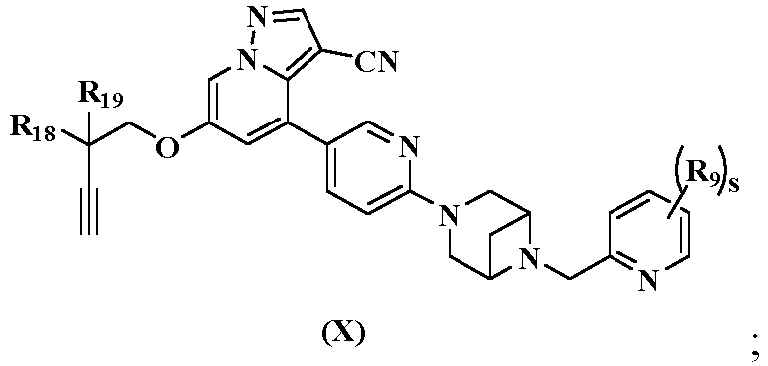 worin R18 und R19 jeweils unabhängig voneinander ausgewählt sind aus Wasserstoff, Deuterium, C1-3-Alkyl, deuteriertem C1-3-Alkyl, C1-3-Haloalkyl, C1-3-Alkoxy, deuteriertem C1-3-Alkoxy, C1-3-Haloalkoxy, Halogen, Amino, Nitro, Hydroxyl, Cyano, C2-4-Alkenyl, C2-4-Alkinyl, C3-6-Cycloalkyl, 3-6-gliedrigem Heterocyclyl, C6-10-Aryl oder 5-6-gliedrigem Heteroaryl, vorzugsweise Hydroxyl oder Methyl;R9 ausgewählt ist aus Wasserstoff, Deuterium, C1-3-Alkyl, deuteriertem C1-3-Alkyl, C1-3-Haloalkyl, C1-3-Alkoxy, deuteriertem C1-3-Alkoxy, C1-3-Haloalkoxy, Halogen, Amino, Nitro, Hydroxyl, Cyano, C2-4-Alkenyl oder C2-4-Alkinyl;s 0, 1, 2 oder 3 ist.
 - Verbindung, dargestellt durch die allgemeine Formel (IX-C), ein Stereoisomer davon oder ein pharmazeutisch akzeptables Salz davon:
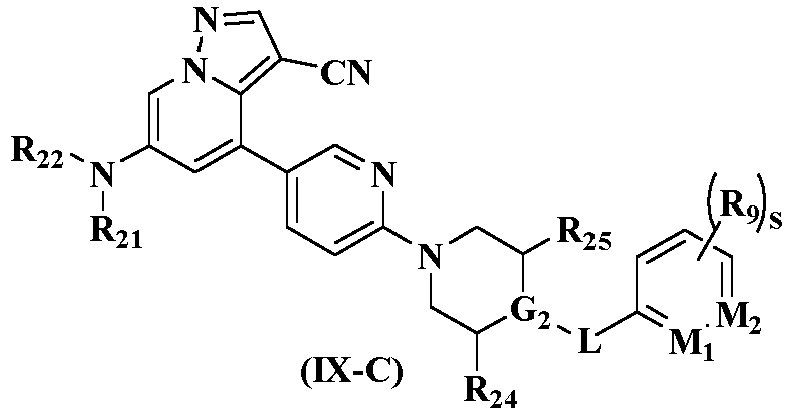 R21 und R22 jeweils unabhängig voneinander aus Wasserstoff, Deuterium, C1-6-Alkyl, deuteriertem C1-6-Alkyl, C1-6-Haloalkyl, C1-6-Alkoxy, deuteriertem C1-6-Alkoxy, C1-6-Haloalkoxy, Halogen, Amino, Nitro, Hydroxyl, Cyano, C2-6-Alkenyl, C2-6-Alkinyl, C3-8-Cycloalkyl, 3-12-gliedrigem Heterocyclyl, C6-10-Aryl, 5-12-gliedrigem Heteroaryl, - (CH2)n1C(O)Raa oder -(CH2)n1Raa ausgewählt sind; oderR21 und R22 zusammen mit den Stickstoffatomen, an die sie gebunden sind, ein Azetidinyl bilden, wobei das Azetidinyl gegebenenfalls weiter durch einen oder mehrere Substituenten, ausgewählt aus Wasserstoff, Amino, Halogen, Cyano, Hydroxyl, Oxo, C1-6-Alkyl oder C1-6-Hydroxyalkyl, substituiert ist;R24 und R25 jeweils unabhängig voneinander ausgewählt sind aus Wasserstoff, Deuterium, C1-6-Alkyl, deuteriertem C1-6-Alkyl, C1-6-Halogenalkyl, C1-6-Alkoxy, deuteriertem C1-6-Alkoxy, C1-6-Halogenalkoxy, Halogen, Amino, Nitro, Hydroxyl, Cyano, C2-6-Alkenyl, C2-6-Alkinyl, C3-8-Cycloalkyl, 3-12-gliedrigem Heterocyclyl, C6-10-Aryl, 5-12-gliedrigem Heteroaryl oder -(CH2)n1ORaa, vorzugsweise Wasserstoff oder Methyl;oder R24 und R25 bilden zusammen mit den Kohlenstoffatomen, an die sie gebunden sind, und G2 ein C3-8-Cycloalkyl oder einen 3-12-gliedrigen Heterocyclyl, vorzugsweise Azetidinyl;L ausgewählt ist aus Bindung, -(CH2)n1CRaaRbb-, - (CH2)n1NRaaC(O)(CH2)n2-, - (CH2)n1C(O)(CH2)n2(CRaaRbb)m-, - (CH2)n1C(O)(CRaaRbb)m(CH2)n2-, -(CH2)n1C(O)NRcc(CRaaRbb)n2-, - (CH2)n1(O)(CH2)n2- oder -(CH2)n1NRaa(CH2)n2-, vorzugsweise - CH2-, -CD2-, -O- oder -NHC(O)-;G2 ausgewählt ist aus N oder CRaa, vorzugsweise N, CH oder CCH3;M1 ausgewählt ist aus N oder CRaa, vorzugsweise N, CH oder CCH3;M2 ausgewählt ist aus N oder CRaa, vorzugsweise N oder CH;R9 ausgewählt ist aus Wasserstoff, Deuterium, C1-6-Alkyl, deuteriertem C1-6-Alkyl, C1-6-Halogenalkyl, C1-6-Alkoxy, deuteriertem C1-6-Alkoxy, C1-6-Halogenalkoxy, Halogen, Amino, Nitro, Hydroxyl, Cyano, C2-6-Alkenyl, C2-6-Alkinyl, C3-8-Cycloalkyl, 3-12-gliedrigem Heterocyclyl, C6-10-Aryl, 5-12-gliedrigem Heteroaryl oder -(CH2)n1ORaa; vorzugsweise Wasserstoff, Halogen, C1-6-Alkoxy, deuteriertes C1-6-Alkoxy oder -ORaa; besonders bevorzugt Wasserstoff, Fluor, Chlor, Methyl, Methoxy, deuteriertes Methoxy oder Cyclopropoxy;Raa, Rbb und Rcc jeweils unabhängig voneinander ausgewählt sind aus Wasserstoff, Deuterium, Cyano, Amino, C1-6-Alkyl, C1-6-Alkoxy, C1-6-Hydroxyalkyl, Hydroxyl, C3-8-Cycloalkyl, 3-12-gliedrigem Heterocyclyl oder C6-14-Aryl, wobei das C1-6-Alkyl, C1-6-Alkoxy, C1-6-Hydroxyalkyl, Hydroxyl, C3-8-Cycloalkyl, 3-12-gliedriges Heterocylcyl und C6-14-Aryl gegebenenfalls weiter substituiert sind durch einen oder mehrere Substituenten, ausgewählt aus Wasserstoff, Halogen, Cyano, Hydroxyl, Oxo, Imino, C1-6-Alkyl oder C1-6-Hydroxyalkyl;oder zwei beliebige von Raa, Rbb und Rcc gegebenenfalls verbunden sind, um ein C3-8-Cycloalkyl oder ein 3-12-gliedriges Heterocyclyl zu bilden, wobei das C3-8-Cycloalkyl und das 3-12-gliedrige Heterocyclyl gegebenenfalls weiter durch einen oder mehrere Substituenten, ausgewählt aus Wasserstoff, Amino, Halogen, Cyano, Hydroxyl, Oxo, Imino, C1-6-Alkyl oder C1-6-Hydroxyalkyl, substituiert sind;s ist 0, 1, 2 oder 3;m 0, 1 oder 2 ist;n1 ist 0, 1 oder 2; undn2 ist 0, 1 oder 2.
 - Verbindung gemäß Anspruch 5, das Stereoisomer davon oder das pharmazeutisch akzeptable Salz davon,R21 und R22 jeweils unabhängig voneinander ausgewählt sind aus Wasserstoff, Deuterium, C1-6-Alkyl, deuteriertem C1-6-Alkyl, C1-6-Haloalkyl, C1-6-Alkoxy, deuteriertem C1-6-Alkoxy, C1-6-Haloalkoxy, Halogen, Amino, Nitro, Hydroxyl, Cyano, C2-6-Alkenyl, C2-6-Alkinyl, C3-8-Cycloalkyl, 3-12-gliedrigem Heterocyclyl, C6-10-Aryl, 5-12-gliedrigem Heteroaryl, -(CH2)n1C(O)Raa oder -(CH2)n1Raa; oderR21 und R22 zusammen mit den Stickstoffatomen, an die sie gebunden sind, ein Azetidinyl bilden, wobei das Azetidinyl gegebenenfalls weiter durch einen oder mehrere Substituenten, ausgewählt aus Wasserstoff, Amino, Halogen, Cyano, Hydroxyl, Oxo, C1-6-Alkyl oder C1-6-Hydroxyalkyl, substituiert ist;R24 und R25 jeweils unabhängig voneinander aus Wasserstoff oder Methyl ausgewählt sind;oder R24 und R25 zusammen mit den Kohlenstoffatomen, an die sie gebunden sind, und G2 ein Azetidinyl bilden;L ausgewählt ist aus -CH2-, -CD2-, -O- oder - NHC(O)-;G2 ausgewählt ist aus N, CH oder CCH3;M1 ausgewählt ist aus N, CH oder CCH3;M2 ausgewählt ist aus N oder CH;R9 ausgewählt ist aus Wasserstoff, Fluor, Chlor, Methyl, Methoxy, deuteriertem Methoxy oder Cyclopropoxy; Raa jeweils unabhängig voneinander ausgewählt ist aus Wasserstoff, Deuterium, Cyano, Amino, C1-6-Alkyl, C1-6-Alkoxy, C1-6-Hydroxyalkyl, Hydroxyl, C3-8-Cycloalkyl, 3-12-gliedrigem Heterocyclyl oder C6-14-Aryl, wobei C1-6-Alkyl, C1-6-Alkoxy, C1-6-Hydroxyalkyl, Hydroxyl, C3-8-Cycloalkyl, 3-12-gliedriges Heterocyclyl und C6-14-Aryl gegebenenfalls weiter substituiert sind durch einen oder mehrere Substituenten, ausgewählt aus Wasserstoff, Halogen, Cyano, Hydroxyl, Oxo, Imino, C1-6-Alkyl oder C1-6-Hydroxyalkyl;s 0, 1, 2 oder 3 ist; undn1 0, 1 oder 2 ist.
- Verbindung, dargestellt durch die allgemeine Formel (IX-C), ein Stereoisomer davon oder ein pharmazeutisch akzeptables Salz davon:
 R21 und R22 jeweils unabhängig voneinander ausgewählt sind aus Wasserstoff, Deuterium, C1-6-Alkyl, deuteriertem C1-6-Alkyl, C1-6-Haloalkyl, C1-6-Alkoxy, deuteriertem C1-6-Alkoxy, C1-6-Haloalkoxy, Halogen, Amino, Nitro, Hydroxyl, Cyano, C2-6-Alkenyl, C2-6-Alkinyl, C3-8-Cycloalkyl, 3-12-gliedrigem Heterocyclyl, C6-10-Aryl, 5-12-gliedrigem Heteroaryl, -(CH2)n1C(O)Raa oder -(CH2)n1Raa; oderR21 und R22 zusammen mit den Stickstoffatomen, an die sie gebunden sind, Azetidinyl oder 2-Azaspiro[3.3]heptan bilden, wobei das Azetidinyl oder 2-Azaspiro[3.3]heptan gegebenenfalls durch einen oder mehrere Substituenten, ausgewählt aus Wasserstoff, C1-6-Alkyl, Hydroxyl oder Hydroxyalkyl, weiter substituiert ist;R24 und R25 jeweils unabhängig voneinander ausgewählt sind aus Wasserstoff, Deuterium, C1-6-Alkyl, deuteriertem C1-6-Alkyl, C1-6-Haloalkyl, C1-6-Alkoxy, deuteriertem C1-6-Alkoxy, C1-6-Haloalkoxy, Halogen, Amino, Nitro, Hydroxyl, Cyano, C2-6-Alkenyl, C2-6-Alkinyl, C3-8-Cycloalkyl, 3-12-gliedrigem Heterocyclyl, C6-10-Aryl, 5-12-gliedrigem Heteroaryl oder -(CH2)n1ORaa, vorzugsweise Wasserstoff oder Methyl;oder R24 und R25 bilden zusammen mit den Kohlenstoffatomen, an die sie gebunden sind, und G2 ein C3-8-Cycloalkyl oder einen 3-12-gliedrigen Heterocyclyl, vorzugsweise Azetidinyl;L ausgewählt ist aus Bindung, -(CH2)n1CRaaRbb-, - (CH2)n1NRaaC(O)(CH2)n2-, -(CH2)n1C(O)(CH2)n2(CRaaRbb)m-, - (CH2)n1C(O)(CRaaRbb)m(CH2)n2-, -(CH2)n1C(O)NRcc(CRaaRbb)n2-, - (CH2)n1(O)(CH2)n2- oder -(CH2)n1NRaa(CH2)n2-, vorzugsweise - CH2-, -CD2-, -O- oder -NHC(O)-;G2 ausgewählt ist aus N oder CRaa, vorzugsweise N, CH oder CCH3;M1 ausgewählt ist aus N oder CRaa, vorzugsweise N, CH oder CCH3;M2 ausgewählt ist aus N oder CRaa, vorzugsweise N oder CH;R9 ausgewählt ist aus Wasserstoff, Deuterium, C1-6-Alkyl, deuteriertem C1-6-Alkyl, C1-6-Halogenalkyl, C1-6-Alkoxy, deuteriertem C1-6-Alkoxy, C1-6-Halogenalkoxy, Halogen, Amino, Nitro, Hydroxyl, Cyano, C2-6-Alkenyl, C2-6-Alkinyl, C3-8-Cycloalkyl, 3-12-gliedrigem Heterocyclyl, C6-10-Aryl, 5-12-gliedrigem Heteroaryl oder -(CH2)n1ORaa; vorzugsweise Wasserstoff, Halogen, C1-6-Alkoxy, deuteriertes C1-6-Alkoxy oder -ORaa; besonders bevorzugt Wasserstoff, Fluor, Chlor, Methyl, Methoxy, deuteriertes Methoxy oder Cyclopropoxy;Raa, Rbb und Rcc jeweils unabhängig voneinander ausgewählt sind aus Wasserstoff, Deuterium, Cyano, Amino, C1-6-Alkyl, C1-6-Alkoxy, C1-6-Hydroxyalkyl, Hydroxyl, C3-8-Cycloalkyl, 3-12-gliedrigem Heterocyclyl oder C6-14-Aryl, wobei das C1-6-Alkyl, C1-6-Alkoxy, C1-6-Hydroxyalkyl, Hydroxyl, C3-8-Cycloalkyl, 3-12-gliedriges Heterocylcyl und C6-14-Aryl gegebenenfalls weiter substituiert sind durch einen oder mehrere Substituenten, ausgewählt aus Wasserstoff, Halogen, Cyano, Hydroxyl, Oxo, Imino, C1-6-Alkyl oder C1-6-Hydroxyalkyl;oder zwei beliebige von Raa, Rbb und Rcc gegebenenfalls verbunden sind, um ein C3-8-Cycloalkyl oder ein 3-12-gliedriges Heterocyclyl zu bilden, wobei das C3-8-Cycloalkyl und das 3-12-gliedrige Heterocyclyl gegebenenfalls weiter durch einen oder mehrere Substituenten, ausgewählt aus Wasserstoff, Amino, Halogen, Cyano, Hydroxyl, Oxo, Imino, C1-6-Alkyl oder C1-6-Hydroxyalkyl, substituiert sind;s ist 0, 1, 2 oder 3;m 0, 1 oder 2 ist;n1 ist 0, 1 oder 2; undn2 ist 0, 1 oder 2;oder R21 und R22 zusammen mit den Kohlenstoffatomen, an die sie gebunden sind, ein Azetidinyl oder 2-Azaspiro[3.3]heptan bilden, wobei das Azetidinyl oder 2-Azaspiro[3.3]heptan gegebenenfalls weiter durch einen oder mehrere Substituenten, ausgewählt aus Wasserstoff, C1-3-Alkyl, Cyano, Hydroxyl oder Hydroxyalkyl, substituiert ist.
 - Verbindung der allgemeinen Formel (IX-C), ein Stereoisomer davon oder ein pharmazeutisch akzeptables Salz davon:

 R26 und R27 sind jeweils unabhängig voneinander ausgewählt aus Wasserstoff, Deuterium, Halogen, Amino, Nitro, Hydroxyl, Cyano, C1-6-Alkyl, deuteriertem C1-6-Alkyl, C1-6-Haloalkyl, C1-6-Alkoxy, deuteriertem C1-6-Alkoxy, C1-6-Haloalkoxy, C1-6-Hydroxyalkyl, C2-6-Alkenyl, C2-6-Alkinyl, C3-8-Cycloalkyl, 3-12-gliedrigem Heterocyclyl, C6-10-Aryl oder 5-12-gliedrigem Heteroaryl; vorzugsweise Wasserstoff, Hydroxyl, Cyano, C1-3-Alkyl oder C1-3-Hydroxyalkyl; besonders bevorzugt Wasserstoff, Hydroxyl, Cyanomethyl oder Hydroxyisopropyl;R24 und R25 jeweils unabhängig voneinander ausgewählt sind aus Wasserstoff, Deuterium, C1-6-Alkyl, deuteriertem C1-6-Alkyl, C1-6-Haloalkyl, C1-6-Alkoxy, deuteriertem C1-6-Alkoxy, C1-6-Haloalkoxy, Halogen, Amino, Nitro, Hydroxyl, Cyano, C2-6-Alkenyl, C2-6-Alkinyl, C3-8-Cycloalkyl, 3-12-gliedrigem Heterocyclyl, C6-10-Aryl, 5-12-gliedrigem Heteroaryl oder -(CH2)n1ORaa, vorzugsweise Wasserstoff oder Methyl;oder R24 und R25 bilden zusammen mit den Kohlenstoffatomen, an die sie gebunden sind, und G2 ein C3-8-Cycloalkyl oder einen 3-12-gliedrigen Heterocyclyl, vorzugsweise Azetidinyl;L ausgewählt ist aus Bindung, -(CH2)n1CRaaRbb-, - (CH2)n1NRaaC(O)(CH2)n2-, -(CH2)n1C(O)(CH2)n2(CRaaRbb)m-, - (CH2)n1C(O)(CRaaRbb)m(CH2)n2-, -(CH2)n1C(O)NRcc(CRaaRbb)n2-, - (CH2)n1(O)(CH2)n2- oder -(CH2)n1NRaa(CH2)n2-, vorzugsweise - CH2-, -CD2-, -O- oder -NHC(O)-;G2 ausgewählt ist aus N oder CRaa, vorzugsweise N, CH oder CCH3;M1 ausgewählt ist aus N oder CRaa, vorzugsweise N, CH oder CCH3;M2 ausgewählt ist aus N oder CRaa, vorzugsweise N oder CH;R9 ausgewählt ist aus Wasserstoff, Deuterium, C1-6-Alkyl, deuteriertem C1-6-Alkyl, C1-6-Haloalkyl, C1-6-Alkoxy, deuteriertem C1-6-Alkoxy, C1-6-Haloalkoxy, Halogen, Amino, Nitro, Hydroxyl, Cyano, C2-6-Alkenyl, C2-6-Alkinyl, C3-8-Cycloalkyl, 3-12-gliedrigem Heterocyclyl, C6-10-Aryl, 5-12-gliedrigem Heteroaryl oder -(CH2)n1ORaa; vorzugsweise Wasserstoff, Halogen, C1-6-Alkoxy, deuteriertes C1-6-Alkoxy oder -ORaa; besonders bevorzugt Wasserstoff, Fluor, Chlor, Methyl, Methoxy, deuteriertes Methoxy oder Cyclopropoxy;Raa, Rbb und Rcc jeweils unabhängig voneinander ausgewählt sind aus Wasserstoff, Deuterium, Cyano, Amino, C1-6-Alkyl, C1-6-Alkoxy, C1-6-Hydroxyalkyl, Hydroxyl, C3-8-Cycloalkyl, 3-12-gliedrigem Heterocyclyl oder C6-14-Aryl, wobei das C1-6-Alkyl, C1-6-Alkoxy, C1-6-Hydroxyalkyl, Hydroxyl, C3-8-Cycloalkyl, 3-12-gliedriges Heterocylcyl und C6-14-Aryl gegebenenfalls weiter substituiert sind durch einen oder mehrere Substituenten, ausgewählt aus Wasserstoff, Halogen, Cyano, Hydroxyl, Oxo, Imino, C1-6-Alkyl oder C1-6-Hydroxyalkyl;oder zwei beliebige von Raa, Rbb und Rcc gegebenenfalls verbunden sind, um ein C3-8-Cycloalkyl oder ein 3-12-gliedriges Heterocyclyl zu bilden, wobei das C3-8-Cycloalkyl und das 3-12-gliedrige Heterocyclyl gegebenenfalls weiter durch einen oder mehrere Substituenten substituiert sind, die aus Wasserstoff, Amino, Halogen, Cyano, Hydroxyl, Oxo, Imino, C1-6-Alkyl oder C1-6-Hydroxyalkyl ausgewählt sind;s ist 0, 1, 2 oder 3;m 0, 1 oder 2 ist;n1 ist 0, 1 oder 2; undn2 ist 0, 1 oder 2.
 - Verbindung, dargestellt durch die allgemeine Formel (IX-A), ein Stereoisomer davon oder ein pharmazeutisch akzeptables Salz davon:
 L ausgewählt ist aus Bindung, -(CH2)n1CRaaRbb-, - (CH2)n1NRaaC(O)(CH2)n2-, -(CH2)n1C(O)(CH2)n2(CRaaRbb)m-,-(CH2)n1C(O)(CRaaRbb)m(CH2)n2-, -(CH2)n1C(O)NRcc(CRaaRbb)n2-, - (CH2)n1(O)(CH2)n2- oder -(CH2)n1NRaa(CH2)n2-, vorzugsweise - CH2-, -CD2-, -O- oder -NHC(O)-;G2 ausgewählt ist aus N oder CRaa, vorzugsweise N, CH oder CCH3;M1 ausgewählt ist aus N oder CRaa, vorzugsweise N, CH oder CCH3;M2 ausgewählt ist aus N oder CRaa, vorzugsweise N oder CH;R9 ausgewählt ist aus Wasserstoff, Deuterium, C1-6-Alkyl, deuteriertem C1-6-Alkyl, C1-6-Haloalkyl, C1-6-Alkoxy, deuteriertem C1-6-Alkoxy, C1-6-Haloalkoxy, Halogen, Amino, Nitro, Hydroxyl, Cyano, C2-6-Alkenyl, C2-6-Alkinyl, C3-8-Cycloalkyl, 3-12-gliedrigem Heterocyclyl, C6-10-Aryl, 5-12-gliedrigem Heteroaryl oder - (CH2)n1ORaa; vorzugsweise Wasserstoff, Halogen, C1-6-Alkoxy, deuteriertes C1-6-Alkoxy oder -ORaa; besonders bevorzugt Wasserstoff, Fluor, Chlor, Methyl, Methoxy, deuteriertes Methoxy oder Cyclopropoxy;R17 ausgewählt ist aus C1-6-Alkyl, C1-6-Haloalkyl, C1-6-Alkoxy, C2-6-Alkinyl, 3-12-gliedrigem Heterocyclyl, 5-12-gliedrigem Heteroaryl oder - (CH2)n1(CRaaRbb)Rcc, wobei das C1-6-Alkyl, C1-6-Haloalkyl, C1-6-Alkoxy, C2-6-Alkinyl, 3-12-gliedriges Heterocyclyl und 5-12-gliedriges Heteroaryl gegebenenfalls weiter substituiert sind durch einen oder mehrere Substituenten, ausgewählt aus Wasserstoff, C1-6-Haloalkyl, Hydroxyl, Cyano, Oxo, Thio, Amino, Imino, C1-6-Alkoxy, C1-6-Hydroxyalkyl, C1-6-Cyanoalkyl, C3-8-Cycloalkyl oder 3-12-gliedrigem Heterocyclyl;R24 und R25 jeweils unabhängig voneinander ausgewählt sind aus Wasserstoff, Deuterium, C1-6-Alkyl, deuteriertem C1-6-Alkyl, C1-6-Haloalkyl, C1-6-Alkoxy, deuteriertem C1-6-Alkoxy, C1-6-Haloalkoxy, Halogen, Amino, Nitro, Hydroxyl, Cyano, C2-6-Alkenyl, C2-6-Alkinyl, C3-8-Cycloalkyl, 3-12-gliedrigem Heterocyclyl, C6-10-Aryl, 5-12-gliedrigem Heteroaryl oder -(CH2)n1ORaa, vorzugsweise Wasserstoff oder Methyl;oder R24 und R25 bilden zusammen mit den Kohlenstoffatomen, an die sie gebunden sind, und G2 ein C3-8-Cycloalkyl oder einen 3-12-gliedrigen Heterocyclyl, vorzugsweise Azetidinyl;Raa, Rbb und Rcc jeweils unabhängig voneinander ausgewählt sind aus Wasserstoff, Deuterium, Cyano, Amino, C1-6-Alkyl, C1-6-Alkoxy, C1-6-Hydroxyalkyl, Hydroxyl, C3-8-Cycloalkyl, 3-12-gliedrigem Heterocyclyl oder C6-14-Aryl, wobei das C1-6-Alkyl, C1-6-Alkoxy, C1-6-Hydroxyalkyl, Hydroxyl, C3-8-Cycloalkyl, 3-12-gliedriges Heterocyclyl und C6-14-Aryl gegebenenfalls weiter substituiert sind durch einen oder mehrere Substituenten, ausgewählt aus Wasserstoff, Halogen, Cyano, Hydroxyl, Oxo, Imino, C1-6-Alkyl oder C1-6-Hydroxyalkyl;oder zwei beliebige von Raa, Rbb und Rcc gegebenenfalls verbunden sind, um ein C3-8-Cycloalkyl oder ein 3-12-gliedriges Heterocyclyl zu bilden, wobei das C3-8-Cycloalkyl und das 3-12-gliedrige Heterocyclyl gegebenenfalls weiter durch einen oder mehrere Substituenten, ausgewählt aus Wasserstoff, Amino, Halogen, Cyano, Hydroxyl, Oxo, Imino, C1-6-Alkyl oder C1-6-Hydroxyalkyl, substituiert sind;n1 ist 0, 1 oder 2;n2 ist 0, 1 oder 2;m ist 0, 1 oder 2; unds ist 0, 1, 2 oder 3.
 - Die in Anspruch 1 definierte Verbindung, das Stereoisomer davon oder das pharmazeutisch akzeptable Salz davon, wobei,L ausgewählt ist aus Bindung, -(CH2)n1CRaaRbb-, - (CH2)n1NRaaC(O)(CH2)n2-, -(CH2)n1C(O)(CRaaRbb)m(CH2)n2-, - (CH2)n1C(O)(CH2)m(CRaaRbb)n2-, -(CH2)n1C(O)NRcc(CRaaRbb)n2-, - (CH2)n1(O)(CH2)n2- oder -(CH2)n1NRaa(CH2)n2-;R11 ausgewählt ist aus Cyano, -(CH2)n1P(O)RaaRbb oder -(CH2)n1C(O)NRaaRbb;R12 ausgewählt ist aus Wasserstoff, C1-6-Alkyl oder Halogen;R13 ausgewählt ist aus C2-6-Alkinyl, - (C≡C)n1(CRaaRbb)mRcc, -(C=C)n1(CRaaRbb)mRcc, oder - (CH2)n1O(CH2)n2(CRaaRbb)mRcc;R14 ausgewählt ist aus Wasserstoff oder Halogen;R15 ausgewählt ist aus Wasserstoff oder Halogen;R16 aus Wasserstoff, Alkoxy oder -ORaa ausgewählt ist;Raa und Rbb jeweils unabhängig voneinander ausgewählt sind aus Wasserstoff, Deuterium, Cyano, Amino, C1-6-Alkyl, C1-6-Alkoxy, Hydroxyl, C3-8-Cycloalkyl, 3-12-gliedrigem Heterocyclyl oder C6-14-Aryl, wobei das C1-6-Alkyl, C1-6-Alkoxy, C3-8-Cycloalkyl, 3-12-gliedrige Heterocyclyl und C6-14-Aryl gegebenenfalls weiter substituiert sind durch einen oder mehrere Substituenten, ausgewählt aus Wasserstoff, Halogen, Cyano, Hydroxyl, Oxo, Imino oder C1-6-Alkyl;Rcc ausgewählt ist aus Cyano;oder beliebige zwei von Raa und Rbb gegebenenfalls verbunden sind, um ein C3-8-Cycloalkyl oder ein 3-12-gliedriges Heterocyclyl zu bilden, wobei das C3-8-Cycloalkyl und das 3-12-gliedrige Heterocyclyl gegebenenfalls durch einen oder mehrere Substituenten, ausgewählt aus Wasserstoff, Amino, Halogen, Cyano, Hydroxyl, Oxo, Imin oder C1-6-Alkyl, weiter substituiert sind.
- Verbindung, ein Stereoisomer davon oder ein pharmazeutisch akzeptables Salz davon, wobei die spezifische Struktur der Verbindung wie folgt ist:









- Verfahren zur Herstellung der Verbindung der allgemeinen Formel (IX-A), wie in Anspruch 9 definiert, des Stereoisomers davon oder des pharmazeutisch akzeptablen Salzes davon, wobei das Verfahren die folgenden Schritte umfasst:
 eine Kupplungsreaktion wird mit der allgemeinen Formel (IX-A1) und der allgemeinen Formel (IX-A2) durchgeführt, um die durch die allgemeine Formel (IX-A) dargestellte Verbindung oder das Stereoisomer davon und das pharmazeutisch akzeptable Salz davon zu erhalten;worin:
X1 ausgewählt ist aus Halogen; vorzugsweise Fluor, Chlor, Brom oder Jod; besonders bevorzugt Brom. - Verfahren zur Herstellung der Verbindung, dargestellt durch die allgemeine Formel (IX-B), wie in Anspruch 3 definiert, des Stereoisomers davon oder des pharmazeutisch akzeptablen Salzes davon, wobei das Verfahren die folgenden Schritte umfasst:
 eine Reaktion wird mit der allgemeinen Formel (IX-B1) und der allgemeinen Formel (IX-B2) durchgeführt, um die durch die allgemeine Formel (IX-B) dargestellte Verbindung oder das Stereoisomer davon und das pharmazeutisch akzeptable Salz davon zu erhalten;worin:R28 ausgewählt ist aus Halogen, Borsäure oder Boratester; vorzugsweise Fluor, Chlor, Brom, Jod, - B(OH)2 oder
 R29 ausgewählt ist aus Halogen, Borsäure oder Boratester; vorzugsweise Fluor, Chlor, Brom, Iod, - B(OH)2 oder
 wenn R28 Halogen ist, ist R29 ausgewählt aus Borsäure oder Boratester;wenn R28 ausgewählt ist aus Borsäure oder Boratester, ist R29 Halogen;oder,wobei es die folgenden Schritte umfasst:
 eine Reaktion mit der allgemeinen Formel (IX-B3) und der allgemeinen Formel (IX-B4) durchgeführt wird, um die durch die allgemeine Formel (IX-B) dargestellte Verbindung oder das Stereoisomer davon und das pharmazeutisch akzeptable Salz davon zu erhalten; worin:R30 ausgewählt ist aus Halogen, Hydroxyl; vorzugsweise Fluor, Chlor, Brom, Jod oder Hydroxyl; besonders bevorzugt Brom oder Hydroxyl;Pg ausgewählt ist aus Wasserstoff, Halogen oder einer Hydroxyl-Schutzgruppe, und das Halogen vorzugsweise Fluor, Chlor, Brom oder Iod ist;wenn Pg eine Hydroxylschutzgruppe ist, ist sie ausgewählt aus Methyl, tert-Butyl, Triphenyl, Methylsulfidmethylether, 2-Methoxyethoxymethylether, Methoxymethylether, p-Methoxybenzylether, Pivaloyl, Benzylether, Methoxymethyl, Trimethylsilyl, Tetrahydrofuranyl, tert-Butyldisilyl, Acetyl, Benzoyl oder p-Toluolsulfonyl; vorzugsweise p-Toluolsulfonyl;wenn M3 -O- ist, ist Pg ausgewählt aus Wasserstoff oder einer Hydroxyl-Schutzgruppe.
 - Verfahren zur Herstellung der Verbindung, dargestellt durch die allgemeine Formel (IX-C), wie in einem der Ansprüche 5 bis 8 definiert, des Stereoisomers davon oder des pharmazeutisch akzeptablen Salzes davon, wobei das Verfahren die folgenden Schritte umfasst:
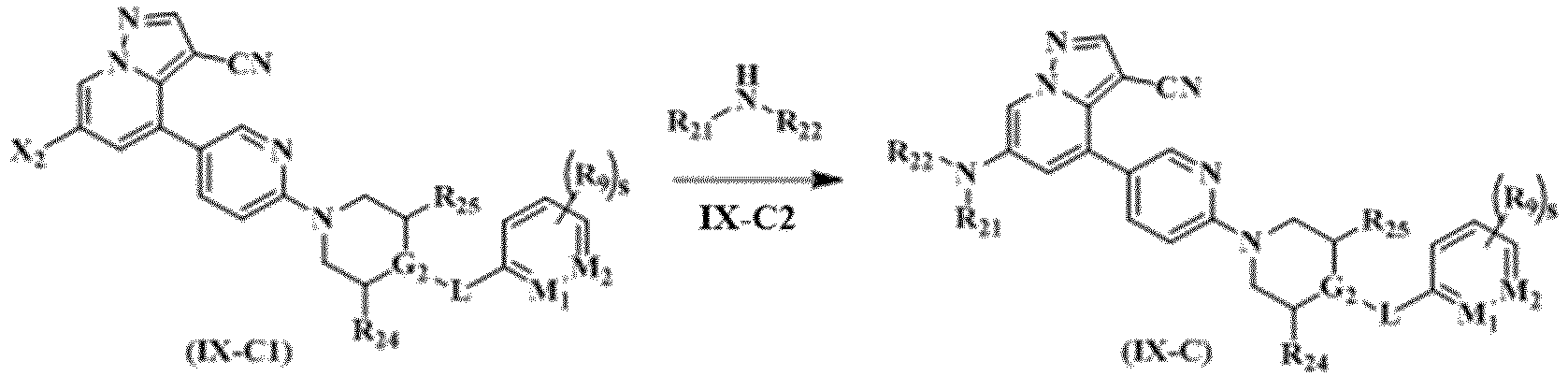 eine Reaktion wird mit der allgemeinen Formel (IX-C1) und der allgemeinen Formel (IX-C2) durchgeführt, um die durch die allgemeine Formel (IX-C) dargestellte Verbindung oder das Stereoisomer davon und das pharmazeutisch akzeptable Salz davon zu erhalten;worin:
X2 ausgewählt ist aus Halogen; vorzugsweise Fluor, Chlor, Brom oder Jod; besonders bevorzugt Brom. - Pharmazeutische Zusammensetzung, umfassend eine therapeutisch wirksame Menge der in einem der Ansprüche 1 bis 11 definierten Verbindung und des Stereoisomers davon oder des pharmazeutisch akzeptablen Salzes davon und einen oder mehrere pharmazeutisch annehmbare Träger.
- Die Verbindung, die wie in einem der Ansprüche 1-11 definiert ist, das Stereoisomer davon oder das pharmazeutisch akteptable Salz davon oder die pharmazeutische Zusammensetzung, wie in Anspruch 15 definiert, zur Verwendung als Arzneimittel zur Behandlung und/oder Vorbeugung von nicht-kleinzelligem Lungenkrebs, Fibrosarkom, Pankreastumor, medullärem Schilddrüsenkarzinom, papillärem Schilddrüsentumor, Weichteilsarkom, hochgradig solidem Tumor, Brusttumor und Kolontumor und anderen verwandten Krankheiten.
Applications Claiming Priority (6)
| Application Number | Priority Date | Filing Date | Title |
|---|---|---|---|
| CN201910400013 | 2019-05-14 | ||
| CN201910615987 | 2019-07-09 | ||
| CN201910816375 | 2019-08-30 | ||
| CN201910895078 | 2019-09-20 | ||
| CN202010177893 | 2020-03-13 | ||
| PCT/CN2020/090142 WO2020228756A1 (zh) | 2019-05-14 | 2020-05-14 | 含二并环类衍生物抑制剂、其制备方法和应用 |
Publications (4)
| Publication Number | Publication Date |
|---|---|
| EP3971187A1 EP3971187A1 (de) | 2022-03-23 |
| EP3971187A4 EP3971187A4 (de) | 2023-01-11 |
| EP3971187B1 true EP3971187B1 (de) | 2025-05-07 |
| EP3971187C0 EP3971187C0 (de) | 2025-05-07 |
Family
ID=73288882
Family Applications (1)
| Application Number | Title | Priority Date | Filing Date |
|---|---|---|---|
| EP20806520.1A Active EP3971187B1 (de) | 2019-05-14 | 2020-05-14 | Inhibitor mit einem bicyclischen derivat, herstellungsverfahren dafür und verwendung davon |
Country Status (13)
| Country | Link |
|---|---|
| US (2) | US12466823B2 (de) |
| EP (1) | EP3971187B1 (de) |
| JP (1) | JP7588095B2 (de) |
| KR (1) | KR102848713B1 (de) |
| CN (3) | CN112368283B (de) |
| AU (1) | AU2020276802B2 (de) |
| BR (1) | BR112021022897A2 (de) |
| CA (1) | CA3137887A1 (de) |
| ES (1) | ES3034203T3 (de) |
| MX (1) | MX2021013846A (de) |
| TW (1) | TW202108582A (de) |
| WO (1) | WO2020228756A1 (de) |
| ZA (1) | ZA202110357B (de) |
Families Citing this family (22)
| Publication number | Priority date | Publication date | Assignee | Title |
|---|---|---|---|---|
| TW202028209A (zh) * | 2018-09-27 | 2020-08-01 | 大陸商重慶複創醫藥研究有限公司 | 作為RET激酶抑制劑的取代的咪唑[1,2-a]吡啶和[1,2,4]三唑[1,5-a]吡啶化合物 |
| EP3998265A4 (de) * | 2019-07-12 | 2022-11-16 | Shouyao Holdings (Beijing) Co., Ltd. | Ret-selektiver inhibitor, herstellungsverfahren dafür und verwendung davon |
| WO2021088911A1 (zh) * | 2019-11-08 | 2021-05-14 | 杭州邦顺制药有限公司 | 作为ret激酶抑制剂的3、6二氮杂双环[3.1.1]庚烷衍生物 |
| CN112851664B (zh) * | 2019-11-12 | 2024-03-29 | 浙江海正药业股份有限公司 | 吡唑[1,5-a]吡啶-3-腈化合物及其在医药上的用途 |
| CN113045569B (zh) * | 2019-12-27 | 2022-04-19 | 浙江同源康医药股份有限公司 | 用作ret激酶抑制剂的化合物及其应用 |
| WO2021138391A1 (en) | 2019-12-30 | 2021-07-08 | Tyra Biosciences, Inc. | Indazole compounds |
| CN113683610B (zh) * | 2020-05-18 | 2025-02-25 | 广东东阳光药业股份有限公司 | 一种ret抑制剂、其药物组合物及其用途 |
| CN113880865A (zh) * | 2020-07-01 | 2022-01-04 | 上海艾力斯医药科技股份有限公司 | 吡唑[1,5-a]吡啶类化合物及其制备方法与应用 |
| EP4201936A4 (de) * | 2020-08-20 | 2024-02-21 | Jiangsu Chia Tai Fenghai Pharmaceutical Co., Ltd. | Heteroaromatische ringverbindung als ret-kinasehemmer sowie herstellung und verwendung davon |
| CN116528859A (zh) * | 2020-11-13 | 2023-08-01 | 上海翰森生物医药科技有限公司 | 含二并环类衍生物抑制剂自由碱的晶型及其制备方法和应用 |
| CN114478586A (zh) * | 2020-11-13 | 2022-05-13 | 上海翰森生物医药科技有限公司 | 一种含二并环类衍生物抑制剂盐或晶型及其制备方法和应用 |
| CN114621256A (zh) * | 2020-12-11 | 2022-06-14 | 深圳众格生物科技有限公司 | 吡唑并[1,5-a]吡啶类化合物及其制备方法和应用 |
| CN112679494B (zh) * | 2020-12-24 | 2023-05-16 | 贵州民族大学 | 一种吡唑并[1,5-a]吡啶衍生物的制备方法 |
| US12264149B2 (en) | 2020-12-30 | 2025-04-01 | Tyra Biosciences, Inc. | Indazole compounds as kinase inhibitors |
| TWI818424B (zh) * | 2021-02-08 | 2023-10-11 | 大陸商北京志健金瑞生物醫藥科技有限公司 | 含氮多環稠環類化合物,其藥物組合物、製備方法和用途 |
| TWI844244B (zh) * | 2022-01-19 | 2024-06-01 | 大陸商深圳眾格生物科技有限公司 | 化合物的鹽、晶型、溶劑合物及水合物 |
| CN117050003A (zh) * | 2022-05-07 | 2023-11-14 | 山东新时代药业有限公司 | 一种1-(3-甲氧基丙基)-4-哌啶胺的制备方法 |
| CN117209501A (zh) * | 2022-06-02 | 2023-12-12 | 苏州朗睿生物医药有限公司 | 磺酰胺衍生物及其用途 |
| KR20250058008A (ko) | 2022-08-01 | 2025-04-29 | 장쑤 한서 파마슈티칼 그룹 캄파니 리미티드 | 접합된 비시클릭 억제제의 중간체 및 그 제조 방법 |
| WO2026021563A1 (zh) * | 2024-07-25 | 2026-01-29 | 首药控股(北京)股份有限公司 | 一种选择性抑制剂的多晶型物及其制备方法 |
| WO2026021558A1 (zh) * | 2024-07-25 | 2026-01-29 | 首药控股(北京)股份有限公司 | 一种药物制剂组合物及其制备方法 |
| WO2026021550A1 (zh) * | 2024-07-25 | 2026-01-29 | 首药控股(北京)股份有限公司 | 一种激酶抑制剂的制备方法 |
Citations (3)
| Publication number | Priority date | Publication date | Assignee | Title |
|---|---|---|---|---|
| EP3950685A1 (de) * | 2019-04-03 | 2022-02-09 | Guangzhou Baiyunshan Pharmaceutical Holdings Co., Ltd. Baiyunshan Pharmaceutical General Factory | Pyrazolopyridinverbindung als ret-inhibitor und deren verwendung |
| EP3998265A1 (de) * | 2019-07-12 | 2022-05-18 | Shouyao Holdings (Beijing) Co., Ltd. | Ret-selektiver inhibitor, herstellungsverfahren dafür und verwendung davon |
| EP4074710A1 (de) * | 2019-12-11 | 2022-10-19 | Shenzhen Zhongge Biological Technology Co., Ltd | Pyrazolo[1,5-a]pyridinverbindung, herstellungsverfahren dafür und verwendung davon |
Family Cites Families (8)
| Publication number | Priority date | Publication date | Assignee | Title |
|---|---|---|---|---|
| EP3322706B1 (de) * | 2015-07-16 | 2020-11-11 | Array Biopharma, Inc. | Substituierte pyrazol[1,5-a]pyridin-verbindungen als ret-kinasehemmer |
| JOP20190077A1 (ar) * | 2016-10-10 | 2019-04-09 | Array Biopharma Inc | مركبات بيرازولو [1، 5-a]بيريدين بها استبدال كمثبطات كيناز ret |
| TWI704148B (zh) * | 2016-10-10 | 2020-09-11 | 美商亞雷生物製藥股份有限公司 | 作為ret激酶抑制劑之經取代吡唑并[1,5-a]吡啶化合物 |
| TWI791053B (zh) * | 2017-10-10 | 2023-02-01 | 美商亞雷生物製藥股份有限公司 | 6-(2-羥基-2-甲基丙氧基)-4-(6-(6-((6-甲氧基吡啶-3-基)甲基)-3,6-二氮雜雙環[3.1.1]庚-3-基)吡啶-3-基)吡唑并[1,5-a]吡啶-3-甲腈之結晶形式及其醫藥組合物 |
| FR3079044B1 (fr) * | 2018-03-14 | 2020-05-22 | Ledger | Traitement securise de donnees |
| TW202028209A (zh) | 2018-09-27 | 2020-08-01 | 大陸商重慶複創醫藥研究有限公司 | 作為RET激酶抑制劑的取代的咪唑[1,2-a]吡啶和[1,2,4]三唑[1,5-a]吡啶化合物 |
| JP7493251B2 (ja) * | 2018-09-30 | 2024-05-31 | 北京志健金瑞生物医▲薬▼科技有限公司 | ピラゾール置換縮合環誘導体並びにその製造方法及び応用 |
| CN111635400A (zh) * | 2019-03-02 | 2020-09-08 | 察略盛医药科技(上海)有限公司 | 吡唑并[1,5-a]吡啶类衍生物、及其制备方法和用途 |
-
2020
- 2020-05-14 EP EP20806520.1A patent/EP3971187B1/de active Active
- 2020-05-14 CA CA3137887A patent/CA3137887A1/en active Pending
- 2020-05-14 AU AU2020276802A patent/AU2020276802B2/en active Active
- 2020-05-14 CN CN202080003546.6A patent/CN112368283B/zh active Active
- 2020-05-14 KR KR1020217040838A patent/KR102848713B1/ko active Active
- 2020-05-14 CN CN202310091956.6A patent/CN115974897A/zh active Pending
- 2020-05-14 CN CN202310081132.0A patent/CN116444515B/zh active Active
- 2020-05-14 MX MX2021013846A patent/MX2021013846A/es unknown
- 2020-05-14 WO PCT/CN2020/090142 patent/WO2020228756A1/zh not_active Ceased
- 2020-05-14 US US17/610,939 patent/US12466823B2/en active Active
- 2020-05-14 JP JP2021568429A patent/JP7588095B2/ja active Active
- 2020-05-14 BR BR112021022897A patent/BR112021022897A2/pt unknown
- 2020-05-14 ES ES20806520T patent/ES3034203T3/es active Active
- 2020-05-14 TW TW109116032A patent/TW202108582A/zh unknown
-
2021
- 2021-12-13 ZA ZA2021/10357A patent/ZA202110357B/en unknown
-
2025
- 2025-10-20 US US19/363,551 patent/US20260042759A1/en active Pending
Patent Citations (3)
| Publication number | Priority date | Publication date | Assignee | Title |
|---|---|---|---|---|
| EP3950685A1 (de) * | 2019-04-03 | 2022-02-09 | Guangzhou Baiyunshan Pharmaceutical Holdings Co., Ltd. Baiyunshan Pharmaceutical General Factory | Pyrazolopyridinverbindung als ret-inhibitor und deren verwendung |
| EP3998265A1 (de) * | 2019-07-12 | 2022-05-18 | Shouyao Holdings (Beijing) Co., Ltd. | Ret-selektiver inhibitor, herstellungsverfahren dafür und verwendung davon |
| EP4074710A1 (de) * | 2019-12-11 | 2022-10-19 | Shenzhen Zhongge Biological Technology Co., Ltd | Pyrazolo[1,5-a]pyridinverbindung, herstellungsverfahren dafür und verwendung davon |
Also Published As
| Publication number | Publication date |
|---|---|
| CN115974897A (zh) | 2023-04-18 |
| AU2020276802A1 (en) | 2022-01-06 |
| CN116444515A (zh) | 2023-07-18 |
| AU2020276802B2 (en) | 2025-08-28 |
| CN112368283A (zh) | 2021-02-12 |
| US20260042759A1 (en) | 2026-02-12 |
| CN112368283B (zh) | 2023-02-17 |
| CN116444515B (zh) | 2026-03-13 |
| EP3971187C0 (de) | 2025-05-07 |
| JP7588095B2 (ja) | 2024-11-21 |
| US12466823B2 (en) | 2025-11-11 |
| BR112021022897A2 (pt) | 2022-01-25 |
| EP3971187A4 (de) | 2023-01-11 |
| ZA202110357B (en) | 2023-11-29 |
| TW202108582A (zh) | 2021-03-01 |
| JP2022532758A (ja) | 2022-07-19 |
| EP3971187A1 (de) | 2022-03-23 |
| ES3034203T3 (en) | 2025-08-13 |
| CA3137887A1 (en) | 2020-11-19 |
| WO2020228756A1 (zh) | 2020-11-19 |
| KR102848713B1 (ko) | 2025-08-20 |
| MX2021013846A (es) | 2022-03-22 |
| US20220259201A1 (en) | 2022-08-18 |
| KR20220008322A (ko) | 2022-01-20 |
Similar Documents
| Publication | Publication Date | Title |
|---|---|---|
| EP3971187B1 (de) | Inhibitor mit einem bicyclischen derivat, herstellungsverfahren dafür und verwendung davon | |
| JP7584451B2 (ja) | 窒素含有複素環系誘導物レギュレーター、その製造方法及び使用 | |
| EP3868742A1 (de) | Regler für stickstoffhaltige heteroaromatische derivate, herstellungsverfahren dafür und verwendung davon | |
| EP4606803A1 (de) | Kras-g12d-abbaumittel sowie herstellungsverfahren und verwendung davon | |
| EP3521288B1 (de) | Heteroarylpyridon- und aza-pyridonverbindungen als btk-aktivitäts-hemmer | |
| EP4092019A1 (de) | Heteroarylderivat, herstellungsverfahren dafür und verwendung davon | |
| EP4667458A1 (de) | Pharmazeutische zusammensetzung zur behandlung von krebs mit sos1-inhibitor und antikrebsmittel | |
| EP4086253A1 (de) | Biphenylderivat-inhibitor, herstellungsverfahren und verwendung davon | |
| EP3129376B1 (de) | Substituierte 4,5,6,7-tetrahydro-pyrazolo[1,5-a]pyrazinderivate und 5,6,7,8-tetrahydro-4h-pyrazolo[1,5-a][1,4]diazepinderivate als ros1 inhibitoren | |
| EP4253376B1 (de) | Salz und kristallform eines stickstoffhaltigen heterocyclischen derivats, herstellungsverfahren dafür und anwendung davon | |
| EP3072893B1 (de) | Ketonderivate von imidazolen, pharmazeutische kombinationen und verwendungen davon | |
| EP4245757A1 (de) | Kristallform der freien base eines bicyclisches ringderivat enthaltenden inhibitors sowie herstellungsverfahren und anwendung der kristallform | |
| EP4137484A1 (de) | Tricyclische verbindungen als egfr-hemmer | |
| WO2013016999A1 (zh) | 杂芳基并嘧啶类衍生物、其制备方法和用途 | |
| EP4495110A1 (de) | Stickstoffhaltiger inhibitor eines heterocyclischen derivats, herstellungsverfahren dafür und verwendung davon | |
| RU2820948C9 (ru) | Ингибитор, содержащий бициклическое производное, способ его получения и его применение | |
| RU2820948C2 (ru) | Ингибитор, содержащий бициклическое производное, способ его получения и его применение | |
| CN113493439A (zh) | 取代的丙烯酰胺衍生物及其组合物及用途 | |
| RU2829553C2 (ru) | Регулятор на основе азотсодержащего гетероциклического производного, способ его получения и его применение | |
| HK40077672A (en) | Pyridone boronates for the preparation of inhibitors of btk activity | |
| HK40058262A (en) | Nitrogen-containing heterocyclic derivative regulator, preparation method therefor and application thereof |
Legal Events
| Date | Code | Title | Description |
|---|---|---|---|
| STAA | Information on the status of an ep patent application or granted ep patent |
Free format text: STATUS: THE INTERNATIONAL PUBLICATION HAS BEEN MADE |
|
| PUAI | Public reference made under article 153(3) epc to a published international application that has entered the european phase |
Free format text: ORIGINAL CODE: 0009012 |
|
| STAA | Information on the status of an ep patent application or granted ep patent |
Free format text: STATUS: REQUEST FOR EXAMINATION WAS MADE |
|
| 17P | Request for examination filed |
Effective date: 20211213 |
|
| AK | Designated contracting states |
Kind code of ref document: A1 Designated state(s): AL AT BE BG CH CY CZ DE DK EE ES FI FR GB GR HR HU IE IS IT LI LT LU LV MC MK MT NL NO PL PT RO RS SE SI SK SM TR |
|
| DAV | Request for validation of the european patent (deleted) | ||
| DAX | Request for extension of the european patent (deleted) | ||
| A4 | Supplementary search report drawn up and despatched |
Effective date: 20221213 |
|
| RIC1 | Information provided on ipc code assigned before grant |
Ipc: C07F 9/53 20060101ALI20221207BHEP Ipc: C07D 519/00 20060101ALI20221207BHEP Ipc: C07D 471/08 20060101ALI20221207BHEP Ipc: C07D 401/14 20060101ALI20221207BHEP Ipc: A61P 35/00 20060101ALI20221207BHEP Ipc: A61K 31/437 20060101ALI20221207BHEP Ipc: C07D 471/04 20060101AFI20221207BHEP |
|
| TPAC | Observations filed by third parties |
Free format text: ORIGINAL CODE: EPIDOSNTIPA |
|
| STAA | Information on the status of an ep patent application or granted ep patent |
Free format text: STATUS: EXAMINATION IS IN PROGRESS |
|
| 17Q | First examination report despatched |
Effective date: 20231016 |
|
| GRAP | Despatch of communication of intention to grant a patent |
Free format text: ORIGINAL CODE: EPIDOSNIGR1 |
|
| STAA | Information on the status of an ep patent application or granted ep patent |
Free format text: STATUS: GRANT OF PATENT IS INTENDED |
|
| RIC1 | Information provided on ipc code assigned before grant |
Ipc: C07F 9/6561 20060101ALI20241104BHEP Ipc: C07F 9/53 20060101ALI20241104BHEP Ipc: C07D 519/00 20060101ALI20241104BHEP Ipc: C07D 471/08 20060101ALI20241104BHEP Ipc: C07D 401/14 20060101ALI20241104BHEP Ipc: A61P 35/00 20060101ALI20241104BHEP Ipc: A61K 31/437 20060101ALI20241104BHEP Ipc: C07D 471/04 20060101AFI20241104BHEP |
|
| INTG | Intention to grant announced |
Effective date: 20241202 |
|
| GRAS | Grant fee paid |
Free format text: ORIGINAL CODE: EPIDOSNIGR3 |
|
| GRAA | (expected) grant |
Free format text: ORIGINAL CODE: 0009210 |
|
| STAA | Information on the status of an ep patent application or granted ep patent |
Free format text: STATUS: THE PATENT HAS BEEN GRANTED |
|
| AK | Designated contracting states |
Kind code of ref document: B1 Designated state(s): AL AT BE BG CH CY CZ DE DK EE ES FI FR GB GR HR HU IE IS IT LI LT LU LV MC MK MT NL NO PL PT RO RS SE SI SK SM TR |
|
| REG | Reference to a national code |
Ref country code: GB Ref legal event code: FG4D |
|
| REG | Reference to a national code |
Ref country code: CH Ref legal event code: EP |
|
| REG | Reference to a national code |
Ref country code: DE Ref legal event code: R096 Ref document number: 602020050970 Country of ref document: DE |
|
| REG | Reference to a national code |
Ref country code: IE Ref legal event code: FG4D |
|
| U01 | Request for unitary effect filed |
Effective date: 20250602 |
|
| U07 | Unitary effect registered |
Designated state(s): AT BE BG DE DK EE FI FR IT LT LU LV MT NL PT RO SE SI Effective date: 20250606 |
|
| PGFP | Annual fee paid to national office [announced via postgrant information from national office to epo] |
Ref country code: GB Payment date: 20250630 Year of fee payment: 6 |
|
| PGFP | Annual fee paid to national office [announced via postgrant information from national office to epo] |
Ref country code: IE Payment date: 20250625 Year of fee payment: 6 |
|
| REG | Reference to a national code |
Ref country code: ES Ref legal event code: FG2A Ref document number: 3034203 Country of ref document: ES Kind code of ref document: T3 Effective date: 20250813 |
|
| REG | Reference to a national code |
Ref country code: GR Ref legal event code: EP Ref document number: 20250401106 Country of ref document: GR Effective date: 20250707 |
|
| U20 | Renewal fee for the european patent with unitary effect paid |
Year of fee payment: 6 Effective date: 20250828 |
|
| PGFP | Annual fee paid to national office [announced via postgrant information from national office to epo] |
Ref country code: ES Payment date: 20250731 Year of fee payment: 6 |
|
| PGFP | Annual fee paid to national office [announced via postgrant information from national office to epo] |
Ref country code: MC Payment date: 20250702 Year of fee payment: 6 Ref country code: NO Payment date: 20250801 Year of fee payment: 6 Ref country code: GR Payment date: 20250701 Year of fee payment: 6 |
|
| PG25 | Lapsed in a contracting state [announced via postgrant information from national office to epo] |
Ref country code: PL Free format text: LAPSE BECAUSE OF FAILURE TO SUBMIT A TRANSLATION OF THE DESCRIPTION OR TO PAY THE FEE WITHIN THE PRESCRIBED TIME-LIMIT Effective date: 20250507 |
|
| PG25 | Lapsed in a contracting state [announced via postgrant information from national office to epo] |
Ref country code: HR Free format text: LAPSE BECAUSE OF FAILURE TO SUBMIT A TRANSLATION OF THE DESCRIPTION OR TO PAY THE FEE WITHIN THE PRESCRIBED TIME-LIMIT Effective date: 20250507 |
|
| PGFP | Annual fee paid to national office [announced via postgrant information from national office to epo] |
Ref country code: CH Payment date: 20250730 Year of fee payment: 6 |
|
| PG25 | Lapsed in a contracting state [announced via postgrant information from national office to epo] |
Ref country code: RS Free format text: LAPSE BECAUSE OF FAILURE TO SUBMIT A TRANSLATION OF THE DESCRIPTION OR TO PAY THE FEE WITHIN THE PRESCRIBED TIME-LIMIT Effective date: 20250807 |
|
| PG25 | Lapsed in a contracting state [announced via postgrant information from national office to epo] |
Ref country code: IS Free format text: LAPSE BECAUSE OF FAILURE TO SUBMIT A TRANSLATION OF THE DESCRIPTION OR TO PAY THE FEE WITHIN THE PRESCRIBED TIME-LIMIT Effective date: 20250907 |
|
| PG25 | Lapsed in a contracting state [announced via postgrant information from national office to epo] |
Ref country code: SM Free format text: LAPSE BECAUSE OF FAILURE TO SUBMIT A TRANSLATION OF THE DESCRIPTION OR TO PAY THE FEE WITHIN THE PRESCRIBED TIME-LIMIT Effective date: 20250507 |
|
| PG25 | Lapsed in a contracting state [announced via postgrant information from national office to epo] |
Ref country code: CZ Free format text: LAPSE BECAUSE OF FAILURE TO SUBMIT A TRANSLATION OF THE DESCRIPTION OR TO PAY THE FEE WITHIN THE PRESCRIBED TIME-LIMIT Effective date: 20250507 |
|
| PG25 | Lapsed in a contracting state [announced via postgrant information from national office to epo] |
Ref country code: SK Free format text: LAPSE BECAUSE OF FAILURE TO SUBMIT A TRANSLATION OF THE DESCRIPTION OR TO PAY THE FEE WITHIN THE PRESCRIBED TIME-LIMIT Effective date: 20250507 |
|
| PLBE | No opposition filed within time limit |
Free format text: ORIGINAL CODE: 0009261 |
|
| STAA | Information on the status of an ep patent application or granted ep patent |
Free format text: STATUS: NO OPPOSITION FILED WITHIN TIME LIMIT |
|
| REG | Reference to a national code |
Ref country code: CH Ref legal event code: L10 Free format text: ST27 STATUS EVENT CODE: U-0-0-L10-L00 (AS PROVIDED BY THE NATIONAL OFFICE) Effective date: 20260318 |