EP3971184A1 - Method for preparing indole or indazole compound - Google Patents
Method for preparing indole or indazole compound Download PDFInfo
- Publication number
- EP3971184A1 EP3971184A1 EP20826825.0A EP20826825A EP3971184A1 EP 3971184 A1 EP3971184 A1 EP 3971184A1 EP 20826825 A EP20826825 A EP 20826825A EP 3971184 A1 EP3971184 A1 EP 3971184A1
- Authority
- EP
- European Patent Office
- Prior art keywords
- alkyl
- heterocycle
- hydrogen
- integer
- atoms
- Prior art date
- Legal status (The legal status is an assumption and is not a legal conclusion. Google has not performed a legal analysis and makes no representation as to the accuracy of the status listed.)
- Granted
Links
Classifications
-
- C—CHEMISTRY; METALLURGY
- C07—ORGANIC CHEMISTRY
- C07D—HETEROCYCLIC COMPOUNDS
- C07D417/00—Heterocyclic compounds containing two or more hetero rings, at least one ring having nitrogen and sulfur atoms as the only ring hetero atoms, not provided for by group C07D415/00
- C07D417/14—Heterocyclic compounds containing two or more hetero rings, at least one ring having nitrogen and sulfur atoms as the only ring hetero atoms, not provided for by group C07D415/00 containing three or more hetero rings
-
- C—CHEMISTRY; METALLURGY
- C07—ORGANIC CHEMISTRY
- C07D—HETEROCYCLIC COMPOUNDS
- C07D209/00—Heterocyclic compounds containing five-membered rings, condensed with other rings, with one nitrogen atom as the only ring hetero atom
- C07D209/02—Heterocyclic compounds containing five-membered rings, condensed with other rings, with one nitrogen atom as the only ring hetero atom condensed with one carbocyclic ring
- C07D209/04—Indoles; Hydrogenated indoles
- C07D209/08—Indoles; Hydrogenated indoles with only hydrogen atoms or radicals containing only hydrogen and carbon atoms, directly attached to carbon atoms of the hetero ring
-
- C—CHEMISTRY; METALLURGY
- C07—ORGANIC CHEMISTRY
- C07D—HETEROCYCLIC COMPOUNDS
- C07D209/00—Heterocyclic compounds containing five-membered rings, condensed with other rings, with one nitrogen atom as the only ring hetero atom
- C07D209/02—Heterocyclic compounds containing five-membered rings, condensed with other rings, with one nitrogen atom as the only ring hetero atom condensed with one carbocyclic ring
- C07D209/04—Indoles; Hydrogenated indoles
- C07D209/30—Indoles; Hydrogenated indoles with hetero atoms or with carbon atoms having three bonds to hetero atoms with at the most one bond to halogen, directly attached to carbon atoms of the hetero ring
-
- C—CHEMISTRY; METALLURGY
- C07—ORGANIC CHEMISTRY
- C07D—HETEROCYCLIC COMPOUNDS
- C07D231/00—Heterocyclic compounds containing 1,2-diazole or hydrogenated 1,2-diazole rings
- C07D231/54—Heterocyclic compounds containing 1,2-diazole or hydrogenated 1,2-diazole rings condensed with carbocyclic rings or ring systems
- C07D231/56—Benzopyrazoles; Hydrogenated benzopyrazoles
Definitions
- the present invention relates to a method for preparing an indole or indazole compound containing an amine group, which is an intermediate structure necessary for the synthesis of a pharmaceutically useful indole or indazole compound.
- the present invention relates to a method for preparing an indole or indazole compound containing an amine group, as an intermediate structure necessary for obtaining an indole or indazole compound exhibiting an effect of prevention or treatment and amelioration for cellular necrosis and necrosis-associated diseases.
- An aspect of the present invention provides a method for preparing an indole or indazole compound containing an amine group from an indole or indazole compound containing a nitro group, which can solve the limitations of the conventional method using an iron (Fe) catalyst and can cost-effectively prepare an indole or indazole compound containing an amine group.
- a method for preparing a compound represented by Formula 1 below including a step for reducing a compound represented by Formula 2 below in the presence of iron(III) chloride hydrate: wherein, in Formula 1 above,
- the method for preparing an indole or indazole compound of the present invention can solve the limitations of the conventional iron (Fe) catalyst and can uniformly prepare a desired indole or indazole compound in excellent yield, and is cost-effective since iron(III) chloride hydrate much cheaper than iron (Fe) is used.
- alkyl refers to an aliphatic hydrocarbon radical.
- Alkyl may be "saturated alkyl” which does not include an alkenyl or alkynyl moiety, or "unsaturated alkyl” which includes at least one alkenyl or alkynyl moiety.
- alkenyl refers to a group containing at least one carbon-carbon double bond
- alkynyl refers to a group containing at least one carbon-carbon triple bond.
- Alkyl may be branched or linear when used alone or in a composite form such as alkoxy.
- the alkyl group may have 1 to 20 carbon atoms unless otherwise defined.
- the alkyl group may be medium-sized alkyl having 1 to 10 carbon atoms.
- the alkyl group may be lower alkyl having 1 to 6 carbon atoms.
- a typical alkyl group includes, but is not limited to, methyl, ethyl, propyl, isopropyl, butyl, isobutyl, t-butyl, pentyl, hexyl, ethenyl, propenyl, butenyl, etc.
- C 1 -C 4 -alkyl has 1 to 4 carbon atoms in the alkyl chain, and is selected from the group consisting of methyl, ethyl, propyl, iso-propyl, n-butyl, iso-butyl, sec-butyl and t-butyl.
- alkoxy refers to alkyloxy having 1 to 10 carbon atoms unless otherwise defined.
- cycloalkyl refers to a saturated aliphatic 3-10 membered ring unless otherwise defined.
- a typical cycloalkyl group includes, but is not limited to, cyclopropyl, cyclobutyl, cyclopentyl, cyclohexyl, etc.
- aryl includes at least one ring having a covalent ⁇ electron system, for example, a monocyclic or fused polycyclic (i.e., rings that share adjacent pairs of carbon atoms) group. That is, unless otherwise defined herein, aryl refers to an aromatic 4-10 membered, preferably 6-10 membered, monocyclic or multicyclic ring including phenyl, naphthyl, etc.
- heteroaryl refers to an aromatic 3-10 membered ring, preferably 4-8 membered ring, and more preferably 5-6 membered ring, which contains 1 to 3 heteroatoms selected from the group consisting of N, O and S and may be fused with benzo or C 3 -C 8 cycloalkyl unless otherwise defined.
- Examples of monocyclic heteroaryl include, but are not limited to, thiazole, oxazole, thiophene, furan, pyrrole, imidazole, isoxazole, isothiazole, pyrazole, triazole, triazine, thiadiazole, tetrazole, oxadiazole, pyridine, pyridazine, pyrimidine, pyrazine and the like.
- bicyclic heteroaryl examples include, but are not limited to, indole, indoline, benzothiophene, benzofuran, benzimidazole, benzoxazole, benzisoxazole, benzthiazole, benzthiadiazole, benztriazole, quinoline, isoquinoline, purine, furopyridine and the like.
- heterocycle refers to a 3-10 membered ring, preferably 4-8 membered ring, and more preferably 5-6 membered ring, which contains 1 to 3 heteroatoms selected from the group consisting of N, O and S and may be fused with benzo or C 3 -C 8 cycloalkyl, and is saturated or contains one or two double bonds, unless otherwise defined.
- heterocycle include, but are not limited to, pyrroline, pyrrolidine, imidazoline, imidazolidine, pyrazoline, pyrazolidine, pyran, piperidine, morpholine, thiomorpholine, piperazine, hydrofuran, and the like.
- the present invention relates to a method for preparing an indole or indazole compound containing an amine group which is an intermediate structure necessary for the synthesis of a pharmaceutically useful indole or indazole compound, the method being characterized by preparing a compound represented by Formula 1 by including a step for reducing a compound represented by Formula 2 in the presence of iron(III) chloride hydrate.
- Iron(III) chloride hydrate herein can be referred to as Iron(III) chloride hexahydrate or ferric chloride hexahydrate, and is represented by FeCl 3 ⁇ 6H 2 O.
- the present invention can improve yield and reproducibility of a reaction by using iron(III) chloride hydrate instead of the conventional iron(Fe) catalyst and can solve the limitations caused by coating the reactor with products such as iron oxide.
- the reducing step herein may be performed at a temperature of 0 °C to 65 °C.
- the step for reducing may be performed at a temperature of 5 °C to 30 °C or 10 °C to 25 °C, and more specifically 20 °C to 25 °C.
- the reducing step may be performed by including an additional reducing agent.
- the reducing agent is at least one selected from the group consisting of NaBH 4 , N 2 H 4 , 9-borabicyclo[3.3.1]nonane (9-BBN), BH 3 SMe 2 , and LiBH 4 .
- the preparation method of the present invention may further include a step for purifying the obtained compound after the step for reducing, wherein the purification may be performed by a solid purification method.
- the solid purification may include a step for filtering and washing the synthesized compound in any order, wherein water, a polar organic solvent, or a mixture thereof may be used for filtering and washing.
- the polar organic solvent may specifically include at least one among alcohol and dichloromethane, and specifically, the alcohol may include at least one among methanol, ethanol, propanol, and butanol.
- the filtering step is not specifically limited, and may be performed by a conventional manner.
- the filtering step may be performed by using silica or celite filter.
- the R 1 may be hydrogen, C 1 -C 6 -alkyl, or di(C 1 -C 3 -alkyl)amino-C 2 -C 3 -alkyl.
- the R 2 may represent hydrogen, halogen, carboxy, carboxy-C 1 -C 3 -alkyl, C 1 -C 3 -alkoxycarbonyl, C 1 -C 3 -alkoxycarbonyl-C 1 -C 3 -alkyl, hydroxy-C 1 -C 3 -alkyl optionally substituted by one oxo group, C 1 -C 3 -alkoxy, -(CH 2 ) p NR 9 R 10 , - NHR 11 , -N(H)S(O) 2 R 9 or -NHC(O) 2 R 11 or may be -(CH 2 ) p -heterocycle-R 11 , wherein heterocycle, p, R 9 , R 10 and R 11 are the same as defined above.
- R 3 may represent hydrogen, methyl or halogen, phenyl optionally substituted by C 1 -C 3 -alkoxy, or may be heterocyclyl-C 1 -C 3 -alkylene in which the heterocycle is a 5-6 membered ring containing one or two heteroatoms selected from N and O atoms and optionally substituted with one or two oxo groups.
- the Y 1 may be selected from the group consisting of a direct bond, -O-, -C(O)-, and -CH 2 C(O)-.
- the R 12 may be selected from the group consisting of hydrogen, methyl, ethyl, phenyl, fluoro, chloro, 2-carboxy-pyrrolidin-1-yl, pyrrolidin-1-yl, 4-acetic acid-1,3-thiazolin-2-yl, -CH 2 -(1,1-dioxo-thiomorpholin-4-yl) and - CH 2 -(2-oxopiperazin-4-yl) .
- the R 5 may be hydrogen, C 1 -C 6 -alkyl, or di (C 1 -C 3 -alkyl) amino-C 2 -C 3 -alkyl.
- the R 6 may represent hydrogen, halogen, carboxy, carboxy-C 1 -C 3 -alkyl, C 1 -C 3 -alkoxycarbonyl, C 1 -C 3 -alkoxycarbonyl-C 1 -C 3 -alkyl, hydroxy-C 1 -C 3 -alkyl optionally substituted by one oxo group, C 1 -C 3 -alkoxy, -(CH 2 ) f NR 14 R 15 , - NHR 16 , -N(H)S(O) 2 R 14 or -NHC(O) 2 R 16 or may be -(CH 2 ) p -heterocycle-R 16 , wherein heterocycle, f, R 14 , R 15 and R 16 are the same as defined above.
- R 7 may represent hydrogen, methyl or halogen, phenyl optionally substituted by C 1 -C 3 -alkoxy, or may be heterocyclyl-C 1 -C 3 -alkylene in which the heterocycle is a 5-6 membered ring containing one or two heteroatoms selected from N and O atoms and optionally substituted with one or two oxo groups.
- the Y 3 may be selected from the group consisting of a direct bond, -O-, -C(O)-, and -CH 2 C(O)-.
- the R 17 may be selected from the group consisting of hydrogen, methyl, ethyl, phenyl, fluoro, chloro, 2-carboxy-pyrrolidin-1-yl, pyrrolidin-1-yl, 4-acetic acid-1,3-thiazolin-2-yl, -CH 2 -(1,1-dioxo-thiomorpholin-4-yl) and - CH 2 -(2-oxopiperazin-4-yl) .
- the compound represented by Formula 1 above may be represented by Formula (1a) or (1b) below: wherein, in Formulae above, n, A, R 1 , R 2 , R 3 and R 4 are the same as defined above.
- the compound represented by Formula 2 above may be represented by Formula (2a) or (2b) below: wherein, in Formulae above, k, A', R 5 , R 6 , R 7 , and R 8 are the same as defined above.
- the compound represented by Formula 1 or Formula 1a above may be (4-((7-amino-2-phenyl-1H-indol-5-yl)methyl)thiomorpholine 1,1-dioxide
- the compound represented by Formula 2 or Formula 2a above may be (4-((7-nitro-2-phenyl-1H-indol-5-yl)methyl)thiomorpholine 1,1-dioxide.
- the compound of Formula 2 above herein may be prepared by using the conventional known method.
- a compound having a simple substituent e.g., 7-nitro-indole, 2,3-dimethyl-7-nitro-indole, etc.
- compound (8) may be synthesized through a linking reaction from halobenzene compound (6) and acetylene compound (7).
- R 6* represents (R 6 )k-A'-, k, A', R 6 , and R 8 are the same as defined above, and Q represents iodine or bromine.
- Compound (2-1) above may be prepared by cyclizing acetylene compound (8) in the presence of a base such as KOBut, K 2 CO 3 , and DBU or a metal catalyst such as CuI and Pd(II) .
- Acetylene compound (8) may be prepared by adding a base in the presence of a metal catalyst, Pd(II), Cu(I), etc. are used as the metal catalyst, and Et 3 N, Et 2 N(iPr), DBU, N-methyl-morpholine, methyl-pyrrolidine, K 2 CO 3 , etc. are used as the base.
- Acetylene compound (7) is typically commercially available, or may be prepared through a coupling reaction of acetylene in the presence of Pd(II) or Cu(I) and a base according to the known method described in Synthesis, 2004, 59-61 ; Bioorganic & Medicinal Chemistry, 13, 2005, 197-209 ; Journal of Organic Chemistry, 71, 2006, 167-175 .
- the used acetylene is trimethylsilylacetylene or 2-methyl-3-butyn-2-ol
- the used base is diethylamine, triethylamine, diisopropylethyl amine, etc.
- Halobenzene compound (6) may be synthesized from nitroaniline compound (13) by using iodine or bromine as shown in Reaction Scheme 2 below:
- R 8 is the same as defined above.
- Nitroaniline compound (13) is commercially available, or may be synthesized through acetylation, nitration, and deacetylation reactions from nitro compound (11) or aniline compound (12), which is commercially available.
- Aniline compound (12), which is not commercially available, may be synthesized from nitro compound (11), and likewise, nitro compound (11) is also commercially available, or may be synthesized from 4-fluoro-nitrobenzene compound (9).
- compound (10) of Formula R 8 -H means alcohol and amine which are commercially available.
- the halogenated material for preparing compound (6) may be selected from among iodine, bromine, iodine monobromide and iodine monochloride, and silver ions such as silver nitrate (AgNO 3 ), silver carbonate (AgCO 3 ), silver sulfate (Ag 2 SO 4 ) may be used together.
- silver ions such as silver nitrate (AgNO 3 ), silver carbonate (AgCO 3 ), silver sulfate (Ag 2 SO 4 ) may be used together.
- Typical acetylation and nitration reactions may be used to obtain compound (13) from compound (12).
- the nitration reaction may be performed at a low temperature (-15 °C to 0 °C) using nitric acid as a stock solution, or the nitric acid may be used with various solvents, for example, dichloroethane or dichloromethane.
- the reduction reaction of the nitro group may be performed by using an acid catalyst and a metal, or a metal catalyst in the presence of hydrogen gas.
- Iron, zinc, lithium, sodium, and tin may be used as the metal, and an inorganic acid such as hydrochloric acid, sulfuric acid, nitric acid and phosphoric acid; an organic carboxylic acid such as acetic acid and trifluoroacetic acid; or ammonium chloride or the like may be used as the acid catalyst.
- a metal catalyst that may be used in a reduction reaction using a metal catalyst in the presence of hydrogen gas may include palladium, nickel, platinum, ruthenium, rhodium, etc., wherein the pressure of the hydrogen gas is typically 1 to 3 atmospheres.
- the present invention relates to a method for preparing a compound represented by Formula 3 below, the method including a step for reacting the compound represented by Formula 1 with a ketone or an aldehyde:
- the compound of Formula 3 includes a pharmaceutically acceptable salt and isomer thereof. For the convenience of the description, these are simply expressed herein as the compound of Formula 3.
- pharmaceutically acceptable salts include acid addition salts formed by acids, which are capable of forming non-toxic acid addition salts containing pharmaceutically acceptable anions, for example, inorganic acids such as hydrochloric acid, sulfuric acid, nitric acid, phosphoric acid, hydrobromic acid and hydroiodic acid; organic carboxylic acids such as tartaric acid, formic acid, citric acid, acetic acid, trichloroacetic acid, trifluoroacetic acid, gluconic acid, benzoic acid, lactic acid, fumaric acid, maleic acid and salicylic acid; or sulfonic acids such as methanesulfonic acid, ethanesulfonic acid, benzenesulfonic acid, p-toluenesulfonic acid, and naphthalenesulfonic acid.
- inorganic acids such as hydrochloric acid, sulfuric acid, nitric acid, phosphoric acid, hydrobromic acid and hydroiodic acid
- base addition salts for example, alkali metal or alkaline earth metal salts formed by lithium, sodium, potassium, calcium, magnesium, etc.; amino acid salts with lysine, arginine, guanidine, etc.; or organic salts with dicyclohexylamine, N-methyl-D-glucamine, tris(hydroxymethyl)methylamine, diethanolamine, choline, triethylamine, etc. are included.
- the compounds of Formula 3 according to the present invention may be converted to salts thereof by means of any conventional methods, and the salt formation may be easily carried out by a person skilled in the art based on the structure of Formula 3 above without additional explanations thereon.
- the term 'isomer' herein means those having the same chemical or molecular formula as, but optically or sterically different from, the compounds of Formula 3, or salts thereof.
- the compounds of formula 3 according to the present invention may have an asymmetric carbon center, so that the compounds may exist in the form of optical isomer (R or S isomer), racemate, mixture of diastereomers, or individual diastereomer, etc. When the compounds have a double bond, the compounds may also exist in the form of geometric isomer (trans or cis isomer). All the isomers and mixtures thereof are also included in the scope of the present invention.
- DBU 1,8-diazabicyclo[5.4.0]undec-7-ene
- reaction mixture was cooled to 0 °C, and 1,1-dioxothiomorpholine HCl (4.4 kg) and N,N-diisopropylethylamine (DIPEA) (8.0 kg) were added while the internal temperature of the reaction was maintained below 20 °C.
- DIPEA N,N-diisopropylethylamine
- the temperature of the reactor was raised to 50 °C, the mixture was stirred for 4 hours, and the reaction was terminated when the reaction mixture was analyzed by sampling to show 1.0% or less of the peak of 5-(bromomethyl)-7-nitro-2-phenyl-1H-indole.
- Toluene (60.0 L) was additionally added thereto and stirred for 2 another hours, and then a solid in the solution was filtered and washed with toluene (20.0 L) to synthesize 4-((7-nitro-2-phenyl-1H-indol-5-yl)methyl)thiomorpholine 1,1-dioxide (5.1 kg, yield: 77.0% overall, purity: 98.4%).
- the reactor was heated to a temperature of 60 °C, the reaction mixture was stirred for 1 hour, and then the reaction was terminated when the reaction mixture was analyzed by sampling to show 0.5% PAR or less of the peak of 4-((7-nitro-2-phenyl-1H-indol-5-yl)methyl)thiomorpholine 1,1-dioxide.
- Example 1 of the present invention may obtain a high-purity compound in excellent yield compared to Comparative Example 1.
- the indole compound of Example 1 has a yield of 97.53% and a purity of 97.64%, while the indole compound of Comparative Example 1 has a yield of 81.3% and a purity of 97.2%.
- the reactor is not coated because there are no iron oxides produced after the reaction, and since iron(III) chloride (FeCl 3 ) hydrate used as a catalyst in Example is much cheaper than iron (Fe) in Comparative Example, the method according to the present invention is cost-effective.
Landscapes
- Chemical & Material Sciences (AREA)
- Organic Chemistry (AREA)
- Pharmaceuticals Containing Other Organic And Inorganic Compounds (AREA)
- Plural Heterocyclic Compounds (AREA)
- Indole Compounds (AREA)
Abstract
Description
- This application claims priority to and the benefit of
Korean Patent Application No. 10-2019-0073019, filed on June 19, 2019 - The present invention relates to a method for preparing an indole or indazole compound containing an amine group, which is an intermediate structure necessary for the synthesis of a pharmaceutically useful indole or indazole compound.
- Many results of studies on compounds having an indole structure as a parent nucleus have been reported, and representative examples include, for example,
PCT International Publication No. WO2006/112549 , which reported that the compounds have the activity for the glucokinase,PCT International Publication No. WO1995/007276 , which reported that the compounds are useful as anti-tumor agents and inhibitors against the production of cardiovascular system, andPCT International Publication No. WO2004/018428 , which reported that the compounds can be used as antibiotics. - Among these, the present invention relates to a method for preparing an indole or indazole compound containing an amine group, as an intermediate structure necessary for obtaining an indole or indazole compound exhibiting an effect of prevention or treatment and amelioration for cellular necrosis and necrosis-associated diseases.
- Conventionally, a method for preparing an indole or indazole compound containing an amine group using an iron (Fe) catalyst from an indole or indazole compound containing a nitro group has been utilized.
- However, in this case, there have been limitations in that yield is lowered due to impurities generated in the reaction when there are various particle sizes of iron (Fe), stirring is not smooth during the reaction, or the reaction time is prolonged. In addition, there has been a limitation in that a reactor is coated with iron oxide produced after the reaction and the cost and time is required to clean the reactor.
- Therefore, there is a need for developing a new cost-effective method capable of preparing an indole or indazole compound containing an amine group, which can solve the limitations of the conventional method using an iron (Fe) catalyst.
- An aspect of the present invention provides a method for preparing an indole or indazole compound containing an amine group from an indole or indazole compound containing a nitro group, which can solve the limitations of the conventional method using an iron (Fe) catalyst and can cost-effectively prepare an indole or indazole compound containing an amine group.
- According to an aspect of the present invention, there is provided a method for preparing a compound represented by Formula 1 below, the method including a step for reducing a compound represented by Formula 2 below in the presence of iron(III) chloride hydrate:

- n is an integer of 1 to 3,
- m is 0 or 1,
- A represents C3-C8-cycloalkyl, phenyl, or 5-6 membered heteroaryl or heterocycle which each contains one or two heteroatoms selected from among N, O and S atoms,
- X represents C or N, with the proviso that m is 0 when X is N and m is 1 when X is C,
- R1 represents hydrogen, C1-C6-alkyl or -(CH2)rNR9R10, wherein r is an integer of 2 to 5, R9 and R10 each independently represent hydrogen or C1-C3-alkyl, with the proviso that R1 is hydrogen when X is N,
- R2 represents hydrogen, halogen or C1-C6-alkoxy, or represents -(CH2)pC(O)2R9, -(CH2)pOR9, - (CH2)pNR9R10, -NHR11, - N(H)S(O)2R9, or -NHC(O)2R11, or represents -(CH2)p-heterocycle-R11 in which the heterocycle is a 5-6 membered ring containing one or two heteroatoms selected from among N, O, and S atoms, wherein p is an integer of 0 to 3, R9 and R10 are the same as defined above, and R11 represents hydrogen, oxo, C1-C6-alkylcarbonyl, C1-C6-alkoxy or C1-C6-alkyl, or a 5-6 membered heterocycle containing one or two nitrogen atoms as a heteroatom,
- R3 represents hydrogen, halogen, C1-C6-alkyl or phenyl, or -(CH2)q-heterocycle in which the heterocycle is a 5-6 membered ring containing one or two heteroatoms selected from among N and O atoms, wherein q is an integer of 1 to 3, with the proviso that R3 is hydrogen or phenyl when X is N,
- R4 represents -Y1R12, wherein Y1 is a direct bond or represents -(CR9R10)sY2-, wherein s is an integer of 0 to 3, R9 and R10 are the same as defined above, and Y2 is selected from the group consisting of -O-, -C(O)-, and -C(O)O-, and
- R12 is selected from the group consisting of hydrogen, halogen, C1-C6-alkyl, and -(CH2)tB1-R13, wherein t is an integer of 0 to 3, B1 represents a 5-6 membered heterocycle containing one or two heteroatoms selected from among N, O, and S atoms, or represents C6-C10-aryl, R13 represents hydrogen, cyano, halogen, hydroxy, oxo, thiol, carboxy or carboxy-C1-C6-alkyl, with the proviso that R4 is hydrogen or C1-C6-alkyl when X is N,
- wherein alkyl, alkoxy, aryl, cycloalkyl, heterocycle and heteroaryl may be optionally substituted, and the substituents are one or more selected from the group consisting of hydroxy, C1-C6-alkylamino, di(C1-C6-alkyl)amino, carboxy, C1-C6-alkyl, C1-C6-alkoxy, carboxy-C1-C6-alkyl and oxo.
- In Formula 2 above,
- k is an integer of 1 to 3,
- j is 0 or 1,
- A' represents C3-C8-cycloalkyl, phenyl, or 5-6 membered heteroaryl or heterocycle which each contains one or two heteroatoms selected from among N, O and S atoms,
- X' represents C or N, with the proviso that j is 0 when X' is N and j is 1 when X' is C,
- R5 represents hydrogen, C1-C6-alkyl or -(CH2)eNR14R15, wherein e is an integer of 2 to 5, R14 and R15 each independently represent hydrogen or C1-C3-alkyl, with the proviso that R5 is hydrogen when X' is N,
- R6 represents hydrogen, halogen or C1-C6-alkoxy, or represents -(CH2)fC(O)2R14, -(CH2)fOR14, -(CH2)fNR14R15, -NHR16, - N(H)S(O)2R14, or -NHC(O)2R16, or represents -(CH2)f-heterocycle-R16 in which the heterocycle is a 5-6 membered ring containing one or two heteroatoms selected from among N, O, and S atoms, wherein f is an integer of 0 to 3, R14 and R15 are the same as defined above, and R16 represents hydrogen, oxo, C1-C6-alkylcarbonyl, C1-C6-alkoxy or C1-C6-alkyl, or a 5-6 membered heterocycle containing one or two nitrogen atoms as a heteroatom,
- R7 represents hydrogen, halogen, C1-C6-alkyl or phenyl, or -(CH2)g-heterocycle in which the heterocycle is a 5-6 membered ring containing one or two heteroatoms selected from among N and O atoms, wherein g is an integer of 1 to 3, with the proviso that R7 is hydrogen or phenyl when X' is N,
- R8 represents -Y3R17, wherein Y3 is a direct bond or represents -(CR14R15)hY4-, wherein h is an integer of 0 to 3, R14 and R15 are the same as defined above, and Y4 is selected from the group consisting of -O-, -C(O)-, and -C(O)O-, and
- R17 is selected from the group consisting of hydrogen, halogen, C1-C6-alkyl, and -(CH2)iB2-R18, wherein i is an integer of 0 to 3, B2 represents a 5-6 membered heterocycle containing one or two heteroatoms selected from among N, O, and S atoms, or represents C6-C10-aryl, R18 represents hydrogen, cyano, halogen, hydroxy, oxo, thiol, carboxy or carboxy-C1-C6-alkyl, with the proviso that R8 is hydrogen or C1-C6-alkyl when X' is N,
- wherein alkyl, alkoxy, aryl, cycloalkyl, heterocycle and heteroaryl may be optionally substituted, and the substituents are one or more selected from the group consisting of hydroxy, C1-C6-alkylamino, di(C1-C6-alkyl)amino, carboxy, C1-C6-alkyl, C1-C6-alkoxy, carboxy-C1-C6-alkyl and oxo.
- The method for preparing an indole or indazole compound of the present invention can solve the limitations of the conventional iron (Fe) catalyst and can uniformly prepare a desired indole or indazole compound in excellent yield, and is cost-effective since iron(III) chloride hydrate much cheaper than iron (Fe) is used.
- Hereinafter, the present invention will be described in more detail to aid in understanding the present invention.
- Terms or words used in the specification and claims should not be interpreted as being limited to a conventional or dictionary meaning, and should be interpreted as the meaning and concept that accord with the technical spirit on the grounds of the principle that the inventor can appropriately define the concept of the term in order to explain the invention in the best way.
- In the definition for the substituents of the compound of Formula (1) according to the present invention, the term "alkyl" refers to an aliphatic hydrocarbon radical. Alkyl may be "saturated alkyl" which does not include an alkenyl or alkynyl moiety, or "unsaturated alkyl" which includes at least one alkenyl or alkynyl moiety. The term "alkenyl" refers to a group containing at least one carbon-carbon double bond, and the term "alkynyl" refers to a group containing at least one carbon-carbon triple bond. Alkyl may be branched or linear when used alone or in a composite form such as alkoxy.
- The alkyl group may have 1 to 20 carbon atoms unless otherwise defined. The alkyl group may be medium-sized alkyl having 1 to 10 carbon atoms. The alkyl group may be lower alkyl having 1 to 6 carbon atoms. A typical alkyl group includes, but is not limited to, methyl, ethyl, propyl, isopropyl, butyl, isobutyl, t-butyl, pentyl, hexyl, ethenyl, propenyl, butenyl, etc. For example, C1-C4-alkyl has 1 to 4 carbon atoms in the alkyl chain, and is selected from the group consisting of methyl, ethyl, propyl, iso-propyl, n-butyl, iso-butyl, sec-butyl and t-butyl.
- The term "alkoxy" refers to alkyloxy having 1 to 10 carbon atoms unless otherwise defined.
- The term "cycloalkyl" refers to a saturated aliphatic 3-10 membered ring unless otherwise defined. A typical cycloalkyl group includes, but is not limited to, cyclopropyl, cyclobutyl, cyclopentyl, cyclohexyl, etc.
- The term "aryl" includes at least one ring having a covalent π electron system, for example, a monocyclic or fused polycyclic (i.e., rings that share adjacent pairs of carbon atoms) group. That is, unless otherwise defined herein, aryl refers to an aromatic 4-10 membered, preferably 6-10 membered, monocyclic or multicyclic ring including phenyl, naphthyl, etc.
- The term "heteroaryl" refers to an aromatic 3-10 membered ring, preferably 4-8 membered ring, and more preferably 5-6 membered ring, which contains 1 to 3 heteroatoms selected from the group consisting of N, O and S and may be fused with benzo or C3-C8 cycloalkyl unless otherwise defined. Examples of monocyclic heteroaryl include, but are not limited to, thiazole, oxazole, thiophene, furan, pyrrole, imidazole, isoxazole, isothiazole, pyrazole, triazole, triazine, thiadiazole, tetrazole, oxadiazole, pyridine, pyridazine, pyrimidine, pyrazine and the like. Examples of bicyclic heteroaryl include, but are not limited to, indole, indoline, benzothiophene, benzofuran, benzimidazole, benzoxazole, benzisoxazole, benzthiazole, benzthiadiazole, benztriazole, quinoline, isoquinoline, purine, furopyridine and the like.
- The term "heterocycle" refers to a 3-10 membered ring, preferably 4-8 membered ring, and more preferably 5-6 membered ring, which contains 1 to 3 heteroatoms selected from the group consisting of N, O and S and may be fused with benzo or C3-C8 cycloalkyl, and is saturated or contains one or two double bonds, unless otherwise defined. Examples of the heterocycle include, but are not limited to, pyrroline, pyrrolidine, imidazoline, imidazolidine, pyrazoline, pyrazolidine, pyran, piperidine, morpholine, thiomorpholine, piperazine, hydrofuran, and the like.
- Unless otherwise defined, terms and abbreviations used herein may be interpreted as meanings commonly understood by those skilled in the art to which the present invention pertains.
- The present invention relates to a method for preparing an indole or indazole compound containing an amine group which is an intermediate structure necessary for the synthesis of a pharmaceutically useful indole or indazole compound, the method being characterized by preparing a compound represented by Formula 1 by including a step for reducing a compound represented by Formula 2 in the presence of iron(III) chloride hydrate.
- Iron(III) chloride hydrate herein can be referred to as Iron(III) chloride hexahydrate or ferric chloride hexahydrate, and is represented by FeCl3·6H2O.
- The present invention can improve yield and reproducibility of a reaction by using iron(III) chloride hydrate instead of the conventional iron(Fe) catalyst and can solve the limitations caused by coating the reactor with products such as iron oxide.
- The reducing step herein may be performed at a temperature of 0 °C to 65 °C. Specifically, the step for reducing may be performed at a temperature of 5 °C to 30 °C or 10 °C to 25 °C, and more specifically 20 °C to 25 °C.
- The reducing step may be performed by including an additional reducing agent. Specifically, the reducing agent is at least one selected from the group consisting of NaBH4, N2H4, 9-borabicyclo[3.3.1]nonane (9-BBN), BH3SMe2, and LiBH4.
- In addition, the preparation method of the present invention may further include a step for purifying the obtained compound after the step for reducing, wherein the purification may be performed by a solid purification method.
- Specifically, the solid purification may include a step for filtering and washing the synthesized compound in any order, wherein water, a polar organic solvent, or a mixture thereof may be used for filtering and washing.
- The polar organic solvent may specifically include at least one among alcohol and dichloromethane, and specifically, the alcohol may include at least one among methanol, ethanol, propanol, and butanol.
- In addition, the filtering step is not specifically limited, and may be performed by a conventional manner. For example, the filtering step may be performed by using silica or celite filter.
- Hereinafter, Formula 1, Formula 2, and related descriptions thereof will be described in detail.

- In Formula 1 above,
- n is an integer of 1 to 3,
- m is 0 or 1,
- A represents C3-C8-cycloalkyl, phenyl, or 5-6 membered heteroaryl or heterocycle which each contains 1 or 2 heteroatoms selected from among N, O and S atoms,
- X represents C or N, with the proviso that m is 0 when X is N and m is 1 when X is C,
- R1 represents hydrogen, C1-C6-alkyl or -(CH2)rNR9R10, wherein r is an integer of 2 to 5, R9 and R10 each independently represent hydrogen or C1-C3-alkyl, with the proviso that R1 is hydrogen when X is N,
- R2 represents hydrogen, halogen or C1-C6-alkoxy, or represents -(CH2)pC(O)2R9, -(CH2)pOR9, -(CH2)pNR9R10, -NHR11, - N(H)S(O)2R9, or -NHC(O)2R11, or represents -(CH2)p-heterocycle-R11 in which the heterocycle is a 5-6 membered ring containing one or two heteroatoms selected from among N, O, and S atoms, wherein p is an integer of 0 to 3, R9 and R10 are the same as defined above, and R11 represents hydrogen, oxo, C1-C6-alkylcarbonyl, C1-C6-alkoxy or C1-C6-alkyl, or a 5-6 membered heterocycle containing one or two nitrogen atoms as a heteroatom,
- R3 represents hydrogen, halogen, C1-C6-alkyl or phenyl, or -(CH2)q-heterocycle in which the heterocycle is a 5-6 membered ring containing one or two heteroatoms selected from among N and O atoms, wherein q is an integer of 1 to 3, with the proviso that R3 is hydrogen or phenyl when X is N,
- R4 represents -Y1R12, wherein Y1 is a direct bond or represents -(CR9R10)sY2-, wherein s is an integer of 0 to 3, R9 and R10 are the same as defined above, and Y2 is selected from the group consisting of -O-, -C(O)-, and -C(O)O-, and
- R12 is selected from the group consisting of hydrogen, halogen, C1-C6-alkyl, and -(CH2)tB1-R13, wherein t is an integer of 0 to 3, B1 represents a 5-6 membered heterocycle containing one or two heteroatoms selected from among N, O, and S atoms, or represents C6-C10-aryl, R13 represents hydrogen, cyano, halogen, hydroxy, oxo, thiol, carboxy or carboxy-C1-C6-alkyl, with the proviso that R4 is hydrogen or C1-C6-alkyl when X is N,
- wherein alkyl, alkoxy, aryl, cycloalkyl, heterocycle and heteroaryl may be optionally substituted, and the substituents are one or more selected from the group consisting of hydroxy, C1-C6-alkylamino, di(C1-C6-alkyl)amino, carboxy, C1-C6-alkyl, C1-C6-alkoxy, carboxy-C1-C6-alkyl and oxo.
- In Formula 2 above,
- k is an integer of 1 to 3,
- j is 0 or 1,
- A' represents C3-C8-cycloalkyl, phenyl, or 5-6 membered heteroaryl or heterocycle which each contains 1 or 2 heteroatoms selected from among N, O and S atoms,
- X' represents C or N, with the proviso that j is 0 when X' is N and j is 1 when X' is C,
- R5 represents hydrogen, C1-C6-alkyl or -(CH2)eNR14R15, wherein e is an integer of 2 to 5, R14 and R15 each independently represent hydrogen or C1-C3-alkyl, with the proviso that R5 is hydrogen when X' is N,
- R6 represents hydrogen, halogen or C1-C6-alkoxy, or represents -(CH2)fC(O)2R14, -(CH2)fOR14, -(CH2)fNR14R15, -NHR16, - N(H)S(O)2R14, or -NHC(O)2R16, or represents -(CH2)f-heterocycle-R16 in which the heterocycle is a 5-6 membered ring containing one or two heteroatoms selected from among N, O, and S atoms, wherein f is an integer of 0 to 3, R14 and R15 are the same as defined above, and R16 represents hydrogen, oxo, C1-C6-alkylcarbonyl, C1-C6-alkoxy or C1-C6-alkyl, or a 5-6 membered heterocycle containing one or two nitrogen atoms as a heteroatom,
- R7 represents hydrogen, halogen, C1-C6-alkyl or phenyl, or -(CH2)g-heterocycle in which the heterocycle is a 5-6 membered ring containing one or two heteroatoms selected from among N and O atoms, wherein g is an integer of 1 to 3, with the proviso that R7 is hydrogen or phenyl when X' is N,
- R8 represents -Y3R17, wherein Y3 is a direct bond or represents -(CR14R15)hY4-, wherein h is an integer of 0 to 3, R14 and R15 are the same as defined above, and Y4 is selected from the group consisting of -O-, -C(O)-, and -C(O)O-, and
- R17 is selected from the group consisting of hydrogen, halogen, C1-C6-alkyl, and -(CH2)iB2-R18, wherein i is an integer of 0 to 3, B2 represents a 5-6 membered heterocycle containing one or two heteroatoms selected from among N, O, and S atoms, or represents C6-C10-aryl, R18 represents hydrogen, cyano, halogen, hydroxy, oxo, thiol, carboxy or carboxy-C1-C6-alkyl, with the proviso that R8 is hydrogen or C1-C6-alkyl when X' is N,
- wherein alkyl, alkoxy, aryl, cycloalkyl, heterocycle and heteroaryl may be optionally substituted, and the substituents are one or more selected from the group consisting of hydroxy, C1-C6-alkylamino, di(C1-C6-alkyl)amino, carboxy, C1-C6-alkyl, C1-C6-alkoxy, carboxy-C1-C6-alkyl and oxo.
- Specifically, in Formula 1 above, the R1 may be hydrogen, C1-C6-alkyl, or di(C1-C3-alkyl)amino-C2-C3-alkyl.
- In addition, the R2 may represent hydrogen, halogen, carboxy, carboxy-C1-C3-alkyl, C1-C3-alkoxycarbonyl, C1-C3-alkoxycarbonyl-C1-C3-alkyl, hydroxy-C1-C3-alkyl optionally substituted by one oxo group, C1-C3-alkoxy, -(CH2)pNR9R10, - NHR11, -N(H)S(O)2R9 or -NHC(O)2R11 or may be -(CH2)p-heterocycle-R11, wherein heterocycle, p, R9, R10 and R11 are the same as defined above.
- Further, R3 may represent hydrogen, methyl or halogen, phenyl optionally substituted by C1-C3-alkoxy, or may be heterocyclyl-C1-C3-alkylene in which the heterocycle is a 5-6 membered ring containing one or two heteroatoms selected from N and O atoms and optionally substituted with one or two oxo groups.
- In addition, the Y1 may be selected from the group consisting of a direct bond, -O-, -C(O)-, and -CH2C(O)-.
- In addition, the R12 may be selected from the group consisting of hydrogen, methyl, ethyl, phenyl, fluoro, chloro, 2-carboxy-pyrrolidin-1-yl, pyrrolidin-1-yl, 4-acetic acid-1,3-thiazolin-2-yl, -CH2-(1,1-dioxo-thiomorpholin-4-yl) and - CH2-(2-oxopiperazin-4-yl) .
- In addition, in Formula 2 above, the R5 may be hydrogen, C1-C6-alkyl, or di (C1-C3-alkyl) amino-C2-C3-alkyl.
- In addition, the R6 may represent hydrogen, halogen, carboxy, carboxy-C1-C3-alkyl, C1-C3-alkoxycarbonyl, C1-C3-alkoxycarbonyl-C1-C3-alkyl, hydroxy-C1-C3-alkyl optionally substituted by one oxo group, C1-C3-alkoxy, -(CH2)fNR14R15, - NHR16, -N(H)S(O)2R14 or -NHC(O)2R16 or may be -(CH2)p-heterocycle-R16, wherein heterocycle, f, R14, R15 and R16 are the same as defined above.
- Further, R7 may represent hydrogen, methyl or halogen, phenyl optionally substituted by C1-C3-alkoxy, or may be heterocyclyl-C1-C3-alkylene in which the heterocycle is a 5-6 membered ring containing one or two heteroatoms selected from N and O atoms and optionally substituted with one or two oxo groups.
- In addition, the Y3 may be selected from the group consisting of a direct bond, -O-, -C(O)-, and -CH2C(O)-.
- In addition, the R17 may be selected from the group consisting of hydrogen, methyl, ethyl, phenyl, fluoro, chloro, 2-carboxy-pyrrolidin-1-yl, pyrrolidin-1-yl, 4-acetic acid-1,3-thiazolin-2-yl, -CH2-(1,1-dioxo-thiomorpholin-4-yl) and - CH2-(2-oxopiperazin-4-yl) .
- In addition, the compound represented by Formula 1 above may be represented by Formula (1a) or (1b) below:


- In addition, the compound represented by Formula 2 above may be represented by Formula (2a) or (2b) below:


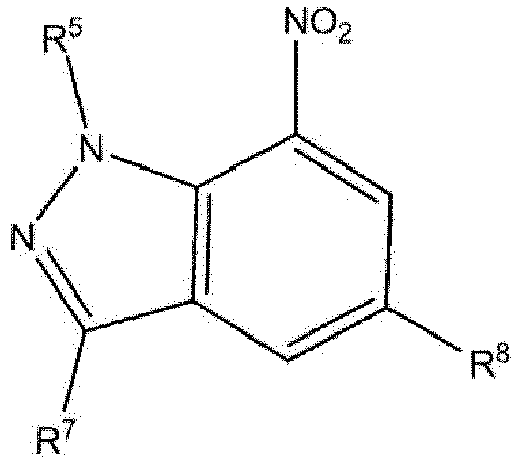
- For example, the compound represented by Formula 1 or Formula 1a above may be (4-((7-amino-2-phenyl-1H-indol-5-yl)methyl)thiomorpholine 1,1-dioxide, and the compound represented by Formula 2 or Formula 2a above may be (4-((7-nitro-2-phenyl-1H-indol-5-yl)methyl)thiomorpholine 1,1-dioxide.
- In addition, the compound of Formula 2 above herein may be prepared by using the conventional known method.
- For an indole compound in which X is C, a compound having a simple substituent (e.g., 7-nitro-indole, 2,3-dimethyl-7-nitro-indole, etc.) is commercially available, and most compounds may be synthesized by cyclizing an acetylene intermediate such as compound (8) of Reaction Scheme 1 below. In addition, compound (8) may be synthesized through a linking reaction from halobenzene compound (6) and acetylene compound (7).


- In Reaction Scheme 1 above,
R6* represents (R6)k-A'-, k, A', R6, and R8 are the same as defined above, and Q represents iodine or bromine. - To obtain the compound of Formula 2 having a preferable R8 functional group, additional steps may be performed for substituting the R8 functional group with the preferable R8 functional group in compound (2-1) above, and this may use a conventional known method or a novel method, but the embodiment is not limited thereto.
- Compound (2-1) above may be prepared by cyclizing acetylene compound (8) in the presence of a base such as KOBut, K2CO3, and DBU or a metal catalyst such as CuI and Pd(II) .
- Acetylene compound (8) may be prepared by adding a base in the presence of a metal catalyst, Pd(II), Cu(I), etc. are used as the metal catalyst, and Et3N, Et2N(iPr), DBU, N-methyl-morpholine, methyl-pyrrolidine, K2CO3, etc. are used as the base.
- Acetylene compound (7) is typically commercially available, or may be prepared through a coupling reaction of acetylene in the presence of Pd(II) or Cu(I) and a base according to the known method described in Synthesis, 2004, 59-61; Bioorganic & Medicinal Chemistry, 13, 2005, 197-209; Journal of Organic Chemistry, 71, 2006, 167-175. The used acetylene is trimethylsilylacetylene or 2-methyl-3-butyn-2-ol, and the used base is diethylamine, triethylamine, diisopropylethyl amine, etc.
- Halobenzene compound (6) may be synthesized from nitroaniline compound (13) by using iodine or bromine as shown in Reaction Scheme 2 below:

- In Reaction Scheme 2 above, R8 is the same as defined above.
- Nitroaniline compound (13) is commercially available, or may be synthesized through acetylation, nitration, and deacetylation reactions from nitro compound (11) or aniline compound (12), which is commercially available. Aniline compound (12), which is not commercially available, may be synthesized from nitro compound (11), and likewise, nitro compound (11) is also commercially available, or may be synthesized from 4-fluoro-nitrobenzene compound (9). In Reaction Scheme 2, compound (10) of Formula R8-H means alcohol and amine which are commercially available.
- The halogenated material for preparing compound (6) may be selected from among iodine, bromine, iodine monobromide and iodine monochloride, and silver ions such as silver nitrate (AgNO3), silver carbonate (AgCO3), silver sulfate (Ag2SO4) may be used together.
- Typical acetylation and nitration reactions may be used to obtain compound (13) from compound (12). The nitration reaction may be performed at a low temperature (-15 °C to 0 °C) using nitric acid as a stock solution, or the nitric acid may be used with various solvents, for example, dichloroethane or dichloromethane. In addition, the reduction reaction of the nitro group may be performed by using an acid catalyst and a metal, or a metal catalyst in the presence of hydrogen gas. Iron, zinc, lithium, sodium, and tin (typically, tin chloride) may be used as the metal, and an inorganic acid such as hydrochloric acid, sulfuric acid, nitric acid and phosphoric acid; an organic carboxylic acid such as acetic acid and trifluoroacetic acid; or ammonium chloride or the like may be used as the acid catalyst. In addition, a metal catalyst that may be used in a reduction reaction using a metal catalyst in the presence of hydrogen gas may include palladium, nickel, platinum, ruthenium, rhodium, etc., wherein the pressure of the hydrogen gas is typically 1 to 3 atmospheres.
- Furthermore, the present invention relates to a method for preparing a compound represented by Formula 3 below, the method including a step for reacting the compound represented by Formula 1 with a ketone or an aldehyde:

- In Formula 3 above,
- n' is an integer of 1 to 3,
- m' is 0 or 1,
- A" represents C3-C8-cycloalkyl, phenyl, or 5-6 membered heteroaryl or heterocycle which each contains one or two heteroatoms selected from among N, O and S atoms,
- X" represents C or N, with the proviso that m' is 0 when X" is N and m' is 1 when X" is C,
- R19 represents hydrogen, C1-C6-alkyl or -(CH2)uNR25R26, wherein u is an integer of 2 to 5, R25 and R26 each independently represent hydrogen or C1-C3-alkyl, with the proviso that R19 is hydrogen when X" is N,
- R20 represents hydrogen, halogen or C1-C6-alkoxy, or represents -(CH2)vC(O)2R25, -(CH2)vOR25, -(CH2)vNR25R26, -NHR27, - N(H)S(O)2R25, or -NHC(O)2R27, represents -(CH2)v-heterocycle-R27 in which the heterocycle is a 5-6 membered ring containing one or two heteroatoms selected from among N, O, and S atoms, wherein v is an integer of 0 to 3, R25 and R26 are the same as defined above, and R27 represents hydrogen, oxo, C1-C6-alkylcarbonyl, C1-C6-alkoxy or C1-C6-alkyl, or a 5-6 membered heterocycle containing one or two nitrogen atoms as a heteroatom,
- R21 represents hydrogen, halogen, C1-C6-alkyl or phenyl, or -(CH2)w-heterocycle in which the heterocycle is a 5-6 membered ring containing one or two heteroatoms selected from among N and O atoms, wherein w is an integer of 1 to 3, with the proviso that R21 is hydrogen or phenyl when X" is N,
- R22 represents -Y5R28, wherein Y5 is a direct bond or represents -(CR25R26)xY6-, wherein x is an integer of 0 to 3, R25 and R26 are the same as defined above, and Y6 is selected from the group consisting of -O-, -C(O)-, and -C(O)O-,
- R28 is selected from the group consisting of hydrogen, halogen, C1-C6-alkyl, and -(CH2)yB3-R29, wherein y is an integer of 0 to 3, B3 represents a 5-6 membered heterocycle containing one or two heteroatoms selected from among N, O, and S atoms, or represents C6-C10-aryl, R29 represents hydrogen, cyano, halogen, hydroxy, oxo, thiol, carboxy or carboxy-C1-C6-alkyl, with the proviso that R22 is hydrogen or C1-C6-alkyl when X" is N,
- R23 represents hydrogen, C1-C6-alkyl, C3-C6-cycloalkyl, heterocycle or heterocyclyl-C1-C6-alkyl, wherein the heterocycle is a 3-8 membered ring containing one to three heteroatoms selected from among N and O atoms, with the proviso that R23 is hydrogen when X" is N, and
- R24 represents -(CR25R26)o-Z-D-W-R30, wherein Z represents a direct bond or is selected from the group consisting of -C(O)- and -C(O)O-, D represents a direct bond, C4-C6-cycloalkyl, 5-6 membered heteroaryl containing one or two N atoms, or a 5-6 membered heterocycle containing one or two heteroatoms selected from among N, O and S atoms, W represents a direct bond, or -NR25-, -C(O)-, -C(O)O-, - C(O)NR31- or -S(O)z-, R31 represents hydrogen, C1-C3-alkyl or C6-C10-aryl, z is an integer of 1 or 2, o is an integer of 0 to 3, R25 and R26 are the same as defined above, R30 represents hydrogen, hydroxy, C1-C6-alkyl, a 5-6 membered heterocycle containing one to three heteroatoms selected from among N, 0 and S atoms, or C6-C10-Ar-C1-C6-alkyl, with the proviso that when X" is N, R24 represents C4-C6-cycloalkyl, or a 5-6 membered heterocycle containing one or two heteroatoms selected from among N, O, and S atoms,
- wherein alkyl, alkoxy, aryl, cycloalkyl, heterocycle and heteroaryl may be optionally substituted, and the substituents are one or more selected from the group consisting of hydroxy, C1-C6-alkylamino, di(C1-C6-alkyl)amino, carboxy, C1-C6-alkyl, C1-C6-alkoxy, carboxy-C1-C6-alkyl and oxo.
- It should be interpreted that the compound of Formula 3 includes a pharmaceutically acceptable salt and isomer thereof. For the convenience of the description, these are simply expressed herein as the compound of Formula 3.
- As used herein, "pharmaceutically acceptable salts" include acid addition salts formed by acids, which are capable of forming non-toxic acid addition salts containing pharmaceutically acceptable anions, for example, inorganic acids such as hydrochloric acid, sulfuric acid, nitric acid, phosphoric acid, hydrobromic acid and hydroiodic acid; organic carboxylic acids such as tartaric acid, formic acid, citric acid, acetic acid, trichloroacetic acid, trifluoroacetic acid, gluconic acid, benzoic acid, lactic acid, fumaric acid, maleic acid and salicylic acid; or sulfonic acids such as methanesulfonic acid, ethanesulfonic acid, benzenesulfonic acid, p-toluenesulfonic acid, and naphthalenesulfonic acid. In addition, pharmaceutically acceptable base addition salts, for example, alkali metal or alkaline earth metal salts formed by lithium, sodium, potassium, calcium, magnesium, etc.; amino acid salts with lysine, arginine, guanidine, etc.; or organic salts with dicyclohexylamine, N-methyl-D-glucamine, tris(hydroxymethyl)methylamine, diethanolamine, choline, triethylamine, etc. are included. The compounds of Formula 3 according to the present invention may be converted to salts thereof by means of any conventional methods, and the salt formation may be easily carried out by a person skilled in the art based on the structure of Formula 3 above without additional explanations thereon.
- In addition, the term 'isomer' herein means those having the same chemical or molecular formula as, but optically or sterically different from, the compounds of Formula 3, or salts thereof. The compounds of formula 3 according to the present invention may have an asymmetric carbon center, so that the compounds may exist in the form of optical isomer (R or S isomer), racemate, mixture of diastereomers, or individual diastereomer, etc. When the compounds have a double bond, the compounds may also exist in the form of geometric isomer (trans or cis isomer). All the isomers and mixtures thereof are also included in the scope of the present invention.
- Hereinafter, the present invention will be described in more detail according to the examples. However, the following examples are intended to illustrate the present invention, and the scope of the present invention is not limited thereto.
- Commercially available (4-amino-3-nitrobenzoic acid) (manufactured by Sinochem Ningbo Co., Ltd.) (5.0 kg), NIS (N-Iodosuccinimide, 9.3 kg), H2SO4 (0.50 kg) and THF (25.0 L) were added to a reactor at room temperature and stirred, and then the reactor was heated to a temperature of 80 °C and stirred for 2 hours. Then, the reaction was terminated when the reaction solution was analyzed by HPLC to show 5.0% or less of the peak of (4-amino-3-nitrobenzoic acid).
- After confirming the completion of the reaction, the temperature of the reactor was cooled to room temperature, and then dichloromethane (DCM, 50.0 L) was added to a concentrated solution obtained by distillation under reduced pressure to form a solid. The formed solid was stirred at room temperature for 1 hour, filtered and washed [1st: DCM (40.0 L), 2nd: H2O (30.0 L), 3rd: EtOH/H2O = 3/7, 30.0 L], and then dried under N2 pressure for 16 hours to synthesize (4-amino-3-iodo-5-nitrobenzoic acid) (7.6 kg, Yield: 89.8%, Purity: 96.4%).
- 1H NMR (500MHz, DMSO-d6) δ 13.1 (br s, 1H), 8.52 (d, J=1.8 Hz, 1H) 8.36 (d, J=1.8 Hz, 1H), 7.50 (s, 2H).
- (4-amino-3-iodo-5-nitrobenzoic acid) (7.6 kg), triethylamine (TEA, 7.5 kg), phenylacetylene (3.0 kg), and 1,4-dioxane (76.0 L) were added to a reactor at room temperature and stirred, and then CuI [Copper(I) Iodide, 47.0 g] and Pd(PPh3)2Cl2 (173.0 g), which are reaction catalysts, were added thereto, and the reactor was heated to a temperature of 60 °C. The reaction mixture was stirred for 2 hours. Then, the reaction was terminated when the reaction solution was analyzed by HPLC to show 1.0% or less of the peak of (4-amino-3-iodo-5-nitrobenzoic acid).
- Then, 1,8-diazabicyclo[5.4.0]undec-7-ene (DBU, 22.5 kg) was added to the reaction mixture, the reactor was heated to a temperature of 110 °C, the reaction mixture was stirred for 18 hours, and the reaction was then terminated. After the reaction mixture was cooled to room temperature, pH was adjusted to 3 with a 3N-HCl aqueous solution (114.0 L), H2O (38.0 L) was added thereto, the mixture was stirred for 2 hours, filtered and washed [1st: H2O (38.0 L), 2nd: EtOH/H2O = 3/7, 23.0 L], and then dried under N2 pressure for 16 hours to synthesize (7-nitro-2-phenyl-1H-indole-5-carboxylic acid) (6.1 Kg, Yield: 87.4%, Purity: 98.0%).
- 1H NMR (500MHz, DMSO-d6) δ 11.6 (s, 1H), 8.03 (s, 1H), 7.96 (m, 3H), 7.46 (t, J= 7.7 Hz, 2H) 7.36 (d, J= 7.3 Hz, 1H), 7.10 (s, 1H)
- (7-nitro-2-phenyl-1H-indole-5-carboxylic acid) (5.8 kg) and THF (61 L) were added to a reactor at room temperature and stirred, and then the reaction mixture was cooled to 12 ± 2 °C, and 5M BH3-DMS (12.3 L) was slowly added dropwise thereto so that the internal temperature thereof did not exceed 40 °C. The dropwise addition was completed, the reactor was heated to a temperature of 40 °C, and then the reaction mixture was stirred for 2 hours. Then, the reaction was terminated when the reaction solution was analyzed by HPLC to show 1.0% or less of the peak of (7-nitro-2-phenyl-1H-indole-5-carboxylic acid).
- After confirming the completion of the reaction, H2O (55 L) was slowly added dropwise to the reaction mixture, and then the mixture was separated into layers to store an organic layer, and the water layer was extracted with EtOAc (29 L), mixed with the stored organic layer, and distilled under reduced pressure. EtOH/H2O (6.1 L/12.2 L) was added to the obtained concentrate, stirred for 2 hours, and then filtered. The resultant was washed with a washing solution (EtOH/H2O = 1/3, 9.0 L) and then dried under N2 pressure for 16 hours to synthesize (7-nitro-2-phenyl-1H-indol-5-yl)methanol (4.6 kg, yield: 83.5%, purity: 98.4%).
- 1H NMR (500MHz, DMSO-d6) δ 11.6 (s, 1H), 8.07 (s, 1H), 8.00 (m, 3H), 7.49 (t, J= 7.7 Hz, 2H) 7.40 (d, J= 7.3 Hz, 1H), 7.14 (s, 1H), 5.42 (t, J= 6.7 Hz, 1H), 4.66 (d, J= 6.7 Hz, 2H) .
- 7-nitro-2-phenyl-1H-indol-5-yl)methanol (4.6 kg) and THF (46 L) were added to a reactor and stirred at room temperature, the reactor was cooled to a temperature of 0 °C, and then PBr3 (2.8 kg) was added while the internal temperature of the reaction was maintained below 20 °C. After the completion of the addition, the temperature of the reactor was raised to 25 °C, the mixture was stirred for 1 hour, and the reaction was terminated when the reaction mixture was analyzed by sampling to show 1.0% or less of the peak of 5-(hydroxymethyl)-7-nitro-2-phenyl-1H-indole.
- The completion of the reaction was confirmed, the reaction mixture was cooled to 0 °C, and 1,1-dioxothiomorpholine HCl (4.4 kg) and N,N-diisopropylethylamine (DIPEA) (8.0 kg) were added while the internal temperature of the reaction was maintained below 20 °C. After the completion of the addition, the temperature of the reactor was raised to 50 °C, the mixture was stirred for 4 hours, and the reaction was terminated when the reaction mixture was analyzed by sampling to show 1.0% or less of the peak of 5-(bromomethyl)-7-nitro-2-phenyl-1H-indole.
- After confirming the completion of the reaction, the reactor was cooled to a temperature of 0 °C, water (46.0 L) was added thereto, the reaction mixture was stirred, and the organic solvent was distilled under reduced pressure. After the distillation under reduced pressure, ethyl acetate (EtOAc) (48.0 L) was additionally added thereto, and the organic solvent was distilled under reduced pressure again to obtain 4-((7-nitro-2-phenyl-1H-indol-5-yl)methyl)thiomorpholine 1,1-dioxide as a solid, and then filtered. The resultant was washed with water (26.0 L) and ethanol (26.0 L) and dried under N2 pressure for 16 hours to synthesize crude 4-((7-nitro-2-phenyl-1H-indol-5-yl)methyl)thiomorpholine 1,1-dioxide (6.4 kg, purity: 92.9%).
- For purification, crude 4-((7-nitro-2-phenyl-1H-indol-5-yl)methyl)thiomorpholine 1,1-dioxide above was added to a mixture of DMF (6.0 L) and toluene (60.0 L), stirred, heated to 120 °C, stirred for 2 hours, and then stirred for another 2 hours at room temperature again. Toluene (60.0 L) was additionally added thereto and stirred for 2 another hours, and then a solid in the solution was filtered and washed with toluene (20.0 L) to synthesize 4-((7-nitro-2-phenyl-1H-indol-5-yl)methyl)thiomorpholine 1,1-dioxide (5.1 kg, yield: 77.0% overall, purity: 98.4%).
- 1H NMR (500MHz, DMSO-d6) δ 11.63 (s, 1H), 8.07 (s, 1H), 8.04 (m, 3H), 7.49 (t, J= 7.7 Hz, 2H) 7.38 (d, J= 7.3 Hz, 1H), 7.14 (s, 1H), 3.79 (s, 2H), 3.12 (m, 4H), 2.84 (m, 4H).
- (4-((7-amino-2-phenyl-1H-indol-5-yl)methyl)thiomorpholine 1,1-dioxide) (0.345 kg) of Preparation Example 1 above, THF/MeOH (2:1, 5.18 L) and FeCl3·6H2O (2.4 g) were added to a reactor at room temperature, stirred for 30 minutes, and then the reactor was cooled to a temperature of 0 °C to 5 °C. NaBH4 (0.1 kg) was slowly added thereto for 30 minutes, the reactor was heated to a temperature of 20 °C to 25 °C, stirred for 2 hours, and the reaction was terminated when the reaction mixture was analyzed to show 0.5% PAR or less of the peak of (4-((-7-nitro-2-phenyl-1H-indol-5-yl)methyl)thiomorpholine 1,1-dioxide).
- The completion of the reaction was confirmed, THF (3.0 L) and H2O (1.73 L) were added to the reaction mixture and stirred for 30 minutes, and then filtered with celite, and the resultant was washed with THF/H2O (1:1, 1.0 L). The filtrate was under reduced pressure and THF was distilled to form a solid, and the reaction mixture was stirred at room temperature for 2 hours. The resultant was filtered and washed with the washing solution [1st H2O: 1.73 L, 2nd ethanol/H2O = 1/3, 1.73 L], and then dried under N2 pressure for 16 hours to obtain the title compound [0.31 kg (yield: 97.53%, purity: 97.64% PAR)].
- 1H NMR (500MHz, DMSO-d6) δ 10.89 (s, 1H), 7.80 (m, 2H), 7.48 (t, J= 7.7 Hz, 2H) 7.30 (d, J= 7.3 Hz, 1H), 6.74 (m, 2H), 6.34 (s, 1H), 5.15 (s, 2H), 3.07 (m, 4H), 2.87 (m, 4H).
- 4-((7-amino-2-phenyl-1H-indol-5-yl)methyl)thiomorpholine 1,1-dioxide (0.60 kg) of Preparation Example 1 above, THF/MeOH/H2O (1:1:1, 3.0 L), and NH4Cl (124 g) were added to a reactor at room temperature and stirred, and then Fe (480 g) was added thereto. The reactor was heated to a temperature of 60 °C, the reaction mixture was stirred for 1 hour, and then the reaction was terminated when the reaction mixture was analyzed by sampling to show 0.5% PAR or less of the peak of 4-((7-nitro-2-phenyl-1H-indol-5-yl)methyl)thiomorpholine 1,1-dioxide.
- The completion of the reaction was confirmed, THF (3.0 L) was added to the reaction mixture and stirred for 10 minutes, and then filtered with celite, and the resultant was washed with THF/H2O (1:1, 3.0 L). The filtrate was under reduced pressure and THF and MeOH were distilled to form a solid, and then the reaction mixture was stirred at room temperature for 2 hours. The resultant was filtered and washed with the washing solution [1st H2O: 500 mL, 2nd EtOH/H2O = 1/3, 1.73 L], and then dried under N2 pressure for 16 hours to obtain the title compound [0.45 kg (yield: 81.3%, purity: 97.2% PAR)].
- From the above results, it is confirmed that Example 1 of the present invention may obtain a high-purity compound in excellent yield compared to Comparative Example 1. Specifically, the indole compound of Example 1 has a yield of 97.53% and a purity of 97.64%, while the indole compound of Comparative Example 1 has a yield of 81.3% and a purity of 97.2%.
- Moreover, according to an embodiment of the present invention, as described above, the reactor is not coated because there are no iron oxides produced after the reaction, and since iron(III) chloride (FeCl3) hydrate used as a catalyst in Example is much cheaper than iron (Fe) in Comparative Example, the method according to the present invention is cost-effective.


Claims (13)
- A method for preparing a compound represented by Formula 1 below, the method comprising a step for reducing a compound represented by Formula 2 below in the presence of iron(III) chloride hydrate:
 n is an integer of 1 to 3,m is 0 or 1,A represents C3-C8-cycloalkyl, phenyl, or 5-6 membered heteroaryl or heterocycle which each contains one or two heteroatoms selected from among N, O and S atoms,X represents C or N, with the proviso that m is 0 when X is N and m is 1 when X is C,R1 represents hydrogen, C1-C6-alkyl or -(CH2)rNR9R10, wherein r is an integer of 2 to 5, R9 and R10 each independently represent hydrogen or C1-C3-alkyl, with the proviso that R1 is hydrogen when X is N,R2 represents hydrogen, halogen or C1-C6-alkoxy, or represents -(CH2)pC(O)2R9, -(CH2)pOR9, -(CH2)pNR9R10, -NHR11, - N(H)S(O)2R9, or -NHC(O)2R11, or represents -(CH2)p-heterocycle-R11 in which the heterocycle is a 5-6 membered ring containing one or two heteroatoms selected from among N, O, and S atoms, wherein p is an integer of 0 to 3, R9 and R10 are the same as defined above, and R11 represents hydrogen, oxo, C1-C6-alkylcarbonyl, C1-C6-alkoxy or C1-C6-alkyl, or a 5-6 membered heterocycle containing one or two nitrogen atoms as a heteroatom,R3 represents hydrogen, halogen, C1-C6-alkyl or phenyl, or -(CH2)q-heterocycle in which the heterocycle is a 5-6 membered ring containing one or two heteroatoms selected from among N and O atoms, wherein q is an integer of 1 to 3, with the proviso that R3 is hydrogen or phenyl when X is N,R4 represents -Y1R12, wherein Y1 is a direct bond or represents -(CR9R10)sY2-, wherein s is an integer of 0 to 3, R9 and R10 are the same as defined above, and Y2 is selected from the group consisting of -O-, -C(O)-, and -C(O)O-, andR12 is selected from the group consisting of hydrogen, halogen, C1-C6-alkyl, and -(CH2)tB1-R13, wherein t is an integer of 0 to 3, B1 represents a 5-6 membered heterocycle containing one or two heteroatoms selected from among N, O, and S atoms, or represents C6-C10-aryl, R13 represents hydrogen, cyano, halogen, hydroxy, oxo, thiol, carboxy or carboxy-C1-C6-alkyl, with the proviso that R4 is hydrogen or C1-C6-alkyl when X is N,wherein alkyl, alkoxy, aryl, cycloalkyl, heterocycle and heteroaryl may be optionally substituted, and the substituents are one or more selected from the group consisting of hydroxy, C1-C6-alkylamino, di (C1-C6-alkyl) amino, carboxy, C1-C6-alkyl, C1-C6-alkoxy, carboxy-C1-C6-alkyl and oxo, and
 k is an integer of 1 to 3,j is 0 or 1,A' represents C3-C8-cycloalkyl, phenyl, or 5-6 membered heteroaryl or heterocycle which each contains 1 or 2 heteroatoms selected from among N, O and S atoms,X' represents C or N, with the proviso that j is 0 when X' is N and j is 1 when X' is C,R5 represents hydrogen, C1-C6-alkyl or -(CH2)eNR14R15, wherein e is an integer of 2 to 5, R14 and R15 each independently represent hydrogen or C1-C3-alkyl, with the proviso that R5 is hydrogen when X' is N,R6 represents hydrogen, halogen or C1-C6-alkoxy, or represents -(CH2)fC(O)2R14, -(CH2)fOR14, -(CH2)fNR14R15, -NHR16, - N(H)S(O)2R14, or -NHC(O)2R16, or represents -(CH2)f-heterocycle-R16 in which the heterocycle is a 5-6 membered ring containing one or two heteroatoms selected from among N, O, and S atoms, wherein f is an integer of 0 to 3, R14 and R15 are the same as defined above, and R16 represents hydrogen, oxo, C1-C6-alkylcarbonyl, C1-C6-alkoxy or C1-C6-alkyl, or a 5-6 membered heterocycle containing one or two nitrogen atoms as a heteroatom,R7 represents hydrogen, halogen, C1-C6-alkyl or phenyl, or -(CH2)g-heterocycle in which the heterocycle is a 5-6 membered ring containing one or two heteroatoms selected from among N and O atoms, wherein g is an integer of 1 to 3, with the proviso that R7 is hydrogen or phenyl when X' is N,R8 represents -Y3R17, wherein Y3 is a direct bond or represents -(CR14R15)hY4-, wherein h is an integer of 0 to 3, R14 and R15 are the same as defined above, and Y4 is selected from the group consisting of -O-, -C(O)-, and -C(O)O-, andR17 is selected from the group consisting of hydrogen, halogen, C1-C6-alkyl, and -(CH2)iB2-R18, wherein i is an integer of 0 to 3, B2 represents a 5-6 membered heterocycle containing one or two heteroatoms selected from among N, O, and S atoms, or represents C6-C10-aryl, R18 represents hydrogen, cyano, halogen, hydroxy, oxo, thiol, carboxy or carboxy-C1-C6-alkyl, with the proviso that R8 is hydrogen or C1-C6-alkyl when X' is N,wherein alkyl, alkoxy, aryl, cycloalkyl, heterocycle and heteroaryl may be optionally substituted, and the substituents are one or more selected from the group consisting of hydroxy, C1-C6-alkylamino, di(C1-C6-alkyl)amino, carboxy, C1-C6-alkyl, C1-C6-alkoxy, carboxy-C1-C6-alkyl and oxo.
 - The method of claim 1, wherein the iron(III) chloride hydrate is ferric chloride hexahydrate (FeCl3·6H2O).
- The method of claim 1, wherein the reducing step is performed at a temperature of 0 °C to 65 °C.
- The method of claim 1, wherein the reducing step is performed by comprising an additional reducing agent.
- The method of claim 4, wherein the reducing agent is at least one selected from the group consisting of NaBH4, N2H4, 9-borabicyclo[3.3.1]nonane (9-BBN), BH3SMe2, and LiBH4.
- The method of claim 1, wherein the compound represented by Formula 1 above is represented by Formula (1a) or (1b) below:


- The method of claim 1, wherein R1 represents hydrogen, C1-C6-alkyl, or di (C1-C3-alkyl) amino-C2-C3-alkyl.
- The method of claim 1, wherein R2 represents hydrogen, halogen, carboxy, carboxy-C1-C3-alkyl, C1-C3-alkoxycarbonyl, C1-C3-alkoxycarbonyl-C1-C3-alkyl, hydroxy-C1-C3-alkyl optionally substituted by one oxo group, C1-C3-alkoxy, - (CH2) pNR9R10, -NHR11, -N(H)S(O)2R9, or -NHC(O)2R11 or may be - (CH2)p-heterocycle-R11, wherein heterocycle, p, R9, R10 and R11 are the same as defined in claim 1.
- The method of claim 1, wherein R3 represents hydrogen, methyl or halogen, phenyl optionally substituted by C1-C3-alkoxy, or heterocyclyl-C1-C3-alkylene in which the heterocycle is a 5-6 membered ring containing one or two heteroatoms selected from N and O atoms and optionally substituted with one or two oxo groups.
- The method of claim 1, wherein Y1 is selected from the group consisting of a direct bond, -O-, -C(O)-, and -CH2C(O)-.
- The method of claim 1, wherein R12 is selected from the group consisting of hydrogen, methyl, ethyl, phenyl, fluoro, chloro, 2-carboxy-pyrrolidin-1-yl, pyrrolidin-1-yl, 4-acetic acid-1,3-thiazolin-2-yl, -CH2-(1,1-dioxo-thiomorpholin-4-yl) and -CH2-(2-oxopiperazin-4-yl).
- The method of claim 1, wherein the compound represented by Formula 1 is (4-((7-amino-2-phenyl-1H-indol-5-yl)methyl)thiomorpholine 1,1-dioxide, and the compound represented by Formula 2 is (4-((7-nitro-2-phenyl-1H-indol-5-yl)methyl)thiomorpholine 1,1-dioxide.
- A method for preparing a compound represented by Formula 3 below, the method comprising a step for reacting the compound represented by Formula 1 prepared according to claim 1 with a ketone or an aldehyde:
 n' is an integer of 1 to 3,m' is 0 or 1,A" represents C3-C8-cycloalkyl, phenyl, or 5-6 membered heteroaryl or heterocycle which each contains one or two heteroatoms selected from among N, O and S atoms,X" represents C or N, with the proviso that m' is 0 when X" is N and m' is 1 when X" is C,R19 represents hydrogen, C1-C6-alkyl or -(CH2)UNR25R26, wherein u is an integer of 2 to 5, R25 and R26 each independently represent hydrogen or C1-C3-alkyl, with the proviso that R19 is hydrogen when X" is N,R20 represents hydrogen, halogen or C1-C6-alkoxy, or represents -(CH2)vC(O)2R25, -(CH2)vOR25, -(CH2)vNR25R26, -NHR27, - N(H)S(O)2R25, or -NHC(O)2R27, or represents -(CH2)v-heterocycle-R27 in which the heterocycle is a 5-6 membered ring containing one or two heteroatoms selected from among N, O, and S atoms, wherein v is an integer of 0 to 3, R25 and R26 are the same as defined above, and R27 represents hydrogen, oxo, C1-C6-alkylcarbonyl, C1-C6-alkoxy or C1-C6-alkyl, or a 5-6 membered heterocycle containing one or two nitrogen atoms as a heteroatom,R21 represents hydrogen, halogen, C1-C6-alkyl or phenyl, or -(CH2)w-heterocycle in which the heterocycle is a 5-6 membered ring containing one or two heteroatoms selected from among N and O atoms, wherein w is an integer of 1 to 3, with the proviso that R21 is hydrogen or phenyl when X" is N,R22 represents -Y5R28, wherein Y5 is a direct bond or represents -(CR25R26)xY6-, wherein x is an integer of 0 to 3, R25 and R26 are the same as defined above, and Y6 is selected from the group consisting of -O-, -C(O)-, and -C(O)O-,R28 is selected from the group consisting of hydrogen, halogen, C1-C6-alkyl, and -(CH2)yB3-R29, wherein y is an integer of 0 to 3, B3 represents a 5-6 membered heterocycle containing one or two heteroatoms selected from among N, O, and S atoms, or represents C6-C10-aryl, R29 represents hydrogen, cyano, halogen, hydroxy, oxo, thiol, carboxy or carboxy-C1-C6-alkyl, with the proviso that R22 is hydrogen or C1-C6-alkyl when X" is N,R23 represents hydrogen, C1-C6-alkyl, C3-C6-cycloalkyl, heterocycle or heterocyclyl-C1-C6-alkyl, wherein the heterocycle is a 3-8 membered ring containing one to three heteroatoms selected from among N and O atoms, with the proviso that R23 is hydrogen when X" is N, andR24 represents -(CR25R26)o-Z-D-W-R30, wherein Z represents a direct bond or is selected from the group consisting of - C(O)- and -C(0)0-, D represents a direct bond, C4-C6-cycloalkyl, 5-6 membered heteroaryl containing one or two N atoms, or a 5-6 membered heterocycle containing one or two heteroatoms selected from among N, O and S atoms, W represents a direct bond, or -NR25-, -C(O)-, -C(O)O-, - C(O)NR31- or -S(O)z-, R31 represents hydrogen, C1-C3-alkyl or C6-C10-aryl, z is an integer of 1 or 2, o is an integer of 0 to 3, R25 and R26 are the same as defined above, R30 represents hydrogen, hydroxy, C1-C6-alkyl, a 5-6 membered heterocycle containing one to three heteroatoms selected from among N, 0 and S atoms, or C6-C10-Ar-C1-C6-alkyl, with the proviso that when X" is N, R24 represents C4-C6-cycloalkyl, or a 5-6 membered heterocycle containing one or two heteroatoms selected from among N, O, and S atoms,wherein alkyl, alkoxy, aryl, cycloalkyl, heterocycle and heteroaryl may be optionally substituted, and the substituents are one or more selected from the group consisting of hydroxy, C1-C6-alkylamino, di (C1-C6-alkyl) amino, carboxy, C1-C6-alkyl, C1-C6-alkoxy, carboxy-C1-C6-alkyl and oxo.
Applications Claiming Priority (2)
| Application Number | Priority Date | Filing Date | Title |
|---|---|---|---|
| KR20190073019 | 2019-06-19 | ||
| PCT/KR2020/007894 WO2020256429A1 (en) | 2019-06-19 | 2020-06-18 | Method for preparing indole or indazole compound |
Publications (3)
| Publication Number | Publication Date |
|---|---|
| EP3971184A1 true EP3971184A1 (en) | 2022-03-23 |
| EP3971184A4 EP3971184A4 (en) | 2022-08-17 |
| EP3971184B1 EP3971184B1 (en) | 2024-04-03 |
Family
ID=74040558
Family Applications (1)
| Application Number | Title | Priority Date | Filing Date |
|---|---|---|---|
| EP20826825.0A Active EP3971184B1 (en) | 2019-06-19 | 2020-06-18 | Method for preparing indole or indazole compound |
Country Status (4)
| Country | Link |
|---|---|
| EP (1) | EP3971184B1 (en) |
| KR (1) | KR102389718B1 (en) |
| CN (1) | CN114080382B (en) |
| WO (1) | WO2020256429A1 (en) |
Family Cites Families (10)
| Publication number | Priority date | Publication date | Assignee | Title |
|---|---|---|---|---|
| FR2664498B1 (en) * | 1990-07-16 | 1993-08-06 | Oreal | PRODUCT BASED ON MINERAL AND ORGANIC LAMELLAR PARTICLES, COMPRISING A MELANIC PIGMENT, ITS PREPARATION METHOD AND ITS USE IN COSMETICS. |
| PT673937E (en) | 1993-09-10 | 2004-04-30 | Eisai Co Ltd | HETEROCYCLIC BICYCLIC DERIVATIVES OF SULFONAMIDE AND SULFONONIC ESTER |
| US20040110802A1 (en) | 2002-08-23 | 2004-06-10 | Atli Thorarensen | Antibacterial benzoic acid derivatives |
| JP5094394B2 (en) | 2005-04-20 | 2012-12-12 | 武田薬品工業株式会社 | Fused heterocyclic compounds |
| RU2353619C2 (en) * | 2007-06-28 | 2009-04-27 | Общество С Ограниченной Ответственностью "Бионика" | Novel compounds possessing anticoagulant function, based on them pharmaceutical compositions for treatment of thrombotic conditions and plasma-substituting solution for correction of hypercoagulation disorders in hemodilution |
| JP5323834B2 (en) * | 2007-08-17 | 2013-10-23 | エルジー・ライフ・サイエンシーズ・リミテッド | Indole compounds as cell necrosis inhibitors |
| RU2460525C2 (en) * | 2008-01-04 | 2012-09-10 | Эл Джи Лайф Сайенсиз Лтд. | Indole and indazole derivatives showing preserving action on cells, tissues and organs |
| KR101511771B1 (en) * | 2011-12-20 | 2015-04-14 | 주식회사 엘지생명과학 | Indole and indazole compounds as an inhibitor of cellular necrosis |
| KR20130087283A (en) * | 2012-01-27 | 2013-08-06 | 재단법인 의약바이오컨버젼스연구단 | Composition containing indole and indazole derivatives for inhibition of cancer metastasis |
| WO2015026172A1 (en) * | 2013-08-22 | 2015-02-26 | 주식회사 엘지생명과학 | Indole amide compound as inhibitor of necrosis |
-
2020
- 2020-06-18 KR KR1020200074041A patent/KR102389718B1/en active Active
- 2020-06-18 CN CN202080049629.9A patent/CN114080382B/en active Active
- 2020-06-18 EP EP20826825.0A patent/EP3971184B1/en active Active
- 2020-06-18 WO PCT/KR2020/007894 patent/WO2020256429A1/en not_active Ceased
Also Published As
| Publication number | Publication date |
|---|---|
| EP3971184A4 (en) | 2022-08-17 |
| CN114080382A (en) | 2022-02-22 |
| CN114080382B (en) | 2024-05-24 |
| KR102389718B1 (en) | 2022-04-25 |
| WO2020256429A1 (en) | 2020-12-24 |
| KR20200145737A (en) | 2020-12-30 |
| EP3971184B1 (en) | 2024-04-03 |
Similar Documents
| Publication | Publication Date | Title |
|---|---|---|
| AU2017254916B2 (en) | Method for producing substituted 5-fluoro-1H-pyrazolopyridines | |
| KR20070050966A (en) | Method for preparing dihydroterridinone | |
| KR102397752B1 (en) | Method for preparing indole or indazole compound | |
| EP3971184B1 (en) | Method for preparing indole or indazole compound | |
| JP7627747B2 (en) | Asymmetric Derivatization of Diols by Nucleophilic Aromatic Substitution | |
| JP4208463B2 (en) | Intermediates for the production of quinolonecarboxylic acid derivatives | |
| KR102389717B1 (en) | Method for preparing indole or indazole compound | |
| MX2007016239A (en) | Derivatives of pyrido[2,3-d]pyrimidine, the preparation thereof, and the therapeutic application of the same. | |
| EP3612533A1 (en) | Methods of preparing indolinobenzodiazepine derivatives | |
| SG183256A1 (en) | Process for the preparation of 2-(cyclohexylmethyl)-n-{2- [(2s)-1-methylpyrrolidin-2-yl]ethyl}-1, 2, 3, 4- tetrahydroisoquinoline-7-sulfonamide | |
| KR102389716B1 (en) | Method For Preparing Indole Or Indazole Compound | |
| Barbu et al. | A method for the synthesis of 3-methyl-2, 7-naphthyridine derivatives | |
| KR101657599B1 (en) | PROCESS FOR THE PREPARATION OF PYRROLO[2,3-c]PYRIDINE DERIVATIVES OR PHARMACEUTICALLY ACCEPTABLE SALTS THEREOF | |
| WO2012052444A1 (en) | Process for the preparation of nicotinamide derivatives | |
| GB2317888A (en) | Acridone derivatives and preparation of 8-hydroxy-imidazoacridinone derivatives | |
| TR2021020004T2 (en) | METHOD FOR PREPARING INDOLE OR INDAZole COMPOUND | |
| JP2024091605A (en) | Method for producing lysine-specific demethylase 1 (LSD1) inhibitors | |
| HK40119710A (en) | Pyrimido[6,1-a]isoquinoline-4-one derivatives and use thereof | |
| JP2010531887A (en) | Method for preparing benzimidazolethiophene | |
| TR2021020008T2 (en) | METHOD FOR PREPARING INDOLE OR INDAZole COMPOUND | |
| AU2006302375A1 (en) | Process for the synthesis of compounds for selectin inhibition |
Legal Events
| Date | Code | Title | Description |
|---|---|---|---|
| STAA | Information on the status of an ep patent application or granted ep patent |
Free format text: STATUS: THE INTERNATIONAL PUBLICATION HAS BEEN MADE |
|
| PUAI | Public reference made under article 153(3) epc to a published international application that has entered the european phase |
Free format text: ORIGINAL CODE: 0009012 |
|
| STAA | Information on the status of an ep patent application or granted ep patent |
Free format text: STATUS: REQUEST FOR EXAMINATION WAS MADE |
|
| 17P | Request for examination filed |
Effective date: 20211216 |
|
| AK | Designated contracting states |
Kind code of ref document: A1 Designated state(s): AL AT BE BG CH CY CZ DE DK EE ES FI FR GB GR HR HU IE IS IT LI LT LU LV MC MK MT NL NO PL PT RO RS SE SI SK SM TR |
|
| REG | Reference to a national code |
Ref country code: DE Ref legal event code: R079 Free format text: PREVIOUS MAIN CLASS: C07D0417140000 Ipc: C07D0209080000 Ref country code: DE Ref legal event code: R079 Ref document number: 602020028493 Country of ref document: DE Free format text: PREVIOUS MAIN CLASS: C07D0417140000 Ipc: C07D0209080000 |
|
| A4 | Supplementary search report drawn up and despatched |
Effective date: 20220719 |
|
| RIC1 | Information provided on ipc code assigned before grant |
Ipc: C07D 209/08 20060101AFI20220713BHEP |
|
| DAV | Request for validation of the european patent (deleted) | ||
| DAX | Request for extension of the european patent (deleted) | ||
| GRAP | Despatch of communication of intention to grant a patent |
Free format text: ORIGINAL CODE: EPIDOSNIGR1 |
|
| STAA | Information on the status of an ep patent application or granted ep patent |
Free format text: STATUS: GRANT OF PATENT IS INTENDED |
|
| INTG | Intention to grant announced |
Effective date: 20231114 |
|
| GRAS | Grant fee paid |
Free format text: ORIGINAL CODE: EPIDOSNIGR3 |
|
| GRAA | (expected) grant |
Free format text: ORIGINAL CODE: 0009210 |
|
| STAA | Information on the status of an ep patent application or granted ep patent |
Free format text: STATUS: THE PATENT HAS BEEN GRANTED |
|
| P01 | Opt-out of the competence of the unified patent court (upc) registered |
Effective date: 20240209 |
|
| AK | Designated contracting states |
Kind code of ref document: B1 Designated state(s): AL AT BE BG CH CY CZ DE DK EE ES FI FR GB GR HR HU IE IS IT LI LT LU LV MC MK MT NL NO PL PT RO RS SE SI SK SM TR |
|
| REG | Reference to a national code |
Ref country code: CH Ref legal event code: EP |
|
| REG | Reference to a national code |
Ref country code: IE Ref legal event code: FG4D |
|
| REG | Reference to a national code |
Ref country code: DE Ref legal event code: R096 Ref document number: 602020028493 Country of ref document: DE |
|
| REG | Reference to a national code |
Ref country code: LT Ref legal event code: MG9D |
|
| REG | Reference to a national code |
Ref country code: NL Ref legal event code: MP Effective date: 20240403 |
|
| REG | Reference to a national code |
Ref country code: AT Ref legal event code: MK05 Ref document number: 1672195 Country of ref document: AT Kind code of ref document: T Effective date: 20240403 |
|
| PG25 | Lapsed in a contracting state [announced via postgrant information from national office to epo] |
Ref country code: NL Free format text: LAPSE BECAUSE OF FAILURE TO SUBMIT A TRANSLATION OF THE DESCRIPTION OR TO PAY THE FEE WITHIN THE PRESCRIBED TIME-LIMIT Effective date: 20240403 |
|
| PG25 | Lapsed in a contracting state [announced via postgrant information from national office to epo] |
Ref country code: NL Free format text: LAPSE BECAUSE OF FAILURE TO SUBMIT A TRANSLATION OF THE DESCRIPTION OR TO PAY THE FEE WITHIN THE PRESCRIBED TIME-LIMIT Effective date: 20240403 |
|
| PG25 | Lapsed in a contracting state [announced via postgrant information from national office to epo] |
Ref country code: IS Free format text: LAPSE BECAUSE OF FAILURE TO SUBMIT A TRANSLATION OF THE DESCRIPTION OR TO PAY THE FEE WITHIN THE PRESCRIBED TIME-LIMIT Effective date: 20240803 |
|
| PG25 | Lapsed in a contracting state [announced via postgrant information from national office to epo] |
Ref country code: BG Free format text: LAPSE BECAUSE OF FAILURE TO SUBMIT A TRANSLATION OF THE DESCRIPTION OR TO PAY THE FEE WITHIN THE PRESCRIBED TIME-LIMIT Effective date: 20240403 |
|
| PG25 | Lapsed in a contracting state [announced via postgrant information from national office to epo] |
Ref country code: FI Free format text: LAPSE BECAUSE OF FAILURE TO SUBMIT A TRANSLATION OF THE DESCRIPTION OR TO PAY THE FEE WITHIN THE PRESCRIBED TIME-LIMIT Effective date: 20240403 Ref country code: HR Free format text: LAPSE BECAUSE OF FAILURE TO SUBMIT A TRANSLATION OF THE DESCRIPTION OR TO PAY THE FEE WITHIN THE PRESCRIBED TIME-LIMIT Effective date: 20240403 |
|
| PG25 | Lapsed in a contracting state [announced via postgrant information from national office to epo] |
Ref country code: GR Free format text: LAPSE BECAUSE OF FAILURE TO SUBMIT A TRANSLATION OF THE DESCRIPTION OR TO PAY THE FEE WITHIN THE PRESCRIBED TIME-LIMIT Effective date: 20240704 |
|
| PG25 | Lapsed in a contracting state [announced via postgrant information from national office to epo] |
Ref country code: PT Free format text: LAPSE BECAUSE OF FAILURE TO SUBMIT A TRANSLATION OF THE DESCRIPTION OR TO PAY THE FEE WITHIN THE PRESCRIBED TIME-LIMIT Effective date: 20240805 |
|
| PG25 | Lapsed in a contracting state [announced via postgrant information from national office to epo] |
Ref country code: ES Free format text: LAPSE BECAUSE OF FAILURE TO SUBMIT A TRANSLATION OF THE DESCRIPTION OR TO PAY THE FEE WITHIN THE PRESCRIBED TIME-LIMIT Effective date: 20240403 |
|
| PG25 | Lapsed in a contracting state [announced via postgrant information from national office to epo] |
Ref country code: CZ Free format text: LAPSE BECAUSE OF FAILURE TO SUBMIT A TRANSLATION OF THE DESCRIPTION OR TO PAY THE FEE WITHIN THE PRESCRIBED TIME-LIMIT Effective date: 20240403 |
|
| PG25 | Lapsed in a contracting state [announced via postgrant information from national office to epo] |
Ref country code: AT Free format text: LAPSE BECAUSE OF FAILURE TO SUBMIT A TRANSLATION OF THE DESCRIPTION OR TO PAY THE FEE WITHIN THE PRESCRIBED TIME-LIMIT Effective date: 20240403 |
|
| PG25 | Lapsed in a contracting state [announced via postgrant information from national office to epo] |
Ref country code: PL Free format text: LAPSE BECAUSE OF FAILURE TO SUBMIT A TRANSLATION OF THE DESCRIPTION OR TO PAY THE FEE WITHIN THE PRESCRIBED TIME-LIMIT Effective date: 20240403 |
|
| PG25 | Lapsed in a contracting state [announced via postgrant information from national office to epo] |
Ref country code: LV Free format text: LAPSE BECAUSE OF FAILURE TO SUBMIT A TRANSLATION OF THE DESCRIPTION OR TO PAY THE FEE WITHIN THE PRESCRIBED TIME-LIMIT Effective date: 20240403 |
|
| PG25 | Lapsed in a contracting state [announced via postgrant information from national office to epo] |
Ref country code: PT Free format text: LAPSE BECAUSE OF FAILURE TO SUBMIT A TRANSLATION OF THE DESCRIPTION OR TO PAY THE FEE WITHIN THE PRESCRIBED TIME-LIMIT Effective date: 20240805 Ref country code: PL Free format text: LAPSE BECAUSE OF FAILURE TO SUBMIT A TRANSLATION OF THE DESCRIPTION OR TO PAY THE FEE WITHIN THE PRESCRIBED TIME-LIMIT Effective date: 20240403 Ref country code: NO Free format text: LAPSE BECAUSE OF FAILURE TO SUBMIT A TRANSLATION OF THE DESCRIPTION OR TO PAY THE FEE WITHIN THE PRESCRIBED TIME-LIMIT Effective date: 20240703 Ref country code: LV Free format text: LAPSE BECAUSE OF FAILURE TO SUBMIT A TRANSLATION OF THE DESCRIPTION OR TO PAY THE FEE WITHIN THE PRESCRIBED TIME-LIMIT Effective date: 20240403 Ref country code: IS Free format text: LAPSE BECAUSE OF FAILURE TO SUBMIT A TRANSLATION OF THE DESCRIPTION OR TO PAY THE FEE WITHIN THE PRESCRIBED TIME-LIMIT Effective date: 20240803 Ref country code: HR Free format text: LAPSE BECAUSE OF FAILURE TO SUBMIT A TRANSLATION OF THE DESCRIPTION OR TO PAY THE FEE WITHIN THE PRESCRIBED TIME-LIMIT Effective date: 20240403 Ref country code: GR Free format text: LAPSE BECAUSE OF FAILURE TO SUBMIT A TRANSLATION OF THE DESCRIPTION OR TO PAY THE FEE WITHIN THE PRESCRIBED TIME-LIMIT Effective date: 20240704 Ref country code: FI Free format text: LAPSE BECAUSE OF FAILURE TO SUBMIT A TRANSLATION OF THE DESCRIPTION OR TO PAY THE FEE WITHIN THE PRESCRIBED TIME-LIMIT Effective date: 20240403 Ref country code: ES Free format text: LAPSE BECAUSE OF FAILURE TO SUBMIT A TRANSLATION OF THE DESCRIPTION OR TO PAY THE FEE WITHIN THE PRESCRIBED TIME-LIMIT Effective date: 20240403 Ref country code: CZ Free format text: LAPSE BECAUSE OF FAILURE TO SUBMIT A TRANSLATION OF THE DESCRIPTION OR TO PAY THE FEE WITHIN THE PRESCRIBED TIME-LIMIT Effective date: 20240403 Ref country code: BG Free format text: LAPSE BECAUSE OF FAILURE TO SUBMIT A TRANSLATION OF THE DESCRIPTION OR TO PAY THE FEE WITHIN THE PRESCRIBED TIME-LIMIT Effective date: 20240403 Ref country code: AT Free format text: LAPSE BECAUSE OF FAILURE TO SUBMIT A TRANSLATION OF THE DESCRIPTION OR TO PAY THE FEE WITHIN THE PRESCRIBED TIME-LIMIT Effective date: 20240403 Ref country code: RS Free format text: LAPSE BECAUSE OF FAILURE TO SUBMIT A TRANSLATION OF THE DESCRIPTION OR TO PAY THE FEE WITHIN THE PRESCRIBED TIME-LIMIT Effective date: 20240703 |
|
| REG | Reference to a national code |
Ref country code: DE Ref legal event code: R119 Ref document number: 602020028493 Country of ref document: DE |
|
| PG25 | Lapsed in a contracting state [announced via postgrant information from national office to epo] |
Ref country code: DK Free format text: LAPSE BECAUSE OF FAILURE TO SUBMIT A TRANSLATION OF THE DESCRIPTION OR TO PAY THE FEE WITHIN THE PRESCRIBED TIME-LIMIT Effective date: 20240403 |
|
| PG25 | Lapsed in a contracting state [announced via postgrant information from national office to epo] |
Ref country code: EE Free format text: LAPSE BECAUSE OF FAILURE TO SUBMIT A TRANSLATION OF THE DESCRIPTION OR TO PAY THE FEE WITHIN THE PRESCRIBED TIME-LIMIT Effective date: 20240403 |
|
| PG25 | Lapsed in a contracting state [announced via postgrant information from national office to epo] |
Ref country code: RO Free format text: LAPSE BECAUSE OF FAILURE TO SUBMIT A TRANSLATION OF THE DESCRIPTION OR TO PAY THE FEE WITHIN THE PRESCRIBED TIME-LIMIT Effective date: 20240403 Ref country code: SK Free format text: LAPSE BECAUSE OF FAILURE TO SUBMIT A TRANSLATION OF THE DESCRIPTION OR TO PAY THE FEE WITHIN THE PRESCRIBED TIME-LIMIT Effective date: 20240403 |
|
| PG25 | Lapsed in a contracting state [announced via postgrant information from national office to epo] |
Ref country code: SM Free format text: LAPSE BECAUSE OF FAILURE TO SUBMIT A TRANSLATION OF THE DESCRIPTION OR TO PAY THE FEE WITHIN THE PRESCRIBED TIME-LIMIT Effective date: 20240403 |
|
| PG25 | Lapsed in a contracting state [announced via postgrant information from national office to epo] |
Ref country code: SM Free format text: LAPSE BECAUSE OF FAILURE TO SUBMIT A TRANSLATION OF THE DESCRIPTION OR TO PAY THE FEE WITHIN THE PRESCRIBED TIME-LIMIT Effective date: 20240403 Ref country code: SK Free format text: LAPSE BECAUSE OF FAILURE TO SUBMIT A TRANSLATION OF THE DESCRIPTION OR TO PAY THE FEE WITHIN THE PRESCRIBED TIME-LIMIT Effective date: 20240403 Ref country code: RO Free format text: LAPSE BECAUSE OF FAILURE TO SUBMIT A TRANSLATION OF THE DESCRIPTION OR TO PAY THE FEE WITHIN THE PRESCRIBED TIME-LIMIT Effective date: 20240403 Ref country code: EE Free format text: LAPSE BECAUSE OF FAILURE TO SUBMIT A TRANSLATION OF THE DESCRIPTION OR TO PAY THE FEE WITHIN THE PRESCRIBED TIME-LIMIT Effective date: 20240403 Ref country code: DK Free format text: LAPSE BECAUSE OF FAILURE TO SUBMIT A TRANSLATION OF THE DESCRIPTION OR TO PAY THE FEE WITHIN THE PRESCRIBED TIME-LIMIT Effective date: 20240403 Ref country code: MC Free format text: LAPSE BECAUSE OF FAILURE TO SUBMIT A TRANSLATION OF THE DESCRIPTION OR TO PAY THE FEE WITHIN THE PRESCRIBED TIME-LIMIT Effective date: 20240403 |
|
| REG | Reference to a national code |
Ref country code: CH Ref legal event code: PL |
|
| PLBE | No opposition filed within time limit |
Free format text: ORIGINAL CODE: 0009261 |
|
| STAA | Information on the status of an ep patent application or granted ep patent |
Free format text: STATUS: NO OPPOSITION FILED WITHIN TIME LIMIT |
|
| PG25 | Lapsed in a contracting state [announced via postgrant information from national office to epo] |
Ref country code: LU Free format text: LAPSE BECAUSE OF NON-PAYMENT OF DUE FEES Effective date: 20240618 |
|
| 26N | No opposition filed |
Effective date: 20250106 |
|
| GBPC | Gb: european patent ceased through non-payment of renewal fee |
Effective date: 20240703 |
|
| PG25 | Lapsed in a contracting state [announced via postgrant information from national office to epo] |
Ref country code: DE Free format text: LAPSE BECAUSE OF NON-PAYMENT OF DUE FEES Effective date: 20250101 |
|
| PG25 | Lapsed in a contracting state [announced via postgrant information from national office to epo] |
Ref country code: IE Free format text: LAPSE BECAUSE OF NON-PAYMENT OF DUE FEES Effective date: 20240618 |
|
| PG25 | Lapsed in a contracting state [announced via postgrant information from national office to epo] |
Ref country code: SI Free format text: LAPSE BECAUSE OF FAILURE TO SUBMIT A TRANSLATION OF THE DESCRIPTION OR TO PAY THE FEE WITHIN THE PRESCRIBED TIME-LIMIT Effective date: 20240403 Ref country code: BE Free format text: LAPSE BECAUSE OF NON-PAYMENT OF DUE FEES Effective date: 20240630 Ref country code: CH Free format text: LAPSE BECAUSE OF NON-PAYMENT OF DUE FEES Effective date: 20240630 |
|
| PG25 | Lapsed in a contracting state [announced via postgrant information from national office to epo] |
Ref country code: FR Free format text: LAPSE BECAUSE OF NON-PAYMENT OF DUE FEES Effective date: 20240630 |
|
| PG25 | Lapsed in a contracting state [announced via postgrant information from national office to epo] |
Ref country code: GB Free format text: LAPSE BECAUSE OF NON-PAYMENT OF DUE FEES Effective date: 20240703 |
|
| REG | Reference to a national code |
Ref country code: BE Ref legal event code: MM Effective date: 20240630 |
|
| PG25 | Lapsed in a contracting state [announced via postgrant information from national office to epo] |
Ref country code: SE Free format text: LAPSE BECAUSE OF FAILURE TO SUBMIT A TRANSLATION OF THE DESCRIPTION OR TO PAY THE FEE WITHIN THE PRESCRIBED TIME-LIMIT Effective date: 20240403 |
|
| PG25 | Lapsed in a contracting state [announced via postgrant information from national office to epo] |
Ref country code: CY Free format text: LAPSE BECAUSE OF FAILURE TO SUBMIT A TRANSLATION OF THE DESCRIPTION OR TO PAY THE FEE WITHIN THE PRESCRIBED TIME-LIMIT; INVALID AB INITIO Effective date: 20200618 |
|
| PG25 | Lapsed in a contracting state [announced via postgrant information from national office to epo] |
Ref country code: IT Free format text: LAPSE BECAUSE OF NON-PAYMENT OF DUE FEES Effective date: 20240618 |
|
| PG25 | Lapsed in a contracting state [announced via postgrant information from national office to epo] |
Ref country code: HU Free format text: LAPSE BECAUSE OF FAILURE TO SUBMIT A TRANSLATION OF THE DESCRIPTION OR TO PAY THE FEE WITHIN THE PRESCRIBED TIME-LIMIT; INVALID AB INITIO Effective date: 20200618 |
|
| PG25 | Lapsed in a contracting state [announced via postgrant information from national office to epo] |
Ref country code: IT Free format text: LAPSE BECAUSE OF NON-PAYMENT OF DUE FEES Effective date: 20240618 |
|
| PGFP | Annual fee paid to national office [announced via postgrant information from national office to epo] |
Ref country code: IT Payment date: 20250523 Year of fee payment: 6 |
|
| PGRI | Patent reinstated in contracting state [announced from national office to epo] |
Ref country code: IT Effective date: 20241031 |