EP3969802B1 - Led strip configurations for large area round luminaires providing homogeneous lighting - Google Patents
Led strip configurations for large area round luminaires providing homogeneous lighting Download PDFInfo
- Publication number
- EP3969802B1 EP3969802B1 EP20721649.0A EP20721649A EP3969802B1 EP 3969802 B1 EP3969802 B1 EP 3969802B1 EP 20721649 A EP20721649 A EP 20721649A EP 3969802 B1 EP3969802 B1 EP 3969802B1
- Authority
- EP
- European Patent Office
- Prior art keywords
- light
- emitting diode
- mixing chamber
- emitting
- led strip
- Prior art date
- Legal status (The legal status is an assumption and is not a legal conclusion. Google has not performed a legal analysis and makes no representation as to the accuracy of the status listed.)
- Active
Links
Images





Classifications
-
- F—MECHANICAL ENGINEERING; LIGHTING; HEATING; WEAPONS; BLASTING
- F21—LIGHTING
- F21K—NON-ELECTRIC LIGHT SOURCES USING LUMINESCENCE; LIGHT SOURCES USING ELECTROCHEMILUMINESCENCE; LIGHT SOURCES USING CHARGES OF COMBUSTIBLE MATERIAL; LIGHT SOURCES USING SEMICONDUCTOR DEVICES AS LIGHT-GENERATING ELEMENTS; LIGHT SOURCES NOT OTHERWISE PROVIDED FOR
- F21K9/00—Light sources using semiconductor devices as light-generating elements, e.g. using light-emitting diodes [LED] or lasers
- F21K9/60—Optical arrangements integrated in the light source, e.g. for improving the colour rendering index or the light extraction
- F21K9/62—Optical arrangements integrated in the light source, e.g. for improving the colour rendering index or the light extraction using mixing chambers, e.g. housings with reflective walls
-
- F—MECHANICAL ENGINEERING; LIGHTING; HEATING; WEAPONS; BLASTING
- F21—LIGHTING
- F21K—NON-ELECTRIC LIGHT SOURCES USING LUMINESCENCE; LIGHT SOURCES USING ELECTROCHEMILUMINESCENCE; LIGHT SOURCES USING CHARGES OF COMBUSTIBLE MATERIAL; LIGHT SOURCES USING SEMICONDUCTOR DEVICES AS LIGHT-GENERATING ELEMENTS; LIGHT SOURCES NOT OTHERWISE PROVIDED FOR
- F21K9/00—Light sources using semiconductor devices as light-generating elements, e.g. using light-emitting diodes [LED] or lasers
- F21K9/90—Methods of manufacture
-
- F—MECHANICAL ENGINEERING; LIGHTING; HEATING; WEAPONS; BLASTING
- F21—LIGHTING
- F21Y—INDEXING SCHEME ASSOCIATED WITH SUBCLASSES F21K, F21L, F21S and F21V, RELATING TO THE FORM OR THE KIND OF THE LIGHT SOURCES OR OF THE COLOUR OF THE LIGHT EMITTED
- F21Y2103/00—Elongate light sources, e.g. fluorescent tubes
- F21Y2103/10—Elongate light sources, e.g. fluorescent tubes comprising a linear array of point-like light-generating elements
-
- F—MECHANICAL ENGINEERING; LIGHTING; HEATING; WEAPONS; BLASTING
- F21—LIGHTING
- F21Y—INDEXING SCHEME ASSOCIATED WITH SUBCLASSES F21K, F21L, F21S and F21V, RELATING TO THE FORM OR THE KIND OF THE LIGHT SOURCES OR OF THE COLOUR OF THE LIGHT EMITTED
- F21Y2107/00—Light sources with three-dimensionally disposed light-generating elements
-
- F—MECHANICAL ENGINEERING; LIGHTING; HEATING; WEAPONS; BLASTING
- F21—LIGHTING
- F21Y—INDEXING SCHEME ASSOCIATED WITH SUBCLASSES F21K, F21L, F21S and F21V, RELATING TO THE FORM OR THE KIND OF THE LIGHT SOURCES OR OF THE COLOUR OF THE LIGHT EMITTED
- F21Y2107/00—Light sources with three-dimensionally disposed light-generating elements
- F21Y2107/70—Light sources with three-dimensionally disposed light-generating elements on flexible or deformable supports or substrates, e.g. for changing the light source into a desired form
-
- F—MECHANICAL ENGINEERING; LIGHTING; HEATING; WEAPONS; BLASTING
- F21—LIGHTING
- F21Y—INDEXING SCHEME ASSOCIATED WITH SUBCLASSES F21K, F21L, F21S and F21V, RELATING TO THE FORM OR THE KIND OF THE LIGHT SOURCES OR OF THE COLOUR OF THE LIGHT EMITTED
- F21Y2115/00—Light-generating elements of semiconductor light sources
- F21Y2115/10—Light-emitting diodes [LED]
Definitions
- the present disclosure generally relates to the field of solid state lighting, and more specifically to light-emitting modules comprising a flexible light-emitting diode strip and a mixing chamber.
- the disclosure further relates to methods for producing such light-emitting modules.
- Light-emitting diode based lighting solutions are highly appreciated due to their energy efficiency, long lifetime and lower use of potentially harmful materials. As light-emitting diodes are point sources, however, these have shown to be problematic to provide uniform illumination.
- a round light-mixing chamber with a diffusive exit window is combined with a set of LEDs arranged on the inside of the sidewall of the mixing chamber.
- This solution provides uniform illumination for smaller light-emitting modules.
- the ability to provide uniform lighting may decrease for larger area modules.
- Document US2018/100624 describes a light emitting module which includes a combination of folded substrates in order to provide a desired illumination pattern.
- a light-emitting module comprising a flexible, elongated light-emitting diode (LED) strip and a mixing chamber.
- the LED strip comprises a first side (front side), a second side (backside) opposite to the first side, and two lengthwise edges.
- a plurality of LEDs is mounted on the first side of the LED strip.
- the mixing chamber (light-mixing chamber) is arranged to mix light which is emitted by the LEDs.
- the mixing chamber has a base. One of the lengthwise edges of each of the one or more LED strips is arranged to face the base.
- the LED strip is bent (or folded) to extend radially from a center portion of the chamber toward one or more outer points.
- the LED strip forms a number N of elongated arms, each elongated arm comprising two segments of one of the one or more LED strips. The two segments form opposite sides of the elongated arm.
- the number N of elongated arms is equal to or larger than 3.
- the flexible, elongated light-emitting diode strip is a flexible, elongated light-emitting diode strip of which at least a portion is bent to extend radially from the center portion of the mixing chamber towards a number N of outer points, thereby forming the number N of elongated arms.
- this light-emitting module comprises (i) a flexible, elongated light-emitting diode strip, having a first side on which a plurality of light-emitting diodes is mounted, a second side opposite to the first side, and two lengthwise edges, and (ii) a mixing chamber arranged to mix light emitted by the light-emitting diodes, the mixing chamber having a base.
- One of the lengthwise edges is arranged to face the base of the mixing chamber.
- At least a portion of the light-emitting diode strip is bent to extend radially from a center portion of the mixing chamber (150) towards a number N of outer points, thereby forming a number N of elongated arms.
- Each elongated arm comprises two segments of the light-emitting diode strip, the segments forming opposite sides of the elongated arm.
- the number N is larger than or equal to 3.
- this light-emitting module there is one flexible, elongated LED strip, and this particular LED strip is bent or folded to form at least three elongated arms.
- the light-emitting module is configured to emit light-emitting module light, which comprises light emitted by the LEDs of the LED strip and mixed within the mixing chamber.
- the LEDs may be arranged in one row on the first side.
- the LEDs may be arranged at even distances on the LED strip. Alternatively, the distance between the LEDs may differ along the LED strip. The distance between two neighboring LEDs is referred to as LED pitch. It will be appreciated that the arrangement of the LEDs on the LED strip is such that each elongated arm comprises at least one LED.
- the LEDs may be arranged only on one side of an elongated arm, or on both sides.
- LEDs are point-sources, that is, they provide light from a small area. Placing the LEDs in a mixing chamber may allow the light to reflect within the chamber and to be mixed. As the light from the plurality of LEDs is reflected and mixed within the mixing chamber, the light may become more randomly directed and, thus, the light emitted by the light-emitting module may become more homogeneous.
- every elongated arm may have substantially the same length.
- the length of the elongated arms may vary. Specifically, there may be a repeating pattern to the lengths of the elongated arms, for instance a pattern in which every other arm has a longer length, and every other arm has a shorter length.
- the length of the arms is adapted to the shape of the base of the mixing chamber.
- the length of an arm may be at least 10 cm. Specifically, the length of an arm may be at least 15 cm. More specifically, the length of an arm may be at least 20 cm. Even more specifically, the length of an arm may be at least 25 cm, such as for example 30 cm.
- the LED strip may have a width (i.e. the width of the first side, the shortest distance between the lengthwise edges), in this disclosure denoted W2, that is in the range 3-30 mm.
- W2 a width that is in the range 5-25 mm.
- the LED strip may have a width (W2) that is in the range 6-20 mm.
- Such LED strips may provide mechanical strength while not obstructing the mixing of light within the mixing chamber.
- the width (W2) of the LED strip may be smaller than the height, in this disclosure denoted H, of the mixing chamber.
- the width of the LED strip (W2) and the height of the mixing chamber (H) may be such that 0.05H ⁇ W 2 ⁇ 0.5H.
- the relation between W2 and H may be such that 0.1H ⁇ W2 ⁇ 0.5 H. More specifically, the relation between W2 and H maybe such that 0.15H ⁇ W2 ⁇ 0.35 H .
- the arrangement of the LED strip with a lengthwise edge facing the base may result in that light is emitted from the LEDs towards a side wall of the mixing chamber, i.e. in a direction substantially parallel to the base.
- Such a configuration improves light-mixing within the chamber. Enhanced light-mixing may in turn contribute to a more uniform lighting.
- the LEDs may be top emitters (i.e. LEDs emitting light through a top surface, and not through side surfaces).
- Such LEDs in combination with the arrangement of the LED strip as described above may result in more LED light being directed substantially parallel to the base of the mixing chamber, which may in turn increase the uniformity of the light-emitting module light.
- Folding the LED strip to extend as elongated arms from a center portion of the mixing chamber may provide a more homogeneous illumination from substantially round or oval light-emitting modules.
- the center portion of the mixing chamber may the same as, or directly above, a center portion of the base. Further, smaller or larger modules providing uniform lighting may be achieved as the bending of the LED strip may result in shorter or longer elongated arms.
- the lengthwise edge of the LED strip which is arranged to face the base of the mixing chamber may more specifically be arranged against the base. This may improve the stability of the arrangement.
- the lengthwise edge facing the base may be arranged in proximity of the base, i.e. with a (small) gap between the base and the lengthwise edge facing the base.
- proximity of the base may be understood as in the bottom half of the mixing chamber, or, even more specifically, in the bottom half of the bottom half (i.e. the bottom fourth) of the mixing chamber.
- the gap may be smaller than 3 cm.
- the gap may be smaller than 1 cm. More specifically, the gap may be smaller than 0.1 cm.
- the LED strip may be held in place using a structure which may be in contact with, or form part of, the base or a sidewall of the mixing chamber.
- Such holding means could for example comprise a pin.
- Arranging the LED strip away from the base may result in less heat development, and thus a reduction in the necessity of cooling. Arranging the LED strip in proximity of the base may result in more light-mixing, and thus improved uniformity of the light emitted by the light-emitting module.
- At least a segment of the LED strip may comprise a LED pitch gradient.
- the arrangement of the at least one segment may be such that the LED pitch decreases along the elongated arm from the center portion of the base towards the outer point.
- the at least one segment comprising the LED pitch gradient may be arranged along an elongated arm of the folded portion of the LED strip.
- the elongated arms may become more distant from one-another as they extend further away from the center portion (of the base) of the mixing chamber. Decreasing the LED pitch, i.e. the distance between successive LEDs, may counteract the increasing distance between the elongated arms towards the outer points, and may thus provide a more uniform light distribution.
- At least a section of the LED strip, between a first LED and a second, successive LED may be folded in order to shorten the pitch between the first LED and the second LED.
- a LED strip having an even pitch which may be cheaper and/or easier to produce, may be used while still improving the uniformity of light by altering the LED pitch.
- the LEDs may be arranged on the LED strip so that the LED strip comprises regions with LEDs and regions without LEDs.
- the bending of at least a part of the LED strip may be such that each region without LEDs may be arranged along a side of an elongated arm facing a side of a neighboring arm having LEDs.
- each region without LEDs faces a region with LEDs located along a neighboring elongated arm.
- the length of an elongated arm may be denoted L1.
- the length of a region without LEDs, L2 may be related to L1 through 0.4 L 1 ⁇ L2 ⁇ L 1.
- the length of the region without LEDs may be related to L1 through 0.5 L 1 ⁇ L 2 ⁇ L 1.
- the length of a region without LEDs may be related to L1 through 0.7 L 1 ⁇ L 2 ⁇ L 1.
- the length of a region without LEDs may be related to L1 through 0.9 L 1 ⁇ L2 ⁇ L1.
- the length of a region without LEDs may be at least 3 cm. Specifically, the length of a region without LEDs may be at least 4 cm. More specifically, the length of a region without LEDs may be at least 5 cm. Even more specifically, the length of a region without LEDs may be at least 6 cm.
- These embodiments may offer an alternate, or complementary, solution for providing a more uniform lighting. Further, arranging regions without LEDs in areas where the LEDs may otherwise, due to the bending of the LED strip, be more densely arranged may decrease excess heat in such areas. Further, having regions without LEDs facing regions with LEDs may ensure that no (or at least less) dark spots, i.e. spots not illuminated by the LEDs, are created. Arrangement of sections with and without LEDs may also aid in obtaining a more uniform lighting depending on the bending of the LED strip. For example, LED-free regions may be arranged in areas in which the distance between elongated arms is shorter and avoided in areas where the distance is longer.
- the number N of elongated arms may be in the range 5-14. Specifically, the number N of elongated arms (and thus outer points) may be in the range 6-12. More specifically, N may be in the range 7-11. Even more specifically, the number N may be in the range 8-10. These ranges may provide a more uniform light-distribution and contribute to fewer dark spots on the light-emitting module.
- This embodiment may provide a more uniform light distribution in that the arms are distributed evenly around 360° (i.e. the outer points are distributed along the circumference of a circle).
- At least a portion of the LED strip may be arranged along an arc of a circle between the outer points of at least two elongated arms. It will be appreciated that the portion of the LED strip which is arranged along an arc of a circle comprises at least one LED.
- the portion which is arranged along an arc of a circle may be arranged with its second side against a circumferential sidewall of the mixing chamber. Arranging the second side towards a circumferential sidewall may direct the LEDs inwards so that they face the interior of the mixing chamber. This may improve the uniformity of the light emitted by the LEDs into the mixing chamber, especially for larger modules where the LED strip along the sidewall complements the arrangement extending from the center portion of the base.
- the LED strip may be arranged with at least N-1 valley folds at the center portion of the mixing chamber, and with at least N-1 mountain folds forming at least N-1 outer points.
- a valley fold is characterized by two segments of the LED strip, on either side of the fold, being folded so that the angle between their respective first sides decrease.
- the LED strip in a valley fold, is folded so that two segments of the LED strip, on the side having LEDs, approach one another.
- a valley fold results in an angle between the two first sides of the segments which is smaller than 180°.
- a mountain fold is made by folding two segments of LED strip, on either side of the fold, so that the first sides of the segments are folded away from one another.
- a mountain fold results in an angle between the two first sides of the segments which is larger than 180°.
- the outer points of the LED strip arrangement may be defined by mountain folds.
- At least one segment of the LED strip which forms a side of an elongated arm from one of the mountain folds (i.e. outer points) to one of the valley folds (at the center portion of the base), is substantially straight. Alternating mountain and valley folds, with substantially straight segments in between, results in a star-like shape. Such a shape may provide improved light-homogeneity.
- the two segments of the LED strip forming opposite sides of an elongated arm may, along at least a portion of the elongated arm, be glued together on their respective second sides. This embodiment may provide improved thermal management.
- the LEDs may be arranged on the LED strip so that LEDs on opposite sides of the elongated arm are interleaved.
- there may be an offset in the direction of the extension of the elongated arm (i.e. towards an outer point), between the LEDs arranged along one side of the elongated arm and the LEDs arranged along the opposite side of the elongated arm.
- This embodiment may lead to improved thermal management, as the LEDs may be more evenly distributed along the arm.
- the mixing chamber may further comprise a semi-reflective light exit window.
- the semi-reflective light exit window may be at least partially transmissive for visible light. Further, the light exit window may be arranged to couple out light which has been emitted by the LEDs and has been mixed within the mixing chamber.
- the reflectance of the semi-reflective light exit window may be in the range from 30-80% for light emitted by the plurality of LEDs. Specifically, the reflectance may be in the range 35-70%. More specifically, the reflectance may be in the range 38-65%. Even more specifically, the reflectance may be in the range 40-60%.
- a semi-reflective light exit window may increase mixing of the light emitted by the LEDs, as some light is reflected back into the mixing chamber. Too high reflectance may result in a loss of efficiency. Increased mixing may allow the light-emitting module to provide a more uniform illumination.
- the mixing chamber may have a width (e.g. a diameter or a longest side), in this disclosure denoted W1, and a height, H.
- An aspect ratio of the width and the height i.e. W 1/ H ) may be in the range 8-60. Specifically, the aspect ratio may be in the range 10-30. More specifically, the aspect ratio may be in the range 12-20.
- the width W1 may be larger than 20 cm. Specifically, the width W1 may be larger than 40 cm. More specifically, the width W1 may be larger than 50 cm, such as for example 60 cm.
- Light-emitting modules are often mounted in ceilings or even recessed into ceilings. Thus, having a low height (H) is often desired. A large aspect ratio may allow a low height while still providing more illumination. However, if the height is too low, the mixing characteristics of the mixing chamber may be impaired, which could lead to a decrease in the uniformity of the illumination.
- a method for producing a light-emitting module may result in a light-emitting module in accordance with any of the embodiments described in relation to the first aspect of the disclosure.
- the method comprises providing a mixing chamber having a base and providing a flexible, elongated light-emitting diode (LED) strip, with a first side, a second side, and two lengthwise edges. On the first side, a plurality of LEDs is arranged. The LEDs may be arranged in one row on the first side. The LEDs may also be arranged at even intervals on the LED strip, or with varying intervals.
- LED light-emitting diode
- the method comprises arranging one of the lengthwise edges of the LED strip to face the base of the mixing chamber and bending at least a portion of the LED strip to form a number N of elongated arms extending radially from a center portion of the chamber towards a number N of outer points.
- Each elongated arm comprises two segments of the LED strip which form opposite sides of the elongated arm.
- FIG. 1a shows a schematic view of a light-emitting module 100 in accordance with some embodiments.
- the light-emitting module 100 comprises a light-mixing chamber 150 having a base 151, a semi-reflective exit window 152 and a side-wall 153.
- the light-emitting module comprises also a flexible, elongated LED strip 110.
- the light-emitting module 100 has a width W1 and a height H.
- the semi-reflective exit window 152 is detached from the module 100 in order to show the inside of the mixing chamber 150. During operation, the exit-window 152 would be attached to the sidewall 153 of the module 100.
- the base 151 and the sidewall 153 of the light-emitting module 100 together form a cavity (or chamber/container) in which the LED strip 110 may be placed.
- Figure 1b is a plan view of the inside of the mixing chamber.
- the LED strip 110 is shown to be arranged on, or in proximity of, the base 151 of the mixing chamber 150.
- the LED strip 110 comprises a plurality of LEDs 111.
- Each elongated arm 130 is composed of two segments 131 of the LED strip 110, which form opposite sides of the elongated arm 130.
- the base 151 of the mixing chamber 150 in the present light-emitting module 100 has a circular shape, which in combination with the circumferential side wall 153 gives the mixing chamber 150 a cylindrical shape. It will however be appreciated that the mixing chamber may have other shapes. In particular, the base 151 may for example have an oblong, elliptical, or oval shape.
- the base 151 and/or the sidewall 153 may have highly reflective inside surfaces. Highly reflective may mean that the reflectance is in the range 90-100 %. For example, the reflectance may be higher than 92%. Specifically, the reflectance may be higher than 94%. More specifically, the reflectance may be higher than 95%.
- the arrangement of the LED strip 110 is such that a lengthwise edge of the LED strip 110 is arranged to face the base 151. Specifically, in the present embodiment, the LED strip 110 is arranged against the base 151. This leads to the plurality of LEDs 111 being arranged so that light emitted from the LEDs is directed towards the side wall 153 of the mixing chamber, i.e. in a direction substantially parallel to the base 151.
- the LEDs 111 may be top emitters, emitting light through a top surface. Such LEDs, in combination with the arrangement of the LED strip 110, may result in more LED light being directed substantially parallel to the base 151, which may in turn increase the uniformity of the light emitted by the light-emitting module.
- the arrangement of the LED strip 110 places the LEDs 111 facing away from the elongated arms 130 on which they are arranged. As a result, light emitted by the LEDs 111 may be emitted into the mixing chamber 150 for mixing within the mixing chamber 150.
- the LEDs 111 may be white LEDs, i.e. LEDs emitting light with a correlated color temperature (CCT) in the range 2000-8000 K. Specifically, the LEDs 111 may be adapted to emit light in the CCT-range 2500-7000 K. More specifically, the LEDs 111 may be adapted to emit light in the CCT-range 2700-5000 K.
- CCT correlated color temperature
- the LEDs 111 may further be adapted to emit white light which is within 10 SDCM (Standard Deviation of Color Matching) from the black body locus (BBL). Specifically, the LEDs 111 may be adapted to emit white light which is within 8 SDCM of the BBL. More specifically, the LEDs 111 may be adapted to emit light within 5 SDCM of the BBL.
- 10 SDCM Standard Deviation of Color Matching
- BBL black body locus
- the LEDs 111 may have a color rendering index (CRI) of at least 80. Specifically, the LEDs 111 may have a CRI of at least 85. More specifically, the LEDs 111 may have a CRI of at least 88.
- CRI color rendering index
- the number of LEDs on an elongated arm may be at least 5. Specifically, the number of LEDs on an elongated arm may be at least 8. More specifically, the number of LEDs on an elongated arm may be at least 10.
- the semi-reflective exit window 152 may be arranged on top of the mixing chamber 150 (for example in contact with the side wall 153, on the opposite side of the base 151), to couple out light emitted by the LEDs 111 and mixed within the mixing chamber 150.
- the semi-reflective window 152 may for example have a reflectance in the range 30-80% for light emitted by the LEDs, such that 30-80% of the light is reflected back into the chamber for further mixing.
- the reflectance may be in the range 35-70%. More specifically, the reflectance may be in the range 38-65%. Even more specifically, the reflectance may be in the range 40-60%.
- the width W1 of the module 100 corresponds to the diameter of the base 151
- the height H corresponds to the height of the sidewall 153.
- the width W1 may refer to another widest dimension of the base.
- An aspect ratio ( W 1/ H ) of the width W1 and the height H may be in the range 8-60. More specifically, W 1/ H may be in the range 9-30. Most specifically, W11H may be in the range 10-20.
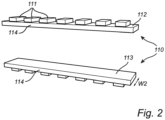
- FIG 2 shows two views of the same LED strip 110, like the one described with reference to Figure 1 , one seen at an angle from above, and another one seen from below.
- the LED strip 110 is elongated and flexible, in particular it is bendable (foldable). It comprises a first side (front side) 112 on which a plurality of LEDs 111 is mounted. It further comprises a second side (backside) 113, which is opposite to the first side 112. Connecting the first side 112 and the second side 113, along the elongation of the LED strip 110, are two lengthwise edges 114 which correspond to the thickness of the LED strip 110.
- one of the lengthwise edges 114 may be arranged to face, such as against or in proximity of, the base (151 in Figures 1a-b ) of the mixing chamber.
- the plurality of LEDs 111 may be arranged in one row on the first side 112 of the LED strip 110 in the direction of the longitudinal extension of the LED strip 110.
- the LEDs 111 may be equidistantly arranged in one row.
- the distance between successive LEDs 111 may vary.
- the LED strip 110 has a width W2.
- the width W2 may be in the range 3-30 mm. Specifically, the width W2 may be in the range 5-25 mm. More specifically the width W2 may be in the range 6-20 mm. These widths may provide mechanical strength to the LED strip so it may be arranged as described above, while not obstructing the mixing of light within the mixing chamber.
- the width W2 may be smaller than the height of the mixing chamber (H in Figure 1a ).
- the width W2 and the height H ( Figure 1a ) may fulfill the condition that 0.05 H ⁇ W 2 ⁇ 0.5H.
- the width W2 and height H ( Figure 1a ) may fulfill the condition that 0.1H ⁇ W2 ⁇ 0.5 H .
- the relation between the width W2 and the height H ( Figure 1a ) may fulfill the condition that 0.15 H ⁇ W 2 ⁇ 0.35 H .
- Figure 3a is a cross-sectional view of a LED strip 310a, taken perpendicular to the extension of the LED strip 310a.
- the LED strip 310a is equivalent to the LED strip 110 as described with reference to Figure 2 , except that it has a first lengthwise edge 114, and a second lengthwise edge 314 which is adapted to be arranged on the base of a mixing chamber.
- the second lengthwise edge 314 comprises a support 315a to facilitate the arrangement of the second lengthwise edge on the base of a mixing chamber (such as the mixing chamber 150 described with reference to Figure 1 ).
- the support 315a extends from the first side of the LED strip orthogonally (i.e. at 90°).
- a support may extend from the second side of the LED strip or at both sides of the LED strip. Further, the angle at which the support extends from the LED strip may be larger or smaller than 90°.
- the support 315a may form part of the LED strip 310.
- Figure 3b is an illustration of a LED strip 310b seen from the first side.
- the LED strip may be equivalent to the LED strip 310a.
- the LED strip 310b comprises five LEDs 111, and four supports 315b. It will be appreciated that the figure only shows a section of the LED strip.
- the supports 315b extend at a right angle from the LED strip 310b.
- Each support 315b is arranged in between two successive LEDs 111.
- the supports 315b have a rectangular cross section.
- Figure 3c is an illustration of another embodiment of a LED strip 310c which is equivalent to the LED strip 310b except that the supports 315c have triangular cross sections.
- One side of the triangular cross section is adapted to be arranged along the base of a mixing chamber, such as the mixing chamber 150 of Figure 1 .
- Embodiments of the LED strip 310a, 310b, 310c may comprise a plurality of supporting elements like the supports described above.
- embodiments of the LED stirp may comprise more than 20 supporting elements/features.
- Some embodiments of the LED strip may comprise more than 30 supporting elements.
- Some embodiments of the LED strip may comprise more than 40 supporting elements.
- the supporting elements may be arranged so that each elongated arm comprises a supporting element.
- each elongated arm may comprise a plurality of supporting elements.
- an LED strip in accordance with the various embodiments of the present disclosure may be arranged on the base of a mixing chamber without the aid of supports.
- the arrangement may comprise some means of attachment, such as a mechanical means of attachment or an adhesive.
- the supports may be adapted to arrange the lengthwise edge of the LED strip at a distance from the base.
- Figure 4a illustrates the folding of an elongated, flexible LED strip 110 with a mountain fold 433 and with a valley fold 434.
- a mountain fold 433 the LED strip 110 is bent so that the angle ⁇ between two segments of the first side of the LED strip 110, one on each side of the fold, is increased such that ⁇ > 180°.
- a mountain fold 433, thus, results in an angle ⁇ , between two segments of the first side of the LED strip 110, which is larger than 180°.
- a valley fold 434 the LED strip 110 is bent (folded) so that an angle ⁇ between two segments of the first side of the LED strip, one on each side of the fold, is decreased such that ⁇ ⁇ 180°.
- a valley fold 434 results in an angle ⁇ , between two segments of the first side of the LED strip 110, which is smaller than 180°.
- Figure 4b shows an example of an arrangement of a LED strip 110. Not to obscure the figure, the LEDs of the LED strip 110 are not shown. However, the LED strip 110 may be equivalent to any of the LED strip 110 as described with reference to Figure 2 .
- the arrangement is formed by alternatively making valley folds 434 (at the center of the shape, arranged at the center portion of the base of the mixing chamber) and mountain folds 433 (forming the outer points of the shape).
- the present shape has six valley folds 434 at the center of the shape, and five mountain folds 433 making up five of the six outer points, as one outer point is made up of a first end point 416 and a second end point 417 of the bent/folded portion of the LED strip 110, and thus does not have a fold.
- the end points 416, 417 may be located along an elongated arm, or at the center portion of the folded shape.
- Segments 435 between a valley fold 434 and a mountain fold 433 may be substantially straight, as shown in the figure, giving the arrangement a star-like appearance.
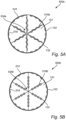
- Figures 5a-b are plan views of LED strips 510 arranged on, in the proximity of, or above, the bases 151 of mixing chambers of light-emitting modules 500a, 500b, the light-emitting modules 500a, 500b being equivalent to the light-emitting module 100 described in relation to Figure 1 , except that the LED strips 510 comprise first portions 518a, 518b and second portions 519.
- the first portions 518a, 518b are folded to extend as elongated arms from the center portions of the respective bases 151 towards a number of outer points 132.
- the second portions 519 are arranged along an arc of a circle. Specifically, the portions 519 are arranged along the inner surface of the circumferential sidewalls 153, so that the LEDs of the LED strip 510 in the second portion 523 face into the mixing chamber.
- the folding/arrangement of the first portion 518a is such that there is a distance between the valley folds 534a at the center of the arrangement.
- the backsides (second sides) of the segments of the LED strip which make up opposite sides of an elongated arm are not in contact along the whole length of the elongated arm.
- the LEDs on either side of an elongated arm are interleaved. Interleaving of the LEDs will be described with reference to Figure 9 .
- the folding/arrangement of the first portion 518b is such that there is substantially no distance between the valley folds 534b at the center of the arrangement.
- the backsides (second sides) of the segments which make up opposite sides of an elongated arm are at least partially in contact. More specifically, opposite sides are in contact along the whole length of the elongated arm. This arrangement may provide an even more uniform lighting.
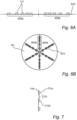
- FIG 6a shows a portion of a LED strip 610.
- the LED strip 610 may be equivalent to the LED strip 110 described above with reference to Figure 2 , except that it comprises a first region 620a in which the LED pitch (i.e. the distance between two successive LEDs 111) decreases from left to right.
- the LED strip 610 further comprises a second region 620b in which the LED pitch increases from left to right.
- Each region 620a, 620b comprising a LED pitch may for example comprise at least 4 LEDs, between which the LED pitch (distance) increases or decreases.
- each region 620a, 620b comprising a LED pitch may for example comprise at least 6 LEDs. More specifically, each region 620a, 620b comprising a LED pitch may for example comprise at least 7 LEDs.
- Figure 6b shows the LED strip 610 being arranged on, or in the proximity of, the base 151 of a mixing chamber, which may be equivalent to the mixing chamber 150 described with reference to Figure 1 .
- the LED strip has been folded with a mountain fold between the first region 620a and the second region 620b, so that the regions together form an elongated arm.
- the LED pitch decreases along the elongated arm, from the center portion of the base towards the outer point of the elongated arm.
- the LEDs are more closely arranged.
- the emitted light may be more uniformly spread.
- FIG 7 is an illustration of a segment of a LED strip 710, which is equivalent to the LED strip 110 described with reference to Figure 2 , in accordance with some embodiments.
- the segment of the LED strip comprises a first LED 711a and a second, successive LED 711b.
- An area of the LED strip 721 between the first LED 711a and the second LED 711b is folded to decrease the pitch between the two LEDs 711a, 711b.
- This technique of folding the LED strip between LEDs may be used to adjust the LED pitch gradient along an elongated arm of a LED strip.
- This technique maybe used to form a light-emitting module such as for example described with reference to Figure 6b .
- the LED strip comprises regions with LEDs and regions without LEDs will be described.
- Figure 8a illustrates a portion of an elongated, flexible LED strip 810.
- the LED strip 810 is similar to the LED strip 110 described with reference to Figure 2 except that the LED strip 810 comprises a first region 822 with LEDs 111 and a second region 823 without LEDs.
- Figure 8b illustrates the LED strip 810 being arranged on, or in the proximity of, the base 151 of a mixing chamber.
- a valley fold has been formed between the first region 822 with LEDs 111 and the second region 823 without LEDs.
- the first region 822 and the second region 823 form part of two neighboring elongated arms (i.e. two different elongated arms), such that they face one another.
- the second region 823 without LEDs is located in proximity of the center portion of the base from which the elongated arms extend, such that the second region 823 without LEDs is a region of the LED strip located close to a region of a neighboring arm 822 having LEDs.
- the absence of LEDs in some regions where the elongated arms are closer to one-another may contribute to a more uniform illumination.
- the length L2 of a region 823 without LEDs may be related to the length L1 of an elongated arm.
- the relation between the length L2 of a region without LEDs and the length L1 of an elongated arm may be 0.4L1 ⁇ L2 ⁇ L1.
- the relation may be 0.5 L 1 ⁇ L2 ⁇ L 1.
- the relation may be 0.7 L 1 ⁇ L 2 ⁇ L 1 .
- the relation may be 0.9 L 1 ⁇ L 2 ⁇ L 1.
- the length L2 of a region 823 without LEDs may be at least 3 cm. Specifically, the length L2 of a region 823 without LEDs may be at least 4 cm. More specifically the length L2 of a region 823 without LEDs may be at least 5 cm. Even more specifically, the length L2 of a region 823 without LEDs may be at least 6 cm.
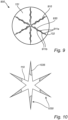
- the light-emitting module 900 shown in Figure 9 is equivalent to the light-emitting module 100 described with reference to Figure 1 except that the LEDs 911a on one side of an elongated arm 930 and the LEDs 911b on the other (opposite) side of the elongated arm 930 are interleaved.
- the LEDs 911a on one side of the elongated arm 930 are not placed at the same level (along the length of the elongated arm 930) as the LEDs 911b on the other side of the elongated arm 930, the heat development in the elongated arm may be more evenly spread out. This may lead to better thermal management.
- FIG 10 is an illustration of a LED strip 110.
- the LEDs of the LED strip are not shown.
- the LED strip is bent/folded into a star-shaped arrangement.
- the backsides of the segments forming the elongated arm 1030 are glued together using an adhesive 1035.
- the adhesive is placed in the outer portions of the elongated arms.
- adhesive may be placed in other portions (one or more portions) of the elongated arms, or along the entire elongated arms. Adhesive on the backsides of the LED strip may improve thermal management.
- the light-emitting module 1100 is equivalent to the light-emitting module 100 of Figure 1a , except for that the LED strip 1110 is arranged with a small gap h between the base 1151 and the LED strip 1110.
- the LED strip 1110 in the present embodiment is attached at the inside of the sidewall 1153.
- the gap h is smaller than the height H of the mixing chamber 1150.
- the gap h may be such that h ⁇ H /2 . More specifically, the gap may be such that h ⁇ H /4 .
- the gap h may be smaller than 3 cm.
- the gap h may be smaller than 1 cm. More specifically, the gap h may be smaller than 0.1 cm.
- the LED strip segments forming the elongated arms may be in part curved, bent or folded to provide different illumination.
- the arrangement of the LEDs on the LED strip may be varied.
- the shape and reflectance of the mixing chamber may be altered.
Landscapes
- Engineering & Computer Science (AREA)
- Physics & Mathematics (AREA)
- Microelectronics & Electronic Packaging (AREA)
- Optics & Photonics (AREA)
- General Engineering & Computer Science (AREA)
- Manufacturing & Machinery (AREA)
- Non-Portable Lighting Devices Or Systems Thereof (AREA)
- Fastening Of Light Sources Or Lamp Holders (AREA)
Applications Claiming Priority (2)
| Application Number | Priority Date | Filing Date | Title |
|---|---|---|---|
| EP19173982 | 2019-05-13 | ||
| PCT/EP2020/062248 WO2020229206A1 (en) | 2019-05-13 | 2020-05-04 | Led strip configurations for large area round luminaires providing homogeneous lighting |
Publications (2)
| Publication Number | Publication Date |
|---|---|
| EP3969802A1 EP3969802A1 (en) | 2022-03-23 |
| EP3969802B1 true EP3969802B1 (en) | 2023-08-09 |
Family
ID=66542030
Family Applications (1)
| Application Number | Title | Priority Date | Filing Date |
|---|---|---|---|
| EP20721649.0A Active EP3969802B1 (en) | 2019-05-13 | 2020-05-04 | Led strip configurations for large area round luminaires providing homogeneous lighting |
Country Status (5)
| Country | Link |
|---|---|
| US (1) | US11774047B2 (https=) |
| EP (1) | EP3969802B1 (https=) |
| JP (1) | JP7583510B2 (https=) |
| CN (1) | CN113795704B (https=) |
| WO (1) | WO2020229206A1 (https=) |
Families Citing this family (4)
| Publication number | Priority date | Publication date | Assignee | Title |
|---|---|---|---|---|
| US12372219B2 (en) * | 2014-05-30 | 2025-07-29 | Cree Lighting Usa Llc | LED luminaire with a cavity, finned interior, and a curved outer wall extending from a surface on which the light source is mounted |
| WO2021209492A1 (en) * | 2020-04-15 | 2021-10-21 | CommScope Connectivity Belgium BV | Device and method for sealing cables in telecommunications enclosures |
| WO2025195939A1 (en) | 2024-03-18 | 2025-09-25 | Signify Holding B.V. | A lighting device |
| WO2026012756A1 (en) | 2024-07-08 | 2026-01-15 | Signify Holding B.V. | Luminaire comprising a combination of a cob led strip and a led filament |
Family Cites Families (21)
| Publication number | Priority date | Publication date | Assignee | Title |
|---|---|---|---|---|
| US5559681A (en) * | 1994-05-13 | 1996-09-24 | Cnc Automation, Inc. | Flexible, self-adhesive, modular lighting system |
| US6371637B1 (en) * | 1999-02-26 | 2002-04-16 | Radiantz, Inc. | Compact, flexible, LED array |
| EP1552215B1 (en) * | 2002-10-01 | 2014-11-05 | Sloanled, Inc. | Bent perimeter lighting and method for fabricating |
| US10655792B2 (en) * | 2014-09-28 | 2020-05-19 | Zhejiang Super Lighting Electric Appliance Co., Ltd. | LED bulb lamp |
| US8322881B1 (en) * | 2007-12-21 | 2012-12-04 | Appalachian Lighting Systems, Inc. | Lighting fixture |
| CN201661918U (zh) | 2010-04-16 | 2010-12-01 | 深圳市绿色半导体照明有限公司 | Led平板灯 |
| US8314566B2 (en) * | 2011-02-22 | 2012-11-20 | Quarkstar Llc | Solid state lamp using light emitting strips |
| US9482421B2 (en) * | 2011-12-30 | 2016-11-01 | Cree, Inc. | Lamp with LED array and thermal coupling medium |
| US9512977B2 (en) * | 2012-01-26 | 2016-12-06 | Cree, Inc. | Reduced contrast LED lighting system |
| EP2893255B1 (en) * | 2012-09-07 | 2017-02-01 | Philips Lighting Holding B.V. | Lighting device with integrated lens heat sink |
| CN104019380A (zh) * | 2013-02-28 | 2014-09-03 | 东莞巨扬电器有限公司 | 灯具及其背板 |
| CN104251470A (zh) * | 2013-06-28 | 2014-12-31 | 上海德士电器有限公司 | 爪式led组件及使用其的led泡形灯 |
| CN103470973B (zh) | 2013-08-31 | 2015-07-29 | 普天智能照明研究院有限公司 | 一种提高照度均匀性的照明装置及方法 |
| KR20150038822A (ko) * | 2013-09-30 | 2015-04-09 | 서울반도체 주식회사 | 엘이디 바를 가지는 백라이트 유닛 |
| PL2935980T3 (pl) | 2014-01-02 | 2016-11-30 | Moduł emitujący światło | |
| JP6190561B1 (ja) | 2014-07-24 | 2017-08-30 | フィリップス ライティング ホールディング ビー ヴィ | 発光モジュール |
| CN204268400U (zh) | 2014-11-13 | 2015-04-15 | 邓德贤 | 一种led吸顶灯灯盘结构 |
| DE102015206808A1 (de) * | 2015-04-15 | 2016-10-20 | Osram Gmbh | Leuchtmittel mit LEDs |
| JP6580716B2 (ja) * | 2015-06-11 | 2019-09-25 | シグニファイ ホールディング ビー ヴィ | 電球のための固体照明装置のためのキャリア |
| US10222036B2 (en) * | 2015-08-27 | 2019-03-05 | GE Lighting Solutions, LLC | Method and system for a three-dimensional (3-D) flexible light emitting diode (LED) bar |
| CN208951743U (zh) * | 2018-04-10 | 2019-06-07 | 深圳市乐的美光电股份有限公司 | 一种任意角度弯曲的柔性led灯条 |
-
2020
- 2020-05-04 CN CN202080035567.6A patent/CN113795704B/zh active Active
- 2020-05-04 WO PCT/EP2020/062248 patent/WO2020229206A1/en not_active Ceased
- 2020-05-04 JP JP2021567809A patent/JP7583510B2/ja active Active
- 2020-05-04 US US17/609,712 patent/US11774047B2/en active Active
- 2020-05-04 EP EP20721649.0A patent/EP3969802B1/en active Active
Also Published As
| Publication number | Publication date |
|---|---|
| EP3969802A1 (en) | 2022-03-23 |
| WO2020229206A1 (en) | 2020-11-19 |
| US20220221113A1 (en) | 2022-07-14 |
| CN113795704A (zh) | 2021-12-14 |
| CN113795704B (zh) | 2024-07-19 |
| JP2022533078A (ja) | 2022-07-21 |
| JP7583510B2 (ja) | 2024-11-14 |
| US11774047B2 (en) | 2023-10-03 |
Similar Documents
| Publication | Publication Date | Title |
|---|---|---|
| EP3969802B1 (en) | Led strip configurations for large area round luminaires providing homogeneous lighting | |
| CN102047156B (zh) | 圆弧形照明设备 | |
| US10323801B2 (en) | Semiconductor tubular lamp, tube therefor, and production method | |
| EP4115116B1 (en) | Tunable led filament | |
| US9822951B2 (en) | LED retrofit lens for fluorescent tube | |
| US20080204888A1 (en) | Optical system for luminaire | |
| WO2013098700A1 (en) | Reflector device and lighting device comprising such a reflector device | |
| CN103518097B (zh) | 装饰灯 | |
| JP6292509B2 (ja) | 照明装置 | |
| WO2013155014A1 (en) | Lensed troffer style light fixture | |
| JP2015090763A (ja) | 照明装置 | |
| JP2012089291A (ja) | 照明用光源及び照明装置 | |
| JP7036997B2 (ja) | 発光デバイス | |
| WO2012146524A2 (en) | Led lamp | |
| JP2014026810A (ja) | 照明器具 | |
| WO2012093734A1 (ja) | 照明装置 | |
| US12146654B1 (en) | Lighting device, luminaire, and method manufacturing | |
| US20150131260A1 (en) | Light-emitting device comprising a hollow retro-reflector | |
| CN102042524B (zh) | 环形灯管 | |
| WO2020201251A1 (en) | Light guide device | |
| CN202253388U (zh) | 新型反光杯及其安装有该反光杯的led灯具 | |
| KR101921469B1 (ko) | 관형 엘이디 램프 | |
| CN102434851A (zh) | 新型反光杯及其安装有该反光杯的led灯具 | |
| CN217209029U (zh) | 透明保护套及照明灯带 | |
| CN218599501U (zh) | 一种新型办公灯 |
Legal Events
| Date | Code | Title | Description |
|---|---|---|---|
| STAA | Information on the status of an ep patent application or granted ep patent |
Free format text: STATUS: UNKNOWN |
|
| STAA | Information on the status of an ep patent application or granted ep patent |
Free format text: STATUS: THE INTERNATIONAL PUBLICATION HAS BEEN MADE |
|
| PUAI | Public reference made under article 153(3) epc to a published international application that has entered the european phase |
Free format text: ORIGINAL CODE: 0009012 |
|
| STAA | Information on the status of an ep patent application or granted ep patent |
Free format text: STATUS: REQUEST FOR EXAMINATION WAS MADE |
|
| 17P | Request for examination filed |
Effective date: 20211213 |
|
| AK | Designated contracting states |
Kind code of ref document: A1 Designated state(s): AL AT BE BG CH CY CZ DE DK EE ES FI FR GB GR HR HU IE IS IT LI LT LU LV MC MK MT NL NO PL PT RO RS SE SI SK SM TR |
|
| DAV | Request for validation of the european patent (deleted) | ||
| DAX | Request for extension of the european patent (deleted) | ||
| GRAP | Despatch of communication of intention to grant a patent |
Free format text: ORIGINAL CODE: EPIDOSNIGR1 |
|
| STAA | Information on the status of an ep patent application or granted ep patent |
Free format text: STATUS: GRANT OF PATENT IS INTENDED |
|
| INTG | Intention to grant announced |
Effective date: 20230307 |
|
| GRAS | Grant fee paid |
Free format text: ORIGINAL CODE: EPIDOSNIGR3 |
|
| GRAA | (expected) grant |
Free format text: ORIGINAL CODE: 0009210 |
|
| STAA | Information on the status of an ep patent application or granted ep patent |
Free format text: STATUS: THE PATENT HAS BEEN GRANTED |
|
| P01 | Opt-out of the competence of the unified patent court (upc) registered |
Effective date: 20230530 |
|
| AK | Designated contracting states |
Kind code of ref document: B1 Designated state(s): AL AT BE BG CH CY CZ DE DK EE ES FI FR GB GR HR HU IE IS IT LI LT LU LV MC MK MT NL NO PL PT RO RS SE SI SK SM TR |
|
| REG | Reference to a national code |
Ref country code: GB Ref legal event code: FG4D |
|
| REG | Reference to a national code |
Ref country code: CH Ref legal event code: EP |
|
| REG | Reference to a national code |
Ref country code: IE Ref legal event code: FG4D |
|
| REG | Reference to a national code |
Ref country code: DE Ref legal event code: R096 Ref document number: 602020015420 Country of ref document: DE |
|
| REG | Reference to a national code |
Ref country code: LT Ref legal event code: MG9D |
|
| REG | Reference to a national code |
Ref country code: NL Ref legal event code: MP Effective date: 20230809 |
|
| REG | Reference to a national code |
Ref country code: AT Ref legal event code: MK05 Ref document number: 1597904 Country of ref document: AT Kind code of ref document: T Effective date: 20230809 |
|
| PG25 | Lapsed in a contracting state [announced via postgrant information from national office to epo] |
Ref country code: GR Free format text: LAPSE BECAUSE OF FAILURE TO SUBMIT A TRANSLATION OF THE DESCRIPTION OR TO PAY THE FEE WITHIN THE PRESCRIBED TIME-LIMIT Effective date: 20231110 |
|
| PG25 | Lapsed in a contracting state [announced via postgrant information from national office to epo] |
Ref country code: IS Free format text: LAPSE BECAUSE OF FAILURE TO SUBMIT A TRANSLATION OF THE DESCRIPTION OR TO PAY THE FEE WITHIN THE PRESCRIBED TIME-LIMIT Effective date: 20231209 |
|
| PG25 | Lapsed in a contracting state [announced via postgrant information from national office to epo] |
Ref country code: SE Free format text: LAPSE BECAUSE OF FAILURE TO SUBMIT A TRANSLATION OF THE DESCRIPTION OR TO PAY THE FEE WITHIN THE PRESCRIBED TIME-LIMIT Effective date: 20230809 Ref country code: RS Free format text: LAPSE BECAUSE OF FAILURE TO SUBMIT A TRANSLATION OF THE DESCRIPTION OR TO PAY THE FEE WITHIN THE PRESCRIBED TIME-LIMIT Effective date: 20230809 Ref country code: PT Free format text: LAPSE BECAUSE OF FAILURE TO SUBMIT A TRANSLATION OF THE DESCRIPTION OR TO PAY THE FEE WITHIN THE PRESCRIBED TIME-LIMIT Effective date: 20231211 Ref country code: NO Free format text: LAPSE BECAUSE OF FAILURE TO SUBMIT A TRANSLATION OF THE DESCRIPTION OR TO PAY THE FEE WITHIN THE PRESCRIBED TIME-LIMIT Effective date: 20231109 Ref country code: NL Free format text: LAPSE BECAUSE OF FAILURE TO SUBMIT A TRANSLATION OF THE DESCRIPTION OR TO PAY THE FEE WITHIN THE PRESCRIBED TIME-LIMIT Effective date: 20230809 Ref country code: LV Free format text: LAPSE BECAUSE OF FAILURE TO SUBMIT A TRANSLATION OF THE DESCRIPTION OR TO PAY THE FEE WITHIN THE PRESCRIBED TIME-LIMIT Effective date: 20230809 Ref country code: LT Free format text: LAPSE BECAUSE OF FAILURE TO SUBMIT A TRANSLATION OF THE DESCRIPTION OR TO PAY THE FEE WITHIN THE PRESCRIBED TIME-LIMIT Effective date: 20230809 Ref country code: IS Free format text: LAPSE BECAUSE OF FAILURE TO SUBMIT A TRANSLATION OF THE DESCRIPTION OR TO PAY THE FEE WITHIN THE PRESCRIBED TIME-LIMIT Effective date: 20231209 Ref country code: HR Free format text: LAPSE BECAUSE OF FAILURE TO SUBMIT A TRANSLATION OF THE DESCRIPTION OR TO PAY THE FEE WITHIN THE PRESCRIBED TIME-LIMIT Effective date: 20230809 Ref country code: GR Free format text: LAPSE BECAUSE OF FAILURE TO SUBMIT A TRANSLATION OF THE DESCRIPTION OR TO PAY THE FEE WITHIN THE PRESCRIBED TIME-LIMIT Effective date: 20231110 Ref country code: FI Free format text: LAPSE BECAUSE OF FAILURE TO SUBMIT A TRANSLATION OF THE DESCRIPTION OR TO PAY THE FEE WITHIN THE PRESCRIBED TIME-LIMIT Effective date: 20230809 Ref country code: AT Free format text: LAPSE BECAUSE OF FAILURE TO SUBMIT A TRANSLATION OF THE DESCRIPTION OR TO PAY THE FEE WITHIN THE PRESCRIBED TIME-LIMIT Effective date: 20230809 |
|
| PG25 | Lapsed in a contracting state [announced via postgrant information from national office to epo] |
Ref country code: PL Free format text: LAPSE BECAUSE OF FAILURE TO SUBMIT A TRANSLATION OF THE DESCRIPTION OR TO PAY THE FEE WITHIN THE PRESCRIBED TIME-LIMIT Effective date: 20230809 |
|
| PG25 | Lapsed in a contracting state [announced via postgrant information from national office to epo] |
Ref country code: ES Free format text: LAPSE BECAUSE OF FAILURE TO SUBMIT A TRANSLATION OF THE DESCRIPTION OR TO PAY THE FEE WITHIN THE PRESCRIBED TIME-LIMIT Effective date: 20230809 |
|
| PG25 | Lapsed in a contracting state [announced via postgrant information from national office to epo] |
Ref country code: SM Free format text: LAPSE BECAUSE OF FAILURE TO SUBMIT A TRANSLATION OF THE DESCRIPTION OR TO PAY THE FEE WITHIN THE PRESCRIBED TIME-LIMIT Effective date: 20230809 Ref country code: RO Free format text: LAPSE BECAUSE OF FAILURE TO SUBMIT A TRANSLATION OF THE DESCRIPTION OR TO PAY THE FEE WITHIN THE PRESCRIBED TIME-LIMIT Effective date: 20230809 Ref country code: ES Free format text: LAPSE BECAUSE OF FAILURE TO SUBMIT A TRANSLATION OF THE DESCRIPTION OR TO PAY THE FEE WITHIN THE PRESCRIBED TIME-LIMIT Effective date: 20230809 Ref country code: EE Free format text: LAPSE BECAUSE OF FAILURE TO SUBMIT A TRANSLATION OF THE DESCRIPTION OR TO PAY THE FEE WITHIN THE PRESCRIBED TIME-LIMIT Effective date: 20230809 Ref country code: DK Free format text: LAPSE BECAUSE OF FAILURE TO SUBMIT A TRANSLATION OF THE DESCRIPTION OR TO PAY THE FEE WITHIN THE PRESCRIBED TIME-LIMIT Effective date: 20230809 Ref country code: CZ Free format text: LAPSE BECAUSE OF FAILURE TO SUBMIT A TRANSLATION OF THE DESCRIPTION OR TO PAY THE FEE WITHIN THE PRESCRIBED TIME-LIMIT Effective date: 20230809 Ref country code: SK Free format text: LAPSE BECAUSE OF FAILURE TO SUBMIT A TRANSLATION OF THE DESCRIPTION OR TO PAY THE FEE WITHIN THE PRESCRIBED TIME-LIMIT Effective date: 20230809 |
|
| REG | Reference to a national code |
Ref country code: DE Ref legal event code: R097 Ref document number: 602020015420 Country of ref document: DE |
|
| PG25 | Lapsed in a contracting state [announced via postgrant information from national office to epo] |
Ref country code: IT Free format text: LAPSE BECAUSE OF FAILURE TO SUBMIT A TRANSLATION OF THE DESCRIPTION OR TO PAY THE FEE WITHIN THE PRESCRIBED TIME-LIMIT Effective date: 20230809 |
|
| PLBE | No opposition filed within time limit |
Free format text: ORIGINAL CODE: 0009261 |
|
| STAA | Information on the status of an ep patent application or granted ep patent |
Free format text: STATUS: NO OPPOSITION FILED WITHIN TIME LIMIT |
|
| 26N | No opposition filed |
Effective date: 20240513 |
|
| PG25 | Lapsed in a contracting state [announced via postgrant information from national office to epo] |
Ref country code: SI Free format text: LAPSE BECAUSE OF FAILURE TO SUBMIT A TRANSLATION OF THE DESCRIPTION OR TO PAY THE FEE WITHIN THE PRESCRIBED TIME-LIMIT Effective date: 20230809 |
|
| PG25 | Lapsed in a contracting state [announced via postgrant information from national office to epo] |
Ref country code: BG Free format text: LAPSE BECAUSE OF FAILURE TO SUBMIT A TRANSLATION OF THE DESCRIPTION OR TO PAY THE FEE WITHIN THE PRESCRIBED TIME-LIMIT Effective date: 20230809 |
|
| PG25 | Lapsed in a contracting state [announced via postgrant information from national office to epo] |
Ref country code: BG Free format text: LAPSE BECAUSE OF FAILURE TO SUBMIT A TRANSLATION OF THE DESCRIPTION OR TO PAY THE FEE WITHIN THE PRESCRIBED TIME-LIMIT Effective date: 20230809 |
|
| REG | Reference to a national code |
Ref country code: CH Ref legal event code: PL |
|
| PG25 | Lapsed in a contracting state [announced via postgrant information from national office to epo] |
Ref country code: MC Free format text: LAPSE BECAUSE OF FAILURE TO SUBMIT A TRANSLATION OF THE DESCRIPTION OR TO PAY THE FEE WITHIN THE PRESCRIBED TIME-LIMIT Effective date: 20230809 |
|
| PG25 | Lapsed in a contracting state [announced via postgrant information from national office to epo] |
Ref country code: LU Free format text: LAPSE BECAUSE OF NON-PAYMENT OF DUE FEES Effective date: 20240504 |
|
| PG25 | Lapsed in a contracting state [announced via postgrant information from national office to epo] |
Ref country code: MC Free format text: LAPSE BECAUSE OF FAILURE TO SUBMIT A TRANSLATION OF THE DESCRIPTION OR TO PAY THE FEE WITHIN THE PRESCRIBED TIME-LIMIT Effective date: 20230809 Ref country code: LU Free format text: LAPSE BECAUSE OF NON-PAYMENT OF DUE FEES Effective date: 20240504 Ref country code: CH Free format text: LAPSE BECAUSE OF NON-PAYMENT OF DUE FEES Effective date: 20240531 |
|
| REG | Reference to a national code |
Ref country code: BE Ref legal event code: MM Effective date: 20240531 |
|
| PG25 | Lapsed in a contracting state [announced via postgrant information from national office to epo] |
Ref country code: IE Free format text: LAPSE BECAUSE OF NON-PAYMENT OF DUE FEES Effective date: 20240504 |
|
| PG25 | Lapsed in a contracting state [announced via postgrant information from national office to epo] |
Ref country code: BE Free format text: LAPSE BECAUSE OF NON-PAYMENT OF DUE FEES Effective date: 20240531 |
|
| PGFP | Annual fee paid to national office [announced via postgrant information from national office to epo] |
Ref country code: FR Payment date: 20250526 Year of fee payment: 6 |
|
| PG25 | Lapsed in a contracting state [announced via postgrant information from national office to epo] |
Ref country code: CY Free format text: LAPSE BECAUSE OF FAILURE TO SUBMIT A TRANSLATION OF THE DESCRIPTION OR TO PAY THE FEE WITHIN THE PRESCRIBED TIME-LIMIT; INVALID AB INITIO Effective date: 20200504 |
|
| PG25 | Lapsed in a contracting state [announced via postgrant information from national office to epo] |
Ref country code: HU Free format text: LAPSE BECAUSE OF FAILURE TO SUBMIT A TRANSLATION OF THE DESCRIPTION OR TO PAY THE FEE WITHIN THE PRESCRIBED TIME-LIMIT; INVALID AB INITIO Effective date: 20200504 |
|
| PGFP | Annual fee paid to national office [announced via postgrant information from national office to epo] |
Ref country code: DE Payment date: 20250728 Year of fee payment: 6 |
|
| PGFP | Annual fee paid to national office [announced via postgrant information from national office to epo] |
Ref country code: GB Payment date: 20260304 Year of fee payment: 7 |