EP3968280A1 - Zielverfolgungsverfahren und -vorrichtung, speichermedium und elektronische vorrichtung - Google Patents
Zielverfolgungsverfahren und -vorrichtung, speichermedium und elektronische vorrichtung Download PDFInfo
- Publication number
- EP3968280A1 EP3968280A1 EP20805061.7A EP20805061A EP3968280A1 EP 3968280 A1 EP3968280 A1 EP 3968280A1 EP 20805061 A EP20805061 A EP 20805061A EP 3968280 A1 EP3968280 A1 EP 3968280A1
- Authority
- EP
- European Patent Office
- Prior art keywords
- input feature
- feature map
- filter
- picture frame
- weight
- Prior art date
- Legal status (The legal status is an assumption and is not a legal conclusion. Google has not performed a legal analysis and makes no representation as to the accuracy of the status listed.)
- Granted
Links
Images




Classifications
-
- G—PHYSICS
- G06—COMPUTING OR CALCULATING; COUNTING
- G06T—IMAGE DATA PROCESSING OR GENERATION, IN GENERAL
- G06T7/00—Image analysis
- G06T7/20—Analysis of motion
- G06T7/246—Analysis of motion using feature-based methods, e.g. the tracking of corners or segments
-
- G—PHYSICS
- G06—COMPUTING OR CALCULATING; COUNTING
- G06V—IMAGE OR VIDEO RECOGNITION OR UNDERSTANDING
- G06V10/00—Arrangements for image or video recognition or understanding
- G06V10/20—Image preprocessing
- G06V10/25—Determination of region of interest [ROI] or a volume of interest [VOI]
-
- G—PHYSICS
- G06—COMPUTING OR CALCULATING; COUNTING
- G06T—IMAGE DATA PROCESSING OR GENERATION, IN GENERAL
- G06T7/00—Image analysis
- G06T7/20—Analysis of motion
- G06T7/246—Analysis of motion using feature-based methods, e.g. the tracking of corners or segments
- G06T7/248—Analysis of motion using feature-based methods, e.g. the tracking of corners or segments involving reference images or patches
-
- G—PHYSICS
- G06—COMPUTING OR CALCULATING; COUNTING
- G06V—IMAGE OR VIDEO RECOGNITION OR UNDERSTANDING
- G06V10/00—Arrangements for image or video recognition or understanding
- G06V10/40—Extraction of image or video features
-
- G—PHYSICS
- G06—COMPUTING OR CALCULATING; COUNTING
- G06V—IMAGE OR VIDEO RECOGNITION OR UNDERSTANDING
- G06V10/00—Arrangements for image or video recognition or understanding
- G06V10/40—Extraction of image or video features
- G06V10/42—Global feature extraction by analysis of the whole pattern, e.g. using frequency domain transformations or autocorrelation
- G06V10/431—Frequency domain transformation; Autocorrelation
-
- G—PHYSICS
- G06—COMPUTING OR CALCULATING; COUNTING
- G06T—IMAGE DATA PROCESSING OR GENERATION, IN GENERAL
- G06T2207/00—Indexing scheme for image analysis or image enhancement
- G06T2207/10—Image acquisition modality
- G06T2207/10016—Video; Image sequence
-
- G—PHYSICS
- G06—COMPUTING OR CALCULATING; COUNTING
- G06T—IMAGE DATA PROCESSING OR GENERATION, IN GENERAL
- G06T2207/00—Indexing scheme for image analysis or image enhancement
- G06T2207/20—Special algorithmic details
- G06T2207/20024—Filtering details
-
- G—PHYSICS
- G06—COMPUTING OR CALCULATING; COUNTING
- G06T—IMAGE DATA PROCESSING OR GENERATION, IN GENERAL
- G06T2207/00—Indexing scheme for image analysis or image enhancement
- G06T2207/20—Special algorithmic details
- G06T2207/20081—Training; Learning
-
- G—PHYSICS
- G06—COMPUTING OR CALCULATING; COUNTING
- G06V—IMAGE OR VIDEO RECOGNITION OR UNDERSTANDING
- G06V20/00—Scenes; Scene-specific elements
- G06V20/50—Context or environment of the image
- G06V20/52—Surveillance or monitoring of activities, e.g. for recognising suspicious objects
Definitions
- This application relates to the field of image data processing, and in particular, to a target tracking method and apparatus, a storage medium, and an electronic device.
- Target tracking is an operation for positioning a manually designated target object in consecutive frames of a video.
- target tracking has been widely applied to fields of automatic driving, human-computer interaction, and behavior recognition.
- target tracking is still a very challenging task.
- a correlation filter-based target tracking algorithm is one of current target tracking methods, and correlation filters are characterized by quickly obtaining samples through circular convolution.
- Danelljan et al. proposed to add a regularization item on a filter, to suppress edge information, and facilitate that the filter performing learning based on central regions of targets, thereby effectively resolving an edge effect.
- the learning background-aware correlation filters (BACF) for visual tracking algorithm provided another feasible method for resolving the edge effect, and actual training samples are generated, which greatly improves an identification capability of the learning filters.
- This application provides a target tracking method and a target tracking apparatus, which not only avoids parameter over-fitting, but also improves the robustness of a corresponding correlation filter model, thereby improving the precision and the effectiveness of target tracking.
- An embodiment of this application provides a target tracking method, including:
- An embodiment of this application provides a target tracking apparatus, including:
- the correlation filter model creation unit includes: a binary mask setting subunit, configured to set a binary mask for the n th weight filter, to reduce a filter weight of a weight filter corresponding to a region other than the n th tracking target region.
- the correlation filter model creation unit includes: a regularization weight setting subunit, configured to set a regularization weight for the n th weight filter, to increase a filter weight of the n th weight filter in a central part of the n th tracking target region.
- An embodiment of this application further provides a storage medium, storing processor-executable instructions, the instructions being loaded by one or more processors to perform the target tracking method.
- An embodiment of this application further provides an electronic device, including a processor and a memory, the memory storing a computer program, the processor invoking the computer program to perform the target tracking method.
- an average pooling operation is performed on filter weights corresponding to different feature channels of an input feature map, to reduce a quantity of algorithm parameters.
- a reduction operation does not need to be performed on a tracking target region, thereby ensuring a quantity of training sample features of the input feature map, avoiding occurrence of parameter over-fitting, and improving the precision and the effectiveness of target tracking. Therefore, the technical problem of parameter over-fitting or relatively low tracking precision in the target tracking method and the target tracking apparatus is effectively resolved.
- the target tracking method and the target tracking apparatus in this application may be disposed in any electronic device, to perform a tracking operation on a designated object or a specific object in a video picture.
- the electronic device includes, but is not limited to, a wearable device, a head-mounted device, a healthcare platform, a personal computer, a server computer, a handheld or laptop device, a mobile device (for example, a mobile phone, a personal digital assistant (PDA), a media player and the like), a multiprocessor system, a consumer electronic device, a mini-computer, a mainframe computer, a distributed computing environment including any of the foregoing system or device, and the like.
- the electronic device may be a picture processing terminal or a picture processing server. A user may accurately determine a designated object or a specific object in consecutive picture frames of a video by using the electronic device, so as to effectively track the designated object or the specific object in the video in a high precision manner.
- FIG. 1 is a flowchart of an embodiment of a target tracking method according to this application.
- the target tracking method in this embodiment may be implemented by using the foregoing electronic device.
- the target tracking method in this embodiment may include the following steps:
- Step S101 Obtain a plurality of consecutive picture frames of a target video, and set a tracking target region of an n th picture frame in the plurality of consecutive picture frames, n being a positive integer.
- the tracking target region is a tracking target region corresponding to the n th picture frame
- the tracking target region may be used as an n th tracking target region.
- Step S102 Perform a feature extraction operation on the tracking target region of the n th picture frame, to obtain an input feature map of the tracking target region, the input feature map including a plurality of feature channels.
- the input feature map is an input feature map corresponding to the n th tracking target region, and the input feature map indicates features of the tracking target region, the input feature map may be used as an n th regional input feature map.
- Step S103 Calculate a weight filter corresponding to the input feature map of the tracking target region according to a correlation filter algorithm and an average pooling constraint condition, the weight filter including a filter weight corresponding to each feature channel in the input feature map.
- the weight filter may be used as an n th weight filter.
- Step S104 Calculate an output response of an (n + 1) th picture frame by using the weight filter and an input feature map of the (n + 1) th picture frame in the plurality of consecutive picture frames, and determine a tracking target region of the (n + 1) th picture frame according to the output response of the (n + 1) th picture frame.
- the input feature map is an input feature map corresponding to the (n + 1) th picture frame, and the input feature map indicates features of the picture frame
- the input feature map may be used as an (n + 1) th picture frame input feature map.
- the output response is an output response corresponding to the (n + 1) th picture frame
- the output response may be used as an (n + 1) th output response.
- Step S105 Perform feature extraction on the tracking target region of the (n + 1) th picture frame, to obtain an input feature map of the tracking target region of the (n + 1) th picture frame, and calculate a weight filter corresponding to the input feature map of the tracking target region of the (n + 1) th picture frame, until tracking target regions of all the consecutive picture frames are obtained.
- the tracking target region is a tracking target region corresponding to the (n + 1) th picture frame
- the tracking target region may be used as an (n + 1) th tracking target region.
- the input feature map is an input feature map corresponding to the (n + 1) th tracking target region, and the input feature map indicates features of the tracking target region
- the input feature map may be used as an (n + 1) th regional input feature map.
- the weight filter is a weight filter corresponding to the (n + 1) th regional input feature map
- the weight filter may be used as an (n + 1) th weight filter.
- step S101 the electronic device (such as the picture processing server) obtains a plurality of consecutive picture frames of a target video.
- a 1 st tracking target region corresponding to a 1 st picture frame in the plurality of consecutive picture frames is set herein.
- the 1 st tracking target region is a tracking target region of the 1 st picture frame in the plurality of consecutive picture frames.
- the 1 st tracking target region herein is a picture region where the specific object or the designated object is located in the picture frame.
- the specific object or the designated object herein may be a preset character, an animal, a vehicle, or any moving object. In this way, corresponding tracking target regions may be found in other subsequent picture frames according to features of the tracking target region in the 1 st picture frame.
- the n th tracking target region is a tracking target region of an n th picture frame
- the n th regional input feature map is an input feature map of the tracking target region of the n th picture frame.
- the n th tracking target region may be divided into mesh regions with a size of a*a. Then, a convolution sampling operation is performed on the mesh regions with a size of a ⁇ a by using d types of convolution kernels of different sizes, to obtain the n th regional input feature map having d feature channels.
- a size of the convolution kernel is less than a size of the mesh region.
- step S103 the electronic device calculates a 1 st weight filter corresponding to a 1 st regional input feature map according to a correlation filter algorithm and an average pooling constraint condition, the 1 st weight filter including a filter weight corresponding to each feature channel in the input feature map.
- the 1 st weight filter is a weight filter corresponding to the input feature map of the tracking target region of the 1 st picture frame.
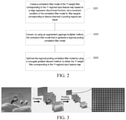
- FIG. 2 is a flowchart of step S103 of the foregoing embodiment of the target tracking method according to this application.
- Step S103 includes the following steps:
- Step S201 The electronic device creates a correlation filter model of the 1 st weight filter corresponding to the 1 st regional input feature map based on a ridge regression discriminant function, a constraint condition of the correlation filter model being set to: filter weights corresponding to feature channels in pooling regions are equal.
- Output responses are target responses of convolution features extracted by deep networks of a tracking target region and a background region in a picture frame under the action of corresponding weight filters.
- the expected output response is a preset output response that can distinguish the tracking target region from the background region of the picture frame.
- the expected output response is supposed to meet Gaussian distribution, that is, a feature of a region closer to the tracking target region corresponds to a larger target response.
- the binary mask may effectively reduce a filter weight of a weight filter corresponding to a region other than the tracking target region, thereby subsequently reducing an influence of a background region on determination of the tracking target region. That is, if a region corresponding to the input feature map is determined as a background region other than the tracking target region, a filter weight of a weight filter related to the region is reduced by using the binary mask.
- the user may select whether to use the binary mask according to requirements thereof.
- the regularization weight may effectively improve a filter weight of the weight filter corresponding to the tracking target region in a central part of the tracking target region. That is, a filter weight of the central part of the tracking target region is directly increased. A picture feature in the central part of the tracking target region is of the greatest importance. Therefore, if the filter weight of the central part of the tracking target region is increased, recognition accuracy of the tracking target region may be further improved.
- the user may select whether to use the regularization weight according to requirements thereof.
- the electronic device sets that filter weights corresponding to the same feature channel in pooling regions are equal as a constraint condition of the correlation filter model.
- Ranges of the pooling regions herein are set in the tracking target region (for example, set to a pixel size of 2 ⁇ 2 or 3 ⁇ 3). Adjacent pooling regions may share an edge, but ranges of adjacent pooling regions are non-overlapped. In this way, the pooling regions may be quickly set, and a quantity of algorithm parameters in the correlation filter model may be effectively reduced, thereby avoiding occurrence of parameter over-fitting, and improving the precision of target tracking.
- FIG. 3 A process of processing, by the correlation filter model having the constraint condition, a tracking target region of a picture frame is shown in FIG. 3 , which is equivalent to perform a cropping operation on the 1 st tracking target region by using convolution sampling, and then perform a pooling operation on adjacent regions in the cropped feature map, that is, set filter weights in pooling regions to complete the pooling operation performed on the cropped adjacent regions, to obtain the corresponding 1 st regional input feature map.
- the pooling operation is not directly performed on the original picture frame (that is, the original picture frame is not scaled down), so that a quantity of cropped samples is relatively large.
- a pooling operation is performed on adjacent regions of each cropped picture region, thereby reducing algorithm parameters in the correlation filter model. Therefore, occurrence of parameter over-fitting may be effectively avoided.
- Step S202 The electronic device converts, by using an augmented Lagrange multiplier method, the correlation filter model that has the constraint condition and that is obtained in step S201, to generate a regional pooling correlation filter model.
- the electronic device converts the simplified correlation filter model and the constraint condition by using an augmented Lagrange multiplier method, to generate a regional pooling correlation filter model.
- Step S203 The electronic device optimizes the regional pooling correlation filter model obtained in step S202 by using a conjugate gradient descent method, to obtain the 1 st weight filter corresponding to the 1 st regional input feature map.
- An alternating direction method of multipliers is used herein to alternately obtain an optimized Lagrange multiplier and filter weight in the regional pooling correlation filter model.
- the corresponding filter weight may be calculated by using a conjugate gradient descent method, that is, a gradient of a target function related to the filter weight ⁇ d in the regional pooling correlation filter model is calculated.
- ⁇ d i + 1 min ⁇ max ⁇ d i , where i represents a quantity of iterations.
- the electronic device when the 1 st regional input feature map and the expected output response are set (a specific object in the picture frame is set as a center of the tracking target region), the electronic device directly calculates the 1 st weight filter according to the correlation filter algorithm and the average pooling constraint condition and by using the 1 st regional input feature map and the expected output response.
- the electronic device may calculate an n th output response according to the correlation filter algorithm and the average pooling constraint condition and by using the n th picture frame input feature map and the (n - 1) th weight filter.
- the n th picture frame input feature map is an input feature map of an n th picture frame
- the (n - 1) th weight filter is a weight filter corresponding to an input feature map of a tracking target region of an (n - 1) th picture frame
- the n th output response is an output response of the n th picture frame.
- the electronic device obtains a location of an n th tracking target region, and an n th regional input feature map according to the n th output response. That is, the electronic device uses a point having a maximum output response as a center of the n th tracking target region, to determine the n th regional input feature map.
- the n th tracking target region is a tracking target region of the n th picture frame
- the n th regional input feature map is an input feature map of the tracking target region of the n th picture frame.
- the electronic device may calculate an n th weight filter corresponding to the n th regional input feature map according to the correlation filter algorithm and the average pooling constraint condition and by using an expected output response of the tracking target region, and the n th regional input feature map.
- the n th weight filter is a weight filter corresponding to the input feature map of the tracking target region of the n th picture frame. This step is similar to the foregoing process of calculating the 1 st weight filter.
- the electronic device may calculate the n th weight filter according to the correlation filter algorithm and the average pooling constraint condition and by using an expected output response of the tracking target region, the n th regional input feature map, and input feature maps of tracking target regions of a plurality of picture frames before the n th picture frame.
- the electronic device may perform linear weight fusion on correlation filter loss functions of the plurality of picture frames according to the correlation filter algorithm and the average pooling constraint condition and by using the expected output response of the tracking target region, the n th regional input feature map, and the input feature maps of the tracking target regions of the plurality of picture frames before the n th picture frame, to obtain a multi-frame based correlation filter model.
- the weight filter of the n th picture frame may be calculated by using input feature maps of all the picture frames before the n th picture frame. If a quantity of picture frames before the n th picture frame is greater than 50, the picture frames before the n th picture frame may be fused, to generate 50 fused picture frames, and the n th weight filter corresponding to the n th picture frame is calculated by using input feature maps of the 50 fused picture frames.
- a picture frame closer to the n th picture frame corresponds to a larger weight.
- the (n + 1) th picture frame input feature map is an input feature map of the (n + 1) th picture frame.
- the electronic device calculates a 2 nd output response by using the 1 st weight filter obtained in step S103.
- the 2 nd output response is an output response corresponding to an input feature map of a 2 nd picture frame.
- the electronic device further compares the 2 nd output response with the output response in step S102, and determines a picture frame region corresponding to an output response that is closest to the output response (the maximum output response) in step S102 as a 2 nd tracking target region.
- the 2 nd tracking target region is a tracking target region of the 2 nd picture frame.
- step S105 a counting operation is performed on the feature extraction operation.
- Step S102 is performed again and a quantity of times of execution of the feature extraction operation is increased by 1.
- the counting operation is performed on the feature extraction operation, and it can be obtained that the quantity of times of execution of the feature extraction operation is 2.
- a 2 nd weight filter corresponding to a 2 nd regional input feature map is calculated, until tracking target regions of all the consecutive picture frames in the target video are obtained in step S104.
- the 2 nd regional input feature map is an input feature map of the tracking target region of the 2 nd picture frame
- the 2 nd weight filter is a weight filter corresponding to the input feature map of the tracking target region of the 2 nd picture frame.
- the electronic device may perform an effectively tracking operation on the designated object or the specific object in the target video according to the tracking target regions of all the consecutive picture frames.
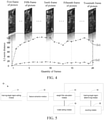
- FIG. 4 is a schematic diagram of a feature change of picture frames of the foregoing embodiment of the target tracking method according to this application.
- a curve 2c1 is a change curve of an L2-norm distance of feature differences between the same regions in the first fame and other frames of the target tracking method in the related art
- a curve 2c2 is a change curve of an L2-norm distance of feature differences between the same regions in the first fame and other frames of the target tracking method in this embodiment. It may be seen from FIG. 4 that a change amplitude of the L2-norm distance in the target tracking method in this embodiment is relatively small, that is, a feature difference of the same feature region in different picture frames is relatively small. In this way, an effective tracking operation may be better performed on the designated object or the specific object in the target video.
- an average pooling operation is performed on filter weights corresponding to different feature channels of an input feature map, to reduce a quantity of algorithm parameters.
- a reduction operation does not need to be performed on a tracking target region, thereby ensuring a quantity of training sample features of the input feature map, avoiding occurrence of parameter over-fitting, and improving the precision and the effectiveness of target tracking.
- FIG. 5 is a schematic structural diagram of an embodiment of a target tracking apparatus according to this application.
- the target tracking apparatus in this embodiment may be implemented by using the embodiment of the target tracking method.
- a target tracking apparatus 30 in this embodiment includes a tracking target region setting module 31, a feature extraction module 32, a weight filter calculation module 33, a tracking target region determining module 34, a counting module 35, and a model setting module 36.
- the tracking target region setting module 31 is configured to obtain a plurality of consecutive picture frames of a target video, and set a tracking target region of an n th picture frame in the plurality of consecutive picture frames, n being a positive integer.
- the feature extraction module 32 is configured to perform a feature extraction operation on the tracking target region of the n th picture frame, to obtain an input feature map of the tracking target region.
- the weight filter calculation module 33 is configured to calculate a weight filter corresponding to the input feature map of the tracking target region of the n th picture frame according to a correlation filter algorithm and an average pooling constraint condition.
- the tracking target region determining module 34 is configured to calculate an output response of an (n + 1) th picture frame by using the weight filter and an input feature map of the (n + 1) th picture frame in the plurality of consecutive picture frames, and determine a tracking target region of the (n + 1) th picture frame according to the output response of the (n + 1) th picture frame.
- the counting module 35 is configured to perform a counting operation on the feature extraction operation.
- the model setting module 36 is configured to set ranges of pooling regions of the tracking target region.
- the tracking target region of the n th picture frame in the plurality of consecutive picture frames may be used as an n th tracking target region
- the input feature map of the tracking target region of the n th picture frame may be used as an n th regional input feature map
- the weight filter corresponding to the input feature map of the tracking target region of the n th picture frame may be used as an n th weight filter.
- the input feature map of the (n + 1) th picture frame in the plurality of consecutive picture frames may be used as an (n + 1) th picture frame input feature map
- the output response of the (n + 1) th picture frame may be used as an (n + 1) th output response.
- the tracking target region of the (n + 1) th picture frame may be used as an (n + 1) th tracking target region.
- FIG. 6 is a schematic structural diagram of a weight filter calculation module of an embodiment of a target tracking apparatus according to this application.
- the weight filter calculation module 33 includes a correlation filter model creation unit 41, a regional pooling correlation filter model generation unit 42, and a model optimization unit 43.
- the correlation filter model creation unit 41 is configured to create a correlation filter model of the n th weight filter corresponding to the n th regional input feature map based on a ridge regression discriminant function, a constraint condition of the correlation filter model being set to: filter weights corresponding to feature channels in pooling regions are equal.
- the regional pooling correlation filter model generation unit 42 is configured to convert the correlation filter model having the constraint condition by using an augmented Lagrange multiplier method, to generate a regional pooling correlation filter model.
- the model optimization unit 43 is configured to optimize the regional pooling correlation filter model by using a conjugate gradient descent method, to obtain the n th weight filter corresponding to the n th regional input feature map.
- FIG. 7 is a schematic structural diagram of a correlation filter model creation unit of a weight filter calculation module of an embodiment of a target tracking apparatus according to this application.
- the correlation filter model creation unit 41 includes a binary mask setting subunit 51 and a regularization weight setting subunit 52.
- the binary mask setting subunit 51 is configured to set a binary mask for the n th weight filter, to reduce a filter weight of a weight filter corresponding to a region other than the n th tracking target region.
- the regularization weight setting subunit 52 is configured to set a regularization weight for the n th weight filter, to increase a filter weight of the n th weight filter in a central part of the n th tracking target region.
- the tracking target region setting module 31 first obtains a plurality of consecutive picture frames of a target video. To facilitate in performing a tracking operation on a designated object or a specific object in the target video, a 1 st tracking target region corresponding to a 1 st picture frame in the plurality of consecutive picture frames is set herein.
- the 1 st tracking target region is a tracking target region of the 1 st picture frame in the plurality of consecutive picture frames.
- the 1 st tracking target region herein is a picture region where the specific object or the designated object is located in the picture frame.
- the specific object or the designated object herein may be a preset character, an animal, a vehicle, or any moving object. In this way, corresponding tracking target regions may be found in other subsequent picture frames according to features of the tracking target region in the 1 st picture frame.
- the n th tracking target region is a tracking target region of an n th picture frame
- the n th regional input feature map is an input feature map of the tracking target region of the n th picture frame in the plurality of consecutive picture frames.
- the feature extraction module 32 may divide the n th tracking target region into mesh regions with a size of a*a, and then perform a convolution sampling operation the mesh regions with a size of a ⁇ a by using d types of convolution kernels of different sizes, to obtain the n th regional input feature map having d feature channels.
- a size of the convolution kernel is less than a size of the mesh region.
- the weight filter calculation module 33 then calculates a 1 st weight filter corresponding to a 1 st regional input feature map according to a correlation filter algorithm and an average pooling constraint condition, the 1 st weight filter including a filter weight corresponding to each feature channel in the input feature map.
- the 1 st weight filter is a weight filter corresponding to the input feature map of the tracking target region of the 1 st picture frame.
- the foregoing process may include the following operation: creating, by the correlation filter model creation unit 41 of the weight filter calculation module 33, a correlation filter model of the 1 st weight filter corresponding to the 1 st regional input feature map based on a ridge regression discriminant function, a constraint condition of the correlation filter model being set to: filter weights corresponding to feature channels in pooling regions are equal.
- Output responses are target responses of convolution features extracted by deep networks of a tracking target region and a background region in a picture frame under the action of corresponding weight filters.
- the expected output response is a preset output response that can distinguish the tracking target region from the background region of the picture frame.
- the expected output response is supposed to meet Gaussian distribution, that is, a feature of a region closer to the tracking target region corresponds to a larger target response.
- the binary mask may effectively reduce a filter weight of a weight filter corresponding to a region other than the tracking target region, thereby subsequently reducing an influence of a background region on determination of the tracking target region. That is, if a region corresponding to the input feature map is determined as a background region other than the tracking target region, a filter weight of a weight filter related to the region is reduced by using the binary mask.
- the user may select whether to use the binary mask according to requirements thereof.
- the regularization weight may effectively improve a filter weight of the weight filter corresponding to the tracking target region in a central part of the tracking target region. That is, a filter weight of the central part of the tracking target region is directly increased. A picture feature in the central part of the tracking target region is of the greatest importance. Therefore, if the filter weight of the central part of the tracking target region is increased, recognition accuracy of the tracking target region may be further improved.
- the user may select whether to use the regularization weight according to requirements thereof.
- the correlation filter model creation unit 41 sets that filter weights corresponding to feature channels in pooling regions are equal as a constraint condition of the correlation filter model.
- Ranges of the pooling regions herein are set by the model setting module 36 in the tracking target region (for example, set to a pixel size of 2 ⁇ 2 or 3 ⁇ 3). Adjacent pooling regions may share an edge, but ranges of adjacent pooling regions are non-overlapped. In this way, the pooling regions may be quickly set, and a quantity of algorithm parameters in the correlation filter model may be effectively reduced, thereby avoiding occurrence of parameter over-fitting, and improving the precision of target tracking.
- the regional pooling correlation filter model generation unit 42 of the weight filter calculation module 33 converts the obtained correlation filter model having the constraint condition by using an augmented Lagrange multiplier method, to generate a regional pooling correlation filter model.
- the regional pooling correlation filter model generation unit 42 first performs Fourier transform on the correlation filter model and the corresponding constraint condition based on Parseval's theorem.
- the regional pooling correlation filter model generation unit 42 converts the simplified correlation filter model and the constraint condition by using an augmented Lagrange multiplier method, to generate a regional pooling correlation filter model.
- the model optimization unit 43 of the weight filter calculation module 33 optimizes the regional pooling correlation filter model by using a conjugate gradient descent method, to obtain the 1 st weight filter corresponding to the 1 st regional input feature map.
- An alternating direction method of multipliers is used herein to alternately obtain an optimized Lagrange multiplier and filter weight in the regional pooling correlation filter model.
- the corresponding filter weight may be calculated by using the conjugate gradient descent method, that is, a gradient of a target function related to the filter weight in the regional pooling correlation filter model is calculated.
- ⁇ d i + 1 min ⁇ max ⁇ d i , where i represents a quantity of iterations.
- the weight filter calculation module 33 when the 1 st regional input feature map and the expected output response are set (a specific object in the picture frame is set as a center of the tracking target region), the weight filter calculation module 33 directly calculates the 1 st weight filter according to the correlation filter algorithm and the average pooling constraint condition and by using the 1 st regional input feature map and the expected output response.
- the weight filter calculation module 33 may calculate an n th output response according to the correlation filter algorithm and the average pooling constraint condition and by using the n th picture frame input feature map and the (n-1) th weight filter.
- the n th picture frame input feature map is an input feature map of an n th picture frame
- the (n-1) th weight filter is a weight filter corresponding to an input feature map of a tracking target region of an (n-1) th picture frame
- the n th output response is an output response of the n th picture frame.
- the weight filter calculation module 33 obtains a location of an n th tracking target region, and an n th regional input feature map according to the n th output response. That is, the weight filter calculation module 33 uses a point having a maximum output response as a center of the tracking target region of the n th picture frame, to determine the n th regional input feature map.
- the n th tracking target region is a tracking target region of the n th picture frame
- the n th regional input feature map is an input feature map of the tracking target region of the n th picture frame.
- the weight filter calculation module 33 may calculate an n th weight filter corresponding to the n th regional input feature map according to the correlation filter algorithm and the average pooling constraint condition and by using an expected output response of the tracking target region, and the n th regional input feature map.
- the n th weight filter is a weight filter corresponding to the input feature map of the tracking target region of the n th picture frame. This step is similar to the foregoing process of calculating the 1 st weight filter.
- the weight filter calculation module 33 may calculate the n th weight filter according to the correlation filter algorithm and the average pooling constraint condition and by using an expected output response of the tracking target region, the n th regional input feature map, and input feature maps of tracking target regions of a plurality of picture frames before the n th picture frame.
- the weight filter calculation module 33 may perform linear weight fusion on correlation filter loss functions of the plurality of picture frames according to the correlation filter algorithm and the average pooling constraint condition and by using the expected output response of the tracking target region, the n th regional input feature map, and the input feature maps of the tracking target regions of the plurality of picture frames before the n th picture frame, to obtain a multi-frame based correlation filter model.
- the weight filter of the n th picture frame may be calculated by using input feature maps of all the picture frames before the n th picture frame. If a quantity of picture frames before the n th picture frame is greater than 50, the picture frames before the n th picture frame may be fused, to generate 50 fused picture frames, and the n th weight filter corresponding to the n th picture frame is calculated by using input feature maps of the 50 fused picture frames.
- a picture frame closer to the n th picture frame corresponds to a larger weight.
- the (n + 1) th picture frame input feature map is an input feature map of the (n + 1) th picture frame.
- the tracking target region determining module 34 calculates a 2 nd output response by using the obtained 1 st weight filter.
- the 2 nd output response is an output response corresponding to an input feature map of a 2 nd picture frame.
- the tracking target region determining module compares the 2 nd output response with the output response of the feature extraction module, and determines a picture frame region corresponding to an output response that is closest to the output response (the maximum output response) of the feature extraction module as a 2 nd tracking target region.
- the 2 nd tracking target region is a tracking target region of the 2 nd picture frame.
- the counting module 35 performs a counting operation on the feature extraction operation.
- Step S102 is performed again and a quantity of times of execution of the feature extraction operation is increased by 1.
- the counting operation is performed on the feature extraction operation, and it can be obtained that the quantity of times of execution of the feature extraction operation is 2.
- the weight filter calculation module 33 calculates a 2 nd weight filter corresponding to a 2 nd regional input feature map, until tracking target regions of all the consecutive picture frames in the target video are obtained by the tracking target region determining module 34.
- the 2 nd regional input feature map is an input feature map of the tracking target region of the 2 nd picture frame
- the 2 nd weight filter is a weight filter corresponding to the input feature map of the tracking target region of the 2 nd picture frame.
- the target tracking apparatus 30 may perform an effectively tracking operation on the designated object or the specific object in the target video according to the tracking target regions of all the consecutive picture frames.
- an average pooling operation is performed on filter weights corresponding to different feature channels of an input feature map, to reduce a quantity of algorithm parameters.
- a reduction operation does not need to be performed on a tracking target region, thereby ensuring a quantity of training sample features of the input feature map, avoiding occurrence of parameter over-fitting, and improving the precision and the effectiveness of target tracking.
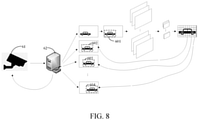
- FIG. 8 is a schematic diagram of target tracking of a target tracking method and a target tracking apparatus according to this application
- FIG. 9 is a flowchart of target tracking of a target tracking method and a target tracking apparatus according to this application.
- a camera 61 obtains a dynamic video of a specific object, and subsequently, a picture processing server 62 performs a target tracking operation on the specific object in the dynamic video, to obtain a motion trajectory of the specific object in the dynamic video.
- a procedure of target tracking in this embodiment includes the following steps:
- Step S601. The camera 61 obtains a dynamic video of a specific object, and transmits the dynamic video to the picture processing server 62.
- Step S602. The picture processing server 62 converts the dynamic video into a plurality of consecutive picture frames, and obtains a 1 st picture frame in the plurality of consecutive picture frames.
- Step S603. Set a 1 st tracking target region, that is, an automobile region 601 in FIG. 8 , corresponding to the 1 st picture frame.
- the 1 st tracking target region is a tracking target region of the 1 st picture frame.
- Step S604. The picture processing server 62 performs a feature extraction operation on the 1 st tracking target region, that is, performs a convolution feature extraction operation on the tracking target region by using a convolution kernel of a predetermined size, to obtain a 1 st regional input feature map corresponding to the 1 st tracking target region.
- the 1 st regional input feature map is an input feature map of the tracking target region of the 1 st picture frame.
- Step S605. The picture processing server 62 obtains a 1 st weight filter corresponding to the 1 st regional input feature map according to a correlation filter algorithm and an average pooling constraint condition and based on the 1 st regional input feature map obtained in step S604 and an expected output response.
- the 1 st weight filter being a weight filter corresponding to the input feature map of the tracking target region of the 1 st picture frame.
- Step S606 The picture processing server 62 sequentially calculates output responses of subsequent picture frames by using the 1 st weight filter obtained in step S605 and input feature maps of the subsequent picture frames, and constantly corrects input feature maps of tracking target regions of the subsequent picture frames based on the output responses.
- weight filters of the subsequent picture frames are constantly corrected by using the corrected input feature maps of the tracking target regions of the subsequent picture frames and expected output responses.
- the tracking target regions of the subsequent picture frames that is, an automobile region 602, an automobile region 603, and an automobile region 604 shown in FIG. 8 , may be determined according to the output responses of the subsequent picture frames.
- Step S607. The picture processing server 62 obtains a motion trajectory of the corresponding specific object in the dynamic video according to the tracking target regions of all the picture frames in the dynamic video, and controls a subsequent photographing direction of the camera 61 based on the motion trajectory of the specific object, so that the camera 61 may continue to perform a motion trajectory capturing operation on the specific object.
- an average pooling operation is performed on filter weights corresponding to different feature channels of an input feature map, to reduce a quantity of algorithm parameters.
- a reduction operation does not need to be performed on a tracking target region, which resolves a primary defect of a correlation filter algorithm, thereby ensuring a quantity of training sample features of the input feature map, avoiding occurrence of parameter over-fitting, and improving the robustness of the correlation filter algorithm. Therefore, the precision and the effectiveness of target tracking are improved, and the technical problem of parameter over-fitting or relatively low tracking precision in the target tracking method and the target tracking apparatus in the related art is effectively resolved.
- ком ⁇ онент may be, but is not limited to, a process running on a processor, a processor, an object, an executable application, an executed thread, a program, and/or a computer.
- an application running on a controller and the controller may be components.
- One or more components may reside within a process and/or a thread of execution, and a component may be located on one computer and/or distributed between two or more computers.
- FIG. 10 and subsequent discussion provide a brief and general description of a working environment of an electronic device in which the target tracking apparatus for implementing this application is located.
- the working environment in FIG. 10 is only an example of a proper working environment, and is not intended to suggest any limitation on a scope of a purpose or function of the working environment.
- the computer-readable instructions are executed by one or more electronic devices.
- the computer-readable instructions may be distributed by using a computer-readable medium (discussed below).
- the computer-readable instruction may be implemented as a program module, for example, a function, an object, an application programming interface (API), or a data structure for executing a particular task or implementing a particular abstract data type.
- functions of the computer-readable instruction can be freely combined or distributed in various environments.
- FIG. 10 shows an instance of an electronic device 712 that includes one or more embodiments of the target tracking apparatus of this application.
- the electronic device 712 includes at least one processing unit 716 and a memory 718.
- the memory 718 may be a volatile memory (for example, a RAM), a non-volatile memory (for example, a ROM or a flash memory), or a combination thereof.
- the configuration is shown in FIG. 10 by using a dashed line 714.
- the electronic device 712 may include an additional feature and/or function.
- the device 712 may further include an additional storage apparatus (for example, a removable and/or non-removable storage apparatus), which includes, but is not limited to, a magnetic storage apparatus, an optical storage apparatus, and the like.
- This additional storage apparatus is shown as a storage apparatus 720 in FIG. 10 .
- a computer-readable instruction used for implementing one or more embodiments provided in the present disclosure may be stored in the storage apparatus 720.
- the storage apparatus 720 may store another computer-readable instruction used to implement an operating system, an application program, or the like.
- the computer-readable instruction may be loaded into the memory 718 to be executed by, for example, the processing unit 716.
- the term "computer-readable storage medium” used herein includes a computer storage medium.
- the computer storage medium includes volatile or non-volatile media, or removable or non-removable media that are implemented by using any method or technology used to store information such as a computer-readable instruction or other data.
- the memory 718 and the storage apparatus 720 are instances of the computer storage medium.
- the computer storage medium includes, but is not limited to, a RAM, a ROM, an EEPROM, a flash memory or another memory technology, a CD-ROM, a digital versatile disk (DVD) or another optical storage apparatus, a cartridge tape, a magnetic tape, a magnetic disk storage apparatus or another magnetic storage device, or any other medium that can be used for storing expected information and can be accessed by the electronic device 712. Any such computer storage medium may be a part of the electronic device 712.
- the electronic device 712 may further include a communication connection 726 allowing communication between the electronic device 712 and another device.
- the communication connection 726 may include, but is not limited to, a modem, a network interface card (NIC), an integrated network interface, a radio frequency transmitter/receiver, an infrared port, a USB connection, or another interface configured to connect the electronic device 712 to another electronic device.
- the communication connection 726 may include a wired connection or a wireless connection.
- the communication connection 726 may transmit and/or receive communication media.
- the term "computer-readable storage medium” may include the communication medium.
- the communication medium typically includes computer-readable instructions or other data in a “modulated data signal” such as a carrier or another transmission mechanism, and includes any information transfer medium.
- modulated data signal may include such a signal: One or more features of the signal are set or changed by encoding information into the signal.
- the electronic device 712 may include an input device 724, for example, a keyboard, a mouse, a stylus, a voice input device, a touch input device, an infrared camera, a video input device, and/or any other input device.
- the device 712 may also include an output device 722, such as one or more displays, a speaker, a printer and/or any other output device.
- the input device 724 and the output device 722 may be connected to the electronic device 712 by using a wired connection, a wireless connection, or any combination thereof.
- an input device or an output device of another electronic device may be used as the input device 724 or the output device 722 of the electronic device 712.
- Components of the electronic device 712 may be connected by using various interconnections (such as a bus). Such interconnection may include Peripheral Component Interconnect (PCI) (for example, PCI Express), Universal Serial Bus (USB), FireWire (IEEE 1394), an optical bus structure, and the like.
- PCI Peripheral Component Interconnect
- USB Universal Serial Bus
- FireWire IEEE 1394
- optical bus structure an optical bus structure, and the like.
- components of the electronic device 712 may be interconnected by using a network.
- the memory 718 may include a plurality of physical memory units that are located at different physical locations and interconnected by using a network.
- a storage device configured to store computer-readable instructions may be distributed across networks.
- a backend server 730 that may be accessed through a network 728 may be configured to store computer-readable instructions used for implementing one or more embodiments provided in this application.
- the electronic device 712 may access the backend server 730 and download a part or all of the computer-readable instructions for execution.
- the electronic device 712 may download a plurality of computer-readable instructions as required, or some instructions may be executed by the electronic device 712 and some instructions may be executed by the backend server 730.
- An embodiment of this application provides an electronic device, including a processor and a memory, the memory storing a computer program, the processor invoking the computer program to perform the following operations: obtaining a plurality of consecutive picture frames of a target video, and setting an n th tracking target region corresponding to an n th picture frame in the plurality of consecutive picture frames, n being a positive integer;
- the processor invokes the computer program, and is configured to perform the following operations:
- the processor invokes the computer program, and is configured to perform the following operation: setting ranges of a plurality of pooling regions of the tracking target region, ranges of adjacent pooling regions being non-overlapped.
- the processor invokes the computer program, and is configured to perform the following operations:
- the processor invokes the computer program, and is configured to perform the following operations:
- the processor invokes the computer program, and is configured to perform the following operations:
- the processor invokes the computer program, and is configured to perform the following operation: setting a binary mask for the n th weight filter, to reduce a filter weight of a weight filter corresponding to a region other than the n th tracking target region.
- the processor invokes the computer program, and is configured to perform the following operation: setting a regularization weight for the n th weight filter, to increase a filter weight of the n th weight filter in a central part of the n th tracking target region.
- the one or more operations may constitute one or more computer-readable instructions stored on a computer-readable medium, and the computer-readable instructions enable a computing device to perform the operations when the computer-readable instructions are executed by an electronic device.
- a sequence in which some or all operations are described is not to be construed as an implication that these operations need to be sequence-related.
- a person skilled in the art will understand an alternative sequence having the benefits of this specification.
- Functional units according to the embodiments of this application may be integrated in one processing module or exist as separate physical units, or two or more units are integrated into one module.
- the integrated module may be implemented in the form of hardware, or may be implemented in a form of a software functional module. If implemented in the form of software functional modules and sold or used as an independent product, the integrated module may also be stored in a computer-readable storage medium.
- the storage medium mentioned above may be a read-only memory, a magnetic disk, an optical disc, or the like.
- the foregoing apparatuses or systems may perform a method in a corresponding method embodiment.
- An embodiment of this application provides a storage medium, storing processor-executable instructions, the instructions being loaded by one or more processors to perform the following operations:
- the instructions are loaded by one or more processors to perform the following operations:
- the instructions are loaded by one or more processors to perform the following operation: setting ranges of a plurality of pooling regions of the tracking target region, ranges of adjacent pooling regions being non-overlapped.
- the instructions are loaded by one or more processors to perform the following operations:
- the instructions are loaded by one or more processors to perform the following operations:
- the instructions are loaded by one or more processors to perform the following operations:
- the instructions are loaded by one or more processors to perform the following operation: setting a binary mask for the n th weight filter, to reduce a filter weight of a weight filter corresponding to a region other than the n th tracking target region.
- the instructions are loaded by one or more processors to perform the following operation: setting a regularization weight for the n th weight filter, to increase a filter weight of the n th weight filter in a central part of the n th tracking target region.
Landscapes
- Engineering & Computer Science (AREA)
- Physics & Mathematics (AREA)
- General Physics & Mathematics (AREA)
- Multimedia (AREA)
- Theoretical Computer Science (AREA)
- Computer Vision & Pattern Recognition (AREA)
- Image Analysis (AREA)
Applications Claiming Priority (2)
| Application Number | Priority Date | Filing Date | Title |
|---|---|---|---|
| CN201910391497.7A CN110148157B (zh) | 2019-05-10 | 2019-05-10 | 画面目标跟踪方法、装置、存储介质及电子设备 |
| PCT/CN2020/087041 WO2020228522A1 (zh) | 2019-05-10 | 2020-04-26 | 目标跟踪方法、装置、存储介质及电子设备 |
Publications (3)
| Publication Number | Publication Date |
|---|---|
| EP3968280A1 true EP3968280A1 (de) | 2022-03-16 |
| EP3968280A4 EP3968280A4 (de) | 2022-06-22 |
| EP3968280B1 EP3968280B1 (de) | 2025-05-28 |
Family
ID=67595267
Family Applications (1)
| Application Number | Title | Priority Date | Filing Date |
|---|---|---|---|
| EP20805061.7A Active EP3968280B1 (de) | 2019-05-10 | 2020-04-26 | Zielverfolgungsverfahren und -vorrichtung, speichermedium und elektronische vorrichtung |
Country Status (5)
| Country | Link |
|---|---|
| US (1) | US11610321B2 (de) |
| EP (1) | EP3968280B1 (de) |
| JP (1) | JP7125562B2 (de) |
| CN (1) | CN110148157B (de) |
| WO (1) | WO2020228522A1 (de) |
Cited By (1)
| Publication number | Priority date | Publication date | Assignee | Title |
|---|---|---|---|---|
| US20240095934A1 (en) * | 2022-09-15 | 2024-03-21 | Canon Kabushiki Kaisha | Image processing apparatus, training apparatus, image processing method, training method, and non-transitory computer-readable medium |
Families Citing this family (15)
| Publication number | Priority date | Publication date | Assignee | Title |
|---|---|---|---|---|
| CN110148157B (zh) | 2019-05-10 | 2021-02-02 | 腾讯科技(深圳)有限公司 | 画面目标跟踪方法、装置、存储介质及电子设备 |
| CN112446255B (zh) * | 2019-08-31 | 2025-06-10 | 华为技术有限公司 | 一种视频图像处理方法及装置 |
| CN111161321B (zh) * | 2019-12-31 | 2023-07-04 | 北京理工大学重庆创新中心 | 一种基于背景感知的相关滤波跟踪方法 |
| KR102504321B1 (ko) * | 2020-08-25 | 2023-02-28 | 한국전자통신연구원 | 온라인 행동 탐지 장치 및 방법 |
| CN113393493B (zh) * | 2021-05-28 | 2024-04-05 | 京东科技信息技术有限公司 | 目标对象的跟踪方法及装置 |
| CN113344973B (zh) * | 2021-06-09 | 2023-11-24 | 南京信息工程大学 | 一种基于时空正则化和特征可靠性评估的目标跟踪方法 |
| CN113808171B (zh) * | 2021-09-27 | 2024-07-09 | 山东工商学院 | 基于特征权重池的动态特征选择的无人机视觉跟踪方法 |
| CN116051385A (zh) * | 2021-10-28 | 2023-05-02 | 北京三星通信技术研究有限公司 | 图像处理方法、装置、电子设备及存储介质 |
| CN114596337B (zh) * | 2022-03-03 | 2022-11-25 | 捻果科技(深圳)有限公司 | 一种基于多摄像机位联动性的自识别目标追踪方法及系统 |
| CN115601400B (zh) * | 2022-11-02 | 2025-11-14 | 上海交通大学 | 一种抑制相关滤波畸变的视频目标多模融合跟踪定位方法 |
| CN116309710B (zh) * | 2023-02-27 | 2024-07-09 | 荣耀终端有限公司 | 目标追踪方法和电子设备 |
| CN116309711B (zh) * | 2023-03-09 | 2025-09-09 | 西安理工大学 | 基于特征重映射的视觉目标跟踪方法 |
| CN116863342B (zh) * | 2023-09-04 | 2023-11-21 | 江西啄木蜂科技有限公司 | 一种基于大尺度遥感影像的松材线虫病死木提取方法 |
| CN118446876B (zh) * | 2023-09-11 | 2025-01-03 | 荣耀终端有限公司 | 单目标追踪方法、电子设备、存储介质及芯片 |
| CN120148124B (zh) * | 2025-05-16 | 2025-07-22 | 成都航空职业技术学院 | 一种基于深度学习的训练数据监测方法 |
Family Cites Families (10)
| Publication number | Priority date | Publication date | Assignee | Title |
|---|---|---|---|---|
| CN105913453A (zh) * | 2016-04-01 | 2016-08-31 | 海信集团有限公司 | 一种目标跟踪方法和装置 |
| CN108229455B (zh) * | 2017-02-23 | 2020-10-16 | 北京市商汤科技开发有限公司 | 物体检测方法、神经网络的训练方法、装置和电子设备 |
| CN107240122A (zh) * | 2017-06-15 | 2017-10-10 | 国家新闻出版广电总局广播科学研究院 | 基于时空连续相关滤波的视频目标跟踪方法 |
| KR101953626B1 (ko) * | 2017-06-29 | 2019-03-06 | 서강대학교산학협력단 | 다중 히스토그램을 이용한 객체 추적 방법 및 이를 이용한 객체 추적 시스템 |
| CN107644217B (zh) * | 2017-09-29 | 2020-06-26 | 中国科学技术大学 | 基于卷积神经网络和相关滤波器的目标跟踪方法 |
| US10628961B2 (en) * | 2017-10-13 | 2020-04-21 | Qualcomm Incorporated | Object tracking for neural network systems |
| CN108550126A (zh) * | 2018-04-18 | 2018-09-18 | 长沙理工大学 | 一种自适应相关滤波器目标跟踪方法及系统 |
| CN109448024B (zh) * | 2018-11-06 | 2022-02-11 | 深圳大学 | 利用深度数据构建约束相关滤波器的视觉跟踪方法、系统 |
| CN109543615B (zh) * | 2018-11-23 | 2022-10-28 | 长沙理工大学 | 一种基于多级特征的双学习模型目标跟踪方法 |
| CN110148157B (zh) * | 2019-05-10 | 2021-02-02 | 腾讯科技(深圳)有限公司 | 画面目标跟踪方法、装置、存储介质及电子设备 |
-
2019
- 2019-05-10 CN CN201910391497.7A patent/CN110148157B/zh active Active
-
2020
- 2020-04-26 JP JP2021536748A patent/JP7125562B2/ja active Active
- 2020-04-26 EP EP20805061.7A patent/EP3968280B1/de active Active
- 2020-04-26 WO PCT/CN2020/087041 patent/WO2020228522A1/zh not_active Ceased
-
2021
- 2021-07-01 US US17/365,893 patent/US11610321B2/en active Active
Cited By (2)
| Publication number | Priority date | Publication date | Assignee | Title |
|---|---|---|---|---|
| US20240095934A1 (en) * | 2022-09-15 | 2024-03-21 | Canon Kabushiki Kaisha | Image processing apparatus, training apparatus, image processing method, training method, and non-transitory computer-readable medium |
| US12608821B2 (en) * | 2022-09-15 | 2026-04-21 | Canon Kabushiki Kaisha | Image processing apparatus, training apparatus, image processing method, training method, and non-transitory computer-readable medium |
Also Published As
| Publication number | Publication date |
|---|---|
| US11610321B2 (en) | 2023-03-21 |
| EP3968280B1 (de) | 2025-05-28 |
| EP3968280A4 (de) | 2022-06-22 |
| CN110148157A (zh) | 2019-08-20 |
| CN110148157B (zh) | 2021-02-02 |
| JP7125562B2 (ja) | 2022-08-24 |
| JP2022516055A (ja) | 2022-02-24 |
| US20210327076A1 (en) | 2021-10-21 |
| WO2020228522A1 (zh) | 2020-11-19 |
Similar Documents
| Publication | Publication Date | Title |
|---|---|---|
| EP3968280B1 (de) | Zielverfolgungsverfahren und -vorrichtung, speichermedium und elektronische vorrichtung | |
| US10810435B2 (en) | Segmenting objects in video sequences | |
| US10713472B2 (en) | Face location tracking method, apparatus, and electronic device | |
| US9344690B2 (en) | Image demosaicing | |
| US8948513B2 (en) | Blurring based content recognizer | |
| CN111144215B (zh) | 图像处理方法、装置、电子设备及存储介质 | |
| CN108229591B (zh) | 神经网络自适应训练方法和装置、设备、程序和存储介质 | |
| CN108389224B (zh) | 图像处理方法及装置、电子设备和存储介质 | |
| US9141851B2 (en) | Deformable expression detector | |
| US9805452B2 (en) | Image processing apparatus, image processing method, program, and recording medium | |
| CN110956255A (zh) | 难样本挖掘方法、装置、电子设备及计算机可读存储介质 | |
| CN108921801B (zh) | 用于生成图像的方法和装置 | |
| CN110288625B (zh) | 用于处理图像的方法和装置 | |
| CN115937020B (zh) | 图像处理方法、装置、设备、介质和程序产品 | |
| EP4343616A1 (de) | Bildklassifizierungsverfahren, modelltrainingsverfahren, vorrichtung, speichermedium und computerprogramm | |
| CN115471671A (zh) | 一种网络模型的训练方法、目标识别方法及相关设备 | |
| US9357123B1 (en) | Image defocus blur estimation | |
| US9799104B2 (en) | Image processing apparatus, image processing method, program, and recording medium | |
| US20260045072A1 (en) | Information processing apparatus, image capturing apparatus, method, and non-transitory computer readable storage medium | |
| CN106548117A (zh) | 一种人脸图像处理方法和装置 | |
| CN108776954B (zh) | 用于生成图像的方法和装置 | |
| CN116091400A (zh) | 一种证件检测方法、装置、电子设备和存储介质 | |
| CN108764206B (zh) | 目标图像识别方法和系统、计算机设备 | |
| CN117911736A (zh) | 一种微小目标检测方法、装置、存储介质及电子设备 | |
| US20240303966A1 (en) | Detection device, detection method, and detection program |
Legal Events
| Date | Code | Title | Description |
|---|---|---|---|
| STAA | Information on the status of an ep patent application or granted ep patent |
Free format text: STATUS: THE INTERNATIONAL PUBLICATION HAS BEEN MADE |
|
| PUAI | Public reference made under article 153(3) epc to a published international application that has entered the european phase |
Free format text: ORIGINAL CODE: 0009012 |
|
| STAA | Information on the status of an ep patent application or granted ep patent |
Free format text: STATUS: REQUEST FOR EXAMINATION WAS MADE |
|
| 17P | Request for examination filed |
Effective date: 20210517 |
|
| AK | Designated contracting states |
Kind code of ref document: A1 Designated state(s): AL AT BE BG CH CY CZ DE DK EE ES FI FR GB GR HR HU IE IS IT LI LT LU LV MC MK MT NL NO PL PT RO RS SE SI SK SM TR |
|
| A4 | Supplementary search report drawn up and despatched |
Effective date: 20220523 |
|
| RIC1 | Information provided on ipc code assigned before grant |
Ipc: G06V 10/42 20220101ALI20220517BHEP Ipc: G06V 10/25 20220101ALI20220517BHEP Ipc: G06T 7/246 20170101AFI20220517BHEP |
|
| RAP3 | Party data changed (applicant data changed or rights of an application transferred) |
Owner name: TENCENT TECHNOLOGY (SHENZHEN) COMPANY LIMITED |
|
| DAV | Request for validation of the european patent (deleted) | ||
| DAX | Request for extension of the european patent (deleted) | ||
| GRAP | Despatch of communication of intention to grant a patent |
Free format text: ORIGINAL CODE: EPIDOSNIGR1 |
|
| STAA | Information on the status of an ep patent application or granted ep patent |
Free format text: STATUS: GRANT OF PATENT IS INTENDED |
|
| INTG | Intention to grant announced |
Effective date: 20241128 |
|
| GRAS | Grant fee paid |
Free format text: ORIGINAL CODE: EPIDOSNIGR3 |
|
| GRAA | (expected) grant |
Free format text: ORIGINAL CODE: 0009210 |
|
| STAA | Information on the status of an ep patent application or granted ep patent |
Free format text: STATUS: THE PATENT HAS BEEN GRANTED |
|
| AK | Designated contracting states |
Kind code of ref document: B1 Designated state(s): AL AT BE BG CH CY CZ DE DK EE ES FI FR GB GR HR HU IE IS IT LI LT LU LV MC MK MT NL NO PL PT RO RS SE SI SK SM TR |
|
| REG | Reference to a national code |
Ref country code: GB Ref legal event code: FG4D |
|
| REG | Reference to a national code |
Ref country code: CH Ref legal event code: EP |
|
| REG | Reference to a national code |
Ref country code: DE Ref legal event code: R096 Ref document number: 602020052062 Country of ref document: DE |
|
| REG | Reference to a national code |
Ref country code: IE Ref legal event code: FG4D |
|
| REG | Reference to a national code |
Ref country code: NL Ref legal event code: MP Effective date: 20250528 |
|
| PG25 | Lapsed in a contracting state [announced via postgrant information from national office to epo] |
Ref country code: ES Free format text: LAPSE BECAUSE OF FAILURE TO SUBMIT A TRANSLATION OF THE DESCRIPTION OR TO PAY THE FEE WITHIN THE PRESCRIBED TIME-LIMIT Effective date: 20250528 Ref country code: FI Free format text: LAPSE BECAUSE OF FAILURE TO SUBMIT A TRANSLATION OF THE DESCRIPTION OR TO PAY THE FEE WITHIN THE PRESCRIBED TIME-LIMIT Effective date: 20250528 |
|
| REG | Reference to a national code |
Ref country code: LT Ref legal event code: MG9D |
|
| PG25 | Lapsed in a contracting state [announced via postgrant information from national office to epo] |
Ref country code: NO Free format text: LAPSE BECAUSE OF FAILURE TO SUBMIT A TRANSLATION OF THE DESCRIPTION OR TO PAY THE FEE WITHIN THE PRESCRIBED TIME-LIMIT Effective date: 20250828 Ref country code: GR Free format text: LAPSE BECAUSE OF FAILURE TO SUBMIT A TRANSLATION OF THE DESCRIPTION OR TO PAY THE FEE WITHIN THE PRESCRIBED TIME-LIMIT Effective date: 20250829 |
|
| PG25 | Lapsed in a contracting state [announced via postgrant information from national office to epo] |
Ref country code: PL Free format text: LAPSE BECAUSE OF FAILURE TO SUBMIT A TRANSLATION OF THE DESCRIPTION OR TO PAY THE FEE WITHIN THE PRESCRIBED TIME-LIMIT Effective date: 20250528 Ref country code: NL Free format text: LAPSE BECAUSE OF FAILURE TO SUBMIT A TRANSLATION OF THE DESCRIPTION OR TO PAY THE FEE WITHIN THE PRESCRIBED TIME-LIMIT Effective date: 20250528 |
|
| PG25 | Lapsed in a contracting state [announced via postgrant information from national office to epo] |
Ref country code: BG Free format text: LAPSE BECAUSE OF FAILURE TO SUBMIT A TRANSLATION OF THE DESCRIPTION OR TO PAY THE FEE WITHIN THE PRESCRIBED TIME-LIMIT Effective date: 20250528 |
|
| PG25 | Lapsed in a contracting state [announced via postgrant information from national office to epo] |
Ref country code: HR Free format text: LAPSE BECAUSE OF FAILURE TO SUBMIT A TRANSLATION OF THE DESCRIPTION OR TO PAY THE FEE WITHIN THE PRESCRIBED TIME-LIMIT Effective date: 20250528 |
|
| PG25 | Lapsed in a contracting state [announced via postgrant information from national office to epo] |
Ref country code: RS Free format text: LAPSE BECAUSE OF FAILURE TO SUBMIT A TRANSLATION OF THE DESCRIPTION OR TO PAY THE FEE WITHIN THE PRESCRIBED TIME-LIMIT Effective date: 20250828 |
|
| PG25 | Lapsed in a contracting state [announced via postgrant information from national office to epo] |
Ref country code: IS Free format text: LAPSE BECAUSE OF FAILURE TO SUBMIT A TRANSLATION OF THE DESCRIPTION OR TO PAY THE FEE WITHIN THE PRESCRIBED TIME-LIMIT Effective date: 20250928 |
|
| PG25 | Lapsed in a contracting state [announced via postgrant information from national office to epo] |
Ref country code: LV Free format text: LAPSE BECAUSE OF FAILURE TO SUBMIT A TRANSLATION OF THE DESCRIPTION OR TO PAY THE FEE WITHIN THE PRESCRIBED TIME-LIMIT Effective date: 20250528 |
|
| REG | Reference to a national code |
Ref country code: AT Ref legal event code: MK05 Ref document number: 1799071 Country of ref document: AT Kind code of ref document: T Effective date: 20250528 |
|
| PG25 | Lapsed in a contracting state [announced via postgrant information from national office to epo] |
Ref country code: SM Free format text: LAPSE BECAUSE OF FAILURE TO SUBMIT A TRANSLATION OF THE DESCRIPTION OR TO PAY THE FEE WITHIN THE PRESCRIBED TIME-LIMIT Effective date: 20250528 Ref country code: AT Free format text: LAPSE BECAUSE OF FAILURE TO SUBMIT A TRANSLATION OF THE DESCRIPTION OR TO PAY THE FEE WITHIN THE PRESCRIBED TIME-LIMIT Effective date: 20250528 Ref country code: DK Free format text: LAPSE BECAUSE OF FAILURE TO SUBMIT A TRANSLATION OF THE DESCRIPTION OR TO PAY THE FEE WITHIN THE PRESCRIBED TIME-LIMIT Effective date: 20250528 |
|
| PG25 | Lapsed in a contracting state [announced via postgrant information from national office to epo] |
Ref country code: CZ Free format text: LAPSE BECAUSE OF FAILURE TO SUBMIT A TRANSLATION OF THE DESCRIPTION OR TO PAY THE FEE WITHIN THE PRESCRIBED TIME-LIMIT Effective date: 20250528 |
|
| PG25 | Lapsed in a contracting state [announced via postgrant information from national office to epo] |
Ref country code: EE Free format text: LAPSE BECAUSE OF FAILURE TO SUBMIT A TRANSLATION OF THE DESCRIPTION OR TO PAY THE FEE WITHIN THE PRESCRIBED TIME-LIMIT Effective date: 20250528 |
|
| PG25 | Lapsed in a contracting state [announced via postgrant information from national office to epo] |
Ref country code: SK Free format text: LAPSE BECAUSE OF FAILURE TO SUBMIT A TRANSLATION OF THE DESCRIPTION OR TO PAY THE FEE WITHIN THE PRESCRIBED TIME-LIMIT Effective date: 20250528 |
|
| PG25 | Lapsed in a contracting state [announced via postgrant information from national office to epo] |
Ref country code: IT Free format text: LAPSE BECAUSE OF FAILURE TO SUBMIT A TRANSLATION OF THE DESCRIPTION OR TO PAY THE FEE WITHIN THE PRESCRIBED TIME-LIMIT Effective date: 20250528 |
|
| REG | Reference to a national code |
Ref country code: DE Ref legal event code: R097 Ref document number: 602020052062 Country of ref document: DE |
|
| PLBE | No opposition filed within time limit |
Free format text: ORIGINAL CODE: 0009261 |
|
| STAA | Information on the status of an ep patent application or granted ep patent |
Free format text: STATUS: NO OPPOSITION FILED WITHIN TIME LIMIT |
|
| PGFP | Annual fee paid to national office [announced via postgrant information from national office to epo] |
Ref country code: GB Payment date: 20260324 Year of fee payment: 7 |
|
| REG | Reference to a national code |
Ref country code: CH Ref legal event code: L10 Free format text: ST27 STATUS EVENT CODE: U-0-0-L10-L00 (AS PROVIDED BY THE NATIONAL OFFICE) Effective date: 20260409 |