EP3968009B1 - Method for determining ammonium - Google Patents
Method for determining ammonium Download PDFInfo
- Publication number
- EP3968009B1 EP3968009B1 EP20195516.8A EP20195516A EP3968009B1 EP 3968009 B1 EP3968009 B1 EP 3968009B1 EP 20195516 A EP20195516 A EP 20195516A EP 3968009 B1 EP3968009 B1 EP 3968009B1
- Authority
- EP
- European Patent Office
- Prior art keywords
- absorption region
- quotient
- recited
- alkaline
- sample
- Prior art date
- Legal status (The legal status is an assumption and is not a legal conclusion. Google has not performed a legal analysis and makes no representation as to the accuracy of the status listed.)
- Active
Links
Images


Classifications
-
- G—PHYSICS
- G01—MEASURING; TESTING
- G01N—INVESTIGATING OR ANALYSING MATERIALS BY DETERMINING THEIR CHEMICAL OR PHYSICAL PROPERTIES
- G01N21/00—Investigating or analysing materials by the use of optical means, i.e. using sub-millimetre waves, infrared, visible or ultraviolet light
- G01N21/17—Systems in which incident light is modified in accordance with the properties of the material investigated
- G01N21/25—Colour; Spectral properties, i.e. comparison of effect of material on the light at two or more different wavelengths or wavelength bands
- G01N21/31—Investigating relative effect of material at wavelengths characteristic of specific elements or molecules, e.g. atomic absorption spectrometry
- G01N21/314—Investigating relative effect of material at wavelengths characteristic of specific elements or molecules, e.g. atomic absorption spectrometry with comparison of measurements at specific and non-specific wavelengths
-
- G—PHYSICS
- G01—MEASURING; TESTING
- G01N—INVESTIGATING OR ANALYSING MATERIALS BY DETERMINING THEIR CHEMICAL OR PHYSICAL PROPERTIES
- G01N21/00—Investigating or analysing materials by the use of optical means, i.e. using sub-millimetre waves, infrared, visible or ultraviolet light
- G01N21/75—Systems in which material is subjected to a chemical reaction, the progress or the result of the reaction being investigated
- G01N21/77—Systems in which material is subjected to a chemical reaction, the progress or the result of the reaction being investigated by observing the effect on a chemical indicator
- G01N21/78—Systems in which material is subjected to a chemical reaction, the progress or the result of the reaction being investigated by observing the effect on a chemical indicator producing a change of colour
-
- G—PHYSICS
- G01—MEASURING; TESTING
- G01N—INVESTIGATING OR ANALYSING MATERIALS BY DETERMINING THEIR CHEMICAL OR PHYSICAL PROPERTIES
- G01N31/00—Investigating or analysing non-biological materials by the use of the chemical methods specified in the subgroup; Apparatus specially adapted for such methods
- G01N31/22—Investigating or analysing non-biological materials by the use of the chemical methods specified in the subgroup; Apparatus specially adapted for such methods using chemical indicators
Definitions
- the present invention relates to a method for the determination of ammonium or ammonia in aqueous samples via the Berthelot method where the risk of an incorrectly low result is eliminated via an additional measurement.
- Ammonia is also toxic to all vertebrates causing convulsions, coma and death, probably because elevated NH 4 + displaces K + and depolarizes neurons, causing activation of NMDA type glutamate receptor, which leads to an influx of excessive Ca 2 + and subsequent cell death in the central nervous system.
- Ammonium compounds accordingly belong to the water-endangering substances, and limit values are set forth in many regulations. A regular monitoring of ammonium content in water and waste-water samples is therefore required.
- Standardized methods for the determination of the ammonium content are frequently used. These include, for example, the Berthelot method where ammonia (NH 3 ) reacts with a so-called "Berthelot's reagent" to form a blue product which is then used in a colorimetric method to determine ammonia. The method is carried out at an alkaline pH, at which ammonium is in the form of ammonia (NH 3 ).
- the reaction mechanism proposed for the Berthelot reaction consists of three steps.
- a first step (1) ammonia reacts with hypochlorite to form monochloramine at basic pH:
- the reaction mechanism proposed for the Berthelot reaction consists of three steps.
- ammonia reacts with hypochlorite to form monochloramine at basic pH: NH 3 + OCl - ⁇ NH 2 Cl (1).
- a second step (2) the monochloramine formed reacts with a phenol derivative in the presence of the catalyst nitroprusside to give a chloroquinone monoamine:
- nitroprusside also called sodium nitroprusside
- the catalyst is a complex of the empirical formula Na 2 [Fe(CN) 5 NO] 2 • H 2 O.
- phenol derivative Various compounds are in principle suitable as the phenol derivative. Salicylates, thymol or 2-chlorophenol can, for example, be used.
- the chloroquinone monoamine formed reacts with a further molecule of the phenol derivative to give a corresponding indophenol.
- indophenol has a blue color which is then measured photometrically, for example, at a wavelength in the region of its absorption maximum. In certain measurement ranges, indophenol correlates with the ammonium content of the sample.
- the Berthelot method can in principle be used for various measurement ranges if the sample/reagent ratios are adapted correspondingly or the sample is pre-diluted.
- the Berthelot method is descripted in US 6,315,950 B1 , US 5,620,900 A , US 2018/0284099 A1 and US 2009/0320570 A1 .
- the Berthelot method has the disadvantage that the blue color formed only correlates with the ammonium content in certain concentration ranges of the ammonium to be determined.
- the measurement signal (i.e., the extinction) of the photometric measurement generally increases with increasing ammonium content of the sample. However, the measurement signal (i.e., the extinction) then drops.
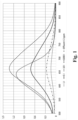
- FIG. 1 shows that the measurement signal of various concentrations of ammonium nitrogen (NH 4 -N) increasing and then decreasing. While no cause of this increase and decrease has to date been clarified with certainty, one theory is that the reaction mechanism no longer proceeds completely at unfavorable analyte/reagent ratios. A pH shift due to excessive monochloramine formed may be responsible. A reliable report of the ammonium content is not possible.
- WO 2018/054797 A1 describes a method to determine the plausibility of a measurement of the ammonium content using the Berthelot method where, besides the measurement of the extinction in the absorption region of the blue indole dye formed, a measurement of the extinction in the absorption region of the nitroprusside employed as catalyst is additionally performed on the sample. If the measurement in the absorption region of the nitroprusside employed as catalyst indicates that sufficient nitroprusside is present, the result of the ammonium determination is determined to be plausible. If the measurement in the absorption region of nitroprusside indicates that little or no catalyst is present, the plausibility of the result of the ammonium determination must be doubted. The plausibility of the actual measurement result of the ammonium determination can be checked via an additional measurement of the extinction in the absorption region of nitroprusside carried out directly on the same sample. Further measurements of dilutions of the sample are thereby normally unnecessary.
- a disadvantage of this method is that a measurement of two different chemical compounds is required, i.e., a first measurement of the blue indole dye formed, and a second measurement of the absorption region of the nitroprusside employed as catalyst.
- An object of the present invention is to provide an alternative method for the determination of the ammonium content of aqueous samples which directly provides information on the plausibility of the measurement result without the need to measure further samples, for example, as part of a dilution series.
- a further object of the present invention is to provide a method for the determination of the ammonium content of aqueous samples which directly provides information on the plausibility of the measurement result while only measuring the absorption regions of one chemical compound, i.e., the formed blue indole dye.
- the invention provides a method for the determination of a plausibility of a measurement result of a determination of an ammonium content of an aqueous sample.
- the method includes providing a blue indole dye mixture of the aqueous sample with an alkaline pH by providing the aqueous sample; adding a base, a chlorinating agent, a phenol derivative, and nitroprusside, so as to obtain the blue indole dye mixture, whereas the method further comprises: ⁇ determining a first extinction value of the blue indole dye mixture in a first absorption region from 650 to 670 nm, the first extinction value being the measurement result, ⁇ determining a second extinction value of the blue indole dye mixture in a second absorption region from 670 to 775, wherein the second absorption region is distant from the first absorption region, ⁇ dividing the first extinction value by the second extinction value so as to obtain a quotient; and ⁇ determining the measurement result to not be plausible if the quotient
- Fig. 1 shows the measured extinction in the case of the determination of the ammonium content of a sample by the Berthelot method for various ammonium concentrations.
- the present invention provides a method for the determination of a plausibility of a measurement result of a determination of an ammonium content of an aqueous sample.
- the method includes providing a blue indole dye mixture of the aqueous sample with an alkaline pH by providing the aqueous sample; adding a base, a chlorinating agent, a phenol derivative, and nitroprusside, so as to obtain the blue indole dye mixture, whereas the method further comprises: ⁇ determining a first extinction value of the blue indole dye mixture in a first absorption region from 650 to 670 nm, the first extinction value being the measurement result, ⁇ determining a second extinction value of the blue indole dye mixture in a second absorption region from 670 to 775, wherein the second absorption region is distant from the first absorption region, ⁇ dividing the first extinction value by the second extinction value so as to obtain a quotient; and ⁇ determining the measurement result to not be plausible if the quot
- an "aqueous sample” as used in the present invention is a sample which contains one or typically more components dissolved in water.
- the aqueous sample generally contains no further solvents apart from water. It may, however, contain up to 20 % of one or more water-miscible solvents, such as, for example, ethanol.
- An aqueous sample can be a water sample, a food or drink, or a body fluid.
- the aqueous sample is preferably a water sample, such as, for example, a sample taken from a water course, a waste-water sample, a ground water sample, a tap water sample, a sample of water fed to an industrial process or discharged from an industrial process as waste water, etc.
- the extinction of the sample after addition of the requisite reagents and after formation of the blue to blue-green indophenol is determined at a certain wavelength in the absorption region of the indophenol.
- the measurement is typically carried out at the absorption maximum of the blue indole dye mixture.
- the quantitative determination can then be carried out with the aid of a calibration curve. This procedure is known to the person skilled in the art. Indophenols generally have an absorption maximum in the wavelength range between 600 and 800 nm.
- the quotient of the present invention will necessarily depend on the wavelengths chosen for the first absorption region and the second absorption region.
- the quotient can, for example, be > 1.5, preferably > 2.0, very preferably > 3.0.
- the quotient can, for example, be greater than or equal to the quotients listed in Table 1.
- the first absorption region is chosen at a wavelength in a region which is expected for the absorption maximum of the blue indole dye mixture. This can for example, be anywhere from 650-670 nm, preferably from 655-665 nm, very preferably at approximately 660 nm or exactly at 660 nm. Possible first absorption regions are listed in Table 2. Table 2 - First Absorption Regions (in nm) 650 653 656 659 662 665 668 651 654 657 660 663 666 669 652 655 658 661 664 667 670
- the curve showing the highest concentration of ammonium nitrogen (NH 4 -N) additionally has an earlier absorption maximum (i.e., about 645 nm) than does the other lower concentrations (i.e., about 660 nm).
- the curve showing the highest concentration of ammonium nitrogen (NH 4 -N) also shows an extinction having a steeper decline.
- a core aspect of the present invention is that a measurement in the second absorption region for a high concentration of ammonium nitrogen (NH 4 -N) will therefore result in a quotient which is significantly different from the lower concentrations of ammonium nitrogen (NH 4 -N).
- a high concentration of ammonium nitrogen (NH 4 -N) as used herein is understood to be a concentration > 100 ppm NH 4 -N, for example, > 250 ppm NH 4 -N, for example, > 500 ppm NH 4 -N, for example, > 1,000 ppm NH 4 -N.
- the second absorption region can, for example be from 665-900 nm, preferably from 670-775 nm, preferably from 700-760 nm, preferably from 710-750 nm, preferably from 720-740 nm, preferably from 725 to 735 nm, very preferably at approximately 730 nm or exactly at 730 nm. Possible second absorption regions are listed in Table 2.
- the selection of the correct quotient will therefore depend on the selection of the first absorption region and on the second absorption region. A person skilled in the art will therefore know which quotient to choose in order to determine whether the measurement result is plausible. For example, if the first absorption region is selected at the expected absorption maximum of the blue indole dye mixture, i.e., at approximately 660 nm or, preferably, at exactly 660 nm, then:
- a chlorinating agent, a phenol derivative and nitroprusside as catalyst are added to the sample in the alkaline region, and a certain time, which is generally between 5 and 30 minutes, preferably between 10 and 20 minutes, is typically awaited in order that the detection reaction can take place.
- a blue-colored indophenol thereby forms over several reaction steps.
- the extinction determined in the absorption region of the indophenol correlates with the ammonium content of the sample in certain measurement ranges known to the person skilled in the art.
- the measurement of the ammonium content can be carried out in accordance with the present invention using any variant of the Berthelot method in which nitroprusside is used as a catalyst.
- the ammonium content of a sample is a sample's content of ammonium compounds present which can be converted into ammonia when the sample is rendered alkaline or are in the form of ammonia in an alkaline sample.
- the alkaline pH can thereby be between pH 10 and 13, preferably between pH 11 and 12, very preferably about pH 11.5.
- the alkaline pH of the aqueous sample with an alkaline pH can, for example, be provided by adding a base or hydroxide solutions.
- Use can, for example, be made of aqueous LiOH solutions, NaOH solutions and KOH solutions, preferably a sodium hydroxide solution.
- ammonium compounds are therefore ammonium salts, ammonium hydroxide and ammonia.
- the chlorinating agent can, for example, be dichloroisocyanurate (DIC), dichloroisocyanuric acid or sodium hypochlorite.
- the phenol derivative can, for example, be phenol or 2-substituted phenols, such as 2-chlorophenol, thymol or salicylates, or 2-hydroxy benzyl alcohol. It is also possible to use the method described in DIN 38406/5, in which dichloroisocyanuric acid and sodium salicylate is used.
- the blue indole dye mixture can, for example, be provided by providing the aqueous sample, adding a base to the aqueous sample so as to provide the aqueous sample with an alkaline pH, and adding to the aqueous sample with the alkaline pH a chlorinating agent, a phenol derivative, and nitroprusside, so as to obtain the blue indole dye mixture.
- the blue indole dye mixture of the aqueous sample can alternatively be provided by providing the aqueous sample, mixing a chlorinating agent and an alkaline buffer to obtain a first mixture, mixing the aqueous sample and the fist mixture to obtain a second mixture, and adding a phenol derivative and a nitroprusside to the second mixture to obtain the blue indole dye mixture.
- a person skilled in the art would also know that all of the above can be added together at the same time.
- a person skilled in the art can also directly add all of the above into, for example, a cuvette for subsequent analysis.
- the phenol derivative can, for example, be 2-hydroxy benzyl alcohol.
- the nitroprusside can, for example, be sodium nitroprusside.
- the chlorinating agent can, for example, be sodium hypochlorite.
- the alkaline buffer can, for example, be an alkaline citrate buffer.
- the chlorinating agent, the phenol derivative, and nitroprusside as a catalyst are added to the aqueous sample with an alkaline pH, a certain time, which is generally between 5 and 30 minutes, preferably between 10 and 20 minutes, should typically elapse in order to allow the detection reaction to take place.
- a blue-colored indophenol i.e., the blue indole dye mixture
- the extinction determined in the absorption region of the indophenol correlates with the ammonium content of the sample in certain measurement ranges known to the person skilled in the art.
- the measurement of the ammonium content can be carried out in accordance with the present invention using any variant of the Berthelot method in which nitroprusside is used as catalyst.
- Reagent 1 10-74 g/l of 2-hydroxybenzyl alcohol premixed with 4-10 g/l of nitroprusside Reagent 2: 10-250 g/l of sodium citrate dihydrate (alkaline adjusted with NaOH to a pH of > 12) Reagent 3: 0.3-10 g/l of sodium hypochlorite (NaOCl)
- aqueous samples containing Ammonium nitrogen were previously determined using conventional methods. These aqueous samples contained the following amounts of Ammonium nitrogen (NH 4 -N): Aqueous Sample 1: 1 ppm NH 4 -N Aqueous Sample 2: 2 ppm NH 4 -N (synthetic effluent) Aqueous Sample 3: 5 ppm NH 4 -N Aqueous Sample 4: 10 ppm NH 4 -N Aqueous Sample 5: 1,000 ppm NH 4 -N
- FIG. 1 A graph of the absorption data of each of aqueous samples 1-5 at various wavelengths from 500 to 900 nm is shown in FIG. 1 .
- the data for Fig. 1 for the wavelengths 660 nm to 780 nm is set forth in Tables 4-15 above.
- a measurement of the second absorption region anywhere from 675 nm to 775 nm will therefore always result in a quotient which is significantly different from those of aqueous samples 1-4.
- the high quotient of 6.05 based on the measurement at the second absorption region of 730 nm clearly shows this result to not be plausible.
- the data for the aqueous sample 5 can thereby be discarded as not plausible by measuring the same sample twice. A separate measurement to determine the amount of nitroprusside remaining is not thereby required.
Landscapes
- Physics & Mathematics (AREA)
- Life Sciences & Earth Sciences (AREA)
- Chemical & Material Sciences (AREA)
- Health & Medical Sciences (AREA)
- General Physics & Mathematics (AREA)
- Analytical Chemistry (AREA)
- Biochemistry (AREA)
- General Health & Medical Sciences (AREA)
- Spectroscopy & Molecular Physics (AREA)
- Immunology (AREA)
- Pathology (AREA)
- Engineering & Computer Science (AREA)
- Chemical Kinetics & Catalysis (AREA)
- Plasma & Fusion (AREA)
- Biophysics (AREA)
- Molecular Biology (AREA)
- Investigating Or Analyzing Non-Biological Materials By The Use Of Chemical Means (AREA)
Description
- The present invention relates to a method for the determination of ammonium or ammonia in aqueous samples via the Berthelot method where the risk of an incorrectly low result is eliminated via an additional measurement.
- Ammonium nitrogen (NH4-N) is present in many above-ground water courses, in some ground waters, and in domestic and many commercial waste waters. Ammonia is present in the aquatic environment due to agricultural run-off and decomposition of biological waste. Ammonia thereby exists in water as either the ammonium ion (NH4 +) or the un-ionized ammonia (NH3). Un-ionized ammonia is toxic to fish, even in low concentrations, while the ammonium ion is nontoxic except at extremely high concentrations. At neutral pH =7 and ambient temperature, almost all of the ammonia exists as NH4 +. As the pH and temperature increase, the amount of NH3 increases and the amount of NH4 + decreases. Ammonium contents in water of 0.5 to 1 mg/l are therefore, depending on the pH of the water, classified as hazardous to fish. A water course is typically unsuitable for fishery purposes at ammonium contents of > 1 mg/l.
- Ammonia is also toxic to all vertebrates causing convulsions, coma and death, probably because elevated NH4 + displaces K+ and depolarizes neurons, causing activation of NMDA type glutamate receptor, which leads to an influx of excessive Ca2 + and subsequent cell death in the central nervous system.
- Ammonium compounds accordingly belong to the water-endangering substances, and limit values are set forth in many regulations. A regular monitoring of ammonium content in water and waste-water samples is therefore required.
- Standardized methods for the determination of the ammonium content are frequently used. These include, for example, the Berthelot method where ammonia (NH3) reacts with a so-called "Berthelot's reagent" to form a blue product which is then used in a colorimetric method to determine ammonia. The method is carried out at an alkaline pH, at which ammonium is in the form of ammonia (NH3).
- The reaction mechanism proposed for the Berthelot reaction consists of three steps. In a first step (1), ammonia reacts with hypochlorite to form monochloramine at basic pH:
The reaction mechanism proposed for the Berthelot reaction consists of three steps. In a first step (1), ammonia reacts with hypochlorite to form monochloramine at basic pH:
NH3 + OCl- → NH2Cl (1).
- In a second step (2), the monochloramine formed reacts with a phenol derivative in the presence of the catalyst nitroprusside to give a chloroquinone monoamine:

- The catalyst, nitroprusside, also called sodium nitroprusside, is a complex of the empirical formula Na2[Fe(CN)5NO]2 • H2O. Various compounds are in principle suitable as the phenol derivative. Salicylates, thymol or 2-chlorophenol can, for example, be used. In the final reaction step (3), the chloroquinone monoamine formed reacts with a further molecule of the phenol derivative to give a corresponding indophenol.

- The formed indophenol has a blue color which is then measured photometrically, for example, at a wavelength in the region of its absorption maximum. In certain measurement ranges, indophenol correlates with the ammonium content of the sample.
- The complete reaction mechanism has not been unambiguously clarified to date and proceeds via many intermediates.
- The Berthelot method can in principle be used for various measurement ranges if the sample/reagent ratios are adapted correspondingly or the sample is pre-diluted.
- Ammonium tests which use the Berthelot method are available from various manufacturers in the form of ready-to-use test sets. The Berthelot method is descripted in
US 6,315,950 B1 ,US 5,620,900 A ,US 2018/0284099 A1 andUS 2009/0320570 A1 . - The Berthelot method has the disadvantage that the blue color formed only correlates with the ammonium content in certain concentration ranges of the ammonium to be determined. The measurement signal (i.e., the extinction) of the photometric measurement generally increases with increasing ammonium content of the sample. However, the measurement signal (i.e., the extinction) then drops.
FIG. 1 shows that the measurement signal of various concentrations of ammonium nitrogen (NH4-N) increasing and then decreasing. While no cause of this increase and decrease has to date been clarified with certainty, one theory is that the reaction mechanism no longer proceeds completely at unfavorable analyte/reagent ratios. A pH shift due to excessive monochloramine formed may be responsible. A reliable report of the ammonium content is not possible. A measurement undertaken at the wavelength in the region of absorption maximum expected for lower concentrations (i.e., at approximately 660 nm) would falsely report the concentration of ammonium nitrogen (NH4-N) which is 1,000 ppm inFig. 1 to be between 5 and 10 ppm. This would result in a significant underestimation of the ammonium content, which might have serious repercussions for the environment. - The standards and test set manufacturers therefore prescribe that further analyses with a diluted sample (various pollution steps) should be carried out in addition to analysis of the sample in order to check the plausibility of the measurement result. This is, however, inconvenient and time-consuming for the user.
-
WO 2018/054797 A1 attempted to address the above problem. -
WO 2018/054797 A1 describes a method to determine the plausibility of a measurement of the ammonium content using the Berthelot method where, besides the measurement of the extinction in the absorption region of the blue indole dye formed, a measurement of the extinction in the absorption region of the nitroprusside employed as catalyst is additionally performed on the sample. If the measurement in the absorption region of the nitroprusside employed as catalyst indicates that sufficient nitroprusside is present, the result of the ammonium determination is determined to be plausible. If the measurement in the absorption region of nitroprusside indicates that little or no catalyst is present, the plausibility of the result of the ammonium determination must be doubted. The plausibility of the actual measurement result of the ammonium determination can be checked via an additional measurement of the extinction in the absorption region of nitroprusside carried out directly on the same sample. Further measurements of dilutions of the sample are thereby normally unnecessary. - A disadvantage of this method is that a measurement of two different chemical compounds is required, i.e., a first measurement of the blue indole dye formed, and a second measurement of the absorption region of the nitroprusside employed as catalyst.
- An object of the present invention is to provide an alternative method for the determination of the ammonium content of aqueous samples which directly provides information on the plausibility of the measurement result without the need to measure further samples, for example, as part of a dilution series. A further object of the present invention is to provide a method for the determination of the ammonium content of aqueous samples which directly provides information on the plausibility of the measurement result while only measuring the absorption regions of one chemical compound, i.e., the formed blue indole dye.
- The invention provides a method for the determination of a plausibility of a measurement result of a determination of an ammonium content of an aqueous sample. The method includes providing a blue indole dye mixture of the aqueous sample with an alkaline pH by providing the aqueous sample; adding a base, a chlorinating agent, a phenol derivative, and nitroprusside, so as to obtain the blue indole dye mixture, whereas the method further comprises:· determining a first extinction value of the blue indole dye mixture in a first absorption region from 650 to 670 nm, the first extinction value being the measurement result,· determining a second extinction value of the blue indole dye mixture in a second absorption region from 670 to 775, wherein the second absorption region is distant from the first absorption region,· dividing the first extinction value by the second extinction value so as to obtain a quotient; and· determining the measurement result to not be plausible if the quotient > 1.1.
- The present invention is described in greater detail below on the basis of embodiments and of the drawing in which:
Fig. 1 shows the measured extinction in the case of the determination of the ammonium content of a sample by the Berthelot method for various ammonium concentrations. - The present invention provides a method for the determination of a plausibility of a measurement result of a determination of an ammonium content of an aqueous sample. The method includes providing a blue indole dye mixture of the aqueous sample with an alkaline pH by providing the aqueous sample; adding a base, a chlorinating agent, a phenol derivative, and nitroprusside, so as to obtain the blue indole dye mixture, whereas the method further comprises:· determining a first extinction value of the blue indole dye mixture in a first absorption region from 650 to 670 nm, the first extinction value being the measurement result,· determining a second extinction value of the blue indole dye mixture in a second absorption region from 670 to 775, wherein the second absorption region is distant from the first absorption region,· dividing the first extinction value by the second extinction value so as to obtain a quotient; and· determining the measurement result to not be plausible if the quotient > 1.1.
- An "aqueous sample" as used in the present invention is a sample which contains one or typically more components dissolved in water. The aqueous sample generally contains no further solvents apart from water. It may, however, contain up to 20 % of one or more water-miscible solvents, such as, for example, ethanol. An aqueous sample can be a water sample, a food or drink, or a body fluid. The aqueous sample is preferably a water sample, such as, for example, a sample taken from a water course, a waste-water sample, a ground water sample, a tap water sample, a sample of water fed to an industrial process or discharged from an industrial process as waste water, etc.
- In order to determine the ammonium content quantitatively, the extinction of the sample after addition of the requisite reagents and after formation of the blue to blue-green indophenol (i.e, the blue indole dye mixture) is determined at a certain wavelength in the absorption region of the indophenol. The measurement is typically carried out at the absorption maximum of the blue indole dye mixture. The quantitative determination can then be carried out with the aid of a calibration curve. This procedure is known to the person skilled in the art. Indophenols generally have an absorption maximum in the wavelength range between 600 and 800 nm.
- The quotient of the present invention will necessarily depend on the wavelengths chosen for the first absorption region and the second absorption region. The quotient can, for example, be > 1.5, preferably > 2.0, very preferably > 3.0. The quotient can, for example, be greater than or equal to the quotients listed in Table 1.
Table 1 - List of Quotients 8 1.1 1.5 1.9 2.3 2.9 4.75 7.5 14.0 1.15 1.55 1.95 2.35 3.0 5.0 8.0 15.0 1.2 1.6 2.0 2.4 3.25 5.25 8.5 16.0 1.25 1.65 2.05 2.45 3.5 5.5 9.0 17.0 1.3 1.7 2.1 2.5 3.75 5.75 10.0 18.0 1.35 1.75 2.15 2.6 4.0 6 11.0 19.0 1.4 1.8 2.2 2.7 4.25 6.5 12.0 20.0 1.45 1.85 2.25 2.8 4.5 7 13.0 21.0 - The first absorption region is chosen at a wavelength in a region which is expected for the absorption maximum of the blue indole dye mixture. This can for example, be anywhere from 650-670 nm, preferably from 655-665 nm, very preferably at approximately 660 nm or exactly at 660 nm. Possible first absorption regions are listed in Table 2.
Table 2 - First Absorption Regions (in nm) 650 653 656 659 662 665 668 651 654 657 660 663 666 669 652 655 658 661 664 667 670 - The second absorption region is chosen to be distant from the first absorption region. While the present invention is in no way limited thereto, it has been observed that the extinction of the blue indole dye mixture is more gradual when lower concentrations of ammonium nitrogen (NH4-N) are measured. Reference to
FIG. 1 shows, for example, that the low concentrations of ammonium nitrogen (NH4-N) (i.e., the uppermost curve = 10 ppm, third curve from the bottom = 5 ppm, the curve second from the bottom = 2 ppm, and the bottommost curve = 1 ppm) have a more gradual extinction than does the high concentration of ammonium nitrogen (NH4-N) (i.e., the curve second from the top = 1,000 ppm). The curve showing the highest concentration of ammonium nitrogen (NH4-N) additionally has an earlier absorption maximum (i.e., about 645 nm) than does the other lower concentrations (i.e., about 660 nm). The curve showing the highest concentration of ammonium nitrogen (NH4-N) also shows an extinction having a steeper decline. A core aspect of the present invention is that a measurement in the second absorption region for a high concentration of ammonium nitrogen (NH4-N) will therefore result in a quotient which is significantly different from the lower concentrations of ammonium nitrogen (NH4-N). A high concentration of ammonium nitrogen (NH4-N) as used herein is understood to be a concentration > 100 ppm NH4-N, for example, > 250 ppm NH4-N, for example, > 500 ppm NH4-N, for example, > 1,000 ppm NH4-N. - The second absorption region can, for example be from 665-900 nm, preferably from 670-775 nm, preferably from 700-760 nm, preferably from 710-750 nm, preferably from 720-740 nm, preferably from 725 to 735 nm, very preferably at approximately 730 nm or exactly at 730 nm. Possible second absorption regions are listed in Table 2.
Table 2 - Second Absorption Regions (in nm) 665 699 733 767 801 835 869 666 700 734 768 802 836 870 667 701 735 769 803 837 871 668 702 736 770 804 838 872 669 703 737 771 805 839 873 670 704 738 772 806 840 874 671 705 739 773 807 841 875 672 706 740 774 808 842 876 673 707 741 775 809 843 877 674 708 742 776 810 844 878 675 709 743 777 811 845 879 676 710 744 778 812 846 880 677 711 745 779 813 847 881 678 712 746 780 814 848 882 679 713 747 781 815 849 883 680 714 748 782 816 850 884 681 715 749 783 817 851 885 682 716 750 784 818 852 886 683 717 751 785 819 853 887 684 718 752 786 820 854 888 685 719 753 787 821 855 889 686 720 754 788 822 856 890 687 721 755 789 823 857 891 688 722 756 790 824 858 892 689 723 757 791 825 859 893 690 724 758 792 826 860 894 691 725 759 793 827 861 895 692 726 760 794 828 862 896 693 727 761 795 829 863 897 694 728 762 796 830 864 898 695 729 763 797 831 865 899 696 730 764 798 832 866 900 697 731 765 799 833 867 901 698 732 766 800 834 868 902 - The selection of the correct quotient will therefore depend on the selection of the first absorption region and on the second absorption region. A person skilled in the art will therefore know which quotient to choose in order to determine whether the measurement result is plausible. For example, if the first absorption region is selected at the expected absorption maximum of the blue indole dye mixture, i.e., at approximately 660 nm or, preferably, at exactly 660 nm, then:
- when the second absorption region is from 670 to < 680 nm, the quotient will be > 1.1,
- when the second absorption region is from 680 to < 690 nm, the quotient will be > 1.2,
- when the second absorption region is from 690 to < 700 nm, the quotient will be > 1.3,
- when the second absorption region is from 700 to < 710 nm, the quotient will be > 1.4,
- when the second absorption region is from 710 to < 720 nm, the quotient will be > 1.5,
- when the second absorption region is from 720 to < 730 nm, the quotient will be > 1.7,
- when the second absorption region is from 730 to < 740 nm, the quotient will be > 1.9,
- when the second absorption region is from 740 to < 750 nm, the quotient will be > 2.1,
- when the second absorption region is from 750 to < 760 nm, the quotient will be > 2.3,
- when the second absorption region is from 760 to < 770 nm, the quotient will be > 2.8, and
- when the second absorption region is from 770 to < 780 nm, the quotient will be > 3.3.
- In the determination of the ammonium content by the Berthelot method, a chlorinating agent, a phenol derivative and nitroprusside as catalyst are added to the sample in the alkaline region, and a certain time, which is generally between 5 and 30 minutes, preferably between 10 and 20 minutes, is typically awaited in order that the detection reaction can take place. A blue-colored indophenol thereby forms over several reaction steps. The extinction determined in the absorption region of the indophenol correlates with the ammonium content of the sample in certain measurement ranges known to the person skilled in the art. The measurement of the ammonium content can be carried out in accordance with the present invention using any variant of the Berthelot method in which nitroprusside is used as a catalyst.
- The ammonium content of a sample is a sample's content of ammonium compounds present which can be converted into ammonia when the sample is rendered alkaline or are in the form of ammonia in an alkaline sample. The alkaline pH can thereby be between
pH 10 and 13, preferably between pH 11 and 12, very preferably about pH 11.5. The alkaline pH of the aqueous sample with an alkaline pH can, for example, be provided by adding a base or hydroxide solutions. Use can, for example, be made of aqueous LiOH solutions, NaOH solutions and KOH solutions, preferably a sodium hydroxide solution. Examples of ammonium compounds are therefore ammonium salts, ammonium hydroxide and ammonia. - The chlorinating agent can, for example, be dichloroisocyanurate (DIC), dichloroisocyanuric acid or sodium hypochlorite. The phenol derivative can, for example, be phenol or 2-substituted phenols, such as 2-chlorophenol, thymol or salicylates, or 2-hydroxy benzyl alcohol. It is also possible to use the method described in DIN 38406/5, in which dichloroisocyanuric acid and sodium salicylate is used.
- Various known methods can be used to provide the blue indole dye mixture of the aqueous sample. The blue indole dye mixture can, for example, be provided by providing the aqueous sample, adding a base to the aqueous sample so as to provide the aqueous sample with an alkaline pH, and adding to the aqueous sample with the alkaline pH a chlorinating agent, a phenol derivative, and nitroprusside, so as to obtain the blue indole dye mixture.
- The blue indole dye mixture of the aqueous sample can alternatively be provided by providing the aqueous sample, mixing a chlorinating agent and an alkaline buffer to obtain a first mixture, mixing the aqueous sample and the fist mixture to obtain a second mixture, and adding a phenol derivative and a nitroprusside to the second mixture to obtain the blue indole dye mixture. A person skilled in the art would also know that all of the above can be added together at the same time. A person skilled in the art can also directly add all of the above into, for example, a cuvette for subsequent analysis.
- The phenol derivative can, for example, be 2-hydroxy benzyl alcohol. The nitroprusside can, for example, be sodium nitroprusside. The chlorinating agent can, for example, be sodium hypochlorite. The alkaline buffer can, for example, be an alkaline citrate buffer.
- After the chlorinating agent, the phenol derivative, and nitroprusside as a catalyst are added to the aqueous sample with an alkaline pH, a certain time, which is generally between 5 and 30 minutes, preferably between 10 and 20 minutes, should typically elapse in order to allow the detection reaction to take place. A blue-colored indophenol (i.e., the blue indole dye mixture) thereby forms over several reaction steps. The extinction determined in the absorption region of the indophenol correlates with the ammonium content of the sample in certain measurement ranges known to the person skilled in the art. The measurement of the ammonium content can be carried out in accordance with the present invention using any variant of the Berthelot method in which nitroprusside is used as catalyst.
-
Reagent 1: 10-74 g/l of 2-hydroxybenzyl alcohol premixed with 4-10 g/l of nitroprusside Reagent 2: 10-250 g/l of sodium citrate dihydrate (alkaline adjusted with NaOH to a pH of > 12) Reagent 3: 0.3-10 g/l of sodium hypochlorite (NaOCl) - Five aqueous samples containing Ammonium nitrogen (NH4-N) were previously determined using conventional methods. These aqueous samples contained the following amounts of Ammonium nitrogen (NH4-N):
Aqueous Sample 1: 1 ppm NH4-N Aqueous Sample 2: 2 ppm NH4-N (synthetic effluent) Aqueous Sample 3: 5 ppm NH4-N Aqueous Sample 4: 10 ppm NH4-N Aqueous Sample 5: 1,000 ppm NH4-N - 5 ml of each of the aqueous samples 1-5 to be tested were provided. To each 5 ml aqueous sample was added 2.0 ml of a 1:1 mixture of:
- 5.15 g/l of sodium hypochlorite (as Reagent 3) and
- 100 g/l of sodium citrate dihydrate alkaline which was adjusted with NaOH to a pH of > 12 (as Reagent 2).
- The resulting mixture was then stirred for 3 minutes at room temperature (i.e., approximately 25 °C);
- 1 ml of 42 g/l of 2-hydroxybenzyl alcohol and 7 g/l of sodium nitroprusside (as Reagent 1) was then added. The resulting mixture was then stirred for 3 minutes at room temperature (i.e., approximately 25 °C). The blue indole dye thereby completely evolved after an elapsed time of approximately 15 minutes to provide the blue indole dye mixture.
- 1 ml of the blue indole dye mixture of each of aqueous samples 1-5 was then respectively pipetted into a 2 mm cuvette and analyzed photometrically using a DR 3900 Spectrophotometer from Hach® at a wavelength of 660 nm (i.e., the first absorption region) and at respective wavelengths of 670 nm, 680 nm, 690 nm, 700 nm, 710 nm, 720 nm, 730 nm, 740 nm, 750 nm, 760 nm, 770 nm and 780 nm (as the respective second absorption region). Samples of the data thereby obtained is set forth in Tables 4-15 below. More complete data is set forth as
Fig. 2 . - A graph of the absorption data of each of aqueous samples 1-5 at various wavelengths from 500 to 900 nm is shown in
FIG. 1 . The data forFig. 1 for thewavelengths 660 nm to 780 nm is set forth in Tables 4-15 above. - A comparison of the quotients of Tables 4-15 makes clear that the quotients of each of aqueous samples 1-4 are for the most part remarkably close to each other. For Table 10, for example, the quotient is approximately 1.5. Starting from Table 10, where a wavelength of 730 nm was used, shows that choosing a wavelength > 730 nm causes the quotient to increase, while a choice of a wavelength between approximately 670 nm and 730 nm would cause the quotient to decrease. The reason for this variance is due to the degree of extinction as is shown in
FIG. 1 .Aqueous sample 5 exhibits an earlier absorption maximum of approximately 645 nm (seeFIG. 1 ) and a corresponding steeper decline in the area of measurement of the second absorption region. A measurement of the second absorption region anywhere from 675 nm to 775 nm will therefore always result in a quotient which is significantly different from those of aqueous samples 1-4. Based solely on the absorbance of theaqueous solution 5 at the first absorption region of 660 nm, i.e., 1.137, a person skilled in the art would normally reasonably conclude that the fifth aqueous sample has a ppm NH4-N of approximately 7 in that it clearly lies between the curves for 5 ppm NH4-N and 10 ppm NH4-N. However, the high quotient of 6.05 based on the measurement at the second absorption region of 730 nm clearly shows this result to not be plausible. The data for theaqueous sample 5 can thereby be discarded as not plausible by measuring the same sample twice. A separate measurement to determine the amount of nitroprusside remaining is not thereby required. - The present invention is not limited to embodiments described herein, but only by the appended claims.
| Concentration ppm NH4-N | Absorbance E 660 nm | Absorbance E 670 nm | Quotient E 660nm / E 670 nm |
| 1 | 0.144 | 0.143 | 1.01 |
| 2 | 0.270 | 0.267 | 1.01 |
| 5 | 0.717 | 0.710 | 1.01 |
| 10 | 1.324 | 1.318 | 1.00 |
| 1,000 | 1.137 | 0.999 | 1.14 |
| Concentration ppm NH4-N | Absorbance E 660 nm | Absorbance E 680 nm | Quotient E 660nm / E 680 nm |
| 1 | 0.144 | 0.139 | 1.04 |
| 2 | 0.270 | 0.259 | 1.04 |
| 5 | 0.717 | 0.685 | 1.05 |
| 10 | 1.324 | 1.279 | 1.04 |
| 1,000 | 1.137 | 0.826 | 1.38 |
| Concentration ppm NH4-N | Absorbance E 660 nm | Absorbance E 690 nm | Quotient E 660nm / E 690 nm |
| 1 | 0.144 | 0.132 | 1.09 |
| 2 | 0.270 | 0.246 | 1.10 |
| 5 | 0.717 | 0.648 | 1.11 |
| 10 | 1.324 | 1.218 | 1.09 |
| 1,000 | 1.137 | 0.646 | 1.76 |
| Concentration ppm NH4-N | Absorbance E 660 nm | Absorbance E 700 nm | Quotient E 660nm / E 700 nm |
| 1 | 0.144 | 0.124 | 1.16 |
| 2 | 0.270 | 0.23 | 1.17 |
| 5 | 0.717 | 0.606 | 1.18 |
| 10 | 1.324 | 1.141 | 1.16 |
| 1,000 | 1.137 | 0.486 | 2.34 |
| Concentration ppm NH4-N | Absorbance E 660 nm | Absorbance E 710 nm | Quotient E 660nm / E 710 nm |
| 1 | 0.144 | 0.116 | 1.24 |
| 2 | 0.270 | 0.213 | 1.27 |
| 5 | 0.717 | 0.561 | 1.28 |
| 10 | 1.324 | 1.061 | 1.25 |
| 1,000 | 1.137 | 0.353 | 3.22 |
| Concentration ppm NH4-N | Absorbance E 660 nm | Absorbance E 720 nm | Quotient E 660nm / E 720 nm |
| 1 | 0.144 | 0.107 | 1.35 |
| 2 | 0.270 | 0.198 | 1.36 |
| 5 | 0.717 | 0.518 | 1.38 |
| 10 | 1.324 | 0.982 | 1.35 |
| 1,000 | 1.137 | 0.261 | 4.36 |
| Concentration ppm NH4-N | Absorbance E 660 nm | Absorbance E 730 nm | Quotient E 660nm / E 730 nm |
| 1 | 0.144 | 0.098 | 1.47 |
| 2 | 0.270 | 0.180 | 1.50 |
| 5 | 0.717 | 0.471 | 1.52 |
| 10 | 1.324 | 0.894 | 1.48 |
| 1.000 | 1.137 | 0.188 | 6.05 |
| Concentration ppm NH4-N | Absorbance E 660 nm | Absorbance E 740 nm | Quotient E 660nm / E 740 nm |
| 1 | 0.144 | 0.089 | 1.62 |
| 2 | 0.270 | 0.162 | 1.67 |
| 5 | 0.717 | 0.425 | 1.69 |
| 10 | 1.324 | 0.805 | 1.64 |
| 1,000 | 1.137 | 0.139 | 8.18 |
| Concentration ppm NH4-N | Absorbance E 660 nm | Absorbance E 750 nm | Quotient E 660nm / E 750 nm |
| 1 | 0.144 | 0.079 | 1.82 |
| 2 | 0.270 | 0.144 | 1.88 |
| 5 | 0.717 | 0.376 | 1.91 |
| 10 | 1.324 | 0.712 | 1.86 |
| 1,000 | 1.137 | 0.103 | 11.04 |
| Concentration ppm NH4-N | Absorbance E 660 nm | Absorbance E 760 nm | Quotient E 660nm / E 760 nm |
| 1 | 0.144 | 0.07 | 2.06 |
| 2 | 0.270 | 0.126 | 2.14 |
| 5 | 0.717 | 0.329 | 2.18 |
| 10 | 1.324 | 0.62 | 2.14 |
| 1,000 | 1.137 | 0.078 | 14.58 |
| Concentration ppm NH4-N | Absorbance E 660 nm | Absorbance E 770 nm | Quotient E 660nm / E 770 nm |
| 1 | 0.144 | 0.06 | 2.40 |
| 2 | 0.270 | 0.108 | 2.50 |
| 5 | 0.717 | 0.282 | 2.54 |
| 10 | 1.324 | 0.53 | 2.50 |
| 1,000 | 1.137 | 0.059 | 19.27 |
| Concentration ppm NH4-N | Absorbance E 660 nm | Absorbance E 780 nm | Quotient E 660nm / E 780 nm |
| 1 | 0.144 | 0.051 | 2.82 |
| 2 | 0.270 | 0.091 | 2.97 |
| 5 | 0.717 | 0.238 | 3.01 |
| 10 | 1.324 | 0.446 | 2.97 |
| 1,000 | 1.137 | 0.045 | 25.27 |
Claims (13)
- A method for determining of a plausibility of a measurement result of a determination of an ammonium content of an aqueous sample, the method comprising:• providing a blue indole dye mixture of the aqueous sample with an alkaline pH by,the method further comprises:providing the aqueous sample;adding a base, a chlorinating agent, a phenol derivative, and nitroprusside, so as to obtain the blue indole dye mixture, whereas• determining a first extinction value of the blue indole dye mixture in a first absorption region from 650 to 670 nm, the first extinction value being the measurement result,• determining a second extinction value of the blue indole dye mixture in a second absorption region from 670 to 775, wherein the second absorption region is distant from the first absorption region,• dividing the first extinction value by the second extinction value so as to obtain a quotient; and• determining the measurement result to not be plausible if the quotient > 1.1.
- The method as recited in claim 1, characterized in that the quotient is > 1.5, preferably > 2.0, very preferably > 3.0.
- The method as recited in any one of claims 1 and 2, characterized in that the first absorption region is from 655 to 665 nm, preferably is 660 nm.
- The method as recited any one of claims 1 to 3, characterized in that the second absorption region is from 700 to 760 nm, preferably is 730 nm.
- The method as recited in claim 1, characterized in that:
the first absorption region is 660 nm;when the second absorption region is from 670 to < 680 nm, the quotient is > 1.1,when the second absorption region is from 680 to < 690 nm, the quotient is > 1.2,when the second absorption region is from 690 to < 700 nm, the quotient is > 1.3,when the second absorption region is from 700 to < 710 nm, the quotient is > 1.4,when the second absorption region is from 710 to < 720 nm, the quotient is > 1.5,when the second absorption region is from 720 to < 730 nm, the quotient is > 1.7,when the second absorption region is from 730 to < 740 nm, the quotient is > 1.9,when the second absorption region is from 740 to < 750 nm, the quotient is > 2.1,when the second absorption region is from 750 to < 760 nm, the quotient is > 2.3,when the second absorption region is from 760 to < 770 nm, the quotient is > 2.8, andwhen the second absorption region is from 770 to < 780 nm, the quotient is > 3.3. - The method as recited in one of the preceding claims, characterized in that the chlorinating agent is dichloroisocyanuric acid or sodium hypochlorite.
- The method as recited in any one of the preceding claims, characterized in that the phenol derivative is 2-chlorophenol or 2-hydroxy benzyl alcohol.
- The method as recited in any one of the preceding claims, characterized in that the alkaline pH of the aqueous sample with the alkaline pH is provided by adding a sodium hydroxide solution.
- The method as recited in any one of the preceding claims, characterized in that the alkaline pH is between pH 10 and 13, preferably between pH 11 and 12, very preferably about pH 11.5.
- The method as recited in any one of the preceding claims, wherein the blue indole dye mixture of the aqueous sample is provided by:providing the aqueous sample;mixing the chlorinating agent and an alkaline buffer to obtain a first mixture;mixing the aqueous sample and the fist mixture to obtain a second mixture; andadding the phenol derivative and the nitroprusside to the second mixture to obtain the blue indole dye mixture.
- The method as recited in any one of the preceding claims , characterized in that the phenol derivative is 2-hydroxy benzyl alcohol.
- The method as recited in any one of claims 10 and 11, characterized in that the chlorinating agent is sodium hypochlorite.
- The method as recited in any one of claims 10 to 11, characterized in that the alkaline buffer is an alkaline citrate buffer.
Priority Applications (3)
| Application Number | Priority Date | Filing Date | Title |
|---|---|---|---|
| EP20195516.8A EP3968009B1 (en) | 2020-09-10 | 2020-09-10 | Method for determining ammonium |
| PCT/EP2021/074094 WO2022053364A1 (en) | 2020-09-10 | 2021-09-01 | Method for determining ammonium |
| US18/044,895 US20230358671A1 (en) | 2020-09-10 | 2021-09-01 | Method for determining ammonium |
Applications Claiming Priority (1)
| Application Number | Priority Date | Filing Date | Title |
|---|---|---|---|
| EP20195516.8A EP3968009B1 (en) | 2020-09-10 | 2020-09-10 | Method for determining ammonium |
Publications (2)
| Publication Number | Publication Date |
|---|---|
| EP3968009A1 EP3968009A1 (en) | 2022-03-16 |
| EP3968009B1 true EP3968009B1 (en) | 2024-11-06 |
Family
ID=72470295
Family Applications (1)
| Application Number | Title | Priority Date | Filing Date |
|---|---|---|---|
| EP20195516.8A Active EP3968009B1 (en) | 2020-09-10 | 2020-09-10 | Method for determining ammonium |
Country Status (3)
| Country | Link |
|---|---|
| US (1) | US20230358671A1 (en) |
| EP (1) | EP3968009B1 (en) |
| WO (1) | WO2022053364A1 (en) |
Family Cites Families (5)
| Publication number | Priority date | Publication date | Assignee | Title |
|---|---|---|---|---|
| DE4436948A1 (en) * | 1994-10-15 | 1996-04-18 | Merck Patent Gmbh | Means and methods for the determination of ammonium ions |
| US6315950B1 (en) * | 1998-09-04 | 2001-11-13 | Hach Company | Controlling chlorination of wastewater and chloramination of drinking water |
| US8065906B2 (en) * | 2008-06-18 | 2011-11-29 | Hach Company | Detection of free chlorine in water |
| AU2014311977B2 (en) * | 2013-08-30 | 2019-02-21 | Children's National Medical Center | Device and methods of using device for detection of hyperammonemia |
| JP6994024B2 (en) | 2016-09-20 | 2022-01-14 | メルク パテント ゲゼルシャフト ミット ベシュレンクテル ハフツング | Ammonium quantification method |
-
2020
- 2020-09-10 EP EP20195516.8A patent/EP3968009B1/en active Active
-
2021
- 2021-09-01 WO PCT/EP2021/074094 patent/WO2022053364A1/en not_active Ceased
- 2021-09-01 US US18/044,895 patent/US20230358671A1/en active Pending
Also Published As
| Publication number | Publication date |
|---|---|
| US20230358671A1 (en) | 2023-11-09 |
| EP3968009A1 (en) | 2022-03-16 |
| WO2022053364A1 (en) | 2022-03-17 |
Similar Documents
| Publication | Publication Date | Title |
|---|---|---|
| US6315950B1 (en) | Controlling chlorination of wastewater and chloramination of drinking water | |
| US8065906B2 (en) | Detection of free chlorine in water | |
| CA2829506C (en) | Method of determining a concentration of nitrate | |
| CN103926239A (en) | Detection method for oxidable contaminant in aqueous sample | |
| Li et al. | Micro-particles as interfering substances in colorimetric residual chlorine measurement | |
| US11378566B2 (en) | Method for determining ammonium | |
| AU773178B2 (en) | Reagent and method for detecting an adulterant in an aqueous sample | |
| US7544516B2 (en) | Reagent for determination of calcium and determination method | |
| US9746451B2 (en) | Kinetic chlorine measurement | |
| EP3968009A1 (en) | Method for determining ammonium | |
| US5155048A (en) | Organic reagent for the colorimetric detection of chlorine and ozone in drinking water | |
| US5236848A (en) | Procedure and agent for the determination of nitrate ions | |
| US10634656B2 (en) | Storage stable standards for aqueous chlorine analysis | |
| JP2019535006A5 (en) | ||
| Jolley et al. | Aqueous chemistry of chlorine: chemistry, analysis, and environmental fate of reactive oxidant species | |
| Zhu et al. | Enhanced spectrofluorimetric determination of hypochlorite based on the catalytic oxidation of thiamine to thiochrome in the presence of trace ferrocyanide | |
| JP2006284206A (en) | Reagent for judging iron component, presence judging method of iron component and concentration measuring method of iron component | |
| Unger-Heumann | Rapid Tests-A Convenient Tool for Sample Screening with | |
| JP2008241382A (en) | Measuring method of alkaline component concentration in sample water | |
| Al-Okab et al. | Novel oxidative electrophilic coupling reactions of phenoxazine derivatives with MBTH and their applications to spectrophotometric determination of residual chlorine in drinking water and environmental water samples | |
| EP4646583A1 (en) | Potassium maleate buffer for free chlorine analysis | |
| Larson et al. | Determination of Free Bromine in Water (U): Annual Progress Report |
Legal Events
| Date | Code | Title | Description |
|---|---|---|---|
| PUAI | Public reference made under article 153(3) epc to a published international application that has entered the european phase |
Free format text: ORIGINAL CODE: 0009012 |
|
| STAA | Information on the status of an ep patent application or granted ep patent |
Free format text: STATUS: THE APPLICATION HAS BEEN PUBLISHED |
|
| AK | Designated contracting states |
Kind code of ref document: A1 Designated state(s): AL AT BE BG CH CY CZ DE DK EE ES FI FR GB GR HR HU IE IS IT LI LT LU LV MC MK MT NL NO PL PT RO RS SE SI SK SM TR |
|
| STAA | Information on the status of an ep patent application or granted ep patent |
Free format text: STATUS: REQUEST FOR EXAMINATION WAS MADE |
|
| 17P | Request for examination filed |
Effective date: 20220914 |
|
| RBV | Designated contracting states (corrected) |
Designated state(s): AL AT BE BG CH CY CZ DE DK EE ES FI FR GB GR HR HU IE IS IT LI LT LU LV MC MK MT NL NO PL PT RO RS SE SI SK SM TR |
|
| GRAP | Despatch of communication of intention to grant a patent |
Free format text: ORIGINAL CODE: EPIDOSNIGR1 |
|
| STAA | Information on the status of an ep patent application or granted ep patent |
Free format text: STATUS: GRANT OF PATENT IS INTENDED |
|
| INTG | Intention to grant announced |
Effective date: 20240522 |
|
| GRAS | Grant fee paid |
Free format text: ORIGINAL CODE: EPIDOSNIGR3 |
|
| GRAA | (expected) grant |
Free format text: ORIGINAL CODE: 0009210 |
|
| STAA | Information on the status of an ep patent application or granted ep patent |
Free format text: STATUS: THE PATENT HAS BEEN GRANTED |
|
| AK | Designated contracting states |
Kind code of ref document: B1 Designated state(s): AL AT BE BG CH CY CZ DE DK EE ES FI FR GB GR HR HU IE IS IT LI LT LU LV MC MK MT NL NO PL PT RO RS SE SI SK SM TR |
|
| REG | Reference to a national code |
Ref country code: GB Ref legal event code: FG4D |
|
| REG | Reference to a national code |
Ref country code: CH Ref legal event code: EP |
|
| REG | Reference to a national code |
Ref country code: DE Ref legal event code: R096 Ref document number: 602020040710 Country of ref document: DE |
|
| REG | Reference to a national code |
Ref country code: IE Ref legal event code: FG4D |
|
| REG | Reference to a national code |
Ref country code: LT Ref legal event code: MG9D |
|
| PG25 | Lapsed in a contracting state [announced via postgrant information from national office to epo] |
Ref country code: HR Free format text: LAPSE BECAUSE OF FAILURE TO SUBMIT A TRANSLATION OF THE DESCRIPTION OR TO PAY THE FEE WITHIN THE PRESCRIBED TIME-LIMIT Effective date: 20241106 Ref country code: IS Free format text: LAPSE BECAUSE OF FAILURE TO SUBMIT A TRANSLATION OF THE DESCRIPTION OR TO PAY THE FEE WITHIN THE PRESCRIBED TIME-LIMIT Effective date: 20250306 Ref country code: PT Free format text: LAPSE BECAUSE OF FAILURE TO SUBMIT A TRANSLATION OF THE DESCRIPTION OR TO PAY THE FEE WITHIN THE PRESCRIBED TIME-LIMIT Effective date: 20250306 |
|
| PG25 | Lapsed in a contracting state [announced via postgrant information from national office to epo] |
Ref country code: NL Free format text: LAPSE BECAUSE OF FAILURE TO SUBMIT A TRANSLATION OF THE DESCRIPTION OR TO PAY THE FEE WITHIN THE PRESCRIBED TIME-LIMIT Effective date: 20241106 Ref country code: FI Free format text: LAPSE BECAUSE OF FAILURE TO SUBMIT A TRANSLATION OF THE DESCRIPTION OR TO PAY THE FEE WITHIN THE PRESCRIBED TIME-LIMIT Effective date: 20241106 |
|
| REG | Reference to a national code |
Ref country code: AT Ref legal event code: MK05 Ref document number: 1739855 Country of ref document: AT Kind code of ref document: T Effective date: 20241106 |
|
| PG25 | Lapsed in a contracting state [announced via postgrant information from national office to epo] |
Ref country code: BG Free format text: LAPSE BECAUSE OF FAILURE TO SUBMIT A TRANSLATION OF THE DESCRIPTION OR TO PAY THE FEE WITHIN THE PRESCRIBED TIME-LIMIT Effective date: 20241106 |
|
| PG25 | Lapsed in a contracting state [announced via postgrant information from national office to epo] |
Ref country code: ES Free format text: LAPSE BECAUSE OF FAILURE TO SUBMIT A TRANSLATION OF THE DESCRIPTION OR TO PAY THE FEE WITHIN THE PRESCRIBED TIME-LIMIT Effective date: 20241106 |
|
| PG25 | Lapsed in a contracting state [announced via postgrant information from national office to epo] |
Ref country code: NO Free format text: LAPSE BECAUSE OF FAILURE TO SUBMIT A TRANSLATION OF THE DESCRIPTION OR TO PAY THE FEE WITHIN THE PRESCRIBED TIME-LIMIT Effective date: 20250206 |
|
| PG25 | Lapsed in a contracting state [announced via postgrant information from national office to epo] |
Ref country code: LV Free format text: LAPSE BECAUSE OF FAILURE TO SUBMIT A TRANSLATION OF THE DESCRIPTION OR TO PAY THE FEE WITHIN THE PRESCRIBED TIME-LIMIT Effective date: 20241106 Ref country code: GR Free format text: LAPSE BECAUSE OF FAILURE TO SUBMIT A TRANSLATION OF THE DESCRIPTION OR TO PAY THE FEE WITHIN THE PRESCRIBED TIME-LIMIT Effective date: 20250207 Ref country code: AT Free format text: LAPSE BECAUSE OF FAILURE TO SUBMIT A TRANSLATION OF THE DESCRIPTION OR TO PAY THE FEE WITHIN THE PRESCRIBED TIME-LIMIT Effective date: 20241106 |
|
| PG25 | Lapsed in a contracting state [announced via postgrant information from national office to epo] |
Ref country code: PL Free format text: LAPSE BECAUSE OF FAILURE TO SUBMIT A TRANSLATION OF THE DESCRIPTION OR TO PAY THE FEE WITHIN THE PRESCRIBED TIME-LIMIT Effective date: 20241106 |
|
| PG25 | Lapsed in a contracting state [announced via postgrant information from national office to epo] |
Ref country code: RS Free format text: LAPSE BECAUSE OF FAILURE TO SUBMIT A TRANSLATION OF THE DESCRIPTION OR TO PAY THE FEE WITHIN THE PRESCRIBED TIME-LIMIT Effective date: 20250206 |
|
| PG25 | Lapsed in a contracting state [announced via postgrant information from national office to epo] |
Ref country code: SM Free format text: LAPSE BECAUSE OF FAILURE TO SUBMIT A TRANSLATION OF THE DESCRIPTION OR TO PAY THE FEE WITHIN THE PRESCRIBED TIME-LIMIT Effective date: 20241106 |
|
| PG25 | Lapsed in a contracting state [announced via postgrant information from national office to epo] |
Ref country code: DK Free format text: LAPSE BECAUSE OF FAILURE TO SUBMIT A TRANSLATION OF THE DESCRIPTION OR TO PAY THE FEE WITHIN THE PRESCRIBED TIME-LIMIT Effective date: 20241106 |
|
| PG25 | Lapsed in a contracting state [announced via postgrant information from national office to epo] |
Ref country code: EE Free format text: LAPSE BECAUSE OF FAILURE TO SUBMIT A TRANSLATION OF THE DESCRIPTION OR TO PAY THE FEE WITHIN THE PRESCRIBED TIME-LIMIT Effective date: 20241106 |
|
| PG25 | Lapsed in a contracting state [announced via postgrant information from national office to epo] |
Ref country code: RO Free format text: LAPSE BECAUSE OF FAILURE TO SUBMIT A TRANSLATION OF THE DESCRIPTION OR TO PAY THE FEE WITHIN THE PRESCRIBED TIME-LIMIT Effective date: 20241106 |
|
| PG25 | Lapsed in a contracting state [announced via postgrant information from national office to epo] |
Ref country code: SK Free format text: LAPSE BECAUSE OF FAILURE TO SUBMIT A TRANSLATION OF THE DESCRIPTION OR TO PAY THE FEE WITHIN THE PRESCRIBED TIME-LIMIT Effective date: 20241106 |
|
| PG25 | Lapsed in a contracting state [announced via postgrant information from national office to epo] |
Ref country code: CZ Free format text: LAPSE BECAUSE OF FAILURE TO SUBMIT A TRANSLATION OF THE DESCRIPTION OR TO PAY THE FEE WITHIN THE PRESCRIBED TIME-LIMIT Effective date: 20241106 |
|
| PG25 | Lapsed in a contracting state [announced via postgrant information from national office to epo] |
Ref country code: IT Free format text: LAPSE BECAUSE OF FAILURE TO SUBMIT A TRANSLATION OF THE DESCRIPTION OR TO PAY THE FEE WITHIN THE PRESCRIBED TIME-LIMIT Effective date: 20241106 |
|
| REG | Reference to a national code |
Ref country code: DE Ref legal event code: R097 Ref document number: 602020040710 Country of ref document: DE |
|
| PG25 | Lapsed in a contracting state [announced via postgrant information from national office to epo] |
Ref country code: SE Free format text: LAPSE BECAUSE OF FAILURE TO SUBMIT A TRANSLATION OF THE DESCRIPTION OR TO PAY THE FEE WITHIN THE PRESCRIBED TIME-LIMIT Effective date: 20241106 |
|
| PLBE | No opposition filed within time limit |
Free format text: ORIGINAL CODE: 0009261 |
|
| STAA | Information on the status of an ep patent application or granted ep patent |
Free format text: STATUS: NO OPPOSITION FILED WITHIN TIME LIMIT |
|
| PGFP | Annual fee paid to national office [announced via postgrant information from national office to epo] |
Ref country code: DE Payment date: 20250919 Year of fee payment: 6 |
|
| 26N | No opposition filed |
Effective date: 20250807 |
|
| PGFP | Annual fee paid to national office [announced via postgrant information from national office to epo] |
Ref country code: GB Payment date: 20250919 Year of fee payment: 6 |
|
| PGFP | Annual fee paid to national office [announced via postgrant information from national office to epo] |
Ref country code: FR Payment date: 20250922 Year of fee payment: 6 |
|
| REG | Reference to a national code |
Ref country code: CH Ref legal event code: H13 Free format text: ST27 STATUS EVENT CODE: U-0-0-H10-H13 (AS PROVIDED BY THE NATIONAL OFFICE) Effective date: 20260425 |