EP3967518B1 - Fahrzeugluftreifen und verfahren zu herstellung eines laufstreifens für einen fahrzeugluftreifen - Google Patents
Fahrzeugluftreifen und verfahren zu herstellung eines laufstreifens für einen fahrzeugluftreifen Download PDFInfo
- Publication number
- EP3967518B1 EP3967518B1 EP21187897.0A EP21187897A EP3967518B1 EP 3967518 B1 EP3967518 B1 EP 3967518B1 EP 21187897 A EP21187897 A EP 21187897A EP 3967518 B1 EP3967518 B1 EP 3967518B1
- Authority
- EP
- European Patent Office
- Prior art keywords
- phr
- tread
- rubber
- pneumatic vehicle
- optimized
- Prior art date
- Legal status (The legal status is an assumption and is not a legal conclusion. Google has not performed a legal analysis and makes no representation as to the accuracy of the status listed.)
- Active
Links
Images
Classifications
-
- B—PERFORMING OPERATIONS; TRANSPORTING
- B60—VEHICLES IN GENERAL
- B60C—VEHICLE TYRES; TYRE INFLATION; TYRE CHANGING; CONNECTING VALVES TO INFLATABLE ELASTIC BODIES IN GENERAL; DEVICES OR ARRANGEMENTS RELATED TO TYRES
- B60C11/00—Tyre tread bands; Tread patterns; Anti-skid inserts
- B60C11/0041—Tyre tread bands; Tread patterns; Anti-skid inserts comprising different tread rubber layers
- B60C11/005—Tyre tread bands; Tread patterns; Anti-skid inserts comprising different tread rubber layers with cap and base layers
-
- B—PERFORMING OPERATIONS; TRANSPORTING
- B29—WORKING OF PLASTICS; WORKING OF SUBSTANCES IN A PLASTIC STATE IN GENERAL
- B29C—SHAPING OR JOINING OF PLASTICS; SHAPING OF MATERIAL IN A PLASTIC STATE, NOT OTHERWISE PROVIDED FOR; AFTER-TREATMENT OF THE SHAPED PRODUCTS, e.g. REPAIRING
- B29C48/00—Extrusion moulding, i.e. expressing the moulding material through a die or nozzle which imparts the desired form; Apparatus therefor
- B29C48/001—Combinations of extrusion moulding with other shaping operations
- B29C48/0022—Combinations of extrusion moulding with other shaping operations combined with cutting
-
- B—PERFORMING OPERATIONS; TRANSPORTING
- B29—WORKING OF PLASTICS; WORKING OF SUBSTANCES IN A PLASTIC STATE IN GENERAL
- B29C—SHAPING OR JOINING OF PLASTICS; SHAPING OF MATERIAL IN A PLASTIC STATE, NOT OTHERWISE PROVIDED FOR; AFTER-TREATMENT OF THE SHAPED PRODUCTS, e.g. REPAIRING
- B29C48/00—Extrusion moulding, i.e. expressing the moulding material through a die or nozzle which imparts the desired form; Apparatus therefor
- B29C48/03—Extrusion moulding, i.e. expressing the moulding material through a die or nozzle which imparts the desired form; Apparatus therefor characterised by the shape of the extruded material at extrusion
- B29C48/07—Flat, e.g. panels
-
- B—PERFORMING OPERATIONS; TRANSPORTING
- B29—WORKING OF PLASTICS; WORKING OF SUBSTANCES IN A PLASTIC STATE IN GENERAL
- B29C—SHAPING OR JOINING OF PLASTICS; SHAPING OF MATERIAL IN A PLASTIC STATE, NOT OTHERWISE PROVIDED FOR; AFTER-TREATMENT OF THE SHAPED PRODUCTS, e.g. REPAIRING
- B29C48/00—Extrusion moulding, i.e. expressing the moulding material through a die or nozzle which imparts the desired form; Apparatus therefor
- B29C48/03—Extrusion moulding, i.e. expressing the moulding material through a die or nozzle which imparts the desired form; Apparatus therefor characterised by the shape of the extruded material at extrusion
- B29C48/12—Articles with an irregular circumference when viewed in cross-section, e.g. window profiles
-
- B—PERFORMING OPERATIONS; TRANSPORTING
- B29—WORKING OF PLASTICS; WORKING OF SUBSTANCES IN A PLASTIC STATE IN GENERAL
- B29C—SHAPING OR JOINING OF PLASTICS; SHAPING OF MATERIAL IN A PLASTIC STATE, NOT OTHERWISE PROVIDED FOR; AFTER-TREATMENT OF THE SHAPED PRODUCTS, e.g. REPAIRING
- B29C48/00—Extrusion moulding, i.e. expressing the moulding material through a die or nozzle which imparts the desired form; Apparatus therefor
- B29C48/16—Articles comprising two or more components, e.g. co-extruded layers
- B29C48/18—Articles comprising two or more components, e.g. co-extruded layers the components being layers
- B29C48/21—Articles comprising two or more components, e.g. co-extruded layers the components being layers the layers being joined at their surfaces
-
- B—PERFORMING OPERATIONS; TRANSPORTING
- B29—WORKING OF PLASTICS; WORKING OF SUBSTANCES IN A PLASTIC STATE IN GENERAL
- B29C—SHAPING OR JOINING OF PLASTICS; SHAPING OF MATERIAL IN A PLASTIC STATE, NOT OTHERWISE PROVIDED FOR; AFTER-TREATMENT OF THE SHAPED PRODUCTS, e.g. REPAIRING
- B29C48/00—Extrusion moulding, i.e. expressing the moulding material through a die or nozzle which imparts the desired form; Apparatus therefor
- B29C48/25—Component parts, details or accessories; Auxiliary operations
- B29C48/30—Extrusion nozzles or dies
- B29C48/304—Extrusion nozzles or dies specially adapted for bringing together components, e.g. melts within the die
-
- B—PERFORMING OPERATIONS; TRANSPORTING
- B29—WORKING OF PLASTICS; WORKING OF SUBSTANCES IN A PLASTIC STATE IN GENERAL
- B29C—SHAPING OR JOINING OF PLASTICS; SHAPING OF MATERIAL IN A PLASTIC STATE, NOT OTHERWISE PROVIDED FOR; AFTER-TREATMENT OF THE SHAPED PRODUCTS, e.g. REPAIRING
- B29C48/00—Extrusion moulding, i.e. expressing the moulding material through a die or nozzle which imparts the desired form; Apparatus therefor
- B29C48/25—Component parts, details or accessories; Auxiliary operations
- B29C48/30—Extrusion nozzles or dies
- B29C48/305—Extrusion nozzles or dies having a wide opening, e.g. for forming sheets
- B29C48/307—Extrusion nozzles or dies having a wide opening, e.g. for forming sheets specially adapted for bringing together components, e.g. melts within the die
-
- B—PERFORMING OPERATIONS; TRANSPORTING
- B29—WORKING OF PLASTICS; WORKING OF SUBSTANCES IN A PLASTIC STATE IN GENERAL
- B29C—SHAPING OR JOINING OF PLASTICS; SHAPING OF MATERIAL IN A PLASTIC STATE, NOT OTHERWISE PROVIDED FOR; AFTER-TREATMENT OF THE SHAPED PRODUCTS, e.g. REPAIRING
- B29C48/00—Extrusion moulding, i.e. expressing the moulding material through a die or nozzle which imparts the desired form; Apparatus therefor
- B29C48/25—Component parts, details or accessories; Auxiliary operations
- B29C48/36—Means for plasticising or homogenising the moulding material or forcing it through the nozzle or die
- B29C48/49—Means for plasticising or homogenising the moulding material or forcing it through the nozzle or die using two or more extruders to feed one die or nozzle
-
- B—PERFORMING OPERATIONS; TRANSPORTING
- B29—WORKING OF PLASTICS; WORKING OF SUBSTANCES IN A PLASTIC STATE IN GENERAL
- B29D—PRODUCING PARTICULAR ARTICLES FROM PLASTICS OR FROM SUBSTANCES IN A PLASTIC STATE
- B29D30/00—Producing pneumatic or solid tyres or parts thereof
- B29D30/06—Pneumatic tyres or parts thereof (e.g. produced by casting, moulding, compression moulding, injection moulding, centrifugal casting)
- B29D30/52—Unvulcanised treads, e.g. on used tyres; Retreading
-
- B—PERFORMING OPERATIONS; TRANSPORTING
- B60—VEHICLES IN GENERAL
- B60C—VEHICLE TYRES; TYRE INFLATION; TYRE CHANGING; CONNECTING VALVES TO INFLATABLE ELASTIC BODIES IN GENERAL; DEVICES OR ARRANGEMENTS RELATED TO TYRES
- B60C1/00—Tyres characterised by the chemical composition or the physical arrangement or mixture of the composition
- B60C1/0016—Compositions of the tread
-
- B—PERFORMING OPERATIONS; TRANSPORTING
- B29—WORKING OF PLASTICS; WORKING OF SUBSTANCES IN A PLASTIC STATE IN GENERAL
- B29C—SHAPING OR JOINING OF PLASTICS; SHAPING OF MATERIAL IN A PLASTIC STATE, NOT OTHERWISE PROVIDED FOR; AFTER-TREATMENT OF THE SHAPED PRODUCTS, e.g. REPAIRING
- B29C2793/00—Shaping techniques involving a cutting or machining operation
- B29C2793/0063—Cutting longitudinally
-
- B—PERFORMING OPERATIONS; TRANSPORTING
- B29—WORKING OF PLASTICS; WORKING OF SUBSTANCES IN A PLASTIC STATE IN GENERAL
- B29L—INDEXING SCHEME ASSOCIATED WITH SUBCLASS B29C, RELATING TO PARTICULAR ARTICLES
- B29L2030/00—Pneumatic or solid tyres or parts thereof
- B29L2030/002—Treads
-
- B—PERFORMING OPERATIONS; TRANSPORTING
- B60—VEHICLES IN GENERAL
- B60C—VEHICLE TYRES; TYRE INFLATION; TYRE CHANGING; CONNECTING VALVES TO INFLATABLE ELASTIC BODIES IN GENERAL; DEVICES OR ARRANGEMENTS RELATED TO TYRES
- B60C2200/00—Tyres specially adapted for particular applications
- B60C2200/06—Tyres specially adapted for particular applications for heavy duty vehicles
Definitions
- the invention relates to a pneumatic vehicle tire for commercial vehicles with a radial carcass, a multi-layer belt and a tread with three radially superimposed layers consisting of a tread base and a profiled tread top having circumferential grooves, wherein the profiled tread top consists of two layers of different rubber compounds arranged one above the other in the radial direction, wherein the rubber compound of the radially outermost layer of the tread top, which comes into contact with the road surface, is optimized with regard to the property of resistance to abrasion.
- Such a pneumatic vehicle tire is from the EP 2 108 530 B1
- the tread has a base section (also called the “base”) and an upper section (also called the “cap”) consisting of two radially stacked layers of different rubber compounds.
- the tread thus consists of three radially stacked layers of different rubber compounds.
- the two rubber compounds of the upper section of the tread have different rebound resilience, while the lower section of the tread consists of a base compound commonly used in commercial vehicles. This resolves the conflicting objectives between resistance to irregular wear and rolling resistance at a higher level.
- a pneumatic vehicle tire in particular for commercial vehicles, wherein the tread of the pneumatic vehicle tire consists of a tread base and a tread top made up of three layers in the radial direction.
- the rubber compounds of the three layers of the tread top differ from one another with regard to the amount of butadiene rubber they contain, with the radially outermost layer having the largest proportion of butadiene rubber and the proportion of butadiene rubber in the two radially inner layers gradually decreasing from layer to layer towards the inside of the tire.
- the tire is said to have good traction properties, high abrasion resistance, and low rolling resistance.
- Abrasion resistance should be as high as possible to ensure the tire's long service life. Furthermore, it is desirable to use tires that are as fuel-efficient as possible to reduce fuel consumption. Furthermore, it is well known that cracks can develop in the groove area, especially at the groove base, which can damage the tread and also reduce the tire's service life.
- the invention is based on the object of providing a pneumatic vehicle tire that is fuel-efficient and also has the longest possible service life. Furthermore, the object of the invention is to provide a method for producing a tread for the aforementioned pneumatic vehicle tire.
- the tread has three radially superimposed layers, each of the three layers comprising rubber compounds optimized for different tasks.
- the radially outermost layer is optimized for abrasion resistance
- the middle layer which comprises the groove bases/bottoms of the tread pattern, is optimized to prevent cracks in the groove bases
- the radially innermost layer is optimized for rolling resistance.
- the tread base is made of a rubber mixture containing natural rubber between 80 - 100 phr, butadiene rubber, high cis-1.4 or SSBR between 0 - 20 phr, carbon black, N234/N121/N339 between 20 - 50 phr, Silica or other filler 0-20 phr, plasticizer between 0-10 phr, and crosslinking agent between 3-10 phr.
- This rubber compound is optimized for improved rolling resistance, resulting in lower fuel consumption.
- phr parts per hundred parts of rubber by weight
- the dosage of the parts by weight of the individual substances is always based on 100 parts by weight of the total mass of all rubbers present in the compound. The mass of all rubbers present in the compound adds up to 100.
- the layers of the tread upper have matching thicknesses.
- the layers have different thicknesses, for example such that their thickness increases from the radially outermost to the radially innermost layer or vice versa.
- the radially innermost layer of the tread cap it is advisable for the radially innermost layer of the tread cap to encompass the groove bases of the circumferential grooves. Because the groove bases are enclosed on all sides by the rubber compound, which is optimized to prevent cracks in the groove base, crack formation can be largely prevented.
- a wear indicator can be arranged in the groove base of at least one circumferential groove. This wear indicator protrudes radially outward beyond the groove base and indicates critical tire wear due to its maximum radial height, its maximum distance in the radial direction from the groove base. It is particularly expedient to design the thickness of the radially outermost layer such that the at least one wear indicator does not protrude into this radially outermost layer. This ensures that the abrasion-resistant outermost layer is completely worn away when the wear indicator is worn to its maximum radial height, thus indicating critical tire wear.
- the stated object is achieved with regard to the method for producing a tread of a pneumatic vehicle tire for commercial vehicles according to one or more of the preceding embodiments, wherein the rubber mixture of the tread base is optimized with regard to the property of rolling resistance, wherein the rubber mixture of the radially outermost layer of the tread top, which comes into contact with the road surface, is optimized with regard to the property of resistance to abrasion (wear), and wherein the rubber mixture of the radially innermost layer of the tread top is optimized with regard to the property of crack prevention in the circumferential grooves, according to the invention in that the tread is extruded by means of a triplex extruder, wherein the extrusion head of the extruder is constructed in such a way that the extruded tread has correspondingly contoured grooves in cross-section in the region of the later circumferential grooves.
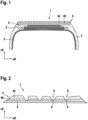
- the Fig. 1 shows a simplified cross-section through the tread area of pneumatic tires for commercial vehicles, where the usual components of the tire are a tread 1, a belt 2 consisting of four belt layers with rubber-embedded, preferably made of steel cord, and a radial carcass 3 also reinforced with reinforcements. Only the radially outer end sections of the tire's sidewalls 7 are shown. Not shown are bead areas with bead cores, core profiles, and other bead components.
- the tread 1 is divided in a known manner into an upper tread section 4 and a lower tread section 5.
- Profiling is not shown.
- the lower tread section 5 has a substantially constant thickness in the range of 2 mm to 5 mm and consists of a rubber compound optimized for rolling resistance.
- An example rubber compound is listed in Table 1 below.
- the tread upper part 4 is that part of the tread 1 which is covered with a Fig. 2 shown profile is provided with circumferential grooves, whereby the Fig. 2 shows the freshly extruded cross-section of a tread, in which the circumferential grooves are "pre-cut” as grooves 6.
- the correct profile will be pressed in later, when the green tire is covered with the tread component and vulcanized.
- the tread cap 4 consists of two superimposed layers 4a, 4b. These two layers 4a, 4b have a thickness in the range of 14 mm to 22 mm.
- the rubber compound of the radially outermost layer 4a of the tread cap 4, which comes into contact with the road surface, is optimized with regard to its abrasion resistance, and the rubber compound of the radially innermost layer 4b of the tread cap 4 is optimized with regard to its crack prevention property in the grooves.
- a rubber compound optimized with regard to its abrasion resistance and another rubber compound optimized with regard to the prevention of crack formation in the groove bottoms are listed in Table 1 below.
- the Fig. 2 shows a cross-section through the extruded tread, which will later be used as a tire component for pneumatic tires for commercial vehicles of the Fig. 1 is used.
- the rubber compound optimized to prevent cracking in the groove base 8, surrounds the groove bases.
- the radially innermost layer 4b has a thickness corresponding to 10% - 30% of the thickness of the entire tread upper part 4.
Landscapes
- Engineering & Computer Science (AREA)
- Mechanical Engineering (AREA)
- Manufacturing & Machinery (AREA)
- Tires In General (AREA)
- Compositions Of Macromolecular Compounds (AREA)
Description
- Die Erfindung betrifft einen Fahrzeugluftreifen für Nutzfahrzeuge mit einer Radialkarkasse, einem mehrlagigen Gürtel und einem Laufstreifen mit drei radial übereinander angeordneten Schichten aus einem Laufstreifenunterteil und einem profilierten, Umfangsrillen aufweisenden Laufstreifenoberteil, wobei das profilierte Laufstreifenoberteil aus zwei in radialer Richtung aufeinander angeordneten Schichten aus unterschiedlichen Kautschukmischungen besteht, wobei die Kautschukmischung der radial äußersten Schicht des Laufstreifenoberteiles, welche mit der Fahrbahnoberfläche in Kontakt kommt, hinsichtlich der Eigenschaft Beständigkeit gegen Abrieb optimiert ist.
- Ein derartiger Fahrzeugluftreifen ist aus der
EP 2 108 530 B1 bekannt geworden. Der Laufstreifen weist ein Laufstreifenunterteil (auch "Base" genannt) und ein aus zwei in radialer Richtung aufeinander angeordneten Schichten aus unterschiedlicher Kautschukmischung bestehendes Laufstreifenoberteil (auch "Cap" genannt) auf. Der Laufstreifen besteht somit aus drei in radialer Richtung aufeinander angeordneten Schichten aus unterschiedlichen Kautschukmischungen. Die beiden Kautschukmischungen des Laufstreifenoberteils weisen eine voneinander abweichende Rückprallelastizität auf, während das Laufstreifenunterteil aus einer für Nutzfahrzeuge üblichen Base-Mischung besteht. Es wird der Zielkonflikt zwischen der Beständigkeit gegen unregelmäßigen Abrieb und dem Rollwiderstand auf einem höheren Niveau gelöst. - Aus der
EP 2 108 525 A1 ist ferner ein Fahrzeugluftreifen, insbesondere für Nutzfahrzeuge, bekannt, wobei der Laufstreifen des Fahrzeugluftreifens in radialer Richtung aus einem Laufstreifenunterteil und einem Laufstreifenoberteil aus drei Schichten besteht. Die Kautschukmischungen der drei Schichten des Laufstreifenoberteils unterscheiden sich voneinander bezüglich der enthaltenen Menge an Butadien-Kautschuk, wobei die radial äußerste Schicht den größten Anteil an Butadien-Kautschuk aufweist und der Anteil an Butadien-Kautschuk in den beiden radial weiter innen liegenden Schichten in Richtung Reifeninnenseite von Schicht zu Schicht stufenweise abnimmt. Der Reifen soll gute Traktionseigenschaften, eine hohe Abriebfestigkeit und einen geringen Rollwiderstand aufweisen. - Eine wichtige Eigenschaft für den Laufstreifen von Fahrzeugluftreifen für Nutzfahrzeuge ist die Beständigkeit gegen Abrieb. Die Beständigkeit gegen Abrieb sollte möglichst groß sein, damit der Luftreifen eine lange Lebensdauer hat. Weiterhin ist es erwünscht, möglichst Treibstoff sparende Reifen einzusetzen, um den Kraftstoffverbrauch zu reduzieren. Weiterhin ist allgemein bekannt, dass im Bereich der Rillen, insbesondere an deren Rillengrund, Risse initiiert werden können, welche den Laufstreifen schädigen und ebenfalls die Lebensdauer des Reifens herabsetzten können.
- Der Erfindung liegt die Aufgabe zugrunde, einen Fahrzeugluftreifen bereitzustellen, welcher in Bezug auf den Treibstoff sparsam ist und zudem eine möglichst lange Lebensdauer aufweist. Ferner ist es die Aufgabe der Erfindung, ein Verfahren zur Herstellung eines Laufstreifens für den vorgenannten Fahrzeugluftreifen bereitzustellen.
- Gelöst wird die gestellte Aufgabe in Bezug auf den Fahrzeugluftreifen erfindungsgemäß dadurch,
- dass die Kautschukmischung des Laufstreifenunterteils hinsichtlich der Eigenschaft Rollwiderstand optimiert ist,
- dass die Kautschukmischung der radial äußersten Schicht des Laufstreifenoberteiles 60 phr bis 100 phr Naturkautschuk,
- 0 phr bis 40 phr Butadien-Kautschuk, wobei der Butadien-Kautschuk High cis-1.4 oder SSBR ist,
- 35 phr bis 80 phr Ruß, wobei der Ruß N234/N121/N339 ist,
- 0 phr bis 20 phr Kieselsäure oder weiteren Füllstoff,
- 0 phr bis 10 phr Weichmacher und
- 3 phr bis 10 phr Vernetzungsmittel enthält und
- dass die Kautschukmischung der radial innersten Schicht des Laufstreifenoberteiles hinsichtlich der Eigenschaft Rissvermeidung in den Umfangsrillen optimiert ist, wobei diese Kautschukmischung
- 70 phr bis 100 phr Naturkautschuk,
- 0 phr bis 30 phr Butadien-Kautschuk, wobei der Butadien-Kautschuk High cis-1.4 oder SSBR ist,
- 30 phr bis 60 phr Ruß, wobei der Ruß N234/N121/N339 ist,
- 0 phr bis 20 phr Kieselsäure oder weiteren Füllstoff,
- 0 phr bis 10 phr Weichmacher und
- 3 phr bis 10 phr Vernetzungsmittel enthält.
- Bei erfindungsgemäß ausgeführten Fahrzeugluftreifen für Nutzfahrzeuge weist der Laufstreifen drei radial übereinander angeordnete Schichten auf, wobei jede der drei Schichten für unterschiedliche Aufgaben optimierte Kautschukmischungen aufweist. Die radial äußerste Schicht ist hinsichtlich der Beständigkeit gegenüber Abrieb optimiert, die mittlere Schicht, welche die Gründe/ die Böden der Rillen der Profilierung umfasst, ist auf Vermeidung von Rissen im Bereich der Rillengründe optimiert und die radial innerste Schicht ist in Bezug auf den Rollwiderstand optimiert. Somit ist ein Fahrzeugluftreifen für Nutzfahrzeuge bereitgestellt, welcher in seiner Haltbarkeit verbessert ist und gleichzeitig sparsam hinsichtlich des Treibstoffverbrauches ist.
- Vorteilhaft ist es, wenn das Laufstreifenunterteil aus einer Kautschukmischung enthaltend Naturkautschuk zwischen 80 - 100 phr, Butadien-Kautschuk, High cis-1.4 oder SSBR zwischen 0 - 20 phr, Ruß, N234/N121/N339 zwischen 20 - 50 phr, Kieselsäure oder weiterem Füllstoff 0 - 20 phr, Weichmacher zwischen 0 - 10 phr und Vernetzungsmittel zwischen 3 - 10 phr, besteht. Diese Kautschukmischung ist für einen verbesserten Rollwiderstand optimiert, wodurch weniger Treibstoff verbraucht wird.
- Die in dieser Schrift verwendete Angabe phr (parts per hundred parts of rubber by weight) ist dabei die in der Kautschukindustrie übliche Mengenangabe für Mischungsrezepturen. Die Dosierung der Gewichtsteile der einzelnen Substanzen wird dabei stets auf 100 Gewichtsteile der gesamten Masse aller in der Mischung vorhandenen Kautschuke bezogen. Die Masse aller in der Mischung vorhandenen Kautschuke addiert sich zu 100.
- In einer Ausführung der Erfindung weisen die Schichten des Laufstreifenoberteiles übereinstimmende Dicken auf.
- In einer anderen Ausführung der Erfindung kann jedoch auch vorgesehen sein, die Schichten unterschiedlich dick auszuführen, beispielsweise derart, dass ihre Dicke von der radial äußersten bis zur radial innersten Schicht zunimmt oder vice versa.
- Zweckmäßig ist es, wenn die radial innerste Schicht des Laufstreifenoberteiles die Rillengründe der Umfangsrillen umfasst. Dadurch, dass die Rillengründe allseitig von der Kautschukmischung, welche auf Vermeidung von Rissen im Rillengrund optimiert ist, umschlossen sind, können Rissbildungen weitgehend vermieden werden.
- In mindestens einer Umfangsrille kann im Rillengrund ein Abnutzungsindikator (TWI) angeordnet sein, der radial nach außen über den Rillengrund hinausragt und aufgrund seiner maximalen radialen Höhe, seinem maximalen Abstand in radialer Richtung zum Rillengrund, einen kritischen Reifenverschleiß anzeigt. Besonders zweckmäßig ist es, die Dicke der radial äußersten Schicht so zu gestalten, dass der mindestens eine Abnutzungsindikator nicht in diese radial äußerste Schicht hineinragt. So ist sichergestellt, dass die gegen Abrieb beständige äußerste Schicht komplett abgetragen ist, wenn der Abnutzungsindikator in seiner maximalen radialen Höhe abgetragen wird und dann den kritischen Reifenverschleiß anzeigt.
- Gelöst wird die gestellte Aufgabe in Bezug auf das Verfahren zur Herstellung eines Laufstreifens eines Fahrzeugluftreifens für Nutzfahrzeuge nach einem oder mehreren der vorangehenden Ausführungen, wobei die Kautschukmischung des Laufstreifenunterteils hinsichtlich der Eigenschaft Rollwiderstand optimiert ist, wobei die Kautschukmischung der radial äußersten Schicht des Laufstreifenoberteiles, welche mit der Fahrbahnoberfläche in Kontakt kommt, hinsichtlich der Eigenschaft Beständigkeit gegen Abrieb (wear) optimiert ist und wobei die Kautschukmischung der radial innersten Schicht des Laufstreifenoberteiles hinsichtlich der Eigenschaft Rissvermeidung in den Umfangsrillen optimiert ist, erfindungsgemäß dadurch, dass man den Laufstreifen mittels eines Triplex-Extruders extrudiert, wobei der Spritzkopf des Extruders derart aufgebaut ist, dass der extrudierte Laufstreifen im Querschnitt im Bereich der späteren Umfangsrillen entsprechend konturierte Nuten aufweist.
- Dabei ist es zweckmäßig, um Verquetschungen der unterschiedlichen Kautschukmischungen zu vermeiden, wenn die Nuten durch im Spritzkopf angeordnete Schneiden in den dreischichtigen endlosen Laufstreifen geschnitten werden.
- Weitere Merkmale, Vorteile und Einzelheiten der Erfindung werden nun anhand der Zeichnungen, die schematisch ein Ausführungsbeispiel darstellen, näher beschrieben. Dabei zeigen die
-
Fig. 1 eine Ausführungsform der Erfindung anhand eines Querschnittes durch einen Fahrzeugluftreifen im Bereich des Laufstreifens und -
Fig. 2 einen Querschnitt des Laufstreifens derFig.1 mit Profilierung direkt nach erfolgter Extrusion. - Die
Fig. 1 zeigt einen vereinfachten Querschnitt durch den Laufstreifenbereich von Luftreifen für Nutzfahrzeugen, wobei von den üblichen Bauteilen des Reifens ein Laufstreifen 1, ein Gürtel 2 bestehend aus vier Gürtellagen mit in Gummi eingebetteten, vorzugsweise aus Stahlkord bestehenden Festigkeitsträgern, und eine ebenfalls mit Festigkeitsträgern verstärkte Radialkarkasse 3 dargestellt sind. Von den Seitenwänden 7 des Reifens sind lediglich die radial äußeren Endabschnitte gezeigt. Nicht dargestellt sind Wulstbereiche mit Wulstkernen, Kernprofilen und sonstigen Wulstbauteilen. - Der Laufstreifen 1 ist in bekannter Weise in ein Laufstreifenoberteil 4 und ein Laufstreifenunterteil 5 geteilt. Eine Profilierung ist nicht dargestellt. Das Laufstreifenunterteil 5 weist eine im Wesentlichen konstante Stärke in der Größenordnung von 2 mm bis 5 mm auf und besteht aus einer Kautschukmischung, welche hinsichtlich der Eigenschaft Rollwiderstand optimiert ist. Eine beispielsweise Kautschukmischung ist in der nachfolgenden Tabelle 1 genannt.
- Das Laufstreifenoberteil 4 ist jener Teil des Laufstreifens 1, welcher mit einer nur in der
Fig. 2 gezeigten Profilierung mit Umfangsrillen versehen ist, wobei dieFig. 2 den frisch extrudierten Querschnitt eines Laufstreifens zeigt, bei dem die Umfangsrillen als Nuten 6 "vorgeschnitten" sind. Das richtige Profil wird später, wenn der Rohreifen mit dem Bauteil Laufstreifen belegt ist und vulkanisiert wird, eingepresst. - Gemäß der Erfindung besteht das Laufstreifenoberteil 4 aus zwei übereinander angeordneten Schichten 4a, 4b. Diese zwei Schichten 4a, 4b weisen eine Dicke in der Größenordnung von 14 mm bis 22 mm auf. Die Kautschukmischung der radial äußersten Schicht 4a des Laufstreifenoberteiles 4, welche mit der Fahrbahnoberfläche in Kontakt kommt, ist hinsichtlich der Eigenschaft Beständigkeit gegen Abrieb optimiert und die Kautschukmischung der radial innersten Schicht 4b des Laufstreifenoberteiles 4 ist hinsichtlich der Eigenschaft Rissvermeidung in den Rillen optimiert. Eine Kautschukmischung, welche hinsichtlich der Beständigkeit gegen Abrieb optimiert ist und eine weitere Kautschukmischung, welche hinsichtlich der Vermeidung von Rissbildungen in den Rillengründen optimiert ist, ist in der nachfolgenden Tabelle 1 genannt.
Tabelle 1 Kautschukmischung, enthaltend (in phr) radial äußerste Schicht des Laufstreifenoberteiles radial innerste Schicht des Laufstreifenoberteiles Laufstreifenunterteil Naturkautschuk 100 100 100 Butadien-Kautschuk, High cis-1.4 oder SSBR 0 0 0 Ruß, N234/N121/N339 55 45 40 Kieselsäure oder weiterer Füllstoff 0 13 15 Weichmacher 0 0 0 Vernetzungsmittel 7.5 7.5 8.5 Abrieb (%, Straßentest) 120 105 100 Rückprall (RT) 43 42 54 - Es ist aus Tests ersichtlich, dass der Abrieb der radial äußersten Schicht des Laufstreifenoberteils hinsichtlich der radial innersten Schicht des Laufstreifenoberteiles und hinsichtlich des Laufstreifenunterteils einen um 15% bzw. 20% verbesserten Abrieb aufweist, wobei der Abrieb im Straßentest (L-EXT) ermittelt worden ist. Es ist ebenfalls ersichtlich, dass das Laufstreifenunterteil hinsichtlich der Rückprallelastizität und somit hinsichtlich des Rollwiderstandes Vorteile bezüglich der anderen beiden Schichten aufweist. Die Rückprallelastizität ist ermittelt mittels eines Pendelschlagwerks nach DIN 53512:2000-04 (Ausführung nach Schob) der Fa. Zwick, Typ 5109.
- Die
Fig. 2 zeigt einen Querschnitt durch den extrudierten Laufstreifen, welcher später als Reifenbauteil für Luftreifen für Nutzfahrzeuge derFig. 1 verwendet wird. Die hinsichtlich der Vermeidung von Rissbildungen im Rillengrund 8 optimierte Kautschukmischung umschließt die Rillengründe. Die radial innerste Schicht 4b weist dabei eine Dicke auf, welche 10% - 30% der Dicke des gesamten Laufstreifenoberteiles 4 entspricht. -
- 1
- Laufstreifen
- 2
- Gürtel
- 3
- Radialkarkasse
- 4
- Laufstreifenoberteil
- 4a
- Schicht
- 4b
- Schicht
- 5
- Laufstreifenunterteil
- 6
- Nut
- 7
- Seitenwand
- 8
- Rillengrund
- rR
- Radiale Richtung
- aR
- Axiale Richtung
Claims (7)
- Fahrzeugluftreifen für Nutzfahrzeuge mit einer Radialkarkasse, einem mehrlagigen Gürtel (2) und einem Laufstreifen (1) mit drei radial übereinander angeordneten Schichten (4a, 4b, 5) aus einem Laufstreifenunterteil (5) und einem profilierten, Umfangsrillen aufweisenden Laufstreifenoberteil (4), wobei das profilierte Laufstreifenoberteil (4) aus zwei in radialer Richtung aufeinander angeordneten Schichten (4a, 4b) aus unterschiedlichen Kautschukmischungen besteht, wobei die Kautschukmischung der radial äußersten Schicht (4a) des Laufstreifenoberteiles (4), welche mit der Fahrbahnoberfläche in Kontakt kommt, hinsichtlich der Eigenschaft Beständigkeit gegen Abrieb optimiert ist,
dadurch gekennzeichnet,dass die Kautschukmischung des Laufstreifenunterteils (5) hinsichtlich der Eigenschaft Rollwiderstand optimiert ist,dass die Kautschukmischung der radial äußersten Schicht (4a) des Laufstreifenoberteiles (4)60 phr bis 100 phr Naturkautschuk,0 phr bis 40 phr Butadien-Kautschuk, wobei der Butadien-Kautschuk High cis-1.4 oder SSBR ist,35 phr bis 80 phr Ruß, wobei der Ruß N234/N121/N339 ist,0 phr bis 20 phr Kieselsäure oder weiteren Füllstoff,0 phr bis 10 phr Weichmacher und3 phr bis 10 phr Vernetzungsmittel enthält unddass die Kautschukmischung der radial innersten Schicht (4b) des Laufstreifenoberteiles (4) hinsichtlich der Eigenschaft Rissvermeidung in den Umfangsrillen optimiert ist,wobei diese Kautschukmischung70 phr bis 100 phr Naturkautschuk,0 phr bis 30 phr Butadien-Kautschuk, wobei der Butadien-Kautschuk High cis-1.4 oder SSBR ist,30 phr bis 60 phr Ruß, wobei der Ruß N234/N121/N339 ist,0 phr bis 20 phr Kieselsäure oder weiteren Füllstoff,0 phr bis 10 phr Weichmacher und3 phr bis 10 phr Vernetzungsmittel enthält. - Fahrzeugluftreifen nach Anspruch 1, dadurch gekennzeichnet, dass das Laufstreifenunterteil (5) aus einer Kautschukmischung enthaltend Naturkautschuk zwischen 80 - 100 phr, Butadien-Kautschuk, High cis-1.4 oder SSBR zwischen 0 - 20 phr, Ruß, N234/N121/N339 zwischen 20 - 50 phr, Kieselsäure oder weiterem Füllstoff 0 - 20 phr, Weichmacher zwischen 0 - 10 phr und Vernetzungsmittel zwischen 3 - 10 phr, besteht.
- Fahrzeugluftreifen nach Anspruch 1 oder 2, dadurch gekennzeichnet, dass die Schichten (4a, 4b) des Laufstreifenoberteiles (4) übereinstimmende Dicken aufweisen.
- Fahrzeugluftreifen nach einem der Ansprüche 1 bis 3, dadurch gekennzeichnet, dass die radial innerste Schicht (4b) des Laufstreifenoberteiles (4) die Rillengründe (8) der Umfangsrillen umfasst.
- Fahrzeugluftreifen nach einem der Ansprüche 1 bis 4, dadurch gekennzeichnet, dass in mindestens einer Umfangsrille im Rillengrund ein Abnutzungsindikator angeordnet ist, der radial nach außen über den Rillengrund hinausragt und aufgrund seiner maximalen radialen Höhe einen kritischen Reifenverschleiß anzeigt, wobei die Dicke der radial äußersten Schicht (4a) so gestaltet ist, dass der Abnutzungsindikator mit seiner maximalen radialen Höhe nicht in die radial äußerste Schicht (4a) hineinragt.
- Verfahren zur Herstellung eines Laufstreifens eines Fahrzeugluftreifens für Nutzfahrzeuge nach einem oder mehreren der vorangehenden Ansprüche 1 bis 5, wobei die Kautschukmischung des Laufstreifenunterteils (5) hinsichtlich der Eigenschaft Rollwiderstand optimiert ist, wobei die Kautschukmischung der radial äußersten Schicht (4a) des Laufstreifenoberteiles (4), welche mit der Fahrbahnoberfläche in Kontakt kommt, hinsichtlich der Eigenschaft Beständigkeit gegen Abrieb optimiert ist und wobei die Kautschukmischung der radial innersten Schicht (4b) des Laufstreifenoberteiles (4) hinsichtlich der Eigenschaft Rissvermeidung in den Umfangsrillen optimiert ist, dadurch gekennzeichnet,
dass man den Laufstreifen mittels eines Triplex-Extruders extrudiert, wobei der Spritzkopf des Extruders derart aufgebaut ist, dass der extrudierende Laufstreifen (1) im Querschnitt im Bereich der späteren Umfangsrillen entsprechend konturierte Nuten (6) aufweist. - Verfahren zur Herstellung eines Laufstreifens (1) eines Fahrzeugluftreifens für Nutzfahrzeuge nach Anspruch 6, dadurch gekennzeichnet, dass die Nuten (6) durch im Spritzkopf angeordnete Schneiden in den Laufstreifen (1) geschnitten werden.
Applications Claiming Priority (1)
| Application Number | Priority Date | Filing Date | Title |
|---|---|---|---|
| DE102020210391.7A DE102020210391A1 (de) | 2020-08-14 | 2020-08-14 | Fahrzeugluftreifen und Verfahren zu Herstellung eines Laufstreifens für einen Fahrzeugluftreifen |
Publications (2)
| Publication Number | Publication Date |
|---|---|
| EP3967518A1 EP3967518A1 (de) | 2022-03-16 |
| EP3967518B1 true EP3967518B1 (de) | 2025-05-07 |
Family
ID=77071352
Family Applications (1)
| Application Number | Title | Priority Date | Filing Date |
|---|---|---|---|
| EP21187897.0A Active EP3967518B1 (de) | 2020-08-14 | 2021-07-27 | Fahrzeugluftreifen und verfahren zu herstellung eines laufstreifens für einen fahrzeugluftreifen |
Country Status (2)
| Country | Link |
|---|---|
| EP (1) | EP3967518B1 (de) |
| DE (1) | DE102020210391A1 (de) |
Family Cites Families (3)
| Publication number | Priority date | Publication date | Assignee | Title |
|---|---|---|---|---|
| DE102008018339A1 (de) | 2008-04-11 | 2009-10-15 | Continental Aktiengesellschaft | Fahrzeugluftreifen |
| DE102008018341A1 (de) * | 2008-04-11 | 2009-10-15 | Continental Aktiengesellschaft | Fahrzeugluftreifen |
| DE102008030711A1 (de) * | 2008-06-27 | 2009-12-31 | Continental Aktiengesellschaft | Fahrzeugluftreifen |
-
2020
- 2020-08-14 DE DE102020210391.7A patent/DE102020210391A1/de active Pending
-
2021
- 2021-07-27 EP EP21187897.0A patent/EP3967518B1/de active Active
Also Published As
| Publication number | Publication date |
|---|---|
| DE102020210391A1 (de) | 2022-02-17 |
| EP3967518A1 (de) | 2022-03-16 |
Similar Documents
| Publication | Publication Date | Title |
|---|---|---|
| DE3879416T2 (de) | Radialer reifen. | |
| DE69300489T2 (de) | Luftreifen. | |
| EP3288781B1 (de) | Fahrzeugluftreifen mit einem laufstreifen | |
| DE69611479T2 (de) | Luftreifen | |
| DE69924074T2 (de) | Spikeloser Luftreifen | |
| EP2268493B1 (de) | Fahrzeugluftreifen | |
| EP2125390B1 (de) | Fahrzeugluftreifen mit geschichtetem laufstreifen | |
| EP3362300B1 (de) | Nutzfahrzeugreifen | |
| DE102013100364B4 (de) | Luftreifen | |
| WO2012159809A1 (de) | Fahrzeugluftreifen | |
| EP3967518B1 (de) | Fahrzeugluftreifen und verfahren zu herstellung eines laufstreifens für einen fahrzeugluftreifen | |
| EP3833550B1 (de) | Fahrzeugluftreifen und kautschukmischung für einen laufstreifen | |
| DE102018131381B4 (de) | Luftreifen | |
| EP2108528B1 (de) | Fahrzeugluftreifen | |
| EP3300924B1 (de) | Fahrzeugluftreifen | |
| EP3321109B1 (de) | Fahrzeugluftreifen | |
| EP2108525B1 (de) | Fahrzeugluftreifen | |
| EP2675632B1 (de) | Fahrzeugluftreifen in radialbauart für nutzfahrzeuge | |
| DE102014208551A1 (de) | Fahrzeugluftreifen | |
| EP3980279B1 (de) | Fahrzeugluftreifen | |
| DE4018117A1 (de) | Radialreifen | |
| EP2108530B1 (de) | Fahrzeugluftreifen | |
| DE102013109355A1 (de) | Fahrzeugluftreifen | |
| DE102021203261A1 (de) | Reifenrohling, Fahrzeugreifen sowie Verfahren zur Herstellung eines Fahrzeugreifens | |
| DE10351587A1 (de) | Fahrzeugluftreifen |
Legal Events
| Date | Code | Title | Description |
|---|---|---|---|
| PUAI | Public reference made under article 153(3) epc to a published international application that has entered the european phase |
Free format text: ORIGINAL CODE: 0009012 |
|
| STAA | Information on the status of an ep patent application or granted ep patent |
Free format text: STATUS: THE APPLICATION HAS BEEN PUBLISHED |
|
| AK | Designated contracting states |
Kind code of ref document: A1 Designated state(s): AL AT BE BG CH CY CZ DE DK EE ES FI FR GB GR HR HU IE IS IT LI LT LU LV MC MK MT NL NO PL PT RO RS SE SI SK SM TR |
|
| STAA | Information on the status of an ep patent application or granted ep patent |
Free format text: STATUS: REQUEST FOR EXAMINATION WAS MADE |
|
| 17P | Request for examination filed |
Effective date: 20220916 |
|
| RBV | Designated contracting states (corrected) |
Designated state(s): AL AT BE BG CH CY CZ DE DK EE ES FI FR GB GR HR HU IE IS IT LI LT LU LV MC MK MT NL NO PL PT RO RS SE SI SK SM TR |
|
| STAA | Information on the status of an ep patent application or granted ep patent |
Free format text: STATUS: EXAMINATION IS IN PROGRESS |
|
| 17Q | First examination report despatched |
Effective date: 20230213 |
|
| RAP3 | Party data changed (applicant data changed or rights of an application transferred) |
Owner name: CONTINENTAL REIFEN DEUTSCHLAND GMBH |
|
| GRAP | Despatch of communication of intention to grant a patent |
Free format text: ORIGINAL CODE: EPIDOSNIGR1 |
|
| STAA | Information on the status of an ep patent application or granted ep patent |
Free format text: STATUS: GRANT OF PATENT IS INTENDED |
|
| INTG | Intention to grant announced |
Effective date: 20250103 |
|
| GRAS | Grant fee paid |
Free format text: ORIGINAL CODE: EPIDOSNIGR3 |
|
| GRAA | (expected) grant |
Free format text: ORIGINAL CODE: 0009210 |
|
| STAA | Information on the status of an ep patent application or granted ep patent |
Free format text: STATUS: THE PATENT HAS BEEN GRANTED |
|
| P01 | Opt-out of the competence of the unified patent court (upc) registered |
Free format text: CASE NUMBER: APP_13759/2025 Effective date: 20250320 |
|
| AK | Designated contracting states |
Kind code of ref document: B1 Designated state(s): AL AT BE BG CH CY CZ DE DK EE ES FI FR GB GR HR HU IE IS IT LI LT LU LV MC MK MT NL NO PL PT RO RS SE SI SK SM TR |
|
| REG | Reference to a national code |
Ref country code: GB Ref legal event code: FG4D Free format text: NOT ENGLISH |
|
| REG | Reference to a national code |
Ref country code: CH Ref legal event code: EP |
|
| REG | Reference to a national code |
Ref country code: DE Ref legal event code: R096 Ref document number: 502021007385 Country of ref document: DE |
|
| REG | Reference to a national code |
Ref country code: IE Ref legal event code: FG4D Free format text: LANGUAGE OF EP DOCUMENT: GERMAN |
|
| REG | Reference to a national code |
Ref country code: NL Ref legal event code: FP |
|
| PGFP | Annual fee paid to national office [announced via postgrant information from national office to epo] |
Ref country code: NL Payment date: 20250721 Year of fee payment: 5 |
|
| PG25 | Lapsed in a contracting state [announced via postgrant information from national office to epo] |
Ref country code: PT Free format text: LAPSE BECAUSE OF FAILURE TO SUBMIT A TRANSLATION OF THE DESCRIPTION OR TO PAY THE FEE WITHIN THE PRESCRIBED TIME-LIMIT Effective date: 20250908 Ref country code: ES Free format text: LAPSE BECAUSE OF FAILURE TO SUBMIT A TRANSLATION OF THE DESCRIPTION OR TO PAY THE FEE WITHIN THE PRESCRIBED TIME-LIMIT Effective date: 20250507 Ref country code: FI Free format text: LAPSE BECAUSE OF FAILURE TO SUBMIT A TRANSLATION OF THE DESCRIPTION OR TO PAY THE FEE WITHIN THE PRESCRIBED TIME-LIMIT Effective date: 20250507 |
|
| PGFP | Annual fee paid to national office [announced via postgrant information from national office to epo] |
Ref country code: DE Payment date: 20250731 Year of fee payment: 5 |
|
| REG | Reference to a national code |
Ref country code: LT Ref legal event code: MG9D |
|
| PG25 | Lapsed in a contracting state [announced via postgrant information from national office to epo] |
Ref country code: GR Free format text: LAPSE BECAUSE OF FAILURE TO SUBMIT A TRANSLATION OF THE DESCRIPTION OR TO PAY THE FEE WITHIN THE PRESCRIBED TIME-LIMIT Effective date: 20250808 Ref country code: NO Free format text: LAPSE BECAUSE OF FAILURE TO SUBMIT A TRANSLATION OF THE DESCRIPTION OR TO PAY THE FEE WITHIN THE PRESCRIBED TIME-LIMIT Effective date: 20250807 |
|
| PG25 | Lapsed in a contracting state [announced via postgrant information from national office to epo] |
Ref country code: PL Free format text: LAPSE BECAUSE OF FAILURE TO SUBMIT A TRANSLATION OF THE DESCRIPTION OR TO PAY THE FEE WITHIN THE PRESCRIBED TIME-LIMIT Effective date: 20250507 |
|
| PG25 | Lapsed in a contracting state [announced via postgrant information from national office to epo] |
Ref country code: BG Free format text: LAPSE BECAUSE OF FAILURE TO SUBMIT A TRANSLATION OF THE DESCRIPTION OR TO PAY THE FEE WITHIN THE PRESCRIBED TIME-LIMIT Effective date: 20250507 |
|
| PG25 | Lapsed in a contracting state [announced via postgrant information from national office to epo] |
Ref country code: HR Free format text: LAPSE BECAUSE OF FAILURE TO SUBMIT A TRANSLATION OF THE DESCRIPTION OR TO PAY THE FEE WITHIN THE PRESCRIBED TIME-LIMIT Effective date: 20250507 |
|
| PGFP | Annual fee paid to national office [announced via postgrant information from national office to epo] |
Ref country code: FR Payment date: 20250725 Year of fee payment: 5 Ref country code: AT Payment date: 20251020 Year of fee payment: 5 |
|
| PG25 | Lapsed in a contracting state [announced via postgrant information from national office to epo] |
Ref country code: RS Free format text: LAPSE BECAUSE OF FAILURE TO SUBMIT A TRANSLATION OF THE DESCRIPTION OR TO PAY THE FEE WITHIN THE PRESCRIBED TIME-LIMIT Effective date: 20250807 |
|
| PG25 | Lapsed in a contracting state [announced via postgrant information from national office to epo] |
Ref country code: IS Free format text: LAPSE BECAUSE OF FAILURE TO SUBMIT A TRANSLATION OF THE DESCRIPTION OR TO PAY THE FEE WITHIN THE PRESCRIBED TIME-LIMIT Effective date: 20250907 |
|
| PG25 | Lapsed in a contracting state [announced via postgrant information from national office to epo] |
Ref country code: LV Free format text: LAPSE BECAUSE OF FAILURE TO SUBMIT A TRANSLATION OF THE DESCRIPTION OR TO PAY THE FEE WITHIN THE PRESCRIBED TIME-LIMIT Effective date: 20250507 |
|
| PG25 | Lapsed in a contracting state [announced via postgrant information from national office to epo] |
Ref country code: DK Free format text: LAPSE BECAUSE OF FAILURE TO SUBMIT A TRANSLATION OF THE DESCRIPTION OR TO PAY THE FEE WITHIN THE PRESCRIBED TIME-LIMIT Effective date: 20250507 Ref country code: SM Free format text: LAPSE BECAUSE OF FAILURE TO SUBMIT A TRANSLATION OF THE DESCRIPTION OR TO PAY THE FEE WITHIN THE PRESCRIBED TIME-LIMIT Effective date: 20250507 |
|
| PG25 | Lapsed in a contracting state [announced via postgrant information from national office to epo] |
Ref country code: CZ Free format text: LAPSE BECAUSE OF FAILURE TO SUBMIT A TRANSLATION OF THE DESCRIPTION OR TO PAY THE FEE WITHIN THE PRESCRIBED TIME-LIMIT Effective date: 20250507 |
|
| PG25 | Lapsed in a contracting state [announced via postgrant information from national office to epo] |
Ref country code: EE Free format text: LAPSE BECAUSE OF FAILURE TO SUBMIT A TRANSLATION OF THE DESCRIPTION OR TO PAY THE FEE WITHIN THE PRESCRIBED TIME-LIMIT Effective date: 20250507 |
|
| PG25 | Lapsed in a contracting state [announced via postgrant information from national office to epo] |
Ref country code: RO Free format text: LAPSE BECAUSE OF FAILURE TO SUBMIT A TRANSLATION OF THE DESCRIPTION OR TO PAY THE FEE WITHIN THE PRESCRIBED TIME-LIMIT Effective date: 20250507 Ref country code: SK Free format text: LAPSE BECAUSE OF FAILURE TO SUBMIT A TRANSLATION OF THE DESCRIPTION OR TO PAY THE FEE WITHIN THE PRESCRIBED TIME-LIMIT Effective date: 20250507 |
|
| PG25 | Lapsed in a contracting state [announced via postgrant information from national office to epo] |
Ref country code: IT Free format text: LAPSE BECAUSE OF FAILURE TO SUBMIT A TRANSLATION OF THE DESCRIPTION OR TO PAY THE FEE WITHIN THE PRESCRIBED TIME-LIMIT Effective date: 20250507 |
|
| REG | Reference to a national code |
Ref country code: DE Ref legal event code: R097 Ref document number: 502021007385 Country of ref document: DE |
|
| REG | Reference to a national code |
Ref country code: CH Ref legal event code: H13 Free format text: ST27 STATUS EVENT CODE: U-0-0-H10-H13 (AS PROVIDED BY THE NATIONAL OFFICE) Effective date: 20260224 |
|
| PLBE | No opposition filed within time limit |
Free format text: ORIGINAL CODE: 0009261 |
|
| STAA | Information on the status of an ep patent application or granted ep patent |
Free format text: STATUS: NO OPPOSITION FILED WITHIN TIME LIMIT |
|
| PG25 | Lapsed in a contracting state [announced via postgrant information from national office to epo] |
Ref country code: LU Free format text: LAPSE BECAUSE OF NON-PAYMENT OF DUE FEES Effective date: 20250727 |
|
| REG | Reference to a national code |
Ref country code: CH Ref legal event code: L10 Free format text: ST27 STATUS EVENT CODE: U-0-0-L10-L00 (AS PROVIDED BY THE NATIONAL OFFICE) Effective date: 20260318 |
|
| REG | Reference to a national code |
Ref country code: BE Ref legal event code: MM Effective date: 20250731 |
|
| 26N | No opposition filed |
Effective date: 20260210 |
|
| PG25 | Lapsed in a contracting state [announced via postgrant information from national office to epo] |
Ref country code: BE Free format text: LAPSE BECAUSE OF NON-PAYMENT OF DUE FEES Effective date: 20250731 |
|
| PG25 | Lapsed in a contracting state [announced via postgrant information from national office to epo] |
Ref country code: CH Free format text: LAPSE BECAUSE OF NON-PAYMENT OF DUE FEES Effective date: 20250731 |