EP3967516A1 - Tire - Google Patents
Tire Download PDFInfo
- Publication number
- EP3967516A1 EP3967516A1 EP19927590.0A EP19927590A EP3967516A1 EP 3967516 A1 EP3967516 A1 EP 3967516A1 EP 19927590 A EP19927590 A EP 19927590A EP 3967516 A1 EP3967516 A1 EP 3967516A1
- Authority
- EP
- European Patent Office
- Prior art keywords
- tire
- sound absorber
- sponge material
- sponge
- carcass
- Prior art date
- Legal status (The legal status is an assumption and is not a legal conclusion. Google has not performed a legal analysis and makes no representation as to the accuracy of the status listed.)
- Granted
Links
Images
Classifications
-
- B—PERFORMING OPERATIONS; TRANSPORTING
- B60—VEHICLES IN GENERAL
- B60C—VEHICLE TYRES; TYRE INFLATION; TYRE CHANGING; CONNECTING VALVES TO INFLATABLE ELASTIC BODIES IN GENERAL; DEVICES OR ARRANGEMENTS RELATED TO TYRES
- B60C19/00—Tyre parts or constructions not otherwise provided for
- B60C19/002—Noise damping elements provided in the tyre structure or attached thereto, e.g. in the tyre interior
-
- A—HUMAN NECESSITIES
- A01—AGRICULTURE; FORESTRY; ANIMAL HUSBANDRY; HUNTING; TRAPPING; FISHING
- A01M—CATCHING, TRAPPING OR SCARING OF ANIMALS; APPARATUS FOR THE DESTRUCTION OF NOXIOUS ANIMALS OR NOXIOUS PLANTS
- A01M29/00—Scaring or repelling devices, e.g. bird-scaring apparatus
- A01M29/06—Scaring or repelling devices, e.g. bird-scaring apparatus using visual means, e.g. scarecrows, moving elements, specific shapes, patterns or the like
- A01M29/08—Scaring or repelling devices, e.g. bird-scaring apparatus using visual means, e.g. scarecrows, moving elements, specific shapes, patterns or the like using reflection, colours or films with specific transparency or reflectivity
-
- A—HUMAN NECESSITIES
- A01—AGRICULTURE; FORESTRY; ANIMAL HUSBANDRY; HUNTING; TRAPPING; FISHING
- A01M—CATCHING, TRAPPING OR SCARING OF ANIMALS; APPARATUS FOR THE DESTRUCTION OF NOXIOUS ANIMALS OR NOXIOUS PLANTS
- A01M29/00—Scaring or repelling devices, e.g. bird-scaring apparatus
- A01M29/06—Scaring or repelling devices, e.g. bird-scaring apparatus using visual means, e.g. scarecrows, moving elements, specific shapes, patterns or the like
- A01M29/10—Scaring or repelling devices, e.g. bird-scaring apparatus using visual means, e.g. scarecrows, moving elements, specific shapes, patterns or the like using light sources, e.g. lasers or flashing lights
-
- A—HUMAN NECESSITIES
- A01—AGRICULTURE; FORESTRY; ANIMAL HUSBANDRY; HUNTING; TRAPPING; FISHING
- A01M—CATCHING, TRAPPING OR SCARING OF ANIMALS; APPARATUS FOR THE DESTRUCTION OF NOXIOUS ANIMALS OR NOXIOUS PLANTS
- A01M2200/00—Kind of animal
- A01M2200/01—Insects
Definitions
- the present disclosure relates to a tire.
- a sound absorber formed from a porous body such as a sponge material, for example, has been arranged on the inner surface of the tire (see patent literature (PTL) 1).
- insects are attracted to the sound absorber in some cases, particularly during storage of the tire before mounting on a rim.
- a tire according to the present disclosure includes:
- a tire capable of protecting the sound absorber from insects can be provided.
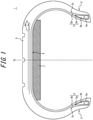
- FIG. 1 is a cross-sectional view in the tire width direction of a tire according to an embodiment of the present disclosure.
- FIG. 1 is a cross-sectional view in the tire width direction of a tire according to an embodiment of the present disclosure.
- a tire 1 is a pneumatic tire and includes a carcass 3 toroidally extending between a pair of bead portions 2.
- the tire 1 also includes a belt 4, formed by two belt layers 4a, 4b in the illustrated example, and a tread 5 on the outer side, in the tire radial direction, of a crown portion of the carcass 3 in this order.
- the pneumatic tire can be filled not only with air but also with an inert gas such as nitrogen or argon.
- a bead core 2a is embedded in each bead portion 2 of the pair of bead portions 2.
- the cross-sectional shape and material of the bead core 2a are not particularly limited, and a configuration normally used in tires can be adopted.
- the tire 1 in the illustrated example has a bead filler 2b with a triangular cross-sectional shape on the outer side, in the tire radial direction, of the bead core 2a.
- the cross-sectional shape of the bead filler 2b is not limited to this example, nor is the material particularly limited.
- the tire can be made lighter by being configured without the bead filler 2b.
- the carcass 3 is formed by one carcass ply that is radially arranged (with the carcass cords forming an angle of 85° or more with respect to the tire circumferential direction, preferably 90° with respect to the tire circumferential direction).
- the number of carcass plies is not particularly limited and can be two or more.
- the carcass 3 has a carcass body portion 3a toroidally extending between the pair of bead portions 2 and carcass folded portions 3b that extend from the carcass body portion 3a and fold up around the bead cores 2a.
- the carcass folded portion 3b can be wrapped around the bead core 2a, or can be structured to be sandwiched between a plurality of divided small bead cores.
- folded ends 3c of the folded portions 3b of the carcass 3 are positioned on the outer side, in the tire radial direction, of the bead filler 2b and on the inner side, in the tire radial direction, of the tire maximum width position (the tire radial position where the width in the tire width direction is the greatest), but the positions of the folded ends 3c are not limited to this example and can be set appropriately.
- the carcass 3 can also be a bias carcass.
- the tire 1 includes the belt 4 formed by the two belt layers 4a, 4b.
- the belt layers 4a, 4b are inclined belt layers formed by belt cords that are inclined with respect to the tire circumferential direction and intersect each other between layers.
- the number of belt layers is not particularly limited.
- the inclination angle of the belt cords in the belt layers is not particularly limited but can, for example, be 35° to 85° with respect to the tire circumferential direction.
- One or more reinforcing belt layers can be arranged on the outer and/or inner sides, in the tire radial direction, of the inclined belt layers.
- the reinforcing cords of the reinforcing belt layers are not particularly limited but can, for example, extend at an angle of 0° to 5° in the tire circumferential direction.
- the width in the tire width direction of each belt layer and each reinforcing belt layer is not particularly limited. Appropriate known materials can be used as the materials of the belt cords and the reinforcing cords, and the number of cords and the like can also be set as needed.
- the tire 1 has a tread 5 formed by one layer of tread rubber.
- the tread rubber configuring the tread 5 may be formed from a plurality of different rubber layers.
- the different rubber layers can be stacked in the tire radial direction and/or arranged side by side in the tire width direction.
- the tire 1 of the present embodiment includes a sound absorber 7 on the inner surface 6 of the tire 1 (in this example, more specifically, the inner surface of the tread portion including the tread 5).
- the sound absorber 7 is a porous body (in this example, a sponge material).
- the sound absorber 7 has a rectangular shape in a cross-sectional view in the tire width direction, but the shape of the sound absorber 7 is not particularly limited.
- the dimensions and the like of the sound absorber 7 are also not particularly limited, but the volume of the sound absorber 7 is preferably 0.1% to 80% of the total volume of the inner cavity of the tire 1.
- the reason is that the sound absorption can be improved by setting the volume of the sound absorber 7 to 0.1% or more of the total volume of the inner cavity of the tire 1, whereas a weight increase due to the sound absorber 7 can be suppressed by setting the volume of the sound absorber 7 to 80% or less of the total volume of the inner cavity of the tire 1.
- the "volume” referred to here is the volume under normal temperature and pressure, with the tire 1 removed from the rim.
- the “total volume of the inner cavity of the tire” refers to the total volume when the tire 1 is mounted on an applicable rim and filled to the specified internal pressure.
- the "applicable rim” refers to a standard rim of an applicable size, such as the Measuring Rim in the STANDARDS MANUAL of the European Tyre and Rim Technological Organisation (ETRTO) in Europe or the Design Rim in the YEAR BOOK of the Tire and Rim Association, Inc. (TRA) in the USA, that is described, or will be described in the future, in industrial standards effective in the region where the tire is manufactured and used, such as the YEAR BOOK published by the Japan Automobile Tyre Manufacturers Association (JATMA) in Japan, the STANDARDS MANUAL of the ETRTO, and the YEAR BOOK of the TRA. (In other words, the "rim” encompasses not only current sizes but also sizes that may be included in industrial standards in the future.
- rim refers to a rim whose width corresponds to the bead width of the tire.
- the “specified internal pressure” represents the air pressure (maximum air pressure) corresponding to the maximum load capability of a single wheel in an applicable size/ply rating described by the aforementioned JATMA or the like.
- the “specified internal pressure” refers to the air pressure (maximum air pressure) corresponding to the maximum load capability prescribed for each vehicle on which the tire is mounted.
- the sound absorber 7 extends continuously in the tire circumferential direction, but the sound absorber 7 can also be formed discontinuously. Also, in this example, the sound absorber 7 is arranged on the inner surface of the tread portion, but the sound absorber 7 can be arranged in various other ways, such as on the inner surface of the sidewall portion.
- the material forming the sound absorber 7 can be any material enabling control to reduce the cavity resonance energy by, for example, mitigating, absorbing, or converting the cavity resonance energy into another form of energy (such as thermal energy) and is not limited to the above-described porous body.
- a non-woven fabric made of organic or inorganic fibers, for example, can also be used.
- the sponge material can be a sponge-like porous structure including, for example, a sponge having continuous bubbles made of foamed rubber or synthetic resin.
- examples of the sponge material include a webbed material in which animal fibers, plant fibers, synthetic fibers, or the like are intertwined and integrally connected.
- the above-described "porous structure" is not limited to a structure with continuous bubbles but also includes a structure with discontinuous bubbles.
- the above-described sponge material converts, into thermal energy, the vibrational energy of the air vibrating in the voids formed on the surface and inside of the sponge material. This suppresses the cavity resonance in the inner cavity of the tire, thereby reducing road noise.
- the sponge material examples include synthetic resin sponges such as an ether-based polyurethane sponge, ester-based polyurethane sponge, and polyethylene sponge, and rubber sponges such as a chloroprene rubber sponge (CR sponge), ethylene propylene diene rubber sponge (EPDM sponge), and nitrile rubber sponge (NBR sponge).
- synthetic resin sponges such as an ether-based polyurethane sponge, ester-based polyurethane sponge, and polyethylene sponge
- rubber sponges such as a chloroprene rubber sponge (CR sponge), ethylene propylene diene rubber sponge (EPDM sponge), and nitrile rubber sponge (NBR sponge).
- CR sponge chloroprene rubber sponge
- EPDM sponge ethylene propylene diene rubber sponge
- NBR sponge nitrile rubber sponge
- the hardness of the sponge material is not limited but is preferably in the range of 5 N to 450 N.
- the sound absorption can be improved by the hardness being set to 5 N or more, whereas the adhesiveness of the sound absorber can be increased by the hardness being set to 450 N or less.
- the hardness of the sound absorber is more preferably in the range of 8 N to 300 N.
- the "hardness" is defined as the value measured in accordance with method A in subsection 6.3 of the measurement method in section 6 of JIS K 6400.
- the specific gravity of the sponge material is preferably between 0.001 and 0.090.
- the reason is that the sound absorption can be improved by the specific gravity of the sponge material being 0.001 or more, whereas an increase in weight due to the sponge material can be suppressed by the specific gravity of the sponge material being 0.090 or less.
- the specific gravity of the sponge material is more preferably between 0.003 and 0.080.
- the "specific gravity” is the value obtained by converting the apparent density into specific gravity in accordance with the measurement method in section 5 of JIS K 6400.
- the tensile strength of the sponge material is preferably between 20 kPa and 500 kPa.
- the reason is that the adhesiveness can be improved by the tensile strength of the sponge material being 20 kPa or more, whereas the productivity of the sponge material can be improved by the tensile strength of the sponge material being 500 kPa or less.
- the tensile strength of the sponge material is more preferably between 40 kPa and 400 kPa.
- the "tensile strength" is defined as the value measured with a No. 1 dumbbell test piece in accordance with the measurement method in section 10 of JIS K 6400.
- the elongation at break of the sponge material is preferably between 110% and 800%.
- the reason is that cracks can be prevented from forming in the sponge material by the elongation at break being 110% or more, whereas the productivity of the sponge material can be improved by the elongation at break being 800% or less.
- the elongation at break of the sponge material is more preferably between 130% and 750%.
- the "elongation at break" is defined as the value measured with a No. 1 dumbbell test piece in accordance with the measurement method in section 10 of JIS K 6400.
- the tearing strength of the sponge material is preferably between 1 N/cm and 130 N/cm.
- the reason is that cracks can be prevented from forming in the sponge material by the tearing strength being 1 N/cm or more, whereas the manufacturability of the sponge material can be improved by the tearing strength being 130 N/cm or less.
- the tearing strength of the sponge material is more preferably between 3 N/cm and 115 N/cm.
- the "tearing strength" is defined as the value measured with a No. 1 test piece in accordance with the measurement method in section 11 of JIS K 6400.
- the foaming ratio of the sponge material should be between 1% and 40%. The reason is that the sound absorption can be improved by the foaming ratio of the sponge material being 1% or more, whereas the productivity of the sponge material can be improved by the foaming ratio of the sponge material being 40% or less. For the same reasons, the foaming ratio of the sponge material is more preferably between 2% and 25%.
- the "foaming ratio" refers to the value yielded by subtracting 1 from the ratio A/B of the specific gravity A of the solid phase portion of the sponge material to the specific gravity B of the sponge material and then multiplying by 100.
- the overall mass of the sponge material is preferably between 5 g and 800 g.
- the reason is that the sound absorption can be improved by the mass being 5 g or more, whereas an increase in weight due to the sponge material can be suppressed by the mass being 800 g or less.
- the mass of the sponge material is preferably between 20 g and 600 g.
- a portion or all (in this example, all) of the sound absorber 7 is orange.
- the wavelength of the visible light emitted from a portion or all (in this example, all) of the sound absorber 7 is between 590 nm and 620 nm.
- Various techniques can be used to make the sound absorber 7 orange, such as dyeing the sound absorber 7 orange.
- the sound absorber 7 is arranged on the inner surface 6 of the tire 1, thereby reducing the resonant vibration (cavity resonance) and improving the sound absorption.
- the sound absorber 7 which is a porous body (for example, a sponge material) or the like, tends to retain heat even during storage. By virtue of having pores and gaps, the sound absorber 7 also tends to attract insects, which remain inside.
- a portion or all (in this example, all) of the sound absorber 7 is orange (in this example, the wavelength of visible light emitted from a portion or all (in this example, all) of the sound absorber 7 is between 590 nm and 620 nm). Therefore, the sound absorber 7 absorbs light in the ultraviolet region, which is the wavelength region that insects easily sense. This prevents insects from being attracted to the sound absorber 7, thereby protecting from insects.
- the tire 1 of the present embodiment can protect the sound absorber 7 from insects.
- the wavelength of visible light emitted from a portion or all (in this example, all) of the sound absorber is preferably between 590 nm and 620 nm. The reason is that when the wavelength is within this range, light having wavelengths in the ultraviolet region can be absorbed more reliably, thereby achieving the aforementioned effect more reliably.
- the sound absorber is preferably a porous body. This enables a reduction in weight in the tire while still achieving the aforementioned effects.
- the porous body is preferably a sponge material. This is because a sponge material is inexpensive and facilitates the manufacturing of an orange sound absorber.
- the remaining portion can be green, for example.
- green includes a wavelength that insects avoid.
- the effect of absorbing ultraviolet rays to protect from insects, combined with the effect of protecting from insects by inclusion of a color that insects avoid, can effectively protect from various kinds of insects.
- the orange and green portions can be arranged side by side in the tire width direction, for example.
Landscapes
- Life Sciences & Earth Sciences (AREA)
- Engineering & Computer Science (AREA)
- Mechanical Engineering (AREA)
- Birds (AREA)
- Insects & Arthropods (AREA)
- Pest Control & Pesticides (AREA)
- Wood Science & Technology (AREA)
- Zoology (AREA)
- Environmental Sciences (AREA)
- Physics & Mathematics (AREA)
- Optics & Photonics (AREA)
- Tires In General (AREA)
Abstract
Description
- The present disclosure relates to a tire.
- To reduce the resonant vibrations of air and gas generated in the inner cavity of a tire (cavity resonance), a sound absorber formed from a porous body such as a sponge material, for example, has been arranged on the inner surface of the tire (see patent literature (PTL) 1).
- PTL 1:
JP 2005-254924 A - However, insects are attracted to the sound absorber in some cases, particularly during storage of the tire before mounting on a rim.
- It would be helpful to provide a tire capable of protecting the sound absorber from insects.
- A summary of the present disclosure is as follows.
- A tire according to the present disclosure includes:
- a sound absorber on an inner surface of the tire,
- wherein a portion or all of the sound absorber is orange.
- According to the present disclosure, a tire capable of protecting the sound absorber from insects can be provided.
- In the accompanying drawings:
FIG. 1 is a cross-sectional view in the tire width direction of a tire according to an embodiment of the present disclosure. - The following describes embodiments of the present disclosure in detail with reference to the drawings.
-
FIG. 1 is a cross-sectional view in the tire width direction of a tire according to an embodiment of the present disclosure. As illustrated inFIG. 1 , atire 1 is a pneumatic tire and includes acarcass 3 toroidally extending between a pair ofbead portions 2. Thetire 1 also includes a belt 4, formed by twobelt layers 4a, 4b in the illustrated example, and atread 5 on the outer side, in the tire radial direction, of a crown portion of thecarcass 3 in this order. The pneumatic tire can be filled not only with air but also with an inert gas such as nitrogen or argon. - In this example, a
bead core 2a is embedded in eachbead portion 2 of the pair ofbead portions 2. In the present disclosure, the cross-sectional shape and material of thebead core 2a are not particularly limited, and a configuration normally used in tires can be adopted. Thetire 1 in the illustrated example has abead filler 2b with a triangular cross-sectional shape on the outer side, in the tire radial direction, of thebead core 2a. The cross-sectional shape of thebead filler 2b is not limited to this example, nor is the material particularly limited. Alternatively, the tire can be made lighter by being configured without thebead filler 2b. - In the example illustrated in
FIG. 1 , thecarcass 3 is formed by one carcass ply that is radially arranged (with the carcass cords forming an angle of 85° or more with respect to the tire circumferential direction, preferably 90° with respect to the tire circumferential direction). On the other hand, in the present disclosure, the number of carcass plies is not particularly limited and can be two or more. In this example, thecarcass 3 has acarcass body portion 3a toroidally extending between the pair ofbead portions 2 and carcass foldedportions 3b that extend from thecarcass body portion 3a and fold up around thebead cores 2a. On the other hand, in the present disclosure, the carcass foldedportion 3b can be wrapped around thebead core 2a, or can be structured to be sandwiched between a plurality of divided small bead cores. In this example, foldedends 3c of the foldedportions 3b of thecarcass 3 are positioned on the outer side, in the tire radial direction, of thebead filler 2b and on the inner side, in the tire radial direction, of the tire maximum width position (the tire radial position where the width in the tire width direction is the greatest), but the positions of the foldedends 3c are not limited to this example and can be set appropriately. In the present disclosure, thecarcass 3 can also be a bias carcass. - In the example illustrated in
FIG. 1 , thetire 1 includes the belt 4 formed by the twobelt layers 4a, 4b. In this example, thebelt layers 4a, 4b are inclined belt layers formed by belt cords that are inclined with respect to the tire circumferential direction and intersect each other between layers. In the present disclosure, the number of belt layers is not particularly limited. The inclination angle of the belt cords in the belt layers is not particularly limited but can, for example, be 35° to 85° with respect to the tire circumferential direction. One or more reinforcing belt layers can be arranged on the outer and/or inner sides, in the tire radial direction, of the inclined belt layers. The reinforcing cords of the reinforcing belt layers are not particularly limited but can, for example, extend at an angle of 0° to 5° in the tire circumferential direction. The width in the tire width direction of each belt layer and each reinforcing belt layer is not particularly limited. Appropriate known materials can be used as the materials of the belt cords and the reinforcing cords, and the number of cords and the like can also be set as needed. - In the illustrated example, the
tire 1 has atread 5 formed by one layer of tread rubber. On the other hand, in the present disclosure, the tread rubber configuring thetread 5 may be formed from a plurality of different rubber layers. In this case, the different rubber layers can be stacked in the tire radial direction and/or arranged side by side in the tire width direction. - As illustrated in
FIG. 1 , thetire 1 of the present embodiment includes a sound absorber 7 on theinner surface 6 of the tire 1 (in this example, more specifically, the inner surface of the tread portion including the tread 5). In the present embodiment, the sound absorber 7 is a porous body (in this example, a sponge material). In this example, the sound absorber 7 has a rectangular shape in a cross-sectional view in the tire width direction, but the shape of the sound absorber 7 is not particularly limited. The dimensions and the like of thesound absorber 7 are also not particularly limited, but the volume of the sound absorber 7 is preferably 0.1% to 80% of the total volume of the inner cavity of thetire 1. The reason is that the sound absorption can be improved by setting the volume of the sound absorber 7 to 0.1% or more of the total volume of the inner cavity of thetire 1, whereas a weight increase due to thesound absorber 7 can be suppressed by setting the volume of the sound absorber 7 to 80% or less of the total volume of the inner cavity of thetire 1. The "volume" referred to here is the volume under normal temperature and pressure, with thetire 1 removed from the rim. The "total volume of the inner cavity of the tire" refers to the total volume when thetire 1 is mounted on an applicable rim and filled to the specified internal pressure. - The "applicable rim" refers to a standard rim of an applicable size, such as the Measuring Rim in the STANDARDS MANUAL of the European Tyre and Rim Technological Organisation (ETRTO) in Europe or the Design Rim in the YEAR BOOK of the Tire and Rim Association, Inc. (TRA) in the USA, that is described, or will be described in the future, in industrial standards effective in the region where the tire is manufactured and used, such as the YEAR BOOK published by the Japan Automobile Tyre Manufacturers Association (JATMA) in Japan, the STANDARDS MANUAL of the ETRTO, and the YEAR BOOK of the TRA. (In other words, the "rim" encompasses not only current sizes but also sizes that may be included in industrial standards in the future. An example of the "size that will be described in the future" is the size described under "future developments" in the ETRTO Standards Manual 2013). In the case of a size not specified in the aforementioned industrial standards, the "rim" refers to a rim whose width corresponds to the bead width of the tire.
- The "specified internal pressure" represents the air pressure (maximum air pressure) corresponding to the maximum load capability of a single wheel in an applicable size/ply rating described by the aforementioned JATMA or the like. In the case of a size not listed in the industrial standards, the "specified internal pressure" refers to the air pressure (maximum air pressure) corresponding to the maximum load capability prescribed for each vehicle on which the tire is mounted.
- Here, in this example, the sound absorber 7 extends continuously in the tire circumferential direction, but the sound absorber 7 can also be formed discontinuously. Also, in this example, the sound absorber 7 is arranged on the inner surface of the tread portion, but the sound absorber 7 can be arranged in various other ways, such as on the inner surface of the sidewall portion.
- The material forming the sound absorber 7 can be any material enabling control to reduce the cavity resonance energy by, for example, mitigating, absorbing, or converting the cavity resonance energy into another form of energy (such as thermal energy) and is not limited to the above-described porous body. A non-woven fabric made of organic or inorganic fibers, for example, can also be used.
- When the
sound absorber 7 is a sponge material, as in the present embodiment, the sponge material can be a sponge-like porous structure including, for example, a sponge having continuous bubbles made of foamed rubber or synthetic resin. In addition to the above-described sponge, examples of the sponge material include a webbed material in which animal fibers, plant fibers, synthetic fibers, or the like are intertwined and integrally connected. The above-described "porous structure" is not limited to a structure with continuous bubbles but also includes a structure with discontinuous bubbles. The above-described sponge material converts, into thermal energy, the vibrational energy of the air vibrating in the voids formed on the surface and inside of the sponge material. This suppresses the cavity resonance in the inner cavity of the tire, thereby reducing road noise. - Examples of the sponge material include synthetic resin sponges such as an ether-based polyurethane sponge, ester-based polyurethane sponge, and polyethylene sponge, and rubber sponges such as a chloroprene rubber sponge (CR sponge), ethylene propylene diene rubber sponge (EPDM sponge), and nitrile rubber sponge (NBR sponge). In terms of sound absorption, weight reduction, adjustability of foaming, durability, and the like, sponges such as polyurethane sponges, including ether-based polyurethane sponges, or polyethylene sponges are preferably used.
- In the case of the
sound absorber 7 being a sponge material, as in the present embodiment, the hardness of the sponge material is not limited but is preferably in the range of 5 N to 450 N. The sound absorption can be improved by the hardness being set to 5 N or more, whereas the adhesiveness of the sound absorber can be increased by the hardness being set to 450 N or less. For the same reasons, the hardness of the sound absorber is more preferably in the range of 8 N to 300 N. Here, the "hardness" is defined as the value measured in accordance with method A in subsection 6.3 of the measurement method insection 6 of JIS K 6400. - The specific gravity of the sponge material is preferably between 0.001 and 0.090. The reason is that the sound absorption can be improved by the specific gravity of the sponge material being 0.001 or more, whereas an increase in weight due to the sponge material can be suppressed by the specific gravity of the sponge material being 0.090 or less. For the same reasons, the specific gravity of the sponge material is more preferably between 0.003 and 0.080. Here, the "specific gravity" is the value obtained by converting the apparent density into specific gravity in accordance with the measurement method in
section 5 of JIS K 6400. - The tensile strength of the sponge material is preferably between 20 kPa and 500 kPa. The reason is that the adhesiveness can be improved by the tensile strength of the sponge material being 20 kPa or more, whereas the productivity of the sponge material can be improved by the tensile strength of the sponge material being 500 kPa or less. For the same reasons, the tensile strength of the sponge material is more preferably between 40 kPa and 400 kPa. Here, the "tensile strength" is defined as the value measured with a No. 1 dumbbell test piece in accordance with the measurement method in section 10 of JIS K 6400.
- The elongation at break of the sponge material is preferably between 110% and 800%. The reason is that cracks can be prevented from forming in the sponge material by the elongation at break being 110% or more, whereas the productivity of the sponge material can be improved by the elongation at break being 800% or less. For the same reasons, the elongation at break of the sponge material is more preferably between 130% and 750%. Here, the "elongation at break" is defined as the value measured with a No. 1 dumbbell test piece in accordance with the measurement method in section 10 of JIS K 6400.
- The tearing strength of the sponge material is preferably between 1 N/cm and 130 N/cm. The reason is that cracks can be prevented from forming in the sponge material by the tearing strength being 1 N/cm or more, whereas the manufacturability of the sponge material can be improved by the tearing strength being 130 N/cm or less. For the same reasons, the tearing strength of the sponge material is more preferably between 3 N/cm and 115 N/cm. Here, the "tearing strength" is defined as the value measured with a No. 1 test piece in accordance with the measurement method in section 11 of JIS K 6400.
- The foaming ratio of the sponge material should be between 1% and 40%. The reason is that the sound absorption can be improved by the foaming ratio of the sponge material being 1% or more, whereas the productivity of the sponge material can be improved by the foaming ratio of the sponge material being 40% or less. For the same reasons, the foaming ratio of the sponge material is more preferably between 2% and 25%. Here, the "foaming ratio" refers to the value yielded by subtracting 1 from the ratio A/B of the specific gravity A of the solid phase portion of the sponge material to the specific gravity B of the sponge material and then multiplying by 100.
- The overall mass of the sponge material is preferably between 5 g and 800 g. The reason is that the sound absorption can be improved by the mass being 5 g or more, whereas an increase in weight due to the sponge material can be suppressed by the mass being 800 g or less. For the same reasons, the mass of the sponge material is preferably between 20 g and 600 g.
- In the present embodiment, a portion or all (in this example, all) of the
sound absorber 7 is orange. In this example, the wavelength of the visible light emitted from a portion or all (in this example, all) of thesound absorber 7 is between 590 nm and 620 nm. - Various techniques can be used to make the
sound absorber 7 orange, such as dyeing thesound absorber 7 orange. - The following describes the effects of the tire according to this embodiment.
- First, according to the
tire 1 of the present embodiment, thesound absorber 7 is arranged on theinner surface 6 of thetire 1, thereby reducing the resonant vibration (cavity resonance) and improving the sound absorption. - The
sound absorber 7, which is a porous body (for example, a sponge material) or the like, tends to retain heat even during storage. By virtue of having pores and gaps, thesound absorber 7 also tends to attract insects, which remain inside. In contrast, in thetire 1 of the present embodiment, a portion or all (in this example, all) of thesound absorber 7 is orange (in this example, the wavelength of visible light emitted from a portion or all (in this example, all) of thesound absorber 7 is between 590 nm and 620 nm). Therefore, thesound absorber 7 absorbs light in the ultraviolet region, which is the wavelength region that insects easily sense. This prevents insects from being attracted to thesound absorber 7, thereby protecting from insects. - As described above, the
tire 1 of the present embodiment can protect thesound absorber 7 from insects. - In the present disclosure, the wavelength of visible light emitted from a portion or all (in this example, all) of the sound absorber is preferably between 590 nm and 620 nm. The reason is that when the wavelength is within this range, light having wavelengths in the ultraviolet region can be absorbed more reliably, thereby achieving the aforementioned effect more reliably.
- In the present disclosure, the sound absorber is preferably a porous body. This enables a reduction in weight in the tire while still achieving the aforementioned effects.
- In the aforementioned case, the porous body is preferably a sponge material. This is because a sponge material is inexpensive and facilitates the manufacturing of an orange sound absorber.
- In the present disclosure, in the case of only a portion of the
sound absorber 7 being orange, the remaining portion can be green, for example. The reason is that green includes a wavelength that insects avoid. The effect of absorbing ultraviolet rays to protect from insects, combined with the effect of protecting from insects by inclusion of a color that insects avoid, can effectively protect from various kinds of insects. In this case, the orange and green portions can be arranged side by side in the tire width direction, for example. -
- 1
- Tire
- 2
- Bead portion
- 2a
- Bead core
- 2b
- Bead filler
- 3
- Carcass
- 3a
- Carcass body portion
- 3b
- Carcass folded portion
- 3c
- Folded end
- 4
- Belt
- 4a, 4b
- Belt layer
- 5
- Tread
- 6
- Inner surface of tire
- 7
- Sound absorber
Claims (4)
- A tire comprising:a sound absorber on an inner surface of the tire,wherein a portion or all of the sound absorber is orange.
- The tire of claim 1, wherein a wavelength of visible light emitted from the portion or all of the sound absorber is between 590 nm and 620 nm.
- The tire of claim 1 or 2, wherein the sound absorber is a porous body.
- The tire of claim 3, wherein the porous body is a sponge material.
Applications Claiming Priority (2)
| Application Number | Priority Date | Filing Date | Title |
|---|---|---|---|
| JP2019087679A JP2020183160A (en) | 2019-05-07 | 2019-05-07 | tire |
| PCT/JP2019/045970 WO2020225938A1 (en) | 2019-05-07 | 2019-11-25 | Tire |
Publications (3)
| Publication Number | Publication Date |
|---|---|
| EP3967516A1 true EP3967516A1 (en) | 2022-03-16 |
| EP3967516A4 EP3967516A4 (en) | 2023-04-12 |
| EP3967516B1 EP3967516B1 (en) | 2026-02-25 |
Family
ID=73045313
Family Applications (1)
| Application Number | Title | Priority Date | Filing Date |
|---|---|---|---|
| EP19927590.0A Active EP3967516B1 (en) | 2019-05-07 | 2019-11-25 | Tire |
Country Status (5)
| Country | Link |
|---|---|
| US (1) | US20220324270A1 (en) |
| EP (1) | EP3967516B1 (en) |
| JP (1) | JP2020183160A (en) |
| CN (1) | CN113795392A (en) |
| WO (1) | WO2020225938A1 (en) |
Family Cites Families (27)
| Publication number | Priority date | Publication date | Assignee | Title |
|---|---|---|---|---|
| US3663664A (en) * | 1969-05-05 | 1972-05-16 | Diamond Shamrock Corp | Oximino esters of organophosphorus and organothiophosphorus compounds |
| JP4651174B2 (en) * | 2000-10-04 | 2011-03-16 | オカモト株式会社 | Insect-proof partition sheet |
| US20060210785A1 (en) * | 2003-07-18 | 2006-09-21 | Oji Paper Co., Ltd. | Foamed product in a sheet form and method for production thereof |
| JP3971396B2 (en) * | 2004-03-10 | 2007-09-05 | 住友ゴム工業株式会社 | Tire silencer |
| JP4138711B2 (en) * | 2004-07-28 | 2008-08-27 | 住友ゴム工業株式会社 | Pneumatic tire |
| JP4330550B2 (en) * | 2005-04-28 | 2009-09-16 | 住友ゴム工業株式会社 | Pneumatic tire and rim assembly |
| US7240828B2 (en) * | 2005-06-07 | 2007-07-10 | Verifone Israel Ltd. | Insect repelling point of sale terminal |
| JP5321871B2 (en) * | 2005-10-19 | 2013-10-23 | 学校法人東京理科大学 | Crop cultivation material and crop cultivation method using the same |
| JP4575874B2 (en) * | 2005-11-18 | 2010-11-04 | 横浜ゴム株式会社 | Soft polyurethane foam for tire, noise reduction device and tire |
| JP4520936B2 (en) * | 2005-12-12 | 2010-08-11 | 住友ゴム工業株式会社 | Pneumatic tire with noise control |
| JP4787784B2 (en) * | 2006-05-09 | 2011-10-05 | 住友ゴム工業株式会社 | Pneumatic tire set |
| JP2008162496A (en) * | 2006-12-28 | 2008-07-17 | Bridgestone Corp | Assembly of tire and rim |
| KR100837865B1 (en) * | 2007-03-16 | 2008-06-13 | 금호타이어 주식회사 | Rubber composition for tires with insect repellent effect |
| JPWO2013031165A1 (en) * | 2011-08-26 | 2015-03-23 | 株式会社ブリヂストン | Pneumatic tire and manufacturing method thereof |
| IL229708B (en) * | 2012-11-28 | 2019-09-26 | Itzhak Shefer | See -through manhole cover |
| JP2014132886A (en) * | 2013-01-10 | 2014-07-24 | Kenji Ito | Led moth-preventing device and led mosquito-preventing device |
| CN203832434U (en) * | 2014-05-16 | 2014-09-17 | 邓炯锋 | Automobile with desinsectization device |
| KR101500319B1 (en) * | 2014-08-27 | 2015-03-12 | 이상호 | Table having harmful insects control function |
| CN106417243A (en) * | 2016-08-02 | 2017-02-22 | 中山市晶丰照明科技有限公司 | A LED mosquito repellent lamp |
| WO2018034248A1 (en) * | 2016-08-15 | 2018-02-22 | 横浜ゴム株式会社 | Pneumatic tire |
| JP6805737B2 (en) * | 2016-11-08 | 2020-12-23 | 住友ゴム工業株式会社 | Pneumatic tires |
| WO2018112179A1 (en) * | 2016-12-15 | 2018-06-21 | Bridgestone Americas Tire Operations, Llc | Sealant layer with barrier, tire containing same, and related processes |
| KR101729061B1 (en) * | 2017-03-24 | 2017-04-21 | 주식회사 케이피엔 | A cctv system to reduce problems caused by insects |
| JP6852887B2 (en) * | 2017-03-30 | 2021-03-31 | 平岡織染株式会社 | Membrane material for seat shutter |
| JP2018186798A (en) * | 2017-05-01 | 2018-11-29 | 健治 比嘉 | Insect catching case |
| WO2018206003A1 (en) * | 2017-05-12 | 2018-11-15 | 天龙环保物流有限公司 | Led mosquito-repelling lamp and lamp beads thereof |
| WO2019199226A1 (en) * | 2018-04-11 | 2019-10-17 | Chong Yeow Hwee | A method for insect repelling and an appratus using the same |
-
2019
- 2019-05-07 JP JP2019087679A patent/JP2020183160A/en active Pending
- 2019-11-25 CN CN201980096074.0A patent/CN113795392A/en active Pending
- 2019-11-25 US US17/594,952 patent/US20220324270A1/en not_active Abandoned
- 2019-11-25 WO PCT/JP2019/045970 patent/WO2020225938A1/en not_active Ceased
- 2019-11-25 EP EP19927590.0A patent/EP3967516B1/en active Active
Also Published As
| Publication number | Publication date |
|---|---|
| CN113795392A (en) | 2021-12-14 |
| WO2020225938A1 (en) | 2020-11-12 |
| US20220324270A1 (en) | 2022-10-13 |
| EP3967516A4 (en) | 2023-04-12 |
| EP3967516B1 (en) | 2026-02-25 |
| JP2020183160A (en) | 2020-11-12 |
Similar Documents
| Publication | Publication Date | Title |
|---|---|---|
| RU2566593C2 (en) | Pneumatic tire | |
| JP7482963B2 (en) | Pneumatic radial tires for passenger cars | |
| JP7083741B2 (en) | Pneumatic radial tires for passenger cars | |
| JP7146600B2 (en) | multi-chamber tire | |
| JP2021178637A (en) | tire | |
| EP3599111B1 (en) | Pneumatic tire | |
| CN113165434A (en) | Pneumatic radial tire for passenger vehicle | |
| JP2009039901A (en) | Manufacturing method of pneumatic tire and pneumatic tire | |
| JP2019093961A (en) | Pneumatic tire | |
| JP7586761B2 (en) | Pneumatic tires | |
| JP2022164929A (en) | Automobile pneumatic radial tire | |
| EP3967516B1 (en) | Tire | |
| JP6934354B2 (en) | tire | |
| JP7372795B2 (en) | pneumatic tires | |
| JP7132172B2 (en) | pneumatic tire | |
| JP2013169826A (en) | Pneumatic tire | |
| JP2017159740A (en) | Pneumatic tire | |
| JP5054955B2 (en) | Aircraft radial tire | |
| JP2021046129A (en) | Pneumatic tire | |
| JP7372796B2 (en) | pneumatic tires | |
| JP7329106B2 (en) | Pneumatic radial tires for passenger cars | |
| JP2023025941A (en) | Run-flat tire and run-flat tire rim assembly |
Legal Events
| Date | Code | Title | Description |
|---|---|---|---|
| STAA | Information on the status of an ep patent application or granted ep patent |
Free format text: STATUS: THE INTERNATIONAL PUBLICATION HAS BEEN MADE |
|
| PUAI | Public reference made under article 153(3) epc to a published international application that has entered the european phase |
Free format text: ORIGINAL CODE: 0009012 |
|
| STAA | Information on the status of an ep patent application or granted ep patent |
Free format text: STATUS: REQUEST FOR EXAMINATION WAS MADE |
|
| 17P | Request for examination filed |
Effective date: 20211105 |
|
| AK | Designated contracting states |
Kind code of ref document: A1 Designated state(s): AL AT BE BG CH CY CZ DE DK EE ES FI FR GB GR HR HU IE IS IT LI LT LU LV MC MK MT NL NO PL PT RO RS SE SI SK SM TR |
|
| DAV | Request for validation of the european patent (deleted) | ||
| DAX | Request for extension of the european patent (deleted) | ||
| A4 | Supplementary search report drawn up and despatched |
Effective date: 20230314 |
|
| RIC1 | Information provided on ipc code assigned before grant |
Ipc: B60C 19/00 20060101ALI20230307BHEP Ipc: B60C 5/00 20060101AFI20230307BHEP |
|
| STAA | Information on the status of an ep patent application or granted ep patent |
Free format text: STATUS: EXAMINATION IS IN PROGRESS |
|
| 17Q | First examination report despatched |
Effective date: 20240712 |
|
| GRAP | Despatch of communication of intention to grant a patent |
Free format text: ORIGINAL CODE: EPIDOSNIGR1 |
|
| STAA | Information on the status of an ep patent application or granted ep patent |
Free format text: STATUS: GRANT OF PATENT IS INTENDED |
|
| INTG | Intention to grant announced |
Effective date: 20250917 |
|
| P01 | Opt-out of the competence of the unified patent court (upc) registered |
Free format text: CASE NUMBER: UPC_APP_9422_3967516/2025 Effective date: 20251009 |
|
| GRAS | Grant fee paid |
Free format text: ORIGINAL CODE: EPIDOSNIGR3 |
|
| GRAA | (expected) grant |
Free format text: ORIGINAL CODE: 0009210 |
|
| STAA | Information on the status of an ep patent application or granted ep patent |
Free format text: STATUS: THE PATENT HAS BEEN GRANTED |
|
| AK | Designated contracting states |
Kind code of ref document: B1 Designated state(s): AL AT BE BG CH CY CZ DE DK EE ES FI FR GB GR HR HU IE IS IT LI LT LU LV MC MK MT NL NO PL PT RO RS SE SI SK SM TR |
|
| REG | Reference to a national code |
Ref country code: CH Ref legal event code: F10 Free format text: ST27 STATUS EVENT CODE: U-0-0-F10-F00 (AS PROVIDED BY THE NATIONAL OFFICE) Effective date: 20260225 Ref country code: GB Ref legal event code: FG4D |
|
| REG | Reference to a national code |
Ref country code: DE Ref legal event code: R096 Ref document number: 602019081939 Country of ref document: DE |
|
| REG | Reference to a national code |
Ref country code: IE Ref legal event code: FG4D |