EP3967063B1 - Bestimmung, bewertung und meldung der ablenkung eines fahrers durch ein mobiltelefon - Google Patents
Bestimmung, bewertung und meldung der ablenkung eines fahrers durch ein mobiltelefon Download PDFInfo
- Publication number
- EP3967063B1 EP3967063B1 EP20803021.3A EP20803021A EP3967063B1 EP 3967063 B1 EP3967063 B1 EP 3967063B1 EP 20803021 A EP20803021 A EP 20803021A EP 3967063 B1 EP3967063 B1 EP 3967063B1
- Authority
- EP
- European Patent Office
- Prior art keywords
- mobile device
- distraction
- phone
- determining
- episode
- Prior art date
- Legal status (The legal status is an assumption and is not a legal conclusion. Google has not performed a legal analysis and makes no representation as to the accuracy of the status listed.)
- Active
Links
Images







Classifications
-
- H—ELECTRICITY
- H04—ELECTRIC COMMUNICATION TECHNIQUE
- H04W—WIRELESS COMMUNICATION NETWORKS
- H04W4/00—Services specially adapted for wireless communication networks; Facilities therefor
- H04W4/02—Services making use of location information
- H04W4/025—Services making use of location information using location based information parameters
- H04W4/027—Services making use of location information using location based information parameters using movement velocity, acceleration information
-
- B—PERFORMING OPERATIONS; TRANSPORTING
- B60—VEHICLES IN GENERAL
- B60W—CONJOINT CONTROL OF VEHICLE SUB-UNITS OF DIFFERENT TYPE OR DIFFERENT FUNCTION; CONTROL SYSTEMS SPECIALLY ADAPTED FOR HYBRID VEHICLES; ROAD VEHICLE DRIVE CONTROL SYSTEMS FOR PURPOSES NOT RELATED TO THE CONTROL OF A PARTICULAR SUB-UNIT
- B60W40/00—Estimation or calculation of non-directly measurable driving parameters for road vehicle drive control systems not related to the control of a particular sub unit, e.g. by using mathematical models
- B60W40/08—Estimation or calculation of non-directly measurable driving parameters for road vehicle drive control systems not related to the control of a particular sub unit, e.g. by using mathematical models related to drivers or passengers
-
- H—ELECTRICITY
- H04—ELECTRIC COMMUNICATION TECHNIQUE
- H04L—TRANSMISSION OF DIGITAL INFORMATION, e.g. TELEGRAPHIC COMMUNICATION
- H04L67/00—Network arrangements or protocols for supporting network services or applications
- H04L67/50—Network services
- H04L67/535—Tracking the activity of the user
-
- H—ELECTRICITY
- H04—ELECTRIC COMMUNICATION TECHNIQUE
- H04W—WIRELESS COMMUNICATION NETWORKS
- H04W4/00—Services specially adapted for wireless communication networks; Facilities therefor
- H04W4/02—Services making use of location information
- H04W4/029—Location-based management or tracking services
-
- H—ELECTRICITY
- H04—ELECTRIC COMMUNICATION TECHNIQUE
- H04W—WIRELESS COMMUNICATION NETWORKS
- H04W4/00—Services specially adapted for wireless communication networks; Facilities therefor
- H04W4/30—Services specially adapted for particular environments, situations or purposes
- H04W4/40—Services specially adapted for particular environments, situations or purposes for vehicles, e.g. vehicle-to-pedestrians [V2P]
-
- B—PERFORMING OPERATIONS; TRANSPORTING
- B60—VEHICLES IN GENERAL
- B60W—CONJOINT CONTROL OF VEHICLE SUB-UNITS OF DIFFERENT TYPE OR DIFFERENT FUNCTION; CONTROL SYSTEMS SPECIALLY ADAPTED FOR HYBRID VEHICLES; ROAD VEHICLE DRIVE CONTROL SYSTEMS FOR PURPOSES NOT RELATED TO THE CONTROL OF A PARTICULAR SUB-UNIT
- B60W2540/00—Input parameters relating to occupants
- B60W2540/229—Attention level, e.g. attentive to driving, reading or sleeping
-
- G—PHYSICS
- G08—SIGNALLING
- G08B—SIGNALLING SYSTEMS, e.g. PERSONAL CALLING SYSTEMS; ORDER TELEGRAPHS; ALARM SYSTEMS
- G08B21/00—Alarms responsive to a single specified undesired or abnormal condition and not otherwise provided for
- G08B21/02—Alarms for ensuring the safety of persons
- G08B21/06—Alarms for ensuring the safety of persons indicating a condition of sleep, e.g. anti-dozing alarms
Definitions
- This description relates to determining and reporting mobile phone distraction of a driver.
- Determining and reporting mobile phone distraction of a driver is useful because, among other reasons, driver mobile phone distraction poses a significant crash and accident risk.
- US 2019/116463 A1 describes a system for collecting driving data to detect and assess distracted drivers.
- the system collects screen state data and sensor data from a mobile device during a trip in a vehicle.
- the collected data is analyzed to determine whether the data is indicative of driver inattentiveness. If the data is indicative of driver inattentiveness, the data is used to estimate an activity being performed using the mobile device, e.g., whether the mobile device is being held to a driver's or passenger's ear or whether the mobile device is being held for viewing and the driver is interacting with the mobile device. A level of driver inattentiveness is then estimated.
- US 2018/183923 A1 describes a system that restricts mobile device usage during a trip. Access to one or more functions of a mobile device are restricted when mobile device movement and sensor data indicates that a user of the mobile device is currently an operator of a moving vehicle.
- US 2012/071151 A1 also describes a system that selectively restricts usage of a mobile device during a trip, e.g., where the restrictions impede operation by a driver more than operation by a passenger.
- sensor data from personal mobile devices e.g., smartphones
- sensor data from an optional device attached to a vehicle has been used to measure the quality of driving of drivers with the goal of improving their driving to make roads safer.
- the sensors available on a mobile phone that are useful in achieving this goal include, but are not limited to, position sensors (e.g., the Global Positioning System, GPS), a three-axis accelerometer to measure the phone's acceleration along three orthogonal axes, and a three-axis gyroscope to measure the phone's angular velocity along the three axes.
- position sensors e.g., the Global Positioning System, GPS
- a three-axis accelerometer to measure the phone's acceleration along three orthogonal axes
- a three-axis gyroscope to measure the phone's angular velocity along the three axes.
- mobile device to include, for example, any kind of equipment that can be carried by a user without requiring wired connection to a communication link and is subject to being used, while a user is driving, in a way that can cause distraction of the user from the driving.
- Mobile devices include mobile phones, for example.
- a mobile application (app) on the mobile phone and drive with it.
- the app runs in the background, automatically detecting the start and stop of each trip using information from location and mobile phone activity APIs provided by the iOS and Android operating systems, in some cases augmented with information from the inertial sensors on the phone; or, using wireless signals from an in-vehicle device such as the tag device from Cambridge Mobile Telematics (described in patent application publication US20150312655A1 ).
- the mobile app then gathers sensor data from the movement sensors, including position sensors, accelerometer, and gyroscope when the user (of the phone) is driving.
- This sensor data is analyzed and initially processed on the mobile phone, then sent to servers in the "cloud” via a wireless network (e.g., Wi-Fi, cellular, or any other network providing connectivity to the servers).
- a telematics engine processes the stream of sensor data from the mobile device to accurately estimate both the dynamics of the vehicle and the movement patterns of the mobile phone within the vehicle. These computations could be run on the mobile device itself without the data being sent to cloud servers.
- the estimated vehicle dynamics include map-matched positions (latitude/longitude/altitude), aspects of which are disclosed in US patent 8,457,880 .
- the estimated vehicle dynamics also include the "longitudinal” (in the direction of the vehicle, i.e., the forward acceleration and braking) and "lateral” acceleration (e.g., cornering) of the vehicle, aspects of which are described in US patent 9,228,836 .
- the system uses the accelerometer and gyroscope data from the phone-which measures the force the phone is experiencing along three orthogonal axes, typically two axes parallel to the surface (e.g., the surface of the display screen) of the phone and one axis perpendicular to the surface of the mobile phone-and transforms these signals into an estimate of the acceleration of the vehicle, while ensuring that the movement of the phone relative to the vehicle itself does not contribute.
- This process includes estimating and segmenting periods of time when the phone is moving in a reference frame independent of the vehicle, e.g., because the orientation of the phone was changed by the user. As discussed later, the process by which this segmentation of a trip into distinct periods when the phone was being significantly moved within the vehicle is important for the assessment of phone distraction.
- the servers in the cloud also compute scores for aspects of the user's driving, taking into account factors such as patterns of hard braking, at-risk speeding, harsh acceleration, harsh cornering, amount of driving, time of driving, and the user's phone distraction.
- the servers also provide an overall score (typically over a rolling time window, such as over one day, two weeks, one month, three months, one year, etc.) and features to engage users and incentivize safer driving, such as personalized driving tips, a leaderboard where users can compare their scores (to their families, friends, neighbors, co-workers, town, state, etc.), and cash prizes for safe driving.
- a key aspect of the scoring is an assessment of phone distraction.
- the server also applies several classifiers to the sensor data captured from the mobile device.
- One such classifier produces a probability or likelihood estimate as to whether the sensor data represents data from a car or some other vehicle, such as bus, train, bike, etc.
- Another classifier estimates, for car trips, whether the user of the device was a passenger or driver, based on both the sensor data as well as other contextual information, such as the start and end locations of the trip.
- a “phone movement” or “phone distraction” classifier determines the locations and times during which a user was using her phone during a trip.
- the location information about distraction events are provided as a timestamped sequence of road segments, or more generally, as ⁇ start, end> latitude/longitude position tuples together with polylines connecting the start and end positions by way of zero or more intermediate positions (also called “waypoints”).
- this feature has been termed “phone movement”, “phone motion”, “phone use”, “phone distraction”, or “distraction”.
- the movement of a phone does not by itself constitute “distraction”; it is, however, a factor indicative of distraction-a necessary but not sufficient condition.
- the existing method augments the inference of phone movement with two further factors: (i) was the user likely to be interacting with the device when the phone movement occurred, and (ii) was the vehicle moving at the time of the phone movement.
- a specific indicator of whether the user was interacting with the phone uses the phone's screen state ("on" signifies interaction) and/or the phone's phone-lock state.
- the existing method considers a threshold vehicle speed below which the distraction is not considered to be occurring (e.g., a user may have pulled over and be looking at their phone or driving slowly).
- the user is able to view on their mobile app's trip interface a scored phone distraction episode. as an overlay on a map with the road segments shown in a different color or shade from the rest of the trajectory, and including some additional information (e.g., duration of distraction, speed of vehicle).
- a phone distraction score typically on a scale of 1 to 5 or 1 to 10
- An aggregate distraction score is also computed over a rolling period of time (e.g., past two weeks of driving, or any time period).
- Figure 13 illustrates this interface in the existing system.
- the existing method therefore includes a concept of episodes and severity metrics, logging of periods of phone motion, in particular: duration of phone motion, speed of vehicle, and road type where the distraction occurred.
- the existing method relies on acceleration, gyro readings, and screen state of the mobile device, as well as acceleration from an external device to detect phone motion. Sensor readings indicating movement of the mobile device must collectively last at least a minimum duration to log a phone motion episode; and movements detected within a set time interval of each other are incorporated into the same episode.
- These episodes are assessed individually to assign a risk to the event, which is reported to users.
- the episodes are also assessed collectively in generating a distraction score to display to a user: the distraction scores are assessed per driving trip and per calendar period.
- traction episodes to assess, score, and inform users of phone distraction occurring on a trip.
- additional factors termed “distraction context” to identify user interaction with the phone in addition to screen state and phone-lock state, such as the tapping of a phone screen by the user, and processes to measure these additional factors.
- distraction context to identify user interaction with the phone in addition to screen state and phone-lock state, such as the tapping of a phone screen by the user, and processes to measure these additional factors.
- the use of user feedback to obtain information about whether a particular distraction episode was relevant or not, for example, whether the user was a passenger, or when the user was a driver and his phone was used by a passenger in the vehicle (e.g., by a child).
- the use of distraction context to score each phone distraction episode and to score each trip.
- trip broadly to include, for example, any continuous period of driving within a car or other conveyance.
- a trip can begin at a certain starting location and time and end at a certain ending location and time.
- traction episode to include, for example, any occurrence, during a segment of a trajectory of a trip or during a time period of a trip, of a perceptual or other disruption, confusion, diversion, or interruption of the activities of a driver in driving a conveyance.
- distraction context broadly to include, for example, one or more circumstances or conditions associated with a distraction episode.
- Conveyance broadly to include, for example, any vehicle or other transportation device that can be driven on roads during a trip. Conveyances can include cars, trucks, carts, motorcycles, and bicycles to name a few.
- distractions e.g., distraction episodes
- the information analyzed and reported can include, for example, when and where the distraction episodes occurred and other aspects of the contexts of the distractions, including the speed, the acceleration or braking, the cornering or swerving or turning, the time-of-day, day-of-week, or month-of-year, the amount of prior driving on the trip, the amount of prior driving during the preceding several hours or the same day, as well as the nature of the user's interaction with the phone.
- the distraction context is useful in assessing a score, and is intended to capture information indicative of the risk of a crash or accident.
- the distraction is determined using data from sensors on a mobile phone.
- the technology focuses on distractions associated with holding or using the mobile phone, such as picking up a phone and talking, using an app in ways that involve moving the phone, or tapping on the screen of the phone, typically without regard to the particular identity of the app.
- the technology determines certain kinds of distraction that may occur when the mobile phone is mounted in a fixed position, or when the driver is using the phone hands-free, so as to not adversely count such occurrences toward (or otherwise to reduce their impact on) a distraction score attributable to the driver.
- the kinds of distractions of a driver that are targets of the technology that we describe here may be perceptual distractions that cause a driver to divert his eyes from the road or other feature in the field of view in the direction of driving, rather than distraction that may occur with, for example, hands-free calling, which may involve cognitive impact but not necessarily perceptual distraction.
- a basic method for detecting phone distraction e.g., perceptual distraction
- phone distraction e.g., perceptual distraction
- phone sensor measurements 20 and states of operation 22 of the mobile phone 24 are gathered.
- the measurements and states can include, for example, one or more of the following timestamped data: 3-axis accelerometer readings (typically gathered at a rate of 10 Hz or higher) 25; 3-axis gyroscope readings (typically gathered at a rate of 10 Hz or higher) 26; speed measurements (from GPS signals, typically gathered at a rate of 1 Hz or possibly from the vehicle's OBD interface) 30; phone barometer measurements (typically gathered at a rate of 1 Hz or higher) 27; phone magnetometer measurements (typically gathered at a rate of 10 Hz or higher) 29; and phone operational states 32, e.g., ⁇ time, state> or ⁇ time, new state>.
- 3-axis accelerometer readings typically gathered at a rate of 10 Hz or higher
- 3-axis gyroscope readings typically gathered at a rate of 10 Hz or higher
- speed measurements from GPS signals, typically gathered at a rate of 1 Hz or possibly from the vehicle's OBD interface
- the phone operational state may indicate, for example: screen on/off, device locked/unlocked, call state (e.g., "on phone"), "user activity” as defined by app events (like “launch the app” or “force quit”), the identity and/or nature of the foreground application currently running (if any), whether the phone is plugged in or not, and other raw data useful to compute the distraction context.
- call state e.g., "on phone”
- app events like "launch the app” or “force quit”
- the phone operational state is recorded as a phone operational event 36 at the start of the trip and whenever the phone operational state changes, rather than being recorded as a periodic or isochronous time series.
- the process of gathering measurements and operational states can store all measurements from the beginning of the current trip to the end of the trip (which may be preferable) or can maintain a circular buffer with limited capacity to store a set of most recent measurements for a moving-window time period of a certain duration.
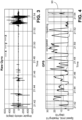
- Figure 3 shows an example of typical data from the 3 axes of the gyroscope; time periods when the phone's screen are on are apparent.
- Figure 4 shows an example of typical data for the GPS speed.
- the gray portions 90 indicate regions where the GPS speed was unavailable; when GPS speed is unavailable, the system errs in favor of a driver being undistracted by assuming that the vehicle may be at rest. By focusing on regions in which the speed data is available, determinations that the driver has been distracted by his phone during those periods become even more credible.
- the technology described here (i) constructs distraction episodes including a start and an end for each distraction episode, (ii) constructs the distraction context for each distraction episode, (iii) provides an interface to display the distraction episode and obtain feedback from the user on a mobile app, and (iv) scores each distraction episode and produces an aggregate distraction score for the trip.
- Distraction episodes are determined based on aggregations of one or more distraction events.
- a single trip can have zero or more distraction episodes.
- condition A and condition B described in the Background section hold true, the technology determines that a potential distraction event has occurred; if condition C also holds, then the potential distraction event becomes a relevant distraction event.
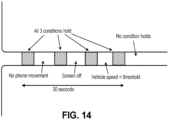
- the accelerometer and gyroscope sensor data will exhibit periods of movement interspersed with periods of no movement often in rapid succession. More generally, one or two of the three conditions A, B, and C may not hold true for some amount of time, as shown for example in figure 14 where within a 30-second interval the three conditions all hold true only during intermittent periods even though the driver's use of the phone was essentially continuous through the entire 30-second period. Each of the intermittent periods when all three conditions hold true can be considered distraction events. Yet the technology avoids treating each of them as a separate distraction episode, a treatment that would be inconsistent with the fact that the driver was effectively engaged in a distraction episode for the entire 30-second period including the intervening periods when fewer than all of the conditions held true.
- the technology that we describe here provides a way to define the start and end of a distraction episode to account for such situations.
- the technology is arranged to treat a distraction episode as the finest granularity situation for which scoring is done and for which information may be presented to users both for feedback and for informational purposes. Therefore, in the situation described with respect to figure 14 , the technology does not score each of the distraction events, but instead only scores the distraction episode. For this purpose, the technology applies certain principles, discussed below, to analyze the sensor signals and the timing of the occurrence of various conditions in deciding that a situation should be considered a distraction episode and also in determining when such an episode started and ended.
- the start of a distraction episode occurs before conditions A and B simultaneously hold true. For example, a user may pick up his phone from a cup-holder or pocket and a few seconds later turn it on. In that case, the start of the distraction episode will be considered to have occurred when one of the two conditions A and B first holds true, provided that both conditions simultaneously hold true at some time within a threshold period of time after the one of the two conditions first holds true. Conversely, if either A or B holds true, but not both, at some point in time, and the other of A and B does not also hold true within the ensuing threshold period of time, then no distraction episode is deemed to have begun. Typical values for this threshold are between 5 and 30 seconds.
- a given distraction episode may not end when either condition A or condition B no longer holds true. Instead, the end of a distraction episode can be considered to have occurred only when all of the following conditions hold true:
- Condition B no longer holds true (i.e., the user is no longer interacting with the phone).
- distraction episodes discussed to this point are considered possible distraction episodes which may require further analysis to determine if they are relevant distraction episodes that should be scored.
- a possible distraction episode must last at least a certain total amount of time to be considered a relevant distraction episode; a too-brief possible distraction episode is often one not triggered by a user, and may be caused, for example, by a phone screen being on and the vehicle driving over a pothole or speed bump causing the phone movement algorithm to trigger a potential event or episode. Therefore determining phone movement is useful for this purpose and others.
- the technology monitors either or both of acceleration 104 and angular velocity 106 from the phone sensor data and uses either or both of the following techniques to determine phone movement:
- the scoring of a relevant distraction episode will take into account information about the distraction context.
- other factors may also be relevant to detecting active phone use including one or a combination of two or more of the following (derived from sensors on or the operating system of) the phone: a call state that represents whether the user is currently on a call (which can indicate active phone use); whether call audio is being routed to the handset speaker, the internal speakerphone, or another external speaker (which can indicate whether the active phone use suggests perceptual distraction); proximity of the user's hand to the phone based on data from a proximity sensor (such as may be present on Android phones); the identity of the foreground app (if any) currently running on the phone (although this may be more intrusive on a user's privacy than other factors); whether the phone is moving in a way that is consistent with the user tapping on the screen (e.g., typing or interacting with an application); whether the phone is moving in a
- distraction context (i) reliably detecting whether a user is interactively tapping on his phone screen, and (ii) combining the phone's orientation and operational states to characterize distraction.
- Example distraction context Phone screen tapping and a tapping detector
- Typing to send text messages and typing in social media apps are common forms of phone distraction during driving. It is useful to detect this typing behavior both to provide users with more targeted feedback about their phone distraction and to assess the degree of risk (e.g., typing may be more risky than, say, briefly swiping in a navigation app to zoom into a map).
- degree of risk e.g., typing may be more risky than, say, briefly swiping in a navigation app to zoom into a map.
- a system for detecting typing behavior using a phone's sensors without monitoring which app is running in the foreground (information that may either be unavailable or violate the user's privacy expectations).
- Typing on a mobile device typically involves tapping on a display screen of the device with the taps occurring in a pattern. Tapping can be recognized by the following process.
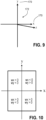
- figure 9 taken from an Android developer guide, illustrates an example arrangement of the three axes 170 relative to the phone.
- the rate of rotation in the x-y plane, induced by a single tap on the screen, is small (e.g., 0.2 - 0.7 radians/s) and lasts only for a short period of time, typically under a few hundred milliseconds.
- the phone gyroscope captures the rotation as a curve, at a high sampling rate of, for example 100 Hz, or as a single peak at a lower frequency of, for example, 15 Hz.
- the rotation is also usually followed by a reverting rotation in the reverse direction.
- the quadrant on which the user taps determines the sign of the rotation signal along the x and y axes.
- the phone briefly rotates along the x-axis by a positive amount and along the y-axis also by a positive amount, assuming a right-handed coordinate system.
- An example of the gyroscope signal captured by the phone when the user taps on the lower right quadrant several times is shown in figure 11 .
- a pair of synchronized peaks, one for the x-axis (solid line) and the other for y-axis (dash-dot line) appears, which is immediately followed by another peak in the reverse direction.
- FIG 12 Another example of tapping is shown in figure 12 , where the user taps on the lower left quadrant.
- the signs of the x-axis and y-axis peaks are opposite.
- the tapping detector works as follows given a tri-axial angular velocity measurement stream from a gyroscope in a phone:
- Example distraction context combining phone orientation and operational states
- the orientation of the phone, the direction in which the phone faces, and phone operational states and combinations of them enable the system to infer how the phone was being used when a phone distraction episode occurred.
- Some phone operational states inherently specify a context that existed at the time of the phone distraction episode.
- one phone operational state may be "active phone call", which indicates that the user was using his phone.
- the orientation of the phone's screen with respect to the conveyance in particular reveals information about the context of phone usage at the time of a phone distraction.
- the directions in which the phone faces and the orientations of the phone display screen and combinations of them during phone distraction episodes can be organized into one or more of the following groups (states) and others as the basis for determining a phone distraction context:
- Each phone distraction episode is annotated with the inferred distraction context, which comprises a vector of attributes capturing the above distraction types, along with the duration of the distraction episode and the location or time (or both) where it occurred.
- the inferred distraction context can be used for at least three purposes.
- the context can be used as a variable for further analysis of phone distraction episodes, for example, to study what distraction contexts of phone distraction episodes are correlated highly with the probability of a crash or near-miss.
- the end-user interface eg., phone app
- the context provides an input for scoring distraction episodes.
- Example distraction context weather and ambient conditions.
- the context can be the weather, including whether it is raining or snowing, the temperature, position of the sun in the sky, etc.
- Certain weather conditions e.g., snow
- snow are known to have a much higher accident risk, and as such distraction during such periods may be more risky.
- Example distraction context time.
- distraction context can include time-of day, day-of-week, and seasonal information. Certain times of day have a higher accident risk (late at night, during rush hour), so understanding this information can be important for risk scoring purposes. Additionally, information such as how much time the driver has already driven during this trip and during the previous 12 or 24 hour period can suggest driver fatigue and reduced attentiveness, which may be relevant to the distraction score.
- Example distraction context vehicle dynamics during episode: As a third example of context, it may include how the vehicle was moving during the distraction episode, for example, whether the vehicle was slowing or accelerating, drifting in the lane, or swerving. These behaviors can indicate the degree of distraction as well as driver inattentiveness. Finally, the relative frequency of certain driving behaviors, e.g., harsh braking, can be compared in a given user's distracted versus undistracted periods, to measure the relative risk of distraction episodes.
- driving behaviors e.g., harsh braking
- the technology also can collect and leverage user feedback 64 ( figure 1 ) associated with a trip or one or more distraction episodes. For example, when a user looks at a trip's trajectory and notices a region or portion of the trip having a phone distraction episode, the user may indicate that the phone was being used by a passenger, either for this portion of the trip or for the whole trip. The marker for that phone distraction episode will then be removed from the trajectory displayed to the user or the entire trip will be marked as a "passenger" trip, and the user will not be associated with (penalized by) that distraction episode.
- Historical user-labeled trips can provide a corpus of examples of passenger trips, which can be used to evaluate and improve the performance of automated driver-versus-passenger classification.
- the feedback gathered as described in the previous paragraph may be used in a machine learning classifier to further improve the accuracy of passenger detection.
- the user feedback can be used to improve the automatic detection of phone distraction episodes by the technology.
- the parameter values used in the steps of the process of phone distraction episode detection need not be fixed values, but could vary within ranges. For example, if the settings cause over-reporting of phone distraction episodes, this may be detected by an elevated rate of user feedback indicating phone distraction episodes had not occurred, and used to recalibrate the system to more appropriate parameter values.
- the system may present information about the episode and the phone distraction context to the driver to help her to reduce phone distraction episodes. Sharing phone distraction episode information also provides an opportunity to collect feedback from the user, which can be used to validate the system and the phone distraction episodes and phone distraction contexts that it generates.
- information about phone distraction episodes are reported that occur during a single trip.
- the system can display the trajectory of the single trip and annotate the portions of the trajectory during which phone distraction episodes occurred.
- the user can select an individual event by tapping on it or scrolling through a list of all episodes on that trip. Selecting an episode provides a pop-up with information about that episode, such as the phone distraction context, the time it occurred, duration, and other measured or inferred contextual information.
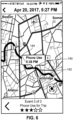
- An example phone distraction episode is shown in figure 6 as a segment 140 on a trajectory 142 and the time 144 of the episode is shown on a pop up that was triggered by the user invoking the segment of the trajectory.
- the user then has the option of providing feedback, for example, to indicate that she was not the driver, but rather a passenger, on the trip.
- the user may also provide feedback that the trip was not taken in a car, but in a bus, train, bike or other mode of transport, or may indicate that certain portions of the labeled trip data appear incorrectly, i.e., that they were not speeding at a particular location.
- the user selects the link 150 called ⁇ Contact Support' (or equivalent, such as ⁇ Provide Feedback', which could be obtained in a variety of ways), then the user is provided with a field 152 for entering (or voicing) feedback, as shown in Figure 8 .
- ⁇ Contact Support' or equivalent, such as ⁇ Provide Feedback', which could be obtained in a variety of ways
- This feedback mechanism allows the user to correct or dispute phone distraction episodes and the properties and context of each episode. It also allows the user to indicate that he was the driver (i.e., the phone belonged to the driver, not a passenger), but for one or more of the distraction episodes in question, the distraction was due to a passenger rather than the driver.
- the system can aggregate phone distraction episodes and phone distraction contexts across multiple trips to provide a single user-level summary. For example, the system can measure how the frequency or count of phone distraction episodes varies by:
- Analyzing user-level phone distraction episode trends also enables the system to provide user-customized contextual hints for improving safety, for example, driver-specific advice like "reduce phone usage while driving home", or "do not use phone at high speeds”.
- Collecting user feedback allows users to feel engaged with the system and correct potential errors in information generated by the system. Feedback from users can also be useful for validating the accuracy of the algorithm.
- a particular set of distraction parameters generated by the system may produce a corresponding amount of feedback.
- the system can use the rate of feedback to estimate how frequently the system misclassifies phone distraction episodes.
- the system can estimate the corresponding misclassification performance for respective parameters.
- the system can then modify the parameters that are generated to reduce a false positive rate or a false negative rate for those parameters.
- the system can change the parameters for the whole population of users, for subsets of the population, for individual drivers, or for individual trips, or combinations of two or more of those approaches. Given a large population of drivers, this makes it possible to explore the parameter space rapidly.
- the scoring of phone distraction episodes is done by taking the distraction context into account.
- distraction score can depend on speed, time-of-day, day-of-week, season, road type, weather conditions, direction of movement, etc.
- type of distraction can be taken into account: phone movement and light phone tapping may be treated differently in scoring.
- a phone call with handset to the ear can be scored differently from a hands-free operation that may involve some tapping.
- Phone distraction episode times and durations are typically determined after a trip is completed.
- the processes discussed above are used to measure that a phone distraction episode occurred; the severity of the episode can be a function of the amount of time distracted, the speed, the road type, or the time-of-day.
- the distraction episode or the measure of distraction or both can then be used in at least the following ways (and others) and combinations of them:
- one or more of the processes are executed on servers remote from the mobile device or on mobile devices, the processes can be implemented on either the mobile devices, the servers, or combinations of them.
Landscapes
- Engineering & Computer Science (AREA)
- Computer Networks & Wireless Communication (AREA)
- Signal Processing (AREA)
- Automation & Control Theory (AREA)
- General Engineering & Computer Science (AREA)
- Physics & Mathematics (AREA)
- Computer Hardware Design (AREA)
- Mathematical Physics (AREA)
- Transportation (AREA)
- Mechanical Engineering (AREA)
- Telephone Function (AREA)
- Mobile Radio Communication Systems (AREA)
- Traffic Control Systems (AREA)
Claims (14)
- Computerimplementiertes Verfahren, das Folgendes umfasst:Empfangen von Signalen von einem oder mehreren Detektoren, die in einer Mobilvorrichtung (24) aufgenommen sind, während sich die Mobilvorrichtung auf einer Fahrt befindet, wobei die Detektoren zumindest einen Beschleunigungsmesser und ein Gyroskop umfassen,Verwenden der empfangenen Signale von den Detektoren, um einen oder mehrere physikalische Zustände der Mobilvorrichtung während der Fahrt zu identifizieren, wobei die physikalischen Zustände eine Bewegungsgeschwindigkeit der Mobilvorrichtung entlang einer Bewegungsbahn der Fahrt und einen Betriebszustand (32) der Mobilvorrichtung umfassen,auf der Grundlage der identifizierten physikalischen Zustände Erzeugen einzelner Ereignisse, die zeitlich getrennt sind, wobei mindestens eines der einzelnen Ereignisse umfasst, dass die Mobilvorrichtung aufgenommen, gedreht oder gehalten wird, dass darauf getippt wird oder dass sie in die Richtung eines Fahrers eines Fahrzeugs gewandt ist, undBestimmen einer Ablenkungs-Gefahrensituation, die zwei oder mehr der einzelnen Ereignisse während der Fahrt überspannt, wobei das Bestimmen der Ablenkungs-Gefahrensituation das Bestimmen einer möglichen Ablenkungs-Gefahrensituation und das Bestimmen, dass die mögliche Ablenkungs-Gefahrensituation eine tatsächliche Ablenkungs-Gefahrensituation umfasst, umfasst, wobei das Bestimmen, dass die mögliche Ablenkungs-Gefahrensituation eine tatsächliche Ablenkungs-Gefahrensituation umfasst, Folgendes umfasst:Bestimmen, dass jede von drei Bedingungen wahr ist, wobei die drei Bedingungen sind, dass eine Bewegung der Mobilvorrichtung, Benutzerinteraktionen mit der Mobilvorrichtung und eine Fahrzeuggeschwindigkeit während der Gefahrensituation einen vorgegebenen Schwellenwert überschreiten,Bestimmen, dass ein Beginn der möglichen Ablenkungs-Gefahrensituation auftritt, wenn a) eine von zwei Bedingungen wahr ist, wobei die zwei Bedingungen eine Bewegung der Mobilvorrichtung und Benutzerinteraktionen mit der Mobilvorrichtung sind, und b) beide der zwei Bedingungen zu einer Zeit innerhalb eines Schwellenwertzeitraums, nachdem die eine der zwei Bedingungen wahr geworden ist, gleichzeitig wahr sind,Bestimmen, dass ein Ende der möglichen Ablenkungs-Gefahrensituation auftritt, wenn i) ein Kontext der Mobilvorrichtung keine weitere Ablenkung angibt, ii) keine weitere Bewegung der Mobilvorrichtung detektiert wird und iii) ein beständiger Zeitraum verstrichen ist, währenddessen weder i) noch ii) wahr sind, undBestimmen, dass ein Zeitraum, der von der möglichen Ablenkungs-Gefahrensituation überspannt wird, nicht länger als eine vorgegebene Länge ist.
- Verfahren nach Anspruch 1, wobei bestimmt wird, dass ein Ende der möglichen Ablenkungs-Gefahrensituation auftritt, wenn i) ein Kontext der Mobilvorrichtung keine weitere Ablenkung angibt, ii) keine weitere Bewegung der Mobilvorrichtung detektiert wird, iii) ein beständiger Zeitraum verstrichen ist, währenddessen weder i) noch ii) wahr sind, und iv) der Benutzer nicht mehr mit der Mobilvorrichtung interagiert.
- Verfahren nach Anspruch 1, wobei i) der physikalische Zustand einen Betriebszustand der Mobilvorrichtung umfasst und ii) der Betriebszustand einen Sperrzustand der Mobilvorrichtung, einen Zustand eines Telefonanrufs, einen Energiezustand oder einen Aspekt einer Vordergrund-App, die auf der Mobilvorrichtung läuft, umfasst.
- Verfahren nach Anspruch 1, wobei mindestens eines der einzelnen Ereignisse ein mögliches einzelnes Ablenkungsereignis (38) während der Fahrt umfasst.
- Verfahren nach Anspruch 1, wobei das Bestimmen einer Ablenkungs-Gefahrensituation das Bestimmen, dass ein physikalischer Zustand der Mobilvorrichtung keine Interaktion durch einen Benutzer umfasst oder dass Werte des Beschleunigungsmessers oder des Gyroskops kleiner als ein Schwellenwert sind, der sich von einem Schwellenwert, der beim Bestimmen einer Bewegung der Mobilvorrichtung zu Beginn der Ablenkungs-Gefahrensituation verwendet wird, unterscheidet, umfasst.
- Verfahren nach Anspruch 1, das ferner Folgendes umfasst:
auf der Grundlage der empfangenen Signale Bestimmen, dass die Mobilvorrichtung mit einem aktiven Telefonanruf beschäftigt ist. - Verfahren nach Anspruch 6, das das Bestimmen auf der Grundlage der empfangenen Signale, ob die Mobilvorrichtung mit einem aktiven Telefonanruf unter Verwendung eines Lautsprechers eines Handapparats, eines Telefons mit internem Lautsprecher oder eines externen Lautsprechers beschäftigt ist, umfasst.
- Verfahren nach Anspruch 1, das basierend auf den empfangenen Signalen Folgendes umfasst:ii) Bestimmen einer räumlichen Nähe einer Hand eines Benutzers zur Mobilvorrichtung, und/oderiii) Bestimmen, ob ein Anzeigebildschirm der Mobilvorrichtung angetippt wird, und/oderiv) Identifizieren einer Vordergrund-App, die auf der Mobilvorrichtung abläuft, und/oderv) Bestimmen eines Verhaltens eines Beförderungsmittels, das für die Fahrt verwendet wird.
- Verfahren nach Anspruch 1, wobei das Bestimmen des Kontexts einer möglichen Ablenkungs-Gefahrensituation das Detektieren einer Drehung eines Anzeigebildschirms der Mobilvorrichtung und wahlweise das Detektieren eines Tippvorgangs auf den Anzeigebildschirm auf der Grundlage eines Parameters der Drehung umfasst.
- Verfahren nach Anspruch 1, das Folgendes umfasst:auf der Grundlage der empfangenen Signale, Bestimmen einer Häufigkeit von Tippvorgängen auf einem Anzeigebildschirm der Mobilvorrichtung; undBestimmen eines Auftretens eines Tippereignisses auf der Grundlage einer Tippbewertung auf der Grundlage von Tippvorgängen in Folge und Zeiträumen zwischen aufeinanderfolgenden Tippvorgängen.
- Verfahren nach Anspruch 1, das das Vergleichen zeitlicher Parameter einer Tippfolge auf einem Anzeigebildschirm der Mobilvorrichtung mit zeitlichen Parametern bekannter Tippfolgen auf Anzeigevorrichtungen von Mobilvorrichtungen auf der Grundlage der empfangenen Signale umfasst.
- Verfahren nach Anspruch 1, das das Bestimmen einer Orientierung der Mobilvorrichtung oder eines Anzeigebildschirms der Mobilvorrichtung während der möglichen Ablenkungs-Gefahrensituation auf der Grundlage der empfangenen Signale; und wahlweise
das Identifizieren des Kontexts der möglichen Ablenkungs-Gefahrensituation auf der Grundlage der Orientierung der Mobilvorrichtung oder des Anzeigebildschirms der Mobilvorrichtung umfasst. - Verfahren nach Anspruch 12, wobei:i) der Anzeigebildschirm der Mobilvorrichtung der Rückseite eines Beförderungsmittels, das für die Fahrt verwendet wird, zugewandt ist, die Mobilvorrichtung im Allgemeinen vertikal orientiert ist und die Mobilvorrichtung zumindest während eines Schwellenwertzeitraums nicht wesentlich gedreht worden ist und der Kontext der möglichen Ablenkungs-Gefahrensituation umfasst, das die Mobilvorrichtung im Beförderungsmittel angebracht ist, und/oderii) der Anzeigebildschirm der Mobilvorrichtung der Rückseite eines Beförderungsmittels, das für die Fahrt verwendet wird, zugewandt ist, die Mobilvorrichtungen in einer Richtung für eine reguläre Verwendung durch einen Insassen eines Beförderungsmittels orientiert sind und der Kontext der möglichen Ablenkungs-Gefahrensituation nicht ist, dass die Mobilvorrichtungen angebracht sind, und/oderiii) der Anzeigebildschirm der Mobilvorrichtung im Allgemeinen einer Seite eines Beförderungsmittels, das für die Fahrt verwendet wird, zugewandt ist und das obere Ende des Anzeigebildschirms im Allgemeinen nach oben orientiert ist und der Kontext der möglichen Ablenkungs-Gefahrensituation umfasst, dass die Mobilvorrichtung in der Umgebung eines Ohrs eines Insassen des Beförderungsmittels gehalten wird, und/oderiv) der Anzeigebildschirm der Mobilvorrichtung im Allgemeinen nach unten orientiert ist und der Kontext der möglichen Ablenkungs-Gefahrensituation umfasst, dass die Mobilvorrichtung nicht verwendet wird.
- Verfahren nach Anspruch 12, das Folgendes umfasst:Melden des Ablenkungskontexts und der möglichen Ablenkungs-Gefahrensituation an einen Benutzer der Mobilvorrichtung, und/oderBewerten der möglichen Ablenkungs-Gefahrensituation unter Verwendung des Ablenkungskontexts.
Priority Applications (1)
| Application Number | Priority Date | Filing Date | Title |
|---|---|---|---|
| EP24204046.7A EP4507341A3 (de) | 2019-05-06 | 2020-05-04 | Bestimmung, bewertung und meldung der ablenkung eines fahrers durch ein mobiltelefon |
Applications Claiming Priority (3)
| Application Number | Priority Date | Filing Date | Title |
|---|---|---|---|
| US16/403,761 US10672249B1 (en) | 2019-05-06 | 2019-05-06 | Determining, scoring, and reporting mobile phone distraction of a driver |
| US16/403,776 US10759441B1 (en) | 2019-05-06 | 2019-05-06 | Determining, scoring, and reporting mobile phone distraction of a driver |
| PCT/US2020/031320 WO2020227212A1 (en) | 2019-05-06 | 2020-05-04 | Determining, scoring, and reporting mobile phone distraction of a driver |
Related Child Applications (1)
| Application Number | Title | Priority Date | Filing Date |
|---|---|---|---|
| EP24204046.7A Division EP4507341A3 (de) | 2019-05-06 | 2020-05-04 | Bestimmung, bewertung und meldung der ablenkung eines fahrers durch ein mobiltelefon |
Publications (4)
| Publication Number | Publication Date |
|---|---|
| EP3967063A1 EP3967063A1 (de) | 2022-03-16 |
| EP3967063A4 EP3967063A4 (de) | 2022-06-15 |
| EP3967063C0 EP3967063C0 (de) | 2024-10-09 |
| EP3967063B1 true EP3967063B1 (de) | 2024-10-09 |
Family
ID=73051164
Family Applications (2)
| Application Number | Title | Priority Date | Filing Date |
|---|---|---|---|
| EP24204046.7A Pending EP4507341A3 (de) | 2019-05-06 | 2020-05-04 | Bestimmung, bewertung und meldung der ablenkung eines fahrers durch ein mobiltelefon |
| EP20803021.3A Active EP3967063B1 (de) | 2019-05-06 | 2020-05-04 | Bestimmung, bewertung und meldung der ablenkung eines fahrers durch ein mobiltelefon |
Family Applications Before (1)
| Application Number | Title | Priority Date | Filing Date |
|---|---|---|---|
| EP24204046.7A Pending EP4507341A3 (de) | 2019-05-06 | 2020-05-04 | Bestimmung, bewertung und meldung der ablenkung eines fahrers durch ein mobiltelefon |
Country Status (7)
| Country | Link |
|---|---|
| EP (2) | EP4507341A3 (de) |
| JP (1) | JP7482899B2 (de) |
| CA (1) | CA3137306A1 (de) |
| DE (1) | DE202020005888U1 (de) |
| ES (1) | ES3001933T3 (de) |
| WO (1) | WO2020227212A1 (de) |
| ZA (1) | ZA202108008B (de) |
Families Citing this family (2)
| Publication number | Priority date | Publication date | Assignee | Title |
|---|---|---|---|---|
| DE102023120936A1 (de) * | 2023-08-07 | 2025-02-13 | Bayerische Motoren Werke Aktiengesellschaft | Verfahren für ein Kraftfahrzeug zur Verminderung einer Ablenkung eines Fahrers, Computerprogramm und/oder computerlesbares Medium, Datenverarbeitungsvorrichtung, Kraftfahrzeug |
| US12556886B2 (en) | 2023-08-08 | 2026-02-17 | Telenav, Inc. | Compute system with driver distraction detection mechanism and method of operation thereof |
Family Cites Families (14)
| Publication number | Priority date | Publication date | Assignee | Title |
|---|---|---|---|---|
| JP4509042B2 (ja) * | 2006-02-13 | 2010-07-21 | 株式会社デンソー | 自動車用もてなし情報提供システム |
| US9477639B2 (en) * | 2006-03-08 | 2016-10-25 | Speed Demon Inc. | Safe driving monitoring system |
| EP2619911A4 (de) * | 2010-09-21 | 2015-05-06 | Cellepathy Ltd | System und verfahren zur sensorbasierten bestimmung der rolle, der position und/oder des status eines benutzers einer oder mehrerer fahrzeuginterner mobiler vorrichtungen und zur erzwingung von deren verwendung |
| US9428052B1 (en) | 2012-09-08 | 2016-08-30 | Towers Watson Software Limited | Automated distraction measurement of machine operator |
| US8457880B1 (en) | 2012-11-28 | 2013-06-04 | Cambridge Mobile Telematics | Telematics using personal mobile devices |
| US9228836B2 (en) | 2013-03-15 | 2016-01-05 | Cambridge Mobile Telematics | Inference of vehicular trajectory characteristics with personal mobile devices |
| EP2995006B1 (de) * | 2013-05-08 | 2018-06-20 | Cellcontrol, Inc. | Fahreridentifizierungs- und datensammlungssystem zur verwendung mit mobilkommunikationsvorrichtungen in fahrzeugen |
| US9053516B2 (en) * | 2013-07-15 | 2015-06-09 | Jeffrey Stempora | Risk assessment using portable devices |
| US9210547B2 (en) * | 2013-07-30 | 2015-12-08 | Here Global B.V. | Mobile driving condition detection |
| DE202014011597U1 (de) | 2014-04-29 | 2023-02-13 | Cambridge Mobile Telematics | System zum Erhalten von Fahrzeugtelematikdaten |
| WO2017049137A1 (en) | 2015-09-17 | 2017-03-23 | Truemotion, Inc. | Systems and methods for detecting and assessing distracted drivers |
| US11691565B2 (en) * | 2016-01-22 | 2023-07-04 | Cambridge Mobile Telematics Inc. | Systems and methods for sensor-based detection, alerting and modification of driving behaviors |
| US9854086B1 (en) | 2016-12-23 | 2017-12-26 | Echostar Technologies L.L.C. | In-vehicle mobile device distracted driver control |
| US9900747B1 (en) * | 2017-05-16 | 2018-02-20 | Cambridge Mobile Telematics, Inc. | Using telematics data to identify a type of a trip |
-
2020
- 2020-05-04 WO PCT/US2020/031320 patent/WO2020227212A1/en not_active Ceased
- 2020-05-04 DE DE202020005888.2U patent/DE202020005888U1/de active Active
- 2020-05-04 JP JP2021565896A patent/JP7482899B2/ja active Active
- 2020-05-04 EP EP24204046.7A patent/EP4507341A3/de active Pending
- 2020-05-04 EP EP20803021.3A patent/EP3967063B1/de active Active
- 2020-05-04 ES ES20803021T patent/ES3001933T3/es active Active
- 2020-05-04 CA CA3137306A patent/CA3137306A1/en active Pending
-
2021
- 2021-10-19 ZA ZA2021/08008A patent/ZA202108008B/en unknown
Also Published As
| Publication number | Publication date |
|---|---|
| EP3967063C0 (de) | 2024-10-09 |
| WO2020227212A1 (en) | 2020-11-12 |
| EP4507341A2 (de) | 2025-02-12 |
| JP2022531689A (ja) | 2022-07-08 |
| EP3967063A1 (de) | 2022-03-16 |
| EP3967063A4 (de) | 2022-06-15 |
| ES3001933T3 (en) | 2025-03-06 |
| DE202020005888U1 (de) | 2023-01-27 |
| EP4507341A3 (de) | 2025-05-07 |
| CA3137306A1 (en) | 2020-11-12 |
| JP7482899B2 (ja) | 2024-05-14 |
| ZA202108008B (en) | 2023-11-29 |
Similar Documents
| Publication | Publication Date | Title |
|---|---|---|
| US11932257B2 (en) | Determining, scoring, and reporting mobile phone distraction of a driver | |
| US10672249B1 (en) | Determining, scoring, and reporting mobile phone distraction of a driver | |
| US10667088B2 (en) | Systems and methods for detecting and assessing distracted drivers | |
| US12071140B2 (en) | Systems and methods for scoring driving trips | |
| US11961340B2 (en) | Method and system for accident detection using contextual data | |
| US11884225B2 (en) | Methods and systems for point of impact detection | |
| Castignani et al. | Driver behavior profiling using smartphones: A low-cost platform for driver monitoring | |
| US12020571B2 (en) | Method and system for vehicle crash prediction using multi-vehicle data | |
| EP3967063B1 (de) | Bestimmung, bewertung und meldung der ablenkung eines fahrers durch ein mobiltelefon | |
| Vavouranakis et al. | Recognizing driving behaviour using smartphones | |
| EP4718828A1 (de) | Verfahren und systeme zur optimierung des ressourcenverbrauchs mobiler vorrichtungen während der erkennung von fahraktivitäten | |
| US20260091797A1 (en) | Methods and systems for optimizing mobile device resource consumption while detecting driving activities |
Legal Events
| Date | Code | Title | Description |
|---|---|---|---|
| REG | Reference to a national code |
Ref country code: DE Ref legal event code: R138 Ref document number: 202020005888 Country of ref document: DE Free format text: GERMAN DOCUMENT NUMBER IS 602020039209 |
|
| STAA | Information on the status of an ep patent application or granted ep patent |
Free format text: STATUS: THE INTERNATIONAL PUBLICATION HAS BEEN MADE |
|
| PUAI | Public reference made under article 153(3) epc to a published international application that has entered the european phase |
Free format text: ORIGINAL CODE: 0009012 |
|
| STAA | Information on the status of an ep patent application or granted ep patent |
Free format text: STATUS: REQUEST FOR EXAMINATION WAS MADE |
|
| 17P | Request for examination filed |
Effective date: 20211105 |
|
| AK | Designated contracting states |
Kind code of ref document: A1 Designated state(s): AL AT BE BG CH CY CZ DE DK EE ES FI FR GB GR HR HU IE IS IT LI LT LU LV MC MK MT NL NO PL PT RO RS SE SI SK SM TR |
|
| A4 | Supplementary search report drawn up and despatched |
Effective date: 20220517 |
|
| RIC1 | Information provided on ipc code assigned before grant |
Ipc: H04W 4/029 20180101ALI20220511BHEP Ipc: H04L 67/50 20220101ALI20220511BHEP Ipc: G08B 21/06 20060101ALI20220511BHEP Ipc: H04W 4/02 20180101ALI20220511BHEP Ipc: H04W 4/40 20180101ALI20220511BHEP Ipc: H04W 48/04 20090101ALI20220511BHEP Ipc: G08B 21/08 20060101ALI20220511BHEP Ipc: B60W 40/08 20120101ALI20220511BHEP Ipc: H04W 4/48 20180101AFI20220511BHEP |
|
| DAV | Request for validation of the european patent (deleted) | ||
| DAX | Request for extension of the european patent (deleted) | ||
| STAA | Information on the status of an ep patent application or granted ep patent |
Free format text: STATUS: EXAMINATION IS IN PROGRESS |
|
| 17Q | First examination report despatched |
Effective date: 20230621 |
|
| GRAP | Despatch of communication of intention to grant a patent |
Free format text: ORIGINAL CODE: EPIDOSNIGR1 |
|
| STAA | Information on the status of an ep patent application or granted ep patent |
Free format text: STATUS: GRANT OF PATENT IS INTENDED |
|
| INTG | Intention to grant announced |
Effective date: 20240506 |
|
| GRAS | Grant fee paid |
Free format text: ORIGINAL CODE: EPIDOSNIGR3 |
|
| GRAA | (expected) grant |
Free format text: ORIGINAL CODE: 0009210 |
|
| STAA | Information on the status of an ep patent application or granted ep patent |
Free format text: STATUS: THE PATENT HAS BEEN GRANTED |
|
| AK | Designated contracting states |
Kind code of ref document: B1 Designated state(s): AL AT BE BG CH CY CZ DE DK EE ES FI FR GB GR HR HU IE IS IT LI LT LU LV MC MK MT NL NO PL PT RO RS SE SI SK SM TR |
|
| REG | Reference to a national code |
Ref country code: CH Ref legal event code: EP |
|
| REG | Reference to a national code |
Ref country code: DE Ref legal event code: R096 Ref document number: 602020039209 Country of ref document: DE |
|
| REG | Reference to a national code |
Ref country code: IE Ref legal event code: FG4D |
|
| U01 | Request for unitary effect filed |
Effective date: 20241105 |
|
| U07 | Unitary effect registered |
Designated state(s): AT BE BG DE DK EE FI FR IT LT LU LV MT NL PT RO SE SI Effective date: 20241113 |
|
| REG | Reference to a national code |
Ref country code: ES Ref legal event code: FG2A Ref document number: 3001933 Country of ref document: ES Kind code of ref document: T3 Effective date: 20250306 |
|
| PG25 | Lapsed in a contracting state [announced via postgrant information from national office to epo] |
Ref country code: IS Free format text: LAPSE BECAUSE OF FAILURE TO SUBMIT A TRANSLATION OF THE DESCRIPTION OR TO PAY THE FEE WITHIN THE PRESCRIBED TIME-LIMIT Effective date: 20250209 Ref country code: HR Free format text: LAPSE BECAUSE OF FAILURE TO SUBMIT A TRANSLATION OF THE DESCRIPTION OR TO PAY THE FEE WITHIN THE PRESCRIBED TIME-LIMIT Effective date: 20241009 |
|
| PG25 | Lapsed in a contracting state [announced via postgrant information from national office to epo] |
Ref country code: NO Free format text: LAPSE BECAUSE OF FAILURE TO SUBMIT A TRANSLATION OF THE DESCRIPTION OR TO PAY THE FEE WITHIN THE PRESCRIBED TIME-LIMIT Effective date: 20250109 |
|
| PG25 | Lapsed in a contracting state [announced via postgrant information from national office to epo] |
Ref country code: GR Free format text: LAPSE BECAUSE OF FAILURE TO SUBMIT A TRANSLATION OF THE DESCRIPTION OR TO PAY THE FEE WITHIN THE PRESCRIBED TIME-LIMIT Effective date: 20250110 |
|
| PG25 | Lapsed in a contracting state [announced via postgrant information from national office to epo] |
Ref country code: PL Free format text: LAPSE BECAUSE OF FAILURE TO SUBMIT A TRANSLATION OF THE DESCRIPTION OR TO PAY THE FEE WITHIN THE PRESCRIBED TIME-LIMIT Effective date: 20241009 |
|
| PG25 | Lapsed in a contracting state [announced via postgrant information from national office to epo] |
Ref country code: RS Free format text: LAPSE BECAUSE OF FAILURE TO SUBMIT A TRANSLATION OF THE DESCRIPTION OR TO PAY THE FEE WITHIN THE PRESCRIBED TIME-LIMIT Effective date: 20250109 |
|
| U20 | Renewal fee for the european patent with unitary effect paid |
Year of fee payment: 6 Effective date: 20250417 |
|
| U1N | Appointed representative for the unitary patent procedure changed after the registration of the unitary effect |
Representative=s name: MEWBURN ELLIS LLP; GB |
|
| PG25 | Lapsed in a contracting state [announced via postgrant information from national office to epo] |
Ref country code: SM Free format text: LAPSE BECAUSE OF FAILURE TO SUBMIT A TRANSLATION OF THE DESCRIPTION OR TO PAY THE FEE WITHIN THE PRESCRIBED TIME-LIMIT Effective date: 20241009 |
|
| PGFP | Annual fee paid to national office [announced via postgrant information from national office to epo] |
Ref country code: GB Payment date: 20250417 Year of fee payment: 6 Ref country code: ES Payment date: 20250603 Year of fee payment: 6 |
|
| PG25 | Lapsed in a contracting state [announced via postgrant information from national office to epo] |
Ref country code: SK Free format text: LAPSE BECAUSE OF FAILURE TO SUBMIT A TRANSLATION OF THE DESCRIPTION OR TO PAY THE FEE WITHIN THE PRESCRIBED TIME-LIMIT Effective date: 20241009 |
|
| PG25 | Lapsed in a contracting state [announced via postgrant information from national office to epo] |
Ref country code: CZ Free format text: LAPSE BECAUSE OF FAILURE TO SUBMIT A TRANSLATION OF THE DESCRIPTION OR TO PAY THE FEE WITHIN THE PRESCRIBED TIME-LIMIT Effective date: 20241009 |
|
| PLBE | No opposition filed within time limit |
Free format text: ORIGINAL CODE: 0009261 |
|
| STAA | Information on the status of an ep patent application or granted ep patent |
Free format text: STATUS: NO OPPOSITION FILED WITHIN TIME LIMIT |
|
| 26N | No opposition filed |
Effective date: 20250710 |
|
| REG | Reference to a national code |
Ref country code: CH Ref legal event code: H13 Free format text: ST27 STATUS EVENT CODE: U-0-0-H10-H13 (AS PROVIDED BY THE NATIONAL OFFICE) Effective date: 20251223 |
|
| PG25 | Lapsed in a contracting state [announced via postgrant information from national office to epo] |
Ref country code: CH Free format text: LAPSE BECAUSE OF NON-PAYMENT OF DUE FEES Effective date: 20250531 |
|
| PG25 | Lapsed in a contracting state [announced via postgrant information from national office to epo] |
Ref country code: MC Free format text: LAPSE BECAUSE OF FAILURE TO SUBMIT A TRANSLATION OF THE DESCRIPTION OR TO PAY THE FEE WITHIN THE PRESCRIBED TIME-LIMIT Effective date: 20241009 |