EP3963873B1 - System und verfahren zur bereitstellung von kontextuellen zusammenfassungen im interaktionstransfer - Google Patents
System und verfahren zur bereitstellung von kontextuellen zusammenfassungen im interaktionstransfer Download PDFInfo
- Publication number
- EP3963873B1 EP3963873B1 EP20730155.7A EP20730155A EP3963873B1 EP 3963873 B1 EP3963873 B1 EP 3963873B1 EP 20730155 A EP20730155 A EP 20730155A EP 3963873 B1 EP3963873 B1 EP 3963873B1
- Authority
- EP
- European Patent Office
- Prior art keywords
- interaction
- party
- customer
- contact center
- agent
- Prior art date
- Legal status (The legal status is an assumption and is not a legal conclusion. Google has not performed a legal analysis and makes no representation as to the accuracy of the status listed.)
- Active
Links
Images



Classifications
-
- H—ELECTRICITY
- H04—ELECTRIC COMMUNICATION TECHNIQUE
- H04M—TELEPHONIC COMMUNICATION
- H04M3/00—Automatic or semi-automatic exchanges
- H04M3/42—Systems providing special services or facilities to subscribers
- H04M3/50—Centralised arrangements for answering calls; Centralised arrangements for recording messages for absent or busy subscribers ; Centralised arrangements for recording messages
- H04M3/51—Centralised call answering arrangements requiring operator intervention, e.g. call or contact centers for telemarketing
- H04M3/5141—Details of processing calls and other types of contacts in an unified manner
-
- G—PHYSICS
- G06—COMPUTING OR CALCULATING; COUNTING
- G06F—ELECTRIC DIGITAL DATA PROCESSING
- G06F40/00—Handling natural language data
- G06F40/10—Text processing
-
- G—PHYSICS
- G06—COMPUTING OR CALCULATING; COUNTING
- G06Q—INFORMATION AND COMMUNICATION TECHNOLOGY [ICT] SPECIALLY ADAPTED FOR ADMINISTRATIVE, COMMERCIAL, FINANCIAL, MANAGERIAL OR SUPERVISORY PURPOSES; SYSTEMS OR METHODS SPECIALLY ADAPTED FOR ADMINISTRATIVE, COMMERCIAL, FINANCIAL, MANAGERIAL OR SUPERVISORY PURPOSES, NOT OTHERWISE PROVIDED FOR
- G06Q30/00—Commerce
- G06Q30/02—Marketing; Price estimation or determination; Fundraising
- G06Q30/0281—Customer communication at a business location, e.g. providing product or service information, consulting
-
- G—PHYSICS
- G10—MUSICAL INSTRUMENTS; ACOUSTICS
- G10L—SPEECH ANALYSIS TECHNIQUES OR SPEECH SYNTHESIS; SPEECH RECOGNITION; SPEECH OR VOICE PROCESSING TECHNIQUES; SPEECH OR AUDIO CODING OR DECODING
- G10L15/00—Speech recognition
- G10L15/26—Speech to text systems
-
- H—ELECTRICITY
- H04—ELECTRIC COMMUNICATION TECHNIQUE
- H04L—TRANSMISSION OF DIGITAL INFORMATION, e.g. TELEGRAPHIC COMMUNICATION
- H04L12/00—Data switching networks
- H04L12/02—Details
- H04L12/16—Arrangements for providing special services to substations
- H04L12/18—Arrangements for providing special services to substations for broadcast or conference, e.g. multicast
- H04L12/1813—Arrangements for providing special services to substations for broadcast or conference, e.g. multicast for computer conferences, e.g. chat rooms
- H04L12/1822—Conducting the conference, e.g. admission, detection, selection or grouping of participants, correlating users to one or more conference sessions, prioritising transmission
-
- H—ELECTRICITY
- H04—ELECTRIC COMMUNICATION TECHNIQUE
- H04L—TRANSMISSION OF DIGITAL INFORMATION, e.g. TELEGRAPHIC COMMUNICATION
- H04L12/00—Data switching networks
- H04L12/02—Details
- H04L12/16—Arrangements for providing special services to substations
- H04L12/18—Arrangements for providing special services to substations for broadcast or conference, e.g. multicast
- H04L12/1813—Arrangements for providing special services to substations for broadcast or conference, e.g. multicast for computer conferences, e.g. chat rooms
- H04L12/1831—Tracking arrangements for later retrieval, e.g. recording contents, participants activities or behavior, network status
-
- H—ELECTRICITY
- H04—ELECTRIC COMMUNICATION TECHNIQUE
- H04L—TRANSMISSION OF DIGITAL INFORMATION, e.g. TELEGRAPHIC COMMUNICATION
- H04L51/00—User-to-user messaging in packet-switching networks, transmitted according to store-and-forward or real-time protocols, e.g. e-mail
- H04L51/02—User-to-user messaging in packet-switching networks, transmitted according to store-and-forward or real-time protocols, e.g. e-mail using automatic reactions or user delegation, e.g. automatic replies or chatbot-generated messages
-
- H—ELECTRICITY
- H04—ELECTRIC COMMUNICATION TECHNIQUE
- H04L—TRANSMISSION OF DIGITAL INFORMATION, e.g. TELEGRAPHIC COMMUNICATION
- H04L51/00—User-to-user messaging in packet-switching networks, transmitted according to store-and-forward or real-time protocols, e.g. e-mail
- H04L51/04—Real-time or near real-time messaging, e.g. instant messaging [IM]
- H04L51/046—Interoperability with other network applications or services
-
- H—ELECTRICITY
- H04—ELECTRIC COMMUNICATION TECHNIQUE
- H04L—TRANSMISSION OF DIGITAL INFORMATION, e.g. TELEGRAPHIC COMMUNICATION
- H04L51/00—User-to-user messaging in packet-switching networks, transmitted according to store-and-forward or real-time protocols, e.g. e-mail
- H04L51/21—Monitoring or handling of messages
- H04L51/214—Monitoring or handling of messages using selective forwarding
-
- H—ELECTRICITY
- H04—ELECTRIC COMMUNICATION TECHNIQUE
- H04L—TRANSMISSION OF DIGITAL INFORMATION, e.g. TELEGRAPHIC COMMUNICATION
- H04L51/00—User-to-user messaging in packet-switching networks, transmitted according to store-and-forward or real-time protocols, e.g. e-mail
- H04L51/21—Monitoring or handling of messages
- H04L51/216—Handling conversation history, e.g. grouping of messages in sessions or threads
-
- H—ELECTRICITY
- H04—ELECTRIC COMMUNICATION TECHNIQUE
- H04M—TELEPHONIC COMMUNICATION
- H04M3/00—Automatic or semi-automatic exchanges
- H04M3/42—Systems providing special services or facilities to subscribers
- H04M3/50—Centralised arrangements for answering calls; Centralised arrangements for recording messages for absent or busy subscribers ; Centralised arrangements for recording messages
- H04M3/51—Centralised call answering arrangements requiring operator intervention, e.g. call or contact centers for telemarketing
-
- H—ELECTRICITY
- H04—ELECTRIC COMMUNICATION TECHNIQUE
- H04M—TELEPHONIC COMMUNICATION
- H04M3/00—Automatic or semi-automatic exchanges
- H04M3/42—Systems providing special services or facilities to subscribers
- H04M3/50—Centralised arrangements for answering calls; Centralised arrangements for recording messages for absent or busy subscribers ; Centralised arrangements for recording messages
- H04M3/51—Centralised call answering arrangements requiring operator intervention, e.g. call or contact centers for telemarketing
- H04M3/5166—Centralised call answering arrangements requiring operator intervention, e.g. call or contact centers for telemarketing in combination with interactive voice response systems or voice portals, e.g. as front-ends
-
- H—ELECTRICITY
- H04—ELECTRIC COMMUNICATION TECHNIQUE
- H04M—TELEPHONIC COMMUNICATION
- H04M3/00—Automatic or semi-automatic exchanges
- H04M3/42—Systems providing special services or facilities to subscribers
- H04M3/58—Arrangements for transferring received calls from one subscriber to another; Arrangements affording interim conversations between either the calling or the called party and a third party
-
- H—ELECTRICITY
- H04—ELECTRIC COMMUNICATION TECHNIQUE
- H04M—TELEPHONIC COMMUNICATION
- H04M2203/00—Aspects of automatic or semi-automatic exchanges
- H04M2203/35—Aspects of automatic or semi-automatic exchanges related to information services provided via a voice call
- H04M2203/357—Autocues for dialog assistance
-
- H—ELECTRICITY
- H04—ELECTRIC COMMUNICATION TECHNIQUE
- H04M—TELEPHONIC COMMUNICATION
- H04M2203/00—Aspects of automatic or semi-automatic exchanges
- H04M2203/40—Aspects of automatic or semi-automatic exchanges related to call centers
- H04M2203/404—Collaboration among agents
-
- H—ELECTRICITY
- H04—ELECTRIC COMMUNICATION TECHNIQUE
- H04M—TELEPHONIC COMMUNICATION
- H04M3/00—Automatic or semi-automatic exchanges
- H04M3/42—Systems providing special services or facilities to subscribers
- H04M3/42382—Text-based messaging services in telephone networks such as PSTN/ISDN, e.g. User-to-User Signalling or Short Message Service for fixed networks
-
- H—ELECTRICITY
- H04—ELECTRIC COMMUNICATION TECHNIQUE
- H04M—TELEPHONIC COMMUNICATION
- H04M7/00—Arrangements for interconnection between switching centres
- H04M7/0024—Services and arrangements where telephone services are combined with data services
- H04M7/0042—Services and arrangements where telephone services are combined with data services where the data service is a text-based messaging service
- H04M7/0045—Services and arrangements where telephone services are combined with data services where the data service is a text-based messaging service where the text-based messaging service is an instant messaging service
Definitions
- the present invention generally relates to telecommunications systems in the field of customer relations management including customer assistance via internet-based service options. More particularly, but not by way of limitation, the present invention pertains to systems and methods for automating the customer experience, including providing contextual summaries of automated interactions.
- the system in a system for executing an interaction flow for a customer contact center, includes: a processor; and a memory coupled to the processor, wherein the memory has stored thereon, instructions that, when executed by the processor, cause the processor to: route an interaction conducted in a first communication channel to an electronic device; monitor the interaction conducted in the first communication channel; store data associated with the interaction conducted in the first communication channel in the memory; conduct the interaction in a second communication channel; in response to conducting the interaction to the second communication channel, retrieve the data associated with the interaction conducted in the first communication channel; and output the retrieved data to the electronic device.
- a method and apparatus provides for multiparty participation and management in text messaging sessions.
- the method includes a server establishing a text messaging session, which establishes a media path for exchanging text messages between a caller device and a single device having a device identifier known to the caller device, wherein the session is established in response to a call from the caller device.
- the server further joins multiple responding devices to the text messaging session, receives text messages from the multiple responding devices, and sends, over the media path to the caller device, a set of text messages based on the text messages received from the multiple responding devices.
- the system includes: a processor; and a memory coupled to the processor, wherein the memory stores instructions that, when executed by the processor, cause the processor to: receive a request for interaction from an end user operating an end user device; receive information from the end user device regarding the interaction; select a first automated chat profile based on the information regarding the interaction; route the request to an automated chat resource associated with the first automated chat profile; monitor a chat communication session between the end user device and the automated chat resource; detect a trigger event during the monitoring of the chat communication; and transition the chat communication session to a contact center resource other than the automated chat resource in response to the detected trigger event.
- the present invention may include a computer-implemented method for providing a contextual summary of an interaction between a first party and a second party over a media channel in an interaction transfer to a third party according to claim 1 and a system for providing a contextual summary of an interaction between a first party and a second party over a media channel in an interaction transfer to a third party according to claim 8.
- Advantageous embodiments are set out in the dependent claims.
- Embodiments of the present invention may be implemented as an apparatus, method, or computer program product. Accordingly, example embodiments may take the form of an entirely hardware embodiment, an entirely software embodiment (including firmware, resident software, micro-code, etc.), or an embodiment combining software and hardware aspects. In each case, the example embodiment may be generally referred to as a "module” or “system” or “method”. Further, example embodiments may take the form of a computer program product embodied in any tangible medium of expression having computer-usable program code embodied in the medium.
- each block in the flowchart or block diagrams may represent a module, segment, or portion of code, which comprises one or more executable instructions for implementing the specified logical functions.
- each block of the block diagrams and/or flowchart illustrations, and combinations of blocks in the block diagrams and/or flowchart illustrations may be implemented by special purpose hardware-based systems that perform the specified functions or acts, or combinations of special purpose hardware and computer instructions.
- These computer program instructions may also be stored in a computer-readable medium that can direct a computer or other programmable data processing apparatus to function in a particular manner, such that the instructions stored in the computer-readable medium produce an article of manufacture including instruction means which implement the function/act specified in the flowchart and/or block diagram block or blocks.
- chatbots In a contact center setting, automated interactions between chatbots and customers can result in the transfer of the interaction to a human agent. This typically occurs during a chat conversation when a bot does not recognize a customer query or when the customer insists on talking with a human agent.
- the interaction is transferred, it is common to provide the agent with a complete chat conversation between the customer and the bot.
- the customer is placed on hold while the agent reviews the entire chat conversation to understand the customer's requirement.
- This holding time is directly proportional to the length of the customer/bot interaction. As a result, hold time increases with the length of the chat conversation.
- the agent often asks repetitive questions of the customer to understand their requirement.
- the interaction handle time increases as a result.
- the cold transfer of an interaction between a first human agent and a customer to a second human agent and the same customer will also result in a longer handle time.
- the second agent must read the entire chat conversation or ask repetitive questions to a customer in order to understand the customer query.
- the handle time will again increase as that agent also has to understand the entire interaction in order to understand the customer query.
- the contextual summary and metadata comprises a list of suggested actions for the third party.
- the actionable summary might include: a summary of the conversation between the parties of the interaction, sentiment indicators, churn prediction indicators, interaction reference indicators, and queue priority rank.
- the agent receiving the transferred interaction can understand the background of the issue within a short span of time, allowing for faster resolution. Customer wait time is drastically reduced with increased customer satisfaction through the avoidance of the agent asking repetitive questions.
- a generated summary is provided to a new agent in the example of bot to agent interaction transfers and also for agent to agent consultations or transfers.
- other parameters e.g., customer sentiment score, churn predictability, interaction reference, etc.
- other parameters e.g., customer sentiment score, churn predictability, interaction reference, etc.
- FIG. 1 a schematic block diagram of an exemplary computing device 100 is shown in accordance with embodiments of the present invention and/or with which exemplary embodiments of the present invention may be enabled or practiced.
- exemplary computing device 100 may be computer implemented using many different forms of data processing equipment, for example, digital microprocessors and associated memory executing appropriate software programs. It should therefore be appreciated that FIG. 1 is provided as a non-limiting example.
- the computing device 100 may be implemented via firmware (e.g., an application-specific integrated circuit), hardware, or a combination of software, firmware, and hardware. It will be appreciated that each of the servers, controllers, switches, gateways, engines, and/or modules in the following figures (which collectively may be referred to as servers or modules) may be implemented via one or more of the computing devices 100.
- the various servers may be a process or thread running on one or more processors of one or more computing devices 100, which may be executing computer program instructions and interacting with other system modules in order to perform the various functionalities described herein.
- the functionality described in relation to a plurality of computing devices may be integrated into a single computing device, or the various functionalities described in relation to a single computing device may be distributed across several computing devices.
- the various servers and computer devices thereof may be located on local computing devices 100 (i.e., on-site at the same physical location as the agents of the contact center), remote computing devices 100 (i.e., off-site or in a cloud-based or cloud computing environment, for example, in a remote data center connected via a network), or some combination thereof.
- functionality provided by servers located on computing devices off-site may be accessed and provided over a virtual private network (VPN), as if such servers were on-site, or the functionality may be provided using a software as a service (SaaS) accessed over the Internet using various protocols, such as by exchanging data via extensible markup language (XML), JSON, or the like.
- VPN virtual private network
- SaaS software as a service
- the computing device 100 may include a central processing unit (CPU) or processor 105 and a main memory 110.
- the computing device 100 may also include a storage device 115, removable media interface 120, network interface 125, and one or more input/output (I/O) devices 135, which as depicted may include an I/O controller 130, display device 135A, keyboard 135B, and pointing device 135C.
- the computing device 100 further may include additional elements, such as a memory port 140, a bridge 145, I/O ports, one or more additional input/output devices 135D, 135E, 135F, and a cache memory 150 in communication with the processor 105.
- the processor 105 may be any logic circuitry that responds to and processes instructions fetched from the main memory 110.
- the process 105 may be implemented by an integrated circuit, e.g., a microprocessor, microcontroller, or graphics processing unit, or in a field-programmable gate array or application-specific integrated circuit.
- the processor 105 may communicate directly with the cache memory 150 via a secondary bus or backside bus.
- the cache memory 150 typically has a faster response time than main memory 110.
- the main memory 110 may be one or more memory chips capable of storing data and allowing stored data to be directly accessed by the central processing unit 105.
- the storage device 115 may provide storage for an operating system and software that run on the computing device 100. The operating system may control scheduling tasks and access to system resources. Unless otherwise limited, the operating system and software may include any capable of performing the operations described herein, as would be appreciated by one of ordinary skill in the art.
- the computing device 100A may include a wide variety of I/O devices 135.
- a I/O controller 130 may be used to control one or more I/O devices.
- Input devices may include the keyboard 135B and pointing device 135C, which, for example, may be a mouse or optical pen.
- Output devices may include video display devices, speakers and printers.
- the I/O devices 135 and/or the I/O controller 130 may include suitable hardware and/or software for enabling for the use of multiple display devices.
- the computing device 100 may also support one or more removable media interfaces 120, such as a disk drive, USB port, or any other device suitable for reading data from or writing data to any type of computer readable media.
- the removable media interface 120 for example, may be used for installing software and programs.
- the computing device 100 may be any workstation, desktop computer, laptop or notebook computer, server machine, virtual device, mobile telephone, smart phone, portable telecommunication device, media playing device, gaming system, mobile computing device, or any other type of computing, telecommunications or media device, without limitation, capable of performing the operations described herein.
- the computing device 100 may have several input devices with each having different processors and operating systems.
- the computing device 100 may include a mobile device that combines several devices, such as a mobile phone having a digital audio player or portable media player.
- the computing device 100 may be one of a plurality of devices connected by a network or connect to other systems and resources via a network.
- a network includes one or more computing devices, machines, clients, client nodes, client machines, client computers, client devices, endpoints, or endpoint nodes in communication with one or more other computing devices, machines, clients, client nodes, client machines, client computers, client devices, endpoints, or endpoint nodes.
- a local machine may have the capacity to function as both a client node seeking access to resources provided by a server and as a server providing access to hosted resources for other clients.
- the network may be LAN or WAN links, broadband connections, wireless connections, or some combination thereof, with connections being established using appropriate communication protocols.
- the computing device 100 may communicate with other computing devices 100 via any type of gateway or tunneling protocol such as secure socket layer or transport layer security.
- the network interface may include a built-in network adapter, such as a network interface card, suitable for interfacing the computing device to any type of network capable of performing the operations described herein.
- the network environment may be a virtual network environment where the various network components are virtualized.
- the various machines may be virtual machines implemented as a software-based computer running on a physical machine.
- the virtual machines may share the same operating system, or, in other embodiments, different operating system may be run on each virtual machine instance.
- a "hypervisor" type of virtualizing is used where multiple virtual machines run on the same host physical machine, each acting as if it has its own dedicated box.
- Other types of virtualization are also contemplated, such as, for example, the network (e.g., via software defined networking) or functions (e.g., via network functions virtualization).
- contact center refers generally to a contact center system (such as the contact center system 200), the associated customer service provider (such as a particular customer service provider providing customer services through the contact center system 200), as well as the organization or enterprise on behalf of which those customer services are being provided.
- customer service providers generally offer many types of services through contact centers.
- Such contact centers may be staffed with employees or customer service agents (or simply “agents”), with the agents serving as an interface between a company, enterprise, government agency, or organization (hereinafter referred to interchangeably as an "organization” or “enterprise”) and persons, such as users, individuals, or customers (hereinafter referred to interchangeably as “individuals” or “customers”).
- the agents at a contact center may assist customers in making purchasing decisions, receiving orders, or solving problems with products or services already received.
- Such interactions between contact center agents and outside entities or customers may be conducted over a variety of communication channels, such as, for example, via voice (e.g., telephone calls or voice over IP or VoIP calls), video (e.g., video conferencing), text (e.g., emails and text chat), screen sharing, co-browsing, or the like.
- voice e.g., telephone calls or voice over IP or VoIP calls
- video e.g., video conferencing
- text e.g., emails and text chat
- screen sharing e.g., co-browsing, or the like.
- contact centers generally strive to provide quality services to customers while minimizing costs. For example, one way for a contact center to operate is to handle every customer interaction with a live agent. While this approach may score well in terms of the service quality, it likely would also be prohibitively expensive due to the high cost of agent labor. Because of this, most contact centers utilize some level of automated processes in place of live agents, such as, for example, interactive voice response (IVR) systems, interactive media response (IMR) systems, internet robots or "bots”, automated chat modules or “chatbots”, and the like. In many cases this has proven to be a successful strategy, as automated processes can be highly efficient in handling certain types of interactions and effective at decreasing the need for live agents.
- IVR interactive voice response
- IMR interactive media response
- Such automation allows contact centers to target the use of human agents for the more difficult customer interactions, while the automated processes handle the more repetitive or routine tasks. Further, automated processes can be structured in a way that optimizes efficiency and promotes repeatability. Whereas a human or live agent may forget to ask certain questions or follow-up on particular details, such mistakes are typically avoided through the use of automated processes. While customer service providers are increasingly relying on automated processes to interact with customers, the use of such technologies by customers remains far less developed. Thus, while IVR systems, IMR systems, and/or bots are used to automate portions of the interaction on the contact center-side of an interaction, the actions on the customer-side remain for the customer to perform manually.
- the contact center system 200 may be used by a customer service provider to provide various types of services to customers.
- the contact center system 200 may be used to engage and manage interactions in which automated processes (or bots) or human agents communicate with customers.
- the contact center system 200 may be an in-house facility to a business or enterprise for performing the functions of sales and customer service relative to products and services available through the enterprise.
- the contact center system 200 may be operated by a third-party service provider that contracts to provide services for another organization.
- the contact center system 200 may be deployed on equipment dedicated to the enterprise or third-party service provider, and/or deployed in a remote computing environment such as, for example, a private or public cloud environment with infrastructure for supporting multiple contact centers for multiple enterprises.
- the contact center system 200 may include software applications or programs, which may be executed on premises or remotely or some combination thereof. It should further be appreciated that the various components of the contact center system 200 may be distributed across various geographic locations and not necessarily contained in a single location or computing environment.
- any of the computing elements of the present invention may be implemented in cloud-based or cloud computing environments.
- “cloud computing”-or simply, the “cloud”-is defined as a model for enabling ubiquitous, convenient, on-demand network access to a shared pool of configurable computing resources (e.g., networks, servers, storage, applications, and services) that can be rapidly provisioned via virtualization and released with minimal management effort or service provider interaction, and then scaled accordingly.
- configurable computing resources e.g., networks, servers, storage, applications, and services
- Cloud computing can be composed of various characteristics (e.g., on-demand self-service, broad network access, resource pooling, rapid elasticity, measured service, etc.), service models (e.g., Software as a Service (“SaaS”), Platform as a Service (“PaaS”), Infrastructure as a Service (“IaaS”), and deployment models (e.g., private cloud, community cloud, public cloud, hybrid cloud, etc.).
- service models e.g., Software as a Service (“SaaS”), Platform as a Service (“PaaS”), Infrastructure as a Service (“IaaS”)
- deployment models e.g., private cloud, community cloud, public cloud, hybrid cloud, etc.
- a cloud execution model generally includes a service provider dynamically managing an allocation and provisioning of remote servers for achieving a desired functionality.
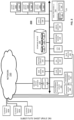
- the components or modules of the contact center system 200 may include: a plurality of customer devices 205A, 205B, 205C; communications network (or simply "network") 210; switch/media gateway 212; call controller 214; interactive media response (IMR) server 216; routing server 218; storage device 220; statistics (or "stat") server 226; plurality of agent devices 230A, 230B, 230C that include workbins 232A, 232B, 232C, respectively; multimedia/social media server 234; knowledge management server 236 coupled to a knowledge system 238; chat server 240; web servers 242; interaction (or "iXn") server 244; universal contact server (or “UCS”) 246; reporting server 248; media services server 249; and analytics module 250.
- IMR interactive media response
- the contact center system 200 generally manages resources (e.g., personnel, computers, telecommunication equipment, etc.) to enable delivery of services via telephone, email, chat, or other communication mechanisms.
- resources e.g., personnel, computers, telecommunication equipment, etc.
- Such services may vary depending on the type of contact center and, for example, may include customer service, help desk functionality, emergency response, telemarketing, order taking, and the like.
- customers desiring to receive services from the contact center system 200 may initiate inbound communications (e.g., telephone calls, emails, chats, etc.) to the contact center system 200 via a customer device 205. While FIG. 2 shows three such customer devices-i.e., customer devices 205A, 205B, and 205C-it should be understood that any number may be present.
- the customer devices 205 may be a communication device, such as a telephone, smart phone, computer, tablet, or laptop.
- customers may generally use the customer devices 205 to initiate, manage, and conduct communications with the contact center system 200, such as telephone calls, emails, chats, text messages, web-browsing sessions, and other multi-media transactions.
- Inbound and outbound communications from and to the customer devices 205 may traverse the network 210, with the nature of network typically depending on the type of customer device being used and form of communication.
- the network 210 may include a communication network of telephone, cellular, and/or data services.
- the network 210 may be a private or public switched telephone network (PSTN), local area network (LAN), private wide area network (WAN), and/or public WAN such as the Internet.
- PSTN public switched telephone network
- LAN local area network
- WAN private wide area network
- the network 210 may include a wireless carrier network including a code division multiple access (CDMA) network, global system for mobile communications (GSM) network, or any wireless network/technology conventional in the art, including but not limited to 3G, 4G, LTE, 5G, etc.
- CDMA code division multiple access
- GSM global system for mobile communications
- the switch/media gateway 212 may be coupled to the network 210 for receiving and transmitting telephone calls between customers and the contact center system 200.
- the switch/media gateway 212 may include a telephone or communication switch configured to function as a central switch for agent level routing within the center.
- the switch may be a hardware switching system or implemented via software.
- the switch 215 may include an automatic call distributor, a private branch exchange (PBX), an IP-based software switch, and/or any other switch with specialized hardware and software configured to receive Internet-sourced interactions and/or telephone network-sourced interactions from a customer, and route those interactions to, for example, one of the agent devices 230.
- PBX private branch exchange
- IP-based software switch IP-based software switch
- the switch/media gateway 212 establishes a voice connection between the customer and the agent by establishing a connection between the customer device 205 and agent device 230.
- the switch/media gateway 212 may be coupled to the call controller 214 which, for example, serves as an adapter or interface between the switch and the other routing, monitoring, and communication-handling components of the contact center system 200.
- the call controller 214 may be configured to process PSTN calls, VoIP calls, etc.
- the call controller 214 may include computer-telephone integration (CTI) software for interfacing with the switch/media gateway and other components.
- CTI computer-telephone integration
- the call controller 214 may include a session initiation protocol (SIP) server for processing SIP calls.
- the call controller 214 may also extract data about an incoming interaction, such as the customer's telephone number, IP address, or email address, and then communicate these with other contact center components in processing the interaction.
- the IMR server 216 may be configured to enable self-help or virtual assistant functionality.
- the IMR server 216 may be similar to an interactive voice response (IVR) server, except that the IMR server 216 is not restricted to voice and may also cover a variety of media channels.
- the IMR server 216 may be configured with an IMR script for querying customers on their needs. For example, a contact center for a bank may tell customers via the IMR script to "press 1" if they wish to retrieve their account balance. Through continued interaction with the IMR server 216, customers may receive service without needing to speak with an agent.
- the IMR server 216 may also be configured to ascertain why a customer is contacting the contact center so that the communication may be routed to the appropriate resource.
- the IMR configuration may be performed through the use of a self-service and/or assisted service tool (referred to herein as "designer tool") which comprises a web-based tool for developing IVR applications and routing applications running in the contact center environment (e.g. Genesys ® Designer).
- the routing server 218 may interact with the call controller 214 to route (i.e., connect) the incoming interaction to the corresponding agent device 230.
- information about the customer may be provided to the selected agent via their agent device 230. This information is intended to enhance the service the agent is able to provide to the customer.
- the contact center system 200 may include one or more mass storage devices-represented generally by the storage device 220-for storing data in one or more databases relevant to the functioning of the contact center.
- the storage device 220 may store customer data that is maintained in a customer database 222.
- customer data may include customer profiles, contact information, service level agreement (SLA), and interaction history (e.g., details of previous interactions with a particular customer, including the nature of previous interactions, disposition data, wait time, handle time, and actions taken by the contact center to resolve customer issues).
- SLA service level agreement
- interaction history e.g., details of previous interactions with a particular customer, including the nature of previous interactions, disposition data, wait time, handle time, and actions taken by the contact center to resolve customer issues.
- agent data maintained by the contact center system 200 may include agent availability and agent profiles, schedules, skills, handle time, etc.
- the storage device 220 may store interaction data in an interaction database 224.
- Interaction data may include data relating to numerous past interactions between customers and contact centers.
- the storage device 220 may be configured to include databases and/or store data related to any of the types of information described herein, with those databases and/or data being accessible to the other modules or servers of the contact center system 200 in ways that facilitate the functionality described herein.
- the servers or modules of the contact center system 200 may query such databases to retrieve data stored therewithin or transmit data thereto for storage.
- the storage device 220 may take the form of any conventional storage medium and may be locally housed or operated from a remote location.
- the databases may be Cassandra database, NoSQL database, or a SQL database and managed by a database management system, such as, Oracle, IBM DB2, Microsoft SQL server, or Microsoft Access, PostgreSQL.
- stat server 226 it may be configured to record and aggregate data relating to the performance and operational aspects of the contact center system 200. Such information may be compiled by the stat server 226 and made available to other servers and modules, such as the reporting server 248, which then may use the data to produce reports that are used to manage operational aspects of the contact center and execute automated actions in accordance with functionality described herein. Such data may relate to the state of contact center resources, e.g., average wait time, abandonment rate, agent occupancy, and others as functionality described herein would require.
- the agent devices 230 of the contact center 200 may be communication devices configured to interact with the various components and modules of the contact center system 200 in ways that facilitate functionality described herein.
- An agent device 230 may include a telephone adapted for regular telephone calls or VoIP calls.
- An agent device 230 may further include a computing device configured to communicate with the servers of the contact center system 200, perform data processing associated with operations, and interface with customers via voice, chat, email, and other multimedia communication mechanisms according to functionality described herein. While FIG. 2 shows three such agent devices-i.e., agent devices 230A, 230B and 230C-it should be understood that any number may be present.
- multimedia/social media server 2334 it may be configured to facilitate media interactions (other than voice) with the customer devices 205 and/or the servers 242. Such media interactions may be related, for example, to email, voice mail, chat, video, text-messaging, web, social media, co-browsing, etc.
- the multi-media/social media server 234 may take the form of any IP router conventional in the art with specialized hardware and software for receiving, processing, and forwarding multi-media events and communications.
- the knowledge management server 234 may be configured facilitate interactions between customers and the knowledge system 238.
- the knowledge system 238 may be a computer system capable of receiving questions or queries and providing answers in response.
- the knowledge system 238 may be included as part of the contact center system 200 or operated remotely by a third party.
- the knowledge system 238 may include an artificially intelligent computer system capable of answering questions posed in natural language by retrieving information from information sources such as encyclopedias, dictionaries, newswire articles, literary works, or other documents submitted to the knowledge system 238 as reference materials, as is known in the art.
- the knowledge system 238 may be embodied as IBM Watson or a like system.
- the chat server 240 may be configured to conduct, orchestrate, and manage electronic chat communications with customers.
- the chat server 240 is configured to implement and maintain chat conversations and generate chat transcripts.
- Such chat communications may be conducted by the chat server 240 in such a way that a customer communicates with automated chatbots, human agents, or both.
- the chat server 240 may perform as a chat orchestration server that dispatches chat conversations among the chatbots and available human agents.
- the processing logic of the chat server 240 may be rules driven so to leverage an intelligent workload distribution among available chat resources.
- the chat server 240 further may implement, manage and facilitate user interfaces (also UIs) associated with the chat feature, including those UIs generated at either the customer device 205 or the agent device 230.
- the chat server 240 may be configured to transfer chats within a single chat session with a particular customer between automated and human sources such that, for example, a chat session transfers from a chatbot to a human agent or from a human agent to a chatbot.
- the chat server 240 may also be coupled to the knowledge management server 234 and the knowledge systems 238 for receiving suggestions and answers to queries posed by customers during a chat so that, for example, links to relevant articles can be provided.
- such servers may be included to provide site hosts for a variety of social interaction sites to which customers subscribe, such as Facebook, Twitter, Instagram, etc. Though depicted as part of the contact center system 200, it should be understood that the web servers 242 may be provided by third parties and/or maintained remotely.
- the web servers 242 may also provide webpages for the enterprise or organization being supported by the contact center system 200. For example, customers may browse the webpages and receive information about the products and services of a particular enterprise.
- mechanisms may be provided for initiating an interaction with the contact center system 200, for example, via web chat, voice, or email.
- An example of such a mechanism is a widget, which can be deployed on the webpages or websites hosted on the web servers 242.
- a widget refers to a user interface component that performs a particular function.
- a widget may include a graphical user interface control that can be overlaid on a webpage displayed to a customer via the Internet.
- the widget may show information, such as in a window or text box, or include buttons or other controls that allow the customer to access certain functionalities, such as sharing or opening a file or initiating a communication.
- a widget includes a user interface component having a portable portion of code that can be installed and executed within a separate webpage without compilation.
- Some widgets can include corresponding or additional user interfaces and be configured to access a variety of local resources (e.g., a calendar or contact information on the customer device) or remote resources via network (e.g., instant messaging, electronic mail, or social networking updates).
- the interaction (iXn) server 244 may be configured to manage deferrable activities of the contact center and the routing thereof to human agents for completion.
- deferrable activities include back-office work that can be performed off-line, e.g., responding to emails, attending training, and other activities that do not entail real-time communication with a customer.
- the interaction (iXn) server 244 may be configured to interact with the routing server 218 for selecting an appropriate agent to handle each of the deferable activities. Once assigned to a particular agent, the deferable activity is pushed to that agent so that it appears on the agent device 230 of the selected agent. The deferable activity may appear in a workbin 232 as a task for the selected agent to complete.
- the functionality of the workbin 232 may be implemented via any conventional data structure, such as, for example, a linked list, array, etc.
- Each of the agent devices 230 may include a workbin 232, with the workbins 232A, 232B, and 232C being maintained in the agent devices 230A, 230B, and 230C, respectively.
- a workbin 232 may be maintained in the buffer memory of the corresponding agent device 230.
- the universal contact server (UCS) 246 it may be configured to retrieve information stored in the customer database 222 and/or transmit information thereto for storage therein.
- the UCS 246 may be utilized as part of the chat feature to facilitate maintaining a history on how chats with a particular customer were handled, which then may be used as a reference for how future chats should be handled.
- the UCS 246 may be configured to facilitate maintaining a history of customer preferences, such as preferred media channels and best times to contact. To do this, the UCS 246 may be configured to identify data pertinent to the interaction history for each customer such as, for example, data related to comments from agents, customer communication history, and the like. Each of these data types then may be stored in the customer database 222 or on other modules and retrieved as functionality described herein requires.
- reporting server 248 it may be configured to generate reports from data compiled and aggregated by the statistics server 226 or other sources. Such reports may include near real-time reports or historical reports and concern the state of contact center resources and performance characteristics, such as, for example, average wait time, abandonment rate, agent occupancy. The reports may be generated automatically or in response to specific requests from a requestor (e.g., agent, administrator, contact center application, etc.). The reports then may be used toward managing the contact center operations in accordance with functionality described herein.
- a requestor e.g., agent, administrator, contact center application, etc.
- the media services server 249 may be configured to provide audio and/or video services to support contact center features.
- such features may include prompts for an IVR or IMR system (e.g., playback of audio files), hold music, voicemails/single party recordings, multi-party recordings (e.g., of audio and/or video calls), speech recognition, dual tone multi frequency (DTMF) recognition, faxes, audio and video transcoding, secure real-time transport protocol (SRTP), audio conferencing, video conferencing, coaching (e.g., support for a coach to listen in on an interaction between a customer and an agent and for the coach to provide comments to the agent without the customer hearing the comments), call analysis, keyword spotting, and the like.
- IVR or IMR system e.g., playback of audio files
- multi-party recordings e.g., of audio and/or video calls
- speech recognition e.g., dual tone multi frequency (DTMF) recognition
- faxes faxes
- audio and video transcoding e
- the analytics module 250 may be configured to provide systems and methods for performing analytics on data received from a plurality of different data sources as functionality described herein may require.
- the analytics module 250 also may generate, update, train, and modify predictors or models 252 based on collected data, such as, for example, customer data, agent data, and interaction data.
- the models 252 may include behavior models of customers or agents.
- the behavior models may be used to predict behaviors of, for example, customers or agents, in a variety of situations, thereby allowing embodiments of the present invention to tailor interactions based on such predictions or to allocate resources in preparation for predicted characteristics of future interactions, thereby improving overall contact center performance and the customer experience.
- the analytics module 250 is depicted as being part of a contact center, such behavior models also may be implemented on customer systems (or, as also used herein, on the "customer-side" of the interaction) and used for the benefit of customers.
- the analytics module 250 may have access to the data stored in the storage device 220, including the customer database 222 and agent database 223.
- the analytics module 250 also may have access to the interaction database 224, which stores data related to interactions and interaction content (e.g., transcripts of the interactions and events detected therein), interaction metadata (e.g., customer identifier, agent identifier, medium of interaction, length of interaction, interaction start and end time, department, tagged categories), and the application setting (e.g., the interaction path through the contact center).
- the analytic module 250 may be configured to retrieve data stored within the storage device 220 for use in developing and training algorithms and models 252, for example, by applying machine learning techniques.
- One or more of the included models 252 may be configured to predict customer or agent behavior and/or aspects related to contact center operation and performance. Further, one or more of the models 252 may be used in natural language processing and, for example, include intent recognition and the like.
- the models 252 may be developed based upon 1) known first principle equations describing a system, 2) data, resulting in an empirical model, or 3) a combination of known first principle equations and data. In developing a model for use with present embodiments, because first principles equations are often not available or easily derived, it may be generally preferred to build an empirical model based upon collected and stored data. To properly capture the relationship between the manipulated/disturbance variables and the controlled variables of complex systems, it may be preferable that the models 252 are nonlinear.
- Neural networks for example, may be developed based upon empirical data using advanced regression algorithms.
- the analytics module 250 may further include an optimizer 254.
- an optimizer may be used to minimize a "cost function" subject to a set of constraints, where the cost function is a mathematical representation of desired objectives or system operation.
- the optimizer 254 may be a nonlinear programming optimizer. It is contemplated, however, that the present invention may be implemented by using, individually or in combination, a variety of different types of optimization approaches, including, but not limited to, linear programming, quadratic programming, mixed integer non-linear programming, stochastic programming, global non-linear programming, genetic algorithms, particle/swarm techniques, and the like.
- the models 252 and the optimizer 254 may together be used within an optimization system 255.
- the analytics module 250 may utilize the optimization system 255 as part of an optimization process by which aspects of contact center performance and operation are optimized or, at least, enhanced. This, for example, may include aspects related to the customer experience, agent experience, interaction routing, natural language processing, intent recognition, or other functionality related to automated processes.
- the various components, modules, and/or servers of FIG. 2 may each include one or more processors executing computer program instructions and interacting with other system components for performing the various functionalities described herein.
- Such computer program instructions may be stored in a memory implemented using a standard memory device, such as, for example, a random-access memory (RAM), or stored in other non-transitory computer readable media such as, for example, a CD-ROM, flash drive, etc.
- RAM random-access memory
- CD-ROM compact disc-read only memory
- flash drive etc.
- interaction and “communication” are used interchangeably, and generally refer to any real-time and non-real-time interaction that uses any communication channel including, without limitation, telephone calls (PSTN or VoIP calls), emails, vmails, video, chat, screen-sharing, text messages, social media messages, WebRTC calls, etc.
- Access to and control of the components of the contact system 200 may be affected through user interfaces (UIs) which may be generated on the customer devices 205 and/or the agent devices 230.
- UIs user interfaces
- the contact center system 200 may operate as a hybrid system in which some or all components are hosted remotely, such as in a cloud-based or cloud computing environment.
- chat features which, in general, enable the exchange of text messages between different parties.
- parties may include live persons, such as customers and agents, as well as automated processes, such as bots or chatbots.
- a bot also known as an "Internet bot" is a software application that runs automated tasks or scripts over the Internet. Typically, bots perform tasks that are both simple and structurally repetitive at a much higher rate than would be possible for a person.
- a chatbot is a particular type of bot and, as used herein, is defined as a piece of software and/or hardware that conducts a conversation via auditory or textual methods. As will be appreciated, chatbots are often designed to convincingly simulate how a human would behave as a conversational partner. Chatbots are typically used in dialog systems for various practical purposes including customer service or information acquisition. Some chatbots use sophisticated natural language processing systems, while simpler ones scan for keywords within the input and then select a reply from a database based on matching keywords or wording pattern.
- a subsequent mention below to a "customer device”, “agent device”, “chat server”, or “computing device” should be understood as referring to the exemplary "customer device 205", “agent device 230", “chat server 240", or “computing device 200", respectively, of FIGS. 1-2 , as well as conventional technology for fulfilling the same functionality.
- chat features and chatbots will now be discussed in greater specificity with reference to the exemplary embodiments of a chat server, chatbot, and chat interface depicted, respectively, in FIGS. 3, 4, and 5 . While these examples are provided with respect to chat systems implemented on the contact center-side, such chat systems may be used on the customer-side of an interaction. Thus, it should be understood that the exemplary chat systems of FIGS. 3, 4, and 5 may be modified for analogous customer-side implementation, including the use of customer-side chatbots configured to interact with agents and chatbots of contact centers on a customer's behalf. It should further be understood that chat features may be utilized by voice communications via converting text-to-speech and/or speech-to-text.
- chat server 240 may be used to implement chat systems and features.
- the chat server 240 may be coupled to (i.e., in electronic communication with) a customer device 205 operated by the customer over a data communications network 210.
- the chat server 240 may be operated by an enterprise as part of a contact center for implementing and orchestrating chat conversations with the customers, including both automated chats and chats with human agents.
- the chat server 240 may host chat automation modules or chatbots 260A-260C (collectively referenced as 260), which are configured with computer program instructions for engaging in chat conversations.
- the chat server 240 implements chat functionality, including the exchange of text-based or chat communications between a customer device 205 and an agent device 230 or a chatbot 260.
- the chat server 240 may include a customer interface module 265 and agent interface module 266 for generating particular UIs at the customer device 205 and the agent device 230, respectively, that facilitate chat functionality.
- each can operate as an executable program that is launched according to demand.
- the chat server 240 may operate as an execution engine for the chatbots 260, analogous to loading VoiceXML files to a media server for interactive voice response (IVR) functionality. Loading and unloading may be controlled by the chat server 240, analogous to how a VoiceXML script may be controlled in the context of an interactive voice response.
- the chat server 240 may further provide a means for capturing and collecting customer data in a unified way, similar to customer data capturing in the context of IVR. Such data can be stored, shared, and utilized in a subsequent conversation, whether with the same chatbot, a different chatbot, an agent chat, or even a different media type.
- the chat server 240 is configured to orchestrate the sharing of data among the various chatbots 260 as interactions are transferred or transitioned over from one chatbot to another or from one chatbot to a human agent.
- the data captured during interaction with a particular chatbot may be transferred along with a request to invoke a second chatbot or human agent.
- the number of chatbots 260 may vary according to the design and function of the chat server 240 and is not limited to the number illustrated in FIG. 3 .
- different chatbots may be created to have different profiles, which can then be selected between to match the subject matter of a particular chat or a particular customer.
- the profile of a particular chatbot may include expertise for helping a customer on a particular subject or communication style aimed at a certain customer preference. More specifically, one chatbot may be designed to engage in a first topic of communication (e.g., opening a new account with the business), while another chatbot may be designed to engage in a second topic of communication (e.g., technical support for a product or service provided by the business).
- chatbots may be configured to utilize different dialects or slang or have different personality traits or characteristics. Engaging chatbots with profiles that are catered to specific types of customers may enable more effective communication and results.
- the chatbot profiles may be selected based on information known about the other party, such as demographic information, interaction history, or data available on social media.
- the chat server 240 may host a default chatbot that is invoked if there is insufficient information about the customer to invoke a more specialized chatbot.
- the different chatbots may be customer selectable.
- profiles of chatbots 260 may be stored in a profile database hosted in the storage device 220. Such profiles may include the chatbot's personality, demographics, areas of expertise, and the like.
- the customer interface module 265 and agent interface module 266 may be configured to generate user interfaces (UIs) for display on the customer device 205 that facilitate chat communications between the customer and a chatbot 260 or human agent.
- UIs user interfaces
- an agent interface module 266 may generate particular UIs on the agent device 230 that facilitate chat communications between an agent operating an agent device 230 and the customer.
- the agent interface module 266 may also generate UIs on an agent device 230 that allow an agent to monitor aspects of an ongoing chat between a chatbot 260 and a customer.
- the customer interface module 265 may transmit signals to the customer device 205 during a chat session that are configured to generated particular UIs on the customer device 205, which may include the display of the text messages being sent from the chatbot 260 or human agent as well as other non-text graphics that are intended to accompany the text messages, such as emoticons or animations.
- the agent interface module 266 may transmit signals to the agent device 230 during a chat session that are configured to generated UIs on the agent device 230.
- Such UIs may include an interface that facilitates the agent selection of non-text graphics for accompanying outgoing text messages to customers.
- the chat server 240 may be implemented in a layered architecture, with a media layer, a media control layer, and the chatbots executed by way of the IMR server 216 (similar to executing a VoiceXML on an IVR media server).
- the chat server 240 may be configured to interact with the knowledge management server 234 to query the server for knowledge information.
- the query for example, may be based on a question received from the customer during a chat.
- Responses received from the knowledge management server 234 may then be provided to the customer as part of a chat response.
- chatbot 260 may include several modules, including a text analytics module 270, dialog manager 272, and output generator 274.
- a text analytics module 270 may be described, including, for examples, modules related to intent recognition, text-to-speech or speech-to-text modules, as well as modules related to script storage, retrieval, and data field processing in accordance with information stored in agent or customer profiles.
- modules related to intent recognition text-to-speech or speech-to-text modules
- modules related to script storage, retrieval, and data field processing in accordance with information stored in agent or customer profiles.
- Such topics are covered more completely in other areas of this disclosure-for example, in relation to FIGS. 6 and 7 -and so will not be repeated here. It should nevertheless be understood that the disclosures made in these areas may be used in analogous ways toward chatbot operability in accordance with functionality described herein.
- the text analytics module 270 may be configured to analyze and understand natural language.
- the text analytics module may be configured with a lexicon of the language, syntactic/semantic parser, and grammar rules for breaking a phrase provided by the customer device 205 into an internal syntactic and semantic representation.
- the configuration of the text analytics module depends on the particular profile associated with the chatbot. For example, certain words may be included in the lexicon for one chatbot but excluded that of another.
- the dialog manager 272 receives the syntactic and semantic representation from the text analytics module 270 and manages the general flow of the conversation based on a set of decision rules. In this regard, the dialog manager 272 maintains a history and state of the conversation and, based on those, generates an outbound communication. The communication may follow the script of a particular conversation path selected by the dialog manager 272. As described in further detail below, the conversation path may be selected based on an understanding of a particular purpose or topic of the conversation.
- the script for the conversation path may be generated using any of various languages and frameworks conventional in the art, such as, for example, artificial intelligence markup language (AIML), SCXML, or the like.
- the dialog manager 272 selects a response deemed to be appropriate at the particular point of the conversation flow/script and outputs the response to the output generator 274.
- the dialog manager 272 may also be configured to compute a confidence level for the selected response and provide the confidence level to the agent device 230. Every segment, step, or input in a chat communication may have a corresponding list of possible responses. Responses may be categorized based on topics (determined using a suitable text analytics and topic detection scheme) and suggested next actions are assigned. Actions may include, for example, responses with answers, additional questions, transfer to a human agent to assist, and the like.
- the confidence level may be utilized to assist the system with deciding whether the detection, analysis, and response to the customer input is appropriate or whether a human agent should be involved. For example, a threshold confidence level may be assigned to invoke human agent intervention based on one or more business rules. In exemplary embodiments, confidence level may be determined based on customer feedback. As described, the response selected by the dialog manager 272 may include information provided by the knowledge management server 234.
- the output generator 274 takes the semantic representation of the response provided by the dialog manager 272, maps the response to a chatbot profile or personality (e.g., by adjusting the language of the response according to the dialect, vocabulary, or personality of the chatbot), and outputs an output text to be displayed at the customer device 205.
- the output text may be intentionally presented such that the customer interacting with a chatbot is unaware that it is interacting with an automated process as opposed to a human agent.
- the output text may be linked with visual representations, such as emoticons or animations, integrated into the customer's user interface.
- the webpage 280 may be associated with a enterprise website and intended to initiate interaction between prospective or current customers visiting the webpage and a contact center associated with the enterprise.
- the chat feature 282 may be generated on any type of customer device 205, including personal computing devices such as laptops, tablet devices, or smart phones. Further, the chat feature 282 may be generated as a window within a webpage or implemented as a full-screen interface. As in the example shown, the chat feature 282 may be contained within a defined portion of the webpage 280 and, for example, may be implemented as a widget via the systems and components described above and/or any other conventional means.
- the chat feature 282 may include an exemplary way for customers to enter text messages for delivery to a contact center.
- the webpage 280 may be accessed by a customer via a customer device, such as the customer device, which provides a communication channel for chatting with chatbots or live agents.
- the chat feature 282 includes generating a user interface, which is referred to herein as a customer chat interface 284, on a display of the customer device.
- the customer chat interface 284, for example, may be generated by the customer interface module of a chat server, such as the chat server, as already described.
- the customer interface module 265 may send signals to the customer device 205 that are configured to generate the desired customer chat interface 284, for example, in accordance with the content of a chat message issued by a chat source, which, in the example, is a chatbot or agent named "Kate".
- the customer chat interface 284 may be contained within a designated area or window, with that window covering a designated portion of the webpage 280.
- the customer chat interface 284 also may include a text display area 286, which is the area dedicated to the chronological display of received and sent text messages.
- the customer chat interface 284 further includes a text input area 288, which is the designated area in which the customer inputs the text of their next message.
- other configurations are also possible.
- This specification includes systems and methods for automating and augmenting customer actions during various stages of interaction with a customer service provider or contact center. These are described to aid understanding of the invention. As will be seen, those various stages of interaction may be classified as pre-contact, during-contact, and post-contact stages (or, respectively, pre-interaction, during-interaction, and post-interaction stages). With specific reference now to FIG. 6 , an exemplary customer automation system 300 is shown that may be used with embodiments of the present invention. To better explain how the customer automation system 300 functions, reference will also be made to FIG. 7 , which provides a flowchart 350 of an exemplary method for automating customer actions when, for example, the customer interacts with a contact center. Additional information related to customer automation are provided in U.S. Application Ser. No. 16/151,362, filed on October 4, 2018 , and published on January 31, 2019 as US 20190037077 A1 entitled "System and Method for Customer Experience Automation".
- the customer automation system 300 of FIG. 6 represents a system that may be generally used for customer-side automations, which, as used herein, refers to the automation of actions taken on behalf of a customer in interactions with customer service providers or contact centers. Such interactions may also be referred to as "customer-contact center interactions" or simply “customer interactions”. Further, in discussing such customer-contact center interactions, it should be appreciated that reference to a "contact center” or “customer service provider” is intended to generally refer to any customer service department or other service provider associated with an organization or enterprise (such as, for example, a business, governmental agency, non-profit, school, etc.) with which a user or customer has business, transactions, affairs or other interests.
- the customer automation system 300 may be implemented as a software program or application running on a mobile device or other computing device, cloud computing devices (e.g., computer servers connected to the customer device 205 over a network), or combinations thereof (e.g., some modules of the system are implemented in the local application while other modules are implemented in the cloud.
- cloud computing devices e.g., computer servers connected to the customer device 205 over a network
- embodiments are primarily described in the context of implementation via an application running on the customer device 205. However, it should be understood that present embodiments are not limited thereto.
- the customer automation system 300 may include several components or modules.
- the customer automation system 300 includes a user interface 305, natural language processing (NLP) module 310, intent inference module 315, script storage module 320, script processing module 325, customer profile database or module (or simply "customer profile") 330, communication manager module 335, text-to-speech module 340, speech-to-text module 342, and application programming interface (API) 345, each of which will be described with more particularity with reference also to flowchart 350 of FIG. 7 .
- NLP natural language processing
- API application programming interface
- the customer automation system 300 may receive input at an initial step or operation 355.
- Such input may come from several sources.
- a primary source of input may be the customer, where such input is received via the customer device.
- the input also may include data received from other parties, particularly parties interacting with the customer through the customer device.
- information or communications sent to the customer from the contact center may provide aspects of the input.
- the input may be provided in the form of free speech or text (e.g., unstructured, natural language input).
- Input also may include other forms of data received or stored on the customer device.
- the customer automation system 300 parses the natural language of the input using the NLP module 310 and, therefrom, infers an intent using the intent inference module 315.
- the speech may be transcribed into text by a speech-to-text system (such as a large vocabulary continuous speech recognition or LVCSR system) as part of the parsing by the NLP module 310.
- the transcription may be performed locally on the customer device 205 or the speech may be transmitted over a network for conversion to text by a cloud-based server.
- the intent inference module 315 may automatically infer the customer's intent from the text of the provided input using artificial intelligence or machine learning techniques.
- Such artificial intelligence techniques may include, for example, identifying one or more keywords from the customer input and searching a database of potential intents corresponding to the given keywords.
- the database of potential intents and the keywords corresponding to the intents may be automatically mined from a collection of historical interaction recordings.
- a selection of several intents may be provided to the customer in the user interface 305. The customer may then clarify their intent by selecting one of the alternatives or may request that other alternatives be provided.
- the flowchart 350 proceeds to an operation 365 where the customer automation system 300 loads a script associated with the given intent.
- scripts may be stored and retrieved from the script storage module 320.
- Such scripts may include a set of commands or operations, pre-written speech or text, and/or fields of parameters or data (also "data fields"), which represent data that is required to automate an action for the customer.
- the script may include commands, text, and data fields that will be needed in order to resolve the issue specified by the customer's intent.
- Scripts may be specific to a particular contact center and tailored to resolve particular issues.
- Scripts may be organized in a number of ways, for example, in a hierarchical fashion, such as where all scripts pertaining to a particular organization are derived from a common "parent" script that defines common features.
- the scripts may be produced via mining data, actions, and dialogue from previous customer interactions. Specifically, the sequences of statements made during a request for resolution of a particular issue may be automatically mined from a collection of historical interactions between customers and customer service providers. Systems and methods may be employed for automatically mining effective sequences of statements and comments, as described from the contact center agent side, are described in U.S. Patent Application No.
- the flowchart 350 proceeds to an operation 370 where the customer automation system 300 processes or "loads" the script.
- This action may be performed by the script processing module 325, which performs it by filling in the data fields of the script with appropriate data pertaining to the customer. More specifically, the script processing module 325 may extract customer data that is relevant to the anticipated interaction, with that relevance being predetermined by the script selected as corresponding to the customer's intent. The data for many of the data fields within the script may be automatically loaded with data retrieved from data stored within the customer profile 330.
- the customer profile 330 may store particular data related to the customer, for example, the customer's name, birth date, address, account numbers, authentication information, and other types of information relevant to customer service interactions.
- the data selected for storage within the customer profile 330 may be based on data the customer has used in previous interactions and/or include data values obtained directly by the customer.
- the script processing module 325 may include functionality that prompts and allows the customer to manually input the needed information.
- the loaded script may be transmitted to the customer service provider or contact center.
- the loaded script may include commands and customer data necessary to automate at least a part of an interaction with the contact center on the customer's behalf.
- an API 345 is used so to interact with the contact center directly.
- Contact centers may define a protocol for making commonplace requests to their systems, which the API 345 is configured to do.
- Such APIs may be implemented over a variety of standard protocols such as Simple Object Access Protocol (SOAP) using Extensible Markup Language (XML), a Representational State Transfer (REST) API with messages formatted using XML or JavaScript Object Notation (JSON), and the like.
- SOAP Simple Object Access Protocol
- XML Extensible Markup Language
- REST Representational State Transfer
- JSON JavaScript Object Notation
- the customer automation system 300 may automatically generate a formatted message in accordance with a defined protocol for communication with a contact center, where the message contains the information specified by the script in appropriate portions of
- FIG. 8 is a block diagram of an embodiment of the channel architecture.
- a voice channel 401 and a chat channel 402 are illustrated for simplicity, however it is within the scope of the embodiments for there to be a plurality of channels (omnichannel) of any media type the contact center is capable of handling, such as voice, chat, SMS, email, etc.
- omnichannel channels of any media type the contact center is capable of handling, such as voice, chat, SMS, email, etc.
- the interaction is received at a SIP server located at the call controller 214 of FIG. 2 .
- the SIP server 214 sends a request to the Orchestration Server (ORS) through a T-lib interface.
- the ORS functions in connection with the URS 218 as an orchestration platform for interactions.
- the Automatic Speech Recognition (ASR) connector component converts the voice interaction 403 into text.
- the voice interaction may be a call between a customer and an agent.
- the voice interaction may comprise a voice interaction between a customer and a bot.
- the converted text is sent to the Designer 405 and to the Contextual Summarizer 410.
- the Contextual Summarizer is comprised of a plurality of APIs that may be customized by a contact center.
- the Contextual Summarizer might comprise: a text summarizer API, a churn predictor API, a sentiment analysis API, a next best action API, and an interaction reference detector API.
- the Text Summarizer API receives the text transcript of the conversation that happened prior to the transfer as input. It processes the transcript to produce a summary using summarization techniques known in the art (e.g. Extractive Summarization and Abstractive Summarization).
- a transfer may be triggered, or initiated, by either party to the interaction.
- a chat bot may determine that the customer needs to speak with a human agent based on the dialog. The customer may also make the request.
- An agent may decide they aren't able to successfully handle an interaction and offer to transfer the interaction to a more specialized agent or a manager.
- Extractive Summarization involves identifying the important sentences or excerpts from the text and reproducing them verbatim as part of the summary. No new text is generated; only existing text is used in the summarization process.
- the original text transcript of the conversation might be: "I opted for the cell provider SIM and recharged with the $50 4G plan. While I am traveling, in non-4G coverage areas, I am not able to browse data. At least, I want to be able to use 3G service in the area. Blocking data is not acceptable. If it continues, I will switch to other networks.”
- An extractive summary might read: "I opted cell provider, recharged $50 4G plan. In non-4G areas, I am not able to browse data. I want to use 3G service in the area.
- Abstractive summarization employs more powerful natural language processing techniques to interpret text and generate new summary text, as opposed to selecting the most representative existing excerpts to perform the summarization.
- the abstractive summary might read as: "I recharged with $50 4G cell provider plan and unable to browse data in non 4G areas. If it persists, will switch to other networks.”
- the Churn Predicter API receives the voice/chat transcript as input and analyzes the transcript for churn indication. If the churn indicator level is high, this API indicates the churn as high in the summary.
- the sentiment analysis API receives the voice/chat transcript as input and searches for the customer sentiments in the transcript (e.g., positive, negative, and neutral).
- the information on the customer's sentiment is passed to the agent along with the summary after this API is triggered.
- the next best action API provides suggested responses and actions to be performed by an agent to assist the customer in an efficient way. For example, a transcript might read "I opted for the cell provider SIM and recharged with the $50 4G plan. While I am traveling, in non-4G coverage areas, I am not able to browse data. At the very least, I want to use 3G service in the area. Blocking data is not acceptable. If it continues, I will switch to other networks.” Suggested actions may appear to the agent based on the interaction in order to achieve a desired outcome, such as “Offer free 3G pack" or "Advise Roaming instructions”.
- the interaction reference detector API may look for information in the chat/call history, and in the current chat transcript, that the customer has previously reached out to the contact center for the same issue.
- the API may trigger an indication in the summary whether the customer already interacted with the contact center for the same query not through metadata.
- APIs may be included in the contextual summarizer. While a few examples have been provided, other APIs may also be included or deleted specific to the contact center and depending on the desired information.
- the Contextual Summarizer 410 is operably connected with the Designer tool 405 through a REST API.
- the Designer tool 405 communicates with the media services 249 through an HTTP connection and the UCS 246 through a Transmission Control Protocol (TCP) connection.
- TCP Transmission Control Protocol
- the Contextual Summarizer 410 is operably connected to the contact center system 200 and provides the summaries of the interaction to the agent device(s) 230.
- Widget is operatively connected to a gateway 212 for the bot 260.
- the gateway 212 is operably connected with the designer (via HTTP, for example), which connects with the Universal Contact Server 246.
- An example conversation in an interaction between a bot and a customer prior to transfer to a human agent is provided as follows:
- the chat transcript is retrieved for the current interaction from the UCS 246 database by the Designer 405 through a network connection (e.g. TCP).
- the transcript is provided to the Contextual Summarizer 410 (via a connection such as a REST API) in a web request.
- the Contextual Summarizer 410 will process the transcript and send the final Summary and detected Metadata as a response back to the web request.
- the summary and metadata as sent as 'Attach data' to the agent 230 in the contact center system 200.
- the following summary might be provided to an agent: "Customer wants to change his plan with more data. Bot offered Freedom-80 plan. Customer feels that suggested plan is too costly and another provider offers more data for much less.”
- Metadata may also be provided in the summary, such as:
- the agent 230 is able to view the Summary and Metadata in a designated section of their UI at their workstation.
- the agent can selection the best action from a list of suggested actions and use the associated suggested response to form a quick reply.
- the notes section in the Agent desktop may also be automatically updated with the summary of the full conversation (the conversation between the bot and the customer and the Agent and the customer) so that the agent does not have to spend their time filling in the notes and can quickly move on to the next interaction.
- a voice interaction between a customer and a first agent is transferred to a second agent
- the second agent has to read through the entire conversation while keeping the customer waiting and/or asking repetitive questions to understand the reason for the transfer and customer problem.
- a sample conversation may appear as such:
- the designer 405 Whenever there is a call transfer from one agent to another, the designer 405 is executed to obtain the voice transcript from the ASR connector 249. Once the voice transcript has been obtained, the designer 405 sends this transcript to the Contextual Summarizer 410 in a web request.
- the Contextual Summarizer 410 processes the transcript and sends the final summary and detected metadata as a response back to the web request.
- the summary and metadata are provided as "attach data" to the next agent.
- the second agent is provided with a summary as follows:
- Metadata may also be provided such as:
- the agent 230 is able to view the Summary and Metadata in a designated section of their UI at their workstation.
- the agent can selection the best action from a list of suggested actions and use the associated suggested response to form a quick reply.
- the notes section in the Agent desktop may also be automatically updated with the summary of the full conversation (the conversation between the bot and the customer and the Agent and the customer) so that the agent does not have to spend their time filling in the notes and can quickly move on to the next interaction.
Landscapes
- Engineering & Computer Science (AREA)
- Signal Processing (AREA)
- Business, Economics & Management (AREA)
- Computer Networks & Wireless Communication (AREA)
- Marketing (AREA)
- Strategic Management (AREA)
- Finance (AREA)
- Development Economics (AREA)
- Accounting & Taxation (AREA)
- Theoretical Computer Science (AREA)
- Physics & Mathematics (AREA)
- General Physics & Mathematics (AREA)
- Multimedia (AREA)
- General Engineering & Computer Science (AREA)
- Game Theory and Decision Science (AREA)
- Computational Linguistics (AREA)
- Audiology, Speech & Language Pathology (AREA)
- Entrepreneurship & Innovation (AREA)
- Health & Medical Sciences (AREA)
- Economics (AREA)
- General Business, Economics & Management (AREA)
- Acoustics & Sound (AREA)
- Human Computer Interaction (AREA)
- Artificial Intelligence (AREA)
- General Health & Medical Sciences (AREA)
- Information Transfer Between Computers (AREA)
- Telephonic Communication Services (AREA)
Claims (15)
- Computerimplementiertes Verfahren zum Bereitstellen einer kontextuellen Zusammenfassung einer Interaktion (402, 403) zwischen einer ersten Partei (205) und einer zweiten Partei (230, 260) über einen Medienkanal in einem Interaktionstransfer an eine dritte Partei (230), wobei das Verfahren Folgendes umfasst:Empfangen einer Anfrage zum Transfer einer Interaktion (402, 403) an die dritte Partei (230), wobei die Anfrage durch die Interaktion (402, 403) ausgelöst wird;Erlangen eines Text-Transkripts der Interaktion (402, 403);Verarbeiten des Transkripts, um die kontextuelle Zusammenfassung und Metadaten zu erlangen; undBereitstellen der kontextuellen Zusammenfassung und Metadaten für die dritte Partei (230) zum Verwalten der Interaktion (402, 403) mit dem Interaktionstransfer, wobei die kontextuelle Zusammenfassung und Metadaten ferner eine Liste von vorgeschlagenen Aktionen für die dritte Partei (230) umfassen.
- Verfahren nach Anspruch 1, wobei der erste Medienkanal einen Sprachkanal umfasst.
- Verfahren nach Anspruch 2, wobei die erste Partei (205) ein Kunde eines Kontaktzentrums ist, die zweite Partei (230) ein Mitarbeiter eines Kontaktzentrums ist und die dritte Partei (230) ein Mitarbeiter eines Kontaktzentrums ist, und optional wobei Erhalten eines Text-Transkripts der Interaktion (403) Durchführen einer automatischen Spracherkennung der Sprachinteraktion (403) umfasst.
- Verfahren nach Anspruch 1, wobei der erste Medienkanal einen Chat-Kanal umfasst.
- Verfahren nach Anspruch 4, wobei die erste Partei (205) ein Kunde eines Kontaktzentrums ist, die zweite Partei (260) ein Chatbot ist und die dritte Partei (230) ein Mitarbeiter eines Kontaktzentrums ist.
- Verfahren nach Anspruch 1, wobei die kontextuelle Zusammenfassung mindestens eines von Folgendem umfasst: eine Zusammenfassung der Unterhaltung, Stimmungsindikatoren, Indikatoren für die Abwanderungsvorhersage, Interaktionsreferenzindikatoren, vorgeschlagene Aktionen und Warteschlangen-Prioritätsrangfolge.
- Verfahren nach Anspruch 1, ferner umfassend die Folgenden Schritte:
nachdem die Interaktion (402, 403) beendet ist, automatisches Aktualisieren von Interaktionsnotizen für die dritte Partei (230), wobei die Notizen Folgendes umfassen:die kontextuelle Zusammenfassung und Metadaten, die der dritten Partei (230) bereitgestellt werden, undeine kontextuelle Zusammenfassung des Verwaltens der Interaktion (402, 403) durch die dritte Partei (230). - System zum Bereitstellen einer kontextuellen Zusammenfassung einer Interaktion (402, 403) zwischen einer ersten Partei (205) und einer zweiten Partei (230, 260) über einen Medienkanal in einem Interaktionstransfer an eine dritte Partei (230), wobei das System Folgendes umfasst:einen Prozessor (105); undeinen Speicher (110) in Kommunikation mit dem Prozessor (105), wobei der Speicher (110) Anweisungen speichert, die, wenn sie durch den Prozessor (105) ausgeführt werden, den Prozessor (105) veranlassen, die kontextuelle Zusammenfassung durch Folgendes bereitzustellen:Empfangen einer Anfrage zum Transfer einer Interaktion (402, 403) an die dritte Partei (230), wobei die Anfrage durch die Interaktion (402, 403) ausgelöst wird;Erlangen eines Text-Transkripts der Interaktion (402, 403);Verarbeiten des Transkripts, um die kontextuelle Zusammenfassung und Metadaten zu erlangen; undBereitstellen der kontextuellen Zusammenfassung und Metadaten für die dritte Partei (230) zum Verwalten der Interaktion (402, 403) mit dem Interaktionstransfer, wobei die kontextuelle Zusammenfassung und Metadaten ferner eine Liste von vorgeschlagenen Aktionen für die dritte Partei (230) umfassen.
- System nach Anspruch 8, wobei der erste Medienkanal einen Sprachkanal umfasst.
- System nach Anspruch 9, wobei die erste Partei (205) ein Kunde eines Kontaktzentrums ist, die zweite Partei (230) ein Mitarbeiter eines Kontaktzentrums ist und die dritte Partei (230) ein Mitarbeiter eines Kontaktzentrums ist, und optional wobei Erhalten eines Text-Transkripts der Interaktion (403) Durchführen einer automatischen Spracherkennung der Sprachinteraktion umfasst.
- System nach Anspruch 8, wobei der erste Medienkanal einen Chat-Kanal umfasst.
- System nach Anspruch 11, wobei die erste Partei (205) ein Kunde eines Kontaktzentrums ist, die zweite Partei (260) ein Chatbot ist und die dritte Partei (230) ein Mitarbeiter eines Kontaktzentrums ist.
- System nach Anspruch 8, wobei die kontextuelle Zusammenfassung mindestens eines von Folgendem umfasst: eine Zusammenfassung der Unterhaltung, Stimmungsindikatoren, Indikatoren für die Abwanderungsvorhersage, Interaktionsreferenzindikatoren, vorgeschlagene Aktionen und Warteschlangen-Prioritätsrangfolge.
- System von Anspruch 8, wobei der Speicher Anweisungen speichert, die, wenn sie durch den Prozessor ausgeführt werden, den Prozessor ferner veranlassen, die kontextuelle Zusammenfassung durch Folgendes bereitzustellen:
nachdem die Interaktion (402, 403) beendet ist, automatisches Aktualisieren von Interaktionsnotizen für die dritte Partei (230), wobei die Notizen Folgendes umfassen:die kontextuelle Zusammenfassung und Metadaten, die der dritten Partei (230) bereitgestellt werden, undeine kontextuelle Zusammenfassung des Verwaltens der Interaktion (402, 403) durch die dritte Partei (230). - System nach Anspruch 8, wobei die kontextuelle Zusammenfassung durch einen kontextuellen Zusammenfasser (410) bereitgestellt wird, der eine benutzerdefinierte Vielzahl von Anwendungsprogrammierschnittstellen (application programming interfaces, API) umfasst, und optional wobei die Vielzahl von API mindestens eines von Folgendem umfasst: eine Textzusammenfassungs-API, eine Abwanderungsvorhersage-API, eine Stimmungsanalyse-API, eine API für die nächstbeste Aktion und eine API für den Interaktionsreferenzdetektor.
Applications Claiming Priority (3)
| Application Number | Priority Date | Filing Date | Title |
|---|---|---|---|
| US201962842552P | 2019-05-03 | 2019-05-03 | |
| US16/864,188 US11301908B2 (en) | 2019-05-03 | 2020-05-01 | System and method for providing contextual summaries in interaction transfer |
| PCT/US2020/031205 WO2020227164A1 (en) | 2019-05-03 | 2020-05-02 | System and method for providing contextual summaries in interaction transfer |
Publications (2)
| Publication Number | Publication Date |
|---|---|
| EP3963873A1 EP3963873A1 (de) | 2022-03-09 |
| EP3963873B1 true EP3963873B1 (de) | 2025-03-12 |
Family
ID=73015958
Family Applications (1)
| Application Number | Title | Priority Date | Filing Date |
|---|---|---|---|
| EP20730155.7A Active EP3963873B1 (de) | 2019-05-03 | 2020-05-02 | System und verfahren zur bereitstellung von kontextuellen zusammenfassungen im interaktionstransfer |
Country Status (6)
| Country | Link |
|---|---|
| US (1) | US11301908B2 (de) |
| EP (1) | EP3963873B1 (de) |
| CN (1) | CN113785556A (de) |
| AU (1) | AU2020268901B2 (de) |
| CA (1) | CA3137117A1 (de) |
| WO (1) | WO2020227164A1 (de) |
Families Citing this family (38)
| Publication number | Priority date | Publication date | Assignee | Title |
|---|---|---|---|---|
| US11012568B2 (en) | 2009-01-28 | 2021-05-18 | Virtual Hold Technology Solutions, Llc | System and method for providing chat-based customer callbacks |
| US10680979B2 (en) | 2018-06-08 | 2020-06-09 | Capital One Services, Llc | System and method for proactive intervention to reduce high cost channel usage |
| US11301908B2 (en) * | 2019-05-03 | 2022-04-12 | Genesys Telecommunications Laboratories, Inc. | System and method for providing contextual summaries in interaction transfer |
| US11775130B2 (en) | 2019-07-03 | 2023-10-03 | Apple Inc. | Guided retail experience |
| US11816800B2 (en) * | 2019-07-03 | 2023-11-14 | Apple Inc. | Guided consumer experience |
| WO2021126962A1 (en) * | 2019-12-16 | 2021-06-24 | Liveperson, Inc. | Systems and methods for a proactive two-way conversation |
| US11763259B1 (en) | 2020-02-20 | 2023-09-19 | Asana, Inc. | Systems and methods to generate units of work in a collaboration environment |
| US11122165B1 (en) * | 2020-05-29 | 2021-09-14 | Verizon Patent And Licensing Inc. | Systems and methods for customer service agent-guided chat session digital assistant |
| US11900323B1 (en) * | 2020-06-29 | 2024-02-13 | Asana, Inc. | Systems and methods to generate units of work within a collaboration environment based on video dictation |
| US11228681B1 (en) * | 2020-07-29 | 2022-01-18 | Five9, Inc. | Systems for summarizing contact center calls and methods of using same |
| AU2021374940A1 (en) * | 2020-11-04 | 2023-06-08 | Genesys Cloud Services, Inc. | System and method for providing personalized context |
| WO2022119942A1 (en) * | 2020-12-03 | 2022-06-09 | Interactive Media S.P.A. | Systems and methods of integrating legacy chatbots with telephone networks |
| US11329933B1 (en) | 2020-12-28 | 2022-05-10 | Drift.com, Inc. | Persisting an AI-supported conversation across multiple channels |
| JP2024506565A (ja) * | 2021-02-18 | 2024-02-14 | ウィックス.コム リミテッド. | 動的表示を統合した構造化通信システム |
| US11729121B2 (en) * | 2021-04-29 | 2023-08-15 | Bank Of America Corporation | Executing a network of chatbots using a combination approach |
| US11809222B1 (en) | 2021-05-24 | 2023-11-07 | Asana, Inc. | Systems and methods to generate units of work within a collaboration environment based on selection of text |
| US11955117B2 (en) | 2021-05-27 | 2024-04-09 | The Toronto-Dominion Bank | System and method for analyzing and reacting to interactions between entities using electronic communication channels |
| US12041020B2 (en) * | 2021-06-14 | 2024-07-16 | LiveChat Software S.A. | System and method for asynchronous messaging combined with a real-time communication |
| US11736610B2 (en) | 2021-09-28 | 2023-08-22 | Optum, Inc. | Audio-based machine learning frameworks utilizing similarity determination machine learning models |
| US12118514B1 (en) | 2022-02-17 | 2024-10-15 | Asana, Inc. | Systems and methods to generate records within a collaboration environment based on a machine learning model trained from a text corpus |
| US11836681B1 (en) | 2022-02-17 | 2023-12-05 | Asana, Inc. | Systems and methods to generate records within a collaboration environment |
| US11997425B1 (en) | 2022-02-17 | 2024-05-28 | Asana, Inc. | Systems and methods to generate correspondences between portions of recorded audio content and records of a collaboration environment |
| US12190292B1 (en) | 2022-02-17 | 2025-01-07 | Asana, Inc. | Systems and methods to train and/or use a machine learning model to generate correspondences between portions of recorded audio content and work unit records of a collaboration environment |
| GB2630523A (en) * | 2022-02-21 | 2024-11-27 | Ntt Technocross Corp | Handling assistance system, handling assistance method, and program |
| US12284148B2 (en) | 2022-03-02 | 2025-04-22 | Microsoft Technology Licensing, Llc | Topic suggestion in messaging systems |
| KR102780758B1 (ko) * | 2022-05-16 | 2025-03-12 | 주식회사 마인드웨어웍스 | 챗봇 서비스 및 컨택센터 서비스 연계 제공 시스템 |
| WO2023244519A1 (en) * | 2022-06-14 | 2023-12-21 | Liveperson, Inc. | Targeted generative ai from merged communication transcripts |
| WO2024076534A1 (en) * | 2022-10-03 | 2024-04-11 | Liveperson, Inc. | Automated opt-in conversation systems |
| US12132580B2 (en) * | 2022-10-17 | 2024-10-29 | vTapestry, Inc. | Interactive generation of meeting tapestries |
| US12400072B2 (en) * | 2023-01-18 | 2025-08-26 | Salesforce, Inc. | Systems and methods for structured conversation summarization |
| US12591604B2 (en) * | 2023-06-13 | 2026-03-31 | Fmr Llc | Intelligent assistant |
| US12499894B1 (en) * | 2023-09-15 | 2025-12-16 | Zoom Communications, Inc. | Video conference transcript querying using artificial intelligence |
| JP7839841B2 (ja) * | 2023-09-19 | 2026-04-02 | ソフトバンクグループ株式会社 | システム |
| US20250131513A1 (en) * | 2023-10-23 | 2025-04-24 | Adp, Inc. | Scaling virtual assistant system execution via machine learning based data mining and event identification |
| US12126769B1 (en) * | 2023-12-06 | 2024-10-22 | Acqueon Inc. | Platform for call transcription and summarization using generative artificial intelligence |
| US12368692B1 (en) * | 2024-01-11 | 2025-07-22 | Intelligent Email, LLC | Systems and methods for electronic mail categorization and generative analysis |
| US20250328571A1 (en) * | 2024-04-19 | 2025-10-23 | The Toronto-Dominion Bank | Systems and methods for generating context summaries for data transfers |
| US12470655B1 (en) | 2024-09-20 | 2025-11-11 | UpDoc Inc. | System for processing telephone voice data to drive an application protocol |
Family Cites Families (16)
| Publication number | Priority date | Publication date | Assignee | Title |
|---|---|---|---|---|
| US8909718B2 (en) * | 2011-06-29 | 2014-12-09 | Avaya Inc. | Methods and systems for incorporating a third user into an instant message session |
| US8838061B2 (en) * | 2011-12-21 | 2014-09-16 | Motorola Solutions, Inc. | Method and apparatus for providing multiparty participation and management for a text message session |
| US9049311B2 (en) * | 2012-08-17 | 2015-06-02 | Michael Yuzefovich | Automated voice call transcription and data record integration |
| US8964946B1 (en) * | 2012-09-27 | 2015-02-24 | West Corporation | Identifying recorded call data segments of interest |
| US9313330B1 (en) * | 2012-09-27 | 2016-04-12 | West Corporation | Identifying recorded call data segments of interest |
| US10439965B1 (en) * | 2013-01-18 | 2019-10-08 | Twitter, Inc. | In-message applications in a messaging platform |
| US9392112B2 (en) * | 2014-05-27 | 2016-07-12 | Genesys Telecommunications Laboratories, Inc. | Flow designer for contact centers |
| US20170331772A1 (en) * | 2014-10-27 | 2017-11-16 | Clutch Group, Llc | Chat Log Analyzer |
| CN105991849B (zh) * | 2015-02-13 | 2019-03-01 | 华为技术有限公司 | 一种坐席服务方法、装置及系统 |
| US9647968B2 (en) * | 2015-03-25 | 2017-05-09 | Pypestream Inc | Systems and methods for invoking chatbots in a channel based communication system |
| US9450901B1 (en) * | 2015-03-25 | 2016-09-20 | Pypestream Inc. | Channel based communication and transaction system |
| EP3453160B1 (de) | 2016-05-06 | 2023-06-21 | Greeneden U.S. Holdings II, LLC | System und verfahren zur verwaltung und überleitung von automatisierten chatkonversationen |
| US10938589B2 (en) * | 2018-11-30 | 2021-03-02 | International Business Machines Corporation | Communications analysis and participation recommendation |
| US12008317B2 (en) * | 2019-01-23 | 2024-06-11 | International Business Machines Corporation | Summarizing information from different sources based on personal learning styles |
| US11140143B2 (en) * | 2019-04-08 | 2021-10-05 | The Toronto-Dominion Bank | Dynamic and cryptographically secure augmentation of participants in programmatically established chatbot sessions |
| US11301908B2 (en) * | 2019-05-03 | 2022-04-12 | Genesys Telecommunications Laboratories, Inc. | System and method for providing contextual summaries in interaction transfer |
-
2020
- 2020-05-01 US US16/864,188 patent/US11301908B2/en active Active
- 2020-05-02 EP EP20730155.7A patent/EP3963873B1/de active Active
- 2020-05-02 AU AU2020268901A patent/AU2020268901B2/en active Active
- 2020-05-02 CN CN202080032861.1A patent/CN113785556A/zh active Pending
- 2020-05-02 CA CA3137117A patent/CA3137117A1/en active Pending
- 2020-05-02 WO PCT/US2020/031205 patent/WO2020227164A1/en not_active Ceased
Also Published As
| Publication number | Publication date |
|---|---|
| US20200349614A1 (en) | 2020-11-05 |
| EP3963873A1 (de) | 2022-03-09 |
| US11301908B2 (en) | 2022-04-12 |
| CN113785556A (zh) | 2021-12-10 |
| AU2020268901A1 (en) | 2021-11-11 |
| AU2020268901B2 (en) | 2025-01-23 |
| CA3137117A1 (en) | 2020-11-12 |
| WO2020227164A1 (en) | 2020-11-12 |
Similar Documents
| Publication | Publication Date | Title |
|---|---|---|
| AU2020268901B2 (en) | System and method for providing contextual summaries in interaction transfer | |
| US10951768B2 (en) | Measuring cognitive capabilities of automated resources and related management thereof in contact centers | |
| US11055649B1 (en) | Systems and methods relating to customer experience automation | |
| EP4029205B1 (de) | Systeme und verfahren zur erleichterung der bot-kommunikation | |
| US20240256788A1 (en) | Systems and methods for dialog management | |
| US11763318B2 (en) | Systems and methods relating to providing chat services to customers | |
| EP3453160B1 (de) | System und verfahren zur verwaltung und überleitung von automatisierten chatkonversationen | |
| US11734648B2 (en) | Systems and methods relating to emotion-based action recommendations | |
| US11620656B2 (en) | System and method for personalization as a service | |
| US20220366427A1 (en) | Systems and methods relating to artificial intelligence long-tail growth through gig customer service leverage | |
| EP4639401A1 (de) | Technologien zur fehlerreduktion bei der absichtsklassifizierung | |
| US20240378392A1 (en) | Systems and methods for computing intent health for enhancing conversational bots | |
| US20240256909A1 (en) | Technologies for implicit feedback using multi-factor behavior monitoring |
Legal Events
| Date | Code | Title | Description |
|---|---|---|---|
| STAA | Information on the status of an ep patent application or granted ep patent |
Free format text: STATUS: UNKNOWN |
|
| STAA | Information on the status of an ep patent application or granted ep patent |
Free format text: STATUS: THE INTERNATIONAL PUBLICATION HAS BEEN MADE |
|
| PUAI | Public reference made under article 153(3) epc to a published international application that has entered the european phase |
Free format text: ORIGINAL CODE: 0009012 |
|
| STAA | Information on the status of an ep patent application or granted ep patent |
Free format text: STATUS: REQUEST FOR EXAMINATION WAS MADE |
|
| 17P | Request for examination filed |
Effective date: 20210830 |
|
| AK | Designated contracting states |
Kind code of ref document: A1 Designated state(s): AL AT BE BG CH CY CZ DE DK EE ES FI FR GB GR HR HU IE IS IT LI LT LU LV MC MK MT NL NO PL PT RO RS SE SI SK SM TR |
|
| DAV | Request for validation of the european patent (deleted) | ||
| DAX | Request for extension of the european patent (deleted) | ||
| STAA | Information on the status of an ep patent application or granted ep patent |
Free format text: STATUS: EXAMINATION IS IN PROGRESS |
|
| 17Q | First examination report despatched |
Effective date: 20230201 |
|
| P01 | Opt-out of the competence of the unified patent court (upc) registered |
Effective date: 20230510 |
|
| RAP3 | Party data changed (applicant data changed or rights of an application transferred) |
Owner name: GENESYS CLOUD SERVICES HOLDINGS II, LLC |
|
| GRAP | Despatch of communication of intention to grant a patent |
Free format text: ORIGINAL CODE: EPIDOSNIGR1 |
|
| STAA | Information on the status of an ep patent application or granted ep patent |
Free format text: STATUS: GRANT OF PATENT IS INTENDED |
|
| RAP1 | Party data changed (applicant data changed or rights of an application transferred) |
Owner name: GENESYS CLOUD SERVICES, INC. |
|
| INTG | Intention to grant announced |
Effective date: 20241218 |
|
| GRAS | Grant fee paid |
Free format text: ORIGINAL CODE: EPIDOSNIGR3 |
|
| GRAA | (expected) grant |
Free format text: ORIGINAL CODE: 0009210 |
|
| STAA | Information on the status of an ep patent application or granted ep patent |
Free format text: STATUS: THE PATENT HAS BEEN GRANTED |
|
| AK | Designated contracting states |
Kind code of ref document: B1 Designated state(s): AL AT BE BG CH CY CZ DE DK EE ES FI FR GB GR HR HU IE IS IT LI LT LU LV MC MK MT NL NO PL PT RO RS SE SI SK SM TR |
|
| REG | Reference to a national code |
Ref country code: GB Ref legal event code: FG4D |
|
| REG | Reference to a national code |
Ref country code: CH Ref legal event code: EP |
|
| REG | Reference to a national code |
Ref country code: DE Ref legal event code: R096 Ref document number: 602020047578 Country of ref document: DE |
|
| REG | Reference to a national code |
Ref country code: IE Ref legal event code: FG4D |
|
| PG25 | Lapsed in a contracting state [announced via postgrant information from national office to epo] |
Ref country code: RS Free format text: LAPSE BECAUSE OF FAILURE TO SUBMIT A TRANSLATION OF THE DESCRIPTION OR TO PAY THE FEE WITHIN THE PRESCRIBED TIME-LIMIT Effective date: 20250612 |
|
| PG25 | Lapsed in a contracting state [announced via postgrant information from national office to epo] |
Ref country code: FI Free format text: LAPSE BECAUSE OF FAILURE TO SUBMIT A TRANSLATION OF THE DESCRIPTION OR TO PAY THE FEE WITHIN THE PRESCRIBED TIME-LIMIT Effective date: 20250312 |
|
| PGFP | Annual fee paid to national office [announced via postgrant information from national office to epo] |
Ref country code: DE Payment date: 20250519 Year of fee payment: 6 |
|
| PG25 | Lapsed in a contracting state [announced via postgrant information from national office to epo] |
Ref country code: ES Free format text: LAPSE BECAUSE OF FAILURE TO SUBMIT A TRANSLATION OF THE DESCRIPTION OR TO PAY THE FEE WITHIN THE PRESCRIBED TIME-LIMIT Effective date: 20250312 |
|
| PGFP | Annual fee paid to national office [announced via postgrant information from national office to epo] |
Ref country code: GB Payment date: 20250512 Year of fee payment: 6 |
|
| REG | Reference to a national code |
Ref country code: LT Ref legal event code: MG9D |
|
| PG25 | Lapsed in a contracting state [announced via postgrant information from national office to epo] |
Ref country code: NO Free format text: LAPSE BECAUSE OF FAILURE TO SUBMIT A TRANSLATION OF THE DESCRIPTION OR TO PAY THE FEE WITHIN THE PRESCRIBED TIME-LIMIT Effective date: 20250612 |
|
| PG25 | Lapsed in a contracting state [announced via postgrant information from national office to epo] |
Ref country code: HR Free format text: LAPSE BECAUSE OF FAILURE TO SUBMIT A TRANSLATION OF THE DESCRIPTION OR TO PAY THE FEE WITHIN THE PRESCRIBED TIME-LIMIT Effective date: 20250312 |
|
| REG | Reference to a national code |
Ref country code: NL Ref legal event code: MP Effective date: 20250312 |
|
| PG25 | Lapsed in a contracting state [announced via postgrant information from national office to epo] |
Ref country code: LV Free format text: LAPSE BECAUSE OF FAILURE TO SUBMIT A TRANSLATION OF THE DESCRIPTION OR TO PAY THE FEE WITHIN THE PRESCRIBED TIME-LIMIT Effective date: 20250312 |
|
| PGFP | Annual fee paid to national office [announced via postgrant information from national office to epo] |
Ref country code: FR Payment date: 20250521 Year of fee payment: 6 |
|
| PG25 | Lapsed in a contracting state [announced via postgrant information from national office to epo] |
Ref country code: GR Free format text: LAPSE BECAUSE OF FAILURE TO SUBMIT A TRANSLATION OF THE DESCRIPTION OR TO PAY THE FEE WITHIN THE PRESCRIBED TIME-LIMIT Effective date: 20250613 Ref country code: BG Free format text: LAPSE BECAUSE OF FAILURE TO SUBMIT A TRANSLATION OF THE DESCRIPTION OR TO PAY THE FEE WITHIN THE PRESCRIBED TIME-LIMIT Effective date: 20250312 |
|
| PGFP | Annual fee paid to national office [announced via postgrant information from national office to epo] |
Ref country code: IE Payment date: 20250507 Year of fee payment: 6 |
|
| REG | Reference to a national code |
Ref country code: AT Ref legal event code: MK05 Ref document number: 1775992 Country of ref document: AT Kind code of ref document: T Effective date: 20250312 |
|
| PG25 | Lapsed in a contracting state [announced via postgrant information from national office to epo] |
Ref country code: NL Free format text: LAPSE BECAUSE OF FAILURE TO SUBMIT A TRANSLATION OF THE DESCRIPTION OR TO PAY THE FEE WITHIN THE PRESCRIBED TIME-LIMIT Effective date: 20250312 |
|
| PG25 | Lapsed in a contracting state [announced via postgrant information from national office to epo] |
Ref country code: SE Free format text: LAPSE BECAUSE OF FAILURE TO SUBMIT A TRANSLATION OF THE DESCRIPTION OR TO PAY THE FEE WITHIN THE PRESCRIBED TIME-LIMIT Effective date: 20250312 |
|
| PG25 | Lapsed in a contracting state [announced via postgrant information from national office to epo] |
Ref country code: SM Free format text: LAPSE BECAUSE OF FAILURE TO SUBMIT A TRANSLATION OF THE DESCRIPTION OR TO PAY THE FEE WITHIN THE PRESCRIBED TIME-LIMIT Effective date: 20250312 |
|
| PG25 | Lapsed in a contracting state [announced via postgrant information from national office to epo] |
Ref country code: PT Free format text: LAPSE BECAUSE OF FAILURE TO SUBMIT A TRANSLATION OF THE DESCRIPTION OR TO PAY THE FEE WITHIN THE PRESCRIBED TIME-LIMIT Effective date: 20250714 |
|
| PG25 | Lapsed in a contracting state [announced via postgrant information from national office to epo] |
Ref country code: IT Free format text: LAPSE BECAUSE OF FAILURE TO SUBMIT A TRANSLATION OF THE DESCRIPTION OR TO PAY THE FEE WITHIN THE PRESCRIBED TIME-LIMIT Effective date: 20250312 Ref country code: PL Free format text: LAPSE BECAUSE OF FAILURE TO SUBMIT A TRANSLATION OF THE DESCRIPTION OR TO PAY THE FEE WITHIN THE PRESCRIBED TIME-LIMIT Effective date: 20250312 |
|
| PG25 | Lapsed in a contracting state [announced via postgrant information from national office to epo] |
Ref country code: AT Free format text: LAPSE BECAUSE OF FAILURE TO SUBMIT A TRANSLATION OF THE DESCRIPTION OR TO PAY THE FEE WITHIN THE PRESCRIBED TIME-LIMIT Effective date: 20250312 |
|
| PG25 | Lapsed in a contracting state [announced via postgrant information from national office to epo] |
Ref country code: EE Free format text: LAPSE BECAUSE OF FAILURE TO SUBMIT A TRANSLATION OF THE DESCRIPTION OR TO PAY THE FEE WITHIN THE PRESCRIBED TIME-LIMIT Effective date: 20250312 Ref country code: CZ Free format text: LAPSE BECAUSE OF FAILURE TO SUBMIT A TRANSLATION OF THE DESCRIPTION OR TO PAY THE FEE WITHIN THE PRESCRIBED TIME-LIMIT Effective date: 20250312 |
|
| PG25 | Lapsed in a contracting state [announced via postgrant information from national office to epo] |
Ref country code: RO Free format text: LAPSE BECAUSE OF FAILURE TO SUBMIT A TRANSLATION OF THE DESCRIPTION OR TO PAY THE FEE WITHIN THE PRESCRIBED TIME-LIMIT Effective date: 20250312 |
|
| PG25 | Lapsed in a contracting state [announced via postgrant information from national office to epo] |
Ref country code: SK Free format text: LAPSE BECAUSE OF FAILURE TO SUBMIT A TRANSLATION OF THE DESCRIPTION OR TO PAY THE FEE WITHIN THE PRESCRIBED TIME-LIMIT Effective date: 20250312 |
|
| PG25 | Lapsed in a contracting state [announced via postgrant information from national office to epo] |
Ref country code: IS Free format text: LAPSE BECAUSE OF FAILURE TO SUBMIT A TRANSLATION OF THE DESCRIPTION OR TO PAY THE FEE WITHIN THE PRESCRIBED TIME-LIMIT Effective date: 20250712 |
|
| REG | Reference to a national code |
Ref country code: DE Ref legal event code: R097 Ref document number: 602020047578 Country of ref document: DE |
|
| REG | Reference to a national code |
Ref country code: CH Ref legal event code: H13 Free format text: ST27 STATUS EVENT CODE: U-0-0-H10-H13 (AS PROVIDED BY THE NATIONAL OFFICE) Effective date: 20251223 |
|
| PG25 | Lapsed in a contracting state [announced via postgrant information from national office to epo] |
Ref country code: DK Free format text: LAPSE BECAUSE OF FAILURE TO SUBMIT A TRANSLATION OF THE DESCRIPTION OR TO PAY THE FEE WITHIN THE PRESCRIBED TIME-LIMIT Effective date: 20250312 |
|
| PG25 | Lapsed in a contracting state [announced via postgrant information from national office to epo] |
Ref country code: LU Free format text: LAPSE BECAUSE OF NON-PAYMENT OF DUE FEES Effective date: 20250502 |
|
| PLBE | No opposition filed within time limit |
Free format text: ORIGINAL CODE: 0009261 |
|
| STAA | Information on the status of an ep patent application or granted ep patent |
Free format text: STATUS: NO OPPOSITION FILED WITHIN TIME LIMIT |
|
| PG25 | Lapsed in a contracting state [announced via postgrant information from national office to epo] |
Ref country code: CH Free format text: LAPSE BECAUSE OF NON-PAYMENT OF DUE FEES Effective date: 20250531 |
|
| REG | Reference to a national code |
Ref country code: CH Ref legal event code: L10 Free format text: ST27 STATUS EVENT CODE: U-0-0-L10-L00 (AS PROVIDED BY THE NATIONAL OFFICE) Effective date: 20260121 |
|
| REG | Reference to a national code |
Ref country code: BE Ref legal event code: MM Effective date: 20250531 |
|
| PG25 | Lapsed in a contracting state [announced via postgrant information from national office to epo] |
Ref country code: MC Free format text: LAPSE BECAUSE OF FAILURE TO SUBMIT A TRANSLATION OF THE DESCRIPTION OR TO PAY THE FEE WITHIN THE PRESCRIBED TIME-LIMIT Effective date: 20250312 |
|
| 26N | No opposition filed |
Effective date: 20251215 |
|
| PG25 | Lapsed in a contracting state [announced via postgrant information from national office to epo] |
Ref country code: BE Free format text: LAPSE BECAUSE OF NON-PAYMENT OF DUE FEES Effective date: 20250531 |