EP3963439B1 - Aggregieren einer hardware-prüfschleife - Google Patents
Aggregieren einer hardware-prüfschleife Download PDFInfo
- Publication number
- EP3963439B1 EP3963439B1 EP20724711.5A EP20724711A EP3963439B1 EP 3963439 B1 EP3963439 B1 EP 3963439B1 EP 20724711 A EP20724711 A EP 20724711A EP 3963439 B1 EP3963439 B1 EP 3963439B1
- Authority
- EP
- European Patent Office
- Prior art keywords
- loopback
- audio data
- display devices
- display device
- hardware
- Prior art date
- Legal status (The legal status is an assumption and is not a legal conclusion. Google has not performed a legal analysis and makes no representation as to the accuracy of the status listed.)
- Active
Links
Images
Classifications
-
- G—PHYSICS
- G06—COMPUTING OR CALCULATING; COUNTING
- G06F—ELECTRIC DIGITAL DATA PROCESSING
- G06F3/00—Input arrangements for transferring data to be processed into a form capable of being handled by the computer; Output arrangements for transferring data from processing unit to output unit, e.g. interface arrangements
- G06F3/16—Sound input; Sound output
- G06F3/165—Management of the audio stream, e.g. setting of volume, audio stream path
-
- H—ELECTRICITY
- H04—ELECTRIC COMMUNICATION TECHNIQUE
- H04M—TELEPHONIC COMMUNICATION
- H04M9/00—Arrangements for interconnection not involving centralised switching
- H04M9/08—Two-way loud-speaking telephone systems with means for conditioning the signal, e.g. for suppressing echoes for one or both directions of traffic
- H04M9/082—Two-way loud-speaking telephone systems with means for conditioning the signal, e.g. for suppressing echoes for one or both directions of traffic using echo cancellers
-
- G—PHYSICS
- G06—COMPUTING OR CALCULATING; COUNTING
- G06F—ELECTRIC DIGITAL DATA PROCESSING
- G06F3/00—Input arrangements for transferring data to be processed into a form capable of being handled by the computer; Output arrangements for transferring data from processing unit to output unit, e.g. interface arrangements
- G06F3/16—Sound input; Sound output
- G06F3/162—Interface to dedicated audio devices, e.g. audio drivers, interface to CODECs
-
- H—ELECTRICITY
- H04—ELECTRIC COMMUNICATION TECHNIQUE
- H04B—TRANSMISSION
- H04B3/00—Line transmission systems
- H04B3/02—Details
- H04B3/20—Reducing echo effects or singing; Opening or closing transmitting path; Conditioning for transmission in one direction or the other
- H04B3/23—Reducing echo effects or singing; Opening or closing transmitting path; Conditioning for transmission in one direction or the other using a replica of transmitted signal in the time domain, e.g. echo cancellers
- H04B3/234—Reducing echo effects or singing; Opening or closing transmitting path; Conditioning for transmission in one direction or the other using a replica of transmitted signal in the time domain, e.g. echo cancellers using double talk detection
-
- H—ELECTRICITY
- H04—ELECTRIC COMMUNICATION TECHNIQUE
- H04B—TRANSMISSION
- H04B3/00—Line transmission systems
- H04B3/02—Details
- H04B3/20—Reducing echo effects or singing; Opening or closing transmitting path; Conditioning for transmission in one direction or the other
- H04B3/23—Reducing echo effects or singing; Opening or closing transmitting path; Conditioning for transmission in one direction or the other using a replica of transmitted signal in the time domain, e.g. echo cancellers
- H04B3/238—Reducing echo effects or singing; Opening or closing transmitting path; Conditioning for transmission in one direction or the other using a replica of transmitted signal in the time domain, e.g. echo cancellers using initial training sequence
-
- H—ELECTRICITY
- H04—ELECTRIC COMMUNICATION TECHNIQUE
- H04L—TRANSMISSION OF DIGITAL INFORMATION, e.g. TELEGRAPHIC COMMUNICATION
- H04L65/00—Network arrangements, protocols or services for supporting real-time applications in data packet communication
- H04L65/40—Support for services or applications
- H04L65/403—Arrangements for multi-party communication, e.g. for conferences
- H04L65/4038—Arrangements for multi-party communication, e.g. for conferences with floor control
Definitions
- the present disclosure relates to multiple devices in communication with a computer device.
- Applications may want to use a loopback audio stream of the audio data being rendered to a speaker for various processing. For example, applications may want to use a loopback audio stream for echo cancelation or recording audio for the application.
- a loopback audio stream for echo cancelation or recording audio for the application.
- WO2010/106469A1 discloses a processing system comprising an operating system which provides an interface to hardware functions for applications of an application layer.
- An audio loopback function of the processing system provides audio loopback data to the application layer where the audio loopback data is audio output data for outputting on a hardware output port.
- the computer device may include a memory to store data and instructions, at least one processor configured to communicate with the memory, and an operating system configured to receive a plurality of hardware loopback streams with rendered audio data from a plurality of display devices in communication with the computer device, wherein each hardware loopback stream of the plurality of hardware loopback streams corresponds to one display device of the plurality of display devices; combine the rendered audio data from the plurality of hardware loopback streams into a loopback buffer to create aggregated loopback audio data; and provide the loopback buffer with the aggregated loopback audio data to one or more applications executing on the computer device.
- Another example implementation relates to a method for aggregating hardware loopback streams of a plurality of display devices in communication with a computer device.
- the method may include receiving, at an operating system executing on the computer device, a plurality of hardware loopback streams with rendered audio data from the plurality of display devices in communication with the computer device, wherein each hardware loopback stream of the plurality of hardware loopback streams corresponds to one display device of the plurality of display devices.
- the method may include combining the rendered audio data from the plurality of hardware loopback streams into a loopback buffer to create aggregated loopback audio data.
- the method may include providing the loopback buffer with the aggregated loopback audio data to one or more applications executing on the computer device.
- the computer-readable medium may include at least one instruction for causing the computer device to receive a plurality of hardware loopback streams with rendered audio data from a plurality of display devices in communication with the computer device, wherein each hardware loopback stream of the plurality of hardware loopback streams corresponds to one display device of the plurality of display devices.
- the computer-readable medium may include at least one instruction for causing the computer device to combine the rendered audio data from the plurality of hardware loopback streams into a loopback buffer to create aggregated loopback audio data.
- the computer-readable medium may include at least one instruction for causing the computer device to provide the loopback buffer with the aggregated loopback audio data to one or more applications executing on the computer device.
- a hardware loopback stream includes audio data being rendered to the speakers on the display devices for output.
- the methods and devices may perform additional processing on the audio data before storing the rendered audio data in the hardware loopback streams in the loopback buffer.
- the additional processing occurs prior to the output of the audio via the speakers.
- the additional processing may include, but is not limited to, equalization, filtering, pitch shift, and/or any other effect on the audio data.
- the hardware loopback streams accurately represent the audio coming out of the speakers on the display devices.
- the methods and devices use a hardware loopback stream instead of copying the output signal sent to the speakers as, for example, currently performed by software loopback streams.
- Software loopback streams may not accurately represent the audio coming out of the speakers on the display devices since the software loopback streams may capture the audio data before the audio data is rendered to the speakers for output and/or prior to any additional processing that may occur on the audio data prior to output.
- using the hardware loopback streams by applications may be more efficient than using software loopback streams since the hardware loopback streams may provide a more accurate representation of the sound produced by the speakers on the display devices relative to the software loopback streams.
- the plurality of display devices may communicate with the computer device via a network or bus protocol, such as, for example, a universal serial bus (USB) connection.
- the display devices may have at least one display and corresponding audio inputs and/or audio outputs.
- the display devices may be any type of display, monitor, visual presentation device, computer device, and/or physical panel capable of presenting information, capturing audio, and/or emitting audio.
- each display device may include any number of channels for capturing audio and/or emitting audio.
- Each speaker and/or microphone of the display devices may correspond to any number of channels.
- the computer device and/or applications running on the computer device may then access the stored aggregated hardware loopback stream to improve one or more operations or outputs associated with the aggregated hardware loopback stream.
- the improved operations or outputs may include, but are not limited to, performing echo cancelation and/or obtaining an accurate recording of the audio played by a particular output device (also referred to as a render device).
- a particular output device also referred to as a render device
- the display devices may have loopback capabilities within the hardware of the display device that enable the audio data being rendered to the speakers of the display devices to be provided in a hardware loopback stream.
- the audio data rendered to the speakers may include the audio data for output via the speakers on the display devices.
- the display devices may include hardware loopback units to receive the audio data currently being rendered to a render device, e.g., a speaker, of the display device.
- the hardware loopback units may create a hardware loopback stream for the rendered audio data.
- a hardware loopback stream with the rendered audio data may be stored in the display device loopback buffer. As such, the hardware loopback stream stored on the display device may accurately represent the audio output from the speakers on the display device.
- One example may include a person using a microphone on a SKYPE call with a friend while some background music is playing on the speaker.
- the audio captured from microphone on the SKYPE call may also include the audio from the background music if it is in close proximity to the speaker.
- the speaker audio e.g., background music
- the speaker audio may be cancelled from the microphone audio so that the friend on the SKYPE call does not hear the background music in the call.
- the computer device receives the hardware loopback streams with the audio data from a plurality of display devices.
- the audio aggregator driver may aggregate the audio data from each of the received hardware loopback streams into a single loopback buffer.
- the size of the loopback buffer is determined by multiplying a total number of display devices in communication with the computer device by a number of audio channels supported by each display device.
- Each of the hardware loopback streams from the different display devices may be combined together into a single loopback buffer.
- the audio aggregator driver may provide the single loopback buffer to one or more applications associated with computer device.
- Applications associated with the computer device may want to use the aggregated loopback audio data from the display devices for additional processing, such as, but not limited to, acoustic echo cancellation and/or recording audio coming out of the speakers.
- applications may access the loopback buffer and may use the same audio output by the speakers on the display device by accessing the corresponding hardware loopback stream containing the audio data.
- hardware loopback By using hardware loopback, a better representation of the audio data rendered to the display devices speakers may be recorded in the hardware loopback streams, aggregated in the single loopback buffer, and used by the applications.
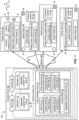
- Fig. 1 is a system 100, covered by the scope of the appended claims, for aggregating hardware loopback streams from a plurality of display devices 106, 108, 110, 112 includes a computer device 102 in communication with the display devices via a wired or wireless network 104.
- display devices 106, 108, 110, 112 may communicate with computer device 102 via a network or bus protocol, such as, for example, a USB connection.
- Display devices 106, 108, 110, 112 may have at least one display and a corresponding audio input and/or audio output.
- Display devices 106, 108, 110, 112 may be any type of display, monitor, visual presentation device, computer device, and/or physical panel capable of presenting information, capturing audio, and/or emitting audio.
- each display device 106, 108, 110, 112 includes any number of channels for capturing audio and/or emitting audio.
- display device 106 may include speaker 32 that supports two channels (e.g., right and left) and may include a microphone 33.
- Display device 108 may include speaker 34 that supports two channels (e.g., right and left) and may include a microphone 36.
- Display device 110 may include speaker 38 that supports two channels (e.g., right and left) and may include a microphone 39.
- Display device 112 may include speaker 40 that supports two channels (e.g., right and left) and may include a microphone 42.
- Each speaker 32, 34, 38, 40 and/or microphone 33, 36, 39, 42 of display devices 106, 108, 110, 112 may correspond to any number of channels.
- Each of the display devices 106, 108, 110, 112 may include hardware loopback capabilities so that anytime audio data is rendered for output from one or more speakers 32, 34, 38, 40 on display devices 106, 108, 110, 112, the rendered audio data may be obtained by a hardware loopback unit 18, 20, 23, 25 on display devices 106, 108, 110, 112.
- Display devices 106, 108, 110, 112 may have internal hardware to redirect the final stream of rendered audio data 15 to the hardware loopback units 18, 20, 23, 25.
- the rendered audio data 15 for output may include any additional processing performed on the rendered audio data 15.
- the additional processing may include, but is not limited to, equalization, filtering, pitch shift, base boost, and/or any other effect on the audio.
- the rendered audio data 15 may include a mix of audio data for a plurality of applications 10 actively rendering audio for output.
- a music application may be playing music on display device 106 at the same time a video conference application may have a video call on display device 106.
- Both applications may be actively rendering audio for output via speaker 32 and the rendered audio data 15 may include the audio data for both the music application and the video conference application.
- the rendered audio data 15 may be stored in hardware loopback stream 31 in a display device loopback buffer 24.
- hardware loopback stream 31 may accurately represent the audio output from the speaker 32 on display device 106.
- display device loopback buffer 26 may include hardware loopback stream 35 with the rendered audio data 17 for display device 108.
- the rendered audio data 17 may correspond to the audio output from speaker 34.
- display device loopback buffer 28 may include hardware loopback stream 37 with the rendered audio data 19 from display device 110.
- the rendered audio data 19 may correspond to the audio output from speaker 38.
- display device loopback buffer 30 may include hardware loopback stream 41 with the rendered audio data 21 from display device 112.
- the rendered audio data 21 may correspond to the audio output from speaker 40.
- Display devices 106, 108, 110, 112 may also include capture streams 27, 29, 43, 45 with any audio captured by microphones 33, 36, 39, 42. For example, if a person speaks into microphone 33 of display device 106, capture stream 27 may include the captured audio data from the person speaking. In addition, if background music is playing nearby microphone 42 of display device 112, capture stream 45 may include the audio data corresponding to the background music.
- Computer device 102 may include any mobile or fixed computer device, which may be connectable to a network.
- Computer device 102 may be, for example, a computer device such as a desktop or laptop or tablet computer, an internet of things (IOT) device, a cellular telephone, a gaming device, a mixed reality or virtual reality device, a music device, a television, a navigation system, a camera, a personal digital assistant (PDA), or a handheld device, or any other computer device having wired and/or wireless connection capability with one or more other devices.
- IOT internet of things
- PDA personal digital assistant
- Computer device 102 may include an operating system 111 may be executed by processor 44 and/or memory 46.
- Memory 46 of computer device 102 may be configured for storing data and/or computer-executable instructions defining and/or associated with operating system 111, and processor 44 may execute such data and/or instructions to instantiate operating system 111.
- An example of memory 46 can include, but is not limited to, a type of memory usable by a computer, such as random access memory (RAM), read only memory (ROM), tapes, magnetic discs, optical discs, volatile memory, non-volatile memory, and any combination thereof.
- processor 44 can include, but is not limited to, any processor specially programmed as described herein, including a controller, microcontroller, application specific integrated circuit (ASIC), field programmable gate array (FPGA), system on chip (SoC), or other programmable logic or state machine.
- ASIC application specific integrated circuit
- FPGA field programmable gate array
- SoC system on chip
- Operating system 111 may include an audio aggregator driver 16 that may receive one or more hardware loopback streams 31, 35, 37, 41 with the rendered audio data 15, 17, 19, 21 from one or more display device loopback buffers 24, 26, 28, 30.
- Hardware loopback streams 31, 35, 37, 41 may accurately represent the audio output from speakers 32, 34, 38, 40 on display devices 106, 108, 110, 112.
- Audio aggregator driver 16 may generate a single loopback buffer 22 for the rendered audio data 15, 17, 19, 21. Audio aggregator driver 16 determines a buffer size 12 for the loopback buffer 22.
- the buffer size 12 may be calculated by multiplying the total number of display devices 106, 108, 110, 112 by the number of channels supported by each of the display devices 106, 108, 110, 112.
- display devices 106, 108, 110, 112 may each support two channels (e.g., speakers 32, 34, 38, 40 may support two channels, right and left).
- the buffer size 12 may be eight (e.g., four devices multiplied by two channels).
- Audio aggregator driver 16 partitions the loopback buffer 22 into a plurality of sections, where the number of sections correspond to the buffer size 12.
- the loopback buffer 22 may be partitioned into eight sections, where each individual section may correspond to a single channel supported by display devices 106, 108, 110, 112.
- a sequencing may be applied to the number of sections so that each section may correspond to a specific display device loopback stream 31, 35, 37, 41. The sequencing may be in response to an order in which display devices 106, 108, 110, 112 are connected and/or in communication with computer device 102.
- the number of sections allocated to a specific display device loopback stream 31, 35, 37, 41 may be in response to a number of channels supported by display devices 106, 108, 110, 112.
- each display device 106, 108, 110, 112 may receive two sections in the loopback buffer 22 since display devices 106, 108, 110, 112 support two channels.
- Audio aggregator driver 16 combines the rendered audio data 15, 17, 19, 21 received from display devices 106, 108, 110, 112 into the loopback buffer 22.
- the rendered audio data 15, 17, 19, 21 received from display device loopback streams 31, 35, 37, 41 may be placed into different sections of the loopback buffer 22 in a specified order resulting in the aggregated loopback audio data 14.
- audio aggregator driver 16 may represent the aggregated loopback audio data 14 from the various hardware loopback streams 31, 35, 37, 41 as one by using a single loopback buffer 22.
- Audio aggregator driver 16 provides the loopback buffer 22 to one or more applications 10 associated with computer device 102.
- Applications 10 may want to use the aggregated loopback audio data 14 for various processing.
- One example may include application 10 using the aggregated loopback audio data 14 to perform echo cancelation on audio output from one or more displays 106, 108, 110, 112.
- capture stream 27 may include the audio from microphone 33 (e.g., the individual speaking) and audio from speaker 32 (e.g., background music).
- Application 10 may use the aggregated loopback audio data 14 in the loopback buffer 22 to cancel out the audio from speaker 32 (e.g., the background music) so the friend does not hear the background music in the call.
- application 10 may want to record the audio emitted by one or more speakers 32, 34, 38, 40 on display devices 106, 108, 110, 112.
- Application 10 may use the aggregated loopback audio data 14 and/or a portion of the aggregated loopback audio data 14 for the recording.
- application 10 may identify a portion of the aggregated loopback audio data 14 that corresponds to display device 110 and may extract the aggregated loopback audio data 14 and/or a portion of the aggregated loopback audio data 14 associated with display device 110 (e.g., audio data 17) for the recording.
- applications 10 may access the loopback buffer 22 and may be able to use the same audio output by the speakers 32, 34, 38, 40 on any of the display devices 106, 108, 110, 112 through the aggregated loopback audio data 14.
- hardware loopback corresponds more closely to the audio output by the display devices 106, 108, 110, 112 than a stored stream of data input to the speakers of the respective display devices, a better representation of the audio output by the display devices 106, 108, 110, 112 may be used by the applications 10.
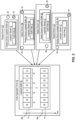
- Audio aggregator driver 16 partitions loopback buffer 22 into a number of sections corresponding to the buffer size 12 ( Fig. 1 ).
- the loopback buffer 22 may be partitioned into eight sections, where each individual section may correspond to a single channel supported by display devices 106, 108, 110, 112.
- a subset of the number of sections allocated to a specific loopback stream 31, 35, 37, 41 may be in response to a number of channels supported by display devices 106, 108, 110, 112.
- each display device 106, 108, 110, 112 may receive a subset of two sections in the loopback buffer 22 because display devices 106, 108, 110, 112 support two channels.
- a sequencing may be applied to the number of sections so that each section may correspond to a specific hardware loopback stream 31, 35, 37, 41.
- the sequencing may have an arrangement (or relative position) based on a value of an order in which display devices 106, 108, 110, 112 are connected and/or in communication with computer device 102.
- display device 106 may be a first display device and the first two sections of loopback buffer 22 may be allocated to hardware loopback stream 31.
- the rendered audio data 15 from display device 106 may be stored in the first two sections of loopback buffer 22.
- Display device 108 may be the second display device and the next two sections of loopback buffer 22 may correspond to hardware loopback stream 35.
- the rendered audio data 17 from display device 108 may be stored in the next two sections of loopback buffer 22.
- Display device 110 may be the third display device and the following two sections of loopback buffer 22 may be associated with hardware loopback stream 37.
- the rendered audio data 19 from display device 110 may be stored in the following two sections of loopback buffer 22.
- Display device 112 may be the fourth display device and the last two sections of loopback buffer 22 may correspond to hardware loopback stream 41. As such, the rendered audio data 21 from display device 112 may be stored in the last two sections of loopback buffer 22.
- Loopback buffer 22 may include aggregated loopback audio data 14 corresponding to different time/sequences 202, 204 of when audio may be output from display devices 106, 108, 110, 112.
- Loopback buffer 22 may include an array of eight sections of rendered audio data 15, 17, 19, 21 (at each time/sequence). For example, at 202 (corresponding to time (ti)), loopback buffer 22 may include any rendered audio data 15, 17, 19, 21 from one or more display devices 106, 108, 110, 112. For example, at 204 (corresponding to time (ti)), loopback buffer 22 may include any rendered audio data 15, 17, 19, 21 from one or more display devices 106, 108, 110, 112.
- the rendered audio data 15, 17, 19, 21 may be combined together using a sequencing of the display devices 106, 108, 110, 112 having an arrangement (or relative position) based on a value of the order in which display devices 106, 108, 110, 112 are connected and/or in communication with computer device 102.
- the combined rendered audio data 15, 17, 19, 21 may result in the aggregated loopback audio data 14.
- the aggregated loopback audio data 14 may include a mix of audio data for one or more applications actively rendering audio for output on display devices 106, 108, 110, 112.
- display device 108 may include a music application playing music via speaker 34.
- Display device 110 may include a media application playing a movie via speaker 38 and a conference call application conducing a call via speaker 38.
- the aggregated loopback audio data 14 may include a mix of audio data for the music application, the media application, and the conference call application.
- the aggregated loopback audio data 14 is provided to one or more applications 10 ( Fig. 1 ) on computer device 102 ( Fig. 1 ) for use by applications 10.
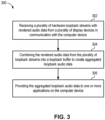
- a method 300 which is covered by the scope of the appended claims, is used by computer device 102 ( Fig. 1 ) for aggregating hardware loopback streams 31, 35, 37, 41 ( Fig. 1 ) of a plurality of display devices 106, 108, 110, 112 ( Fig. 1 ) in communication with computer device 102.
- the actions of method 300 may be discussed below with reference to the architecture of Fig. 1 .
- method 300 includes receiving a plurality of hardware loopback streams with rendered audio data from a plurality of display devices in communication with the computer device.
- Display devices 106, 108, 110, 112 may have at least one display and a corresponding audio input and/or audio output.
- Display devices 106, 108, 110, 112 may be any type of display, monitor, visual presentation device, computer device, and/or physical panel capable of presenting information, capturing audio, and/or emitting audio.
- each display device 106, 108, 110, 112 may include any number of channels for capturing audio and/or emitting audio.
- Each speaker 32, 34, 38, 40 and/or microphone 33, 36, 39, 42 of display devices 106, 108, 110, 112 may correspond to any number of channels.
- each of the display devices 106, 108, 110, 112 includes hardware loopback capabilities so that anytime audio output occurs from one or more speakers 32, 34, 38, 40 on display devices 106, 108, 110, 112, the rendered audio data 15, 19, 17, 21 for output via speakers 32, 34, 38, 40 may be obtained using hardware loopback units 18, 20, 23, 25 on display devices 106, 108, 110, 112.
- Display devices 106, 108, 110, 112 may have internal hardware to redirect the final stream of rendered audio data 15, 17, 19, 21 to respective hardware loopback units 18, 20, 23, 25.
- the rendered audio data 15, 17, 19, 21 inludes any additional processing performed on the rendered audio data 15, 17, 19, 21 prior to output.
- the additional processing may include, but is not limited to, equalization, filtering, pitch shift, base boost, and/or any other effect on the audio data.
- the rendered audio data 15, 17, 19, 21 may include a mix of audio data for a plurality of applications 10 actively rendering audio for output on display devices 106, 108, 110, 112.
- display device 112 may include a music application playing music via speaker 40 and a game application outputting audio for a game via speaker 40 at the same time the music application is playing music.
- the music application and the game application may be actively rendering audio for output via speaker 40 on display device 112.
- the rendered audio data 21 for display device 112 may include a mix of audio data for the music application and audio data for the game application.
- An audio aggregator driver 16 may receive one or more hardware loopback streams 31, 35, 37, 41 with the rendered audio data 15, 17, 19, 21 from one or more display device loopback buffers 24, 26, 28, 30.
- Hardware loopback stream 31, 35, 37, 41 may accurately represent the audio data being rendered to the speakers 32, 34, 38, 40 on display devices 106, 108, 110, 112 for output.
- method 300 includes combining the rendered audio data from the plurality of hardware loopback streams into a loopback buffer to create aggregated loopback audio data.
- Audio aggregator driver 16 may generate a single loopback buffer 22 for the rendered audio data 15, 17, 19, 21.
- Audio aggregator driver 16 determines a buffer size 12 for the loopback buffer 22.
- the buffer size 12 is calculated by multiplying the total number of display devices 106, 108, 110, 112 by the number of channels supported by each of the display devices 106, 108, 110, 112.
- display devices 106, 108, 110, 112 may each support two channels (e.g., speakers 32, 34, 38, 40 may support two channels, right and left).
- the buffer size 12 may be eight (e.g., four devices multiplied by two channels).
- Audio aggregator driver 16 partitions the loopback buffer 22 into a plurality of sections, where the number of sections correspond to the buffer size 12.
- the loopback buffer 22 may be partitioned into eight sections, where each individual section may correspond to a single channel supported by display devices 106, 108, 110, 112.
- a sequencing may be applied to the number of sections so that a subset of the number of sections may correspond to a specific display device hardware loopback stream 31, 35, 37, 41. The sequencing may be in response to an order in which display devices 106, 108, 110, 112 are connected and/or in communication with computer device 102.
- the number of sections allocated to and/or associated with a specific display device hardware loopback stream 31, 35, 37, 41 may be in response to a number of channels supported by display devices 106, 108, 110, 112.
- each display device 106, 108, 110, 112 may receive two sections in the loopback buffer 22 since display devices 106, 108, 110, 112 support two channels.
- Audio aggregator driver 16 combines the rendered audio data 15, 17, 19, 21 received from display devices 106, 108, 110, 112 into the loopback buffer 22 to create aggregated loopback audio data 14.
- the rendered audio data 15, 17, 19, 21 received from display device loopback buffers 24, 26, 28, 30 may be placed into different sections of the loopback buffer 22 using a sequencing of the display devices 106, 108, 110, 112 having an arrangement (or relative position) based on a value of an order in which display devices 106, 108, 110, 112 are connected and/or in communication with computer device 102 resulting in the aggregated loopback audio data 14.
- loopback buffer 22 may include rendered audio data 15, 17, 19, 21 corresponding to different time/sequences of when audio may be output from display devices 106, 108, 110, 112.
- the aggregated loopback audio data 14 may include a mix of audio data for one or more applications actively rendering audio for output on display devices 106, 108, 110, 112.
- display devices 106, 108, 110, 112 may all include a video conference application where a video conference is currently ongoing on display devices 106, 108, 110, 112.
- display device 108 may include a music application playing music via speaker 34
- display device 110 may include a media application playing a movie via speaker 38.
- the aggregated loopback audio data 14 may include a mix of audio data for the video conference application, the music application, and the media application.
- audio aggregator driver 16 may represent the aggregated loopback audio data 14 from the various hardware loopback streams 31, 35, 37, 41 as one by using a single loopback buffer 22.
- method 300 includes providing the aggregated loopback audio data to one or more applications on the computer device.
- Audio aggregator driver 16 provides the aggregated loopback audio data 14 to one or more applications 10 associated with computer device 102.
- Applications 10 may want to use the aggregated loopback audio data 14 for various processing.
- Applications 10 may send a request for the entire loopback buffer 22 to use in the processing.
- application 10 may want to record the audio emitted by one or more speakers 32, 34, 38, 40 on display devices 106, 108, 110, 112.
- Application 10 may request the entire loopback buffer 22 and may use the aggregated loopback audio data 14 for the recording.
- applications 10 may send a request for a portion of the aggregated loopback audio data 14 to use in the processing.
- applications 10 may send a request for a portion of the aggregated loopback audio data 14 relating to a particular time.
- Application 10 may want to record the audio output by one or more speakers 32, 34, 38, 40 on display devices 106, 108, 110, 112 during the start of a meeting.
- Application 10 may identify a time period for the start of the meeting and may request a portion of the aggregated loopback audio data 14 corresponding to the time period and may use the portion of the aggregated loopback audio data 14 for the recording.
- Another example may include applications 10 identifying a particular display device 106, 108, 110, 112 and extracting a portion of the aggregated loopback audio data 14 from the corresponding hardware loopback stream 31, 35, 37, 41 associated with the identified display device 106, 108, 110, 112 for use.
- Another example may include application 10 using the aggregated loopback audio data 14 to perform echo cancelation on audio output from one or more displays 106, 108, 110, 112.
- capture stream 27 may include the audio from microphone 33 (e.g., the individual speaking) and audio from speaker 32 (e.g., background music).
- Application 10 may use the aggregated loopback audio data 14 in the loopback buffer 22 to cancel out the audio from speaker 32 (e.g., the background music) so the friend does not hear the background music in the call.
- applications 10 may access the loopback buffer 22 and may be able to use the same audio data rendered for output by the speakers 32, 34, 38, 40 on any of the display devices 106, 108, 110, 112 through the aggregated loopback audio data 14. As such, applications 10 may have access to an accurate representation of audio output by the display devices 106, 108, 110, 112 for any additional processing and/or use by applications 10.
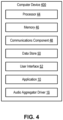
- computer 400 which is covered by the scope of the appended claims, and that may be configured as computer device 102 in accordance with an implementation includes additional component details as compared to Fig. 1 .
- computer 400 includes processor 44 for carrying out processing functions associated with one or more of components and functions described herein.
- processor 44 can include a single or multiple set of processors or multicore processors.
- processor 44 can be implemented as an integrated processing system and/or a distributed processing system.
- Computer 400 further includes memory 46, such as for storing local versions of applications being executed by processor 44.
- Memory 46 can include a type of memory usable by a computer, such as random access memory (RAM), read only memory (ROM), tapes, magnetic discs, optical discs, volatile memory, non-volatile memory, and any combination thereof.
- processor 44 may include and execute operating system 111 ( Fig. 1 ).
- computer 400 may include a communications component 48 that provides for establishing and maintaining communications with one or more parties utilizing hardware, software, and services as described herein.
- Communications component 48 may carry communications between components on computer device 102, as well as between computer device 102 and external devices, such as devices located across a communications network and/or devices serially or locally connected to computer device 102.
- communications component 48 may include one or more buses, and may further include transmit chain components and receive chain components associated with a transmitter and receiver, respectively, operable for interfacing with external devices.
- computer 400 may include a data store 50, which can be any suitable combination of hardware and/or software, that provides for mass storage of information, databases, and programs employed in connection with implementations described herein.
- data store 50 may be a data repository for applications 10 and/or audio aggregator driver 16.
- Computer 400 may also include a user interface component 52 operable to receive inputs from a user of computer device 102 and further operable to generate outputs for presentation to the user.
- User interface component 52 may include one or more input devices, including but not limited to a keyboard, a number pad, a mouse, display (e.g., which may be a touch-sensitive display), a navigation key, a function key, a microphone, a voice recognition component, any other mechanism capable of receiving an input from a user, or any combination thereof.
- user interface component 52 may include one or more output devices, including but not limited to a display, a speaker, a haptic feedback mechanism, a printer, any other mechanism capable of presenting an output to a user, or any combination thereof.
- user interface component 52 may transmit and/or receive messages corresponding to the operation of applications 10 and/or audio aggregator driver 16.
- processor 44 executes applications 10 and/or audio aggregator driver 16, and memory 46 or data store 50 may store them.
- a component may be, but is not limited to being, a process running on a processor, a processor, an object, an executable, a thread of execution, a program, and/or a computer.
- an application running on a computer device and the computer device can be a component.
- One or more components can reside within a process and/or thread of execution and a component may be localized on one computer and/or distributed between two or more computers.
- these components can execute from various computer readable media having various data structures stored thereon.
- the components may communicate by way of local and/or remote processes such as in accordance with a signal having one or more data packets, such as data from one component interacting with another component in a local system, distributed system, and/or across a network such as the Internet with other systems by way of the signal.
- a signal having one or more data packets, such as data from one component interacting with another component in a local system, distributed system, and/or across a network such as the Internet with other systems by way of the signal.
- the term "or” is intended to mean an inclusive “or” rather than an exclusive “or.” That is, unless specified otherwise, or clear from the context, the phrase “X employs A or B” is intended to mean any of the natural inclusive permutations. That is, the phrase “X employs A or B” is satisfied by any of the following instances: X employs A; X employs B; or X employs both A and B.
- the articles “a” and “an” as used in this application and the appended claims should generally be construed to mean “one or more” unless specified otherwise or clear from the context to be directed to a singular form.
- DSP digital signal processor
- ASIC application specific integrated circuit
- FPGA field programmable gate array
- a general-purpose processor may be a microprocessor, but, in the alternative, the processor may be any conventional processor, controller, microcontroller, or state machine.
- a processor may also be implemented as a combination of computer devices, e.g., a combination of a DSP and a microprocessor, a plurality of microprocessors, one or more microprocessors in conjunction with a DSP core, or any other such configuration. Additionally, at least one processor may comprise one or more components operable to perform one or more of the steps and/or actions described above.
- a software module may reside in RAM memory, flash memory, ROM memory, EPROM memory, EEPROM memory, registers, a hard disk, a removable disk, a CD-ROM, or any other form of storage medium known in the art.
- An exemplary storage medium may be coupled to the processor, such that the processor can read information from, and write information to, the storage medium.
- the storage medium may be integral to the processor.
- the processor and the storage medium may reside in an ASIC. Additionally, the ASIC may reside in a user terminal.
- processor and the storage medium may reside as discrete components in a user terminal. Additionally, in some implementations, the steps and/or actions of a method or algorithm may reside as one or any combination or set of codes and/or instructions on a machine readable medium and/or computer readable medium, which may be incorporated into a computer program product.
- the functions described may be implemented in hardware, software, firmware, or any combination thereof. If implemented in software, the functions may be stored or transmitted as one or more instructions or code on a computer-readable medium.
- Computer-readable media includes both computer storage media and communication media including any medium that facilitates transfer of a computer program from one place to another.
- a storage medium may be any available media that can be accessed by a computer.
- such computer-readable media can comprise RAM, ROM, EEPROM, CD-ROM or other optical disk storage, magnetic disk storage or other magnetic storage devices, or any other medium that can be used to store desired program code in the form of instructions or data structures and that can be accessed by a computer.
- Disk and disc includes compact disc (CD), laser disc, optical disc, digital versatile disc (DVD), floppy disk and Blu-ray disc where disks usually reproduce data magnetically, while discs usually reproduce data optically with lasers. Combinations of the above should also be included within the scope of computer-readable media.
Landscapes
- Engineering & Computer Science (AREA)
- Signal Processing (AREA)
- Theoretical Computer Science (AREA)
- Computer Networks & Wireless Communication (AREA)
- Multimedia (AREA)
- General Health & Medical Sciences (AREA)
- Audiology, Speech & Language Pathology (AREA)
- Human Computer Interaction (AREA)
- Physics & Mathematics (AREA)
- General Engineering & Computer Science (AREA)
- General Physics & Mathematics (AREA)
- Health & Medical Sciences (AREA)
- Telephonic Communication Services (AREA)
- Circuit For Audible Band Transducer (AREA)
Claims (7)
- Computervorrichtung, umfassend:einen Speicher zum Speichern von Daten und Anweisungen;mindestens einen Prozessor, der konfiguriert ist, um mit dem Speicher zu kommunizieren; undein Betriebssystem, das konfiguriert ist, um mit dem Speicher und dem mindestens einen Prozessor zu kommunizieren, wobei das Betriebssystem betreibbar ist zum:Empfangen einer Vielzahl von Hardware-Prüfschleifen-Streams mit gerenderten Audiodaten von einer Vielzahl von Anzeigegeräten, die mit der Computervorrichtung kommunizieren, wobei die gerenderten Audiodaten Audiodaten für eine Vielzahl von Anwendungen umfassen, die die Audiodaten aktiv zur Ausgabe auf der Vielzahl von Anzeigegeräten rendern, wobei ein Hardware-Prüfschleifen-Stream die Audiodaten darstellt, die aus einem oder mehreren Lautsprechern auf einem Anzeigegerät kommen, einschließlich aller zusätzlichen Verarbeitungen, die an dem gerenderten Audio durchgeführt werden und die vor der Ausgabe des Audios über den einen oder die mehreren Lautsprecher erfolgen, wobei jeder Hardware-Prüfschleifen-Stream der Vielzahl von Hardware-Prüfschleifen-Streams einem Anzeigegerät der Vielzahl von Anzeigegeräten entspricht;Bestimmen einer Puffergröße für einen Prüfschleifen-Puffer durch Multiplizieren einer Gesamtzahl der Vielzahl von Anzeigegeräten mit einer Anzahl von Kanälen, die von der Vielzahl von Anzeigegeräten unterstützt werden;Aufteilen des Prüfschleifen-Puffers in eine Anzahl von Abschnitten, die der Puffergröße entspricht;Bestimmen eines Teilsatzes der Anzahl von Abschnitten für jedes Anzeigegerät der Vielzahl von Anzeigegeräten, wobei der Teilsatz der Anzahl von Abschnitten für jedes Anzeigegerät der Anzahl von Kanälen entspricht, die von jedem Anzeigegerät der Vielzahl von Anzeigegeräten unterstützt werden;Kombinieren der gerenderten Audiodaten aus der Vielzahl von Hardware-Prüfschleifen-Streams im Prüfschleifen-Puffer, um aggregierte Prüfschleifen-Audiodaten zu erstellen, wobei das Kombinieren das Platzieren der gerenderten Audiodaten, die von jedem Anzeigegerät empfangen werden, in dem Teilsatz der Anzahl von Abschnitten umfasst, der jedem Anzeigegerät der Vielzahl von Anzeigegeräten entspricht; undBereitstellen des Prüfschleifen-Puffers mit den aggregierten Prüfschleifen-Audiodaten für eine oder mehrere Anwendungen, die auf der Computervorrichtung ausgeführt werden;wobei die eine oder die mehreren Anwendungen den aggregierten Hardware-Prüfschleifen-Stream für mindestens eines aus Echounterdrückung oder Erstellen einer Aufzeichnung verwenden.
- Computervorrichtung nach Anspruch 1, wobei die Vielzahl von Hardware-Prüfschleifen-Streams mit mindestens einer Hardware-Prüfschleifen-Einheit auf jedem Anzeigegerät verknüpft ist, die die gerenderten Audiodaten auf jedem Anzeigegerät der Vielzahl von Anzeigegeräten erhält.
- Computervorrichtung nach Anspruch 1, wobei das Betriebssystem ferner betreibbar ist zum:Bestimmen einer Reihenfolge für die gerenderten Audiodaten als Reaktion auf eine Sequenzierung der Vielzahl von Anzeigegeräten; undKombinieren der gerenderten Audiodaten entsprechend der Reihenfolge im Prüfschleifen-Puffer.
- Verfahren zum Aggregieren von Hardware-Prüfschleifen-Streams einer Vielzahl von Anzeigegeräten in Kommunikation mit einer Computervorrichtung, wobei das Verfahren umfasst:Empfangen einer Vielzahl von Hardware-Prüfschleifen-Streams mit gerenderten Audiodaten von der Vielzahl von Anzeigegeräten, die mit der Computervorrichtung kommunizieren, an einem Betriebssystem, das auf der Computervorrichtung ausgeführt wird, wobei die gerenderten Audiodaten Audiodaten für eine Vielzahl von Anwendungen umfassen, die die Audiodaten aktiv zur Ausgabe auf der Vielzahl von Anzeigegeräten rendern, wobei ein Hardware-Prüfschleifen-Stream die Audiodaten darstellt, die aus einem oder mehreren Lautsprechern auf einem Anzeigegerät kommen, einschließlich aller zusätzlichen Verarbeitungen, die an dem gerenderten Audio durchgeführt werden und die vor der Ausgabe des Audios über den einen oder die mehreren Lautsprecher erfolgen, wobei jeder Hardware-Prüfschleifen-Stream der Vielzahl von Hardware-Prüfschleifen-Streams einem Anzeigegerät der Vielzahl von Anzeigegeräten entspricht;Bestimmen einer Puffergröße für einen Prüfschleifen-Puffer durch Multiplizieren einer Gesamtzahl der Vielzahl von Anzeigegeräten mit einer Anzahl von Kanälen, die von der Vielzahl von Anzeigegeräten unterstützt werden;Aufteilen des Prüfschleifen-Puffers in eine Anzahl von Abschnitten, die der Puffergröße entspricht;Bestimmen eines Teilsatzes der Anzahl von Abschnitten für jedes Anzeigegerät der Vielzahl von Anzeigegeräten, wobei der Teilsatz der Anzahl von Abschnitten für jedes Anzeigegerät der Anzahl von Kanälen entspricht, die von jedem Anzeigegerät der Vielzahl von Anzeigegeräten unterstützt werden;Kombinieren der gerenderten Audiodaten aus der Vielzahl von Hardware-Prüfschleifen-Streams im Prüfschleifen-Puffer, um aggregierte Prüfschleifen-Audiodaten zu erstellen, wobei das Kombinieren das Platzieren der gerenderten Audiodaten, die von jedem Anzeigegerät empfangen werden, in dem Teilsatz der Anzahl von Abschnitten umfasst, der jedem Anzeigegerät der Vielzahl von Anzeigegeräten entspricht; undBereitstellen des Prüfschleifen-Puffers mit den aggregierten Prüfschleifen-Audiodaten für eine oder mehrere Anwendungen, die auf der Computervorrichtung ausgeführt werden;wobei die eine oder die mehreren Anwendungen den aggregierten Hardware-Prüfschleifen-Stream für mindestens eines aus Echounterdrückung oder Erstellen einer Aufzeichnung verwenden.
- Verfahren nach Anspruch 4, wobei die Vielzahl von Hardware-Prüfschleifen-Streams mindestens einer Hardware-Prüfschleifen-Einheit auf jedem Anzeigegerät zugeordnet ist, die die gerenderten Audiodaten auf jedem Anzeigegerät der Vielzahl von Anzeigegeräten erhält.
- Verfahren nach Anspruch 4, wobei das Verfahren ferner umfasst:Bestimmen einer Reihenfolge für die gerenderten Audiodaten als Reaktion auf eine Sequenzierung der Vielzahl von Anzeigegeräten; undKombinieren der gerenderten Audiodaten entsprechend der Reihenfolge im Prüfschleifen-Puffer.
- Computerlesbares Medium, das von einer Computervorrichtung ausführbare Anweisungen speichert, umfassend:mindestens eine Anweisung zum Veranlassen, dass die Computervorrichtung eine Vielzahl von Hardware-Prüfschleifen-Streams mit gerenderten Audiodaten von einer Vielzahl von Anzeigegeräten, die mit der Computervorrichtung kommunizieren, empfängt, wobei die gerenderten Audiodaten Audiodaten für eine Vielzahl von Anwendungen umfassen, die die Audiodaten aktiv zur Ausgabe auf der Vielzahl von Anzeigegeräten rendern, wobei ein Hardware-Prüfschleifen-Stream die Audiodaten darstellt, die aus einem oder mehreren Lautsprechern auf einem Anzeigegerät kommen, einschließlich aller zusätzlichen Verarbeitungen, die an dem gerenderten Audio durchgeführt werden und die vor der Ausgabe des Audios über den einen oder die mehreren Lautsprecher erfolgen, wobei jeder Hardware-Prüfschleifen-Stream der Vielzahl von Hardware-Prüfschleifen-Streams einem Anzeigegerät der Vielzahl von Anzeigegeräten entspricht;mindestens eine Anweisung zum Veranlassen, dass die Computervorrichtung eine Puffergröße für einen Prüfschleifen-Puffer bestimmt, indem eine Gesamtzahl der Vielzahl von Anzeigegeräten mit einer Anzahl von Kanälen multipliziert wird, die von der Vielzahl von Anzeigegeräten unterstützt werden;mindestens eine Anweisung zum Veranlassen, dass die Computervorrichtung den Prüfschleifen-Puffer in eine Anzahl von Abschnitten aufteilt, die der Puffergröße entspricht;mindestens eine Anweisung zum Veranlassen, dass die Computervorrichtung einen Teilsatz der Anzahl von Abschnitten für jedes Anzeigegerät der Vielzahl von Anzeigegeräten bestimmt, wobei der Teilsatz der Anzahl von Abschnitten für jedes Anzeigegerät der Anzahl von Kanälen entspricht, die von jedem Anzeigegerät der Vielzahl von Anzeigegeräten unterstützt werden;mindestens eine Anweisung zum Veranlassen, dass die Computervorrichtung die gerenderten Audiodaten aus der Vielzahl von Hardware-Prüfschleifen-Streams in den Prüfschleifen-Puffer kombiniert, um aggregierte Prüfschleifen-Audiodaten zu erstellen, wobei das Kombinieren das Platzieren der gerenderten Audiodaten, die von jedem Anzeigegerät empfangen werden, in dem Teilsatz der Anzahl von Abschnitten umfasst, der jedem Anzeigegerät der Vielzahl von Anzeigegeräten entspricht; undmindestens eine Anweisung zum Veranlassen, dass die Computervorrichtung den Prüfschleifen-Puffer mit den aggregierten Prüfschleifen-Audiodaten an einer oder mehreren auf der Computervorrichtung ausgeführten Anwendungen bereitstellt;wobei die eine oder die mehreren Anwendungen den aggregierten Hardware-Prüfschleifen-Stream für mindestens eines aus Echounterdrückung oder Erstellen einer Aufzeichnung verwenden.
Applications Claiming Priority (2)
| Application Number | Priority Date | Filing Date | Title |
|---|---|---|---|
| US16/428,318 US11563857B2 (en) | 2019-05-31 | 2019-05-31 | Aggregating hardware loopback |
| PCT/US2020/029417 WO2020242670A1 (en) | 2019-05-31 | 2020-04-23 | Aggregating hardware loopback |
Publications (2)
| Publication Number | Publication Date |
|---|---|
| EP3963439A1 EP3963439A1 (de) | 2022-03-09 |
| EP3963439B1 true EP3963439B1 (de) | 2024-11-13 |
Family
ID=70614681
Family Applications (1)
| Application Number | Title | Priority Date | Filing Date |
|---|---|---|---|
| EP20724711.5A Active EP3963439B1 (de) | 2019-05-31 | 2020-04-23 | Aggregieren einer hardware-prüfschleife |
Country Status (4)
| Country | Link |
|---|---|
| US (1) | US11563857B2 (de) |
| EP (1) | EP3963439B1 (de) |
| CN (1) | CN113874830B (de) |
| WO (1) | WO2020242670A1 (de) |
Citations (2)
| Publication number | Priority date | Publication date | Assignee | Title |
|---|---|---|---|---|
| WO2015036857A1 (en) * | 2013-09-13 | 2015-03-19 | Alcatel Lucent | Method and device for packet acoustic echo cancellation |
| WO2015036858A1 (en) * | 2013-09-13 | 2015-03-19 | Alcatel Lucent | Method and device for packet acoustic echo cancellation |
Family Cites Families (10)
| Publication number | Priority date | Publication date | Assignee | Title |
|---|---|---|---|---|
| GB0702574D0 (en) * | 2007-02-09 | 2007-03-21 | Texas Instruments Ltd | Loopback circuit |
| US10194032B2 (en) * | 2007-05-04 | 2019-01-29 | Staton Techiya, Llc | Method and apparatus for in-ear canal sound suppression |
| WO2010106469A1 (en) | 2009-03-17 | 2010-09-23 | Koninklijke Philips Electronics N.V. | Audio processing in a processing system |
| US9524291B2 (en) * | 2010-10-06 | 2016-12-20 | Virtuoz Sa | Visual display of semantic information |
| US9264835B2 (en) | 2011-03-21 | 2016-02-16 | Microsoft Technology Licensing, Llc | Exposing off-host audio processing capabilities |
| US9262391B2 (en) * | 2013-03-29 | 2016-02-16 | Cisco Technology, Inc. | Annotating a presentation in a telepresence meeting |
| CN104767895B (zh) | 2014-01-06 | 2017-11-03 | 阿尔卡特朗讯 | 一种用于分组声学回声消除的方法与设备 |
| KR102580418B1 (ko) | 2017-02-07 | 2023-09-20 | 삼성에스디에스 주식회사 | 어쿠스틱 에코 제거 장치 및 방법 |
| EP3729797B1 (de) * | 2017-12-21 | 2025-01-29 | Dolby Laboratories Licensing Corporation | Audiovorrichtung für hdmi |
| US11514921B2 (en) * | 2019-09-26 | 2022-11-29 | Apple Inc. | Audio return channel data loopback |
-
2019
- 2019-05-31 US US16/428,318 patent/US11563857B2/en active Active
-
2020
- 2020-04-23 CN CN202080040134.XA patent/CN113874830B/zh not_active Expired - Fee Related
- 2020-04-23 EP EP20724711.5A patent/EP3963439B1/de active Active
- 2020-04-23 WO PCT/US2020/029417 patent/WO2020242670A1/en not_active Ceased
Patent Citations (2)
| Publication number | Priority date | Publication date | Assignee | Title |
|---|---|---|---|---|
| WO2015036857A1 (en) * | 2013-09-13 | 2015-03-19 | Alcatel Lucent | Method and device for packet acoustic echo cancellation |
| WO2015036858A1 (en) * | 2013-09-13 | 2015-03-19 | Alcatel Lucent | Method and device for packet acoustic echo cancellation |
Also Published As
| Publication number | Publication date |
|---|---|
| EP3963439A1 (de) | 2022-03-09 |
| CN113874830B (zh) | 2024-05-10 |
| WO2020242670A1 (en) | 2020-12-03 |
| US11563857B2 (en) | 2023-01-24 |
| CN113874830A (zh) | 2021-12-31 |
| US20200382648A1 (en) | 2020-12-03 |
Similar Documents
| Publication | Publication Date | Title |
|---|---|---|
| CN111988653A (zh) | 多视频投屏信息的交互方法、装置、设备及存储介质 | |
| WO2016029806A1 (zh) | 一种声像播放方法及装置 | |
| WO2018126613A1 (zh) | 一种音频数据播放方法和双屏移动终端 | |
| US20180262716A1 (en) | Method of providing video conference service and apparatuses performing the same | |
| CN113874850B (zh) | 跨多个设备的音频的同步 | |
| CN110191745A (zh) | 利用空间音频的游戏流式传输 | |
| US20230102108A1 (en) | Enhancing group sound reactions | |
| EP3963439B1 (de) | Aggregieren einer hardware-prüfschleife | |
| CN113892080B (zh) | 将多个端点表示为一个端点的设备聚合 | |
| US10743105B1 (en) | Sending audio to various channels using application location information | |
| US12447410B2 (en) | Audio system and method | |
| CN115794022B (zh) | 音频输出方法、装置、设备、存储介质和程序产品 | |
| US20180220252A1 (en) | Spectator audio and video repositioning | |
| US10909049B1 (en) | Converting a pin into a loopback pin | |
| US9542922B2 (en) | Method for inserting watermark to image and electronic device thereof | |
| CN118660074A (zh) | 交互控制方法、装置、设备及系统 | |
| CN121728271A (zh) | 用于音频处理的方法、装置、设备和存储介质 | |
| JP2016057569A (ja) | 再生装置 |
Legal Events
| Date | Code | Title | Description |
|---|---|---|---|
| STAA | Information on the status of an ep patent application or granted ep patent |
Free format text: STATUS: UNKNOWN |
|
| STAA | Information on the status of an ep patent application or granted ep patent |
Free format text: STATUS: THE INTERNATIONAL PUBLICATION HAS BEEN MADE |
|
| PUAI | Public reference made under article 153(3) epc to a published international application that has entered the european phase |
Free format text: ORIGINAL CODE: 0009012 |
|
| STAA | Information on the status of an ep patent application or granted ep patent |
Free format text: STATUS: REQUEST FOR EXAMINATION WAS MADE |
|
| 17P | Request for examination filed |
Effective date: 20211130 |
|
| AK | Designated contracting states |
Kind code of ref document: A1 Designated state(s): AL AT BE BG CH CY CZ DE DK EE ES FI FR GB GR HR HU IE IS IT LI LT LU LV MC MK MT NL NO PL PT RO RS SE SI SK SM TR |
|
| DAV | Request for validation of the european patent (deleted) | ||
| DAX | Request for extension of the european patent (deleted) | ||
| STAA | Information on the status of an ep patent application or granted ep patent |
Free format text: STATUS: EXAMINATION IS IN PROGRESS |
|
| 17Q | First examination report despatched |
Effective date: 20230124 |
|
| GRAP | Despatch of communication of intention to grant a patent |
Free format text: ORIGINAL CODE: EPIDOSNIGR1 |
|
| STAA | Information on the status of an ep patent application or granted ep patent |
Free format text: STATUS: GRANT OF PATENT IS INTENDED |
|
| INTG | Intention to grant announced |
Effective date: 20240227 |
|
| GRAJ | Information related to disapproval of communication of intention to grant by the applicant or resumption of examination proceedings by the epo deleted |
Free format text: ORIGINAL CODE: EPIDOSDIGR1 |
|
| STAA | Information on the status of an ep patent application or granted ep patent |
Free format text: STATUS: EXAMINATION IS IN PROGRESS |
|
| GRAP | Despatch of communication of intention to grant a patent |
Free format text: ORIGINAL CODE: EPIDOSNIGR1 |
|
| STAA | Information on the status of an ep patent application or granted ep patent |
Free format text: STATUS: GRANT OF PATENT IS INTENDED |
|
| P01 | Opt-out of the competence of the unified patent court (upc) registered |
Effective date: 20240522 |
|
| INTC | Intention to grant announced (deleted) | ||
| INTG | Intention to grant announced |
Effective date: 20240620 |
|
| GRAS | Grant fee paid |
Free format text: ORIGINAL CODE: EPIDOSNIGR3 |
|
| GRAA | (expected) grant |
Free format text: ORIGINAL CODE: 0009210 |
|
| STAA | Information on the status of an ep patent application or granted ep patent |
Free format text: STATUS: THE PATENT HAS BEEN GRANTED |
|
| AK | Designated contracting states |
Kind code of ref document: B1 Designated state(s): AL AT BE BG CH CY CZ DE DK EE ES FI FR GB GR HR HU IE IS IT LI LT LU LV MC MK MT NL NO PL PT RO RS SE SI SK SM TR |
|
| REG | Reference to a national code |
Ref country code: GB Ref legal event code: FG4D |
|
| REG | Reference to a national code |
Ref country code: CH Ref legal event code: EP |
|
| REG | Reference to a national code |
Ref country code: DE Ref legal event code: R096 Ref document number: 602020041274 Country of ref document: DE |
|
| REG | Reference to a national code |
Ref country code: IE Ref legal event code: FG4D |
|
| REG | Reference to a national code |
Ref country code: LT Ref legal event code: MG9D |
|
| REG | Reference to a national code |
Ref country code: NL Ref legal event code: MP Effective date: 20241113 |
|
| PG25 | Lapsed in a contracting state [announced via postgrant information from national office to epo] |
Ref country code: HR Free format text: LAPSE BECAUSE OF FAILURE TO SUBMIT A TRANSLATION OF THE DESCRIPTION OR TO PAY THE FEE WITHIN THE PRESCRIBED TIME-LIMIT Effective date: 20241113 Ref country code: PT Free format text: LAPSE BECAUSE OF FAILURE TO SUBMIT A TRANSLATION OF THE DESCRIPTION OR TO PAY THE FEE WITHIN THE PRESCRIBED TIME-LIMIT Effective date: 20250313 Ref country code: IS Free format text: LAPSE BECAUSE OF FAILURE TO SUBMIT A TRANSLATION OF THE DESCRIPTION OR TO PAY THE FEE WITHIN THE PRESCRIBED TIME-LIMIT Effective date: 20250313 |
|
| PG25 | Lapsed in a contracting state [announced via postgrant information from national office to epo] |
Ref country code: FI Free format text: LAPSE BECAUSE OF FAILURE TO SUBMIT A TRANSLATION OF THE DESCRIPTION OR TO PAY THE FEE WITHIN THE PRESCRIBED TIME-LIMIT Effective date: 20241113 Ref country code: NL Free format text: LAPSE BECAUSE OF FAILURE TO SUBMIT A TRANSLATION OF THE DESCRIPTION OR TO PAY THE FEE WITHIN THE PRESCRIBED TIME-LIMIT Effective date: 20241113 |
|
| REG | Reference to a national code |
Ref country code: AT Ref legal event code: MK05 Ref document number: 1742179 Country of ref document: AT Kind code of ref document: T Effective date: 20241113 |
|
| PG25 | Lapsed in a contracting state [announced via postgrant information from national office to epo] |
Ref country code: BG Free format text: LAPSE BECAUSE OF FAILURE TO SUBMIT A TRANSLATION OF THE DESCRIPTION OR TO PAY THE FEE WITHIN THE PRESCRIBED TIME-LIMIT Effective date: 20241113 |
|
| PG25 | Lapsed in a contracting state [announced via postgrant information from national office to epo] |
Ref country code: ES Free format text: LAPSE BECAUSE OF FAILURE TO SUBMIT A TRANSLATION OF THE DESCRIPTION OR TO PAY THE FEE WITHIN THE PRESCRIBED TIME-LIMIT Effective date: 20241113 |
|
| PG25 | Lapsed in a contracting state [announced via postgrant information from national office to epo] |
Ref country code: NO Free format text: LAPSE BECAUSE OF FAILURE TO SUBMIT A TRANSLATION OF THE DESCRIPTION OR TO PAY THE FEE WITHIN THE PRESCRIBED TIME-LIMIT Effective date: 20250213 |
|
| PG25 | Lapsed in a contracting state [announced via postgrant information from national office to epo] |
Ref country code: LV Free format text: LAPSE BECAUSE OF FAILURE TO SUBMIT A TRANSLATION OF THE DESCRIPTION OR TO PAY THE FEE WITHIN THE PRESCRIBED TIME-LIMIT Effective date: 20241113 Ref country code: AT Free format text: LAPSE BECAUSE OF FAILURE TO SUBMIT A TRANSLATION OF THE DESCRIPTION OR TO PAY THE FEE WITHIN THE PRESCRIBED TIME-LIMIT Effective date: 20241113 Ref country code: GR Free format text: LAPSE BECAUSE OF FAILURE TO SUBMIT A TRANSLATION OF THE DESCRIPTION OR TO PAY THE FEE WITHIN THE PRESCRIBED TIME-LIMIT Effective date: 20250214 |
|
| PG25 | Lapsed in a contracting state [announced via postgrant information from national office to epo] |
Ref country code: PL Free format text: LAPSE BECAUSE OF FAILURE TO SUBMIT A TRANSLATION OF THE DESCRIPTION OR TO PAY THE FEE WITHIN THE PRESCRIBED TIME-LIMIT Effective date: 20241113 |
|
| PG25 | Lapsed in a contracting state [announced via postgrant information from national office to epo] |
Ref country code: RS Free format text: LAPSE BECAUSE OF FAILURE TO SUBMIT A TRANSLATION OF THE DESCRIPTION OR TO PAY THE FEE WITHIN THE PRESCRIBED TIME-LIMIT Effective date: 20250213 |
|
| PG25 | Lapsed in a contracting state [announced via postgrant information from national office to epo] |
Ref country code: SM Free format text: LAPSE BECAUSE OF FAILURE TO SUBMIT A TRANSLATION OF THE DESCRIPTION OR TO PAY THE FEE WITHIN THE PRESCRIBED TIME-LIMIT Effective date: 20241113 |
|
| PGFP | Annual fee paid to national office [announced via postgrant information from national office to epo] |
Ref country code: DE Payment date: 20250319 Year of fee payment: 6 |
|
| PG25 | Lapsed in a contracting state [announced via postgrant information from national office to epo] |
Ref country code: DK Free format text: LAPSE BECAUSE OF FAILURE TO SUBMIT A TRANSLATION OF THE DESCRIPTION OR TO PAY THE FEE WITHIN THE PRESCRIBED TIME-LIMIT Effective date: 20241113 |
|
| PG25 | Lapsed in a contracting state [announced via postgrant information from national office to epo] |
Ref country code: EE Free format text: LAPSE BECAUSE OF FAILURE TO SUBMIT A TRANSLATION OF THE DESCRIPTION OR TO PAY THE FEE WITHIN THE PRESCRIBED TIME-LIMIT Effective date: 20241113 |
|
| PG25 | Lapsed in a contracting state [announced via postgrant information from national office to epo] |
Ref country code: RO Free format text: LAPSE BECAUSE OF FAILURE TO SUBMIT A TRANSLATION OF THE DESCRIPTION OR TO PAY THE FEE WITHIN THE PRESCRIBED TIME-LIMIT Effective date: 20241113 |
|
| PG25 | Lapsed in a contracting state [announced via postgrant information from national office to epo] |
Ref country code: SK Free format text: LAPSE BECAUSE OF FAILURE TO SUBMIT A TRANSLATION OF THE DESCRIPTION OR TO PAY THE FEE WITHIN THE PRESCRIBED TIME-LIMIT Effective date: 20241113 |
|
| PG25 | Lapsed in a contracting state [announced via postgrant information from national office to epo] |
Ref country code: CZ Free format text: LAPSE BECAUSE OF FAILURE TO SUBMIT A TRANSLATION OF THE DESCRIPTION OR TO PAY THE FEE WITHIN THE PRESCRIBED TIME-LIMIT Effective date: 20241113 |
|
| PG25 | Lapsed in a contracting state [announced via postgrant information from national office to epo] |
Ref country code: IT Free format text: LAPSE BECAUSE OF FAILURE TO SUBMIT A TRANSLATION OF THE DESCRIPTION OR TO PAY THE FEE WITHIN THE PRESCRIBED TIME-LIMIT Effective date: 20241113 |
|
| REG | Reference to a national code |
Ref country code: DE Ref legal event code: R097 Ref document number: 602020041274 Country of ref document: DE |
|
| PG25 | Lapsed in a contracting state [announced via postgrant information from national office to epo] |
Ref country code: SE Free format text: LAPSE BECAUSE OF FAILURE TO SUBMIT A TRANSLATION OF THE DESCRIPTION OR TO PAY THE FEE WITHIN THE PRESCRIBED TIME-LIMIT Effective date: 20241113 |
|
| PLBE | No opposition filed within time limit |
Free format text: ORIGINAL CODE: 0009261 |
|
| STAA | Information on the status of an ep patent application or granted ep patent |
Free format text: STATUS: NO OPPOSITION FILED WITHIN TIME LIMIT |
|
| 26N | No opposition filed |
Effective date: 20250814 |
|
| REG | Reference to a national code |
Ref country code: CH Ref legal event code: H13 Free format text: ST27 STATUS EVENT CODE: U-0-0-H10-H13 (AS PROVIDED BY THE NATIONAL OFFICE) Effective date: 20251125 |
|
| PG25 | Lapsed in a contracting state [announced via postgrant information from national office to epo] |
Ref country code: LU Free format text: LAPSE BECAUSE OF NON-PAYMENT OF DUE FEES Effective date: 20250423 |
|
| PG25 | Lapsed in a contracting state [announced via postgrant information from national office to epo] |
Ref country code: MC Free format text: LAPSE BECAUSE OF FAILURE TO SUBMIT A TRANSLATION OF THE DESCRIPTION OR TO PAY THE FEE WITHIN THE PRESCRIBED TIME-LIMIT Effective date: 20241113 |
|
| REG | Reference to a national code |
Ref country code: BE Ref legal event code: MM Effective date: 20250430 |
|
| PG25 | Lapsed in a contracting state [announced via postgrant information from national office to epo] |
Ref country code: FR Free format text: LAPSE BECAUSE OF NON-PAYMENT OF DUE FEES Effective date: 20250430 |
|
| PG25 | Lapsed in a contracting state [announced via postgrant information from national office to epo] |
Ref country code: BE Free format text: LAPSE BECAUSE OF NON-PAYMENT OF DUE FEES Effective date: 20250430 |
|
| PG25 | Lapsed in a contracting state [announced via postgrant information from national office to epo] |
Ref country code: CH Free format text: LAPSE BECAUSE OF NON-PAYMENT OF DUE FEES Effective date: 20250430 |
|
| PGFP | Annual fee paid to national office [announced via postgrant information from national office to epo] |
Ref country code: GB Payment date: 20260319 Year of fee payment: 7 |
|
| PG25 | Lapsed in a contracting state [announced via postgrant information from national office to epo] |
Ref country code: IE Free format text: LAPSE BECAUSE OF NON-PAYMENT OF DUE FEES Effective date: 20250423 |