EP3961663B1 - Stationary induction apparatus - Google Patents
Stationary induction apparatus Download PDFInfo
- Publication number
- EP3961663B1 EP3961663B1 EP19926516.6A EP19926516A EP3961663B1 EP 3961663 B1 EP3961663 B1 EP 3961663B1 EP 19926516 A EP19926516 A EP 19926516A EP 3961663 B1 EP3961663 B1 EP 3961663B1
- Authority
- EP
- European Patent Office
- Prior art keywords
- plate
- insulating
- flow path
- holes
- windings
- Prior art date
- Legal status (The legal status is an assumption and is not a legal conclusion. Google has not performed a legal analysis and makes no representation as to the accuracy of the status listed.)
- Active
Links
Images








Classifications
-
- H—ELECTRICITY
- H01—ELECTRIC ELEMENTS
- H01F—MAGNETS; INDUCTANCES; TRANSFORMERS; SELECTION OF MATERIALS FOR THEIR MAGNETIC PROPERTIES
- H01F27/00—Details of transformers or inductances, in general
- H01F27/08—Cooling; Ventilating
- H01F27/10—Liquid cooling
- H01F27/12—Oil cooling
- H01F27/125—Cooling by synthetic insulating and incombustible liquid
-
- H—ELECTRICITY
- H01—ELECTRIC ELEMENTS
- H01F—MAGNETS; INDUCTANCES; TRANSFORMERS; SELECTION OF MATERIALS FOR THEIR MAGNETIC PROPERTIES
- H01F27/00—Details of transformers or inductances, in general
- H01F27/28—Coils; Windings; Conductive connections
- H01F27/32—Insulating of coils, windings, or parts thereof
- H01F27/322—Insulating of coils, windings, or parts thereof the insulation forming channels for circulation of the fluid
-
- H—ELECTRICITY
- H01—ELECTRIC ELEMENTS
- H01F—MAGNETS; INDUCTANCES; TRANSFORMERS; SELECTION OF MATERIALS FOR THEIR MAGNETIC PROPERTIES
- H01F27/00—Details of transformers or inductances, in general
- H01F27/02—Casings
- H01F27/025—Constructional details relating to cooling
-
- H—ELECTRICITY
- H01—ELECTRIC ELEMENTS
- H01F—MAGNETS; INDUCTANCES; TRANSFORMERS; SELECTION OF MATERIALS FOR THEIR MAGNETIC PROPERTIES
- H01F27/00—Details of transformers or inductances, in general
- H01F27/08—Cooling; Ventilating
- H01F27/10—Liquid cooling
- H01F27/12—Oil cooling
-
- H—ELECTRICITY
- H01—ELECTRIC ELEMENTS
- H01F—MAGNETS; INDUCTANCES; TRANSFORMERS; SELECTION OF MATERIALS FOR THEIR MAGNETIC PROPERTIES
- H01F27/00—Details of transformers or inductances, in general
- H01F27/28—Coils; Windings; Conductive connections
- H01F27/30—Fastening or clamping coils, windings, or parts thereof together; Fastening or mounting coils or windings on core, casing, or other support
- H01F27/306—Fastening or mounting coils or windings on core, casing or other support
-
- H—ELECTRICITY
- H01—ELECTRIC ELEMENTS
- H01F—MAGNETS; INDUCTANCES; TRANSFORMERS; SELECTION OF MATERIALS FOR THEIR MAGNETIC PROPERTIES
- H01F27/00—Details of transformers or inductances, in general
- H01F27/28—Coils; Windings; Conductive connections
- H01F27/32—Insulating of coils, windings, or parts thereof
- H01F27/324—Insulation between coil and core, between different winding sections, around the coil; Other insulation structures
Definitions
- the present invention relates to a stationary induction apparatus.
- Japanese Utility Model Laying-Open No. 58-196814 (PTL 1) is a document that discloses a configuration of a stationary induction apparatus.
- a transformer which is a stationary induction apparatus described in PTL 1
- a high-voltage winding and a low-voltage winding are insulated from each other by a flat interwinding insulating plate.
- an oil duct is formed by affixing insulating pieces to a surface of the flat insulating plate.
- a tank contains these components, and is filled with insulating oil.
- the insulating oil enters between the high-voltage winding and the low-voltage winding via one ends of the windings, and is heated by receiving heat of these windings while passing between them.
- the insulating oil is delivered to the outside via the other ends of the windings, into an oil cooler by an oil pump through a pipe, and is then cooled by a blower and returns to the tank.
- the flow path for insulating oil can be readily formed between the plurality of windings by disposing the first plate-like portion and the second plate-like portion to be adjacent to each other, without arranging a plurality of insulating pieces on the insulating plate.
- Fig. 1 is a perspective view showing an external appearance of a stationary not covered by the claims.
- induction apparatus according to a first embodiment
- Fig. 2 is a perspective view showing part of a configuration of the stationary induction apparatus according to the first embodiment.
- Fig. 3 is a partial cross-sectional view of the stationary induction apparatus shown in Fig. 1 when viewed in a direction of arrows of line III-III.
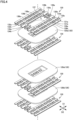
- Fig. 4 is an exploded perspective view showing a multilayer structure of a plurality of windings and a plurality of insulating plates included in the stationary induction apparatus according to the first embodiment.
- stationary induction apparatus 100 includes a core 110, a plurality of windings 120, a plurality of insulating plates 130, and a tank 140.
- the plurality of insulating plates 130 are not illustrated in Figs. 2 and 3 .
- core 110 includes a main leg 111 and side legs 112. Side legs 112 are connected to main leg 111.
- the plurality of windings 120 include a plurality of high-voltage windings 120a and a plurality of low-voltage windings 120b. In a central axis direction of the plurality of windings 120, the plurality of high-voltage windings 120a are located so as to be sandwiched between a pair of the plurality of low-voltage windings 120b.
- tank 140 contains core 110, the plurality of windings 120 and the plurality of insulating plates 130.
- Tank 140 is filled with insulating oil.
- Tank 140 is configured such that the insulating oil flows within tank 140 in a first direction D1 orthogonal to the central axis direction of the plurality of windings 120.
- Circulation pipe 151 is further connected to a cooling container 153.
- Cooling container 153 is cooled from outside by air delivered from an electric blower 152. As a result, the insulating oil that has flowed into cooling container 153 is cooled, and then flows into circulation pipe 151 again.
- connection portions 141 The insulating oil that has flowed in via one of connection portions 141 flows through a flow path 10 for insulating oil that is formed between the plurality of windings 120 adjacent to each other. As a result, heat of windings 120 adjacent to flow path 10 is transferred to the insulating oil. The plurality of windings 120 are thereby cooled.
- Flow path 10 is formed of the plurality of insulating plates 130. Flow path 10 in the present embodiment will be hereinafter described along with the configuration of the plurality of insulating plates 130.
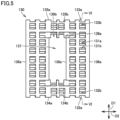
- Fig. 5 is a diagram showing a shape of an insulating plate in the first embodiment.
- Fig. 6 is a cross-sectional view of the insulating plate shown in Fig. 5 when viewed in a direction of arrows of line VI-VI.
- Fig. 7 is a diagram showing a shape of a first plate-like portion of the insulating plate in the first embodiment.
- Fig. 8 is a diagram showing a shape of a second plate-like portion of the insulating plate in the first embodiment.
- the plurality of windings 120 adjacent to insulating plate 130 are also illustrated in Fig. 6 .
- each of the plurality of insulating plates 130 has a rectangular outer shape, when viewed in the central axis direction of the plurality of windings 120.
- Each of the plurality of insulating plates 130 is located such that a longitudinal direction of each of the plurality of insulating plates 130 is along first direction D1. That is, each of the plurality of insulating plates 130 is located such that a transverse direction of each of the plurality of insulating plates 130 is along a second direction D2 orthogonal to both the central axis direction and first direction D1.
- Each of the plurality of insulating plates 130 is provided with an opening 137 extending therethrough in the central axis direction.
- Core 110 shown in Fig. 2 is located in opening 137.
- main leg 111 is located in opening 137.
- each of the plurality of insulating plates 130 includes a first plate-like portion 130a and a second plate-like portion 130b adjacent to each other in the central axis direction.
- each of the plurality of insulating plates 130 is formed of first plate-like portion 130a and second plate-like portion 130b.
- Each of first plate-like portion 130a and second plate-like portion 130b is made of an insulating material, for example, insulating paper such as pressboard, or an insulating material such as polyamide.
- first plate-like portion 130a is provided with a plurality of first holes 131a extending therethrough in the central axis direction.
- first hole 131a When viewed in the central axis direction, first hole 131a has a rectangular outer shape, specifically, a square outer shape.
- Side edges 136a located at opposite sides of first plate-like portion 130a in second direction D2 each have a linear outer shape along first direction D1.
- first hole 131a, and first notch 132a and second notch 133a in first plate-like portion 130a when viewed in the central axis direction are not particularly limited.
- the outer shapes of first hole 131a, and first notch 132a and second notch 133a in first plate-like portion 130a when viewed in the central axis direction can be varied as appropriate so as to reduce pressure loss caused by the shape of flow path 10 for insulating oil.
- Second plate-like portion 130b is provided with a second notch 133b at the other edge 135b in first direction D1. Specifically, second plate-like portion 130b is provided with a plurality of second notches 133b. In the present embodiment, each corner of each of the plurality of second notches 133b in second plate-like portion 130b forms a right angle.
- Second plate-like portion 130b located at opposite sides of second plate-like portion 130b in second direction D2 each have a linear outer shape along first direction D1.
- Second plate-like portion 130b is provided with a plurality of inner peripheral notches 139b at inner peripheral edges 138b.
- first plate-like portion 130a and second plate-like portion 130b is provided with first notch 132a, 132b at one edge 134a, 134b in first direction D1, and is provided with second notch 133a, 133b at the other edge 135a, 135b in first direction D1.
- first hole 131a located closest to one edge 134a overlaps first notch 132b.
- Each of the plurality of second holes 131b overlaps both of two first holes 131a adjacent to each other in first direction D1.
- First hole 131a located closest to 135a overlaps second notch 133b.
- Linear flow path 11 is configured in this manner.
- a stationary induction apparatus will be not covered by the claims hereinafter described.
- the stationary induction apparatus according to the second embodiment is different only in the configuration of each of the plurality of insulating plates from stationary induction apparatus 100 according to the first embodiment. Thus, a description of the configuration similar to that of stationary induction apparatus 100 according to the first embodiment will not be repeated.
- each of the plurality of first holes 431a and the plurality of second holes 431b is configured such that, when viewed in the central axis direction, a central portion of each of the plurality of first holes 431a and a central portion of each of the plurality of second holes 431b are located in a zigzag relation to each other.
- Fig. 23 is a cross-sectional view showing a configuration of an insulating plate in the fifth embodiment.
- insulating plate 430 in the fourth embodiment is shown in the same cross section as in Fig. 19 .
Landscapes
- Engineering & Computer Science (AREA)
- Power Engineering (AREA)
- Chemical & Material Sciences (AREA)
- Combustion & Propulsion (AREA)
- Coils Of Transformers For General Uses (AREA)
- Insulating Of Coils (AREA)
- Transformer Cooling (AREA)
Description
- The present invention relates to a stationary induction apparatus.
-
Japanese Utility Model Laying-Open No. 58-196814 -
JP S54 26623 U - PTL 1:
Japanese Utility Model Laying-Open No. 58-196814 - Between a plurality of windings included in a conventional stationary induction apparatus, insulating oil may flow between a plurality of insulating pieces affixed to an insulating plate. In this case, the plurality of insulating pieces are arranged one by one in consideration of a flow path to be formed. This results in a complicated work of affixing the plurality of insulating pieces.
- The present invention was made in view of the problem described above, and has an object to provide a stationary induction apparatus in which a flow path for insulating oil can be readily formed between a plurality of windings.
- According to the present invention, the flow path for insulating oil can be readily formed between the plurality of windings by disposing the first plate-like portion and the second plate-like portion to be adjacent to each other, without arranging a plurality of insulating pieces on the insulating plate.
-
-
Fig. 1 is a perspective view showing an external appearance of a stationary induction apparatus according to a first embodiment -
Fig. 2 is a perspective view showing part of a configuration of the stationary induction apparatus according to the first embodiment. -
Fig. 3 is a partial cross-sectional view of the stationary induction apparatus shown inFig. 1 when viewed in a direction of arrows of line III-III. -
Fig. 4 is an exploded perspective view showing a multilayer structure of a plurality of windings and a plurality of insulating plates included in the stationary induction apparatus according to the first embodiment. -
Fig. 5 is a diagram showing a shape of an insulating plate in the first embodiment. -
Fig. 6 is a cross-sectional view of the insulating plate shown inFig. 5 when viewed in a direction of arrows of line VI-VI. The invention is defined in the appended claims. -
Fig. 7 is a diagram showing a shape of a first plate-like portion of the insulating plate in the first embodiment. -
Fig. 8 is a diagram showing a shape of a second plate-like portion of the insulating plate in the first embodiment. -
Fig. 9 is a diagram showing a shape of an insulating plate in a second not covered by the claims. embodiment -
Fig. 10 is a cross-sectional view of the insulating plate shown inFig. 9 when viewed in a direction of arrows of line X-X. -
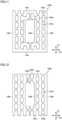
Fig. 11 is a diagram showing a shape of a first plate-like portion of the insulating plate in the second embodiment -
Fig. 12 is a diagram showing a shape of a second plate-like portion of the insulating plate in the second embodiment -
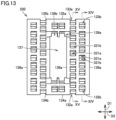
Fig. 13 is a diagram showing a shape of an insulating plate in a third embodiment covered by the claims. -
Fig. 14 is a diagram of the insulating plate shown inFig. 13 when viewed in a direction of arrows of line XIV-XIV. -
Fig. 15 is a diagram of the insulating plate shown inFig. 13 when viewed in a direction of arrows of line XV-XV. -
Fig. 16 is a diagram showing a shape of a first plate-like portion of the insulating plate in the third embodiment. -
Fig. 17 is a diagram showing a shape of a second plate-like portion of the insulating plate in the third embodiment. -
Fig. 18 is a diagram showing a shape of an insulating plate in a fourth embodiment not covered by the claims. -
Fig. 19 is a diagram of the insulating plate shown inFig. 18 when viewed in a direction of arrows of line XIX-XIX. -
Fig. 20 is a diagram of the insulating plate shown inFig. 18 when viewed in a direction of arrows of line XX-XX. -
Fig. 21 is a diagram showing a shape of a first plate-like portion of the insulating plate in the fourth embodiment. -
Fig. 22 is a diagram showing a shape of a second plate-like portion of the insulating plate in the fourth embodiment. -
Fig. 23 is a cross-sectional view showing a configuration of an insulating plate in a fifth embodiment not covered by the claims. - Stationary induction apparatuses according to embodiments will be hereinafter described with reference to the drawings. In the following description of the embodiments, the same or corresponding parts in the drawings are designated by the same symbols and a description thereof will not be repeated.
-
Fig. 1 is a perspective view showing an external appearance of a stationary not covered by the claims. induction apparatus according to a first embodimentFig. 2 is a perspective view showing part of a configuration of the stationary induction apparatus according to the first embodiment.Fig. 3 is a partial cross-sectional view of the stationary induction apparatus shown inFig. 1 when viewed in a direction of arrows of line III-III.Fig. 4 is an exploded perspective view showing a multilayer structure of a plurality of windings and a plurality of insulating plates included in the stationary induction apparatus according to the first embodiment. - As shown in
Figs. 1 to 4 , astationary induction apparatus 100 according to the first embodiment is an on-vehicle transformer.Stationary induction apparatus 100 according to the present embodiment is also a so-called shell-type transformer. - As shown in
Figs. 1 to 4 ,stationary induction apparatus 100 includes acore 110, a plurality ofwindings 120, a plurality ofinsulating plates 130, and atank 140. The plurality ofinsulating plates 130 are not illustrated inFigs. 2 and 3 . - As shown in
Fig. 2 ,core 110 includes amain leg 111 andside legs 112.Side legs 112 are connected tomain leg 111. - As shown in
Figs. 1 and2 , each of the plurality ofwindings 120 is wound aroundcore 110, withcore 110 as a central axis. Specifically, each of the plurality ofwindings 120 is wound aroundmain leg 111 while being passed betweenmain leg 111 andside legs 112. In this manner, each of the plurality ofwindings 120 is coaxially arranged. Each of the plurality ofwindings 120 is a plate winding in the present embodiment. - As shown in
Figs. 1 to 3 , the plurality ofwindings 120 include a plurality of high-voltage windings 120a and a plurality of low-voltage windings 120b. In a central axis direction of the plurality ofwindings 120, the plurality of high-voltage windings 120a are located so as to be sandwiched between a pair of the plurality of low-voltage windings 120b. - As shown in
Fig. 4 , each of the plurality of insulatingplates 130 is located so as to be sandwiched between every twoadjacent windings 120 of the plurality ofwindings 120. A configuration of each of the plurality of insulatingplates 130 will be described later. - As shown in
Figs. 3 and4 ,tank 140 containscore 110, the plurality ofwindings 120 and the plurality of insulatingplates 130.Tank 140 is filled with insulating oil.Tank 140 is configured such that the insulating oil flows withintank 140 in a first direction D1 orthogonal to the central axis direction of the plurality ofwindings 120. - As shown in
Figs. 1 and3 ,stationary induction apparatus 100 further includes acirculation pipe 151.Circulation pipe 151 connects twoconnection portions 141 located at opposite ends oftank 140 in first direction D1, respectively.Circulation pipe 151 is provided with apump 154. Operation of thispump 154 causes the insulating oil to circulate throughtank 140 andcirculation pipe 151. -
Circulation pipe 151 is further connected to acooling container 153. Coolingcontainer 153 is cooled from outside by air delivered from anelectric blower 152. As a result, the insulating oil that has flowed intocooling container 153 is cooled, and then flows intocirculation pipe 151 again. - The insulating oil that has flowed in via one of
connection portions 141 flows through aflow path 10 for insulating oil that is formed between the plurality ofwindings 120 adjacent to each other. As a result, heat ofwindings 120 adjacent to flowpath 10 is transferred to the insulating oil. The plurality ofwindings 120 are thereby cooled. - Flow
path 10 is formed of the plurality of insulatingplates 130. Flowpath 10 in the present embodiment will be hereinafter described along with the configuration of the plurality of insulatingplates 130. -
Fig. 5 is a diagram showing a shape of an insulating plate in the first embodiment.Fig. 6 is a cross-sectional view of the insulating plate shown inFig. 5 when viewed in a direction of arrows of line VI-VI.Fig. 7 is a diagram showing a shape of a first plate-like portion of the insulating plate in the first embodiment.Fig. 8 is a diagram showing a shape of a second plate-like portion of the insulating plate in the first embodiment. The plurality ofwindings 120 adjacent to insulatingplate 130 are also illustrated inFig. 6 . - As shown in
Figs. 4 and5 , each of the plurality of insulatingplates 130 has a rectangular outer shape, when viewed in the central axis direction of the plurality ofwindings 120. Each of the plurality of insulatingplates 130 is located such that a longitudinal direction of each of the plurality of insulatingplates 130 is along first direction D1. That is, each of the plurality of insulatingplates 130 is located such that a transverse direction of each of the plurality of insulatingplates 130 is along a second direction D2 orthogonal to both the central axis direction and first direction D1. - Each of the plurality of insulating
plates 130 is provided with anopening 137 extending therethrough in the central axis direction.Core 110 shown inFig. 2 is located inopening 137. Specifically,main leg 111 is located inopening 137. - As shown in
Figs. 4 to 6 , each of the plurality of insulatingplates 130 includes a first plate-like portion 130a and a second plate-like portion 130b adjacent to each other in the central axis direction. In the present embodiment, each of the plurality of insulatingplates 130 is formed of first plate-like portion 130a and second plate-like portion 130b. Each of first plate-like portion 130a and second plate-like portion 130b is made of an insulating material, for example, insulating paper such as pressboard, or an insulating material such as polyamide. - As shown in
Fig. 7 , first plate-like portion 130a is provided with a plurality offirst holes 131a extending therethrough in the central axis direction. When viewed in the central axis direction,first hole 131a has a rectangular outer shape, specifically, a square outer shape. - In the present embodiment, first plate-
like portion 130a is provided with afirst notch 132a at oneedge 134a in first direction D1. Specifically, first plate-like portion 130a is provided with a plurality offirst notches 132a. In the present embodiment, each corner of each of the plurality offirst notches 132a in first plate-like portion 130a forms a right angle. - First plate-
like portion 130a is provided with asecond notch 133a at theother edge 135a in first direction D1. Specifically, first plate-like portion 130a is provided with a plurality ofsecond notches 133a. In the present embodiment, each corner of each of the plurality ofsecond notches 133a in first plate-like portion 130a forms a right angle. -
Side edges 136a located at opposite sides of first plate-like portion 130a in second direction D2 each have a linear outer shape along first direction D1. - First plate-
like portion 130a is provided with a plurality of innerperipheral notches 139a at innerperipheral edges 138a. The plurality of innerperipheral notches 139a are located so as to be sandwiched between the plurality offirst holes 131a in first direction D1. - The outer shapes of
first hole 131a, andfirst notch 132a andsecond notch 133a in first plate-like portion 130a when viewed in the central axis direction are not particularly limited. The outer shapes offirst hole 131a, andfirst notch 132a andsecond notch 133a in first plate-like portion 130a when viewed in the central axis direction can be varied as appropriate so as to reduce pressure loss caused by the shape offlow path 10 for insulating oil. - As shown in
Fig. 8 , second plate-like portion 130b is provided with a plurality ofsecond holes 131b extending therethrough in the central axis direction. When viewed in the central axis direction,second hole 131b has a rectangular outer shape, specifically, a square outer shape. - In the present embodiment, second plate-
like portion 130b is provided with afirst notch 132b at oneedge 134b in first direction D1. Specifically, second plate-like portion 130b is provided with a plurality offirst notches 132b. In the present embodiment, each corner of each of the plurality offirst notches 132b in second plate-like portion 130b forms a right angle. - Second plate-
like portion 130b is provided with asecond notch 133b at theother edge 135b in first direction D1. Specifically, second plate-like portion 130b is provided with a plurality ofsecond notches 133b. In the present embodiment, each corner of each of the plurality ofsecond notches 133b in second plate-like portion 130b forms a right angle. - Side edges 136b located at opposite sides of second plate-
like portion 130b in second direction D2 each have a linear outer shape along first direction D1. Second plate-like portion 130b is provided with a plurality of innerperipheral notches 139b at innerperipheral edges 138b. - The outer shapes of
second hole 131b, andfirst notch 132b andsecond notch 133b in second plate-like portion 130b when viewed in the central axis direction are not particularly limited. The outer shapes ofsecond hole 131b, andfirst notch 132b andsecond notch 133b in second plate-like portion 130b when viewed in the central axis direction can be varied as appropriate so as to reduce pressure loss caused by the shape offlow path 10 for insulating oil. - As described above, at least one of first plate-
like portion 130a and second plate-like portion 130b is provided withfirst notch edge second notch other edge - As shown in
Figs. 5 and6 , the plurality offirst holes 131a, the plurality ofsecond holes 131b,first notches second notches flow path 10 which connects one side and the other side of each of the plurality of insulatingplates 130 and through which the insulating oil can flow in first direction D1. - As shown in
Figs. 5 and6 , when viewed in the central axis direction, flowpath 10 includes alinear flow path 11 formed along first direction D1. In the present embodiment, when viewed in the central axis direction, flowpath 10 includes a plurality oflinear flow paths 11. - In the present embodiment, as shown in
Fig. 6 , for example,first hole 131a located closest to oneedge 134a overlapsfirst notch 132b. Each of the plurality ofsecond holes 131b overlaps both of twofirst holes 131a adjacent to each other in first direction D1.First hole 131a located closest to 135a overlapssecond notch 133b.Linear flow path 11 is configured in this manner. - As shown in
Figs. 5 and7 , each of the plurality of innerperipheral notches 139a may be located between two of the plurality offirst holes 131a aligned along first direction D1. In this case,linear flow path 11 is such that the plurality offirst holes 131a, the plurality ofsecond holes 131b,first notches second notches flow path 10 in first direction D1. - As described above, in
stationary induction apparatus 100 according to the first embodiment, the plurality offirst holes 131a, the plurality ofsecond holes 131b,first notches second notches flow path 10 which connects one side and the other side of each of the plurality of insulatingplates 130 and through which the insulating oil can flow in first direction D1. As a result, flowpath 10 for insulating oil can be readily formed between the plurality ofwindings 120 adjacent to each other, by disposing first plate-like portion 130a and second plate-like portion 130b to be adjacent to each other, without arranging a plurality of insulating pieces on the surface of each of the plurality of insulatingplates 130. - In the first embodiment, when viewed in the central axis direction, flow
path 10 includeslinear flow path 11 formed along first direction D1. As a result, in first direction D1, the insulating oil flowing throughlinear flow path 11 is capable of alternately cooling winding 120 adjacent to first plate-like portion 130a and winding 120 adjacent to second plate-like portion 130b. The plurality ofwindings 120 can, in turn, be efficiently cooled as a whole. - A stationary induction apparatus according to a second embodiment will be not covered by the claims hereinafter described. The stationary induction apparatus according to the second embodiment is different only in the configuration of each of the plurality of insulating plates from
stationary induction apparatus 100 according to the first embodiment. Thus, a description of the configuration similar to that ofstationary induction apparatus 100 according to the first embodiment will not be repeated. -
Fig. 9 is a diagram showing a shape of an insulating plate in the second embodiment.Fig. 10 is a cross-sectional view of the insulating plate shown inFig. 9 when viewed in a direction of arrows of line X-X.Fig. 11 is a diagram showing a shape of a first plate-like portion of the insulating plate in the second embodiment.Fig. 12 is a diagram showing a shape of a second plate-like portion of the insulating plate in the second embodiment. - As shown in
Figs. 9 to 12 , in a plurality of insulatingplates 230 in the second embodiment, each of a plurality offirst holes 231a in a first plate-like portion 230a andsecond holes 231b in a second plate-like portion 230b includes rounded corners when viewed in the central axis direction. As a result, pressure loss inflow path 10 when the insulating oil flows throughflow path 10 can be reduced. - In the present embodiment, each of a plurality of
first notches 232b, a plurality ofsecond notches peripheral notches - covered by the claims A stationary induction apparatus according to a third embodiment will be hereinafter described. The stationary induction apparatus according to the third embodiment is mainly different in the position of each of the plurality of first holes and the plurality of second holes from
stationary induction apparatus 100 according to the first embodiment. Thus, a description of the configuration similar to that ofstationary induction apparatus 100 according to the first embodiment will not be repeated. -
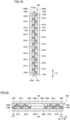
Fig. 13 is a diagram showing a shape of an insulating plate in the third embodiment.Fig. 14 is a diagram of the insulating plate shown inFig. 13 when viewed in a direction of arrows of line XIV-XIV.Fig. 15 is a diagram of the insulating plate shown inFig. 13 when viewed in a direction of arrows of line XV-XV.Fig. 16 is a diagram showing a shape of a first plate-like portion of the insulating plate in the third embodiment.Fig. 17 is a diagram showing a shape of a second plate-like portion of the insulating plate in the third embodiment. - In a plurality of insulating
plates 330 in the third embodiment, as shown inFigs. 13 and14 , each of a plurality offirst holes 331a in a first plate-like portion 330a forms part of onelinear flow path 11X of a plurality of linear flow paths adjacent to each other. As shown inFigs. 13 and15 , each of the plurality offirst holes 331a forms part of the otherlinear flow path 11Y of the plurality of linear flow paths adjacent to each other. The plurality offirst holes 331a forming onelinear flow path 11X and the plurality offirst holes 331a forming the otherlinear flow path 11Y are located in a staggered relation to each other in first direction D1, as shown inFigs. 13 and16 . As shown inFigs. 13 and14 , each of a plurality ofsecond holes 331b in a second plate-like portion 330b forms part of onelinear flow path 11X of a plurality oflinear flow paths 11 adjacent to each other. As shown inFigs. 13 and15 , each of the plurality ofsecond holes 331b forms part of the otherlinear flow path 11Y of the plurality of linear flow paths adjacent to each other. The plurality ofsecond holes 331b forming onelinear flow path 11X and the plurality ofsecond holes 331b forming the otherlinear flow path 11Y are located in a staggered relation to each other in first direction D1, as shown inFigs. 13 and17 . - With the configuration described above, as shown in
Figs. 14 and15 , when viewed in second direction D2, a portion of the plurality ofwindings 120 that is not adjacent to onelinear flow path 11X is adjacent to the otherlinear flow path 11Y. When viewed in second direction D2, a portion of the plurality ofwindings 120 that is not adjacent to the otherlinear flow path 11Y is adjacent to onelinear flow path 11X. As a result, each of the plurality ofwindings 120 adjacent to each of the plurality of insulatingplates 330 can be uniformly cooled. - A stationary induction apparatus according to a fourth embodiment will be not covered by the claims hereinafter described. The stationary induction apparatus according to the fourth embodiment is mainly different in the position of each of the plurality of first holes and the plurality of second holes from
stationary induction apparatus 100 according to the first embodiment. Thus, a description of the configuration similar to that ofstationary induction apparatus 100 according to the first embodiment will not be repeated. -
Fig. 18 is a diagram showing a shape of an insulating plate in the fourth embodiment.Fig. 19 is a diagram of the insulating plate shown inFig. 18 when viewed in a direction of arrows of line XIX-XIX.Fig. 20 is a diagram of the insulating plate shown inFig. 18 when viewed in a direction of arrows of line XX-XX.Fig. 21 is a diagram showing a shape of a first plate-like portion of the insulating plate in the fourth embodiment.Fig. 22 is a diagram showing a shape of a second plate-like portion of the insulating plate in the fourth embodiment. - As shown in
Figs. 18 and19 , also in the present embodiment, a first plate-like portion 430a and a second plate-like portion 430b form the plurality offlow paths 10 each of which connects one side and the other side of each of a plurality of insulatingplates 430 and through each of which the insulating oil can flow in first direction D1. - Further, in the present embodiment, as shown in
Figs. 18 and20 ,flow path 10 through which the insulating oil can flow is formed fromside edges peripheral edges Fig. 20 ,flow path 10 along second direction D2 is formed, for example, by an overlap of a plurality offirst holes 431a, a plurality ofsecond holes 431b, innerperipheral notches 139a, andside notches 439 formed atside edges 136a. - As shown in
Figs. 18 to 20 , each of the plurality offlow paths 10 along first direction D1 when viewed in the central axis direction and each of the plurality offlow paths 10 along second direction D2 when viewed in the central axis direction are connected to each other. In this manner, in the fourth embodiment, flowpath 10 includes a mesh-like flow path 12 when viewed in the central axis direction. - In the fourth embodiment, as shown in
Figs. 18 ,21 and 22 , each of the plurality offirst holes 431a and the plurality ofsecond holes 431b is configured such that, when viewed in the central axis direction, a central portion of each of the plurality offirst holes 431a and a central portion of each of the plurality ofsecond holes 431b are located in a zigzag relation to each other. - In the stationary induction apparatus according to the fourth embodiment, as the plurality of
first holes 431a and the plurality ofsecond holes 431b are arranged as described above, flowpath 10 includes mesh-like flow path 12 when viewed in the central axis direction. The insulating oil can flow while taking various paths within mesh-like flow path 12, thereby more uniformly cooling the plurality ofwindings 120 in contact with each of the plurality of insulatingplates 430. - not covered by the claims A stationary induction apparatus according to a fifth embodiment will be hereinafter described. The stationary induction apparatus according to the fifth embodiment is mainly different in the number of plate-like portions forming the insulating plate from the stationary induction apparatus according to the fourth embodiment. Thus, a description of the configuration similar to that of the stationary induction apparatus according to the fourth embodiment will not be repeated.
-
Fig. 23 is a cross-sectional view showing a configuration of an insulating plate in the fifth embodiment. InFig. 23 , insulatingplate 430 in the fourth embodiment is shown in the same cross section as inFig. 19 . - As shown in
Fig. 23 , in the fifth embodiment, a plurality of insulatingplates 530 each further include a third plate-like portion 530c located on the opposite side to first plate-like portion 430a in the central axis direction and adjacent to second plate-like portion 430b. In the present embodiment, the plurality of insulatingplates 530 are each formed of first plate-like portion 430a, second plate-like portion 430b and third plate-like portion 530c. - Third plate-like portion 530c is identical in shape to first plate-
like portion 430a, and is located symmetrically to first plate-like portion 430a with respect to second plate-like portion 430b. As a result, in each of twowindings 120 adjacent to each of the plurality of insulatingplates 530, twoflow paths 10 in contact withwindings 120 are identical in configuration. As a result, each of the plurality ofwindings 120 can be similarly cooled. - In the description of the foregoing embodiments, configurations that can be combined with each other may be combined together.
- It is noted that the embodiments disclosed herein are illustrative in every respect, and do not serve as a basis for restrictive interpretation. Therefore, the technical scope of the present invention should not be interpreted based on the foregoing embodiments only, but is defined by the terms of the claims.
- 10 flow path; 11, 11X, 11Y linear flow path; 12 mesh-like flow path; 100 stationary induction apparatus; 110 core; 111 main leg; 112 side leg; 120 winding; 120a high-voltage winding; 120b low-voltage winding; 130, 230, 330, 430, 530 insulating plate; 130a, 230a, 330a, 430a first plate-like portion; 130b, 230b, 330b, 430b second plate-like portion; 131a, 231a, 331a, 431a first hole; 131b, 231b, 331b, 431b second hole; 132a, 132b, 232b first notch; 133a, 133b, 233a, 233b second notch; 134a, 134b one edge; 135a, 135b other edge; 136a, 136b side edge; 137 opening; 138a, 138b inner peripheral edge; 139a, 139b, 239a, 239b inner peripheral notch; 140 tank; 141 connection portion; 151 circulation pipe; 152 electric blower; 153 cooling container; 154 pump; 439 side notch; 530c third plate-like portion; D1 first direction; D2 second direction.
Claims (2)
- A stationary induction apparatus comprising:a core(110);a plurality of windings(120) wound around the core(110), with the core(110) as a central axis, and coaxially arranged;a plurality of insulating plates(130, 230, 330), each being located so as to be sandwiched between every two adjacent windings(120) of the plurality of windings(120); anda tank(140) to contain the core(110), the plurality of windings(120) and the plurality of insulating plates(330), the tank(140) being filled with insulating oil,the tank(140) being configured such that the insulating oil flows within the tank(140) in a first direction(D 1) orthogonal to a central axis direction of the plurality of windings(120),the plurality of insulating plates(130, 230, 330) each including a first plate-like portion(330a) and a second plate-like portion(330b) adjacent to each other in the central axis direction,the first plate-like portion(330a) being provided with a plurality of first holes(331a) extending therethrough in the central axis direction,the second plate-like portion(330b) being provided with a plurality of second holes(331b) extending therethrough in the central axis direction,at least one of the first plate-like portion(330a) and the second plate-like portion(330b) being provided with a first notch(132a, 132b) at one edge(134a, 134b) in the first direction(D 1), and being provided with a second notch(133a, 133b) at the other edge(135a,135b) in the first direction(D 1), andthe plurality of first holes(331a), the plurality of second holes s(331b), the first notch(132a, 132b) and the second notch(133a, 133b) overlapping one another, to thereby form a flow path(10) which connects one side and the other side of each of the plurality of insulating plates(130, 230, 330) and through which the insulating oil can flow in the first direction(D 1), whereinwhen viewed in the central axis direction, the flow path(10) includes a linear flow path(1 1) formed along the first direction(D 1),when viewed in the central axis direction, the flow path(10) includes a plurality of the linear flow paths(1 1X, 11Y),the plurality of first holes(331a) forming one(1 1X) of the plurality of the linear flow paths(11X,11Y) adjacent to each other and the plurality of first holes(331a) forming the other linear flow path(1 1Y) are located in a staggered relation to each other in the first direction(D 1), andthe plurality of second holes(331b) forming one(11X) of the plurality of the linear flow paths(11X,11Y) adjacent to each other and the plurality of second holes(331b) forming the other linear flow path(11Y) are located in a staggered relation to each other in the first direction(D 1).
- The stationary induction apparatus according to claim 1, whereinthe plurality of insulating plates each further include a third plate-like portion(530c) located on an opposite side to the first plate-like portion(430a) in the central axis direction and adjacent to the second plate-like portion(430b), andthe third plate-like portion(530c) is identical in shape to the first plate-like portion(430a), and is located symmetrically to the first plate-like portion(430a) with respect to the second plate-like portion(430b).
Applications Claiming Priority (1)
| Application Number | Priority Date | Filing Date | Title |
|---|---|---|---|
| PCT/JP2019/017608 WO2020217376A1 (en) | 2019-04-25 | 2019-04-25 | Stationary induction device |
Publications (3)
| Publication Number | Publication Date |
|---|---|
| EP3961663A1 EP3961663A1 (en) | 2022-03-02 |
| EP3961663A4 EP3961663A4 (en) | 2022-05-04 |
| EP3961663B1 true EP3961663B1 (en) | 2023-12-20 |
Family
ID=68692061
Family Applications (1)
| Application Number | Title | Priority Date | Filing Date |
|---|---|---|---|
| EP19926516.6A Active EP3961663B1 (en) | 2019-04-25 | 2019-04-25 | Stationary induction apparatus |
Country Status (4)
| Country | Link |
|---|---|
| US (1) | US12009134B2 (en) |
| EP (1) | EP3961663B1 (en) |
| JP (1) | JP6612009B1 (en) |
| WO (1) | WO2020217376A1 (en) |
Families Citing this family (1)
| Publication number | Priority date | Publication date | Assignee | Title |
|---|---|---|---|---|
| US20230142063A1 (en) * | 2020-03-31 | 2023-05-11 | General Electric Company | Liquid/fluid cooling systems for high power-density (hpd) transformers |
Family Cites Families (7)
| Publication number | Priority date | Publication date | Assignee | Title |
|---|---|---|---|---|
| JPS5033616Y1 (en) | 1969-12-17 | 1975-10-01 | ||
| JPS5314135B2 (en) * | 1972-02-05 | 1978-05-15 | ||
| JPS5426623U (en) * | 1977-07-26 | 1979-02-21 | ||
| JPS58196814U (en) | 1982-06-24 | 1983-12-27 | 株式会社東芝 | Outside iron type oil-immersed transformer |
| JP4540733B2 (en) * | 2006-07-10 | 2010-09-08 | 三菱電機株式会社 | Transformer for vehicle |
| US8547193B2 (en) | 2009-10-21 | 2013-10-01 | Mitsubishi Electric Corporation | Stationary induction apparatus |
| JP5766383B1 (en) * | 2014-07-17 | 2015-08-19 | 三菱電機株式会社 | In-vehicle transformer |
-
2019
- 2019-04-25 US US17/429,081 patent/US12009134B2/en active Active
- 2019-04-25 JP JP2019547737A patent/JP6612009B1/en not_active Expired - Fee Related
- 2019-04-25 EP EP19926516.6A patent/EP3961663B1/en active Active
- 2019-04-25 WO PCT/JP2019/017608 patent/WO2020217376A1/en not_active Ceased
Also Published As
| Publication number | Publication date |
|---|---|
| US12009134B2 (en) | 2024-06-11 |
| EP3961663A4 (en) | 2022-05-04 |
| JPWO2020217376A1 (en) | 2021-05-13 |
| WO2020217376A1 (en) | 2020-10-29 |
| EP3961663A1 (en) | 2022-03-02 |
| US20220020520A1 (en) | 2022-01-20 |
| JP6612009B1 (en) | 2019-11-27 |
Similar Documents
| Publication | Publication Date | Title |
|---|---|---|
| US3183461A (en) | Magnetic core structure with cooling passages therein | |
| US9805852B2 (en) | Transformer core | |
| US8274351B2 (en) | Transformer device | |
| US20160247621A1 (en) | Stationary Induction Electric Apparatus | |
| KR20000074890A (en) | High Voltage Transformer having Radiating Rib | |
| KR20120014147A (en) | Transformer core | |
| CN105895328A (en) | Three-phase five-column iron core and static electromagnetic equipment | |
| US9576709B2 (en) | Transformer having a stacked core | |
| CN110914938A (en) | Planar transformer and DCDC converter | |
| EP3961663A1 (en) | Stationary induction device | |
| KR20220054393A (en) | Kwon Cheol-shim | |
| CA1198187A (en) | Transformer core cooling arrangement | |
| US10102966B2 (en) | Stationary induction apparatus | |
| JP6572541B2 (en) | Transformer | |
| JP5930780B2 (en) | Reactor | |
| US3349357A (en) | Transformer core reinforcing plate | |
| US20160268035A1 (en) | Vehicle-mounted transformer | |
| US4477791A (en) | Spacer block pattern for electrical inductive apparatus | |
| US9941043B2 (en) | Core for an electrical induction device | |
| JPH0145204B2 (en) | ||
| US714232A (en) | Transformer, inductor, &c. | |
| US2812505A (en) | Magnetic core for stationary electrical induction apparatus | |
| US20170301450A1 (en) | Cooling structure for coil component | |
| JP7199606B1 (en) | Static induction device | |
| KR20180082601A (en) | Transformer or reactor iron core |
Legal Events
| Date | Code | Title | Description |
|---|---|---|---|
| STAA | Information on the status of an ep patent application or granted ep patent |
Free format text: STATUS: THE INTERNATIONAL PUBLICATION HAS BEEN MADE |
|
| PUAI | Public reference made under article 153(3) epc to a published international application that has entered the european phase |
Free format text: ORIGINAL CODE: 0009012 |
|
| STAA | Information on the status of an ep patent application or granted ep patent |
Free format text: STATUS: REQUEST FOR EXAMINATION WAS MADE |
|
| 17P | Request for examination filed |
Effective date: 20210827 |
|
| AK | Designated contracting states |
Kind code of ref document: A1 Designated state(s): AL AT BE BG CH CY CZ DE DK EE ES FI FR GB GR HR HU IE IS IT LI LT LU LV MC MK MT NL NO PL PT RO RS SE SI SK SM TR |
|
| A4 | Supplementary search report drawn up and despatched |
Effective date: 20220331 |
|
| RIC1 | Information provided on ipc code assigned before grant |
Ipc: H01F 27/12 20060101ALI20220325BHEP Ipc: H01F 27/32 20060101AFI20220325BHEP |
|
| DAV | Request for validation of the european patent (deleted) | ||
| DAX | Request for extension of the european patent (deleted) | ||
| GRAP | Despatch of communication of intention to grant a patent |
Free format text: ORIGINAL CODE: EPIDOSNIGR1 |
|
| STAA | Information on the status of an ep patent application or granted ep patent |
Free format text: STATUS: GRANT OF PATENT IS INTENDED |
|
| INTG | Intention to grant announced |
Effective date: 20230711 |
|
| P01 | Opt-out of the competence of the unified patent court (upc) registered |
Effective date: 20230919 |
|
| GRAS | Grant fee paid |
Free format text: ORIGINAL CODE: EPIDOSNIGR3 |
|
| GRAA | (expected) grant |
Free format text: ORIGINAL CODE: 0009210 |
|
| STAA | Information on the status of an ep patent application or granted ep patent |
Free format text: STATUS: THE PATENT HAS BEEN GRANTED |
|
| AK | Designated contracting states |
Kind code of ref document: B1 Designated state(s): AL AT BE BG CH CY CZ DE DK EE ES FI FR GB GR HR HU IE IS IT LI LT LU LV MC MK MT NL NO PL PT RO RS SE SI SK SM TR |
|
| REG | Reference to a national code |
Ref country code: GB Ref legal event code: FG4D |
|
| REG | Reference to a national code |
Ref country code: DE Ref legal event code: R096 Ref document number: 602019043812 Country of ref document: DE |
|
| REG | Reference to a national code |
Ref country code: CH Ref legal event code: EP |
|
| REG | Reference to a national code |
Ref country code: IE Ref legal event code: FG4D |
|
| PG25 | Lapsed in a contracting state [announced via postgrant information from national office to epo] |
Ref country code: GR Free format text: LAPSE BECAUSE OF FAILURE TO SUBMIT A TRANSLATION OF THE DESCRIPTION OR TO PAY THE FEE WITHIN THE PRESCRIBED TIME-LIMIT Effective date: 20240321 |
|
| REG | Reference to a national code |
Ref country code: LT Ref legal event code: MG9D |
|
| PG25 | Lapsed in a contracting state [announced via postgrant information from national office to epo] |
Ref country code: LT Free format text: LAPSE BECAUSE OF FAILURE TO SUBMIT A TRANSLATION OF THE DESCRIPTION OR TO PAY THE FEE WITHIN THE PRESCRIBED TIME-LIMIT Effective date: 20231220 |
|
| REG | Reference to a national code |
Ref country code: NL Ref legal event code: MP Effective date: 20231220 |
|
| PG25 | Lapsed in a contracting state [announced via postgrant information from national office to epo] |
Ref country code: ES Free format text: LAPSE BECAUSE OF FAILURE TO SUBMIT A TRANSLATION OF THE DESCRIPTION OR TO PAY THE FEE WITHIN THE PRESCRIBED TIME-LIMIT Effective date: 20231220 |
|
| PG25 | Lapsed in a contracting state [announced via postgrant information from national office to epo] |
Ref country code: LT Free format text: LAPSE BECAUSE OF FAILURE TO SUBMIT A TRANSLATION OF THE DESCRIPTION OR TO PAY THE FEE WITHIN THE PRESCRIBED TIME-LIMIT Effective date: 20231220 Ref country code: GR Free format text: LAPSE BECAUSE OF FAILURE TO SUBMIT A TRANSLATION OF THE DESCRIPTION OR TO PAY THE FEE WITHIN THE PRESCRIBED TIME-LIMIT Effective date: 20240321 Ref country code: FI Free format text: LAPSE BECAUSE OF FAILURE TO SUBMIT A TRANSLATION OF THE DESCRIPTION OR TO PAY THE FEE WITHIN THE PRESCRIBED TIME-LIMIT Effective date: 20231220 Ref country code: ES Free format text: LAPSE BECAUSE OF FAILURE TO SUBMIT A TRANSLATION OF THE DESCRIPTION OR TO PAY THE FEE WITHIN THE PRESCRIBED TIME-LIMIT Effective date: 20231220 Ref country code: BG Free format text: LAPSE BECAUSE OF FAILURE TO SUBMIT A TRANSLATION OF THE DESCRIPTION OR TO PAY THE FEE WITHIN THE PRESCRIBED TIME-LIMIT Effective date: 20240320 |
|
| REG | Reference to a national code |
Ref country code: AT Ref legal event code: MK05 Ref document number: 1643182 Country of ref document: AT Kind code of ref document: T Effective date: 20231220 |
|
| PG25 | Lapsed in a contracting state [announced via postgrant information from national office to epo] |
Ref country code: NL Free format text: LAPSE BECAUSE OF FAILURE TO SUBMIT A TRANSLATION OF THE DESCRIPTION OR TO PAY THE FEE WITHIN THE PRESCRIBED TIME-LIMIT Effective date: 20231220 |
|
| PG25 | Lapsed in a contracting state [announced via postgrant information from national office to epo] |
Ref country code: SE Free format text: LAPSE BECAUSE OF FAILURE TO SUBMIT A TRANSLATION OF THE DESCRIPTION OR TO PAY THE FEE WITHIN THE PRESCRIBED TIME-LIMIT Effective date: 20231220 Ref country code: RS Free format text: LAPSE BECAUSE OF FAILURE TO SUBMIT A TRANSLATION OF THE DESCRIPTION OR TO PAY THE FEE WITHIN THE PRESCRIBED TIME-LIMIT Effective date: 20231220 Ref country code: NO Free format text: LAPSE BECAUSE OF FAILURE TO SUBMIT A TRANSLATION OF THE DESCRIPTION OR TO PAY THE FEE WITHIN THE PRESCRIBED TIME-LIMIT Effective date: 20240320 Ref country code: NL Free format text: LAPSE BECAUSE OF FAILURE TO SUBMIT A TRANSLATION OF THE DESCRIPTION OR TO PAY THE FEE WITHIN THE PRESCRIBED TIME-LIMIT Effective date: 20231220 Ref country code: LV Free format text: LAPSE BECAUSE OF FAILURE TO SUBMIT A TRANSLATION OF THE DESCRIPTION OR TO PAY THE FEE WITHIN THE PRESCRIBED TIME-LIMIT Effective date: 20231220 Ref country code: HR Free format text: LAPSE BECAUSE OF FAILURE TO SUBMIT A TRANSLATION OF THE DESCRIPTION OR TO PAY THE FEE WITHIN THE PRESCRIBED TIME-LIMIT Effective date: 20231220 |
|
| PG25 | Lapsed in a contracting state [announced via postgrant information from national office to epo] |
Ref country code: IS Free format text: LAPSE BECAUSE OF FAILURE TO SUBMIT A TRANSLATION OF THE DESCRIPTION OR TO PAY THE FEE WITHIN THE PRESCRIBED TIME-LIMIT Effective date: 20240420 |
|
| PG25 | Lapsed in a contracting state [announced via postgrant information from national office to epo] |
Ref country code: CZ Free format text: LAPSE BECAUSE OF FAILURE TO SUBMIT A TRANSLATION OF THE DESCRIPTION OR TO PAY THE FEE WITHIN THE PRESCRIBED TIME-LIMIT Effective date: 20231220 Ref country code: AT Free format text: LAPSE BECAUSE OF FAILURE TO SUBMIT A TRANSLATION OF THE DESCRIPTION OR TO PAY THE FEE WITHIN THE PRESCRIBED TIME-LIMIT Effective date: 20231220 |
|
| PG25 | Lapsed in a contracting state [announced via postgrant information from national office to epo] |
Ref country code: SK Free format text: LAPSE BECAUSE OF FAILURE TO SUBMIT A TRANSLATION OF THE DESCRIPTION OR TO PAY THE FEE WITHIN THE PRESCRIBED TIME-LIMIT Effective date: 20231220 |
|
| PG25 | Lapsed in a contracting state [announced via postgrant information from national office to epo] |
Ref country code: SM Free format text: LAPSE BECAUSE OF FAILURE TO SUBMIT A TRANSLATION OF THE DESCRIPTION OR TO PAY THE FEE WITHIN THE PRESCRIBED TIME-LIMIT Effective date: 20231220 Ref country code: SK Free format text: LAPSE BECAUSE OF FAILURE TO SUBMIT A TRANSLATION OF THE DESCRIPTION OR TO PAY THE FEE WITHIN THE PRESCRIBED TIME-LIMIT Effective date: 20231220 Ref country code: RO Free format text: LAPSE BECAUSE OF FAILURE TO SUBMIT A TRANSLATION OF THE DESCRIPTION OR TO PAY THE FEE WITHIN THE PRESCRIBED TIME-LIMIT Effective date: 20231220 Ref country code: IT Free format text: LAPSE BECAUSE OF FAILURE TO SUBMIT A TRANSLATION OF THE DESCRIPTION OR TO PAY THE FEE WITHIN THE PRESCRIBED TIME-LIMIT Effective date: 20231220 Ref country code: IS Free format text: LAPSE BECAUSE OF FAILURE TO SUBMIT A TRANSLATION OF THE DESCRIPTION OR TO PAY THE FEE WITHIN THE PRESCRIBED TIME-LIMIT Effective date: 20240420 Ref country code: EE Free format text: LAPSE BECAUSE OF FAILURE TO SUBMIT A TRANSLATION OF THE DESCRIPTION OR TO PAY THE FEE WITHIN THE PRESCRIBED TIME-LIMIT Effective date: 20231220 Ref country code: CZ Free format text: LAPSE BECAUSE OF FAILURE TO SUBMIT A TRANSLATION OF THE DESCRIPTION OR TO PAY THE FEE WITHIN THE PRESCRIBED TIME-LIMIT Effective date: 20231220 Ref country code: AT Free format text: LAPSE BECAUSE OF FAILURE TO SUBMIT A TRANSLATION OF THE DESCRIPTION OR TO PAY THE FEE WITHIN THE PRESCRIBED TIME-LIMIT Effective date: 20231220 |
|
| PG25 | Lapsed in a contracting state [announced via postgrant information from national office to epo] |
Ref country code: PL Free format text: LAPSE BECAUSE OF FAILURE TO SUBMIT A TRANSLATION OF THE DESCRIPTION OR TO PAY THE FEE WITHIN THE PRESCRIBED TIME-LIMIT Effective date: 20231220 Ref country code: PT Free format text: LAPSE BECAUSE OF FAILURE TO SUBMIT A TRANSLATION OF THE DESCRIPTION OR TO PAY THE FEE WITHIN THE PRESCRIBED TIME-LIMIT Effective date: 20240422 |
|
| PG25 | Lapsed in a contracting state [announced via postgrant information from national office to epo] |
Ref country code: PT Free format text: LAPSE BECAUSE OF FAILURE TO SUBMIT A TRANSLATION OF THE DESCRIPTION OR TO PAY THE FEE WITHIN THE PRESCRIBED TIME-LIMIT Effective date: 20240422 Ref country code: PL Free format text: LAPSE BECAUSE OF FAILURE TO SUBMIT A TRANSLATION OF THE DESCRIPTION OR TO PAY THE FEE WITHIN THE PRESCRIBED TIME-LIMIT Effective date: 20231220 |
|
| REG | Reference to a national code |
Ref country code: DE Ref legal event code: R097 Ref document number: 602019043812 Country of ref document: DE |
|
| PG25 | Lapsed in a contracting state [announced via postgrant information from national office to epo] |
Ref country code: DK Free format text: LAPSE BECAUSE OF FAILURE TO SUBMIT A TRANSLATION OF THE DESCRIPTION OR TO PAY THE FEE WITHIN THE PRESCRIBED TIME-LIMIT Effective date: 20231220 |
|
| PLBE | No opposition filed within time limit |
Free format text: ORIGINAL CODE: 0009261 |
|
| STAA | Information on the status of an ep patent application or granted ep patent |
Free format text: STATUS: NO OPPOSITION FILED WITHIN TIME LIMIT |
|
| PG25 | Lapsed in a contracting state [announced via postgrant information from national office to epo] |
Ref country code: SI Free format text: LAPSE BECAUSE OF FAILURE TO SUBMIT A TRANSLATION OF THE DESCRIPTION OR TO PAY THE FEE WITHIN THE PRESCRIBED TIME-LIMIT Effective date: 20231220 |
|
| PG25 | Lapsed in a contracting state [announced via postgrant information from national office to epo] |
Ref country code: SI Free format text: LAPSE BECAUSE OF FAILURE TO SUBMIT A TRANSLATION OF THE DESCRIPTION OR TO PAY THE FEE WITHIN THE PRESCRIBED TIME-LIMIT Effective date: 20231220 Ref country code: DK Free format text: LAPSE BECAUSE OF FAILURE TO SUBMIT A TRANSLATION OF THE DESCRIPTION OR TO PAY THE FEE WITHIN THE PRESCRIBED TIME-LIMIT Effective date: 20231220 |
|
| REG | Reference to a national code |
Ref country code: DE Ref legal event code: R119 Ref document number: 602019043812 Country of ref document: DE |
|
| PG25 | Lapsed in a contracting state [announced via postgrant information from national office to epo] |
Ref country code: MC Free format text: LAPSE BECAUSE OF FAILURE TO SUBMIT A TRANSLATION OF THE DESCRIPTION OR TO PAY THE FEE WITHIN THE PRESCRIBED TIME-LIMIT Effective date: 20231220 |
|
| 26N | No opposition filed |
Effective date: 20240923 |
|
| PG25 | Lapsed in a contracting state [announced via postgrant information from national office to epo] |
Ref country code: MC Free format text: LAPSE BECAUSE OF FAILURE TO SUBMIT A TRANSLATION OF THE DESCRIPTION OR TO PAY THE FEE WITHIN THE PRESCRIBED TIME-LIMIT Effective date: 20231220 |
|
| REG | Reference to a national code |
Ref country code: CH Ref legal event code: PL |
|
| PG25 | Lapsed in a contracting state [announced via postgrant information from national office to epo] |
Ref country code: LU Free format text: LAPSE BECAUSE OF NON-PAYMENT OF DUE FEES Effective date: 20240425 |
|
| GBPC | Gb: european patent ceased through non-payment of renewal fee |
Effective date: 20240425 |
|
| REG | Reference to a national code |
Ref country code: BE Ref legal event code: MM Effective date: 20240430 |
|
| PG25 | Lapsed in a contracting state [announced via postgrant information from national office to epo] |
Ref country code: LU Free format text: LAPSE BECAUSE OF NON-PAYMENT OF DUE FEES Effective date: 20240425 |
|
| PG25 | Lapsed in a contracting state [announced via postgrant information from national office to epo] |
Ref country code: DE Free format text: LAPSE BECAUSE OF NON-PAYMENT OF DUE FEES Effective date: 20241105 |
|
| PG25 | Lapsed in a contracting state [announced via postgrant information from national office to epo] |
Ref country code: BE Free format text: LAPSE BECAUSE OF NON-PAYMENT OF DUE FEES Effective date: 20240430 |
|
| PG25 | Lapsed in a contracting state [announced via postgrant information from national office to epo] |
Ref country code: GB Free format text: LAPSE BECAUSE OF NON-PAYMENT OF DUE FEES Effective date: 20240425 |
|
| PG25 | Lapsed in a contracting state [announced via postgrant information from national office to epo] |
Ref country code: GB Free format text: LAPSE BECAUSE OF NON-PAYMENT OF DUE FEES Effective date: 20240425 Ref country code: DE Free format text: LAPSE BECAUSE OF NON-PAYMENT OF DUE FEES Effective date: 20241105 Ref country code: BE Free format text: LAPSE BECAUSE OF NON-PAYMENT OF DUE FEES Effective date: 20240430 Ref country code: CH Free format text: LAPSE BECAUSE OF NON-PAYMENT OF DUE FEES Effective date: 20240430 |
|
| PG25 | Lapsed in a contracting state [announced via postgrant information from national office to epo] |
Ref country code: IE Free format text: LAPSE BECAUSE OF NON-PAYMENT OF DUE FEES Effective date: 20240425 |
|
| PGFP | Annual fee paid to national office [announced via postgrant information from national office to epo] |
Ref country code: FR Payment date: 20250310 Year of fee payment: 7 |
|
| PG25 | Lapsed in a contracting state [announced via postgrant information from national office to epo] |
Ref country code: CY Free format text: LAPSE BECAUSE OF FAILURE TO SUBMIT A TRANSLATION OF THE DESCRIPTION OR TO PAY THE FEE WITHIN THE PRESCRIBED TIME-LIMIT; INVALID AB INITIO Effective date: 20190425 |
|
| PG25 | Lapsed in a contracting state [announced via postgrant information from national office to epo] |
Ref country code: HU Free format text: LAPSE BECAUSE OF FAILURE TO SUBMIT A TRANSLATION OF THE DESCRIPTION OR TO PAY THE FEE WITHIN THE PRESCRIBED TIME-LIMIT; INVALID AB INITIO Effective date: 20190425 |