EP3961594A1 - Suitcase search system and tag - Google Patents
Suitcase search system and tag Download PDFInfo
- Publication number
- EP3961594A1 EP3961594A1 EP19885808.6A EP19885808A EP3961594A1 EP 3961594 A1 EP3961594 A1 EP 3961594A1 EP 19885808 A EP19885808 A EP 19885808A EP 3961594 A1 EP3961594 A1 EP 3961594A1
- Authority
- EP
- European Patent Office
- Prior art keywords
- tag
- communication
- smartphone
- unit
- suitcase
- Prior art date
- Legal status (The legal status is an assumption and is not a legal conclusion. Google has not performed a legal analysis and makes no representation as to the accuracy of the status listed.)
- Granted
Links
Images







Classifications
-
- G—PHYSICS
- G08—SIGNALLING
- G08B—SIGNALLING SYSTEMS, e.g. PERSONAL CALLING SYSTEMS; ORDER TELEGRAPHS; ALARM SYSTEMS
- G08B13/00—Burglar, theft or intruder alarms
- G08B13/22—Electrical actuation
-
- G—PHYSICS
- G08—SIGNALLING
- G08B—SIGNALLING SYSTEMS, e.g. PERSONAL CALLING SYSTEMS; ORDER TELEGRAPHS; ALARM SYSTEMS
- G08B13/00—Burglar, theft or intruder alarms
- G08B13/02—Mechanical actuation
- G08B13/14—Mechanical actuation by lifting or attempted removal of hand-portable articles
- G08B13/1427—Mechanical actuation by lifting or attempted removal of hand-portable articles with transmitter-receiver for distance detection
-
- G—PHYSICS
- G06—COMPUTING OR CALCULATING; COUNTING
- G06K—GRAPHICAL DATA READING; PRESENTATION OF DATA; RECORD CARRIERS; HANDLING RECORD CARRIERS
- G06K19/00—Record carriers for use with machines and with at least a part designed to carry digital markings
- G06K19/06—Record carriers for use with machines and with at least a part designed to carry digital markings characterised by the kind of the digital marking, e.g. shape, nature, code
- G06K19/067—Record carriers with conductive marks, printed circuits or semiconductor circuit elements, e.g. credit or identity cards also with resonating or responding marks without active components
- G06K19/07—Record carriers with conductive marks, printed circuits or semiconductor circuit elements, e.g. credit or identity cards also with resonating or responding marks without active components with integrated circuit chips
- G06K19/077—Constructional details, e.g. mounting of circuits in the carrier
-
- G—PHYSICS
- G06—COMPUTING OR CALCULATING; COUNTING
- G06K—GRAPHICAL DATA READING; PRESENTATION OF DATA; RECORD CARRIERS; HANDLING RECORD CARRIERS
- G06K7/00—Methods or arrangements for sensing record carriers, e.g. for reading patterns
- G06K7/10—Methods or arrangements for sensing record carriers, e.g. for reading patterns by electromagnetic radiation, e.g. optical sensing; by corpuscular radiation
-
- G—PHYSICS
- G08—SIGNALLING
- G08B—SIGNALLING SYSTEMS, e.g. PERSONAL CALLING SYSTEMS; ORDER TELEGRAPHS; ALARM SYSTEMS
- G08B13/00—Burglar, theft or intruder alarms
- G08B13/22—Electrical actuation
- G08B13/24—Electrical actuation by interference with electromagnetic field distribution
- G08B13/2402—Electronic Article Surveillance [EAS], i.e. systems using tags for detecting removal of a tagged item from a secure area, e.g. tags for detecting shoplifting
- G08B13/2451—Specific applications combined with EAS
- G08B13/2462—Asset location systems combined with EAS
-
- G—PHYSICS
- G08—SIGNALLING
- G08B—SIGNALLING SYSTEMS, e.g. PERSONAL CALLING SYSTEMS; ORDER TELEGRAPHS; ALARM SYSTEMS
- G08B21/00—Alarms responsive to a single specified undesired or abnormal condition and not otherwise provided for
- G08B21/02—Alarms for ensuring the safety of persons
- G08B21/0202—Child monitoring systems using a transmitter-receiver system carried by the parent and the child
- G08B21/0241—Data exchange details, e.g. data protocol
- G08B21/0247—System arrangements wherein the alarm criteria uses signal strength
-
- G—PHYSICS
- G08—SIGNALLING
- G08B—SIGNALLING SYSTEMS, e.g. PERSONAL CALLING SYSTEMS; ORDER TELEGRAPHS; ALARM SYSTEMS
- G08B21/00—Alarms responsive to a single specified undesired or abnormal condition and not otherwise provided for
- G08B21/02—Alarms for ensuring the safety of persons
- G08B21/0202—Child monitoring systems using a transmitter-receiver system carried by the parent and the child
- G08B21/0275—Electronic Article Surveillance [EAS] tag technology used for parent or child unit, e.g. same transmission technology, magnetic tag, RF tag, RFID
-
- G—PHYSICS
- G08—SIGNALLING
- G08B—SIGNALLING SYSTEMS, e.g. PERSONAL CALLING SYSTEMS; ORDER TELEGRAPHS; ALARM SYSTEMS
- G08B25/00—Alarm systems in which the location of the alarm condition is signalled to a central station, e.g. fire or police telegraphic systems
- G08B25/01—Alarm systems in which the location of the alarm condition is signalled to a central station, e.g. fire or police telegraphic systems characterised by the transmission medium
- G08B25/10—Alarm systems in which the location of the alarm condition is signalled to a central station, e.g. fire or police telegraphic systems characterised by the transmission medium using wireless transmission systems
-
- G—PHYSICS
- G08—SIGNALLING
- G08B—SIGNALLING SYSTEMS, e.g. PERSONAL CALLING SYSTEMS; ORDER TELEGRAPHS; ALARM SYSTEMS
- G08B7/00—Signalling systems according to two or more of groups G08B3/00 - G08B6/00
- G08B7/06—Signalling systems according to two or more of groups G08B3/00 - G08B6/00 using electric transmission, e.g. involving audible and visible signalling through the use of sound and light sources
-
- G—PHYSICS
- G09—EDUCATION; CRYPTOGRAPHY; DISPLAY; ADVERTISING; SEALS
- G09F—DISPLAYING; ADVERTISING; SIGNS; LABELS OR NAME-PLATES; SEALS
- G09F13/00—Illuminated signs; Luminous advertising
-
- G—PHYSICS
- G09—EDUCATION; CRYPTOGRAPHY; DISPLAY; ADVERTISING; SEALS
- G09F—DISPLAYING; ADVERTISING; SIGNS; LABELS OR NAME-PLATES; SEALS
- G09F13/00—Illuminated signs; Luminous advertising
- G09F13/18—Edge-illuminated signs
-
- H—ELECTRICITY
- H04—ELECTRIC COMMUNICATION TECHNIQUE
- H04M—TELEPHONIC COMMUNICATION
- H04M1/00—Substation equipment, e.g. for use by subscribers
-
- G—PHYSICS
- G08—SIGNALLING
- G08B—SIGNALLING SYSTEMS, e.g. PERSONAL CALLING SYSTEMS; ORDER TELEGRAPHS; ALARM SYSTEMS
- G08B21/00—Alarms responsive to a single specified undesired or abnormal condition and not otherwise provided for
- G08B21/02—Alarms for ensuring the safety of persons
- G08B21/0202—Child monitoring systems using a transmitter-receiver system carried by the parent and the child
- G08B21/0266—System arrangements wherein the object is to detect the exact distance between parent and child or surveyor and item
-
- G—PHYSICS
- G08—SIGNALLING
- G08B—SIGNALLING SYSTEMS, e.g. PERSONAL CALLING SYSTEMS; ORDER TELEGRAPHS; ALARM SYSTEMS
- G08B21/00—Alarms responsive to a single specified undesired or abnormal condition and not otherwise provided for
- G08B21/18—Status alarms
- G08B21/24—Reminder alarms, e.g. anti-loss alarms
-
- G—PHYSICS
- G08—SIGNALLING
- G08B—SIGNALLING SYSTEMS, e.g. PERSONAL CALLING SYSTEMS; ORDER TELEGRAPHS; ALARM SYSTEMS
- G08B5/00—Visible signalling systems, e.g. visible personal calling systems or remote indication of seats occupied
- G08B5/22—Visible signalling systems, e.g. visible personal calling systems or remote indication of seats occupied using electric transmission; using electromagnetic transmission
- G08B5/36—Visible signalling systems, e.g. visible personal calling systems or remote indication of seats occupied using electric transmission; using electromagnetic transmission using visible light sources
- G08B5/38—Visible signalling systems, e.g. visible personal calling systems or remote indication of seats occupied using electric transmission; using electromagnetic transmission using visible light sources using flashing light
-
- H—ELECTRICITY
- H04—ELECTRIC COMMUNICATION TECHNIQUE
- H04W—WIRELESS COMMUNICATION NETWORKS
- H04W76/00—Connection management
- H04W76/10—Connection setup
- H04W76/14—Direct-mode setup
Definitions
- the present invention relates to a suitcase search system for a traveler to search for the travel suitcase owned by the traveler by attaching a tag to the travel suitcase, and particularly to a system that allows travelers to work in collaboration with their own smartphones.
- Patent Document 1 discloses a technique for obtaining direction information inexpensively and efficiently by a signal transmitted from a GNSS satellite.
- the satellite signals from the GNSS satellites that exist on the half sky half of the sky are shielded using the body, in the process of obtaining a limited orientation using a satellite signal captured while searching for a satellite signal of a GNSS satellite existing on the other side of a GNSS receiver installed vertically on the ground according to the body, the wavelengths on both sides of the body as a shield are subject to a certain amount of time, based on the comparison of records such as signal strength by the GNSS receiver, collecting the signal strength by the GNSS receiver for a certain period of time in the same way, the orientation information is obtained by determining whether the received GNSS satellites exist in all areas of a quarter celestial area above the sky based on the comparison of the records such as the signal intensity collected for each of them.
- Patent Document 2 discloses a technology for constructing an information system and an information network centering on a physical medium, and constructing an advantageous information providing service using the product properties and physical properties of the physical medium.
- the information providing system attaches a unique local ID of a specific object belonging to a specific location, and stores the unique main information of the object in a database in relation to the local ID.
- subordinate information which is information related to a specific object, is stored in a database by linking main information about the specific object.
- the main information of a specific object is output in a form that can be viewed/listened to the information searcher terminal, the dependent information linked to the main information and the access history information for the access from the information viewer terminal for the main information are output in a form that can be viewed/listened linked to the main information.
- Patent Document 3 discloses an anti-theft device such that the engine is not easily started even if a thief obtains a key and tries to steal an industrial vehicle. Specifically, it consists of a powerless IC card or ID tag carried by a regular flight attendant, a stationary station installed outside the vehicle that communicates with the IC card or ID tag by connecting the power supply with a timer, which has a contact point in contact with the vehicle power supply and an IC card or ID tag, to a receiver installed inside the vehicle and a power supply,
- Patent Document 4 provides a home delivery support system that can be linked to a home delivery company without feeling security concerns, and by using such a home delivery support system, the consignee can go out for a short time and can return home without haste if there is a slight delay, at the scheduled delivery time of the package.
- the consignee inputs short-term absence information from the consignee terminal device, the short-term absence information and personal identification information are transmitted to the contractor terminal device, searches for the presence or absence of the scheduled delivery package, and if there is the scheduled delivery package, the package information and short-term absence information will be transmitted to the delivery staff terminal device owned by the delivery staff of the scheduled delivery package and inform the delivery staff of the time when the consignee does not receive the scheduled delivery package, and if there is no scheduled delivery package, the package information will be transmitted to the consignee terminal, and the consignee is notified that there is no scheduled delivery package.
- Patent Document 5 discloses a cargo tracking device, method, and system.
- the cargo tracking device includes a tracking device to collect information including location information received from the network and status information of at least one lock of the cargo article.
- the cargo tracking device can be arranged to be integrated into the luggage article.
- the locking device has a locking element that is movable between a first locked state and a second unlocked state.
- the cargo tracking device includes a first locking member operable to control movement of the locking element.
- the cargo tracking device further includes a first sensor connected to the first locking member for detecting an operation of the first locking member.
- Patent Document 6 discloses a device that combines rational design, adaptive hardware and software, adapts to the legal system, and develops the adaptability that users need in output games. Specifically, according to the physical and physical non-Mr. of various groups of different types of output possessed by the user, also known as the method of raw material, the strategy for selecting a patent application analyzer is adaptation, receiving clear information input such as material system technology with the majority of functions to create a technology system that constitutes the interactive function of the system, technology of the system that can do so. Organize, adapt, and interact with the technology of the system to output better, the user needs the output function, interactive SWEET SPOT for the reaction.
- Patent Document 7 even when there are many search targets and the appearance of the search targets is similar or there are many replacements of search persons and search targets, a search support system is disclosed that efficiently searches for a search target without unnecessarily increasing the number of combinations of identification information and search targets.
- a mark that can be used depending on whether or not the terminal device and the search area in which the search target is located is used is assigned to the search target, and the label device mapped to the search target and a mark is set on the terminal device that requested the search for the search target.
- Patent Document 8 discloses that a compact and economical device capable of detecting dementia/wandering persons at an early stage and with high accuracy is provided, and the usage of this device in other fields is expanded. It consists of a wireless slave unit and a master unit, and includes
- Patent Document 9 discloses a system and method for managing one or more communication devices related to a user of the communication network 110. Specifically, it has the ability to receive an indicator related to wireless communication between the first device and the second device. This indicator indicates that the first device has entered or exited the vicinity (or range) of the second device. Additionally, this is being achieved using the Bluetooth protocol IEEE802.11 (b) protocol and/or IEEE802.11 (g) protocol. For example, when the first device enters the vicinity of the second device, a call to the user may be automatically transmitted to the user's phone located in the vicinity of the second device. Likewise, with one embodiment, when the first device comes out near the second device, the call may be automatically transferred to the first device.
- Patent Document 10 describes a content providing method that can be executed by using a mobile device
- the inventors of the present invention have developed a smartphone application that cooperates with a smartphone carried by travelers such as electronic devices by preparing a tag equipped with a relatively simple electronic circuit in a travel suitcase, and it is thought that appropriate travel suitcase management will be possible.
- An object of the present invention is to provide a system in which a smartphone and a tag can cooperate to search for a travel suitcase.
- a suitcase search system comprising:
- the light guiding plate of the tag is characterized in that a film cut into a specific pattern shape is attached to the surface of the acrylic plate.
- the specific pattern for cutting the film is characterized in that it functions as a marker for identifying the possessor of the tag.
- the film is characterized in that a paint that conducts light is applied in a predetermined pattern.
- the light guiding plate of the tag has the film attached to both sides of the front and back sides of the acrylic plate, respectively, and displays advertisements and possessor's identification marks on the front and back sides, respectively.
- the switch for turning the power ON and OFF of the tag has a locking device, and a third party other than the traveler cannot easily operate the power supply of the tag. Thus, contrary to the traveler's own intention, it is possible to prevent the tag from not working.
- a suitcase search system comprising:
- the present invention has the above-described configuration, by installing an application program required by a traveler and operating a smartphone using the application, thereby providing tags that are helpful in various ways, such as suitcase lifting prevention and search for picking up one s luggage entrusted.
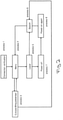
- FIG 1 is a block diagram showing the configuration of a suitcase search system.
- the travel suitcase search system consists of a smartphone 10 and a tag 40.
- the smartphone 10 is a terminal equipped with phone functions and tablet computer functions.
- a tablet computer can be used instead of the smartphone 10.
- a notebook with a one-to-one wireless communication function can be used instead.
- the smartphone 10 is a device that operates as a computer equipped with a CPU (central processing unit), memory, etc., and has at least a display device 11, an input device 12, an audio output device 14, a first communication device 15, and a second communication device 16.
- the display device 11 has a liquid crystal screen, for example, and is a device that displays the processing contents of the CPU.
- the input device 12 is, for example, a touch panel attached to the screen of the display device 11 and functions as a pointing device.
- the audio output device 14 is, for example, a speaker.
- the first communication device 15 is a device that performs one-to-one communication with the first communication unit 41 of the tag 40.
- it is a communication device with Wi-Fi (Wi-Fi: registered trademark) function.
- Wi-Fi Wi-Fi: registered trademark
- Android registered trademark
- P2P Wi-Fi Direct
- the second communication device 16 is a device that performs one-to-one communication (P2P) between the second communication units 42 of the tag 40.
- P2P one-to-one communication
- it is a communication device that provides a Bluetooth (registered trademark) function.
- the communication method used by the second communication device 16 is a short-range communication method compared to the communication method used by the first communication device 15.
- the smartphone 10 Since the smartphone 10 is a computer equipped with a CPU and memory, various application programs are installed, and when necessary, the CPU recognizes one or part of the application programs to realize the function.
- the application program function unit 20 shows that the CPU having loaded the application program realizes each function. Since the CPU is such a device as can be said to be a central processing unit, the CPU in a state that realizes functions by loading an application program is a device that performs each function. In that sense, the application function unit 20 has a suitcase lifting prevention device 22, a first connection verification device 23, and a second connection verification device 24.
- the suitcase lifting prevention device 22 is a device that triggers an alarm when the radio wave exchanged between the tag 40 and the smartphone 10 becomes weaker than a predetermined value so that the travel suitcase with the tag 40 attached does not disappear from the possessor of the suitcase against the intention of the possessor.
- the first connection verification device 23 and the second connection verification device 24 are devices that establish a one-to-one wireless communication connection with the smartphone 10 and tag 40 and, when connected, verify the connection information (e.g., signal strength).
- the tag 40 can exchange information in a one-to-one (P2P) wireless communication with the smartphone 10.
- the tag 40 includes the first communication unit 41, the second communication unit 42 that realizes one-to-one wireless communication with the smartphone 10, a light emitting unit 47 that emits light by LED, etc., a light guiding plate 48 that transmits light emitted from the light emitting unit, a power supply unit 45 that supplies power to each unit, a switch 46 that switches power supply on and off, and a control unit 44 that controls each unit.
- the first communication unit 41 is, for example, a device that provides Wi-Fi (registered trademark) communication.
- ad-hoc mode There is a one-to-one communication mode called ad-hoc mode in the existing wireless LAN communication method.
- the smartphone 10 is an Android smartphone, for example, and the Android OS version is 4.0, P2P communication, that is, one-to-one communication, is possible through a communication method called Wi-Fi Direct.
- the second communication unit 42 is, for example, a device that provides a Bluetooth communication function.
- the second communication unit uses a communication method suitable for a shorter distance than the communication unit of the first communication unit.
- the light emitting unit 47 is composed of, for example, an LED.
- the light emitting unit 47 does not emit light.
- the second communication unit 42 In sleep mode, the second communication unit 42 does not transmit radio waves, but only the first communication unit continues to transmit radio waves at extremely sparse time intervals.
- the wake-up mode is released from the power saving mode.
- the light emitting unit 47 flashes intermittently, i.e. flashes in a gentle cycle.
- the flashing period is long.
- the light emission state of the light emitting unit 47 is changed according to the communication state (signal strength) of the first communication unit 41.
- the blinking period is shortened.
- radio waves start to be transmitted from the second communication unit 42.
- the light emission state (flashing period) of the light emitting unit 47 is changed according to the signal strength.
- the light guiding plate 48 makes the light emitted by the light-emitting unit 47 shine out to be easily seen by travelers.
- it can consist of sticking a film to the surface of an acrylic plate.
- This film can use EZ Free Sheet sold by EZ Corporation.
- EZ FREE SHEET is a unique technology in the signage field, which was born after more than 700 experiments over 3 years. Only EZ FREE SHEET enables the construction of desired signage advertisements at low cost.
- EZ FREE SHEET The important technology of EZ FREE SHEET is the manufacturing method of LIGHT GUIDEPLATE used in the existing industry.
- the EZ FREE SHEET is formed by applying a fine dot-shaped paint in various places according to a predetermined pattern, and the light is appropriately refracted or diffracted by the paint through an acrylic plate and applied to the outside of the acrylic plate.
- the light emitting unit 47 (LED) is irradiated from the side of the acrylic plate.
- EZ FREE SHEET has the following properties and characteristics.
- LGP LIGHT GUIDING PLATE
- Manufacturing of the LIGHT GUIDING PLATE is simpler than the existing acrylic light guiding flight, and it is possible to increase the size and mass production.
- a special reflective sheet pattern is used with a film that incorporates optical bonding technology.
- a film after the traveler's name can be applied to acrylic to act as a light guiding plate, reducing the risk of the traveler being exchanged for someone else's suitcase.
- This sheet can be used to make a tag to attach to the suitcase.
- the size of the tag is not limited to the size of a tag attached to an existing travel suitcase, but can be designed freely.
- the power supply unit 45 may use, for example, a coin cell battery.
- Coin cell batteries have conventionally been used as batteries that supply power to various electronic devices. For example, it is used to store time and BIOS setting information on the motherboard of a PC.
- the coin cell battery is discharged, open the lid of the tag 40 to replace it. Or it is to be charged using a battery that can be charged. It can consider charging from a PC's USB terminal or charging a wireless power supply system.
- the switch 46 is a switch capable of switching the power supply on and off from the power supply unit 45 to each unit of the tag 40. When the traveler is at home after the trip, turn off the power of the tag 40 and prevent the battery from draining the power source 45. Therefore, it is desirable to have this switch for the traveler himself/herself.
- the control unit 44 is a controller connected to the first communication unit 41, the second communication unit 42, and the light emitting unit 47 to control them.
- a so-called microcomputer microcontroller
- It can also use something called a programmable digital device. It just needs a digital circuit that can execute simple programs.
- a processor it is possible to construct this option at a relatively low cost by using a microcomputer and a programmable digital device.
- FIG. 2 is a diagram for explaining process switching of a smartphone application of the smartphone 10.
- Process 1 is a connection verification process, and the smartphone 10 establishes a connection by two, one-to-one wireless communication between tags 40, and acquires and stores the connection information (the other terminal number, signal strength, etc.).
- Process 2 is a menu processing process, and it is a menu to move to the next process after selecting one of whether the traveler who operates the smartphone 10 wants to use the suitcase lifting prevention function or wants to leave the suitcase in the future.
- Process 3 is a suitcase lifting prevention process, assuming that a travel suitcase is placed near the traveler, and a one-to-one wireless communication (Communication between the second communication device and the second communication unit: Bluetooth) is established between the smartphone and the tag, and the signal strength is monitored and an alarm is generated when it is weaker than a predetermined value.
- a one-to-one wireless communication Communication between the second communication device and the second communication unit: Bluetooth
- Process 5 is the process of leaving the luggage, and the smartphone 10 stores the necessary information so that the search can be started at any time. At this time, tag 40 continues to perform sparse transmission of radio waves by the first communication unit. Transmission by the second communication unit is terminated.
- Process 6 is a process in which the smartphone 10 searches for a suitcase (tag 40).
- the traveler waits for the smartphone 10 to revive communication between the tags 40, observing the exterior of the suitcase itself and the shining light guiding plate of tag 40. Communication between the first communication device and the first communication unit is restored first, and communication between the second communication device and the second communication unit is later restored.
- the traveler who recognizes that tag 40 flashes, searches for a suitcase.
- the traveler switches to process 3 by selecting the suitcase lifting prevention from the menu screen.
- the smartphone issues a command to stop light emission to stop the light emission of the tag.
- the traveler can turn off the switch of the tag and stop the light emission.
- Process 7 is the process of powering off the smartphone.
- Process 8 is the process of re-powering the smartphone. Since the time from leaving the suitcase to receiving the suitcase at the destination is a relatively long time, the research was conducted to prevent battery consumption by turning off the power of the smartphone. Therefore, between process 5 and process 6, it includes powering off and re-powering. Since the smartphone has a memory, it remembers the connection information (the number of the opponent's terminal, the communication method, etc.) between tags, and it is not lost even if the power is cut off.
- Process 1 transitions to Process 2.
- Process 2 transitions to Process 3 or Process 5.
- Process 3 transitions to Process 2.
- Process 5 transitions to Process 6 or Process 7.
- Process 7 transitions to process 8.
- Process 8 transitions to Process 6.
- Process 6 transitions to Process 2.
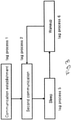
- FIG 3 is a processing transition diagram of the tag 40 controller (control unit 44).
- Tag process 1 is the process of establishing communication. Radio waves are transmitted from the first communication unit 41 and the second communication unit 42 of the tag 40. The establishment of one-to-one wireless communication with the smartphone 10 is led and executed by the smartphone 10 side.
- the tag process 2 is a process of continuing only the second communication.
- the tag 40 side waits for an instruction (for example, an instruction to turn off lights) from the smartphone and follows it.
- Tag process 5 is a sleep process. If the communication is disconnected in the tag Process 2, it transitions to the tag Process 5. In the power saving mode, tag 40 sparsely performs the first communication. In processing other than that, it does not move and avoids power consumption.
- Tag process 6 is a wake-up Process.
- the sparse first communication resumes it switches to wake-up (mode).
- the first communication is exchanged at regular time intervals.
- Tag 40 emits radio waves to revive one-to-one wireless communication by the second communication between smartphones 10. It also shines in order to make it easier to discover by travelers. Light emission is flashing. And the blinking period is based on the signal intensity. The stronger the radio wave, the shorter the blinking period.
- Tag Process 1 transitions to tag process 2.
- Tag Process 2 transitions to tag process 5.
- Tag Process 5 transitions to tag process 6.
- Tag Process 6 transitions to tag process 2.
- FIG 4 is a flowchart of a process for establishing a one-to-one wireless communication.
- FIG 4A shows the processing on the smartphone side.
- the tag is searched on the smartphone side (step 401), and the tag (terminal number) found as a result of the search is listed (step402). It is possible to find multiple tags, such as when there are other travelers nearby. Ask the traveler to choose which of the list is a traveler-owned tag. (Step 403). Since it is necessary to enter the result code chosen by the traveler, the traveler is urged to enter it. (Step 404).
- FIG 4(b) shows control processing on the tag side.
- Step 451 When the power is turned on to the tag 40 (Step 451), the device information (terminal information) attached to the tag 40 is sent to the smartphone (Step 452). Check whether the smartphone side has selected tag 40 according to the information sent from the smartphone (Step 453). Require code input required to set up one-to-one communication (step454). Confirm that the correct code is entered on the smartphone side and establish a connection. (Step 455).
- Wireless communication is established by performing the above processing for the first communication (communication between the first communication device and the first communication unit) and the second communication (communication between the second communication device and the second communication unit), respectively.
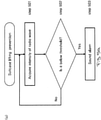
- FIG 5 is a flowchart of the suitcase lifting prevention processing.
- FIG 5A shows the processing on the smartphone side.
- the signal strength is acquired (Step 501), and it is determined whether it is lower than a predetermined value (Step 502). If it is below the predetermined value (Yes in Step 502), an alarm is issued. (Step 503). If it is not below the predetermined value, signal strength monitoring continues. (No in Step 502).
- determining whether or not it is below the predetermined value instead of making the signal strength an absolute value, 50% of the original signal strength may be set as a predetermined value. It can consider triggering an alarm by making a sound from the smartphone's speaker, or displaying an alarm (e.g., a flashy design) on the smartphone's screen.
- FIG 5(B) shows control processing on the tag side.
- the signal strength is acquired (Step 551), and it is judged whether it can be called a communication disconnection (below a predetermined value) (Step 552). If it is less than the predetermined value (Yes in Step 552), it switches to sleep mode (Step 553). If it is not below the predetermined value, signal strength monitoring is continued. (No in Step 552).
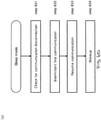
- FIG. 6 shows a flow chart of processing when entering the power saving mode after leaving the luggage (or in the event of being shoplifted at the suitcase lifting prevention)
- FIG 6A shows the processing on the smartphone side.
- the application function unit on the smartphone side stores communication information (the model number of the communication partner, etc.) (Step 601) and disconnects the communication (Step 602). This communication disconnection disconnects both the first communication (communication between the first communication device and the first communication unit) and the second communication (communication between the second communication device and the second communication unit).
- FIG 6(B) shows control processing on the tag side. After confirming the communication disconnection (Step 651), the controller at the tag side transmits only the first communication wave sparingly (Step 652), and when communication resumes (Step 653), it proceeds to the wake-up mode (Step 654).
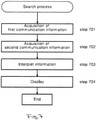
- FIG 7 shows the search process on the smartphone side. Travelers wait for their suitcases to come out near a rotary conveyor or the like. At that time, the smartphone application function unit acquires the first communication information (Step 701), and acquires the second communication information (Step 702). Then, the signal intensity is converted into an estimated distance (Step 703) and displayed on the screen (Step 704). Travelers use the information displayed on the screen to find their suitcase.
- FIG 8 shows the control processing in the wake-up mode on the tag side.
- the first communication information is acquired (Step 801), and it is determined whether communication is resumed (Step 802).
- Step 802 When communication is resumed (YES in Step 802), light emission starts according to the intensity of the first radio wave (Step 803). The stronger the radio wave, the more frequent the flashing.
- the radio waves of the second communication are transmitted (Step 803).
- the second communication information is acquired (Step 804) and communication is resumed (YES in Step 805), light is emitted according to the intensity of the second radio wave. (Step 806).
- the light may be output intermittently depending on the signal intensity. That is, when the light is flickering, the length of the period, the ratio of lighting and turning off, and the time can be changed, and the intensity of the light can be changed.
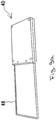
- FIG. 9 is a perspective view showing an embodiment of a tag.
- FIG. 9A shows a shape of the tag.
- the tag 40 includes a case including an electronic circuit and a light guiding plate 48 extending from the case.
- the light guiding plate 48 consists of an acrylic plate and sheet pasted on its surface.
- the pasted sheet is preferably a sheet sold by EZU.
- FIG. 9(B) shows the inside of the tag.
- the lid of the case in FIG. 9(A) was made to show the inside of the case.
- a light emitting unit (LED) 47 is installed so as to contact the acrylic plate constituting the light guiding plate48.
- the light emitting unit 47 is connected to other circuits by an extension connection line on a circuit board 49.
- the circuit board 49 is equipped with a communication unit 41, a clock unit 42, a control unit 44, and a switch 46. If necessary, a speaker 43 can also be mounted.
- connection status including the signal strength of the first communication device 15 and the second communication device 16 mounted on the smartphone 10 is acquired by the first connection verification device 23 and the second connection verification device 24 of the application function unit 20.
- the first connection verification device 23 and the second connection verification device 24 of the application function unit 20 it is possible to display the signal strength on the display device 11.
- the intensity of each of the two radio waves corresponds to the approximate distance from the smartphone 10 to the tag 40, it is possible to indicate the approximate distance in numbers.
- a traveler carrying a smartphone can navigate his or her own suitcase by checking the approximate distance displayed on that display device 11.
- the traveler can easily identify the location of the suitcase by standing at a certain point A and then moving a little immediately after obtaining the approximate distance and obtaining the corresponding approximate distance from point B again.
- Switch 46 to turn on and off the power of the tag is installed to prevent battery consumption. Therefore, if a traveler needs it, it is desirable to be able to operate the switch 46. On the other hand, if a malicious third party trying to steal a suitcase can easily switch it off, the search system will not work.
- the tag can be attached to the travel suitcase by a string or the like.
- the shiny fiber developed by Philips of the Netherlands is known.
- the fiber contains LEDs.
- a shining fiber may be used to generate the light of the tag.
- the shiny fiber can be used by the possessor of the suitcase to give a highly original decoration.
- the light guiding plate in the present invention, a film was attached to the acrylic plate.
- a conventional light guiding plate may be used to provide a desired shape on the surface of the acrylic plate with a laser or the like. It is also possible to use a silk screen printing type light guiding flight.
- the invention according to the present invention Since passengers on the bus are sitting in the upper seats, they may become anxious that someone else may take their suitcases from the bottom trunk by mistake. Therefore, by using the invention according to the present invention, it is put in the "suitcase lifting prevention" mode, and when one's travel suitcase falls away from himself/herself due to an unintended movement, trigger an alarm and let it know by sound or vibration.
- the "suitcase lifting prevention” function is understood as “bus (mode)", and it can be understood by the passengers to display it on the smartphone screen.
- a menu such as "Bus Mode” and “Airplane Mode” or “BUS” or “AIRPLANE” is displayed to enable switching.
- the light guiding plate may become an advertisement medium. It can also function as an identification mark by displaying a person's name and his or her original shape or mark. Separate films may be attached to the front and back of the light guiding flight so that the front side is an advertisement and the back side is an identification mark.
- a travel function in addition to the search system includes the above-described airport function (a function to quickly search for luggage left at the airport) and a bus function (a lift-off prevention function that prevents the luggage left in the trunk room of a vehicle from being lost by others, such as when riding a bus), a travel function is added.
- airport function a function to quickly search for luggage left at the airport
- bus function a lift-off prevention function that prevents the luggage left in the trunk room of a vehicle from being lost by others, such as when riding a bus
- the tag's ID is something unique (which can identify one in the world).
- Wi-Fi registered trademark
- a plurality of tags for example, up to 40
- tags candidate tags capable of one-to-one connection
- the tour manager recognizes the tags of all group members in advance and registers them on their smartphones, it can be confirmed that there is everyone by recognizing all of the tags when a call is needed.
- the manager can check the system with his smartphone. In addition to notifying the screen when everyone is gathered, the system can respond from the speaker to announce the gathering of everyone.
- Multi-tag recognition device and tag-possessor connection device
- the smartphone application function unit includes a tag-possessor connection device in which multiple tags recognized by multiple tag recognition devices are connected with the owner, respectively.
- a plurality of tags recognition devices are already generally possible with current smartphones. This is because displaying multiple targets for which communication setting is possible before setting up 1-to-1 communication can be realized in Wi-Fi.
- the tag-possessor connection device that the smartphone application function must have is a device that connects each member's tag with the member participating in the group tour, and through this, the group tour conductor associates the tag with the tour participant and can recognize it.
- the tour manager When actually holding a group tour, the tour manager passes a tag to each participant in advance. Alternatively, members who have their own tags are provided with the corresponding ID information. Until the start of the trip, the IDs of all the members' tags are registered on the tour conductor's smartphone. When all the members gather, the number is displayed on the tour conductor's smartphone. Check it out and the group tour begins. Group tours go around some of the tourist attractions. The meeting time has been set at each location, confirming that they have gathered, and moving to the next location. In the case of the group, the tour conductor can check the smartphone and see the screen that everyone is gathered, or check the sound (machine sound, music, voice, etc.) on the speaker and move to the next tourist attraction.
- the tour conductor can check the smartphone and see the screen that everyone is gathered, or check the sound (machine sound, music, voice, etc.) on the speaker and move to the next tourist attraction.
- the application function unit add a group member nickname display device displayed on the screen of the smartphone owner by changing the connection group member information to the smartphone owner in an easy-to-understand manner by the tag-possessor connection device.
- a group member nickname display device displayed on the screen of the smartphone owner by changing the connection group member information to the smartphone owner in an easy-to-understand manner by the tag-possessor connection device.
- the control unit of the tag When the tag realizes one-to-one communication with the smartphone, the control unit of the tag has a light emitting mode that establishes communication in light of the light emitting unit for a short time, and allows the owner of the smartphone to check who the owner of the tag is. Then, when there are members of several tours next to the tour conductor, it may be easier for the tour conductor to check which IDs among the members registered on his smartphone correspond to which members.
- a tour conductor When a tour conductor recognizes a tour member, it is generally recognized as a candidate to establish one to one communication without one to one communication, but only when there is a need to check the correspondence with the member in the field, the communication establishment response issuance mode is used to establish one-to-one communication with the tag, and the light is emitted through the control unit inside the tag.
- the ID of the tag is a unique ID in the world. Accordingly, the smartphone owner may continue to recognize the recognized tag even when approaching another tag-possessor in a tourist destination. As these tags and applications become popular, there may be situations where several tour groups will come across a single tourist attraction. Even in that case, it is desirable that the ID assigned to the tag in advance is unique in the world so as not to cause confusion with the members of other tour groups.
- the control unit controls to generate a warning sound from the speaker, so that a warning sound can be emitted when the tour manager is separated.
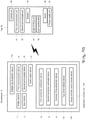
- FIG 10 shows a block diagram of a suitcase retrieval system with a travel function added.
- the smartphone 110 several tag recognition devices 115 are added, and a tag-possessor connection device 125 and a group member nickname addition device 126 are added to the application program function unit 120.
- the plurality of tag recognition devices 115 are already realized by a Wi-Fi device. This corresponds to the step of displaying communication target candidates before establishing one-to-one communication.
- Tag 40 is emitting its own ID information saying "who am I".
- the multiple tag recognition device 115 of the smartphone 110 recognizes various tags sending ID information and displays them.
- the tag-possessor connection device 125 is a device that connects tag and ID information with a tour group member.
- the group member nickname addition device 126 also provides possible functions such as taking notes of nicknames and their individual characteristics for ease of management by the tour conductor.
- It can be used as a tag distributed to travelers by group tour planning companies, such as a travel agency that plans a trip by leaving luggage in various means of transportation, such as travel by plane or travel by bus.
Landscapes
- Physics & Mathematics (AREA)
- Engineering & Computer Science (AREA)
- General Physics & Mathematics (AREA)
- Theoretical Computer Science (AREA)
- Business, Economics & Management (AREA)
- Emergency Management (AREA)
- Health & Medical Sciences (AREA)
- General Health & Medical Sciences (AREA)
- Computer Networks & Wireless Communication (AREA)
- Signal Processing (AREA)
- Electromagnetism (AREA)
- Child & Adolescent Psychology (AREA)
- Computer Vision & Pattern Recognition (AREA)
- Computer Hardware Design (AREA)
- Microelectronics & Electronic Packaging (AREA)
- Toxicology (AREA)
- Artificial Intelligence (AREA)
- Automation & Control Theory (AREA)
- Computer Security & Cryptography (AREA)
- Telephone Function (AREA)
- Alarm Systems (AREA)
- Illuminated Signs And Luminous Advertising (AREA)
- Burglar Alarm Systems (AREA)
- Emergency Alarm Devices (AREA)
- Mobile Radio Communication Systems (AREA)
- Purses, Travelling Bags, Baskets, Or Suitcases (AREA)
Abstract
Description
- The present invention relates to a suitcase search system for a traveler to search for the travel suitcase owned by the traveler by attaching a tag to the travel suitcase, and particularly to a system that allows travelers to work in collaboration with their own smartphones.
- When a traveler travels with a suitcase, the suitcase is left in accordance with the service content of the airline, bus company, and shipping company. And when the traveler get to his destination, he gets it back. In this way, during the travel, there are times when the traveler's suitcases are away from themselves and there are times when they return to their hands.
-
Patent Document 1 discloses a technique for obtaining direction information inexpensively and efficiently by a signal transmitted from a GNSS satellite. Specifically, the satellite signals from the GNSS satellites that exist on the half sky half of the sky are shielded using the body,
in the process of obtaining a limited orientation using a satellite signal captured while searching for a satellite signal of a GNSS satellite existing on the other side of a GNSS receiver installed vertically on the ground according to the body, the wavelengths on both sides of the body as a shield are subject to a certain amount of time, based on the comparison of records such as signal strength by the GNSS receiver, collecting the signal strength by the GNSS receiver for a certain period of time in the same way, the orientation information is obtained by determining whether the received GNSS satellites exist in all areas of a quarter celestial area above the sky based on the comparison of the records such as the signal intensity collected for each of them. -
Patent Document 2 discloses a technology for constructing an information system and an information network centering on a physical medium, and constructing an advantageous information providing service using the product properties and physical properties of the physical medium. Specifically, the information providing system attaches a unique local ID of a specific object belonging to a specific location, and stores the unique main information of the object in a database in relation to the local ID. In addition, subordinate information, which is information related to a specific object, is stored in a database by linking main information about the specific object. When reading the local ID of a specific object by the ID reading means of the information viewer terminal, at the same time, the main information of a specific object is output in a form that can be viewed/listened to the information searcher terminal, the dependent information linked to the main information and the access history information for the access from the information viewer terminal for the main information are output in a form that can be viewed/listened linked to the main information. -
Patent Document 3 discloses an anti-theft device such that the engine is not easily started even if a thief obtains a key and tries to steal an industrial vehicle. Specifically, it consists of a powerless IC card or ID tag carried by a regular flight attendant, a stationary station installed outside the vehicle that communicates with the IC card or ID tag by connecting the power supply with a timer, which has a contact point in contact with the vehicle power supply and an IC card or ID tag, to a receiver installed inside the vehicle and a power supply, - a first intermittent control unit connected to a stationary station installed on the negative ground wire of the starter motor, and
- a second intermittent control unit connected to the timer and power supply between the station and the power supply.
- Patent Document 4 provides a home delivery support system that can be linked to a home delivery company without feeling security concerns, and by using such a home delivery support system, the consignee can go out for a short time and can return home without haste if there is a slight delay, at the scheduled delivery time of the package. Specifically, it is a home delivery support system that the consignee inputs short-term absence information from the consignee terminal device, the short-term absence information and personal identification information are transmitted to the contractor terminal device, searches for the presence or absence of the scheduled delivery package, and if there is the scheduled delivery package, the package information and short-term absence information will be transmitted to the delivery staff terminal device owned by the delivery staff of the scheduled delivery package and inform the delivery staff of the time when the consignee does not receive the scheduled delivery package, and if there is no scheduled delivery package, the package information will be transmitted to the consignee terminal, and the consignee is notified that there is no scheduled delivery package.
-
Patent Document 5 discloses a cargo tracking device, method, and system. Specifically, the cargo tracking device includes a tracking device to collect information including location information received from the network and status information of at least one lock of the cargo article. The cargo tracking device can be arranged to be integrated into the luggage article. Provide more locking devices to secure cargo items. The locking device has a locking element that is movable between a first locked state and a second unlocked state. The cargo tracking device includes a first locking member operable to control movement of the locking element. The cargo tracking device further includes a first sensor connected to the first locking member for detecting an operation of the first locking member. -
Patent Document 6 discloses a device that combines rational design, adaptive hardware and software, adapts to the legal system, and develops the adaptability that users need in output games. Specifically, according to the physical and physical non-Mr. of various groups of different types of output possessed by the user, also known as the method of raw material, the strategy for selecting a patent application analyzer is adaptation, receiving clear information input such as material system technology with the majority of functions to create a technology system that constitutes the interactive function of the system, technology of the system that can do so. Organize, adapt, and interact with the technology of the system to output better, the user needs the output function, interactive SWEET SPOT for the reaction. - In
Patent Document 7, even when there are many search targets and the appearance of the search targets is similar or there are many replacements of search persons and search targets, a search support system is disclosed that efficiently searches for a search target without unnecessarily increasing the number of combinations of identification information and search targets. - Specifically, while continuously updating the contents of the dynamic information storage unit, a mark that can be used depending on whether or not the terminal device and the search area in which the search target is located is used is assigned to the search target, and the label device mapped to the search target and a mark is set on the terminal device that requested the search for the search target.
-
Patent Document 8 discloses that a compact and economical device capable of detecting dementia/wandering persons at an early stage and with high accuracy is provided, and the usage of this device in other fields is expanded. It consists of a wireless slave unit and a master unit, and includes - a communication means for transmitting and receiving radio waves,
- a power supply means for supplying power,
- a signal processing means for processing communication signals, stored data and voice output signal,
- and a storage means for storing data such as the issued voice, communication code number and communication distance,
- wherein master unit is a voice notification device such as roaming detection and loss prevention, in which a setting means capable of setting change or setting designation of stored data is provided in the storage means.
- Patent Document 9 discloses a system and method for managing one or more communication devices related to a user of the communication network 110. Specifically, it has the ability to receive an indicator related to wireless communication between the first device and the second device. This indicator indicates that the first device has entered or exited the vicinity (or range) of the second device. Additionally, this is being achieved using the Bluetooth protocol IEEE802.11 (b) protocol and/or IEEE802.11 (g) protocol. For example, when the first device enters the vicinity of the second device, a call to the user may be automatically transmitted to the user's phone located in the vicinity of the second device. Likewise, with one embodiment, when the first device comes out near the second device, the call may be automatically transferred to the first device.
-
Patent Document 10 describes a content providing method that can be executed by using a mobile device, - wherein the mobile device is a first communication unit configured to set a short-range connection to an external remote controller, and a second communication unit configured to set a connection to the external display device,
- wherein the external remote controller is configured to control the external display device,
- and wherein the content providing method includes;
- the stage of displaying content on the display of the mobile device;
- the stage of receiving information related to the external display installation from the external remote controller by the first communication unit;
- the stage of setting the connection to the external display device by the second communication unit based on the information received from the external remote controller; and the stage in which the content displayed on the display of the mobile device is provided to the external display device, and a connection is set to the external display device by the second communication unit.
-
- 1.
Japanese Patent Application Publication No. 2017-122713 - 2.
Japanese Patent Application Publication No. 2018-026133 - 3.
Japanese Patent Publication No. 4573203 - 4.
Japanese Patent Publication No. 5895090 - 5.
Japanese Patent Application Publication No. 2017-532691 - 6.
Japanese Patent Application Publication No. 2010-182287 - 7.
Japanese Patent Application Publication No. 2008-087947 - 8.
Japanese Patent Application Publication No. 2001-052288 - 9.
Japanese Patent Application Publication No. 2006-507767 - 10.
Japanese Patent Publication No. 6218418 - There are more and more places using smartphone. It can be used in airports or airplanes.
- On the other hand, when retrieving the luggage that was left on board the plane at the destination airport, it is necessary to find one's luggage among a number of luggage loaded on the rotary conveyor.
- The inventors of the present invention have developed a smartphone application that cooperates with a smartphone carried by travelers such as electronic devices by preparing a tag equipped with a relatively simple electronic circuit in a travel suitcase, and it is thought that appropriate travel suitcase management will be possible.
- An object of the present invention is to provide a system in which a smartphone and a tag can cooperate to search for a travel suitcase.
- A suitcase search system, comprising:
- a smartphone carried by a traveler;
- an application function unit realized when an application program of the smartphone is installed and executable on the smartphone; and
- a tag attached to the travel suitcase,
- wherein the smartphone includes
- a display device for expressing processing contents processed by the application function unit,
- an input device for realizing that the application function unit inputs a selection for an operator or an input by an operator in response thereto,
- a first communication device for realizing one-to-one communication with the tag,
- a second communication device for realizing one-to-one communication with the tag over a shorter distance than the first communication device;
- an audio output device that generates an alarm sound or vibration according to the function of the application function unit;
- wherein the application function unit includes
- a first connection verification device for verifying the connection of a one-to-one wireless communication according to the first communication device with the tag,
- a second connection verification device for verifying the connection of a one-to-one wireless communication according to the second communication device with the tag, and
- a suitcase lifting prevention device for monitoring the intensity of radio waves exchanged with the tag and warns when it is weaker than a predetermined intensity, wherein the tag includes
- a first communication unit for realizing one-to-one wireless communication with the first communication device of the smartphone,
- a second communication unit for realizing one-to-one wireless communication with the second communication device of the smartphone,
- a light emitting unit for emitting light,
- a light guiding flight or optical fiber that induces light emitted by the light emitting unit to emit light in a predetermined pattern,
- a control unit for controlling the communication unit and the light emitting unit, and a power supply unit to supply power to each unit,
- wherein the control unit controls,
- a communication establishment mode that realizes a one-to-one wireless communication between the first communication device of the smartphone and the first communication unit of the tag, a one-to-one wireless communication is performed between the second communication device of the smartphone and the second communication unit of the tag. Communication establishment mode to realize;
- a sleep mode in which only the first communication unit continues to emit radio waves at infrequent time intervals when both the first communication unit and the second communication unit are unable to communicate with each other; and
- a wake-up mode in which the light emitting unit is illuminated at a frequency adjusted according to the intensity of the corresponding radio wave, and at the same time, when the first communication unit of the tag attempts to resume communication with the first communication device of the smartphone, the light emitting unit shines at a frequency adjusted according to the intensity of the radio wave, when the second communication unit of the tag tries to resume communication with the second communication device of the smartphone, respectively.
- This makes it possible to provide tags that are useful for both lifting prevention and search for picking up checked luggage.
- The light guiding plate of the tag is characterized in that a film cut into a specific pattern shape is attached to the surface of the acrylic plate.
- This gives the emitted light a specific pattern, which makes it easier for travelers to search.
- The specific pattern for cutting the film is characterized in that it functions as a marker for identifying the possessor of the tag.
- This makes it easier for travelers to search.
- The film is characterized in that a paint that conducts light is applied in a predetermined pattern.
- This eliminates the need to process the acrylic plate itself, and makes it possible to manufacture tourist identification marks with a simple operation.
- The light guiding plate of the tag has the film attached to both sides of the front and back sides of the acrylic plate, respectively, and displays advertisements and possessor's identification marks on the front and back sides, respectively.
- As a result, it is possible to support the traveler to search the suitcase while also having the function of advertisement.
- The switch for turning the power ON and OFF of the tag has a locking device, and a third party other than the traveler cannot easily operate the power supply of the tag. Thus, contrary to the traveler's own intention, it is possible to prevent the tag from not working.
- A suitcase search system, comprising:
- a smartphone carried by a traveler;
- an application function unit realized when an application program of the smartphone is installed and executable on the smartphone; and
- a tag attached to the travel suitcase,
- wherein the smartphone includes
- a display device for expressing processing contents processed by the application function unit,
- an input device for realizing that the application function unit inputs a selection for an operator or an input by an operator in response thereto,
- a first communication device for realizing one-to-one communication with the tag,
- a second communication device for realizing one-to-one communication with the tag over a shorter distance than the first communication device;
- an audio output device that generates an alarm sound or vibration according to the function of the application function unit;
- wherein the application function unit includes
- a first connection verification device for verifying the connection of a one-to-one wireless communication according to the first communication device with the tag,
- a second connection verification device for verifying the connection of a one-to-one wireless communication according to the second communication device with the tag, and
- a suitcase lifting prevention device for monitoring the intensity of radio waves exchanged with the tag and warns when it is weaker than a predetermined intensity, wherein the tag includes
- a first communication unit for realizing one-to-one wireless communication with the first communication device of the smartphone,
- a second communication unit for realizing one-to-one wireless communication with the second communication device of the smartphone,
- a light emitting unit for emitting light,
- a light guiding flight or optical fiber that induces light emitted by the light emitting unit to emit light in a predetermined pattern,
- a control unit for controlling the communication unit and the light emitting unit, and a power supply unit to supply power to each unit,
- wherein the control unit controls, respectively,
- a communication setting mode for realizing one-to-one wireless communication between the communication device of the smartphone and the tag communication unit;
- a sleep mode that continuously transmits radio waves at sparse time intervals when the communication unit does not communicate;
- a wake-up mode in which the light emitting unit glows at a frequency adjusted according to a corresponding signal strength when the communication unit of the tag resumes communication with the communication device of the smartphone;
- and it is characterized in that the determination of disconnection of communication for switching from the communication setting mode to the sleep mode is determined by the control of the tag without receiving information and instructions from the smartphone.
- Therefore, it is possible to provide a variety of helpful tags, such as anti-theft and searching for picking up checked luggage.
- The present invention has the above-described configuration, by installing an application program required by a traveler and operating a smartphone using the application, thereby providing tags that are helpful in various ways, such as suitcase lifting prevention and search for picking up one s luggage entrusted.
-
-
FIG 1 is an exemplary block diagram illustrating the configuration of a suitcase search system. -
Fig. 2 is a diagram for showing process switching of a smartphone application. -
FIG 3 is a process transition diagram of the tag controller. -
FIG 4 is a flow chart of connection verification (communication setting). -
FIG 4A shows the processing on the smartphone side. -
FIG 4B shows the control process on the tag side. -
FIG 5 is a flow chart of theft prevention processing,FIG 5A shows the processing on the smartphone side, andFIG 5B shows the control process on the tag side. -
FIG 6 shows a flow chart of processing when leaving luggage,FIG 6A shows the processing on the smartphone side, andFIG 6B shows the control process on the tag side. -
FIG 7 is a flowchart of a search process on the smartphone side. -
FIG 8 shows the wake-up mode control processing of the tag. -
FIG 9 is a perspective view showing an embodiment of a tag,FIG 9A shows a shape of the tag, andFIG 9B shows an inside of the tag. -
FIG 10 is a block diagram showing the configuration of a suitcase search system to which a travel function is added. - Hereinafter, the best mode for realizing the system of the present invention will be described in detail with reference to the accompanying drawings.
FIG 1 is a block diagram showing the configuration of a suitcase search system. - The travel suitcase search system according to the present invention consists of a
smartphone 10 and atag 40. Thesmartphone 10 is a terminal equipped with phone functions and tablet computer functions. - A tablet computer can be used instead of the
smartphone 10. In addition, a notebook with a one-to-one wireless communication function can be used instead. - The
smartphone 10 is a device that operates as a computer equipped with a CPU (central processing unit), memory, etc., and has at least adisplay device 11, aninput device 12, anaudio output device 14, afirst communication device 15, and asecond communication device 16. Thedisplay device 11 has a liquid crystal screen, for example, and is a device that displays the processing contents of the CPU. Theinput device 12 is, for example, a touch panel attached to the screen of thedisplay device 11 and functions as a pointing device. Theaudio output device 14 is, for example, a speaker. - The
first communication device 15 is a device that performs one-to-one communication with thefirst communication unit 41 of thetag 40. For example, it is a communication device with Wi-Fi (Wi-Fi: registered trademark) function. For reference, Android (registered trademark), one of the OSs of smartphones, has a one-to-one communication (P2P) called Wi-Fi Direct on Android 4.0 or higher, and it can be used. - The
second communication device 16 is a device that performs one-to-one communication (P2P) between thesecond communication units 42 of thetag 40. For example, it is a communication device that provides a Bluetooth (registered trademark) function. The communication method used by thesecond communication device 16 is a short-range communication method compared to the communication method used by thefirst communication device 15. - Since the
smartphone 10 is a computer equipped with a CPU and memory, various application programs are installed, and when necessary, the CPU recognizes one or part of the application programs to realize the function. The applicationprogram function unit 20 shows that the CPU having loaded the application program realizes each function. Since the CPU is such a device as can be said to be a central processing unit, the CPU in a state that realizes functions by loading an application program is a device that performs each function. In that sense, theapplication function unit 20 has a suitcaselifting prevention device 22, a firstconnection verification device 23, and a secondconnection verification device 24. - The suitcase
lifting prevention device 22 is a device that triggers an alarm when the radio wave exchanged between thetag 40 and thesmartphone 10 becomes weaker than a predetermined value so that the travel suitcase with thetag 40 attached does not disappear from the possessor of the suitcase against the intention of the possessor. - The first
connection verification device 23 and the secondconnection verification device 24 are devices that establish a one-to-one wireless communication connection with thesmartphone 10 andtag 40 and, when connected, verify the connection information (e.g., signal strength). - The
tag 40 can exchange information in a one-to-one (P2P) wireless communication with thesmartphone 10. Thetag 40 includes thefirst communication unit 41, thesecond communication unit 42 that realizes one-to-one wireless communication with thesmartphone 10, alight emitting unit 47 that emits light by LED, etc., alight guiding plate 48 that transmits light emitted from the light emitting unit, apower supply unit 45 that supplies power to each unit, aswitch 46 that switches power supply on and off, and acontrol unit 44 that controls each unit. - The
first communication unit 41 is, for example, a device that provides Wi-Fi (registered trademark) communication. - There is a one-to-one communication mode called ad-hoc mode in the existing wireless LAN communication method.
- It doesn't matter if it use the ad-hoc mode to communicate.
- In addition, if the
smartphone 10 is an Android smartphone, for example, and the Android OS version is 4.0, P2P communication, that is, one-to-one communication, is possible through a communication method called Wi-Fi Direct. - At this time, it is good if the smartphone supports Wi-Fi Direct.
- Even if the
Tag 40communication unit 41 does not comply with the Wi-Fi Direct standard, one-to-one communication can be set using a function on the smartphone side. - The
second communication unit 42 is, for example, a device that provides a Bluetooth communication function. - The second communication unit uses a communication method suitable for a shorter distance than the communication unit of the first communication unit.
- The
light emitting unit 47 is composed of, for example, an LED. - While
Tag 40 is in the sleep mode, thelight emitting unit 47 does not emit light. - In sleep mode, the
second communication unit 42 does not transmit radio waves, but only the first communication unit continues to transmit radio waves at extremely sparse time intervals. - When the communication between the
first communication unit 41 on thetag 40 side and thefirst communication device 15 of thesmartphone 10 is restored, the wake-up mode is released from the power saving mode. - When the wake-up mode has just been entered, the
light emitting unit 47 flashes intermittently, i.e. flashes in a gentle cycle. The flashing period is long. - The light emission state of the
light emitting unit 47 is changed according to the communication state (signal strength) of thefirst communication unit 41. - For example, as the radio waves become stronger, the blinking period is shortened.
- In addition, when communication between the
first communication unit 41 and thefirst communication device 15 is restored, communication between thesecond communication unit 42 and thesecond communication device 16 is attempted to resume. - That is, radio waves start to be transmitted from the
second communication unit 42. - The transmission of this radio wave is initially insufficient, and when communication is resumed, normal exchange is possible.
- When communication between the
second communication unit 42 and thesecond communication device 16 is resumed, the light emission state (flashing period) of thelight emitting unit 47 is changed according to the signal strength. - The
light guiding plate 48 makes the light emitted by the light-emittingunit 47 shine out to be easily seen by travelers. - For example, it can consist of sticking a film to the surface of an acrylic plate.
- This film can use EZ Free Sheet sold by EZ Corporation.
- EZ FREE SHEET is a unique technology in the signage field, which was born after more than 700 experiments over 3 years. Only EZ FREE SHEET enables the construction of desired signage advertisements at low cost.
- The important technology of EZ FREE SHEET is the manufacturing method of LIGHT GUIDEPLATE used in the existing industry.
- There is no need for unnecessary processes of LASER and V-CUT printing methods, and the advertisement image innovation, energy saving, and construction economics are pursued only with SHEET.
- The EZ FREE SHEET is formed by applying a fine dot-shaped paint in various places according to a predetermined pattern, and the light is appropriately refracted or diffracted by the paint through an acrylic plate and applied to the outside of the acrylic plate.
- Cut this simple EZ FREE SHEET to form the desired shape and attach it to the acrylic plate.
- The light emitting unit 47 (LED) is irradiated from the side of the acrylic plate.
- EZ FREE SHEET has the following properties and characteristics.
- It is possible to fundamentally solve the blackening phenomenon of acrylic and reflective films without being bound by the size of the LGP (LIGHT GUIDING PLATE). Manufacturing of the LIGHT GUIDING PLATE is simpler than the existing acrylic light guiding flight, and it is possible to increase the size and mass production. Unlike the existing light guiding flight that processes the acrylic plate itself, a special reflective sheet pattern is used with a film that incorporates optical bonding technology.
- 1. V-Cutting NO! (The film is cut in a plane. Therefore, three-dimensional processing of the acrylic plate is unnecessary.)
- 2. High efficiency light emitting sheet
- 3. Unlimited applications
- 4. Special pattern design with optical technology
- 5. Illumination and brightness UP!
- With this sheet, for example, a film after the traveler's name can be applied to acrylic to act as a light guiding plate, reducing the risk of the traveler being exchanged for someone else's suitcase.
- This sheet can be used to make a tag to attach to the suitcase. The size of the tag is not limited to the size of a tag attached to an existing travel suitcase, but can be designed freely.
- The
power supply unit 45 may use, for example, a coin cell battery. Coin cell batteries have conventionally been used as batteries that supply power to various electronic devices. For example, it is used to store time and BIOS setting information on the motherboard of a PC. - Using a coin cell battery as a power source for the
tag 40 is thought to be able to withstand several trips or half a year of use. - If the coin cell battery is discharged, open the lid of the
tag 40 to replace it. Or it is to be charged using a battery that can be charged. It can consider charging from a PC's USB terminal or charging a wireless power supply system. - The
switch 46 is a switch capable of switching the power supply on and off from thepower supply unit 45 to each unit of thetag 40. When the traveler is at home after the trip, turn off the power of thetag 40 and prevent the battery from draining thepower source 45. Therefore, it is desirable to have this switch for the traveler himself/herself. - On the other hand, if a third party who is trying to steal the suitcase can easily operate this switch, the third party may switch off the tag immediately before the stealing, and the suitcase may be stolen. And the possibility of returning to the traveler's own hands is lowered. Therefore, it is desirable to lock the switch so that it cannot be easily turned on and off, so that the operation of the switch is only possible in a state other than the locked state.
- The
control unit 44 is a controller connected to thefirst communication unit 41, thesecond communication unit 42, and thelight emitting unit 47 to control them. A so-called microcomputer (microcontroller) can be used. It can also use something called a programmable digital device. It just needs a digital circuit that can execute simple programs. Although it is possible to use a processor, it is possible to construct this option at a relatively low cost by using a microcomputer and a programmable digital device. -
FIG. 2 is a diagram for explaining process switching of a smartphone application of thesmartphone 10. - In the
smartphone 10, the seven processes shown inFIG 2 can be considered in relation to tag 40. -
Process 1 is a connection verification process, and thesmartphone 10 establishes a connection by two, one-to-one wireless communication betweentags 40, and acquires and stores the connection information (the other terminal number, signal strength, etc.). -
Process 2 is a menu processing process, and it is a menu to move to the next process after selecting one of whether the traveler who operates thesmartphone 10 wants to use the suitcase lifting prevention function or wants to leave the suitcase in the future. -
Process 3 is a suitcase lifting prevention process, assuming that a travel suitcase is placed near the traveler, and a one-to-one wireless communication (Communication between the second communication device and the second communication unit: Bluetooth) is established between the smartphone and the tag, and the signal strength is monitored and an alarm is generated when it is weaker than a predetermined value. - ASK On the other hand, when an emergency shoplifting occurs, it not only issues an alarm, but also switches to process 6 to search for a suitcase.
-
Process 5 is the process of leaving the luggage, and thesmartphone 10 stores the necessary information so that the search can be started at any time. At this time,tag 40 continues to perform sparse transmission of radio waves by the first communication unit. Transmission by the second communication unit is terminated. -
Process 6 is a process in which thesmartphone 10 searches for a suitcase (tag 40). The traveler waits for thesmartphone 10 to revive communication between thetags 40, observing the exterior of the suitcase itself and the shining light guiding plate oftag 40. Communication between the first communication device and the first communication unit is restored first, and communication between the second communication device and the second communication unit is later restored. After communication is revived, the traveler, who recognizes thattag 40 flashes, searches for a suitcase. When the suitcase returns to the possessor's hand, the traveler switches to process 3 by selecting the suitcase lifting prevention from the menu screen. At this time, the smartphone issues a command to stop light emission to stop the light emission of the tag. At this time, the traveler can turn off the switch of the tag and stop the light emission. -
Process 7 is the process of powering off the smartphone. -
Process 8 is the process of re-powering the smartphone. Since the time from leaving the suitcase to receiving the suitcase at the destination is a relatively long time, the research was conducted to prevent battery consumption by turning off the power of the smartphone. Therefore, betweenprocess 5 andprocess 6, it includes powering off and re-powering. Since the smartphone has a memory, it remembers the connection information (the number of the opponent's terminal, the communication method, etc.) between tags, and it is not lost even if the power is cut off.Process 1 transitions toProcess 2.Process 2 transitions toProcess 3 orProcess 5.Process 3 transitions toProcess 2.Process 5 transitions toProcess 6 orProcess 7.Process 7 transitions to process 8.Process 8 transitions toProcess 6.Process 6 transitions toProcess 2. -
FIG 3 is a processing transition diagram of thetag 40 controller (control unit 44). -
Tag process 1 is the process of establishing communication. Radio waves are transmitted from thefirst communication unit 41 and thesecond communication unit 42 of thetag 40. The establishment of one-to-one wireless communication with thesmartphone 10 is led and executed by thesmartphone 10 side. - The
tag process 2 is a process of continuing only the second communication. In response to the smartphone side performing the menu processing process, thetag 40 side waits for an instruction (for example, an instruction to turn off lights) from the smartphone and follows it. -
Tag process 5 is a sleep process. If the communication is disconnected in thetag Process 2, it transitions to thetag Process 5. In the power saving mode, tag 40 sparsely performs the first communication. In processing other than that, it does not move and avoids power consumption. -
Tag process 6 is a wake-up Process. When the sparse first communication resumes, it switches to wake-up (mode). In the wake-up mode, the first communication is exchanged at regular time intervals.Tag 40 emits radio waves to revive one-to-one wireless communication by the second communication betweensmartphones 10. It also shines in order to make it easier to discover by travelers. Light emission is flashing. And the blinking period is based on the signal intensity. The stronger the radio wave, the shorter the blinking period. -
Tag Process 1 transitions to tagprocess 2.Tag Process 2 transitions to tagprocess 5.Tag Process 5 transitions to tagprocess 6.Tag Process 6 transitions to tagprocess 2. - When switching from the
tag Process 6 to thetag Process 2, if there is an instruction from thetag 40 smartphone (suitcase lifting prevention from the menu selection), the light emission is stopped. -
FIG 4 is a flowchart of a process for establishing a one-to-one wireless communication.FIG 4A shows the processing on the smartphone side. The tag is searched on the smartphone side (step 401), and the tag (terminal number) found as a result of the search is listed (step402). It is possible to find multiple tags, such as when there are other travelers nearby. Ask the traveler to choose which of the list is a traveler-owned tag. (Step 403). Since it is necessary to enter the result code chosen by the traveler, the traveler is urged to enter it. (Step 404).FIG 4(b) shows control processing on the tag side. When the power is turned on to the tag 40 (Step 451), the device information (terminal information) attached to thetag 40 is sent to the smartphone (Step 452). Check whether the smartphone side has selectedtag 40 according to the information sent from the smartphone (Step 453). Require code input required to set up one-to-one communication (step454). Confirm that the correct code is entered on the smartphone side and establish a connection. (Step 455). - Wireless communication is established by performing the above processing for the first communication (communication between the first communication device and the first communication unit) and the second communication (communication between the second communication device and the second communication unit), respectively.
-
FIG 5 is a flowchart of the suitcase lifting prevention processing.FIG 5A shows the processing on the smartphone side. The signal strength is acquired (Step 501), and it is determined whether it is lower than a predetermined value (Step 502). If it is below the predetermined value (Yes in Step 502), an alarm is issued. (Step 503). If it is not below the predetermined value, signal strength monitoring continues. (No in Step 502). Here, in determining whether or not it is below the predetermined value, instead of making the signal strength an absolute value, 50% of the original signal strength may be set as a predetermined value. It can consider triggering an alarm by making a sound from the smartphone's speaker, or displaying an alarm (e.g., a flashy design) on the smartphone's screen.FIG 5(B) shows control processing on the tag side. The signal strength is acquired (Step 551), and it is judged whether it can be called a communication disconnection (below a predetermined value) (Step 552). If it is less than the predetermined value (Yes in Step 552), it switches to sleep mode (Step 553). If it is not below the predetermined value, signal strength monitoring is continued. (No in Step 552). -
Fig. 6 shows a flow chart of processing when entering the power saving mode after leaving the luggage (or in the event of being shoplifted at the suitcase lifting prevention)FIG 6A shows the processing on the smartphone side. - When leaving luggage at an airport, etc., travelers choose to leave their luggage according to the menu selection. Then, the application function unit on the smartphone side stores communication information (the model number of the communication partner, etc.) (Step 601) and disconnects the communication (Step 602). This communication disconnection disconnects both the first communication (communication between the first communication device and the first communication unit) and the second communication (communication between the second communication device and the second communication unit).
-
FIG 6(B) shows control processing on the tag side. After confirming the communication disconnection (Step 651), the controller at the tag side transmits only the first communication wave sparingly (Step 652), and when communication resumes (Step 653), it proceeds to the wake-up mode (Step 654). -
FIG 7 shows the search process on the smartphone side. Travelers wait for their suitcases to come out near a rotary conveyor or the like. At that time, the smartphone application function unit acquires the first communication information (Step 701), and acquires the second communication information (Step 702). Then, the signal intensity is converted into an estimated distance (Step 703) and displayed on the screen (Step 704). Travelers use the information displayed on the screen to find their suitcase. -
FIG 8 shows the control processing in the wake-up mode on the tag side. The first communication information is acquired (Step 801), and it is determined whether communication is resumed (Step 802). - When communication is resumed (YES in Step 802), light emission starts according to the intensity of the first radio wave (Step 803). The stronger the radio wave, the more frequent the flashing.
- In doing so, the radio waves of the second communication are transmitted (Step 803). Then, when the second communication information is acquired (Step 804) and communication is resumed (YES in Step 805), light is emitted according to the intensity of the second radio wave. (Step 806).
- In this case, the light may be output intermittently depending on the signal intensity. That is, when the light is flickering, the length of the period, the ratio of lighting and turning off, and the time can be changed, and the intensity of the light can be changed.
-
FIG. 9 is a perspective view showing an embodiment of a tag. -
FIG. 9A shows a shape of the tag. As shown inFIG. 9(A) , thetag 40 includes a case including an electronic circuit and alight guiding plate 48 extending from the case. As described above, thelight guiding plate 48 consists of an acrylic plate and sheet pasted on its surface. - As described above, the pasted sheet is preferably a sheet sold by EZU.
-
FIG. 9(B) shows the inside of the tag. The lid of the case inFIG. 9(A) was made to show the inside of the case. A light emitting unit (LED) 47 is installed so as to contact the acrylic plate constituting the light guiding plate48. Thelight emitting unit 47 is connected to other circuits by an extension connection line on acircuit board 49. Thecircuit board 49 is equipped with acommunication unit 41, aclock unit 42, acontrol unit 44, and aswitch 46. If necessary, aspeaker 43 can also be mounted. - The connection status including the signal strength of the
first communication device 15 and thesecond communication device 16 mounted on thesmartphone 10 is acquired by the firstconnection verification device 23 and the secondconnection verification device 24 of theapplication function unit 20. Thus, it is possible to display the signal strength on thedisplay device 11. And since the intensity of each of the two radio waves corresponds to the approximate distance from thesmartphone 10 to thetag 40, it is possible to indicate the approximate distance in numbers. - When it is displayed on the
display device 11, a traveler carrying a smartphone can navigate his or her own suitcase by checking the approximate distance displayed on thatdisplay device 11. - In other words, the traveler can easily identify the location of the suitcase by standing at a certain point A and then moving a little immediately after obtaining the approximate distance and obtaining the corresponding approximate distance from point B again.
-
Switch 46 to turn on and off the power of the tag is installed to prevent battery consumption. Therefore, if a traveler needs it, it is desirable to be able to operate theswitch 46. On the other hand, if a malicious third party trying to steal a suitcase can easily switch it off, the search system will not work. - So it is desirable to be able to lock the on-off switch. For example, when locking and unlocking using a 4-digit number, it is desirable to turn the 4-digit number or enter it to unlock.
- The tag can be attached to the travel suitcase by a string or the like.
- The shiny fiber developed by Philips of the Netherlands is known. The fiber contains LEDs. Instead of the light guiding plate of the present invention, a shining fiber may be used to generate the light of the tag. The shiny fiber can be used by the possessor of the suitcase to give a highly original decoration.
- As for the light guiding plate, in the present invention, a film was attached to the acrylic plate. In addition, a conventional light guiding plate may be used to provide a desired shape on the surface of the acrylic plate with a laser or the like. It is also possible to use a silk screen printing type light guiding flight.
- In the present invention, it is assumed that the suitcase is near the traveler and a warning about the travel of the suitcase is expressed as "suitcase lifting prevention". This can also be expressed as a 'bus'.
- On a limousine bus (large bus) heading to the airport, passengers leave their luggage in the trunk (floor trunk) provided under the bus floor. Limousine buses pick up tourists at some stops on the way to the airport. In addition, if the airport is large, there are
Terminal 1,Terminal 2,Terminal 3, and many places where travelers drop off. - Since passengers on the bus are sitting in the upper seats, they may become anxious that someone else may take their suitcases from the bottom trunk by mistake. Therefore, by using the invention according to the present invention, it is put in the "suitcase lifting prevention" mode, and when one's travel suitcase falls away from himself/herself due to an unintended movement, trigger an alarm and let it know by sound or vibration.
- In that sense, the "suitcase lifting prevention" function is understood as "bus (mode)", and it can be understood by the passengers to display it on the smartphone screen. In this case, a menu such as "Bus Mode" and "Airplane Mode" or "BUS" or "AIRPLANE" is displayed to enable switching.
- In the present invention, it is proposed to provide a system for searching by using Wi-Fi and Bluetooth together. Although an embodiment using both radio waves has been shown, it is also possible to implement the invention using only either one. It can also use Wi-Fi and Bluetooth, as well as other radio waves. It is also possible to use the GPS function and the location specific function using a mobile base station together. In addition to combining two radio waves, an embodiment in which three types of radio waves are combined and used is also possible.
- By attaching a film having a predetermined shape to the light guiding flight of the tag, the light guiding plate may become an advertisement medium. It can also function as an identification mark by displaying a person's name and his or her original shape or mark. Separate films may be attached to the front and back of the light guiding flight so that the front side is an advertisement and the back side is an identification mark.
- Therefore, it can be said that it is a tag that combines advertising by travel agencies, tour agencies, and the like, and one that can identify each traveler.
- When traveling abroad, put a tag to a large trunk to use. When sightseeing in the country of the visited country, there are cases of group tours. When traveling in such a way, tagging a small bag or auxiliary bag instead of a large trunk can help with group travel. Group tours can take a chartered bus to several tourist attractions, and when moving from one place to the next, it is necessary to make a call to make sure tour leader have them all. At that time, when people such as tour leader, tour conductor, tour manager, T/C, etc. take a call, they can use their smartphone to search for tags that members have, so that the call can be smoothly performed. In the present invention, in addition to the search system includes the above-described airport function (a function to quickly search for luggage left at the airport) and a bus function (a lift-off prevention function that prevents the luggage left in the trunk room of a vehicle from being lost by others, such as when riding a bus), a travel function is added.
- Now the tag's ID is something unique (which can identify one in the world). When the radio wave exchanged between the tag and the smartphone is Wi-Fi (registered trademark), a plurality of tags (for example, up to 40) exchangeable with the smartphone (candidate tags capable of one-to-one connection) may be displayed. If the tour manager recognizes the tags of all group members in advance and registers them on their smartphones, it can be confirmed that there is everyone by recognizing all of the tags when a call is needed. When it is necessary to check the situation to see if everyone is gathered, the manager can check the system with his smartphone. In addition to notifying the screen when everyone is gathered, the system can respond from the speaker to announce the gathering of everyone. When signing up for the first time, it is advisable to establish a one-to-one connection (pairing) to confirm that the ID is a tag owned by a member (a member of a group trip), and visually check that the tag illuminates. That procedure can be useful not only when registering for the first group, but whenever it need to make a roll call (to make sure all group members are present).
- In order to add the above travel function to the luggage search system of the present invention, it is necessary to add at least two devices. First, when there are several tags nearby, a multi-tag recognition device capable of simultaneously recognizing the existence of such several tags is provided to a smartphone. Second, the smartphone application function unit includes a tag-possessor connection device in which multiple tags recognized by multiple tag recognition devices are connected with the owner, respectively. A plurality of tags recognition devices are already generally possible with current smartphones. This is because displaying multiple targets for which communication setting is possible before setting up 1-to-1 communication can be realized in Wi-Fi. The tag-possessor connection device that the smartphone application function must have is a device that connects each member's tag with the member participating in the group tour, and through this, the group tour conductor associates the tag with the tour participant and can recognize it.
- When actually holding a group tour, the tour manager passes a tag to each participant in advance. Alternatively, members who have their own tags are provided with the corresponding ID information. Until the start of the trip, the IDs of all the members' tags are registered on the tour conductor's smartphone. When all the members gather, the number is displayed on the tour conductor's smartphone. Check it out and the group tour begins. Group tours go around some of the tourist attractions. The meeting time has been set at each location, confirming that they have gathered, and moving to the next location. In the case of the group, the tour conductor can check the smartphone and see the screen that everyone is gathered, or check the sound (machine sound, music, voice, etc.) on the speaker and move to the next tourist attraction.
- It is preferable that the application function unit add a group member nickname display device displayed on the screen of the smartphone owner by changing the connection group member information to the smartphone owner in an easy-to-understand manner by the tag-possessor connection device. To make it easier for the tour conductor to remember each and every member of the tour, he may want to make a note of features or nicknames. By putting in a memo like a tall skinny Mexican, the tour manager can easily figure it out. Also, the nickname display changed by this tour manager can be made unknown to each member.
- When the tag realizes one-to-one communication with the smartphone, the control unit of the tag has a light emitting mode that establishes communication in light of the light emitting unit for a short time, and allows the owner of the smartphone to check who the owner of the tag is. Then, when there are members of several tours next to the tour conductor, it may be easier for the tour conductor to check which IDs among the members registered on his smartphone correspond to which members. When a tour conductor recognizes a tour member, it is generally recognized as a candidate to establish one to one communication without one to one communication, but only when there is a need to check the correspondence with the member in the field, the communication establishment response issuance mode is used to establish one-to-one communication with the tag, and the light is emitted through the control unit inside the tag.
- It is preferable that the ID of the tag is a unique ID in the world. Accordingly, the smartphone owner may continue to recognize the recognized tag even when approaching another tag-possessor in a tourist destination. As these tags and applications become popular, there may be situations where several tour groups will come across a single tourist attraction. Even in that case, it is desirable that the ID assigned to the tag in advance is unique in the world so as not to cause confusion with the members of other tour groups.
- It can also have a beep when a member of a tour group holding a tag leaves the group. When the tag is disconnected from the smartphone of the tour manager, the control unit controls to generate a warning sound from the speaker, so that a warning sound can be emitted when the tour manager is separated.
-
FIG 10 shows a block diagram of a suitcase retrieval system with a travel function added. In the smartphone 110, severaltag recognition devices 115 are added, and a tag-possessor connection device 125 and a group membernickname addition device 126 are added to the applicationprogram function unit 120. As described above, the plurality oftag recognition devices 115 are already realized by a Wi-Fi device. This corresponds to the step of displaying communication target candidates before establishing one-to-one communication.Tag 40 is emitting its own ID information saying "who am I". The multipletag recognition device 115 of the smartphone 110 recognizes various tags sending ID information and displays them. The tag-possessor connection device 125 is a device that connects tag and ID information with a tour group member. The group membernickname addition device 126 also provides possible functions such as taking notes of nicknames and their individual characteristics for ease of management by the tour conductor. - It can be used as a tag distributed to travelers by group tour planning companies, such as a travel agency that plans a trip by leaving luggage in various means of transportation, such as travel by plane or travel by bus.
-
- 10,110
- Smartphone
- 11
- Display device
- 12
- Input device
- 14
- Audio out device
- 15
- First communication device
- 16
- Second communication device
- 115
- Multiple tag recognition device
- 20,120
- Application function unit
- 22
- Suitcase lifting prevention device
- 23
- First connection verification device
- 24
- Second connection verification device
- 125
- Tag-possessor connection device
- 40
- Tag
- 41
- First communication unit
- 42
- Second communication unit
- 43
- Speaker
- 44
- Control unit
- 45
- Power supply unit
- 46
- Switch
- 47
- Light emitting unit
- 48
- Light guiding plate
- 49
- Circuit board
- 51
- Communication setting mode
- 52
- Suitcase lifting prevention mode
- 54
- Sleep mode
- 55
- Wake-up mode
- 60
- Communication establishment response light emitting mode
Claims (11)
- A travel suitcase search system, comprising:a smartphone carried by a traveler; an application function unit realized when an application program of the smartphone is installed and executable on the smartphone; and a tag attached to the travel suitcase;wherein the smartphone includes,a display device for expressing processing contents processed by the application function unit,an input device for realizing that the application function unit inputs a selection for an operator or an input by an operator in response thereto,a first communication device for realizing one-to-one communication with the tag,a second communication device for realizing one-to-one communication over a shorter distance than the first communication device with the tag, andan audio output device for generating an alarm sound or vibration according to the function of the application function unit,wherein the application function unit includes,a first connection verification device for verifying the connection of a one-to-one wireless communication according to the first communication device with the tag,a second connection verification device for verifying the connection of a one-to-one wireless communication according to the second communication device with the tag, anda suitcase lifting prevention device for monitoring the intensity of radio waves exchanged with the tag and warns when it is weaker than a predetermined intensity, wherein the tag includes,a first communication unit for realizing one-to-one wireless communication with the first communication device of the smartphone,a second communication unit for realizing one-to-one wireless communication with the second communication device of the smartphone,a light emitting unit for emitting light,a light guiding flight or an optical fiber that induces light emitted by the light emitting unit to emit light in a predetermined pattern,a control unit for controlling the communication unit and the light emitting unit, anda power supply unit to supply power to each unit,wherein the control unit controls,a communication establishment mode that realizes one-to-one wireless communication between the first communication device of the smartphone and the first communication unit of the tag, thereby realizing one-to-one wireless communication with the second communication unit of the smartphone and the second communication unit of the tag,a sleep mode in which only the first communication unit continues to emit radio waves at rare time intervals when the first communication unit and the second communication unit are unable to communicate with each other,a wake-up mode in which the light emitting unit shines at a frequency adjusted according to the intensity of the corresponding radio wave, when the first communication unit of the tag attempts to resume communication with the first communication device of the smartphone, and at the same time, the light emitting unit shines at a frequency adjusted according to the intensity of the radio wave, when the second communication unit of the tag tries to resume communication with the second communication device of the smartphone.
- The travel suitcase search system according to claim 1,
wherein the light guiding plate of the tag has a film cut into a specific shape on the surface of an acrylic plate. - The travel suitcase search system according to claim 2,
wherein the specific shape obtained by cutting the film serves as a mark for identifying the possessor of the tag. - The travel suitcase search system according to claim 2 or 3,
wherein the film is coated with a light-inducing paint according to a predetermined pattern. - The travel suitcase search system according to any one of claims 2 to 4,
wherein the light guiding plate of the tag has the film attached to both a front side and a back side of the acrylic plate, respectively, and the front side and the back side are, respectively, displayed as an advertisement and an identification mark of the possessor. - The travel suitcase search system according to any one of claims 1 to 5,
wherein a switch for turning on/off the power supply unit of the tag is locked, and a third party other than the traveler cannot easily operate the power supply unit of the tag. - The travel suitcase search system according to any one of claims 1 to 6,
wherein the smartphone further includes a plurality of tags recognition device capable of simultaneously recognizing the existence of the plurality of tags when there are the plurality of tags nearby, and the application function unit further includes a tag-possessor association device that associates the plurality of tags recognized by the plurality of tags recognition device with respective possessors. - The travel suitcase search system according to claim 7,
wherein the application function unit further includes a group member nickname replacement device displayed on the screen of the corresponding smartphone owner by changing information of the group member associated by the tag-possessor association device to the corresponding smartphone owner in an easy to understand manner. - The travel suitcase search system according to claim 7 or 8,
wherein the control unit of the tag illuminates the light emitting unit for a short time when the tag realizes one-to-one communication with the smartphone and has a communication establishment response light emitting mode, allowing the smartphone owner to verify who owns the tag. - The travel suitcase search system according to any one of claims 7 to 9,
wherein the ID of the tag is one unique ID in the world, and the smartphone owner continues to recognize the recognized tag even if the smartphone owner is in close proximity to other tag-possessors in a tourist area. - The travel suitcase search system according to any one of claims 7 to 9,
wherein the tag further includes a speaker, and the control unit of the tag continuously recognizes the smartphone and the tag emits a warning sound from its speaker when it cannot recognize the smartphone.
Applications Claiming Priority (2)
| Application Number | Priority Date | Filing Date | Title |
|---|---|---|---|
| JP2018215912A JP6490290B1 (en) | 2018-11-16 | 2018-11-16 | Travel bag search system, tag |
| PCT/JP2019/028013 WO2020100346A1 (en) | 2018-11-16 | 2019-07-17 | Suitcase search system and tag |
Publications (3)
| Publication Number | Publication Date |
|---|---|
| EP3961594A1 true EP3961594A1 (en) | 2022-03-02 |
| EP3961594A4 EP3961594A4 (en) | 2022-08-24 |
| EP3961594B1 EP3961594B1 (en) | 2026-01-28 |
Family
ID=65895181
Family Applications (1)
| Application Number | Title | Priority Date | Filing Date |
|---|---|---|---|
| EP19885808.6A Active EP3961594B1 (en) | 2018-11-16 | 2019-07-17 | Suitcase search system and tag |
Country Status (6)
| Country | Link |
|---|---|
| US (1) | US11990021B2 (en) |
| EP (1) | EP3961594B1 (en) |
| JP (1) | JP6490290B1 (en) |
| KR (1) | KR102427005B1 (en) |
| CN (1) | CN113016012B (en) |
| WO (1) | WO2020100346A1 (en) |
Families Citing this family (4)
| Publication number | Priority date | Publication date | Assignee | Title |
|---|---|---|---|---|
| PL4191778T3 (en) | 2020-08-07 | 2026-05-11 | Lg Energy Solution, Ltd. | Separator for secondary battery and secondary battery including the same |
| JP7488743B2 (en) * | 2020-10-13 | 2024-05-22 | 積水樹脂株式会社 | Light-emitting device |
| JP7549505B2 (en) * | 2020-10-13 | 2024-09-11 | 積水樹脂株式会社 | Light-emitting device |
| JP2023164084A (en) * | 2022-04-28 | 2023-11-10 | キヤノン株式会社 | Programs, systems and methods |
Family Cites Families (40)
| Publication number | Priority date | Publication date | Assignee | Title |
|---|---|---|---|---|
| JPS5641145A (en) | 1979-09-14 | 1981-04-17 | Matsushita Electric Industrial Co Ltd | Vessel for combustion oil |
| US6934546B1 (en) | 1998-04-30 | 2005-08-23 | Telefonaktiebolaget Lm Ericsson (Publ) | Method and apparatus for control of soft handoff usage in radiocommunication systems |
| JP2001052288A (en) | 1999-08-12 | 2001-02-23 | Koji Nakamura | Voice notification device for detecting wanderers and preventing lost items |
| JP4573203B2 (en) | 2000-11-20 | 2010-11-04 | 株式会社鈴機商事 | Industrial vehicle anti-theft device |
| US11337047B1 (en) * | 2002-05-21 | 2022-05-17 | M2M Solutions Llc | System and method for remote asset management |
| EP1568150A4 (en) | 2002-11-25 | 2013-01-23 | Telesector Resources Group Inc | Methods and systems for automatic communication line management based on device location |
| US20060077058A1 (en) * | 2004-10-12 | 2006-04-13 | Del Asher | Luggage locator |
| US8299922B2 (en) * | 2005-11-23 | 2012-10-30 | Yyy International Llc | System and method for article and proximity location |
| JP2008087947A (en) | 2006-10-04 | 2008-04-17 | Mitsubishi Electric Corp | Search support system, management device, terminal device, label device, and program |
| KR100871317B1 (en) | 2007-03-28 | 2008-12-01 | (주)이엠넷 | How to provide ad status |
| US7719418B2 (en) * | 2007-03-21 | 2010-05-18 | E-Novative, Inc. | System and method for locating objects |
| JP2010182287A (en) | 2008-07-17 | 2010-08-19 | Steven C Kays | Intelligent adaptive design |
| US20110092161A1 (en) * | 2009-10-19 | 2011-04-21 | Simon Dotan | Wireless communication apparatus for monitoring proximity of a subject |
| KR101023939B1 (en) * | 2010-07-23 | 2011-03-28 | 임성규 | Apparatus and method for preventing loss of goods and quick search |
| JP3167823U (en) * | 2011-02-28 | 2011-05-19 | 株式会社ティーアンドエス | Lighting identification tool for baggage |
| US9311586B2 (en) * | 2011-03-22 | 2016-04-12 | Jamie Robinette | Apparatus and method for locating, tracking, controlling and recognizing tagged objects using active RFID technology |
| JP6218418B2 (en) | 2012-04-07 | 2017-10-25 | 三星電子株式会社Samsung Electronics Co.,Ltd. | Content providing method, portable device, and recording medium |
| KR101220911B1 (en) * | 2012-04-23 | 2013-01-11 | (주) 세롬 | The system for tracking position based on the local area wireless communication network and the method thereof |
| MX354903B (en) * | 2012-06-27 | 2018-03-23 | Treefrog Dev Inc | Tracking and control of personal effects. |
| GB201214976D0 (en) * | 2012-08-22 | 2012-10-03 | Connect In Ltd | Monitoring system |
| US20140173439A1 (en) * | 2012-09-12 | 2014-06-19 | ACCO Brands Corporation | User interface for object tracking |
| KR101269666B1 (en) * | 2012-12-17 | 2013-05-31 | 김주영 | Back sheet and luminescence apparatus using the same |
| CN203386222U (en) * | 2013-07-25 | 2014-01-08 | 杨坤荣 | Wireless detection device for objects |
| US20150156567A1 (en) * | 2013-11-29 | 2015-06-04 | Ian James Oliver | Human activity reporting system |
| WO2015096978A1 (en) * | 2013-12-24 | 2015-07-02 | Ec Solution Group B.V. | Electronic tag with cellular communication module |
| WO2015144210A1 (en) * | 2014-03-25 | 2015-10-01 | Ec Solution Group B.V. | Electronic tag assembly with cellular communication module |
| CN107075878A (en) | 2014-07-21 | 2017-08-18 | 领烔有限公司 | Baggage tracking device, system and method |
| US9177186B1 (en) * | 2014-09-26 | 2015-11-03 | DUFL, Inc. | Register for counting and tracking items in a bag |
| CN104637262A (en) * | 2014-12-31 | 2015-05-20 | 华中科技大学 | Loss preventing system and loss preventing method based on Bluetooth device and intelligent mobile terminal |
| JP2016197093A (en) | 2015-01-04 | 2016-11-24 | 高橋 正人 | Direction information acquisition device, direction information acquisition program and direction information acquisition method |
| CN107418181B (en) | 2015-03-26 | 2020-04-21 | 住化Pc有限公司 | Polycarbonate resin composition and optical molded article |
| CN104916061A (en) * | 2015-05-15 | 2015-09-16 | 西安电子科技大学 | Radio frequency identification and Android-based luggage anti-theft alarm system |
| JP5845548B1 (en) * | 2015-06-27 | 2016-01-20 | テクサジャパン株式会社 | Short-range wireless identification device management system |
| JP5895090B1 (en) | 2015-08-12 | 2016-03-30 | ワンブライト株式会社 | Home delivery support system and home delivery support program |
| KR20170052389A (en) * | 2015-11-04 | 2017-05-12 | 삼성전자주식회사 | Alerting system and method for portable electronic device |
| JP6469189B2 (en) | 2016-08-09 | 2019-02-13 | 崇司 今川 | Information providing system and information providing method using physical medium |
| KR20180026133A (en) | 2016-09-02 | 2018-03-12 | 주식회사 디젠 | Dressing table, System apparatus for recommendation of fashion information |
| KR101726840B1 (en) * | 2016-09-06 | 2017-04-13 | 김주영 | Signboard assembly |
| CN207690450U (en) * | 2017-10-13 | 2018-08-03 | 厦门市华励电器科技有限公司 | A kind of novel energy-conserving light tiles and luminescent fabric and articles for daily use |
| DE102018215866A1 (en) * | 2018-09-18 | 2020-03-19 | Volkswagen Aktiengesellschaft | Order management system and method for its operation |
-
2018
- 2018-11-16 JP JP2018215912A patent/JP6490290B1/en active Active
-
2019
- 2019-07-17 KR KR1020207014161A patent/KR102427005B1/en active Active
- 2019-07-17 CN CN201980074685.5A patent/CN113016012B/en active Active
- 2019-07-17 WO PCT/JP2019/028013 patent/WO2020100346A1/en not_active Ceased
- 2019-07-17 EP EP19885808.6A patent/EP3961594B1/en active Active
-
2021
- 2021-05-04 US US17/307,267 patent/US11990021B2/en active Active
Also Published As
| Publication number | Publication date |
|---|---|
| WO2020100346A1 (en) | 2020-05-22 |
| EP3961594B1 (en) | 2026-01-28 |
| CN113016012A (en) | 2021-06-22 |
| EP3961594A4 (en) | 2022-08-24 |
| JP2020086604A (en) | 2020-06-04 |
| US11990021B2 (en) | 2024-05-21 |
| US20210272441A1 (en) | 2021-09-02 |
| JP6490290B1 (en) | 2019-03-27 |
| KR20200099520A (en) | 2020-08-24 |
| KR102427005B1 (en) | 2022-07-29 |
| CN113016012B (en) | 2022-05-13 |
Similar Documents
| Publication | Publication Date | Title |
|---|---|---|
| US11990021B2 (en) | Travel suitcase search system and tag | |
| US9973913B2 (en) | Index of everyday life | |
| CN104778427B (en) | Article inventory tracing system | |
| EP4006800A2 (en) | Secure asset supply cabinet, asset tag and methods and devices for restocking and asset tracking | |
| RU2671925C2 (en) | Vehicle with a passive entry system | |
| KR101880715B1 (en) | Method and apparatus for notifying bus passengers | |
| CN101295423A (en) | Method for Preventing Loss of Personal Items Using RFID System on Mobile Phone | |
| JP2020061123A (en) | Terminal for tracking position of article to be set by person, and position tracking system and method using terminal for tracking position of article to be set by parson | |
| CN109102681B (en) | Forgetting prevention device | |
| US20150322693A1 (en) | Luggage lock with identification and location tracking | |
| CN106022396A (en) | Operating an inventory system of a vehicle | |
| US20070001803A1 (en) | Personal proximity network | |
| CN109619787A (en) | A kind of Intelligent luggage carrier | |
| CN102103678B (en) | Articles seeking system and supporting electronic tag thereof | |
| EP3549114A1 (en) | Object for theft detection | |
| CN205281708U (en) | Omnipotent monitoring alarm | |
| US20250013839A1 (en) | Digital Tag Tracking System | |
| US20210169191A1 (en) | Luggage item with radio-tag reader | |
| JP2005018316A (en) | System and method for searching vehicle in parking space, and program for executing the same on computer | |
| KR101533538B1 (en) | terminal equipment having function of loss-prevention | |
| JP2012053823A (en) | Vehicle monitoring system, vehicle monitoring device and vehicle monitoring method | |
| US20230248131A1 (en) | Baggage alert lock | |
| CN223624629U (en) | Bluetooth remote control key and search system thereof | |
| CN210924817U (en) | Automatic vending machine with anti-theft function | |
| CN204515886U (en) | A kind of intelligent reminding device |
Legal Events
| Date | Code | Title | Description |
|---|---|---|---|
| STAA | Information on the status of an ep patent application or granted ep patent |
Free format text: STATUS: THE INTERNATIONAL PUBLICATION HAS BEEN MADE |
|
| PUAI | Public reference made under article 153(3) epc to a published international application that has entered the european phase |
Free format text: ORIGINAL CODE: 0009012 |
|
| STAA | Information on the status of an ep patent application or granted ep patent |
Free format text: STATUS: REQUEST FOR EXAMINATION WAS MADE |
|
| 17P | Request for examination filed |
Effective date: 20210504 |
|
| AK | Designated contracting states |
Kind code of ref document: A1 Designated state(s): AL AT BE BG CH CY CZ DE DK EE ES FI FR GB GR HR HU IE IS IT LI LT LU LV MC MK MT NL NO PL PT RO RS SE SI SK SM TR |
|
| A4 | Supplementary search report drawn up and despatched |
Effective date: 20220726 |
|
| RIC1 | Information provided on ipc code assigned before grant |
Ipc: G09F 13/18 20060101ALI20220720BHEP Ipc: G09F 13/00 20060101ALI20220720BHEP Ipc: G08B 21/02 20060101ALI20220720BHEP Ipc: G08B 5/38 20060101ALI20220720BHEP Ipc: G08B 13/14 20060101ALI20220720BHEP Ipc: G08B 13/24 20060101ALI20220720BHEP Ipc: H04M 1/00 20060101ALI20220720BHEP Ipc: G06K 19/077 20060101ALI20220720BHEP Ipc: G06K 7/10 20060101ALI20220720BHEP Ipc: G08B 21/24 20060101AFI20220720BHEP |
|
| STAA | Information on the status of an ep patent application or granted ep patent |
Free format text: STATUS: EXAMINATION IS IN PROGRESS |
|
| 17Q | First examination report despatched |
Effective date: 20230615 |
|
| GRAP | Despatch of communication of intention to grant a patent |
Free format text: ORIGINAL CODE: EPIDOSNIGR1 |
|
| STAA | Information on the status of an ep patent application or granted ep patent |
Free format text: STATUS: GRANT OF PATENT IS INTENDED |
|
| INTG | Intention to grant announced |
Effective date: 20250903 |
|
| GRAS | Grant fee paid |
Free format text: ORIGINAL CODE: EPIDOSNIGR3 |
|
| GRAA | (expected) grant |
Free format text: ORIGINAL CODE: 0009210 |
|
| STAA | Information on the status of an ep patent application or granted ep patent |
Free format text: STATUS: THE PATENT HAS BEEN GRANTED |
|
| AK | Designated contracting states |
Kind code of ref document: B1 Designated state(s): AL AT BE BG CH CY CZ DE DK EE ES FI FR GB GR HR HU IE IS IT LI LT LU LV MC MK MT NL NO PL PT RO RS SE SI SK SM TR |
|
| REG | Reference to a national code |
Ref country code: CH Ref legal event code: F10 Free format text: ST27 STATUS EVENT CODE: U-0-0-F10-F00 (AS PROVIDED BY THE NATIONAL OFFICE) Effective date: 20260128 Ref country code: GB Ref legal event code: FG4D |
|
| REG | Reference to a national code |
Ref country code: IE Ref legal event code: FG4D |
|
| REG | Reference to a national code |
Ref country code: DE Ref legal event code: R096 Ref document number: 602019080936 Country of ref document: DE |