EP3961495B1 - System and method for finding an area of an eye from a facial image - Google Patents
System and method for finding an area of an eye from a facial image Download PDFInfo
- Publication number
- EP3961495B1 EP3961495B1 EP21185196.9A EP21185196A EP3961495B1 EP 3961495 B1 EP3961495 B1 EP 3961495B1 EP 21185196 A EP21185196 A EP 21185196A EP 3961495 B1 EP3961495 B1 EP 3961495B1
- Authority
- EP
- European Patent Office
- Prior art keywords
- area
- iris
- eye
- radius
- directional filter
- Prior art date
- Legal status (The legal status is an assumption and is not a legal conclusion. Google has not performed a legal analysis and makes no representation as to the accuracy of the status listed.)
- Active
Links
Images


Classifications
-
- G—PHYSICS
- G06—COMPUTING OR CALCULATING; COUNTING
- G06V—IMAGE OR VIDEO RECOGNITION OR UNDERSTANDING
- G06V40/00—Recognition of biometric, human-related or animal-related patterns in image or video data
- G06V40/10—Human or animal bodies, e.g. vehicle occupants or pedestrians; Body parts, e.g. hands
- G06V40/18—Eye characteristics, e.g. of the iris
-
- A—HUMAN NECESSITIES
- A61—MEDICAL OR VETERINARY SCIENCE; HYGIENE
- A61B—DIAGNOSIS; SURGERY; IDENTIFICATION
- A61B3/00—Apparatus for testing the eyes; Instruments for examining the eyes
- A61B3/10—Objective types, i.e. instruments for examining the eyes independent of the patients' perceptions or reactions
- A61B3/11—Objective types, i.e. instruments for examining the eyes independent of the patients' perceptions or reactions for measuring interpupillary distance or diameter of pupils
- A61B3/112—Objective types, i.e. instruments for examining the eyes independent of the patients' perceptions or reactions for measuring interpupillary distance or diameter of pupils for measuring diameter of pupils
-
- A—HUMAN NECESSITIES
- A61—MEDICAL OR VETERINARY SCIENCE; HYGIENE
- A61B—DIAGNOSIS; SURGERY; IDENTIFICATION
- A61B3/00—Apparatus for testing the eyes; Instruments for examining the eyes
- A61B3/10—Objective types, i.e. instruments for examining the eyes independent of the patients' perceptions or reactions
- A61B3/1025—Objective types, i.e. instruments for examining the eyes independent of the patients' perceptions or reactions for confocal scanning
-
- G—PHYSICS
- G06—COMPUTING OR CALCULATING; COUNTING
- G06V—IMAGE OR VIDEO RECOGNITION OR UNDERSTANDING
- G06V10/00—Arrangements for image or video recognition or understanding
- G06V10/40—Extraction of image or video features
- G06V10/44—Local feature extraction by analysis of parts of the pattern, e.g. by detecting edges, contours, loops, corners, strokes or intersections; Connectivity analysis, e.g. of connected components
- G06V10/443—Local feature extraction by analysis of parts of the pattern, e.g. by detecting edges, contours, loops, corners, strokes or intersections; Connectivity analysis, e.g. of connected components by matching or filtering
-
- G—PHYSICS
- G06—COMPUTING OR CALCULATING; COUNTING
- G06V—IMAGE OR VIDEO RECOGNITION OR UNDERSTANDING
- G06V10/00—Arrangements for image or video recognition or understanding
- G06V10/40—Extraction of image or video features
- G06V10/56—Extraction of image or video features relating to colour
-
- G—PHYSICS
- G06—COMPUTING OR CALCULATING; COUNTING
- G06V—IMAGE OR VIDEO RECOGNITION OR UNDERSTANDING
- G06V40/00—Recognition of biometric, human-related or animal-related patterns in image or video data
- G06V40/10—Human or animal bodies, e.g. vehicle occupants or pedestrians; Body parts, e.g. hands
- G06V40/16—Human faces, e.g. facial parts, sketches or expressions
- G06V40/161—Detection; Localisation; Normalisation
- G06V40/165—Detection; Localisation; Normalisation using facial parts and geometric relationships
-
- G—PHYSICS
- G06—COMPUTING OR CALCULATING; COUNTING
- G06V—IMAGE OR VIDEO RECOGNITION OR UNDERSTANDING
- G06V40/00—Recognition of biometric, human-related or animal-related patterns in image or video data
- G06V40/10—Human or animal bodies, e.g. vehicle occupants or pedestrians; Body parts, e.g. hands
- G06V40/16—Human faces, e.g. facial parts, sketches or expressions
- G06V40/168—Feature extraction; Face representation
- G06V40/171—Local features and components; Facial parts ; Occluding parts, e.g. glasses; Geometrical relationships
-
- G—PHYSICS
- G06—COMPUTING OR CALCULATING; COUNTING
- G06V—IMAGE OR VIDEO RECOGNITION OR UNDERSTANDING
- G06V40/00—Recognition of biometric, human-related or animal-related patterns in image or video data
- G06V40/10—Human or animal bodies, e.g. vehicle occupants or pedestrians; Body parts, e.g. hands
- G06V40/18—Eye characteristics, e.g. of the iris
- G06V40/193—Preprocessing; Feature extraction
Definitions
- the present disclosure relates generally to a system and method of facial image processing, more specifically to eye color and skin color detection.
- “Eye segmentation” is a process of segmenting an image of an eye, for example derived from a portion of a captured facial image. Such image segmentation partitions a digital image of an eye into multiple segments known as "image objects".
- a goal of image segmentation is to transform a representation of a given image into a corresponding transformed version of the given image, wherein the transformed image is more meaningful and easier to analyze.
- the image segmentation is typically used to locate objects and boundaries, for example, lines, curves, etc. in images.
- Segmenting a portion of an image of a face, wherein the portion corresponds to an eye is useful for many applications.
- executable software applications that are available for making recommendations for cosmetic products, such as cosmetic makeups.
- One such executable software application enables a user to capture an image (e.g. photo) of the user's face, for example in a "selfie mode" of image capture, whereafter the image is used to test mutually different types of makeups such as lipstick, mascara, blush, eye shadow, foundation, etc. that are virtually superimposed on top of the image.
- the makeups have mutually different colors and their final effect on appearance is mainly dependent on a skin tone, a skin color, and a skin type of a given user.
- the given user is then potentially motivated to buy a cosmetic product that suits the given user.
- Existing executable software applications that detect eye color for makeup do not detect eye locations within an image to a sufficient accuracy, wherein such an accuracy is important to achieve when making recommendations on cosmetic products; the cosmetic products are used, for example, to modify a color of a skin of the user.
- pattern recognition algorithms are available for detecting an eye or other part of an image of a face of the user.
- the pattern recognition algorithms are found to be unreliable and problematic when the user wears eyeglasses in the image, wherein the user's eyes are partly closed in the image, or the image is of low quality and captured in poor illumination conditions.
- random stochastic noise for example image sensor noise, physical obstructions partially covering the eyes, eyeglasses, makeup, poor illumination conditions, etc. present in the image potentially creates artificial edges in the image, which potentially cause the pattern recognition algorithms to function erratically.
- Evenly distributed noise potentially causes the pattern recognition algorithms to detect "false candidates" when seeking to identify an eye in a facial image.
- existing image recognition and image analysis algorithms are inaccurate in finding a position of an eye in a facial image, when the image includes imperfect data.
- a document XP036580506 discloses iris center localization method using facial landmark, snakuscule, circle fitting and binary connected component.
- the present disclosure seeks to provide an improved system and method for finding at least one area of interest of a graphical representation of an eye from a facial image, even when the user is wearing eyeglasses or the user's eye is partly closed in the facial image, or the facial image of the user is of a low quality.
- the present disclosure further seeks to reduce an effect of artificial edges present in the facial image due to random noise, thereby improving an accuracy of detection of the eye and its parts.
- the present disclosure seeks to provide a system and a method to function more reliably when processing very low-quality images and when determining a color of an eye in an efficient way to provide recommendations on one or more cosmetic products to the user.
- a method for finding at least one area of interest of a graphical representation of an eye from a facial image comprising executing instructions by implementing by a data processing arrangement steps of:
- the at least one direction filter enables the center point of the iris and the radius of the iris to be identified more reliably, even when there is stochastic noise present within the facial image.
- a system for finding at least one area of interest of a graphical representation of an eye from a facial image comprising a memory configured to store instructions; a data processing arrangement that is configured to execute the instructions to
- a computer program comprising computer readable instructions adapted to perform the method of the first aspect.
- the aforesaid method of the first aspect is not merely a segment "for finding at least one area of interest of a graphical representation of an eye from a facial image", but has a technical effect in that the method receives stochastically noisy data representing a facial image of a user, wherein the stochastically noisy data is obtained from an image capturing device, and automatically processes the facial image to segment a portion of the image corresponding to an eye using at least one directional filter.
- the method of automatically segmenting the portion of the image corresponding to the eye involves using at least one of: (i) the at least one directional filter; and (ii) using the at least one directional filter to address (for example, to solve) the technical problem of segmenting a portion of a facial image corresponding to an eye by automatically determining whether a left eye or a right eye in the facial image is suitable for being used, wherein such a determination utilizes at least one quality metric for determining the center point of the eye and a radius of an iris of the eye.
- compensating at least one element of the eye segmentation system that automatically segments the image of the eye optionally causes a hardware reconfiguration of the eye segmentation system, for example at least one of: (i) selectively switches in additional processor capacity, (ii) selectively switches in more data memory capacity, (iii) selectively switches in mutually different types of graphic processor chip, wherein a status of the hardware reconfiguration is regarded as being technical in nature and providing a technical effect, for example coping with the aforementioned stochastic noise present in the captured image.
- Embodiments of the present disclosure substantially eliminate, or at least partially address, the aforementioned technical drawbacks in segmenting from the facial image a portion of the facial image corresponding to the eye, especially when the user is wearing eyeglasses or the user's eye is partly closed in the facial image or the facial image is of low quality and captured in poor illumination conditions. Additional aspects, advantages, features, and objects of the present disclosure are made apparent from the drawings and the detailed description of the illustrative embodiments construed in conjunction with the appended claims that follow. It will be appreciated that features of the present disclosure are susceptible to being combined in various combinations without departing from the scope of the present disclosure as defined by the appended claims.
- a method for finding at least one area of interest of a graphical representation of an eye from a facial image comprising executing instructions by implementing by a data processing arrangement steps of:
- the method uses a segmentation process by segmenting from the captured facial image of the user a portion of the facial image corresponding to the user's eye, even when the user is wearing eyeglasses or the user's eye is partly closed in the facial image, or the facial image of the user is of a low quality. Moreover, the method reduces an effect of artificial edges created on the facial image due to random noise by using directional filtering, thereby improving a reliability and accuracy of detection of the portion of the facial image corresponding to the eye and its parts. The method is able to function reliably when presented with very low-quality images and is able to determine the color of the eye in a more accurate and efficient way to provide recommendations in respect of one or more cosmetic products to the user.
- the method comprises determining a sclera area of the graphical representation of the eye to be an area between the edge and a circle, the circle having the determined center point of the iris and the radius of the iris.
- the method further comprises determining a pupil area of the graphical representation of the eye by implementing a contrast analysis and using the center point of the iris and the radius of the iris.
- the method further comprises determining an iris area to be an area between the circle having the center point and the radius of the iris and the pupil area.
- the method further comprises determining the edge of the first area by identifying at least one eye point around the graphical representation of the eye using an image processing technique.
- determining the center point of the iris further comprises identifying a point that is correlating to a center of the first area based on the scanning the first area using the at least one directional filter in the first direction and the second direction.
- the method comprises determining a radius of the pupil area by
- determining the sclera area comprises
- the threshold value is determined statistically from the data of the facial image. From a technical perspective, whiteness is calculated from a candidate sclera area and a 90 th percentile value is calculated from the candidate sclera area.
- the threshold is the percentile value divided by a constant number (for example 1.3, wherein the constant number is empirically determined). Moreover, "whiteness" is a measure of brightness minus a red color content.
- the method comprises calculating a normalization factor from color values of the sclera area. More optionally, the method comprises normalizing colors of the facial image using the normalization factor. More optionally, the method comprises calculating an iris color value from color values of the iris area. More optionally, the method comprises calculating a pupil color value from color values of the pupil area.
- the method comprises determining an eye color of the user from the color values of the sclera area, the iris color value and the pupil color value.
- Sclera color is only used to correct an estimated color bias. Thus, if the sclera appears to be red, redness is reduced until the sclera looks white. Pupil color has no influence.
- Iris color is a main source for estimation.
- the iris area is masked for the best location and the image is converted, for example, into "lab color space”.
- Mean lab color coordinates from the mask area give three parameters that are segmented into eye color classes based on a decision tree. It will be appreciated that a decision tree is a logical list of rules that operates on the input values and guides a process into branches depending on the values.
- the method comprises determining a skin tone of the user using color values of the facial image.
- a system for finding at least one area of interest of a graphical representation of an eye from a facial image comprising a memory configured to store instructions; a data processing arrangement that is configured to execute the instructions to
- the data processing arrangement is further configured to execute the instructions to determine a sclera area of the graphical representation of the eye to be an area between the edge and a circle, the circle having the determined center point of the iris and the radius of the iris.
- the data processing arrangement is further configured to determine a pupil area of the graphical representation of the eye by implementing a contrast analysis and the center point of the iris and the radius of the iris.
- the data processing arrangement is configured to determine an iris area to be an area between the circle having the center point and the radius of the iris and the pupil area.
- a computer program comprising computer readable instructions adapted to perform the method according to the embodiments of the present disclosure.
- the system is implemented using the image capturing device that is communicatively connected to the at least one input interface through a network.
- the network is implemented as a wired network, a wireless network, or a combination of the wired network and the wireless network.
- the network is implemented using the Internet ® .
- the image capturing device is a camera, a mobile phone, e-reader, PDA (Personal Digital Assistant), a tablet, a computer, an electronic notebook or a smartphone.
- the system is implemented using a tablet computer, a desktop computer, a personal computer or an electronic notebook computer.
- the at least one input interface is communicatively connected to the data processing arrangement.
- the eye segmentation system comprises at least one data storage medium that is coupled to the data processing arrangement, wherein the at least one data storage medium stores the facial image in the at least one data storage medium, for example in data memory.
- the system beneficially employs a server that is coupled via a network in communication with the image capturing device.
- the server receives data of the facial image from the image capturing device and processes the data of the facial image to segment from the facial image a portion of the facial image corresponding to an eye for analysis.
- the server may be e.g. a tablet computer, a desktop computer, a personal computer, an electronic notebook computer or a cloud server.
- the server performs functions of the data processing arrangement to segment a portion of a captured facial image corresponding to an eye.
- the present system is implemented as a portable computing device.
- the portable computing device comprises a camera for capturing a facial image of the user.
- the portable computing device optionally enables the user to capture a facial image of the user's face.
- the portable computing device is optionally a smartphone, a web pad, or a laptop with a camera.
- the portable computing device communicates, for example, the facial image to the server via a communication network and the server is configured to process the data of the facial image to segment a portion of the facial image corresponding to an eye.
- the portable computing device is configured to do all or part of data processing required in a local manner.
- the facial image of the user is captured by any image capturing device.
- the facial image comprises a picture of a face of the user, for example derived from an historical photographic image.
- the system is beneficially configured to process facial image data that is in any feasible format for image analysis.
- the facial image data includes a portion of data corresponding to a left eye and a right eye; the left eye and the right eye each comprises a region of eye white ( sclera ), an iris and a pupil.
- a color of the iris varies from person-to- person, for example, blue, green, brown, etc.
- a color of the pupil is black.
- a feasible format of the facial image data optionally includes JPEG (or JPG) format, PNG format, GIF format, TIFF format, PSD format, PDF format, EPS format or an AI-suitable format.
- the system When in operation, the system performs data processing of the facial image data to determine a plurality of eye landmarks around the left eye and the right eye, wherein the data processing employs image analysis algorithms.
- the plurality of eye landmarks is defined as a rectangular area around the left eye and the right eye.
- a center point (x1, y1) of the eye is determined using the at least one directional filter.
- the directional filter is an edge detector that is used to compute first derivatives of the facial image. The first derivatives (or slopes) are most evident when a large change occurs between adjacent pixel values.
- the directional filters are optionally designed to filter for any direction within a given facial image. For images, x- and y-directional filters are commonly used to compute derivatives in their respective directions.
- the center point of the eye is a center point of the pupil.
- the center point of the pupil is determined using the at least one directional filter.
- the present system employs a Bayesian analysis method which uses a pre-defined probability distribution to determine a center point of the eye and a radius of the pupil.
- the center point of the eye is determined by identifying a point that is closer to the center of the eye area than to the borders and is represented mathematically.
- the radius of the iris is determined by combining the pre-defined probability distribution with a measurement of the radius of the iris to obtain a posterior probability distribution. From the posterior probability distribution, a highest radius value of the iris is determined as the radius of the iris.
- the radius of the pupil is determined as a combination of a radial scan of an image brightness change and the pre-defined probability distribution.
- a spatially abrupt image brightness change is indicative of a pupil border.
- the present system defines a sclera area, using the rectangular area defined by the at least one eye landmark, by extracting the pupil from the facial image.
- the sclera color is measured by analyzing the defined sclera area using an average value of that area.
- a sclera criteria is defined as being (a) bright relative to an aggregated brightness of the facial image, or (b) low color ("no color", namely relatively indistinguished in color from an aggregate color of the facial image).
- the sclera criteria is calculated for the rectangular area, after which a statistically estimated threshold value from the sclera criteria is applied to select a "best sclera area".
- the data processing arrangement of the system determines a plurality of eye landmarks around the left eye and the right eye using an image processing technique.
- the image processing technique is a digital image processing technique, for example as aforementioned.
- the plurality of the eye landmarks is detected using a facial landmark detection technique.
- the facial landmark detection technique is susceptible to being implemented using a machine learning model to identify frontal human faces in the facial image and estimate their pose with the plurality of eye landmarks on the face of the user.
- the machine learning model is beneficially implemented as a recursive neural network that can learn by experience regarding how to perform eye segmentation on a series of teaching facial images.
- the facial landmark detection technique comprises at least one of the Histogram of Ordered Gradients (HOG) feature combining with a linear classifier algorithm, an image pyramid technique, or a sliding window detection technique.
- HOG Histogram of Ordered Gradients
- the facial landmark detection technique optionally predicts a position of the plurality of eye landmarks on the facial image of the user including points on an eyelid and canthi.
- the facial landmark detection technique is applied to detect points of interest on the facial image using machine learning models, as aforementioned.
- the plurality of eye landmarks near the eyebrows are used to extract the eye regions from the facial image.
- the data processing arrangement is beneficially configured to apply the at least one directional filter in at least two directions separately to scan over an area of the eye to determine the center point of the eye and the radius of the iris.
- the at least two directions are mutually orthogonal.
- the at least one directional filter scans the eye area separately in x and y directions.
- the at least one directional filter has one or more parameters that may be fully scanned.
- the one or more parameters optionally include at least one of: a x-axis, a y-axis, the radius (r) of the iris.
- the x-axis, y-axis, and the radius (r) of the iris all have a minimum value or a maximum value.
- the at least one directional filter scans through loops of all combinations of the one or more parameters.
- At least one quality metric is balanced based on a combination of at least a first metric, and a second metric, to determine the eye that is suitable for segmentation, wherein the first metric and the second metric are selected from an eye openness, an eye area image brightness or an eye area image overexposure.
- An eye area is beneficially defined as a portion of a facial image that is spatially close around the eye including the eye and surroundings of the eye.
- a problem arises when an image overexposure potentially arises due to light illuminating excessively the facial image (saturated pixels with close to maximum brightness).
- a selection is made: (i) when the left eye is more open than the right eye, the left eye is selected to be suitable for segmentation, (ii) when the right eye area is brighter than the left eye (i.e. the left eye is in a shadow), the right eye is selected to be suitable for segmentation, and (iii) when the right eye area has image overexposure compared to the left eye, the left eye is selected to be suitable for segmentation.
- the plurality of eye landmarks is defined as a rectangular area around each of the left eye and the right eye, wherein the rectangular area comprises about 4 to 8 eye landmarks around each of the left eye and the right eye.
- a number of eye landmarks around the left eye and the right eye are 6, for example.
- the number of eye landmarks around the left eye and the right eye are in a range of 4 or 8.
- the image analysis determines an eye (i.e. a left eye or a right eye) from the facial image which is suitable for eye segmentation. For example, if the right eye is fully open and the left eye is partly closed, a first rectangular area defined by the left eye is smaller than a second rectangular area defined by the right eye. In such a case, the second rectangular area defined by the right eye is selected for eye segmentation. Based on the second rectangular area defined by the right eye, the right eye is selected as a suitable eye for the eye segmentation. When the iris is blocked by eyelids in the facial image, a part of the circular iris area that is within the rectangular area is selected for eye segmentation.
- an eye i.e. a left eye or a right eye
- At least one of a range of values for center points (e.g. x-axis, y-axis), and the radius (r) of the iris are determined using the at least one directional filter.
- the ranges for x-axis include x1, x2, x3, ... xn
- the ranges for y-axis includes y1, y2, y3, ... yn
- the ranges for the radius (r) of the iris include r1, r2, r3, ... rn.
- an angle or a shape of the at least one directional filter is included as one of the parameters of the at least one directional filter.
- the at least one directional filter starts to scan a range of values for x-axis, y-axis, for example to compute the radius (r) of the iris, based on pre-defined parameters or settings being used for configuring the at least one directional filter.
- the parameters of the at least one directional filter are beneficially adjusted according to a rule, for example an updated rule, until a stop condition is reached.
- a best match that includes at least one of: (i) values for x-axis, y-axis; (ii) the radius (r) of the iris; this best match is identified from the scans of the at least one directional filter.
- the best match is, for example, a best correlation, a best score or a best probability.
- the data processing arrangement determines a sclera area, using the rectangular area defined by the at least one eye landmark, by extracting the pupil from the facial image data, wherein the data processing arrangement determines the sclera area by calculating and combining at least one sclera criteria for the rectangular area, and by applying a statistically estimated threshold value from the at least one sclera criteria.
- the sclera color is beneficially measured by analyzing the defined sclera area using an average value of that area.
- a sclera criterion is defined as being (a) bright, or (b) having a low color content ("no color", for example grey with a low color contrast to other portions of the facial image).
- the threshold value is dynamically varied, based on an aggregated content of the facial image data, wherein the threshold value is beneficially adaptively changed when processing a series of facial image; in other words, in the system, the threshold value is beneficially not constant in value.
- the present system uses a median estimator to determine the sclera area.
- the present system uses an average estimator to determine the sclera area.
- the system for finding at least one area of interest of a graphical representation of an eye from a facial image is configured to determine the radius of the iris by determining a first radius of the iris by sliding a first directional filter over an area of the eye in a predetermined way; determining a second radius of the iris by sliding a second directional filter over the area of the eye in a predetermined way; and determining the radius of the iris, from the first radius or the second radius of the iris, that is correlated with the center point of the eye.
- the first directional filter is a circular directional filter.
- the first directional filter determines a first radius (r1) of the iris.
- the first directional filter is scanned or slid over an area of the eye in a first predetermined manner to determine the first radius of the iris.
- the first predetermined manner includes, for example, sliding systematically all x values, and then indexing y values, etc.
- the area of scan within the image of the facial image is beneficially determined using the plurality of eye landmarks.
- the second directional filter determines a second radius (r2) of the iris.
- the second directional filter is scanned or slid over the eye area in the first predetermined manner.
- the second directional filter is scanned or slid over the area of the eye in a second predetermined manner, which is different from the first predetermined manner.
- the second radius (r2) of the iris is different from the first radius (r1) of the iris.
- a range of radii of the iris is determined in the above similar way using the circular directional filter, and then a best correlation with circular form of the iris provides a measure of the center point (x1, y1) of the eye.
- the aforesaid at least one directional filter processes data of a region that is oval in shape, wherein the at least one directional filter that is oval in shape is slid over the area of the eye in a predetermined manner for determining the radius of the iris.
- the at least one directional filter that is oval in shape optionally has different diameters in one direction than another direction.
- the at least one directional filter that is oval in shape is slid, for example, in the same predetermined manner as used for the circular directional filter.
- the at least one directional filter that is oval in shape is optionally rotated for different slidings and a best correlation of values enables the center point (x1, y1) of the eye to be computed.
- the radius and a rotational angle of the oval shaped directional filter is used as an initial value for the radius of the iris or pupil.
- the radius of pupil potentially changes as a function of illumination conditions when the facial image is captured. From the radius of pupil and the radius of the iris, an area which defines the iris is determined, which in turn is used to determine a color of the iris in an efficient way.
- the system when the system is in operation, is configured to perform a Bayesian analysis to: formulate a prior probability distribution to determine the center point of the eye and the radius of the iris; identify a point that is closer to a center of an eye area to determine the center point of the eye; combine the prior probability distribution with a measurement of the radius of the iris to obtain a posterior probability distribution; and determine the radius of the iris by identifying a radius of the iris that has a maximum value from the posterior probability distribution.
- a Bayesian analysis to: formulate a prior probability distribution to determine the center point of the eye and the radius of the iris; identify a point that is closer to a center of an eye area to determine the center point of the eye; combine the prior probability distribution with a measurement of the radius of the iris to obtain a posterior probability distribution; and determine the radius of the iris by identifying a radius of the iris that has a maximum value from the posterior probability distribution.
- the radius of the iris is determined as a combination of a radial scan of image brightness change using the at least one directional filter and the prior probability distribution.
- the system beneficially uses a method of segmenting a portion of facial image data corresponding to an eye to determine a center point of the eye, a radius of an iris of the eye, and an area of interest of the eye from a white area of the eye, wherein the method comprises receiving, when in operation, a facial image of a user from an image capturing device; determining an eye that is suitable for segmentation from a left eye and a right eye using at least one quality metric; determining a center point of the eye using at least one directional filter; determining, using the at least one directional filter, a radius of an iris of the eye from the center point of the eye; using a contrast analysis to determine a pupil of the eye using the center point of the eye and the radius of the iris; determining a white area of the eye by removing the iris of the eye; and determining an area of interest from the white area by normalizing the white area using white normalization.
- the method comprises determining a plurality of eye landmarks around the left eye and the right eye using an image processing technique.
- the method comprises applying the at least one directional filter in at least two directions separately to scan over an area of the eye to determine the center point of the eye and the radius of the iris.
- Embodiments of the present disclosure automate the segmentation process by segmenting a portion of data corresponding to the eye from captured facial image data of the user, even when the user uses eyeglasses or the user's eye is partly closed in the facial image, or the facial image of the user is of a low quality; "low” includes, for example low spatial resolution, low color contrast, blurred facial image, and so forth.
- Embodiments of the present disclosure optionally reduce the effect of artificial edges created on the facial image due to random noise using directional filtering, thereby improving the detection of the eye and its parts more accurately.
- Embodiments of the present disclosure optionally reduce the false matches with perfect data.
- Embodiments of the present disclosure optionally scan the facial image data in several mutually-different directions to determine an exact center point of the eye and the radius of the iris. Embodiments of the present disclosure optionally determine a color of the eye in a more accurate and efficient way to provide recommendations on one or more cosmetic products to the user.
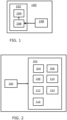
- FIG. 1 is a schematic illustration of a system 100 in accordance with an embodiment of the present disclosure.
- the system 100 comprises an eye segmentation system 102 that comprises a data processing arrangement 104 and at least one input interface 106.
- the at least one input interface 106 receives a facial image of a user from an image capturing device 108 and generates corresponding facial image data.
- the data processing arrangement 104 receives, when in operation, the facial image data of the user as an input data and processes the input data to segment a portion of the input data corresponding to an eye to determine a center point of the eye, a radius of an iris of the eye, and an area of interest from a white area (i.e. sclera ) of the eye.
- a white area i.e. sclera
- the at least one input interface 106 is communicatively connected to the data processing arrangement 104. In an embodiment, the at least one input interface 106 is communicatively connected to the data processing arrangement 104 through a network. The functions of these parts are as described above.
- the functional block diagram of the system comprises at least one input interface 200 and a data processing arrangement 202.
- the functions of these parts are as described above.
- the data processing arrangement 202 includes a facial image receiving module 204, a suitable eye determination module 206, an eye center point determination module 208, an iris radius determination module 210, a pupil determination module 212, a sclera determination module 214 and an area of interest determination module 216.
- These modules are beneficial implemented in hardware units (for example implemented using FPGA's), as software executable on computing hardware, or a combination thereof.
- the facial image receiving module 204 receives the facial image of the user as input data and processes the input data to segment a portion of the input data corresponding to an eye.
- the suitable eye determination module 206 determines an eye that is suitable for segmentation from a left eye and a right eye using at least one quality metric.
- the eye center point determination module 208 determines a center point of the eye using at least one directional filter.
- the iris radius determination module 210 determines a radius of an iris of the eye from the center point of the eye using the at least one directional filter.
- the pupil determination module 212 determines a pupil of the eye using the center point of the eye and the radius of the iris, using a contrast analysis.
- the sclera determination module 214 determines a white area by removing the iris of the eye.
- the area of interest determination module 216 determines an area of interest from the white area by normalizing the white area using white normalization.
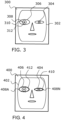
- FIG. 3 there is shown an illustration of an example facial image 300 captured by an image capturing device in accordance with an embodiment of the present disclosure.
- the facial image 300 includes a graphical representation of a face 302 comprising a graphical representation of a left eye 304 and a right eye 306 , both including a sclera 308 , an iris 310 and a pupil 312.
- FIG. 4 there is shown an illustration of an example facial image 400 after an initial level of image analysis performed by a system in accordance with an embodiment of the present disclosure.
- the facial image 400 includes a picture of a face 402.
- the face 402 includes a left eye 404 and a right eye 406.
- Both the left eye 404 and the right eye 406 includes a plurality of eye landmarks 408A-408N.
- the plurality of eye landmarks 408A-408N is defined as a first rectangular area 410 around the left eye 404 and as a second rectangular area 412 around the right eye 406.
- the plurality of eye landmarks 408A-408N around the left eye 404 and the right eye 406 are determined using the initial level image analysis.
- a number of eye landmarks 408A-408N around the left eye 404 and the right eye 406 is six (6). In another embodiment, the number of eye landmarks 408A-408N around the left eye 404 and the right eye 406 are four (4) or eight (8).
- the initial level image analysis determines an eye which is better for eye segmentation. In an embodiment, for example, if the right eye 406 is fully open and the left eye 404 is partly closed, the first rectangular area 410 defined by the left eye 404 is smaller than the second rectangular area 412 defined by the right eye 406. In this case, the second rectangular area 412 defined by the right eye 406 is selected to be suitable for the eye segmentation.
- FIG. 5 there is shown an illustration of an eye 500 of a facial image comprising a sclera 502 , an iris 504 and a pupil 506 in accordance with an embodiment of the present disclosure.
- the eye 500 includes the sclera 502 , the iris 504 and the pupil 506.
- the present system determines a radius of the iris 508 , a radius of the pupil 510 and a center point 512 of the eye 500 as described above.
- the at least one directional filter includes a first directional filter 602 that determines a first radius (r1) of the iris 604 from a facial image of a user.
- the first directional filter 602 is slid over an eye area through a first predetermined way 606 .
- the first predetermined way 606 includes sliding systematically all x values, then indexing y values etc.
- the area of scan within the facial image is beneficially determined using a plurality of eye landmarks determined by an initial image analysis.
- the at least one directional filter includes a second directional filter 608 that determines a second radius (r2) of the iris 610.
- the second directional filter 608 is slid over the eye area through the first predetermined way 606.
- the second radius (r2) of the iris 610 is optionally different from the first radius (r1) of the iris 604.
- the center point (x1, y1) of the eye is determined using the at least one directional filter ( 602 , 608 ).
- the at least one directional filter ( 602 , 608 ) is beneficially oval in shape and is slid over the area of the eye in a predetermined way for determining the radius of the iris of the eye.
- the at least one directional filter ( 602 , 608 ) that is oval in shape optionally has different diameters in one direction than another direction.
- the at least one directional filter ( 602 , 608 ) that is oval in shape is slid in a same way like employed for the circular directional filter.
- the at least one directional filter (602, 608) that is oval in shape is beneficially rotated for different slidings and the best correlation with circular form of the iris is used to compute the center point (x1, y1) of the eye.
- the radius and a rotational angle of the directional filter (602, 608) that is oval in shape is used as an initial value for the radius of the iris or pupil.
- the at least one directional filter (602, 608) scans an eye area separately in x and y directions.
- the at least one directional filter (602, 608) has one or more parameters that may be fully scanned.
- the one or more parameters optionally include x-axis, y-axis, and the radius of the iris r.
- the x-axis, y-axis, and the radius r all have a minimum value and a maximum value.
- the at least one directional filter (602, 608) scan through the loops of all combinations of the one or more parameters.
- FIGS. 7A-7F there are shown illustrations of an example of a basic filter versus at least one directional filter used in segmenting an eye which is partly closed in accordance with an embodiment of the present disclosure.
- FIGS. 7A through 7F each include an image of an eye 702 .
- image edges are detected using the basic filter as depicted in FIG. 7A .
- the image edges with directions 704 are detected using the at least one directional filter of the present system as depicted in FIG. 7B .
- the basic filter 706 as shown in FIG. 7C , is relatively well covered by edge areas and a strong match of the basic filter 706 is depicted in FIG. 7C .
- the at least one directional filter 708 being circular in shape of FIG.
- FIG. 7D depicts the edge directions 704 , and many directions are wrong and the match is weaker as depicted in FIG. 7D for the same image of the eye 702 .
- a relatively weak match 710 of the basic filter is depicted in FIG. 7E .
- a relatively strong match 712 of the at least one directional filter is depicted in FIG. 7F .
- the present system processes reliably, despite stochastic noise being present, very low-quality images that are captured in poor illumination conditions.
- the system reduces an effect of artificial edges created on the facial image due to random noise using directional filtering, thereby improving the detection of the eye and its parts more accurately.
- the present system reduces false matches with perfect data.
- the present system scans in several directions to determine an exact center point of the eye 702 and a radius of the eye 702.
- FIG. 8 there is shown an illustration of a process flow for applying at least one directional filter based on the parameters x, y, and r in accordance with an embodiment of the present disclosure.
- the at least one directional filter is started.
- the ranges of x include x1, x2, x3, ... xn
- the ranges of y include y1, y2, y3, ...
- yn and the ranges of r include r1, r2, r3, ... rn.
- An angle or a shape of the at least one directional filter is optionally included as one of the parameters of the at least one directional filter.
- an initial value at point (xn, y1) is set.
- the eye area is scanned through the ranges by starting from the best prior parameters and by adjusting them until a stop condition is reached.
- a best match that includes the values for x-axis, y-axis, and/or the radius (r) of the iris is identified from the scans of the at least one directional filter.
- the best match is beneficially a best correlation, a best score or a best probability.
- a color value at point (xn, y1) is read.
- the radius of the eye is determined if the color value is greater than a threshold value. If the color value is not greater than the threshold value, the process flow continues to the step 808.
- the radius of the eye is determined.
- the system includes a portable computing device 904 , a communication network 908 and a system server 910.
- the portable computing device 904 includes a camera 906.
- the portable computing device 904 is used by a user 902 to capture a facial image of a face of the user 902.
- the portable computing device 904 is optionally a smartphone, a web pad, a laptop with a camera.
- the portable computing device 904 is configured to communicate the facial image of the user 902 over the communication network 908 to the server system 910.
- the server system 910 processes the facial image to segment an eye to determine a center point, a radius of an iris, and an area of interest from a white area of the eye.
- the server system 910 determines a center point of the eye and therefrom determines a white area of the eye.
- the portable computing device 904 is configured to do all or part of the processing.
- FIG. 10 there is shown an illustration of a flowchart illustrating steps of a method for finding at least one area of interest of a graphical representation of an eye from a facial image, in accordance with an embodiment of the present disclosure.
- a facial image of a user from an image capturing device is received.
- an eye that is suitable for segmentation, from a left eye and a right eye is determined using at least one quality metric.
- a center point of the eye is determined using at least one directional filter.
- a radius of the iris of the eye from the center point of the eye is determined using the at least one directional filter.
- a pupil of the eye is determined using a contrast analysis.
- the white area sclera
- the area of interest is determined from the white area by normalizing the white area using white normalization.
- FIG. 11 there is shown an illustration of an exploded view of a system, including a computing architecture, in accordance with an embodiment of the present disclosure, wherein the system comprises at least one input interface 1102 , a control module that comprises a data processing arrangement 1104 , a memory 1106 and a non-volatile storage 1108 , processing instructions 1110 , storage 1112 , and an image capturing device that comprises a processor 1114 , a memory 1116 and a non-volatile storage 1118 and an output interface 1120.
- the functions of the data processing arrangement 1104 , the least one input interface 1102 are as described above and cooperate together to implement methods of the disclosure as described in the foregoing.
Landscapes
- Engineering & Computer Science (AREA)
- Health & Medical Sciences (AREA)
- Physics & Mathematics (AREA)
- General Health & Medical Sciences (AREA)
- Life Sciences & Earth Sciences (AREA)
- Multimedia (AREA)
- Theoretical Computer Science (AREA)
- General Physics & Mathematics (AREA)
- Oral & Maxillofacial Surgery (AREA)
- Ophthalmology & Optometry (AREA)
- Human Computer Interaction (AREA)
- Computer Vision & Pattern Recognition (AREA)
- Veterinary Medicine (AREA)
- Public Health (AREA)
- Biomedical Technology (AREA)
- Animal Behavior & Ethology (AREA)
- Surgery (AREA)
- Molecular Biology (AREA)
- Biophysics (AREA)
- Medical Informatics (AREA)
- Heart & Thoracic Surgery (AREA)
- Geometry (AREA)
- Image Processing (AREA)
- Image Analysis (AREA)
- Measurement Of The Respiration, Hearing Ability, Form, And Blood Characteristics Of Living Organisms (AREA)
Applications Claiming Priority (1)
| Application Number | Priority Date | Filing Date | Title |
|---|---|---|---|
| US17/004,751 US12029483B2 (en) | 2020-08-27 | 2020-08-27 | System and method for finding an area of an eye from a facial image |
Publications (2)
| Publication Number | Publication Date |
|---|---|
| EP3961495A1 EP3961495A1 (en) | 2022-03-02 |
| EP3961495B1 true EP3961495B1 (en) | 2024-06-26 |
Family
ID=76920508
Family Applications (1)
| Application Number | Title | Priority Date | Filing Date |
|---|---|---|---|
| EP21185196.9A Active EP3961495B1 (en) | 2020-08-27 | 2021-07-13 | System and method for finding an area of an eye from a facial image |
Country Status (3)
| Country | Link |
|---|---|
| US (1) | US12029483B2 (https=) |
| EP (1) | EP3961495B1 (https=) |
| JP (1) | JP2022039984A (https=) |
Families Citing this family (3)
| Publication number | Priority date | Publication date | Assignee | Title |
|---|---|---|---|---|
| US11657648B2 (en) * | 2021-03-31 | 2023-05-23 | Revieve Oy | Method and system for measuring a feature of persons |
| US11792506B2 (en) | 2022-02-09 | 2023-10-17 | Motorola Mobility Llc | Electronic devices and corresponding methods for defining an image orientation of captured images |
| CN116098576A (zh) * | 2022-11-17 | 2023-05-12 | 中国人民解放军总医院第四医学中心 | 一种便携式自动测定瞳孔大小的装置及方法 |
Family Cites Families (11)
| Publication number | Priority date | Publication date | Assignee | Title |
|---|---|---|---|---|
| JP4469476B2 (ja) * | 2000-08-09 | 2010-05-26 | パナソニック株式会社 | 眼位置検出方法および眼位置検出装置 |
| US9053524B2 (en) * | 2008-07-30 | 2015-06-09 | Fotonation Limited | Eye beautification under inaccurate localization |
| US8885882B1 (en) * | 2011-07-14 | 2014-11-11 | The Research Foundation For The State University Of New York | Real time eye tracking for human computer interaction |
| US8804122B2 (en) * | 2011-09-22 | 2014-08-12 | Brightex Bio-Photonics Llc | Systems and methods for determining a surface profile using a plurality of light sources |
| KR101979669B1 (ko) * | 2012-07-13 | 2019-05-17 | 삼성전자주식회사 | 이미지 내 사용자의 시선 보정 방법, 기계로 읽을 수 있는 저장 매체 및 통신 단말 |
| JP2014021782A (ja) * | 2012-07-19 | 2014-02-03 | Canon Inc | 画像処理装置、その制御方法及びプログラム |
| EP3140779A4 (en) * | 2014-05-09 | 2017-11-29 | Google LLC | Systems and methods for using eye signals with secure mobile communications |
| JP6685151B2 (ja) * | 2016-03-08 | 2020-04-22 | 株式会社トプコン | 眼科装置 |
| KR101854991B1 (ko) * | 2016-09-12 | 2018-05-08 | 에스테 로우더, 인코포레이티드 | 눈 흰자위와 동공의 색을 기반으로 한 디지털 이미지 색 보정 방법 및 시스템 |
| JP6751324B2 (ja) * | 2016-09-14 | 2020-09-02 | 株式会社デンソーアイティーラボラトリ | 虹彩検出装置、虹彩検出方法、およびプログラム |
| JP6811971B2 (ja) * | 2019-10-30 | 2021-01-13 | 糧三 齋藤 | 携帯端末用ストレス評価プログラム及び該プログラムを備えた携帯端末 |
-
2020
- 2020-08-27 US US17/004,751 patent/US12029483B2/en active Active
-
2021
- 2021-07-13 EP EP21185196.9A patent/EP3961495B1/en active Active
- 2021-07-19 JP JP2021118356A patent/JP2022039984A/ja active Pending
Also Published As
| Publication number | Publication date |
|---|---|
| US12029483B2 (en) | 2024-07-09 |
| EP3961495A1 (en) | 2022-03-02 |
| US20220061659A1 (en) | 2022-03-03 |
| JP2022039984A (ja) | 2022-03-10 |
Similar Documents
| Publication | Publication Date | Title |
|---|---|---|
| US11775056B2 (en) | System and method using machine learning for iris tracking, measurement, and simulation | |
| CN106056064B (zh) | 一种人脸识别方法及人脸识别装置 | |
| EP3338217B1 (en) | Feature detection and masking in images based on color distributions | |
| CN110852160B (zh) | 以图像为基准的生物识别系统及计算机实施方法 | |
| US7382902B2 (en) | Evaluation of the definition of an eye iris image | |
| EP3961495B1 (en) | System and method for finding an area of an eye from a facial image | |
| Luengo-Oroz et al. | Robust iris segmentation on uncalibrated noisy images using mathematical morphology | |
| CN111524080A (zh) | 脸部皮肤特征的识别方法、终端及计算机设备 | |
| JP4708909B2 (ja) | デジタル画像の対象物検出方法および装置並びにプログラム | |
| KR101612605B1 (ko) | 얼굴 특징점 추출 방법 및 이를 수행하는 장치 | |
| JP2006260397A (ja) | 開眼度推定装置 | |
| JP2007188504A (ja) | 画像中の画素強度をフィルタリングする方法 | |
| CN103778406B (zh) | 对象检测方法及设备 | |
| KR20220107022A (ko) | 안저 영상 식별 방법 및 장치와 기기 | |
| CN109840484A (zh) | 一种基于边缘滤波、椭圆评价和瞳孔验证的瞳孔检测方法 | |
| KR102669584B1 (ko) | 반려동물 생체정보 검출 방법 및 장치 | |
| Srikrishna et al. | Realization of human eye pupil detection system using canny edge detector and circular Hough transform technique | |
| Venkatesan et al. | Face recognition system with genetic algorithm and ANT colony optimization | |
| JP2011170890A (ja) | 顔検出方法および装置並びにプログラム | |
| Chen et al. | A computational efficient iris extraction approach in unconstrained environments | |
| Fathy et al. | Benchmarking of pre-processing methods employed in facial image analysis | |
| JP2018005505A (ja) | 画像認識パラメータ設定装置、画像認識パラメータ設定方法、および画像認識パラメータ設定プログラム | |
| Greco et al. | Saliency based aesthetic cut of digital images | |
| JP4795737B2 (ja) | 顔検出方法および装置並びにプログラム | |
| Riaz et al. | Visibility restoration using generalized haze-lines |
Legal Events
| Date | Code | Title | Description |
|---|---|---|---|
| PUAI | Public reference made under article 153(3) epc to a published international application that has entered the european phase |
Free format text: ORIGINAL CODE: 0009012 |
|
| STAA | Information on the status of an ep patent application or granted ep patent |
Free format text: STATUS: THE APPLICATION HAS BEEN PUBLISHED |
|
| AK | Designated contracting states |
Kind code of ref document: A1 Designated state(s): AL AT BE BG CH CY CZ DE DK EE ES FI FR GB GR HR HU IE IS IT LI LT LU LV MC MK MT NL NO PL PT RO RS SE SI SK SM TR |
|
| STAA | Information on the status of an ep patent application or granted ep patent |
Free format text: STATUS: REQUEST FOR EXAMINATION WAS MADE |
|
| 17P | Request for examination filed |
Effective date: 20220902 |
|
| RBV | Designated contracting states (corrected) |
Designated state(s): AL AT BE BG CH CY CZ DE DK EE ES FI FR GB GR HR HU IE IS IT LI LT LU LV MC MK MT NL NO PL PT RO RS SE SI SK SM TR |
|
| REG | Reference to a national code |
Ref country code: DE Ref legal event code: R079 Free format text: PREVIOUS MAIN CLASS: G06K0009000000 Ipc: G06V0010440000 Ref document number: 602021014727 Country of ref document: DE |
|
| GRAP | Despatch of communication of intention to grant a patent |
Free format text: ORIGINAL CODE: EPIDOSNIGR1 |
|
| STAA | Information on the status of an ep patent application or granted ep patent |
Free format text: STATUS: GRANT OF PATENT IS INTENDED |
|
| RIC1 | Information provided on ipc code assigned before grant |
Ipc: G06V 40/18 20220101ALI20240119BHEP Ipc: G06V 10/44 20220101AFI20240119BHEP |
|
| INTG | Intention to grant announced |
Effective date: 20240207 |
|
| GRAS | Grant fee paid |
Free format text: ORIGINAL CODE: EPIDOSNIGR3 |
|
| GRAA | (expected) grant |
Free format text: ORIGINAL CODE: 0009210 |
|
| STAA | Information on the status of an ep patent application or granted ep patent |
Free format text: STATUS: THE PATENT HAS BEEN GRANTED |
|
| AK | Designated contracting states |
Kind code of ref document: B1 Designated state(s): AL AT BE BG CH CY CZ DE DK EE ES FI FR GB GR HR HU IE IS IT LI LT LU LV MC MK MT NL NO PL PT RO RS SE SI SK SM TR |
|
| REG | Reference to a national code |
Ref country code: GB Ref legal event code: FG4D |
|
| REG | Reference to a national code |
Ref country code: CH Ref legal event code: EP |
|
| REG | Reference to a national code |
Ref country code: DE Ref legal event code: R096 Ref document number: 602021014727 Country of ref document: DE |
|
| PG25 | Lapsed in a contracting state [announced via postgrant information from national office to epo] |
Ref country code: BG Free format text: LAPSE BECAUSE OF FAILURE TO SUBMIT A TRANSLATION OF THE DESCRIPTION OR TO PAY THE FEE WITHIN THE PRESCRIBED TIME-LIMIT Effective date: 20240626 |
|
| PG25 | Lapsed in a contracting state [announced via postgrant information from national office to epo] |
Ref country code: FI Free format text: LAPSE BECAUSE OF FAILURE TO SUBMIT A TRANSLATION OF THE DESCRIPTION OR TO PAY THE FEE WITHIN THE PRESCRIBED TIME-LIMIT Effective date: 20240626 Ref country code: HR Free format text: LAPSE BECAUSE OF FAILURE TO SUBMIT A TRANSLATION OF THE DESCRIPTION OR TO PAY THE FEE WITHIN THE PRESCRIBED TIME-LIMIT Effective date: 20240626 |
|
| REG | Reference to a national code |
Ref country code: LT Ref legal event code: MG9D |
|
| PG25 | Lapsed in a contracting state [announced via postgrant information from national office to epo] |
Ref country code: GR Free format text: LAPSE BECAUSE OF FAILURE TO SUBMIT A TRANSLATION OF THE DESCRIPTION OR TO PAY THE FEE WITHIN THE PRESCRIBED TIME-LIMIT Effective date: 20240927 |
|
| PG25 | Lapsed in a contracting state [announced via postgrant information from national office to epo] |
Ref country code: LV Free format text: LAPSE BECAUSE OF FAILURE TO SUBMIT A TRANSLATION OF THE DESCRIPTION OR TO PAY THE FEE WITHIN THE PRESCRIBED TIME-LIMIT Effective date: 20240626 |
|
| REG | Reference to a national code |
Ref country code: NL Ref legal event code: MP Effective date: 20240626 |
|
| PG25 | Lapsed in a contracting state [announced via postgrant information from national office to epo] |
Ref country code: NO Free format text: LAPSE BECAUSE OF FAILURE TO SUBMIT A TRANSLATION OF THE DESCRIPTION OR TO PAY THE FEE WITHIN THE PRESCRIBED TIME-LIMIT Effective date: 20240926 Ref country code: LV Free format text: LAPSE BECAUSE OF FAILURE TO SUBMIT A TRANSLATION OF THE DESCRIPTION OR TO PAY THE FEE WITHIN THE PRESCRIBED TIME-LIMIT Effective date: 20240626 Ref country code: HR Free format text: LAPSE BECAUSE OF FAILURE TO SUBMIT A TRANSLATION OF THE DESCRIPTION OR TO PAY THE FEE WITHIN THE PRESCRIBED TIME-LIMIT Effective date: 20240626 Ref country code: GR Free format text: LAPSE BECAUSE OF FAILURE TO SUBMIT A TRANSLATION OF THE DESCRIPTION OR TO PAY THE FEE WITHIN THE PRESCRIBED TIME-LIMIT Effective date: 20240927 Ref country code: FI Free format text: LAPSE BECAUSE OF FAILURE TO SUBMIT A TRANSLATION OF THE DESCRIPTION OR TO PAY THE FEE WITHIN THE PRESCRIBED TIME-LIMIT Effective date: 20240626 Ref country code: BG Free format text: LAPSE BECAUSE OF FAILURE TO SUBMIT A TRANSLATION OF THE DESCRIPTION OR TO PAY THE FEE WITHIN THE PRESCRIBED TIME-LIMIT Effective date: 20240626 Ref country code: RS Free format text: LAPSE BECAUSE OF FAILURE TO SUBMIT A TRANSLATION OF THE DESCRIPTION OR TO PAY THE FEE WITHIN THE PRESCRIBED TIME-LIMIT Effective date: 20240926 |
|
| PG25 | Lapsed in a contracting state [announced via postgrant information from national office to epo] |
Ref country code: NL Free format text: LAPSE BECAUSE OF FAILURE TO SUBMIT A TRANSLATION OF THE DESCRIPTION OR TO PAY THE FEE WITHIN THE PRESCRIBED TIME-LIMIT Effective date: 20240626 |
|
| REG | Reference to a national code |
Ref country code: AT Ref legal event code: MK05 Ref document number: 1698368 Country of ref document: AT Kind code of ref document: T Effective date: 20240626 |
|
| PG25 | Lapsed in a contracting state [announced via postgrant information from national office to epo] |
Ref country code: NL Free format text: LAPSE BECAUSE OF FAILURE TO SUBMIT A TRANSLATION OF THE DESCRIPTION OR TO PAY THE FEE WITHIN THE PRESCRIBED TIME-LIMIT Effective date: 20240626 |
|
| PG25 | Lapsed in a contracting state [announced via postgrant information from national office to epo] |
Ref country code: PT Free format text: LAPSE BECAUSE OF FAILURE TO SUBMIT A TRANSLATION OF THE DESCRIPTION OR TO PAY THE FEE WITHIN THE PRESCRIBED TIME-LIMIT Effective date: 20241028 |
|
| PG25 | Lapsed in a contracting state [announced via postgrant information from national office to epo] |
Ref country code: PT Free format text: LAPSE BECAUSE OF FAILURE TO SUBMIT A TRANSLATION OF THE DESCRIPTION OR TO PAY THE FEE WITHIN THE PRESCRIBED TIME-LIMIT Effective date: 20241028 |
|
| PG25 | Lapsed in a contracting state [announced via postgrant information from national office to epo] |
Ref country code: PL Free format text: LAPSE BECAUSE OF FAILURE TO SUBMIT A TRANSLATION OF THE DESCRIPTION OR TO PAY THE FEE WITHIN THE PRESCRIBED TIME-LIMIT Effective date: 20240626 |
|
| PG25 | Lapsed in a contracting state [announced via postgrant information from national office to epo] |
Ref country code: EE Free format text: LAPSE BECAUSE OF FAILURE TO SUBMIT A TRANSLATION OF THE DESCRIPTION OR TO PAY THE FEE WITHIN THE PRESCRIBED TIME-LIMIT Effective date: 20240626 |
|
| PG25 | Lapsed in a contracting state [announced via postgrant information from national office to epo] |
Ref country code: IS Free format text: LAPSE BECAUSE OF FAILURE TO SUBMIT A TRANSLATION OF THE DESCRIPTION OR TO PAY THE FEE WITHIN THE PRESCRIBED TIME-LIMIT Effective date: 20241026 Ref country code: AT Free format text: LAPSE BECAUSE OF FAILURE TO SUBMIT A TRANSLATION OF THE DESCRIPTION OR TO PAY THE FEE WITHIN THE PRESCRIBED TIME-LIMIT Effective date: 20240626 |
|
| PG25 | Lapsed in a contracting state [announced via postgrant information from national office to epo] |
Ref country code: CZ Free format text: LAPSE BECAUSE OF FAILURE TO SUBMIT A TRANSLATION OF THE DESCRIPTION OR TO PAY THE FEE WITHIN THE PRESCRIBED TIME-LIMIT Effective date: 20240626 |
|
| PG25 | Lapsed in a contracting state [announced via postgrant information from national office to epo] |
Ref country code: RO Free format text: LAPSE BECAUSE OF FAILURE TO SUBMIT A TRANSLATION OF THE DESCRIPTION OR TO PAY THE FEE WITHIN THE PRESCRIBED TIME-LIMIT Effective date: 20240626 Ref country code: SK Free format text: LAPSE BECAUSE OF FAILURE TO SUBMIT A TRANSLATION OF THE DESCRIPTION OR TO PAY THE FEE WITHIN THE PRESCRIBED TIME-LIMIT Effective date: 20240626 |
|
| PG25 | Lapsed in a contracting state [announced via postgrant information from national office to epo] |
Ref country code: ES Free format text: LAPSE BECAUSE OF FAILURE TO SUBMIT A TRANSLATION OF THE DESCRIPTION OR TO PAY THE FEE WITHIN THE PRESCRIBED TIME-LIMIT Effective date: 20240626 Ref country code: SM Free format text: LAPSE BECAUSE OF FAILURE TO SUBMIT A TRANSLATION OF THE DESCRIPTION OR TO PAY THE FEE WITHIN THE PRESCRIBED TIME-LIMIT Effective date: 20240626 |
|
| PG25 | Lapsed in a contracting state [announced via postgrant information from national office to epo] |
Ref country code: SM Free format text: LAPSE BECAUSE OF FAILURE TO SUBMIT A TRANSLATION OF THE DESCRIPTION OR TO PAY THE FEE WITHIN THE PRESCRIBED TIME-LIMIT Effective date: 20240626 Ref country code: SK Free format text: LAPSE BECAUSE OF FAILURE TO SUBMIT A TRANSLATION OF THE DESCRIPTION OR TO PAY THE FEE WITHIN THE PRESCRIBED TIME-LIMIT Effective date: 20240626 Ref country code: RO Free format text: LAPSE BECAUSE OF FAILURE TO SUBMIT A TRANSLATION OF THE DESCRIPTION OR TO PAY THE FEE WITHIN THE PRESCRIBED TIME-LIMIT Effective date: 20240626 Ref country code: PL Free format text: LAPSE BECAUSE OF FAILURE TO SUBMIT A TRANSLATION OF THE DESCRIPTION OR TO PAY THE FEE WITHIN THE PRESCRIBED TIME-LIMIT Effective date: 20240626 Ref country code: IS Free format text: LAPSE BECAUSE OF FAILURE TO SUBMIT A TRANSLATION OF THE DESCRIPTION OR TO PAY THE FEE WITHIN THE PRESCRIBED TIME-LIMIT Effective date: 20241026 Ref country code: ES Free format text: LAPSE BECAUSE OF FAILURE TO SUBMIT A TRANSLATION OF THE DESCRIPTION OR TO PAY THE FEE WITHIN THE PRESCRIBED TIME-LIMIT Effective date: 20240626 Ref country code: EE Free format text: LAPSE BECAUSE OF FAILURE TO SUBMIT A TRANSLATION OF THE DESCRIPTION OR TO PAY THE FEE WITHIN THE PRESCRIBED TIME-LIMIT Effective date: 20240626 Ref country code: CZ Free format text: LAPSE BECAUSE OF FAILURE TO SUBMIT A TRANSLATION OF THE DESCRIPTION OR TO PAY THE FEE WITHIN THE PRESCRIBED TIME-LIMIT Effective date: 20240626 Ref country code: AT Free format text: LAPSE BECAUSE OF FAILURE TO SUBMIT A TRANSLATION OF THE DESCRIPTION OR TO PAY THE FEE WITHIN THE PRESCRIBED TIME-LIMIT Effective date: 20240626 |
|
| PG25 | Lapsed in a contracting state [announced via postgrant information from national office to epo] |
Ref country code: IT Free format text: LAPSE BECAUSE OF FAILURE TO SUBMIT A TRANSLATION OF THE DESCRIPTION OR TO PAY THE FEE WITHIN THE PRESCRIBED TIME-LIMIT Effective date: 20240626 |
|
| REG | Reference to a national code |
Ref country code: CH Ref legal event code: PL |
|
| PG25 | Lapsed in a contracting state [announced via postgrant information from national office to epo] |
Ref country code: LU Free format text: LAPSE BECAUSE OF NON-PAYMENT OF DUE FEES Effective date: 20240713 |
|
| PG25 | Lapsed in a contracting state [announced via postgrant information from national office to epo] |
Ref country code: MC Free format text: LAPSE BECAUSE OF FAILURE TO SUBMIT A TRANSLATION OF THE DESCRIPTION OR TO PAY THE FEE WITHIN THE PRESCRIBED TIME-LIMIT Effective date: 20240626 |
|
| REG | Reference to a national code |
Ref country code: DE Ref legal event code: R097 Ref document number: 602021014727 Country of ref document: DE |
|
| PG25 | Lapsed in a contracting state [announced via postgrant information from national office to epo] |
Ref country code: MC Free format text: LAPSE BECAUSE OF FAILURE TO SUBMIT A TRANSLATION OF THE DESCRIPTION OR TO PAY THE FEE WITHIN THE PRESCRIBED TIME-LIMIT Effective date: 20240626 Ref country code: LU Free format text: LAPSE BECAUSE OF NON-PAYMENT OF DUE FEES Effective date: 20240713 |
|
| PG25 | Lapsed in a contracting state [announced via postgrant information from national office to epo] |
Ref country code: DK Free format text: LAPSE BECAUSE OF FAILURE TO SUBMIT A TRANSLATION OF THE DESCRIPTION OR TO PAY THE FEE WITHIN THE PRESCRIBED TIME-LIMIT Effective date: 20240626 |
|
| PG25 | Lapsed in a contracting state [announced via postgrant information from national office to epo] |
Ref country code: CH Free format text: LAPSE BECAUSE OF NON-PAYMENT OF DUE FEES Effective date: 20240731 Ref country code: BE Free format text: LAPSE BECAUSE OF NON-PAYMENT OF DUE FEES Effective date: 20240731 |
|
| PLBE | No opposition filed within time limit |
Free format text: ORIGINAL CODE: 0009261 |
|
| STAA | Information on the status of an ep patent application or granted ep patent |
Free format text: STATUS: NO OPPOSITION FILED WITHIN TIME LIMIT |
|
| 26N | No opposition filed |
Effective date: 20250327 |
|
| REG | Reference to a national code |
Ref country code: BE Ref legal event code: MM Effective date: 20240731 |
|
| PG25 | Lapsed in a contracting state [announced via postgrant information from national office to epo] |
Ref country code: IE Free format text: LAPSE BECAUSE OF NON-PAYMENT OF DUE FEES Effective date: 20240713 |
|
| PG25 | Lapsed in a contracting state [announced via postgrant information from national office to epo] |
Ref country code: SE Free format text: LAPSE BECAUSE OF FAILURE TO SUBMIT A TRANSLATION OF THE DESCRIPTION OR TO PAY THE FEE WITHIN THE PRESCRIBED TIME-LIMIT Effective date: 20240626 |
|
| PGFP | Annual fee paid to national office [announced via postgrant information from national office to epo] |
Ref country code: DE Payment date: 20250722 Year of fee payment: 5 |
|
| PGFP | Annual fee paid to national office [announced via postgrant information from national office to epo] |
Ref country code: GB Payment date: 20250722 Year of fee payment: 5 |
|
| PGFP | Annual fee paid to national office [announced via postgrant information from national office to epo] |
Ref country code: FR Payment date: 20250725 Year of fee payment: 5 |
|
| PG25 | Lapsed in a contracting state [announced via postgrant information from national office to epo] |
Ref country code: CY Free format text: LAPSE BECAUSE OF FAILURE TO SUBMIT A TRANSLATION OF THE DESCRIPTION OR TO PAY THE FEE WITHIN THE PRESCRIBED TIME-LIMIT; INVALID AB INITIO Effective date: 20210713 |
|
| PG25 | Lapsed in a contracting state [announced via postgrant information from national office to epo] |
Ref country code: HU Free format text: LAPSE BECAUSE OF FAILURE TO SUBMIT A TRANSLATION OF THE DESCRIPTION OR TO PAY THE FEE WITHIN THE PRESCRIBED TIME-LIMIT; INVALID AB INITIO Effective date: 20210713 |